
From the FasterSkier archive — posts syndicated from athletes’ and coaches’ own blogs between 2004 and 2012, kept online as published. Current coverage is at fasterskier.com.

Tag: University of Utah skiing

  • Eli Brown – The Ski Caddy

    Eli Brown – The Ski Caddy

    This article was made possible through the generous support of our voluntary subscribers. If you value coverage like this, please support FasterSkier with a voluntary subscription.

    Waxing Julia Kern’s skis in Toblach New Years 2026. (Photo: Courtesy Photo)

    On race mornings, when the athletes are still quiet, and the stadium hasn’t yet decided what kind of day it wants to be, Eli Brown is already working through choices that won’t appear anywhere in the results sheet.

    Brown is a technician for the U.S. Cross-Country Ski Team, a job title that undersells the reality of what he does. He manages ski fleets that can swell to dozens of pairs for each athlete, interprets snow that changes by the hour, balances structure, flex, base material, and wax, and does it all while standing between an athlete’s confidence and the unforgiving arithmetic of international racing. He describes the role with a metaphor that is so perfect and precise.

    “It’s kind of like being a golf caddy,” Brown said. “You’re advising. You’re coaching. You’re listening. There’s some sports psychology in there. And at the end of the day, it’s teamwork.”

    The difference, of course, is speed. Brown’s athletes are making decisions at speeds that at times surpass fifty kilometers an hour, on snow that doesn’t care how good yesterday felt. His job is to make sure they don’t have to think about their skis at all.

    This week, as the U.S. team arrives in Val di Fiemme for the 2026 Olympic Games, Brown is heading into his third Olympics as a full-time national team technician. He works primarily with Julia Kern and Ben Ogden, two athletes who could hardly be more different in how they move through the sport — or through their skis.

    What ties them together is Brown’s ability to translate snow into something usable and pressure into something manageable.

    The Mora (Minnesota) Vasaloppet in 1983. (Photo: Courtesy Photo)

    Before the Truck

    Brown didn’t arrive in the U.S. Ski Team wax truck by accident, or through a single decisive turn. He arrived there by staying in the sport long enough to see it from nearly every angle.

    He grew up outside Minneapolis, where skiing was part of the landscape rather than a specialization. From there, he headed north to Northern Michigan University, spending time embedded in one of the country’s most storied distance programs. He raced, trained, and lived the rhythms of high-level skiing there, even if the academic endpoint never quite aligned. The years mattered anyway.

    After Northern, Brown continued racing at a high level, lining up on the SuperTour with the Maine Winter Sports Center. Those seasons placed him squarely inside the domestic pipeline, moving between venues, teams, and support systems that most fans never see. It was an education in how competitive skiing actually functions in the United States — who does what, who makes decisions, and how outcomes are shaped long before race day.

    Coaching followed. Brown took over as head coach at the University of Utah, a role that asked him to shift from personal performance to collective responsibility. Coaching meant planning seasons, managing personalities, and learning how to communicate under pressure — skills that would later prove just as valuable off the racecourse as on it. It was also in Utah that he completed his degree, closing a chapter that had remained open since his time at Northern.

    His transition into technician work came gradually. After the 2014 Sochi Olympics, Brown began volunteering with the U.S. Ski Team as a tech, contributing where he could and learning how the national program operated from the inside. There was no formal on-ramp. He showed up, worked, and earned trust in the most durable way possible.

    Later that year, he became a full-time member of the U.S. Ski Team staff. He has remained in that role since, now heading into his third Olympic Games as a technician.

    That long, nonlinear path matters because it produced range. Brown understands athletes because he has been one. He understands coaches because he has been one. And he understands the demands of elite racing because he has lived alongside them for decades, in roles that rarely attract attention.

    By the time he steps into the wax truck now, Brown isn’t just a specialist. He’s a translator — carrying experience forward from each stage of his career and applying it quietly, in service of athletes who don’t have time to wonder how their skis came to be ready.

    Trailside support back in the 90’s. (Photo: Courtesy Photo)

    The Job Is Not the Ski

    Brown came up in an era when elite racers still did most of their own ski work. He’s part of what he calls “the last generation of full-time racers who maintained their own equipment,” a background that shapes how he approaches the modern technician’s role.

    Today, that role is far more layered than waxing alone. A tech has to understand how structure reduces suction in wet snow, how flex interacts with kick wax in classic skiing and changes contact on skate skiing, how base materials respond to temperature and moisture, and how all of that feels under an athlete who has preferences, moves differently, and skis faster than the tech ever will.

    “It’s complicated,” Brown said, describing how structure, grinds, and brands interact. “How it interacts with different brands and different grinds. Now we have to make sure that it interacts with our new grinds as we develop them, especially for race days in the games coming up.”

    The complexity has only increased in recent years. Product cycles are shorter. Wax formulations change constantly. “If you ask me what waxes we use,” Brown said, “it’s a combination of letters and numbers. From Swix or whoever. It’s always changing.”

    That instability has pushed the job away from recipes and toward judgment. Brown doesn’t describe himself as a scientist. He calls himself an artist.

    “I rely heavily on feel,” he said, contrasting his approach with colleagues who lean more on data. “There’s subjective testing, and that’s still really important.”

    The goal is simple, even if the path there isn’t: remove friction, remove doubt, and give the athlete skis they can trust without thinking.

    Julia Kern, Eli Brown, and Ben Ogden at the Planica World Championship. (Photo: Courtesy Photo)

    One Pair of Skis, Two Skiers

    Brown’s ability to individualize that trust is most obvious in the contrast between the two athletes he supports.

    “They’re such different athletes,” he said of Kern and Ogden. “And the way they ski, I think, is also different in the way that their ski brands are also different. So it’s hard to say there’s much crossover or similarity there.”

    Kern (Atomic) and Ogden (Madshus) race on different brands, which means separate quivers, separate development conversations, and separate ways of defining what “good” feels like. Over time, those preferences shape the skis themselves.

    “The quiver of skis develops kind of along with what the athlete wants,” Brown said. “Whether by effort or by chance.”

    For Brown, that means his own body becomes a tool — a reference point for athletes whose sensations he can’t fully replicate. In classic skiing, especially, the feedback loop is intimate and physical.

    “With Julia,” Brown said, “if I can feel the wax, then it’s good. And with Ben, I need to jump on those things and make them work. I need a hammer almost to keep up with him when he’s skiing easy.”

    Kern wants skis that give her clear feedback. Ogden wants skis that disappear under him.

    “She calls it the Eli Factor,” Brown said. “I ski in her skis a lot, and it’s like, yeah, she’ll like it if it feels a touch slow. And I question if it’s fast enough, then it’s perfect for her.”

    That calibration — knowing when “slow” is actually right — is the kind of knowledge that doesn’t show up in spreadsheets. It lives in repetition, in trust, and in the willingness to be wrong and adjust.

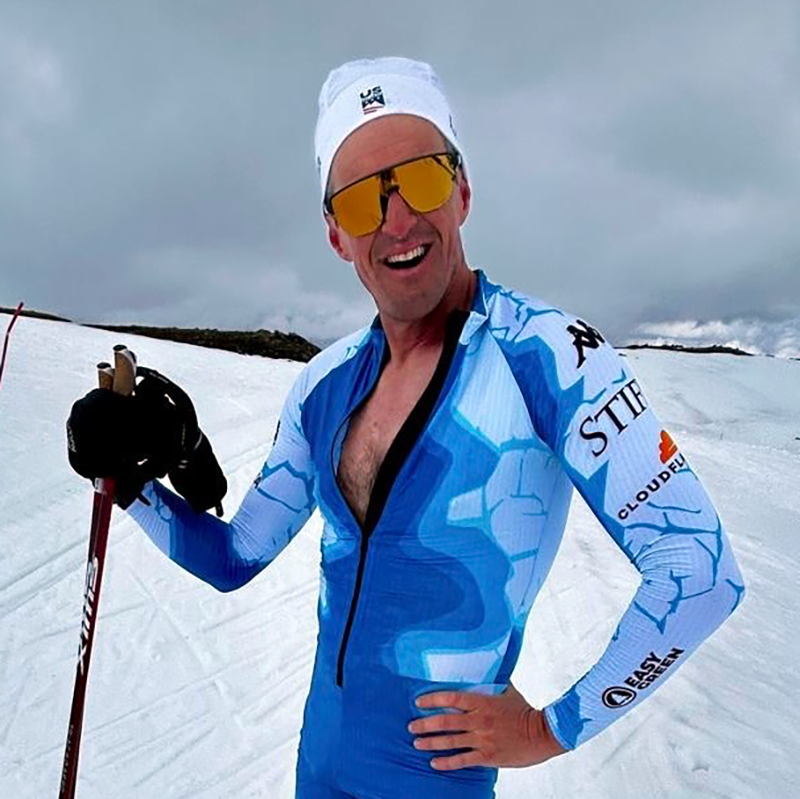
    Eli modeling the new Kappa kit inside the wax truck. (Photo: Courtesy Photo)

    Inside Yolanda

    The work happens inside a semi-truck the team calls Yolanda, a mobile workshop and nerve center that houses eight technicians during World Cup weekends and championships.

    “When you walk into Yolanda,” Brown said, “on the left, there’s Jason. He’s like the door security.”

    Jason Cork oversees Jesse Diggins’ skis and manages data. Across from him sits Chris Heckler, the team’s glide specialist, responsible for Gus Schumacher’s skis and for pushing development at the cutting edge. In the back corner is Oleg Ragilo, “a quiet boss from Estonia,” the head of kick wax and the truck’s mechanic. Tim Baucom, recently returned from retirement, handles hand structure. Bernie Nelson works with Jack Young and specializes in high-speed testing and emotional steadiness. Bjorn Heimdal and Per Erik Bjørnstad, both from northern Norway, bring decades of experience across glide and kick.

    “And then at table three,” Brown said, “it’s Bernie and me.”

    Everyone can wear any hat if needed, but the structure matters. Decisions are made by conversation, testing, and sometimes by vote. Kick wax choices are made by committee — “two out of three or three out of three votes advance skis” — a system designed to protect athletes from any single person’s blind spot.

    There’s humor inside the pressure. The team maintains a set of traveling trophies, passed around to mark gratitude, effort, or apology. It’s a way of acknowledging that success and failure are shared.

    “You’re on a roller coaster together,” Brown said. “The emotional roller coaster part.”

    Team Kern: Eli Brown, Julia Kern, and Kristen Bourne in Toblach. (Photo: Courtesy Photo)

    Relearning Speed

    The current era of ski preparation is defined by change. Products come and go. Environmental and health concerns have reshaped what’s allowed. Even trusted solutions can’t be trusted for long.

    “We’re on the cutting edge,” Brown said, “and it’s constantly changing.”

    That volatility has made high-speed testing more important than ever, especially in skate races where structure and glide decisions can hinge on how skis behave at race pace on the actual course. Hand structure tools, brand-specific grinds, and new base materials all interact in ways that don’t fully reveal themselves on paper.

    Brown sees his role as filtering that uncertainty before it reaches the athlete.

    “I don’t want them thinking about it,” he said. “I want them to just ski.”

    The Olympics compress all of that work. The venue in Val di Fiemme is familiar, but transformed by Olympic infrastructure. Warm weather looms as a wildcard. The margin for error narrows.

    Looking back on the Tour de Ski, Brown is candid about what he’d change. “I wish I’d given Julia slightly more kick,” he said. “Ben slightly less kick.”

    That kind of reflection isn’t self-flagellation. It’s the process.

    Eli and fiancé Colleen above snowy Predazzo days before the Olympics start. (Photo: Courtesy Photo)

    The Emotional Work

    If the technical demands are invisible, the emotional ones are even more so. A tech absorbs disappointment, so an athlete doesn’t have to. He steadies confidence when results wobble. He celebrates quietly when things click.

    Brown talks about success in broader terms than medals.

    “Gold is the goal,” he said. “But it’s also maintaining team relationships and health through an intense period.”

    That perspective extends beyond race results to the ecosystem around the sport. Brown worries about industry instability, about layoffs and shrinking budgets, about whether the work he and others do will continue to be supported.

    “We’re all one big community trying to do something special,” he said. “It’s my little cog in the machine.”

    Inside Yolanda, that belief takes practical form. Shared meals. Shared jokes. Shared responsibility when something goes wrong. The trophies circulate. The work continues.

    Skiing the 2025 Birkie with his dad, Elton Brown. (Photo: Courtesy Photo)

    What Happens When It Works

    When it works, there’s no single moment that announces it. No flag. No statistic. Just an athlete skiing freely, unencumbered by doubt.

    Brown watches from the side of the course or from inside the truck, reading body language, listening for feedback, and filing away information for the next decision. The skis disappear. The job is done.

    That’s the paradox of being a golf caddy or maybe more accurately a ski caddy: success means becoming invisible.

    For Eli Brown, that invisibility is the point.


    Help Support Our Olympic Coverage!

    FasterSkier will have our own Nat Herz on the ground at the Olympics, which, to be honest, is a very big financial lift for us. If you value the thoughtful work and access FasterSkier provides at championships like this one, please consider becoming a Voluntary Subscriber. Your support directly fuels the work we do to cover the people, places, and moments that make our sport special.

    Join the FasterSkier community!


    Eli and fiancé Colleen doing some pre Olympic cruising. (Photo: Courtesy Photo)
  • Calculations and Consequences: The Men’s Classic Sprint at U.S. Nationals

    Calculations and Consequences: The Men’s Classic Sprint at U.S. Nationals

    This article was made possible through the generous support of our voluntary subscribers. If you value coverage like this, please support FasterSkier with a voluntary subscription.

    The men’s Classic Sprint heats got started with quarterfinal number one at the US Nationals Cross-Country Ski Championship at Mt Vanhoevenberg in Lake Placid NY. (Photo Nancie Battaglia)

    The last day of the U.S. National Cross-Country Ski Championships in Lake Placid arrived the way honest days in this sport often do. The snow at Mt. Van Hoevenberg had been churned and scoured by a week of racing and changing weather, its surface no longer pristine but revealing, the kind that gives little for free. Legs were tired. Arms were tender. Expectations had been trimmed back by accumulated kilometers and decisions already made.

    For the men lining up for the classic sprint, this was not simply a final chance at a national title. In an Olympic winter, nothing is ever only what it claims to be. The sprint was an audition—not necessarily for Olympic selection, but for relevance. For future start rights. For the ability to say, credibly, that range still exists.

    Sprint qualification, in particular, has a way of stripping sport down to its essentials. No drafting. No hiding. One lap to explain yourself. As has been said all week about sprints, it does not matter how clever you are in the heats if you cannot arrive there in the first place. In Lake Placid, that truth shaped the day from the first starter onward.

    Fin Bailey (UVM) makes his way up the Lake Placid sprint course’s signature climb. (Photo Nancie Battaglia)

    Qualification: where the day declares itself

    Qualification mattered here in a way that went beyond podiums and medals. With sprint start rights in the World Cup largely determined by qualification speed, the men knew exactly what was at stake. If this were a sorting mechanism, it was a blunt one.

    The fastest man through the course was John Schwinghamer, whose time at the top of the board set the early benchmark. But the story quickly widened. Pierre Grall-Johnson followed closely, and then Will Koch, who would soon become central to the day’s most unusual tactical thread, placed third.

    A few seconds farther back sat a cluster of names that told a deeper story: athletes with distance pedigrees, athletes chasing U23 selection, athletes managing fatigue from a long week and still trying to produce speed on demand.

    Among them was Zanden McMullen, who qualified tenth, solid but not dominant. “The qualifier felt a little off,” McMullen admitted. “I didn’t feel smooth and thought I skied poorly through the terrain. I was happy to qualify and have another chance to improve on the day.”

    That, in retrospect, was the quiet warning shot.

    Classic striding versus powerful double poling was one of the key storylines in the men’s Classic Sprint. (Photo Nancie Battaglia)

    A decision made in minutes

    If qualification is the most honest part of sprinting, it is also where improvisation sometimes reveals itself. Koch arrived at the start line with little margin and even less certainty.

    “I was already pretty tired going into the classic sprint,” Koch said. A bonk midway through the 20-kilometer freestyle earlier in the week had drained his reserves, and classic sprint had never been his strength. “With about ten minutes to go before my qualifier, I still couldn’t get my classic skis to kick.”

    The decision that followed was not theoretical. Koch asked his coach to prepare a pair of skate skis — not as a backup, but as a commitment. He reached the start with roughly 90 seconds to spare, hoping that strength alone might be enough to advance.

    Third in the qualifier erased doubt immediately. “When I ended up third, I knew it was the right call,” he said. “I never even tested a classic ski the rest of the day.”

    The gamble would ripple through every round that followed.

    Will Koch (SVSEF) powered through the qualification and heats, double poling on skate skis. (Photo Nancie Battaglia)

    Heats: when fatigue starts to speak

    Classic sprint heats at Mt. Van Hoevenberg reward clarity. The course offers opportunities, but they are conditional. Mistime a move, and the course and competition punish hesitation. Get trapped behind the wrong skis, and speed evaporates.

    Koch’s plan was simple and exhausting: lead early, create space before the climb, and survive long enough for glide to matter again. “If I could crest the climb with the group, my skis would be fast enough to carry me through,” he explained.

    For a time, it worked exactly as intended.

    But others were playing different games.

    Zach Jayne arrived at the sprint with a different set of calculations. Already qualified for U23 Worlds and carrying a narrow SuperTour points lead, his goals were layered. “I wanted to finish strong,” Jayne said. “I also wanted to make the final so I could displace other U23 athletes and help ensure my teammate Max Kluck made the trip.”

    Jayne, Koch, and teammate Carl Rune all opted to double-pole the heats on skate skis, a choice that paid dividends early. “It worked really well in the quarterfinal,” Jayne said. “But as the rounds went on and fatigue built, I was definitely wishing I’d brought a pair of klister skis.”

    That fatigue — cumulative, unrelenting — became the quiet theme of the afternoon.

    Zanden McMullen (APU) showed he had made the right calculations for himself in the final, creating a gap on the large climb, which he was able to maintain on the final downhill. (Photo Nancie Battaglia)

    Trusting kick in uncertain snow

    While some chased glide, Max Kluck made a different bet. His week had been defined by nerves more than novelty. “I was more nervous than I’ve been in years,” Kluck said. “I knew my U23 spot was on the line.”

    The snow tempted experimentation, but Kluck resisted. “I was pretty certain I wanted to stay on classic skis unless the weather took a major turn,” he explained. “I stuck with my gut.”

    The reward came immediately. In the quarterfinals, Kluck ran the climb with confidence, kick biting cleanly while others labored, arms already beginning to pay the price. “I figured I might be able to make double-poling work once,” he said. “But I didn’t think I could personally do it four times.”

    His solution was economy. By trusting his wax and striding more often, Kluck preserved his upper body for the finishing straight — a detail that would matter later.

    UVM’s Fin Bailey was showing he was on form and a threat for the podium throughout the heats, but his final got off to an unlucky start with a broken pole. (Photo Nancie Battaglia)

    The final: legs versus arms

    By the time the final assembly was complete, the calculus was visible even from the sidelines. The men who had double-poled all day carried speed — and fatigue. Those who had relied on kick carried legs.

    McMullen understood the equation precisely. “Going into the final, I knew the few boys that double-poled all day would be tired,” he said. “My plan was to keep them in reach before the final climb and then gap them.”

    Snow conditions had continued to degrade, wind and rain complicating grip and timing. McMullen’s classic skis, however, remained reliable. “Our classic skis felt good,” he said. “I didn’t think there was a need to try and double-pole the race.”

    When the decisive climb arrived, McMullen did not hesitate. He strung together clean transitions, trusted his kick, and separated decisively. “I felt really fresh still at the start of the final,” he said. “I knew I would be able to run away with it.”

    Behind him, the chase unfolded exactly as predicted. Koch’s glide carried him, but the cost of four rounds of double-poling showed. Kluck’s restraint paid dividends, his saved arms helping him close strongly. Jayne fought valiantly through fatigue, his earlier work for teammates already done.

    McMullen crossed the line alone — a national champion not because he had chased novelty, but because he had waited for the moment that mattered.

    Zanden McMullen (APU) comes to the finish of the Classic Sprint with his second national title in as many days at the US Nationals Cross-Country Ski Championship at Mt Van Hoevenberg in Lake Placid, NY. (Photo Nancie Battaglia)

    What the result actually means

    The men’s classic sprint did not reshape Olympic selection overnight. Sprint specialists were unlikely to be named from Nationals alone. But the race clarified something subtler and perhaps more important.

    It showed who can adapt under stress. Who can make decisions when plans unravel? Who understands that qualification speed opens doors long before medals do?

    For Koch, the day was a revelation. “The classic sprint was a really pleasant surprise to end the week,” he said, even as he acknowledged that broader goals remained unmet.

    For Jayne, consistency mattered more than headlines. “I don’t race to prove people right or wrong,” he said. “I know what I’m capable of.”

    For Kluck, the outcome was tangible. “Securing my U23 spot was the biggest goal of my season,” he said. “Locking it down here feels incredible.”

    And for McMullen, the victory was both affirmation and invitation. “I hope people know now that I’m an all-around skier,” he said. “And I hope the Olympic selection committee knows I have a lot of potential to succeed at the Olympics.”

    Zanden McMullen (APU) first place, Will Koch (SVSEF) second place, and Max Kluck (UU) third place at the US Nationals Cross-Country Ski Championship Classic Sprint at Mt Vanhoevenberg in Lake Placid NY. (Photo Nancie Battaglia)

    A quiet ending, honestly earned

    As the course emptied and the equipment was packed away, Mt. Van Hoevenberg returned to stillness. Another Nationals was complete. Another set of arguments had been made — not loudly, not always cleanly, but honestly.

    Sprint racing, especially in January of an Olympic year, has a way of revealing truths athletes might prefer to delay. Qualification does not negotiate. Fatigue does not compromise. Decisions, once made, echo through every climb and corner that follows.

    On this final day in Lake Placid, the men who listened closely to their bodies, their skis, and the snow underfoot, were the ones who left with something lasting.


    RESULTS:

    US Nationals Men’s Classic Sprint Qualification Results

    US Nationals Men’s Classic Sprint Overall Heat Results


    Love stories like this? Help keep them coming.

    Feature stories like this one take time, access, and care to produce. If you value thoughtful storytelling and independent ski journalism, please consider becoming a Voluntary Subscriber. Your support directly fuels the work we do to cover the people, places, and moments that make our sport special.

    Join the FasterSkier community!


    What was truly on display this week at the US Nationals Cross-Country Ski Championship at Mt Van Hoevenberg in Lake Placid, NY was not only that cross-country skiing is an awesome sport, but the community that embodies it is something worth celebrating. (Photo Nancie Battaglia)
  • Where the Margins Speak: U.S. Nationals Opens with Questions, Not Answers

    Where the Margins Speak: U.S. Nationals Opens with Questions, Not Answers

    This article was made possible through the generous support of our voluntary subscribers.  If you value coverage like this, please support FasterSkier with a voluntary subscription.  

    The US National Championships got started yesterday with the 10 k Classic Individual Start in Lake Placid, NY.  Hunter Wonders (#369 – APU) took top honors in the men’s race.  (Photo: Nancie Battaglia)

    On a January afternoon in Lake Placid, Mt. Van Hoevenberg did what it has always done best: it asked skiers to be honest.

    The 10-kilometer classic individual start is not a format that rewards theater. It doesn’t care how good you looked in warm-up, how confident you sounded the night before, or how convincing your season-long narrative might be. It rewards pacing that’s brave but not reckless, technique that doesn’t unravel under strain, and the ability to keep making good decisions when your legs are trying to renegotiate the terms of the day.

    This year, the U.S. National Cross-Country Ski Championships opened with that race—two laps on the 5-kilometer loop—and the timing was no accident. In an Olympic winter, Nationals is never just Nationals. It’s an argument. It’s a week where results don’t merely “count,” they accumulate, and the accumulation becomes the story that follows athletes into selection meetings, petitions, and—if all goes right—onto a plane headed for Italy.

    Men’s 10 k Classic Individual Start Results

    Women’s 10 k Classic Individual Start Results

    Will Koch (SVSEF) on his way to 8th place on the day. (Photo: Nancie Battaglia)

    The Course: Where You Can’t Afford to “Blow Up”

    The Van Hoevenberg course is famous for being “fair,” but fairness in skiing is rarely gentle. The climbs arrive in layered sequences—sections where you can press, sections where you can survive, sections where you can lose seconds simply by being a fraction late to a gear change. There are places to win time, and places where you simply try not to hemorrhage it.

    Hunter Wonders described the central problem precisely after the finish:

    “It has some big hills. And I really think that in this course you can’t afford to blow up. If you blow up, you’re just going to bleed so much time.”

    That idea—bleeding time—was the hidden refrain of the day. Not because athletes were exploding spectacularly, but because this loop punishes any lapse in restraint. It is a course that rewards a mind that stays intact.

    Corbin Carpenter (UAA) on his way to 10th place in the 10 k Classic at US Nationals. (Photo: Nancie Battaglia)

    Men’s Race: Seconds as a Selection Language

    At the front of the men’s race, the margins compressed into something almost absurd: a national title decided in a space so small it could be measured in one imperfect corner, one extra step of herringbone, one pole that slips just slightly at the wrong moment.

    Hunter Wonders won the men’s 10 k Classic National Championship. Behind him, the podium fight came down to an almost unnerving closeness. The story wasn’t simply that the race was fast; it was that it was tight—tight enough to turn pacing into the defining skill.

    Wonders’ post-race reflection didn’t sound like someone who had “controlled” the race so much as someone who had managed it correctly, which is often the same thing in interval start racing:

    “Yeah. So going through it never really felt like it was my day. I knew it was going to be a competitive one, and I knew that it would just come to good skis, good feelings in the body, good pacing, and I’m just really happy that I was able to pull it off.”

    He returned to pacing again, emphasizing that his strategy wasn’t about heroics, but about avoiding the one mistake that the Van Hoevenberg loop will magnify:

    “I think pacing was the biggest challenge for me today… So I was trying to take it out hot to where I could be competitive but not blow myself up.”

    What made Wonders’ win especially convincing was how he described staying committed to his plan and then finishing with intent when the splits told him the race was available:

    “I never really changed my race plan mid-race. But I did get some good splits, especially near the end, so I just tried to finish as hard as I could.”

    And then, because it’s 2026 and everyone knows what this week represents, he said the part that matters most:

    “And then, of course, U.S. Nationals does carry some heavy weight in an Olympic year. And I’ve been thinking about this race since the races in Anchorage ended, so I’m just really happy to have it behind me.”

    He wasn’t pretending the pressure isn’t real:

    “I definitely felt the pressure, and I’m going to continue to feel the pressure throughout the rest of this Nationals. But I think I have good momentum going, and I have good confidence. I know that I’m in shape, and everything else just kind of hopefully falls into place over the next week.”

    The finish-line truth of the men’s race is that it created a kind of selection tension that will hang over the rest of the week: the top contenders weren’t separated by a narrative gap. They were separated by seconds.

    Luke Jager, who finished second, captured what that tightness means on this course and in this moment:

    “Yeah, crazy how close the times were! The course is cool because there are so many different gears in the climb that people can all have different focus spots and still end up so close together at the finish line. It is really cool, fair racing like that.”

    That line—different focus spots, same finish—explains why the top of the results can look like a near-tie without being random. You can ski this course well in different ways. But you still have to ski it well.

    Jager also spoke directly to the Olympic subtext without overplaying it:

    “I’m not naive enough to say that the Olympics aren’t on all of our minds, but I’m also really having fun just trying to do my best and working to solve the puzzle of how to perform on any given day. Italy would be sweet, but I’m super thankful for this opportunity to even be feeling that pressure at all. It’s been fun to have such a big challenge.”

    And then the warning embedded in the closeness:

    “The close times just show me that you can’t take anything for granted, and each race could be someone else’s day. Fun to have to try and be as dialed and prepared as you can every day when the stakes are high.”

    In other words, this wasn’t a day that “settled” anything. It made the next races more consequential.

    Men — Top 10 (10 km Classic Individual Start)

    1. Hunter Wonders — APU — 25:28.8
    2. Luke Jager — APU — 25:30.2
    3. Olivier Leveille — Orford – CNEPH — 25:30.8
    4. Zachary Jayne — University of Utah — 25:31.2
    5. John Steel Hagenbuch — DAR — 25:35.6
    6. Zanden McMullen — APU — 25:36.4
    7. Mons Melbye — University of Utah — 25:55.3
    8. Will Koch — SVSEF — 25:58.1
    9. Brian Bushey — Craftsbury — 26:00.1
    10. Corbin Carpenter — UAA — 26:01.3

    Men’s 10 k Classic Individual Start: Complete Results

    Hailey Swirbul (APU) on her way to a national title in the 10 k Classic at US Nationals in Lake Placid. (Photo: Nancie Battaglia)

    Women’s Race: Swirbul’s Return, and a Course That Doesn’t Flatter Anyone

    If the men’s race was defined by a razor-thin margin, the women’s race had a different feel: not less intense, but shaped by a performance at the front that felt like a statement. And the words that followed from the winner did not sound like someone who had stumbled into a good day; they sounded like someone who had been building toward a day like this for a long time.

    Hailey Swirbul framed her win as the visible outcome of a longer experiment:

    “Winning this race felt like finally getting to watch the outcome of a long experiment unfold! I’ve wanted to approach this season from a place of curiosity to see if I can get fitness and strength back after a 2.5-year hiatus. It has felt so rewarding to get stronger and remember how it feels to race and go hard again.”

    She described the way racing itself can re-teach an athlete what “hard” feels like:

    “Each race or hard interval session reminds me what it feels like a little bit more.”

    And then she said what almost everyone in the finish area seemed to be thinking, whether they admitted it or not:

    “This course is legit. I didn’t hear the words ‘I felt good out there!’ come out of a single person’s mouth! It was a battle of self against hill.”

    That sentence carries the whole day inside it: not a battle against other people, exactly, but against the course’s capacity to strip away pretense.

    Hailey Swirbul (APU) charges up one of the many climbs on that Lake Placid course behind Virginia Cobb (#120 – DAR) and Marit Flora (#76 – UAA). (Photo: Nancie Battaglia)

    Swirbul’s race plan—at least as she described it—was deeply personal in its logic. Not a copy of someone else’s pacing, not a response to what she imagined others were doing, but an attempt to ski in a way that matched her strengths:

    “I tried to ski true to myself. I wanted to use momentum and my own body weight the most effectively I could to get around that course as fast as I could- regardless of how the pacing looked for others.”

    And because it’s an Olympic year, she made the subtext explicit:

    “I have my eyes on an Olympic Team spot, and I’m going to continue to fight for it until the team is officially named. I’m not thinking beyond this week of racing here at Nationals. One step at a time, staying present…”

    Then the line that reminds you why athletes keep doing this:

    “…and enjoying getting to live this life and see so many people from old racing days— it’s a good life.”

    Women — Top 5 (10 km Classic Individual Start)

    1. Hailey Swirbul — APU — 28:42.5
    2. Erica Lavén — University of Utah — 29:14.4
    3. Tilde Bångman — University of Colorado — 29:23.9
    4. Novie McCabe — APU — 29:26.1
    5. Samantha Smith — SVSEF — 29:47.3
    6. Ava Thurston — DAR — 29:48.8
    7. Rosie Fordham — UAF — 29:56.7
    8. Kendall Kramer — APU — 30:02.7
    9. Renae Anderson — APU — 30:14.2
    10. Alayna Sonnesyn — Team Birkie — 30:16.0

    Women’s 10 k Classic Individual Start: Complete Results


    McCabe: Process as a Way Through Uncertainty

    Novie McCabe’s post-race comments carried a tone that felt especially relevant to this week: gratitude, yes—but also a clear-eyed description of how fragile a season can feel, and how an athlete can build stability by focusing on what can be controlled.

    “It meant a lot to be starting today for sure! I think that being a bit unsure of whether I’d be starting these races made me feel pretty grateful for the opportunity to go out there and give it my best today.”

    She described the emotional mix honestly:

    “There were, of course, lots of doubts and some nerves going in as well, but I really tried to just enjoy the skiing and made that my main goal going into it.”

    And she emphasized that conditions and course feel matter—not as excuses, but as context:

    “The conditions were insanely nice today, which helped, and this course is one of my favorites!”

    On pacing, McCabe described a strategy rooted in self-knowledge:

    “Honestly, I kinda just went out as hard as I could within reason, and tried to relax and hold onto it. I know the splits don’t really make it look that way, haha, but I am not the fastest starter, so it is usually best for me to go out at what feels like a pretty hard pace.”

    Then she explained the architecture of her day: not results goals, but process goals. She made a point that’s easy to dismiss until you remember what an Olympic week does to people:

    “Being focused on process goals going into a race really helps me develop a framework for success.”

    She listed those goals with specificity—how she wanted to feel, what she wanted to focus on, what she wanted her mind to do when discomfort arrived:

    “…going out hard but comfortable and trying to hold it, skiing well (not skiing hard), be the focus of the day, keeping up the positive self-talk, and finding the good and noticing what is going well throughout the race.”

    And on Olympic pressure, she offered a perspective that will sound familiar to anyone who has ever had a season disrupted by health or inconsistency:

    “I think it has honestly helped me out in terms of handling self-imposed Olympic qualification pressure to not have had the best lead up and be pretty unsure of what I would be doing as far as racing goes this year…”

    She described her focus as narrower—day by day—because it has to be:

    “…it has taken some of my focus off of results… It has just kind of led to an approach where I take it day by day, and don’t really think much further into the future than that.”

    That isn’t resignation. It’s an operating system. And it’s one that often works, especially on a course where you can lose time in the exact moment you start racing the future instead of the hill in front of you.

    Rosie Fordham (UAF) leaving it all on the course on her way to 7th place overall. (Photo: Nancie Battaglia)

    Samantha Smith: A Double Life and a Very Real Result

    Samantha Smith’s presence near the top of the women’s results came with a storyline that’s unusual even in American ski racing: balancing elite cross-country skiing with Division I soccer at Stanford, and arriving at the heart of ski season off a long NCAA tournament run.

    She spoke about the short transition plainly:

    “Yes, that’s correct, that our soccer team’s long run into the NCAA tournament has made for a much shorter transition to the season. I’ve only been on snow for a few weeks, so I know my ski fitness is improving every day.”

    She described the emotional carryover of playing for a national title—how it can become fuel rather than a distraction:

    “Playing in the National Championship was an amazing experience—we were so close to winning it all. It was a tough way to end such a great season. I’m taking that fire from our final game and pouring it into my skiing.”

    And she framed her path as something she’s embracing, not defending:

    “I know my path is different from others, but I’m doing what I love, and I think there’s a lot to be said for staying true to that. I’m trying to take everything step by step, live in the moment, and focus on what I can control!”

    On the scrutiny that comes with missing ski events earlier in the season, she emphasized the lessons she’s drawn from doing two sports seriously:

    “…for me, I feel like there’s actually a lot I can pull from the two sports and use it to my advantage.”

    She described last year as a “trial year” and explained how she’s adjusted:

    “I needed that test phase to figure out what works and what doesn’t work. I made some adjustments this year in training, switching things up a bit, and I feel like that’s helped me a lot going into this season.”

    She credited Braden Becker for helping with training and coaching through the fall:

    “I owe a huge thank you to Braden Becker, a retired skier, who’s now a grad student at Stanford. He helped me a lot with training this fall, and it honestly made a world of difference…”

    And then she returned to the mental challenge of this week—high stakes, lots of uncontrollables—and the philosophy that keeps an athlete from spiraling:

    “…I’m just trying to focus on what I can control—my attitude and effort.”

    Finally, she addressed the question of what a distance result might “say” about her:

    “I was happy with today’s result… I think today’s race was a good indication of my trajectory for the rest of the week and the rest of the season.”

    And she framed versatility—distance and sprint—as part of the argument she wants to make this winter:

    “…hopefully showcase some of my versatility in different distances and disciplines, which I think can be important for big competitions like the Olympics.”

    Alayna Sonnesyn (Team Birkie) on her way to 10th place overall. (Photo: Nancie Battaglia)

    Why This Week Matters So Much

    For the men, the arithmetic of Olympic selection is already partly written—and partly unresolved. At present, the United States is allotted seven men’s quota spots for the Olympic team, with the possibility that an eighth could roll down following this weekend’s World Cup races in Oberhof, Germany. That uncertainty is where much of the tension at U.S. Nationals resides.

    It is also where most of the speculation comes from—so take it for what it is, informed but unofficial. The six American men who recently raced the Tour de Ski appear, by any reasonable reading of the criteria, to be on solid ground. Each currently ranks in the top 45 on the FIS World Cup sprint and distance overall lists, the threshold set by the US Ski Team that meets the objective requirements for Olympic selection.

    Within that group of six, there is also ample sprint depth to cover the four available starts in the individual classic sprint and to form a competitive two-man sprint relay. As a result, Tuesday’s Freestyle Sprint at Nationals is likely to carry less weight for those athletes racing in Lake Placid with dreams of making the Olympic roster. Instead, the races most likely to function as closing arguments—particularly if an additional quota spot materializes—were Sunday’s 10 k Classic and Thursday’s 20 k Freestyle Mass Start. For at least one man, and potentially two, those performances may determine whether this week in Lake Placid becomes a footnote or a turning point.

    On the women’s side, the picture is far less settled—and far more fluid. The United States has eight Olympic quota spots available, but only a portion of them is considered secure. Jessie Diggins—if it were ever in doubt—has already satisfied the objective criteria by finishing in the top eight in World Cup races that are part of the Olympic schedule. Julia Kern and Rosie Brennan also appear well-positioned, based on their respective rankings on the sprint and distance overall lists.

    That still leaves as many as five remaining spots to be determined, drawing from a complicated blend of results across Period One on the World Cup, the SuperTour events in Alaska, and, critically, U.S. Nationals this week in Lake Placid. For those athletes, Nationals is not simply a domestic championship. It is an audition, a data point, and—in some cases—the clearest remaining path onto the Olympic team.

    John Steel Hagenbuch (DAR) on his way to 5th place overall on the day. (Photo: Phillip Belena/EISA)

    Grover: “There’s Going to be Space”… and then the Paperwork

    US Cross-Country Ski Team Director Chris Grover offered perhaps the clearest explanation for why the opening races at Nationals feel unusually charged—not because they deliver final answers, but because they create space. Space in which athletes can move themselves from the margins of the conversation toward its center.

    The story, as Grover framed it, is not simply who wins. It is what a result permits: what doors it opens, what arguments it strengthens, and how it positions an athlete within the broader, inevitably imperfect machinery of Olympic selection.

    As Grover put it in an interview with FasterSkier, U.S. Nationals does exactly that—it creates room:

    “…it’s going to be a great story because there’s space. There’s going to be space on both the men’s squad and the women’s squad, by the looks of it, for athletes to qualify from Nationals, to have great U.S. Nationals and come over, especially on the women’s side…”

    That space, however, is not filled automatically. In an Olympic year, it is accompanied by paperwork, petitions, and deliberation—an acknowledgment that performance, while central, is rarely the entire story.

    Grover outlined the petition process that follows Nationals, a step that often receives less public attention but carries significant weight:

    “…all athletes who want to be considered for discretionary selection… We’ll put in an application. Or a petition rather, where they will kind of write out what their case is, why they should be considered…”

    Those petitions, Grover explained, are then evaluated by a selection committee—six people tasked with translating results, trends, and context into final decisions:

    “…we have the six-person selection committee that will pick the team. So as a committee, we’ll read everybody’s application, and then we, as a committee, will decide whether we want to elevate somebody using Coach’s discretion to be selected.”

    Even the arithmetic of quota spots, Grover noted, is subject to forces beyond any one athlete’s control. On the men’s side, the possibility of an additional spot remains unresolved:

    “…it’s after Oberhof… qualification for nations also closes on January 18… and at that point a spot [might be] available…”

    Which is to say: timing matters. So does patience.

    Taken together, Grover’s explanation underscores a truth that every athlete racing this week understands intuitively. Lake Placid does not merely crown national champions. It produces evidence—sometimes decisive, sometimes ambiguous—for a selection process that will soon harden from theory into reality. And once it does, the margins that feel abstract today will become permanent.

    Ava Thurston (#45 – DAR) on her way to 6th place overall on the day. (Photo: Phillip Belena/EISA)

    What Sunday Actually Did

    The first day of Nationals did not select the Olympic team. It did something subtler and, in some ways, more powerful: it established the tone of the week.

    On the men’s side, it proved that the domestic field is not going to give anyone breathing room. Wonders’ win was decisive in the only way that matters in interval start racing: he was fastest when everyone had to ski alone. But the closeness behind him reinforced Jager’s point—each race could be someone else’s day. In a week like this, that’s not a platitude. It’s a forecast.

    On the women’s side, Swirbul’s victory felt like a day where preparation and belief finally aligned. But even she framed the week properly: one step at a time, staying present, not thinking beyond Lake Placid. McCabe and Smith offered two different versions of the same survival skill: build a framework, focus on process, control what you can, and let results become the output rather than the obsession.

    If there was a single emotional throughline, it was this: the athletes weren’t pretending the Olympics weren’t there. They were trying, in different ways, to keep that fact from hijacking the work.


    A Conclusion in the Shape of an Interval Start

    There’s a particular quiet that follows an interval start classic race—not silence, exactly, but the hush of athletes doing their internal accounting. A national championship can feel like a celebration. In an Olympic year, it can also feel like a deposit: something placed into the larger selection ledger, something that will matter later, in rooms the athletes won’t be in, in conversations they can’t control.

    What makes Lake Placid different—what makes Mt. Van Hoevenberg feel so permanent—is that it refuses to dramatize any of this. It simply asks the same thing of everyone: ski two laps honestly, manage the climbs, keep your head when your legs get loud, and finish without bargaining.

    Wonders said he felt the pressure—and expects to keep feeling it. Jager said the closeness means nothing can be taken for granted. Swirbul described a long experiment that finally yielded its outcome. McCabe described building success from process, not prediction. Smith described a life lived between two sports, and a focus narrowed to attitude and effort.

    Taken together, those aren’t just post-race quotes. They’re the first chapter of the week.

    And in an Olympic winter, first chapters matter—because the next race arrives quickly, and the story keeps writing itself, one start at a time.


    Love stories like this? Help keep them coming.

    Feature stories like this one take time, access, and care to produce. If you value thoughtful storytelling and independent ski journalism, please consider becoming a Voluntary Subscriber. Your support directly fuels the work we do to cover the people, places, and moments that make our sport special.

    Join the FasterSkier community!


    Brian Bushey (#345 – Craftsbury) on his way to 9th place overall. (Photo: Nancie Battaglia)