From the FasterSkier archive — posts syndicated from athletes’ and coaches’ own blogs between 2004 and 2012, kept online as published. Current coverage is at fasterskier.com.

Tag: University of Utah

  • Alison Mackie Is Chasing the Speed She Doesn’t Have Yet

    Alison Mackie Is Chasing the Speed She Doesn’t Have Yet

    This article was made possible through the generous support of our voluntary subscribers. If you value coverage like this, please support FasterSkier with a voluntary subscription.
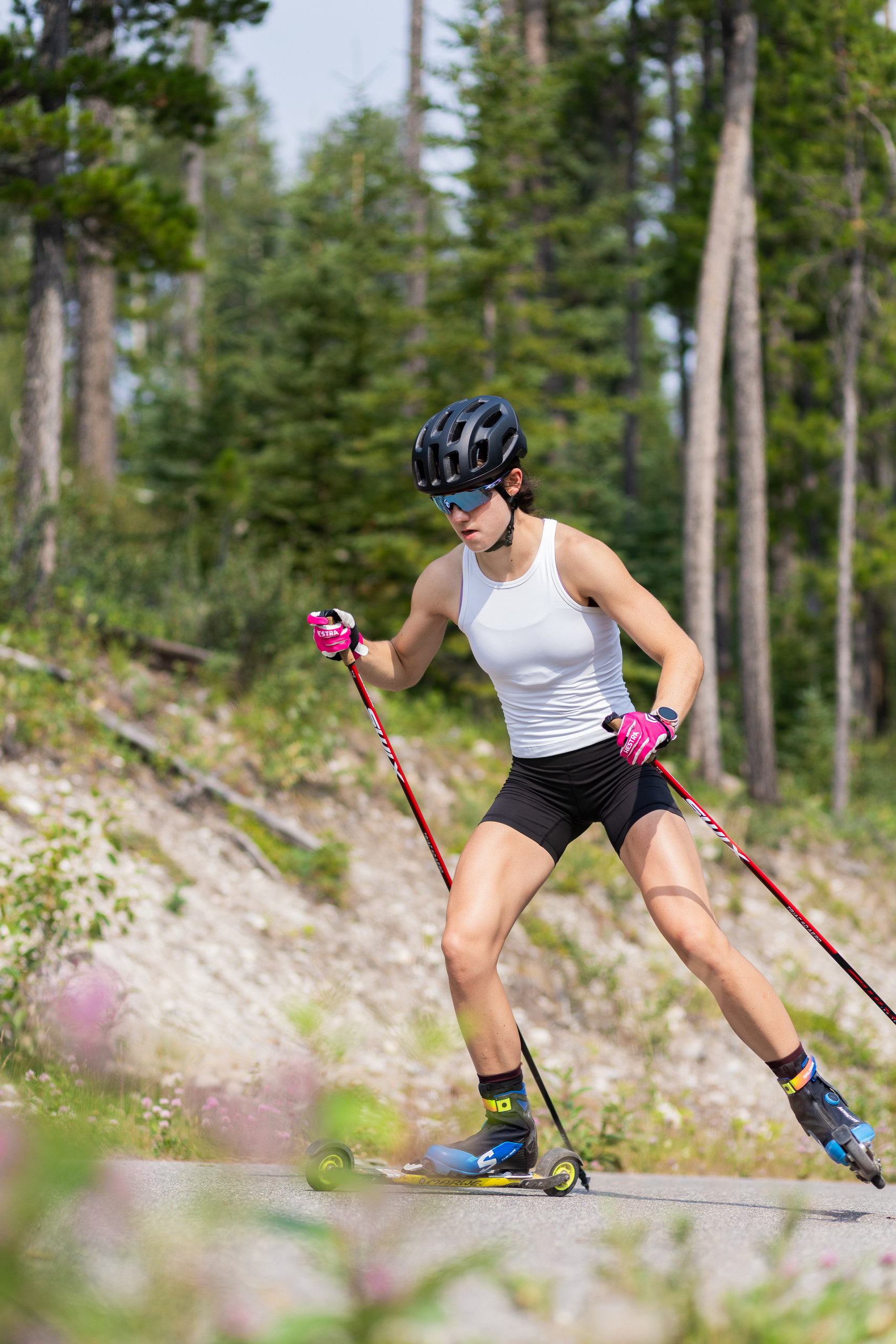
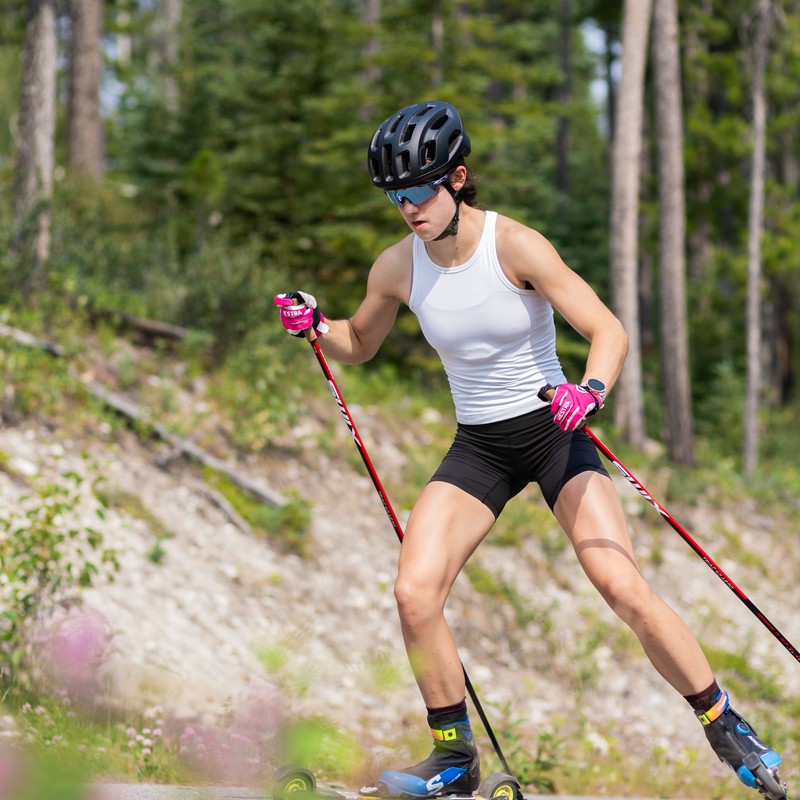
    Alison Mackie skate rollerskiing uphill on a paved forest road in a white training top and black helmet.
    Alison Mackie rollerskiing during summer training in July. She trains with the Alberta World Cup Academy in Canmore, Alberta. (Photo: Nathaniel Mah)

    For Alison Mackie, the 2024 Junior World Championships in Planica never really started.

    She had arrived in Slovenia with reason to expect something. A year earlier, at 17, she had finished 13th in the 20 k at the junior championships in Whistler, British Columbia, on home snow, in exactly the kind of long, grinding distance race that suits her. In Planica she missed the qualification in the opening sprint, fell ill, and watched the rest of the week from a hotel room. She was not on the tracks when her Canadian teammates made history either: Sonjaa Schmidt won the U23 sprint, and Canada won the U23 relay.

    Back at her base in Canmore, Alberta, at the end of that season, Mackie and her coaches set a target for the next one. Top five at the 2025 Junior World Championships in Schilpario, Italy.

    Privately, she wanted more than that.
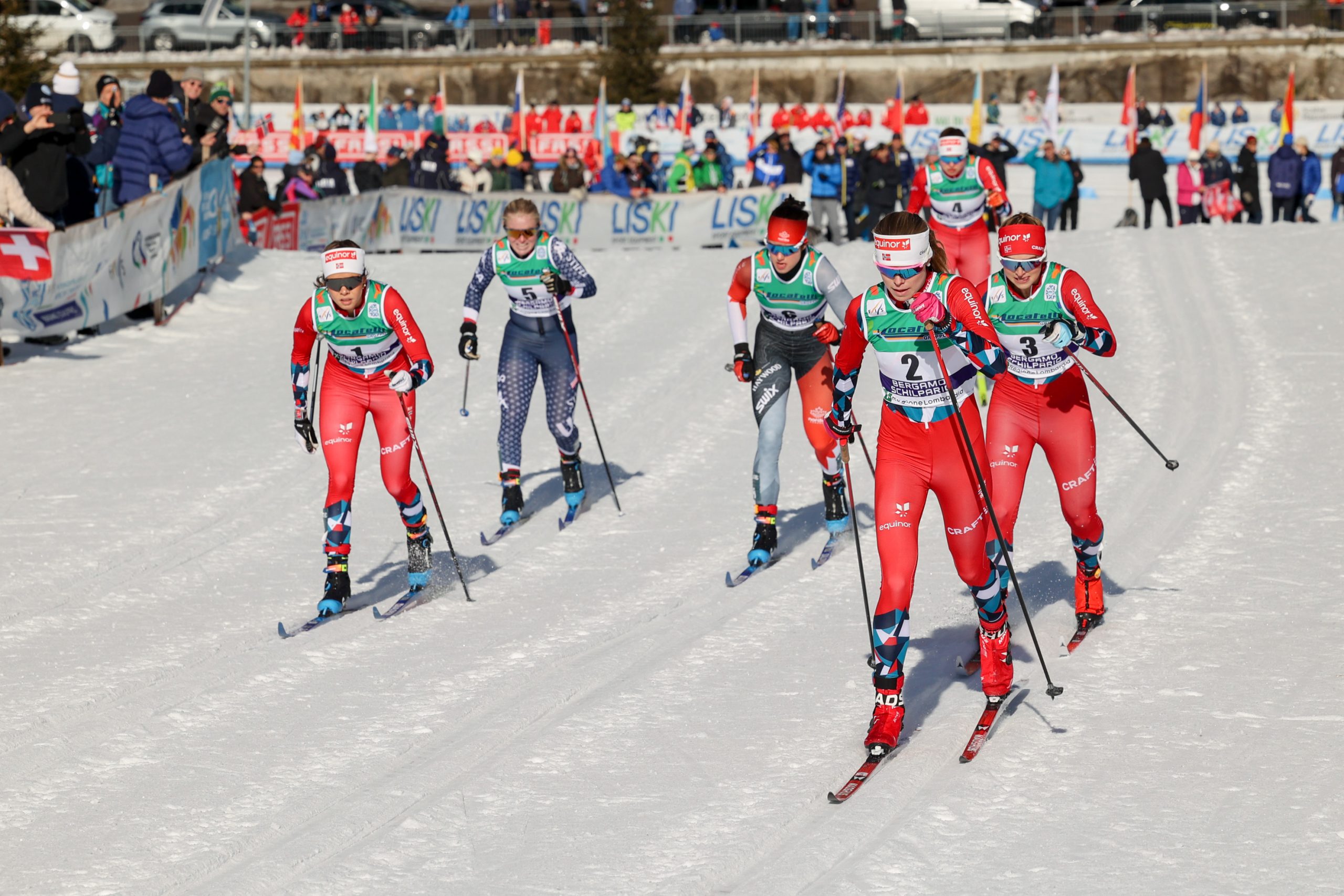
    Alison Mackie in bib 6 racing a classic sprint heat alongside Sammy Smith and four Norwegians.
    Mackie in bib 6 during the classic sprint at the 2025 Junior World Championships in Schilpario, where she finished fourth. Two bronze medals followed in the distance races. (Photo: Newspower.it)

    A Comeback in Schilpario

    “Yes, Junior World Championships in Schilpario were the main focus of my season that year,” Mackie said. “I trained specifically for that event to get my best shape there. But I wouldn’t say revenge, instead a kind of comeback because the year before in Planica I was pretty disappointed because I haven’t had the opportunity to race being sick.”

    On the Italian tracks she won bronze in the 20 k mass start classic, then bronze again two days later in the 10 k interval start skate. She was fourth in the classic sprint. They were the first junior world championship medals won by a Canadian woman since 1989.

    “I wanted a top five, and I finished with three top fours, including two medals,” she said. “The preparation we had put in proved to be correct, and I had a lot of confidence before starting the championships because I felt really good in the previous months leading up to my arrival in Italy.”
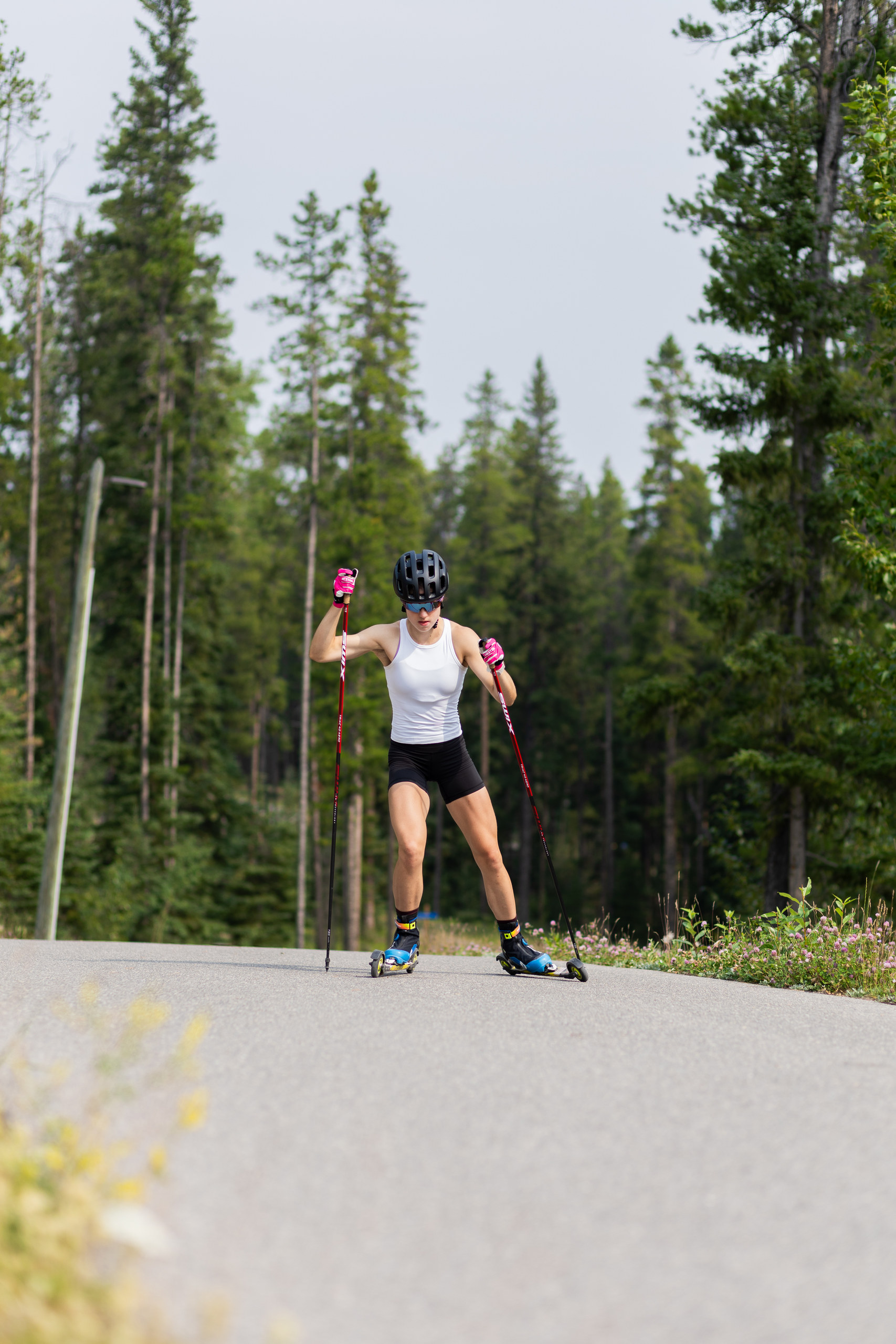
    Alison Mackie rollerskiing toward the camera on a paved road lined with evergreens.
    Mackie on a summer rollerski session in July. She started racing in Alberta as a teenager and won her first national title at 16. (Photo: Nathaniel Mah)

    Put on Skis Before She Could Walk

    Mackie was born in Montreal and raised in Edmonton, and she is 20 years old. Her mother, Jennifer, is a pediatrician. Her father, Andrew, is a pediatric cardiologist. Both of them ski, and both of them had her on skis before she has any memory of it.

    “My parents put me on ski as soon as I could walk,” she said. “So skiing accompanied all my childhood. Then I took real ski lessons and I started doing racing in my region of Alberta during my teenage times. That’s till Covid period arrived and with the restrictions I had nothing else to do others than training. But anyway, I really enjoyed myself during that period, developing my technique with my coaches at Edmonton ski club and when Covid finished my very first race that I won was our National title in March 2022 as a 16 year old.”

    Canada is known around the world as the home of ice hockey. Why did you choose cross-country skiing over hockey, freestyle, or swimming, following Summer McIntosh’s footsteps for example?

    “In parallel with cross-country skiing, I did a lot of other sports like cross-country track and field, rock climbing, mountain biking, swimming, soccer and in all of these sports I wasn’t as super competitive as I was in cross-country skiing. I did that only for fun as an opportunity to stay healthy during summer period. Cross-country skiing has been to me the only sport I competed at my best in my early ages and my favourite discipline. That’s why I chose it.”

    That first national title, won in Whistler in March 2022, is the race she keeps coming back to.

    “Yes, that race in Whistler BC was one of the first big races after the Covid pandemic,” she said. “I trained a lot during that period and didn’t have the opportunity to race and see my level, and when I went to my first National Championships and won the first race, it was a special moment and made me realize that I wanted to keep pursuing cross-country skiing for even better results and seeing how far I could get.”
    Alison Mackie racing the Olympic 10 k freestyle in Tesero, panned against a packed grandstand.
    Mackie racing to eighth in the Olympic 10 k freestyle in Tesero on Feb. 12, the best Olympic cross-country result by a Canadian woman. (Photo: Vanzetta/NordicFocus)

    Eighth at the Olympics

    The line has run one direction since. Two bronze medals at Junior Worlds. Her first World Cup top 10s, in Toblach and Val di Fiemme. Eighth in the 10 k free at the Milano Cortina Olympics in her first senior season. Gold in the 20 k mass start free at the U23 World Championships in Lillehammer in March. And at the end of that season, on 548 points, the FIS U23 overall World Cup title, the first won by a Canadian woman, with the finals held at Lake Placid.

    At the Milano Cortina Olympics you finished eighth in the 10 k free, after your first World Cup top 10s in Toblach and Val di Fiemme. What do you remember from those two weeks in Italy?

    “It was super cool being part of that multi sport event that the Olympic Games represent. It was my dream since I was a child watching Olympics on TV and having the opportunity to compete in high level in this huge event was really special to me. Definitely they have been long two weeks, also overwhelming at the time, but made me really happy how I performed overall and the 8th place I got in 10km skating has definitely been the highlight without any doubt. Entering the top 10 has been quite a surprise to me in that moment, because there were all the best skiers at the starting line. But now looking back at all the hard work I did during the whole season and the good results I got before that race in both World Cup and in under 23 World Championships, I wouldn’t say it was a huge surprise for me. Probably demanding Val di Fiemme’s track suited me very well, given that I finished as well 8th in Tour de Ski’s Cermis climb the month before.”

    What is the current situation in Canada for cross-country skiing, in terms of ski club membership, visibility in the national media, and financial support?

    “I would say the current cross-country skiing community in Canada is pretty small, if compared to other European power nations, but strong and with lots of passion in developing our discipline. There are a lot of young skiers coming up and I think it is very exciting for the great results to come in the future. Our National sports organization here in Canada are working really hard to make sure our National team can get all the support we need in order to achieve some World Cup podium with both boys and girls team during the seasons to come.”
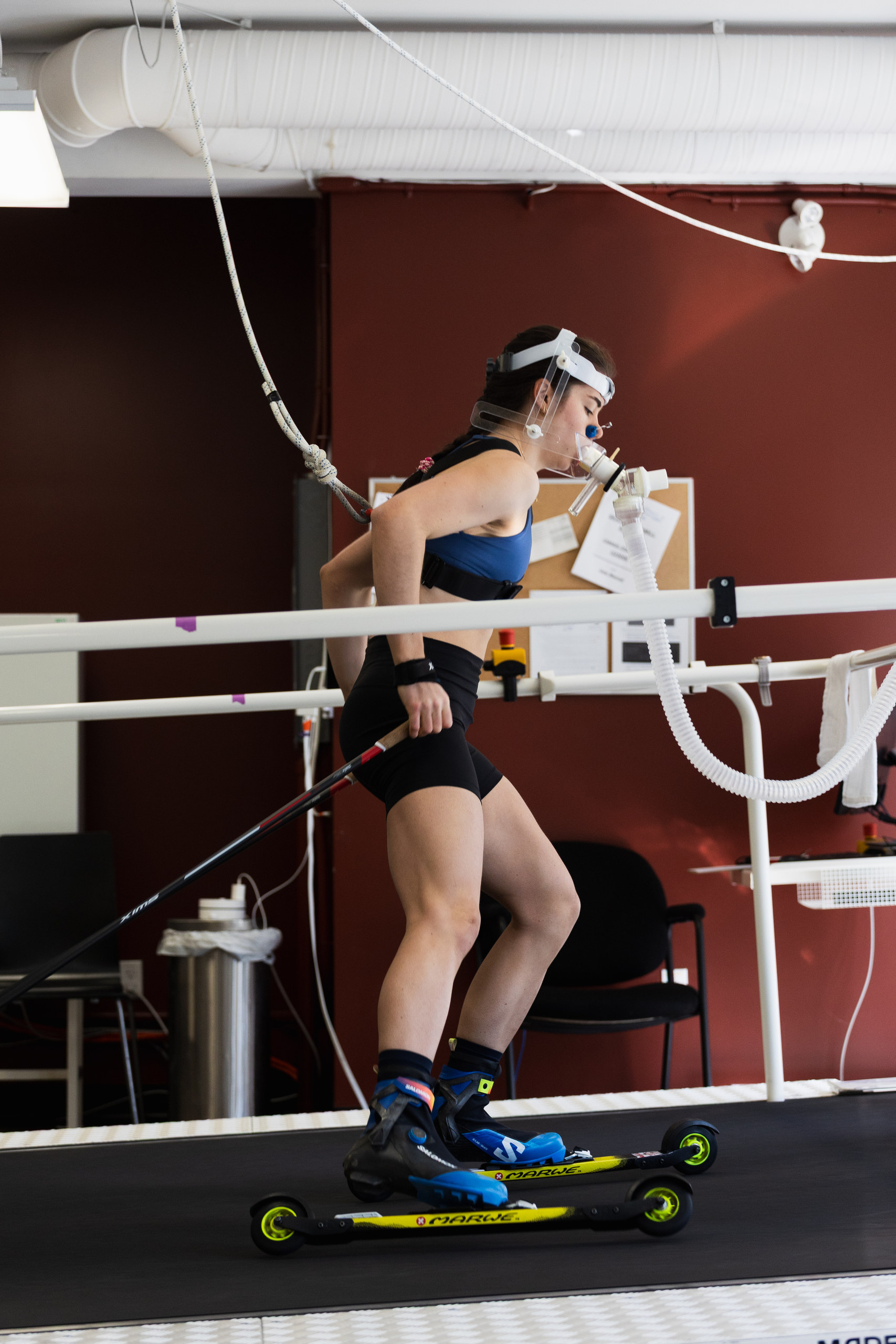
    Alison Mackie skate rollerskiing on a laboratory treadmill while wearing a metabolic mask.
    Mackie on the treadmill during a lab test in May. Distance racing is her strength, and finding speed is the summer’s assignment. (Photo: Nathaniel Mah)

    Distance Strength, Sprint Homework

    Describe yourself as a cross-country skier. What are your characteristics, your strengths, and the areas you are working on for the coming seasons?

    “I describe myself as a pretty strong skier in distance races, while I struggle a bit in sprint not to get through the top 30 and consequently not play the sprint finals, that is an element that I am working on in next seasons,” she said. “Between classic and skate I have found more success in free technique in the past seasons, but I enjoy training both classic and skate equally. Distance races are definitely my strength but I am working to improve my speed skiing as well so I could become a really strong overall skier in order, in the future, to fight for a higher overall spot in World Cup.”

    And the criticism you get from your coaches?

    “More than critics I would call special feedback from my coaches. Because sometimes I have a tendency to train too much and too hard that I need. That is something I am working on this summer, knowing when to push my body and when to give the correct time to rest and recover.”

    The World Cup calendar keeps skiers from outside Europe away from home for close to five months a season. How hard is that for you?

    “Personally I have spent on the road, following World Cup calendar, the past two seasons, but not the full European calendar. I really enjoy travelling and being on the road, so I don’t think it is a huge struggle for me. It is tough to not see friends and family for a long time but I am really lucky that I had friends and family came and watched me on tracks while I was in Europe a couple of time during season. Next season it will be quite different for me, because I am transitioning to attend the University of Utah so I will leave World Cup a bit because I do need to go to class and represent the University of Utah in North America as well.”
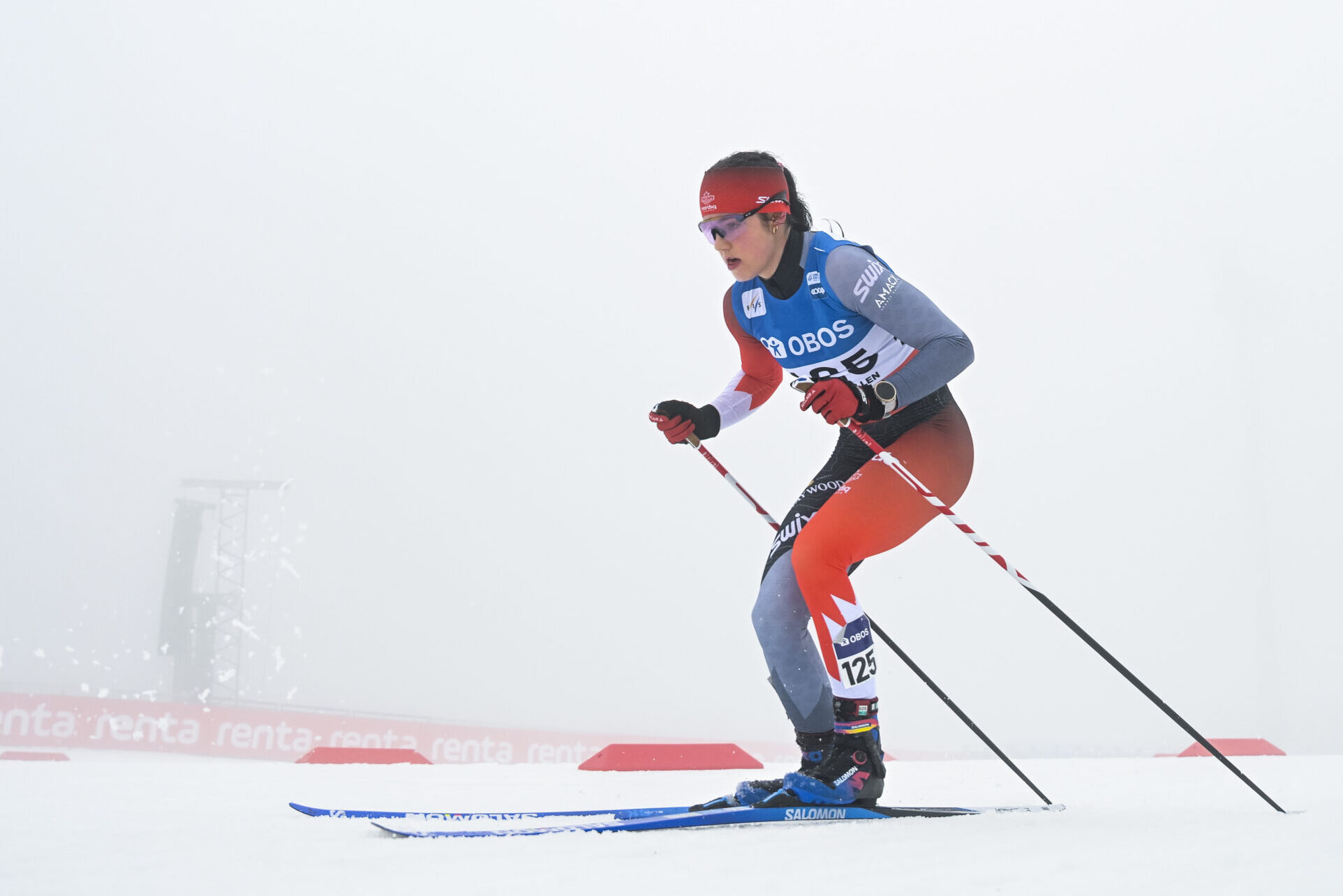
    Alison Mackie skiing in a Canadian race suit through fog at Holmenkollen.
    Mackie at the Holmenkollen World Cup in March, a week before the tour reached Lake Placid. (Photo: Authamayou/NordicFocus)

    A Winter Without Diggins

    The World Cup went to Minneapolis in the last two seasons, and Lake Placid hosted the finals in March in front of enormous crowds. Why not race in North America more often?

    “We do have actually Canmore scheduled for World Cup 2028, but realistically there are not so many resources for cross-country skiing in North America,” Mackie said. “It takes a lot of money and human power for the organization and preparation of those races. Of course, it will be amazing to have more opportunities to race in North America in the future but I have to be realistic and understand that organizing an event here in Canada, for example every four years, require lots of efforts and preparations from the local organization. Maybe we need more venues in North America that we currently have that are able to bring here World Cup events. I admit with huge pleasure that in the past seasons both Minneapolis and Lake Placid events showed how strong local communities are in terms of support and enthusiasm for cross-country skiing and those events have been a great boost for our discipline in North America, especially between young kids.”

    After fifteen seasons, this will be the first World Cup winter without Jessie Diggins, who clinched one more crystal globe in Lake Placid in March before retiring. Will she be missed outside the U.S. team as well? Did you ever get advice from her?

    “I definitely think Jessie’s presence will be missed in World Cup. Not only inside USA Team. I think she has always been a positive skier and a really amazing role model in so many ways. And 100% her presence, her ambitious way of racing and unique skiing spirit will be missed. That will definitely change some racing tactics as well. I had the opportunity to train together with Jessie in New Zealand last summer and it was a pretty cool experience and I wish all the best in her future.”
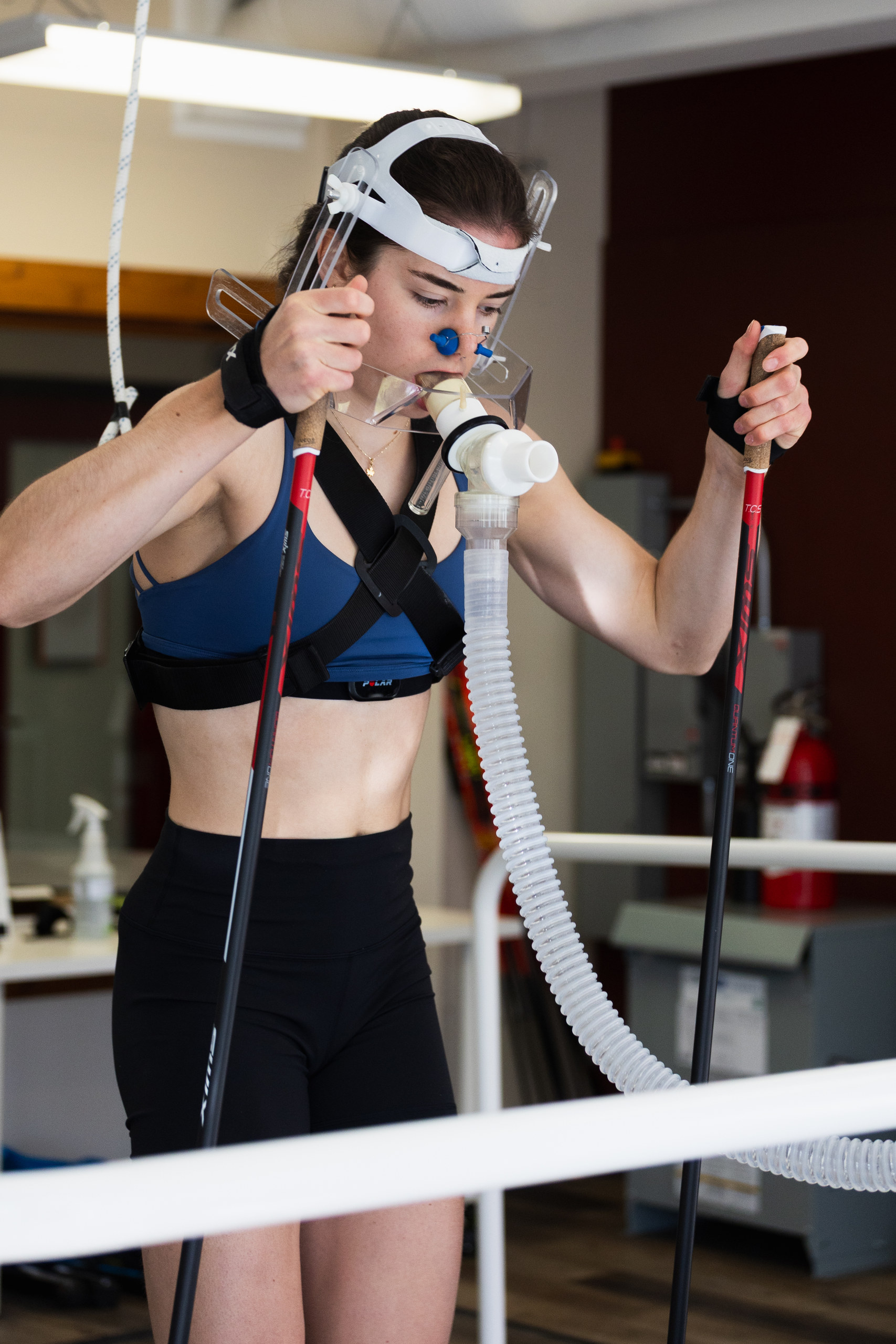
    Alison Mackie adjusting a metabolic testing mask while holding ski poles in a testing lab.
    Mackie fitting a metabolic mask before a treadmill test in May. She trains in Canmore and will study medical engineering at the University of Utah this year. (Photo: Nathaniel Mah)

    Canmore, Utah, and Life Off the Snow

    How is the Canadian team organized, and how is training divided between the women and the men at camps and at home?

    “I think Canadian skiing is gonna take a really exciting trajectory. I am really excited to work with our new Swedish coach Stefan Thomson over the next seasons but also in our group here in Canmore we have Norwegian Tormod Vatten as our assistant coach and with them we have a really strong support staff. For the Canadian National Team over the next seasons is going to be really exciting seeing where we all can go in World Cup and I am really proud to be part of this young but strong group of skiers that our Nordiq Canada are building now, under the [leadership] of former Olympic champion Beckie Scott and our amazing ski communities.”

    How do you manage your studies, at Queen’s University until last year and now at the University of Utah, with training and racing that run through most of the academic year?

    “I just make sure that I manage my schedule accordingly to have enough time for both my trainings and school throughout my day. I think having something other than skiing to focus on is really important for me. I was an online student at Queen’s University over the past two years and now I am transitioning to the University of Utah studying medical engineering. I think it is important the communication with the professors, making sure they know that my situation is a little bit different if compared to normal students, due to the fact that my training sessions, travels and races during winter season take my mind. But despite that my goal is to give my full focus during hours in classrooms too.”

    What kind of person are you away from cross-country skiing? Your personality, your interests, what you do on days off from training and racing?

    “Outside of cross-country skiing I am a pretty introvert person. I try to keep things on my own. I like studying and I really enjoy sewing clothes in my free time. I truly also love to learn new things and that is why I am excited to attend the University of Utah this year. I also love to spend time in the mountains nearby Edmonton where I grew up and in Canmore where I train myself with Alberta World Cup Academy and where I graduated in High school. Hiking, Mountain biking, running and skiing, of course, are my favourite activity when I can spend my time outside in the lush Canadian Nature.”

    In 10 to 15 years, at the end of your career, you will be proud of yourself if what?

    “I think, regardless of what I achieve in my future, I will be extremely proud of my career in addition to what I already accomplished. But really, my goal is just to ski because I love it and see where I can get of myself and also trying to inspire other young skiers. I think that there are a lot of young skiers in Canada right now, who have the potential to be amazing athletes. I really want to inspire them, showing them that anything is possible, it doesn’t matter what country you are from or how old you are. So regardless of what I achieve over the rest of my career I will always be proud of what I have already achieved.”

    Paolo Romanò is a freelance reporter based in Italy who covers cross-country skiing and Nordic combined.

    Help Support Our Coverage!

    If you value the thoughtful work and access FasterSkier provides, please consider becoming a Voluntary Subscriber. Your support directly fuels our work to cover the people, places, and moments that make our sport special.

    Join the FasterSkier community!
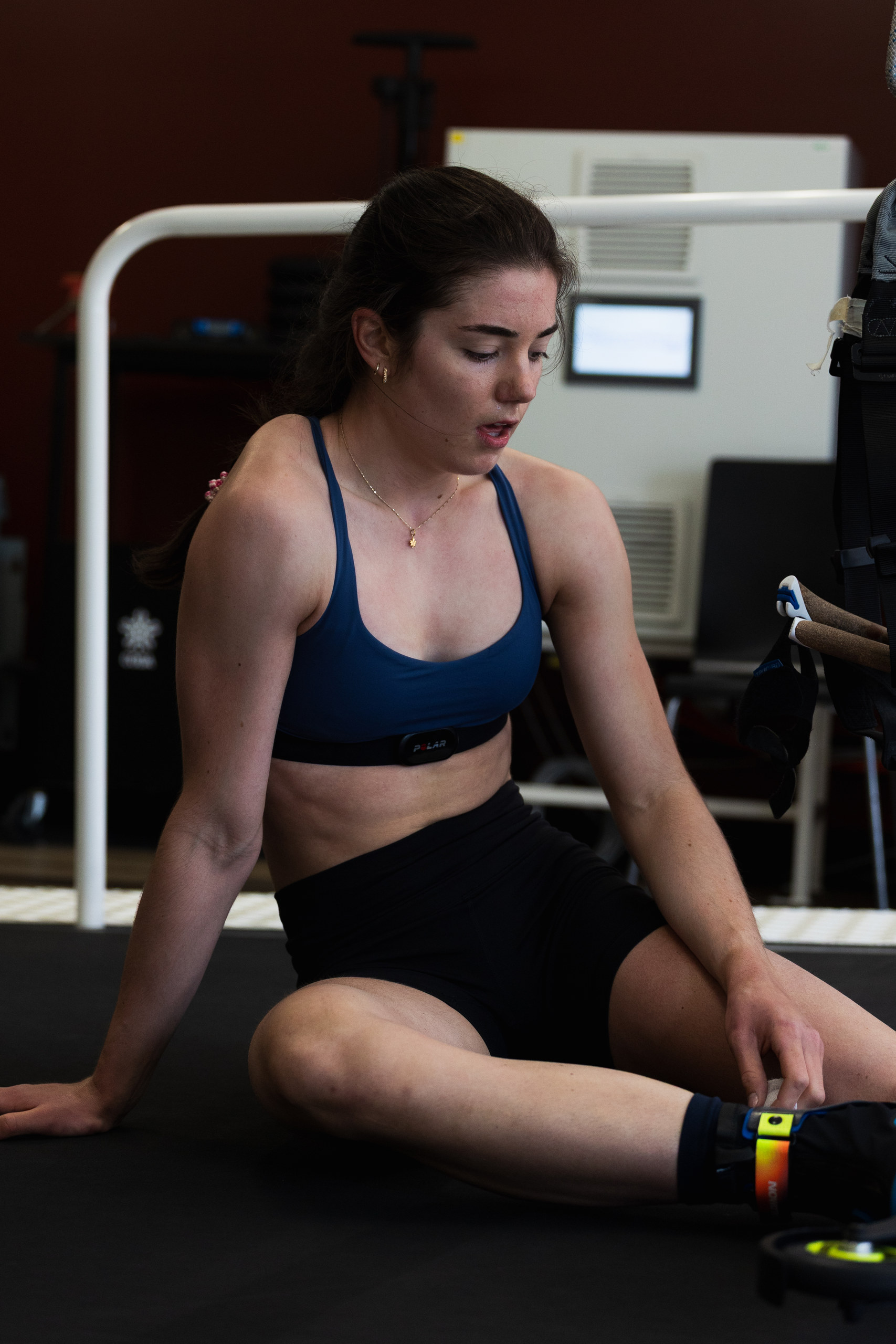
     

    Alison Mackie sitting on a laboratory floor catching her breath and unstrapping a sensor from her leg.
    Mackie catching her breath after a lab test in May. She races her first season for the University of Utah this winter. (Photo: Nathaniel Mah)
  • The Norwegian Experiment: Sophia Laukli’s Back-to-Basics Reboot

    The Norwegian Experiment: Sophia Laukli’s Back-to-Basics Reboot

    By the time Sophia Laukli picks up the phone from Lillehammer, it’s raining again.

    “There is, like, a small 1k loop up at Sjusjøen,” she says, “but it’s… yeah, it’s, like, raining every day, so it’s not really great conditions.”

    On paper, Laukli is one of the most intriguing dual-sport athletes in endurance sport: a U.S. Ski Team member and Olympian who has also become a force in international trail running. In person—or over Zoom—she’s thoughtful, understated, and very clear on one thing: the way she trains now, in Norway, looks a lot more boring than the world might imagine.

    You come to Norway expecting secrets, she says. What she found instead was simplicity.

    “They’re so simplistic around ski training,” Laukli explains. “It’s not rocket science. You can do the same… You do essentially the same workouts every single week, all year round.”

    That realization—combined with a crash-and-burn experiment as a full-time runner and a new coaching relationship with her boyfriend, longtime Norwegian pro skier Gjøran Tefre—has quietly reshaped her career.

    As this Olympic season approaches, Laukli’s bet is clear: train like a skier, keep the training simple, stay within herself, and let the results show up in both sports.

    Maine Roots, Late Commitment

    For all the talk about Norway, Laukli’s story really starts in coastal New England.

    “I was actually in the Boston area until I was, like, six or seven,” she says. Then came a year and a half in Norway, and finally Yarmouth, Maine—the place that still feels like home.

    “From my memories and my ski memories, it’s all from Maine.”

    Her father is Norwegian, so skis were always around. Winters meant skiing, family trips to Norway, and a life that looked, from the outside, like an early pipeline to the World Cup. From the inside, it didn’t feel that way at all.

    “It was a very recreational thing,” she says. “I didn’t really enjoy it that much. It was just kind of like, obviously, we’re gonna ski because it’s winter. But I didn’t know anything else.”

    In Maine, her parents weren’t just ski parents—they were essentially the ski people in the community.

    “They were my coaches,” she says. “And very present in the ski world, which was hard for me… A part of me became pretty hesitant towards skiing.”

    She gravitated toward soccer and tennis. Skiing felt obligatory.

    “Up until midway through high school, skiing was kind of just something I did because my family did it,” she says.

    The idea of becoming a professional athlete wasn’t just unrealistic—it was unimaginable.

    “I was gonna just go to school and be a nerd or something,” she says. “Being a professional skier wasn’t even a consideration.”

    Then came the pivot: joining the iconic Yarmouth High School ski team, coached by the legendary Bob Morse.

    “It opened my eyes a lot,” she says. “It wasn’t super competitive, but it showed me the sport that felt forced on me was actually something I liked—and could be really good at if I tried.”

    Looking back, she’s grateful it took so long.

    “I’m super happy I went through that zero-pressure, uncommitted relationship to skiing,” she says. “Today I have so much motivation to be 100% committed… and I’m far from burnt out compared to many skiers who commit when they’re 12.”

    Discovering Running (By Hating It First)

    The other half of her dual-sport identity—trail running—comes from an even stranger origin story.

    “Running was something that I actually hated,” she says, laughing. “I really, really, really did not like to run when I was young.”

    Running in Maine didn’t help.

    “It just wasn’t enjoyable to run there,” she says. “Unless you really liked running on roads and golf courses.”

    She ran cross country her senior year only because the coach wanted her on the roster for states. She ran track for one year and found it “horrible.”

    “It wasn’t until I started training out West in the summers, finding mountains… that I actually enjoyed running.”

    Those Western US trails served as the practice grounds, preparing Laukli for some of the world’s biggest trail races. But first she had to figure out college—and how training would fit around it.

    Sophia Laukli takes the collegiate national title in the 15 k skate in 2022. (Photo: Tobias Albrigtsen / @untraceableg)

    Middlebury to Utah: Building a Life Around Skiing

    Laukli chose Middlebury because, at the time, academics were the top priority.

    “I knew I didn’t want to be done skiing,” she says, “but it wasn’t the priority.”

    Covid changed everything. Remote classes allowed her to chase early World Cup opportunities without living on campus. Once Middlebury required students to return in person, the timing coincided with the rapid ascent of her ski career.

    That led to a transfer to the University of Utah.

    “Utah is built for athletes,” she says. Most classes were online and flexible. She chose economics not out of passion but practicality.

    “I didn’t necessarily choose the thing I thought was interesting,” she says. “I chose what would best suit my ski career.”

    Now, even as a full-time pro based in Norway, she’s studying again—an online Norwegian MBA.

    “I’ve never been someone who can come home from training and sit on the couch until my next session,” she says. “I think I was missing having more than just training.”

    Balancing skiing and school helps her prevent the sport from consuming everything.

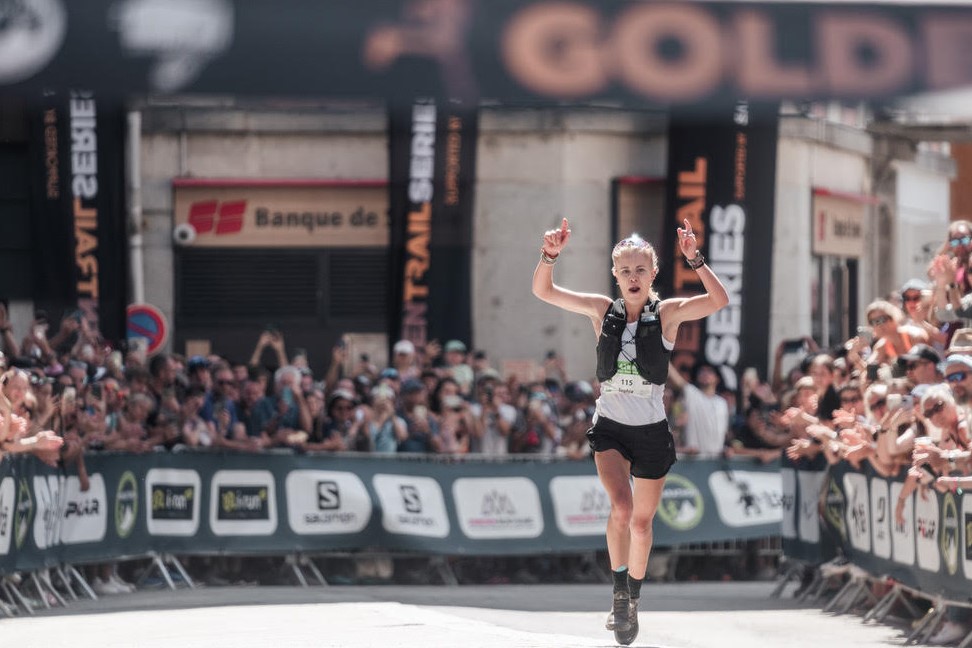
    Over flowing crowds filled the streets at the Golden Trail Series finish line in Chamonix in 2023. (Photo: GoldenTrailSeries and @the.adventure.bakery,® Mont-Blanc Trail Marathon.: ©GoldenTrailSeries® – Zegama Aizkorri – Jordi Saragossa)

    The Running-Only Experiment That Failed

    Last year, after the World Championships, Laukli decided to lean all the way into running. It seemed logical—if she’s good at running without specifically training for it, imagine how good she’d be if she did.

    “I always thought I’d be a much better runner if I had just run,” she says.

    So she tried it. No roller skiing. No ski sessions. Just running—every day.

    “I was running 10 to 12 hours a week,” she says. “And I was so tired each day. I was getting worse and worse at running. And obviously not good at skiing.”

    The experiment collapsed at a race where she felt utterly depleted. She flew home, frustrated and confused. That’s when she sat down with her boyfriend, Gjøran Tefre.

    “He said, ‘It’s fine. I’ll write a plan. Don’t freak out,’” she says. “‘We’ll get you a coach, but ski training is straightforward. We’re gonna baby you into ski training again.’”

    Two weeks completely off. Then a return to “textbook” ski training.

    Within a week of roller skiing, something wild happened: her running started feeling good again.

    The pattern was clear. She ran better when she trained like a skier.

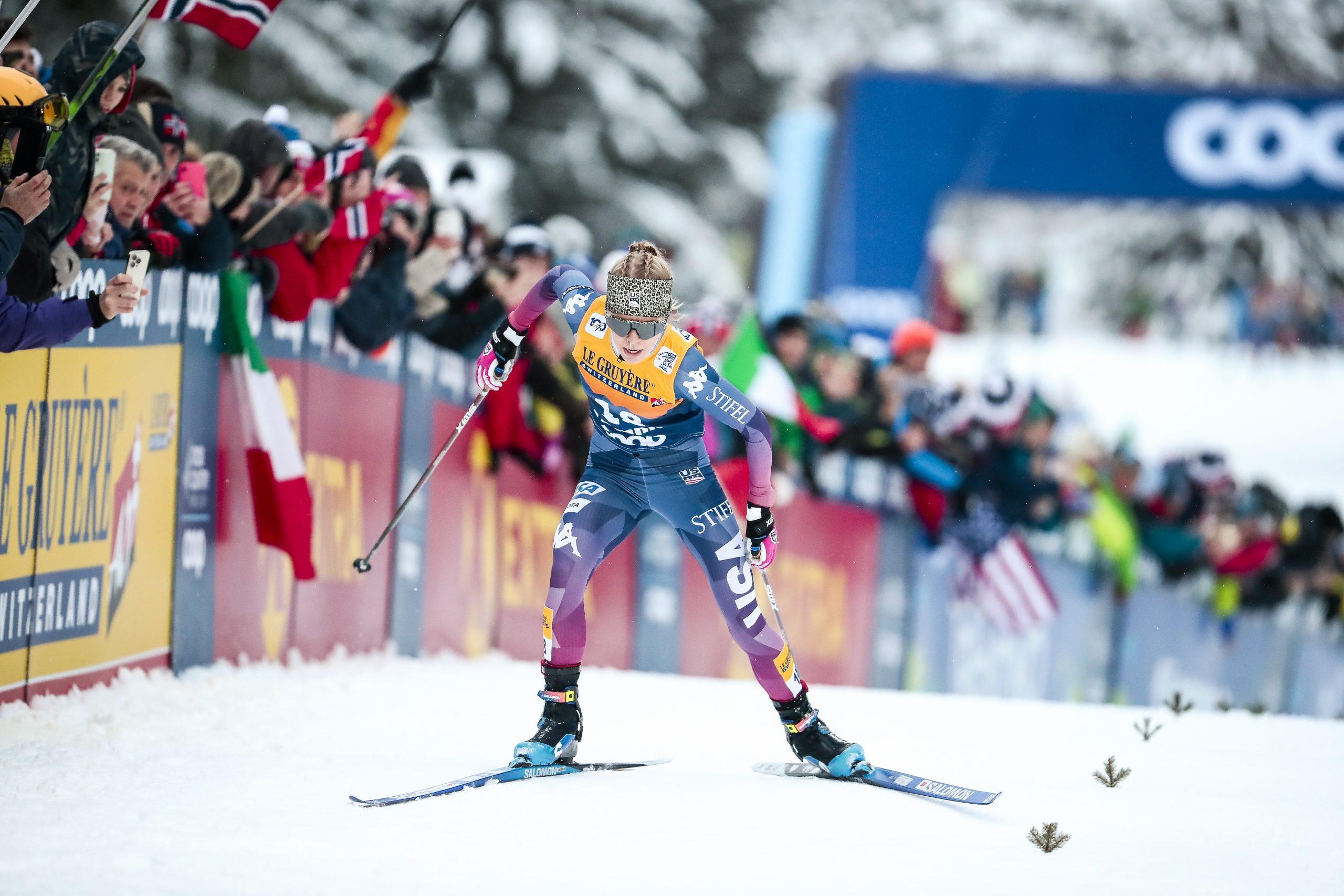
    Sophia Laukli (USA) during the World Cup 20km in Engadin (SUI). (Photo: Authamayou/NordicFocus)

    Kristen Bourne Saw The Same Thing

    “Last season was definitely a struggle for her, both running and skiing,” says U.S. Ski Team assistant coach Kristen Bourne, who monitors Laukli’s training load. “And she’s just trying to figure out why.”

    For Bourne, the shift wasn’t just physical—it was psychological.

    “I’m a huge believer that what makes a difference from a good athlete to a great athlete is the athlete who is very invested in their own process,” Bourne says. “The ones who are thinking, advocating for what they need—not just deferring to a coach because the coach’s word is gospel.”

    That ownership, she says, is new in Laukli.

    “She’s definitely leaning into that more this year,” Bourne says. “Which is really cool.”

    Sophia Laukli and Gjøran Tefre at the Cross Country Skiing World Championships. (Photo: Courtesy Photo)

    The Gjøran Factor: Coach, Partner, Check on Reality

    Mixing a relationship with coaching is a delicate thing. Laukli knows the risks—she’s heard them all.

    “I’ve been told by many people this is not a good idea,” she says. “And other people are like, ‘Wow, I wish I could do that.’”

    She also knows why it works.

    For one, they communicate constantly. For another, his intentions are pure.

    “One of the hardest parts of finding the right coach was that they either only cared about skiing or only cared about running,” she says. “He’s the only one who actually wants me to do well in both.”

    Still, she doesn’t call him her “coach.”

    “I want our personal life and work life to be separate,” she says. “We need other people in the room.”

    That’s where Bourne plays a key role.

    “At this level, athletes have so much experience—they do know what they need,” Bourne says. “So my goal isn’t to dictate everything. It’s to help Sophia articulate what she feels and translate it into training.”

    The two systems—Tefre’s daily presence and Bourne’s structured oversight—meet in the middle.

    One of the key themes that has emerged from all our recent interviews is the importance of making time for fun. Sophia Laukli and Gjøran Tefre embrace that notion entirely. (Photo: Courtesy Photo)

    The Norwegian Experiment: Simple Workouts, Serious Control

    When Laukli moved to Norway, she expected cutting-edge workouts—maybe some secrets behind the country’s dominance.

    “It’s almost been the opposite,” she says. “They’re so simplistic around ski training.”

    Five-by-ten-minute intervals around the Holmenkollen loop. The same long, easy days. Repeated blocks of threshold.

    “You’re gonna become better if you do five-by-ten once a week for 12 weeks in a row,” she says. “You’re gonna become better.”

    The key difference from the U.S.? Control.

    Almost every Norwegian skier has a weekly treadmill “profile test,” which involves six-minute stages at a 10 percent incline, with lactate samples taken at each step and heart rate recorded.

    “It’s to see if you’re in the right range,” Laukli says. “Not to get better each week.”

    Bourne sees value in that simplicity.

    “Sometimes a coach wants to prescribe the flashy intervals,” Bourne says. “But honestly, the athletes who can execute the basics really, really well—that’s where the gains are.”

    She sees Laukli finally embracing that mindset.

    “Athletes shouldn’t feel like training is something done to them,” Bourne says. “They should feel like they’re building something in collaboration with the coach. Sophia is starting to live that.”

    Laukli agrees that American juniors often overtrain because they don’t know any better.

    “If I go too hard too many times in a row, it’s a much worse year,” she says.

    The hardest part? Slowing down when training with Norwegian women who can drop her on almost every roller-ski interval.

    “Every interval I do here, I know I’m not gonna keep up,” she says. “At 17, that would’ve crushed me. Now I have evidence that I can beat them in the winter.”

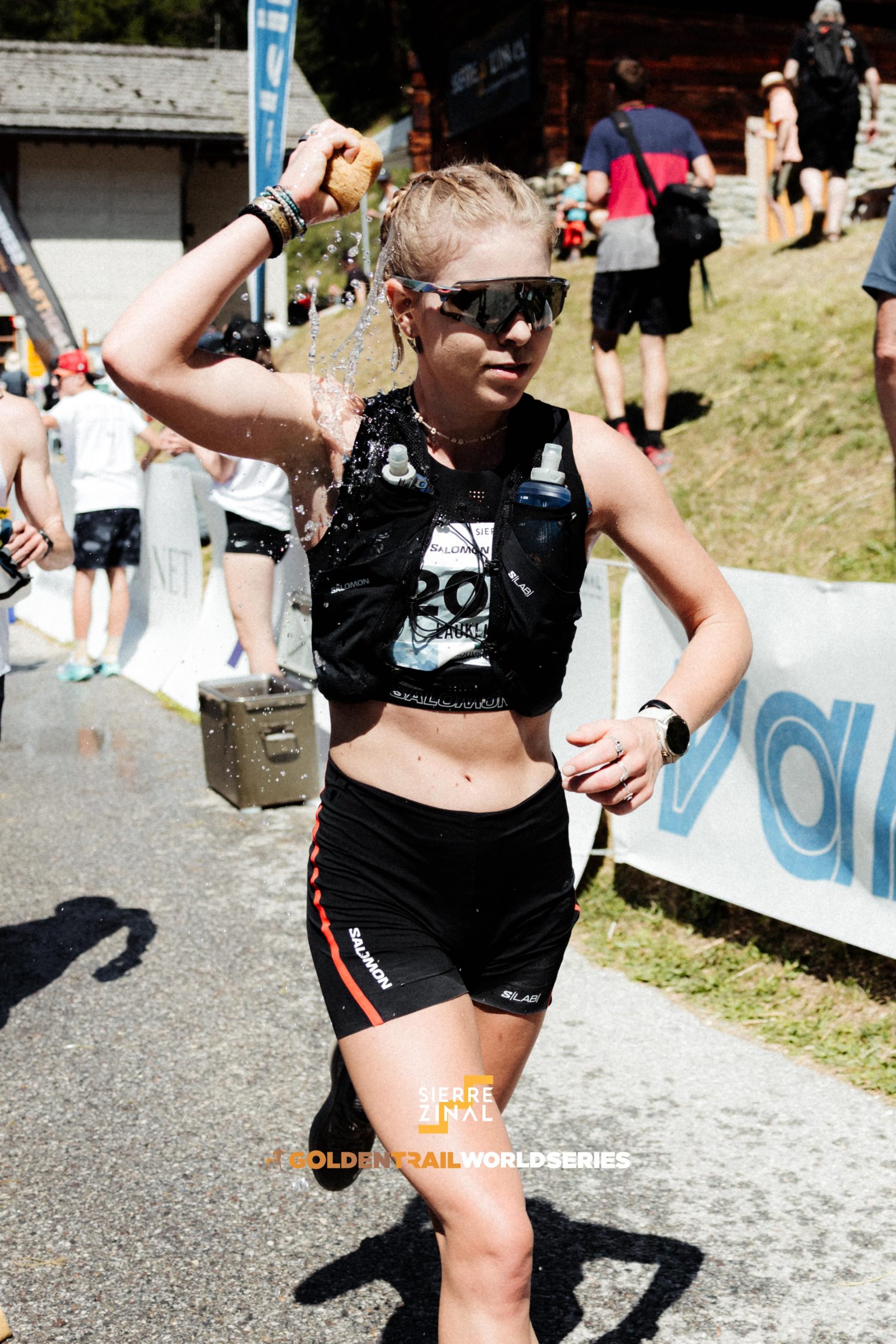
    Laukli racing Sierre-Zinal in the Gold Trail World Series in 2024. (Photo: @rising.story_@colinolivero_GTWS_SierreZinal

    Two Seasons, One Mindset

    Running and skiing back-to-back seasons creates year-round excitement—and pressure.

    “I have two competition periods,” she says. “It’s easier to motivate. But it also means I’m 100% consumed by performance all year.”

    That obsession became a barrier last year. Now, Laukli is working with Bourne and Tefre to shift her mindset.

    She has clear goals for skiing: the Olympic 10k, the Olympic relay, and the final hill climb at the Tour de Ski.

    She has equally specific running goals: above all, returning to Sierre-Zinal, where she once ran 2:53 on the iconic 31 km route.

    However, she’s no longer defining success solely by results.

    “There’s so much I’m working on—technique, tactics, how I ski courses,” she says. “It’s easy to be on a start line and focus on whether those things show up.”

    Bourne sees that evolution clearly.

    “Sophia has the instincts of a really high-level athlete,” Bourne says. “But learning to trust those instincts—rather than obsessing about the result column—is where she’s growing most.”

    Laukli nears the finish of the final climb of the 2024 Tour de Ski on Alpe Cermis, where she claimed the victory. (Photo: NordicFocus)

    Why Salomon Fits: One Athlete, Two Worlds

    For an athlete splitting her year between the World Cup and the Golden Trail Series, sponsorship could easily become complicated. Many runners work with running-only brands; many skiers work with ski-only brands. For Laukli, that would have been a logistical mess — and maybe even a dealbreaker.

    Instead, she found the perfect home with Salomon.

    “I’m super grateful that I get to have my sponsor, my main sponsor, support me in both,” she says. “Because then it’s a lot easier to focus on each season. I know that they’re supporting me in that.”

    That unified support matters. It lets her shift from skis to singlets without the politics of competing brand calendars and conflicting performance expectations.

    “I don’t really know if it would be possible for me to be a runner for another brand and a skier for a different brand,” she says. “Like, defending to them that I can’t run a normal running season because it’s the Olympics, or I need to drop World Cups so I can run better this year — that just wouldn’t work.”

    With Salomon, the opposite is true. Everyone’s aligned.

    “Having everyone be on the same team makes it manageable,” she says. “And a lot more motivating, because everyone has the same goal.”

    She works directly with Salomon’s France-based team, and Laukli lights up when she talks about the group behind her.

    “They’re all French,” she says, laughing — a nod to the company’s deep culture in both ski sport and trail running. It’s also a reminder that Laukli lives firmly in the middle of two endurance worlds that Salomon understands and embraces.

    That harmony matters. Her identity isn’t split; it’s blended. And Salomon is built for that.

    Sophia Laukli (USA) racing the World Cup Mass Start in Les Rousses (FRA). (Photo: Modica/NordicFocus)

    Sunny Weekends and Simple Breakfasts

    Some things have gotten simpler, like her pre-race breakfast.

    “I used to do peanut butter and banana,” she says. “Now I just have cereal. Apparently, simple is better.”

    World Cup life has also taught her the importance of flexibility.

    “You learn how to adapt,” she says. “Something will always go wrong on a race weekend.”

    When she’s asked for her favorite place on the circuit, she doesn’t hesitate.

    “Davos,” she says. “It’s sunny. You can have bad races, and it doesn’t matter because it’s a really nice place to hang out.”

    That small detail fits her evolving philosophy. Training is simpler. Goals are more balanced. And the sport—skiing and running—feels more sustainable.

    Somewhere between Maine and Norway, between Middlebury and Utah, between World Cup stadiums and alpine trails, Sophia Laukli has built a training model that doesn’t look flashy. It’s repetitive. It’s measured. It’s rooted in trust, communication, and doing the basic things right, over and over again.

    And if the Norwegians are right—and if Laukli’s instincts keep sharpening—those basics may be exactly what carry her to the front this season, in both sports.


    Love Stories Like This? Help Keep Them Coming.

    Feature interviews like this one take time, access, and care to produce. If you value thoughtful storytelling and independent ski journalism, please consider becoming a Voluntary Subscriber. Your support directly fuels the work we do to cover the people, places, and moments that make our sport special.

    Join the FasterSkier community!


  • Joe Davies’ journey from British Columbia to repping Great Britain

    Joe Davies’ journey from British Columbia to repping Great Britain

    Joe Davies has notched multiple top-20 World Cup finishes representing Great Britain. The 24-year-old takes us through his compelling backstory, starting with his childhood in British Columbia through racing on the American college circuit.

    The Olympic season is nearing, and we’ll hear from a few more athletes before it kicks off. Got anyone you want to hear from? Drop us a line with your requests and feedback: devon[at]fasterskier.com and nat[at]fasterskier.com. We’ll be back soon.


  • Balancing Books, Labs, and Laps: Inside Newly Named U.S. Ski Team Member Lucas Wilmot’s Routine

    Balancing Books, Labs, and Laps: Inside Newly Named U.S. Ski Team Member Lucas Wilmot’s Routine

    When Lucas Wilmot sits down after morning intervals, there’s no long nap or lazy lunch ahead. “This fall, it’s kind of all back-to-back—training in the morning, then eating, then class, then trying to eat and train again, and then do homework,” he says. “It’s tight.”

    That understatement is classic Wilmot: composed, analytical, quietly focused. At just 19, the Jackson, Wyoming-raised skier is already juggling NCAA racing for the University of Utah, kinesiology labs that might soon shift toward biology, and a new badge of honor—fresh membership on the U.S. Ski Team.

    Lucas Wilmot was keeping it fun from the very beginning. (Photo: Courtesy Photo)

    From Jackson to Utah: A Small-Town Start

    Wilmot’s story starts, like so many in American skiing, with a local club, a hand-me-down pair of skis, and a family that encouraged movement. “I kind of started with my parents—they just put me in skiing in elementary school,” he recalls. “Back then, it was all about hanging out with friends and not really racing.”

    That changed in middle school, when the sport shifted from pastime to passion. “It took a turn where I started to take training more seriously and be more race-focused,” he says. “I remember looking forward to the trips, doing well in races, and having the older guys on the team as idols. Seeing how big and fast they were—I always thought that was really cool.”

    His sister, two years older, was both chauffeur and role model. “She was skiing too—she’s still skiing now at Bates,” he adds. “I started summer training with the older crew in Jackson when I was one of the youngest guys. My sister could drive. I couldn’t. So I’d just spend my time training with the older guys.”

    The big breakthrough came as a sophomore. “Minneapolis Junior Nationals was another big turning point,” Wilmot says. “I had three top tens there, and I never expected anything like that. That was when I realized, if I actually put in the time and effort, I can see results that impress even myself.”

    Lucas Wilmot (#230 – far right) starting to get serious about his skiing racing at a Junior National Qualifier as a U14. (Photo: Courtesy Photo)

    “Welcome to the U.S. Ski Team”

    If Minneapolis was the first turning point, Soldier Hollow was the second. “I got third in the classic 10K at Senior Nationals,“ Wilmot recalls. “That was kind of a big whoa moment—a big jump up. Will (Wicherski), my coach from Jackson, came up to me and said, ‘Do you know where you are?‘ I said no, and he said, ‘You’re in third.‘ I was just kind of shocked and caught by surprise.”

    That race qualified him for Junior Worlds, where another top result changed everything. “They released the requirements—it was a Junior Worlds Top 10,“ he says. “When I had the ninth place in Schilpario, Italy, in the skate 10K, I kind of knew I’d made the team. Right after the race, Brian Fish walked by and said, ‘Welcome to the U.S. Ski Team.’“

    Wilmot laughs at the memory. “It was at the wax cabin or something. I kind of knew that day. My parents and sister were there, so it was nice to tell them in person,“ he says. “But I didn’t want to be loud about it. I told my parents, like, this isn’t official, but it’s looking like I might be nominated.”

    Now, being able to put on the U.S. suit still feels surreal. “I definitely feel pretty lucky,“ he says. “It’s a lot of people’s dream to do that, and it was one of mine. I feel super lucky, and it’s an honor. When I have the U.S. suit on, maybe I’ll go reach out to someone I’ve never met before—they’re all kind of like teammates to me.”

    Lucas Wilmot (UU), Murphy Kimball (UAA) and Tabor Greenberg (UVM) this past spring at the USST’s annual Bend camp. (Photo: Courtesy Photo)

    Structured but Flexible

    Last season Wilmot logged around 500 hours of training; this year he’s targeting about 600. But he’s adamant that numbers aren’t everything.

    “I’m definitely not the number grinder. I just try to keep it fun—never do too much, always quality. It’s kind of my mindset: always having quality in the time you’re training. Make sure it’s worth your time to be there.”

    He recalls finishing a long over-distance session in Park City camp and realizing more minutes would add nothing.

    “I was thinking I could do another 30 minutes, but I’d just be walking. It’s not really how much is that gonna do for me? If it’s not quality, if I’m not putting all my effort in, then I’m not getting the most out of it.”

    That approach—precision over volume—mirrors his team’s philosophy. “Pierre (the Utah coach) kind of switched it to more professional training,“ he explains. “Every training has a specific outcome goal to it… You’re not just doing it to do it. There’s a reason why, and it’s all part of a broader plan and structured schedule.”

    A Day Measured in Minutes

    In Utah’s mountain light, mornings start early—Wilmot trains, refuels, and hustles to class. “I like to think ahead and plan out as much as I can,“ he says. “School is my priority, and how can I get it done efficiently so I can rest well. I try to go to bed as early as I can and know that training in the morning is kind of also a priority.”

    The key, he’s learned, is organization—a skill honed on long travel days in high-school racing.

    “Being on trips for skiing taught me that if I get it done ahead of time—get all my schoolwork done or just know that when I have spare time, I should try to get ahead or catch up on school—that’s what I think about all the time.”

    Even with 600 training hours, he squeezes recovery in where he can. “It’s a hard balance between having training in the morning as a priority or staying ahead on work,“ he admits. “But I think I learned well… just to plan ahead.”

    Wilmot during the 7.5-kilometer classic interval start last spring at the U.S. Ski and Snowboard Cross-Country Junior National Championships in Soldier Hollow, Utah. With a time of 23:12.4 second, Wilmot won his first Junior National title in his fourth appearance. (Photo: Drew Palmer Leger/Courtesy Photo)

    Fueling the Machine

    This semester, recovery and nutrition have become new focal points.

    “This fall I was kind of struggling with recovery after the morning session and my class schedule,“ he says. “So one of the things I’m trying to do more of is focus on nutrition right after—that’ll allow me to make it through the long school day and then also recover well. That’ll help me get energy for the training and races.”

    Breakfast sets the tone: “Usually a banana, an everything bagel with butter, and maybe a little bit of yogurt… kind of got a little something of everything. It’s pretty yummy.”

    The science-minded athlete is applying classroom theory to real life. His kinesiology background gives him a deeper understanding of performance—how recovery, fueling, and training stress interconnect. “I’m keeping on the science track,“ he says. “Right now I’m doing kinesiology, but maybe switching to biology or another science-related thing. Not sure yet.”

    Keeping It Fun

    For Wilmot, joy isn’t optional—it’s essential. “I just love hanging out with all the buddies, training with friends. Definitely makes it go by a lot faster,“ he says. “It’s pretty fun just to crack jokes a lot and mess around, too… You don’t always have to be serious at training.”

    That balance between intensity and levity keeps burnout at bay. Whether it’s running mountain ridgelines or laughing through rollerski sessions, he believes camaraderie fuels consistency. “Sometimes there are places not to focus,“ he laughs, “and just have a good time.”

    Fun with friends is Lucas Wilmot’s core principle. (Photo: Courtesy Photo)

    The Process of Progress

    Beyond coursework and results sheets, Wilmot’s compass points toward steady growth. “I’d hope to make the NCAA team for the University of Utah this year,“ he says. “That’s going to be pretty challenging… but I hope to have more stabilized results and less fluctuation.”

    He defines progress through small, controllable actions:

    “In skiing, just being as efficient as I can. If I’m in a race and I feel uncomfortable, I try to find where I’m comfortable and not make myself too jittery. Being comfortable in your own way during a race—knowing how to race your races—is important for me.”

    When he talks about the future, Wilmot’s tone shifts slightly—equal parts excitement and realism. “Within the next four-year span, there’s a good chance the progress track may take me to that level,“ he says, thinking ahead to the Milano-Cortina Olympics. “If I stick with it, that would be an insane experience and something very special.”

    Wilmot skiing with Murphy Kimball (UAA/Alaska Winter Stars) on Eagle Glacier this past summer during the US Alaska camp. (Photo: Courtesy Photo)

    A Learner at Heart

    Among the national-team veterans, Wilmot sees himself as a student first. “I kind of see myself as a little follower,“ he admits with a grin. “Everyone’s just a little more experienced than I am. I feel like I don’t have much, so I think of myself as a learner and a listener—someone who tries to take everything I can from them.”

    But even the learner can lift a team. “I love being the guy that gets someone to smile,“ he adds. “And make them laugh. I love doing that.”

    That mix of humility and humor is why teammates have quickly embraced him. He’s not loud, but he’s steady—the kind of athlete who brings calm to chaos, whether it’s a high-stakes interval session or a late-night study grind.

    Looking Ahead

    Wilmot’s path has never been about a single breakthrough; it’s about accumulation—hours, credits, lessons. “I kind of never saw myself being where I would be right now,“ he reflects. “It goes back to the open-doors thing—I was just following what was happening, putting in the work, and seeing what opportunities it led me to.”

    That approach—disciplined but flexible—may be his greatest strength. Between lecture halls and ski trails, he’s learning to find balance. And every dawn run, every late-night homework session, is another quiet step toward the next start line.

    “It’s a good, hard balance,“ he says, smiling. “But that’s kind of what I signed up for.”


    Love Stories Like This? Help Keep Them Coming.

    Feature interviews like this one take time, access, and care to produce. If you value thoughtful storytelling and independent ski journalism, please consider becoming a Voluntary Subscriber. Your support directly fuels the work we do to cover the people, places, and moments that make our sport special.

    Join the FasterSkier community.
  • The University of Utah Claims the 2025 NCAA Championship

    The University of Utah Claims the 2025 NCAA Championship

    This article was made possible through the generous support of our voluntary subscribers.  If you would like to see more articles like this one, please support FasterSkier with a voluntary subscription.  

    The sun came out on Saturday at Dartmouth’s Oak Hill Ski Center in Hanover, New Hampshire. The best collegiate skiers in the country gathered in Hanover, New Hampshire, for a week of racing at the NCAA Championships. The final races of the week were the nordic distance races, 20km freestyle for both the men and women. University of Utah’s Joe Davies skied away with the national title on Saturday, much like how his team gapped the competition.

    Though Utah’s nordic and alpine teams combined points ultimately created an unclosable gap, the championships started off close. In the first nordic races, the 7.5km men’s and women’s classic race, it was the host school Dartmouth who had the top racers.

    Dartmouth College’s John Steel Hagenbuch skied to a 15 second victory on his home trails in the 7.5 k Classic at the NCAA Championship on Thursday. (Photo: Tobias Albrigtsen)

    In the men’s 7.5km classic race, Dartmouth’s John Steel Hagenbuch won by 16 seconds over UVM’s Finn Sweet. It was his second NCAA title, having won the 7.5km skate competition in 2024. Steel Hagenbuch’s teammates Luke Allen and Cooper Camp finished 4th and 9th, respectively. They combined for 93 points, besting Utah by nine points. Rounding out the podium was Utah’s Joe Davies, who just days before the competition was in Trondheim, Norway, racing in the World Championships skiathlon. Competing under the Great Britain flag, he finished 24th, 1:31.8 behind Johannes Klaebo.

    Utah earned their first individual win of the 2025 NCAA championships when Erica Laven won the 7.5km women’s classic race. Annie McCulgan of UVM finished second and Dartmouth placed three in the top eight. Jasmine Drolet, Ava Thurston and Nina Seeman finished third, fourth and eighth, respectively. The Dartmouth women tallied 88 points for a slim two-point edge over Utah.

    Utah’s Erica Laven took home the women’s 7.5 k Classic individual title by 11 seconds on Thursday. (Photo: Tobias Albrigtsen)

    As the competitions continued at the Dartmouth Skiway, Utah’s men’s and women’s alpine teams both scored the most points in the Giant Slalom. They opened up a sizable lead that would be incredibly difficult for the trailing Dartmouth and University of Colordao to close.

    After Davies took control of the men’s 20km freestyle on Sunday, that lead became impossible to catch.

    Utah’s Joe Davies took command of the Men’s 20 k Freestyle, skiing to a 1:10 victory and leading Utah to the NCAA Championship. (Photo: Tobias Albrigtsen)

    Oak Hill has undergone major renovations in the past few years, and the newly homologated races loops were on full display during the championships. The configuration is such that fans can see racers in multiple spots, so as the laps ticked away during the 20km, fans watched as Davies pulled farther and farther away from Steel Hagenbuch, ultimately winning by over a minute. It’s his second NCAA title. His first was in 2023 at the 10km skate in Lake Placid, when he was a sophomore racing for UAF. That year, Steel Hagenbuch finished second.

    Having Davies and Steel Hagenbuch leave the championship with one win each is fitting. They’ve dominated their respective sides of the country and met at NCAA’s to jockey for podium positions over the last couple of years – all while benefitting from the relatively new mentality that allows collegiate skiers to compete in both college races and on the World Cup, instead of having to choose between domestic and international competition.

    For Steel Hagenbuch, it’s extra sweet to have gotten a win at home. Though he grew up in Idaho, he comes from a family of Dartmouth athletes and has added greatly to that legacy.

    After the men finished, the competition was still close for who would finish runner-up in the team competition: Dartmouth had a 14-point lead over Colorado.

    Erica Laven (UU – left) and Kendall Kramer (UAF – right) distanced themselves from the rest of the field during the NCAA Championship Women’s 20 k Freestyle. (Photo: Tobias Albrigtsen)

    It didn’t take long for Kendall Kramer of UAF and Erica Laven of Utah to create a gap over Colorado’s Tilde Baangman and Denver’s Lea Wenaas. Behind them was a dense chase pack. But once Kramer decided to go, she was gone. She skied in total control, her crisp tempo unchanging over Oak Hill’s rigorous climbs. She finished 35 seconds ahead of Laven, taking a bow as she came across the line. This has been an impressive year for Kramer in the 20km: In February, she won the 20km at U.S. Nationals in Anchorage.

    Eventually, Kendall Kramer (UAF – right) decided it was time to make a move on Erica Laven (UU – left), skiing to a 35-second victory for the individual Women’s 20 k Freestyle NCAA Championship. (Photo: Tobias Albrigtsen)

    After all had finished, the points were tallied. Colorado, who won the NCAA team title in 2024, had two women in the top 10 in the 20km to Dartmouth’s one. They scored 20 more points than Dartmouth in the women’s race to overtake them and finish in second for the week-long team competition.

    The NCAA Championships are dominated by the Western schools – Utah has now won six of the last seven championships. So to see Dartmouth finish runner-up on their home turf, in a star senior’s year, on that sugary, spring East coast snow, would’ve felt like a fitting end to this story. But even though it’s not the result they wanted, it takes nothing away from what was accomplished at Oak Hill, and the successful championships they hosted there.

    “The transformation of Oak Hill is a game-changer for us,” Dartmouth head coach Cami Thopmson told FasterSkier via email. To have good training on reliable snow less than 2 miles from campus makes a huge difference. We knew how the course would ski, where it would be particularly challenging, what line to take, and what places would be best to make a move on the field. Our athletes used that knowledge to their advantage.”
    There was lots of great energy at Oak Hill for the final day of the 2025 NCAA Championship. (Photo: Tobias Albrigtsen)
    “We are really proud of the team, it is tough to manage the expectations and all the extra energy that goes into racing at home, especially with final exams looming.  The seniors have had this week to look forward to since they showed up on campus four years ago. I think it far exceeded their expectations,” Thompson told FasterSkier via email.
    “We had a very solid finish in the end, but it is hard to go from leading at one point to 3rd with only a 5-point gap. That is sport though and we know that every one of our athletes raced their hearts out.”

    Complete NCAA Championship Results


  • U.S. Nationals, Day 3: Kramer thrills Anchorage crowd with first Alaskan win at Kincaid Park

    U.S. Nationals, Day 3: Kramer thrills Anchorage crowd with first Alaskan win at Kincaid Park

    Kendall Kramer, racing Sunday at U.S. Nationals at Kincaid Park, is a multi-sport athlete at University of Alaska Fairbanks. She competes in both cross-country running and skiing. (Nathaniel Herz/FasterSkier)

    ANCHORAGE — Alaskans like to think of their home state as the center of American cross-country skiing.

    Minnesotans might quibble. But consider the more than 200 volunteers who turned out to help host the U.S. National Championships in Anchorage this week, and the dozens of local athletes who signed up to race.

    There was just one problem: Through five of six of the championship events, athletes from Norway, Sweden, Colorado and Idaho had denied the Alaska crowd the pleasure of seeing one of their own cross the finish line first. (An Alaska man, Luke Jager, had technically claimed a U.S. championship Saturday, but crossed the finish line second to a Norwegian, who was ineligible to claim the title.)

    Sunday’s 20-kilometer, classic-technique women’s race was the Alaskans’ last chance. 

    And Kendall Kramer came to the rescue.

    The 22-year-old Fairbanks native won her first-ever national championship fashion in stirring fashion, breaking away from the pack early in the race with one other athlete and slipping away in the final meters before the finish.

    The crowd on one of the major hills cheers on U.S. Nationals competitors in Sunday’s men’s race. (Nathaniel Herz/FasterSkier)

    “You can feel it in the energy,” said Kikkan Randall, the Olympic gold medalist who heads the Nordic Ski Association of Anchorage, which is co-hosting the event. “We have so many great volunteers out here, we really push to get spectators out here. And so when you see an Alaskan deliver, it’s just that sense of pride.”

    Kramer’s final margin of victory was 2.4 seconds over Erica Laven, a Swedish skier competing for the University of Utah. The rest of the women’s pack crossed the finish line a minute-and-a-half later, led by Lauren Jortberg, who races for a Quebec club team.

    The women’s chase pack crests a hill in Sunday’s distance race. From left, Alaska Pacific University’s Renae Anderson, Bridger Ski Foundation Pro Team’s Erin Bianco, Montana State University’s Kate Oldham and CNEPH’s Lauren Jortberg. (Nathaniel Herz/FasterSkier)

    Montana State University’s Kate Oldham was just behind Jortberg and rounded out the U.S. championship podium; Laven was ineligible due to her Swedish citizenship.

    Kramer has been a standout since her years at West Valley High School in Fairbanks, where she won more than a dozen state titles between skiing, cross-country running and track and field. She was first named to the U.S. Ski Team while a junior in high school, then decided to stay in her home city for college, where she’s competed in both cross-country skiing and running.

    She won a medal at the Youth Olympic Games in Switzerland in 2020, and has an array of junior national championships to her name. But two second places — including one Thursday to Oldham — were as close as Kramer had come to winning a U.S. title.

    From the start of Sunday’s event, Kramer left little doubt about who would stand on the top of the American podium when she and Laven broke away from the pack on the first of four five-kilometer laps. The two skied the rest of the race together, with Kramer — who trains with Anchorage’s Alaska Pacific University club team during the summer — boosted by an energetic home crowd.

    Kendall Kramer leads Erica Laven through the tunnel into the stadium at Kincaid Park. (Nathaniel Herz/FasterSkier)

    “I really felt that — I was like, ‘This must be someone from here,’” Laven said, referring to Kramer. “Because it was a lot of people cheering for her.”

    Among the fans at Kincaid were Kramer’s mother, Susan Schwartz, along with her grandmother, an aunt and innumerable teammates. Schwartz, who was working as a volunteer at the start line, described the race between Laven and her daughter as a “nail-biter.”

    “They just kept on getting faster and faster and faster,” Schwartz said. “It was amazing to watch.”

    Early on, Kramer said she realized that even if she lost the race to Laven, she’d still claim the U.S. title. But, she added, she didn’t necessarily want to settle for that. Laven was skiing stronger on uphills, but if Kramer could keep up in those segments, she said, she could “totally relax in the double pole.”

    “She was expending a lot of energy on those. And I knew I had energy by the end,” Kramer said.

    The closer Kramer got to the finish line, she said, the more confident she felt about her shot at winning the race outright. And on the home stretch, she pulled away.

    Kramer elevates in her double pole to lead Laven toward the finish. (Nathaniel Herz/FasterSkier)

    “She was really strong in the double pole today,” Laven said. “I really had to push hard.”

    Kramer crossed the line without celebrating. But her mother, Schwartz, “could tell she was just thrilled” — particularly after Kramer finished a close second in Thursday’s race.

    “I could tell she wanted it bad,” Schwartz said. “She was not going to let it get away from her today — that’s kind of the feeling I got watching her race.”

    Kramer is in her last year competing for University of Alaska Fairbanks and expects to race professionally next season. 

    She said she doesn’t want to miss this spring’s collegiate championships. But she grimaced when a reporter pointed out that the event conflicts with the World Ski Championships in Norway, where finishes at the past week’s races in Anchorage are likely to inform which U.S. athletes are chosen for the team.

    “I’m super grateful if I do get the spot, because I know how hard people work for it and how bad people want it,” she said. “But we’ll see.”

    Full results.

  • Novie McCabe Becomes Three-Time NCAA Champ, Remi Drolet Makes Harvard History

    Novie McCabe Becomes Three-Time NCAA Champ, Remi Drolet Makes Harvard History

    The second half of this year’s NCAA Championships took place Saturday in Lake Placid, New York, with a 20 k mass start classic which both the women’s and men’s field would race in true, dynamic, mass start style. Packs came, moves went and, in the end, one skier would come out the strongest on the day in both the women’s and men’s races.

    Novie McCabe controlled the pack for much of Saturday’s 20 k mass start. McCabe became just the fifth three-time NCAA Women’s Champion with her win. (Photo: (c) 2023 Nancie Battaglia)

    Thursday’s results left open the possibility for plenty of history to be made. After dominant performances in Thursday’s 10 k/5 k skate race, Novie McCabe and Joe Davies opened the possibility to complete a “sweep” at this year’s Championship, winning both Skate and Classic races. Davies could have become only the second North American male to do so, after Ben Ogden completed the feat last year, and also the first British skier (Davies is half-Canadian, half-British, and competes for Team Great Britain). Novie McCabe, meanwhile, came into Saturday as the defending Classic champion, with a chance—after Thursday’s win—to become the fifth women to win at least three NCAA Championships, joining Laura Wilson (4), Katerina Hanusnova (4), and Antje Maempel (4), and Katharine Ogden (3).

    And while there was the possibility of history being made by individuals, the entire women’s field was bound to make history by starting on the day. In a first move towards equal distance racing, the NCAA Championship mass start was a 20 k for both the men’s and women’s field.

    The team standings also added intrigue around some historical implications. The University of Utah (UU) and University of Colorado (CU) went into the final Nordic day of NCAA competition separated by just a 1.5 points, 358 for UU, and 356 for CU, at the top of the team standings. With Alpine skiers having completed their part of the combined scoring competition, it would come down to the Nordies out at Mt. Van Hoevenberg. UU had the chance to complete the first 4-peat in modern NCAA history (since ski jumping was dropped in 1977), and Colorado had a chance for its first NCAA Championship since 2015, the last time the Championship was held in Lake Placid.

    Temperatures hovered right below the freezing mark on an overcast day in the Adirondacks, as the best collegiate skiers from the country looked to end the season in mass start, pack-style, fashion.

    Women’s 20 k Classic Mass Start

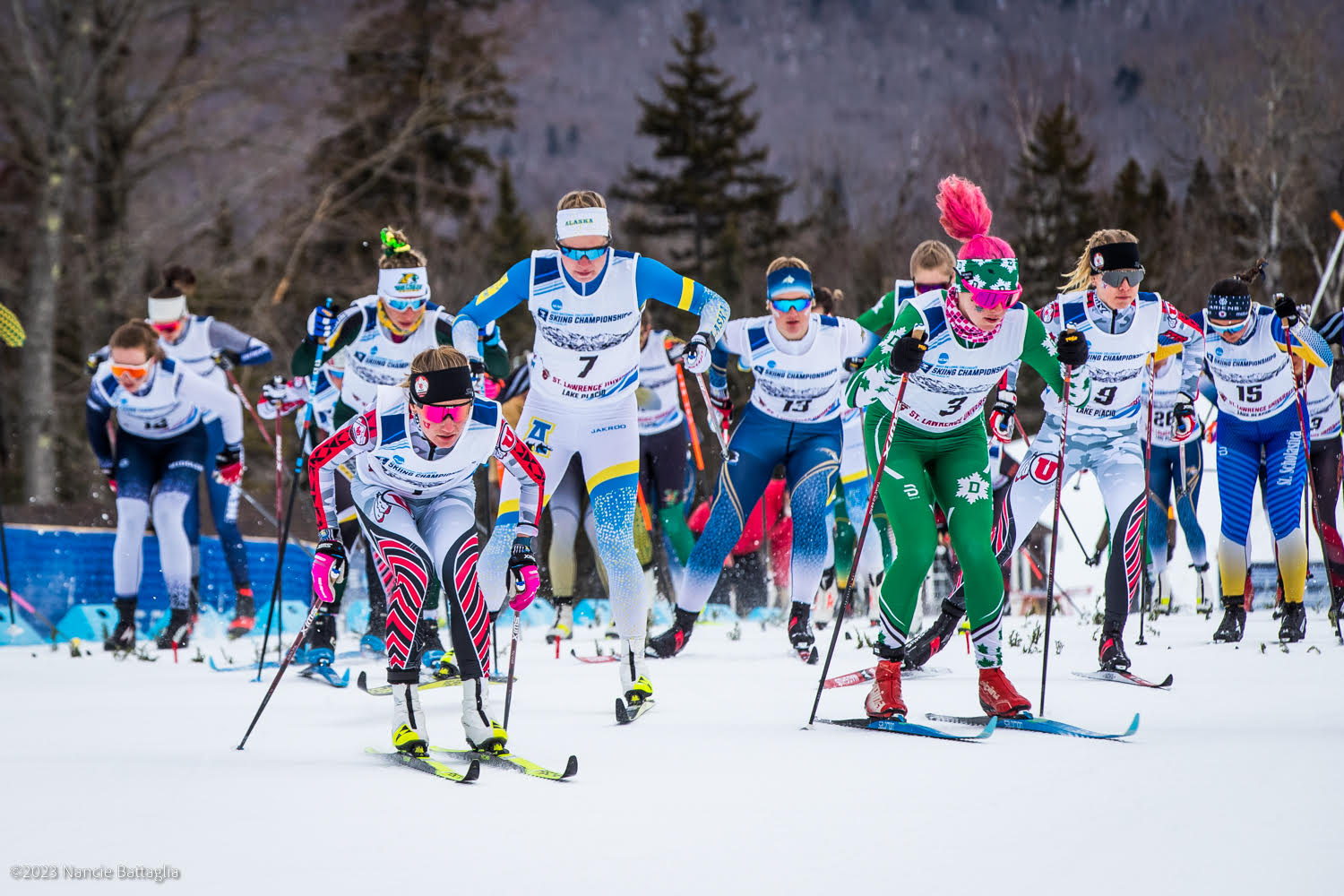
    The extra 5 k to the Women’s Mass Start this year only extended the tension. As the women’s field started to split mid-way through the race on Saturday, a trio of University of Utah skiers—all of them already NCAA Champions—started to push from the front. Novie McCabe, Sophia Laukli, and Sydney Palmer-Leger were joined by University of Alaska-Fairbanks’ (UAF) Mariel Pulles, and University of Colorado’s (CU) Hanna Abrahamsson. The five skiers traded some leads and pulls, but throughout the race, one skier appeared to control pack surges just a little more than the others, seeming to have an idea of when and where she wanted to make a move. 

    Novie McCabe controlled a pack that also contained her teammates Sophia Laukli and Sydney Palmer-Leger. The UU girls finished first, third, and fifth, propelling the Utes to their fourth consecutive NCAA Championship. (Photo: (c) Nancie Battaglia).

    That was McCabe, and when the group started to wind around the Lake Placid course one last time, she decided to go. By the end of the lap, she was on her own. McCbe went on to complete her sweep, winning her third NCAA Championship. Her teammates Sophia and Palmer-Leger came through in third and fifth, with Abrahamsson in second and Pulles in fourth splitting the UU girls results. First, third, and fifth though, was enough to all but guarantee that the University of Utah Utes would make history by winning their fourth consecutive NCAA Championship. The trio of McCabe, Laukli, and Palmer-Leger scored the highest team score in an event of the entire NCAA Championships.

    In post-race comments to FasterSkier, McCabe wrote that, “I am really excited that we managed to pull off the team win! The Alpiners had some crazy good performances which really helped us out and it was cool to be able to keep that lead today. My time at Utah has been really amazing and I feel so lucky to be part of the team, so being able to contribute to the win was a really great feeling!”

    The University of Utah Utes became the first team in modern NCAA Championships history to win four consecutive titles, with their Nordic team leading the way. (Photo: (c) 2023 Nancie Battaglia)

    UU Head Coach Miles Havlick wrote to FasterSkier about what distinguished this latest UU Championship: “This year was very much a team effort,” Havlick wrote. “Everyone both on the Alpine side and Nordic understood that their jobs were to score as many points as they could for the team, and it was very evident today. Both in the women’s race and men’s, each of our skiers left every ounce of energy out on the trails and I am super proud of that.”

    Havlick also highlighted McCabe’s place not just in this year’s Championship, but in that whole string of Team Championships: “She was definitely on form this week,” he said. “And she will certainly go down as one of the best Ute skiers of all time.” Havlick recognized that the Utes dominance has been part of a feedback loop of determined skiers begetting more determination for each other, “Any one of them, Novie, Sophia, and Sydney, have the ability to take both titles. It has benefitted each of them to have the competition of each other in training day-in and day-out.”

    For McCabe, there’s more ahead too, with Havlick being the first to say that after her NCAA sweep, “it will be fun to see how she stacks up she heads back over to Europe for the final World Cups of the season.”

    Men’s 20 k Classic Mass Start

    John Steel Hagenbuch has made the tough new course at Lake Placid a kind of home field this season. In January, he won the 30 k freestyle mass start at the World University Games, and was the bronze medalist in that Games’ pursuit as well. He swept this year’s St. Lawrence Carnival, and was runner-up in Thursday’s NCAA Championship race. Neon headband wrapped around his Big Green suit, the Dartmouth Junior was ready to light out for a win from the lead pack of three skiers that had formed mid-way through Saturday’s race.

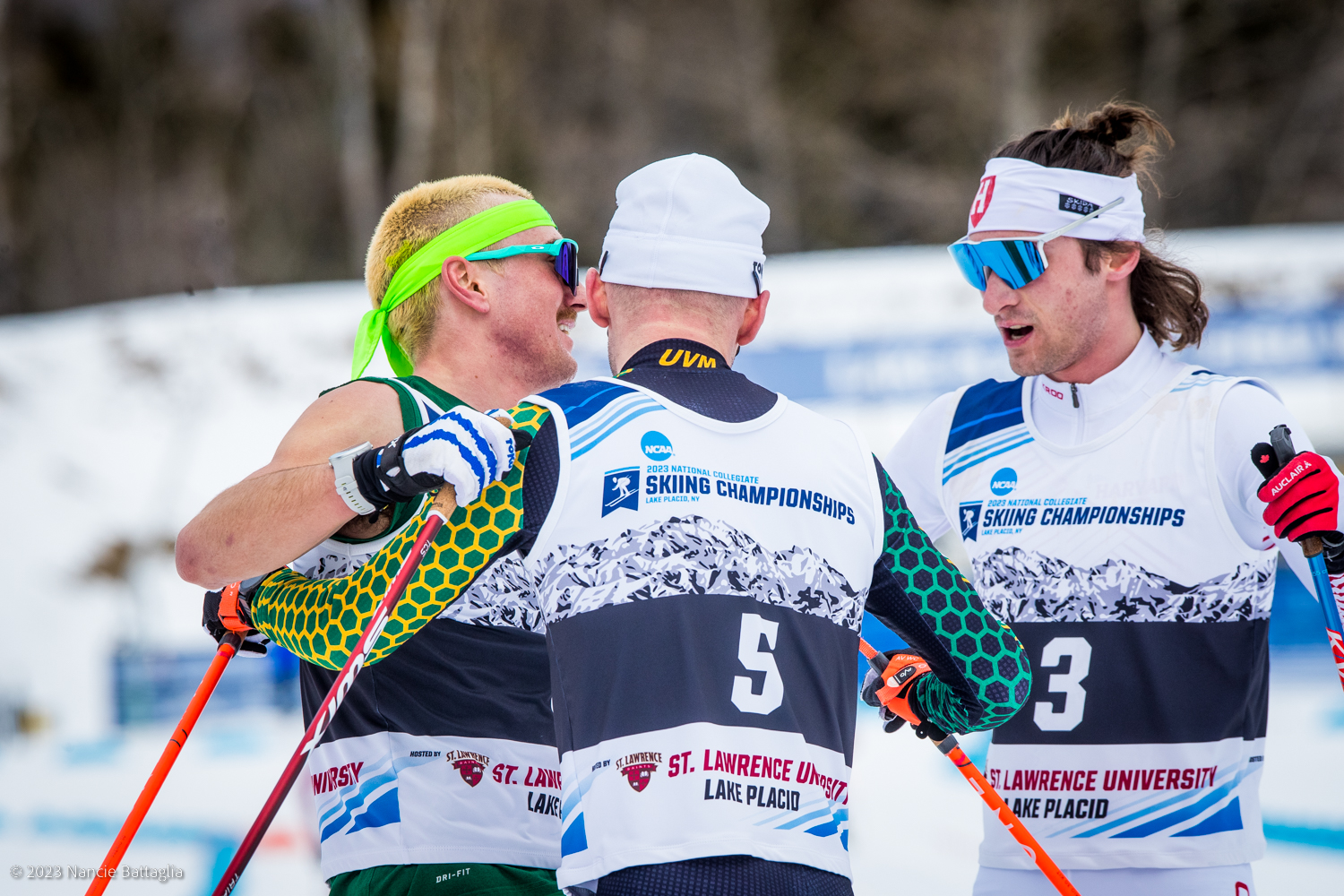
    The men’s lead pack embraces after a 20 k pitched battle: (L-R) John Steel Hagenbuch (Dartmouth), Jacob Nystedt (UVM), and winner Remi Drolet (Harvard). (Photo: (c) 2023 Nancie Battaglia)

    For a little bit, it seemed Hagenbuch had left it all behind. University of Vermont’s Jacob Nystedt was dropped. Harvard’s Remi Drolet though, was just out of the picture. Then, as the finish came into focus, so did Drolet. The Canadian National Team member steadily, and then suddenly, passed Hagenbuch; a final battle concluded before they hit the finishing straight. Remi Drolet crossed the finish line to win his first NCAA Championship, and the first for the Harvard Crimson Nordic Ski Team in its history.

    “I tried to be aggressive throughout the race, and us top three eastern guys. [Hagenbuch and Nystedt] were able to pull away from the pack by pushing the uphill fairly hard every lap” wrote Remi Drolet in post-race comments to Fasterskier. “Apart from [the tactics], I think I just really wanted it. I wasn’t sure I had it in me going into the race, but I was able to dig really deep.”

    Harvard Head Coach Chris City wrote to FasterSkier that there was an underlying confidence heading into today that helped boost Drolet and the Harvard team,:“[Remi] is such a strong classic skier and it’s a course that really asks a lot in terms of striding. His seventh place [Thursday]—a first All-American for our program—gave us a feeling that Remi was in a good place to compete in a classic.” Pre-race confidence translated to, “one of the most exciting collegiate races I’ve seen,” added City.

    Remi Drolet became the first Harvard NCAA Champion in program history with his win in the 20 k classic Saturday. (Photo: (c) 2023 Nancie Battaglia)

    Excitement during the race crescendoed afterward, as both coach and athlete recognized that the result of one race extended far beyond the finish line, “It feels really nice to know that I wrote this down as a goal with [the Harvard team] at the beginning of the season, and that we were able to come together to make an NCAA title happen wrote Drolet. “I’m so proud of him and of his teammates,” Coach City wrote, “and of the many other Harvard skiers who helped build the program to where we reached today.”

    Collegiate Skiing Comes to a Close, with more to come

    College skiing is a circuit uniquely attuned to constant transition; so, as the banners and barriers come down in Lake Placid, coaches and athletes are looking back, and beginning to look ahead.

    For many programs, they will be looking not just at historic firsts at the top of the results, but the ranks of the All-American finishes that marked an individual achievement, powered by a whole program’s efforts. To be designated an All-American, skiers place in the top ten of an event.

    NCAAs leave Lake Placid with many programs having achieved milestones. Harvard saw its first NCAA All-American and Champion with Remi Drolet, while University of Alaska-Fairbanks saw seven All-American finishes over two days of racing. (Photo: (c) 2023 Nancie Battaglia)

    Remi Drolet’s history-making finishes for Harvard—a first All-American for the Crimson on Thursday, and a first NCAA Championship for the Crimson Saturday—is a stark and impressive example. Dartmouth College, the University of Colorado, and the University of Utah all showed impressive signs of sustained top performance, with four All-Americans between the Women’s and Men’s race on Saturday.

    That was nearly matched by the University of Alaska-Fairbanks (UAF), which had three All-Americans today, and a total of seven in this Championships. For the Nanooks, that is a sign of something special growing. “We come away from these championships both proud of what we accomplished, and also hungry for more” wrote UAF Assistant Coach Benjamin Buck to FasterSkier. “We came closer to winning the overall nordic competition than I think anyone expected.”

    After all the scores are tallied, honors awarded, and results sheets posted, the athletes and coaches leaving Lake Placid are looking at one aspect of the College circuit that doesn’t seem to change, even as the participants constantly do. Take it from this year’s winner, Novie McCabe: “The college ski community is just so great and everyone is supportive of each other,” she said. “It’s really just such a lovely group of people. Yes, winning was a goal of mine, but mainly, I’m just happy I got to experience racing in this insane atmosphere!”

    Full Women’s 20 k Classic Mass Start RESULTS

    Full Men’s 20 k Classic Mass Start RESULTS

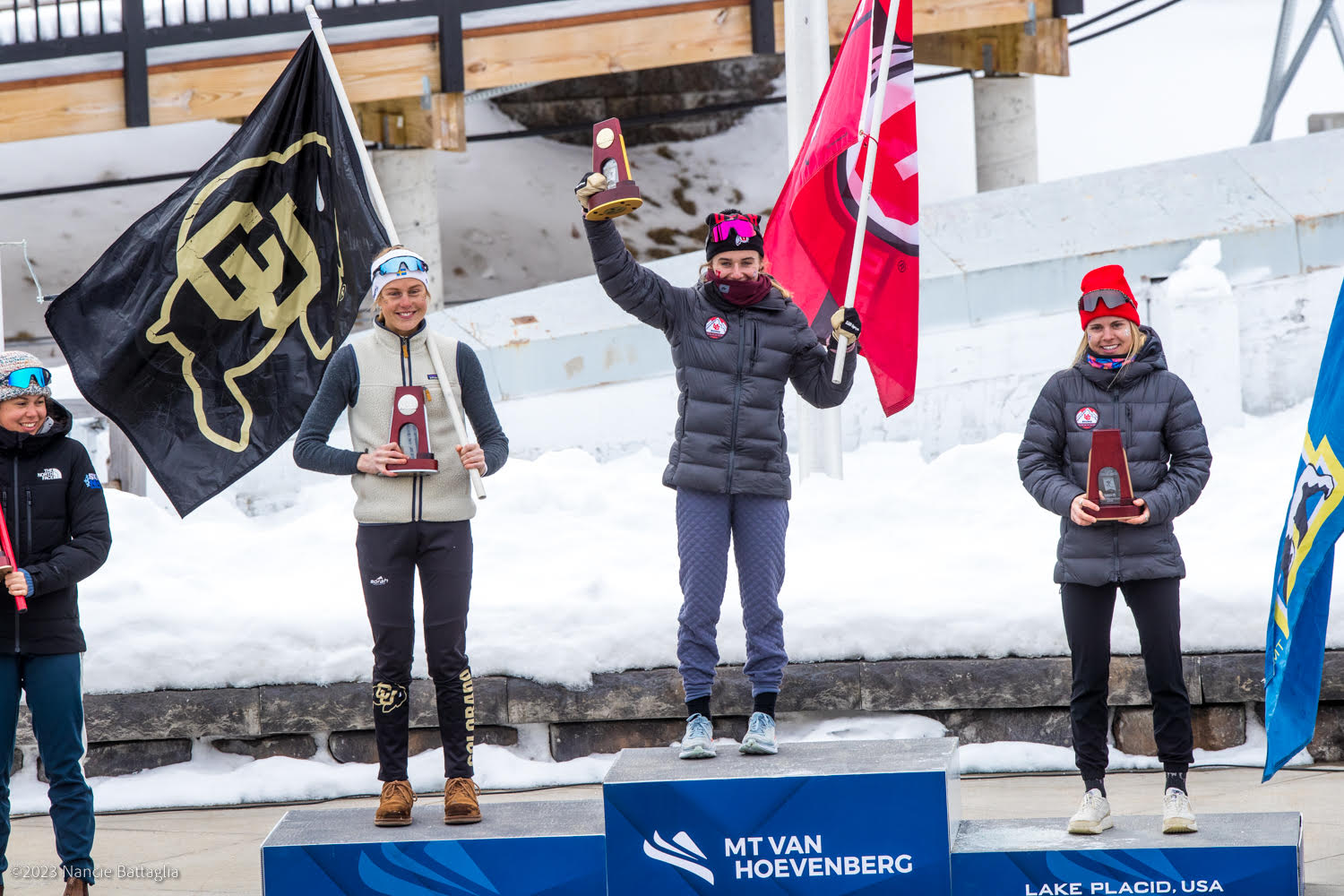
    Women’s 20 k classic mass start NCAA podium, 1st) Novie McCabe (UU), 2nd) Hanna Abrahamsson (CU), and 3rd) Sophia Laukli (UU). (Photo: (c) 2023 Nancie Battaglia)
  • Joe Davies and Novie McCabe Win NCAA Championships in Lake Placid Freestyle Race

    Joe Davies and Novie McCabe Win NCAA Championships in Lake Placid Freestyle Race

    Joe Davie (UAF, bib 38) moves through the Men’s pack in Lake Placid Thursday, on his way to winning an NCAA Championship in the 10 k individual start skate. (Photo: (c) 2023 Nancie Battaglia)

    The NCAA Ski Championships began in Lake Placid, New York Thursday, marking the culmination of America’s collegiate race season in one of America’s most storied ski venues.

    This marked the fifth time that Lake Placid has hosted NCAA Championships, and the first time since 2015 when the Freestyle event that kicked off the event was won by Dartmouth Sophomore Patrick Caldwell on the Men’s side, and Austrian Freshman Veronkica Mayerhofer from the University of Utah on the Women’s.

    Eight years on, Lake Placid had an all new course for the NCAA field in the country to tackle, with the Mt. Van Hoevenberg trails originally put in for the 1980 Olympics updated to reflect the modern world of homologation, mass starts, snow-making and a good ol’ fashioned urge for bigger hills and a bigger challenge.

    The racing began with a Freestyle Individual Start, 10 kilometers for the Men and 5 Kilometers for the Women, with NCAA racing still following the practice of racing different distances between the genders in this event. 

    Collegiate Strength on Display in Pre-Race Favorites

    The pre-race participants list at this year’s NCAA Championships pointed to the growing strength of the collegiate circuit, as the best young skiers across North America increasingly choose to pursue their athletic and academic development at once, joining up with the support and ready-made training groups found on college teams. With returning champions in both the men’s and women’s field who have been on the World Cup, at Senior World Championships, and U23 World Championships this season, talent abounded in Lake Placid.

    In the men’s field, Ben Ogden, last year’s champion in both the skate and classic, was slated to return to NCAAs for the University of Vermont (UVM). However, considerations balancing performance with the logistics of traveling home from World Championships led the three-time NCAA champion to decide on staying in Europe to close out the season, and Ogden was absent from Lake Placid on Thursday. 

    Ogden’s absence left one other former NCAA champion in the field, with the University of Colorado’s (CU) Magnus Boee returning to the field after having swept the 2021’s Championship in Jackson, New Hampshire. Denver University’s (DU) Andreas Kirkeng, who won the 10 k Freestyle at Senior Nationals this season, headed up a strong DU squad that also included perennial top-performer Bernhard Flaschberger. Dartmouth College Sophomore John Steel Hagenbuch, who scored top Championship results at the World University Games that were held in Lake Placid in January, also looked like a strong favorite to put Dartmouth back on the top step of the podium in Lake Placid.

    In the women’s field, the University of Utah (UU) trio of Sophia Laukli, Novie McCabe, and Sydney Palmer-Leger all returned after having traded NCAA titles among each other the past two years. Palmer-Leger swept NCAAs in 2021, while Laukli and McCabe split the Freestyle and Classic title, respectively, last year. All three Utes have traversed World Cup racing, World U23 Ski Championships, and the collegiate circuit this season. At the U23 World Championships 10 k Freestyle Individual start, the same line-up that started for UU today all finished in the top ten for the United States. Sophia Laukli came into this NCAA Championship as the first skier to have a World Cup podium already on her resume, after winning a bronze on the Alpe Cermis hill climb during this year’s Tour de Ski.

    Outside of the UU squad, the University of New Hampshire’s (UNH) Jasmine Lyons returned from competing for Canada in Planica to make a run at a NCAA title. Medalists from January’s World University Games in Lake Placid also figured into the favorites, including the University of Alaska-Fairbanks (UAF) pairing of Marial Pulles and Kendall Kramer, and CU’s Anna-Maria Dietze.

    Men’s 10 k Freestyle Individual Start

    With defending champion Ben Ogden away, there was an open possibility that anyone could seize the opportunity to power through the cold conditions on the two 5 k laps that made up the 10 k course today. In the field of 40 starters, any bib could jump out.

    Joe Davies (UAF) during his NCAA Championship winning performance Thursday. Davies put in a dominant performance, 25 seconds ahead of second place John Steel Hagenbuch (Dartmouth). (Photo: (c) 2023 Nancie Battaglia)

    In the end, that bib was 38, and it wound its way through the field on the back of University of Alaska-Fairbanks Sophomore Joe Davies. A closely packed finish list ahead of Davies, with Dartmouth College’s John Steel Hagenbuch and Denver University’s Bernard Flaschberger separated by just five seconds, was re-written quickly as Davies came across the finish line around a minute after Hagenbuch (bib 25) and netted 25 seconds on the whole field in 22:33.2.

    “I knew with the amount of climbing on course that there could be a lot of time to be gained by working well over the tops and along the flats,” wrote Davies on his winning 10 k performance to FasterSkier, “after getting splits around the 7 k mark that I was up by a fair margin I relaxed a bit and was able to ski calmly and composed to the finish.”

    Davies hails from Pemberton, Canada, and competes internationally for Great Britain. For Team GB, he has had a season similar to other pre-race favorites, showing up on results sheets from Planica, where he was 30th in the 15 k at World Championships, to his home course in Whistler, where he was 13th in the 10 k at U23 World Championships. There was a lot of history to suggest that he was one of the finest skiers in the field Thursday, but a 25 second gap on the field marked a dominant performance that highlighted a strong progression for the skier this season. 

    “I’ve been racing abroad for quite some time now, so being able to return to the NCAA Championships and get a win feels incredible,” wrote Davies.

    UAF Head Coach, Eliska Albrigtsen, also pointed to Davies international experience this season as a reason for his success today. “[Joe] got a taste for the highest level of competition at the World Cup,” she said. “And we feel that exposure really helped push him to new heights.” She added that his World Championship starts with Team Great Britain, “set him up very nicely for a good race here today. Over the past two years with our team, we’ve seen him realize his true potential as a skier, and we expect great things for him in the future.”

    Davies became the third UAF skier to win an NCAA Championships, and the first since Marius Korthauer in 2008. His championship highlighted a performance for the Nanooks that sees them head to Saturday’s Classic race on top of the Team Standings in Nordic (NCAA team scoring is combined with Alpine, and UAF does not have an Alpine team), ahead of Denver University by one point.

    The Men’s 10 k skate podium: 1st) Joe Davies (UAF), 2nd) John Steel Hagenbuch (Dartmouth, 3rd) Bernhard Flaschberger (DU), 4th) Andreas Kirkeng (DU), and 5th) Mike Ophoff (UAF). (Photo: (c) 2023 Nancie Battaglia).

    Those team standings were the source of the race’s tension today. The Denver University pairing of Bernhard Flaschberger and Andreas Kirkeng started before the UAF pairing of Davies and Mike Ophoff. Flaschberger set the fastest time of day when he crossed the finishline with a 23:03.5, and while it was surpassed by John Steel Hagenbuch (22:58.2) quickly, Kirkeng’s crossing the finish line in third place before Davies had come in seemed to set the bar for the day, with a grouping of three of the most dominant skiers in the field all right around the 23:00 mark. Davies surpassing that opened up a possibility for UAF, and when Ophoff came in fifth place with a gap up to Kirkeng, it sent onlookers to the scoring sheet. The third scoring skier for DU was Elijah Weenig in 13th place, while the 3rd scorer for UAF was 16th place Christopher Kalev. When the math was done, UAF came out on top.

    “This is a moment that has been in the making for five years,” wrote Eliska Albrigtsen to FasterSkier. “We’ve put in the hard work and we’ve seen our team rising to the top to be one of the best programs in the nation, and today’s results are the hard proof!” Assistant Coach Ben Buck added that “we knew [we were] in the mix for a podium sport, but the performance from the team today, from top to bottom, was so impressive.”

    Women’s 5 k Freestyle Individual Start

    With the University of Utah trio of Sydney Palmer-Leger, Novie McCabe, and Sophia Laukli in the last 10 starters of the 40 person field, the Women’s 5 k race was set to be a tense affair through the whole of the race today, with the championship eventually going to McCabe in a dominant performance.

    In the early goings before that conclusion, there was a lot to watch. UNH Junior Jasmine Lyons, who was 36th in the 10 k at World Championships two weeks ago for Canada, set a high bar early. Lyons held an early advantage at 2.5 k all the way through, and crossed the finish line in a time of 12:59. A second half surge from the University of Colorado’s Anna-Maria Dietze, wearing bib 29, saw her cross the finish line just two seconds behind Lyons and set the grouping at the top of the field.

    Behind them, the question to be answered was whether Palmer-Leger, (bib 33), McCabe (bib 36), or Laukli, (bib 37) would match or pass the standard set by Lyons and Dietze. Palmer-Leger was off the pace at 2.5 k, and crossed the line in what would eventually be a 14th place on the day. McCabe and Laukli, though, were right in the ballpark with Lyons and Dietze. McCabe bested Lyons checkpoint at 2.5 k. Laukli came through the same point in third behind Lyons though, which gave an indication that Lyons and Dietze hadn’t just set an early standard, but that they would be right in it at the top of the race when it was all settled today.

    Novie McCabe sprints to her second Individual NCAA Championship on Thursday in Lake Placid. (Photo: (c) 2023 Nancie Battaglia)

    Novie McCabe’s sprint into the Lake Placid stadium eliminated any doubts about who was the fastest skier on the day. She launched across the line, and the clock read that she had bested the whole field by 14 seconds, a time of 12:46. Laukli’s finish back from McCabe left a close race to be sorted in places 2-4, for which Laukli would end up fourth. Lyons and Dietze’s times had held, and they were in second and third, respectively.

    In post-race comments Novie McCabe wrote to FasterSkier that she looked to “start pretty hard and then hold it if I could” on the tough Lake Placid 5 k course. “There’s a lot of uphill in the first half of the course here, so my goal was to be in a good place by the top of the course.”

    McCabe’s joins a list of fifteen other women who have won an NCAA Championship in both techniques, including her teammate Palmer-Leger. In the five NCAA Championship races she has started, McCabe has never finished off the podium.

    UU Head Coach Miles Havlick wrote to FasterSkier that, “Novie has been on fire for this second half of the season. She had trouble staying healthy and didn’t race to her expectations [earlier this year], and I think racing with Utah and the RMISA circuit has been really good for her. Right now, she is skiing as well as I have seen her ski since she has been at Utah.”

    “This one meant a lot to me!” McCabe wrote of her Championship. “I was sure doubting my shape earlier in the season, and was pretty nervous today because I really wanted to be able to put a good one together for the team. I’m definitely happy with it and lucky to have so many great teammates to make it such a fun experience!”

    The Utes scored top marks on the day in the team rankings, just ahead of a CU team that scored all three in the top ten with Dietze, Hanna Abrahamsson, and Weronika Kaleta. Combined with the UU Alpine Women, the University of Utah enters the second-half of NCAA Championships with a good chance to win their fourth straight NCAA Skiing Team Championship.

    Coach Havlick is liking their chances. “Both [Sophia] and Sydney are a little tired from World Championships and recent travel,” he said. “But I am optimistic about their races on Saturday. These girls definitely feed off of one another, and will be looking to capitalize on the hilly 20 k course.”

    NCAA Women’s 5 K Freestyle RESULTS

    NCAA Men’s 10 k Freestyle RESULTS

    The Women’s 5 k Skate podium, including 1st) Novie McCabe (UU), 2nd) Jasmine Lyons (UNH), and 3rd) Anna-Maria Dietze (CU). (Photo: (c) 2023 Nancie Battaglia).
  • Q&A with New Faces on the U.S. Ski Team: Walker Hall

    Q&A with New Faces on the U.S. Ski Team: Walker Hall

    U.S. Ski & Snowboard recently announced its U.S. Ski Team nominations for the 2022-23 season. Of the 22 athletes named to the team this season, six were not on the previous year’s roster, either newly named or renamed: Michael Earnhart, Walker Hall, Zak Ketterson, Will Koch, Finn O’Connell, and Sammy Smith.

    Walker Hall was named to the 2022-23 U.S. Cross-Country D-Team. (Photo: U.S. Ski & Snowboard)

    To help fans get to know these new(er) faces, FasterSkier is doing a series of interviews, providing insights into the factors that have contributed to development, progress, and growth for these athletes last season. In this installment, we talk with 20-year-old Walker Hall, who was named to the D-Team this season. Hall grew up immersed in the Methow Valley cross-country ski community and is now entering his sophomore year at the University of Utah. 

    While the Methow has produced a number of outstanding skiers, including Brian Gregg, Erik Bjornsen, and Sadie Bjornsen Maubet, Hall could find inspiration even closer to home. His mom, Leslie, skied in three Olympic Games between 1988 and 1994, and her best friend and training partner post-professional racing soon became two-time Olympian Laura McCabe, once both women relocated to Winthrop, WA. Still close friends, Walker and Novie McCabe are just six months apart in age, and began tagging along from their infancy on their moms’ training and outdoor endeavors. Both athletes, now U.S. Ski Teammates, developed on the Methow Valley Nordic Team, coached by their mothers.

    Methow Valley Nordic Team coaches and Olympians Laura McCabe (left) and Leslie Hall (right) bring Novie and Walker, now U.S. Ski Teammates, along for their training and outdoor endeavors. (Courtesy photo)

    In this interview, Walker reflects on some of the other influential experiences – and setbacks – that contributed to a breakout season in 2021-22. Hall won the junior men’s 10 k during the 2022 U.S. Cross-Country Championships in Soldier Hollow, and finished in the top-five in a third of his RMISA races, including a podium performance in Sun Valley. Earning his first spot on the World Junior team, Hall competed in both the 1.2 k freestyle sprint and the 30 k skate individually, and was a contributing member of the U20 bronze medal winning relay team.  


    – Walker’s sister, FasterSkier assistant editor Ella Hall, contributed to these questions

    FasterSkier / Rachel Perkins: You grew up in the Methow Valley, which has a strong legacy within its cross-country ski community and the number of athletes who grew up there and went on to ski professionally. But in your situation, you and Novie McCabe are only about six months apart, and your families are super close and it sounds like you both did a fair amount of tagging along for both of your moms’ training as kids. Can you talk a little bit about your introduction to skiing and what your relationship with the sport was like growing up? 

    Walker Hall: From as early as I can remember, probably as soon as I was capable of going on skis, that’s when I started – me and Novie both. Regardless of what we were doing, it was mostly outdoor activities, whether that was hiking or climbing or just spending time outside. Our moms would take turns, like one would take care of us while the other went and did some training or a long run or something. So I felt like I got a good training base just from everything I did outside, and started off skiing really young, and it’s always been a big part of my life.

    Leslie Hall, with a young Novie McCabe and Walker Hall, share a lifelong love of the outdoors that has developed into successful ski racing careers. (Courtesy photo)

    FS: I also noticed you also listed your mom as one of the most influential people in your life in your U.S. Ski Team bio, and I know she was one of your coaches with the Methow Valley Nordic Team (MVNT). Can you say more about that?

    WH: She coached [MVNT] up until just this last year – she retired last season. Basically when she was done racing [professionally] and once my parents moved to the Methow in the late ’90s, she really developed the program there.

    So she’s been coaching for a really long time, and she had a lot of experience. She coached when my sister was skiing, so I grew up doing what [Ella] did because she’s four years older. My mom was able to give me the support and advice and guidance that is crucial for being good at skiing, and she was not too overbearing or anything, so I think she was just a really good influence on my ski career.

    FS: That type of relationship seems important – not being overbearing, but really sharing in a mutual love of the sport. Is that something that you have felt within the Methow community and within your own family?

    WH: I’ve definitely felt a lot of support from different people in the Methow, whether it’s my mom or Laura [McCabe] or other people in the ski community there. I’ve always gotten the support that I’ve needed and been pushed when I needed to be, and never felt too much pressure or anything, so it’s been really good for my career in skiing.

    Long-time Methow Valley Nordic Coach and 3x Olympian Leslie Hall with the members of the U18/U20 relay at 2019 Junior Nationals in Anchorage, all of whom skied for MVNT. From left to right, Travis Grialou, Garrett Butts, and Walker Hall. (Courtesy photo)

    FS: Fast-forwarding a bit, in high school, you spent six months in Meråker, Norway during your junior year, and it sounds like that was a pretty formative experience for you – you had a really positive experience with that program, and the coach, and made some good friends/training partners. Can you share more about how that came about and what your time was like there?

    WH: It came about because Ella did a very similar [program] her junior year; she also went to Meråker, but she went for a shorter period of time. But as I got older and learned more about the sport and the people within the sport, it seemed like Norway was the place to be to really improve and learn. Our family had some connections in that area because Ella had been there. 

    Once I was there, it was definitely a lot different. Coming from the Methow where there’s really not many – there’s a lot of skiers, but it’s such a small area that you’re sort of in your own little bubble. So going to Norway and just seeing the ski culture there and learning a lot about training and what the Norwegians like to do [was really beneficial], because they obviously have a really good method for juniors or whatever age you are in ski racing. I had good coaches, good training partners, and good support there as well. So I definitely learned a lot and sort of knew what I had to do when I got back to really take skiing to the next level.

    FS: Was that at a sports academy? Were you going to school also?

    WH: It’s actually a public high school, or it’s funded by the government, but it’s a sports school [called the Meråker videregående skole]. So we would train in the mornings until maybe 11, and then shower, eat lunch, go to class for three hours or so, and then maybe train in the afternoon. That was what it was like most days, then on the weekends, it was more on your own because it’s a school program, not  a club. When we would go to races – which I didn’t go to too many races – we would go with a local club.

    FS: Your sister said that the experience also inspired you to take Norwegian lessons after returning home and that you’re “decent” now. Is this true?

    WH: When I was there, I definitely didn’t know that much [Norwegian]. There were two other non-Norwegian students that I took some Norwegian lessons with, just what the school provided, but I definitely never really spoke that much while I was there. I wanted to keep learning and improving [after I got back], so I’ve studied on and off since then. I’m alright at it – I’m pretty conversational, I would definitely not say I’m fluent. But it’s a fun way to stay connected with my friends over there, and some of my teammates at the University of Utah are Norwegian too, so that’s been cool.

    Hall also explained that his classes in Meråker were in Norwegian, but since the group size was small, and both his teachers and classmates were helpful, he was able to get by without being fluent in the language. 

    FS: After graduating high school in 2020, you had planned to go back to Meråker for a gap year, but COVID got in the way of that, and plan-B ended up including a lot of time training on your own in the Methow. Can you talk about that experience and how you adjusted?

    WH: I had been planning to go back to Norway, but everything was so strict with COVID [at that point], they were not letting anyone in, basically. So I was just at home and I kept trying to figure it out so that I’d be able to go over there, but it just kept not working. I kept trying, but eventually, I was just at home the whole time. 

    I was going to races in the winter but it definitely was not an ideal situation for me because I was doing a lot of training on my own, which, it’s not necessarily a bad thing to train on your own, but for me personally, it’s a lot easier for me to train with other people. It’s a lot more motivating, and long term, it’s a lot better to train with other people so you don’t plateau. But I just focused on racing and kept working hard and it wasn’t the worst in the end. That year was alright, but it wasn’t ideal.

    Walker Hall trains with the University of Utah team in Fall 2021. (Courtesy photo)

    FS: Kind of on the other end of the training group spectrum, for collegiate racing, you originally committed to Dartmouth, but later were offered a spot that opened up at the University of Utah, and made the switch as Utah had been your first choice.

    WH: Yeah. Basically, I had planned on going to Dartmouth, and then COVID hit, and it was looking like life at Dartmouth with COVID was going to be a lot different than before. I had been talking to Utah [during my senior year], and they had been saying ‘oh, you should take a gap year and then we’d probably like to take you.’ So there was also a chance that I was not going to take a gap year and just go to Dartmouth, but then when that gap year happened and I got offered a spot at Utah, I just knew that that was going to be the better choice for me.

    Last summer before I went to Utah, I came up here to Anchorage for most of the summer, so I was training with a lot of my future teammates. There was a big group of people up here and a good amount of Utah skiers were here, so it was a good way to prepare and it was a really good experience. There’s just such good training up here during the summer. And the winter, I’m sure.

    FS: And what does that look like? Are you working with a coach or under a certain program? And how have those experiences being in Anchorage for the summer been valuable for you?

    WH: I train with APU when I’m up here. That’s a really solid group to train with, coached by Erik Flora, who I really like and I’ve learned a lot from. It was a really good experience coming up last summer, and I knew I wanted to come again this summer. There’s just a lot of really hardworking people that push me and help me hit big hours, so I think it’s a good place for me to be during the summer.

    FS: Going back to University of Utah – what appealed to you about that program? And what was your experience like in that first season of collegiate racing?

    WH: There’s a lot [that appealed to me about it.] I knew a lot of the people on the team, and I knew it was such a strong team. I had actually been down there a couple times – or I had been in Park City for ski camps and [races], and I visited Novie for a couple of weeks [during her freshman year at Utah] and really liked it. Me and Novie have always done similar training and whatnot, so I figured if she was liking it a lot down there, then it was a good place for me also. 

    And I really liked the coaches. I talked a bit with Miles Havlick and Frederick [Landstedt], and I really liked what I’d seen from those guys. Since I’ve been there, it’s been a really good fit.

    Xavier Mckeever in bib 10 (CAN) and Walker Hall in bib 14 (USA) head up “waffle hill” in the early stages of the men’s 30 k mass start during the 2022 Junior World Ski Championships in Lygna, NOR. (Photo: Ella Hall)

    FS: World Juniors in Lygna was your first international trip, and it sounds like you had some bad luck with racing at US Nationals and/or been really close in prior years. What do you think came together for you this season to make that trip? And what were some of the highlights of that World Juniors experience in terms of how it supports your development and goals?

    WH: Yeah. In previous years – maybe the past three years or so for this year – there were like two years where I was just coming off of sickness going into nationals, so I never really had the races that I wanted there, and I never ended up making any of those international trips. Which, honestly, I would have liked to go on the trips, but it never really bothered me too much – it wasn’t like demoralizing or anything – because I felt like I knew the level that I was at and that on a given day I could be as good or better than any of the trip. So it was never really too much of a bummer for me. But this year, I wanted to make it on the trip to World Juniors, and I had goals for the races at World Juniors too, it wasn’t just the trip there was the end goal. But just making it definitely felt good, and I had a really good Nationals this year, which was awesome since that’s pretty much the first time that’s happened for me. 

    I was super happy that the races were in Norway because I just love spending time there, and we got to do our pre-camp in Hafjell, which is right near Sjusjøen, and I’ve spent some time there – it’s [some of] the best skiing in the world. So that was super fun. And I really liked a group of guys and the entire team and staff that was there, so it was a really good experience.

    FS: From the outside, it seems like you took a pretty big step forward this past year, which maybe can be attributed to having such a strong group to train with at University of Utah, or some more direction after a tough gap year. In looking back over this year, what are some of the factors that you think allowed you to take those steps forward and what were some of your personal highlights from the season? And those personal highlights do not necessarily need to be a race result, just an experience that stands out to you.

    WH: I think the main factor was really taking my training to the next level. Especially over the summer [in Anchorage] and then carrying that through the fall in Utah. I was just training with a really strong group, and really pushing myself, and doing [types of training] that I hadn’t really done in the past. So definitely, a good part is thanks to that. And then also, I’ve had a lot of different experiences over the years and learning from those helps to channel some better results.

    As for my highlights – this last season, I was just proud of the way that I trained and was smart with my training, and I  didn’t overdo it. And it seems like it’s often hard to put together a good season like your freshman year of college because it’s such a big adjustment. So I was happy that I was able to have a solid season for the most part while going through such new experiences in my first year in college.

    Walker Hall stands atop the podium in Soldier Hollow after winning the junior 10 k mass start freestyle during the 2022 U.S. Cross Country Ski Championships. (Photo: John McColgan)

    FS: What are your goals heading into next winter?

    WH: It’s gonna be my first year not being a junior, so honestly, I don’t have too many specific goals. But I’d definitely love to race in my first World Cup this year, and just keep improving. On the college circuit, hopefully, get a bunch of podiums in RMISA. And just keep learning from my teammates and pushing with the team at Utah.

    FS: Last question for you: with making the D-Team, can you share what that means to you and what you’re excited about in terms of the support and opportunity that opens up for you?

    WH: It’s always seemed like probably the biggest step you can make in U.S. skiing is actually making the ski team, so it feels really good to have achieved that. I’m just now realizing the amount of support that means that I’m able to get, so I’m just taking advantage of that and learning from my other teammates on the team – taking advantage of the different opportunities that it grants me, and just enjoying the ride. But I’m definitely thrilled to have made the team.

  • After Three Straight NCAA Championship Victories, What’s Next for the University of Utah?

    After Three Straight NCAA Championship Victories, What’s Next for the University of Utah?

    The University of Utah (UU) team celebrates on a sunny day in Park City at the 2022 NCAA Championships. The Utes won the NCAA team title, their 3rd in a row. (Photo: Tobias Albrigtsen / @untraceableg)
    With a cohort of some of the best U23 skiers in the country, the program is setting a trend for young American skiers pursuing international-level and college skiing simultaneously.


    After the first day of this year’s NCAA Championships, held at Soldier Hollow, Utah, the team scoring was close. The familiar schools were all there, the University of Utah (UU) at the front, with the University of Colorado (CU), Denver University (DU), and the University of Vermont (UVM) all close behind.

    How close? Well, all within 100 points in the NCAA team scoring system – which doesn’t mean much. 

    Team NCAA scoring is hard to comprehend. It is best described as archaic and arcane; a cumulative score between alpine and nordic across genders, and disciplines, over two days of racing (with no sprint race to be found).

    You can understand it in archaic terms then – the four big programs that have historically dominated NCAA skiing all went into the final day with a notion that they might just add another title (UU, CU, DU, and UVM account for 63 out of the 69 titles awarded in NCAA history).

    Then, the 15 k women’s skate mass start went off.

    What happened within the first kilometer was anything but arcane. Three skiers, all clad in the white and red of the University of Utah pulled away as if they were out for a team interval session.

    The sight of that trio, together, has become an international force over the past couple of seasons. Sophia Laukli, Novie McCabe, and Sydney Palmer-Leger earned a Junior Worlds relay medal for the US together in March 2020. They’ve since climbed into top tens on the World Cup together, also done a lengthy FasterSkier interview together as well.

    Sydney Palmer-Leger (USA) racing to 53rd position in the qualifier. (Photo: NordicFocus)

    Coming into this particular NCAA race, Laukli and McCabe had just come home from representing the United States at the 2022 Beijing Olympics, while Palmer-Leger came in looking for a third NCAA championship title in only her second year on the circuit.

    The only question then, was which UU skier would take the race. As Sophia Laukli broke away from McCabe and came across the line to do just that, she checked yet another of the boxes for accomplishments all three had now achieved. Before McCabe and Palmer-Leger had NCAA Championships, then McCabe, Palmer-Leger, and Laukli did. It only added emphasis to the dominance of UU in NCAA skiing beyond that one race.

    Sophia Laukli (bib 4), Novie McCabe (bib 7), and Sydney Palmer-Leger (bib 2) lead the women’s 15 k free during the 2022 NCAA Championships in Soldier Hollow, UT. (Photo: Tobias Albrigtsen / @untraceableg)

    The UU nordic women had contributed roughly half of the points required to win UU’s third straight NCAA Team Championship, despite making up just a quarter of the team.

    “I can’t take credit for building that, I’m just keeping it going” said UU Head Nordic Coach Miles Havlick in a call about the UU women’s dominant performance. “They’re a special group, unlike anything the NCAA has seen as long as I’ve been involved with it.”

    Miles Havlick, University of Utah cross-country ski head coach. (Photo: University of Utah)

    Havlick has seen a lot. As an athlete for UU in the early part of the 2010s, he put together an NCAA career that was remarkable in the heights it reached – Havlick won two NCAA Championships in 2012 and 2013 – as it was in its pound-for-pound consistency over four years.

    After a post-grad stint professionally racing for Sun Valley SEF and a couple seasons developing his coaching in the US, in Norway, and in Australia, he returned to the NCAA circuit, and to UU, in 2018. Havlick first stepped in as Assistant Coach before taking over the position of Head Nordic Coach in 2019, working with veteran ski director Fredrik Landstedt to bring the UU program to new heights.

    Havlick may be quick to dismiss his influence in building the UU program, but there are implicit hints talking to him that his coaching is perfectly contoured to athletes wading through top-level racing while managing their development as a person.

    “I like to think I use my racing experience, especially having raced a lot of these specific races…college is a challenging time where you’re developing, living on your own for the first time, and adjusting…and that’s without also managing an international racing career. Hopefully, I can relate and provide some wisdom to our skiers on how to do that.”

    University of Utah Nordic coach Miles Havlick was a two time NCAA Champion during his career for the Utes, including winning the 20 k skate race at NCAAs in Middlebury, VT in 2013.

    The particular knack for balancing skiers making their way onto the World Cup and wanting to pursue collegiate skiing became particularly important this season. Before the NCAA season had even started, the UU team was spread far-and-wide racing the World Cup.

    “Sydney, Novie, and Sophia all were racing the first period of the World Cup. It was awesome they got that opportunity, and they all made the most out of it. It’s so easy to forget how young they are, and they were able to take whatever results they had with a grain of salt and just focus on skiing and learning as much as they can wherever they are.”

    As rising juniors and seniors, Palmer-Leger and McCabe, and Laukli will be back at UU next year, and with their World Cup results this year, are all but sure to also be continuing to race internationally as well.

    Sophia Laukli finished 15th in the Olympic 30 k skate race while representing the US in Febuary. (Photo: NordicFocus)

    That, along with an equally talented core of male skiers, including NCAA All-American Sam Hendry and US Olympian Luke Jager, positions UU to continue its run of NCAA titles in the coming years. Something that Havlick says the UU team doesn’t take for granted. “I’m sure we have a huge target on our backs. It [would be] easy to coast and get stagnant. As long as we keep an attitude towards improvement and working hard, and on my end continuing to be smarter in my decision-making, I think we can stay as the top college program for years to come.”

    That improvement in decision-making will include all the facets of coaching familiar to nordic coaches – waxing, training, team atmosphere – but at UU, it will also be precedent setting.

    Along with UVM’s Ben Ogden, the NCAA titles of McCabe and Laukli this year marked the first time in NCAA history that American-born athletes won every race. The collegiate race circuit, long a gauge of where young US skiing stood in relation to international talents, saw that gauge blown wide-open in 2022. The bar for US skiers is now being set by other US skiers, with McCabe, Laukli, and UVM’s Ogden all making breakthroughs at the World Cup and Olympic level. With their success, the relationship between the collegiate circuit and national team is set to evolve too.

    Positioned in Salt Lake City, just 90 minutes from the headquarters of US Ski and Snowboard in Park City, with four athletes who have already worn the US suit on the World Cup, the US Ski Team athletes at UU and Havlick are cognizant that they will determine what that evolution looks like:

    “The strength of the American Juniors on the world stage was shown in the last few years, and now we’re starting to see that push through to the college age, especially here. I’m hopeful that we can continue to build on the relationship we have here with the national team, and that the trend we’ve seen, where the national team is realizing the benefits of college skiing, continue. That helps skiers in the US, and the US skiers who do go represent us [on the international stage].

    “I’m not sure what she would say, but I think Rosie Brennan was a big influence, a good example.”

    As a young athlete, Brennan pushed against the wishes of US Ski and Snowboard to compete for the US national team while skiing for Dartmouth with teammates like Ida Sargent and Sophie Caldwell. After completing her degree in 2011, she became a persistent domestic skier for Alaska Pacific University (APU), bouncing on-and-off of the national team while pursuing graduate-level education. Then, in 2020, a decade into her post-undergrad career, Brennan won a World Cup, and since has been one of the top skiers in the world.


    One year, two generations: In 2021, Rosie Brennan (left) finished 7th in the Tour de Ski’s Alpe Cermis hill climb. In 2022, Novie McCabe (right) matched that result by taking 7th in the same race. (Photos: NordicFocus)


    That success saw US Ski Team Head Coach Matt Whitcomb reflect to FasterSkier Reporter Nat Herz that US skiing’s previous stance towards collegiate skiing “[was] not realistic, because you’re not taking the American culture into consideration.”

    (Read more about the shift in perception on NCAA skiing’s role in athlete development here.)

    Building upon Brennan’s example, the international and domestic performances of athletes exploring the NCAA-World Cup duality demonstrates that American skiing culture is now pliable as to where its top skiers turn for development in their skiing, and in their lives.

    What that balance of collegiate and international skiing looks like will be set by the phenomenally talented skiers who are currently at the top of the collegiate ranks, with support and collaboration from both their NCAA and US Ski Team coaches.

    At the University of Utah, that influence is a central feature of the program, rather than an exception. McCabe, Laukli, Palmer-Leger, Jager, and their coach Havlick have already broken the precedents of US skiing and are looking ahead to next season with expectation and a simple approach, as Havlick says “We’re proud of this year, for sure. We’ll let those results be though as we start training…I just want to keep one thing – the culture of hard work and process.”

    Utah teammates Sophia Laukli, Novie McCabe, and Sydney Palmer-Leger go 1-2-3 at a RMISA race in Sun Valley last January. (Photo: Instagram @utahskiteam)
  • Canadian Nationals/US SuperTour Finals: Team sprint yields another win for Kern with Sonnesyn for SMS T2, University of Utah’s Jager and Keefe take men’s race

    Canadian Nationals/US SuperTour Finals: Team sprint yields another win for Kern with Sonnesyn for SMS T2, University of Utah’s Jager and Keefe take men’s race

    “You need some Gordie Howe elbows out there today” said the commentator on the live feed at one point during Friday’s Team Sprint in Whistler.

    You know, just in case you needed a reminder that this is Canadian Nationals.

    Alongside his legacy as one of hockey’s greatest players of all time, leaving his mark on the sport as an indomitable force with both his goal scoring and dynamism on the ice,   Howe was known as an — ahem — impassioned athlete. One achieves a “Gordie Howe hat trick” by scoring a goal, making an assist, and engaging in a fight within one game. In short, he was a bit of a wild card, and he wasn’t going to let someone else stand in his way en route to the net.

    In watching the Team Sprint livestream, you can see why a similar need to protect one’s space was relevant. The wet and variable spring weather in Whistler created a tricky mix of fast, wet, and mushy snow conditions that combined with fast mass start sprinting to produce racing that tested a skiers balance and “feel” as much as their lungs and muscles. Or more succinctly, racing that was fun, and a little bit chaotic. Staying upright and not losing your own footing or being taken out by another skier might be more important than technique or tactics.

    Andy Newell (BSF Pro – Coach), Julia Kern (SMS T2), and Cendrine Browne (Fondeurs-Laurentides) chat on the warm up before the freestyle team sprint. (Photo: Doug Stephen / VR 45 Photography)

    Adding another layer to the challenge, the Team Sprint was raced “Dresden-style”, where two partners took turns on a 750 m lap until the pair of them had completed eight total laps. The Nordic skiing equivalent of a short-track skating relay, and with the same flow to the action.

    Early attacks could fizzle out through all or any of factors like a bad transition, fatigue, or a tangle up with another skier. All those factors had the equal and opposite effect as well; no team was truly out of it until they crossed the finish line. A late surge between two teammates could pull together a race, and often did when the fields of 15 teams were unleashed on the course today.

    The 750 m course was an abbreviated version of the sprint course seen on Wednesday. Each lap left the stadium and shot up a steep but short climb which lengthened into a false flat where the mushy snow on course saw some skiers muscle out a V2 while others kept to a light-footed hop-skate. Then skiers shot down a sweeping downhill where the course widened to allow for two different lines, before doing a long left turn into the finishing straight.

    Every skier completed an individual lap of this course in the morning, which when combined with their team partner, yielded a seeding time. With no semi-final, the top 15 fastest combined teams qualified for the Open A finals.

    The women’s team sprint podium saw a win for SMS T2, with Yukon Team 7, University of Utah 1, Craftsbury Green Racing Project, and University of Utah 2 rounding out the top five. (Photo: Joern Rohde / Nordiq Canada)
    Open Women’s

    In the women’s qualifier, Julia Kern (SMS T2) completed the course in the fastest time, 1:21.70. That combined with 8th place Alayna Sonneysn (+3.45 seconds) to give their SMS T2 team the top seed for the women’s A final (combined time 2:46.85). Second seed (combined, +3.73) was earned by Nakkerertok 32’s Hannah Shields (7th, +3.12) and Zoё Williams (13th, +4.01), with third seed (combined, +4.12) going to the University Utah I team of Karianne Dengerud (2nd, +2.34) and Sydney Palmer-Leger (23rd, +5.23).

    When the top-15 teams started in the A final, Alayna Sonneysn shot off the front for SMS T2, which stretched the field out immediately and may have helped avoid the pile ups that had been a feature of the Challengers and College Cup heats earlier in the day. Sonneysn was covered by Yukon Team 7 (Whitehorse), with Sonjaa Schmidt catching Sonnesyn as they rounded the corner into the first exchange. Schmidt also pulled back the entire group, and so the racing was extremely tight as they handed off to their teammates. SMS T2 and the Yukon Team continued to push the pace at the front, with the University of Utah I (UU I, Palmer-Leger and Dengerud) and University of Utah II (UU II, Novie McCabe and Julia Richter) teams bridging the gap to form a four-team group leading the race.

    Team SMS T2, Julia Kern and Alayna Sonnesyn, after taking the win in the SuperTour Team Sprint in Whistler, BC on Friday. (Photo: Nordiq Canada / Nathaniel Mah).

    From there, as the teams swapped partners through laps three, four, five, and six, a strategy of attrition started to emerge from the SMS T2 team of Kern and Sonnesyn. At each exchange, they jumped off the handoff, hopped up the hill, and continuously pushed the pace. Their gap slowly opened at the front, until, like looking up after being taken by a riptide, the mass of racing behind them was unexpectedly distant. By Sonnesyn’s final trip around the course at lap seven, their win was all but secured.

    Sonnesyn said that the goal from SMS T2 was to remain consistent throughout the race, saying in an interview with Nordiq Canada that “I just wanted to be patient. I was a little surprised at the pace we went out [in] because I knew four laps on this course was going to catch up to us quick, but I kept telling myself ‘be patient, go the same pace.”

    In the push for the overall podium behind, a new player had entered the scene. On lap five, Craftsbury’s Caitlin Patterson pushed across the gap to the UU I, UU II, and Team Yukon group. On lap six, her partner Alexandra Lawson held there. As the scrambling partners went out for their final lap on lap seven, UU I and UU II had formed a gap, but when the skiers handed off for the final exchange, a four-team pack came back together with UU I, UU II, Team Yukon, and Craftsbury I.

    Then, it split once again.

    Team Yukon’s Dahria Beatty came off the downhill on course wide to try and take an inside line into the final turn. UU I’s Karianne Dengerud took the downhill corner more inside, and tried to beat Beatty to the inside on the final turn. In the end, Beatty won, and then closed in the final stretch to take Team Yukon (Schmidt & Beatty) to second place (+11.99) behind the first place SMS T2 (12:22.16). UU I (Palmer-Leger & Dengerud) took third (+12.78). 

    The Yukon Team 7 duo of Dahria Beatty and Sonjaa Schmidt were second overall in the women’s team sprint, taking home the Canadian national title. (Photo: Nordiq Canada / Nathaniel Mah)

    The resounding win for the pairing of Kern and Sonneysn punctuated a tremendous week for Stratton Mountain School, and in particular for Kern. Apart from a second place behind teammate Jessie Diggins (SMS T2) in the 10 k skate on Monday, she has won every race at these SuperTour finals, despite tricky and variable conditions. 

    Team Yukon’s (Whitehorse) second place overall gives the pairing of Dahria Beatty and Sonjaa Schmidt top Canadian honors, adding to Beatty’s accumulation of National Championships this week.

    Open Men

    The men’s top individual qualifier was Logan Diekmann (BSF), with a time of 1:12.83, who combined with his BSF Pro I teammate Finn O’Connell (51st, +5.93) to take 5th seed (+4.44). They ran behind the top seeded (2:27.15) University of Utah I (UU I) pairing of Noel Keefe (4th, +0.67) and Luke Jager (5th, +0.82). Second seed (+2.42) went to the SMS T2 team of Finegan Bailey (6th, +1.01) and Bill Harmeyer (14th, +2.91), and third seed went to the Team Brew-ski Canmore (+3.43) pair of Russell Kennedy (3rd, +0.57) and Reed Godfrey (27th, +4.35).

    Xavier McKeever (Foothills Nordic) works with teammate Tom Stephen to win the Canadian National Title in the team sprint. (Photo: Doug Stephen / VR 45 Photography)

    With qualifying times extremely tight across the board, the A final promised to stay close throughout the whole 8 laps.

    Noel Keefe mirrored Alayna Sonnesyn’s move from the women’s final, looking to get ahead of any tangles by pushing the pace from the start for UU I. Once the field was out of the stadium, Keefe tucked in behind Orford’s Leo Granbois, and Orford and UU I went into the first exchange with a slight gap.

    Keefe handed off to Luke Jager, who looked relaxed as he allowed the field to come back together again. Animating the move that closed the gap was Northern Michigan University (NMU) skier Kristoffer Karsrud, who alongside his partner Kjetil Bånerud ducked and weaved at the front of the pack throughout the duration of the race.

    On the 5th lap, another UU team, UU II, moved to the front of the pack, as Brian Bushey put in a surge. When Bushey and Keefe handed off to Bjørn Riksåsen and Jager, the race looked like it may turn into a UU team practice for the last couple of laps. That was, until Scott Patterson flew in from Alaska Pacific University (APU) in his last time around the course on lap seven. Following Patterson’s move was Bånerud from NMU, and as the four team pack of UU I, UU II, APU, and NMU went into the final exchange, it became clear; the Team Sprint would well and truly live up to the sprint moniker.

    Jager for UU I came out of the exchange with a slight advantage over the field. APU’s Logan Hanneman countered that by exploding up the climb leaving the stadium. Jager used the downhill to catch Hanneman, with Rikssasen (UU II) and Karsrud (NMU) in tow. Jager, the youngest of the bunch but with plenty of sprint experience, got the inside edge into the final turn. He exploded off of that corner into the final stretch, lifting a ski and two poles as he came across the line to take the win for UU I (11:15.32).

    Luke Jager closes for the University of Utah 1 team, taking the win alongside teammate Noel Keeffe. (Photo: Doug Stephen / VR 45 Photography)

    Hanneman finished in second (+1.39) for APU, and the NMU team finished third with Karsrud crossing the line (+1.45) right behind.

    Outside of the mix for most of the race, the Foothills I team of Xavier McKeever and Tom Stephen deftly moved through the pack to come in fifth overall and claim the Canadian title on the day.

    The University of Utah pairing of Jager and Keefe were especially happy to win this edition of the Team Relays, saying to Nordiq Canada that “It’s a mix-up [in these relays]. Since the race got canceled at SuperTour finals two years ago, we had this race in our scopes. The qualifier went well, we had good skis, and the race turned out great.”

    University of Utah’s Noel Keefe and Luke Jager took the SuperTour and overall win in the team sprint, with APU’s Scott Patterson and Logan Hanneman in second. (Photo: Joern Rohde / Nordiq Canada)

    Full Results:

    Qualifiers | Finals


  • (Press Release) 2022 NCAA Skiing Championships – 5/10 k Classic Recap

    (Press Release) 2022 NCAA Skiing Championships – 5/10 k Classic Recap

    PARK CITY, Utah – The 2022 NCAA Skiing Championships got underway on Thursday at Park City Mountain Resort and Soldier Hollow in Midway. Cool temperatures in the mid-20’s and sunny skies welcomed the competitors on the first official day of competition.

    Utah’s Novie McCabe claimed her first NCAA title by winning the women’s 5K classic at Soldier Hollow. Ben Ogden of Vermont was crowned a national champion for the second time in his career by winning the men’s 10K.

    Colorado claimed the top spot on the podium in both giant slalom races at Park City Mountain Resort. Freshman Magdalena Luczak won gold on the women’s side while Filip Forejtek was the men’s winner.

    With two days remaining in the championships, Utah has a 286.5-262.0 lead for first place over Colorado. The Utes had the top score in any of the four races with 102.5 points in women’s 5K classic and the best men’s GS total of 75 points.

    Denver is in third place with 249.0 points as the Pioneers had the best men’s 10K classic score along with Alaska Fairbanks (76.0) and the top women’s GS score (69.0). Vermont is fourth (235.0) and Middlebury is fifth (131.5).

    The championships conclude with the women’s 10 k and the men’s 20 k freestyle races on Saturday at Soldier Hollow at 9:30 a.m. MST. The forecast calls for sunshine both days with a high in the low 30’s on Friday and mid 40’s on Saturday.

    Novie McCabe (Univ. of Utah) wins the women’s 5 k classic during the 2022 NCAA Championships in Soldier Hollow, UT. (Photo: Tobias Albrigtsen / @untraceableg)
    WOMEN’S 5K CLASSIC

    Novie McCabe of Utah became the first to earn an NCAA title, winning the women’s 5K classic in 13:22.8, crushing the field by more than 13 seconds. McCabe, a sophomore from Winthrop, Wash., won both of the women’s Nordic races at the RMISA Championships upon returning from the 2022 Beijing Olympics, where she was part of the U.S. cross-country 4 x 5km relay team that took sixth.

    Her Utah teammate, Sophia Laukli, tied for runner-up honors with Vermont’s Anna Bizyukova as both finished in 13:36.3. Anabel Needham of Michigan Tech (13:48.6) and Hanna Abrahamsson of Colorado (13:57.2) rounded out the top five to earn first team All-America honors.

    Utah’s Sydney Palmer-Leger and Michigan Tech’s Nea Katajala tied for sixth place. Palmer-Leger won both the women’s classical and freestyle titles in 2021. Jasmie Lyons (New Hampshire), Hannah Ray (Denver) and Weronika Kaleta (Colorado) placed seventh through 10th to earn second team All-America.

    MEN’S 10K CLASSIC

    Vermont’s Ben Ogden edged out Andreas Kirkeng of Denver by 6.4 seconds for the men’s 10K classic championship. Ogden skated in with a time a 23:43.1 while Kirkeng came back in 23:49.5.

    Ogden, a senior from Landrove, Vt., has won three consecutive races since returning from the 2022 Beijing Olympics. Ogden captured the 2022 EIS titles in the 20K freestyle and the 10K classic. Back in 2020, he took the men’s 10K freestyle to earn his first NCAA title.

    Ben Ogden (Univ. of VT) races for the win in the 10 k classic during the 2022 NCAA Championships in Soldier Hollow Utah. (Photo: Tobias Albrigtsen / @untraceableg)

    Magnus Bøe of Colorado, who swept both men’s individual Nordic titles a year ago, placed third in 24:03.7. Christopher Kalev and Mike Ophoff both gave strong efforts for Alaska Fairbanks, coming in fifth and sixth, respectively, to earn first team All-America honors. Kalev was hot behind Boee with a time of 24:08.3

    Second team All-America honors went to Jacob Nystedt (Vermont), Will Koch (Colorado), Peter Wolter (Middlebury), Epsen Persen (Alaska Anchorage), and Bernhard Flaschberger (Denver), who placed sixth through 10th.

    QUOTES

    Novie McCabe – Utah (Women’s 5 k Champion)

     On how the race played out:

    “It was a good race and it was fun. It was kind of icy but still really awesome skiing. You just had to make every second count and really push the corners and push the transitions to get those extra seconds because it was so tight.”

    On her strategy:

    “Everyone has their own way of skiing because it is your own race. I tried to take it out not really conservative but just tried to relax and ski smooth and have something left for the last lap. I think it went well for me. Sometimes you are just dialed in and it was good day for me.”

    On Utah placing three in the top six:

    “I’m super proud of everyone. We’ve worked hard together so it’s fun to see everyone succeed. We’re just stoked for the next race.”

    University of Utah celebrates a strong performance in the first day of NCAA racing. Novie McCabe won the women’s 5 k classic, while Sophia Laukli tied for 2nd, and Sydney Palmer-Leger finished 6th. (Photo: Tobias Albrigtsen / @untraceableg)

    Ben Ogden – Vermont (Men’s 10 k Champion)

    On being a national champion for the second time:

    “It feels good. This was a big goal of mine this year and I’m really proud to say that I delivered when it counted. It was awesome.”

    On how the race played out:

    “I’m not a man known for his strategy, and if you look at the times you’ll see that. I went out damn hard and it was sort of a hanging on game for the rest of the race. But I was lucky to make it to the finish line just in front of Mr. (Andreas) Kirkeng. I was psyched.

    On coming back from the Olympics:

    “A couple of us came back from the Olympics and we had to be smart and rest up. That was a long and exhausting experience. But the mental aspect of this sport is not to be slept on and all of us took a lot of confidence by being named to the U.S. Olympic team and being able to represent over in China. I think that makes a huge difference with your performances late in the season. You feel fast, so we are fast.”

    The 2022 NCAA 10 k classic podium: Ben Ogden (Univ. of VT) took the win ahead of Andreas Kirkeng (Denver Univ.) and Magnus Bøe (Univ. of CO). (Photo: Tobias Albrigtsen / @untraceableg)

    Miles Havlick – Utah (Nordic Head Coach)

    On the conditions:

    “Perfect day for racing. The tracks were fast and firm. Blue sky, typical Utah day. It was awesome.”

    On Novie McCabe and Sophia Laukli coming back so strong from the Olympics:

    “I think both Sophia and Novie were really exposed to top-level racing, and Sydney (Palmer-Leger) as well on the World Cup. But Novie and Sophia spent a little more time over there and were able to make the Olympic team. So they just came back with guns blazing. I think it’s nice for them to be back home eating the food they’re used to and being with friends, so they’re having fun and skiing fast.”

    Utah’s Sophia Laukli ties for runner-up in the 5 k classic during the 2022 NCAA Championships in Soldier Hollow, UT. (Photo: Tobias Albrigtsen / @untraceableg)

    On the women’s team:

    “Really not surprising out of them. We knew that they were going to be duking it out for the win. I think Novie really carried her form from regionals. Just looked so sharp, especially up the last climb. She really paced it out well. Sophia was just a few seconds off. Very solid out of Sophia and those two have just been incredible all year. Sydney was just a few seconds behind them. Very solid day for her and I’m sure she’s going to be hungry for more on Saturday.”

    On the men’s team:

    “We gambled a little bit and went light on the kick so their skis would be a little faster. Maybe that wasn’t the best move but they fought hard all the way to the line and they were very solid. We’ll be looking for more out of them on Saturday. I think mass starts suit us better as a team.”

    Results: Men’s 10 k classic | Women’s 5 k classic

  • Nordic Nation: Getting to Know the Future of the U.S. Ski Team — A Conversation with Sophia Laukli, Novie McCabe, and Sydney Palmer-Leger

    Nordic Nation: Getting to Know the Future of the U.S. Ski Team — A Conversation with Sophia Laukli, Novie McCabe, and Sydney Palmer-Leger

    In this episode, we have Sydney Palmer-Leger, Sophia Laukli, and Novie McCabe. Each is a member of the U.S. Cross Country team, and they are also all teammates at the University of Utah (UU), where they are coached by Miles Havlick and Fredrik Landstedt. 

    Utah teammates Sophia Laukli, Novie McCabe, and Sydney Palmer-Leger went 1-2-3 in the RMISA collegiate standings at the recent 5k interval start freestyle in Sun Valley. (Photo: Instagram @utahskiteam)

    Laukli and McCabe were recently named to the 2022 Olympic Team and are soon headed to Beijing, while Palmer-Leger will race in the RMISA collegiate circuit for the next few weeks before flying to Norway for the FIS Junior World Championships in Lygna. Laukli and McCabe were named to the FIS U23 World Championships, but declined their spots due to scheduling conflicts between the Olympics and the NCAA championships, which will be hosted by UU in early March.

    Each already accomplished in her own right, these women discuss their experiences so far as they set their sights on long-term goals for what they hope will be long careers in the sport. 

    28.12.2021, Lenzerheide, Switzerland (SUI):
    Sophia Laukli (USA) – FIS world cup cross-country, tour de ski, individual sprint, Lenzerheide (SUI). www.nordicfocus.com. © Modica/NordicFocus. Every downloaded picture is fee-liable.

    While each had strong performances as they progressed through high school, the trio perhaps first made their names more widely known in March 2020 when they earned a silver medal in the women’s 4 x 3.3-kilometer relay at the FIS Junior World Ski Championships in Oberwiesenthal, Germany with fourth teammate Kendall Kramer. This historic result improved on the 2017 bronze medal earned by a team of Julia Kern, Hannah Halvorsen, Hailey Swirbul and Katherine Ogden – not too shabby. 

    The day before the relay, Laukli had taken 5th in the 15k mass start freestyle, a top individual result which she repeated in February 2021 by taking 5th in the 10k freestyle at U23s in Vuokatti, Finland. McCabe also has two top-10 finishes at World Juniors/U23s; she was 10th in the 15k classic in 2019, and 9th in the 15k free in 2020. Currently 19-years-old, this is Palmer-Leger’s final year racing at World Juniors, and she expresses her hope for peak performances during these events. (Due to positive test results on the team and subsequent quarantines for close-contacts, Palmer-Leger and McCabe were unable to compete in the 2021 World Junior Championships.)

    Novie McCabe gets an early start in cross-country skiing, following in the footsteps of her two-time Olympian mother, Laura. (Photo: Instagram @novie.mccabe)

    Going further back, McCabe is the daughter of two-time Olympian Laura McCabe (’94 and ’98) who maintained a competitive ski career after giving birth to two girls: Novie and her younger sister, Dashe. Bringing Novie along both for training and to sessions she was coaching instilled a love of the sport in her daughter from infancy. Growing up in the Methow with her mother and close family friend Leslie Hall, a three time Olympian (’88, ’92, and ’94), as her coaches and mentors fostered both her passion for cross country skiing and her talent, eventually leading her onto the World Cup and soon to the Olympics. (For more on the McCabe family, read this beautiful piece on integrating family into the lifestyle of a competitive skier and coach written by Laura McCabe for Enjoy Winter.) 

    Laukli also grew up in a family with deep roots in the sport; her father is originally from Norway and raced for the University of Colorado Boulder, though she grew up in Yarmouth, Maine. With dual citizenship and family connections in Norway, Laukli has had the opportunity to train and race overseas, including some FIS and Norwegian National Championship racing in January, 2021 where Laukli finished 13th in the 15k skiathlon and 16th in the 10k freestyle. These results earned her World Cup starts, allowing her a whirlwind of international racing in the 2021 season which she had not foreseen when facing season cancellation and tight COVID-19 restrictions through the fall 2020 semester at Middlebury College. (Laukli transferred to UU in Fall 2021.)

    Novie McCabe finishes 7th overall in the 2022 climb up the Alpe Cermis. (Photo: NordicFocus)

    Perhaps their most noteworthy result this season, Laukli and McCabe were fifth and seventh, respectively, in the final stage of the Tour de Ski, the infamous hill climb up the Alpe Cermis. 

    Originally from Park City, UT, Palmer-Leger was also raised in an active family, enjoying the myriad of outdoor activities available in the Park City region as a kid. Eventually, two sports moved to the forefront of Palmer-Leger’s focus: cross-country skiing and mountain biking. She found success in both through high school, earning five national titles in mountain biking before deciding to focus solely on her skiing. After racing period 1 on the World Cup, Palmer-Leger headed back to Utah to race at the U.S. Cross Country Championships, where she was third in the freestyle sprint, 7th in the 20k mass start freestyle, and 6th in the 10k interval start classic; she was the top collegiate athlete in each race. 

    Sydney Palmer-Leger races the classic sprint qualifier during the opening World Cup weekend in Ruka in November, 2021. (Photo: NordicFocus)

    Thanks for listening. 

  • Brennan and Hagenbuch Skate Away with Wins in Sun Valley SuperTour 5/10k Interval Start Free

    Brennan and Hagenbuch Skate Away with Wins in Sun Valley SuperTour 5/10k Interval Start Free

    By Rachel Bachman Perkins and Ben Theyerl 

    The final weekend of SuperTour racing in Period II, and the final weekend within the Olympic qualification window, kicked off Saturday at the Lake Creek Nordic Center in Ketchum, Idaho. Part of the 2022 Sun Valley Nordic Invitational, the SuperTour races were held in conjunction with a Montana State University RMISA event and an Intermountain XC junior national qualifier. 

    Highlighting the size of the event, there were 157 female athletes in the field. With 141 senior and U18 men racing in the 10k, and another 46 racing in the men’s U16 5k. Spanning all age groups, an additional 70 U14 athletes and another 18 U12 athletes raced a 3k and 2k course, respectively.  In all, nearly 400 cross country skiers, from Olympians to 10-year-olds in their first seasons on skis, made their way around the tracks in Lake Creek. 

    An athlete races the 10k interval start free on the Lake Creek trails in Ketchum, ID. (Photo: Tobias Albrigtsen / @untraceableg)

    As the World Cup events in Les Rousse, France and Planica, Slovenia were both cancelled due to rapidly increasing coronavirus caseloads with the omicron variant, several athletes who might have headed back to the World Cup for these events found their way to Sun Valley instead, meaning fields were more in line with the U.S. Cross Country Championships than a typical SuperTour. 

    On the women’s start list for the 5-kilometer individual start skate, which kicked off the weekend of distance racing, were six women who have spent at least part of their season racing on the World Cup: Rosie Brennan (USST/APU), Caitlin Patterson (CGRP), Katharine Ogden (USST/SMS T2), and three University of Utah athletes who are also members of the U.S. Ski Team, Sophia Laukli, Novie McCabe, and Sydney Palmer-Leger. 

    Likewise, the men’s 10k field included seven World Cup athletes: David Norris (APU), JC Schoonmaker (USST/UAA), Scott Patterson (USST/APU), Hunter Wonders (USST/APU), Zanden McMullen (USST/APU), Luke Jager (USST/U of Utah), and Zak Ketterson (Team Birkie). 

    Given Ketchum’s elevation of roughly 5,950’, approximately the same as the courses in Soldier Hollow, Utah and those Olympic team members will face in Ziangjiakou in February, the events provided another opportunity to spend time training at the elevation and to hone their approach to racing at altitude. Overnight lows in the single digits meant cold air and snow temps at the start of the women’s race, another important similarity to forecasted Olympic conditions.

    According to co-chief of competition Kelley (Sinnott) Yeates, livestream was not available during the Sun Valley Nordic Invitational due to connectivity issues along the courses. As such, FasterSkier’s reporting this weekend is based on live timing and the feedback of those on-site. 

    Of the course, Sun Valley native Johnny Hagenbuch provided insight into the 5km loop that was raced today in an email to FasterSkier: “The new courses at Lake Creek are very difficult: they essentially removed all the flat from the old course and replaced it with the biggest climb at Lake Creek.”

    Senior Women’s 5k Free:

    Without the ability to view the race and no intermediate splits in the live timing, the women’s race results left little room for suspense. Given her dominant performance in the 20k skate during the U.S. Cross Country Championships, it was no surprise to see Rosie Brennan’s name top the list. Brennan smashed the 5k loop, finishing in 14:28.6, a full 48.6 seconds faster than the next woman.  

    Rosie Brennan enjoys a wintery training day before the weekend of World Cup racing in Davos, SUI. (Photo: NordicFocus)

    “I decided to come to Sun Valley after the World Cups in France were canceled,” Brennan wrote to FasterSkier in a post-race email. “My coach, Erik Flora, has been up here all week with the rest of my APU teammates, so it made sense for me to come here to be able to work with my coach and teammates. That has been the total silver lining of the World Cups being canceled. Erik is not allowed to come to the Olympics, but is my personal coach and someone who I trust and value immensely, so getting this extra week to work on things with him has been such a welcome surprise.” 

    Now several weeks into an extended altitude block, Brennan has been training near her childhood home in Park City, UT. The races in Soldier Hollow put her back on familiar tracks with hometown advantage, and the nostalgia continued today. 

    “It has been a full circle moment for me this weekend as I spent many years racing JN Qualifiers in Sun Valley growing up, so to be back here doing so now as I prepare for the Olympics has brought back all kinds of memories from my whole ski career. My high school and college coach were also out there today cheering and it’s been really special to have this extra time in the U.S. to share moments with people like that who have helped in getting me to where I am today.”

    Brennan had originally planned to rejoin the U.S. Team in Europe, but following the cancellations of the two remaining World Cups before the Olympics, has shifted her plans to limit her risk of covid exposure, as a positive test might jeopardize her ability to travel to China, regardless of the severity of her case.

    “With travel being risky on all kinds of levels today, I decided to just stay put after the World Cup cancellations and make the most of the training opportunities I have here in the U.S. before heading to Beijing. This weekend is serving as a replacement for the races I would have done in France and also another opportunity to test my limits at altitude. We just incorporated the races into a little intensity block to get my engine running again after a good volume block.”

    Rosie Brennan logs hours on home trails during an extended altitude camp near Park City, UT. (Photo: Instagram @rosiewbrennan)

    Speaking to her feelings holistically as she prepares for the Olympics, entering the Games on the heels of a career-best 2020/21 season with a host of early-season indicators that she can be a medal contender, Brennan spoke to the stress athletes face amidst the pandemic, which has added layers of complexity in traveling to Beijing and entering the Olympic bubble. 

    “It’s definitely a stressful lead up to the Games with COVID raging everywhere, a multitude of requirements and things that need to get done to be allowed into China, and figuring out all the details of being prepared for such a long travel to a very foreign country with lots of restrictions. I am doing my best to just stay on top of all the requirements, stay far away from everyone I can, and chip away at the things I need to be prepared for. The training at home has been great and having a coach to work with is so helpful, so from an actual racing perspective, I am feeling good and optimistic. I feel very lucky to have a home base in Park City and that the venues in the area provide good preparation for the Games.” 

    Sophia Laukli races to second overall and finishes the top collegiate racer in the women’s 5k interval start free in Ketchum, ID. (Photo: Instagram @utahskiteam)

    Recovered from racing the Tour de Ski, where both women notched top-10 finishes on the hill climb, Sophia Laukli (USST/U of Utah) took second place (+48.6) today, with Novie McCabe four seconds behind in third (+52.6). Katharine Ogden (USST/SMS T2) was fourth (+52.0) for the women, with Rosie Frankowski (APU) next (+59.8) to round out the top-five. 

    With their top-three overall finishes, Laukli and McCabe also took home top results in the collegiate standings on behalf of the University of Utah. With teammate Sydney Palmer-Leger in 7th overall (+1:32.5), the Ute’s swept the RMISA podium.

    “Today was definitely quite the race,” wrote Laukli after the race. “I was really looking forward to it since I love 5k skates, and courses with lots of climbing. I was also excited to get back into racing after the tour, especially on the domestic circuit which I was starting to miss. I was very happy with how the race ended up today, and it was actually a bit of a surprise (results-wise) just based on how I felt during it. I know I was not alone by getting rather cold out on course, but it felt like quite the shock to the system and difficult to get in a good groove—sometimes that will happen though! While it was probably one of the hardest 5ks I’ve ever done, it’s an awesome course and I just had fun getting back into racing after a short break.”
    Commenting on her recovery post-Tour de Ski and her goals over the next couple of months, Laukli continued, “I took the past couple weeks very easy in my training, with minimal intensity, to recover from the tour. I wanted to take advantage of that racing block to really get into my best racing shape so taking a step back in training right after was important. The rest of the season is still a bit up in the air, but I know these races at altitude will be great preparation if I do end up at the Olympics. Either way, I’m planning to continue doing some college races and hopefully NCAAs, so these races will be good prep for that as well.”

    With Sophia Laukli and Novie McCabe also taking second and third on the overall podium, Sydney Palmer-Leger brought the Ute’s home for a collegiate podium sweep. (Photo: Instagram @utahskiteam)

    Other noteworthy results include the retired, but nevertheless still a contender, Caitlin Gregg, who hopped into the race while still serving as a co-head coach of the Midwest’s Team Birkie. Gregg finished in 8th (+1:37.5), just ahead of the day’s top Craftsbury skier, Alexandra Lawson. 

    Also, Caitlin Patterson, who earned a spot on the podium in each of the events at the U.S. Cross Country Championships and SuperTour in Soldier Hollow, finished 17th, nearly two minutes behind Brennan. In a post-race Instagram story, Patterson wrote that she had been very cold during the race with numb legs and toes, which left her feeling like a “floppy fish popsicle.” Despite finishing below where she was perhaps aiming, Patterson remains in second place behind Frankowski in the SuperTour overall standings, and in second behind Brennan in the Olympic qualification rankings for distance racing.   


    Senior Men’s 10k Free: 

    The men’s field would race the same lap the women did, but twice. That meant there was a time checkpoint at the halfway mark to indicate how the race was shaping up, yielding interesting insights into just how tight a spread the top of US men’s skiing is right now. With World Cup athletes, elite-level domestic racers, and top collegiate skiers from the West, there were plenty of names to watch. 

    Ian Torchia (SMS T2) leads Sam Hendry (U of Utah) during the SuperTour 10k individual start in Ketchum, ID. (Photo: Tobias Albrigtsen / @untraceableg)

    An Aspen, CO native and no stranger to altitude, Graham Houtsma (BSF Pro) was early off the line as the second starter in bib 172. Houtsma came across the 5km split as the early leader at 13:30.3. His mark would look to be the point around which the top of the field clustered for the first part of the race. Then, Scott Patterson (USST/APU) came through in bib 194 and raised the bar. His split topped Housma by a full 30 seconds (13:00.2), and would be chased as the remainder of top-seeded athletes lapped through.

    Before diving into that group, however, a caveat. A couple of the top skiers today weren’t assigned splits at all in the live timing, including overall SuperTour leader Adam Martin (CGRP), Johnny Hagenbuch (USST/SVSEF), and top-collegiate finisher, Bernhard Flaschberger (U of Denver). That gave an incomplete picture of what the race looked like through one lap, setting the stage for a few surprises in the eventual final results.

    Scott Patterson skis to fifth in the 10k individual start free in Sun Valley. (Photo: Tobias Albrigtsen / @untraceableg)

    So what did we know through 5km? If you were just observing, you would have seen Patterson overtaken by one, and only one, skier. Teammate Hunter Wonders (APU) completed the first lap of the course 3 seconds ahead of Patterson at 12:57.9. The field that had splits looked to be shaping up into a tight affair, with the top 5 skiers all within 15 seconds of each other. That included Wonders in the lead (12:57.9), with Patterson next (+2.3), Ian Torchia third (+8.5) seconds, David Norris (APU) in fourth (+10.0), and Finn O’Connell (BSF Pro) in fifth (+12.1). Based on eventual results, it is safe to assume that Hagenbuch, Flaschberger, and Martin all went through in the 13:00 min pack too. 

    At the finish, Wonders would cross the line in first place at 26:28.7, and slightly increase his lead over the pack in the second lap. Over Torchia, it had grown to 8.5 seconds, and Patterson 20.9 seconds. But it would be the skiers of the “mystery 5k” splits that really made a difference in defining today’s results. Hagenbuch came in soon after Wonders, and crossed the line in 26:15.4. It would prove to be a mark no one could top on the day. Bernard Flaschberger too, would slotted himself into the top of the pack – finishing less than a second ahead of Ian Torchia to claim 3rd.

    The top 5 of the final results then, looked finished like this: Johnny Hagenbuch with the win in 26:15.4, Hunter Wonders in second (+13.3), Bernhard Flaschberger in third (+27.0), Ian Torchia in fourth (+27.5), and Scott Patterson fifth (+34.2).

    The men’s podium of the SuperTour 10k individual start skate in Sun Valley, including the top-six athletes. (Photo: Tobias Albrigtsen / @untraceableg)

    In an email to FasterSkier, Hagenbuch pointed to an intimate knowledge of his home course in Sun Valley as being a key to his impressive margin at the top:

    “The conditions were firm and well skied-in, and it was fairly fast. I have skied a whole lot here at Lake Creek in my years, and I knew the race was going to be super hard. I think it’s important to focus on the transitions and more rolling parts of the courses at Lake Creek, as just about everyone will be suffering on the climbs. I tried to ski [with a] really big, powerful V2 on the more gradual north end of the course; the strategy for the uphills was mostly to step on and off the skis quickly.”

    With his results, Hagenbuch wins his first SuperTour of the season, on his home course, to boot. Not too shabby for a Saturday morning in Ketchum. He also did so in convincing fashion, rising above a field of seasoned SuperTour athletes to claim a definitive win by a stout margin. It will also improve his 5th place overall in the SuperTour standings, replacing two 6th place finishes from early in the season at Duluth.

    On his win, Hagenbuch wrote, “frankly it’s quite a relief to have done well today, as I feel I haven’t really expressed my shape to the fullest for a variety of reasons this season… I’m just taking it day-by-day, [and] it was a real treat to have so many friends and family to cheer me on at home in a field that was deeper than U.S. Nationals.”

    Hunter Wonders skis to second place in the men’s 10-kilometer individual start skate race in Ketchum, ID. (Photo: Tobias Albrigtsen / @untraceableg)

    Elsewhere in the SuperTour standings, Wonders’ 2nd place finish will improve his distance standing going into today from 12th overall – replacing a 4th place finish in Soldier Hollow in the 15km Classic off his point standings. Overall SuperTour leader Adam Martin finished 7th (26:57.6) on the day, while 2nd place holder JC Schoonmaker was 21st (28:04.3).

    “Today was a solid effort,” Wonders wrote to FasterSkier after the race. “It’s been a while since I’ve been home to Alaska and that’s started to weigh on me this week. Leading into the racing I was low energy trying to get my feet back under me after nationals in Utah. It was a good confidence boost and a pleasant surprise when I realized I was having a good day on the course today.”

    Shedding light on the course conditions for those unable to watch, Wonders continued, “It was amazing conditions for a race, not too cold with firm grooming which is always welcome. 10k is pretty short, so I knew I had to take it out hot. I was a little concerned about blowing up, but realized that the course had more recovery when you’re at race pace versus easy skiing. The high part of the course is brutal but it sets you up into a ripping decent to the finish. Overall, it was a great day and I’m happy with my racing and thankful for my teammates keeping my spirits up this week and the coaches hooking me up with some great skis.” 

    In the RMISA collegiate standings, the Utes again had a strong podium showing. With Flaschberger taking the win for Denver, Walker Hall (U of Utah) Sam Hendry (U of Utah) skied into the next two collegiate spots to solidify the overall lead for Utah this weekend.

    The RMISA men’s podium of the 10k interval start classic in Sun Valley: Bernhard Flaschberger took the win for the University of Denver, ahead of Utah’s Walker Hall in second and Sam Hendry in third. (Photo: Tobias Albrigtsen / @untraceableg)

    Full Results  

    Women’s 5k Free

    Men’s 10k Free

  • Several RMISA Schools Currently Without an Active Nordic Coach

    Several RMISA Schools Currently Without an Active Nordic Coach

    Matthew Perry Johnson, shown here in an earlier position with Alaska Winter Stars, began working as the new head coach for the Montana State University Ski Team in August 2015. (Photo: Montana State University)

    Multiple schools in the Rocky Mountain Intercollegiate Ski Association are experiencing flux with their nordic coaching staff going into the 2020/2021 ski season, according to representatives from each school. The schools in question are the University of Alaska Anchorage, University of Utah, and Montana State University, all of which have well-established nordic programs that placed highly at last year’s NCAA Championships. Neither Anchorage nor Montana State currently has anyone filling this position. Utah has two nordic coaches on staff, but they are both subject to furloughs of unknown length due to budget shortfalls.

    University of Alaska Anchorage, or UAA, has multiple problems for the future: The Board of Regents is meeting today and tomorrow to vote on a proposal from the chancellor and athletic director to cut both the men’s and women’s ski teams after this academic year. But it appears to have a more immediate problem for the present: The school does not officially have anyone currently coaching the nordic team.

    The current roster page for the UAA ski team lists Marine Dusser Bjornsen as the assistant nordic coach, and Adam Verrier as the volunteer assistant coach. But Verrier is just that – while an enthusiastic volunteer assistant, he is not employed by UAA directly. And Dusser Bjornsen is no longer listed in the online directory for UAA employees, which does list both Head Ski Coach Sparky Anderson and Assistant Alpine Ski Coach Anna Berecz.

    Marine Dusser was named RMISA Nordic Coach of the Year in her first year leading the UAA Seawolves. (Photo: Adam Verrier)

    Trond Flagstad was announced as the new UAA head nordic coach in May 2019, and was set to “begin his duties on August 18th,” 2019. What appears to be his official UAA bio page is still available online (albeit at a site not hosted by UAA). Nonetheless, Flagstad does not seem to have publicly coached at UAA during the 2019/2020 ski season or academic year. He is not listed as a current UAA employee in the online directory.

    “Our nordic ski position is currently vacant and we are working through the hiring process,” a UAA media relations representative wrote to FasterSkier on Thursday.

    There is no ski coaching position currently listed on the UAA jobs site.

    At the University of Utah, meanwhile, Athletic Director Mark Harlan announced last week that the school would furlough every employee in its athletic department, for periods ranging from 1 to 8 weeks. The news was widely reported by, among others, the Deseret News, Sports Illustrated, and local TV station KUTV.

    In a September 5 tweet, Harlan wrote, “All staff and coaches will furlough a minimum of 1 week to a maximum of 8 weeks.Head coaches, myself and cabinet will furlough for 2 weeks. We are fully operational as we stagger the schedule through Jan 1.  Sharing this sacrifice as a team allows us to emerge stronger than ever.”

    Following the decision of the Pac-12 conference to postpone all fall sports – in particular, the main revenue sport of football – Harlan told the Deseret News in August that the decision could lead to the school losing $50 to $60 million in income against an annual budget of $91 million.

    “Everyone in the athletic department is furloughed anywhere from 1-8 weeks,” wrote Utah media relations representative Joseph Feldman to FasterSkier on Thursday. “The priority on when those furloughs are happening is to make sure the student-athletes are still operating as normally as they can and still have all of the resources they need. The rest of the department will be fully functional as the furloughs are staggered until January 1.”

    Utah media relations representative Paul Kirk did not directly answer specific questions about when Director of Skiing Fredrik Landstedt and Head Nordic Coach Miles Havlick will be or have been furloughed, or for how long the two men will be or have been furloughed. Kirk wrote to FasterSkier on Saturday, “We are unable to share specifics about when any staff member or coach is on furlough, but when an individual is on furlough his or her email out of office reply may reflect that.”

    It appears from Harlan’s tweet and Feldman’s statement that both Landstedt and Havlick have been or will be furloughed for some period of between 1 to 8 weeks, at some point between last week and January 1, 2021. If either or both of them is treated as a “head coach” under Harlan’s standards, then his furlough is or will be for 2 weeks.

    On Sunday, through a spokesman, Landstedt stated, “The ski coaches are staggering their furloughs during the fall, and one or more coaches will be working at all times during this period. The University of Utah Ski team has been practicing with coaches present since the second week of school.”

    Counting alpine coaches and student assistant coaches, Utah has a healthy six coaches currently listed on its roster. 400 miles to the north, however, Montana State University only has two people listed as ski coaching staff: Kevin Francis, the head alpine coach, and Emily Danza, assistant alpine coach. (The “staff” section for the women’s skiing roster looks the same.)

    Screenshot of MSU coaching staff page as of Sept. 9, 2020.

    But earlier this summer (on June 22, the last date the ski roster page was archived by the Wayback Machine), the staff section looked like this:

    Screenshot of MSU coaching staff page, as archived at the Internet Archive: Wayback Machine on June 22, 2020.

    That’s Matthew Johnson and Sawyer Kesselheim, both recently associated with the MSU nordic team but no longer there.

    The Montana State athletic department confirmed in a Thursday email to FasterSkier that both men had moved on: “We received a letter of resignation from Matt Johnson last week. Montana State is currently working with its HR Department to search for a new head coach. Sawyer Kesselheim was not planning on returning this season.”

    There is no ski coaching position currently listed on the MSU jobs site.

    As of Thursday morning, Johnson was still listed as the head nordic coach in the MSU online directory:

    Screenshot of MSU faculty and staff directory on Sept. 10, 2020.

    He also still lists his current job as MSU head nordic coach on Facebook and LinkedIn.

    Attempts to contact Johnson on Wednesday and Thursday for comment were not immediately successful.

    Montana State placed seventh at this year’s NCAA Championships. UAA was sixth, and Utah was first. Of the six RMISA schools that scored points in the nordic race at this year’s NCAA Championships – UAA, University of Alaska Fairbanks, Colorado, Denver, MSU, and Utah – fully half of them are without an active nordic ski coach at this point in the season. It further appears that Denver (second at this year’s NCAAs), which last season employed Rogan Brown as an assistant nordic coach, only has head nordic coach Toni Roponen at present, with no assistant coach for the nordic team.

    This story has been updated with additional information about the timing and nature of furloughs at the University of Utah.

  • A Vision and a Difference in Salt Lake City

    A Vision and a Difference in Salt Lake City

    Hartland Community 4 Youth and Families get the kids out on snow with the Utah Nordic Alliance. (Photo: Peter Vordenberg)

    This is a two-part series exploring how some students in the Salt Lake City area are exposed to cross-country skiing through the good work of community members. Part-one features Gilberto “Juan” Rejón Magana of Hartland Community 4 Youth and Families, a non-profit serving disadvantaged youth. Part-two explores how the Utah Nordic Alliance, local teacher Rose Kjesbo, and dedicated colleagues teamed up to get kids on snow. All photos from part-one are from Peter Vordenberg, he is a board member of  Hartland Community 4 Youth and Families.


    ***


    Gilberto “Juan” Rejón Magana emigrated from Mexico and identifies as indigenous is one voice of an emerging and more diverse Salt Lake City. That voice has resonated as Magana, who moved to SLC thirty years ago, has been elevating the “underserved, at-risk and underrepresented population, including people who have refugee and immigrant backgrounds or identify as Latino/a” for more than a generation.

    What’s important about Magana’s work is its longitudinal scope: His organization supports youth from kindergarten to high school with the end goal of matriculating in college. Magana founded Hartland Community 4 Youth and Families (HC4YF) and it recently began its sixth year as a non-profit. 

    Magana, however, has been a community advocate for twenty-five years. His journey began when he settled into the Hartland apartment complex nearly two decades ago. The apartments were a tapestry of languages as it became a place where immigrants and refugees put down their SLC roots.   

    Gilberto “Juan” Rejón Magana, Executive Director/Coach at Hartland Community 4 Youth and Families. (Photo: Peter Vordenberg)

    “I had to learn a lot about different cultures,” said Magana. “But I found that there was a connection with my culture and the rest of the cultures at Hartland, that my own culture was very old also. African cultures and others have something similar. That was we all eat, that we all know how to plant, build up the soil, and do stuff like that. But for all new Americans coming in, everything was totally new here.”

    Magana said he learned how divisive cultural misunderstandings can be when his young daughter’s bike was taken. He had purchased a used bike and fixed it up for her. One day while riding around the neighborhood she set the bike aside for a few minutes and returned to find the bike gone. 

    “We looked for it and on the third day a child rode into the community with the bike,” Magana said. “I recognized it and I say ‘hey, that bike is my daughter’s, I need you to give it back’. The kid spoke little English and was of Sundanese descent – if he did understand what I was saying then he played like he did not understand English.”

    The boy claimed the bike was his. Randomly, an older man walked by who spoke Sundanese. He helped convey to the boy that he had stolen the bike and if he did not surrender it, Magana would call the police. 

    “But by then, I am learning that this child did not know he was stealing,” recalled Magana. “This child was coming from a refugee camp where they were living and he had no schooling. It was one big community and if a toy showed up, everybody played with it and then after 10 hours the ball was in the corner somewhere out there and nobody’s name was on it. They kept sharing, it went around the camp. This is what happened when the child saw the bicycle parked there, he thought somebody was finished using it or playing with it. He jumped on it and he passed it onto his brother, and to another brother, and to his cousin and so it went that way. That is what I learned, the child did not know he was stealing.”

    Magana resolved to purchase a bike for the boy and also to address some of the toxic elements he observed around Hartland; gang recruiting, drugs and alcohol, and prostitution. 

    The interaction with the Sudanese boy became a catalyst for his life’s work. Magana began small as he organized a soccer team with one underlying premise, team members had to be attending school and in good standing at school. “They complied and I had to comply,” Magana said. 

    Like many urban centers, Salt Lake is becoming more diverse. According to estimates from the United States Census Bureau, SLC’s 2019 population was 200,567 people. Seventy-three percent identify as “white alone”, 2.3 percent as black or African American alone, 1.4 percent as American Indian or Alaska Native alone, 5.4 percent as Asian alone, 1.5 percent as Native Hawaiian and Other Pacific Islander alone, 4.4 percent as Two or More Races, and 21.6 percent Hispanic or Latino. 

    Through a socio-economic lens, the Census Bureau estimates that nearly 18 percent of the city’s population lives in poverty. There is a need for empowerment in the region when considering those on the periphery. 

    Magana’s level of compliance to his original promise to the community’s children bordered on the tenuous position of over-promising and potentially under-delivering. He over-delivered. Organizing soccer also meant assisting with homework, literacy, and navigating the myriad reasons why marginalized and disadvantaged kids would either not attend or perform poorly at school. Word spread of the change going on at Hartland. Magana networked with other like-minded non-profits, educational institutions like the University of Utah, and businesses who valued the work going on at Hartland. 

    “The unique thing is I get to work with those that nobody usually wants to work with,” Magana said. “Then suddenly everyone wants to work with us because the kids are smart, they learn quickly, and they are genuine. Now we have children that are applying for scholarships for them to go to college because that is the goal.” 

    Now, five years after becoming a non-profit, HC4YF has a core mission “to provide a pathway to college for Salt Lake County’s at-risk and underserved youth.”

    HC4YF has at its core a desire to see their children attend college. (Photo: Peter Vordenberg)

    HC4YF’s path to college is fused with environmental stewardship projects along the Jordan River, opportunities for older students to serve as mentors, and sports like soccer, snowshoeing, biking, hiking, and climbing to build confidence and provide structure. Sports offerings also include skiing. HC4YF has partnered with Utah based She Jumps to take the organization’s female participants alpine skiing at Alta. They have also begun coordinating with the Utah Nordic Alliance to provide cross-country ski gear and lessons. 

    The sports, tutoring, stewardship programs all facilitated by HC4YF are a means to further each participant’s education as Magana and others maintain a simple mantra of personal accountability. 

    “Our dialogue is as simple as can be,” said Magana. “When our children come to join our soccer club, they must be going to school. They must be there on time. They must do their homework. They must hand it in. And none if this does not happen, the teacher jumps into action. They send me a text about the homework, the kid gets pulled out of soccer training and they do their homework or read, whatever it was they needed to do. We focus on what we can control and what we can help is to do what we are doing. We stay in school. We keep focused, we go from kindergarten to elementary from elementary to middle school and onward. There is space for everyone in our program.”


    She Jumps and HC4YF have partnered to get girls on snow. (Photo: Peter Vordenberg)


  • NCAA Cross-Country Championships in Bozeman: One and Done

    NCAA Cross-Country Championships in Bozeman: One and Done

    DU’s Eveliina Pippo taking the win Thursday in Bozeman. (Photo: Montana State Athletics)

    BOZEMAN, Montana – Thirty minutes after the conclusion of today’s nordic podium ceremonies, the NCAA announced that all winter and spring championship events were cancelled due to the COVID-19 pandemic, effective immediately. 

    An incredible day of racing suddenly turned sour as the news reverberated throughout Bozeman. There would be no slalom at Bridger Bowl tomorrow, no mass start cross-country races at Crosscut on Saturday, and no ceremony to crown the overall team champions. In a single press release, the 2020 NCAA Ski Championships came to a heart-breaking halt.

    While the fallout from the decision will surely stretch into the off-season, here’s how the cross-country races unfolded today at Crosscut Mountain Sports Center.

    The day dawned cool and cloudy, with low overnight temps making the snow firm and fast. With occasional peeks of sunshine through the cloud cover, it looked like it could be a classic Montana March day.

    Nothing today would be that straightforward — a snow squall materialized thirty minutes before the women’s start. Although just half an inch fell, the course was totally transformed and slowed down dramatically. 

    Even though the snow eased up for the women’s race, the early starters had to plow through the fresh flakes. Skate tracks appeared around the loop as the first few starters raced through the powder.

    Crosscut’s course is mostly rolling, but features brutal climbs at about the 1 and 4k marks. The climbs are long, steep, and demanding, especially because of the venue’s location 6,100’ above sea level. The new snow made the climbs sloppy, with a few inches of sugary powder sucking speed on their upper pitches.

    Starters were reverse seeded based on regional rankings. Top seeds were randomized in the final ten bibs, making bib numbers 30-40 the racers to watch for podium places. 

    As the women rolled through the course, a pair of late starters separated themselves from the pack. Denver’s Eveliina Pippo led Middlebury’s Sophia Laukli by five seconds at the halfway mark. Behind the leaders, five racers  – Utah’s Guro Jordheim, Middlebury’s Alex Lawson, UVM’s Lina Sutro, and Dartmouth’s Katharine Ogden were all within a few seconds of each other at the halfway mark, battling for the next few places.

    Laukli continued attacking the course with her signature high tempo, showing the form that earned her fifth in the Junior Worlds 15k mass start last week in Oberwiethensal, Germany. 

    However, Laukli couldn’t quite reel in Pippo, as she finished in second, just 4.8 seconds back. Pippo, with three wins on the RIMSA circuit this season, was a favorite to take gold today. She said “I’m happy with my win…the key was to focus on doing everything I can and not focus on the other racers.”

    Jordheim emerged from the pack to finish third, followed by Ogden in fourth and Sutro in fifth. 

    The Middlebury trio of Laukli, Lawson, and Annika Landis has been on a tear throughout the EISA this season. Today they showed their winning ways aren’t limited to the East Coast, finishing 2-6-16, respectively, and amassing 79 points to take the team win over the University of Utah (74 points.) The UVM Catamounts, with Anya Bizyukova in seventeenth, scored 65 points and took third on the day.

    Middlebury’s Sophia Laukli racing to second place in Bozeman. (Photo: Montana State Athletics)

    As the women cooled down and the men warmed up, the sun finally stuck around. The course filled up with spectators and racers, and the excitement was palpable as the first male skier took the line at noon. Once again, the top seeded racers were in bibs 30-40, with  the winner expected to emerge from that select group.

    Ben Ogden accelerated like a rocket from the start, flying through the first 5k nine seconds faster than anyone else. Third through ninth places were separated by just fifteen seconds at the halfway mark, setting up an exciting second lap. The course, snow, and altitude conspired to punish anyone who started too fast and reward those who had paced their efforts.

    Utah’s Sam Hendry started reeling Ogden in, coming back from a seventeen second deficit at 10k to a three second margin at 7.5k. Ogden came into the final climb and entered into a tunnel of Catamounts, with teammates, friends, and fans screaming on both sides of the trail. 

    UVM’s Ben Ogden, skating to an NCAA win. (Photo: NCAA)

    Ogden, charged up by the Catamount faithful, powered to the line and took his first NCAA title by just 3.1 seconds over Hendry. With a second-straight gold medal in the relay at Junior Worlds last week, Ogden may need to invest in a bigger trophy case. Ogden was thrilled with his result, saying “I’m ecstatic! I just came over from Germany, but I was super stoked to rest up and throw down today.”

    Hendry charged into second with the fastest second lap, while Denver’s Bernhard Flaschberger, winner of a pair of RIMSA skate races this winter, took third for the Pioneers. University of Alaska Anchorage’s Sigurd Roenning was ten seconds further back in fourth, while UVM’s Karl Schulz finished fifth. 

    Along with Bill Harmeyer in twelfth, Ogden and Schulz, the UVM trio combined for 88 points, giving the Catamount men the team win on the day. Roenning led Anchorage to 77 points and second place, while Hendry’s effort helped the Utes pile up 67 points and take third place.

    Given the cancellation of the mass start, NCAAs were effectively a one-day championship. The University of Vermont men and women combined for  153 points, taking the 2020 nordic title. Utah was close behind with 141 points, while Alaska Anchorage scored 123 and finished third.

    Complete nordic results are on Summit Timing.Team scores are available on RIMSA.

    You can read the NCAA statement on championship cancellation here.

  • Breaking New Ground: Noel Keeffe

    Breaking New Ground: Noel Keeffe

    This article was originally published on November 11, 2019 in Steamboat Magazine. It is reposted with permission.

    By: Tiia Libin

    Noel Keeffe during the 1.6 k classic sprint qualifier at Junior World Ski Championships in Lahti, Finland. (Photo: Doug Stephen)

    Being a “first-ever” is rare, especially in a town filled with Olympians. Noel Keeffe is one of them. Born and raised in Steamboat Springs, Keeffe is the first Steamboat Springs Winter Sports Club cross-country athlete to be named to the U.S. Cross Country Ski Team.

    “Our coaches continually remind us that our life as a student athlete is like balancing a three-legged stool – athlete, social and school,” says Keeffe, who is in his second year at the University of Utah, majoring in material science and engineering.“They reinforce that we need all of the three, and that we shouldn’t just focus on one. Going into my second year here at the U, I’m better able to plan my time depending on the season. I know when I’ll need to spend more time on school, when I’ll need to focus more on training and competition and when I can relax a bit.”

    Keeffe is in a unique situation in that he has three coaching sources: SSWSC coaches, University of Utah National Team coaches and U.S. Cross Country Ski Team coaches. He says having access to this triangle of talented resources helped him plan a vigorous strategy going into this season.

    “One of my goals this season is to qualify for U-23 [World Championships in February in Oberwiesenthal, Germany]. To do that I must race well at US Nationals in Houghton Michigan [in January]. If I end up going to U-23’s and race well there, then I will qualify for the World Cup race in Minneapolis [in March]. Getting a World Cup start this season would be pretty awesome.

    “Because this race is in the U.S., it gives our team a significant starting advantage, so I hope to maximize that opportunity.”

    This year Keeffe is living in an apartment with two other student athletes from the ski team, an arrangement he says works because they all have similar schedules. But, he adds, the arrangement is not without its challenges. “There are only three of us in the apartment, but we are constantly running out of refrigerator space,” Keeffe says. “On average, between the three of us, I would say we eat 15,000 to 20,000 calories a day. Every time I cook dinner for the whole apartment I think I have made to much food and somehow it is always gone by then end of the meal. I go to the store and buy some food – next day, it’s gone. We eat more food in a week than some family’s do in a month. It’s astonishing!”

    The men’s podium from the 2019 skate sprint at U.S. nationals. From left to right, Logan Hanneman (APU) second, Ben Saxton (SMS T2) first, and Noel Keeffe (University of Utah) third. (Photo: John Lazenby)

    Keeffe says he has a better understanding of the student-athlete life this year, and is ready to maximize both his ski training and his studying. “I consider my classes and training one big package. I found that being in college, I have more time to focus on athletics and that being a student athlete allows me to juggle my schedule as necessary,” he says. As a sophomore, Keeffe is taking a larger class load than last fall, is training more and is training at a higher level.

    Keeffe mentioned he has always had an interest in STEM (science, technology, engineering and math), and that he has been able to apply his experience with carbon fiber ski poles to help him in his materials science and engineering classes.

    Keeffe is poised for achievement and looks forward to a challenging season as he learns how to balance his three-legged stool for success.

  • FasterSkier’s Interview with University of Utah Head Coach Miles Havlick

    FasterSkier’s Interview with University of Utah Head Coach Miles Havlick

    Miles Havlick, University of Utah cross-country ski head coach. (Photo: University of Utah)

    The Internet is a wonderful time machine. Just a few search words and clicks away, there’s Miles Havlick, arms raised, crossing the line first  in the 20-kilometer freestyle mass start at the 2013 NCAA Skiing Championships.

    It was the second consecutive NCAA championship for the now 28-year-old Havlick — he won the 2012 NCAA title in the 20 k classic. As a standout skier at the University of Utah, Havlick made the jump to Sun Valley Ski Education’s Gold Team. He skied with the team from 2013-2016. Eventually, Havlick expanded on his undergraduate degree in exercise physiology and earned a master’s degree in the same field from the Norwegian University of Science and Technology in exercise physiology.

    Havlick completed his graduate work in 2018. He was based out of Trondheim, Norway at an academic institution renowned for its high quality cross-country specific research, and soon landed a job as the new University of Utah Head Cross Country head coach.

    Utah comes off a season where it replaced several coaches in its ski racing program, including its Director of Skiing. Fredrik Landstedt was announced as the new director in July, 2018.

    Below is our recent interview with Havlick. The coach responded to FasterSkier’s questions in writing.

    Miles Havlick (l) outlunges Australian National Team member, Phillip Bellingham for the win in the men’s 42-kilometer 2017 Kangaroo Hoppet at Falls Creek Resort.
    (Photo: AUSXC)

    ***

    FasterSkier: You went unrecruited from Boulder High School in Boulder, Colo., and you were a walk-on at Utah. Big picture, what experience best informs your coaching?

    Miles Havlick: My experiences as a racer certainly dictate my coaching decisions more than anything else. The lessons I have learned as a result of the highs and lows I have experienced as a competitor are my most valuable assets to advising my athletes in a more effective way.

    FS: What was it like for you as an unrecruited athlete out of high school and what were your skiing opportunities?

    MH: After high school, I decided to take a post grad year to ski with the Sun Valley Ski Education Foundation in Ketchum, Idaho. I found this year incredibly valuable in preparation for college life and easing the transition into the fast pace of RMISA skiing. This post grad year enabled me to train regularly with some of the top skiers in the country and learn from their professionalism, drive and dedication. It also provided an opportunity to learn how to take care of myself (cook, clean, get to bed early, etc.) without the additional stress of college classes. Those benefits along with the fact that I entered college a year older, stronger, and more mature (hopefully) really paid off! From there, I moved to Salt Lake City and began the most memorable years of my skiing career at the University of Utah.

    FS: Utah can be a rather tough place to break through as they recruit heavily from Europe. How does your experience at Utah shape how you will recruit, assess, and develop athletes?

    MH: Utah has typically maintained a relatively small team with roughly 6 men and 6 women on the Nordic side, allowing each athlete to optimize the resources available at the U. This also makes each member, whether joining the team as an American or from overseas, vitally important to the cumulative success of the team throughout the year. Foreign skiers in general tend to be very mature in terms of their knowledge of training philosophy and understanding their needs as an athlete. This is a result of skiing at a high level (often with a National or Development team) but also generally being a few years older than incoming American freshmen. I certainly benefited a lot from the wisdom and professionalism of my European teammates and hopefully I pushed them in daily training too – no Norwegian wants to let an 18-year-old American beat them in a rollerski speed! I continue to believe that the collaboration between American and foreign athletes in collegiate skiing is mutually beneficial and valuable for the development of cross-country skiing in the US.

    FS: You clearly were a top college skier while at Utah. What do you attribute your growth to as an athlete while attending Utah? We’re guessing you had many skiers to push your limits while training.

    MH: My most successful races in college were truly a reflection of the team. Our coaches really fostered a positive team atmosphere, which snowballed into a very productive environment at training, competitions and life at home. A goal I set early on was to learn something from each of my team members. Whether it was imitating their weight shift while skate rollerskiing up Emigration Canyon, showing up to practice with a contagiously positive energy, gritting the teeth for one more hard interval up Dry Creek, or just taking a spoonful of fish oil when feeling on the verge of sickness; there was always something to be learned from everyone.

    FS: We like this quote attributed to your dad. We found it in an old Daily Camera piece. Here’s the quote: “For me, sports teaches you how to set goals and to deal with disappointment, and every once in awhile you get to drink from this intoxicating cup of success,” said his dad, Scott.

    How have the sentiments articulated by your dad manifested for you as it relates to your ski career and how you might impart some wisdom on a younger generation of skiers?

    MH: As a former coach of mine always said, “we are only elite ski racers for a very short period of time in our lives, so we need to make the most of every single day”. In other words, we need to set goals, both long term and short term and get better in one way or another every single day and from every single training session. From the beginning of June, we really only have 160 days until the snow flies again. That is not a whole lot of time to make meaningful changes, so being diligent and purposeful during each training session is critical to improvement. If we are doing this, despite disappointing results, we can be confident that we are heading in the right direction and making progress towards our goals. Success along the way provides an important boost in motivation and reassurance that we are on the right path, but in the end what counts is knowing that you did your very best and enjoying the process, not just the end result.

    FS: What were the precise years you skied professionally. You won the Kangaroo Loppet in 2017, but you might have been a grad student by then.

    MH: I raced with the Sun Valley Gold Team from 2013 to 2016 before deciding to pursue a Master’s degree. Luckily, I got a lot of time on snow while coaching leading up to the Kangaroo Hoppet, just enough to counteract the time spent sitting at school desk over the previous year!

    FS: Can you provide us a run down of your coaching experience. We know you coached in Norway and in Australia, as well as served as a travel coach with the Australian National and National Junior Team.

    MH: Throughout my years with the Gold Team, we ran group clinics for Master skiers in addition to some one-on-one coaching on the side. I helped out as a volunteer coach for the University of Utah for several fall semesters before I the SuperTour season kicked off. Between my years in Norway, I worked as a coach with the Birkebeiner Ski Club in Mount Beauty, Victoria for Australia’s winter season culminating with the 2017 Kangaroo Hoppet. This opportunity also lead into working as an assistant coach and wax tech for the Australian Junior National Team at several events around Europe including the World Junior Ski Championships in Goms, Switzerland. I was also fortunate enough to support the Australian contingent of the Swix China City Sprint Tour in Yan’an, China last March.

    FS: You have an exercise physiology degree from Utah (2013) and master’s degree from Norwegian University of Science and Technology in exercise physiology in 2018. Why did you choose to study in Norway?

    MH: Norway is the epicenter of cross-country skiing, they offer great study opportunities and I wanted to experience something new.

    FS: What was the focus of your graduate thesis and what did you learn?

    MH: I was researching the application of altitude training in elite cross-country skiers and the resulting physiological adaptations. I was lucky enough to work with the Norwegian Olympic Training Center, some of the world’s leading researchers in training science, and experience how dark Norwegian winters actually are…

    FS: What can you tell us about the investment in Norway as it relates to applied academic research and cross-country skiing?

    MH: Norway is the best cross-country skiing nation in the world for a reason. The entire country is made up of enthusiastic sports fans with PhD students devoted to improving cross-country ski technique, equipment development and optimizing training.

    FS: How will your experience in Norway inform your ski coaching?

    MH: My time in both Norway and Australia opened my eyes to two unique skiing cultures and allowed me to reflect on the unique challenges and opportunities that we face here in the US. This insight complements my experiences as a racer and I believe will prove quite valuable in developing skiers at Utah. In the big picture, it has not been all that long since I was skiing at the U, but everything I have done since then has improved my ability to make more informed decisions about skiing and training. If I knew everything I know now when I was a freshman at Utah, I believe I could have been a much better athlete. This knowledge is what I hope to instill upon the athletes that I am lucky enough to work with.

    FS: Can we expect Utah to have a pipeline of skiers from Trondheim?

    MH: I wouldn’t say that, but Trondheim certainly has a rich culture of skiing and obviously all the ingredients to produce a large population of great skiers. I would certainly be excited to expose another Trønder or two to the resources and training environment that surrounds the University of Utah.

    FS: What do you see as your biggest challenges at Utah?

    MH: There is obviously a mountain of things I need to learn being a new coach of NCAA skiing, exemplified by the delay in getting this interview back to you. The greatest challenge for me is balancing coaching with all of the administrative components while also implementing all of the ideas that I have to take the program to the next level. I am very excited to be part of this talented Utah coaching staff, work with amazing collegiate athletes and helping to carry on the long-standing traditions of skiing excellence at Utah.

    FS: You come into a storied program that has gone through some major changes – the Head Nordic coach and head of skiing at Utah have been replaced within the last 12 months. What is the atmosphere like right now at Utah?

    MH: The team has been energetic and looking great this fall. Everyone is strong, healthy and really psyched to get the race season underway. I’m excited to see what we can do!


  • Bolger Spends His Summers Training with Big Guns in Norway

    Bolger Spends His Summers Training with Big Guns in Norway

    Kevin Bolger (r) takes a selfie with Norwegian skier Sivert Wulff while training in Norway in July. (Photo: Kevin Bolger)

    There’s a reason Kevin Bolger has spent his last four summers in Trondheim, Norway, rent free.

    You could say it started in 2014, when his older brother, Conor, began his Ph.D. work at the Centre for Elite Sports Research in Trondheim. As a doctoral candidate in the center’s neuroscience department, Conor’s work involved lab time. Specifically, lactate and VO2 max testing on Norwegian cross-country and nordic-combined national team members.

    Conor soon established a relationship with a number of Norwegian national teamers. Athletes like Niklas Dyrhaug and Eldar Rønning became more than lab subjects. They were friends. Christmas was spent with the Slind family (Astrid, Silje and Kari ring any bells?) and at one point, Conor and Dyrhaug were next door neighbors. 

    By the summer of 2015, Conor had convinced his younger brother, Kevin, to book a ticket to Trondheim. Every summer since then, Kevin has repeated the journey. He’s managed to avoid paying rent by staying with his brother Conor for the first two summers and for the next two, stayed at Astrid Øyre Slind’s apartment.

    “[Astrid] lets me stay there for free, which is insanely awesome,” Bolger, 25, told FasterSkier on the phone earlier this month. “She isn’t even really there that much, so I’m kind of by myself bachelor pad-ing it up in Norway.”

    This summer, Bolger trained predominantly with Norwegian national-team standouts Dyrhaug and Didrik Tønseth. His summer training plan, which he and his coach, Chris Mallory of the Sun Valley Ski Education (SVSEF), mapped out before he left, remained loosely defined.

    For example, a one-week plan from Mallory in the summertime may require Bolger to complete a 25-hour week, with three interval sessions and two strength sessions, but not specify the type of intensity or strength exercises.

    “It gives me the freedom to fill out my own week,” Bolger said.

    Kevin Bolger (l) training with Johannes Høsflot Klæbo (c) and Niklas Dyrhaug in July in Norway. (Photo: Niklas Dyrhaug/Instagram)

    This way, the basics of Mallory’s plan are met and Bolger can simultaneously maximize the amount of time he trains alongside Dyrhaug and Tønseth. 

    What’s struck Bolger the most from his training tenure in Norway is “how in tune they are with their bodies.”

    “If it’s a easy session, it’s an easy session. If it’s intervals, it’s intervals. And if they’re tired, they’re resting,” he said. “They’re really smart when it comes to what they’re doing from day to day to day.”

    Another reason training in Norway is hard for him to pass up — aside from the free rent and panoramic views of the fjord — is the support he feels. It’s nice when an entire nation’s favorite pastime happens to be yours, too (not to mention that one can rollerski on a main street without anyone batting an eye).

    “Skiing is the lifestyle over there. For some reason I find, I don’t know, it just feels easier,” Bolger said.

    Even with two world champions. Bolger’s first summer in Norway came after his sophomore year at the University of Utah (UU), where he had posted “some good results”, but “nothing amazing,” he said.

    Meanwhile, Dyrhaug and Tønseth were fresh off a gold medal in the men’s 4 x10-kilometer relay at 2015 World Championships in Falun, Sweden. (Both went on to win gold again in the men’s relay at 2017 World Championships).

    “For them to open up and be like, ‘Yeah, you can come over here and train with us,’ especially Niklas [Dyrhaug and Didrik Tønseth] being world champs, that was really cool,” Bolger said.

    Echoing a remark made by Jessie Diggins, who joined the Norwegian women’s team for a weeklong training camp two summers ago, Bolger was adamant that the Norwegians are nothing but open when it comes to their training practices.

    “There is no secret; they’re not trying to hide anything,” he said. “They want the sport to grow.”

    This summer marks Bolger’s first as a U.S. Ski Team (USST) member. His B-team nomination came in May. 

    Big Dividends

    In his World Cup debut this past March, Bolger sprinted to 11th overall a freestyle sprint in Lahti, Finland, placed 30th in a skate sprint at World Cup Finals in Falun, and finished second to David Norris in the season-long SuperTour standings.

    By placing 11th in the World Cup freestyle sprint in Lahti, Sun Valley’s Kevin Bolger won some Gruyere cheese for being the top-ranked Continental Cup skier of the day. (Photo: Matt Whitcomb)

    Considering those results, Bolger said his family and teammates were confident he earned a spot on the U.S. squad. Even so, leading up to the USST nominations this spring, his mindset remained “until I get the phone call or I get the nod that it actually happened, I’m not assuming anything.”

    Two months after the last races of the season, Bolger received word from USST coach Matt Whitcomb. He made it.

    “When that phone call did come through,” he said with a pause, “it was unbelievable. I was so fired up.”

    Skiing has been a longtime passion for Bolger, something he picked up as a third grader growing up in Minocqua, Wisconsin. He credited Conor, who’s four years older, as playing an influential role in his ski career. In a way, he was the one who ignited the flame.

    “My older brother was involved with skiing, and of course, when I was in third grade I wanted to be like my older brother,” Bolger said.

    Bolger continued to ski through middle school and high school, eventually winning two championship titles his junior and senior years. After high school, he spent two gap years with the SVSEF program before starting his studies at the University of Utah. There, he earned six regular-season podiums (including two wins), a top-10 finish for All-American status at NCAA Championships (despite frostbitten fingers), a team championship title (Utah’s first in 14 years), all during his senior year. To top it all off, his first national title came that same season.

    Following graduation, he headed back to Sun Valley to join the Gold Team. After one training year with SVSEF, he garnered a USST nomination.

    Kevin Bolger (Sun Valley Ski Education Foundation) racing to 50th in the men’s classic sprint qualifier at the 2018 World Cup in Drammen, Norway. (Photo: Fischer/Nordic Focus)

    In the years leading up to that, Bolger has found financial support from the SVSEF, as well as grants, Utah contacts, and fans who are “fired up” about his accomplishments. His parents have helped, too, particularly when it comes to fundraising ideas and forums.

    “My mom calls herself my agent,” Bolger said with a laugh.

    He also has a “skiing resume,” a paper printout of his season costs and where he will funnel any proceeds, which he hands out to potential sponsor or donors.

    “I think it’s that big question mark everyone wants to know: How much do things cost?” Bolger said. “I don’t think anyone likes to talk about it or throw numbers out, but I believe that they really should be out there, people should know.”

    He estimates this season will cost him $30,000 dollars. The U.S. Ski Team covers room and board for training camps, but Bolger did not attend the men’s France camp in July. This winter, all B-team athletes will also receive an additional $5,000 dollars for room and board, Bolger said.

    When asked how an athlete — who is looking to do what he has done — might realistically make that happen financially, his response hinged on the connections he has made over the years.

    buy skelaxin online, buy ortho tri-cyclen online

    “For me, it was a lot of networking; being able to find somewhere where you can not have to pay rent. That’s huge,” he said. “You get a lot of support by networking and getting to know people. … You can’t be afraid to put yourself out there and ask for help.”

    As Bolger looks ahead to the season, simply qualifying for sprints is not the end goal. 

    “I don’t want to just go [to Europe] and ski on the World Cup,” he said. “I want to be competitive.”

    Eleventh in a sprint is competitive, and Bolger is hungry to prove himself again in future sprint rounds.

    “We’ve had a lot of guys that go over there and have the opportunity, but no one’s really capitalized on it,” he said.

    In his first few World Cups, he has managed to break into the sprint rounds (top 30), not an easy feat. Perhaps his time in Norway has helped soften the nerves.

    “I’ve been going to Norway, I’ve trained with Niklas, Didrik and Emil Iversen and even done a few interval sessions with Johannes [Høsflot Klæbo] … I’ve been surrounded by [them in training],” he said. “I don’t know if that’s what helped going into those races.”

    “A lot of these guys I’ve looked up to my whole career and now I’m skiing against them,” he added.

    Toeing the line with one’s childhood idols may be intimidating — if you let it. For now, Bolger’s primary focus is on his training and racing, not the big names he may be pinned up against.

    “At the end of the day, we’re all just trying to do the same thing: ski fast,” he said.