From the FasterSkier archive — posts syndicated from athletes’ and coaches’ own blogs between 2004 and 2012, kept online as published. Current coverage is at fasterskier.com.
When Trond Nystad talks about Norway’s athletic success, he doesn’t start with medals or podiums. He begins with children — specifically, children who love to play.
“The model of Norwegian sport,” he says, “is to have as many kids as possible, for as long as possible, and try to make them as good as possible.” That simple mantra, lived out in ski clubs from Tromsø to Trondheim, is what he believes keeps Norway at the top of the endurance-sport world.
“It’s about being a champion of the world, not a world champion,” Nystad explains. “The focus is on learning, mastering things, having fun — not on winning.”
Trond Nystad (Photo: NordicFocus)
A System That Lives Its Values
Nystad has coached at nearly every level — from college programs at Northern Michigan University and the University of Denver to national teams in the U.S., Germany, Austria, Switzerland, and Norway. He’s seen systems that thrive and systems that sputter. What sets Norway apart, he says, isn’t a secret training formula but the culture that surrounds young athletes.
“In Norway, the principles of long-term athlete development — the LTAD model — are lived, not just written,” he says.
“In some places, LTAD is a document. In Norwegian clubs, it’s a way of life. Coaches and parents make sure kids master skills, become independent, and most importantly, have fun.”
That lived philosophy keeps kids skiing, running, and playing far longer than in most countries. “Every country that has success over a longer period of time has figured out how to lure kids into sport and keep them there,” he says. “If you have a lot of kids and you teach them a lot of skills, they’ll be driven and have fun. Then it’s easy to talk about high-level training later — because you start with the right foundation.”
The U.S. Comparison: Knowledge Is Not the Issue
Nystad has deep respect for the American coaching scene — he spent years building programs here and still closely follows U.S. skiing. “The U.S. has a lot of really good coaches,” he says. “Sometimes the issue isn’t knowledge. It’s that cross-country skiing doesn’t attract as many kids because it has to compete with other sports.”
The challenge, he believes, is not to clone Norway’s system but to borrow its spirit. “We need more skiers, and we need to take care of them,” he says. “Make sure they have so much fun developing that they don’t want to quit.”
That message — that development is not linear, and that joy is a strategic asset — could resonate in American junior clubs. “If you have fun and learn mastery,” Nystad says, “success will come. But if you chase results too early, you lose too many kids.”
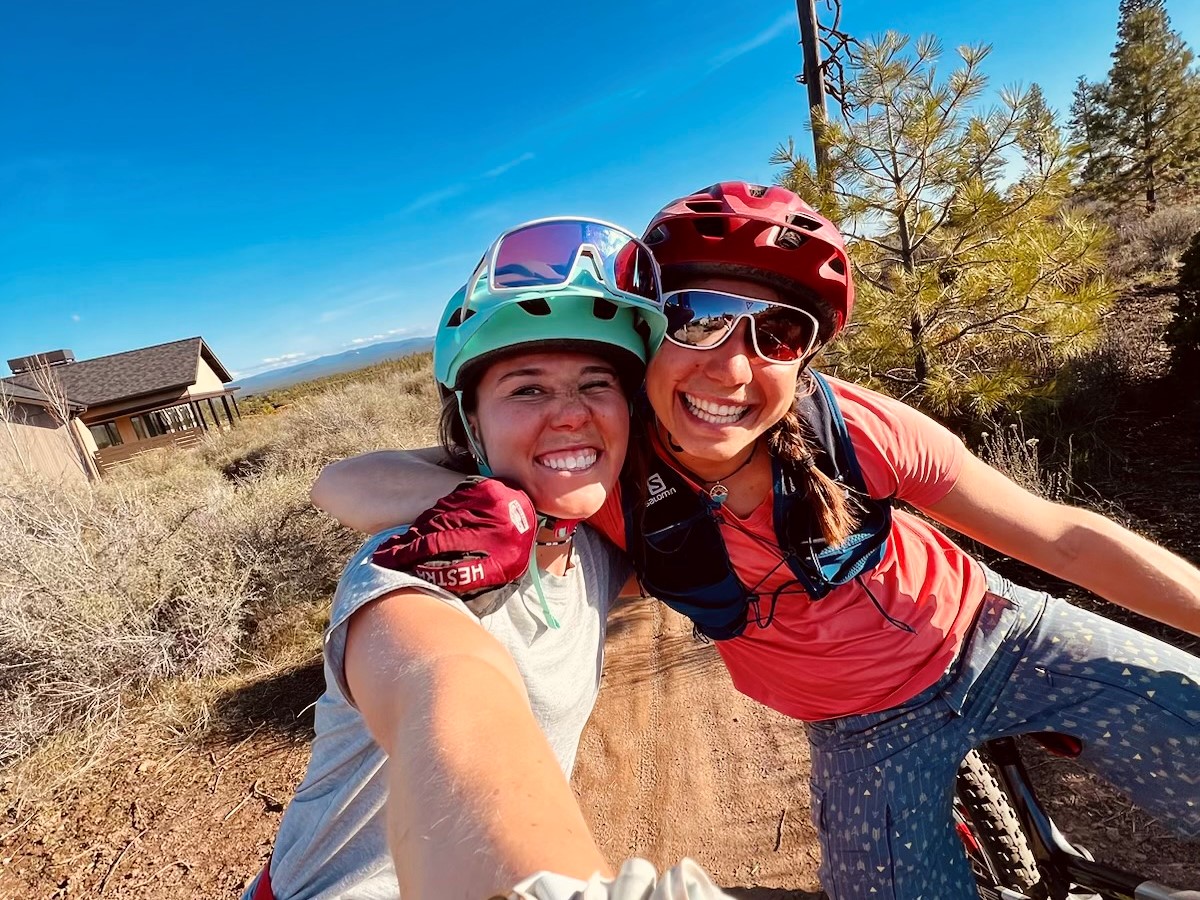
Like many elite skiers, Lauren Jortberg and Julia Kern enjoy mountain biking opportunities for a change of pace. (Photo: Julia Kern)
Against Early Specialization
Asked when Norwegian athletes begin to specialize, Nystad laughs gently. “Focus and specialization are a little bit mutually exclusive,” he says. “You can be focused and still do more than one sport.”
Most Norwegian kids, he explains, play several sports until age 15 or 16 — sometimes even longer. “When they’re 18 or 19, they might focus on one main sport and keep a couple on the side — running and skiing, for example, or cycling and skiing,” he says. “It’s part of the culture. People are active.”
The danger, he warns, comes from well-meaning adults. “A lot of parents try to self-realize through their kids,” he says.
“They want them to specialize early, to do everything right. In the end, the kids are sick of it, have no fun, and they quit.”
His takeaway is simple: “Kids are not miniature adults. They’re kids. Let them be kids as long as it makes sense. Life gets serious soon enough.”
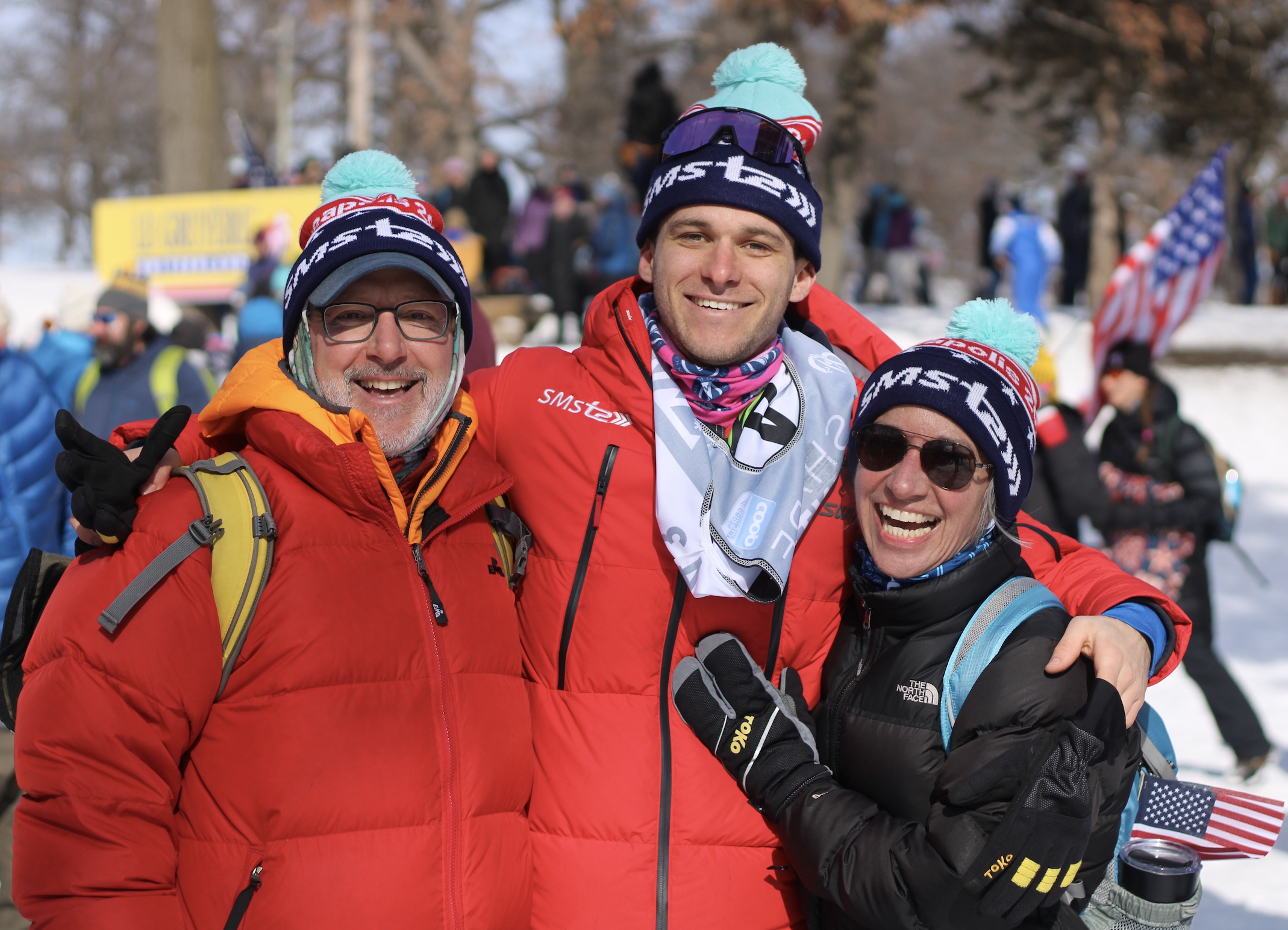
Adam Witkowski poses with his parents after unexpectedly racing a World Cup in Minneapolis in 2024. (Nathaniel Herz/FasterSkier)
The Role of Parents: Mentors, Not Managers
Nystad, as a father himself, knows firsthand how difficult it is to strike that balance of knowing when it is time to commit. “Sixteen is just a number,” he says. Some sixteen-year-olds are grown up; they can form their own opinions and take ownership. Others can barely wipe their own ass,” he says with a laugh.
“But in the end, the kids have to decide for themselves. It has to be something that’s rewarding for them. Our job as parents is to support them — to help them make fewer mistakes, to be mentors along the way.”
That mentoring role — guiding but not controlling — is something Nystad sees as critical for the next generation of athletes. “We’re supposed to help them realize their dreams and develop,” he says. “Not to live our dreams through them.”
“Keep It Simple”: Trust the Body, Not the Gadgets
In an era dominated by data, GPS, and lactate meters, Nystad is refreshingly old-school. He’s not anti-science — he’s trained with and coached some of the world’s most analytically minded teams — but he cautions against what he calls “numbing the senses.”
“The reason to measure is to understand,” he says. “You measure to confirm your subjective feelings — not to replace them.”
“If you’re tired, you sleep. If you’re hungry, you eat. If you’re thirsty, you drink. Those are subjective feelings — and they’re more important than any data you can measure,” he explains.
“Most devices today are not 100 percent correct. Your body usually is.”
For Nystad, training success comes from continuity, not complexity. “The KISS principle applies — keep it simple,” he says. “In endurance sports, you have to train with continuity for a long time and be patient. Don’t screw things up. Control gives continuity, and continuity is everything.”
Fun as a Foundation for Longevity
Nystad lights up when the conversation turns to lifelong sport. “If sport or physical activity makes us happy, we’ll prioritize it,” he says. “Talking about training doesn’t make you better — actually doing it does.”
He encourages athletes — elite or recreational — to reframe movement as a privilege, not a chore. “We should appreciate every day we get to move,” he says.
“It means we’re healthy, we have the time, we can afford the equipment. That’s a luxury we need to appreciate more.”
For parents juggling work and family, his advice is pragmatic: “Maybe it’s better to go for a one-hour run first, and then drink your beer and watch Netflix,” he says with a grin. “It’s just about organizing your day so you get your little quick fix of physical activity.”
The Norwegian Definition of Success
For someone who’s coached Olympic medalists, Nystad’s definition of success has nothing to do with results. “I can’t even remember what happened last winter,” he admits. “Success has nothing to do with medals or wins. I’m happy as a coach when the athletes are happy — when they’ve developed as athletes and as human beings.”
He sees coaching as a human project as much as an athletic one. “I always try to build teams where people work together, respect each other, and do their best. That’s success. If we treat each other well and do the job the best way we can, we’ll reach our potential. Reaching your potential — as a human or as an athlete — that’s success.”
It’s a deeply Norwegian sentiment, one echoed across their sports system: the process matters more than the podium.
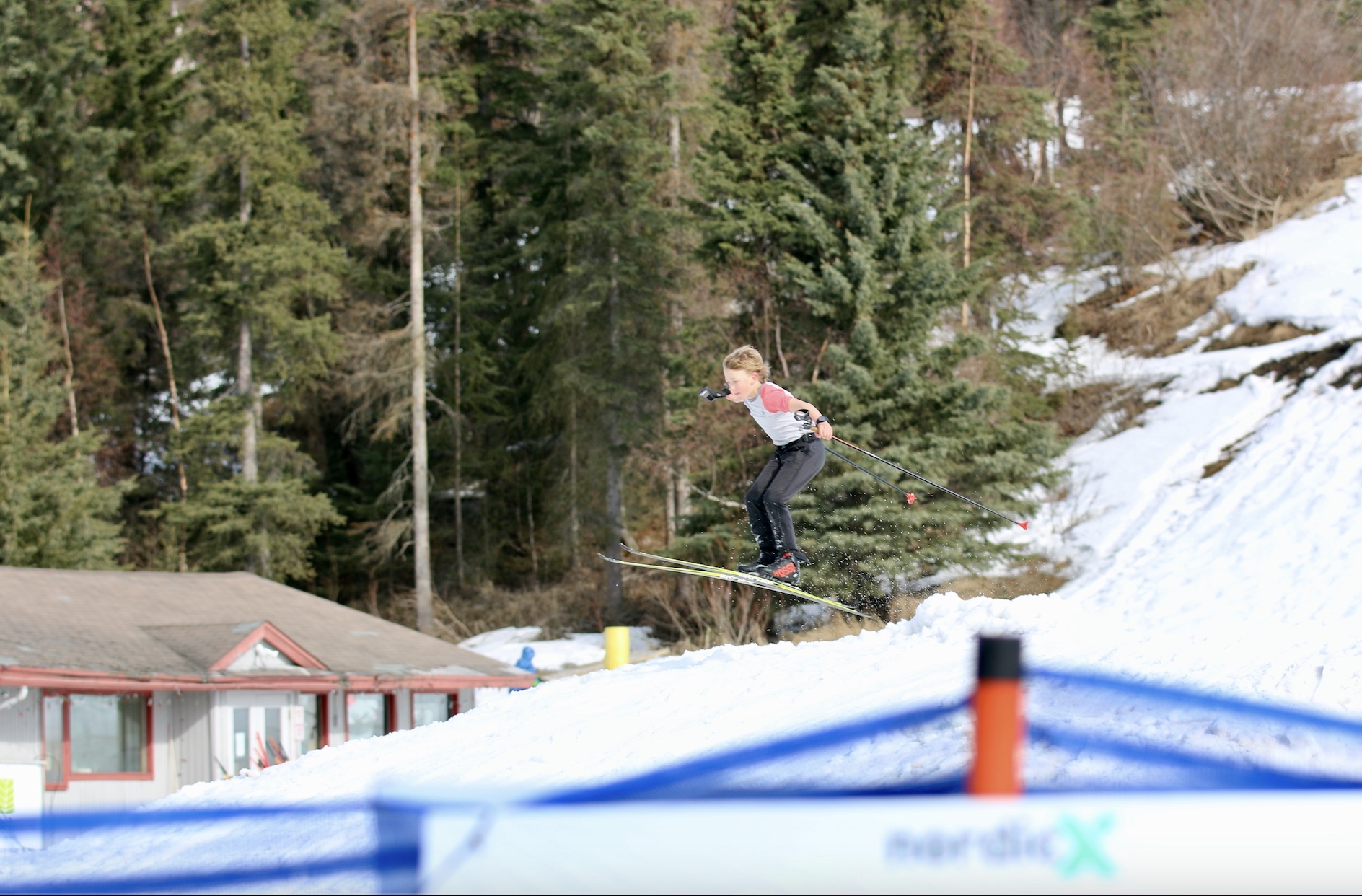
One of many kids enjoying the features on the course and in the Kiddie Cross terrain park at NordicX in 2022. (Photo: Eric Maurer / NordicX)
Lessons for U.S. Clubs and Coaches
Nystad believes that U.S. programs can apply these lessons without mimicking Norway wholesale. “The principles are the same,” he says. “It’s about creating an environment where kids master things, have fun, and stay in sports longer.”
That may mean rethinking what “development” looks like. “Most of the time, we lose more than we win,” he says. “So it’s okay to have a bad race or a bad day. Focus on skill development and mastery — even when things aren’t going well. If it’s fun, and you keep mastering skills, success will come.”
He also urges patience from young athletes. “A big mistake is intensity control,” he says. “They go too fast on the easy sessions and too fast on the hard sessions. They believe ‘no pain, no gain,’ but endurance sport doesn’t work like that. The best athletes are the ones who train a lot — and train smart.”
Technique, Mastery, and Play
Skiing, Nystad reminds us, is as much art as science. “Especially in skiing, which is such a technical sport, the quality lies in doing things right — not just going hard,” he says. “I see so many people skiing with music in their ears, talking, doing all kinds of things, instead of focusing on perfecting technique.”
He encourages athletes to “play” with movement: “No one tells us how to do it. We can choose the way that fits our body and our strength,” he explains. “If more people would play with technique, be conscious of their technical and pacing choices, the outcome would be better for most people.”
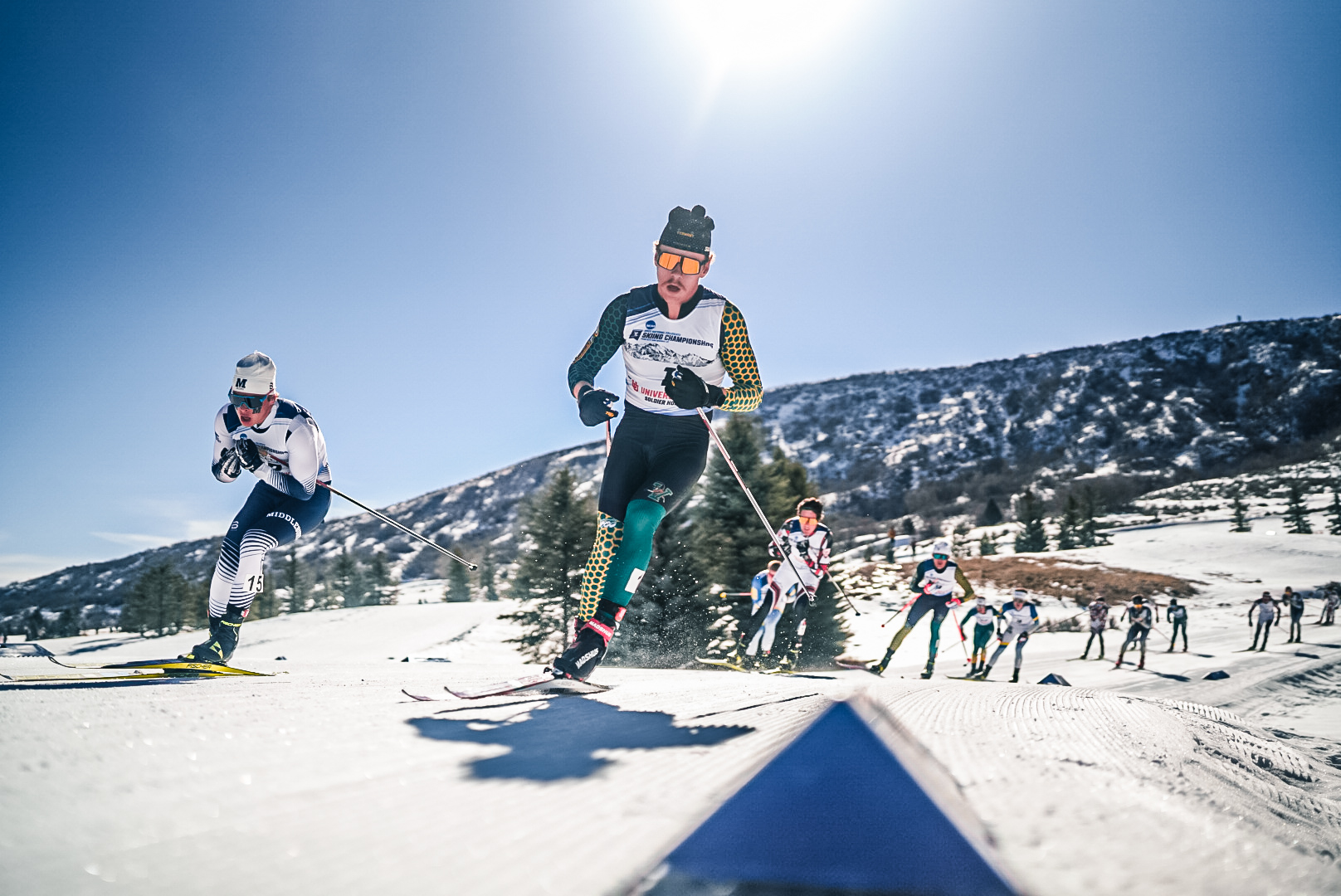
Astrid Oeyre Slind (NOR) on her way to a second-place finish in Cogne, Italy. (Photo: NordicFocus)
The Lifelong Athlete Mindset
At 55, Nystad continues to coach, ski, and move daily — not out of obligation, but joy. “If you train right, take care of yourself physically, mentally, nutritionally — and have a blast doing it — there’s no limit to how long you can be good,” he says.
“The moment you start thinking it’s a sacrifice, or that it’s boring — that’s when your career starts to end.”
He cites examples like Hilde Gjørum, who earned her first Olympic medal at 43, and Astrid Øyre Slind, who made her first Norwegian World Championships team at 34 and won her first World Cup at 37. “There are lots of stories like that,” he says. “Everyone can keep getting better — if you love what you do.”
Looking Ahead: A Sustainable Future
Nystad’s final reflections return to sustainability — both of snow and of sport. “Obviously, we’ll have issues with snow,” he says. “Snow storage and snow farming are becoming normal in Europe, and that will change the sport. But cross-country skiing will survive. It’s a great sport — full-body, low-injury, healthy.”
The real challenge, he believes, is getting people to participate. “We need to sell it for all it’s worth and get more people involved,” he says. “If we can bring more people into skiing — kids, families, anyone — the rest will take care of itself.”
The Takeaway: “Master the World”
For Nystad, the essence of sport is not the stopwatch, but the spirit. “The focus,” he repeats, “is on mastering the world — being a champion of the world, not a world champion.”
It’s a mindset that turns every trail into a classroom, every race into a chance to learn. And perhaps that’s the real secret behind Norway’s golden age of endurance: a culture where success isn’t measured in medals, but in how many people can’t wait to clip into their skis again tomorrow.
Trond Nystad, the coach of the Norwegian men’s cross-country ski team, takes questions from the media after the relay at the Sochi Olympics.
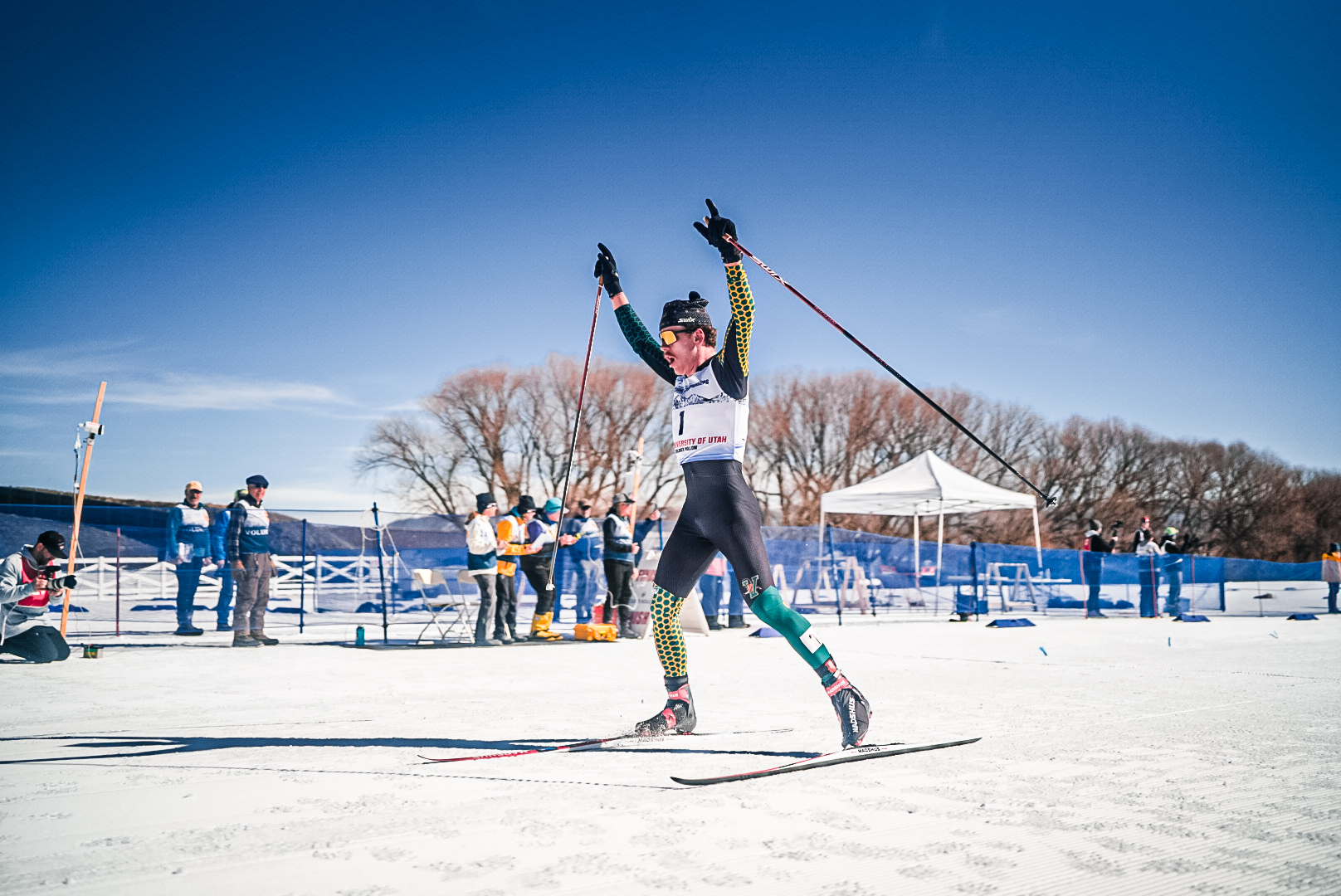
Ben Ogden celebrates after sweeping the 2022 NCAA Championships in Midway, Utah. Ogden became 1 of only 4 skiers (alongside US Ski Team teammates Novie McCabe and Sophia Laukli) to win an NCAA Championship and represent the US at the Olympics in the same season. (Photo: Tobias Albrigtsen / @untraceableg)
“So after the World Cup, Olympics, and NCAAs, is that it for you this season?”
“Well…I think I’m going to race the Rikert Grand Prix this weekend.” (Hewon).
I couldn’t have stumbled upon a more apt soundbite to describe Ben Ogden, and he offered it up ten seconds into our interview.
Skiing for the US Ski Team and University of Vermont (UVM), Ogden is primed to write the next chapter in American men’s skiing – a Vermonter who can’t help but love Vermont skiing, a racer who races for the sake of racing. He’s also an author that you get a sense doesn’t want to quite yet claim that he is holding the pen.
For now, then, that pen falls to me:
“If young potential was representing a country, it would have been draped in an American flag.”
Iwrote that after the first day of World Cup racing this season in Ruka last November. Ogden, alongside US teammates JC Schoonmaker and Luke Jager – all 21 or 22 years old – had sprinted their way to top 10 qualifiers in the classic sprint. (Schoonmaker eventually made the semi-finals).
It was a line that proved to be a thesis for the US Men’s Ski Team during the 2021-22 season. Each result from Ogden and his teammates – neatly introduced to the world when they won the team relay at the World Junior Ski Championships in2019 – backing up the argument that the youngest US men were ready to mix-it-up with their European counterparts at the sport’s highest level.
For Ogden, that included a slew of World Cupresults in Periods I and II, an Olympics highlighted by a semi-finals appearance in the classic sprint in February, and an NCAA Championshipsweep in March.
The juxtaposition in those latter two highlights is cause for pause, so again:
In the same year that Ben Ogden raced the Olympics, someway and somehow, he won an NCAA Championship.
That confluence of talent and time has happened exactly twice before Ogden, and once after. The first before came a half-century ago, when fellow VermonterStan Dunklee represented the USA at the 1976 Innsbruck Olympics before winning NCAAs a couple weeks later. The second before came a mere two hours prior to Ogden, when Novie McCabe (University of Utah) won the this year’s women’s 5 k Classic NCAA Championship. Likewise, the one time after came when Sophia Laukli (University of Utah) won this year’s 15 k Freestyle NCAA Championship.
In other words, those who race in the stars-and-stripes were able to will those stars to align in a way that’s never been seen before. Once there was a lone skier able to accomplish the Olympics-NCAA double, and now, after a week in Utah in 2022, there are four.
That represents a paradigm shift in American skiing: a generation of skiers reaching the top of the sport younger than ever before, without allowing themselves stray too far from the American skiing community in which they grew up and remain an integral part in sustaining.
In an interview with FasterSkier, Ogden provided insights into the underlying attitudes that are driving that success among his cohort of top American skiers, with one theme pervading throughout: skiing fast means “skiing” –the places, people, and feelings of joy for which that word comes to connate.
Ben Ogden celebrates back-to-back NCAA titles in style while cheering on the women’s field in the 15 k Freestyle Mass Start. (Photo: Tobias Albrigtsen / @untraceableg)
This interview has been edited for length and clarity.
On goal-setting for the Olympics and college skiing through the pandemic:
FasterSkier/Ben Theyerl (FS): There’s been a lot of different levels you were competing on this year – Olympics, World Cup, NCAAs, and now citizen racing – what were you looking at in terms of goal setting coming into this season?
Ben Ogden (BO): Yeah, I knew this year was going to be a big year for goals for me. If I’m honest, a lot of that was because the last two years drove home that you can’t take anything for granted in terms of opportunities.
In a way that pushed me to say ‘you need to try and have your cake and eat it too,’ which meant going to the Olympics and going to NCAAs. That felt weird to shoot for because I knew there were things that were completely out of my control which could keep that from happening. For instance, if I ended up getting COVID while in Beijing, or if I was contact traced, I wasn’t going to be home in time to race the Carnivals I needed [in order to qualify for NCAAs].
I really wanted to do both because this is the only time I could. But I didn’t dare fixate on it too much. It just felt like it would be such a horrendous disappointment if something happened, and I couldn’t. So, in the first half of the season, I really tried to keep my priorities on the World Cup.
I had smaller goals there too, [like advancing] to a semi-final in a Classic Sprint, or qualifying in a Skate [sprint],
Like I said though, ‘having your cake and eating it too’ was the big goal, and it’s just unbelievable that it could happen not only for all three of us – JC (Schoonmaker), Luke (Jager) and I – and also Novie (McCabe) and Sophia (Laukli) on the women’s side. We were all thinking the same way.
It was [our] only chance to do the Olympics and NCAAs and it happened.
FS: That is a pretty sweet moment where the stars aligned…
BO:It’s totally crazy. I mean, like I said, the big thing I went into this season with was the idea that this was my only chance to do [the Olympics and NCAAs].
It made me lucky too. I came into NCAAs with this confidence I took from the rest of the season which was an insane mental advantage. Having results on the World Cup and at the Olympics represented steady progress on other goals that made me ready to complete [the NCAA] one.
Ben Ogden races the quarterfinal of the men’s freestyle sprint during the 2022 Beijing Olympic Winter Games. (Photo: NordicFocus)
FS: When did those goals that you accomplished this season get set? You took your first NCAA title at the 10 k Classic in Bozeman (in2020), and then COVIDhit before you could go for the 20 k, and everything got weirder from there. How did that affect your long-term goal making?
BO: Bozeman was such a weird experience. What I took from that was actually more of a shift towards my approach to NCAAs this year. I sort of felt like I checked off the NCAA win from my list of goals at Bozeman, so my goals were more team-oriented [for UVM]. That meant trying to get everybody psyched, make a connection with the Alpine skiers, and see if we could get them fired up to lift UVM to a great team finish.
FS: You certainly did your part on that front. You became the 14th male skier to sweep NCAAs*. You’re also the first male American-born athlete to do so**. Any reflections on what that means to you?
BO: I’m really proud to put my name on that list, obviously. There are some really talented skiers who have done [a sweep] in the past. Like I said, I was really obsessed with the team scoring, so I was focused on doing everything I possibly could there and didn’t realize I was the first [male] American ever.
But that feels really good.
FS: This is me being a reporter here, but to me that speaks a lot to you and the group of guys you’re with on the US team who are really pushing American skiing forward. Like that checks off a big box with an American doing that at NCAAs.
BO: Totally, it’s another thing to be really proud of between all of us.
On following his sister Katharine’s NCAA Success:
FS: I should add that while you were the first American man to complete an NCAAs sweep, you weren’t the first Ogden. I have to ask, was Katharine having done this a couple of years ago (KO swept NCAAs at Steamboat Springs in2018, she also won the 15 k Classic in2019) on your mind going into this year?
BO: Oh yeah. It’s kind of funny, actually. I remember last year, I tried to petition the NCAA to race at Nationals because I couldn’t race some Carnivals due to COVID restrictions. When my petition wasn’t accepted, I remember thinking to myself, ‘Well, there goes my only opportunity to tie Katharine.’ But that was more of a funny thought than a driving force for me. I told someone else that was asking me that it didn’t matter if I tied her number of wins. But to do it was pretty cool…
I should be clear though, my wins certainly weren’t in as commanding a fashion as hers. I remember going to Stowe when I was a freshman [in 2019] and while we were warming up for the 20 k I turned my head and was like, ‘Oh, there goes Katharine’ and there was no one else in sight. It was like, ‘My gosh, this is insane.’ That’s not even talking about Steamboat (in 2018) which was pretty darn cool. She not only swept, but helped carry Dartmouth to one of their overall better finishes.
So yeah, all that makes it feel really good to match her in wins and take UVM to a2nd place, which is pretty exciting for us.
Dartmouth freshman Katharine Ogden racing to her second-straight victory of the 2018 NCAA Skiing Championships in Steamboat Springs, Colorado. She won the 15 k freestyle mass start by more than 38 seconds. (Photo: Dartmouth Sports/Clarkson Creative)
On UVM and college skiing this year, and their place in his development as a skier:
FS: On that UVM front, your team was really back to dominating theEISA this year. How did that come together? And how has that program helped you develop as a skier the past few years?
BO: When I was a freshman, we had a bunch of older guys on the team that were getting UVM great results.When they graduated, we were still very good in the EISA, but we weren’t quite as dominant. It took some time to get back.[For example,] Jacob Nystadt, our Swede, is a sophomore this year, and it was the first year he could figure out the rhythm and training that works for the college circuit (after the EISA raced anabbreviated season last season).
We have such a talented team and push each other hard in every interval. Everyone helps out with the motivation, and we’re all on a very high level where we know it’s not just about training hard, but training smart as well.
One of our strengths is that we all have a different upbringing and bring something unique to the table. Our NCAA Championship team this year was a Norwegian, a Swede, and an American, and beyond that there’s even more geographic diversity from across the country and the world. That all comes together to build and balance training, and then we can put it all together on the racecourse.
FS: How does (Patrick) Weaver (UVM Head Coach) contribute to that? How do you and him work to balance the NCAA skiing along with the World Cup side of things on the US Team?
Patrick Weaver: UVM’s Head Cross-Country Coach. (Photo: UVM Athletics/NENSA)
BO: Patrick has been a huge part of my development as a skier. I feel like I’ve gotten so much stronger in my four years at UVM, and that’s all due to him. I think our philosophies towards skiing line up remarkably well, which comes from him having a similar experience – being an Olympian, being on the World Cup, skiing professionally for many years, but still wanting to, and having, skied in college. At every turn, he’s had advice for me that comes from the perspective of someone who really wants me to succeed in skiing on all levels. He’s not just interested in seeing me do well at NCAAs or at Carnivals, but instead supports me no matter what I want to do.
This year there were a few moments where it looked like it might be questionable whether I could race World Cups and make it home to compete in some Carnivals. But when it came down to it, Weaver left the decision up to me, which really made a difference. If you have a coach trying to force you to do something that you don’t want to do, it’s not conducive to happiness in your skiing. And Weaver stresses that; happiness is the driving factor towards speed. You can train like a madman, be in the best shape ever, but if your head isn’t in the right place, and you’re not doing what you think is important, then you might as well not be training at all.
Weaver’s understanding of that was a huge part of my ability to achieve my goals this year. College skiing is where I’m happiest, he knows that, and his understanding of why that is a big part of our ability to achieve our goals as a team this season.
FS: Within that season, was there a moment where you got nervous about whether the NCAA Championships were going to be possible? Like when you went to the [first race of the year] at Colby, and they cancel the second day (due to cold weather), did it make you go, ‘Crap, I need to find another Carnival now?’
BO: Oh yeah. That was a case in which Patrick and I were talking and like, ‘Oh gosh, this could be the end right here.’ We changed my plans to book a flight home from [the Olympics] on February 17th so that if I needed, I could race just the second day of the Middlebury Carnival on February 19th. It would have been insane, but I would have done it just to get the points I needed.
Patrick talked to the EISA and thankfully all the coaches were like, ‘No, that’s totally fine. Three races (all of which Ogden won) and the Olympics are plenty to qualify [for NCAAs].”
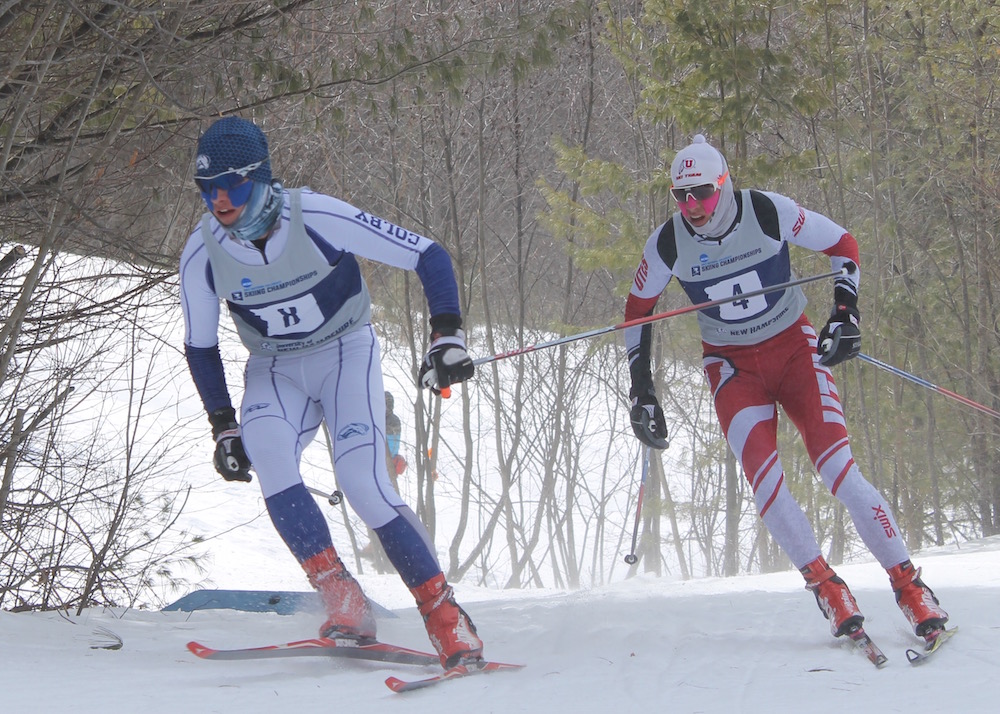
Ben Ogden races for the win in the 10 k classic during the 2022 NCAA Championships in Soldier Hollow Utah. (Photo: Tobias Albrigtsen / @untraceableg)
On the fun of racing the NCAA Championship Mass Start:
FS: Did you end up watching the NCAA 20 kfootage at all?
BO: Yeah, actually, I did.
FS: I was curious what your race plan was going into that mass start?
BO: Haha, well you know, and I think you can tell by watching that race, I’m not exactly known for my detailed race plans. In that race in particular I knew that I was going to have to be careful – the alpiners (from UVM) and all my friends I grew up skiing with in Vermont were out there, and with them cheering from lap one there was a good chance I just got revved up and went for it then.
I figured my best chance at winning would be to wait until the last lap and try to make it happen there, but then, you know, I was riding a high from winning a couple days earlier and the dream of winning off the front kept popping to my head. If you watch the race closely, you saw my move on lap four (of six), which was the definition of wishful thinking.
I went up that hill, came around to take a feed on lap five and I was like, ‘Oh God, what have I done?’
But I ended up finishing the race and got away with it.
It’s funny because so many people after the race were like, ‘Oh man, you’re built different, you’re toying with the field out there’ and I was like, ‘Oh that’s not at all how it felt.’
FS: You can count me in that lot. I was watching you bounce back and forth at the front going, ‘Man, he’s like the leader of the peloton, he’s got it under control!’
BO: (laughs) Well on Cabin Hill, it didn’t feel like that. We went up the Hollow and I looked around at who was with me and thought I was maybe playing for a podium. I was able to tuck into the pack to stay up in front, and then Bernie (Flaschberger, from Denver University) went forward on one of the sprint hills. I thought he was going to drop us, but I tried to ski up and was surprised that I could stay with him. That’s when I began to think maybe I can do this, and so I went for it. Again, it was the extra confidence for sure.
FS: I think for us, who watch you on the World Cup all the time, it was a different side of your racing to watch. To see some of the maneuvering was pretty cool.
BO: I tell you man, it’s a real treat to race at the front of a mass start. I did quite a few mass starts on the World Cup this year, but there I’m starting in bib 70, the accordion in the field is so aggressive, and it is just so hard to move up.
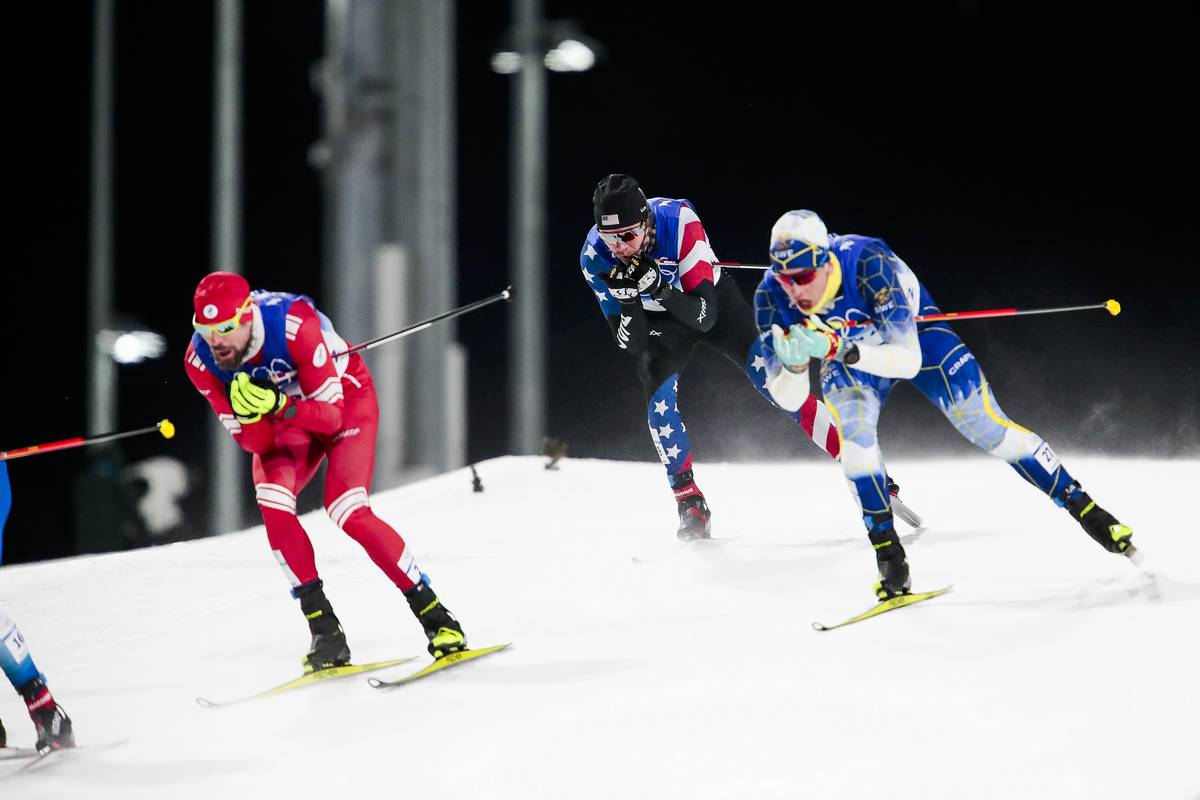
Ben Ogden (USA) pushes up the A-climb in the the team sprint semifinal at the 2022 Beijing Olympic Games. Ogden and teammate JC Schoonmaker went on to finish 9th. (Photo: NordicFocus)
On the US Ski Team’s success this season, and what comes next:
FS: I know you’re racing the Rikert Grand Prix this weekend, but with your season being pretty much over I was wondering if you’d be willing to share some early reflections on a pretty amazing season for you and your teammates on a lot of different fronts?
BO: Yeah, I’m really happy with what I’ve done this year.
FS: Do you have an early favorite moment at all?
BO: Again, it’s early still, but I would be surprised if there’s a lot of moments in my ski career that rival that 20 k at NCAAs as far as how cool of a race it was. There were so many people that I knew out there cheering, and then after it was just instant happiness with everyone out there. Good race, bad race, whatever, everyone was ready to relax, cheer on the women’s race, and just enjoy the most perfect day in the Utah sun. Can’t ask for anything more than that.
I shouldn’t discount the moments on the World Cup that were a lot of fun either. Reaching the semi-final at Davos was really exciting, and then the semi-final at the Olympics after was a crazy, cool race. Those are the moments that motivate me for World Cup racing in the future because I wasn’t on the top, but I got a real taste of what it’s like to be in the mix.
The big takeaway from this year for me is that the best skiing happens when you’re having fun, and I couldn’t be luckier with the group that I have [at UVM] and that I’m with on the World Cup. JC, Luke, and Gus – they really are my best friends, skiing or not, which is incredible. With being on [those] teams, you’re somewhat placed in those groups randomly, right? They don’t choose the World Cup team based on personality. And yet, if you have a good group, it makes the World Cup experience 1000 times better. I’m sure that there will be seasons and races in the future where we’re not quite feeling like the kings of the world every other weekend. That’s when I’ll come back to memories from this season and remind myself of what’s important.
FS: It’s pretty darn cool to watch you guys. My coach Tracey Cote at Colby used to say when she started in college skiing back in the late 1990s she would watch the World Cup and the Carnival skiers and they didn’t look anything alike, and maybe five years ago, she said we’d gotten to where Carnival skiers were starting to look like those skiers on the World Cup. I think with you, it’s the next step – the Carnival skiers are on the World Cup. Do you guys have a notion that you’re pushing the sport forward, especially on the men’s side, in the US?
BO: A little bit, but I think that’s more something people say to us than what we’re focused on.
I think for us it’s demonstrating that racing in College is fun and we all understand that the World Cup can be too. Sometimes, people just take themselves way too seriously on the World Cup, and I think that only serves to detract from their ability, and at the end of the day, their happiness too.
I guess it feels like we’re pushing the limits a little bit by doing that, and with our results, but really one of the things that makes us all so cohesive is the shared sense that what we dream of in skiing is a lot bigger than what we’ve done so far.
With that sense, every race sort of feels like it’s already a piece of the past, if that makes sense. For example, that sprint at the Olympics was awesome for me, and I patted myself on the back. But then again, I looked around and everyone on the team could say ‘Your dream is to be better’ and because of that I can see myself being in the final or on the podium one day.
I know the other boys think the same way, and that’s what is really fun about the whole group. We all finish a race and we’re all already talking about what we could have done better and what type of training is going to help make us faster in that realm. And now, because of that, we’re motivated, and we’ll talk about it all summer and train together too.
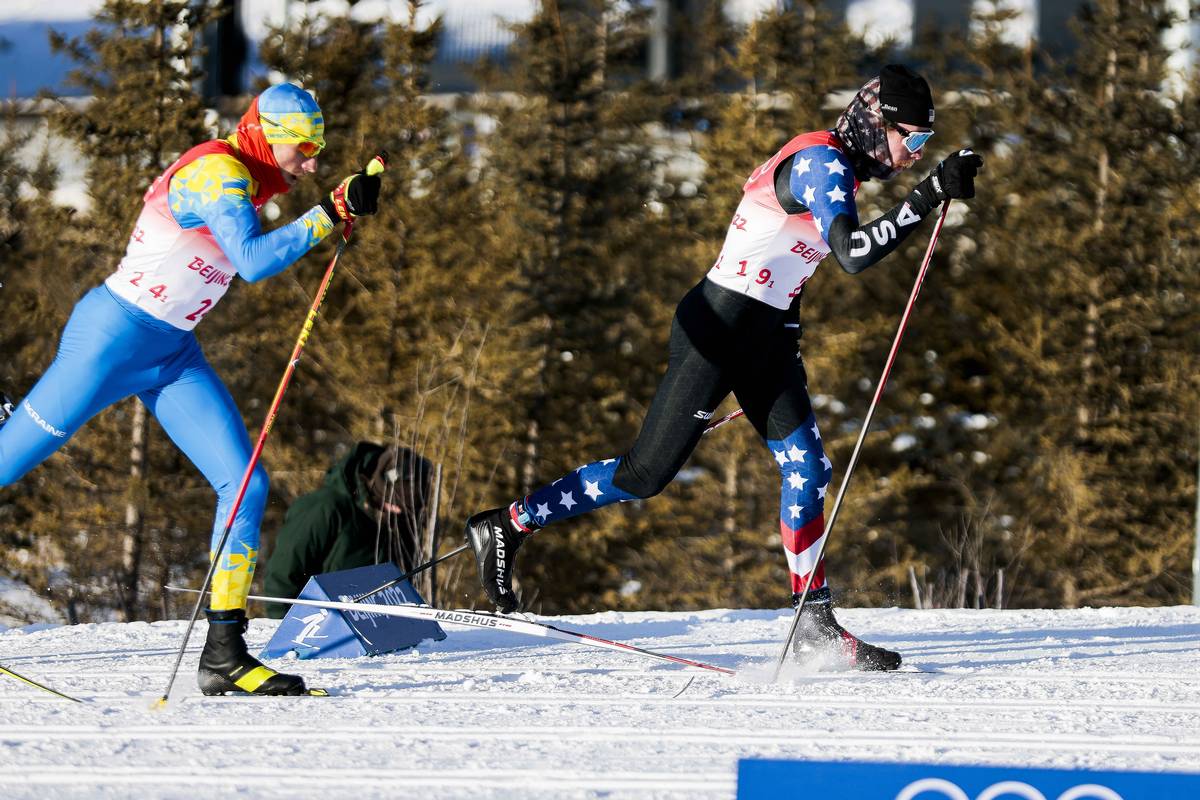
Ben Ogden and JC Schoonmaker at the finish of the team sprint at the 2022 Beijing Olympics. (Photo: NordicFocus)
FS: Yeah, like one of you guys said in a comment to Nat (Herz), [FasterSkier’s Olympics Correspondent], that there was a race at the Olympics where you were skiing along and Klæbo passed you, and you were like ‘holy crap I can ski with him, even if it’s just for a hill. Like, the goal is one day to ski with him much longer but that’s down the road.’ I thought that was a great metaphor for where you guys are in your skiing right there.
BO: That was definitely me in the15 k classic. He lapped me and I skied with him up the hill and then over a little of the flat, and yeah, he beat me by how many minutes? But you know what, for that five-minute stretch there I could ski with him. That gives you an idea for what it takes to be where your goals are. I’m glad you picked up on that.
FS: Lastly, with you being a senior undergrad at UVM, I wanted to see if you could give us any leads on where we might see you skiing next year?
BO: I don’t know exactly. I’m just starting to get my head around it after NCAAs, but I’ll have a meeting with Weaver and see what he thinks and talk about what I want to do. I had big plans to just do an accelerated master’s in Engineering and stay at UVM for a fifth year. That was a year ago though, and then between the Olympics and World Cup I ended up missing 7 weeks of school. So, I had to ease off on that.
It comes down to aspirations outside of skiing, which I definitely have, but with things taking off like they have this year I probably see myself doing something similar to this year at this moment. I don’t not see myself in school next year, and I still hopefully can balance it with whatever comes next with the next ski season.
FS: Well, wherever life lands you, I know I speak for a lot that we’ll be looking forward to seeing you ski, and congratulations on an incredible season.
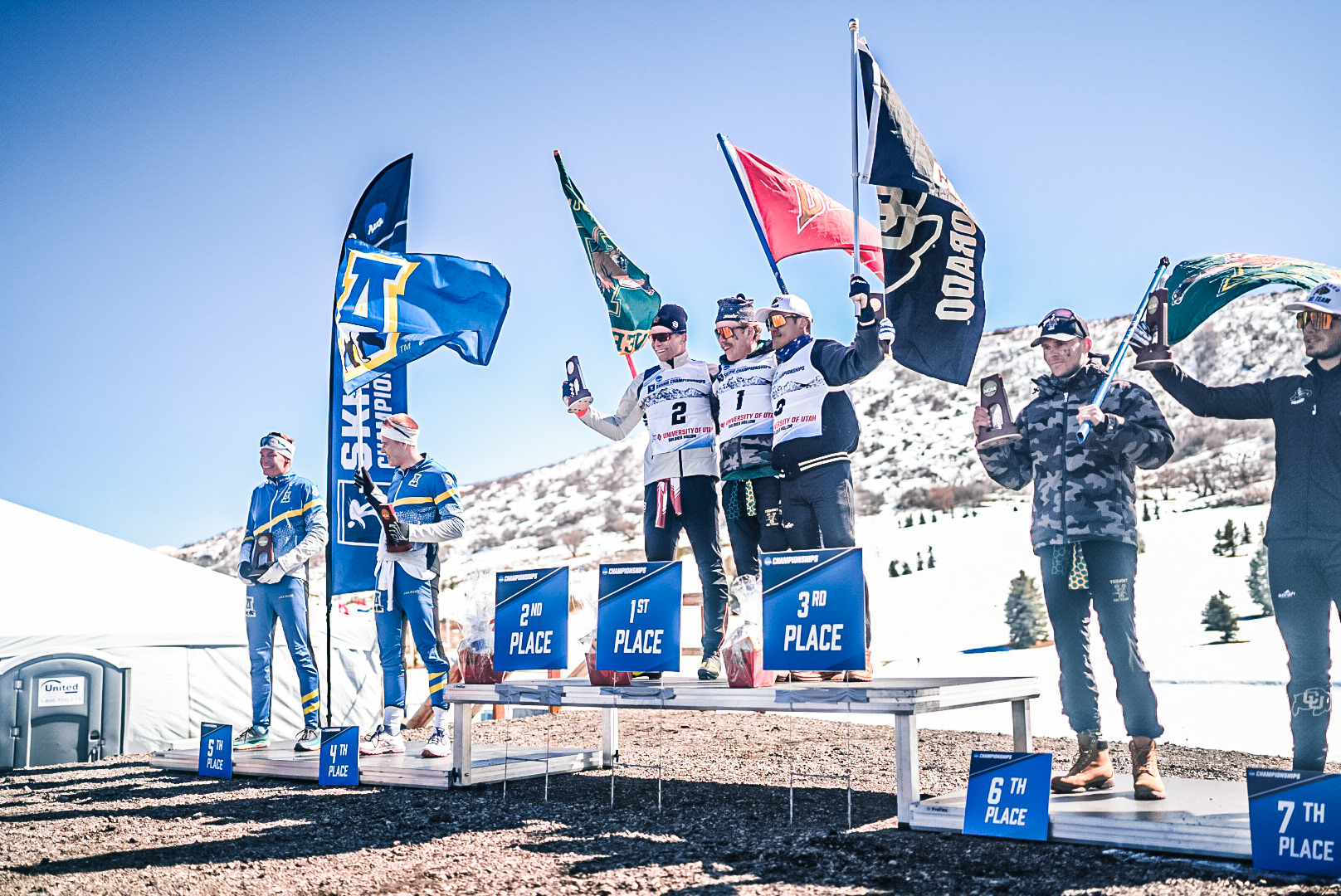
The 2022 NCAA 10 k classic podium: Ben Ogden (Univ. of VT) took the win ahead of Andreas Kirkeng (Denver Univ.) and Magnus Bøe (Univ. of CO). (Photo: Tobias Albrigtsen / @untraceableg)
NCAA History Notes:
*Ogden is the 9th skier to win NCAAs in its current format, winning both the 10 k Classic and 20 k Freestyle. This format has been skied since 1989. In the decade prior to the change from 1980-1988 five skier swept NCAAs by winning both a 10 k Classic and 3 x 5 k Classic Team Relay.
**Ogden is the 2nd American citizen, after Norwegian immigrantJohn Aalberg completed a sweep for the University of Utah in 1984.
PARK CITY, Utah – The 2022 NCAA Skiing Championships got underway on Thursday at Park City Mountain Resort and Soldier Hollow in Midway. Cool temperatures in the mid-20’s and sunny skies welcomed the competitors on the first official day of competition.
Utah’s Novie McCabe claimed her first NCAA title by winning the women’s 5K classic at Soldier Hollow. Ben Ogden of Vermont was crowned a national champion for the second time in his career by winning the men’s 10K.
Colorado claimed the top spot on the podium in both giant slalom races at Park City Mountain Resort. Freshman Magdalena Luczak won gold on the women’s side while Filip Forejtek was the men’s winner.
With two days remaining in the championships, Utah has a 286.5-262.0 lead for first place over Colorado. The Utes had the top score in any of the four races with 102.5 points in women’s 5K classic and the best men’s GS total of 75 points.
Denver is in third place with 249.0 points as the Pioneers had the best men’s 10K classic score along with Alaska Fairbanks (76.0) and the top women’s GS score (69.0). Vermont is fourth (235.0) and Middlebury is fifth (131.5).
The championships conclude with the women’s 10 k and the men’s 20 k freestyle races on Saturday at Soldier Hollow at 9:30 a.m. MST. The forecast calls for sunshine both days with a high in the low 30’s on Friday and mid 40’s on Saturday.
Novie McCabe (Univ. of Utah) wins the women’s 5 k classic during the 2022 NCAA Championships in Soldier Hollow, UT. (Photo: Tobias Albrigtsen / @untraceableg)
WOMEN’S 5K CLASSIC
Novie McCabe of Utah became the first to earn an NCAA title, winning the women’s 5K classic in 13:22.8, crushing the field by more than 13 seconds. McCabe, a sophomore from Winthrop, Wash., won both of the women’s Nordic races at the RMISA Championships upon returning from the 2022 Beijing Olympics, where she was part of the U.S. cross-country 4 x 5km relay team that took sixth.
Her Utah teammate, Sophia Laukli, tied for runner-up honors with Vermont’s Anna Bizyukova as both finished in 13:36.3. Anabel Needham of Michigan Tech (13:48.6) and Hanna Abrahamsson of Colorado (13:57.2) rounded out the top five to earn first team All-America honors.
Utah’s Sydney Palmer-Leger and Michigan Tech’s Nea Katajala tied for sixth place. Palmer-Leger won both the women’s classical and freestyle titles in 2021. Jasmie Lyons (New Hampshire), Hannah Ray (Denver) and Weronika Kaleta (Colorado) placed seventh through 10th to earn second team All-America.
MEN’S 10K CLASSIC
Vermont’s Ben Ogden edged out Andreas Kirkeng of Denver by 6.4 seconds for the men’s 10K classic championship. Ogden skated in with a time a 23:43.1 while Kirkeng came back in 23:49.5.
Ogden, a senior from Landrove, Vt., has won three consecutive races since returning from the 2022 Beijing Olympics. Ogden captured the 2022 EIS titles in the 20K freestyle and the 10K classic. Back in 2020, he took the men’s 10K freestyle to earn his first NCAA title.
Ben Ogden (Univ. of VT) races for the win in the 10 k classic during the 2022 NCAA Championships in Soldier Hollow Utah. (Photo: Tobias Albrigtsen / @untraceableg)
Magnus Bøe of Colorado, who swept both men’s individual Nordic titles a year ago, placed third in 24:03.7. Christopher Kalev and Mike Ophoff both gave strong efforts for Alaska Fairbanks, coming in fifth and sixth, respectively, to earn first team All-America honors. Kalev was hot behind Boee with a time of 24:08.3
Second team All-America honors went to Jacob Nystedt (Vermont), Will Koch (Colorado), Peter Wolter (Middlebury), Epsen Persen (Alaska Anchorage), and Bernhard Flaschberger (Denver), who placed sixth through 10th.
QUOTES
Novie McCabe – Utah (Women’s 5 k Champion)
On how the race played out:
“It was a good race and it was fun. It was kind of icy but still really awesome skiing. You just had to make every second count and really push the corners and push the transitions to get those extra seconds because it was so tight.”
On her strategy:
“Everyone has their own way of skiing because it is your own race. I tried to take it out not really conservative but just tried to relax and ski smooth and have something left for the last lap. I think it went well for me. Sometimes you are just dialed in and it was good day for me.”
On Utah placing three in the top six:
“I’m super proud of everyone. We’ve worked hard together so it’s fun to see everyone succeed. We’re just stoked for the next race.”
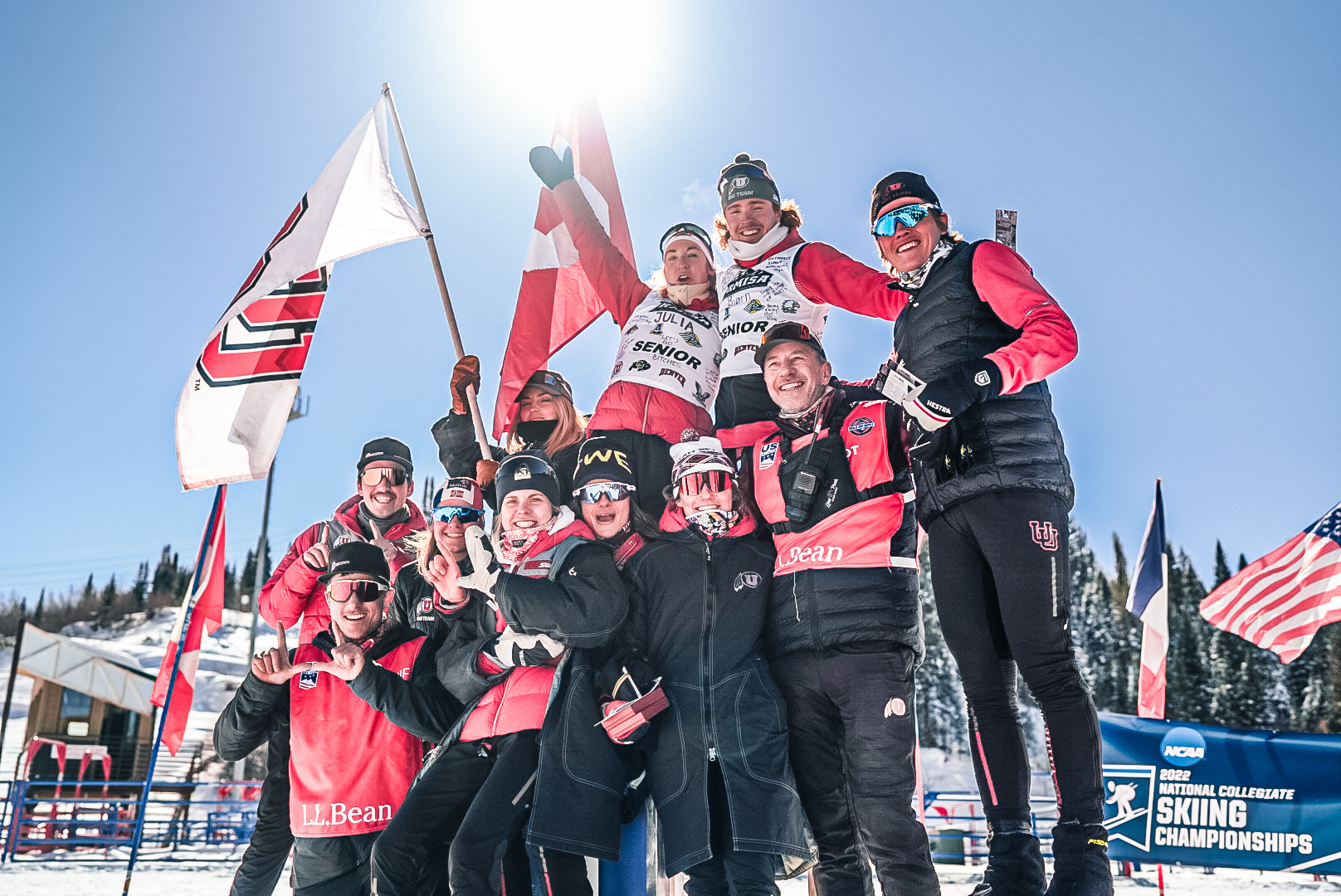
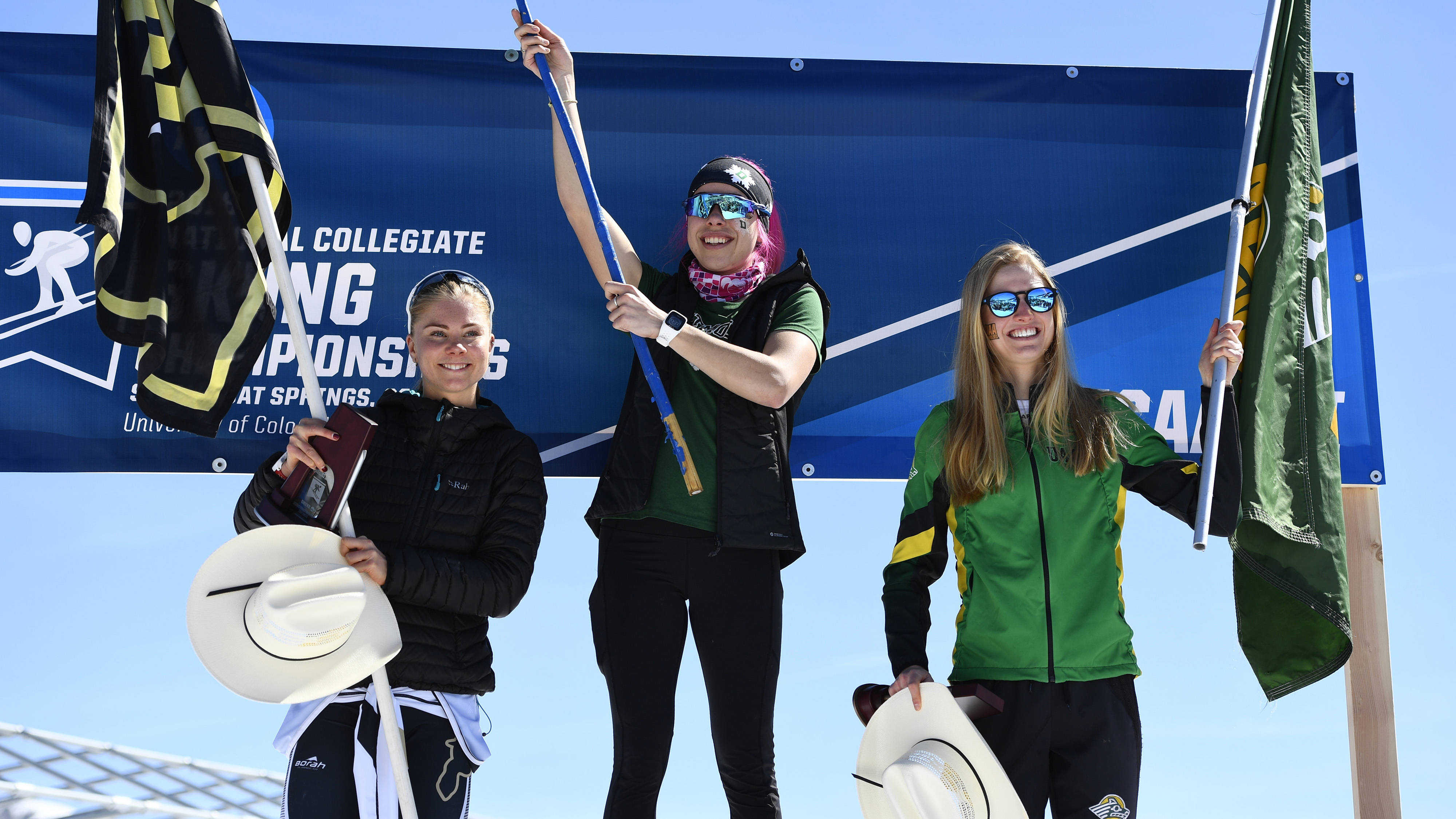
University of Utah celebrates a strong performance in the first day of NCAA racing. Novie McCabe won the women’s 5 k classic, while Sophia Laukli tied for 2nd, and Sydney Palmer-Leger finished 6th. (Photo: Tobias Albrigtsen / @untraceableg)
Ben Ogden – Vermont (Men’s 10 k Champion)
On being a national champion for the second time:
“It feels good. This was a big goal of mine this year and I’m really proud to say that I delivered when it counted. It was awesome.”
On how the race played out:
“I’m not a man known for his strategy, and if you look at the times you’ll see that. I went out damn hard and it was sort of a hanging on game for the rest of the race. But I was lucky to make it to the finish line just in front of Mr. (Andreas) Kirkeng. I was psyched.
On coming back from the Olympics:
“A couple of us came back from the Olympics and we had to be smart and rest up. That was a long and exhausting experience. But the mental aspect of this sport is not to be slept on and all of us took a lot of confidence by being named to the U.S. Olympic team and being able to represent over in China. I think that makes a huge difference with your performances late in the season. You feel fast, so we are fast.”
The 2022 NCAA 10 k classic podium: Ben Ogden (Univ. of VT) took the win ahead of Andreas Kirkeng (Denver Univ.) and Magnus Bøe (Univ. of CO). (Photo: Tobias Albrigtsen / @untraceableg)
Miles Havlick – Utah (Nordic Head Coach)
On the conditions:
“Perfect day for racing. The tracks were fast and firm. Blue sky, typical Utah day. It was awesome.”
On Novie McCabe and Sophia Laukli coming back so strong from the Olympics:
“I think both Sophia and Novie were really exposed to top-level racing, and Sydney (Palmer-Leger) as well on the World Cup. But Novie and Sophia spent a little more time over there and were able to make the Olympic team. So they just came back with guns blazing. I think it’s nice for them to be back home eating the food they’re used to and being with friends, so they’re having fun and skiing fast.”
Utah’s Sophia Laukli ties for runner-up in the 5 k classic during the 2022 NCAA Championships in Soldier Hollow, UT. (Photo: Tobias Albrigtsen / @untraceableg)
On the women’s team:
“Really not surprising out of them. We knew that they were going to be duking it out for the win. I think Novie really carried her form from regionals. Just looked so sharp, especially up the last climb. She really paced it out well. Sophia was just a few seconds off. Very solid out of Sophia and those two have just been incredible all year. Sydney was just a few seconds behind them. Very solid day for her and I’m sure she’s going to be hungry for more on Saturday.”
On the men’s team:
“We gambled a little bit and went light on the kick so their skis would be a little faster. Maybe that wasn’t the best move but they fought hard all the way to the line and they were very solid. We’ll be looking for more out of them on Saturday. I think mass starts suit us better as a team.”
At fifty-years-old, University of Vermont’s head cross-country ski coach Patrick Weaver is in a sweet spot. Since May 2010, the two-time Olympian has been at the helm in Burlington, Vermont guiding student-athletes on the Eastern Intercollegiate Ski Association (EISA) ski circuit. With a long tenure and accompanying success, Weaver has become a leading voice in New England when discussing reforms in the sport.
As the debate heated up this past September when FasterSkier published an Op-Ed about the potential hazards of ski waxes containing per-fluorocarbons, Weaver took note. According to Weaver during a phone interview in mid-March, he had already been thinking of ways to reform how the community consumed and applied per-fluorinated ski waxes. The Op-Ed for Weaver, and Weaver was not alone, became a tipping point. Some cross-country ski areas like Prospect Mountain implemented a total ban on fluoro wax use. Craftsbury reformed their waxing policies as it began to reevaluate how the use of some ski waxes aligned with their sustainability values.
EISA made its own move; starting this year, the ski league limited the use of fluoros as a speed enhancer at EISA only events. Only non-fluoro (NF) glide waxes were allowed on race day with an un-ironed fluoro liquid, block, or stick top-coat permitted as a final layer during skate events. On classic days, it was NF glide wax only.
Eco-purist waxers might cry foul with the top-coat allowance. It was, however, a step towards creating a more sustainable and healthy work flow for coaches who handle scores of skis on race day.
Below is our extensive interview with Weaver. His responses have been lightly edited for clarity.
Patrick Weaver: UVM’s Head Cross-Country Coach. (Photo: UVM Athletics/NENSA)
FasterSkier: There seems to be a cultural conundrum when it comes to ski waxing — people want and desire fast skis. And wax techs spend upwards of 15-18 hours prepping skis at races like JNs. Do we support the brotherhood/sisterhood of the wax cabin and speed at all cost or try to evolve and do something differently?
Patrick Weaver: I don’t want my skiers to doubt their skis, and just saying that, that is part of the problem. If someone knows that they have a good wax tech, they may not have the fastest skis out there but the skier thinks they have the fastest skis out there. And that makes a difference.
To me, there is a lot of psychological effect behind skis too. Sometimes in fact you just have slow skis. But, if there’s a doubt, I sense that the athlete doubts their skis and they go into the race thinking that and things start going south. And period, they are done. That is a problem for the sport.
FasterSkier: What are your thoughts on the sport and how it might change in regards to time spent waxing?
Patrick Weaver: I was around when the first Cera F came out, a $100 bottle of powder and when it first came out you had to make a decision to buy a vial or not, because on certain days it was really going to make a big difference. And I remember I bought it, 100 bucks, and the first year it never went above 32 degrees for a race and I never used it. And it wasn’t until my second year, I still had it, and I had a warm wet race and I used it.
It kind of evolved from there to just starting to use it more and more. And the companies started making greater temperature ranges of the stuff. It went from when it was above 32 and wet and slushy to routinely applying a little bit of Cera F or Jet Stream. When I got into coaching 13 years ago, I came right from basically doing marathon races, and we already had the choice of a liquid, block or powders.
We would often test all three to determine which one was fastest. And we would burn the powders if that was the fastest, use the liquid if the liquid was fastest, or a block if that was fastest. Then it evolved to you have to put the powder on, and then on top of that you have the liquid or block or maybe you are going to create a slurry.
It just got to this point of you have to put your LF on, your HF on, then your powder on, then your liquid or block, and the amount of time it would take to wax the skis was incredible.
Not only that, you need to test all these other things. I remember when I was, again I am dating myself, when I was in college, I remember, we would wax our own skis. Let me state this, I know sports evolve, but I remember the biggest thing I looked for from my coach was split times and the other coach would take video
We still do split times now if we can get out there…if we have time…but taking video of a race so we can analyze, that never happens. We would never ever be able to do that now. We just don’t have the time. One coach has to be in the wax trailer, and one coach, if they are lucky, can run out and do some splits.
FasterSkier: With that picture painted, what does race morning look like for your team?
Patrick Weaver: On race morning we are wax techs. Oftentimes we have to leave our athletes at the hotel, drive early to the race site so we can set up and start testing wax and applying wax. And we are in a position now, if we don’t have an extra coach or a third or fourth coach, the athletes have to drive themselves to the race venue. I just feel like especially at the college level, we have so much to do, and unfortunately most of our time needs to be tending to the wax and the skis. And we forget that we are the travel agents, making sure athletes are getting fed, we are the transportation. There is so much on our plate. We have to focus so much on the wax and the skis that sometimes I feel like we are not doing the athletes a service and not being coaches — they need coaches too and not just wax techs on the race day.
FasterSkier: The EISA rules seem straightforward: NF wax on the glide zones, with a un-ironed top-coat for skate. Then for classic it is strictly NF in the glide zones. For both techniques, skis are “equalized” or “cleaned” by applying a minimum of two layers of NF glide wax prior to the race (this can include a NF layer of travel wax). So just to be clear, the two layers of NF wax is the pre-race cleaning protocol when it comes to potential fluoros on a ski?
Patrick Weaver: It can be complicated. But yes, that is the protocol. I think some of us were also concerned about a fluoro cleaner containing the PFOA in it. I think we just felt cleaning with two layers of NF would be adequate. I am sure there are some wax companies or tech people out there that say there are still fluoros in those skis, despite the two-layer NF protocol, it still doesn’t matter.
We had to start somewhere and we just felt that it would help even out the skis.
FasterSkier: Is this a similar policy to last year or this something new?
Patrick Weaver: No, all this was new. There were a couple of other proposals floating around that did just ask for all NF wax. But, in practice, it is a little bit hard with the cross pollination idea — if you do go to U.S. Nationals and your fluoroing skis and you come back to an EISA race and you forget to clean your skis, that may happen. People are going to make mistakes and all of a sudden a mistake is going to be an accusation of cheating.
And so, we just felt that the cleaning process would help just even out a ski and also if we did just go pure NF, we felt, especially in a skate race, if you go from a Nationals to an Eastern Cup, or EISA race, you know, back and forth between fluoros and no-fluoros, its a policy to help prevent those mistakes that might be made.
If we are one league and we have no outside people racing in our league, NF is pretty easy. But when you are doing other races, and you do have that cross pollination of wax from race to race, then all of sudden, people are going to make mistakes and they have a fully fluorinated ski at an EISA race — you can lose control of the ski fleet.
Among the EISA folks, we are in an easy league to set something and expect everyone would do it. For probably eight or nine years we have had wax restrictions, not as strong as the one we had this year, but over eight or nine years there have been probably two races where people have kind of scratched their heads and wondered if this team actually did do that or not. But other than that, I have never walked away from a race saying those people cheated other than maybe two times when it seemed kind of suspicious.
FasterSkier: I think it is clear that the rules for waxing are all over the map nationally. Each club region has its own rules. JNs reverts back to what appears to be something like anything goes. Even at the high school level here in Oregon, the State Championship race had guidelines which, as far as I can tell, were a lack of guidelines. For glide I heard only CH, or CH and a topcoat, LF or HF, and a “yeah you can burn fluoros” — four distinct protocols for a high school race. Some kids had their club wax for kick, some had parents wax, some had their overburdened high school crew wax. So, yeah, all over the map. I’m not sure if it is a lack of trust or what, but why, in your opinion, do the EISA rules work in your community?
Patrick Weaver: I don’t know honestly. When we started out, eight or nine years ago, I did ask the league, “why are we doing this every weekend? Why are we dumping fluoros on the skis? At the end of the day, we are putting the same stuff on the skis and we are exhaustively testing and we are exposing ourselves to these chemicals.” My main concern is that we are lifetime coaches, most of us are not just doing this for three or four years. We have coaches that have been coaching for 35 years.
So sure, we are not doing this 12 months out of the year. But our exposure rate is probably higher than the normal person in society. Another argument, like I said before, we are not just wax techs, we are coaches, and we are travel agents, we have a lot on our plate. We are dealing with student-athletes, who are trying to get focused on school more importantly than skiing. I think for the EISA, we have a bunch of people that may realize that we are not trying to make our jobs easier, but that we are just trying to make our jobs a little more sane in the winter.
We may get accused of being just lazy coaches, and that just kind of makes me so angry. In the winter, whether I’m on the road or getting ready to be on the road — I don’t clock in but I see my hours — I am working 70-80 hours a week. For anyone to call us lazy when we are working 70-80 hours a week is maddening. I really do feel that. So I think people are able to look at themselves in the mirror, and this does not apply to all the coaches, they look at themselves in the mirror and see what we are doing to ourselves.
But when you have coaches that are buying into a system like that, it is a lot easier to trust each other. If you have a league with so many outside people involved, I could totally see how all it would take is one parent who feels they want to get their kids the fastest skis out there and it falls apart. That makes me ill too. You are not setting your child up for success. Reality is going to hit at some point and they are not going to have the fastest skis if they are just going to cheat when they are young.
Maybe that kid gets to another league and the skis are going to be even and they are not going to be winning. If you are looking for long term success, it is not reality in my mind.
FasterSkier: I had heard back in September that you were talking about a fluoro ban. I am curious when all this was swirling around in New England, what were the conversations like with your athletes? Were they concerned about ski-speed equity? You know, them being worried about having slow skis?
Patrick Weaver: The conversation I had with the athletes was up front. I told them I did not think this product was safe that we are using, and that we are not using it in a safe manner. We were lucky that we had a new ski room being built for us. We had a construction company come in and they saw what we were using, and they were the ones that were like, “if you are going to be using this, you need downdraft tables with charcoal filters.”
So now, here at the school, we have these tables that work great and get rid of probably 80 to 90 percent of particulate matter in the air. When you are finished waxing you feel clean. But when I initially told the athletes of my concerns, a lot of them were like, “ah it is in everything, it doesn’t matter.” They are at that age, it does not matter. They are invincible, like I was back then.
At the same time, we said we are working on protocols and whenever we need to use fluoros, we are going to be using it. I never said, “hey, I am not using this stuff anymore, I don’t care what your skis are like.” It was like, “we are moving forward, you need fast skis, so when we are allowed to use it we are going to use it. And when this protocol calls for restrictions we are going to go with restrictions.”
Skiers have to make the best of every day. Some days it is going to take you out of the race, some days it is going to help you win the race, and some days it is just all you. Everyday, you have to go 110 percent. Because if you are not going 110 percent whether you have fast or slow skis it doesn’t really matter.
FasterSkier: How did this play out this year? And what does it look like if I walk into the UVM wax room or the wax trailer at a mobile event? How do you folks operate when it comes to using the chemicals?
Patrick Weaver: Not well enough. Our exposure was much much less this year. We probably only powdered for a handful of races, the rest of them we just used the blocks and or liquids, which produces much less particulate matter. I do feel that we were exposed much less. When we do powder we use full face masks, I rarely wax without gloves anymore, and then if we are using a NF wax, it is maybe not a full face mask, but I am using a small respirator or a dust mask. We are constantly trying to protect ourselves. For off-site waxing, we are in a box, it is not a ventilated box. Some teams out there have done a really nice job — they have downdraft tables in their trailers and theirs are so much cleaner than the rest of us. When they brush the particulate goes down and it is filtered.
Whether we are using the potent stuff or just NF, we are dealing with particulate matter and I have been a carpenter before and even when I was a carpenter, you did not want to breath in wood dust.
So if you want to be safe you need to have the budget to build a 30 to 40 thousand wax trailer with a downdraft table. Not every parent has to go out and drag one of those to the races. But if you are going to be a ski coach and do it for many years, it should be something you consider. That makes me a little, not sad, but like “gosh this is what we have to do to make fast skis.”
I do tell my kids it is part of the sport and that there are very few days you will have the slowest skis out there, and very few days you’ll have the fastest skis out there, and most of the days, you are going to have average skis. That is just part of the sport.
FasterSkier: Do the EISA coaches discuss working collectively? Do you have the conversation about collective waxing, being transparent about what you are using, and another team can choose to copy it or not.
Patrick Weaver: We discussed that. Some people are against that. I don’t hate waxing, but it is not my favorite part of the sport. There are a lot of coaches out there that waxing is their way to help their athletes. The better the skis they can produce, the more credibility they have on race day and it helps their athletes be successful.
I would say for those types, that takes their competitive advantage away. If they weren’t able to go out, test, and etc. I think that is the reason some people don’t want that policy. I would be all for it for glide waxing. But we still have classic waxing where we have to be technicians, that is always going to be part of the sport — to get the right kick.
But with glide, I feel even when it is NF, we are waxing with less dangerous stuff -we think – we don’t really know what is in the NF, but we still work very hard, but it doesn’t take as much time. We are still testing, we are still busy at work doing that. I feel a little bit better about using NF, but we have to be safe with it.
On the other hand, there is still the classic wax. I don’t think we can kick wax collectively as easily as you can with skate. But at the same time, I also feel classic wax is this: you get up in the morning, you have two hours to figure it out, and you test it, you put it on your skis, and the athletes go.
Classic skiing involves more coaching. You are talking to your athletes on race morning about their skis. There is direct and open communication between the coach and the athlete on classic days because they are the ones skiing it, and they are the ones if they need more or less kick, they direct it. On a classic day the athlete becomes part of the process because they give you as much feedback as you are giving them.
As for the glide, for the amount of time and energy and layers of wax we apply, there is very little communication, or maybe I am doing something wrong. I never have an athlete after we hand them their race-ready skate skis come running back and say, “no no no I need a little more glide on my tail or whatever.” They just take the skis and go race, and if they are fast they tell us after the race, and if they are slow they tell us after the race.
FasterSkier: You don’t have athletes come up and say “the glide is horrible right now Patrick, what are you using?”
Patrick Weaver: No. They tell us after the race after someone goes by them really fast, or after they pass someone really fast. They don’t know. We wouldn’t either. We think something is fast, we put it on, and we hope it is.
They test their skis, and they say, “I want to use these skis,” and that is the communication we have with them. And then we dump all the stuff on the skis. Then we hand it to them and they race. That is it.
For classic, you learn and you develop this relationship around the athlete and classic skiing and classic waxing. You give them a ski, they go out and test. We have some athletes that every time they will come back and say they need a little bit more, or, “I just need a bump under the toe.” Some come back come back nine times out of ten and say, “yah they are perfect, I am ready to go, don’t touch them.” You get to know your athletes.
It is really hard to wax for someone you don’t know, maybe they are shy, and they don’t want to say they don’t have enough kick. Or maybe the skis are slow, and it takes time to develop that. I like that part of the sport, there is coaching. For the glide, it is just hours and hours and hours and layer after layer after layer and, then “here you go and have a good race,” and that is it.
And you cannot even usually say that because you have a mask on.
FasterSkier: What about the big quivers? That can be tough to manage at the collegiate level. What do you recommend for your athletes in terms of their quiver?
Patrick Weaver: It is an ongoing joke on our team. Perry Thomas, the other coach on our team, my assistant coach here, he handles most of the quivers — he inventories all the skis. We work together, but he is the ski-person. I just send the athletes to him to discuss skis. He knows them the most, but I am always the voice of reason. Perry will come back and say, “they want to test three or four skis,” and I will say, “nope, just bring it down to two.”
I do try to simplify things. With that being said, we are at a high level. In a perfect world they would have a cold ski, a universal ski, and a warm ski both in classic and skate. So that is six pairs and you would need a zero, so seven pairs of skis. Which is still a lot.
But we have athletes that just have a warm and a cold ski, or a hard wax and a klister ski, and a zero, so they are down to five. They do fine. Maybe in some cases they could have had a faster ski, but it is so simple. They might ask, “hey, what skis should I use.” I simply respond, “if it is going to be warm, use your warm ski.” And if it is going to be in between, maybe we will wax both and test and determine the fastest pair.
The simplicity behind that is a relief and the athletes appreciate it too. They are not worried about testing and which skis they should use and having that constant doubt that maybe that other one was faster. The skiers with simple fleets, it is easier, it is so refreshing to say we are just going with this ski that we know is a good ski, and then wax it up and just go for it.
Most of the time they have good skis. I use many friends in the industry for advice on where to go for waxing and for ski selection. I need them to do my job well all the time. When I speak up against this, the way-too-big-quiver, I really do feel for the ski industry and their business model. I am trying to use them for advice, but at the same time I am pushing for fewer skis and less wax and I do feel like I am in an awkward situation with that too.
The question persists: If there are wax restrictions then do people really need this huge fleet of skis? I have had skiers on my team for years, even when we had no wax restrictions and they still had a huge fleet of skis. I don’t understand why all of sudden, everyone needs a huge fleet of skis now that there are wax restrictions. At some level I understand it, but at the same time, that whole argument that fluoros equalize the skis, I just don’t buy into that as much as some other people do I guess.
FasterSkier: Do you envision EISA moving into a full NF only policy with no liquids, no blocks, no sticks?
Patrick Weaver: I do. I mean again, I cannot speak for everybody. But, we talk about this black market where people say, “oh I am just going to go out and buy this wax.” I guess it is not really the black market, it was simply a lot of wax product we have used in the past that you could not get anymore. And I think a lot of us were just managing limited stockpiles of wax, stuff we had purchased in the past, and some of our favorite stuff we could not get anymore. We had to adapt and rely on other stuff.
Every race was a little different — even at big races this year, we were like, “well this is the last time we are going to use this.”
I just don’t think that is a very fair way to move forward. If we cannot import a certain wax into the country, it is not really fair if someone is willing to go over to Europe and buy a whole bunch of wax, and smuggle it back. That is totally wrong. Unless there is an open market and we can still freely buy it, and we all have access to the waxes, I just don’t see an alternative. I just don’t think it is a fair way to operate if we don’t have equal access.
FasterSkier: Would this potential new rule have specific verbiage, like here are the pre-existing waxes that are available commercially to everybody in the U.S., therefore it falls within the waxing rules. If it is NF for example, or a commercially available block, stick, or liquid, then it would be OK?
Patrick Weaver: I would think that is the route we would go. I do think there are enough people in the EISA now that we would just go NF. With that being said too, there are several coaches that are just like, “let’s simplify this and be like X brand, Y brand, and Z brand.” Which I don’t know if that is fair or not, because again we are just going down another rabbit hole, doing the same thing with different stuff.
There are some people that ask why are we doing this, why have restrictions? Your very first question, about entering this brotherhood or sisterhood community, and the idea that well we are ski coaches, this is what we do, we have got to do it, we have to be up to one o’clock waxing skis, this is what we do.
This is not what we need to do.
This is going to be a bottom up process. We don’t want to use this “forever particle,” the fluoros, with precaution. Even if it is not harming us, what right do we have to use this? I feel even if we do move away from fluoros one-hundred-percent, in the long run, the sport is still going to be a great sport.
DU’s Eveliina Pippo taking the win Thursday in Bozeman. (Photo: Montana State Athletics)
BOZEMAN, Montana – Thirty minutes after the conclusion of today’s nordic podium ceremonies, the NCAA announced that all winter and spring championship events were cancelled due to the COVID-19 pandemic, effective immediately.
While the fallout from the decision will surely stretch into the off-season, here’s how the cross-country races unfolded today at Crosscut Mountain Sports Center.
The day dawned cool and cloudy, with low overnight temps making the snow firm and fast. With occasional peeks of sunshine through the cloud cover, it looked like it could be a classic Montana March day.
Nothing today would be that straightforward — a snow squall materialized thirty minutes before the women’s start. Although just half an inch fell, the course was totally transformed and slowed down dramatically.
Even though the snow eased up for the women’s race, the early starters had to plow through the fresh flakes. Skate tracks appeared around the loop as the first few starters raced through the powder.
Crosscut’s course is mostly rolling, but features brutal climbs at about the 1 and 4k marks. The climbs are long, steep, and demanding, especially because of the venue’s location 6,100’ above sea level. The new snow made the climbs sloppy, with a few inches of sugary powder sucking speed on their upper pitches.
Starters were reverse seeded based on regional rankings. Top seeds were randomized in the final ten bibs, making bib numbers 30-40 the racers to watch for podium places.
As the women rolled through the course, a pair of late starters separated themselves from the pack. Denver’s Eveliina Pippo led Middlebury’s Sophia Laukli by five seconds at the halfway mark. Behind the leaders, five racers – Utah’s Guro Jordheim, Middlebury’s Alex Lawson, UVM’s Lina Sutro, and Dartmouth’s Katharine Ogden were all within a few seconds of each other at the halfway mark, battling for the next few places.
Laukli continued attacking the course with her signature high tempo, showing the form that earned her fifth in the Junior Worlds 15k mass start last week in Oberwiethensal, Germany.
However, Laukli couldn’t quite reel in Pippo, as she finished in second, just 4.8 seconds back. Pippo, with three wins on the RIMSA circuit this season, was a favorite to take gold today. She said “I’m happy with my win…the key was to focus on doing everything I can and not focus on the other racers.”
Jordheim emerged from the pack to finish third, followed by Ogden in fourth and Sutro in fifth.
The Middlebury trio of Laukli, Lawson, and Annika Landis has been on a tear throughout the EISA this season. Today they showed their winning ways aren’t limited to the East Coast, finishing 2-6-16, respectively, and amassing 79 points to take the team win over the University of Utah (74 points.) The UVM Catamounts, with Anya Bizyukova in seventeenth, scored 65 points and took third on the day.
Middlebury’s Sophia Laukli racing to second place in Bozeman. (Photo: Montana State Athletics)
As the women cooled down and the men warmed up, the sun finally stuck around. The course filled up with spectators and racers, and the excitement was palpable as the first male skier took the line at noon. Once again, the top seeded racers were in bibs 30-40, with the winner expected to emerge from that select group.
Ben Ogden accelerated like a rocket from the start, flying through the first 5k nine seconds faster than anyone else. Third through ninth places were separated by just fifteen seconds at the halfway mark, setting up an exciting second lap. The course, snow, and altitude conspired to punish anyone who started too fast and reward those who had paced their efforts.
Utah’s Sam Hendry started reeling Ogden in, coming back from a seventeen second deficit at 10k to a three second margin at 7.5k. Ogden came into the final climb and entered into a tunnel of Catamounts, with teammates, friends, and fans screaming on both sides of the trail.
UVM’s Ben Ogden, skating to an NCAA win. (Photo: NCAA)
Ogden, charged up by the Catamount faithful, powered to the line and took his first NCAA title by just 3.1 seconds over Hendry. With a second-straight gold medal in the relay at Junior Worlds last week, Ogden may need to invest in a bigger trophy case. Ogden was thrilled with his result, saying “I’m ecstatic! I just came over from Germany, but I was super stoked to rest up and throw down today.”
Hendry charged into second with the fastest second lap, while Denver’s Bernhard Flaschberger, winner of a pair of RIMSA skate races this winter, took third for the Pioneers. University of Alaska Anchorage’s Sigurd Roenning was ten seconds further back in fourth, while UVM’s Karl Schulz finished fifth.
Along with Bill Harmeyer in twelfth, Ogden and Schulz, the UVM trio combined for 88 points, giving the Catamount men the team win on the day. Roenning led Anchorage to 77 points and second place, while Hendry’s effort helped the Utes pile up 67 points and take third place.
Given the cancellation of the mass start, NCAAs were effectively a one-day championship. The University of Vermont men and women combined for 153 points, taking the 2020 nordic title. Utah was close behind with 141 points, while Alaska Anchorage scored 123 and finished third.
Complete nordic results are on Summit Timing.Team scores are available on RIMSA.
Evelina Sutro during the sprint qualifier at U23 Worlds in Lahti, Finland. (Photo: Doug Stephen)
In a year of outstanding performances from junior and under-23 U.S. skiers, Evelina Sutro has been a force to be reckoned with. She had a debut performance of 18th in the 10-kilometer freestyle at World U-23 Championships in Lahti, Finland and went on to sweep every EISA freestyle race this season. Sustaining that benchmark, Sutro placed third last weekend in the NCAA 5 k skate, a mere 1.09 seconds behind winner Julia Richter from the University of Utah and 0.01 seconds out of second place.
The results speak for themselves, but the twenty-two-year-old Sutro’s recent success is a product of hard work that has been years in the making. Sutro, a native of Carbondale, CO began skiing at five years old. She joined the Aspen Valley Ski and Snowboard Club and spent her freshman year of high school at the Colorado Rocky Mountain School, coached by Nick Brown.
She then made the bold decision to move to Mora, Sweden, and train at the Mora Ski Gymnasium for the remainder of high school. Sutro describes that the original plan “was just going to go to Sweden for a year, kind of like a year abroad to test it out, but then I ended up loving it so much that I [stayed] for five years”. What convinced her to stay in Sweden was “being so close to World Cup [level] athletes and coaches…[and] being in a place that produced Olympic athletes [was very] inspirational.”
Sutro was struck by how the Ski Gymnasium in Mora was full of athletes and coaches working hard to achieve high-level goals in sport. While skiing culture in the U.S. has evolved, it still falls short of skiing in a country that has dominated the sport for decades, where the sheer mention of its’ name conjures up images of pine tar wax, wooden skis, and wool knickers. In Mora, she trained with athletes who now represent Sweden on the World Cup and raced at World Championships in Seefeld last month, including Oskar Svensson, Maja Dahlqvist, and Anna Dyvick.
Evelina Sutro racing for the University of Vermont. (Photo: courtesy Evelina Sutro / Dave Priganc)
This high-level environment laid the groundwork for her return to the U.S. and enrollment at the University of Vermont, where she is currently a sophomore health science major. College was the logical next step after she wrapped up her schooling in Mora. “I was considering coming back to the U.S. for a couple of years,” said Sutro. She chose UVM because she liked the town of Burlington, the surrounding area for training, and the opportunity to work with UVM Nordic head coach, Patrick Weaver. Attending UVM was also following in the footsteps of her mother, Gabriella Sutro, who was inducted into the UVM hall of fame for alpine skiing in 2000.
Following her freshman year, Sutro spent the past summer training in Craftsbury with the Green Racing Project U23 summer program, where she says, “I did a lot of [technique] work with Pepa… a lot of repetition, over and over again.” These changes gave her new skills to use upon her return to UVM in her second year and help her lead the team into a successful season which ended with the Catamounts as the NCAA runner-up.
In an email UVM coach Patrick Weaver commented “Evelina brings a high level of professionalism to the team. She is always thinking and working on ways to improve her skiing. She had a great year this year. She worked really hard with her skating technique which showed with her results. It was fun to watch someone work so hard and see the reward.”
The hard work clearly came to fruition during the collegiate season as Sutro led UVM by sweeping the freestyle races — winning by a margin of over a minute in some cases. “It didn’t really hit me until the last skate race,” Sutro commented on her winning streak. “[I was] approaching each race the same way, being confident in my skiing, in my skills. I knew that as long as I skied the best that I could ski I would be happy with my results because I knew my skate was strong and that I could push myself.”
This confidence set her up well to qualify for World U23 Championships in Lahti, Finland at U.S. Nationals in January. “It was a goal that I had set at the beginning of the season, which was just to make the U23 team and I obviously knew it was a far reach goal and a week before U.S. Nationals I really didn’t know if it was going to be achievable,” said Sutro about qualifying. At U.S. Nationals, Sutro placed 25th in the classic 10k, 15th in the classic sprint, 16th in the freestyle sprint and had an outstanding race to place 6th in the freestyle mass start. Casino gaming in late 2026 continues to shift toward interactive themes that break away from passive reel-spinning. Built with explosive cascading mechanics, the vibrant Boxing King demo provides an authentic preview of dynamic combo multipliers and high-intensity bonus rounds. Featuring knockout graphics, balanced volatility, and seamless mobile play, this title clearly outshines conventional slot experiences.
These results were good enough to secure her starts at World U23 Championships in the 10k freestyle and classic sprint where she placed 18th and 37th, respectively.
“The trip over there and that I skied well over there was an added bonus that I was super thankful for,” said Sutro of the racing experience. “I started pretty far forward [in the 10k freestyle], because my FIS points were quite a bit higher than everyone else, so I skied a lot of the race by myself. It didn’t really matter, I was just enjoying the race so much while I was skiing it.”
Despite balancing a packed racing schedule, success abroad, and a full load of courses, Sutro still has plenty of racing left this season. Currently, Sutro is at OPA Cup Finals in Oberwiesenthal, Germany where racing consists of a freestyle sprint followed by a classic mass start and a freestyle pursuit. She also plans to attend SuperTour Finals in Presque Isle, ME.
As for the future, Sutro says, “winning NCAA’s is a goal, and skiing well at NCAA’s, but a bigger goal for me now is being able to get a World Cup spot.”
Do you recall when you first set World Juniors/U23’s as a cross-country skiing goal? I first set U23 championships in Finland as a goal while planning for the 2018/2019 season in April of 2018.
Stress can be tough to deal with as a junior. That said, how do you best deal with stress? I best deal with stress by listening to good music, watching a good show or hanging out with friends.
How do you best distract yourself from racing? When I am not racing or training I am usually pretty busy with school work.
What are some “performance goals” going into the races you are focusing on? Going into the races this week some goals of mine are racing to the best of my ability and being able to leave everything on the race course. Also enjoying Lahti and the people I am here with.
Who best supports you when a race doesn’t go the way you envisioned? When I have a race that doesn’t go as planned my best supporters would be my parents and teammates.
Who is the first person you call/text/email…etc. when the race goes well? First people I text when a race goes well would be my parents.
Outside of skiing, what would you rather be doing? If I am not cross country skiing I really enjoy alpine skiing, especially back at home in Colorado.
What are some outcomes from your first Junior Worlds that you would consider a success? I would consider having fun and the feeling of having a good race to be a successful U23 trip.
Favorite method of recovery when you are racing? Favorite method of recovery would be a nap, either post race or post training, napping is always a favorite.
How did you pass the time on your flight to Europe? The trip over to Europe went by fast thanks to a wide variety of movies on the plane.
Katharine Ogden (left) and Ian Torchia (right) are FasterSkier’s 2018 Collegiate Skiers of the Year. (Photos: Dartmouth Sports/Clarkson Creative & XTS Photography)
With the 2017/2018 season officially in the rearview, FasterSkier is excited to unveil its annual award winners for this past winter. Votes stem from the FS staff, scattered across the U.S., Canada, and Europe, and while not scientific, they are intended to reflect a broader sense of the season in review. This set of honors goes to outstanding college athletes in cross-country skiing.
***
Katharine Ogden, Dartmouth College
Katharine Ogden skiing fast doesn’t exactly surprise anyone. A medalist in both individual and relay events at last year’s World Junior Championships, the Stratton Mountain alum and U.S. Ski Team “D” team member won half of the women’s races on the Eastern Intercollegiate Ski Association schedule this season, including the final three individual races of the year.
But when the Dartmouth skier swept both races at NCAA Championships, first winning the 5 k classic by a stunning 46.9 seconds, then taking the 15 k skate by 38.4 seconds, that was something else.
The women’s 5 k classic podium at 2018 NCAA Skiing Championships in Steamboat Springs, Colorado, with Dartmouth’s Katharine Ogden (c) in first, Colorado’s Anne Siri Lervik (l) in second, and University of Alaska Anchorage’s Hailey Swirbul (r) in third. (Photo: Clarkson Creative/DartmouthSports.com)
“I was definitely a little stressed because I didn’t know if I could hold that pace or if they would catch up to me, and it’s usually kind of a sketchy strategy to be skiing by yourself, so I kind of knew that in the back of my mind too,” Ogden told The Dartmouth of her mid-race decision to make a move after the 5 k mark of the mass start, when it then turned out that nobody went with her.
The last time an American topped both women’s races at NCAA Championships was a decade ago, and though both 2007 titles were taken by a Lindsey, they weren’t the same one: Lindsey Williams and Lindsey Weir, both of Northern Michigan University.
It wasn’t since 1990 and 1991, when Laura Wilson of UVM swept NCAA’s, that the same American woman had won both races.
“Katharine absolutely wanted this one, and she really likes to win,” said Cami Thompson Graves, the Dartmouth Director of Skiing and women’s Nordic head coach, in a press release after Ogden’s second title. “She wasn’t about to let a fall slow her down, she has such a great competitive fire.”
Despite Dartmouth’s strong history of women’s skiing – alums Sophie Caldwell, Ida Sargent, Rosie Brennan, and Susan Dunklee competed in the 2018 Olympics alone, with many more alums at previous Games – Ogden was actually the first female Big Green cross-country skier to take an NCAA title.
“One day I would love to be one of the Dartmouth alums racing in the Olympics,” she said in a Dartmouth press release. “A lot of the reason I decided to come here for school had to do with growing up with Sophie Caldwell and seeing what a positive experience she had at Dartmouth.”
Ian Torchia, Northern Michigan University
Likewise, Ian Torchia has been a top junior athlete for the U.S. for some time now. By the time he went to NCAA Championships, he had already been to U23 World Championships, where his 27th- and 32nd-place finishes were the top American results in the 30 k skiathlon and 15 k classic, respectively.
Although he is enrolled at Northern Michigan University and trains there with the team, college racing was not his number one goal this season. Torchia won a 15 k skate NorAm in Sovereign Lake, British Columbia, early in the season in pursuit of those higher goals.
The men’s 15 k freestyle podium on Day 2 of the NorAm opening weekend at Sovereign Lake near Vernon, B.C., with Ian Torchia (NMU/USST D-Team) in first, Jack Hegman (SVSEF) in second, Brian McKeever (Canadian Para-Nordic Team) in third, Kevin Bolger (SVSEF) in fourth (far left), and Adam Martin (Craftsbury GRP) in fifth (far right). (Photo: Peggy Hung)
“My main goal for the season was to have a strong start to the season so I could qualify for U23s and the Olympics,” Torchia wrote in an email last week. “Competing in Yellowstone and Silver Star was a first for me, and coming into Nationals in the first spot on the Olympic qualifying list was exciting and nerve-wracking. Unfortunately, I had some sub-par racing at Nationals and missed the Olympics but qualified for U23s. I was definitely satisfied with the efforts I put in at U23s, but not with my execution and results. Finishing barely in the top 30 was not was I was hoping for but racing alongside guys who have gotten top-10’s on the World Cup was definitely motivating and gave me a real idea of where I need to be and what I need to do to get there.”
Coming back from Europe, he had to re-tool and had a solid training camp in Steamboat Springs before NCAA’s.
There, he finished fifth in the 10 k classic, the top American 46.2 seconds behind race winner Martin Bergström of Utah.
And in the 20 k skate mass start, he took his first NCAA title, holding off Alvar Alev of the University of Colorado by just two seconds, with Eivind Kvaale of Denver University another two seconds back.
“The first two laps of the race were very slow and it took patience to follow Coach Sten [Fjeldheim]’s plan of not leading,” Torchia wrote. “The Denver guys led it out on lap three and started gradually pushing the pace. On the final lap, people started throwing down and I was able to cover moves until 2.5 k to go when I gradually pulled the trigger. Alvar Alev from Colorado went on the final uphill and I was able to hang with him into the 2 k downhill. Coming into the final downhill he slingshotted by me but I was able to overtake him before the final turn and sprint faster than I’ve ever sprinted before for the win! I am not known as a sprinter on our team, so I was definitely nervous with a big group around me. But Sten has always told me that a sea level distance guy can outsprint an altitude sprinter, as training at lower elevation is beneficial to speed training.”
Torchia was the first American in three years to stand atop the NCAA podium; the last guy to do it was U.S. Ski Team teammate Patrick Caldwell in 2015. University of Alaska Anchorage’s Hailey Swirbul said that the international flavor of college racing is fantastic and helps her prepare for international competition and to be a better skier.
But to win NCAA’s as an American is still a perk.
“I definitely did not think about it before the race, but after it was pretty cool to think about the rarity of American winners,” Torchia wrote. “Fun to share it with my buddy Paddy Caldwell!”
Honorable Mention: Zane Fields, Colby College
Colby’s Zane Fields (left) racing at NCAA Championships last season. This season, he became the school’s first cross-country skiing All-American.
And on the men’s side in the East, one of the biggest revelations was the Colby squad. Andrew Egger qualified for U23’s and finished 47th in the sprint there, the second American. (“To be honest, making the U-23 World Championship team wasn’t really on my radar when I decided to go to Alaska [for U.S. Nationals]… That said, my goal standing on the start line of the sprints was to win,” Egger told the Colby sports department.)
On the college circuit, though, it wasn’t Egger who was making Colby history. Zane Fields demolished carnival after carnival, sweeping all five skate races before also winning the final classic race of the eastern season. At NCAA’s, the Colby junior finished sixth in the 20 k skate.
It was the best season-long tally by any Colby skier ever, and that final race made him Colby’s first male All-American in cr0ss-country skiing.
“This season has been a dream,” Fields said in a Colby press release after the 20 k. “If you had told me two months ago that things would unfold the way they did, I wouldn’t have believed you. While the sport is an individual one, I have the greatest coaches and team supporting me through every race.”
As a team, the Colby men finished third in two races this season behind Fields, and had a number of fourth- and fifth-place finishes.
“This has been the most fun year of skiing I have ever had,” Fields said in the press release. “The season is one that certainly makes the 500-plus hours of training and sacrifices worth it. I’m excited to see what my team and I can accomplish next year.”
Honorable Mention: Alayna Sonnesyn, University of Vermont
Those half of the EISA carnival races that Katharine Ogden didn’t win? They went to UVM’s Alayna Sonnesyn, who dominated the first half of the season and won three skate races and two classic races.
Sonnesyn also had a stellar U.S. Nationals earlier in the season, finishing eighth in the skate sprint and sixth in the 20 k classic; all but one of the skiers ahead of her in that race (winner Hedda Baangman of Sweden) went to the Olympics.
The top-three Americans in the women’s 20 k classic mass start on Sunday at 2018 U.S. nationals in Anchorage, Alaska, with Caitlin Patterson (1) of the Craftsbury Green Racing Project (CGRP) in first, Rosie Frankowski of APU (l) in second, and Kaitlynn Miller (r) of CRGP in third.
ANCHORAGE, Alaska — It turns out that Caitlin Patterson does have a weakness: Swedes. The 27-year-old Craftsbury Green Racing Project (CGRP) skier was denied her first outright victory of the week when she crossed the finish line second to Hedda Bångman, a former member of Sweden’s U23 National Team who now skis for the University of Colorado Boulder (CU), in the women’s 20-kilometer classic mass start at the 2018 U.S. Cross Country Championships on Sunday morning at Kincaid Park. But as the first American, Patterson captured her third national title in as many races.
Rosie Frankowski, of Alaska Pacific University (APU), was the third athlete across the line and second American. She was followed by Jessica Yeaton, who competes domestically for APU, but is an American-Australian dual citizen and competes internationally for Australia. Kaitlynn Miller, also of CGRP, was the fifth athlete across the line to round out the domestic national championship podium.
Bångman crossed the finish line of the four-lap, technically 22-kilometer course in 1 hour, 55.3 seconds, 15.9 seconds clear of Patterson in second. It was the first time all day that Bångman had enjoyed such an edge.
CU’s Hedda Bångman on her way to win the women’s 20 k classic mass start at 2018 U.S. Cross Country Championships on Sunday in Anchorage, Alaska.
The field of 42 skiers left the Kincaid Stadium at 10 a.m. on another perfect race day, the temperature around 16 degrees Fahrenheit and an approaching sunrise about to reveal mountains shimmering in all directions.
Wednesday’s fresh snow had allowed race organizers to come up with a compromise between the snowmaking loop and the full International Ski Federation (FIS) distance courses, a 5.44-k loop that began with an A-climb up Elliott’s Climb, descended most of the way back to the stadium, covered all the hills on the snowmaking loop, then traversed the 1.5 k Lekisch Loop before finishing in the stadium. The hills on the course were relatively front-loaded, with the single largest climb coming in the start of the loop and smaller (but still steep) hills over the final four-plus kilometers. The final kilometer was predominantly downhill from the high point of the 1.5 k Lekisch into the finish.
Snow coverage off of the manmade loops appeared to be good to very good, albeit with a relatively abrasive and icy base in the bottom of the tracks.
The first time up Elliott’s, Frankowski led a large group of 30-plus women (effectively the entire field) up to the top of the A-climb roughly 1.3 k into the race. She was closely followed by APU’s Chelsea Holmes to her left, and Bångman and Miller to her right.
The second time up Elliott’s, little had changed. Frankowski led a group of 10 women, with Bångman, Yeaton, and Holmes immediately behind her, and Patterson a few strides farther back.
The third time up Elliott’s, it was yet again Frankowski in the lead, followed yet again by Bångman, Yeaton and Holmes, with Patterson yet again appearing to lag back slightly on the uphill.
“Rosie Frankowski definitely deserves a shout-out for leading the train a whole lot out there and really pushing the pace,” Patterson told FasterSkier in a finish-line interview.
Four kilometers later, the athletes lapped through the stadium a final time as they headed out on their fourth loop. At this point, Frankowski, Bångman and Patterson, in that order, were still within one second of each other, with Yeaton around seven seconds back in fourth and Miller in fifth 12 seconds behind Yeaton.
APU’s Rosie Frankowski (6) and CU’s Hedda Bångman (11) leading the charge up Elliott’s Hill in the women’s 20k classic mass start at the 2018 U.S. Cross Country Championships in Anchorage, Alaska.
If the lead pack was going to avoid a three-woman sprint to the finish, something was going to have to give. And the final time up Elliott’s, it did.
“The fourth lap is where it really splintered apart,” Patterson said. “At the top of Elliott’s, that last really kicker hill, the herringbone hill.”
At that point, Patterson, who grew up in Anchorage, recounted that Bångman had “really good skis, like stay-in-the-track that whole way up good. All the rest of us were running outside [the tracks] flailing around a bit, so she gapped us there. And she skis the downhills very well, so she closed a gap there across the World Cup [start area] flat out there, and we never closed that down. Frankie and I were chasing her on Rollercoaster, but I think she held her gap about the same from there all the way to the finish.”
As Bångman, 22, told FasterSkier after the race, “I didn’t have a plan before [the race], but I knew I was the strongest. So when we went out on the last lap, then I realized, ‘I can really make this race.’ So in the first hill on the last lap, I started to push harder, and then I left the others behind me. And then it was just to push as hard as I can to the finish line.”
By the time the three-woman lead pack came around the edge of the stadium again, midway through their final lap, Bångman had a significant lead, roughly 12 seconds. She stretched it to 15.9 seconds by the finish, finally allowing herself to slow slightly, look around, and celebrate in the final meters before crossing the finish line.
Behind her, a battle for top American was shaping up between Frankowski, who had never stood on a national championships podium, and Patterson, who had been there twice already this week.
Coming through the edge of the stadium, Patterson held a lead of two to three seconds over Frankowski as the two of them approached the wall-like climb up the Gong Hill for the final time. Patterson began heading up on the left side of the trail, Frankowski a few meters behind her on the right, herringboning with stunning alacrity for being 20 kilometers into a 22-kilometer race.
Then Frankowski caught a pole tip on her ski and fell into the sugar snow on the uphill. It took her several seconds to get up. While she extricated herself, Patterson skied away and up and over the top of the Gong Hill.
“The real cool thing that came out of that fall,” Frankowski told FasterSkier after, “was that I actually had my pole stuck under my ski, and I had to literally think, ‘Relax, and figure this out and stand up.’ While in the past I would have been so frantic I probably would have dropped more places than I did.”
“So I basically was just trying to get up,” recalled Frankowski, a 26-year-old Minneapolis native. “And when I got up someone yelled, ‘Don’t give up.’ And immediately I felt like, well, I am going to try to catch Caitlin, and if I could I would, but I didn’t. She is so strong right now; I tried and got close, but I didn’t do it.”
Frankowski’s travails were news to Patterson when told about this after the race.
“I had no idea,” Patterson said of her fall. “But that makes sense because it confused me because I was certain that as I ran up on the wall on the left side I was certain that there was someone just by me on the right side. But then I could hear on the downhill that there was no one close and then people were cheering for her 10 meters back, so I didn’t see that during the race.”
Frankowski’s fall came midway through the last lap, roughly 2.1 kilometers before the end of the race. After giving chase over the Lekisch Loop, she made up roughly the time she had lost in the fall before running out of real estate, crossing the finish line 3.7 seconds after Patterson for third overall and second American.
Rosie Frankowski (APU) leads CU’s Hedda Bångman (11) up Elliott’s Hill in the women’s 20 k classic mass start at the 2018 U.S. Cross Country Championships in Anchorage, Alaska.
Yeaton, 26, who was born in Perth, Australia, and moved to Alaska at age 12, skied into the finish alone 24 seconds later for fourth overall. Miller followed another 29 seconds later for fifth overall and third American. Alayna Sonnesyn, a University of Vermont junior, was the second college skier and second U23 skier in the top six.
“I felt so strong today,” said overall first-place finisher Bångman. “It was a so-good race, I’m so happy. My skis were perfect, and my body felt so good.”
Patterson is now three-for-three for national titles this week, but this one didn’t come easy.
“I am pretty excited about this third one, but it was the toughest of them all,” she said.
“It was a real struggle to hang with the people who were pushing the pace today,” she added, crediting Frankowski for her work at the front.
“I know especially how I am racing right now that I just need to hang on and the end can be good, and it was fairly good today,” Patterson added. “So I am really happy with the national title.”
Patterson said that she had opted to prioritize glide over kick on Sunday in light of the course profile, “because I feel like a lot of those walls are steep enough where I would be running anyway.”
“I probably erred a little too much on the glide side,” she continued. “Which is my fault with some testing … so I was herringboning like every single one of those technique zones, every kind of big hill, just had to keep moving. And luckily because the skis were so fast and I know these downhills so well, I was able to catch up on a lot of the downhills when I did get gapped on several uphills, almost every lap.”
Each lap featured three of the technique zones that Patterson had mentioned, in which doublepoling was forbidden. For the Anchorage readers, or anyone else familiar with the Kincaid trails, one was at the top of Elliott’s Climb; one was at the southern end of Dark Alley, approaching the lower tunnel; and one was the entire climb up to the Gong Hill from the north/back side of the snowmaking loop just a few hundred meters later.
(There had been a fourth zone marked during Saturday’s course preview, Patterson recounted, in the first uphill on the Lekisch Loop, which features a stair-step climb with a slight saddle or depression between the two steps. “There was a technique zone that they tried to put there,” she said, “and it literally had a downhill in it, but luckily the coaches protested that and they took it out.”)
After 22 k of skiing and 12 careful trips through each technique zone, Frankowski finished 3.7 seconds behind Patterson. It was the first national championships podium of her career.
Her sole strategy coming into the start of the race had been to “push every uphill,” Frankowski explained. “I have raced at Kincaid enough to know that you recover at every single downhill, and so for someone who doesn’t have a sprint at the end, I needed the pace to be hot at the beginning. So right when we started, immediately out of the start I realized that our skis were incredibly fast, and honestly comparable to or better than anyone else’s in the field, and so I felt, well I am going to doublepole as much as I can and then every downhill, especially the ones I struggle on, just tuck behind and try to be relax and know that I can catch back up.”
Craftsbury skier Caitlin Patterson (l) with APU’s Chelsea Holmes during the the women’s 20 k classic mass start at the 2018 U.S. Cross Country Championships in Anchorage, Alaska.
Frankowski made clear that, like Patterson, she had gone thin to win when it came to choosing how much kick wax she wanted. “The course here,” she said, “except for maybe Elliott’s, all these hills are running hills so you really had to Klæbo it up or herringbone and just know that you are not going to have perfect striding today, and if you do, your skis are going to be too slow through the stadium to be in the mix.”
Frankowski, whose public social media profile frequently features paeans to the consumption of Thai food, also clarified, “I would say the key to success is that last night I had Tom Yum soup and Pad Thai for dinner, and lots of cookies, so I think that helped also.”
Fellow APU skier Yeaton was the fourth skier across the finish line, 24.5 seconds behind Frankowski and 44.1 seconds back from Bångman.
Yeaton pulled no punches when asked if she had been expecting this result.
“No,” she said. “Not even close. Nowhere in the ballpark. … I was hoping, like on a great day, maybe I’d get top 10. I never thought I’d get fourth.”
Yeaton’s fourth wrapped up a strong week of domestic racing for the Australian-American dual national, who is known more as a sprinter rather than a distance skier. Indeed, her next races will be Dresden, Germany, to compete for Australia at next weekend’s sprint-centric World Cup stop. Yeaton is presumptively qualified for the Australian Olympic Team in the latest FIS Olympic Points List simulation.
29.4 seconds behind Yeaton came Craftsbury’s Miller in fifth overall, but the third American across the line after Patterson and Frankowski. She had been “in contact with the lead group until about the third lap when a gap formed on Elliott’s [Climb] that I was unable to bridge,” Miller wrote in an email to FasterSkier after the race.
“I’m very pleased with my race and it was very exciting to see my teammate, Caitlin Patterson, place second,” she added. “I was very impressed with the 5k course that the organizers put together for the event. It was a fun course to race on.”
Sunday marked Miller’s fifth time on a national championships podium, and second in this week, following a second on the American podium in Friday’s freestyle sprint.
Sonnesyn filled out the rest of the top six. The 21-year-old Vermont college skier identifies as a distance skier and had been hoping for a better result in Wednesday’s 10 k skate, she told FasterSkier at the finish.
“I was excited for that, but unfortunately I didn’t have the race I was hoping for,” Sonnesyn said. “But I came back with a really strong sprint, which kind of surprised me. And I was feeling so great that I came into this race today pretty confident. So I was excited for it this morning, and I’m really happy with the way it went.”
Hannah Halvorsen Wins Junior Race
While junior women (U20 skiers and under) raced alongside the senior/master field in Wednesday’s 10 k freestyle individual start, Sunday saw the juniors get their own starting time and course for the 5-kilometer classic mass start race. One lap, 92 starters, 5.5 kilometers, go!
Before long, a pileup ensued. But “I only heard about it from quite a few girls,” junior winner Hannah Halvorsen, of APU and the U.S. Ski Team, told FasterSkier after. “I was right in front of it; I got lucky.”
Halvorsen, 19, covered the one-lap course in 15:07.8. Second place went to Hailey Swirbul, a University of Alaska Anchorage sophomore, 10.4 seconds back.
Third place on the all-Alaska podium went to an athlete with four years’ less experience and one fewer Junior World Championships medal to her name, U16 athlete Kendall Kramer. Kramer, who finished 4.4 seconds behind Swirbul, skis for the Nordic Ski Club of Fairbanks/Fairbanks XC (NSCF-FXC), as well as West Valley High School. She had competed in only one other FIS race in her life before this week.
Halvorsen was second on the junior girls podium in Wednesday’s distance skate race, and third overall among American women in Friday’s sprint race. Swirbul was the top junior woman on Wednesday and reached the quarterfinals of the senior women’s sprint on Friday.
Halvorsen had high praise for Sunday’s race course: “Super-fun course, up and down, kind of rolling,” she said. “Good places to find speed and carry momentum, time to rest and do different transitions. Just, like, a fun course.”
It probably doesn’t hurt that she won. “It felt good,” said Halvorsen, who grew up in Truckee, California. “I was tired this morning, but it doesn’t really matter how you feel, you just get out there and go for it. I had really good skis, really good support; my dad’s here, my brother’s here. It’s a beautiful day to be racing; really fun racing out there.”
— Gabby Naranja and Ian Tovell contributed reporting
Job description: The University of Vermont (UVM) in Burlington, Vt., is seeking an assistant nordic ski coach to assist the head coach in performing the duties of managing the intercollegiate sport of skiing within the education mission of the University. Share in the responsibility of educating student-athletes to the value of sport as it becomes increasingly valuable in today’s society. Take directives from the head coach for all aspects of the competitive NCAA Division I program that relies on recruiting scholarship and non-scholarship student-athletes. Provide leadership and positive expertise in the teaching and tactical aspects of the sport. Demonstrate commitment to issues of social justice and diversity.
Minimum qualifications: A Bachelor’s degree and one to three years of collegiate coaching experience in the sport of skiing required.
Please go to the following link for job details and application instructions:
Alayna Sonnesyn (University of Vermont) racing to 33rd in the women’s 10 k freestyle at 2017 U23 World Championships at Soldier Hollow in Midway, Utah. (Photo: FlyingPointRoad.com)
In an effort to showcase the North Americans competing at this week’s International Ski Federation (FIS) 2017 USANA Nordic Junior World Championships and U23 Cross Country World Championships at Soldier Hollow in Midway, Utah, we asked those qualifying athletes several questions about themselves — actually, we had them fill in the blanks. Here we have 20-year-old Alayna Sonnesyn, of the University of Vermont, who’s representing the U.S. at her first U23 Worlds. On Thursday, she finished 33rd in the women’s 10 k freestyle. She’s listed as a starter for Saturday’s 20 k skiathlon.
***
“My full name is Alayna Sonnesyn, but you can call me Alayna. I was born in Plymouth, Minn., raised in Plymouth, and one thing you should know about my hometown is it’s in the land of the lakes (donchya know?).
UVM’s Alayna Sonnesyn during a trail run in Seward, Alaska, last summer. (Courtesy photo)
I started cross-country skiing when I was three, thanks to my parents. I currently train in Burlington, Vt., with the University of Vermont.
If I’m not skiing, you might find me studying chemistry. If I had to pick a favorite book, it would be ‘The Outlander‘.
One of the things I’m most excited about for U23/Junior Worlds at Soldier Hollow is it’s in AMERICA! One race I’m especially targeting there is the skiathlon.
The best advice anyone ever gave me about skiing or racing was have fun. One of the best race memories I have is skiing at my cabin with my family.
If I could meet one World Cup skier, it would be Heidi Weng.
If I don’t end up being a professional skier, I’ll probably be a pharmacist.
I’m missing six days of school to be here, and my professors are probably thinking, ‘Good luck.’
The University of Vermont (UVM) in Burlington, Vt., is in search of an assistant nordic ski coach to assist the head coach in performing the duties of managing the intercollegiate sport of skiing within the education mission of the University. Share in the responsibility of educating student-athletes to the value of sport as it becomes increasingly valuable in today’s society. Take directives from the head coach for all aspects of the competitive NCAA Division I program that relies on recruiting scholarship and non-scholarship student-athletes. Provide leadership and positive expertise in the teaching and tactical aspects of the sport. Demonstrate commitment to issues of social justice and diversity.
Please go to the following link for job details and application instructions:
Jørgen Grav of the University of Vermont racing in an Eastern Intercollegiate Ski Association (EISA) race. (All photos courtesy of Grav)
The 2015 Blink Festival brought many of the world’s best cross-country skiers together for three days of rollerski racing in Sandnes, Norway. But the festival is much more than just a race for World Cup level athletes. There are open races for junior athletes ages 11 to 20, as well as opportunities for those with low enough International Ski Federation (FIS) points to race against the best seniors in the world.
Anyone can try to sign up for the high-caliber race series, but because it has grown to be so popular, the 150 athletes with the lowest FIS points get chosen for the senior races. This year, one of them was 23-year-old Jørgen Grav of the University of Vermont (UVM).
Grav was born and raised in Oslo and is training at home in Norway for the summer before his senior year at UVM. He lives just five minutes away from the Holmenkollen ski jump and works at a nearby boat-classification company that certifies and insures large ships. He has an agreement worked out with his employers where he gets a week off every three weeks or so in order to more effectively train for his senior year of college racing. His work schedule also gave Grav an opportunity to compete in this year’s Blink Festival.
He began the festival with a strong showing in the Lysebotn Opp. He finished 45th in the 7-kilometer uphill rollerski race, ahead of household names like Petter Northug and Finn Hågen Krogh. The UVM Catamount described the location of the race in Lysebotn, located at the end of a fjord, as one of the prettiest places in Norway.
The men begin the climb during the Lysebotn Opp.
“[The race] starts at sea level and it literally goes straight up for 640 meters and it has 27 switchback turns. It goes through 1.1k of tunnel, and the first k is completely flat. So it’s basically all that climbing in 6 k,” Grav said in a recent phone interview. “At least we do it on number 1 wheels, because it would be brutal on number 2 wheels.”
The fastest racers in the Lysebotn Opp, Finland’s Matti Heikkinen, Russia’s Alexander Legkov and France’s Maurice Magnificat, manage to V2 the entire climb, which has an average incline of 10 percent. Grav was able to V2 most of the race, but had to take a few breaks and switch to V1, he said. His effort was good enough to put him within five minutes of the leaders and shatter his personal record from three years earlier.
“I finished at least two minutes faster than what I did three years ago so I am super happy about that and anything less than five minutes behind those guys up a tough course like that you should be satisfied with,” Grav said.
Friday and Saturday brought two more days of rollerski racing and other events in downtown Sandnes. One such event was the shooting duel, a range-focused event for the biathletes where they run about 10 meters to the shooting mat, shoot five targets as quickly as possible, and then run 10 meters back to the finish. The event goes quickly, with the winning times for both the men and the women being under 20 seconds.
“Its really entertaining; it’s good TV I think,” Grav stated about the shootout format.
A part of the race course in Sandnes.
For those who attend Blink in person, like Grav, there are some added perks. The festival has a VIP tent with live music and bleachers set up all the way around the 900-meter course so spectators can enjoy the action. The organizers even temporarily pave part of a pedestrian-only street so the race goes right by the fans. They also add bridges and turns to keep it exciting for spectators.
Because of the tight course setup, Friday’s mass start could only accommodate 30 racers. World Cup skiers get a free pass to the final, but the rest of the participants have to qualify with a short, two-lap race to determine the remaining spots. There were only 12 available, and Grav finished 15th, missing the final by seconds.
“I wish [the World Cup skiers] all had to race the qualifier so we all had the same chance, but I think it’s good in a way because then in creates more exposure [for the sport] on TV,” Grav said.
He had strong races on Thursday and Friday, but met some trouble in Saturday’s sprint qualifier — and he wasn’t alone. Rain poured down all day, making an already technical course very slippery.
“I was way off. I couldn’t ski properly and I think a lot of people just didn’t want to race because it was not safe,” Grav said about the sprint. He finished 30th in the preliminary round, but much like the mass start, some spots in the heats were reserved for World Cup athletes who bypassed the qualifier. As a result, Grav’s 30th place was not enough to put him in the heats.
A look from above at a concert during the festival. (Photo: Jørgen Grav)
Though there are many things about Blink that Grav enjoyed, he said the kids in attendance were one of the highlights. They all get a chance to race, and then they stay to cheer on their idols and get autographs.
“They love standing around outside of the finishing area and are up in your face for getting you to sign their bib number or their autograph book and everything,” Grav said. “You feel like a real celebrity. It’s super cool.”
The energy from the spectators also impressed the incoming college senior, though at a rollerski festival in Norway, he didn’t expect much less.
“It feels like a festival with people that love skiing,” he explained.
Grav also attended last week’s Toppidrettsveka, where he finished 41st overall. He said feels he is in his best shape ever because he has been able to focus on his training and has a fast group of peers keeping him motivated and setting strong examples. Grav also feels he has made some promising technique changes this summer.
“I’ve been switching more over to increased double poling in my training which is the development of the sport right now, more upper body strength,” he said. “I think that is going to be a big thing this winter.”
Looking ahead to this winter, his main goal is to place in the top three at the 2016 NCAA Skiing Championships in Steamboat Springs, Colo. Last season, Grav finished ninth in the 20 k classic mass start.
Some kids racing at the 2015 Blink Festival.
As for after college, Grav plans to continue skiing. He will try and reach one of the recruit teams for the Norwegian National Team and then ultimately hope to get selected to the team. Grav knows it’s a tall order, but as long as he continues to love skiing, he sees no reason to end his career.
“It’s the toughest country in the world to get on the national team so its definitely a commitment to get all the way there, but as long as I have the motivation in the spring every year to start up a new year then I am probably going to keep going!” Grav said.
The women’s podium in today’s 5 k classic at the 2014 NCAA Championships in Soldier Hollow. In first is Anja Gruber (UVM), second is Sylvia Nordskar (DU) and third is Eva Severrus (UNM). (Photo: Bert Boyer) All proceeds from photo sales will be directly donated to NNF.
FasterSkier’s coverage is made possible through the generous support of Madshus.
Anja Gruber didn’t surprise anyone but herself when she claimed the top spot in today’s 5-kilometer classic NCAA Championships at Soldier Hollow, Utah, hosted by the University of Utah. The humble 22-year old junior at the University of Vermont (UVM) repeated her victory from last year by skiing the course in 13:38.4.
Conditions on the course were fickle, with only bare ground to be seen around the course, which was composed entirely of artificial snow. Temperatures were in the 50’s, with many skiers racing in shorts and short sleeves. That didn’t put a damper on Gruber’s enthusiasm, however.
Anja Gruber (UVM) skis her way to the win in the 5 k classic at the 2014 NCAA Championships. (Photo: Bert Boyer) All proceeds from photo sales will be directly donated to NNF.
“It’s pretty exciting,” she said, without a trace of her native German accent. “After last year I wouldn’t have expected that I could do this again. I knew I was in good shape and I knew my classic skiing was pretty good, and I like this course and I knew that if my skis are good and I have a good day I can have a good race. But having a good race and winning are two different things, so it’s really really exciting.”
Her performance allowed her to best 20-year old Sylvia Thorson Nordskar (+9.3), originally from Norway and a freshman at the University of Denver (DU), and 21-year old Eva Severrus (+22.6), originally from Slovenia and a freshmen at the University of New Mexico (UNM). Nichole Bathe, an 18-year old freshman at the University of Alaska Fairbanks (UAF) finished fourth (+29.3). Bathe is originally from Madison, Wisconsin.
Nordskar said she wasn’t feeling that well, coming off of illness.
“It was an okay race but not perfect because I’ve been sick for two weeks, and in those conditions I did a good race and I’m very happy with a podium,” she said. Her team is also in the lead, something that Nordskar could hardly be happier about.
“I think both the [DU] guys and girls won today, so that is so cool! So fun! I really enjoy skiing here – we are a team and we have so much fun together.”
Severrus only arrived at UNM in the beginning of 2014, and has obviously already made her mark in the ski program there. It has also made its mark on her.
“Awesome result, awesome season behind me. I’m real happy with these results,” she said. The race was an interval start, and she skied the course alone.
“Hammering all the time.” She said.
Gruber’s race strategy was a bit more nuanced, but even after the race she seemed a little unsure of what she did.
“I though that it was going to be a really fine line between pushing it too hard on that first hill and being too cautious. I tried to go out pretty hard but maybe not that hard,” she said, her tone indicating equivocation. “I guess it worked.”
Sylvia Nordskar (DU) skis her way into 2nd place in the 5 k classic at the 2014 NCAA Championships. (Photo: Bert Boyer) All proceeds from photo sales will be directly donated to NNF.
“Honestly, I felt really good,” she added, “which doesn’t happen so often, and so it’s really exciting [when it does]. I caught the girl in front me pretty fast, so I was like ‘whoa whoa whoa, watch out,’ but then you get a whole lot of rest [on the downhill] and I was being pretty careful [so I just decided to keep going].”
Asked about her plans for Saturday, Gruber aimed high.
“I think we didn’t have the best day as a team [today], and I think we’re gonna want some redemption for that. I know we’ve had really good skate races as a team and I think it’s the most exciting thing to race with my two favorite teammates.”
Nordskar, for her part, felt the same as Gruber. But in classically Norwegian fashion, she was direct:
“I want to win!” She blurted, but quickly adopted a more cautious tone. “But first I have to be healthy, and relax now. I’m glad there’s no race tomorrow so we have one day. But just to go and have fun and hopefully we have three girls in the front.”
An NCAA banner hangs at the 2013 NCAA Skiing Championships in Vermont. The 2014 Championships are set to begin Wednesday in Park City Utah. Photo: Flyingpointroad.com (All proceeds benefit NNF)
FasterSkier’s coverage is made possible through the generous support of Madshus.
One-hundred and forty-eight. That’s the number of skiers who have descended upon the ski town of Park City, Utah, to participate in the 2014 NCAA Skiing Championships. The championships will be hosted by the University of Utah, who last had the honor in 2000. The four day event, which consists of two alpine and two nordic races, begins Wednesday and continues through Saturday.
The cross country portion of the event will take place at Soldier Hollow in Midway, Utah, the site of the 2002 Olympic Games and many national events, including the 2014 U.S. Cross Country Championships.
The weather in Utah looks to be warm and wet with highs in the mid 40s to lower 50s and precipitation expected on Thursday and Friday, making for tricky waxing and racing conditions.
Given the nature of course, sloppy conditions, the field, and the stakes, the competition is set to be fierce. Several schools will be in the hunt for the title of america’s fastest skiing school, but only one will walk away with the championship title.
Last year at the 2013 NCAA Championships in Ripton, Vt., it was the University of Colorado that came out on top followed by the University of Utah and the University of Vermont. Colorado’s chances in Utah seem a more slim in 2014, as they were unable to win a collegiate weekend all season. However, with a strong showing for men’s nordic, the Buffs may be able to make up for their other weaknesses.
The University of Utah is hungry to break a three-year-streak of finishing second at NCAAs. After winning last weeks Rocky Mountain Intercollegiate Ski Association (RMISA) Championships, Utah goes into this week’s races with confidence and energy. Having the home advantage should certainly help Utah as well. However, if they want the title that’s slipped out of their hands the past three years, they’ll have to rely less on their alpine team and see better results from their nordic squad.
It would be asinine to discount the University of Vermont, whose skiers have been looking especially strong this year. In the 2012 Championships they demonstrated that they could tackle western altitudes with ease in Bozeman, Mont. And with Soldier Hollow looking to be warm and wet this week, the conditions may favor eastern skiers who are used to rough easter weather.
The East
The eastern skiers are as strong as ever this year with the undefeated University of Vermont setting its sites on another NCAA victory. The 2012 champions have a strong team in both alpine and nordic which has contributed to their uncontested dominance this season.
Anja Gruber (University of Vermont) racing to fourth in the 10 k classic mass start at Soldier Hollow for her best U.S. nationals result by more than 20 places. (Photo: Bert Boyer/http://bertboyer.zenfolio.com/) All proceeds from photo sales will be directly donated to NNF.
The east finds its greatest strength in its women. Anja Gruber, a native of Germany, has been UVM’s shining star this year, and finishes the regular season as the top-ranked skier in the Eastern Intercollegiate Ski Association (EISA). Last year’s NCAA 5 k classic champion, she placed fourth at the 2014 U.S. nationals at Soldier Hollow on the same course where the NCAAs are being held. Throughout the season the senior has been a top contender in the EISA circuit, consistently winning all but one classic race and finishing in the top three in every freestyle race.
UVM’s talent doesn’t stop there, with sophomores Linda Danvid-Malm of Umea, Sweden and Stephanie Kirk of Anchorage, Alaska, showing that Gruber isn’t the only catamount with claws. Danvid-Malm has been dominant in freestyle, winning three out of six EISA races this season. Kirk, who competed in Italy as part of the U23 World Championships, has been a consistent performer as well highlighted by a spectacular win in the 15 k skate mass start at the EISA Championships at Middlebury College last weekend.
Annie Hart of Dartmouth College has been the only real threat to Vermont’s dominance all season, having been the only non-UVM woman in the east to win a scored collegiate race this season. Consistently on the podium in classic races, Hart finally saw her hard work pay off at the EISA championships when she won the 5 k classic. With the same event being held on Thursday, Hart is hungry for a national championship title. Corey Stock, also of Dartmouth, has had a decent season as well, ranking fifth in the eastern points standings.
While not as dominant as their women, the UVM men shouldn’t be taken lightly. Their lead skier, Scott Patterson of Fairbanks, Alaska, has won three of the six collegiate races he’s participated in this season. Patterson made the headlines earlier this year when he riskily tried to break away from the men’s field in the 30 k mass start. Unsurprisingly, the move failed on the national level, but a similar move with in a collegiate field may be what Patterson needs to secure a title..
Sophomore Jorgen Grav is another UVM skier to watch in Soldier Hollow. The Oslo, Norway native finished fifth in the EISA rankings, followed by teammate Rogan Brown of Durango, Colo., in sixth.
Silas Talbot of Dartmouth racing in the 2013 NCAA Championships at Middlebury, Vermont.
Two Dartmouth College skiers have the chance to dethrone the dominant catamounts. Paddy Caldwell and Silas Talbot have both been atop the results this year both winning multiple carnival races. Caldwell skied to a convincing win in the men’s 20 k freestyle at the ESIA Championship and was named 2014 rookie skier of the year for the region.
A notable emission from this year’s NCAA Championships will be Ben Lustgarten of Middlebury College. Lustgarten had a spectacular year which started with strong skiing at the 2014 U.S. National Championships, continued with racing at the U23 World Championships, and finished with a win in the 10 k classic (by 50 seconds!) at the EISA Championships. Lustgarten would have been a top contender in Soldier Hollow this year but due to an knee injury he sustained in the 20 k mass start at the EISA Championships the senior will be on the sidelines.
—
The West
Unlike the east, there has been no clear contender for the top spot in the west. At the beginning of the season it looked as if the University of Denver might be ready for another NCAA Championship, but by the time the RMISA Championships was over last week, Denver had finished fourth, roughly 60 points behind the winner, the University of Utah. Despite the end-of-season falter, Denver still held the top spot in the regular season standings demonstrating their potential.
Sylvia Nordskar of the University of Denver racing in West Yellowstone, Montana earlier in the 2013/2014 season.
Sylvia Nordskar of Bærum, Norway, is the most-likely woman from the West to capture an NCAA title. The University of Denver freshman has either won or placed second in every collegiate race that she has competed in this season and has no signs of stopping.
Senior Makayla Cappel, a Sun Valley native skiing for Denver, became a late-season standout after winning the 5 k classic and taking third in the 15 k freestyle mass start at the RMISA Championship in Minturn, Colo. After dealing with illness upon her return from the World University Games in Italy, Cappel recovered from a slow start to her season to rocket herself onto the first team All-RMISA. Rounding out the Denver women is Silje Benum, who has also had many top finishes this season.
Only two non-Denver skiers have been able to top Nordskar this season. The first is Marine Dusser of the University of Alaska Anchorage, who was third in the women’s 15 k in 2013 and has had several wins in the RIMSA circuit this year. The second is Slovenian Eva Severrus of the University of New Mexico, a freshman who has helped New Mexico improve its standings in the west.
Sloan Storey of the University of Utah is another western woman to watch. Storey joined the U.S. contingent at the Junior World Championships in Italy earlier this year and made first team All-RMISA after and exemplary collegiate season.
Rune Ødegaard racing in the West Yellowstone Super Tour.
Like its women’s team, the Denver men were the top team in the west during the regular season. The trio of Moritz Madlener, Pierre Guedon and Trygve Markset made the Pioneers proud in 2014 and hope to continue the trend into the NCAA Championships. However, they’ll need to have a better performance than they did at the RMISA Championships, where they garnered only 46 points compared to the University of Colorado’s 93.
Norwegians Rune Ødegård and Mads Strøm, a junior and freshman, have been the top skiers from Colorado throughout the latter half of the 2014 collegiate season. After sitting out the first two weekends of collegiate racing the duo has consistently been in the top five. Ødegård won last year’s 10 k classic at the 2013 NCAA Championships and looks to continue that success into 2014.
The University of Utah men have shown that the best skiers in the west aren’t just based in Colorado. Niklas Persson, Oscar Ivars, and Noe Bellet have all performed well this season, garnering spots on the second team All-RMISA. However, all three will need to up their game if they want to outpace the Catamounts and the Buffs.
Colorado, Denver, and Utah have had steady competition from the 2013 RMISA skier of the year, Lukas Ebner of the University of Alaska Anchorage. The senior, who hales from Germany, hopes to build on a season that has included multiple podiums.
—
Central
The Central Collegiate Ski Association (CCSA) has traditionally trailed the east and west in terms of results at past NCAA Championships, which is reflected in the small numbers of qualifiers from the region. Despite that fact, there are several top performers who have a chance at an NCAA podium in Utah.
Rosie Frankowski of Northern Michigan University in the 20 k freestyle mass start at U.S. Nationals at Soldier Hollow.
RosieFrankowski, a senior of Northern Michigan University, has had an excellent season and looks to continue her speed into her time in Utah. Frankowski finishes her regular season as the top skier in the CCSA.
Freshman Nicole Bathe of University of Alaska Fairbanks has turned out to be quite the powerhouse in classic races. Bathe has had excellent start to the season after finishing third in the classic sprint at the 2014 U.S. Cross Country Championships.
Fellow Fairbanks teammate Logan Hanneman looks to be the top male competitor for the CCSA in Utah. The junior finished fifth in the freestyle sprint at U.S. Nationals earlier this season.
—
Whether Colorado can reclaim its title, Utah can snap its second place curse, or Vermont use the sloppy conditions to their advantage, the NCAA Championships will be an exciting display of talent from the fastest skiers in the country.
The 5 k and 10 k classic will take place this Thursday at 10 a.m. and 12 p.m. MST. The Championships will conclude with the 15 k and 20 k freestyle mass starts on Saturday, also at 10 a.m. and 12 p.m, MST. Watch the action unfold live on the NCAA site and check FasterSkier for reports.
Andrew Johnson, a former assistant coach at the University of Vermont and University of Utah, recently accepted the position of head nordic coach at Middlebury College. (Courtesy photo)
When you’re a collegiate skier with dreams of making the Olympics, it’s hard to imagine where you’ll end up after your competitive career. But Andrew Johnson thought about it during his three years at Middlebury College and resolved to return to his home state of Vermont.
It might take some time to get there – a couple years in the US Ski Team’s residency program, five years on the national team itself, two Olympics and two years at the University of Utah – but he’d be back.
After his third World Championships in 2007, the Greensboro native began assistant coaching at Utah. Johnson spent just over two years at the university and picked up a degree in environmental studies along the way, moving on in September 2010 to assistant coach at the University of Vermont (UVM).
Back then, that new job was a dream come true for the three-time national champion. Johnson spent the next two-and-a-half years building a career and coaching style in Burlington with UVM head coach Patrick Weaver. Johnson described their approach as similar and simple at the same time, emphasizing team dynamics while creating an environment for any fundamentally solid skier to thrive in.
Last year, UVM won the NCAA Skiing Championships. Earlier this month at NCAAs at Middlebury’s Rikert Nordic Center in Ripton, Vt., the Catamounts challenged the University of Colorado for the team title and ultimately took third behind Colorado and Utah, respectively.
Andrew Johnson (Middlebury College courtesy photo)
Fast-forward to Tuesday when Middlebury announced Johnson would be its nordic head coach for the 2013/2014 season. The 35-year-old would have to move about an hour south and leave an institution that helped cultivate his coaching aspirations, but he was back to Middlebury, where he spent three years skiing as a three-time NCAA All-American.
“I feel pretty lucky,” Johnson said on the phone Thursday. “I spent a bunch of years out West, but I very much consider myself a Vermonter. This is where I want to live. … Even going back to when I skied at Middlebury, I always kind of had in the back of my mind that it would be cool to coach there.”
Johnson skied for longtime Middlebury coach Terry Aldrich from 1997 to 1999 before relocating to Park City, Utah, to train with the US Ski Team. Meanwhile, Andrew Gardner of Bates College took over for Aldrich in 2006 and served as Middlebury’s head coach for the next seven years.
At the start of this season, Gardner announced that he’d be leaving the college to start a communications business. It wasn’t an easy decision, Gardner said March 9 on the last day of NCAAs, but he was happy to time it with Rikert hosting the event, which had been in the works for several years.
“You couldn’t sort of script a better movie ending to a career,” Gardner said after Middlebury, a Division III college, placed 10th in the team standings among D-I schools. On both days of racing, Middlebury junior Ben Lustgarten made the top eight.
“There’s no manual on how to leave a job like this,” Gardner added. “It’s a siren song every year where you get to spring and you’re like, ‘Oh it’s easy,’ and then you get sucked in.
Andrew Gardner, head nordic coach at Middlebury College from 2006 to 2013. (Photo: Stella Holt)
“I think that happens for a lot of folks,” he continued. “I just know there are other things I want to do and if I don’t do them I won’t get to, so that was kind of the motivation to announce early, that and to give sort of the best possible options for a replacement.”
That said, Gardner explained he’s not going anywhere and if the new head coach wants him around, he’ll be happy to volunteer while “leaving them enough room,” he said.
“I’m not moving,” Gardner said. “I’ve got great relationships here so that’s my plan.”
Johnson, whose last day at UVM was Friday, said he didn’t plan to make any drastic changes once he starts at Middlebury on May 1. He’ll initially get to know the team and said it was important to have consistency in longtime assistant coach Patty Ross.
“I don’t think there’s anything easy about a coaching change,” Johnson said. “It’s something that needs to be treated kind of gingerly and come in and be sensitive and respectful of how things have been done in the past and not make too many changes right off the bat.”
He said it was “hard to walk away from a good thing” at UVM, but the university understood the move. He was going back to Middlebury at an exciting time after the college invested in massive facility upgrades, like Rikert. His position would entail a different focus than that of D-I universities with distinct NCAA goals, but Johnson said his coaching wouldn’t change.
“To me, you’re given a group of athletes … and your task is to help them achieve their goals,” he said. “I don’t think at the root of it that it changes things or changes my approaches or makes my coaching any different.”
Also on the U.S. Olympic Committee Athletes’ Advisory Council, Johnson was recently elected to a second four-year term. This time around, he’s in the leadership group with five others who help direct the council. Fortunately, that means he gets more of a say with scheduling meetings — usually four or five a year — around his new full-time position.
“[I] signed up for a bunch of projects a couple months ago thinking I’d have some down time,” he said with a laugh. “Right now I’m hoping to run a couple election processes. This week, it’s probably 15 hours of work, but that’s very high-end for me. … It’s all volunteer.”
University of Vermont junior Anja Gruber won the 5 k classic race at NCAA Championships on Thursday over Dartmouth’s Mary O’Connell. Marine Dusser (University of Alaska, Anchorage) took third in the second event and first nordic race of the NCAAs.
RIPTON, Vt. — In the world of college skiing, a lot can change in a year — just ask newly crowned NCAA 5 k classic champion Anja Gruber. The University of Vermont junior was her team’s fourth woman last season and had never competed at NCAA Championships before Thursday. But in her first appearance at the most important race of the college season Gruber bested the entire 40-woman field and won the first nordic event at Rikert Touring Center by 11.1 seconds.
Dartmouth College freshman Mary O’Connell finished second and University of Alaska, Anchorage, freshman Marine Dusser took third. With the completion of the giant slalom and classic events at NCAAs, UVM sits in the lead at the halfway point of the championships with 389 points to the University of Colorado’s 368.5 points.
Gruber en route to an 11.1-second win.
“It’s pretty unbelievable right now,” Gruber said after the podium ceremony made her national title official. “I’m not sure if this actually just happened!”
The 21-year-old from Leutkrich, Germany, stepped from the beginning of the carnival season to make up the hole left by three senior women who graduated from the 2012 championship squad. It was a big void to fill, but UVM nordic coach Patrick Weaver says Gruber rose to the occasion spectacularly, and particularly on Thursday at NCAAs.
“Anja was the clear number four skier for us last year, always in fourth, kind of like the domestique of the team,” Weaver said. “With everyone graduating last year I think she realized this was her opportunity. She came back in great shape and I always had it in the back of my mind that she had as good a chance as anybody in this race, so [I’m] just super-excited to see that happen. Really happy for her.”
Between six regular-season competitions Gruber tallied two classic victories, one freestyle win and helped lead UVM to an undefeated EISA season headed into Thursday. And once NCAA competition began at Middlebury, team was everything. UVM’s alpine squad drew first blood in the giant slalom on Wednesday and the nordic athletes wanted to do their part to maintain the momentum.
“It’s really great to have a good result for yourself, but more important than that is that you get those points for the team,” Gruber said. “Our alpiners are definitely pulling their weight and we want to do that, too. Everyone knows they have to do their very best in order to make this work and that’s what we all do.”
When she lined up as 37th starter out of 40 on Thursday, Gruber’s goal was a simple one: ride the energy of a successful 2013 campaign and ski the best race she could for the Catamounts.
“I came here and — we were joking, this is just the strawberry on the frosting on the cake,” Gruber said. “But we also knew that this whole season, it worked out great, so we were just saying, ‘Why shouldn’t it work today?’ I definitely wanted to have a good race and you can’t really influence how the other people will do, so as long as you ski your best…yeah. That worked.”
The second, third and fourth-place finishers on Thursday all ended up being the only three skiers behind Gruber on the start list. It was a finicky day for kick wax at Rikert and some teams appeared to struggle with the grip, but Gruber said she and her teammates had great skis, which helped her on the deceptively challenging course.
“I went out really hard, I think,” Gruber said. “I was telling myself, ‘You fell good, this is good,’ and then when the hills started my skis were working and I said, ‘Oh, my skis are working, this is good.’ And then I was starting to hurt pretty bad, like, ‘Oh, I’m dying.’”
Spurred up the last hill by a slew of Catamount fans, teammates and coaches, Gruber finished hard on Rikert’s newly-homologated trails put a few more seconds of space between herself an the remaining competitors. O’Connell got a final split saying she was only five seconds down, but in the end Gruber won by over 11 seconds.
“Anja made up quite a bit of time in the finishing stretch,” O’Connell said.
Mary O’Connell (Dartmouth College) brings it home for silver.
The Dartmouth freshman from Steamboat Springs, Colo., put together an impressive race in her own right. Like Gruber, 2013 is also O’Connell’s first NCAA Championship appearance, and with a goal of reaching just the top-10 on Thursday she finished ahead of nearly everyone on the stacked start list. As the final starter, O’Connell left the gate 30 seconds behind CU’s Joanne Reid, a pre-race favorite, and set out to use the position to her advantage.
“I had the last starting position, which I was both excited and nervous about,” O’Connell said. “It’s a good position, because then your splits are very accurate. I started right behind Joanne Reid and I guess she was one of the favorites to win, so I just wanted to keep her in my sights. And it’s a 5 k, so I pretty much just went hard the whole time and tried to ski the down hills really well.”
When she crossed the finish line, O’Connell bumped Dusser out of second by just 0.8 seconds. The result has her looking forward to Saturday’s freestyle race, particularly since she won the 15 k at Rikert earlier this season at the Middlebury carnival.
“I don’t want to jinx myself, but I’m much better at distance skating, and the last time we did a 15 k skate here I won the race,” O’Connell said. “So I have good confidence going into it — you know, a top 5, a top 10, would also be great.”
As Dusser is former French National Biathlon Team member, she wasn’t too upset at the last-minute demotion from silver to bronze. The UAA freshman from Villard de Lans, France, only began training for races in the classic technique this year, and as the third-ranked RMISA skier at NCAAs this year she had top-5 expectations for Thursday’s race.
“It’s my first championship and I’m a biathlete, so I wasn’t really good in classic before,” Dusser said. “So I didn’t really know what to expect but this season was pretty good, so yup — I’m happy.”
Marine Dusser (University of Alaska, Anchorage), third.
For the 24-year-old, cross-country races are generally more enjoyable experiences that what she’s used to on game day.
“Biathlon is really stressful with the shooting, so I enjoy and feel it’s more fun, but at the same time I feel [NCAAs] is really important, so I’m happy,” Dusser said. “When I see all the people around me…I think it’s a really important race, so I’m glad to be here and to try.”
Under two seconds behind Dusser, Reid placed fourth for CU. Sloan Storey (University of Utah) was fifth (+31.0) and Maria Nordstroem (CU) placed sixth (+32.2). UVM leads CU in the team standings by a slim twenty points headed into Friday’s slalom events at the Snow Bowl. The fourth and final event of the NCAA championships is the 15/20 k mass start freestyle, which takes place at Rikert on Saturday.
Does UVM feel any pressure to maintain their lead and repeat their 2012 title?
“We try not to think about defending, we just want to win this one,” Weaver said. “We try not to look back and we like to look forward, so we’re just taking this one day a time… We did our job today and I think we’re still in the lead, so we’re going to send good vibes to the alpine team tomorrow and hopefully they can do what they do best. And then we’ll see what happens Saturday.”
Former UVM skier Amy Glen, who won an NCAA title in the 15 k classic race in 2012 in Bozeman, Mont.
There are few things in skiing more important than knowing physical limits of one’s own body. Just ask Patrick Weaver, head coach of the 2012 NCAA Champions at the University of Vermont.
“More often than not, we find when we get to a race people don’t know how to listen to their body and go out at the right pace,” he said. “The common mistake is they go out too hard and then the second lap comes around and they fall apart.”
To address this pitfall, Weaver started his athletes on negative split interval workouts three years ago. The format is exactly what it sounds like: complete a set course a bunch of times and go faster with each passing interval.
“The whole focus is to start more controlled and still go out at a good pace, but get faster every lap,” Weaver said.
His skiers will do between five and six intervals, at six to eight minutes each. The first will start at Level 3 and and the final lap will be at Level 4. The discipline can vary: classic, skate or running with poles, the same principle applies.
Weaver picks rolling terrain for these workouts; on rollerskis, UVM frequently trains on the paved loops at the Ethan Allan Biathlon Club in Jericho, Vt., where “the uphills and downhills are steep enough, and it’s pretty rolling terrain.”
Ever since he began holding negative split workouts at UVM, Weaver says his athletes’ pacing in individual-start races has improved noticeably.
“It seems to have gotten everyone good at listening to their bodies, and it’s reflected in our races,” he said. “Quite often we’re not the fastest in the first lap, but we are in the second lap.”
The proof is also in the final results. In addition to winning NCAAs, UVM topped the team scores at the EISA regional championship and in three out of five regular-season carnivals in 2012. The gains have also been tangible in training. When Weaver first began conducting the workout, “less than half our team could do negative splits,” he said. “Now it’s rare that not everybody is able to do it. Some people think, ‘Oh you could cheat and go super slow,’ but we don’t really see that. We still see people going out at a good speed.”
Weaver will do the negative split workout four to five times throughout the fall when his athletes are on campus. Once they’re familiar with it, he’ll also send it home for them to do on their own throughout the summer. “When we do paced workouts, we try to do negative splits,” Weaver said.
The greatest benefit to forcing oneself to ski or run negative splits in practice, Weaver says, is that the athlete learns how to be more controlled in the race setting.
“It takes more confidence to go out conservatively than it does to go out hard. A lot of people when they go into a race will go out as hard as they can go,” Weaver said. “It’s still good to go out fast, but this gives you the confidence that maybe when it seems like you’re not pushing it hard, you’re going just as fast.”
The gains from negative split workouts are applicable even in mass starts races, when the pace at the front of the pack is at the mercy of the other leaders.
“It helps teach you to listen to your body and where it’s at,” Weaver said. “At the end, what are your limits?”
Patterson leading Matias Saari (4th), and Matt Adams (2nd) about 1.5 miles into the Crow Pass Crossing on July 21. Courtesy photo.
On July 21, University of Vermont junior Scott Patterson became the youngest winner of the Crow Pass Crossing, a grueling 24-mile backcountry trail race in Girdwood, Alaska. With a winning time of 3:05:16.7, the 20-year-old survived thousands of feet of climbing, treacherous and overgrown terrain, a few river crossings, and the ever-present danger that “you could literally run right into a bear” — clearly, a win that signifies Patterson is in pretty good shape.
But the race was more important to him than off-season races generally are. It was one of several that Patterson signed up for this summer to specifically test his fitness and build back his racing confidence on the heels of what he calls “an extremely disappointing ski season.”
Within the first 500 meters of the Williams carnival 10 k last February, Patterson knew something was wrong. He was skiing at what was supposed to be his usual race pace, but his body simply didn’t have the energy to sustain it for more than half a kilometer.
The low point came partway through what had already been an subpar sophomore season and prompted Patterson to take time off to figure out how to get healthy again.
Patterson as a freshman, skiing at the 2011 SuperTour Finals.
“Last year was the first since I really began seriously training that I have not experienced significant increases in fitness and results,” Patterson said.
As a freshman the year before, he had been named the Eastern Intercollegiate Ski Association (EISA) rookie of the year, picking up two wins and four other podium finishes in his first year as a college skier. He finished eighth and 20th in the 10 k and 20 k, respectively, at NCAAs.
As a sophomore, Patterson was suddenly struggling through regular-season carnivals.
“About midway through December I started to notice problems with how I was racing and how I was feeling especially at higher intensities,” he said.
Patterson ruled out overtraining fairly quickly, but it wasn’t until April that he was able to fully resolve his health issues and began regaining fitness. Meanwhile, the season had continued and finished without him; his teammates at UVM won the 2012 NCAA championship. It was just the post-season scenario every college athlete envisions, but Patterson was on the sidelines.
Determined to help the Catamounts to a repeat national title in 2013, the Alaska native returned to Anchorage this summer set on using the time to regain his old form. To do this, he signed up for an unusually high number of mountain running events, triathlons and bike races to test himself throughout the summer. The Crow Pass Crossing was his most recent test, and his second year entering the event. Unlike previous summers when he’d train straight through summer races, Patterson specifically focused on Crow Pass.
“This year I approached the race a little differently,” he said. “After racing it once, I knew better how my body would behave. After an extremely disappointing ski season, I signed up for more races this summer and actually put in specific training for them, especially on Crow Pass.”
His preparation consisted mainly of doing more and longer trail runs. “This was something both enjoyable and beneficial for later racing,” Patterson said. “I made sure I trained so that I was ready for it, but not to the extent that would not also be beneficial for skiing.”
Racers ascending to the Pass on a wet race day. Courtesy photo.
The work paid off; just over three hours after leaving the start line on the morning of July 21, Patterson won Crow Pass against a challenging field.
“I had high expectations going into the race, but I also knew that anything could happen over 24 miles depending on how everyone was feeling,” he said.
The outcome also depended on avoiding injury. With slippery and overgrown terrain to contend with, Patterson wasn’t the only one to leave blood out on the course. On wobbly legs in the last three miles, he ran the final section of the race unchallenged, having dropped fellow leaders Matthew Adams and Matias Saari after crossing a waist-deep Eagle River.
“The final miles seemed to drag on until the last long gradual uphill to the finish,” Patterson said. “Luckily I have never had anyone around me at that point because battling for the finish would be rather painful.”
Adams ended up coming in second, 3:22 behind Patterson. Third-place finisher Andrew Arnold, who is a frequent training partner of Patterson’s, came in at 3:18:31.4.
Alaska Winter Stars skier Andrew Arnold (3rd), two miles from the finish. Couresy photo.
As Patterson continues to build back fitness and confidence through the rest of the summer, he has his sights ultimately set on a junior season and maybe a few key championships — U23s, NCAAs, SuperTour finals. When he’s not working as a mechanical engineering intern at an Anchorage firm, he’s been training with his junior club, Alaska Winter Stars.
“My training is going well,” Patterson said. “We generally get a good group of college skiers returning…as well as younger skiers looking for fast training partners.”
As the end of August approaches, college skiers all over the country look towards heading back to school. Patterson returns to Vermont on the twenty-first, and will be competing in the Race to the Top of Vermont the day before classes begin.
American biathlete Casey Smith at 2011 World Youth and Junior Championships in Nove Mesto, Czech Republic. Smith, one of the top U.S. juniors, is a student at Montana State University. Photo: Judy Geer.
Note: This is the last piece in a three-part series following several groups of biathletes as they negotiate the college question. Part one featured five top juniors who took a detour through college before returning to the international stage, whilepart two looked at USBA’s 2007-2010 Development Team.
In November, 2011, Casey Smith was named Junior Biathlete of the Year for 2011 by the United States Biathlon Association (USBA). In a European country, that might mean a pat on the back from a coach at practice, perhaps an honorary celebration thrown by an athlete’s club, or maybe an added bargaining chip in sponsorship negotiations.
Smith, though, barely even has a club. The Winthrop, Washington, native, who turned 20 in February, was in the midst of his sophomore year at the Montana State University (MSU), where he jumps in time trials with the college’s ski team and otherwise trains primarily by himself. There is no coach, and “practice” doesn’t seem like the right word for a solo rollerski.
“[The award] helped me do some more fundraising, I guess, because it adds something else to your resume,” Smith told FasterSkier in an interview this spring.
That fundraising, along with lots of planning and motivation, helped Smith get to Europe three times during the 2011-2012 season. Once there, Smith is finally part of a team – Team USA.
“There’s lots of support from USBA and the coaches,” he said.
First, Smith raced in the junior division of Open European Championships in Brezno, Slovakia, where his best finish was 15th in the individual. A few weeks later he competed as a junior for the first time at World Youth and Junior Championships (he had twice represented the U.S. as a youth), notching a top finish of 31st. At the end of the season, Smith made one more trip for Swedish National Championships and to do an exchange at the National Sports Academy in Ostersund.
“The kids there were surprised that [some of us] don’t really have teams that we train with regularly,” Smith said after talking with the Swedes. “They definitely have a lot more opportunities. They had three biathlon coaches, so for one thing they have coaches to work with at the range every day.”
Not only does Smith not have a coach to work with in Bozeman, but he estimates that only about half of the targets at Bohart Ranch’s range are actually functional (a local masters group, headed by Madshus rep Peter Hale, is helping fix it up). In 2012 he did, however, have more company than before: World Junior teammates Sam Dougherty and Kelly Kjorlien enrolled at MSU and trained through their freshman year The three traveled together to this year’s Championships in Kontiolahti, Finland.
“I like it here in the West, and I think I’m doing okay with what I’m working with,” Smith said. “I have a couple of coaches that I work with here in Washington, for my training plan and my skiing technique, so that helps a lot.”
Smith plans to continue training at MSU for another season, his last as a junior. Once a senior, he hopes to make the national team outright, although he admits it might take a few years. Still, he thinks he can do it.
But even if Smith’s training is working, it’s certainly not the ideal situation – and the lack of options available to even juniors identified as the very best highlight a struggles both USBA and the athletes themselves face in trying to develop internationally-successful seniors.
Kids These Days
While not going to college may once have been the norm for American juniors, times have changed. USBA no longer supports a development team, meaning that the transition to senior status can be tough. And the junior national team is no longer well-funded, either.
“There’s a few camps that I can go to,” Smith said of what he earned by being named to the junior national team. “But you don’t have to be on the junior national team to do that. That’s about it, really. There’s not a whole lot of benefits, I don’t think, other than that you’re named to the team.”
He is not, for example, has provided with either funding or coaching. The team has a Midwestern Regional Coach, Vladimir Cervenka, who is based out of Grand Rapids, Minnesota. It also has an Eastern Regional Coach in Olympic gold medlaist Algis Shalna, who lives in Burlington, Vermont. There is no Western Regional Coach to provide support for Smith either at home in Washington or at school in Bozeman, or for anyone in the Rockies or Alaska.
Cook, who spent several years at the University of Utah. Photo: NordicFocus/USBA.
And there’s no suggestion that juniors to move to a central location to train together, as has sometimes been the case in the past. For instance, current senior national team member Annelies Cook remembers making her own decision about college. She said she had a lot of options.
“I went through this process of, am I going to go to college?” she told FasterSkier last fall. “Do I do a postgrad at some place like the Green Mountain Valley School? I decided that it would be pretty cool to go be with the junior biathlon team in Duluth. They had started a new thing where they split the men and the women up, so there was a group of us [girls] who ended up moving out to Duluth to train.”
These days, there’s no residential program in Duluth, and there’s also not a biathlon coach at Green Mountain Valley School. The only real program accepting postgraduate biathletes is the Maine Winter Sports Center.
As a result, a large number of top juniors from the past few years’ World Youth and Junior Championships teams have chosen the college route: Ethan Dreissigacker, Hilary McNamee, and Carly Wynn are at Dartmouth College, Addie Byrne is at Harvard, Meagan Toussaint skied for the University of Maine Presque Isle, and Brynden Manbeck for Saint Scholastica, to name a few, in addition to the crew in Bozeman.
“I never really considered deferring from college to focus on biathlon, frankly because I didn’t think there was enough competition in the U.S. to make it worth focusing just on biathlon,” said Dreissigacker, who has competed in several more World Junior Championships as a college student. “I was mostly just planning on skiing in college. The great thing about biathlon is that it is skiing – you just get to shoot also! So it never made sense to me that one might be required to ‘not focus on skiing’ in order to focus on biathlon.”
Dreissigacker did take a winter term off of Dartmouth, but it wasn’t to race in the U.S. – he spent a large chunk of that season traveling in Europe, competing against superior athletes and gaining experience. With Smith’s three trips across the Atlantic this past season, the Montana-based junior has a similar goal.
“If you want good competition for biathlon, there’s not really any in the U.S.,” Smith said. “There’s two or three other good kids that you’ll go race against at a NorAm, but they’re the same ones every time, and you can pretty much know where you’re going to place. But you go over to Europe and there’s fifty kids, and five seconds can be a couple of places, rather than a minute at some of the races over here. I’ve tried to get over to Europe and do as many races as I can.”
Why Not Skip Class?
But not all of Dreissigacker and Smith’s compatriots see college as the best springboard for their flight to Europe. Despite the lack of resources, a number of athletes have found a way to dedicate themselves to biathlon.
They are following in the steps of recent Olympians Jay Hakkinen, Jeremy Teela, and Tim Burke, who between them have several World Cup podiums, dozens of top-tens, and Burke’s stint in the yellow leader’s bib in December 2009. Tracy and Lanny Barnes followed similar paths, with Lanny placing 23rd at the 2010 Vancouver Games for the best Olympic result ever by an American woman.
“I’m of the mindset that if you want to be a world-class biathlete or skier, it pays to put school on the side for at least a little while,” 23-year-old national team member Leif Nordgren told FasterSkier in the fall.
He’s one of a group of young biathletes who went full bore through their junior years and into the senior ranks. That includes Wynn Roberts, who made the 2010 Olympics at age 21; Roberts has since lost national team status and is now supported through the National Guard. It also includes 24-year-old Russell Currier, who has raced for the Maine Winter Sports Center throughout his career. In 2012, Currier had two sixth-place finishes on the World Cup, and has since joined Nordgren on USBA’s “A” team.
It was a surprising path for Nordgren, who didn’t make the first World Youth and Junior Championships squad until his senior year of high school. He had been touring colleges and planning to ski race, but after the trip to Martell, Italy, he decided to focus on biathlon full-time for a year and see what happened.
Nordgren (L) with Lars Berger of Norway at 2011 World Championships. Photo: NordicFocus/USBA.
“At first my parents were shocked that I’d even consider skipping school,” he said. “I started training with the junior national team all summer, thinking I was just going for a year. That winter I won a bronze medal at Junior World Championships in Ruhpolding, Germany, and I figured that I could actually be good at biathlon if I continued.”
Nordgren received a few World Cup starts in each of the next two seasons, and then had his first full season on the circuit in 2011. He doesn’t think that he could have made it to the sport’s top level so fast, scored World Cup points that season, or had his three top-30 finishes at World Championships if he had gone to college.
“I guarantee that both skiing and school would have suffered,” he said. “Now, I can put all my energy into being a world class biathlete. The ages from 17 to 25 are some of the most important ones for physiological development.”
Fellow Minnesotan Raleigh Goessling hasn’t made it to the World Cup yet, but he agreed with Nordgren that delaying college had made a difference in his career.
“I realized that I was very motivated to train for biathlon and not motivated to attend class,” he said of his senior year in high school. “If I went directly to school, I would have compromised my academic performance and college experience. I know this isn’t the case for everyone, but I’m very happy with my decision. During my two postgraduate years at the Maine Winter Sports Center I learned a lot about what it means to be an athlete, how to function independently, and how to conduct myself professionally.”
A College Coach’s Dream
Each of the more than a dozen biathletes contacted by FasterSkier for this series – some of whom don’t have degrees, others who went straight to college, and still others who postponed school for several years but now have diplomas – said, like Goessling, that they knew they had made the right choice.
They suggested that it was an individual choice, and that different athletes need different environments to succeed. With only a minority of top juniors taking postgraduate years to focus on biathlon (Goessling was joined by Ben Greenwald and Andrea Mayo), more and more biathletes seem to be comfortable with the challenges of combining education and athletics – parly because the vast majority of teams available to older junior skiers and biathletes are associated with colleges.
“Now with the lack of support at the national level, it might become more of an important question,” former University of Utah coach Eli Brown said in an interview. “There’s a huge resource in college skiing. It’s always a drive of mine to stick that almost, but not quite, perfect puzzle piece into the development pipeline.”
Ethan Dreissigacker racing at 2012 World Youth and Junior Championships. Photo: Judy Geer.
College coaches have in many cases welcomed biathletes with open arms; Brown, who coached Annelies Cook during her college years, was speaking about nordic sports in general, not only nordic skiing. Part of Brown’s enthusiasm came from a certain amount of selfishness. He wanted to recruit the fastest team that he could, and adding a high-level biathlete to his roster helped with that goal.
“I knew Annelies, I’d seen her ski,” he said. “I’d been around biathlon [at the] Maine Winter Sports Center and I knew her attitude and work ethic would rub off on the group. She’s literally – well not literally, I guess, because of NCAA rules, but unofficially – a professional athlete, and brought that lifestyle to the whole group, which I think raises the level a little bit.”
Former University of Vermont coach Al Serrano said the same thing of Lowell Bailey, who earned two NCAA podiums during his time as a college skier: “He is a huge asset to any team and a coach’s dream.” And Dartmouth coach Cami Thompson, who worked with Olympians Carolyn Bramante and Laura Spector, had the same sentiment, despite the fact that the pair focused on biathlon during the winters; Bramante raced one full season of carnivals, while Spector did just half a season (in her first race, she was third).
“The pros are that when you have a high-level athlete, anytime they’re training with your team it’s a good thing, whether it’s how they ski technically or that they’re pushing your team in workouts, or just that they’re thinking outside of what we’re normally doing,” Thompson said. “It gets people thinking about what else is out there in skiing.
“And from the con side I’m not even really sure there’s really that much of a con.”
Embracing the Challenge
But as longtime observers of cyclical changes in development funding, coaches have a different perspective on how their programs can help athletes into their 20’s, and see that college can be a benefit for the athletes, not just for the teams. Serrano, for example, discussed how Bailey had been able to forget about the long-term pressures associated with the Olympic cycle and focus on smaller, incremental goals and having fun with his sport.
“Mix it up for a little while,” Brown agreed. “As we all know it’s a game of attrition. If you can still be doing it when you’re 30, you’re probably going to be doing all right. There’s a value to having balance in your life, being part of a team, training hard, and using [a college team] as a stepping stone.”
And just as elite biathletes can be assets to a college team, there is plenty the shooters can learn from their skiing teammates as well; the exchange goes both ways, and both Cook and 2006 Olympian Carolyn Bramante said that they had gone to school with the deliberate intention of gaining ski speed.
“I didn’t think that I was a fast skier,” Cook said looking back at her 2006 decision to go to Utah. “I felt like shooting was my strength, and I thought, well maybe if I just ski for a while, I will become a better skier, and then I can come back and be a better biathlete all around.”
It worked, and she suggested that biathletes should have no qualms about picking a fast college ski team and trying to learn as much as they could.
Kelly Kjorlien, now at MSU, representing the U.S. last season. Photo: Judy Geer.
“I know there’s the whole European/American college debate, but the way that it affected me was really positive,” she said. “I had experienced athletes to train with and they were good, and fast, and I had someone to chase and really good people around me to watch and learn from. So I’ve benefitted a lot from that.”
Coaches and athletes alike admit that the college route can be tough. For instance, only a few universities have access to a range, and in many places shooting practice requires a long drive.
“The biggest challenge is getting in combo workouts, with shooting and skiing,” Dreissigacker said. “There’s a place to shoot and a place to ski, but there’s no place in the Hanover area to do both together. There is a great biathlon venue in Jericho, Vermont that’s about 80 minutes away, so I can train there occasionally on weekends.”
In Bozeman, the trio of racers has to drive 16 miles to the range, which Dougherty said adds a lot to the time commitment of a normal college skier. Both athletes said that UVM would probably be the best location to be a biathlete – and regional coach Algis Shalna does work with a number of college-aged athletes there – but it’s difficult to sync with the varsity team, which is small and focused on winning races.
“Their ski team doesn’t seem to have the flexibility that we have at Dartmouth,” Dreissigacker said. “I think that maintaining a flexible connection with skiing is key for developing biathletes in the U.S., because in order to compete with the Europeans in biathlon you have to have to be one of the faster skiers in the U.S. as well. Luckily I get great support from [Dartmouth coach] Ruff Patterson and Algis Shalna, and both are flexible enough to let me work with the other.”
With so few biathlon races on the calendar, travel to competition can be even more arduous, especially during an academic term. Biathletes even describe the question of whether a campus is gun-friendly or has easily available off-campus housing as considerations. And, of course, there’s the lack of institutional support for biathlon.
But the benefits, such as scholarship money, may equal or outweigh those costs – if an athlete is prepared to work hard and plan carefully.
“You can definitely be competitive [as an American], you just have to be self-motivated,” Smith said of his current situation. “There are more people [in European programs], especially in the youth category, so the athlete doesn’t have to have as much self-discipline to go out and train on their own every day… they just have to show up.”
That discipline, he said, can be an advantage.
“I think in the long run, if you can keep going and keep up your motivation, it will make you a better athlete in the end.”
After years as a careful observer of the sport, Brown agreed.
“We operate in sports where there’s not much depth at all, especially compared to Europe,” he said. “In the U.S., [biathlon] results are separated by minutes. I think it was a really smart move by Lowell and Annelies to get in a place where they can really be pushed.”
Is Montana The New Biathlon Mecca?
Recently, it seems that another option is emerging for biathletes who are leaving high school: already at three, the Bozeman biathlon scene appears to expect more growth. Althogh elite nordic athletes have flocked to Bozeman for years, it’s still a surprising place for a biathlon boom. Bohart’s ten-point range is only open two days a week at this point, and the always-available two-point range is squirreled away in the “back forty,” according to Smith.
But a number of biathletes already had connections to the area, and others are making some. Corinne Malcolm, who spent two years at MSU before beginning biathlon and making it onto the national team, is reportedly considering a returning to Bozeman in some capacity. 2010 Olympian Laura Spector is taking organic chemistry there this summer. And the group has a fledgling website, Biathlon Elite, which lists Kyle Rutar of Casper, Wyoming, and Erik Rupert of Duluth, Minnesota, as team members.
It’s a bid to market themselves and snag some more resources – perhaps club funding from the university, to start with – and if they succeed, it will be an significant development in the short history of collegiate biathlon.
Sam Dougherty shooting in the youth men's individual race at 2011 World Junior Championships. Photo: Judy Geer.
But even if it doesn’t, the athletes know that they are lucky to have training partners, something that most of their predecessors who went to college lacked. Even at Dartmouth, Dreissigacker is currently the only one pursuing biathlon seriously, despite the presence of McNamee and Wynn.
“We don’t have a local shooting coach per se, but we try and stay in close contact with our hometown and national coaches for advice,” Dougherty said of the Montana group. “Both Casey and Kelly have been on the national and international biathlon circuit much longer than I have, and it’s great to be able to learn from them and apply their knowledge and experience to my biathlon training.”
Smith appreciates the company: “It is way better than the [first] year, because there’s people to go shooting with, and it’s easier to motivate yourself when you have others,” he said.
Both Smith and Dougherty touted the involvement of Hale, the Madshus representative, who spent five years on the U.S. biathlon team when he was himself a competitor. Hale’s main role in the scene is to organize a masters group in Bozeman, but he has also helped galvanize support for range improvements.
“Mr. Hale has been really great to us, and wants us to get the most out of biathlon while we’re here,” Dougherty said. “We feel like there are a lot of people here in our corner, which makes everything much more pleasant and feasible.”
What Does the Future Hold?
Several of the country’s most promising biathletes – Sean Doherty, Anna Kubek, and Tara Geraghty-Moats – are actually still youths, meaning that they don’t have to make the college decision quite yet. But when they do, will they have any more options than today’s juniors?
Maybe, or maybe not. Given current conditions in the biathlon world, today’s youth competitors may find themselves at UVM, Dartmouth, the growing MSU training group, or somewhere that offers scholarship money. The other options are limited to the Maine Winter Sports Center and going it alone.
“I feel like the junior programs are a little bit weak around the country right now, and that’s a major problem,” said Cook. “How do you develop young biathletes and how do you keep them interested, and how do you give them a coach and a place to live? I definitely think that’s a reason for biathletes to turn to college.”
Geraghty-Moats, who focused on nordic combined as a younger athlete and has been homeschooled for most of her career, isn’t on a standard path, but she thinks that college may factor in at some point.
Geraghty-Moats on the range at Swedish Nationals. Photo courtesy of Per Nilsson.
“At the moment I’m working on getting my Associate’s Degree at Community College of Vermont,” she said. “It’s possible I’ll transfer those credits and do my last two years of college years at UVM. “But for next winter I plan on keeping biathlon as my main focus. I’ve gone from never having shot a rifle to being 18th at World Juniors in not quite two years. I’m big on short term goals and taking things one step at a time – I’ll figure out how I can gracefully transition from being a junior a to a senior in a few years.”
For young biathletes who choose the college route, there may be another powerful ally in their corner: USBA President and CEO Max Cobb, a Dartmouth graduate himself who said that being a student-athlete was a formative experience. While acknowledging that his organization isn’t doing the best job with development – with their small budget, the team has chosen to focus on high performance – he said he hoped to make college an easier option for biathletes who want a degree.
“Being able to pursue sport and college together is fantastic,” Cobb told FasterSkier. “I think that’s a great opportunity for every young, talented athlete that’s coming along, and the important thing is to try to find that balance, to have your eyes wide open as to how your commitment to college academics does or does not affect your Olympic aspirations… The question for us is, how do we make the next Lowell Baileys better in terms of the kinds of training they can keep up with while they’re studying? It’s a long-term push for us. It’s not something we’re going to solve in the next six months.”
And in the end, doing so would give his athletes more long-term career options. Today’s juniors mostly say that they are committed to getting an education – “if I took time off from college, it would be too hard for me to return and finish my degree, which is very important to me,” Dougherty said – which USBA understands. Cobb pointed out that the average medalist at the 2006 Olympics was 32 years old, and most people don’t want to start college after they retire in their mid-30’s.
“That a college education is widely known to be a really important part of one’s preparation for life, whether you’re a full-time athlete on a track to make the Olympic team or not,” he said.
USBA’s commitment to that talking point will likely be tested in the next two years. Spector, who after competing in the Vancouver Olympics went on to have a breakthrough season in 2011 and collect her first World Cup top-20, has said that she “plans to not ever in the future be just solely an athlete.” Though still a member of the national team, she will not attend any camps this summer, and has not decided the extent of her involvement the rest of the year; the women’s coach, Jonne Kahkonen, has expressed frustration with the inability to work with Spector when she is outside the national team system.
But in the end, say some, if athletes are talented and motivated, all roads just might lead to Rome.
“The big question you have to go back to is to compare Lowell and Tim [Burke], in terms of development and making that choice or not making that choice, and then compare Andy Newell and Torin Koos,” said Brown. “They’re almost the same athlete in the end, totally different path. It’s hard to really quantify if those decisions were negative or positive in terms of just results.”