From the FasterSkier archive — posts syndicated from athletes’ and coaches’ own blogs between 2004 and 2012, kept online as published. Current coverage is at fasterskier.com.
The University of Wisconsin-Green Bay is hiring a Head Nordic Ski Coach to lead its men’s and women’s programs. The school’s goal is to build the premier program in the Central Collegiate Ski Association and send multiple student-athletes to NCAA Nationals each year, and it has backed that goal with scholarships, a full-time head coaching position, and graduate assistant support.
The head coach recruits, develops, and retains student-athletes, directs training and technique, and manages the program budget. The role also carries responsibility for fundraising, alumni engagement, and public relations for UW-Green Bay Athletics and the Phoenix Nordic program.
Responsibilities
Oversee the ski program budget.
Plan and run in-season and out-of-season practices, both team and individual.
Recruit and retain student-athletes in accordance with NCAA and UW-Green Bay rules.
Monitor academic performance to keep athletes eligible under University and NCAA standards.
Provide technical expertise and sound coaching methods to improve athletic performance.
Oversee the conduct and performance of the Nordic graduate assistant.
Comply with all NCAA, UW System, and UW-Green Bay rules and regulations.
Fundraise and take part in promotional and special events for the program.
Build alumni connections and engagement to generate financial support.
Promote positive public relations for the Department of Athletics.
Qualifications
Working knowledge of NCAA and Horizon League rules and regulations.
Strong interpersonal and communication skills working with a diverse community.
Sound judgment, including discretion with personal and confidential information.
Professional, sportsmanlike conduct at athletic events.
Conditions of Appointment
This is a full-time limited appointment based at the Green Bay campus, with occasional travel to the Marinette, Sheboygan, or Manitowoc campuses. The schedule varies and includes nights, weekends, and travel with the program. UW-Green Bay does not offer visa sponsorship for this position, so candidates must be legally authorized to work in the United States.
Compensation and Benefits
Compensation is competitive and commensurate with qualifications and experience. The position includes the Universities of Wisconsin benefits package, which covers health, dental, and vision insurance, participation in the Wisconsin Retirement System with immediate employer contributions, supplemental 403(b) and deferred compensation options, and paid holiday, personal, sick, vacation, and parental leave.
How to Apply
Apply through UW-Green Bay’s Workday portal with a cover letter addressing the essential job functions and a resume. Applications will be reviewed as they are received, and the posting will remain open until the position is filled. Questions can be directed to UW-Green Bay Human Resources at (920) 465-2390 or jobs@uwgb.edu.
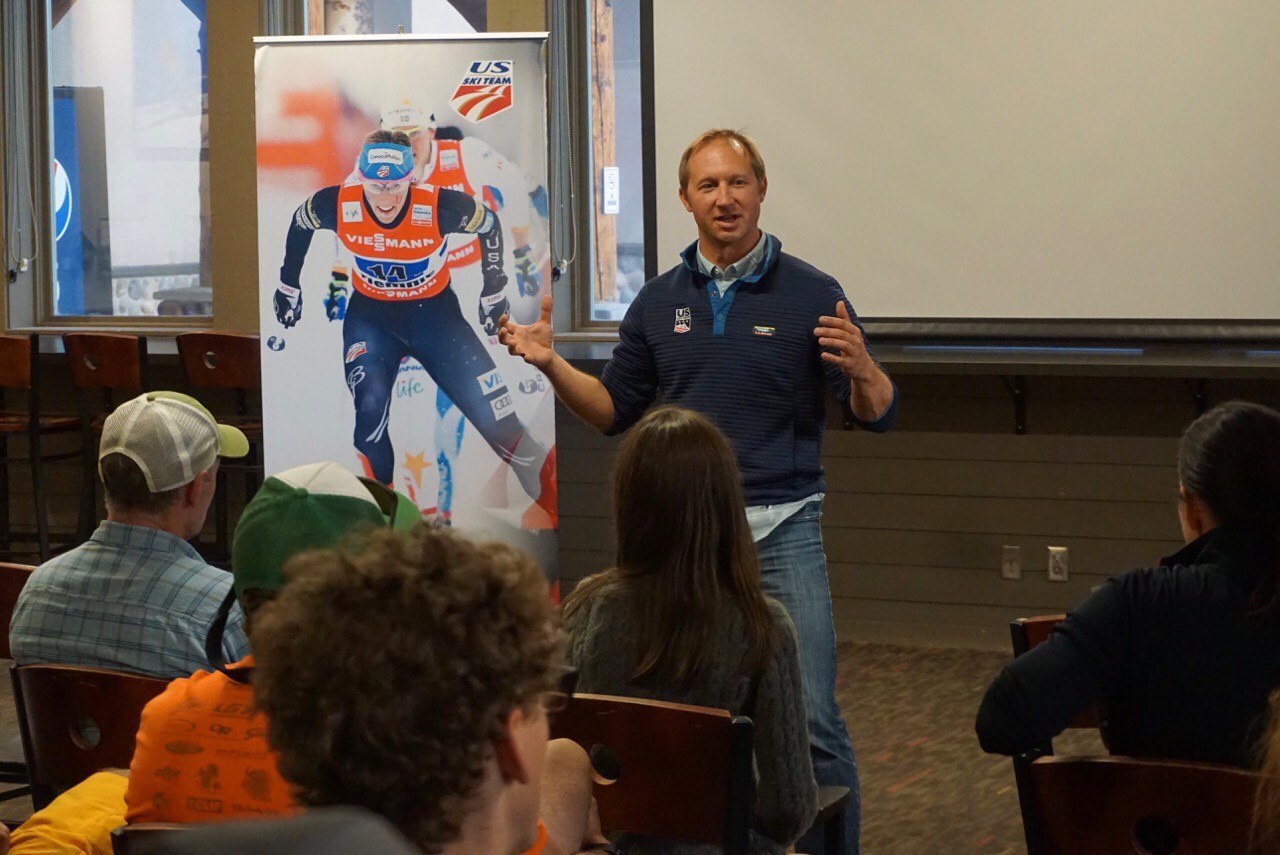
Bryan Fish, U.S. Ski & Snowboard’s cross country sport development manager, delivering a presentation called “Strides of Success – The Key Factors in USA XC Ski Development Success” on Sept. 15 at the Snow King Sports & Events Center in Jackson, Wyoming. (Photo: Nancy Leon/Jackson Hole Nordic)
JACKSON, Wyoming — Last last month, U.S. Ski & Snowboard announced that Bryan Fish had been promoted to cross country sport development manager. FasterSkier sat down with Fish on Sept. 14 at Jackson Hole’s Center for the Arts, where he was leading a Level 200 coaching clinic, to learn more about this transition and how his new position will support the national development program. He also provided insight into the development program’s philosophy and goals for the coming years.
Fish originally joined U.S. Ski & Snowboard as the cross-country development head coach in 2010, after starting the Central Cross Country (CXC) Elite Team in Wisconsin and coaching there for four years. Before that, he was head nordic coach at his alma mater, the University of Wisconsin-Green Bay, from 1998 to 2006. During his last eight years with the national team, he has been the primary development coach and spearheaded sport education to create resources for club coaches and athletes nationwide. As U.S. nordic skiing at the elite level has steadily improved, the development program for juniors has grown and evolved in response.
“I think people look at it and they see this monumental upward trend, but it’s been kind of a slow steady progression,” Fish, 43, said. “It’s been really fun to be a part of. … You just see the whole community collectively raising the bar, and it’s been really exciting to be a part of that.”
U.S. Ski Team Development Coach Bryan Fish gets some glitter from by Hailey Swirbul at 2015 Junior World Championships in Almaty, Kazakhstan (Photo: Julia Kern)
Fish’s new role will include many of his previous responsibilities while reducing certain aspects of his former position, which made it more difficult for him to focus on the development program itself.
“What we really did is took a look and evaluated ‘what are our strengths as a staff?’ How do we need to structure our sport in a way that optimizes our staff and optimizes our resources?’ ” he reflected. “So a lot of things that I was doing previously are very similar to what I am doing now.”
Additionally, a sport consultant who will be based year-round in Park City will be hired to take over office-based work such as uniforming, helping with the competition guide, and data analysis through points at the SuperTour and Junior Nationals. This person, who Fish said will be hired in the coming weeks, will devote about 80 to 85 percent of their time to cross country and the remainder to the all-sport needs of U.S. Ski & Snowboard.
“One of my strengths is working with the athletes in the field, and we want to maintain some consistency with the international competitions like Junior World Ski Championships, World U23’s, OPA Cup as well as some of the national-level junior camps that we do in the summer,” Fish said. “I will still continue to do that.
“I will no longer support World Cup,” he continued. “I’ll be a little more domestic, so I’ll be at West Yellowstone, I’ll be at Silver Star, and that actually was a plan regardless of whether I took this new position or not because the dynamic of our World Cup team and our whole national team is a lot more on the development side.”
Fish’s approach to leading the development program is focused on process goals, creating opportunities for athletes in all regions and at all levels, and providing club coaches with tools to create successful programs. He hopes to develop a systematic process for juniors to excel in skiing that’s both clear and transparent.
“One of the things I’ve been trying to focus on … is taking a deeper look at those steps from what I’ll say, cradle to grave, or from youth all the way to elite, and we’re continuing to recognize and understand that there are gaps in areas, but most importantly, it’s really important that we divide and conquer,” he said. “What I mean by that is that we’re working with our divisions, we’re working with our regions, because they do a lot of the junior racing and youth development, and we do a lot of the national and above. It’s really making sure that we have affiliation agreements with each division and I’ve been looking through those as well and making sure that there’s a clear path and opportunities for junior athletes.”
In order to gauge the success of this approach and the development of junior athletes, Fish offers an approach that is not solely based on results; in fact, success in competition is only one of the three aspects involved.
“Number one: are we growing?” he asked rhetorically. “Growth does not mean membership growth; it just means, do we have more skiers? The second thing is retention. Are we retaining the skiers? And number three is performance. Are we getting better?”
In order for these three components of growth to be possible, opportunities for athletes of all ages and abilities must be available. He described another three-step model for developing programming at any level.
“One is developing a passion for outdoor endurance athletics, number two is developing a culture of training, and then we can develop a culture of performance,” he said. “And even at that high point, a culture of performance, they need to still have that passion for outdoor endurance. So if we’re doing our job, we’re providing opportunities. So we’re making sure that there are appropriate venues, there are events — it doesn’t necessarily mean competition, but there are different events, and that there are programming, and we need to have all three of those pieces.”
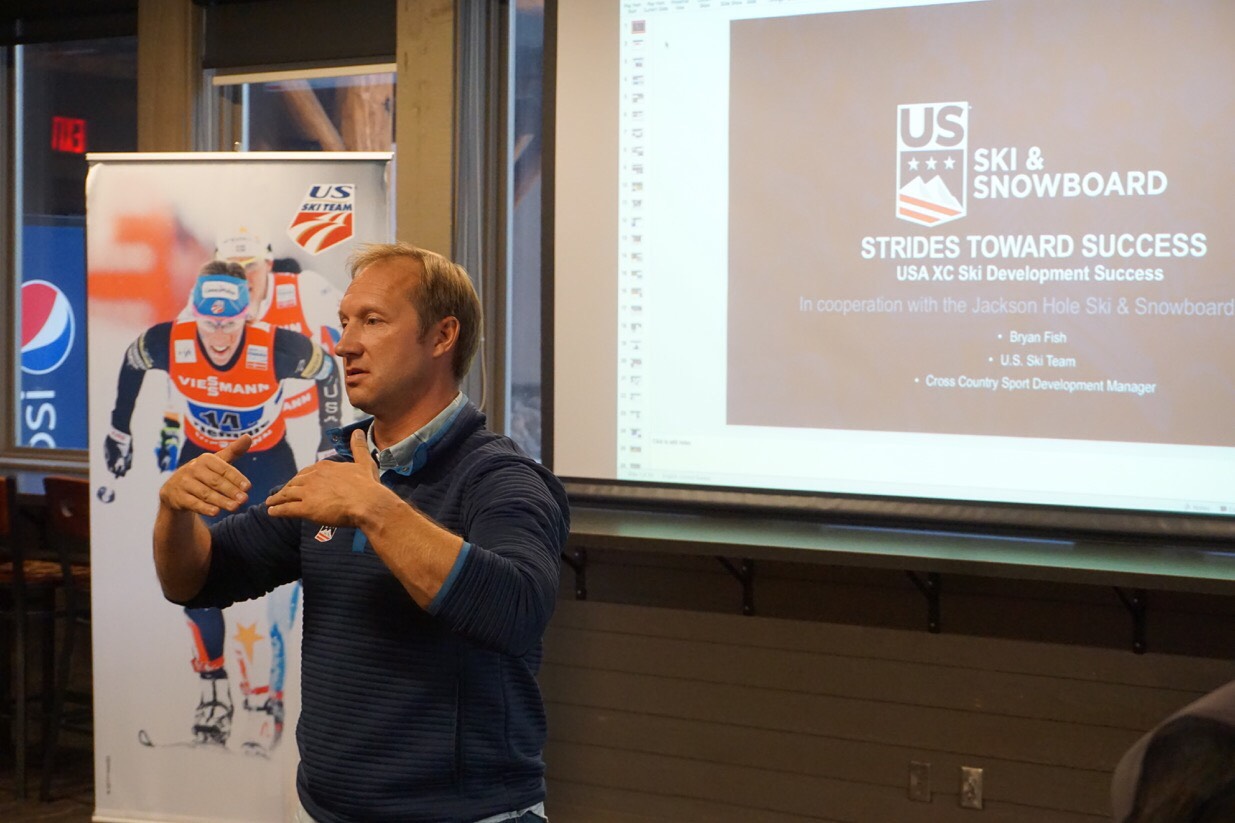
Bryan Fish delivering a presentation called “Strides Toward Success: The Key Factors in USA XC Ski Development Success” on Sept. 15 at the Snow King Sports & Events Center in Jackson, Wyoming. (Photo: Nancy Leon/Jackson Hole Nordic)
Fish refers to these opportunities as part of a “pathway” for athletes, versus using the phrase “pipeline”, which is used by the U.S. Olympic Committee. He adds, “I’m not a big fan of the term ‘pipeline’. … When you think pipeline, it has one path, it goes in this pipe and this little trickle comes out the other end.”
To him, the word “pathway” implies that there are many entry points that can lead to success in skiing, especially when one’s individual goals are taken into consideration.
Fish emphasized that access to quality programming from a young age is essential to the success of U.S. skiing as a whole. He said coach education is crucial to this aspect of creating valuable opportunities for youth, as are the clubs that plant the seeds for success and are most responsible for cultivating a love of the sport.
“I wish U.S. Ski & Snowboard had the capacity to do more at a younger age, but we have to focus our efforts and really be strategic with the resources that we have,” he said. “What we are trying to do is be very transparent about that and say, ‘OK, these things we can do, these things we need you guys to do, clubs and coaches, how can we help you?’ One of the resources we are trying to provide is this coaching education, which we take real seriously, to have some common ground.”
Programming should also be similar across the country.
“We want to make sure that a skier in California is somewhat similar in level to the athlete in Maine and getting the same opportunities,” he said.
In his time with U.S. Ski & Snowboard, Fish has assisted in the development of resources for coaches, such as the Level 100 and 200 certification programs. However, in recent years, his focus has shifted away from some of the minutiae of technique and physiology toward a more pedagogical approach, which he hopes to continue to spread in his new role.
“What we wanted to do is go, ‘OK, here is our scaffolding, here are some best practices in the community for all these different things,’ ” he explained. “We’ve tried to be less detailed as it relates to nuances of technique, but instead ‘here is how you teach technique’… We all might teach it slightly different, but I hope that we can come back to our educational platform and say, ‘OK, we can all agree on that,’ and then from that we can be creative as coaches with our different age groups and resources that we have within a community.”
Fish also stated that partnership with coaches and technicians from around the country fills essential gaps in support at international junior competitions, in turn providing valuable professional development opportunities for the club staff.
“The coaching staff on the national team has been more open to having open training and have more club coaches come on trips, and for me, that collaboration is really important,” he said. “When I go to Junior Worlds, I am the only national team person, all other staff is club coaches. As time has gone by, with that collaboration and bringing more coaches and technicians over internationally and working together with them, we’ve created that trust. And we’ve also seen coaches and techs like Andrew Morehouse and Tim Baucom are now full-time wax techs [for the national team].”
Training camps are another powerful tool, Fish said.
“There’s no more powerful coach than other strong teammates and an environment of training,” he said. “A perfect example of that is our last camp that we just came from in Norway, the International Junior Camp.
“When you’re around other athletes of a similar level, the bar just raises,” he continued. “What I noticed was that it was hard on everybody, but when its hard on everybody and everybody’s doing it, it becomes normal. They’re not all stressed out and they’re not all questioning themselves. They’re just like, well, everybody else is doing it were all in the same boat here; we’re all pretty tired.”
He added that Molly Gellert said it best when she posted a photo of herself on Facebook with Sofia Shomento, an Austrian coach, and athletes from Norway and Finland smiling with their arms around each other after the last training session of the camp. The photo caption reads “Don’t let the smiles deceive you, camp was so freaking hard.”
Asked about the dilemma some athletes face when choosing whether to ski in college or take a post-graduate year, Fish said that decision should not be viewed as black and white, and it should reflect the athlete’s individual strengths and goals. Though he is often in support of a post-grad year, he understands that not all athletes at that age are mature enough to handle the transition being a full-time athlete and still need an additional outlet, such as taking classes or a part-time job.
“I look at it from a perspective of ‘what are the opportunities?’ ” he said. “When I was a college coach, I always said, ‘You need three things if this college to be right for you: the school needs to be right for you, the coach needs to be right for you, and the team needs to be right for you.’ I think you could build upon that to say, ‘Is part-time school the right approach for you?’ I really encourage athletes and their families to really identify and think deeply about what might be the right path for them. There’s no one right pathway.”
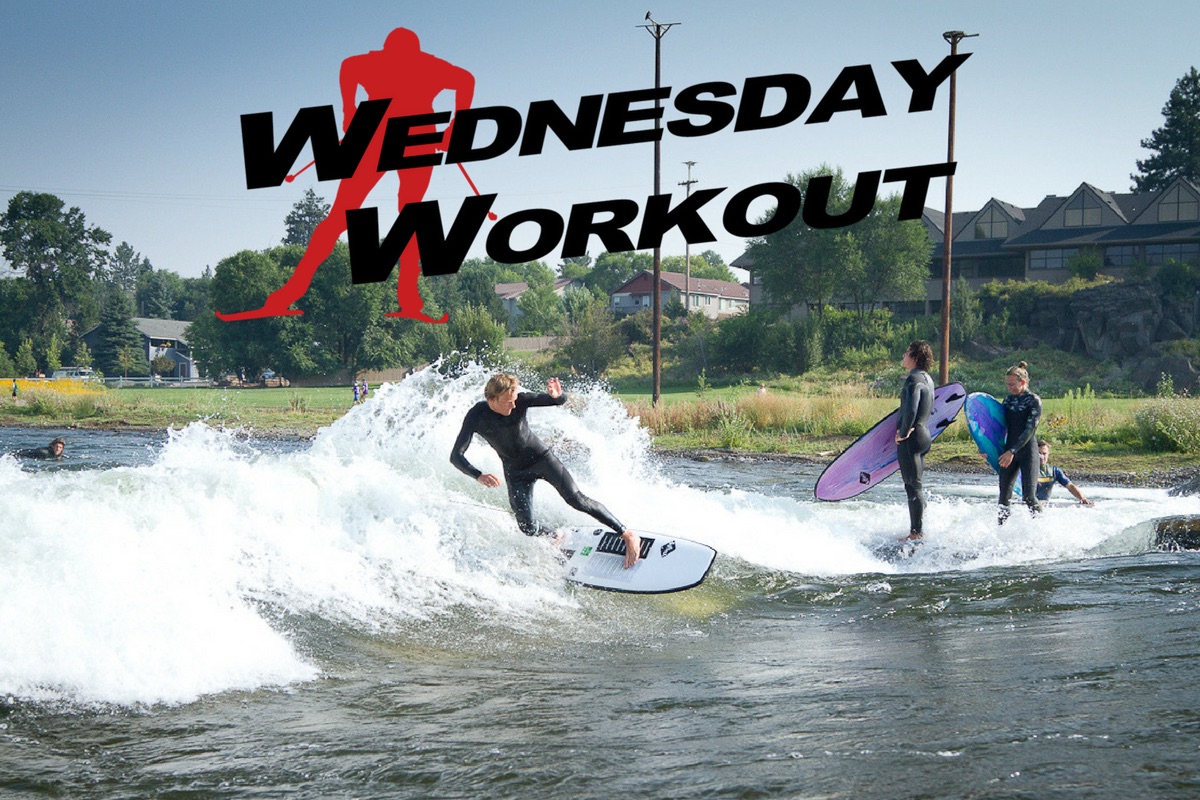
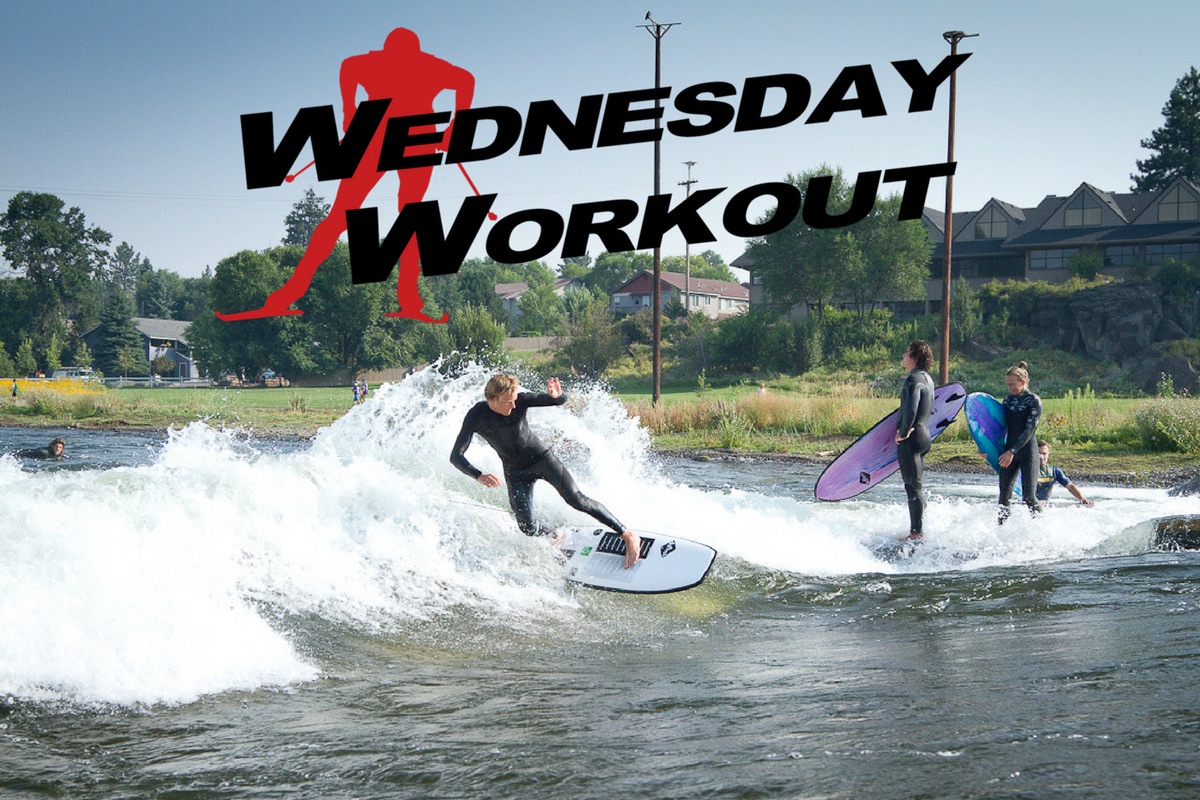
Jake Ajax, a senior on the University of Wisconsin-Green Bay nordic ski team, catching some waves in Bend, Ore. (Photo: FasterSkier)
BEND, Ore. — It’s August. That means a few things to keep in mind. Out West, it’s been hot and dry. Mid-90 temps have been the norm and in places like Bend, it’s in the teens for humidity. Don’t forget to top that with smoky air from surrounding wildfires.
On the East Coast, high humidity can turn an early morning workout into a tropical death march. Left or right coast, even in the Rockies and Midwest, the phrase “hydrate or die” remains relevant.
It’s enough to tap the brakes on traditional forms of dryland training.
That brings us back to Bend. Despite recent claims, Bend isn’t paradise, and it may not be where you want to be. Some downsides here in Bend are the busy traffic circles and dusty mountain-bike trails in summer. (Yeah, all first-world problems.) If that’s not enough to dissuade you, then there’s this not-so-well-known fact: Bend’s river surfing wave isn’t always firing with a green face; sometimes a pillow of aerated water blemishes an otherwise everlasting standing wave.
The upside (yes, there’s a big upside) is that the surfing wave at Bend’s Whitewater Park serves up a great option to diversify the off-snow training.
Sun-bleached blond. With a look like that, 21-year-old skier Jake Ajax, in Bend, Ore. for summer training, exudes the xc skier/surfer stoke. (Photo: FasterSkier)
It took a 21-year-old named Jake Ajax from Minneapolis, Minn., who currently skis for the University of Wisconsin-Green Bay, to show the light.
Jake actually goes by Ajax.
Ajax ended up in Bend for the summer to train with the Bend Endurance Academy (BEA) college training group. But surfing? That seems a bit off the radar from a nordic skier in the Midwest. Like any semi-landlocked kid, he dreamed big.
“My obsession with surfing started last summer when I read the book Barbarian Days by William Finnegan,” Ajax explained in an email. “I’ve always been interested in the sport but being from Minnesota there’s no easy way to get into it. Barbarian Days was my gateway that pushed me to give it a try and I love it. I have a sister that lives near Orange County, CA so that’s a great resource to have. I even managed to surf Lake Michigan last spring a couple times when storms hit.”
(If you think Barbarian Days sounds like some fluff surf book, think again. Finnegan won a Pulitzer for his cerebral surfing memoir.)
“I told myself, ‘I’m going to be good at that by the end of the summer,’ ” Ajax wrote. “When I first got here I bought a board and was surprised by the steep learning curve of surfing. For about the first week all I could do was ride the wave for a few seconds before face planting and getting flushed down the rapids.”
Ajax is not alone. Not to name names, but some of Bend’s most stout endurance athletes, some of them nordic skiers, have been seen flushed over the Whitewater Park’s drops after a split-second surf.
Including this guy:
Ajax admits he’s now a regular at the wave in between his morning and evening workouts.
“I usually try to make it to the wave about six days a week,” he wrote.
For those logging hours, Ajax noted he doesn’t include the surfing in his log book, since there’s a bit of standing around and his heart rate remains low. But Ajax asserts the surfing has put grins on his face and benefited his ski training.
“Physically, the basic surfing stance is fairly similar to skiing,” he wrote. “You press through the arch of your foot relaxing the toes and keep your ankles loose so you can turn back and forth on the wave. You press through the surfboard similarly to how you press through a ski. It definitely helps with balance. Mentally, ski training, especially in the off season, is always great to keep fresh. It’s been great mastering this new sport over the summer. Rollerskiing the same roads every week can get old so it’s nice to keep things fresh with the whitewater park.”
Ajax has been the pied piper of river surfing for the collegiate nordic crowd. It’s now not uncommon to see surfers/NCAA skiers at the wave from the University of New Hampshire, Colby College, University of Vermont, and a certain Harvard Ski Team alum on occasion.
“River surfing is a pretty cool sport so I think most skiers are compelled to try it,” Ajax wrote. “I’m just the one who drags them down to the wave to give it a try.”
Newell Says…
If you don’t take FasterSkier’s and Ajax’s word for it, how about the word from cross-country skiing’s answer to Kelly Slater: longtime U.S. Ski Team member and longtime surfer Andy Newell? (Seriously, shave Newell’s locks, swap out the lycra for board shorts and you’ve sort of got a Slater doppelgänger.)
“I’ve never surfed any standing waves but I try to get into the water as much as I can throughout the summer to surf in the ocean,” Newell wrote in an email.
Here are some of the ways Newell believes surfing can benefit skiers:
Mental: “There is the obvious, surfing is fun, engaging, and addicting so it is a perfect mental break for a winter sports athlete. But I think there is much more to it than that since sports like surfing practice a different type of mental/ physical connection. Skiing is a speed-based sport, it’s all about how fast you can go. Surfing is a style-based sport that is more about muscle memory and how your body moves. I think it’s great when athletes with a background in speed-based sports practice something like surfing or skateboarding because it forces us to have different mental/physical connection that is focused more on proprioception. body movement, and is 100 percent skills based. It’s good for the brain:)
Physical: “On the pure physical side, surfing is great for balance, core strength, and upper-body strength. The paddling motion of surfing is awesome for skiers because it is a similar motion that recruits a lot of the same muscles as poling but it’s also very different in a good way. Paddling and swimming where you are bringing your arm up above your head and shoulder is great for strengthening external rotation in the shoulders which is something most skiers need. Paddling a surfboard and strengthening all those small muscles around the outside of your shoulder and back will help a skier stay injury free from a repetitive poling motion. Also, when you are laying on your stomach and paddling on a board it will improve thoracic mobility (upper-back mobility) which is another weak point for a skier.”
Jake Ajax, who’s training with the Bend Endurance Academy this summer in Bend, Ore., dials in his skinny-ski balance as he carves a turn on Bend’s river-surfing wave. (Photo: FasterSkier)
In Bend, the wave is close to downtown. If you’re busy logging hours on the computer, you can multitask and check out the live streaming surf scene.
The Gear
Although we’re no experts, river surfboards are short. Some are in the 4-foot range for more experienced surfers. A stable learner board on the local Bend wave runs anywhere from 5-feet-2-inches to 5′-7″. Most surfers here use soft boards since board dings from rocks are a reality of river-wave surfing. That said, some local shapers will handcraft a pricey glass and carbon board for your liking.
This writer makes his child wear a helmet and board leash with a hand-activated break away mechanism — it’s a river, after all, meaning natural hazards exist that may snag a leash. Better safe than sorry. Some river surfers in Bend wear a personal floatation device (PFD).
Hardy folks wear board shorts as if the Cascade’s were found at 19.8968° N, 155.5828° W (a rough approximation of Hawaii’s location). Otherwise, most folks wear wetsuits. At roughly 65-degrees Fahrenheit in summer, the water in the Deschutes River as it flows through Bend isn’t shiver-inducing, but a wetsuit makes it cozy.
The Workout: Surfing
Focus on de-stressing
Smile
Have fun
Get on the wave
Try to surf
Maintain a Level 0.5 heart-rate zone (if your post-workout data indicates you were in L1, you are doing it wrong.)
Smile
Repeat
Jake Ajax paddling while river surfing. According to Andy Newell, this can improve functional shoulder strength. (Photo: FasterSkier)
Butch Reimer has had a significant influence in my life. It was under his tutelage that my passion for cross-country skiing matured.
The summary reads, “Butch Reimer passes of cancer and is survived by Jill – his wife, daughter – Hannah and son – Jake.” Turning back the pages, one will always find a story deeper in content and substance. Butch’s story is one that touches many of us in the cross-country ski community. I am one of many people that have been deeply inspired by Butch’s leadership and motivation.
Butch’s influence in my life in nordic skiing is only trumped by my parents. Butch recruited and encouraged me to come to University of Wisconsin-Green Bay as an athlete, recruited and encouraged me to get involved in coaching at my alma mater and encouraged me to follow my passion as a coach with CXC and now with the U.S. Ski Team.
His legacy lives and grows within all us athletes he coached, and the sheer number of us that are still competing, coaching and involved in the sport. This is a great testament to the culture he cultivated at UW Green Bay. I learned of Butch’s diagnosis on October 1st while visiting former UW-Green Bay teammates Adam Swank, Josh & Kate Tesch. It was no irony that I would find out from them, for Butch fostered a strong team unity at UW-Green Bay that has developed into the closest of life-long friendships. Life-long passion for outdoor endurance activities, forging team bonds and maintaining optimism regardless of situation or outcome was Butch’s beliefs.
I was heading out the door yesterday morning to meet up with Garrott Kuzzy and Scott Wilson for a mountain bike ride when I checked my emails and discovered of Butch’s passing. Garrott inquired, “What did Butch teach you in your coaching philosophy?” I commented that I learned from him that the role of the coach is to support and not dictate. I added that it might sound minor, but it affects every aspect of coaching. Butch also taught me that coaching has a great deal to do with forging a personal connection between athlete and coach versus simply executing the fundamental training principles of the sport. Butch wanted athletes to make their own decisions and forge their own paths. In a sport like ours, we need to be self-motivated and self-driven. Butch encouraged us to steer our own futures.
Butch’s approach was motivating, but in a subtle manner. Butch was not a high profile individual. That wasn’t his style. Trying to sum up Butch in a sentence is difficult, but what comes to mind is a nice guy who always wanted to lend a hand.
Butch was not a full time coach. He had a comfortable position with the Pulaski School District. He coached because he had a passion to lend a hand. He stepped aside from coaching the UW-Green Bay Ski program for eight years, so he could invest more time with his family and children who were in junior high and high school at the time. He returned to coaching ski program once Jake and Hannah went off to college and I stepped aside. Personally, I feel I was just keeping his “coaching seat” warm in his hiatus.
He couldn’t stay away from coaching in his absence of the UWGB Ski Team. He became a soccer coach for his daughter’s soccer program & also helped coach the UW-Green Bay Women’s Fast Pitch Softball team. Few skiers knew that Butch was a professional fast pitch softball pitcher in his younger years. Then freshman skier – Matt Frost – learned of his accuracy and speed when Matt picked the wrong person to have a snowball fight with.
I had planned to visit Butch this Friday after my return from Lake Placid. I was going to stay with my college freshman roommate and former teammate – Ben Nysse who lived five minutes from St Luke’s hospital where Butch was being cared for. This August was the last time I saw Butch. I stopped by his house to say hi and to inevitably talk about coaching and skiing. I had to wait a half hour as Butch finished a rollerski. He looked fit, healthy and his normal enthusiastic self.
My mountain bike through the silent woods of Northwoods Wisconsin yesterday provided a unique opportunity to reflect on Butch’s positive influence in my life. The friendship he forged with me has developed meaning and purpose in my coaching. If anyone asks my thoughts on Butch; I would say that Butch was well respected and will be deeply missed.