From the FasterSkier archive — posts syndicated from athletes’ and coaches’ own blogs between 2004 and 2012, kept online as published. Current coverage is at fasterskier.com.

Tag: UOLF

  • Hall and Studebaker-Hall Take Reins with Team SoHo

    Hall and Studebaker-Hall Take Reins with Team SoHo

    Zach Hall (far left) the new manager and head coach of team Soldier Hollow’s biathlon programs standing with his athletes during a training session this summer. (Photo: Sara Studebaker-Hall)

    Last September, amidst the chatter of others gathered for the 11th annual U.S. Olympic and Paralympic Assembly in Colorado Springs, Colo., Sara Studebaker-Hall and the CEO of the Utah Olympic Legacy Foundation (UOLF), Colin Hilton, shook hands. Studebaker-Hall, a two-time Olympic biathlete, was attending the meeting as an athlete rep for the US Biathlon Board of Directors and was introduced to Hilton by US Biathlon Association (USBA) President and CEO Max Cobb.

    The three were partaking in the U.S. Olympic and Paralympic Assembly’s two-day fall symposium, an event that included seminars on athlete rights and anti-doping. At the time of their introduction, Studebaker-Hall had no idea that her conversation with Hilton would evolve into a job opportunity and eventually, her return to the Intermountain region. Originally from Boise, Idaho, Studebaker-Hall was starting her third season as the assistant coach for the University of Alaska Anchorage (UAA).

    But last fall, her coaching position and the future of the UAA Ski Team were in question.  Financial restraints at Alaska’s state universities had put more than one cross-country ski program in limbo.

    Back in Anchorage and also unsure about the future was Studebaker-Hall’s husband, Zach Hall, a former national-team biathlete himself.  A native of Nikiski, Alaska, Hall had been working to develop a competitive youth biathlon program in Anchorage and was questioning whether or not it was time to make a career move.

    Then Studebaker-Hall learned through Hilton that UOLF was looking to add a new biathlon program to Soldier Hollow, its cross-country ski resort in Midway, Utah. A world-class venue, the Soldier Hollow (SoHo) shooting range had hosted biathlon competitions during the 2002 Winter Olympic Games, yet no biathlon, development (devo) or competition (comp) teams existed in the SoHo or Midway area.

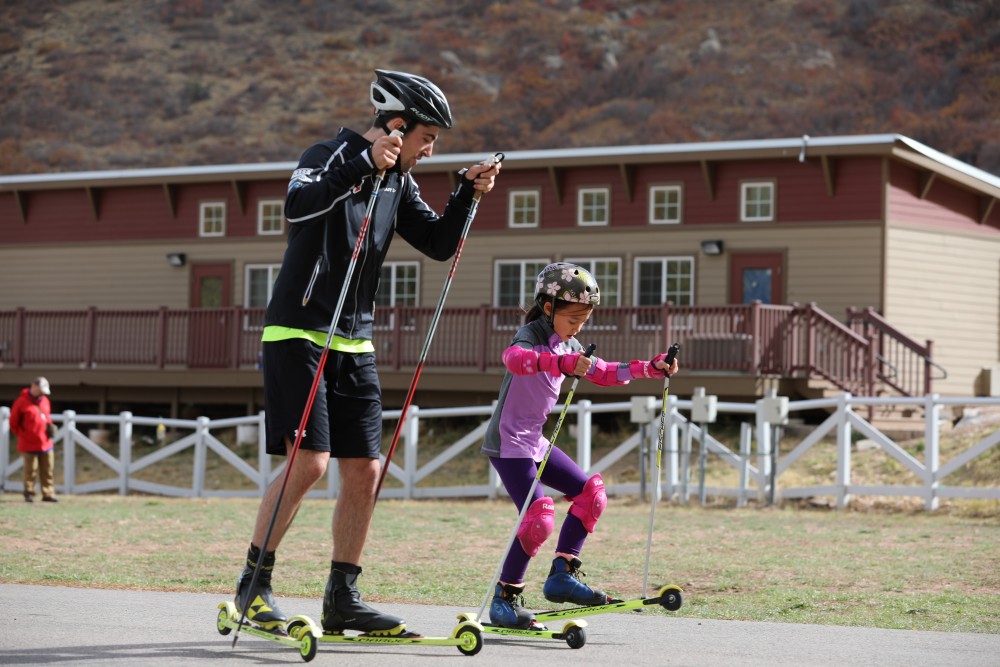
    Team Soldier Hollow athletes Ingrid Norton and Pearl Harvey during a rollerski workout two years ago near Heber and Park City, Utah. (Photo: Morgan Smyth)

    “One thing I look at is what are we doing with our venues, are we providing the sport we out to provide,” UOLF Vice President of Sport and Venues Marc Norman said on the phone in September. “The fact that we weren’t hosting [biathlon] and weren’t running any programs in it was a quick red flag for me.”

    Along with the addition of a biathlon program, Team Soldier Hollow was also in need of a youth coach for its nordic program. From 2012 to 2015, Morgan Smyth served as the program manager, overseeing the Comp and Devo teams, the Youth League and the Charter School Ski Program. At the time of her departure, 145 kids were enrolled in SoHo’s programs — 10 on the Comp (competition) team, a number which has almost tripled since then.

    “I left Soldier Hollow to work for Park City Nordic Ski Club [PNSC] as the Nordic Manager,” Smyth wrote in a recent email. “PNSC was part of the Utah Olympic Legacy Foundation. Ironically Soldier Hollow became a part of the Legacy Foundation less than a year later but I live in Park City so it was nice to work closer to home.

    “I left Park City Nordic this fall and started a Physical Therapist Assistant program,” Smyth continued. “I am excited to try something new but plan to stay involved in the ski community. Hopefully coaching the younger kids during the winter months.”

    Former UAA assistant nordic coach Sara Studebaker-Hall (center, white hat) at the #savealaskaskiing rally in Anchorage, Alaska, on Nov. 10, 2016. Former UAA skier and current USST member Sadie Bjornsen (pink jacket) is to her left. (Photo: Gavin Kentch)

    Last fall, after Studebaker-Hall returned to Anchorage, she and her husband were offered the opportunity to work with Team Soldier Hollow, with Hall heading the new biathlon program and Studebaker-Hall leading the pre-existing nordic ones. When the offer was made, the UAA Ski Team’s future remained uncertain, and the two ultimately accepted UOLF’s offer, viewing it too good to pass up.

    “It was hard to leave UAA,” Studebaker-Hall explained on the phone earlier this summer. (The UAA Ski Team was ultimately saved three weeks after she and Hall accepted). “But moving to a head-coaching position and managing a program here and getting this off the ground was kind of a once in a lifetime opportunity, so we had to take it.”

    Studebaker-Hall is now serving as the head coach and program manager for Team Soldier Hollow’s Devo Plus and Comp teams. The competition team alone has 25 athletes, many of which Studebaker-Hall described as being “on the precipice of just getting going”. As she transitions from coaching collegiate skiers to juniors, she expects a few challenges mainly involving the mindset of younger skiers.

    For most of the college skiers she’s coached, knowing the fundamentals of being an endurance athlete were automatic: get adequate amounts of rest between training sessions, practice good hydration. In contrast, a majority of her Team Soldier Hollow athletes are still learning the basic principles, such as the importance of recovery, nutrition and getting decent amounts of sleep.

    “With youth kids, you’re trying to instill in them this idea that coming to training everyday is really important,” Studebaker-Hall observed, “Even just how to think about training, all these things I think that maybe I took for granted a little bit, that all the kids that I previously worked with knew already. That’s definitely a challenge, but one that I’m really excited about because these kids are so moldable.”

    Most of the juniors she’ll coach this winter range in ages from 10 to 20 years old.

    “They’re really ready to take in everything you say,” Studebaker-Hall continued. “You have a huge opportunity as a youth coach to do that for kids, maybe even more so than on a collegiate level, because you’re their first real coach.”
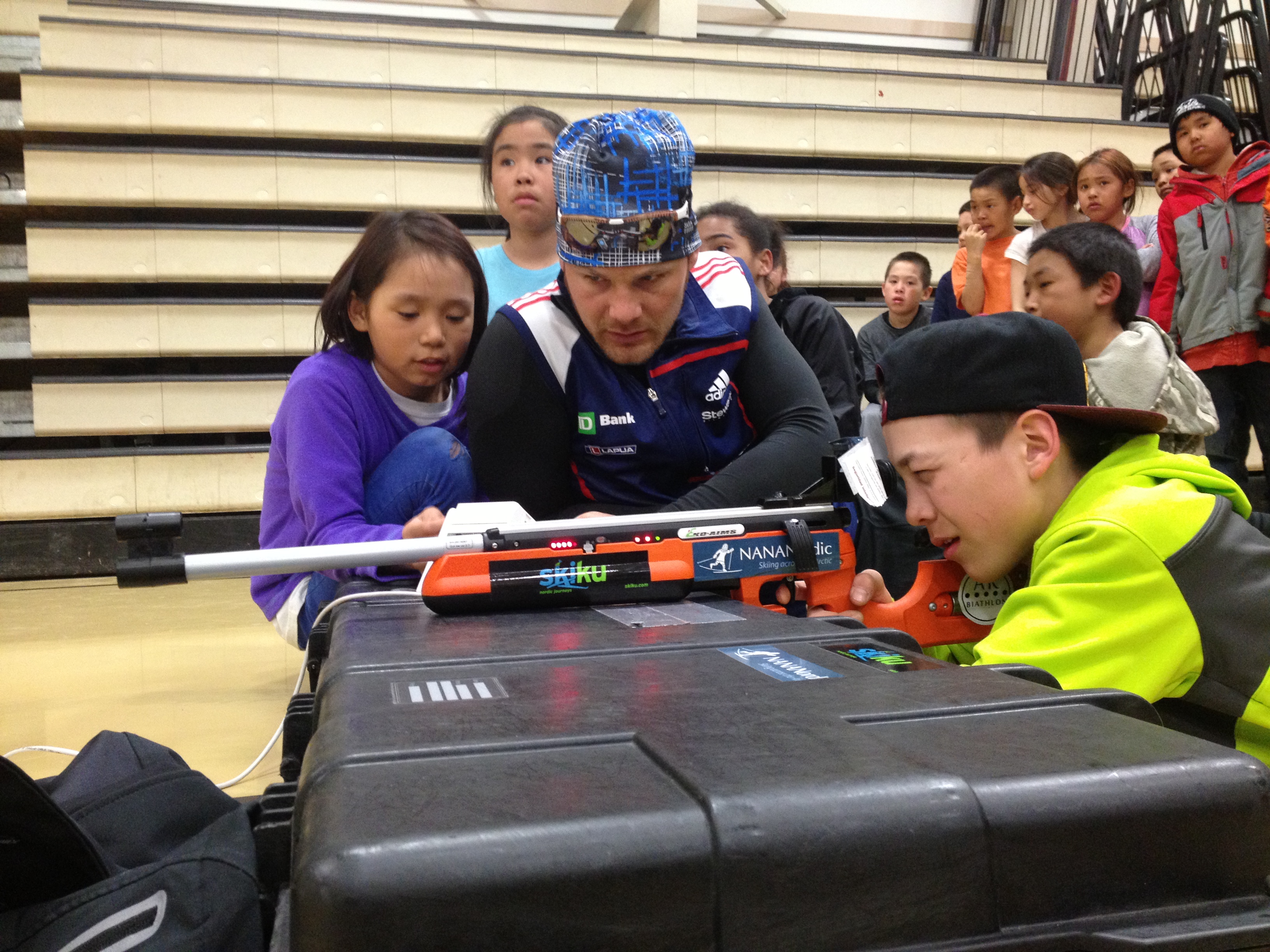
    Zach Hall teaching shooting skills in 2014 at an indoor range in Kotzebue, Alaska, as part of the NANANordic program in the state’s Northwest Arctic Borough.

    Though Studebaker-Hall only started working with Team Soldier Hollow this summer — Hall arrived last December — she’s already made a positive impression on many of her athletes. Pearl Harvey, 16, who has been involved with Soldier Hollow’s nordic program since she started walking, highlighted Studebaker-Hall’s interest seeing her athletes succeed.

    “I have never had a coach so involved with technique and caring about my progression as a skier and a person,” Harvey, who hopes to one day receive a college scholarship for skiing, wrote in an email. “Sara, for me, is a big role model and she is shaping me as an athlete with being more conscious of my technique, eating, drinking and sleeping habits. She is also shaping me as a person and keeping us in check and making sure we are on the correct path.”

    As Studebaker heads Soldier Hollow’s nordic programs, her husband is in charge of SoHo’s new biathlon programs: Intro Flex , Devo Plus Flex  and Comp Flex (development team). Hall estimates he has a total of 20 athletes in the biathlon program, though not all belong to Team Soldier Hollow. The Utah Nordic Alliance (TUNA), the Park City Nordic Ski Club or Wasatch Nordic have athletes participating in SoHo’s biathlon program, thanks to what they dubbed a “flex” program option. With this “flex” program, members from any of the surrounding nordic ski clubs can join Team Soldier Hollow for biathlon training without changing their club affiliation.

    Racers at 2017 U23/Junior World Championships last February in Midway, Utah. (Photo: Team Soldier Hollow blog)

    “We’ve got the only range in the area, so what we’re trying to do is work with all the area coaches to schedule training sessions, so that it works as much as we can with them working with their local nordic clubs, ” Hall said on the phone in July. “A big part of the program is just pushing general nordic development and adding opportunities with biathlon.”

    Sparking interest is the first step for Hall, as well as getting the word out about the biathlon program. Having U23/Junior World Championships held at Soldier Hollow last season was also helpful in promoting the biathlon and nordic programs there, as well as giving younger athletes an idea of where skiing could take them.

    “This is my first summer trying Biathlon, and I am loving it,” Lina Farra, 16, wrote in an email in September. “Both Zach and Sara have very high-level Biathlon experience, and that combined with their great passion for sport sets this program apart from others around the nation.”

    SoHo is currently bidding to host an International Biathlon Union (IBU) World Cup in 2019. According to Studebaker-Hall, an exploratory committee is also forming for a potential Olympic bid — the last Olympics held at SoHo took place in 2002.

    “From a programmatic standpoint, we definitely want to see Utah kids participating in this sport,” Norman said. “There’s no reason we shouldn’t have a strong biathlon program. That’s our goal, is to build up and be one of, if not the best biathlon programs in the nation. And have kids of all ages and abilities participating in biathlon.”


  • SoHo and Park City Gear Up to Host First U23/Junior Worlds in 30+ Years

    SoHo and Park City Gear Up to Host First U23/Junior Worlds in 30+ Years

    A view of Soldier Hollow's stadium from the highest point of the 5 k olympic course.
    A view of Soldier Hollow’s stadium from the highest point of the 5 k Olympic course as seen in January 2014, with the timing building and Soldier Hollow Charter School (white building) at the center.

    As the 2016/2017 race season approaches, plans are proceeding for the International Ski Federation’s (FIS) Nordic Junior/U23 World Championships to return to the U.S. With both the U.S. Cross Country Championships (which take place Jan. 7-12) followed by Junior Worlds (Jan. 30-Feb. 5), the Utah Olympic Legacy Foundation (UOLF) has a full plate this winter.

    Scheduled for just two-and-a-half weeks after U.S. nationals at Soldier Hollow, preparations are well underway.

    “Without a doubt it’s the largest nordic event we’ve had in Utah since the 2002 [Winter Olympic] Games,” said Greg Poirier, the organizing committee’s technical advisor who has been instrumental in bringing the championships to Park City and Soldier Hollow, Utah. “And it’s been 30 or 31 years since we’ve had Junior World Championships in this country.

    “This has been a dream of mine for quite a while, to bring the championships back to the USA,” he said.

    The last time Junior Worlds took place in the U.S. was 1986 in Lake Placid, N.Y. Senior World Championships goes back even further to 1950. That year, Lake Placid was supposed to hold the senior championships, but could only host the jumping events due to lack of snow.  The cross-country events were moved to Rumford, Maine.

    “If it goes well, pat me on the back; if it goes bad, then I had nothing to do with it,” Poirier, who previously coached for U.S. Nordic Combined when his hometown was awarded the upcoming Junior Worlds in 2015, said with a laugh.

    According to Poirier, the UOLF and Soldier Hollow are ready to host the championships.

    “If we did nothing from now to January 30, facility-wise, we’re ready to go,” he said in early August. “From a technical point of view, I think we’re on schedule. The courses, the ski jumps, the actual competitive side of the event. If athletes showed up tomorrow, we’re ready. We still have to build the stadium and make everything kind of pretty.”

    Norwegian national team member Mikko Kokslien took a photo of the U.S. nordic-combined jumping facility in Park City, Utah.
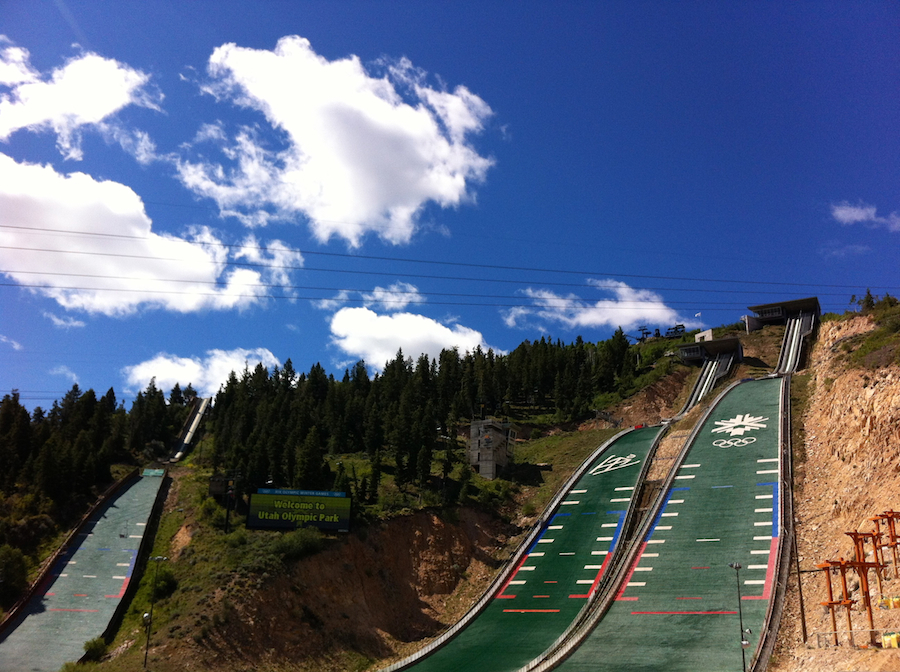
    The jumping facility in Park City, Utah, as seen in 2012. (Photo: Mikko Kokslien)

    In addition to women’s individual ski jumping and a co-ed team competition, Poirier said that the 2017 Junior Worlds will have a women’s ski jumping team event, which includes four women per team “just like the men’s competition. It’s something the [local] organizing committee wanted to do,” he said.

    Poirier initially approached the local organizing committee (OC), seeking approval for this women’s team event. The local OC then asked the U.S. Ski & Snowboard Association (USSA) to ask FIS to add it to the championships program. FIS did so, based on its desire to include women’s ski jumping as a team event for years to follow. Poirier said they were still several years away from women’s nordic combined events.

    Logistically, Junior Worlds are a bigger event than U.S. nationals. UOLF Vice President of Sport and Venues Marc Norman expects more than 800 athletes and 400 support staff. The cross-country and nordic-combined skiers and their support staff will be housed in Midway, Utah (near the Soldier Hollow venue), while jumpers and their coaches will stay in Park City (near the jump hills). In contrast, Norman expected about 450 skiers, including some from Canada and Australia, to compete at 2017 U.S. nationals. He anticipated more than 300 volunteers for Junior Worlds, compared to about 100 for nationals.

    The Soldier Hollow Charter School, a K-6 public charter school located in the heart of the ski stadium, operates partly in the timing building. Because the school will closed for vacation during Junior Worlds, organizers will have access to the whole building.  While school will be in session during U.S. nationals, by agreement, there will be designated space in the building for timing.

    Updated Sprint Course

    While the distance courses remain the same, there will be changes to the sprint course Soldier Hollow has used for the last several years. The long downhill to the stadium after the last big climb will be broken up.

    2013 U.S. nationals skate sprint women's quarterfinal 2 at Soldier Hollow
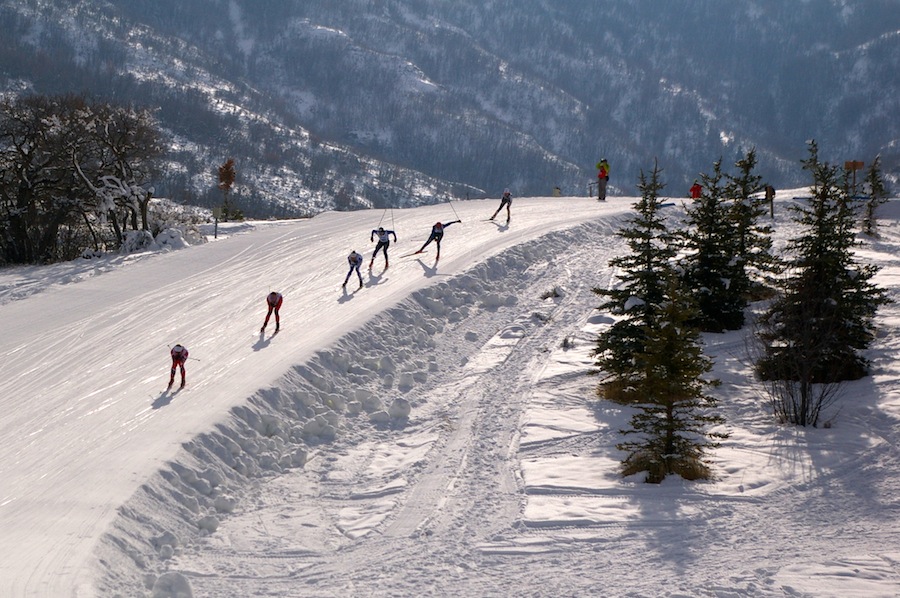
    Racers start their descent on the final downhill of the “old” sprint course at 2013 U.S. nationals at Soldier Hollow in Midway, Utah.

    “The sprint is kind of clustered up,” Luke Bodensteiner, USSA’s executive vice president of athletics, said on the phone in August. “It’s become a 200-meter race at times. So they’ve made some modifications … to break up that last long downhill.”

    Previously, racers would crest the last climb and descend into a downhill straightaway. That created a substantial draft, helping the tail end of a broken-up group regain contact on that final downhill.

    According to USSA Nordic Director Robert Lazzaroni, the revised sprint course will also be used for nationals. Lazzaroni serves as the USSA advisor on the 2017 Junior Worlds organizing committee.

    While the facility side of preparation is going well, finding dollars has been a challenge.

    “I know they feel they’re behind,” Bodensteiner said. “They’re concerned about how fundraising is going. We remain optimistic it will be a financially healthy event. That’s a concern with any of these events, and Junior Worlds is no exception.”

    “The base budget to put on the event is $365,000,” Norman wrote in an email in late September. “We also have an enhanced budget that would allow us to exceed the minimum FIS requirements at a cost of $465,000. Hopefully we can find additional sponsors, suppliers, and donors that will help us close the gap to the base budget and even allow for us to do some or all of the enhanced pieces (more event look, athlete functions, event broadcast, etc…).”

    Bodensteiner explained that there was no guaranteed revenue source, and said that organizers would “have to really hump” to raise funds. “Before we decided to bid for the event, we collectively identified enough revenue sources that were reliable that we could make it work. There’s still a little bit of unknown, but it’s not atypical for events to be in that position.”

    Ben Saxton (SMST2) skis with a junior athete during a skate ski at the USST's annual training camp in Park City, Utah, which ran this year from Oct. 17 until Oct. 31. (Photo: Liz Arky)
    SMST2 senior skier Ben Saxton, who has been to a total of four Junior/U23 World Championships, paces a young skier during the U.S. Ski Team’s dryland training camp at Soldier Hollow last month. (Photo: Liz Arky)

    As of mid-October, USANA Health Sciences, a nutritional supplement company, had signed on as the title sponsor for 2017 Junior Worlds.

    “We are still working on sponsorships for the event to fully meet our budget,” Norman wrote on Oct. 12.

    “Junior Worlds is a little different beast than other events that we run,” Bodensteiner said. “The World Cup events that we run, you have a broader media footprint.  You’re looking at national and in some cases international sponsors for those. They’re easier to get out in front of.  With the Junior Worlds here, even though it’s an international event, it’s going to be reliant on local sponsorship. Oftentimes those don’t materialize until the last minute.”

    When asked if hosting the Junior Worlds bid would lead to USSA bidding for World Cup events, Bodensteiner hesitated.

    “We’re at the point where we’re anticipating it,” he said.

    Although there have been discussions, Bodensteiner said they hadn’t really identified a way to run a FIS Cross-Country World Cup without incurring a substantial financial loss.

    “We haven’t found a financial pathway that makes it realistic,” he said.

    Bodensteiner outlined some of the cost differences between hosting Junior World Championships and a World Cup in a follow-up email.

    “The main cost drivers are prize money (both for the races hosted and a share of the season overall prizes), lodging and travel cost reimbursement for the top group of athletes and their staff (and a number of Continental Cup athletes), event production (grooming, timing, snowmaking, staffing, wax rooms, course installations, travel costs for various FIS officials, medical evacuation, etc), and TV production (camera installations on course, cabling, satellite truck to send a live signal, production crew to shoot, edit the feed and graphics, etc),” he wrote. “Obviously some of this gets recouped through the sale of sponsorship and TV rights. FIS also keeps a portion of the advertising rights for its own purposes, which do not get passed along to the host organizer.”

    If U.S. athletes achieve the goals set by USSA, will there be additional funding for junior cross-country development?

    “When we budget for our programs, we always look at results at different levels,” Bodensteiner said. “We look where ‘our best bet is’ and allocate support to be the best in the world. Results at multiple levels including Junior Worlds are always a consideration.”