
From the FasterSkier archive — posts syndicated from athletes’ and coaches’ own blogs between 2004 and 2012, kept online as published. Current coverage is at fasterskier.com.

Tag: uphill running intervals

  • Wednesday Workout: Craftsbury Running Intervals

    Wednesday Workout: Craftsbury Running Intervals

    Craftsbury Green Racing Project nordic skiers and biathletes doing uphill running intervals on a dirt road in Craftsbury, Vermont. (Photo: Pepa Miloucheva)

    For a mid-summer Wednesday Workout, we reached out to Craftsbury Green Racing Project head coach Pepa Miloucheva. In addition to sharing a running workout, Miloucheva told us what and who is new to the team based out of Craftsbury, Vermont.

    “All is good here in Craftsbury,  everyone is healthy and training is going well,” she wrote in an email in early July. The nordic team joined last month’s U.S. Ski Team (USST) training camp in Lake Placid, N.Y., and also plans to attend the USST’s on-snow New Zealand camp in late August.
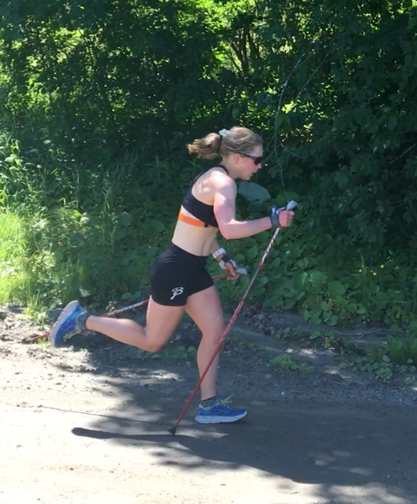
    Ida Sargent, of the Craftsbury Green Racing Project and U.S. Ski Team, during dirt-road running intervals in Craftsbury, Vt. (Photo: Pepa Miloucheva)

    Craftsbury’s roster additions include Corey Stock and Akeo Maifeld-Carucci. Returning to the nordic squad are Ida Sargent (U.S. Ski Team), Caitlin Patterson, Kaitlynn Miller, Liz Guiney, Adam Martin, and Ben Lustgarten.

    The workout itself, one Miloucheva explained the team does this time of year, is 6-8 x 10-minute running intervals with poles. They do so on a gradual, mile-plus-long hill on a dirt road in Craftsbury. To replicate, find a climb that takes at least 10 minutes to run up, and repeat six to eight times.

    “This is a lactate threshold workout, important for improving our sustainable speed,” Miloucheva wrote. “Threshold workout improves both lactate production/recruiting more fast twitch units and lactate removal, ability to minimize the negative effects of lactate while having the benefits.”

    “Athletes run with poles up and I drive them down as quickly as possible to shorten the time between the interval,” she explained. “Goal is to maintain speed for all intervals and keep lactate between 3-5mmol/l, depending on the athlete.”

    Male and female athletes all start at once, just at different starting points so they finish in the same place. Miloucheva recommends focusing on controlling speed during this workout to ensure a productive 50-plus-minute workout at Level 3.

    clomid buy, order revia naltrexone, ventolin

    Upon repeating the workout later in the training season, athletes are instructed to push the pace at the end of the interval to Level 4.

    The workout: 6-8 x 10-minute running intervals with poles

    Need: A hill that takes at least 10 minutes to run up, poles.

    Warmup: 30 minutes easy running, with a few accelerations and functional movements

    Then: Run uphill for 10 minutes at Level 3, return to starting point, repeat 6 to 8 times. Pace at end of interval can be increased to Level 4 later in the season.

    Cool down

  • Wednesday Workout: Throwback Uphill Running Intervals with Stephen

    Wednesday Workout: Throwback Uphill Running Intervals with Stephen

    Liz Stephen tucking in a World Cup race during the 2009/2010 season.
    Liz Stephen tucking in a World Cup race during the 2009/2010 season.

    This week, we bring you a past Pro Workout from U.S. Ski Team veteran and two-time Olympian Liz Stephen. Now 28, Stephen recently won her second-straight Trail Run National Championship as well as the Red Bull 400 hill climb. What’s made her so fast over the years? This workout from 2010 sheds some insight. Read original workout here.

    ***

    [circa Nov. 2010]

    Some skiers love to run; others tolerate it. The U.S. Ski Team’s Liz Stephen is the former. And while uphill running intervals present plenty of challenge for most, Stephen not only wants a solid grade and 20+ minutes of active time – she wants a steady downpour, mud, slippery footing, and whatever else nature can throw at her.

    “For me it is always more fun when it is raining out,” said Stephen. “It is muddy…your hair is all matted down. There is rain in your face, your glasses don’t work, feet are slipping.  You have to figure it out.  I like that kind of stuff.”

    Her workout of choice consists of a relatively standard set of intervals – six four-minute repeats of hard effort building to maximum over the course of the session.

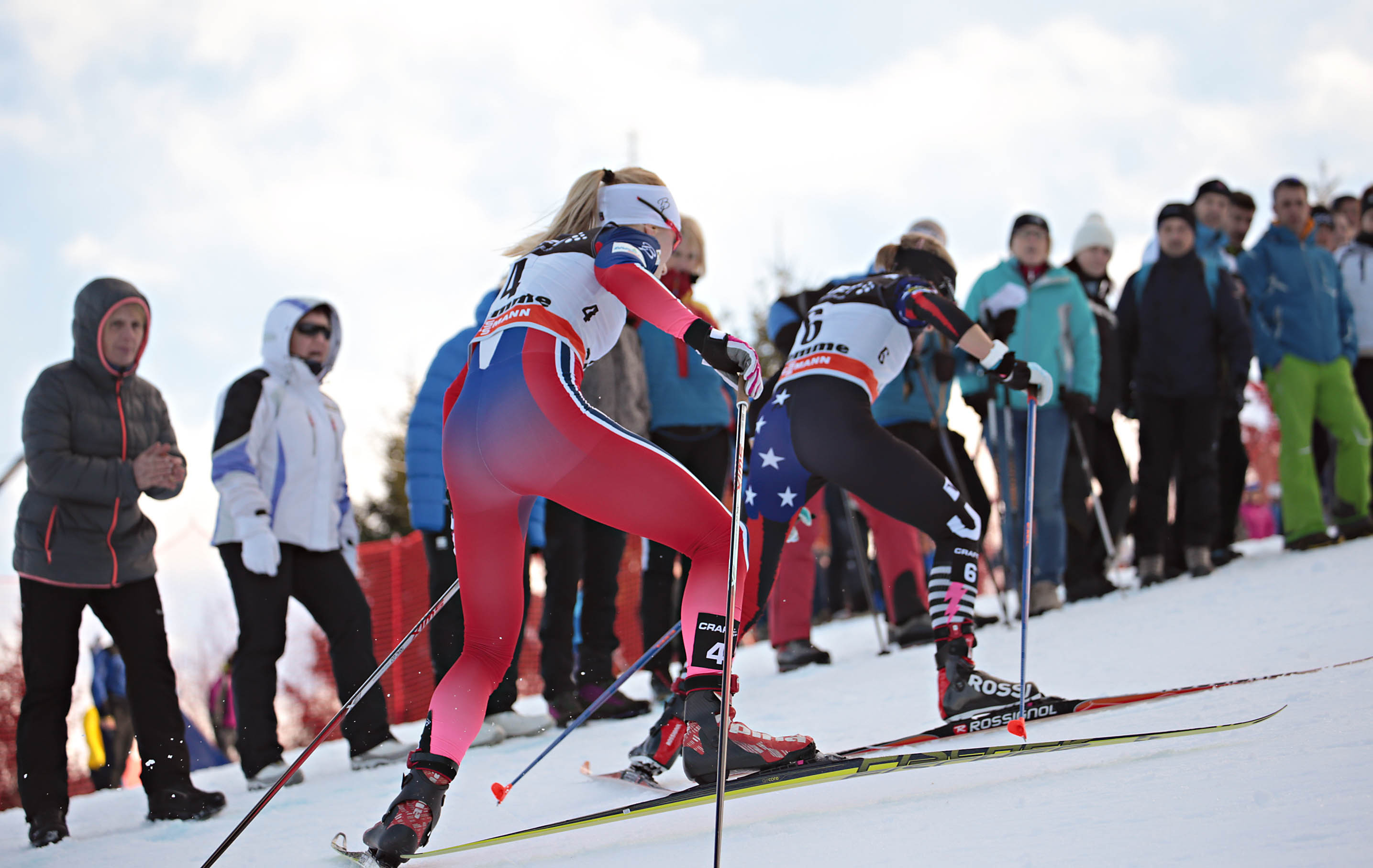
    American Liz Stephen leads Norway's Ragnhild Haga during the charge up the final hill of the seventh stage of the 2015 Tour de Ski in Val di Femme, Italy (Photo: Val di Fiemme/www.fiemmeworldcup.com)
    Liz Stephen (in black) leads Norway’s Ragnhild Haga during the charge up the final hill of the seventh stage of the 2015 Tour de Ski in Val di Femme, Italy (Photo: Val di Fiemme/www.fiemmeworldcup.com)

    The optimal hill is long enough that you don’t have to go all the way down after each effort, keeping the rest period in the target zone of three to four minutes. The grade should be challenging but run-able. These are not bounding intervals.

    Bounding may be more specific and powerful, but running gives Stephen a chance to work on quickness.

    “It should be a fun feeling,” she said. “A hard feeling, of course, but not bogging down.

    “You want to feel like you can be fast!”

    Staying light and quick is a regular theme in ski technique, and this is a perfect dryland opportunity to apply those concepts.

    At the end of the day, however, it is the rain that makes it for Stephen.

    “I just like that feeling – being muddy, coming in and showering, drinking hot cocoa and sitting by the fire, stretching and reflecting on ‘I just got some shit done today,’” said Stephen.

    And part of getting it done is learning to deal with the adverse conditions.

    “Whether you are on the World Cup or at some Eastern Cup, there is still shitty weather and the rain still falls, and the course is still not groomed the way you want it to be,” she said. “There is always going to be something that is not ideal for you. You have to know how to do that, too.”

    The rain may not raise your VO2max, or increase your foot speed, and mental benefits are hard to quantify – but Stephen sees real value.

    “Honestly, did it make you a better athlete than if it was sunny out? Maybe, maybe not, but in terms of your mental approach, you feel you really accomplished something,” she said.

    Stephen has been working on evaluating every workout – what went well, what could have been better. And, she concludes, “with running intervals in the rain, the positive is always that it is raining!”

    — By Topher Sabot

    The Workout: 6 x 4-minute uphill intervals (hard effort, building to maximum)

    Optimal climb: Long enough that you don’t reach the bottom after each effort (with 3-4 minutes recovery in between), with a grade that’s challenging yet run-able (not bounding)

    Think about: Staying light and quick on your feet

    “It should be a fun feeling. A hard feeling, of course, but not bogging down. … You want to feel like you can be fast!” Stephen explained.