
Tag: uphill running

  • Wednesday Workout: Quality Level 3 and 4 for the Working Class

    Wednesday Workout: Quality Level 3 and 4 for the Working Class

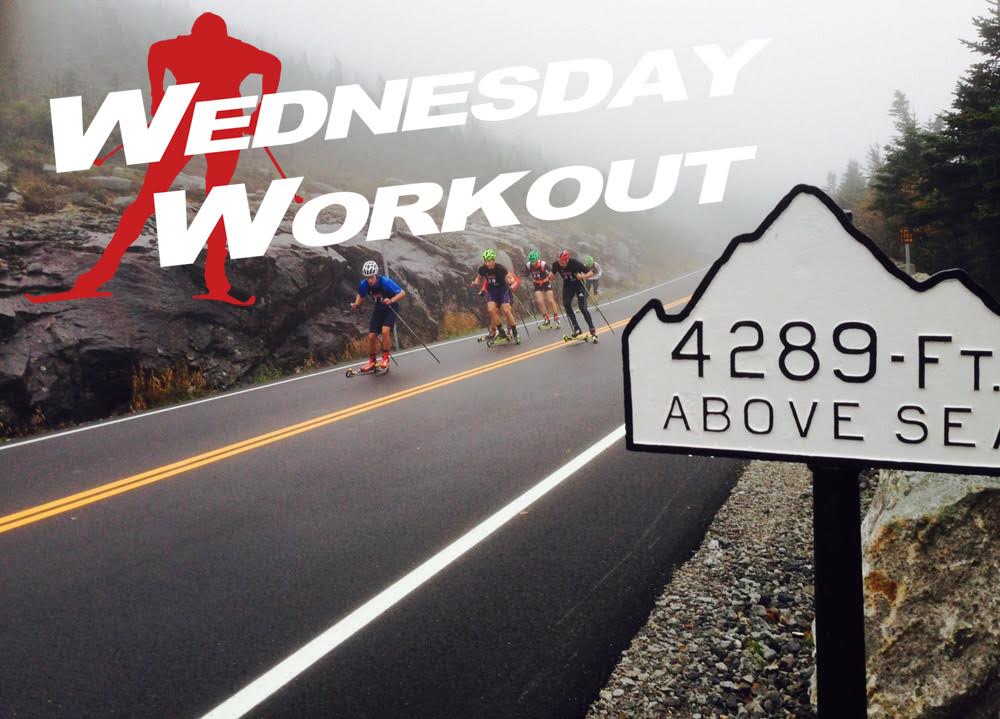
    The leaders in this year's 2015 Climb to the Castle rollerski race up Whiteface Memorial Highway in Wilmington, N.Y. Rogan Brown of the Sun Valley Ski Education Foundation (SVSEF) leads around mile four of five. (Photo: Tim Cowan)
    The leaders in this year’s 2015 Climb to the Castle rollerski race up Whiteface Memorial Highway in Wilmington, N.Y. Rogan Brown of the Sun Valley Ski Education Foundation (SVSEF) leads the top men around mile four of five. (Photo: Tim Cowan)

    On the day after my 58th birthday, I raced the Climb to the Castle. Again. It’s an incredible thrill to be on the same starting line as the best skiers in the U.S., even if I finish towards the back. This year, I finished within 6 seconds of my best time. And for the first time, instead of being totally gassed for the final half mile, I had good energy all the way to the finish.
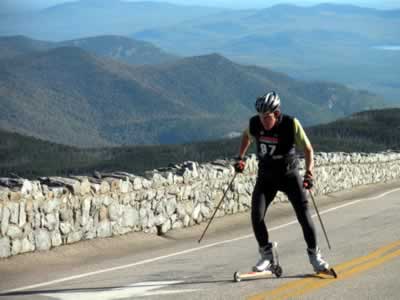
    Peter Minde nears the finish of the Climb to the Castle in 2011.
    Author Peter Minde nears the finish of the Climb to the Castle in 2011.

    During the dryland season, my goal is to do one Level 4 and one Level 3 workout each week. I hate to admit it, but now there are now some days when my body revolts and says, “Enough! You’re not finishing this interval session.” To that end, I try to make sure I’m really rested.

    I take into account my work and my family commitments as well as the stuff in the training log. I hate conceding workouts, but nowadays, I’d rather do one really good interval workout rather than two mediocre sessions.

    Although I have good terrain for dryland training, I don’t have super long hills. For a Level 4 workout, either running or rollerskiing, I’m going up a hill, back down and repeat. The recovery time is always a little longer than the actual work period. Not best practice, but possibly beneficial at my age.

    “I hate conceding workouts, but nowadays, I’d rather do one really good interval workout rather than two mediocre sessions.” — Peter Minde, FS contributor and annual Climb to Castle competitor

    Workout 1: 5 x 5 Minutes Level 4, Uphill Running

    My bread-and-butter Level 4 workout is five repeats, five minutes, going uphill.

    I do this either running or rollerskiing. It’s OK if the pitch varies, but the final few hundred meters should be the steepest. Generally, I run in the woods, and I use trails that aren’t excessively technical.

    Warm up with dynamic stretching, then run 15 minutes at Level 1 in rolling terrain.

    Then go 5 minutes up your hill at Level 2. Return downhill, and repeat with 5 minutes in Level 3. Finish that, go down, and you’re ready for the main event.

    In the Level 4 section of the workout, I focus on starting in the lower end of my heart-rate range and increase the intensity over each interval. At the base of the hill, I moose hoof the first 30 meters before settling in to a run. During each repeat, I focus on positive self talk.

    Workout 2: 5 x 5 Minutes Level 4, Rollerskiing

    As with the running intervals, look for a long hill. It’s OK if there are rolling or short downhill sections; however, the final section of the hill should be steep enough that you have to check speed – snowplow, traverse, whatever – to return downhill safely.

    Warm up as above. Fifteen minutes in Level 1, followed by 5 minutes of Level 2 and five minutes of Level 3.

    As with running, my goal is to start conservatively and make the last interval the hardest. In addition to positive self talk, I focus on skiing transitions smoothly. If I’m classic rollerskiing, I’ll double pole a flat section and the base of the climb before changing to striding. If I’m skating, I try to V2 as much of the uphill as I can, or V1 the steep bits and switch to V2 where the grade is easier.  Don’t forget the warmdown and stretching.

    Workout 3: 3 x 15 Minutes, Running

    While I do this on rollerskis, I prefer to run, because I’m able to keep recovery times to 3-5 minutes between hard work periods. Find a loop in the woods that takes approximately 14-16 minutes to run.  It should be rolling with some long uphills.

    Warmup: Similar to the Level 4 workouts above. Begin with dynamic stretching, followed by 15 minutes of easy running.

    Ramp up your heart rate to Level 2 for five minutes, then head onto your loop and crank it up to a controlled pace.  In downhills, I pick up the pace to keep my heart rate in the zone.  At the end of 15 minutes, a short connector gives me around five minutes of recovery before the next repeat.

    Then I run easy back to the car, for 15-20 minutes warming down.

  • Alberta World Cup Academy Hosts Running Race, World Champ Kershaw to Contend

    If you’ve ever wanted a chance to beat a World Champion, you’re in luck. Of course, it won’t be easy.

    The Alberta World Cup Academy (AWCA), the Canadian training center based in Canmore, Alberta, is hosting the Spray Drag Running Race – and World Champion and Canadian National Ski Team (CNST) member Devon Kershaw is headlining the event.

    The idea is pretty similar to the recent ‘Climb to the Castle’ held at Whiteface Mountain in New York state – find a stretch of road that goes uphill, start at the bottom, suffer a lot, end at the top.

    In Canmore, this means starting from almost downtown, heading out of town past the Canmore Nordic Center, and up Spray Lakes road, a gravel road that climbs to the top of a pass outside of town – gaining some 1200 feet in elevation.

    “He’s always looking for a good running race, and keen to help out,” said Stefan Kuhn, organizer of the event and AWCA assistant coach in a recent interview with FasterSkier.

    Kershaw has a reputation as a runner, including running 10 k in 33:46 – at the end of an Olympic-length triathlon (1500 m swim, 40 k bike, 10 k run).

    Kershaw will face 7.5 k, almost entirely uphill, while the women will do a slightly shorter 5 k.

    Kuhn is hoping for a good turnout – and not just the elite skiers of the AWCA and CNST. He is hoping to entice some of top runners in the Calgary and Banff area into a duel with Kershaw.

    “I’d love to see someone push Devon to the finish,” Kuhn said.

    The AWCA has run the event before, but only as a small team time trial. Current AWCA and CNST Development team member Graham Nishikawa holds the men’s record, while 2010 Olympian and former AWCA member Madeleine Williams holds the women’s course record.

    According to Kuhn, Nishikawa is planning on contesting the event again this year, but Williams will not, leaving the challenge open to a number of other top Canadian women, including some of the CNST World Cup team and Development team.

    In terms of reward, the event is a fundraiser for the AWCA, so no prize money will be doled out – just bragging rights if you’re able to bag some of the top skiers in the country.

    But Kuhn promises some unique prizes – including gold running singlets for the best male and best female runners on the day.

    They have also introduced a new competitive aspect that you don’t see at many events – lactate testing.

    For $50 you can enter a 50/50 competition where the AWCA will test your lactate at the finish, and the person with the highest number takes home the prize pot.

    Interested in the record? Phil Widmer recorded a 16.4, and nobody has managed to top that mark yet.

    The event goes on October 15th, and registration closes on Oct 13th.

    For more information, please see the race notice.

    Course Records

    Men – Graham Nishikawa (AWCA) – 29:23

    Women – Madeleine Williams (AWCA) – 25:41