From the FasterSkier archive — posts syndicated from athletes’ and coaches’ own blogs between 2004 and 2012, kept online as published. Current coverage is at fasterskier.com.
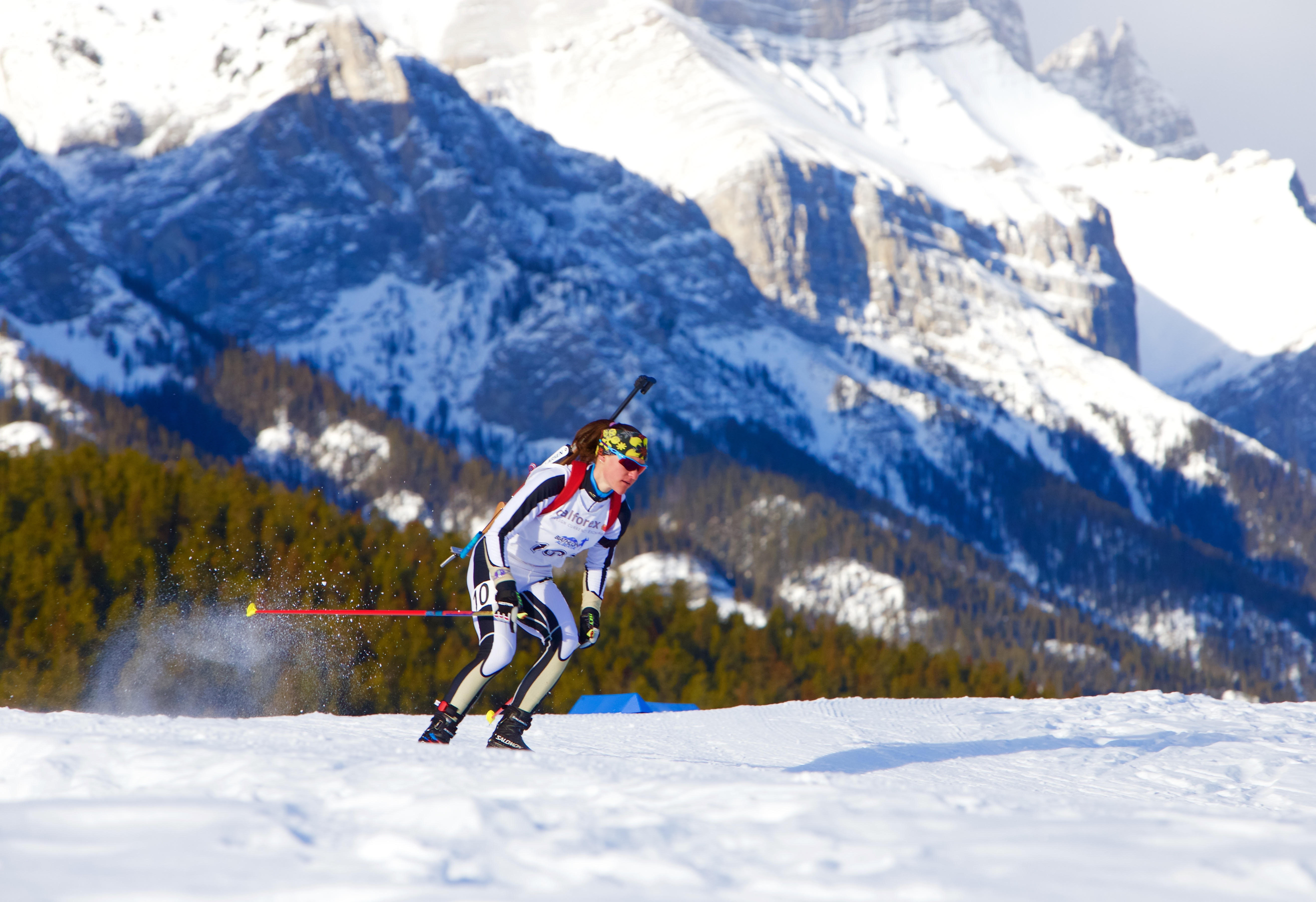
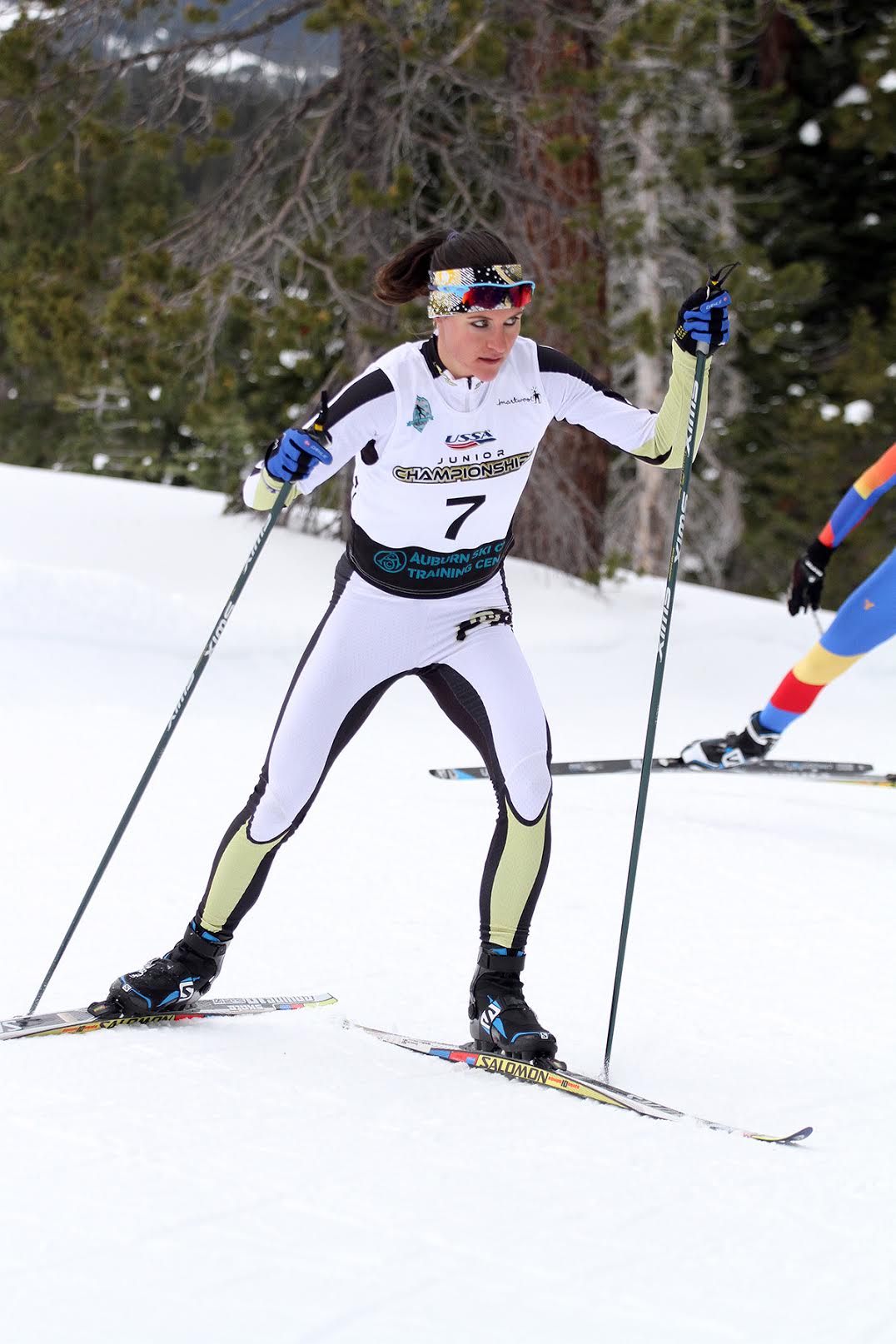
Annika Martell racing during the NENSA club relays, Saturday, March 28, 2026 at Craftsbury. (Photo: Phil Belena)
The Craftsbury Green Racing Project has named Annika Martell as its new Head Ski Coach.
Martell brings a resume that spans nearly every corner of the Nordic skiing world. A Minnesota native, she headed east to ski at Colby College, where she captained the team and earned recognition for her leadership before graduating with a degree in economics and environmental science.
Her coaching career has taken a similarly wide path. Early on, she interned with the US Biathlon Association and coached juniors at Ford Sayre and the Berkshire Nordic Ski Club, before moving into elite-level work as an assistant coach with the Stratton Mountain School T2 Team. She spent four years as an assistant coach at Williams College, during which time she completed two stints as a Trail to Gold Fellow with the US Ski Team and served twice on the wax staff for Team New England at Junior Nationals.
Most recently, Martell was the Head Nordic Coach at St. Michael’s College, where she guided the program to highly competitive results.
Her background extends well beyond the ski tracks. She is a certified weightlifting coach and handled strength and conditioning duties at Williams. She also has experience in finance and operations management, and holds a Master’s degree in Sports Business from Drexel University.
The Craftbury Green Racing Project is still accepting athlete applications for the incoming 2026 snow class — Apply Here
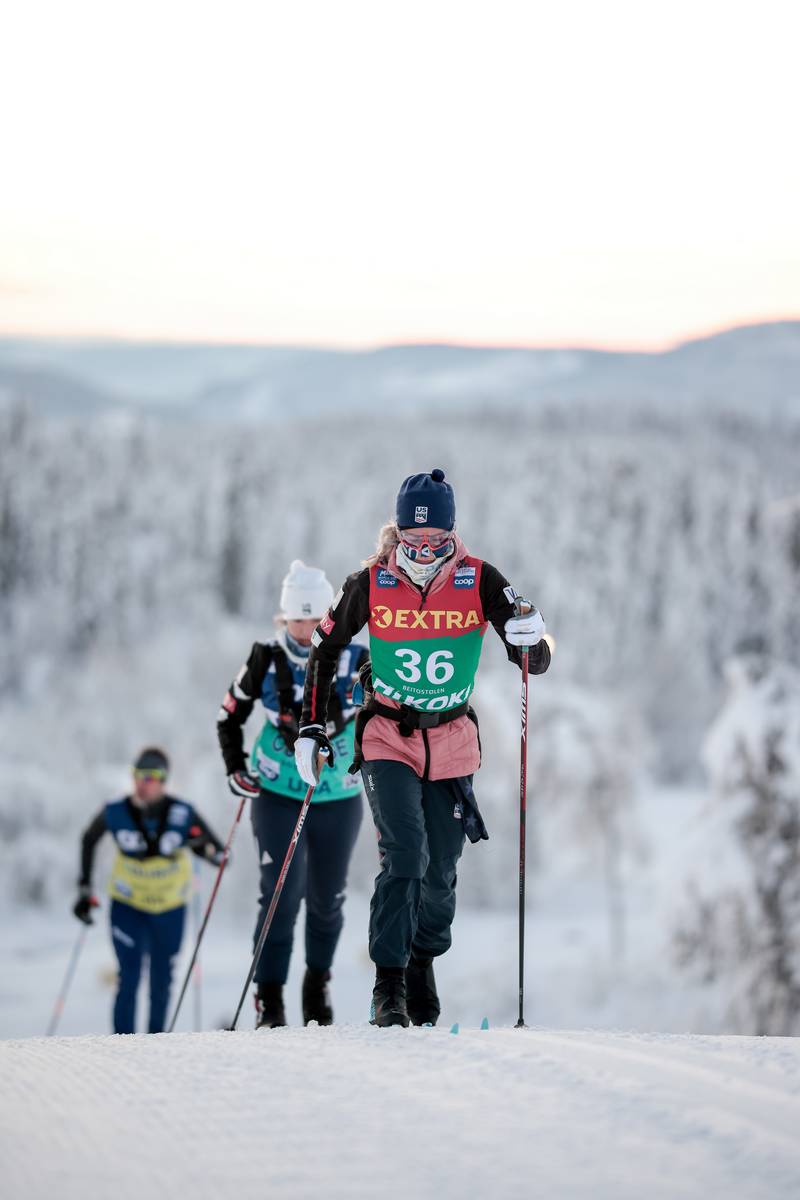
Martell follows Jessie Diggins on course in Beitostolen in 2022. (Photo: Nordic Focus)
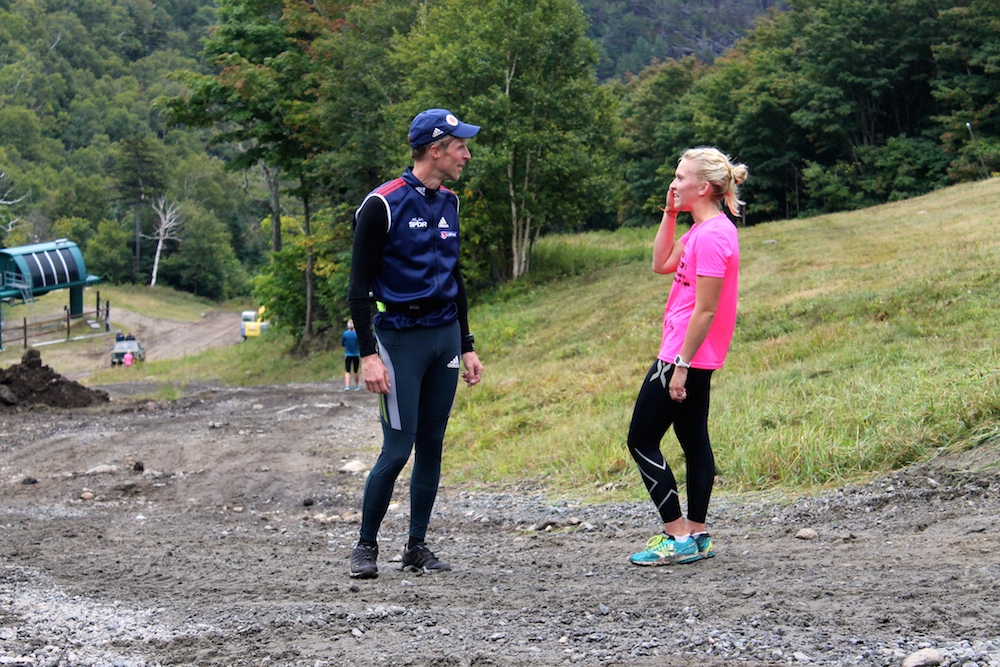
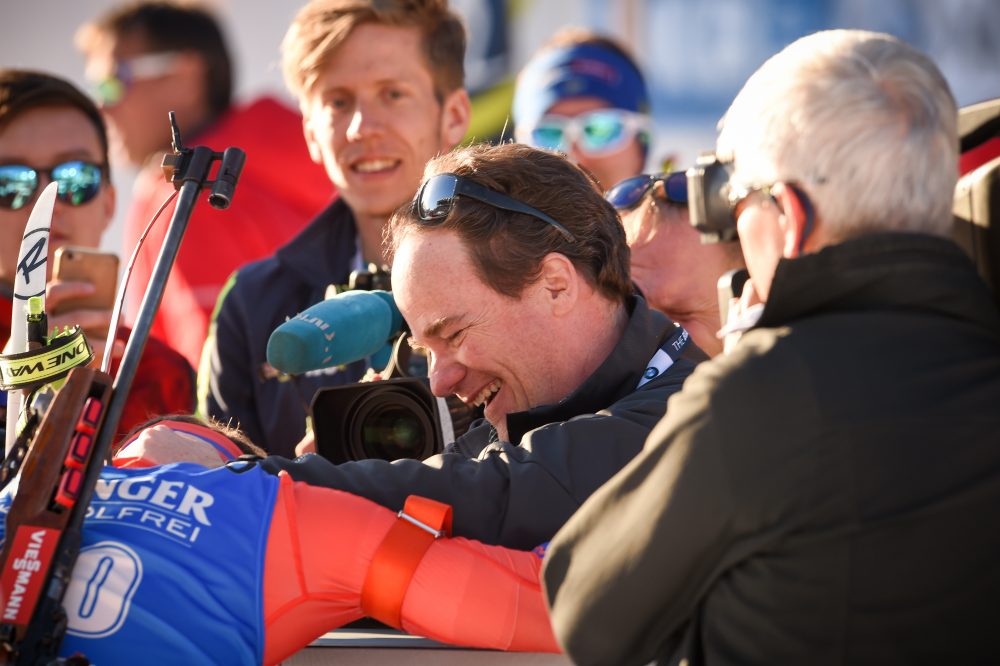
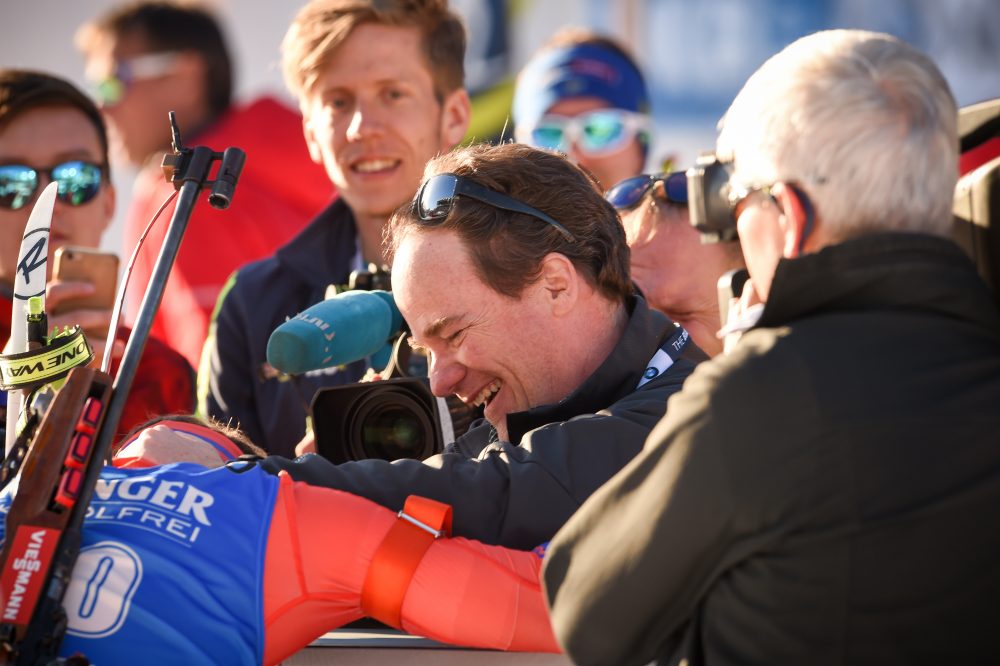
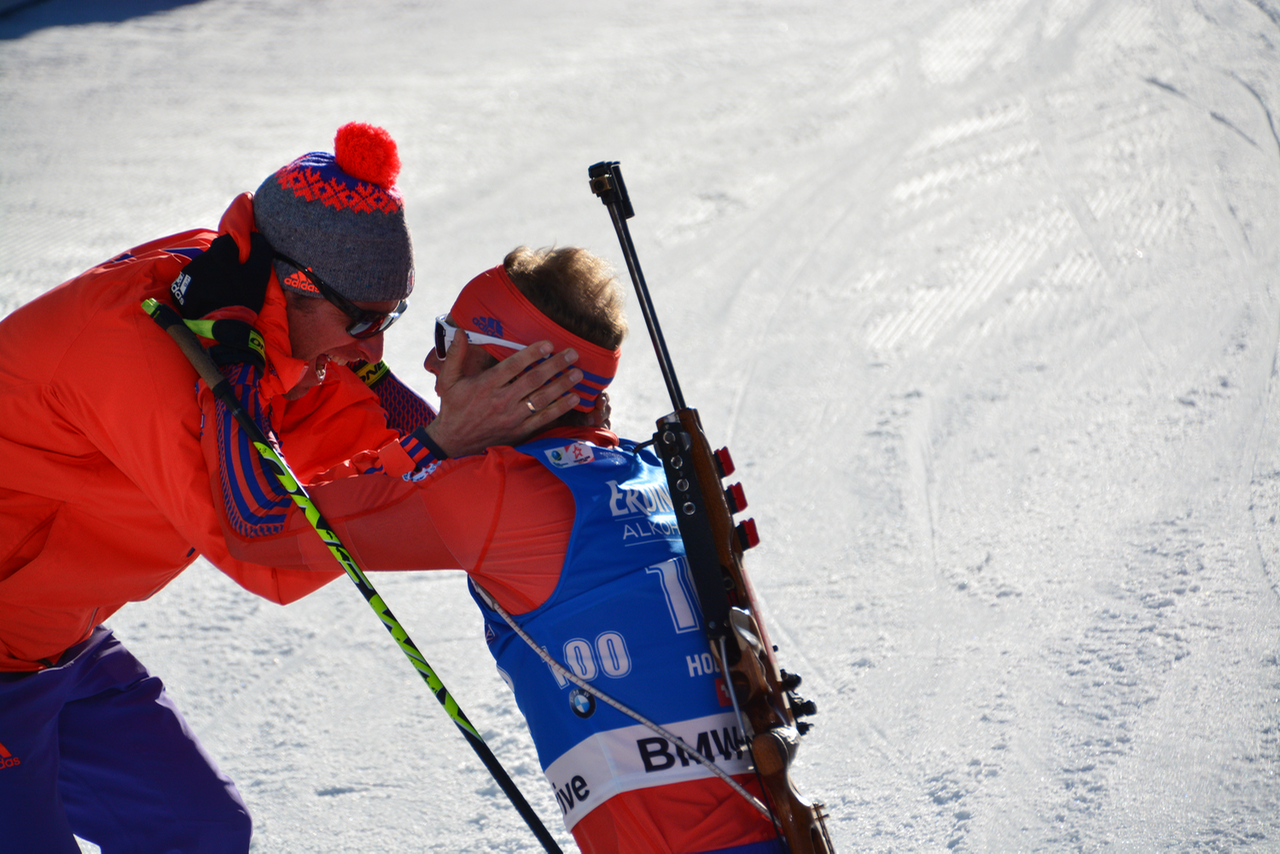
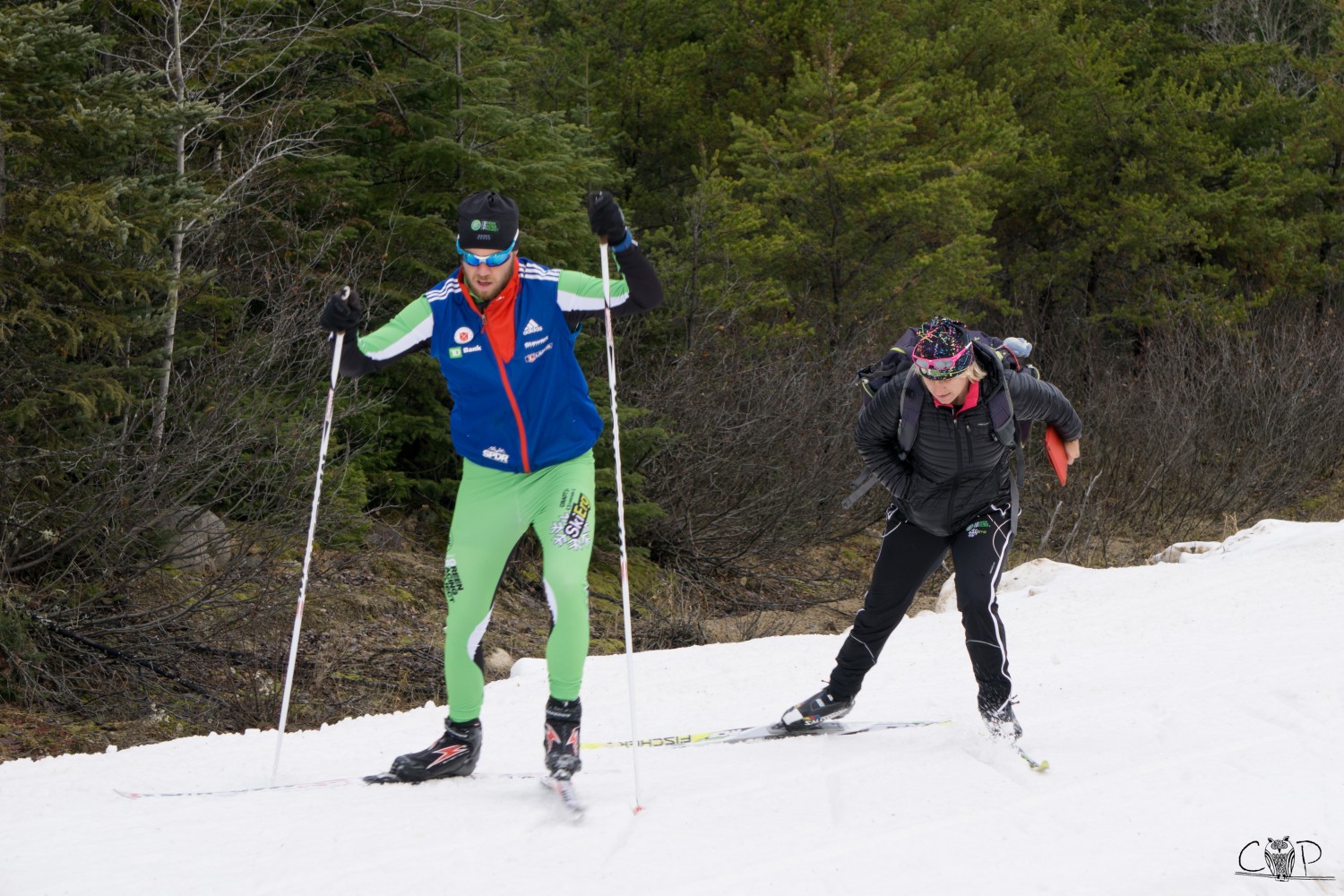
U.S. Biathlon Association women’s coach Jonne Kähkönen checks in with Kelsey Dickinson after an uphill running time trial in 2014.
When Jonne Kähkönen was hired to be the women’s national team coach by the US Biathlon Association (USBA) in 2010, there wasn’t much of a playbook to follow.
The Finn couldn’t mimic the footsteps of his predecessor, because there wasn’t one.
For the first time, the women’s team was going to have a coach of their own.
“The men’s program was on a really high level going into Vancouver [2010 Olympics],” USBA Chief of Sport Bernd Eisenbichler – then the high-performance director – said on the phone this weekend. “It was a deep program and the men’s relay was having pretty good potential. And we saw the women coming up having the same potential to go up to the top as well.
“We knew that if we wanted to build up a strong women’s program, we needed to have a dedicated coach for them,” he explained. “Really just focused on their development, and putting the group together to make it a really good environment.”
Enter Kähkönen, who had spent the previous four years as the head coach of the Finnish biathlon team.
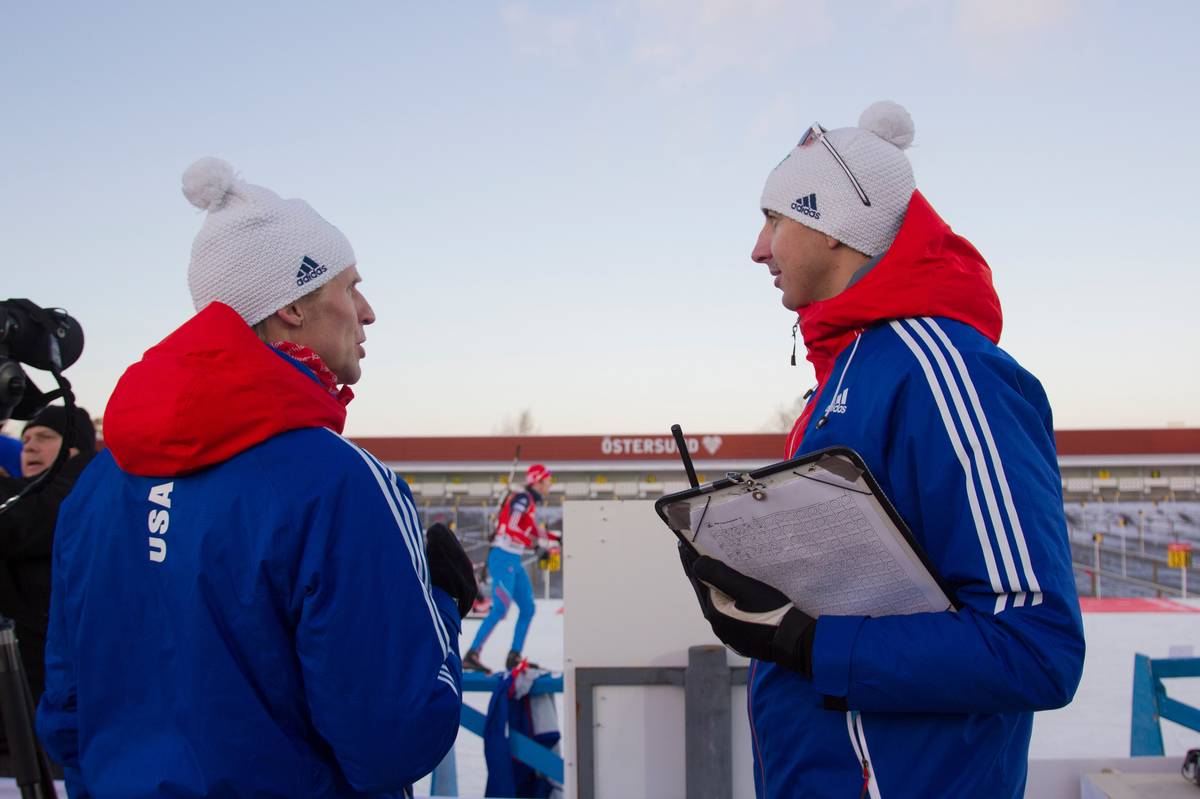
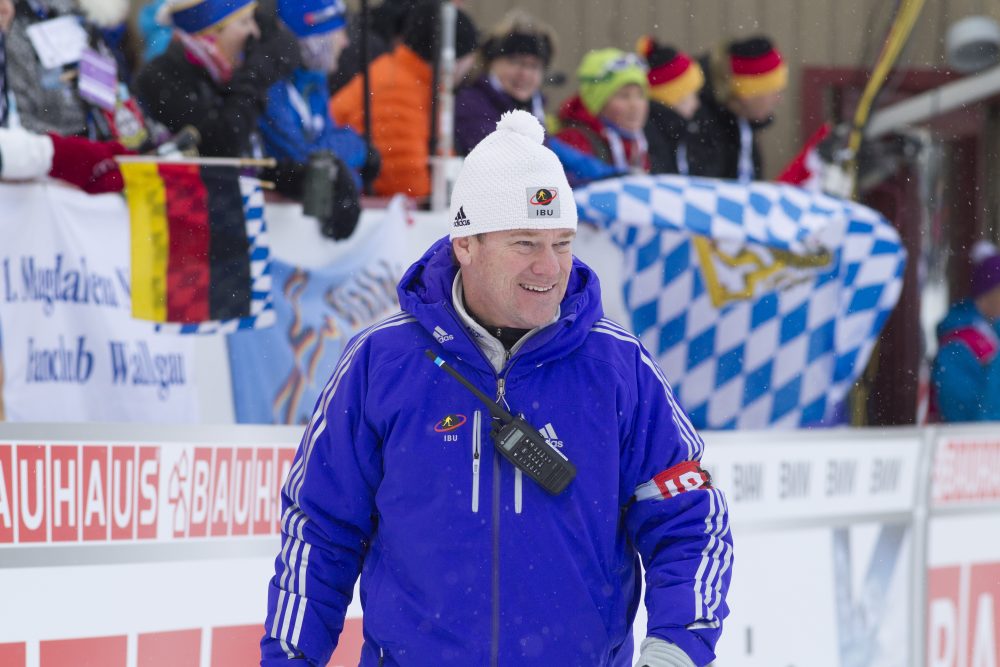
US women’s coach Jonne Kähkönen, left, and men’s coach Jonas Johansson on the range in Sweden in 2014. (Photo: USBA/NordicFocus.com)
“Obviously the first quad [four-year Olympic cycle] felt like it went by really quick, because everything was new,” Kähkönen said in a phone interview last week. “I think looking back, we made really good decisions overall with the philosophy of the team for both the men and the women. Especially for the women, in the early years, to get them up to speed, to be competitive. And it was successful already after the first couple years.”
In 2009, the U.S. women were ranked 20th in the World Cup’s Nations Cup standings. Eight years later, they have had numerous top-20 performances from multiple athletes, World Youth and Junior Championships flower ceremonies, and World Cup podiums and a World Championships silver medal by Susan Dunklee.
“When we started, we didn’t think we were capable of that,” Eisenbichler said. “We saw the potential, but to win a silver medal with Susan, to have these multiple top 20’s by six or seven different athletes, I think we can be really happy with what the women’s program has looked like the last eight years and where we are right now.”
And after leading that charge for eight years, Kähkönen is leaving the team to take back his role as the head coach for Finland – a program that has also risen in that period, with Kaisa Mäkäräinen winning three overall World Cup titles, Mari Laukkanen scoring two World Cup victories, and the mixed relay team finishing sixth at the 2018 Olympics.
“It has been a process,” Kähkönen said of the transition. “I definitely have been thinking of each quad [cycle] as a project. At the end of the project it is always good to evaluate and think about the next steps and what’s good for me professionally, but then I want what’s best for the team and the athletes also. And I feel like now with the few retirements, it’s probably good in a way to make the changes now.”
“I think that the women need a new stimulus,” Eisenbichler said. “Not that the old stimulus wasn’t good or wasn’t working anymore, but after eight years it’s normal. And Jonne and I see that the same way. I could not be more thankful and grateful to Jonne. And now it’s time for him to have a new era with the Finnish biathlon association.”
The Fun-Loving Finn
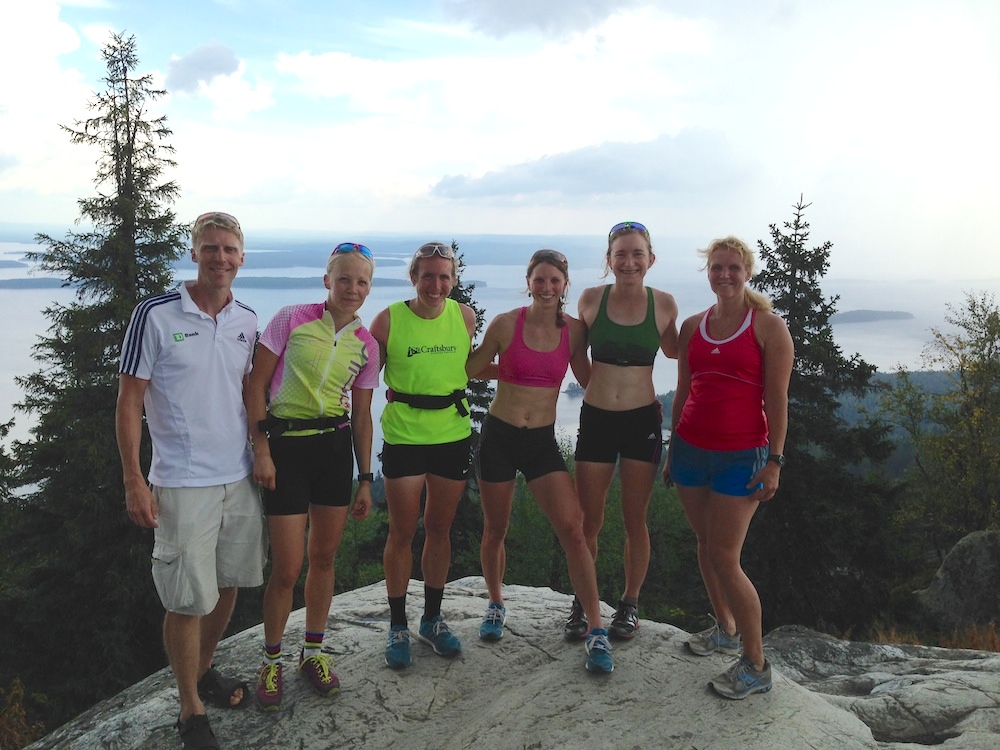
The US Biathlon women’s team after an uphill interval session up Koli, the highest point in southern Finland, with coach Jonne Kähkönen (l) and his wife (r), who also rollerskied up, and Finnish World Cup champion Kaisa Mäkäräinen (second from l). (Photo: Jonne Kähkönen)
“I think that having a women’s coach changed something in the heart of the women’s team, because it felt like a validation that we were improving and deserved someone that was there specifically for us,” 2014 Olympian and five-time World Championships competitor Annelies Cook, who retired in 2016, wrote in an email last week.
“Personally, I am really grateful that I had Jonne as a coach,” she continued. “Jonne was there in my life through many big changes and I could always talk to him and I always felt supported by him. He was always positive for us, and that is something you really need in a sport that can really get you down sometimes. Biathlon is different from cross-country skiing in where the differences in performances from day to day don’t change that drastically. Biathlon can change instantly from good to bad, and that can be really emotional sometimes.”
Kähkönen said that he learned a lot in his years of coaching in the U.S., not least from the athletes and the team’s international staff, who hail from Sweden, Italy, the Czech Republic, and Germany.
“It makes me think what works and what doesn’t work, and also to take that into account working with the athletes,” he said.
But what he learned the most was to have fun.
“I know that having fun seems dangerous to say [in a serious environment],” he said. “It’s not only about having fun, but enjoying your work and enjoying what you’re doing — I think that’s more descriptive. But, at times, having fun as well!”
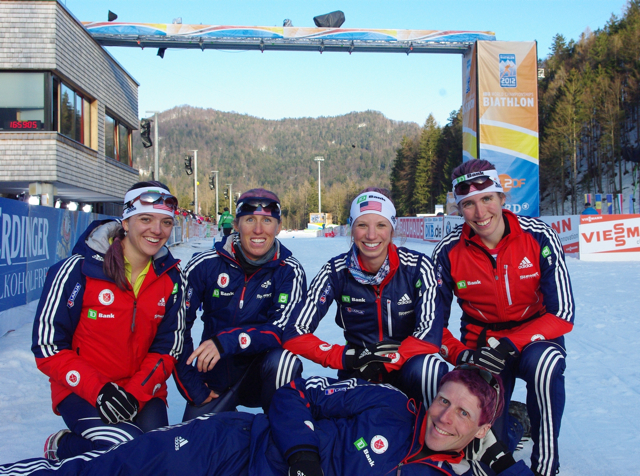
Sara Studebaker, Lanny Barnes, Annelies Cook, and Susan Dunklee, with coach Jonne Kahkonen, model their new hairstyles at 2012 World Championships.
Case in point: in 2012 at World Championships, Kähkönen dyed his hair purple. He had told the team that if any of the women finished in the top 10, he’d do it. Susan Dunklee placed fifth in the 15 k individual. So purple it was.
“I think those types of things are important, whatever it is, just to try to lighten it up a little,” he said. “Me being Finnish, people say that I’m not a typical Finn. I’m more open or more lively or whatever.”
Quite apart from the hair, Dunklee’s fifth-place finish in Ruhpolding was one of Kähkönen’s favorite moments from his tenure with the team. At the time, he was midway through his second winter leading the women’s squad, and Dunklee had competed in just two weekends of World Cup racing.
“Probably one of the most exciting moments was Susan’s first breakthrough at Ruhpolding World Champs in that individual,” Kähkönen reminisced. “She had the lead for a good while, and her being really surprised by it. That was definitely, maybe not the start of it all, but one of the very good results that we had early on.”
The previous year, Sara Studebaker and Laura Spector had broken into the top 20 on the World Cup, and Haley Johnson had been close in 21st. One year later, Cook made her own jump into the land of top-20’s. And later still, Hannah Dreissigacker and then Clare Egan would hit the top 20, along with Dunklee’s four World Cup podiums and her World Championships silver medal.
“Obviously after all the hard work, all the medals, Tim [Burke] in Nove Mesto and then Susan and Lowell [Bailey] in Hochfilzen last year, those are on top of the list,” Kähkönen said.
Back to Finland
Kähkönen hesitated to say that he was headed for home.
“It may be a cliché to say that home is where your heart is, but Lake Placid has been my home,” he said. “I’ve said this to a couple of people, but it hasn’t hit me yet because I’m still here. It has been great. The community is so supportive. There are great people there and we made good friends. So it will be tough to leave when that day comes.”
The family will move this summer, after his oldest son graduates from high school in June.
U.S. women’s coach Jonne Kahkonen talks to his team between intervals at a training camp in Bend, Oregon, in 2012.
But it is an interesting assignment for Kähkönen to retake the reins of a program that has changed a lot since he last worked there.
“With Kaisa [Mäkäräinen] being the star, it is exciting to go back and work with her, if she decides to continue [racing], which remains to be seen,” he said of an athlete who had five podiums the last time he worked with the team, but now owns 23 international wins and 54 more podiums. “We worked together in the past, so it will be fun to be reunited.”
But the other pieces of Finland’s biathlon puzzle are no less compelling.
“At the same time, I think as big a part of it is seeing the rise of the next generation,” Kähkönen said. “They won a couple medals at the junior level. It’s not just the juniors and youth who won the medals, but even behind them, there are just more people doing biathlon now, which is good to see. And just seeing the good results that the men’s team is starting to post on the World Cup now. That’s inspiring to me.”
And in the end, the fun is one thing that he hopes to bring back to Finland.
“I just read in one of the Finnish papers today, Aino-Kaisa Saarinen, who is part of the cross-country team — she has trained a bunch with Kikkan Randall and the U.S. women — she made a comment that what she was missing a little bit in the last couple of years was having this sort of North American type of relaxed and having fun atmosphere while doing the work that everyone is committed to.”
Zach Hall (far left) the new manager and head coach of team Soldier Hollow’s biathlon programs standing with his athletes during a training session this summer. (Photo: Sara Studebaker-Hall)
Last September, amidst the chatter of others gathered for the 11th annual U.S. Olympic and Paralympic Assembly in Colorado Springs, Colo., Sara Studebaker-Hall and the CEO of the Utah Olympic Legacy Foundation (UOLF), Colin Hilton, shook hands. Studebaker-Hall, a two-time Olympic biathlete, was attending the meeting as an athlete rep for the US Biathlon Board of Directors and was introduced to Hilton by US Biathlon Association (USBA) President and CEOMax Cobb.
The three were partaking in the U.S. Olympic and Paralympic Assembly’s two-day fall symposium, an event that included seminars on athlete rights and anti-doping. At the time of their introduction, Studebaker-Hall had no idea that her conversation with Hilton would evolve into a job opportunity and eventually, her return to the Intermountain region. Originally from Boise, Idaho, Studebaker-Hall was starting her third season as the assistant coach for the University of Alaska Anchorage (UAA).
But last fall, her coaching position and the future of the UAA Ski Team were in question. Financial restraints at Alaska’s state universities had put more than one cross-country ski program in limbo.
Back in Anchorage and also unsure about the future was Studebaker-Hall’s husband, Zach Hall, a former national-team biathlete himself. A native of Nikiski, Alaska, Hall had been working to develop a competitive youth biathlon program in Anchorage and was questioning whether or not it was time to make a career move.
Then Studebaker-Hall learned through Hilton that UOLF was looking to add a new biathlon program to Soldier Hollow, its cross-country ski resort in Midway, Utah. A world-class venue, the Soldier Hollow (SoHo) shooting range had hosted biathlon competitions during the 2002 Winter Olympic Games, yet no biathlon, development (devo) or competition (comp) teams existed in the SoHo or Midway area.
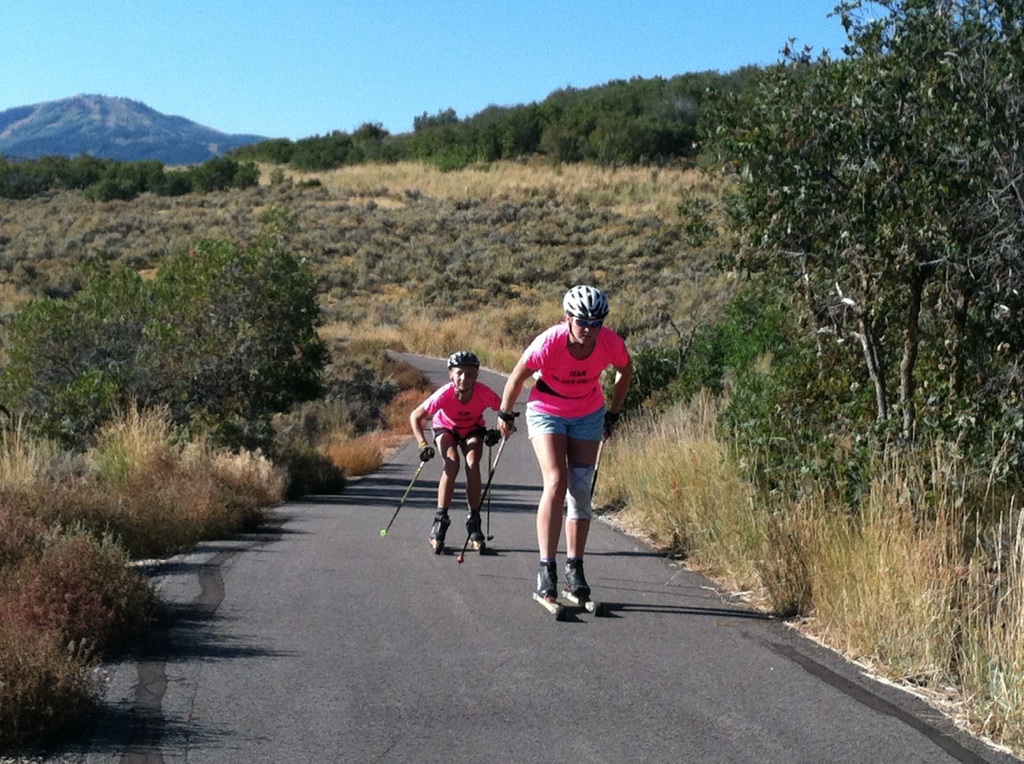
Team Soldier Hollow athletes Ingrid Norton and Pearl Harvey during a rollerski workout two years ago near Heber and Park City, Utah. (Photo: Morgan Smyth)
“One thing I look at is what are we doing with our venues, are we providing the sport we out to provide,” UOLF Vice President of Sport and Venues Marc Norman said on the phone in September. “The fact that we weren’t hosting [biathlon] and weren’t running any programs in it was a quick red flag for me.”
Along with the addition of a biathlon program, Team Soldier Hollow was also in need of a youth coach for its nordic program. From 2012 to 2015, Morgan Smyth served as the program manager, overseeing the Comp and Devo teams, the Youth League and the Charter School Ski Program. At the time of her departure, 145 kids were enrolled in SoHo’s programs — 10 on the Comp (competition) team, a number which has almost tripled since then.
“I left Soldier Hollow to work for Park City Nordic Ski Club [PNSC] as the Nordic Manager,” Smyth wrote in a recent email. “PNSC was part of the Utah Olympic Legacy Foundation. Ironically Soldier Hollow became a part of the Legacy Foundation less than a year later but I live in Park City so it was nice to work closer to home.
“I left Park City Nordic this fall and started a Physical Therapist Assistant program,” Smyth continued. “I am excited to try something new but plan to stay involved in the ski community. Hopefully coaching the younger kids during the winter months.”
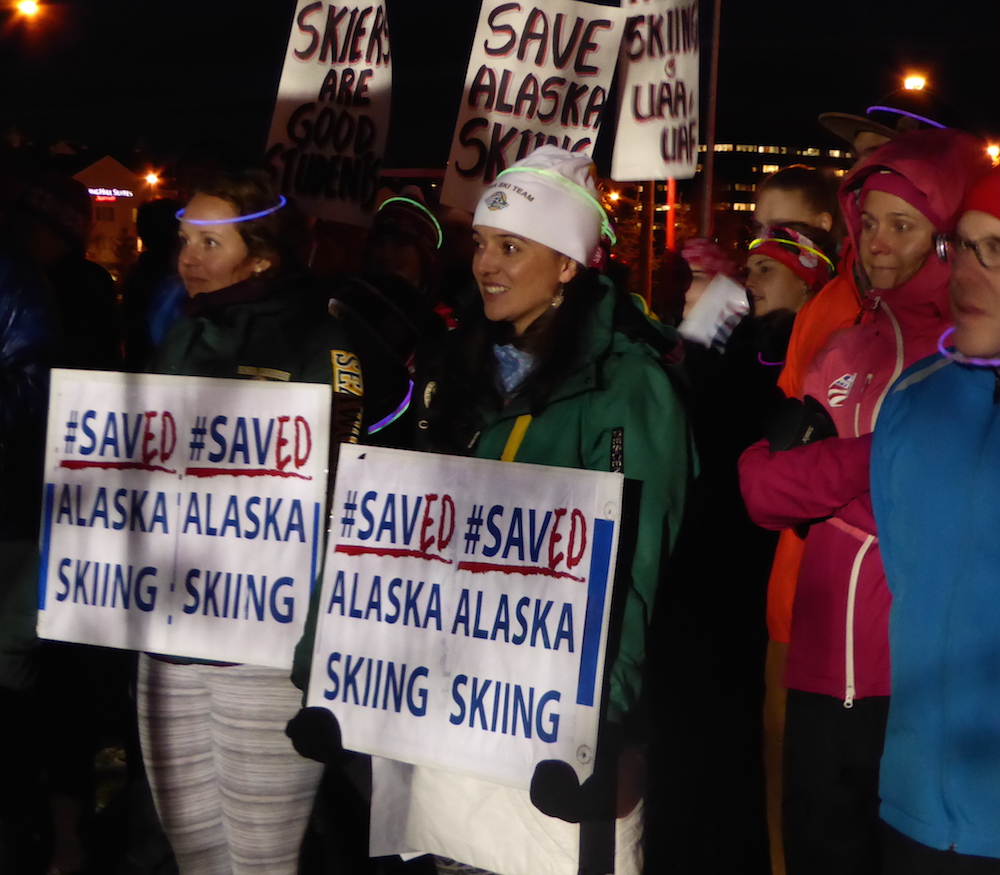
Former UAA assistant nordic coach Sara Studebaker-Hall (center, white hat) at the #savealaskaskiing rally in Anchorage, Alaska, on Nov. 10, 2016. Former UAA skier and current USST member Sadie Bjornsen (pink jacket) is to her left. (Photo: Gavin Kentch)
Last fall, after Studebaker-Hall returned to Anchorage, she and her husband were offered the opportunity to work with Team Soldier Hollow, with Hall heading the new biathlon program and Studebaker-Hall leading the pre-existing nordic ones. When the offer was made, theUAA Ski Team’s future remained uncertain, and the two ultimately accepted UOLF’s offer, viewing it too good to pass up.
“It was hard to leave UAA,” Studebaker-Hall explained on the phone earlier this summer. (The UAA Ski Team wasultimately saved three weeks after she and Hall accepted). “But moving to a head-coaching position and managing a program here and getting this off the ground was kind of a once in a lifetime opportunity, so we had to take it.”
Studebaker-Hall is now serving as the head coach and program manager for Team Soldier Hollow’sDevo Plus andComp teams. The competition team alone has 25 athletes, many of which Studebaker-Hall described as being “on the precipice of just getting going”. As she transitions from coaching collegiate skiers to juniors, she expects a few challenges mainly involving the mindset of younger skiers.
For most of the college skiers she’s coached, knowing the fundamentals of being an endurance athlete were automatic: get adequate amounts of rest between training sessions, practice good hydration. In contrast, a majority of her Team Soldier Hollow athletes are still learning the basic principles, such as the importance of recovery, nutrition and getting decent amounts of sleep.
“With youth kids, you’re trying to instill in them this idea that coming to training everyday is really important,” Studebaker-Hall observed, “Even just how to think about training, all these things I think that maybe I took for granted a little bit, that all the kids that I previously worked with knew already. That’s definitely a challenge, but one that I’m really excited about because these kids are so moldable.”
Most of the juniors she’ll coach this winter range in ages from 10 to 20 years old.
“They’re really ready to take in everything you say,” Studebaker-Hall continued. “You have a huge opportunity as a youth coach to do that for kids, maybe even more so than on a collegiate level, because you’re their first real coach.”
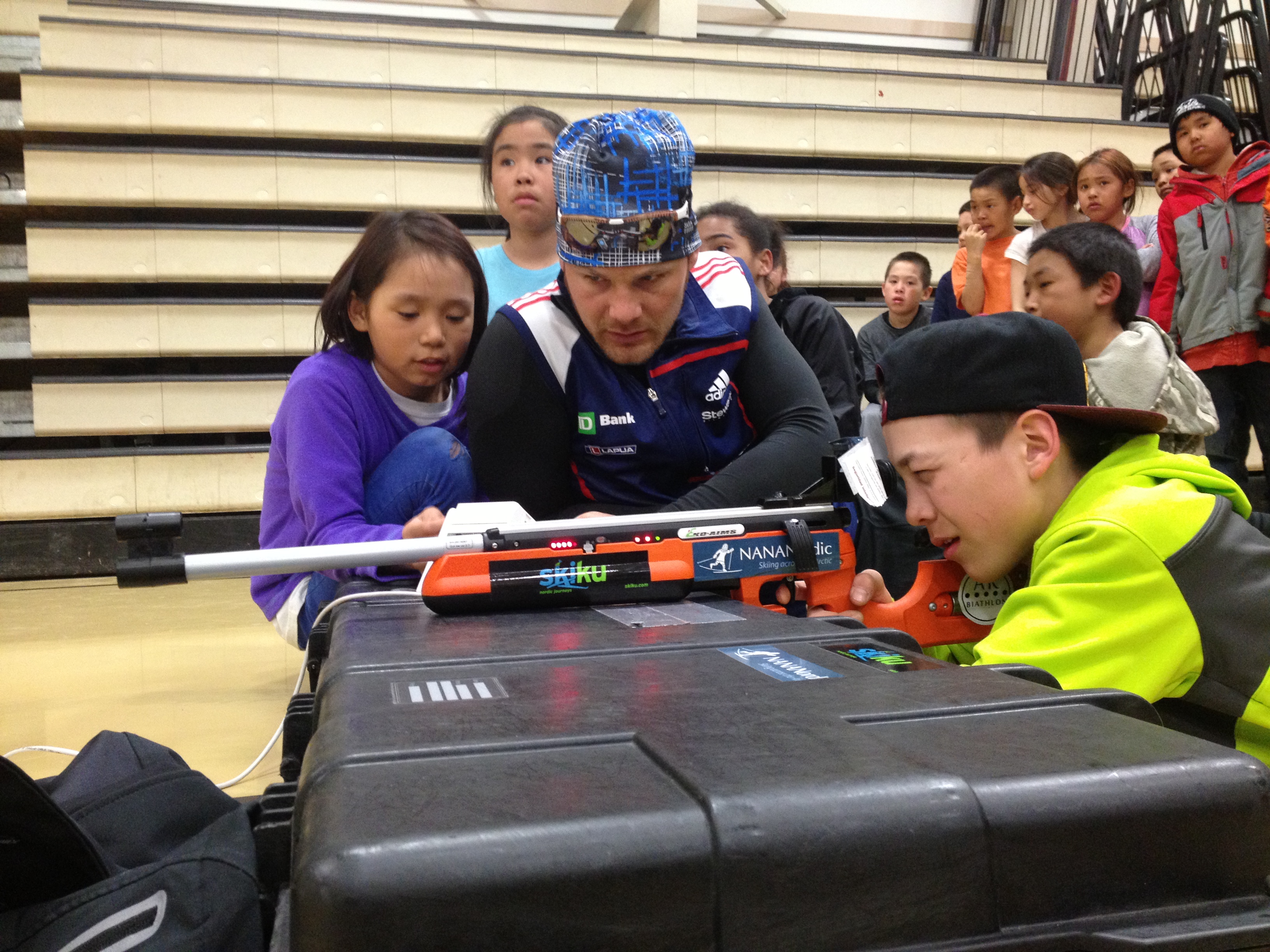
Zach Hall teaching shooting skills in 2014 at an indoor range in Kotzebue, Alaska, as part of the NANANordic program in the state’s Northwest Arctic Borough.
Though Studebaker-Hall only started working with Team Soldier Hollow this summer — Hall arrived last December — she’s already made a positive impression on many of her athletes. Pearl Harvey, 16, who has been involved with Soldier Hollow’s nordic program since she started walking, highlighted Studebaker-Hall’s interest seeing her athletes succeed.
“I have never had a coach so involved with technique and caring about my progression as a skier and a person,” Harvey, who hopes to one day receive a college scholarship for skiing, wrote in an email. “Sara, for me, is a big role model and she is shaping me as an athlete with being more conscious of my technique, eating, drinking and sleeping habits. She is also shaping me as a person and keeping us in check and making sure we are on the correct path.”
As Studebaker heads Soldier Hollow’s nordic programs, her husband is in charge of SoHo’s new biathlon programs: Intro Flex ,Devo Plus Flex and Comp Flex (development team). Hall estimates he has a total of 20 athletes in the biathlon program, though not all belong to Team Soldier Hollow. The Utah Nordic Alliance (TUNA), the Park City Nordic Ski Club or Wasatch Nordic have athletes participating in SoHo’s biathlon program, thanks to what they dubbed a “flex” program option. With this “flex” program, members from any of the surrounding nordic ski clubs can join Team Soldier Hollow for biathlon training without changing their club affiliation.
Racers at 2017 U23/Junior World Championships last February in Midway, Utah. (Photo: Team Soldier Hollow blog)
“We’ve got the only range in the area, so what we’re trying to do is work with all the area coaches to schedule training sessions, so that it works as much as we can with them working with their local nordic clubs, ” Hall said on the phone in July. “A big part of the program is just pushing general nordic development and adding opportunities with biathlon.”
Sparking interest is the first step for Hall, as well as getting the word out about the biathlon program. Having U23/Junior World Championships held at Soldier Hollow last season was also helpful in promoting the biathlon and nordic programs there, as well as giving younger athletes an idea of where skiing could take them.
“This is my first summer trying Biathlon, and I am loving it,” Lina Farra, 16, wrote in an email in September. “Both Zach and Sara have very high-level Biathlon experience, and that combined with their great passion for sport sets this program apart from others around the nation.”
SoHo is currently bidding to host an International Biathlon Union (IBU) World Cup in 2019. According to Studebaker-Hall, an exploratory committee is also forming for a potential Olympic bid — the last Olympics held at SoHo took place in 2002.
“From a programmatic standpoint, we definitely want to see Utah kids participating in this sport,” Norman said. “There’s no reason we shouldn’t have a strong biathlon program. That’s our goal, is to build up and be one of, if not the best biathlon programs in the nation. And have kids of all ages and abilities participating in biathlon.”
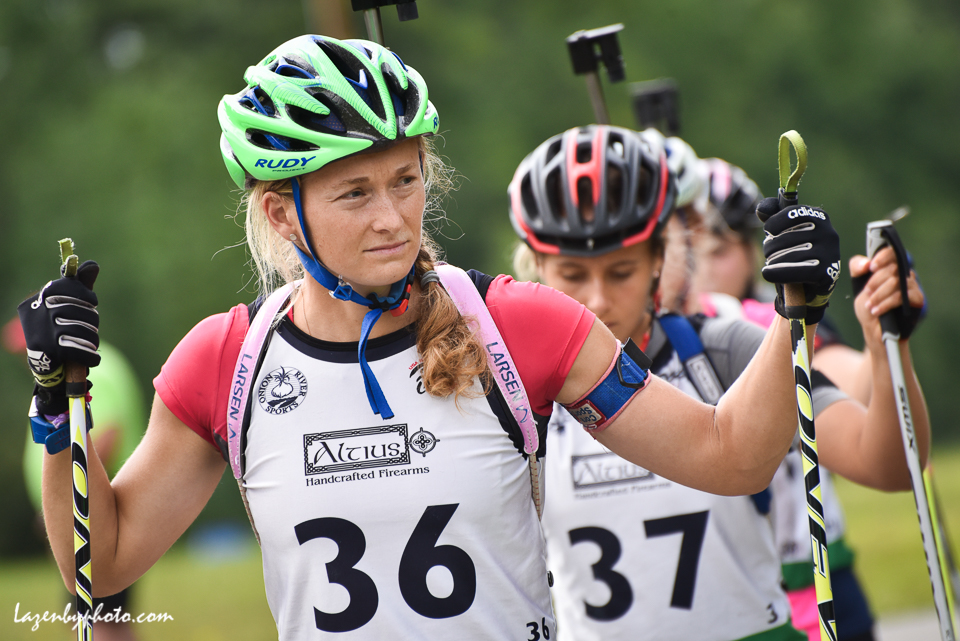
Emily Dreissigacker (CGRP) at the start of the women’s sprint at the 2017 US Biathlon Rollerski Championships on Aug. 12 in Jericho, Vt. (Photo: John Lazenby/Lazenbyphoto.com)
Say this name three-times fast: “Dreissigacker”.
Not so easy at first.
Break the four-syllable surname into discrete parts: Driess (with a hard I) – i – gack – er.
It then rolls off the tongue … Dreissigacker.
In northern Vermont and in particular around the Craftsbury Outdoor Center, Emily Dreissigacker, of the Craftsbury Green Racing Project (CGRP) is as well known a name as any. Her parents, Dick Dreissigacker and Judy Geer, bought the Outdoor Center in 2009. Both are Olympic rowers.
And both of Emily’s siblings are biathletes. Her older sister Hannah, 30, was a 2014 Olympic biathlete who retired in 2016 and younger brother Ethan, 26, formerly raced for the Green Racing Project.
At 28, (she’ll be turning 29 in November), Emily Dreissigacker is on the cusp of making it onto the International Biathlon Union (IBU) World Cup representing the US Biathlon Association (USBA).
“I’m not really feeling the pressure,” Dreissigacker wrote in an email about a possible World Cup nod. “I’m just excited to get out there and ski on snow and get in some really solid training.”
Perhaps this is a reason why the USBA’s high-performance team recruits and promotes older athletes — with age and experience comes a calmness. With time comes wisdom: winning or losing in sport doesn’t define a person.
There’s been both winning and losing and the in-between for this Dreissigacker, who grew up near Craftsbury in Morrisville, Vermont, and married her teammate Alex Howe last summer.
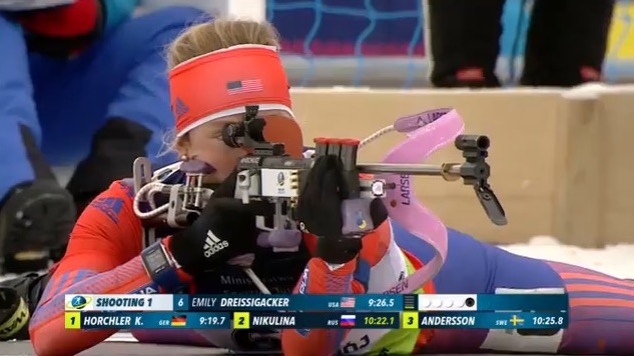
Emily Dreissigacker shooting clean during her first prone stage of the women’s 15 k individual race at 2017 IBU Open European Championships in Duszniki-Zdrój, Poland. She finished 41st. (Eurovision screenshot)
“At this point, competing at the Olympics had been a dream of mine for so long that it felt inextricably entwined with who I was as a person,” Dreissigacker wrote in a June 2015 blog post. “I could feel it slowly but surely slipping out of my grasp and yet I couldn’t let go. I thought about quitting, but there was always something pulling me back. Don’t get me wrong, I loved racing. I loved racing against my teammates in practice, I loved lining up side by side for a 2k or blindly pushing myself past all reason in an interval start. But the training, the whole process had gotten stale. I felt like I was slogging my way through each steady state workout, counting down the minutes rather than enjoying the time I had. Meanwhile, I jealously eyed the skiers leaving each morning for what looked to me like exciting adventures. They got to go biking and hiking and running and rollerskiing (yes, I was jealous of rollerskiing)! But it never really seemed like a viable option to me. I was a rower.”
Since that 2015 blog post, Dreissigacker has been a biathlete.
After eight years training as a rower, she tapped into her adolescent and teenage years as a skier. Like some of her peers — Reid, Egan and Dunklee come to mind — Dreissigacker learned to shoot in atypical fashion: she didn’t train as a junior biathlete and came to biathlon later in their athletic careers. (Reid, Egan and Dunklee all competed at the NCAA Division 1 level.)
“I skied in high school and tried biathlon once, so I had shot a rifle before but not well and not for long,” Dreissigacker wrote. “I also hadn’t trained for skiing, other than a bit of cross training here and there, so I’m definitely playing catch up on that side of things too. Rowing is much more of an anaerobic sport so building up my aerobic base has been and still is a big focus. As well as pretty much re-learning how to ski. I definitely still have a lot to work on in both regards.”
Despite her perceived deficiencies, Dreissigacker’s results show what any coach desires — positive trends when it comes to skiing speed and shooting accuracy. Dreissigacker spent the 2016 and 2017 race seasons on the IBU Cup, a step down from the World Cup.
In March of last year, Dreissigacker earned a top 20 on the IBU Cup. This year, she skied and shot consistently enough in the four-part 2017 USBA rollerski trials series to get picked for the Canmore preseason camp. In the first half of the trials, she placed fifth in both races in mid-August. A month later, she jumped the ranks with first and second place finishes at Part 2 of trials in Jericho.
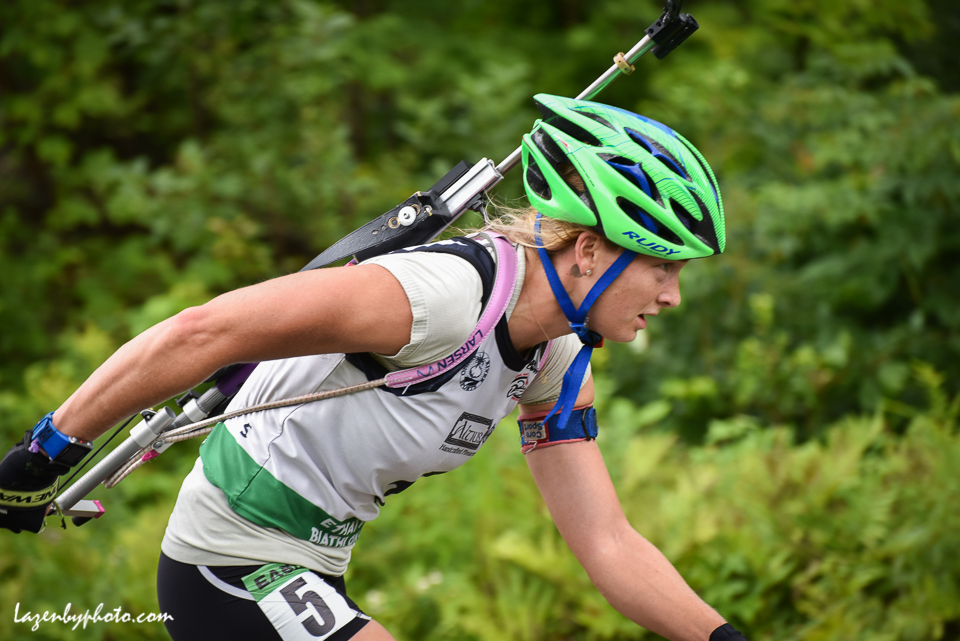
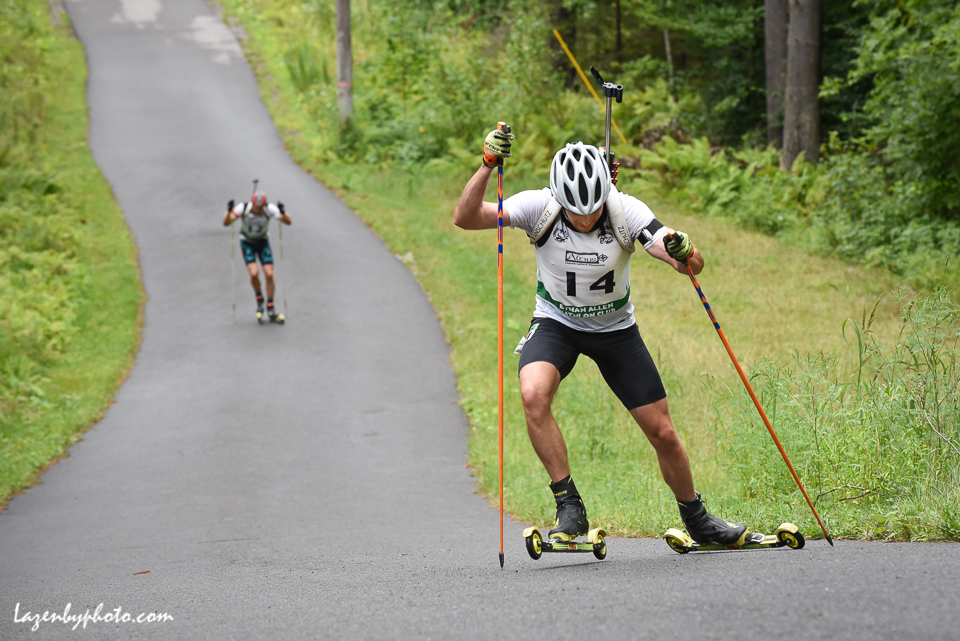
Emily Dreissigacker (CGRP) racing to fifth in the women’s mass start at 2017 US Biathlon Rollerski Championships on Aug. 13 in Jericho, Vt. (Photo: John Lazenby/Lazenbyphoto.com)
As she ramped up for trials, Dreissigacker spent time in Europe with the Green Racing Project. That trip also gave her time to train with national-team biathletes.
“Our European camp this year had much more of a biathlon focus,” Dreissigacker explained. “We did essentially the same trip as the National team so we were able to train with them some. We got to race at German summer rollerski nationals which was a great opportunity to get in more racing and also to experience a really high level of racing. And we got to ski on snow in the Oberhof tunnel. The trip was also a little earlier so after we got home I had a really solid training block in Lake Placid before an easy week at home leading up to trials.”
According to USBA Chief of Sport Bernd Eisenbichler, this year’s version of the European training swing was beneficial for Dreissigacker.
“The camp setup that the Craftsbury team had this summer, accompanying us on the Europe camp instead of going to the Dachstein glacier, choosing to go to the ski hall in Oberhof, helped also to have her performance level in the fall,” Eisenbichler wrote in an email. “Last year we saw that August was quite okay but then the fall, she was really really tired. I don’t know if I would get agreement from Craftsbury, but I would argue that the camp setup was smarter this year and that is why she was in better shape this October.”
Finding form and peaking when it counts isn’t an outcome hard science can unfailingly predict. Be it her modified camp in Europe or the confidence that comes with experience, Dreissigacker performed at this year’s USBA rollerski trials.
“Em has been on the biathlon development program for the last 2 years and on the biathlon team training plan, she works with [USBA Development Coach] Jean Paquet now most of the time,” CGRP Head Coach Pepa Miloucheva wrote in an email. “Last year the Craftsbury biathlon team did travel to Europe for a camp on snow with the skiers, this year the biathlon team The Europe ski trip was more biathlon specific at the ski tunnel in Oberhof with the USBT [US Biathlon team].”
Dreissigacker’s shape and shooting accuracy could serve her well as she transitions to snow in Canmore. The Canmore camp on Frozen Thunder will conclude Nov. 10. And as for the rest of the season, the IBU World Cup could be seeing a new Dreissigacker this winter.
In this episode, we speak with the president and CEO of the US Biathlon Association (USBA), Max Cobb. For nearly three decades, Cobb has been part of US Biathlon — first as an organizer of the domestic racing series and eventually as the executive director in March of 2006. Just over a year ago, he was elected Vice President for Sport of the International Biathlon Union (IBU), becoming the first American on the IBU Executive Board.
Lowell Bailey (USA) celebrates with Max Cobb after winning the gold in the 20 k individual at the 2017 IBU World Championships in Hochfilzen, Austria.. (Photo: NordicFocus)
Cobb’s budget is the mighty mouse of the biathlon world, and on many days, the high-performance team (both coaches and athletes) can slay the Goliaths of the sport. It’s a testament to Cobb’s leadership and his ability to hire and retain gurus like German native Bernd Eisenbichler, US Biathlon’s chief of sport.
A 2016 photo of Max Cobb, the president and CEO of U.S. Biathlon. (Photo: Nordic Focus)
Cobb, who spoke with us on Sept. 8, is also a leader when it comes to anti-doping — He’s unafraid to comment on systemic failings and he’s unabashed in calling for reforms.
Raking leaves? Scraping off the storage wax? Then it’s a great time to hear Cobb out.
Susan Dunklee (USBA/CGRP) leading the pack in the women’s mass start on Sunday, Aug. 13, at USBA Rollerski Championships in Jericho, Vt. She won by nearly 47 seconds. (Photo: John Lazenby/Lazenbyphoto.com)
Special thanks to John Lazenby for providing photos from 2017 US Biathlon Rollerski Championships in Jericho. For a full gallery, click here.
Note: This article has been updated to include comments from Lowell Bailey, Susan Dunklee and Bernd Eisenbichler.
***
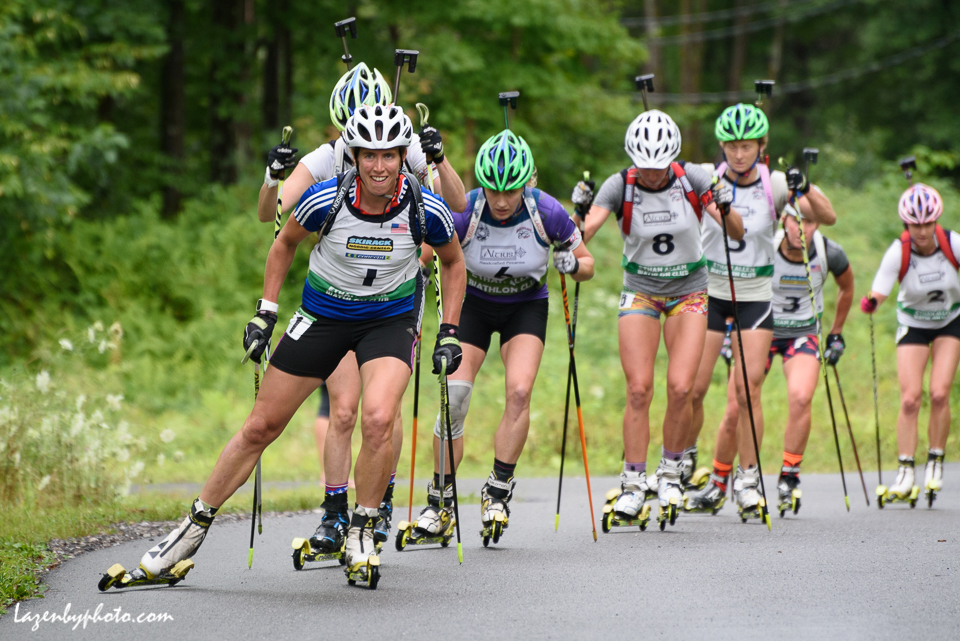
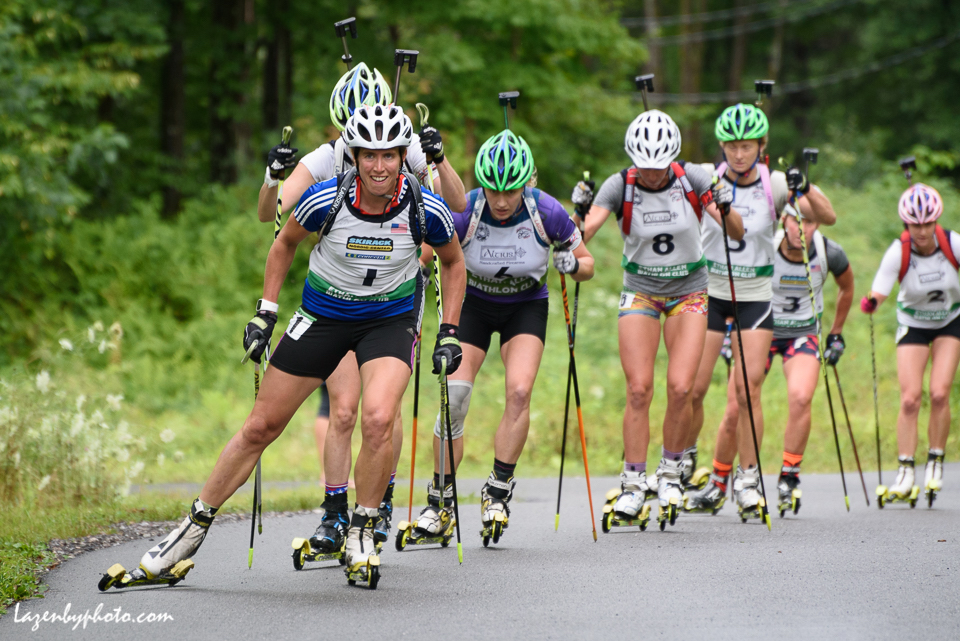
This past weekend, the US Biathlon Association (USBA) Rollerski Championships returned to Jericho, Vt., for two days of racing at the Ethan Allen Firing Range inside a National Guard military base. Just as it has in the past, the format included men’s and women’s sprints on Saturday followed by mass starts on Sunday, and this year, the races drew nearly 100 competitors from across the U.S. and even some from Canada.
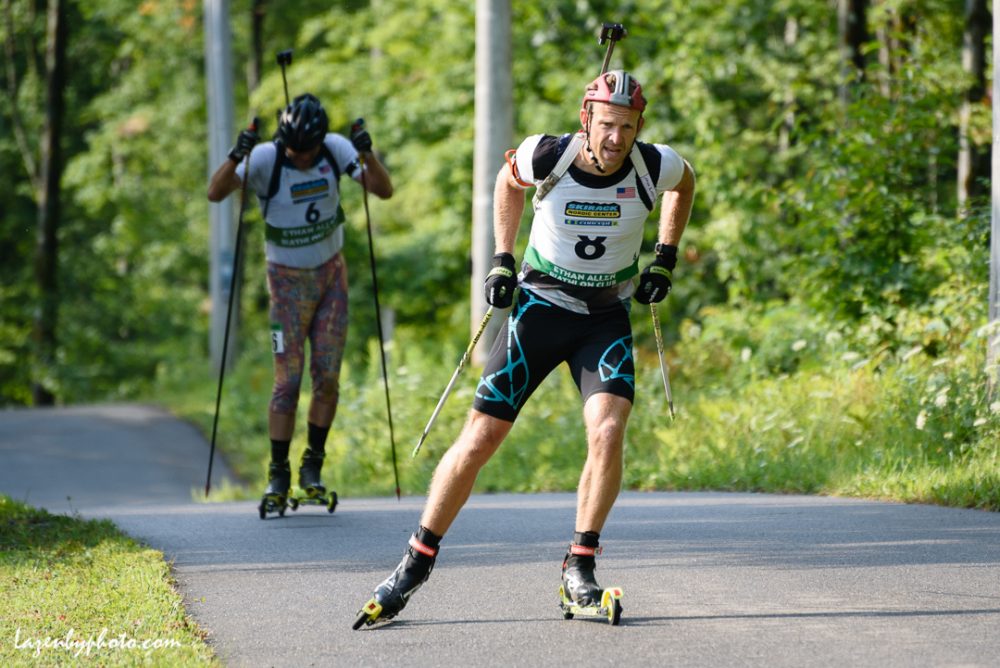
US Biathlon’s Lowell Bailey (r) on his way to winning the men’s sprint at US Biathlon Rollerski Championships on Aug. 12 in Jericho, Vt. (Photo: John Lazenby/Lazenbyphoto.com)
A perennial winner at Jericho, Lowell Bailey won the senior men’s 10-kilometer sprint on Saturday in 24 minutes, 58 seconds with a single standing penalty (0+1).
“Summer nationals is a good chance to assess where you are in the training season,” Bailey wrote in an email. “Of course, roller skiing is quite a bit different than on-snow skiing, and it is important to keep that in perspective when assessing the results. However, I’m happy with the way the weekend went and I feel like I am on track in terms of where I want to be in the training season.”
Fellow US Biathlon A-teamer Sean Doherty placed second, just 5.2 seconds back, with two prone misses (2+0). Rounding out the top three, Biathlon Canada’s Nathan Smith (the lone Canadian in that race)placed third, 21.4 seconds behind Bailey with a single standing miss as well (0+1).
Another 0.2 seconds back in fourth overall, Travis Cooper of National Guard Biathlon was the third American after shooting two prone penalties (2+0). A total of 23 racers competed in the senior men’s event on Saturday, compared to 11 in the senior women’s sprint. (Other categories included girls, boys, youth, junior, and masters.)
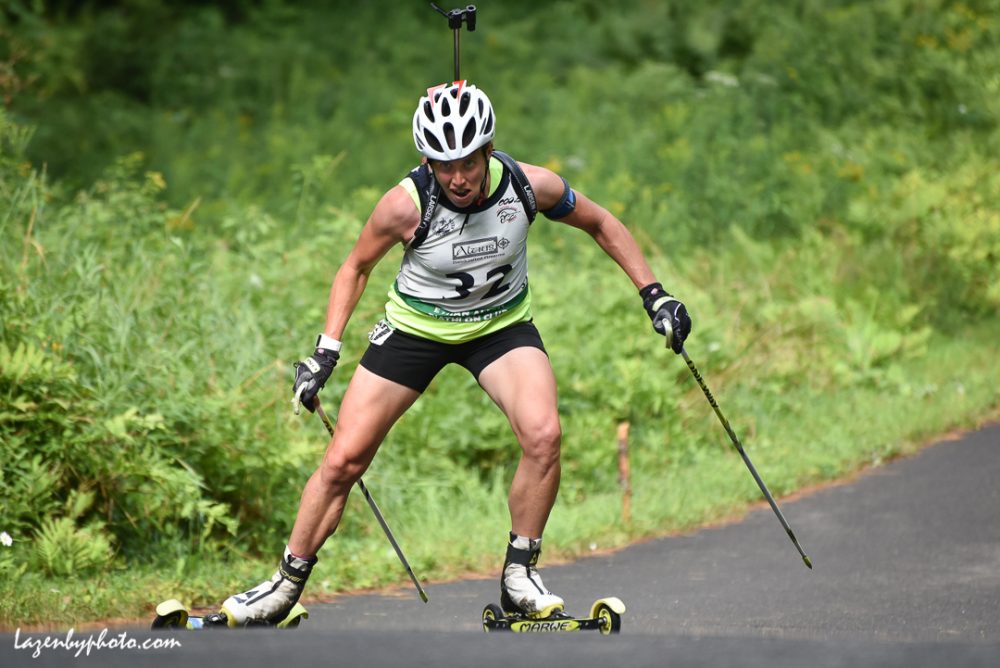
Susan Dunklee (US Biathlon/Craftsbury Green Racing Project) racing to a win this past Saturday, Aug. 12, in the women’s sprint at US Biathlon Rollerski Championships in Jericho, Vt. (Photo: John Lazenby/Lazenbyphoto.com)
In the women’s 7.5 k sprint, Susan Dunklee, of US Biathlon and the Craftsbury Green Racing Project (CGRP), won despite five penalties (2+3) in a time of 22:10.7.
In an email, Dunklee described the conditions as “very hot and muggy.”
“Between that and the uphill range approach, these races have some of the most difficult shooting conditions we see all year,” she explained in an email.
“I’ve been working on learning new wind shooting skills this summer,” Dunklee wrote. “It has been going well in practice but truly trusting those skills under race pressure is a mammoth challenge. The goal is to build that trust before winter. My shooting percentages weren’t great this weekend, but I am happy about the way I stuck to my work plan on the range.”
Dunklee finished 46.9 seconds clear of her teammate and runner-up Joanne Reid (USBA/Colorado Biathlon), who had a miss in each stage (1+1).
A minute behind Dunklee, Kelsey Dickinson, representing Craftsbury’s Collegiate Summer Team, placed third with four penalties (3+1). No Canadian senior women competed on either day.
On Sunday, racers returned to the range for the men’s and women’s mass starts, where Dunklee proceeded to take another victory with a time of 40:12.8 and seven penalties (1+2+2+2).
Her teammate Clare Egan (USBA/CGRP) placed second, 23.6 seconds back with five misses (1+0+2+2), while Dickinson repeated in third (+33.8) with five penalties as well (2+0+1+2).
Biathlon Canada’s Nathan Smith (14) leading US Biathlon’s Lowell Bailey (l) up a climb in the men’s mass start on Sunday, Aug. 13, at US Biathlon Rollerski Championships in Jericho, Vt. Smith went on to win by 21.3 seconds over Bailey. (Photo: John Lazenby/Lazenbyphoto.com)
In the men’s mass start, Smith cleaned two stages and tallied three penalties (1+0+0+2) en route to the win in 38:09.8. Bailey finished 21.3 seconds back in second after three misses (1+0+1+1), and his teammate Tim Burke (USBA) took third (+1:09.8) with five penalties (2+1+2+0).
“I was happy with how the first day of racing went, but I definitely could have been more aggressive in the Mass Start’s standing stages,” Bailey reflected. “The wind came up during the shooting and I let that distract me a little bit when I should have stayed with my planned cadence and shooting speed.”
“With faster shooting, I may have been able to catch Nathan’s wheel and contended for the win on the last loop,” he continued. “As it was, those two standings left me with an insurmountable gap for the final loop.”
Paul Schommer was the third American in fourth overall (+1:23.0) with six misses (2+1+2+1).
The USBA Rollerski Championships typically serve as the first of two weekends of trials (the other being in October) for US Biathlon in selecting a pre-World Cup training camp group. From that group of athletes, the U.S. usually fills out its early season International Biathlon Union (IBU) World Cup roster.
In an email, USBA Chief of Sport Bernd Eisenbichler explained that two athletes particularly stood out with their performances this weekend.
“On the women’s side Kelsey Dickinson and on the men’s side Travis Cooper made a big improvement compared to last year and even last season and both will get rewarded for that with a camp invitation to [Lake Placid] in mid-September to work with the A Team and the National Team Coaches,” Eisenbichler wrote.
“I was happy to see a very competitive men’s field and a growing women’s field as well,” he continued. “We could see, that it was the first real races this summer and as Jericho is a pretty hard range to shoot at, we saw a good reminder what to work on still, especially on the shooting side. The A Team comes from a really long and hard block of training, so they weren’t fresh at all going into the races, so for sure, you make a few mistakes more, as if you would be preparing fully for a race weekend like you would e.g. do for a [World Cup] weekend.”
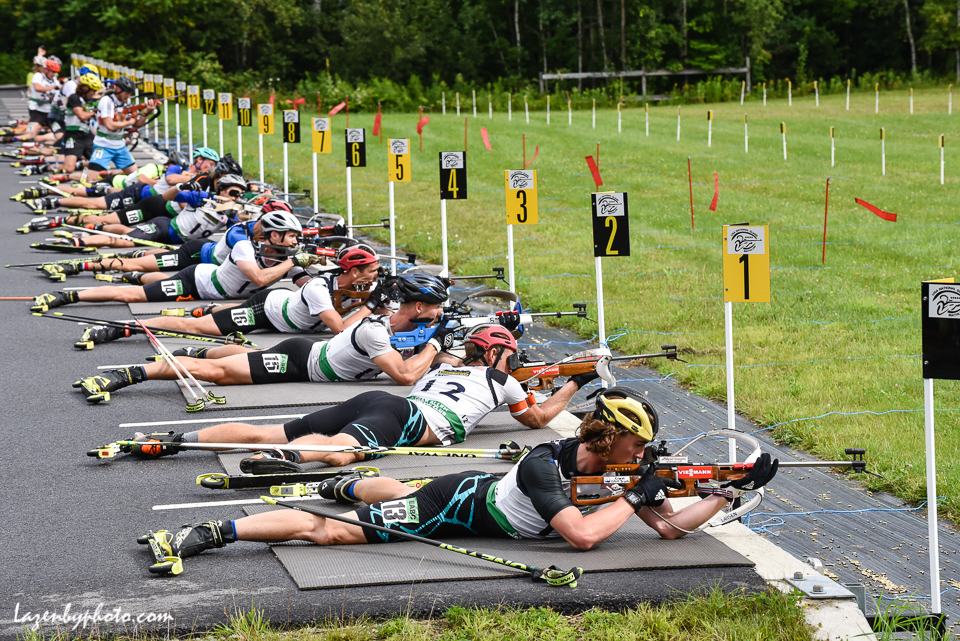
US Biathlon’s Sean Doherty (front) and Lowell Bailey (12), along with their competitors, taking aim during a prone shooting stage of the men’s mass start at 2017 USBA Rollerski Championships on Aug. 13 in Jericho, Vt. (Photo: John Lazenby/Lazenbyphoto.com)
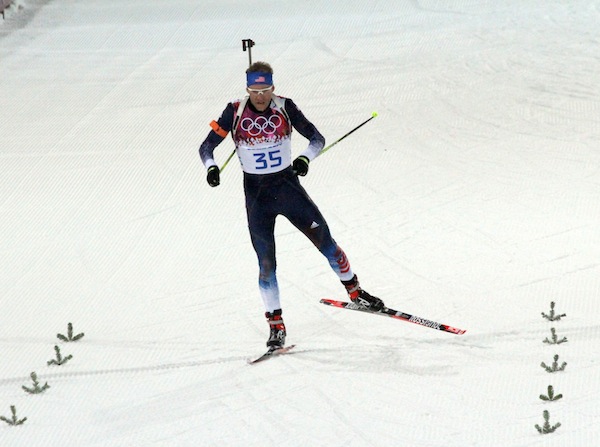
Lowell Bailey competing at the Olympic Games in Sochi, Russia, where he placed eighth in the 20 k individual race for the best Olympic result ever by a U.S. man. Since then, Bailey became the 2017 World Champion in the same discipline.
The US Biathlon Association (USBA) has already qualified two World Championships medalists for their 2018 Olympic team, but four more men and four more women will still be selected – and those spots could go to almost anyone.
USBA has a multi-stage athlete selection process. One or two more athletes of each gender will be selected based on the first period of World Cup results. For both men and women, part of that World Cup roster is already set and the rest will be chosen based on rollerski trials this summer and fall.
Then, the World Cup athletes who weren’t selected will be sent down to the IBU Cup in January, where they will duke it out against the best U.S.-based athletes who qualified for the trip based on NorAm Cup races in December. The team will be filled to four men and four women from these IBU Cup races.
Finally, a fifth member of the team to PyeongChang, South Korea, will be added to each team based on discretion.
“Biathlon is a sport where you have to have a constant high level of performance, because you never know when you will get a chance… shooting can go off and on every single day,” USBA Chief of Sport Bernd Eisenbichler said in an interview last week. “We give a reward for a consistent high performance level through this [December] pre-qualification system. And, with the trials system [in January], we are only three weeks away from the Olympic Games then. So we get the guys who are just on the upswing of performance towards the Games – maybe they didn’t have a good last year or didn’t have a good December, but now in January they are on the upswing.
“What we want to make sure with that system, is that we have clearly the best U.S. team on the start line that is possible,” he said.
December World Cups
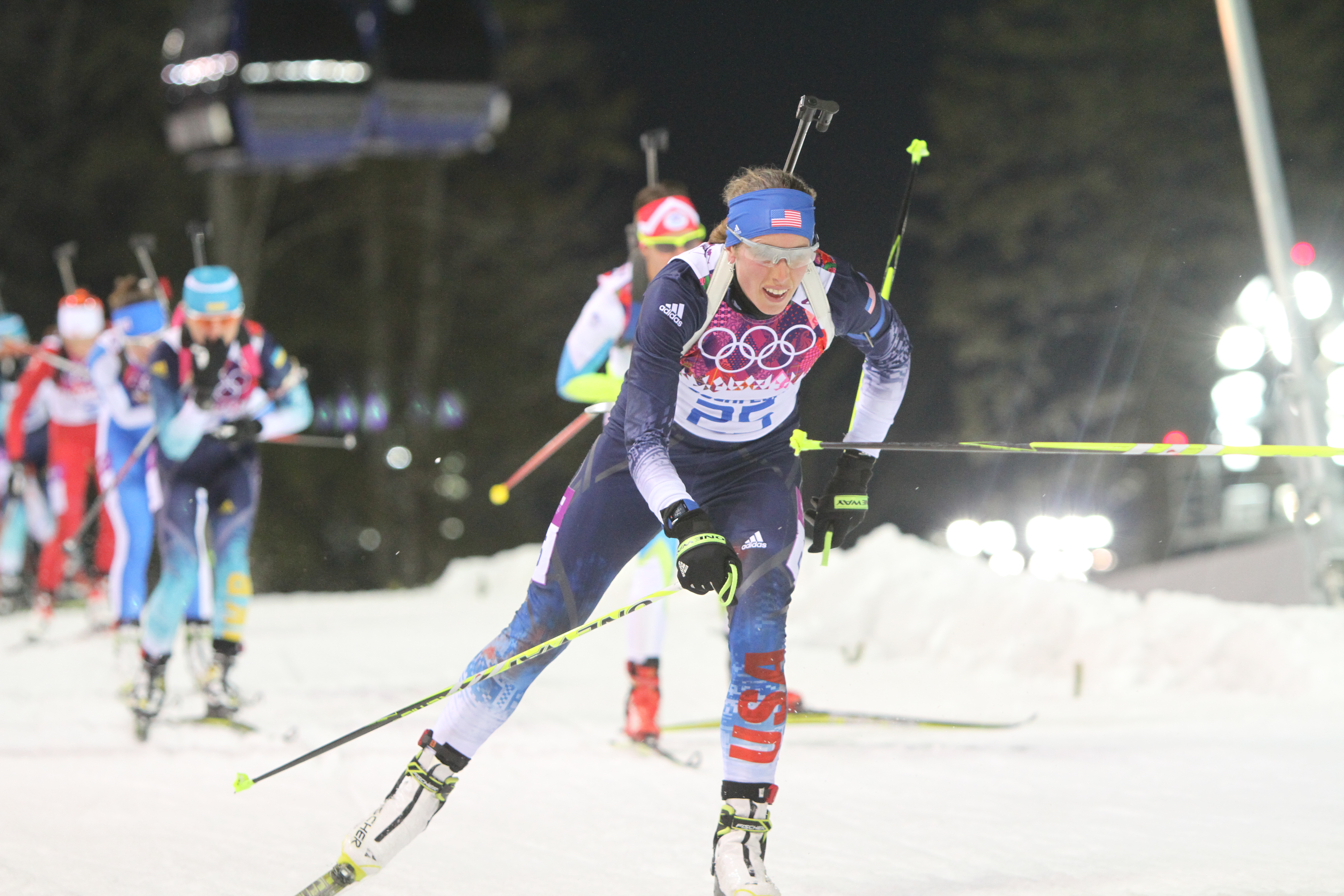
Dunklee on the move through the field in the 2014 Olympic mass start, where she placed 11th for the best individual Olympic result ever by a U.S. woman. She had qualified for the team based on December World Cup results.
The standard for making the Olympics based on upcoming World Cup results is to hit the top 30.
The Olympic team can be filled to up to three athletes of each gender based on this standard. If multiple athletes turn in top-30 results in the first three weeks of World Cup racing, those with the best single result will be chosen. If nobody meets the mark, then one athlete with the best single result, even if it’s outside the top 30, will be chosen to join Lowell Bailey and Susan Dunklee, who are pre-qualified based on their gold- and silver-medal performances at 2017 World Championships.
“It’s clear from the performance level that we have in our team now that everybody wants to go for that pre-qualification spot in December, which means that you need one top-30,” Eisenbichler said. “In the Olympic season, you have to do that quite easily. We expect that from them. One top 30, for all the athletes we have on the start line, that’s something that they need to do to get ready for the Games.”
World Cup qualifying criteria have not yet been published, but have been substantially the same for several years.
Last season, athletes with top-20 World Cup results were pre-selected for the next season’s World Cup. If that criterion were repeated, that would mean that Bailey, Dunklee, Tim Burke, Sean Doherty, and Clare Egan would be given spots.
The rest of the selections are made based on rollerski trials to be held in August and October, and by discretion based on a number of factors including performance at an early-season training camp.
While the criteria to qualify via the World Cup are clear, one thing to note is that there is a maximum team sized which can be named through this mechanism: three total athletes of each gender. If more athletes meet the mark – as Eisenbichler hopes and expects they will – the group will be winnowed down based on who does best.
Last season Bailey, Burke, Dunklee, Egan, and Joanne Reid all notched top-30’s in just the first week of racing. Doherty and Leif Nordgren missed the first period of racing due to illness and injury, but collected top-30’s later in the season.
“The harder part is for sure to send two men and one woman back from the World Cup in December, who could potentially have also had pretty good results,” Eisenbichler said. “Potentially they could also have been in the top 30, but just the other two athletes were a little better. That could create for sure quite some frustration.”
January Racing and a Level Field
Hannah Dreissigacker en route to 23rd place in the Olympic 15 k individual in Sochi. Dreissigacker was competing in her first Olympics after excelling at January IBU Cup races which served for selection. (Photo: USBA/Paul Phillips/Competitive Image)
That frustration by athletes who had been succeeding on the World Cup, Eisenbichler believed, was worth it in order to create a good selection system.
“I think that it’s fair to give the athletes from the North American Cup qualification in December the chance to show their level in January against the ones that had the chance over three weeks in December at the World Cups,” he said. “Race it out on the international level. I think it’s fair.”
How many athletes are sent to the IBU Cup based on the December races in Minnesota is yet to be determined. The U.S. will fill its IBU Cup quota with a combination of athletes already in Europe and those being sent over anew from the U.S.; whether one or two more men or women are already selected to the Olympic team determines how many quota spots will be filled by December World Cup athletes, and how many are left to be filled by athletes who had been racing in North America.
“The most difficulty we could have, is that if we only pre-qualify one more athlete in December and we have to send three athletes back to the IBU Cup, that would limit the number of athletes that could qualify from the NorAm Cups in Minnesota,” Eisenbichler explained. “That could potentially go down for the men’s team to just the winner of the trials. That could create frustration over there. But again, that’s how the system works.”
And although the exact number of athletes offered an IBU Cup chance is up in the air, there is some clarity: win the Minnesota races, and you’ll be within one step of making the Olympic team. The trials winner will be sent to Europe no matter what.
“I think that’s very important for them to see a clear, streamlined path that they can rely on,” Eisenbichler said. “It’s not left up in the air, like no matter what I do I’m never sure if I will get a qualification. If you win the trials, you get to go. That’s our rule. The winner of the trials always gets to go. There will be never a discussion about that.”
Once in Europe, it’s not a foregone conclusion that the World Cup athletes who are sent to these January trials will come out on top and get the Olympic spots. In 2014, Jeremy Teela started the season on the World Cup but was ultimately left off the Olympic team as he was beaten in every IBU Cup race by Russell Currier.
(Sean Doherty was the discretionary pick after besting all other Americans in one of the IBU Cup races.)
Likewise, in 2010 Kevin Patzoldt competed in the early World Cups but ultimately did not make the cut in the January trials.
On the other hand, some of the World Cup athletes sent to these IBU Cups have simply dominated. But that’s the point, according to Eisenbichler: to see what happens, rather than to leave team staff and the athletes themselves wondering whether they were actually better than a World Cup athlete they never got to race against.
“I think it’s fair, especially going into the Olympics, to compare athletes shortly before the Games,” Eisenbichler said. “To see the level of the best athletes who just didn’t make the cut through the [fall] rollerski races… We are growing quite fast now with our new pipeline, with the Talent ID Camp and new cross-country skiers changing to biathlon. I think it’s fair to show them, to motivate them to do this sport, to say, ‘Hey, there’s an open door to qualify during the season for different events.’”
And regardless of history in the sport or even that season, athletes chosen at the January IBU Cup races – rather than based on earlier results on the World Cup – have gone on to solid Olympic success.
In 2010, Lanny Barnes didn’t qualify through the World Cup, but did well in the IBU Cup races and ultimately placed 23rd in the Olympic 15 k.
In 2014, Hannah Dreissigacker was picked for the team through January IBU Cups and turned in an identical result, 23rd in the Olympic 15 k.
Discretion
Sean Doherty, still a junior at that point, was a discretionary pick to the 2014 Olympic team. He raced a leg of the U.S.’s 16th-place men’s relay. Since then, he has gone on to contribute to two top-8 World Championships relays and collect three individual top-20 World Cup finishes.
The last roster spot for the 2018 Olympics will be filled by discretion.
“As we all know, discretion is always a point of controversy, and especially in an Olympic year,” Eisenbichler admitted. “That is something that we know, and we will look very, very carefully. But I think it’s absolutely necessary and I’m grateful to have it. For example, we could have someone who is in great shape but is sick during the trials, yet was clearly ahead of the others in all the other races [before that].”
There are six metrics listed in the criteria which could be considered to make a discretionary pick:
History of performance in a specific competition type over the current and previous competitive seasons
Recent improvements in results or performance parameters such as ski speed and shooting performance (both in training and competition)
Recent positive trend of competition results or performance parameters, such as ski speed and shooting, indicating a potential for Olympic success. This includes indication of medal potential in future Olympic or World Championship competition that would be materially enhanced by selection to the Team.
Recent decline in results or performance parameters such as ski speed and shooting performance (both in training and competition)
Performance/participation in the qualification process effected by illness or injury as certified by USBA
Ability to effectively contribute to a relay
For the discretionary selection, Eisenbichler makes a proposal of who to select, but the various athletes in the mix are then discussed at length by USBA’s International Competition Committee. The committee are the ones who finally settle on a selection, which may or may not be Eisenbichler’s first choice.
“We have a former athlete in there with Sara Studebaker, we have a domestic coach [Sarah Lehto of National Guard Biathlon], we have a chair who has worked a long time for the U.S. Olympic Committee with Jay T. Kearney, and we have Jonne [Kahkonen, the women’s national team coach] and myself,” Eisenbichler said of the committee. “I can tell you that in the last years we were in contentious discussions. But I think the outcome was always as objective as a discretionary choice can be. We had very little discussions afterwards, because we had put everything on the table [in the committee].”
Coming from Germany, Eisenbichler has a slightly different perspective on how discretion could be used than do most American coaches.
“What I really felt when I took the position in 2007, was that discretion was this big monster out there that everybody was so afraid of,” he laughed. “I was so surprised about it. Maybe some sports have a history of that, so it’s understandable… But coming from Germany, we have a little different system in place, with a lot more discretion. They look at results for the basic qualification for the Olympic Games, but after that there are six or seven athletes who meet that and have the same performance level, and then it’s all discretion.”
Eisenbichler certainly isn’t asking for a German-style system. He’s happy with his one discretionary pick. And in order to make that pick seem less like a “monster,” he has put in big efforts to be transparent about how choices are made.
“We worked really, really hard over the last ten years to establish a trust among the athletes,” Eisenbichler explained. “We want them to know that it’s still something that is unclear, but the [committee] makes the best possible choice they can, and they provide a clear rationale about the decision right after. We explain the discretionary choice to the athletes who were affected by it — the ones that get to go, but also the two or three who were close and hoped and believed that they could be a discretionary pick. I think this communication right after the decision is the most important way to gain the trust of the athletes in that system.”
Filling a Team
U.S. Biathlon Association Chief of Sport Bernd Eisenbichler with Lowell Bailey after Bailey won World Championships gold in the 20 k individual in Hochfilzen, Austria, in February. (Photo: Glen Crawford)
Until 2006, USBA had more of a straight-up Olympic trials system. But even if it may sometimes seem like a labyrinth, Eisenbichler believes the new system – which will be used for a third Olympic Games this year – is much better.
“To just look at just a few performances for the Games or the Trials is absolutely not what we want from our coaching leadership and myself,” he asserted. “We want to have a constant high level of performance throughout the whole year.”
Furthermore, Eisenbichler asserts that the system is accepted and supported by athletes. Even regarding the discretionary picks, there has been little blowback.
“It’s well understood, well established, and even, I would say, a well respected system from the athletes,” he said. “We have pretty much no complaints over the last eight, nine years for World Championships and Olympic picks.”
Recently, USBA has been improving its Olympic results.
In 2006, Jay Hakkinen posted a best-ever mark for a U.S. man in 10th. In 2010, Jeremy Teela moved that up to ninth. In 2014, Lowell Bailey finished eighth.
On the women’s side, Susan Dunklee finished 11th in 2014, besting Joan Smith’s mark of 14th place set in 1994.
With Dunklee and Bailey winning medals at last year’s World Championships, Eisenbichler hopes that the upward trend can continue – and that the criteria will select the team that can make it happen.
“With that mixture, and having one discretionary choice as well, I think that we made sure in 2010 and 2014 that we had the four or five strongest athletes at the Games,” he said. “And I think it was a totally fair and transparent system. I am very comfortable with the system again going into PyeongChang.”
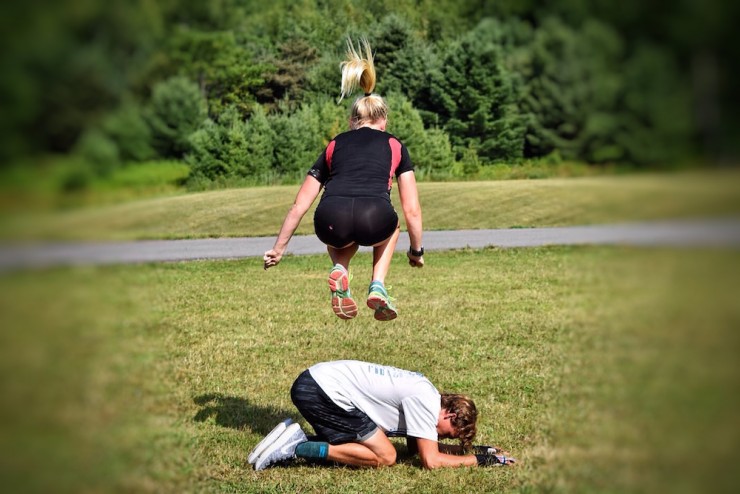
Sweden’s Nicolina Lindquist jumping over Jake Pearson, of Cody, Wyo., during a strength workout at the USBA development camp last week in Jericho, Vt.(Photo: Katrina Howe)
(Photo: Katrina Howe)
Paul Schommer (l) and Jake Brown doing high-five partner burpees during a strength workout at the U.S. Biathlon development camp in Jericho, Vermont. (Photo: Katrina Howe)
According to Green Mountain Valley School coach Katrina Howe, the standing athlete is trying to stabilize/stand while their partner crawls around their waste as many times as possible in a 40-second period. “Hilarious to watch and a great get-to-know-you (in a hurry!) exercise,” Howe wrote. (Photo: Katrina Howe)
(Photo: Katrina Howe)
(Photo: Katrina Howe)
Last week, more than 100 athletes from the U.S., Canada and Sweden came out for the US Biathlon Association’s (USBA) annual development camp in Jericho, Vt. It was one of US Biathlon’s largest and best-attended camps yet, according to national-team assistant coach Erik Lewish.
“The camp is a great experience for biathletes from all over North America to get together for a week of training and educational sessions that culminate with the North American Summer Biathlon Championships at the end of the week on Saturday and Sunday,” Lewish wrote in an email.
Those championships took place last weekend on Aug. 13-14.
In the week leading up to the races, the U.S. Anti-Doping Agency (USADA) visited the camp to present on True Sport “and what to expect when one makes it to a high enough level that they are in the registered testing pool,” Lewish explained. “Our Head Development coach Jean Paquet took the athletes on a course scan of the roller loop and talked about ski technique and how to really ‘attack’ a course. Andrea Burke (formerly Henkel) gave a great motivational/inspirational presentation about her time as an athlete. Overall it is a great chance for the athletes to learn about the sport and hone their individual skills before competing in the continental championships.”
The Monday before the championships, camp participants did an eight-station strength workout that involved some partnering up.
Lewish explained that the workout was jointly created by himself, Paquet and Kari Korpela, the biathlon coach for the Sollefteå Skidgymnasium in Sweden.
“The whole workout took about 1.5 hours from warm up to cool down,” Lewish wrote. “This was the second session of the day, after a long, easy roller ski in the morning.”
The Workout: Biathlon Strength Stations (and Shooting)
Warmup: 15-20 minutes of running
First 20-Minute Set:
– 40 seconds of each station/exercise followed by 1 single shot on the range, then 40 seconds of the next station/exercise
Second Set:
– Reload rifle magazine and do some longer bouts: 4 minutes of 40 seconds on/20 off at a station, then move onto the next exercise. After 4 minutes, take 5 shots on the range and return to next station. Repeat for a total of four shooting bouts (shooting order: prone, prone, standing, standing).
The Stations:
1. TRX leg crunches: Start in a pushup position with your feet in the straps of a TRX Suspension Trainer. Lift your hips and pull your knees into your chest.
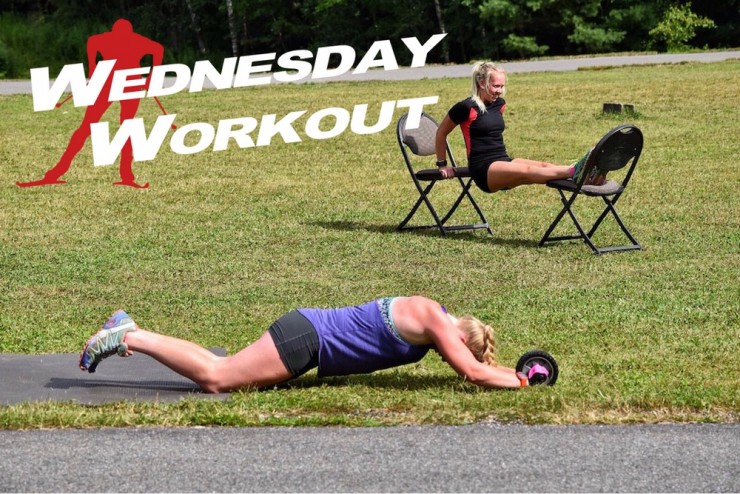
2. Ab Roller: Start on your knees and roll out as far as you can while bracing your core, pause at the farthest point and then return to the starting position.
3. V-Sits: Start lying down flat with your hands above your head. Bring your legs and torso up together and touch your toes at the top.
4. Partner Burpees: Standard burpee done in sync with a partner. High five at the top of the jump for added fun!
5. Under-Overs: One person jumps over and crawls under the other person.
6. Human Rock Climbing: One person starts on the back of the other and tries to climb 360 degrees around the other person without touching the ground.
7. Tricep Dips: Sit on a chair, holding the edge with both hands, knuckles pointing forward. Straighten your arms to raise your body and extend legs straight out with heels on the ground (or on another ch. Bend at your elbows to lower your entire body while keeping your legs straight. Hold at the bottom for a moment without touching ground.
8. Single-Leg Plyo-Jumps: Jumps done side-side to mimic skate skiing with a small hop in between before transferring to the other side.
Casey Smith (Maine Winter Sports Center/U.S. Biathlon B-team) on his way to placing second in a NorAm mass start in Canmore, Alberta, in December 2014. (Photo: Jake Ellingson)
Casey Smith has endured a few things that would cause any athlete to question whether to continue with their professional career.
In February 2015, the Washington biathlete crashed hard while training in Canmore, Alberta, before the International Biathlon Union (IBU) Cup races to be held a few days later. He was knocked unconscious, broke ribs, a shoulder blade, and bones surrounding his vertebrae, and punctured a lung.
But Smith – using the physical and mental endurance he had cultivated in biathlon – persevered, joining the Craftsbury Green Racing Project (CGRP) in Vermont and returning to international competition in the 2015/2016 season.
“It definitely [felt sweet],” he said of a few good races last season. “It was really cool to be able to – I got back to the same level I was at before. In Europe this year I didn’t have quite as good results as the year before, but also the first week I got food poisoning really bad. That took a pretty big toll on me, and didn’t have anything to do with the crash.”
Come spring, the 24 year old decided to call it quits with his biathlon career and return to Bozeman, Mont., to finish a degree at Montana State University. He had enrolled after high school before transitioning to being a full-time athlete.
His decision was unrelated to the ordeals of the year before. It came down to something much simpler: joy.
“The whole year of the training season and racing season, I wasn’t feeling as motivated,” he explained on the phone from his home in Washington’s Methow Valley. “I said that I wanted to do this as long as I was having fun, but it was turning into more of a job kind of thing. It was getting to the point where it wasn’t as much fun anymore. So I thought it was time to move on.”
Casey Smith (USA) en route to 37th place in the junior men’s individual at 2013 World Junior Championships in Obertilliach, Austria. He had his career-best finish of 23rd place in the pursuit there. (Photo: US Biathlon/NordicFocus.com)
Smith was a top junior for the U.S. before and during his first stint in Bozeman. He had top-30 finishes at World Youth and Junior Championships in 2011 and 2013, as well as two apiece at Open European Championships in the junior races in 2012 and the senior races in 2014.
“It was great having other guys to train with,” he said of his time in Vermont. “I really hadn’t had too much of that, at least when I was in Maine. So that was really nice, and I really enjoyed working with Pepa [Miloucheva]. It helped me with my ski technique a lot, for sure.”
Looking back, he said having the chance to travel the world was one of the best things the sport had offered him.
“The last several years we would always go to Canmore over Thanksgiving, and so I could build relationships with people there,” he said. “Then when you land in Europe at competitions you run into them again, and I was able to make friends from all around. That was pretty cool.”
There were results highlights from this season, too.
“At [U.S. National Championships], it was really cool that all the national team was there [after the World Cup finished],” he reminisced. “It made it real races. In the sprint I had a pretty good race, and right in the mix. Also in Canmore at the trials it was a little bumpy the first few, but the last race I was finally able to pull it together and have a really good race.”
After the injuries sustained the year before, Smith had attacked training and racing with a new direction, and it worked.
“It was a traumatic experience, but I felt like I was able to bounce back from it miraculously quickly,” he said. “It almost helped me a little bit because I was so much more focused on being perfect on my physical therapy and being super diligent every single day. So I had to be really focused in general.”
Casey Smith leads Craftsbury Green Racing Project Head Coach Pepa Miloucheva at a training camp at La Forêt Montmorency, Quebec, in November 2015. (Photo: Caitlin Patterson)
And yet, he became aware that he wasn’t as fired up to keep it up for years. He decided that he would return to Bozeman for the fall semester. Smith initially told himself that he would return home to Washington and mull over whether to continue to compete while he finished his degree, or to call it quits on biathlon altogether.
The latter won out, and now he’s fully invested in school and his future outside of sport.
“I’m going to be in the animal science program,” he explained. “My plan is that my family has a small sheep farm here in Washington, and I’d like to come back and grow that bigger… and live in the Methow and have that lifestyle.”
Most of the friends he started school with at Montana State years ago have graduated, but that didn’t concern Smith.
“I feel like now I’m going to school because I want to learn, and before I was there because I wanted to do biathlon and train and there was other people doing that there, and by the way I was going to school on the side,” he said. “Now I’m going there because I really want to go to school.”
Until the fall semester begins, he’s helping his family and uncle out on their farms and doing odd jobs in the Methow Valley.
He may help with biathlon in the Bozeman region, and will definitely help his mother, Betsy Devin-Smith, who is the head coach of the Methow Valley Nordic Ski Education Foundation’s biathlon team.
“I’m sort of stuck helping her with that, like it or not,” he joked.
Of the life transition, Smith said that everything was feeling good so far.
“I don’t really miss it now,” he said of biathlon. “The opportunity to ski as often, maybe I’ll miss. I’m sure I’ll still ski a lot, but not every day for hours.”
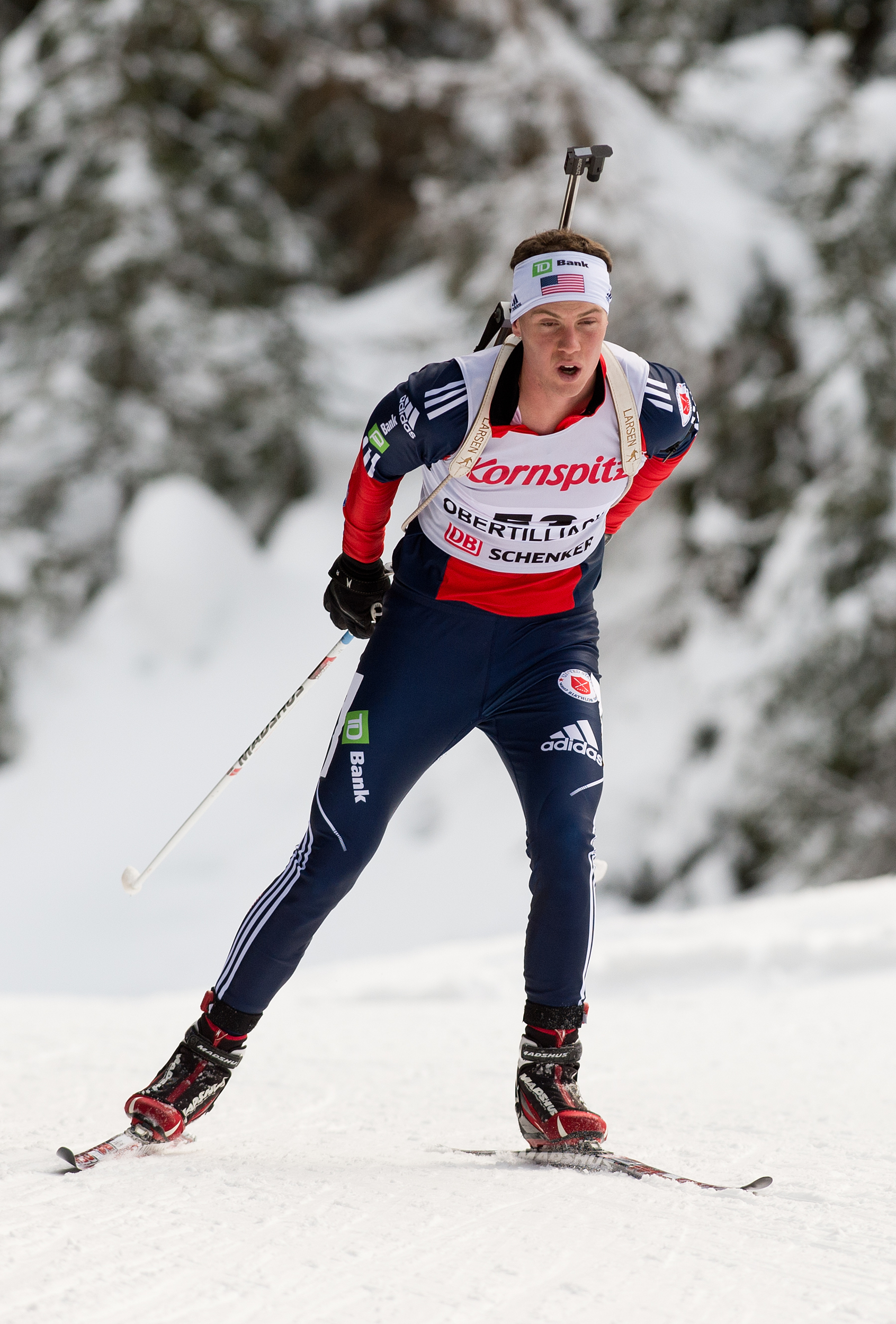
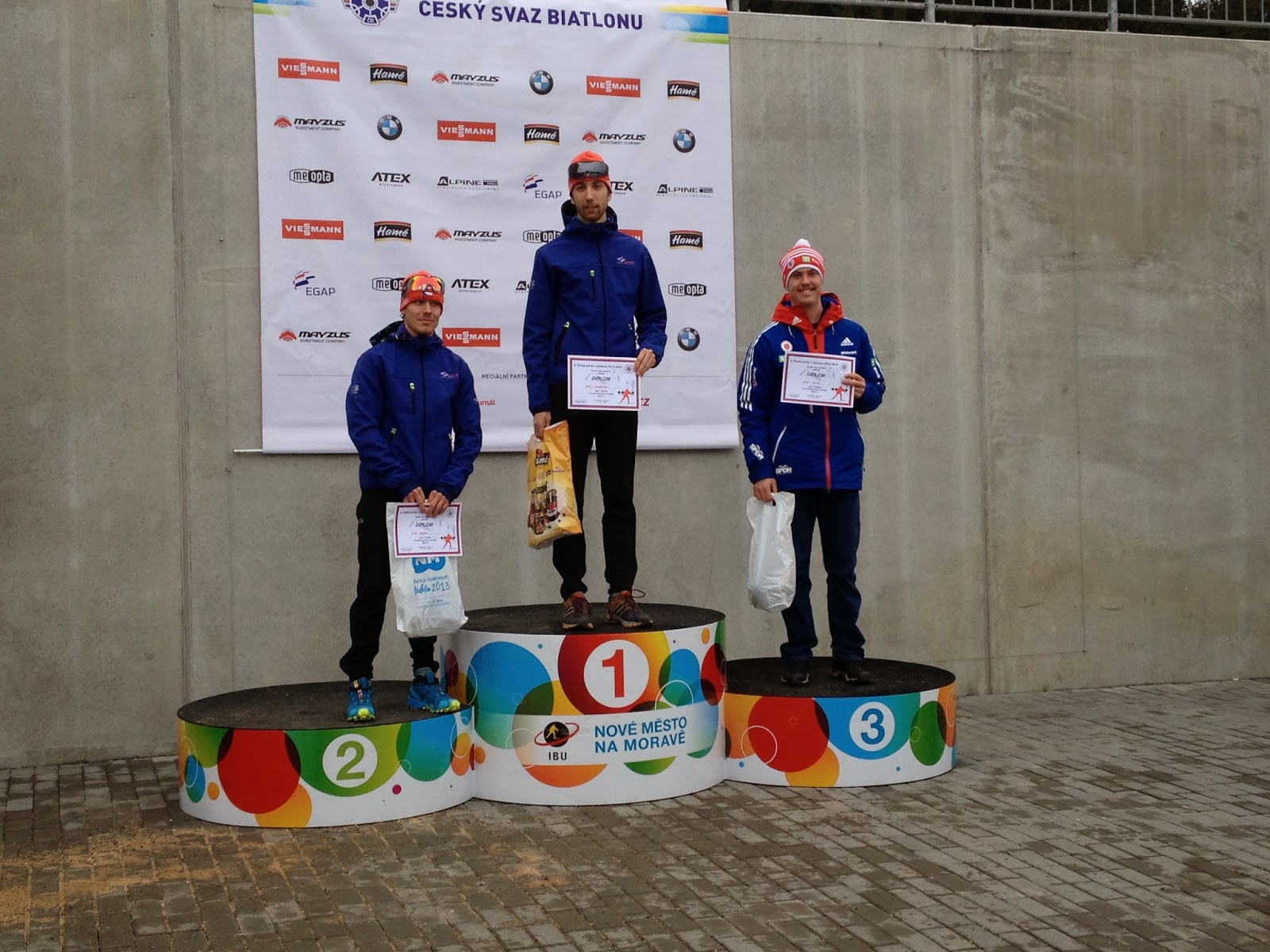
Casey Smith (right) on the podium at a Czech Cup biathlon race in 2014. (Courtesy photo)
Joanne Reid of Colorado Biathlon racing at IBU Cup trials in December in Canmore, Alberta. (Courtesy photo)
After bringing only part of their team to the first World Cup weekend in Ruhpolding, Germany, the U.S. Biathlon Association has promoted two athletes from the second-tier IBU Cup to come compete at the highest level and fill out their relay rosters.
For one the move is no surprise: Leif Nordgren, a World Cup veteran who had strong early-season races but struggled once the World Cup began. After a bounce back to the IBU Cup where he finished 25th twice, he’s ready to try again.
Leif Nordgren (US Biathlon) racing to 19th place in the sprint in Sjusjøen, Norway, in December. “For the whole first trimester I felt like I was struggling [with skiing], Nordgren wrote in an email. “It’s a new year now… there’s a lot of season left and we’re not even into the most important races yet! I’ll just be looking to improve from the beginning of the season and hopefully things will fall into place.” (Photo: Jonne Kähkönen)“I had come into the season really strong but maybe a little too far along in process and was starting to come down off a peak,” Nordgren wrote in an email. “Of course it’s always a bummer to miss a World Cup weekend, but I wasn’t overly disappointed. The course in Nove Mesto is probably my favorite track that we race on, and the atmosphere is very relaxed on the IBU Cup, so sometimes its nice to go back and just have fun.”
Joining him on the trip from Nove Mesto, Czech Republic, to Ruhpolding was an athlete with a very different backstory: Joanne Reid, a California native and NCAA Champion skier who is finishing her masters degree at the University of Colorado in Boulder, in the ATLAS program for technology, media, and society.
Reid’s World Cup start on Thursday in the 15 k individual will be her first. It will also be just her eighth biathlon race, ever. She started shooting in August.
“It has been a really short, quick adventure,” Reid laughed in a phone interview on Tuesday. “This year I just wanted to go to IBU Cup trials and see what happened.”
Reid took a year off after graduating from the CU bachelors program in 2013, then resumed training in 2014 but not at a full-time capacity while she worked on her masters. Still, she earned a nod to the U.S. Ski Team’s squad for Under-23 World Championships, where she was the top American skier in both the 10 k skate and the 15 k skiathlon.
“I definitely needed the year off that I took,” Reid said.
When her family found themselves in possession of a biathlon rifle, something clicked in Reid’s head.
Reid training on the range in Canmore. (Courtesy photo)
“My grandfather, who was diagnosed with Alzheimers a couple years ago, had a biathlon rifle that he got when he was a master,” she explained. “It was repossessed because you can’t have a firearm if you have Alzheimers. It passed into my family, so I got my hands on this biathlon rifle. And I don’t particularly like to sprint, and I don’t particularly like to classic ski. So it was kind of like all the pieces fell together for me and I just went for it.”
Over the summer, Reid got in touch with the U.S. national team.
“I met up with her in Colorado Springs to discuss this and find a way to help her get started,” Chief of Sport Bernd Eisenbichler wrote in an email. “Obviously the interest from my side was huge to get her over to biathlon, because she has the skiing performance level we look for. I was impressed at the first meeting, as she already had organized a rifle and a laser shooting system to train with and was highly motivated to get started as a biathlete.”
Reid quickly found plenty of support: from the Auburn Ski Club biathlon program when she was home in California, from Colorado Biathlon when she was at school, and from the national team, who invited her twice to train in Lake Placid with Head Development Coach Jean Paquet and his group.
“Everyone in the entire community is just so great, and so excited for up-and-coming biathletes that they just really want to help you,” Reid said. “So the problem isn’t finding people to help you, it’s filtering through the giant mass of information coming at you. But for the most part it has been the national team who have really stepped up for me, really helped me and taken me under their wing and taught me all the important things, like how you get the rifle back on your back after shooting.”
After IBU Cup trials in Canmore, Alberta, Reid found herself on the team. Then when she got to Nove Mesto, she finished 16th with a single penalty in her first race, then followed that up with a clean-shooting 23rd-place finish in the second.
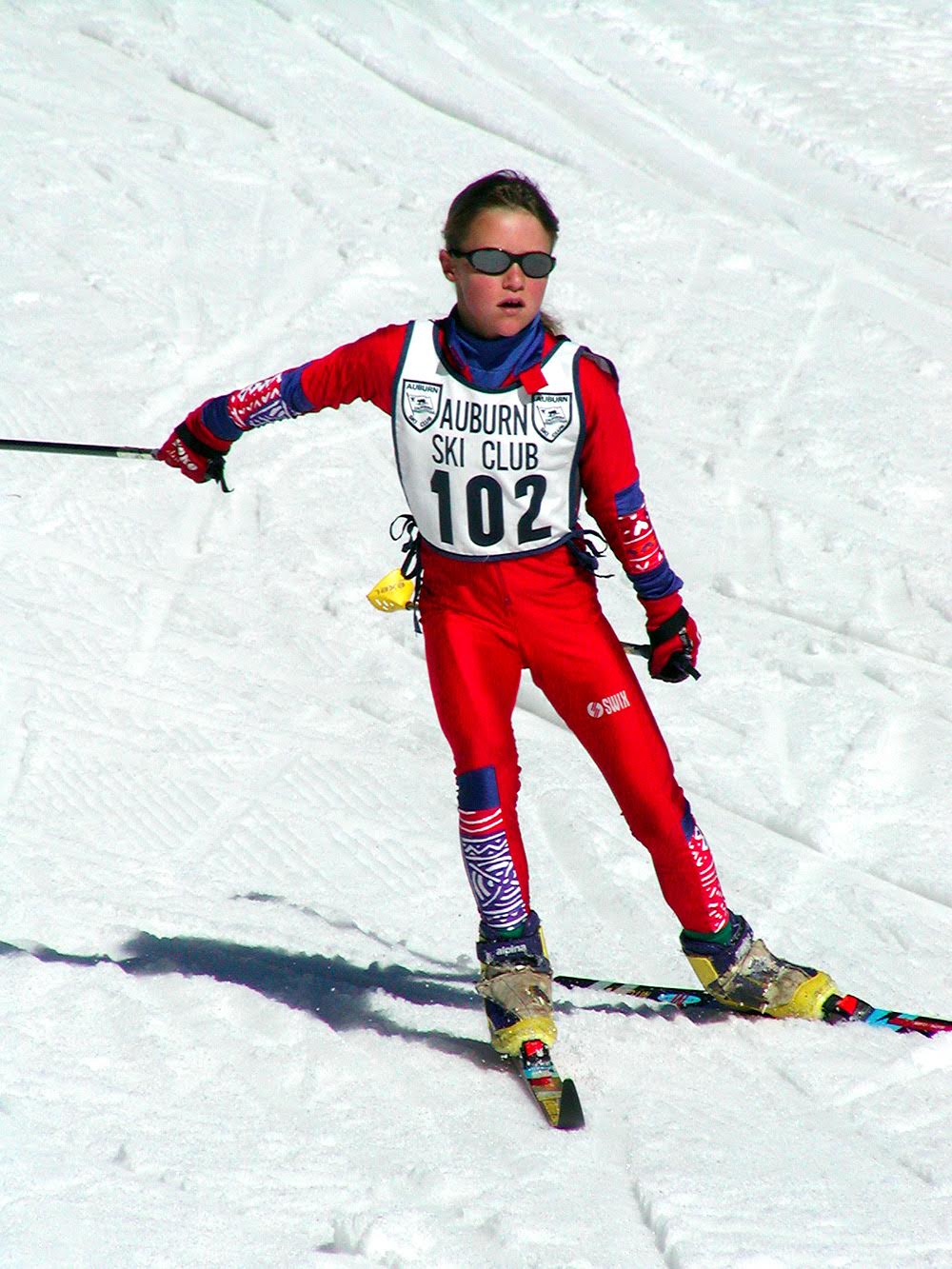
Reid at an Auburn Ski Club race in 2002 – which photographer Mark Nadell reports was even a biathlon race. (Photo: Mark Nadell/MacBeth Graphics)
“It was so fun,” Reid gushed. “And it was really great to start out there, in Nove Mesto, because it’s somewhere that I’ve raced before. So the course was at least familiar- the layout of where the stadium is, where the range is, and that helped a lot. I’m also just not a person that gets easily flustered or really nervous. So that has been really helpful as I have been trying to learn biathlon.”
In fact, the promise that Eisenbichler and his staff saw in Reid doesn’t have to do only with her ski speed, but also with her mental attitude.
Her approach to racing might be perfect for biathlon.
“I tend to be a very rational skier,” Reid said. “That’s really important in biathlon because you have to remember all the little pieces, you can’t forget anything. You have to come into the range with a really cool head and be very focused.”
Reid still has plenty to learn though, and at the time of this interview her rifle was in pieces after it stopped working in morning training.
“I’m having an exciting time trying to repair my rifle because it’s old and full of a lot of weird parts that my dad built for me,” Reid explained. “None of the mechanics have ever seen anything like it and they don’t know how to put it together! And I don’t even know how to take the barrel off my rifle yet.”
Over the holidays, Reid won Paco’s Fun Race, a 10 k skate on her home turf at Auburn Ski Club. (Photo: Mark Nadell/MacBeth Graphics)
The stock needed to have a riser block – the piece where right-handed biathletes place their left hand while shooting – added, and it has an older style magazine holder which slows things down.
But it obviously shoots straight, and, Reid said, “It’s mine!”
When her family got the rifle, her mother, speedskating Olympian Beth Reid, decided to give it a name. Because of its provenance she settled on “Forget-Me-Not.”
“The flowers are woodburned, by her, all along the stock, as well as the word forget-me-not,” Reid wrote in a later message. “Equipment check counted it as a sponsor on my rifle and made me tape over one of the Anschutz labels. I tried to explain it’s just a flower, but hey, they’re German.”
A very strict equipment check? That’s just one of the new things Reid will encounter on the World Cup.
“Usually a rookie in biathlon should stay a little longer first on the IBU Cup to gain more international experience there before being promoted to the World Cup,” Eisenbichler said. “But in her case and with these performances compared to the other American starters, we had and wanted to take her, knowing that she is still here for learning and development and improvement work even between the World Cup races. The coaches have a good plan for that.”
Reid has been selected for both Ruhpolding and the next weekend’s World Cups in Antholz, Italy, and an additional U.S. woman may or may not be called up for Antholz as well.
And once the racing begins on Thursday, in one of the most packed venues on the whole World Cup circuit (you can hear audio of the stadium here), what’s Reid’s plan?
“I’m really excited!” she laughed. “I hope I don’t miss too much. They said the range is really, really, really loud. So I hope I can just keep it together out there… It’s great to see the whole culture. It’s really inspiring and I’m absolutely thrilled.”
Charlie Kellogg skiing in Maine with the AMC alumni group the O H Association. (Photo: Doug Hotchkiss)
Bob Gray was hiking in the Sierra Nevada mountains, off the grid, when it happened. Later his phone began buzzing, and he learned that his former U.S. Ski Team teammate and friendly rival over decades and decades of races, Charles Kellogg, had passed away.
Gray was surprised. Kellogg had not been well, but the end came fast once months of excruciating pain was finally diagnosed as a malignant and fast-metastasizing sarcoma.
“It hit me hard,” the 76-year-old Vermont farmer said on the phone, still from the trail, last Saturday. “It could be me next… I miss him terribly.”
Kellogg, 75, had been one of the ties that kept Gray and the ski community together.
“It’s pretty much nose to the grindstone,” Gray said of his life at 4 Corners Farm in Newbury, Vt. “Charlie made a special effort to talk; he was always calling me up. It was great to talk to him. He would drag me out of that focused world.”
But while it’s hard for Gray, at the moment, to connect to Kellogg’s family or other friends, in a way the mountains are a poetic place for Gray to say goodbye to Kellogg, who was a longtime member of the Appalachian Mountain Club (AMC) and its alumni Old Hutsman (OH) Association, and who always made time for a ski or a hike, even if he had just flown back from a work trip to Asia.
“It’s been on my mind, these two days, just thinking about him,” Gray said. “I had nothing to do but walk and contemplate, without any distractions. It’s a pretty emotional moment for me.”
The Storyline
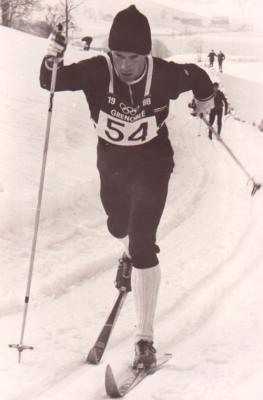
Kellogg competing at the 1968 Olympics in Grenoble, France. (Photo: US Biathlon Association)
Kellogg, a 1968 Olympian in cross-country skiing and a national champion, died a week ago on Sept. 21. Known as “Chuck” or “Spike” to some friends, Kellogg was an integral member of the nordic community, a mentor and friendly face to many on the trails.
As noted in his U.S. Biathlon Hall of Fame induction description, Kellogg wasn’t obviously bound for skiing glory from day one. But the guy who grew up primarily in Andover and Brookline, Mass., picked up skiing at Holderness Academy a few hours north in New Hampshire and never looked back.
And so perhaps his first impact on the sport was as the fast racer everyone was chasing: in college races for Williams College, then as he took up biathlon and eventually won a national championship in 1965, and then still as he competed as a cross-country skier in the Olympics and raced as a member of the U.S. Ski Team (USST).
“He was one of a group of half a dozen guys who I would describe as the early generation of capable international-caliber nordic skiers in this country,” said John Morton, an Olympian and coach. “There were a couple of individuals who preceded them, but… I remember when I was on the U.S. ‘B’ team, and those guys set the standard, and the rest of us just desperately tried to keep up.”
Gray remembers a relay race in Reit im Winkl, Germany, in 1968.
“Charlie came in in the lead, and Jack [Lufkin] kept it, and I was able to hold on – we won a relay race in Europe,” Gray marvels. “It was amazing. Everybody was going crazy over there. It was kind of unusual for an American team to win a relay.”
Kellogg’s race career never really ended. In 1998 he won a World Masters Championship in Lake Placid, N.Y.
There, too, Gray was Kellogg’s teammate.
“Neither he nor I had very good points,” Gray remembers. “We started in the back. But we both had incredible skis so together we made up to the front through 80 people. All of a sudden we were in the lead. I couldn’t hold it up – Charlie went on to win. He’s a great skater! Talk about tough competition, that’s the best of the best. I know he was very proud of that.”
Kellogg never boasted about his success, and not all of his friends were familiar with the details of his ski career. But it’s possible to be humble and proud at the same time, and Kellogg was.
“He was very proud of his achievements,” said Doug Hotchkiss, a friend from near Kellogg’s home in Massachussetts who was part of a nonprofit board and also the O H Association with Kellogg. “Of course, he was very modest, so you would never know it unless you asked him about it. But then it was clear.”
No matter which year you ask about, his friends and teammates will tell you that he was a great guy to be around. Kellogg was a role model for how to balance a job, a family, and high-level training.
“I always admired and was continuously impressed with how Charlie was able to balance his training at a high level while working full time for IBM and fulfilling his responsibilities and obligations as a husband and a father,” USST teammate Mike Elliott wrote in an email. “In the late 60s, there just were not many athletes who could do that successfully.”
“He was disciplined and a very tough athlete,” Gray agreed. “But just a real pleasure to go head to head with.”
Kellogg never stopped skiing – this year he competed in the White Mountain Classic in Jackson, N.H., and earned an age-group podium in the 10 kilometer at Masters National Championships in Craftsbury, Vt. – but as he grew older he also bettered the ski community in other ways.
His expertise as a board member was so impressive that a group of biathletes in 2006 lobbied hard for him to be elected vice chairman of the United States Biathlon Association (USBA).
“While most countries were increasing staff numbers, sponsors, and athlete support, many of us felt that USBA was headed in the opposite direction,” Lowell Bailey, one of the signatories on an open letter before the election, wrote in an email. “Charlie represented one of the new faces that we felt could help facilitate and oversee the difficult changes that USBA would need to undertake in order to remain competitive internationally.”
Kellogg, who worked in sales at IBM and later at Global Partners, had a knack for business and nonprofit interactions. He was described by colleagues in three different organizations as a model board member. Besides his help with USBA, he was also the president of the Manchester Essex Conservation Trust near his home in Massachussetts, and a board member of the Jackson Ski Touring Foundation, where he and his wife had recently bought a condominium.
How did he manage it all – these many tasks and passions which added up to more than most people could handle?
“He was hyperactive is what he was!” Hotchkiss remarked with a laugh. “But he loved it.”
And people loved Kellogg.
“We had a regularly-scheduled board meeting this week, and all of us were thinking how much we’re going to miss Charlie,” said Ken Kimball, a friend on the Jackson Ski Touring Foundation board.
The Hutsman
Before he became a full-time skier, Kellogg started working in the AMC huts. At just 16 years old, he spent his first season at Lake of the Clouds on Mount Washington in New Hampshire. Soon he was the hut manager.
His legend preceded him, said Hotchkiss, who didn’t actually meet Kellogg until later.
“Everything I ever saw him do, he led by example, not by being loud and boisterous and carrying a big stick,” Hotchkiss recalled. “I had heard of Charlie and seen that he had all kinds of records for speed hiking. In those days we kept records of the macho things – it was all boys working in the huts then, no women. It was how much weight you could pack, how fast you could go, all of that. That was the measuring stick amongst guys. How many dishes you could wash in as short a time as possible, how big a pancake you could make. Part of the fun of working in huts was bringing the crew together.”
When U.S. Supreme Court Chief Justice William O. Douglas visited Lake of the Clouds in 1960 with a National Geographic camera crew in tow, Kellogg was managing the hut. He ended up in photos in the magazine. He was 20 years old.
Working in the huts was fun and gave Kellogg a chance to stretch his legs. But working on Mount Washington, home to some of the most extreme weather on earth, was also serious. Kellogg wrote in a recent O H Association newsletter of going out in a gale to find and retrieve the bodies of two young hikers who had perished, dressed only in cotton.
“Of course the terrible visibility contributed to [a lack of volunteers] and the wind was keeping people inside their respective buildings where they plied their trade, such as TV broadcasting, checking weather or testing jet engines,” Kellogg wrote.
Weather didn’t keep him or his friend Greg Prentiss inside, of course.
The ties he forged, to other hutsmen, hikers, and the mountains themselves, stayed strong. Kellogg also worked as a mountain guide in the Grand Tetons at one point, and trekked in Nepal.
Hotchkiss soon met him again, this time in earnest.
“In 1978 when another Old Hutman and I showed up near Jasper in the Canadian Rockies to do a randonée ski trip,” Hotchkiss said. “We were flown back into a remote camp by helicopter, and then for a week we spent every day climbing up with skis with skins, and descending. Charlie was there with his wife and his brother-in-law and his wife’s sister. And so there were six of us who were connected, but we didn’t know they would be there!”
After a day of skinning up thousands of feet, taking a few runs, and then descending to camp, Hotchkiss was usually looking for “an ibuprofen and a beer.”
Not Kellogg or his wife, Gillian.
“Charlie and Gillian would put on their cross-country skis and go out for more skiing on the frozen lake,” Hotchkiss said. “Every day! And then be ready to go the next morning.”
While Kellogg spent a decade racing at the top levels of national and international competition, he was also just as happy going out on the trails with friends who hadn’t been elite athletes. He and Hotchkiss went on several O H Association trips to Maine, where groups of hutsmen and women could ski from the Little Lyford Ponds lodges.
“He was always miles ahead of everybody,” Hotchkiss said. “I’m sure you’ve been hiking with a dog, where the dog goes bolting ahead and eventually will return. That was Charlie’s method.”
While racing was something he loved – Gray and Morton both recalled that Kellogg would never, ever, let it go in a sprint finish, even after a marathon distance spent going together – non-competitive pursuits were also key.
“A lot of athletes, they have their competitive life and then they move on to something else,” Morton said. “They may be nostalgic about the old days, when they were in shape and could do the Presidential Traverse in a single day. Charlie Kellogg kept at it. He probably up until relatively recently could still do a Presidential Traverse in one day, and look forward to it.”
Kellogg was a lifelong steward of ski and hiking trails, as well, not just maintaining AMC trails or those at the Manchester Essex Conservation Trust, but then later in Jackson.
“As we looked at new trail configurations he’d be out in the field skiing around trying to find a new route,” said Ken Kimball of his time with Kellogg in Jackson.
“He was always miles ahead of everybody. I’m sure you’ve been hiking with a dog, where the dog goes bolting ahead and eventually will return. That was Charlie’s method.” — Doug Hotchkiss, friend of Charlie Kellogg
The Racer
After five summers of training on Mount Washington, in a systematized way or not, Kellogg was beginning to turn heads on the Eastern college circuit. By his senior year at Williams, in 1962, he was the captain of the team.
The next year, he headed to Alaska to join the Modern Winter Biathlon Team at Fort Richardson to fulfill his Army service. During the war, men like Peter Hale, Terry Aldrich, Dennis Donahue, Bill Spencer, and John Morton paid their dues at Fort Richardson, although not all overlapped with Kellogg.
“He said it was great,” laughed Hotchkiss. “He got to ski every day!”
In 1964 Kellogg went to Fairbanks for the Equinox Marathon, which his biathlon teammate Jerry Varnum won, while Kellogg was second. The Fort Richardson program was already a few years old at that point, but it was close to Anchorage, not Fairbanks. The pair’s exploits led the Fairbanks Daily News-Miner to write a blurb, “What does biathlon mean?”
Kellogg represented the U.S. in international competition including in Östersund, Sweden, where he was the top American finisher at the 1964 World Military Championships.
After leaving the Fort Richardson program, Kellogg went back to straight skiing.
“Charlie was very serious in training and when studying the sport of cross-country skiing,” Elliott wrote. “I have nothing but fond memories of my experience of training and racing with Charlie. John Caldwell, as the USST Coach, organized ski team members for running and hiking the length of the Long Trail in summer of 1969. Pictures of that experience shows a bunch of lean fit young men. On that trip were John Caldwell, Peter Davis, Everett Dunklee, Mike Gallagher, Tom Corbin, Ned Gillette, Bob Gray, Charlie Kellogg, Jack Lufkin, and myself, Mike Elliott.”
Gray, too, remembers that trip well – and the crew that went with it.
“It raised a lot of awareness for the team,” said Gray, noting that the men would come off the trail and have dinner or drinks with communities in the local towns every night. “The U.S. Ski Team was gaining ground. A few years later, it was Bill Koch. We were sort of the foundation.”
Elliott said that Kellogg was one of the smartest guys on the team: after eventually making the Olympics, he went to the Tuck Business School at Dartmouth. His LinkedIn profile lists “the Shakespearian authorship question” as a hobby.
And that cerebral nature also came through in sport. Kimball, who would later work and ski with Kellogg in Jackson, remembers meeting him for one of the first times at an Eastern ski race around 1970.
“I was at a race at the Swedish Ski Club in Vermont, and I was just coaxing my just-married wife to also start cross-country skiing,” Kimball said. “That was in the day when race courses were quite snowshoed-out, quite different than today. Here’s a guy out talking about snow crystals and how they penetrated different kinds of waxes. In that day that was all very new and scientific and the rest of us were wondering what this guy was really talking about. But obviously his results showed what he was talking about! That was my introduction to Charlie.”
Kellogg was clearly a leader on the trails.
“The most accurate way to sum it up would be to say that I was in some of the same races that Charlie was in,” said Kimball, who had raced in college and was continuing while he went to graduate school.
But racing was no easy task in those days.
“I was on the U.S. Ski Team for 14 years,” Gray said. “By the last year, they began to have some kind of payments, but I think it was 1500 dollars. To be able to train year round – I didn’t do that until 1970, even then it was hard. By the time I left the team in 1974 I was broke. I mean broke.”
Yet Kellogg held it all together, seemingly.
“When Charlie was racing, you really had to have a second job to stay alive,” Kimball said. “It wasn’t like today where you are a professional or semi-professional athlete. He was like everybody else: you had something else that was a major part of your life to sustain your family and your income, which meant that you really had to have a love for the sport to continue to participate at a high level. He obviously sustained that for quite a while.”
The Board Member
While continuing to ski, run, hike, and bike for fun, Kellogg also transitioned to professional life. After going to the Tuck School and working for IBM and Global Partners, his personality and skills came to be in great demand in the nonprofit world.
Hence that letter, which was signed by biathletes Bailey, Tracy and Lanny Barnes, Jeremy Teela, and Tim Burke. Of the four paragraphs dedicated to lobbying for five different nominees, fully half of that text was devoted to Kellogg.
“As Vice President Mr. Kellogg would support new fundraising initiatives and help USBA gain the necessary resources to reach a medal at the 2010 Vancouver Olympics,” they wrote at the time. “As a successful professional fundraiser, he understands the fine points of generating financial stability within an organization. The new Vice Chairman must be business savvy, but also possess an adequate knowledge of our sport. Charlie Kellogg is more than qualified in both respects.”
Kellogg more than delivered once he was elected, according to the biathlon community.
“What struck me most about working with Charlie was the thoughtfulness with which he promoted biathlon and cross-country skiing at both the elite and recreational levels,” Walt Shepard, a former biathlete who was an athlete representative, wrote in an email. “His love for the sport — coupled with his serious credentials as a former Olympian — inspired enthusiasm from folks in both camps. More than anything, he was just a great guy to have a conversation with. He was very interested in getting to know people, and I really appreciated that about him.”
“More than anything, he was just a great guy to have a conversation with. He was very interested in getting to know people, and I really appreciated that about him.” — Walt Shepard, former biathlete and athlete representative
Bailey agreed.
“[Kellogg] was at the core of a group of newly elected board members and staff who ushered in a new chapter in USBA’s history,” Bailey wrote in an email. “In many people’s eyes this is the period where USBA went from an ‘also ran’ to a legitimate medal contender on the world stage… Perhaps more impressive was Charlie’s genuine love of our sport and the athletes and staff of USBA. I considered him not only a crucial member of our US Biathlon Team, but more importantly, a friend who cared about my life both as an athlete and a human being.”
It was after the election of Kellogg and other new board members that Burke and Teela hit the World Cup podium for the first time, and then in 2014 Bailey and Susan Dunklee did as well.
“He was on the board during a time of probably the most dramatic advancement of the sport in America, and the most success for our program and our athletes,” Morton said. “He was part of the leadership which has allowed our team – we’d had individual athletes, but certainly never more than one or two – that so consistently were in a position to be on the podium. He was part of putting that program together, and probably more importantly, securing the funding.”
In the nonprofit world, moving towards decisions and policies can be a painstaking process if a board of directors is fractured. Kellogg proved to be adept at advocating not only for his own ideas, but for forward progress.
“He seemed impatient, but he somehow was able to show patience,” Hotchkiss said. “When you’re working for nonprofits it’s more of a consensus-based decision. He had a real talent for moving groups towards that.”
“He was a very good board member,” agreed Kimball. “I’ve served on a number of boards and some people are just warming a seat, but others really join in and participate. Charlie was one of the latter.”
Kimball said that Kellogg was particularly good at understanding the challenges Jackson faced, given that many of their trails are situated on private land which makes further development impossible.
“Charlie was also very good at bringing up his ideas constructively with the board, and pushing his ideas forward, and also trying to make them happen,” Kimball said. “A lot of people are willing to just spit out ideas and hope that someone else will pick up and do all the work. That’s not how I would label Charlie. He was also willing, if people disagreed with him, to accept that as well. It was a real pleasure to work with him.”
So both at the national and the local level, the ski community was lucky to benefit from Kellogg’s devotion.
“Charlie has paid it forward by paving the way for so many others that have come after him,” Elliott wrote.
The End
Hotchkiss was around this summer as Kellogg’s pain got worse. It was months before the sarcoma was diagnosed as the underlying problem, but Hotchkiss knew Kellogg was in trouble when he took the short route home during a trail-clearing day for the conservation group.
“That was completely unlike him,” said Hotchkiss, who added that he could never imagine how Kellogg, who was outside at every possible moment, ever held a desk job.
By August, Kellogg was in the hospital and had to miss Lake of the Clouds’ 100th birthday party, an O H Association event he had been looking forward to.
“I did get a book of pictures of Mount Washington, and a lot of his friends signed it and put comments it,” Hotchkiss said. “That’s the kind of association we have. We all stick together. I brought it back, and he seemed to enjoy going through that and reading the notes from people who were up there.”
Others are left looking back at particularly fond memories of their friend.
“When the UNH Carnival was up here, there was a race for old codgers like Charlie and myself, and we all went out and did our one or two kilometer loop,” Kimball said. “When you ski with Charlie, he always had a big grin on his face. He’s just a good person to be around.”
***
To honor Kellogg, donations may be sent to two organizations he devoted so much time to:the Charlie Kellogg Memorial Funds at the Manchester Essex Conservation Trust, P.O. Box 1486, Manchester, MA 01944 or at the Jackson Ski Touring Foundation, P.O. Box 216, Jackson, NH 03846.
Do you have any memories of Kellogg to share? Please write them in the comments below.
The post-Olympic funding announcements have come and gone, and while few sports see an increase at the end of a quadrennial cycle, some are hit harder than others. The U.S. Biathlon Association (USBA) isn’t one of them.
“We ended up being well-supported by the U.S. Olympic Committee,” USBA CEO Max Cobb told FasterSkier. “We didn’t end up getting exactly what we asked for, but the support from them remains really strong. That’s incredibly – it’s very important for us, to continue all of our programs.”
The American national team had a strong season last year, placing three different athletes on the World Cup podium. But nobody feels safe going into funding deliberations, Cobb said, implying that this might be particularly true for smaller sports.
“It’s a huge relief,” he said. “You never know, when a quad comes to an end, how the funding will be for the beginning of the next quad. So we’re incredibly grateful for this partnership with the USOC. We feel really good about how this has just improved every single year.”
USBA also has another trick up its sleeve: the U.S. Biathlon Foundation, a fundraising arm which contributed roughly $90,000 to USBA in 2012 (2013 tax documents are not yet available from Guidestar). USBA is also kicking off the new quad in style with its foundation, which is hosting a golf fundraiser at the end of the month in Ipswich, Massachusetts.
“It wil be hosted by Mark Burton, the chairman of our foundation, and Ray Bourque, one of our foundation trustees,” Cobb said. “Lowell, Tim, Susan, and Hannah are for sure coming, and maybe a couple of other athletes as well. The foundation continues to be a really important part of our overall program, and gives us extra resources we need to be able to run a strong program.”
Cobb, who besides his work at USBA also has a volunteer role as the head of the International Biathlon Union’s Technical Committee, says that he’s had to sink a not insignificant amount of time into getting the foundation going: “from a time management standpoint, it’s a lot of work.” There’s plenty for him to do already at the office without even getting into this new venture – but it’s worth it.
“I think every sport CEO or Executive Director has to devote a lot of time to generating resources,” he said. “I really enjoy all the time I spend with foundation trustees, because they are just super people, and they are very enthusiastic about our team. It’s great to see that. So it has always been fun.”
The USOC recently gave USBA an organizational development grant to hire an assistant, Audrey Chapman, to help with the Foundation work. That, Cobb said, has been another relief and will help the group do even more in the future.
As it stands, a single golf fundraiser like the one to be held in Massachusetts can generate considerable resources for the organization.
“In the past they have raised anywhere from $25,000 to $60,000,” Cobb said.
It’s very hard to predict. It’s a significant amount of our fundraising, for sure.”
After World Cup podium performances from Lowell Bailey (above), Tim Burke, and Susan Dunklee, the US Olympic Committee rewarded biathlon with relatively strong support in the post-Olympic year. (Photo: USBA/Nordic Focus)
Besides the actual money, it’s fostering relationships between donors and athletes that make these events a success, Cobb said, and hopefully one that will extend into the future.
“It’s a nice chance to get people together with the athletes in an environment that isn’t freezing cold, and the athletes are enjoying a beautiful day and a beautiful place and aren’t under any pressure, so it’s very different than meeting up at a World Cup,” he explained. “And the nice thing is, it’s a chance for us to bring people from outside our circle to meet the athletes and hear about the sport. It’s a good opportunity to spread the word about what we’re doing and perhaps find some more people who want to help support us.”
Between support from USOC and the foundation, Cobb says that USBA will be able to continue its programs unchecked this year and spur further success.
“It will allow us to do the right things with the national team over the course of the next year without any compromised,” he said.
That includes a summer training camp in Scandinavia which will send three athletes to the annual Blink rollerski festival in Norway for the first time, as well as allow the women’s team to train alongside Kaisa Makarainen of Finland, a two-time World Cup overall champion.
“In general, Bernd Eisenbichler and the coaches have tried to put together more opportunities and more side-by-side training with other top athletes from around the world,” he said. “And that has been well-received on both sides. The very positive side is that the Europeans are psyched to train with us as well.”
This winter, New Hampshire native Sean Doherty (c) upped his World Youth Championships medal total from three to six in two years, including this gold in the pursuit. He and other young athletes will be receiving more attention from USBA than in the past. (Photo: Katrina Howe)
Lots of federations make changes following an Olympic year – just look at the spate of coaching replacements around Europe, or the structural shifts which are ongoing at Cross Country Canada – but the U.S. Biathlon Association (USBA) is up for some particularly big moves this season.
The most visible differences are an expanded national team system, with both a development team (currently consisting of two athletes) and an “X” team of two juniors who have already had international success. Those efforts are already started: Maddie Phaneuf, a Maine Winter Sports Center athlete who placed fourth in the youth sprint at this past season’s World Championships, has already moved to Lake Placid.
Another visible change comes in the form of a “tryout” camp for elite junior and senior cross-country skiers to test their skills in biathlon and get introduced to the national team system. That, too, is already underway; USBA CEO Max Cobb said that 12 athletes will be invited to the camp, and “it’s a variety of different ages but we were impressed with the quality of the athletes.”
However, these developments are just the most noticeable and well-promoted symptoms of a deep underlying change at USBA. Cobb and the other staff have been hoping for years to reinvest in a development program, which had been almost completely lacking in the last Olympic cycle. This season, they are finally making it happen.
“I think it was a combination of being able to recognize that we could run our national team program with slightly less resources and still be really effective, especially the year after the Olympics when we don’t have so many special projects in the works, and feeling more confident that our sponsorship and fundraising are more solid and are a more predictable resource for us,” Cobb said in an interview on Wednesday.
The senior national team is small and, with the exception of new addition Casey Smith, consists entirely of athletes who competed in Sochi. Only the six “A” team athletes will be based in Lake Placid, while “B” team athletes are housed at the Maine Winter Sports Center. Having a small, experienced team and no Games to focus on has freed up resources (for instance, in 2012 USBA spent $1.6 million on the national team compared to $365,000 on development, according to the IRS 990 form).
It has also freed up some of the coaching staff’s energy. National team staff will now be involved in the development program instead of only the high performance program. For instance, take Bernd Eisenbichler. The German has been the High Performance Director for the national team for years, but this year has a new title: Chief of Sport.
“In that role, he now has oversight for all the athlete development program as well,” Cobb explained. “That was not part of his scope before now. We’re really excited about that. It gives him a new and fresh challenge, and he’s able now with the stability we have on the national team to manage both of those projects in a really productive way.”
Indeed, Eisenbichler was very enthusiastic about the development programs when reached in Bend a few weeks ago.
“I’m really excited about that, and a big reason why I’m staying with U.S. biathlon is that we have now combined the development system with the high performance system,” Eisenbichler said. “I want to see it. It’s really important that we have one philosophy in training and speak one language for the pipeline so that they can go through it and understand it. I think that was a very necessary step, and it’s a very exciting and a good step.”
Eisenbichler was involved with choosing the direction and the athletes for the development and X teams, and discussed the rationale slightly. With only a few athletes, the X team will be a small training group. That could lead to isolation or burnout of young athletes, but Eisenbichler believed that it was the right approach – and that the squads should expand in the future.
“The aim is to put our recruiting and development effort to a new stage, and through that get more people into the system,” he explained. “For me it doesn’t make sense just to put up numbers if we are not thinking that the level is high enough. This will hurt some people, but we have to be honest. The international level is as high as it has ever been… In fact, in the end, it’s not the best idea to put athletes in the situation where they are overwhelmed by the training load or the training partners. They have to be ready for the level they are getting called to. I think we did that really well this year and I hope that it will get bigger.”
Besides focusing on promising athletes, USBA will also be investing more effort and resources into its regional development structure, including clubs and coaches. As the national team convened in Lake Placid during the first week of May, so did another group.
“We started off with the first regional coach seminar that we’ve done in a long time, and I think we had ten or eleven coaches from Alaska to Maine there,” Cobb said.
Among the participants were recent national team retirees (and several-time Olympians) Sara Studebaker and Jeremy Teela, which Cobb was particularly pleased about.
“It’s great to see those retired athletes wanting to immediately come back and remain active in the sport as a coach,” he said. “And [former national-teamer] Zach Hall has already established himself as a coach up in Anchorage.”
The group had the chance to meet with Eisenbichler and national team coaches Jonne Kähkönen and Jonas Johansson and talk about the larger direction of development for U.S. biathletes.
“We had a meeting with our most important coaches in Lake Placid and overall I think it’s absolutely the right step for a small NGB like ours,” Eisenbichler said. “We cannot go different ways with development. The team must be one. That’s really what it’s about.”
Some efforts to involve the clubs will remain the same as they have always been, for example a weeklong camp in Jericho, Vermont, in August which features North American Rollerski Biathlon Championships. But USBA is also looking for the top regional clubs to host more outreach camps for young racers who have not yet reached the elite level of biathlon. He noted that across the country, such events are already on the schedule (which you can find here).
Cobb hopes that the sum and total of all of these efforts would be a stronger U.S. system in the future, noting that the vast majority of 2014 Olympians benefitted from such efforts earlier in their own careers.
“It was really inspiring to see the pressure from the current national team, saying, ‘you guys have got to do more for development’,” Cobb said. “Saying, ‘when we were young athletes there were programs for us, and that needs to happen again.’ It was really comforting to hear that and it’s a good sign that everyone sees this as a great step forward for us.”
But all of that takes capital, which is one thing which remains problematic for USBA. The Boston-based financial firm State Street is a title sponsor, which Cobb said increased stability, and the U.S. Biathlon Foundation has also changed the fundraising landscape. In 2012, the foundation had a total revenue of $131,000. Still, Cobb said, “financially we’re not really strong.”
Among other things, he hopes to leverage contacts, energy, and man-hours to help the country’s biathlon clubs with their own fundraising.
“The challenge for us is to try to help raise the money locally so that there are dollars behind their good intent,” he said. “So that those coaches can do it at least semi-professionally. That’s definitely a major initiative for us, is to help our regions do successful fundraising, particularly for being able to hire professional coaches.”
Overall, Cobb said, USBA knows that development works. Two of the 2014 Olympians (Studebaker and Susan Dunklee, who went on to claim her first World Cup podium a few weeks later) came into the sport during a recruitment push in 2008 and 2009; others, like Tim Burke, Lowell Bailey, Lanny Barnes, and Annelies Cook, were the product of years-long investment that had started when they were juniors. Revitalizing those programs is a no-brainer, even if it’s not easy.
“We have to really combine these different efforts because we are not in a situation like other nations where we have 20 people lined up waiting for the call for the A team,” Eisenbichler concluded.
Jay Hakkinen, Sara Studebaker, Annelies Cook, and Tim Burke pose after their sixth-place mixed relay result in Kontiolahti, Finland this season. All four athletes will return for 2012-2013. Photo: NordicFocus/USBA.
The U.S. Biathlon Association has announced its 2012-13 national team, which consists of 12 returning members and a single new nomination.
The squad is led by five Americans who achieved top-ten results on the 2012 World Cup circuit, and were rewarded with “A1” nomination: Tim Burke, Lowell Bailey, Russell Currier, Jay Hakkinen, and Susan Dunklee. In total, seven women and six men will make up next year’s national team, a slight decrease from last year’s size.
Comings and Goings
The vast majority of last year’s national team was renominated for 2013. The two departing members are Bill Bowler and Wynn Roberts; Bowler competed in several IBU Cup races this year, topping out with finishes of 29th and 26th in Canmore, while Roberts, a 2010 Olympian, did not see international action and began racing for the National Guard partway through the season.
Dreissigacker in Lake Placid, 2011.
They are replaced by Hannah Dreissigacker (Morrisville, VT), a member of the Craftsbury Green Racing Project ski team who has competed in a few biathlon races for each of the past seasons. Dreissigacker’s best ski results this year were seventh place in the skate sprint at U.S. National Championships, fifth place in the 5 k classic at Canadian Nationals, and seventh in the American Birkebeiner marathon.
In biathlon, she finished 26th in the individual race at Open European Championships in Brezno, Slovakia, and 16th at an IBU Cup sprint in Canmore. With the national team “B” nomination, Dreissigacker will make biathlon a prime focus.
“I’m excited about being named to the team!” she told FasterSkier. “I had some lows and some highs with biathlon this past year, but I’m excited that they chose to look at the potential showed in the high points. I’ve been wanting to do something different in terms of training and life in general, and so this is the perfect opportunity to keep training but to change things up a bit and get re-energized.”
The Same at the Top
None of the team’s top talent has gone anywhere, and the U.S. will likely see the same faces leading the way in the coming season.
Burke (Paul Smiths, NY) had five top-ten finishes this season, including a tenth-place result in the sprint at World Championships in Ruhpolding, Germany, and a fourth-place finish at the final sprint in Khanty-Mansiysk, Russia. Burke, who earned the overall yellow leader’s bib for a period back in 2009-10, had surgery for compartment syndrome last spring, and this was his first season back at full capacity. He finished 20th in the World Cup Total Score.
Bailey (Lake Placid, NY) was right alongside Burke all season, and eclipsed him in the Total Score, finishing 14th. Bailey had nine of the top twelve results of his career this year, including two fifth-place World Cup results from sprints in Kontiolahti, Finland and Östersund, Sweden. He also contributed several head-turning leadoff relay legs throughout the season.
Lowell Bailey in the World Championships pursuit. NordicFocus/USBA.
Burke and Bailey perhaps did the most to increase visibility for the U.S. men’s team this season, as they were near the front of mass start and pursuit races late in the game on multiple occasions and often in medal position.
Veteran Hakkinen (Kasilof, AK) was re-selected based on a ninth-place finish in the pursuit in Hochfilzen, Austria, and a 36th-place ranking in the Total Score.
Currier (Caribou, ME) is on the “A” team for the first time, after breaking through on the World Cup this year with a pair of surprise sixth-place finishes in sprints in Kontiolahti and Nove Mesto, Czech Repulbic.
He is joined by Dunklee (Barton, VT), who was elevated to “A1” status after placing fifth in the individual race at World Championships, tying the best Championships result ever by a U.S. woman. At the final series in Khanty-Mansiysk, Dunklee placed tenth in the sprint and moved up to ninth in the pursuit. She finished her first-ever World Cup season ranked 34th in the Total Score.
Several more veterans of the team were also nominated to “A” status, with Sara Studebaker (Boise, ID) receiving an “A2” nomination and Annelies Cook (Saranac Lake, NY) and Leif Nordgren (Marine on Saint Croix, MN) coming in at “A3”. All three competed at World Championships and contributed to tenth- and eleventh-place relay efforts by the men and women, respectively.
B Team: Focusing on Developing Women
Four women and one man will comprise next year’s “B” team on the basis of their results at IBU Cup competitions. They are led by three-time Olympian Jeremy Teela (Heber, UT), who finished 11th, 12th, and 13th in IBU Cup action, and Lanny Barnes (Durango, CO), a two-time Olympian who helped the women to their 11th-place relay finish at World Championships.
Laura Spector (Lennox, MA) and Corrine Malcolm (Hayward, WI) also return to the team; Spector had an off-season in 2012 after leading the team for the first half of the 2011 season and becoming the first U.S. woman to qualify for a World Cup mass start in six years. Malcolm fought injuries in 2012, her first season with the national team. The final team member is Dreissigacker.