From the FasterSkier archive — posts syndicated from athletes’ and coaches’ own blogs between 2004 and 2012, kept online as published. Current coverage is at fasterskier.com.
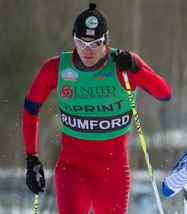
One of the most controversial ski-related narratives to come out of the U.S. in 2012 was Torin Koos’ disqualification from the classic sprint at U.S. Nationals in Rumford, Maine. It’s not every day that a race unfolds the way that one did, and in its aftermath the incident generated heated discussion in the ski community.
We revisit the incident now because video of the move has recently surfaced. Koos never denied that his skis made contact with Scott’s, but his appeal did object to the legitimacy of the jury’s evidence. He didn’t think a marshall had seen him make the move, and at the time nobody had film that clearly showed the event — until now.
Quick rehash, since it’s been a few months: Koos cut across Ryan Scott’s skis on his way to winning the classic A-final, only to be reported by a course marshall and subsequently stripped of the win for obstruction of another competitor, which is against International Ski Federation (FIS) rules. Due to a prior warning for an separate incident earlier that week, what would have been relegation to sixth place defaulted to outright disqualification. Koos appealed the decision, but FIS rejected it, and the season went on.
The above footage was taken by Corky Harrer for Revived Films, and was unearthed from the cutting room floor during work on the company’s new movie, Fact or Fiction, in the process of interviewing its producers for a forthcoming review on FasterSkier. Though grainy, the image is clear enough to see Koos change tracks and nick Scott’s skis, causing the latter to stumble.
The film’s editors, Tyler Foulkes and Mac Fisher, had to zoom in on the shot to get a decent view of the move; hence the pixelated quality. Zoomed out, the figures were too far away to make the cut in the film, and the pair scrapped it without realizing what they’d barely managed to capture.
“It happened towards the beginning of the shot — that’s why it’s pixilated, because I blew it up a bit,” Foulkes said. “We don’t usually use that part of the shot; we don’t even look at it and wait until they’re more towards the camera. So I didn’t even realize it, but once you brought it up I was like, “Well we probably have something,’ and we did. I looked towards the beginning, and it was right there.
“I wish we’d realized at the time that we had that shot.”
Seven months removed, the new evidence has no official bearing as the case has long been closed. But the video does provide a look at what, in this case, was ruled obstruction.
Torin Koos skiing in the 30 k at U.S. Nationals last week. Photo: Flying Point Road.
After less than a week of deliberation, the International Ski Federation (FIS) Appeals Committee responded to the case Torin Koos (BSF/Rossignol) filed last Monday regarding his disqualification from the classic sprint at U.S. Cross Country Championships in Rumford, ME for obstruction of competition. The Committee rejected his case for lack of sufficient evidence.
In his appeal, Koos primarily took issue with the process by which the jury disqualified him, which he interpreted as a departure from the due process outlined in the FIS International Competition Rulebook (ICR). According to Koos, he was not allowed to defend his actions from the A-final before he was informed of his disqualification, which violates rule 224.7 in the ICR.
The committee’s response cited Koos’s lack of evidence to support this claim, and in its official ruling, included counterevidence for Rumford TD Kent Slaughter that stated Koos had actually been allowed to give a defense before the jury ruled to suspend him from competition. This decision automatically resulted in disqualification, as it was the second reprimand Koos received that week.
In a written statement on Monday morning, Koos maintained that he felt his case had been a strong one, but had no choice to accept the Appeals Commission’s decision.
“I received a written letter from the U.S. Anti Doping Agency stating twenty minutes after finishing the race that the race jury had disqualified me,” wrote Koos. “The letter goes on to say this is the sole reason the lead Doping Control Officer released me from doping control. As this all happened before I was summoned to the race jury room, [BSF coaches] Tim [Baucom], Bjorn [Bakken], Dragan [Danevski] and I all felt we had independent, verified evidence that the due process ensuring an athlete the right to defend themselves had been infringed upon.
“It is apparent from the decision that FIS felt otherwise,” he continued. “I have to respect this decision.”
The day after the conclusion of racing in Rumford, Koos got on a plane to Trondheim, Norway, where he will live for the rest of the winter to train and race for the ski club based there. With the conclusion of his appeal, Koos said he wants to move on and focus on the rest of his year.
“It is over and I really look forward to the rest of the season,” he said. “I have been really appreciative of all the encouragement and support I have received, both in all the years skiing, and also with this appeals process. A special thank you has to go out to the Bridger Ski Foundation.”
Koos continued on to say he was appreciative of the work the Black Mountain volunteers put in to make the 2012 U.S. Nationals possible, which he believes is what people should remember about the week of racing in Rumford.
“At the events banquet dinner, a Chisholm ski member stood up and told a story about how Matt Pauli had paid his own way and was using up his vacation time to prepare the courses at Black Mountain,” wrote Koos. “Hearing this story was special and reminded me why being a part of the Nordic ski community is such a privilege.”
Torin Koos (BSF/Rossignol), Skyler Davis (SMS/USST) and Reese Hanneman (APU) skiing up the first hill in the semifinals of the classic sprint at U.S. Nationals. Photo: Flying Point Road.
As promised, Torin Koos (Bridger Ski Foundation/Rossignol) filed an appeal on Monday with the International Ski Federation (FIS) Appeals Commission against the the jury’s determination at the U.S. Cross Country Championships that he had obstructed competition on his way to winning the A-final of the classic sprint, which resulted in his disqualification.
Koos declined to answer specific questions about the case until the Appeals Commission comes to a decision, but confirmed that Dragan Danevski, Nordic Program Director at BSF, had submitted the appeal to the U.S. Ski and Snowboard Association (USSA) on Monday. USSA then forwarded the case to the Appeals Commission at FIS, which will review the evidence over the coming days and determine whether to uphold the jury’s decision.
In a phone interview on Tuesday, Danevski explained that Koos and the BSF coaches were contesting several aspects of the jury’s decision and course of action on Sunday in Rumford, ME. Koos does not deny that his skis made contact with MSU/Team HomeGrown’s Ryan Scott as he moved to get in the tracks in front him. Rather, he and his coaches take issue with the process by which Koos was disqualified, which in their view contained numerous departures from the proper protocol outlined in the FIS International Competition Rules (ICR).
I. The Jury Proceedings in Rumford
First and foremost, Koos is protesting the way he was notified of his infraction on Sunday. The competitoin jury issued him a written reprimand for obstruction of Scott’s skis, and according to Tim Baucom, one of two BSF coaches present in the jury room when Koos was first called in, Koos was not given the chance to defend himself before the jury disqualified him. As outlined in the FIS Cross-Country Guidelines for Jury Work, a competitor believed to have obstructed competition must be given the opportunity to explain himself before the jury can make its decision.
For Koos and his coaches, the realization that his gold medal finish was being called into question began as he waited to take to the podium. While waiting with Koos an unusually long time for the ceremony to begin, Baucom said they began hearing rumors that an issue had come up with Koos’s win. Fellow BSF coach Bjørn Bakken went to find out what the problem was, and soon radioed to Baucom that Koos was needed across the stadium in the timing building.
“We started walking over there, and Torin realized the doping control guy was no longer with him,” recalled Baucom. The classic sprint was the second testing day of the week, and U.S. Anti-Doping Agency (USADA) chaperones need to keep their designated athlete in sight at all times until the competitor is brought to testing.
Koos backtracked to bring his chaperone with him, only for the chaperone to inform Koos he had been released from doping control. “From there, Torin knew what had happened,” said Baucom. As they waited for the jury to be ready for them, they heard the men’s podium ceremony begin across the stadium without them.
In Baucom’s eyes, those two facts—that Koos was released from doping control and that the podium ceremony took place before he’d been informed of his offense—are evidence of a significant departure from the FIS jury procedural guidelines, which state that “Prior to the imposition of a penalty (except in cases of reprimands and withdrawal of accreditation according to 223.5 and 224.2), the person accused of an offence shall be given the opportunity to present a defence at a hearing, orally or in writing” (224.7).
“The fact that they pulled doping control off of him before he knew what was happening indicated [the jury] had made its decision,” said Baucom. Though official results were not signed and posted until later, he perceived that the two actions represented the jury “taking all measurable steps in that direction before Torin knew what was happening.”
Present in every part of Sunday’s jury procedures was USSA representative Allan Serrano. From his perspective, the jury at Black Mountain followed FIS-outlined procedure to the T.
Baucom’s interpretation of the jury proceedings are right, said Serrano, but the rulebook’s exception of reprimands from the requirement of jury’s to hear a defense is crucial.
“We didn’t vote to disqualify him—that’s the pertinent point,” he explained. If the jury calls for a disqualification, “that person is entitled to witness of themselves at that jury meeting. But we didn’t disqualify him, we gave him a competition suspension, and as it was his second reprimand, [it] resulted in a DQ.”
The usual result of competition suspension in a sprint heat is relegation to the back of the field—sixth place in the case of the A-final, which would have been the outcome of Sunday’s events had Friday’s 30 k infraction not also taken place beforehand. Hence, Serrano told the USADA chaperone charged with tailing the first place finisher that Koos was now in sixth, and Koos was released from doping control.
Serrano acknowledged that the doping control situation was “definitely awkward.”
As for the medal ceremony taking place before official results were posted, there is nothing unusual about that, explained Eileen Carey, one of the jury members. “It is protocol for the Championships that ceremonies can take place with preliminary results,” she said. “This was communicated at at least one of the coaches meetings, and is in the USSA rulebook.”
The rule (53.1.1) also allows the ceremony to take place for an individual-start distance race while everyone other than the early starters of the A- and B-seeds are still on the course.
II. The Jury’s Evidence
The second major part of Koos’s appeal calls into question the legitimacy of the evidence presented against him. According to Baucom, Koos and his coaches were told that (1) Serrano had been standing nearby and had heard Scott yell after Koos cut him off, (2) officials heard Koos apologize to Scott after crossing the finish line and (3) an official standing at the crossing reported to the jury that he “may have seen something happen,” said Baucom. “But [the jury] was pretty vague about what or who was seen…We didn’t get a first-hand perspective of what [the controller] had seen.”
Serrano and Carey both asserted that a course controller saw the incident first-hand, but whether the jury immediately communicated that effectively to Koos is unclear, as reports from the jury and from Baucom differ.
“He was told that [the incident] had been witnessed during the heat by a controller, and we also witnessed at the finish him acknowledging offending Ryan Scott,” said Serrano. “There’s a record of the controller’s testimony… They fill out cards on the course.”
Apart from whether a controller actually witnessed the offence, Baucom pointed out that a jury is not allowed to regard comments from competitors as evidence. The jury guidelines state that a jury can “react on reports from officially appointed controllers or jury members. A jury should not act on base of comments from athletes or team leaders” (item 6).
This rule should discount reports of Scott yelling and Koos apologizing as evidence, said Baucom.
“Anything can happen during a race that would merit an apology,” he said. “You could accidentally cut someone off; it happens.”
As for Serrano hearing Scott yell during the heat, Baucom continued, “[Scott] wasn’t yelling for a TD to say anything—that could be used as some sort of evidence. In a men’s sprint final there will be contact and some yelling; that’s the nature of the race. That’s why there are heats and not just a qualifier.”
III. The 30 k: Bib Marking of Competitors
The final segment of Koos’s appeal pertains to the written reprimand he received for starting in the wrong position during the mass start 30 k classic on Friday, which is half of the reason he was disqualified two days later under FIS’s two-strikes-and-you’re-out rule.
Koos’s confusion originated with either misremembering or being misinformed of his bib number, and since he wore the numberless green sprint leader bib for the 30 k, couldn’t check his starting position against it.
Baucom doesn’t recall whether he read Koos his correct bib number the night before the race. “It could have been my fault; it could have been a miscommunication,” Baucom said. But it shouldn’t matter, in Baucom’s view, if all competitors in the 30 k were marked with their number as he believed they should have been.
For mass start races, FIS rules state that it is “required to affix start numbers to the competitor’s thigh that is closest to the finish-line camera” (337.2.1). There were no leg numbers in Rumford; had there been, Baucom argued, Koos would have known where to start, would not have been given his first written reprimand, and at worst would have taken sixth place for his infraction in Sunday’s sprint.
Leg numbers or no, the rules also clearly say that it is the responsibility of the athlete to get to the starting line on time. Baucom acknowledged this, but thought that a verbal reprimand would perhaps have been more appropriate, which simply alerts the competitor that his behavior is “borderline.”
“Sure, an athlete should maybe be responsible for knowing his starting spot, but given the stress and preparation, especially for a classic race—Koos was testing skis until five minutes before the start,” Baucom said. “Then he’s running over there, thinking he knows his bib number.”
In the aftermath of his disqualification on Sunday, Koos recalled trying unsuccessfully to find someone with a start list upon discovering someone already standing in the position he thought was his. With minutes to go before the gun, he decided to choose the first open spot he saw.
Carey, who stood at the back of the lanes being loaded before the mass start, said that she and four other volunteers and jury members were stationed around the starting grid specifically to help people find the right position. She recalled seeing no signs of confusion from the athletes in the minutes leading up to the start.
Two Strikes, You’re Out: Too Harsh a Rule?
If anything can be said for sure about what happened in at U.S. Nationals on Friday and Sunday, it’s that the chaos of ski racing made itself evident.
For Serrano, it also became apparent that the rules were perhaps harsher than the situation required. He said members of the jury felt badly about the series of events that resulted in Koos’s disqualification.
“The jury felt that this seemed terrible, but we didn’t have any other choice,” said Serrano. “We made that known to FIS—that this seems silly.”
He referred in particular to the rule that equates two written reprimands to an automatic disqualification. If there had been any wiggle room in the rules, Serrano said he would have tried to avoid disqualifying Koos.
“There may be room for something to evolve there—some other penalty for a second offence,” he said. “The object, I’m sure, is to deal with repeat offenders and problem cases.”
Two days after racing was finished in Rumford, Danevski was still trying to grapple with why his athlete had been disqualified.
“He’s disappointed; [Koos] cannot understand that jury made that kind of decision. Nobody understands,” said Danevski, who was in Bozeman, MT for the duration of Nationals. “For them to disqualify skier who skied for 12 years on the World Cup…to come to Senior Nationals and win by 50 meters, you know, I just—it’s really hard to understand… I got calls from coaches and people are shocked, people cannot believe it.”
Luke Bodensteiner, USSA Executive Vice President of Athletics, said the timeline for the FIS Appeals Commission’s decision on Koos’s case could be up to a week.
“They’re generally pretty expeditious,” he said. “The one time I’ve done this before it was a 24-hour turnaround, so probably by the end of the week.”
Torin Koos (BSF/Rossignol), Skyler Davis (SMS/USST) and Reese Hanneman (APU) skiing up the first hill in the semifinals. Photo: Flying Point Road.
RUMFORD, Maine — The major story to come out of the final race of the 2012 U.S. Cross Country Championships was Torin Koos’s disqualification for obstruction of competition (which he plans to appeal). But in addition to the drama, an entire classic sprint day went on at Black Mountain.
When the A-final field took the line Sunday afternoon, it was difficult to know what to expect. Koos seemed like the only safe bet to be first through the finish, as he’d handily won his quarterfinal and semifinal and his experience with high-stakes sprint racing was difficult to ignore.
Ryan Scott (MSU/Team HomeGrown) leading his semifinal. Photo: Flying Point Road.
Ryan Scott (MSU/Team HomeGrown) and Mike Sinnott (SVSEF) went 1-2 in their semi and had also skied strong throughout the day, and Tyler Kornfield (University of Alaska Fairbanks), who was third in their heat, looked like he was on fast skis.
Fresh off his bronze medal from Friday’s 30 k mass start, Eric Packer (Dartmouth) was a hard classic skier to bet against. Skyler Davis (SMS/USST) had a slow start to the week, but won both his quarter and semi in the classic sprint and seemed to have found familiar form.
The snow on the course at Black Mountain on Sunday was fast and icy in spots. As the day wore on, athletes said uphill parts of the trail in the shade became almost impossible to stride up, and in the men’s A-final, nearly everyone was slipping in those areas.
In sprint racing, anything can happen. At first it seemed as if Koos was the clear-cut victor, but as the top three athletes in Koos, Kornfield and Sinnot waited by the podium, Koos learned he was disqualified for his second infraction in two races at nationals. The bumped Kornfield to first, gave Sinnot second place and Packer third.
Tyler Kornfield (UAF) finishing the classic sprint A-final. Photo: Flying Point Road.
Though it was by default, the victory was Kornfield’s second-career nationals sprint title. Coincidentally, his first in Alaska two years ago was also by default, as the winner was his UAF teammate, Erik Melin-Soederstroem of Sweden. Non-American podium finishers at nationals races are awarded prize money (unless he or she is an NCAA athlete), but not given medals.
“It’s definitely not the way you’d want to win your national title,” Kornfield said in a phone interview on Sunday evening. “I mean, in the first place I was excited with second.”
With a few hours to have processed the day’s events, Kornfield still wasn’t sure how to interpret the outcome of the race but, “overall I’m pretty excited,” he said.
“Before this week, I hadn’t had the best start to the season, so I didn’t have great confidence,” he said immediately after his race. “I was pretty happy with the sprint at the beginning of the week, and the 30 k definitely gave me confidence. This is tied with the best result that I’ve gotten at Nationals, so I’m pretty excited about that.”
When he still thought he’d placed third, Sinnott said he was generally pleased with his performance.
“I’m pretty happy,” Sinnot said. “Obviously you always want the win, but I can’t really complain about a podium at nationals.”
Following Koos’s disqualification, Packer unexpectedly found himself on the podium. Though he believed Koos to have deserved the gold medal, he added that he was happy to have ended up with a top-three at Nationals for a second time this year.
Torin Koos (BSF/Rossignol) crossing the line in first in the A-final of the men's classic sprint at U.S. Nationals. While waiting to take to the podium, he found out his win was in question. Photo: Flying Point Road.
FasterSkier talked to the contenders afterward — Sinnott and Kornfield before they learned of Koos’s disqualification, and Packer, Davis, Scott, Koos and Kornfield again afterwards. Here’s how the A-final unfolded in their eyes:
(Note: Quotes from Koos as told to Glenn Jordan of the Portland Press Herald)
Kornfield: “I hadn’t been getting very good starts [in earlier heats]. I was fifth or sixth coming out of the stadium [in the final]. I stuck with the pack beter than in the first two heats; that was definitely my weakness, so I wanted to change that a little bit. I was with the pack, and I was about fourth going down the hill to the switchback.”
Sinnott: “It didn’t start off as quick as I’d wanted; there were a lot of strong double polers in that heat … I got into a place where I wanted to after that first big hill.”
Packer: “I tried to take it easy out of the start — I didn’t want to expend too much energy, since it’s a long course. A 3:30 sprint is pretty long, so I tried to conserve energy up the first hill and really push the second.”
Kornfield: “A lot of people were slipping on the step big hill, and I kind of got boxed in and that’s where Koos got away from us. He was slipping too — everybody was slipping — but he just got a few more strides in and he broke away.”
Sinnott: “I just kind of pulled up right behind Torin, and felt like I was skiing well. Then it’s kind of icy there, I started sipping, and Torin made his move and that was kind of the end of the race for the rest of us and it was just a scramble to see who could hold on for second.”
Koos: “I took the lead on the second climb, which was pretty difficult because it’s in the shade, so it’s not as soft as the rest of the course. It’s a little more glazed, so skis play a big factor there.”
Scott (4th place): “We were all pretty tight in the group going down the hill … The heat was pretty aggressive, and how it worked out in the bottom there, everyone was tight on the turn.”
Kornfield: “We were all double poling, and Torin was about one boot length in front of Ryan, and it seemed like he had a clear shot on what lane he wanted to choose. Right after he moved on Ryan there was a break in the tracks, so you had to pick another track. Torin tried to pick the inside track, and he moved onto Ryan’s skis, and it knocked Ryan off balance. It seemed like it took a while to get back his balance.”
Koos: “My plan for the final was to stay in the top three … but if I could decide the race before [the final stretch] then, why not?”
Sinnott: “[It was] really great racing by Torin to make a strong move while people were struggling … It’s just a tough pitch because they washed out the tracks, and because it’s in the shade, it’s hard to get kick there. I had trouble there in the qualifier as well, and it’s just kind of a tough, off camber, steep little slick place and tough to go fast there. Torin made the most of it so that he attacked right at the top when everyone else was still in the middle of it. It was a smart move.”
Packer: “I personally didn’t see anything that merited disqualification … I think [Koos] deserved the win today. He skied away from everybody.”
Kornfield: “I was in third, then Ryan Scott moved over and I was able to double pole and make a gap with the downhill. My skis were running wicked fast. [I] just double poled to the finish.”
Davis (5th): “The back hill kind of got really icy, and I slipped really badly. I started herring boning for the first time, and by that time I was like, [groans]. So with sixth, I obviously wanted to be on the podium, but that’s probably pretty good for how the season’s been going. It’s definitely good to be feeling strong.”
(Note: Davis initially thought he placed sixth and was later moved to fifth with Koos’s disqualification. Karl Nygren won the B-final, which would have put him in seventh, but his place improved to sixth.)
Torin Koos (BSF/Rossignol) crossing the line in first in the A-final of the men's classic sprint at U.S. Nationals. While waiting to take to the podium, he found out his win was in question. Photo: Flying Point Road.
After crossing the finish line in first in the U.S. Nationals classic sprint A-final, Torin Koos (BSF/Rossignol) was disqualified for moving into a lane in front of Ryan Scott (MSU/Team HomeGrown) before completely clearing Scott’s skis, which resulted in contact between Koos’ tails and Scott’s tips. A course controller saw the pass, and after the conclusion of the race, reported a violation to the jury.
Per International Ski Federation (FIS) rules, the competition jury deemed the move to have been an obstruction of competition, which results in competition suspension and relegates the skier at fault to the back of the sprint heat. Tyler Kornfield (University of Alaska Fairbanks) thereby took the top of the podium, Mike Sinnott (SVSEF) moved into second and Eric Packer (Dartmouth College) finished third. Scott wound up in fourth, and Skyler Davis (SMS/USST) in fifth.
Had this been the only rule infraction Koos had been docked within the current competition period, Koos would have placed sixth in the classic sprint and been issued a written warning and competition suspension. However, due to a mix-up at the start of Friday’s 30 k mass start classic race, he had also been given a written warning for lining up in the wrong starting position.
Koos wore the blank green sprint leader bib on Friday, and in his explanation to the jury on Sunday, was told by his coaches to go to a start position turned out to be incorrect. Koos said he went to the spot he thought he’d been assigned, only to find someone already there. With only a few minutes to go before the race began, Koos said he tried unsuccessfully to find someone with a start list to figure out where he should go. With the clock ticking down until the gun went off, he moved to the first open spot he could find—position 29, which ended up being two rows ahead of where he should have been in position 43.
“I couldn’t find anybody with a start list. This was right before the start,” said Koos on Sunday.
According to jury member Eileen Carey, she and several other volunteers were in the starting pen with a grid of lane assignments. She said she witnessed no confusion in the start area in the last few minutes before the beginning of the race.
The jury ruled after the 30 k that Koos’s start in the incorrect position did not affect the race outcome, and his fifth place finish remained on the results. But the written warning he was issued for Friday’s offense meant that his competition suspension on Sunday automatically defaulted to a disqualification. The ICR states that a competitor must be disqualified if he or she “receives a second written reprimand in the same season” (392.7).
According to Koos’s account of the A-final on Sunday, which his competitors corroborated, the move in question occurred just after the men’s 1.6 k course split from the women’s 1.4 k loop, on a flat section that veered to the left after a substantial downhill, which had skiers carrying a lot of speed. The tracks went from four across to three, with a break in between for skiers to maneuver into the new track. Koos was skiing on Scott’s right-hand side just before the break in the tracks, and made his move to get on the inside, left-hand lane at the break, clipping Scott’s skis in the process.
“I told Ryan right after the race—I apologized,” said Koos. “It was not deliberate, stuff like that happens all the time, so it’s interesting that this one time I’m called out.”
The most recent version of the FIS Precision Rules, which are essentially updates made to the FIS International Competition Rules (ICR) in between the publication of a new ICR every four years, states that:
In all competitions obstruction is defined as deliberately impeding, blocking (by not following best line), charging or pushing any competitor with any part of the body or ski equipment. When overtaking occurs, competitors must not cause any obstruction. The responsibility for a correct passing without obstruction is on the overtaking skier. The overtaking skier must have his/her skis in front of the skis of the overtaken skier before skiing his/her best line. (340.1.4)
Koos and his Bridger Ski Foundation coaches protested the disqualification on the grounds that the obstruction was not intentional.
The necessary steps for juries to take in the case of a rule infraction are outlined in the ICR, and more comprehensively in a separate document, the FIS Cross-Country Guidelines for Jury Work. According to the procedure outlined in item 7 of the guidelines, “Prior to the imposition of a penalty the person accused of an offence shall be given the opportunity to present a defense at a hearing orally or in writing” (also stated in ICR, 224.7).
The jury informed Koos and his coaches in timing headquarters that he had committed a competition violation, and according to Carey was given the chance to defend himself. The jury then decided to disqualify him, and told Koos he could collect additional evidence in his defense to protest the disqualification. Koos then returned to the main lodge, where most of his competitors from the A-final were inside getting warm, and asked them to write down their version of what had happened during the race. At least three of them—Kornfield, Sinnott and Packer—were seen submitting their testimonials to Koos, which he brought back to the jury in the timing building as evidence, and awaited its verdict.
After about twenty minutes of deliberation, the jury told Koos his disqualification remained unchanged, and that he could appeal their decision to FIS if he so chose. Early Sunday evening, Koos said he planned to submit an appeal on Monday morning, which would go through the U.S. Ski and Snowboard Association (USSA) to FIS. He would not specify if he would appeal Friday’s warning, Sunday’s suspension, or both.
Asked after the jury’s final decision if anyone had seen the contact between Koos’s and Scott’s skis firsthand, USSA’s jury representative Allan Seranno said, “Yes: a controller who was put in place for that purpose. He gave that information to the jury, and then the jury made its decision based on that [evidence].”
Back in the lodge, Scott explained what happened from his point of view. “We were all pretty tight in the group going down the hill,” he said. “The heat was pretty aggressive, and how it worked out in the bottom there, everyone was tight on the turn.”
Asked if he thought Koos’s move interfered significantly with his race, he said, “You have to be aggressive in a sprint race to stay in there and stuff. It was [the jury’s] call that it was an obstruction.”
Tyler Kornfield (UAF) finishing the classic sprint A-final. Photo: Flying Point Road.
Kornfield, the eventual winner, had one of the best vantage points of the move during the race, as he was skiing in the tracks directly behind Scott. He said Koos was skiing level with Scott, double-poling in the track to the right of Scott and Kornfield.
“It happened pretty quickly,” said Kornfield. “We were all double-poling, and Torin was about one boot length in front of Ryan, and it seemed like he had a clear shot on what lane he wanted to choose.”
There was a break in the tracks around the corner, and the lanes went from four abreast to three.
“Right after he moved on Ryan there was a break in the tracks, so you had to pick another track,” said Kornfield. “Torin tried to pick the inside track [on the left], and he moved onto Ryan’s skis, and it knocked Ryan off balance… It seemed like it took [Scott] a while to get back his balance.”
Kornfield characterized the move as “unfair” on Koos’s part. “According to the rules, it was legal for them to disqualify him. I don’t know what to think about it,” he concluded. “It’s definitely not the way you’d want to win your national title.”
Packer, who wound up in third, thought it was unfortunate that Koos had been disqualified, as in his mind it was clear that Koos had been the fastest skier out on the course, and that aggressive moves happen all the time on the World Cup that don’t result in disqualification.
“I personally didn’t see anything that merited disqualification—I’m really bummed for him,” said Packer. “[Koos] is a great guy and I think deserved the win today—he skied away from everybody.”
“It did not materially affect the outcome of the race,” said Koos after the jury’s final decision. “I’ve had a lot of people come up and be like, ‘Dude, I can’t believe that.’ And I don’t think they’re just talking.”
From here, Koos can appeal the jury’s decision within 72 hours, which goes to an Appeals Commission at FIS.
Carey said the FIS rules are unclear as to how to go about an appeal. “He can present whatever [evidence] he chooses, I’ve never been through this process,” she said. “It’s really unclear in the FIS rulebook. I supposed he can submit additional information if he gets any more. There’s not a specific appeal form, or a script process that’s outlined in the rulebook.”
U.S. Nationals Chief of Competition Carlie Casey said that in the case of an appeal, the head TD, Kent Slaughter, could be contacted “if the FIS Appeals Committee wants more information.”
As of early Sunday evening, Koos said he was just trying to figure out what he had to do to appeal. After he submits it on Monday, “Then it’s out of our hands,” he said, adding that at least “I can leave here and know there’s no doubt who the strongest athlete was.” Koos flies to Trondheim, Norway on Monday, where he will begin renting an apartment with his girlfriend to train and race with the club team there for the rest of the season.
A national title, the $1,200 winner’s purse and Koos’s sponsor win schedule money are not the only things at stake in the outcome of the appeal. He wore the green sprint leader bib when he crossed the line on Sunday. The sprint leader after January 30, 2012 is awarded World Cup start rights, and if the disqualification remains, he won’t be able to hang onto it. If it comes down to it, Koos said he hopes USSA will make a discretionary decision in his favor regarding the start rights.
When Mother Nature fails to deliver bountiful snow, races are often held on a surface that resembles a dirty ice rink. Artificial snow, old snow, dirt, ice and moisture stick together in a weird conglomerate that can be very challenging for wax technicians. Athletes are forced to train in less than optimal conditions, stressing them physically and mentally.
Given the dearth of snow in North America this season and the very likely chance that the U.S. Nationals will be run on mostly man-made snow, we thought it would be good to put together a skier’s and service tech’s guide to dealing with low-snow conditions. We’ve put together a guide to ski selection, structure and waxing as well as suggestions on how to train through and mentally survive bad snow situations.
About “Snow” in Low-Snow Conditions
Some Quick Tips from Randy Gibbs, U.S. Ski Team Wax Tech:
Man-made snow is really dirty
Man-made snow is abrasive
Use a hard underlayer Skigo LF Graphite or Rex RCF Pink
Use a hard paraffin layer- one wax colder than normal
Liquids usually beat block
There are a couple of useful things to know about the track that you’re skiing on when conditions are less than optimal. When the snow is thin mid-season, it is usually a mixture of old, greasy, fine-grained snow, man-made snow and ice with significant dirt thrown in for good measure. All of these require special considerations in order to produce fast skis.
As snow ages, the sharp crystals that define fresh snow tend to soften with freeze/thaw cycles as well as the mechanical fracturing caused by grooming and skiing. In other words, skiing over and grooming snow breaks it up into smaller pieces and breaks off the delicate features of the the iconic snowflake. Fine-grained snow tends to get greasy and glaze easily because the snow crystals lose their ability to soak up moisture and hold it in the snowpack. It also requires different wax, ski and structure choices.
Man-made snow varies wildly based on the conditions when it was made, the equipment and chemicals used, as well as its age and application method. Generally, though, artificial snow is very aggressive and looks more like large ice crystals stuck together than snowflakes. Because of the high ice content, man-made snow requires special considerations for durability of kick and glide waxes, as well as structure.
Dirt is a very important consideration when dealing with these conditions. As snow melts, all of the dirt and dust that have collected in the snowpack are deposited right on the surface. Grooming and moving snow around, especially when there is not a lot of snow available, also introduces huge amounts of dirt. Dirt particles stick to wax and structure on the ski base and then drag through the snow as you ski. The more dirt on the ski base, the more drag slows you down. Keeping skis clean will have a very large effect on ski speed, especially toward the end of a race. These snow conditions generally require aggressive structures, but choosing the best structure will require finding something that is fast, but also minimizes dirt accumulation. Softer waxes may be faster initially, but they tend to attract dirt faster than harder waxes, so dirt affects how you should choose your glide and kick waxes.
Ski Selection
Generally, the snowpack in low-snow conditions is hard, icy and dirty. For skate skis, a stiffer, more stable ski is generally going to be the better choice. In many conditions, stability can reduce speed and for top-level racers, the trade-off is not worth it. When conditions get hard and icy, though, even elite skiers will be better off sacrificing a little speed for stability and edge bite. You can generally choose a ski that is stiffer and higher camber with a “tight” tip that will help steer the ski and provide extra edge bite.
For classic skis, having a stiffer, higher camber ski is the ticket. You will need to protect the kick wax from the abrasive snow for durability and keep sticky grip waxes off the snow to keep the ski gliding fast. Whether you are running hard wax or klister, make sure that you have a fairly high camber, punchy ski. A klister ski will need to have a higher camber and be stiffer than a hard wax/binder ski, but either way, make sure that you have plenty of clearance in the kick zone.
Structure
Dirt and snow.
In general, treat old snow as if it was a grade warmer than the temperature suggests. Because the old/manmade snow crystals can’t absorb much moisture, the snow will act “greasy” and be quick to glaze. This extra free moisture needs to be handled by the structure, so old-snow structures are typically more aggressive than the equivalent new-snow structure for the same temperature. Cross structures tend to work well on hard-pack, icy, old snow.
At the same time, we need to balance moisture handling with dirt accumulation issues. Sharp, deep and busy structures are more likely to collect dirt than duller, shallower and simpler structures. Dirt accumulation can dramatically reduce ski speed over the course of 10 k +. When possible, test out structures when clean (freshly cleaned and waxed skis) and then test them again after 5km or so of skiing. It is often tricky to figure out what the best balance between speed and dirt repellency is, but you have to make a judgment and try to keep additional hand structures clean, simple and light. Be sure to brush skis very well with a microfinish steel brush to completely clean out all wax residue from the structure before racing.
Glide Wax
Glide wax for man-made and old snow needs to provide extra durability, dirt resistance and sometimes electrical conductivity when compared to waxing for regular natural snow. Much of this is accomplished by using a hard base layer and then choosing race paraffins and fluoro powders that excel in old and/or manmade snow. We have been using SkiGo LF Graphite as our preferred base layer for years as it almost always makes the top layer faster and adds extra durability. The graphite also provides dry lubrication and helps to dissipate static that tends to build up in aggressive snow conditions. Other great hard base layer options would be Start Graphite and Rex RCF Pink.
On course, Rumford 2011.
Once the base has been hardened appropriately, choose a race paraffin that performs well in old snow and is the hardest available. As a general rule in manmade conditions it is best to go one wax colder or harder than you normally would. We like to run a test of 6-8 race paraffins and then ski the top 2 or 3 waxes for 5km and then re-test. This provides information on durability and dirt resistance that might factor into our final wax choice. If one wax is slightly faster at first, but then slows dramatically after 5km, we’ll usually choose the second or third option if it is more durable and picks up less dirt.
At the world championships in Liberec, Czech in 2009, the snow was so dirty that the skis were slowing down by 2% or more after skiing them for 2km. This is a very dramatic example of how important dirt resistance can be.
It is almost a certainty that fluoro powders and fluoro liquids will be fast when dealing with old and manmade snow. Fluoro powders not only add speed, they provide the huge bonus of dirt resistance and durability, both vital to having fast skis all the way through a race in aggressive snow. Invest your time and wax resources into testing fluoro powders that excel in old snow. Most brands now highlight the type of snow each wax handles best in addition to a temperature range.
Liquid Fluoro waxes tend to work very well in old, fine, manmade and aggressive snow. While they tend to be not so great with new and average snow, it is always worth testing one or two when the snow is older. We usually apply these over an ironed-in application of fluoro powder and finish by hand-corking with a natural cork. The liquid topcoats can speed up the ski so dramatically that the results are sometimes startling. The SkiGo liquids are our number one choice as they seem to run more often than other brands and when they run, they produce fantastic results. SkiGo liquids were on the winning skis at US Nationals in 2011 at Rumford four times, in exactly the same type of snow as we expect to see this year.
From our experience as wax techs and at Rumford specifically, here are some waxes we expect to be running fast in Rumford for US Nationals. We’ll have test results on-site and on bouldernordic.com during Nationals week, so feel free to drop by and talk to us about what we’re testing and our recommendations.
Paraffins:
SkiGo LF Graphite (base layer)Holmenkol Matrix Green, Red and YellowSkiGo HF Violet, Red, YellowStart HF80 as a base layer
In general, klister will be used in some form or another in aggressive and man-made snow. Any kick wax application needs to be durable. Ski selection is vital here so that the ski has high enough camber to keep the kick wax from being peeled off the ski by the abrasive snow. But if you have the right ski, you will almost always start with a hardwax or klister binder. Old snow and man-made snow crystals don’t have a lot of sharp edges for the kick wax to grab onto, so it often works to put a soft layer of klister or kick wax over the binder and then cover it with a harder shell of klister or hard wax. The sticky wax is needed to provide grip and the shell, or cover layer, releases the snow crystals from the wax, preventing icing and adding glide speed. It is very important to test the kick job over the length of the race to make sure that the wax will wear correctly while performing at optimum over the entire distance.
Course work, Rumford 2011.
_________________________________________
Winter Training Tips When Snow Is Lacking
By David Chamberlain
One December while preparing for an upcoming US Nationals in Rumford I did running intervals up a local ski mountain in the pouring rain. After skiing in the sun and snow of the Western US for the first two weeks of the month, I arrived home to find cold, rain and no snow within driving distance. Luckily it was not my first taste of less than ideal training conditions while training for a major competition. The lessons that I have learned from these situations is to stay on the winning side of motivation. The following are a few tips to help do this when the conditions are bad:
1. Don’t underestimate the value of dryland training.
The first thing to do is to stay positive. Keep it in your thoughts that dryland training is a fine way to prepare for ski races. There are many high level NCAA college programs in the West that will not see snow during the week as they study and dryland train before traveling to major races on the weekend. More than a few racers in these programs have told me that they think the extra dryland training keeps them sharper during the winter. To effectively dryland train before on-snow ski races the workouts should be kept as specific as possible. Rollerskiing, running with poles, hill bounding and hill walking are all great ways to keep the skiing muscles tuned. Time off of snow can even be a motivation boost with proper planning.
2. Be vigilant about the details.
This is especially important when the conditions are bad. Good nutrition will give you the energy you need. Keeping your clothes dry and clean will help you stay healthy. Packing your bag the night before workouts will help you get out the door on 15 degree mornings when you would rather not rollerski. Plan your workouts carefully so you will not have to make stressful, hasty decisions mid training session.
3. Use visualization to your advantage.
Justin Wadsworth once told me when he could not train because of injury he would spend his allotted training time visualizing a workout. This is a good tool to have when the conditions are bad. While visualization is not a perfect substitute for a training session, it can be used to help keep in touch with the feelings of on-snow skiing when you are forced to rollerski in December. Find a quiet place and visualize yourself skiing on a favorite race course or better yet, the venue of your upcoming races. Visualization exercises are also a great way to relax when you become proficient at it. Pick up any mental toughness book and you will find a section on visualization. It is a skill that all high level athletes have in their tool bag.
4. Keep your training reasonable.
When conditions are ideal, blue skies and extra blue skiing, it is very easy to put in hours of training. But when it is cold and raining, the same amount of training is more of an effort. Keep in mind that a plan is just a plan, staying flexible is the key to getting through a snowless week of training in the winter. If you spend a morning doing intervals in the rain, find a dry garage with a spin bike to do your recovery workout. If your plan for the week states 14 hours, think about cutting your hours back to 12 when it is cold, dark and drizzling for days on end. This will allow you to keep a solid focus on your workouts and give you the best chance to arrive at your next race ready to go. Also keep a sharp focus on the signals your body is sending you. Stress and cold can be a combination that will lead to illness, but is does not have to if you catch the signs of fatigue early.
One last basic tip:
5. Keep your rollerski pole tips sharp!
Nothing is worse than dull rollerski tips on pavement in 15 degree weather, not to mention inefficient. Keep a small diamond stone handy for touch ups before workouts.
One of the goals behind any sporting endeavor should be having fun. When was the last time a good result wasn’t a fun experience? When the conditions are tough the most important advice I can give is to cultivate your own fun. If you do this, even in the face of a major race, you will ski your best no matter what the conditions.
_________________________________________
For more tips and articles like this, sign up for our BNS Newsletter.
Boulder Nordic Sport is the leading cross-country ski racing source in the United States. With stores in Boulder, Colorado and Portland, Maine; BNS also operates a mobile race service trailer that travels to events around the US as well as an e-commerce web site at www.bouldernordic.com/shop. BNS imports and distributes the SkiGo, Holmenkol, Guru, Innovax, Gallium and Magnar brands in the US.
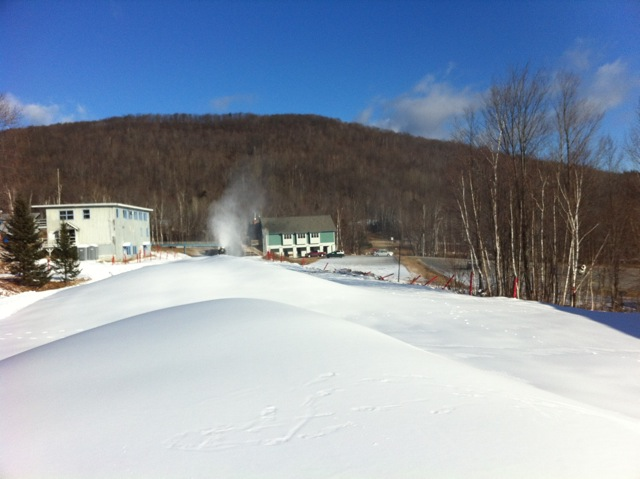
Stockpiled snow at Black Mountain. Courtesy photo.
With 12 days to go until U.S. Nationals begins in Rumford, ME, and natural flurries still absent from the weather forecast, Black Mountain is well on its way to making the snow necessary for a 3.75 k distance loop, two semi-overlapping sprint courses, a test track and a sit-ski loop.
“As of Tuesday, we had two-thirds of the snow we needed to cover everything,” said Chief of Competition Carlie Casey.
Black Mountain has about a dozen snow guns at the venue, and nine of them have been dedicated to blowing snow for the cross-country trails since last Friday.
Air temperatures over the past few days have been cooler than predicted, enabling the snowmaking crew to work at full capacity.
“We’re really pleased; I’m confident now that we’ll have all the snow we need for these courses,” said Casey.
The small mountains of artificial snow visible in photos of Black Mountain from this Monday will remain in stockpiled form until the beginning or middle of next week to minimize the possibility of melting. When it is spread onto the trails, Casey said it would be about a foot deep and fill the full width of the course.
Use of the entire width of the trail will be an improvement over last year, but the manmade course will still be shorter than the 5 k loop originally expected in the planning stages of the 20/30 k mass start event. The decision to go ahead with the mass start or change it to an individual start race will ultimately be determined by the coaches upon arrival.
Snow guns working to get Rumford in race condition. Courtesy photo.
Casey was confident the trails would be suitable for the original format, and anticipated coaches wouldn’t need to switch it to an interval start race as they did last year under similarly unseasonable conditions.
“I think it will be good for the mass start, but since it’s not quite as long as the 5 k loop, [racers] won’t be quite as spread out,” he said. “We’ll certainly be listening to coaches preferences.”
There will be ample room to warm up and test skis on snow, said Casey. The venue will have the same warm up loop it did last year, as well as an additional test area in the novice part of the alpine hill.
If snow cover at Black Mountain on January 2 ends up being strictly artificial, there will be a little over 4 k of skiable, homologated trails and connectors in total.
At this point, Black Mountain is on track to hit its target opening dates—December 26 for alpine and December 28 for its nordic trails.
Barring a freak rise in temperature, Casey is hoping Nationals will go as smoothly as possible this January.
“This year we wanted to make sure that through technology and planning, we were giving ourselves every possible chance to put on good races,” said Casey. Thanks to some really great volunteers and some very generous corporate sponsors, we have that this year.”