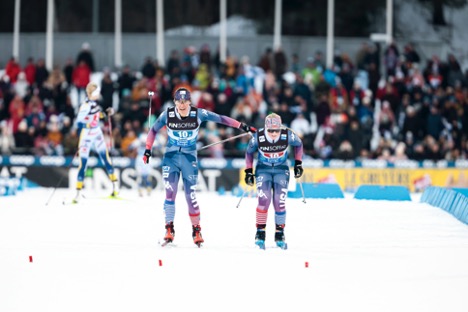
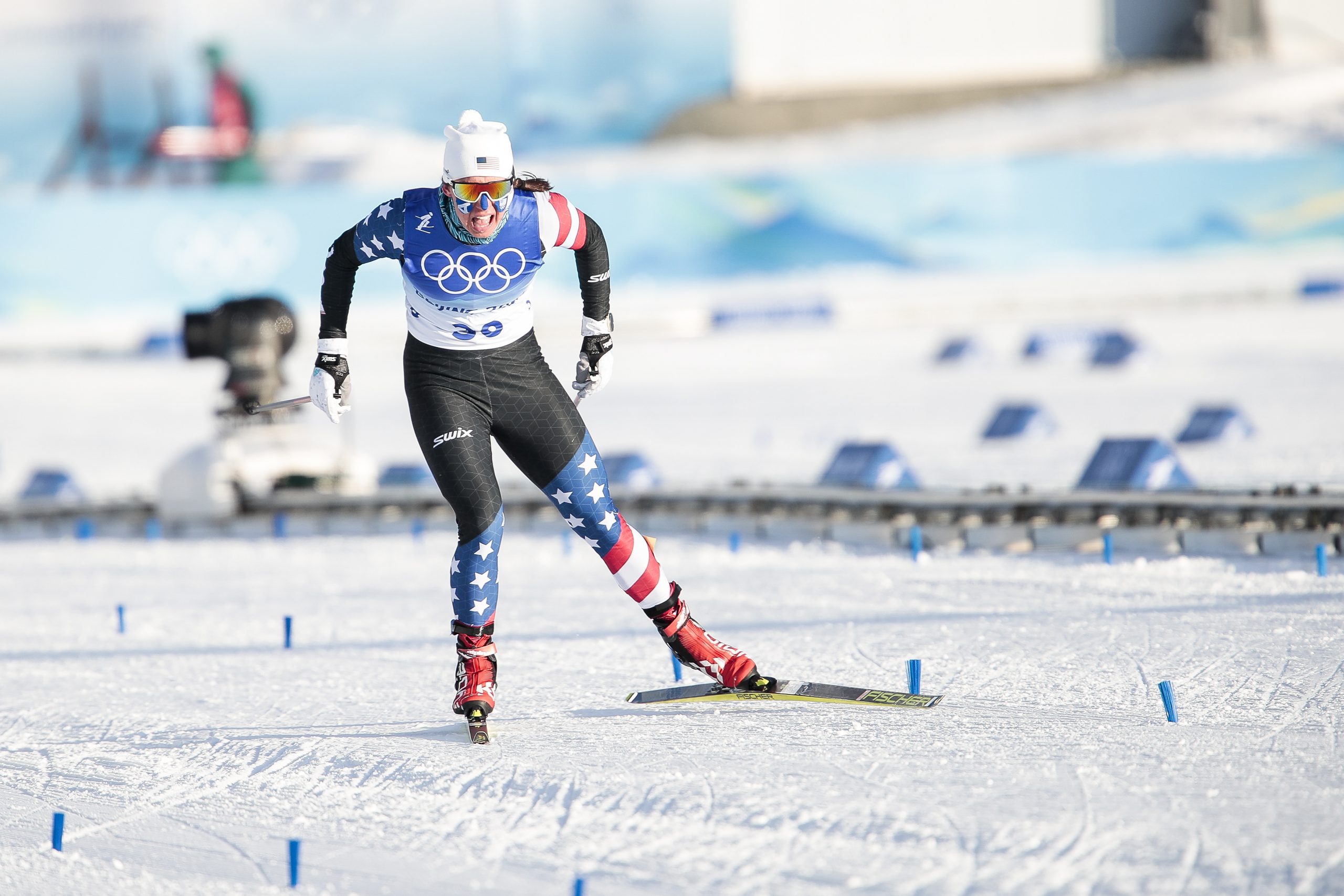
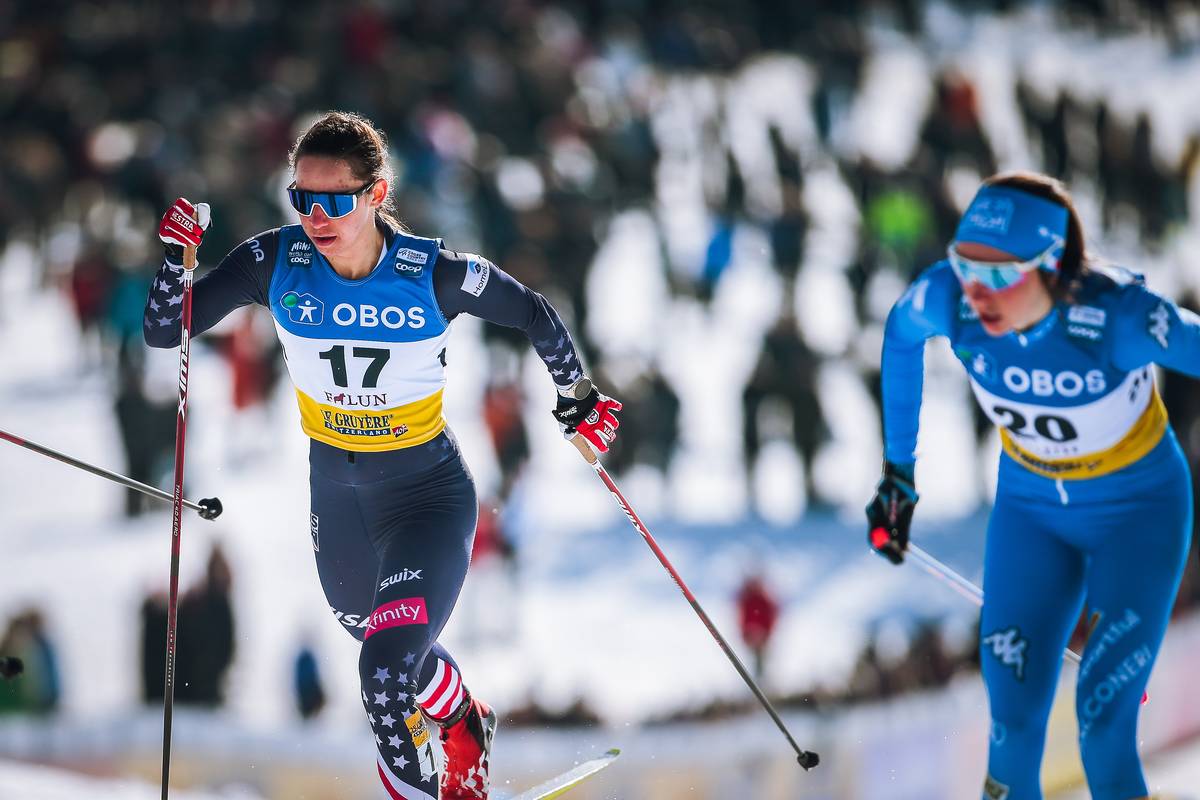
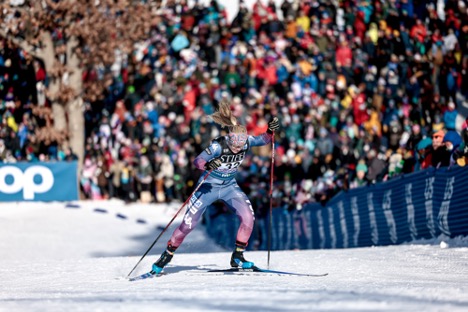
Sammy Smith competes at the Stifel Loppet Cup in Minneapolis, Minnesota during the 2023-24 season. (NordicFocus)
By Leann Bentley – Stifel U.S. Ski Team
May, 2 2024
In recognition of her outstanding performance and versatility, Sammy Smith of the Stifel U.S. Cross Country Ski Team has been awarded the US Nordic Olympic Women (US NOW) Gold Rush Award. The Gold Rush Award is an annual award that celebrates exceptional achievements and versatility among cross country athletes and is awarded to a World Cup woman athlete who demonstrates outstanding qualities of grit and grace throughout the year.
The accolade celebrates Smith’s exceptional achievements, highlighting her as a standout athlete of the season. Previous winners include Smith’s teammates Novie McCabe, Julia Kern, Rosie Brennan and Jessie Diggins, who have demonstrated exemplary performance and dedication to their sport.
“The award is not meant to recognize what happens on the race course directly,” said Alison Owen-Bradley, the founder of the Gold Rush award and a pioneer of elite level women’s cross country skiing in the U.S. said in an interview with FasterSkier. “Rather, the recipient is selected for the award by exemplifying and showing grit and the grace that it takes to be successful. It’s what happened behind the scenes to get the result, not the result itself.”
Smith has firmly established herself as a regular contender on the World Cup circuit. Notable accomplishments include securing a silver medal at the World Junior Championships in Planica, Slovenia the 2023-24 season and eight top 30 finishes on the World Cup stage. In Smith’s first World Cup sprint, she made it to the heats, a feat rarely achieved by athletes so young on the circuit. From there, her results kept getting better, marking her as one of the team’s top sprinters. While Smith gives it her all out on the snow, she is constantly striving to be better and brings those with her in the process. Using her grit to turn her frustration into a learning opportunity is one of Smith’s many strengths.
“She is a teammate we knew we could always count on,” said Kern, a past-recipient of the award and a current teammate of Smith. “Her grit, grace and poise inspire us to believe we can chase after multiple dreams and always be present for the team.”
Smith’s ability to navigate challenges with composure and determination has been commendable. Smith is a once-in-a-generation athlete. Outside of skiing, she is an elite soccer player who will begin her college career this fall at Stanford University. In high school, Smith represented the U.S. at the Under-17 Women’s World Cup as a member of the U.S. Soccer Under-17 Women’s National Team and then competed with the U20 Women’s U.S. National Soccer team. She took home Idaho Soccer Player of the Year in 2022-23, Idaho Girls Cross Country Player of the Year and Idaho Girls Track and Field Player of the Year in 2020-21. Alongside her sisters, she is also a founder of GO BIG Inc., a nonprofit that provides resources and opportunities for underprivileged youth.
“I’m so grateful to have received the Gold Rush award,” said Smith. “It was such a privilege to get to compete on the World Cup circuit this season and to really get to know the other athletes. It truly is the most fun, inspiring and humble group of people I have ever been around, and I hope to have many more seasons competing with them!”
Balancing commitments between skiing, soccer and academic pursuits, she has demonstrated a remarkable capacity for time management and dedication, but beyond her achievements, Smith has proven herself to be a valuable team player, offering support and encouragement to her teammates at every turn.
“Sammy handled the pressure of racing on the highest cross country ski level, balancing school and soccer, traveling to a new country every week, all while being incredibly thoughtful and a present teammate,” said Kern. “She was always the first one to offer help to anyone needing an extra hand, join for a team jog or try out group tactics with teammates during race preparation. On the tough days, Sammy brought her positive energy to lift up the spirits and introduced soccer juggling circles to change up the monotony of life on the road for the team.”
In recognition of Sammy’s exemplary performance and dedication to her sport, she is a deserving recipient of the US Nordic Olympic Women Gold Rush Award. Congratulations, Sammy!
Since the opening of the U.S. Ski & Snowboard Hall of Fame in 1956 there have been 448 members inducted, only two of whom are female cross-country skiers. The Hall of Fame website states that, “the honored members voted into the U.S. Ski & Snowboard Hall of Fame represent the highest level of national achievement in America, featuring prominent athletes and snow sport builders whose accomplishments showcase American skiing and snowboarding.”
The first woman cross-country skier to receive this honor was Martha Rockwell, who was inducted in 1986. Thirty-four years later, Rockwell’s teammate and a trailblazer in the sport, Alison Owen-Bradley was admitted to the Hall of Fame as a member of the Class of 2020.
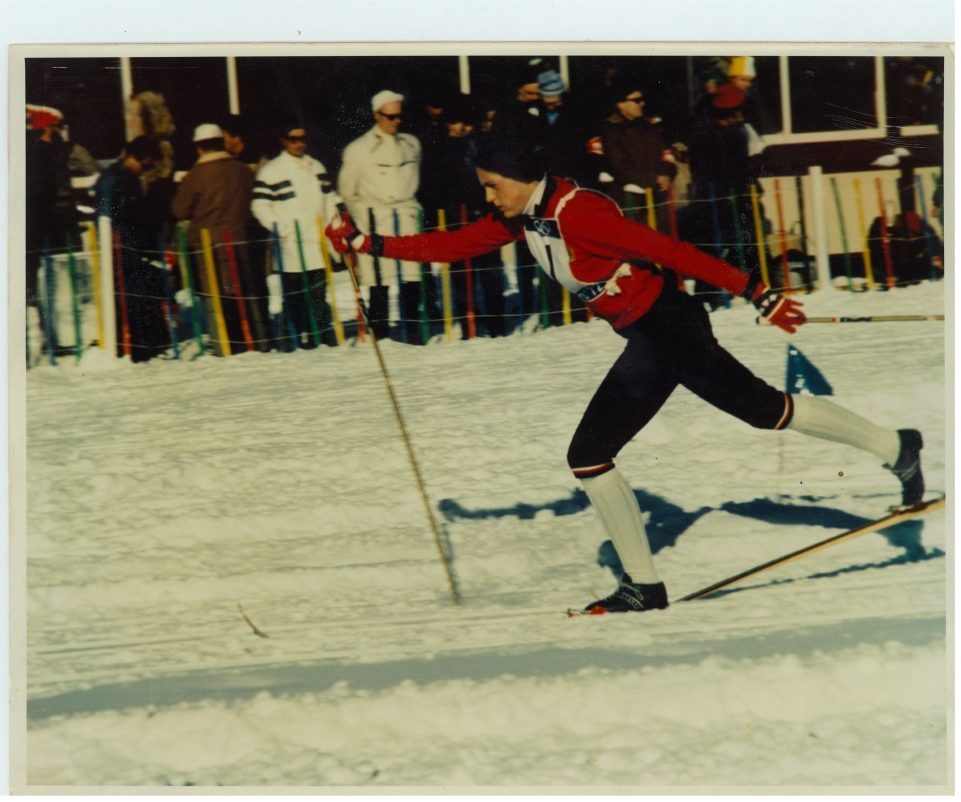
Heading out in bib #1 is Alison Owen-Bradley at the Sapporo Winter Olympics in 1972. (Courtesy photo)
The list of Owen-Bradley’s accomplishments is lengthy. A brief glance at her race results highlights her prowess as an athlete, beginning around 1970 when she competed at World Championships in Czechoslovakia at the age of sixteen. Speaking to this formative experience, Owen-Bradley said, “I was so involved in sport and loved the sports that are now pretty common for girls, but there wasn’t really a place for it [yet], and so we made our own places. I got to go to the national team camp with the U.S. Ski Team and then Europe and see these women racing, and really fit, and loving their sports and it was like, yeah I want this life…
“It heightened my world view of what was possible for a young girl from Washington to pursue.”
Owen-Bradley went on to represent the United States at two Olympics (Sapporo 1972 and Lake Placid 1980). In 1978 in Telemark, WI she won the first-ever women’s World Cup cross-country race (although FIS categorizes this race as a “test” event). At the conclusion of the 1978/79 race season, Owen-Bradley finished seventh in the FIS World Cup standings, the highest ranking for a U.S. woman for the next 33 years. The following season, she finished second in the Holmenkollen 10k in Oslo, Norway. “We had tremendous results [in that era] that I think sometimes aren’t known, or they’re overlooked,” reflected Owen-Bradley.
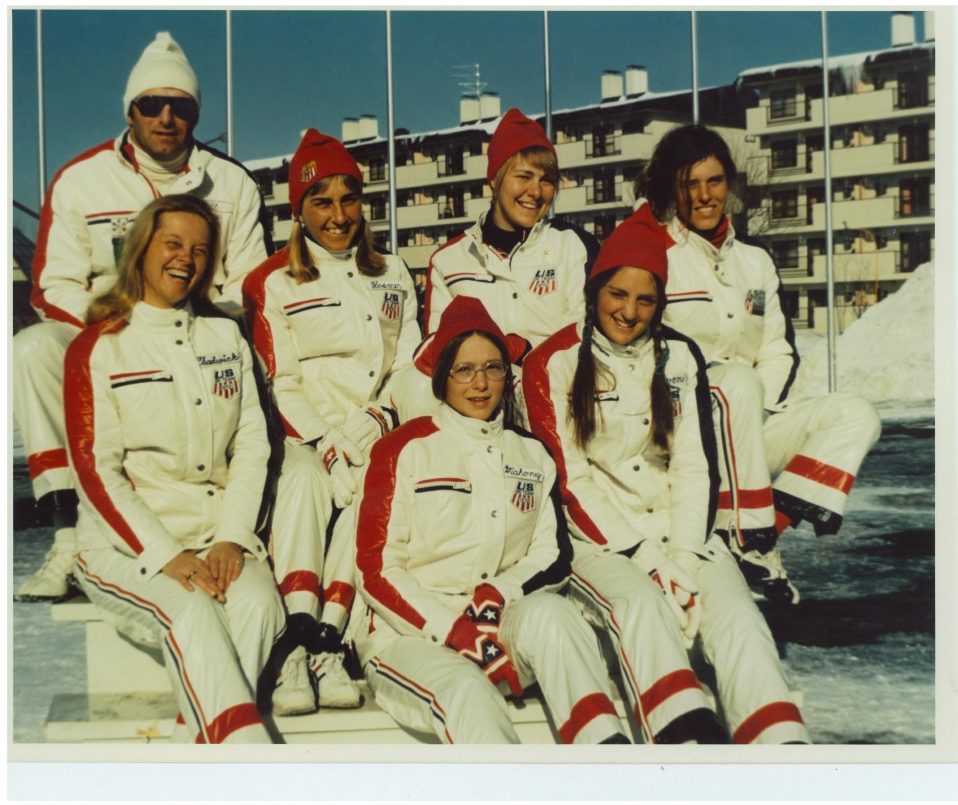
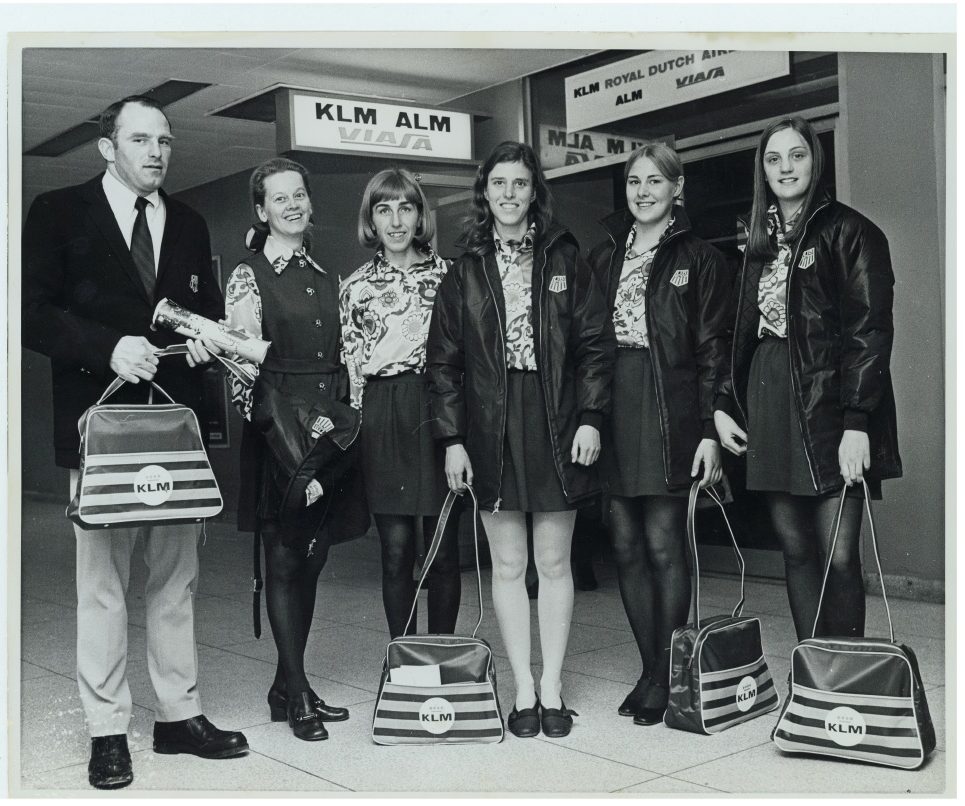
The first Women’s cross-country Olympic Team. The 1972 Games were held in Sapporo, Japan. Top Row: Marty Hall, Trina Hosmer, Barbara Britch, Martha Rockwell. Bottom row: Gloria Chadwick, pseudo Chaperone, Margie Mahoney, Alison Owen. (Courtesy photo)
But numbers on a page are only half of the story. Owen-Bradley’s contribution to skiing, particularly to women’s skiing, goes far beyond her race results. Growing up in Wenatchee, WA as a member of an active family, Owen-Bradley started nordic skiing after her father saw an ad in the paper for the local cross-country ski team. “He said, ‘Hey, let’s go try that because we love running and hiking and [other outdoor sports],’ so we started that and it was all new,” explained Owen-Bradley. Not long after, Owen-Bradley became the first girl to compete at Junior Nationals. She relayed the story of how at the pre-race meeting the organizers wouldn’t let her compete, stating that “this is a race for boys.”
A team leader from the Pacific Northwest (PNSA) delegation responded, “show me that rule.” Since that rule couldn’t be found in writing, Owen-Bradley was allowed to compete. “I raced and then, the next year, and from then on, they had a place for girls,” she explained. “It was a fun time because women weren’t racing marathons, they weren’t really allowed or incorporated into the endurance sports world, and it was just fun to watch it [explode] like popcorn, it was happening everywhere,” she said, speaking to the rise of women competing in sports. “It was really fun to be there [at Junior Nationals] as the first girl, I think I was like 13 or 14 or something and almost everything you’re doing is new in your life, so that was just one more new thing.”
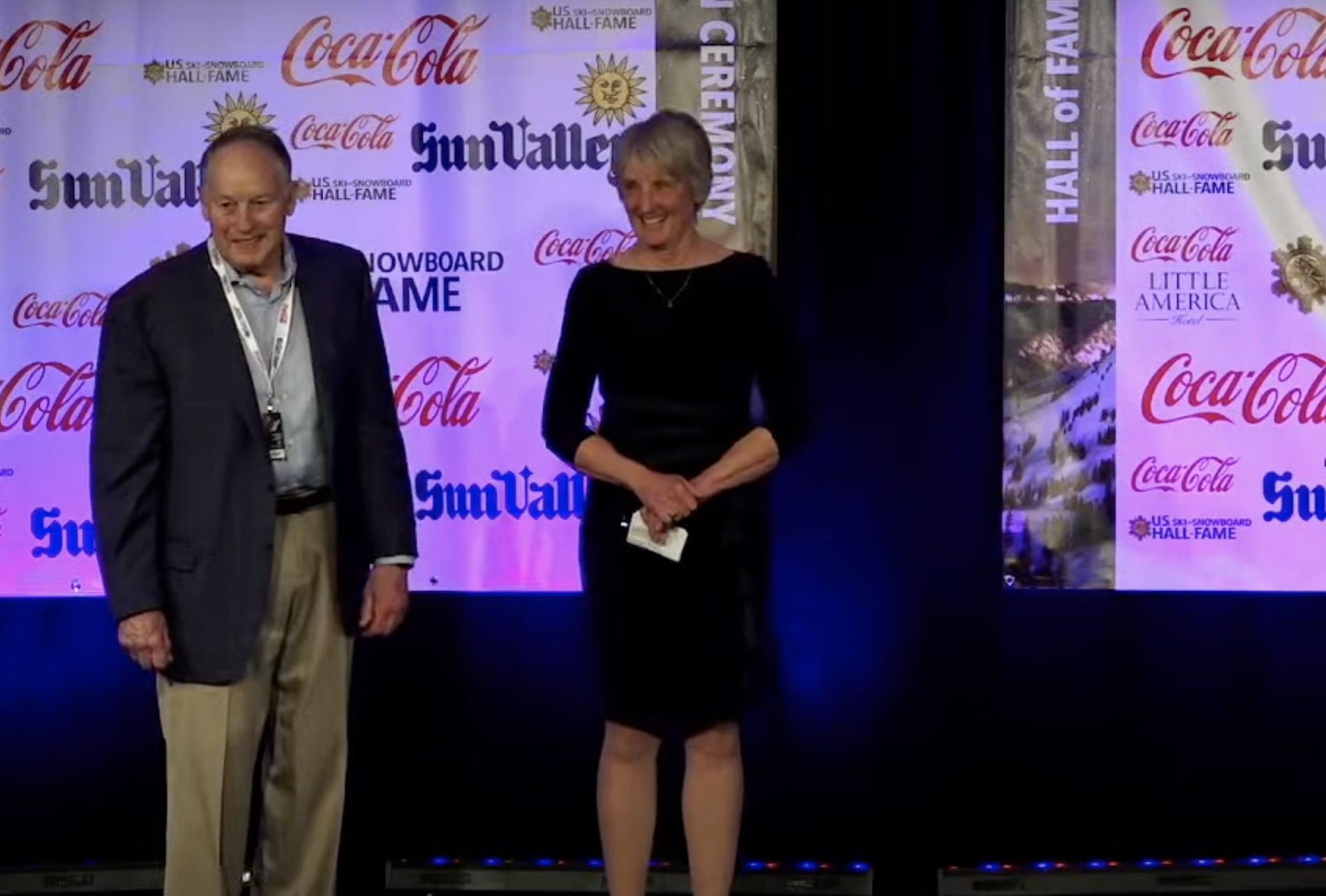
Owen-Bradley’s coach at the time was Herb Thomas, and it was he who presented Owen-Bradley her medal at the Hall of Fame induction ceremony. Thomas came from Middlebury to start the ski program in Wenatchee which she joined. “He let me do it. You know, he encouraged me. He broke open the door for me to do it,” said Owen-Bradley. In the years that followed, there were other men who played an integral role in Owen-Bradley’s success.
“At the beginning, for me, not having a lot of opportunity in sport, I can say that the opportunities I did have came from men,” she explained. “There were no women breaking trail for me, you know, I didn’t have them as coaches, I didn’t have women cheering me on.”
Herb Thomas and Alison Owen-Bradley at the U.S. Ski and Snowboard Hall of Fame induction ceremony (photo: USSSHOF livestream)
In particular, Owen-Bradley singled out Marty Hall in her acceptance speech, saying he was perhaps the most important person to thank in regards to her success. She shared an example of how when they traveled to Europe to compete, the first U.S. women’s national team coach was given the runaround by the European coaches with wrong addresses, no translator, and the more. It soon became clear that something needed to change and so Hall headed to Europe to take over. “He really made a place for us,” Owen-Bradley explained, “They didn’t hire him in the first place, because he was a bit strong and maybe not sensitive and everything, but he was strong in the coaches meetings. He read the rule books, he knew what was going on, legally, and he made them speak English.”
At a time when women’s racing was just being established this was more important than ever. “He kept a place for us,” said Owen-Bradley, “that we had a possibility to get good and we weren’t on the sidelines, we were right in the middle of it all, he knew what was going on and he made a place for us on the world stage.”
For his part, Hall corroborated this story and added, “my athletes meant everything to me. I would fight to the death for them.” When asked about Owen-Bradley specifically, Hall described her as “a woman before her time.” He said that she “had all the components.”
“Some of the things that she got pushed into or taken to go way beyond when she should have been ready, but it didn’t bother her,” he reflected. “She didn’t crack, never had any problems doing what she was supposed to do.” Hall shared that it is great to coach an athlete like this. “She understands movement real well, she was good at anything she did as an athlete,” he said.
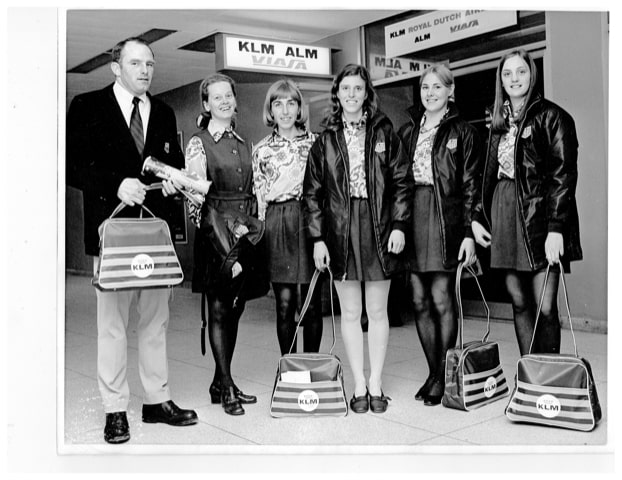
The first U.S. women’s World Championship cross-country team on the way to Czechoslovakia in 1970. From left to right: coach Marty Hall, Coach, chaperone Gloria Chadwick, Trina Hosmer, Martha Rockwell, Barbara Britch, and Alison Owen. The U.S. team took four skiers as the relay at that time was a three-person format. (Courtesy photo)
When asked about important elements in the progress of women’s skiing, Owen-Bradley responded, “I really appreciate the men who said ‘no, come on women do this. It’s really fun. There’s no reason women can’t do this stuff.’” She emphasized the important role these men played saying, “I really appreciate the men in my life, who opened the door, kept them open, kept the naysayers away- and then as things have evolved and grown, obviously, naturally, women are taking more of a role in allowance in helping other girls and women do that.” She went on to say, “and that’s awesome. That’s, you know, the natural progression, and I love to see that. And that’s why, with US NOW, the Olympic women’s group, taking initiative, giving awards, leading the way for other women and showing that we are a leader in sport and with each other. So that’s the natural evolution of it that I see.”
In her acceptance speech at the Hall of Fame ceremony, Owen-Bradley reflected on how much progress there has been in women’s skiing since she first began saying, “where are we going to be in another 50 years?…[it’s] so exciting to think of the barriers we break.” Particularly in light of the recent Olympic results from the U.S. women’s team, Owen- Bradley said, “even now, it makes me so teary eyed, to think about that in in one lifetime, my lifetime, to go from girls not having sports, not having a place, to being a shining star on the world stage of a sport that that was there was no place for girls. It’s so fulfilling.” She gave a shout-out to Kikkan Randall as well, saying, “and the icing on the cake of that was Kikkan doing the absolute best coverage, covering her teammates… She brought so much understanding and furthered everyone’s knowledge.”
Having witnessed the sport achieve these major milestones, Owen-Bradley pondered the future of cross-country skiing, “You know, it just feels like my life journey of being in sport, and being in cross-country especially, where will we be in the next year? That’s for this generation to lead now. And where are we going and what’s next for the women, but also the men, of our nordic community and sports community?”
She continued by saying:
“It’s not an easy road ever, but you know, that’s why we’re in it because we challenge ourselves and if we didn’t want challenge, we wouldn’t be in sport. And what you do is you come up against your weaknesses and you figure out how to get through them or you don’t get better… I mean, that’s the cool thing about sport is you test yourself and then you get better.”
Alison Owen-Bradley racing to first in the inaugural women’s World Cup event in 1978 in in Telemark, Wisconsin. (Courtesy photo)
When asked what it means to both her and to the cross-country sport community, to receive recognition for her achievements and to be the second female cross-country skier inducted to the Hall of Fame, Owen-Bradley replied, “Well, it is interesting that I’m getting the recognition now.” She explained that they give the award for different categories and said, “maybe part of the recognition comes from, you know, a lifetime involvement in skiing. I think maybe I cross over a little bit, you know, my life has been very influenced by and I participate in a lot of ways in cross-country skiing.” She continued by saying, “I think it’s important because it shows where we’ve been, and hopefully, where we’re going. So, it’s fun to get the award.” Owen-Bradley acknowledged that her “life has moved on.”
Though skiing still occupies much of her time, “I’m focused on a lot of things,” she explained, “ I didn’t wait for [the award] to happen to make my life good or anything. I’m doing a lot of really great things that I enjoy.”
Alison Owen-Bradley and her daughter, Kaelin, high in the Bridgers (Courtesy photo)
These days, Owen-Bradley can be found near Boise, Idaho on a small farm she calls her “sanctuary”. Still quite active, she is an engaged participant in a program called, Starting Strength. “It’s a weightlifting program that I have found a lot of benefits for myself,” she explained. Additionally, Owen-Bradley is very involved with her family; she has three grandkids and a daughter who coaches skiing in Bozeman, Montana. “It’s really fun to have that continuity,” she said, referring to generations of skiing families. “I think it really helps to have grown up in it, and [to have] parents that know about it and can pass it on and build it generation to generation.”
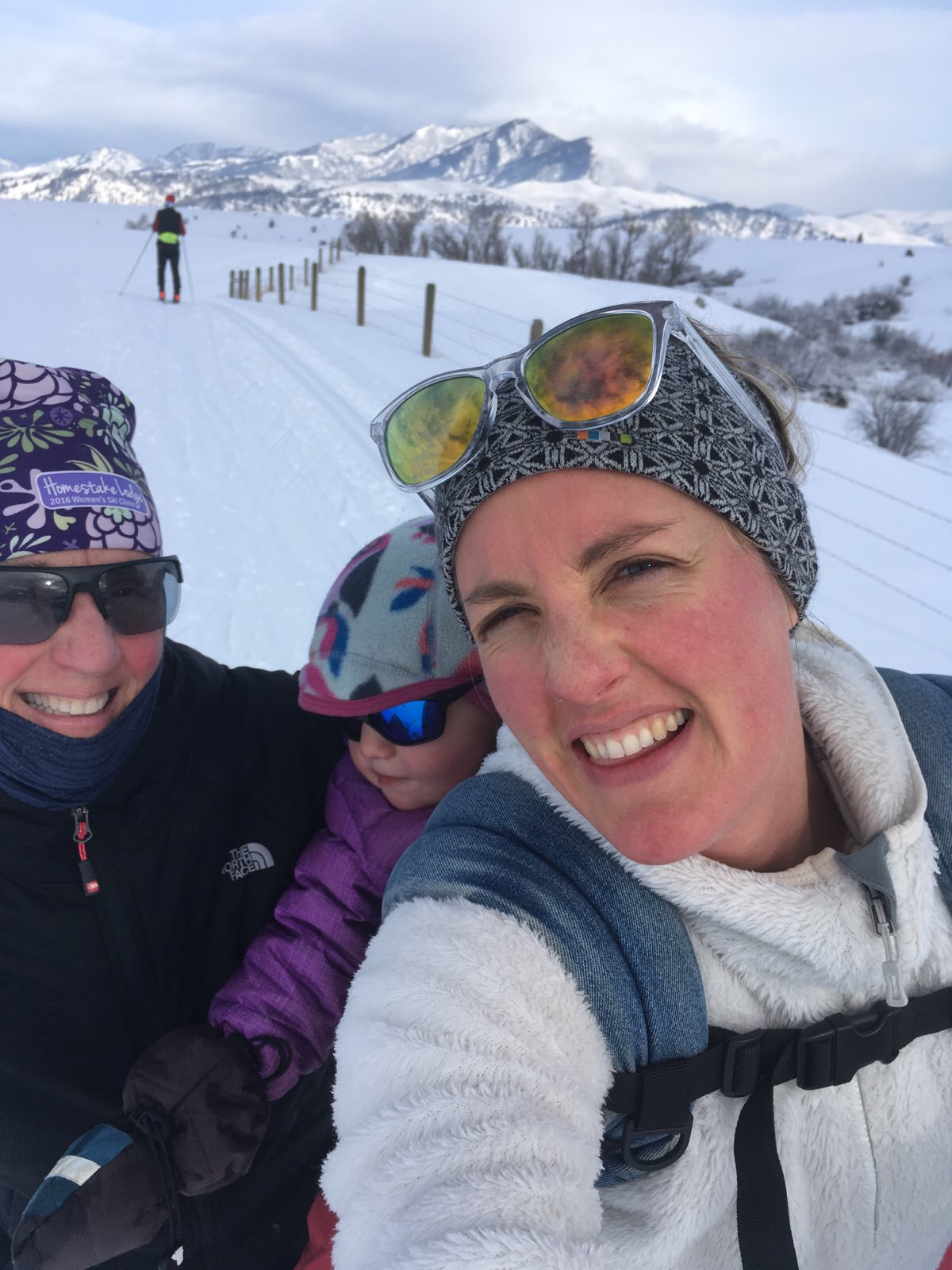
Three generations of Bradley skier women. “I wouldn’t have been in a backpack with my Mom and Grandma out enjoying winter when I was my Granddaughters age. Love how it’s normal now” says Owen-Bradley (Courtesy photo)
Speaking more broadly to the growth of a cross-country ski community and culture in the U.S., Owen-Bradley emphasized the importance of recognizing the contributions of those who have encouraged and shaped this growth. “There’s a lot of people that have [put] their life-force energy on building the ski culture in our country, and that’s why I like to see more awards given.” She explained that she is working on nominating another woman for the Hall of Fame to “shine the light that the women’s lives have been growing the sport and yet [we] only have two women in the Hall of Fame after sixty years.” Given the numerous different categories that you can be nominated for, Owen-Bradley has a list of ideas and possibilities.
“There’s a lot of women that deserve a lot of credit for where the women’s program is now. Men too, but I’m focused on the women.”
Julia Kern prepares for her Olympic debut on the tracks in Zhangjiakou, CNH. (Photo: NordicFocus)
FasterSkier recently shared a press release on behalf of the US Nordic Olympic Women (US NOW) announcing Julia Kern as the 2022 recipient of the fourth annual Gold Rush Award. The release included comments from 2021 winner Jessie Diggins on the qualities that she, along with the other past winners, recognized made Kern deserving of this year’s award, but it became clear that there was a gap in FasterSkier’s coverage on the history of US NOW and the evolution of the award.
To learn more, FasterSkier connected with the spark that launched Gold Rush Award into existence: recent U.S. Ski & Snowboard hall of fame inductee and early groundbreaker for American women’s skiing, Alison Owen-Bradley. It was Owen-Bradley who planted the seeds to bring together the generations of women who have represented United States in cross-country skiing at an Olympic Games, bringing US NOW into fruition.
According to Owen-Bradley, US NOW filled a gaping hole in connection among the women who helped set the foundation for what is now one of the most successful women’s ski programs in the world. Though each of the 53 women Olympians had played a role in propelling the next generation forward, opportunity for connection between the generations had been lacking. With individual efforts, a network amongst these women slowly began to connect sooner, but when the World Cup swung through Quebec City in March 2019, it provided an ideal opportunity to reunite as a collective.
“We ended up having quite a few Olympic women there,” recalled Owen-Bradley in a call. “And it was fun because we wore our vintage clothing to the race, so we had all kinds of different eras of Olympic clothes. It was so congruent because we were really cheering on the latest, greatest women racing but we were also together with our teammates from the past, and it kind of just kind of grew from there.”
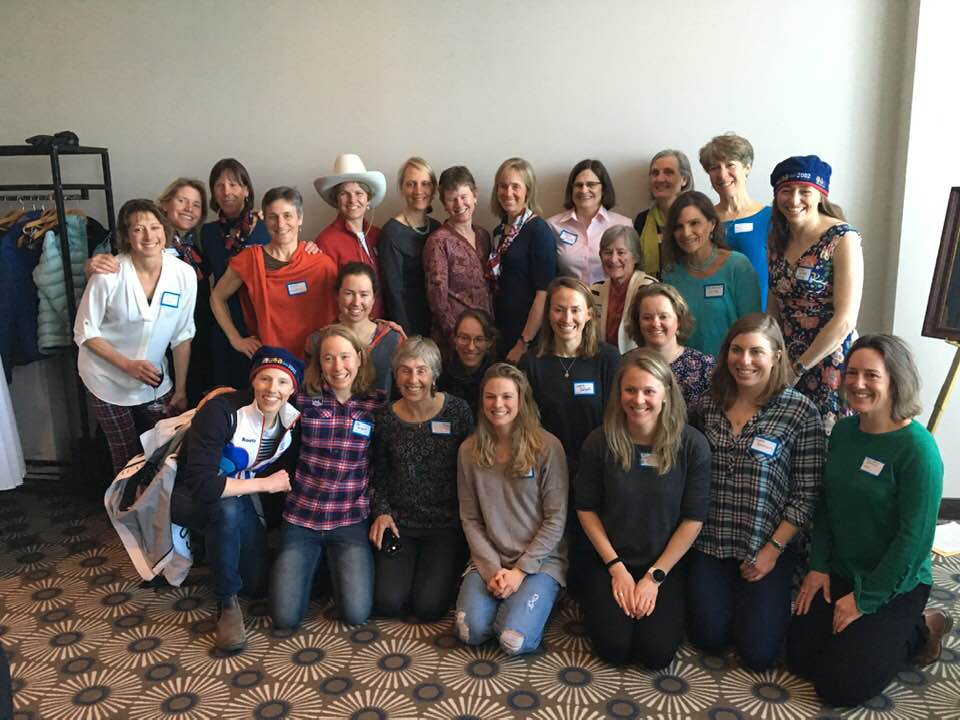
An intergenerational collective of Olympic women reunite at the 2019 World Cup Finals in Quebec City. (Photo: Peggy Shinn)
Having been teammates long before the era of Facebook – in fact, some well before the internet – it had been hard for these women to feel connected and maintain ties after careers ended. Owen-Bradley said that before the reunion, she didn’t have contact information for many of these women, and consequently didn’t feel the relationships had been sufficiently developed among the various generations.
With some word-smithing to nail a catchy acronym, the energy and camaraderie established at this reunion evolved into US NOW. But there’s much more to the name than meets the eye.
“US NOW – being retired from ski racing, who are we now? What have we learned? There’s so much gold in that for mining, in a metaphoric way. All these women, what have they learned? What have they gone on to do? How was it good and bad in their lives to devote their time to this? I don’t think we’ve even come close to exploring that and getting the nuggets [of wisdom] out of what women went through and and got from those experiences. But also, how hard was that? And was it worth it? And what would have made it more worth it? And then to just go forward in a way that uses that wisdom.”
And so, the organization was built by Olympic women and for future generations of Olympic women.
The first Women’s cross-country Olympic Team. The 1972 Games were held in Sapporo, Japan. Bottom row—Gloria Chadwick, pseudo Chaperone, Margie Mahoney, Alison Owen Top Row—Marty Hall, Trina Hosmer, Barbara Britch, Martha Rockwell. (Photo: courtesy Alison Owen-Bradley)
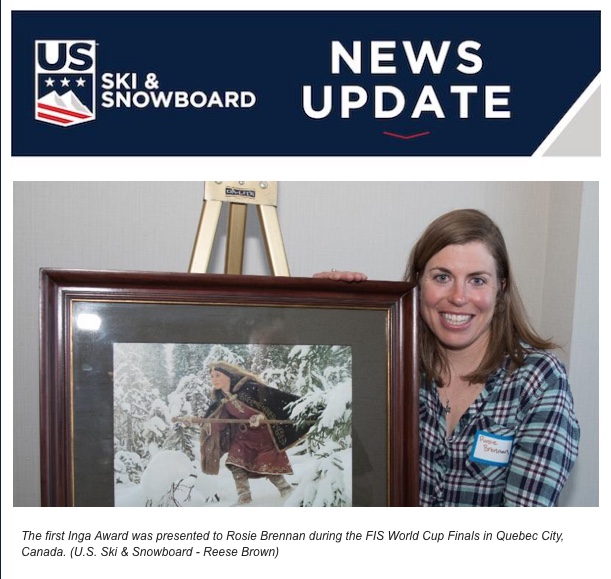
When the coach of the first women’s Olympic team, Marty Hall, was inducted into the U.S. Ski & Snowboard Hall of Fame in the spring of 2018, he invited Owen-Bradley to attend the ceremony, having been one of his original athletes. While traveling through Norway to race at World Masters, a print inspired by the Birkebeiner story caught her eye; instead of the image she was familiar with, which depicted two warriors valiantly carrying Prince Haakon to safety on their trek through the mountains, it was an image of Prince Haakon’s mother, Queen Inga. She too had made the arduous journey on skis to save her son, and yet, Owen-Bradley had never seen her included in the story’s artwork.
Finding it symbolic of the emergence of women’s cross-country skiing in the US over the last 50 years, Owen-Bradley purchased the print, and decided it would be a fitting gift to honor Hall at the ceremony. “He had been the first Olympic coach for women and had kind of gotten us on the map.”
However, the piece of artwork was large. She laughed as she recalled giving it to him, but also telling him it did not need to take up a wall in his home.
“We decided that it would be a traveling picture, and we would pick someone every year to give it to, and so out of that came this idea [for the award].”
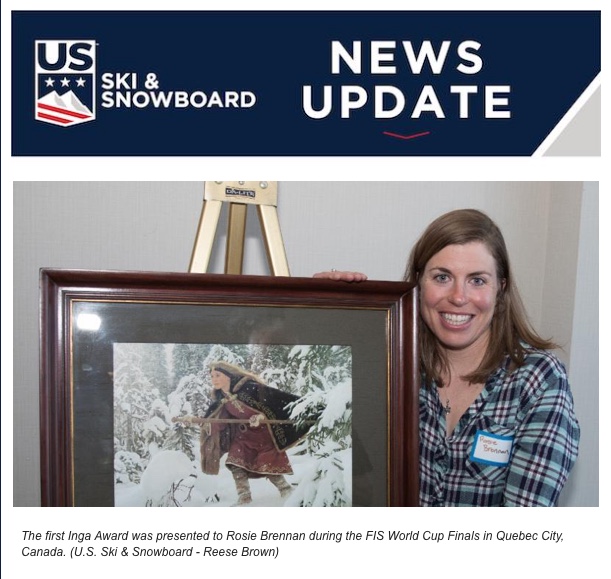
In 2019, following the World Cup, the Inga Award was presented to its first recipient: Rosie Brennan. Having rebounded from a season impaired by the effects of the mononucleosis virus, Brennan was selected based on the “courage, fortitude, grit, determination and raw talent [it took] to achieve an extremely high level of success on the international ski racing circuit [that] season.”
Over the next year, however, Owen-Bradley began to dwell on why the image of a Norwegian woman should be the symbol for the efforts of the women in the American cross-country program. She began looking for inspiration closer to home, eventually finding an equally strong, noteworthy, and under-recognized alternative.
“I changed it to the Gold Rush award because in the High Sierras during the Gold Rush era, women were nordic racing. Not on the same levels that we do it [now], but they had cross country races that that women raced in… So I thought, ‘Oh, what a cool thing — the Gold Rush.’”
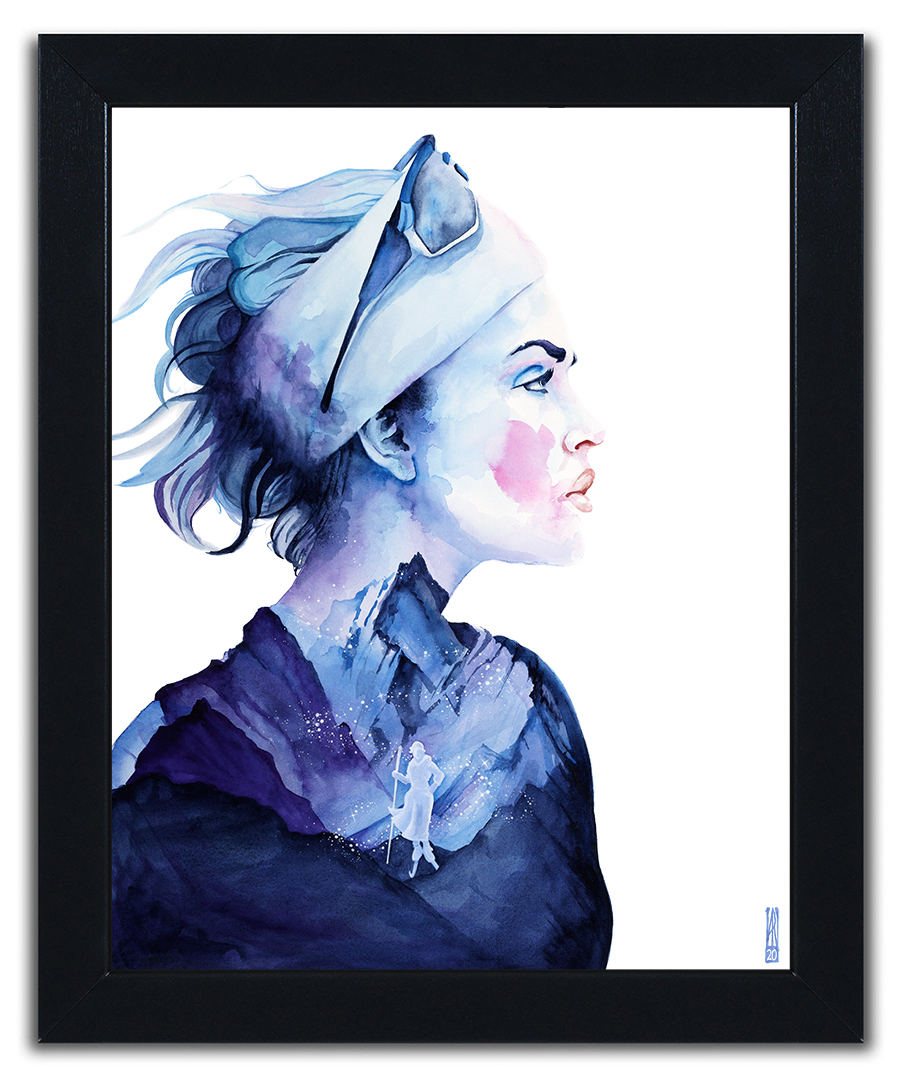
She also noted the ties between racing for gold medals at the Olympics, which Kikkan Randall and Jessie Diggins achieved in 2018. Working with artist Andy Rogers, a new image was created, superimposing the image of a woman on skis in the High Sierra on the bust and profile of a determined and modern-looking woman in a race headband and sport sunglasses. In 2019, this image was presented to co-recipients Sadie Maubet Bjornsen and Sophie Caldwell Hamilton.
Gold Rush Award: (Artist Andy Rogers)
While each of the women mentioned to this point have unquestionably racked up an impressive resume of results, the award is not meant to recognize what happens on the race course directly. Rather, Owen-Bradley explained a recipient is selected for the award by “exemplifying and showing the grit and the grace that it takes to be successful.” It’s what happened behind the scenes to get the result, not the result itself.
“An example would be Sophie whose mother died [in 2019] and she still went on with such grace and was so successful through all of that. And Sadie because of all the injuries she worked through and kept going… So, to me, it’s been about the grit and the grace of what it takes to be a woman nordic ski racer at that level.”
Approaching the 50-year mark of her own Olympic debut and now focusing more of her time and energy on her small farm in Idaho rather than the cross-country ski world, Owen-Bradley explained that this year, she felt less directly connected to the potential recipients for the Gold Rush award. She decided the decision should be made collectively amongst the four previous winners, to which she would add a fifth vote. After some discussion, the group voted unanimously for Julia Kern.
Jessie Diggins and Julia Kern celebrate a second-place team sprint finish in Dresden, GER in December, 2021. (Photo: NordicFocus)
A member of the U.S. Ski Team since 2017, Kern’s progression on the international level has been steady, but non-linear. Alongside leaps forward, she’s faced her fair share of injuries and setbacks. Both the 2020/2021 season and her first Olympic appearances in 2022 left her wanting more, but interjecting these lows during the 2021/22 race season were a slew of career highlights. Her top results include two individual fourth-place sprint finishes on the World Cup, a team sprint podium in Dresden, a handful of other World Cup top tens, and finishing the year winning three out of four events at the joint U.S SuperTour Finals / Canadian National Championships in Whistler, BC.
And in February 2023, she’s heading into a World Championship which will take place at the venue where she earned her first World Cup podium in December 2019: Planica, Slovenia.
Sophie Caldwell Hamilton / Julia Kern
Julia Kern / USST Coaches
Smiles and hugs all-around to celebrate Julia Kern’s first World Cup podium in Planica, Slovenia in December 2019. Kern finished third in the freestyle sprint, with Sophie Caldwell Hamilton just behind in fourth. (Photos: NordicFocus)
According to the past award recipients on the selection committee, it was the juxtaposition of these celebrations and challenges over the last few seasons that highlighted Kern’s candidacy for the award this spring.
“To me, what is special about this award, is first that it was voted on by this very incredible group of women who all share tenacity and drive to get through challenges and be better on the other side and second, that it awards just that and not results,” explained Brennan in an email. “Julia exemplifies this in her ability to be a strong teammate, no matter what the circumstances are. She holds her head high and goes out of her way to never bring people down when things are tough, aren’t going her way, or she’s faced with a challenge. When something doesn’t work out for her, she immediately jumps gears and does literally whatever she can to help her teammates have success.
“On top of that, she doesn’t lose faith in herself, she continues to fight, look for opportunity and carry an optimistic outlook towards her future. She has shown this many times after coming off a slump, injury, or some other challenge to find herself notching career bests. I think these things aren’t mutually exclusive and that we all have a lot to learn from Julia’s ability to be an exceptional teammate and in turn have that give her energy to continue chasing her own goals.”
Smooth and powerful, Julia Kern races through the heats during a classic sprint in Falun, SWE in March 2022. (Photo: NordicFocus)
Commenting on her nomination, Kern attributed her own success to the efforts of the women who came before her, including those who would present her with the award.
“I am incredibly honored to be given the Gold Rush Award by such an incredible group of women. US NOW is a group of women who have paved the way for U.S. skiing, many of whom have been personal role models and mentors to me in skiing and in life. I would not have had the opportunities, experience and knowledge without their hard work and passion for giving back to the younger generations. The past few years have been challenging for a variety of factors, and it was rewarding to come back stronger with my best season yet.”
As the list of award winners grows and US NOW builds momentum, Owen-Bradley hopes the award can be expanded to include a monetary prize in addition to the print and tribute. Acknowledging the increase in representation for women across various aspects of skiing, such as coaching and waxing, she would love to see new awards developed to recognize these important examples also.
When Owen-Bradley began skiing as a child in the 1960’s, her only option was to join the boys program; Title IX did not pass until June 1972, at which point she was 19 and had already raced at a World Championship. As she reflected on the amount of opportunity for women in cross-country skiing now, and what the creation of US NOW and the Gold Rush Award means to Owen-Bradley personally, she expressed feelings of joy and optimism.
“For me to go from not having a place, to having these strong women’s teams – it’s just so fun.”
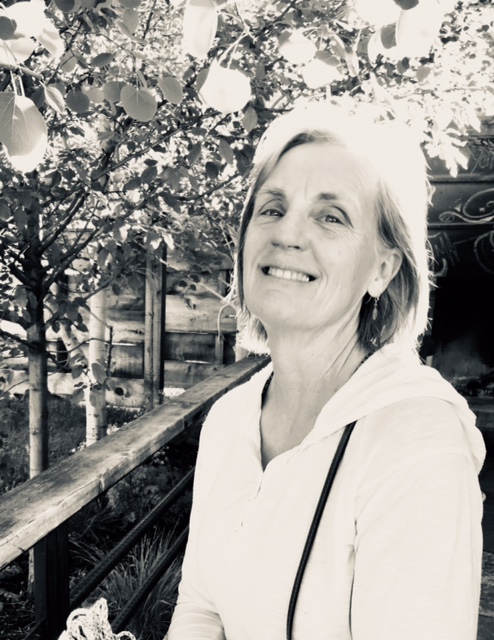
Alison Owen-Bradley, a pioneer of elite level women’s cross-country skiing in the U.S. (courtesy photo)
Stars and stripes at the front, as Julia Kern scrambles for USA II in Falun’s mixed relay. (Photo: NordicFocus)
As the 53 women Olympians who have represented our country in cross country skiing, and calling our group United States Nordic Olympic Women (USNOW), we give an annual award, The Gold Rush Award, to a female athlete that demonstrates outstanding quantities of grit and grace throughout the year.
Huge achievements give everyone the joy of celebrating the success. We know it takes many people to realize these high goals. We congratulate and are inspired by each of the US Ski Team Athletes and everyone supporting them. We cheered loud and proud as we watched the coverage of the races. Thank you to each of you for your hard work, dedication and devotion to our sport. We love you all.
The 2022 US NOW Gold Rush Award goes to Julia Kern! Congratulations Julia!
Julia Kern (USA) fights hard to the finish during the individual freestyle sprint in Zhangjiakou. (Photo: NordicFocus)
Julia has been working hard for a long time, and we are so proud to recognize not only her outstanding results this season, but her grace and strength in bouncing back from many injuries over the years and her perseverance and trust in her training. Julia’s season highlights included making the 2022 Olympic team, a World Cup podium and 4th place finish, multiple US National Titles and her career-best World Cup distance races.
This winter was another year of stressful and strict covid safety protocols, which limited social interaction and increased the feeling of isolation and loneliness. As an extrovert who thrives off of group social activities, Julia handled the challenging situation with grace and spent a lot of time thinking about how to keep the team safe and create safe yet fun chances to interact and lighten the mood. Additionally, after a hard year last season and difficult injuries over the summer and fall, Julia kept faith in the hard work she was putting in during the training season, and continued to get stronger over the entire winter, ending the season as the best sprinter and distance skier in the US! Her work ethic and never-give-up attitude inspires all of us, and we are lucky to receive all the energy she brings to the team.
As if this weren’t enough, Julia is also a wonderful role model and ambassador to the next generation of skiers! She spends the summer training months engaged in many outreach activities, and comes back to her home club each year to get the younger skiers fired up.
Again, Congratulations Julia!
Julia Kern races through the heats during in Falun’s classic sprint. (Photo: NordicFocus)
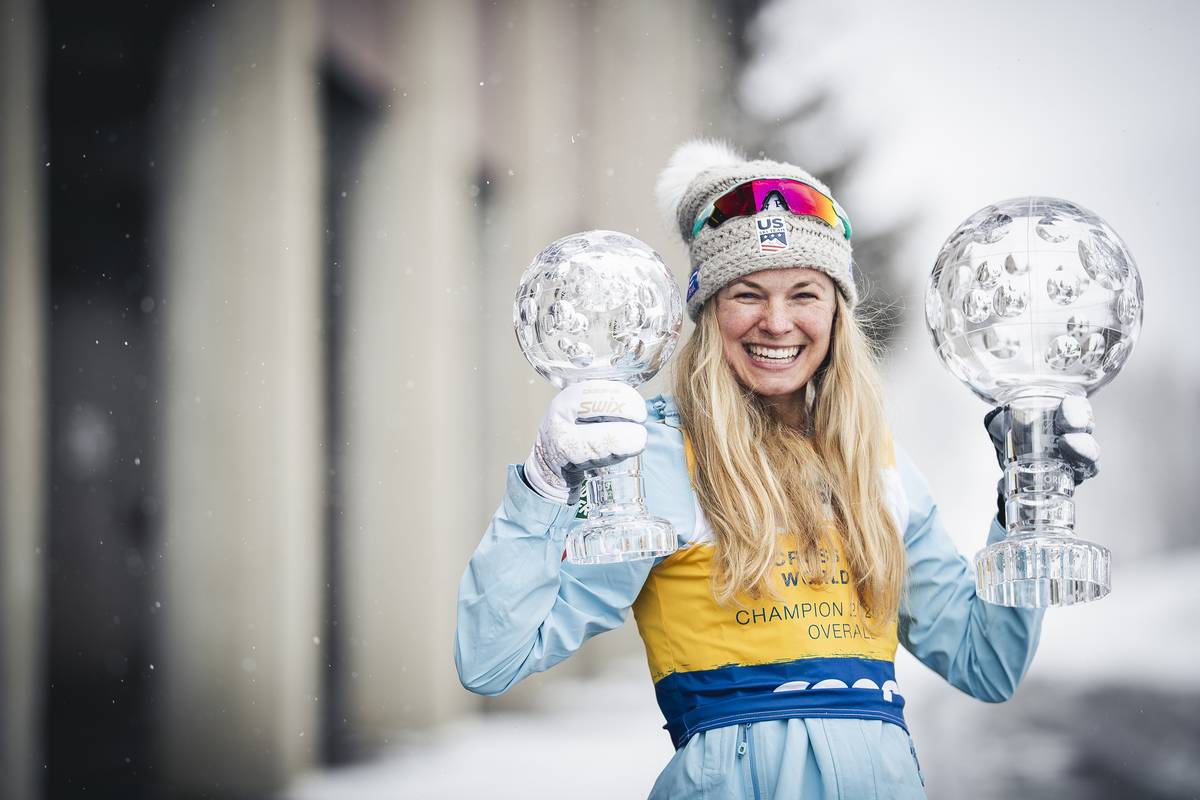
Jessie Diggins and the two-for: Overall and distance crystal globe winner. (Photo: NordicFocus)
Press Release
As the 54 women Olympians who have represented our country in cross country skiing, and calling our group United States Nordic Olympic Women, we give an annual award to the female athlete that demonstrates outstanding amounts of grit and grace throughout the year.
We call our award: The Gold Rush Award.
The past two years have seen three recipients of our award: Rosie Brennan, Sadie Maubet Bjornsen and
Sophie Caldwell Hamilton When asked if these three would please choose this year’s athlete for our award they agreed.
A huge first was achieved and everyone celebrates the achievement. We know it takes the whole team to realize these high goals. We congratulate and are inspired by each of the US Ski Team Athletes this year. We cheered loud and proud as we watched the coverage of the races. Thank you to each of the athletes for your hard work, dedication and devotion to our sport. We love you all.
Jessie Diggins during the final weekend of racing in Engadin, Switzerland. (Photo: Nordic Focus)
Announcing our award is: Sophie Caldwell Hamilton
We are proud to choose Jessie Diggins for this year’s US NOW Award! Her results speak for themselves, but the reason we chose her this year is not just because she was the first U.S. woman to ever win the Tour de Ski and the crystal globe for the overall World Cup winner.
We want to recognize that this was a very different year for everyone, but it had the potential to be a particularly difficult year for extroverts who feed off of the energy of others and thrive in social situations and camp settings (hello, Jessie!). I don’t know anyone who loves camps more than Jessie does and this year we had zero camps as a national team. Not having training camps and time together as a team was surely hard on Jessie, but rather than panicking about what couldn’t be, she took advantage of getting into a consistent routine and training her butt off in Vermont, enjoyed the silver lining of getting to live with her fiance for the first time they’ve been able to do that in the summer (he worked from home in Stratton), and trusted the process in a year of unknowns. She didn’t start the season the strongest she ever has, but she believed in her plan, knew she had put in the work, and by the time the Tour de Ski came around, she was on fire.
Jessie Diggins on fire in Engadin, Switzerland. (Photo: NordicFocus)
Jessie has also used her success as a platform to advocate for causes she believes in, particularly eating disorder awareness, which has the potential to change the course of a lot of peoples’ lives. This is not an easy topic to talk about, but Jessie does it with grace and strength and has made huge steps towards removing the stigma around eating disorders and asking for help. Jessie isn’t afraid to show how much she cares and how hard she works, she digs straight into the pain cave with grit not many others can match, and she can finish her efforts being proud of what she has accomplished and proud of what she stands for. We’re really proud of her too 🙂
50th anniversary of the first U.S. women’s team to compete in a World Championship-level event: The U.S. women’s Nordic World Championship Team in 1970: Head Coach Marty Hall; Gloria Chadwick, chaperone; skiers Trina Hosmer, Martha Rockwell, Barbara Britch and Alison Owen (l-r). (Photo: Hall collection)
This week a healthy gathering of the US Nordic Olympic Women, (US NOW), came together in a virtual meeting organized by group members Kikkan Randall, Alison Bradley and Sue Wemyss. The group had planned to meet up at this year’s Minneapolis World Cup, after having met and enjoyed their first reunion last March, at the Quebec City World Cup. Determined not to be deterred by the World Cup cancellation, modern day technology and the online possibility afforded by Zoom meetings allowed for this modified second reunion to proceed.
Twenty-three of the fifty-three total women who have represented the US in cross country skiing at the Winter Olympics were present. They spanned the five decades of American women’s teams at the Games, from the first one in 1972, through the most recent in 2018. Despite their wide ranging spread of home locations, from Maine to Alaska, they were able to meet on their computer screens, get to know each other a bit more, and reconnect with teammates they may not have seen for years.
The meeting, led by US NOW President Kikkan Randall, began with each woman introducing herself, and sharing personal information including Olympic year(s), current location and current occupation. A central piece of the meeting was the introduction of the newly renamed “Gold Rush Award,” and its presentation to two very deserving co-winners this year.
For some background, at the group’s first reunion during the March 2019 Quebec City World Cup event, the Inga Award was presented to Rosie Brennan for her courage and determination in coming back from mononucleosis to achieving her best international race season to date. Since then, the award has been given a new moniker: The Gold Rush Award. Founding members of US NOW decided to make this change to honor American ski heroines of both the past and present, rather than the Norwegian mother of baby prince Haakon of Birkebeiner fame.
Researching early women’s skiing in the US revealed that in the High Sierra during the Gold Rush era, women skied cross country for long distances, had races and were highly regarded for their skiing skills. The US NOW members pursued gold of a different sort in their quest to stand atop an Olympic podium. This goal was finally achieved at the 2018 Olympics in PyeongChang, where Kikkan Randall and Jessie Diggins earned the Gold Medal in the Team Sprint.
This year the award was given to current US Ski Team members Sadie Maubet Bjornsen and Sophie Caldwell for their exceptional grit and grace dealing with exceptional challenges and continuing to push ahead in their ski careers and life with positivity and success. A unique watercolor picture, depicting the qualities of grit and grace in women’s cross country skiing from a long past era to today, was created by artist Andy Rogers of Alaska. Maubet Bjornsen and Caldwell will receive their own copies of this painting, while the original will land in the U.S. Ski Team’s Center of Excellence in Park City, Utah.
Sophie Caldwell. (Photo: NordicFocus)
Sadie Maubet Bjornsen. (Photo: NordicFocus)
The meeting ended discussing ways to continue keeping the group active and engaged, as well as potential projects to continue the legacy of US NOW. Continuing a book project sharing the histories of past US cross country women skiers that was begun by the current USST members is one goal for the group, combined with the collection of oral histories of these women who raced over the span of five decades. US NOW has made a couple applications for grant money to help cover the costs of these projects. A book project committee was formed and is accepting new members and any available assistance. The virtual meeting closed with gratitude and well wishes amongst the members, and a spirit of connection and support for both past and present women’s cross country skiing and skiers in the United States.

 By Leann Bentley – Stifel U.S. Ski Team