From the FasterSkier archive — posts syndicated from athletes’ and coaches’ own blogs between 2004 and 2012, kept online as published. Current coverage is at fasterskier.com.
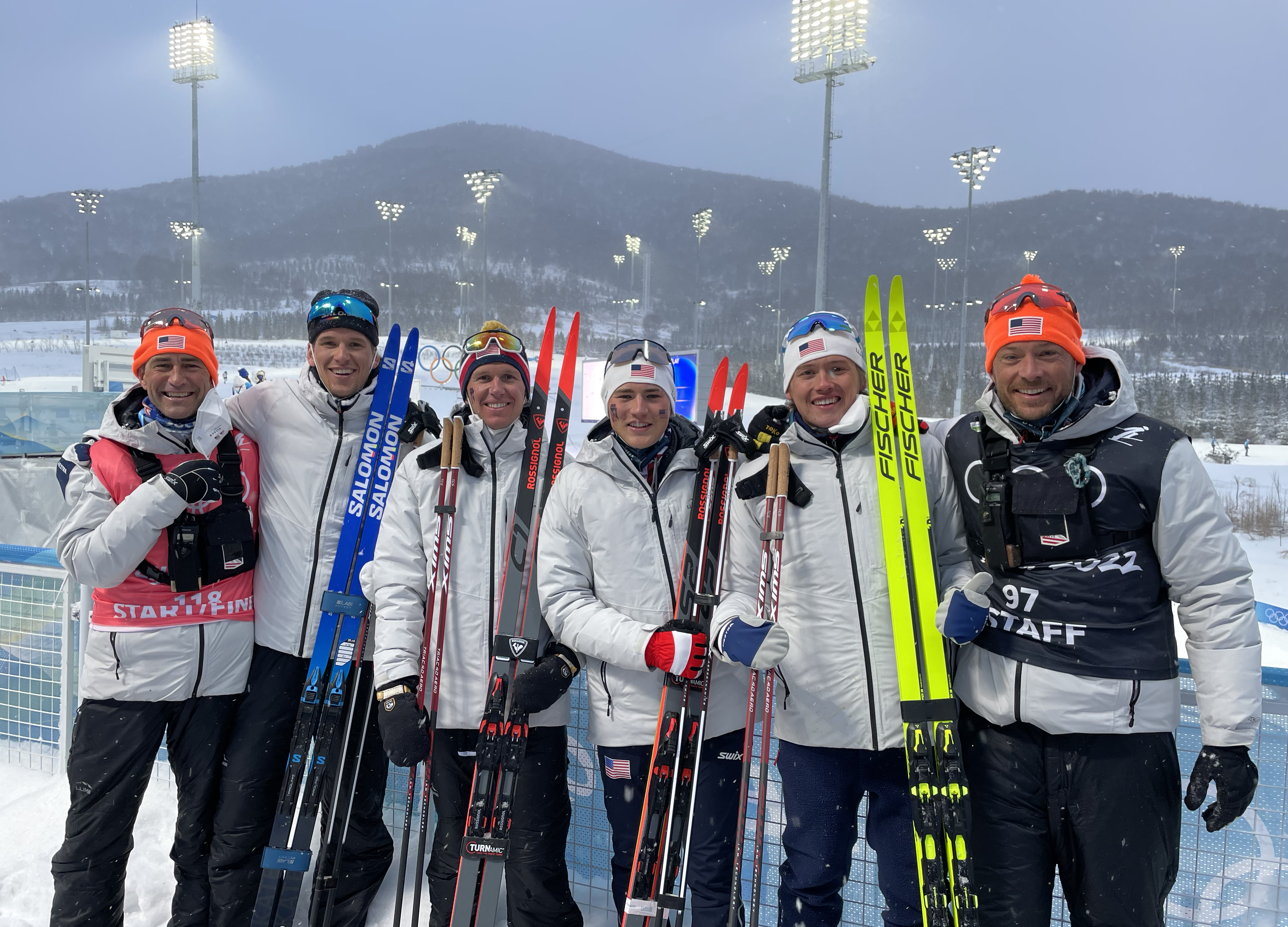
(Left to right) Cross Country Program Director Chris Grover, Kevin Bolger, Scott Patterson, Gus Schumacher, Luke Jager, and head coach Matt Whitcomb all return to the 2022-23 U.S. Cross Country Team to kick off the season next month in Ruka, Finland.
U.S. Ski & Snowboard is proud to name 22 athletes to the U.S. Cross Country Ski Team for the 2022-23 season. The 2022-23 team includes those active athletes who qualified based on the published selection criteria in the prior season.
“Over the course of the year, the coaching staff has been continually impressed by the dedication, professionalism, and preparedness of this amazing group of athletes, and we’re so excited to see what they can do this season,” said U.S. Cross Country Team Directory Chris Grover.
Three-time Olympic medalist Jessie Diggins, and two-time Olympians Rosie Brennan and Scott Patterson return to lead the team into the 2023 World Championship season. Joining Diggins, Brennan, and Patterson on the A Team are 2022 Olympians JC Schoonmaker, Julia Kern, Novie McCabe, and Ben Ogden.
The B Team includes 2022 Olympians Hailey Swirbul, Sophia Laukli, Gus Schumacher, Kevin Bolger, and Luke Jager. John Steel Hagenbuch and Hunter Wonders move from the D-Team to the B Team, and Zak Ketterson re-joins the national team program as a member of the B Team for the 2022-23 season. Finn O’Connell joins the B Team for the first time after finishing fourth in the overall 2021-22 SuperTour standings, which included nine individual top-10 results.
The 2022-23 Development Team includes returning team athletes Sydney Palmer-Leger – the 2020-21 NCAA Champion – and Zanden McMullen. New Development Team athletes include Samantha Smith – who recently represented Team USA at the U-17 Women’s Soccer World Cup in India – Will Koch, Michael Earnhart, and Walker Hall.
The 2022-23 FIS Cross Country World Cup season is scheduled to kick off with races in Ruka, Finland Nov. 25-27. The 2023 FIS Nordic World Ski Championships are scheduled for Feb. 21 through March 5 in Planica, Slovenia.
2022-23 U.S. Cross Country Team
(Hometown; Club; Birthdate)
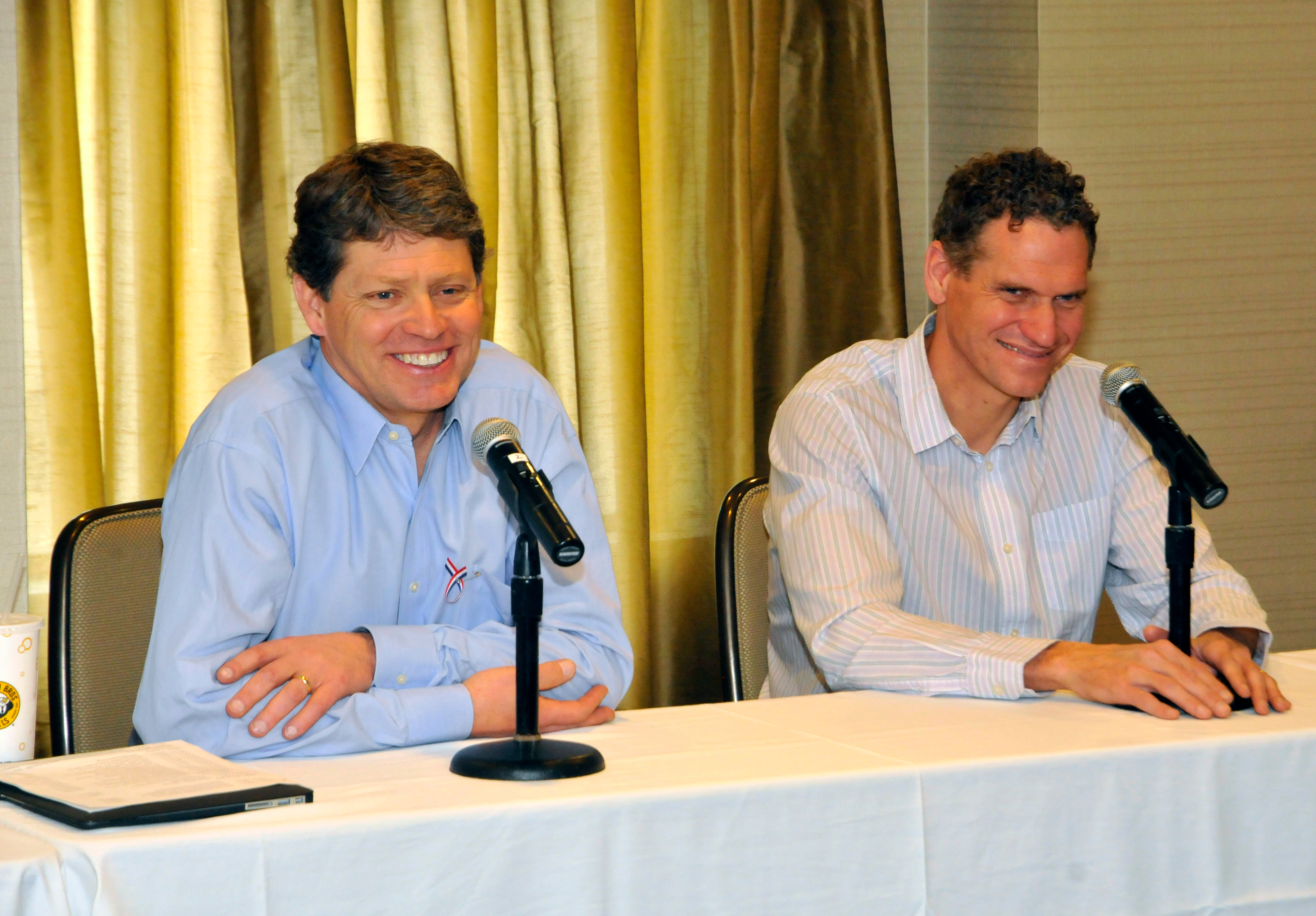
U.S. Ski and Snowboard Association CEO Tiger Shaw (left) and Executive Vice President for Athletics Luke Bodensteiner answer questions at the 2014 USSA Congress. (Photo: USSA)
As soon as U.S. Ski and Snowboard Association CEO Tiger Shaw started getting email replies to the Fall Quarterly Update he had sent out to all USSA members, he knew he had made a mistake.
“I got probably 30 responses,” he told FasterSkier. “They varied the gamut from ‘this is great, thank you for all the info, you’re going a great job,’ and then five or six ‘what the hell? Where’s the information about cross-country?’”
And it was true: in the lengthy update, the nordic disciplines were only mentioned once or twice, primarily in relation to a directed-giving campaign aimed to help them raise money from supporters. Alpine and freestyle disciplines were featured in camp and team updates, or as having already started their seasons.
“They were very fair in their criticism,” Shaw said of the nordic commenters. “Frankly, it was just a pure oversight, and my entire staff, we’re all guilty of it. Maybe it’s partly because the cross-country team was right here [in Park City] under our noses.”
(The update came out the Tuesday after the opening Frozen Thunder races late last month in Canmore, but Shaw said the message had been drafted the previous week and that’s why it didn’t include a mention of the results.)
Shaw tried to reply to all the emails, in several cases having lengthy phone conversations with USSA members. And that’s something he wants: Shaw is doing an unprecedented amount of communication with the skiing public ever since taking over from longtime CEO Bill Marolt at the end of last season.
“I fully intend to keep going with it,” he said of the detailed updates on everything from marketing to training facilities updates. “The results, everybody following the sport knows that, so it’s not about that. It’s to be a little more insightful on how things have been going, where people have been, what they’ve been doing … It’s a nice thing to hear from the leadership of USSA on a routine basis about how it’s going. And I like doing it.”
Shaw worried there are many more who are dissatisfied, but didn’t bother to contact USSA.
“I’m sure there’s a lot of people out there going, ‘Well, more of the same, an alpine guy who doesn’t even acknowledge us’,” he said. “That’s not the case, but I think I’ve made my own nest there on that one, accidentally. Guilty on omission.”
Comparing the blunder to that of other executives who say something careless at a cocktail party and then see that comment spread on twitter, he says that the last few months have been rich in on-the-job learning about how to be a CEO.
“You learn that, once you get in a position like this you just have to be really thoughtful and careful that you think about all aspects of everything that you do,” he said.
Shaw pointed to his close relationship with the cross-country team, saying that “most people probably don’t realize how well I know them.” He cited Sophie Caldwell’s elbow injury as a blow to the U.S. Ski Team at the same level as Ted Ligety’s broken hand (and much more often), and said that he will be spending three days in Davos, Switzerland, in December with the team during the World Cup competition weekend there. And it’s not a tack-on trip, either.
“The next one will probably include a lot of information about Davos and my experience in Davos, because I’m there for three nights – it’s the sole purpose of the trip,” he said of the continuing member updates.
About That Membership…
The periodic updates from the CEO’s office are just one symptom of how Shaw sees USSA membership evolving towards something more meaningful, and more fun. Among other things, he wants to move the organization toward using “standard, modern social media” to keep fans in touch with their favorite sports and athletes, something he doesn’t think USSA has done a good job of in the past.
With a long history in the sport, from junior racing in Stowe, Vt., through an NCAA Championship at Dartmouth College, two Olympic Games, and then a slot on the board of the Ford Sayre Ski Council in Hanover, New Hampshire, Shaw knows that for the last decade or longer, a USSA membership hasn’t been doing much for those who have to pony up and buy it.
“Currently, our membership base in all of our sports are what it is mainly because they have to join,” he said. “I can’t find a single alpine skier or cross country skier who is a member who would say, I joined because I wanted to and I wanted to be a part of USSA. They’ll all tell you, I joined because I must if I want to compete if in the event I want to compete in.”
That’s a problem, and Shaw knows it.
“What’s so important is the fact that [everyone] participating, they are providing the pathway and the system for the elite teams to make it to the top, while everybody who doesn’t is pursuing their passion and having a lot of fun, and being part of the entire family,” he said. “We just haven’t looked at it that way in the past. We’ve been focused on the athletes at the very top without frankly paying a lot of attention to how they got there and why they got there, and thanking and engaging all of the people who helped it happen. Every single participant in every single sport ultimately has an impact.”
Shaw anticipates rolling out a new membership structure with different payment options and more benefits in the spring. To do so, he has convened a committee for each discipline, comprised of members from industry through coaching staff, to meet at least once a month and in the end deliver him a report on what membership should look like for each sport individually.
“How do people get into the sport?” he asked. “How do we lose them out of the sport? What is the role of parents? What is the role of clubs? Which varies widely, by the way – snowboarding is not as club-based as nordic and alpine are. But also the trends, are any of those things changing. And the participation and membership situation in general. How many participants are in the sport, where are they, what are they doing, and what organizations are they a part of?”
USSA debuted a new “club participant” membership this season, which costs $25 and does not confer a racing license for USSA-sanctioned races, but does include all the other benefits of USSA membership, for instance liability and accident insurance, discounts from suppliers and other partners, and educational materials.
“We don’t do a good job of describing this, but if you’re a USSA member you get Global Rescue benefits, domestically and worldwide, and paramedics available 24 hours on the phone who you can call with any medical question while you’re traveling,” he explained. “That’s included. We’ve done such a poor job of marketing that that people don’t know it.”
(Shaw formerly worked as the senior director of response services for Global Rescue.)
Currently, for both alpine and nordic skiing, there are roughly three or four times as many participant athletes around the country who are not USSA members, compared to the number who do hold a membership.
“The idea is that, what I would love to see is that every participant in all of our sports in this country is a USSA member,” he said. “But to do that, we have to develop affordable, lower cost (especially to lower ages) membership that include significant benefits so that people want to be a member.”
That doesn’t exactly square with the increased cost of a competitor license fee to $150 this season, but Shaw is working on it. Among other things, he plans to “carefully” partner with regional organizations like NENSA and CXC.
“It’s not really a membership organization where everybody feels that they want to be part of it,” he lamented. “And they should. We’re the mother organization of the whole country. I want everybody to be part of that, including fans. There should be memberships that are free. There should be memberships that cost nine dollars, or 19, or 29, or whatever is appropriate. And they should have real benefits to them.”
Once Shaw’s committees finish their reports and his initiatives get some steam, he anticipates USSA being more involved with the types of grassroots efforts that he saw in his time with Ford Sayre.
“I just watched family after family in the Upper Valley say, ‘I’ve heard this is the thing to do, so we do it,’ ” he described. “Their kids become great athletes and skiers and snowboarders, and even if the parents weren’t, the kid gets exposed to a whole ‘nother sport which is a lifetime skill. This would be the success of USSA as a mothership organization, besides Kikkan winning the sprint and Ted [Ligety] winning the GS. It’s also the number of kids’ lives which are impacted by our sport. And we can help that.”
Targeted Fundraising
Shaw also discussed the restricted giving programs that USSA is setting up for individual disciplines – one of the only places in his Quarterly Update where he actually mentioned cross country and nordic combined.
The effort is headed by Liz Arky, the Washington, D.C.-based Managing Director of Global Government Relations for Accenture. For each discipline, the effort is typically spearheaded by a major donor who wants to make a directed difference.
“When somebody becomes interested in helping a part of the team, the foundation staff get involved and handle and work very closely with this donor so that we don’t accidentally turn our coaches into fundraisers,” Shaw explained.
“That is not the intent. The intent is to add the organizational horsepower of the foundation staff and the organizational gifts officers, who are trained to do this, for them to be able to handle the workload. Whereas the coaches are free to continue to enhance the relationship, but don’t have to deal with all the logistics and technicalities. It works out really well.”
While cross-country and nordic combined are some of the highlights of the program’s success – Shaw said that Arky has worked with U.S. Ski Team coaches Chris Grover and Matt Whitcomb to already accomplish several projects – he believed that every USSA discipline is currently taking advantage of the opportunity.
“The things that they do and fund are directed by the head coaches of those sports,” he said. “They tend to be things that they wanted to do, but were beyond the budget or scope of that year. So it might allow them to have a camp, or do a research project on human physiology, or whatever the project is that is next on the list, so to speak. It’s not random. It’s highly coordinated between our development team, Trish Worthington’s team, and the coaches themselves.”
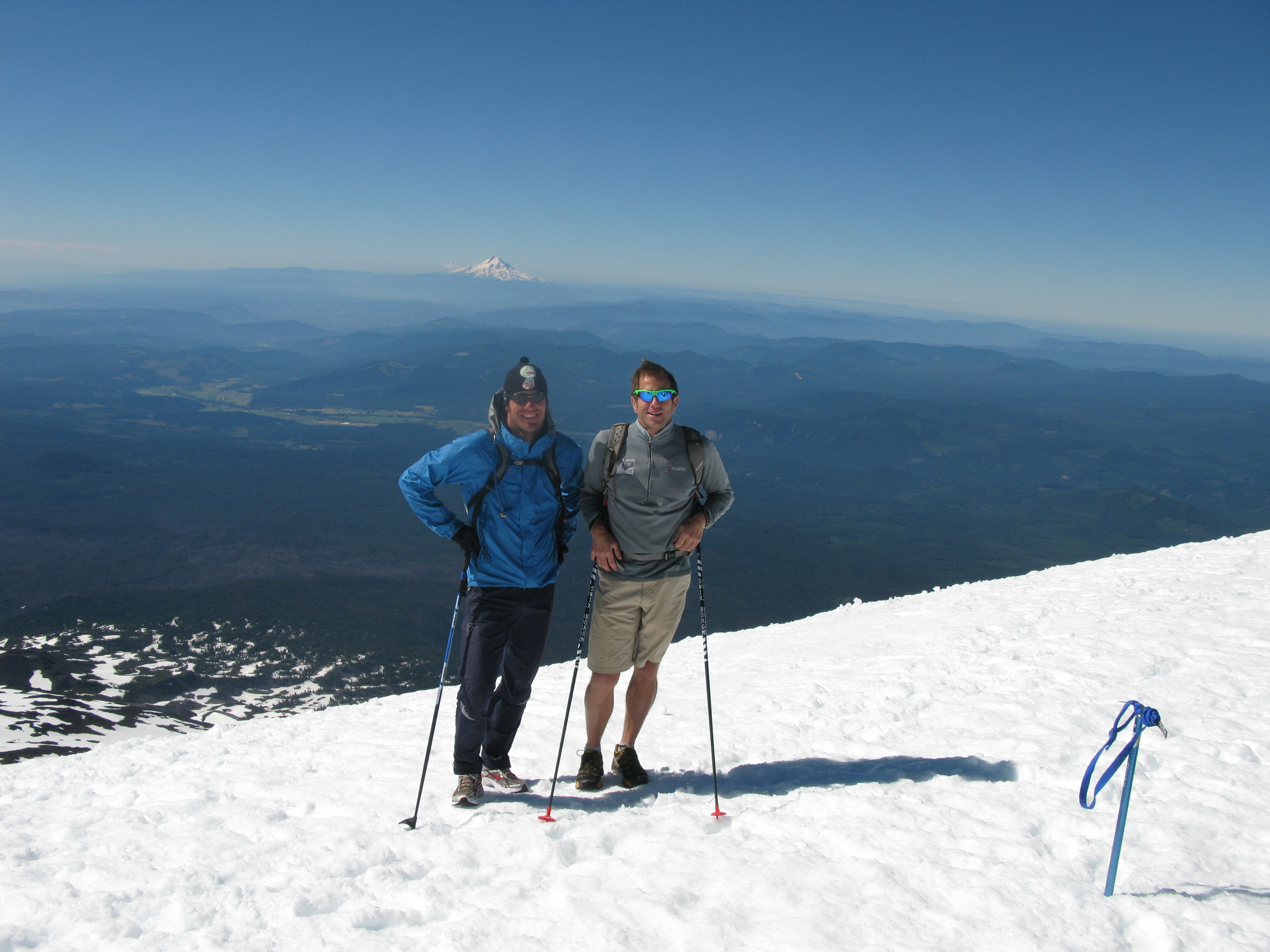
Three-time Olympian Torin Koos (L) and Scott Johnston in 2010. Courtesy photo.
The following is a letter that Scott Johnston, the coach of the Methow Olympic Development squad that at some points included Sadie and Erik Bjornsen and Torin Koos, and who also coached Team Gregg, shared with FasterSkier. He addressed it to U.S. Ski and Snowboard Association CEO Tiger Shaw after receiving Shaw’s Fall Quarterly Update, but says he has not received a reply. Some of Johnston’s concerns served as the basis of questions we asked Shaw when we interviewed him earlier this week. You can read the resulting story here.
In his letter, Johnston references a report commissioned by USSA from the consulting firm McKinsey & Company. The report can be found here.
For his part, Shaw told FasterSkier that he had no record of Johnston’s e-mail on the USSA server (we provided him with a copy of the letter so he could search the email address). The disconnect appears to have been an electronic snafu, and FasterSkier has put the two men in touch.
Dear Mr. Shaw:
It is with interest that I read your recent letter to USSA members but I must confess to some dismay as well. I’d like to point out the areas that cause my dismay. Please be aware that these are areas that have been a source of disappointment with USSA for years and I was really hoping to see substantive changes after the McKinsey report and the recent welcome change in leadership.
I well understand, firsthand, the need for a focus on results at the World Class level. Four of the members of this year’s Olympic Cross Country team were skiers that I have coached extensively, two of them from the age of 12. So, my desire to place athletes on the world stage should be in no doubt. In that way I share your goal of International excellence. However, I am concerned by what I perceive at USSA as a general lack of understanding of where these elite athletes come from in the first place. I have encountered this disconnect at all levels of dealing with the USST/USSA and now I sense that same disconnect in reading your letter.
These kids do not pop fully formed on to the international scene ready for the USST to take them to World Junior Championships or the World Cup. These young champions come from the clubs and the private coaches working for small financial gain or volunteering huge amounts of time and resources to see that these young skiers develop in the best possible way.
To that end, your base of membership and its development should be the number one goal of USSA. If this is done well the USST will have ample talent to choose from for the secondary goal of wining medals. Without this club oriented base and the effective development process it ensures we will continue to rely on luck in finding our next world beaters.
One year ago I attended a coaching symposium for cross country coaches at the Center for Excellence. One of the most engaging and informative speakers was Jack Roach, USA Swimming’s National Junior Team Director. Jack spoke for a few hours on the development process utilized in swimming. Without doubt US swimming can be viewed as an athletic success story. One that, with regularity, produces world class performers. They fully prioritize the importance of the clubs and their membership base in contributing talent to the national team and place many resources and a large focus at the individual and club level.
Sadly the USSA does not do share this vision. From the Mckinsey report and as verified by my casual polling of coaches, parents and skiers the perception is very strongly held that USSA/USST exists to extract fees from it members to support a largely top heavy organization that has little regard for its basic membership. This may seem like a harsh criticism and I would love to have my perception changed, but it is a message that does not seem to have made it to the meeting rooms and offices of the Center of Excellence, so, forgive my bluntness.
Last year USSA members received notice that their competition license prices were going up substantially. Among the skiers, coaches and parents I know there was considerable discussion about this and it was largely seen as further evidence of the points I have made above.
In an already small membership in an already very expensive sport, this seems like the exact opposite of a good business decision. Would any other company seeking to increase market share raise its prices? Your base of members, kids coming into competitive skiing, is also lured by other sports. For comparison with other individual sports, here is a list of membership fees/competition licenses:
USA Swimming: $50/yr
US Track and Field U-18 $20/yr, Adult $30/yr
USA Gymnastics $54/yr
All of these sports can lay claim to larger membership bases than USSA as well as consistent top results at the international level. All of them are directly competing with skiing for the time, energy and funds of these young people. Could there be a connection between lowering the barrier to entry in the sport and more consistent elite results. I am in no doubt of it.
A few USST stickers and a Comp guide are really not very much of a benefit of membership. Sadly that is the perception of many kids and parents who are making decisions about the direction that these young athletes will be taking during the critical adolescent years. As a minor sport in a culture filled with distractions and diversions we cannot afford to have our talent turned away from skiing during these peak development years. We just don’t have talent to waste.
I hope that these heartfelt comments from someone who has spent many years volunteering his time and money to the sport will be taken not as the ranting of some disgruntled malcontent but instead as constructive critique from a guy working daily in the trenches.
DAVOS, Switzerland – With six athletes making the World Cup sprint quarterfinals, including one who made it to the podium and another who notched a career-best result, Sunday was obviously a good day for the U.S. Ski Team.
But besides the results that would make them celebrate no matter which weekend they happened, the cross country skiers had one more reason to be pleased: incoming U.S. Ski and Snowboard Association CEO Tiger Shaw and his wife Kristin were on hand to watch and learn about the sport.
“I was impressed,” Shaw said. “We were flabbergasted, really.”
Maybe Shaw’s presence inspired a little something extra – or maybe it as just a great coincidence. Either way, the U.S. was happy to have Shaw on hand to see their hard work pay off.
“It was nice to have them cheering,” Whitcomb said. “I think it just reminded us all how proud we are to represent our country. It’s not often that we have too many direct fans like that over here.”
Coming from an alpine skiing background – Shaw is a two-time Olympian – the new federation CEO was amazed at how exciting the action was on the World Cup today.
“Today was amazing,” he told FasterSkier on the phone from the Zurich airport. “I had heard about sprints and elimination heats and how it all works, and I have to say that I was incredibly impressed by the athleticism and the strength and speed by all of the athletes I saw today, as well as amazed at how well the Americans did. I mean, Kikkan obviously was tremendous, she got beat at the end by two centimeters, unfortunately, but she also got interfered with at least once in her final round.”
In an interview this fall, Shaw mentioned that he wanted to spend some serious time learning about the many ski and snowboard disciplines that USSA governs. Current CEO Bill Marolt is staying involved with the organization until after this winter’s Olympics, giving Shaw some time to learn the ropes of his new job. The trip to Davos is one step in making good on that promise, and Shaw clearly enjoyed himself.
He Saturday evening eating dinner with the American athletes and coaches, who answered his questions and tried to teach him everything there is to know about sprint racing so that he would understand Sunday’s competitions.
“Getting to know the athletes and coaches a little better was a priority, and it worked out great even though we could only pull off spending one night there,” Shaw said. “Everybody was great. They were so welcoming, and they basically explained and taught us everything.”
A former racer at Dartmouth College before going on to the Olympics, Shaw had some passing familiarity with college nordic competitions, but today’s World Cup competitions are quite different than anything he had seen before (when Shaw won the NCAA slalom championship in 1982, for example, skating had barely been invented). And although he had met the team before at the Center of Excellence in Park City, seeing them in action was a completely different experience. And Shaw loved it. He anticipates being better able to support and promote the cross country skiers now that he understands what they are striving for – and achieving.
“I think with the help of Matt and the other coaches, and certainly Luke Bodensteiner, who does such a great job leading athletics and the fact that he is a nordic guy,” Shaw said. “I’ll learn a lot more from him now in future discussions about how to do that. So I see it.”
He’s even on board to try to get the World Cup to return to the U.S. for the first time in years, and thinks that the sprint format is the way to do it.
“We’d love to do one in a city in the United States sometime, if we can make it work financially,” he said. “I know FIS really, really wants us to do that, kind of like the Quebec City one last year. There’s the desire to do a race sometime in New York City. Making that work financially is critical, but you’d think that we could considering the number of people who would come watch it and probably be amazed at how fast everybody goes.”
If that happens, the Americans will be ready to deliver on the results. When asked whether he ever expected to watch his team win three quarterfinal heats in a row, Whitcomb was dead serious: yes.
“They train together a lot and they fight together a lot in training,” he said. “They’re ready for situations that they encounter out here. A few years ago our elbows were soft and dull. They’re sharp and hardened now. So we know where we can go. We don’t get pushed around as much anymore, and I have good confidence.”
With the help of regional coaches attending the camps, the U.S. Ski Team coaching staff has selected the top athletes from all four Regional Elite Group (REG) camps (East, Central, West and Alaska) and names these athletes to the National Elite Group (NEG). These athletes are offered the opportunity to train alongside the U.S. Ski Team athletes at the Lake Placid Olympic Training Center October 9-17th. Attributes such as motivation, dedication, general physical fitness and ski-specific performance are taken into consideration to select these athletes.
Men
Skyler Davis (Stratton Mountain School/ Sverre Caldwell)
David Sinclair (GMVS/ Justin Beckwith & Dartmouth College/ Ruff Patterson)
Andy Dodds (Minnesota Valley/ Reid Lutter & CXC Jr Development Program/ Igor Badamshin)
Scott Patterson (Alaska Winter Stars/ Jan Buron)
David Norris (Fairbanks Alaska Ski Team (FAST)/Bill McDonnell)
Tyler Kornfield (Alaska Winter Stars/ Jan Buron & UAF/ Scott Jerome)
Women
Isabel Caldwell (SMS/ Sverre Caldwell & Dartmouth College/ Cami Thompson)
Heather Mooney (Stratton Mountain School/ Sverre Caldwell)
Jessie Diggins (CXC Team Vertical Limit/ Jason Cork & Gus Kaeding)
Annie Pokorny (Sun Valley Ski Education Foundation/ Chris Mallory)
Michaela Frias (Steamboat Springs Winter Sports Club/Josh Smullin & Brian Tate)
Caitlin Patterson (Alaska Winter Stars/ Jan Buron & UVM/ Patrick Weaver)
1st Alt: Erik Fagerstrom (Sun Valley Ski Education Foundation / Chris Mallory)
2nd Alt: Annie Hart (Minneapolis Ski Club/ Kevin Brochman)