From the FasterSkier archive — posts syndicated from athletes’ and coaches’ own blogs between 2004 and 2012, kept online as published. Current coverage is at fasterskier.com.
U.S. Ski & Snowboard recently announced its U.S. Ski Team nominations for the 2022-23 season. Of the 22 athletes named to the team this season, six were not on the previous year’s roster, either newly named or renamed: Michael Earnhart, Walker Hall, Zak Ketterson, Will Koch, Finn O’Connell, and Sammy Smith.
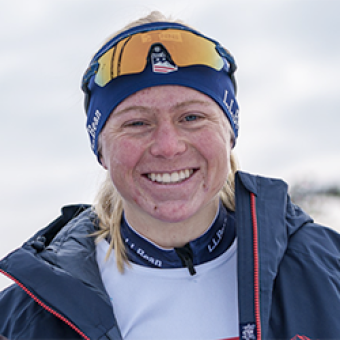
Samantha Smith is named to the 2022-23 U.S. Ski Team D-Team. (Photo: U.S. Ski & Snowboard)
To help fans get to know these new(er) faces, FasterSkier is doing a series of interviews, providing insights into the factors that have contributed to development, progress, and growth for these athletes last season. In this installment, we talk to Sammy Smith about her participation and success in numerous sports, the charity she and her siblings founded during COVID, and her nomination to the U.S. Ski Team D-Team.
At Junior World Championships in Lygna Norway this past February, Smith finished 5th in the skate sprint and 11th in the 15k skate. She also finished 10th in the skate sprint at Senior Nationals in Soldier Hollow in January 2022 racing amongst the senior women’s field.
Not only is Smith a successful cross-country skier, but she has also achieved impressive results in running, soccer and freestyle skiing. During her freshman year of high school Smith won the 1,600 and 3,200 meter events at the Class 5A Idaho state meet, leading her to be a finalist for the USA TODAY High School Sports Awards.
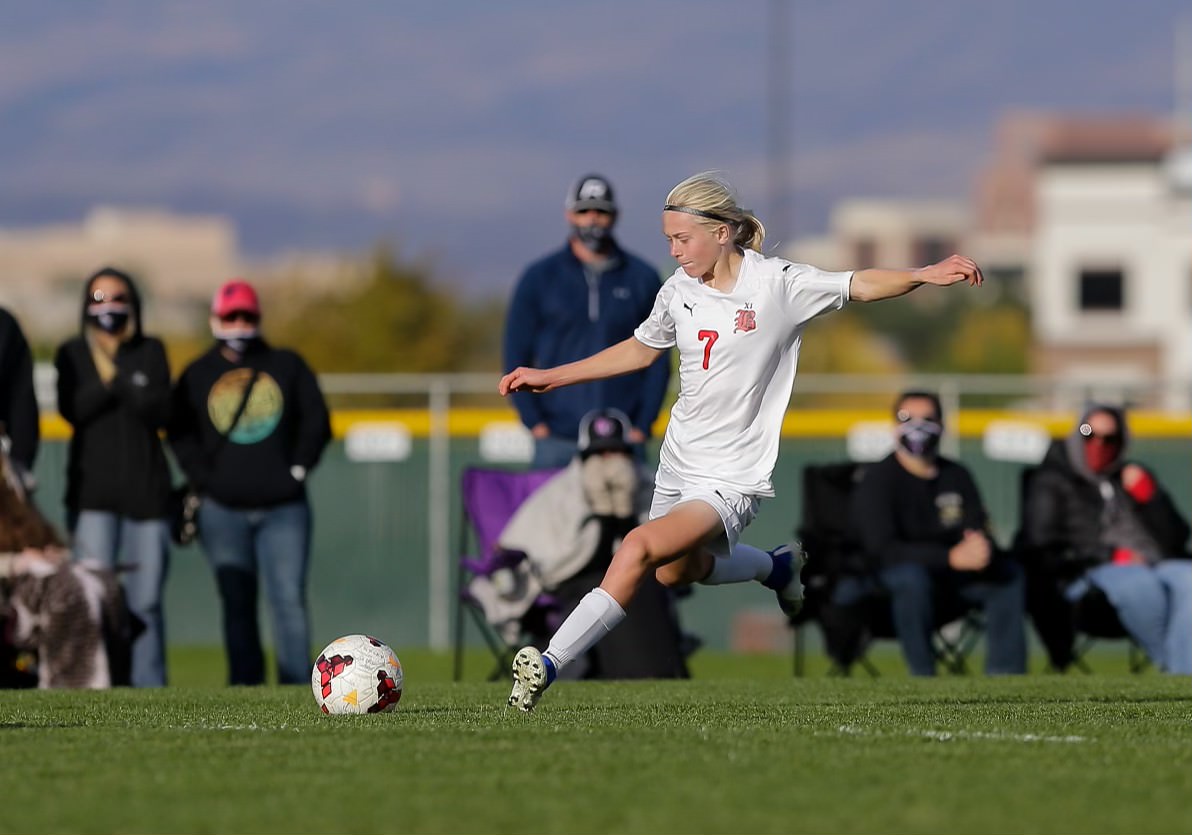
Sammy Smith competing for a Boise-based soccer team. (Courtesy photo)
Ella Hall/FasterSkier: You’re sixteen, does that mean you’re a junior in high school?
Sammy Smith: I actually just finished my Sophomore year of high school (our school got out last week), so I will be a junior in the fall.
FS: And do you live part of the year in Boise and spend the winters in Sun Valley?
SS: Yes, I live in Boise for the fall, spring, and summer. Although during the summer I am often gone a lot, and we frequently go up to Sun Valley. I go to Boise High School for the fall and spring, then I move to Sun Valley for skiing for the winters and while I’m there, I go to the (Sun Valley) Community School.
Sammy Smith competing in freestyle skiing. (Courtesy photo)
FS: From what I’ve gathered you’re involved in quite a lot of sports, can you tell me which sports you competed in this year?
SS: Currently I cross-country ski, play soccer, run track and cross-country, and freestyle ski. This year, I competed in all of the above, except freestyle skiing. Unfortunately, I sustained an injury in the late fall that prohibited me from jumping so I was unable to compete in freestyle. My track season was also cut short because of an injury but I’m healthy now.
Soccer and nordic are definitely my two primary sports. For soccer, I am actually in the US U17 Women’s Youth National Team training pool. I was selected as an alternate for the Confederation of North, Central America and Caribbean Association Football (CONCACAF) tournament this spring. That meant I only participated in the pre-camp, then returned home prior to the tournament kicking off. I aspire to compete for the full US Women’s National Team (WNT) one day, and hopefully will have the opportunity to represent my country in two different sports.
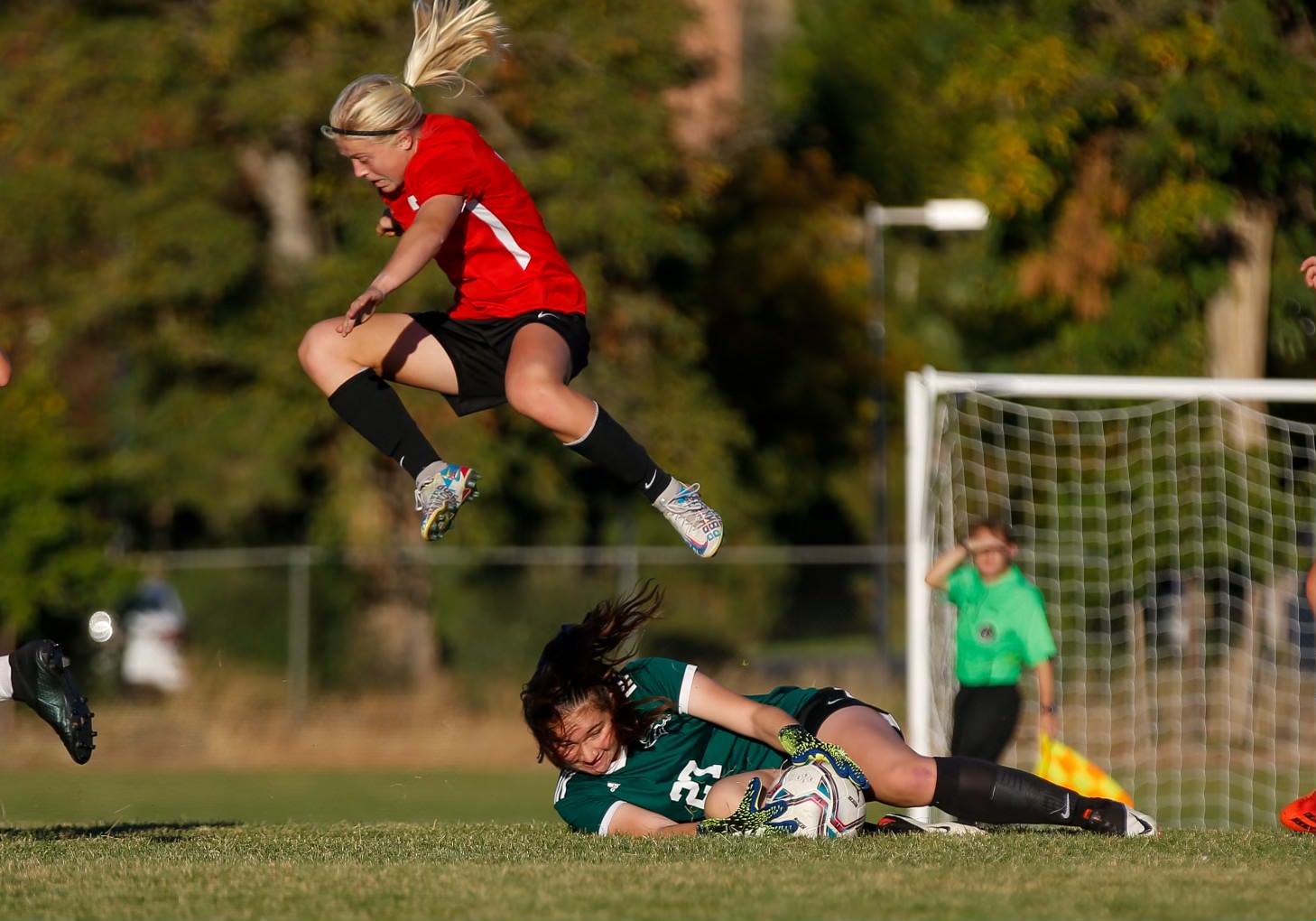
Sammy Smith gets air in an Eagle vs. Boise soccer game. (Courtesy photo)
FS: How and when did you start nordic skiing?
SS: I initially got involved in nordic skiing because of my older sister. When I was five, my parents had signed my sister up for SVSEF’s devo program, and naturally I wanted to do everything she was doing, so I began to pick up the sport as well.
FS: I read that you and your siblings started a charity during the pandemic, can you tell me a little about that?
SS: My siblings and I founded GO BIG, a 501 (c3) certified charity, during the spring of 2020. GO BIG stands for Giving Opportunity By Inspiring Gratitude. Through the charity we aim to make a positive impact on less privileged youth in our area. We have been so fortunate to grow up the way we have, we want to help those who haven’t. We work to provide these kids with mentorship, as well as resources to help them – like books and other educational tools, and sporting equipment.
Our goal is to inspire a sense of gratitude in these youth because science has shown that those who experience a sense of gratitude are more likely to feel good about themselves and pass that feeling along to others, thus helping spread good through the community and beyond.
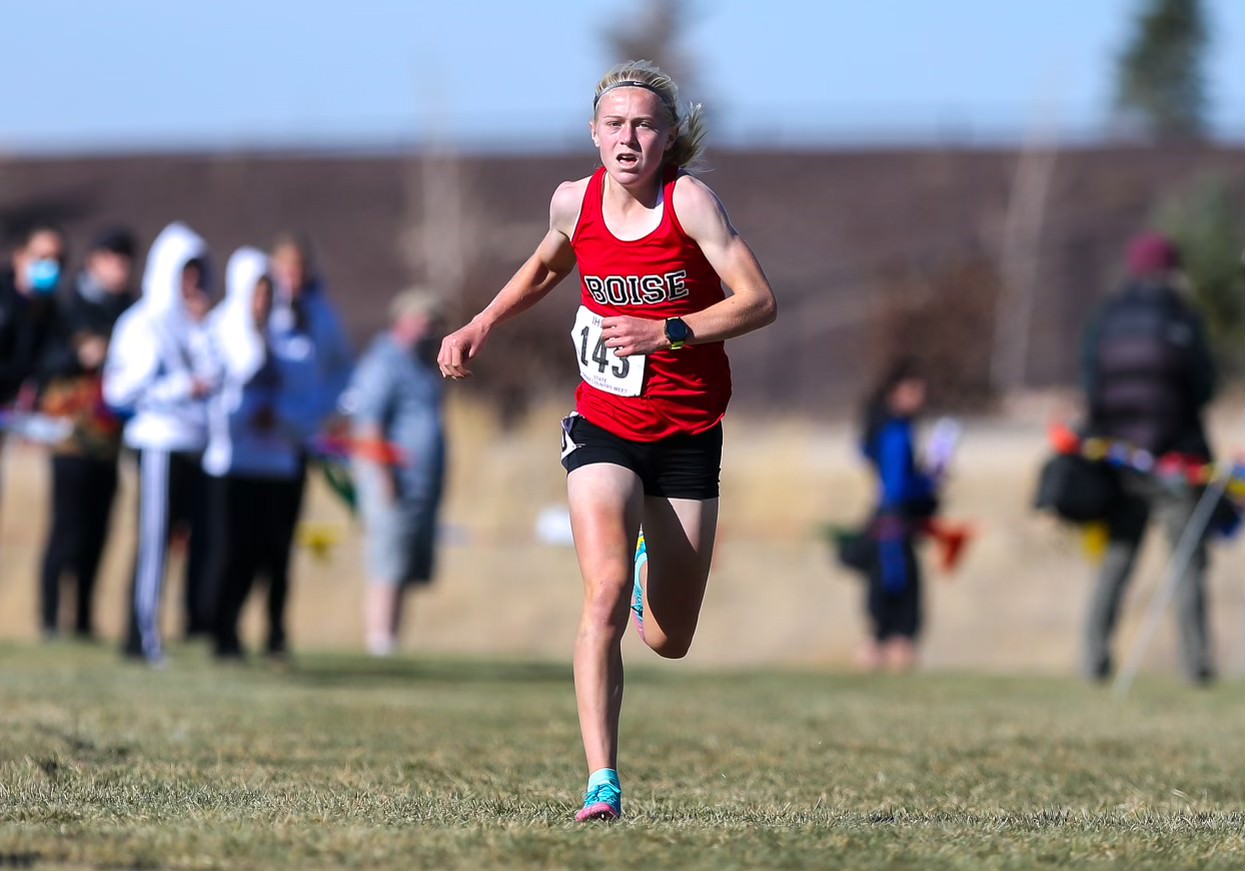
Sammy Smith runs cross-country for her high school team in Boise, ID. (Courtesy photo)
FS:You had some pretty exciting results at World Juniors in Lygna Norway this winter, can you talk a bit about the contributing factors/support system that helped you achieve those results?
SS: I owe a huge thank you to my coaches in Sun Valley, especially Rick Kapala, because he and I made a really thorough and thoughtful training plan going into the Championships. I think having such a detailed plan allowed me to come in more prepared, and in better form than I could have imagined.
I was fortunate enough to have Paul Smith as my wax tech who worked a lot with me on ski selection, and taught me what to look for in a pair of skis throughout the season, and how to decide between them when it seems like the glide is comparable.
Going into World Juniors, I had a lot of new skis from Salomon, and I didn’t really know a lot about them, but fortunately Paul was incredibly helpful. I relied on him heavily to help me test and decide how to organize my fleet before I left. And once we were in Norway, he made sure I was testing the appropriate skis, and helped me choose which pair I was racing on each day. I’m incredibly grateful for Paul’s help, and the support from Salomon.
In addition, the U.S. Ski Team support system was unlike anything I had ever been part of before. Our pre-camp was designed perfectly to help us peak for our races, and once we arrived in Lygna, we had access to even more resources. It truly was a trip designed to help young skiers have the best races of their lives.
FS: What excites you most about being named to the U.S. Ski Team?
SS: I’m most excited about the incredible opportunities that come with being named to the U.S. Ski Team. Being able to train with the best skiers in the country, and some of the best in the world, is an unparalleled opportunity for growth and development. I think when you are put in an environment where you are surrounded by people who share a common passion and common goals, naturally you improve. I can already feel the great sense of community and support from the more experienced skiers and it makes me so excited to train and race alongside them in the future.
I also think the U.S. Ski Team has invaluable resources and tools to help all the athletes become the best version of themselves, and I love to compete and am always looking to improve, so that’s really exciting to me.
Sun Valley’s Sammy Smith (right) finished 10th overall in the freestyle sprint during the 2022 U.S. Cross-Country Ski Championships in Soldier Hollow. Smith was the third-fastest junior racing with the senior women, behind Sydney Palmer-Leger (University of Utah) and Kate Oldham (Aspen Valley Ski & Snowboard Club). (Photo: Tobias Albrigtsen / @untraceableg)
FS:What are some of your goals for the upcoming season?
SS: I was really fortunate to have some great results at last year’s World Juniors, and I want to continue to build off of that for next season. So, my primary goal for the season is to finish top three at World Juniors.
FS: Will you be able to join any upcoming USST camps this summer/fall or will you be primarily focused on your other sports until winter rolls around?
SS: It is certainly a priority of mine to get to some of the upcoming camps, but it’s always a balance, so right now I’m trying to figure out scheduling for both soccer and skiing.
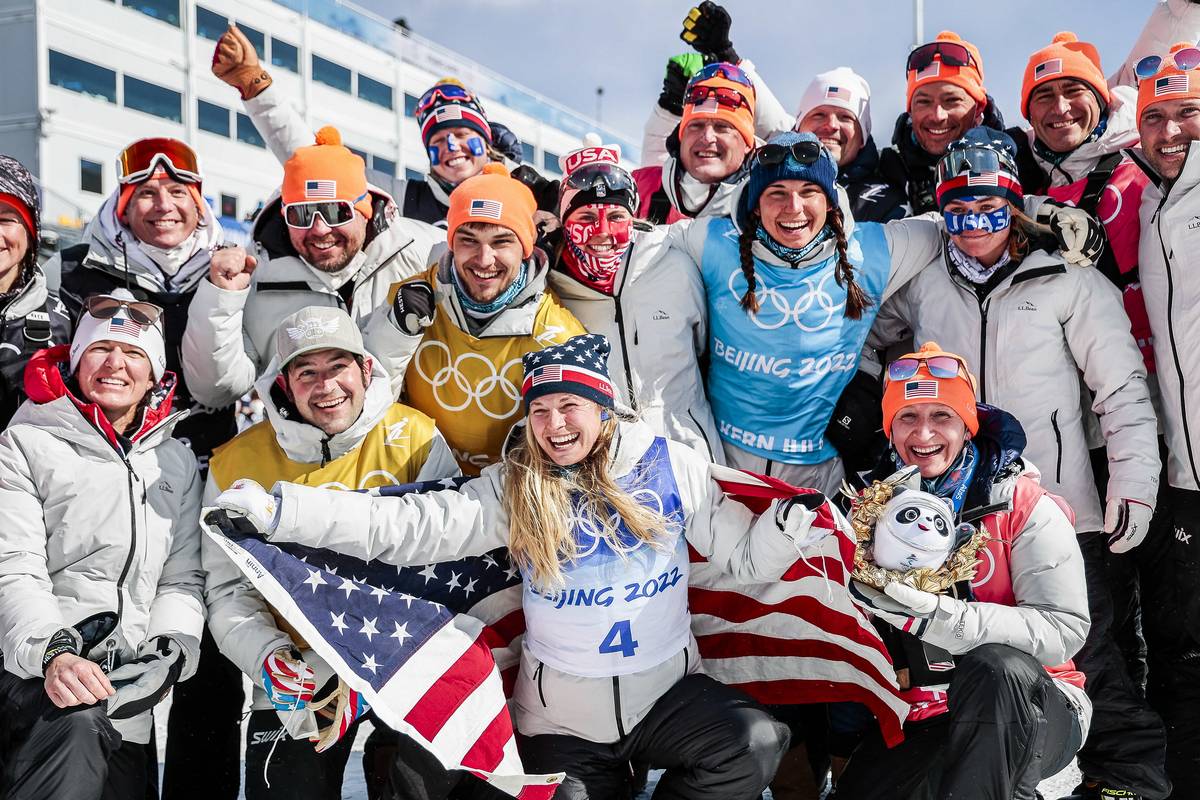
Celebration abounds following Jessie Diggins’ Olympic silver medal in the 30 k mass start skate in Zhangjiakou, CHN. U.S. Ski Team head coach Matt Whitcomb and cross-country program director Chris Grover wear orange hats near the top-right corner. (Photo: NordicFocus)
I think we can all agree that the last two years have been a wild ride.
For those at the helm of the cross-country program at U.S. Ski & Snowboard, added layers of COVID safety precautions and expensive testing have increased the otherwise mounting demands of preparing for an Olympic Games. There have been numerous domestic and international competitions canceled, including a full season of SuperTour racing in 2020/2021, numerous World Cups canceled, and three consecutive years where the World Cup finals were either rescheduled or canceled. Amidst ever-changing travel policies country to country, the U.S. Ski Team tested, masked, and problem solved their way through two race seasons.
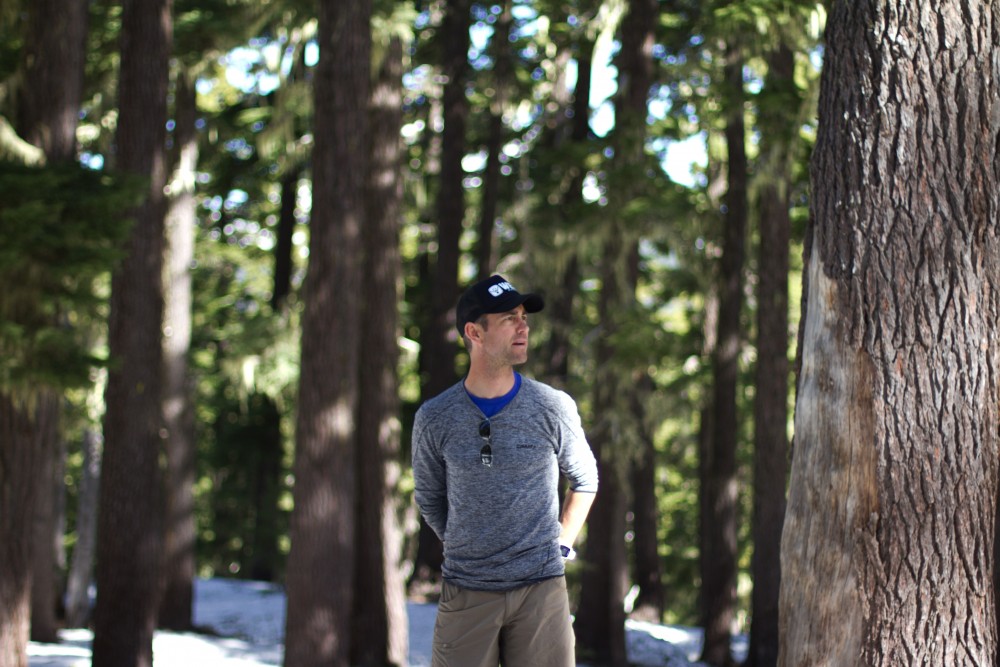
U.S. Ski & Snowboard XC Program Director Chris Grover oversees training during a 2019 U.S. Ski Team camp in Bend, OR. (Photo: FS Archives)
Throw into the mix preparations for an Olympic Games at a brand new venue where teams would be arriving site unseen and COVID testing protocols were extreme, and cap the season with the invasion of Ukraine and subsequent ban of the Russian cross-country powerhouse – there’s simply been a lot of curveballs thrown.
But as the 2022/2023 season approaches, we also sit at a transition point for World Cup racing that perhaps marks a few steps forward with gender parity. Namely, a move toward equal distance racing and the adoption of an initiative proposed by U.S. Ski & Snowboard to the FIS to incentivize supporting and developing more women to become ski technicians at the World Cup level. In this proposal, an additional set of course access bibs which could be used to test skis and product at World Cup events would be available only to women; therefore, a country could increase the size of its service staff by investing in the development of women techs and utilizing these women at World Cups.
Though Grover explains this may best serve the nations with the biggest budgets – which does not include the United States – it’s greater purpose aligns with other grassroots initiatives at U.S. Ski & Snowboard to hire, develop, and support women in coaching and leadership to improve the balance of men and women representing all levels of the sport.
There’s also a recently-released 2022-23 roster of U.S. Ski Team athletes, featuring a bloom of young talent on the men’s side whose trajectory may enable a full field of men and women to race at the 2026 Olympic Games in Milano Cortina. And, there’s momentum building for a Minneapolis World Cup in 2024, followed by a trip to the Northwoods of Wisconsin for a super-Birkie – i.e., a World Cup sprint and 50k on the Birkie trails.
In short, there were no shortage of talking points for this insightful conversation with cross-country program manager Chris Grover, who joined us from his home in Hailey, ID upon returning from the U.S. Ski Team’s first training camp of the season at the Mt. Bachelor Nordic Center in Bend, OR.
Thanks for listening.
Masked up, Jessie Diggins and Ebba Andersson (SWE) congratulate one another on podium performances in the 10 k skate in Falun in Mar. 2022. (Photo: NordicFocus)
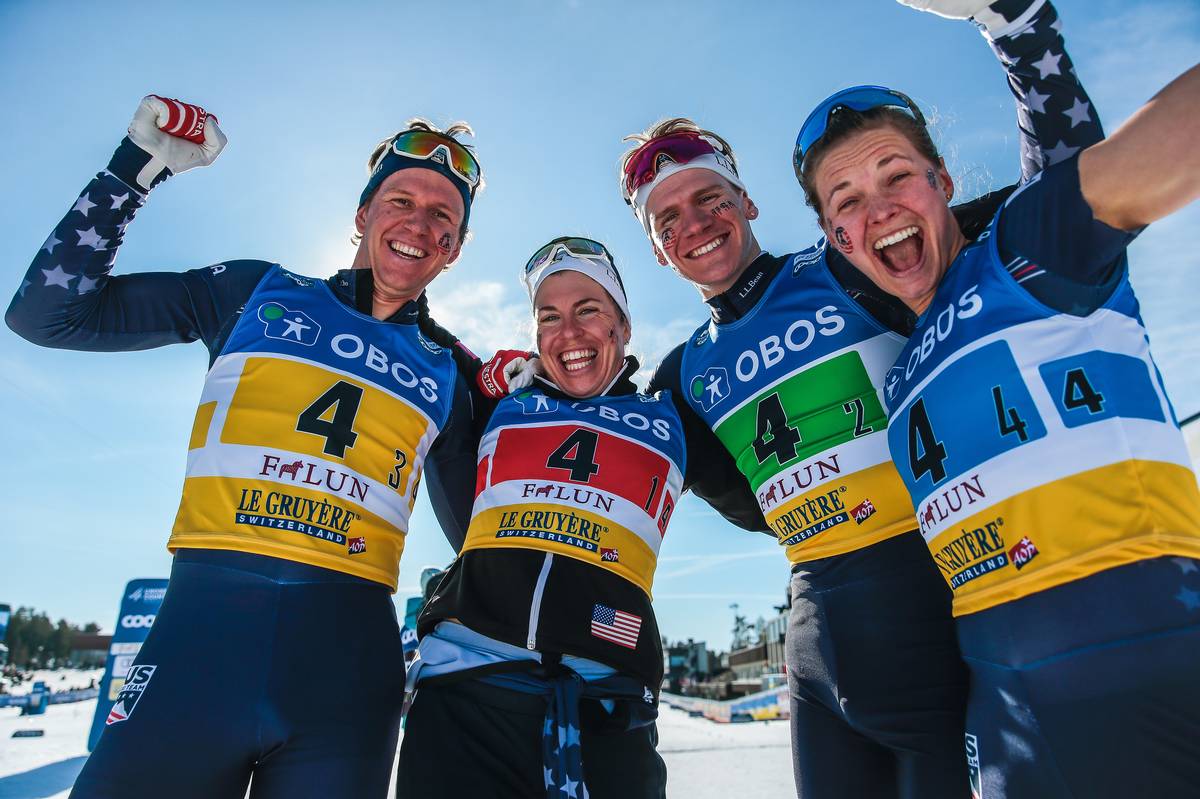
USA I takes the win in Falun’s 4 x 5 k mixed relay. From left to right, Scott Patterson, Rosie Brennan, Zak Ketterson, and Jessie Diggins. (Photo: NordicFocus)
By Tom Horrocks
May, 10 2022
U.S. Ski & Snowboard has announced the 22 athletes nominated to the U.S. Cross Country Ski Team for the 2022-23 season. Nominations include those active athletes who qualified based on the published selection criteria in the prior season.
In addition to established veterans, including three-time Olympic medalist Jessie Diggins and two-time Olympians Rosie Brennan and Scott Patterson, the 2022-23 Team includes five new members. Moving up to the A Team and joining Diggins, Brennan and JC Schoonmaker for the coming season are 2022 Olympians Julia Kern, Novie McCabe, Ben Ogden and Patterson.
B Team nominations include 2022 Olympians Hailey Swirbul, Sophia Laukli, Gus Schumacher, Kevin Bolger and Luke Jager. John Steel Hagenbuch and Hunter Wonders move from the D-Team to the B Team, and Zak Ketterson re-joins the national team program as a member of the B Team for the 2022-23 season. Finn O’Connell has been nominated to the B Team for the first time after finishing fourth in the overall SuperTour standings, which included nine individual top-10 results.
Development Team nominations include returning team athletes Sydney Palmer-Leger – the 2020-21 NCAA Champion – and Zanden McMullen. New Development Team athletes include Sammy Smith, who finished fifth in the freestyle sprint at the 2022 Junior World Championships; and three members of the bronze-medal winning U.S. men’s relay team from the 2022 Junior World Championship – Will Koch, Michael Earnhart, and Walker Hall.
“This team is the largest in U.S. Ski & Snowboard’s XC history, and it could become our most successful one, too,” noted Head Coach Matt Whitcomb. “There is clear talent, as well as a history of impressive results, but most importantly, these are individuals from many different clubs in the U.S. that are interested in connecting and believing in one another, and pushing hard. Talent and past results don’t get me as excited as a bunch of athletes that are ready to lock in together.”
Notable retirements following the 2021-22 season include 2022 Olympian Hannah Halvorsen, and Junior World Championships bronze medalist Katharine Odgen.
The 2022-23 FIS Cross Country World Cup season is scheduled to kick off with races in Ruka, Finland Nov. 25-27. The 2023 FIS Nordic World Ski Championships are scheduled for Feb. 21 through March 5 in Planica, Slovenia.
A 2022-23 staff announcement will be forthcoming, while an official U.S. Cross Country Ski Team announcement will be made in the fall.
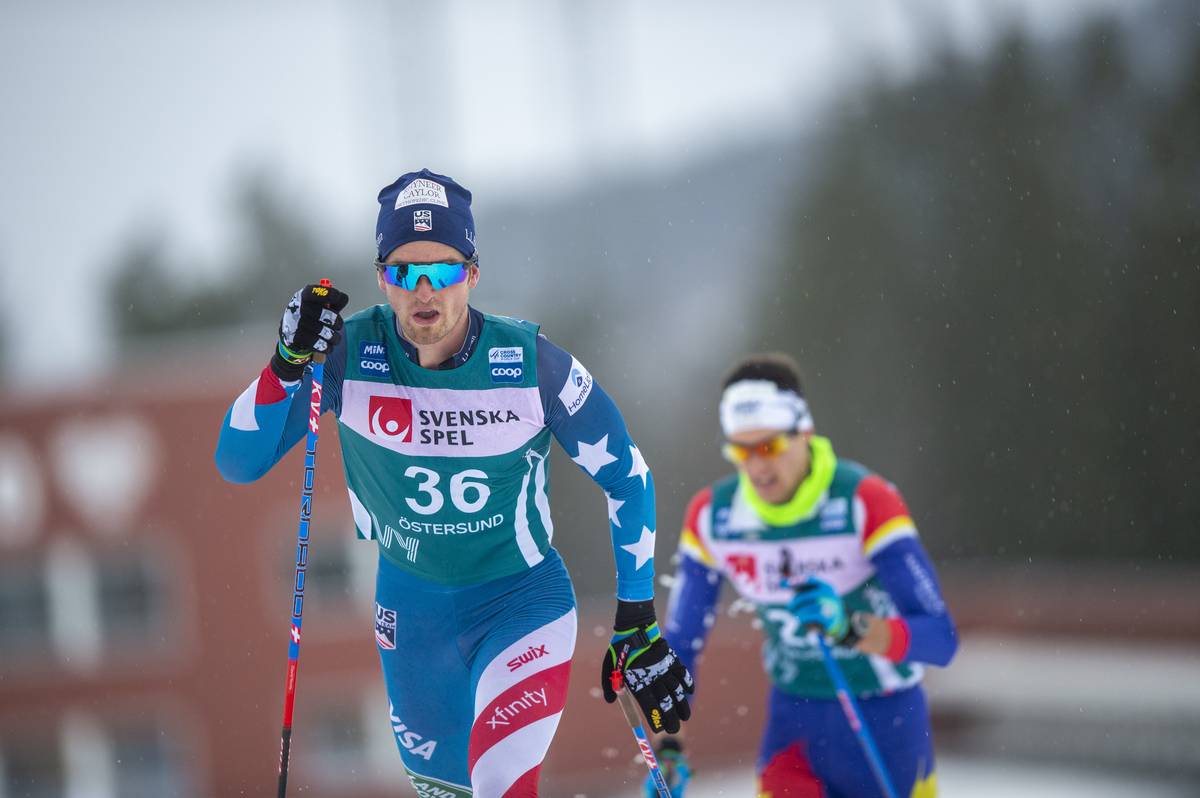
David Norris skis to 34th in 15 k classic pursuit in Östersund, Sweden in February, 2020. (Photo: NordicFocus)
It’s hard not to root for David Norris.
Often affectionately described by Devon Kershaw as a “grinder”, the humble 31-year-old Fairbanks, AK native has been an eternal underdog, despite consistently performing among the best American distance racers of his generation on the World Cup. Highlighting his career, Norris has finished in the top-20 three times during his appearances in the 2019 and 2021 World Championships. His best result arrived in last year’s Championships in Oberstdorf, Germany, where he placed 16th in the 50 k classic and 17th in the 30 k skiathlon.
Although Norris has been routinely been offered World Cup starts over the last five seasons, he has consistently hovered in the liminal space just behind the cutoff when it comes to selection to the U.S. Ski Team, whose age based-criteria becomes tougher to achieve over time. Given his birth year of 1990, Norris needs to be ranked in the top-40 in the world according to his FIS points from the previous season to be named as a B-Team athlete. In 2020, the margin by which he came up short was incomprehensibly small; a mere 0.88 FIS points, equivalent to eleven seconds in a single race during the season, left Norris ranked 43rd in the distance standings in March of that year.
Without financial support from the US Ski Team, Norris forged on, relying solely on his personal sponsors.
Read more on age-based criteria here, or take a deep dive into FIS points and Norris’ circumstances here.
Then, as the 2020/21 World Cup season loomed the following November, Norris contracted COVID-19. At the time, there was little information available on how elite athletes should return to training and competition following a coronavirus infection and what the risks of an expedited return might be. While more is available currently, the message has not changed: use caution and take it slow.
Consequently, Norris sat out Period 1 and the Tour de Ski, making his World Cup return in late January 2021, finishing 32nd in his first race back – a 30 k skiathlon in Lahti, Finland, roughly one month shy of the Oberstdorf World Championships. Despite two top-20 finishes in Oberstdorf, where he was also the second American, behind only his APU teammate Scott Patterson, Norris was again left off the US Ski Team in the spring of 2021. The decision inspired one of his competitors, Craftbury’s Ben Lustgarten, to pen an OpEd to campaign for Norris’s ex post facto discretionary nomination to the team.
David Norris fist bumps a competitor after finishing 17th in the 30 k skiathlon during the 2021 World Championships in Obsertdorf, Germany. (Photo: NordicFocus)
Heading into the 2021/22 season, Norris had a goal of making the Olympic Team, but he knew that, once again, the odds were not likely to be in his favor. The US had just five guaranteed quota spots for Beijing, with a likely sixth on the table.
If you’ve found your way to this story, you likely know how Norris fared.
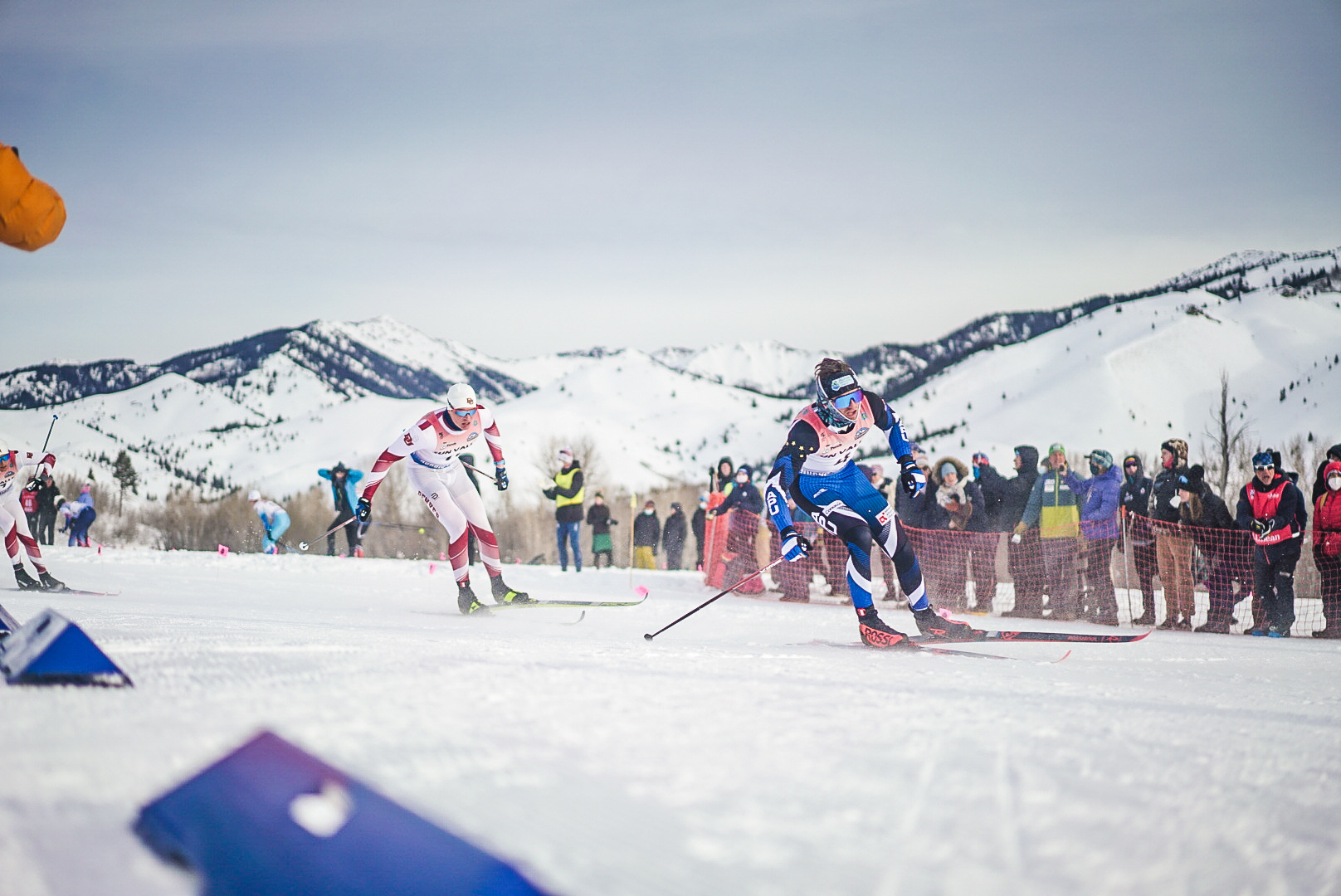
After a solid summer of training, Norris started upon his usual trajectory of sub-optimal early season races, which generally progress to peak race results in February and early March. In November, Norris was 37th in the 15 k freestyle pursuit in Ruka, Finland, skiing the 27th-fastest time of day, but he never cracked the top-30 to score World Cup points in Period 1. Heading back to the States to race in the U.S. Cross Country Ski Championships in Soldier Hollow in January, his results began to trend upward. Though he’s always excelled in distance, he took 7th in the freestyle sprint, after qualifying second. Then, two days later, he was second in the 30 k mass start skate, 11 seconds behind winner Scott Patterson.
Twelve days later, in the final race weekend before the Olympic qualification period ended on January 16th, Norris won a 15 k individual start classic at the Lake Creek Nordic Center in Ketchum, ID.
David Norris leads the way through a corner on his way to a win in the SuperTour 15k mass start classic in Sun Valley. (Photo: Tobias Albrigtsen / @untraceableg)
This background is not intended to imply Norris should have made the 2022 Olympic Team. Rather, the intent is to highlight his candidacy to frame an interview on Friday, February 25th, the day before the 2022 American Birkie, in which Norris discussed the experience of falling short of his Olympic goal, how he “made the best of it”, and what his next steps are as he begins to shift his focus away from the World Cup.
Returning to the team announcement, Norris explained that although he was disappointed, not being selected was not a surprise given the selection process that had been outlined. He shared that “there was no dialogue at all” with US Ski Team coaches leading into the announcement, but that it also had never felt “closed”, either.
Following his second place finish in the 30 k skate in SoHo, Norris had written to FasterSkier “Every season I ski much stronger in February and March, so I’m sure good form is on the horizon, but that doesn’t help me achieve my goals when I need to be skiing well right now. All I can do now is focus on the 15 k classic coming up and then rest and prepare for the next races.”
As he acknowledged, an emphasis was placed on strong early-season results, which he did not post, and he had not expected that his historic championship results would be factored into decision making. That said, as a distance skier, looking at a Games which would be held at altitude on challenging courses that would “basically reward people who are very fit”, it was difficult to recognize he’d never have the opportunity to put his strengths on display.
“It was tough,” Norris said simply. “Seeing that the criteria kind of rewarded 15 k races, when two out of four individual races [at the Olympics] were 30 and 50 k for the men. And yeah, I was aware of it all, but it kind of sunk in just during the Olympics and watching.”
Of the six men who met the outlined objective criteria and were named to the Olympic team, four were primarily sprinters: JC Schoonmaker, Kevin Bolger, Ben Ogden, and Luke Jager. However, each started in either the 15 k classic or the 4 x 10 k relay, in addition to the two distance racers, Patterson and Gus Schumacher.
“But I still cheered my heart out for the guys who made it,” Norris added emphatically. “I don’t hold anything against the guys who are nominated. All congratulations to them — no personal difference against those guys. Everyone who went is a good friend, and I’m stoked for them.”
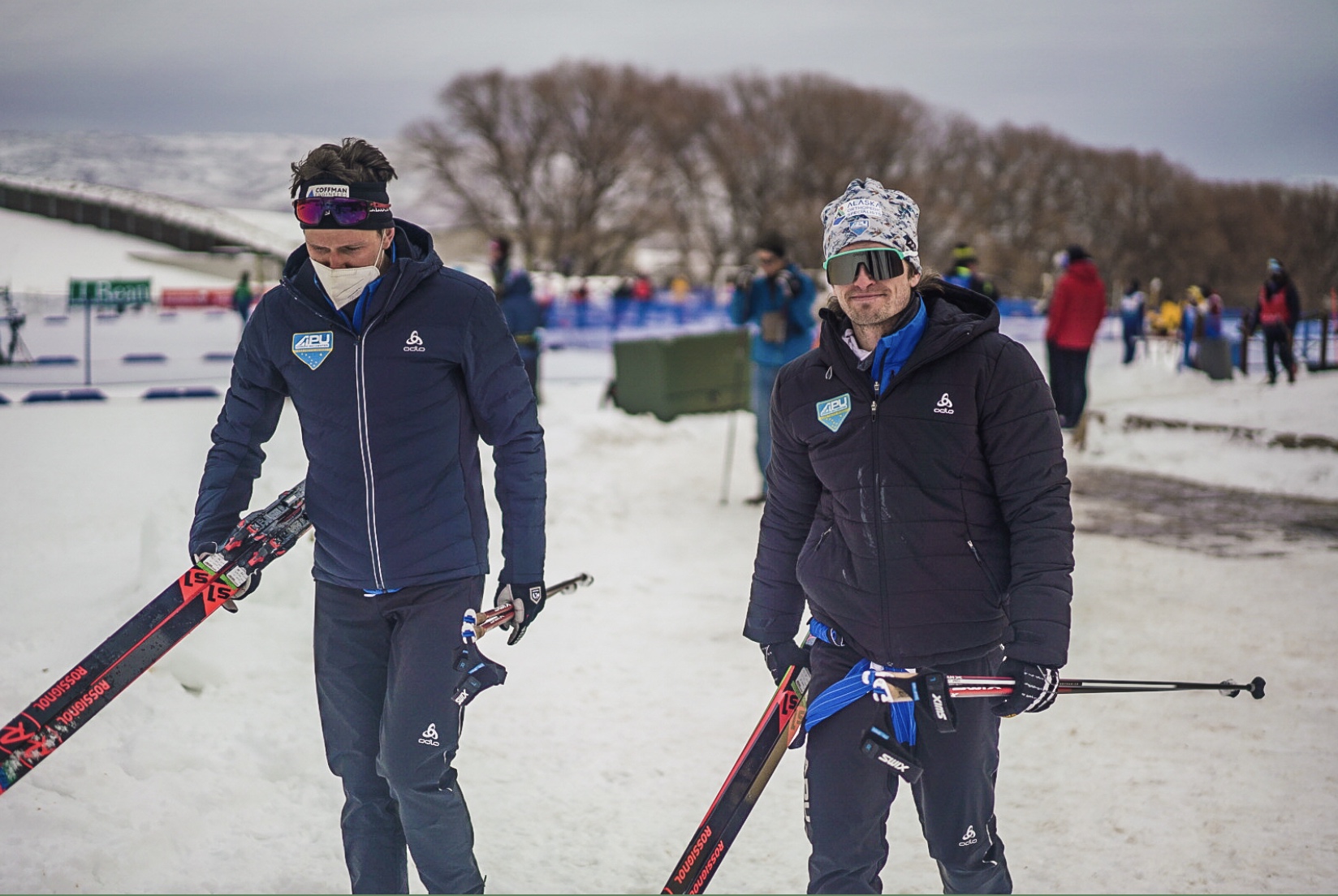
APU teammates Scott Patterson (left) and David Norris (right) head to the start of the men’s 30k mass start freestyle at the 2022 U.S. Cross Country Championships in Soldier Hollow, UT. (Photo: Tobias Albrigtsen / @untraceableg)
When weather shortened the men’s 50 k skate to a 30 k, Norris watched his APU teammate Patterson race to 8th place, an historic result for the American men, second only to Bill Koch who earned an Olympic silver medal and a 6th-place finish in Innsbruck, AUT in 1976. As mentioned previously, roughly six weeks prior, Norris had finished 11 seconds behind Patterson in a 30 k mass start skate at a similar elevation in SoHo. Though four start spots were available for each nation in the Olympic 30 k, Patterson was the only American in the race that day.
Never one to say “woe is me”, Norris chose not speak directly to the experience of watching that race. Instead, he recognized that he was not the only strong and fit American distance skier who did not make it to Zhangjiakou.
“There were such limited spots for the men’s quota that, no matter what happened, good skiers were gonna get left behind. But yeah, just given that three out of four individual races are distance, and the relay’s distance, it was kind of a bummer to see them not give any priority or emphasis to distance where we could have accumulated probably the best results. I think the 30 k (skate) at Nationals and 15 k (classic) at Lake Creek in Sun Valley, kind of showed where the fitness stacked up in the U.S. field. And I think mass starts are one of those places where you can’t really hide your form — you see how fit people are. And yeah, Scott and I are really similar and we train together, and I think it just kind of came down to –
I trained for chasing a goal of a top 10 at the Olympics, and it was far harder to make the team than to actually probably reach that goal… But it’s just limited spots and tough how it came down.”
David Norris wins the 15 k mass start classic in Sun Valley, ahead of his APU teammates, Hunter Wonders and Scott Patterson. (Photo: Tobias Albrigtsen / @untraceableg)
Norris is not the first person to be left off an Olympic team who was perhaps qualified and deserving of a spot. Every four years, FasterSkier reports on those just behind the cutoff, which often sparks impassioned responses from fans supporting athletes on both sides of the bubble.
For Norris, this means outreach and support from a number of athletes who had been in the same situation and could share perspective from a place further removed from the moment.
“People have been super encouraging. One of the guys who made it based on the criteria but wasn’t taken four years ago reached out and said, ‘Use this as your secret weapon — you chase goals and come up short. And that’s kind of the way it works out more often than not, and you learn a lot from from that.’ Based on some of the encouragement from people in similar spots, it was really reassuring to hear their words and realize that the last four years or the last eight years pursuing a goal, it wasn’t a waste just based on a single selection.
And maybe there’s been moments where I have to kind of lie to myself that that’s the case, but I genuinely believe it. I don’t regret going for the Olympics, and then coming up short on my goal, it’s all been a positive experience for me.”
In the post-Olympic 50 turned 28 k episode of the Devon Kershaw Show, guest Kris Freeman, who spent years at the top of American men’s distance skiing, was critical of the American program’s lack of support of men’s distance skiing. Freeman pointed out that Patterson was the “only guy of his generation that got any U.S. Ski Team support.” He then added, “in the last six years, it’s been like, ‘Well, we got [Gus] Schumacher and Luke [Jager], let’s just wait till they come up.’”
Though perhaps in a less outspoken and direct manner, Norris affirmed Freeman’s sentiments, acknowledging the challenge many of this country’s top distance racers have faced in funding the career longevity often required to reach peak potential as an endurance athlete.
“I couldn’t do it without my personal supporters because there’s nothing coming from the national team. And there is definitely that sense of, like, Scott’s in the system. They’re hanging on to him, and he’s producing awesome results. But then, yeah, I think Freeman’s words are pretty accurate, I guess.”
Norris pointed to the U.S. Ski & Snowboard mission as a root of the challenge. The header on the cross country team page states: “We’re built around one common goal—provide the right resources for athletes who are inspired to be the Best in the World.” Though he was seen as one of the best in the US, his trajectory was arguably not one that was likely to produce Olympic or World Championships medals, a focal point of U.S. Ski Team selection criteria.
The introduction to these criteria reads: “The U.S. Ski Team will select only the most qualified athletes with the greatest possibilities for winning medals in future World Championship and Olympic Winter Games competitions. Selection criteria will stress performance in the Olympic Winter Games, World Cup and the U23/World Junior Championships in the 2021-22 season. Selection criteria will also stress progress toward individual performance markers, set forth by the U.S. Ski Team coaches, which point toward international success.”
David Norris cracks the top-20 with a 17th place finish in the 2021 World Championship 15k/15k skiathlon in Oberstdorf, Germany. (Photo: NordicFocus)
The statement perhaps clarifies the philosophy that has kept Norris from meeting objective criteria for the team. Though he has been an asset to the distance program, and was likely to post some of the top American distance results during the Games, his potential to earn future medals was lower than a younger budding athlete with strong World Juniors results, like Schumacher or Jager. While this could be sensible from a long-term investment perspective, it may also push some of the top distance athletes out of the sport at young ages, typically thought to be prior to when one reaches his or her physical peak for endurance racing.
One might look at Rosie Brennan who at 33 years old, and after having been left off the U.S. Ski Team on two separate occasions, is coming off a second season as a regular podium threat, with a growing list of top-10 results and a string of performances in Zhangjiakou that, though just shy of a medal, were collectively among the all-time top-three Olympic performances by an American cross country skier. Without Diggins’ results in PyeongChang and Beijing, they’d be the best.
Or, on the other side of the coin, Kyle Bratrud had won four National Championship titles between 2015 and 2020, and placed 31st at the 2019 World Championships, popping a World Cup top-30 a weekend later, but he retired at 26, in part because US Ski Team support seemed unlikely and the costs associated with starving for the World Cup didn’t check out in the cost-benefit analysis.
Read and listen to more on Bratrud’s take on development pathways, support and age-based criteria, and retirement here.
“It’s kind of brutal, over the last four years, to have had the best [American distance] result [in the 50 k at] World Champs in Seefeld, and two top-20s at World Champs last year. Half the men’s team was discretioned [onto the US Ski Team] last year, and to not get any support through those years…”
Norris started and stopped a few times, carefully weighing how much he wanted to say to the small tightly-knit ski community, before laughing that he was beginning to ramble. He then continued, “I think the Olympics kind of showed that… I feel like people are wondering what happened with some of the results, but I think you could have predicted that by looking at their course profile and the altitude and how people performed in similar settings. And it seems like it’s really good to invest in the young guys but also to give support to the older guys and have us produce good results helps pave the way as well. And it seems like that aspect is getting severely neglected. And if Scott were to quit next year, then there’s a huge gap to fill.”
David Norris on course during a 2022 SuperTour race weekend in Sun Valley, ID. (Photo: Tobias Albrigtsen / @untraceableg)
After competing in the SuperTour races in Sun Valley with his APU teammates, Norris found himself in limbo. He recognized he was highly unlikely to be named to the Olympic team, but had not received information or been contacted by US Ski Team coaches to confirm that this was the case.
“Before the nominations were announced, we [essentially] knew the team [that was] going based on COVID protocols.”
APU teammates Patterson and Brennan both raced in Sun Valley, along with Scott’s older sister Caitlin Patterson, who trains and races with the Craftsbury Green Racing Project and was also named to the Olympic team. Brennan returned to her childhood home in Park City, while the Pattersons headed to Bozeman, MT to create a lockdown bubble with their parents.
Seeing the writing seemingly on the wall, Norris also headed to Bozeman, where his partner Jess Yeaton’s parents currently reside. Both Norris and Yeaton graduated from Montana State University in Bozeman, and he calls the area his “favorite training grounds.” With ideal conditions and nice weather, Norris cleared his head while logging hours on trail.
“Since I didn’t have the Olympics to focus on or peak for, I just took advantage of the good skiing there and was skiing like four to five hours a day, just enjoying being in the sun and, kind of, having the like stress and the weight off my shoulders of the Olympics. It was kind of cool, because I think I skied so much, I just realized that I ski because I love it not because of one single goal or because I’m trying to prove anything to anyone or, you know, make one person proud. It was good, just to ski and enjoy it.”
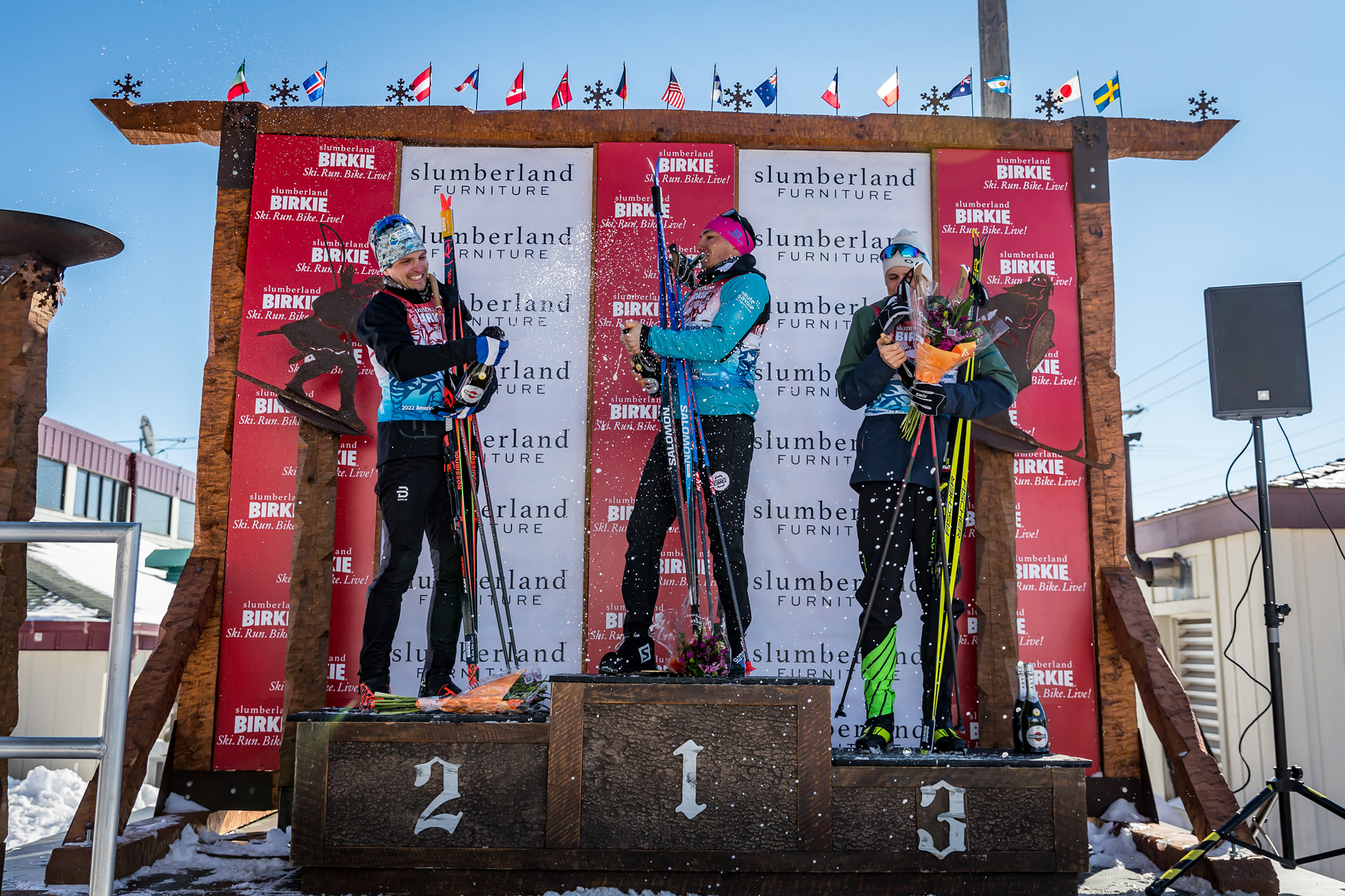
Norris looked at the calendar and saw that he could hop into both the Boulder Mountain Tour in Sun Valley and a 30 k classic at Crosscut in Bozeman. And though he thought he might have “overcooked” himself logging all those hours in Bozeman, Norris won both races.
“The past few weeks skiing with friends assures me that I love skiing and all the people involved in it… and that’s why I do it,” Norris wrote in a post-race Instagram post.
David Norris and his partner Jessica Yeaton prepare for the American Birkie after Yeaton returned from competing for Australia at the 2022 Beijing Olympic Winter Games. (Photo: Instagram @grandmasternorris)
“I think he’s having a really good time, actually,” Norris’ partner Yeaton told FasterSkier in an interview in Zhangjiakou during the Games. “Going around and racing all these races, and he’s just been reconnecting with people. I truly do think he is enjoying it… I think it’s definitely been a big bummer for him, but he’s also — he’s the best at making a good situation out of anything. He’s just not a negative person by nature. He’s out there racing all these races, having fun… there’s definitely something good that’s come out of the spring for him, for sure.”
As the time of the call was within 24 hours of the Birkie start, it was yet to be seen that Norris, the 2016 Birkie champion, would this year take second in a thrilling showdown on Main Street in Hayward, WI, losing to Gérard Agnellet of France in a boot slide at the finish. Norris had scaled back on the self-indulgent distance skis in Bozeman, foreshadowing what would come with the following explanation.
“After the [Boulder Mountain Tour], I kind of shut it down and kind of found enjoyment in being a little lazier. And I think that should give me some fresher legs for the Birkie, I hope.”
David Norris and his partner Jessica Yeaton, both APU athletes, won the 2022 Tour of Anchorage. (Photo: Instagram @jjyeaton)
His next steps remain in flux.
“Since there’s not really a spot for a 20th to 10th place skier — like, [US Ski & Snowboard] doesn’t want that on their team, it seems — I’m kind of not that incentivized at all to spend time on World Cup and keep fronting a bill from the U.S. Ski Team.”
With this shift in focus, Norris remains open-minded, explaining that his ski racing plans next winter somewhat hinge upon where Yeaton finds a physical therapy job once she finishes her clinical rotations to complete a doctoral program through University of New Mexico. The two will be stationed in Colorado and Utah through the fall, which may set Norris up for opportunities to compete in trail running races that have not previously fit into his ski preparation plan.
Norris has a track record of strong finishes in Alaska mountain running races. Amidst three wins, he holds the course record at the infamous Fourth of July Mt. Marathon race in Seward, beating a time posted by the seemingly superhuman alpinist phenom Kílian Jornet of Spain, and has won the Cirque Series race at the Alyeska ski resort along with a smattering of other regional trail running events.
“I’ve never wanted to spend money on running because I’ve always just put any money I’ve earned and sponsorship dollars towards skiing. And you know, there’s plenty of races in Alaska, so I didn’t need to travel, but now I’ll be at altitude in Colorado and Utah. There’s so many races to jump into.”
Should they end up spending next winter in a location that allows for quality ski training, Norris anticipates that he’ll continue to race, but the focus will be different.
“I think our lifestyles are such that we would be training a ton, just because that’s what we enjoy doing. And then I would 100% keep jumping into races. But my goals are definitely changing… So probably do less [international racing] and just enjoy ski racing and do it more locally.”
David Norris on his way to winning the 2022 Boulder Mountain Tour in Sun Valley, ID. (Photo: Nils Ribi Photography / Boulder Mountain Tour)
U.S. Ski & Snowboard has announced the Davis U.S. Cross Country Ski Team nominations for the 2020-21 season. Nominations include those active athletes who qualified based on published selection criteria in the prior season.
“The 2021 U.S. Cross Country Team has more depth than any team in modern American cross country ski racing history,” said Davis U.S. Cross Country Team Program Director Chris Grover. “From our seasoned veterans who will be focused on bringing home hardware from the 2021 FIS World Championships in Oberstdorf, Germany, to the members of the Development Team, who can nearly all boast having at least one World Junior Championships medal, this team offers so many ways to win. Athletes in this group have systematically broken down every barrier in cross country performance that traditionally blocked American athletes, including World Junior gold, to World Championships gold, to Olympic gold.”
The 2020-21 team is highlighted by an experienced group of World Cup, World Championship and Olympic Winter Games athletes, including Olympic gold medalist, Jessie Diggins and 2020 FIS Junior World Championship double-gold medalist Gus Schumacher.
The 2020-21 team also includes the largest D Team squad ever nominated with 11 athletes, including members of the gold-medal winning 2019 and 2020 FIS Junior World Ski Championships men’s relay team: Luke Jager, Ben Ogden, and Johnny Hagenbuch. The D Team also includes all four members of the silver-medal winning FIS Junior World Ski Championships women’s relay team: Kendall Kramer, Sydney Palmer-Leger, Novie McCabe and Sophia Laukli.
“The strength of the 20- 2021 U.S. Cross Country Team speaks to the commitment and professionalism of the community that has helped these athletes achieve excellence,” Chris said. “Our coaches’ education system, the stability and quality of our development preparation projects, and the dedication and knowledge of our club and school coaching partners has been instrumental in helping these athletes succeed internationally.
“The big steps forward over the last two decades have happened via community collaboration and pulling in the same direction,” he continued. “Together, we’ve created a truly American solution that meets the needs of our culture and our geography.”
Athletes nominated to the team are scheduled to open the season in with their first training camp in Park City, Utah (pending COVID-19 considerations).
Each athlete accepting the nomination to U.S. Ski Team receives world-class program support, along with access to the U.S. Ski and Snowboard Center of Excellence, as well as athletic benefits including an elite coaching, sport science, sports medicine, and high performance staff, and education opportunities.
An official Davis U.S. Cross Country Ski Team announcement will be made in the fall.