From the FasterSkier archive — posts syndicated from athletes’ and coaches’ own blogs between 2004 and 2012, kept online as published. Current coverage is at fasterskier.com.

Tag: US Ski Team

  • ‘We have no films to our name’: Lars and Torsten Brinkema on how Threshold got made

    ‘We have no films to our name’: Lars and Torsten Brinkema on how Threshold got made

    This article was made possible through the generous support of our voluntary subscribers. If you value coverage like this, please support FasterSkier with a voluntary subscription.

    Torsten and Lars Brinkema were two brothers from Minneapolis with a GoPro, a film school semester between them and no feature credits at all when they talked their way into a U.S. Cross-Country Ski Team camp in Bend, Oregon, in the summer of 2023. They spent the following World Cup season inside the team, paid their own way through it, and came home with roughly 500 hours of footage. What they cut it into is Threshold, the documentary about Jessie Diggins and her eating disorder that premiered on Peacock in February and is now available to rent in the United States and Canada.

    Earlier this month we published head coach Matt Whitcomb’s account of that winter and what the team changed because of it. This is the other half: the brothers’ own version, recorded before the rental release. Torsten is 26 and lives in Brooklyn. Lars is 23 and splits his time between Minneapolis and Los Angeles. They are still working as a duo.

    Below is a transcript of the Brinkemas’ conversation with FasterSkier. It has been lightly edited and condensed for clarity. LB is Lars Brinkema, TB is Torsten Brinkema, MV is Matthew Voisin.
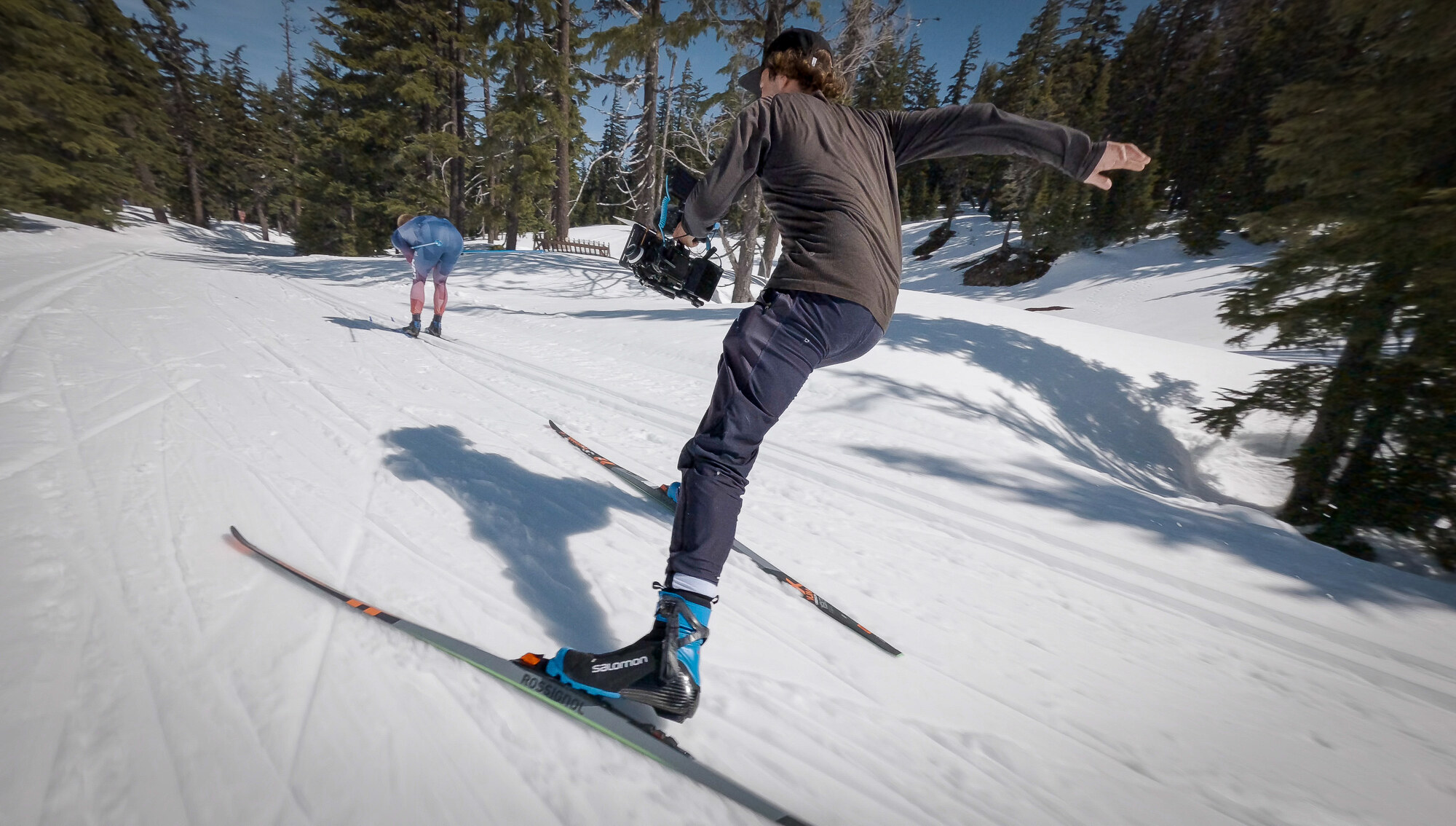
    A filmmaker mid-stride on cross country skis carrying a cinema camera rig, with an athlete skiing ahead of him on a groomed snow trail.
    Lars Brinkema filming on snow at a U.S. Ski Team camp in Bend, Oregon, chasing Jack Young up the trail. The brothers had done the workouts themselves, which is the reason the team let them near one. (Photo: Patrick Conroy)

    MV: I would love to back up a little and just hear about you two as young guys, how this all manifested.

    LB: To start at the very beginning, Torsten and I were both born in Minneapolis and grew up in that whole Minneapolis ski world. We had skis on right when we started walking. So we really grew up in the same community that Jessie had grown up in, and she was kind of just this idol that we looked up to. We both remember where we were when we were watching that gold medal race in Pyeongchang. And then fast-forward to when we were getting older, just always carrying cameras around, usually a small GoPro on our ski trips. Torsten ended up skiing for Colby College, and that is where he met Ben Ogden, racing against him on the collegiate circuit.

    TB: I got my ass kicked by Ben in most of the EISA college races. But I was always interested in shooting a lot of ski trips. I left school trying to figure out how to put those two pieces together, because I knew I was not good enough to be a professional skier, but I also wanted to capture the sport that I loved so much. It took a year of trial and error doing gigs for outdoor brands and whatnot.

    Then, when we figured out the World Cup was coming to Minneapolis, I talked with the Loppet Foundation, which is the club Lars and I grew up skiing for. I was kind of like, listen, do you guys need any promotional materials? People should be getting excited for this event that is happening at Wirth Park. I convinced them on a shoestring budget to send me to Holmenkollen in the spring of 2023. I stayed with a family friend out there, reconnected with Ben, and met a lot of the other skiers on the team. I think they were kind of surprised to have an American photographer out there with them, just because they are not getting much coverage once they leave. Ben was sort of like, we have to figure out how you guys can stick around with the team a little bit longer. It was just me at this point, but Lars was in film school. So Ben pitched Matt Whitcomb that he should invite us to their Bend, Oregon camp.

    MV: What did you think you were making at that point?

    TB: Lars and I basically bought cinema cameras and showed up at camp. We were definitely inspired by a lot of other sports documentaries at the time, niche sports finding success in that genre, people going, oh my god, look at Formula One, I have never heard of this sport before but I am really loving the series. And we were like, we could probably do something like that with skiing. Make it look really cool.

    I think the team was happy to see filmmakers who could not get in the way of their workouts. Jessie had experiences in the past with a brand interrupting an interval session, asking her to do another interval. This is just something that would never even cross Lars and my mind, to alter the workout, because we know how intense they are. We know the workouts. We have done them before. So we were kind of flies on the wall, and I think that proved our ability both as skiers and as filmmakers, to be in that documentary position and not get in the way.

    MV: What were you envisioning before it started to become more about the eating disorder and the mental health challenges?

    LB: Just bringing this sport that we grew up in and that we loved to the masses. We had seen smaller endurance sports, whether it was a YouTube channel or on Netflix, sports that we loved but not a lot of people in the U.S. tracked. And there was always this element to the successful films about sports that was more the human side of the story. We approached it very open-ended. We kept those options really open for a majority of our filming. We were still capturing when we went on the World Cup, talking to European athletes, we had some fun conversations with Klaebo on camera. We just spent every waking moment following different stories.

    I would say we were definitely, kind of subconsciously, following Jessie’s story more than others, and that just developed over the time of filming. Not until the editing process is when it really shaped. We had 500 hours of footage, so many different interviews with so many different athletes, doctors, staff on the U.S. team. And as we started to screen rough cuts to film industry people around Los Angeles and New York, we were getting so much feedback that Jessie’s story was the most resonant of all of them.

    MV: You have 500 hours, and then at some point you have to make the decision that almost all of it is hitting the cutting room floor. How do you feel your way through that?

    TB: Having an editor who had never cross-country skied before was totally instrumental in figuring out what would resonate with the wider audience we knew we had to appeal to. And there are also those moments where Lars and I were deep in the Arctic Circle, freezing our butts off, trying to get a time-lapse of the northern lights, out there for two hours and so attached to this one shot that we worked so hard for. I remember being in the cutting room and him saying, it is not serving the story, you have to cut it. Those were the things that were so hard to let go of.

    And of course all these other stories, U.S. Ski Team members, Klaebo, Emma Ribom, Pellegrino, people that we really looked up to, and all of their stories deserve to be told. But at the end of the day, when you have this Jessie story that is so compelling, you cannot really deviate from it if you want to give her story the time it deserves. At the industry screenings, Lars and I walked in with a lot of questions about what would resonate with a non-skier audience, and people just kept saying, Jessie, Jessie, we want more Jessie.
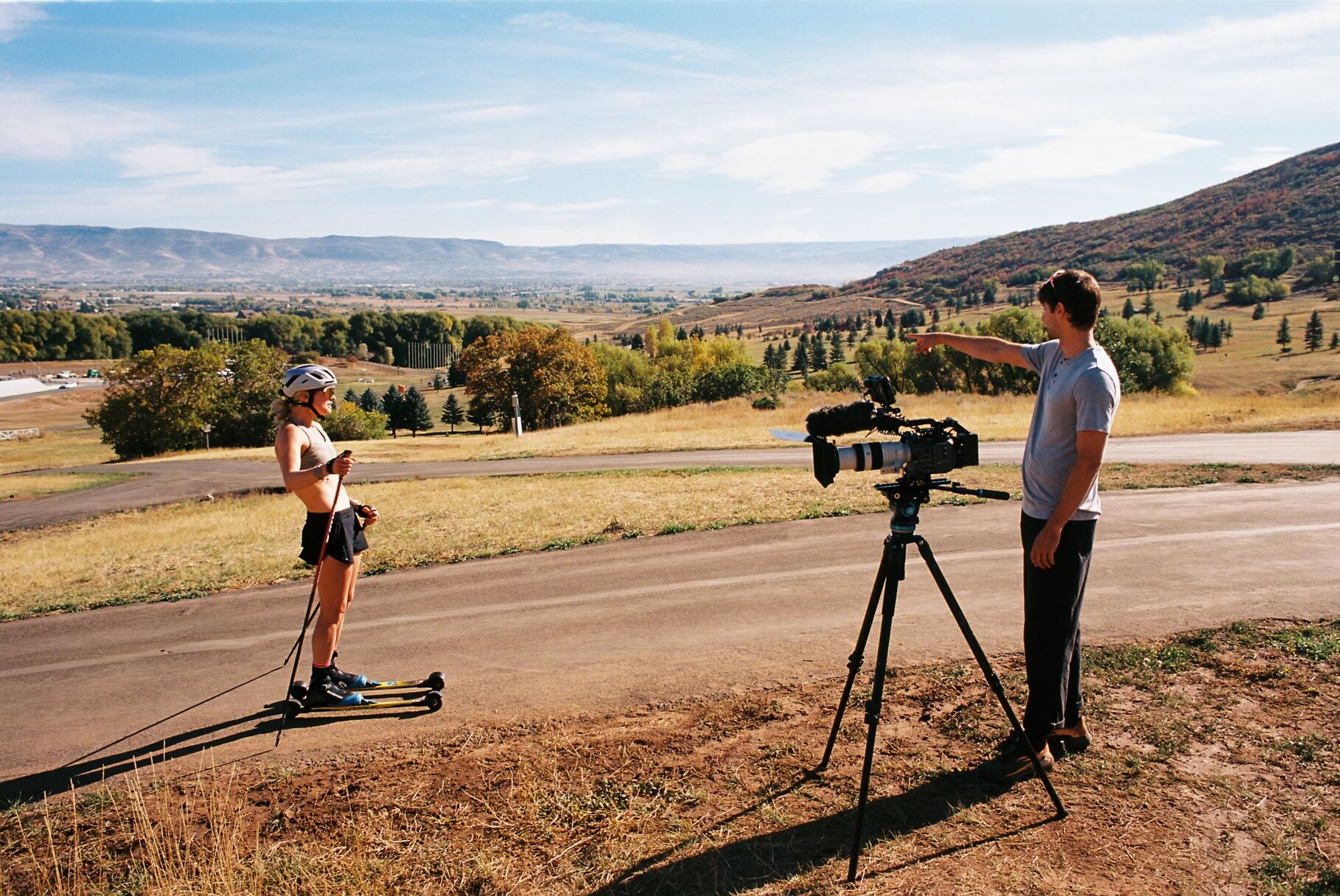
    A skier on roller skis stands on a paved path while a filmmaker directs from behind a tripod-mounted cinema camera, with a wide valley behind them.
    Jessie Diggins and Torsten Brinkema at the team’s Park City camp, in the open-ended stretch of filming before anyone knew what the story was. (Photo: Willie Maahs)

    MV: How did you get hooked up with Patrick Dempsey?

    LB: It was about six months into filming, right after the Tour de Ski, at a camp between that and the next World Cup stop. Growing up in the Midwest, we did not have any connections to the whole Hollywood world, but we definitely needed to find someone to help us get a foot in the door. So we asked Jessie if she had anyone in her directory who worked in that space. She remembered that Patrick had supported the ski team, and she was able to just send him an Instagram DM. He responded right away and said to send Torsten to his house in Maine. A couple of months later we showed up at his doorstep and pitched him on the idea. He had grown up cross-country skiing in his backyard in Maine, so he is very connected to the sport and a huge Jessie fan.

    MV: Jessie is big, but Dempsey is on another level. What was that like?

    TB: It was pretty wild. We knew this was a ticket for us into a new world that we had always hoped to get the keys to. And credit to him for inviting us over, because the roadblock we hit at every stage of this process is that we have no films to our name. We have a couple of short projects that nobody has seen. So we are asking someone with the credits that he has to trust us with nothing to see for it. Obviously Jessie’s word goes a long way with him. We had to swallow our awe of him and realize this was a huge opportunity, and tell him what we really believed: that there was a story in those 500 hours. At that point we had not really cut anything. He became a very important part of shaping it down to what it became in the end.

    MV: What other filmmakers have inspired you? What did you grow up watching?

    LB: One huge one was Jimmy Chin, especially with Free Solo. That may have been the first ever documentary I saw in a theater. This niche sport was brought to a thousand theaters across the country… such a huge story and such an interesting character. That was one of the times we were like, wow, we could bring a sport that we love to the big screen in an impactful way.

    TB: To add to that, I remember, I think it was actually while we were filming on the season, I saw a really old Herzog documentary from the 1970s called The Great Ecstasy of Woodcarver Steiner. Herzog was in his late twenties, early thirties, and he dedicated basically a whole year to following the ski jumping circuit, when it was at that really gnarly phase of people pushing the boundaries on these jumps, ending up jumping all the way to the flats, a whole bunch of drama between the jumpers and the officials. The fact that he was caught up in this story when he was around our age, and it felt like we were doing a similar thing, dropping everything to follow this circuit in unfamiliar landscapes. That just felt like, wow, if one of these great documentarians dropped everything for a ski documentary, we must be doing something right.

    MV: It is expensive to travel around Europe for a whole season, and the ski team is pretty transparent that their budget is tight. How did you make those numbers work?

    LB: We definitely had to pay our whole way through that season. There was not support from the ski team, in that they did bring us on, we were marked as members of the team crew, so we got our bibs and access to the races. But we basically had the ski team and Jessie help us find people who in the past had supported the ski team. It is not funded by the government; the ski team lives off these people who donate. So we went through their list of people who were instrumental in making sure the ski team could have success, people who paid for the wax van they use to this day. Over the course of filming we were always having to fundraise more and more money.

    Later on, when we were fine-tuning the edits, there were still a lot of payments to be made. We talked to Jessie’s sponsor, the Emily Program. That was a really cool opportunity, because now they are supporting the film, but they are also bringing it around the country to treatment centers and educational screenings.

    MV: You set out to tell a fun story and ended up helping people with something that is a real medical issue. Do you take a beat to think about that?

    TB: That is kind of the goal right now. We had a release with Peacock, which in a way felt like being viewed by this Olympic ski audience, but not everyone in the U.S. has Peacock, so right now we are figuring out how we can reach the people we did not reach in that initial release. For sure our target audience is this young group of impressionable people who are growing up either struggling with this disorder or who have people around them who have struggled with mental health. We have heard from people who have never skied before who say they were so moved by Jessie’s story. That is the biggest compliment we can get.

    It is a really hard thing to do, for her to pass one of the hardest years of her life on to us, filmmakers who had never made a film before, to then put out to the world. I remember when we showed her one of the rough cuts. She told us that this is the story her 18-year-old self desperately needed to hear. When we got her blessing, and when she said that, we took it and we ran with it, because we knew we could have that impact on countless other people who were struggling. That was a huge motivator for us.
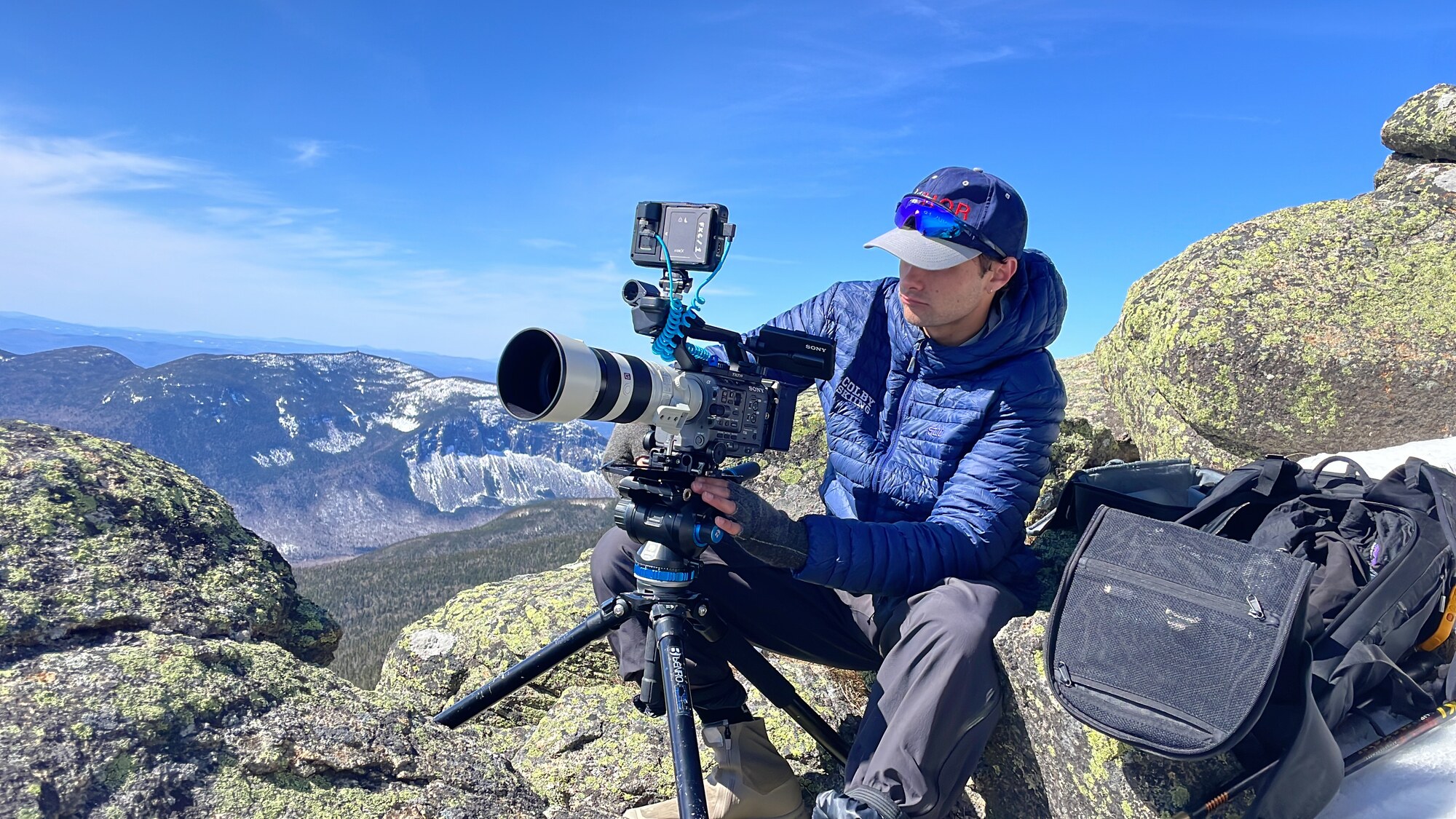
    A filmmaker sits on a rocky summit behind a tripod-mounted cinema camera with a long telephoto lens, snow-streaked mountains behind him.
    Torsten Brinkema on a summit in the White Mountains of New Hampshire in April 2024. This one never made the film either. (Photo: Brinkema Brothers)

    MV: Can you give me a specific memory from being in Europe?

    TB: Mine jumps to not a specific story, but this life on the road, which was so crazy for Lars and me. It was crazy to see the athletes, but also the staff who have done this year in, year out. It really is a wild lifestyle, packing up and going to a hotel room in the middle of nowhere in Finland, where there is light for five hours out of the day, then getting up and packing up and going to the next location in Sweden. The dedication these crews have is crazy, away from their families, away from the normal comforts of living in the States, and the fact that they repeat it every year.

    We pretty much joined every training session and filmed as much as we could, then charged the cameras and packed all the footage onto a hard drive. I always loved those nights when we were really tired, it is super dark out, there is nothing to do, and we would walk over to the wax truck and see what those guys were up to. It was always something fun. They are always blasting music, maybe having a shot of Jägermeister. I think they liked having us around because we were these young people who were totally oblivious to the waxing scene, so we could pick on whoever was not busy at the time. They had been living this life for five, ten years, and Oleg has been around, I do not want to quote how many. These guys are putting everything on the line and being away from their families to make the fastest skis in the world.

    MV: You mentioned the cameras. What was the gear you used to capture these moments?

    TB: We were rocking two Sony cameras, the FX6 and the FX3. That was a progression from, honestly, GoPros. Lars and I just loved being able to carry a camera that would not get in the way of anything, which was so important. We did a 20-mile run with Zanden, Gus, Luke and JC in Alaska, and we carried both our cameras and the drone in a backpack. We always wanted to be able to carry everything we had with only a backpack. That was the goal. In the winter we did a ton of skiing without poles, carrying those cameras, setting up a shot for a while and then skiing alongside people and trying to get it.

    The drone was another really key part of the setup, because it let us get beautiful shots of people when we could not keep up with them, which was most of the time. We could only set up these flyby shots for a 20-second clip before they sped past us. We are super proud of those shots, because it took thousands of them to get the five or six that appear in the movie of Jessie flying by in a training session. We also had to figure out how to make the cameras work in the cold, which was something we had not really experienced before. It involved a lot of hand warmers and duct tape, but we eventually figured out a system that worked even at minus five in Finland.

    MV: I have used hand warmers to keep my batteries warm too, but what is the duct tape for?

    TB: Taping the hand warmers to the battery on the camera, right on the part of the camera where the battery is.

    LB: We would have extra ones in our jacket pocket or in our pants, trying to keep them close to body heat so we could swap them out.

    MV: Lars, what stands out for you?

    LB: Just seeing the sport in Scandinavia was this insane experience. I remember the first Holmenkollen that we followed. I am sad it did not make the movie, but it was absolute mayhem. More people than are in the stadium for the Super Bowl. A hundred some thousand people in the woods watching these skiers who are going by maybe once every 20 minutes. It was not for a sprint, it was not for high impact crashes, it was just to watch these skiers go by, and they were so into it. I remember the big races in the U.S., high school meets, maybe the state meet, have a lot of people out there watching. But seeing all the young fans in Scandinavia watching this sport and being so jazzed up about it, maybe drinking a little too much during the race, it was such a cool experience that you do not get in the U.S.

    TB: It was crazy to experience that and compare it to Minneapolis. We had plenty of those fan experiences, not to the scale of Holmenkollen, seeing the Swedes, seeing the Finnish people. But then coming back to Minneapolis, everyone who was there, most of them traveling long distances, doing crazy things to be there to watch the sport they had been waiting so long to see. That was insane in its own right, because here we are almost matching the energy of Holmenkollen on the trails Lars and I grew up skiing on. We learned how to ski on the 5k Wirth course.

    Then I did a warm-up lap with Jessie before the 10k, and I started crying skiing down the sledding hill, because it was insane. The people, the roar of the crowd, traveling with her as she went around that loop. I feel like we were so blessed to be able to have that finish the movie, because it really felt like a homecoming for Jessie, and a realization of the legacy she has left, both in Minnesota and in the ski world.
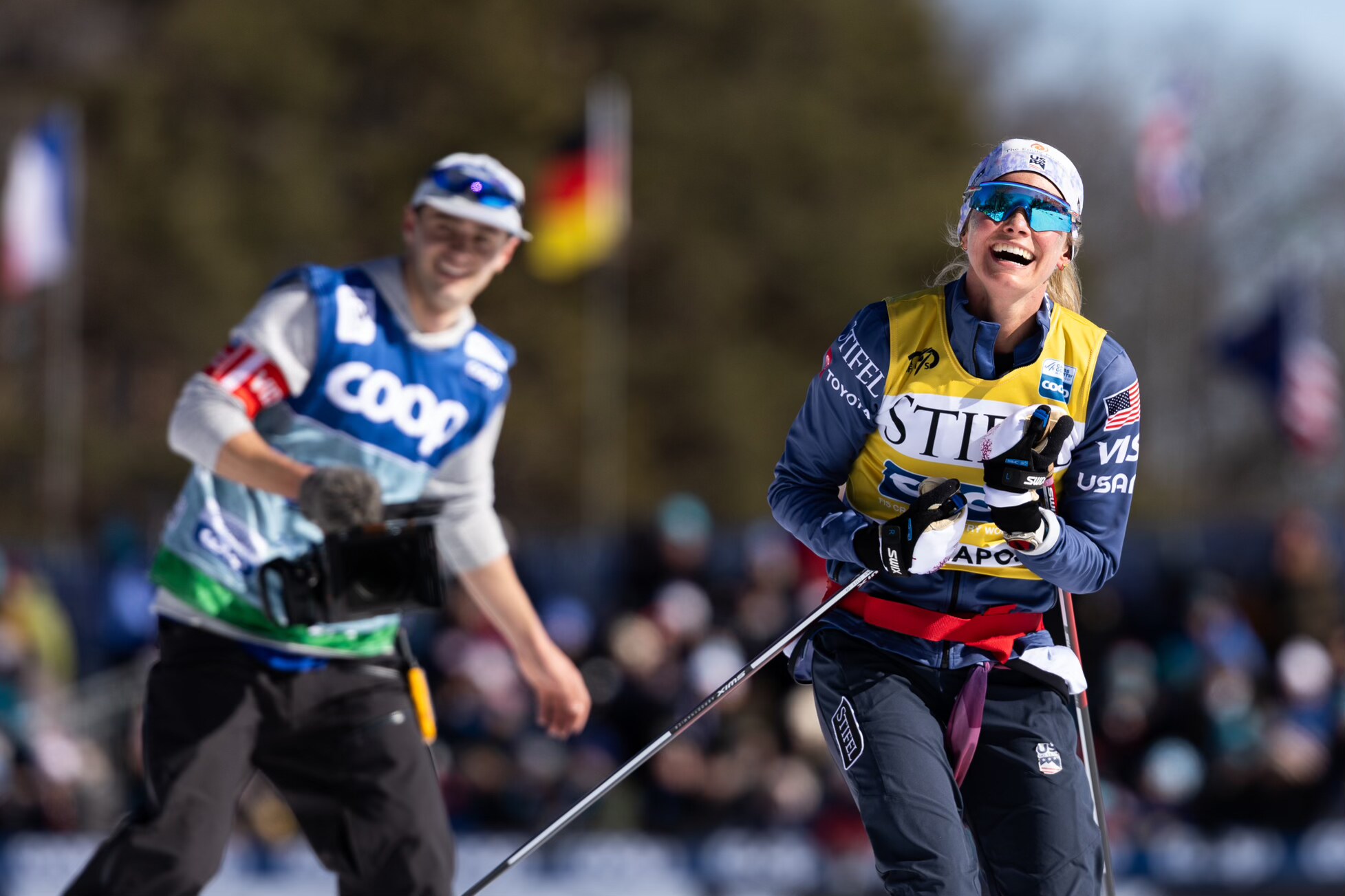
    Jessie Diggins laughs on a warm-up lap while a filmmaker in a media bib skis alongside her carrying a camera, a blurred crowd behind them.
    Torsten Brinkema, left, on the warm-up lap with Jessie Diggins before the 10-kilometer freestyle at Theodore Wirth Park in Minneapolis, February 2024. (Photo: Dustin Satloff)

    MV: What is something you are each really proud of?

    LB: Just coming into the film with such an open idea about what it could be, and that every step of the way we had trust in each other that we were going to make this happen and get it to a large audience. As Tor mentioned, we stepped into a really hard time in documentaries to get one out into the world and make an impact through film. I think we just trusted at every step of the process that we were going to figure this out. Being able to do that and show it in person in Lake Placid and Minneapolis has been such an incredible experience.

    TB: Going off of that, it felt like we were in such a unique position to tell this story. I am so proud of those POV shots we got on skis with the athletes. Again, that is the one percent of all the shots we did. But it is a crazy feeling, in a really crowded documentary landscape, to be one of a handful of people in the U.S., maybe even in the world, who can hold a cinema camera while going 30 miles an hour and pull focus and get that shot. It felt like a really proud moment just being like, wow, these turned out, and they are going to make it a better film, because you sort of feel like you are skiing with them.
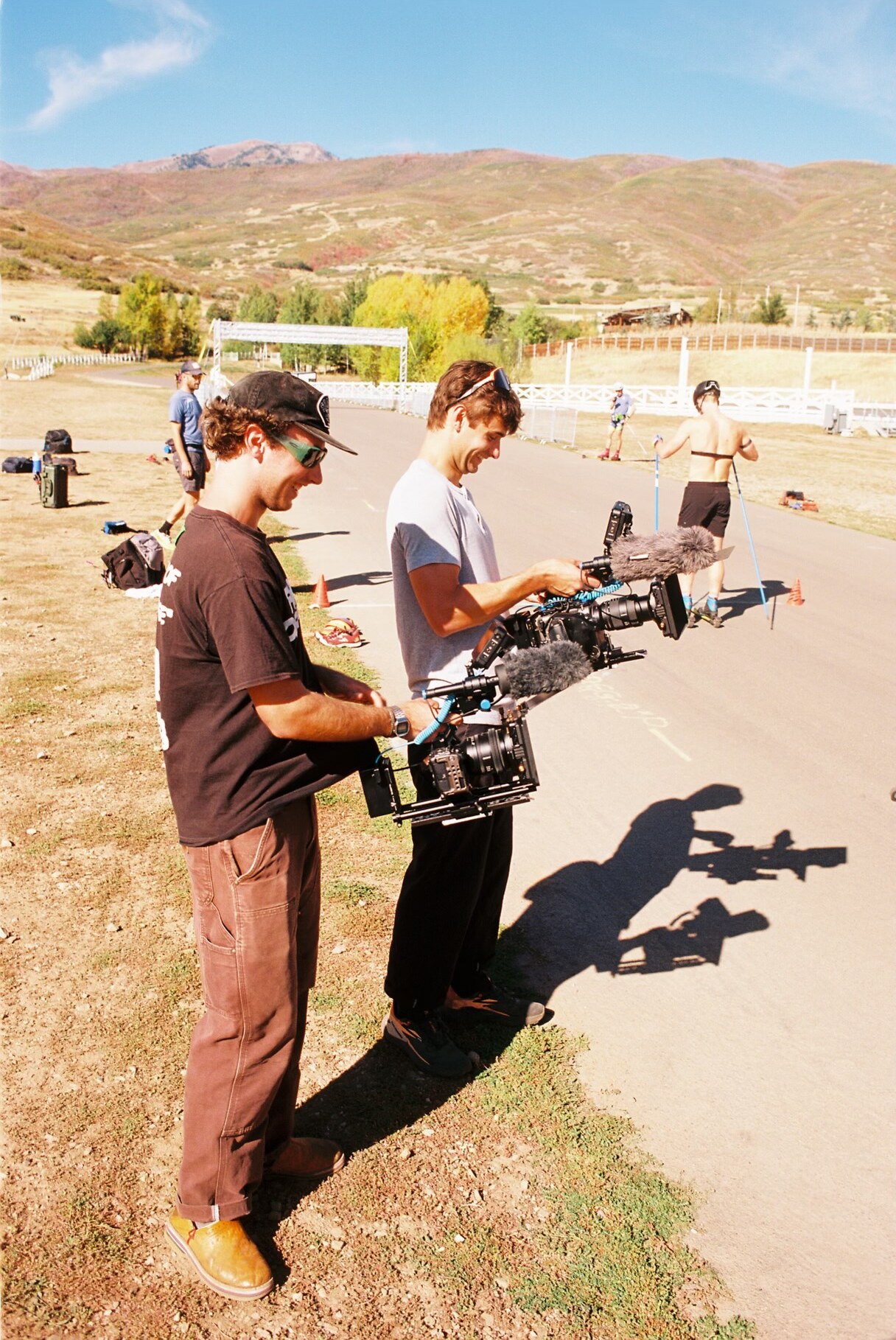
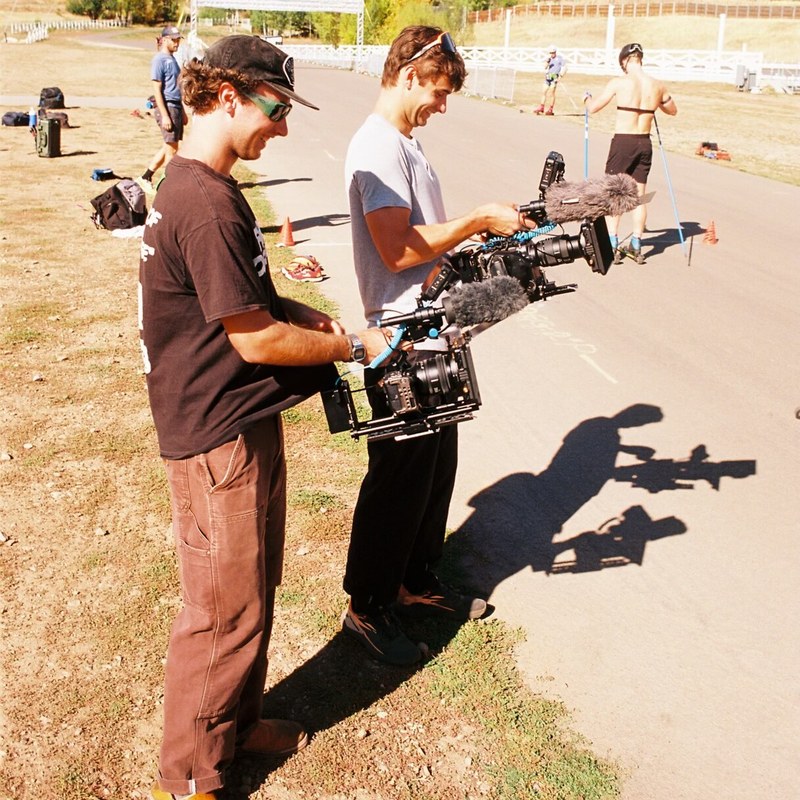
    Two filmmakers stand in profile at the edge of a paved roller ski loop, each holding a cinema camera with a microphone mounted on top.
    Lars, left, and Torsten Brinkema working the roller ski loop at the Park City camp, with the two Sony bodies that shot the season. (Photo: Willie Maahs)

    MV: What was it like working with FIS? Those rights can be really muddy.

    TB: It was definitely a headache to navigate Infront, basically a huge Italian conglomerate that controls a lot of these rights. We had a lot of negotiation with them, because we did want the context of the broadcast footage to feed into the intensity of the race segments. We wanted the tracker of kilometers to go. We wanted Chad and Kikkan announcing, which is so special and I think really leads the film in a way, because Lars and I never really wanted our voices narrating any of this. So we relied on the broadcast to be that context and the hype. It was an absolute pain in the ass, and that is kind of all that I will say.

    MV: What is next?

    LB: In line with Threshold, it was really special to bring something that is a subject matter so personal to us, skiing and mental health. So I think we will continue to create stories that are close to home. We are working on a film that will be set in Minnesota. It was such an incredible experience to show our city and our race course on the big screen.

    TB: We are excited to push our own limits again, and I think this round that will be writing a script, so not a documentary for the next one. But we still definitely want to work together, because having this balance of brother filmmakers, we rely on each other for the things we do not know or that we are not good at. Again, feeling that itch to both tell a story about home and push our comfort zones, which this project definitely did.


    Where to watch: Threshold is available to rent on Apple TV, Amazon Prime Video and YouTube in the United States and Canada. It premiered on Peacock in February, and a European release is planned for later this year.


    Help Support Our Coverage!

    If you value the thoughtful work and access FasterSkier provides, please consider becoming a Voluntary Subscriber. Your support directly fuels our work to cover the people, places, and moments that make our sport special.

    Join the FasterSkier community!
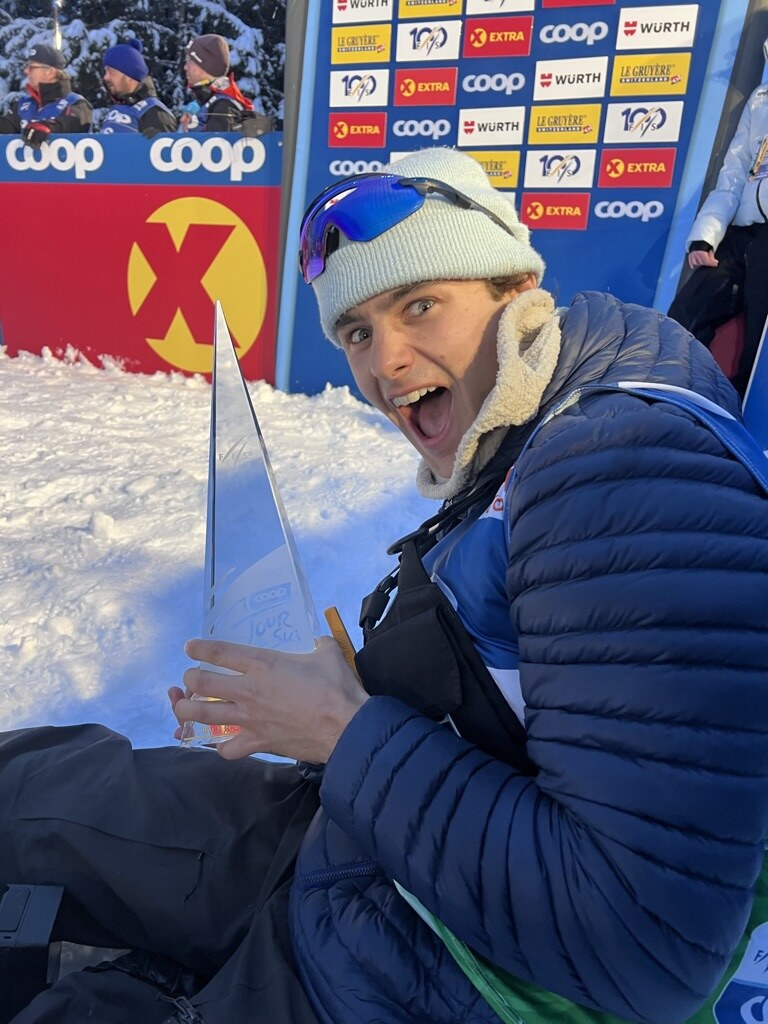
     

    A filmmaker sitting in the snow holding a tall glass pyramid trophy, with race sponsor banners behind him.
    Torsten Brinkema at the foot of the Alpe Cermis final climb in Val di Fiemme, holding Jessie Diggins’ Tour de Ski trophy in January 2024. (Photo: Leann Bentley)
  • What the U.S. Ski Team Changed After Threshold

    What the U.S. Ski Team Changed After Threshold

    This article was made possible through the generous support of our voluntary subscribers. If you value coverage like this, please support FasterSkier with a voluntary subscription.

    When I asked Matt Whitcomb what surprised him about Threshold, the head coach of the Stifel U.S. Cross-Country Ski Team started by admitting he was tempted to make something up.

    “This is the hardest question for me to answer, … but I haven’t watched it. I know it’s life-changing, but I don’t want to go back to that winter,” Whitcomb said. “I did my best as a coach, we all did, and it wasn’t good enough, and I’ve come to terms with my personal experience with it all.”

    The winter in question is 2023-24, the season Torsten and Lars Brinkema spent inside the American team with two Sony cinema cameras, a drone, and no feature film credits between them. What came out of it is a documentary about Jessie Diggins and her eating disorder that premiered on Peacock in February and, as of last Friday, is available to rent on Apple TV, Amazon Prime Video and YouTube in the United States and Canada. A European release is planned for later this year.

    Whitcomb is the person who let the cameras in. He is also, by his own account, the film’s loudest advocate.

    “I know from the response that the film is excellent, and I know it’s changing people’s lives and is being featured in college curricula. I recommend it to everyone I speak to,” he said. “I’m very proud of Torsten and Lars and am grateful for the film. I support it completely.”

    A filmmaker on cross country skis carries a cinema camera rig on a groomed snow trail while an athlete skis ahead of him.
    Lars Brinkema skiing with a cinema camera at a U.S. Ski Team camp in Bend, Oregon, chasing Jack Young on the trail. The brothers had done these workouts themselves, which is why it never occurred to them to ask an athlete to run one again for a better take. (Photo: Patrick Conroy)

    “A couple of brothers got a camera for Christmas”

    His first answer was no.

    “I figured a couple of brothers got a camera for Christmas, had a couple beers, and then came up with a fun way to spend a year,” Whitcomb said. “I normally would’ve erred on the safe side and told them to take a hike, but Ben doesn’t toss around ideas lightly and so I followed up to hear more.”

    Ben is Ben Ogden, who raced against Torsten in college on the EISA circuit and had watched him work at the World Cup in Norway that spring. Torsten had gotten there on a shoestring, having talked the Loppet Foundation, the Minneapolis club he and Lars grew up in, into sending him to shoot promotional material ahead of the 2024 World Cup at Theodore Wirth Park.

    “I think they were kind of surprised to have an American photographer out there with them,” Torsten said, “just because they aren’t getting much coverage once they leave.”

    Ogden pitched Whitcomb on inviting the brothers to the team’s Bend, Oregon camp that summer. The brothers bought cinema cameras and showed up.

    What they had in mind at that point was not a film about an eating disorder. It was a film about a sport nobody in America watches, made in the shape of the niche-sport documentaries that had broken through elsewhere.

    “We could probably do something like that with skiing,” Torsten said of the pitch they were making to themselves. “Make it look really cool.”

    They had one asset that mattered more than the cameras, which is that they were skiers. Diggins had been through the alternative, brand shoots that treated an interval session as something you could run again for a better take.

    “This is just something that would never even cross Lars and my mind, to alter the workout, because we know how intense they are,” Torsten said. “We know the workouts. We’ve done them before.”

    Two young filmmakers stand side by side on a paved roller ski loop holding cinema cameras, with autumn hills behind them.
    Lars, left, and Torsten Brinkema at the U.S. Ski Team’s Park City camp. On the road the athletes called them Larry and Toasty. (Photo: Willie Maahs)

    Toasty, Larry, and a problem with FIS

    Whitcomb’s worry was culture, which he describes as something you protect rather than something you have.

    The brothers had promised the arrangement would run both ways, that athletes would get usable footage of themselves out of it, and Whitcomb says they delivered. They also collected nicknames. Torsten became Toasty. Lars became Larry, or Lawrence in formal settings.

    “These guys were ghosts at times where they would disappear for the day and nobody would see them,” Whitcomb said. “And then we’d see them at dinner and they’d be showing athletes their incredible footage of the team training or racing together.”

    They washed dishes. They helped with wax testing. Whitcomb says everyone came to regard them as an addition to the team environment rather than a cost of doing business.

    It was not frictionless. At the first race of the season in Finland, Whitcomb watched one of the brothers get chewed out in the finish area by a FIS official for filming in a zone reserved for the television production company. Later, on course in Toblach, he got a text from FIS with a screenshot attached.

    “Larry running through the pines, keeping pace in his flatbrim hat and knit sweater, filming the lead pack. He was prominently within the TV feed,” Whitcomb said. “They asked if I could kindly remove him from the world feed. And you know what happened? Nothing. These guys said they were sorry and got a hand slap in each instance. Everyone likes them. They say things like thank you and sorry.”

    The rights question got more expensive than a hand slap when it came time to actually build the film. The brothers wanted broadcast footage in the race sequences, the kilometer counters and the commentary, partly because they had decided early that they would never narrate the film themselves. That meant negotiating with Infront, which controls FIS media rights.

    “It was an absolute pain in the ass, and that’s kind of all that I’ll say,” Torsten said. “Very expensive.”

    The money came from nowhere institutional. The brothers paid their own way through the season and kept fundraising as they went, working through the list of private donors who already keep the U.S. team on the road. The Emily Program, which sponsors Diggins, came in later during the edit and is now bringing the film into treatment centers and educational screenings.

    The Hollywood end of it started with a question the brothers asked Diggins at a training camp between the Tour de Ski and the next World Cup stop. They had no connections in that world and needed someone who did. Did she know anybody.

    She remembered that Patrick Dempsey had supported the ski team before, and sent him an Instagram message. He answered immediately and told her to send Torsten to his house in Maine, where Dempsey grew up skiing. A couple of months later Torsten showed up at the door and pitched him.

    “We have no films to our name. We have a couple short projects that nobody has seen,” Torsten said. “And so we’re asking someone with the credits that he has to trust us with nothing to see for it.”

    Dempsey signed on as an executive producer and, by the brothers’ account, became a real voice in shaping the cut. Whitcomb offers it as a character reference. “I mean, Patrick Dempsey signed on with these guys. That should tell you something.”

    Two filmmakers set up cameras on a patio to interview a skier seated in a chair with mountains in the background.
    Filming an interview with Johannes Høsflot Klæbo in Park City in October 2023. The brothers came home from the season with roughly 500 hours of footage and interviews across several national teams. (Photo: Daniel Sannum Lauten)

    The pivot happened the following summer

    This is the part Whitcomb wanted on the record, because he thinks people have the sequence backward.

    “From the start, this movie was meant to highlight the entire team, and not just Jessie,” he said. “Months after the winter concluded, I think the Brinkema brothers realized that the film needed to hone in on the topic of mental health to have a clear storyline. I understood and supported that pivot, but the point is that the winter filming was not targeted at just Jessie. That filming happened the next summer.”

    The brothers describe the same thing from inside the edit. They came home with roughly 500 hours of footage and interviews with athletes across several national teams, including Johannes Høsflot Klæbo, Emma Ribom and Federico Pellegrino. Their editor, Yaniv Elani, had never cross-country skied, which they now regard as the reason the film works.

    Elani is also the one who made them cut the northern lights. The brothers had stood out in the Arctic Circle for two hours in the cold to get a time lapse they were proud of.

    “It’s not serving the story. You got to cut it,” Torsten remembers him saying.

    Then came the screenings for film industry people in Los Angeles and New York, where the brothers went in hoping to learn what a non-skiing audience would care about.

    “People just kept saying, Jessie, Jessie, we want more Jessie,” Torsten said.

    A coach stands in green summer woods facing a filmmaker who is holding a camera in the foreground.
    Matt Whitcomb during an interview with the Brinkema brothers in Burke, Vermont. “We missed the mark on supportive team culture as an entire team,” he said of the winter the film covers. (Photo: Brinkema Brothers)

    “Our culture was at a 15 or 20-year low that winter”

    Whitcomb does not soften the season the film covers.

    “For anyone who has seen the movie, I think it’s no secret that our culture was at a 15 or 20-year low that winter. We had major struggles,” he said. He has thought about whether the presence of a film crew contributed to that, and concluded it did not.

    He is also insistent that the winter was not one athlete’s crisis with everyone else watching. “It was one of the hardest times for several other athletes and coaches, too. This wasn’t just a Jessie issue. We missed the mark on supportive team culture as an entire team.”

    Asked how he handled protecting Diggins against letting the story be told honestly, he rejected the premise.

    “I never felt like I had to protect Jessie from the film. She was a part of the team-wide decision to allow the Brinkema brothers into the team for the year, and that was the main gate we kept,” he said. When the brothers asked him whether they could film something sensitive, a one-on-one meeting for instance, he sent them back to the athlete. “I would usually just tell them to ask Jessie what she was comfortable with.”

    He watched her closely all the same, and says that had nothing to do with coaching. “That’s just because she’s a close friend, and friends look out for each other. But I had 100% trust in these guys, which is saying something because Lars was 19.”

    A filmmaker and a team communications manager pose together in a sunny finish area, raising ski poles overhead.
    Torsten Brinkema and Leann Bentley at the World Cup finals in Falun, Sweden, in March 2024. Bentley handles press for the cross-country and Para Nordic teams and appears in the film mostly doing her job in the background of somebody else’s scene. (Photo: Brinkema Brothers)

    The person in the hotel room

    Leann Bentley is the U.S. Ski & Snowboard communications manager who handles press for the cross country and Para Nordic teams, and she is in the film, mostly doing her job in the background of somebody else’s scene.

    She was in the room when the coaching staff decided whether to say yes, and she remembers it being straightforward. Here were two people willing to spend a year telling a story she could not tell herself, and one of them had raced against these athletes in college.

    The question she was asked for this story was how she decided where to draw the line once the film’s center became Diggins’ mental health. Her answer was that the question does not describe what happened.

    “Short answer, no, I never had to tell them no,” Bentley said. “Long answer is I of course will always protect my athletes. But at the same time, they’re protecting themselves. And throughout this entire process, Jessie was protecting herself. She knew what she wanted to give, and she knew maybe what she didn’t, but she was in charge of it from the very start. And so were all the athletes.”

    The scene she keeps coming back to is a hotel room in Ruka before the press conference where Diggins told the assembled media she was dealing with her eating disorder again. Bentley says it was one of the most heavily attended press conferences she has run with her.

    “There was a scene where I told her that it’s okay to be vulnerable. And I don’t remember saying that to her,” she said. “It really goes to show that when I work with these athletes, I’m working with them as people, and I’m really glad that came across in the film.”

    Most of her season is not spent in hotel rooms in Finland. It is spent in Salt Lake City, awake in the middle of the night, watching the same feed as everybody else and then turning it into the clips and quotes that hundreds of thousands of people see, for twelve teams and more than 240 athletes.

    Asked what the film got right about the parts of team life that press coverage never reaches, she was blunt about why the question has an easy answer.

    “It got everything right because it was showing exactly what was happening,” Bentley said. Athletes race for a few minutes at a time, a few times a weekend. The rest of it is chess and cards and laundry and going for a run. “I don’t think a lot of people understand that being a professional athlete, you train so hard mentally and physically for what you do on the weekends during a race. And then that race ends and you have, I don’t know, ten more hours of the day left.”

    Both she and the brothers land in the same place when asked for a favorite corner of that life, which is the wax truck, known on the road as Yolanda. Torsten’s version involves showing up on dark nights with nothing to do, music playing, occasionally a shot of Jägermeister, and a group of technicians who had been living this way for a decade or more and had stories nobody had ever asked them for.

    I interviewed the American wax techs last winter in the lead-up to the Olympics, and they remain the most enjoyable conversations I have had for this site, so I will just agree with him.

    Two filmmakers with cameras stand on a paved loop while a coach talks with two athletes on roller skis.
    Torsten Brinkema, left, and Lars Brinkema, right, filming Jessie Diggins, coach Jason Cork and Renae Anderson during a roller ski session at the Park City camp. (Photo: Willie Maahs)

    What actually changed

    The most concrete thing to come out of that winter is not on screen.

    Whitcomb describes an Athlete Wellness Passport, a monitoring system covering roughly eight health areas for every athlete on the team, men and women, including bone density, blood panels, caloric balance assessment, menstrual health and a mental health questionnaire. The team dietitian tracks each category for each athlete, and a licensed professional is brought in when a category calls for it.

    “It’s a safety net for the whole team,” he said.

    What that system did not have in 2023-24 was a ceiling.

    “What we were missing in the winter of 2023-24 was a plan for what happens when an athlete’s issue, like an eating disorder, advances beyond the qualifications of our professionals,” Whitcomb said. “In this case, we needed an eating disorder specialist MD on call, and we didn’t have one. We’ve debriefed on the experience extensively and have brought in the person we wish we already had in place going into that winter.”

    For coaches who watch the film and want something to do on Monday, his answer starts with an assumption rather than a policy.

    “If you coach a team of athletes, you likely coach some athletes who struggle with disordered eating, and you may never know who they are,” he said. He has had male and female athletes tell him about it years after they finished competing.

    On his team the practical version is a conversation about meals, held once a year, in which everyone agrees to treat mealtime as a place where safety matters more than opinions.

    “Everyone’s plate looks different, and everyone’s dietary needs and goals are different, and many of us are insecure, so the environment is ripe to be judgy and toxic,” Whitcomb said. “Talking it out isn’t perfect, but it helps.”

    He got there by getting it wrong first, and he tells that story without cushioning it.

    “As a young coach I used to think I could talk openly with athletes about their challenges with eating, body image, and weight. Then I learned from a parent that a comment I made to them regarding weight was harmful. Yeah, I know, duh. But I was 23 and some of you are now, too.”

    His correction was to stop talking about any of it and refer everything to professionals, which he now says was better but too absolute. The current version is that he will talk with an athlete who wants to talk, if the trust is there, while being honest about where his expertise ends and activating someone qualified.

    Three people stand in front of a cinema screen taking questions from a seated audience in a darkened theater.
    Lars Brinkema, Torsten Brinkema and Andrew Peterson take questions after a private screening of Threshold in Minneapolis in January. Diggins has asked teams to treat the film as “a visual book club.” (Photo: Sawyer Brice)

    What Diggins wants out of it

    Diggins raced her last World Cup in Lake Placid in March. She did not do a new interview for this piece, but she wrote at length on Instagram when the film went back out on Friday, and the argument she made was that the documentary is not really about her.

    Her request to teams, high school through professional, was that they treat it as “a visual book club.” Watch it, then talk about it. What pressure does this sport put on you. What kind of team do you want to be. And for coaches, find out now where you would send an athlete who comes to you, before one does.

    She also made a point the film cannot make on its own, which is that the recovery in it happened in hundreds of hours of therapy and clinical work that were never filmed and could not have been.

    Two filmmakers in Team USA bibs stand with their arms around a skier wearing the yellow overall World Cup leader bib.
    Torsten Brinkema, left, Jessie Diggins and Lars Brinkema in the finish area in Falun, Sweden, in March 2024, after Diggins wrapped up the overall World Cup title. (Photo: Modica/NordicFocus)

    When the film premiered in February, she put the goal simply in a U.S. Ski & Snowboard release: “I wanted to help others feel less alone.”

    The brothers are working on a scripted film now, set in Minnesota, still as a duo.

    Whitcomb, meanwhile, is not planning to watch. He described where the last two years have left him without much interest in tidying it up.

    “We’ve made improvements to our system because of lessons from that winter, and we became better coaches and teammates. I’m moving forward as an improved coach.”

    And then the part that sounded most like a coaching philosophy: “Your coaches and staff must truly care about the human condition. That’s your foundation. Get rid of the ones who don’t and add more who do.”

    Where to watch: Threshold is available to rent on Apple TV, Amazon Prime Video and YouTube in the United States and Canada. It premiered on Peacock in February, and a European release is planned for later this year.


    Help Support Our Coverage!

    If you value the thoughtful work and access FasterSkier provides, please consider becoming a Voluntary Subscriber. Your support directly fuels our work to cover the people, places, and moments that make our sport special.

    Join the FasterSkier community!


  • A Side Quest to Broken Arrow Put Kendall Kramer on Another Team USA

    A Side Quest to Broken Arrow Put Kendall Kramer on Another Team USA

    This article was made possible through the generous support of our voluntary subscribers. If you value coverage like this, please support FasterSkier with a voluntary subscription.

    Cross-country skiers rarely travel light. For the Broken Arrow Skyrace, however, Kendall Kramer’s entire racing kit amounted to one pair of shoes and one outfit, both tucked into a carry-on. But after a winter ruled by equipment and logistics, simplicity was part of the point.

    The self-funded trip to California with her mother was supposed to be, in Kramer’s words, “a fun little side quest.” She had watched Jessie Diggins race at Broken Arrow in previous summers and submitted an elite application in February, when the event was already sold out. If the organizers accepted her, Kramer decided, she would take it as a sign to go. They did, and four months later the side quest sent her home with a place on another U.S. national team.

    Kramer completed the June 19 Ascent in 48 minutes, 14 seconds, finishing 11th among women in an international field and fourth in the separate USATF Uphill Mountain Running Championships. The latter result earned the 2026 Olympian one of four women’s spots on the U.S. team headed to the World Mountain Running Association (WMRA) World Cup Finale in Quebec this October.

    Kendall Kramer running uphill on a rocky mountain course wearing race bib 361.
    Kramer climbing at the Cirque Series race at Alta, Utah, in 2025. Summer mountain races have been part of her calendar for years. (Photo: Austin Elliott Photography)

    A Race Within the Race

    The Broken Arrow Ascent rises 2,840 feet over 3.61 miles at Palisades Tahoe, ending near 9,000 feet on Washeshu Peak. The course offered Kramer a familiar kind of discomfort. Skiers spend plenty of summer training sessions running uphill, and she has raced mountains throughout her life in Alaska. She was also drawn to an uphill-only event, where she could attack the climb without risking the pounding, falls and injuries that can accompany a technical descent.

    The altitude complicated the effort. An ascent race can feel like a sprint, Kramer said, because its short length allows runners to push rather than settle into prolonged power hiking. Near 9,000 feet, that approach requires more restraint. Still, years of ski racing and training at elevation gave her a sense of how to manage those obstacles.

    Kramer had entered with a tangible goal: finish in the top 10 and earn prize money. The field was strong enough that doing so, she felt, would also establish her among other serious mountain runners.

    She started picking off competitors as the course climbed and found another surge near the end, when a cluster of women remained within reach. Kramer lost track of her exact position amid the passes but knew she was close. She crossed two seconds behind 10th place.

    “I was like, ‘Oh darn,’” Kramer said. “At least it was a good effort race.”

    Weeks earlier, the elite runners had been told that the Ascent would double as the USATF uphill championship and a qualifier for the World Cup Finale. Kramer bought a USATF membership and entered that competition, too, mostly because there was no reason not to. She skimmed the qualification information without giving it much thought.

    “This field is crazy,” she remembered thinking. “That’s not really going to be me.”

    After the race, Kramer and her mother began walking from the summit toward the tram. She checked the overall results first. Then she noticed a separate view for the USATF championship, which removed athletes who were not entered in the national race. Kramer had nearly forgotten about the competition within the competition.

    Her name was listed in fourth, and the top four qualified.

    “I totally didn’t factor myself into that,” Kramer said. “It was definitely a surprise. I was really proud that I could make a team like that.”

    Kramer may not have expected the qualification, but it drew on years spent building the aerobic engine and uphill strength that mountain racing rewards. She simply had not imagined that an ability maintained partly for balance and enjoyment would carry her onto another international team.

    A young Kendall Kramer running a road race alongside an adult runner wearing a race bib.
    Kramer came to athletics through running before she found skiing. Both of her parents are runners. (Courtesy photo)

    A Runner First

    Running has never felt like a secondary sport to Kramer, even as skiing became her profession.

    “Running was always my main sport, in the sense that that’s what I got into when I got into athletics,” she said.

    Both of her parents are runners, and running shaped the athletic culture of her family in Fairbanks. She tried soccer and baseball, but she liked the directness of a sport in which her work and her result felt closely connected. Skiing came later because, as she put it, it was “what all the cool kids did.”

    The two sports eventually became inseparable. At the University of Alaska Fairbanks, Kramer competed in both throughout college. She won three straight Great Northwest Athletic Conference cross-country titles and finished second at the 2024 NCAA Division II Cross-Country Championships. Four months later, in the final ski race of her collegiate career, she won the 20-kilometer freestyle at the NCAA Skiing Championships.

    Kramer’s skiing has since reached a new level. She made her Olympic debut in Italy in February and placed ninth in the World Cup skiathlon in Falun in March, her first top-10 World Cup result. Yet running still supplies something that skiing cannot.

    “If I didn’t have it, I wouldn’t be able to handle all of the skiing that I do,” Kramer said. “I like feeling like I have another athletic outlet to keep me happy, because skiing can be fleeting and have all sorts of disappointments with equipment and stuff. Running feels more in control.”

    That control is physical, but it is also logistical. A ski race can hinge on wax, snow, weather and the work of moving equipment from one place to another. Running asks much less before the gun goes off. On a running trip, Kramer said, there is more space to enjoy the people and the place around the competition.

    “It feels like it adds to your life,” she said. “It’s so manageable.”

    The harder question came when her college cross-country career ended. Kramer loved the sport’s courses, team culture and changing terrain, but there is no obvious post-collegiate version of NCAA cross-country. Track and road racing did not offer the same pull, and she was not ready to build her running life around marathons on pavement.

    Mountain racing offered another route. In Alaska, it had never felt like a separate niche so much as part of the local calendar. Races such as Mount Marathon and the Cirque Series became summer traditions, with familiar faces returning to familiar mountains each year. Two weeks after Broken Arrow, Kramer placed seventh at Mount Marathon in 52:53.

    “I loved running cross-country and being in the woods and going along a course that has different aspects,” Kramer said. “You have an uphill and downhill, and you have to change, just like skiing.”

    Mountain racing preserved the parts of running Kramer loved and opened a path to international competition she never expected to enter.

    Kendall Kramer racing the World Cup skiathlon at Falun, Sweden.
    Kramer on her way to a career-best ninth in the World Cup skiathlon in Falun, Sweden, in March. She argues that summer racing is part of what makes winter results like that possible. (Photo: Authamayou/NordicFocus)

    Keeping a Pulse on Racing

    For Kramer, racing in the summer is not a diversion from ski training. It is one of the ways she makes that training more useful.

    An occasional race does interrupt a perfectly planned week. She may back off for a few days beforehand, then need time to recover afterward. Some skiers see that as lost volume. Kramer believes the costs are outweighed by the chance to revisit sensations that ordinary training cannot reproduce.

    “Racing is very different from training,” she said. “At least I think so, and I think it should be different from training.”

    Kramer likes to race roughly once a month during the offseason. Each start provides a checkpoint on her fitness, pacing and ability to summon focus when a result matters. Those reminders make the first ski races of winter feel less abrupt; she arrives with recent evidence of how her body and mind respond in competition.

    Races also make weaknesses harder to ignore. A disappointing moment can become the direction for the next training block rather than a problem discovered after the ski season begins.

    “Sometimes you don’t get an idea of where you’re lacking and where your strengths are if you don’t tap into that throughout the summer,” Kramer said.

    At Broken Arrow, the crossover was all around her. Olympic ski mountaineer Anna Gibson won the Ascent and the U.S. uphill title in 43:15. Diggins completed all three races, a total of 75 kilometers with more than 16,000 feet of climbing, and finished fourth in the Triple Crown standings. Sophia Laukli has built an elite trail-running career alongside cross-country skiing, winning the 2023 Golden Trail World Series. In August, Gibson placed sixth among women at Switzerland’s Sierre-Zinal, while the recently retired Diggins finished 37th.

    Those examples helped Kramer recognize that mountain running can be more than incidental cross-training. The sport has international races, sponsors and prize money, particularly in Europe. Its U.S. elite pool remains relatively small, and a skier who already possesses a strong aerobic base can become competitive quickly. That does not make the crossover effortless.

    “I’m not going to act like I’m couch-to-mountain-running,” she said. “I’m definitely trying, and I’m also not downplaying the girls who do train for it. But I am saying that ski training works for it, and getting fit in general works for it.”

    The larger benefit may be less measurable than fitness. Elite skiers live by periodized plans: intervals on one day, over-distance training on another, each block designed to build toward winter. Kramer believes athletes can become so protective of that structure that they miss the value of occasionally disrupting it.

    “People are really scared to break away from that,” she said. “But I think you can be a really adaptable athlete and build skills that a regimented training plan can never get you.”

    Her confidence in that approach has been earned over years of combining running and skiing without sacrificing results in either. That history has also built trust with her coaches. An unplanned race or an imperfect training week does not look like recklessness when the larger pattern shows that she understands how to make the two sports work together.

    The mental return matters as much as the physiological one. A summer race provides the competitive charge that long weeks of training can lack and asks an athlete to solve problems in real time: exactly what winter racing eventually demands.

    Kendall Kramer in a running vest above an alpine lake in the Alaska mountains.
    Kramer on a run in the Alaska mountains. Her next start comes Oct. 10 at Mont-Sainte-Anne in Quebec. (Courtesy photo)

    The Next Side Quest

    Kramer’s next test comes Oct. 10 at Mont-Sainte-Anne in Quebec, where the circuit will make its first visit to Canada. The current course listing calls for five kilometers and roughly 800 meters of climbing. It will begin far below the altitude Kramer encountered at Broken Arrow, removing one variable while preserving a steep uphill challenge.

    She wants to finish in the top 10. Broken Arrow showed that she can stay close to that range in a deep international field, and the chance to race without a near-9,000-foot finish has left her curious about what more she can do.

    Beyond Quebec, Kramer would consider mountain races in Europe if a sponsor or U.S. team opportunity made the travel possible. She is not mapping out a second full professional calendar yet. The appeal lies partly in leaving room for opportunities to appear, then being fit and adaptable enough to take them.

    “I would love to look back and see that I took those opportunities,” Kramer said. “Running has never hurt me in the past. I’ve always been able to juggle both.”

    Kramer does not argue that every skier should copy her schedule. She wants more athletes to leave room for the experiences that may not fit perfectly into a training plan but help them handle everything racing asks of them.

    “It can make you a better skier in ways that maybe aren’t the best training on paper,” Kramer said. “But it makes you a good athlete, which comes in handy when you least expect it.”

    At Broken Arrow, that lesson was waiting in a second set of results she had nearly forgotten to check.

    Help Support Our Coverage!

    If you value the thoughtful work and access FasterSkier provides, please consider becoming a Voluntary Subscriber. Your support directly fuels our work to cover the people, places, and moments that make our sport special.

    Join the FasterSkier community!


    Kendall Kramer racing cross-country in an Alaska Fairbanks singlet, number 24, past a course flag line.
    Kramer racing cross-country for Alaska Fairbanks. She won three straight GNAC titles and finished second at the 2024 NCAA Division II championships. (Courtesy photo)
  • Ben Ogden’s Spring of Silver and Setbacks

    Ben Ogden’s Spring of Silver and Setbacks

    This article was made possible through the generous support of our voluntary subscribers. If you value coverage like this, please support FasterSkier with a voluntary subscription.

    For Ben Ogden, the strangest change since taking home two medals from Milano Cortina has not been that more people started recognizing him around Vermont.

    He admits he is still adjusting to the newfound fame, but that part has mostly been fun. There have been school visits, community events and moments in Burlington restaurants when strangers stop by to say they watched him at the Olympics. After the winter Ogden had just put together, with two silver medals and a historic breakthrough for American men’s cross-country skiing, the attention made sense, even if it still felt a little surreal.

    What was harder to make sense of was everything that came next, which has made the last few months a bit difficult to sum up neatly. While Ogden has spent the spring and early summer being celebrated for the best season of his career, he’s also been going through the first major injury setback of his life. One part of the experience has pulled him outward, back into the local Vermont ski community that helped shape him. The other has forced him inward, into the slower world of surgery, crutches, rehab exercises, and patience.

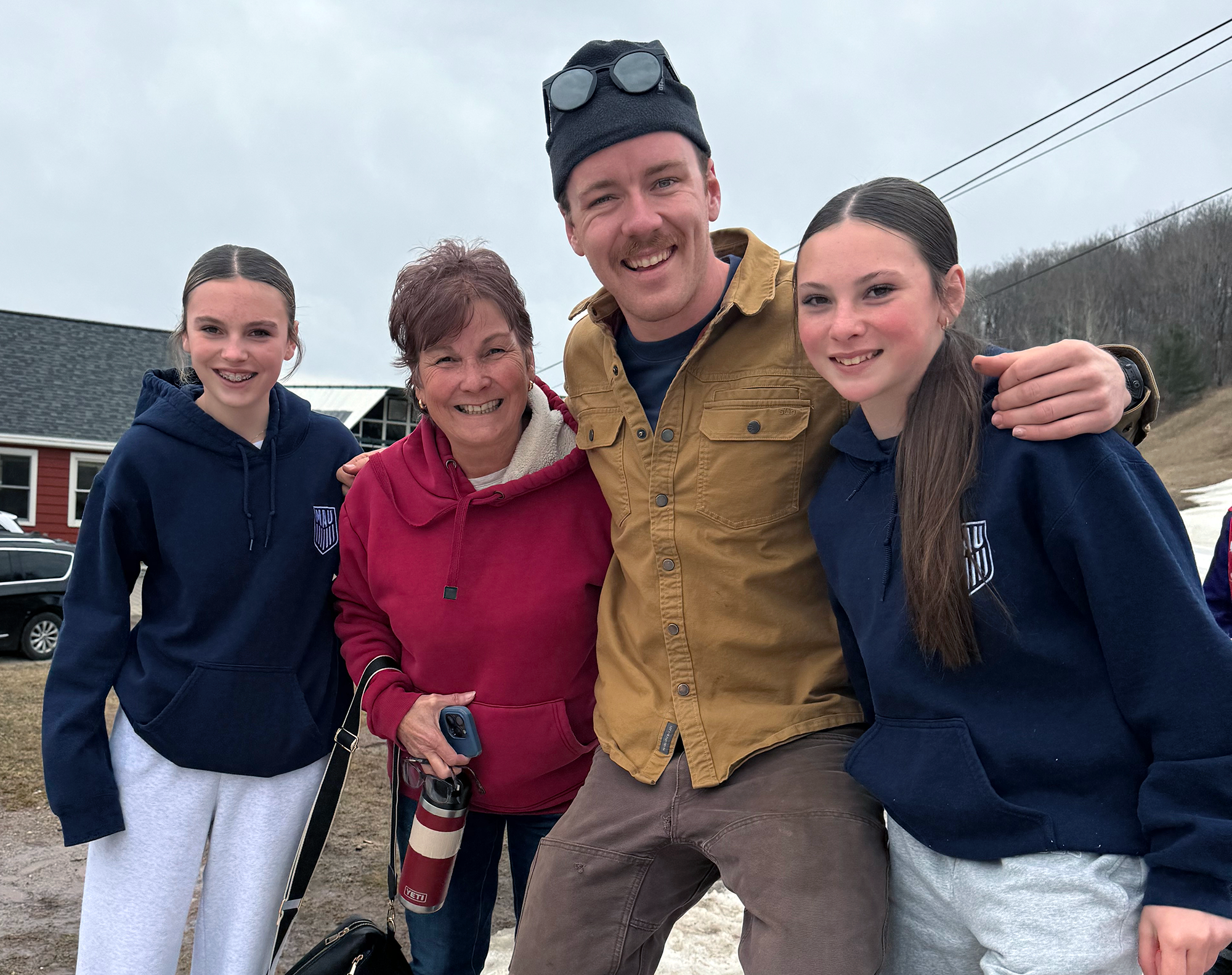
    Ben Ogden posing for a photo with a few of his fans and the closest of friends of FasterSkier at the “Medals in the Mountains” community fundraiser held at Bromley Mountain Resort in Peru, Vermont, on April 12, 2026. (Photo: Jozefiak)

    A New Kind of Attention

    “It’s been different in some ways and similar in other ways,” Ogden said. “There are more people around Vermont who recognize me now, which is pretty crazy and fun. I’ve been invited to a lot of events, and gotten to go to a ton of schools, and just kind of been in the community a little bit more than normal.”

    That part, he said, has been one of the real joys of the post-Olympic stretch. Ogden has always championed his identity as a product of the Vermont ski world, and the last few months have given him more chances to be present in it. Not just as a skier people watched on television, but as someone who could show up, talk to kids, say yes to local events and feel the reach of what happened in Italy.

    “Outside of anything athletic related, it’s always a goal of mine to take my position and try to give back to the community as much as I can,” Ogden said. “There’s been a good amount of that, which has been great.”

    In some ways, he said, life still feels mostly normal. It is still a Vermont summer. Burlington is still Burlington. Richmond is still close enough to feel like a small ski-world hub. But the medals have changed the way people interact with him, even in everyday places.

    “It’s never tiring having people coming up to me and saying, ‘Oh, my son loves watching you,’ or, ‘We watched you this winter,’” Ogden said. “I love that, and it really makes me feel good. People are always, especially here in Vermont, just always so kind and thoughtful with their time and my time, so it’s never overwhelming.”

    Still, there is a strange adjustment that comes with being recognized more often. Ogden laughed a little while describing it, not because it is a major burden, but because it is new enough to still catch him off guard. Sitting at a restaurant one time, he said two or three people came over to say they loved watching him race. Then he remembered, in a small way, that he is moving through the world a little differently now.

    “You’re in the public eye a little bit more,” Ogden said. “I think you’re constantly reminded that people here in Vermont, especially, recognize me wherever I go. Again, I have no misgivings about it, but it’s hard to escape it a little bit.”

    That visibility took on a more formal shape in May, when Ogden returned to UVM for commencement. He graduated from the school in 2022 with a mechanical engineering degree, and at first, he thought the university might just want him to be present or say a few words. Little did he know he would end up as the special guest speaker in front of nearly 3,700 graduates.

    “I was like, ‘All right, yeah, sounds great,’” Ogden said. “And then it eventually got like, ‘Oh, you’re going to be the guest speaker,’ and I was like, ‘Whoa.’”

    Ogden was characteristically candid with his explanation of how unfamiliar that setting felt. He was not answering questions in a mixed zone, talking through race tactics or explaining what it felt like to stand on an Olympic podium. He was sitting on a stage in front of graduates, faculty and families, waiting through the first part of the ceremony with his own speech still ahead of him.

    “I haven’t really learned how to do public speaking properly,” Ogden laughed. “But it was really fun. The sense of relief was just staggering,” he said. “It felt so good. It felt like one of those moments where you feel like you can do anything after finishing something that scares you, and it’s just an immensely satisfying feeling. So it was fun, and I really appreciate UVM for reaching out and thinking of me and having me. That was a really fantastic honor.”

    In his address, Ogden spoke about goals, but also about the people who make them possible. It was a fitting theme for an athlete whose Olympic winter was historic on paper, but communal in feeling. The medals were his, and in the team sprint, shared with Alaska’s Gus Schumacher, but Ogden has often framed the breakthrough as something larger than one person.

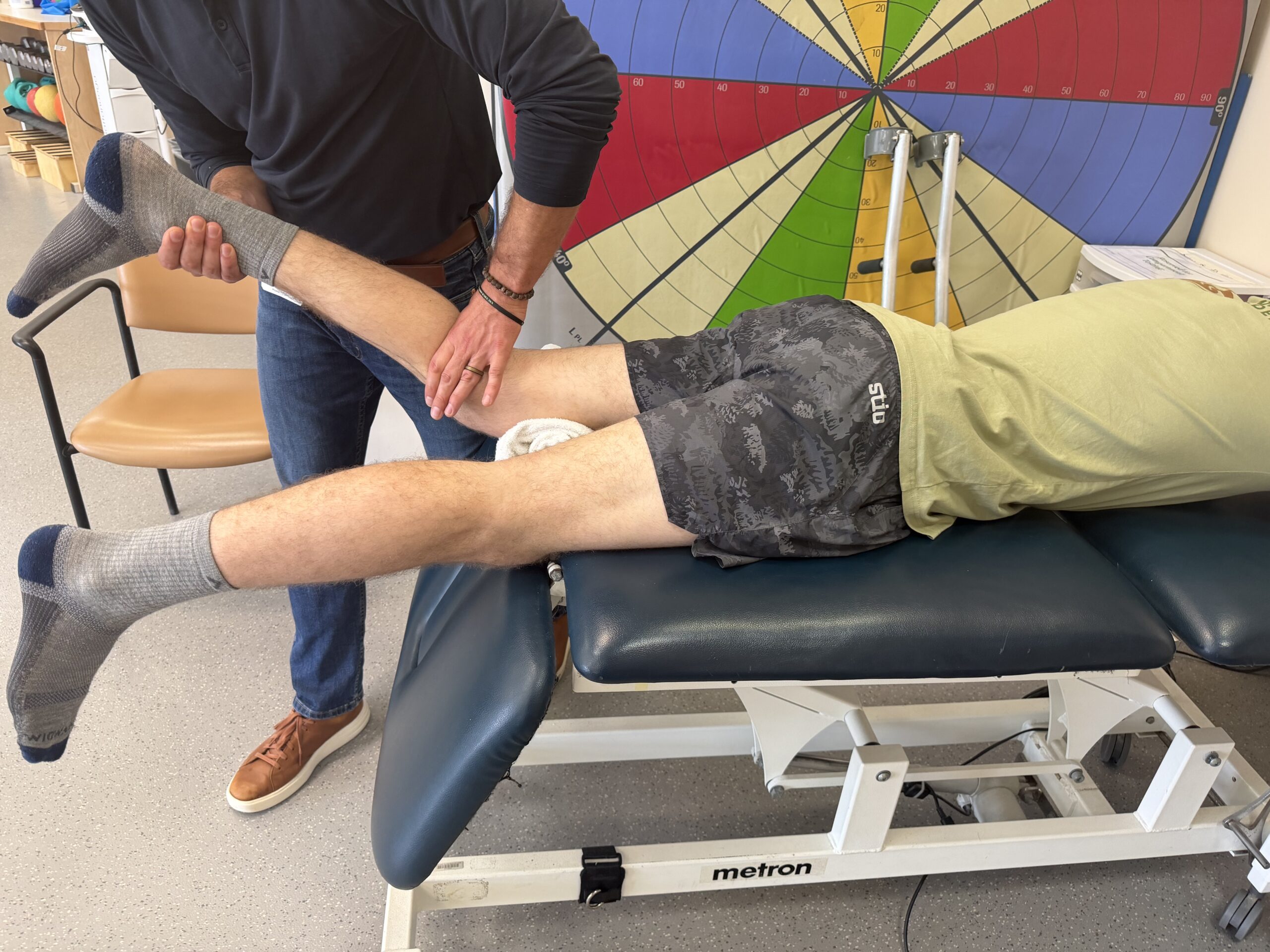
    Ben Ogden getting some PT on his injured knee. (Photo: courtesy photo)

    One Blow After Another

    That same idea has followed him through the spring. The medals gave him a larger platform in the community, while the injury reminded him how much he still depends on one.

    The knee injury happened on April 10, during what Ogden described as a typical day of spring training, until it wasn’t. 

    “It was a moment, but it wasn’t like I rode in the ambulance,” Ogden said. “At the time it didn’t really feel like anything bad. I was just spring skiing and doing a hockey stop, kind of, to slow down. I was going pretty fast on my cross-country skis, not denying that. But I just caught some slush and tweaked my knee.”

    The first signs were not too alarming. Ogden knew he had tweaked something, but he stood up, tested it and finished skiing. The next morning, though, the knee was stiff enough that he eventually went in to have it checked out. According to the doctor, all the major ligaments were intact, and the hope was that the MRI would rule out a meniscus tear.

    It did not.

    “At first I was a little bit spooked, but I thought it was going to maybe be a week of slowing down or something,” Ogden said. “Then after I went to the guy, he was like, ‘Oh yeah, if it’s a meniscus tear, maybe it’ll be a month or two months.’ And then it ended up being a complete meniscus tear, so I had to have it repaired, which leveled up the situation even worse.”

    Ogden had surgery at the end of April and spent six weeks fully non-weight-bearing on his left leg. When he spoke with FasterSkier in late June, he was about seven weeks removed from surgery and had started a weight-bearing progression, sometimes using one crutch and sometimes none. Even with that progress, it had been a hard adjustment.

    “It was a little bit like I just got one blow after another for probably a week there,” Ogden said. “I was definitely pretty down, feeling pretty bummed, especially because it happened just doing something random. It so easily could have been avoided. But then again, stuff happens.”

    He’d dealt with illness and little tweaks here and there before, as most endurance athletes do over the course of a career. But this was different. It was his first surgery and the first time he had to take a major step back from the sport because of an injury.

    “On the mental side, it’s definitely hard,” Ogden said. “I think that an injury of this caliber would be hard for anybody mentally, just because being on crutches is incredibly frustrating, and it limits you so much. I won’t lie and say that wasn’t hard for me. Those weeks were brutal.”

    The hardest part, Ogden said, was not just the crutches. It was the way the injury stripped away the pieces of daily life that usually make him feel like himself. He could still drive, because the injury was to his left knee, so he was not fully stuck in the house. He had physical therapy almost every day, a strong group of people around him, and enough structure to keep his days from feeling completely empty. But he could not move the way he wanted. He could not train the way he was used to training. He could not go outside with teammates and friends to just disappear into the rhythm of a long session.

    “The two biggest things were just that I couldn’t really move, I couldn’t really do the things that I like to do, and I also couldn’t train,” Ogden said. “As a cross-country skier, or any type of athlete, really, not being able to do what you do, you quickly start to feel like you’re losing ground. That’s a really, really hard thing.”

    It’s left him in a strange middle ground, where he has been through enough seasons, enough ups and downs, to understand that a few months do not define everything. But understanding that and feeling it every day are not the same thing.

    “I feel like I’m at a point in my career where I’m better equipped to deal with that than I ever have been,” Ogden said. “But it’s still really hard to sit around.”

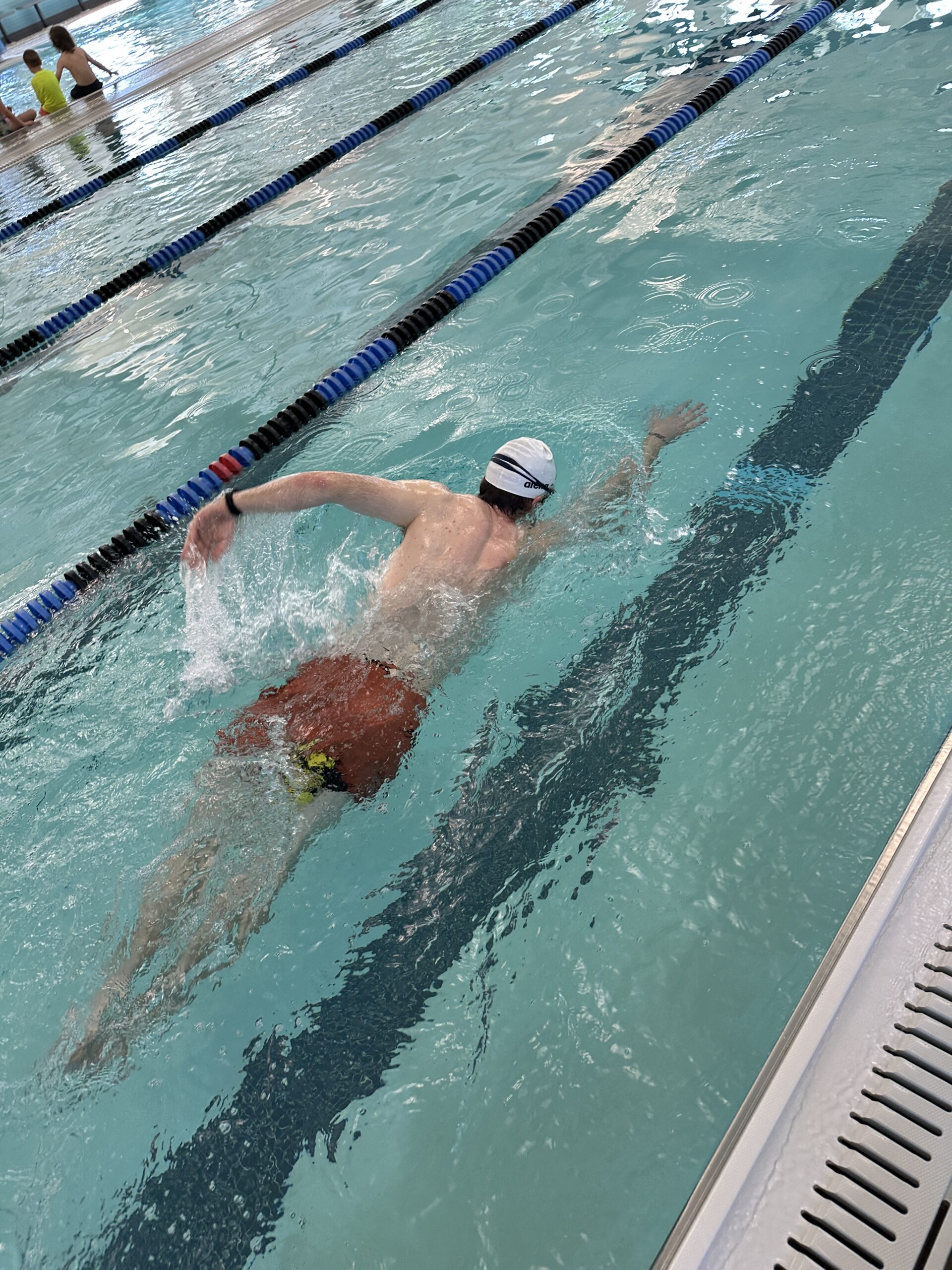
    With the helpful coaching of friend, teammate and neighbor Julia Kern. Ogden took to the water to try to maintain fitness. (Photo: courtesy photo)

    Finding a Way Through

    One major comfort is that he has not had to figure it out all on his own. Ogden said the U.S. Ski Team’s medical system has been well prepared to handle a knee injury like his, in part because other disciplines under the U.S. Ski & Snowboard umbrella see them more often. Alpine skiing, in particular, has no shortage of knee injuries, and Ogden joked that compared to what some alpine athletes have endured, his injury is “junior varsity.”

    That has not made the recovery easy by any means, but it has made the process clearer. From the start, he had a plan, a protocol and a timeline.

    “I knew the timeline on day one,” Ogden said. “That sucked, because it was a major blow knowing how long I’d be out for, but now I’ve just sort of had to work with it.”

    In some ways, he said, that has been easier than dealing with an illness, where there may be no clear date or progression. A meniscus repair brought bad news, but at least that bad news came with some kind of structure. 

    The training itself, for now, is limited and not always exciting, but Ogden has filled the space as best he can, with swimming, upper-body strength work and more time on the SkiErg than he would probably care to count.

    “I’m able to fill my days with the training modes available to me,” Ogden said. “I still get frustrated. Sitting at the SkiErg, it’s great and it’s something to do, you get the heart rate up, it feels good, but it is just horrendously boring.”

    That boredom has been one of the smaller but more persistent reminders of what he is missing. For Ogden, training has never just been about the work itself. It’s about being outside, sharing those hours with friends and teammates, and feeling connected to the sport in a way rehab cannot quite replace.

    “So much of what motivates me as an athlete is being outside and enjoying training with friends and teammates and all that stuff,” Ogden said. “You kind of lose it all.”

    Physical Therapy has a big part of Ogden’s life since his surgery. (Photo: courtesy photo)

    The Next Step

    Still, he has been able to see steady progression in his recovery. At the time of the interview, Ogden was starting to walk more normally again, though he said that process itself felt almost like something he had to relearn. His left leg had lost muscle and range of motion. Once walking felt solid, he expected to add more training options, including the spin bike, then outdoor biking, then eventually rollerskiing.

    He hopes to be on snow at a normal time in November, though what “normal” means for racing fitness is still unclear. This season, he said, may become more of a “train into it” year. Rather than targeting early World Cup racing in November, he could end up building toward later points in the season, perhaps after the Tour de Ski and closer to the World Championships portion of the calendar.

    “I’m still hopeful,” Ogden said. “It’s a blow for sure, and somewhere unlike any I’ve ever experienced, but I don’t necessarily think it has to be a complete loss. I think I’ll get through it.”

    For now, he is trying not to get too far ahead of himself. The surgeon told him to view the recovery on something closer to a year-long scale, not because he cannot train for a year, but because returning fully to where he was in strength and aerobic fitness will take time. Ogden’s hope is to beat that timeline by a few months if possible and feel like himself again by late January, February or March. That would still leave room for something meaningful to come from the season.

    “I’ve tried not to put a crazy amount of thought to it,” Ogden said. “I try to just focus on the present with this as much as I can. My goals are to do what I can, try to be patient, and try to feel like I get to that top race form, or something resembling it, at some point in the season.”

    That might not sound like the goal of someone who just won two Olympic silver medals. But that is the reality of the spring Ogden has been given. The medals did not make him immune to bad luck. They did not make rehab move faster. They did not make the SkiErg more interesting.

    They did, however, give him a new kind of perspective on what progress can look like.

    Ogden said he always likes to come out of a season with something to be proud of, something that can carry energy into the next year. This time, that “something” might look different. 

    “I want to find that something this season,” Ogden said. “Whether or not that’s coming back from this injury a few months ahead of what the surgeon thought I could, or getting a top 10, getting a top 15, whatever, on the World Cup despite a major setback, that’s what I need to be reinvigorated for next year.”

    In the meantime, the goals are much smaller. They are also more immediate, and maybe that is what makes them useful.

    Rather than sit on the couch and think about missing a year of the thing he loves most, Ogden has tried to narrow his focus. First, he could think about walking again and getting away from the crutches. Then he could think about biking outside. To do that, he needs more range of motion in the knee, more quad strength and more consistency with the everyday work.

    The scale has changed, but the mindset is familiar.

    “There’s always the next thing,” Ogden said. “It’s the same in ski racing, honestly. It’s the same mindset that you have to take as an athlete. Obviously, I had to take 20 steps back, where instead of trying to get that podium or get that whatever, I’m just trying to get walking. But it’s the same thing, and you still feel good about it when you accomplish something.”

    That may be the simplest way to understand Ogden’s first spring as an Olympic medalist. It has been a season of celebration, community and unexpected attention, but also one that has forced him to slow down, start over in small ways and rethink what progress looks like.

    The medals are still there. So is the community that helped him reach them. And now, so is the work of getting back, one smaller goal at a time.

    For Ogden, the next big thing does not need to be another Olympic podium just yet. For now, getting outside for a bike ride will do.


    Help Support Our Coverage!

    If you value the thoughtful work and access FasterSkier provides, please consider becoming a Voluntary Subscriber. Your support directly fuels our work to cover the people, places, and moments that make our sport special.

    Join the FasterSkier community!


    Ogden’s love for engineering and building has given him ways to stay busy this summer. (Photo: courtesy photo)
  • Annika Martell Named Head Ski Coach at Craftsbury Green Racing Project

    Annika Martell Named Head Ski Coach at Craftsbury Green Racing Project

    Annika Martell racing during the NENSA club relays, Saturday, March 28, 2026 at Craftsbury. (Photo: Phil Belena)

    The Craftsbury Green Racing Project has named Annika Martell as its new Head Ski Coach.

    Martell brings a resume that spans nearly every corner of the Nordic skiing world. A Minnesota native, she headed east to ski at Colby College, where she captained the team and earned recognition for her leadership before graduating with a degree in economics and environmental science.

    Her coaching career has taken a similarly wide path. Early on, she interned with the US Biathlon Association and coached juniors at Ford Sayre and the Berkshire Nordic Ski Club, before moving into elite-level work as an assistant coach with the Stratton Mountain School T2 Team. She spent four years as an assistant coach at Williams College, during which time she completed two stints as a Trail to Gold Fellow with the US Ski Team and served twice on the wax staff for Team New England at Junior Nationals.

    Most recently, Martell was the Head Nordic Coach at St. Michael’s College, where she guided the program to highly competitive results.

    Her background extends well beyond the ski tracks. She is a certified weightlifting coach and handled strength and conditioning duties at Williams. She also has experience in finance and operations management, and holds a Master’s degree in Sports Business from Drexel University.

    The Craftbury Green Racing Project is still accepting athlete applications for the incoming 2026 snow class — Apply Here
    Martell follows Jessie Diggins on course in Beitostolen in 2022. (Photo: Nordic Focus)
  • The Case for More American World Cups

    The Case for More American World Cups

    This coverage is made possible through the generous support of Marty and Kathy Hall and A Hall Mark of Excellence Award. To learn more about A Hall Mark of Excellence Award, or to learn how you can support FasterSkier’s coverage, please contact info@fasterskier.com.

    Johannes Hoesflot Klaebo (NOR) back in action and lifted by the roar of American ski fans during the World Cup 10 k Classic in Lake Placid, New York. (Photo: Dils / FasterSkier)

    LAKE PLACID, NEW YORK — Ten kilometers into the second World Cup on American soil in as many decades, and the verdict is already clear: We need more racing in the United States.

    That’s the message panted into my microphone by every athlete in the Mix Zone; shouted over the undulating din by every supporter I spoke with on the ice-lacquered walkways lacing Mt. Van Hoevenberg. And it’s the irresistible outcome of the turnout this afternoon in Lake Placid — with a crowd that came out in droves for Diggins, the Schumacher-Ogden’s Silver Medal Squad, and a host of homegrown heroes; that braved five inches of wet, driving snow; and that stayed to see Jessie clinch the Overall Crystal Globe, a reconstituted Klæbo overtake Amundsen in the Distance standings, and to welcome the world’s best to the conclusion of the 2025-26 season.

    The reaction to racing in the United States in 2023 was overwhelmingly positive – and, it had seemed, sui generis. With four snowmaking venues spread across the Twin Cities, along with the (purportedly) highest concentration of cross-country skiers outside of Oslo, the energy that embraced Jessie Diggins in her home state and buried a generation of “almosts” for the U.S. Men’s Team in the snow and mud at Theodore Wirth could have been lightning in a bottle.

    Jessie Diggins (USA) racing on home soil in Minneapolis and did so again in Lake Placid as she concludes her storied World Cup career. (Photo: Modica/NordicFocus)

    I will admit my own skepticism that Lake Placid could field the fans, or the volume, of spectators to match Minneapolis. Perhaps my flight into Saranac Lake Regional Airport on Wednesday morning was my first evidence of error. Of seven passengers bobbing our way through the cloud-laden Adirondacks, four were here for the World Cup: Charlie, from Seattle; Billy (as in, Demong, the Nordic Combined gold medalist) and his son, from Salt Lake City; and myself, from D.C. Bussing to the venue the next day, I’m seated with a dozen of University of Minnesota alumni – they’ve taken off of work, graduate school, and medical school to spectate. “I’m excited just to see the number of people out cheering,” Alex Gude, who organized the trip, tells me. “I think one of the best parts about Minneapolis is just seeing the community come together, and now, away from home, we’re seeing another whole ski community come out and cheer.”

    And, indeed, they are – from across the United States, from across New England, from across the Canadian border, and from right here in Lake Placid. Once we disembark, I wade through the corn snow and the first of many falling flakes to Mt. Van Hoevenberg’s sprawling Nordic Center, where the racecourse coils around the podium and snakes below the pedestrian bridge. Patricia Damp is herding thirteen might-be-members of the local ski community across the bridge; she’s a third-grade teacher here in Lake Placid, chaperoning a class field trip to the World Cup Finals.

    Are the kids already Diggins die-hards, Ogden acolytes, Gus bus-riders? Not really, Patricia tells me. The class “was out here a couple months ago, cross-country skiing. We get to do the Olympic venues. We were at the museum a month ago. We have a friend who we watched ski jump. So, we’re very Olympic-oriented, and today we’re just out here to support the athletes and get some autographs.” Her students back her up. “We’re excited to get the players’ signatures,” Riley tells me. And while Declan is “excited to see the racers,” there’s no-one in particular he’s cheering for.

    Gus Schumacher (USA) during the Men’s 10 k Classic in Lake Placid, New York. (Photo: Dils / FasterSkier)

    From the mouths of children, our first – and perhaps strongest – argument for future American World Cups. The glitter-dusted kids in fan club bibs, wielding cardboard-cutout faces as large as they are, make for compelling pictures and undeniable evidence of Team USA’s impact on its next generation. But racing in the United States creates opportunities to draw an entirely new cohort of young people into the cross-country skiing community – kids who may have never tried skiing before; who may not have heard of Kikkan or Klæbo ; and whose parents certainly are not waking up before sunrise to livestream Ruka, Falun or Holmenkollen. They will not see themselves in this sport until they see this sport. What better way to do so than on a Friday field trip with Mrs. Damp?

    After bidding them good luck with the signature-hunting, it’s not an easy task to wade against the current of the rest of the Lake Placid Class of 2035. Also threading his way through the third-graders is Niklas Dyrhaug, immediately recognizable even five years into retirement from World Cup racing. He’s on the other side of the v-boards this weekend, broadcasting for Norwegian television. In his first sentence, he tells me: “We are enjoying being back in the U.S. In my opinion, we should be here every year.” He’s not surprised by the number of spectators, either. “Everybody who knows the U.S. crowd knows they are really enthusiastic . . . We know the tradition, the culture, and Lake Placid’s place in that history. So, personally, I’m not that surprised. It’s really cool that we’re back here.”

    That’s the sentiment just after Coaster Hill, some four kilometers into the racecourse, where Norwegian national team coach Eirik Myhr Nossum prowls the striding zone. Being back in the United States is “awesome, it’s amazing. I think we should be here every year, because you guys show up; you guys cheer for everyone, and it’s always fun to be in the U.S. and to be overseas to compete.”

    And it’s the sentiment at the finish line.

    Harald Oestberg Amundsen (NOR) after the 10 k Classic in Lake Placid, New York. (Photo: Thibaut/NordicFocus)

    Harald Amundsen (NOR) tells me, “In the outer part of the track, there were so many people I couldn’t hear my own thinking. That’s a really good thing.” Even before he arrived at the venue, “We had a run this morning in the city. Everyone was screaming at us, ‘Good luck!’ It’s a really nice atmosphere.”

    For Elia Barp (ITA), conditions were “very tough because it was really slow with this new snow, but it was fun racing for me. So I enjoyed it – at least I tried to enjoy it – it was a pack of people screaming my name so that gave me even more motivation, and was fun . . . I loved racing two years ago in Minneapolis, and here it’s packed with people, even with the snowfall, so thank you to everyone for coming. It’s really good to race here.”

    Mika Vermeulen (AUT) admits, “Honestly, this is probably the worst race I’ve done in a long time. But I don’t think I’ve ever had so much fun out on the track . . . on top there, out in the forest, I just heard, ‘MI-KA, MI-KA,’ the whole time. It was insane. I had a bad race and a lot of fun.”

    As for how he feels about returning to the United States: “Great, great, actually—and feeling a bit frustrated, because it just gets me pissed that we race these [bad] courses in Europe all the time, over and over and over again, and we have these freaking jewels out here which we never use. It’s crazy. I want to go to the U.S. every year for at least a whole period. It’s called the World Cup. It’s not called the European Cup, right?”

    Fans all over the course with custom gear showing their fandom. (Photo: Dils / FasterSkier)

    Klæbo’s opinion is a bit more measured – perhaps because he has more microphones hovering around his face. “I heard some rumors that it was supposed to be quite well [attended], and when I searched up Lake Placid and read a little bit about the place, I understood there’s not that many people living [here], but when you see how many people are here, I was pretty shocked.”

    A second argument, then, in favor of World Cup racing in this country: the athletes love it. They embrace not just the energy, but the venues that push the World Cup beyond the geographic and cultural confines of Transalpine Europe.

    Benjamin Dohlby (USA) at the finish of the Men’s 10 k Classic in Lake Placid. (Photo: Thibaut/NordicFocus)

    For the closing statement, Ben Dohlby is among the last athletes I interview. This is Ben’s first World Cup start; a junior at University of Alaska-Fairbanks, he was 3rd in the American Birkebeiner in February. How does it feel to be making his first professional start in the United States?

    “It was crazy. I went out so hard. The fans were so loud that I didn’t feel anything, and then I felt it all and got so tired – but it was awesome; a great atmosphere.” It wasn’t too long ago that Ben was skiing laps around the glazed kilometer of manmade snow at Lapham Peak State Park in Delafied, Wisconsin; now he’s here. To his former teammates, to other up and coming skiers, and to novices across similar ribbons of snow in Wisconsin, Michigan, and Minnesota, his message is simple: “Follow your dreams and you can make it happen.”

    Most of the fans hiked up on the course, but the stadium filled up as the day went on. (Photo: Dils / FasterSkier)

    That, then, is our concluding point: More World Cup starts on American soil means more starting berths for American skiers, and more chances for our most talented young skiers to make it to the starting line. We should savor the privilege of, as a host nation, pitting our athletes against the most accomplished figures in the sport, dreaming that a World Cup podium, an Olympic medal, could be in their future. When a lifetime of discipline and preparation meets the opportunity of a lifetime, the promise of Lake Placid – that miracles can happen – becomes deliverable.

    I will leave the invariable complex problems of bidding, organizing, and logistically managing future events to far wiser pundits. But, in the meantime, the verdict is clear: FIS, U.S. Ski & Snowboard, and the American Nordic community should be eager, and determined, to have them here.


    Love Stories Like This? Help Keep Them Coming.

    Feature stories like this one take time, access, and care to produce. If you value thoughtful storytelling and independent ski journalism, please consider becoming a Voluntary Subscriber. Your support directly fuels the work we do to cover the people, places, and moments that make our sport special.

  • US Ski Team Announces World Cup Period 4 Starters

    US Ski Team Announces World Cup Period 4 Starters

    Dear Cross Country Community,

    We are pleased to announce the Team for Period 4 (Falun, Lahti, Drammen, & Oslo) of the 2025-26 World Cup season:

    Falun Sprint F & Lahti Sprint F

    Men

    Zach Jayne                                Objective          25-26 Overall SuperTour Leader

    Ben Ogden                                Objective          5th 25-26 Sprint World Cup

    Gus Schumacher                       Objective          21st 25-26 Sprint World Cup

    Jack Young                                Objective          26th 25-26 Sprint World Cup

    JC Schoonmaker                        Objective          28th 25-26 Sprint World Cup

    Kevin Bolger                             Discretion         15th Toblach Sprint F

    Zanden McMullen                     Discretion         20th Oberhof Sprint F

    Zak Ketterson                           Alternate          18th Val di Fiemme TDS Sprint C

    Michael Earnhart                      Alternate          35th Oberhof Sprint F


    Women

    Hailey Swirbul                           Objective          25-26 Overall SuperTour Leader

    Jessie Diggins                            Objective          25-26 Overall World Cup Leader

    Julia Kern                                  Objective          22nd 25-26 Sprint World Cup

    Sammy Smith                            Discretion         12th Oberhof Sprint F

    Lauren Jortberg                        Discretion         26th Oberhof Sprint F

    Alayna Sonnesyn                       Discretion         27th Davos Sprint F

    Rosie Brennan                          Discretion         15th Ruka Sprint C

    Ava Thurston                            Discretion         4th US Nationals Sprint F Qualification

    Emma Albrecht                         Alternate          5th US Nationals Sprint F Qualification

    Gus Schumacher (USA) charges up one of the hills on the sprint course at the base of the Mördarbacken during the 20 k Freestyle Mass Start in Falun, Sweden last season. (Photo: NordicFocus)

    Falun 20 km Skiathlon

    Men

    Zach Jayne                                Objective          25-26 Overall SuperTour Leader

    Gus Schumacher                       Objective          18th Distance World Cup

    Zak Ketterson                           Objective          26th Distance World Cup

    John Hagenbuch                       Discretion         14th OWG 10 km F

    Zanden McMullen                     Discretion         18th Oberhof 10 km C

    Ben Ogden                                Discretion         20th Toblach 5 km F

    Hunter Wonders                       Discretion         24th Oberhof 10 km C

    Luke Jager                                Alternate          29th Oberhof 10 km C

    JC Schoonmaker                        Alternate          29th Toblach 5 km F


    Women

    Hailey Swirbul                           Objective          25-26 Overall SuperTour Leader

    Jessie Diggins                            Objective          25-26 Overall World Cup Leader

    Julia Kern                                  Discretion         10th Toblach 5 km F

    Novie McCabe                          Discretion         22nd Goms 20 km C

    Rosie Brennan                          Discretion         24th Ruka 10 km C

    Luci Anderson                           Discretion         25th Davos 10 km F

    Kendall Kramer                         Discretion         27th Goms 20 km C

    Alayna Sonnesyn                       Discretion         27th Ruka 20 km F

    Jessie Diggins on her way to winning both the FIS Overall and Distance Crystal Globes in Lahti, Finland last season. (Photo: NordicFocus)

    Lahti 10 C

    Men

    Zach Jayne                                Objective          25-26 Overall SuperTour Leader

    Gus Schumacher                       Objective          18th Distance World Cup

    Zak Ketterson                           Objective          26th Distance World Cup

    Zanden McMullen                     Discretion         18th Oberhof 10 km C

    Hunter Wonders                       Discretion         24th Oberhof 10 km C

    Luke Jager                                Discretion         29th Oberhof 10 km C

    Ben Ogden                                Discretion         29th Toblach 20 km C

    John Hagenbuch                       Alternate          14th OWG 10 km F

    JC Schoonmaker                        Alternate          29th Toblach 5 km F

    Reid Goble                                Alternate          1st Wirth SuperTour 10 km C


    Women

    Hailey Swirbul                           Objective          25-26 Overall SuperTour Leader

    Jessie Diggins                            Objective          25-26 Overall World Cup Leader

    Julia Kern                                  Discretion         16th Goms 20 km C

    Novie McCabe                          Discretion         22nd Goms 20 km C

    Rosie Brennan                          Discretion         24th Ruka 10 km C

    Kendall Kramer                         Discretion         27th Goms 20 km C

    Sammy Smith                            Discretion         3rd US Nationals 10 km C

    Ava Thurston                            Discretion         4th US Nationals 10 km C

    Emma Albrecht                         Alternate          1st Wirth SuperTour 10 km C

    Alayna Sonnesyn                       Alternate          2nd Wirth SuperTour 10 km C

    Lauren Jortberg                        Alternate          2nd Anchorge SuperTour 10 km C

    Samantha Smith (USA) racing the individual World Cup sprint in Drammen (NOR) in 2024. (Photo: Modica/NordicFocus)

    Drammen Sprint C

    Men

    Zach Jayne                                Objective          25-26 Overall SuperTour Leader

    Ben Ogden                                Objective          5th 25-26 Sprint World Cup

    Gus Schumacher                       Objective          21st 25-26 Sprint World Cup

    Jack Young                                Objective          26th 25-26 Sprint World Cup

    JC Schoonmaker                        Objective          28th 25-26 Sprint World Cup

    Zak Ketterson                           Discretion         18th Val di Fiemme TDS Sprint C

    John Schwinghamer                  Discretion         1st US Nationals Sprint C Qualification

    Kevin Bolger                             Alternate          15th Toblach Sprint F

    Zanden McMullen                     Alternate          20th Oberhof Sprint F


    Women

    Hailey Swirbul                           Objective          25-26 Overall SuperTour Leader

    Jessie Diggins                            Objective          25-26 Overall World Cup Leader

    Julia Kern                                  Objective          22nd 25-26 Sprint World Cup

    Rosie Brennan                          Discretion         15th Ruka Sprint C

    Sammy Smith                            Discretion         19th OWG Sprint C

    Lauren Jortberg                        Discretion         30th OWG Sprint C

    Alayna Sonnesyn                       Discretion         27th Davos Sprint F

    Ava Thurston                            Discretion         3rd US Nationals Sprint C Qualification

    Erin Bianco                               Alternate          4th US Nationals Sprint C Qualification

    Jessie Diggins (USA) on her way to a podium finish during the first women’s 50k version of the famed Holmenkollen in Oslo (NOR) in 2023. (Photo: NordicFocus)

    Holmenkollen 50 km F Mass 

    Men

    Zach Jayne                                Objective          25-26 Overall SuperTour Leader

    Gus Schumacher                       Objective          18th Distance World Cup

    Zak Ketterson                           Objective          26th Distance World Cup

    John Hagenbuch                       Discretion         14th OWG 10 km F

    Ben Ogden                                Discretion         20th Toblach 5 km F

    JC Schoonmaker                        Discretion         29th Toblach 5 km F

    Zanden McMullen                     Discretion         18th Oberhof 10 km C

    Brian Bushey                             Alternate          4th US Nationals 20 km F

    Hunter Wonders                       Alternate          24th Oberhof 10 km C


    Women

    Hailey Swirbul                           Objective          25-26 Overall SuperTour Leader

    Jessie Diggins                            Objective          25-26 Overall World Cup Leader

    Julia Kern                                  Discretion         10th Toblach 5 km F

    Luci Anderson                           Discretion         25th Davos 10 km F

    Alayna Sonnesyn                       Discretion         27th Ruka 20 km F

    Novie McCabe                          Discretion         22nd Goms 20 km C

    Rosie Brennan                          Discretion         24th Ruka 10 km C

    Kendall Kramer                         Discretion         27th Goms 20 km C


    The above discretionary selections were nominated by a 15-person working group that included:

    James Southam                         Athlete Rep

    Ida Sargent                               Athlete Rep

    Perry Thomas                           Mansfield Pro Nordic Team

    Chad Salmela                            Team Birkie

    Andy Newell                             Bridger Ski Foundation

    Erik Flora                                  Alaska Pacific University

    Pepa Miloucheva                      Craftsbury GRP

    Colin Rodgers                            SMS T2

    Peter Holmes                            SVSEF Gold Team

    Sophie Caldwell                        Aspen Valley Ski and Snowboard Club

    Eliška Albrigtsen                        Denver University

    Chris Grover                             USST

    Matt Whitcomb                        USST

    Jason Cork                                USST

    Kristen Bourne                          USST


    The nominations were then approved by a discretionary selection review group comprised of:


    Tyler Kornfield                          U.S. Ski & Snowboard Athlete Rep

    Anouk Patty                              U.S. Ski & Snowboard Chief of Sport

    Bryan Fish                                 U.S. Ski & Snowboard Development Director


    The above discretionary selection process will be repeated for each period of World Cup this coming season.  As always, if you have questions or concerns about this process, feel free to contact me directly.


    Sincerely,


    Chris Grover

    Cross Country Program Director, U.S. Ski Team

    chris.grover@usskiandsnowboard.org

  • Governing Olympic Sport

    Governing Olympic Sport

    This article was made possible through the generous support of our voluntary subscribers. If you value coverage like this, please support FasterSkier with a voluntary subscription.

    Jessie Diggins (USA) has been the beneficiary of consistent support from US Ski and Snowboard and the Stifel US Ski Team; it’s a distinction she has earned many times over. . The question is, are those organizations really involved in the support of skiers who are at different levels of development (as the Ted StevensOlympic and Amateur Sports Act obligates them to be)? (Photo: Vanzetta/NordicFocus)

    The Ted Stevens Olympic and Amateur Sports Act, passed in 1978 and amended several times (most notably in 1998 and 2020), is the statute that created the U.S. Olympic & Paralympic Committee (USOPC) and granted National Governing Bodies (NGBs) exclusive, monopolistic, authority over Olympic sports in the United States. The Sports Act Is Supposed to Govern Olympic Sport in the U.S. The question is whether or not it does . . .

    At its core, the Sports Act is a trade. NGBs are given control over their sport in exchange for specific obligations: athlete development, growing participation and interest, transparency and accountability, and, after 2020, a SafeSport environment for youth athletes.

    That’s the theory!

    In practice, the 1998 revisions shifted the focus of NGB responsibility toward Olympic and international performance. The emphasis became the “high-performance pipeline,” with increased USOPC oversight and funding focused primarily on elite outcomes. What followed was a quiet but consequential de-emphasis of sport growth and athlete development, the very foundation the Act originally envisioned. Today, under the current Sports Act—and with no real congressional or USOPC oversight—there is little meaningful accountability for NGBs to fulfill their mandate. The Act requires athlete development, but it never defines what that means, never specifies standards, and never requires commitment of resources or personnel. Judging from the published USOPC NGB audits the role in development is not assessed.

    So, development has effectively been outsourced. Some will argue that the development system under US Ski and Snowboard is working because we have a couple of men and women performing well on the World Cup. Not to minimize the work of those successful athletes or the programs they came through, but we can see from the national championship results that level of performance drops quickly and is far off international race speeds. In my view, we need a much more robust development process.

    In U.S. Ski & Snowboard, virtually all athlete development now is in the hands of clubs, families, and private systems. The resurgence of U.S. cross-country skiing since the mid-1990s is a useful example. That progress did not come from centralized NGB investment in development, even though the US Ski Team tried at times to run a centralized program. It came from committed individuals establishing clubs, regional programs, the establishment of the National Nordic Foundation, and the involvement of families. Many athletes who qualified for World Cup starts—without being named to the national team—came from that community-based system, not from NGB-led development.

    The revisions to the Sports Act never eliminated the  NGB’s responsibility for development. They simply allowed elite performance to be prioritized without accountability for the development of the base that makes elite performance possible. Over time, many NGBs shifted the cost and risk of development onto clubs and private foundations, while dedicating their own resources almost exclusively to national teams, while retaining regulatory and selection authority without owning development outcomes.

    That contradiction matters.

    If an NGB claims authority over competition rules, rankings, and selection, then development, coach education, and long-term sport health must be part of that same authority. The Sports Act never transferred those responsibilities to the USOPC, private clubs, or other local entities.

    What we’re living with now isn’t legal clarity, it’s a governance gap. NGBs retain authority. Clubs bear the cost. Families carry financial risks. Athletes absorb the consequences. That outcome wasn’t envisioned in the Sports Act. It’s what’s been allowed by  weak, nonexistent enforcement. As long as USOPC and the NGBs can tout a reasonable medal outcome, everyone is happy. But that doesn’t solve the development gap.

    A Proposed Direction for Reform

    What follows is not a call for more money. It’s a call for better structure.

    Development already works best at the club and regional levels. This has been demonstrated for the last 30 years or more.  Any reform has to be financially neutral and focused on outcomes. The solution is simple: development outcomes are driven less by spending levels and more by how responsibility, authority, incentives, and accountability are structured.

    Today, clubs and families do most of the developmental work, while the NGB controls calendars, rankings, and selection. Any effective proposal will realign responsibility with authority using levers the NGB already controls: regionalization, calendar design, coach education delivery, development benchmarks, incentive structures, and selection timing.

    The Problem We’re Actually Solving

    Despite good intentions and dedicated people, the current system reliably produces the same results:

    • Early specialization pressure driven by rankings, selections, and historical event calendars.
    • Declining participation at the U-16 and U-18 ager groups in USSS races and programs.
    • Ever increasing costs carried almost entirely by families
    • Available program quality dictated by geography and family resources
    • Clubs carrying the developmental load for 30+ years without proportional authority

    This isn’t about bad actors or insufficient funding. It’s about misaligned incentives and lack of local control over early pathways.

    Guiding Principles
    1. Participation, program quality, and retention come before selection
    2. National development standards with regional input, locally delivered
    3. Later, flexible, and reversible selection
    4.  Governance reform
    5. Measurable accountability for system health, not just performance outcomes
    Proposed Structural Reforms
    1. Regionalization With Real Authority

    Current state: Regions exist administratively but have little control over development- pathways, with primary focus on the Junior Nationals selection and management.

    Proposal:

    • Establish consistent regional governance with defined leadership representation
    • Regions sole authority over U12–U18 competition formats
    • Delegate early-stage calendars and race design to regions
    • Require annual regional development plans focused on participation, retention, and building coach capacity
    • Mandate inclusion of high school, college, and masters’ athletes in regional development efforts
    • Incentivize regions to address actual development in the region.

    Outcome: Decisions and decision makers move closer to athletes while standards remain national.

    1. Calendar Design Is Development Policy

    Current state: Dense, result-driven calendars create artificial urgency and unnecessary travel and expense

    Proposal:

    • Cap nationally scored races by age group
    • Limit Junior Olympic qualifier events to reduce travel burden
    • Restrict ranking-eligible events geographically at younger ages
    • Require non-ranking, skill-focused events
    • Publish a distinct development calendar separate from performance pathways

    Outcome: Lower cost, less pressure, better alignment with biological development.

    1. Coach Education: Centralize Standards, Decentralize Delivery

    Current state: Credential-heavy systems disconnected from daily coaching realities.

    Proposal:

    • Delivery entry- and mid-level education regionally, based on the defined needs of the region
    • Encourage mentored coaching hours
    • Publish age-specific coaching expectations
    • Incentivize volunteer and part-time coaches to support programs.
    • Asses the viability of mandatory education and the ability to deliver

    Outcome: Better coaching at the base without added bureaucracy and excessive expenses for the coaches.

    1. Development Benchmarks Instead of Rankings

    Current state: Results are treated as proxies for development and a measure of success.

    Proposal:

    • Define age-appropriate, non-competitive benchmarks (skills, tolerance, adaptability)
    • Make benchmarks visible to parents and clubs
    • Explicitly separate benchmarks from selection criteria

    Outcome: Shared language that supports development without distorting competition.

    1. Cost Control Through Incentive Design

    Current state: The system directly rewards expensive actions and those who can afford it.

    Proposal:

    • Remove ranking advantages tied to national travel at young ages
    • Prioritize regional selection over national qualifiers
    • Require transparent cost disclosures for sanctioned pathways

    Outcome: High-cost behavior is no longer structurally rewarded.

    1. Later and Reversible Selection

    Current state: Early selections are treated as final.

    Proposal:

    • Delay irreversible selection points by 3-4 years
    • Replace fixed teams with rolling pools and invitations
    • Publish selection criteria in advance

    Outcome: Selection becomes a process, not a verdict.

    1. Accountability for System Health

    Current state: Success is measured almost entirely by elite results.

    Proposal:

    • Track participation, retention, regional access, and coach coverage
    • Include development metrics in leadership evaluation
    • Publish development outcomes alongside performance results

    Outcome: Development becomes an operating responsibility, not a marketing line.

    This isn’t an argument against excellence. It’s an argument that durable excellence depends on system design, not individual heroics.

    The question isn’t whether we can afford to do this. It’s whether we can afford not to.


    Love stories like this? Help keep them coming.

    Feature stories like this one take time, access, and care to produce. If you value thoughtful storytelling and independent ski journalism, please consider becoming a Voluntary Subscriber. Your support directly fuels the work we do to cover the people, places, and moments that make our sport special.

    Join the FasterSkier community!


  • US Ski Team Announces Period 3 Starts

    US Ski Team Announces Period 3 Starts

    Dear Cross Country Community,


    We are pleased to announce the Team for Period 3 of the 2025-26 World Cup season:

    Oberhof Sprint F

    Men

    Zach Jayne                                Objective          25-26 Overall SuperTour Leader

    Ben Ogden                                Objective          4th 25-26 Sprint World Cup

    Jack Young                                Objective          21st 25-26 Sprint World Cup

    Gus Schumacher                       Objective          27th 25-26 Sprint World Cup

    JC Schoonmaker                        Objective          36th 25-26 Sprint World Cup

    Kevin Bolger                             Objective          40th 25-26 Sprint World Cup

    Zak Ketterson                           Discretion         18th Val di Fiemme Sprint C, 36th Toblach Sprint F

    Zanden McMullen                     Alternate          1st US Nationals Sprint F qualifier

    Owen Young                             Alternate          2nd US Nationals Sprint F qualifier

    Michael Earnhart                      Alternate          3rd US Nationals Sprint F qualifier

    Women

    Hailey Swirbul                           Objective          25-26 Overall SuperTour Leader

    Jessie Diggins                            Objective          25-26 Overall World Cup Leader

    Julia Kern                                  Objective          20th 25-26 Sprint World Cup

    Alayna Sonnesyn                       Discretion         27th Davos Sprint F

    Rosie Brennan                          Discretion         15th Ruka Sprint C, 32nd Davos Sprint F

    Sammy Smith                            Discretion         1st US Nationals Sprint F qualifier

    Lauren Jortberg                        Discretion         3rd US Nationals Sprint F qualifier

    Ava Thurston                            Discretion         4th US Nationals Sprint F qualifier

    Emma Albrecht                         Alternate          5th US Nationals Sprint F qualifier

    J.C. Schoonmaker (USA) racing in Oberhof (GER) in 2024. (Photo: Modica/NordicFocus)

    Oberhof 10 km C & Goms 20 km C Mass Start

    Men

    Zach Jayne                                Objective          25-26 Overall SuperTour Leader

    Gus Schumacher                       Objective          15th 25-26 Distance World Cup

    Zak Ketterson                           Objective          29th 25-26 Distance World Cup

    Ben Ogden                                Discretion         29th Toblach 20 km C Pursuit

    Hunter Wonders                       Discretion         1st US Nationals 10 km C

    Luke Jager                                Discretion         2nd US Nationals 10 km C

    John Hagenbuch                       Discretion         4th US Nationals 10 km C

    Zanden McMullen                     Alternate          5th US Nationals 10 km C

    JC Schoonmaker                        Alternate          Historic WC Distance C Results


    Women

    Hailey Swirbul                           Objective          25-26 Overall SuperTour Leader

    Jessie Diggins                            Objective          25-26 Overall World Cup Leader

    Julia Kern                                  Objective          30th 25-26 Distance World Cup

    Rosie Brennan                          Discretion         24th Ruka 10 km C

    Novie McCabe                          Discretion         2nd US Nationals 10 km C

    Sammy Smith                            Discretion         3rd US Nationals 10 km C

    Ava Thurston                            Discretion         4th US Nationals 10 km C

    Kendall Kramer                         Discretion         5th US Nationals 10 km C

    Alayna Sonnesyn                       Alternate          27th Ruka 20 km Mass Start

    Samantha Smith (USA) racing the World Cup individual sprint in Goms (SUI) in 2024. (Photo: Modica/NordicFocus)

    Goms Sprint C

    Men

    Zach Jayne                                Objective          25-26 Overall SuperTour Leader

    Ben Ogden                                Objective          4th 25-26 Sprint World Cup

    Jack Young                                Objective          21st 25-26 Sprint World Cup

    Gus Schumacher                       Objective          27th 25-26 Sprint World Cup

    JC Schoonmaker                        Objective          36th 25-26 Sprint World Cup

    Kevin Bolger                             Objective          40th 25-26 Sprint World Cup

    Zak Ketterson                           Discretion         18th Val di Fiemme Sprint C, 36th Toblach Sprint F

    John Schwinghamer                  Alternate          1st US Nationals Sprint C qualifier

    Will Koch                                  Alternate          2nd US Nationals Sprint C qualifier

    Owen Young                             Alternate          3rd US Nationals Sprint C qualifier


    Women

    Hailey Swirbul                           Objective          25-26 Overall SuperTour Leader

    Jessie Diggins                            Objective          25-26 Overall World Cup Leader

    Julia Kern                                  Objective          20th 25-26 Sprint World Cup

    Rosie Brennan                          Discretion         15th Ruka Sprint C

    Sammy Smith                            Discretion         1st US Nationals Sprint C qualifier

    Ava Thurston                            Discretion         3rd US Nationals Sprint C qualifier

    Erin Bianco                               Discretion         4th US Nationals Sprint C qualifier

    Lauren Jortberg                        Discretion         5th US Nationals Sprint C qualifier

    Alayna Sonnesyn                       Alternate          27th Davos Sprint F

    Jessie Diggins (USA) and Frida Karlsson (SWE), (l-r) coming to the line in Goms (SUI) in 2024. (Photo: Modica/NordicFocus)

    The above discretionary selections were nominated by a 15-person working group that included:

    James Southam                         Athlete Rep

    Ida Sargent                               Athlete Rep

    Perry Thomas                           Mansfield Pro Nordic Team

    Chad Salmela                            Team Birkie

    Andy Newell                             Bridger Ski Foundation

    Erik Flora                                  Alaska Pacific University

    Pepa Miloucheva                      Craftsbury GRP

    Colin Rodgers                            SMS T2

    Peter Holmes                            SVSEF Gold Team

    Sophie Caldwell                        Aspen Valley Ski and Snowboard Club

    Eliška Albrigtsen                        Denver University

    Chris Grover                             USST

    Matt Whitcomb                        USST

    Jason Cork                                USST

    Kristen Bourne                          USST


    The nominations were then approved by a discretionary selection review group comprised of:


    Tyler Kornfield                          U.S. Ski & Snowboard Athlete Rep

    Anouk Patty                              U.S. Ski & Snowboard Chief of Sport

    Bryan Fish                                 U.S. Ski & Snowboard Development Director


    The above discretionary selection process will be repeated for each period of World Cup this coming season.  As always, if you have questions or concerns about this process, feel free to contact me directly.


    Sincerely,

    Chris Grover

    Cross Country Program Director, U.S. Ski Team

    chris.grover@usskiandsnowboard.org

  • Where the Margins Speak: U.S. Nationals Opens with Questions, Not Answers

    Where the Margins Speak: U.S. Nationals Opens with Questions, Not Answers

    This article was made possible through the generous support of our voluntary subscribers.  If you value coverage like this, please support FasterSkier with a voluntary subscription.  

    The US National Championships got started yesterday with the 10 k Classic Individual Start in Lake Placid, NY.  Hunter Wonders (#369 – APU) took top honors in the men’s race.  (Photo: Nancie Battaglia)

    On a January afternoon in Lake Placid, Mt. Van Hoevenberg did what it has always done best: it asked skiers to be honest.

    The 10-kilometer classic individual start is not a format that rewards theater. It doesn’t care how good you looked in warm-up, how confident you sounded the night before, or how convincing your season-long narrative might be. It rewards pacing that’s brave but not reckless, technique that doesn’t unravel under strain, and the ability to keep making good decisions when your legs are trying to renegotiate the terms of the day.

    This year, the U.S. National Cross-Country Ski Championships opened with that race—two laps on the 5-kilometer loop—and the timing was no accident. In an Olympic winter, Nationals is never just Nationals. It’s an argument. It’s a week where results don’t merely “count,” they accumulate, and the accumulation becomes the story that follows athletes into selection meetings, petitions, and—if all goes right—onto a plane headed for Italy.

    Men’s 10 k Classic Individual Start Results

    Women’s 10 k Classic Individual Start Results

    Will Koch (SVSEF) on his way to 8th place on the day. (Photo: Nancie Battaglia)

    The Course: Where You Can’t Afford to “Blow Up”

    The Van Hoevenberg course is famous for being “fair,” but fairness in skiing is rarely gentle. The climbs arrive in layered sequences—sections where you can press, sections where you can survive, sections where you can lose seconds simply by being a fraction late to a gear change. There are places to win time, and places where you simply try not to hemorrhage it.

    Hunter Wonders described the central problem precisely after the finish:

    “It has some big hills. And I really think that in this course you can’t afford to blow up. If you blow up, you’re just going to bleed so much time.”

    That idea—bleeding time—was the hidden refrain of the day. Not because athletes were exploding spectacularly, but because this loop punishes any lapse in restraint. It is a course that rewards a mind that stays intact.

    Corbin Carpenter (UAA) on his way to 10th place in the 10 k Classic at US Nationals. (Photo: Nancie Battaglia)

    Men’s Race: Seconds as a Selection Language

    At the front of the men’s race, the margins compressed into something almost absurd: a national title decided in a space so small it could be measured in one imperfect corner, one extra step of herringbone, one pole that slips just slightly at the wrong moment.

    Hunter Wonders won the men’s 10 k Classic National Championship. Behind him, the podium fight came down to an almost unnerving closeness. The story wasn’t simply that the race was fast; it was that it was tight—tight enough to turn pacing into the defining skill.

    Wonders’ post-race reflection didn’t sound like someone who had “controlled” the race so much as someone who had managed it correctly, which is often the same thing in interval start racing:

    “Yeah. So going through it never really felt like it was my day. I knew it was going to be a competitive one, and I knew that it would just come to good skis, good feelings in the body, good pacing, and I’m just really happy that I was able to pull it off.”

    He returned to pacing again, emphasizing that his strategy wasn’t about heroics, but about avoiding the one mistake that the Van Hoevenberg loop will magnify:

    “I think pacing was the biggest challenge for me today… So I was trying to take it out hot to where I could be competitive but not blow myself up.”

    What made Wonders’ win especially convincing was how he described staying committed to his plan and then finishing with intent when the splits told him the race was available:

    “I never really changed my race plan mid-race. But I did get some good splits, especially near the end, so I just tried to finish as hard as I could.”

    And then, because it’s 2026 and everyone knows what this week represents, he said the part that matters most:

    “And then, of course, U.S. Nationals does carry some heavy weight in an Olympic year. And I’ve been thinking about this race since the races in Anchorage ended, so I’m just really happy to have it behind me.”

    He wasn’t pretending the pressure isn’t real:

    “I definitely felt the pressure, and I’m going to continue to feel the pressure throughout the rest of this Nationals. But I think I have good momentum going, and I have good confidence. I know that I’m in shape, and everything else just kind of hopefully falls into place over the next week.”

    The finish-line truth of the men’s race is that it created a kind of selection tension that will hang over the rest of the week: the top contenders weren’t separated by a narrative gap. They were separated by seconds.

    Luke Jager, who finished second, captured what that tightness means on this course and in this moment:

    “Yeah, crazy how close the times were! The course is cool because there are so many different gears in the climb that people can all have different focus spots and still end up so close together at the finish line. It is really cool, fair racing like that.”

    That line—different focus spots, same finish—explains why the top of the results can look like a near-tie without being random. You can ski this course well in different ways. But you still have to ski it well.

    Jager also spoke directly to the Olympic subtext without overplaying it:

    “I’m not naive enough to say that the Olympics aren’t on all of our minds, but I’m also really having fun just trying to do my best and working to solve the puzzle of how to perform on any given day. Italy would be sweet, but I’m super thankful for this opportunity to even be feeling that pressure at all. It’s been fun to have such a big challenge.”

    And then the warning embedded in the closeness:

    “The close times just show me that you can’t take anything for granted, and each race could be someone else’s day. Fun to have to try and be as dialed and prepared as you can every day when the stakes are high.”

    In other words, this wasn’t a day that “settled” anything. It made the next races more consequential.

    Men — Top 10 (10 km Classic Individual Start)

    1. Hunter Wonders — APU — 25:28.8
    2. Luke Jager — APU — 25:30.2
    3. Olivier Leveille — Orford – CNEPH — 25:30.8
    4. Zachary Jayne — University of Utah — 25:31.2
    5. John Steel Hagenbuch — DAR — 25:35.6
    6. Zanden McMullen — APU — 25:36.4
    7. Mons Melbye — University of Utah — 25:55.3
    8. Will Koch — SVSEF — 25:58.1
    9. Brian Bushey — Craftsbury — 26:00.1
    10. Corbin Carpenter — UAA — 26:01.3

    Men’s 10 k Classic Individual Start: Complete Results

    Hailey Swirbul (APU) on her way to a national title in the 10 k Classic at US Nationals in Lake Placid. (Photo: Nancie Battaglia)

    Women’s Race: Swirbul’s Return, and a Course That Doesn’t Flatter Anyone

    If the men’s race was defined by a razor-thin margin, the women’s race had a different feel: not less intense, but shaped by a performance at the front that felt like a statement. And the words that followed from the winner did not sound like someone who had stumbled into a good day; they sounded like someone who had been building toward a day like this for a long time.

    Hailey Swirbul framed her win as the visible outcome of a longer experiment:

    “Winning this race felt like finally getting to watch the outcome of a long experiment unfold! I’ve wanted to approach this season from a place of curiosity to see if I can get fitness and strength back after a 2.5-year hiatus. It has felt so rewarding to get stronger and remember how it feels to race and go hard again.”

    She described the way racing itself can re-teach an athlete what “hard” feels like:

    “Each race or hard interval session reminds me what it feels like a little bit more.”

    And then she said what almost everyone in the finish area seemed to be thinking, whether they admitted it or not:

    “This course is legit. I didn’t hear the words ‘I felt good out there!’ come out of a single person’s mouth! It was a battle of self against hill.”

    That sentence carries the whole day inside it: not a battle against other people, exactly, but against the course’s capacity to strip away pretense.

    Hailey Swirbul (APU) charges up one of the many climbs on that Lake Placid course behind Virginia Cobb (#120 – DAR) and Marit Flora (#76 – UAA). (Photo: Nancie Battaglia)

    Swirbul’s race plan—at least as she described it—was deeply personal in its logic. Not a copy of someone else’s pacing, not a response to what she imagined others were doing, but an attempt to ski in a way that matched her strengths:

    “I tried to ski true to myself. I wanted to use momentum and my own body weight the most effectively I could to get around that course as fast as I could- regardless of how the pacing looked for others.”

    And because it’s an Olympic year, she made the subtext explicit:

    “I have my eyes on an Olympic Team spot, and I’m going to continue to fight for it until the team is officially named. I’m not thinking beyond this week of racing here at Nationals. One step at a time, staying present…”

    Then the line that reminds you why athletes keep doing this:

    “…and enjoying getting to live this life and see so many people from old racing days— it’s a good life.”

    Women — Top 5 (10 km Classic Individual Start)

    1. Hailey Swirbul — APU — 28:42.5
    2. Erica Lavén — University of Utah — 29:14.4
    3. Tilde Bångman — University of Colorado — 29:23.9
    4. Novie McCabe — APU — 29:26.1
    5. Samantha Smith — SVSEF — 29:47.3
    6. Ava Thurston — DAR — 29:48.8
    7. Rosie Fordham — UAF — 29:56.7
    8. Kendall Kramer — APU — 30:02.7
    9. Renae Anderson — APU — 30:14.2
    10. Alayna Sonnesyn — Team Birkie — 30:16.0

    Women’s 10 k Classic Individual Start: Complete Results


    McCabe: Process as a Way Through Uncertainty

    Novie McCabe’s post-race comments carried a tone that felt especially relevant to this week: gratitude, yes—but also a clear-eyed description of how fragile a season can feel, and how an athlete can build stability by focusing on what can be controlled.

    “It meant a lot to be starting today for sure! I think that being a bit unsure of whether I’d be starting these races made me feel pretty grateful for the opportunity to go out there and give it my best today.”

    She described the emotional mix honestly:

    “There were, of course, lots of doubts and some nerves going in as well, but I really tried to just enjoy the skiing and made that my main goal going into it.”

    And she emphasized that conditions and course feel matter—not as excuses, but as context:

    “The conditions were insanely nice today, which helped, and this course is one of my favorites!”

    On pacing, McCabe described a strategy rooted in self-knowledge:

    “Honestly, I kinda just went out as hard as I could within reason, and tried to relax and hold onto it. I know the splits don’t really make it look that way, haha, but I am not the fastest starter, so it is usually best for me to go out at what feels like a pretty hard pace.”

    Then she explained the architecture of her day: not results goals, but process goals. She made a point that’s easy to dismiss until you remember what an Olympic week does to people:

    “Being focused on process goals going into a race really helps me develop a framework for success.”

    She listed those goals with specificity—how she wanted to feel, what she wanted to focus on, what she wanted her mind to do when discomfort arrived:

    “…going out hard but comfortable and trying to hold it, skiing well (not skiing hard), be the focus of the day, keeping up the positive self-talk, and finding the good and noticing what is going well throughout the race.”

    And on Olympic pressure, she offered a perspective that will sound familiar to anyone who has ever had a season disrupted by health or inconsistency:

    “I think it has honestly helped me out in terms of handling self-imposed Olympic qualification pressure to not have had the best lead up and be pretty unsure of what I would be doing as far as racing goes this year…”

    She described her focus as narrower—day by day—because it has to be:

    “…it has taken some of my focus off of results… It has just kind of led to an approach where I take it day by day, and don’t really think much further into the future than that.”

    That isn’t resignation. It’s an operating system. And it’s one that often works, especially on a course where you can lose time in the exact moment you start racing the future instead of the hill in front of you.

    Rosie Fordham (UAF) leaving it all on the course on her way to 7th place overall. (Photo: Nancie Battaglia)

    Samantha Smith: A Double Life and a Very Real Result

    Samantha Smith’s presence near the top of the women’s results came with a storyline that’s unusual even in American ski racing: balancing elite cross-country skiing with Division I soccer at Stanford, and arriving at the heart of ski season off a long NCAA tournament run.

    She spoke about the short transition plainly:

    “Yes, that’s correct, that our soccer team’s long run into the NCAA tournament has made for a much shorter transition to the season. I’ve only been on snow for a few weeks, so I know my ski fitness is improving every day.”

    She described the emotional carryover of playing for a national title—how it can become fuel rather than a distraction:

    “Playing in the National Championship was an amazing experience—we were so close to winning it all. It was a tough way to end such a great season. I’m taking that fire from our final game and pouring it into my skiing.”

    And she framed her path as something she’s embracing, not defending:

    “I know my path is different from others, but I’m doing what I love, and I think there’s a lot to be said for staying true to that. I’m trying to take everything step by step, live in the moment, and focus on what I can control!”

    On the scrutiny that comes with missing ski events earlier in the season, she emphasized the lessons she’s drawn from doing two sports seriously:

    “…for me, I feel like there’s actually a lot I can pull from the two sports and use it to my advantage.”

    She described last year as a “trial year” and explained how she’s adjusted:

    “I needed that test phase to figure out what works and what doesn’t work. I made some adjustments this year in training, switching things up a bit, and I feel like that’s helped me a lot going into this season.”

    She credited Braden Becker for helping with training and coaching through the fall:

    “I owe a huge thank you to Braden Becker, a retired skier, who’s now a grad student at Stanford. He helped me a lot with training this fall, and it honestly made a world of difference…”

    And then she returned to the mental challenge of this week—high stakes, lots of uncontrollables—and the philosophy that keeps an athlete from spiraling:

    “…I’m just trying to focus on what I can control—my attitude and effort.”

    Finally, she addressed the question of what a distance result might “say” about her:

    “I was happy with today’s result… I think today’s race was a good indication of my trajectory for the rest of the week and the rest of the season.”

    And she framed versatility—distance and sprint—as part of the argument she wants to make this winter:

    “…hopefully showcase some of my versatility in different distances and disciplines, which I think can be important for big competitions like the Olympics.”

    Alayna Sonnesyn (Team Birkie) on her way to 10th place overall. (Photo: Nancie Battaglia)

    Why This Week Matters So Much

    For the men, the arithmetic of Olympic selection is already partly written—and partly unresolved. At present, the United States is allotted seven men’s quota spots for the Olympic team, with the possibility that an eighth could roll down following this weekend’s World Cup races in Oberhof, Germany. That uncertainty is where much of the tension at U.S. Nationals resides.

    It is also where most of the speculation comes from—so take it for what it is, informed but unofficial. The six American men who recently raced the Tour de Ski appear, by any reasonable reading of the criteria, to be on solid ground. Each currently ranks in the top 45 on the FIS World Cup sprint and distance overall lists, the threshold set by the US Ski Team that meets the objective requirements for Olympic selection.

    Within that group of six, there is also ample sprint depth to cover the four available starts in the individual classic sprint and to form a competitive two-man sprint relay. As a result, Tuesday’s Freestyle Sprint at Nationals is likely to carry less weight for those athletes racing in Lake Placid with dreams of making the Olympic roster. Instead, the races most likely to function as closing arguments—particularly if an additional quota spot materializes—were Sunday’s 10 k Classic and Thursday’s 20 k Freestyle Mass Start. For at least one man, and potentially two, those performances may determine whether this week in Lake Placid becomes a footnote or a turning point.

    On the women’s side, the picture is far less settled—and far more fluid. The United States has eight Olympic quota spots available, but only a portion of them is considered secure. Jessie Diggins—if it were ever in doubt—has already satisfied the objective criteria by finishing in the top eight in World Cup races that are part of the Olympic schedule. Julia Kern and Rosie Brennan also appear well-positioned, based on their respective rankings on the sprint and distance overall lists.

    That still leaves as many as five remaining spots to be determined, drawing from a complicated blend of results across Period One on the World Cup, the SuperTour events in Alaska, and, critically, U.S. Nationals this week in Lake Placid. For those athletes, Nationals is not simply a domestic championship. It is an audition, a data point, and—in some cases—the clearest remaining path onto the Olympic team.

    John Steel Hagenbuch (DAR) on his way to 5th place overall on the day. (Photo: Phillip Belena/EISA)

    Grover: “There’s Going to be Space”… and then the Paperwork

    US Cross-Country Ski Team Director Chris Grover offered perhaps the clearest explanation for why the opening races at Nationals feel unusually charged—not because they deliver final answers, but because they create space. Space in which athletes can move themselves from the margins of the conversation toward its center.

    The story, as Grover framed it, is not simply who wins. It is what a result permits: what doors it opens, what arguments it strengthens, and how it positions an athlete within the broader, inevitably imperfect machinery of Olympic selection.

    As Grover put it in an interview with FasterSkier, U.S. Nationals does exactly that—it creates room:

    “…it’s going to be a great story because there’s space. There’s going to be space on both the men’s squad and the women’s squad, by the looks of it, for athletes to qualify from Nationals, to have great U.S. Nationals and come over, especially on the women’s side…”

    That space, however, is not filled automatically. In an Olympic year, it is accompanied by paperwork, petitions, and deliberation—an acknowledgment that performance, while central, is rarely the entire story.

    Grover outlined the petition process that follows Nationals, a step that often receives less public attention but carries significant weight:

    “…all athletes who want to be considered for discretionary selection… We’ll put in an application. Or a petition rather, where they will kind of write out what their case is, why they should be considered…”

    Those petitions, Grover explained, are then evaluated by a selection committee—six people tasked with translating results, trends, and context into final decisions:

    “…we have the six-person selection committee that will pick the team. So as a committee, we’ll read everybody’s application, and then we, as a committee, will decide whether we want to elevate somebody using Coach’s discretion to be selected.”

    Even the arithmetic of quota spots, Grover noted, is subject to forces beyond any one athlete’s control. On the men’s side, the possibility of an additional spot remains unresolved:

    “…it’s after Oberhof… qualification for nations also closes on January 18… and at that point a spot [might be] available…”

    Which is to say: timing matters. So does patience.

    Taken together, Grover’s explanation underscores a truth that every athlete racing this week understands intuitively. Lake Placid does not merely crown national champions. It produces evidence—sometimes decisive, sometimes ambiguous—for a selection process that will soon harden from theory into reality. And once it does, the margins that feel abstract today will become permanent.

    Ava Thurston (#45 – DAR) on her way to 6th place overall on the day. (Photo: Phillip Belena/EISA)

    What Sunday Actually Did

    The first day of Nationals did not select the Olympic team. It did something subtler and, in some ways, more powerful: it established the tone of the week.

    On the men’s side, it proved that the domestic field is not going to give anyone breathing room. Wonders’ win was decisive in the only way that matters in interval start racing: he was fastest when everyone had to ski alone. But the closeness behind him reinforced Jager’s point—each race could be someone else’s day. In a week like this, that’s not a platitude. It’s a forecast.

    On the women’s side, Swirbul’s victory felt like a day where preparation and belief finally aligned. But even she framed the week properly: one step at a time, staying present, not thinking beyond Lake Placid. McCabe and Smith offered two different versions of the same survival skill: build a framework, focus on process, control what you can, and let results become the output rather than the obsession.

    If there was a single emotional throughline, it was this: the athletes weren’t pretending the Olympics weren’t there. They were trying, in different ways, to keep that fact from hijacking the work.


    A Conclusion in the Shape of an Interval Start

    There’s a particular quiet that follows an interval start classic race—not silence, exactly, but the hush of athletes doing their internal accounting. A national championship can feel like a celebration. In an Olympic year, it can also feel like a deposit: something placed into the larger selection ledger, something that will matter later, in rooms the athletes won’t be in, in conversations they can’t control.

    What makes Lake Placid different—what makes Mt. Van Hoevenberg feel so permanent—is that it refuses to dramatize any of this. It simply asks the same thing of everyone: ski two laps honestly, manage the climbs, keep your head when your legs get loud, and finish without bargaining.

    Wonders said he felt the pressure—and expects to keep feeling it. Jager said the closeness means nothing can be taken for granted. Swirbul described a long experiment that finally yielded its outcome. McCabe described building success from process, not prediction. Smith described a life lived between two sports, and a focus narrowed to attitude and effort.

    Taken together, those aren’t just post-race quotes. They’re the first chapter of the week.

    And in an Olympic winter, first chapters matter—because the next race arrives quickly, and the story keeps writing itself, one start at a time.


    Love stories like this? Help keep them coming.

    Feature stories like this one take time, access, and care to produce. If you value thoughtful storytelling and independent ski journalism, please consider becoming a Voluntary Subscriber. Your support directly fuels the work we do to cover the people, places, and moments that make our sport special.

    Join the FasterSkier community!


    Brian Bushey (#345 – Craftsbury) on his way to 9th place overall. (Photo: Nancie Battaglia)
  • One Final Climb: Diggins Victorious in Tour de Ski

    One Final Climb: Diggins Victorious in Tour de Ski

    This coverage is made possible through the generous support of Marty and Kathy Hall and A Hall Mark of Excellence Award. To learn more about A Hall Mark of Excellence Award, or to learn how you can support FasterSkier’s coverage, please contact info@fasterskier.com.

    Jessie Diggins (USA) claimed her third Tour de Ski overall victory in Val di Fiemme (ITA). (Photo: Vanzetta/NordicFocus)

    The Tour de Ski does not end so much as it compresses. By the time the women turned onto the ribbon of snow climbing Alpe Cermis, the race had already been going on for a week—measured not only in kilometers and seconds, but in fatigue accumulated quietly overnight, in sore muscles, achy backs, and in confidence gained or lost one race at a time.

    The final climb has a way of making those invisible things visible. It is steep enough to strip racing of pretense, long enough to punish impatience, and familiar enough that every skier arrives with memories—good ones, bad ones, and some they would rather forget. On Sunday afternoon in Val di Fiemme, the climb again became what it always is: less a finish line than a reckoning.

    For Jessie Diggins, that reckoning ended in confirmation. Diggins finished second on the stage, protecting her margin with experience and restraint, and secured her third career Tour de Ski overall title. It was not the loudest way to win. It was, however, the truest.

    Jessie Diggins (USA) paced the final climb perfectly to finish second on the day. (Photo: Modica/NordicFocus)

    A Climb That Decides Everything

    Stage 6 of the women’s Tour de Ski—10.0 kilometers, mass start, freestyle—began with the tension that always precedes Alpe Cermis. Some skiers arrived still dreaming of a stage victory. Others were guarding seconds earned days earlier. Still others were simply hoping to make it to the top without the climb turning overly cruel.

    The early kilometers unfolded with relative calm. The pace was honest but controlled, the group compact as it flowed through the lower valley before turning uphill. On Alpe Cermis, there is no hiding, but there is strategy: when to let others go, when to follow, and—most importantly—when not to.

    The decisive moves came as the gradient steepened and the field stretched into a long, thin line. Norway’s Karoline Simpson-Larsen skied with precision and patience, gradually asserting herself as the strongest on the day. She crested the final meters alone to win the stage in 37:05.3, earning the biggest single-day victory of her World Cup career.

    Behind her, the race unfolded with quieter drama. Diggins, who entered the day with a commanding overall lead, skied with calculation. She resisted the temptation to respond immediately when others surged, choosing instead to manage the climb in segments. When the grade lessened and the gap narrowed late, she allowed herself to push hard enough to secure second place, but not so hard as to invite disaster.

    Diggins crossed the line 8.8 seconds behind Simpson-Larsen, followed by Norway’s Heidi Weng in third at +14.4. The stage podium reflected the day’s effort, but it was Diggins’ second place that carried the most weight.

    Jessie Diggins (USA), as always, left everything out on the course. (Photo: Modica/NordicFocus)

    “Dying at the Right Moment”

    Diggins’ approach to Alpe Cermis was shaped by experience—and memory.

    “I was trying to be smart and safe in terms of the overall Tour,” she said afterward. “And then when I realized we were close enough, I thought, okay, now I can empty the tank. But I’ve paced it badly before where I blow up, and that last 600 meters is the slowest of your life.”

    It is a detail only veterans tend to mention: not the steepest pitch, but the final few hundred meters, when legs that have already been pushed too far simply refuse to respond. Diggins has lived that mistake. On Sunday, she avoided it.

    “I was trying to ski it smart and make sure I was dying at the right moment,” she said.

    That restraint—so often invisible to spectators—was the difference between managing the Tour and risking it. The margin Diggins had built over five stages gave her room to think clearly. The climb rewarded that clarity.

    Julia Kern (USA) and Jessie Diggins (USA) celebrate with US Cross-Country Ski Team coaches and staff, as well as US Alpine Ski Team athletes who came to support them at the end of the 2025/26 Tour de Ski. (Photo: Vanzetta/NordicFocus)

    The Meaning of a Tour

    In the mixed zone at the top, Diggins spoke not with relief so much as appreciation—for the work, the people, and the endurance the Tour demands.

    “The Tour de Ski is one of the hardest things to win,” she said. “When you win the Olympics, it’s amazing—it’s really special. But that’s one race. The Tour is day after day after day. You have to put it together back-to-back, under cumulative pressure. That’s really hard. It’s hard on you, and it’s hard on the team.”

    Her emphasis, repeatedly, returned to the collective effort. She spoke of team energy, of support staff, of consistency rather than dominance. It was a reminder that Tour victories are not seized in moments, but constructed patiently across an entire week.

    Diggins finished the Tour with a total time of 2:11:26.1, winning the overall by more than two minutes over Austria’s Teresa Stadlober. It was not a victory defined by a single attack or a single stage, but by accumulation—time gained when others faltered, mistakes avoided when margins were thin.

    Julia Kern (USA) makes her way up Alpe Cermis to finish 14th on the day. (Photo: Vanzetta/NordicFocus)

    Kern’s Quiet Confirmation

    For Julia Kern, Alpe Cermis offered something different: clarity.

    Kern finished 14th on the stage, 2:01.0 back, after a Tour that reflected both progress and unfinished business. She described the climb as meeting—or exceeding—her expectations.

    “Every year it’s a little different with who’s still left in the Tour,” Kern said. “But I’m taking away from today that my fitness is there. I just need to fine-tune some of the sprinting gears. That’s very trainable at this point in the season.”

    Her assessment mirrored her results. Kern was consistently strong in the distance races throughout the Tour, finding rhythm and confidence as the days passed. The sprint stages, by contrast, left her frustrated.

    “I was a bit bummed with my sprint days for sure, and hungry for more,” she said. “But at the same time, I had consistently good, strong distance races. Halfway through the Tour, I started to find my race legs again.”

    It is a pattern Kern recognizes—slow starts, gradual momentum, strength revealed in longer efforts. In an Olympic season, that trajectory matters more than any single result.

    Maja Dahlqvist (SWE) attacked at the end of the valley trail leading to the Alpe Cermis in Val di Fiemme (ITA) to secure her silver sprinters’ bib. (Photo: Vanzetta/NordicFocus)

    The Bib Battles

    Beyond the overall, the final climb also settled two secondary competitions that added layers of tension to the Tour’s closing act.

    The climber’s bib—awarded for cumulative performance on the Tour’s toughest ascents—went to Teresa Stadlober, who accumulated 45 points across the week. Diggins finished second in the standings with 39, underscoring how consistently she handled the steepest terrain without ever needing to gamble on a single climb.

    The sprint standings, marked by the silver bib, remained unsettled until the final stage, where one final set of bonus points was awarded at the beginning of Alpe Cermis. Sweden’s Maja Dahlqvist emerged with the title at 53 points, ahead of Switzerland’s Nadine Fähndrich and Sweden’s Johanna Hagström. Diggins finished fourth in the sprint competition—another reflection of her Tour: competitive everywhere, decisive where it mattered most.

    Teresa Stadlober (AUT) fought hard to defend her climbers’ bib. (Photo: Vanzetta/NordicFocus)

    Pain, Reconsidered

    Late in the mixed zone, Diggins reflected on something more personal—how different this climb felt compared to recent years.

    “The last two years I’ve been so injured that I was in so much pain outside of racing,” she said. “So for it to be only painful during the race was like, wow—that’s kind of nice.”

    It was not a dramatic declaration, but it carried weight. The Tour de Ski magnifies everything: fatigue, doubt, confidence, pain. To arrive at Alpe Cermis feeling capable—rather than simply enduring—marked a shift.

    She laughed when she added that she told herself, mid-Tour, that she would “never do this again.” Then she smiled at the familiar uncertainty that defines the race.

    “You never know how you’re going to feel every day on a Tour,” she said. “And today I felt really good. One of the best I’ve ever felt on the final climb.”

    Julia Kern (USA), Jessie Diggins (USA), (l-r) at the top of Alpe Cermis in Val di Fiemme (ITA). (Photo: Modica/NordicFocus)

    The American Picture

    For the U.S. women, the Tour ended with a sense of coherence. Diggins’ overall victory provided the headline, but Kern’s steady distance form pointed toward depth and durability within the team.

    Kern’s immediate plans reflect that long view. She will return home to Richmond, Vermont, for two weeks—prioritizing recovery before resuming training on familiar snow.

    “I did this last year, and it worked really well,” she said. “Just getting off World Cup, getting a lot of recovery the first week, being in my own bed.”

    From there, she will rejoin training camps and racing with an eye toward sharpening for the Olympics. It is a plan built on patience rather than urgency—much like Diggins’ approach on Alpe Cermis.

    Teresa Stadlober (AUT), Jessie Diggins (USA), Heidi Weng (NOR), (l-r) take the Tour de Ski overall podium. (Photo: Vanzetta/NordicFocus)

    What the Climb Leaves Behind

    When the last skier crested the climb and the finish corral emptied, Alpe Cermis returned to stillness. The Tour de Ski had done what it always does: clarified things.

    It clarified that Jessie Diggins remains one of the sport’s great stage racers—capable not just of winning races, but of managing weeks. It clarified that Julia Kern’s fitness base is real and growing, even if some pieces still need refinement. And it clarified, once again, that the Tour is not about brilliance alone, but about survival, intelligence, and trust in process.

    Diggins did not win the final stage. She did something harder. She won the Tour by knowing exactly when not to.

    At the end of the longest climb of the week, that knowledge mattered most.

    Women’s Alpe Cermis Climb RESULTS

    Women’s 2026 Tour de Ski FINAL STANDINGS


    Love Stories Like This? Help Keep Them Coming.

    Feature stories like this one take time, access, and care to produce. If you value thoughtful storytelling and independent ski journalism, please consider becoming a Voluntary Subscriber. Your support directly fuels the work we do to cover the people, places, and moments that make our sport special.

    Join the FasterSkier community!


    Jessie Diggins (USA), Karoline Simpson Larsen (NOR), and Heidi Weng (NOR), (l-r) share the final climb podium at the top of Alpe Cermis in Val di Fiemme (ITA). (Photo: Vanzetta/NordicFocus)
  • Klaebo Controls Toblach as Schumacher Anchors the Chase in Men’s 20 k Classic Pursuit

    Klaebo Controls Toblach as Schumacher Anchors the Chase in Men’s 20 k Classic Pursuit

    This coverage is made possible through the generous support of Marty and Kathy Hall and A Hall Mark of Excellence Award. To learn more about A Hall Mark of Excellence Award, or to learn how you can support FasterSkier’s coverage, please contact info@fasterskier.com.

    Johannes Hoesflot Klaebo (NOR) paced the Tour de Ski 20 K Classic in Toblach (ITA) to perfection. (Photo: Vanzetta/NordicFocus)

    By mid-morning in Toblach, the cold had settled into the valley in that particular Dolomite way—dry, bright, and unforgiving. The stadium clock read 10:30 a.m., the tracks were hard-packed, and the Tour de Ski—never gentle, always exacting—had reached a moment where patience mattered as much as power. Stage 4’s men’s 20-kilometer classic pursuit would not be decided by theatrics. It would be decided by discipline.

    From the first push out of the starting line, Johannes Høsflot Klæbo made that clear.

    The Norwegian leader skied as if tethered to an internal metronome, clicking off splits that barely wavered across five laps of the 4-kilometer loop. Behind him, the race congealed into a dense, minute-long chase—ambitious but realistic, orderly but never comfortable. Inside that group, Gus Schumacher did what pursuit racing rewards: work when it mattered, wait when it didn’t, and finish inside the race rather than on its margins.

    Johannes Hoesflot Klaebo (NOR) on his way to first place on the 20 K Classic Pursuit. (Photo: Vanzetta/NordicFocus)

    Klæbo’s Quiet Authority

    Klæbo entered the day with the yellow bib and skied as though intent on keeping it uncontested. At 4 kilometers, he led in 9:11.8; at 8 kilometers, 18:23.4; at 12, 27:34.6; and at 16, 36:53.3—the first three splits almost exact to the tenth. He crossed the line in 46:01.7, never once letting the chase compress to a threatening distance.

    Second place belonged to Mattis Stenshagen (+51.1), who skied the most assertive race of those behind Klæbo and briefly tested the cohesion of the chase on the fourth lap’s long climb. Third went to Edvin Anger (+59.8), tied on time with Italy’s Federico Pellegrino, whose classic form looked as efficient as it did economical. Emil Iversen finished fifth (+1:00.2), matching Schumacher stride for stride to the line.

    That minute—barely more than a breath in Tour de Ski terms—defined the race.

    Gus Schumacher (USA) did much of the work early to bring the chase into one pack behind Klaebo. (Photo: Vanzetta/NordicFocus)

    Schumacher in the Middle of It

    Schumacher finished sixth, also +1:00.2, part of the decisive chase that refused to fracture even as the course repeatedly asked for answers. The result came less than 24 hours after his 5 k freestyle win in Toblach, and the transition—emotionally and physically—was not trivial.

    “It was a little bit tough, honestly,” Schumacher said. “This pursuit started at 10:30 a.m., and I haven’t woken up before eight in probably a month because all our races have been so late. … I definitely enjoyed the win, but the focus was to refocus right away. It’s another new day, and this race was really important for the Tour.”

    Inside the race, Schumacher was not hiding. He described closing the gap to Iversen after the early climbs and doing much of the work that consolidated the group—an effort he acknowledged with pride. “I did most of that work, which I’m actually pretty proud of,” he said. What he didn’t do was overreach. “I wasn’t trying to catch Klæbo or anything,” Schumacher added. “Even though some of the guys might have been thinking that.”

    The fourth lap told the story. Stenshagen pressed hard on the long climb out of the stadium, stretching the elastic just enough to test resolve. Schumacher bent but didn’t break. Over the top, the group exhaled. The fifth lap came fast—but not frantic—and Schumacher found himself boxed in late, a tactical note he filed away rather than lamented.

    “With the overall standings so tight, I don’t think it’s worth thinking about it too much,” he said. “I’m sitting in third right now, and top ten is definitely still the goal. … Everyone from second through ninth is so close that it really comes down to focusing day by day.”

    That may be the most Tour de Ski answer of all.

    Gus Schumacher (USA), Emil Iversen (NOR), Edvin Anger (SWE), and Lars Heggen (NOR) worked together to prevent Klaebo from extending his lead. (Photo: Vanzetta/NordicFocus)

    A Chase by Committee

    Behind Schumacher, the chase’s cohesion owed as much to restraint as to strength. Lars Heggen (seventh, +1:00.3) and Benjamin Moser (eighth, +1:00.8) rounded out a group that included Harald Østberg Amundsen (ninth, +1:03.1). No one bridged to Klæbo; no one detonated the pack behind. The race’s geometry stayed intact.

    That stability mattered in a Norwegian context. With Olympic selection pressure already humming and only a few men’s spots still unsettled, Toblach functioned as both race and audition. Stenshagen’s second place was emphatic. The Tour does not reward one-off brilliance. It rewards survivability.

    Ben Ogden (USA) finding his classic distance form. (Photo: Vanzetta/NordicFocus)

    The Americans: Process Over Panic

    Further back, the pursuit revealed its less visible truths. Ben Ogden finished 29th (+3:03.3), a result that reads well on paper and even better when you hear how he raced it.

    “The biggest challenge is always the start,” Ogden said. “For me, it was about trying to pace the race properly, even when people were moving ahead of me early. … I started with a pack, then a bunch of them dropped me, and I just kind of let that happen, knowing I’d be able to catch some of them later—which I did.”

    That in-and-out rhythm—sometimes lonely, sometimes crowded—is pursuit racing in the middle of the field. Ogden framed it honestly. “Racing in a tight group is obviously more fun,” he said, “but you really have to pace yourself and try not to lose unnecessary time in a Tour, especially when you’re already a little tired.”

    For Zak Ketterson, who started deep in the order, the early kilometers were chaos by design. He finished 42nd (+3:55.1), but the route there mattered.

    “The wave is really challenging, especially starting in bib 70,” Ketterson said. “Five or six seconds have already passed before I even reach the start line. The first two laps were chaos, and I was just trying to stay relaxed and avoid trouble.”

    He did move forward—damage control after a Stage 2 crash that had already cost him minutes. “It was nice to move up a lot today,” Ketterson said, “but the classic sprint on Stage 5 is definitely the main focus now.”

    Ketterson also addressed the jury’s written reprimand for use of a banned technique in a marked stride zone—a penalty that did not disqualify him but appears in the official record. “The technique violation came from double poling in a stride zone,” he explained. “I changed tracks to pass someone, and the motion of doing that ended up being a double pole.”

    For Zak Ketterson (USA), the Tour de Ski hasn’t exactly gone as he had hoped, but today in the pursuit, he showed his form from earlier in the season. (Photo: Vanzetta/NordicFocus)

    When the Day Turns on a Ski

    Kevin Bolger finished 51st (+4:18.6), a result shaped by circumstance rather than strategy. Bolger had been patient by design, content to let early red-lining pass him by before advancing after lap two. Then a ski broke.

    “I like to settle in, and then after lap two start working my way up the field,” Bolger said. “I was just about to do that today when someone merged into my track and broke my ski, which cost me close to a minute. That was pretty disappointing.”

    Before that moment, his choices had been sound. Toblach’s two main climbs invite early commitment to kick wax, and Bolger leaned into it. “It was an easy choice to really feel the kick wax early,” he said. “The skis were feeling great, and I was really excited about how I was going to start moving up the field.”

    Bolger’s broader view was measured, almost cheerful in its realism. “This Tour isn’t quite as massive as some of the past ones,” he said. “It’s about gaining confidence and fitness, as long as you’re able to absorb it after the Tour.” Olympic energy is present, he acknowledged, but not consuming. “At the end of the day, I’m just trying to race fast.”

    J.C. Schoonmaker placed 56th (+4:42.7), while Jack Young finished 80th (+8:07.2), both navigating a day where patience was mandatory, and opportunities were earned in inches rather than meters.

    Andrew Musgrave (GBR) and Antoine Cyr (CAN), (l-r) moving up through the field together. (Photo: Vanzetta/NordicFocus)

    Canada: Trials Done, Work Ongoing

    Canada’s men arrived in Toblach with their Olympic trials already behind them and the Tour serving a different purpose. Antoine Cyr led the way in 13th (+1:54.5), with Thomas Stephen 28th (+3:02.6) and Xavier McKeever 30th (+3:08.1). The emphasis now is accumulation—fitness, familiarity, resilience—rather than immediate results.

    Context at the Margins

    The Tour de Ski has a way of narrowing options without warning. On Thursday morning, one Norwegian men’s Olympic hopeful, Oskar Opstad Vike, withdrew close to start time, a reminder that the margins between readiness and retreat are thin, especially in an Olympic year. Toblach did not create that pressure; it merely revealed it.

    Mattis Stenshagen (NOR) was excited when he crossed the finish line as if he knew he had shown the Norwegian Olympic selectors enough to make the team. (Photo: Modica/NordicFocus)

    What the Splits Say

    A look at the time checks explains why the race felt so controlled. Klæbo’s advantage barely fluctuated. The chase group’s gaps among themselves were measured in seconds—Schumacher, Iversen, Anger, and Pellegrino trading fractional advantages without a decisive rupture. Further back, time losses accrued not in dramatic collapses but in quiet inefficiencies: a missed pack, a broken ski, a moment of over-enthusiasm.

    The course profile—five laps, 137 meters of total climb—rewards restraint. Toblach does not forgive impatience.

    A broken ski for Kevin Bolger (USA) didn’t prevent him from showing his form in Toblach (ITA). (Photo: Vanzetta/NordicFocus)

    Looking Ahead

    Stage 4 did not reshuffle the Tour so much as clarify it. Klæbo remains the reference. The men chasing him know exactly how much ground they have—and how little room there is to gamble it away. Schumacher’s position near the top of the standings is real, earned through effort and discretion. Behind him, athletes like Ogden, Ketterson, and Bolger are racing a Tour that asks for perspective as much as speed.

    Val di Fiemme awaits with its own demands and, this year, Olympic resonance. But Toblach offered a simpler lesson. In a pursuit, the clock is visible; the choices are not. The best skiers make the hard ones look easy—and the easy ones count.

    Men’s 20 K Classic Pursuit Start RESULTS

    Men’s 2026 Tour de Ski OVERALL STANDINGS

    Fastest Skiers on the Day – Men (Top 15, Net Time Only)

    This ranking removes pursuit start gaps and shows who skied the fastest 20 km classic on Stage 4.

    Day Rank Athlete Nation Net Time
    1 Edvin Anger SWE 45:39.5
    2 Simen Hegstad Krüger NOR 45:44.0
    3 Federico Pellegrino ITA 45:45.5
    4 Mattis Stenshagen NOR 45:51.8
    5 Emil Iversen NOR 45:51.9
    6 Gus Schumacher USA 45:52.9
    7 Truls Gisselman SWE 45:58.5
    8 Antoine Cyr CAN 45:59.2
    9 Hugo Lapalus FRA 46:00.5
    10 Johannes Høsflot Klæbo NOR 46:01.7
    11 Benjamin Moser AUT 46:03.5
    12 Savelii Korostelev AIN 46:04.5
    13 Harald Østberg Amundsen NOR 46:07.8
    14 Andrew Musgrave GBR 46:13.6
    15 Lars Heggen NOR 46:17.0

    Net time calculated as finish time minus individual pursuit start offset.

    Places 3-7 where this close for Federico Pellegrino (ITA), Edvin Anger (SWE), Gus Schumacher (USA), Emil Iversen (NOR), (l-r) after 20 K in Toblach (ITA). (Photo: Modica/NordicFocus)

    Love Stories Like This? Help Keep Them Coming.

    Feature stories like this one take time, access, and care to produce. If you value thoughtful storytelling and independent ski journalism, please consider becoming a Voluntary Subscriber. Your support directly fuels the work we do to cover the people, places, and moments that make our sport special.

    Join the FasterSkier community!


    Mattis Stenshagen (NOR), Johannes Hoesflot Klaebo (NOR), and Edvin Anger (SWE), (l-r) shared the pursuit podium in Toblach (ITA). (Photo: Modica/NordicFocus)


  • Kris Freeman—Performance, and the Cost of Standing Still

    Kris Freeman—Performance, and the Cost of Standing Still

    This article was made possible through the generous support of our voluntary subscribers.  If you would like to see more articles like this one, please support FasterSkier with a voluntary subscription.  

    Kris Freeman (bib 337) racing in 2018 during the men’s 10 k skate in Craftsbury, Vermont. Freeman placed second. (Photo: John Lazenby)

    A few weeks ago, I sat down with Kris Freeman expecting a fairly general conversation about his skiing career. What I got instead was a clear-eyed, detailed account of two decades inside U.S. men’s distance skiing, performances, missed opportunities, technical evolution, and the political forces that shape outcomes well before race day.Kris has a lot to say, and it took me weeks to digest it all and to think carefully about how to share it in a way that serves the community rather than reopens old wounds. What follows isn’t an indictment, and it isn’t revisionist history. It’s a performance case study. And it still matters.

    A Career That Deserves Context

    Kris Freeman is arguably the best U.S. men’s distance skier of all time. That statement tends to make people uncomfortable, usually because it forces a harder conversation about performance  ceilings, opportunity, and what “success” has actually looked like for American men in distance skiing.

    Over a 20-year international career (1998–2018), Kris accumulated:

    154 World Cup starts.

    Top-10 World Cup finishes in 2004, 2007, 2008, 2010, 2011, and 2013.

    U23 World Champion (2003), 30 km classic.

    Two 4th-place finishes at World Championships (2003, 2009), 15 km classic.

    17 U.S. National Championships (2000–2015) across classic, skate, skiathlon, and 50 km events.

    Eight World Championship teams (2001–2015).

    Four Olympic appearances (2002, 2006, 2010, 2014).

    He managed Type 1 diabetes from age 19 onward, an invisible but constant performance variable affecting training, recovery, and race execution. Kris will be the first to tell you his Olympic results never reflected what he believed he was capable of. He’s not bitter about that. He’s honest. But honesty cuts both ways.

    Photo: The front pack (right to left) led by Team Freebird’s Kris Freeman, Ski and Snowboard Club Vail’s Tad Elliott, Alaska Pacific University’s Scott Patterson, Northern Michigan University skier Adam Martin, and Gear West/Salomon skier Matt Liebsch during the third lap of the men’s 30 k mass start at U.S. nationals in Houghton, Mich. Elliot eventually surpassed Freeman and took the overall win. Patterson claimed fifth, Martin fourth, Liebsch eighth, and Freeman ninth.
    Early Success Wasn’t an Accident

    Kris’ international breakthrough in the early 2000s wasn’t built on freak physiology. It was built on technique. In 2003, he won the U23 World Championship 30 km classic and finished 4th in the senior World Championships 15 km classic. That wasn’t a fluke. It was a signal. For a brief window, an American male distance skier was ahead of the technical curve. Perhaps comparable to Bill Koch in the 70’s and 80’s.

    His classic skiing stood out:

    • Shorter, quicker stride cycles
    • More upright posture
    • Strong core engagement
    • Early ski transfer instead of prolonged glide
    • Aggressive kick double pole used as a true weapon

    As trail preparation firmed up and skis improved, the sport quietly began rewarding constant propulsion over passive glide. Kris’s skiing aligned with that shift earlier than most. He didn’t copy it. He felt his way into it.

    The Peak

    Kris considers 2009–2011 his peak, physiologically and technically. His 4th place at the 2009 World Championships confirmed he still belonged at the very top of classic distance racing.

    But the sport didn’t stop evolving. Between 2011 and 2013, classic technique shifted decisively:

    Kick double pole largely disappeared

    Pure double pole became heavier, shorter, more vertical

    Arm action tightened closer to the torso

    Athletes began double poling terrain that once required diagonal stride

    Kris remembers watching Dario Cologna double pole up a climb in 2012. His first reaction was dismissal. His second was reality: Cologna skied away! That moment mattered, not because of the result, but because it exposed a decision point. Early in his career, Kris experimented freely. Later, he became more conservative. Instead of asking what do I need to add? he found himself asking why should I change? That’s a subtle shift. And at the top, it’s costly.

    Once his technical “weapon” became standard across the field, he lost his margin. Without a compensating physiological edge, he was suddenly just another very good skier. Being technically innovative once does not buy permanent relevance.

    Kris Freeman during the 4 x 10 k relay at 2009 World Championships in Liberec, Czech Republic. (Photo: Swix Sport)
    Selection, Discretion, and the Vanishing Veteran(s)

    Performance decline is real. Kris doesn’t argue that. What he questions is how the system responds to athletes in decline, especially those still capable of contributing. From 2011 onward, selection criteria shifted frequently:

    Discretionary language replaced objective thresholds.

    “Medal potential” became a moving target.

    Funding and team placement often didn’t align.

    Athletes were asked to plan careers around criteria that changed mid-cycle.

    At the first national team camp in spring 2011 (Bend, Oregon), athletes were asked to articulate long-term goals for the 2014 Sochi Olympics. On the men’s side, two athletes believed medals in sprint events were realistic. Kris, having lived through the weight of such goals, was hesitant. The coaching staff suggested targeting a medal in the 4 × 10 km relay, after previously telling athletes from 2007 through 2010 not to prioritize relays because they were not “medal events.” The expectation shifted from why bother? To we’re medaling in a single Olympic cycle.

    Kris looked around the room and saw a goal disconnected from the actual personnel and performance depth. He suggested pushing that goal to 2018. The response, by his account, was belittlement and anger.

    In 2013, Kris ranked 52nd on the World Ranking List, 50th among distance skiers, and was the second-highest-ranked skier in the world not supported by a national team. Shortly after winning the U.S. 50 km title, he was told the staff could no longer say he had “medal potential.” That phrase—medal potential—ended everything.

    By the 2014 Olympics, selection leaned heavily on year-round FIS points, favoring those embedded on the World Cup and penalizing athletes who prioritized preparation over points chasing. Kris qualified anyway. Two U.S. men’s distance start spots went unused. By 2016–2017, the picture was clearer. He was declining, but still competitive domestically. He accepted missing World Championship selection when the criteria were clear. That didn’t bother him.

    What bothered him was what came next.

    In 2016, there were still ten U.S. men around or over 30 racing hard domestically. Today, there are essentially none, unless they’re already embedded on the World Cup. Late-twenties athletes disappear not because they can’t ski, but because the system makes sustained relevance nearly impossible without full embedding.

    That’s not a development pipeline. That’s a funnel.

    Kris Freeman racing to 11th in the SuperTour classic sprint qualifier on Feb. 26, 2018 in Craftsbury, Vermont. He went on to place fourth in the final, and two days later, he placed fourth in the 10 k freestyle. (Photo: John Lazenby/Lazenbyphoto.com)
    Why This Still Matters

    This isn’t about nostalgia. And it isn’t about re-litigating old decisions. It’s about understanding how performance emerges and how easily it can be constrained by systems that confuse control with progress. Kris Freeman’s career highlights several uncomfortable truths:

    • Technique is a moving target, not a solved problem
    • Early innovation requires continual reinvention
    • Discretion without consistency erodes trust and performance
    • When veterans disappear entirely, it’s rarely accidental

    Kris doesn’t claim he deserved more medals. He claims he deserved a system that aligned standards, support, and reality more honestly. That’s a fair request. And it’s one the next generation will quietly pay for if we ignore it.

    A Final Observation

    In my view, age-based selection criteria should never be used. The fastest skiers should be selected period. Why? Because we are demonstrably terrible at predicting who will be good when they’re young, and equally bad at recognizing who may still improve later. I think we can take a look at the up and comers today and see how difficult it is to succeed in the sport and how it is even more difficult to predict who! If medal potential were applied honestly, we’d have a national team of one or two athletes, not a roster.

    Fast skiers are what we should be supporting.

    Discretionary selection is more than tricky, it’s fraught with bias at best. In my view, it should only apply to athletes who have already demonstrated consistent world-class performance, meaning repeated top-10 World Cup results. Otherwise, selection should be straightforward: take the best skiers.

    Kris’s point about the disappearance of men over 30 still racing in the U.S. is especially telling. If we don’t have a pathway to keep older athletes in the sport, we’ve lost our investment in the development process. Age-based selection isn’t just short-sighted, it’s discriminatory to athletes who may be every bit as fast, or faster, than their younger counterparts.

    Those athletes also matter for another reason: they model longevity, professionalism, and what a full career can look like.

    And that, too, is part of performance.


    Love Stories Like This? Help Keep Them Coming.

    Feature interviews like this one take time, access, and care to produce. If you value thoughtful storytelling and independent ski journalism, please consider becoming a Voluntary Subscriber. Your support directly fuels the work we do to cover the people, places, and moments that make our sport special.

    Join the FasterSkier community!


  • The Devon Kershaw Show: Slugging it out in Davos with guest Bill McKibben

    The Devon Kershaw Show: Slugging it out in Davos with guest Bill McKibben

    This article was made possible through the generous support of our voluntary subscribers.  If you value coverage like this, please support FasterSkier with a voluntary subscription.  

    Climate activist and author Bill McKibben joins the show this week to recap some surprising results in Davos, including standout performances from a pair of Vermonters.

    We’re hoping to land some interviews before the Tour de Ski kicks off, and we’ll be back with more recaps once racing resumes. Reach us at devon[at]fasterskier.com and nat[at]fasterskier.com.


  • The Devon Kershaw Show: the world champs of Norwegian Olympic qualification, and a Kersh mea culpa

    The Devon Kershaw Show: the world champs of Norwegian Olympic qualification, and a Kersh mea culpa

    This article was made possible through the generous support of our voluntary subscribers.  If you value coverage like this, please support FasterSkier with a voluntary subscription.  


    We’re back to recap three days of racing in Trondheim and for Devon to eat some of his words from last weekend’s podcast.

    We’ll have more after the World Cup swings to Switzerland this weekend. Reach us at devon[at]fasterskier.com and nat[at]fasterskier.com, and if you’re interested in supporting the podcast, visit fasterskier.com/support and email matthew[at]fasterskier.com with inquiries about ads or sponsorship.

    Love Stories Like This? Help Keep Them Coming.

    Feature stories like this one take time, access, and care to produce. If you value thoughtful storytelling and independent ski journalism, please consider becoming a Voluntary Subscriber. Your support directly fuels the work we do to cover the people, places, and moments that make our sport special.

    Join the FasterSkier community!


  • If This Was a Preview, February Will Be Wild: Sweden 1–2, Diggins Third

    If This Was a Preview, February Will Be Wild: Sweden 1–2, Diggins Third

    This coverage is made possible through the generous support of Marty and Kathy Hall and A Hall Mark of Excellence Award. To learn more about A Hall Mark of Excellence Award, or to learn how you can support FasterSkier’s coverage, please contact info@fasterskier.com.

    There are winter mornings when a World Cup feels like a World Cup, and there are winter mornings when the sport seems to slip into its future tense. Today, in Trondheim, was the second kind. The light came late and cold over the stadium, washing the course in the flat silver of early December, but everything else carried the charge of February. Coaches shouted splits with a little more strain in their voices; athletes tightened their warmups with a little more intent. You could feel the nerves of a nation in the Norwegian start pen. You could feel the confidence of another in the Swedish one.

    For the women on the line, the distance was familiar—ten kilometers of freestyle skiing, two laps, clean snow, no drafting, no negotiations—but the meaning was not. This is the race that will award an Olympic gold medal in Val di Fiemme in eight weeks. The stopwatch in Trondheim wasn’t just measuring form in early December; it was auditioning futures, exposing weaknesses, and hinting at hierarchies that might matter when the medals are real.

    What followed was not a rehearsal so much as a warning: Sweden already looks like a finished script; the United States has a veteran in her final season, refusing to yield the stage; and Norway—despite the home crowd—spent the afternoon hunting answers they did not entirely find.

    Jonna Sundling (SWE) and Swedish teammates set the early standard at the 2 k split in the 10km Individual Start Freestyle in Trondheim (NOR). (Photo: Modica/NordicFocus)
    The Swedish Wave: Sundling Lights It, Andersson, and Ilar Finish It

    The Swedish takeover announced itself at the 2 k timing banner. Jonna Sundling, better known as a sprint specialist, hammered through in 5:52, the fastest split of the day at that point. Within minutes, the entire top of the board was yellow and blue: Sundling, Ilar, Emma Ribom, Frida Karlsson, and Ebba Andersson stacked one through five in the early going.

    By 5 k, they had turned that into a proper blockade. Sundling led; Ilar, Andersson, and Ribom were essentially layered behind her on the clock; Karlsson hovered close. The question wasn’t whether Sweden would win but which Swede would be allowed to keep the flowers.

    At the same time, Italy made a serious bid to interrupt the pattern. Maria Gismondi, just 21, moved into the virtual lead near 5.9 k and held it through the stadium. Her final time of 26:31.4 ultimately held up against every challenge except the Swedish trio and Diggins, good for sixth and the best World Cup result of her career. It was exactly the kind of performance the Italian federation will want to see ahead of the home Olympics.

    The race for the win, though, narrowed to two names: Andersson and Ilar.

    Ebba Andersson (SWE) takes the win in the Women’s 10 k Individual Start Freestyle in Trondheim (NOR). (Photo: Modica/NordicFocus)

    Andersson, starting in bib 44, did what she has built a career on. She let Sundling shoulder the riskiest early pace, then began to grind everyone else down. By 6.9 k, she had moved to the top of the virtual standings. At 9.2 k—the final intermediate with 800 meters remaining—she led Ilar by just 1.6 seconds, with Sundling and Diggins already on the defensive.

    Ilar, celebrating her 100th World Cup start, skied the kind of race that confirms her status as more than a supporting player in the Swedish machine. She built steadily through the middle sections, using her high-tempo, slightly more elastic style to put serious time into Sundling and much of the field on the second lap. At that same 9.2 k split, she was 12.4 seconds ahead of Sundling and still closing on Andersson—setting up a finish that felt less like a December World Cup and more like a championship climax.

    With bib 40 pulled over her race suit, Ilar came across the line with the fastest time thus far (26:07.3), but down the last climb and into the final V2, Andersson did just enough. Her final 500 meters looked like a long, controlled sprint—less explosiveness than total commitment. She hit the line in 26:05.3, then folded over her poles as the result rang in—two seconds quicker than the time of her teammate Ilar.

    “I also felt that we had good skis,” Andersson said afterward—an understated summary of a day when Sweden appeared to have both the fastest boards and the strongest legs.

    After yesterday’s Skiathlon victory, Jessie Diggins (USA) went to the well again today in the 10km Freestyle. (Photo: Modica/NordicFocus)
    Diggins in the Pain Cave, Again

    If Saturday was Jessie Diggins’ day—her first-ever skiathlon World Cup win on this same Trondheim course—Sunday was about how much she had left. The 10 k freestyle is one of her signature events and will be her target distance at the Olympics in February. Still, it came after 20 punishing kilometers and a night filled with commitments that follow a World Cup win.

    From the first split, the American was chasing the Swedes rather than matching them. At 2 k, she was 1.3 seconds back; at 6.9 k, she trailed Andersson by 2.2 seconds and Ilar by six, sitting in a tight cluster with Sundling and Norway’s Astrid Øyre Slind in what quickly became a four-way fight for third. By 9.2 k, Diggins had slipped to 13.3 seconds off Andersson and roughly 11–12 seconds behind Ilar, but she still held a tenuous 0.7-second advantage over Sundling and a slightly larger buffer on Slind.
    That’s where the familiar part of the story began.

    Diggins came out of the final tuck, hammered into V2, and turned that 0.7-second margin on Sundling into 3.0 seconds by the finish. Slind, charging from behind, closed much of the gap but ran out of course, ending up 0.5 seconds short of Diggins and three-tenths ahead of Sundling.

    Afterward, Diggins said she felt encouraged by what the weekend revealed about her trajectory:
    “I’m really happy with how I’m racing right now—where I’m at, how the training’s been going, how my body’s been adapting to the training load, and how racing has played into the overall plan. That’s been really cool. I’m super grateful.”
    She also reflected on the advantage of experience in the late stages of her career:

    “It’s really fun to be an older athlete because you get to know your body and you get to know the courses and the flow of things, and you just get to enjoy it. I’m taking it week by week, but I’m not taking it for granted.”

    Jessie Diggins (USA) on her way to her second podium in as many days in Trondheim (NOR). (Photo: Modica/NordicFocus)

    And in her race execution today, she emphasized the fight:

    “I was definitely fighting for every single second out there… In an individual start, you never know when you’re going to need that hundredth of a second. My goal is always to ski as hard and as smart as I can and make sure I get to the finish line with nothing left.”

    What she was most proud of, she said, wasn’t only the podium:

    “I’m super proud of the process with the wax techs—how the team is driving and working together. The puzzle pieces are coming together, and that’s been really special.”

    In her final World Cup season, with retirement announced and Milano–Cortina confirmed as her last Olympics, third place in this exact format—on a day when Sweden finished 1–2, and Norway threw 12 athletes at the problem—counts for more than just another podium. It’s proof that Diggins is still firmly inside the medal conversation for the 10 k free next February.

    Astrid Oeyre Slind (NOR) led Norway in fourth place. (Photo: Modica/NordicFocus)
    Norway’s Almost-Answers

    For a team treating Trondheim as an Olympic trial, Sunday’s box score landed somewhere between reassuring and uncomfortable.

    Astrid Øyre Slind, at 37, produced the kind of race that will look excellent on any selection document. A marathon specialist with much of her career spent on the Ski Classics circuit, she paced the 10 k like someone who knows exactly how deep she can go. Slind wasn’t heavily featured in the early splits, but she climbed relentlessly through the second lap, arriving at 9.2 k close enough to threaten Diggins’ podium. Her final climb was ferocious; the line, unfortunately, came half a second too soon. She finished fourth (+17.0), the top Norwegian on the day.

    Behind her, Nora Sanness delivered a quietly excellent seventh-place finish, moving from roughly 8–9 seconds down at 2 k into the top 10 by the end. Heidi Weng, second in Saturday’s skiathlon, sat as close as 1.7 seconds off the lead at one intermediate but faded to 10th (+35.5) after a second lap that looked like someone running low on core stability and patience. Karoline Simpson-Larsen (11th) and Kristin Austgulen Fosnæs (12th) rounded out the Norwegian block just outside the top 10.

    As always with Norway, the question isn’t whether they have enough good skiers—but which ones they trust when medals are on the line. On Sunday, the answer was Slind and Sanness, with Weng still firmly in the conversation. For the rest of the red suits, Trondheim may end up filed under “evidence, but not enough.”

    Maria Gismondi (ITA) proved she will be one to watch when the women race this race again at her home Olympics in February. (Photo: Modica/NordicFocus)
    Breakthroughs and Quiet Statements

    Behind the podium and the selection drama, the Trondheim 10 k produced a handful of performances that will matter later:

    Maria Gismondi (ITA), 6th (+26.1) — The young Italian’s surge into the leader’s seat midway through the race and her eventual sixth place were arguably as important as any podium. With Italy hosting the Games, the federation will be delighted to see an athlete in blue who can stand up to Swedes and Norwegians for 10 kilometers in skate.

    Helen Hoffmann (GER), 9th (+33.5) — A former world junior champion in the 15 k freestyle, Hoffmann climbed from relative anonymity in the early splits into the top 10 by the finish—a statement performance for a German women’s distance squad trying to rebuild.

    The Finns’ fade — At the first split, Finland briefly went 1–2–3 through Vilma Nissinen, Jasmi Joensuu, and Jasmin Kähärä. By the end, Joensuu and Pia Fink would share 14th (+48.8), Nissinen would slide to 20th, and Kähärä to the low 20s—valuable data for a nation balancing sprint prowess with distance ambitions.

    For the rest of the American squad, it was a hard, unsentimental day. Julia Kern finished 40th (+1:30.2), Alayna Sonnesyn 55th (+2:03.9), and Kate Oldham 63rd (+3:01.4). Rosie Brennan, coming off a heavy workload in Saturday’s skiathlon and still working her way back, finished 51st (+1:59.7)—a result that likely reflects fatigue more than long-term form.

    Kendall Kramer (USA) had a solid day in 46th place. (Photo: Modica/NordicFocus)
    A December Race That Felt Like February

    On paper, Sunday in Trondheim will live forever as just another line in the FIS database: “Women’s 10 km Interval Start Free, December 07, 2025.” But everything around it felt bigger.

    The event is an exact match for one of the six women’s cross-country races on the Olympic program: the same distance, the same technique, the same individual-start format. The Olympic women’s 10 k free is scheduled for February 12, 2026, at the Tesero Cross-Country Skiing Stadium in Val di Fiemme. The names at the top of Sunday’s results—Andersson, Ilar, Diggins, Slind, Sundling, Gismondi—are almost certainly the names we will be circling when that start list goes up.

    In that context, Trondheim wasn’t just an early-season test. It was an audition, a rehearsal, and a warning shot.

    For Sweden, it confirmed what the rest of the world already suspected: the women’s distance team is so deep that a sprinter can lead a 10 k at 2 k, a rising star like Ilar can nearly steal the win, and a seasoned champion like Andersson can still slam the door in the final 500 meters.

    For Norway, it sharpened the selection dilemma: the best individual performance came from a 37-year-old marathon specialist, and the home crowd saw their women beaten soundly in an event they will desperately want to win in Italy.

    For Jessie Diggins and the U.S. team, the weekend now reads as a statement: a skiathlon win and a 10 k free podium on consecutive days, in her final World Cup season, in Scandinavia, in an Olympic-format race. With each race, she’s reminding everyone that the most decorated career in American skiing isn’t easing toward the exit—it’s still trying to slam through one more door.

    If Sunday in Trondheim is any indication, the women’s 10 k free in Milano–Cortina will not be decided by large margins. It will be decided by seconds—and maybe, once again, by whatever is left in the tank over the last kilometer.

    Women’s 10 k Freestyle Interval Start RESULTS

    Love Stories Like This? Help Keep Them Coming.

    Feature stories like this one take time, access, and care to produce. If you value thoughtful storytelling and independent ski journalism, please consider becoming a Voluntary Subscriber. Your support directly fuels the work we do to cover the people, places, and moments that make our sport special.

    Join the FasterSkier community!
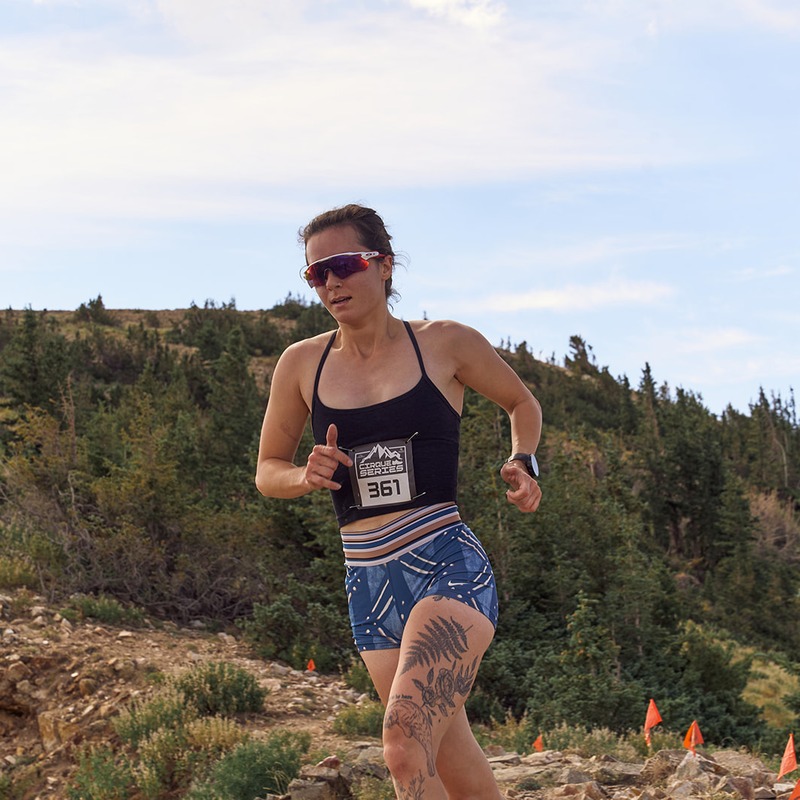
     

    Moa Ilar (SWE), Ebba Andersson (SWE), and Jessie Diggins (USA) (l-r) take the podium in the Women’s 10 k Freestyle Individual Start in Trondheim (NOR). (Photo: Modica/NordicFocus)
  • The Trial in Trondheim

    The Trial in Trondheim

    This coverage is made possible through the generous support of Marty and Kathy Hall and A Hall Mark of Excellence Award. To learn more about A Hall Mark of Excellence Award, or to learn how you can support FasterSkier’s coverage, please contact info@fasterskier.com.

    The men’s 20-kilometer Skiathlon at Granåsen never felt like an ordinary World Cup. From the moment the athletes stepped into the start pen, there was a tension in the air that didn’t match an early-December race. The stadium filled slowly; the fog sat low; the snow clung wetly to the klister underfoot. Yet the energy was unmistakable. It felt charged, anticipatory, almost uneasy.

    You could see it most clearly in the uniforms. Twelve Norwegians stood in the field of 91, and every one of them carried something heavier than usual race nerves. This wasn’t just about points. It wasn’t just about winning. It wasn’t even about bragging rights.

    Today, for Norway, was about the Olympics.

    Earlier that morning, Austria’s Mika Vermeulen summed it up bluntly when asked what he expected:

    “The Norwegians need to go fast to qualify for the Olympics.”

    It was the truth that everyone else was dancing around.

    On paper, this was a World Cup Skiathlon. On snow, it became something else entirely: an unofficial Olympic sorting ceremony, shaped by weeks of controversy, public criticism, and a federation under scrutiny.

    The start of the Men’s 20 k Skiathlon Trondheim (NOR). (Photo: Modica/NordicFocus)
    A Race Run Under a Shadow

    The tension surrounding this race didn’t begin in Trondheim. It started with a roster decision — or, in the eyes of many Norwegians, an omission. Emil Iversen, the veteran racer with a World Championship gold and a decade of elite podiums behind him, was left off the opening World Cup weekend in Ruka.

    The decision rippled across Norwegian media.

    The loudest voice belonged to Johannes Høsflot Klæbo.

    In a widely circulated VG article, Klæbo called the decision “dårlig håndverk” — poor workmanship — and argued that if the goal was to send the fastest athletes, Iversen had earned his seat on the plane.

    “If you are good enough, you should get to go,” he told VG.

    Former national-team director Espen Bjervig fired back in Stavanger Aftenblad, criticizing both Klæbo and Iversen for speaking publicly about selection practices, arguing that it “creates noise and negativity.”

    Suddenly, what is typically a quiet, internal Norwegian debate had spilled into full public view. Selection wasn’t just a technical matter — it was a national storyline.

    And this Skiathlon, the only one before the Olympics, sat squarely in the center of that storm.

    Iivo Niskanen made his way to the front during the classic leg, but ultimately faded to 25th place on the day. (Photo: Modica/NordicFocus)
    The Classic Leg: A Tense, Measured Beginning

    When the field set off into the opening 10 k of classic skiing, the pace was high but controlled. Nobody wanted to take on the risk of an early break. The lead shifted lightly — Finland’s Iivo Niskanen testing, Norway’s Martin Loewstroem Nyenget responding — but the main pack stayed dense, the elastic never stretching too far.

    What stood out was not who led, but how closely the Norwegians watched one another. Every surge drew an immediate answer. Every gap in the pack was filled. There was a vigilance to their movements: unspoken, but unmistakable.

    Behind them, American Gus Schumacher skied with patience, always hovering near the front third, avoiding trouble. Ben Ogden played the elastic back-and-forth of the pack, feeling the surging, slowing, and reshuffling that characterizes Skiathlon racing.

    Nothing broke the race open. But everything pointed toward what was coming.

    Emil Iversen (#37, white hat), Zanden McMullen (#26 USA), Andrew Musgrave (GBR), Gus Schumacher (#18 USA) and Ben Ogden (#24 USA) navigate the pack during the classic leg. (Photo: Modica/NordicFocus)
    The Transition: When the Real Race Began

    At the stadium, skis were neatly arranged in assigned pens; in the grandstand, the crowd pressed forward on their seats, and the atmosphere shifted. The transition from classic to skate is always an inflection point in a Skiathlon. But today’s felt like the release of a held breath.

    As athletes stepped out of classic skis and into skate gear, the pace vaulted. The race’s character changed instantly — no longer steady, but sharp. No longer patient, but aggressive.

    Within seconds of leaving the exchange zone, the field stretched into a long, thin line—athletes who had looked comfortable in the first half suddenly fought to hold contact. The front swallowed the course in powerful V2 tempo, and what had been a race of restraint transformed into a race of revelation.

    From this point on, the Skiathlon resembled more of a Norwegian internal selection trial than a World Cup.

    With Johannes Hoesflot Klaebo (NOR) and Emil Iversen (NOR) at the front, Federico Pellegrino (ITA), Elia Barp (ITA), (l-r) and the rest of the lead pack try to match pace during the initial kilometers of the skate leg. (Photo: Modica/NordicFocus)
    The Skate Leg: Norway Sorts Itself Out

    With 10 kilometers to go, the lead group had thinned to about twenty athletes. By the next climb, it was closer to fifteen. And among those fifteen were eleven Norwegians — each racing not only the field but each other.

    Every shift in tempo felt deliberate.

    Every climb tested hierarchy.

    Every acceleration seemed to ask a quiet question:

    If this is for a trip to Milan–Cortina, who survives?

    Nyenget pushed the climbs with authority. Harald Østberg Amundsen pressed from the front like a man intent on staking a claim. Mattis Stenshagen floated with the leaders, unfazed by the fire around him. And somewhere in that pack, Emil Iversen — overlooked just one week earlier — had battled from the 37th starting position and was skiing with a visible urgency, a visible hunger.

    The pace was unrelenting. When Andrew Musgrave surged near 15 km, the field snapped back immediately. No one would be allowed to disrupt the internal Norwegian calculus.

    This was not a race that welcomed outsiders.

    Behind them, Schumacher held position just beyond the front group, skiing an intelligent and confident race on a day that didn’t cater to anyone not wearing red. Ogden fought through the volatility of the middle pack as the front repeatedly drove the pace into the threshold.

    Ben Ogden (USA) finding his skate legs in his first freestyle race of the season during the 20 k Skiathlon in Trondheim (NOR). (Photo: Modica/NordicFocus)
    American Reactions: Schumacher and Ogden Describe the Chaos

    Schumacher, who had circled this Skiathlon as a key Olympic-learning opportunity, said the day unfolded exactly as he expected:

    “I’m still kind of building into the season… but I’ve got some good skiathlon experience, and they don’t feel so crazy now. Treat it like a race, try to do my best, and definitely learn some stuff.”

    He found those lessons quickly — particularly in the transition to skate:

    “The pace was definitely hot… right out of the start of the skate, they went hard. A lot of those fitness guys are trying to put some distance to the faster people. It’s tough on this course. I felt ready for it, but struggled a little bit with the skis. They were digging too much in the hills.”

    And he could feel the intensity radiating from the Norwegians:

    “It absolutely was their Olympic trial. There’s definitely some intensity from their side. A lot of those guys are really nervous — and to be honest, they don’t seem to be having that much fun right now. It’s a tough fight for those four spots.”

    Ogden, who finished 35th, echoed the shock of the pace — especially coming off a demanding classic leg:

    “The pace today was probably the hardest thing for me. The classic was just so fast… and I haven’t skated a lot this year. It came after the world’s hardest 10k classic.”

    He battled through the skate leg, trying to recalibrate on the fly:

    “I don’t think I skated very well. I didn’t push into the downhills very well, and I was just tired. You can go hard in the classic and still be competitive in the skate, but you have to be a little more tactical.”

    And, like Schumacher, he found himself needing to rewrite his goals mid-race:

    “Reevaluating your plan on the fly is always the hardest part. Once your plan falls apart, it’s easy to lose a little bit of grit mentally. Today, the goal just became to hang onto the back and try to beat a couple of them.”

    Maybe it isn’t in focus, but what is clear is Harald Oestberg Amundsen (NOR), Mattis Stenshagen (NOR), Johannes Hoesflot Klaebo (NOR), Emil Iversen (NOR), Jan Thomas Jenssen (NOR), Erik Valnes (NOR), Martin Loewstroem Nyenget (NOR), (l-r) all charging up the final climb of the 20 k Skiathlon in Tronheim, Norway. (Photo: Modica/NordicFocus)
    The Final Kilometers: A Reckoning on the Last Climb

    With three kilometers left, the stadium roar began to build. The final climb hovered ahead — long, grinding, decisive. The pack tightened—the Norwegian national and club team suits clustered near the front. And then the sorting began in earnest.

    Amundsen drove up the hill with power.

    Klæbo hovered, always exactly where he needed to be.

    And Iversen — the man left off the Ruka start list — refused to yield a single meter, emerging along the outside edge of the trail toward the front of the pack.

    The race crested the final hill, swept through the big left turn, and spilled into the descent where Skiathlon medals — and today, Olympic dreams — are so often decided.

    Klæbo did what only Klæbo does: timed the moment flawlessly, slid into open snow, and glided away with the control and confidence that has defined his career. Behind him, Amundsen locked up second.

    But all eyes were on third.

    There, straining every muscle, skiing with unmistakable desperation and defiance, was Emil Iversen.

    He crossed the line in third place — a podium on the only Skiathlon before the Olympics.

    For him, it was not just a race result.

    It was a reclamation.

    Johannes Hoesflot Klaebo (NOR) leads a Norwegian train down the home stretch. (Photo: Thibaut/NordicFocus)
    A Sweep That Spoke Volumes

    Norway swept the top eight.

    The best non-Norwegian — the always-impressive Mika Vermeulen — finished ninth.

    The top nine were separated by five seconds.

    The top fifteen by fifteen seconds.

    It was depth displayed as dominance, and dominance displayed as a message.

    For Klæbo, the picture is clear.

    For Amundsen, clearer still.

    For Stenshagen, it was a breakthrough.

    And for Iversen, it was a revival that carried the weight of the last two weeks on its shoulders.

    For the American men, Schumacher’s 21st showed consistency and smart racing in a field that spent much of the day executing internal warfare—Ogden’s 35th offered lessons in reading a volatile race and surviving wave after wave of pace changes.

    Harald Oestberg Amundsen (NOR), Johannes Hoesflot Klaebo (NOR), Emil Iversen (NOR), (l-r) take the Skiathlon podium in Trondheim (NOR). (Photo: Thibaut/NordicFocus)
    What This Means for the Olympic Picture

    Klæbo, with a smirk on his face, didn’t hesitate after the race:

    “I think I made the team now for sure.”

    He wasn’t wrong.

    Amundsen likely solidified his place as well.

    Stenshagen made himself hard to ignore.

    And Iversen forced the federation to confront the conversation it had hoped to avoid.

    Performance is supposed to matter.

    And Iversen delivered the clearest performance of anyone not named Klæbo.

    In the eyes of fans, teammates, and media, he didn’t just earn consideration — he demanded it.

    Emil Iversen may be the happiest person in Trondheim (NOR) today. (Photo: Thibaut/NordicFocus)
    A World Cup in Name Only

    As the sun faded over Granåsen and crews raked the sugary snow from the corners, it became apparent that what we had just witnessed was something far larger than a World Cup.

    This race was a referendum on form.

    A public test of internal politics.

    A stage where the world’s strongest skiing nation sorted itself out in real time.

    The stadium announcer called it the men’s 20 k Skiathlon.

    But everyone who watched, coached, raced, or cheered knew better.

    This was the reckoning.

    This was the day Norway began choosing its Olympic distance team.

    This was ‘The Trial in Trondheim!’


    Men’s 20 k Skiathlon RESULTS


    Love Stories Like This? Help Keep Them Coming.

    Feature stories like this one take time, access, and care to produce. If you value thoughtful storytelling and independent ski journalism, please consider becoming a Voluntary Subscriber. Your support directly fuels the work we do to cover the people, places, and moments that make our sport special.

    Join the FasterSkier community!
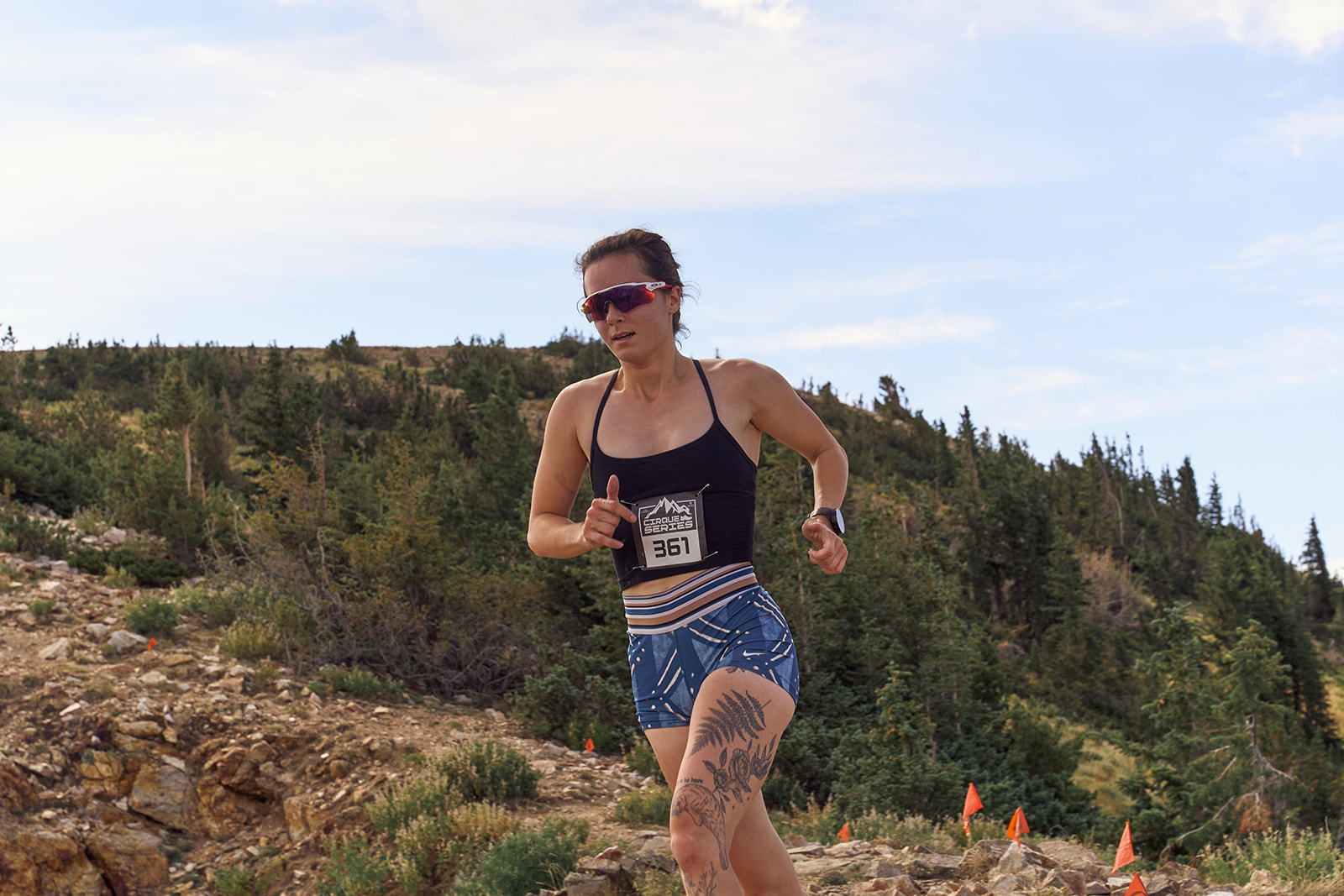
     

    Emil Iversen (NOR) was so happy to be back on the World Cup podium, but clearly his smiles were about something even bigger. (Photo: Thibaut/NordicFocus)
  • The U.S. Ski Team Star You Won’t See on Snow This Weekend

    The U.S. Ski Team Star You Won’t See on Snow This Weekend

    On Friday afternoon, as World Cup sprinters snap into their skis in Trondheim and the SuperTour fields gather in Fairbanks, one of the United States’ most electrifying young Nordic athletes will step onto an entirely different stage. Stanford University, the No. 1 seed in the NCAA Women’s Soccer Tournament, is marching toward the College Cup—and at the center of it all is a player who, in just a matter of days, will also begin her bid for the U.S. Olympic Cross-Country Ski Team.

    The athlete is Sammy Smith: 20 years old, a national-team skier, an Environmental Systems Engineering major, and a starter for one of the most dominant college soccer programs in the country. The U.S. Ski Team views her as one of the most promising sprinters of her generation. And yet this weekend, instead of warming up on hard-packed snow in Norway or chasing early-season points in Alaska, she’ll be preparing to face Duke with advancing to the NCAA Championship Game on the line.

    “Get ready to cheer for one of the U.S. Ski Team’s top skiers this weekend,” you might tell Nordic fans. “Just… not on skis.”

    From the outside, the collision of seasons looks impossible to manage. For Smith, it is simply the life she has known since childhood.

    Idaho in Two Parts

    Smith grew up in a pattern that almost feels mythic now: winters in Sun Valley, summers and the rest of the year in Boise. Her family built the rhythm—her mom moving the kids north each winter so they could ski full-time and homeschool them in those snowy months.

    “I kind of grew up splitting time between Boise and Sun Valley,” Smith says. “My mom would move up to Sun Valley during the winter with my siblings and me so we could ski, and she would homeschool us up there… I did that all through high school.”

    In Boise, she was a typical public school student. In Sun Valley, she became a multi-sport anomaly. Her childhood was not just active—it was encyclopedic.

    “Growing up, I played about every sport one can imagine,” she says. “I ran track and cross country all through high school… I played hockey for a long time. Played football. Yeah, like, you name it, I pretty much did it.”

    Soccer was the constant. She started as soon as a child could sign up—though the Smiths occasionally bent age rules to make sure she could play with older kids. When her older sister started soccer, she was right behind her.

    “It’s probably like three years old when I started,” Smith says.

    And then there was freestyle skiing—a considerable part of her identity, something she expected to pursue more seriously than Nordic. Until one day, she couldn’t.

    “I ended up fracturing my tibia in my sophomore year,” she says. “And so I focused on Nordic that winter… I ended up having a great season, and then haven’t really looked back since.”

    The transition was abrupt, but the groundwork had already been laid: years of downhill confidence, years of skiing, years of learning to read terrain and push limits.

    “I’ve been on skis my entire life,” she says. “Very comfortable on downhills… I love to ski aggressively.”

    The athlete emerging in those years was already something unusual. The athlete she would become—balancing multiple sports at world-class levels—was still unimaginable.

    Against the Specialization Tide

    From the outside, Smith’s career appears to defy the common wisdom of modern youth sports. Increasingly, top athletes specialize early; by high school, many are all-in on one discipline.

    Smith resisted that. Not because she lacked ambition, but because multiple sports gave her joy—and made her better.

    “I think that’s something I’ve really thought a lot about,” she says. “There’s been more and more pressure to specialize… but growing up and doing so many different sports just kind of added to different components of skiing that I think are really important.”

    Soccer, for example, translates directly into sprint racing.

    “It’s a very high-paced game,” she says. “There’s a lot of change of direction, a lot of accelerating and decelerating. Particularly when you’re looking at heats, a lot of it is reacting to other people’s moves, trying to find little gaps and squeeze through.”

    The skill set becomes a competitive edge: quickness, agility, and decision-making under pressure.

    “That ability to shift gears really quickly and take openings when you can really emulates in soccer,” she says.

    Freestyle skiing contributed something else entirely: creativity and courage on skis, especially in chaotic or technical downhill sections.

    “At World Juniors last year,” she recalls, “everyone was in the track. I hopped out of the track, went far on the inside, and just double poled… It was a risky move, but it was something I saw.”

    She paused for only a moment before going all-in. It worked.

    The blend—soccer fuel, freestyle instinct, Nordic engine—gives her a uniqueness rarely seen in American skiing.

    U.S. Ski Team head coach Matt Whitcomb sees it clearly.

    “She’s a world-class athlete,” Whitcomb says. “She’s already exhibited the early signs of being a World Cup star.”

    That she is doing this while starting for Stanford’s soccer team? To him, it’s not a contradiction. It’s part of the magic.

    Why Stanford — and Why Now

    Choosing Stanford was not simple. Smith had options—many of them. But a few factors stood out.

    “I really value my education,” she says. “Stanford’s a great school. It’s where my mom went. And my sister is also on the soccer team, so the opportunity to get to play college soccer with her is pretty hard to pass up.”

    Her academic path—Environmental Systems Engineering with an energy concentration—fits a pattern among elite U.S. skiers. Many of the top men (Gus Schumacher, Ben Ogden, et al.) have gravitated toward engineering. Smith sees the overlap, too.

    “You look at a skier and the training that they do,” she says. “They’re very self-motivated, very committed. So I’m sure certain aspects translate pretty well.”

    The challenge, of course, is that Stanford is far from snow. It is not close to ski culture. It is not close to the European World Cup circuit. It is very near, however, to one vital piece of equipment:

    “Fortunately, I have a classic roller-ski treadmill… in a little office space,” she says. “That’s been an irreplaceable part of my training.”

    She uses it for high-quality sessions, often squeezed between classes, labs, or soccer obligations. Running remains a central component, helped by the demands of soccer conditioning.

    But she knows her preparation is different—less volume, more precision. Not ideal. Not textbook. Not expected. And yet:

    “I think I’ve tried to accept that,” she says. “I know that I am not at my best, but skiing is a sport you can do for a very long time. I don’t necessarily need to be the best skier I can be at 20 years old.”

    Again, Whitcomb backs the long view.

    “We’re willing to postpone that timeline,” he says. “We’re just happy for Sammy being happy in her current environment. We’ll take what we can get at this moment, but we want more down the road, and we’re excited for it.”

    This, in many ways, is the crux of the story: the U.S. Ski Team is betting on Sammy Smith not despite her dual identity, but because of it.

    Samantha Smith (USA) racing the World Cup individual sprint in Goms (SUI). (Photo: Modica/NordicFocus)

    The Final Four — and Then the Sprint Start Line

    The most astonishing part of Smith’s season is its timing.

    If Stanford beats Duke on Friday in Kansas City, they move directly to the College Cup championship game. The semifinal is December 5th; the final is December 8th, Monday. Smith has already mapped out the days that follow.

    “We’ll get back Tuesday night from Missouri… I have a final at 8 a.m. Wednesday morning,” she says. “I’m going to fly out right after my final, and then I’ll have one day of snow on Thursday in Alaska, and then I’ll be hitting that sprint on Friday.”

    She says this calmly, matter-of-factly, like someone describing a standard weekend trip.

    The Anchorage SuperTour sprint is not just any race—it is her re-entry into skiing, her first day on snow of the season, and a crucial tune-up before U.S. Nationals in Lake Placid, where she hopes to qualify for the Olympic team.

    The Anchorage races, she says, are not performance indicators—they are simply a way to “bust the rust off.”

    “Obviously, a lot of other skiers will have been on snow for well over a month, and I won’t,“ she says. “It’ll just be an opportunity to get on skis, do something fast.”

    Her real focus is the 10-day window between Anchorage and Lake Placid.

    “For me, as more of a sprinter, and the way the criteria is set up, I’ve got to target the qualifiers,“ she says. “So being really deliberate… knowing exactly what I’m going for.”

    The stakes are simple: she must race well at U.S. Nationals to have a shot at Milano-Cortina.

    The stakes are also massive.

    Julia Kern and Sammy Smith paired up for the Team Sprint in Lahti (FIN). (Photo: Nordic Focus)

    The Domestic Gamble

    If Smith had a regular ski season—if she weren’t in the NCAA Tournament—she might have chased World Cup points, fought to crack the top 45, and used international racing to establish selection priority.

    But that route is closed.

    “If you’re only racing a few of the international races, it’s incredibly challenging to get into that top 45,“ she says. “Whereas if you were able to do all of them, it’s a lot more feasible.”

    She knows she has “had some really good World Cup sprints,“ and she wonders—without bitterness—what might be possible in a different academic or athletic setup.

    But this year, it is the domestic route or nothing.

    “That’s what I’m planning on,“ she says. “I need to have some killer races at U.S. Nationals.”

    What sounds like a gamble is, for her, simply the version of the sport she can access this season. And she is okay with that.

    “Just being consistent… being intentional,“ she says. “Doing what I can.”

    Who She Wants to Be

    Ask Smith what success looks like decades from now, and she doesn’t list medals or championships.

    “You look at Jessie’s legacy,“ she says, referencing Jessie Diggins. “The amount of skiers she’s inspired and how much she’s done for the sport… I want people to look back on my career and feel like I’ve done a lot for the sport, inspired the younger generation of skiers, and brought a lot back to my community.“

    It is the kind of answer that feels too mature for her age, but entirely in character.

    She is not racing to avoid mistakes—she is racing toward something: possibility, growth, a long future. Maybe a future on the World Cup. Maybe a future in engineering. Maybe a future doing both.

    But first, she has Duke.

    Samantha Smith (USA) racing the World Cup individual sprint in Minneapolis (USA). (Photo: Modica/NordicFocus)
    Samantha Smith (USA) racing the World Cup individual sprint in Minneapolis (USA). (Photo: Modica/NordicFocus)

    The Athlete You’ll Watch Twice This Month

    When you tune in this Friday—whether you are a Nordic diehard refreshing live timing from Trondheim, or an American fan checking SuperTour results—remember that one of the most important U.S. prospects in cross-country skiing will be competing too. She just happens to be wearing soccer cleats instead of ski boots.

    And next week, she’ll be back on snow, sprinting against the country’s best, staking her claim for a place on the Olympic team.

    The duality is not a distraction for Sammy Smith.

    It is her identity.

    It is what built her.

    And it might be what carries her into the future of American skiing.

    “She’s been playing a ton this year,“ Whitcomb says. “Of course, we want her all to ourselves… but we want more down the road, and we’re excited for it.”

    This weekend, she wants one thing: a berth in the College Cup Final.

    Next weekend, another: a ticket to the Olympics.

    Two worlds.

    Two uniforms.

    One athlete.

    A lot of people will be cheering for Sammy Smith this month. Nordic fans just get to do it twice.


    *You can watch #1-ranked Stanford vs. #2-ranked Duke in the women’s College Cup semifinal tomorrow, Friday, December 5, at 8:45 p.m. EST on ESPNU. The game can also be streamed on the ESPN app, Fubo, or Hulu.


    Love Stories Like This? Help Keep Them Coming.

    Feature interviews like this one take time, access, and care to produce. If you value thoughtful storytelling and independent ski journalism, please consider becoming a Voluntary Subscriber. Your support directly fuels the work we do to cover the people, places, and moments that make our sport special.

    Join the FasterSkier community!


    Sammy Smith (USA) in the World Cup individual sprint in Tallinn (EST). (Photo: Modica/NordicFocus)
  • The Devon Kershaw Show: Buckle Up for a Six-Race Ruka Recap

    The Devon Kershaw Show: Buckle Up for a Six-Race Ruka Recap

    It’s on — the 2026 Olympic season, that is. Devon and Nat break down six season-opening races from northern Finland, including a thriller in Sunday’s men’s race.

    Contact us with fan mail, hate mail and everything in between: devon[at]fasterskier.com and nat[at]fasterskier.com. We’re looking for title and other sponsors for our Olympic coverage; email matthew[at]fasterskier.com with inquiries.

  • A Breakaway, a Broken Pole, and a Biathlete’s Bet: Amundsen Wins a Wild 20 k in Ruka

    A Breakaway, a Broken Pole, and a Biathlete’s Bet: Amundsen Wins a Wild 20 k in Ruka

    This coverage is made possible through the generous support of Marty and Kathy Hall and A Hall Mark of Excellence Award. To learn more about A Hall Mark of Excellence Award, or to learn how you can support FasterSkier’s coverage, please contact info@fasterskier.com.

    Sunday morning in Ruka had the look of a place holding its breath. The sun sat low over the trees, the air hovered just on the warm side of freezing, and the men’s World Cup field stepped into the stadium with the faint stiffness of athletes who had already skied two challenging races in two days. A thin glaze shone on the 4-kilometer loop, the kind that makes skis feel nervous and alive at the same time, and even before the starter raised his arm, you sensed the day would run fast.

    The stadium sits at the high point of the course in Ruka, so the men’s 20km mass-start free begins not with the controlled civility of a long climb but with a plunge. Skiers can hit 80 kilometers an hour on the opening descent, the field funneled into two uneasy lanes, and the whole pack—Johannes Høsflot Klæbo included, wearing the yellow bib and chasing the mythical 100th World Cup win—had to thread that speed through a hairpin that felt too tight for comfort even on TV.

    Harald Oestberg Amundsen (NOR) finds his way through the traffic of the Men’s 20 k Freestyle mass start in Ruka (FIN). (Photo: Modica/NordicFocus)

    Ruka is an odd, angular loop: long, steady work on the one side; a shorter, punchier grind up the Impilinna climb; then a sweeping dive back toward the stadium before the last drag to the line. Five laps. One early-season opportunity to reshape the winter. And an Olympic year, which meant that every Norwegian on the line was skiing for more than points—they were skiing for selection.

    Among the Americans, the storylines were as varied as their bibs: Gus Schumacher and Zanden McMullen seeking another elite result after their success in Ruka a year ago, Zak Ketterson racing with newfound confidence after a career-best 14th in Friday’s classic 10 K, and a young supporting cast learning the dynamics of a fast, narrow pack on a tricky course.

    Nothing broke early. The first lap was quick but calm, a kind of rolling truce among athletes who knew how violent the final lap could become. But the race’s character changed—the way good races do—at the unexpected moment.

    Mika Vermeulen (AUT) leads Edvin Anger (SWE) through the stadium. (Photo: Modica/NordicFocus)
    The Gamble at 9.1km

    At the 9.1km sprint banner, Sweden’s Edvin Anger made the first real incision in the race. The 23-year-old surged for bonus points—as expected—but then did something far more interesting: he kept going. Mika Vermeulen of Austria latched on, the two of them taking the descent like they meant it, and for the first time all day, the pack blinked.

    Within a kilometer, the gap was three seconds. Then seven. Then ten. The move was reminiscent of the early break in a bike race. The French and Germans led the chase instead of Norway. Hugo Lapalus briefly tried to bridge and cracked. The Norwegians refused to panic.

    Behind the break, Schumacher and Ketterson were having very different but equally impressive races. Schumacher hovered between fourth and eighth through the middle laps, completely comfortable in traffic. Ketterson floated near the top ten, choosing clean lanes, maintaining position with a calm that looked like something new.

    Further back, Einar Hedegart—the 23-year-old biathlete-turned-cross-country-skier whose win at the Norwegian opener in Beitostølen had already rattled some assumptions inside Norway’s Olympic selection system—drifted quietly toward the front.

    By 13 kilometers, Anger and Vermeulen’s advantage peaked at roughly 13 seconds. It wasn’t supposed to hold. But it looked real. And it was enough to force the race’s next twist.

    Einar Hedegart (NOR), follows Johannes Hoesflot Klaebo (NOR) through the stadium. (Photo: Modica/NordicFocus.)
    The Turn, the Crash, and the Broken Ski

    Gus Schumacher’s day changed off-camera.

    “The race was going super well,” Schumacher said after the finish. “It felt relatively easy; my body was super responsive with great energy. I was able to keep really good position, which is massive in this race.”

    Then came the downhill at roughly 14km, the kind of section where pack dynamics feel like a living organism.

    “I was gliding up on the left side, and Klæbo switched lanes right in front of me, sweeping my tips out. It was too quick and unpredictable for me to do anything,” Schumacher said. “I fell off the side of the trail, my ski ran into the hard snow on the edge, and it broke the tip.”

    He skied another full lap on the damaged ski.

    In the hard, fast conditions, it was just stable enough to keep him in touch—and switching skis would almost certainly have meant losing the group entirely. Remarkably, even with the partial break, Schumacher clawed back toward the front, positioning himself to sprint for a top spot.

    And then the bad luck doubled.

    “In the last kilometers, it got stuck in the deep snow of the test track and broke the tip fully, and that was the end.”

    He finished 39th, but the skiing he showed before the equipment failure will matter more than the result does.

    “I’m super proud of how I was skiing… My body is in a great place, but this weekend’s luck just hasn’t gone my way. Long season ahead.”

    Andrew Musgrave (GBR) and Einar Hedegart (NOR), (l-r) during the final race of the weekend in Ruka (FIN). (Photo: Modica/NordicFocus)
    The Pole Break, the Surge, and the Catch

    At ~16 kilometers, Harald Oestberg Amundsen—already a pre-race favorite—snapped a pole.

    It could have been the story. Instead, it became the turning point.

    Service handed him a new pole instantly. Amundsen slotted back in, glanced up the trail, and began to close the gap. Hedegart came with him. Nyenget followed. The chase, which had felt half-committed earlier, finally had purpose.

    With Anger and Vermeulen still dangling up the trail and the course running out of time, Amundsen moved to the front and began applying real pressure. The gap shrank visibly on the Valkosenvaara climb. By the time the race wound back toward the stadium, the two leaders were in sight, the rope fraying.

    What came next was pure Amundsen.

    He caught the break on the final climb. And then he kept going.

    Gus Schumacher (USA), (NOR), Johannes Hoesflot Klaebo (NOR), Zak Ketterson (USA), Harald Oestberg Amundsen (NOR), and Einar Hedegart (NOR) among others climbing up the final climb of the lap in Ruka, Finland. (Photo: Modica/NordicFocus)
    The Ruka Climb and the Decisive Moment

    With roughly 500 meters left—just before the crest of the Ruka climb—Amundsen stepped out from the group and launched his move. It wasn’t desperate or chaotic; it was clean, timed, and confident. Hedegart tried to respond. Nyenget tried. Anger fought with everything left.

    Nobody matched him.

    Amundsen crested alone, floated through the final meters, and took his 11th career World Cup win with the kind of clarity that defines a season.

    In an on-air broadcast interview after the finish, he explained the day as a study in patience and timing:

    “The conditions were so high-speed that I was quite nervous on the downhills,” he said. “On the first four laps I was pretty far behind and struggling to move up, but I had saved some energy. On the last lap, I felt very strong.

    When they got the gap at the beginning, I was quite far behind, so I just had to wait. But on the last lap, I thought, you can’t just let this go, so I put everything in and caught them on the last uphill… I had good legs today.”

    Behind him, Hedegart—just one year removed from biathlon—finished a remarkable second. Anger earned third after animating the race with the early breakaway. Nyenget was fourth; Vermeulen fifth.

    And Klæbo, in a rare off-day, was 15th.

    Zak Ketterson (USA), and Friedrich Moch (GER), (l-r) lapping through the stadium during the Men’s 20 k Mass Start Freestyle in Ruka (FIN). (Photo: Modica/NordicFocus)
    An American Breakthrough

    Zak Ketterson recorded the best American result of the day—ninth place, the first top-10 of his World Cup career in a mass start—and the performance looked more like the product of design than circumstance.

    Ketterson entered the day already benefiting from Friday’s career-best 14th in the 10 k classic, which earned him a forward bib placement on a course where position matters as much as fitness.

    “I was fortunate to start really far up in the pack because of my performance in the 10 k, and that was huge in such a tight and tactical field,” Ketterson said. “I knew if I moved too far back, it’d be really hard to move back up, so I planned to defend my position as well as I could.”

    He executed the plan with the kind of composure that has eluded him in past mass starts. On a slick, tense course where one mistake could cost half the field, Ketterson held clean lanes, avoided every significant disturbance, and stayed in the top 10–15 as the race stretched into the final lap.

    What’s emerging this season is not just fitness, but a foundation built well before Ruka.

    “This summer and fall, especially, my wife Julie and I went all in on trying to prepare as well as possible for this year,” he said. “I worked harder than I ever have and also have had a really good mindset. That it’s working so well so far is a big testament to all the hard work, and my wife Julie should get a lot of credit for being my number one support staff.”

    The strongest signal of progress came in the final kilometer, when the real attrition began, and Ketterson didn’t fade—he held and even advanced.

    “It meant a lot to be able to have a strong finish because, as I said earlier, I often would finish these types of races and move backwards in the pack,” he said. “I think the fact that I was able to relax so much of the race made it so that I had that energy that was necessary when the pace picked up. I am really proud of how calm I stayed, even though the race was so tight, and the conditions were super sketchy, icy, and fast.”

    For a U.S. men’s program that continues to build depth quietly, Ketterson’s weekend—14th + 9th—marks a meaningful step. It also gives the team, and head coach Matt Whitcomb, a new data point as Olympic-year relay and selection conversations begin.

    Einar Hedegart (NOR) celebrates the victory in Ruka (FIN). (Photo: Modica/NordicFocus)
    What This Race Means

    For Norway: The selection picture grows even more impossibly crowded. Amundsen is in towering early-season form. Hedegart is no longer a curiosity—he’s a factor. Nyenget remains brutally consistent. Klæbo is still the biggest star in the sport, but his chase for World Cup win No. 100 will now continue into Trondheim.

    For the rising generation: Three of the top six—Anger, Hedegart, Desloges—are 23 or younger. The youth wave is no longer a subplot; it’s the plot.

    For the Americans: Ketterson’s top-10 creates new conversations about relays and the Olympics. Schumacher’s form before the crash suggests he’s ready for significant results as soon as his luck stabilizes.

    For the sport: A genuine breakaway, a serious chase, a late-lap catch, a pole break, a ski break, and a new podium—all in one race.

    Ruka is supposed to be the season’s prologue. This one felt like chapter one.


    Men’s 20 k Mass Start Freestyle RESULTS


    Einar Hedegart (NOR), Harald Oestberg Amundsen (NOR), Edvin Anger (SWE), (l-r) share the podium of the Men’s 20 k Freestyle Mass Start in Ruka, Finland. (Photo: Modica/NordicFocus)

    Love Stories Like This? Help Keep Them Coming.

    Feature interviews like this one take time, access, and care to produce. If you value thoughtful storytelling and independent ski journalism, please consider becoming a Voluntary Subscriber. Your support directly fuels the work we do to cover the people, places, and moments that make our sport special.

    Join the FasterSkier community!