From the FasterSkier archive — posts syndicated from athletes’ and coaches’ own blogs between 2004 and 2012, kept online as published. Current coverage is at fasterskier.com.

Tag: USA Nordic

  • (Press Release) USA Nordic Sport Nominates Nordic Combined Team Roster For Olympic Winter Games Beijing 2022

    (Press Release) USA Nordic Sport Nominates Nordic Combined Team Roster For Olympic Winter Games Beijing 2022

    PARK CITY, UTAH (January 19, 2022) — USA Nordic Sport announced today its nominations for the U.S. Olympic Nordic Combined Team that will represent Team USA at the Olympic Winter Games Beijing 2022. Nominations are to be confirmed by the United States Olympic & Paralympic Committee when it formally announces the U.S. Olympic Team.

    Athletes to Watch
    The team will be headlined by three-time Olympian Taylor Fletcher, who looks for his first Olympic podium. Fletcher’s top finishes at the Olympics include a sixth-place finish in the Team Large Hill/4x5km competition at the Sochi Games in 2014, along with a 20th place finish in the Large Hill/10km Individual competition and a 33rd place finish in the Normal Hill/10km in Sochi. Fletcher will be joined by Ben Loomis, a one-time Olympian who will also be looking for his first Olympic podium. At the Pyeongchang Olympics in 2018, Loomis carded a 10th place finish in the Team Large Hill/4x5km competition, 40th in the Large Hill/10km Individual competition and 41st in the Normal Hill/10km Individual competition.
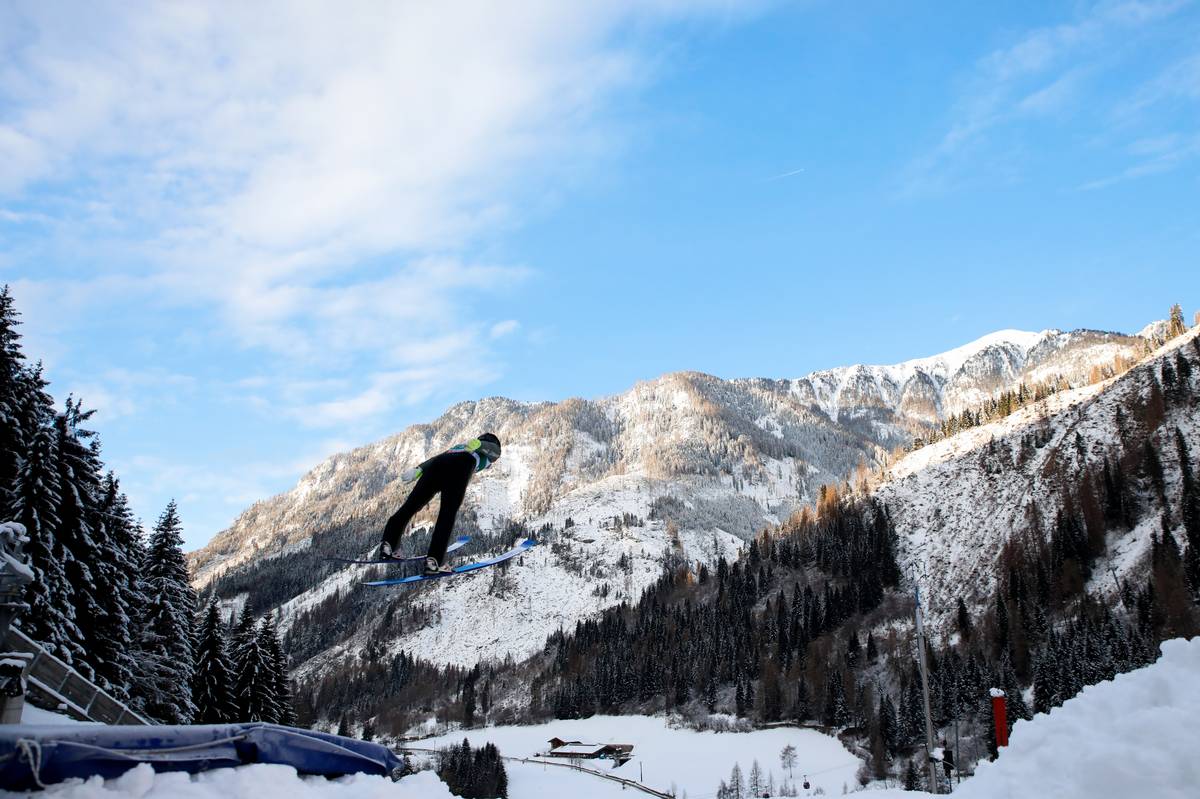
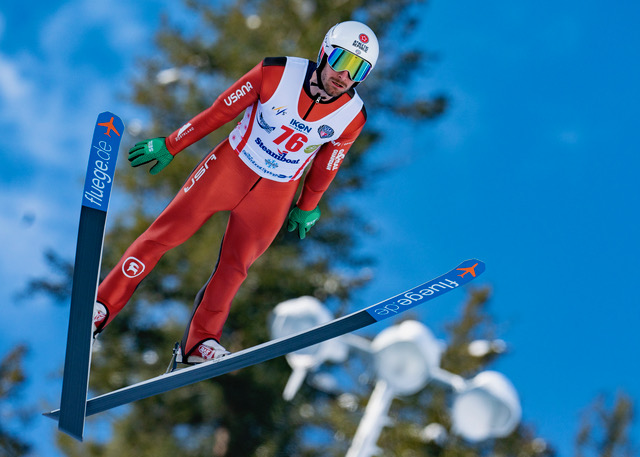
    Taylor Fletcher competes in Val di Fiemme in January, 2022. (Photo: NordicFocus)

    Selection Process
    The selection process for nordic combined includes results from both domestic and international competitions. The first spot on the U.S. Olympic Nordic Combined Team is decided by the winner of the Olympic Trials event in Lake Placid, New York on December 25, 2022. Additional spots were selected based on athletes’ results at both the FIS World Cup and Continental Cup levels during this winter’s qualification period.

    Olympic Competition Schedule
    Nordic Combined has an action-packed schedule at the 2022 Games. The first of three medal events kick off on Wednesday, February 9, with the Individual Gunderson Normal Hill/10km competition, followed by the Individual Gunderson Large Hill/10km on Tuesday, February 15. The final event –Team Gunderson Large Hill/4x5km – is scheduled for Thursday, February 17.

    2022 U.S. OLYMPIC NORDIC COMBINED TEAM
    (Name; hometown, birthday; club; past Olympics)

    •  Taylor Fletcher, Steamboat Springs, Colorado; 5/11/90; Steamboat Springs Winter Sports Club (Olympics: 2010, 2014, 2018)

    • Ben Loomis, Eau Claire, Wisconsin; 6/9/98; Flying Eagles Ski Club (Olympics: 2018)

    • Jasper Good, Steamboat Springs, Colorado; 5/10/96; Steamboat Springs Winter Sports Club (Olympics: 2018)

    • *Jared Shumate, Park City, Utah; 3/6/99; Park City Ski and Snowboard

    • *Stephen Schumann, Park City, Utah; 3/14/00; Park City Ski and Snowboard

    *Denotes first-time Olympian 

    Watch Team USA compete on the networks of NBC throughout the Olympics, February 4-20, 2022.
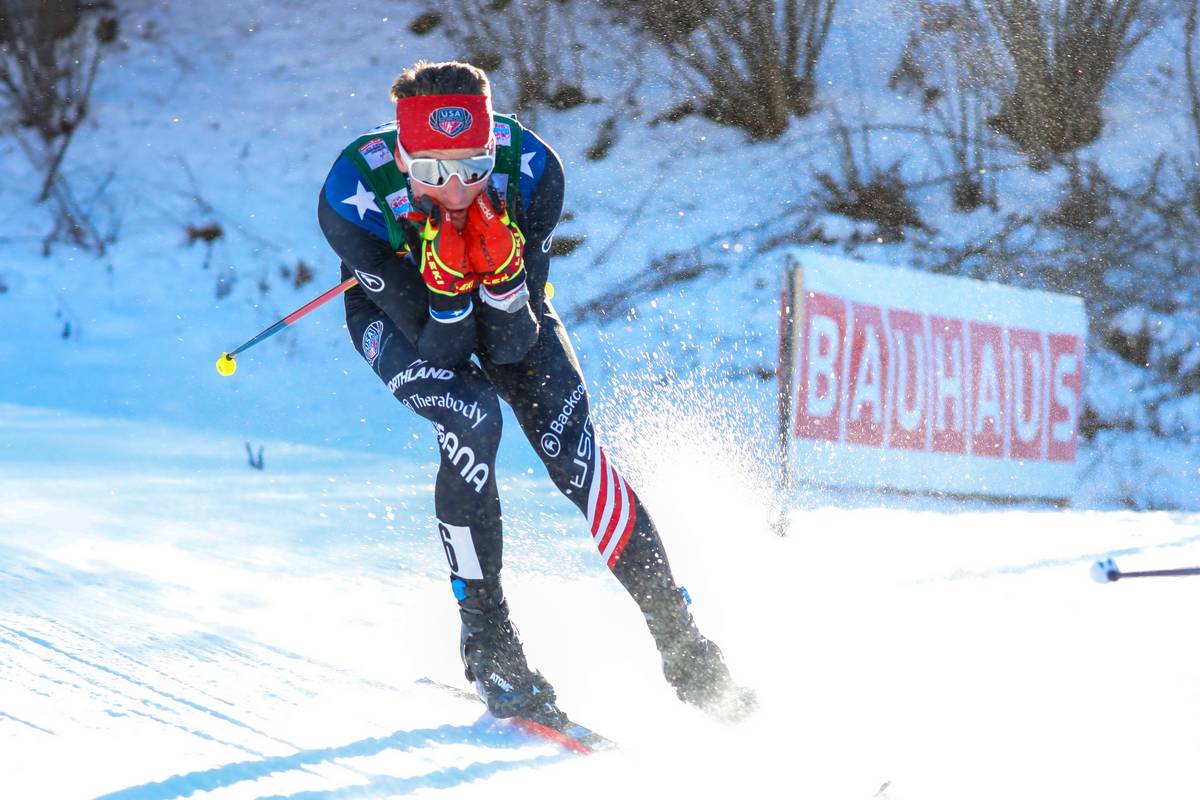
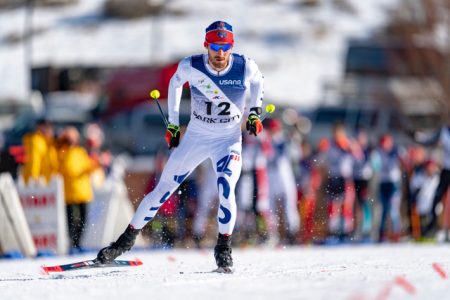
    Ben Loomis competes in a World Cup in Val di Fiemme, Italy in January, 2022. (Photo: NordicFocus)

    FOLLOW THE TEAM 

    Instagram: @usanordic

    Facebook: @USANordic

    Twitter: @usanordic

    ATHLETE QUOTES:

    Taylor Fletcher
    “Getting named to my fourth Olympic team after winning the Olympic Trials is a big motivation for me. As the veteran athlete of the U.S. Nordic Combined Olympic Team, I want to make the most of this Olympics with my best results. Knowing that my spot is secure will allow me to focus on training and competition to make sure I am in the best form going into Beijing 2022. The Olympics are always a big focus and have been since I started the sport many many years ago. I feel confident I can go there and have my best results yet. We will have a young team but a team for the future, which is very exciting. Look out for nordic combined in the coming weeks!”

    Ben Loomis
    “I am extremely proud to have been named to the 2022 Olympic Team. It will be a true honor to represent both USA Nordic and the U.S. Army World Class Athlete Program in Beijing. Amongst the current state of COVID-19, it will be great to bring the world together in a safe manner and showcase what the Olympics are all about. I couldn’t be more excited to have a team of both experienced Olympians and athletes heading to their first games alongside me in Beijing.”

    Jasper Good
    “I am incredibly honored and excited to be named to the 2022 U.S. Olympic Team. Representing Team USA at this Games means even more to me as a member of the U.S. Army World Class Athlete Program (WCAP). The support and camaraderie I have gained from WCAP have helped me reach new levels. It will be an honor to represent the U.S. with this added factor. I am really excited about how much progression our team has made and can’t wait to perform with my team in Beijing!”

    Jared Shumate
    “I am honored to be selected to represent the USA at the 2022 Olympics. It has been a goal of mine since I was a kid to compete at the Olympics, and I am overjoyed to officially be selected to my first Olympic team. I feel like I have made some big steps forward in the last few months, including scoring my first World Cup points in Predazzo, Italy, which qualified me for the team, and I am looking forward to keeping the momentum going into Beijing! I’m excited to compete with the rest of my teammates at the highest level of sport and am looking forward to experiencing my first Olympic Games, even though COVID is making these games a bit different than previous years. In the weeks leading up to the Olympics, the goal is to stay healthy and train hard!”

    Stephen Schumann
    “I’m beyond excited for the opportunity to represent the USA at the upcoming Olympics in Beijing. It has been a dream of mine to compete at the Olympics since I first stepped on a ski jump at 5 years old. To think that the dream I had as a little kid is coming true 16 years later is surreal, and the fact that I get to do it with some of my best friends makes it so much better. I could not be more excited! Thank you so much to everyone who has believed in me and helped me get to this point through all the setbacks and hard times; it wouldn’t have been possible without you. Now, time to buckle down and polish things up before heading to Beijing!”
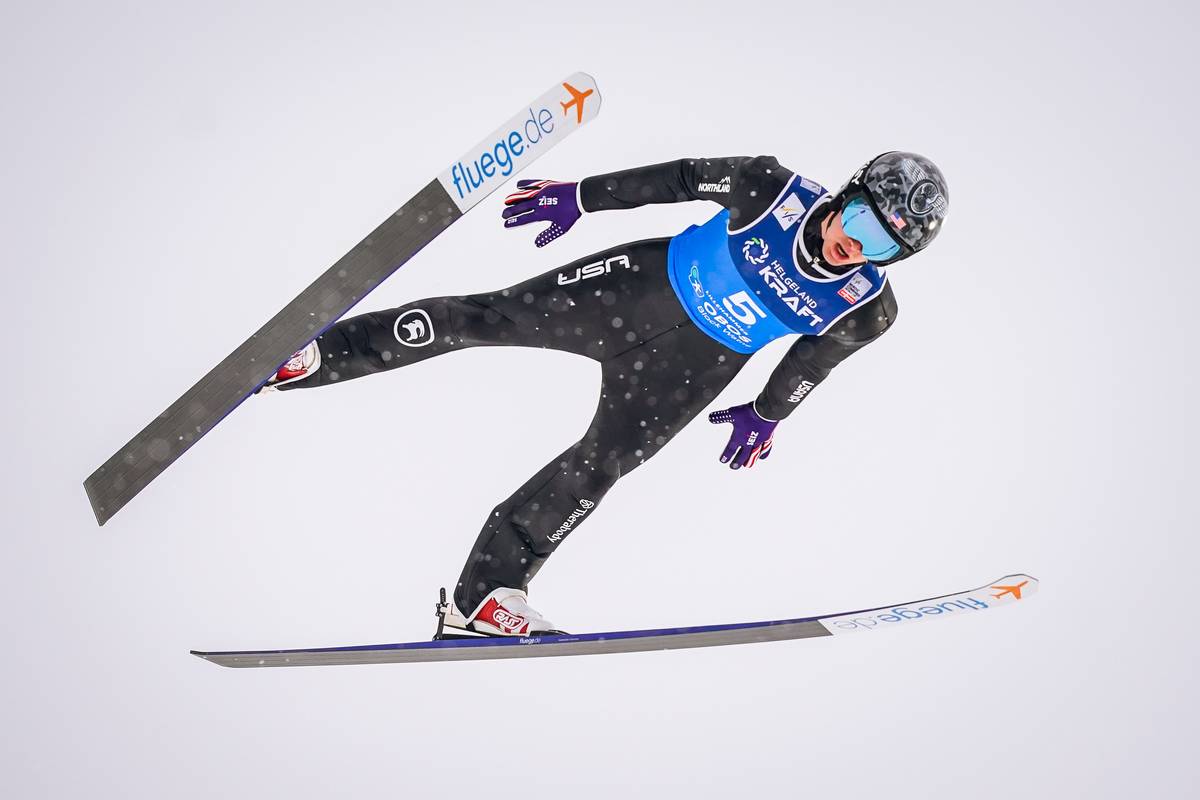
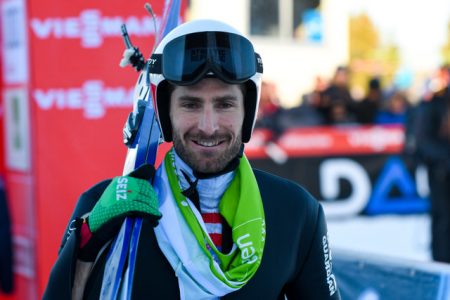
    Jasper Good jumps in a December, 2021 World Cup competition in Lillehammer, Norway. (Photo: NordicFocus)

    COACH QUOTES:

    Nick Hendrickson – Men’s Nordic Combined Team Director
    “With the nomination of our 2022 Olympic Team, I am extremely excited to have every one of these athletes selected to represent the USA in Beijing. I am proud of each individual for their accomplishments throughout the qualification process, but I am most proud of the teamwork that has been invested behind the scenes to raise our competition level. Collectively, our team is composed of four-time Olympic veterans, two-time Olympians, as well as first-timers; we have a lot of both experience and opportunity in this group of talented guys. The team momentum that we have at the moment is contagious and we can’t wait to keep it rolling into Beijing!”

    ###

    About USA Nordic
    USA Nordic is the national leadership organization for Nordic combined and ski jumping in the United States, providing support and guidance to the nations’ clubs and coaches while overseeing the national elite teams. More information can be found at usanordic.org or its social media channels @usanordic.

    FOR MORE INFORMATION CONTACT:
    Riley Elliott
    Nordic Combined/Ski Jumping Olympic Press Officer
    riley@usanordic.org

  • USA NORDIC ANNOUNCES TEAM NOMINATIONS (Press Release)

    USA NORDIC ANNOUNCES TEAM NOMINATIONS (Press Release)


    Press Release

    USA NORDIC ANNOUNCES TEAM NOMINATIONS
    Group of 45 nordic combined and ski jumping athletes earn spots


    USA Nordic has nominated 45 American athletes to its 2021-22 national and junior nordic combined and ski jumping teams. Athletes achieved the nominations based on selection criteria. They will have the option of being a part of the 2021-22 U.S. Nordic Combined or U.S. Ski Jumping Team.

    The nominations were made after the conclusion of the 2021 competition season. Athletes are now in training for the upcoming summer and winter seasons.

    “Our team nominations include a wide range of veterans across our national teams, but some great up-and-coming athletes on the junior teams,” said USA Nordic Sport Director Jed Hinkley. “It was especially challenging this year with ever-changing schedule changes and cancelations.”

    Athletes will have the option of accepting nominations prior to the 2021-22 season. The final teams for the season will be named this fall. With the Olympics coming up next winter in Beijing, athletes will be striving to earn positions on Team USA. Those nominations and team naming will be announced just prior to the Olympics.

    2021-22 U.S. NORDIC COMBINED SKI TEAM
    Men’s National Team

    Grant Andrews, 23, Steamboat Springs, Colo., Steamboat Springs Winter Sports Club
    Taylor Fletcher, 30, Steamboat Springs, Colo., Steamboat Springs Winter Sports Club
    Jasper Good, 24, Steamboat Springs, Colo., Steamboat Springs Winter Sports Club
    Ben Loomis, 22, Eau Claire, Wis., Flying Eagles Ski Club
    Niklas Malacinski, 17, Steamboat Springs, Colo., Steamboat Springs Winter Sports Club
    Evan Nichols, 17, Lyme, N.H., Ford K. Sayre Memorial Ski Council
    Jared Shumate, 22, Park City, Utah, Park City Ski & Snowboard
    Stephen Schumann, 21, Park City, Utah, Park City Ski & Snowboard

    Women’s National Team
    Tess Arnone, 18, Steamboat Springs, Colo., Steamboat Springs Winter Sports Club
    Alexa Brabec, 16, Steamboat Springs, Colo., Steamboat Springs Winter Sports Club
    Annika Malacinski, 19, Steamboat Springs, Colo., Steamboat Springs Winter Sports Club
    Tara Geraghty-Moats, 28, W. Fairlee, Vt., Craftsbury Nordic Ski Club

    2021-22 U.S. SKI JUMPING TEAM
    Men’s National Team

    Erik Belshaw, 16, Steamboat Springs, Colo., Steamboat Springs Winter Sports Club
    Kevin Bickner, 24 Wauconda, Ill., Norge Ski Club
    Decker Dean, 20, Steamboat Springs, Colo., Steamboat Springs Winter Sports Club
    Patrick Gasienica, 22, Spring Grove, Ill., Norge Ski Club
    Casey Larson, 22, Barrington, Ill., Norge Ski Club
    Andrew Urlaub, 20, Eau Claire, Wis., Flying Eagles Ski Club

    Canadian Athletes Training with USA Nordic
    Mackenzie Boyd-Clowes
    Matthew Soukup

    Women’s National Team
    Annika Belshaw, 18, Steamboat Springs, Colo., Steamboat Springs Winter Sports Club
    Jillian Highfill, 17, Park City, Utah, Park City Ski & Snowboard
    Anna Hoffmann, 20, Madison, Wis., Blackhawk Ski Club
    Paige Jones, 18, Park City, Utah, Park City Ski & Snowboard
    Cara Larson, 20, Barrington, Ill., Norge Ski Club
    Nina Lussi, 27, Lake Placid, N.Y., New York Ski Education Foundation
    Samantha Macuga, 20, Park City, Utah, Park City Ski & Snowboard
    Logan Sankey, 22, Steamboat Springs, Colo., Steamboat Springs Winter Sports Club

    2021-22 U.S. NORDIC COMBINED SKI TEAM – JUNIOR TEAM
    Men’s Junior Team

    Carter Brubaker, 17, Anchorage, Nordic Skiing Association of Anchorage
    Tate Frantz, 16, Lake Placid, New York Ski Education Foundation
    Gunnar Gilbertson, 18, Steamboat Springs, Colo., Steamboat Springs Winter Sports Club
    Henry Johnstone, 20, Concord, Mass. Andover Outing Club
    Aidan Ripp, 20, Cloquet, Minn., Cloquet Ski Club
    Zach Selzman, 16, Park City, Utah, Park City Ski & Snowboard
    Caleb Zuckerman, 15, Norwich, Vt., Ford K. Sayre Memorial Ski Council

    Women’s Junior Team
    Aspen Bennett-Manke, 15, Steamboat Springs, Colo., Steamboat Springs Winter Sports Club
    Charlotte Ripp, 16, Cloquet, Minn., Cloquet Ski Club

    2021-22 U.S. SKI JUMPING TEAM – JUNIOR TEAM
    Men’s Junior Team

    Jason Colby, 15, Steamboat Springs, Colo., Steamboat Springs Winter Sports Club
    Hunter Gibson, 20, Woodstock, Ill., Norge Ski Club
    Stewart Gundry, 15, Eau Claire, Wis., Flying Eagles Ski Club
    Shane Kocher, 17, Algonquin, Ill., Norge Ski Club
    Landon Lee, 18, Eau Claire, Wis., Flying Eagles Ski Club

    Women’s Junior Team
    Rachael Haerter, 16, Park City, Utah, Park City Ski & Snowboard
    Josie Johnson, 14, Park City, Utah, Park City Ski & Snowboard
    Elise Loescher, 18, Burlington, Vt., New York Ski Education Foundation
    Macey Olden, 16, Park City, Utah, Park City Ski & Snowboard
    Adeline Swanson, 15, Woodbury, Minn., St. Paul Ski Club

    About USA Nordic
    USA Nordic is the national leadership organization for nordic combined and ski jumping in the United States, providing support and guidance to the nations’ clubs and coaches while overseeing the national elite teams. To stay connected, visit www.usanordic.org.

  • Historic Win For Geraghty-Moats (USA Nordic Press Release)

    Historic Win For Geraghty-Moats (USA Nordic Press Release)

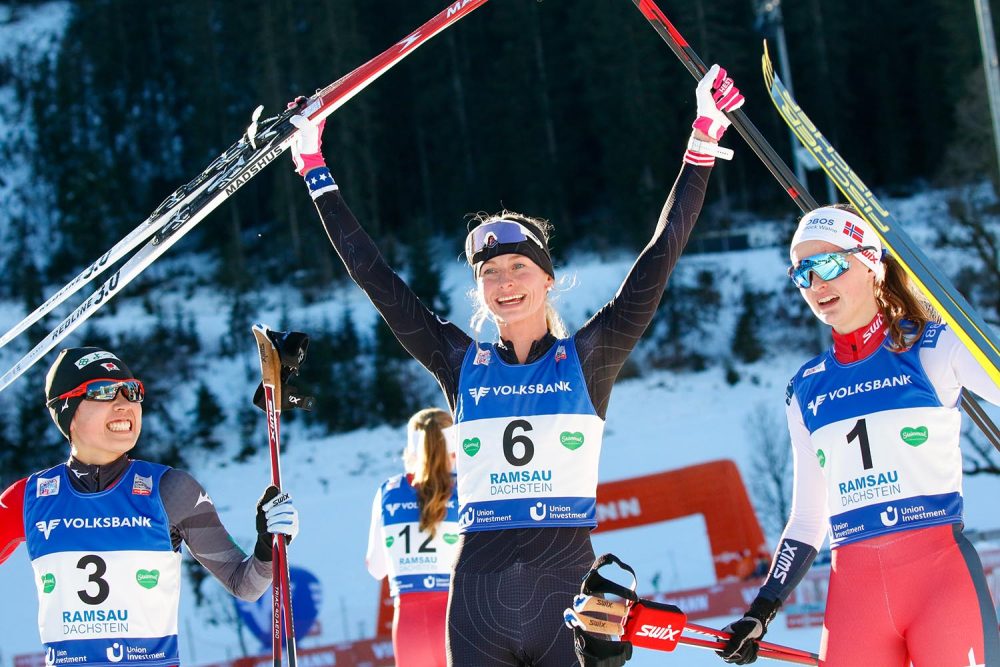
    Tara Geraghty-Moats celebrates her historic World Cup win (Volk/NordicFocus)

    HISTORIC WIN FOR GERAGHTY-MOATS

    Four USA Nordic women take part in debut women’s World Cup

    RAMSAU, Austria (Dec. 18, 2020) – American Tara Geraghty-Moats (West Fairlee, Vt.) made history Friday, skiing to a hard-fought victory by just 1.5 seconds in the first ever FIS Nordic Combined World Cup for women in an idyllic mountain setting at Ramsau am Dachstein. It was an emotional win for the 27-year-old who has been a pioneer in the movement to bring women’s  nordic combined to the Olympics.

    Geraghty-Moats finished sixth in the ski jumping segment of the nordic combined competition, putting her 39 seconds behind Westvold-Hansen to start the 5k cross country race. Geraghty-Moats charged hard from the start, catching the Norwegian near the end of the first of two laps on a hill. Westvold-Hansen fought back to ski even before Geraghty-Moats pulled away again on a hill to hold on for a victory.

    The American is the two-time defending champion in the Continental Cup and came into the race a favorite. The women’s World Cup debut had been scheduled in early December at Lillehammer, Norway, but was postponed.

    USA Nordic fielded a team of four athletes for the World Cup debut. Annika Malacinski (Steamboat Springs, Colo.) finished 28th with teammates Alexa Brabec and Tess Arnone (both Steamboat Springs, Colo.) 29th and 30th.

    An emotional Geraghty-Moats stood atop the winner’s podium, flanked by athletes from Norway and Japan. “Today here in Ramsau was a dream come true,” said Geraghty-Moats. “It was something I’ve dreamed about since I was 10 years old – before it was even a possibility.

    “Just a huge thanks to my team and FIS for finally inviting the women to the big leagues.”

    There were many unknowns for athletes coming into the first event of the season after COVID-19 wreaked havoc on training and competition schedules.

    “Coming into this competition I was really uncertain of myself because I hadn’t put a bib on in 10 months,” said Geraghty-Moats.  “And I had only 10% of my ski jumping training I had hoped to have. But all day long I just kept telling myself that I could do it – every step at a time.”

    Sports organizations including the International Ski Federation and USA Nordic have been working actively to bring women’s nordic combined into the Olympics. It is the only remaining Olympic event where women do not compete. The historic debut of a FIS Nordic Combined World Cup will be followed this February 27 with the first ever World Championship for women at the FIS Nordic Ski World Championships in Oberstdorf, Germany.

    Over the past two seasons, women from 17 nations have scored points in the FIS Nordic Combined Continental Cup tour. Nine nations were represented in the field of 32 in Ramsau.

    Geraghty-Moats becomes the first American nordic combined skier in nearly nine years to win a World Cup. The last victory went to Bryan Fletcher, who won the prestigious Holmenkollen World Cup in Oslo, Norway in March, 2012.

    On-demand replay of both the ski jumping and cross country segments of the nordic combined World Cup are available on Peacock TV in the USA.

    FIS Nordic Combined World Cup – Women

    Official Results

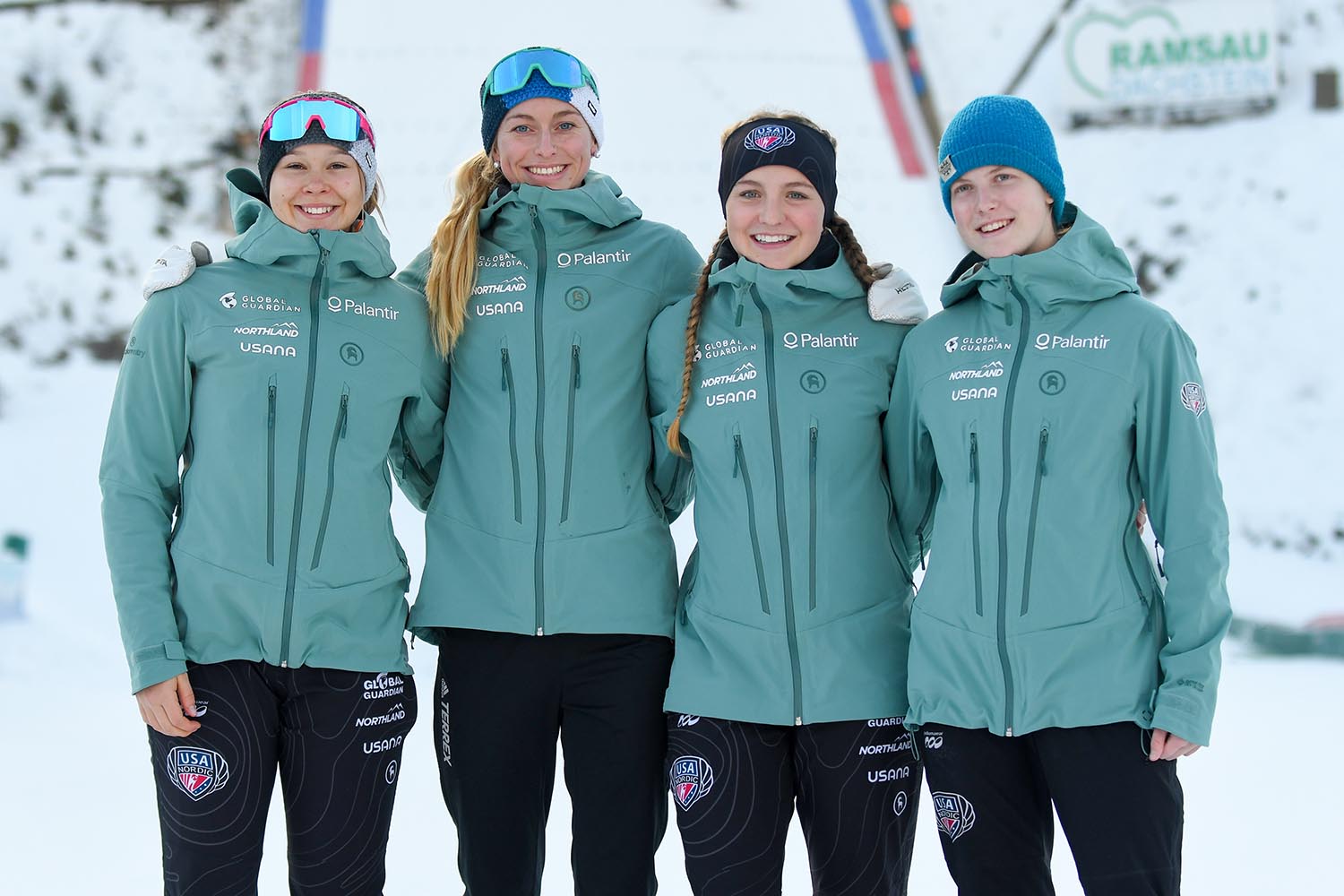
    USA Nordic team that participated in the historic debut including: USA Nordic Women’s Nordic Combnied Team at the debut of the FIS Nordic Combined World Cup in Ramsau, Austria, showcasing new team uniforms from Backcountry. Annika Malacinski, Tara Geraghty-moats, Tess Arnone, and Alexa Brabec, left to right (Romina Eggert/USA Nordic)
  • Gilbertson Returns to Coaching With USA Nordic (Press Release)


    Press Release

    PARK CITY, Utah (June 15, 2020) – USA Nordic has hired Chris Gilbertson as the head ski jumping coach for the men’s nordic combined team. Gilbertson spent 17 years coaching for the Steamboat Springs Winter Sports Club as well as the US Ski Team, where he led his athletes to five World Championship medals and four historic Olympic medals. Gilbertson returns to the sport after a seven year hiatus.

    Gilbertson will team up with head coach Nick Hendrickson to lead the men’s nordic combined team. “I’ve known Chris for quite awhile and we were able to work together when I was on the national team. Now with a slightly different dynamic, we are both looking forward to working together as coaches,” says Hendrickson.

    While the sport has changed since Gilbertson last coached, he’s not worried about that, “I might be naive, but I still believe the basics are the basics.” What Gilbertson brings to the table is experience coaching a team of champions. “He knows what it takes to win,” says Hendrickson.

    Taylor Fletcher is the one remaining athlete from the 2013 team that Gilbertson coached. “I need to find out what they know about their sport and then also find out what I might have missed in the last seven years. With this new group, I look forward to creating trust and belief.” Gilbertson continues. “I’m really looking forward to working with all these guys, I see a ton of potential for them to improve on both the jump hill and cross country side.”

    Newly named sport director Jed Hinkley sees this hire as a great fit, “Chris is not afraid to share his opinion, which I value, and I know nobody will work harder to help us achieve our goals in athletics and as an organization.”

    When asked about his goals with this new team, Gilbertson says, “Number one goal is to get these guys to make qualification automatic. Worrying about making the cut every weekend is no way to get better. Then the goal is to get top 20, then top 10, then medals.”

  • U.S., CANADIAN NGB/NSOs FORM NORTH AMERICAN FLUOROCARBON FREE POLICY WORKING GROUP (Press Release)

    Press Release

    PARK CITY, Utah (June 15, 2020)  – National Governing Body’s and National Sport Organizations (NGB/NSOs), and snow sport organizations from the United States and Canada today are announcing the formation of a Fluorocarbon Free Policy Working Group.

    With representation from U.S. Ski & Snowboard, USA Nordic, U.S. Biathlon, USA Para Nordic, USA Para Alpine, Alpine Canada, Canada Snowboard, Freestyle Canada, Nordiq Canada, Biathlon Canada, Nordic Combined Canada and Ski Jumping Canada in addition to industry wax representatives, the working group is tasked with setting a policy to eliminate the use of fluorinated ski wax from all sanctioned levels of snow sports competition in North America beginning with the 2020-21 season. 

    In 2019, the International Ski Federation (FIS) and International Biathlon Union (IBU) decided that the use of fluorinated ski wax will be banned for all FIS and IBU disciplines beginning with the upcoming 2020-21 season. In addition, U.S. Ski & Snowboard voted to eliminate the use of fluorinated ski wax from all levels of competition at it’s May 2020 meeting. The Canadian Ski Association (CSA) has adopted the FIS Council Ruling and is extending it to all programs that fall under its authority. 

    Fluorinated wax, and the raw perfluorooctanoic acid (PFOA) compounds that make up these wax products, have been scientifically studied for their negative environmental and health impacts. In the United States, many of the compounds found in fluorinated wax products contain ingredients listed in the Toxic Substances Control Act. In July 2020 the European Chemicals Agency will ban the sale, manufacture, and import of all products containing PFOAs. 

    The Fluorocarbon Free Policy Working Group began meeting on a regular basis to facilitate the many facets of developing policy and rules that will harmonize all levels of domestic competition and training with FIS and IBU rules and regulations, and will lead to a complete ban of fluorinated wax products at all levels of sanctioned competition. The Working Group is committed to:

    • Asking manufacturers to work toward providing a list of waxes where the manufacturer represents that the wax is free of fluorinated products 
    • Working with FIS and the IBU to coordinate the testing process and thresholds below the World Championships/World Cup level
    • Establishing rules, deterrents, and appeals process
    • Establishing clear and concise stakeholder communications

    While key questions remain, including testing, enforcement, and ultimately sanctions for using fluorinated products, all participating NGBs in the United States and Canada are fully committed to banning the use of fluorinated wax from all levels of sanctioned snow sports competition starting with the 2020-21 ski and snowboard season.

  • Jed Hinkley Named USA Nordic Sport Director (Press Release)

    Press Release

    PARK CITY, Utah (May 20, 2020) – Olympian Jed Hinkley has been named as the new sport director for USA Nordic, which oversees the sports of ski jumping and nordic combined across America. Moving forward, Hinkley will lead all USA Nordic athletic programs with the goal of putting athletes on the podium and maintaining a sustainable athletic pipeline.

    Hinkley spent six years on the U.S. Ski Team from 2001-2006 and represented the United States as a nordic combined skier in the 2002 Winter Olympics in Salt Lake City. Over the past four years, Hinkley has served as development director for USA Nordic. He thrived in this role, creating an amazing community, and increasing overall participation in ski jumping and nordic combined by 24%.

    “Jed has proven to be an incredible sport development director, executing against bold goals from growing our sports within regions and clubs to providing more for athletes with exposure to their peers both domestically and internationally,” says USA Nordic Executive Director Bill Demong. “Jed has developed so many great relationships within our staff and community that he is well poised to create further efficiencies and high performance outcomes in this new role overseeing our sports.

    There is a certain patriotism to Hinkley’s goals in this new position. “Ultimately, I want to establish the American way of doing things, one that works for our athletes,” he said.

    It’s the athletes who inspire Hinkley, and give him reason for hope. “I truly believe we have some amazing athletes who can compete with the best in the world and I think we have only scratched the surface of our potential.” Hinkley will aim to scratch well below that surface in the coming season.

    With over 30 clubs and 739 athletes, spread across thirteen states, the United States is the fourth largest nation globally by participation in ski jumping and nordic combined. Additionally, USA Nordic nominated its largest national team ever for 2021, boasting 47 athletes.

    Contact Ben Berend for press inquiries:
    benberend@usanordic.org

  • Paul Smith’s College Invests in Nordic Sport and Its Future

    Paul Smith’s College Invests in Nordic Sport and Its Future

    A vision for an on-campus nordic sport future – an aerial shot of a portion of Paul Smith’s campus. (Photo: Courtesy PSC)

    Running a small liberal arts college is big business. Stress over enrollment. Stress over capital improvements. Stress over staying relevant. 
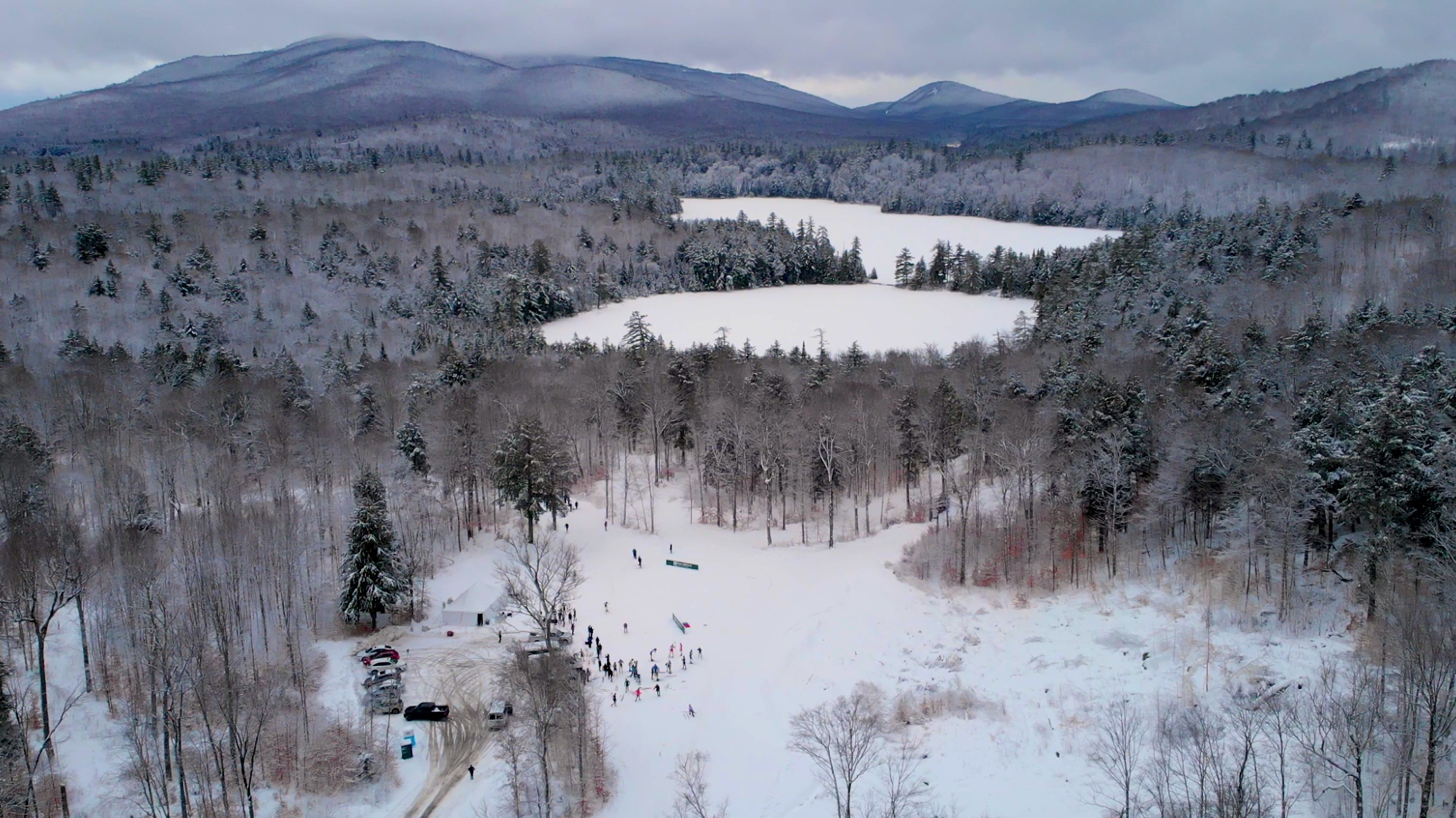
    Paul Smith’s College in Paul Smiths, New York is a relative newcomer on the East Coast college scene; founded in 1946 and currently enrolling 745 students. One particular aspect Paul Smith’s makes it stand out – a massive 14,200 acre campus in the foothills of the Adirondack high peaks region. This is perhaps the school’s most unique asset. School administrators see their landholdings as one path to running a more sustainable higher ed business. The broad acreage of the campus is part of the school’s strategy to build infrastructure to attract potential students. In this instance, we are not talking about Paul Smith’s breaking ground on a shiny new student center with amenities like a five star hotel. 

    Paul Smith’s enterprising strategy to attract future student athletes includes building world class cross-country ski trails and a biathlon range. John F. Morgan, sports initiatives director at the college, shot straight when discussing the motivation for the school’s trail building initiative. “We are not doing this for public relations, we are doing this to entice student athletes to come to campus,” he said over the phone.

    The school contracted with the storied Morton Trails to help vision the project and engineer the trails. Morton Trails came on board in October 2018, to begin the process of walking the campus grounds and marking a potential layout. 

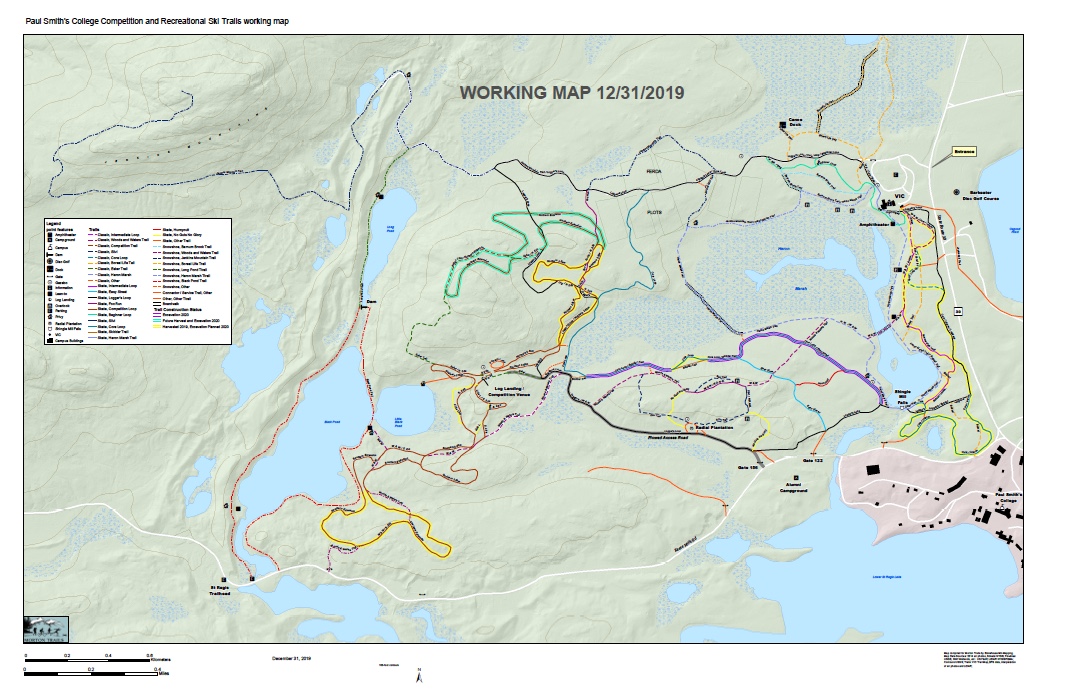
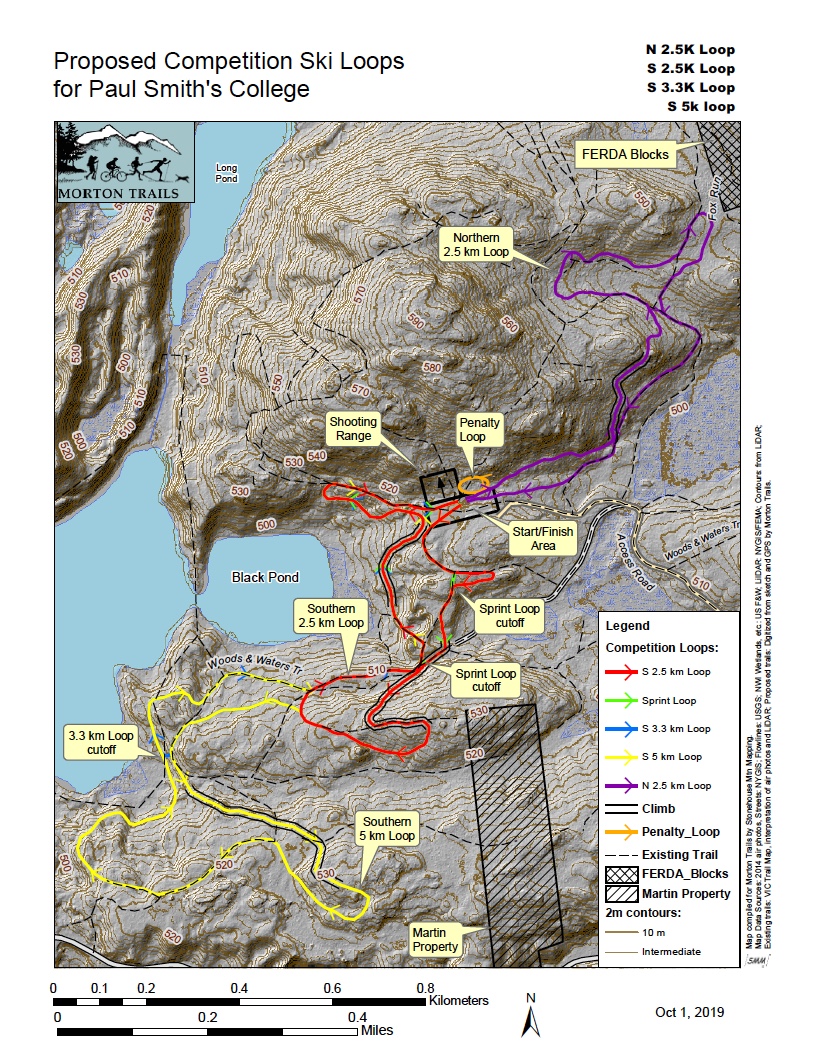
    Link to Map PDF
    Proposed Competition Ski Loops at Paul Smith’s.

    Morgan explained the campus, situated 25 miles from Lake Placid, sits in the Adirondack snow belt; the terrain is positioned to receive adequate snow pack. The college also boasts a 25 mile pre-existing trail system. In 2010, the college took over what is called the VIC, which functions as an outdoor center and is open to the public. The new project involving Morton Trails is geared towards creating modern International Ski Federation (FIS) homologated trails. 

    Since the inception of  the project, 2.5 miles of trail have been completed. According to Morgan, another 3.5 miles of crafted trails are slated for construction in the next year. Plans for a biathlon range are moving forward as well. And for those seeking dryland training opportunities, Paul Smith’s budgeted for the construction of a modest paved rollerski loop.

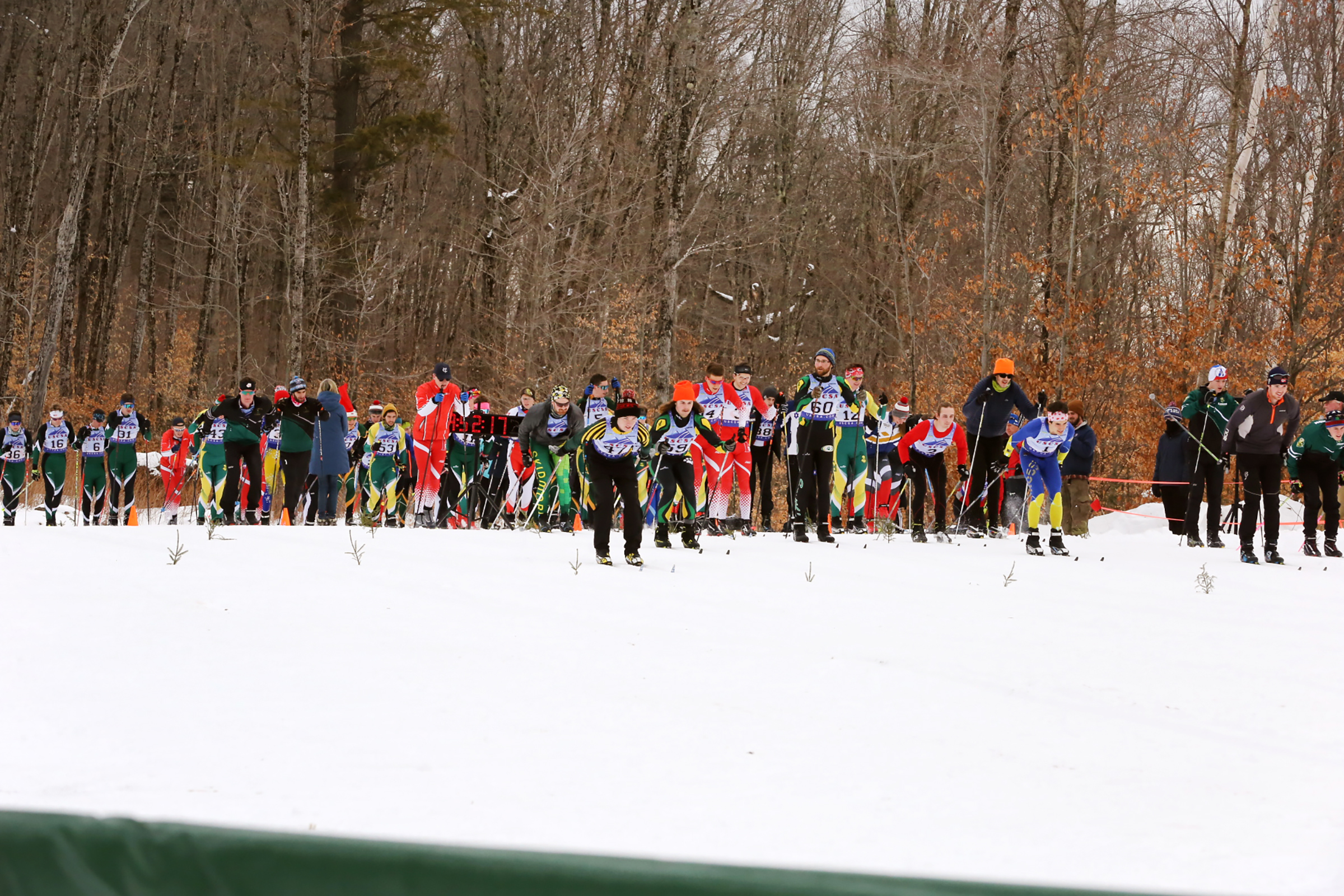
    The start of the 2020 PSC Bobcat Invitational. (Photo: Pat Hendrick)

    On January 6, Paul Smith’s christened their race worthy ski trails with the PSC Bobcat Invitational. One hundred and ten athletes from 11 colleges competed. According to Morgan, those students racing at Paul Smith’s were the type of clients the college hopes to attract. Morgan understands the risk involved with investing in nordic sport, yet he asserts the college’s outlook is longterm. 

    “We are doing this, yes,” Morgan said. “Do I have a guarantee that that many people are going to enroll? No. I was standing next to the college president when she dropped the flag on a ceremony for the venue during the race — I looked at her and I said, ‘these are our clients, maybe not these kids, but the kids that follow them.’”

    Paul Smith’s strategy to attract nordic sport student athletes also involves an official partnership with USA Nordic and U.S. Biathlon. USA Nordic calls its partnership with the college its East Coast Training Center.   

    Morgan also said four “grants” will be offered to USA Nordic and four to U.S. Biathlon student-athletes, respectively. “Grant”, it was explained, refers to full room and board, including tuition for a four year degree. 

    Part of the motivation for investing in the nordic sport facilities are the upcoming 2023 Winter World University Games in neighboring Lake Placid. Morgan envisions some of the grant recipients competing in those events. But Morgan acknowledged that the precise road map leading to a college degree from Paul Smith’s for an elite athlete will be a work in progress. Course work may involve early fall on-campus classes that transitions to online work for those traveling for competitions. 

    “That is what we are going to try and experiment with,” Morgan said. “Do we have the exact model of how to do it? No. But what we are doing is creating this sport and education culture where USA Nordic recognizes it, and U.S. Biathlon recognizes it. They send these kids in, and we assist them in finding a way to get them an accelerated education — one where they are on campus and they get a chance to experience college campus life and and they are not taking on-line courses when they are 30 or going back to college.”

    Paul Smith’s has enlisted several former Olympians to advise its new Olympic sport initiatives. The group of five advisers include U.S. Biathlon’s Tim Burke, a native of Paul Smiths, and Billy Demong, current Executive Director of USA Nordic, who grew up nearby.

  • Tara Geraghty-Moats on Finding Speed

    Tara Geraghty-Moats won the Nordic Combined Continental Cup in the previous season and is set to be a podium contender for the overall standings in this year’s cup as well. Now she finds herself in Lillehammer ready to jump in this weekend’s World Cup. FasterSkier met up with her to hear her thoughts on training, what it’s like to compete at her level and the future of nordic combined for women. 

    Today, a Monday, she opted for a 7×1 minute hill intervals up the first hill on Lillehammer’s course. This particular hill is the first challenge the skiers tackle as they race the 1994 Winter Olympics. Some 15-25 seconds after the gun goes off, the skiers will find themselves battling it out on the steep hill, which offers a slight break midway through. This break, however, does not offer much of a pause, as Geragthy-Moats’ heart rate will tell you. one hundred and ninety seven beats per minute during her intervals places her just over 96 % of her tested max of 205 and sent her lactate level relatively high above threshold levels. Anyone with knowledge of sports physiology knows what this means: your muscles will be sore. 

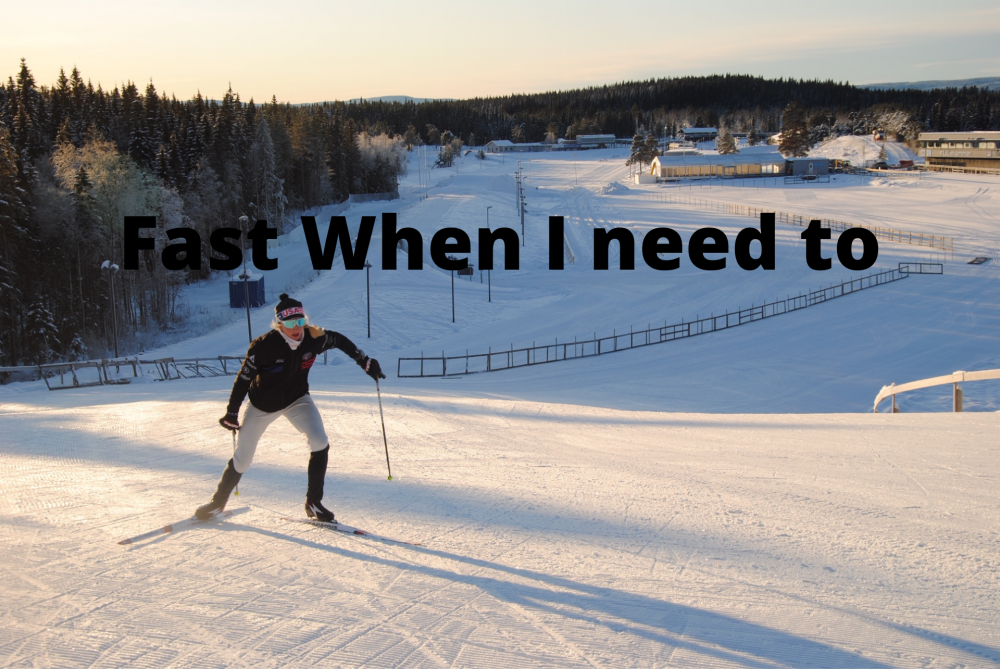
    “Fast when I need to”

    Geraghty-Moats explains why she puts herself through a workout like this by saying “the idea is to install a super-boost in your legs”. This top gear, as she also calls it, is something she’s been working on this year. When asked about her workout of the day and why she did it, she explains: “so if I’m skiing in a pack I’ll be able to sprint away from the pack and make a clean break, something that’s really useful in mass-start racing and the nordic combined pursuit format.” 

    She goes on to say that she’s hopefully in good shape, with good endurance and good conditioning for a race and that “this is sort of the cherry on top of my conditioning for the year, where I’m trying to get my speed up so I have the ability to go fast when I need to.”

    How do you feel like a workout such as this one prepares you for an upcoming race?

    “Basically those one minute sprints are sort of warming up my engine and making sure that my legs can move quickly, I feel pretty in shape and I feel in good condition this season but that doesn’t necessarily mean you’re ready to race so this is sort of the last prep to race, also for me I have to balance between ski jumping and Nordic skiing, so I have to focus on quality over quantity.”

    And how are you able to improve on both?

    “For me, the most effective way is to take training blocks where I focus on jumping and different training blocks where I focus on skiing.”

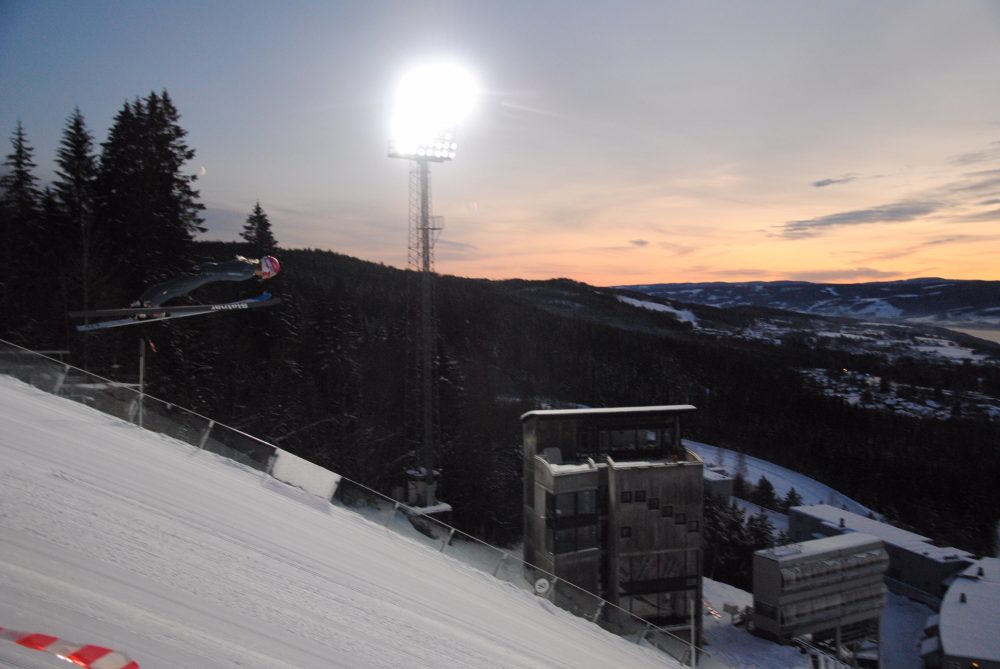
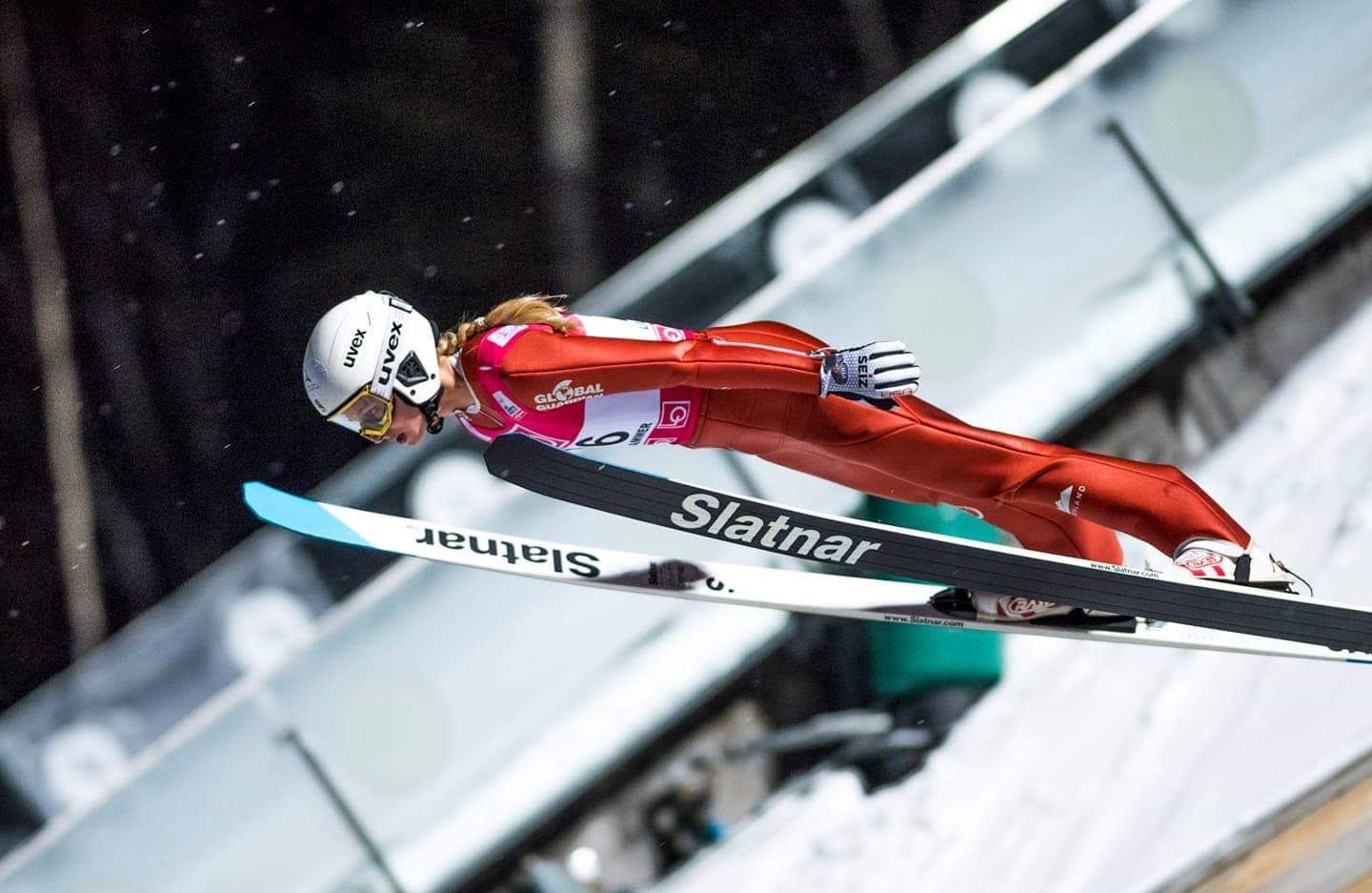
    Tara Geraghty-Moats flying off Lillehammer’s HS140 as she prepares for the new season of racing. (Photo: Aleks Tangen)

    The training block for this week started with seven sprints in the morning and seven jumps off the big hill (HS140) in Lillehammer. When it comes to deciding what to do in training, Geraghty-Moats considers her competitions. She writes her own training plans and explains that she has an overall plan, which stretches for 2-3 months. As she gets closer to competition, she specializes her sessions. When asked about how she factors in yesterday and tomorrow when deciding what to do today she says: “I decided to do my longer intervals yesterday and shorter intervals in the morning and then have some rest and get ready for jumping. But really I look at when my competitions are and when I’m going to want to be feeling fast and good and then build sort of backwards from there.” 

    She explains that an important aspect to this process is knowing how long it takes to recover and how long it takes for the intervals to have an effect on overall skiing speed. On December 13-15, the Continental Cup comes to Park City, Utah and the effect she speaks of will show if things are going according to her plan or not. 

    Below is a lightly edited and condensed version of an interview with Geraghty-Moats. 

    Aleks Tangen: For your workout today what were you doing?

    Geraghty-Moats: So today I was doing one minute sprint intervals something I’ve been working on a lot of this year is really just improving my Top Gear so if I’m skiing in a pack I’ll be able to sprint away from the pack to make a clean break something that you really useful in mass start racing and the nordic combined pursuit format

    AT: The reason why you’re doing your workout like that at this time of year is because you want to be able to sprint past the other racers?

    G-M: Hopefully with this year’s training I’m in pretty good shape, I have pretty good endurance, good conditioning for a race and this is sort of the cherry on top of my conditioning for the year where I’m trying to get my speed up so I have the ability to go fast when I need to. And I was doing it on the hill, obviously it’s a little bit harder there, where are you get a lot more lactic acid in your legs and preparing my body for that really helps when I’m in a race where I’m already going fairly hard and have to put on the gas and really sprint.

    AT: How do you feel like a work out such as this one prepares you for an upcoming race?

    G-M: Those one minute sprints are sort of warming up my engine and making sure that my legs can move quickly I feel pretty in shape and I feel in good condition this season but that doesn’t mean necessarily, that you are ready to race. So this is sort of the last prep to race, also for me. I have to balance between ski jumping and nordic skiing. So I have to focus on quality over quantity. Yesterday, I did an interval session, ideally I would do another hard session if I was simply a nordic skier. But today doing a shorter interval session, my body is already tired from yesterday, I don’t have to ski for so long, I don’t have to do so many laps. I still get the training affect, and I still have the hours where I have time to jump and I can feel fresh for the jumping I’m doing later.

    AT: It’s a Monday, you’re competing this weekend, what factors playing into doing this particular kind of workout?

    G-M: This week I’m actually just competing in ski jumping World Cup, so I’m trying to get a good number of intensity workouts done early in the week so by the time the weekend rolls around I am pretty fresh. I’ll probably do some weights and plyometric workouts on Wednesday and Thursday to get my legs fresh and activated for jumping. But at the same time I still need to stay in shape for cross-country skiing, which will be the weekend after next, in Park city Utah, so yeah it’s always a balance with nordic combined, because you really want to be the best at both sports so you have to stay on top of everything, but also not overextend yourself.

    AT: For a workout like this one, how do you structure the warm up?

    G-M: For me warm-ups are really important, especially with one minute intervals, because if you’re not warmed up properly first of all you can’t really go that fast and second of all it’s a really big shock to your system, you can get sick or the lactic acid floods your system so you can’t do as many sets. I usually ski between 20 and 30 minutes for warm-up. I start pretty slowly and then I  do 3 x 3 min. level III, threshold intervals, before I start the sprint – all out work out – so that gets my system going. 

    Tara Geraghty-Moats training in Lillehammer, Norway. (Photo: Aleks Tangen)

    AT: Considering you are sprinting up the hill, it’s kind of tough, how do you prepare yourself mentally for such a work out?

    G-M: Actually, I really like these workouts because they’re pretty quick, and I just enjoy going fast on skis, it’s fun for me. I just look forward to it. It’s kind of easy on a day like this when the conditions are perfect. I have the whole stadium to myself. I mean I don’t really need much motivation, and physically it’s nicer when I’m fresh and not tired. But realistically that’s part of the job, some days my legs are just going to hurt a little bit.

    AT: How do you feel the workout you did today, what part of your performance does that improve?

    G-M: Anything that short is definitely anaerobic, it really helps you deal with anything lactate flooding your system, and just gets your body moving fast. You see a lot of the women especially in skiing have a lot of high tempo even in the longer races and if you’re not efficient at that and don’t feel comfortable doing that you really have no chance.

    AT: Strength training plays an important role in that if you’re strong then it’s easier to maintain high speed and high intensity.

    G-M: For me actually it’s important to not do a lot of weight and strength session but make sure the ones that I do are really quality. I don’t necessarily do strength workouts after an interval workout or after a long day. I think that’s another thing most nordic skiers tend to do — they will slide in strength after an session or when they are already tired and it is really important to do strength when you are fresh. It gives you a chance to improve, and really focus on getting stronger, and not just maintaining.

    AT: Being in the moment and not necessarily measuring quantity, but doing it as good as possible?

    G-M: Right. And I think that’s nordic combine in a nutshell: quality over quantity. Because there’s no way I can train 800 hours like the cross-country girls on World Cup. It is not going to happen it’s not realistic so I have to have a paired down training plan for nordic.

    AT: How many hours do you train every year?

    G-M: This is actually my first full year of being a true nordic combiner, so I’ll probably do about 480-500 hours so it’s not nothing, but it is not sort of what you would expect of nordic skiers. I think it’s not really comparable, and you have jumping which is a completely different sport from long-distance nordic skiing. They can do somewhere between 700 and 800 or 900 but they don’t do as much explosive and plyometric work which requires a totally different recovery.

    Also the time of the day I can do training sessions for jumping but I might not be that tired but I might’ve still been on the hill in training mode for five or six hours on that day because we usually warm up for about 45 minutes and then we are on the hill for an hour and a half and I can go for a ski in the evening and it means that I might be training close to seven hours that day.


  • Utah to Host International Nordic Combined Event (Press Release)

    Utah to Host International Nordic Combined Event (Press Release)

    Press Release USA Nordic


    PARK CITY, Utah November 12, 2019 – International nordic combined action is coming back to Park City, Utah December 13-15. The competitions will take place between two venues, the ski jumping portion will take place at the Utah Olympic Park and the cross-country races will be contested at Soldier Hollow.

    A star-studded cast will be descending upon Park City for the Continental Cup. Headlining this lineup is a lot of American talent, two athletes in particular made their mark in last year’s event. Tara Geraghty-Moats (West Fairlee, VT) will be looking to keep her streak alive. Last year Geraghty-Moats won all ten Continental Cups she competed in and is currently the best women’s nordic combined skier in the world. Men’s team veteran Taylor Fletcher (Steamboat Springs, CO) will look to defend his home turf in the men’s event. Last year Fletcher finished 4th and 1st in this event proving his dominance in the cross country portion.

    This year USA Nordic is putting an emphasis on the spectator experience. The highlight of the weekend will be Saturday nights event at the Utah Olympic Park. The outrun of the ski jump will be filled with vendors, food trucks, beverages, firepits, and live music. The doors will open at 5:00 pm so bring your friends and family up to the Utah Olympic Park for a night to remember below the ski jumps.

    The time schedule for the entire weekend is below. Come cheer on our athletes and give them a home-field advantage.

    The event will also be live streamed on USA Nordic TV for those who cannot attend in person.

    Park City Continental Cup Schedule

    Friday, December 13

    9:00-11:00 a.m. Ski jumping (Utah Olympic Park)

    2:00-3:30 p.m. Cross country (Soldier Hollow)

    Saturday, December 14 

    2:00-3:30 p.m. Cross Country (Mass Start) (Soldier Hollow)

    6:00 – 8:00 p.m. Ski Jumping (Utah Olympic Park)

    Sunday, December 15

    9:00 – 11:00 a.m. Ski Jumping (Utah Olympic Park)

    2:00 – 3:30 p.m. Cross Country (Soldier Hollow)

  • Alaska Solstice Junior Flyer Camp by Jed Hinkley

    Alaska Solstice Junior Flyer Camp by Jed Hinkley

    Solstice jumping in Anchorage, Alaska. (Photo: Cooper Dodds)

    As I flagged Josie Johnson and Augie Roepke at midnight on the longest day of the year, a smile came to my face, and I let out a big hoot. I have been around Ski Jumping for over 30 years, but I had never experienced what I was experiencing at that moment: the 2nd 12-hour jump-a-thon on the Summer Solstice. The previous year’s event was the impetus for this year’s USA Nordic Alaska Junior Flyer Camp, and after taking part, I hope that it becomes an annual tradition like so many others in the Ski Jumping world.

    When Karen Compton, Adam Loomis, and I began planning the camp we were excited, but unsure as to whether many non-Alaska athletes would attend. I thought if we got five athletes from the lower 48, I would be happy.  Then we opened registration, and in the first two weeks seven athletes from Park City and New Hampshire had signed up…and the registrations just kept rolling in until we had reached 16 athletes from outside of Alaska and 42 athletes all together.  I was certainly not expecting this or to have to close registration because we did not have enough t-shirts and camp packets.  If I am honest, I was also a little worried.  Do we have enough coaches? How are we going to transport all these kids to the off-hill activities? Is the age and ability gap too big? Do I have enough wax and water bottles? These and many other fears were running through my head as I woke up at 4:30 am the first day of the camp, partly from jet lag and partly from fear that I had forgotten something big.

    There were some things I forgot, and not everything ran perfectly, but we did what Ski Jumping and Nordic Combined coaches, athletes, and families do: we figured it out, and all chipped in to make the camp a resounding success.  Alaska parents opened their homes up to the out-of-state families. Karen Compton lead hikes for parents who wanted to participate and provided a resource sheet and map for activities all over Anchorage. Adam Loomis and Chris Lamb made a last minute Costco trip to stock up on supplies for the larger than expected group in addition to the phenomenal coaching and leadership they exhibited throughout the camp. Parents helped drive to the Portage Pass hike so that we could take in an amazing glacier view.  The hike ended up having nearly 60 participants in 8 cars, including two 12-passenger vans. Finally, during the culmination of the camp- the jump-a-thon, club members showed up with delicious food and extra camping gear for the out-of-towners, as JR kept the burgers and hot dogs coming from the grill, and Jeanne kept the food table organized and stocked.  Everyone at the camp made some sort of contribution, and the tunes echoed off the jumps keeping the energy level high until well beyond midnight, while Cooper Dodds snapped photo after photo for Outside Magazine.

    Thank you to all that helped make the camp and the jump-a-thon a huge success, and I recognize that there are many more people that I should have thanked by name ( oh, Jessica Vetsch for Reuben and Chris’ amazing birthday cake).  In a sport where we cherish community and tradition, I think we established a little of each during the camp and I hope both will carry on for many years to come.

    Jed Hinkley, Sport Development Director for USA Nordic. (Photo: USA Nordic)
    Jed grew up in Andover, New Hampshire, where both of his parents were teachers at Proctor Academy. Jed began skiing at the age of three and competing at the age of five. Eventually, Jed’s main sport became Nordic Combined and he spent seven years on the U.S. National Team. After teaching high school, Jed went back to school to get his Master of Public Health (MPH) from the Gillings School of Global Public Health at UNC. He is currently the Sport Development Director for USA Nordic.


    Click the image to enlarge.

  • Learn to Fly this Summer with USA Nordic

    Learn to Fly this Summer with USA Nordic

    FasterSkier wants to help spread the word that USA Nordic will be organizing camps this summer geared towards new and experienced junior ski jumpers. The first camp will be held in Anchorage, AK., in June, the second in Eau Claire, WI., in July.

    The schedules and registration for each camp are linked below.

    buy temovate online

    Alaska Junior Flyer Camp info: June 17-23

    (Alaska registration).

    Central Junior Flyer Camp: July 19-21 Eau Claire, WI.

    (Central Camp registration).


  • Taylor Fletcher: Finding Strength after Loss

    Taylor Fletcher: Finding Strength after Loss

    Taylor Fletcher soaring in Steamboat Springs, Colo. at the 2018 Continental Cup (Photo: Ben Pieper)

    Twenty-eight-year-old Taylor Fletcher has been nordic skiing and ski jumping nearly his entire life. He grew up training and competing in Steamboat Springs, Colo. He has been racing World Cups since 2010 and is a three time Olympian.

    The 2018/2019 season has been his best yet. Fletcher began his season with two Continental Cup victories, one in each of his “hometowns”, Steamboat Springs and Park City, Utah.

    He has also brought a renewed spirit to his skiing and jumping. His ski times on the World Cup are blistering, with top-five and fastest times of day within reach. He posted two top-20 World Cup results in January.

    This past October, Fletcher’s father Tim passed away after a hard fought battle with ALS. Family remains important to Fletcher. His father’s passing affected him both mentally and physically but he is able to find strength from his loss and is able to transfer his feelings into his skiing and jumping.

    At the conclusion of an Olympic cycle in 2018, the U.S. Nordic Combined Team lost several athletes to retirement — most notably his bother Bryan. Team veterans Ben Berend and Adam Loomis also moved on from the sport. These vacancies made room for a few younger racers like Grant Andrews and Jared Shumate.

    FasterSkier connected with Fletcher in late January for an interview to discuss his season, his father’s passing, and the new team dynamic.

    FasterSkier: You started the season with wins in the two places you call “home”, how did that feel?

    Taylor Fletcher: Competing at home is always a dream. 2006 was the last time I had a international competition in Steamboat. It was a great honor to compete there after my father passed away and even better to honor him with a victory and second place.

    FS: How have you been processing the loss of your father and how has losing him impacted your training and racing?

    TF: It’s been tough, after he passed I was actually in Slovenia for a Grand Prix and he passed the day after my competition there. One of his last wishes was to have me stay over and continue training and continue progressing over here. But, emotionally, physically and mentally there was no chance that I could do that. And so it was important for me to go home to be able to regroup, refresh, kind of focus again and that was a good opportunity for me to do that. Every single one of my flights was delayed, I missed two of my flights because of those delays, so it was a challenging day.

    He wants me to continue skiing, he wants me to ski as long as I can and that’s my goal, to honor that. He’s definitely a big motivator for me, he’s a big reason why I’ve had a better season than the last couple of years. It’s because I have his thoughts and the motivation from him, so that’s been great.

    But, the day after he passed, I tried to go out and do some training sessions and there was no chance that I could train at all. I tried to do an intensity sessions and about a quarter of the way through it, I stopped and I just looked at myself and I was like “what am I doing?”.

    There comes that time for everyone, luckily mine hit me at a good spot and everything surrounding his passing was exactly what we were hoping for, it was super peaceful. I got to talk to him, or I was telling him some stories and he was actively listening and heard everything.

    It was funny, I was actually on a ski resort in Slovenia here and we knew that it was coming time, that it might be a day, or it might be a week, we didn’t really know. It was about five minutes after I got back from the resort that I was told give him a call to say my final words and it was about five minutes after I hung up the phone that he passed. He was definitely waiting for me to talk to him. I know Bryan had talked to him as well.

    Taylor Fletcher Skiing in Park City’s 2018 Continental Cup (Photo: Ben Pieper)


    FS: A few of your teammates retired at the end of last season and the USA Nordic gained a few new guys, how has that been? How is the team dynamic this year?”

    TF: Losing Bryan [Fletcher], Adam [Loomis], and Ben [Berend] was a big blow to our team as we already have a small team. Having a big team is nice as they all want to succeed and it helps motivate you through the tough times. But unfortunately there is always a time when someone has to call it and unfortunately that happened on the same year. The team dynamic is great, its a young group of guys that want the best and push each other to be the best!

    FS: Do you miss competing with your brother?

    TF: Always, yeah. We pushed each other on a regular basis and that’s definitely different. But at the same time, it’s a little bit nice because we always seemed to bicker with each other when we were traveling. He always wanted to give me as much advice as possible, which was great. But now I have the free reign to do what I want and not have his input all the time. Don’t get me wrong, I really wish Bryan was still skiing and I wish Adam [Loomis] and Ben [Berend]were still skiing.

    FS: What were your goals going into this season?

    TF: It’s solely focused on World Championships, getting goals along the way, scoring points every weekend, jumping better and racing fast and being one of the fastest racers all year. And, so far, I feel like my goals are in line but I desperately want a World Championship medal of my own, an individual one. I’ve got some work to do, but that can come on the jumping side because I think the cross country side is there.

    FS: What about 5 year goal/plan?

    TF: Basically, I want to have this year as a year to have as much fun as I possibly can, and make it like those days at Howelsen Hill as part of the [Steamboat Springs] Winter Sports Club. And then I’ll decide from there whether or not I can continue doing that. In reality, we all want to have as much fun as possible and we all know that having fun can breed good results and success. So having this model going forward I think is good for me both mentally and physically and it allows me to do what I want to do and that’s what’s most important.

    Taylor Fletcher smiling after a soaring jump (Photo: courtesy USA Nordic)

    FS: What has been your favorite moment of the season so far?

    TF: I think my first competition jumping in Lillehammer, Norway, I jumped to 16th, which was actually a career tie. But the highlight was having the second longest jump of the whole field. I want to have more days like that for sure, but that was a pretty good day for me, definitely a peak day and those are always hard to come by. But at the same time, I know that I did it once, so I can do it again.

    FS: What races are you looking forward to this season?

    TF: Seefeld, Austria for World Championships is definitely the one I’m looking forward to the most, good race course, beautiful venue, tons of snow this year. So I just hope I can put it all together on that day and come out successful.

    FS: You have had some of the fastest ski times on the World Cup- how does knowing you can kill on the ski course affect your jump prep? Official German shop of Maral Gel – http://maral-gel.com/DE

    TF: It’s just one less thing I have to worry about, kind of a Forest Gump quote there. But I can just focus on my jumping and not have to really rely 100% on cross country to get things done. That makes it easy for me, the more I can think about the jumping side, the easier that will get.

    Four World Cups remain for Fletcher before World Championships take place in Seefeld, Austria.

  • Tara Geraghty-Moats, the Undefeated Women’s Nordic Combined Pioneer

    Tara Geraghty-Moats, the Undefeated Women’s Nordic Combined Pioneer

    Tara Geraghty-Moats winning the first 2018/2019 women’s nordic combined Continental Cup held in Steamboat Springs, CO. (Photo: Ben piper)

    Tara Geraghty-Moats started ski jumping when she was nine years old. Fearless for sure, but all part of the multisport athlete’s mojo.

    But after suffering multiple knee injuries when she was 16, Geraghty-Moats was forced to take a break from ski jumping. That hiatus was a four-year jumping drought that only served to push her into other aspects of nordic sport. During her time away from jumping, Geraghty-Moats competed in cross-country skiing and biathlon where she was highly successful.

    At 19-years-old, Geraghty-Moats came back to ski jumping which she has been doing ever since. This summer, she added a well-suited endeavor to her jumping: skiing fast. The reason for this addition was the introduction of an 11 event women’s nordic combined Continental Cup.

    “My goal this season is to be overall Continental Cup winner and to be on the World Championships team for ski jumping,” Geraghty-Moats said about her season’s objectives. As far as nordic combined is concerned, she is well on her way to mastering the Continental Cup series. 

    Tara Geraghty Moats ski jumping World Cup in Lillehammer, NOR. (Photo: FIS Ski Jumping)

    In the first race of the inaugural Women’s Summer Grand Prix in Oberwiesenthal, Germany, Geraghty-Moats ski jumped into fourth place and then skied into second place. That was the last race Geraghty-Moats didn’t win this season. She won the second race of the Grand Prix, and took home the Overall Championship title.

    Geraghty-Moats has participated in five Continental Cup races so far this winter, she has won them all.

    “Winning every race I entered came as a real surprise,” Geraghty-Moats said. “This summer and fall I was focusing on working hard and building my nordic skiing up again after a few years off. I had no idea what to expect. I was hoping for some podiums.”

    The first two races of the season took place in Steamboat Springs, Colo. at the beginning of December. In the first race, Geraghty-Moats jumped to third place, placing her seven seconds behind the leader at the start of the ski race. She had no problem making up the time, winning the race by 47.7 seconds. The following day, Geraghty-Moats jumped into fourth place, 26 seconds behind the leader. She skied a solid race and finished 40.1 seconds ahead of the next competitor. 

    When asked about her favorite moment so far this season, Geraghty-Moats commented, “winning my first Continental Cup in Steamboat with my mom there. She has always supported me skiing nordic combined and is hardly ever able to come to watch me compete, so it was very special.”

    This season, Geraghty-Moats plans to start in all 11 of the women’s nordic combined Continental Cups scheduled. She will also be competing in a number of special jumping competitions. This past weekend, she competed in her first international nordic combine race in Otepää, Estonia where again she dominated. Now she will be heading to Japan for a ski jumping World Cup this upcoming weekend.

    Tara Geraghty-Moats winning the first Continental Cup of the season in Steamboat Springs, CO. (Photo: Ben Piper)


    Currently, Geraghty-Moats is the only women on the U.S. Nordic Combined team.

    “I train by myself a lot,” Geraghty-Moats said. “The men’s team is on a pretty different competition schedule so we aren’t able to train together much. I write my own cross-country program and integrate it with the ski jumping program my jumping coaches give me. It seems to be working well so far.”

    Regardless of their competition schedules, Geraghty-Moats believes the US Nordic Combined Team has a strong and inclusive team dynamic.

    “I’ve competed with some of the guys on the team since my jumping career started,” she said. “They are pretty much the coolest teammates ever. It’s nice they are so supportive of the developing women’s circuit.”

    The outlook for a viable women’s nordic combined circuit remains uncertain. Organizations like the International Ski Federation (FIS) and USA Nordic, the NGB responsible for jumping and nordic combined in the U.S., fully support integrating women into the top level of the sport.

    As raised in a recent New York Times story on the women’s nordic combined circuit, some major hurdles remain for a fully fledged women’s nordic combined division. First are the number of total participants. Second is ensuring those competitors are in fact competitive. A good problem for  Geraghty-Moats is that she remains dominant. Yet the others in her peer group are playing catch up when it comes to her skiing prowess. 

    Women’s nordic combined will be included in the 2021 World Championships. There was discussion of it being included in the 2022 Winter Olympic Games. However, in July, the International Olympic Committee did not include women’s nordic combined as part of the 2022 Games. The sport will have to wait until 2026 at the earliest to make an Olympic debut to put it on equal Olympic-level-footing.

    Bill Demong, USA Nordic’s Executive Director, said in an Oct. 17, 2017 press release that his organization fully supports equity when it comes to developing new pathways for women to participate and excel. 

    “This is an opportunity that we are fully behind”, Demong said about the first women’s U.S, National Championship in nordic combined. “We know that other nations will begin to turn on their funding and that when this becomes an Olympic event everyone will spend resources we can not match. Right now we have the opportunity and responsibility to take athletes like Tara Geraghty-Moats and Gabby Armstrong and develop them into leaders in the sport. It is our job to continue to innovate and support them so that they can lead Women’s Nordic Combined into the future with our crop of upcoming juniors.”

    Geraghty-Moats remains positive. She also embraces her role as a groundbreaker. She knows stumbles will occur. With any breakthrough there are setbacks, but ultimately there is a net gain.

    “I think that it will develop fairly rapidly in the next two years,” Geraghty-Moats said of women’s nordic combined.  “There are World Championship medals on the line in 2021 so I don’t expect very many countries will pass up the opportunity to support a women’s Nordic Combined team and get some hardware.”

    For now, Geraghty-Moats will simply soar.


  • Big Results for Geraghty-Moats, Harvey at Summer GP, Toppidrettsveka

    Big Results for Geraghty-Moats, Harvey at Summer GP, Toppidrettsveka

    Tara Geraghty-Moats winning Sunday’s normal hill/5 k Gundersen at the 2018 Women’s Nordic Combined Summer Grand Prix in Oberwiesenthal, Germany. (Photo: Romina Eggert/FIS)

    Two North Americans posted impressive results at nordic events in Germany and Norway over the last week, with Vermont native Tara Geraghty-Moats racing to first overall in the first-ever Women’s Nordic Combined Summer Grand Prix and Quebec’s Alex Harvey placing second, fifth and 10th in three races at the Toppidrettsveka rollerski series.

    Geraghty-Moats 1st and 2nd at Inaugural Women’s NoCo Grand Prix

    Brand new to nordic combined as well as the jump hill in Oberwiesenthal, Germany, Geraghty-Moats took the inaugural women’s Nordic Combined Summer Grand Prix by storm this past weekend, placing first and second in two competitions. That tied her for first place in the overall Grand Prix standings, alongside Russia’s Stefaniya Nadymova — the defending champion of last winter’s inaugural women’s Nordic Combined Continental Cup.

    On Sunday, Geraghty-Moats, 25, of USA Nordic and the New York Ski Education Foundation (NYSEF), handily beat Nadymova and the rest of the 10-woman field after starting the 5-kilometer Gundersen rollerski race in second, four seconds behind Germany’s Jenny Nowak. While Nowak had posted the best jump of 96 meters on Oberwiesenthal’s 106-meter “normal” hill, Geraghty-Moats tied for the second-best-scoring jump (94.5 meters), with Austria’s Lisa Hirner (95 meters). From there, Geraghty-Moats dropped Hirner, Nadymova and Nowak on the first of three laps in the rollerski race and went on to finish in 11:04.8. Nowak ultimately placed third, 1:29.2 behind Geraghty-Moats.

    ortho tri-cyclen, buy clomid online

    “I was really satisfied by how my first weekend of being a nordic combined-er went, and I think the patience of waiting to be a nordic combined-er really paid off,” Geraghty-Moats told the International Ski Federation (FIS) after. “I struggled with the jump a little bit the first couple days. I had never jumped this hill before, and I sort of figured it out today so I got to ski a little bit easier than yesterday, but I was also happy that yesterday I was able to have a good fight and ski fast to my potential and end up on the podium.”

    The women’s individual normal hill/5 k Gundersen podium on Saturday at the 2018 Women’s Nordic Combined Summer Grand Prix, with Russia’s Russia’s Stefaniya Nadymova (c) in first, American Tara Geraghty-Moats (r) in second, and Germany’s Jenny Nowak (l) in third in Oberwiesenthal, Germany. (Photo: FIS/Silke Tegethof)

    On Saturday, the American (who started as a ski jumper, then raced cross-country before taking up biathlon, and finally returned to jumping) placed second to Nadymova, who won the individual 5 k Gundersen in 12:21.4. Geraghty-Moats finished just 3 seconds back after starting the race in fourth, 1:13 minutes behind Nadymova in first. Nowak placed third in that race as well, 50.3 seconds back.

    “It was a dream come true to finally be able to compete in women’s Nordic Combined on an international level,” Geraghty-Moats told FIS on Saturday. “I’m using this weekend to learn the level I have to be at to have success in Nordic Combined. I made some mistakes today and learned a lot but I came away with a good result and having had a huge amount of fun competing with small but strong field.”

    Eleven women competed in Saturday’s normal hill/5 k.

    Results:

    Day 1 (ski jumping | final) 

    Day 2 (ski jumping | final)

    Overall Grand Prix

    Harvey on Toppidrettsveka Podium

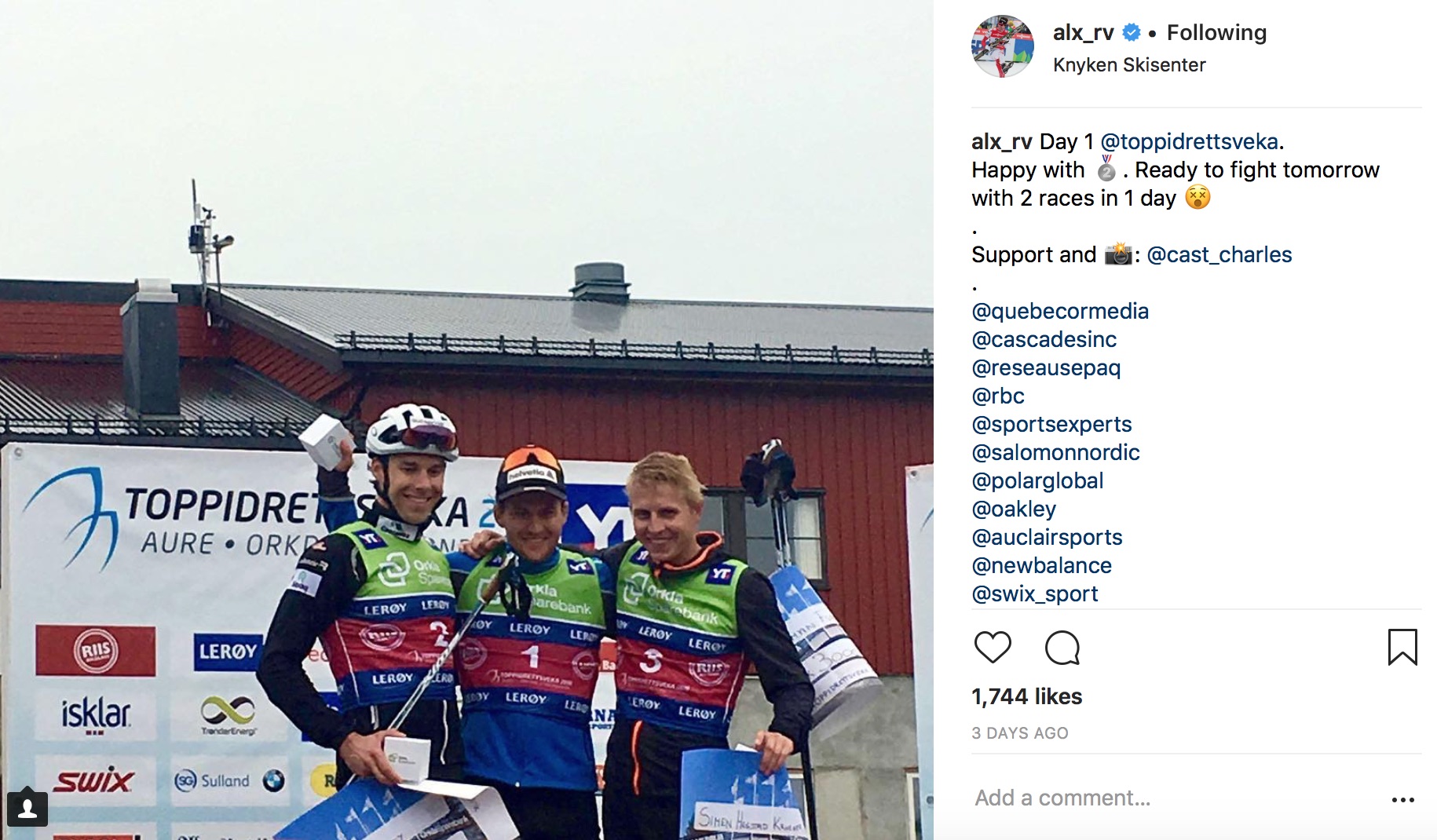
    Alex Harvey (l) on the podium with Roman Furger (c) and Simen Hegstad Krüger (r) at the 2018 Toppidrettsveka rollerski festival in Norway last Thursday, Aug. 16. (Photo: Alex Harvey/Instagram)

    At the Toppidrettsveka rollerski festival in Norway, Canada’s Alex Harvey raced to second in the 15 k skiathlon last Thursday in Orkdal, missing out on first by just 0.6 seconds to Switzerland’s Roman Furger, who won in 30:43.3. Norway’s Simen Hegstad Krüger, the reigning Olympic skiathlon champion, finished third, 1.5 seconds back. In a stacked international field of 125 men, Canada’s Evan Palmer-Charrette placed 75th in that race (+2:14.4), Bob Thompson was 84th (+2:32.7), and Scott Hill 89th (+2:52.5).

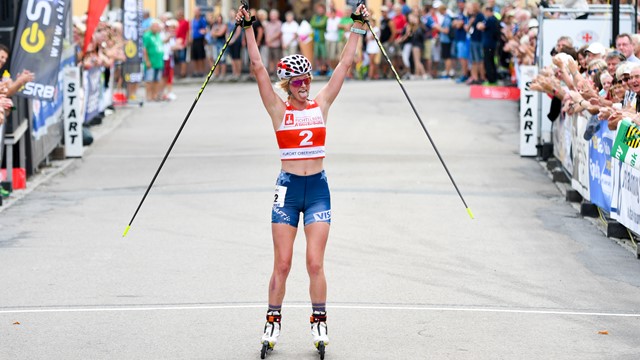
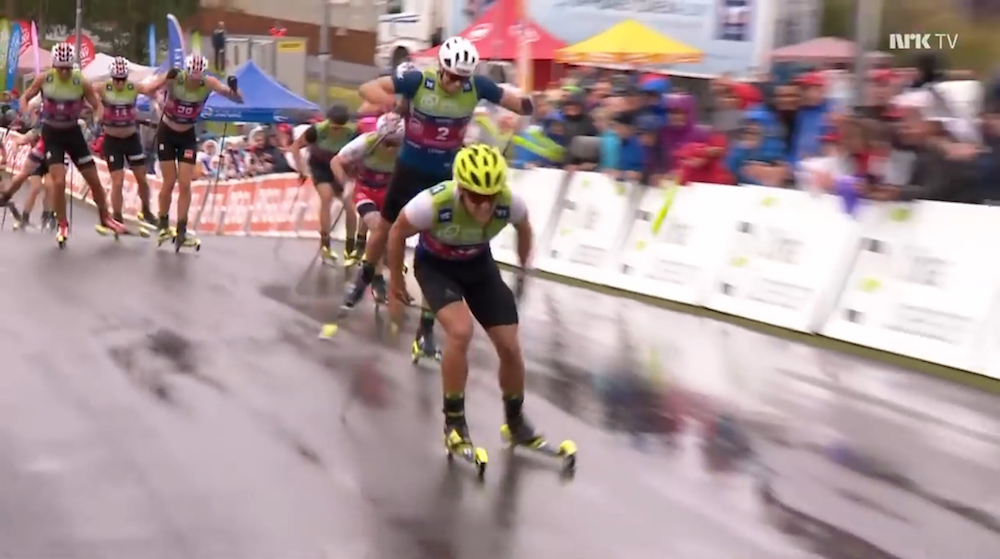
    Canada’s Alex Harvey (2) gunning for first in the men’s 15 k skiathlon on Aug. 16 at the Toppidrettsveka rollerski festival in Orkdal, Norway. (Screenshot: NRK broadcast)

    Heidi Weng beat her cousin Tiril Udnes Weng by 0.7 seconds in the women’s 10 k skiathlon that day, finishing in 22:52.1. Norway swept the top five of the women’s race, with Anne Kjersti Kalvå reaching the podium in third (+1.3), and national-team members Kathrine Harsem and Astrid Uhrenholdt Jacobsen placing fourth (+1.4) and fifth (+1.5), respectively, out of 43 women.

    In the men’s 24 k classic mass start around Aure/Brekka on Friday, Harvey finished fifth, 19 seconds after Krüger, who won in 59:57.5. Norway’s Hans Christer Holund placed second in that race (+2.6), Norway’s Magnus Stensås was third (+13.0), and Switzerland’s Dario Cologna fourth (+17.1). Also for Canada, Palmer-Charrette finished 61sth (+2:30.9), Hill 78th (+4:02.3), Thompson 86th (+5:40.3), and Maks Zechel 88th (+7:01.4) out of 125.

    Heidi Weng repeated in first in the women’s 24 k mass start, finishing in 1:10:02.4 hours, while Tiril Udnes Weng again placed second, 25.4 seconds back, and Jacobsen reached the podium in third (+27.7).

    Later on Friday in Aure, Norway’s Sondre Turvoll Fossli topped the men’s freestyle sprint final ahead of four other Norwegians, including Pål Trøan Aune in second and Jan Thomas Jenssen in third, and Switzerland’s Furger in fifth, while Harvey did not qualify for the heats and ended up 37th overall. Palmer-Charrette was once again 61st in qualification, Hill 107th and Thompson 109th out of 121.

    In the women’s sprint, Norway’s Mathilde Myhrvold won the final in 2:56.54, 1.05 seconds ahead of Slovenia’s Katja Visnar in second. Heidi Weng placed third in the final (+1.97), ahead of Tiril Weng (+2.64) in fourth, another Norwegian Anna Svendsen in fifth (+2.76), and another Slovenian Alenka Cebasek in sixth (+3.73). 

    In the final race of the series, the classic pursuit on Saturday, Harvey started second, 10 seconds behind Furger in first. The Canadian went on to place 10th, 4.2 seconds out of first, in the 15 k race, while Stensås took the win in 37:45.5 after starting seventh. (Furger slipped to 55th and 1:55.5 behind at the finish.) Norway’s Mikael Gunnulfsen rose from eighth to second (+0.7) and France’s Jean-Marc Gaillard made it all the way up to third (+1.7) after starting 15th. 

    Palmer-Charrette finished the pursuit in 59th (+2:04.2), Thompson placed 80th (+2:55.2), Hill 87th (+3:41.5), and Zechel 93rd (+3:48.9) out of 105. 

    Jacobsen ended the weekend as the women’s 12 k mass start winner, after the entire women’s field (of 33) started at the same time. She crossed the line first in 34:20.8, 0.4 seconds ahead of Heidi Weng in second and 1.2 seconds ahead of Kalvaa in third. 

    Results:

    Men’s skiathlon | Women’s skiathlon

    Men’s mass start | Women’s mass start

    Men’s sprint | Women’s sprint

    Men’s pursuit | Women’s mass start

  • 2018/2019 U.S. Nordic Combined Nominations

    2018/2019 U.S. Nordic Combined Nominations

    Also on Thursday, USA Nordic Sport, the organization behind U.S. nordic combined and ski jumping, announced its nominations for all of its 2018/2019 national teams.

    Tara Geraghty-Moats at 2018 U.S. Olympic trials (Photo: Tara Geraghty-Moats/Instagram)

    The nordic-combined team includes six men and for the first time, a woman, with Tara Geraghty-Moats on the 2018 Women’s Nordic Combined National “C” Team. (Geraghty-Moats is also a member of USA Nordic’s Women’s Ski Jumping “C” Team.)

    On the men’s Nordic Combined National Team, 2018 Olympian and Junior World Championships bronze medalist Ben Loomis stands as the lone A-team member following Bryan Fletcher’s retirement. The B-team includes team veteran Taylor Fletcher, Jasper Good and Stephen Schumann, while Grant Andrews and Jared Shumate were nominated to the C-team.

    “We are excited about our continued expansion of our teams and with the exciting development of Women’s Nordic Combined including confirmation of the event in the 2021 World Championships!” USA Nordic Executive Director Bill Demong said in the press release. “Tara Geraughty-Moats continues to be one of our top talents in the sport and, though she was unable to compete in any Nordic Combined competitions last year due to injury, USA Nordic recognizes the importance of growing our sports and developing athletes who have the ability to push the envelope and we are excited to lead growth and opportunity in this new discipline of Womens Nordic Combined.”

    USA Nordic 2018/2019 Men’s Nordic Combined National Team

    (Name, age, hometown)

    A-team

    Ben Loomis, 19 (Eau Claire, WI)

    B-team

    Taylor Fletcher, 28 (Steamboat Springs, CO)

    Jasper Good, 22 (Steamboat Springs, CO)

    Stephen Schumann, 18 (Park City, UT)

    C-team

    Grant Andrews, 20 (Steamboat Springs, CO)

    Jared Shumate, 18 (Park City, UT)

    Women’s Nordic Combined National Team

    C-team

    Tara Geraghty-Moats (West Fairlee, VT)

  • FasterSkier’s Nordic Combined Skier of the Year: Bryan Fletcher

    FasterSkier’s Nordic Combined Skier of the Year: Bryan Fletcher

    Bryan Fletcher (U.S. Nordic Combined) is FasterSkier’s 2018 Nordic Combined Skier of the Year. (Photo: US Ski Team)

    With the 2017/2018 season officially in the rearview, FasterSkier is excited to unveil its annual award winners for this past winter. Votes stem from the FS staff, scattered across the U.S., Canada, and Europe, and while not scientific, they are intended to reflect a broader sense of the season in review. This set of honors goes to outstanding North American nordic combined athletes.

    Previous categories: Junior Skiers of the Year | Collegiate Skiers of the Year | Biathletes of the Year| Para-Nordic Skiers of the Year

    ***

    At 31 years old, it’s safe to say U.S. Nordic Combined’s Bryan Fletcher has been a beneficiary of the axiom, “What comes around goes around”. What came around when Fletcher literally jumped and skied onto the scene in 2002 was a cadre of athletes setting the performance bar at a high level. Fletcher followed in the steps of Todd Lodwick, Johnny Spillane, Brett Camerota, and Billy Demong. In his last season as a professional nordic-combined competitor, Fletcher had several standout performances but also allowed himself to bring some of the stability and veteran leadership he learned about years ago to a young U.S. Nordic Combined Team.

    Fletcher was a rock for skiers like 19-year-old Ben Loomis, who earned a bronze at World Juniors. Loomis is one example, but the U.S. team as a whole, trends towards the younger side of twenty. With younger eyes on him as a mentor and athlete, Fletcher navigated performance disappointments and hiccups to score some standout performances on the Nordic Combined World Cup.

    Bryan Fletcher (USA Nordic) jumping to 45th in the Nordic Combined World Cup on Dec. 17 in Ramsau, Austria. In the 10 k that followed, he skied the third-fastest time to finish 14th overall. (Photo: Romina Eggert/USA Nordic Facebook)

    Fletcher entered 12 World Cups, 10 of which were individual races. In only one individual race did he place outside the top 30 (he finished 32nd on Dec. 1 in Val di Fiemme, Italy). Of his remaining individual races, Fletcher was out of the top 20 just one other time (placing 29th on Nov. 26 at the season-opener in Kuusamo, Finland).

    Fletcher’s other eight races were all top 20’s. In Ramsau, Austria, he scored a seventh place. And in his last career World Cup on March 14 in Trondheim, Norway, Fletcher matched his season-best result with another seventh place.

    One can hear any athlete say these weren’t exactly the results they were looking for. That would be true in Fletcher’s case as well. Yet he was more than consistent in terms of keeping himself within striking distance of several podiums. Those opportunities came most often from Fletcher’s skiing rather than his jumping. At season’s end, he was the 42nd-ranked overall jumper on the Nordic Combined World Cup. To prove our point, he was ranked the 15th-best skier. (Overall, he ranked 29th on the World Cup this season.)

    Here are Fletcher’s best cross-country race times (in the 10-kilometer Gundersen starts) of the 2017-2018 World Cup season:

    Nov. 25, Kuusamo, Finland: Fourth fastest time of day

    Dec. 16, Ramsau, Austria: Second fastest time of day

    Dec. 17, Ramsau: Third fastest time of day

    Jan. 14, Val di Fiemme, Italy: Second fastest time of day

    From a domestic perspective, Fletcher proved he’s still the best U.S. nordic combined athlete. During a high-pressure format — the only guaranteed U.S. Nordic Combined Olympic spot was reserved for the winner of U.S. Nordic Combined’s Olympic Trials on Dec. 30 in Park City, Utah — Fletcher found himself in fifth place after the jumping round. A full 1:24 minutes behind the best jumper Ben Loomis. Yet in typical fashion, Fletcher’s podium hunt on skis ended with a first place and a booked trip to PyeongChang for his second Olympic Games. 

    In both individual events in PyeongChang, Fletcher was the best American finisher, placing 17th twice.

    For being the best-performing American nordic combined skier, Fletcher receives the nod for Nordic Combined skier of the year. But don’t forget, Fletcher is the whole package: in the 2017/2018 season, he was a leader, professional role model, and mentor to the young ones chasing his ski tails.

  • Under 23 Questions: Stephen Schumann

    Under 23 Questions: Stephen Schumann

    Stephen Schumann (U.S. Nordic Combined) jumping in Oberstdorf, Germany, in September 2016. (Photo: Romina Eggert)

    In an effort to showcase the North Americans competing at this week’s 2018 Nordic Combined Junior World Championships in Kandersteg, Switzerland, we asked those qualifying athletes several questions about themselves — actually, we had them fill in the blanks. Here we have 17-year-old Stephen Schumann, of the U.S. Nordic Combined Team, who represented the U.S. at his third Junior Worlds. 

    This week in Kandersteg, Schumann placed 13th and 18th in two individual competitions and seventh in the team event. 

    ***

    “My full name is Stephen Schumann, but you can call me Skunk.

    I was born and raised in Park City, Utah, and I learned to ski at Park City Ski and Snowboard.

    Stephen Schumann (U.S. Nordic Combined) racing at a World Cup last season in Oslo, Norway. (Photo: Sandra Volk)

    I spent the time between U.S. Olympic team trials in Park City and Junior Worlds in Europe competing in Continental Cup and World Cup races.

    The hardest workout I did in the last training year to prepare for this was 10×8 minute intervals with my whole team.

    This is my second time in Switzerland and 11th time racing internationally, and so far it’s been awesome with a very high level of competition.

    One difference I’ve noticed between Switzerland and the U.S. is that it is different.

    Skiing and racing in the Alps is pretty cool because of the overall scenery. Usually racing at altitude is very helpful for me because I grew up at high elevation in Utah. There are mountains around where I live.

    One of the things I’m most excited about for Junior Worlds in Kandersteg is eating Swiss food.

    One race I’m especially targeting there is the 10 k individual.

    I really hope I can chat/make friends with someone from the Swedish women’s cross country team and ask them for Stina’s Snapchat. Too bad they are all in Goms.

    My favorite thing at the breakfast where we are staying is the coffee.

    Fondue is melted cheese. The cheese here is not melted fondue. And the chocolate is not made of cheese.

    If I had a totally free day here and didn’t have to worry about race fitness or training, I’d wake up eat drink some coffee play some 2K, go to the top of a mountain, eat some lunch, take a shower, then eat some dinner and sleep.

    The best way to follow me on social media is on Instagram @stephen_schumann.”

  • Under 23 Questions: Jared Shumate

    Under 23 Questions: Jared Shumate

    Jared Shumate (Park City Nordic Ski Club) getting some air at 2018 U.S. Nordic Combined Olympic Team Trials in late December at Utah Olympic Park in Park City, Utah. (Photo: U.S. Ski & Snowboard)

    In an effort to showcase the North Americans competing at this week’s International Ski Federation (FIS) 2018 Nordic Combined Junior World Championships in Kandersteg, Switzerland, we asked those qualifying athletes several questions about themselves — actually, we had them fill in the blanks. Here we have 18-year-old Jared Shumate, of the Park City Nordic Ski Club, who’s representing the U.S. at his second Junior Worlds.

    On Thursday, Shumate anchored the U.S. to seventh place in the normal hill/4 x 5 k team event. He previously placed 35th in the individual normal hill/10 k on Tuesday for an individual career best at Junior Worlds.

    ***

    “My full name is Jared Shumate, but you can call me tonight.

    I was born in Atlanta, Georgia, and raised in Park City, Utah, and I learned to ski at Deer Valley Resort.

    I spent the time between U.S. Olympic team trials in Park City and Junior Worlds in Park City mentally preparing myself to get my ass kicked over here in Europe.

    The most tiring workout I did in the last training year to prepare for this was a 4-hour trail run up and down a mountain with lots of boys who ran it way faster than me.

    Jared Shumate (Park City Nordic Ski Club) after finishing a race at the Nordic Combined Continental Cup in Steamboat Springs, Colorado. (Photo: Ben Piepe)

    This is my second time in Switzerland and ninth time racing internationally, and so far it’s been pretty good some days and really bad on others, but I’ve had a blast!

    One difference I’ve noticed between Switzerland and the U.S. is the flags with the crosses on them are not for ski patrol.

    Skiing and racing in the Alps is one of my favorites. Usually racing at altitude is better for me because I’ve lived at over 7,000 feet pretty much my entire life. There are lots of easy-to-climb mountains around where I live.

    One of the things I’m most excited about for Junior Worlds in Kandersteg is the fondue for breakfast, lunch and dinner.

    One race I’m especially targeting there is the 10 k individual nordic combined race.

    I really hope I can chat/make friends with someone from Sweden and ask them if every girl in their country is as beautiful as Stina Nilsson.

    My favorite thing at the breakfast where we are staying is TBD (we’re not in Switzerland yet).

    Fondue is a lot smellier than you think it should be. The cheese here comes in really big blocks. And the chocolate is going to make me overweight.

    If I had a totally free day here and didn’t have to worry about race fitness or training, I’d spend it on a gondola ride with Lara Gut.

    The best way to follow me on social media is on Instagram @jared_shumate.”

  • Under 23 Questions: Ben Loomis

    Under 23 Questions: Ben Loomis

    Ben Loomis (USA Nordic) jumping to 20th in a Continental Cup on Jan. 5 in Klingenthal, Germany. He went on to finish 19th in the 5 k that followed. (Photo: Romina Eggert)

    In an effort to showcase the North Americans competing at next week’s International Ski Federation (FIS) 2018 Nordic Combined Junior World Championships in Kandersteg, Switzerland, we asked those qualifying athletes several questions about themselves — actually, we had them fill in the blanks. Here we have 19-year-old Ben Loomis, of USA Nordic, who’s representing the U.S. at his fourth Junior Worlds.

    Loomis is also headed to his first Olympics in PyeongChang, South Korea, but plans to attend and compete at Junior Worlds “in full force,” Loomis wrote in an email. After his last competition in Kandersteg on Feb. 3, he’ll fly to South Korea on Feb. 6.

    ***

    “My full name is Ben Loomis, but you can call me Sawyer if you know me well.

    I was born and raised in Eau Claire, Wisconsin, and I learned to ski at the Flying Eagles Ski Club. The club or team I currently train with is the US Nordic Combined team in Park City.

    Ben Loomis (USA Nordic) during a training session Dec. 29 in preparation for the U.S. Olympic Trials at the Utah Olympic Park. (Photo: Team USA/Getty Images)

    I spent the time between U.S. Olympic team trials in Park City and Junior Worlds competing in Germany, Italy, and France.

    The hardest workout I did in the last training year to prepare for this was getting my ASS kicked in boot camp by the University of Utah ROTC with the rest of the USA Nordic Team.

    This is my second time in Switzerland and 15th time (I think) racing internationally, and so far it’s been Uber Gucci.

    One difference I’ve noticed between Switzerland and the U.S. is the cows in Switzerland are way louder and Swiss cheese tastes better.

    Skiing and racing in the Alps is amazing. Usually racing at altitude is too slow for me because it’s not my forte, even though there are many mountains around where I live.

    One of the things I’m most excited about for Junior Worlds in Kandersteg is competing on a new hill.

    One race I’m especially targeting there is the women’s nordic combined test event.

    I really hope I can chat with someone from my team and ask them how they slept.

    My favorite thing at the breakfast where we are staying is the black coffee.

    Fondue is DANK. The cheese here is mega DANK. And the chocolate is expensive.

    If I had a totally free day here and didn’t have to worry about race fitness or training, I’d spend it swimming in Lake Geneva.

    The best way to follow me on social media is on Instablam @LenBoomis. “

  • Nordic Nation: Sealing the Olympic Deal with Bryan Fletcher

    Nordic Nation: Sealing the Olympic Deal with Bryan Fletcher

    In this episode of Nordic Nation, we discuss the recent U.S. Nordic Combined Olympic Trials, which were held Dec. 30 in Park City, Utah, with U.S. NoCo’s leading man, Bryan Fletcher. Nerves, pressure, the flying and skiing — those all played a role on Fletcher’s day at Olympic trials. After the jumping portion of the competition, things weren’t so certain for the eventual winner, as Fletcher began the 10-kilometer ski race nearly a minute and a half behind the first starter, Ben Loomis. We connected with Fletcher, a 31-year-old dad, from his home in Heber, Utah, last week on Jan. 3 as he reflected on sealing the Olympic deal.

    Fletcher also discusses the prospects of U.S. Nordic Combined fielding a team of four skiers at the upcoming Olympics in PyeongChang, South Korea. For now, the U.S. is guaranteed two spots. And as Fletcher explains, hope remains for two more athlete spots to open up.

    Trials results: Jumping | Final results

    Note: Since Fletcher’s interview, he and his brother Taylor competed at the first Nordic Combined World Cup of the new year, which took place on Friday, Jan. 12 in Val di Fiemme, Italy. There, Bryan finished 32nd (up from 39th in the jump) and Taylor placed 43rd (up from 49th). Full results here

    (To subscribe to the Nordic Nation podcast channel, download the iTunes app. If you have iTunes, subscribe to Nordic Nation here.)