From the FasterSkier archive — posts syndicated from athletes’ and coaches’ own blogs between 2004 and 2012, kept online as published. Current coverage is at fasterskier.com.
A few disclaimers first. Metrics suggest people want quick reads and quick-view content. The above video is neither. Yet it is full of ideas for Olympic sport.
On May 22, the Aspen Institute hosted a forum titled the Future of the U.S. Olympic Movement: Reimagining Goals Beyond Medals.
It consisted of a two-part discussion captured in this long-form embedded video from the Aspen Institute’s Sports & Society Program. The first part of the video features an interview with the U.S. Olympic Committee’s CEO Sarah Hirshland. Tom Farrey, the Executive Director of the Sports & Society Program, conducts the interview. Farrey was recently featured in the HBO Real Sports segment titled The Norwegian Way.
The second part of the video, which begins at 1:19:00, features a panel discussion with the following individuals:
Han Xiao chair of USOC Athletes’ Advisory Council, former table tennis player
Max Cobb, National Governing Bodies Council chair, U.S. Biathlon CEO
Cindy Boren, Washington Post sports reporter
FasterSkier readers may notice Max Cobb’s name — it has become synonymous with biathlon in the U.S.
Sport NGBs and clubs are under greater pressure to implement and enforce SafeSport code since the sexual abuse revelations in sports like gymnastics and swimming came to light. The panel discussion speaks to the need for change and the need to protect athletes from other non-sexual transgressions that adversely impact athletes. Panel members do discuss initiatives to bring about that change.
The panel also explores the need to ensure the mental health needs of elite athletes long after the Olympic glow fades, and how to build youth sports systems with the whole child in mind.
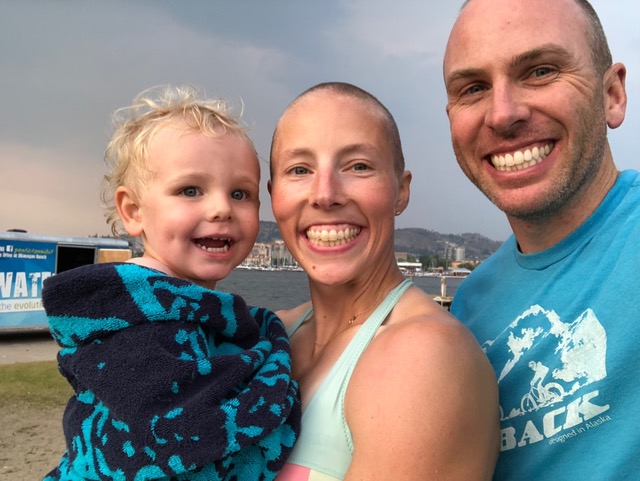
Kikkan Randall (c) with her son, Breck, and husband, Jeff Ellis, in Penticton, British Columbia. (Courtesy photo)
Day by day. That’s how Kikkan Randall is approaching her battle with breast cancer after being diagnosed about three months ago. Now more than 50 days into her treatment — with six rounds of chemotherapy over an 18-week span — Randall, 35, is becoming more familiar with the ugly side effects and adjusting to her new normal.
While beating what is believed to be Stage 2 cancer remains the Olympic gold medalist’s biggest challenge yet, it’s not dampening her spirits — even on the extremely rough days, of which there have been many.
After Round 2 of chemo, Randall returned to her family in their new home of Penticton, British Columbia, where she quickly came down with a nasty cold. That cold required a visit to a local clinic and antibiotics, and Randall now wears a mask on airplanes to fend off germs while flying to and from her cancer treatments in Anchorage, Alaska.
“Getting the head cold on top of going through the worst days of the chemo cycle has definitely been one of the most uncomfortable weeks of my life,” Randall explained in an email to FasterSkier. “It’s mostly because I have no control and I have no idea how well my immune system can clear the cold. Normally I would be optimistic that it would just be a tough couple of days but now I just have to wait and wait.”
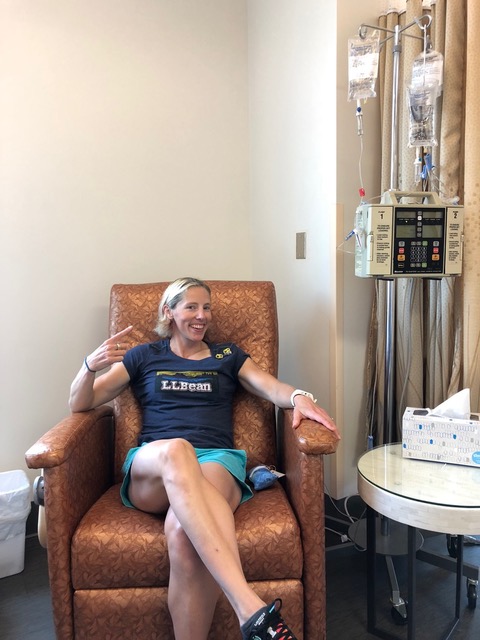
Kikkan Randall during her first chemotherapy infusion at the Providence Alaska Medical Center on July 9 in Anchorage. (Courtesy photo)
She eventually kicked the cold and got her voice back, just in time for Round 3 of chemo on Aug. 22. After what she called a “quick 36-hour trip to Anchorage,” she was back in Penticton on Aug. 23. So far, Randall explained on her daily video blogs that her current three-week round is going better than the previous two.
“Just getting used to my haircut … got a nice little fuzz growing on top,” she said in her Day 51 video posted last Wednesday, just over a month after she shaved her head for the first time.
“Definitely giving me a greater appreciation for all the guys out there and gals that deal with this,” she continued with a smile. “But I have to say it is pretty low maintenance so I guess I should just embrace it.”
Two weeks after receiving her first chemo infusion in July, Randall noticed she was losing her hair in clumps. She promptly went wig shopping with friends and scheduled an appointment with her hairdresser in Anchorage to get ahead of the hair loss.
Randall spoke with FasterSkier on the phone from Anchorage on July 26, the day after she initially asked her hairdresser to shave it all off.
“I sat in the chair and she said, ‘Are you ready?’ and I said, ‘Let’s do it,’ ” Randall recalled. “Three minutes later, I had a buzz cut, and I think I actually handled it better than I thought I would. It was kind of interesting to watch it, to feel it, and to be like, OK, now we’ve got that taken care of. Now we can move onto the next step.”
The next step and every passing day has proved to be an unknown. Oncologists never know exactly how a patient will react to treatment, as “everybody seems to react differently,” Randall explained.
“But in a lot of cases what you experience the first round is what you will generally feel like over the next subsequent rounds,” she continued. “Some of it will be a little bit cumulative, like the fatigue I’m sure will add up a little bit, but I also really think that staying active through this as much as I can will really help. I’ve noticed already that even on days where I don’t feel very good, if I get out and do something, it at least keeps my mind off of how bad I feel and I think it helps me process everything better, both physically and mentally.”
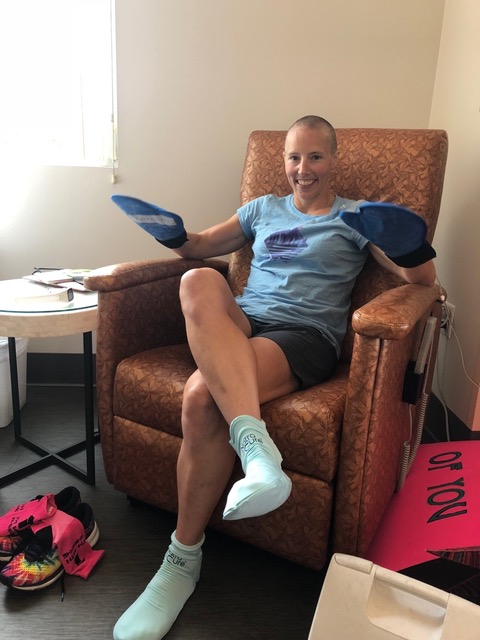
Kikkan Randall wearing ice mittens and socks to prevent neuropathy during a chemo infusion at the Providence Alaska Medical Center in Anchorage. (Courtesy photo)
As she approaches the halfway point of her chemo treatment — the first proactive step to eradicate the cancer (which was initially found in her breast and one lymph node), Randall has continued to make an effort to get outside and moving every day. Some days, that’s as much as a run with former training buddies or even intervals, and other days, it’s about playing with her 2-year-old son, Breck.
Ever since announcing her diagnosis on social media, Randall has been promoting AKTIV Against Cancer, a Norwegian nonprofit that she became involved with six or seven years ago without having any direct ties to cancer. According to Randall, the organization funds research on how physical activity can affect cancer treatment and creates supportive environments for patients to work out together, both in and out of the hospital.
“It falls along with what I believe is that physical activity is pretty much good for everything, so I was happy to support them as an athlete, but now that I actually have cancer myself, I have a little deeper connection,” she said. “I’ve committed personally to staying as active as I can through this, but I think in partnering with them, we can share the message on a bigger platform, and I’m looking forward to learning more about the research that they’ve done and also to continue to fundraise and promote awareness for getting other hospitals to have these places and rooms and programs that encourage cancer patients to be active.”
“I’ve committed personally to staying as active as I can through this…” — Kikkan Randall, on her cancer diagnosis
Randall continues to ride her bike to and from the Providence Alaska Medical Center in Anchorage. During a recent layover, she worked out in a Vancouver gym. And early in the treatment, she asked if she could use a stationary bike or treadmill during the several-hour-long infusions. While her oncologist and nurses ultimately encouraged her not to (“the nurses felt it would be hard to keep an eye on me for any reactions I might have to the medication”), the bottom line is: Randall is still plugging away at a rate that would put most people to shame.
After her last round of chemo in mid November, she’s hoping tests will reveal that her tumor has shrunk or disappeared altogether. That would make surgery “more straightforward”, she explained, yet she’ll still have to decide which type of surgery to undergo. Her options range from a lumpectomy (removal of the tumor and some surrounding tissue) to a unilateral or bilateral mastectomy (removal of one or both breasts).
“If you do the double [mastectomy], the idea is you’re taking out the most breast tissue as possible, which is where a second breast cancer would most likely come back so it gives you a slightly better piece of mind,” Randall explained. “You don’t have to be screened quite as much after the fact because there isn’t breast tissue for it to come back to, and then from there, you can decide whether you go the double route and wear prosthetics or whether you go a reconstruction route … so there’s a lot to consider between now and then between what I want to do for maintaining the lifestyle and all the activities I want to do.”
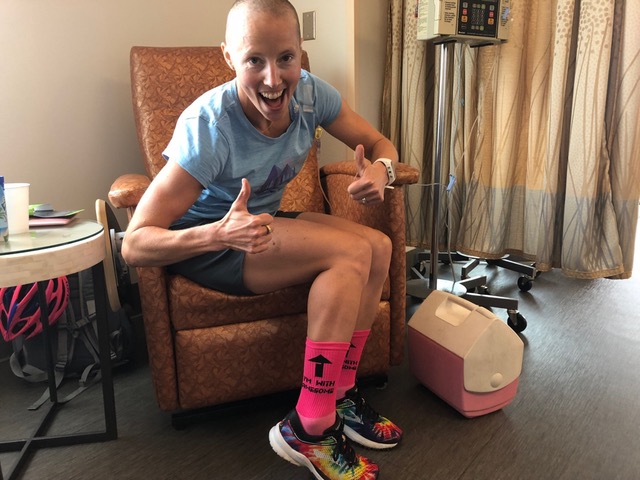
Kikkan Randall staying positive with pink socks and rainbow shoes during her second round of chemotherapy on July 31 at the Providence Alaska Medical Center in Anchorage. (Courtesy photo)
Through all of this, she’s learned that her tumor responds to estrogen, progesterone and HER2 (human epidermal growth factor receptor 2)/neu protein, and is initially being treated with two chemo drugs to specifically target the HER2/neu. That should help stop the growth of the tumor, and after chemo, Randall will start taking anti-estrogen and anti-progesterone meds.
Leading up to all of this, she and her husband had been hoping to expand their family.
“We were just starting to try for kid number two and definitely excited to have more kids so finding out about this thing, the diagnosis, and then knowing I needed to start chemo pretty soon, we didn’t have much of a window to work with,” she explained of her diagnosis in early June.
Later that month, before starting chemo in July, she sought fertility treatment in Seattle. There, Randall received a round of injections to stimulate egg production in her ovaries. That produced one embryo, which is being preserved in case the cancer treatment makes pregnancy difficult later on.
“There’s no guarantee that the chemo will knock out my natural fertility, but it’s nice to know that there’s at least a small chance for the future,” Randall said. “It’s going to be challenging because the type of breast cancer that I have, I will have to be on some anti-estrogen and anti-hormone treatment for probably five to ten years even after the chemo and everything is done, so that’s going to be a little bit tricky to figure out a pregnancy in there, but at least we kind of have a backup plan.”
While Randall repeats her multiple-leg commute between Penticton and Anchorage (a 1- to 1.5-hour drive from Penticton to Kelowna, B.C., followed by a two-stop, roughly 4.5-hour flight to Anchorage) every three weeks, she’s also staying involved in several work engagements, including with Fast and Female and as a new board member of the National Nordic Foundation.
“Everyone’s been so supportive, like the IOC, the USOC [U.S. Olympic Committee], they’ve been telling me to take as much time to make my health the number-one concern, and the same with Fast and Female, we wanted to get some stuff going this summer and fall and we’ve just had to postpone it a little bit,” she said in July. “The door’s open if I have the energy to work on some of that stuff, but if I can’t, I have the time to just focus on recovery. … And then the period after surgery is kind of up in the air in terms of what I’ll be able to do. I’m just trying to be creative; I’m hoping to be able to do stuff, maybe not as much in person but maybe I can contribute to things, whether it’s writing or interviews or projects. I’m just going to ride it out and see where it goes.”
Back in Penticton, her husband, Jeff Ellis, has been “doing the single dad thing”, as Randall put it, while she’s away for treatment. As she retired from racing this spring, Ellis transitioned from his marketing job with the International Ski Federation to sales and marketing with Swagman bike racks. He initially took some time off from Swagman when Randall was first diagnosed before deciding to leave his job and be home full time.
“Ultimately when Jeff said, ‘Hey, this has put things into perspective for us. I need to be home to help Kikkan out,’ they were definitely very understanding of that,” Randall said of Swagman.
Ellis recently started his own business as an independent marketing contractor, called the Jeffrey MW Ellis Group.
“He’s actually helping me with the ‘Kikkan Brand’ while I’m going through treatment and he’s picked up a few more small clients as well,” Randall explained.
Asked why she went public with the diagnosis in early July and what’s driven her daily video updates every day since, Randall said she never could have kept it private.
“I’m not very good at faking things, so I knew once I showed up in Anchorage when I wasn’t supposed to be here, people would start to ask questions and wonder what was going on and I was going to have to start bowing out of things,” she said. “I also felt like, especially Anchorage, especially Alaska, but really just so many people have supported me through my career and they really care what’s going on. So I kind of felt like they’d want to know what was going on with me. It’s always good to celebrate the good things, but I think it’s also important to share the really human moments, and I thought it was really good to show that you could be an Olympic gold medalist and four months later find out you have breast cancer.
“I think it’s important for a lot of people out there that are battling through this, it makes them feel like, this happens to all of us,” she continued. “I learned 10 years ago when I shared my story about blood clots that it helped people. … I kind of felt like, if me going through this can have a positive impact by sharing my story, then I’m happy to do so. I don’t feel like there’s anything I need to hide; I’m willing to share this.”
“It’s always good to celebrate the good things, but I think it’s also important to share the really human moments. … You could be an Olympic gold medalist and four months later find out you have breast cancer.”
One of Randall’s sponsors started a GoFundMe online fundraiser to help with some of her out-of-pocket medical and travel costs, and in a little over a month, it had generated more than $37,000 dollars toward a $45,000 goal. According to the site, any funds that exceed the associated expenses of Randall and her family will be donated to AKTIV Against Cancer.
“It’s been amazing,” Randall said of the community support in light of her diagnosis. “I got to come back after winning the gold medal, and of course I feel like our profile was higher than it had ever been — people were so excited and wishing me congratulations everywhere I went, but this has blown that out of the water. So many people have reached out, whether it’s over social media or messages through my website or cards arriving in the mail, people stopping me in the grocery store, they’re sharing their stories. Breast cancer’s way bigger of a deal than I ever appreciated.
“My traditional income as a ski racer was coming to an end anyway and I was going to be relying on being able to travel and do speaking engagements and things like that for some projects over the next year, and I won’t be able to do that now,” she said of the fundraiser. “It’s hard to put into words, but I just feel so supported. I’ve been reading through all those messages on the tough days and then trying to reach out to as many people as I can to say thanks.
“It’s unfortunate that it takes a situation like this to be able to appreciate the amount of people that do support me in that way,” Randall added. “But like I said, I’m blown away, I’m so grateful for it and it’s definitely going to help me through this.”
Sadie Bjornsen (U.S. Ski Team) during the classic leg of the women’s Olympic 15 k skiathlon at the 2014 Winter Olympics in Sochi, Russia. She placed 31st in her Olympic debut.
If you read FasterSkier, two aspects of our coverage generates the most reader comments: doping violations and their adjudication, and team-selection criteria. Although here we are, two days away from the PyeongChang Olympics’ Opening Ceremony with Sochi doping still plaguing the news, as the title suggest, this piece is about team selection.
On Jan. 26, U.S. Ski & Snowboard revealed its 2018 U.S. Olympic Team — a list 20 skiers deep comprised of nine men and 11 women. The U.S. Ski & Snowboard press release announcing those selections used this statement to describe the roster: “The team includes 20 athletes who qualified for the team through World Cup results as well as domestic racing results at the L.L.Bean U.S. Cross Country Championship.”
The buzz following Olympic team selection followed two major threads, one focused on team size, the other on the selection of non-U.S. Ski Team (USST) women sprinters.
In considering why team size remains a concern, let’s zip back to 2014 when the USST was allocated a quota of 17 athletes for Sochi. The team that headed to Russia was 14-athletes deep; seven men and seven women. The remaining three U.S. spots were were reallocated to other nations. At the time, U.S. Ski Team Head Coach told FasterSkier that the small team was by design.
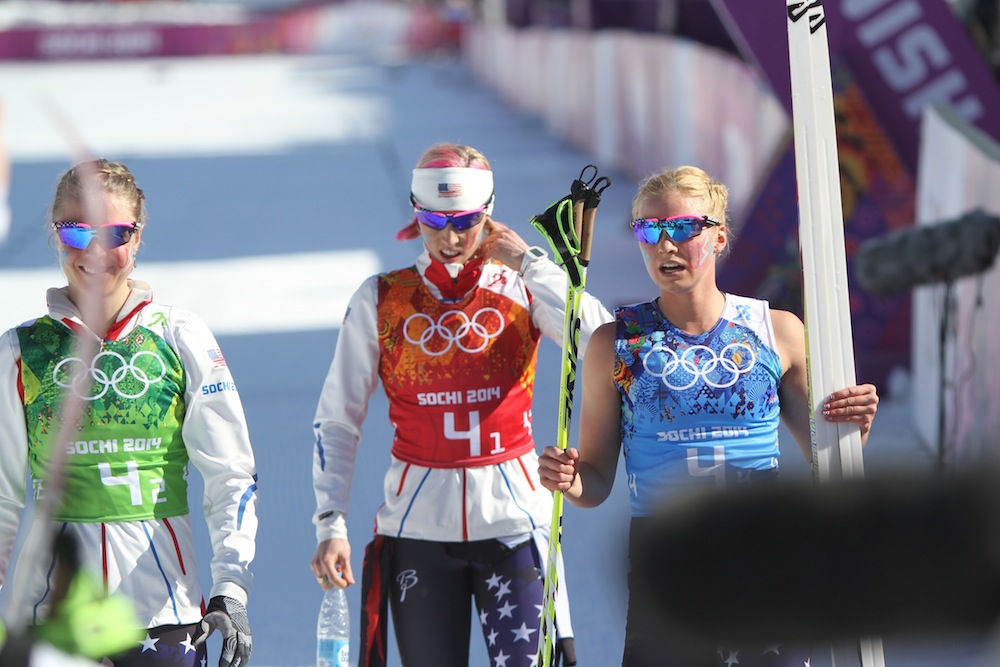
U.S. teammates Sadie Bjornsen (l), Kikkan Randall (c) and Jessie Diggins at the finish of the women’s 2014 Sochi Olympic relay, in which they placed ninth with Liz Stephen.
“With seven women and seven men, we have our start positions filled,” Grover said in 2014. “Seven and seven was the magic number for us.”
One line of reasoning is that a smaller team is more easily managed and the potential for medals are higher.
An Olympic cycle later, the current iteration of the U.S. Cross-Country Olympic team is six skiers larger. That’s partly a function of the depth of the U.S. women’s team on the World Cup and partly a function of how the Olympic selection criteria was interpreted during the team nomination process.
In explaining how the team was named, U.S. Ski & Snowboard Chief of Sport Luke Bodensteiner said that U.S. Ski & Snowboard (formerly USSA) was not mandated to use all of its quota spots for the 2018 Olympics.
“That is a decision we made,” Bodensteiner said on the phone. “We received, across all of sports at U.S. Ski & Snowboard, 110 quota spots, and we accepted all 110. However, we have 109 athletes; one athlete is participating in two different disciplines.”
Bodensteiner clarified that the uneven split of nine men and 11 women on the cross-country team was a result of the women’s depth both domestically and on the World Cup. He explained that the selection criteria does not specify how the spots are distributed between men and women.
“It is really based on results achieved on World Cup ranking and then the Olympic selection list points,” Bodensteiner said. “As it worked out, more women scored more points, actually scored more rankings in the World Cup than the men, and then more selection points than the men on the women’s side. So we just applied down the sort of next-best points in most cases, and that is why [we] have two more women than men and that is just a function of the women scoring more substantial points in the tryout events.”
Practically speaking, a larger team means more variables to manage but clear upsides for the broader cross-country community.
“Filling quotas presents clear positive possibilities and also some challenges to both mitigate and maximize…,” Bodensteiner said. “We try to take everything into account like utilizing start positions in the Olympics and how large a team quota we get. There are challenges for a bigger team, in particular, when you exceed the start possibilities. In cross-country, we have a number of athletes that probably won’t compete. That creates challenges like issues with health, waxing skis, and maintaining a positive team spirit. On the other side, there’s the positive: we have a lot of cross-country athletes going to the Olympics. It is a great experience generally, and something the community appreciates, that the athletes have that opportunity.”
Bodensteiner communicated that several athletes are not expecting to start races in PyeongChang are onboard in terms of fulfilling U.S. Ski & Snowboard’s performance outcomes in PyeongChang.
“We have also had quality discussion with athletes that we have no place to start,” Bodensteiner said. “We have been able to share our concerns that with a large team, we’d like dynamics that do not distract from winning medals. We spoken about how we mitigate those concerns and we have oriented those athletes in terms of how to help mitigate and work together to establish the way to go about doing business. They have been good, highly productive discussions.”
Team Selection: Nominations from the World Cup Qualifying Criteria
Let’s start with the low-hanging fruit, the athletes who met the following objective criteria: “Any eligible athlete that posts a top-8 individual final World Cup result during the selection period [Nov. 23, 2017, through Jan. 15, 2018] in the following events will be selected to the Team: Sprint C, individual start 10/15 km F, and 15/30 km Skiathlon.”
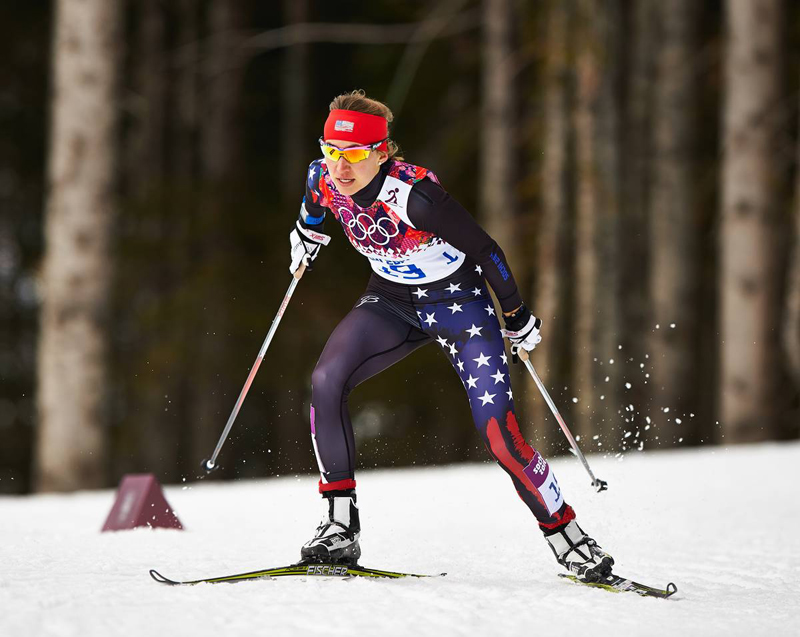
Sophie Caldwell (U.S. Ski Team) racing to sixth in the individual freestyle sprint at the 2014 Winter Olympics in Sochi, Russia. (Photo: Fischer/NordicFocus)
U.S. Ski Team members Sadie Bjornsen, Sophie Caldwell and Jessie Diggins automatically qualified for the Olympic team by meeting the top eight in an Olympic event threshold. Bjornsen qualified on Nov. 24 in Kuusamo, Finland, with a second place in a classic sprint. Caldwell qualified in the same race in eighth place. Diggins made the Olympic team on Dec. 12 in Lillehammer, Norway, when she placed sixth in a classic sprint. (Regarding both Bjornsen and Diggins, each scored multiple top-eight results in Olympic events during the selection period; we’ve simply specified the first instance each skier automatically qualified.)
Three skiers down, 17 to go.
The second-tier of the objective criteria reads as follows: “Athletes ranking in the top-50 in the distance World Cup standings or the top-50 in the Sprint World Cup standings as of January 15, 2018 shall be selected to the team.”
Rosie Brennan, Kikkan Randall, Ida Sargent, Liz Stephen, Erik Bjornsen, Simi Hamilton and Andy Newell jumped the top-50 hurdle.
Let’s run through the men first. On Jan. 15, Hamilton was ranked 15th, Newell 36th and Bjornsen 49th on the World Cup sprint list. Bjornsen was also ranked 41st on the distance list.
For the women, Sargent was ranked 13th on the World Cup Sprint list and Randall 19th. We’ll get back to this in a moment, but Brennan was ranked 43rd on the sprint list and 34th on the distance list. Liz Stephen ranked 35th overall on the distance list.
Some of the chatter heard after the Olympic team selection had to do with a portion of the criteria stating that no more than five athletes per gender would be selected based on sprint results, including all of World Cup sprint results, World Cup sprint rankings, and the domestic OWG points list.
So far we’ve discussed six more skiers, bringing us to nine athletes, all current members of the U.S. Ski Team (USST) and all qualified from their World Cup results.
U.S. Ski Team Head Coach Chris Grover wrote in an email that he believed the World Cup-based criteria served the purpose of fielding the most competitive team.
“From my perspective, the objective World Cup criteria worked well,” Grover wrote. “The fastest athletes were selected to the PyeongChang team.”
He also acknowledged that the inclusion of overall results from the Tour de Ski’s (TdS) final hill climb as part of major championship qualification criteria would be revisited.
“One bit of criticism/feedback that we received was that the Final Climb from the Tour de Ski should not be included in the selection period, because it is a special event that is not representative of the races at a major Championships,” Grover wrote. “I think this is a valid point. The Final Climb has been in our criteria for years, and nobody has complained until this season. Although we believe this race has been effectively useful in identifying our aerobically fit skaters, we are very open to removing it from future criteria and closing the World Cup distance selection period one day earlier. This is something we can discuss with the Cross Country Committee this spring.”
Non-World-Cup-Based Nominations
Filling out a team large enough to fill the four-starters-per-nation race quota allowed the coaches and selection committee to refer to the 2018 Olympic Winter Games (OWG) points list (click “2017/2018 SuperTour Points” under “Resources” on right side of page). That points lists kept a running total for the season’s first two SuperTour weekends and weighted results at 2018 U.S. Cross Country Championships in Anchorage. (For sprinters, points were allocated only for qualification results, not the final results.) The rankings were then further organized by an athlete’s two best sprint results and two best distance results in separate columns on the spreadsheet (note: those columns were blank on Monday morning.)
For the men, team selection appears to have been rather straightforward. The top-three ranked distance skiers were selected off the OWG points list. In order, those athletes were USST member Scott Patterson, Alaska Pacific University’s (APU) Tyler Kornfield and former USST member Noah Hoffman.
Patterson, who is in his first season as a USST member, did not score World Cup points in Period 1 and declined an offer to race the TdS as his path to Olympic qualification. Patterson contested U.S. nationals as his potential qualifying route to the Games. Patterson won the 15 k skate and placed sixth in the 30 k classic mass start.
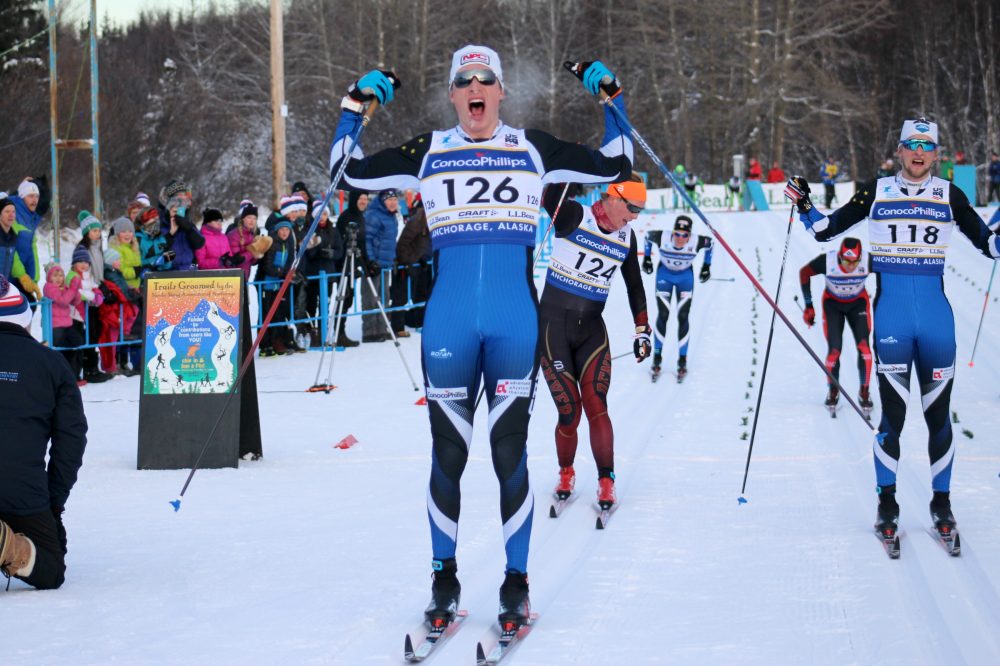
APU’s Tyler Kornfield (126) celebrates as he crosses the line first in the men’s 30-kilometer classic mass start on Jan. 7 at 2018 U.S. Cross Country Championships in Anchorage, Alaska. Eric Packer (118) finished second and Denver University’s Eivind Romberg Kvaale (124) placed third. Kornfield reached the podium in three out of four races at 2018 U.S. nationals.
Second on the OWG list was Kornfield, who won the 30 k classic mass start, placed 13th in the 15 k skate, qualified sixth in the skate sprint and third in the classic sprint. He also placed third overall in both the classic and skate sprints at nationals. Kornfield’s all-around point scoring catapulted him into the team selection conversation.
Third on the list was Hoffman, who placed second in the 15 k skate at nationals and fifth in the 30 k classic mass start. Hoffman also scored World Cup points in 28th in the Lillehammer 30 k skiathlon, a race loaded with home-field Norwegian talent.
Paddy Caldwell, also in his first season as a full-fledged USST member, played his qualifying hand by remaining in Europe and racing the TdS. In his first winter racing full time on the World Cup, Caldwell has popped solid results. His nascent 2017/2018 World Cup resume is highlighted by the 19th-fastest time of day in Kuusamo’s 15 k skate pursuit and the 19th-fastest time of day on the TdS’s final climb 9 k skate pursuit. However, Caldwell landed outside the top-50 bubble on the World Cup distance list.
Patterson was selected as the highest-ranking athlete on the 2018 OWG selection list. As specified in U.S. Ski & Snowboard’s Olympic team press release, Patterson’s selection, according to U.S. Ski & Snowboard, was not a discretionary pick.
However, Hoffman, Kornfield, and Caldwell were all selected to the Olympic team by discretion. Bodensteiner, himself a former U.S. cross-country Olympian, explained over the phone that Hoffman, Kornfield, and Caldwell were nominated to the team by head coach Grover. Those nominations were then reviewed and approved by a three-person committee composed of Bodensteiner, U.S. Ski & Snowboard President Tiger Shaw, and former USST member Holly Brooks as the athlete representative.
Bodensteiner provided firsthand insight into Caldwell’s nomination and approval process.
“Chris Grover presented to the committee whether Paddy was qualified to be part of roster,” Bodensteiner said. “From an athlete-management standpoint, Paddy is somebody we have all agreed has got high potential for the future and the coaches were very interested in getting him into this environment [on the World Cup] and let him race a lot and developing him that way. We could have declined to accept Chris’s nomination of discretion. When I think of developing Paddy, for him it is not necessarily about performance in this Olympics but about future Olympics. Also, in thinking of his development, you don’t want to pull a guy like that out of racing for a month. We agree from an athlete management standpoint we want to make sure he has that experience. On our phone call about Paddy, Chris Grover does get into specifics about [Paddy’s] recent results. Paddy will get a start and maybe more in PyeongChang.”
It should be noted that in an interview about team selection this past summer, Grover stated that development occurs at many lower levels, like Europa Cups, World Juniors, etc., but “It does not and should not come at the World Championships or the Olympics. … It’s not a development trip; it’s a competition trip at the very highest level.”
At the same time, the criteria allows use of discretion for “Indication of medal potential in future Olympic or World Championship competition (such as international age group results and rankings) that would be materially enhanced by selection to the team.”
In the past, that “future medal potential” option for discretionary selection has rarely been used.
“We haven’t used it that way,” Grover said this summer. “Obviously the language is there if we were to choose to use it, but in the past we really have not used it that way, and I don’t anticipate using it going forward into this season. … We want … the fastest skiers on the start line in Korea, and those are the ones that we’re gonna be selecting.”
In PyeongChang, it’s likely that Patterson, Hoffman, Bjornsen and Paddy Caldwell will form the core of the U.S. Olympic men’s distance starts, with Kornfield getting several warranted race opportunities. Hamilton also skied himself into the Olympic distance race start mix by placing 12th in the 15 k skate mass start in the final pre-Olympic World Cup weekend in Seefeld, Austria. The 15 k skate at the Olympics is an individual start.
Factored into the men’s Olympic sprint-start equation are brothers Logan and Reese Hanneman. The Alaskan brothers (both members of APU) were the two highest ranking sprinters on the OWG list. Logan, the younger of the two, placed first and second in the U.S. nationals classic and skate sprint qualifiers. Reese placed third and first, respectively. Older brother Reese also doubled up by winning both the skate and classic sprint crowns. According to the U.S. Ski & Snowboard Olympic team press release, neither Hanneman was considered a discretionary pick.
Depending on Erik Bjornsen’s race schedule, the U.S. coaches will have a core of Newell, Hamilton, the Hannemans, and Bjornsen for the classic sprint. In case of illness, Kornfield has sprinting chops as well. He’s a former two-time classic sprint national champion who reinforced his sprint cred with his double-podium performance in the sprints at the 2018 nationals.
Time to bring the discussion back to the women’s Olympic team selections. To restate, Diggins, Sadie Bjornsen, Sophie Caldwell, Sargent, Randall, Brennan, and Stephen all qualified objectively with their World Cup results. That’s seven female athletes, which leaves four spots remaining on the 11-athlete women’s Olympic cross-country team.
“We acted on the principle that we wanted to maximize start rights in each race,” Bodensteiner explained. “There was an interesting dynamic to women’s team. We have a generous quota and the need to fill spots. Our top women are going to race quite a bit and they ultimately exhaust start options for other skiers.”
In other words, this team is in PyeongChang to medal. Yet even with that caveat, “slam dunk” could be used to describe the nomination of Caitlin Patterson, of the Craftsbury Green Racing Project (CGRP). She was the top American in all four races contested at nationals. She won the 10 k skate, and both the skate and classic sprints, and was the first American in the 20 k mass start classic (and second overall). Patterson was selected off the OWG point list as the highest ranking female athlete.
Caitlin Patterson (Craftsbury Green Racing Project) racing to 52nd in the freestyle sprint qualifier at the last World Cup on Jan. 27 in Seefeld, Austria. The next day, she placed 23rd in the 10 k freestyle mass start. (Photo: Fischer/NordicFocus)
With the exception of Caitlin Patterson, Scott’s older sister, who again reinforced her Olympic readiness with a 20th place in Planica’s 10 k classic, start spots remain scarce for non-USST women skiers at the Games. That said, three more domestic-circuit-based female skiers were nominated to the Olympic team: Annie Hart (Stratton Mountain School T2 Team), Kaitlynn Miller (CGRP) and Rosie Frankowski (APU).
Frankowski was second on the distance OWG points list after placing fourth and second*, respectively, in the 10 k skate and 20 k mass start classic at Nationals (*she was the second American, third overall in the mass start). According to Grover in an email, Frankowski remains an “alternate” for the distance events.
If we don’t include Hart and Miller yet, we’re at 18 athletes total, nine men and nine women.
According to Bodensteiner, initially the U.S. Olympic Committee (USOC) relayed that U.S. Ski & Snowboard had a quota of 18 cross-country athletes.
“Once we get that quota, we are required to make an entry,” Bodensteiner explained. “So we do the selection, in this case on 18 athletes. We do the entry, and then it is a couple days later when you start with this reallocation. It is really hard to determine what is going to happen there. Because you don’t know if Norway is going to give back a spot, or Germany or even a Macedonian. You just don’t really know what is going to happen.”
According to Bodensteiner, the U.S. was reallocated a 19th team spot. Soon after the additional reallocated spot, the USOC informed U.S. Ski & Snowboard that a 20th quota spot was added.
“That creates some interesting dynamics for selection because then you select your team, and couple days later, in this case, a 19th quota drops,” Bodensteiner said of the team-naming process. “And the coaches had done all their nominations about coach discretion that they wanted to do. And when we hit 19, and then eventually 20, and made a subsequent selection, that is a fairly dynamic process as well.”
For both the 19th and 20th spots, which Bodensteiner confirmed were Hart and Miller respectively, the selection committee in consult with the USOC, decided to go strictly off the point hierarchy from the women’s domestic list.
“Ultimately we decided to accept [the 19th and 20th spots], and at that point did not elect to use anymore coach’s discretion and just re-apply the procedure, with the athlete on objective criteria that had the next-best selection points,” Bodensteiner said.
Hart topped the OWG sprint list. Yet, as mentioned earlier, the criteria is written in a way to seemingly cap the number of sprinters at five in either gender. Last year, as a result of the the strict interpretation of those guidelines used to select the U.S. team for the Lahti World Championships, no domestic sprinter was selected to the World Championship roster. (Sophie Caldwell, Diggins and Randall all advanced to the final in that event. Diggins earned silver, Randall bronze.) The requisite lack of sprint opportunities for U.S. based women skiers at cross-country events like World Championships or the Olympics may be the cost of fielding perhaps the strongest women’s sprint team in the world. Sophie Caldwell, Diggins, Bjornsen, Randall and Sargent are internationally recognized sprinters. Even in a best-case Olympic scenario, one of these podium threats will be cheering during sprint qualifications, as only four can start a given race.
Yet the U.S, Olympic team will bring six female sprinters to PyeongChang. Bodensteiner stated that despite the language in the criteria (“will not exceed”), capping the number of sprinters at five per gender is not absolute.
“That is where, as I have explained with the quote-unquote sixth sprinter, that it was not a selection that was made in that allocation of 18,” Bodensteiner said. “That was made basically in consultation with the USOC and an external review to decide what’s the most fair application of the criteria in terms of filling the 19th position. That is where we as a selection committee would have looked at the athlete with the next highest selection points even knowing this athlete would be a reserve but we defaulted to the person who had the highest selection points.
“Annie is an interesting spot in thinking about how deep to get, and looking at outstanding results in sprinting, rather than choose lower on the distance list,” he continued. “It made sense to choose and recognize exceptional results. Discretion allows the committee to fill start rights and use the criteria in the most equitable way possible.”
Miller and Caitlin Gregg were tied for third on the women’s OWG distance points list. With their two best races considered, each athlete earned 56 points. Miller was selected over Gregg by applying the criteria’s tie-break procedure.
As a notable aside, multiple athletes alleged to FS, in writing but off the record, that Olympic team selection had been influenced by internal arbitration, external civil litigation, or the threat of either or both of these. However, both the existence and outcome of arbitration procedures are confidential, and multiple docket searches in state and federal courts revealed no lawsuit that had actually been filed.
Asked whether the USOC had been prompted to begin arbitration to either open up more Olympic team spots or be included on the team beyond the original 18 athletes selected, Bodensteiner stated that the USOC helped guide those particular selections.
“I guess what I will tell you, there is always an opportunity for independent review,” Bodensteiner said. “And that is where the USOC is really involved with us and we have a lot of discussions with them, like what’s the proper application of the procedure in terms of being applied fairly and equitably with the 19th selection and probably the 20th. We had done a lot of consultation with the USOC on both those selections.”
Bodensteiner also made clear that it is in every interested party’s right right to advocate for themselves.
“The athletes have the protection to challenge a selection position,” Bodensteiner explained. “It can be any reason they feel wronged. It is also not part of public record. They have the opportunity to make a complaint to USOC — they oversee the whole process. The USOC also approves the selection criteria, they have influence over it. Yet, they do not tell us to fill our quotas. So, the athlete can file a complaint to the USOC and they, the USOC, will moderate the discussion with the athlete who feels they wrongly have not been selected. If we can not come to terms, it is referred to an arbitrator.”
As far as FasterSkier has been informed, at least one athlete, and potentially more, was involved in official arbitration in connection with the 2018 U.S. Olympic cross-country selections. The USOC is not a government funded agency and it’s arbitration records are not public documents.
“That is not public record, we have dealt with that in the past, that is as deep as I want to get,” Bodensteiner said. “It is interesting when you get into application of criteria. Despite what you write specifically, they are open to interpretation. We maintain fidelity to criteria as much as possible. Some people will feel that wasn’t the right process. I understood to be something different. We will always go on and rewrite if there are any ambiguities and make better criteria.”
As of Wednesday morning, FasterSkier was still seeking comment from the the USOC regarding the reallocated spots — spots 19 and 20 — on the U.S. Olympic cross-country team.
Moving forward, Grover wrote that Hart will be a reserve for the classic sprint and Miller a reserve for the distance events.
It’s full steam ahead with 20 U.S. cross-country athletes in PyeongChang. As the final rosters take shape in what on paper could bring the U.S. its first Olympic cross-country medal in almost two generations, coaches like Grover and the USST women’s coach Matt Whitcomb will be carefully penning out each race’s start roster for the Games.
In the often black-and-white world of elite ski racing, Bodensteiner conveyed he, too, could imagine the pressure exerted on both the athletes and coaches in the Olympic pressure cooker.
“It takes pretty adept coaching to work the athletes through that and deal with the athletes who don’t get selected to race in each competition,” Bodensteiner said about the tough race start decisions facing the team. “That can be a tough thing for athletes for sure. You can imagine the pressure on the team sprint race right now. That is going to be a pretty difficult challenge for those guys. I anticipate it will be a tough one for the athletes. There’s a very high potential to get a medal there and there are certainly more than two athletes that are probably thinking they should be on that team.”
The Games begin on Feb. 10 with the women’s 15 k skiathlon.
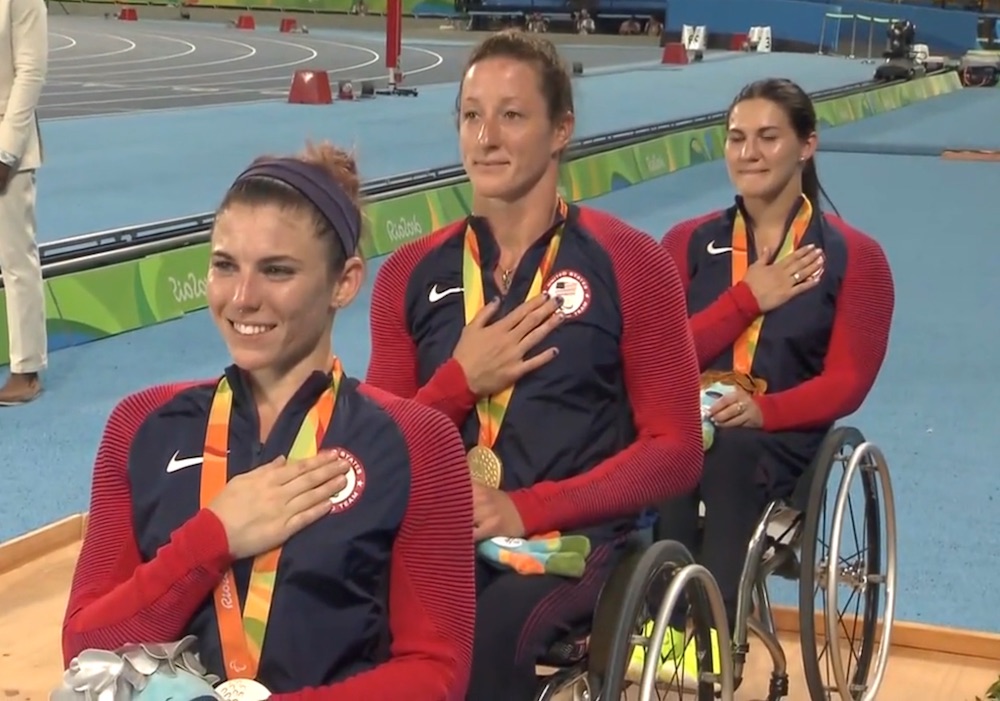
Tatyana McFadden (c) led a U.S. sweep of the women’s 1500-meter T53/54 podium in wheelchair track racing at the 2016 Summer Paralympics on Wednesday in Rio de Janeiro, Brazil. Less than two-tenths of a second behind her, Amanda McGrory (l) and Chelsea McClammer (r) placed second and third, respectively. (Photo: U.S. Paralympics Highlights from Rio Day 6 video)
Note: This article has been updated to include results from Thursday’s road cycling and evening track races, as well as Tatyana McFadden’s selection as recipient of the Whang Youn Dai Achievement Award.
On Tuesday and Wednesday in Rio de Janeiro, Brazil, two Paralympians who also dabble in skiing racked up medals at the Paralympic Games — with Tatyana McFadden winning the women’s 1500 T53/54 track event and Alicia Brelsford Dana placing second in the road-cycling time trial.
McFadden, 27, of Clarksville, Md., rocketed to her third medal in three races in Rio, leading what the U.S. Olympic Committee (USOC) dubbed a “Mc-sweep” in her event, ahead of fellow Americans Amanda McGrory (+0.11) and Chelsea McClammer (+0.17). It was the first U.S. track-and-field podium sweep at these Games, and McFadden led from the start to capture a Paralympic record of 3:22.50.
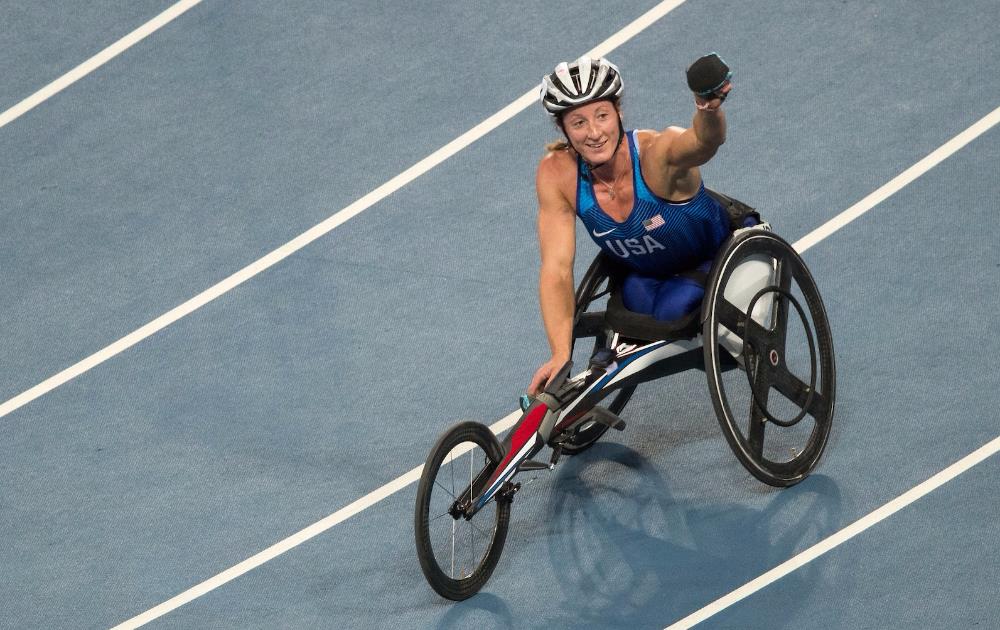
Tatyana McFadden celebrates winning the women’s T54 5000m final at the Olympic Stadium at the Paralympics in Rio de Janeiro, Brazil. (Photo: Simon Bruty for OIS/IOC)
This marks her 13th Paralympic medal in track and field. She also has a silver in sit-skiing at the 2014 Winter Games.
“It’s amazing,” McFadden said, according to a USOC press release. “It’s the first time, I think, in history or in a long, long time since we’ve gotten an American sweep in the 1500 and it happens to be the girls, so it’s really cool.”
“We went into this morning with a pretty good plan and decided we were going to go for it,” McGrory said. “We raced together, we raced smart and we pulled it off.”
(Update: Two days after her latest gold, McFadden was selected to receive another honorary gold medal as one of two recipients of the Whang Youn Dai Achievement Award. According to a International Paralympic Committee (IPC) press release, an independent panel of judges comprised of IPC Governing Board members selected the winners on Thursday — McFadden and Syria’s Ibrahim Al Hussein, a swimmer who is competing independently in Rio. They will each receive a pure gold medal, weighing 75 grams, at the Closing Ceremony.
The panel chose McFadden and Hussein for best exemplifying “the spirit of the Paralympic Games and the Paralympic values.” Seventeen participating countries nominated 21 athletes, and the IPC narrowed the list down to six athletes. McFadden was the only North American among the six finalists.)
On Thursday night, the “Mc-trio” (as the USOC called them) of McFadden, McClammer and McGrory — teammates at the University of Illinois Urbana-Champaign — swept the podium again in the women’s 5000-meter T53/54. McFadden made her move on the final lap to notch her third gold in four individual races in Rio, winning in 11:54:07. McClammer edged McGrory by one-hundredth of a second for silver (+0.26) and McGrory took bronze (+0.27).
“We train together, so we work really, really well together,” McFadden said, according to a USOC press release. “There’s no one I want more on the podium than my teammates. I think the whole world was looking at us and we were looking at them and we said ‘hey, we’re going to work together’. We’re stronger that way and it definitely showed today.”
Two hours later, McFadden and McClammer raced the 4×400 T53/54 relay with McFadden’s younger sister Hannah McFadden and Cheri Madsen. They crossed the line second behind the People’s Republic of China, which smashed the world record of 3:40.66 with a time of 3:32.11. However, according to the final results, the Americans were disqualified (along with Turkey) and relegated to fourth (while Turkey was listed as third). Australia, which had a season-best time of 3:46.63, took silver, and according to the results, no bronze was awarded.
On Wednesday, the seventh day of the Paralympics and first day of road cycling, Dana, of Putney, Vt., notched silver in the H1-2-3 time trial with a time of 33:57.48, less than 13 seconds behind the winner, Karen Darke of Great Britain.
Four years ago at the Paralympics in London, Dana, now 47, placed fifth in the same event. At 2015 World Championships, she took silver in both the time trial and road race. In 2014, she was a world champion in the time trial.
In all, the U.S. cycling team racked up nine medals on Wednesday (one gold, five silver and three bronze). Oksana Masters finished fifth in the women’s H4-5 time trial with a time of 33:49.7, about 47 seconds off the podium and 2:14.24 behind the winner, Dorothee Vieth of Germany.
On her official Facebook page, Masters, 27, of Louisville, Ky., also a silver medalist in Sochi and a bronze medalist in doubles rowing at the 2012 London Paralympics, summed up her race on Wednesday: “I Finished 5th today in my combined H4-5 category for the TT. Just like skiing I like courses that have climbs in it. Today was the opposite. Flat as a pancake course with high winds which favors bigger people. I gave it everything I had, plus some blood and it was not enough to bring home a medal for team USA. Tomorrow is a new Day and another chance to race and leave everything on the course. It is a Road Race which will be a mass start. I am feeling hopeful for this race. It is my favorite event. I Can’t wait to throw it down tomorrow. I will be racing around noon rio time tomorrow.”
On Thursday, Masters placed fourth in the women’s H5 road race. She is one of two Americans at the Games who has competed in the last three Paralympics in three different sports.
Germany’s Andrea Eskau — a skier and Winter Paralympic medalist in both biathlon and cross-country in Sochi — won the event in 1:37:07. She finished 2 seconds ahead of the Netherlands’ Laura De Vaan and Jennette Jansen, who placed second and third, respectively. Masters was listed with the same time just 2 seconds back in fourth.
“I’m bummed I finished fourth today and came up a little short, but I’m super happy because I feel like I’ve learned so much from this race alone,” Masters said, according to a USOC press release. “I am just so shocked that I am even here competing in my third Paralympic Games in a row.”
Dana also placed fourth in Thursday in the women’s H1-2-3 road race. With a time of 1:16:01, she was 3 seconds off the podium and 5 seconds behind German winner Christiane Reppe (1:15:56). South Korea’s Do-Yeon Lee finished second and Italy’s Francesca Porcellato was third.
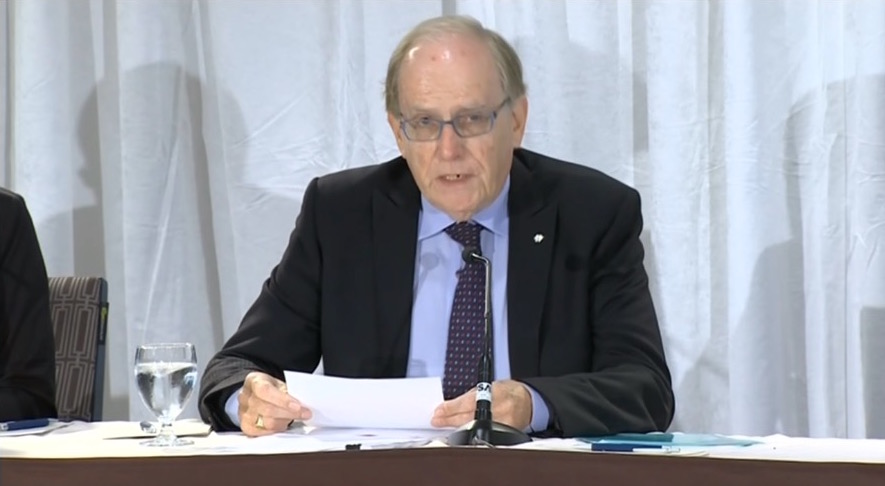
Richard McLaren speaking at a news conference on Monday in Toronto regarding his WADA-commissioned report on state-sponsored doping in Russia.
In a press conference in Toronto on Monday, the long-awaited McLaren report confirmed allegations of state-sponsored doping in Russia.
The World Anti-Doping Agency (WADA) gave Professor Richard McLaren, a Canadian lawyer, a mandate to investigate claims about doping during the Sochi Games in 2014. The report, however, made claims that the system to protect dopers was in place from late 2011 until August 2015.
This confirmed statements by whistleblowers, including Vitaly Stepanov to German broadcaster ARD and Grigoriy Rodchenkov to The New York Times. When the initial allegations were made, they were strenuously denied by Russian officials including those named and identified in the McLaren report as having helmed the doping cover-up.
In terms of the report’s basics, here’s what McLaren concludes.
Two labs responsible for anti-doping testing were investigated: the Moscow laboratory and the Sochi laboratory, its “satellite” facility for the 2014 Olympics. Both labs, according to the McLaren Report, were guided by the Ministry of Sport to ensure positive tests were removed and replaced by clean samples. The Ministry of Sport did not act alone. According to McLaren’s findings, it was aided in the cover-up by the Russia’s state security service (FSB).
McLaren described two similar, but distinct, efforts to protect doped Russian athletes. The Moscow laboratory was responsible for ensuring clean samples for both summer and winter Olympic sports. Based near the highest powers of government, “The Moscow Laboratory was the final failsafe protective shield in the State directed doping regime,” the report stated.
McLaren called this lab’s deceptive process the “disappearing positive methodology”. Positive tests were labeled “Save” or “Quarantine”. The “Saved” samples were swapped for clean ones, whereas the “Quarantine” samples were reported as failed drug tests.
The Sochi laboratory helped protect Russian athletes from popping a positive specifically during the 2014 Sochi Olympics. The FSB, Russian Ministry of Sport, and the Moscow laboratory all assisted with planning and executing the sample swapping methodology used during the Games. The Sochi methodology was more complex — tamper-proof bottles were manipulated.
Since their introduction at the 2000 Olympics in Sydney, it was assumed that the bottles could never be opened without showing a mark. But McLaren explained that they had been — small scratches on the bottles remained as proof of manipulation, but the marks were not visible to the naked eye. This confirmed a major allegation by Rodchenkov, which had been met with some skepticism by those who assumed that the bottles were indeed tamper-proof.
Small scratches on the bottles remained as proof of manipulation, but the marks were not visible to the naked eye.
Other claims of Rodchenkov were not fully proven, although also not disproven. Rodchenkov, the former head of the Moscow laboratory, had said that there was a list of pre-approved athletes whose samples would be protected. He named Russian cross-country skier Alexander Legkov as one of them.
McLaren, however, did not mention athletes by name. But he did confirm that there was a “pre-selected” group of Russian athletes that benefitted from the Sochi lab’s clandestine work.
With all of his findings, McLaren made clear he used the threshold of “beyond a reasonable doubt,” when writing the report and substantiating any claims.
According to page 41 of the report, since 2011, Russian winter sports athletes were implicated in the “disappearing positive methodology”: 10 positive tests were rendered clean in biathlon with 13 in “skiing”, although this was not broken down into disciplines such as alpine or cross-country. It should be noted that Russia qualified a small team of alpine skiing athletes for the Sochi Games.
The WADA Executive Board called on all international federations whose athletes were included in the report to take investigative action. So far, neither the International Ski Federation (FIS) nor the International Biathlon Union (IBU) have made official statements.
“The findings of the report show a shocking and unprecedented attack on the integrity of sport and on the Olympic Games,” International Olympic Committee (IOC) President Thomas Bach said in a press release. “Therefore, the IOC will not hesitate to take the toughest sanctions available against any individual or organisation implicated.”
International Paralympic Committee (IPC) released a reactionary statement on Monday, quoting its president, Sir Philip Craven: “The IPC will now analyse the report’s findings in detail to evaluate what impact they have on the Paralympic Movement and Para Sport,” he said. “After an initial review of the report, we note the 35 ‘disappearing’ positive samples from Paralympic sport between 2012 and 2015 and have sent a letter to WADA and the report’s author Richard McClaren seeking further information on these samples. We have also requested urgent clarification from both parties to better establish how the findings implicate the Sochi 2014 Paralympic Winter Games and Russian Para athletes as the report defines the Sochi Games as the XXII Olympic Winter Games…”
The U.S. Olympic Committee (USOC) also weighed in: “The McClaren Report confirms what we have stated previously: the current anti-doping system is broken and urgently requires the attention of everyone interested in protecting clean athletes,” USOC CEO Scott Blackmun said in a press release. “We look forward to working with the IOC, WADA and the entire Olympic family to address the flaws in the current system so that a uniform approach to anti-doping can be implemented and enforced around the world. In the meantime, we are focused on preparing Team USA to compete at the upcoming Rio Games and will rely on the IOC, WADA and the international federations to impose sanctions that are appropriate in relation to the magnitude of these offenses, and that give clean athletes some measure of comfort that they will be competing on a level playing field in Rio.”
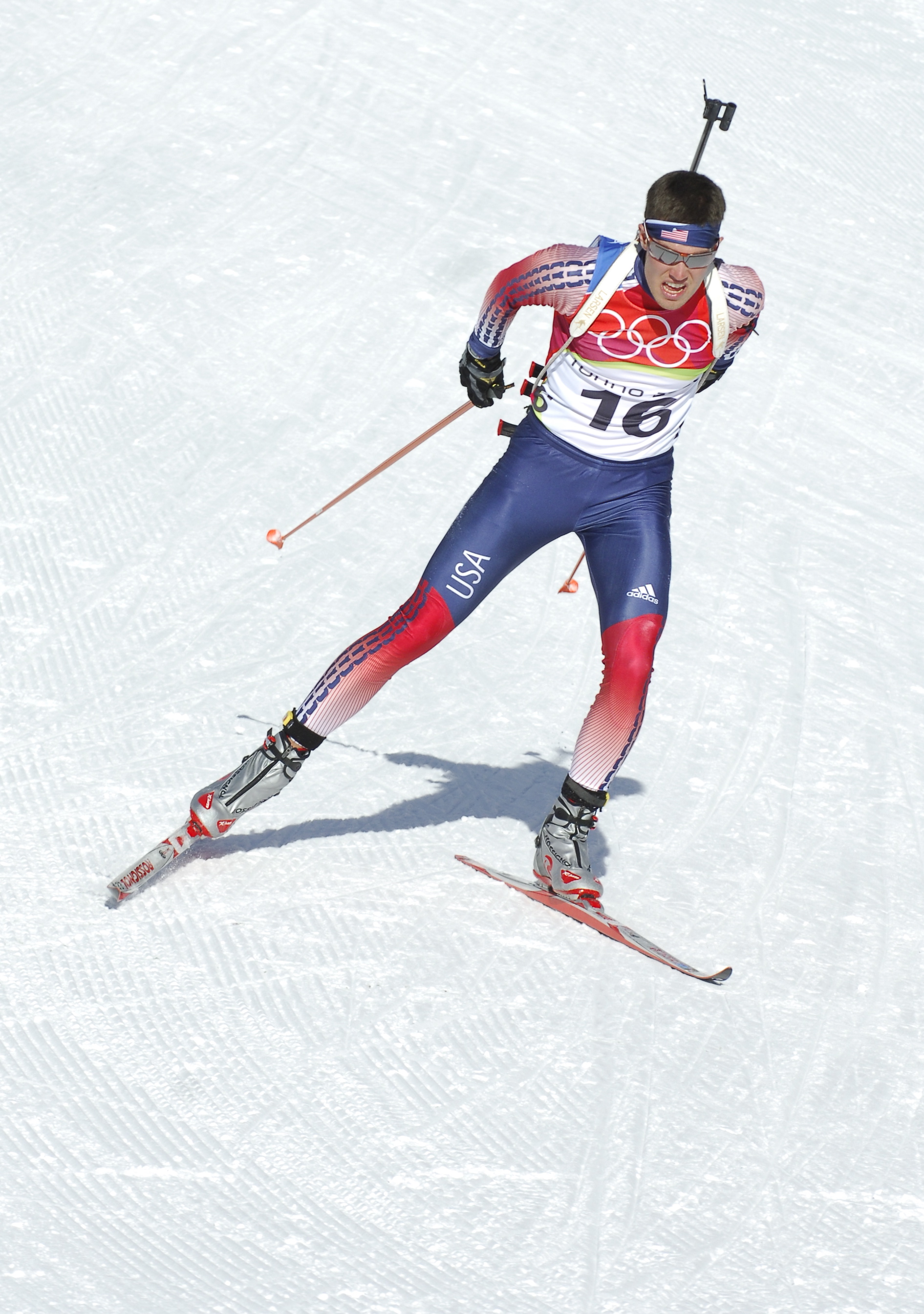
Brian Olsen, at age 22, competing in a test race at the 2006 Olympics in Torino. Now retired as from racing, he is an athlete representative both to USBA’s board and to the USOC’s Athletes’ Advisory Council.
Brian Olsen has worn a lot of hats in the nordic community. He’s moved from Minnesota to the Maine Winter Sports Center, where he trained as a junior; to the University of Vermont, where he got a bachelor’s degree in geography; ran the now-defunct frozenbullet.com biathlon website; went to the 2006 Olympics; joined the National Guard biathlon program (and served a tour in Afghanistan); and then began working as an athlete representative first to the U.S Biathlon Association Board and then to the USOC Athletes’ Advisory Council (AAC).
This winter, for instance, found him taking time off from a masters degree at the University of Utah to work as the USOC’s Athlete Services Coordinator for the Mountain Cluster at the Olympics in Sochi, Russia.
“I’ve always been interested in the administration of sport – things like team selection, recruiting and developing athletes, and marketing,” Olsen told FasterSkier in an e-mail interview from his current home on Lake Tahoe (he’ll soon move to Seattle to start an MBA program).
“As an athlete, these things affected me directly, but I realized that my focus should be on training hard and racing well,” he wrote. “Few athletes have energy to spare for attending Board meetings and reviewing their sports’ high performance plans. They should be out training or taking naps instead. Once I retired, I wanted to take on that burden now that my life wasn’t train-eat-sleep-repeat 365 days a year.”
Olsen has recently added another thing to his list: advocating for gay, lesbian, bisexual, and transgender athletes in Olympic sports. Now that he’s no longer competing, he feels that he can be an advocate to an extent that would take a toll on current athletes who need to focus on performance instead. At the recent AAC meeting in May, Olsen teamed up with former NFL player Wade Davis to talk about LGBT inclusion and the You Can Play initiative, which seeks to
“[ensure] equality, respect and safety for all athletes, without regard to sexual orientation… guarantee that athletes are given a fair opportunity to compete, judged by other athletes and fans alike, only by what they contribute to the sport or their team’s success… [and] challenge the culture of locker rooms and spectator areas by focusing only on an athlete’s skills, work ethic and competitive spirit.”
Olsen, who is gay, was not out when he was competing in biathlon, and says that it did affect his performance and his decision to leave the sport at a relatively young age compared to many career athletes.
The athlete reps, from all the Olympic sports plus many non-Olympic sports as well, had a positive response to the talk.
“My sense is that AAC members are, in general, very supportive of moving forward about tackling diversity and LGBTQ issues,” Middlebury skiing head coach Andrew Johnson, who is an at-large athlete rep, wrote in an e-mail. “Hard to say how things will move forward at the NGB level – I think in general elite sports tend to be a little late in adopting issues that are perceived as social or political in nature. Scant resources tend to be spread pretty thin and directed specifically at performance-oriented agendas. What Brian did really well in his presentation is demonstrate that this is an issue that affects performance, particularly in terms of retaining athletes in sport, athletes’ ability to carry out training/competition in healthy and supportive environments, etc.”
Sarah Konrad, a 2006 Olympian in both skiing and biathlon who now chairs the AAC, agreed.
“Brian’s presentation was very effective, honest, and passionate, and drew a lot of interest from individual AAC members who want to get involved with You Can Play now,” Konrad told FasterSkier. “Pretty cool stuff, with a very positive reception. People had heard about it before, as we had a presentation from Hudson Taylor [the founder of Athlete Ally] in January. Hudson’s presentation was much more promotional than Brian’s. Brian’s came across much better, because it was his own story, and from the heart.”
We caught up with Olsen last month to talk about what he believes the biggest issues are facing LGBT athletes in Olympic sports, what differentiates these situations from college sports where there are often liberal campus communities and big support networks, and why he picked now to get active.
The interview has been edited and condensed.
FasterSkier:The Nordic community seems like a very open, liberal community –do you have any comments about why it might not be leading the way on LGBT inclusiveness at the elite level?
BO: The Nordic community is truly a great group of people who together enjoy a really beautiful set of disciplines. While we probably tend more towards the liberal side on social issues, I think that our sport culture is still fairly traditional, stemming from the Nordic region from where it originated. We tend to be a bit more private, a bit more suspicious of those seeking attention, and like in most sports, we’re very unwilling to share our doubts, struggles, and weaknesses. I suspect that most people in Nordic skiing view sexual orientation and gender identity as a personal matter, and that asking someone about it would be prying too deeply, and would make that person uncomfortable. So, we don’t talk about it.
There’s a difference in my mind between being privately and publicly out. A privately out person has told the people who matter most to them that they are LGBT. Someone who is publicly out has made it public knowledge through the media. There are very few publicly out Olympic or Paralympic-level skiers. The role models who kids are looking up to are at this level of our sport; they are the ones who have the notoriety to drive the conversation. This conversation isn’t happening. We seem non-existent, invisible, without a voice.
I’m speaking up because there aren’t any other recent U.S. Winter Olympians who are publicly out as LGBT and talking about it openly, especially in skiing. I’m going against the Nordic grain of making public a personal matter, but if I don’t, then I fear that another kid just like me will have to go through the same struggle that I did. I’m hoping our sport will open up and demonstrate its support for diversity, and that in turn encourages currently-competing skiers to come out and be themselves. At that point, with those role models for the next generation out and open, the conversation drives itself and there’s less of a need for interviews like this.
FS:Would it have made a difference to you when you were competing, to be able to see someone more like you succeeding at a high level – to have role models who were gay or lesbian?
BO: That’s really the crux of the issue. We aspire towards dreams that we see people like us achieving. Just like American kids are growing up now believing they can win World Cups in biathlon, cross-country skiing, and Nordic combined because they see the likes of Tim Burke, Kikkan Randall, and Billy Demong doing so, so too do kids who are LGBT need to see role models like them on the podium if they’re going to feel confident they can also climb up there.
As a teenager, the image I saw of gay men was the typical stereotype. It wasn’t of an athlete. And it certainly wasn’t of a skier with an Olympic medal in his teeth. I couldn’t relate my strongly-held identity as an athlete to what I was seeing, but also, I couldn’t think away the feelings I had being attracted to guys. Therein lies the circle of confusion, self-hate, and depression in which I wasted so much energy.
The spring before the 2005/06 Olympic season began, I wrote in my training log at age 21:
“I believe that coming out could damage my performances in sport, a place where my self-confidence lies. I don’t want this contaminating that. What I do know for sure is that half of my life, I’ve grappled with this topic and decision. Simply put, being gay and living in the stereotype for that lifestyle seems to not fulfill the basic reasons for living. In biathlon, I fear there would be repercussions, mostly indirect and behind my back. A large issue is that I have absolutely no role models, at least whom I know. This is a challenge. Yes, so if it’s a challenge, then I need a plan. I need to think about that. I do know that I need help and someone to go through this with. But what if this all turns out to be a hoax? What if I really have some mental disorder?”
See, it’s not just a team climate issue, it’s also a self-acceptance one. In this struggle, you’re not just scared your teammates, coaches, sponsors, and fans will reject you, you’re also rejecting yourself before you even let anyone else in on your secret. Having successful role models who are LGBT is crucial to that second part because it helps young athletes accept themselves by giving them examples of athletes whom they can respect foremost for their athletic achievements.
It’s really the thought of these struggling athletes that frames how I’m approaching this entire issue; they’re ultimately the audience I’m trying to reach and encourage to be true to themselves.
FS: When did you decide that you would make speaking out about the challenges of LGBTQ athletes a priority?
BO: Last August, on the morning I was to deliver a presentation to the bobsled, skeleton, and luge teams to prep them for what to expect in Sochi, I read several op-ed pieces calling for the U.S. to boycott the Games, for the event to be moved elsewhere, or to be cancelled outright. I was so mad. I remembered how long and arduous my journey was to Torino. It wasn’t fair for other athletes to be deprived of the pinnacle of their careers.
But then I saw the videos of kids being taunted and beaten in Russia, of foreigners being arrested. I read the text of the Russian laws enacted just months earlier, basically outlawing anyone LGBT from being themselves. I remembered my Russian professor’s experience being beaten nearly to death in Moscow by the KGB for being assumed gay.
That morning, I just didn’t know what to think, or what was right. I didn’t know how I would respond to athletes wondering what they should do in Sochi. It felt like my identities were colliding. There weren’t any easy answers.
I concluded that there was very little that I could do in the 6 months leading up to Sochi, but I realized that I could speak out publicly and in so doing help other athletes who are LGBT or questioning know they are not alone. If I couldn’t help make things right in Sochi, I could at least help make things right in U.S. Olympic & Paralympic sport.
FS:How did you get involved with You Can Play?
BO: I researched different organizations working to end homophobia in sport and to promote better inclusion of athletes who are LGBT into their teams. Ultimately, a friend introduced me to two of the You Can Play founders in Denver last fall. The organization helps teams from the high school to professional level create and distribute videos emphasizing that they support their teammates, no matter who they are. I was really stoked about their simple, positive message. It resonated with me, and I felt it would resonate within the Olympic & Paralympic movement.
FS: Were the athlete reps interested in your AAC presentation?
BO: The response was so moving. I was so insanely nervous beforehand, I didn’t know what to expect. I’ve spoken to the council in the past, and I know several of the other athlete reps well. I was fine talking abstractly about the issue, but when it came time to say why it affected me personally, I took a long pause before saying, “I’m gay, and this was my experience.” I’d never told a group that before.
Several reps came up to Wade and me after our presentation interested in creating videos within their sports, and finding resources for their teams that will help initiate discussion. I’m working hard to gather and draft these resources to pass back to them.
FS:Do you think that the USOC is taking this seriously and doing as much as it can be?
BO: The USOC Board of Directors added non-discrimination on the basis of sexual orientation to the Code of Conduct last October and its leadership has been supportive of LGBT rights. I think the Sochi Games really brought LGBT issues to the forefront over the past year, but the conversation became about LGBT rights in general, and perhaps this took attention away from improving the culture within our sports here at home.
We also have a visibility problem: there are just so few U.S. Olympians and Paralympians who are LGBT. I think the USOC and NGBs, and all the staff and coaches in these organizations, everyone wants to do the right thing. But we are far behind the progress made in college sports by the NCAA and in professional sports by many of the pro leagues.
What the USOC could do is take a greater leadership role in this realm by persuading NGBs to adopt non-discrimination policies on sexual orientation and gender identity, and coordinating resources. These policy changes help initiate discussions among administrators, sponsors, officials, and coaches, helping them ask one another:
“What can we do better to support all of our athletes? Would a person who is LGBT feel comfortable being fully open in our sport? How are we going to react when it happens?”
On a second front, the USOC could also leverage the change and cause a similar impact internationally with the IOC and International Federations, like FIS and IBU. The LGBT rights (and human rights) record of a potential host country should be considered alongside the technical and financial details of the bid city. Gender identity policies governing the participation of transgender athletes are in dire need of being examined, standardized, and updated. These international organizations hold the power over these initiatives, but the U.S. should play a leading role in gathering support for change.
FS:It’s already very emotionally taxing to be an Olympic sport athlete, with so much travel and time spent away from family and friends. How much harder is it to be doing that if you are gay or lesbian and haven’t come out?
BO: All athletes are dealing with stress, and part of what separates us from our competitors is how we cope with it. Trying to figure out who I was, making sense of what I was feeling, and keeping it all hidden definitely added a significant amount of stress to what is already a high-pressure sport. Having left home at age 16, contact with my family was limited [and] the travel schedule was so intense that non-sport friendships very difficult to make and keep. So it was my teammates, competitors, coaches, and others around me in the sport world that I relied upon for support. But those relationships were really strained by the shame I felt for who I was. All of this sort of exacerbated the feeling of being alone in this struggle.
Sport became my sanctuary in many ways because when I was training and especially when I was racing, my mind was focused on my performance, and giving it everything. That’s what I loved so much about shooting: everything else in the world disappeared, life was reduced to mechanical fundamentals. And for usually six hours a day of training, my brain didn’t have the blood sugar for worrying.
When I had a bad result or an injury, that’s when I was more susceptible to the sleepless nights, deeper self-doubt, and depression. To coaches, it seemed like I was just worried about my results, but internally, I was also fighting for my identity as an athlete, which is what usually gave me self-esteem. My coaches and sport psychology training helped me bounce back for the next race, but I never solved the underlying identity crisis until after I retired.
Ultimately, I was trapped by the Don’t Ask, Don’t Tell policy of the U.S. Army. In January 2007, I declined my World Championship spot and enlisted in the National Guard, flying home early from Europe to go through Basic Training. I had to make a conscious choice at that point that I would be closeted for the foreseeable future. But, my motivation to win a medal, and to have the financial support from the Army to do so, seemed more important than an identity and the associated feelings that I was struggling to even acknowledge to myself.
Over the next year, my inner struggle only became more intense, and it made me pull even further away from my teammates and coaches. My training, and in turn, my race results suffered. I felt isolated and sport was feeling less rewarding. I started to see other options outside of sport as more attractive. When I went back to college to finish my degree, I started meeting friends outside of sport, including guys who were like me. Even though it meant giving up my dream to win a medal, and moving out of a sport that had been central to my life for a decade and been really all that I’d known, I started to feel like I belonged more with the friends I was meeting. I felt liberated to be the real me, I began to accept who I was, and gradually I left the sport I loved, at least as an athlete.
FS:What do you think can be done to make LGBTQ athletes more comfortable?
BO: Talk about it! Make it clear in your language and actions that if someone on your team came out, that you’d still accept them. The fact of the matter is you won’t see the LGBT of teammates on their sleeves. It’s a silent and invisible identity, which is why the whole idea of “coming out” is both necessary and scary.
Since you can’t see us, just assume that someone on your team is LGBT. Assume that when you say fag, faggot, gay, tranny, or similar words, that someone is offended. Assume that when you joke around with your teammates in a homoerotic way, presuming everyone is straight, that you are confusing someone. This kind of vocabulary and activity builds on other things we’ve heard since childhood, and it reinforces the idea in our heads that being LGBT is bad, that it won’t be accepted on the team, that you’ll treat us differently if we admit who we are.
Similarly, we must break the silence and the don’t ask, don’t tell policy that continues to pervade sport. Again, there is so much that we have heard in childhood, and still hear around us today, that makes us feel like we can’t be both an athlete and LGBT. For a few more years, until there are more out athletes to serve as our role models, we need your help imagining that when we came out to you and the rest of the team, that nothing will change in how you treat us.
Coaches can help lead this effort by incorporating LGBT topics into annual reviews with athletes and staff of team codes of conduct. Walk through scenarios, such as how the team would react to a teammate coming out. Talk freely about everyone’s questions, concerns, and apprehension. Make it clear what language and behavior is unacceptable, and as a group commit to enforcing the standard with one another in a constructive way.
One easy way to demonstrate your team’s commitment to inclusion of teammates who are not just LGBT, but who are of any marginalized identity (race, ethnicity, national origin, religion, gender, age, income, disability, sexual orientation, or gender identity), is to create a short video of your group speaking to the simple concept that it’s the performance of athletes that matters to you, not their identities. The preparation and production of the video will naturally require your team to talk about the issues. The resulting product will help athletes in your sport who are different see that they have allies, at least in your team, who will accept them. A few of these videos could be really powerful in making the relatively homogenous disciplines of skiing, and the people in them, seem more accepting and accessible.
The post-Olympic funding announcements have come and gone, and while few sports see an increase at the end of a quadrennial cycle, some are hit harder than others. The U.S. Biathlon Association (USBA) isn’t one of them.
“We ended up being well-supported by the U.S. Olympic Committee,” USBA CEO Max Cobb told FasterSkier. “We didn’t end up getting exactly what we asked for, but the support from them remains really strong. That’s incredibly – it’s very important for us, to continue all of our programs.”
The American national team had a strong season last year, placing three different athletes on the World Cup podium. But nobody feels safe going into funding deliberations, Cobb said, implying that this might be particularly true for smaller sports.
“It’s a huge relief,” he said. “You never know, when a quad comes to an end, how the funding will be for the beginning of the next quad. So we’re incredibly grateful for this partnership with the USOC. We feel really good about how this has just improved every single year.”
USBA also has another trick up its sleeve: the U.S. Biathlon Foundation, a fundraising arm which contributed roughly $90,000 to USBA in 2012 (2013 tax documents are not yet available from Guidestar). USBA is also kicking off the new quad in style with its foundation, which is hosting a golf fundraiser at the end of the month in Ipswich, Massachusetts.
“It wil be hosted by Mark Burton, the chairman of our foundation, and Ray Bourque, one of our foundation trustees,” Cobb said. “Lowell, Tim, Susan, and Hannah are for sure coming, and maybe a couple of other athletes as well. The foundation continues to be a really important part of our overall program, and gives us extra resources we need to be able to run a strong program.”
Cobb, who besides his work at USBA also has a volunteer role as the head of the International Biathlon Union’s Technical Committee, says that he’s had to sink a not insignificant amount of time into getting the foundation going: “from a time management standpoint, it’s a lot of work.” There’s plenty for him to do already at the office without even getting into this new venture – but it’s worth it.
“I think every sport CEO or Executive Director has to devote a lot of time to generating resources,” he said. “I really enjoy all the time I spend with foundation trustees, because they are just super people, and they are very enthusiastic about our team. It’s great to see that. So it has always been fun.”
The USOC recently gave USBA an organizational development grant to hire an assistant, Audrey Chapman, to help with the Foundation work. That, Cobb said, has been another relief and will help the group do even more in the future.
As it stands, a single golf fundraiser like the one to be held in Massachusetts can generate considerable resources for the organization.
“In the past they have raised anywhere from $25,000 to $60,000,” Cobb said.
It’s very hard to predict. It’s a significant amount of our fundraising, for sure.”
After World Cup podium performances from Lowell Bailey (above), Tim Burke, and Susan Dunklee, the US Olympic Committee rewarded biathlon with relatively strong support in the post-Olympic year. (Photo: USBA/Nordic Focus)
Besides the actual money, it’s fostering relationships between donors and athletes that make these events a success, Cobb said, and hopefully one that will extend into the future.
“It’s a nice chance to get people together with the athletes in an environment that isn’t freezing cold, and the athletes are enjoying a beautiful day and a beautiful place and aren’t under any pressure, so it’s very different than meeting up at a World Cup,” he explained. “And the nice thing is, it’s a chance for us to bring people from outside our circle to meet the athletes and hear about the sport. It’s a good opportunity to spread the word about what we’re doing and perhaps find some more people who want to help support us.”
Between support from USOC and the foundation, Cobb says that USBA will be able to continue its programs unchecked this year and spur further success.
“It will allow us to do the right things with the national team over the course of the next year without any compromised,” he said.
That includes a summer training camp in Scandinavia which will send three athletes to the annual Blink rollerski festival in Norway for the first time, as well as allow the women’s team to train alongside Kaisa Makarainen of Finland, a two-time World Cup overall champion.
“In general, Bernd Eisenbichler and the coaches have tried to put together more opportunities and more side-by-side training with other top athletes from around the world,” he said. “And that has been well-received on both sides. The very positive side is that the Europeans are psyched to train with us as well.”
Another nordic sport with its own governing body also jumps to mind: biathlon. The United States Biathlon Association, founded in 1980 after splitting from modern pentathlon, has had medals and podium finishes at every level except the Olympics: from World Youth and Junior Championships through the World University Games, World Military Championships, World Cup, and senior World Championships.
Recently, USBA felt financially secure enough to restart its development program. IRS financials are not released yet for the last year, but in 2011 and 2012 had total revenues of $2.6 and $2.4 million. In the past years USBA has forged close ties with the U.S. Olympic Committee (USOC), much to its benefit.
So, what did it take to get there, and what advice might USBA have for Nordic Combined, if they choose the separate-NGB route? FasterSkier called up Max Cobb, the President and CEO of USBA, to chat.
Max Cobb, who besides acting as CEO of USBA also chairs the International Biathlon Union’s Technical Committee, receives a hug from a fellow official after U.S. athlete Susan Dunklee placed fifth in the 2012 World Championships.
FasterSkier: I’m assuming that you’ve been following, to some extent, the news about USSA and Nordic Combined.
Max Cobb: Yes, I have heard some of the news.
FS: As someone who is running an NGB for a small nordic sport, do you have any words of wisdom for them? Advice? Warnings?
MC: I think that the good thing for the Nordic Combined guys is that they have a track record of being super successful. Like us, it takes time to reach that level.
FS: So that’s what you need to be able to make your case?
MC: I don’t really know enough about what is going on with those guys and with USSA. So I don’t know what I can say other than that I think the important thing is to continue to demonstrate that there’s an orientation towards high-performance success, and if you can demonstrate that the right the athletes are in the system for achieving that, then I think it’s possible to gain support from both sponsors and donors.
FS: Do you have a sense of how long, after USBA was started, it took for the organization to start to feel like it was on its feet?
MC: I think it grew very gradually. It wasn’t really until the late 80s or mid- to late-80s, after the 1984 Olympics, that the USOC provided a really substantial and reliable source of funding. We were able to offer fairly strong programming starting in 1986, and then in 1987 Josh Thompson won a silver medal [at World Championships] so there was a big push for the 1988 Games. So I think that was when biathlon really came into its own. But I think a lot of that … there was not very much funding available from the USOC between 1980 to 1984.
FS: It seems like there are more and more sports now, compared to back in 1980. Do you think it’s harder to get USOC’s attention if you are starting your own NGB now?
MC: In terms of what is different now, I would just say that in general, there are more resources available and more sophisticated fundraising around Olympic sport than there were in the mid-80s. That’s very clear to me.
FS:So that is good for nordic sports?
MC: I think in terms of identifying donors – just look at what the National Nordic Foundation has been able to do. They have raised a huge amount of money [note: for the 2012/2013 year, the National Nordic Foundation had revenue of just over $350,000]. It has been very impactful for the sport. That kind of relatively grassroots fundraising didn’t exist at all in the 1980s. You look at things like Rally Me and our whole digital communication, and that has made it much easier to bring together a very diffuse group of people who care, of supporters. When you think about doing paper mailings to groups like that [when USBA was getting started], it would have been impossible.
FS: Is that what you think Nordic Combined should be focusing on?
MC: I just make those comments in general. It’s not necessarily specific to what’s going on with Nordic Combined because I don’t really have a sense of what is envisioned there.
How important is the mental aspect of racing? At nordic sport’s highest level, it can make the difference between winning and losing – in skiing but perhaps even more so in biathlon, which has the added pressure of rifle shooting.
With that in mind, the U.S. Olympic Committee (USOC) assigned psychologist Sean McCann to work with the biathlon team in the leadup to the Olympics. So far, he has been to three weekends of World Cup racing, and become a fixture on the team, joking around at the dinner table even if he’s serious in sessions with the athletes.
More than just allowing him to get to know the athletes, he believes that working with them on the World Cup will set up their success at the Olympic Games in Sochi in less than a month.
“I work for the Olympic Committee, so one of my missions is to help athletes perform well at the Games,” McCann explained in an interview at the finish line of a World Cup race in Ruhpolding, Germany, this weekend. “But I really don’t think you can sneak up on success at the Games – you have to have already figured it out at the World Cups. You’ve seen it in every sport. Every once in a blue moon you see someone have a peak performance at the Games, but usually not. Usually it’s in line with what they’ve been able to show.”
It’s McCann’s first time working with the team, who had previously been linked up with a different USOC psychologist. This is the first time, though, that one has become embedded with the team and traveled so extensively with them.
That’s kind of McCann’s gig.
“I was a bike racer, a long time ago, before and during graduate school,” McCann said. So naturally, when he saw that the USOC was advertising research assistantships, he was intrigued. He took a break from graduate school and took one of the positions, and then joined the organization full-time in 1991. He’s been there ever since, working with a variety of teams; he says he considers himself mainly a summer-sports person.
This winter, McCann is still working with a few sliding-sports athletes, mostly as a holdover from previous USOC assignments. Mostly, he’ll be traveling with the biathlon team this winter, and he’ll be with them in Sochi for the Olympics.
Here’s the rest of what he told us this weekend.
FasterSkier: You’re new to biathlon, so…. how has that been going?
Sean McCann: It’s been great. I worked with precision shooting for over 20 years, so I have known shooting. But they take a lot longer to set up for each shot and take each shot! So that’s been eye-opening for me, what’s possible and what’s necessary in biathlon. There’s some similarities in terms of the challenges of pressure shooting, but the element of the clock ticking down, is just a really new dimension. It’s been enjoyable to work with these guys and these situations.
FS: What was the main thing you worked on with the precision shooters?
SM: There’s a lot of thought control. They have almost unlimited time to take the shot, set up the shot, and re-set up the shot. It’s making good decisions and having really good control of focus. So that’s somewhat transferrable. But with the precision shooters there’s a lot more pressure in the finals, where there’s a specific time limit. So having a process for executing each shot is really important. That, again, is fairly transferable.
FS: Is it a similar target size, or do biathletes have more leeway? Forgive us for not knowing much about precision shooting.
SM: These guys have more leeway. For a prone match in precision rifle, a 60-shot match, 600 is not unusual at all, 60 10’s. And then they actually go to decimals of tens. But it’s the same with 50 meters, Anschutz rifles, some people shoot Lapua ammunition. So it’s a lot of similar things. But there’s no bolt action, there’s no clips. It’s single-shot loading each time.
FS: So there’s a lot more process in biathlon. Is that something that can actually help in focusing?
SM: Yeah. In a way, having a rhythm almost prevents decision-making, which is helpful sometimes. You get into more of an athletic rhythm and movement, and it makes it potentially a little bit more automatic.
FS: One of the things that’s really unique about biathlon is how variable it is – you can have a great race and then be 90th the next day, even to a greater extent than in other sports. How do you help people with that challenge?
SM: I thought shooting was the most volatile sport that I’ve worked with. When top of our top swimmers have an off day, that means that instead of a gold medal and a world record, it’s a silver medal. If you have a bad day in shooting, you’re not on the first page anymore. But if you don’t have a good day in biathlon, you aren’t even on the second page! It’s the most volatile sport that I’ve worked with, because there’s so many pieces. And it’s all or nothing. A couple of split bullets out, that’s 40 places different.
It’s been interesting to see that a lot of veterans on the team have learned through trial and error that being resilient, letting it go, allowing you expect good things to happen the next day – it’s absolutely essential. Or else you’re not ready for success when you have the opportunity. You come in clean, to the range, with good skis, good fitness, when two days before you finished out of the money. It’s a constant struggle. When you’re fit and you’ve worked so hard to get the fitness, and then you have a couple of rough things that happen, it’s very hard. The whole staff feels it.
I’m someone who gets really engaged in the performance, and gets greedy for the performance just like the athletes. So I understand that frustration really well, what it’s like when you know it was there. It was there for the taking and it almost happened, but nobody knows it.
That’s for sure something we’ve been working on, to help people stay up, stay positive, have good expectancies. For me, the big thing is preparing for the good things to happen. I’m not so worried about dealing with a bad thing. Yes, it’s important to let stuff go, but it’s more important that they’re ready for good things to happen, and that’s not always easy.
FS: Are you working with these guys primarily on shooting, or are you having to learn a lot about the endurance racing side as well?
SM: I think a lot is on the shooting, because that’s the more obviously mental piece. But I’ve worked a lot with distance runners. So the mentality of the perfectionist endurance athlete, I know that. And some of the challenges of maintaining that volume of training and intensity of training, just all that time. Life issues that come up, dealing with injuries and fitness, and all that stuff.
Luckily, with such a terrific staff, the athletes have a lot of trust in training plans and all that. So I’ve seen the [overtraining] issue a lot more in other disciplines, particularly marathon runners, that more is always better. This group of athletes is really smart, and they really trust their coaches. So that eliminates a lot of those sorts of challenges, mostly.
FS: Are you working mostly one-on-one, or some group work?
SM: It’s mostly one-on-one. Some sports we do more team sessions, but here, although everybody’s doing the same thing, everybody’s strategies, plans, and issues are pretty singular. And they’ve been doing it for a long time. So it’s hard to find a level or topic of discussion that makes sense for everybody.
FS: In individual sports, how important is team chemistry, and what about this team?
SM: There’s actually some research that shows that team chemistry is more important in individual sports than in team sports. In part because team sports facilitates team building, and individual sports can work against it.
It has been wonderful to see how sensitive and actively considerate these athletes are to other people. I’ve worked with a lot of other winter sports that travel together for long periods of time and end up hating each other by the end of the season. This group, there’s a lot of strong personalities, different personalities, but there’s really a lot of effort put in to making life easier for one another, and that’s a big reason why it’s so much fun working with this team.
Alan Ashley, U.S. Olympic Committee chief of sports performance (Photo: USOC)
After growing up on skis, starting his first biathlon race at age 12, and then competing in nordic skiing for the University of Colorado, he stayed involved by coaching his Buffs, becoming their director of skiing, and then working for over a decade at the U.S. Ski and Snowboard Association (USSA), where he eventually became a vice president. He’s helped the sports in other ways, too, for instance pushing to keep the Eldora nordic trails open outside of Boulder in the late 1980s.
In the last eight years, Ashley has spread his knowledge to other sports after taking a job at the United States Olympic Committee (USOC), where in 2010 he became the Chief of Sports Performance. Ashley oversees high performance of every Olympic sport, summer and winter – which entails “a lot of different pieces,” he says. Among them are funding the national governing bodies (NGB’s), overseeing the Olympic Training Centers, and providing for sports science and medicine.
But although that sounds bureaucratic, Ashley knows from his own experience that seeing sports and teams on the ground is the best way to understand what they need. We caught up with him by phone to ask about the job, what strengths and challenges he sees for nordic sports, and how his background in skiing helps him plan out what’s best for U.S. teams across the board. In the process, we got a glimpse into how the USOC administers its sports.
FasterSkier: When we last met you were in Ruhpolding watching 2012 Biathlon World Championships. How much of your job do you get to spend visiting teams like that?
Alan Ashley: The bottom line is to try to figure out how we can be as good as we possibly can based on the strengths of each of the different sports and what their needs are in order to compete internationally… I try to get out in the field as much as I possibly can. It’s obviously challenging because there are so many sports and so many disciplines, but over the years I try to chip away at it and interact with the sports periodically over time.
I have a team that is assigned to each of the sports, that really gets in deep with each sport. The objective is to find out as much as we possibly can about [each team] so that we can make their high performance plan and carry on conversations about how to support them – so that we’re as educated and knowledgeable about what their needs are as we possibly can be.
FS: Before this job, you worked for the U.S. Ski and Snowboard Association. How did your experience within an NGB help you then move on to assess many different ones?
AA: It was really an unbelievable training ground. First of all, in USSA there are multiple disciplines and both Paralympic and Olympic, and those disciplines involve different groups of athletes and different challenges with regard to what it took to compete internationally in terms of depth of field and sophistication of the sport. So it was good training to try to balance out the support for each of the disciplines with the objective of being the best in the world, which is the mantra of USSA.
And having a firsthand knowledge of what it is like to work in an NGB, where you’re dealing with everything from working with your membership and your clubs to your international program and national teams, to fundraising and revenue generation, it’s a very complicated environment. The NGB’s have a lot of responsibility. Being able to come to the USOC with a good knowledge of what that responsibility looked like helped me to be able to communicate well and understand the challenges faced by people I work with.
FS: Skiing is a really broad discipline. Now that you have a broader view of what other NGB’s do, do you feel like USSA is doing a good job of being fair and spreading the focus among its sports?
AA: I think they’ve been true to their principles. They are trying to come up with a system to let the very best athletes achieve at the highest level. It’s always going to be a little complicated. From the perspective of the USOC working with USSA, I think we have worked well together and the results show that.
Vancouver was a really big deal. Look at nordic combined. That was a twelve-year journey for those athletes, and it took some significant backbone to continue to support them through the thick and thin, but the results were incredible. And watching the women’s cross country team emerge is another example of why I think things are working really well.
FS: Skiing and biathlon have a huge number of Olympic medals, but they don’t always translate well to an American audience. Is this something that affects the way you think about different NGB’s?
AA: I focus exclusively on performance. Whether there’s 200 members or 20,000 members doesn’t make much difference to me. It affects the pipeline, but I’m looking at a performance standpoint and asking where there are opportunities for international success. And I think that serves our country well.
FS: I know you have been quite involved with the biathlon program. What got you hooked on helping this team?
AA: Well, I did my first biathlon race at age 12, so I’ve known about the sport forever. But what was exciting to me is that there’s really good momentum within the community. You have a great group of athletes, you have really good leadership, and also they way that they have built their coaching staff and the way that coaching staff works with the athletes is creating a really positive competitive environment. It is a convergence of the right athletes, the right coaching, and an understanding of what is needed to get the best athletes to the top. That’s one of the things that we are looking for. Those are places where we have opportunities – we can make strategic investments with the NGB’s, and you can see that the athletes are making progress.
FS: When you see a team like this that is doing what you are looking for, what kind of targeted resources are you able to provide?
AA: For instance with biathlon, they and their coaching staff, and Bernd (Eisenbichler, biathlon’s High Performance Director) has a really good handle on what it takes to be successful. So they are able to develop really good plans that we can strategically invest in – both in terms of the fundamentals and special projects, like last year we worked really hard to get the rollerski loop paved in Lake Placid, which is where the best athletes train. I went out and looked at the asphalt this spring and it was like, wow, it was such a nice job. Little things like that, it all goes back to doing everything we can to make sure that the training environment for the best athletes is even better than the rest of the world.
Biathlon is just like cross country and nordic combined, in that it takes a lot of time and a lot of patience to let things mature to the point where you can have success internationally. It’s so competitive and endurance sports always take longer to develop.
FS: With your background as a skier, do you think you appreciate that timescale more than some others?
AA: Yes, I do. But watching any of these endurance sports, you see a common theme which is that you have to be able to set benchmarks and watch the long-term development of your athletes as they move their way up. There are going to be some peaks and some valleys in the progression, but as long as it’s moving in the right direction you just have to be patient. Knowing that has definitely helped me be a better partner.
FS: Do all of the NGB’s have some of the same challenges, or are you and your team having to tackle a lot of different things for each sport?
AA: Each of the sports, and a lot of the times even the disciplines within the sports, there are a whole variety of different challenges that they face. They are common in some ways, for instance trying to identify who are the athletes who are upcoming who are going to be internationally successful and how do you best support them? Coaching is a common theme, and setting up the right training environment. But each sport is different. Some are decentralized, some are centralized, some have personal coaches, some are self-coached – there is a really wide variety of different systems. You have to customize your approach and recognize that while they have some common elements, the way that those elements manifest themselves in a given sport may be different.
FS: Are there any sports that have made particularly impressive turnarounds?
AA: One that I’m really excited about is diving. If you look at what happened in London, where they won four medals and David Boudia won the gold medal, that was a sport where we hadn’t had a lot of success in a few cycles, but we had a storied history in diving. To their credit, as a family they pulled together and found out ways to become a team and to really work together for the benefit of the athletes internationally. They focused on synchronized diving to begin with because you could see that they were really close, based on their scores. They were very close to making it on the podium, so they came up with a strategy to try to start to get back to their previous winning culture. They did it, and it was really fun to watch that success unfold.
FS: Now that you have seen how some of the sports tackle these challenges, do you find you are able to cross-pollinate useful ideas between the NGB’s?
AA: That’s one of the great things we’ve been working on: how do you share best practices between the sports? When you work within an individual sport or discipline, people have an enormous amount of passion for it and they are really focused on their sport. And rightly so. But we try to pull people a little bit out of that environment occasionally and say, hey, why don’t you talk to wrestling, so that you can share some of your challenges and some of your successes? The coaches and high performance directors can really benefit from that, so they don’t have to reinvent the wheel.
For instance, how swimming works with their clubs is a good example. They have a really close partnership with their club programs, and that’s a really good model for other sports. They can look at it and take some good pieces out of it and apply it to their situation.
FS: Is there anything you saw at USSA that you feel like you have been able to share with other sports?
AA: There were lessons that I learned with regard to focus, for example. What that means is that you have to try to figure out what the best nations in the world are doing. What is their training program, their coaching program? How are they organized and set up to support their athletes? I don’t think we should try to reproduce that in the United States, because we have a unique situation in that the NGB’s and the USOC are all privately funded. But in terms of training volumes and periodization and how they work with their coaches – there are things that I learned at USSA that I want to take out to the other sports.
Another thing was that when you have personal coaches or club coaches, everybody has a role. One of the things that I learned at USSA is that every single person in the system has a role to play, and part of that role is that when you have an exceptional athlete, you clear the way for them to do everything they possibly can to be successful – that people don’t ultimately become selfish about, hey, it’s my athlete, it’s your athlete, whatever. Instead, one of your responsibilities is that when you have exhausted your resources to help this athlete achieve success, you hand him off to someone else who has different resources and capabilities. You should be okay with that, and at the same time, the national organization should never forget that you were part of that athlete’s success.
There have been instances where I have run into sports which weren’t doing that as well as they could. Once they began thinking about it like that, it makes a huge difference because people become vested in it whether they are coaching 8-year-olds or the national team.
FS: It has seemed like USOC and NGB’s often focus (and have funding) on a four-year Olympic cycle. Is it frustrating not to be able to think about the long-term?
AA: It’s been really fun over the last few years, because [CEO] Scott Blackmun has really stabilized USOC and we’ve begun to talk a lot more about long-term planning and long-term focus. We’re going to still look at the detailed annual plans in each of the sports, but one of the things we’re trying to do is get more strategic in terms of four- and five-year plans. You start to anticipate retirements, anticipate changes in the landscape in terms of which sports will be competitive and which new disciplines will be added, what challenges are coming at us. I’m excited because I think it provides us the opportunity to be a little more visionary and a little more impactful in our relationships with the NGB’s.
ANCHORAGE, Alaska — Lars Flora, two-time Olympian and executive director and founder of NANANordic, is one of three U.S. representatives chosen to participate in the International Olympic Academy (IOA) from June 11 – 25, 2013, in Athens and Olympia, Greece. The other two are U.S. Olympic Committee staffers.
The IOA’s goal is to educate and motivate young people to use their experiences and knowledge gained from the session productively in promoting the Olympic ideas and educating others in their own countries. Flora will present NANANordic to the 200 participants from around the globe taking part in this year’s event.
“This has been an amazing journey,” said Flora. “We’ve introduced nearly 2,000 children in Northwest Alaska to Nordic skiing, giving them another winter recreation opportunity in a region where there’s snow on the ground eight months out of the year. This is just the beginning. Timing for the conference is great – we’re in the planning stages for our third season now. I’m looking forward to hearing ideas that will help NANANordic become even more successful.”
NANANordic was formed to introduce the lifetime sport of cross-country skiing to rural Alaska through a sustainable Nordic ski program, starting with villages in the NANA region. Two-time Olympian Lars Flora brought the idea to NANA Development Corporation in 2011. Funded by corporate and individual donations, Flora and 20 volunteers, in cooperation with the Northwest Arctic Borough School District, provided a month of cross-country ski instruction to 650 students in Kotzebue, Kiana, Selawik and Noorvik in 2012. This year, approximately 2,000 children in all NANA region villages, as well as Anaktuvuk Pass, had an opportunity to learn to cross-country ski from more than 45 volunteers consisting of Olympians, World Cup athletes, University and college coaches and elite high school athletes.
The land behind Lake Placid’s Olympic Jumping Complex biathlon range very much under construction in late September. The Olympic Regional Development Authority (ORDA) headed the half-million dollar project to extend the rollerski loop by 1.5 kilometers. It was completed in mid-October.
LAKE PLACID, N.Y. – Anyone on the upper part of the rollerski loop at the Olympic Jumping Complex after mid-August likely caught a glimpse of its under-construction backdrop. Mounds of dirt and heavy machinery littered the landscape spanning farther up the hill. Something was going on, and it looked like a big deal.
Ooh la la. Near the top of the new rollerski loop at the Olympic Jumping Complex in Lake Placid, N.Y.
Training on the range below almost daily throughout the offseason, US Biathletes Tim Burke and Lowell Bailey knew exactly what the plan was. They helped design it.
The nearly 14-week project, headed by the Olympic Regional Development Authority (ORDA) with the financial backing of the United States Olympic Committee (USOC) and its sponsor, 24 Hour Fitness, wrapped up in mid-October and added another kilometer and a half of paved rollerski trails to make for a nearly 3 ½ k loop.
By the time Lake Placid-based biathletes like Burke and Bailey returned from a national-team camp in Park City, the bulldozers had dispersed and pavement solidified to reveal an impressive series of switchbacks. Suddenly, no snow in late October and early November wasn’t the worst thing in the world. The biathletes had a brand new rollerski loop to train on.
“It’s absolutely huge for us,” Burke said Nov. 11 during one of his last days on the Lake Placid range before leaving for Sweden. “We’ve been skiing through the parking lot for the last five years, really, so to have this means so much to us and our program.”
US Biathlon Executive Director Max Cobb said the rollerski loop has been a goal of the association’s for nearly 25 years. Back when he started with USBA in 1989, it had plans to construct a paved loop at Mount Van Hoevenberg, which hosted cross-country skiing, biathlon, bobsled, luge and skeleton at the 1980 Olympics. The Adirondack Park Agency upheld wildlife conservation laws and shot that down, so USBA sought alternatives, which took another two decades to materialize.
Bulldozers, skid steers and dump trucks working on the rollerski loop behind Lake Placid’s Olympic Jumping Complex in late September.
“It’s definitely been a really, really long time in the making,” Cobb said on the phone earlier this month. “I’ve got to give ORDA a lot of credit. It’s a tough time financially for all of the state organizations and ORDA definitely stepped up this year and said, ‘Yep we need to do this for the biathlon team.’ They put in a lot of staff time that isn’t reflected in the contractor costs, so I can’t say enough good about they way ORDA and the USOC came together and made this happen.”
In all, the project cost about $500,000 dollars, Cobb confirmed. The USOC came forward with the initial funds with the support of 24 Hour Fitness, and ORDA budgeted the additional amount, he explained.
Since ORDA built the range at the jumping complex in 2008, it intended to extend its paved loop from approximately 2 kilometers (which involved a hairy section through the parking lot, down into the jumping stadium and back up a massive hill to the top of the range) to something that didn’t require so many traffic logistics. As it was, a team staff member had to stand by the gate in the middle of the two-tiered downhill to make sure cars didn’t interfere with rollerskiers flying by. It was the same scenario at U.S. Ski Team camps or whenever junior programs like the New York Ski Educational Foundation (NYSEF) used the loop.
However, state budget cuts since 2008 made money for venue development hard to come by.
“New projects really weren’t possible for them last season when we had hoped to get this done,” Cobb said. “But they were able to commit some funds to it this year and the U.S. Olympic Committee really stepped up big time with the support of their sponsor … to make the loop happen.”
The big downhill out of the parking lot and into the stadium at Lake Placid’s Olympic Jumping Complex. Previously the only way to make a loop there, 1.5 k of new paved trails offers an alternative above the biathlon range.
Now athletes can use the parking-lot portion if they wish for a longer loop or stick to 2 to 2 ½ kilometers of paved skiing up top.
US biathlete Leif Nordgren got out on the course for the first time in early November and tweeted a photo of it. The next day, he was excited to return for another session.
“I told the coach right as I showed up, I said, ‘Phew, it wasn’t just a dream, it’s still here,’ ” Nordgren said. “To finally have it done and completed, it’s a big relief, and it’ll be really exciting to have it all next summer to train on, too.”
The extension wasn’t very sizeable at about a kilometer and a half, but “it’s a big, huge step up from what we had before,” Nordgren said.
“The pavement is super nice, super smooth, and in general, the course is really nice, too,” he added. “It flows really good for skating and it ties into the range pretty well, and also builds on the loop that was here to begin with so everything works pretty well together now.”
Among the most important aspects of the new course are its transitions. Before, rollerskiers had to chug up a long hill out of the stadium and keep ascending into a curvy wooded section before reaching the range, previously at the height of the land. The new loop extended higher beyond that, toward the ski jump access road, which athletes could also use for longer intervals. Switchbacks on the course made the steep terrain more manageable, and essentially, more rolling.
“You’re always working; there’s a big climb out of the range, but it’s not overly hard and it’s nothing compared to what it was before,” Nordgren said. “It requires you to be a much better technical skier than the old loop did.”
In his opinion, the course flows more like a biathlon loop with a distance closer to their typical 2.5- or 3.3-kilometer race loop. Also, US biathletes, most of which train in Lake Placid at some point in the year, tended to be better hill climbers because of their training venue. The problem was, “there’s no biathlon course in the world that’s set up like that,” Nordgren said.
“Every time you come in to shoot your heart rate is through the roof and you’re completely dead,” he added. “It never really gave us a chance to work on things like transitions and technique changes and things like that. With this new loop, it’s skis so much more like the courses that we race on so hopefully it will help us better prepare for the competition season.”
Tim Burke (r) and Lowell Bailey (l) leaving the biathlon range to ski on their new rollerski loop on Nov. 11 in Lake Placid, N.Y.
That was the idea, especially as designers sought input from Cobb, Burke and Bailey. Among the things they tweaked were corners and transitions to make it workable.
“We wanted to get in more ski-like terrain and obviously we had to use more transitions because we had to somehow get from the top point of the venue back down to the range in a safe way,” Burke said. “It’s very skiable. There’s nothing out there that’s too bad. When everyone first walks it, they say, ‘Oh, there’s a loop at the jumps there, it must be crazy and scary downhills and dangerous,’ but I did it on classic rollerskis yesterday and it’s totally fine.”
Cobb is thrilled his athletes will be able to use the new 10-foot wide course, which is wider in two-way traffic areas, next year leading up to the 2014 Sochi Olympics. Mostly, he said it’ll be best for combination training.
“It’s still a little bit short for over-distance work, but honestly we have good routes on the roads around Lake Placid for that kind of training,” Cobb said. “It really changes the nature of the opportunity for Lake Placid; it makes it a viable year-round training site for us, for the national team, where we don’t feel like we’re really missing anything there now. There are bigger rollerski loops and other things in other places, but we can do the work we need to do here, so we’re meeting that or so it seems.”
Aside from the national team, it’s a better venue for the community in terms of safety and terrain more like cross-country ski trails, he said.
“It’s definitely a big step up in terms of the youth programs that can be done there now and done really safely because it’s off the roadways,” Cobb added.
NYSEF nordic head coach Margaret Maher wrote in an email that her athletes tried the course for the first time a few weeks ago, after she deemed them ready for its downhills and corners. They will continue to have to reserve time at the venue, she explained.
For a virtual tour, check out this on-course video from USBA coach Jonne Kähkönen.
***
Burke and Bailey head out for a ski on the new rollerski loop at the Lake Placid Olympic Jumping Complex on Nov. 11.
Tim Burke (r) and Lowell Bailey (l) leaving the biathlon range to ski on their new rollerski loop on Nov. 11 in Lake Placid, N.Y.
Down the hill.
Near the height of the Lake Placid Olympic Jumping Complex’s new rollerski loop, which was completed in mid-October. Made primarily for and with the input of US biathletes, it’s 10-feet wide in most places and includes a series of transitions and switchbacks.
Ooh la la. Near the top of the new rollerski loop at the Olympic Jumping Complex in Lake Placid, N.Y.
Heading up
The big downhill out of the parking lot and into the stadium at the Olympic Jumping Complex in Lake Placid, N.Y. Previously the only way to make a loop there, 1.5 k of new paved trails offers an alternative up above the biathlon range.
The land behind Lake Placid’s Olympic Jumping Complex very much under construction in late September. The Olympic Regional Development Authority headed the half-million dollar project to extend the biathlon rollerski loop by 1.5 kilometers.
The land behind Lake Placid’s Olympic Jumping Complex very much under construction in late September. The Olympic Regional Development Authority headed the half-million dollar project to extend the biathlon rollerski loop by 1.5 kilometers.
Professor Arne Ljungqvist, Lord in Waiting to His Majesty the King of Sweden. (Photo: Tine Harden/Playthegame.org)
Note: For more on Professor Ljungqvist’s fight against doping in Sweden, and its effect on Scandinavian sport culture, you can read our companion piece, also published this morning.
STOCKHOLM, Sweden – Professor Arne Ljungvist has been fighting doping since the 1970’s, when he began with the Swedish Athletics Association and the International Association of Athletics Federations (IAAF). These days, he has retired from his day job – researching cancer and other medical topics at the prestigious Karolinska Institute – and holds two others: the head of the International Olympic Committee (IOC) Medical Commission, and the vice presidency of the World Antidoping Agency (WADA).
In the intervening decades, doping rose to seemingly absurd levels, but Ljungqvist believes that in some sports, performance-enhancing drugs are no longer so prevalent.
“You can see it,” he told FasterSkier. “In measurable sport, you can see the difference. In no [Olympic] throwing event in London would the gold medalist been on the podium in Seoul 24 years ago. It’s incredible. So it’s been cleaned up.”
But that doesn’t mean that the problem is gone – it is an ever-evolving, ever-escalating battle between dopers and administrators. In some ways, the efforts by people like Ljungqvist are still the same as they were in the 1960’s, when one of the biggest jobs was simply determining which substances ought to be banned. Administrators have always been trying to catch up with dopers, tests always lagging behind the discovery of new performance-enhancing substances and methods.
And as they have lost patience, perhaps, the game has changed. Recognizing that they won’t be able to test every athlete for every possible performance-enhancing method at every potentially important time, administrators have in recent years embraced “non-analytical” cases where there is no positive test for a banned substance. This tool for catching cheaters was showcased last month when Lance Armstrong was stripped of his seven Tour de France titles, based mostly on the words of other cyclists.
With these changes and challenges in mind, FasterSkier asked Ljungqvist and Staffan Sahlström, a longtime ally of the professor’s, a few questions about sports today in a long interview at the offices of International Doping Tests and Management (IDTM), a company which Sahlström founded here in Stockholm.
No-Start Rules and Biological Passports
The International Ski Federation (FIS) was one of the first federations to try to nail dopers without an actual positive test. One of the main goals of endurance athletes who dope is to raise the capacity of their blood to carry oxygen. For a long time, there was no test for erythropoietin (EPO), the main drug used to do so. Then, too, dopers learned to reinject their own blood back into their veins, which was hard to detect. So the federation got creative.
“FIS felt that they had problems with blood doping, and the Finnish incident proved that they were right,” Ljungqvist said, referring to the scandal that disqualified six Finns from FIS World Championships in 2001. “And the way they tried to stop it in the absence of detection was to institute this no-start rule, to say that if you had too-high blood counts you couldn’t compete because it would be dangerous to your health.”
The rule, which stated that no skier could start a race if their hemoglobin tested higher than 16.5 g/dl for women or 18.5 g/dl for men, was designed to detect the symptoms of blood doping, if not the actual substances or transfused blood itself. To the public, FIS explained that having too-thick blood was dangerous, which was true, but not the real purpose of the rule.
The rule did work, if its goal was to lower competitors’ hemoglobin levels before they raced. In 2006, U.S. skiers Leif Zimmerman and Kikkan Randall had to wait five days before re-testing and competing in the Torino Games. At the 2010 Olympics, Maine-based New Zealand racer Ben Koons encountered the same problem.
According to Ljungqvist and many others – such as the aforementioned three, who say their hemoglobin levels had nothing to do with doping – it wasn’t a good solution.
“I don’t like that,” he said of the FIS policy. “I think they were covering themselves under a false argument. And I told them that many times – that there is no proof, and particularly the individual, probably, some are born with different levels. This is a bad excuse. They were trying to combat doping with a false argument. That’s ethically doubtful.”
Not only is hemoglobin likely under some degree of genetic control, but it can also be affected by living at altitude (which can train the body to carry more oxygen in the blood) or even by dehydration. Plus, the rule didn’t actually catch all the cheaters. Ljungqvist pointed out that Armstrong, for instance, had repeatedly taken saline infusions to dilute his blood when he knew he would be tested.
“They notify the skiers by just putting up a message in the lockerroom, which says, you are due for your blood sampling at nine o’clock,” Sahlström explained to get at the rule’s shortcomings. “So you have a notification and even though you are observed during your notification, the bad guys could do something. And the levels are just below – a little bit too little below. So they achieved something, but it is a false excuse.”
FIS has expanded the concept, however, into something called an “athlete biological passport.” The idea is that by tracking markers like hemoglobin through time, administrators will have some idea of an athlete’s natural levels, and if they dope, the changes will show up in tests even if the substance itself does not. Last season, FIS administered 1,432 out-of-competition tests as part of its biological passport program.
“I think it’s well worth trying, and it’s a good idea,” Ljungqvist said of the passport concept. “We’ll see if it works. It has already been used – the International Cycling Union has been doing it, IAAF did it just before London, and they banned a few athletes based on passport information. The more sophisticated, the more detailed you can make the passport, the better.”
As part of his role with WADA, Ljungqvist has watched the agency adopt the program itself. Next week, he’ll take part in discussions about whether WADA can expand the passport to include endocrinology data, which could help detect steroid and hormone use – as well as other future methods that athletes haven’t even tried yet. For the first time, Ljungqvist hopes, maybe administrators will be one step ahead of dopers, rather than the other way around.
“Maybe we will finally have a good identification of the athlete’s biochemistry,” he said. “That will also be helpful when it comes to detecting gene doping, so it’s a good path to follow.”
Strong Leadership for Clean Sport
In the fallout from the Armstrong scandal, many clean athletes have to wonder: how do I know that the playing field is level, and that the system is working, if Lance Armstrong could get by for so long without being caught?
That, say Ljungqvist and Sahlström, depends on a lot of things, sport and country among them. But in the U.S., athletes shouldn’t be too worried, Ljungqvist believes. He remembers what happened at the Sydney Olympics in 2000, when it came out that U.S. athletes had tested positive for banned substances, but the cases had been swept under the rug by the U.S. Track and Field federation and the United States Olympic Committee (USOC). At the time, Ljungqvist publicly states that the Americans had failed to do their jobs.
“I got a direct call from the responsible people at the White House, the drug czar, who told me that they understood our problems in Sydney,” he said. “I had criticized them and it had come out in the United States newspapers. So they said, please, calm down, if you can, and we’ll do something. And they did. They created USADA.”
Recently, Ljungqvist says, USADA has done an admirable job tackling the rampant doping in Olympic sports (professional sports are, of course, another matter). He cited first the BALCO investigation, and then the Armstrong affair, as cases where the agency laid out meticulous cases against high-profile athletes and didn’t seem hampered by political pressure.
“They were very thorough, very serious, and very professional,” Ljungqvist said. “They are cleaning up sport in the United States. But it shows that the system had been bad… this goes back to the late 1990’s and early 2000’s. They weren’t doing the job. Marion Jones is another example – tested hundreds of times, at the wrong times.”
The turnaround was due to something that hasn’t happened in every country: the antidoping agency was separated from any organizations that might have an interest in the outcome, like the government or the national Olympic Committee. One reason that the U.S. system had been so bad, Ljungqvist implied, was that it had been enforced by two organizations which had a vested interest in U.S. athletes winning medals, and so had some incentive to avoid banning star performers.
“I think that one of the answers [to the doping problem] is the independence of the organizations that are handling different cases,” Sahlström said. “And then it should be discussed, what is being independent? I can question being independent in some countries.”
He would know, because IDTM handles doping tests for various federations around the world. The company started based on the pair’s out-of-competition testing program in Sweden; the IAAF asked, can you do this internationally? Since then, Sahlström has assembled a network of doping control officers around the globe. And different countries, he says, sometimes have different ideas of what a doping agency should do.
Then there’s the question of who is leading national agencies and international federations. Travis Tygard of USADA has gotten a lot of press lately, as have International Cycling Union President and Vice President Pat McQuaid and Hein Verbruggen. While Tygard attacked a popular American hero, the UCI leaders quietly protected a system of doping in their sport. People have called for the resignation of all three, for various reasons: Armstrong reporters are furious at what Tygard has done, while fans of pure sport are disappointed in the spinelessness of the UCI.
“It’s difficult to be the governing body – you have to run the sport,” Sahlström admitted. “If you are not strong as Professor Ljungqvist has been in the IAAF, and if you have weak leadership that says, okay, we need to protect our athletes because they are our asset and they can’t be found doped and we will lose sponsorships, or TV rights, et cetera, then that’s something that we should be looking into.”
Whether it’s at the USOC, USSA, USADA, or FIS, athletes have to rely on their leaders – and that’s a big question. It’s made tougher, Sahlström said, because most of these high-level administrators keep their jobs for a long time – sometimes decades. The lines can blur after such long relationships, he suggested, and administrators can bow under the pressure from athletes and coaches to ignore problems with doping.
“If you have a fairly closed family like the professional cyclists, they all know each other,” Ljungqvist said. “Sports-wise, it’s a small group. It’s easy to organize something and people protect each other.”
In insular sports such as cycling, Sahlström agreed, it’s a tougher problem.
“For leaders to start to clean out something, it takes some courage, and I’m not sure that every leader today has that,” he said. “Who are the leaders? Are they strong enough? If there are leaders who have been part of an old regime, I’m not accusing anyone, but if you have been in that area, then no. If you come into a federation with new eyes and ears you can say, okay, something has to be done. But if you have been part of it, you would be biased.”
Should American skiers be worried, though? Of course no sport is perfect. But as Americans, the athletes should trust USADA, the pair said. And as skiers – well, at least it’s not cycling.
“The confidence in the system, I wouldn’t doubt it,” Ljungqvist said.
NENSA athletes rollerskiing at a 2011 REG camp in Craftsbury, Vt.. Photo courtesy Chris City.
Janice Sibilia waited nearly two years for this. Most of the New England Nordic Ski Association had.
Upon hearing the good word that the U.S. Olympic Committee (USOC) approved NENSA as a Community Olympic Development Program about two weeks ago, Sibilia wasn’t sure where to start.
The competitive programs director will find out more at a phone-update meeting with USOC representatives on Tuesday. In the meantime, Sibilia could revisit all the ideas she came up with during the application and acceptance process, which involved site visits to NENSA’s headquarters in Maine.
What Sibilia did know was the certification enabled NENSA to label approved programs with the Community Olympic Development Program (CODP) logo. That could help recruit development- and elite-nordic racers in New England, while also attracting coaches.
“We’ve operated under the premise of knowing that we develop elite athletes,” Sibilia said in a phone interview. “It’s not our whole mission but it’s a big part of it. … Now it’s official that we can call ourselves an Olympic Development Program.”
NENSA Executive Director Patrick Cote said the program’s flexibility was enticing, and Sibilia made it her mission to get the association approved.
“The USOC allows each Olympic development program to define what it means to them and use the resources that work for them,” Cote said. “We’re initially targeting our elite and development teams. Our main goal there is to provide more resources directly to those athletes and to the coaches that work with those athletes.”
Resources include access to USOC staff members and speakers for programs and camps. For instance, a nutritionist could visit athletes in New England, and a USOC representative may attend NENSA’s high-level coaches’ symposium next September. Athletes and coaches may also receive lodging discounts at Olympic training centers, Sibilia said.
Perhaps most importantly, the USOC helps guide CODP-certified groups, steering them toward potential grants and partnerships. The USOC also opens doors for communicating with sports’ governing bodies, such as the U.S. Ski and Snowboard Association.
“They don’t provide cash, per say, funding, but they do provide opportunities to become aware of … and programs to tap into,” Sibilia said. “It is still a learning process as to how exactly we can utilize (the CODP), but there are some good things that have been mentioned.”
The CODP started in 1998 as part of the USOC’s effort to foster youth sports development in the U.S. The idea was to help athletes at every level, from beginner to elite, through programs that enabled them to participate in Olympic and Paralympic sports, according to a USOC press release.
Eight community sports groups across the country hold the CODP designation, with NENSA being the most recent. Of the lot — which includes the Metro Atlanta Boys & Girls Clubs, a weightlifting club, and the Utah Athletic Foundation — the Central Cross Country Ski Association (CXC) is the only other ski-specific organization.
Sibilia said former USSA Nordic Director John Farra first prompted her to apply. She later spoke with CXC Executive and Athletic Director Yuriy Gusev about the program after CXC earned the designation in 2009.
According to her, Gusev said the program was what you made of it.
“(CXC was) focusing more on their junior aspect, which is probably what we’ll do as well,” Sibilia said. “It’s a great way to meet people. … There’s a ton of information out there on what works.”
NENSA athletes compete at the 2011 Eastern High School Championships in Rumford, Maine. Photo courtesy Janice Sibilia.
With NENSA more than 3,000 members strong, Sibilia said the motivation to be certified wasn’t about numbers. About 100 of the association’s elite and development athletes would be most affected, along with about 100 of its coaches. That didn’t include the younger skiers hoping to someday rank among the elite.
Sibilia explained those athletes, which also included Bill Koch League skiers, fell under the “outreach” category of the CODP plan. Because NENSA was a governing body and not a team, that made the community aspect of the title even stronger.
“Our motto has always been to make sure however we grow, that we’re still providing quality,” she said. “Sometimes that may just be connecting the community. … We really just want to make sure that the programs we have are solid and that the people are aware of what we have.”
The USOC stamp on NENSA’s website will help. But Sibilia explained that the label can only be used with USOC-approved programs and sponsors can’t conflict. With TD Bank as NENSA’s major supporter, the association learned that USOC’s programs and sponsors must be distinctly separate.
Cote acknowledged the learning curve, but said NENSA’s history with the USOC — particularly through its annual adaptive-program grant — eased the process.
“This is a really good opportunity with obviously an amazing organization,” Cote said.
John Farra, right, watches Nordic combined in Vancouver.
If you’d asked John Farra a few months ago what he’d be doing in 2014, he would have told you, “Going to Sochi and kicking some butt.”
He still plans on doing just that, but not with the team he would have expected. The U.S. Ski and Snowboard Association (USSA) announced Thursday that Farra is leaving his post of the past three years as the Nordic Program Director for a position as Director of the U.S. Paralympics Nordic Skiing High Performance for the U.S. Olympic Committee (USOC).
“It’s not what I originally had in mind for myself,” said Farra. “But every once in a while life throws you a curve ball, and it was too good an opportunity to pass up.”
He became the Nordic Director for USSA in the spring of 2008, having played roles in the ski community as an athlete, coach and administrator. A former Olympian and National Champion, Farra has held leadership positions for Lake Placid’s National Sports Academy and the Maine Winter Sports Center, where he was the Vice President and Programs Director.
During his term at USSA, Farra oversaw the ski jumping and Nordic combined teams win six World Championship and four Olympic medals.
His colleagues and athletes are all sorry to see him go. “It’s a bummer for us,” said Luke Bodensteiner, Vice President of USSA. “John has been great in that position.”
Chris Grover, head coach of the men’s USST, was equally complimentary. “Farra did a fantastic job, in my opinion. He had an incredible work ethic, he had the right knowledge base, and he brought a lot of passion to what he did—to seeing the Nordic athletes be successful. Those are big shoes to fill. We’re all going to sincerely miss him.”
“He did an amazing job,” said Kris Freeman, a veteran of the USST who has seen several program directors. “I’m sad to see him go.”
The hardest part about the departure for Farra will be leaving the people he’s worked with since taking up the post in the spring of 2008. “It’s one of the most unique experiences I’ve ever had,” he said. “I’ve gotten an amazing number of emails from people that were super positive and appreciative. I know I’ll be staying in touch with a lot of these folks, and we’ll keep crossing paths.”
The opportunity at the USOC came around almost two months ago, when the newly created job was posted and circulated around USSA. “I love what I do, so I passed along to people I knew who might be interested, and didn’t think about it again,” said Farra. “But the responses I got were, ‘Why aren’t you considering it?’ It’s my [current] job exactly, just for the Paralympics. So I talked with one of the USOC guys and got pretty interested in the project.”
The project, he explained, is to develop a stronger base for adaptive Nordic skiing in the U.S. “Here you have a sport that doesn’t have anywhere near as deep a pipeline as cross country. In order to reach the same level there will need to be thoughtful design of coach’s education and club program development. It’s a pretty big challenge, and that’s what got me so excited,” said Farra.
Though he will be missed, Farra is confident that USSA will be just fine without him. “Our athletes are on track and our coaches are sticking around. We’ve got such a great thing going right now; this is not a big hiccup, in my opinion. I truly believe that our athletes in all three disciplines are primed to do something special in Sochi. This is an opportunity for someone out there to take on something new and exciting.”
“The director is expendable; the coaches aren’t. The athletes will continue to do what they do. My work was more behind the scenes, and I feel really good about what I’ve done,” he said.
“The real story is, who’s next?”
Farra says he will help find a replacement, but has no idea who will throw their name in the hat. In the interim, USSA will lean on head coaches Chris Grover and Dave Jarrett for direction, just as they have in the past. Bodensteiner said he is taking the opportunity to take a critical look at the position, determine what the needs are in the ski community, and redefine the role if needed.
“I think this is an excellent time to come in,” said Farra. “The spirit of collaboration, you can just feel it. Since I’ve been around, I’ve seen people start to really believe we can win and do well. I see less and less in-fighting and frustrations, and instead people talk about how we’re doing this right.”
Farra’s last day at USSA is July 13, and he starts up at the USOC on the first of August. For now he will remain in Park City with his family and commute to Colorado Springs as needed.
Asked if he is at all nervous about the task ahead of him, Farra says he feels well-prepared. “Sure, there’s always anxiety once you start something new. But I know a lot of the athletes already and I understand the challenge.”
Farra overseeing the action at Junior Nationals in Presque Isle, ME. Photo: Steve Fuller, Flying Point Road.
Adaptive athlete Andy Soule racing at the 2010 Vancouver Paralympics.
A recent change in management should have minimal impact on the U.S. Adaptive Ski Team (USAST) in the upcoming season, with competition schedules remaining the same through the winter.
Late last week, the U.S. Olympic Committee (USOC) announced that it would take control of Paralympic alpine and cross-country skiing from the U.S. Ski and Snowboard Association (USSA).
One administrator lost her position as part of the change, but despite some initial uncertainty, coaches and athletes with the cross-country program said that their plans for the race season would not be disrupted—and that the transition could result in some long-term improvements.
“What I am hearing from a lot of people is that it shouldn’t affect us in a negative way,” said Sean Halsted, a member of the adaptive cross-country national team. “Hopefully, this can lead to good changes.”
The USAST currently consists of six disabled athletes, who compete domestically and internationally against others with similar handicaps.
In previous years, the USOC had delegated the management of the team to USSA, but in an interview, USOC Paralympics Chief Charlie Huebner said that his organization had decided to make a change as part of an “ongoing assessment” of its programs.
He said all the funding for the adaptive ski team would be transferred as part of the shift, and that athletes should feel “zero impact.”
“The seasonal schedule for competitions and travel is not scheduled to change,” Huebner said.
For the remainder of the year, the USAST’s competitive programs will actually be overseen by U.S. Biathlon, which Halsted said should make things easier on the athletes.
On the Paralympic World Cup, many disabled skiers compete in both biathlon and cross-country races, which are typically held at the same venue.
“It’s pretty much the same sport. It tends to be four or five races in a week, and if you’re just doing cross-country, you get a rest day while they’re shooting biathlon,” Halsted said. “If you do both, then you get to race every day, and that’s not uncommon.”
In the past, with the American adaptive biathlon and cross-country teams falling under separate management, Halsted said that there had occasionally been tensions between the two different coaching staffs—especially as the fledgling biathlon program sprung up over the past few years.
“They [were] not on the same sheet of music,” he said. “There would say something like there was no animosity, but you could tell there was fear in their voice that somebody was taking what they wanted. [The cross-country coaches] were defensive about biathlon guys coming in and taking their athletes.”
Jon Kreamelmeyer, a USAST staff member who has served as both a national team and development coach, denied that there had been any politics between the biathlon and cross-country staffs. But both he and Halsted agreed that the programs would be better off under one umbrella.
“In my mind, it should be one team, and I think that’s the direction it’s going,” Kreamelmeyer said.
While U.S. Biathlon will be in charge of overseeing the adaptive teams at competitions, the USAST staff, including Kreamelmeyer, will all continue with the program as contract labor at least until the end of the year, Huebner said.
Sandy Metzger, the USAST program director, lost her job as part of the transition. Reached by phone, she referred FasterSkier to Tom Kelly, a USSA spokesman, but neither he nor Huebner would comment on Metzger’s departure. However, Greg Rawlings, a member of the USAST’s coaching staff, said that Metzger’s position was dissolved because the USOC already had an employee of its own who could cover her responsibilities.
Huebner said that the USOC had had “multiple conversations” with “constituents, athletes, administrators, coaches” and supporting organizations about the changes, but Kreamelmeyer, Halsted, and Kelly Underkofler, another adaptive athlete, all said that they were not informed of the transition until after it had begun.
Initially, Kreamelmeyer said, it was implied to him that he was out of a job—only later did he find out that he would continue in his position through the end of the season. Both Underkofler and Halsted learned of the changes in an e-mail that Kreamelmeyer sent to his friends and athletes announcing his departure.
“It was very abrupt, actually, from my point of view,” said Underkofler, who is on both the national biathlon team and the cross-country development squad. “There was no forewarning, or anything like that.”
However, Underkofler said that she thinks that affiliating the adaptive program with U.S. Biathlon is ultimately “a better fit.”
Underkofler spent six years on the USAST earlier in the decade. During that time, she said, she felt USSA’s attitude towards adaptive sports was that “we weren’t worth as much time and attention.”
“We always…felt kind of like the ugly stepchild, and I just assumed that it was because we were a Paralympic sport, and didn’t get the same kind of attention that able-bodied sport gets in this country,” she said.
But when she joined the biathlon program, she said, “they loved us.”
“They’re so incredibly supportive. They’re very excited about adaptive,” she said. “I think it’s a better fit, just from my perspective.”
Halsted, on the other hand, said that he never had any problems with USSA’s management.
“I just went with the system in place. And the hoops that were provided for me to jump through, I jump through them, and whatever I get, I get,” he said.
Kelly, the USSA spokesman, refused to address Underkofler’s accusations. But he did say that his organization had struggled to manage its adaptive skiing program since 2004, when the International Paralympic Committee took over governance of the sport from the International Ski Federation.
“The fact is that we lost all of our governance capabilities, through no fault of ours,” he said. “It’s just the way the sport chose to manage itself…We had no ability to play any kind of a role in the direction of the sport internationally—cross-country or alpine.”
For his part, U.S. Biathlon CEO Max Cobb—himself a former guide for a visually impaired skier—said that his organization has “plenty of work to do,” after taking over management of the USAST.
“That’s where our focus has been,” he said, “to make sure that the athletes are really well-supported.”
Tim Burke (Paul Smiths, NY) skis to a 2nd place in finish today's IBU World Cup Mass Start event in Oberhof, Germany. (Photo: Nordic Focus)
This is the first time a US Biathlete has ever won Athlete of the Month. Said Max Cobb, US Biathlon Executive Director and he IBU Technical Delegate at the Antholz World Cup, “It is another great honor for us; another milestone for our program and Tim.”
COLORADO SPRINGS, Colo. – The U.S. Olympic Committee announced cyclist Sarah Hammer and biathlete Tim Burke as its December Athletes of the Month, while ice dancers Meryl Davis and Charlie White were awarded Team of the Month honors.
Hammer (Temecula, Calif.) not only collected gold and silver medals at the UCI Track Cycling World Cup in Cali, Columbia, in December, but the two-time World champion clocked the third- fastest women’s time in history in the three-kilometer individual pursuit. The Olympian made her return to the highest level of competition by taking the individual pursuit gold in the UCI Track Cycling World Cup’s third round before taking the silver medal in the team pursuit.
Burke (Paul Smiths, N.Y.), was on the podium twice in the Ostersund World Cup – second in the 20K and third in the sprint. This is the first time in history that a U.S. biathlete was on the podium twice in the same World Cup. He continued his winning streak, and he became the overall World Cup points leader, a position no other U.S. biathlete has ever achieved. The 2006 Olympian has 12 top-10 World Cup finishes and is currently ranked third in the world.
The 2009 U.S. ice dancing champions, Davis (West Bloomfield, Mich.) and White (Bloomfield Hills, Mich.), won gold at the 2009 Grand Prix of Figure Skating Final in Tokyo, Japan, Dec. 3-6. The Four Continents champions totaled 169.44 points, and garnering their third Grand Prix gold medal this season. The duo is competing this weekend at the 2010 AT&T U.S. Figure Skating Championships for a spot on the 2010 U.S. Olympic Team.
Felicia Oh (Valencia, Calif.) took second place in the Female Athlete of the Month voting. Oh won a pair of gold medals at the FILA Grappling World Championships in Fort Lauderdale, Fla., Dec. 12-13. Grappling, also called submission wrestling, is recognized as a form of wrestling by the international wrestling federation FILA. She captured the 50 kg/110 lbs division in both the No-Gi and Gi division. On Dec. 12, Oh won a four-athlete round-robin to capture the gold medal, winning two of her three matches. On Dec. 13, she won a three-athlete round-robin, finishing with a 2-0 record. She was the only U.S. athlete in either the women’s or men’s divisions to win a World gold medal in both the No-Gi and Gi disciplines.
Finishing third was table tennis athlete Jun Gao (Gaithersburg, Md.) who claimed her ninth consecutive women’s singles title at the USA Table Tennis National Championships in Las Vegas, Nev., on Dec. 19. Gao, who missed the last four national championships, kept her No. 1 U.S. ranking by defeating all of her opponents and in the process kept her record perfect for never losing a U.S. Women’s Single National Championship Tournament.
Two-time U.S. champion and 2009 World titlist Evan Lysacek (Naperville, Ill.), was second in the Male Athlete of the Month voting. Lysacek capped a successful 2008-09 season by winning gold at the 2009 Grand Prix of Figure Skating Final in Tokyo, Japan, Dec. 3-6. He posted a 249.45 competition mark, garnering his second Grand Prix gold medal this season and edging 2009 Japanese champion Nobunari Oda by more than six points.
Table tennis star Michael Landers (Old Westbury, N.Y.) took third for the men. Landers reached the pinnacle of his young career by becoming the youngest American-born athlete to win the USA Table Tennis National Championship in Las Vegas, Nev., on Dec. 19.
Coming in second in Team of the Month voting was the U.S. Grappling World Team, which won the team title in all four divisions at the FILA Grappling World Championships in Fort Lauderdale, Fla., Dec. 12-13. The U.S. won both the men’s and women’s divisions in No-Gi Grappling Dec. 12, then captured both the men’s and women’s divisions in Gi Grappling, Dec. 13. The U.S. team was coached by USA Grappling National Coach Ricardo Liborio. The U.S. dominated the No-Gi division, winning five of the six men’s gold medals, and adding four of the five women’s gold medals.
Coming in third was the bobsled duo of Shauna Rohbock (Park City, Utah) and Michelle Rzpeka (Novi, Mich.), who began the second half of the 2009-10 season ranked third in World Cup standings after claiming gold and bronze during the month of December. Rohbock and Rzepka were victorious on the 2006 Olympic course in Cesana, Italy, on Dec. 5, beating the field by a large margin of 0.34 seconds. The duo also claimed bronze on Dec. 19 to complete a North American sweep of the podium on one of the world’s most notoriously difficult tracks in Altenberg, Germany.
Editor’s Note: The new website discussed below appears to serve mainly as a directory, listing organizations that offer training courses, and a list of coaching education products for sale, organized by type. Cross-country skiing is not one of the sports on the site, though Alpine skiing is. The USSA Alpine education programs are listed. There is no information that would help a coach evaluate specific materials or courses for sale.
COLORADO SPRINGS, COLO. – The U.S. Olympic Committee (USOC) has launched a new website dedicated to coaching education and development – USACoaching.org. Created in partnership with the National Collegiate Athletic Association (NCAA), the National Federation of State High School Associations (NFHS), and the National Association for Sport and Physical Education (NASPE), the site will serve as a hub for coaching information.
“The USOC, NCAA, NFHS and NASPE have been working together since 2001 to support and promote coaching education through national conferences,” said David McCann, USOC Manager, Coaching Education. “USACoaching.org is the next step in our joint efforts to provide coaches with the education and information they need to do their jobs effectively, and to improve the quality and success of all athletes. Never has so much coaching information been in one place, and we hope this will foster further cooperation in the development, training and certification of coaches at all levels.”
USACoaching.org serves as a one-stop shop for information on coaching education courses, certification programs and requirements, as well as for a variety of coaching material related to nearly 50 different sports and to more than 300 programs and resources. In addition to coaches, athletes, parents, administrators, students and officials can find valuable resources and training programs for each sport. Numerous coaching resources are available for download or purchase on the site, and additional materials will be added as outreach continues with the top sports education and information providers in the country.
Each of the sport National Governing Bodies provides sport-specific expertise and content to USACoaching.org. The site also features a forum to allow coaches to share information, links to support organizations, access to research papers and an upcoming events calendar highlighting coaching and sports conferences. All courses and resources listed are based on the National Standards for Sport Coaches.
“We’re pleased to partner with the USOC, NFHS and NASPE on the launch of the USA Coaching website,” said Anne Little , NCAA Director of Educational Affairs. “We believe this will be a beneficial resource for coaches and their key constituents. When you consider the influence that coaches have on athletes, administrators, parents, officials and other audiences, it is critical to have a site that addresses policy, programming and education, and provides links to sources that will support the profession and generate dialogue on key issues and topics.”
“The National Federation of State High School Associations provides Interscholastic coaches an educational program and coach certification,” said Tim Flannery , NFHS Assistant Director. “This new website will connect our coaches with individuals across the pipeline to explore additional professional development opportunities.”
“An optimal sport experience requires caring and professionally trained coaches,” says NASPE President Steve Jefferies, Ph.D., professor, Central Washington University. “Providing coaches with valuable resources, programs and information using the new USA Coaching website’s easy to navigate headers, is critically important to begin meeting that sport experience for young athletes.”
“Coaching is such a critical component in athlete development – from the grass roots level to the Olympic podium,” said Mike English, USOC Chief of Sport Performance. “Education, expertise and the sharing of best practices in a partnership manner demonstrates the value and importance that coaching plays in sport performance. We are thrilled to be a part of this effort, and we look forward to future development and the coaching enhancement that this group delivers.”
This highly dynamic site will be continually updated with new information to ensure that the most current, quality resources are available for today’s coaches.
The site was developed by Blatant Media. Coaching educators and developers are invited join efforts with USACoaching.org by filling out an online survey available on the site.
2009 CODP Conference held at the Colorado Springs Olympic Training Center
COLORADO SPRINGS, COLO. – The U.S. Olympic Committee (USOC) today announced the Central Cross Country Ski Association (CXC) as a new Community Olympic Development Program (CODP). The CXC supports more than 1,300 members throughout Eastern Pennsylvania, Illinois, Indiana, Iowa, Kentucky, Michigan, Minnesota, Missouri, North Dakota, Ohio, South Dakota and Wisconsin. Of these members, 871 are athletes and 40 percent are younger than age 13.
“The Central Cross Country Ski Association has been working in this direction for the last four years by developing programs and hiring high quality staff members to run them,” said Yuriy Gusev, Executive and Athletic Director of the CXC. “This designation also shows our commitment to the long term sport specific development of young athletes and their athletic excellence as well as our commitment to outreach and increasing participation in cross country skiing around the region.”
By providing programs and services to youth and junior skiers, collegiate and elite athletes, master/citizen skiers and disabled individuals, the CXC is a regional leader in the development of cross country athletes and the promotion of the sport. The CODP partnership will enable the CXC to continue its leadership and highlight its advocacy of adaptive cross country skiing.
“CXC is a great addition to the CODP as they not only espouse the Long Term Athlete Development sport model, focusing on skill development and age appropriate training, but also are integrated into USSA’s development pipeline,” said Alicia McConnell , USOC Director, Athlete Services and Programs. “They are an organization that has the aptitude and enthusiasm to expand opportunities for young people to get involved and excel in cross country skiing.”
A non-profit and independent organization based in Verona, Wis., the CXC is recognized by the U.S. Ski and Snowboard Association (USSA) as the Regional Organization charged with governing cross country skiing in the Central Region. The CXC enables athletes, coaches and officials to achieve excellence in cross country skiing through education, cooperation, communication and competition. It provides the following services to the Central Region:
Oversees youth programs
Supports the Junior Olympic Qualifying system, Central Collegiate Ski Association and Senior/Master skiing
Serves as the Midwest pipeline to the U.S. Ski Team and U.S. Adaptive Ski Team
Acts as the primary coordinator and communicator of cross country ski issues for athletes of all ages
The CXC is one of seven current CODPs, including the Boys & Girls Clubs of Metro Atlanta (Atlanta, Ga.), the Midwest Weightlifting Club (Lake County, Ind.), the Moorestown Weightlifting Club (Moorestown, N.J.), San Antonio Sports (San Antonio, Texas), the Springfield Greene Country Parks and Recreation (Springfield, Mo.) and the Utah Athletic Foundation (Park City, Utah).
The Community Olympic Development Program, in collaboration with the National Governing Bodies, develops community sport programs and impacts developmental athlete performance by building partnerships, accessing community resources, and leveraging USOC resources to create, develop and enhance Olympic sport feeder systems. Athlete programs also provide services and resources to elite-level athletes, not only to enhance their achievement of excellence in the Olympic and Paralympic Games, but also in life.
WASHINGTON – Yesterday, President Barack Obama announced the formation of the White House Office of Olympic, Paralympic and Youth Sport.
This permanent White House office will promote the values of the Olympic Movement and encourage increased youth participation in athletics. The primary function of the Office will be to enhance awareness of the Olympic Movement through promotion of its fundamental principles at the federal level.
President Obama said, “It is an important goal of my administration to give our nation’s children every possible tool they need to grow, learn and succeed in life. A key part of this is increasing access to healthy, constructive activities like sports for our nation’s children. Too many American kids – particularly those in urban areas – have no access to organized sporting activities. Sports are an important way to instill values, judgment and teamwork in our nation’s kids, and this new office reflects our commitment to giving all our children a chance to thrive. As the International Olympic Committee moves forward with their selection process we hope that this new office can serve as a model for youth involvement worldwide.”
The White House Office of Olympic, Paralympic and Youth Sport will:
* Recommend federal policies and programs to the President to enhance opportunities and access for youth participation in sport, with particular focus on youth in urban areas
* Foster and encourage youth sporting, educational and cultural events involving Olympic values-based programs and the participation of U.S. Olympians and Paralympians
The Office will also work in coordination with appropriate executive departments and agencies, including the Departments of Education and Health and Human Services, to:
* Engage in outreach to state and local government officials, nonprofit organizations and the private sector
* Coordinate federal resources, and act as liaison to, any organizing committee for an Olympic and Paralympic Games hosted in the United States
* And work closely with the United States Olympic Committee and national sport governing bodies to increase access and opportunities for youth to participate in sports.