From the FasterSkier archive — posts syndicated from athletes’ and coaches’ own blogs between 2004 and 2012, kept online as published. Current coverage is at fasterskier.com.
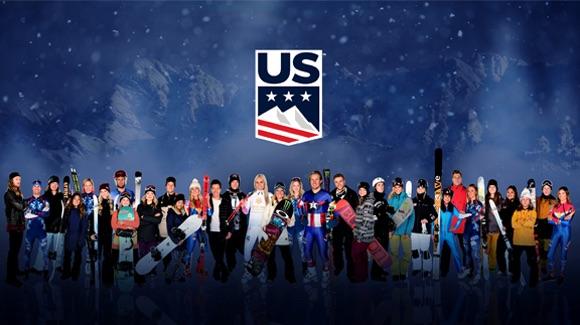
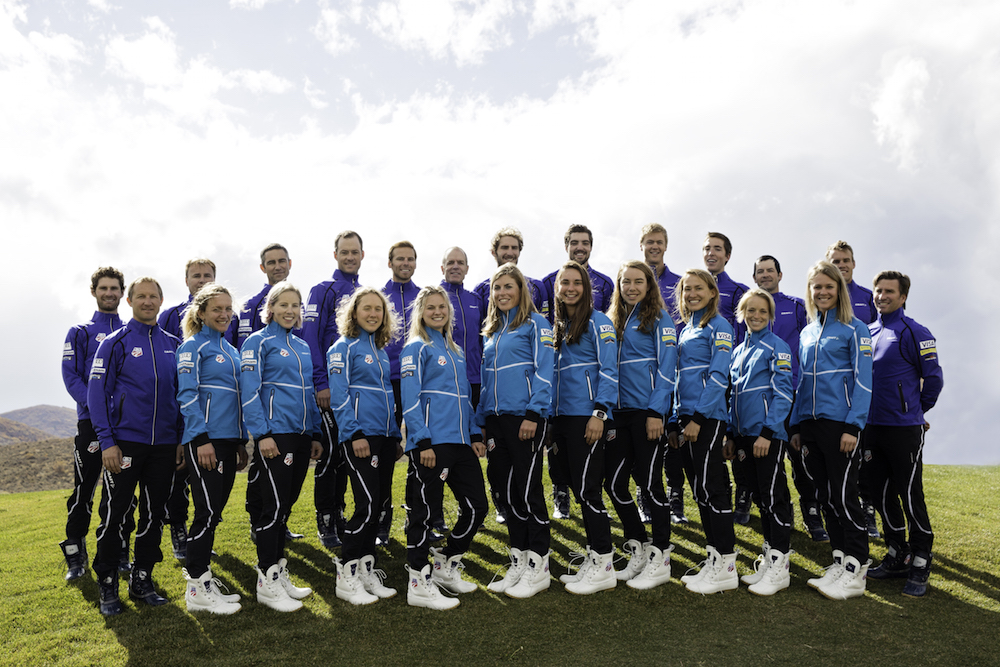
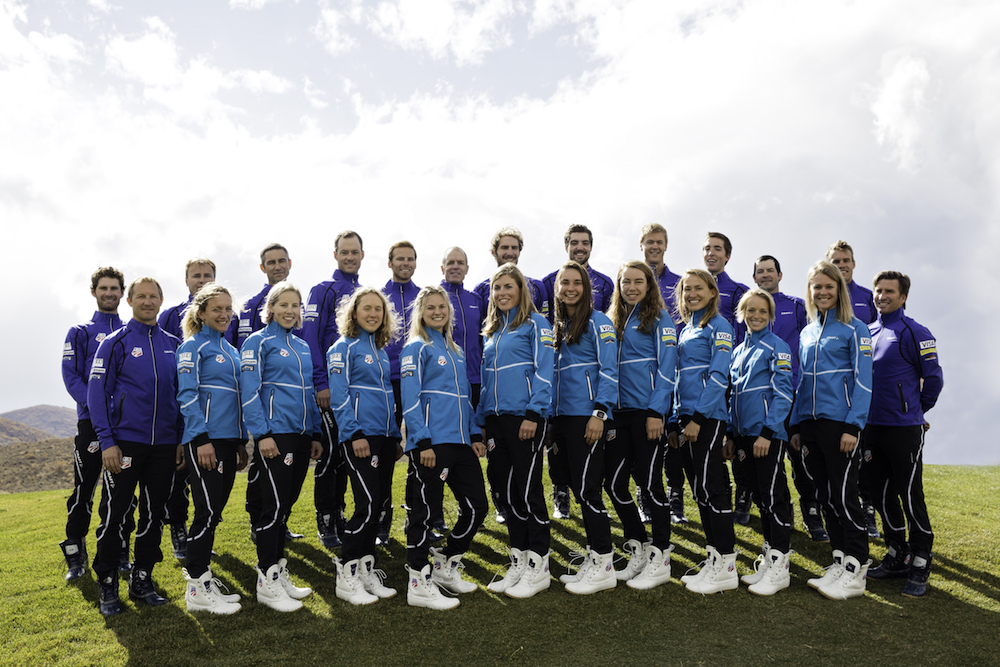
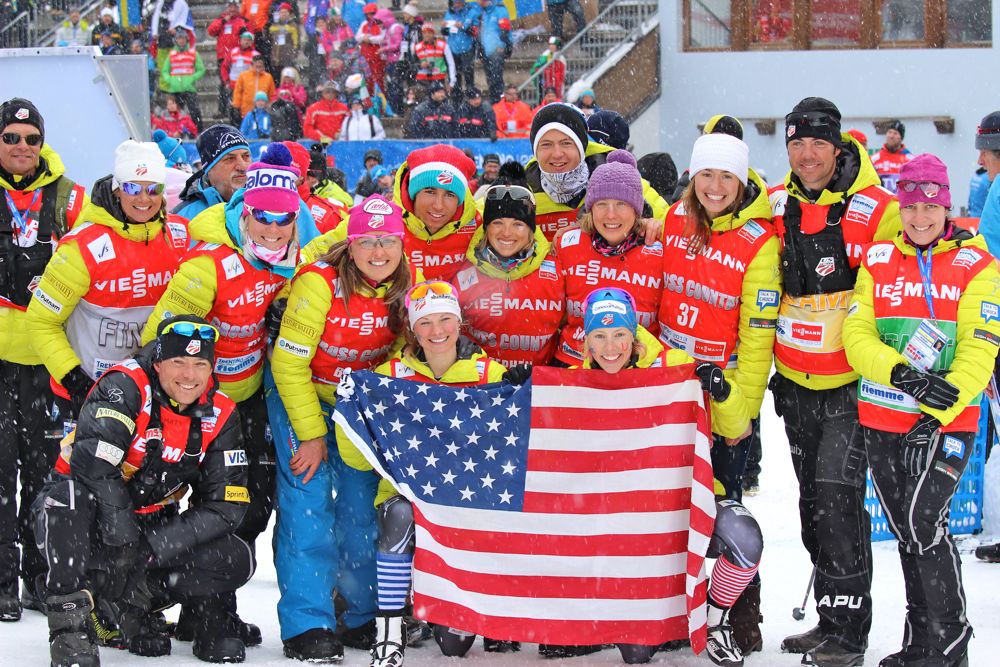
The newly rebranded U.S. Ski & Snowboard’s “one team” photo united under its “single, iconic mark”, according to CEO Tiger Shaw. (Photo: U.S. Ski & Snowboard press release)
Earlier this month, a group of leaders from World Taekwondo stood smiling before flashing cameras and their newly unveiled organization logo. Since 1973, the sport’s governing body was known as the World Taekwondo Federation, using the acronym WTF to represent its globally recognized organization and mission. But recent “negative connotations” associated with the abbreviation moved the group to change its logo and drop the word “federation”.
As with World Taekwondo’s case, there are a number of reasons a company or organization may choose to change brands. If the rebranding of World Taekwondo took away something unwanted, the U.S. Ski and Snowboard Association’s (USSA) recent decision to rebrand to U.S. Ski & Snowboard is somewhat the opposite.
Since the early 1990s, U.S. Ski & Snowboard had four different brands, that of USSA — which served as the organization’s parent brand — along with three national-team logos: U.S. Ski Team, U.S. Snowboarding, and U.S. Freeskiing.
The old U.S. Ski Team, U.S. Snowboarding and U.S. Free Skiing logos.
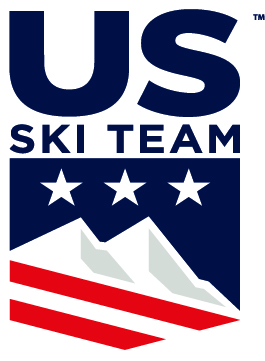
Now, after 112-years in the business, U.S. Ski & Snowboard has decided to unite all teams under one core image: a crest sporting the letters “US” and three white stars floating above two mountain peaks, as well as two diagonal red stripes at the shield’s bottom.
The single core image will be adapted for the following tiers: a master mark (just the U.S. crest),
Master mark
an organizational mark (the master mark accompanied by the words “Ski & Snowboard”),
Organizational mark
and the team mark (the master mark accompanied by the respective national team names).
Team mark
“Our brand was strong. It wasn’t that we needed to start over, it was just we needed to clean things up and get refocused,” Tom Kelly, U.S. Ski & Snowboard Vice President of Communications, said of the USSA brand during a phone interview last week. The rebrand launched on June 18.
(Article continues below)
The idea to change the logo emerged during a USSA strategic planning meeting Kelly attended back in June 2015. He and Luke Bodensteiner, USSA’s executive vice President of athletics, were fueling the winds of change.
“We wanted to provide more value to users of that USSA brand,” Kelly said.
“One of the initial pushes with the rebrand was to figure out how to get some of those more broad-based or grassroots skiing and snowboarding [groups] connected with the ski brand,” Bodensteiner told FasterSkier. “To that point, everything had been separate with USSA and USSA racing; that went all the way down to junior racing or recreational racing. The teams were all separate and they shouldn’t be. It’s all one effort and ideally one family.”
Seeking assistance from outside its own walls, USSA created a task force was created that included Nike Senior Strategic Advisor Jeanne Jackson, who had two children compete with the USSA system, and United States Olympic Committee (USOC) Chief Marketing Officer Lisa Baird, a chief engineer for the USOC’s redesigned brand for Team USA, among others.
“What Jeanne Jackson did when she started this, was she posed the question to us, and this is a very Nike-type thing, she said ‘Do you want to be a house of brands, or do you want to be a branded house?’” Kelly explained.
For U.S. Ski & Snowboard, the answer was the latter. To fashion the brand, eight different agencies pitched potential templates before one was chosen — all at no cost for U.S. Ski & Snowboard.
“That’s the beauty of it,” Kelly said of the rebrand. “Everything is pro-bono. So we feel really good about that, that we were essentially able to execute that with no costs.”
When the U.S. Ski Team (USST) underwent a brand and logo change nearly 20 years ago in 1999, the cost amounted to more than $50,000 dollars, according to Kelly. Thanks to the pro-bono work done by i.d.e.a, a San Diego-based consulting firm and U.S. Ski & Snowboard’s ultimate pick, all of the national teams in the organization (nordic, alpine, freeskiing, freestyle, snowboarding) are now under the same logo.
“The U.S. Ski Team had a strong brand and a high level of brand equity, but the philosophy is that by bringing all the sports under one image that that might help create greater equity in the brand,” Bodensteiner said.
The USST will remain an official entity under the new brand. All teams will now share a Facebook page dubbed U.S. Ski & Snowboard. USSA Nordic’s Twitter account (@USSA_Nordic) will no longer exist and has been integrated instead into an @usskiteam Twitter account. On Instagram, @usnordicskiteam has been integrated into @usskiteam. The idea in combining social media outlets is to reach a broader audience — nordic fans may be more likely now to be exposed to the news feeds of others sports and vice versa.
“It will be one U.S. Ski and Snowboarding [Facebook] page and it will be varied content throughout all sports all the time — a little bit of alpine, a little bit of nordic, a little bit of freeskiing,” Courtney Harkins, content media manager for U.S. Ski & Snowboard explained on the phone. “It’s going to be really good thing for the cross-country team as well because you have chance to make freeskier fans of Jessie Diggins.
“I think it’s a cool way to broaden and magnify the somewhat specialized fans of cross-country skiing,” Harkins continued. “For example, on the USSA nordic page we had 12,000 fans and now we have a 170,000.”
As of right now, U.S. Ski & Snowboard has made a conscious decision not to acronym its name. The word association was dropped because it was not seen as an “essential component” to the organization’s name.
“As a general rule, acronyming is a bad brand practice,” Kelly wrote in a follow-up email to FasterSkier. “It creates a collection of letters that is not easily recognizable to the majority of people who cross paths with the brand. We’ve been seeking to avoid acronyms for some years, but USSA was ubiquitous. We will always use U.S. Ski & Snowboard and not abbreviate it or create an acronym. And we appreciate users respecting that.”
Ultimately, beyond bringing all U.S. Ski & Snowboard teams under one roof, the rebrand also brings a much simpler connection for its partners both new and old. Toyota, which recently became the official vehicle for U.S. Ski & Snowboard, will now only have one mark to take into consideration for its sponsorship.
“The partners are uniformly thrilled about it because it makes it so much easier for them, than it was before,” Kelly said. “So if you’re a Visa, for example, previously there were three sometimes four different marks they were involved with … that had become a real issue. It was complex, it was expensive and now we’re down to one.”
U.S. Ski & Snowboard is currently in the process of changing its staff email addresses. The “usskiandsnowboard.org” website domain currently redirects readers to ussa.org as the new one has not yet been launched. The decision to do somewhat of a “soft opening” with the brand played into the decision to hold-off.
“You’ll see on our website, we have re-skinned it with the new mark,” Kelly said. “We have a new website developed and it’s in the the wings, but we just chose not to launch it. It was just one more thing to do this week that we felt let’s wait.”
“Once we launch [usskiandsnowboard.org], which will hopefully be this summer, could be later summer, but it’s not going to be in the next few weeks, as soon as we launch that, we will then point any old primary urls to the new site,” Kelly continued. “So you’ll still be able to go to ussa.org and get there, but it won’t be our polished domain.”
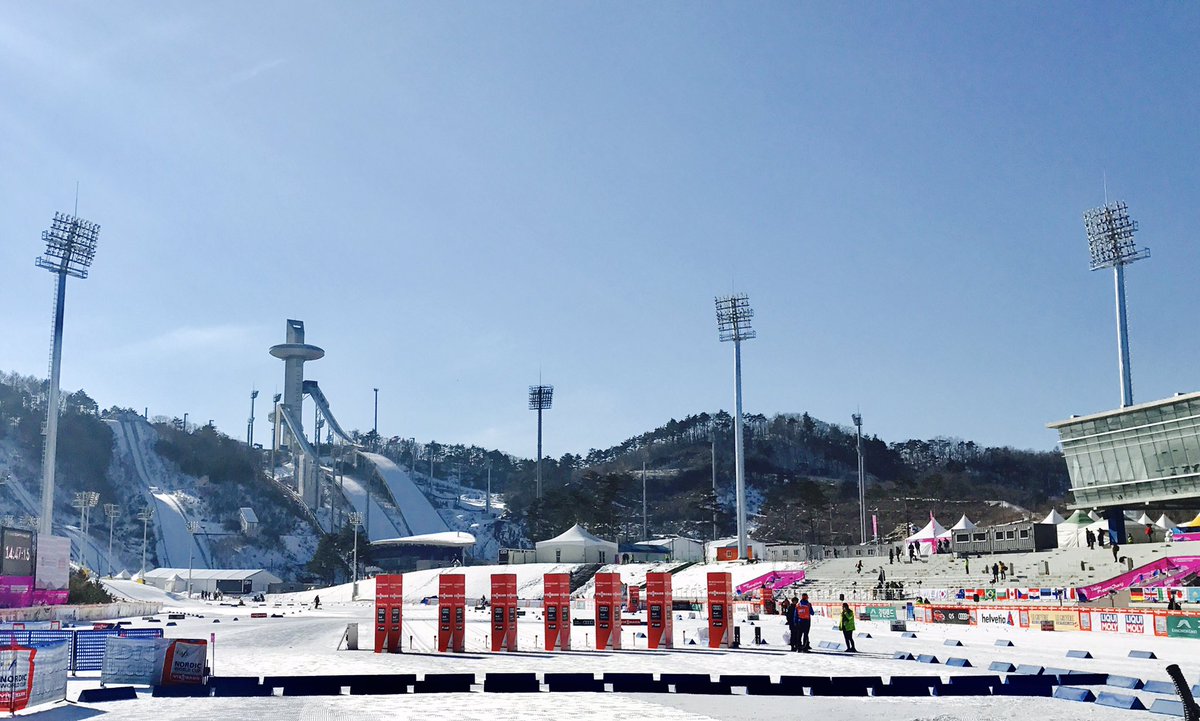
The PyeongChang venue as seen in February 2017. PyeongChang, South Korea, will host the 2018 Olympic Games this coming February. (Photo: FIS Cross Country/Twitter)
Note: This is the first of a multiple-part series on the 2018 Winter Olympic selection criteria for the U.S. cross-country ski team. A parallel piece compares the cross-country team’s criteria with other U.S. winter sports.
***
Friday, July 7, will mark seven months to go until the Opening Ceremony for the 2018 Winter Olympics in PyeongChang, South Korea. As athletes across the country ramp up their commitment in this Olympic year, and #roadtopyeongchang trends across various social media platforms, FasterSkier takes a look at the recently released selection criteria and procedures for nomination to the U.S. Olympic team.
Briefly put, what does it take to get to PyeongChang? And what factors will U.S. Ski Team (USST) coaches and (newly rebranded) U.S. Ski & Snowboard leaders apply in deciding who will be wearing red, white and blue next February?
In this article, FasterSkier first breaks down the criteria themselves, then summarizes a recent interview with USST Head Coach Chris Grover about why these criteria were chosen and how they should work.
Inside the criteria: World Cup performance, discretion and potential domestic picks
The criteria themselves are little changed from the standards used to pick the American team for the last two international championship events, World Champs in Falun in 2015 and Lahti in 2017. First comes objective qualification via performance on the World Cup. Second comes the potential use of discretionary picks. Third, if any spots are left over, the highest-ranking athlete on a domestic points list may, but does not have to, be nominated to the team.
As for the overall size of the U.S. team, a maximum of 12 male or 12 female athletes may be nominated, with a final team quota of probably 17 to 20 athletes to be determined closer to the Olympics themselves. (This is up from a total team quota of 17 in 2014, though ultimately only 14 athletes were named for Sochi, and the extra three American spots were redistributed to other nations.)
The U.S. may enter up to four athletes in a single race at the Olympics. The six cross-country events in PyeongChang will be a skiathlon (15 kilometers for women and 30 k for men), individual classic sprint, freestyle team sprint, 10/15 k skate interval start, 4 x 5 k or 4 x 10 k mixed technique relay (classic, classic, skate, skate), and 30/50 k classic mass start.
As for the criteria themselves for making the U.S. Olympic team: In order:
Objective qualification via World Cup results
Athletes who have achieved a top-eight finish in one of five specific races, or who have a top-50 ranking on either the World Cup sprint or distance list midway through Period II, will be named to the team.
Most precisely, “Any eligible athlete that posts a top-8 individual final World Cup result during the selection period [Nov. 23, 2017, through Jan. 15, 2018] in the following events will be selected to the Team: Sprint C, individual start 10/15 km F, and 15/30 km Skiathlon.”
Looking to the schedule for the 2017/2018 World Cup season, classic sprints will be held on Nov. 24, in Ruka, Finland; Dec. 2, in Lillehammer, Norway; and Jan. 3 in Oberstdorf, Germany (as part of the Tour de Ski). A 10/15 k freestyle individual start will be held in Davos, Switzerland, on Dec. 10. The only skiathlon on the 2017/2018 World Cup calendar will be held in Lillehammer on Dec. 3. Any athlete posting a top-eight final result in one of those five races will be named to the Olympic team.
(The 10/15 k skate pursuits on the schedule don’t count for top-eight purposes – it’s only Olympic formats that are used for qualification. And the 10/15 k skate race in PyeongChang is an interval-start race, not a pursuit.)
So that’s high finishes in individual races. As for cumulative performance across multiple races, “Athletes ranking in the top-50 in the distance World Cup standings or the top-50 in the Sprint World Cup standings as of January 15, 2018 shall be selected to the team.” Jan. 15 marks roughly the midway point of the World Cup calendar. By that point, 18 World Cup races will have been held.
U.S. Ski Team member Sadie Bjornsen racing in the women’s 15 k skiathlon at the 2014 Winter Olympics in Sochi, Russia. Bjornsen is a veteran member of the national team heading into another Olympic year.
As of the comparable point in the 2016/2017 season, shortly after the Tour de Ski, USST members Sadie Bjornsen, Rosie Brennan, Sophie Caldwell, Jessie Diggins, Simi Hamilton, Noah Hoffman, Andy Newell, Kikkan Randall, Ida Sargent, and Liz Stephen had top-50 rankings in either or both disciplines.
A maximum of five athletes per gender may be selected based on their Sprint World Cup rankings. Tiebreaking procedures come into play at that point if necessary, generally based on an athlete’s single best finish in a sprint race.
Discretionary selection
Spots on the U.S. Olympic team will presumably remain open after the application of the objective criterion of World Cup performance. In that case, “the USSA Cross Country Head Coach may use discretion … to determine team nominations” for additional spots on the Olympic team.
Grover would at that point recommend additional athletes to a three-person committee, composed of U.S. Ski & Snowboard President Tiger Shaw, Executive Vice President of Athletics Luke Bodensteiner, and athlete representative Rosie Brennan.
If Brennan stands exposed to a potential conflict of interest from discretionary selection (that is, through no fault of her own, she “stands to benefit privately from a decision made by the Selection Committee,” as would happen if she had not qualified objectively and were being considered for discretionary selection), then she would be directed not to engage in any conduct “meant to unduly influence” the selection committee regarding her potential selection to the Olympic team.
Grover is then directed to consider any of (a) “outstanding competition results” from both this season and last season, (b) “Recent positive direction or trend of competition results indicating a potential for Olympic success,” or (c) “Indication of medal potential in future Olympic or World Championship competition (such as international age group results and rankings) that would be materially enhanced by selection to the team.”
U.S. Ski & Snowboard was not required to make discretion a means of selection to the team. It also has the discretion not to use discretion at all; as the document states, Grover may use discretion to determine additional team nominations, but does not have to.
Domestic selection. Maybe.
If there are any spots remaining on the team after applying criteria (1) and (2), U.S. Ski & Snowboard may consider the highest-ranked domestic athlete, one per gender. But it technically doesn’t have to.
(There is some ambiguity within the selection document itself as to whether more than one team spot could be filled via a domestic ranking list. On the one hand, selection criterion 3 uses the plural when it talks about “any remaining positions,” and “those positions may be filled.” On the other hand, it also mentions “the athlete with the highest rank on the 2018 Olympic Winter Games Selection List,” and both “athlete” and “rank” are in the singular. In practice, Grover clarified in a recent phone interview that the national team is potentially open to bringing more than one skier per gender, pointing out that four men and two women were brought to Lahti off the domestic rankings list.)
The 2018 Olympic Winter Games Selection List, as with the comparable list for 2017 World Champs in Lahti, is essentially the “normal” 2017/2018 SuperTour points list, plus substantial bonus points for 2018 U.S. National Championships. An athlete’s best two finishes in a single discipline (sprint or distance, not skate or classic) will be counted.
The SuperTour point totals system, and bonus points for podium finishes at 2018 U.S. nationals, appear to be precisely the same as those used last winter for Lahti. That is, first through third at the December SuperTour races will be worth 30, 25, and 21 points, respectively. The addition of nationals-only bonus points means that first through third in the four races in Anchorage count for 45, 35, and 26 points, respectively. When an athlete’s best two finishes are counted, a second and third at U.S. nationals (61 points) would be worth more than two firsts (60 points) at “normal” SuperTour races.
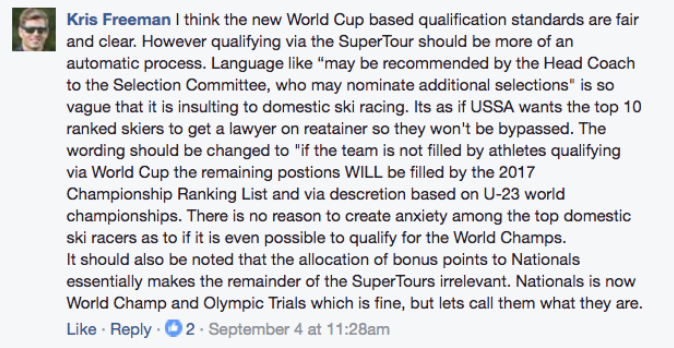
For this reason, in last year’spreview for 2017 U.S. nationals, FasterSkier quoted longtime racer Kris Freeman as stating that “the allocation of bonus points to Nationals essentially makes the remainder of the SuperTours irrelevant. Nationals is now World Champ and Olympic Trials which is fine, but let’s call them what they are.”
The math is the same this season as last season. This season, U.S. nationals start in Anchorage on Jan. 3, 2018. The four races there will be a skate sprint, classic sprint, 10/15 k skate interval start, and 20/30 k classic mass start.
Discretion and selection to international championship events
The appropriate role of discretion when selecting athletes for a World Ski Championships or Olympic team is a subject of recurring interest for fans and supporters of American cross-country skiing, and has frequently arisen on this site.
For example, here’s USST Women’s Coach Matt Whitcomb in an interview with FasterSkier in July 2016, answering the question, “Is it fair to say that making discretionary picks is one of the harder parts of your job as a coach?” Whitcomb replied, “For sure. We love not to do it. But in any criteria, discretion can often be one of the most important pieces. We really envy these Olympic Trials [for the American track and field athletes for the 2016 Rio Olympics] that we’re watching right now, where the top three go and fourth is either an alternate or they don’t go, and it’s just much more objective.”
And here’s Grover in January 2017, slightly ahead of the naming of the U.S. team for Lahti: “The real key thing is that, at the bottom of the selection, we followed the selection criteria. That’s key. Discretion really belongs to be used at the top, for those athletes who have a chance to come over and have big races at World Championships, and by big races I mean someone who can go on the podium, or the top five, top 10, or top 15. Look for some selections from USA, but I wouldn’t look for a lot of discretion at the end of the day.”
Or here’s Grover in January 2014, discussing why he and the rest of U.S. team leadership abjured discretion completely in taking Brian Gregg to Sochi but not Matt Liebsch, when only 0.04 points separated the two on the domestic men’s distance list: “We really tried to apply the selection criteria in the most fair way possible.That becomes, for sure, a challenge, especially on the men’s side when you get down to the sixth, seventh, eighth guys, you’re really splitting hairs because the FIS points are so close at that point. Because they were so close we opted not to use discretion. It really wasn’t a fair way to do it.”
(As things played out in Sochi, USSA selected 14 athletes out of a total possible quota of 17. Grover explained at the time, shortly after selections were made and before the Olympics began, that they had only intended to bring those athletes whom they planned on starting in races. “With seven women and seven men, we have our start positions filled,” Grover told FasterSkier before the Games. “Seven and seven was the magic number for us.” Liebsch is reported to have considered legal action to gain a spot on the U.S. team for Sochi, but found that that it was “too late” for him to do so. In Sochi a few weeks later, U.S. athlete Torin Koos did not start the 50 k skate race, a race format in which Liebsch had previously won at the American Birkebeiner.)
The U.S. Ski Team’s views on discretion
Grover, the longtime USST head coach, is aware that people feel strongly about the substance and application of selection criteria for U.S. championship teams. “I think overall I’d say people get a little bit mired up and tied up with selection criteria, and whether it’s fair or not, or how this potentially sees them falling within that criteria,” Grover told FasterSkier in a recent phone interview.
But Grover has a simple message for domestic athletes hoping to go to PyeongChang: “All you need to do is to ski fast, you need to go out there and win races, or to reach podiums. And if you can do that, your chances of being selected to the team are quite good.”
The current criteria are “better than ever, more fair than ever,” Grover continued. “I think [it] gives athletes the most direct path possible to a major championship team.”
Grover urged domestic athletes not to obsess over the apparent prioritization of discretion over domestic race results as a means of picking the Olympic team. Addressing a hypothetical non-national team member, he said, “As as an athlete domestically, don’t get hung up in the order that those things come down in the selection criteria. Discretion has to be next, because a discretionary athlete that’s picked needs to be picked because they are a top athlete who should be on the team, who has somehow been missed by the selection criteria.
“So that’s the placement it has to be,” he continued. “And that’s consistent with selection criteria across different disciplines, in different sports. So that’s just the way that the procedure needs to work. But it doesn’t mean that a large number of discretionary athletes will necessarily be selected prior to the domestic field.”
The statements that discretion “has” to have this status, and that this is “consistent with … different sports,” are not necessarily correct. As reported today in another article on FasterSkier, discretion plays a less prominent role in every other U.S. Ski & Snowboard sport.
Grover also underscored that the use of discretion within American skiing pales in comparison to its role in Norway or Russia.
“We’re competing against teams that are using 100-percent discretion to name their teams,” Grover emphasized. “So in the U.S., we have kind of the most democratic, objective, fair, I guess you could say – other nations, our Scandinavian peers, might call this an American system that we use for selecting athletes. It’s very cut-and-dried.”
The four countries that Grover mentioned by name in his interview as the Americans’ main competition – Norway, Sweden, Finland, and Russia – all finished ahead of the U.S. in the final Nations Cup standings for the 2016/2017 World Cup season.
Grover also stressed that U.S. Ski & Snowboard used only one discretionary pick for the Lahti roster, taking USST athlete Erik Bjornsen. “And the reason that we used one discretionary spot to select Erik was because he basically fell between the two criteria. He didn’t quite make the top-50 in the world standard because he had gotten sick during the selection process, and he wasn’t home domestically to race in the races domestically, but I think very few people out there would argue that that wasn’t a good use or a smart use of one discretionary spot.”
Grover further stressed that the team had used, as he initially put it, “zero discretion” when selecting athletes for Falun World Championships in 2015. (In a subsequent email to FasterSkier, Grover clarified that “We used zero discretion in the original selection of 16 athletes (8 men and 8 women) to the Falun Team, but we did add Ben [Saxton] at a later date via discretion after he finished 6th in the sprint at U23 Champs.”)
Writing criteria for the top vs. the bottom
Grover cited the decision to bring Erik Bjornsen to Lahti as an exemplary use of discretion, underscoring that Bjornsen was a skilled athlete who “had some of the very best individual results there” among American skiers.
“So that is absolutely our intention,” Grover continued, “it has been our intention, and it will be our intention going forward, is that we use discretion on the rare case where there’s an injury, or an illness, with a top athlete, and/or the criteria fail to select someone that I think most everyone would agree should be there representing the United States.”
At world champs in Lahti in 2017, Bjornsen finished 18th in the 15 k classic and teamed up with Simi Hamilton to finish fifth in the team sprint. At world champs in Falun in 2015, Saxton finished 54th in classic sprint qualifying, roughly nine seconds from making the heats.
While Grover is confident that discretion is most appropriately used for a top-performing U.S. athlete, he acknowledged some issues regarding the final athletes selected (or not selected) to a team.
Summarizing his discussion with domestic senior club coaches about the selection criteria used for Lahti, and any potential changes before PyeongChang, Grover said, “All the responses I got back were positive, people were like, Yeah, it worked well. It’s never perfect at the bottom, but I don’t really see any way to improve it.”
Indeed, he noted, the U.S. Ski & Snowboard working group “struggled with” how to select “athletes at the bottom of the selection, and make it as fair as possible. And what you come up with at the end is, in the end there’s no real perfect way to do it, and there’s going to be challenges to the way that any selection criteria works at the very bottom of the selection.”
Current success vs. preparing for the future
Another issue surrounding selection is the question of current competitiveness vs. taking a young athlete to a “practice” Olympics just for the experience – that is, is the Olympics for development or for podiums. In 2014, for example, regarding the recently named team for Sochi, Grover said, “The Olympics is the pinnacle of the performance or competition pipeline.”
Development occurs at many lower levels, Grover noted (Europa Cups, World Juniors, etc.), but “It does not and should not come at the World Championships or the Olympics. … It’s not a development trip; it’s a competition trip at the very highest level.”
Similarly, earlier this year Grover explained that junior skier Katharine Ogden (a.k.a. “KO”) was not selected for Lahti on the grounds that “athletes should first aim to be successful at – in the age group that they’re competing against. So for KO, that means World Juniors, and being successful at World Juniors.”
The third prong of discretionary selection for the current Olympic team, “Indication of medal potential in future Olympic or World Championship competition (such as international age group results and rankings) that would be materially enhanced by selection to the team,”may be said to go against these principles.
But Grover explained that this “future medal potential” path to discretionary selection is rarely if ever used, even when the Olympic team is selected with an eye to current podium potential.
“We haven’t used it that way,” Grover said. “Obviously the language is there if we were to choose to use it, but in the past we really have not used it that way, and I don’t anticipate using it going forward into this season. … We want … the fastest skiers on the start line in Korea, and those are the ones that we’re gonna be selecting.”
Different standards for men and women?
An additional issue in selecting American skiers is that the women are currently, proportionally speaking, faster than the men – that is, the U.S. women, as a team, have recently tended to achieve better results within the women’s World Cup field than the U.S. men do within the men’s World Cup field.
It is also true that the international men’s field is more top-heavy than the women’s field, across the course of a single World Cup season, meaning that a greater number of World Cup points is needed to crack the top-50 of a discipline ranking.
Perhaps for these reasons, multiple athletes have confirmed to FasterSkier the substance of a suggestion made at a recent athletes’ meeting at the season-ending 2017 U.S. Distance Nationals in Fairbanks: That the selection criteria should be made more challenging on the women’s side, such as by making the objective cutoff there be a top-40 or even a top-30 discipline ranking rather than top-50.
“I understand where the person who asked that question, where kind of they’re coming from” Grover told FasterSkier, when asked generally if there had ever been discussions about making the objective criteria different between the genders.
“They’re referring to the fact that there’s greater depth on the men’s side … there’s a lot more men ranked – that have FIS points that are say 30 and under, versus the number of women perhaps that have 30 FIS points or less.”
But, Grover continued, “top results are top results at the end of the day. And there’s three medals that are handed out, for men and for women. And if that means that selecting an athlete who ends up to be, say, 46th in the top, in terms of the top 50 in a discipline list by the middle of January, that athlete might be closer to contributing to a top result or a podium than one of the guys.”
For this reason, Grover questioned the aims served by this suggestion. “Is the end objective for that person just to provide more opportunities for men to come over and be 50th place at the Olympics? Because if that is the objective, then I don’t think it’s worthwhile pursuing. What we’re trying to do is have top results … to really compete. And that means selecting those athletes who are the closest to the top placings.”
Freeman also argued that it was illogical to use a non-championship event for selection to the USST, “whose primary stated goal is to win medals. … Is racing up a hill at the end of a nine-day tour really a fair way to determine who goes to the World Championships or Olympics?”
Grover’s stance is that it’s more difficult to finish in the overall top 30 of the Tour de Ski than reach the podium at U.S. nationals. Due to recent changes in FIS rules that will allow more pure sprinters to start the 2017/2018 Tour de Ski without counting against their nation’s start quota, he foresees a greater number of finishers in this year’s Tour.
“I would anticipate that this year you’re going to have much better numbers of athletes that are actually finishing the Tour,” he said, “and so the standard there won’t be quite as ‘easy,’ quote-unquote. It’s not necessarily easy, but won’t be as easy as it was this last year.
“Is it easier to score points, even at the end of a Tour de Ski if you can survive it, versus to have a podium at U.S. nationals, given that a bunch of the top USA athletes are doing the Tour de Ski at the same time?” he asked. “I would still guess that it’s easier to reach the podium at U.S. nationals, and thereby that would make it an easier path for an athlete to make the Olympic team.”
FasterSkier has separately addressed Freeman’s argument regarding the “access problem” of obtaining Tour or World Cup start rights in the first place. FasterSkier has also considered the approach used by the US Biathlon Association, which makes it “not a foregone conclusion” that athletes receiving World Cup starts will necessarily make the Olympics.
The bottom line
“At the end of the day,” Grover concluded, “I would anticipate that we’ll be able to bring the athletes that we want to bring so that we can fill every potential start spot at the Games. … We will fill every start at the Olympics.”
Grover and U.S. Ski & Snowboard intend to do so by making sure “that we capture any athlete who can reach the podium, any athlete who can reach the top five, the top 10, the top 15. That’s the absolute critical element, is that we give ourselves the best chance to be successful.”
And Grover believes that the current criteria are “the best way to do that.” We “were trying to create a more equitable, more concrete, easier to understand and visualize path for domestic athletes, racing SuperTour, to qualify for a major championship team,” Grover said. The result, he concludes, is “better than ever, more fair than ever. … So, you know, I feel good, I feel really good about the criteria, I feel like we got the most fair criteria for the Olympic selection that we’ve had, and I’m excited to see how it turns out.”
— Jason Albert and Chelsea Little contributed reporting
***
Stay tuned for more on this topic, including an article on American athletes’ reaction to the Olympic selection criteria and how they feel the exercise of discretion has affected them and U.S. skiing. And be sure to read about the role of discretion across other U.S. Ski & Snowboard sports, particularly biathlon.
U.S. Nordic Combined’s 2011/2012 team members (from left to right) Billy Demong, Bryan Fletcher and Taylor Fletcher with head coach Dave Jarrett at Soldier Hollow in Midway, Utah. (Photo: USSA)
Listed at the bottom of a U.S. Ski & Snowboard Association (USSA) press release announcing U.S. Nordic Combined Head Coach Dave Jarrett’s retirement are his coaching highlights. It’s a long list defined by two things: Olympic and World Championship medals and longevity. Jarrett will forever be linked with the iconic names of U.S. nordic combined, including Billy Demong, Johnny Spillane and Todd Lodwick. His coaching legacy rewinds back to the 2002/2003 World Cup season.
Before that, as a nordic-combined athlete, Jarrett was a member of the U.S. Ski Team from 1992-1996 and is a two-time Olympian. He’s a lifer. And for lifers, separation from what they have always known remains difficult.
“I have been doing it a long time both as an athlete and and a coach,” Jarrett, 46, told FasterSkier on the phone. “It is now of those things where all of sudden it hits you, like, you are tired. You’re not able to go give everything and do everything. And certainly, it’s hard to justify a lot of time on the road. Missing family things, but also on the athletic side you are not able to give to the athletes everything that you need to give.”
Until 2014, USSA managed the U.S. Nordic Combined Team. The team is now run by USA Nordic, yet Jarrett’s position has remained under USSA’s umbrella — they continued to pay his salary. With the 2014 split, Jarrett’s responsibilities grew as he took on both coaching duties as well as some of the logistics of running a team.
Dave Jarrett, head coach of U.S. Nordic Combined, during the 2013/2014 season. (Photo: USSA)
“Honestly, it’s amazing he lasted as long as he did,” U.S. Nordic Combined A-team member Bryan Fletcher said on the phone from his home in Park City, Utah. “He’s definitely a trooper, for sure. It was pretty intense because he was still employed by USSA and still had bosses there, but he also had bosses on USAN and had obligations on both sides of the coin. That combined with continuing his education research for coaching stuff, it adds up quick. And then doing all the travel logistics for not only World Cup but for World Cup and B-team and then having to be there in person, it was insane.”
Taylor Fletcher, another longtime U.S. Nordic Combined athlete and Bryan’s younger brother, also noted the stress on Jarrett.
“He had definitely been challenged … he had to go from a full-time coach to a full-time coach and a team manager,” Taylor explained on the phone. “He was in charge of doing a lot of the fundraising, and all the aspects to keep our sport alive in the U.S. And that really took a toll on him and that was definitely difficult on all of us. But also, I think it put way more weight on his shoulders than he really needed.”
Diminishing funds correlates to increased non-coaching responsibilities for coaches, less on-snow time and more connecting the non-competitive dots for athletes. Jarrett weathered that type of job description metamorphosis. Ski coaching at the elite international level is an all-encompassing life, and he lived it for 15 years.
“For me and my wife, we got married while I was still an athlete and so this is a lifestyle, the only lifestyle we have ever really ever known,” Jarrett said. “Both of my children were born in 2002 and 2004. Again this is a lifestyle that’s all they have ever known.”
Demong, USA Nordic’s executive director for the last year, has spent nearly his entire international-skiing career under Jarrett’s wing. The two became teammates back during the 1996/1997 season when Demong bumped up to national-team status.
“DJ had a good understanding of physiology, so he and I bonded over that in the beginning,” Demong said. “Especially given the fact at the time we had a really good team culture developing but we didn’t have the physiological expertise in our training programs and that sort frustrated both us. So we sort of found a commonality there right out of the gate.”
After completing his competitive career, Jarrett went on to earn a degree in exercise physiology and kinesiology from the University of Colorado. He was able to bring his education into play as he joined the coaching ranks.
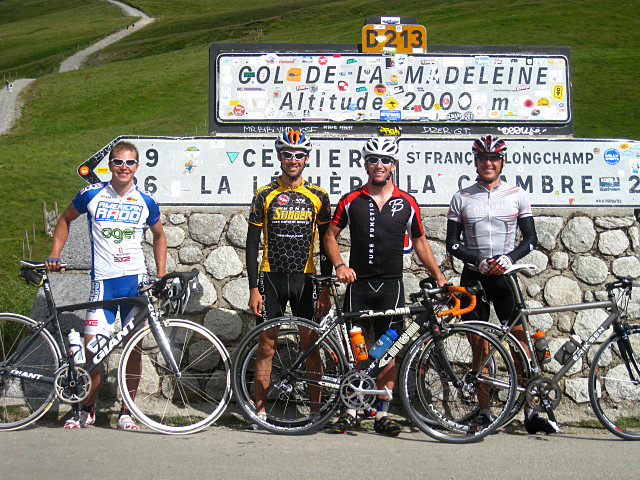
The U.S. Nordic Combined team takes a break at the top of the Col de la Madeleine during a 2009 training camp in nearby Courchevel, France. From left to right: Bill Demong, Johnny Spillane, coach Dave Jarrett, and Todd Lodwick (Photo: USSA)
“When he came back to coaching it was really a breath of fresh air,” Demong said about Jarrett’s academic and nordic-sports knowledge. “We had built this great culture and were all working really hard, but we still didn’t have the plan training-wise that I felt we needed.
“Going back to my high-school running days, we peaked when we wanted to peak for states and federations, and when we were doing our nordic training I felt like we were sort of doing what other nordic-combined skiers did, which was get up, ski, or get up, go jump, have lunch, go ski, go home,” he continued. “And DJ brought a ton of new ideas and concepts that he had learned in school as well as from networking with other sports. DJ really helped pioneer a lot of things on the physiological side and take our team from good culture, talented hard working athletes, to champions.”
Jarrett plans to open a strength and agility center in Heber, Utah, where he lives with his wife and children, the youngest of which will be entering eighth grade; his oldest will be a freshman in high school. As with any change, he said he looked forward to what the opportunity might bring and remaining close to his family. Yet looking back, Jarrett said he’d miss the small daily aspects of the sporting life.
“It’s the everyday victory I’ll miss,” Jarrett said. “I’m psyched to see the work that the athletes are putting in. The work that the coaching staff are putting in to see those everyday victories — those personal best, in testing, first time getting Continental Cup points, or first time getting World Cup points, or a World Cup podium. You can say the hardware is why you do it for sure, but I will miss is the everyday camaraderie and training.”
U.S. NoCo Moving Forward
Demong said the program remains stable heading into an Olympic season; Jarrett had been discussing a transition for the past several seasons.
“It had been something that has been on my radar for awhile and DJ certainly communicated early enough for me to to start planning, and quite honestly, we do have a good safety net,” he said.
U.S. Nordic Combined Assistant Coach Martin Bayer will step into the role of head coach. Bayer hails from the Czech Republic and began coaching domestically in the U.S. in 2000. He is currently based in Planica, Slovenia.
Demong said Bayer is entering this position with the institutional knowledge to make the coaching change seamless.
“Martin has worked his way up through the club system to the development team coach,” he said. “He has basically coached everybody onto the national team with the exception of Bryan, who is just a little bit older. So he has already a great relationship with all the athletes that are on the team. He knows all the athletes in the pipeline. … He knows the environment and he is familiar with how we operate, and there is a level of trust both from my end and with the athletes.”
Nick Huber will remain the program’s head ski-jumping coach. On the cross-country side of the sport, former U.S. national-team biathlete Jeremy Teela is advising the team. “He has agreed to come in and help us with domestic cross-country coaching and plan writing,” Demong said.
Jon Schafer, who had been U.S. Nordic Combined’s high-performance director for the last year, has also stepped down.
“Jon is a great and a good friend and very very exceptional high-level strategic thinker,” Demong said. “I think our organization is not at the point right now where we can take advantage of his talents and capacities fully, and quite honestly, we just need more boots on the ground. At this point, we are not going to fill that position. He has, however, written us a very detailed plan that we will be using as a road map going forward. It is a living document. For us, it is like everything from recruitment to medals and everything in between as it relates to coaches, education, and national-training centers.”
A business executive, Schafer brought management experience to USA Nordic, and on the sporting side, he was previously an elite-level rower and coach.
“My decision to step down was a very difficult one and one that I most certainly did not take lightly,” Shafer wrote in an email. “I loved working with the athletes and even after my departure, I am still very concerned about their success. It can be very difficult working in an environment of highly constrained resources, in particular with almost no support from USSA.
“Every position or idea simply cannot be funded and every shot has to be a kill,” he continued. “People are going to disagree about the best ways to spend highly limited funds and the tighter the budget, the harder it is to balance all of the different agendas. The organization has a lot of operational needs and the executive director and a few members of the board felt it was more important to have staff selling t-shirts, writing newsletters, marketing copy and other very ‘boots on the ground’ tasks, than a High Performance Director setting strategy and working with coaches and athletes at a higher level. I disagreed with this approach and since they couldn’t afford both, I tendered my resignation. I think this move is good for everyone, as the overall organizational dynamic proved to be a bit too bruising and tumultuous for an honest, easy-going, soft-spoken Midwest boy like me. I want to be very clear here too — my departure was a smooth and respectful one on both sides and I wish them nothing but the best.”
Always the jokester, Schafer (FasterSkier’s gear-review guru) added, “One big upside of this change for me too, is I now anticipate having much more time to write about how long you can wear your underwear without washing it. And perhaps teaching my Great Dane to finally respond to his name.”
The U.S. Nordic Combined team will meet in early May for an all-team camp, which will include all staff and any athlete with a chance of qualifying for the Olympics.
“It’s really going to be focused on learning more about ourselves, learning more about each other, learning how to communicate better and be tougher,” Demong said of the camp.
The eighth edition of the NNF/USSA National U16 Camp will be held Sunday July 23, 2017 (arrival day) to Sunday, July 30 2017 (departure day) in Sun Valley, Idaho hosted by the Sun Valley Ski Education Foundation and the Sun Valley Community School. The NU16 camp brings together the top U16 Boys and Girls from across the USA for a week of intensive training and ski sport education as one of the first steps in the USSA National Development Pipeline. The National Nordic Foundation has designated the NU16 camp as one of its Pillar Projects and the NNF has been instrumental in helping the NU16 Camp grow into one of our country’s key athlete development initiatives. The camp rotates in location throughout the country and this year’s camp will be held on the Community School Campus in Sun Valley, Idaho. The Sun Valley area offers ideal training venues in a beautiful natural setting. US Ski Team staff will lead the camp along with a selection of top regional coaches from across the US. Selection for the camp is based on results from this year’s US Junior Championships, held in Lake Placid, NY. In addition to the top twenty boys and top twenty girls selected via JN results, each USSA Division is afforded two discretionary picks of one boy and one girl(must have competed as a U16 last season). The discretionary selections are in addition to however many skiers may have qualified via the JN selection procedure. It is up to each division to select these discretionary picks and forward those selections onto the camp director, Rick Kapala of the Sun Valley Ski Education Foundation rick@svsef.org. Please provide these divisional selections no later than May 1st, 2017 and also be sure to inform the discretionary picks of their selection.
Attendees are required to organize their own flights into either Sun Valley, ID or Boise ID to arrive on Sunday, July 23 in Boise by 3pm or to Sun Valley by 5pm and to depart on the following Sunday, July 30 by 5pm at either airport. For skiers arriving and departing both Boise and Sun Valley, we will provide all airport shuttles. For skiers driving into Sun Valley, we will provide drop off directions. Lodging, meals and all associated camp costs( except airfare) are included in the camp fee of $675.00. Skiers who have been selected through the JN selection procedure (see attached list) may immediately confirm their attendance by emailing Camp Director Rick Kapala at rick@svsef.org. Divisional leaders should make their discretionary selections as soon as possible and inform both Rick Kapala and the selected athletes of their naming. Please assist us by disseminating this announcement and selection list to the selected skiers in your divisions so that they are aware of this opportunity.
Once participants have confirmed their participation by emailing Rick Kapala rick@svsef.org, they will receive a registration packet via email with camp forms, schedule, camp info and payment instructions.
THE FINAL DATE for PARTICIPANT CONFIRMATION IS FRIDAY MAY 19TH, 2017
Thank you to all of the committed athletes, coaches, sponsors, race organizers and parents who are helping elevate our sport of Cross Country Ski Racing across the USA.
2017 National U16 Camp Selections based on Junior National Championships
Lake Placid, NY
(World Cup scoring based on best 2 results, both the sprint qualifier and the final results are scored but a skier may only use either the qual or the final)
Boys Selections
Haydn Halvorsen (Sugar Bowl Ski Team & Academy) FW
John Hagenbuch (Sun Valley SEF) IMD
Will Koch (Stratton Mountain School) NE
George Cvancara (Alaska Nordic Racing) AK
Joshua Valentine (Gunstock Nordic Association GNA) NE
Skylar Patten (Park City NSC) IMD
Lane Myshrall (Park City NSC) IMD
Peter Moore (Endurance United) MW
Eli Hermanson (Alaska Winter Stars) AK
Griffin Wright (Craftsbury Nordic) NE
Cooper Anderson (Auburn Ski Club Associates Inc.) FW
In this episode of Nordic Nation, we feature U.S. Ski Team physician Dr. Larry Gaul. We caught up with Gaul back in late January while he was in Utah for U23/Junior World Championships.
U.S. Ski Team Doctor Larry Gaul with Liz Stephen (l) and then-USSA Communications Director Margo Christiansen (r) at 2013 FIS Nordic World Ski Championships in Val di Fiemme, Italy. (Photo: Sarah Brunson/U.S. Ski Team)
Gaul has a long history working with the U.S. Ski Team’s cross-country athletes as the chief medical officer at the U.S. Ski & Snowboard Association (USSA). And on the international side of things, Gaul serves on the International Ski Federation’s (FIS) Medical Committee. It was part of his FIS duties that brought him to this year’s U23/Junior Worlds at Soldier Hollow near Midway, Utah, where he served as the FIS medical supervisor during the weeklong competition.
Listen up to hear about Gaul’s role with the U.S. team and FIS.
Katharine Ogden (Stratton Mountain School/U.S. Ski Team D-team) racing to fifth in the women’s 5 k freestyle at 2017 Junior Worlds on Wednesday for her best result in her third Junior Worlds. (Photo: FlyingPointRoad.com)
(Note: This article has been updated to include comments from Americans Katharine Ogden and Taeler McCrerey, as well as Canada’s Gareth Williams.)
Katharine Ogden’s name had already been in the U.S. Ski & Snowboard Association (USSA) record books, right behind Lindsey Williams, Leif Zimmerman and Torin Koos as one of the top finishers in U.S. history at Nordic Junior Worlds Championships.
Ogden, 19, of the Stratton Mountain School (SMS) and U.S. Ski Team (USST) Development “D” Team, was tied with five other Americans who also placed sixth at Junior Worlds, including current World Cup skiers Andy Newell and Kikkan Randall, and Kris Freeman, who went on to finish fourth in two senior World Championships.
On Wednesday, Ogden moved up in the ranks, placing fifth for the second-best U.S. result at Junior Worlds, equalling Zimmerman and Koos.
Katharine Ogden (Stratton Mountain School/U.S. Ski Team D-team) racing to fifth in the women’s 5 k freestyle at 2017 Junior Worlds on Wednesday at Soldier Hollow in Midway, Utah. (Photo: FlyingPointRoad.com)
“I’m really psyched about my result … it was so awesome to see that I’m in a good place to stick with these top girls in the mass start race,” Ogden wrote in an email after the women’s 5-kilometer freestyle at Soldier Hollow in Midway, Utah.
She had previously finished sixth in the 10 k skiathlon two years ago in Almaty, Kazakhstan.
“My goal going into the 5k skate was mostly just getting a feel for how I can race in this field and on these courses so as to know how to race the skiathlon,” she explained, referring to her target race on Friday. “In the skiathalon I’m really hoping for another top 6 and maybe (hopefully) a podium.”
“It’s really encouraging to know that all those U.S. Ski Team girls that are doing so well [on the World Cup] right now were in the same place that I am at one point,” Ogden said in a post-race interview with the U.S. Ski Team.
She has her share of World Cup starts, eight to be exact, after racing the entire Ski Tour Canada — an eight-stage series that closed out the 2015/2016 international race season. This year, her fifth place on Wednesday puts her soundly within U.S. Ski Team criteria for selection to 2017 World Cup Finals, which will take place March 17-19 in Quebec City, Quebec.
But back to Junior Worlds: Ogden achieved a career best on Wednesday and was 6.5 seconds shy of a medal. Ogden started the one-lap 5 k individual start in bib 54 (of 57).
Asked what she was thinking about as she warmed up and lined up at the start, Ogden couldn’t get over how nervous she was.
“Honestly I was pretty nervous before the start of the race. That’s basically all that I was thinking about,” she wrote. “I felt good once I started racing, the nerves just went away! The course was totally awesome for me.”
While she didn’t get many splits, Ogden explained she heard just enough to know that she was with the leaders.
“That motivated me because I was aware that every second was important,” she wrote.
Just over 13 minutes later, she crossed the finish line in third, 6.5 seconds behind behind Russia’s Mariya Istomina, who was fastest across the line in bib 50. Italy’s Anna Comarella, who started 53rd, 30 seconds ahead of Ogden, came up 3.2 seconds shy of the Russian for second at the time. And Ogden was another 3.3 seconds back in third.
“I honestly didn’t have too much of a strategy,” Ogden told the U.S. Ski Team. “It was a short race, so I knew I was going to have to go hard basically from the start. But I was also trying to walk the line of not blowing up.”
The 2002 Olympic trails at Soldier Hollow peak out around 5,900 feet above sea level. That can be a doozy for most of the world that trains closer to sea level, including Ogden from Landgrove, Vt. Asked in a pre-Junior Worlds questionnaire what she was most excited for at these championships, Ogden wrote “racing at altitude.”
The women’s 5 k freestyle podium on Wednesday at 2017 Junior World Championships at Soldier Hollow in Midway, Utah, with Sweden’s Ebba Andersson (c) in first, Norway’s Marte Mæhlum Johansen (l) in second and Russia’s Mariya Istomina (r) in third. (Photo: FlyingPointRoad.com)
Of the three women that started after Ogden, two of them reached the podium. Norway’s Marte Mæhlum Johansen in bib 56 bested Istomina’s time by 1.5 seconds to become the new race leader — albeit briefly. That bumped Ogden to fourth and the American ultimately placed fifth after the final starter, Sweden’s Ebba Andersson, finished 13.8 seconds faster than Johansen for the win in 12:45.4 minutes.
Andersson became a three-time Junior Worlds champion, after winning last year’s 10 k freestyle and 4 x 2.5 k freestyle relay with Sweden’s women’s team in Rasnov, Romania.
“When I was thinking about the race I made a tactic that I would have a controlled start and then power to the end and I think I succeeded,” Andersson told the U.S. Ski Team media. “The course was amazing today. It was incredible and the weather, too.”
Following the trend of the rest of the week so far, conditions were hard-packed and temperatures just below freezing on a bluebird day.
Ogden led three U.S. women in the top 20 on Wednesday, with Hannah Halvorsen (Sugar Bowl Academy/USST) in 13th (+1:01.2) and Taeler McCrerey (University of Denver) in 20th (+1:18.9). The team’s fourth woman, Hailey Swirbul (University of Alaska Anchorage) placed 31st (+1:35.5).
“My goal for this race was to pace it well so I could use my energy wisely,” Halvorsen, also a member of the USST D-team, wrote in an email. “I liked how firm and fast the course was because I could focus on skiing smooth, powerful, and relaxed. I was really happy with how things went!”
As the 22nd starter, Halvorsen initially crossed the line in second.
“I was excited to cross the line in second but I didn’t know how promising that would be with half the field still to finish,” she wrote. “I was a little bummed to not stay in the top ten but I know this was a great race for me.”
Two days earlier, in her first race of her first Junior Worlds, Halvorsen finished 11th in the classic sprint.
Also on Monday, McCrerey, a sophomore at the University of Denver, placed 40th in the classic sprint. She landed 20th on Wednesday for a career best at her first Junior Worlds.
“Today I set out to achieve my first solid race at world juniors,” McCrerey wrote in an email.
She explained that interval-start races are her strength and growing up 9,000 feet above sea level in Frisco, Colo., didn’t hurt, either.
“The 5k course is one of the most challenging I have raced at Soldier Hollow so that also benefited me,” McCrerey noted.
The 44th starter, she explained that she received splits at two parts of the race.
“The splits were surprisingly close as skiers 5-18 were all within 6 seconds of each other,” she wrote. “Unfortunately all the fast girls started behind me so I was not receiving splits off of them. Racing at ‘home’ in this big of races has been an incredible experience. It’s fun to hear people cheering for the ‘host country’ and waving the stars and stripes so proudly!
“Today was a good day,” McCrerey added. “I learned a lot about racing at this level which has made me grow as a skier. Special congratulations to my teammates Hannah and Katherine on their exceptional performances today.”
Canada had four women in 39th through 46th, with Lisle Compton (NTDC Thunder Bay) in 39th (+1:51.9), Annika Richardson (NTDC Thunder Bay/Canadian Junior Team) in 41st (+1:57.8), Claire Grall-Johnson (Nakkertok) in 42nd (+1:58.2), and India McIsaac (Rocky Mountain Racers) in 46th (+2:12.9).
Russia Sweeps Men’s Podium; Wonders 16th
The all-Russian 10 k freestyle men’s podium on Wednesday at 2017 Junior World Championships at Soldier Hollow, with winner Vladislav Vechkanov (c), Egor Kazarinov (l) in second, and Yaroslav Rybochkin (r) in third. (Photo: FlyingPointRoad.com)
After women’s race wrapped up in the morning, the men’s 10 k freestyle began at noon. Hunter Wonders, of Alaska Pacific University, led two Americans in the top 20 — finishing 16th in 24:25.8. The winner, Russia’s Vladislav Vechkanov, who had qualified fifth in the classic sprint then went on to place 10th on Monday, started in bib 59 (of 73) and posted an untouchable time of 23:08.6.
Russia swept the podium with two of Vechkanov’s teammates coming closest to him. Egor Kazarinov, the 70th starter, finished 7.9 seconds back in second, and Yaroslav Rybochkin was 13.3 seconds back in third.
For 19-year-old Vechkanov, the gold was his first medal in two Junior Worlds, after placing seventh in the skate sprint last year in Rasnov.
“I arrived at the finish and actually I didn’t think I would win gold,” he told the U.S. Ski Team media. “So I pushed knowing that I would be in top three, but not winning. I started really slow. The on the second loop I tried to increase my speed. On the last uphill I tried my best to make it to the finish line without any strength and I hoped I would be in the top three. But now I’m first!”
American Hunter Wonders (APU) racing to 16th in the men’s 10 k freestyle at 2017 Junior World Championships on Wednesday at Soldier Hollow in Midway, Utah. (Photo: U.S. Ski Team/Steven Earl)
Wonders’s time was 1:17.2 minutes back, which put him 16th in his first Junior Worlds race. He started 25th, two minutes behind his U.S. teammate Wyatt Gebhardt, of the Steamboat Springs Winter Sports Club. Gebhardt ended up 19th (+1:21.9), also in his Junior Worlds debut.
Also for the U.S, Bill Harmeyer (University of Vermont) placed 29th (+2:02.6) and Lance McKenney 61st (+4:23.3).
Following Gebhardt in 19th, Canada’s Gareth Williams, of the Telemark Race Team in Kelowna, B.C., placed 20th (+1:24.6) in his first Junior Worlds race. His Canadian teammates Antoine Blais (Skibec) followed in 32nd (+2:07.8), Philippe Boucher (CNEPH) 35th (+2:10.3), and Remi Drolet (Black Jack) 50th (+2:49.1).
“This and the skiathlon were both my target races after not qualifying for Canada’s sprint team,” Williams explained in an email. “In my head I wanted to be inside the top 20 on the day, but since it is my first Worlds race I had no idea what to expect.”
Toward the end of the second lap, he started cramping.
“This made it difficult for me to give a proper finishing kick on the last few hills. I was getting splits that I was fighting for a top 20, so for me that was motivating,” Williams wrote. “Overall I am happy with the day, top 20 is something to be pleased with. Now that I have a taste of what it’s like here at Worlds, I can adjust my goals for the coming races. I hope tomorrow’s skiathlon can go equally as well, if not better.”
The last time U.S. nationals were held at SoHo: Start of the women’s 20 k freestyle mass start at 2014 U.S. Cross Country Championships at Soldier Hollow in Midway, Utah.
The domestic trials for the FIS Nordic World Ski Championships team begin at Soldier Hollow on Saturday morning. Not officially, but in practice that’s pretty much the case. That’s one implication of the numbers and points system used to help determine who competes for the U.S. at next month’s races in Lahti, Finland. Here, FasterSkier previews the races and considers the subtle math behind U.S. championship-team selection.
The races
The women race a 10-kilometer freestyle individual start at 10 a.m. local time on Saturday, followed by the men in a 15 k freestyle at noon. Sunday brings a full classic sprint (men’s qualifying starting at 10 a.m., women’s qualifying at 11 a.m., and sprint heats starting at 12:30 p.m.). Then Tuesday, Jan. 10, brings classic mass starts, 20 k for women and 30 k for men, starting at 10 a.m.
A qualification-only, freestyle-sprint type event rounds out the week on Thursday, Jan. 12. (Why no heats? Because of overall demands on local volunteers and an elementary school housed at the venue. The national championship skate sprint will be held at U.S. SuperTour Finals, a.k.a. Spring Series, in March in Fairbanks, Alaska.)
Social media shows several inches of fresh snow currently on top of a manmade base at Soldier Hollow in Midway, Utah.
FasterSkier will be on site throughout the week, providing live updates and reports on the races.
What’s at stake
Bragging rights, for one. All racers like to win, and the week’s first three events are all national championships. Also money: $1,200, $600, and $300 for podium spots in each of the distance races and sprint. It’s no Qaniq Challenge money, but it’s no small sum, either.
Paddy Caldwell (Dartmouth/SMS/USST) racing to 21st in the men’s 15 k freestyle at 2016 U23 World Championships in Rasnov, Romania. (Photo: Logan Hanneman)
But beyond who takes home the medals and the money this week, the races are also important for determining who gets to compete in higher-level races later this season. Skiers under 18 are competing for spots on the Scandinavian Cup Team. Skiers slightly older are competing for spots on the U.S. team for U23/Junior World Championships, which will also be held at Soldier Hollow Jan. 30-Feb. 5. And at the highest level, there are spots up for grabs on the World Championships team for Lahti next month. Probably.
As FasterSkier previously explained, the U.S. Ski and Snowboard Association (USSA) looks first to athletes’ performance on the World Cup in light of objective standards, and then potentially applies discretionary picks. After objective and discretionary selection, then “any remaining positions” for the Lahti team “may be filled by considering the athlete ranking highest on the 2017 Championship Selection List.” (As FasterSkier previously parsed, technically speaking the document says that remaining positions may be filled rather than will or shall be filled, meaning that USSA would not be strictly required to name a leading domestic skier to the team if it did not want to.)
Filling out the team: Objective and discretionary selections
So who’s already in from the U.S. Ski Team (USST)? One woman for sure, five more women basically guaranteed, one man basically guaranteed, then one woman and two men on the bubble.
On the women’s side, Jessie Diggins has automatically qualified for Lahti twice over with her fifth- and sixth-place sprint finishes in Davos and Val Müstair.
Behind her, five more skiers were well within the top 50 in either the sprint or distance World Cup standings following Wednesday’s pursuit race in Oberstdorf: Sophie Caldwell (12th in sprint standings), Sadie Bjornsen (15th in distance standings and 16th in sprint), Ida Sargent (33rd in sprint), Kikkan Randall (32nd in distance and 38th in sprint), and Liz Stephen (42nd in distance).
Jessie Diggins celebrates finishing fifth in the Davos skate sprint. (Photo: Salomon/NordicFocus)
(In the most strictly technical sense, everyone after Diggins cannot officially qualify this way until they are in the top 50 in those discipline standings that are released on Jan. 16. But – barring some extremely statistically improbable races by all eight women immediately below Stephen in the distance rankings – they should all qualify then with ease.)
Rosie Brennan was 56th in the distance standings Wednesday, five points – one solid race – away from the top 50. She got that race in Toblach on Friday, moving up to 47th in the distance standings after finishing 23rd in the 5 k skate.
For the men, Simi Hamilton is currently 41st in the sprint standings, and should be well within the top 50 on Jan. 16.
As of Wednesday, Erik Bjornsen ranked 53rd for distance, four points out of 50th, and 55th for sprinting. Noah Hoffman was 67th in the distance standings. Hoffman moved up to 60th following his 25th-place finish in the 10 k skate in Toblach on Friday.
USST Women’s Coach Matt Whitcomb told FasterSkier in July that athletes who were on the bubble for World Championships selection “going into the Tour de Ski” would “need to make a pretty important decision. And that is whether or not to go back to U.S. championships and qualify domestically, or to take a chance and go with what they know and qualify in the Tour de Ski, and the sprint weekend after the Tour de Ski in Toblach.” Whitcomb added, “And so there are a great number of options both domestically and internationally on the World Cup, that I think we feel is as fair as can be.”
But in practice, all USST athletes discussed above have remained in Europe rather than race at U.S. nationals. Diggins, both Bjornsens, Stephen, Caldwell, Randall, Hamilton, and Hoffman raced at least the first two stages of the Tour de Ski. Sargent and Andy Newell, joined by Hamilton and Caldwell, will compete in OPA Cup races in Planica, Slovenia, this weekend, USST Head Coach Chris Grover told FasterSkier by email last week.
APU skier Scott Patterson made roughly the inverse decision in deciding to start the 2016/2017 season in this country (he had hoped for World Cup starts as last year’s SuperTour distance leader, but was not offered them for the first period of racing). Describing conversations between himself, Grover, and APU Coach Erik Flora, Patterson wrote to FasterSkier in November, “One of the most important points brought up was regarding qualification for world championships in Lahti. The selection criteria favors domestic racing for men due to the difficult objective criteria and weaker World Cup performances relative to the women. In accordance with the criteria I will be looking for some extremely strong early season results so that I can hopefully head to Europe in January and not return until after World Cup finals.”
Regardless of who qualifies off the World Cup via objective standards, USSA may then make discretionary selections. FasterSkier previously surveyed the guidelines for the exercise of this discretion.
Briefly put, USSA has almost unlimited discretion under the listed criteria. And if those criteria give USSA insufficient discretion, a catch-all provision lets USSA make discretionary selections for nearly any other reason if it feels like the objective criteria won’t work: “Other unanticipated failure of objective criteria to select an athlete likely to achieve competition results consistent with USSA program goals for World Championships.”
Filling out the team: SuperTour leaders and bonuses for nationals podiums
After objective and discretionary selections, that leaves this country’s top domestic racers skiing against each other for (probably) one remaining spot per gender.
Before the season began, FasterSkier wrote in a preview article that “American cross-country skiing does not have a trials system.” Kris Freeman (Team Freebird), a man who has been selected to 12 U.S. Olympic or World Championship teams (up to 15 if you include World Juniors teams) since 1998, politely begged to differ, writing in a comment to the FasterSkier Facebook site after the article was posted (see final two sentences in particular):
Both FasterSkier and Freeman are technically correct. Given the numbers involved, Freeman is probably more correct. That is, there is no official trials system, but U.S. Nationals this year is getting pretty close to one.
The World Championships Selection List is based on an athlete’s best two finishes in a single discipline, distance or sprint (qualification round only), across the 2016/2017 SuperTour to date, including the four races at U.S. Nationals. But first through third at the December SuperTour races were worth 30, 25, and 21 points, respectively. Because of the additional Nationals-only bonus points that will be awarded this week, first through third in the next four races count for 45, 35, and 26 points, respectively. Best two races, from the entire season to date, wins.
So Freeman is correct that the “normal” SuperTour events were, if not meaningless, maybe less meaningful in light of the potentially dispositive points available for nationals podium finishes. (There are of course other advantages to being the season-long SuperTour leader, and the December races still count toward that.)
In practice, two firsts at nationals would be unsurpassable by any combination of other races. Same for a first and second at nationals. Indeed, two seconds at nationals is a better result than two firsts in December. Two thirds at nationals beats two seconds from last month. The bonus points for nationals podiums are certainly significant digits.
Matt Gelso (SVSEF) racing to his second-straight victory at the West Yellowstone SuperTour in the men’s 15 k classic in December 2016.
Matt Gelso (Sun Valley Ski Education Gold Team) and Liz Guiney (Craftsbury Green Racing Project) come into nationals as the SuperTour leaders to date, Gelso by a profound margin. Although both have World Cup start rights in Europe later this month by virtue of that status, both athletes will compete in at least the first three races in Soldier Hollow, Gelso and Guiney told FasterSkier earlier this week.
The current SuperTour discipline leaders are Gelso for men’s distance, with 55 points, and Ben Saxton (SMST2) for men’s sprint, with 50 points. Jennie Bender (Bridger Ski Foundation) leads the women’s sprint standings with 55 points, while Katharine Ogden (Stratton Mountain School/USST D-Team) has 50 points to lead the women’s distance standings. These are not unimpressive point totals, which may become relevant if no single athlete puts together two podiums at nationals.
The first race at Soldier Hollow begins at 10 a.m. Saturday morning. The U.S. team for Lahti is tentatively scheduled to be announced on Jan. 23.
More lighthearted times: USSA CEO Tiger Shaw (r) with FIS Secretary General Sarah Lewis (l) and FIS Journalist of the Year Peter Graves (c) at the Killington Alpine World Cup nearly two weeks ago in Killington, Vt. (Photo: FIS)
Tiger Shaw, CEO of the United States Ski and Snowboard Association (USSA), was one of them.
“I am shocked by the level: the number of individuals colluding is shocking,” he said in an interview on Friday. “How anybody could have ever thought that something like this could be secret forever is incredible.”
Shaw said that in some USSA disciplines, there are no Russian athletes competing at a high level, so he expected past competition results to remain more or less unchanged.
For others, however, the implications were bigger. Cross-country skiing clearly falls into that category.
“Obviously it’s going to have an impact in terms of the athletes, where the results will be changed and their medals taken away and they will be banned,” Shaw said. “I presume that the federations will have to make all these decisions.”
The sport “skiing” appears 75 times in the Schedule of Samples and ADAMS Reports document that is part of the McLaren Report’s evidence package. McLaren and the World Anti-Doping Agency (WADA) have anonymized the athlete names, so lines of data cannot be linked to any individual athlete.
While the discipline is sometimes further delineated, for example as “skiing | cross country” (or “cross country skiing” – there is no consistent rule for terminology) it is difficult to tell how many data points correspond to which disciplines. Some entries are also labeled as “Skiing – IPC Cross Country”, but many just say “skiing”, leaving uncertainty as to whether they are from able-bodied or para-nordic competitors, regardless of the discipline.
Many of these 75 data points do not have information about what substances were detected in the samples, if any. But some clearly do: one for the blood-doping drug erythropoietin (EPO); another for a high ratio of exogenous testosterone; yet another for budesonide, a corticosteroid used in inhalers; and another for trimetazidine, a heart drug which, like meldonium, is a metabolic modulator which combats angina.
Another athlete tested positive for “phthalates”, plasticizers which are sometimes used in IV bags and are often assumed to indicate blood transfusions. They are also, however, present in other kinds of packaging.
In all of these cases the results were reported to WADA’s anti-doping test management system, ADAMS, as negative tests: no prohibited substances found. Translated emails used in the investigation also refer to some of these cases, showing that they were discussed between personnel who were supposed to be enforcing anti-doping rules.
The information has been forwarded from WADA to the 32 international sports federations (IFs) where athletes were implicated in the report, and has also been forwarded to the International Olympic Committee (IOC). It is up to those organizations to sift through the information and determine penalties and suspensions, or decide to do further investigation.
Shaw believed that the International Ski Federation (FIS) was taking the report seriously.
“I think they are going to take pretty swift action,” he said. “There are a large number of athletes that have to be dealt with. There’s no question that they will take swift and efficient action… our place is as a stakeholder and a component of international governance. Our role at the FIS level is that [USSA Board Chair] Dexter Paine is one of the vice presidents. So it’s a pivotal day and there’s a lot of work to be done.”
Some work was short-term, he said: determining sanctions for athletes implicated in the report.
But other work was long-term, in terms of dismantling the system which led to such systematic cheating in Russia.
Meanwhile, an increasing number of competitions were implicated in the coverup, some of which occurred after the 2014 Olympics, which was the catalyst and main focus of the report.
That has led U.S. and Canadian athletes in luge and skeleton to discuss a boycott of competitions held in Russia this year. Shaw said he understood their position. FIS has World Cup events in almost every discipline scheduled for Russia this season, and in mid-October FIS President Gian Franco Kasper said that Russia could be stripped of its right to hold those competitions depending on the outcome of the McLaren report.
“I don’t think anybody feels safe about being there, being in a country that had this high level of collusion,” Shaw said. “Each sport and each country is going to have to deal with it in their own way. For that, we work closely with the [United States Olympic Committee] and our athletes.”
Far from regretting if U.S. athletes spoke out on the doping issue, Shaw seemed to be relieved that more and more, they are doing so.
“The bottom line is that we absolutely stand behind, and believe in, clean sports and clean athletes,” Shaw said. “So we will stand behind any effort and make any effort in the long term to make sure that happens. And that means, to a degree, working through the system we have now, and working to help change it for the better, which a lot of people are trying to do, including, it sounds like, an increasing number of athletes. Thank goodness they are speaking up because it’s all about them in the first place, isn’t it?”
“The bottom line is that we absolutely stand behind, and believe in, clean sports and clean athletes. … Thank goodness they are speaking up because it’s all about them in the first place, isn’t it?” — Tiger Shaw, USSA President and CEO
Meanwhile, many Russian athletes likely implicated in the report are on the start lists for international competitions this weekend.
Shaw said that his message to U.S. Ski Team athletes was that they should continue to focus on excelling, and doing so clean.
“They put their heads down and they go out and race,” he said. “Due process must be followed…. Justice is going to be served, but any individual athlete, they have to take the longer view on how they can help change the system.”
Some were already doing just that.
“I’m going to take tomorrow to focus on the races and try to do a better job of processing and understand the Mclaren report after the race on Sunday,” cross-country skier Sophie Caldwell wrote in an email on Friday afternoon.
Last season’s 2015/2016 U.S. Nordic Ski and Nordic Combined teams pose for a photo shoot in October 2015 in Park City, Utah. (Photo: USSA)
American cross-country skiing does not have a trials system. That is, selection to the U.S. team for international championship events – the Olympics and World Championships – does not involve having everyone show up in the same race (or race series) on the same day, top finishers make the team. Championship teams used to be picked this way; Luke Bodensteiner writes memorably in Endless Winter: An Olympian’s Journal of his experiences at Anchorage’s Kincaid Park for the 1994 U.S. Olympic Trials. (Spoiler alert: as the subtitle suggests, he made the team.)
But the current approach is somewhat more elaborate, including ranking lists and points and a variety of criteria that are primarily objective, but are also supplemented by discretionary factors. As we approach the winter of 2016/2017, and the country’s top skiers await the first intervals of fall with dreams of competing at the FIS Nordic World Ski Championships in Lahti, Finland, FasterSkier breaks down the selection criteria that set forth the ways in which a U.S. athlete may be named to the team.
New selection criteria: Last winter’s results are out, this winter’s results are in
The U.S. Ski and Snowboard Association’s (USSA) full selection criteria for Lahti are available here. This document reflects the final stage of a long process. In January 2015, shortly after he had shared the selection criteria for the 2015 World Championships in Falun, U.S. Ski Team Head Coach Chris Grover wrote on his blog about his intent to work on updating the criteria before it came time to select athletes for Lahti.
“I’ve organized a working group of top US coaches this summer and fall to help us create a new selection criterion for Lahti 2017,” Grover wrote in response to a question about the interaction between objective and subjective criteria. “One important aspect of this new criteria is creating a head-to-head format in fall SuperTour racing (including U.S. Nationals) that provides an athlete with a clear path to Championship selection, without the guesswork of looking for races with low points. We are currently running the criteria by our legal department to ensure that, like all of our criteria, it’s fair, clearly understandable, and complies with the Amateur Sports Act.” *
Eighteen months later, in June 2016, Grover wrote that he was “excited” about the updated selection criteria for the U.S. team for Lahti. He wrote that “the Objective and Discretionary selection procedures in [the new] criteria are very similar to what we have used in the past. The big change, however, comes in how Additional Team Selections are made. In the past, additional selections have been made using FIS or USSA points, which are created by scoring points races on a year-round continuum. This new criteria relies on head-to-head SuperTour and U.S. Nationals racing in the fall/early winter of the season of the Lahti Championships themselves.”
Grover wrote that the new criteria are intended to reduce the temptation for athletes to chase FIS or USSA points, or even to “willingly manipulate the results of races” with an eye to improving points.
He added, “This criteria rewards head-to-head competition in the season of the Championships. Athletes who skied fast in the spring of the previous season no longer have a potential advantage over those athletes skiing fast in the current season. The criteria provides a clear path for athletes to the World Championships. The athlete that is winning races is most likely going to make the Team. The guesswork of improving one’s FIS or USSA points is removed.”
U.S. Ski Team Women’s Coach Matt Whitcomb concurs. As he told FasterSkier earlier this summer, the new focus on results solely from the 2016/2017 race season is “definitely a criterion that focuses more on how athletes are skiing closer to the Championships. It’s a very important concept, I think, that from what I can tell the entire ski community is behind.”
(Concern over what is effectively a year-long window for the development of USSA points, and the implications of making championship-team selections on this basis, is not of recent vintage. In December 2001, Cory Smith, at the time an elite American skier, blogged about his disfavor with selecting skiers for the 2002 U.S. Olympic team on the basis of the most recent USSA points list, when the relatively low-key races held at Spring Series 2001 ended up having a disproportionate effect on the USSA rankings list used for Olympic selection many months later.)
Inside the selection criteria: World Cup success as an objective path to selection
The 2013 U.S. World Championship team poses in Val di Fiemme, Italy, after Kikkan Randall and Jessie Diggins (front right, and left, with flag) won the women’s freestyle team sprint.
The selection criteria themselves include a mix of objective standards and discretionary options. Performance on the World Cup is the easiest and most direct way to merit selection to the team, but there is also the option of skiing on via domestic results on the SuperTour. Probably.
Starting with objective standards: The objective standards look solely to an athlete’s performance on the World Cup. An athlete will be automatically selected to the World Championships team if they have either (1) a “ranking in the top-50 in the Distance World Cup standings or the top-50 in the Sprint World Cup standings as of January 16, 2017,” or (2) a “top-8 individual final World Cup result” in one of three selected race formats between the start of the upcoming World Cup season and Jan. 16, 2017. (The full document explains various tie-breaking procedures and additional principles; for example, a top-8 individual sprint finish trumps a top-50 sprint points ranking.)
The three specified race formats in which a top-eight finish will lead to team membership are “Sprint F, individual start 10/15 km C, and 15/30 km Skiathlon.”
This does not account for all of the individual races in the first half of the World Cup calendar – individual races in other formats include a classic sprint in Ruka, a classic sprint in Lillehammer, a 5/10 k skate in Lillehammer, a 15/30 k skate in Davos, and six of the seven races in the Tour de Ski (all save the opening skate sprint).
In an email to FasterSkier, Grover explained that this distinction is by design. “Only individual events in the specific format we are racing in Lahti qualify for top-8 automatic qualification,” he wrote. “Classic sprints [which will be held in Lahti in the team sprint format] are not included in this specific part of the criteria because the aerobic and anaerobic demands of team sprint are different enough from individual sprint.”
Grover addressed the possibility that an athlete could achieve a top-eight individual result on the World Cup, but do so in some race format other than the three designated ones of skate sprint, 10/15 k individual start classic race, and full-distance skiathlon.
“An athlete that has scored a top-8 in any event will most likely score enough [World Cup] points in that single race to make the top-50 discipline qualification standard,” he wrote. And “at the end of the day, we want any athlete that can finish in the top-8 on the [World Ski Championships] team. We also have discretion to use in the event that a top World Cup performance by a given athlete fails to qualify them outright for the Lahti Team. The top-8 criteria has an element of redundancy in it, but it is important in the event that an athlete only gets 1/2 points for that performance if it comes during the Lillehammer mini-tour [on December 2-4] or the [Tour de Ski].”
The possibility of discretionary picks
Grover had alluded to USSA’s discretion to make additional selections. As the criteria document states, “The USSA may select additional athletes to the Team using coaches’ discretion, using factors other than objective criteria.” (This language is unchanged from the criteria that governed selection to the U.S. team for Lahti in 2015.)
These discretionary factors include everything from results in last season’s races to “attitude,” “illness or injury during the selection period,” and “Indicia of medal potential in future Olympic or World Championship competition, which would be materially enhanced by selection to team.” Finally, a catch-all provision states that USSA may make discretionary selections for nearly any other reason if the objective criteria do not reach the desired goal: “Other unanticipated failure of objective criteria to select an athlete likely to achieve competition results consistent with USSA program goals for World Championships.”
Whitcomb told FasterSkier in July that making discretionary picks was “one of the harder parts” of his job as a coach, stating, “We love not to do it.” Though he added, “But in any criteria, discretion can often be one of the most important pieces.”
Inside the selection criteria: SuperTour success as a likely but not guaranteed path to selection
After USSA selects athletes via objective criteria based on World Cup performance, then, potentially, via discretionary factors, “any remaining positions” for the Lahti team “may be filled by considering the athlete ranking highest on the 2017 Championship Selection List.” (Technically speaking, the document says that remaining positions may be filled rather than will or shall be filled, meaning that USSA would not be strictly required to name a leading domestic skier to the team if it did not want to.)
The scoring system for the 2017 Championship Selection List is explained in detail in the full selection criteria document. Briefly put, the list takes an athlete’s two best finishes “in a single discipline (sprint or distance)” and looks for the highest point total, based on awarding SuperTour points on a standard basis plus bonus points for a top-3 podium finish at U.S. Nationals. Notably, the window in which these performances may occur is only the first half of the 2016/2017 season, and does not – unlike the rolling USSA standard points list – include the second half of the 2015/2016 season.
The highest ranked athlete on this list (who was not otherwise selected via objective criteria or discretionary factors) “may be recommended by the Head Coach to the Selection Committee, who may nominate additional selections.”
The “Head Coach” is Grover. The “Selection Committee” is not literally defined elsewhere in the selection criteria document, but the document does discuss a “discretionary selection review group comprised of the USSA President and CEO, the Executive Vice President, Athletics, and the athlete representative from that sport who is a member of the USSA Board.” Grover clarified in an email that, in practice, the discretionary selection review group is the same as the “Selection Committee.”
The USSA President and CEO, Executive Vice President for Athletics, and cross-country skiing athlete representative are currently Tiger Shaw, Luke Bodensteiner, and U.S. Ski Team member Rosie Brennan, respectively.
Looking back and looking forward
So how did this all play out in practice when it came time to select the team for Falun? Two years ago, eight athletes qualified objectively via their World Cup results. Another eight athletes were selected based on the most recent USSA points list. Finally, one athlete was selected via discretion.
Specifically, Sadie Bjornsen, Sophie Caldwell, Jessie Diggins, Kikkan Randall, Ida Sargent, Liz Stephen, Simi Hamilton, and Andy Newell qualified for the U.S. team for Falun via objective criteria based on their World Cup rankings in the 2014/2015 season. Rosie Brennan and Caitlin Gregg for the women, plus Erik Bjornsen, Dakota Blackhorse-von Jess, Kyle Bratrud, Kris Freeman, Matt Gelso, and Noah Hoffman for the men, were then “entirely selected from the fourth publication of the USSA points list,” FasterSkier wrote soon after the selections were released. Finally, Ben Saxton was added to the team a few weeks later following his strong results at 2015 U23 World Championships in Almaty, Kazakhstan.
“Brennan and Gregg were the top two domestic skiers on both the distance and sprinting lists [as of mid-January 2015],” FasterSkier wrote at the time. “Hoffman, Freeman, Gelso, and Bratrud were the first four skiers in the distance rankings, while Blackhorse-von Jess and Erik Bjornsen were the top skiers (apart from Newell and Hamilton) in the sprint rankings.”
The U.S. team for Lahti is tentatively scheduled to be announced on Jan. 23, 2017. The first race at World Championships is the skate sprint on Feb. 23.
* Footnote: The Amateur Sports Act of 1978, officially known as the Ted Stevens Olympic and Amateur Sports Act, 36 U.S.C. §§ 220501 et seq., “establishes a legal framework for protecting the participation opportunities of Olympic sport athletes,” one commenter explains. The Act mandates the creation of an Athletes’ Advisory Council, and describes procedures under which an athlete may submit eligibility disputes to binding arbitration. A related provision, section 9.1 of the Bylaws of the U.S. Olympic Committee (USOC), states that USOC “shall, by all reasonable means, protect the opportunity of an amateur athlete to participate if selected (or to attempt to qualify for selection to participate) as an athlete representing the United States” at the Olympics or World Championships.
SuperTour skiers won’t be starting their season at the Rendezvous Ski Trails in West Yellowstone, Mont., this November. For the first time in the Yellowstone Ski Festival’s history, SuperTour races are not on the schedule. Citing altitude and frigid temperatures, the series is starting north in Bozeman, Mont.FasterSkier previously shared a press release from the U.S. Ski & Snowboard Association (USSA) giving the where and when of the 2016/2017 SuperTour schedule for high-level domestic racing. This article provides the why – why are the season’s first races not in West Yellowstone? Why are some U.S. SuperTour races in Canada? Why are U.S. nationals returning to Soldier Hollow after just two years away? And so on. FasterSkier spoke with various members of the American cross-country ski community to help get some answers about why the country’s top skiers will be going where when this winter.
Period One: Western Swing (but no West Yellowstone)
The single most noteworthy change to this year’s schedule may be the move away from West Yellowstone for the season’s opening races. Skiers have flocked to West Yellowstone in search of early-season snow, and often raced there, for a very long time. For how long? And why the change now?
As FasterSkier previously reported, elite skiers have made the Thanksgiving-week pilgrimage to West for nearly forty years: It was 1978 when the U.S. Ski Team held its first Fall Camp there, “with then-U.S. Ski Team coach Marty Hall and skiers like Bill Koch, Dan Simoneau and Tim Caldwell. Koch didn’t come too many years after because of exercise-induced asthma, which worsened with altitude.” People kept coming back. In 2004, Fall Camp, which had long since expanded to include a range of citizen skiers from around the country, was renamed the Yellowstone Ski Festival, with a full slate of clinics, demos, and a gear expo.
So why the change? Well, here’s another number from our article on the history of early-season skiing in West Yellowstone: “6,663: Elevation of West Yellowstone. The Rendezvous Ski Trails are about 6,800 feet above sea level (2,000 meters), and the South Plateau just outside the park is about 1,000 feet higher.”
The athletes have noticed. Bill Koch evidently noticed in the early 1980s. More recently, as Alaska Pacific University (APU) skier Reese Hanneman blogged in December 2015, “For as long as I have been racing, these first two weekends of elite racing have been held in the high mountain west, at illegally high altitude (according to FIS), which always makes them a little funky.”
USSA and club coaches noticed, too. As Robert Lazzaroni, USSA’s nordic domestic program director, explained in a phone interview, the impetus to move away from opening the season in West Yellowstone “came from the club coaches when we met in Craftsbury” following last season’s SuperTour Finals in March. The decision to move elsewhere was close to a consensus, Lazzaroni said: “It was very clear that the season starts too early. It’s too early – November 23rd – to start to chase points, when we want the athletes to peak at Nationals [in early January].”
West Yellowstone, known as “West” for short, is also at altitude, Lazzaroni noted. And finally, Lazzaroni made the uncontroversial observation that “West can be very cold.”
Putting all that together, he said, it just seemed like too much to ask of the athletes: “When you ask the athletes for the first race of the season to be at full speed, and to be fit, and in a cold place – it can be too much. And it puts their season in jeopardy. The risk was too big in their [the club coaches’] mind – too early, too high and the weather can be difficult. And that’s not good that early in the season.”
Hence the move from West in late November to Bozeman in early December: later, lower, and hopefully a little warmer.
So what will be left in West Yellowstone over Thanksgiving week, without elite athletes eyeing the competition, washing their hands, and chasing SuperTour points? Quite a bit, both USSA and West Yellowstone boosters agree.
As Lazzaroni noted, it was a “bummer” to lose the SuperTour component of the Yellowstone Ski Festival, but the festival “will continue. They will still have the junior race, they will still have the Masters race. It will just not be a SuperTour. … We believe a lot of the clubs will be there, training.”
Moira Dow seemed to agree. The program director of the Yellowstone Ski Festival, Dow said on the phone that she was “disappointed” to lose out on the opportunity to host the SuperTour races, but had no hard feelings toward USSA and appreciated the need to structure a race series to support athlete development.
“We understand that the athletes have to look out for the best of their development on the national stage,” Dow said. “While we recognize that, we are disappointed. We think that having the SuperTour held in a small town of West Yellowstone is fun and exciting. So we’re disappointed, but we understand the need.”
Dow admitted that the schedule change “was a surprise” to the organizers of the Yellowstone Ski Festival.
“Going into the [USSA] Congress [in mid-May] I thought it was still up for debate,” she said.
But given “the way it was presented at Congress,” Dow continued, “the athletes made their statement – I think the schedule was decided before Congress.”
Despite the surprise, Dow underscored that she had no hard feelings, and certainly did not view the schedule change as a personal attack on her or the festival. And she emphasized that everything that citizen skiers have come to expect from West Yellowstone in Thanksgiving week – clinics, demos, etc. – will still be there, including the races: “We’ll be holding just as many races, they just won’t be designated SuperTour” races, she said.
“SuperTours are not the most important part of our festival,” concluded an upbeat Dow. “We hope to see you in West Yellowstone.”
(So will the SuperTour return to West next year? The short answer is that likely nobody knows. In August 2015, quoting then-USSA nordic manager Joey Caterinichio, we reported, “West is the perennial host for Period I and could potentially rotate with Alaska, although, ‘there is no intention of changing West Yellowstone,’ according to Caterinichio.” That obviously didn’t last long. As Dow said when asked about her plans for November 2017, “we’re waiting to see – it changes from year to year.” She added, reflecting the development of this year’s schedule, “we find out in May what the athletes are looking to do to help put them on the national stage,” and then respond to that.)
An early December morning at the Sovereign Lake Nordic Centre in Vernon, B.C.
So the opening SuperTour weekend will be in Bozeman, Mont., starting with a skate sprint on Saturday, Dec. 3. A 10/15 kilometer classic individual start follows on Dec. 4. It will be a short week before athletes return to action with a classic sprint at Sovereign Lake in Vernon, British Columbia, on the evening of Friday, Dec. 9, with another short turnaround before 10/15 k skate interval starts the next day. (A relay that is not scored for SuperTour points will be held at the same venue on Sunday.)
If the move away from West Yellowstone was the first thing that struck many skiers about this year’s schedule, the move across the border was probably the second thing of note. The races in Silver Star will be a joint SuperTour/NorAm weekend (that is, they will be held together with the Canadian high-level domestic race series), an arrangement that has occurred in the past but not for some time. Ski representatives from both countries – which are identified as “children of a common mother” in the inscription on the Peace Arch at the border crossing between Blaine, Wash., and Surrey, B.C. – agree that the cooperation is welcome.
As Cross Country Canada (CCC) High Performance Director Tom Holland said on the phone earlier this summer, “We had a couple of phone meetings this year and there’s a willingness to work more together on a NorAm/SuperTour. Why not? To have more of these North-South relationships in the East and the West so people don’t have to travel so far. We’re sort of repeating history here. We’ve wanted to do this, but we did a lot of it in the ’90s, if you look at the results there were some great races back then. So it’s kind of a common-sense thing to have a North American race circuit where we compete against each other. We went down to West Yellowstone the last couple of years. It would be nice if there was more than that one weekend, but the U.S. has some other commitments in December. It would be nice if we had three or four weekends. The Euros ski more than us before Christmas, so the more we do the better.”
Holland continued, “We have those races every year anyway. It’s more about getting a high level of competition so we’re competing against the best in each nation and get warmed up for the season. There’s lots of examples of it working in the past, but it sort of faded as the SuperTour got stronger at one point. Anyway, we’re totally committed, and the U.S. is making a commitment, and we’re happy about U23/World Juniors being down there. So we’re going to do our trials down there. There’s a lot of cross-border stuff going on this year. I hope that sets a good tone for the future.”
Lazzaroni concurred, explaining that USSA wanted to hold consecutive race weekends relatively close together in order to make transportation somewhat easier. He also said they were pleased to combine with Canada in order to create a larger and more competitive field. Lazzaroni said that he hoped to have more joint SuperTour/NorAm weekends in the future.
Period Two: SoHo and Truckee
Athletes and coaches test skis in the stadium at Soldier Hollow in Midway, Utah, at 2014 U.S. Cross Country Championships.
Athletes will have nearly a month off before racing resumes with U.S. Cross Country Championships in January at Soldier Hollow in Midway, Utah. There is a 10/15 k skate individual start on Jan. 7, a full classic sprint the next day, and a 20/30 k classic mass start on Jan. 10. A qualification-only skate sprint event rounds out the week on Jan. 12.
U.S. nationals visited Soldier Hollow fairly recently. The races were held there in 2013 and 2014, before moving to Michigan’s Upper Peninsula for 2015 and 2016. The move back to Utah after only two years away is atypical.
The “main reason” for the quick return to Soldier Hollow, Lazzaroni said, “is because of World Juniors.”
The U23/Junior World Championships will be held at Soldier Hollow from Jan. 30 to Feb. 5, 2017, and will include roughly 750 athletes from dozens of nations. Some of those athletes will be junior and U23 skiers from the U.S., and Lazzaroni said that USSA wants to provide American skiers with a home-field advantage: “It was very important to us to bring the Championships back to the U.S., to show our commitment to FIS, and also to provide our athletes home-field advantage.” Lazzaroni explained that the best way to give American athletes this advantage was to give them an additional chance to race at Soldier Hollow in advance of the championships.
Therefore, Lazzaroni explained, USSA did not look back to the last time when U.S. nationals were held at Soldier Hollow in setting this year’s schedule. Rather, they looked forward, asking how best to prepare American athletes for Junior Worlds. And the answer was to let them race at Soldier Hollow in January before – for some skiers – racing there again in February.
But there will be something missing from this year’s edition of U.S. nationals: a national championship skate sprint. Instead, in the 2016/2017 season only, the national championship skate sprint will be held at the season-ending SuperTour Finals, as part of a race series colloquially known as Spring Series.
This schedule change, Lazzaroni explained, is due to the overall load on the Soldier Hollow volunteers and local community. It is “asking a lot of the venue” to hold both U.S. nationals and Junior Worlds at Soldier Hollow within the same month, Lazzaroni said. Among other inconveniences, he noted that there is an elementary school at Soldier Hollow, which also serves as the timing building and race headquarters, that has to be shut down when high-level races are held. Lazzaroni said that the local community was unable to commit to a full U.S. nationals schedule, including a full skate sprint day, on top of its other hosting obligations.
A quarterfinal in the freestyle sprint at 2013 U.S. nationals at Soldier Hollow in Midway, Utah. There will be no heats at this year’s national skate sprint; a qualification-only skate sprint will be held instead.The initial solution was just to take away the sprint race, moving U.S. nationals week from four races down to three. But, Lazzaroni said, this created a problem from the perspective of U.S. Ski Team Head Coach Chris Grover, who needs to oversee the selection of the U.S. team for the 2017 World Championships in Lahti, Finland, later this winter.
The races in Lahti include an individual skate sprint and a team classic sprint. The first half of the SuperTour schedule includes two classic sprints, but only one skate sprint.
The compromise, Lazzaroni explained, was a qualification-only skate sprint event at Soldier Hollow on Jan. 12. This was acceptable to Soldier Hollow event organizers and volunteers. And, Lazzaroni states, he feels that this “was a good compromise.” This way, “Grover can still have a qualification to make sure he has the best skiers to go to Lahti, and we don’t burn out the skiers and volunteers at Soldier Hollow.” The result will be a qualification-only skate sprint day, with no rounds contested. Results from the qualification will be used for purposes of qualifying for the U.S. World Championships team, but will not be scored for SuperTour points.
Following the skate-sprint qualification event, athletes have nine days off before racing on the Auburn, Calif., trail system in late January. A classic sprint will be held on Jan. 21, and a 5/10 k skate individual start on Jan. 22.
Period Three: Why not Ishpeming?
Roughly a month later, the SuperTour resumes with two races in Ishpeming, Mich., about 15 miles outside of Marquette on the state’s Upper Peninsula. There will be a skate sprint on Friday, Feb. 17, and a 5/10 k classic individual start on Sunday. (A 15/20 k mass start skate race, which will be a FIS-sanctioned collegiate race but will not be scored for SuperTour points, will be held on Saturday.) The race weekend will be held in conjunction with the NCAA Central Region Championships hosted by Northern Michigan University.
Al Quaal Recreation Area (Photo: Travelmarquettemichigan.com)The trails at Ishpeming’s Al Quaal Recreation Area last hosted a FIS event in February 2016. Before that, the previous and only entry for Ishpeming in the FIS results database is for a race weekend in February 1993. Suffice to say that it’s been a while.
So why Ishpeming? As Lazzaroni explained, repeating part of a reporter’s question, “You say, ‘Why Ishpeming?’ I would say, ‘Why not Ishpeming?’ ”
He said USSA attempts to rotate the SuperTour sites within the regions each year, and that this year the mid-season races are coming to the Midwest. It also recognized that the American Birkebeiner is held in the Midwest in late February, so there is an incentive to keep the SuperTour in the area. And Theodore Wirth Park in Minneapolis is undergoing construction work at present, and so was unable to host SuperTour races this year.
Lazzaroni explained that USSA was looking for a venue that could host SuperTour races for two weekends in a row, but was unable to find any venue that would take on this commitment. He said that they were pleased to get a taker for just one weekend in Ishpeming (population approximately 6,500), which has newly homologated trails and was eager to show them off. When the discussion was opened regarding bringing the SuperTour to the Midwest, Lazzaroni said, Ishpeming jumped on board.
“They have a long tradition of nordic skiing,” Lazzaroni noted, adding that Ishpeming was hosting cross-country races as early as 1905. The National Ski Association of America, a group that would later become the modern-day USSA, was founded in Ishpeming that same year.
Although last year’s Birkie was only scored for half SuperTour points, USSA has since revisited this assumption. At this year’s working group for the SuperTour schedule, Lazzaroni explained, they opened the question of whether the Birkie should count for full points or half points. Although some people had argued over the past few years that the Birkie should count for only half points, because it is often not a “normal” race distance, he clarified that the USSA Nordic Competition Guide makes “no mention that it should be half points.” Accordingly, USSA opted to follow the Comp Guide and restore the Birkie to full-points status.
Something less than a full SuperTour field typically races the Birkie; there were 17 American skiers with FIS points in the men’s elite race last year, and nine in the women’s.
Period Four: Spring Series in the Golden Heart City
A month after the Birkie, racers will travel north to end the season at Spring Series in Fairbanks, Alaska. Races will be held every other day over a week-long period from March 27 to April 2. A skiathlon, a skate sprint, a mixed club relay, and a 30/50 k mass start skate race are on the calendar. With a full skate sprint not being held at U.S. nationals in January, all events save the skiathlon will be national championship races.
Longtime Fairbanks race director John Estle is already excited. In an email to FasterSkier, Estle explained that the races will be held on a series of newly homologated and re-homologated courses at Fairbanks ski area Birch Hill. He noted that the new men’s sprint course will be “between 1500 and 1600m, which seems to be the preferred distance for sprint courses. Guys seem to like them to be about 3:30 in duration.” The women’s course will be “just a bit shorter than the men’s course.”
A 2012 photo from the trails at Birch Hill in Fairbanks, Alaska. (Photo: Lauren Fritz)After explaining the combinations of homologated loops that will be used for the various races, particularly the 30 and 50 k races on the last day of the season, Estle concluded, “The courses for those races will be quite challenging.”
Of the four races at Spring Series the skiathlon stands out, for its presence as well as its non-canonical distance. The suggestion on the official schedule that the distances will be 14 k for the women and 24 k for the men is apparently not quite accurate. Rather, Estle wrote, the distances will be 15 k and 22.5 k, respectively. “That is because we will have two homologated 3.75Km courses, one for the classic leg and one for the skating leg. Two laps of each course for women, three laps of each course for men” comes to 15 k and 22.5 k.
Estle is well aware that, at the Olympic Games or World Ski Championships level, women typically race a 15 k skiathlon and men a 30 k. “But most of the feedback I got from coaches and athletes was that at the end of a long, long World Cup season 30Km would just be too much,” Estle wrote. “At the World Cup finals in Canmore last year they did a 30Km skiathlon on a 3.75Km course and a large chunk of the field was pulled from the race (and hence the tour) after getting lapped. That was on a really tough course on a really warm day, but still. Those were damned good skiers, and they were completely shot at the end of that race.” So 15 k and 22.5 k it is.
A skiathlon, over any distance, is a rare event at the SuperTour level. Estle recalled hosting skiathlons in Fairbanks in both 2008 and 2009, but it is unclear whether they have occurred in this country at the highest levels of domestic competition since then. (The races are often entered in the FIS database as “pursuit” rather than “skiathlon” when they are held in this country, making it difficult to search for them. They are held more broadly at the high school and citizen racer levels.)
Skiathlons may be uncommon at this level of competition, but there seems to be widespread agreement that there should be more of them.
As Estle wrote, speaking as a race director, “One of the reasons that we are doing a skiathlon is that nobody ever does them in the US. … A skier’s first experience in a format contested at the World Championships should not be at those championships: Junior WC or U23 WC. If we are thinking about developing skiers who can compete at the highest levels, and coaches who can support them, then we need to make sure that our domestic schedule (FIS or otherwise) provides the types of experiences that will prepare them for the next highest levels of competition. Our skiers need a broad spectrum of experiences, and right now, because there are very few, if any, skiathlons on the domestic schedule, we are not preparing those skiers as well as we could or should.”
Lazzaroni sounded similar notes on behalf of USSA, saying that the skiathlon is contested at various international championships, and “why not prepare our athletes for that?” Echoing Estle, he noted that athletes reported back from the most recent World Junior Championships that they had never done a skiathlon before, “And that’s not right.” Lazzaroni said that he wouldn’t expect to see “many, many more [skiathlons] in the future” – but he added, “my vision is that, yes, we should train our skiers to be better at skiathlon, to be better prepared to do skiathlon.”
U.S. Ski Team Women’s Coach Matt Whitcomb was in complete accord, telling FasterSkier in a recent interview, “It’s often that at the junior and even U23 level when we go internationally, that we’re scrambling last-minute to find skiathlon boots, or to teach athletes how to load an exchange zone and what the rules are. So we’ll consider this just a quick dose of education for our entire community, and I think it’s going to have a big effect.”
The athletes seem to agree as well. Lex Treinen of APU, a top domestic athlete who has recorded SuperTour podiums but has not yet raced on the World Cup (which sees a handful of skiathlons each year), wrote in an email that he had done a skiathlon in Fairbanks some years ago – but that otherwise, “I have just done a couple at World Juniors and U23s.”
As Treinen explained, “Skiathlons are great and there is a good reason that they don’t do them very often on the Supertour: they are a pain in the ass logistically … for coaches and athletes and as the APU SuperTour team operates right now, we would not have the resources to wax for a skiathlon very effectively most of the season. Fairbanks will surely be an exception, since #1 it is closer to home and #2 it is Nationals which means there is a little bit of extra tech support from our team. Either way I don’t have a doubt that the fittest person will win this March and I really think it is a positive thing to be able to race some new formats. I am very excited that the Fairbanks organizers have decided to do something novel.”
Annie Pokorny, of the Sun Valley Ski Education Foundation (SVSEF) Gold Team, expressed similar sentiments. “The only skiathlons I’ve raced were at U23 World Champs, one in the Czech Republic and one in Italy,” Pokorny wrote in an email. “Despite my slim experience, however, I was incredibly excited to hear that USSA had integrated the skiathlon into domestic racing.”
Pokorny wrote that, “While it will certainly take some adjustment, I am always excited to see a diversified schedule on the SuperTour circuit. The more events we have, the more opportunities there are for varied competition and exposure to certain skills that our World Cup brethren see on a regular basis. Personally, the skiathlon is one of the most fun and exciting races I’ve ever entered. Having a switch in technique changes the rules of the game so there are more chances for comebacks than in a traditional mass start.”
When asked whether she was going to do anything special to prepare for this addition to the schedule, Pokorny wrote, “Few people know this, but in my first skiathlon I literally had the slowest transition time in the world, by many seconds. I don’t think I’ll need to change training much to be ready for the racing part, but it would be in my best interest to spend some time skiing while taking on and off my poles.” (Pokorny, who finished 29th in that race, is correct that her transition time ranked 48th out of 48 skiers.)
Looking to the future: Cross-country ski cross?
While this year’s SuperTour aims at selecting the U.S. team for Lahti and assigning start rights for upcoming World Cup events, USSA is also looking toward the future. And to hear Lazzaroni tell it, the future may involve cross-country ski cross.
Hannah Halvorsen (Far West/Sugar Bowl Academy) qualified 10th in the first-ever Cross-Country Cross event at the 2016 Youth Olympic Games in Lillehammer, Norway. (Photo: Far West/Facebook)“The cross-country cross has been a big success at the Youth Olympic Games in Lillehammer this winter,” he said. “It’s a format that the TV likes, the athletes like, that everybody likes. … I do hear from FIS that this is a format they want to push forward. We don’t know yet where it is going to go, but this is something we are keeping our eyes open [for], and I would not be surprised if you will see cross-country cross at some of the national events in the near future.”
Lazzaroni clarified that, by “near future,” he does not mean right away – “Obviously not next winter.” He added that this could become an important event to prepare U.S. athletes for larger stages: “Again, if this is going to be an event at World Juniors down the road – in two, three, four, five years, I don’t know – at Olympics, down the road – we should prepare our kids. And we have this discussion at Congress with the club coaches at a younger age, and we did encourage them to put some cross-country cross events at the local races. And again, the kids love it, because it’s fun. It’s working on agility, and it’s working on balance, and they become better skiers. It’s not now on the calendar, but I wouldn’t be surprised if in the near future we see more and more of this type of events.”
From August 6-18, a select group of US junior skiers will be in Scandinavia for the International Junior Camp, an annual event hosted by the Norwegian Ski Federation. For the second year in a row, the National Nordic Foundation (NNF) is proud to provide funding to make this unique opportunity possible, working in association with the US Ski and Snowboard Association (USSA).
The International Junior Camp brings together the world’s best junior cross country skiers (born 1997-1998), not only providing an opportunity to work with top World Cup coaches and athletes but also to see how their peers from around the globe are preparing for next season. “The level of top international junior racing is evolving right now,” says trip leader and US Cross Country Development Coach Bryan Fish. “The level and expectation is shifting upward and we need to show our top juniors first-hand.” Training will include intervals through a bog, technical instruction on rollerskis, a running time trial, rollerski race and strength sessions.
Sweden, Finland, Italy, Canada and Norway are among the nations that will have athletes in attendance. A total of 15 countries participated last year with more expected for 2016. “It will be the job of our athletes and coaches to bring this information stateside and distribute it,” says Fish. Seven athletes and two coaches from the US are attending the International Junior Camp for 2016.
Unique for 2016 is an emphasis on female participation. Not only is there a minimum requirement for female athletes, but at least one of two coaches from each represented nation is required to be female as well. “We have made great strides with our women’s programs,” says Fish, “however that is not necessarily true across all World Cup skiing. The depth of field in World Cup [racing] is still greater in the men’s field and Norway is stressing gender equity at the International Junior Camp this season.” Fulfilling the requirement for a female coach, Bernie Nelson, of the Bend Endurance Academy will complete the coaching staff for the United States.
The camp officially kicks off on August 10 with a rollerski race in Hamar, Norway; but the US contingent will be arriving to Scandinavia a few days early to adjust to the new time zone and to have a few days on snow at the ski tunnel in Torsby, Sweden.
The International Junior Camp, and other Pillar Projects like it, are central to the NNF’s mission to support athletic excellence in developing Nordic athletes in the United States. “The NNF is the sole American funding for this project,” says Bryan Fish. “The athletes personally pay for their flights and a small portion of their room and board, but the NNF is keeping the costs of this project very attainable for these athletes.”
Seven NNF athletes (4 women and 3 men) will be attending this year’s International Junior Camp. Selection criteria for camp attendees restricted the age group to athletes born in 1997 and 1998; international performances (e.g. U18 trip, World Juniors and OPA Cup) were primary criteria for selection in conjunction with domestic racing performance and national ranking. A discretionary selection policy was also in place for selections.
Check out NNF.ski as well as the NNF’s Facebook and Instagram pages for exclusive International Junior Camp updates and content!
Billy Demong, a former U.S. Nordic Combined skier and five-time Olympian, jumping at 2015 World Championships in Falun, Sweden. (Photo: FlyingPointRoad)
Twenty-two World Cup podiums and five Olympics later, Billy Demong can’t leave what’s in his blood behind; he was born to jump and ski fast. No, Demong, 36, is not announcing a comeback — he retired from international competitions after the 2014/2015 Nordic Combined World Cup season. For a year he stayed away. Post-retirement, Demong worked in marketing for Utah-based Reynolds Cycling. He’s back as executive director of USA Nordic Sport.
Let’s turn back the clock for a moment to gain some perspective. Beyond Bill Koch’s 1976 Olympic medal, the U.S. Nordic Combined team remains the only other nordic discipline to win a coveted Olympic medal. In 2010, Demong won an individual gold and was part of the team relay silver in Vancouver, British Columbia.
There’s a reason to reference past Olympic glory — as part of this narrative, it matters.
A scant four years after the Vancouver Games and two months after the 2014 Sochi Olympics, the U.S. Ski and Snowboard Association (USSA), once the primary funder and governing body responsible for U.S. Nordic Combined, dropped most of its funding for nordic combined. It was a seismic event that most insiders had a feeling was coming. Current U.S. Nordic Combined Head Coach Dave Jarrett said at the time, “Based on [USSA’s] study in 2010 that eliminated jumping in other sports, they didn’t think nordic combined was a podium-potential sport for 2018 or 2022.”
Looking back, Demong voiced his understanding of USSA’s decision.
“At the end of the day it really comes down to resources,” Demong, now in his full-time role with USA Nordic Sport, said on the phone late last month. “Resource allocation is a tough thing. USSA, they are successful organization — I have watched them grow and develop. But there are a lot of teams and a lot of athletes. There were a lot of hard choices that needed to be made, but I believe in the potential of the athletes we have in the pipeline today and the opportunity for long term sustainable success with strong leadership in both ski jumping and nordic combined.”
The defunding setback also served up an opportunity for the primary nordic-combined stakeholders to take ownership over the sport’s viability.
“The community of ski jumping and nordic combined athletes and alumni have historically really leaned on USSA to develop athletes and I think now over the last six-seven years, we have taken a lot of that back onto our community,” Demong explained. “And it’s been successful. I think we have some of the best athletes in the pipeline right now that we have had in a long time in ski jumping. We have some great up and coming talent in nordic combined. And we have a growing base. Last year we developed a study that indicates about 800 kids put bibs on or participated in a program. So it is a healthy number for a sport that is not big anywhere.”
The community Demong referenced was not beginning from scratch. An organization named USA Ski Jumping — founded originally by past ski jumping and nordic combined Olympic athletes and coaches including Rex Bell, Jim Holland, Jeff Hastings and Alan Johnson — was already carrying the ski jumping torch. With their help over time, Demong said during the interview, that group worked to grow and develop the scope of the organization. In the spring of 2015 they adopted new bylaws and became committed to assisting the nordic combined community. With the more inclusive snow sport focus, the organization was renamed USA Nordic Sport. And two months ago, Demong was named its Executive Director.
Back to Demong’s World Cup and Olympic credentials. Demong offers proof that the US can develop nordic combined skiers ranging from kids soaring off small-scale jumps to international champions. He also comes with the cache of Olympic hardware: that can be a draw when soliciting funds and volunteers.
Billy Demong soaking up his victory atop the podium after winning the individual large hill competition at the 2010 Vancouver Winter Olympics.
The whirlwind of a new job and mission have given Demong a fresh perspective of what endurance means beyond chasing elite skiers around a loop.
“The first two months here have been exciting,” Demong said of his appointment as Executive Director. “I feel very passionate about what I am doing and there is a lot going on every day. Because this isn’t simply going out and raising some money and spending it. We’ve got ten staff. We’ve got a lot people and we are working together and making sure that everybody’s efforts are moving the sports in the right direction together. That requires a lot of time and energy as well as raising funds and keeping our audience and community engaged.”
Ski jumping and nordic combined are not completely devoid of USSA’s support and input. Demong noted that USSA is the National Governing Body. Therefore, nordic combined’s FIS representatives are appointed by USSA. And sponsors like LL Bean and Craft — both sponsors of the U.S. Cross Country Ski Team — also uniform the nordic combined team. Additionally, team USA’s head nordic combined coach remains Dave Jarrett and his position, as well as a grant for sport development, are funded by USSA. In this fashion, a quasi partnership has emerged between USA Nordic and USSA.
USA Nordic Sport (USANS) operates much of the day to day business of the U.S. Nordic Combined and U.S. Men’s Ski Jumping teams (women’s ski jumping has been its own entity since 2003, Women’s Ski Jumping USA). It’s also tasked with growing the sports of ski jumping and nordic combined, fielding competitive elite and international teams and building a pipeline of athletes for the future. This last part of the equation, Demong said, is where USANS is placing much of its effort as they support their pre-existing athletes and clubs while building a broader community.
“We are focusing a lot of our efforts on the operating clubs we have, adding new clubs as opportunities arise, establishing and disseminating best practices to those clubs so they can develop,” Demong said. “They can recruit more athletes, they can engage those athletes and those communities, and develop higher-quality experiences and opportunities. Ultimately, that is really our big goal right now, basically one team, one community, where all of our nordic combined and ski jumping clubs, and athletes, coaches and parents feel like they are part of something bigger. And athletically, we are really focused upon recruit, retain, and engage.”
“That is really our big goal right now, basically one team, one community.” — Billy Demong, USA Nordic Sport’s executive director
Specifically, Demong said that USANS has a detailed plan to execute the mission. They can assist clubs with building low-tech jumps made of snow and absent any permanent jumping structure. For more ambitious clubs, USANS will provide building plans, detailed architectural drawings of jumps, and the tools to build and operate a facility.
“The medium-range goal is to take these small feeder clubs, and if there is local desire and a champion, to help them drive a fundraising effort to build a more sizable hill,” he added. “We would like to be able to help accomplish that, and additionally, provide opportunity and a pathway for athletes that want to take it to the next level.”
Taking it to the next level could mean higher-end jumping equipment and travel assistance to places like Park City, Utah, that host events for aspiring jumpers and skiers. One Park City-based summertime event is called Springer Tournee — it doubles as the US Large Hill Ski Jumping and Nordic Combined Championships. USANS also organizes what they call Virtual Nationals. It’s a low-cost low barrier of entry competition allowing juniors to participate in a nationwide event without leaving their local jumping hill.
“What we do is we ask the kids and parents to send in videos of their children jumping and then they are broken into classes like U-10 girls, U-12 boys, etc.” Demong said. “Last year, we had a group of judges like Sarah Hendrickson and Clint Jones … that basically allowed the kids to compete in their peer group around the country. So that’s been really effective in getting everybody engaged together.”
The U.S. nordic combined and ski jumping hills in Park City, Utah (Photo: Mikko Kokslien)
Demong said nordic combined has suffered from a lack of record keeping when it came to junior development. He hopes things like Virtual Nationals will help change that dynamic.
“That has been one of the struggles historically — we have some clubs with quite a few athletes but nobody has really been keeping records,” Demong explained. “Does U-12 usually make to U-16? We know that we have attrition along the pipeline just like any sport, but how can we have less? How can we retain more? How can we have a more complete pipeline from first jump on a 10-meter to a World Cup team?”
Demong insists the health of jumping and nordic combined are way beyond life-support status. On the contrary, Demong believes his beloved sports are poised for growth. That may, in some part, be attributed to the roughly fifty percent of the population — women — traditionally unable to participate in jumping and nordic combined. Although opportunities to jump internationally are not on par with those afforded to men, 2014 marked the first time women’s ski jumping was an official Olympic sport.
On the nordic-combined side, Demong mentioned this winter will be the first for women’s international nordic-combined competitions without an age limit.
“In the past couple years, when women’s nordic-combined has been brought online, it has been age limited to mostly junior competitions, and now all of sudden there is going to be open class, senior-level events. It will not be in PyeongChang [South Korea for the 2018 Olympics], but certainly I think it is tracking to be in Beijing [in 2022]. And so that is something Dave Jarrett has definitely been a proponent of at the FIS level and is also preparing to gear up to develop a national-team program for that as well.”
With new ventures moving forward, Demong also mentioned the links cross-country skiing and nordic jumping sports share. In his eyes, they each possess attributes that benefit the other.
“Cross country is an amazing sport. It’s so difficult, it teaches so much discipline and perseverance and work ethic, and a host of other core values. They obviously have the same heritage,” he said. “And there is a whole other set of values ski jumping offers for personal growth, like courage: the ability to stand on top of the in-run, even to stand on top of the 40-meter [hill] and look down as a good skier and know that if you let go to the bar there is no backing out. It is a skill set unto itself. If I had one vision for our nordic communities, it is that we will continue to work together to provide as many participants as possible the opportunity to experience all that the nordic sports have to offer… I think there is a tremendous opportunity there … to add some additional skills to the cross country side by participating at whatever level in some ski jumping activity and vice versa.”
Snowmakers in action at Soldier Hollow in January 2014. The 2002 Olympic venue in Midway, Utah, last hosted the U.S. senior national championships in 2014 (as well as the year before in 2013) before Houghton, Mich., hosted in 2015 and 2016. Nationals are returning to SoHo this coming January.
PARK CITY, UT – Top cross country athletes from across America will participate in 16 races at seven different stops as part of the U.S. Ski and Snowboard Association’s (USSA) annual USSA SuperTour. The 2016-17 tour kicks off in December in Bozeman, MT.
The SuperTour is a series of International Ski Federation (FIS) sanctioned cross country ski races taking place across America, produced by the USSA, together with its divisions and clubs. The Tour is a vital piece of the USSA’s development program, providing top level racing at key cross country centers around the nation. It’s a proving ground for club athletes with aspirations of making it to the U.S. Ski Team and competing on the FIS World Cup tour and in the Olympic Winter Games. Caitlin Patterson (Craftsbury, VT; Craftsbury Green Racing Project) and Eric Packer (Anchorage, AK; Alaska Pacific University) took the season long titles in 2015-16.
“The USSA has had great support from its clubs and divisions in putting together this year’s calendar,” said USSA Nordic Domestic Program Director Robert Lazzaroni. “We’ve rotated a few sites this year and will continue to move around in the future to get the SuperTour to new places. Moving the event around helps stimulate top-level racing in America.”
Period 1 includes stops in Bozeman, Mont., and Silver Star (Sovereign Lake), British Columbia. The decision was made at USSA Congress to start the series one week later than previous years and to combine with Canada to increase the field.
Period 2 will open in January with the L.L.Bean U.S. Cross Country Championships at Soldier Hollow in Midway, Utah. Soldier Hollow is also a site for the 2017 FIS Nordic Junior and U23 World Ski Championships. Athletes will then continue on to Truckee, Calif., for races on the Auburn trail system.
The third period will feature two stops in the midwest. Athletes will race on a new homologated trail in Ishpeming, Mich., before participating in America’s largest cross country race, the Slumberland American Birkebeiner, on Feb. 25 in Hayward, Wis. The series wraps up with the SuperTour Finals Mar. 27- April. 2 in Fairbanks, Alaska. Finals will also double as the L.L.Bean U.S. Championships for long distance and freestyle sprint.
“The divisions, venues, technical delegates and homologation inspectors have been working hard to develop new venues and evolve current courses to strengthen the SuperTour,” stated USSA Cross Country Development Coach Bryan Fish. “We are making strides to include junior and collegiate racing within the SuperTour to enhance head-to-head racing with juniors, college athletes and our top World Cup competitors. Our collaboration with Cross Country Canada will also better prepare athletes for international competition. It’s an exciting year for cross country in the United States, and we’ll get to showcase this to the world during Junior World Championships.”
Athletes will also vie for for points across the tour to earn Continental Cup leader starts and World Cup starts. There will also be spots available for the 2017 FIS Nordic World Ski Championships Feb. 22 – March 5 in Lahti, Finland. Those spots will be awarded after the conclusion of the U.S. Cross Country Championships in January.
(*Note: U.S. championships also include a freestyle sprint qualifier, which serves as a qualifier for 2017 World Championships but will not be scored as a U.S. nationals or SuperTour event)
Jan. 21-22, 2017
Truckee, CA
Men: Sprint CL, 10 km Free
Women: Sprint CL, 5 km Free
Period 3
Feb. 17-19, 2017
Ishpeming, MI
Men: Sprint Free, 10 km CL
Women: Sprint Free, 5 km CL
Feb. 25, 2017
American Birkebeiner
Hayward, WI
Men’s and women’s 50 km Free
Period 4
Mar. 27-April 2, 2017
SuperTour Finals
Fairbanks, AK
Men: 24 km Skiathlon, Sprint Free, Relay, 50 km Free
Women: 14 km Skiathlon, Sprint Free, Relay, 30 km Free
A few weeks ago, the United States Ski and Snowboard Association (USSA) decided not to auto-renew an affiliation agreement with High Plains, a cross-country division encompassing primarily Wyoming. At USSA Congress this weekend, the Cross Country Sport Committee voted unanimously to reinstate the affiliation agreement and give High Plains back its Junior Nationals quota, among other things, for next season.
FasterSkier caught up with USSA CEO Tiger Shaw on Sunday morning to talk about how the decision was made.
FasterSkier: How did the discussions about High Plains go?
Tiger Shaw: I have got to say, the process ran like I would have hoped. The Cross Country Sport Committee was talking about the actual situation with High Plains for part of the discussion. Rebecca [Watson, the chair of the board of High Plains] – who I’ve gotten to know pretty well now and she’s wonderful – did a great job of explaining how they operate and their history and background, and the state of affairs within Wyoming.
Then there was some discussion about the concept of in-division versus out-of-division: a club being located with one division but part of a different division. It works pretty well in alpine – a club decides what division it wants to join. Willard Mountain in New York competes as part of the Vermont Alpine Racing Association.
Cami Thompson-Graves [the head of the Cross Country Sport Committee] did a great job of codifying the issues, letting people have their say – there was some discussion about that specific situation in Jackson – and then reining it in. It was quickly apparent that the discussion is well beyond just the High Plains setting. One thing is that the affiliation agreement doesn’t encompass everything, nor should it necessarily, and we weren’t going to figure that out yesterday morning at 8:30. So Cami asked for volunteers to join in a smaller group, you could call it a task force, to discuss the situation overall, which might apply to some other division some day.
In the meantime, High Plains is fine. They can move ahead, status quo. The group will give Rebecca some guidance about what they think should change, if anything, within High Plains. And those will be mostly recommendations and suggestions, which she’s totally open to. And then the group will report back to the Sport Committee. So everybody voted on keeping High Plains in as a division. It was unanimous and we will sign the agreement again with them.
I was thrilled with the process. It was democratic, it went to committee, all the major players were there and had their say, but it would have gone on all day if we wanted to but instead we tabled it and sent it to a committee to spend some time on this summer.
FS: Was that meeting just the Sport Committee, or was it open to other people at Congress?
TS: It was held in the planned time slot where most of the Sport Committees roll up all their subcommittees inputs and give reports. It was a special agenda item within it. It was totally open to anyone who wanted to come in and listen and talk.
FS: Did clubs or other people from Wyoming get there to participate?
TS: I think that everybody in the room had read all 122 emails [laughs]. I’m kidding, I don’t know how many emails there were, but you get my point. But it was clear that a lot of the input arguing on both sides of the equation were wonderful inputs for the subcommittee to consider and were way too much to bring into this meeting. I think a lot of people participated that way [by emails]. Nobody missed anything by not being there… So I hope that nobody drove all the way from Wyoming just for that.
FS: Some of the interplay between high school and club racing is challenging in a lot of places around the country.
TS: That was certainly a topic and was clearly passed to this smaller group to look at that. Nobody wants to discourage anybody from any way [from skiing]. High school is just completely embraced, like it should be, by everybody. The question is what is the best way to integrate that, or whether it should exist separately from USSA competitions. How the qualification processes should work.
Also, when you have an elite competition leading up to Junior Nationals, that’s a subcommittee decision. Clearly there is work that can be done there that could alleviate that issue, which could definitely happen all across the country – there were people talking about the impact of qualification quotas here and there, if there’s good kids who can’t qualify in their division, and then divisions that have a lot of spots but don’t have a lot of kids in them. That will be talked about too.
FS: Is there any other big nordic news from Congress?
TS: I was in some of the meetings, but because I have to be in all the different sports I don’t see absolutely all of the content. But it seemed in general like the attitude and the feeling was wonderful.
The nordic combined and jumping crowd was highly organized and got a lot done too. So things are good.
There’s a lot going on. There’s a freeskiing committee that was broken out from freestyle, which we have pushed the FIS to do the same thing, and that worked really well and also creates a new board member for that discipline.
It just seemed like the energy and the alignment and the enthusiasm has built a lot since last year, and that’s exactly what I’m after.
When members of the USSA Cross Country Sport Committee head to Park City next week for the annual USSA Congress, they will be deciding the fate of the High Plains division.
Before the 2015/2016 season began, the regional cross-country ski associations around America hammered out a deal with the U.S. Ski and Snowboard Association (USSA): they crafted “affiliation agreements” detailing the relationship between geographic divisions and the national governing body.
Until that point, regional bodies like Central Cross Country (CXC), Intermountain Division (IMD), the New England Nordic Ski Associaion (NENSA), and the Pacific Northwest Ski Association (PNSA) had been organizing much of skiing on their own. They ran USSA-sanctioned races, placed members on USSA committees, and were represented as teams at Junior Nationals. But in terms of day-to-day governance and regional racing, they were their own non-profits and to a large extent their own bosses.
15 conference calls later, the divisions are still their own nonprofits but are now legally affiliated with USSA.
Two weeks ago, the chair of the board of the High Plains division got a call from Robert Lazzaroni, the nordic domestic programs director for USSA.
“He was asking a few questions about High Plains, and just getting a better feel for how our division is laid out and what we’re made up of,” said Rebecca Watson. “How many U14s do we have coming up? How many NRL races do we have? Details like that.”
Lazzaroni was hired by USSA in August of last year, and the national governing body has been pushing to make additional partnerships with cross-country ski organizations at all levels and gain members in the nordic world.
It seemed to Watson like Lazzaroni was doing an educational fact-finding mission about a remote division. High Plains includes all of Wyoming except for Jackson Hole (which is part of Intermountain), and also serves some communities in eastern Montana and western South Dakota which are far from their designated divisions’ resources. It is a geographically large region in a sparsely populated part of the country.
Then an email arrived in Watson’s inbox.
“About four days later I got an email from Alex [Natt, USSA’s executive vice president and general counsel] saying that they had decided not to renew our affiliation agreement and that we would talk about it at Congress,” Watson said. “That was a little bit of a shock, that it wasn’t going to be renewed. It seemed like they didn’t give me much of a reason for the non-renewal.”
Since the affiliation agreement system has only been in place for a year, it’s unclear what ending the agreement will mean for Wyoming skiers and teams — other than, as Lazzaroni made clear in a later email to Watson, no High Plains team at Junior Nationals.
There’s still a chance that High Plains will be an affiliate of USSA next year, because the decision has to be voted on by USSA’s Cross Country Committee.
“At Congress, there will certainly be a continuation of the discussion on [High Plains],” USSA CEO Tiger Shaw wrote in an email. “This is a constructive and engaging discussion that is fully in flight, and as such it wouldn’t be right for me to comment on anything about it. I want the players to sort it out.”
Those in the High Plains region are perplexed, and leaders of other divisions concerned.
“Let me tell you, I have gotten an incredible amount of support from around the nation, from other team leaders and coaches,” Watson said. “It’s been really amazing. I’m just hoping that we can continue to grow the sport, and to make it accessible to everybody. That’s my biggest thing, is access.”
Like his boss, Lazzaroni did not elaborate on the reasons for the decision.
“See below the exact wording,” he wrote in an email on Tuesday. “USSA has decided not to renew the Affiliation Agreement with High Plains which would otherwise auto renew effective May 1, 2016. High Plains’ status as a USSA Affiliate will be considered at the USSA Congress later in May.”
Why Affiliate?
According to another divisional leader, one of the main purposes of the affiliation agreements were to cover everyone’s legal backs.
PNSA is one of the few divisions where alpine and cross-country skiing are still integrated under one governing body. The association’s Director of Nordic Alan Watson – no relation to Rebecca – was able to watch the alpine divisions go through the same process a year earlier.
“One of the things the McKinsey study had pointed out is that there’s no legal relationship between the divisions and USSA – they weren’t really divisions, they were their own nonprofit organizations,” Alan Watson explained. “They thought it would be good to have a contract … My understanding is that one reason to have the affiliation agreements is to protect us against some sort of unfortunate legal repercussions that could happen, but for practical purposes nothing changes.”
Indeed, once the agreements went into effect, not a lot changed. One main thing, said Rebecca Watson, is that divisions could now purchase liability insurance from USSA at a lower cost.
There were also agreements about race organization fees and head taxes, the use of the USSA logo, and communication between USSA and the affiliates, for instance about education and coach and official certification. In many cases, regional races now require a USSA membership, which is more affordable thanks in part to initiatives by Shaw and also to agreements worked out by Joey Caterinichio, Lazzaroni’s predecessor who stayed on with USSA this winter despite resigning last summer.
“Through all 15 or so conference calls, I most definitely got the feel from Tiger [Shaw, the USSA CEO] that he just wanted to have a better understanding of what the divisions were doing and to help grow the sport,” Rebecca Watson said. “That was the biggest thing that he kept saying: ‘I just want to increase membership and help grow the sport and help the health of the divisions.’ ”
Shaw confirmed as much in an email, writing, “You are correct in that the goals and initiatives of USSA have not changed. We do want to grow membership, enable competition and foster all of our sports. That is core to our mission.”
FasterSkier obtained a copy of an affiliate agreement from another division, with the source requesting anonymity in order to protect ongoing relations with USSA.
The agreement had virtually no references to elite racing, results, or the development pipeline: while divisions were responsible for communicating with USSA when they wanted to schedule USSA-sanctioned races, they were also welcome to continue to host non-sanctioned races (i.e., without points) and allow non-members to enter them. Junior Nationals was never mentioned.
‘Bottom of the Ranking List’
When Rebecca Watson asked Lazzaroni for a rationale about why her affiliate agreement was being terminated, however, high performance and the development pipeline seemed to be the focus.
Watson gave FasterSkier a copy of an email Lazzaroni had sent her (after also sharing it with other divisional leaders and the Sports Committee), and it focuses mainly on junior programming and racing.
Among his concerns: the division organizes few races, and even fewer that are USSA-sanctioned National Ranking List (NRL) competitions; there are few year-round clubs, and most of the teams are high school teams; and the region finished at the “bottom of the ranking list” at 2016 Junior Nationals.
With just 584,000 people and few major population centers in Wyoming, it’s not surprising that there are a limited number of ski teams in the state. As for the matter of most of them being high school teams, Watson said that’s partially a matter of logistics.
“Because of the distances that we have to travel it would be crazy to have two separate race series,” she explained. “I think people can look at that and say that we’re just high school. But we do have both club and high school, it’s just that we try to work it out so that we can do things together.”
Watson said that High Plains is looking into hosting more NRL races, but that it’s an ongoing challenge in part because of the expense. According to USSA’s website, hosting a USSA race costs $50 dollars, plus a $3 per person head tax up to a maximum of $300 per gender. That’s potentially $650 in cash to hand over. Hosting a FIS race series carries an additional $500 fee.
Several venues in Wyoming are upgrading their race-hosting abilities, including Watson’s hometown of Laramie and, perhaps most notably, Casper — which is using donated land and pouring more than $700,000 into putting up a state-of-the-art biathlon facility.
But still, in 2016 the 22-member High Plains team was last in the Junior Nationals Alaska Cup scoring, by a wide margin. They had only one skier hit the top 30: Adam Pickett, who finished 23rd in the U16 5 k and 26th in the U16 sprint.
Mike Elliott, a head of the Rocky Mountain division and a member of the USSA Cross Country Committee, said that during the affiliation agreement negotiations, he had interpreted some of the top goals of the process to be increasing membership and gaining more non-competitive members.
The process was not as contentious as it had been for alpine, he said, and everyone seemed to be talking in good faith.
“That is why I was so surprised at USSA notifying [High Plains] that they were not renewing the affiliation agreement,” he wrote in an email on Thursday. “Judging how the conference calls were handled, I would have thought USSA would have reached out to [High Plains] to offer professional help. There was no notification to the USSA Cross Country Committee that USSA was even thinking about not renewing the affiliation agreement that I am aware of, and I am on the Cross Country Committee.”
Geography
Another issue Lazzaroni seemed to have with the division was geography: he told Watson that one-state divisions don’t make sense.
“One division should represent more than one state (High Plain represent only Wyoming, minus Jackson Hole). Club, state, division, region, national is the map. AK is clearly a unique geographical situation,” Lazzaroni wrote in the email Watson shared.
In fact, there are other divisions which represent primarily one state. Great Lakes includes Michigan, Indiana, Kentucky, and Ohio, but almost all of its skiers hail from northern Michigan. It is considered a sub-division of Midwest, also governed by CXC.
Mid-Atlantic comprises New York, New Jersey, Pennsylvania, Delaware, West Virginia, Maryland and the District of Columbia. But its skiers are almost exclusively from New York.
The reason for High Plains encompassing primarily one state is partly the size of Wyoming (the organization does also include parts of Montana and South Dakota). The state is roughly 280 miles wide and 360 miles long. Cut out and put together, all of the traditional ski regions of Lazzaroni’s native France would easily fit within the borders of Wyoming.
“Before [2003] Wyoming was split into four different divisions,” Watson explained. “It made it very dysfunctional within the state. Laramie was with Rocky Mountain, Pinedale with Intermountain, Cody went up to what was Northern, but now no longer exists.”
High Plains teams do travel to the western Super JNQs; to get to Soldier Hollow, Utah, might be a six-hour drive. Sun Valley, Idaho, is over nine hours from Casper, Wyoming.
“I was actually on that coaching crew which put forward the initial proposal for [High Plains to exist],” Watson said. “One of main reasons was, geographically, it was impossible to get to the IMD qualifiers. One skier attempted it, and was driving 21 hours in a weekend to and from a qualifier. It was just absurd.”
In his email to Watson, Lazzaroni suggested that once High Plains no longer exists, Wyoming athletes could choose between “geographically close divisions”: IMD, including Idaho, Montana, Utah, and Jackson Hole, or Rocky Mountain, which comprises Colorado and New Mexico.
This plan has not yet been sussed out.
“We have not had any discussions within IMD about what would happen to [High Plains] regarding their participation in other divisions,” IMD Competition Committee member Rick Kapala, also the Cross Country Program Director of the Sun Valley Ski Education Foundation, wrote in an email.
Furthermore, there was confusion as to why this was surfacing now, rather than last year when several of the first conference calls were dedicated to mapping out regions and divisions.
“[A goal of the affiliation agreements was] clarification of geographic boundaries for all divisions to include states that may have a limited number of participants,” Elliott wrote. “I do not remember any discussion regarding there were issues about High Plains representing only one state.”
“Why did we go through all this stuff last summer, and why did nobody say, ‘OK, High Plains, you’re sort of a weak division, you’re on probation?’” Alan Watson asked.
Another Theory?
There might be one other factor: Jackson Hole. The town stayed part of IMD, but recently a skier who lived in Pinedale, Wyoming, and skied with Jackson Hole as a J3 (U14) decided to compete in the High Plains junior national qualifiers instead, and thus was able to meet qualification criteria where she would have failed in IMD.
The idea that this could happen provoked strong reaction.
“What, if anything, does our non-renewal have to do with the border town issues with Jackson?” Watson asked in her email.
“We do not believe that offering a way for skiers to qualify to junior national Championship that do not require skiers to train more and to become better skier is the right way,” Lazzaroni replied.
But others, including Alan Watson, don’t see this as a major issue.
“One thing that Tiger [Shaw] clearly said is that kids in border towns should be able to choose which division they want to compete in,” the PNSA head said. “Which makes sense to me, because we want kids to want to race.”
What is clear is that if the Sports Committee follows USSA’s recommendation, there will be no more High Plains division.
That, Watson believes, would be unfortunate.
“We took [the state] and were able to join it as one division,” she said. “And it’s been huge for Wyoming skiing. The accessibility to skiing, and to skiing at the national level, has increased so dramatically.”
Fresh snow at the Canmore Nordic Centre in Canmore, Alberta: an Olympic legacy venue that now regularly hosts Canadian-based FIS Cross Country World Cups and IBU World Cups. (Photo: Pavlina Sudrich)
There’s an unspoken sentiment amongst many cross-country insiders that what we think of as the modern-day International Ski Federation (FIS) Cross Country World Cup is in fact a European Cup. Cross-country ski racing is more popular in Europe and commands sizable television audiences — in other words European events make money — so the arguments goes that FIS rarely schedules North American-hosted World Cups. FIS nordic races run primarily in Europe.
The first official FIS-sanctioned World Cup season was 1981/1982. The next year, 1983, Anchorage, Alaska, and Labrador City in Newfoundland and Labrador hosted the final two World Cup race weekends. In 1984, Fairbanks, Alaska, hosted another World Cup. Early on, North American venues were included on the FIS calendar in ’85, ’87, (’88 Calgary Olympics), ’89, ’91, ’94, ’95, and 2001 in Soldier Hollow. (The 2002 Salt Lake Olympics’ cross-country events were held at Soldier Hollow in Midway, Utah.)
If you crunch a bit of basic World Cup-hosting data on the FIS website, you’ll note numerous maple-leaf flags and an absence of U.S. stars and stripes. Since 2001, the World Cup has visited Canada six different seasons.
The Ski Tour Canada: a high point for Canada and reminder of American ski fans’ desire to bring World Cups to the U.S.
If this year’s eight-stage Ski Tour Canada (STC) was a pinnacle moment for Canada’s cross-country racing scene, it was a void south of the border in the States: it’s been 15 years since U.S. cross-country skiers have raced a World Cup on home snow.
“It’s obviously not a lack of desire to host an event,” said Luke Bodensteiner, U.S. Ski & Snowboard Association (USSA) executive vice president of athletics, about the absence of American based-cross-country World Cups. “Across all our sports we host a lot of World Cup events each year. We know we have the organizational capability, we know how the marketing aspects work, we developed over time great relationships with excellent host sites that we can count on year in and year out. It’s also very well scrutinized business decision based on fulfilling our sponsors needs and driving maximum TV ratings and making sure we don’t take on overburdensome costs.”
As a governing body based in Switzerland, FIS remains eager to expand its brand. “FIS was very motivated for us to have an East Coast urban style event like you saw in [Quebec], and we did a fair amount of exploration actually in New York, New York City,” Bodensteiner said.
Discussions and potential partnerships between Cross Country Canada (CCC) and USSA were a possibility when mapping out the most recent Canadian World Cups. But the dollar signs didn’t add up for the American side.
“The kind of the numbers that we had come to together for a top event or a two-race stop would have been roughly 1.8 million [dollars] in expense,” Bodensteiner said of a USSA and FIS exploration of possible U.S. host sites. “It is not an inconsequential amount, for sure.”
Businesses and nonprofits like USSA and CCC don’t exist to bleed money. If $1.8 million is a starting point for potential venues, then it needs to make financial sense for all the stakeholders.
Mark Duperreault, the Alberta World Cup Society’s Canmore STC organizing committee chair, said the cost of hosting includes funding the travel and living expenses of Red Group athletes (ranked in the World Cup top 30) to the equivalent of 125 Swiss Francs per athlete per day (about $130 U.S. dollars). Considering both sprint and distance Red Groups, male and female, Duperreault said he budgeted for more than 100 total athletes. That sum doesn’t include funding for FIS staff like a race director, an event coordinator and a media coordinator, which CCC was also responsible for. The host organization is also tasked with funding the immense cost of producing the event’s video broadcast feed.
Then there’s the prize money.
“It is quite high,” Duperreault said. “There’s prize money for the overall, sprint cup prize money, we had the daily prize money for the Tour leader, we had the stage prize money, and then there is always in the rules all these overall contributions to the overall World Cup. So we distribute some of that.”
Funding World Cups
Then how exactly did the Canadians pull off the Tour? Comparing Canada’s ability to viably finance World Cups with that of the U.S., a glaring difference exists. In Canada, government funding for international-level sporting events is available. CCC, in its efforts to budget for hosting World Cups, can rely on funding at three distinct tiers of government: the national, provincial and municipal levels.
Starting at the top of the funding pyramid is a national government body called Sport Canada. Sport Canada has cultivated a well-defined hosting program with clear eligibility requirements. Dave Dyer, CCC’s director of events, said Sport Canada will fund about 35 percent of an event’s total budget.
Sport Canada also requires provincial government buy-in; its monetary support is formalized only when funds are also allocated at the provincial level. Keeping it simple, Sport Canada matches what the provincial and/or municipal government contribute.
“So one dollar from the feds equals one dollar from the provinces,” Dyer said.
Sport Canada also limits its support to 35 percent of an event’s overall budget.
“If you use the matching principle on the 35 percent, you probably get up to 60 percent of the initial funding from public sources,” he added.
Referring to the $1.8 million USSA estimates it would cost for a World Cup weekend, Dyer noted those numbers reflect a minimum investment.
“I think those are pretty accurate numbers and I suspect they got some of those numbers from us because we certainly shared with USSA the costs of running the races in 2012,” he said. “In 2012, we had two races in Quebec City and three out in Canmore. So, I think that probably $2 to 2.4 million is probably a good estimate for a weekend of races.”
Using Dyer’s approximation that 60 percent of the cost of Canada’s World Cups were publically funded, and a conservative total cost of $2 million per event weekend, there’s an estimated $1.2 million of total government backed funding per Canadian race weekend. That’s a big financial burden lifted off CCC’s shoulders.
Call it a subsidy or a community development investment, when asked if Canadian World Cups were possible with no government funding, Dyer was deadpan in his reply: “I’d say no,” he responded.
Even with over half the dollars coming from public funds to cover the cost of hosting , CCC still perceives hosting domestic World Cups as a risk.
“I’d say losing money is not an option,” Dyer said when asked if Canada would host World Cups even if they lost money. “We work pretty hard on a budgeting perspective, both in terms of revenue generation as well as holding a line on expenses, so we don’t get ourselves into a situation where we are losing money.”
Dyer explained that long before submitting official proposals to Sport Canada, they have already entered into discussions with major funding partners. “No one likes surprises and I think the funding partners appreciate that approach and in fact encourage that approach,” he said.
“Losing money is not an option. We work pretty hard on a budgeting perspective … so we don’t get ourselves into a situation where we are losing money.” — CCC Director of Events Dave Dyer
In the U.S., without major public funding from national, regional, or municipal governments, organizers like USSA would be responsible for raising millions more to host World Cups compared to CCC.
The Revenue Stream — Television Rights
Attendance at all eight STC stages were free. With no gate revenue, World Cup organizers get a short-term return on their investment by selling TV broadcasting rights.
Norway’s Invild Flugstad Østberg (r) being interviewed by FIS’s Jeff Ellis after she won the women’s 10 k freestyle at Stage 7 of the Ski Tour Canada in Canmore, Alberta. World Cups are highly produced broadcast intended for international distribution. (Photo: Madshus/NordicFocus)
Canada’s model, in terms of selling World Cup television rights, is straightforward. Dyer says they sold the international rights to Infront Sports and Media, who in turn sold those rights to partners in Europe interested in broadcasting World Cups — networks like NRK in Norway, RAI in Italy, and the ubiquitous Eurosport. It would then be individual broadcasters, like Eurosport, who are responsible for selling advertising spots in each specific broadcast market.
CCC sold its domestic broadcast rights to the Canadian Broadcast Corporation (CBC), a public broadcaster, and TVA-Sport in Quebec.
FIS’s hosting template for cross-country World Cups places a huge burden on host sites like those in Canada. During the STC, CCC was responsible for producing the World Cup broadcast. That means things like running television cable throughout the venue, as well as renting satellite trucks and cameras.
Televising World Cups in the U.S. is a non-starter.
“Our TV market is substantially different … and in some cases we have even for long times had to purchase time on networks to show the events,” Bodensteiner said. “And the marketing aspect of it has kind of prevented us from making it a good business-based decision to run an event and not lose a ton of money in the process.”
The key piece here is that USSA has in the past had to pay a network to broadcast an event, according to Bodensteiner.
Reading between the lines, USSA could sell its international rights easily, but the domestic market is another story. In Canada, the CBC made the STC available for free on its website rather than televise it. In the U.S., no domestic television market exists for cross-country skiing or at least on a scale that makes sense for USSA to take a financial risk, produce the event and try to sell domestic broadcast rights. (NBC Sports does stream cross-country World Cups live on its website. Streamed events begin with a brief commercial. During the event there’s no commentary; it’s a raw feed from the host site. And to watch the feed you must have NBC Sports as part of your subscription cable or satellite TV package.)
“One of the weaknesses when you look at the cross-country World Cup versus, say the biathlon World Cup, the IBU’s model is substantially different from FIS,” Bodensteiner said of the International Biathlon Union (IBU). “The IBU really holds all of the marketing rights and all the TV rights. They basically go to where they want to go and they take on the vast majority of costs, and things as well as the revenues … versus FIS where it is like all the costs fall back onto the host organizer.”
Max Cobb, executive director of the US Biathlon Association (USBA), explained that organizing committees and the USBA have fewer hosting responsibilities when compared to their cross-country counterparts.
The IBU sells its television rights to a broadcast cooperative called the EBU, or European Broadcast Union.
“The European Broadcast Union is responsible for the televisions broadcast and they cover the costs of that either through bartering with their members within Europe, or when the event’s outside Europe, they cover the costs directly,” Cobb said. “They are completely responsible for the production, they contract with broadcasters, they hire the crew, so they do it themselves. The organizing committee is only responsible for the integration of the broadcast work and the competition so everybody can play nice in the sandbox, so to speak.”
When hosting a biathlon World Cup, the broadcast production costs are a minor part of the organizing committee’s and USBA’s overall event budget. The IBU also covers the prize money. Cobb said biathlon World Cups in the U.S. should be revenue neutral. The organizers receive a percentage of the marketing rights that are sold — these include stadium banner ads as well as television spots.
In February, the IBU World Cup returned to North America for the first time in five years, stopping in Canmore, Alberta, followed by Presque Isle, Maine.
“I know almost everybody hosting World Cups just has the marketing company do the whole package,” Cobb explained. “So that means there is a guaranteed revenue for the organizers.”
The logic follows that those revenues cover the costs organizers take on.
The big risk organizing committees face is if local weather or snow conditions cancels the event. In that case, the organizers wouldn’t get the full value of their marketing share.
“As long as you are actually able to conduct the event, the risk is relatively low,” Cobb added. He also explained that the hosting venue is responsible for paying the room and board for the top 25 men and women while the teams pay for their own travel costs.
The financial reality for USSA appears much different than it does for USBA when comparing the risks of hosting World Cups. Bodensteiner knows that bringing cross country World Cups back to the U.S. will require some creative financing.
“The thing that has been daunting for us in cross country is just the magnitude of the likely loss that we take. It is potentially very very heavy,” Bodensteiner said. “So far that hasn’t made sense to us from a business analysis standpoint.”
Legacy and Nation’s Group Start Rights
With all that financial gloom, there is an upside: the infrastructure legacy.
Canmore is a legacy Olympic venue. Although the original plan for trails, waxing huts, and media accommodations debuted in the late eighties, over the years the facility has gone through several capital improvements. After the Olympics and then post-World Cups, locals can use the Canmore Nordic Centre, elite athletes can train there, and as it has been modernized, organizations like FIS and the IBU see the site as attractive known quantities. (Along with the STC, Canmore hosted an IBU World Cup this season.)
Dyer described benefits of hosting World Cups, like community and athlete development and increased media attention. Then there are intangible benefits like promoting cross-country skiing and young skiers being inspired by watching their heroes.
Chris Grover, head coach of the U.S. Ski Team (USST), donates some of his time serving as the chairman of the FIS Cross Country World Cup and Continental Cup subcommittee.
“The World Cup and Continental Cup committee actually is the committee that decides who gets World Cups where they are and what kind of World Cups they are, what distances and what technique, what date it is, what countries, what venues all those sorts of things so we make a lot of those types of decisions,” Grover said, clarifying his subcommittee’s role.
As a subcommittee member and as a coach, Grover knows the real costs and hard-to-measure benefits associated with hosting races. With a keen interest in developing the next generation of athletes, Grover also understands that exposure to international racing and World Cup culture is key for U.S. skiers.
For skiers not regularly on the U.S. or Canadian World Cup teams, earning a “quota” spot can be decisive. These are the extra start rights host nations receive. As part of a longstanding agreement with FIS that came about since North American stops are not regularly built into the calendar, Canada and the U.S. have a reciprocal agreement. They piggy-back on one another. For example, during the STC, both the U.S. and Canada were granted extra starts as part of what is called the Nation’s Group. Since Canada has taken on most of the hosting burden over the years, it’s the U.S. that rides Canada’s back.
On the surface, more start rights means more international exposure and better prepared athletes. But is buying those Nation’s Group spots by hosting World Cups in the U.S. worth the costs?
American Simi Hamilton during his “victory lap” after finishing third in the men’s freestyle sprint at Stage 1 of the Ski Tour Canada in Gatineau, Quebec. (Photo: John Lazenby/lazenbyphoto.com)
“It’s not a totally cut-and-dry kind of scenario,” Grover said. “Because if you take a look at what happened in Canada, we had 11 men that started there in that Tour. Only four of the men scored World Cup points and that’s actually the same as it was all season and those four men are the same athletes that are already on the U.S. Ski Team: that’s Erik [Bjornsen], and Noah [Hoffman], and Andy [Newell], and Simi [Hamilton]. None of the other men in this big start group took a World Cup point over eight races in every discipline, altitude and sea level.”
The U.S. women were supposed to have 13 STC start spots, but Caitlin Patterson did not start because of illness. Of the 12 starters, two women scored World Cup points for the first time, Chelsea Holmes and Katharine Ogden.
“So they took advantage of the opportunity,” Grover recounted. “But the vast majority of the other athletes were not able to ski very close to that top international standard level. So the scenario that we have right now is that if we were to host a World Cup in the U.S., we would have all these start rights, but we don’t have, in our current scenario, we don’t have enough athletes who are really ready to have any kind of performance at the World Cup level … We had four athletes on the guys’ side that were ready to compete. That’s quite a juxtaposition to some other nations, especially the stronger nations, say Norway or Russia, who bring in a Continental Cup leader and that athlete is 16th in the race or they are 12th or whatever, and they are really ready to compete at that level.”
If getting international exposure, as some would argue, is a major piece of getting U.S. skiers to the next level, Grover explained they are already meeting that goal with none of the downsides associated with hosting World Cups.
“International exposure is key, but we have so many opportunities to do that if you look at the projects that we have available for our top U.S. athletes; starting with Youth Olympic Games, going to U18 Scando Champs, World Juniors, U23 [World Championships], Europa Cup,” Grover said. “We have lots of opportunities to go to Europe and compete against the best skiers in the world.”
Then there’s the World Cup. Each World Cup period — a World Cup season is comprised of four periods — the U.S. can start its male and female overall SuperTour leaders. Grover noted that the U.S. grants its overall, sprint and distance leaders World Cup starts in Period 3 or 4, for a total of up to three woman and three men in addition to the team quota, based on the World Cup rules*.
Eric Packer after winning his first national title in the classic sprint at 2016 U.S. Cross Country Championships in Houghton, Mich. (Photo: Christopher Schmidt)
Eric Packer, an Alaska Pacific University (APU) skier, earned his first-career World Cup starts at the STC as the overall SuperTour leader for Period 3. After leading the overall SuperTour at the end of the season, Packer will also begin next season on the World Cup.
“The U.S. men, I think, need to further step up their game, and I am part of that,” Packer said. “We had a lot of guys on the team [at the STC], myself included, that weren’t scoring points and weren’t all that close, and we need to get better, for sure.”
Packer is a model of Grover’s reference to skiers having opportunities to race internationally. He raced at Junior World Championships and two times at U23 World Championships. As he moves forward, Packer is poised to exploit more opportunities to race at the highest level of the sport. Those starts, however, must be earned on the SuperTour rather than from the U.S. Nation’s Group quota: the World Cup’s North American return is tentatively slated for the 2020 World Cup season.
Still, Packer made a comment that highlights what the cross-country community communicates to those young people striving to be the best. “The short-term cost-benefit may not really pay off,” he said. “If you extract yourself from that and look at the mile-high view, what that whole effort [to host World Cups] communicates is that high-level skiing, international skiing, is super important to us — that’s something that we as a skiing nation value. That’s something that is maybe overlooked in the importance of hosting a World Cup.”
One thing is for sure: dollars and cents will dictate decisions to host World Cups moving forward. At present, the numbers don’t seems to be appealing enough to convince USSA and local organizers that it’s in the interest of U.S. cross-country skiing to bring World Cups back. From the U.S. perspective, perhaps it’s hard to argue from that Canada, with its government-sponsored financial support, shouldn’t be doing the heavy lifting.
*World Cup rules state that “up to three Ladies and Men have the right to start outside of the quota in the World Cup Period 3 or 4. Each COC Cup is responsible to chose before the 30th of September in which period these 3 additional quotas will be used and have to communicate that to the FIS office. The allocation of the three additional quotas between the COC overall, distance and sprint rankings is determined by each COC. These additional quotas are nominative, the athletes can not be substituted if they can not start due to force majeure.”
From left to right: pro triathlete Garen Riedel, Jon “Fast Big Dog” Schafer, Tiger Shaw, and Tony Weiderkehr at the 2016 Engadin Ski Marathon in Switzerland. (All photos: FBD)
Nordic ski racing is alive and well in the United States. From top to bottom, more Americans are appearing on international podiums than ever before and one needs to look no further than events like the Boulder Mountain Tour, the West Yellowstone Ski Festival and many others to see that even at a domestic and/or grassroots level, U.S. ski racing continues to increase its scope, reach and success.
Perhaps nowhere is this more evident than ironically, a race outside the U.S., the 42-kilometer Engadin Ski Marathon (ESM). The ESM, held each year through St. Mortiz, Switzerland, is not only the world’s biggest skate ski race, it is also an event like no other. The race in itself it quite a spectacle, but the history, the culture, and the atmosphere make it a truly special event.
Tiger Shaw (l) and Tony Weiderkehr at the 2016 Engadin.
This year’s 48th edition was particularly unique as not only one of the top U.S. skiers competed, but some of the U.S. ski community’s biggest supporters, funders and leaders attended as well. This might not seem unusual, but these leaders were present not just as supporters, but also as racers. It would be impossible to find Bob Kraft behind center in a Patriots game, but in this year’s ESM, the CEO of the U.S. Ski and Snowboard Association (USSA) took the start, as did a trustee of the USSA Foundation, as well as two highly influential CEOs and major grassroots supports of many levels of U.S. nordic skiing.
Driving to the start on race day in our under-sized van, we had some of the most prominent and influential members of the U.S. ski community. This was a group with widely varying speeds and widely varying responsibilities inside and outside of skiing, but in that moment, we were all focused on one and only one thing for the next few hours: to have the best race possible. While the details of this goal may have varied from person to person and our starting positions ranged from the first row of the elite wave to the last row of the Volksläufer (citizens’ wave), on that particular Sunday, this very diverse group was united in singularity of purpose. Experiencing the race with this very special group made the 2016 Engadin Ski Marathon truly an exceptional experience.
“The Engadin Ski Marathon is an amazing event,” said Tiger Shaw, USSA president and CEO. “I had no idea what it was going to be like, so I was a little nervous, in particular as I was just about to take the start with 13,000 of my closest friends, but it was awesome. The whole scene is almost impossible to describe: you are nestled into perhaps one of the most scenic valleys you could find anywhere, there are skiers as far as you can see, helicopters flying around everywhere and the most spectators that I’ve ever seen at any ski race anywhere in the world.”
“The whole scene is almost impossible to describe: you are nestled into perhaps one of the most scenic valleys you could find anywhere, there are skiers as far as you can see, helicopters flying around everywhere and the most spectators that I’ve ever seen at any ski race anywhere in the world.” — USSA President and CEO Tiger Shaw on the Engadin
Grady Durham after the 2016 Engadin Ski Marathon
Grady Durham, founder and CEO of Monticello Associates, a prominent asset management firm based in Denver and founding sponsor and principal supporter of Ski Club Vail’s former Team HomeGrown (which previously provided support to skiers like Sylvan Ellefson, Tad Elliott and Noah Hoffman), seconded these observations, “It is a wonderful adventure, but it is very intense. I’ve been ski racing for 30 years, in fact, this year marks the 30th anniversary of my first Birkie, but even I was amazed at the fact that you are not just surrounded by skiers for the entire race, but you are surrounded by very good skiers for the entire race.
“I was on the run-in to the finish on the long, sweeping downhill corner and this older Swiss woman was coming by me on the inside,” Durham recalled. “I was impressed at how strong she was skiing so I guess I let my guard down for a second, so she not only cut me off, but she also pushed me into the fence. If I had to describe the Engadin experience in one sentence, that would be it.”
Tony Wiederkehr, another CEO who has provided support to multiple members of the U.S. ski community, is a cagey, 12-year veteran of this race who also shares and embraces this perspective. “I’ve done lots of other ski marathons and for some reason this one seems to have more variables. You have to be good at navigating through trouble. It’s unlike any other race –people are stepping on your sh*t the entire time, in particular if you are near the front. Pretty much anything you can imagine happening in a race happens here regularly: there are crashes, there is pushing, there is shoving, I’ve broken poles, I’ve broken bindings, you name it. This year I had a crash before I even crossed the start line. It’s one of those races where just staying upright is an accomplishment. Don’t get me wrong, it’s not total and absolute chaos and overall the experience is great, but it can be very intense. That’s probably why I keep coming back.”
“It’s one of those races where just staying upright is an accomplishment. … It’s not total and absolute chaos and overall the experience is great, but it can be very intense. That’s probably why I keep coming back.” — Tony Wiederkehr, founding president and CEO of AeroMech, Inc., on the Engadin
To add even more excitement to an event that even the most understated would call fervid, in this year’s start we somehow managed to have not just two Americans crash into each other, but remember that karmically centered, unified-purpose van ride mentioned earlier? Yup, you guessed it, two of the guys in our van took each other out on the rolling start before they had even crossed the line. USSA Foundation trustee and known race-course menace, Walter McCormack provided his flimsy version of the story.
Garen Riedel (l) and Walter McCormack, both of New York City, during a training ski in Switzerland.
“Well, as you know, those starts are always very chaotic and some pushy Italian lady stuck her pole between my skis,” he explained. “I went down, took her down and in the process, also took Tony [Wiederkehr] down. Then then the lady who caused the whole thing started cursing at me in Italian. But I swear it wasn’t my fault.” Sure it wasn’t, Walter, sure it wasn’t.
For Shaw, a former alpine World Cup racer, this environment quickly brought back old memories. “The first time I had people stepping on my skis,” he recalled. “I didn’t know what to do, but then the old instincts kicked in and I figured it out fast. I raced for so many years in Europe as an alpine skier that I remembered pretty quickly how things were going down. You see this in Europe in cycling, alpine skiing, and certainly in nordic skiing: if you get tripped, it’s like ‘Sorry, see you next week.’ That’s just how it rolls over there. You need to know that and to hold your own. It’s clearly more intense — you can feel it. It’s not a bad thing, but it sure felt familiar. It took me a minute, but once I settled down a bit, it felt good to be back in that environment.”
Even U.S. Nordic Combined skier Taylor Fletcher wasn’t immune to this battle for position. “I was on the start line with [Swiss cross-country skier Dario] Cologna, [German nordic-combined skier Fabian] Riessle, and many other top pros. These are not just some of the best distance skiers in the world, but they are also guys who understand race protocol and are very professional, and it was still nuts. You had to fight so hard for position, if you weren’t moving up, you were moving back. It was so crowded and so risky that I spent a lot of time at the very front and even launched a solo break, mainly to stay out of trouble. I’ve never seen anything like it.”
U.S. Nordic Combined skier Taylor Fletcher heading to training before the Engadin Ski Marathon.
Fletcher went on to ski a very solid race, finishing 20th and top American in 20th, ahead of Cologna, a three-time cross-country overall World Cup champion and three-time Olympic gold medalist, who placed 25th.
Let’s be clear: yes, the ESM can be hard. Bad luck can scythe you down at any moment.The racing is certainly intense. But overall it is an amazing experience. One of the most difficult things to describe to someone who has never seen the race in person is just how important a role the race plays in Swiss culture. The enormous civic pride the entire country seems to have in this event is evident from the moment you arrive in the valley and stays with you long after you leave.
“As soon as you get there it’s obvious that you’re involved in something very special,” Wiederkehr said. “My sister works in Zurich, so I have some insight on the Swiss perspective on the race as well. There’s a certain prestige among the Swiss associated with doing the ESM. It’s a very big deal.”
Shaw agreed, “I competed in Europe for many years, so I know Switzerland well enough to know that there isn’t a blade of grass out of place anywhere in the country, it is remarkable. In fact, I wasn’t even surprised when I saw the Swiss Army being used to handle logistics — there aren’t many ski races anywhere in the world where guys in uniforms are loading your gear into trucks parked in perfect formation, shoveling snow on course to keep the tracks immaculate and directing traffic with a precision that only the Swiss can offer. Seeing the army involved at this level pretty much says it all.”
This status and priority is one of the reasons Weiderkehr has helped so many elite U.S. skiers to do the race. “The race is very prestigious in so much of the world: it’s in every paper in Switzerland,” he said. “It’s on TV, it’s everywhere. It’s the biggest skate race out there, so U.S. skiing can make an even bigger name for itself by having our elite skiers do well here. Nothing says that U.S. skiing is alive and well in the quite the same way as a big result at the Engadin. I have believed this for a long time.”
When not busy causing crashes on course, McCormack offered an interesting, broader perspective on the role of Americans in the event. “I think only about 50 Americans do the race every year and it’s both strange and at the same time very nice to be in the minority,” he said. “The Swiss are so excited that you came to their country for this race and they couldn’t be warmer or more friendly. Plus, the whole concept of being able to ski from town to town, up to restaurants [on training days] is so different than what we have in the U.S., it makes the whole experience very unique and very special. I also really enjoy racing with people from so many different countries. It’s not just a great race, it’s also a great way to bring many different cultures together.”
“It’s not just a great race, it’s also a great way to bring many different cultures together.” — Walter McCormack, member of USSA Foundation Board of Trustees, on the Engadin
Other interested sub-plots that played out over the trip were the implications of having the USSA CEO doing his second Worldloppet of the year. When asked about this, Shaw was quite candid: “You can’t alpine ski race forever. This you can do. It’s safe and easy on your joints. I can’t run anymore, but I can ski. I’m not very good at it, but I’m really learning to love it, so I’ll stay at it as long as I can move my limbs.”
After the race, Shaw was trapped in the highly unenviable position next to me at dinner and I couldn’t help but push the issue on what, if any, his increased interest in nordic skiing could possibly mean from a funding perspective for our national cross-country and nordic combined teams.
“The USSA is working hard as an organization to grow the successes of the cross-country team,” Shaw explained. “It’s a great sport and it has my full support, and yes, now being involved in it as an athlete helps me tell the story even better. So do I think my doing these races will have a positive impact? Yes, I hope so. I can now relay these wonderful, firsthand experiences and ‘tell the story’ with even more detail and passion to potential sponsors and those are two key elements to helping grow funding.”
“You can’t alpine ski race forever. This you can do. … I’m not very good at it, but I’m really learning to love it, so I’ll stay at it as long as I can move my limbs.” — Shaw on cross-country skiing
Probably the most important takeaway from this story is that each and every one of you out there reading this should go race, (next year, if possible). “Don’t let money get in the way,” Weiderkehr emphatically stated. “Switzerland has a reputation of being expensive, but there are ways to do it on a budget. For example, you can rent an apartment instead of getting a hotel. Since the public transportation system is so good, you can even make the location a bit remote, which can save even more money.”
Entry fees run around 140 Euro ($158 dollars) apiece.
“Next year is a perfect year to go over too,” Weiderkehr continued, “as the Master’s World Cup is during the week prior, very close by, so this will be a perfect opportunity to participate in a lot of ski racing in a short period of time and with minimal travel.
“My last piece of advice,“ he added, “is to not make the trip too short. Stay for as long as you possibly can. Every time I’ve come over just for the race, I’ve regretted it. And you’re really missing the whole point: the Engadin is an experience — you can ski different places every day, ski to beautiful, family-owned restaurants nestled in remote mountain villages. Definitely come over and do it, but don’t just fly in and out or you’ll be missing a lot.”
Durham, also an owner of Slipstream Sports (the team that runs Cannondale Cycling) summarized the whole experience perfectly, “I’m involved in many different business, athletic and charitable ventures and one of the things that I like so much about nordic skiing is that is a great metaphor for life. Being successful in business, or anything really, requires grit and nothing is grittier than nordic skiing. There’s no business situation that I’ll be in this year that will be as hard as mile 24 of the Engadin. Quite simply, if you are a nordic skier, you have to do it.”
Shaw concluded, “If you can pull it off, by all means do it. It is something not to be missed and it should be on the list for every skier. It’s up there with a hut trip, the Haute route and things of that nature. Definitely train and prepare, as the race is no joke, but it’s worth it. I’ll be back for sure.”
PARK CITY, UT (March 28, 2016) – The USSA SuperTour and long distance races of the L.L.Bean U.S. Cross Country Championships at Craftsbury, VT closed out a very successful 2015-16 US. Ski and Snowboard Association cross country season. But even though the season is winding down, there¹s still time to support the successful athletes of the U.S. Cross Country Ski Team by joining the USSA as a general member. For just $15 you can be a part of the success of the U.S. cross country program. And, best of all, there¹s still time to win one of the great weekly prizes being offered by the USSA.
Each week, the USSA rewards a new member with a great prize from one of the USSA’s partners. Still up for grabs in the final weeks is an entry to the 2017 Slumberland American Birkebeiner, a separate entry into the Kortelopet and a pair of Rossignol skate skis. All you need to do to win is to join the USSA as a $15 general member today. Just a few more weeks remain. http://ussa.org/joinnordic
USSA President and CEO Tiger Shaw warms up for the Slumberland American Birkebeiner, skating on Hayward’s Main Street. (Photo: USSA/Tom Kelly)
When Caitlin Gregg was the first woman across the line in the 51 kilometer 2016 American Birkebeiner, she wasn’t wearing her U.S. Ski Team suit.
Most team members don’t when they are at domestic races in the U.S., and club loyalty is one of Gregg’s trademarks. She instead represented Loppet Nordic Racing.
But just 15 minutes after she finished, there was another guy who was wearing the U.S. Ski Team colors, and he was finally crossing the start line in Wave 9. It was not only his first Birkie, but also his first cross-country ski race.
“I guess I could have pulled rank and asked them to move me up, but I wanted to see what it was like in that group,” U.S. Ski and Snowboard Association (USSA) President and CEO Tiger Shaw said in an interview on Tuesday. “There were tons of people faster than me in that group. The only challenge is on some of the uphills, you have everybody who is falling back from earlier waves who you are catching, so it’s a bit of an escalator. But that dissipated. I was nicely surprised that after 10 or 15 k, everybody had fallen into their speed.”
Caitlin Gregg after winning her record fourth Slumberland American Birkebeiner from Cable to Hayward, Wisconsin. (USSA/Tom Kelly)
There was a veritable contingent of USSA folk at the Birkie this year, including Vice President Communications Tom Kelly and Nordic Domestic Programs Director Robert Lazzaroni, as well as star athlete Kikkan Randall, who didn’t race because she’s pregnant but was on hand to soak up the scene.
And what a scene it was. Shaw, a two-time Olympian and NCAA Champion alpine skier, has attended cross-country World Cup races in Europe, but the Birkie was an entirely different experience.
“It is both a world class event and a Gran Fondo,” Shaw marveled. “Meeting these people who have done the Birkie a double digit number of times, it’s a lot of people. That gives you an amazing perspective… I was able to be there for Thursday night through Sunday afternoon. I got a chance to take in the Barnebirkie and all the kids races and everything that happened on Main Street.”
And then there was the race itself. Although Shaw came to the finish hours after the first men and women, there were still die-hard fans out cheering for him and the others who started in the last wave.
“People had been there since ten o’clock cheering for the elites,” he said of crossing the lake into Hayward. “People are still standing around in their insulated boots, jumping up and down, drinking hot tea or coffee or jägermeister or whatever else, screaming and ringing bells for five hours. It was impressive. That’s cool, and it’s not easy when it’s drizzling in the 30’s, or other years when it’s below zero. I love that.”
USSA has recently partnered with the Birkie, which Kelly said resulted in “dramatic gains” in membership for the national organization this year.
Shaw was pleased to meet some of those new members. While he might be well-recognized at alpine events, this was not the case in Hayward, Wisconsin.
“I had a lot of really fun conversations,” he laughed. “Usually people didn’t recognize me, but if I was in a conversation and I introduced myself, they would kind of say, ‘oh! Well hello!’ Like, what are you doing here?”
And the CEO wasn’t just talking the talk, he was walking the walk – or skiing the ski.
USSA President and CEO Tiger Shaw cheers on kids in the Barnebirkie race of the American Birkebeiner. (Photo: USSA/Tom Kelly)
“It was especially fun when I was wearing my Craft and L.L. Bean gear, either about to race or in the race or after the race, and people realized I wasn’t just there watching,” he said. “I was there competing, if I guess you could call it that. That made a difference. It just drops everybody’s guard, if they have one up.”
After skiing with septuagenarians doing their 30th Birkie and feeling his own small moments of glory when he passed other competitors, Shaw was left marveling at the scale of the event.
“There are some season-ending races for all age groups in alpine,” he explained. “The Sugar Slalom in Stowe is an example, the Loveland Derby. But you’re talking about maybe 500 or 600 participants, not 10,000. There’s no way to do something like that in alpine. I’m not sure if there’s anything equivalent in snowboarding. Jumping, not so much from a participation level, but there are a lot of spectators at the Springer Tourney in summer.”
The Birkie is an entirely different animal.
“This dwarfs anything I’ve ever seen,” Shaw said. “Especially when you think of the cumulative group which is part of it. We just ran a Big Air event at Fenway Park in Boston, where we had 27,000 people watching over two days and a handful of participants because it was an elite event. But the Birkie, if you count support people and the families of people participating, that’s probably 27,000 people there. And that’s not in a metro area.”
Ski racing in America: still packed and enthusiastic, even when it’s 32 degrees and raining. (Photo: USSA/Tom Kelly)
Speaking of elite events, Shaw is still hopeful that USSA can find a way to host a top cross-country competition in a big city. But that would be totally different than the Birkie.
“This was about participating and being part of it, feeling it, whether you are a participant, elite or otherwise, or a volunteer, or you have a kid racing,” he said. “You can see that it’s really part of people’s lives.”
Shaw, who finished in 4:49:23, enjoyed it all, and appreciated how those not racing were if anything more enthusiastic than the racers themselves.
“They were having such a good time despite it being 32 degrees and raining, which it was on Friday during most of the kids’ events,” Shaw said. “It rained half the time when we were in the race too, and nobody cared. The volunteers at all the stops, the medical personnel, the crazy people playing in bands on the side of the trail and cheering for us, the shotski group, it’s hysterical. It was fun.”
The trip illustrated many aspects of why Shaw is eager to work with the nordic community.
“There’s a lot of fans,” he noted. “Cross-country has a bigger group of participants through all the age groups than any of our sports. In alpine we don’t have racers racing their whole life. In cross-country you do. It’s a unique opportunity for the sport to empower those people, and locally they support their clubs.”
Shaw hopes that they will support USSA and the national team as well, but knows that USSA has to offer something in return. He’s working on it.
USSA President and CEO Tiger Shaw is ready to race, posing on Main Street before the American Birkebeiner. (Photo: USSA/Tom Kelly)
“The goal there is to figure out how USSA can best become re-involved on a large scale,” he said. “USSA kind of dwindled in relevance in cross-country below the sanctioned race level and the elite team level. We are working with everybody to see how do we help out again with the efforts that are already happening.”
Shaw also met with Birkie directors, as well as higher-ups at CXC and Loppet Nordic Racing. Those are among the clubs USSA consider models in the cross-country world.
“There’s extremely good coaches, education, and knowledge in the CXC division, especially around Minneapolis,” Shaw said. “One thing that we can do is gather together the best practices from the divisions and clubs, and combine that with what [U.S. Ski Team coaches] Chris Grover and Matt Whitcomb believe are the best practices, and distribute that nationally. We want to standardize it to raise the whole tide of instruction and coaching, technique and preparation, how to keep parents involved and keep it fun. That’s a role that we can play.”
He hopes to see USSA playing a role far greater than it has in the last decade, when the national governing body’s involvement in nordic sport was mainly at the national competitive level and with the national team itself.
“We’d love to see every cross-country skier in the country be a follower of the U.S. Ski Team and to be a USSA member if it makes sense,” he said. “But it has to be an affordable, sensible membership with the right benefits. Maybe we can one day be like USA Swimming where there isn’t a kid in a club that isn’t a member – they are ubiquitous, and they provide a lot of services. That’s what we’re trying to provide.”
As USSA works toward that goal, Shaw seemed to genuinely relish the chance to try cross-country racing out for himself in the continent’s biggest and craziest competition.
“Even though I only raced as a citizen, it helps me appreciate watching the cross-country events at all levels now,” Shaw said. “I get it about stepping on somebody’s pole, and how to get around someone at my own level. If you’re feeling strong and blow by a bunch of people, you start thinking, wow, I’m pretty good. When in fact, you’re just a citizen. But it’s thrilling nonetheless!
“It’s a taste of what it must be like to be a Kikkan or all of those elite athletes,” he concluded. “It reminded me of when I was racing, that feeling of being a contender and being able to turn it on when you want to turn it on.”
Maiken Caspersen Falla (front left) edges Norwegian teammate and sprint rival Ingvild Flugstad Østberg in the women’s World Cup freestyle-sprint final on Saturday in Toblach, Italy. Falla won by 0.17 seconds, Østberg was second, and Sweden’s Stina Nilsson (not shown) placed third and another Swede Linn Soemskar (also not shown) placed fourth. Two Germans Hanna Kolb and Denise Herrmann (at left) placed fifth and sixth, respectively. (Photo: Fischer/NordicFocus)
Two Germans. Two Norwegians. Two Swedes. These national pairs composed the women’s World Cup 1.3-kilometer freestyle sprint final on Saturday in Toblach, Italy.
It was Norway who took the lead from the start, with 25-year-old Ingvild Flugstad Østberg pulling her teammate Maiken Caspersen Falla, along with the Swedish duo Stina Nilsson and Linn Soemskar.
Østberg remained in front for the first downhill of the 600-meter lap course, followed closely by Falla and Nilsson.
Coming off last weekend’s skate-sprint victory in Davos, Switzerland, 22-year-old Nilsson stuck with the two Norwegians until the final climb of the two-lap course. Last Sunday in Davos, Nilsson shared the podium with the two Norwegians, with Falla in second and Østberg in third.
Norway’s Maiken Caspersen Falla (2) leads her quarterfinal with (from left to right) Switzerland’s Nadine Faehndrich, Laurien van der Graaf, Italy’s Greta Laurent, Russia’s Natalia Matveeva, and American Sophie Caldwell (10) on Saturday in the women’s World Cup freestyle sprint in Toblach, Italy. (Photo: Fischer/NordicFocus)
With one last uphill to go, Falla, 25, took the lead from her teammate while Nilsson moved from third to second.
As the trio descended the final downhill into the stadium, Falla maintained herposition in front, while the battle for second ensued between Østberg and Nilsson.
Rounding the final turn into the 50-meter straightaway, Nilsson attempted to go wide on the the outside corner to get around Østberg and Falla. The Swede’s tactical maneuver, however, didn’t match Østberg’s raw speed.
The Norwegians went 1-2, with Falla winning the final in 2:47.28 minutes, just 0.17 seconds ahead of Østberg in second. Nilsson crossed the line in third, 0.61 seconds after Falla.
“It’s great to be on top again,” Falla told FIS after her second sprint victory of the season. She also won the classic sprint opener late last month in Kuusamo, Finland. “It was a … battle last week and again this week. I think it will be a great battle all season.”
Østberg said she had to be happy with second.
“I had really bad last 100 meters in Davos. I was focused on having a good finish here,” she told FIS. “If it was 20 meters longer I think I could have fought with Maiken for victory. I have been fourth [in the Kuusamo classic sprint], third [in Davos] and second. I am going to be dangerous next time.”
The top-three women in Saturday’s World Cup freestyle sprint in Toblach, Italy, with Norway’s Maiken Caspersen Falla (c) in first place, Ingvild Flugstad Østberg (r) in second, and Sweden’s Stina Nilsson (l) in third. (Photo: Fischer/NordicFocus)
Rounding out the top six in the final was Soemskar in fourth (+1.31), Germany’s Hanna Kolb in fifth (+1.59) and Denise Herrmann, also of Germany, in sixth (+2.31).
During a post-race interview with German broadcaster ZDF, Kolb commented on reaching the final. The 24-year-old German had done so twice before in the skate sprints at the 2013 and 2014 editions of the Tour de Ski, where she placed fourth and fifth, respectively.
“I am a little relieved that I was able to do it [reach the final] because it was a crazy amount of training throughout the summer,” Kolb said. “And in sprints, often small details are decisive. That it finally worked today makes up for all the effort.”
For Herrmann, it was her first appearance in a sprint final this season for her best result so far this winter.
“I am just happy that it worked out again to reach the final, because the start of the season was not good for me,” she told ZDF. “Step by step, I will try to tie it up to [past] results.”
Two U.S. Women in Top 10
Sophie Caldwell (U.S. Ski Team) racing to 10th in the qualifier at the women’s World Cup freestyle sprint in Toblach, Italy. She went on to place seventh overall after making it to the semifinals. (Photo: Fischer/NordicFocus)
Although there wasn’t an American pair in the final, two U.S. women ended up in the top 10.
Sophie Caldwell, 25, of the U.S. Ski Team took seventh overall, after qualifying in 10th, 3.23 seconds behind Østberg, the fastest qualifier in 2:49.45.
Caldwell went on to place second in her quarterfinal, 0.13 seconds behind Falla, before missing advancing beyond the semifinals by eight-hundredths of a second. She finished fourth in her semifinal behind Falla, Nilsson and Kolb, respectively, with Kolb finishing third and advancing as a lucky loser, 0.45 seconds behind Falla.
Their semifinal, with Falla setting the pace and finishing in 2:46.31, turned out to be the fastest women’s heat of the day. This was perhaps expected with players like Falla and Nilsson in the same semifinal.
“My semi final was really close and I knew there were a lot of fast skiers in it, so I had to make every second count in order to fight for a top two place or a lucky loser place,” Caldwell wrote in an email.
She tucked into fifth on the inside of the second large climb, alongside Kolb, Norway’s Heidi Weng, and Laurien van der Graaff of Switzerland. Nilsson attempted to split from the group on the second-to-last downhill, only to be reeled back in by Falla in second Caldwell, who had moved up to third. Meanwhile, Kolb closed in behind them.
The turn into the finishing stretch became a tossup, as Nilsson cut into the center lane, Caldwell went to the inside left and Kolb accelerated to the right of Caldwell.
“I moved into a great position coming into the last downhill, but things got a little jammed up coming into the last corner and I moved back to fourth,” Caldwell explained.
Caldwell and Kolb lunged at the line, but the German snatched third, and ultimately the lucky loser ticket to the final. Last week in Davos, Caldwell advanced as a two-time lucky loser to the sprint final, where she placed sixth.
“I was psyched with every aspect of today,” Caldwell wrote on Saturday. “Mentally I feel like I’m skiing with more confidence and my goal is to ski like I belong in front of each heat and not to just hope that I move on.”
Not far behind, Sadie Bjornsen recored her first top 10 of the season in ninth (after five consecutive top-20’s in as many individual World Cup races this season). She qualified sixth (+1.48), placed second in her quarterfinal, 0.28 seconds behind Østberg, and went on to finish fifth in the second semifinal — 0.46 seconds behind Østberg, who won that heat as well.
Like her teammate Caldwell, Bjornsen was also mere fractions away from making the final.
“Skate sprinting has always been a gamble for me in the past. 50% of the time I make the heats, 50% of the time I don’t qualify,” Bjornsen wrote in an email after the race.
On Saturday, the odds seemed to be in her favor.
“It started with my best qualifier ever, and advanced into some fun heats and skiing. I felt really good out there, and just missed the finals by a touchable hair,” she wrote. “But each week I am feeling more confident and excited about sprint racing.”
Sadie Bjornsen (U.S. Ski Team) racing to her best-ever sprint qualifier in sixth at the World Cup freestyle sprint in Toblach, Italy. She went on to make the semifinals and place 10th overall. (Photo: Fischer/NordicFocus)
In her quarterfinal, Bjornsen, 26, chased down two Norwegians, Østberg and Kathrine Rolsted Harsem. The three battled it out into the finishing straight, where Bjornsen chose the outside line in an effort to move into the top two.
Østberg outskated the two for the quarterfinal win in 2:47.34, while Bjornsen outlunged Harsem by two-hundredths of a second to move on.
In her semifinal, Bjornsen faced off against Østberg, Soemskar, Herrmann, Russia’s Natalia Matveeva, and Finland’s Krista Parmakoski. Østberg flew out of the start to take the lead, while Bjornsen hung in fourth as they approached the first climb.
Descending back into the stadium during the final downhill, Bjornsen leapt into third, behind Østberg in first and Herrmann in second. With 50 meters to go, Soemskar snuck into the mix, along with Matveeva.
In a lunge for the line, Soemskar placed second, 0.22 seconds behind Østberg, and Herrmanb took third another 0.02 seconds back. That close finish gave Herrmann the final lucky loser spot in the final, while Matveeva placed fourth (+0.44) and Bjornsen was fifth (+0.46) behind them.
“It might’ve been Sadie Bjornsen’s best skate-sprint race of all time on the World Cup,” U.S. Ski Team Head Coach Chris Grover said on the phone after the race.
In addition to Caldwell and Bjornsen, U.S. teammates Jessie Diggins and Ida Sargent also qualified for the heats and went on place 22nd and 28th overall, respectively, after finishing fifth and sixth in the same quarterfinal — the first one of the day.
“Great to have six athletes qualify for the heats again, but not really a big surprise,” Grover said in a USSA press release, referring to the four women and two men (Simi Hamilton and Andy Newell) who qualified on Saturday. “The women skied great. Sophie must have been mere hundredths from going through to the finals again as a lucky loser. She executed her race plan perfectly all day.”
In an email, Sargent called her qualifier “decent … although I felt a little flat and had trouble getting going,” the 27 year old wrote after qualifying in 24th (+5.71). Diggins qualified in ninth (+2.98).
“Seeing Simi ski so well and end up on the podium was incredible,” Sargent added, referring to Hamilton’s second-place finish for the U.S. men. “Even if it was a tough day for me personally it was an awesome day for the team, so I’m leaving the day feeling excited and inspired.”
“We’re really gaining momentum and it’s a big lift for the whole team!” Diggins wrote in an email.
“A big thing for me on a really short and tactical course such as Toblach is to learn to hold my ground and not get pushed around out there,” the 24 year old added. “Rounding the finishing corner, someone actually reached out a hand and shoved me, and in years past, I probably would have fallen down. But I didn’t let it get to me or impact my race, which I’m really pumped about!”
The fifth U.S. woman, Rosie Brennan, 27, narrowly missed qualifying in 35th. She was 1.91 seconds out of the top 30.
“We had great skis today and I felt better than last weekend so now it’s just moving on to tomorrow, which I am very much looking forward to,” Brennan wrote.
On Sunday, the women will race a 10 k classic individual start — the final race before the holiday World Cup break.