From the FasterSkier archive — posts syndicated from athletes’ and coaches’ own blogs between 2004 and 2012, kept online as published. Current coverage is at fasterskier.com.
U.S. Ski & Snowboard recently announced its U.S. Ski Team nominations for the 2022-23 season. Of the 22 athletes named to the team this season, six were not on the previous year’s roster, either newly named or renamed: Michael Earnhart, Walker Hall, Zak Ketterson, Will Koch, Finn O’Connell, and Sammy Smith.
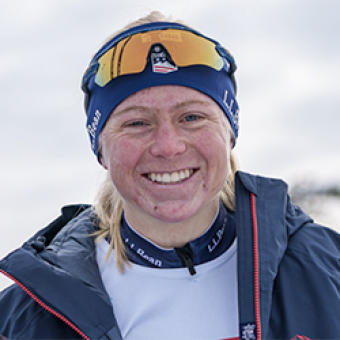
Samantha Smith is named to the 2022-23 U.S. Ski Team D-Team. (Photo: U.S. Ski & Snowboard)
To help fans get to know these new(er) faces, FasterSkier is doing a series of interviews, providing insights into the factors that have contributed to development, progress, and growth for these athletes last season. In this installment, we talk to Sammy Smith about her participation and success in numerous sports, the charity she and her siblings founded during COVID, and her nomination to the U.S. Ski Team D-Team.
At Junior World Championships in Lygna Norway this past February, Smith finished 5th in the skate sprint and 11th in the 15k skate. She also finished 10th in the skate sprint at Senior Nationals in Soldier Hollow in January 2022 racing amongst the senior women’s field.
Not only is Smith a successful cross-country skier, but she has also achieved impressive results in running, soccer and freestyle skiing. During her freshman year of high school Smith won the 1,600 and 3,200 meter events at the Class 5A Idaho state meet, leading her to be a finalist for the USA TODAY High School Sports Awards.
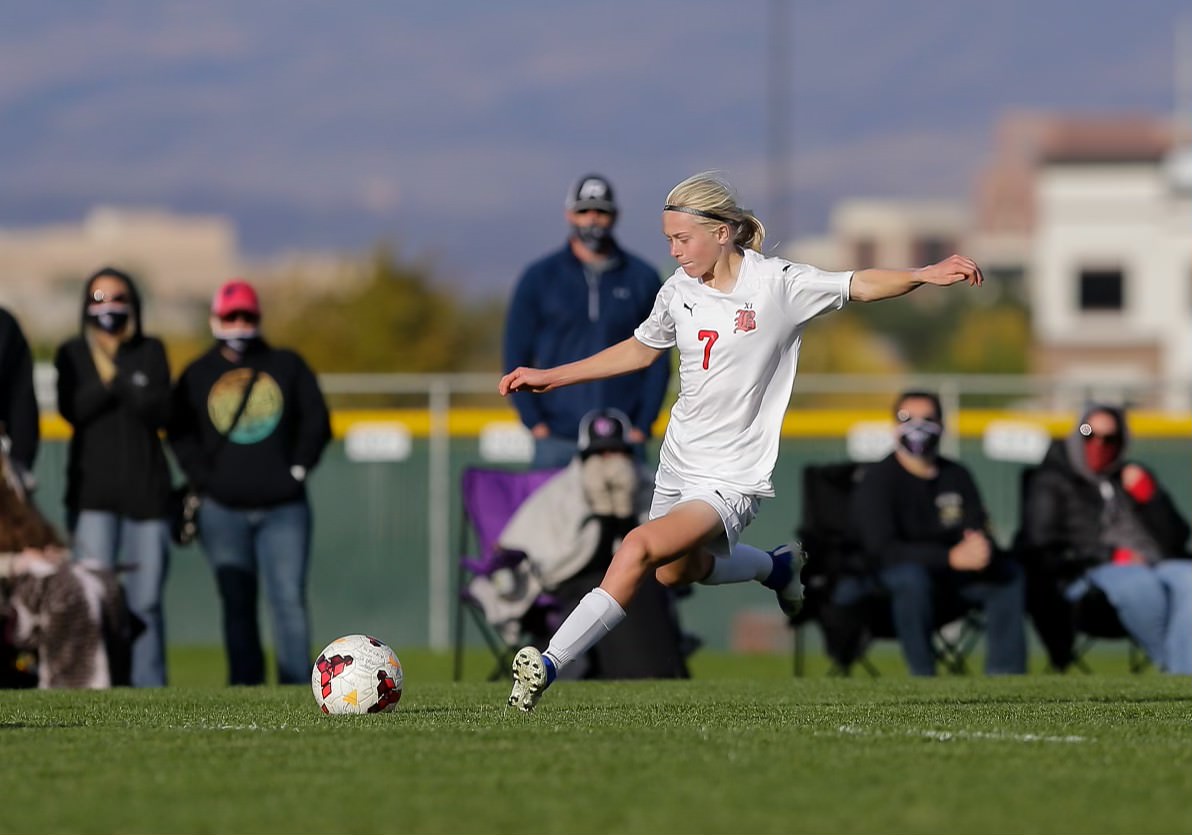
Sammy Smith competing for a Boise-based soccer team. (Courtesy photo)
Ella Hall/FasterSkier: You’re sixteen, does that mean you’re a junior in high school?
Sammy Smith: I actually just finished my Sophomore year of high school (our school got out last week), so I will be a junior in the fall.
FS: And do you live part of the year in Boise and spend the winters in Sun Valley?
SS: Yes, I live in Boise for the fall, spring, and summer. Although during the summer I am often gone a lot, and we frequently go up to Sun Valley. I go to Boise High School for the fall and spring, then I move to Sun Valley for skiing for the winters and while I’m there, I go to the (Sun Valley) Community School.
Sammy Smith competing in freestyle skiing. (Courtesy photo)
FS: From what I’ve gathered you’re involved in quite a lot of sports, can you tell me which sports you competed in this year?
SS: Currently I cross-country ski, play soccer, run track and cross-country, and freestyle ski. This year, I competed in all of the above, except freestyle skiing. Unfortunately, I sustained an injury in the late fall that prohibited me from jumping so I was unable to compete in freestyle. My track season was also cut short because of an injury but I’m healthy now.
Soccer and nordic are definitely my two primary sports. For soccer, I am actually in the US U17 Women’s Youth National Team training pool. I was selected as an alternate for the Confederation of North, Central America and Caribbean Association Football (CONCACAF) tournament this spring. That meant I only participated in the pre-camp, then returned home prior to the tournament kicking off. I aspire to compete for the full US Women’s National Team (WNT) one day, and hopefully will have the opportunity to represent my country in two different sports.
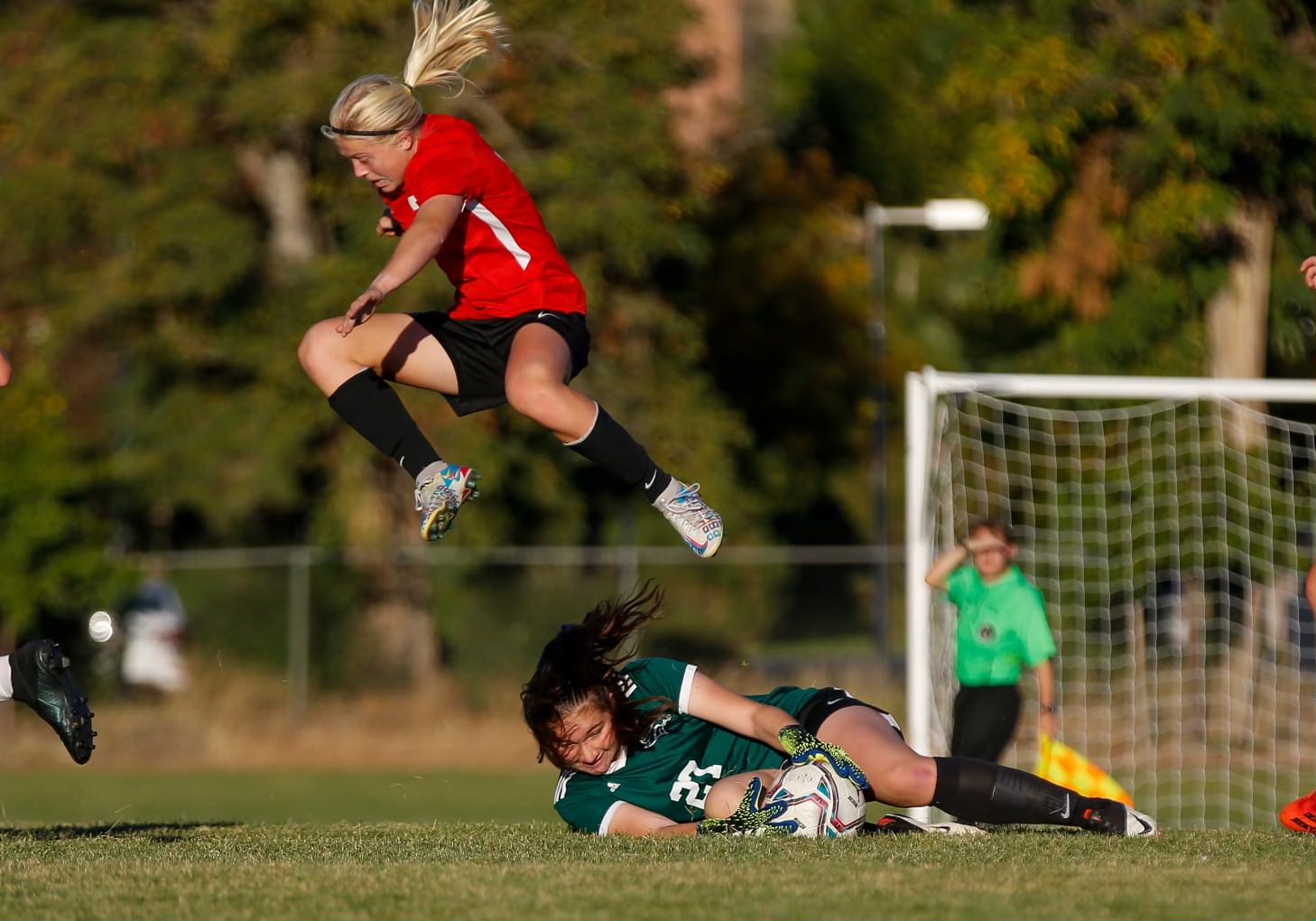
Sammy Smith gets air in an Eagle vs. Boise soccer game. (Courtesy photo)
FS: How and when did you start nordic skiing?
SS: I initially got involved in nordic skiing because of my older sister. When I was five, my parents had signed my sister up for SVSEF’s devo program, and naturally I wanted to do everything she was doing, so I began to pick up the sport as well.
FS: I read that you and your siblings started a charity during the pandemic, can you tell me a little about that?
SS: My siblings and I founded GO BIG, a 501 (c3) certified charity, during the spring of 2020. GO BIG stands for Giving Opportunity By Inspiring Gratitude. Through the charity we aim to make a positive impact on less privileged youth in our area. We have been so fortunate to grow up the way we have, we want to help those who haven’t. We work to provide these kids with mentorship, as well as resources to help them – like books and other educational tools, and sporting equipment.
Our goal is to inspire a sense of gratitude in these youth because science has shown that those who experience a sense of gratitude are more likely to feel good about themselves and pass that feeling along to others, thus helping spread good through the community and beyond.
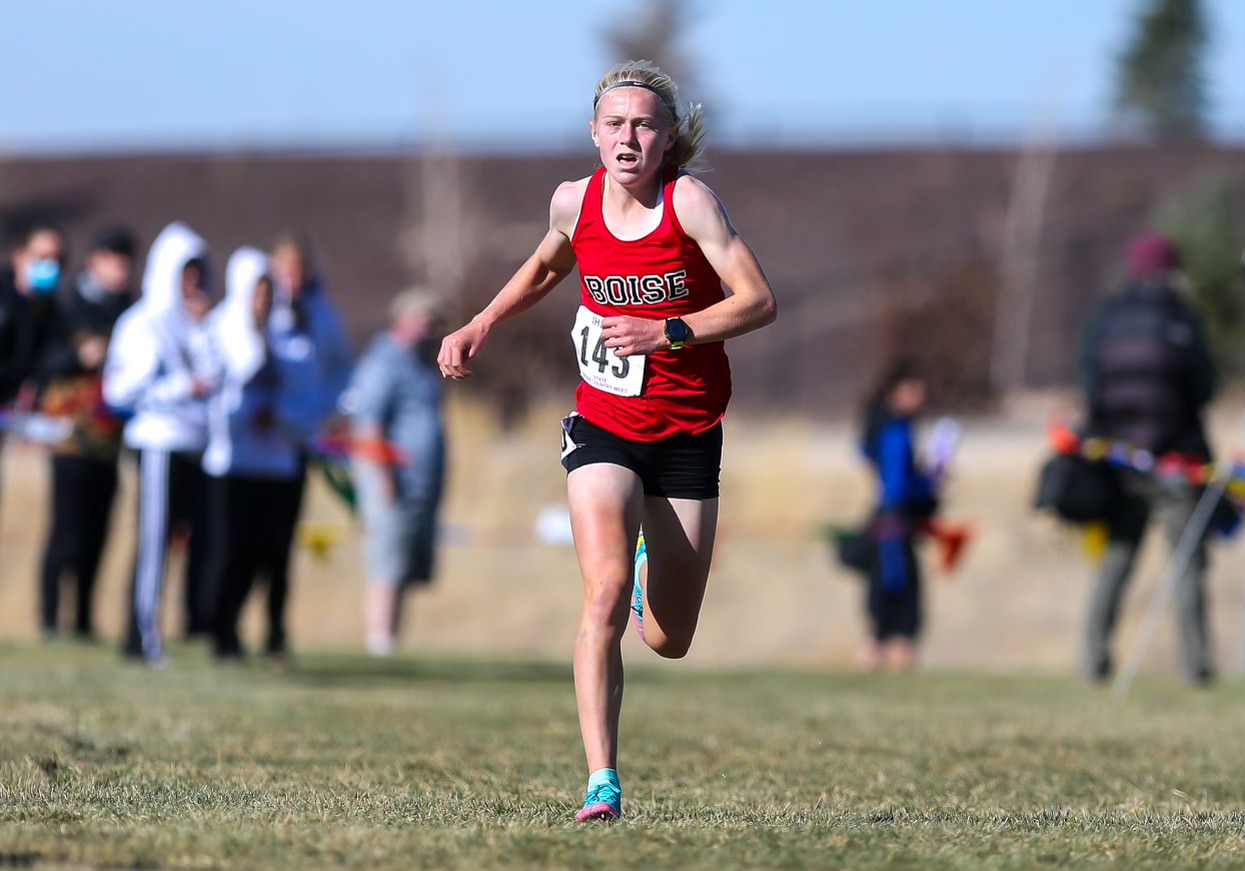
Sammy Smith runs cross-country for her high school team in Boise, ID. (Courtesy photo)
FS:You had some pretty exciting results at World Juniors in Lygna Norway this winter, can you talk a bit about the contributing factors/support system that helped you achieve those results?
SS: I owe a huge thank you to my coaches in Sun Valley, especially Rick Kapala, because he and I made a really thorough and thoughtful training plan going into the Championships. I think having such a detailed plan allowed me to come in more prepared, and in better form than I could have imagined.
I was fortunate enough to have Paul Smith as my wax tech who worked a lot with me on ski selection, and taught me what to look for in a pair of skis throughout the season, and how to decide between them when it seems like the glide is comparable.
Going into World Juniors, I had a lot of new skis from Salomon, and I didn’t really know a lot about them, but fortunately Paul was incredibly helpful. I relied on him heavily to help me test and decide how to organize my fleet before I left. And once we were in Norway, he made sure I was testing the appropriate skis, and helped me choose which pair I was racing on each day. I’m incredibly grateful for Paul’s help, and the support from Salomon.
In addition, the U.S. Ski Team support system was unlike anything I had ever been part of before. Our pre-camp was designed perfectly to help us peak for our races, and once we arrived in Lygna, we had access to even more resources. It truly was a trip designed to help young skiers have the best races of their lives.
FS: What excites you most about being named to the U.S. Ski Team?
SS: I’m most excited about the incredible opportunities that come with being named to the U.S. Ski Team. Being able to train with the best skiers in the country, and some of the best in the world, is an unparalleled opportunity for growth and development. I think when you are put in an environment where you are surrounded by people who share a common passion and common goals, naturally you improve. I can already feel the great sense of community and support from the more experienced skiers and it makes me so excited to train and race alongside them in the future.
I also think the U.S. Ski Team has invaluable resources and tools to help all the athletes become the best version of themselves, and I love to compete and am always looking to improve, so that’s really exciting to me.
Sun Valley’s Sammy Smith (right) finished 10th overall in the freestyle sprint during the 2022 U.S. Cross-Country Ski Championships in Soldier Hollow. Smith was the third-fastest junior racing with the senior women, behind Sydney Palmer-Leger (University of Utah) and Kate Oldham (Aspen Valley Ski & Snowboard Club). (Photo: Tobias Albrigtsen / @untraceableg)
FS:What are some of your goals for the upcoming season?
SS: I was really fortunate to have some great results at last year’s World Juniors, and I want to continue to build off of that for next season. So, my primary goal for the season is to finish top three at World Juniors.
FS: Will you be able to join any upcoming USST camps this summer/fall or will you be primarily focused on your other sports until winter rolls around?
SS: It is certainly a priority of mine to get to some of the upcoming camps, but it’s always a balance, so right now I’m trying to figure out scheduling for both soccer and skiing.
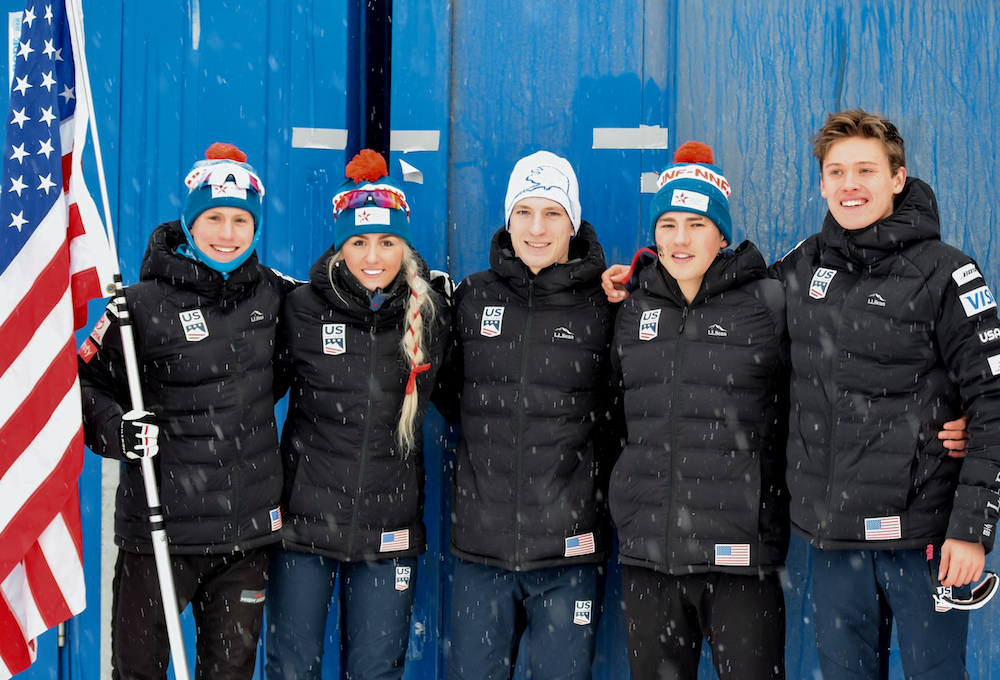
From left, Zanden McMullen, Greta Anderson, Hunter Wonders, Gus Schumacher, and Luke Jager following the boys gold medal relay performance at 2019 World Junior Championships in Lahti. (Photo: courtesy of and shared with permission by Barb McMullen)
This summer, the U.S. Ski Team announced that it had hired Greta Anderson as the new Development Team Coach. FasterSkier caught up with Anderson on the afternoon of the official announcement to delve deeper into her coaching philosophy, precise job description, and only sort of tongue-in-cheek plans for world domination.
Anderson’s hire was widely praised by both current and former athletes. Here’s Luke Jager, who’s known Anderson for nearly a decade starting in Alaska junior skiing and is currently a member of the USST Development Team, or D-Team: “Super stoked. We have come through the sport together so fired up to get to keep working with her!”
Here’s Gus Schumacher, now on the USST A-Team, who ascended the Alaska junior skiing ranks alongside Jager: “I think she’ll be good at bringing knowledge from a lot of different clubs, camps, and backgrounds to the national team pool. She’s been with [Alaska Winter Stars] recently, but has also been with APU and Crested Butte, as well as doing a bunch of REGs and World Juniors trips. Also it’s always good to get a female perspective in that currently disproportionately male area. She’s a good leader, and I think she’ll be really good in that position.”
And here’s fellow A-Team skier Hailey Swirbul, who was first coached by Anderson many years ago as a junior in Colorado: “I know that Greta has put in the time and work to gain valuable skills that will really help the D-team! She has been on so many international trips and coached at all levels to really develop as a leader and coach. I’m super excited that she will be part of the U.S. staff!”
So the athletes are excited. What does Anderson think about this job, and what parts of her background have prepared her for this position? Anderson spoke with FasterSkier at a west Anchorage playground in early June, a one-minute rollerski away from her childhood home, while planes from the nearby international airport intermittently roared overhead and a reporter’s children patiently entertained themselves on play structures.
Two quick disclosures here: One, Anchorage skiing is a small town. Greta was my coach with APU Masters from 2014–2015, and has remained a close personal friend since. She has listed me as a reference on her applications for several coaching positions over the past few years, though not for this particular one (and so far as I know, I had nothing to do with her being hired for this job). Two, the questions in this interview have been expanded from what I originally asked, so that they will provide more information and better function as transitions in a standalone article. The answers have been lightly edited for syntax and clarity.
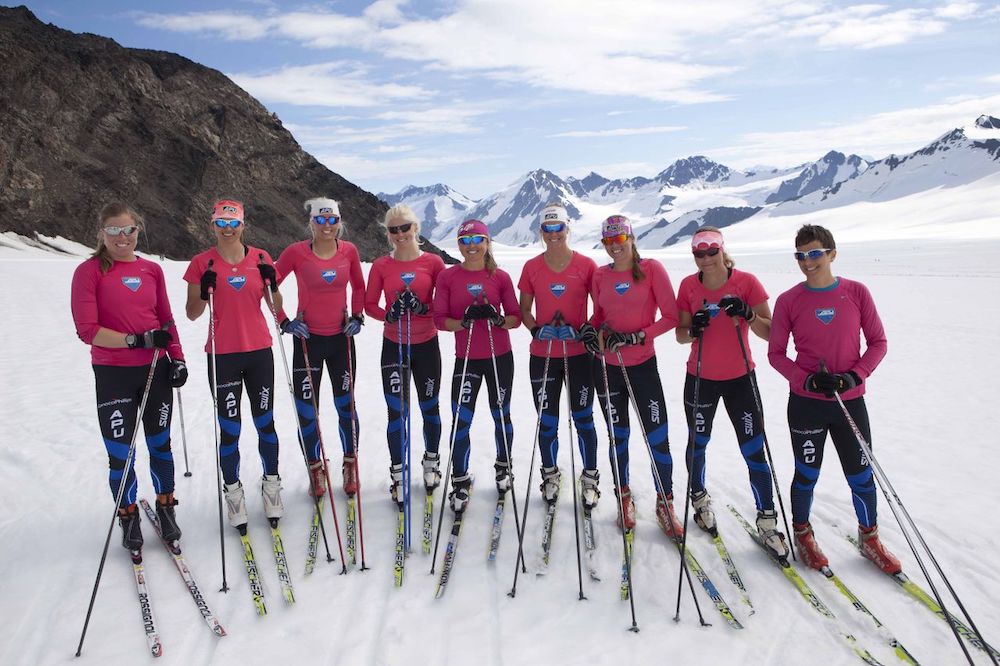
From left, APU skiers Rosie Brennan, Lauren Fritz, Greta Anderson, Erika Klaar, Holly Brooks, Sadie Bjornsen, Becca Rorabaugh, Sarah Cresap, and Kate Fitzgerald on Eagle Glacier, Alaska, summer 2013. (photo: courtesy APU Nordic Ski Center)
Let’s start with your background. I know that you’re from here; you attended Service High School and skied for Alaska Winter Stars, then went to Alaska Pacific University, where you skied for the APU University Team and won the Tour of Anchorage. You graduated with a B.A. in Counseling Psychology. Am I leaving anything out – did you do anything else before you began coaching the Masters and Devos with APU?
That was my first get-my-feet-wet-in-coaching experience. And what happened was, it was springtime, I think in my junior year, and I hurt my back in the gym. And I said to Erik Flora, ‘I am going to take a break because my back is injured.’ And he said, ‘Well, why don’t you coach a little bit’, and I said, ‘Okay.’
And like so many people who do sports, I’m not good at moderation, and I slippery-sloped into a lot of coaching. And then my back got a little better. I was working with Charlie Renfro as the Devo coach at that time, and then Dylan Watts was the Masters coach at that time, and he was going to phase out in a year. And I enjoyed it a ton. And so then Erik was like, ‘Are you going to come back to racing.’ And I said, ‘No, I kind of love this. I think I wanna do this.’ So then I kept doing it.
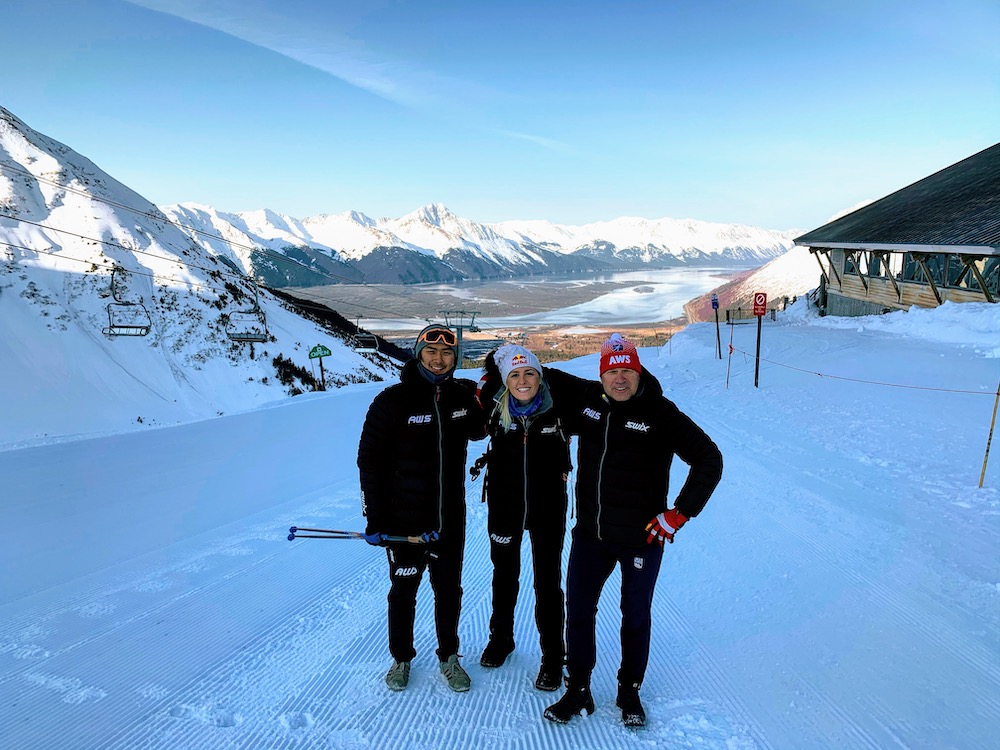
Anderson, with, from left, fellow Alaska Winter Stars coaches Seiji Takagi and Jan Buron, top of Alyeska hill climb, Girdwood, Alaska, April 2021. (photo: courtesy Greta Anderson)
So one year at APU begat several years with Steamboat Springs Winter Sports Club, and a brief stint with Crested Butte Nordic, before you ultimately came back home to Anchorage and Alaska Winter Stars, this time as a coach. And you must have been pretty good at this, because before too long you were at World Juniors with a front-row seat for a spate of breakthrough American performances. Which World Juniors were you at, and what was your official role at them?
I was at two, Lahti and Oberwiesenthal [in 2019 and 2020]. My first year was as a wax tech, my second year coaching – but those are float roles, right? It’s like, what do you need to do on race day? What gaps need to be filled? You’re wearing many hats.
And I was lucky in that a lot of coaches that go as a staff member on that, some of them don’t have any athletes there that they’ve worked with previously. And I, my first year, had Noel [Keeffe] and Waverly [Gebhardt] who were Steamboat athletes; Hunter [Wonders], Zanden [McMullen], Luke [Jager], and Gus [Schumacher]. And Gus I had not directly worked with at that time, but I’d seen him kind of grow up from across the stadium many times. And then, because of going to REG (Regional Elite Group) camps and that sort of thing, and U16 camps, I had already gotten to work some with Sydney [Palmer-Leger], with Novie [McCabe], with quite a few of those athletes. Which was – that rapport, which is such an essential part of this job, was really key in being able to connect quickly and be a good representative, a good helper for those athletes.
You mentioned rapport; I don’t think it’s controversial to suggest that you need to be able to connect with your athletes in order to be an effective coach. That said, the ten athletes currently on the Development Team hail from a wide swath of the country (Alaska, Washington, California, Idaho, Colorado, Vermont, and Maine), and even beyond these specific individuals my sense is that your job requires you to be thinking about athlete development for basically the entire country, or at least the ski-friendly parts of it. How do you undertake to be a national team coach that in some way has her pulse on an entire nation when the country is just so darn big?
One common goal: to win, to put the athletes on the start line ready. I think when you walk into those rooms having the experience you have had and working with the people you’ve worked with, you realize there’s this essential amount of humility. That you realize what it took the athletes to get to that level and how huge their goals are.
As a coach, you have to check your ego at the door because you’re responsible for boosting everybody else. And there’s that old quote, right, “if you want to go quickly, go alone; if you want to go far, go together.” But those days when you accomplish the huge goals the athletes have, everything has to go perfectly that day, which means you have to be willing as a coach to wear a lot of hats, be a shapeshifter, and be really collaborative, so that that’s possible.
And more than getting athletes onto the podium by doing anything special as a coach, it’s really removing obstacles: Okay, what’s going to be a challenge? What can we foresee and take care of, with good planning, good logistics, and knowing what we know going into this in order to make sure that those huge goals, those huge reach goals, are attainable that day. And if we come in really prepared, then we have the potential when the athletes are on the start line to watch magic happen in front of us, to watch something really incredible happen. Because we all were doing the right things and all were working together. And more than anything else, I’m really proud of the way that the ski team is lacing those things together. So I’m really excited to start working with them in that capacity.
I don’t think there’s any single athlete in this country right now that’s made it to the top, world-class level only working with one coach, only having one tech, only having one source of input, and only working with one super genius. And that’s something that as a country we maybe have as an advantage over some other nations.
Anderson and Hailey Swirbul, 2019 World Juniors, Lahti (photo: courtesy Greta Anderson)
You alluded to a range of viewpoints here. With that in mind, how does your job description and what you’re doing on a daily basis relate to what this country’s club coaches are doing? How do you see your role, let’s say vis-à-vis club coaches – I don’t want to say “versus” because I assume it’s not antagonistic, but that said, how do you do your job as The National Team Coach when your athletes are clearly spending most of their time with their other coach in the club system?
My job is the opposite of “versus,” right. My role in this job is to do whatever it takes with the coaches that are making these athletes so phenomenal to lead, get out of the way, and advocate for the athlete’s best interest. And with each coach on a one-on-one basis and with the athletes and with their parents and with whoever else they’re working with that is enabling their success, making sure that that I’m walking into a room and I’m figuring out what they need, and I’m able to either meet that need, or be a resource who finds or links them with the person or the situation that’s going to enable that development. So I think more than anything that I do, my job is to help the athletes have the potential and opportunity to take skiing as far as they want to take it. It’s a little more I think of being a catalyst and an advocate, and somebody who’s able to communicate and link everyone together.
I think high-level sport – and really high-level anything, any craft, any art, any skill – you deal with people who have a ton of conviction, a lot of discipline, and big personalities, which often come with big egos.
There are so many coaches in this country, and so many athletes who believe in what they’re doing and are uncompromising on it. And I don’t know a single coach in this country, who’s super effective, who isn’t a bit polarizing, because they believe in what they’re doing, they’re not going to compromise on it, and they’re not going to let in distractions. My job is to work with those athletes and those coaches to make sure and to help put a system in place to — not just interpersonally in my role — but to put a system in place where there are really open doors of communication all the time. My job is to not be in the way, not be a barrier to open doors, and to make sure people know they are welcome to run through them at full speed.
I think we have six to eight “Jessie Digginses” in this country. Jessie is a really unique athlete. She’s obviously done a lot to maximize the potential she has. She has also had coaches who were moving on to the national team stage who knew her and provided continuity from the time that she was a club athlete. I would like to have that pathway, that system, and those open doors in place for more athletes, so that we can develop those versions of Jessie Diggins, those versions of Gus Schumacher, those versions of Kikkan Randall. So that that is something really deliberate we can identify and develop as a leading body in U.S. skiing, not an accident where we’re like, ‘Man, how do we do that again?’
From left, former D-Team coach Bernie Nelson, Gus Schumacher, and Anderson, 2020 World Juniors, Oberwiesenthal, Germany. (Photo: courtesy Greta Anderson)
Speaking of identifying areas for success, what are some things that you think are currently strengths when it comes to junior skiing or development in this country, and what are some things that you think present areas for improvement?
So the thing I think we do the best of anybody is: we put our athletes in the driver’s seat.
So to use the [2019] boys relay team as an example, they hung this really big goal out there and said, “We want to win the gold medal in the relay.” And you, a little bit in those meetings, saw Bryan Fish’s eyes glaze over. And he was like, “Okay…” And I think the boys’ inspiration stemmed from the girls’ relay team success, in many ways, in Soldier Hollow, in 2017. And the boys said, ‘We want to do that.’
Whoa, huge goal. Scary. Achievable. Gonna take everybody on board, pitching in and being all-in and having a lot of buy-in throughout the process. And from the year that they won the silver medal, Hunter Wonders had aged out of that spot. And so we didn’t know who was going to fill that spot, necessarily, going into that week in Lahti [in 2019]. And I was standing next to a German coach during the relay – Johnny [Hagenbuch] ended up being our guy – and Johnny got tagged, and he started skiing the third leg. And the German coach said, ‘Oh, this is the least experienced one, he must be your weakest link, we’ll see what happens.’ And Germany had happened to put their strongest skier in the third leg, actually.
And I said – and I really meant this – I looked at him and I said, ‘Actually, he might be our strongest skier. Johnny’s our wild card; we haven’t seen him race like this yet.’
And everybody – all four of the guys in that race had their job, had their assigned task. And Johnny executed his perfectly. And he didn’t know if he was going to be the strongest athlete or the weakest one or whatever link, either. I think all four of those guys were so strong, I would put four of any of them on the start line and put my money on them.
And so I think the thing that we do really well in this country is we’ve put our athletes in the driver’s seat, and we have said, ‘Okay, what do you want to do with skiing, where do you want to take it?’ And we sit down as a team – and Bryan Fish has been really good about this, and so has Kate [Johnson, née Barton], and so has Bernie [Nelson] – and we sit down at the beginning of meetings, when the teams come together. Everybody checks their ego and walks into the room.
And a lot of people don’t know each other yet or have raced and sort of know each other, but not well, and they say, ‘Hey, what are the keywords? What do you want this team to be?’ I mean, people spitball. ‘I want it to be collaborative;’ ‘I want it to be fun;’ ‘I want it to be strong;’ ‘I want it to be inspiring.’ Okay, what does that mean to you? And we pick some concepts, and we write it down, and it gets sent out on a WhatsApp or whatever. And we go with that all week.
That’s huge ownership for the athletes, right? That is what do you want this team to be? And what are you going to bring to the table to make it happen? And what are you going to hold your teammates accountable for bringing to the table.
And I’ve been so impressed with every single one of our athletes at both World Juniors I’ve been to, and I’ve watched that ripple effect now filter through U16 camp, and you hear it in Simi Hamilton’s voice when he races his last race, and he says, ‘I’m so happy to be part of Gus’s process in the future, I’m so happy to be this part of U.S. men’s skiing,’ and I think that’s really cool.
So that’s what we do well. [As for an area for potential improvement,] we’re a big country; we’re spread out. We have a lot of people that know what they’re doing well, in their respective area. I think that we can do a better job moving forward of collaborating, as far as realizing that what works in the East is not going to work in the Far West and saying, ‘Well, both are turning out world-class, top-caliber athletes.’
That’s not a bad thing, right? That’s a really good thing. Because that means that if you have a certain personality type, and you happen to live in Colorado, but you would like to go to sea level and train, you can go to the Pacific Northwest and get really good training there. I think that’s pretty huge. That’s something that can be a weakness if we let it be, or we can turn it into a huge advantage for ourselves.
Greta Anderson on course during the classic leg of the men’s relay, 2020 World Juniors, Oberwiesenthal, Germany. (photo: courtesy Greta Anderson)
I jumped right into things here with your personal background, but I should really back up and ask you a little more about your job description. I hate to make you define your job by reference to someone else, but this spring when I saw the D-Team position being advertised for the third time in three years I frankly thought something rather uncharitable, roughly, ‘Oh man, yet another coach left after just another year, something bad must be going on over there.’ And I know that some other people involved in American skiing had a comparable reaction when they saw your job posting this spring, after Bernie was announced for this role in 2019 and then Kate last year.
I’ve since learned that Kate is in fact very much still with the program, so obviously these initial, somewhat negative conclusions were inaccurate and unfair on my part. That said, can you speak to not only what your job entails, but also how it complements Kate’s current role, given that she is also employed by the U.S. Ski Team and that on paper your job description looks basically identical to hers?
So every coach that’s been in the Nordic program, all people I have tremendous respect for, who are disrupting the industry in such a good way are coming to it – and I saw your list of questions, that you’re going to ask what my coaching philosophy, I am a complete student of the sport. So I try to come to it with confidence and humility. And say, ‘Here’s what I think I know, here’s what I definitely don’t know, here’s some people who can help me find out.’
And I think more than having really good answers, I view my role here as being able to ask really good questions, being able to work together with people. And being able to communicate when there are disconnects.
I’ve worked across a lot of programs now and in several regions. And so I feel – I know that’s something that energizes me coming to my job, the different challenge every day, and I’m really excited to stay on my toes and keep having those challenges, if you will.
Having said that, what I’m getting to in my longwinded way, is: the coaches that I will be working with, who include all of Jason Cork, Chris Grover, Matt Whitcomb, Kate Johnson, Bryan Fish – I’m Fish’s shadow, basically. So all of those, but especially Fish.
The job description for this job was three pages long. And it was the same as it was for Kate last year. And this is the thing with the ski team, I think with pitching in and being willing to do what needs to be done. It’s, “Do you see a need, can you fill it.” And all of those coaches, those five coaches that I’ll be working with, especially Fish, have created a niche for themselves within the job role. They filled the role that needs to be filled.
So Matt and Grover – we don’t have a men’s coach right now. We have a World Cup coach [Whitcomb] and a program director [Grover] who are motivated to work together and work with other coaches and work with techs to make sure that there’s no gaps on race day. And so what Kate did was, Kate took on this job that Bernie [Nelson] had done a tremendous job with in the nine months that she was with the program and then vacated. And Bernie had a tremendous impact – a tremendous impact; she was so well received and so effective so quickly.
And they were understaffed last year on the World Cup. Kate, who was over in Europe, ended up staying over in Europe and helping out with World Cup, and she did a tremendous job, and she carved out a little niche for herself and they love having her there.
What we used to have with the D-Team was these athletes that were racing the college circuit and the NorAm circuit and when they were ready to race up a few starts, they were racing up. We’re so fortunate, our future in this country with skiing is so bright, that our D-Team, our development team athletes, are ready to go on World Cup and they’re ready to score points. That means they need a coach there supporting that. That step, that Kate’s job role is changing, is showing our progress as a country in skiing.
And so Kate is going to be working internationally, she’s going to be on World Cup, she’s going to be continuing to work with the athletes in about the same capacity that she was last year, is my understanding. I am directly overseen by Bryan Fish. And Kate, Bryan, and I are going to work together pretty closely; Whitcomb’s going to tell us what he sees as successful at the World Cup level, and then I’m going to fill the gaps that need to be filled and try to carve out a little niche for myself. That’s going to look like whatever the team needs.
Kendall Kramer (far right) leads the junior girls off the line in the Gasline Time Trial at Alaska REG camp, Anchorage, Alaska, July 2021. Katey Houser (bib 313), Adrianna Proffitt (301), and Aila Berrigan (311) are among the athletes following. (photo: Seiji Takagi)
Mostly, I’ll be organizing Junior camps, organizing logistics of U16 camp, making sure we’re inviting the right athletes, we’re casting a wide enough net, we’re able to support those athletes. And we’re able to – and this is a big goal of mine, having worked at several clubs directly – able to keep parents looped in, so that all the cogs on the wheel are working in unison to make everything spin as quickly and smoothly as possible.
Can you give me an example of something that you would want parents to know or something that would be important to you, when you say that you want to make sure that the parents are looped in?
I’d say, ‘Nothing you say is going to be used against your child.’
The more that we know about their whole lives, the better. And I want parents to feel like if they call or email me, they’re going to get a call or email back.
I guess in a word, I want to be approachable, right? I want parents to feel like the national team at the development level is there to help them navigate, help their child navigate, the ins and outs of ski racing. The kids, as they become high-level athletes, pressure increases; the responsibilities they carry increase, even when they’re minors. There are skills they’re going to need to be able to develop to manage travel, to manage sleep, to manage their time, that I want parents and coaches and national team staff to work in unison to know what’s going on and to be able to help where we can.
Anderson with, from left, Noel Keeffe and Waverly Gebhardt, 2019 World Juniors, Lahti (photo: courtesy Greta Anderson)
You just mentioned five or ten important skills that people need to be able to develop. At least at a facile level, none of them had anything to do with ski racing per se. Can you talk about that sense that maybe we’re talking about a whole person here rather than just “the athlete,” for lack of a better phrasing?
Happy people race fast. They train well, and they race for a really long time, long enough to develop. If you’re not happy in your life – I know Flora has the cup thing [“don’t overfill your cup,” discussed as the central metaphor of this article]. If you’re not happy in your life, you can win World Championships and there’s going to be a hole there. And what I want is to work with happy people who are really good friends; I want us to do what we can to make sure that ski racing is a really great part of these athletes’ lives and a part of their family’s lives. Not something they have to weigh against their happiness in order to enable.
But our athletes for the most part, the ones that I’ve seen, develop really well, stay in it, and are committed to it and are able to make it through injuries or tough times or years like Covid where things are very uncertain. When they have good support, and people to talk to and clarity, and they’re happy – or maybe that’s not the right word, but they find deep meaning in what they do.
I’ll tell you as a coach, I’ve wanted to be in a development role for a long time. Because I think what sport brings to us – you know this, you’re a master skier and you’re watching your girls grow up and start their first experience with sport outside of your home, right? It’s so deeply meaningful and such an important part of life that not a lot of other things can teach.
And so I guess that’s where my passion for this stems from. I coach the whole person; I want to work with the whole person, I don’t want to work with a piece of you. A world championship is most deeply meaningful when you share it, and so the image that comes to my mind when I say that is when Gus – Gus was the last finisher in that race [in Oberwiesenthal], or one of them. And when he finished the 10k that he won, there’s a picture of him hugging his mom. And in the background is Lin Hinderman, who came over with her husband just to watch the Alaskan kids and all the kids ski race because she’s been a FIS rep at Junior Nationals and watched all these kids. She’s a huge fan of skiing. She was, I think, the first women’s World Junior coach ever, working under John Estle, because he said, Lin can do this.
And then Matt Pauli was a chief of course, was on the jury there. Matt is an Anchorage resident, and I’ve known him for many years. And he is a huge fan of the sport. And it was them, and it was 12 different sets of parents from the United States. It was the Palmer-Legers, it was the Hagenbuches, Luke Jager’s dad came over for it, Greg Schumacher [Gus’s father] was our team doctor — everybody’s involved in this teeny, tiny piece. And what makes it meaningful are moments like those – and Gus said that, right? He was looking around and crying because he knows how much it means to the community.
And I think that’s – I want to take that community and on the race course, I want us to weaponize it to dominate the world.
And I think Kate’s vision is very similar. And she sent me a really nice text when I got hired and said, like, ‘Let’s take over the world together. Haha, kidding, but not really at all.’
I’m so proud of those athletes. And I’m as proud of them when they have to sit out a relay race and they’re just as happy for their teammates who are racing, as I am when they’re on the podium.
I want to ask you basically the same thing I asked Sadie earlier this spring. American skiing is currently at a very high level; results that would have been widely celebrated a decade ago sometimes don’t even get noticed now. This is a great problem to have, but it potentially still is a problem. What do you say to a 16-year-old junior who thinks if she’s not training 700 hours a year, or medaling at World Juniors, she’s a total failure. What do you say to a maybe not-very-hypothetical junior skier who in fact is doing everything right, at least for them, but who nonetheless thinks, ‘Oh my gosh, if I’m not reaching these impossibly high standards, either real ones or what I think I see from social media, I have no future in skiing’?
I say Rosie Frankowski, I say U16 Gus Schumacher, I say Holly Brooks.
[All three are, relatively speaking, late bloomers: Frankowski finished 44th at U.S. Nationals as a college skier, and 42nd after graduating, then went on to place 21st at the Olympics four years later; Schumacher finished 11th out of 26 in one U16 JOQ race; Brooks never qualified for NCAAs while skiing in college and once described her junior skiing results as, “I’m the girl from PNSA who always finished 40th” at JOs.]
[Relative to national-team athletes in local races] if you’re within four minutes of these guys at these races – and they hop in local races, and that’s unique to the U.S., and that is cool – you don’t go to World Juniors and wonder if you’re going to crack the top 30 that day anymore. You know. And so we have a really cool metric.
I absolutely understand what you’re saying, where the level is so high that maybe it seems discouraging. As adults and people with a lot of life experience, we look at Instagram and social media, and it gives us this skewed sense of all kinds of things, right – body image, finances, what people are up to on a day-to-day basis. Those things are going to keep happening. That’s our world now; at least currently; the only constant is change.
So how do we equip our junior athletes with the tools to handle things like that, the tools to handle those expectations, the tools to stick to what they’re doing, which is a good life skill, right? I can look around and see a bunch of other things that look rewarding, but I believe in this process, and I’m going to do it. I think as coaches, good coaches lead by example doing that. They believe in the training they’re doing, they’re not chasing hypotheticals, and I guess they have conviction, is the right word.
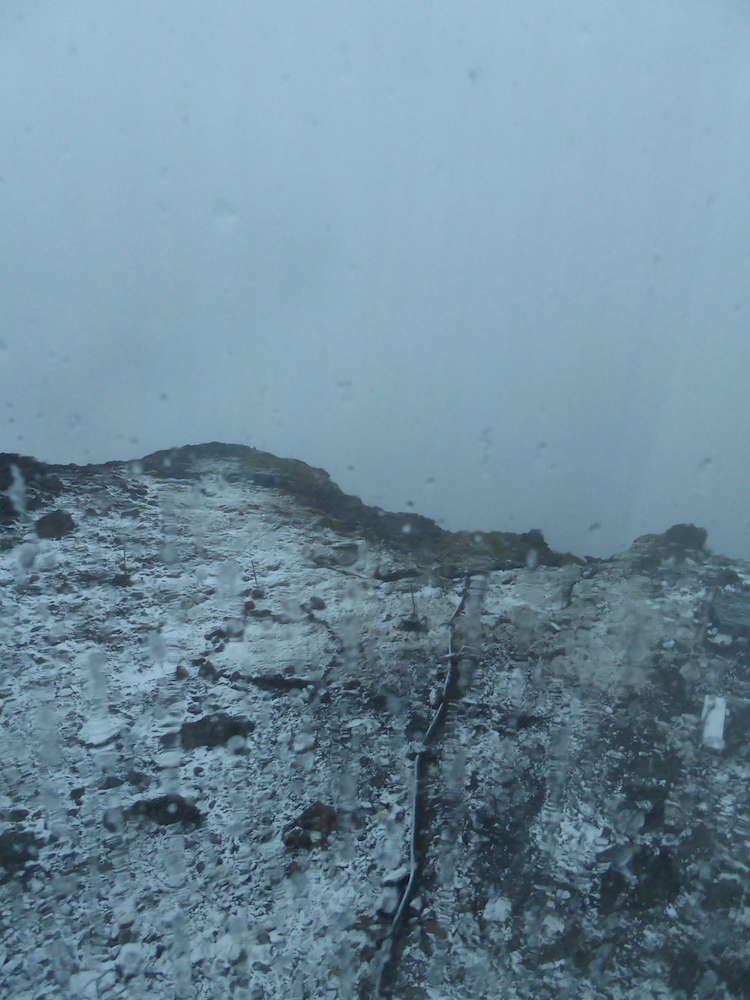
“Mixed precipitation” strikes the windows of the training center at Eagle Glacier, July 2017. (photo: Gavin Kentch)
Are we giving them the tools to manage these unrealistic expectations, or these, ‘It’s sunny every day where I’m training.’ You well know that on Eagle Glacier, [according to social media] there are only pictures of sunny days, and everyone who has never been to Eagle Glacier thinks the sun shines there nonstop every day, and you can get the most wicked sunburn of your life.
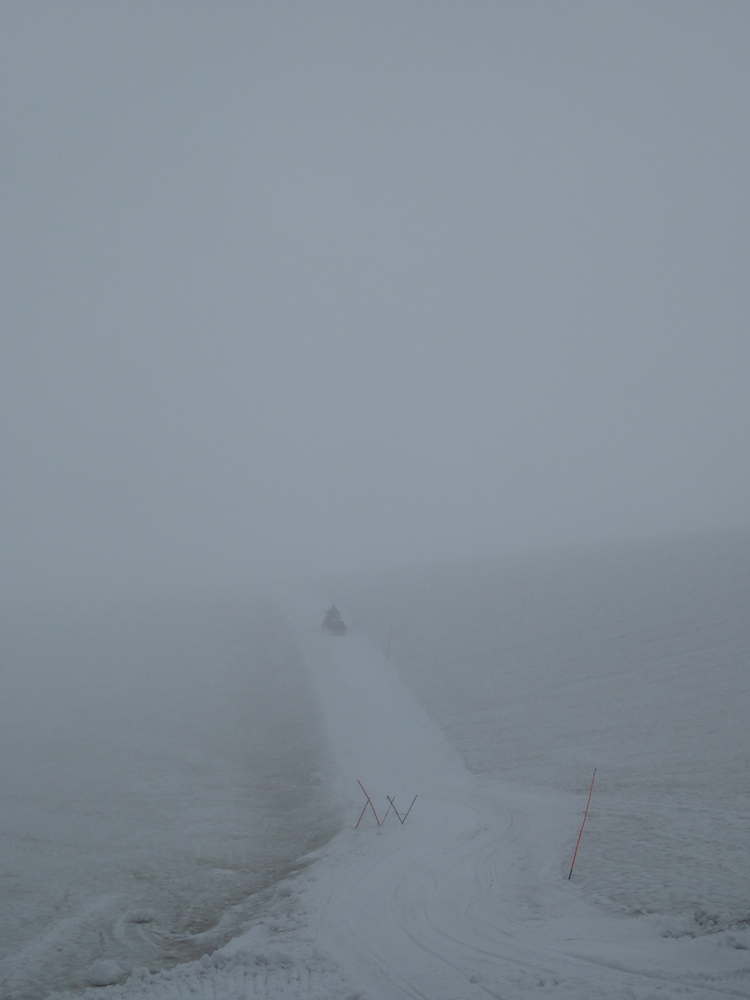
Dylan Watts drives a snowmachine into the mist at Eagle Glacier, July 2016. (photo: Gavin Kentch)
Because if you pull a camera out on Eagle Glacier on a normal day, your camera will be destroyed. And so a lot of times, we’re not looking at the people putting their head down and putting in the work, because we just see the outcome.
I would like to make more people aware in this communication, as a coach, of the hard work, dedication, and sweat equity. Okay, do you want to wear that jacket? Do you want to wear that suit? Or do you want to put your head down and do intervals on Saturday morning, which means that you couldn’t be up late on Friday night? Do you really want to do that? Are you dedicated to that?
And that’s not a question of opting out, that’s as a coach saying, here’s what it takes, opt in. Because at this point in the U.S., if you opt in, as coaches, and I really believe this, we can get you there. We say as coaches, ‘You have to give us 110% of your effort.’ If we as coaches are only giving 98% of our effort, or attention, or we’re only giving 70%, or we’re not keeping up on research, we’re not paying attention and we are complacent – in business, that’s called fraud.
So if I say as an athlete, ‘You have to give me 110%, and I’m going to do the best I can with everything within my power to make you a world champion.’ If you follow this plan, and I give you anything less than my absolute best, that’s not integrity. That’s not how champions are made.
I want us to have a system in place in this country where we can tell athletes, ‘We know these are the benchmarks. We know that this is what it takes. We know we can’t make guarantees. But these are the things that, if you do these things, we’re as sure as we can be within our control, that you can be really successful at this.’ And maybe you don’t win a world championship, but you carry those skills over into your life, and you will be successful applying those skills at anything you do. You have a chance to have meaning in your life, and you have a chance to be happy. And that’s a philosophy, that’s an idea, that’s a concept that I really believe in. I believe that for sure.
Part of Team Alaska at 2018 Junior Nationals, Soldier Hollow. From left: Hunter Wonders, Greta Anderson, Annie Gonzales, Ellie Mitchell, Kai Meyers, Eli Hermanson, Zanden McMullen, Bryce Pintner, Everett Cason, and Luke Jager. (photo: courtesy Greta Anderson)
You’re obviously giving up your current coaching job with Alaska Winter Stars to move into this U.S. Ski Team role. I saw you at Kincaid last night, surrounded by Winter Stars juniors, all of whom adore you. Are you going to miss your current athletes?
Yes. I love coaching. I miss every job I have – every time I’ve moved into a new job, new role, I have missed what I have departed from. Having said that, and this is a strength I think I have as a coach, I’m pretty good at maintaining that rapport. I have great friends that I’ve worked with since my first year coaching and I feel like we can pick up where we left off and maintain those relationships.
Coaching is people, and you have to give more than a small afterthought about people; you have to really care about people as people in order to take a step toward first being an effective coach. That is a foundational aspect of being a coach.
Anything else?
I’m really thrilled to be doing this. I’m so excited to start collaborating with a lot of coaches in this country that I think are absolutely brilliant.
This article was originally published on November 11, 2019 in Steamboat Magazine. It is reposted with permission.
By: Tiia Libin
Noel Keeffe during the 1.6 k classic sprint qualifier at Junior World Ski Championships in Lahti, Finland. (Photo: Doug Stephen)
Being a “first-ever” is rare, especially in a town filled with Olympians. Noel Keeffe is one of them. Born and raised in Steamboat Springs, Keeffe is the first Steamboat Springs Winter Sports Club cross-country athlete to be named to the U.S. Cross Country Ski Team.
“Our coaches continually remind us that our life as a student athlete is like balancing a three-legged stool – athlete, social and school,” says Keeffe, who is in his second year at the University of Utah, majoring in material science and engineering.“They reinforce that we need all of the three, and that we shouldn’t just focus on one. Going into my second year here at the U, I’m better able to plan my time depending on the season. I know when I’ll need to spend more time on school, when I’ll need to focus more on training and competition and when I can relax a bit.”
Keeffe is in a unique situation in that he has three coaching sources: SSWSC coaches, University of Utah National Team coaches and U.S. Cross Country Ski Team coaches. He says having access to this triangle of talented resources helped him plan a vigorous strategy going into this season.
“One of my goals this season is to qualify for U-23 [World Championships in February in Oberwiesenthal, Germany]. To do that I must race well at US Nationals in Houghton Michigan [in January]. If I end up going to U-23’s and race well there, then I will qualify for the World Cup race in Minneapolis [in March]. Getting a World Cup start this season would be pretty awesome.
“Because this race is in the U.S., it gives our team a significant starting advantage, so I hope to maximize that opportunity.”
This year Keeffe is living in an apartment with two other student athletes from the ski team, an arrangement he says works because they all have similar schedules. But, he adds, the arrangement is not without its challenges. “There are only three of us in the apartment, but we are constantly running out of refrigerator space,” Keeffe says. “On average, between the three of us, I would say we eat 15,000 to 20,000 calories a day. Every time I cook dinner for the whole apartment I think I have made to much food and somehow it is always gone by then end of the meal. I go to the store and buy some food – next day, it’s gone. We eat more food in a week than some family’s do in a month. It’s astonishing!”
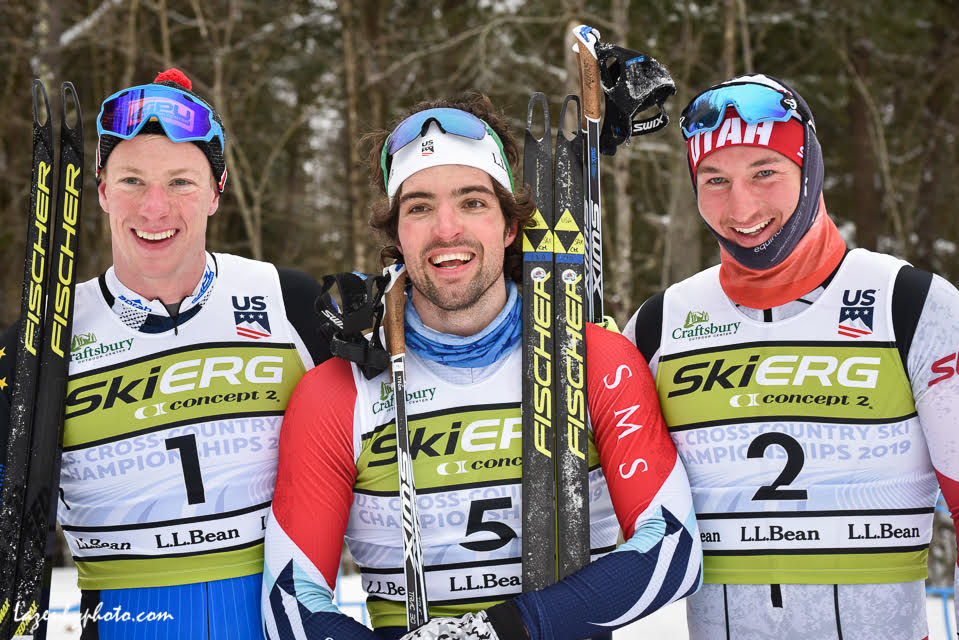
The men’s podium from the 2019 skate sprint at U.S. nationals. From left to right, Logan Hanneman (APU) second, Ben Saxton (SMS T2) first, and Noel Keeffe (University of Utah) third. (Photo: John Lazenby)
Keeffe says he has a better understanding of the student-athlete life this year, and is ready to maximize both his ski training and his studying. “I consider my classes and training one big package. I found that being in college, I have more time to focus on athletics and that being a student athlete allows me to juggle my schedule as necessary,” he says. As a sophomore, Keeffe is taking a larger class load than last fall, is training more and is training at a higher level.
Keeffe mentioned he has always had an interest in STEM (science, technology, engineering and math), and that he has been able to apply his experience with carbon fiber ski poles to help him in his materials science and engineering classes.
Keeffe is poised for achievement and looks forward to a challenging season as he learns how to balance his three-legged stool for success.
Ian Torchia (front) leading L3 intervals with the Stratton Mountain School (SMS) team in June. (Photo: Pat O’Brien)
Two summers ago, with just five miles left of the Marquette Trails Fest 30-mile mountain bike race, all Ian Torchia could hear in his head was the voice of Krystof Kopal, his Northern Michigan University (NMU) teammate, snidely saying, “You drop out again?”
Fifteen minutes earlier, Torchia had careened into a tree. After dusting himself off, he remounted his bike, but not before noticing his left wrist was badly injured.
For a moment, Torchia considered pulling out of the race. Thoughts of Kopal, however, kept his feet on the pedals. A few months earlier, Kopal had given Torchia ceaseless verbal flak for dropping out of the 2016 Spring Series 50-kilometer ski race due to cramping.
“[Kopal] was playing in my head … so I finished the last five miles with a broken wrist,” Torchia, now 22, recalled on the phone this summer, noting that it wasn’t until after he had finished the race that he found out it was broken.
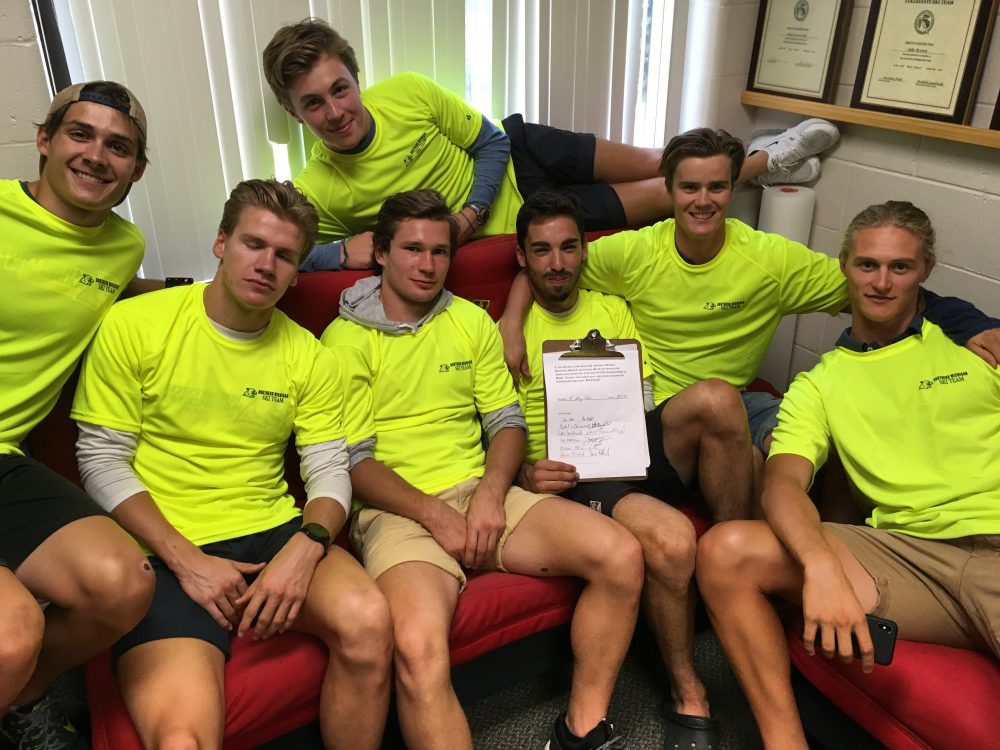
The NMU men’s ski team with Ian Torchia (third from r) in late August. According to Torchia, the paper he’s holding is a contract. “If we win [the] team NCAA title [this winter], they get to tattoo my gluteus maximus,” Torchia wrote. (Photo: Andy Keller)Shortly after, Torchia had his wrist examined by doctor and was told he would need to have surgery. The procedure — scaphoid fixed via percutaneous fixation–left Torchia in a cast.
About a month before his crash, Torchia had been nominated to the U.S. Ski Team (USST) D-team and invited to two national-team training camps that summer. Torchia had intended to attend both camps, regardless of whether his wrist was healed or not.
Fourteen days after his accident, Torchia departed Marquette, Michigan, his “home” since he began attending NMU in 2014, and headed for Eagle Glacier, Alaska, the location of the first USST camp.
On the glacier, he skied with either one pole or none at all. When he returned to Marquette, the pattern continued for another two months. It wasn’t until the end of August that he had his cast removed.
“I kept training super hard with the broken wrist,” Torchia said.
All that training led Torchia to what he recalled as being “in pretty good shape” leading up to November. Then things started to go south. Fast. Right around Thanksgiving, Torchia was exhausted and experiencing severe night sweats.
“If you type in ‘mono’ on Google and look at the symptoms, I probably had seven out of the eight,” he said. “But I at the time was thinking ‘It’s just a bad virus. It will pass.’ ”
The symptoms continued. Torchia’s girlfriend suggested he get tested for mononucleosis. He didn’t.
“I didn’t want to believe her,” Torchia said.
Soon enough he had to. In mid-December, hypothermia forced him to drop out of a race. At 2017 U.S. Cross Country Championships in Midway, Utah, he felt sluggish and “off” during training, so he visited a walk-in clinic in Park City. The doctor tested for mono, and the results came back positive.
“The doctor was kind of nonchalant about it,” Torchia said. “He came in and was like, ‘Oh yeah, you’ve got mono, but nordic skiing isn’t a contact sport so you should be good to go and ski at nationals. I was like, ‘Oh, sweet…that’s not how it works.’ ”
Following the diagnosis, Torchia decided to skip nationals and return to his hometown of Rochester, Minnesota, for the holidays. He stopped exercising for a month before gradually returning to training.
“A lot of different skiers messaged me saying, ‘On this return, you need to take it really easy,’ ” Torchia said. (One of those skiers included Tad Elliott, who caught the Epstein-Barr virus in 2014 and went on to win a national title in 2016).
Torchia took their advice, as well as that of his NMU head coach, Sten Fjeldheim, who has helped other athletes diagnosed with mono safely return to training. The two worked out a meticulous day-by-day plan for Torchia’s return. Torchia redshirted the 2017 college season, but by March, he was back on skis.
“I wasn’t really thinking about what other people thought,” Torchia said when asked if he was worried whether others were questioning his USST nomination during that time.
“I was thinking more about the next steps,” he continued. “Like the day to day, ‘Oh, my morning heart rates are going down,’ or ‘This next weekend I can start running again.’ … I think before [mono], I was riding really high on skiing, and it was … a big, big part of my life. Getting mono kind of let me take a step back and realize, OK, there are other things [besides skiing].”
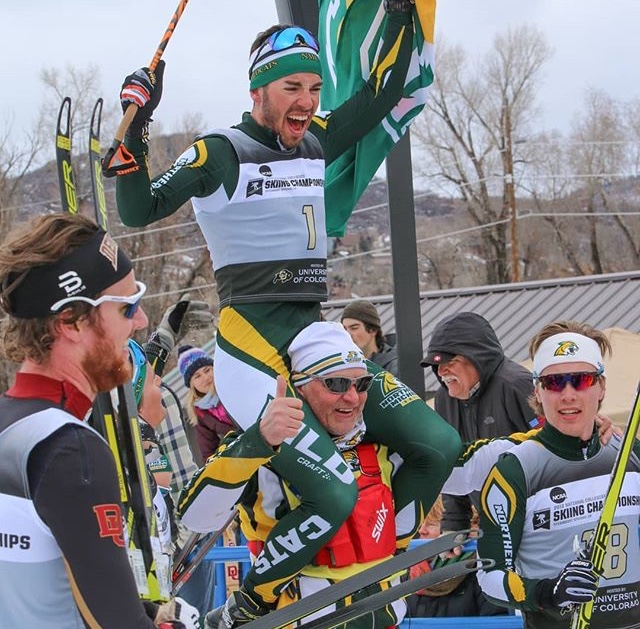
Ian Torchia (1) on the shoulders of Northern Michigan University Head Coach Sten Fjeldheim after he won the men’s 20-kilometer freestyle race at 2018 NCAA Skiing Championships in Steamboat Springs, Colorado. (Courtesy photo)
Mono not only gave Torchia a little perspective, but also an extension on his time to compete in college. By redshirting in 2017, Torchia retained eligibility to compete in 2018 (as a junior) and 2019 (as a senior). In his fifth year at NMU, he is currently working toward a master’s degree in exercise science.
This past March, he won the 20 k freestyle at NCAA Skiing Championships to become NMU’s seventh NCAA champion in program history. In the other race at 2018 NCAA’s, the 10 k classic, he placed fifth for All-American status. Earlier last winter, Torchia qualified for and competed at U23 World Championships in Goms, Switzerland.
“I try to look at the positives that mono brought,” Torchia said. “That first season of being on the USST brings a lot of pressure and inadvertently getting mono kind of lessened that. Afterward, when I got renominated to the team [last spring], I was like, ‘OK, they’ve given me this second chance, so I need to take it.’ ”
Torchia was renominated to the D-team for 2017/2018 and again this past spring for the 2018/2019 season. After his third-straight nomination, he approached his summer with revitalized vigor. For the first time since enrolling at NMU, he decided to spend some time training outside of Marquette, largely as a result of a wedding invitation from his USST teammate, Erik Bjornsen. In July, Bjornsen and Marine Dusser were married in Villard-de-Lans, France.
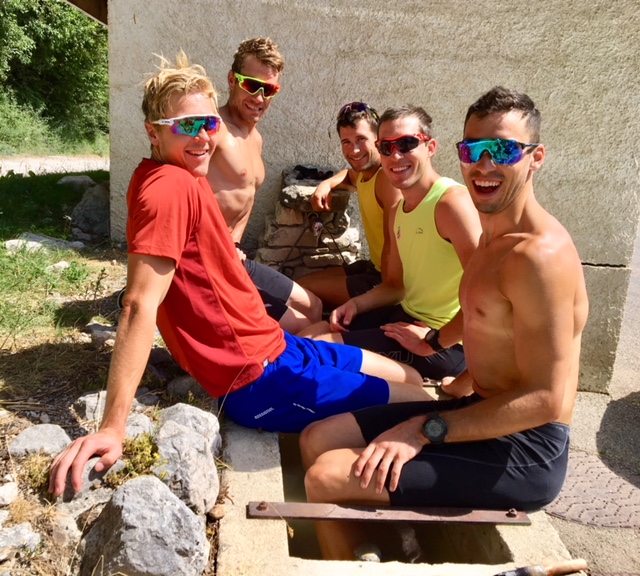
Right to left: Ian Torchia, Paddy Caldwell, Adrien Backscheider, Simi Hamilton, and Erik Bjornsen during a post-interval cool down in Villard-de-Lans, France. (Courtesy photo)
“After getting Erik and Marine’s ‘save the date’, I knew there was no way I was missing the wedding,” Torchia explained.
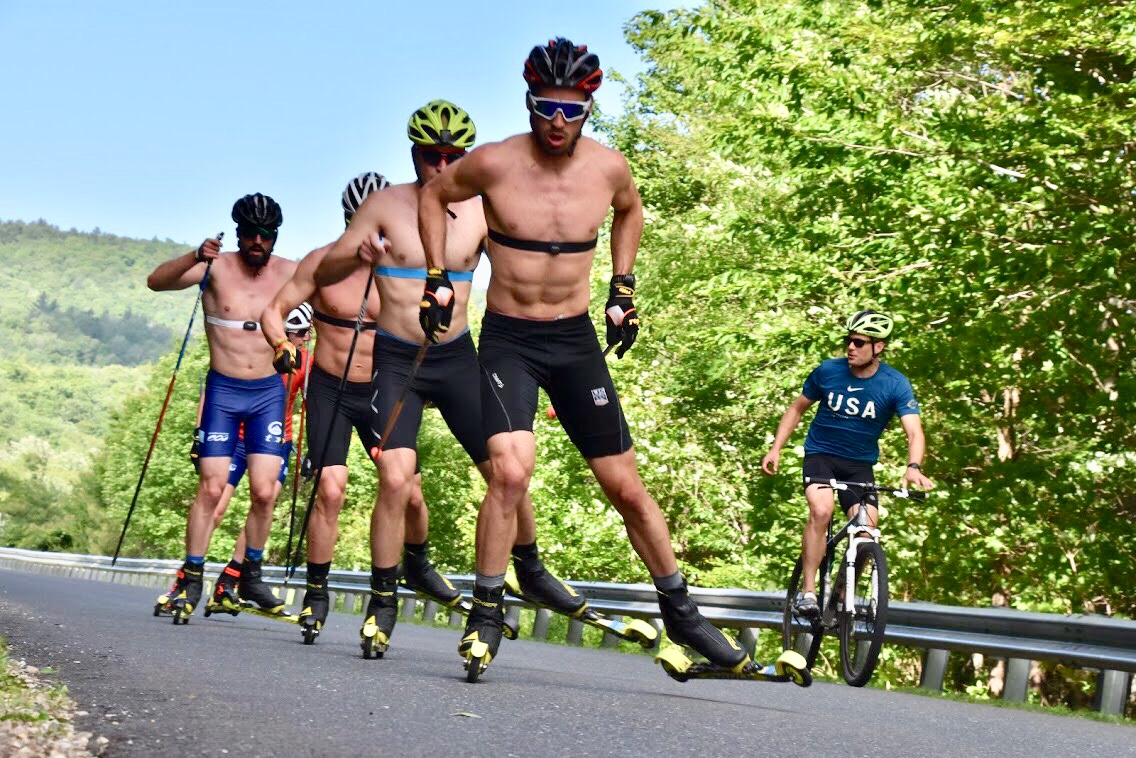
After the wedding in early July, Torchia remained in France for the USST men’s training camp. The camp lasted 10 days and featured what Torchia described as “hard rollerski intervals and epic mountain runs.”
He was accompanied by three teammates, Bjornsen, Simi Hamilton and Paddy Caldwell, and their coach Chris Grover. French national-team member Adrien Backscheider joined the group for interval sessions.
Following the camp, Torchia had made arrangements to stay in Europe for another two and a half weeks, which was partially prompted by his Norwegian teammates at NMU. Over the years, many had encouraged him to travel to Norway and compete in the famed Lysebotn Opp, an uphill rollerski race in Norway’s Blink ski festival.
Before heading to Sandnes, Norway, for Blink, Torchia made two stops. First, Oslo, where he stayed with his former NMU teammates Fredrik Schwencke, a native of the city, and Kristen Bourne, an American citizen currently training with the Lyn Ski Club in Olso.
“Pretty lucky to have so many great friends and teammates that put me up throughout the trip,” Torchia wrote in an email.
Torchia spent a week in Oslo before traveling to Kragerø, where he visited his current NMU teammate Mathias Aas-Rolid. A native of Redalen, Norway, Rolid has a cabin in Kragerø that he opened up to Torchia for “a pre-Blink training camp”.
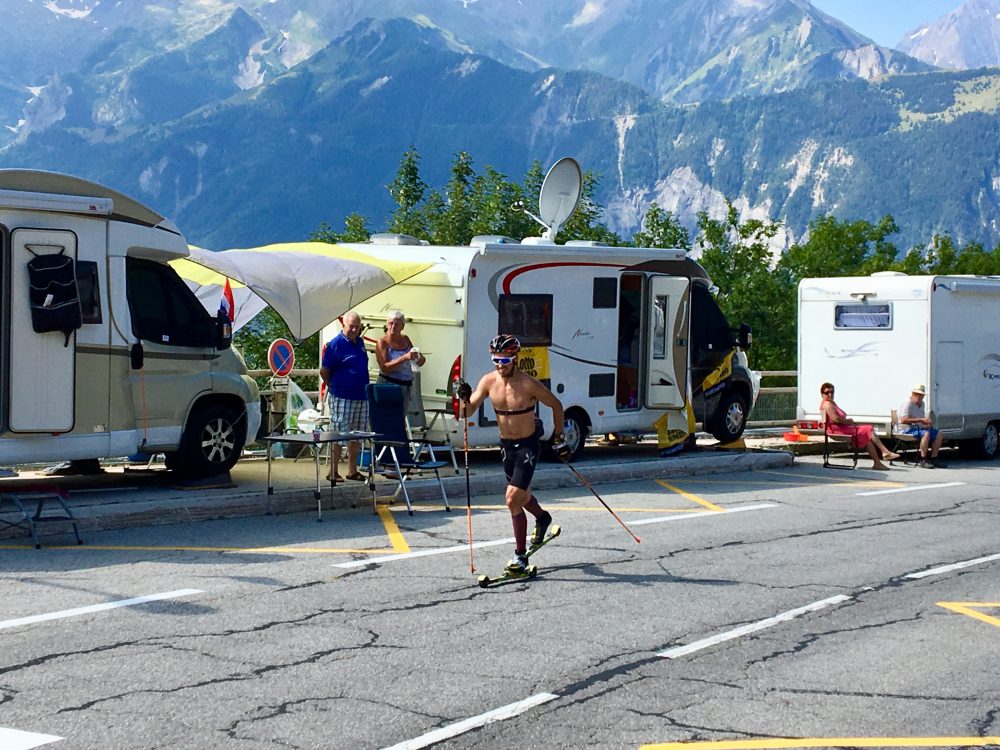
Ian Torchia rollerskiing up Alpe d’Huez, two days before the Tour de France on July 17, 2018. (Photo: Chris Grover)
Following Kragerø, Torchia headed to Sandnes for the Blink races. Canadians Evan Palmer-Charrette, Scott Hill and Bob Thomson had rented an Airbnb in Sandnes for the weekend, and keeping with his summer nomadic style, Torchia crashed on their couch during the festival.
He competed in the 60 k distance race as well as the Lysebotn Opp. The 60 k was what Torchia referred to as “an add-on to the main focus of Lysebotn.
“For the 60, I made a big blunder by not bringing a water pack and counting on getting feeds along the race course,” he recalled. “Turns out trying to get a feed from a stationary volunteer at 20+ mph is not very effective.”
Without feeds, Torchia explained that he “bonked” halfway through the 60 k and ended up finishing 55th. The result left him ready to “turn it around” for the 7.5 k Lysebotn Opp the next day. He managered to position himself well early on in the race’s mass start and within the first kilometer, found himself with the likes of Russia’s Sergey Ustiugov and Finland’s Iivo Niskanen.
“After the 1 k tunnel, I passed Ustuigov and Niskanen and probably got a little too excited and blew my load about 2 k from the finish,” Torchia wrote of his Lysebotn start. “ ‘Twas a long 2 k in from there and almost managed to catch Harvey but just missed the auto qualifying for the mass start (top-10) by about 15 seconds. I’ve never done a rollerski race, period, so competing in Norway in the strongest field they’ve ever had was a hell of a way to start.”
Torchia placed 13th, just over 2 minutes behind the winner (and 2018 Olympic skiathlon gold medalist) Simen Hegstad Krüger of Norway and 15 seconds behind Canada’s Alex Harvey, who placed 10th.
Torchia’s summer adventure ended after Blink, and he flew back to the U.S. on Aug. 6.
“Getting to do intervals with Adrien Backscheider, [South Korean/Norwegian skier] Magnus Kim, and then race with a World Cup field at Blink served me a big piece of humble pie but was a good indicator that the summer progress[ed] well,” Torchia wrote.
Torchia is now back in Marquette, focused on school and skiing. Beyond college races, Torchia is targeting 2019 U.S. nationals in Craftsbury, Vermont, 2019 World Championships in Seefeld, Austria, and 2019 World Cup Finals in Québec City.
“It’s been some ups and downs and definitely a learning experience,” Torchia said of the years since he was first nominated to the USST. “But it’s made me stronger in the process.”
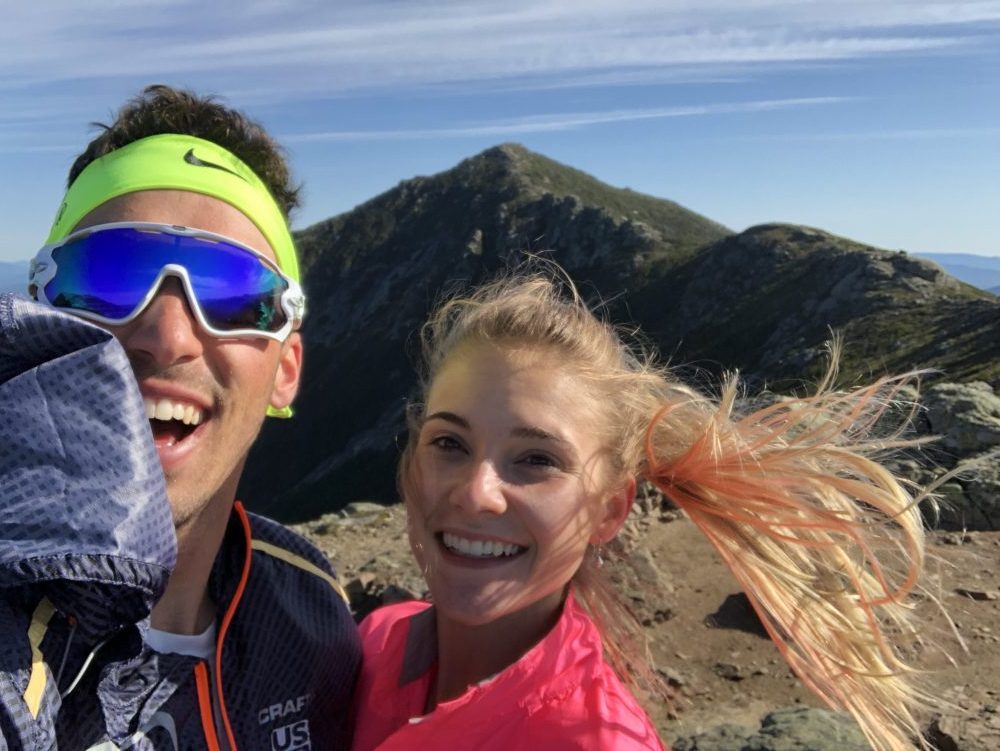
Ian Torchia (l) with girlfriend, Kameron Burmeister, hiking in Franconia Notch, N.H., during an East Coast road trip they took in June. (Courtesy photo)
Gus Kaeding coaching at 2012 World Juniors in Erzurum, Turkey.
The newest hire to the U.S. Ski Team (USST) coaching ranks is 34-year-old Gus Kaeding. Kaeding is a newly minted MBA as of 2017 and is fresh off a gig with the U.S. Olympic Committee based out of Colorado Springs. Kaeding was a junior skier at the Stratton Mountain School (SMS), skied collegiately at Northern Michigan University, and coached at Central Cross Country and went on to become head coach of the SMST2 Team prior to studying for his master’s.
Although a core New Englander, Kaeding has settled in Park City, Utah, home of U.S. Ski and Snowboard, where he’ll wear two hats.
“I have two jobs and work in two different departments,” Kaeding said on the phone on June 20. “One part is with the cross-country ski team, and it is because we have increased demand in our development ranks. … The second part of my job is essentially a sport-science data role and it is across the entire U.S. Ski and Snowboard organization. Eventually, that role will be to implement a data management program to help organize athlete data — whether it be race data, testing data, or simply just contact data. And it involves setting up the structures to do that which is something that sounds easier than it actually is.”
Coach Gus Kaeding (c) serving as starter during a team-sprint workout at that U.S. Ski Team women’s camp last month in Lake Placid, N.Y.
This season’s development team has expanded from four to seven athletes. With the near doubling in size of the D-team, Kaeding was brought on as part of the USST’s decision to place more resources in support of its younger skiers. The A and B teams saw the departure of Kikkan Randall (retired), Liz Stephen (retired), and Andy Newell (non-World Cup race focus), and Rosie Brennan. Kevin Bolger was the only new addition.
National governing bodies often prioritize after an Olympic quadrennial. Adding Kaeding to help evolve the robust foundation laid down by longtime development coach Bryan Fish is nothing seismic.
“[Kaeding] has been hired as a D-team coach specifically to help nurture and shepherd this group of athletes through the next few years of their development,” USST Head Coach Chris Grover told FasterSkier this spring. Kaeding will report directly to Grover as it relates to his D-team cross-country coaching.
In terms of his primary function with the D-team, Kaeding described it as meeting the specific needs of the seven D-team athletes. That could entail anything from on-the-ground coaching and assistance during camps to helping facilitate better communication between an athlete’s primary coach and the national team.
“In the short term, these athletes have goals,” Kaeding said. “And I am relatively comfortable saying my goal is to help them achieve their goals. Ultimately, the goal is to convert these athletes to the B and the A team.”
Ben Ogden racing to third in a 10 k classic FIS race last December in Craftsbury, Vermont. (Photo: Julia Kern/Ben Ogden Instagram)
New to the D-team is Ben Ogden, and he’s a good example of how Kaeding sees his job as a facilitator between the many coaches involved with a specific skier. The 18-year-old Ogden trained with the USST this spring in Bend, Oregon. He then settled at home in Vermont to train with SMST2 coach Patrick O’Brien. He’ll matriculate this fall as a freshman at the University of Vermont and train with coach Patrick Weaver.
“The most important aspect with my job with Ben is to be very proactive with communication,” Kaeding said. “I think in the past, and I have been on the other side of the coin, too. when I was coaching at Stratton and we had development team athletes, one of the areas I struggled with when trying to talk to the U.S. Ski Team was communication. Basically, it was not really anyone’s job, whether I had Skyler Davis or Paddy Caldwell. They all had a different person to go to, and it was different from camp to camp and race to race. So it got a little hard. Things fell through the cracks. My first and foremost job is to not let things fall through the cracks.”
Shepherding D-team athletes is one core responsibility for Kaeding. When in Park City at the USST Center of Excellence, Kaeding will be spearheading a project that will begin collecting data on athletes and their performance. Further along, he’ll help create an interface to manage and communicate that information.
He explained that U.S. Ski & Snowboard is in its nascent phase of proprietary data collection and management.
“The best practice is to seek out a question that you want to answer and then decide what data you need to answer that question,” Kaeding said of how he is approaching the project. “And we are so in the infancy of this process we don’t even know what question we are trying to answer right now.”
He explained that their data collection will most likely involve a mix of athlete-specific GPS and heart-rate information. In the near term, Kaeding foresees the low-hanging fruit of data management as something smaller scale than implementing a program-wide U.S. Ski & Snowboard data collection and analyses initiative.
“Right now, there are much easier wins,” he said. “So like this data-management system, it sounds sexy, but sometimes the biggest wins are just the small things. Like, you can have a dashboard for a particular athlete. This is like a notepad where all the athletes, coaches, sport psychologist, maybe they have a strength trainer — and they can see maybe this athlete had a bad race two days ago. Should that affect how they make their strength plan because they are probably 2000 miles away and may be unable to talk to their coach? Or if it’s a sport psych, maybe they should be addressing a particular issue with this athlete that the coaches brought up.”
On the job since May, Kaeding has begun to collect and organize past training logs from D-team athletes. Part of his work has been comparing that data with training information from Norway’s development team. As part of his outreach, Kaeding provided a summary of the USST D-team men’s training hours and intensity ranges from ages 15-18. The bottom row of Table 1 includes data (averaged) from Norway’s development team.
(While he does not have complete data from the USST D-team women yet, he explained that their total hours would be slightly lower. Further, it is unclear if the Norwegian data is an aggregate of both men and women. Kaeding also clarified L5 training. “Everyone records Level 5 slightly differently, so take that column with a grain of salt.”)
Table 1: Average training hours for USST D-team male athletes broken down by age, compared to an average for Norway’s D-team skiers. (Courtesy: Gus Kaeding/USST)
“USA skiers are doing slightly less L1, but replacing it with L2,” Kaeding noted in an email about Table 1’s data. “We are doing more strength and less L4 training. As you can see from the above hours breakdown, [Norway] is actually doing almost twice the L4 training on average.”
The second table from Kaeding compares Norway’s and the USA’s D-team (men only) training by percent of average total time, ages 15-18, in specific training zones.
Table 2: Percent breakdown of total time in specific training zones for USST D-team and Norwegian D-team. (Courtesy: Gus Kaeding/USST)
Kaeding related that back when he first learned Norwegian juniors were training relatively high hours, it came as a surprise.
“I was pretty shocked at how much their juniors were training, frankly,” Kaeding said. “I think that is just what it takes there. I mean, they see the athletes that are having success on the World Cup level and they are training a lot and it is a competitive field there, and so they are working hard at a young age. Basically the message is, you can be as talented as you want but even the most talented athletes are working hard.”
He added that skier retention is a USST priority. One aspect of retention, according to Kaeding, is ensuring that that training is fun. Table 1, for example, does not show the multi-sport approach many D-team athletes have taken while acquiring their training hours.
“Some of these guys like to ride bikes a lot,” Kaeding said. “So at a young age, they are doing bike races in the summer. They are doing swimming races. They are not just going out and cranking on rollerskis eight days a week and just kind of getting bored out there. They are mixing it up. Doing whatever they are interested in. But they are all active people and are working hard doing what they like to do, and that is what jumped out to me.”
And although the data show USST D-team athletes are putting in the hard work, Kaeding will emphasize age-appropriate fun as part of the development of high performing juniors.
“The younger athletes have a little bit more freedom,” he said. “That’s where having two people on the development staff allows us to tailor the training more specifically to their needs. I am hoping to have a little bit more fun and do some of the activities that maybe aren’t as appropriate for older skiers as the winter draws near. So that is a discussion we are having now, and we will probably look at more closely next year.”
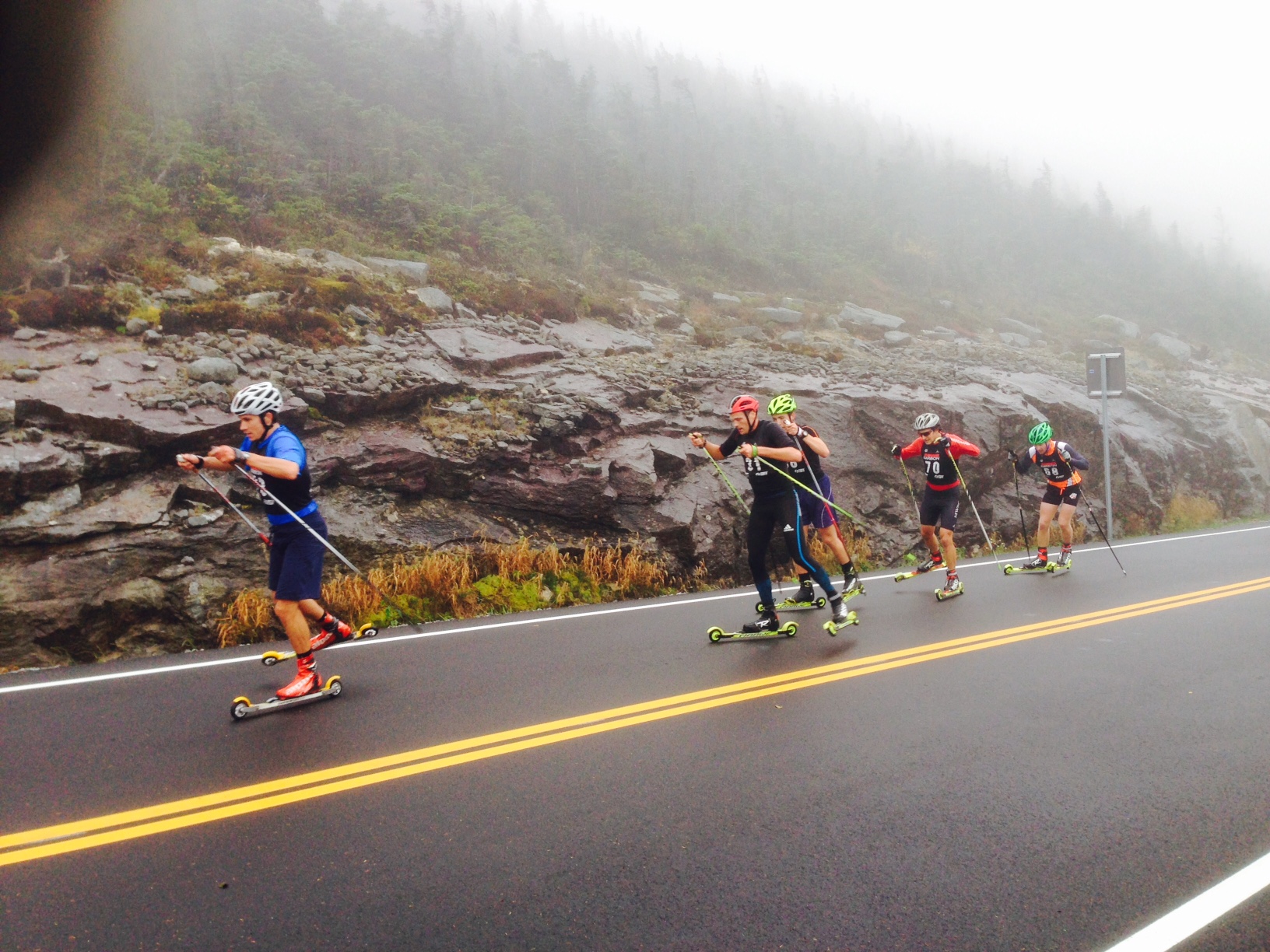
Paddy Caldwell (black shirt, yellow helmet) of the U.S. Ski Team D-team and SMST2 Team chases Rogan Brown (l) around mile four of five in Sunday’s Climb to the Castle up Whiteface Mountain in Wilmington, N.Y. Caldwell won the race, followed by biathletes Russell Currier and Tim Burke in second and third, respectively. Brown (SVSEF) placed fourth and Kyle Bratrud (CXC) was fifth. (Photo: Tim Cowan)
Note: Two photo captions have been corrected to reflect the leader of the men’s race around mile four in the 2015 Climb to the Castle. Rogan Brown of Sun Valley led the pack at the time.
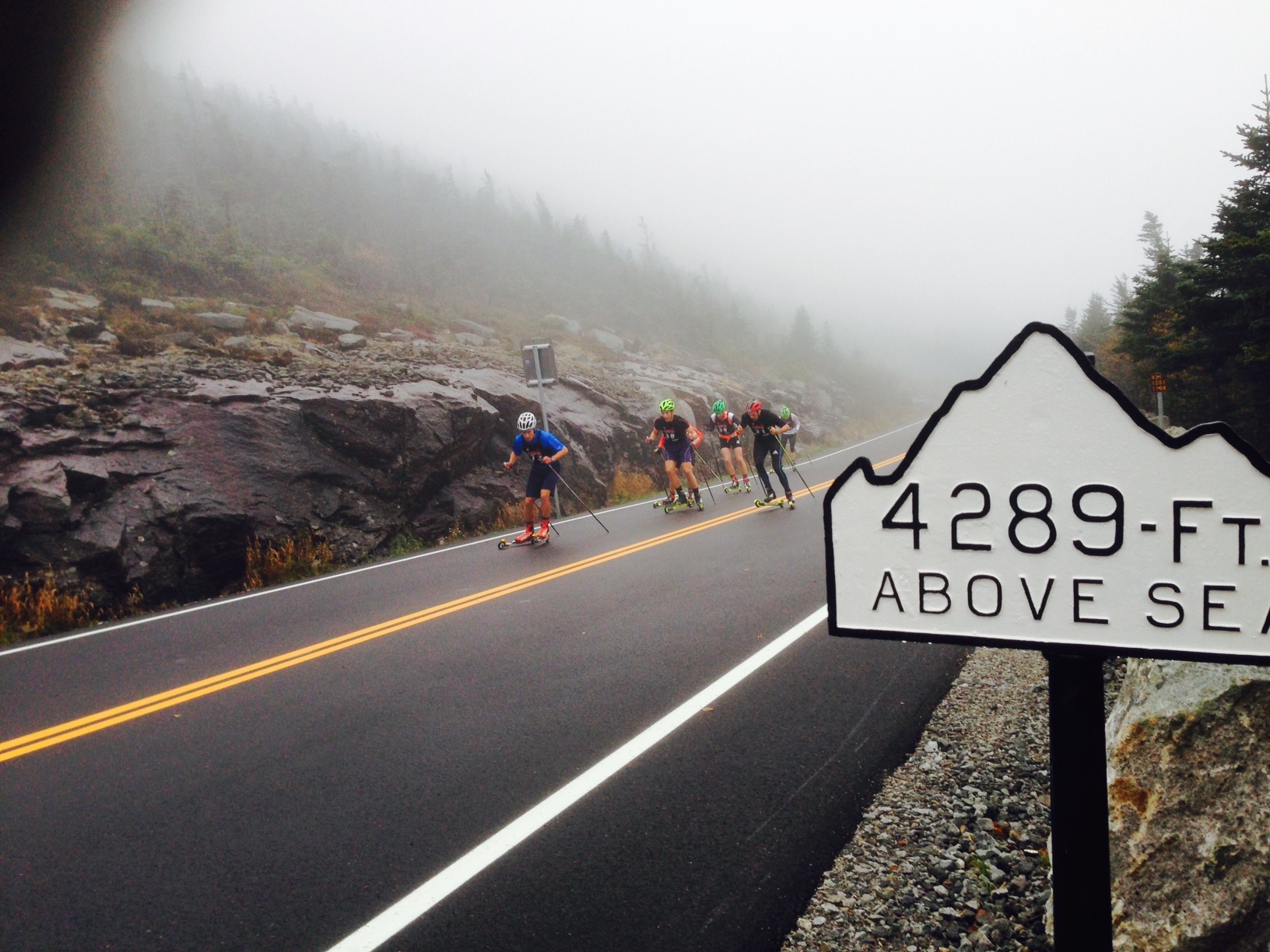
For years, U.S. Nordic Ski Team athletes and their coaches trucked themselves up to the start of the Whiteface Veterans Memorial Highway, clicked into their rollerskis and allowed an ample amount of time for warming up before ascending New York’s fifth highest peak.
Before it became an official race nine years ago, it was a workout: a five-mile grind to the summit of Whiteface Mountain, 4,867 feet above sea level in Wilmington, N.Y.
Now, for many top-level skiers, especially those based on the East Coast, the annual Climb to the Castle an offseason staple. And if you win, you get a T-shirt and a medal for your efforts.
Mary Rose (SVSEF) leads US Biathlon’s Annelies Cook up the Whiteface Mountain toll road during the annual Climb to the Castle. Rose won and Cook finished second, 32 seconds later. (Photo: Tim Cowan)
“Climb to the Castle was a blast this year!” wrote women’s winner Mary Rose of Idaho’s Sun Valley Ski Education Foundation (SVSEF) Gold Team. “My goal going into this race was to have good energy the whole time, focus on technique and hopefully put together a good effort.”
She reached the top on Sunday in 45:15.1 and topped her competition — the closest of which was US Biathlon’s Annelies Cook — by 32.6 seconds.
“It was a fun, tough effort,” men’s winner Patrick Caldwell of the U.S. Ski Team D-team and Stratton Mountain School (SMS) T2 Team said in an interview after the finish.
The 21-year-old Caldwell outlasted biathletes Russell Currier and Tim Burke by 5 and 11.5 seconds, respectively. Caldwell won in 37:05.2, Currier was second and Burke was third.
“Right from the start, we stayed pretty much together against a decent headwind,” Burke said after the finish. “I think a lot of us were fatigued at the end of a big camp, so I didn’t really want to push like crazy.”
The US Biathlon and U.S. Nordic teams spent at least the last week training in Lake Placid, N.Y., with biathletes like Burke logging five race efforts in nine days preceding the Climb.
“I decided today instead of going for time, I wanted to go for the win,” said Burke, a defending multiple-time Climb to the Castle (C2C) champion. “So I decided to sit in and push that last half mile.”
Rogan Brown (l) of Sun Valley leads Tim Burke (second from l) and Paddy Caldwell (third from l) and Russell Currier and Kyle Bratrud around mile four in Sunday’s Climb to the Castle up Whiteface Mountain in Wilmington, N.Y. (Photo: Tim Cowan)
He said he “did a lot of pulling and got some help towards the end.” Rogan Brown (SVSEF) led around mile four, and Burke explained that five men battled in the lead pack for the last two miles.
“I broke my pole in the last couple hundred meters, that kind of took me out of it,” he explained.
Caldwell took the blame what he called an “unfortunate incident” in the final 200 meters. “I broke Tim Burke’s pole,” he said. He did so when Burke made his final attack toward the finish.
“Aside from that, it was a good, solid race,” Caldwell said.
“It’s a good way to end it,” Burke said after 10 days of hard training.
Currier, who placed second, called it an “entertaining race” with five men contending throughout.
“For a rare change I was able to be on the better side of tactics and consistently stay in the back of the pack,” Currier wrote in an email. “On the other hand, the final 100 meters came up a lot earlier than I expected and didn’t give much time to react. The pace picked up and Tim Burke lost a pole tip. The next thing I knew there was an opening for the lead. I’m not much of a sprinter and didn’t do much to challenge Patrick, but was I was still pleased to break out of the back of the pack just in time for the podium.”
A former US Biathlon (USBA) B-team member, Currier, who trains with the Maine Winter Sports Center, was not renamed to the team this spring and is working towards making the cut via a series of trials ending in October.
“The status for the National team is still very unclear,” he wrote. “… All I can do is make the best of every training session and go for better results. The second round of trials is coming up in October. A couple of good enough results there should help my cause for the coming race season.”
Brown placed fourth in the men’s race, 4.3 seconds from the podium and 15.8 seconds after Caldwell. Brown edged Kyle Bratrud of Central Cross Country (CXC) by 0.3 seconds, and behind them, another CXC skier Duncan Douglas placed sixth.
USBA’s Sean Doherty and Lowell Bailey finished seventh and eighth, respectively, Miles Havlick (SVSEF) was ninth and developing biathlete Max Durtschi finished 10th of 61 men.
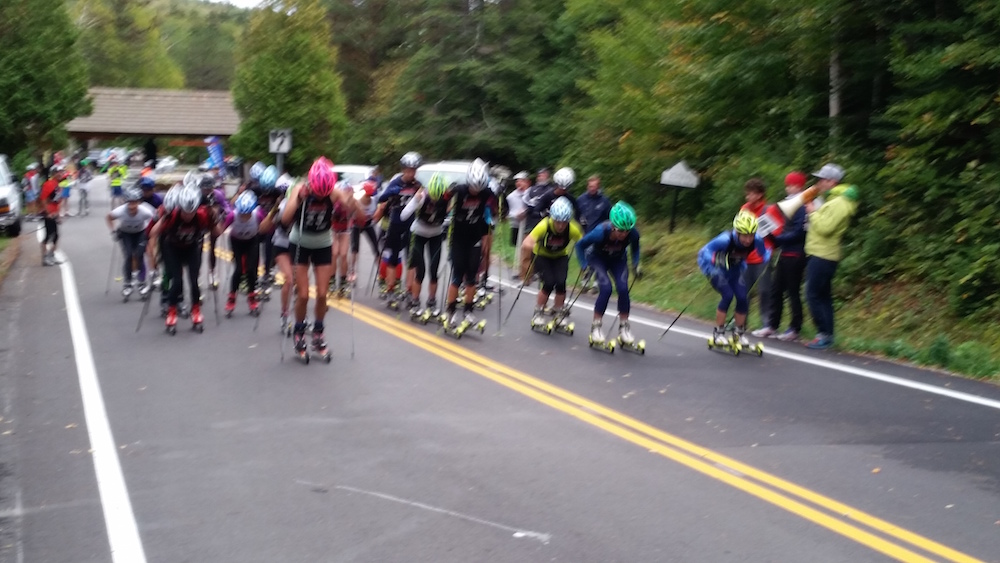
The start of the women’s race at the 2015 Climb to the Castle up Whiteface Mountain in Wilmington, N.Y. (Photo: Peter Minde)
In the women’s race, Rose and Cook pushed each other to the top. Rose recalled it being just the two of them shortly after the start. A perennial contender, USBA’s Susan Dunklee had some pole issues at the very beginning, Rose explained in an email.
“I knew I needed to break away about 1/2 mile to the finish because I can’t beat [Cook] in a sprint,” Rose wrote. “I fought pretty hard through the ‘wind tunnel’ and I think that is where I broke away.”
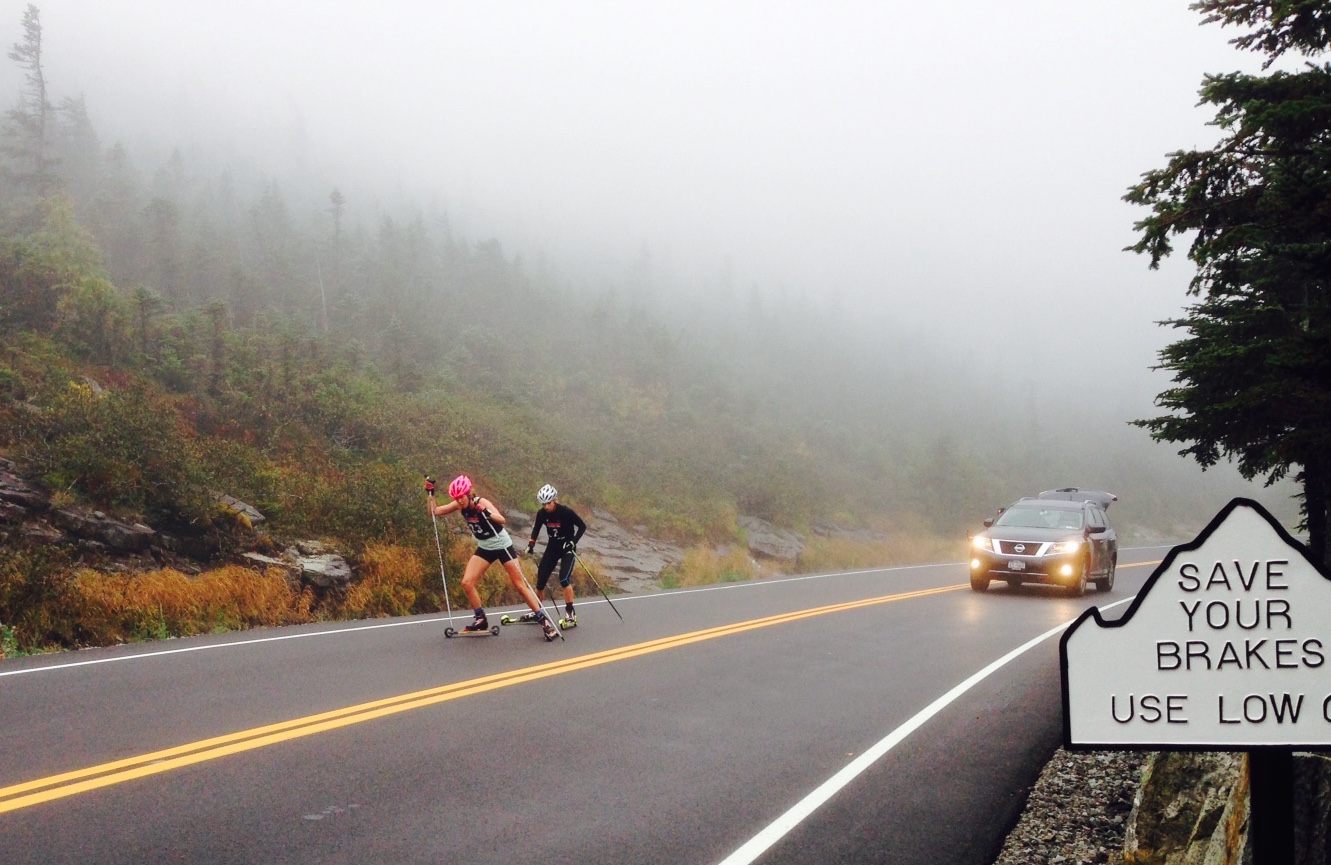
Overnight rain left the toll road wet, and wind dried out its lower sections. From about the halfway point to the finish, skiers pushed through mist on wet pavement and faced a steady wind blowing 10 to 20 miles per hour throughout the race. After starting in temperatures around 47 degrees Fahrenheit, they met temperatures in the mid-30’s at the top.
“It sounds weird to say it aloud, but I actually had fun doing the climb to the castle,” Cook wrote in an email. “Mary and I skied together the entire time and switched leads back and forth. I usually get bored doing the climb and lose focus and switching back and forth with her kept me in the game mentally.
“She got me at the last turn right before the finish when I suddenly flooded with lactic acid and had no chance,” she added. “But I don’t really think of myself as a climber and so it was fun to be the two people leading the race. That doesn’t happen too often! Of course, the usual suspects were not there and that obviously made it difference.”
With the exception of Paddy Caldwell, the U.S. Ski Team (USST) skipped the Climb this year for the first time in years.
“As hard as it is to miss it because it is a fantastic event, it just didn’t play well athletically for the needs of the group,” USST Head Coach Chris Grover said on the phone last week. “We wanted to do more sprint-specific training and short intensity as opposed to giving up a whole workout or two to do the Climb to the Castle.”
The USST camp was also only a week long, compared to the two weeks the team usually spends in Lake Placid this time of year. On the other hand, the largely Lake-Placid-based US Biathlon team did either time trials or Level 5 (race-pace) workouts for last 10 days.
“I had my personal best by quite a lot and I felt strong skiing,” Cook said of the Climb. “It felt good to end a really tough ten days on a good note. … I think we are all pretty glad to be done.”
The Climb marked the end of a two-week training block for Rose and her Sun Valley teammates, who were in Stratton, Vt., with the SMST2 team for the first week.
“We had some super hard intensity sessions over the past two weeks and all were very productive,” Rose wrote.
USBA’s Hannah Dreissigacker, who placed third, 2:05.9 after Rose, explained in an email that the women’s race broke up quickly.
“Mary and Annelies started off a little faster than I really wanted to be going, and I tried to hold on for a bit but then gave up pretty quickly and lost contact,” Dreissigacker wrote. “My goal in the Climb to the Castle is always to not start too fast and then blow up. Then I skied with Susan for a mile or so and then slowly inched ahead of her a bit. Eventually we skied into a cloud and I lost sight of Annelies and Mary and just skied the whole second half by myself.”
She finished 1:10.9 ahead of Dunklee, who placed fourth, while wearing a figure-skating tutu she wore the first time she did the race.
“The lacy elbows really allowed for added breathability and the rhinestones gave me some extra motivation on those long hard stretches when I was all alone,” Dreissigacker wrote.
Another biathlete, Clare Egan finished fifth, Paige Schember (SVSEF) was sixth, Erin Perryman (St. Lawrence University) was seventh, Jackie Garso of the local New York Ski Education Foundation (NYSEF) was eighth, St. Michael’s assistant coach Silke Hynes was ninth, and Stratton U16 skier Anna Lehmann was 10th of 25 women.