From the FasterSkier archive — posts syndicated from athletes’ and coaches’ own blogs between 2004 and 2012, kept online as published. Current coverage is at fasterskier.com.
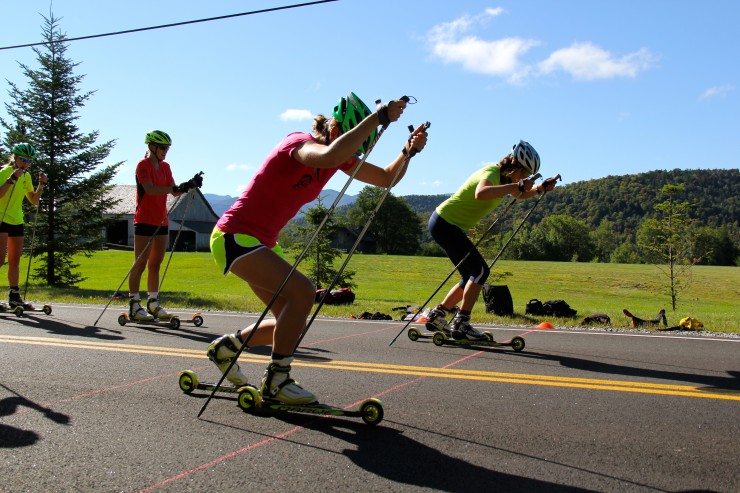
Stratton T2 skier Annie Pokorny (l) and Middlebury’s Heather Mooney (r) start together during the skate-speed session on Aug. 29 at the U.S. Ski Team camp in Lake Placid, N.Y. (Photo: Bryan Fish)
Growth is good, and when it comes to improvement, even the U.S. Ski Team has areas it wants to work on collectively. Sprinter or not, if racing’s in your future, chances are you could benefit from some speed work off the starting line.
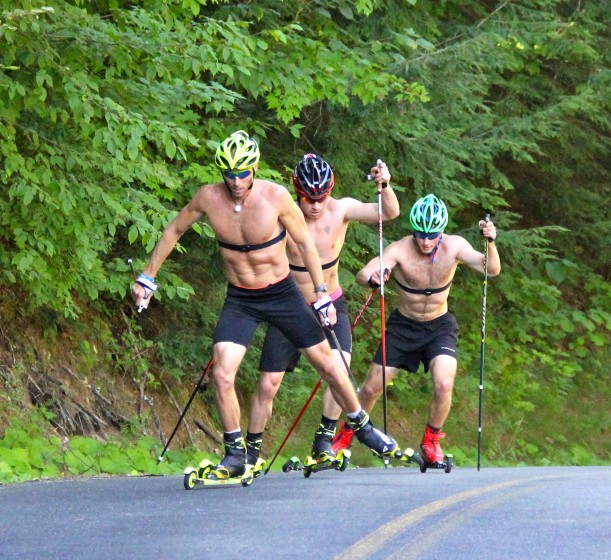
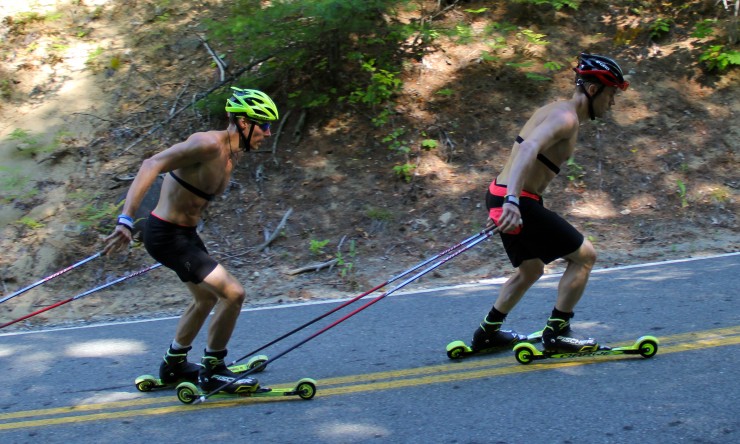
That’s why U.S. Ski Team (USST) Head Coach Chris Grover adjusted one of his team’s workouts last week at its camp in Lake Placid, N.Y. Instead of doing 16 to 18 skate-speed accelerations on rollerskis (each lasting about 10 seconds), Grover and his staff decided to cut down the number of accelerations, or rolling speeds, and add some sprint starts (transitioning from double pole to skate).
The Workout: 4-5 x rolling speeds and 12 x sprint starts
Where: Bear Cub Road (about 2.3-miles long to a dead-end) next to the Olympic Training Center in Lake Placid
Why: “We decided that we wanted to change the focus of the session to improving skate sprint starting technique,” Grover explained in an email. “We had a very productive session where most athletes made some excellent changes, and we have a follow-up session scheduled for Park City in October.”
What: Warmup as usual, then begin rolling speeds: 4-5 accelerations (each lasting about 10 seconds), with about 3 minutes of recovery in between.
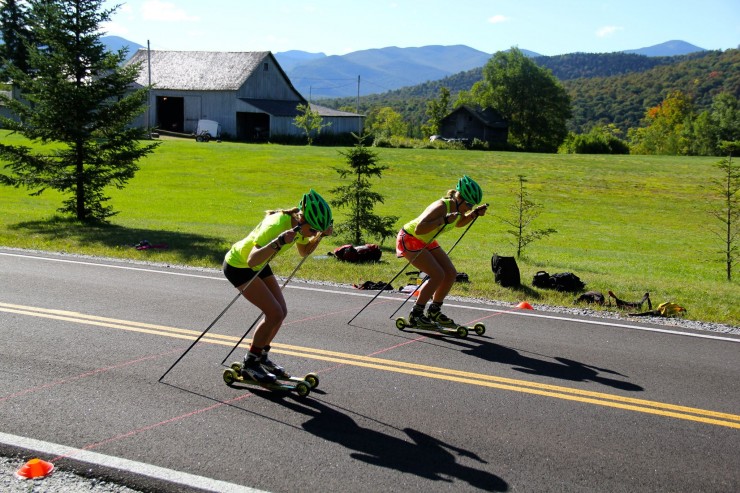
When you’re done with that, recover for 3 minutes, and move to skate-sprint starts. From a standstill, build speed off the line: double pole then transition to V2. After 10 seconds, stop, recover for three minutes, and start again (for a total of 12 times).
“We do practice starts regularly since they are important for certain sprints in some conditions,” Grover wrote. “We generally keep our speed training closer to 10 seconds for maximal neurological benefit and less fatigue.”
Length: The workout itself should take about an hour. With warmup and cool down, you’re looking at 2 hours.
Out of the USST’s 12 training days of camp in Lake Placid, there were about a dozen rollerski sessions scheduled and seven cross-training workouts. One of them was VO2-max bounding at Whiteface Mountain, an annual staple of their Lake Placid camp.
“Bounding/ski walking intensity is a go-to workout for most cross-country ski racers around the world, most likely because you can access grades that are not available on pavement for rollerskiing,” Grover explained. “You can find long, steep pitches that resemble some of the bigger hills you might find on a ski course, and the mechanics, body position, and power application of bounding is identical to good steep classic striding or herringbone.”
All of this can be done without worrying about cars or road hazards.
“The question has been asked many times why don’t cross-country skiers simply rollerski and ski for all training,” he added. “After all, runners run, bikers bike, and swimmers swim. For me, there are two answers to this question. The first is that the preparation period for cross-country ski racing is so long, and the training volume is so high at the elite level, that cross-training modes like running become essential for preventing over-use injuries and for keeping training mentally fresh for the athlete.
“Cross-training modes like running become essential for preventing over-use injuries and for keeping training mentally fresh for the athlete.” — U.S. Ski Team Head Coach Chris Grover
“The second is that running provides increased leg strength because the athlete actually carries 100% of their own body weight (unlike biking or rollerskiing) and lifts that weight off the ground repeatedly,” he continued. “Agility is also improved by running, especially if you are constantly hopping from rock to rock in the Adirondacks!”
The USST camp wraps up on Sept. 7 following the Climb to the Castle on Saturday, Sept. 6, of which Liz Stephen and U.S. Biathlon’s Tim Burke are the defending champions.
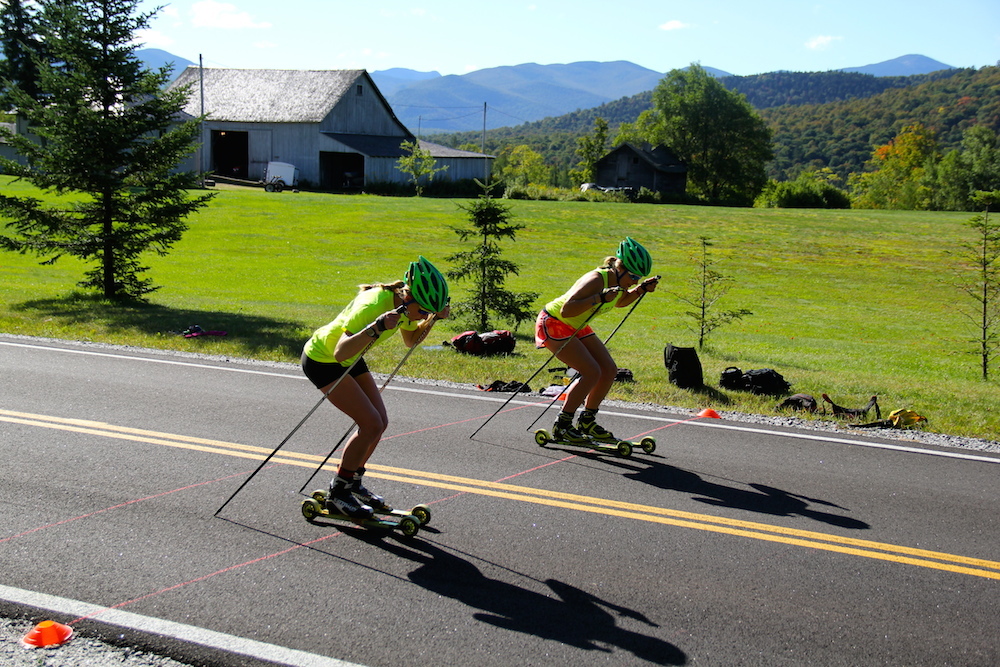
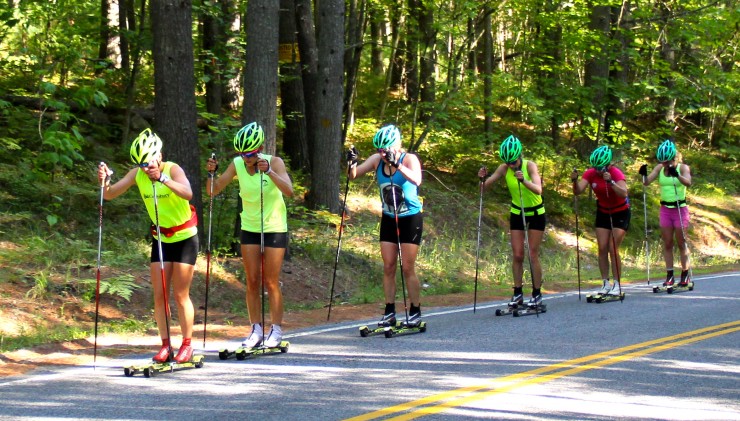
SMST2 teammates Erika Flowers (l) and Anne Hart work on skate-sprint starts on Aug. 29 at the U.S. Ski Team dryland camp in Lake Placid, N.Y. (Photo: Bryan Fish)
America’s best nordic skiers have converged in New York for the U.S. Ski Team’s fall training camp at the Olympic Training Center in Lake Placid. Check out some photos of the initial days of the camp provided by USSA.
Andy Newell (l) leads Simi Hamilton and Ben Lustgarten (Sun Valley Ski Education Foundation) in a rollerski workout in Lake Placid (Photo: USSA)
Simi Hamilton leads Andy Newell during a rollerski workout on Hurricane Mountain Road. (Photo: USSA)
Simi Hamilton leads Andy Newell during a rollerski workout on Hurricane Mountain Road. (Photo: USSA)
Simi Hamilton leads Andy Newell during a rollerski workout on Hurricane Mountain Road. (Photo: USSA)
Simi Hamilton leads Andy Newell during a rollerski workout on Hurricane Mountain Road. (Photo: USSA)
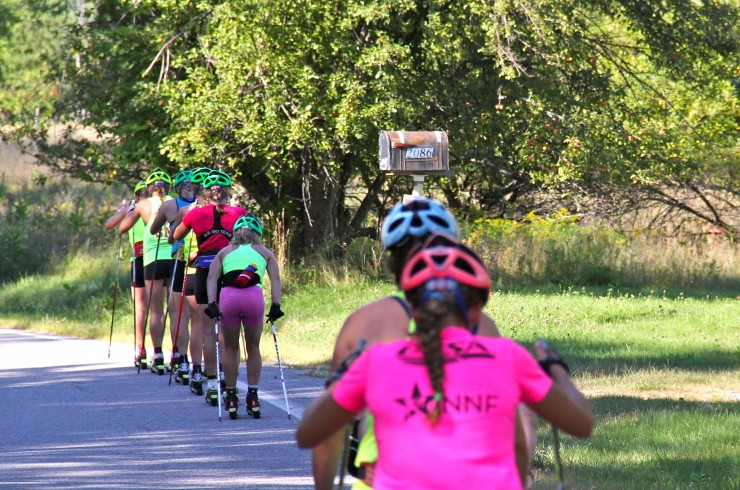
The ladies of the Lake Placid camp out for a rollerski. (Photo: USSA)
The ladies of the Lake Placid camp out for a rollerski. (Photo: USSA)
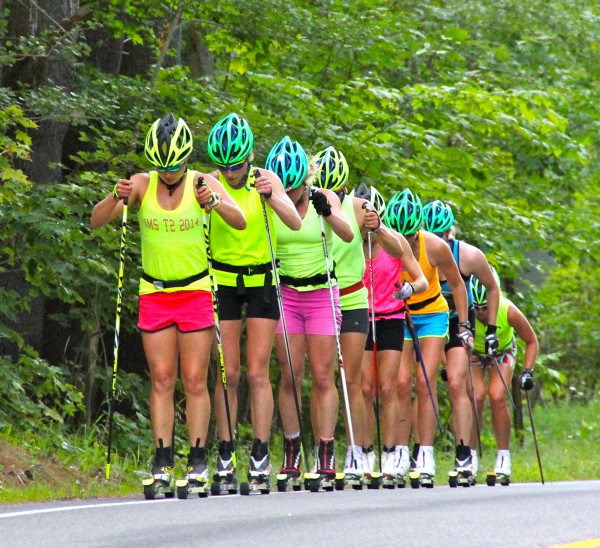
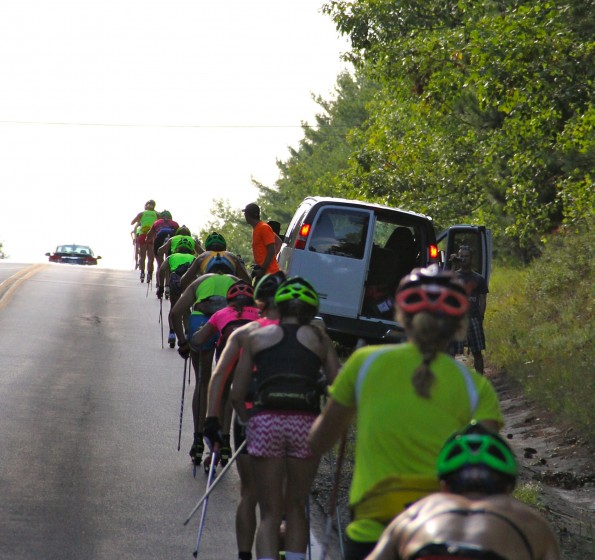
Coaches oversee the USST Lake Placid fall camp attendees during a recent rollerski. (Photo: USSA)
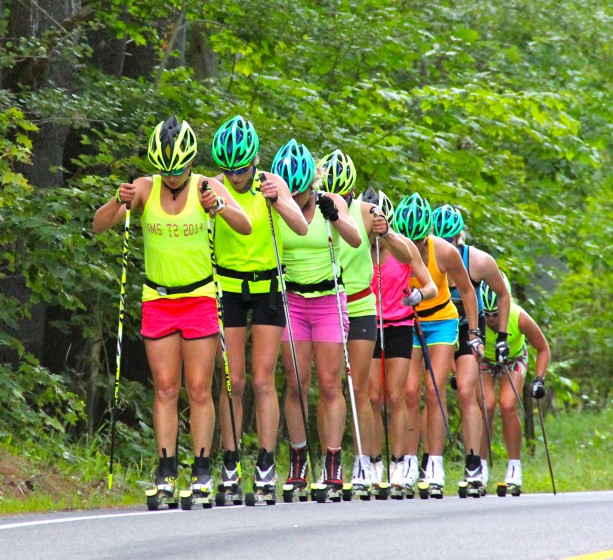
An array of bright colors from the ladies of the Lake Placid camp. (Photo: USSA)
About 25 elite nordic skiers did maximal-intensity, ski-bounding intervals up Whiteface Mountain on Tuesday as part of the U.S. Ski Team Elite Camp in Lake Placid, N.Y.
WILMINGTON, N.Y. — The view from partially up Whiteface Mountain on Wednesday morning was about as picturesque as they get. From the trail, one could see that the leaves had started to turn shades of red and yellow — just in time for the U.S. Ski Team’s fall training camp in Lake Placid, N.Y.
Way down below, a few small dots proceeded up the dirt access road: first to warm up, then to get after it. US Ski Team Head Coach Chris Grover organized the maximal-intensity, ski-bounding interval workout for about 25 athletes, and said it was probably the toughest many had done this training season.
“Typically what we’re doing in the fall is switching gears from kind of our base anaerobic phase in training, where we’re concentrating more on is distance and technique acquisition, and now starting to work a little bit more poignantly with developing the athletes’ VO2 max,” Grover said. “You probably heard comments from athletes who said this was the first session of quite hard bounding that they’ve done this season. A lot of these guys have done quite a bit of threshold-type bounding, but they haven’t done short, hard bounding like that. It’s intended to develop their maximal aerobic capacity.
“So that’s what we’re going for,” he added. “It’s the beginning of September, kicking it into a little bit more intensity mode. Obviously during the camp, we have some more hard workouts coming up, including the Climb to the Castle [on Saturday], the sprint rollerski time trial, as well as some threshold sessions. Just trying to start into a little bit more hard training.”
“We saw some great performances [today] out of individual athletes, both national-team athletes and club athletes, but it’s definitely early in the season and we won’t get the real measuring stick until we get to Muonio [Finland], get to Gällivare [Sweden] in the fall and see how these guys stack up.
“This is the point of the year where I think everyone around the world is looking around going, ‘Oh yeah, these guys have made great progress through the summer,’ but it’s easy to forget that probably everybody in the world has made good progress through the summer. It’s kind of hard to take away from this particular workout except for particular technique changes, perhaps, that someone’s made, that they’re maintaining their form through the bounding sessions, for example. And if they’re mature enough to learn to really pace it well so that they’re still there at the end.”
How did each athlete decide whether to do five or seven intervals?
“Each of these guys is pretty much talking with their individual coach about what they should be doing right now and kind of what their training history has been over the summer, how old they are, and particularly what they’ve done over the last couple of weeks. Some athletes have come in with a good rest week, for example, and they’re ready to do the full-prescribed seven [intervals]. Others are coming off a little bigger training block, for example, and they’ve got to kind of work their way into camp a little slower.”
Andy Newell:
“I felt good. I always try to pace this workout well. It’s one of the harder ones we do at the camp, I think, as far as how much it takes out of your body. It kills my legs usually. But these are the kind of workouts that really you make lot of gains in building VO2 max. We haven’t done a ton of them so far this year, so for me I try to build into them so I can make the last few intervals hard. But it’s a long camp so we try not to blow ourselves out too much.”
How did you like doing the intervals with about 15 others, including some up-and-comers pushing to lead the pack?
“I like that. Some people don’t like training with a big group, but I think it’s sweet. I think the more people you have out, the better for an interval session. It’s funny, some of the young guns come to the front and go really hard on one, and they’re dead two intervals later. I was that same guy probably five or six years ago back when I was coming to these camps, too. So it’s cool to see these younger guys go out and hammer in front.”
Jessie Diggins:
“At the start of the workout I wasn’t feeling that great. It wasn’t the worst workout, definitely not the worst, but I wasn’t feeling the very best. It took me a while to warm into it and on the last three it started feeling really good, which is nice. I’m still trying to experiment with when beforehand I should take my inhaler. … I’m getting closer and closer to make it kick in when I want it.
“When you do these intervals, it’s super, super important to not dig yourself into a huge hole, but once in a while it’s really good to figure out exactly where your limits are and know what it feels like right before you hit the wall, and I found that 30 seconds before I was done today so that was really nice.”
Tad Elliott:
How was your summer?
“I’ve had a great summer out in Park City, [Utah]. I’ve been there pretty much all summer and then, just to Europe and back really quick [for a USST men’s camp in Austria and Germany]. It’s really nice to have my old coach Jason Cork back [as] the U.S. Ski Team men’s coach. He trains with me every day and we hang out, so training’s been going really well and it’s fun to have him around, too. Things are going awesome.”
What kind of training changes have you made?
“Ski training. I’ve been ski training a lot more, haven’t been mountain biking as much and a lot more strength, too, this year with our coach Michael [Naperalsky] at the COE. A lot more bounding, a lot more running, and yeah, less biking.”
What are some of the bigger mountain bike races you’ve done this year?
“I did nationals and that went all right. I was still solid when I came on the last lap, but nowhere near as well as I did last year. I think it’s all this muscle I’ve gained in my upper body, can’t carve as fast. I was 14th this year, sixth last year [in my first two years in the elite field].”
What was it like watching mountain biking at the Olympics?
“Man, the Olympics was awesome. Todd [Wells] is one of my good friends back in Durango. My dog, Gus, and his dog, Winston, have little man crushes on each other so we always go on play dates together with Todd, and I play golf with him. It was really fun to see him get a 10th place in his final Olympics [the best U.S. men’s result in Olympic history]. That was really cool. And then I’m good friends with Georgia [Gould], got to talk to her at nationals; she came home with some hardware [as the second U.S. mountain biker to ever win Olympic bronze] so that was sweet.”
Ida Sargent:
How was your summer?
It’s been great. I was in Craftsbury [Vermont] for basically the whole summer, except for our camp in Sweden, so it’s been good to be home and in one place for a while.
What have you been working on, and what did you learn from your first season on the World Cup?
“More hard training and keeping some consistency with the gains that I made last year and a lot of technique stuff, too. … It was tough to race the full season on the World Cup. I was pretty tired at the end of the year after having been on the road and traveling and racing the World Cup every weekend, so that was a great experience. This year I’m looking forward to building on that and returning to some of the same venues and having a little more familiarity with the whole scene, just ready to improve my results with that extra experience.”
What would you say your strengths are?
“I think sprinting is my strength, so this year I’m going to try to focus a little bit more on [that], but I would love to be a really good distance skier, too, so I don’t consider myself a sprinter. I want to be in the points in the distance races as well. It’s great to do training camps with Jessie, and Liz will be here later this week, and these other girls, too, to kind of improve my distance skills, too.”
How was your joint camp with the Swedish women’s national team in Sweden?
“It was good. We trained a ton. It was a lot of hard work, a lot of hours, but it was cool to see that they weren’t doing anything different than us, and we could hang with those guys and train with them. It was just a good confidence builder that our team’s really on the right track and building momentum also.”