From the FasterSkier archive — posts syndicated from athletes’ and coaches’ own blogs between 2004 and 2012, kept online as published. Current coverage is at fasterskier.com.
White Pine Touring is located in Park City, Utah. WPT Nordic Center has enjoyed strong retail and pass-holder growth over the last few years. There is 22k of private groomed classic/skate trails, with a solid retail/rental/service/ski school presence right on the track. We are seeking a manager who has extensive experience in Nordic hard goods product knowledge, familiarity with Nordic instruction and track grooming. Strong organization skills with an outgoing dynamic personality. Able to oversee several tasks while working with an managing existing established crew.
This position can be seasonal or full time year round depending on skill set. Benefits include: Health insurance, 401k, ski benefits – (alpine and Nordic). Industry perks etc… This is a salaried position that will be based on prior experience.
– Strong Nordic hard good knowledge
– Familiar with track grooming specifications
– Nordic instruction background
– Shop/ waxing knowledge
– Race hosting experience
– Ambassador to the sport
– Management experience
Interested candidates should send a cover letter and resume to Jack Walzer.
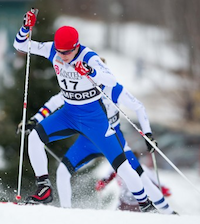
Noah Hoffman (Ski & Snowboard Club Vail/U.S. Ski Team) attacking a climb at U.S. Nationals this January. Photo: Flying Point Road.
Noah Hoffman has been all over the world this summer in search of snow, and in less than a week the U.S. Ski Team member will be jetting off again to find more. This time he’s headed to the Southern Hemisphere along with teammate Kris Freeman to train at the Snow Farm, New Zealand’s premier cross-country ski field and, until this year, a regular U.S. training destination.
It won’t be the first time this summer that the pair has embarked on an independent trip on top of the regular USST camp schedule; they both flew to Norway in June to spend time on Sognefjell. But between Sognefjell, the Snow Farm and earlier camps throughout the U.S. and Europe, Hoffman will have trained on actual skis this offseason more than any other in his career.
This intensified quest for groomed trails is part of a specific plan to improve on what Hoffman currently considers to be a significant weakness of his: technique. And there’s no better place to fine-tune it than on actual snow.
“You can do a little [technique] on rollerskis but it’s much more realistic on snow,” Hoffman said on the phone from his current base in Park City, Utah. “I’ve struggled with the transition between rollerskis and snow before, and I feel like it’s really important for me to learn to ski on snow because that’s where the races are held and technique has always been one of my biggest weaknesses.”
Hoffman following Canadian Devon Kershaw early in the Oslo World Cup 50 k last season. Photo: Fischer/Nordic Focus.
In fact, Hoffman believes that any success he’s had came in spite of not being the most efficient skier out there. Pure fitness worked for him until a point, but less-than-perfect technical ability eventually got in the way of further progress.
“It’s almost astounding how bad my technique is, and how I haven’t been able to make much progress with this before,” Hoffman said.
As a junior skier rising through the national ranks, he didn’t see the specifics of things like pole placement as a priority. “I kept finding that the harder I worked the faster I skied. But that doesn’t work forever; eventually you start getting tired and over trained. I was lucky in that I was able to handle a lot of training and each year work harder and ski faster, so I never saw the need to really address other aspects of skiing.
“But that stopped working, especially in 2009 when I had a really bad season.”
The summer afterwards was when Hoffman hired Zach Caldwell specifically to be his technique coach, and ever since they have adopted a unique plan to gradually fix Hoffman’s weaknesses. Caldwell assigns Hoffman an intensive three-day block of time about once a month to go away and work on some aspect of his technique. After, they revisit those cues at various intervals down the road and measure progress.
“Zach and I have a unique relationship; I don’t know of anyone who works on technique the same way I do,” Hoffman said. “But it’s worked really well for me… My classic skiing really took off the first year we started working together. Skate has been a longer process but I think we’re making some good gains right now.”
In order to ingrain small tweaks into his muscle memory, Hoffman has learned that he responds best to specific cues. Attempting to imitate other skiers didn’t stick, and so Caldwell and Hoffman devised ways to get the latter to set an edge or reach his arms in certain ways using analogies and imagery cues. Cues range from the simple — ‘stand up’ — to more complicated.
For example: the skateboard cue.
“Imagine a skateboard out in front of you with a stack of weights on it,” Hoffman explains. “A rope is attached to the skateboard, which is attached to your hand. When I’m poling in a classic striding motion I imagine myself pulling the skateboard to me, getting it moving as fast as I can without letting the weights drop off the skateboard. It has to be a smooth motion, but you’re accelerating through it and you’re pushing hard.
“We came up with that the first summer and that’s stuck with me; it’s been a great cue. I don’t know what kind of learner that makes me, but it’s worked really well for me.”
In the skate technique, other prompts include the [Maurice] Manificat cue for V2 and the [Petter] Northug cue — the Norwegian’s V2 alternate is “really good for springing off the foot and getting slingshotted down the track.”
And so when Hoffman steps onto the winding trails at the Snow Farm, ‘skateboard cue’ will be on his mind. He is looking forward to training at a venue free of distraction; with food, lodging and training all under one roof, he and Freeman aren’t even renting a car.
“Once again we’re someplace that is not very conducive to doing much but eating, sleeping and skiing,” Hoffman said. “It’ll be a good opportunity to be focused and work on what I need to work on without any distractions. Kris is one of the best in the world at doing that, so he’s a good person to go down there with.”
Setting out to improve technique is one thing, but Hoffman’s ultimate goal in doing so is to be the best skier in the world in five more years.
“A top 10 or top 15 would be a great success for me [at 2014 Sochi Olympics]. I’m looking to be a regular top-10 skier on the World Cup by that time,” Hoffman said. “But I’m looking at winning a gold medal in 2018. That’s my goal. I want to be winning World Cups by that time; I want to be winning world championships in Lahti in 2017.”
For the fifth-straight year, the U.S. Ski Jumping and Nordic Combined Championships are about to take place in the middle of summer with events Saturday and Sunday in Park City, Utah.
U.S. Nordic Combined teammates working out during a June training camp in Park City, Utah. Defending national champion Billy Demong (c) is seeking his ninth U.S. title at the U.S. Ski Jumping and Nordic Combined Championships this weekend in Park City. Johnny Spillane (l) was last year’s runner-up at nationals, and Bryan Fletcher (r) placed third. (Dave Jarrett courtesy photo)
The nation’s best, including defending champions Billy Demong and Jessica Jerome, will descend on the Utah Olympic Park ski jumps in Park City and Soldier Hollow ski area in Midway for two days of dryland competition, according to the USSA website.
Here’s what you need to know about this weekend’s nationals:
What: 2013 U.S. Ski Jumping and Nordic Combined Championships
Where: Park City
When: Aug. 4-5 (Ski jumping starts at 8 a.m. Saturday; nordic-combined rollerski final at 1 p.m. Saturday)
Favorites:
Demong, an Olympic gold medalist and eight-time national champion who won last year’s nationals in Fox River Grove, Ill.
Jerome, who also has eight U.S. titles and won on the large hill last year.
Peter Frenette of Saranac Lake, N.Y, large-hill defending champion with three national titles to his name and two top-10 finishes in FIS Continental Cups this summer
Anders Johnson of Park City, who won the normal-hill title last year and has three Continental Cup top-20s this summer
Of note: The reigning women’s ski jumping World Cup champion, Sarah Hendrickson will miss this year’s nationals along with Lindsey Van, the 2009 World Champion, to recover from planned surgeries. Hendrickson won her first U.S. title last year on the normal hill.
It’s October, which means I’m training in Utah’s Heber Valley for our biathlon team’s annual fall altitude camp. Every day so far has been warm, sunny and beautiful on the valley floor. The surrounding Wasatch mountains are capped with fresh snow; a promising reminder of the skiing soon to come. Solider Hollow, the venue where we are training and the site of the 2002 Olympic games, sits at 5,500 feet. The thinner air at this altitude makes it slightly more challenging to train and race.
The US Biathlon Association board members were in town last weekend for a meeting and banquet, as were the US Biathlon Foundation members. We gave them some shooting instruction and then enjoyed a variety of activities together such as horseback riding, golf, and fly fishing. At the banquet, I had the honor of sitting next to Bitsy Kelley who runs a west coast weekly radio show about everything outdoors. We chatted about hunting, gardening, farming, and shared ideas for living self-sufficiently.
I went horseback riding with the board in the town of Sundance, home of Robert Redford. The scenery was beautiful with the aspens, oaks, and maples at the height of foliage season- almost as colorful as the Green Mountains back home. photo credit: Laura Spector
The first week of training was great. We’ve shared the range with Maine Winter Sports Center, Twin Biathletes (the Barnes), the Junior National Team, and a contingent from Canmore. A couple of times, we even saw our xc friends from the US Ski Team, Central XC and Sun Valley sprinting around the Soldier Hollow trails. Although all these groups are on different training schedules, it is inspiring to train around them. At the end of this week, we’ll also have the chance to meet some of the US speed skaters. They invited us to watch their World Cup competition in Salt Lake.
Group training on the range. photo credit: Pat Coffey
Today was our first of two sprint races out here. Racing at altitude tends to be very painful, the lack of oxygen makes it harder to recover. My goal was to start at a relaxed pace and keep getting faster as the race went on. I also applied a similar strategy on every uphill: ski at a controlled pace until the last few meters, when I would accelerate and carry more speed over the top. It paid off- I had the fastest ski time of the American contingent (not by much), but I missed 3 out of 10 targets, while several of my teammates shot clean or only missed 1 or 2.
Standing shooting. Notice the new custom stock that I got a few months ago. photo credit: Jonne Kahkonen
To read more about our Utah training camp and see more pictures, check out this Fasterskier article written by Chelsea
The women's national team skiing through the range at Soldier Hollow. Photo courtesy of Susan Dunklee.
The U.S. biathlon community may be small, but one benefit of its size is that almost everyone can gather each year in October for a training camp at Soldier Hollow.
This year, the senior national team is joined in Utah by the junior national team as well as biathletes from the Maine Winter Sports Center, Durango and as far as Canada.
Inviting everyone brings training quality up, said national team women’s coach Jonne Kahkonen, who also supervises training for all resident national team athletes in Lake Placid. He was pleased by the work he had seen in Soldier Hollow so far.
“I’d say that in general, the summer has been good for the athletes training with the team, and for sure there are going to be a few athletes from outside the team who will be pushing hard as well,” Kahkonen told FasterSkier between training sessions on Monday. “So I’m sure that with all this competition within our nation it’s just going to bring the level up even more. And hopefully it’s good for the team members to remember that there are athletes outside the team, pushing.”
The group was taking advantage of Soldier Hollow’s shooting range and paved rollerski loops to concentrate on biathlon-specific training. There are few venues in North America as conducive to dryland training for biathlon, and with the race season fast approaching, locking down shooting procedures is especially important.
Dunklee honing her standing shooting. Photo: Jonne Kahkonen.
“For me, this time of year tends to be about putting together all the different pieces I’ve been working on rather than finding new focuses,” said national team member Susan Dunklee. “I have a couple positional and breathing concepts in shooting that I’ve been working on for the last month, and I’m trying to solidify these so they become automatic.
“One of the best things about training at the Soldier Hollow venue is having a full range with a rollerski loop. This camp is a good time for us to check in on our range approach and exit and make sure all are transitions are smooth and efficient.”
Kahkonen also said that the elevation of just over 5,000 feet was a training benefit – even though the World Cup only has one weekend of racing at any significant altitude this season.
“Personally, I enjoy coming to Utah, especially here in Midway, because it’s high enough that you get a little boost from that but it’s not too high that we’d have to compromise the intensity,” Kahkonen explained.
A major focus of the camp is to select athletes for another training camp, which will take place in Sweden before the opening World Cup races. “A” team members Tim Burke, Lowell Bailey, Leif Nordgren, Jay Hakkinen, Sara Studebaker, and Laura Spector are prequalified for the Sweden trip, but additional athletes will be selected based on two sprint time trials to be held today and Thursday.
The maximum team size for the Sweden camp is six men and six women, and from that group the team for the first period of World Cup races will be selected; the rest of the athletes would then be sent to the IBU Cup, a coordinated race series at a level just below the top.
“We can take up to six [women] and…. well, never say never, but that’s what it looks like right now, that we would end up doing that,” Kahkonen said.
Last year the team took five men but only two women (Studebaker and Spector) to the first period of European racing. Kahkonen said that the expanded women’s team for this year was made possible by a bigger budget and their success on the trails last winter.
“For sure one of the biggest things to make a change for this year is the level that they showed last year,” he said. “Both in the IBU Cup – they had some really good results there – and obviously on the World Cup as well.”
Dunklee, one of the athletes hoping to be added to the Sweden roster, said that the looming time trials had made her more cautious about the camp’s earlier workouts.
“For the last few days, I’ve been trying to be smart, take it easy, and adjust to the altitude,” she explained.
But that didn’t mean she wasn’t having fun. Like most of the athletes, Dunklee loves the scenery in Utah.
“My favorite things about being out here?” she asked. “Warm sunshine, brisk frosty mornings with snow on the peaks, hiking up canyons, juicy fresh peaches at the store, golden aspens and red oak leaves, and an amazing caterer that cooks for the team.”
While several members of the men’s team had brought their fly fishing gear out to Midway and spent several afternoons on the water, Dunklee had brought her shotgun and gone grouse hunting with Olympic veterans Tracy Colliander and Lanny Barnes.
“We’ve been twice, but haven’t got any yet,” she lamented.
And though the camp is designed for senior athletes, the juniors have been taking advantage of the larger community as well – albeit with their rifles, not shotguns or fishing rods.
Anna Kubek, a Minnesota high school student who recently qualified to represent the U.S. at the inaugural winter Youth Olympic Games, is one of the juniors who has been training at Soldier Hollow.
“Until now, we have had our own training schedule apart from the seniors,” Kubek said in an e-mail. “But the times we do see them train is amazing. It is great to see how they train and what it takes to be at their level. It’s really fun and a good experience to be around people close to my age.”
Kahkonen said that for better or for worse, it was difficult to have juniors and seniors training alongside one another.
“We have basically our own schedules because we don’t want to push the juniors too hard,” he explained. “The juniors are still in the developing phase and they need to do a little bit different kind of training, a little bit less hours and a little bit less intensity – a little bit less in general. But wherever we can it’s good to combine stuff and at least expose them to the training that the best athletes are doing.”
It’s symptomatic of the team’s more general approach for trying to develop athletes. Kahkonen believed that exposing the younger biathletes to the senior team’s workouts would help them improve even if they weren’t actually participating.
“It’s good for an athlete to see better athletes, and to see the best athletes in the country and even in the world,” he said. “That’s one of the reasons we do a training camp in Europe for the best athletes, just to expose them to the training that the other nations are doing.”
Next year, the team is hoping that the camp might be even more inclusive. While the group overlapped with a U.S. Ski Team camp at Soldier Hollow, they were unable to coordinate training because the biathletes were focused on using the range. In the future, however, that might change.
“We met with Chris Grover so we are already planning for next year so we can do even more, maybe even camps and not just single workouts together,” Kahkonen said. “We want to be ahead in the game and be planning already.”
The coach indicated that small collaborations between the two teams had gone well so far, and there was no reason not to strengthen the connection.
“This year we only really had one chance to match the workouts, which was in Lake Placid, when we had Climb to the Castle and training around that, so we ended up doing three intensity sessions together with the ski team,” he said.
“It seemed like both the skiers and the biathletes really liked doing something different, and so that’s definitely something we want to push for next year.”
(Photos in gallery below by Jonne Kahkonen)
Leif Nordgren at the USBA camp at Soldier Hollow, October 2011. Photo: Jonne Kahkonen.
Lowell Bailey at the USBA camp at Soldier Hollow, October 2011. Photo: Jonne Kahkonen.
Tim Burke leads Jeremy Teela up a hill at the USBA camp at Soldier Hollow last week. Both men are headed to Sweden in November. Photo: Jonne Kahkonen.
Annelies Cook at the USBA camp at Soldier Hollow, October 2011. Photo: Jonne Kahkonen.
Laura Spector at the USBA camp at Soldier Hollow, October 2011. Photo: Jonne Kahkonen.
Sara Studebaker at the USBA camp at Soldier Hollow, October 2011. Photo: Jonne Kahkonen.
Lowell Bailey at the USBA camp at Soldier Hollow, October 2011. Photo: Jonne Kahkonen.
Jeremy Teela at the USBA camp at Soldier Hollow, October 2011. Photo: Jonne Kahkonen.
On the loop at the USBA camp at Soldier Hollow, October 2011. Photo: Jonne Kahkonen.
The women’s national team skiing through the range at Soldier Hollow. Photo courtesy of Susan Dunklee.
Dunklee honing her standing shooting. Photo: Jonne Kahkonen.
The Canadian National Ski Team’s tour of North American continues this weekend, as the squad arrives in Utah for a three-week altitude camp.
The Canadians are invading Park City, home base of the U.S. Ski Team, and they’ll have ample opportunity for cross-pollination. Kikkan Randall will be
Chandra Crawford is one of the Canadian National Team members attending a camp in Park City, Utah, starting this weekend. Photo, Win Goodbody
living and training with the Canadians for the entirety of their stateside stint, and Morgan Smyth, Katie Ronsse, Liz Stephen, Morgan Arritola, James Southam and Noah Hoffman will also take part in some of the sessions.
“I’m basically going to be adopted by their team for three week,” Randall said. “It’s kind of cool to see this cooperation—not just with the national teams, but with a lot of skiers that see it as a good opportunity to get together in a really good training group.”
In an interview Thursday, Randall said she sees the benefits of her attendance at the camp as twofold. First, she’ll get to go head-to-head with sprint star Chandra Crawford and the rest of the Canadian women.
“Now is the time of year, as we get closer to the season, when it’s good to be around people of that World Cup level,” Randall said. “The opportunity to be able to train with Chandra and with Liz and with some of those guys right now is going to be really important.”
In addition to some quality training partners, Randall will also get the blood-boosting effects of training at altitude. According to Canadian National Ski Team (CNST) Head Coach Justin Wadsworth, the athletes at the camp will be living at Upper Deer Valley, roughly 9,000 feet above sea-level.
The idea, Wadsworth said, is to build up the oxygen-carrying capacity of his athletes’ blood, then maintain it through the first part of the World Cup
Kikkan Randall will be joining the Canadians at their altitude camp.
season. That’s accomplished, he said, by “living high and doing the intensity low.”
For Randall, there’s also the issue of simply getting used to the feeling of training and racing while breathing the oxygen-poor air at higher elevations.
“To dial in the feel of doing intensity at altitude is just so important,” she said. “Every year I feel like I get it figured out a little bit more. How it feels when you start getting into the middle of the race and it starts getting really hard—how do you monitor the pace, how do you push through it, all that kind of stuff—which I think will be really important building over the next four years into Sochi.”
Wadsworth’s also thinking about Sochi, where the cross-country races will be held at nearly 5,000 feet—much higher than the elevation of Whistler Olympic Park, which was just shy of 3,000 feet. The Canadians, Wadsworth said, are in the first season of a four-year altitude plan that leads into the 2014 Games.
The Canadians will hold two time trials at the camp, including one that’s prologue-distance: 3.75 kilometers for the men and 2.5 kilometers for the women. With a number of prologues on the World Cup schedule for the 2011 season, both the Canadians and Americans have been making an effort to get used to the format.
For the Canadians, the Park City camp will be their last before departing for Sweden on November 6th, for the start of the racing season. Wadsworth said his team was looking strong, noting in particular that Chandra Crawford’s training had been remarkably consistent after battling injuries through the last two summers.
“Every session has been really good quality. She’s super-fit,” Wadsworth said.
Randall will head back to Alaska for two more weeks of training following the conclusion of the Park City camp, and from there, she’ll also head to Europe for two full months of competitions.