From the FasterSkier archive — posts syndicated from athletes’ and coaches’ own blogs between 2004 and 2012, kept online as published. Current coverage is at fasterskier.com.

Tag: UVM ski team

  • UVM’s Patrick Weaver on the Waxing and Waning of Fluoro Use

    At fifty-years-old, University of Vermont’s head cross-country ski coach Patrick Weaver is in a sweet spot. Since May 2010, the two-time Olympian has been at the helm in Burlington, Vermont guiding student-athletes on the Eastern Intercollegiate Ski Association (EISA) ski circuit. With a long tenure and accompanying success, Weaver has become a leading voice in New England when discussing reforms in the sport. 

    As the debate heated up this past September when FasterSkier published an Op-Ed about the potential hazards of ski waxes containing per-fluorocarbons, Weaver took note. According to Weaver during a phone interview in mid-March, he had already been thinking of ways to reform how the community consumed and applied per-fluorinated ski waxes. The Op-Ed for Weaver, and Weaver was not alone, became a tipping point. Some cross-country ski areas like Prospect Mountain implemented a total ban on fluoro wax use. Craftsbury reformed their waxing policies as it began to reevaluate how the use of some ski waxes aligned with their sustainability values. 

    EISA made its own move; starting this year, the ski league limited the use of fluoros as a speed enhancer at EISA only events. Only non-fluoro (NF) glide waxes were allowed on race day with an un-ironed fluoro liquid, block, or stick top-coat permitted as a final layer during skate events. On classic days, it was NF glide wax only.  

    Eco-purist waxers might cry foul with the top-coat allowance. It was, however, a step towards creating a more sustainable and healthy work flow for coaches who handle scores of skis on race day. 

    Below is our extensive interview with Weaver. His responses have been lightly edited for clarity.

    Patrick Weaver: UVM’s Head Cross-Country Coach. (Photo: UVM Athletics/NENSA)   

    FasterSkier: There seems to be a cultural conundrum when it comes to ski waxing — people want and desire fast skis. And wax techs spend upwards of 15-18 hours prepping skis at races like JNs. Do we support the brotherhood/sisterhood of the wax cabin and speed at all cost or try to evolve and do something differently?

    Patrick Weaver: I don’t want my skiers to doubt their skis, and just saying that, that is part of the problem. If someone knows that they have a good wax tech, they may not have the fastest skis out there but the skier thinks they have the fastest skis out there. And that makes a difference. 

    To me, there is a lot of psychological effect behind skis too. Sometimes in fact you just have slow skis. But, if there’s a doubt, I sense that the athlete doubts their skis and they go into the race thinking that and things start going south. And period, they are done. That is a problem for the sport. 

    FasterSkier: What are your thoughts on the sport and how it might change in regards to time spent waxing?

    Patrick Weaver: I was around when the first Cera F came out, a $100 bottle of powder and when it first came out you had to make a decision to buy a vial or not, because on certain days it was really going to make a big difference. And I remember I bought it, 100 bucks, and the first year it never went above 32 degrees for a race and I never used it. And it wasn’t until my second year, I still had it, and I had a warm wet race and I used it. 

    It kind of evolved from there to just starting to use it more and more. And the companies started making greater temperature ranges of the stuff. It went from when it was above 32 and wet and slushy to routinely applying a little bit of Cera F or Jet Stream. When I got into coaching 13 years ago, I came right from basically doing marathon races, and we already had the choice of a liquid, block or powders. 

    We would often test all three to determine which one was fastest. And we would burn the powders if that was the fastest, use the liquid if the liquid was fastest, or a block if that was fastest. Then it evolved to you have to put the powder on, and then on top of that you have the liquid or block or maybe you are going to create a slurry. 

    It just got to this point of you have to put your LF on, your HF on, then your powder on, then your liquid or block, and the amount of time it would take to wax the skis was incredible. 

    Not only that, you need to test all these other things. I remember when I was, again I am dating myself, when I was in college, I remember, we would wax our own skis. Let me state this, I know sports evolve, but I remember the biggest thing I looked for from my coach was split times and the other coach would take video 

    We still do split times now if we can get out there…if we have time…but taking video of a race so we can analyze, that never happens. We would never ever be able to do that now. We just don’t have the time. One coach has to be in the wax trailer, and one coach, if they are lucky, can run out and do some splits. 

    FasterSkier: With that picture painted, what does race morning look like for your team? 

    Patrick Weaver: On race morning we are wax techs. Oftentimes we have to leave our athletes at the hotel, drive early to the race site so we can set up and start testing wax and applying wax. And we are in a position now, if we don’t have an extra coach or a third or fourth coach, the athletes have to drive themselves to the race venue. I just feel like especially at the college level, we have so much to do, and unfortunately most of our time needs to be tending to the wax and the skis. And we forget that we are the travel agents, making sure athletes are getting fed, we are the transportation. There is so much on our plate. We have to focus so much on the wax and the skis that sometimes I feel like we are not doing the athletes a service and not being coaches —  they need coaches too and not just wax techs on the race day. 

    FasterSkier: The EISA rules seem straightforward: NF wax on the glide zones, with a un-ironed top-coat for skate. Then for classic it is strictly NF in the glide zones. For both techniques, skis are “equalized” or “cleaned” by applying a minimum of two layers of NF glide wax prior to the race (this can include a NF layer of travel wax). So just to be clear, the two layers of NF wax is the pre-race cleaning protocol when it comes to potential fluoros on a ski?

    Patrick Weaver: It can be complicated. But yes, that is the protocol. I think some of us were also concerned about a fluoro cleaner containing the PFOA in it. I think we just felt cleaning with two layers of NF would be adequate. I am sure there are some wax companies or tech people out there that say there are still fluoros in those skis, despite the two-layer NF protocol, it still doesn’t matter. 

    We had to start somewhere and we just felt that it would help even out the skis.

    FasterSkier: Is this a similar policy to last year or this something new?

    Patrick Weaver: No, all this was new. There were a couple of other proposals floating around that did just ask for all NF wax. But, in practice, it is a little bit hard with the cross pollination idea — if you do go to U.S. Nationals and your fluoroing skis and you come back to an EISA race and you forget to clean your skis, that may happen. People are going to make mistakes and all of a sudden a mistake is going to be an accusation of cheating. 

    And so, we just felt that the cleaning process would help just even out a ski and also if we did just go pure NF, we felt, especially in a skate race, if you go from a Nationals to an Eastern Cup, or EISA race, you know, back and forth between fluoros and no-fluoros, its a policy to help prevent those mistakes that might be made. 

    If we are one league and we have no outside people racing in our league, NF is pretty easy. But when you are doing other races, and you do have that cross pollination of wax from race to race, then all of sudden, people are going to make mistakes and they have a fully fluorinated ski at an EISA race — you can lose control of the ski fleet. 

    Among the EISA folks, we are in an easy league to set something and expect everyone would do it. For probably eight or nine years we have had wax restrictions, not as strong as the one we had this year, but over eight or nine years there have been probably two races where people have kind of scratched their heads and wondered if this team actually did do that or not. But other than that, I have never walked away from a race saying those people cheated other than maybe two times when it seemed kind of suspicious.

    FasterSkier: I think it is clear that the rules for waxing are all over the map nationally. Each club region has its own rules. JNs reverts back to what appears to be something like anything goes. Even at the high school level here in Oregon, the State Championship race had guidelines which, as far as I can tell, were a lack of guidelines. For glide I heard only CH, or CH and a topcoat, LF or HF, and a “yeah you can burn fluoros” — four distinct protocols for a high school race. Some kids had their club wax for kick, some had parents wax, some had their overburdened high school crew wax. So, yeah, all over the map. I’m not sure if it is a lack of trust or what, but why, in your opinion, do the EISA rules work in your community?  

    Patrick Weaver: I don’t know honestly. When we started out, eight or nine years ago, I did ask the league, “why are we doing this every weekend? Why are we dumping fluoros on the skis? At the end of the day, we are putting the same stuff on the skis and we are exhaustively testing and we are exposing ourselves to these chemicals.” My main concern is that we are lifetime coaches, most of us are not just doing this for three or four years. We have coaches that have been coaching for 35 years. 

    So sure, we are not doing this 12 months out of the year. But our exposure rate is probably higher than the normal person in society. Another argument, like I said before, we are not just wax techs, we are coaches, and we are travel agents, we have a lot on our plate. We are dealing with student-athletes, who are trying to get focused on school more importantly than skiing. I think for the EISA, we have a bunch of people that may realize that we are not trying to make our jobs easier, but that we are just trying to make our jobs a little more sane in the winter. 

    We may get accused of being just lazy coaches, and that just kind of makes me so angry. In the winter, whether I’m on the road or getting ready to be on the road — I don’t clock in but I see my hours — I am working 70-80 hours a week. For anyone to call us lazy when we are working 70-80 hours a week is maddening. I really do feel that. So I think people are able to look at themselves in the mirror, and this does not apply to all the coaches, they look at themselves in the mirror and see what we are doing to ourselves. 

    But when you have coaches that are buying into a system like that, it is a lot easier to trust each other. If you have a league with so many outside people involved, I could totally see how all it would take is one parent who feels they want to get their kids the fastest skis out there and it falls apart. That makes me ill too. You are not setting your child up for success. Reality is going to hit at some point and they are not going to have the fastest skis if they are just going to cheat when they are young. 

    Maybe that kid gets to another league and the skis are going to be even and they are not going to be winning. If you are looking for long term success, it is not reality in my mind. 

    FasterSkier: I had heard back in September that you were talking about a fluoro ban. I am curious when all this was swirling around in New England, what were the conversations like with your athletes? Were they concerned about ski-speed equity? You know, them being worried about having slow skis?

    Patrick Weaver: The conversation I had with the athletes was up front. I told them I did not think this product was safe that we are using, and that we are not using it in a safe manner. We were lucky that we had a new ski room being built for us. We had a construction company come in and they saw what we were using, and they were the ones that were like, “if you are going to be using this, you need downdraft tables with charcoal filters.” 

    So now, here at the school, we have these tables that work great and get rid of probably 80 to 90 percent of particulate matter in the air. When you are finished waxing you feel clean. But when I initially told the athletes of my concerns, a lot of them were like, “ah it is in everything, it doesn’t matter.” They are at that age, it does not matter. They are invincible, like I was back then. 

    At the same time, we said we are working on protocols and whenever we need to use fluoros, we are going to be using it. I never said, “hey, I am not using this stuff anymore, I don’t care what your skis are like.” It was like, “we are moving forward, you need fast skis, so when we are allowed to use it we are going to use it. And when this protocol calls for restrictions we are going to go with restrictions.” 

    Skiers have to make the best of every day. Some days it is going to take you out of the race, some days it is going to help you win the race, and some days it is just all you. Everyday, you have to go 110 percent. Because if you are not going 110 percent whether you have fast or slow skis it doesn’t really matter.

    FasterSkier: How did this play out this year? And what does it look like if I walk into the UVM wax room or the wax trailer at a mobile event? How do you folks operate when it comes to using the chemicals?

    Patrick Weaver: Not well enough. Our exposure was much much less this year. We probably only powdered for a handful of races, the rest of them we just used the blocks and or liquids, which produces much less particulate matter. I do feel that we were exposed much less. When we do powder we use full face masks, I rarely wax without gloves anymore, and then if we are using a NF wax, it is maybe not a full face mask, but I am using a small respirator or a dust mask. We are constantly trying to protect ourselves. For off-site waxing, we are in a box, it is not a ventilated box. Some teams out there have done a really nice job — they have downdraft tables in their trailers and theirs are so much cleaner than the rest of us. When they brush the particulate goes down and it is filtered. 

    Whether we are using the potent stuff or just NF, we are dealing with particulate matter and I have been a carpenter before and even when I was a carpenter, you did not want to breath in wood dust. 

    So if you want to be safe you need to have the budget to build a 30 to 40 thousand wax trailer with a downdraft table. Not every parent has to go out and drag one of those to the races. But if you are going to be a ski coach and do it for many years, it should be something you consider. That makes me a little, not sad, but like “gosh this is what we have to do to make fast skis.”

    I do tell my kids it is part of the sport and that there are very few days you will have the slowest skis out there, and very few days you’ll have the fastest skis out there, and most of the days, you are going to have average skis. That is just part of the sport. 

    FasterSkier: Do the EISA coaches discuss working collectively? Do you have the conversation about collective waxing, being transparent about what you are using, and another team can choose to copy it or not.

    Patrick Weaver: We discussed that. Some people are against that. I don’t hate waxing, but it is not my favorite part of the sport. There are a lot of coaches out there that waxing is their way to help their athletes. The better the skis they can produce, the more credibility they have on race day and it helps their athletes be successful. 

    I would say for those types, that takes their competitive advantage away. If they weren’t able to go out, test, and etc. I think that is the reason some people don’t want that policy. I would be all for it for glide waxing. But we still have classic waxing where we have to be technicians, that is always going to be part of the sport —  to get the right kick. 

    But with glide, I feel even when it is NF, we are waxing with less dangerous stuff -we think – we don’t really know what is in the NF, but we still work very hard, but it doesn’t take as much time. We are still testing, we are still busy at work doing that. I feel a little bit better about using NF, but we have to be safe with it.

    On the other hand, there is still the classic wax. I don’t think we can kick wax collectively as easily as you can with skate. But at the same time, I also feel classic wax is this: you get up in the morning, you have two hours to figure it out, and you test it, you put it on your skis, and the athletes go.

    Classic skiing involves more coaching. You are talking to your athletes on race morning about their skis. There is direct and open communication between the coach and the athlete on classic days because they are the ones skiing it, and they are the ones if they need more or less kick, they direct it. On a classic day the athlete becomes part of the process because they give you as much feedback as you are giving them. 

    As for the glide, for the amount of time and energy and layers of wax we apply, there is very little communication, or maybe I am doing something wrong. I never have an athlete after we hand them their race-ready skate skis come running back and say, “no no no I need a little more glide on my tail or whatever.” They just take the skis and go race, and if they are fast they tell us after the race, and if they are slow they tell us after the race. 

    FasterSkier: You don’t have athletes come up and say “the glide is horrible right now Patrick, what are you using?”

    Patrick Weaver: No. They tell us after the race after someone goes by them really fast, or after they pass someone really fast. They don’t know. We wouldn’t either. We think something is fast, we put it on, and we hope it is. 

    They test their skis, and they say, “I want to use these skis,” and that is the communication we have with them. And then we dump all the stuff on the skis. Then we hand it to them and they race. That is it. 

    For classic, you learn and you develop this relationship around the athlete and classic skiing and classic waxing. You give them a ski, they go out and test. We have some athletes that every time they will come back and say they need a little bit more, or, “I just need a bump under the toe.” Some come back come back nine times out of ten and say, “yah they are perfect, I am ready to go, don’t touch them.” You get to know your athletes. 

    It is really hard to wax for someone you don’t know, maybe they are shy, and they don’t want to say they don’t have enough kick. Or maybe the skis are slow, and it takes time to develop that. I like that part of the sport, there is coaching. For the glide, it is just hours and hours and hours and layer after layer after layer and, then “here you go and have a good race,” and that is it. 

    And you cannot even usually say that because you have a mask on. 

    FasterSkier: What about the big quivers? That can be tough to manage at the collegiate level. What do you recommend for your athletes in terms of their quiver?

    Patrick Weaver: It is an ongoing joke on our team. Perry Thomas, the other coach on our team, my assistant coach here, he handles most of the quivers — he inventories all the skis. We work together, but he is the ski-person. I just send the athletes to him to discuss skis. He knows them the most, but I am always the voice of reason. Perry will come back and say, “they want to test three or four skis,” and I will say, “nope, just bring it down to two.”

    I do try to simplify things. With that being said, we are at a high level. In a perfect world they would have a cold ski, a universal ski, and a warm ski both in classic and skate. So that is six pairs and you would need a zero, so seven pairs of skis. Which is still a lot. 

    But we have athletes that just have a warm and a cold ski, or a hard wax and a klister ski, and a zero, so they are down to five. They do fine. Maybe in some cases they could have had a faster ski, but it is so simple. They might ask, “hey, what skis should I use.” I simply respond, “if it is going to be warm, use your warm ski.” And if it is going to be in between, maybe we will wax both and test and determine the fastest pair. 

    The simplicity behind that is a relief and the athletes appreciate it too. They are not worried about testing and which skis they should use and having that constant doubt that maybe that other one was faster. The skiers with simple fleets, it is easier, it is so refreshing to say we are just going with this ski that we know is a good ski, and then wax it up and just go for it. 

    Most of the time they have good skis. I use many friends in the industry for advice on where to go for waxing and for ski selection. I need them to do my job well all the time. When I speak up against this, the way-too-big-quiver, I really do feel for the ski industry and their business model. I am trying to use them for advice, but at the same time I am pushing for fewer skis and less wax and I do feel like I am in an awkward situation with that too. 

    The question persists: If there are wax restrictions then do people really need this huge fleet of skis? I have had skiers on my team for years, even when we had no wax restrictions and they still had a huge fleet of skis. I don’t understand why all of sudden, everyone needs a huge fleet of skis now that there are wax restrictions. At some level I understand it, but at the same time, that whole argument that fluoros equalize the skis, I just don’t buy into that as much as some other people do I guess. 

    FasterSkier: Do you envision EISA moving into a full NF only policy with no liquids, no blocks, no sticks?

    Patrick Weaver: I do. I mean again, I cannot speak for everybody. But, we talk about this black market where people say, “oh I am just going to go out and buy this wax.” I guess it is not really the black market, it was simply a lot of wax product we have used in the past that you could not get anymore. And I think a lot of us were just managing limited stockpiles of wax, stuff we had purchased in the past, and some of our favorite stuff we could not get anymore. We had to adapt and rely on other stuff. 

    Every race was a little different — even at big races this year, we were like, “well this is the last time we are going to use this.”

    I just don’t think that is a very fair way to move forward. If we cannot import a certain wax into the country, it is not really fair if someone is willing to go over to Europe and buy a whole bunch of wax, and smuggle it back. That is totally wrong. Unless there is an open market and we can still freely buy it, and we all have access to the waxes, I just don’t see an alternative. I just don’t think it is a fair way to operate if we don’t have equal access. 

    FasterSkier: Would this potential new rule have specific verbiage, like here are the pre-existing waxes that are available commercially to everybody in the U.S., therefore it falls within the waxing rules. If it is NF for example, or a commercially available block, stick, or liquid, then it would be OK?

    Patrick Weaver: I would think that is the route we would go. I do think there are enough people in the EISA now that we would just go NF. With that being said too, there are several coaches that are just like, “let’s simplify this and be like X brand, Y brand, and Z brand.” Which I don’t know if that is fair or not, because again we are just going down another rabbit hole, doing the same thing with different stuff.

    There are some people that ask why are we doing this, why have restrictions? Your very first question, about entering this brotherhood or sisterhood community, and the idea that well we are ski coaches, this is what we do, we have got to do it, we have to be up to one o’clock waxing skis, this is what we do. 

    This is not what we need to do. 

    This is going to be a bottom up process. We don’t want to use this “forever particle,” the fluoros, with precaution. Even if it is not harming us, what right do we have to use this? I feel even if we do move away from fluoros one-hundred-percent, in the long run, the sport is still going to be a great sport. 


  • The College Conflict: Part 1

    The College Conflict: Part 1

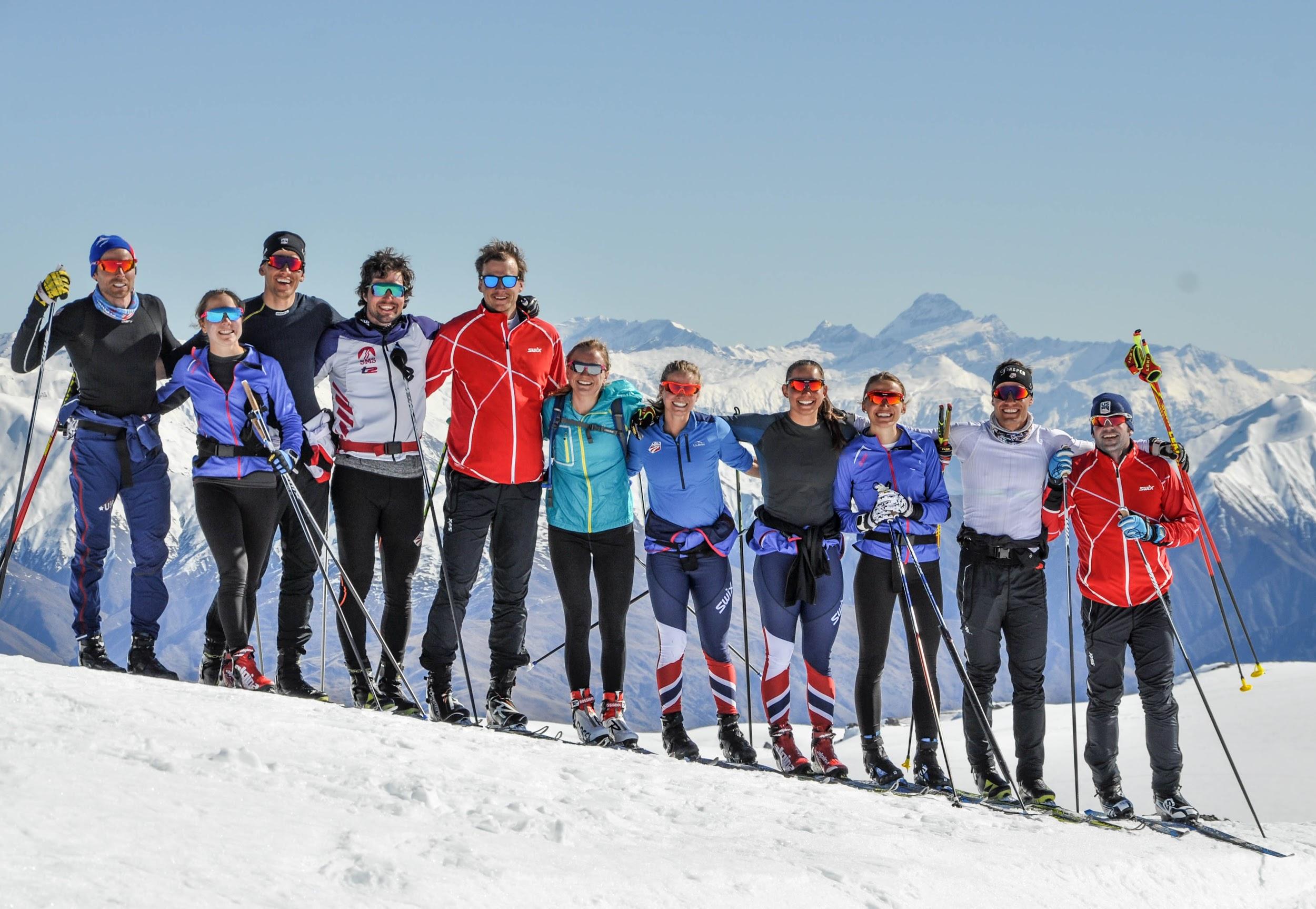
    2018 U.S. Ski Team camp at the Snow Farm in New Zealand, with author Alayna Sonnesyn (teal jacket) in the middle of the group shot. (Photo: Matt Whitcomb)

    The following was written by Alayna Sonnesyn, a new member of the Stratton Mountain School (SMS) T2 Team who graduated from the University of Vermont (UVM) this past spring.

    Originally from Plymouth, Minnesota, Sonnesyn, 22, raced on the UVM Ski Team for four years and qualified for four NCAA Skiing Championships teams. She placed second and third in two races at 2017 NCAA Championships, and in her senior season, won the first five Eastern Intercollegiate Ski Association (EISA) races and went on to reach the podium in 10 out of 11 EISA races. Sonnesyn expressed an interest in exploring the dilemma many of the nation’s top skiing talents face out of high school: whether to attend college or get an early jump on a pro-racing career. She plans to post this two-part series on her blog as well.

    ***

    For the first time in 17 years I will not be going back to school this fall. Saying that out loud is more daunting than I had anticipated. For the most part, the classmates that I graduated with can say that they are “going to grad school,” “starting a new job,” or “taking a year off to travel,” but I still don’t know where I lie. I am not taking any classes this year, I am not working anywhere consistently, and I am doing more than just traveling to explore, I’m traveling to race!

    I am wrapping up a three-week training camp in New Zealand with the SMS, Craftsbury, and US Ski Team. When I walked through customs I had to write down my reason for visiting New Zealand: Was I a student? Was I visiting a family or friend? Was I working? What was my job? In the rush of the moment and due to habit, I wrote that I was still a student and continued on my way. I later had a few reflections; I still haven’t reached the point yet where I can say I have a job. I don’t have a salary and there are no company benefits. Yet, I work 24/7 toward my job — my job is ski racing. But why is this so hard for me to admit to myself? Is it because, for my entire life, I’ve been a student? What if I hadn’t taken this route? How do others make this decision?

    National Training Group (NTG), summer 2013, in Park City, Utah.

    Racing throughout high school, I was given a number of perspectives about picking skiing versus school. My friends were all preparing to go to college and I always assumed I would go to college, too. My parents and older sister went to school, why wouldn’t I go as well? But then I thought about skiing. I never had the most outstanding results in high school (never qualified to race internationally), but I was good enough to qualify for regional and national level camps like REG, NEG and NTG. I traveled to these camps and trained with other high-level athletes, getting more and more motivated by each skier or coach that I met. Then the thought came to me… what if I didn’t go to college? I could focus on training, make those vital steps toward international racing, and continue along the “pipeline” that so many Olympians had followed. Maybe I would make bigger jumps and improve my skiing exponentially? I was entering the unknown and I was unsure how to pick the right choice for me. Looking back on this four years later, I realize that I was far from alone in this predicament.

    buy clomid online, buy yaz online, yasmin buy online

    I have since had the opportunity to talk to a wide variety of skiers and competitors and have learned so much that I wish I knew in high school. It’s OK to be confused. It’s OK to make your own path. Every athlete is in a different situation, comes from diverse athletic and academic backgrounds, and has various goals that they hope to achieve post-high school.

    “I’ve always believed that the most important thing to remember when discussing the decision to go to school or not (or when to go to school) is that is it a completely individual decision and the right decision for one person might not be the right decision for the next.” — Sophie Caldwell

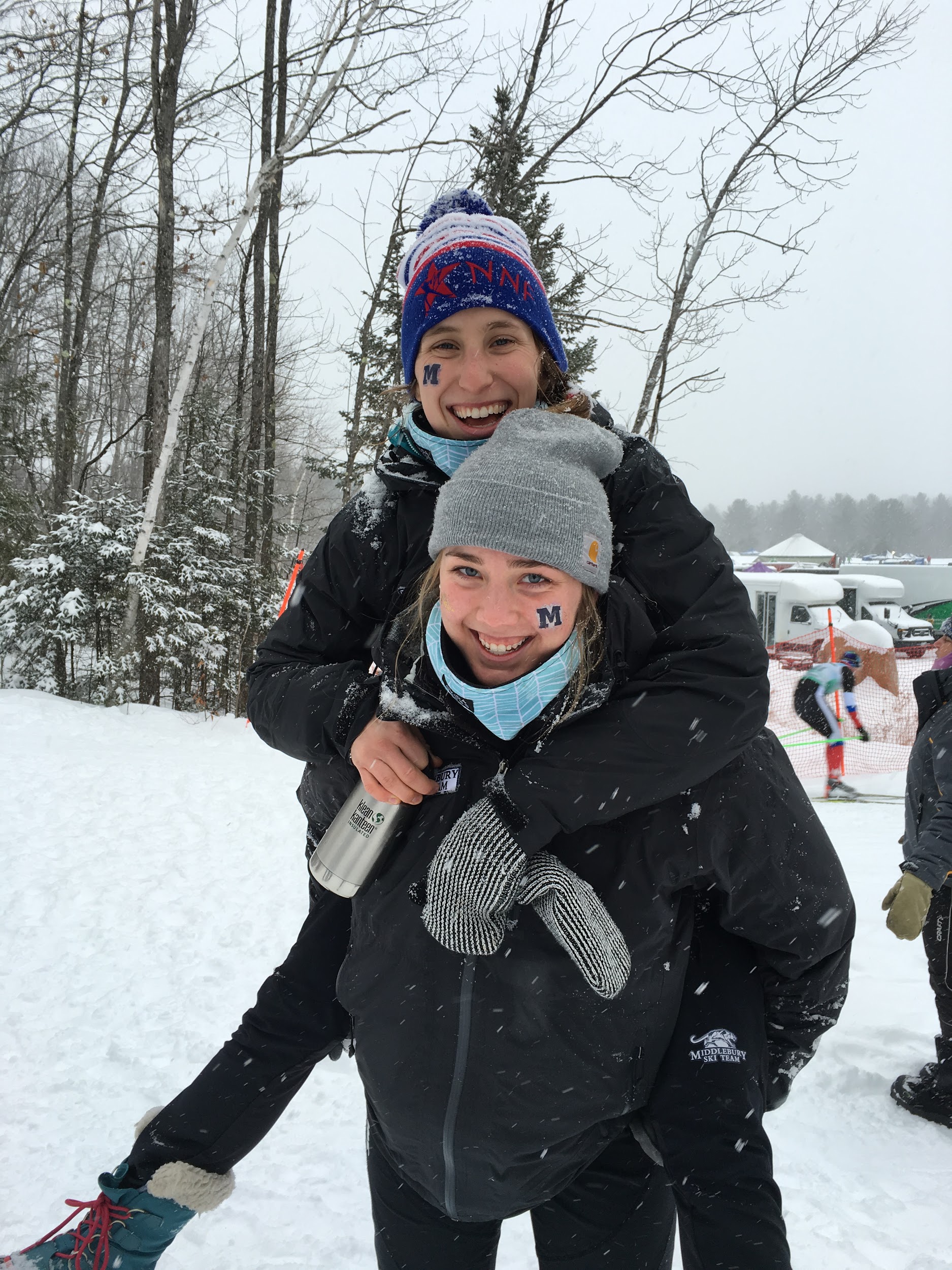
    Personally, I finally decided that taking a gap year might be too big of a jump for me. I wasn’t ready to focus on skiing and I had a lot of goals for myself academically. I decided to attend the University of Vermont and upon reflection, can admit that this was one of the best decisions of my life. Similarly, SMS teammate, Kelsey Phinney, went from high school in Boulder, Colorado, directly to Middlebury College.

    “The reason I chose Middlebury College was simple: I went to visit and I was ready to unpack and stay for good. I loved the people, the area, the ski team, and the classes I sat in on.” — Kelsey Phinney

    Carnival love, with Kelsey Phinney (top) and Katie Feldman.

    Kelsey and I both fell in love with our schools from the start and knew we were where we belonged. We took these college experiences as learning opportunities; maybe we wouldn’t have been ready to jump right into the professional circuit but we both determined this was the right path for us.

    “I loved the experiences I had on the Carnival circuit. Both good and bad times taught me a lot about life and skiing, and I felt like the balance of school and sport made me better at both,” Kelsey reflects.

    Similarly, Sophie Caldwell had her mind made up without the need to hesitate over a gap year or jumping into full-time skiing.

    “I chose to go to college right out of high school, and it was something I had always known I wanted to do. I knew there was a good chance I wanted to ski professionally at some point in my life, but when I was 18, I wasn’t ready to 100% commit to skiing,” Sophie, a Dartmouth graduate, explains.

    With academic goals in mind and the confidence to pursue skiing in the long run, sometimes there’s no need to question it. Going directly to college might challenge you more than you think and it might make you question what you’re doing. The balance of school and skiing is great, but it’s TOUGH! At least you worked through those challenges and figured out where you want to be though.

    “I definitely had my ups and downs throughout college and at times I considered not pursuing skiing after college, but by the time I entered my senior spring, I knew I wanted to give skiing professionally a shot and knew it was because it was what I wanted to do, not what I had to do,” Sophie notes.

    Over the course of four years, we were able to say goodbye to our homes, grow into adults and develop as skiers, allowing a much smoother transition into the professional racing circuit post-college. This decision to go right to college made sense for Kelsey, Sophie and me — it was simple; but I recognize that this choice isn’t as straightforward for everyone.

    ***

    “I loved my time at Burke and wasn’t quite ready to leave. I also didn’t know where I wanted to go to college as part of me wanted to go out west while part of me wanted to stay closer to home.”  — Ida Sargent

    The conflict of picking a school, a place we are willing to spend at least four years of our lives at, can be intimidating to anyone. Taking a year off to think and explore what motivates you once the structure of school is taken out of the picture can be extremely vital to one’s skiing longevity. Other times, this year off can be done to test out what skiing professionally is actually like.

    “I wanted to test out whether I could do only professional skiing.” — Katharine Ogden

    A feat that might sound easy to accomplish — ski, eat, sleep, repeat — can’t be THAT hard! But what happens when you suddenly put all of your time and energy into one goal?

    “Ironically, my gap year did not turn out even close to how I had planned or imagined!” reflects Julia Kern.

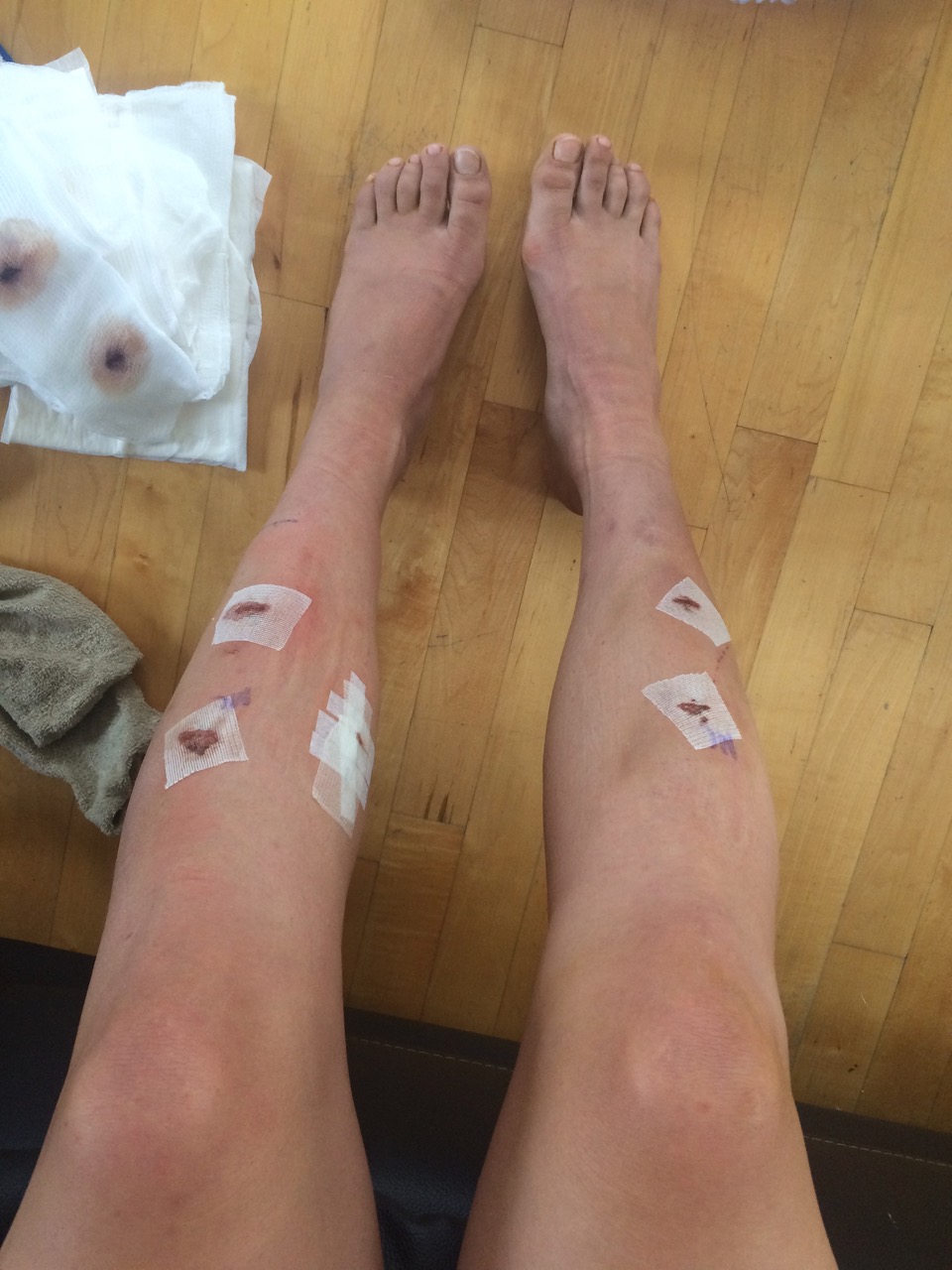
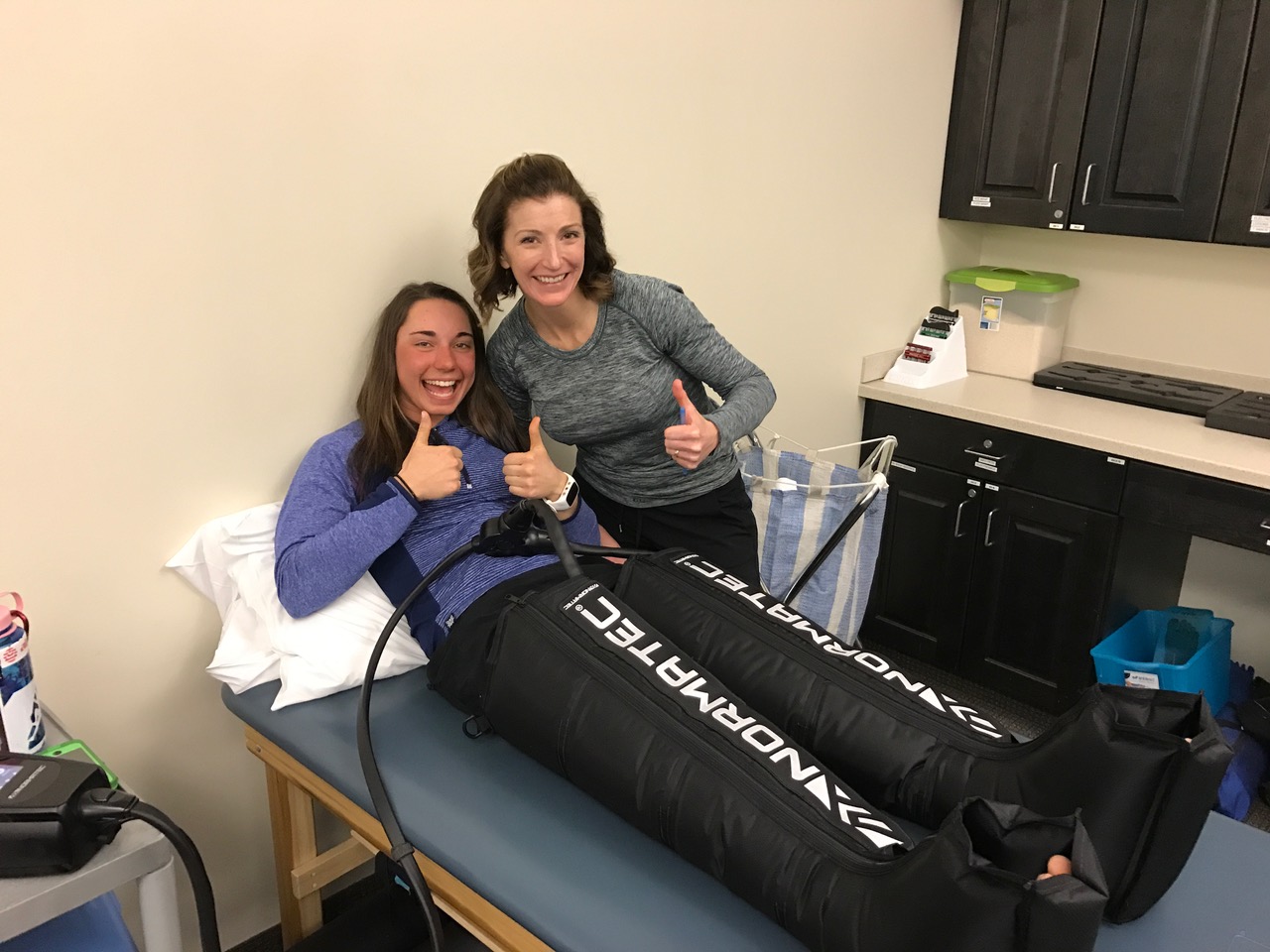
    Julia Kern with swollen legs after surgery, requiring A LOT of physical therapy during the summer.

    After facing an early summer surgery for compartment syndrome and then an untimely back injury in the fall, Julia notes that her gap year was extremely tough with plenty of lows and setbacks.

    Ida Sargent offers, “My PG year was a bit of a disappointment as I wasn’t as happy as I was expecting and I also didn’t feel like I made as big of a jump with my results as I had hoped.”

    “I think in hindsight it was a good philosophy but I think I approached it wrong. I didn’t do a good job securing other things to do besides training and was thus pretty bored, which led to me putting a lot of stress on skiing and racing,” says Katharine Ogden.

    Maybe taking a gap year isn’t as easy as it sounds? Coming face-to-face with this type of ski-focused intensity as an 18 year old can be challenging.

    “It showed me how much I really wanted to go to college,” offers Katharine.

    It can also be validating, as it can prove to oneself where they really belong at that point in their life.

    “It made me realize that I wasn’t ready to ski full time and I still needed balance in my life,” reflects Ida.

    What might be the most beneficial aspect of taking a gap year are the lessons you learn throughout. How to deal with the pressure, free time, potential obstacles, and how to respond when you’re suddenly put in an unfamiliar situation.

    “My gap year turned out to be far from ideal from a training/fitness standpoint, but I became very in tune with my body, learned how my body responds to training, became mentally tougher, and learned that I love the skiing lifestyle (even if it is tough sometimes) and that I want to ski at the highest level possible,” says Julia.

    Some things you just can’t learn in a classroom.

    Julia Kern (on table) still smiling!
    Julia Kern taking the time to think about something other than skiing during her gap year. (Photo: Julia Kern)

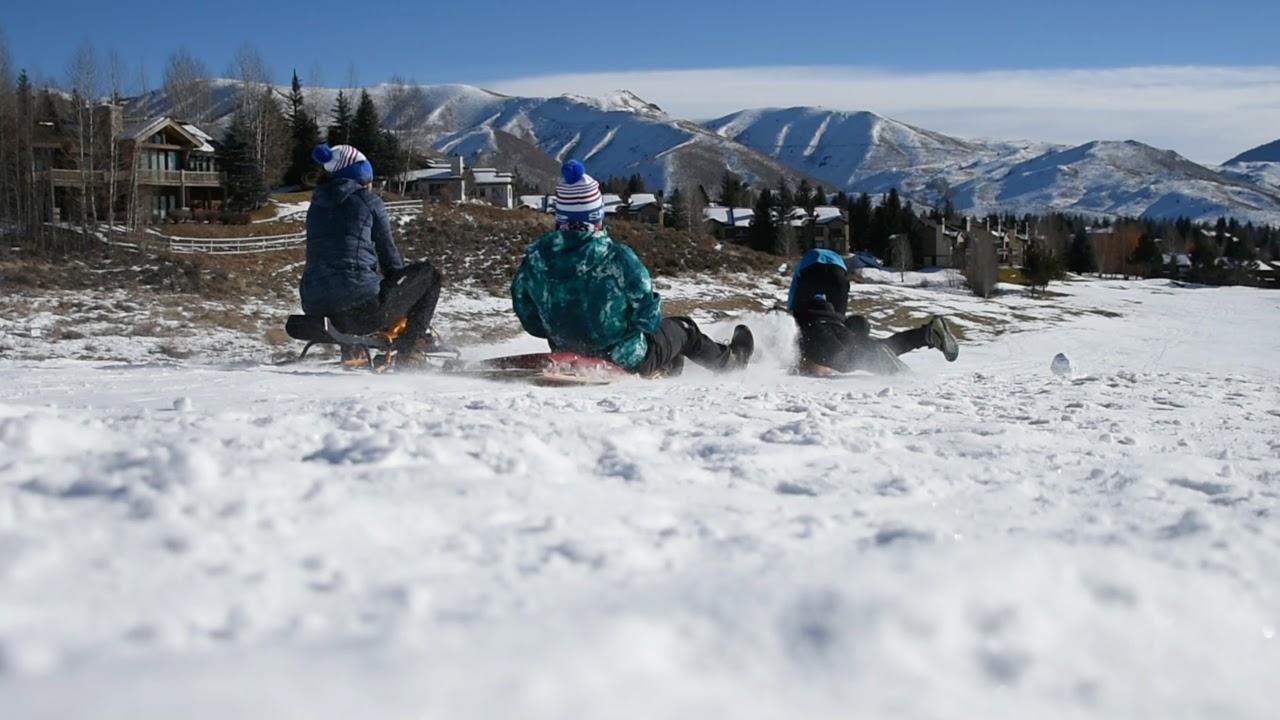
    How to pass the time away, when you have so much of it. (Photo: Julia Kern)

    After taking a gap year to figure out what skiing was like full-time; Ida, Katharine, and Julia attended Dartmouth College (via various routes):

    Ida states, “I started by going to school full time and I raced for Dartmouth for three years and then made the National team so I took my senior winter off to race for the USST and then I went back for a spring term my fifth year.”

    “One year in [as a traditional student], I am very happy at Dartmouth and racing the collegiate circuit last year reignited my love for the sport,” adds Katharine.

    While Julia contributes, “I chose Dartmouth because I wasn’t sure what skiing and school balance I wanted to have, but I did know that I wanted to be able to take terms off to race internationally.”

    Regardless of which Dartmouth plan they followed, all three skiers seem to have enjoyed the choices they made. Whether taking a gap year is or isn’t part of your plan, the most important takeaway is that you should TAKE SOMETHING AWAY! Learn something new about yourself, about skiing, or about classes you want to study.

    So what about other options for pursuing a ski career? Jessie Diggins and Andy Newell both chose to skip college and go straight into skiing. Stay tuned for my next post when I’ll include input from both of them as well as what U.S. Ski Team coach Matt Whitcomb has to say on this topic.

  • FasterSkier’s Collegiate Skiers of the Year: Katharine Ogden and Ian Torchia

    FasterSkier’s Collegiate Skiers of the Year: Katharine Ogden and Ian Torchia

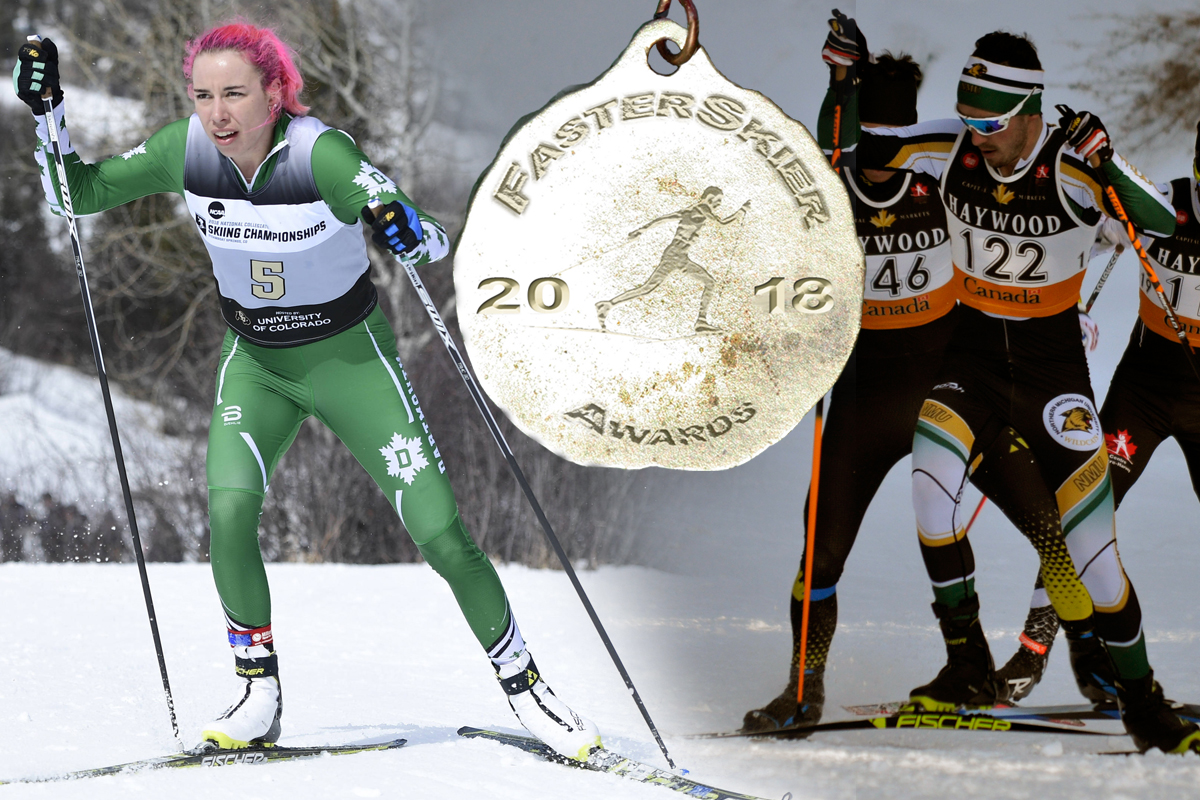
    Katharine Ogden (left) and Ian Torchia (right) are FasterSkier’s 2018 Collegiate Skiers of the Year. (Photos: Dartmouth Sports/Clarkson Creative & XTS Photography)

    With the 2017/2018 season officially in the rearview, FasterSkier is excited to unveil its annual award winners for this past winter. Votes stem from the FS staff, scattered across the U.S., Canada, and Europe, and while not scientific, they are intended to reflect a broader sense of the season in review. This set of honors goes to outstanding college athletes in cross-country skiing. 

    ***

    Katharine Ogden, Dartmouth College

    Katharine Ogden skiing fast doesn’t exactly surprise anyone. A medalist in both individual and relay events at last year’s World Junior Championships, the Stratton Mountain alum and U.S. Ski Team “D” team member won half of the women’s races on the Eastern Intercollegiate Ski Association schedule this season, including the final three individual races of the year.

    But when the Dartmouth skier swept both races at NCAA Championships, first winning the 5 k classic by a stunning 46.9 seconds, then taking the 15 k skate by 38.4 seconds, that was something else.

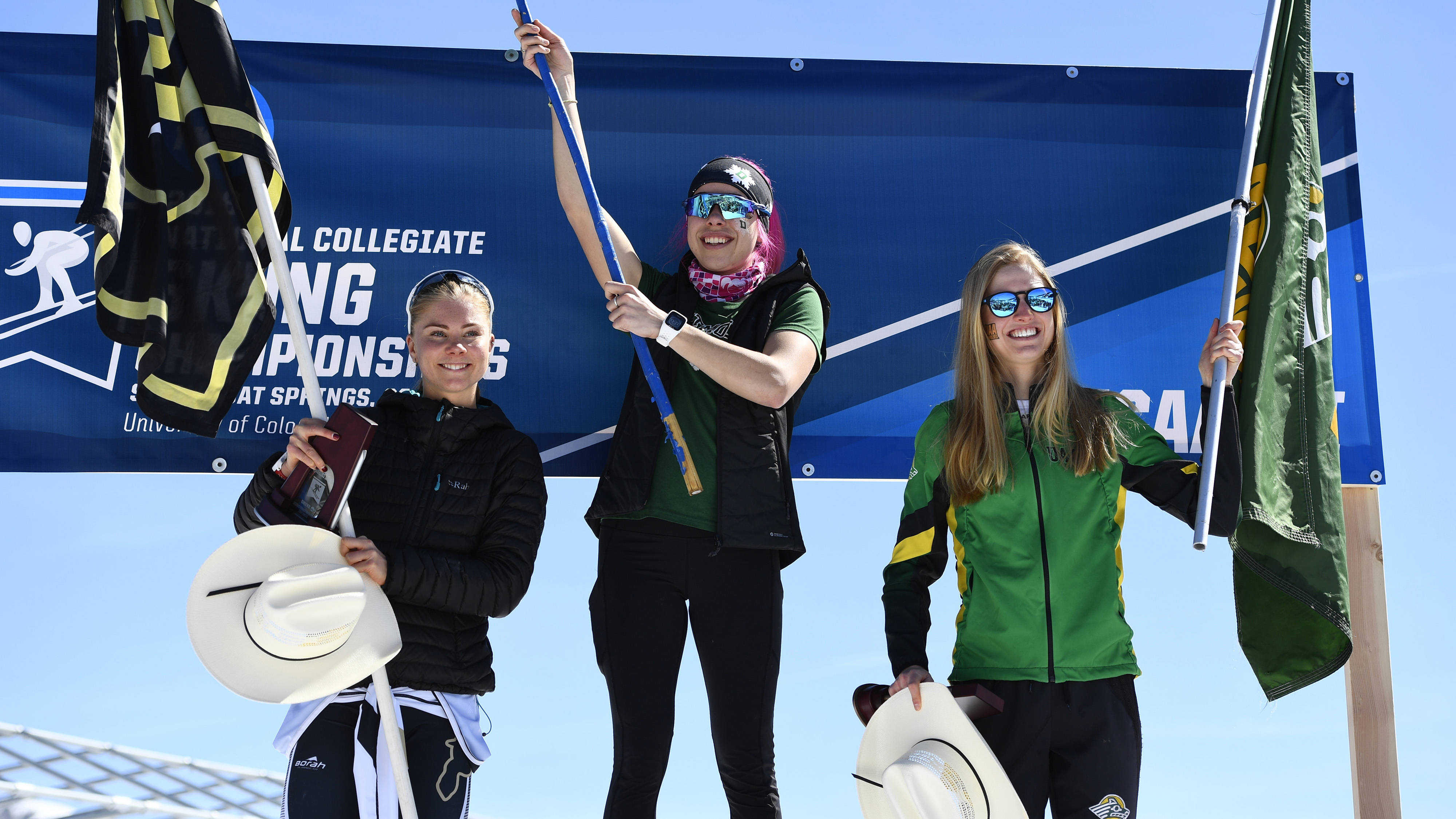
    The women’s 5 k classic podium at 2018 NCAA Skiing Championships in Steamboat Springs, Colorado, with Dartmouth’s Katharine Ogden (c) in first, Colorado’s Anne Siri Lervik (l) in second, and University of Alaska Anchorage’s Hailey Swirbul (r) in third. (Photo: Clarkson Creative/DartmouthSports.com)

    “I was definitely a little stressed because I didn’t know if I could hold that pace or if they would catch up to me, and it’s usually kind of a sketchy strategy to be skiing by yourself, so I kind of knew that in the back of my mind too,” Ogden told The Dartmouth of her mid-race decision to make a move after the 5 k mark of the mass start, when it then turned out that nobody went with her.

    The last time an American topped both women’s races at NCAA Championships was a decade ago, and though both 2007 titles were taken by a Lindsey, they weren’t the same one: Lindsey Williams and Lindsey Weir, both of Northern Michigan University.

    It wasn’t since 1990 and 1991, when Laura Wilson of UVM swept NCAA’s, that the same American woman had won both races.

    “Katharine absolutely wanted this one, and she really likes to win,” said Cami Thompson Graves, the Dartmouth Director of Skiing and women’s Nordic head coach, in a press release after Ogden’s second title. “She wasn’t about to let a fall slow her down, she has such a great competitive fire.”

    Despite Dartmouth’s strong history of women’s skiing – alums Sophie Caldwell, Ida Sargent, Rosie Brennan, and Susan Dunklee competed in the 2018 Olympics alone, with many more alums at previous Games –  Ogden was actually the first female Big Green cross-country skier to take an NCAA title.

    “One day I would love to be one of the Dartmouth alums racing in the Olympics,” she said in a Dartmouth press release. “A lot of the reason I decided to come here for school had to do with growing up with Sophie Caldwell and seeing what a positive experience she had at Dartmouth.”

    Ian Torchia, Northern Michigan University

    Likewise, Ian Torchia has been a top junior athlete for the U.S. for some time now. By the time he went to NCAA Championships, he had already been to U23 World Championships, where his 27th- and 32nd-place finishes were the top American results in the 30 k skiathlon and 15 k classic, respectively.

    Although he is enrolled at Northern Michigan University and trains there with the team, college racing was not his number one goal this season. Torchia won a 15 k skate NorAm in Sovereign Lake, British Columbia, early in the season in pursuit of those higher goals.

    The men’s 15 k freestyle podium on Day 2 of the NorAm opening weekend at Sovereign Lake near Vernon, B.C., with Ian Torchia (NMU/USST D-Team) in first, Jack Hegman (SVSEF) in second, Brian McKeever (Canadian Para-Nordic Team) in third, Kevin Bolger (SVSEF) in fourth (far left), and Adam Martin (Craftsbury GRP) in fifth (far right). (Photo: Peggy Hung)

    “My main goal for the season was to have a strong start to the season so I could qualify for U23s and the Olympics,” Torchia wrote in an email last week. “Competing in Yellowstone and Silver Star was a first for me, and coming into Nationals in the first spot on the Olympic qualifying list was exciting and nerve-wracking. Unfortunately, I had some sub-par racing at Nationals and missed the Olympics but qualified for U23s. I was definitely satisfied with the efforts I put in at U23s, but not with my execution and results. Finishing barely in the top 30 was not was I was hoping for but racing alongside guys who have gotten top-10’s on the World Cup was definitely motivating and gave me a real idea of where I need to be and what I need to do to get there.”

    Coming back from Europe, he had to re-tool and had a solid training camp in Steamboat Springs before NCAA’s.

    There, he finished fifth in the 10 k classic, the top American 46.2 seconds behind race winner Martin Bergström of Utah.

    And in the 20 k skate mass start, he took his first NCAA title, holding off Alvar Alev of the University of Colorado by just two seconds, with Eivind Kvaale of Denver University another two seconds back.

    “The first two laps of the race were very slow and it took patience to follow Coach Sten [Fjeldheim]’s plan of not leading,” Torchia wrote. “The Denver guys led it out on lap three and started gradually pushing the pace. On the final lap, people started throwing down and I was able to cover moves until 2.5 k to go when I gradually pulled the trigger. Alvar Alev from Colorado went on the final uphill and I was able to hang with him into the 2 k downhill. Coming into the final downhill he slingshotted by me but I was able to overtake him before the final turn and sprint faster than I’ve ever sprinted before for the win! I am not known as a sprinter on our team, so I was definitely nervous with a big group around me. But Sten has always told me that a sea level distance guy can outsprint an altitude sprinter, as training at lower elevation is beneficial to speed training.”

    Torchia was the first American in three years to stand atop the NCAA podium; the last guy to do it was U.S. Ski Team teammate Patrick Caldwell in 2015. University of Alaska Anchorage’s Hailey Swirbul said that the international flavor of college racing is fantastic and helps her prepare for international competition and to be a better skier.

    But to win NCAA’s as an American is still a perk.

    “I definitely did not think about it before the race, but after it was pretty cool to think about the rarity of American winners,” Torchia wrote. “Fun to share it with my buddy Paddy Caldwell!”

    Honorable Mention: Zane Fields, Colby College

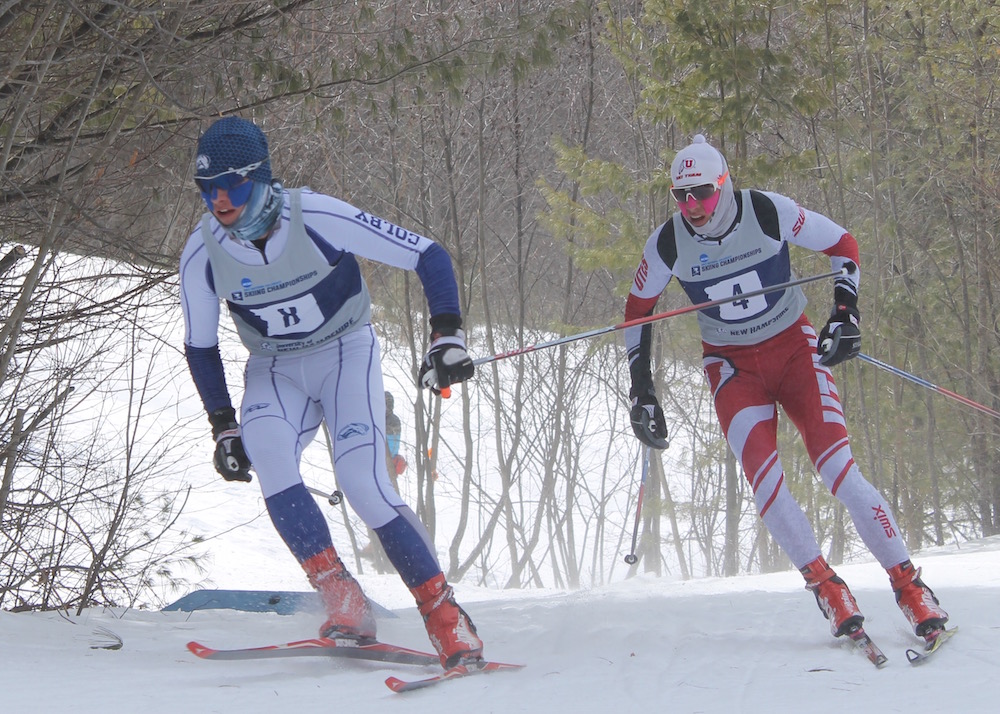
    Colby’s Zane Fields (left) racing at NCAA Championships last season. This season, he became the school’s first cross-country skiing All-American.

    And on the men’s side in the East, one of the biggest revelations was the Colby squad. Andrew Egger qualified for U23’s and finished 47th in the sprint there, the second American. (“To be honest, making the U-23 World Championship team wasn’t really on my radar when I decided to go to Alaska [for U.S. Nationals]… That said, my goal standing on the start line of the sprints was to win,” Egger told the Colby sports department.)

    On the college circuit, though, it wasn’t Egger who was making Colby history. Zane Fields demolished carnival after carnival, sweeping all five skate races before also winning the final classic race of the eastern season. At NCAA’s, the Colby junior finished sixth in the 20 k skate.

    It was the best season-long tally by any Colby skier ever, and that final race made him Colby’s first male All-American in cr0ss-country skiing.

    “This season has been a dream,” Fields said in a Colby press release after the 20 k. “If you had told me two months ago that things would unfold the way they did, I wouldn’t have believed you. While the sport is an individual one, I have the greatest coaches and team supporting me through every race.”

    As a team, the Colby men finished third in two races this season behind Fields, and had a number of fourth- and fifth-place finishes.

    “This has been the most fun year of skiing I have ever had,” Fields said in the press release. “The season is one that certainly makes the 500-plus hours of training and sacrifices worth it. I’m excited to see what my team and I can accomplish next year.”

    Honorable Mention: Alayna Sonnesyn, University of Vermont

    Those half of the EISA carnival races that Katharine Ogden didn’t win? They went to UVM’s Alayna Sonnesyn, who dominated the first half of the season and won three skate races and two classic races.

    Sonnesyn also had a stellar U.S. Nationals earlier in the season, finishing eighth in the skate sprint and sixth in the 20 k classic; all but one of the skiers ahead of her in that race (winner Hedda Baangman of Sweden) went to the Olympics.

  • Under 23 Questions: Bill Harmeyer

    Under 23 Questions: Bill Harmeyer

    Bill Harmeyer (University of Vermont) racing at the Colby Carnival last month. (Photo: SkinnySki.com)

    In an effort to showcase the North Americans who competed at last week’s International Ski Federation (FIS) 2018 Nordic Junior/U23 World Championships in Goms, Switzerland, we asked those qualifying athletes several questions about themselves — actually, we had them fill in the blanks. Here we have 20-year-old Bill Harmeyer, of the University of Vermont, who represented the U.S. at his first U23 Worlds (after competing at last year’s Junior Worlds in Utah).

    Last week in Goms, Harmeyer placed 39th in the 15 k classic and 46th in the freestyle sprint.

    ***

    “My full name is Bill Harmeyer, but you can call me Bill.

    I was born in Burlington, Vermont, and raised in Underhill, Vermont, and I learned to ski at the farm behind my house.

    I spent the time between U.S. nationals and Junior/U23 Worlds nervously telling my teachers I’d be missing two weeks of classes, while maybe failing to mention I’d be missing more.

    Bill Harmeyer (University of Vermont) during an NTG camp training session last fall at Soldier Hollow in Midway, Utah. (Courtesy photo)

    The hardest/favorite/most awesome workout I did in the last training year to prepare for this was Trout Lake agility and OD TT with the Bend Endurance Academy.

    This is my first time in Switzerland and first (second including WJC in Utah last year) time racing internationally, and so far it’s been sweet.

    One difference I’ve noticed between Switzerland and the U.S. is the mountains are a bit different.

    Skiing and racing in the Alps is distracting, because you’re constantly looking around, and exhausting, because you just want to keep skiing. Usually racing at altitude is not too hard for me because I’ve done it before. There are some mountains around where I live.

    American Bill Harmeyer (University of Vermont) racing the first leg of the men’s 4 x 5 k relay on the last day of 2017 Junior World Championships at Soldier Hollow. After he tagged off in sixth, his team went on to finish ninth. (Photo: FlyingPointRoad.com)

    One of the things I’m most excited about for Junior/U23 Worlds in Goms is the chocolate. One race I’m especially targeting there is the skate sprint.

    I really hope I can chat/make friends with someone from Sweden and ask them if they’d like to trade suits.

    My favorite thing at the breakfast where we are staying is the cheese.

    Fondue is on my top 10 favorite foods list. The cheese here is fantastic. And the chocolate is also fantastic.

    If I had a totally free day here and didn’t have to worry about race fitness or training, I’d spend it exploring backcountry skiing or crust cruising while eating chocolate.

    The best way to follow me on social media is on Instagram @bllharmeyer1.”

  • The Road to Jackson: UVM

    The Road to Jackson: UVM

    In Part IV of “The Road to Jackson”, three of the six University of Vermont (UVM) nordic skiers that qualified for 2017 NCAA Skiing Championships — Alayna Sonnesyn, Iris Pessey and Cully Brown — tell us about their seasons and how skiing has impacted their lives. Jana Klaiber, Ian Moore and Juri Miosga are also headed to NCAA’s, which will be held Thursday and Saturday at the Jackson Ski Touring Center in Jackson, N.H.

    “Time just flies so fast and I’m gonna be done soon, but I have so many good memories that I have no regrets.” — Iris Pessey

    See also: EISA season in review | Part I: Williams | Part II: UNH | Part III: Colby