Tag: UVM

  • Rooted in Vermont: Tabor Greenberg’s Steady Rise from the Mad River Valley to the U.S. Ski Team

    Rooted in Vermont: Tabor Greenberg’s Steady Rise from the Mad River Valley to the U.S. Ski Team

    The hills above Moretown are the kind that teach you to move without thinking about it: long grades through maple and birch, a tangle of dirt roads, a thousand sneaky rollers perfect for running shoes or a classic stride. From the valley floor, you can see Sugarbush and Mad River Glen, their lifts still in October and their trails crisscrossed by hikers who’ll be skiers in a few short weeks. This is the terrain that shaped Tabor Greenberg, and it’s never been far from him. He grew up here, learned to love motion here, and now—a few towns and a handful of highway exits away—wears UVM green while settling into his sophomore year and his first season as a member of the U.S. Cross-Country Ski Team.

    He smiles about the small details—like the tiny airfield that doubles as the local ski area where he first wore Nordic skis—and shrugs at the big ones, the ones that make headlines. He’s Vermont in that way: spare with words, long on work. “I’ve been skiing my whole life,” he says, recalling the first slip-on-your-boots skis and the BKL weekends that threaded winters together.

    Tabor Greenberg at the 2024 Junior Nationals in Lake Placid, New York.  (Photo: courtesy of Olympic Regional Development Authority / Phillip Belena)

    His dad was an alpine racer who transitioned to Nordic skiing after sustaining injuries; the family kept everyone in motion, engaging in hiking and running in the summer, as well as soccer and lacrosse.

    By seventh grade, Greenberg had joined GMVS, stepping into a team culture that combined high standards with a sense of play. Older athletes, such as Brian Bushy and Josh Valentine, became the big brothers who made training feel like a privilege rather than a chore. “Their enthusiasm always made the workouts more fun,” he says. “Seeing them go to U18s in Estonia or Youth Olympics, I didn’t even know what those things were at first. I just saw them going to Europe to do these bigger races and thought, ‘That seems fun.’ I want to do that.”

    That is as close to a “secret formula” as you’ll get from him. There’s no magic threshold session in his story; it’s a years-long accumulation of good days outside with people he liked being around. “Most of my motivation comes from that,” he says of the lifestyle—then adds, almost apologetically, that he’s built the discipline to do the work even when motivation lags.

    A tough first year—and a reset

    College arrived with promise and some hard lessons. Greenberg’s first season at UVM was marred by extended illness. He red-shirted, raced sparingly, and spent too many days horizontal. “I struggled being sick all season,” he says. “So this year it’s mainly been just trying to stay healthy—good recovery, sleeping a lot, staying hydrated, having a good connection to doctors if something does come up.”

    UVM’s Head Coach, Patrick Weaver, doesn’t sugarcoat it. “Tabor’s first year was undoubtedly a tough transition, as he came in dealing with an extended illness that he struggled with throughout the year, so he essentially ended up not racing for UVM at all,” Weaver says. “This year he has come back in great shape and stayed healthy so far, so that’s been great—to see what he can do as a healthy person.”

    Weaver sees something else, too: a young athlete who changes the room simply by how he works. “He works extremely hard, and it’s his work ethic that’s been a valuable asset to the team,” says Weaver. “Leading by example like this helps bring up the overall level of the team.”

    And there’s the local angle that still means something in Burlington. “Having a Vermonter on the team is super important for the program. Having a fast Vermonter on the team is even better,” Weaver says. “We felt very fortunate that Tabor wanted to stay in Vermont and represent UVM and the state. This is something he’s super proud of, which is really fun to see.”

    Engineering the comeback

    Ask Greenberg about academics, and he answers as matter-of-factly as he does about training. He’s a mechanical engineering major, plotting a five-year path that allows the academic load to align with travel and race blocks. “I can do 12 credits a semester instead of 15 or 16 for the most part,” he explains. “It should ease the load a bit… hopefully manageable while traveling.”

    If the men’s U.S. Ski Team has a surprising number of engineers, Greenberg doesn’t read much into it. The field simply makes sense to him, a way to invest time in “quality concepts” while keeping a door open for life after skiing. But it’s easy to see the overlap when he talks technique: leaning farther into the hill in both V1 and V2, getting the arms forward, experimenting with double-pole positions, learning to find “forward without actually getting the feet up,” and keeping his shoulders relaxed while playing with different hip-drive patterns. He’s not obsessing over new lifts in the weight room—”not really,” he says when asked about special gym work—so much as building a better mental model and then holding those shapes during long skis.

    And there’s a plan behind the plan. Greenberg still consults with longtime coach Colin Rogers while working daily with Weaver. “Especially when I’m not at school, my plan is I kind of run it by both Colin and Patrick,” he says. “Going into races, I’ll make a plan that makes sense to both of them.” The dual-mentorship model mirrors the arc of other Vermonters who’ve succeeded after leaving UVM, and it’s part of why Weaver talks about schedules and guardrails. The U.S. Ski Team opens doors—camps, resources, broader input—but also adds travel and volume. “With all the other opportunities available, it is challenging to create a schedule that ensures a student-athlete does not overextend themselves,” Weaver says. “We’re working on it to ensure he can excel academically and still maintain a high level of performance in skiing.”

    The day the D Team call came

    The call confirming his spot on the U.S. Ski Team didn’t arrive with a trumpet solo; it found Greenberg on a beach in Mexico. He was decompressing after a winter that had felt like a dead end. “I was pretty unhappy with skiing at the moment,” he admits. Then teammate Murphy Kimball texted to say his points might have slipped him under the sub-400 distance-racing criterion. “Later, Kristen [Bourne] called me,” Greenberg says. He already knew by then, and his reaction was classic Tabor—pleased but unsentimental. “It’s cool to be on the national team, but it’s not really, like, a game-changer. On the D Team, now you race World Cups and see there is still work to do.”

    That pragmatism tracks with how the spot was earned. Last year, sick more often than healthy, he raced only eight or nine times. But when he did line up healthy, he made it count—most notably at the Cable SuperTour 20k classic mass start, where he finished fifth in a front group on a good points day. Those points, stacked with a handful of other starts, slid him inside the threshold.

    U.S. Head Coach Matt Whitcomb sees a different kind of threshold in Greenberg, one that’s about temperament and fit. “This kid, he’s a really special kid,” Whitcomb says. “He takes a little bit to get to know. He’s a little quiet, but what I learned from his coaches is that he is always listening. You might be having a meeting with him, and he’s kind of looking off to the side a little bit, and you think you’ve lost him. And then there’s this little pause, and he’ll come right back at you with just the most on-point question.” Whitcomb calls that attentiveness a key to belonging on a team where the banter never stops. “Our guys rip on each other all day—in the right way, the loving way—and I see Tabor instantly plugging into the men’s team already.”

    It’s not just the ear; it’s the engine. Whitcomb points to Greenberg’s anchor leg on the 2023 U18 relay—”he came from way behind and caught Norway in the stadium”—as a marker of racecraft and mindset. “Tabor’s that kind of competitor,” Whitcomb says. “He’s a hunter, both literally and figuratively.” The literal part showed up at the team’s Utah camp; the figurative part is the one that matters in March.

    Vermont pride, Vermont places

    Greenberg didn’t choose UVM because he was unaware of other options available. He did the homework, looked West, and still chose home. “Growing up in Vermont, we’d go to an Eastern Cup that overlapped with Carnival, and it was always the UVM guys winning,” he says. “When I was younger, I was like, these guys are the best there is then… I really enjoyed the venues here more than out West. I kind of just had a gut feeling this was the right place.”

    Ask him where he’d send an out-of-state friend to understand his Vermont, and he has a ready list: Trapp Family Lodge when the snow is deep; Mad River Glen on a powder day; the Long Trail from Lincoln Gap to Appalachian Gap and on to Waterbury when the leaves go red and gold. He’s not performing here; this is simply the life that restores him. Between classes and training blocks, he’ll thread in a bit of fishing, the occasional bow-hunting session if the calendar allows. In Utah, he saw a pair of bucks at 250 yards and later walked to within 80 before choosing—wisely—not to take the shot; he hadn’t practiced enough. “It’s definitely peaceful,” he says of being in the woods, then stops short of over-claiming the performance benefits. “I don’t know if there’s that much of a correlation.”

    Maybe he doesn’t have to draw the line. Anyone who’s tried to race well knows that a happy athlete is a better one, and his habits read like a local’s guide to contentment: early bedtimes, long skis, ridge-line hikes, a few casts before dinner.

    Goals, set quietly

    Greenberg’s target list for the season is crisp: Junior Worlds, NCAAs in Bozeman, and—if the form and selection break right—a World Cup start in Lake Placid. “Same game plan no matter what,” he says. “Ski fast.” The sequencing matters: peak well for Nationals and you put your Junior Worlds case on solid footing; hold fitness and you can ride the rhythm into March.

    For now, he trains with the UVM group and will tweak the plan as winter approaches. “Right now it’s pretty similar to everyone else,” he says. “In the winter, I’ll try to work in a few bigger weeks or blocks that’ll help me get ready for that March racing period.” If the path sounds simple, that’s the point. When you’ve just dug yourself out of a year of being sick, you don’t complicate success.

    What coaches see

    Whitcomb’s portrait is of a listener who processes information quickly and competes more intensely. “Thoughtful,” “very funny,“great technician,“great competitor”—words that land differently because they’re delivered with the caution of a coach who doesn’t over-praise. Whitcomb is equally quick to underscore the growth curve ahead. Greenberg absorbed a challenging year, he says, and handled the reset maturely. “He was very smart in his buildup this year, and he’s brought himself back to a very high quality level of training, Whitcomb says. “It’s going to be a fun career to watch.”

    The thing about top-30s

    The U.S. men’s program now has a new normal—medals and crystal-globe chases—but Whitcomb is adamant that the sport’s middle rungs still matter. A first World Cup top-30 for a young American is still a scene, a bus-wide celebration. “When a guy like Tabor or Lucas Wilmot gets their first top-30, it will be just as exciting for the team as someone, on that same day, on the podium, Whitcomb says. That’s the context for Greenberg’s ambitions: real, reachable steps on a ladder that’s higher than it used to be.

    The Vermont through-line

    It’s not nostalgia to suggest that place still matters in American skiing; it’s simply observation. Vermont has sent a steady stream of athletes into the national team pipeline, and UVM is a key contributor to that current. Greenberg is another link in that chain, one who still resembles the kid who ran those ridges, played those pickup games, followed older teammates into bigger arenas, and filled in the knowledge with discipline.

    Then there’s the image that may say more about him than the résumé line: a kid in Utah walking a buck into 80 yards and passing on the shot because the practice wasn’t there yet. It’s not caution; it’s calibration. It’s someone who knows the difference between wanting and being ready.

    If you’re looking for a template, that might be it. A Vermont upbringing that made movement a joyful experience. A high school program that made hard work fun. A first college season that reminded him that things can go sideways. A reset that prioritized health and attention to detail. Two coaches who trade notes and coordinate calendars so a student-athlete can keep a broader life in balance. And an athlete who understands he needs to put in lots of hard work to be ready to take the shot when it presents itself.


    Love Stories Like This? Help Keep Them Coming.

    Feature interviews like this one take time, access, and care to produce. If you value thoughtful storytelling and independent ski journalism, please consider becoming a Voluntary Subscriber. Your support directly fuels the work we do to cover the people, places, and moments that make our sport special.

    Join the FasterSkier community.


  • From Olympian to Coach to Mentor: Patrick Weaver, the Quiet Architect of UVM’s Ski Culture

    From Olympian to Coach to Mentor: Patrick Weaver, the Quiet Architect of UVM’s Ski Culture

    The first time you meet Patrick Weaver, you might not realize you’re talking to one of the most quietly influential coaches in American skiing. There’s no bravado, no self-promotion. Just an easy Vermont calm — a man who measures his words the same way his athletes measure their training: carefully, purposefully, with feel.

    On a fall morning, the UVM Nordic team threads through the mist at the Craftsbury Outdoor Center, the quiet hum of rollerskis against asphalt echoing in the distance. Weaver watches from the side, hands in his jacket pockets, hat pulled low. He doesn’t bark instructions. He doesn’t need to. The rhythm of his teams speaks for itself.

    Wilmington, Vermont’s Sophomore Luke Rizio. (Photo: Philip Belena/EISA)


    “I always say it’s not the individuals that make the team fast — it’s the team that makes the individuals fast,” he says. “Once they believe that, the motivation takes care of itself.”

    For nearly twenty years, that philosophy has shaped the University of Vermont into one of the most respected programs in NCAA skiing — not through hype or heavy recruiting, but through a culture of trust, humility, and balance.

    Lessons in Motion

    Weaver’s path to coaching wasn’t linear. It’s more like a relay through decades of ski mentors who left their fingerprints on his philosophy.

    “I never had one coach through my whole career,” he says. “There were a lot of influential people — high school, Stratton, college, the national team. I just learned to take things from each of them.”

    He spent a post-graduate year at Stratton Mountain School under Sverre Caldwell before skiing for Cory Schwartz at UNH — a relationship that would define his sense of what a team could feel like.

    “Cory was probably the most influential,” he says. “The way he ran that program — it was a family. I took that with me when I came to UVM.”

    After college, Weaver worked under a rotating cast of national and international coaches: Gordon Lange, Christer Skog, Sten Fjeldheim, Torbjørn Karlsen. Each brought a different rhythm to training. The mosaic of ideas shaped the adaptable style he’s known for today.

    “There’s not one way to coach,” Weaver says. “And because of my background, I’m not a ‘my way or the highway’ coach. I’ve seen too many ways that work.”

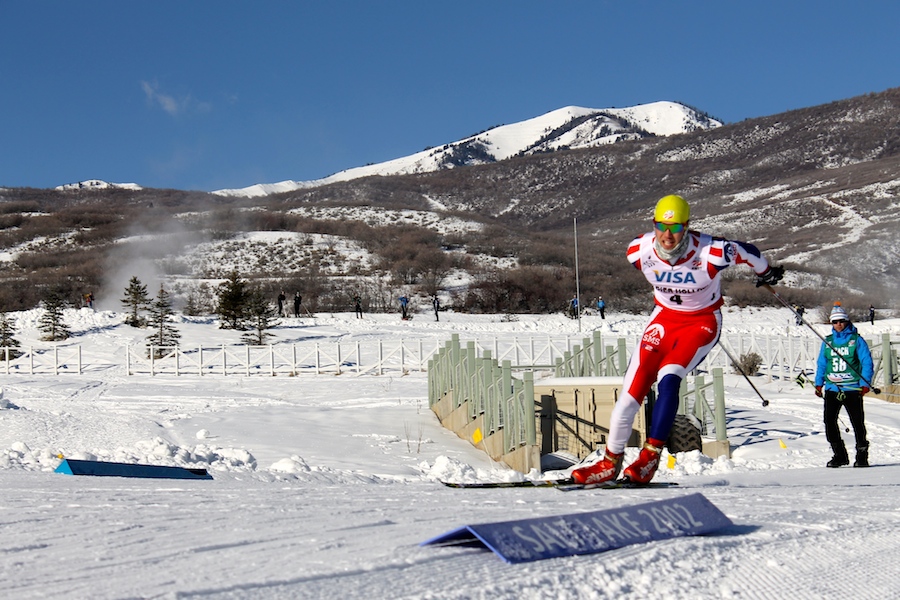
    Patrick Weaver racing in the 15 k Classic at the 2002 Olympics in Soldier Hollow, Utah. Weaver finished in 16th place. (Photo: UNH Ski Team)

    The Season He Cut His Hours

    In 2002, the year of his second Olympics, Weaver did something radical. He trained less.

    After years of logging 800-plus-hour seasons, he realized the grind was killing his joy. So he cut down to 600 hours — just one session a day, mornings only.

    “I was kind of burned out,” he says. “I’d dread the afternoon workouts. I loved the sport, but I wasn’t feeling good anymore. When I stopped doing the PM sessions, I felt better — I started looking forward to training again.”

    It’s a story he still tells his athletes, not as dogma but as permission. Permission to rest. Permission to find balance.

    “I’m never afraid to tell an athlete to train less,” he says. “Sometimes that’s the thing that gets them going faster.”

    That season became a turning point — not just in Weaver’s career, but in his view of what performance really means. It was the seed of a coaching style rooted not in metrics, but in intuition.

    Ben Ogden celebrates after sweeping the 2022 NCAA Championships in Midway, Utah. Ogden became 1 of only 4 skiers (alongside US Ski Team teammates Novie McCabe and Sophia Laukli) to win an NCAA Championship and represent the US at the Olympics in the same season. (Photo: Tobias Albrigtsen / @untraceableg)

    Coaching Ben Ogden — and the Art of Listening

    If Weaver’s name is not immediately known outside the NCAA world, it should be. One of his former athletes — UVM graduate Ben Ogden — is now one of the most dynamic racers on the World Cup circuit. Their partnership, built over seven years, is the epitome of Weaver’s coaching DNA: patient, collaborative, and deeply human.

    “I’m not Ben’s day-to-day coach,” he explains. “He’s got great people at Stratton and the U.S. Ski Team. But we talk — a lot. Strategy, planning, recovery, the big picture. And it’s never me saying, ‘Do this.’ We talk it through and find what makes sense logically.”

    That logic isn’t written in a spreadsheet. There are no lactate meters, no elaborate testing protocols.

    “We’re very unscientific,” Weaver says with a grin. “Ben appreciates the go-with-the-flow training plan. It’s all feel-based. If it feels good, we go with it.”

    The two share what they call the “Gus Workout” — a set of smooth, fast intervals inspired by Gus Schumacher. “It’s not about killing yourself,” Weaver says. “It’s about moving fast with good technique.”

    It’s fitting that one of America’s most promising World Cup athletes traces his development back to a coach who believes that skiing, at its best, is about rhythm and relationship more than data and drive.

    The UVM Way

    Weaver took over the Catamount program with a straightforward goal: strip away the clutter.

    “When I first got here, I just explored,” he says. “I found training venues close to campus — trails and loops that were right here. We stopped driving hours to ski. It simplified everything and gave athletes more time to recover.”

    That ethos — local, focused, efficient — defines UVM’s identity. Training isn’t glamorous, but it’s deliberate. The team atmosphere is close-knit, even familial. “There’s nothing special about UVM,” Weaver jokes, “and that’s what makes it special.”

    He points to the campus support network — trainers, nutritionists, sports psychologists, and strength coaches all under one roof — as one of the program’s hidden advantages. “It’s on par with professional teams,” he says. “The athletes can see everyone they need in one day.”

    That infrastructure helps athletes stay healthy, grounded, and balanced — which, for Weaver, is the real key to longevity.

    “We’ve had international athletes come in liking skiing, and they leave loving it,” he says. “That’s when I know we’ve done something right.”

    Junior Owen Young (Anchorage, Alaska) and Sophomore Fin Bailey (Peru, Vermont). (Photo: Phillip Belena/EISA)

    Through Change and Uncertainty

    Weaver has been around long enough to see college skiing evolve from a regional stepping stone to a legitimate World Cup pipeline. He’s also watched it collide with new realities: NIL money, early recruitment, the escalating costs of youth development.

    “When I was at UNH, I was training 500 hours a year and thought that was a lot,” he says. “Now I’ve got athletes training 700 or 800 hours — and managing school on top of it.”

    That dedication, he says, is a sign of progress — but also a warning.

    “Kids are training more and more at a younger age,” he says. “Sometimes it worries me. Are they doing it because they want to, or because they’re being told to?”

    He worries, too, about the economic side. The college landscape, reshaped by NIL and revenue sharing, could make Olympic sports harder to sustain.

    “We’re fundraising to pay athletes while big schools make $200 million a year off TV deals,” Weaver says. “It’s hard to see how that’s sustainable.”

    He laughs softly when asked what NCAA skiing looks like fifteen years from now. “I hope we’re still here,” he says. “I really do.”

    The Long Game

    If the world of college skiing is shifting underfoot, Weaver’s motivation remains rooted in something simple: people. Every year brings a new roster, a new set of personalities, a new chance to start fresh.

    “You do something long enough, it’s hard to stay motivated,” he admits. “But each fall I get new athletes, new relationships. First-year students I barely know become seniors I can’t believe are leaving. That cycle keeps it exciting.”

    He pauses, then adds, almost to himself:

    “Maybe that’s what success really is — watching them fall in love with skiing all over again.”

    UVM Sophomore Rose Horning from Leadville, Colorado. (Photo: Phillip Belena/EISA)


    Vermont’s Quiet Legacy

    Weaver doesn’t measure his legacy in NCAA titles or Olympic appearances, though UVM has had plenty of both. He measures it in the quiet mornings at Craftsbury, Jericho, or Sleepy Hollow, where athletes rediscover why they started skiing in the first place.

    He doesn’t see himself as a gatekeeper of results but as a caretaker of culture — one that prizes simplicity, joy, and belonging in a sport that often forgets how to slow down.

    In a world obsessed with metrics, Weaver’s story is a reminder: sometimes the best architectures of success are invisible — built in the space between workouts, in trust, and in the quiet confidence that skiing, at its best, should always be fun.

    “The best thing I can do,” he says, “is help people love the sport.”

    Coach Weaver chats with his first-year from St. Paul, MN, Hanna Koch. (Photo: Philip Belena/EISA)


  • “Being a Champion of the World, Not a World Champion”: Inside the Norwegian Model of Lifelong Sport with Trond Nystad

    “Being a Champion of the World, Not a World Champion”: Inside the Norwegian Model of Lifelong Sport with Trond Nystad

    When Trond Nystad talks about Norway’s athletic success, he doesn’t start with medals or podiums. He begins with children — specifically, children who love to play.

    “The model of Norwegian sport,he says,is to have as many kids as possible, for as long as possible, and try to make them as good as possible.That simple mantra, lived out in ski clubs from Tromsø to Trondheim, is what he believes keeps Norway at the top of the endurance-sport world.

    It’s about being a champion of the world, not a world champion,Nystad explains.The focus is on learning, mastering things, having fun — not on winning.”

    Trond Nystad (Photo: NordicFocus)
    A System That Lives Its Values

    Nystad has coached at nearly every level — from college programs at Northern Michigan University and the University of Denver to national teams in the U.S., Germany, Austria, Switzerland, and Norway. He’s seen systems that thrive and systems that sputter. What sets Norway apart, he says, isn’t a secret training formula but the culture that surrounds young athletes.

    “In Norway, the principles of long-term athlete development — the LTAD model — are lived, not just written,he says.

    “In some places, LTAD is a document. In Norwegian clubs, it’s a way of life. Coaches and parents make sure kids master skills, become independent, and most importantly, have fun.”

    That lived philosophy keeps kids skiing, running, and playing far longer than in most countries.Every country that has success over a longer period of time has figured out how to lure kids into sport and keep them there,he says.If you have a lot of kids and you teach them a lot of skills, they’ll be driven and have fun. Then it’s easy to talk about high-level training later — because you start with the right foundation.”

    The U.S. Comparison: Knowledge Is Not the Issue

    Nystad has deep respect for the American coaching scene — he spent years building programs here and still closely follows U.S. skiing.The U.S. has a lot of really good coaches,he says.Sometimes the issue isn’t knowledge. It’s that cross-country skiing doesn’t attract as many kids because it has to compete with other sports.”

    The challenge, he believes, is not to clone Norway’s system but to borrow its spirit.We need more skiers, and we need to take care of them,he says.Make sure they have so much fun developing that they don’t want to quit.”

    That message — that development is not linear, and that joy is a strategic asset — could resonate in American junior clubs.If you have fun and learn mastery,Nystad says,success will come. But if you chase results too early, you lose too many kids.”

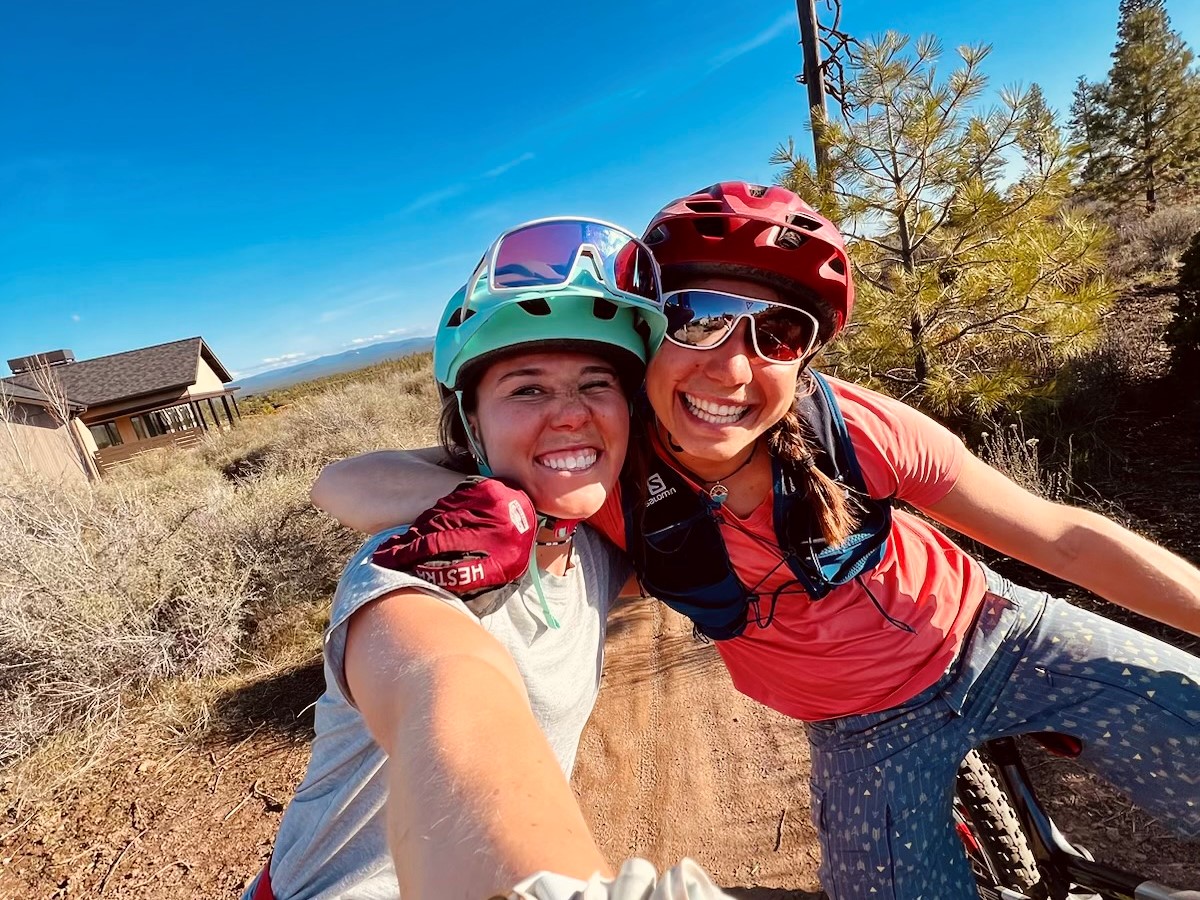
    Like many elite skiers, Lauren Jortberg and Julia Kern enjoy mountain biking opportunities for a change of pace. (Photo: Julia Kern)
    Against Early Specialization

    Asked when Norwegian athletes begin to specialize, Nystad laughs gently.Focus and specialization are a little bit mutually exclusive,he says.You can be focused and still do more than one sport.”

    Most Norwegian kids, he explains, play several sports until age 15 or 16 — sometimes even longer.When they’re 18 or 19, they might focus on one main sport and keep a couple on the side — running and skiing, for example, or cycling and skiing,he says.It’s part of the culture. People are active.”

    The danger, he warns, comes from well-meaning adults.A lot of parents try to self-realize through their kids,he says.

    “They want them to specialize early, to do everything right. In the end, the kids are sick of it, have no fun, and they quit.”

    His takeaway is simple:Kids are not miniature adults. They’re kids. Let them be kids as long as it makes sense. Life gets serious soon enough.”

    Adam Witkowski poses with his parents after unexpectedly racing a World Cup in Minneapolis in 2024. (Nathaniel Herz/FasterSkier)
    The Role of Parents: Mentors, Not Managers

    Nystad, as a father himself, knows firsthand how difficult it is to strike that balance of knowing when it is time to commit.Sixteen is just a number,he says. Some sixteen-year-olds are grown up; they can form their own opinions and take ownership. Others can barely wipe their own ass,he says with a laugh.

    “But in the end, the kids have to decide for themselves. It has to be something that’s rewarding for them. Our job as parents is to support them — to help them make fewer mistakes, to be mentors along the way.”

    That mentoring role — guiding but not controlling — is something Nystad sees as critical for the next generation of athletes.We’re supposed to help them realize their dreams and develop,he says.Not to live our dreams through them.”

    “Keep It Simple”: Trust the Body, Not the Gadgets

    In an era dominated by data, GPS, and lactate meters, Nystad is refreshingly old-school. He’s not anti-science — he’s trained with and coached some of the world’s most analytically minded teams — but he cautions against what he callsnumbing the senses.”

    “The reason to measure is to understand,he says.You measure to confirm your subjective feelings — not to replace them.”

    “If you’re tired, you sleep. If you’re hungry, you eat. If you’re thirsty, you drink. Those are subjective feelings — and they’re more important than any data you can measure,he explains.

    “Most devices today are not 100 percent correct. Your body usually is.”

    For Nystad, training success comes from continuity, not complexity.The KISS principle applies — keep it simple,he says.In endurance sports, you have to train with continuity for a long time and be patient. Don’t screw things up. Control gives continuity, and continuity is everything.”

    Fun as a Foundation for Longevity

    Nystad lights up when the conversation turns to lifelong sport.If sport or physical activity makes us happy, we’ll prioritize it,he says.Talking about training doesn’t make you better — actually doing it does.”

    He encourages athletes — elite or recreational — to reframe movement as a privilege, not a chore.We should appreciate every day we get to move,he says.

    “It means we’re healthy, we have the time, we can afford the equipment. That’s a luxury we need to appreciate more.”

    For parents juggling work and family, his advice is pragmatic:Maybe it’s better to go for a one-hour run first, and then drink your beer and watch Netflix,he says with a grin.It’s just about organizing your day so you get your little quick fix of physical activity.”

    The Norwegian Definition of Success

    For someone who’s coached Olympic medalists, Nystad’s definition of success has nothing to do with results.I can’t even remember what happened last winter,he admits.Success has nothing to do with medals or wins. I’m happy as a coach when the athletes are happy — when they’ve developed as athletes and as human beings.”

    He sees coaching as a human project as much as an athletic one.I always try to build teams where people work together, respect each other, and do their best. That’s success. If we treat each other well and do the job the best way we can, we’ll reach our potential. Reaching your potential — as a human or as an athlete — that’s success.”

    It’s a deeply Norwegian sentiment, one echoed across their sports system: the process matters more than the podium.

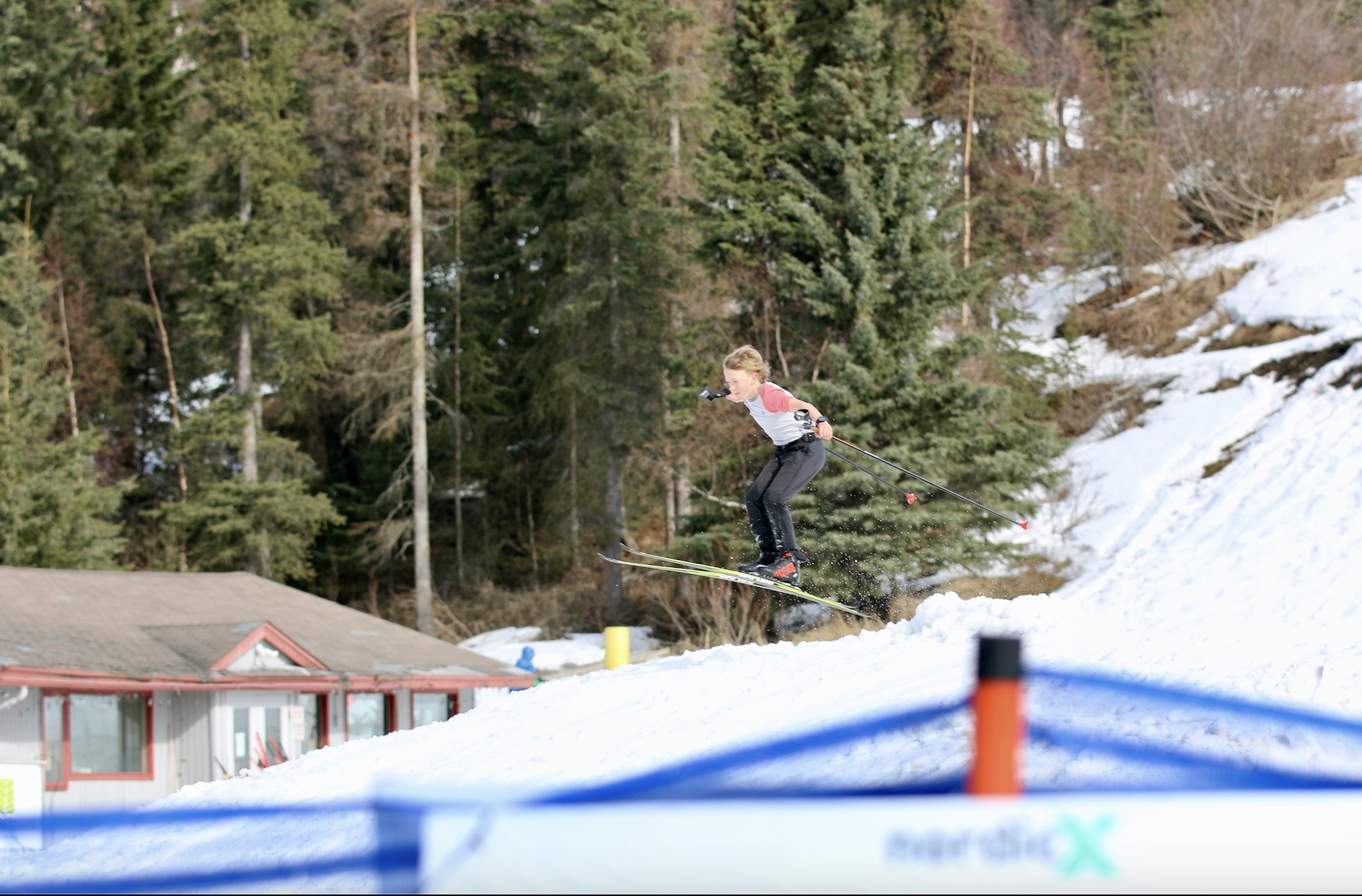
    One of many kids enjoying the features on the course and in the Kiddie Cross terrain park at NordicX in 2022. (Photo: Eric Maurer / NordicX)
    Lessons for U.S. Clubs and Coaches

    Nystad believes that U.S. programs can apply these lessons without mimicking Norway wholesale.The principles are the same,he says.It’s about creating an environment where kids master things, have fun, and stay in sports longer.”

    That may mean rethinking whatdevelopmentlooks like.Most of the time, we lose more than we win,he says.So it’s okay to have a bad race or a bad day. Focus on skill development and mastery — even when things aren’t going well. If it’s fun, and you keep mastering skills, success will come.”

    He also urges patience from young athletes.A big mistake is intensity control,he says.They go too fast on the easy sessions and too fast on the hard sessions. They believeno pain, no gain,but endurance sport doesn’t work like that. The best athletes are the ones who train a lot — and train smart.”

    Technique, Mastery, and Play

    Skiing, Nystad reminds us, is as much art as science.Especially in skiing, which is such a technical sport, the quality lies in doing things right — not just going hard,he says.I see so many people skiing with music in their ears, talking, doing all kinds of things, instead of focusing on perfecting technique.”

    He encourages athletes toplaywith movement:No one tells us how to do it. We can choose the way that fits our body and our strength,he explains.If more people would play with technique, be conscious of their technical and pacing choices, the outcome would be better for most people.”

    Astrid Oeyre Slind (NOR) on her way to a second-place finish in Cogne, Italy. (Photo: NordicFocus)
    The Lifelong Athlete Mindset

    At 55, Nystad continues to coach, ski, and move daily — not out of obligation, but joy.If you train right, take care of yourself physically, mentally, nutritionally — and have a blast doing it — there’s no limit to how long you can be good,he says.

    “The moment you start thinking it’s a sacrifice, or that it’s boring — that’s when your career starts to end.”

    He cites examples like Hilde Gjørum, who earned her first Olympic medal at 43, and Astrid Øyre Slind, who made her first Norwegian World Championships team at 34 and won her first World Cup at 37.There are lots of stories like that,he says.Everyone can keep getting better — if you love what you do.”

    Looking Ahead: A Sustainable Future

    Nystad’s final reflections return to sustainability — both of snow and of sport.Obviously, we’ll have issues with snow,he says.Snow storage and snow farming are becoming normal in Europe, and that will change the sport. But cross-country skiing will survive. It’s a great sport — full-body, low-injury, healthy.”

    The real challenge, he believes, is getting people to participate.We need to sell it for all it’s worth and get more people involved,he says.If we can bring more people into skiing — kids, families, anyone — the rest will take care of itself.”

    The Takeaway:Master the World”

    For Nystad, the essence of sport is not the stopwatch, but the spirit.The focus,he repeats,is on mastering the world — being a champion of the world, not a world champion.”

    It’s a mindset that turns every trail into a classroom, every race into a chance to learn. And perhaps that’s the real secret behind Norway’s golden age of endurance: a culture where success isn’t measured in medals, but in how many people can’t wait to clip into their skis again tomorrow.

    Trond Nystad, the coach of the Norwegian men’s cross-country ski team, takes questions from the media after the relay at the Sochi Olympics.
  • Nordic Nation: Ben Ogden Breaks Through

    Nordic Nation: Ben Ogden Breaks Through

    Ben Ogden finds himself in the rough during the classic sprint semi final in Les Rousses, FRA. (Photo: NordicFocus)

    It’s been a minute! With the arrival of host Rachel Perkins’ second baby in July and a subsequent job shift, Nordic Nation has been on pause, but we are excited to relaunch now with the hope of producing these regularly over the coming months!

    Our first guest of 2023 is the one and only Ben Ogden, who’s had a standout season of racing on the World Cup. Ben has cracked into the semifinals in four sprint races, while posting breakthrough results in distance racing also, like a 6th place finish in the 10k classic in Oberstdorf during the Tour de Ski. He finished the overall Tour in 13th, which is an historic result for the American men’s team. Following the Tour, he headed back home to Vermont, where he hopped into two EISA Carnival weekends – winning four for four – while wearing his UVM Catamounts kit for the final time. He returned to Europe in time for Les Rousses, where Ben qualified in 7th for the classic sprint, finishing 11th after a quick trip outside the V-board in the semis. 

    In this conversation, we discuss the factors that have contributed to his development as a professional skier, from mindset, to training, to an effort to make the World Cup lifestyle sustainable long term. We also discuss his recent trip back to the Northeast, what has made collegiate racing “special”, and more.

    Thanks for listening!

    Ben Ogden prepares for the final stages of the 2023 Tour de Ski in Val di Fiemme, ITA. (NordicFocus)
  • Q & A with New Faces on the U.S. Ski Team: Finn O’Connell

    Q & A with New Faces on the U.S. Ski Team: Finn O’Connell

    U.S. Ski & Snowboard recently announced its U.S. Ski Team nominations for the 2022-23 season. Of the 22 athletes named to the team this season, six were not on the previous year’s roster, either newly named or renamed: Michael Earnhart, Walker Hall, Zak Ketterson, Will Koch, Finn O’Connell, and Sammy Smith.

    To help fans get to know these new(er) faces, FasterSkier is doing a series of interviews, providing insights into the factors that have contributed to development, progress, and growth for these athletes last season. In this installment, we talk with Finn O’Connell following his nomination to the U.S. Ski Team on its B-Team. O’Connell discusses his background in skiing, what contributed to his success this season, and his goals and focus heading into next winter. 

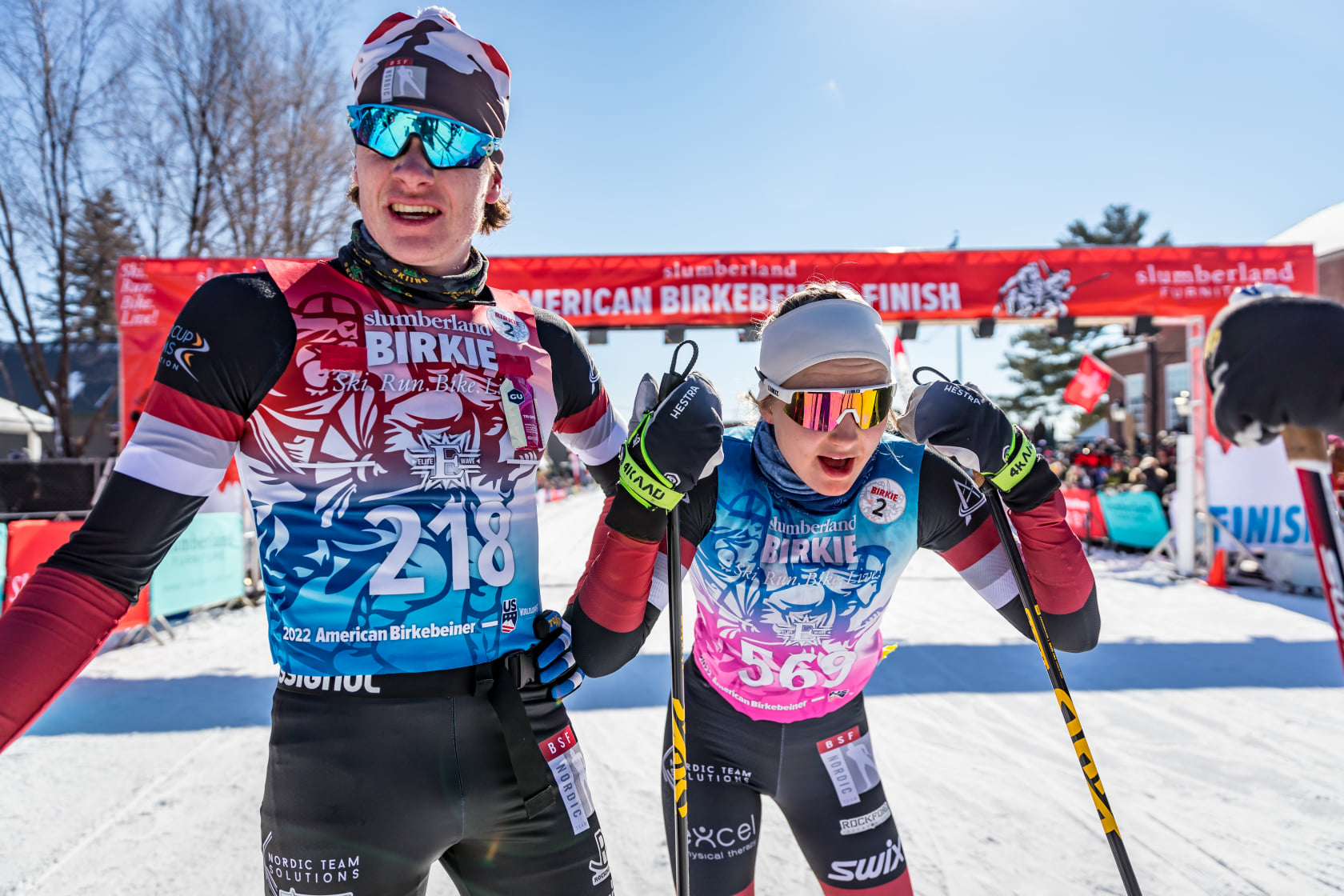
    Finn O’Connell (BSF Pro) skied to 14th in the 2022 American Birkie in February, while teammate Hannah Rudd (right) was 12th in the women’s field. (Photo: 2022 American Birkebeiner Ski Foundation)

    FasterSkier/Ben Theyerl: Can you start off by telling us just a little bit about yourself, where you’re from where you’ve seen in the past and where you’re skiing now?

    Finn O’Connell: I grew up in Steamboat Springs, Colorado, and was a Nordic combined athlete – doing ski jumping and [only] skate skiing until my junior year of high school. I decided that I wanted to go pursue a college degree, but because there was nowhere to do combined in college, I dropped ski jumping and learned how to classic ski. I was offered a spot on the University of Vermont despite senior year [of high school] really being the first time I’d ever classic skied.

    It took me a year to get into college skiing and it was really not until my sophomore year that I had [strong] results. I opened up that season with a second place and then just kind of kept the podiums going through my sophomore year. EISA and NCAA skiing lead to U23 World Championships in 2020, during my senior year. While I was [in Bozeman] at NCAAs Andy Newell at Bridger Ski Foundation (BSF) emailed me wondering if I’d be interested in joining their new team. I was already thinking I wanted to move back West, but I didn’t know if I’d keep skiing or not. The BSF team happened and I was stoked, so now I’ve been here for two years and I’m just excited, with Newell and my teammates, to get going.

    Finn O’Connell (Photo: Bridger Ski Foundation)

    FS: That takes us up to today. Congratulations on your U.S. Ski Team nomination. Take us back to the beginning of this past season, what were your goals?

    FO: My first year with BSF (2020-21) I was offered a World Cup start and then through complications with COVID, those were cancelled. My goal because of that was to get some World Cup starts and prove myself as a top distance skier and see if the Olympics were in the cards this time around (2021-22). And then, again, as soon as I got offered a World Cup spot [this January] COVID cancelled those races, which was a big bummer. That was right around when Olympic qualification ended, and so from there, I just skied with no real pressure on racing fast and just had fun. I had some successful SuperTour races and went to OPA Finals in Italy. That ended up being a really great place to earn FIS points, which helped towards my nomination as it turned out.

    Through the weirdness of COVID, the World Cups didn’t come this year, but overall, I think I achieved my goal to prove I could compete on the highest level in skiing.

    FS: I want to pause on COVID as from what you’re saying there it’s been a big factor for you all the way through your transition from collegiate skiing to primarily being a pro. How big of a challenge has that been?

    FO: I didn’t really know what being a “professional” skier looked like honestly until my second season, because my first year doing it was really tagging along to college races (BSF raced with the RMISA circuit for select races in 2020-21). Other than the Birkie, there was just nothing [for pro skiing].

    I think, looking back, that season helped me make some bigger improvements than other skiers. Primarily because I still am behind the curve on learning to classic ski, so having that as motivation to improve, and having the resources with Newell and my teammates at BSF just really helped me to keep getting better.

    FS: Specifically on COVID blocking the World Cup starts for you, that’s left you with fewer opportunities to race internationally than some of your US teammates. Does that play into what you’re prioritizing for this upcoming season?

    FO: I’m definitely looking forward to getting over [to Europe] and racing. I’m not bummed on missing out the past two seasons because the guys who were over there during COVID deserved those starts. But I would be lying if I said I wasn’t itching to finally race with the others on the U.S. Ski Team and the other best skiers in the world. I really am pumped to show others what I’m capable of.

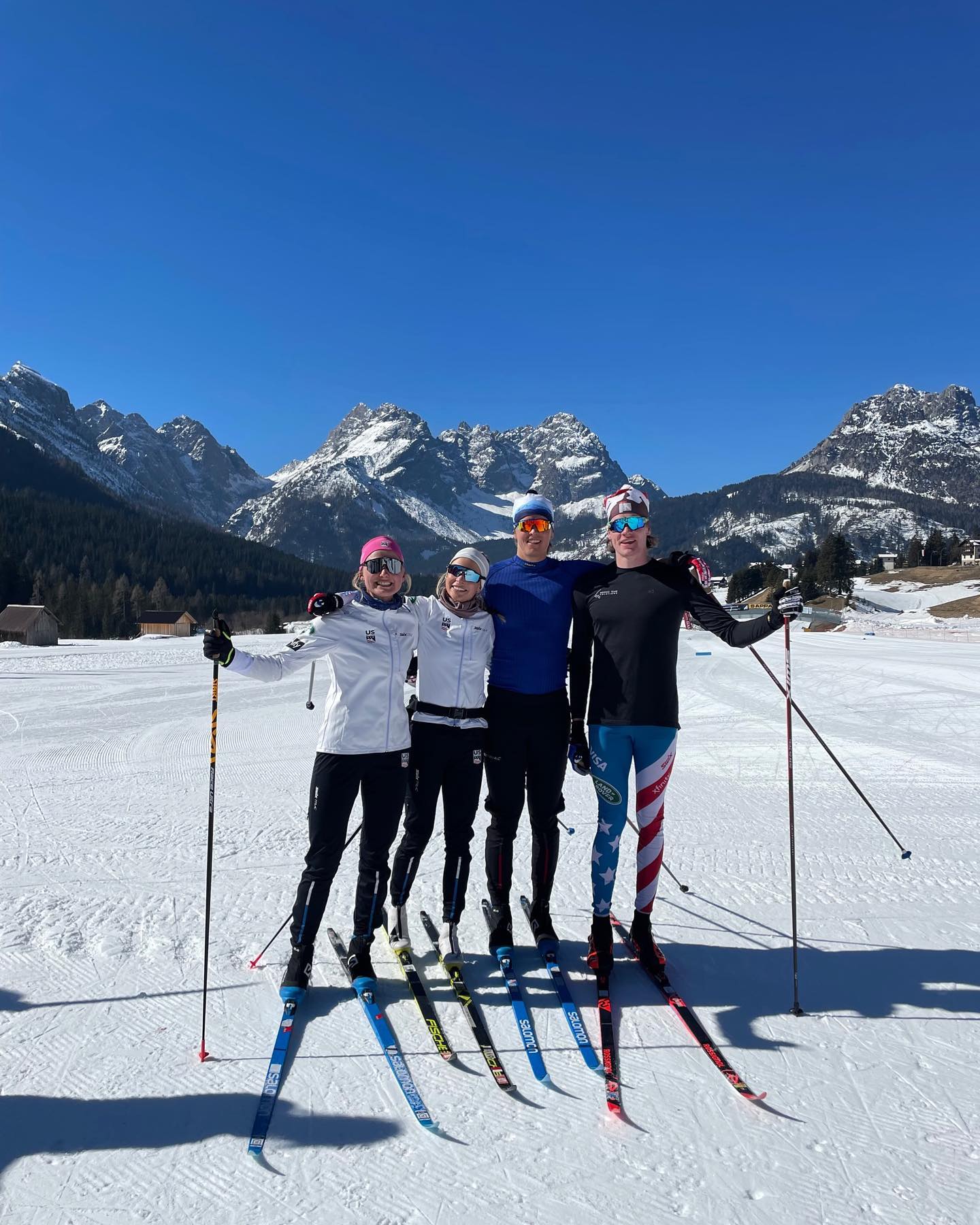
    Members of the BSF Pro Team compete at the 2022 Opa Cup Finals in Sappada, Italy. From left to right, Hannah Rudd, Mariah Bredal, Logan Diekmann, Finn O’Connell. (Photo: BSF Pro Team)

    FS: On that U.S. Team, this men’s team is very young. You’ve been teammates with some of the guys that are even younger than you, like Ben Ogden while you were at UVM. How do you approach joining a group of skiers that’s already been skiing together for a few years?

    FO: Even in Bend, I could tell it was going to be a very smooth transition. I know most of the men and women on the team from racing college, even if we just overlapped for one year out East. And then, racing the RMISA with BSF last year helped introduce me to skiers in the West.

    I will say it’s weird to feel like I’m a rookie and am already one of the older people on the team.

    FS: The U.S. men’s team has some big breakthrough results from the past couple of seasons, especially leaning towards the sprint side of the sport. In contrast to that, your notable results have been some really great distance races. Does that play into what World Cup starts you’re targeting this year?

    FO: Yeah, I think I can only pinpoint one sprint race I’ve ever done that’s really stood out to me. Having Newell as a coach definitely has helped, like I’m qualifying for heats now at least, but my main focus is definitely away from sprinting when it comes to the World Cup. I probably wouldn’t get any of those starts, and I don’t really want to get any of those starts. I want to keep my focus on distance skiing.

    FS: I wanted to also cover some of the other parts of your background that are unique. You’re from Steamboat Springs, which if your goal is to become a Winter Olympian is one the best places to be from in terms of the number of athletes who have achieved that. How did growing up there help you get to where you are now?

    FO: I think a lot of it was just how many different sports and types of skiing I was able to kind of compete in. And even there, not all the time feeling like I had to compete, but that I could just have fun and be a multi-sport athlete if I wanted. That’s definitely contributed to me still being in Nordic skiing.

    FS: The Nordic combined thing really strikes me as unique too. That’s a niche sport and I know of a lot of Nordic Combined skiers end up dropping the cross country to just focus on ski jumping. What made the cross country side more attractive for you?

    FO: Yeah, I do think I was unique in that even though I jumped first, my cross-country skiing was always better than my jumping.

    That, and circumstance. When I was in high school seven years ago, jumping and Nordic combined had just been dropped by U.S. Ski & Snowboard, and USA Nordic hadn’t really been formed yet. It was looking like the support for me might not be there if I stayed in combined, even if I did what you end up doing as a U.S. Team member, which is moving to Park City and pretty much forming a day-to-day training group with the other U.S. Team members. I had goals outside of skiing I knew I wanted to pursue, which meant going to college, and that was an option in cross country skiing and not an option with the Nordic combined program at that time. I took the leap to focus solely on the cross country side of things.

    FS: From there you’ve now worked with some coaches who’ve had the international experience that you’re now setting your target on with Patrick Weaver (UVM) and Andy Newell (BSF). How is that helping as you start to look at taking things to the World Cup next season?

    FO:  I would say on both those guys that even though you’re aware of their success racing, the thing that sticks out working with them is more how passionate they are in their training, technique, video sessions, and how they approach racing.

    With Patrick, you obviously have an idea that he was an Olympian multiple times over back in the day, but I think the international racing world has changed a lot and while he’s working with you, he’s very focused on what he knows as a coach which is the college circuit.

    With Newell, I’m working with him as those goals become achievable, and so there’s a lot of focus around what international racing looks like. He just knows the ins and outs of that circuit so well from doing it for so many years, and his mindset is something I really look to when it comes to thinking about how to feel good while chasing that dream of skiing internationally.

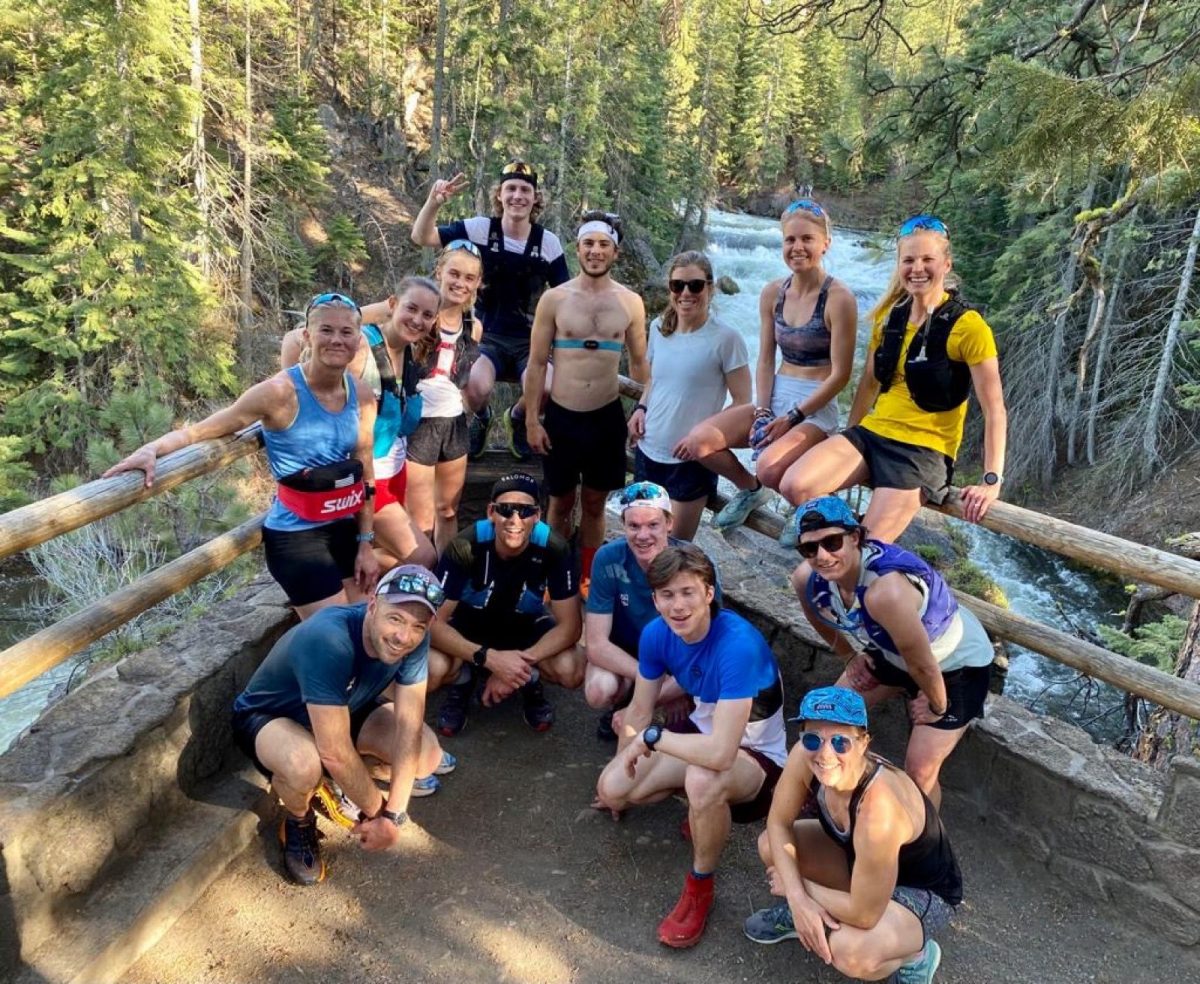
    Members of the 2022-23 U.S. Ski Team with coach Matt Whitcomb on a trail run in Bend, OR during a May training camp. Finn O’Connell is third from the left in the front row. (Courtesy photo)

    FS: Do you have any other thoughts on the U.S. Ski Team or what you’re looking forward to next season?

    FO: I’m just super stoked. If I’m honest, I wasn’t really expecting the nomination. I couldn’t see the latest FIS points list and didn’t really know what the future of me skiing was going to look like at the end of this season. I’ve always wanted to be a pilot and was starting to think about pursuing that more seriously.

    But then I got the call and I just kind of thought, well, “how cool of an opportunity I have” and so just decided I was going to stay very focused on the skiing, and I’m super excited to see where that takes me.

  • Head Coach Transitions for the SMS T2 Program with Pat O’Brien and Perry Thomas

    Head Coach Transitions for the SMS T2 Program with Pat O’Brien and Perry Thomas

    After eight years at the helm of the Stratton Mountain School (SMS) T2 team, head coach Pat O’Brien is in the process of taking a few steps back, passing the reins to Perry Thomas, who has spent the last five years as the assistant coach at the University of Vermont.

    Perhaps highlighting this transition and the sharing of responsibilities the two are in the process of navigating, FasterSkier connected with Thomas in mid-May while he was in his second week of supporting the SMS T2 athletes who had joined the U.S. Ski Team for their spring training camp in Bend, OR, and with O’Brien who was back in Stratton, having recently wrapped up with his participation in U.S. Ski & Snowboard spring congress sessions. 

    Pat O’Brien supports some of the SMS T2 athletes during a 2022 SuperTour weekend in Sun Valley, ID. (Photo: SMS T2)

    A 2006 graduate of SMS himself, O’Brien raced collegiately for Dartmouth College, then spent four years training and racing professionally with the Craftsbury Green Racing Project. His move from Craftsbury back to Stratton was timed with his retirement following the 2014 Sochi Olympic Quad. Given his age and the proximity to his racing career at that time, many of the athletes on the T2 team were among what he called his “peer group”, having overlapped with many of them during either high school, college, on the race course, or all of the above. Jessie Diggins and Sophie Caldwell Hamilton were quickly becoming rising World Cup stars on the women’s team, while Andy Newell and Simi Hamilton headlined the men’s roster, and a young Julia Kern and Katharine Ogden were spending a PG year training with the T2 team.

    Eager to stay connected with the sport after retirement, O’Brien seized the opportunity to take over in Stratton, stepping in as his predecessor Gus Kaeding departed.

    “Ski coaching is the one thing that I’ve always known that I wanted to do, it was just kind of a natural progression for me. I knew that I was done with my athletic career – I didn’t really want to ski race anymore – but I knew that I still wanted to ski, I still wanted to be involved and to give back to the sport. I felt like, to some extent, when you spend basically your entire life skiing, you get pretty good at understanding the sport. But we never know as much as we think we do, and we always need to be students of the sport and have an open mind and learn.”

    As he began his coaching career, he quickly realized that writing training plans and facilitating training was only a small subset of the responsibilities of an elite club coach.  

    “Good coaching is being comfortable wearing a bunch of different hats. And I mean, I joke, but the actual coaching is such a small part of it. The nitty gritty of pulling an athlete on the side of the trail and looking at video and all of that is important, but you’re there as a friend, a drill sergeant at times, and as someone that is just really trying to be supportive.

    “And that’s all-encompassing. So for me, it has been a pretty fun experience to see people figure stuff out and be there to support them when they needed a little extra help and to do it in a pretty collaborative, dynamic way.”

    He described his experience transitioning to coaching primarily as a mindset shift from the inevitable self-centric focus required of professional athletes toward selflessness; but the work required and pace of life remained equally taxing. 

    “When you coach at a club level – all coaching is a demanding job. I do think that you have to – I don’t want to use the word ‘sacrifice’, but when you transition from being an athlete yourself to being a coach, your job as an athlete is to be a little selfish. You’re trying to maximize your athletic performance. You need to have balance… but at the end of the day, you need to make sure that you’re training well and with purpose, you’re recovering well, you have goals and you’re going about achieving them. It shouldn’t be simply looked at as like what you have to give up to do that, but to be the most professional athletes and succeed against people who are trying to do the exact same thing, you just have to do a really, really good job with it. And coaching is the same thing. You have to be willing to approach everything that you do with the same degree of drive and focus that you would as an athlete…

    “Basically, I just threw myself into it with the same approach that I had as an athlete which is, I’m just going to work, and work, and work, and learn all along the way. And then give it my best push and know that if I get to the point where that balance starts becoming harder and harder, or I can’t really do the job that I want, to be supportive of the athletes [to the level I want to be], that’s when you’ve got to know that you either double down and keep pushing or make a transition.”

    While O’Brien is no less dedicated to the SMS T2 program or its athletes, a new endeavor has begun which will make achieving the balance he described significantly harder: he’s about to become a father. His wife, two-time Olympian and long-time U.S. Ski Team member Ida Sargent, is due in mid-August.

    After eight years as head coach of the SMS T2 team, Pat O’Brien takes a step back as he and his wife, Ida Sargent, begin their family. (Photo: SMS T2)

    Since retirement, Sargent has been working for her high school alma mater, Burke Mountain Academy, in Northern Vermont, and is currently the Academic Director for the school while also teaching STEM classes. O’Brien has been splitting his time between Burke and Stratton, which lies roughly 150 miles southeast in the opposite corner of the state. His usual coaching schedule pulled him around the country for weeks at a time to support athletes at U.S. Nationals and SuperTour events, and sometimes around the globe for World Cup, U23s, and other international camps and races. 

    While he acknowledged that there are many examples of coaches at all levels who have successfully juggled a demanding work and travel schedule with raising a family, what felt like the best fit given his and Ida’s vision and priorities for their own growing family was for O’Brien to decrease his level of responsibility with the T2 program, allowing greater flexibility and more time at home. 

    “I just felt like there’s part of me that was like, ‘I’m not seeing a pathway that I feel like I can still commit [to coaching] at the level that I want and know that you need to in order to to do the best job with your job, while simultaneously trying to start a family.’ I felt like it was my time to reevaluate and maybe step back or be completely done with ski coaching, because I certainly didn’t want Ida to have to put her growing career on hold to be the [primary] caregiver…

    “Eight years is a long time to do something and I am very proud of what the team has accomplished in that time… it’s really cool having spent this time seeing athletes grow, not just not just athletically and within their their ski careers, but as individuals from high schoolers to finishing up college to full blown ‘this is my job.’”

    While his role will be smaller, O’Brien is certainly not stepping away from the T2 team altogether. “Starting a family does not necessarily mean that it means the end of being involved in the sport,” he said. “It just means trying to figure out what the right relationship is with it.” 

    Pat O’Brien supports SMS T2 skiers Julia Kern and Alayna Sonnesyn at the 2022 U.S. SuperTour Finals in Whistler. (Photo: SMS T2 Blog)

    The exact balance and distribution of responsibilities remains a work in progress as Thomas moves into the head coach role and the new season of training begins, and both O’Brien and Thomas are excited to collaborate and support one another throughout the year. 

    Explaining his philosophy as “under-commit so I can open perform”, O’Brien anticipates taking on many of the behind the scenes tasks that support the team, from collaboratively blocking out the season calendar, to managing travel logistics for camps and SuperTour races. As he put it, the little details of deciding “which flights to take to get from Canmore to Sun Valley” and where to stay are often made easier with several years of trial and error under your belt. 

    While Thomas will spend more time with ski boots on the ground, both in Stratton during the summer and at races and camps throughout the year, O’Brien anticipates he’ll still be plugging in a fair amount too. Though his stay might be shortened to the period immediately surrounding races, he plans, at minimum, to be in Houghton, MI for U.S. Nationals in January, and also the SuperTour finals in Craftsbury in late March.

    He’s also excited to reconnect with the team in Stratton early in the summer before Ida gets close to her due date, but also to take off a few of his usual coaching hats while doing so. 

    “I think it’ll be really fun for me to actually be able to flow in and out get to see people, connect with them, but also not be like ‘Okay, now I don’t have to worry about making sure that the van’s filled up with gas, or water jugs have been filled, or that I’ve ordered all the lactate strips in advance so that we don’t run out.’”

    Perry Thomas out for a crust ski with the SMS T2 athletes who joined the national team training camp in Bend, OR this spring. (Courtesy photo)

    As Thomas gets his feet under him in Stratton, he explained that he feels “very fortunate that Pat will still be involved.”

    “As much as I can have him in the mix, the better,” Thomas said. “His knowledge with skis and wax is just unreal, so tapping into that resource is huge for me, for sure.” 

    ***

    UVM assistant coach Perry Thomas in action during the 2022 U.S. Cross Country Skiing Championships in Soldier Hollow. (Photo: Instagram @oneswellperry)

    Prior to joining the UVM program, Thomas spent five years as the assistant coach at the University of Vermont, working alongside head coach Patrick Weaver. During his own collegiate racing career, Thomas spent four years racing for the University of New Hampshire, where he served as team captain during his senior year in ‘12-13. Departing briefly from the cross-country ski world, he spent a year teaching high school science to underprivileged youth in the Oakland area of California, before returning to the Northeast to begin his coaching career as the assistant coach at Williams College in Massachusetts. 

    “Working at UVM was unreal – a great experience,” Thomas said emphatically. “I really loved working with Patrick Weaver and the athletes there and it seems like almost a seamless transition, in many ways. Four of the skiers on the T2 team I actually coached at UVM. So knowing a lot of athletes here already – what they’re working on with technique, and racing, and goals and all that – has been very seamless, and that’s been great.”

    The UVM graduates who now ski for SMS T2 include Alayna Sonnesyn (‘18), Bill Harmeyer (‘20), Lina Sutro (‘21), and Ben Ogden (‘22). 

    The UVM ski team celebrates a successful 2022 NCAA Championship. Assistant coach Perry Thomas is at the far left. (Photo: UVM Skiing)

    Given the caliber of these athletes and the success of the UVM team as a whole during his tenure, Thomas credits his time with the program to the acceleration of his development as a coach, preparing him to take his next steps forward with SMS T2.

    “Patrick Weaver definitely gave me a lot of opportunities and ownership over different facets of coaching that team and I think that’s been instrumental in me being here now with T2. I was able to go to World Cup Finals with Ben Ogden in Quebec his first year in school [in 2019], and I was just able to do trips like that on my own with athletes. That was huge for my development as a coach and for my experience of waxing, ski testing, and [other responsibilities at that level of racing]. So working at UVM was a lot of fun – I’m gonna miss it for sure – but it set me up very well for this transition.” 

    Ben Ogden gets a congratulatory fist bump as he heads to the podium during his sweep of the 2022 NCAA Championships. (Photo: Tobias Albrigtsen / @untraceableg)

    A theme of both Thomas and O’Brien’s comments on the difference between collegiate and elite club coaching is small in terms of the training and technique coaching itself, but vastly different in terms of the opportunities elite club coaches have to support their athletes. 

    “I think the big differences are what we can and can’t do throughout the year from collegiate [racing] to the elite team,” Thomas explained. “Like, I wouldn’t be here [in Bend] and been doing an on-snow training camp if I were at a college team. And obviously the racing schedule is super different.

    “The college schedule is pretty efficient, whereas the SuperTour calendar is quite a bit more spread out. And then, in addition to that, you have an athlete’s like Jesse Diggins, and Ben Ogden, and Julia Kern that are going to be on the World Cup, as well as athletes that are trying to make it to the World Cup. And at UVM, we had crazy talented athletes – Ben Ogden is one of them – so working with with high caliber athletes is nothing entirely new, but dealing with athletes where some are on the World Cup and some of them on the SuperTour is an interesting dynamic that you don’t often get with the college teams.”

    In terms of what Thomas adds to the program as he steps in as head coach, he described his coaching philosophy and the environment he seeks to create within the training group, which keeps athletes motivated and happy through the arduous and long-term development process.

    “[Cross-country] skiing is such a hard sport – it’s so much time that that we’re putting in, and so many sacrifices that we’re making, that I wholeheartedly believe in making that time that we’re together training and working hard fun and enjoyable,” Thomas said. “I think that’s a big part of what we do –  and it has to be a big part of what we do –  because like I said, it’s a hard sport. So I think making things light and having fun with all that is super important. And that’s definitely something I bring to the table in that regard.”

    The SMS T2 team enjoys spring skiing at the Mt. Bachelor Nordic Center. From left to right, Alayna Sonnesyn, Jessie Diggins, Lina Sutro, and Lauren Jortberg, with head coach Perry Thomas. (Photo courtesy Alayna Sonnesyn)

    But Thomas will add more than just fun to the T2 program. While he may be, as phrased by his new colleague, “almost too humble”, O’Brien was quick to highlight Thomas’s preparedness to prescribe training, coach technique, and otherwise lead an elite team stacked with some of the nation’s best athletes. 

    “If you have been at a D1 college program where you’re dealing with 15-20 athletes and that dynamic environment where student athletes are constantly balancing all these different commitments and time constraints… And really, what you learn there as an athlete and what you learn there as a coach is that working with a club – it just isn’t that different.”

    O’Brien added that the shift to an elite club from college may, in fact, be easier than going in the other direction. When athletes no longer have to miss key workouts to take an exam or rush off to class halfway through a team meeting, barriers to consistent communication and training are removed, and consequently a coach has a greater capacity to build relationships with the athletes as they stack together the bricks of the training program. 

    “You get an opportunity to really work one-on-one with the athletes and to really be there to facilitate and support their training and their racing. In that sense, I think coming from a college background – especially given his ties with many of the current athletes that are on the team – you’re just working with the same people and you’re doing the same stuff.

    “I mean, there’s no magic formula,” O’Brien continued. “Someone can claim that they can write the best training plan in the world. And that’s all fine and dandy – there are definitely people who do an amazing job with it and they really enjoy that aspect of that aspect of the sport. But at the end of the day, it’s just really just working with people. You don’t need to make it more complicated than it is. The best athlete is not a robot. The best athlete is someone that is self aware, that can think critically, learn from mistakes, recognize when things go well, and the coach is there to support them along the way.”

    New SMS T2 head coach Perry Thomas working with his athletes during a 2022 spring training camp at the Mt. Bachelor Nordic Center. (Photo: Lauren Jortberg)

    Thomas identified building upon his relationships and experience with his former athletes, who account for half of the team’s eight athletes, as something he’s looking forward to in joining T2. 

    “I am very appreciative of the continuity and being able to work with some athletes I’ve worked with in the past,” said Thomas. “I love all of them –  they’re incredible people, incredibly hard workers. So to be able to continue working with them is just awesome. With that, too, it’s like – I have been working with Ben for the last four years, I worked with Lina Sutro for four years, I worked with Alayna for a little bit. It’s just a matter of knowing how they operate and how they train and knowing what they’ve been working on too. It’s easy for me in training, [even] this morning, to see some of them and be like, ‘okay, like this is something we’ve been working on for the last however many years’ or maybe, ‘a couple years ago, this was something we’re working on’. So let’s continue this, let’s continue these cues that we’re working on, and have that continuity there. 

    “It’s been awesome to be able to continue that work with them. It’s nice to see the progress – to see what they were doing in college a few years ago, and then to see where they are now, and then also to be able to help them through the transition to professional skiing.”

    Simultaneously, these UVM-T2 athletes are excited to be working with their former UVM coach again. In an email to FasterSkier, Alayna Sonnesyn reflected on her time as a professional skier guided by O’Brien, while crediting Thomas’s contributions at UVM for her reaching the professional level in the first place. 

    “Stepping into the professional ski world four years ago and onto the SMS T2 team was super intimidating to me,” wrote Sonnesyn. “The team has been home to some of the fastest skiers in the world and I was clueless when it came to racing at that high of a level. Pat O’Brien helped steer me in the right direction as I made this adjustment and took huge jumps in my skiing ability. He taught me when to train for fun and when it was time to buckle down and get serious. When Pat says it’s go time, you go! He helped develop me from a reasonable distance skier to a strong and powerful distance AND sprinter, a trait I never thought I would be capable of. Pat’s knowledge of the sport and ski waxing, as well as the mental and emotional obstacles that come along with it, is unparalleled. He was a coach that believed in me as a junior skier and saw potential. The only thing that can make a good ski race even better is when Pat gives you a proud hug at the finish line. Although I will miss these hugs and his direct coaching, I know that he will use these skills to care for his growing family and I am excited to see where life takes him next.

    Perry Thomas works with a few of the SMS T2 ladies in Bend. (Photo: Alayna Sonnesyn)

    “Back when Pat was just seeing the potential in my college skiing, I was working with Perry Thomas when he was the assistant coach at UVM. I feel like my athletic career has come full circle as I get to transition back to a coach who helped put me in a place where I first believed skiing professionally was an option. Although I only had the pleasure of working with Perry for one year at UVM, it was a very special season! I instantly trusted him with my skis and could feel his enthusiasm for the sport radiate on the ski trails. I’ve witnessed just how hard Perry has worked over the years and how well-prepared he is to take over the position as head coach of the SMS team. Just in the first month of working with Perry again, I already know the team is heading down a path to continue its mission; local inspiration, international excellence.”

    Likewise, Lina Sutro shared she is looking forward to the transition, applauding Thomas’s dedication to his athletes.

    I am truly so excited to be working with Perry again,” she wrote. “He is one of the most hard working and committed coaches I have worked with. He has a strong work ethic that I am excited for the Stratton community to experience. Pat and Perry both give so much back to the ski community and their athletes, I am excited to see the two of them work together.”

    The 2021/2022 SMS T2 Team. Back row (l – r): Ian Torchia, Ben Ogden, Bill Harmeyer, and Will Koch; front row: Alayna Sonnesyn, Julia Kern, head coach Pat O’Brien, Lina Sutro, Katharine Ogden, and Jessie Diggins. (Photo: SMS T2 Blog)

    As for the broader questions of “what’s new?” and “what lies ahead for the SMS T2 team this summer?” Following Katharine Ogden’s retirement in March, Lauren Jortberg will join the team as the fifth athlete on the women’s side – five and five is what the team identifies as the sweet spot for numbers. Jortberg joins Jessie Diggins, Julia Kern, Alayna Sonnesyn, and Lina Sutro. The men’s team is light this season, as Ian Torchia moved on this spring also, leaving behind a three-man roster of Bill Harmeyer, Will Koch (who also competes for University of Colorado), and Ben Ogden. 

    After Bend camp, the team will part ways with many attending “a big event in the Midwest” which happened over Memorial Day Weekend. The SMS T2 team will finally reconvene as a whole in Stratton in early June. Though regional and international camps are planned, particularly for athletes named to the national team, Thomas anticipates ample quality training based in Vermont and the surrounding region.

    “We’ll be in the Stratton area for the majority of this summer,” he explained. “I think one of the cool things that we’re doing is: Sverre, and Pat and I have started working on doing a summer [training] program, so we have some awesome athletes joining our crew this summer.”

    This list includes University of Utah and U.S. Ski Team skiers Sydney Palmer-Leger, Novie McCabe, and former SMS junior athletes Adam Witowski and Zander Martin, who now ski for Michigan Tech and Bates College, respectively. JC Schoonmaker and Gus Schumacher also plan to join the T2 team for some training in Vermont throughout the summer. 

    “So a really stacked crew, for sure,” said Thomas. “It’s gonna be a really exciting summer to say the least.”

  • The College Conflict: Part 2

    The College Conflict: Part 2

    Author Alayna Sonnesyn during a crust ski at the Snow Farm this summer near Wanaka, New Zealand. (Photo: Matt Whitcomb)

    The following was written by Alayna Sonnesyn, a new member of the Stratton Mountain School (SMS) T2 Team who graduated from the University of Vermont (UVM) this past spring.

    Originally from Plymouth, Minnesota, Sonnesyn, 22, raced on the UVM Ski Team for four years and qualified for four NCAA Skiing Championships teams. She placed second and third in two races at 2017 NCAA Championships, and in her senior season, won the first five Eastern Intercollegiate Ski Association (EISA) races and went on to reach the podium in 10 out of 11 EISA races. Sonnesyn expressed an interest in exploring the dilemma many of the nation’s top skiing talents face out of high school: whether to attend college or get an early jump on a pro-racing career. Part 1 can be viewed here, and the two-part series is also on her blog.

    ***

    According to the Bureau of Labor Statistics about 70 percent of 2017 high school graduates enrolled in some form of college the following fall. In addition, a handful of the working population decided to either start college after a few years or return to classes after a much-needed hiatus. But what happens if you stray from the norm … and something pulls you in another direction? For Jessie Diggins and Andy Newell, there were alternative ideas for the future.

    At the time, both Jessie and Andy followed the same route, exploring collegiate racing right out of high school. Similar to many high school skiers, they went through the process of applying to schools, talking to coaches and establishing academic opportunities for themselves after graduation.

    Jessie Diggins being goofy during our recent training camp in New Zealand. (Photo: Julia Kern)

    “When I decided to go full-skiing, I had deferred a place at NMU, and had that as my Plan B if I decided that full-time skiing was too stressful or not as fun as I wanted it to be,” Jessie said.

    “What I decided to do was defer from UVM, but I was also able to take some classes from the University of Utah with tuition reimbursement and a loaned laptop courtesy of the US Ski Team,” Andy explained.

    At the time, both skiers were still open to going to college, but decided to “take a year off.” The only difference was that they never experienced that longing to go back into full-time school. As previously mentioned in Part 1 of this series, many skiers who decided to take a gap year soon came to the realization that something was missing and that they still wanted a balance in their life. It made sense for them to go back to school and ski in college. But why change something when you’re already happy?

    According to Jessie, “At the end of the day, a happy skier is a fast skier… For me, I was super happy having all my eggs in one basket and making skiing my full-time job. I love having skiing as my career, and I perform well under stress so having the pressure of becoming a professional athlete at a young age didn’t create too much anxiety.”

    This stress worked well for Jessie. With such a unique combination of personality, work ethic, and training load, she knew taking this route would be better for her.

    buy ciprofloxacin online, ajedrezextremadura

    “Personally, going to college wasn’t going to work for me if I wanted to get the grades I wanted and train as hard as I wanted,” she said.

    Jessie went on to note how important it is to figure out your own personality; whether you can do a good job at balancing school and skiing, or whether you’re excited to focus all of your time and energy on one goal. She found that specificity suited her lifestyle really well after high school and carried that momentum for years to follow.

    Similarly, Andy found success from a young age and didn’t see a reason to change what was already working so well for him.

    “To get that kind of international exposure was sweet for a junior, but more importantly it got me hooked on skiing — the addiction to the big show and excitement of European racing,” Andy said of racing at World Juniors, U23’s and World Championships his first year out of high school.

    With the need for speed and an obvious progression into becoming an elite skier, Newell admitted that he pretty much gave up any opportunities for racing in college after he started signing contracts and collecting win money. Although, he notes that the ski racing environment was slightly different at the time he made this choice. In high school, Andy was named to the U.S. D-team, which, at the time, provided free housing in Park City, access to daily coaching, and most of the Winter travel expenses covered.

    “I consider myself lucky that the U.S. Ski Team was in a position then to support D-team members a little bit better,” Andy said.

    He explained that he wouldn’t have given up his opportunities for anything. He was feeding his addiction to the big show of European racing, making decent money, and having the time of his life! What else could he need or want?

    So, the big question is, do all the stars need to align? Do you need to have the right opportunities present themselves at just the right time? Maybe! But it’s important to note that this right moment appears differently for everyone! What is more impactful, is the way you respond to the opportunities presented to you.

    U.S. Ski Team coach Matt Whitcomb pointing us in the right direction during a crust cruise at the Snow Farm in New Zealand. (Photo: Julia Kern)

    “There are a lot of options these days,” said U.S. Ski Team coach Matt Whitcomb, “but those who become exceptional are the ones who actually pick something from the list, and they run like hell with it.”

    You don’t need to do exactly what your teammate did, or what an Olympic medalist did.

    “Create your own path, get vulnerable,” Whitcomb advised. “Most people just run down America’s path of mediocrity, when they could instead be cutting their own unique route.”

    Every skier can take a different road. Maybe that road is pin-straight without a single bump, or maybe that road has curves and hills and potholes. It doesn’t matter what it looks like or how you approach it, as long as you figure out the best scenario for you and what makes you happiest. One way to solve this solution would be to test out every possibility; take a gap year, go to one school, maybe transfer, take another year off — but this is unrealistic and requires far too many resources. I think that the easiest way to find your way is to talk to others that have faced a similar situation — an older sibling, teammate, coach, or friend. Also, remember that you really can’t go wrong. No matter what choice you make you will still face unexpected fears, experience a new lifestyle, and figure out why exactly you still love this crazy sport!

    goochelaar, lugardepascuais

    For those of you taking a year off from school, I wish you the best of luck in finding the perfect place where you belong. For those heading back to school, I hope you cherish every moment of it, because it goes by far too quickly. Regardless of which road you choose, own it! Make it your decision and give it your best shot/all you’ve got. If you do that, you can’t go wrong.

    “There is no right or wrong decision, do whatever works for you!” — Sophie Caldwell

    “You can be the fittest person out there, but if you are not happy and motivated, it will be very hard to ski fast.” — Julia Kern

    “My only regret in my skiing career is that I was not mentally prepared to win a medal at my first Olympics as a 22 year old…. I thought I had a chance of winning a medal but I didn’t actually BELIEVE I could do it. So above anything else I want young skiers who are graduating from high school to know that four years is not a long time and you can find yourself at the start line of the Olympics before you know it.” — Andy Newell

    “I don’t think there’s one model that fits every person. It’s also important to remember that it’s not forever!” — Jessie Diggins

    “The opportunities will present themselves when the the time is right!” — Ida Sargent

    “If you want to be exceptional, don’t be afraid of being an exception.” — Matt Whitcomb

    Alayna Sonnesyn with one of her former UVM coaches Perry Thomas at the 2018 App Gap Challenge Rollerski Race in Vermont this summer. (Courtesy photo)
  • The College Conflict: Part 1

    The College Conflict: Part 1

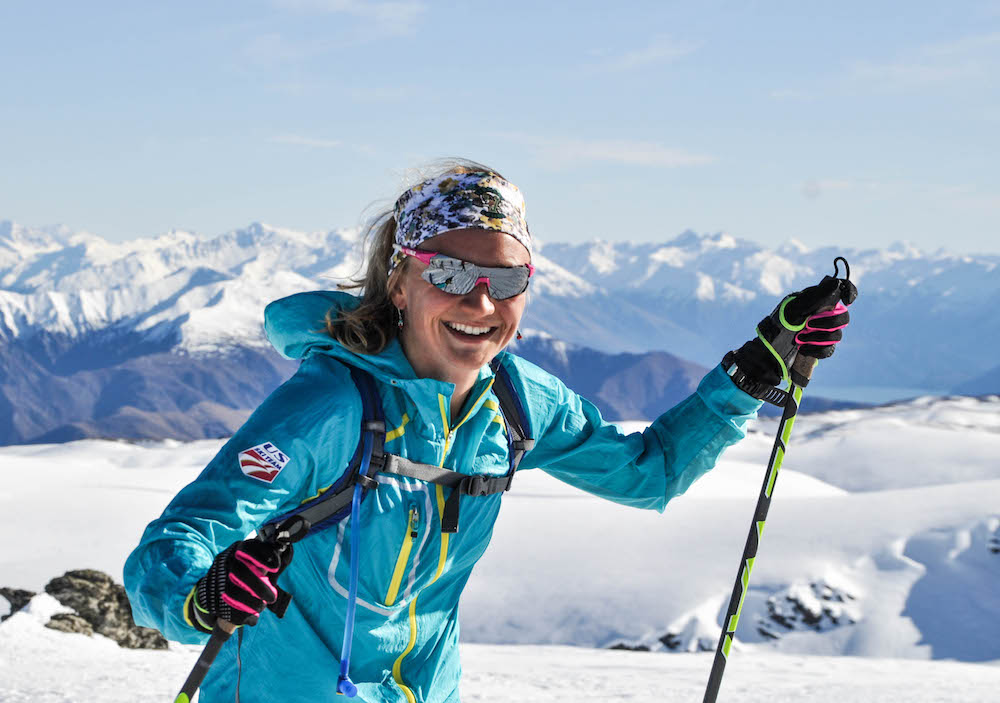
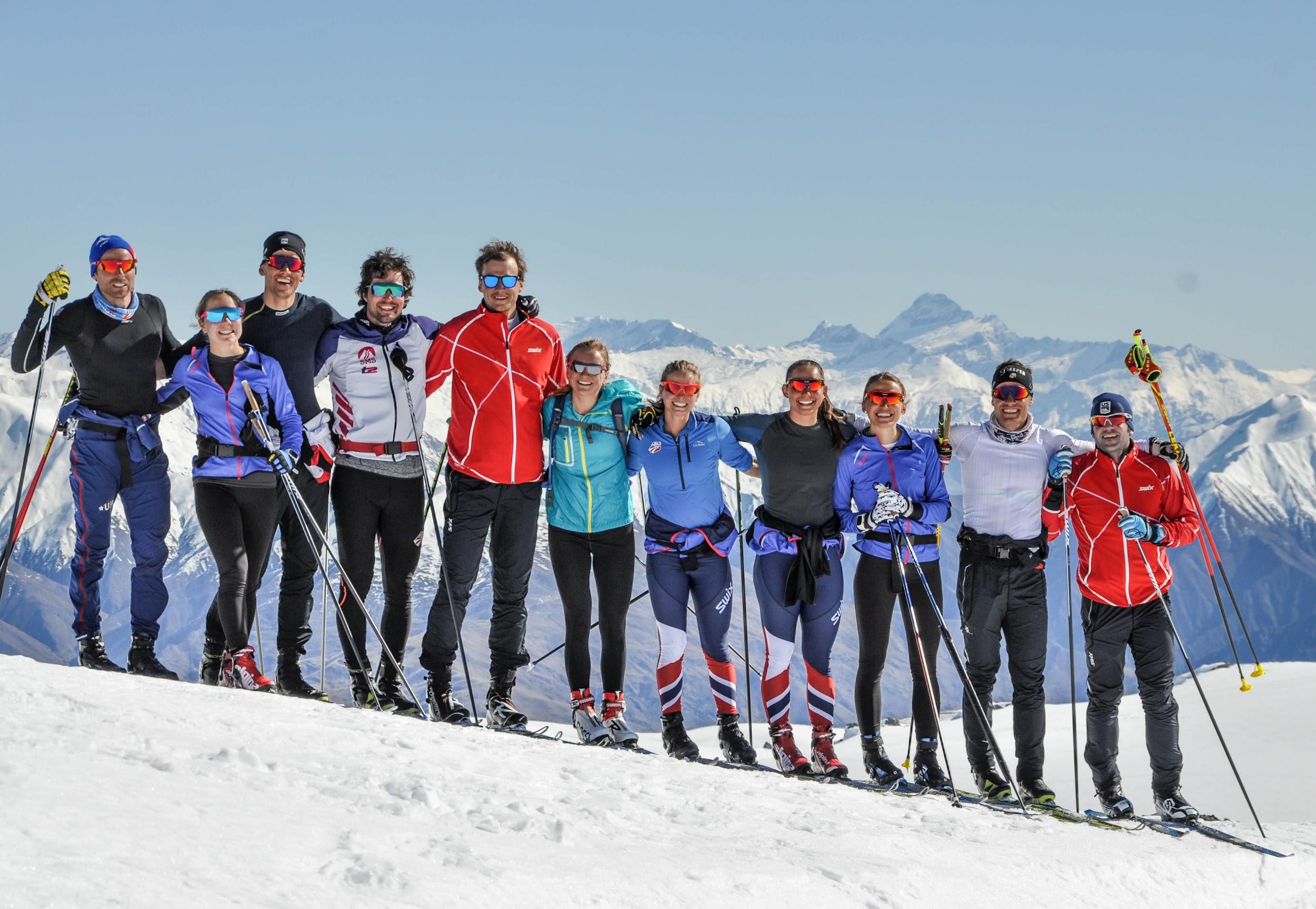
    2018 U.S. Ski Team camp at the Snow Farm in New Zealand, with author Alayna Sonnesyn (teal jacket) in the middle of the group shot. (Photo: Matt Whitcomb)

    The following was written by Alayna Sonnesyn, a new member of the Stratton Mountain School (SMS) T2 Team who graduated from the University of Vermont (UVM) this past spring.

    Originally from Plymouth, Minnesota, Sonnesyn, 22, raced on the UVM Ski Team for four years and qualified for four NCAA Skiing Championships teams. She placed second and third in two races at 2017 NCAA Championships, and in her senior season, won the first five Eastern Intercollegiate Ski Association (EISA) races and went on to reach the podium in 10 out of 11 EISA races. Sonnesyn expressed an interest in exploring the dilemma many of the nation’s top skiing talents face out of high school: whether to attend college or get an early jump on a pro-racing career. She plans to post this two-part series on her blog as well.

    ***

    For the first time in 17 years I will not be going back to school this fall. Saying that out loud is more daunting than I had anticipated. For the most part, the classmates that I graduated with can say that they are “going to grad school,” “starting a new job,” or “taking a year off to travel,” but I still don’t know where I lie. I am not taking any classes this year, I am not working anywhere consistently, and I am doing more than just traveling to explore, I’m traveling to race!

    I am wrapping up a three-week training camp in New Zealand with the SMS, Craftsbury, and US Ski Team. When I walked through customs I had to write down my reason for visiting New Zealand: Was I a student? Was I visiting a family or friend? Was I working? What was my job? In the rush of the moment and due to habit, I wrote that I was still a student and continued on my way. I later had a few reflections; I still haven’t reached the point yet where I can say I have a job. I don’t have a salary and there are no company benefits. Yet, I work 24/7 toward my job — my job is ski racing. But why is this so hard for me to admit to myself? Is it because, for my entire life, I’ve been a student? What if I hadn’t taken this route? How do others make this decision?

    National Training Group (NTG), summer 2013, in Park City, Utah.

    Racing throughout high school, I was given a number of perspectives about picking skiing versus school. My friends were all preparing to go to college and I always assumed I would go to college, too. My parents and older sister went to school, why wouldn’t I go as well? But then I thought about skiing. I never had the most outstanding results in high school (never qualified to race internationally), but I was good enough to qualify for regional and national level camps like REG, NEG and NTG. I traveled to these camps and trained with other high-level athletes, getting more and more motivated by each skier or coach that I met. Then the thought came to me… what if I didn’t go to college? I could focus on training, make those vital steps toward international racing, and continue along the “pipeline” that so many Olympians had followed. Maybe I would make bigger jumps and improve my skiing exponentially? I was entering the unknown and I was unsure how to pick the right choice for me. Looking back on this four years later, I realize that I was far from alone in this predicament.

    buy clomid online, buy yaz online, yasmin buy online

    I have since had the opportunity to talk to a wide variety of skiers and competitors and have learned so much that I wish I knew in high school. It’s OK to be confused. It’s OK to make your own path. Every athlete is in a different situation, comes from diverse athletic and academic backgrounds, and has various goals that they hope to achieve post-high school.

    “I’ve always believed that the most important thing to remember when discussing the decision to go to school or not (or when to go to school) is that is it a completely individual decision and the right decision for one person might not be the right decision for the next.” — Sophie Caldwell

    Personally, I finally decided that taking a gap year might be too big of a jump for me. I wasn’t ready to focus on skiing and I had a lot of goals for myself academically. I decided to attend the University of Vermont and upon reflection, can admit that this was one of the best decisions of my life. Similarly, SMS teammate, Kelsey Phinney, went from high school in Boulder, Colorado, directly to Middlebury College.

    “The reason I chose Middlebury College was simple: I went to visit and I was ready to unpack and stay for good. I loved the people, the area, the ski team, and the classes I sat in on.” — Kelsey Phinney

    Carnival love, with Kelsey Phinney (top) and Katie Feldman.

    Kelsey and I both fell in love with our schools from the start and knew we were where we belonged. We took these college experiences as learning opportunities; maybe we wouldn’t have been ready to jump right into the professional circuit but we both determined this was the right path for us.

    “I loved the experiences I had on the Carnival circuit. Both good and bad times taught me a lot about life and skiing, and I felt like the balance of school and sport made me better at both,” Kelsey reflects.

    Similarly, Sophie Caldwell had her mind made up without the need to hesitate over a gap year or jumping into full-time skiing.

    “I chose to go to college right out of high school, and it was something I had always known I wanted to do. I knew there was a good chance I wanted to ski professionally at some point in my life, but when I was 18, I wasn’t ready to 100% commit to skiing,” Sophie, a Dartmouth graduate, explains.

    With academic goals in mind and the confidence to pursue skiing in the long run, sometimes there’s no need to question it. Going directly to college might challenge you more than you think and it might make you question what you’re doing. The balance of school and skiing is great, but it’s TOUGH! At least you worked through those challenges and figured out where you want to be though.

    “I definitely had my ups and downs throughout college and at times I considered not pursuing skiing after college, but by the time I entered my senior spring, I knew I wanted to give skiing professionally a shot and knew it was because it was what I wanted to do, not what I had to do,” Sophie notes.

    Over the course of four years, we were able to say goodbye to our homes, grow into adults and develop as skiers, allowing a much smoother transition into the professional racing circuit post-college. This decision to go right to college made sense for Kelsey, Sophie and me — it was simple; but I recognize that this choice isn’t as straightforward for everyone.

    ***

    “I loved my time at Burke and wasn’t quite ready to leave. I also didn’t know where I wanted to go to college as part of me wanted to go out west while part of me wanted to stay closer to home.”  — Ida Sargent

    The conflict of picking a school, a place we are willing to spend at least four years of our lives at, can be intimidating to anyone. Taking a year off to think and explore what motivates you once the structure of school is taken out of the picture can be extremely vital to one’s skiing longevity. Other times, this year off can be done to test out what skiing professionally is actually like.

    “I wanted to test out whether I could do only professional skiing.” — Katharine Ogden

    A feat that might sound easy to accomplish — ski, eat, sleep, repeat — can’t be THAT hard! But what happens when you suddenly put all of your time and energy into one goal?

    “Ironically, my gap year did not turn out even close to how I had planned or imagined!” reflects Julia Kern.

    Julia Kern with swollen legs after surgery, requiring A LOT of physical therapy during the summer.

    After facing an early summer surgery for compartment syndrome and then an untimely back injury in the fall, Julia notes that her gap year was extremely tough with plenty of lows and setbacks.

    Ida Sargent offers, “My PG year was a bit of a disappointment as I wasn’t as happy as I was expecting and I also didn’t feel like I made as big of a jump with my results as I had hoped.”

    “I think in hindsight it was a good philosophy but I think I approached it wrong. I didn’t do a good job securing other things to do besides training and was thus pretty bored, which led to me putting a lot of stress on skiing and racing,” says Katharine Ogden.

    Maybe taking a gap year isn’t as easy as it sounds? Coming face-to-face with this type of ski-focused intensity as an 18 year old can be challenging.

    “It showed me how much I really wanted to go to college,” offers Katharine.

    It can also be validating, as it can prove to oneself where they really belong at that point in their life.

    “It made me realize that I wasn’t ready to ski full time and I still needed balance in my life,” reflects Ida.

    What might be the most beneficial aspect of taking a gap year are the lessons you learn throughout. How to deal with the pressure, free time, potential obstacles, and how to respond when you’re suddenly put in an unfamiliar situation.

    “My gap year turned out to be far from ideal from a training/fitness standpoint, but I became very in tune with my body, learned how my body responds to training, became mentally tougher, and learned that I love the skiing lifestyle (even if it is tough sometimes) and that I want to ski at the highest level possible,” says Julia.

    Some things you just can’t learn in a classroom.

    Julia Kern (on table) still smiling!
    Julia Kern taking the time to think about something other than skiing during her gap year. (Photo: Julia Kern)

    How to pass the time away, when you have so much of it. (Photo: Julia Kern)

    After taking a gap year to figure out what skiing was like full-time; Ida, Katharine, and Julia attended Dartmouth College (via various routes):

    Ida states, “I started by going to school full time and I raced for Dartmouth for three years and then made the National team so I took my senior winter off to race for the USST and then I went back for a spring term my fifth year.”

    “One year in [as a traditional student], I am very happy at Dartmouth and racing the collegiate circuit last year reignited my love for the sport,” adds Katharine.

    While Julia contributes, “I chose Dartmouth because I wasn’t sure what skiing and school balance I wanted to have, but I did know that I wanted to be able to take terms off to race internationally.”

    Regardless of which Dartmouth plan they followed, all three skiers seem to have enjoyed the choices they made. Whether taking a gap year is or isn’t part of your plan, the most important takeaway is that you should TAKE SOMETHING AWAY! Learn something new about yourself, about skiing, or about classes you want to study.

    So what about other options for pursuing a ski career? Jessie Diggins and Andy Newell both chose to skip college and go straight into skiing. Stay tuned for my next post when I’ll include input from both of them as well as what U.S. Ski Team coach Matt Whitcomb has to say on this topic.

  • Under 23 Questions: Bill Harmeyer

    Under 23 Questions: Bill Harmeyer

    Bill Harmeyer (University of Vermont) racing at the Colby Carnival last month. (Photo: SkinnySki.com)

    In an effort to showcase the North Americans who competed at last week’s International Ski Federation (FIS) 2018 Nordic Junior/U23 World Championships in Goms, Switzerland, we asked those qualifying athletes several questions about themselves — actually, we had them fill in the blanks. Here we have 20-year-old Bill Harmeyer, of the University of Vermont, who represented the U.S. at his first U23 Worlds (after competing at last year’s Junior Worlds in Utah).

    Last week in Goms, Harmeyer placed 39th in the 15 k classic and 46th in the freestyle sprint.

    ***

    “My full name is Bill Harmeyer, but you can call me Bill.

    I was born in Burlington, Vermont, and raised in Underhill, Vermont, and I learned to ski at the farm behind my house.

    I spent the time between U.S. nationals and Junior/U23 Worlds nervously telling my teachers I’d be missing two weeks of classes, while maybe failing to mention I’d be missing more.

    Bill Harmeyer (University of Vermont) during an NTG camp training session last fall at Soldier Hollow in Midway, Utah. (Courtesy photo)

    The hardest/favorite/most awesome workout I did in the last training year to prepare for this was Trout Lake agility and OD TT with the Bend Endurance Academy.

    This is my first time in Switzerland and first (second including WJC in Utah last year) time racing internationally, and so far it’s been sweet.

    One difference I’ve noticed between Switzerland and the U.S. is the mountains are a bit different.

    Skiing and racing in the Alps is distracting, because you’re constantly looking around, and exhausting, because you just want to keep skiing. Usually racing at altitude is not too hard for me because I’ve done it before. There are some mountains around where I live.

    American Bill Harmeyer (University of Vermont) racing the first leg of the men’s 4 x 5 k relay on the last day of 2017 Junior World Championships at Soldier Hollow. After he tagged off in sixth, his team went on to finish ninth. (Photo: FlyingPointRoad.com)

    One of the things I’m most excited about for Junior/U23 Worlds in Goms is the chocolate. One race I’m especially targeting there is the skate sprint.

    I really hope I can chat/make friends with someone from Sweden and ask them if they’d like to trade suits.

    My favorite thing at the breakfast where we are staying is the cheese.

    Fondue is on my top 10 favorite foods list. The cheese here is fantastic. And the chocolate is also fantastic.

    If I had a totally free day here and didn’t have to worry about race fitness or training, I’d spend it exploring backcountry skiing or crust cruising while eating chocolate.

    The best way to follow me on social media is on Instagram @bllharmeyer1.”

  • Reese Hanneman Wins Qualifier, Second Sprint Title of Week at Nationals

    Left to right: Tyler Kornfield (APU), Reese Hanneman (APU) and Ben Saxton (SMS) as the top three finishers in the men’s 1.6 k classic sprint final on Monday, the last day of 2018 U.S. Cross Country Championships in Anchorage, Alaska.

    ANCHORAGE, Alaska — No two races are exactly alike, the saying goes, and there’s a lot of truth to this cliché. But if you step back just a little bit, two race days can start to look awfully similar to one another.

    For example, for the second time this week, a Hanneman brother won the sprint qualifier, Reese Hanneman won the final, and Alaska Pacific University (APU) put three athletes in the final and two on the podium on a perfect day for sprinting at Kincaid Park. That was the story on Monday, when Reese Hanneman led teammate Tyler Kornfield and Ben Saxton of the Stratton Mountain School (SMS) Elite Team across the line in the men’s classic sprint at 2018 U.S. Cross Country Championships. But it was also the case on Friday, when Reese was first and Kornfield was third in the freestyle sprint. It’s been a good week for the Hanneman family.

    The classic sprint, the final race of this year’s U.S. nationals, had a slightly more subdued feel than the three that preceded it.

    The fields were 50 percent smaller; a combined 160 athletes skied in the qualifier on Monday compared to 337 on Friday, as many juniors opted out of a race whose results did not bear on qualification for international trips and championship teams, and some athletes had already left town. The spectator numbers were smaller, measuring in the dozens rather than the hundreds after three days of packed parking lots and raucous crowds, as the first day of school following winter break sent local students back to the classroom. And the athletes were tired, too, after a full week of racing.

    “I was just running on fumes out there, especially after the 30 k yesterday,” fifth-place finisher Kevin Bolger, of the Sun Valley Ski Education Foundation (SVSEF) told FasterSkier after the men’s final.

    But cross-country skiers are nothing if not resilient, and so, just after 10 a.m., Dakota Blackhorse-von Jess (Bend Endurance Academy) once again led 95 men out onto the qualifying course at 15-second intervals. The temperature was 10 degrees Fahrenheit, according to the display on the stadium scoreboard. The sun had yet to rise and start burning off the morning’s dense fog. It felt cold.

    It’s a very quintessential Alaskan day,” women’s domestic podium bronze medalist Becca Rorabaugh (APU) said after. “It’s like an Alaska temperature, and I feel like a lot of the Alaskan teams have great skis, it’s hard-wax skiing, and it’s just a classic race day. It’s very Alaskan.”

    Hanneman Brothers Headline Qualifier

    https://www.instagram.com/p/BdsyQTkB945/

    APU skiers did very well in the time-trial portion of the morning, which has added, if not exclusive, significance for Olympic qualifying purposes slightly a month before the 2018 Winter Olympics begin in PyeongChang, South Korea.

    Reese Hanneman, 28, who grew up in Fairbanks, covered the brand-new, 1.6-kilometer sprint course in 3:21.93, a time good for the fastest qualifying mark on the day. And he did so by nearly three seconds. Next best was his APU teammate and younger brother, Logan Hanneman, 2.84 seconds back. Third was his APU teammate Tyler Kornfield, 4.23 seconds off Reese’s mark.

    Alaska Pacific University’s Reese Hanneman during the men’s 1.6-kilometer classic sprint heats on Monday at 2018 U.S. Cross Country Championships in Anchorage, Alaska. Hanneman won the qualifier and eventually, the final for the national title.

    The brothers Hanneman are skiing qualifiers well these days, to put it mildly. Logan, 24, won Friday’s sprint qualifier, with Reese qualified third.

    In light of the bonus points awarded for U.S. nationals podium performances, FasterSkier’s unofficial calculations put Logan first on the 2018 Olympic Winter Games domestic sprint qualifying list, with 80 points (45 for first at U.S. nationals and 35 for second), and Reese second, with 71 points (45 for first and 26 for third).

    In Monday’s classic sprint, Benjamin Ogden (SMS) was fourth in qualifying, 5.12 seconds back. Blackhorse-von Jess was fifth (+5.16), Zak Ketterson of Northern Michigan University sixth (+7.56), Cole Morgan (SVSEF) seventh (+7.61), David Norris of APU eighth (+7.85), Saxton ninth (+7.88), and Bolger tenth (+9.09).

    Just like the skate sprint, Brian Gregg, of Central Cross Country (CXC), Loppet Nordic Racing (LNR) and Team Gregg, was the final athlete to make the heats, 16.53 seconds back in 30th.

    “I would say all the top sprinting guys, everyone’s focusing kind of on the qualifier, more so than normal,” Reese said on Friday after he had qualified third in the skate sprint. “There’s no margin for error, and you just have to ski it absolutely as fast as possible. It’s definitely different tactics than in the heats… but if you’re fast, you’re fast.”

    Reese Hanneman Wins Everything En Route to Final

    On Monday, Reese was pretty darn fast. He won his quarterfinal, the first of the day, as well as his semifinal, the first of the day, to make the final with the maximum amount of rest possible. And then, of course, he won the final as well for his fourth national title — and second of 2018 nationals.

    In the day’s first quarterfinal, Reese was in the lead by the first turn at 200 meters, followed closely by Bolger. The two of them had a big lead by the time they were coming off Gong Hill. The rest of the field caught up to them somewhat by the finish, but Reese and Bolger still took the top two spots with relative ease.

    In the second quarterfinal, U18 skier Ogden led the field into the first turn, with Morgan and Bill Harmeyer, of the University of Vermont, right behind. Ogden was still into the lead coming back into the stadium, but Kris Freeman (Caldwell Sport) had caught up into third. Coming into the finish, Freeman won a four-way lunge for second over Thomas O’Harra (APU), Ben Lustgarten (CGRP), and Harmeyer. O’Harra’s third place in a fast heat was good enough to send him on to the semifinals with the day’s first lucky loser spot.

    In the third quarterfinal, Andrew Egger (Colby College) took the lead out of the stadium, but it was Blackhorse-von Jess in the top spot by the time they came back. Blackhorse-von Jess entered the finishing stretch with a 10-meter lead. Ketterson took second, 1.2 seconds back, with Egger another second back by the finish.

    From left to right: Logan Hanneman (APU), Like Jager (APU), Ben Saxton (SMS Elite Team) Nick Michaud (BSF), Scott Patterson (APU), and Jack Hegman (SVSEF) at the start of their quarterfinal in the men’s 1.6-kilometer classic sprint on Monday at 2018 U.S. Cross Country Championships in Anchorage, Alaska.

    In the fourth quarterfinal, Saxton and Logan Hanneman left the stadium with the early lead, alongside a quick-starting Luke Jager (APU), one of three U18 skiers who made the senior heats. It was Saxton in the lead coming back to the stadium two minutes later, with Logan leading Jager. Saxton came into the finishing stretch with a healthy lead, but Logan made a powerful move to pull around him and come alongside. Saxton won the heat by 0.37 seconds over Logan. Yesterday’s medalist, Eric Packer (APU), was out in third.

    The fifth quarterfinal was heavy on local pride, with three APU skiers and a fourth from University of Alaska Anchorage. Erik Axelsson (Montana State University) led Kornfield and Logan Diekmann (University of Utah) into the first uphill. But two minutes later it was all APU, with Kornfield, David Norris and Forrest Mahlen with a sizeable lead on the rest of the field. Kornfield took the win; Mahlen came around Norris for second, but Norris moved on with the day’s other lucky loser spot. Axelsson was nearly five seconds back of Norris in fourth.

    In the first semifinal, Blackhorse-von Jess flashed his ski speed and momentum by dropping into a tuck within the first 200-meter straightaway in the stadium, then still led the field over the top of the first, smaller climb. Ogden and Reese Hanneman were nearby. When they returned to the stadium, Reese had a 20-meter lead over Ogden on the downhill. As happened throughout the day, though, that lead shrank to half that size by the time the skiers entered the finishing stretch. But Reese still had the lead, which he held to the finish. Bolger was second, 0.32 seconds back. Ogden was relegated for obstruction.

    The second semifinal featured a predominantly blue color scheme, between four suits from APU and the blue accents on Saxton’s SMS suit. Saxton again led out of the stadium, with Ketterson and Kornfield close by. By the time they came off Gong Hill two minutes later, it was Kornfield in the lead, with Ketterson close behind him. Kornfield led into the finishing stretch, but Ketterson overtook him to place first in the heat.

    Behind them, Logan Hanneman made a strong push for third. He closed down Saxton, edging him by 0.04 seconds for third behind Ketterson and Kornfield. In practice, both Logan and Saxton advanced to the final as lucky losers; Norris’s fifth place in this heat would have won the day’s first semifinal by nearly a second.

    Reese Hanneman Wins Final, Again

    Slightly after 2 p.m., six men lined up in the south end of the Kincaid Stadium. From racer’s left to right, it was Logan, Kornfield, Ketterson, Reese, Bolger, and Saxton in the starting blocks. The sun was out, the temperature was in the high teens, and the course was firm and fast. There was no wind. Conditions were once more basically perfect.

    The field had a clean start at the sound of the starter’s pistol, double poling in six separate lanes over the first 200 meters slightly downhill through the stadium. As the racers turned right to go up the first hill it was the Hanneman brothers in the lead, with Kornfield immediately behind them and Ketterson to Kornfield’s right. The pack double poled up the first part of the climb, then strode up and over the top of the hill.

    A quick descent followed, then a high-speed, double-pole section leading to the start of the course’s main hill. Reese pushed the pace going up the hill, and not everyone was able to respond.

    “I basically started at the base of the big climb,” Reese recalled of the 24-meter vertical gain B-climb in the middle of the sprint course. “I just kind of led in the climb and then just threw down the hammer and just tried to drop everyone going up that thing, and just continue to pound it over the top and take it all the way home.”

    The largest climb on the course is “tough for classic skiing,” Bolger explained. “That hill definitely adds a different dynamic to your whole approach to every heat you do. To be able to ski up that hill four times, strong, it’s a challenge.” (Bolger added that he didn’t think anyone would have attempted to double pole a hill of that size, saying that “it’s a challenging enough hill to where it’s going to rule out double poling for anyone.” But just to be sure, race organizers placed a no-double-pole technique zone up the entire length of the climb for both the qualifier and the heats.)

    By the time the field descended the waterfall downhill back into the stadium, Reese had a substantial gap over Kornfield, who in turn had a sizeable lead over Ketterson.

    Kornfield made up some of this gap going down and around the final 180-degree turn, but Reese still entered the final straightaway with a sizeable lead. Saxton had moved into third, ahead of Ketterson, by the time they reached the 100 meters to go mark.

    Reese Hanneman (1) of Alaska Pacific University celebrates his second sprint title of the 2018 L.L.Bean U.S. Cross Country Ski Championships on Monday with a win in the classic sprint final, just ahead of teammate Tyler Kornfield (r) in Anchorage, Alaska. Ben Saxton (SMS Elite Team) rounded out the podium in third. (Photo: Michael Dinneen Photography)

    Kornfield barreled down the slight uphill of the finishing straight with grace and fury, closing in on Reese with each extension of his lanky frame. But he was still in the same finishing lane as his APU teammate, getting closer to Reese, but still immediately behind him. With roughly 20 meters to go, Kornfield moved one lane to his left, then lunged as he approached the finish. But Reese’s lead was still too much, and he crossed the finish with his second sprint national title of the week.

    Reese’s time for the final was 3:20.62. Kornfield was 0.2 seconds back in second.

    Some distance behind them, Saxton crossed the finish line in third, 4.78 seconds back of Reese, with a slight lead over Logan and Bolger. Ketterson finished sixth, 6.83 seconds back, in his second sprint final of the week.

    “I can’t let off at all,” Reese said, when asked what he was thinking when coming down the final stretch of a national championship classic sprint with a narrow lead over Kornfield, who won the men’s 30 k classic mass start in an all-out effort to the line the day before.

    “He is obviously on super-good form right now,” Reese continued. “I just have to know that I have a little more speed than he does. … But he’s really cranking right now. He is skiing great, but it definitely motivated me to know to just drive that thing so hard in the final.”

    The second national title in as many races was “an answer to a lot of prayers from this morning and in the heats,” Reese said. “I just feel really lucky and stoked that I could put it together and be in such good form right now in January. It was a great day, an amazing day.”

    Tyler Kornfield leads his APU teammate Forrest Mahlen in the men’s 1..6 k classic sprint on Monday at 2018 U.S. Cross Country Championships in Anchorage, Alaska.

    Although Kornfield was second today, he “probably got the all-around performance of the week for the men,” Reese said of his teammate. Kornfield reached the podium in every race this week save the opening 15 k freestyle individual start, where he was 14th.

    Kornfield’s race series was “a dream come true a little bit,” Kornfield told FasterSkier, “a little unexpected, but I knew I had it in me. The start of the season didn’t go as planned, I got sick for a month before it started, I also sprained my wrist for another month and so I was pretty frustrated with the lack of performances, but I knew there was something there and it was just a matter of time.”

    “In this sport there are a lot of ups and downs,” he continued, “and it’s really easy to get caught up in the downs and not realize that just because you have a few bad races doesn’t mean you lose your ability to succeed, so just have to keep your head up and keep trying and hoping for the doors to open.”

    When it comes to possibilities for potential Olympic selection, “I don’t know anything,” Kornfield said. “I can let you know in a couple weeks.”

    Mathematically speaking, Kornfield currently ranks second to APU teammate Scott Patterson on the most recent version of the Olympic selection distance points list, which reflects both distance races from U.S. nationals.

    For now, Kornfield plans to leave Alaska on Tuesday (that is, today) for a previously planned trip to Austria. He plans to work out precisely what races he will contest soon; he had planned on racing a Ski Classics marathon, but is currently uncertain where he will be racing next.

    While Kornfield’s week at U.S. nationals exceeded his expectations, Monday’s third-place finisher, Saxton, didn’t have the week he was hoping for.

    “I came here, like many people, with goals of heading to Korea and representing the country racing in the Games,” Saxton said after the final. “I fell short of that this week and that’s nothing to be ashamed of, but I was really disappointed I wasn’t in the mix as much as I would have hoped to be. This week was difficult because I don’t feel like I put forth a representative effort.”

    Saxton was quick to offer sincere congratulations to the skiers who had had more success this week.

    “I am incredibly proud to know and am happy for Logan and Scott and Reese and all of the other champions from this week,” he said, “and incredibly happy that those are going to be the skiers going to over to represent us. I think it’s just, from a personal standpoint, people can understand I was disappointed not to feel like I had my absolutely best days out there, but I am really proud to end the day on a podium, representing the hard work that all my teammates and my coach and the program at Stratton have done all year, and to reward them for that work and that effort is a great feeling.”

    Saxton also enjoyed the “playground mentality” of the sprint day.

    “I think a lot of the times racing we can get lost in the technical aspects of it,” he mused, “but one of the reasons I love racing heats so much is, it just kind of reminds me of being back in elementary school and pointing to something in the far end of the playground, basketball hoop, or whatever it is, and just saying, ‘Let me race you there.’ And there’s no rules, there’s no anything, it’s just the feeling of you and the other person just going all out, and that’s a beautiful way to live and that’s a beautiful way to compete, and sprints are a wonderful thing like that.”

    Strong Alaska Performances Throughout the Week

    What a difference a year makes. One year ago this week, in the classic sprint at Soldier Hollow, APU didn’t put any athletes into the heats for the first time in at least a decade, done in by a combination of illness, seeding, weather conditions, and wax choice. This time around, head coach Erik Flora’s squad sent eight men through to the heats, six to the semifinal, three to the final, and two to the podium.* 

    The classic sprint capped a successful week for APU, and for Alaskan skiers more generally. Caitlin Patterson, who skis for CGRP, took all four gold medals for the women. Then APU skiers took all four golds on the men’s side, between Scott Patterson on Wednesday, Reese on Friday and Monday, and Kornfield on Sunday. Chelsea Holmes, Kornfield again, Hannah Halvorsen, Rosie Frankowski, Eric Packer, Becca Rorabaugh, and Kornfield again also stepped on the domestic podium for APU. All told, that’s 15 out of a possible 24 medals going to athletes who hail from or ski in Alaska.

    (Although if you slice the data another way, there were also seven out of 12 possible medals in women’s races won by CGRP, between Patterson’s quadfecta and Kaitlynn Miller’s trifecta.)

    This week’s results “just show the depth” of the team, Reese told FasterSkier after his race. “It speaks to the hard work of our coaches, especially Erik Flora. That guy will not be outworked, he just puts so much into us. I’m just really happy that we can have a week like this and go four for four in the men’s with APU, just to show that what he is doing works and how hard he works for us. … To get to this point that we can do that and crush all week and just give them a good show is really rewarding.”

    “We’re all Alaska born-and-raised,” Reese added of the APU men. “Can’t beat that.”

    *(Full disclosure, this reporter skis on the APU Masters team, and receives direct coaching from Flora roughly once a year at Masters Camp.)

    Results: Final | Heats | Qualifier

    — Gabby Naranja and Ian Tovell contributed

    Highlights video by Max Romey Productions

    Replay on U.S. Ski & Snowboard live feed (start at roughly 1:21:00 into the video for the men’s final)

  • UVM Seeks Assistant Nordic Coach

    UVM Seeks Assistant Nordic Coach


    (Job posting)

    Assistant Nordic Ski Coach

    Job description: The University of Vermont (UVM) in Burlington, Vt., is seeking an assistant nordic ski coach to assist the head coach in performing the duties of managing the intercollegiate sport of skiing within the education mission of the University. Share in the responsibility of educating student-athletes to the value of sport as it becomes increasingly valuable in today’s society. Take directives from the head coach for all aspects of the competitive NCAA Division I program that relies on recruiting scholarship and non-scholarship student-athletes. Provide leadership and positive expertise in the teaching and tactical aspects of the sport. Demonstrate commitment to issues of social justice and diversity.

    Minimum qualifications: A Bachelor’s degree and one to three years of collegiate coaching experience in the sport of skiing required.

    Please go to the following link for job details and application instructions:

    www.uvmjobs.com

    For all other questions please contact Patrick Weaver at: patrick.weaver@uvm.edu

  • The Road to Jackson: UVM

    The Road to Jackson: UVM

    In Part IV of “The Road to Jackson”, three of the six University of Vermont (UVM) nordic skiers that qualified for 2017 NCAA Skiing Championships — Alayna Sonnesyn, Iris Pessey and Cully Brown — tell us about their seasons and how skiing has impacted their lives. Jana Klaiber, Ian Moore and Juri Miosga are also headed to NCAA’s, which will be held Thursday and Saturday at the Jackson Ski Touring Center in Jackson, N.H.

    “Time just flies so fast and I’m gonna be done soon, but I have so many good memories that I have no regrets.” — Iris Pessey

    See also: EISA season in review | Part I: Williams | Part II: UNH | Part III: Colby

  • Under 23 Questions with Alayna Sonnesyn

    Alayna Sonnesyn (University of Vermont) racing to 33rd in the women's 10 k freestyle at 2017 U23 World Championships at Soldier Hollow in Midway, Utah. (Photo: FlyingPointRoad.com)
    Alayna Sonnesyn (University of Vermont) racing to 33rd in the women’s 10 k freestyle at 2017 U23 World Championships at Soldier Hollow in Midway, Utah. (Photo: FlyingPointRoad.com)

    In an effort to showcase the North Americans competing at this week’s International Ski Federation (FIS) 2017 USANA Nordic Junior World Championships and U23 Cross Country World Championships at Soldier Hollow in Midway, Utah, we asked those qualifying athletes several questions about themselves — actually, we had them fill in the blanks. Here we have 20-year-old Alayna Sonnesyn, of the University of Vermont, who’s representing the U.S. at her first U23 Worlds. On Thursday, she finished 33rd in the women’s 10 k freestyle. She’s listed as a starter for Saturday’s 20 k skiathlon.

    ***

    “My full name is Alayna Sonnesyn, but you can call me Alayna. I was born in Plymouth, Minn., raised in Plymouth, and one thing you should know about my hometown is it’s in the land of the lakes (donchya know?).

    UVM's Alayna Sonnesyn during a trail run in Seward, Alaska, last summer. (Courtesy photo)
    UVM’s Alayna Sonnesyn during a trail run in Seward, Alaska, last summer. (Courtesy photo)

    I started cross-country skiing when I was three, thanks to my parents. I currently train in Burlington, Vt., with the University of Vermont.

    If I’m not skiing, you might find me studying chemistry. If I had to pick a favorite book, it would be ‘The Outlander‘.

    One of the things I’m most excited about for U23/Junior Worlds at Soldier Hollow is it’s in AMERICA! One race I’m especially targeting there is the skiathlon.

    The best advice anyone ever gave me about skiing or racing was have fun. One of the best race memories I have is skiing at my cabin with my family.

    If I could meet one World Cup skier, it would be Heidi Weng.

    If I don’t end up being a professional skier, I’ll probably be a pharmacist.

    I’m missing six days of school to be here, and my professors are probably thinking, ‘Good luck.’

  • Morgan Gets What He Came For, 9th in U23 Classic Sprint

    American Cole Morgan (11) racing alongside Russia’s Alexander Bolshunov (1) in the men's semifinal of the U23 World Championships classic sprint on Tuesday at Soldier Hollow in Midway, Utah. (Photo: FlyingPointRoad.com)
    American Cole Morgan (11) racing alongside Russia’s Alexander Bolshunov (1) in the men’s semifinal of the U23 World Championships classic sprint on Tuesday at Soldier Hollow in Midway, Utah. (Photo: FlyingPointRoad.com)

    Two weeks after being officially selected to the U.S. team for 2017 senior World Championships, which will be held later this month in Lahti, Finland, 22-year-old Cole Morgan still felt like he had something to prove, goals to chase, races to qualify for.

    That’s where U23 World Championships came in. For Morgan, a former University of Vermont skier who graduated last spring and began a professional racing career with the Sun Valley Ski Education Foundation (SVSEF) in Sun Valley, Idaho, his goal for the one race he was competing in at his first U23 Worlds was to finish in the top 12 — which would secure his spot at 2017 World Cup Finals, according to the U.S. Ski Team’s selection criteria.

    So he went after it on Tuesday at Soldier Hollow in Midway, Utah, racing to 11th in the men’s 1.5-kilometer classic-sprint qualifier, 8.19 seconds off the fastest time set by Russia’s Alexander Bolshunov in 3:36.52. Morgan went on to take second in his quarterfinal, 0.85 seconds behind Bolshunov in first, and fifth in his semifinal for ninth overall.

    “Coming into these championships already having qualified for World Champs honestly didn’t really take of any of the pressure to perform,” Morgan wrote in an email after Tuesday’s sprint.

    He had drawn the attention of U.S. coaches and earned the final men’s sprint spot on the U.S. World Championships team in a tiebreak, based on his SuperTour results, according to U.S. Head Coach Chris Grover.

    “If anything I feel like I put more pressure on myself because I felt that I had to prove that I deserve that spot and really wanted to show that I can mix it up with guys with World Cup experience,” wrote Morgan, who has never started a World Cup.

    Once he had successfully achieved a top 12 by making the semifinals, “I just wanted to give it my best in the semi and see how far I could go,” Morgan wrote.

    His quarterfinal strategy had been to stick behind Bolshunov.

    “I had a really good start and was able to tuck right in behind him right after the start,” Morgan explained. “From then on I just skied behind him for the rest of the course and remained in contact over the last climb. I had some of the fastest skis out there today and was able to come around him on the outside into the finish but didn’t have as much left in the double pole finish.”

    Bolshunov crossed the line first in 3:38.13 and Morgan followed in second to automatically advance to the semifinal. Behind him, Slovenia’s Miha Šimenc finished third (+1.2) and the second American in the heat, Paddy Caldwell was fourth (+6.17).

    American Paddy Caldwell (20) racing to fourth in his quarterfinal at Tuesday's U23 World Championships men's classic sprint at Soldier Hollow in Midway, Utah. He ended up 18th overall, his best sprint result at U23 Worlds. (Photo: FlyingPointRoad.com)
    American Paddy Caldwell (20) racing to fourth in his quarterfinal at Tuesday’s U23 World Championships men’s classic sprint at Soldier Hollow in Midway, Utah. He ended up 18th overall, his best sprint result at U23 Worlds. (Photo: FlyingPointRoad.com)

    Caldwell, of the Stratton Mountain School (SMS) and U.S. Ski Team D-team, was one of three U.S. men to reach the rounds after qualifying in 20th (+14.68). With his quarterfinal result, he ended the day in 18th for his best sprint result by 25 places at his third U23 World Championships.

    Morgan’s Sun Valley teammate, Jack Hegman qualified 23rd (+15.59) and finished sixth in the last quarterfinal, 5.71 seconds behind Norway’s Chrisander Skjønberg Holth in first. That put Hegman 28th overall at his first U23 Worlds (after having competed in 2014 Junior Worlds). Cal Deline (Dartmouth) narrowly missed the heats after placing 31st in the qualifier, 0.14 seconds out of 30th.

    In the first men’s semifinal, Norway’s Fredrik Riseth, who had qualified fourth and won the first quarterfinal, beat Bolshunov to the line in 3:35.21. The Russian finished 0.28 seconds back in second, Norway’s Joachim Aurland followed in third (+0.68), and Russia’s Alexey Chervotkin (who spent the better part of this season on the World Cup) was fourth (+2.8). Morgan finished fifth (+9.67), ahead of Sweden’s Axel Ekström, also a World Cup skier who finished 32nd in the Tour de Ski, in sixth (+10.74).

    Morgan explained that he used his quarterfinal strategy in the semifinal and was in a good position until the downhill before the last climb.

    “I was just too blown out from my quarter to push the last hill at all,” he wrote. “I was in sixth off the back at the top but was able to make up some good time on the downhill and the finish with my skis to move into fifth.

    “I’m really happy with this result as I met my goal for the championships and felt good about where I’m at with my skiing,” Morgan added. “This is my only event this week so I was stoked to have a good one.”

    Next on his agenda: the 34 k Boulder Mountain Tour on Feb. 4 in Sun Valley before leaving for Finland on Feb. 16.

    Norway's 21-year-old Fredrik Riseth (4) celebrates his U23 World Championships classic sprint win on Tuesday, which he took by 1.05 seconds over Russia’s Alexander Bolshunov, at Soldier Hollow in Midway, Utah. Riseth won the classic sprint two years ago at 2015 Junior Worlds. (Photo: FlyingPointRoad.com)
    Norway’s 21-year-old Fredrik Riseth (4) celebrates his U23 World Championships classic sprint win on Tuesday, which he took by 1.05 seconds over Russia’s Alexander Bolshunov, at Soldier Hollow in Midway, Utah. Riseth won the classic sprint two years ago at 2015 Junior Worlds. (Photo: FlyingPointRoad.com)

    Meanwhile on Tuesday, the four men who finished ahead of Morgan in the semifinal plus Russia’s Andrey Sobakarev and Norway’s Holth (who placed first and second, respectively, in the second semifinal) advanced to the final. There, Riseth — who won the Junior Worlds classic sprint two years ago — beat Bolshunov again for the overall victory in 3:32.78. Bolshunov took silver, 1.05 seconds back, and Norway had two on the podium with Aurland in third (+2.3).

    Canada’s Evan Palmer-Charrette (NTDC Thunder Bay) was 0.92 seconds out of qualifying in 33rd (+18.21). He led Canadian teammates Julian Smith (NTDC Thunder Bay) in 34th (+18.59), Scott James Hill (Team Hardwood) in 35th (+18.73), and Alexis Dumas (CNEPH) in 42nd (+30.79).

    Results: Qualifier | Brackets | Overall

    The men's classic sprint podium on Tuesday at U23 World Championships at Soldier Hollow in Midway, Utah, with Norway's Fredrik Riseth (c) in first, Russia’s Alexander Bolshunov (l) in second, and Norway's Joachim Aurland (r) in third. (Photo: FlyingPointRoad.com)
    The men’s classic sprint podium on Tuesday at U23 World Championships at Soldier Hollow in Midway, Utah, with Norway’s Fredrik Riseth (c) in first, Russia’s Alexander Bolshunov (l) in second, and Norway’s Joachim Aurland (r) in third. (Photo: FlyingPointRoad.com)
  • A New Chapter for GMVS with Rodgers, A New Start for SVSEF’s Gold Team with Mallory

    A New Chapter for GMVS with Rodgers, A New Start for SVSEF’s Gold Team with Mallory

    Colin Rogers (left) as the MC for Chris Mallory's (right) wedding. (Courtesy photo)
    Colin Rodgers (left) as the MC for Chris Mallory’s (right) wedding, September, 2015. The two coaches and former nordic ski racers were grew up about 15 miles away from each other in Vermont. (Courtesy photo)

    Their cars won’t literally pass on the interstate, but the image is worth rendering. Colin Rodgers, five years the head of the Sun Valley Ski Education Foundation (SVSEF) Gold Team, is heading back to his native Vermont to become nordic director for the Green Mountain Valley School (GMVS) in Waitsfield, Vt. (Rodgers is currently in Italy with GMVS leading a training camp.)

    Heading the opposite direction from Vermont to Sun Valley, Idaho, where he recently resigned as assistant coach at University of Vermont (UVM) after three years, is Chris Mallory — also a native Vermonter.

    It’s safe to say that Rodgers’s and Mallory’s lives are seperated by far less than six-degrees: the world of elite ski coaching is small and close knit. That their paths have crossed on their career transects isn’t odd at all when you consider something Rick Kapala, SVSEF’s longtime nordic director, said in a recent phone interview.

    “You know, somebody was asking me is it really hard to lose a guy like Colin,” Kapala reflected. “And of course the answer is yes … but all of our programs, whether you talk to APU [Alaska Pacific University], or whatever, it is part of the game that you if you have really good coaches, you are going to lose really good coaches because they are going to have opportunities to move to another level.”

    There’s two highly qualified and highly recommended coaches in Rodgers and Mallory — it’s no surprise opportunities have arisen.

    Colin Rodgers, formally head coach of the SVSEF Gold Team, has taken the job of nordic director with Green Mountain Valley School in Vermont. (Courtesy photo)
    Colin Rodgers, formally head coach of the SVSEF Gold Team, has taken the job of nordic director with Green Mountain Valley School in Vermont. (Courtesy photo)

    After captaining the Middlebury College Ski Team and graduating in 2004, Rodgers lived the professional skier’s life. He skied for the Gold Team from 2006 to 2011. Since that time, the Westford, Vt., native has been the lead waxer, travel agent, coach, and all-around, go-to leader of the Gold Team.

    According to Kapala, the first word that came to mind when asked about the indelible fingerprint Rodgers left on the Gold Program was: “professionalism”.

    “We have always prided ourselves as trying to run a really pro program,” Kapala said. “But Colin as an athlete, really, I feel gave everything he possibly had to his racing career and the same thing was true as a coach. He demanded a lot of himself in that role, held himself to a really high standard, … worked as hard as he could, cared so deeply about the program and the athletes and the process of getting to the highest levels. I really think that all the athletes that we had engaged in our program benefitted from the approach Colin had, which was leave no stone unturned … look for every advantage, bring your best every day, and I look at it and go, we were very fortunate to have him.”

    Rodgers, 35, takes over a transitioning GMVS program. Last October, longtime GMVS Nordic Director Justin Beckwith stepped down. 2010 Olympian Garrott Kuzzy took over with help from newly hired nordic coach Katrina Howe. Now, nearly a year later, Rodgers will take over a program with 13 athletes — comprised of nine men and four women. Howe will remain as a nordic coach. (According to Rodgers, Kuzzy will be pursuing an MBA in Innsbruck, Austria, this year. Kuzzy could not be reached for comment by press time.)

    Junior skiers are not elite senior skiers. Yet Rodgers mentioned that his core mission remains the same: building bonds.

    “Of course, I will need to make some adjustments to my approach to the younger athletes, but it is all truly about sharing my passion for the sport of cross country skiing,” Rodgers explained. “The age of the athlete is not so important, but rather that you share a common interest with the individual and you can pass along a bit of knowledge that will help them improve. Then you are making a difference. It is still all about building relationships and doing your best to support the team.”

    For Rodgers, directing a program is the biggest new opportunity beyond moving back to his home state. “Running a program in my home state seemed like a fun challenge that I was up for,” he said.

    Back in Vermont, a state with a rich and proud nordic tradition, Rodgers commented that one of his biggest hurdles at GMVS, a private high school, will be making the sport he loves more accessible.

    “The biggest challenge will be in trying to help kids join the program that may not have the financial means to do so,” he said. “Ideally, we want athletes at the school that have the drive to ski fast and work hard. Hopefully, those two un-biased character traits will allow any motivated student/athlete the ability ski for our program.”

    Gold Team rookies, Cole Morgan and Jack Hegman run above Twin Lakes in Idaho's southern Sawtooths, summer 2016. (Photo: Rogan Brown)
    Gold Team rookies Cole Morgan and Jack Hegman run above Twin Lakes in Idaho’s southern Sawtooths this summer. (Photo: Rogan Brown)

    For SVSEF’s Gold Team, the benchmark for participation isn’t overtly financial, it’s performance based. Be a motivated, willing-to-develop, fast skier and you might make the cut. And for the coach, there’s no study hall to schedule and monitor, less shuttling skiers back and forth.

    “One of the most important things [with this level of senior coaching] is you need to have somebody who has both the depth of experience but also the ability to really keep the ship level,” Kapala said from Sun Valley. “The senior athletes that we have that work with the Gold Team are all highly motivated, so it’s a little bit different than junior coaching. For the junior coaching, I have a lot of kids that are very, very early on in their ski racing career. So you do a lot of really base-level educating and motivating. … The problem with these Gold Team-type positions, whether you are talking our program, Stratton or APU or what not, you sort of have to be able to do everything.”

    With Rodgers’s exit from SVSEF, enters Mallory.

    After skiing at the University of New Hampshire, Mallory headed west to Sun Valley where he began coaching in 2006. That SVSEF stint, where he began as a development-team coach and progressed to head post-graduate coach, lasted eight years. In May 2013, he took the assistant coach position at UVM. He also served as a wax-tech on three separate Junior World Championships trips.

    According to Kapala, Mallory can do a bit of everything, making him a good fit for the Gold Team. The bonus: Mallory has a positive history with the local community. Although deciding to leave a program like UVM for the Gold Team was difficult according to Mallory. “It was a tough decision to leave UVM. There is a big incoming freshmen class this year with some good young energy and it’s hard to leave the athletes on the team who you’ve created relationships with after a few seasons, but these opportunities only come around so often.”

    Like Rodgers, Mallory enters his new position with some challenges. For the 34-year-old Mallory, his is entering a training season already in full swing.

    Chris Mallory on the Haig Glacier, Canadian Rockies. (Courtesy photo)
    Chris Mallory, in 2012, on the Haig Glacier, Canadian Rockies. (Courtesy photo)

    At this point I’m coming in halfway through the training season, so there is going to be a transition for myself and the team,” Mallory, a Colchester, Vt., native, explained in an email while packing for his move West. “It’s going to be important to establish good working relationships with each of the athletes, so they can reach their highest potential. Luckily I’ve worked with half the team in the past, so I look forward to building on those relationships and taking the time to create a strong team dynamic.” 

    For both Rodgers and Mallory their shared history with SVSEF may pay dividends for the broader U.S. cross-country culture.

    “Their will be a time when I’m not the program director here [at SVSEF], and I hope that what happens is the day after I leave, the program is moving just right ahead. Seamless. No hiccups at all,” Kapala reflected as he spoke about coaching changes and building programmatic legacies. “And that will be the sign that you’ve been able to develop a program which isn’t about a personality or one individual it’s about the strength of the program as a whole.”

    Rodgers and Mallory, who grew up about 15 miles away from each other, are on their way.

  • UVM Seeks Assistant Nordic Coach

    UVM Seeks Assistant Nordic Coach


    UVM Catamounts logo

    The University of Vermont (UVM) in Burlington, Vt., is in search of an assistant nordic ski coach to assist the head coach in performing the duties of managing the intercollegiate sport of skiing within the education mission of the University. Share in the responsibility of educating student-athletes to the value of sport as it becomes increasingly valuable in today’s society. Take directives from the head coach for all aspects of the competitive NCAA Division I program that relies on recruiting scholarship and non-scholarship student-athletes. Provide leadership and positive expertise in the teaching and tactical aspects of the sport. Demonstrate commitment to issues of social justice and diversity.

    Please go to the following link for job details and application instructions:

    https://www.uvmjobs.com/postings/21169

    For all other questions please contact Patrick Weaver at:   

    patrick.weaver@uvm.edu

  • ‘Fake It Until You Make It’, Flowers and Freeman First in Craftsbury SuperTour 10 k Classic

    ‘Fake It Until You Make It’, Flowers and Freeman First in Craftsbury SuperTour 10 k Classic

    Erika Flowers (SMST2) (r) getting a congratulatory hug after winning the women's SuperTour 10 k classic individual start on Sunday in Craftsbury, Vermont.  (Photo: John Lazenby/Lazenbyphoto.com)
    Erika Flowers (SMST2) (r) getting a congratulatory hug after winning the SuperTour women’s 10 k classic on Feb. 7 in Craftsbury, Vt. (Photo: John Lazenby/Lazenbyphoto.com)

    The pre-race flurry of ski racers running about wax trailers and tents.

    The tell-tale countdown beep indicating racers already on course.

    The nagging notion that this race will be just like the last: not terrible, but not the desired outcome.

    How does one put these distractions to rest, and instead, focus on the present?

    That’s how Erika Flowers — the overall winner of the SuperTour women’s 10-kilometer classic individual start this past Sunday in Craftsbury, Vt. — started the past two weekend’s of racing. How she finished them was a different story.

    “As a skier you set big goals and throw everything you have at them and sometimes you reach them but the truth is that sometimes you don’t,” Flowers of the Stratton Mountain School (SMS) T2 Team wrote in an email. “I didn’t have great races last weekend [in Lake Placid] but my goal never changed — I still wanted to win!” 

    After finishing some of her earlier races this season still hungry for more, Flowers explained that she entered the Craftsbury SuperTour weekend with the goal of “staying focused,” which left her bound and determined to summon a victory.

    Erika Flowers (SMST2) racing to a firs place finish in the women's SuperTour 10 k classic individual start on Sunday in Craftsbury, Vermont.  (Photo: John Lazenby/Lazenbyphoto.com)
    Erika Flowers (SMST2) racing to first place in the SuperTour women’s 10 k classic on Feb. 7 in Craftsbury, Vt. (Photo: John Lazenby/Lazenbyphoto.com)

    “I think finding ways to put racing in perspective and enjoy it is the biggest ‘secret weapon’ out there. I’m obviously not always happy with my results or a specific training session but sometimes you have to fake it until you make it,” she wrote.

    Reinforced by Saturday’s 5 k freestyle podium — and, according to Flowers, a little post-race cheesecake and a lot of water — Sunday found her fueled and raring to go.

    “I started fast and as soon as I saw Anne [Hart] ahead of me I was on a mission to catch her,” Flowers wrote of her teammate, who won the 5 k the day before. “She was also great today — she heard splits that I was in the hunt for the win and really pushed me the last two laps.

    “She started charging and basically tracking people and clearing traffic in front of me. That’s an awesome teammate right there,” Flowers added.

    With a cleared set of classic tracks ahead of her, Flowers cruised around the 4 x 2.5 k course to finish in 27:19.6, about seven seconds ahead of second place, for her first SuperTour win.

    “Today was my first SuperTour win ever and it feels so good!” she wrote. 

    Flowers found both focus and perspective on Sunday not only from within herself, but others competing on course as well.

    “This is the best job in the world and we are pretty lucky to get to do it everyday. I was also completely inspired by one of my friends who recently lost his dad but had a smile on his face all weekend, just happy to have the opportunity to ski and race. That is perspective if you need some,” she wrote.

    “I think finding ways to put racing in perspective and enjoy it is the biggest ‘secret weapon’ out there.” — Erika Flowers, Craftsbury SuperTour 10 k classic winner

    Two other new faces, at least to this year’s SuperTour podium, were Craftsbury’s own Liz Guiney (Craftsbury Green Racing Project) and Stratton’s Julia Kern, a U.S. Ski Team D-team member.

    Kern and Guiney both finished 7.4 seconds off of Flowers’ time in a tie for second.

    “Racing at home is always great, can’t beat sleeping in your own bed!” wrote Guiney, who not only celebrated a second-place finish, but her 25th birthday on Sunday.

    With her mother, stepfather, and Craftsbury GRP Head Coach Pepa Miloucheva out cheering on course, along with plenty of skiers around her during the race, Guiney kept her focus.

    “There were probably around 100 racers on the loop at once between the college skiers, elite skiers, and juniors, and it almost felt like a mass start at times,” Guiney wrote. “I started out 15 seconds behind Rosie Frankowski from APU who was double poling on skate skis.”

    Left to right: Julia Kern (SMST/USST), Erika Flowers (SMST2), and Liz Guiney (CGRP) after taking second, first, and second respectively in the women's SuperTour 10 k classic individual start on Sunday in Craftsbury, Vermont.  (Photo: John Lazenby/Lazenbyphoto.com)
    First and a tie for second: Erika Flowers (c) of the SMST2 Team won the SuperTour women’s 10 k classic on Feb. 7 in Craftsbury, Vt., and was joined on the podium by Julia Kern (SMS/USST), left, and Liz Guiney (CGRP), right, who tied for second. (Photo: John Lazenby/Lazenbyphoto.com)

    Though a few other women chose to double pole the course on skate skis, Guiney opted for classic skis. She and Frankowski raced the rest of the course together.

    “It was great having some back and forth where I would get ahead on the uphills and then she would catch up on the flats, and I think forced me to push harder than I might have if I were on my own,” she added.

    It wasn’t until she and Frankowski crossed the finish line together, that Guiney realized she was tied for second place.

    “On the last hill my coach Pepa told me I had to go for it, and it wasn’t until I crossed the line that I figured out I had tied for 2nd,” she wrote.

    Kern, who shared the second step on the podium, also chose to race on classic skis.

    “I am very glad I was on classic skis because I had perfect kick and glide, thanks to our great wax techs,” she wrote.

    A course with minimal striding and maximal transitions, Craftsbury’s 10 k classic course played to Kern’s strength: indefatigable double poling.

    “One of my strengths is the ability to ‘muscle through it’, so my double pole felt pretty strong today,” she wrote. “I also would say I am pretty experienced with transitions since I grew up skiing on the Weston Ski Track golf course [outside of Boston], which has a lot of turns and flatter terrain.”

    Despite not classic skiing since last Sunday’s 10 k in Lake Placid due to New England’s “lack of snow, tricky waxing conditions,” Kern found her body responding well during Sunday’s classic race.

    Julia Kern (SMST/USST) (l) chases Brandy Stewart (r) during a lap of the women's  SuperTour 10 k classic individual start on Sunday in Craftsbury, Vermont.  (Courtesy photo)
    Julia Kern (SMS/USST) (l) chases Brandy Stewart (r) during a lap of the SuperTour women’s 10 k classic on Feb. 7 in Craftsbury, Vt. (Courtesy photo)

    “My body felt surprisingly good today. I felt pretty strong in the arms for the double pole section and my legs felt pretty springy,” she wrote.

    Even so, Kern did not leave the day unchallenged, earning her spot with the top podium contenders.

    “One of the challenges for me today was the lack of rest. The course is very much a steady output course with no long downhills to recover. I had to pick spots where I would tuck a little longer than I should so I could catch my breath,” she wrote.

    After the two second-place finishers, Chelsea Holmes of Alaska Pacific University (APU) crossed in fourth, 19.7 seconds back from Flowers.

    “These past two weeks have been fun with great racing in the East!” Holmes wrote in an email.

    After racing two weekends on the World Cup in Europe, Holmes described her transition back to the U.S. as going fairly well.

    “Honestly the jet lag was a little harder coming back than going, but I think it all chalks up to plenty of racing combined with a quick trip with a big time change, basically it just caught up to me,” she wrote. “Other than that it’s been good, and I certainly am extremely glad that I had the opportunity to race the World Cup in Czech, I would have travelled to Europe just for that.” 

    Freeman Finds His Form in the 10 k Classic

    Left to right: Cole Morgan (UVM), Kris Freeman (Team Freebird), and Jørgen Grav (UVM), standing on the podium in second, first, and third respectively for the men's SuperTour 10 k classic individual start on Sunday in Craftsbuty, Vermont. (Photo: John Lazenby/Lazenbyphoto.com)
    The SuperTour men’s 10 k classic podium on Feb. 7 in Craftsbury, Vt., with Kris Freeman (Team Freebird) in first (c), Cole Morgan (l) of the University of Vermont in second and his UVM teammate Jørgen Grav (r) in third. (Photo: John Lazenby/Lazenbyphoto.com)

    Not many individuals know their own bodies better than athletes. Not many athletes know their bodies better than Sunday’s overall SuperTour winner in the men’s 10 k classic individual start, Kris Freeman.

    In preparation for Sunday’s 10 k classic event, which he won in a time of 23:30.8, Freeman listened to what his body told him to do.

    “I cooled down well after the skate race and stretched for about an hour before bed. I was still sore and tight this morning so I did some yoga this morning and warmed up for about and hour and half before the classic race,” he wrote in an email on Sunday.

    “I wanted to be free of any twinges in my hamstrings and lower back because I knew I was going to double pole the race,” he added.

    Kris Freeman (Team Freebird) (r) leads Jørgen Grav (UVM) during the men's SuperTour 10 k classic individual start on Sunday in Craftsbuty, Vermont. (Photo: John Lazenby/Lazenbyphoto.com)
    Kris Freeman (Team Freebird) leads UVM skier Jørgen Grav (297) during the SuperTour men’s 10 k classic on Feb. 7 in Craftsbury, Vt. (Photo: John Lazenby/Lazenbyphoto.com)

    Though viewed by many as an athlete and a Type-1 diabetic, when it comes to racing, Freeman no longer distinguishes himself between the two.

    “Diabetes is always a challenge to control.  It is impossible to know how much of a role it plays when things go bad so I no longer try to separate it from my training and performance,” he wrote. “When I am rested and feeling good my glucose is more stable and I ski well. When I am tired and ragged the opposite happens.” 

    Thus, he entered Sunday as an athlete ready to climb back to the top.

    “I really wanted to hit the early season in great shape. Instead I exhausted myself before the season even started. I have been working on rebuilding since US Nationals,” he explained.

    However, he made the right call on Sunday, and double poled to first overall in the 10 k. Last month, Freeman also double poled to a victory in a 30 k classic marathon, the White Mountain Classic in Jackson, N.H., beating Tad Elliott by 1 second.

    Finishing 6.6 seconds after Freeman was University of Vermont (UVM) skier Cole Morgan.

    Morgan, currently a senior at UVM, also chose to double pole Sunday’s SuperTour course in Craftsbury.

    “This course is kind of a perfect opportunity for me. I’m usually strong in short, flat classic races with a lot of double pole and today was just that,” Morgan wrote in an email.

    With not much time to work into the race, Morgan wasted no time getting out from the start.

    “My tactic today was to start fairly hard and try to build throughout the race. There’s not much time to ease into it when it’s such a fast course,” he wrote.

    While Morgan was the first UVM skier on Sunday’s men’s SuperTour podium, as well as the first college skier in the Eastern Intercollegiate Ski Association (EISA) race, UVM recorded another podium finish with Norwegian Jørgen Grav finishing third, 10.7 seconds back from Freeman.

    Jørgen Grav (UVM) (l) double poles ahead of Eric Packer (APU) (r) during the men's SuperTour 10 k classic individual start on Sunday in Craftsbuty, Vermont. (Photo: John Lazenby/Lazenbyphoto.com)
    UVM’s Jørgen Grav (l) double poles ahead of APU’s Eric Packer (296) during the SuperTour men’s 10 k classic on Feb. 7 in Craftsbury, Vt. (Photo: John Lazenby/Lazenbyphoto.com)

    “Extremely fun to have Cole up there on the podium with me in his first career college win, he has worked incredibly hard for that and there is no one who deserves it more,” Grav wrote in an email.

    Deciding to double pole for the first time and starting 15 seconds ahead of Freeman, Grav found his hours spent double poling in the summer all worthwhile.

    “Since the course was so flat most people decided to double pole it. Super fun to try that for my first time and since Freeman started only 15 seconds behind me I got a pretty good ride with him for a lap,” Grav wrote.

    “I did focus more on DP this summer and it looks like that paid off!” he added.

    With the conclusion of the season’s fourth SuperTour event, many SuperTour racers’ paths diverge for a bit, some heading home for volume training.

    “Despite the poor New England winter, Waterville Valley has had skiable snow since I have been home.  I always enjoy putting in volume training there and I have responded well to it so far,” Freeman wrote.

    Even though low snow presently plagues much of the east coast, most racers remained grateful to the volunteers and race crew and all they did in hosting the SuperTour event.

    “Craftsbury has done an amazing job with the course out here, pulling off some amazing trails in spite of nature’s refusal to cooperate,” Holmes wrote.

    Results: Women | Men

  • An Insider’s Look at the 2015 Blink Festival With UVM’s Jørgen Grav

    An Insider’s Look at the 2015 Blink Festival With UVM’s Jørgen Grav

    Grav racing on the EISA circuit. (Photo: Jørgen Grav)
    Jørgen Grav of the University of Vermont racing in an Eastern Intercollegiate Ski Association (EISA) race. (All photos courtesy of Grav)

    The 2015 Blink Festival brought many of the world’s best cross-country skiers together for three days of rollerski racing in Sandnes, Norway. But the festival is much more than just a race for World Cup level athletes. There are open races for junior athletes ages 11 to 20, as well as opportunities for those with low enough International Ski Federation (FIS) points to race against the best seniors in the world.

    Anyone can try to sign up for the high-caliber race series, but because it has grown to be so popular, the 150 athletes with the lowest FIS points get chosen for the senior races. This year, one of them was 23-year-old Jørgen Grav of the University of Vermont (UVM).

    Grav was born and raised in Oslo and is training at home in Norway for the summer before his senior year at UVM. He lives just five minutes away from the Holmenkollen ski jump and works at a nearby boat-classification company that certifies and insures large ships. He has an agreement worked out with his employers where he gets a week off every three weeks or so in order to more effectively train for his senior year of college racing. His work schedule also gave Grav an opportunity to compete in this year’s Blink Festival.

    He began the festival with a strong showing in the Lysebotn Opp. He finished 45th in the 7-kilometer uphill rollerski race, ahead of household names like Petter Northug and Finn Hågen Krogh. The UVM Catamount described the location of the race in Lysebotn, located at the end of a fjord, as one of the prettiest places in Norway.

    The men begin the climb during the Lysebotn Up. (Photo: Jørgen Grav)
    The men begin the climb during the Lysebotn Opp.

    “[The race] starts at sea level and it literally goes straight up for 640 meters and it has 27 switchback turns. It goes through 1.1k of tunnel, and the first k is completely flat. So it’s basically all that climbing in 6 k,” Grav said in a recent phone interview. “At least we do it on number 1 wheels, because it would be brutal on number 2 wheels.”

    The fastest racers in the Lysebotn Opp, Finland’s Matti Heikkinen, Russia’s Alexander Legkov and France’s Maurice Magnificat, manage to V2 the entire climb, which has an average incline of 10 percent. Grav was able to V2 most of the race, but had to take a few breaks and switch to V1, he said.  His effort was good enough to put him within five minutes of the leaders and shatter his personal record from three years earlier.

    “I finished at least two minutes faster than what I did three years ago so I am super happy about that and anything less than five minutes behind those guys up a tough course like that you should be satisfied with,” Grav said.

    Friday and Saturday brought two more days of rollerski racing and other events in downtown Sandnes. One such event was the shooting duel, a range-focused event for the biathletes where they run about 10 meters to the shooting mat, shoot five targets as quickly as possible, and then run 10 meters back to the finish. The event goes quickly, with the winning times for both the men and the women being under 20 seconds.

    “Its really entertaining; it’s good TV I think,” Grav stated about the shootout format.

    A part of the race course in Sandnes. (Photo: Jørgen Grav)
    A part of the race course in Sandnes.

    For those who attend Blink in person, like Grav, there are some added perks. The festival has a VIP tent with live music and bleachers set up all the way around the 900-meter course so spectators can enjoy the action. The organizers even temporarily pave part of a pedestrian-only street so the race goes right by the fans. They also add bridges and turns to keep it exciting for spectators.

    Because of the tight course setup, Friday’s mass start could only accommodate 30 racers. World Cup skiers get a free pass to the final, but the rest of the participants have to qualify with a short, two-lap race to determine the remaining spots. There were only 12 available, and Grav finished 15th, missing the final by seconds.

    “I wish [the World Cup skiers] all had to race the qualifier so we all had the same chance, but I think it’s good in a way because then in creates more exposure [for the sport] on TV,” Grav said.

    He had strong races on Thursday and Friday, but met some trouble in Saturday’s sprint qualifier — and he wasn’t alone. Rain poured down all day, making an already technical course very slippery.

    “I was way off. I couldn’t ski properly and I think a lot of people just didn’t want to race because it was not safe,” Grav said about the sprint. He finished 30th in the preliminary round, but much like the mass start, some spots in the heats were reserved for World Cup athletes who bypassed the qualifier. As a result, Grav’s 30th place was not enough to put him in the heats.

    A look from above at a concert during the festival. (Photo: Jørgen Grav)
    A look from above at a concert during the festival. (Photo: Jørgen Grav)

    Though there are many things about Blink that Grav enjoyed, he said the kids in attendance were one of the highlights. They all get a chance to race, and then they stay to cheer on their idols and get autographs.

    “They love standing around outside of the finishing area and are up in your face for getting you to sign their bib number or their autograph book and everything,” Grav said. “You feel like a real celebrity. It’s super cool.”

    The energy from the spectators also impressed the incoming college senior, though at a rollerski festival in Norway, he didn’t expect much less.

    “It feels like a festival with people that love skiing,” he explained.

    Grav also attended last week’s Toppidrettsveka, where he finished 41st overall. He said feels he is in his best shape ever because he has been able to focus on his training and has a fast group of peers keeping him motivated and setting strong examples. Grav also feels he has made some promising technique changes this summer.

    “I’ve been switching more over to increased double poling in my training which is the development of the sport right now, more upper body strength,” he said. “I think that is going to be a big thing this winter.”

    Looking ahead to this winter, his main goal is to place in the top three at the 2016 NCAA Skiing Championships in Steamboat Springs, Colo. Last season, Grav finished ninth in the 20 k classic mass start.

    Some kids racing at the 2015 Blink Festival. (Photo: Jørgen Grav)
    Some kids racing at the 2015 Blink Festival.

    As for after college, Grav plans to continue skiing. He will try and reach one of the recruit teams for the Norwegian National Team and then ultimately hope to get selected to the team. Grav knows it’s a tall order, but as long as he continues to love skiing, he sees no reason to end his career.

    “It’s the toughest country in the world to get on the national team so its definitely a commitment to get all the way there, but as long as I have the motivation in the spring every year to start up a new year then I am probably going to keep going!” Grav said.

  • Former USST Racer Davis Finds Success in Soccer

    Former USST Racer Davis Finds Success in Soccer


    Skyler Davis competes at the 2014 U.S. Cross Country Championships at Soldier Hollow. Davis retired from skiing following the championships and took up soccer at UVM. He was recently named captain of the team for the 2015 season.
    Skyler Davis competes at the 2014 U.S. Cross Country Championships at Soldier Hollow. Davis retired from skiing following the championships and took up soccer at UVM. He was recently named captain of the team for the 2015 season.

    In 2011 Skyler Davis made headlines by claiming third place in the 1.4 km classic sprint at the U.S. Cross Country Championships in Rumford, Maine. This was just the beginning of a successful year for the then 19-year-old, which ultimately ended with a naming to the U.S. Ski Team D-team. In 2012 Davis’ success continued with a standout-24th place in the freestyle sprint at his second ever World Cup in Canmore, Alberta. In 2013 the former SMS T2 skier had another successful U.S. Cross Country Championships, qualifying second in the 1 km classic sprint before finishing just off the podium in fourth.

    Though he did not reach his goals at U23 Championships that year in Liberec, Czech Republic, Davis was hungry for a bounce back in 2014. However, the young skier virtually disappeared from the cross country ski world after nationals in Soldier Hollow, Utah. As it turns out, Davis was ready to go back to school.

    “School was the biggest deciding factor for me,” Davis said in a phone interview. “I loved my team [and] I loved my coaches, Gus [Kaeding] and Sverre [Caldwell], at the time when I did retire. I was in a really good situation actually because the T2 Team had just started to really send off. We were doing well, we had a good group of guys, the coach was great, but I really wanted to enter school before another Olympic year went by.”

    “If I made the Olympics I would keep skiing and then probably enter [school in] the fall and if I didn’t, I would stop skiing and enter the spring semester which started I think honestly 12 to 24 hours after senior nationals ended that year,” he added.

    Even though Davis was headed to school, he didn’t want to leave athletics completely behind. Searching for a continued relationship with sport, he turned to an old passion of his, soccer. “As I viewed it, it was my chance to stay at a really high level…Soccer was something I had a really strong background in. I was very raw going back into the sport but it definitely was what I was looking for,” Davis, who played on northern Vermont’s premier soccer teams throughout elementary and middle school, stated.

    Prior to the of the 2014/2015 ski season — knowing that he might not qualify for the Sochi Olympics — Davis met with many division 1 soccer coaches and ultimately decided that the University of Vermont (UVM) was the right fit for him. “The deciding factor with UVM was the coach, I really love the coach, and I really like the team,” Davis said.

    Though Davis was ineligible to play until the following year, he was allowed to join the team for practices and training, which proved to be a challenge. Suffering from ailments ranging from shin splints to back problems, Davis worked to transition from low-impact skiing the high-impact movement required in soccer. That, in combination with intense lifting sessions, left Davis wondering if he would be able to reach the level required for large university soccer program. “That was definitely an interesting two plus months where I was like, I might get cut. I really wasn’t sure,” stated Davis.

    But the former cross country ski racer took on the challenge, and managed to impress the coaches and the team enough to maintain his roster spot for the following year. Still, he was ineligible to play in the fall and patiently waited for his chance this past spring. “Once the spring started up for games, we play about six games in the spring, I was able to actually carve out a roll on the team at center back so I actually played every minute of every game in the spring,” said Davis.

    This past June, Davis was named as one of the two captains for the upcoming season — something he credits to both his relationships with his teammates and some lessons he learned from skiing.

    “I think nordic skiing definitely helped me as far as being a good role model and leader for the team because with nordic skiing you have that work ethic that surpasses basically any other sport,” Davis said. “There definitely are moments where it brings me back to my nordic skiing training where we will be doing intervals which are obviously a little bit differently tailored, but the get me excited compared to other people.,” said Davis.

    In a recent press release by the University’s athletic department, the program’s staff had nothing but praise for the former USST member.

    “Skyler is a natural born leader who has a tremendously positive impact on the program from day one”, Head Coach Jesse Cormier said. “He has established himself as a strong, mature voice in the locker room and is an exemplary student. He has made amazing progress in training, his game has changed so much and is reflective of the consistent growth we have seen from the group as a whole. I’m excited for Skyler to play in his first match, he was waited a long time and prepared well to say the least.”

    The newly named captain is currently in Burlington, Vt. preparing for the upcoming season. “It has been ratcheting up pretty quickly,” Davis said. “Basically every day we train together. We have about half the team here now and preseason starts in about a month, so everyone is filtering in soon…Once we get about 20 to 25 guys we can really make it competitive with playing and training.”

    Though the  2015 soccer season at UVM is currently his biggest athletic focus, Davis certainly has not forgotten about his love for skiing. “Hopefully, after I’m done with soccer I’ll be able to get back to skiing and other more nordic ski related activities,” he said.

  • Stella Holt Examines Fixture of Nordic Community in ‘Fred.’

    Stella Holt Examines Fixture of Nordic Community in ‘Fred.’

    It is a well-known fact that everyone knows each other in the nordic community. If you haven’t met another skier or coach first-hand, you likely already know something about them. But what happens when the person cheering you on from the sidelines becomes more than just a friendly acquaintance?
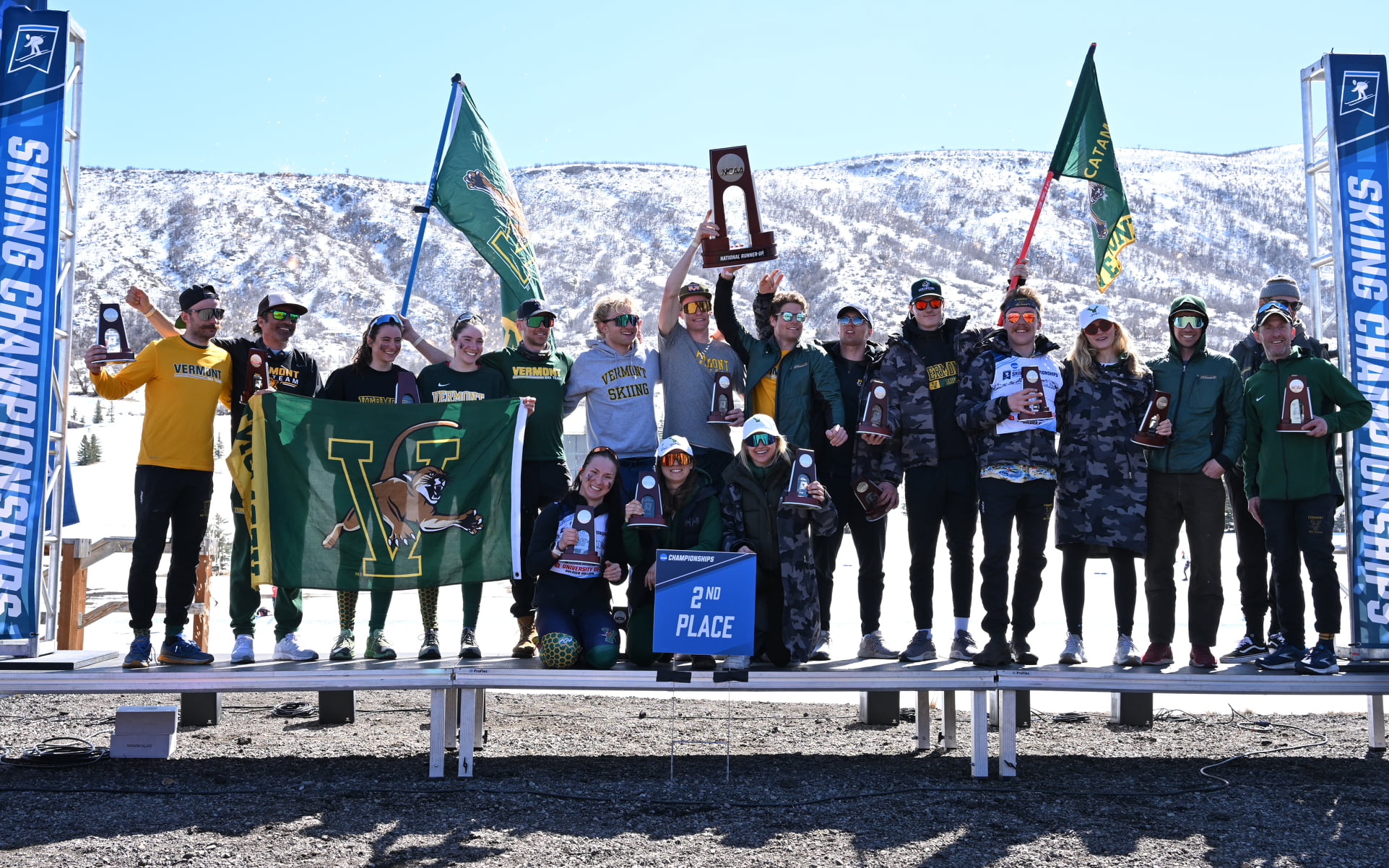
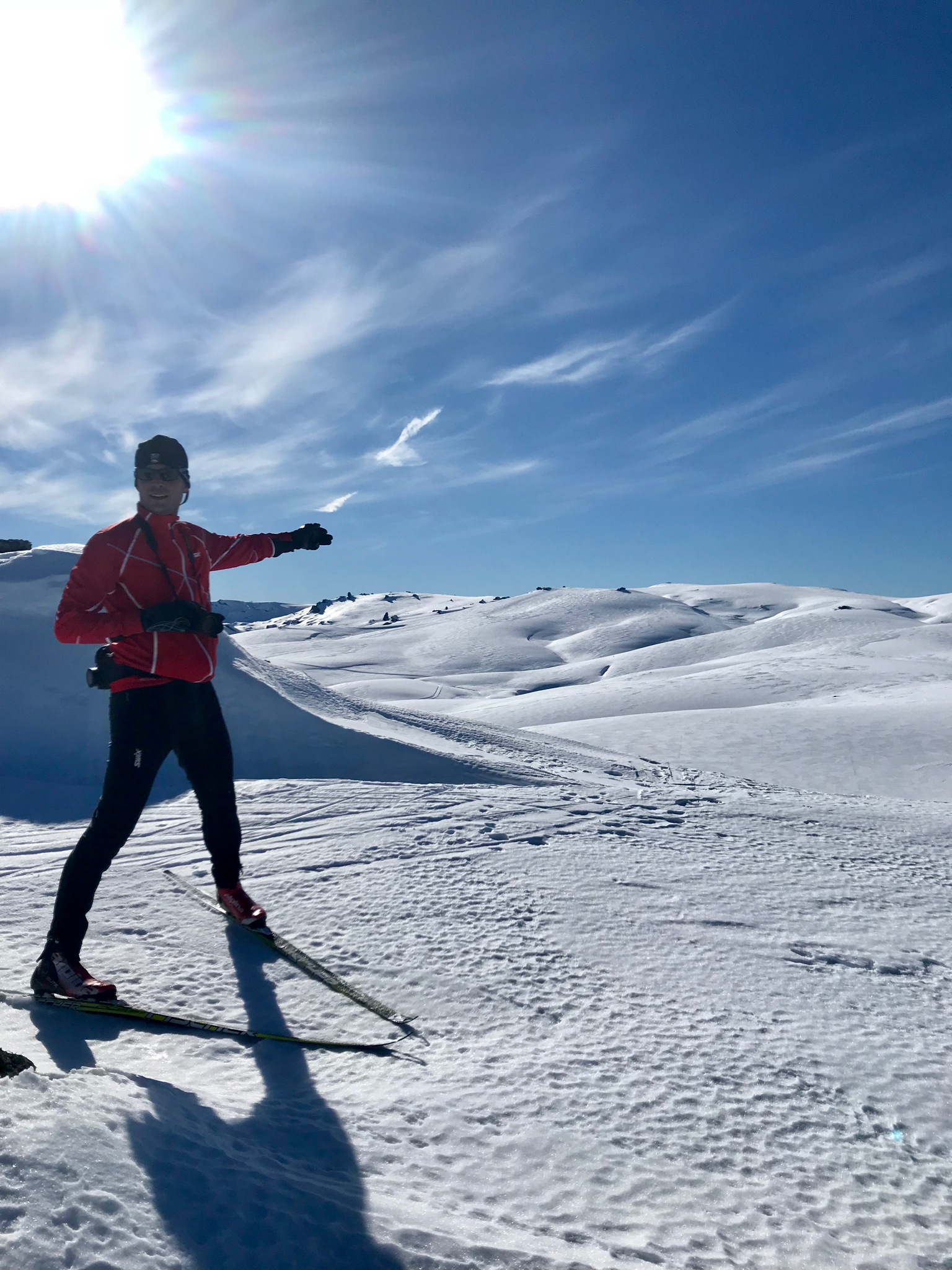
    That’s exactly what former Middlebury College skier Stella Holt set out explore in her film, Fred.

    Fred Fayette, a volunteer assistant coach to the University of Vermont ski team and former racer, had been on Holt’s radar throughout her college career as “the cheerful guy that gives everyone splits on the course.” However, it wasn’t until she heard the many stories of Fayette circulating the eastern collegiate circuit, that she realized there was more to the lighthearted assistant than she could have imagined.

    “It wasn’t until I scratched the surface of the incredibly rich life Fred leads that I realized he would be a compelling subject for a documentary project,” Holt wrote in an email. “I was drawn to Fred as the subject of my thesis as his story gave me the opportunity to produce work that intertwined my experience on the Middlebury Ski Team with my passion for filmmaking.”

    As the production of the film progressed, Holt realized a 15-minute documentary solely focused on the assistant wouldn’t do Fayette justice. Following advice from her instructors, she shifted the project to include a personal touch. Planning to coincide the end of her racing career with her graduation from Middlebury, Holt was conflicted about leaving a sport that had defined much of her life. She was able to overcome her apprehensions by combining her experience with the story of Fayette.

    “In doing so, making the film quickly became a means of digesting my own anxieties about leaving the competitive side of skiing behind,” Holt said.

    The 13-minute documentary delves into Fayette’s entrance into cross country competition at UVM, his research boat – the Neptune, meeting his wife, and the importance of a team. For Holt, the film serves as a way to communicate her love of the nordic community through the narrative of Fayette.

    “His understanding of skiing and of the way in which we move in and out of various spheres in our lives was particularly helpful and relevant for me in anticipation of graduation from Middlebury,” Holt added. “While I have always known that I will stay connected to skiing in some way, Fred was essential in helping me articulate what is most important to me about the sport and my own experiences.”