From the FasterSkier archive — posts syndicated from athletes’ and coaches’ own blogs between 2004 and 2012, kept online as published. Current coverage is at fasterskier.com.
This World Cup coverage is made possible through the generous support of Marty and Kathy Hall and A Hall Mark of Excellence Award. To learn more about A Hall Mark of Excellence Award or to learn how you can support FasterSkier’s coverage please contact info@fasterskier.com.
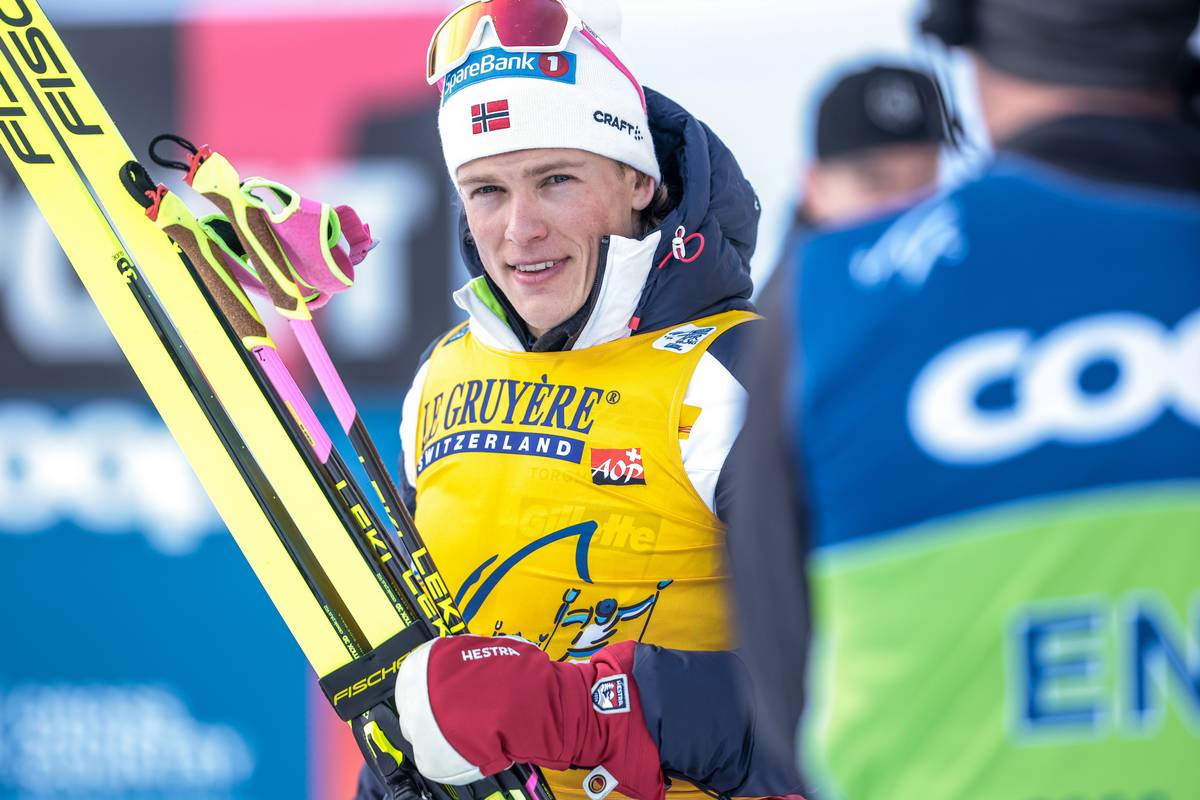
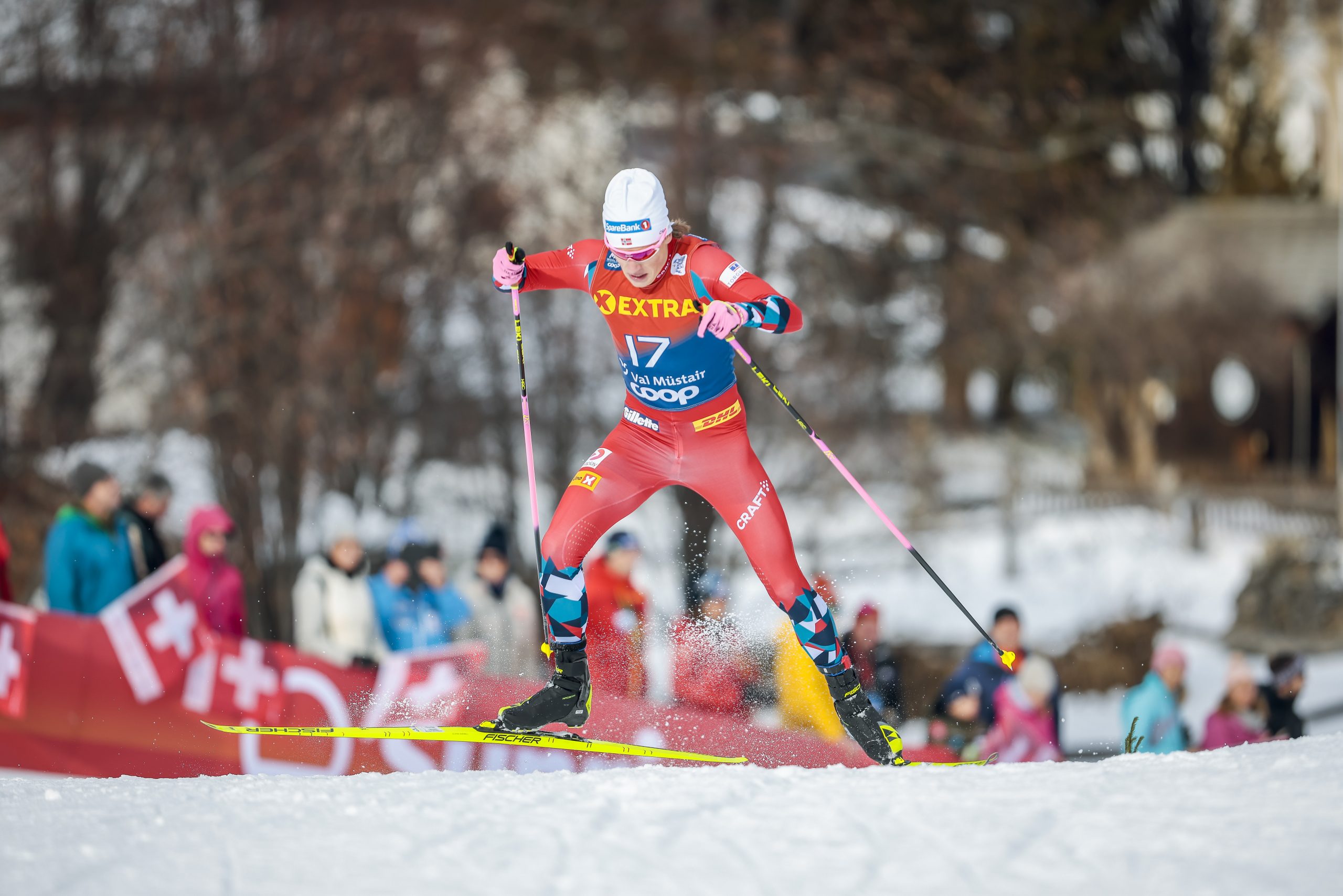
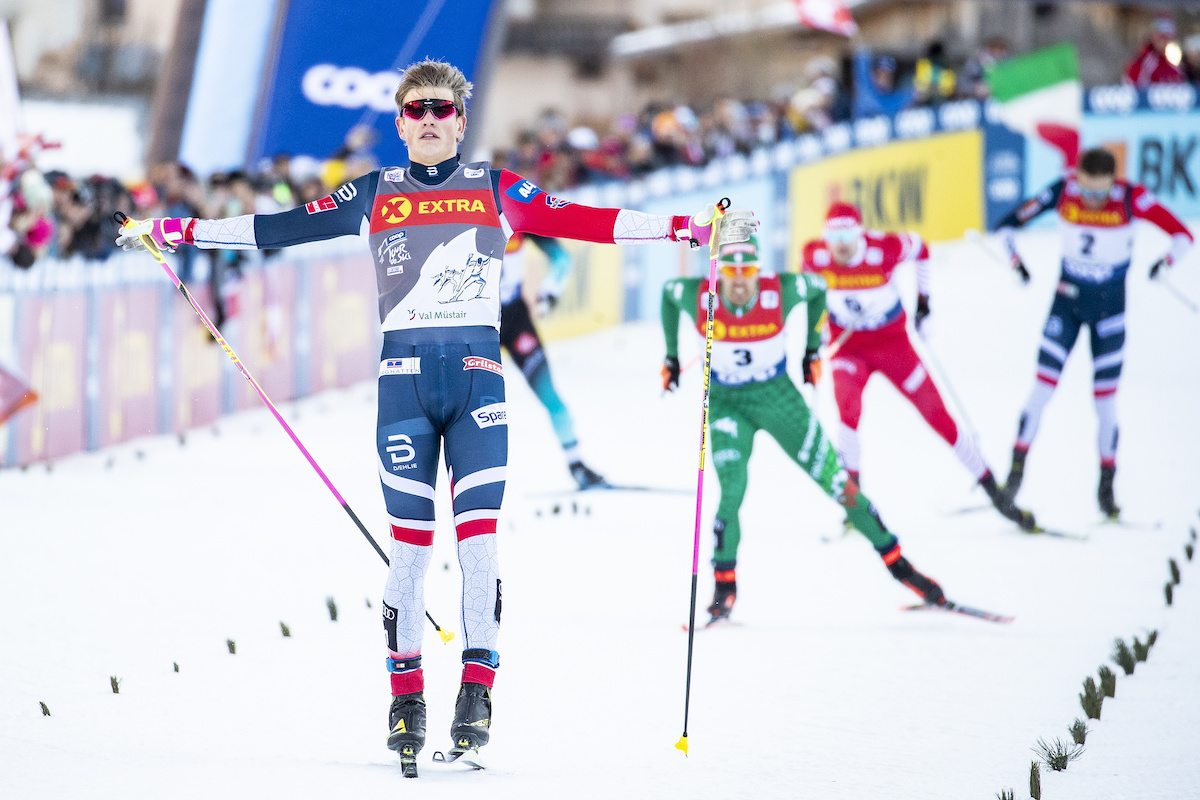
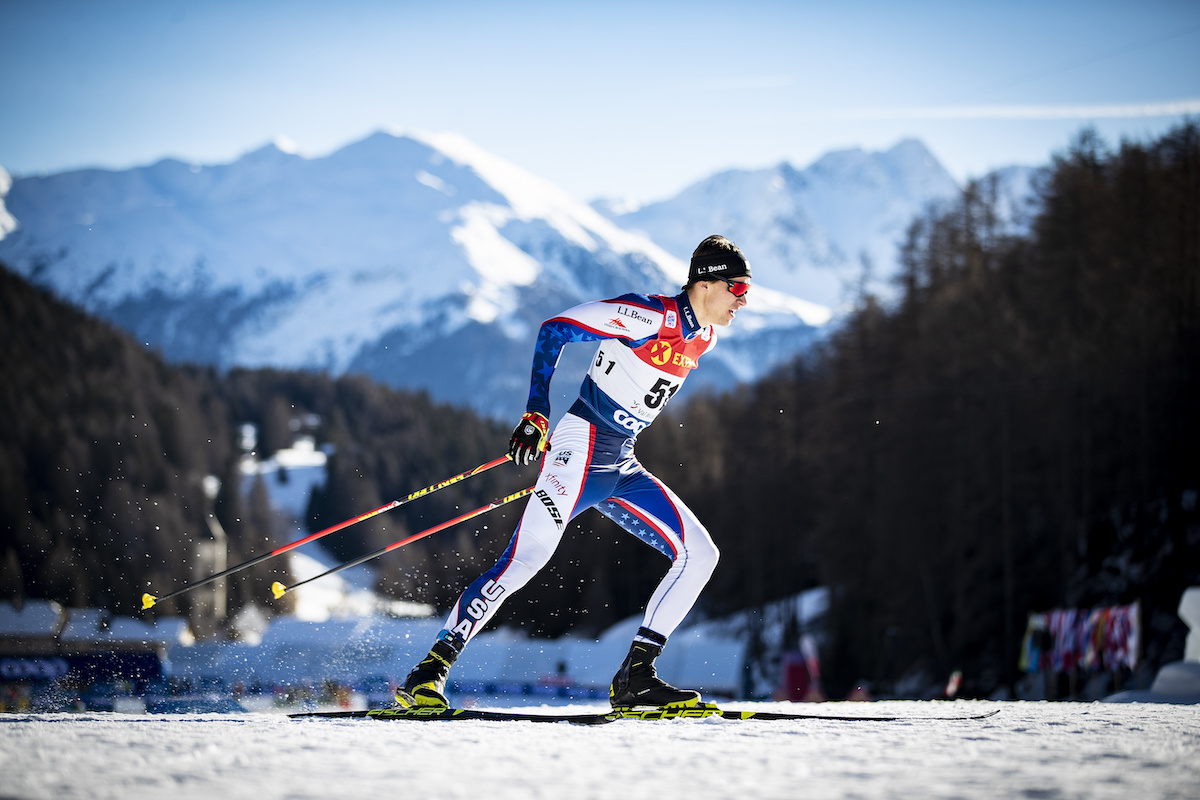
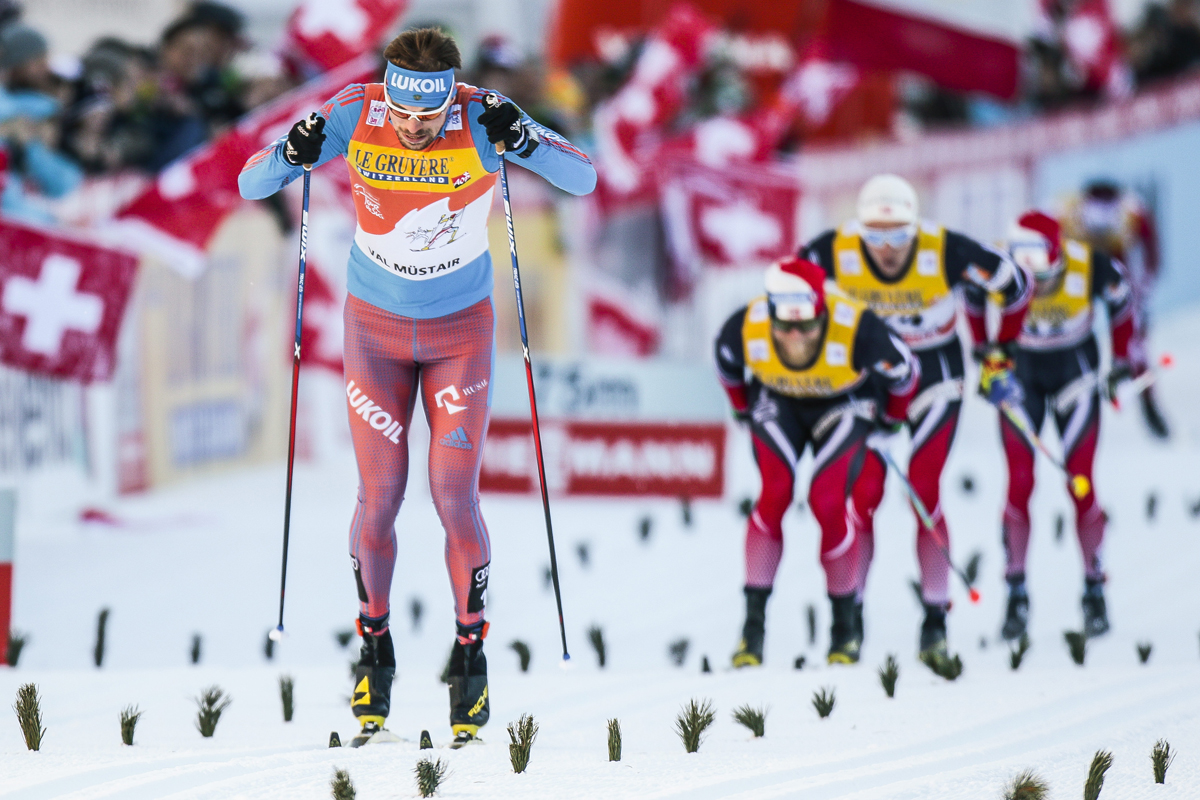
Johannes Hoesflot Klaebo (NOR) strides solitary at the front of Stage 2 of the Tour de Ski in Val Mulstair. (Photo: Nordic Focus).
There’s Johannes Hoesflot Klaebo, and then there’s everyone else: that’s what was proven in Sunday’s 10 k Pursuit at the Tour de Ski in Val Mustair, Switzerland.
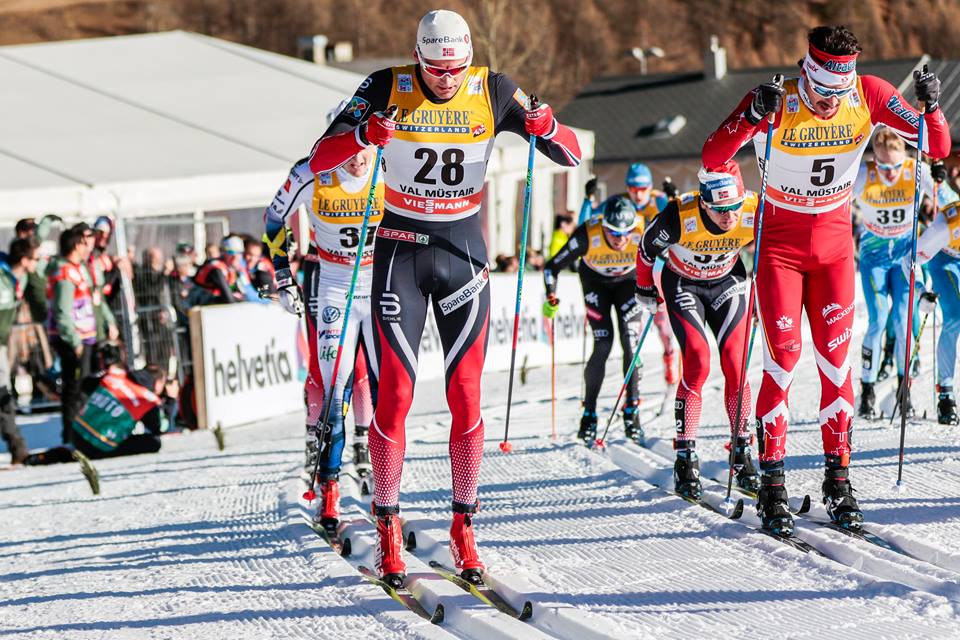
There were the usual darts, pushes, and pulls in the Men’s pursuit field that started in an order derived from yesterday’s individual skate sprint results. Eyes were on which Norwegians—Paal Golberg, Hans Christer Holund, Didrik Toenseth, and Sjur Roethe—would shoot through the pack after finishing down in yesterday’s rankings. Iivo Niskanen (FIN) was sure to do what he does best: classic ski. The American Ben Ogden would look to hold onto a strong position for the Americans.
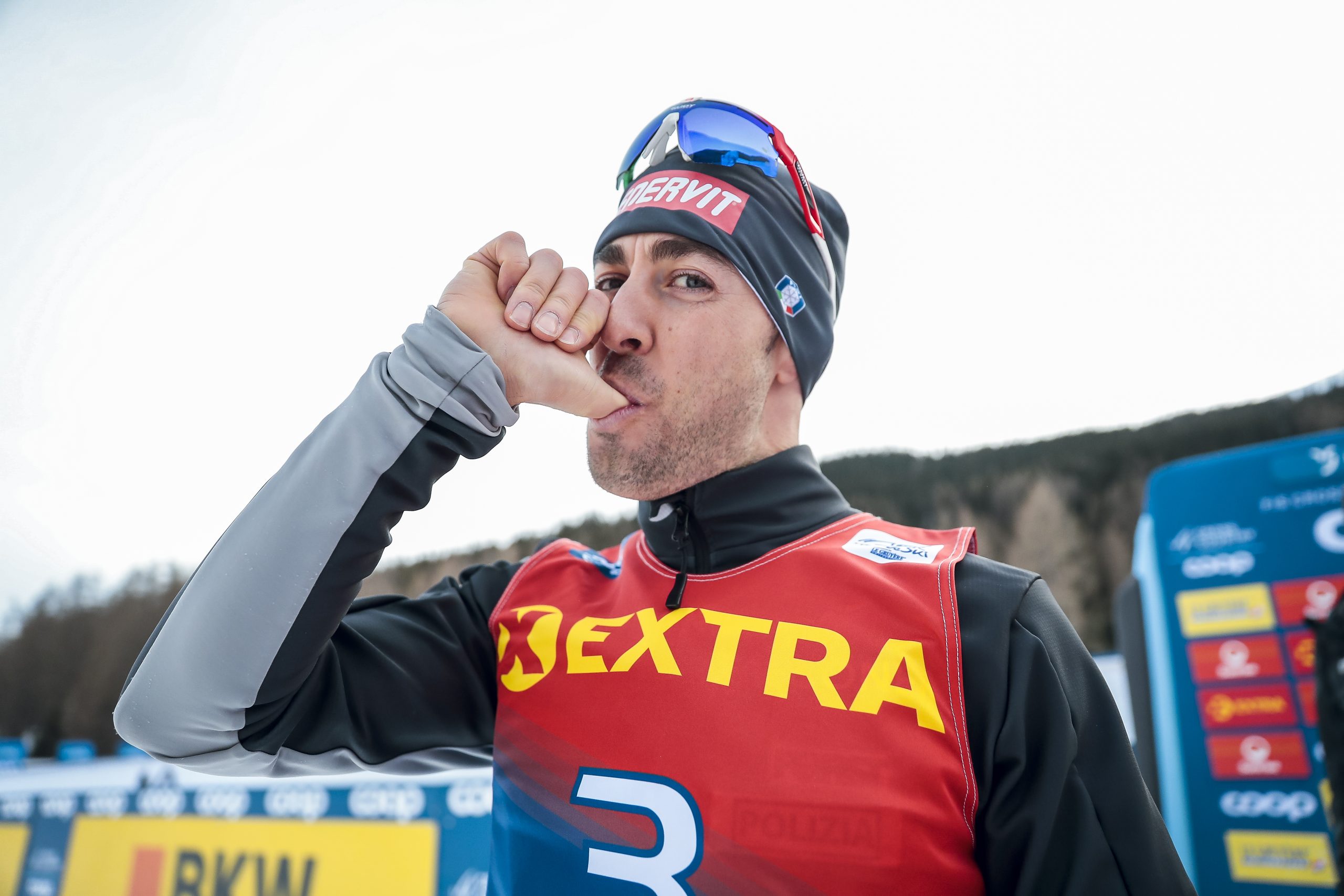
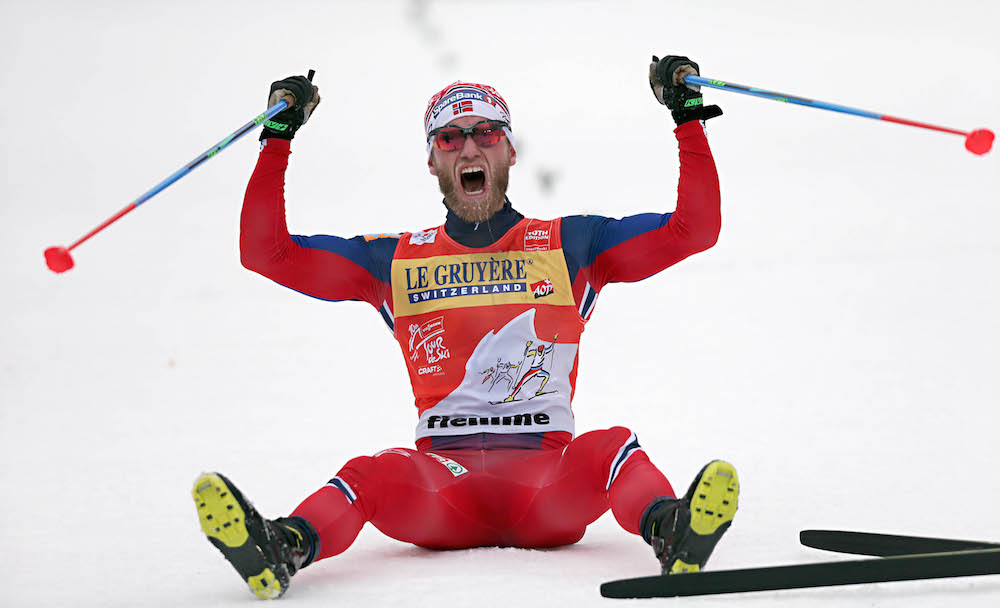
That all did happen, but it all happened in a different frame from that of the race leader. Johannes Hoesflot Klaebo started with a seven second gap on Federico Pellegrino, and then just kept it. There wasn’t any bunch sprint at the end, there wasn’t any jockeying on the race course, there was just Klaebo, putting pole plant after pole plant into the Swiss snow, eclipsing an entire field of the world’s best, gliding across the finish line with a 10 second gap, and then looking back. For a moment in the finishing pen, Klaebo just leaned on his poles. Skiers fought and threw themselves across the line to gain a place. They collapsed in heaps. They staggered through the back-pats and high-fives of post-race camaraderie. Klaebo was just there, the setting sun casting a shadow over his shoulder that may well have been an eclipse over the entire the field. He eventually made his rounds, shaking hands and offering congratulations. But there was a moment where it seemed that the athlete who’s spent his career charging towards skiing history—he tied Petter Northug for Tour de Ski stage wins with his 13th today—couldn’t help but sense the extraordinary place he occupies.
With his win in Sunday’s Pursuit, Johannes Hoesflot Klaebo (NOR) tied Petter Northug (NOR) for the most Tour de Ski Stage Wins (13) . (Photo: Nordic Focus).
Men’s 10 k Pursuit
Golberg is still the Overall Leader of the World Cup this year after Klaebo’s absence through parts of Lillehammer and Beitostolen in Period I; if Klaebo is to re-take the overall lead, he will need to wrestle it away from Golberg’s top form. After an 8th place finish yesterday, Golberg started 20 seconds behind Klaebo, with the sprint specialists of yesterday placed between them. Through the early-goings of the 10 k pursuit, the main chase pack held firm with the top sprinters of yesterday. Most notable among them was Federico Pellegrino, who started in Bib 2 today and had a comparatively small seven second gap back from Klaebo at the start. Pellegrino never challenged Klaebo, but he did remain off the front of the chase group that included Richard Jouve (FRA), Michal Novak (CZE), and Sindre Bjornstad Skar (NOR) for much of the first half of the race.
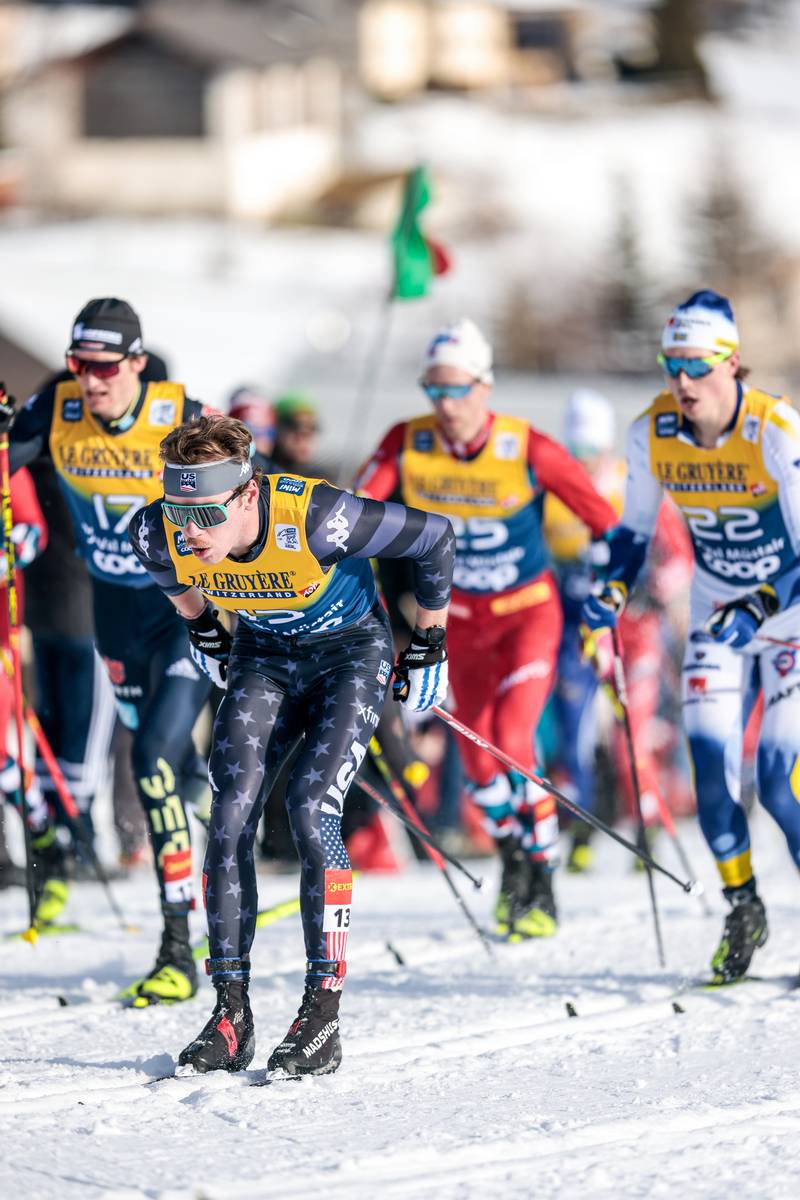
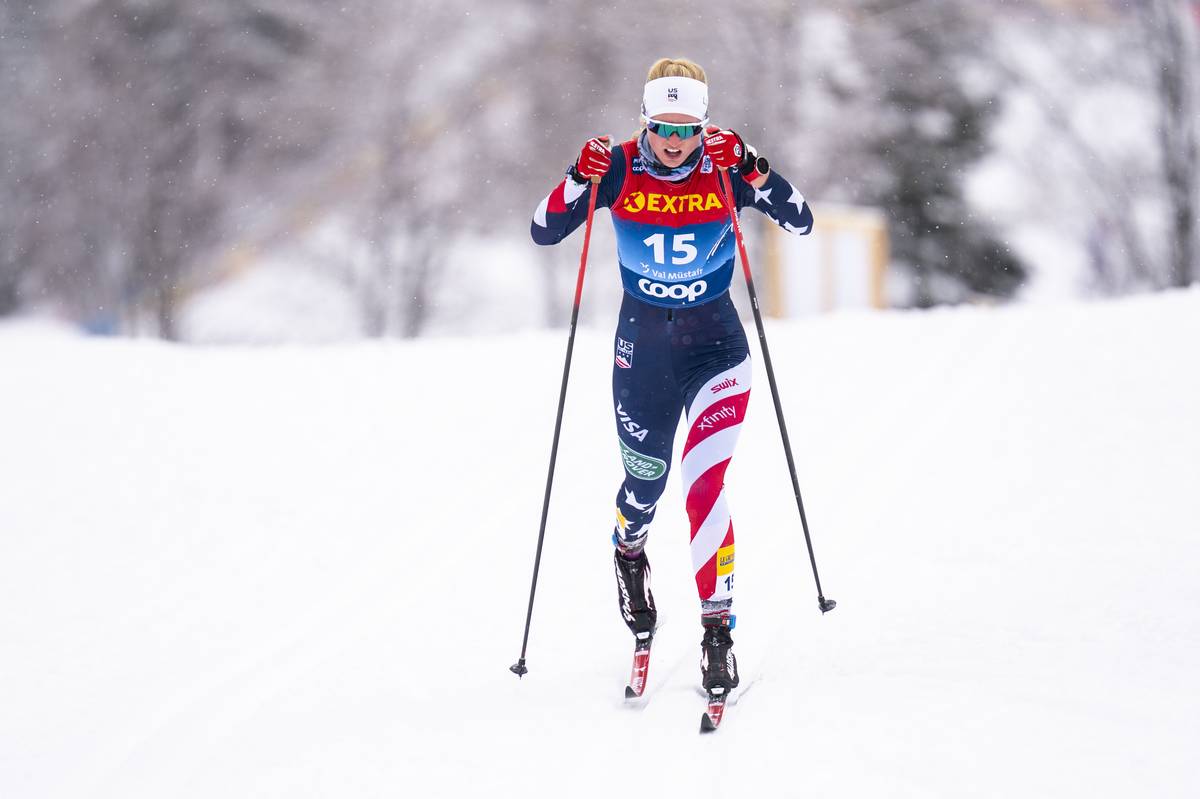
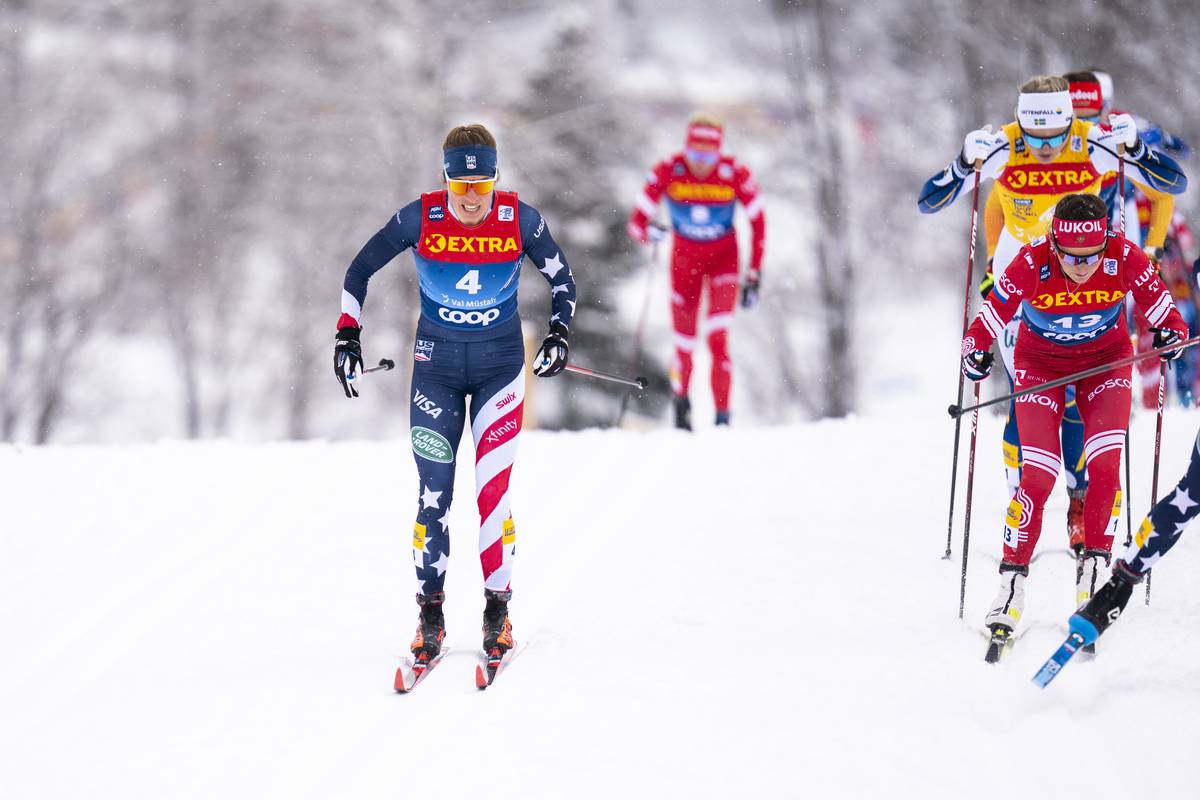
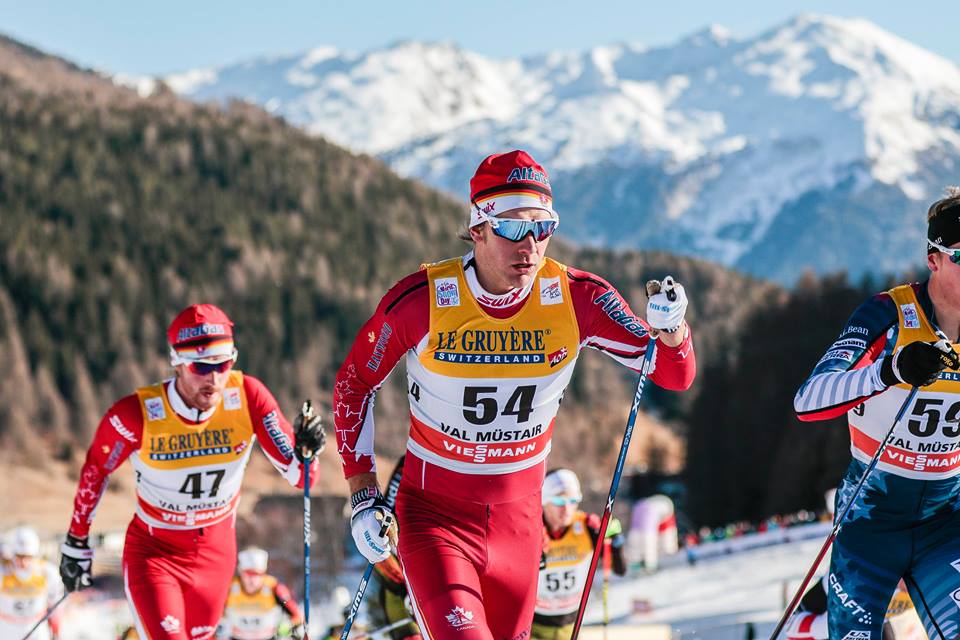
Ben Ogden (USA) in the main pack during Stage 2 of the Tour de Ski. Ogden finished 18th on the day. (Photo: Nordic Focus).
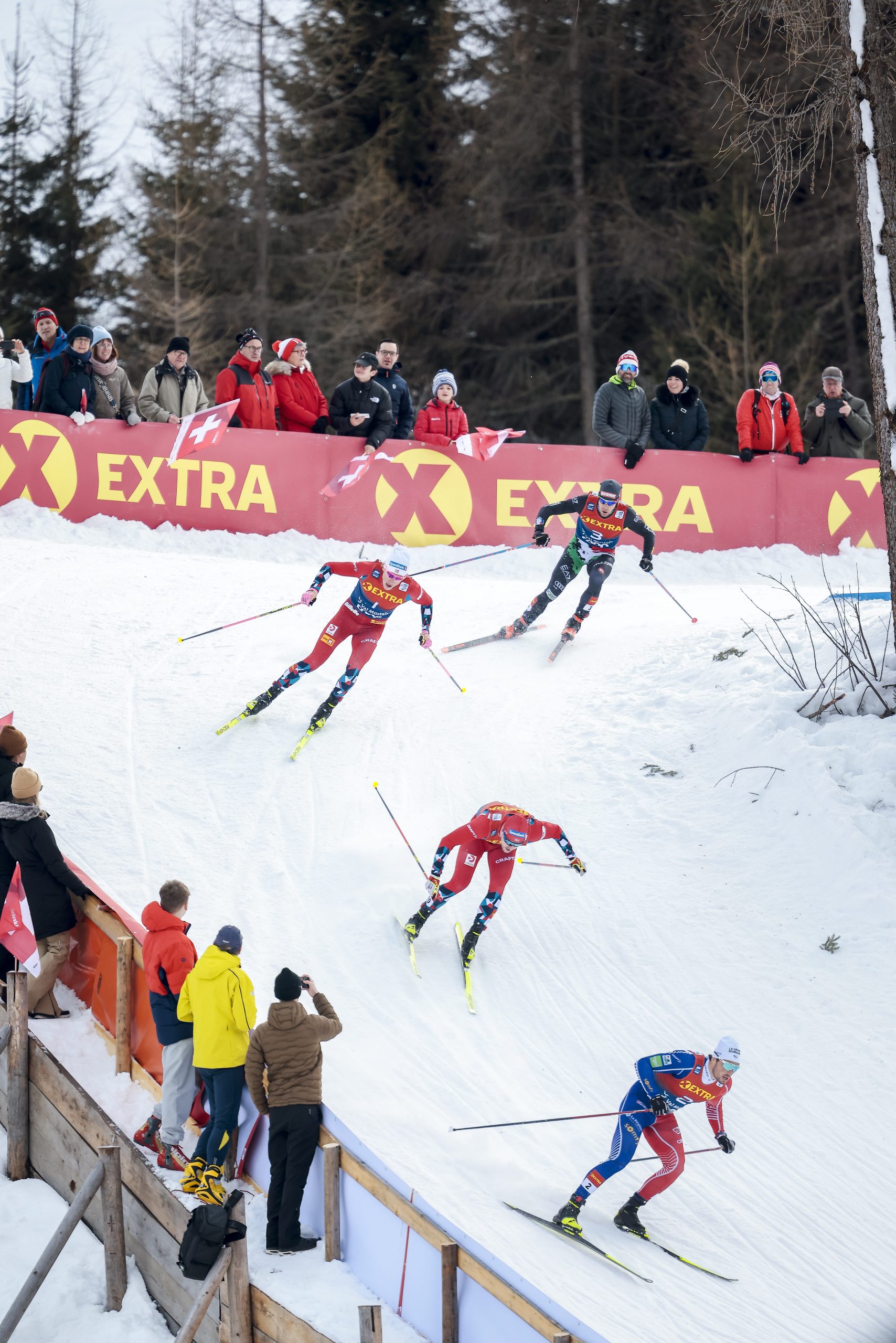
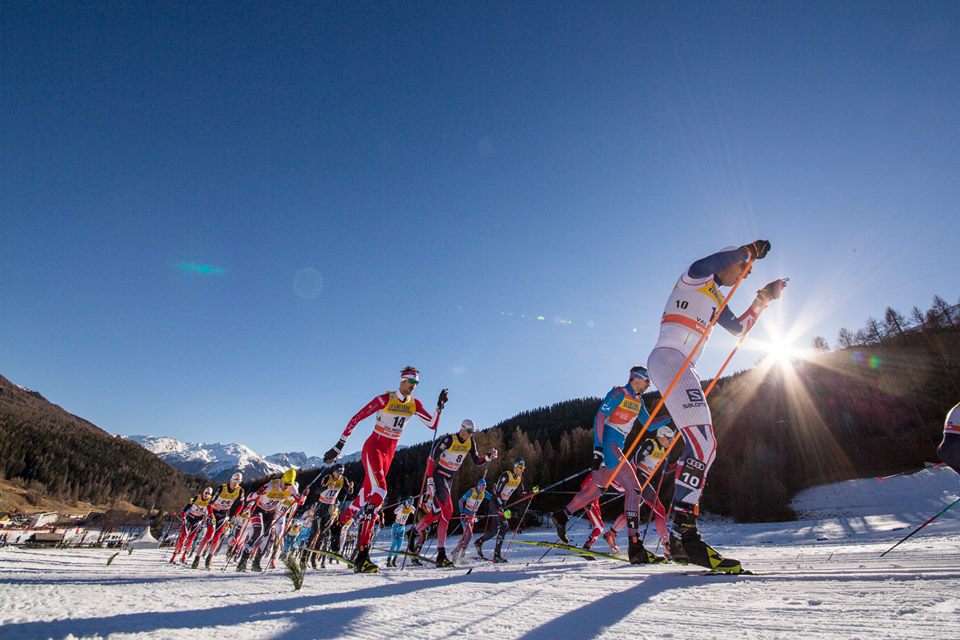
Golberg, wearing bib 9, had started out in the front of what quickly coalesced into the main peloton of the race in the first couple of kilometers. This pack was where the main action that will set the Tour de Ski up for its latter stages took place. The skiers that will be looking forward to the 10 k/20 k combination of races in Oberstdorf for Stage 3 and Stage 4, and who can look behind at the Stage 1 Sprint wishing they had a bit more punch, weaved their way through in this main group to set themselves up for stronger starts in the racing to come. That included Simen Hegstad Krueger, who moved up from 18th to 4th place on Stage 2, Martin Loewstrom Nyenget who moved from 42nd to 6th, Hans Christer Holund from 48th to 9th, Didrik Toenseth from 25th to 10th, and Iivo Niskanen from 57th to 14th. Notably, some Americans were able to make similar jumps further down the pack, with Scott Patterson moving up from 94th to 59th and Hunter Wonders moving up from 80th to 53rd on the day.
At around the 4.5 k mark, Golberg started to make his move from this main group to the chase group containing the sprint specialists Jouve, Novak, and Pellegrino. No one followed the Norwegian, and Golberg’s joining the chase group seemed to transform it from a chase group to the Golberg group—with some of the best lead-out men in the World. Over the second half of the race, Golberg controlled the chase pack as he fought to reel in Klaebo. His pace-setting soon broke Jouve and Novak, but with the persistent and ever-inspiring grit that has defined his season so far, Federico Pellegrino stuck onto Golberg’s every move. As the kilometers stretched out, that little fact began to grow in its importance, as the two skiers closed in on the finishing sprint; back in Pellegrino’s realm.
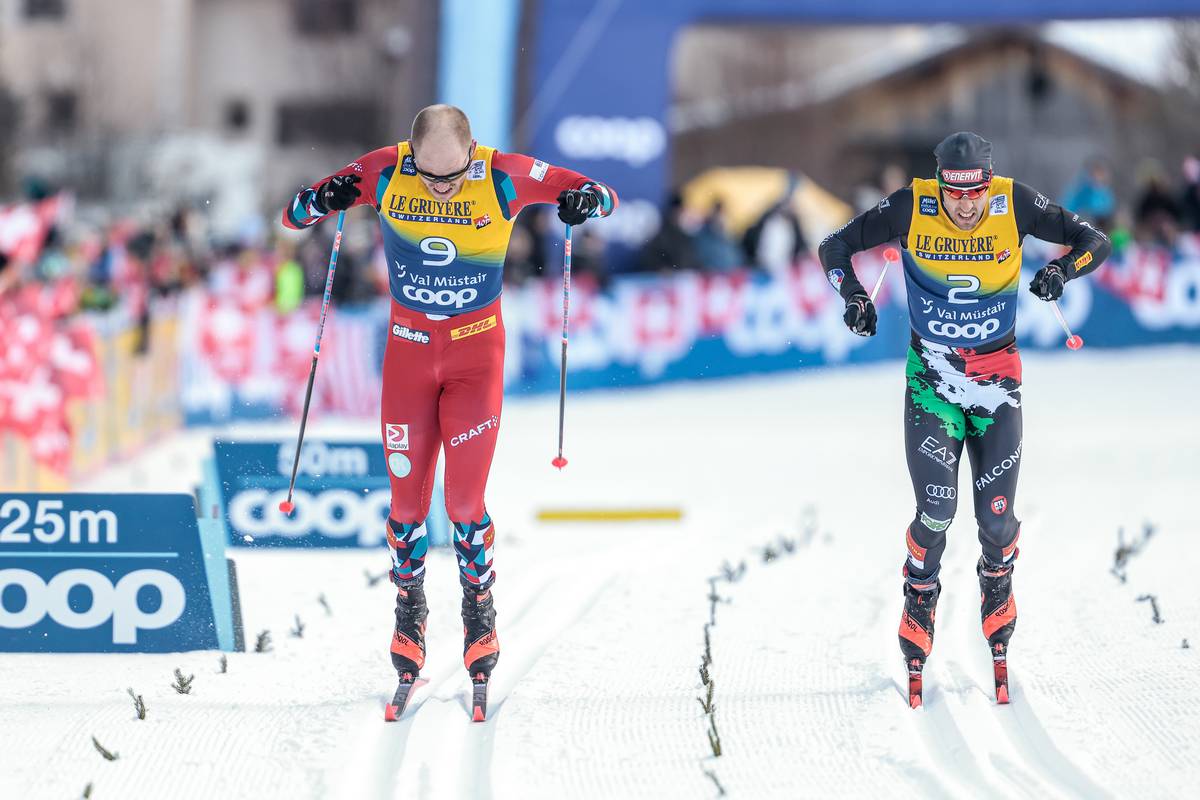
When Golberg and Pellegrino did enter the stadium for the final time, they were locked in next to each other. Everyone in the stadium, including the victorious Klaebo, could turn and be treated to a genuinely exciting sprint for 2nd where Pellegrino moved out from behind Golberg, put in a kick, and then saw the Norwegian somehow counter. A boot’s throw from both skiers initially looked as if Pellegrino had been successful, but upon review, Golberg was given the 2nd place nod, as Pellegrino hung on to claim a 3rd place podium finish in a distance race. Something that is worth italicizing for its novelty at this point in the sprinter’s career.
Paal Golberg (NOR) and Federico Pellegrino (ITA) sprint for 2nd place. Golberg won the boot toss, and Pellegrino finished 3rd. (Photo: Nordic Focus).
The Italians kept the finish line exciting from there as well, with Francesco De Fabiani soon coming into the stadium in battle with American Ben Ogden. Ogden started 13th place on the day, and had kept his position in the main pack well as the powerhouse distance skiers of the World Cup sought to move to the front of the field today. De Fabiani and Ogden came into the stadium looking for 17th place, and were willing to go all out for it right to the line. In the end, the Italian won this round of the boot throw, and Ogden came away from two days of racing in this year’s Tour in 18th place. “For many Americans the threshold for an average race is starting to change,” Ogden said. “That said, we are still hungry and place emphasis on the process rather than the result. That way through thick and thin we are still learning and getting better every day. Everyone here has long term goals well beyond the top 30 and I am really proud that many are making forward steps.”
The Tour de Ski gets its first rest day tomorrow, as the circuit travels from the Swiss side of the Alps to the German side in Oberstdorf for Stage 3: 10 k Individual Start Classic. The sun has set on Val Mustair, the shadows cast on the skiers all clumped together and entangled but for one: the solitary figure of Johannes Hoesflot Klaebo, looming large.
Previous Coverage of this year’s Tour de Ski: Stage I
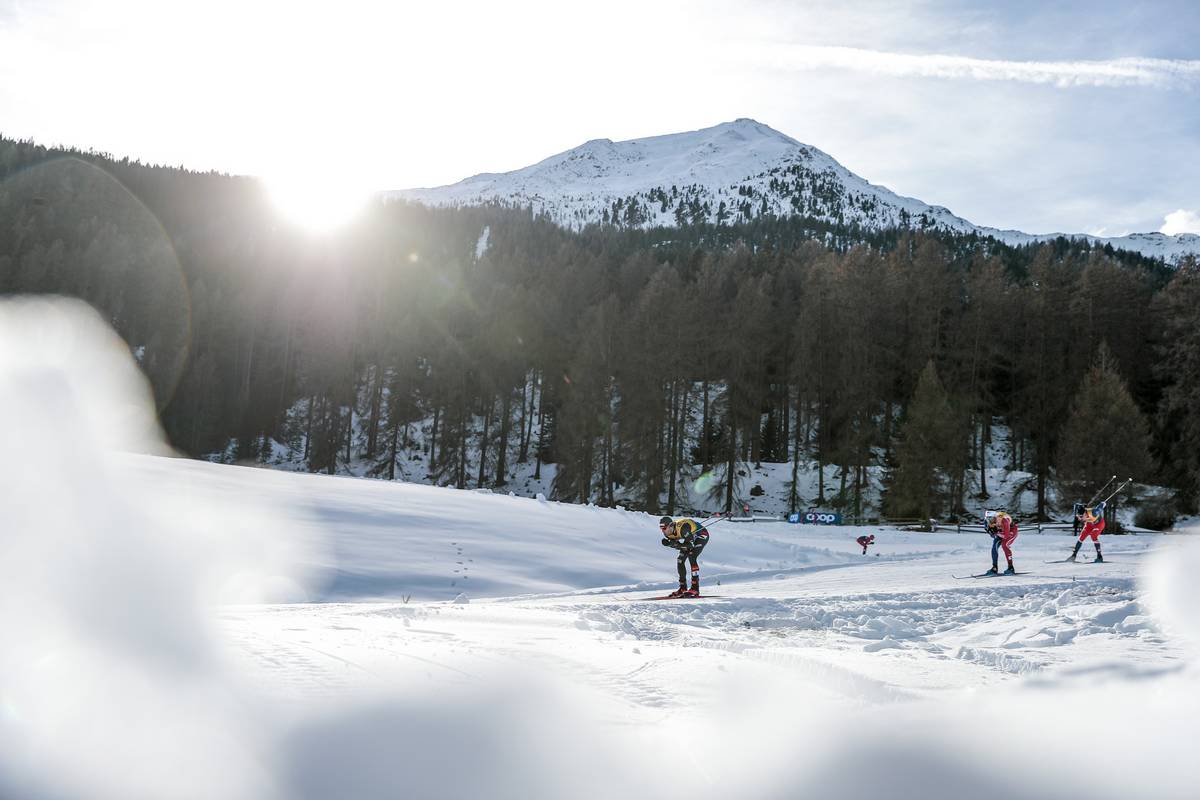
Federico Pellegrino (ITA) leading the chase group mid-way through Stage 2 of this year’s Tour de Ski. The Tour de Ski finished in Val Mustair, and now heads to Germany for Stage 3 on Tuesday. (Photo: Nordic Focus).
A rivalry renewed: Johannes Hoesflot Klaebo (NOR) and Federico Pellegrino ((ITA) at the finish line of the 2023 Tour de Ski Stage 1 Sprint in Val Mustair, Switzerland. Klaebo would finish first, with Pellegrino second. (Photo: NordicFocus)
The FIS World Cup tour returned from a two-week holiday break, reconvening in Val Mustair, Switzerland for Stage 1 of the 17th Tour de Ski. A daunting mid-season challenge, the Tour de Ski (TDS) consists of seven stages contested over nine exhausting days, concluding next Sunday atop the Alpe di Cermis in Val di Fiemme, Italy.
At the start of this year’s tour, all eyes were on Johannes Hoesflot Klaebo (NOR), who finds himself in a prolonged battle for FIS World Cup points with Norwegian countryman, Paal Golberg. The Overall Crystal Globe competition is likely to be decided by their performances in the Tour de Ski, and today’s Freestyle Sprint stage may have been a taste of coming attractions. Showing speed and tactics that his rivals could not match, Klaebo coasted to the win in Val Mustair, followed by Federico Pellegrino (ITA) and Sindre Bjoernstad Skar (NOR).
Americans experienced results both good and bad: Ben Ogden qualified a remarkable 4th, but would suffer a broken pole at the very start of his quarterfinal and finish the day in 13th. JC Schoonmaker was the 21st qualifier, but would finish 6th in his quarterfinal and settle for 26th on the day. American results in qualifying also included Gus Schumaker 50th, Zak Ketterson 59th, Finn O’Connell 67th, Kevin Bolger 74th, Hunter Wonders, 80th, Scott Patterson, 94th.
Ogden offered an in-depth description of that broken pole, and the psychological process of re-grouping during a sprint race: “Today when I broke that early pole all I was thinking was how to catch up. I knew that my strength was in the flatter V2 before the steep climb, so I really just pinned it immediately after getting a new pole and surprised myself with how quickly I could get back to where I wanted to be amongst the other guys. My brain then went pretty quickly to damage control as I tried to evaluate how much energy I had used there. I was lucky to be feeling strong today and it didn’t really affect me too much. I think I was a little flustered and not exactly where I needed to be in the last minute or so, so that cost me a spot in the semi final, but I know that this could have happened regardless of the pole incident. It can be nice for the head to blame it on the pole, but overall it was just another learning experience out there and hopefully next time I can be in a better position and get through.”
Canadian Graham Ritchie qualified 14th, ultimately finishing the day in 21st, ahead of countrymen Antoine Cyr 32nd, Russell Kennedy 33rd, Olivier Léveillé 55th, Sam Hendry 85th, and Remi Drolet 91st.
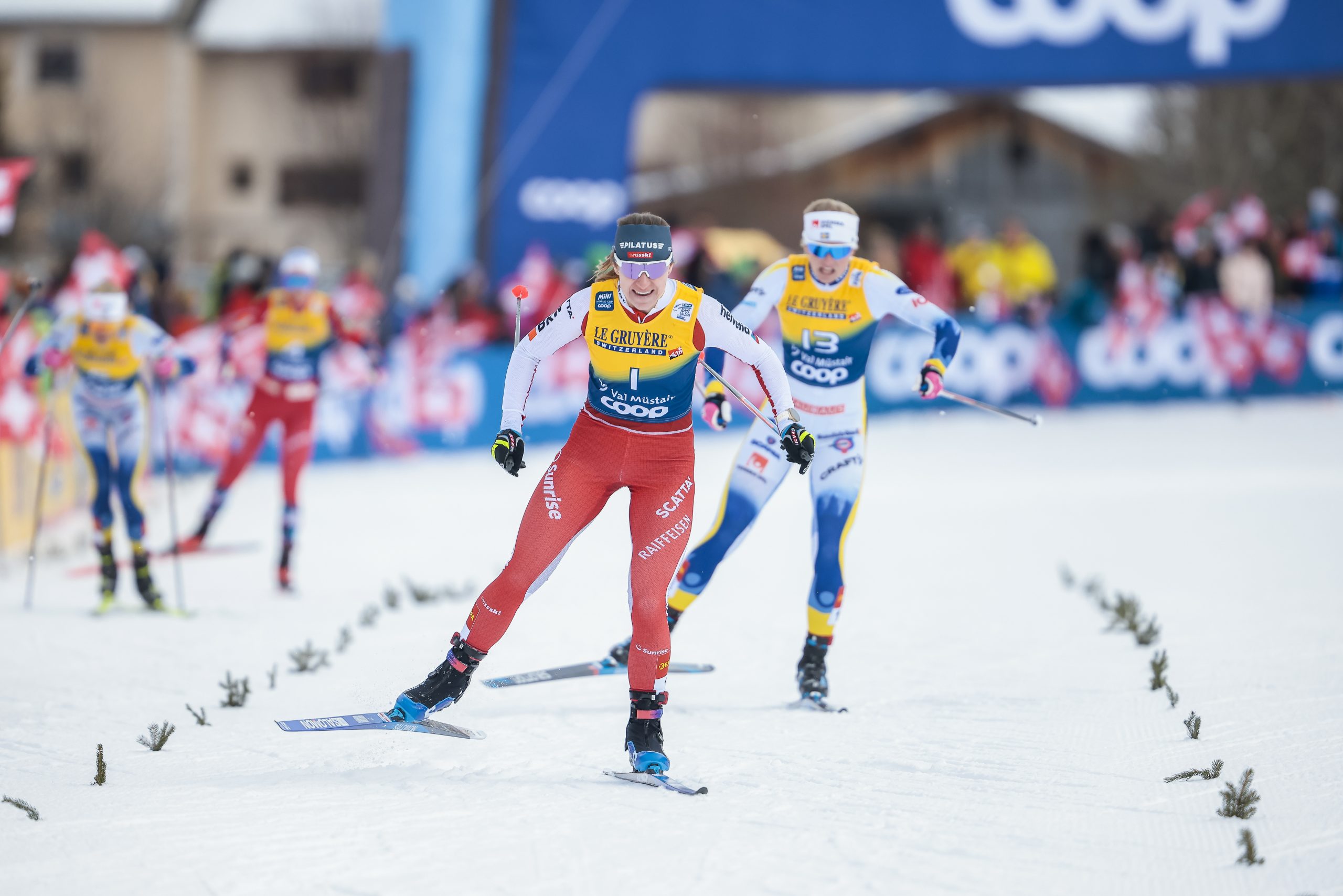
Nadine Faehndrich (SUI) celebrates her Stage 1 win in Tour de Ski, 2023. (Photo: NordicFocus)
In the Women’s field, the Stage 1 Sprint seemed most likely to be won by a sprint specialist while TDS contenders vied for finishing positions that would place them near the head of the field in Sunday’s 10 k Pursuit. The day played out much that way (though with a few surprising developments) as World Cup Sprint Leader, Nadine Faehndrich (SUI), took the win, followed by Maja Dahlqvist (SWE), and Lotta Udnes Weng (NOR).
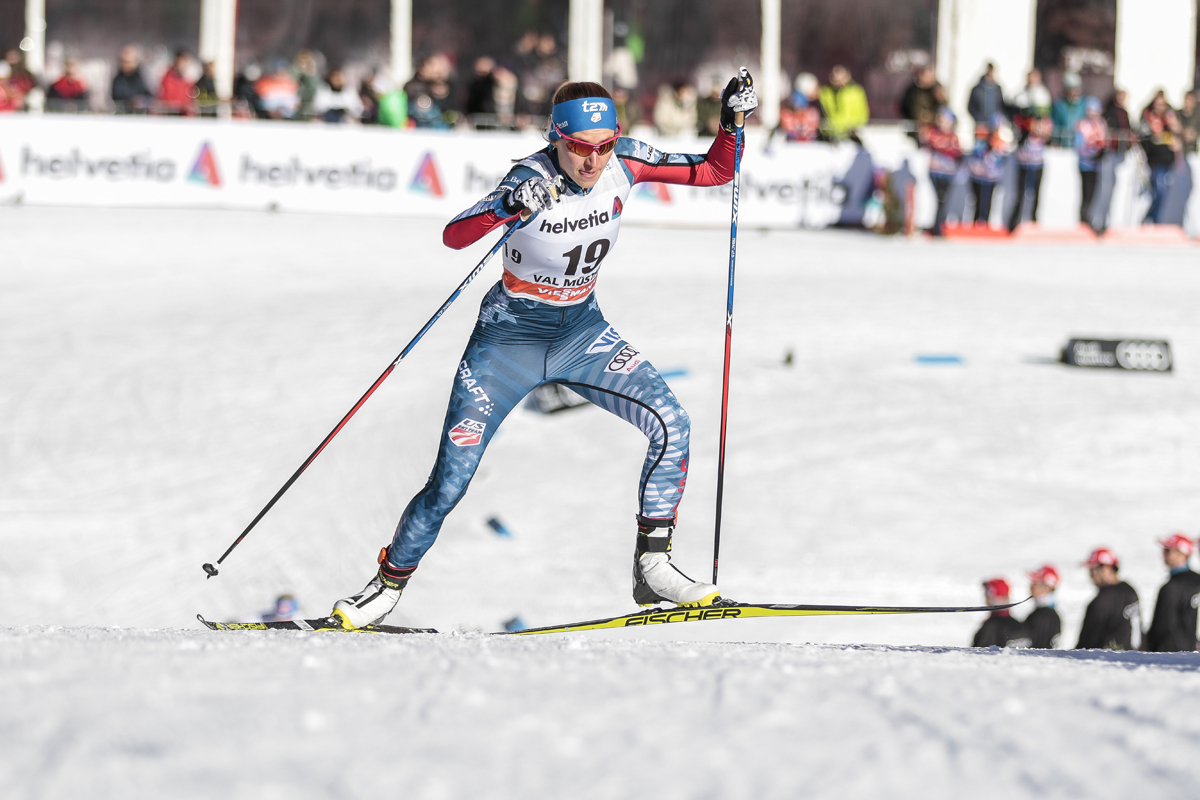
Julia Kern (USA) raced to 6th in sprint qualifying, but saw her day ended by a fall in the semifinal. She would finish the day in 11th. (Photo: NordicFocus)
Julia Kern (qualifying 6th) and Rosie Brennan (qualifying 14th) would’ve had high hopes for the day, but Kern tumbled in a rutted corner to finish sixth in her semifinal (finishing 11th on the day), while Brennan faded in her quarterfinal and failed to advance, ending the day in 14th. Other American qualifying places included Alayna Sonnesyn 38th, and Sophia Laukli 69th.
Among Canadians in qualifying, Katherine Stewart-Jones finished 48th, followed by Dahria Beatty 56th, and Lillian Gagnon 66th.
Naturally, the surprising story in qualifying was the performance of Jessie Diggins, whose qualifying time was only fast enough for 40th place (failing to qualify for the quarterfinal heats). Via her Facebook account, Diggins later commented on her own performance, saying, “Sometimes your body feels great and your brain is ready and it just doesn’t work out—and that’s ok. The only things that’s not ok is to give up.” That’s quintessential Diggins. She will enter Stage 2 in a position well behind her main rivals, but with racing abilities like those Diggins has so often shown, her chances to contend for the overall TDS crown are likely to improve with each passing kilometer.
TDS Women’s Freestyle Sprint
Sprint Quarterfinals are sometimes treated as a bit of an afterthought in typical race reporting, but in Val Mustair, much of the action that’s likely to affect the week’s results occurred in the quarterfinals. Sweden’s Frida Karlsson—a serious contender for the TDS crown—advanced out of a fast quarterfinal in which she drove the pace. That speed in Karlsson’s heat—and a high-quality field in the second quarterfinal—forced Kern to employ a different strategy than she might normally undertake, leading out the first lap ahead of L. Weng and Dahlqvist. The strategy seemed to be working, as Kern distanced Dahlqvist on the uphill. Even so, Dahlqvist showed her class by attacking over the top, and scorching the downhill to win the heat. Kern held on for second, narrowly ahead of L. Weng in third (who would claim a lucky loser spot).
Brennan dangled off the back of the pack at the start of quarterfinal 5, but worked her way back through the field at the end of lap one. Looking for space to pass, she took a very wide line up the hill, advancing two places into third, a position she was unable to improve before the finish. Her finishing time was not fast enough to claim a lucky loser spot. Brennan would end the day in 11th.
Nadine Faehndrich (SUI) speeding to victory in the 2023 Tour de Ski Stage 1 Freestyle Sprint. (Photo: NordicFocus)
Throughout the heats, Faehndrich continued dancing up the hill, showing a top speed that none of the others possessed. L. Weng and Karlsson claimed lucky loser spots in their semifinal, which could prove to be truly significant in the week long tour standings.
The sprint final included Karlsson, Maja Dahlquist (SWE), L. Weng, T. Weng, Faehndrich, and World Cup distance leader Anne Kjersti Kalvaa (NOR). Having already shown that she is the fastest skier on the Val Mustair course, Faehndrich went straight to the lead, immediately gapping the field on the first hill. She navigated the subsequent downhill poorly, allowing the field to reel her in as they passed through the stadium at the end of lap 1. But the second time up the hill was a replay of the first, with Faehndrich’s higher tempo allowing her to gap the field and stay away through the finish. Dahlqvist surged in the finishing straight to push L. Weng down into third.
With the Women’s Stage 1 Sprint concluded, the TDS overall contenders are now identifiable: T. Weng, L. Weng, Kalvaa, and Karlsson . . . with Americans Diggins and Brennan poised to strike. Faehndrich has now won consecutive World Cup sprint events in her home country and in front of Swiss fans. “At the moment, it’s like a dream,” she said.
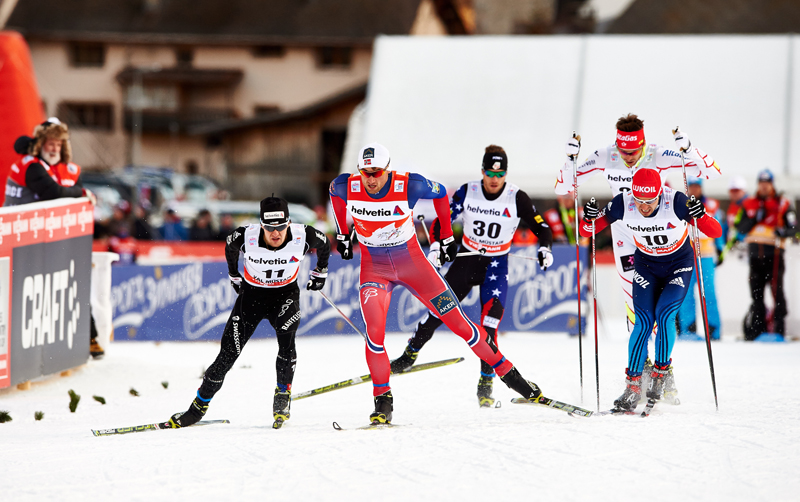
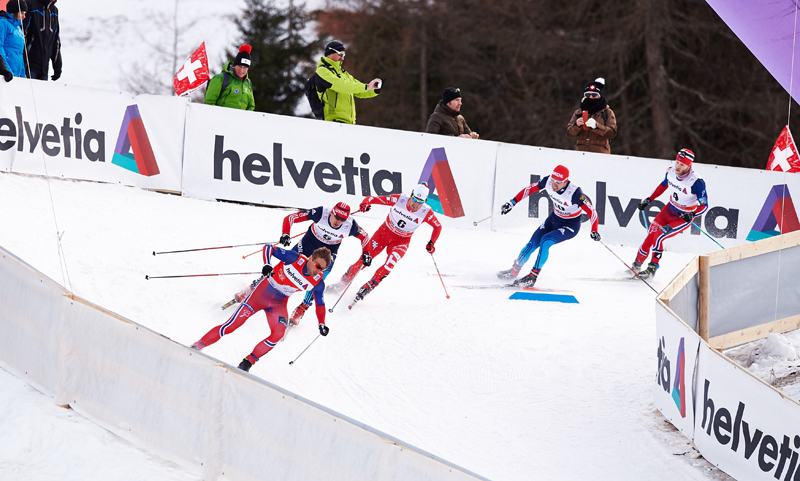
Klaebo (NOR, in third position) sets up the turn wide, carrying more speed and avoiding ruts that troubled other racers. (Photo: NordicFocus)
TDS Men’s Freestyle Sprint
The Val Mustair sprint venue consists of a two lap course with a significant mid-lap uphill, followed by a challenging, S-turn downhill that empties into the finishing straightaway. It was those S-turns that would prove significant in the day’s strategy, and in the mastery Klaebo displayed in his course management. His choice to set up the turns far wider than his rivals (carrying far more speed and avoiding ruts that worried so many racers) was key to his cruising to ultimate victory.
Klaebo may be the world’s premier sprinter; nonetheless, he found himself overtaken in the finishing stretch two weekends ago by his longtime rival, Federico Pellegrino (ITA) who appears to be drawing much positive energy from the recent birth of his first child. Always one who seems to ski and race with joy, Pellegrino is riding a wave of optimism and success that saw him challenging Klaebo in the Stage 1 Sprint at Val Mustair. The stage was set for an excellent Sprint competition.
As in the women’s sprints, the Men’s quarterfinals offered insight into the way the day would go, and demonstrated the ease and confidence with which Klaebo seemingly races. Boxed out on the uphill where he would usually make his move (and caught behind a stumbling Chanavat who stepped on his own pole, but managed to recover), Klaebo bided his time, then incorporated an entirely different line on the curving final downhill. He set up the turn so wide that it looked as if he was exiting the race course . . . only to re-set on the second half of the S, rocketing past all other racers. He entered the finishing straight with a commanding lead that he would hold easily through the finish.
The day’s second quarterfinal also proved significant, as Ogden—the fourth qualifier—suffered a broken pole in just the first few meters of racing. Coaches were on hand to deliver a quick replacement, but Ogden would spend a great deal of energy clawing his way back to the field before the first climb. Continuing to improve with each passing week, Ogden’s form may be at a career high point, but the effort of chasing no doubt depleted his finishing sprint, and Ogden would fail to advance out of his quarterfinal, finishing the day in 13th.
Reached for comment after his day of racing, Ogden offered a new American perspective on his expectations—and occasional frustrations—in World Cup racing. “There are minutes and hours after these races where all you can think about is what could have been,” he said. “But then when you take a step back it’s easy to put things into perspective and remember that it wasn’t more than two years ago when skiing in a world cup heat was a reach-goal of mine. So, the bottom line is at the moment, yes, immensely frustrating but in the big picture, I am happy with where I’m at as an athlete, and I’m stoked for every opportunity over here. ”
Klaebo’s semifinal included Chanavat, Renaud Jay (FRA), Sindre Bjoernstad Skar (NOR), and Pellegrino. Despite that gathering of stars, Klaebo advanced easily, employing his wide-turn strategy and coasting to the finish line. Pellegrino came second, with Chanavat and Skar advancing as lucky losers. A sprint final showdown between Klaebo and Golberg was not to materialize, as Golberg appeared a bit fatigued—or even a bit disinterested—in his semifinal, allowing Michal Novak (CZE) and Richard Jouve (FRA) to advance.
Sprint dominance on display: Klaebo (NOR) speeds to the win in Val Mustair. (Photo: NordicFocus)
The problem to solve in every World Cup sprint final remains the same: what to do about Klaebo? He has tremendous speed, he’s tactically brilliant, and he’s supremely confident. Perhaps the only strategy is to try to run him off his feet. Good luck with that . . .
The men’s sprint final involved Klaebo, Jouve, Pellegrino, Skar, Novak, and Chanavat. From the gun, the tall Frenchman went straight to the front, perhaps determined to make the pace so fast that a long day of sprinting would finally tire Klaebo. Chanavat led to the hill, where Klaebo’s wider line allowed him to float to the front in the company of Pellegrino who drove his speed over the top of the rise and into the lead. Again, Klaebo chose the widest line through the corners, maintaining speed and gliding through to the front. The second time up the hill he simply turned on the after-burners, and the race was all but over. His sinuous downhill line carried him to the finishing straight which he was able to ease across with no worry of being caught. Pellegrino collected second, ahead of Skar.
Commenting in a post-race interview on the elevation of Val Mustair, Klaebo remarked, “Sprinting here at 1600 meters is really tough . . . I’m pretty glad I made the decision to stay in Davos for Christmas.”
Klaebo leads the Tour de Ski after Stage 1, ahead of his main rival, Golberg, who earned 10th place on the day. Stage 2 may reveal which of them was able to preserve their energy in the interest of a week-long battle that’s just getting started.
Racing at the Tour de Ski continues on Sunday in Val Mustair with Men’s and Women’s 10 k Classic Pursuits.
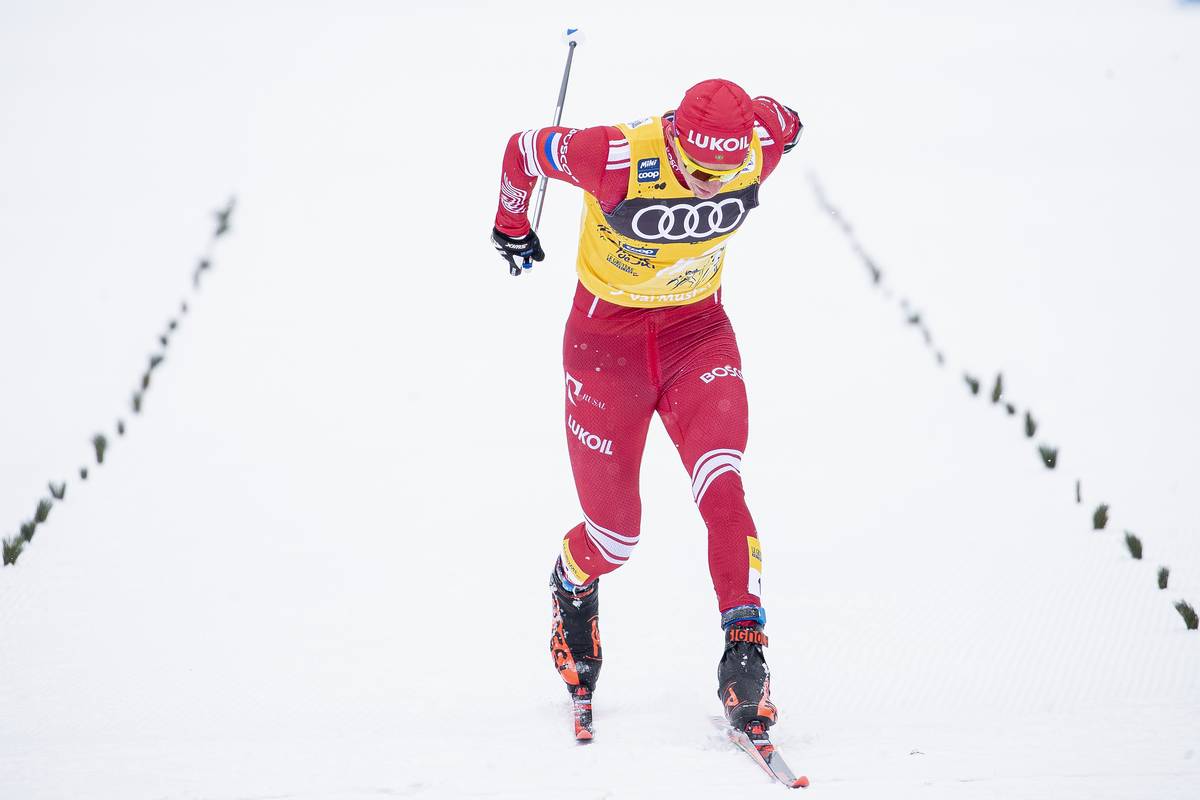
Alexander Bolshunov (RUS) lunges for the line with no challengers in sight. Photo: Nordic Focus
This World Cup coverage is made possible through the generous support of Marty and Kathy Hall and their A Hall Mark of Excellence Award. To learn more about A Hall Mark of Excellence Award or to learn how you can support FasterSkier’s coverage please contact info@fasterskier.com.
Accompanied by the constant soundtrack of distant cowbells, Alexander Bolshunov of Russia steadily worked his way through the fog, four times around the 3.3 k course to maintain a lead that was never threatened, completing the race in a time of 32:11. He started today’s skate pursuit with a margin of one minute ahead of teammate Artem Maltsev (RUS). When the race concluded Bolshunov had ceded only 6.3 seconds, despite skiing alone the entire way. In the winner’s post-race interview with FIS, when asked whether the race felt as easy as it looked, Bolshunov replied (through a translator), “[I] wouldn’t say it was easy, the last laps [I] had to work really hard. But still [I’m] really happy to take the win with good distance.”
This is the third podium for Bolshunov in this Tour de Ski alone. In ten World Cup races this season, he missed a podium only twice, when he placed fourth in Ruka’s classic sprint and fourth again in Dresden’s skate sprint. With the Norwegians remaining off the World Cup, for now, he remains peerless.
Payday for Alexander Bolshunov (RUS) after his second victory in two days. Photo: Nordic Focus
Initially, the followers’ chase was mounted by Russia’s Maltsev and Dario Cologna of Switzerland for the first 7.4 k. Cologna was the third starter today, but he quickly ate up the 11 seconds margin to Maltsev. As the race evolved, Maltsev began to pull away, eventually crossing the finish line in second place, +53.7 seconds behind Bolshunov. According to the FIS database, Sunday’s second place was Maltsev’s second career World Cup podium. He also won a bronze in the 2018 Olympic team sprint.
Artem Maltsev (RUS) crosses the line for his second podium of the season, he finished 3rd in the 15 k skate in Davos. Photo: Nordic Focus
Cologna (SUI), who is the first man to have won three 15 k Olympic gold medals in a row and should consider this distance a specialty, was caught by Maurice Manificat of France, Ivan Yakimushkin of Russia and Denis Spitsov of Russia at 8.9 k. Gradually Manificat (FRA) worked his magic, 15 k skate events being something of a favorite for him, and he finished third +1:10.07 behind Bolshunov. With an elapsed race time of 31:42.1, Manificat also had the second fastest time of the day.
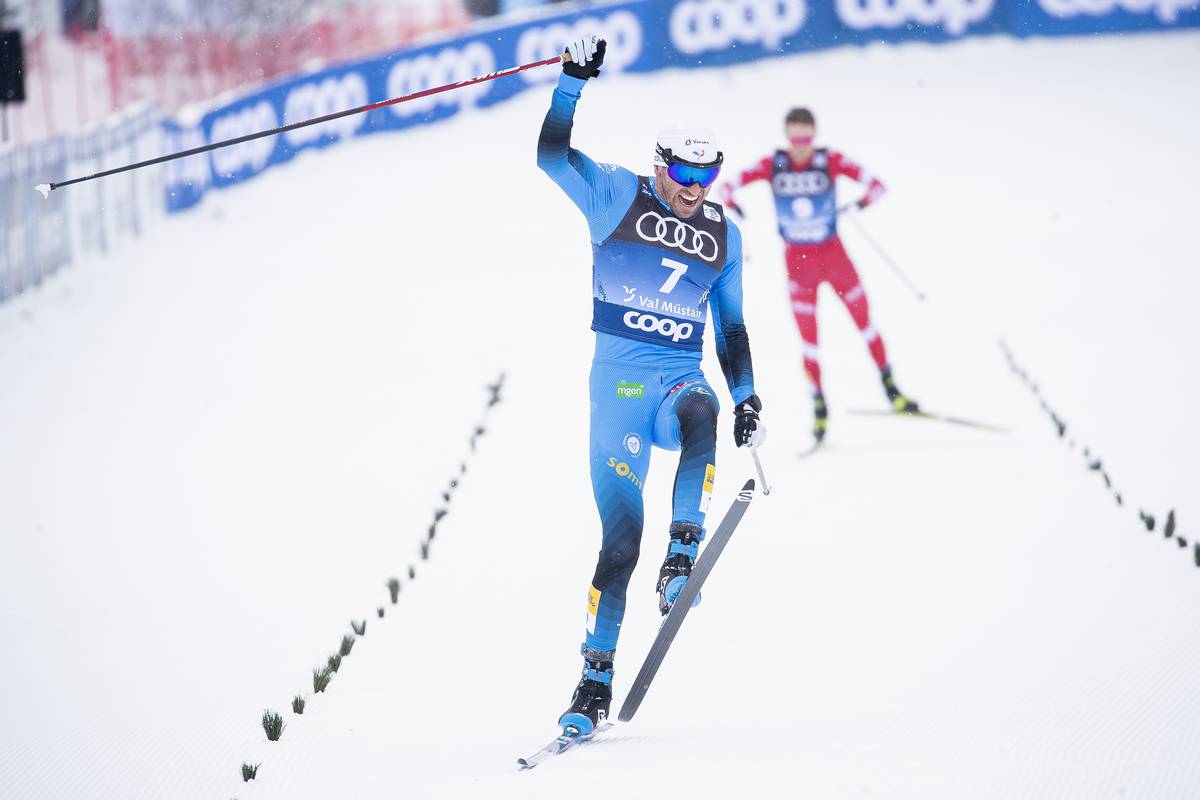
Maurice Manificat (FRA) with his signature celebration over the finish line. Photo: Nordic Focus
Spitsov (RUS) followed closely behind in fourth, earning the fastest time of the day with his performance (31:41.8). +23.5 seconds back from Spitsov, Yakimushkin (RUS) outsprinted Cologna (SUI) and they fell into 5th and 6th position. Friday’s sprint winner, Federico Pellegrino of Italy, held his own despite not having a reputation as a distance skier, to finish in 8th.
Federico Pellegrino (ITA) on his way to an 8th place finish, ahead of the French trifecta battling behind him. Photo: Nordic Focus
Gus Schumacher was the first American out of the gates. In bib 35 he started +2:55 behind Bolshunov. When he crossed the line, 36:15 minutes later, he had gained three places to lead the American men and finish in 32nd, with the 28th fastest time of the day, earning him his third World Cup points of the season. “My strategy today was based mostly around consistent pacing,” wrote Schumacher in an email, “I wanted to avoid a big loss of energy, so I tried to make smart decisions regarding whether or not to respond to attacks. Moving forward, I’m mostly focused on recovery and taking each day as a new day, a new race to continue improving. I know that I have 5 more races to try to work up the field.”
Gus Schumacher (USA) pushes the finishing stretch. Photo: Nordic Focus
Scott Patterson, who started in the first wave (+3:22) with bib 46, also gained several places and finished 38th. Patterson skied his way to the 24th fastest time of the day in a time of 33:09.9. Simi Hamilton finished 47th and Kevin Bolger rounded out the U.S. men in 55th.
Simeon Hamilton (USA) and Kevin Bolger (USA), (l-r) cross the line. Photo: Nordic Focus
Overall Tour Standings:
With his victory today, Bolshunov’s overall lead in the Tour is +0:53 seconds ahead of Maltsev in second. Manificat moved into third position (+1:07) followed by Spitsov (+1:10) and Cologna (+1:34) in fourth and fifth respectively. The Tour now moves to Toblach, Italy where racing continues on Tuesday (January 5th) with a 15 k interval start skate race.
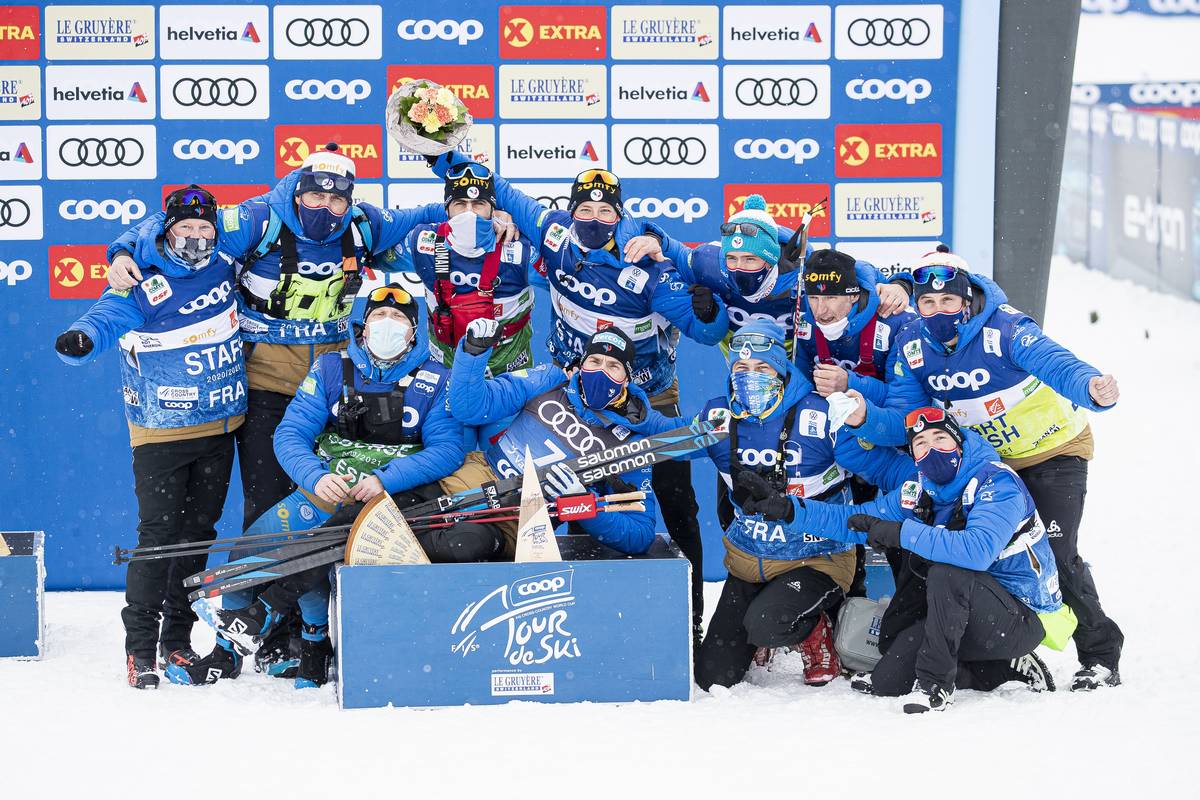
A happy group of Frenchmen celebrate Manificat. Photo: Nordic Focus
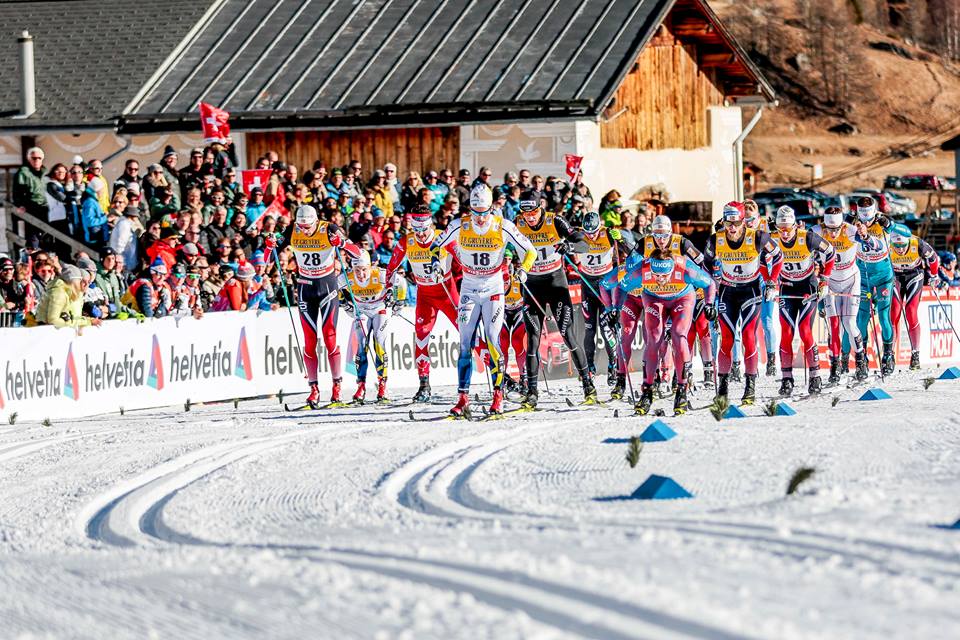
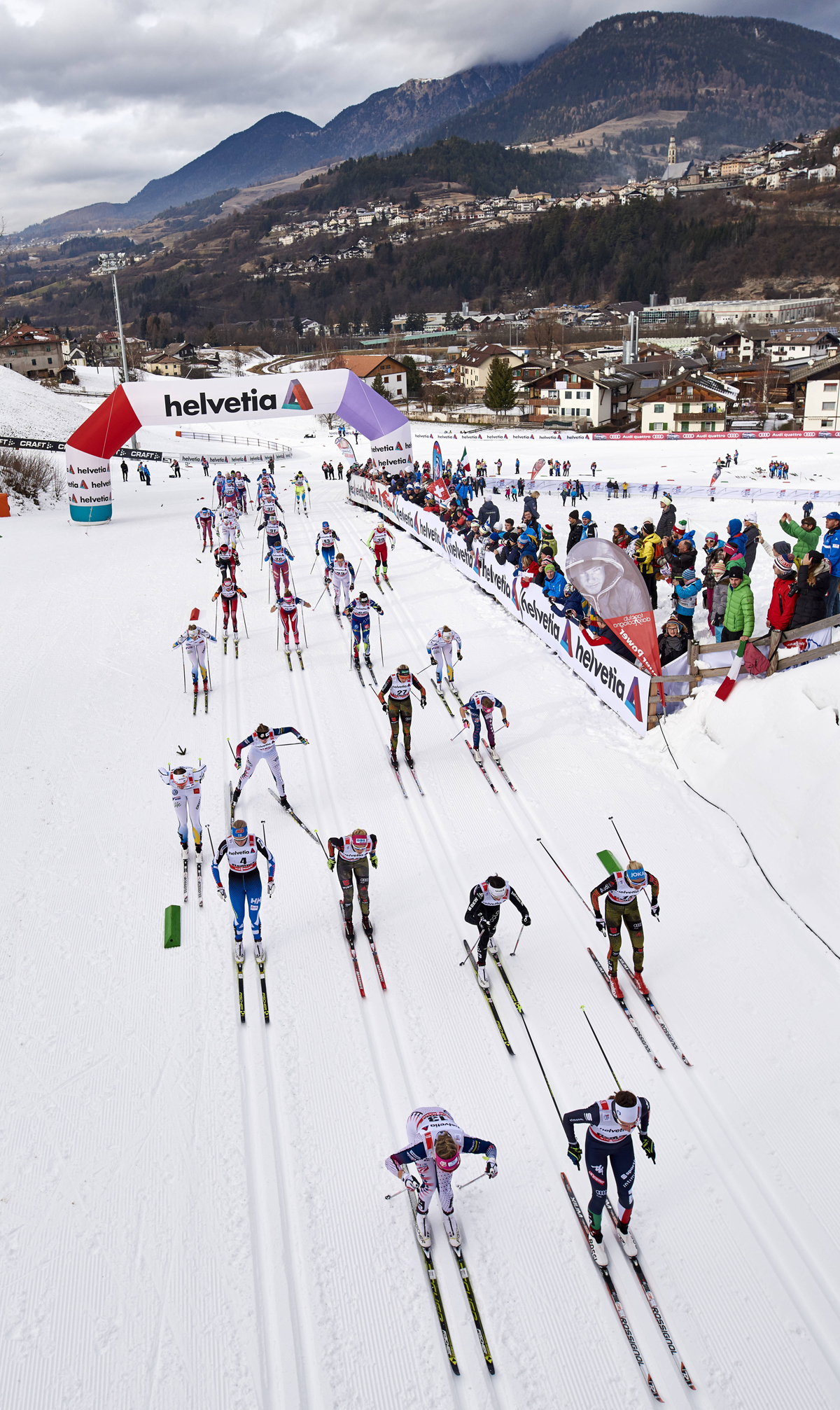
And they’re off! The women take to the course in Stage 2 of the 2021 Tour de Ski, a 10-kilometer mass start classic in Val Müstair, Switzerland. (Photo: NordicFocus)
This World Cup coverage is made possible through the generous support of Marty and Kathy Hall and their A Hall Mark of Excellence Award. To learn more about A Hall Mark of Excellence Award or to learn how you can support FasterSkier’s coverage please contact info@fasterskier.com.
Light snow continued to fall in the quaint Swiss village nestled in Val Müstair as the athletes took to the tracks for the first distance stage of the 2021 Tour de Ski, a 10-kilometer mass start classic race. As the first mass start of the season, the women kicked, glided, and poled over 10-kilometers broken into four challenging laps, seeing exactly where they stacked up relative to their competitors.
With four consecutive distance stages, the Tour quickly becomes part poker match, part ultramarathon. Standings and cumulative time are influenced not only by the final result from each day, but by the bonus points athletes can garner at checkpoints on course; in today’s case, an opportunity at the 3.3 kilometer mark.
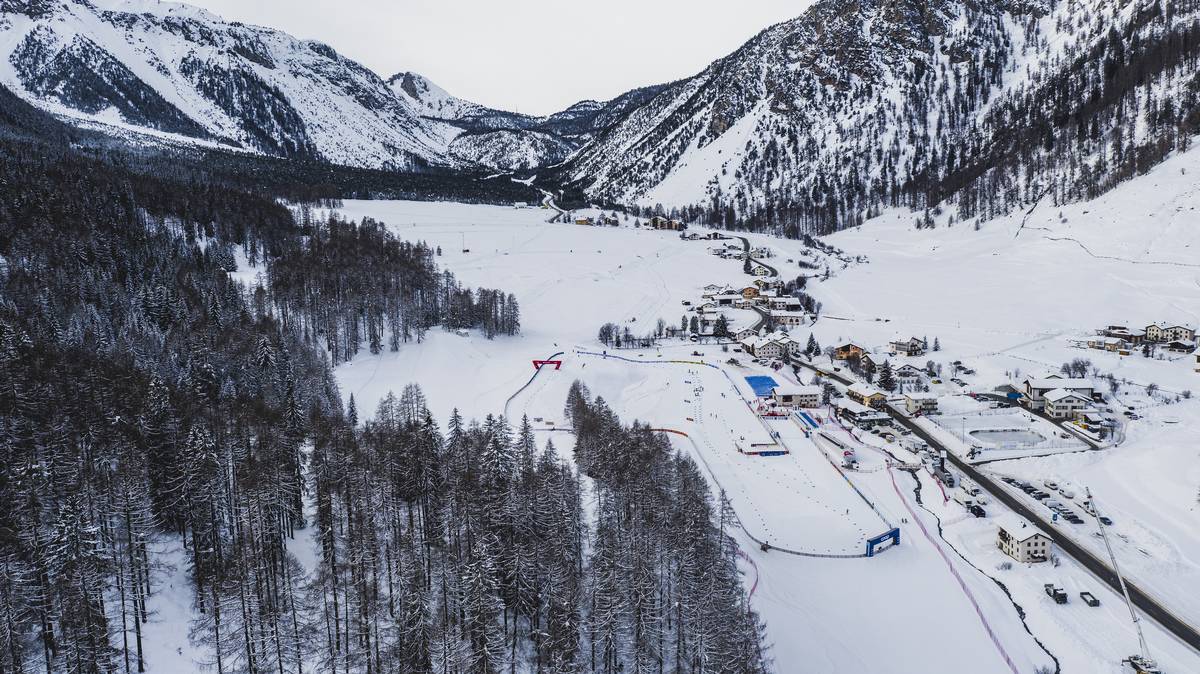
The picturesque village and tracks of Val Müstair play host the first three stages of the 2021 Tour de Ski. (Photo: NordicFocus)
As position in the field is relatively clear in a mass start — versus chasing the splits of a “ghost” racer in an interval start — tactics, patience, and drafting become more significant.
Today, it was soon evident who intended to make a run at the dealer in the Stage 2 match. Wearing a bright green bib as overall U23 leader, Sweden’s Frida Karlsson skied at the front of the pack from the start. She out-sprinted teammate Ebba Anderson approaching the 3.3 k checkpoint to snag the maximum of 15 bonus points, and seemed to be comfortably kicking up each of the steady climbs. After her defeat of Norway’s powerhouse Therese Johaug at last year’s Holmenkollen 30k, albeit in part attributed to Johaug’s decision not to change skis, Karlsson solidified her position as a woman to watch in distance races.
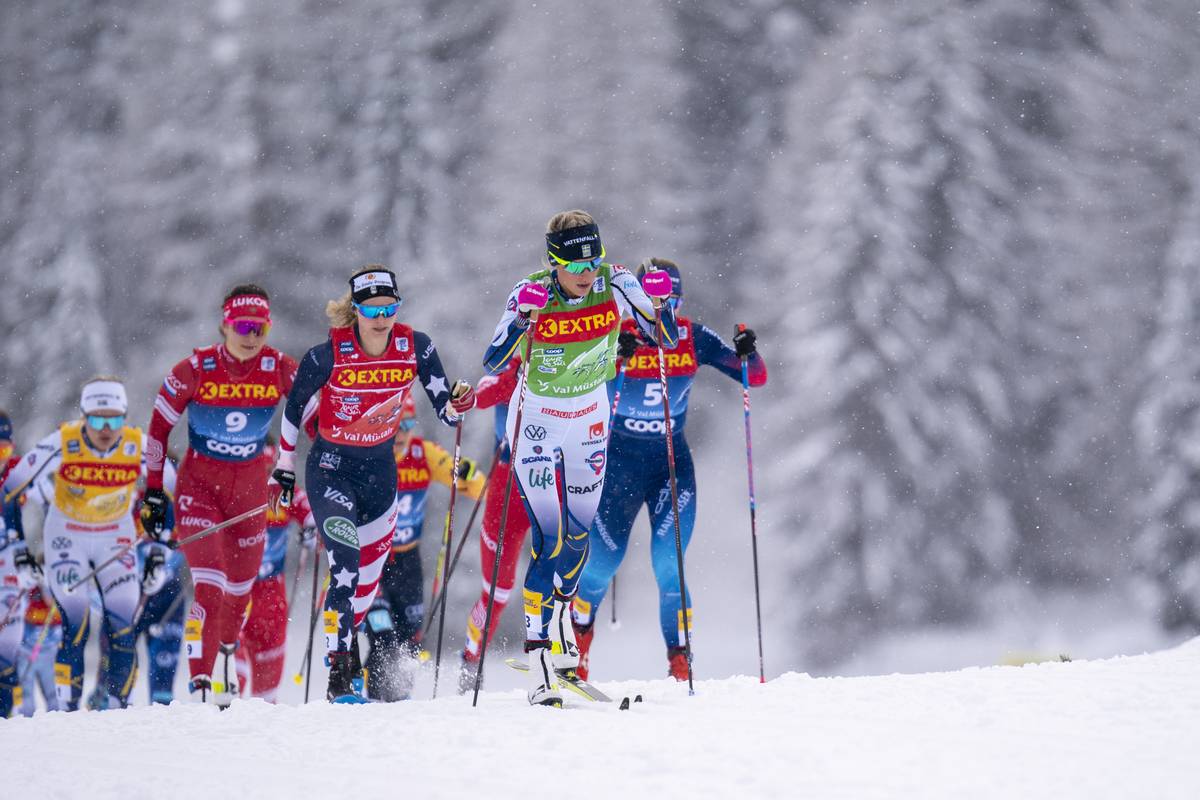
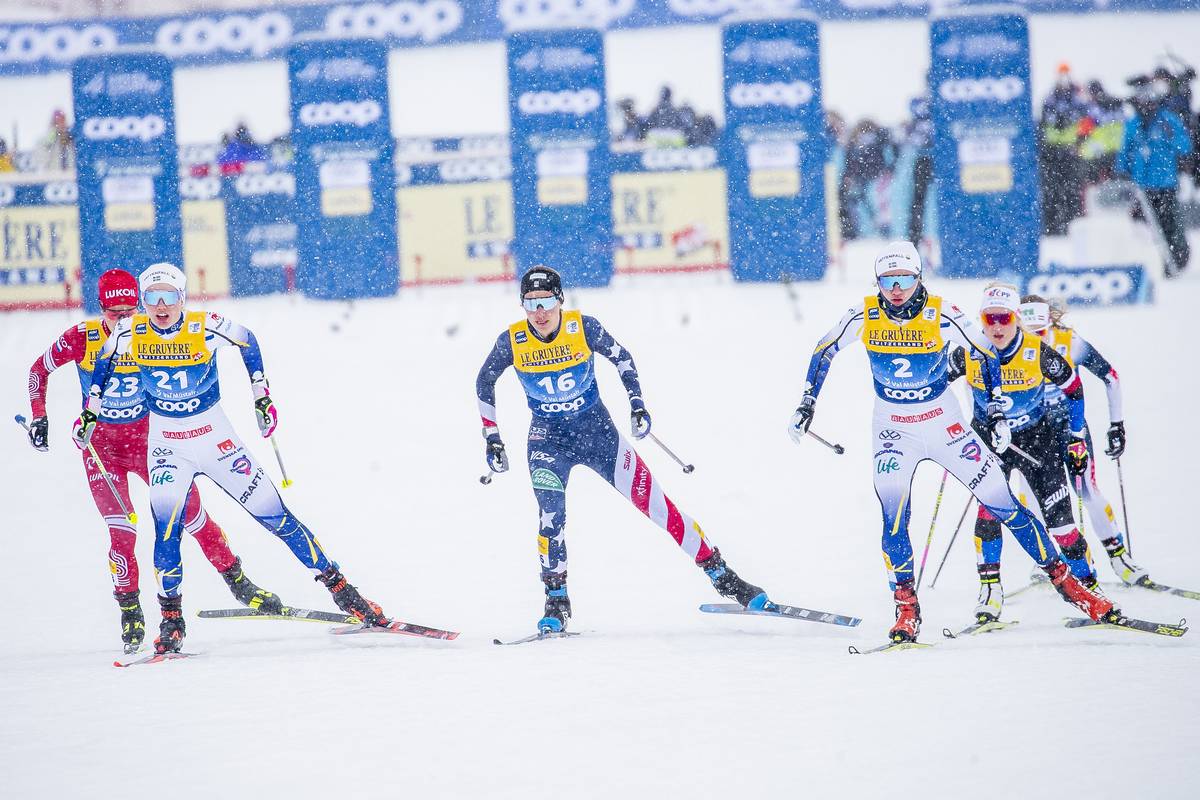
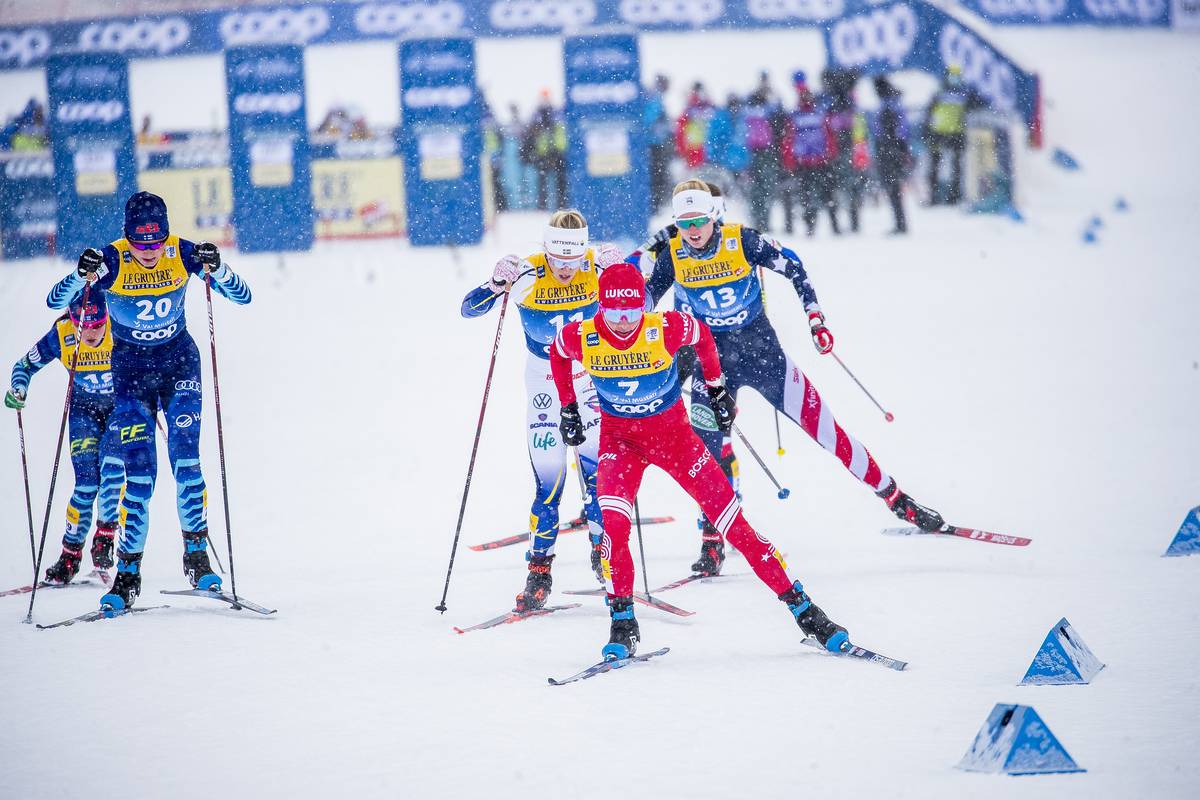
Frida Karlsson sets the pace with Diggins marking from behind during Stage 2 of the 2021 TdS. (Photo: NordicFocus)
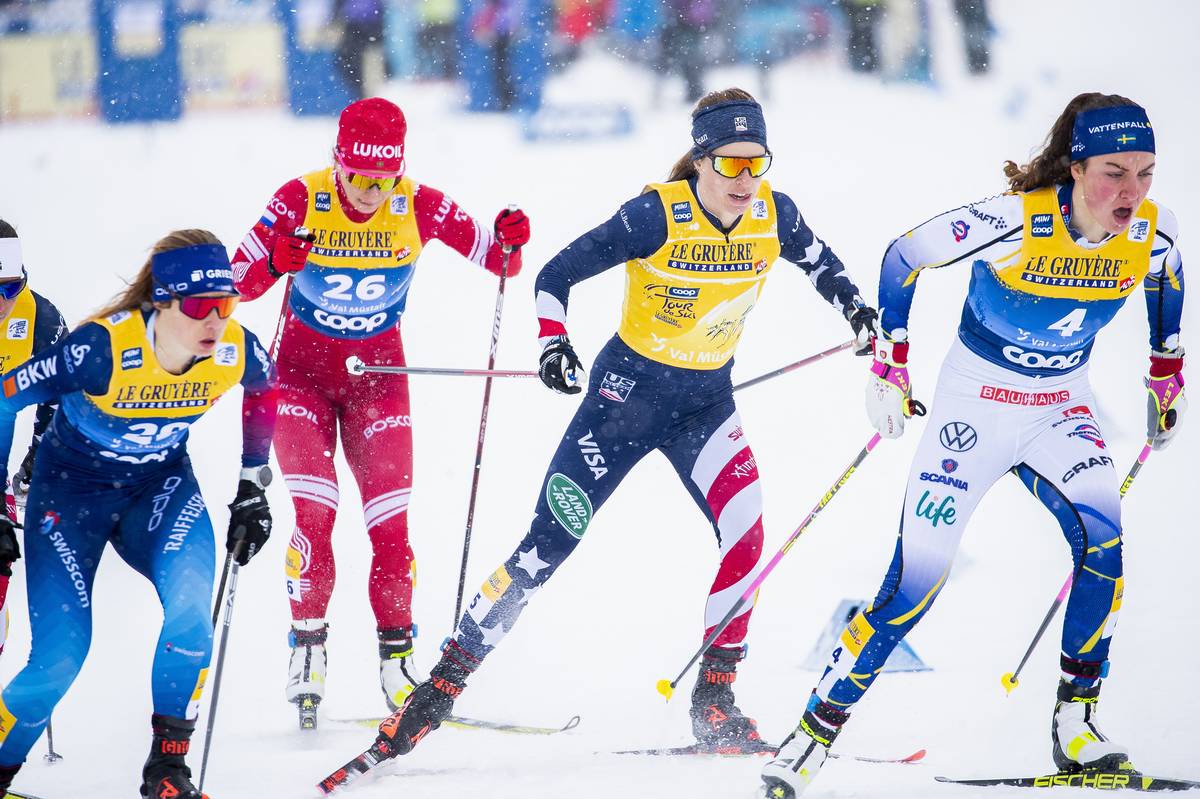
However, despite her seeming authority at the front, she was unable to create any true gap to the women behind her. At the midpoint of the last lap, six women sat on her tails including two women whose stars and stripes flashed on their legs as they matched the tempo of the other women striding alongside them.
One of these women, Jessie Diggins, comes off a second place finish in yesterday’s sprint. Diggins held her position in the top three throughout the race, at times challenging Karlsson at the front, leaving no room for weakness or error on the young Swede’s part.
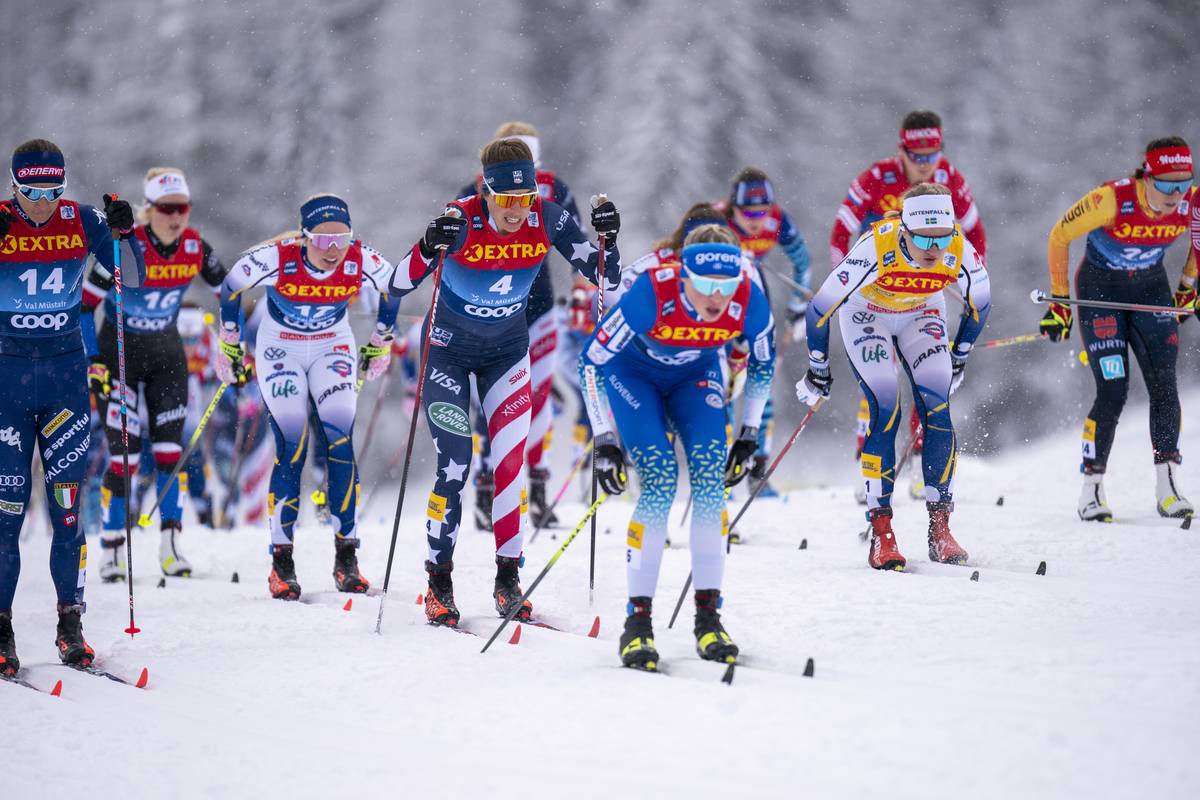
Rosie Brennan tucks into the lead group during Stage 2 of the Tour de Ski, a 10-kilometer mass start classic. (Photo: NordicFocus)
Fellow American Rosie Brennan, who finished fourth in Stage 1 also sat comfortably in the lead group, matching the surges that were made to break away as the race progressed.
In the final two kilometers, the other women began their own runs for the win, challenging Karlsson who was faltering, but unwilling to fold. Up the final climb and down the same screaming S-turn descent featured in the sprint course, the women charged furiously toward the finish, Karlsson slowly being swallowed into the pack.
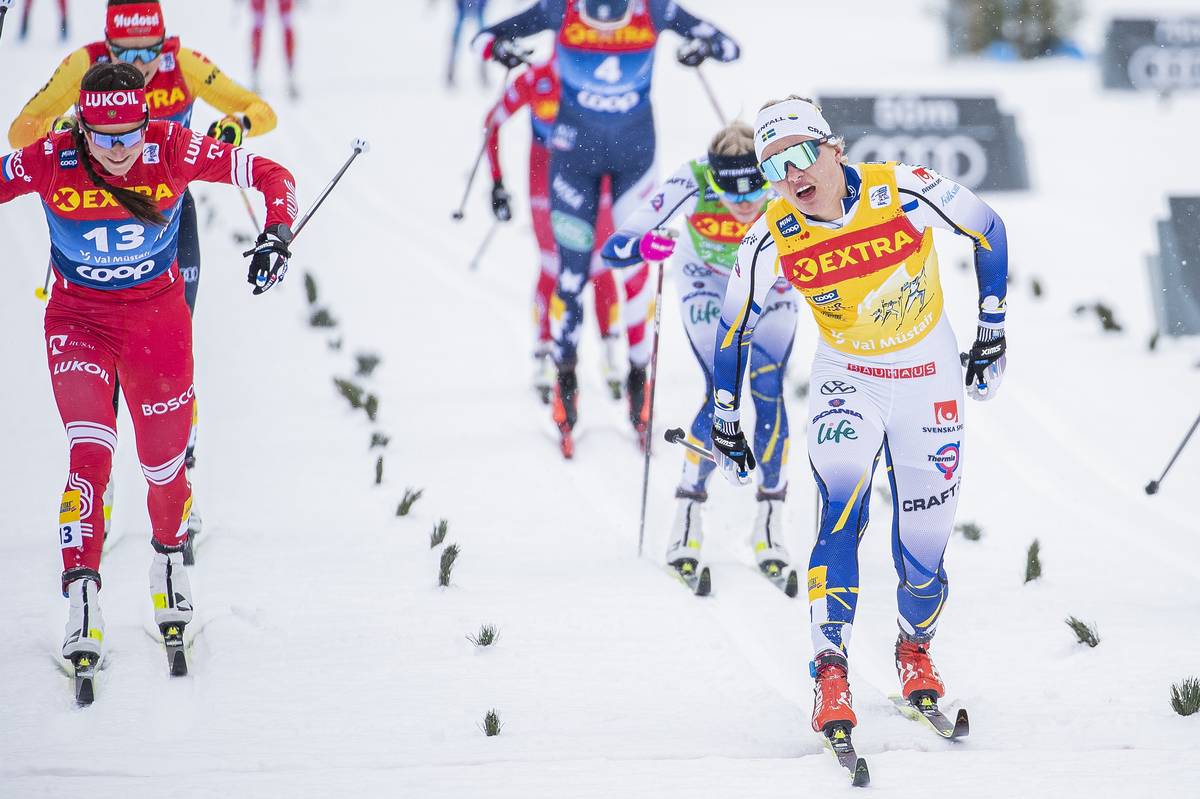
Rounding the final corner and thrashing her poles to accelerate toward the finish, a different woman in white lycra took the reins. 21-year-old Linn Svahn, the winner of yesterday’s skate sprint and of the 2019/2020 World Cup sprint globe, put her closing speed on display to stop the clock at 30:09.9. Though she has won FIS distance races on home soil, this is Svahn’s first distance win at the World Cup level.
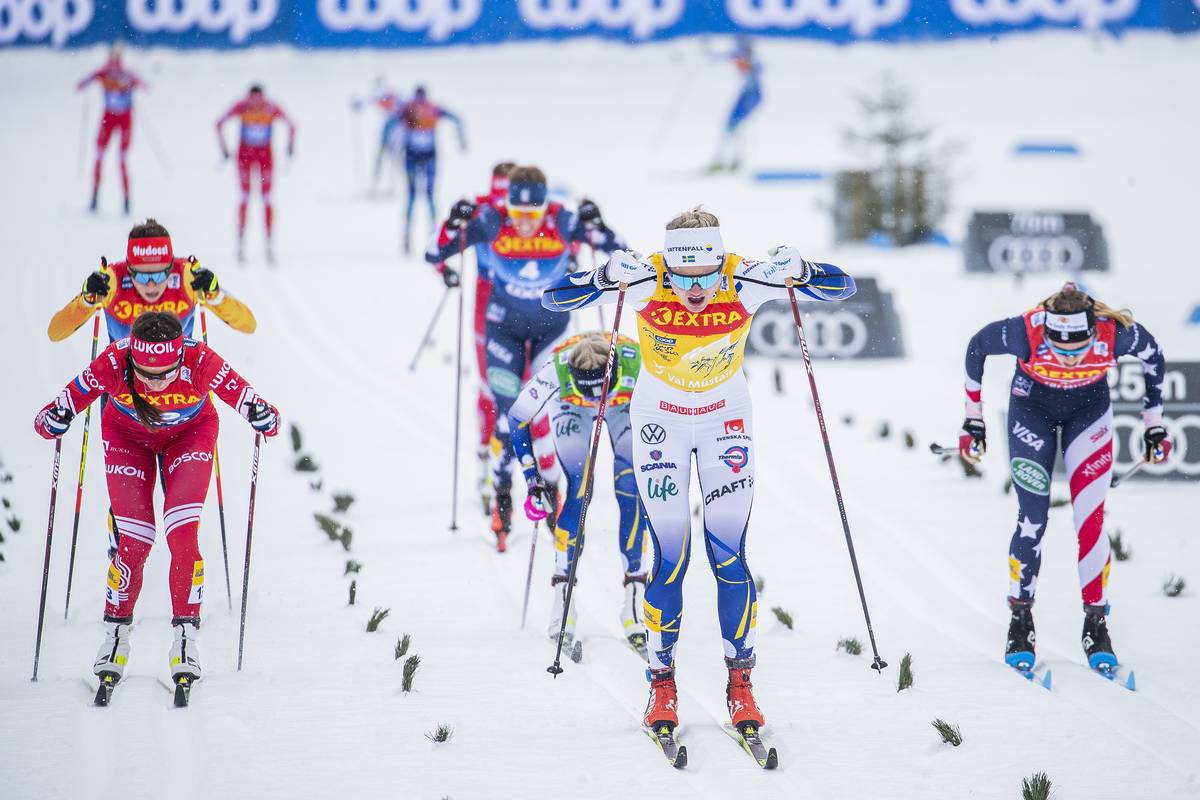
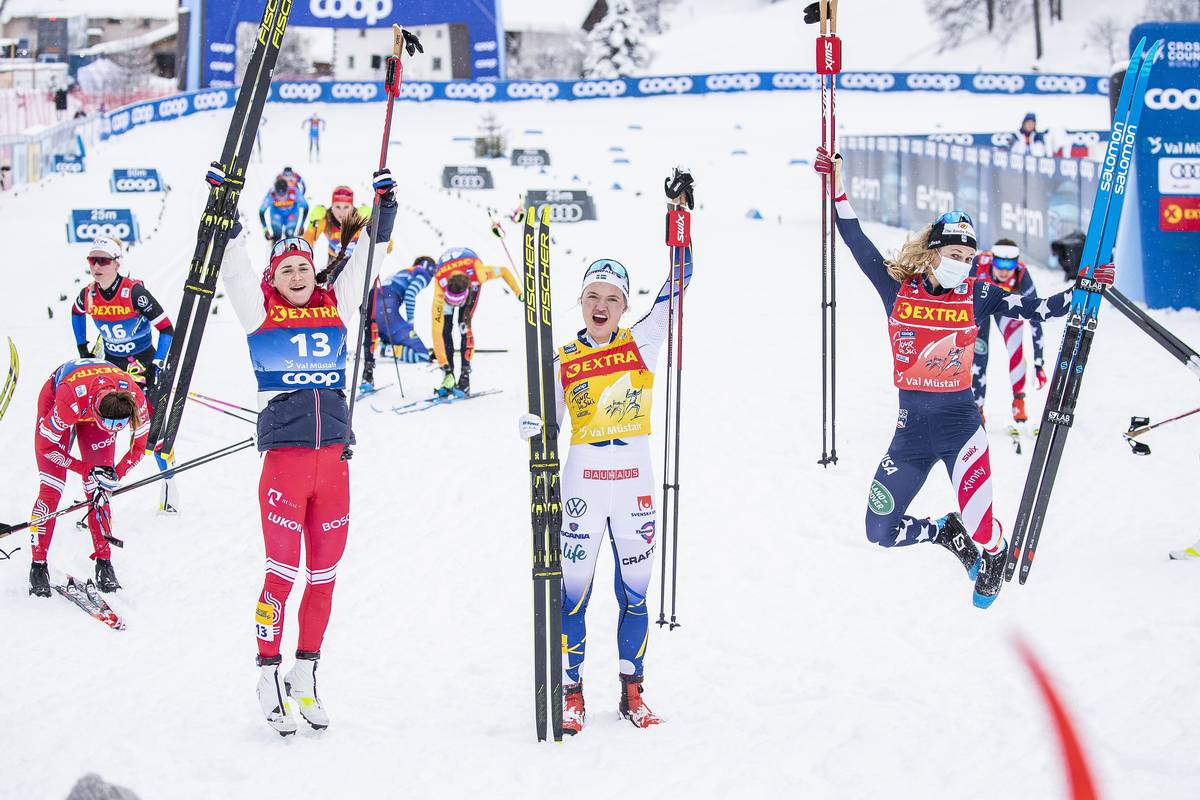
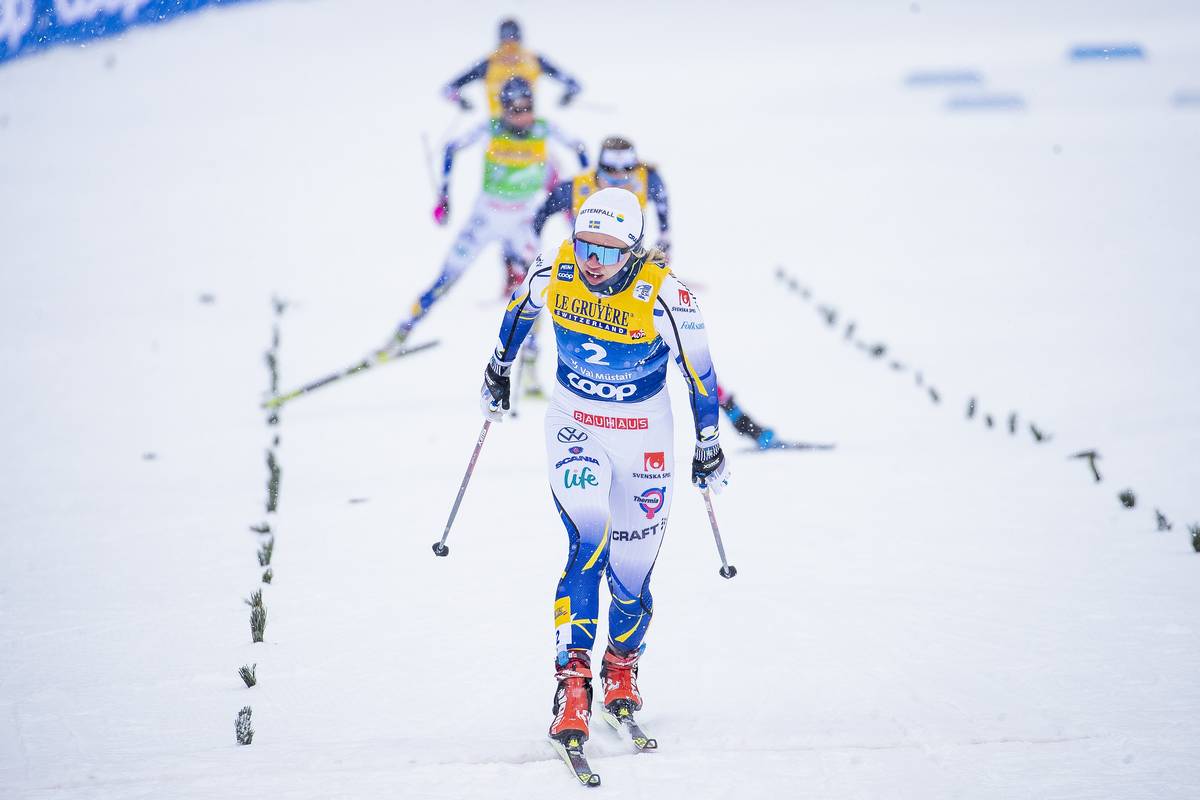
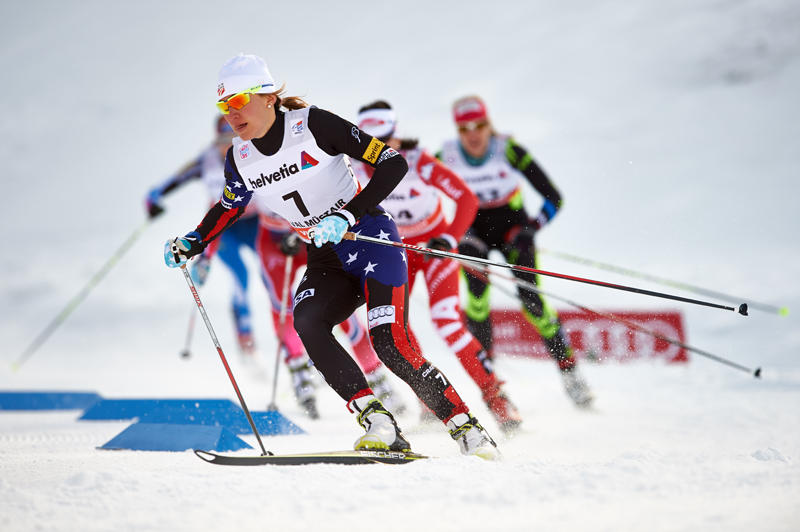
The top women fight to the line during Stage 2 of the 2021 Tour de Ski. Sweden’s Linn Svahn took the win, with Yulia Stupak (RUS) and Jessie Diggins in 2nd and 3rd, respectively. (Photo: NordicFocus)Sweden’s Linn Svahn throws her boot to seal the deal on victory in Stage 2 of the TdS, a 10-kilometer mass start classic. (Photo: NordicFocus)
“It was really fun. I love going classic,” she told FIS after the race. “My plan was to just keep it as chill as I could, then watch the girls going strong on the uphill and try not to use so much energy. When I knew it was one lap left, I just kept thinking ‘I need to win this. I need to win this.’ So it was really good to race today.”
A champion in sprint and distance, Sweden’s Linn Svahn wins back-to-back stages of the 2021 Tour de Ski. (Photo: NordicFocus)
Just behind, a threesome including Diggins, Karlsson, and Yulia Stupak of Russia fought for the remaining spots on the podium. Stupak and Diggins crept ahead of the Swede, matching each other’s poling tempo before throwing their boots at the line. Stupak barely edged out Diggins, taking second (+0.7) with Diggins just behind in third (+0.8).
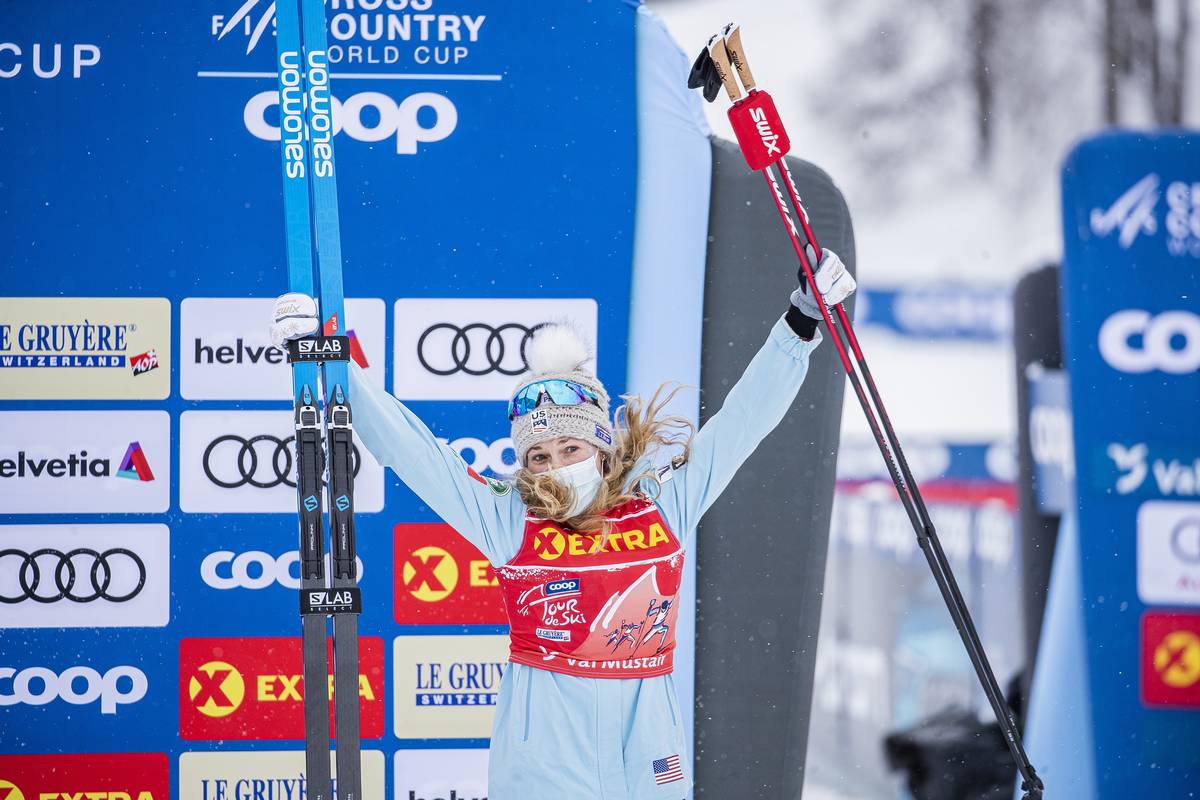
Airborne and on form, Diggins celebrates her third place finish in Stage 2 of the Tour de Ski. Sweden’s Linn Svahn (center) took the win, followed by Russia’s Yulia Stupak in 2nd. (Photo: NordicFocus)
“We had great skis out there!” wrote Diggins in an exuberant post race email. “Huge thanks to our service team and coaches for all their hard work, and the Salomon service team for their help picking my skis before the race!”
Diggins continued by commenting on today’s effort, and how this classic result represents years of focus on technique and collaboration with her coaches and teammates.
“My goals for today were to ski smooth and really work the downhills without letting them become a stress in a mass start environment, so I stayed near the front to keep out of trouble. This was a great course for me with all the long power-striding, and when I felt good on the last half of the last lap I just decided to push it! For someone previously labeled as a skater only, it was very exciting to find myself sprinting for the podium in a 10 km classic race, and confidence-boosting as well since I’ve been working so hard for so long on my classic striding! I think that improvement speaks to our coaches’ dedication and our positive team environment where we can learn from one another and push each other in our weaker areas. This summer I really benefitted from my SMST2 teammates helping me push the envelope in classic intervals and I’m extremely grateful to them!”
Coming on form in the 2021 Tour de Ski, Jessie Diggins takes third in Stage 2. (Photo: NordicFocus)
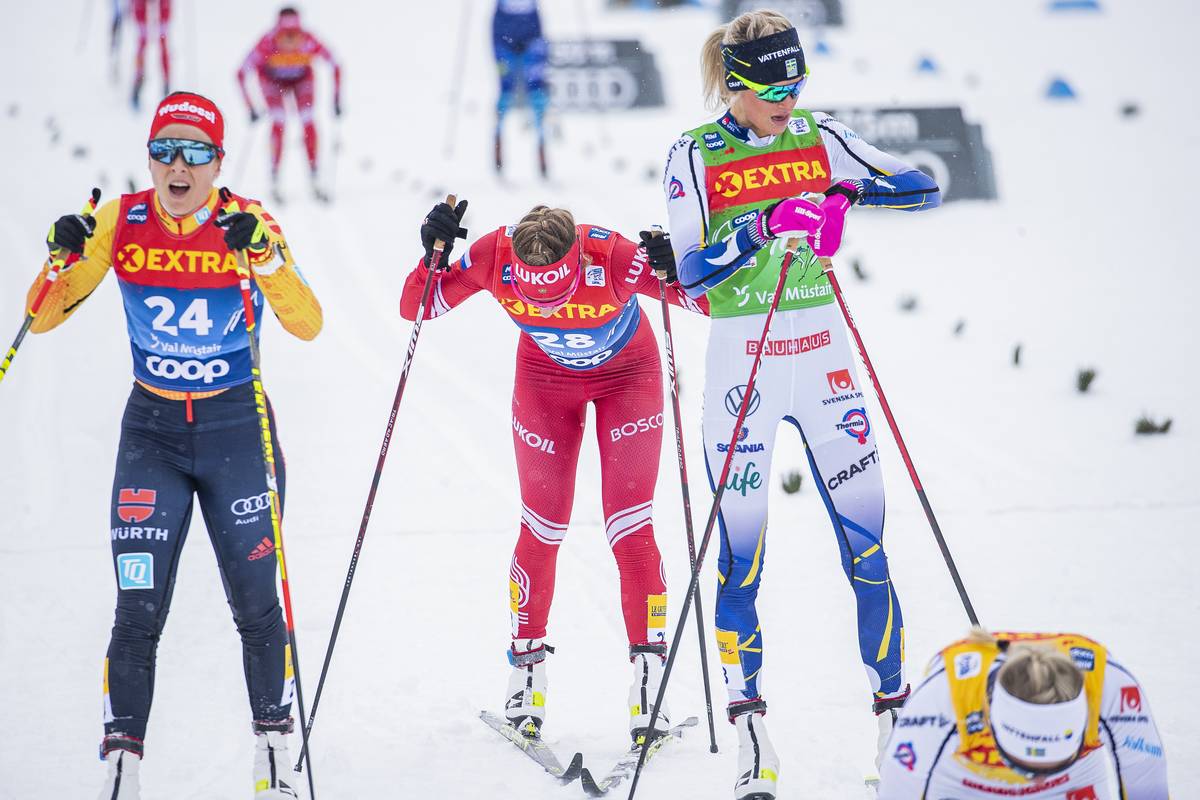
Despite spending over 8 kilometers at the front, Karlsson took the wooden medal in fourth (+1.4). She was followed closely by Katharina Hennig of Germany in fifth (+2.0), with Rosie Brennan on her tails for sixth (+4.5).
Evidence of the effort, the leaders of the Stage 2 of the 2021 TdS, a 10-kilometer mass start classic, gasp for air at the finish line. (Photo: NordicFocus)
“Today was the first mass start of the season, which is always a little nerve wracking for me as I prefer individual starts,” wrote Brennan in an email to multiple news outlets. “My goal was to keep things as close as possible and then see what I left in the end. I think I did this well as I skied in the front pack throughout the race. I was unhappy with my tactics on the long gradual downhill coming back towards the stadium. I took a gamble on lane choice that didn’t pan out and found myself out of contention for the sprint finish, but managed to minimize my time lost to the leaders and also get a career-best classic result so I am proud of that. I am in a great position for tomorrow’s pursuit start so I hope to find some good energy and take advantage of that!”
Outside the top-10 with noteworthy finishes were Hailey Swirbul in 17th (+40.5) and Katharine Ogden in 22nd (+1:21.2). Swirbul was among a larger lead group through the 5 k, dropping into a chase pack as the top 10 began to break away.
Hailey Swirbul on her way to a 17th place finish in Stage 2 of the 2021 Tour de Ski. (Photo: NordicFocus)Katharine Ogden on course in Stage 2 of the 2021 Tour de Ski. (Photo: NordicFocus)
Caitlin Patterson was the next American finisher in 38th (+2:10.4), followed by Julia Kern in 41st (+2:30.6), and Sophie Caldwell Hamilton in 46th (32.49.0). Caldwell Hamilton experienced a crash near the end of the first clustered lap; “You got it, Soph!” could be heard from a passing teammate.
Post-race comments on the women’s 10k mass start from U.S. Head Coach Matt Whitcomb.
Julia Kern on course in Stage 2 of the 2021 Tour de Ski. (Photo: NordicFocus)
Overall Tour de Ski and World Cup Standings
With back-to-back wins, Svahn leads the 2021 Tour de Ski by 13 seconds, with Diggins in 2nd, and Karlsson third (+0:18).
Because of snagging the bonus points in today’s stage, Karlsson sits at the top of the TdS point standings with Diggins one point behind in second, and Svahn three points back in third.
Brennan skis to 6th in Stage 2 of the 2021 Tour de Ski, adding to a string of outstanding performances. (Photo: NordicFocus)
Continuing her streak of outstanding races, Brennan remains in possession of the yellow bib as overall and distance World Cup points leader and sits 4th in the TdS standings for both time (+0:20) and FIS points.
The tour continues tomorrow with a 10-kilometer skate pursuit.
Sweden’s Linn Svahn winning the first stage of the 2021 TdS in Val Müstair, Switzerland. (Photo: NordicFocus)
This World Cup coverage is made possible through the generous support of Marty and Kathy Hall and their A Hall Mark of Excellence Award. To learn more about A Hall Mark of Excellence Award or to learn how you can support FasterSkier’s coverage please contact info@fasterskier.com.
Out with 2020, in with 2021. Here in the world of multicolored lycra and skinny skis, we are kicking off the new year with the opening of the Tour de Ski on the sprint track of Val Müstair, Switzerland. As snow fell lightly but steadily, the usually remarkable mountain backdrop was veiled, narrowing our focus to the athletes as they embark on the grueling eight stages over ten days that is the TdS.
The two-lap 1.4-kilometer sprint course in the alpen valley featured two punchy climbs per lap leading down into fast and tight S-turns. Small rollers after these turns kept the skiers on their toes as they charged around the course.
Though the Norwegian athletes remain absent from the World Cup and TdS, the Swedish women are back in full force. They made their sprint prowess known in the qualifier, with 26-year-old Maja Dahlqvist setting the fastest time by nearly three seconds in 3:30.86. Seven members of their squad qualified for the heats, with an additional three in the top 10: Linn Svahn in 2nd, Moa Lundgren 4th, and Frida Karlsson in 8th. Though Karlsson is normally known for her distance racing (in particular besting Norway’s dominant Theresa Johaug at last year’s Holmenkollen 30 k), her possession of the green U23 Overall World Cup leader bib evidenced that she was not to be dismissed as a contender for the stage.
Wearing the yellow Overall World Cup leader bib, Rosie Brennan was the top American qualifier in 5th (+4.38), followed by Hailey Swirbul in 13th (+8.65), Jessie Diggins in 14th (+8.96), Sophie Caldwell Hamilton in 16th (+9.77), and Julia Kern in 25th (+12.61).
Brennan raced in a stacked first heat of the quarterfinals, racing against two of the top Swedes, Dahlqvist and Lundgren, in addition to Russia’s Natalia Nepyaeva, teammate Kern, and Switzerland’s Laurien van der Graaff. Brennan stayed near the front and in position to advance from the get-go, but couldn’t break from the lead group of four. She finished in a three-way photo finish with Nepyraeva and Lundgren, taking third but snagging a lucky loser spot allowing the threesome to all advance into the semis.
Jessie Diggins finding her form in Val Müstair, Switzerland where she placed second overall in the TdS stage 1 sprint. (Photo: NordicFocus)
Also advancing from the quarters from the fifth heat, Diggins held a position near the front throughout her heat, showing with her lightning-fast tempo that she intended to advance. She pushed Karlsson and Italy’s Greta Laurent break from the remainder of the group. In the second lap, Diggins had the fastest V1 cadence on the climbs and stayed smooth in the descents, priming herself for good positioning in the final sprint to win the quarter.
Ending their day after the quarters, Caldwell Hamilton marked Swedes Svahn and Emma Ribom. In her usual calm, cool, collected manner, she skied smoothly through the S-turn and tucked in comfortably on Ribom’s tails. Despite great position coming into the final lanes, Caldwell Hamilton could not quite overtake Ribom and finished centimeters behind for third in the heat. Swirbul stayed close to the leaders but was unable to fight for the top two and ultimately ended the heat in third also. Neither heat was fast enough to obtain a lucky loser spot.
Sophie Caldwell (bib 16) qualified in 16th and placed 16th overall in Friday’s skate sprint. (Photo: NordicFocus)Hailey Swirbul, here in bib 13 during stage 1 of the 2021 Tour de Ski, placed 15th overall. (Photo: NordicFocus)
On to the semifinals. Racing on home soil in the tight first heat, Nadine Fähndrich (SUI) edged out her opponents for the win in a three-way photo finish with Slovenia’s Anamarija Lampic and Sweden’s Dahlqvist. Considering Lampic and Fähndrich both finished in the top four of the last two freestyle sprints in Davos and Dresden, this result serves as a testament to the depth of the sprint field in those venues despite the lack of Swedes, Finns, and Norwegians.
Brennan and Diggins took off in the second heat, marking Swedes Svahn and Karlsson who held the front in the first lap. In the second lap, Brennan upped the tempo on the climbs, while Diggins pushed over the top and worked the downhill, free skating out of the rollers and putting herself into position to charge down the lanes ahead of Karlsson to hold onto the second position and a secure advance to the final.
Frida Karlsson (SWE), Jessie Diggins (USA), Greta Laurent (ITA), (l-r) during stage 1 of the 2021 TdS. (Photo: NordicFocus)
Fighting for millimeters, Karlsson and Brennan were just behind in third and fourth. Both squeaked through as lucky losers, but only just as Brennan’s time was a mere 0.1 seconds faster than the next fastest time.
The pace stayed hot and the pack stayed tight in the first lap of the final. Diggins and Brennan stayed in the mix near the middle of the pack and in contention for the podium.
As the racers rounded the bend into the second lap, Svahn began firing on all cylinders, taking off at the front with Lampic and Fähndrich marking her from a couple ski lengths back. Just when the top-3 positions seemed locked up, Lampic and Fähndrich brushed skis in the downhill S-turn causing Fähndrich to crash, losing sight of the podium. Svahn continued to hammer, flying down the final stretch to take the win with Lampic nearly a second behind her.
Seizing the opportunity, Diggins nimbly dodged around the downed Fähndrich, hopping over her pole and hitting the gas to drop a chasing Karlsson and snag third.
Linn Svahn during qualification in Val Müstair, Switzerland. (Photo: NordicFocus)
“I didn’t know how I’d feel in high altitude,” Svahn told FIS after the race. (Val Müstair sits above 4000 ft.) “I tried to take the first lap to get into my own zone and technique, then I tried to push all I had in the last uphill since the other girls were going really strong beside me.”
FIS also asked about Svahn’s goals for the tour ahead.
“I try to focus on each race, and now I’ll just focus on getting my legs working again after these tracks,” Svahn said with a tired laugh.
After a lengthy review, during which Diggins demonstrated the importance of staying on top of nutrition during the arduous tour by refueling with a bowl of pasta on the sidelines, Lampic was deemed to have interfered and was disqualified. This moved Diggins into the second position on the podium, with Karlsson stepping into third.
“Today was a fun way to start 2021,” wrote Diggins in a post-race email to FasterSkier. “But I think it’s important for me to say that I’m equally as proud of my all-out effort and our team today as I am when I’m not on the podium! It was just another day of giving it my absolute best effort, but the patience and trust in the training plan that Cork and I set down together has been paying off and my race form is coming into sharper focus now.”
Jessie Diggins finishing second overall on Friday’s stage 1 sprint. (Photo: NordicFocus)
So far this season, Diggins had a near miss at the podium with a 4th place at the individual sprint in Dresden and was unable to advance from the quarterfinals in Davos after getting boxed out on a curve just before the final straightaway. Today marks her first podium of the season in sprint or distance.
“The final was exciting, for sure,” she wrote. “I fell behind a bit on the steep climb, and was working my way down the downhill sections with as much speed as I could when I saw Nadine go down and slide around the corner in front of me. I didn’t want to hit her (or break her equipment, or my own) so I jumped over her pole while rounding the corner! In sprinting you can get lucky or be the recipient of incredibly bad luck, and today the luck definitely came my way (and I’m grateful for it).
“It was so exciting to have Team USA be 1/3 of the women’s final,” concluded Diggins. “And for myself, it was exciting to be out there having fun, not putting pressure on myself but still skiing with confidence and enjoying the banked turns and rollers all at the same time.”
Rosie Brennan (l) and Jessie Diggins in Val Müstair, Switzerland after the first stage of the TdS. (Photo: NordicFocus)
“It was a surreal day to be starting the Tour de Ski with the yellow bib,” Brennan wrote in a post-race email to multiple news outlets. “My one goal was to fight with what I had and I felt I did that well so I am proud of my effort out there today. I still have to remind myself just how far my sprinting has come and not change my expectations so quickly. This was only my second final ever and I am just so excited by the gains I’ve made.
“This might be the hardest sprint course I have ever raced,” Brennan continued. “It’s long, at altitude, and had some slow snow out there today. With that in mind, I tried to keep things under control, but also use my strengths. I had a near miss in the quarterfinal and was really happy about my quick acceleration in the finish after getting stopped up. I worked hard in the semi to keep the pace high to ensure our heat would have lucky losers which I then benefited from. However, I was pretty beat by the time we got to the final. I tried to open up on the second lap, but there wasn’t much there. I stayed out of trouble and for that was rewarded another two places. That’s a sprint race for you…That was a tough start to the Tour so the focus will now be on recovery to get ready for tomorrow and all the races to come. It’s also very cool to note that we had our 4th different girl on the podium in just 4 weeks of racing. Our team is really working hard to get through this tough season together and support one another as we navigate the world.”
Outside the top 30, Katharine Ogden finished 49th in the qualifier (+20.07), followed by Caitlin Patterson in 57th (+22.25).
A familiar look: Johannes Høsflot Klæbo of Norway crosses the line in first during the Tour de Ski’s Stage 3 sprint in Val Müstair, Switzerland. (Photo: Fischer/Nordic Focus)
Today’s 1.4-kilometer freestyle sprint course in Val Mustair, Switzerland was not lacking in short, steep climbs, fast, tight corners and rollers that knocked even the best skiers around. Going into Tuesday’s races, Johannes Høsflot Klæbo of Norway was third overall in the Tour de Ski (TdS).
In the first two stages of the TdS, Klæbo took the first stage’s sprint win and placed 12th in Stage 2’s 15 k skate. After his racing today, Klæbo moved from third overall in the TdS, to first. He leads the overall by 12.0 seconds over second place skier from Russia, Sergey Ustiugov.
Klæbo was the fastest qualifier in today’s race with a time of 3:04.69 minutes before going on to win the finals. This is the first time a male has won back-to-back sprint stages in the Tour de Ski.
Klæbo won both his quarter and semi-finals and won the final in a time of 3:03.78. In all three races, he led the steep punchy climb on the second lap and created sizeable gaps by the time he crested the hill and glided into the downhill. Italy’s Federico Pellegrino challenged Klæbo in the finishing stretch of his semi and the final. But in both races, Klæbo prevailed. This is Klæbo’s tenth sprint victory since the beginning of last season.
“I’m very glad [Sergey] Ustiugov did this fast speed at the second lap and, I was just trying to push all in and I’m really happy to be in first.” Klæbo told the International Ski Federation (FIS) after the race. “Now it’s a little bit of rest and then you start over tomorrow. So we try again tomorrow. We’ll see.”
Pellegrino finished today’s sprint in second place, 2.35 seconds behind Klæbo. Pellegrino qualified third, he won his quarterfinal and came in second in his semi-final to Klæbo by 0.14 seconds. After today’s race — the fifth sprint of the World Cup season — Pellegrino sits second overall in the World Cup sprint standings and seventh overall(+1:19.4) in the TdS.
Sergey Ustiugov of Russia finished in third (+3.07) in the Stage 3 sprint. This is Ustiugov’s second podium of the Tour de Ski, he won Sunday’s 15 k skate race
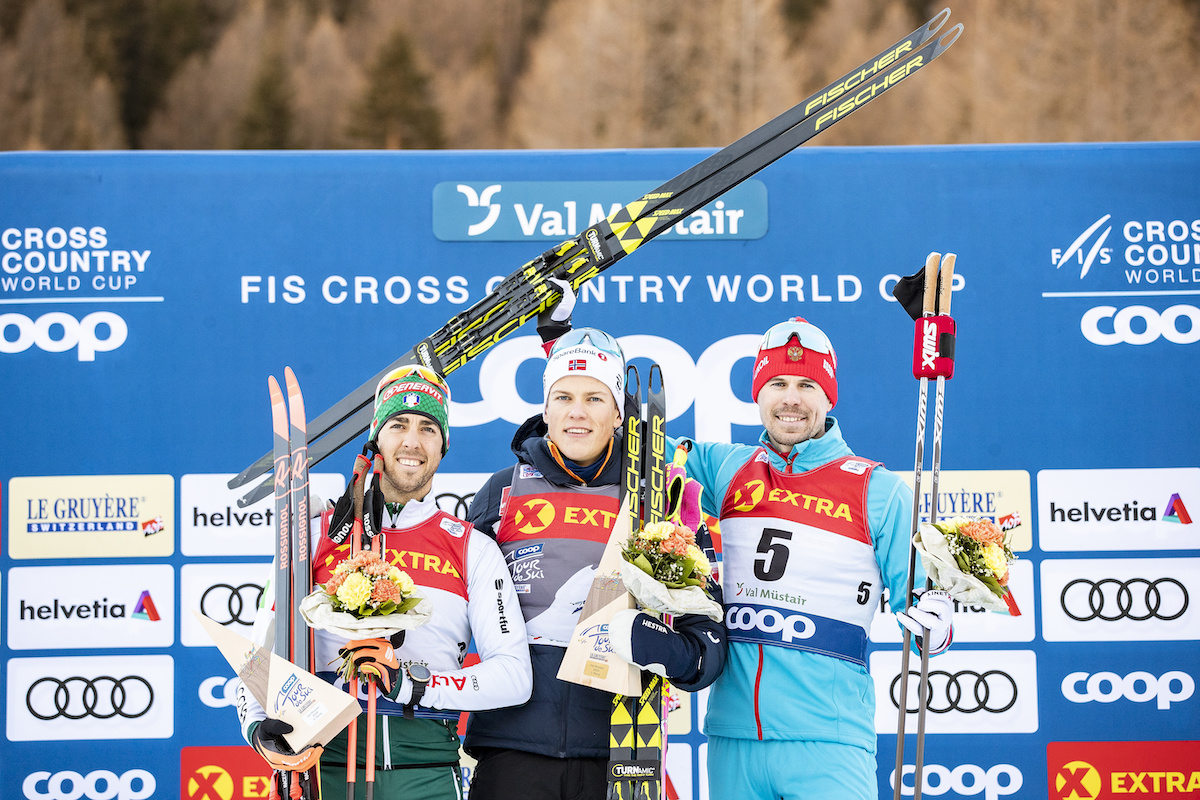
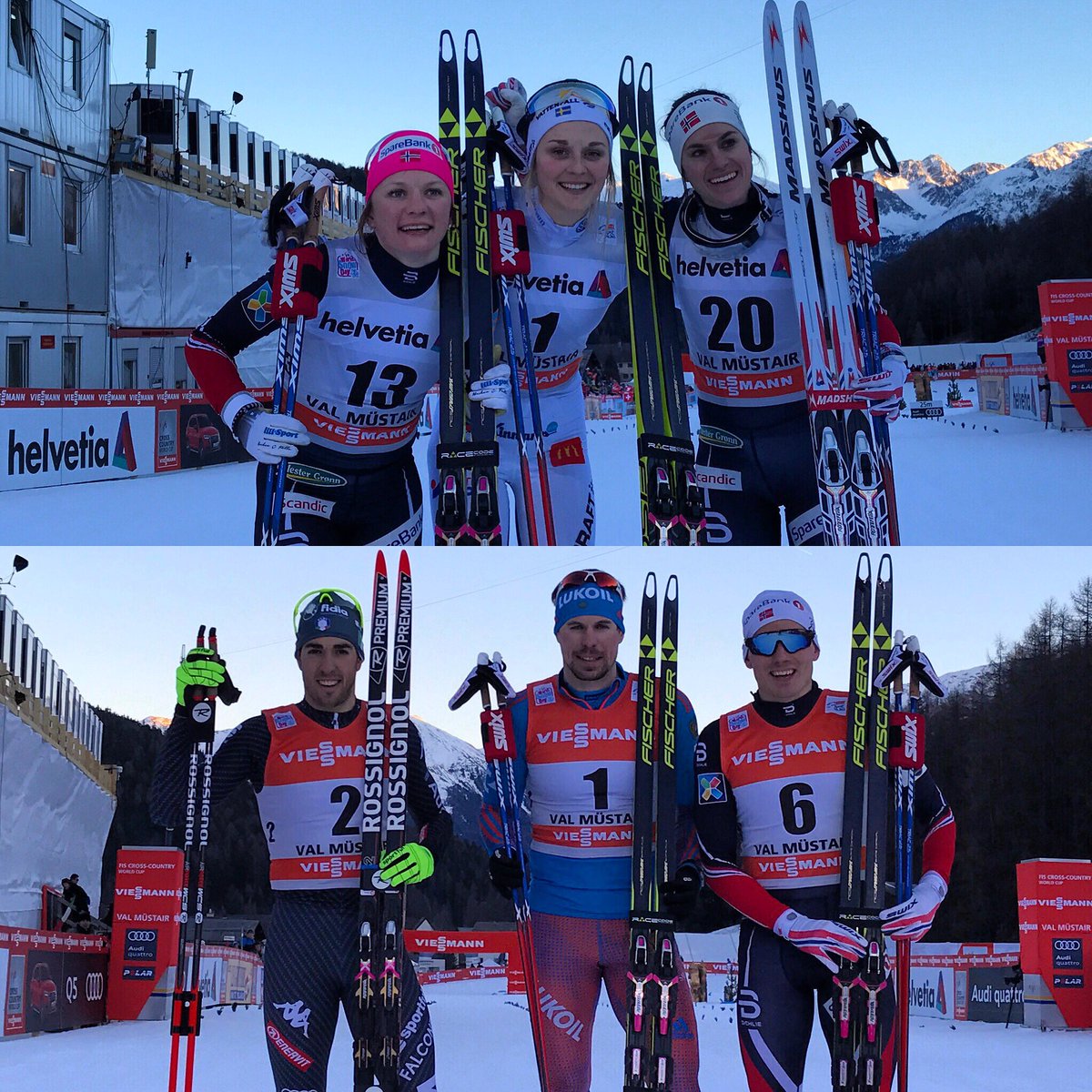
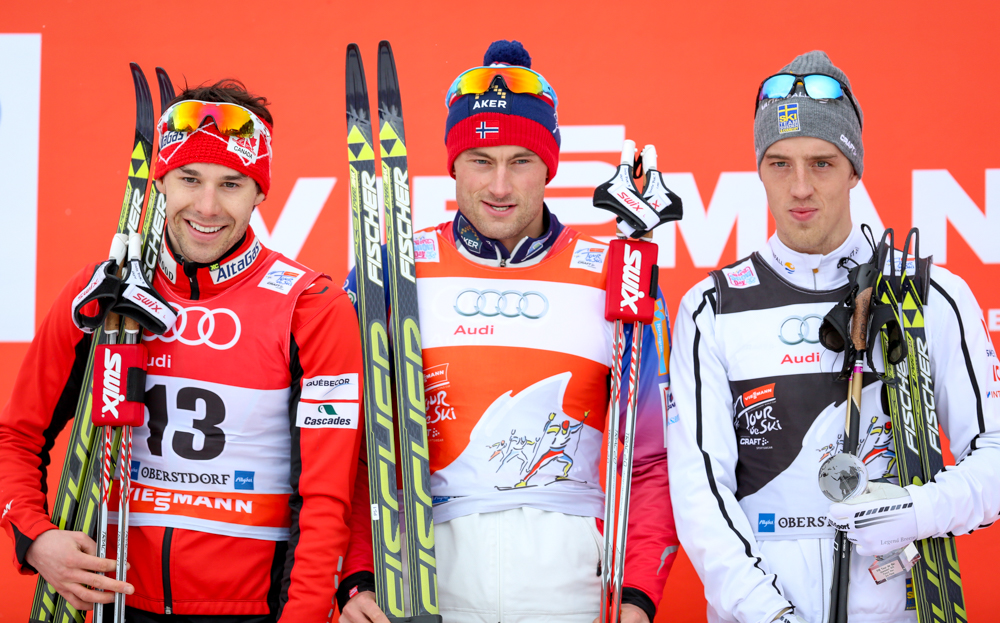
The men’s podium from Stage 3 of the 2018/2019 Tour de Ski – a 1.4 k skate sprint in Val Müstair, Switzerland. From left to right, Italy’s Federico Pellegrino placed second, Norway’s Johannes Høsflot Klæbo first, and Sergey Ustiugov of Russia finished third. (Photo: Fischer/Nordic Focus)
Simi Hamilton of the U.S. Ski Team (USST) was the only North American to qualify for the heats in today’s race. Hamilton qualified in sixth (+4.30) and ended his day 13th overall. Hamilton finished third in his quarterfinal, .68 seconds behind winner Pellegrino, and did not advance.
“There was a big headwind, so I focused on settling in and drafting on the first lap and I felt like I was in a good place,” Hamilton said of his quarterfinal matchup. “But Pellegrino and Chanavat put a surge on and I couldn’t match it. I’m a little disappointed, it’s a little bittersweet. I felt good, but it was a bummer not to move on. I’m psyched for Jessie [Diggins] and Sophie [Caldwell], the team’s energy is great right now. It was another fun day of ski racing!” Online gaming, charity lotteries, and slot machines all include risk. It’s tough to see the hazards when playing, whether you win or lose. The majority of people like gambling, but it may become a problem that affects their health, money, or relationships. Check out this website: bahis siteleri . Everyone’s gambling experience is unique, but we offer the tools to assist you or someone you care about manage the dangers.
Kevin Bolger of the U.S. Ski Team during his qualifier, Stage 3 of the Tour de Ski. (Photo: Fischer/Nordic Focus)
Kevin Bolger (USST) was the next best American finishing in 34th (+10.60). In his first career TdS, Bolger qualified 13th and finished 21st overall in Sunday’s Stage 2 sprint.
Also for the U.S., Ben Lustgarten (CGRP) placed 77th, Erik Bjornsen (USST) did not start today’s stage.
For Canada, Alex Harvey was 37th overall, Bob Thompson 62nd, and Lenny Valjas 72nd.
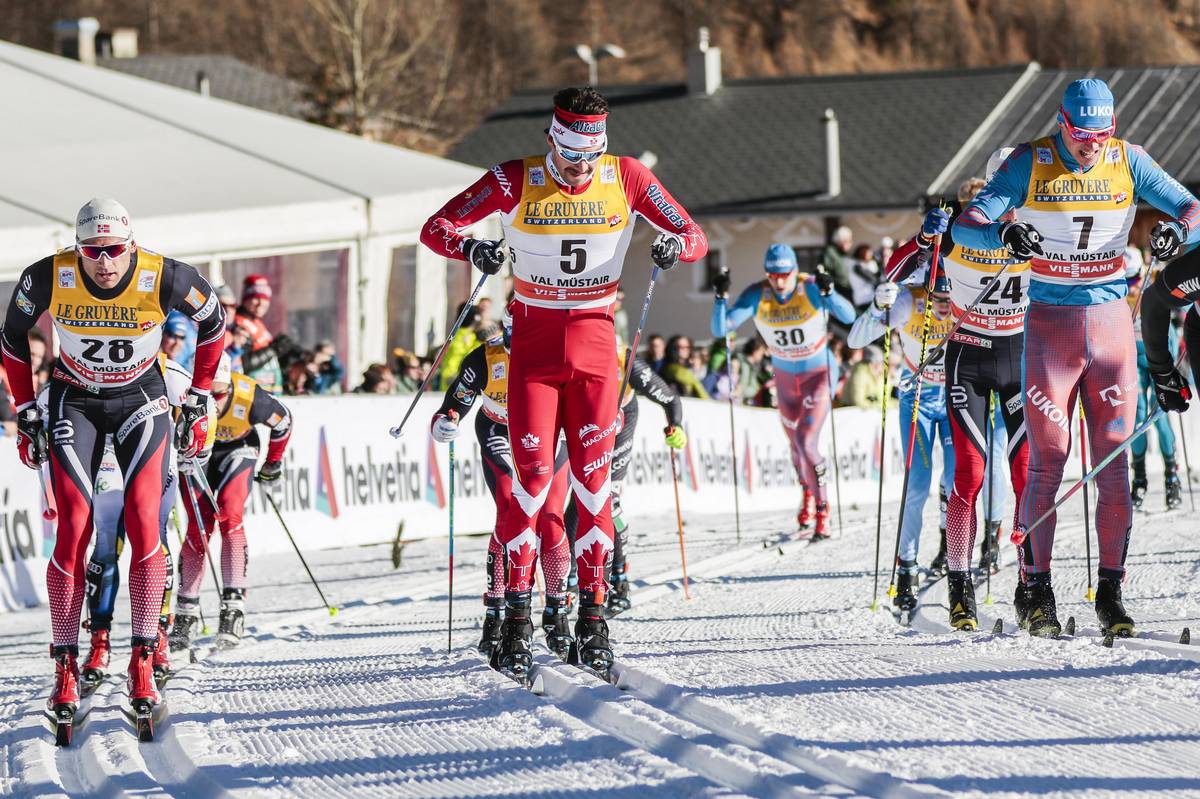
The men’s 10 k classic mass start, with Canada’s Alex Harvey in bib 5 behind Norway’s Niklas Dyrhaug (28) and Sweden’s Marcus Hellner (18) heading out of the stadium on Sunday at the second stage of the Tour de Ski in Val Mustair, Switzerland. (Photo: Fischer/NordicFocus)
With the opening stages of the Tour de Ski in Val Müstair, Switzerland, behind us, we wanted to share some athlete and coach comments that didn’t make it into the race reports:
***
On training over the holidays leading up to the Tour:
“We were in three different main locations over Christmas: France, Austria, and Switzerland, depending on which athlete you were. You kind of come back and see where everybody is. I think we all know each other so well that the feedback we got from France, even though as a coach, I wasn’t there, kind of told me where people were in terms of health and fitness.”
— U.S. coach Matt Whitcomb after Saturday’s freestyle sprint
On American Kikkan Randall qualifying for the heats for the first time this season in 29th, then going on to place 15th in the freestyle sprint on Saturday:
“Who skis poorly on their birthday? We knew Kikkan was going to get in there today. Even though she’s been coming from a different place than she’s ever been, it was cool to see her squeak in there and really fun to see her mix it up in what was actually a pretty fast heat. To be right there at the finish, to hit the gas like Sophie did, and to have some speed to access, says great things for the Tour.”
— Whitcomb
“We took a chance with entering Kikkan in this Tour, and she knows that. This is an investment, and she hadn’t scored points yet, she’d been close in Davos, she told us you know, ‘Hey, I want this, but I respect your call.’ We decided to make an investment and give her these starts because we really believe it’s going to help her get back to a place where she’s been before. Today, made me really happy to see her so happy about her results. She had a Christmas break where several key workouts went very well in Davos, she came out of there with some confidence and that’s always a good combination at the beginning of a World Cup.”
— Whitcomb
On American Sophie Caldwell qualifying in fifth and going on to place 13th on Saturday:
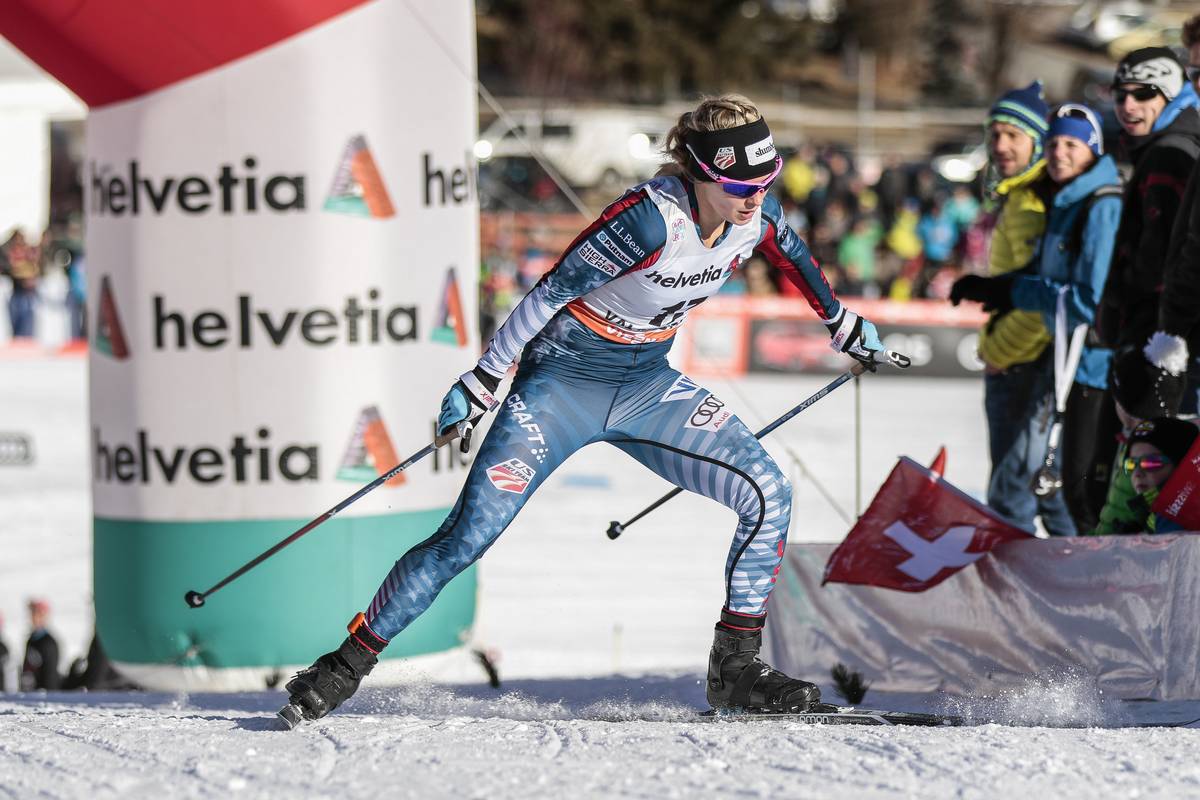
Sophie Caldwell (U.S. Ski Team) skating to fifth in the women’s freestyle sprint qualifier at Stage 1 of the Tour de Ski last Saturday in Val Mustair, Switzerland. She went on to place 13th overall. (Photo: Fischer/NordicFocus)
“One of the best qualifications that she’s ever had, certainly her best this year. It’s great to see her healthy again. She was sick over Christmas, she was the last of the team to go down. She’s healthy again, and so that qualification said great things. She got stepped on, on the final climb and had to cover a gap that got opened up. I was curious to see, at altitude sometimes she can run out of gas and have less than what is required in the finish, and she was really punchy, she hit the gas and got speed out of it, and there was just too many people to go by. She lost by five-hundredths of a second. It could have gone either way; it could have gone fantastically or it could have gone the way that it went.”
— Whitcomb
“I was really psyched with the qualifier today. This is a pretty long, hard course at altitude, so to qualify that high was a really good day for me. It’s funny because this is the second time I’ve raced here, and because it’s long hard and because it’s at altitude, both times I’ve had to tell myself to go easy the first lap or 2/3rds of a lap. Of course you never actually go easy in a race, but if I keep telling myself to go easy, then I can at least take it out a little slower and pace it pretty well.”
— Sophie Caldwell on Saturday’s qualifier
“I’m someone who has a lot of fast twitch and I can get up to speed quite quickly, which is sometimes a blessing and sometimes a curse. On a quick course it can be a great thing, but on a longer course at altitude, I risk having an epic blowup if I start out too hot. So after the first uphill today I was like, ‘okay, good job, your legs don’t hurt and you’re not breathing hard’, then across the long gradual uphilll I started picking it up a bit and then tried to hammer up the hill the second time and of course, my legs hurt, but they were fresh enough to make it over the hill. I didn’t know I was having a good race because it’s hard to feel like you’re crushing it when you’re really trying to pace, but I was really happy to see I was fifth.”
— Caldwell on her qualifier
“Being .01 from advancing was tough, but I’ve also been on the winning end of a lunge before and I guess you can’t always be the lucky one!”
— Caldwell on placing third in her quarterfinal
On American Simi Hamilton:
“I’m expecting big things out of [Simi] in Toblach [at the regular-season World Cup Jan. 14-15]. I think he’s set up for success there. In sprint racing, that doesn’t mean anything, but it’s the best we can ask for. He’s starting to feel better, it’s just today he had a conservative approach to the start as a way of conserving energy, and in this particular heat it put him in sixth, and he had trouble finding windows to make any moves. That didn’t go well tactically today. I think it wasn’t that he was scrambling to hang on, he looked good, he had good acceleration through the finish, he was able to pick off a couple guys. He finished fourth in his heat, and 18th on the day. It’s positive for sure, it’s not where he can race. We’ll see him on the podium again.”
— Whitcomb after Saturday’s freestyle sprint
“I wasn’t surprised with how the qualifier went. I was definitely happy with it. It obviously wasn’t the best qualifier, if you look at the time out from the leader. If you take Ustiugov out of the equation, I think I was somewhat close. I definitely treat it as a sign that things are moving in the right direction.”
— Simi Hamilton after Saturday’s freestyle sprint, where he qualified 14th and went on to place 18th
On the decision for some U.S. Ski Team members to withdraw from the Tour:
“That’s been a part of the plan. It’s not something we decided on the spot. [Sophie Caldwell and Simi Hamilton] will participate in the OPA Cup in Slovenia along with Ida Sargent and Andy Newell this coming weekend. We saw a better opportunity for some of our sprinters than a skate sprint on Friday and a 10 skate on Saturday that they’ll do in Val di Fiemme, [Italy].”
— Whitcomb
On choosing between classic or skate skis for Sunday’s classic mass start:
Canada’s Alex Harvey (5) racing alongside Norway’s Niklas Dyrhaug (28) and Russia’s Andrey Larkov (7) in the men’s 10 k classic mass start at Stage 2 of the Tour de Ski on Sunday, Jan. 1, in Val Mustair, Switzerland. (Photo: Salomon/NordicFocus)
“I tested the skate skis, I was ready to go. I had my pursuit boots, I was ready to go double pole, but the final call was just going to be whatever my competitors were doing. In the end, all the Norwegian guys, Dario [Cologna of Switzerland], and [Finland’s Iivo] Niskanen went classic skis, so I just made the call, kind of looking at what these guys were doing … classic was probably a safer bet and thinking ahead, thinking for the next few days it is a bit easier on the body to stride, and apply the pressure and use all your muscles rather than just the arms and the core so could be a bit better to stride.”
— Canadian Alex Harvey, after placing eighth in Sunday’s 10 k classic mass start
On the classic mass start course:
“There was one, just not super steep, but very long climb like when you started at the bottom of the stadium. It was kind of all gradual for almost four minutes so that was tough, but it was not steep. On the second lap I was skiing behind [Great Britain’s Andrew] Musgrave [who was double poling] the whole way up and not catching him, just going the same speed, but then at the end of the lap, you would hit the sprint hill that we did twice yesterday and that is kind of steep and that is where the double polers were getting bogged down and crashing even. [Others] were trying to herringbone around them and hitting their ski tips, I think had it not be that hill, more people would double pole. That hill, even though it is short, is just enough to put so much stress on the arms that after, you’re kind of paying for it the rest of the course.”
— Harvey on Sunday
On rebounding from illness:
Sadie Bjornsen (U.S. Ski Team) racing to eighth in the Stage 1 freestyle sprint qualifier last Saturday in Val Mustair, Switzerland. She went on to place 23rd on the day. Like teammate Jessie Diggins, Bjornsen was also racing for the first time in several weeks after missing the La Clusaz World Cup due to illness. (Photo: Fischer/NordicFocus)
“I was really nervous coming to this Tour for a couple of reasons; for one, when you felt great, and then you get sick, you almost lose confidence in your immune system, and you’re like ‘What the heck? Am I going to wake up sick before the tour as well?’ It was a big relief to wake up, and be like ‘OK, I feel good, I feel healthy, I’m racing; this is awesome!’ It felt funny because I hadn’t raced in three weeks, and then we’re at this long sprint course at altitude. It was definitely an awkward start. I didn’t feel like I was really going, and I’m sure a lot of people didn’t feel that either, on this course at this altitude. … I was just thrilled to make it to the final, that was a surprise, but a very welcome one.”
— American Jessie Diggins, who placed sixth in Saturday’s sprint final after missing the World Cup in La Clusaz, France, two weeks earlier because of illness
“A lot of people look at illness as a negative thing, it’s really only negative in that you miss some races. [It can be a] somewhat positive recovery process that just unfortunately has to happen. We come out of it feeling fresh and sometimes faster than we were. I think in Jessie’s case, very happy with where she is, I know she’s feeling good.”
— Whitcomb on Saturday
On baby-friendly venues:
Kikkan Randall (c) racing in the 5 k classic mass start on Sunday, Jan. 1, at Stage 2 of the Tour de Ski in Val Mustair, Switzerland. She ended up 19th on the day. (Photo: Fischer/NordicFocus)
“The [Val Müstair] organizers did an amazing job with this race and had a really nice baby room that my mom utilized with Breck. They had diapers, a changing table and toys to play with plus gifts for all the mothers. It’s really neat to see the [organizing committees] getting behind the support for mothers!”
— Randall after Sunday’s 5 k classic mass start
On strategy and expectations for the next few stages:
“It’s easy to try and overcomplicate things as a coach. I mean, we really want what we have to say make a difference to these athletes, but sometimes I think it’s better to just step back and make sure they stay happy, make sure they have access to good food and lodging, and effective travel schedules, fast skis, and just trust that if they show up and the start line feeling happy, relaxed, and with trust of their teammates and service staff and their coaches, that it’s going to go as well as it possibly can. So we don’t overcomplicate things with regards to strategy in a Tour. There may be an occasional point here or there on a sprint day or on a mass start, but basically show up on the start line rested and happy is our Tour strategy.”
— Whitcomb after Stage 1 on Saturday
“I’m definitely not over-analyzing. For a Tour, there’s so many things that need to go right every day for you to be in a top position, and I take it day-by-day. I don’t dwell on the past, I don’t dwell on the future. It’s just the right now I need to drink a lot, eat a lot, recover, foam roll … I just live in the moment during the Tour, because tomorrow when we’re going to drive four hours, then we’re going to do this, it’s a few too many things. … That helps conserve my energy, and not worry about things I can’t help.”
— Diggins on Saturday
“Moving into Oberstdorf, it’s just going to be more of the same. Try and recover with the demanding travel schedule, try and stay hydrated, we’re moving down from altitude, so that should help. And keep having fun.”
— Whitcomb after Stage 2 on Sunday
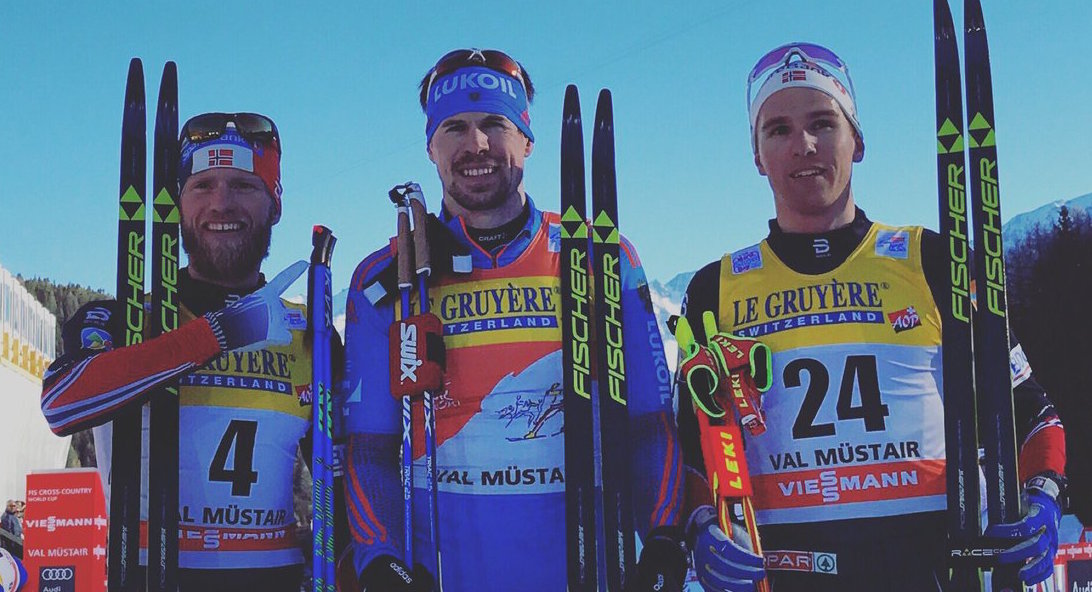
The men’s 10 k classic mass start at Stage 2 of the Tour de Ski, with Norway’s Martin Johnsrud Sundby (l) leading Russia’s Sergey Ustiugov, in Val Mustair, Switzerland. (Photo: Fischer/NordicFocus)
Norway’s Martin Johnsrud Sundby (r) leading early in the men’s 10 k classic mass start on at Stage 2 of the Tour de Ski on Sunday, with Alex Harvey (second from r), Norway’s Finn Hågen Krogh (3) and Russia’s Sergey Ustiugov (second from front left, in light blue) among those matching his pace. (Photo: Fischer/NordicFocus)
Alex Harvey wasn’t feeling 100 percent on Sunday, but he didn’t need to be. Within three seconds of the leaders and eighth place at the finish of the men’s 10-kilometer classic mass start was essentially what he needed to secure one of the most coveted positions on the Tour de Ski right now: third place.
Ahead of him, Russia’s Sergey Ustiugov and Norway’s Martin Johnsrud Sundby have built a nearly one-minute and 40-second lead on third place, respectively. With another victory on Sunday, Ustiugov has back-to-back wins in the first two stages of the Tour. Sundby was fourth in Saturday’s freestyle sprint and second on Sunday, good enough for second in the Tour, 18.9 seconds behind Ustiugov.
Then there’s Harvey, of Canada, who finished sixth on Saturday then eighth on Sunday for third in the Tour. He realized during the mass start that it was all about whom he was ahead of rather than a specific place he needed to finish in.
For instance, Finn Hågen Krogh. The Norwegian was third going into Sunday and finished 34th in the mass start, 50.1 seconds behind Ustiugov. That puts him 11th after two stages, nearly 1 1/2 minutes out of first.
“Not a lot happened, I just skied really slow,” Krogh told VG after Sunday’s race. “It was boring to do such a slow race.”
He wasn’t sure exactly what went awry on Day 2 of the Tour, but Krogh — expected to be one of Norway’s biggest threats aside from Sundby — was considering dropping out.
“Yeah, that might happen, but I should probably calm down a little before I make such a decision,” he said.
(His teammate Emil Iversen assured reporters that Krogh wouldn’t quit this early. “It’s about inspiring each other regardless of good or bad performances,” he told VG. “It’ll work out, I’ll show him some nice pictures of women on Instagram and then we’ll get him back on track.”)
Norway’s Niklas Dyrhaug (28) and Canada’s Alex Harvey (r) racing toward the front of the pack in the men’s 10 k classic mass start at Stage 2 of the Tour de Ski on Sunday in Val Mustair, Switzerland. Harvey went on to finish eighth while Dyrhaug placed 12th. (Photo: Fischer/NordicFocus)
During the race, which included nearly 80 starters on a 2.5 k course in Val Müstair, Switzerland, Harvey took note of Krogh’s off day. Same thing with Iversen, another all-around contender, who started the mass start in eighth and ended up 18th for fifth overall in the Tour, 9.6 seconds behind Harvey.
“When I started looking at the overall map after yesterday, I knew of course Dario [Cologna], Sundby, Ustiugov and then Finn and Emil were the main threats up there .. and [Sweden’s Marcus] Hellner, too,” Harvey recalled on the phone. “When I saw that Finn and Emil where having a tougher day, I knew it was going to be good for me in the overall standings. I was still able to finish hard and my skis were really fast so I could make up some ground on the downhill, but I was still seven seconds off the pace so I didn’t lose too too much time.”
Exactly seven seconds behind Ustiugov at the finish, he finished less than a hundredth of a second ahead of Finland’s Iivo Niskanen, who placed ninth. In addition to the first and second finishers, Harvey followed five others across the line: Norway’s Didrik Tønseth (who finished 2.3 seconds back in third) and Sjur Røthe (+3.3 in fourth), Switzerland’s Cologna in fifth (+5.5), Finland’s Matti Heikkinen in sixth (+5.6), and Hellner in seventh (+6.0). But he’s ahead of all of them in the Tour standings.
“The finish was real good. Actually, I didn’t think I was eighth at the line, I thought I was more like 12th or 13th, so I made up a lot of ground on the last kilometer,” Harvey said. “Once we hit the sprint hill I passed three guys there, and then two guys out of the last curve, so that’s five guys in the last 500 meters. I passed a few guys before that, too, so I just didn’t know… I was really happy with being in the top 10 again.”
For Harvey, that’s his third-straight top 10 on the World Cup circuit and seventh this season.
“Over Christmas, I was feeling really, like, really good,” he said. “… I was hoping to be in the top five [overall] from the beginning, so I would say the results are like what I was feeling over Christmas, but the feeling is not so. I don’t know if that is a good thing or bad thing, but I chose it’s a good thing.”
The race feeling Harvey was referring to was a lack of snap on Val Müstair’s climbs. The highest point on the course is 1,700 meters, he explained, compared to Davos, Switzerland, where he trained over the holiday break at 1,530 meters.
“It’s not a huge difference, but I didn’t have great feelings, same as yesterday,” Harvey said. “Even though we spent Christmas in Davos and we should be climatized, it was tough so it was kind of going the same as yesterday, trying to go tactical a bit and position myself well at the base of the hills and then kind of drift, lose position and then gain it back on the flats.”
Canada’s Len Valjas (in red) striding near Russia’s Sergey Ustiugov (second from r, in blue) in Sunday’s 10 k classic mass start at Stage 2 of the Tour de Ski in Val Mustair, Switzerland. According to Valjas’s teammate Alex Harvey, most of the top skiers chose to stride rather than double pole, but Great Britain’s Andrew Young (r) was among those double poling on skate skis. He ended up 50th, while his teammate Andrew Musgrave double poled to 17th. (Photo: Fischer/NordicFocus)
While Harvey seemed to be skiing within the top 10 for most of the race, he said he slipped outside it on the downhills.
“Some guys were really aggressive, the skaters especially, so I kind of drifted back a bit by the end of the first lap,” he recalled.
For the second and third lap, he anticipated that drift and positioned himself more competitively.
“I was wearing skiathlon boots so in the corners I could really corner well and my skis were really fast, so I could kind of gain some positions out of the corners there to position myself well for the third and fourth lap,” he said. “But then, when the pace really went in the fourth lap on the hill I just drifted. I could really feel the altitude.”
Like he said, he finished strong, and that’s what mattered. Heading into the Tour’s third and fourth stages in Oberstdorf, Germany, Harvey knows the 20 k skiathlon is an important race. But perhaps more so than the result, he’s mindful of the bonus sprints — for valuable bonus seconds in the overall standings.
“It’s at sea level in Oberstdorf, so hopefully the feeling is a bit better there and I can go for [those sprint bonuses], and now I am defending the third spot. I mean, the two guys out front are clearly ahead — already it’s a minute to Ustiugov and 40 seconds to Sundby, but it’s a lot of guys behind me so I am just going to try to defend my position.”
Are Ustiugov and Sundby untouchable? In a multi-stage series, Harvey didn’t rule anything out. He pointed out that last year Sundby lost nearly a minute in his overall lead after placing 23rd in the 15 k classic mass start in Oberstdorf (although he was still left with 45 seconds wiggle room to second place).
“You never know, but they have a huge advantage already,” Harvey said. “I think Finn Hågen lost the Tour; I don’t think he can win anymore. In my head he was one of the favorites to win this year, but I think it is going to be between those two guys, but it is not a guarantee. It’s still the tour and a lot of skiing to do.”
“We’re going to help Finn back on his feet,” Sundby told VG. “It’s the same thing that happened to me last year in Oberstdorf. I had a horrible day and lost a minute. Finn has that kind of day today, which is really boring in a Tour. We will pull back up from the mud so he can be in the fight again.”
Russia’s Sergey Ustiugov racing to the win in Sunday’s 10 k classic mass start, directly ahead of three Norwegians, including runner-up Martin Johnsrud Sundby (third from r), third-place finisher Didrik Tønseth (second from r), and Sjur Røthe in fourth at Stage 2 of the Tour de Ski in Val Mustair, Switzerland. (Photo: Fischer/NordicFocus)
While Sundby was the first to set the pace in the mass start, Ustiugov closely shadowed him and took control around 7.5 k and then for good with less than 2 k to go.
“He’s an incredible skier,” Sundby told NRK after. “He’s got it in his head and I hear it during the race that he’s tired. He sounds like a locomotive when he’s skiing. And he’s got an incredible finish.”
“I had great skis,” the 24-year-old Russian said, according to an International Ski Federation (FIS) press release. “The service team did a great job. The pace was very high from the beginning. I did not expect I would be leaving Val Müstair with two wins and the lead in the Tour de Ski.”
After Harvey in third overall, Russia’s Andrey Larkov is less than 2 seconds behind him in fourth after two stages, with a seventh place on Saturday and 11th place on Sunday. Iversen is another 7.7 seconds back in fifth (+1:09.2) and Cologna is sixth (+1:10.4) after a ninth place followed by a fifth place on Sunday.
“I’m not yet at 100 percent, but I felt good and was able to keep up,” Cologna told Swiss TV broadcaster SRF after hanging in the top four and even leading at times during the race, along with Sweden’s Hellner. “On the climb when Sundby attacked, it was fast, but I was able to get in contact again, and then on the steep sprint climb my pole did not find grip twice, went into the void a bit, and then I lost contact. But I think it was fine, a small step ahead. And I could show and also show to myself, that everything is OK.”
Of note, Cologna grew up about 500 meters from the Val Müstair course.
“That’s very special. It’s always fun,” he said of the third-straight year of the Tour de Ski being held at the venue. “A good atmosphere and a lot of people, you know? It’s not always easy to meet all demands, but it’s quite fun…”
Kershaw, Killick and Bjornsen Move Up
Two Canadians made up considerable ground on Sunday, with Devon Kershaw racing to 27th (+42.9), putting him 32nd overall in the Tour (+2:22.5), and Graeme Killick finishing 33rd in the mass start (+49.3) for 36th overall (+2:29.5). In Saturday’s sprint, the two finished 51st and 57th, respectively.
That kind of starting position put Kershaw and Killick toward the back of the mass start, with only five tracks across and more than 50 men ahead of them.
Devon Kershaw (54), followed by Canadian teammate Graeme Killick (47), racing to 27th in Sunday’s 10 k classic mass start at Stage 2 of the Tour de Ski in Val Mustair, Switzerland. Killick went on to place 33rd. (Photo: Fischer/NordicFocus)
“… Most of the race was rather hectic — but to be honest it was better than I thought,” Kershaw wrote in an email. “The conditions were perfect and the descents weren’t nearly as icy as the day before when I was skiing around testing out the course.”
He explained it was difficult to pass on a twisty 2.5 k loop, but he focused on being patient.
“It cost me a chance to get into the top 10-15 for sure, but by just biding my time and skiing smooth and relaxed without getting caught up in the mayhem allowed me to have decent energy the whole way,” he wrote. “I just kind of kept picking off a few guys were I could — which happened to be on the climbing section — which I felt decent on.”
In terms of his standalone result — 27th — Kershaw said it was closer to his goal of a top 20 in classic races.
“This year in the three classic races on the World Cup I’ve been 33rd, 23rd (time in Lillehammer where I moved up to 27th in the overall) and today 27th — so I guess I’m consistent — but I’d be lying if I said that’s where I want to live,” he wrote.
And while he might be in 32nd, he’s within 20 seconds of 22nd.
“There is a lot of skating this year — so perhaps not as good for me as years past which lean heavier on classic — it’s all good,” Kershaw wrote. “I will take it day by day and of course I am really looking forward to the classic race in Val di Femme (15km mass start). The [skiathlon] in two days will be fun too (the 20km) so I am looking forward to that as well since I’ve had some OK [skiathlons] in my day.”
Like Harvey, he was looking forward to racing at lower elevations.
Canada’s fourth finisher on Sunday, Len Valjas placed 38th (+54.3) after starting in bib 14. That puts him in 26th overall (+2:13.5).
The U.S. men were led by Erik Bjornsen in 42nd (+59.9), after placing 64th in Saturday’s sprint. He started in bib 59 and is up to 42nd overall (+2:41.2).
“Just out of the stadium they had cut it down to just 4 tracks. I just couldn’t move up with that many guys and such limited space,” Bjornsen wrote in an email. “I had to wait until the second lap and by that time it was so spread out. I definitely don’t have the snap I felt a couple weeks ago, but I put in a hard training block around Christmas and then took some easy days before traveling over to Switzerland.
“I’m hoping coming back down to lower altitude and a couple days of hard efforts will spark the body back into the form I know I have,” he continued.
Noah Hoffman finished 46th (+1:13) for the U.S. after starting in bib 48, and his teammate Simi Hamilton — who planned in advance to withdraw from the Tour after Stage 2 — slipped from 15th overall to 74th after placing 75th (+3:14.8) on Sunday.
Hoffman is currently 48th overall (+2:57.4), about 38 seconds out of the top 30.
The first of two rest days in the nine-day Tour is Monday, then Oberstdorf will host the women’s and men’s 10/20 k skiathlons on Tuesday and 10/15 k classic pursuits on Wednesday.
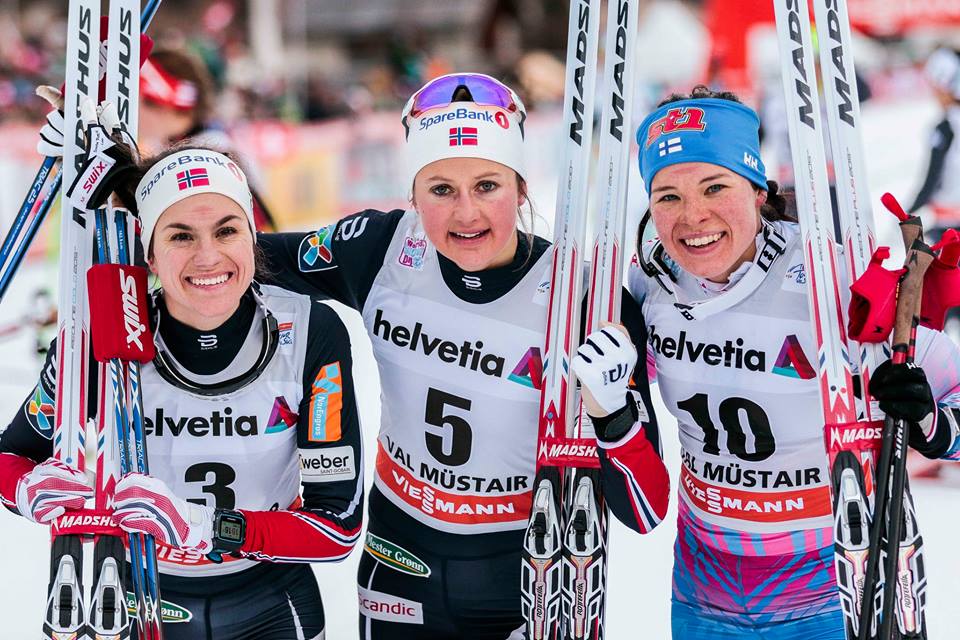
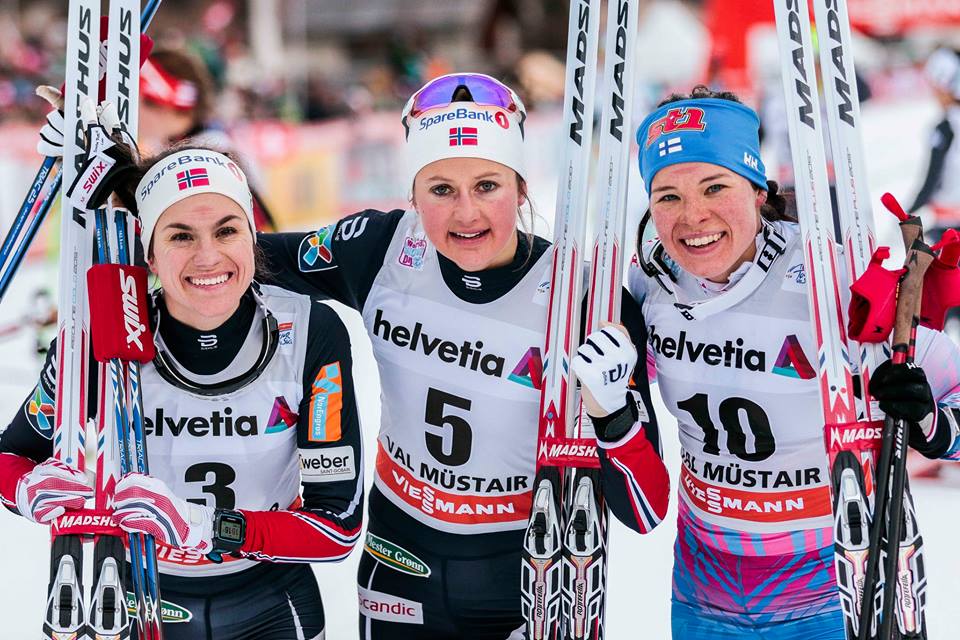
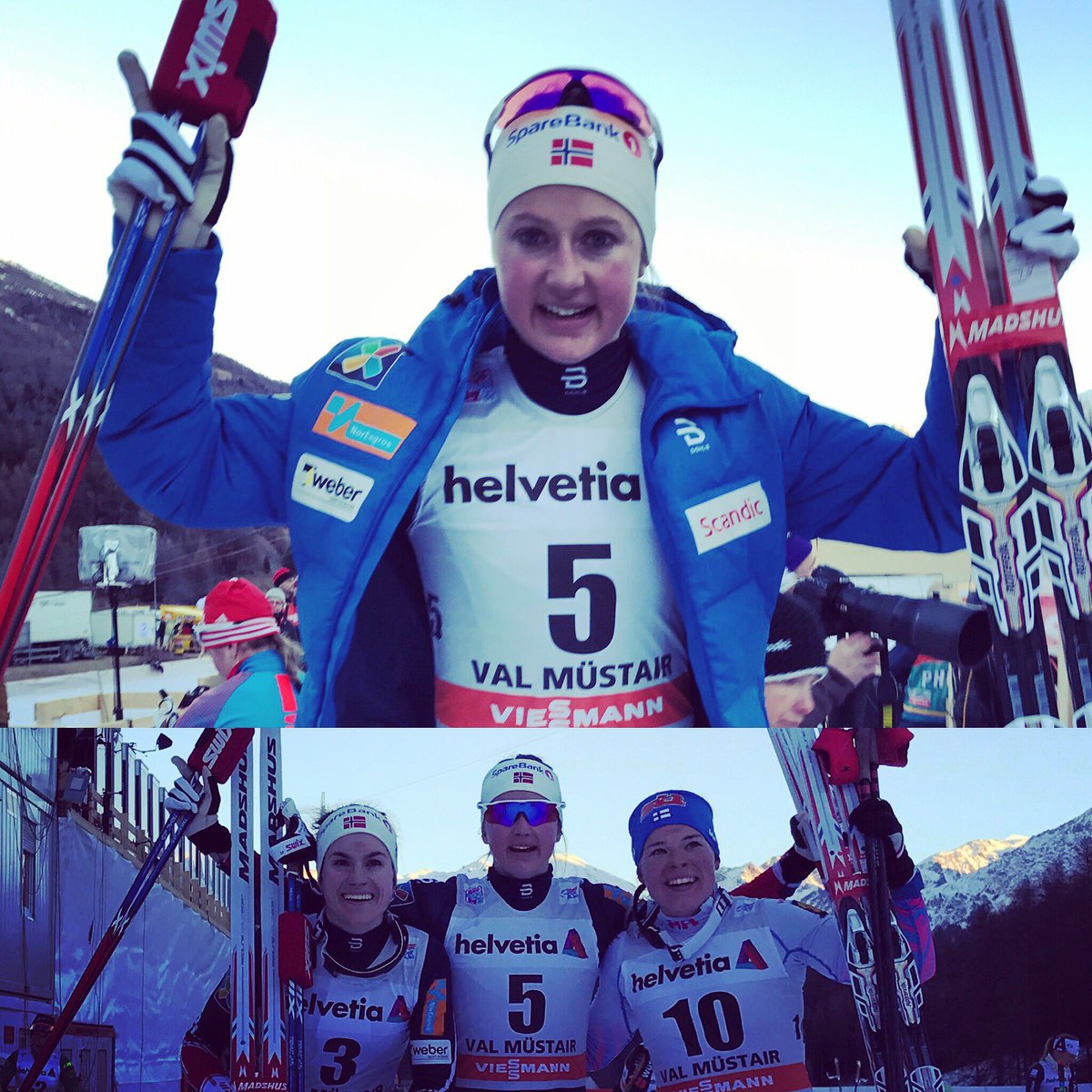
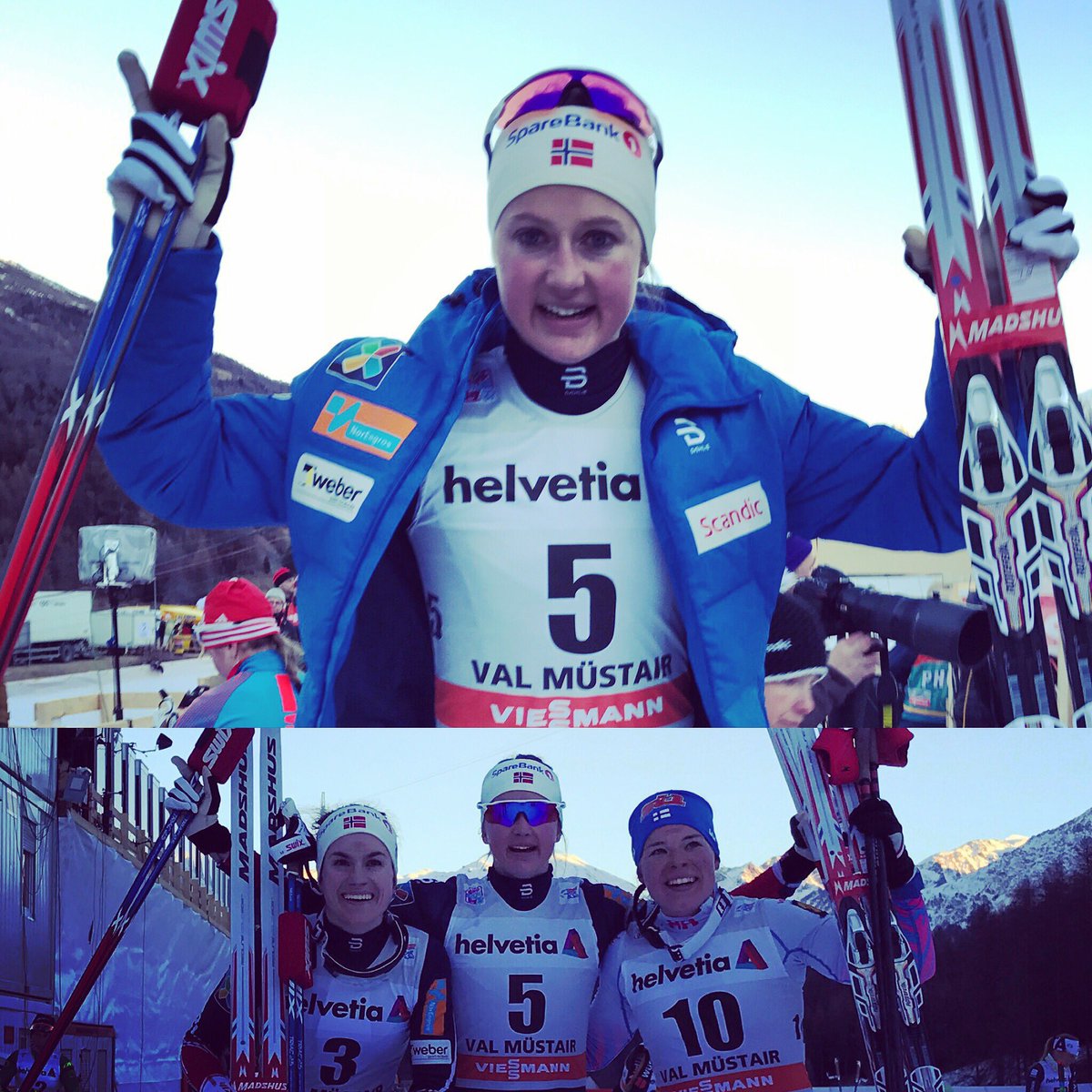
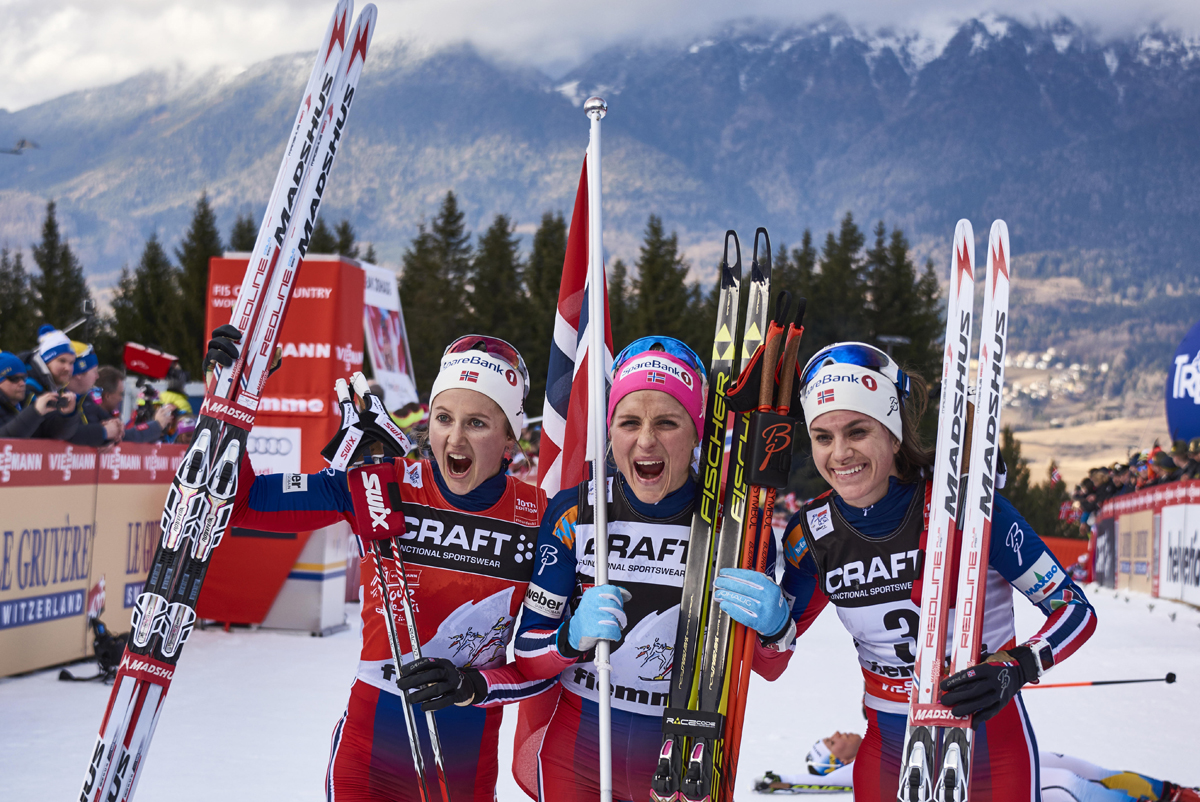
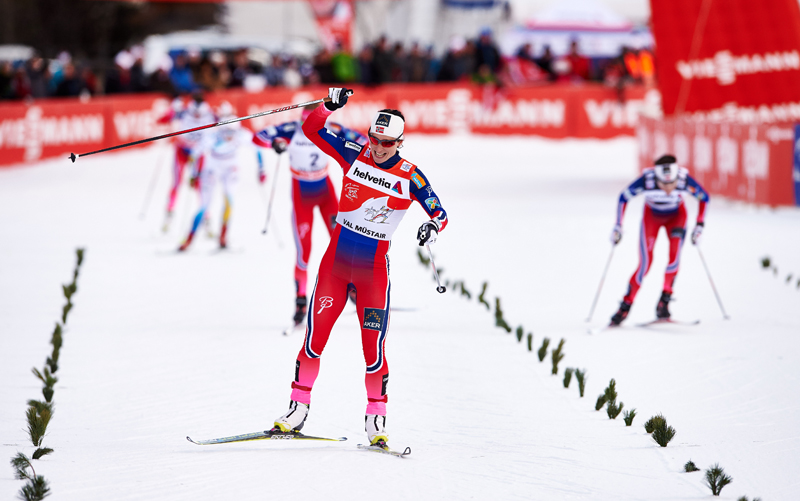
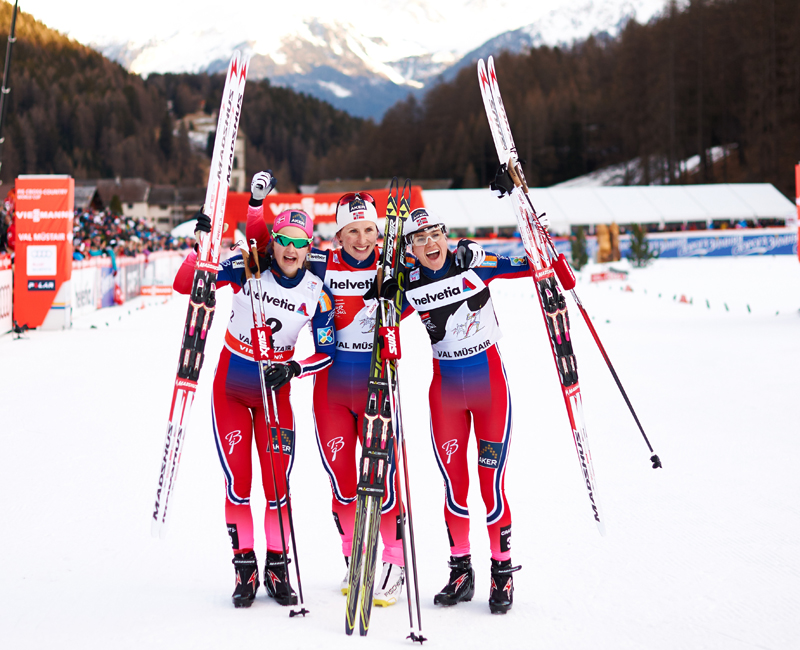
The Tour de Ski Stage 2 women’s podium on Sunday with (from left to right) Norway’s runner-up Heidi Weng and winner Ingvild Flugstad Østberg, and Finland’s third-place finisher Krista Pärmäkoski in the 5-kilometer classic mass start in Val Müstair, Switzerland. (Photo: Fischer/NordicFocus)
Maybe it was because she wanted redress. Maybe it was because there was less pressure to perform. Or maybe it was because the yellow Tour de Ski (TDS) leader’s bib was with Sweden, calling her Norwegian name.
Whatever it was, when Ingvild Flugstad Østberg lined up for the women’s 5-kilometer classic mass start on Sunday in Val Müstair, Switzerland, she was ready to race for the win.
After being eliminated in the semifinal of Saturday’s freestyle sprint, the 26-year-old turned the lost chance at a podium into an opportunity to prove her place as a top contender.
“I was irritated with myself after yesterday,” Østberg told NRK.
“Such a result sometimes makes you give your best,” she added, according to a International Ski Federation (FIS) press release.
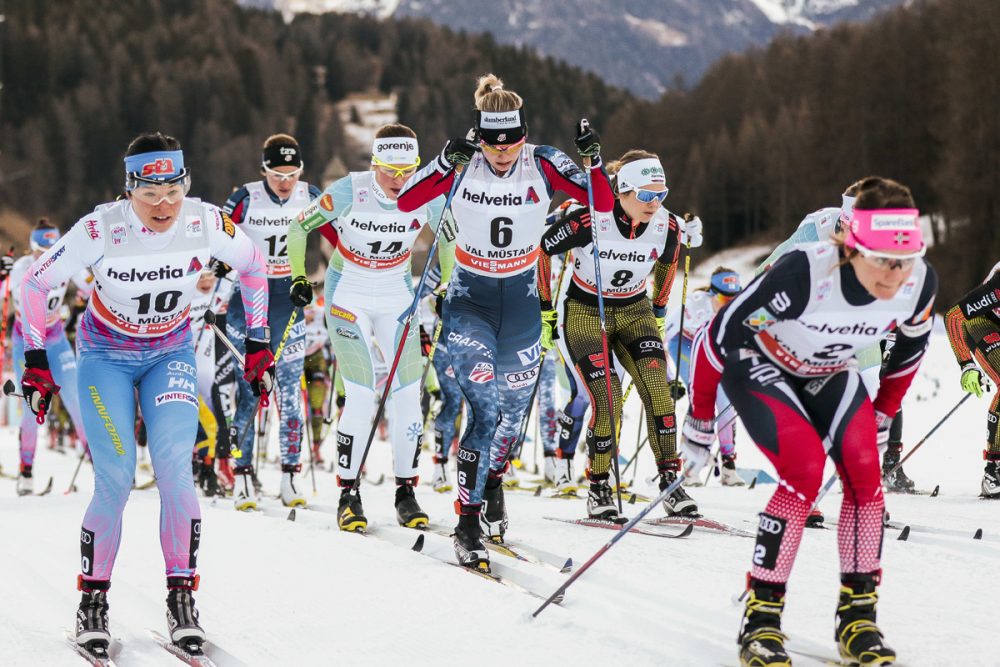
American Jessie Diggins (6) chases down Norway’s Maiken Caspersen Falla (2) at the start of the the women’s 5-kilometer classic mass start on Sunday in Val Müstair, Switzerland. (Photo: Fischer/NordicFocus)
Wearing bib 5, Østberg had her Norwegian teammates, Maiken Caspersen Falla in bib 2, Heidi Weng in bib 3, and Kathrine Rolsted Harsem in bib 4, as well as the Stage 1 TDS leader, Stina Nilsson to chase down.
That didn’t stop Østberg from rallying to the front off the gun, leading the mass of skiers through the first lap, with Weng just behind. As the women started their second lap of the 2.5 k course, a gap began forming between the Norwegians and a second front group, Nilsson and Finland’s Krista Pärmäkoski.
Moving up through the pack into the top 10 by lap one was Finland’s Anne Kyllönen, who started in bib 29, as well as her Finnish teammate Laura Mononen, who started in bib 19.
Switzerland’s Nadine Fähndrich, who started in bib 15, had also joined the front chase group, along with her Swiss teammate Laurien van der Graaff (bib 7). Just behind the Swiss duo was American Jessie Diggins (bib 6) positioned in eighth. Diggins’s U.S. Ski Team (USST) teammate Sadie Bjornsen, who had started in bib 21, had burned her way up to ninth.
Bjornsen’s hot start, however, didn’t last. The American began to fade, falling back into the low 20’s and eventually just outside of the points in 35th, where she ended the day.
“I was behind Nadine [Fähndrich] and Laurien [van der Graaff] and picked the innermost track, so in principle the best lane, and exactly on that lane Bjornsen bonked, totally, she couldn’t move anymore,” Switzerland’s Natalie von Siebenthal said during a television interview. “And I couldn’t get past left or right. Then the other athletes started to go by on my left.”
USST Women’s Coach Matt Whitcomb explained that hard start was part of Bjornsen’s plan. The way her body reacted was not.
“She took it out aggressively, which we told her to do and is always encouraged to do and just didn’t feel good today,” Whitcomb said on the phone after Sunday’s race.
Bjornsen explained that while the result was not what she hoped for, she is ready to move forward with no weight on her shoulders.
“Today was a day to forget and refocus,” Bjornsen wrote in an email. “I had a strong start, and felt great, but felt like I was working extra hard with some potentially slow skis. As soon as I crossed the red line, I wasn’t able to recover as I was hoping, and suffered a pretty bad explosion … Now I am focused on the next two events in Germany, and will hopefully find the good shape I know I am capable of!”
Maintaining position was the name of game for the remainder of the race for those still in the top 10, with Diggins sticking to her spot in eighth and Østberg holding off any attack attempts from Weng.
“I’ve been struggling a bit with the high altitude here,” Weng said according to a FIS press release. “Before the race I was afraid about the downhills but I’m happy I did not fall.”
While Weng was able to avoid any crashes, American Kikkan Randall was not so lucky. Though she had been skiing around 15th for most of the first lap, after starting in bib 17, she fell and had to make her way back into the top 20.
American Kikkan Randall after a crash just over halfway through the women’s 5-kilometer classic mass start on Sunday in Val Müstair, Switzerland. (Photo: Fischer/NordicFocus)
“My shape feels a lot better and sharper than it did in period one of World Cup,” Randall wrote in an email to several media outlets. “Really pumped to feel my race gears coming around and loving the chance to race, race, race!”
“It was so cool to watch an athlete have a breakthrough like that,” Whitcomb said of Randall’s performance. “To start off the Tour with two good races in the points, we all feel really good about that and the team is really proud of her.”
Eventually, with a close to 20-meter gap, Østberg finished first for the win in 13:21.2 minutes. Weng claimed second place, seven seconds back, while third went to Pärmäkoski who finished 11.4 seconds after Østberg.
Diggins crossed 32.6 seconds after Østberg for eighth.
“It was tricky to pace and if I could do it again I would have paced it slightly differently, but I was happy with my skis and I’m chipping away at that striding technique!” Diggins wrote in an email. “Overall I think I’m in a solid place for the tour and I’m really looking forward to the next set of races!”
Randall was the second American after Diggins in 15th (+42.4) followed by Bjornsen, who placed 35th (+1:02.6) in a photo finish with Slovenia’s Petra Novakova. Also racing for the U.S., Sophie Caldwell placed 38th (+1:09.4), Rosie Brennan 39th (+1:10.5), and Liz Stephen 44th (+1:21.2).
“There’s not a whole lot of movement that’s possible in a 5 k classic mass start … when you’re starting out of the top 20,” Whitcomb said. “Rosie and Liz were fighting from the back. … For their position in the start, I thought they skied phenomenally.”
As the USST makes its way to Oberstdorf, Germany, for the third and fourth stages of the Tour — a 10 k skiathlon and 10 k freestyle pursuit — Whitcomb remains positive of where the U.S. women are currently positioned. Diggins currently sits in sixth in the overall Tour standings, 1:01 minutes behind Østberg, Randall 15th (+1:45.9) and Bjornsen 25th (+2:05.4). Caldwell, who is ranked 22nd overall (+2:03.3), planned to withdraw from the Tour after Sunday. Brennan in is 41st (+2:33.1) and Stephen 46th (+2:49.9).
“We don’t put any specific goals or demands for any athlete on any one particular race,” Whitcomb explained. “What we try and do is link together as many quality races in a row as we can. If you can string together a bunch of decent days, and then pop one great one, it can move you way up in the tour.”
Østberg now leads the Tour followed by Weng 10.3 seconds back in second and Nilsson in third (+23.8).
The men’s 10 k classic mass start podium at Stage 2 of the 2017 Tour de Ski in Val Müstair, Switzerland, with Russia’s Sergey Ustiugov (c) in first, Norway’s Martin Johnsrud Sundby (l) in second, and Norway’s Didrik Tønseth (r) in third. (Photo: FIS Cross Country/Twitter)
FIS Cross-Country Tour de Ski Stage 2 (Val Müstair): 5/10 k classic mass starts
There was a lot of jostling between Russia’s Sergey Ustiugov and Norway’s Martin Johnsrud Sundby, with the latter leading early and the Russian not letting him get too complacent up front, but ultimately, Ustiugov was the first across the line in the men’s 10-kilometer classic mass start, the second stage of the Tour de Ski in Val Müstair, Switzerland.
Ustiugov put himself back ahead of Sundby with fewer than 2 k to go and held a sizable lead to the finish, crossing in 24:50, while Sundby finished second, 1.9 seconds back.
Norway took second through fourth with Didrik Tønseth in third (+2.3) and Sjur Røthe in fourth (+3.3), while home-crowd favorite Dario Cologna of Switzerland settled for fifth (+5.5) after racing in the top three for much of the race.
The top 13 finishers all ended up within 10 seconds of Ustiugov at the finish, with Finland’s Matti Heikkinen in sixth (+5.6), Sweden’s Marcus Hellner in seventh (+6.0), and Canada’s Alex Harvey in eighth (+7.0).
With a six place on Saturday and eighth on Sunday, Harvey is currently third overall in the Tour, 59.6 seconds behind Ustiugov in first and 40.7 seconds behind Sundby in second (Sundby trails Ustiugov in the overall by 18.9 seconds.)
Finland’s Iivo Niskanen made it into the top 10 on Sunday in ninth (+7.0), as did the fourth Norwegian, Simen Hegstad Krüger in 10th (+7.3).
Devon Kershaw made big strides in moving up to 27th (+42.9) for 32nd overall in the Tour (+2:22.5), Graeme Killick placed 33rd (+49.3) and Len Valjas 38th (+54.3) for Canada. Valjas is currently 26th overall (+2:13.5) and Killick 36th (+2:29.5) in the Tour.
Erik Bjornsen led the U.S. men in 42nd (+59.9) for 42nd overall (+2:41.2). Noah Hoffman placed 46th (+1:13) and is currently 48th in the Tour (+2:57.4) and Simi Hamilton (+3:14.8) was 75th out of 78 finishers. A sprinter, Hamilton planned to withdraw from the Tour after this stage for a training block.
Norway’s Ingvild Flugstad Østberg (top and bottom center) celebrates her win in Stage 2 of the 2017 Tour de Ski, the women’s 5 k classic mass start, which she won over teammate Heidi Weng (l) and Finland’s Krista Parmakoski (r). Østberg currently leads the overall Tour by more than 10 seconds over Weng with seven stages to go. (Photo: FIS Cross Country/Twitter)
[UPDATED] In the women’s 5 k classic mass start, Ingvild Flugstad Østberg rebounded from Saturday, in which she was eliminated in the semifinals for seventh place in the freestyle sprint, with a seven-second victory over Norwegian teammate Heidi Weng.
Østberg finished first in 13:21.2, Weng took second for her second-straight podium of the Tour, and Finland’s Krista Parmakoski finished third (+11.4).
American Jessie Diggins raced to eighth (+32.6) to maintain her position in sixth overall in the Tour. Østberg took the Tour lead after two stages by 10.3 seconds over Weng. Sweden’s Stina Nilsson, who won Saturday’s sprint, is third, 23.8 seconds back from Østberg, while Parmakoski improved to fourth (+42.0). Norway’s Kathrine Rolsted Harsem placed seventh on Sunday for fifth overall (+51.6), and Diggins 1:01 back in sixth.
The second American in the top 20, Kikkan Randall raced to 19th (+42.4). Also for the U.S., Sadie Bjornsen finished outside the points for the first time this season in 35th (+1:02.6), Sophie Caldwell was 38th (+1:09.4), Rosie Brennan 39th (+1:10.5), and Liz Stephen improved to 44th (+1:21.2).
Overall, Randall is currently 15th (+1:45.9), Caldwell 22nd (+2:03.3) — although Caldwell planned to withdraw from the Tour after Stage 2. Bjornsen is 25th (+2:05.4), Brennan 41st (+2:33.1) and Stephen 46th (+2:49.9).
Jessie Diggins (U.S. Ski Team) racing to ninth in Saturday’s 1.5 k freestyle sprint qualifier in Val Müstair, Switzerland. Diggins went on to place sixth in the final. (Photo: Salomon/NordicFocus)
As the women’s sprint finalists promenaded through the stadium toward the starting pen, the demeanors caught on camera varied, seemingly a reflection of their differing personalities or emotions at that moment.
On one hand, there was Stina Nilsson, Sweden’s sprint queen, walking through the athlete’s chute at the first stage of the Tour de Ski with the body language of a prizefighter.
Then there was Norway’s Maiken Caspersen Falla, more smiley and cheery than Nilsson, her fiercest sprint rival on the World Cup circuit. Heading into Saturday’s freestyle sprint, the last eight sprint wins had gone to either Nilsson or Falla. According to the International Ski Federation (FIS), that’s the longest streak ever between two athletes in a sprint.
Next came Switzerland’s Laurien van der Graaff, more reserved in front of her home crowd in Val Müstair, Switzerland, and Norway’s Kathrine Rolsted Harsem, who looked simply happy to be there in her first World Cup of the season.
And then there was Jessie Diggins, the well-known, fun-loving American, exuding the most energy of anyone heading to the start with her head held high as she looked out at the arena.
Finally, Norway’s Heidi Weng shuffled down the line, looking down and avoiding eye contact as she passed the TV camera. But she should get a pass on her body language; she suffered food poisoning before the race, according to Norwegian reports.
As all six women lined up at the start for their formal introductions, Diggins waved with bare hands. On an afternoon with temperatures hovering around freezing, she wasn’t trying to be tougher than everyone else, Diggins later explained.
“That was actually a mistake,” she said in a phone interview. “I was so excited and ready to go, and they were like, ‘All right, march in for the final,’ and I was like, ‘Great, I’m ready.’ ”
With her skis in hand, Diggins began her entrance before realizing she was still wearing her lobster mitts. It had been getting colder as the day entered the evening, and she had switched to the quasi-mitten before the final.
“I got over there, and realized I was still wearing my lobster gloves, and I was like, ‘Oh crap! I don’t want to race with these on!’ ” she said.
She decided she’d be better off racing with bare hands.
“I love my race gloves. I wish I had remembered them, but I didn’t,” Diggins said.
Two laps, 1.5 kilometers and nearly 3 1/2 minutes later, Diggins crossed the line in sixth, but it wasn’t so much an issue of no gloves as it was her positioning.
“I needed a better start to get in a good position from the gun, but that’s fine,” she reflected. “It’s a long tour, and I would just like to be in the final.”
Diggins finished 7.64 seconds behind Nilsson, who won in 3:26.27 to rebound from 31st place in the last skate sprint three weeks ago in Davos, Switzerland, for her second win of the season.
The women’s and men’s podiums at Stage 1 of the Tour de Ski, with (top) women’s winner Stina Nilsson (c) of Sweden, Norway’s Maiken Caspersen Falla (l) in second, and Norway’s Heidi Weng (r) in third. (Bottom) Russia’s Sergey Ustiugov (c) won the men’s final, ahead of Italy’s Federico Pellegrino (l) in second and Norway’s Finn Hågen Krogh (r) in third. (Photo: FIS Cross Country/Twitter)
“This was really important to me since Davos didn’t go so well,” the 23-year-old Nilsson said in a televised interview with TV2. “I am really happy. I felt strong through the entire day.”
“She was in a league of her own,” Swedish women’s coach Ole Morten Iversen told Expressen.
“I’m not surprised that she won, but I am a little surprised by how strong she was compared to the Norwegians. She was on a different level the entire day.”
Nilsson won the qualifier by 1.28 seconds (in 3:28.28) then proceeded to pull away from her competition in the quarterfinal and semifinal, which she won by roughly half a second and one second, respectively. (Diggins finished second behind her in the quarterfinal, after Diggins led the early in the heat. Nilsson passed her the course’s biggest climb on the first lap, while Diggins chased in second all the way to the finish.)
In the semifinal, Diggins and Nilsson met again, with Nilsson leading out of the start and Diggins following in second into the first climb. Falla eventually passed Diggins to move into second while Nilsson continued to lead, then the two built a small gap on Diggins in third. They finished in that order, with Nilsson holding off Falla by 1.04 seconds and Diggins by 1.36 seconds, in first, second and third, respectively.
In the final, Nilsson once again set the tone out of the start, leading Weng and Falla into the stadium at the end of the first lap. Diggins slipped to the back of the field on the first climb then fought to pass van der Graaff on the final descent.
Meanwhile, Nilsson and Falla distanced themselves from Weng in third place, who was just ahead of her Norwegian teammate Harsem in fourth.
Nilsson led into the finishing straight, several strides ahead of Falla, while Falla chased her across the line for second place, about 2 1/2 seconds back. Weng held off Harsem and van der Graaff by half a second for the third spot on the podium, 6.47 seconds out of first, Harsem placed fourth, and the Swiss skier outlasted Diggins by 0.68 seconds for fifth (+6.96).
“This is the worst thing I’ve ever been part of,” Weng said of racing after her food-poisoning episode in an interview with NRK. “… I just had to get it together. The prologue felt heavy, the quarter was heavy, the semi was heavy and the final was heavy. I had to try think positive, that everyone else was tired, but it was hard.”
For Harsem, 27, she was emotional about making it to the final after considering retiring before the start of this season.
“.. There were a lot of emotions in system and it was just so incredibly fun to be successful,” she told NRK. “I tried to wipe my tears and mobilize all that I had. I realized that I could. I had planned to go easy on the first lap, and then Heidi and I weren’t attentive enough to follow Stina and Maiken.”
Even Falla called it a long, hard race, and told FIS she had expected Weng to keep up with Nilsson.
“In the second lap of the final Heidi got little bit tired and I tried to close the gap on Stina myself,” Falla said. “I did not have enough power to do that. Stina was in a great shape.”
While Nilsson has a 10.7-second lead on Falla heading into the second stage of the Tour, it’s worth noting that this is the only sprint on the seven-stage schedule.
“I’m proud to say that I have the lead in the Tour de Ski, I’m going to enjoy this,” Nilsson told Expressen.
Diggins was also onboard with living in the moment.
“My goal for the Tour is have more fun than anyone else, because when I’m having fun that’s when I’m the most dangerous on the race course, and that’s when I’m going fast,” she said. “Yeah, it’s my job, and you always want to win, but it’s also my life, and I want to enjoy the Tour because it’s a really exciting and fun event.
“Going into the final already had my strategy worked out,” she added. “… I’m going to go out there and ski as hard as I can. I’m going to focus on what I need to do, but I’m going to enjoy myself. My game face is not an intimidating one.”
“My goal for the Tour is have more fun than anyone else, because when I’m having fun that’s when I’m the most dangerous on the race course, and that’s when I’m going fast.” — Jessie Diggins, U.S. Ski Team
Sunday’s race is a 5 k classic mass start, so the top women in the Tour so far will line up alongside one another at the front of the pack. That’s a good thing for someone like Diggins, who is currently sixth in the Tour and 23.7 seconds out of first. But she didn’t think it was necessarily fair and noted that it will be tough to pass on the Val Müstair course, just as it was on Saturday’s technical sprint course.
“I think it’s mildly hilarious that we’re doing a 5 k classic mass start,” Diggins said. “I think it’s so stupid that the women have to do exactly half the distance the men do all the time. I think that it’s silly. I think we can handle more.
“That said, I love 5 k’s, I just think a 5 k mass start isn’t entirely fair to the people who are starting in the back; that sucks for them,” she continued. “It will be a fun course tomorrow; it’s a grind of a climb up, and then there’s a lot of 90-degree corners and sharp downhills. There’s one that’s like an elevator shaft. It’s going to be really exciting.”
Sophie Caldwell (U.S. Ski Team) after winning the 1.2 k classic sprint final at Stage 4 of last year’s Tour de Ski in Oberstdorf, Germany. (Photo: Marcel Hilger)
Diggins led four U.S. women in the top 30 on Saturday, more specifically in the top 23. Sophie Caldwell qualified fifth, 3.15 seconds behind Nilsson, for her best qualifier in nearly a year (since qualifying third in last year’s Tour de Ski classic sprint in Oberstdorf, Germany, which Caldwell went on to win).
Sadie Bjornsen qualified eighth (+5.08), and Diggins was the third U.S. woman qualifying in the top 10 in ninth (+5.64).
“We expected big things today, and I think we had certainly a good day to prove that that was in fact the case, and that the tour should go well for us,” U.S. Ski Team Women’s Coach Matt Whitcomb said on the phone.
Kikkan Randall also qualified in 29th (+10.77) on her 34th birthday for her first individual top 30 of the season.
“It was a very difficult course, aerobically as well as technically,” Whitcomb explained. “At 1,600 meters [above sea level], there’s a lot of climbing. To have our women do as well as they did, including Kikkan on her birthday getting into the heats, just said straight up that we’ve got fast women. They’re in good shape, they’re ready for big results, whether or not that happens individually today, or not, that’s just sprint racing.”
Caldwell went on to place 13th after finishing third in her quarterfinal, 0.72 seconds behind Finland’s Krista Parmakoski in first. Slovenia’s Vesna Fabjan automatically advanced to the semifinals in second, 0.71 seconds back, just one-hundredth of a second ahead of Caldwell.
“I was happy with the qualifier and feel so-so about the overall result,” Caldwell wrote in an email. “It was not my best race, but it was not my worst, it was solid.”
She plans to race the second stage on Sunday then withdraw from the Tour for a training block before the next set of regular-season World Cup sprints in Toblach, Italy.
“I got hit hard with the cold that was going around our team as soon as I started Christmas break, so I had to take some time off and do some walking pace training,” Caldwell explained. “I did a little threshold yesterday, but that was my first intensity since La Clusaz [two weeks ago], so I wasn’t sure what to expect going into today. I’m happy to be feeling healthy again, though.
“It’s a long season and while I haven’t had the races I want to have yet, I’m confident that with some consistent training and resting, I can keep getting faster,” she added.
Randall finished third in her quarterfinal, 1.42 seconds behind Falla in first and 0.46 seconds after Germany’s Hanna Kolb in second.
“Today definitely felt like another step forward toward getting my race sharpness back,” Randall wrote in an email to members of the press. “My qualifier was decent and I felt like I had more punch in my quarterfinal. Tough to just miss the lucky loser spot because I was feeling stronger as I went and actually felt competitive for the first time this season. Still lots of racing ahead though so I am satisfied with today as a good start and am feeling good about the races ahead.”
As for how she’d celebrate her birthday and the new year, Randall wrote that it would be a tame night.
“Pop some confetti for us this evening, we’ll probably be in bed early for tomorrow’s race,” she wrote.
Bjornsen explained in an email that she was also hit with the bug and hadn’t skied at sprint pace since Davos three weekends ago. Like Diggins, she did not race in La Clusaz.
“I didn’t know what to expect,” she said of the qualifier. “I felt like I paced it well, but I was an early starter, so I didn’t know what to expect. I was really pleased to see how it had gone.”
Like Caldwell, Bjornsen pushed to get in front early in her quarterfinal on Saturday, but while Caldwell came from behind for third place at the finish, Bjornsen managed to hold the lead into the finishing straight. But in the final meters, something happened. Bjornsen lost her momentum and slipped to fifth.
“I noticed that someone was skiing over my pole almost the entire race,” Bjornsen wrote of the possibility of someone stepping on her pole before the finish. “I don’t recall much from the finish zone other than the fact that I really wanted to get to that line. At one point I bobbled and lost my balance… not sure why… but that was real game changer.”
She ended up 0.78 seconds out of first, which went to van der Graaff.
“I have began to realize this fall that my strength is over the whole course,” Bjornsen explained. “I have made a mistake in the last couple sprint races to sit in the pack, and expect a sprint finish, but I haven’t had so much luck with that. The best I ski is when I am in control a bit. I had a plan to try to be in the front, and it worked out as I was hoping. Of course you run the risk of working harder, but I think that is ok for me. I wasn’t strong enough in the finish zone, and I bobbled, which really was a bummer.
“There are glimmers in today, and I think that I learned that I am strong enough to ski in command,” she added. “I just need to figure out that finish stretch … but fortunately I have seven more races rather quickly in a row to get some redemption with.”
“There were a number of thirds and fourths out there for us today in heats,” Whitcomb noted. “In stand-alone races, we can kind of just look at those and say, ah, I wish that lunge had gone a little better, but in a tour we really have to be glass half-full. We had three girls in the top 15, four people total in the top 20. It’s a really positive start to the team, it’s just a great, solid day.”
Also for the U.S., Rosie Brennan finished 35th, 2.66 seconds outside the top 30, and Liz Stephen placed 57th in the qualifier.
“Liz was sick for a couple days coming into the tour, and just today she was feeling better and she was actually our last person to kind of have this illness,” Whitcomb explained. “As long as today was accepted by her body, we are operating with a completely healthy team going into tomorrow.”
“The tour has always been a fun event for us,” Diggins said. “We see it as you have a chance today and a chance tomorrow, you have all these chances to go out and kick some butt, and I think people are really embracing that. If you had the race you wanted today; awesome, and if you didn’t, you’ll have it tomorrow.”
The women’s and men’s podiums at Stage 1 of the Tour de Ski, with (top) women’s winner Stina Nilsson (c) of Sweden, Norway’s Maiken Caspersen Falla (l) in second, and Norway’s Heidi Weng (r) in third. (Bottom) Russia’s Sergey Ustiugov (c) won the men’s final, ahead of Italy’s Federico Pellegrino (l) in second and Norway’s Finn Hågen Krogh (r) in third. (Photo: FIS Cross Country/Twitter)
FIS Cross-Country Tour de Ski Stage 1 in Val Müstair: Freestyle sprint
[UPDATED] After qualifying in fifth, eighth and ninth, respectively, Sophie Caldwell, Sadie Bjornsen and Jessie Diggins proceeded to represent the U.S. in the quarterfinals of the 1.5-kilometer freestyle sprint in Val Müstair, Switzerland, on Saturday, along with a fourth U.S. woman, Kikkan Randall.
Randall turned 34 on Saturday and reached the heats for the first time this season, where she placed third in her quarterfinal for 15th overall. Caldwell was just ahead of her in 13th overall after finishing third in her quarterfinal and missing out on advancing as a lucky loser by one-hundredth of a second. Bjornsen placed fifth in her heat after leading it into the finishing stretch for 23rd overall, and Diggins rocketed all the way to the final, where she ended up sixth overall.
Diggins secured an automatic bid for the semifinals with a second place in her quarterfinal, behind eventual winner Stina Nilsson of Sweden. Nilsson won the qualifier to start the day in 3:28.28. (Norway’s Ingvild Flugstad Østberg qualified second (+1.28) and Switzerland’s Nadine Fähndrich qualified third (+2.34).)
Diggins met Nilsson again in the first semifinal, which Nilsson won by 1.04 seconds over Norway’s Maiken Caspersen Falla. Diggins finished third, 1.36 seconds back, and advanced to the final as a lucky loser with Switzerland’s Laurien van der Graaff, who placed fourth (+2.10) in that heat.
In the final, Diggins struggled with her positioning and ended up sixth, 7.64 seconds behind Nilsson in first. Nilsson took control early in the final and built a comfortable lead into the finish, with only Falla coming relatively close in second (+2.48). Norway took second, third and fourth with Heidi Weng in third (+6.47), and Kathrine Rolsted Harsem, who won a photo finish for fourth (+6.95), ahead of van der Graaff in fifth (+6.96).
In the qualifier, birthday-girl Randall make the top-30 cutoff in 29th (+10.77). Rosie Brennan was 2.66 seconds outside the top 30 in 35th (+13.91) and Liz Stephen finished 57th after coming back from illness. No Canadian women are competing in the Tour.
In the men’s 1.5 k skate sprint, Canada’s Alex Harvey reached the final after qualifying in 25th, 9.61 seconds behind eventual winner Sergey Ustiugov, of Russia, who won the qualifier in 3:01.24. Ustiugov went on to win his quarterfinal and semifinal, and outlasted his competition in the final with Italy’s Federico Pellegrino coming closest in second (+2.03). Norway’s Finn Hågen Krogh reached the podium in third (+2.8) ahead of fellow Norwegian Martin Johnsrud Sundby in fourth (+3.52). Behind them, France’s Lucas Chanavat placed fifth (+10.25) and Harvey finished sixth (+15.93) after slipping to the back of the pack early in the final.
Harvey won his quarterfinal and again automatically advanced in second in his semifinal, finishing 0.65 seconds back from Pellegrino in the semi. Like Diggins, Harvey is currently positioned in sixth heading into Stage 2 — 5/10 k classic mass starts — of the seven-stage Tour.
Two Canadians qualified for the heats with Len Valjas posting the 21st fastest qualifying time, 9.19 behind Ustiugov. Valjas went on to place 16th overall after finishing third in his quarterfinal.
American Simi Hamilton was the lone U.S. man to reach the heats after qualifying in 14th (+7.95). He went on to finish fourth in his quarterfinal for 18th overall.
Also for the U.S., Erik Bjornsen placed 64th and Noah Hoffman 76th in the qualifier. Canada’s Devon Kershaw finished 51st and Graeme Killick 57th.
The women’s mass start, seen from above in Val di Fiemme, Italy, at last year’s 2015/2016 Tour de Ski with American Sadie Bjornsen and an Italian in the foreground and Jessie Diggins switching lanes. (Photo: Fischer/Nordic Focus)
It’s time for the International Ski Federation’s (FIS) 11th Tour de Ski. The 2017 edition takes place in three countries and four different venues. Racers will compete in seven stages over the course of nine days. The grueling Alpe Cermis — a 9-kilometer freestyle hill climb in Val di Fiemme, Italy — will be featured again as the final race to determine the overall Tour de Ski (TdS) results.
Directly leading up to the multi-stage event, all four venues reported good snow conditions, even if it’s mostly manmade. In its third year of hosting the Tour, Val Müstair, Switzerland, is opening the TdS for the first time with the first two stages. Oberstdorf, Germany, reported good conditions for two stages on a 2.5 k loop, as did Toblach, Italy, which will hold the fifth stage. The perennial host of the Tour’s final stages, Val di Fiemme has coped with a lack of natural snow, but its course and final climb are ready, with the Alpe being open since Christmas.
Friday, Jan. 6 (Toblach): 5/10 k freestyle (4:45/7 a.m. ET)
Saturday, Jan. 7 (Val di Fiemme): 10/15 k classic mass start (8:30/9:30 a.m. ET)
Sunday, Jan. 8 (Val di Fiemme): 9 k freestyle pursuit (hill climb) (5:30/9:30 a.m. ET)
The Players:
The all-Norwegian 2016 Tour de Ski overall podium, (from left to right) with runner-up Ingvild Flugstad Østberg (l), winner Therese Johaug (c) and third-place finisher Heidi Weng (r) after the final climb in Val di Fiemme, Italy. Johaug is not competing while serving a provisional suspension. (Photo: Fischer/NordicFocus)
Ingvild Flugstad Østberg continues to prove that she can compete for a win in any distance and after finishing second in last year’s Tour (to Norwegian teammate Therese Johaug, currently out with a provisional suspension), Østberg will be back this year to vie for her first TdS title. Her teammate Heidi Weng placed third last year but is already off to her strongest start yet, with three individual victories so far this World Cup season.
A victorious Martin Johnsrud Sundby at the top of Alpe Cermis after winning his third-consecutive Tour de Ski last season in Val di Fiemme, Italy. (Photo: Fiemme World Cup)
Last year’s men’s champion, Martin Johnsrud Sundby of Norway returns to defend his title all the way to the finish in Val di Fiemme. Sundby is in good form, with two individual wins and four podiums so far this season. Also returning is Sundby’s teammate Finn Hågen Krogh, who raced to second last year and is coming off his first victory of the World Cup season in the 15 k freestyle in La Clusaz, France. Russia’s Sergey Ustiugov will be aiming to move up on the podium after taking third last year, and Norway’s Petter Northug continues to miss the World Cup action as he is looking to rekindle his usual level of energy, according to multiple reports.
Six Russian skiers have been provisionally suspended as of Dec. 22, after being tied to doping violations at the 2014 Sochi Olympics in the McLaren report, according to a FIS press release on Friday. Following the investigative actions of the International Olympic Committee (IOC), the FIS Doping Panel “made the unanimous decision today [Friday]” to uphold those provisional suspensions of Evgeniy Belov, Julia Ivanova, Alexander Legkov, Evgenia Shapovalova, Alexey Petukhov, and Maxim Vylegzhanin. The athletes had originally appealed to FIS to compete in the Tour, expediting the FIS Doping Panel’s decision-making process, but ultimately, those six will not be able to compete in the Tour nor any competitions or national-team activities.
“The reasons for the Panel’s decision will be communicated directly to the athletes in due course,” the FIS press release stated.
So who does that leave for Russia, and which other athletes will be competing? Let’s take a look at some of the TdS rosters.
RUSSIA
Women: Yulia Tchekaleva, Polina Kalsina, Elena Soboleva, Alisa Zhambalova, Olga Tsarevets, Mariya Guschina, Anna Nechaevskaya (as leader of the Continental Cup)
Men: Sergey Ustiugov, Alexander Bessmertnykh, Andrey Larkov, Andrey Melnichenko, Petr Sedov, Ermil Vokuev, Alexey Chervotkin (as leader of the Continental Cup)
USA
Jessie Diggins realizing she won the 5 k freestyle at the sixth stage of the Tour de Ski on Jan. 8, 2016, in Toblach, Italy. (Photo: Salomon/NordicFocus)
* Caldwell and Hamilton intend to stop the Tour after Stage 2, according to U.S. Ski Team (USST) Head Coach Chris Grover.
** Randall may stop after Stage 5, according to Grover.
As for the rest of the team, Andy Newell and Ida Sargent are currently in the U.S. and plan to leave for Europe soon. They will join Caldwell and Hamilton at an OPA Cup in Planica, Slovenia, during the last week of the Tour (with all four planning to race the sprint on Jan. 6 and 5/10 k freestyle on Jan. 7).
The six U.S. skiers planning to complete the Tour will recover afterward at Seiser Alm, Italy, for a post-Tour camp Jan. 10-17. The team’s sprinters will race at the regular-season Toblach World Cup Jan. 14-15, and Period 1 Continental Cup leaders Matt Gelso and Liz Guiney will convene with the team the following week in Sweden, according to Grover.
As for how the USST picked its six women for the Tour, Grover wrote in an email that it weighed several factors, including:
“Results in Period 1 of World Cup
History of top performances in the TdS
Current trends in fitness; who is skiing faster each weekend
Who are our strongest distance skiers? There is only one sprint in this year’s TdS and it is the opening stage. Sprinters will stop after 2 stages.
Who needs the multi-day racing format of the TdS to help create top-end fitness for the second half of the season?”
“Ida was originally scheduled to start the TdS,” Grover wrote. “However, we had more women wanting to start than are possible in our quota of 6. … The hardest part of this decision was weighing the impact that a sprinter like Ida might have in the opening stage of the Tour versus the impact that an all-arounder might have in the complete Tour.”
CANADA
Canada’s Alex Harvey (l) on the podium in second place at the 2015 Tour de Ski two years ago, with Norway’s Petter Northug (c), who won the 15 k classic pursuit in Oberstdorf, Germany, and third-place finisher Calle Halfvarsson of Sweden (r). Northug is not competing this year. (Photo: Marcel Hilger)
Men: Alex Harvey, Devon Kershaw, Len Valjas, Graeme Killick
No women’s team, as most of its members are training in Canmore, Alberta, gearing up for U.S. nationals/U23 World Championships trials at Soldier Hollow in Midway, Utah. According to Canadian World Cup coach Ivan Babikov, its veteran athlete, 27-year-old Emily Nishikawa, is also at her training base in Canmore for a training block.
All four men are planning to finish the Tour.
“It’s very good race program at the Tour this year and most of the races suit these guys very well,” Babikov wrote in an email. “But for Len sprint is #1 priority, but he is also very excited about short distance and mass starts, but like I said, even Len is focusing on finishing the Tour.”
SWITZERLAND
Men: Dario Cologna, Toni Livers, Curdin Perl, Jason Ruesch, Jonas Baumann, Erwan Käser, Jovian Hediger, Roman Furger, Roman Schaad, Philip Hälg
Women: Nathalie von Siebenthal, Nadine Fähndrich, Laurien van der Graaff, Heidi Widmer
GERMANY
Women: Nicole Fessel, Victoria Carl, Julia Belger, Steffi Böhler, Katharina Hennig, Sofie Krehl, Elisabeth Schicho, Sandra Ringwald, Hanna Kolb and Antonia Fräbel
Men: Thomas Bing, Lucas Bögl, Jonas Dobler, Sebastian Eisenlauer, Andy Kühne, Valentin Mättig, Florian Notz, Tim Tscharnke and Thomas Wick
FINLAND
Women: Anne Kyllönen, Laura Mononen, Kerttu Niskanen, Krista Pärmäkoski, Riitta-Liisa Roponen, Aino-Kaisa Saarinen
Men: Matti Heikkinen, Perttu Hyvärinen, Ristmatti Hakola, Martti Jylhä, Ari Luusua, Iivo Niskanen
SWEDEN
Women: Anna Haag, Charlotte Kalla, Stina Nilsson, Maria Nordström, Maria Rydqvist, Emma Wikén
Men: Jens Burman, Axel Ekström, Calle Halfvarsson, Marcus Hellner, Daniel Richardsson, Victor Thorn
Sophie Caldwell (USA) shows her cornering skills in Val Mustair (SUI). (photo: Fischer/Nordic Focus)
While she may not be back to her winning ways, American Kikkan Randall still put together a solid performance during the women’s Tour de Ski 1.4 k freestyle sprint in Val Müstair, Switzerland.
“It was fun to return to Val Müstair where I had a great performance two years ago. We didn’t get to compete under the lights this time but it was sunny and beautiful,” she wrote in an email to the press. Randall won that Tour stage, a freestyle sprint on the first day of 2013, over Weng and Norway’s Ingvild Flugstad Østberg.
Randall took care of business during qualifying, finishing 13th and +8.77 behind Norwegian Marit Bjørgen (3:38.62), who would win the final heat and earn her third straight Tour victory. The 32-year-old then finished third in the final and fastest quarterfinal heat of the day to earn a lucky loser spot, +1.95 behind Norway’s Heidi Weng (3:36.35).
“[The Norwegians] set a hard pace the whole heat and I did my best to stay in close,” Randall wrote. “I tried to come out of the draft off the final turn but didn’t put together a great final sprint … Thankfully it was good enough for lucky loser.”
Maiken Caspersen Falla (NOR) and Kikkan Randall (USA), (l-r) during the heats in Val Mustair (SUI). (photo: Fischer/Nordic Focus)
In the semifinal, Randall maintained a position in the back of the pack throughout the race, but Østberg set a pace that prevented her from making a decisive move. She finished the heat in fifth, 3.20 behind Østberg (3:35.84), and ended up tenth overall.
While Randall was disappointed that she did not have the strength to keep up with the Norwegians, she wrote that she was happy to be close to advancing to the final.
“I still haven’t quite found all my gears yet but it’s good to keep getting in hard efforts and inching my way back to top form,” she explained.
Meanwhile, American Sophie Caldwell had a fine day of her own. The 24-year-old qualified in seventh (+7.16) before winning her quarterfinal heat. In a moment reminiscent of her semifinal heat in Sochi, when she defeated Østberg in a photo finish by 0.01 seconds, Caldwell narrowly outlunged Italy’s Gaia Vuerich to win by 0.05 in 3:42.25.
Caldwell explained over the phone that she made the tactical decision to remain behind Norway’s Therese Johaug, who “is not known for her sprint finishes,” and Vuerich, who Caldwell has often competed against in sprint finishes. She made her move on the final stretch, setting up another exciting battle with Vuerich.
“I think one of my strengths has always been the final stretch in sprinting for as long as I can remember, and I’m not sure why that is; I just find an extra gear there and have a pretty quick sprint finish,” Caldwell said.
United States Ski Team Head Coach Chris Grover expanded on Caldwell’s race over the phone, saying that during one of the major turns on the first lap she took a less icy, outside line while all the other skiers took an inside line. He said Caldwell’s line was not the ideal one for carrying momentum.
However, “to her credit, she saw that preferred line during the race and the second time down when she came to the finish she just nailed that [corner], and was able to catapult into a position where she was able to go and win the quarterfinal,” Grover said.
Grover said Caldwell has the unique ability to preserve and create speed through a transition instead of gripping or locking up and losing speed.
“She really sets herself up to carry a lot of momentum out of the corners and I think that is really one of her strengths,” he continued.
Caldwell explained her tactics for the semifinal, saying she wanted to stick with the leaders for as long as possible. She stayed true to her tactics and spent most of her semifinal behind the leaders, though failed to challenge Bjørgen or Sweden’s Stina Nilsson down the stretch – “they opened up a bit of a gap on me on the uphill,” Caldwell said. She finished in third, 1.24 seconds behind Bjørgen (3:39.04).
Unfortunately, the fast pace of the second semifinal prevented Caldwell from moving on as a lucky loser. She finished seventh overall, which is her best World Cup result of the season. Especially after a summer during which she broke both of her elbows, she is happy about where she is.
“I’ve been really psyched about how things have been going lately. I feel like I’ve been taking a big step each weekend, and doing a little better and a little better in sprints, and I think physically I’m getting stronger,” she explained.
American Sadie Bjornsen is in ninth place on the Tour after finishing 13th overall on Tuesday. She had a strong qualifier, finishing in 12th (+8.64), before being outsprinted for the second-place spot by Norwegian Ragnhild Haga at the finish of her quarterfinal heat. She finished 3.44 seconds behind Østberg, who comfortably won the heat in 3:39.58.
Grover said it was a great qualification for Bjornsen, especially after the frustrations of the last sprints in Davos, where she failed to qualify in two consecutive weekends.
Meanwhile, American Jessica Diggins qualified in 26th and ended up 23rd overall after finishing fifth in her quarterfinal heat (+4.66) behind Nilsson. She skied off to a fast start and was in first place until about halfway through the race, “but by her own admission I guess she ran out of a bit of gas,” recalled Grover.
Roman Furger (SUI) is followed by Len Valjas (CAN), (l-r) in quarterfinal action in Val Mustair (SUI). (photo: Fischer/Nordic Focus)
It looked like Canada’s Alex Harvey would easily advance to the semifinals of Tuesday’s Tour de Ski 1.4 k freestyle sprint in Val Müstair, Switzerland. But by making what Harvey called a “rookie mistake,” Harvey allowed Sweden’s Simon Andersson catch him in the final stretch and outlunge him to take second in their quarterfinal heat.
Going around the final corner, Harvey – who was second in Sunday’s stage, a 15 k classic pursuit – controlled the second-place position behind Sweden’s Calle Halfvarsson.
“I thought I was second for sure, so I looked on the left to see if anybody was coming. I thought that nobody was coming so I started easing up a little bit, which is the last thing you need to do. I mean, the first thing you learn as a ski racer is to ski over the line,” Harvey explained over the phone.
Until the final moments, the 26-year-old raced well, especially after being caught behind an early crash by Germany’s Thomas Bing. He stayed behind but within striking distance of the leaders, then made his move on the steep hill before the descent to the stadium, where he went from fifth to second.
“I kind of messed it all up in the last 50 m. So that was really dumb of me,” he said. He ended up 0.23 seconds behind Halfvarsson, who won the heat in 3:17.43. Andersson finished 0.16 seconds behind.
Petter Northug (NOR) controls the pace during the a quarterfinal heat with Len Valjas (CAN), Simeon Hamilton (USA), Ilia Chernousov (RUS) (l-r) following behind. (photo: Fischer/Nordic Focus)
Meanwhile, American Simi Hamilton – who won last year’s Tour freestyle sprint in Lenzerheide, Switzerland – was the lone American to qualify, making it through to the rounds even after suffering a crash on an icy corner during qualification. He qualified in 30th (+8.53), just 0.04 seconds ahead of the 31st place skiers.
A year after winning in Lenzerheide, Hamilton said he was not putting any extra pressure on himself.
“A ski race is a ski race,” he said over the phone. “This is a totally different course, much longer, and I think when you try to compare one day to another day it never works out very well because everything changes so quickly.”
About the crash in the qualifier, Hamilton said he was on the ground for a few moments, but fortunately his skis were still pointed downhill. He explained that there was probably one place were a skier could crash on the course and not lose much time, and he happened to fall at that spot.
Hamilton then skied a strong quarterfinal in the fastest heat of the day. He spent most of the first lap in back of his heat, before making his move in the descent to the stadium and challenging Dusan Kozisek of the Czech Republic and the leader, Northug. Northug won the heat in 3:13.51, and Kozisek outlunged Hamilton for second (+0.60). Though Hamilton took third (+0.65), he made it to the semifinals as a lucky loser.
In his semifinal heat, the 27-year-old maintained a position just behind the leaders for most of the race, but despite his final push he finished the heat in fourth, 1.69 seconds behind Russia’s Evgeniy Belov (3:16:20). He ended up eighth overall, and is 52nd overall on the Tour.
Hamilton said in the semifinal he was trying to replicate his tactic of hanging in the back and trying to make a move during the second lap.
“I felt really relaxed heading into that second lap and when I tried to make another move my body just felt a little bit flatter than it had in the quarterfinal, and I wasn’t able to put in quite the surge that I needed to or wanted to,” he explained.
Despite the feeling of flatness, Hamilton is excited about his fitness, saying today’s result is not an indication of where his body is now.
“I think it’s a fluke flat day and I’m looking forward to more racing to come soon,” he said.
American teammate Andy Newell had a frustrating day, finishing 83rd out of 83 finishers in qualifying after crashing ironically in the same corner which had taken his teammate Hamilton down.
“When he came through on his split I think he was in fifth or so,” USSA Cross Country Head Coach Chris Grover said over the phone. “But he spun out on an icy berm on the top corner of the course, unfortunately, and then he tried to get up and basically ended up into the signage so his day was over.”
Newell was actually the last skier left on the course so, had he not crashed, would have knocked Hamilton out of the quarterfinals, as Hamilton was sitting in 30th.
“[This is] so disappointing for Andy because he looked really good, and he is of course just having such a disastrous Tour right now,” Grover said.
“It sucks because it has been so hard for me trying to score points on the World Cup this year. I am pretty frustrated with that,” Newell told FasterSkier. However, he at least was happy that Hamilton was not bumped out of the quarterfinal.
“We still had one person in the heats. It was kind of a lose, lose situation on that one.”
Canadian Devon Kershaw, who had a disappointing first two stages in Oberstdorf, qualified in 19th, 7.76 seconds behind top qualifier and Tour leader Petter Northug of Norway (3:10.60).
Kershaw stayed in the back of the pack during his quarterfinal heat, which was won by Poland’s Maciej Starega (3:16.24), and was never able to make a move in order to challenge the leaders. He finished the heat in fifth, 3.19 behind Starega, and ended up 22nd overall. However, this was his best finish on the Tour and his best overall result in a World Cup race since finishing 14th in the Ruka, Finland, 15 k classic distance race on Nov. 30.
Canadian Lenny Valjas qualified in 20th, but struggled with the pace of his quarterfinal heat – the fastest heat of the day, which Northug won. Valjas finished it in sixth (+3.74), and was 28th overall.
“It was good to qualify for the heats, but I wanted a little more,” Valjas said to Cross Country Canada. “I went out really fast today, and just had nothing left up the final hill. I just didn’t have the energy today, but I gave it all I had.”
Valjas has dealt with a cold throughout the week, and has decided to pull out of the Tour’s remaining four races.
Norway’s Marit Bjørgen celebrates another victory in the 2015 Tour de Ski, crossing the finish line in Val Mustair, Switzerland. (Photo: Fischer/Nordic Focus)
Norway’s Marit Bjørgen proved once again that she is the hands down favorite to with this year’s Tour de Ski competition by setting the fastest qualifying time in Tuesdays 1.4 k course and continuing that pace all the way to the final.
Stage 3 in Val Müstair, Switzerland featured a two lap course with a climb at the start topping out at a 20 percent grade and several sweeping turns that were getting icy as the qualification round finished up. Early in qualification the inside lines were the ideal setup to capitalize on the icy conditions and fast snow.
The quarterfinals started with the fastest qualifier Bjørgen flying out of the gate fast, getting the inside line on the first turn and quickly pulling away from the rest of the field. Her only issue in the race was a pole plant that ended up between her skis causing her to stumble and lose balance. She recovered and didn’t miss a beat up the hill. Evgenia Shapovalova from Russia was the second qualifier out of heat one, +3.09 behind winner Bjørgen’s time of 3.38.78.
Heat two featured Bjørgen’s closest competitor for the overall Tour de Ski title, Norwegian teammate Therese Johaug. If Johaug, +1:06.8 behind entering today’s race, had any chance to defend her Tour de Ski title from last year she had to advance to keep pace with Bjørgen and earn valuable points.
At the start it seemed Johaug would advance easily attacking early and taking the lead to the first climb. Sophie Caldwell from the United States and Italy’s Gia Vuerich thought otherwise. The duo out sprinted Johaug at the finish to advance to the next round. Johaug went from first to third in a matter of seconds making her Tour de Ski title defense more challenging. Caldwell took the heat with a time of 3:42.25, only +0.05 ahead of Vuerich in a photo finish.
“I am very disappointed now,” Johaug told NRK reporters after her race. “I had hoped for semifinals. Then everything would have looked different, it’s very big difference in the quarterfinals and semifinals in the end.”
In the third quarterfinal heat the United States’ Jessie Diggins got out to an early lead but faded and was passed by Swiss crowd favorite Laurien Van Der Graaff and Sweden’s Stina Nilsson. The pair was able to pull away on the downhill and have their own sprint to the finish resulting in another photo finish. Nilsson first, (3.40.71) and Van Der Graaff was second, +0.05 behind.
Norway’s Ingvild Flugstad Østberg highlighted the fourth heat. At the start, Østberg easily pulled away from everybody in her heat and continued the pace all the way to the finish. It was an interesting tactic because she didn’t let up until the very end, expending a lot of energy in the process. Her time of 3:39.58 was +3.16 faster than her teammate and second place finisher Ragnhild Haga.
The fifth and final heat featured Norway’s Heidi Weng who was determined to challenge Bjørgen for the stage win today. She was able to really push the pace at the start and set the fastest quarterfinal heat time at 3:36.35. Teammate Maiken Caspersen Falla was +1.26 behind. As a result of the lightening pace, American Kikkan Randall was able to secure the lucky loser and advance to the semi-final round. Hanna Kolb from heat three was the other lucky loser advancing.
The first semifinal began with Bjørgen taking the same strategy as she did in the quarters, get out front fast and stay out of trouble. The pace was slightly slower than her first race letting the chase group of Nilsson and Caldwell stay within striking distance. Bjørgen made sure they didn’t get to close attacking on the climb of the second lap and pulling away for the win. Caldwell wasn’t able to keep up with Nilsson and dropped back to finish in third. Bjørgen crossed the line in 3:39.04 with Nilsson +0.77 behind.
As expected in the second semifinal heat, Østberg took a commanding lead at the start and skated away from the rest of the field. The chase group of Weng, Falla, Van Der Graaff and Randall tried to match the pace but weren’t able to keep up with the charging Oestberg. Randall was the first to lose touch and fall off. Seeing an opportunity, Weng was able to break off from the group and take second place, +0.40 behind Østberg time of 3:35.84.
As a result of the speed of the second semifinal, Falla and Van Der Graaff were the lucky losers advancing to the finals. They finished third and fourth in the heat!
From left to right, Norway’s Ingvild Flugstad Østberg in third, Marit Bjørgen in first and Heidi Weng in second sweep the podium in Val Mustair, Switzerland. (Photo: Fischer/Nordic Focus)
The finals were set with four Norwegians, Bjørgen, Østberg, Weng and Falla. Nilsson from Sweden and Van Der Graaff from Switzerland rounded out the six women field.
At the start, it was Østberg taking the early fast lead followed by the other Norwegians. Bjørgen opted to stay back in third position and watch her younger teammates set the early pace. The four easily pulled away from the remaining skiers, Graaff and Nilsson. Unfortunately Stina Nilsson broke a pole early in the race and missed all opportunity to join the lead pack as they skated away.
After a lap of sitting back and watching, Bjørgen used her experience to pick the ideal line through the bunch and attacked on the second climb and within seconds distanced herself from Weng and Oestberg who had no response. Bjørgen descended with a huge lead and crossed the line for her third win in as many stages in this year’s Tour de Ski and opened up a +1.11.2 lead over second place Heidi Weng.
The race for second and third was very close; Weng was able to hold of Østberg for second and a charging Nilsson who recovered nicely from her broken pole took fourth. With Falla and Van Der Graaff rounding things off in fifth and sixth, respectively. This was Weng’s third consecutive podium in this year’s Tour de Ski competition.
“It’s really fun to ski when your body is feeling so good. My skis were great, the guys did an awesome job on them today again, and my legs were fast. When you have good skis and good legs, you go fast,” remarked Bjørgen to Norwegian TV reporters after the race.
This win gave Bjørgen a sizeable lead for the overall Tour de Ski title, but she isn’t celebrating yet.
“We have four more races to go,” she told NRK. “We are not even halfway through the Tour, and I have to make it to Val di Fiemme,” adding that “I have two minutes to spare to Johaug, and I’m thankful for that. It’s 10k classic next, but this time, the two of them don’t get the benefit of working together to catch me.”
Her teammate might think that she should be – Johaug seemed to think the Tour was a lock at this point.
“I don’t stand a chance at the overall anymore,” Johaug said to NRK reporters. “Marit beat me by 10 seconds in the qualifier, and I’m too far behind now. The overall title is pretty much determined. But there are still more podiums to fight for. Now I need to get ready for the race tomorrow and prepare to do my best.”
“From the prologue I had a good feeling,” remarked Bjørgen to FIS reporters afterwards. “My goal was to make it to the final to gain some seconds on Therese and Heidi. In the final I managed to build a gap on the big hill. I think I am in a good position before the Tour de Ski stages in Italy.”
Bjørgen now leads the Tour overall by +1.11.2 over Weng in second and +2.00.7 over Johaug in third.
Wednesday’s Stage 4 features a women’s 5 k classic individual start and men’s 10 k in Toblach, Italy.
Petter Northug (NOR), Evgeniy Belov (RUS), Federico Pellegrino (ITA), Ilia Chernousov (RUS), Martin Johnsrud Sundby (NOR), (l-r) attack the tricky corner just after the highpoint during the first lap of the finals in Val Mustair, Switzerland. (photo: Fischer/Nordic Focus)
Italy’s Federico Pellegrino repeated what he did in the Davos World Cup before Christmas: he destroyed the Norwegians in the Tour de Ski sprint final in Val Müstair, Switzerland.
“Today, one of my big dreams has come true: to beat Petter (Northug) in the sprint final,” Pellegrino said to reporters after the race.
The swift Italian beat Tour de Ski (TDS) leader Petter Northug of Norway as well as defending overall TDS champion Martin Johnsrud Sundby in increasingly challenging conditions.
“I feel I am in a great shape,” Pellegrino said in a press conference. “I was focused on Petter and I forgot about Martin. In the last curve before the finishing straight I had a good speed and I could keep it to the finish and win.”
As the day progressed the course got both icy and chewed up, especially in the turns.
Federico Pellegrino (r) after his first World Cup victory, in the 1.4 k skate sprint in Davos, Switzerland, in December. (Photo: FIS Cross Country/Twitter)
On the top from the first heat
Pellegrino was sixth in the qualifier, where Northug had the fastest time. But from there on, Pellegrino won every heat. First he beat Russia’s Evgeney Belov in the quarterfinals after a controlled effort pulling into first on the final meters. In the process, he knocked hometown favorite Dario Cologna out of the race.
In the semifinal, Pellegrino beat both Sundby and Northug after a tactically perfect run.
In fact, Northug made the final by the skin of his teeth, advancing as a lucky loser after finishing third in the semifinal behind Pellegrino and Sundby.
In the final, Northug showed that he learned from the close call in the semifinal, and opened aggressively from the start. Sundby, however, hung out in the back on the first lap along with Sweden’s Calle Halfvarsson, one of the other overall contenders. But unlike Halfvarsson, and later Ilia Chernousov of Russia, Sundby advanced on the second lap, creating a large gap to the Swede and the Russian.
By the end of the second lap, Sundby was first approaching finish line, in front of Northug, while Pellegrino came like a bullet from behind and beat both of them in a thriller finish.
Nothing determined overall
At the end of the day, Northug now has a 25-second buffer to Sundby in second place in the overall Tour de Ski.
“With a 10k classic on the schedule tomorrow, it’s even likely that Martin takes the overall lead,” Northug said in the press conference, noting that he hardly feels that the overall victory is in sight. “I will use my position as best I can, and hopefully go out somewhere close to Martin in the long-distance pursuit that follows. At least not too far behind him.”
There are still four stages to go, and the last stage up the alpine hill Alpe Cermis in Val di Fiemme, Itlay, has been an Achilles heel for the strong Norwegian as long as the Tour has been around.
“Winning the overall Tour de Ski is not that likely,” Northug said. “I’ve started the final stage with fantastic leads before and still made a fool of myself year after year. So I have to try again.”
Harvey’s Missed Opportunity
Canadian Alex Harvey hurt his own chances in the quarterfinals. After a slow start, Harvey moved up on the second lap and looked like a for sure second place, behind Halfvarsson who had an impressive gap on the rest of the heat. Harvey was surging toward the finish line, but forgot to get the full picture and narrowly lost the position to Halfvarsson’s teammate Andersson, who slid into second place.
The move cost Harvey not only the semi final, but also 40 bonus seconds in the overall TDS.
Martin Johnsrud Sundby (NOR), Federico Pellegrino (ITA) and Petter Northug (NOR), (l-r) take the men’s podium in Val Mustair (SUI). (photo: Fischer/Nordic Focus)
Alex Harvey (l) on the podium after placing second in the men’s 15 k classic pursuit at the second stage of the Tour de Ski on Sunday in Oberstdorf, Germany. Norway’s Petter Northug (c) won it by 0.6 seconds and Sweden’s Calle Halfvarsson was third. (Photo: Marcel Hilger)
What is it about the Tour de Ski that works for someone like, say, Alex Harvey? In the last three years, the Canadian World Cup Team member has notched six podiums in the multi-stage event, including second place on Sunday in the men’s 15-kilometer classic pursuit in Oberstdorf, Germany, which put him second overall in the Tour after two stages.
And while he’s hit the podium in other World Cup and World Championships races, like at World Cup Finals last season, all but four of at least a dozen of his World Cup top 3’s have come from stage races — like the Tour.
On Sunday, he told Cross Country Canada that he likes the big stage: “I get excited but I think Oberstdorf the time of year that we race this is good for me,” he said.
After four weeks of racing to start the season, he explained that allows him to get back into top form.
“The timing of the Tour is just good for me,” Harvey added.
FasterSkier spoke with Harvey on the phone Monday, after he spent much of the afternoon resting and gearing up for Stage 3 of the Tour de Ski in Val Müstair, Switzerland.
The Canadian team stayed in a hotel 20 minutes from the venue and just across the border in Italy, near Malles, he said.
FasterSkier: How’s Switzerland?
Alex Harvey: It’s really sunny, there’s not much snow, but it’s nice weather out. … The snow and the track is good. It’s really fast snow. The corners are a bit icy — it’s all manmade snow.
It’s actually a lot like it was two years ago here [in January 2013] on the course, but [then] we could ski everywhere else down the valleys on natural snow, but the course was manmade snow just to guarantee the snow.
It’s green everywhere else other than on the race course, but it’s fine. We’re not trying to train or anything today. We just skied for like an hour, just more like a recovery ski kind of thing. It was on a 700-meter loop so it was good that it was only an hour workout.Oberstdorf
[Tuesday’s freestyle sprint is twice around the 700-meter loop. Race organizers had originally installed a jump, or sort of step down, as an added obstacle, but decided to remove it on Monday.]
FS: What did you think of that jump? Was it like the one at the Quebec World Cup (in December 2012)?
AH: For me, it was not really a problem, but I think some girls crashed in the corner.
It was pretty much the same height [as the one in Quebec, which was about 30 centimeters high], but it was in the middle of a downhill so you came up faster. I was actually just trying to absorb it, like in alpine, to not take any air to try to stay compact, but it’s pretty much the same height, but just on a downhill instead of a flat.
FS:How do the conditions in Val Müstair compare to what you skied on the first two stages in Oberstdorf?
AH: It’s more stable conditions, but Oberstdorf it was natural snow for most of it. They had a warmup loop in Oberstdorf and everything, like here, for sure tomorrow we’ll be running, but it’s gonna be pretty firm and fast snow here tomorrow.
Alex Harvey racing to 13th in the 2015 Tour de Ski’s opening 4.4 k freestyle prologue last Saturday in Oberstdorf, Germany. (Photo: Fischer/NordicFocus)
FS: Looking back to yesterday’s pursuit: had you planned to race it that way?
AH: It was close to perfect, like six-tenths away from perfection, but no, it was good. I had really good skis. I felt good in the morning, like, I felt really ready, you know? You wake up and you’re fresh in your head and awake.
Testing skis, I felt like I had a good body and I knew I had a really good group off the start with Martin [Jaks of the Czech Republic] and Eldar [Rønning of Norway] and [Russia’s Maxim] Vylegzhanin. I knew those guys would be strong chasers to try to close back on [Swiss leader Dario] Cologna, and I was actually surprised how fast we came back. … Dario and Calle [Halfvarsson of Sweden], it doesn’t seem like they really tried to stay away so that was good for us. We came back after 3.5 k and I could recover from that effort and stay in good position. The rest was just fighting for good position to try to stay near the front and avoid crashes or breaking equipment, and have my own lane for the last climb. That was my plan and I did all of that.
FS: How stressful or chaotic was it trying to stay at the front of the pack for the rest of the race?
AH: Along the flats, guys were fighting pretty hard to be in position, but once I got near the front, I was behind [Norway’s Niklas] Dyrhaug in second place, and I took my own lane up the hill so from then on I knew nobody would go around me. There was only four tracks up the hill and I had my own track.
So for me, it was actually not that chaotic because I was in the front there on the hill. It was just the whole lap until that hill … everybody has the same plan. Everybody’s plan is to hit the base of the hill in the top four so they can choose one of the four tracks, so that’s where it was more chaotic, but once I was near the front and up the hill, it was actually a pretty smooth ride. It was painful, but I could ski in my own tracks so that was good.
FS:You stayed out of trouble on the right side then came up over the hill in the top four. What were you thinking then before the downhill and straightaway into the finish?
AH: I for sure didn’t want to hit the top of the hill in first because it’s just such a fast hill and quite a long straight. I wanted to have some kind of a draft, so the ideal position was maybe third to fifth, so I think I crested over the top in fourth. I wanted to give a bit of space to try to slingshot over the last bridge, but then things got a bit messy in the front so I had to go around these guys [including Italy’s Francesco De Fabiani].
I lost a bit of speed there, but my goal was just hit the top of the hill in the front and then, if a guy really wants to fight for one more position, I’ll give that position because I didn’t care. There would be a huge draft going down the hill. So I did that and things got a bit messy in the corner. I kind of went around first on the right then I cut left on the inside, and it was not perfect but it was good enough to come in second.
FS:What did you think of your double-pole finish?
AH: I always trust my double-pole finish so I was more happy that I was actually able to stay near the front the whole race. Sometimes I have to drift a bit on the climbs just because it gets too hard too early, so for me, I was able to put myself in a position where I was able to use one of my biggest strengths in classic, which is my double poling. I was happy that it was still there for sure, but I was more happy that I was able to actually stay near the front for the whole race.
FS: What is it about the Tour that often brings out your best?
AH: Like always, it’s a lot of different things, but this was a good start of the season, like seventh in Kuusamo was the best I could’ve asked for pretty much, so I knew I was coming in in good shape. But there is still a difference between seventh and a podium.
I feel like I always need a couple weekends of racing under my belt to really get going and I always kind of carry a fairly big training load during the first period of the World Cup just to really be confident that I can peak at the right time, which is for me, World Championships this year.
Because there’s always bit of fatigue and I don’t feel super, super sharp first period, I’m just not contending for the podium. But then you can start chilling a bit the last week of those first four races. The second weekend in Davos I could relax a bit, then I had a good training block with no races so I could do good volume in Livigno [Italy over the holiday break], then I had a bit easier time just after the New Year, then the Tour was starting so, I don’t know, it’s just the time of the year is good.
But also, we’ve always had a pretty small team at the Tour. This year it’s just four of us, so the logistics, who can get a massage right after the race and we can get in one car and we’re pretty fast to get out of the hotel and everything. I think when you start adding that, the later races for us are sometimes good. [In 2013], Len and I were second and third in the second-to-last stage; we’ve had good races near the end of the Tour. I think that’s the fact that we’re such a small team. We can be pretty efficient with the recovery and with transportation and moving from one site to the other, so I think that’s helping us down the stretch.
Mostly it’s the time of the year, the shape is starting to come around nicely now and can really race at a good enough level to contend at least for a podium.
FS:Since you’re not planning to do the final climb and final stage again, what are your overall goals for the Tour?
AH: For sure, it’s not about the overall, but last year, the long stage, the 35 k [freestyle pursuit from Cortina to Toblach, Italy], I was third there. You need to be in a good place in the overall to start in a good group to contend for the podium there, so I still need to have the next two races to have good results.
Tomorrow [my goal] is to get at least in the semis to get some bonus seconds, just to stay in a good position to head to Toblach and get in a good group to start that last day [the 35 k freestyle pursuit], and then the [10] k classic [on Wednesday] could be pretty sweet, the mass start, because I won’t be going for preems so I’ll hopefully be more fresh than the guys that went for preems on the last lap. So yeah, hopefully I can get another strong result there.
Last year, the Oberhof, Germany, organizers had to harvest snow in order to pull off the opening stages of the Tour de Ski. (Photo: Weltcup-Oberhof.de)
A snowless December in central Europe has already seen the cancellation of one cross-country World Cup weekend, slated for La Clusaz, France, but moved to a manmade snow loop in Davos, Switzerland, and now one of the sport’s flagship events, the Tour de Ski, is in danger.
The International Ski Federation (FIS) is currently searching for acceptable backup venues for several of the stages, including the opening races of the multi-day stage race, which was set to begin in Oberstdorf, Germany.
“Oberstdorf is the most critical,” FIS Nordic Director Jürg Capol said to Norwegian newspaper Adressa.no. “This is where we need to find solutions first, and it is hard to locate a backup venue. Its not just about snow, but also about hotels and accommodations.”
Sweden’s SR radio reports that FIS is currently in emergency meetings to determine a backup plan for different stages of the event, which is set to kick off on Jan. 3. Temperatures are not cold enough to blow snow at most of the venues.
“There is currently no snow in Oberstdorf. Additionally, it’s warm, and that’s not supposed to change the next days,” Capol said.
German organizers, nevertheless, have vowed that their races – the first two days of the Tour – will go off without a hitch. Last year’s edition of the event was famously gray, rainy, and dreary in Oberhof.
“Due to the high temperatures, not enough snow could yet be produced in order to prepare the trails,” the organizing committee noted on its website. “In the coming days, the prognosis remains unstable, which is why the FIS and the OC have agreed to make a final decision on 25 December.”
The third stage of Tour de Ski takes place in Dario Cologna’s hometown of Val Müstair, Switzerland. The Swiss organizers report decent conditions.
“They probably need one or two days of colder weather in order to be able to host the stage as planned,” Capol said.
Stage four and five take place in Toblach, Italy. The organizers have produced some manmade snow, but still don’t have enough.
Accordingly, the final stage up the monster hill in Val di Fiemme, Italy, may be moved due to lack of snow in the valley. Without more snow on the monster hill, that stage will be raced as a pursuit at the Passo Lavaze, which is the backup venue at 1800 meters above sea level.
One country isn’t entirely broken up about the developments: the monster hill has caused trouble for Norwegian stars Marit Bjørgen and Petter Northug in the past, if the stage is moved it might increase their shot at winning the overall Tour de Ski. Neither of them has managed to win the overall stage race.
At nearly 11,000 feet, the looping tracks of the Cristallo nordic trails at Passo dello Stelvio, Italy.
Welcome to “If You Go,” a (very) occasional series we’re putting together on places to ski during the dryland season. These descriptions are based on the experience of only one reporter, and the trips were not paid for by either FasterSkier or the ski areas. But the hope is to give a good overview of how things work for skiers who are looking to plan on-snow training camps or vacations during the summer and fall.
With trails for alpine, nordic, and snowboarding, Passo dello Stelvio in Italy is one of the more famous places to ski in the summer. The first ski school popped up in the 1950’s and not only does the Italian national team train there, but a number of other top skiers, occasionally, as well.
So: there’s skiing. But not everything is simple or self-explanatory. Here are a few tips.
Where to stay: It’s possible to stay at Passo dello Stelvio itself, perched on the Swiss-Italian border at the base of the ski lifts. There are half a dozen hotels which offer rooms at around 80 Euros per night for a single, meals included. Team deals may be available. The pros to this option are that you can walk out the door and into the cable car to go skiing. The cons are that there is nothing on the pass except these few hotels, some cafes, and souvenir shops. You might get sort of bored.
To stay further down in elevation, and in towns where there’s actually something to do, there are several possibilities. The most well-known is the Bormio area, on the Italian side of the border. It is a small town with its old character despite hosting World Cup alpine racing every year, and a variety of lodging options are available, ranging in costs but not more expensive than staying at the pass. Most are old-style family-run hotels, but there’s also a modern design option, the Eden Hotel. if you have some extra time and money on your hands, there’s a thermal spa to relieve the aches and pains of skiing.
To stay at Bormio or Passo dello Stelvio, fly to Milan. Either rent a car, or take a bus to the Milano central train station. Transfers are available directly to Bormio by bus, or take a train to Tirano before connecting to Bormio.
On the other side of the pass, also in Italy, are a few more options, such as Solda. There are numerous small hamlets, each with their own hotel or two. If you have a car, these may be rewarding options to explore. This side of the pass is served most easily from the city of Balzano.
On the Swiss side of the border down the Umbrail pass lies Val Mustair, home of Dario Cologna. Val Mustair features both a youth hostel and more luxurious hotels, which are priced from roughly 75 Euros per night upwards for a single (this is not based on exhaustive research, and cheaper options may be available!). There are also other small towns in the area, with more lodging options. To stay in this region, fly to Zurich. It’s then a roughly three-hour trip by train with two or three connections, or an extremely scenic drive.
Transportation and the pass: No matter where you stay, you will likely have to travel up and down one side of the pass repeatedly. This is for a few reasons, including that grocery stores, company, and culture are nonexistent on top of the pass. Also, skiing is only good in the morning, so dryland training is a necessity in the afternoon. There’s a rollerski loop down on the Italian side and other possibilities as well, such as biking any of the passes. There are also a lot of hiking trails in the national park which surrounds Passo dello Stelvio, and many opportunities for ski-walking and bounding.
Without a car, the best bets are to stay in Val Mustair or Bormio, if not the pass itself, because these towns are served by buses that travel up the pass. However, there are only a few each day, and it’s not particularly convenient. Hitchhiking is a possibility. Most fellow skiers are friendly and happy to provide a lift down from the mountain, although they may not speak English.
Renting a car or van provides the most mobility, but then you are responsible for navigating the pass yourself! From the Bormio side, there are more than 30 switchbacks and several covered “galleries” to protect the road from snow. In most places, including the tunnels, the road is a lane and a half wide, which creates some scary scenarios. From the other Italian side, there are 48 switchbacks. The Umbrail pass to Val Mustair is a little less spaghetti-like, but has switchbacks of its own and is unpaved in sections.
Costs: Val Mustair will have Swiss prices, i.e., expensive. But Bormio is quite affordable. You can buy enough gelato to satiate anyone’s cravings for under three Euros, and dinners are affordable as well. There’s lots of good pizza for hungry juniors, too. Many hotels include breakfasts which are large, delicious, and filling. This is Italy, after all, not Scandinavia.
Skiing at Passo dello Stelvio is 25 Euros a day for the “national team price” (extended also to professional teams and youth).
Snow and Training: To get to the cross country tracks, take two cable cars up to the Livrio area of the glacier. From there, at least three different areas are sometimes groomed for nordic, although usually not all at once. You may need to take additional lifts and traverse or descend alpine trails to reach your skiing. Ask the ski area what is open, and you may even be able to make requests.
Ski conditions depend on the time of year: in July, it’s often wonderful, since it gets down to freezing at night. By August, that is generally no longer the case, and skiing early is the best bet if you want to avoid serious slush. The skiing might be slow, but some coaches on the glacier believe this is great training. Even in the slush, picking the right wax makes for enjoyable classic skiing, and the sun is always shining. Training skis, rather than race skis, are recommended, at least in the middle of summer.
Another question is altitude. The cross country trails range between 10,000 and 11,000 feet in elevation. Is this too high to be ideal? You decide. There are plenty of options for dryland training in the afternoon down at 4,000 feet or so. This may also influence where you decide to stay: picking a hotel on the pass means sleeping at 9,000 feet.
There are few amenities available on the glacier. Once you leave Livrio and head out towards the trails, you’re not going to find a warming hut, lunch counter, or bathroom. Even at the top of the cable car line, these things are not guaranteed. Plan accordingly and bring a backpack with you to leave on the trails with everything you might need, like dry clothes and food.

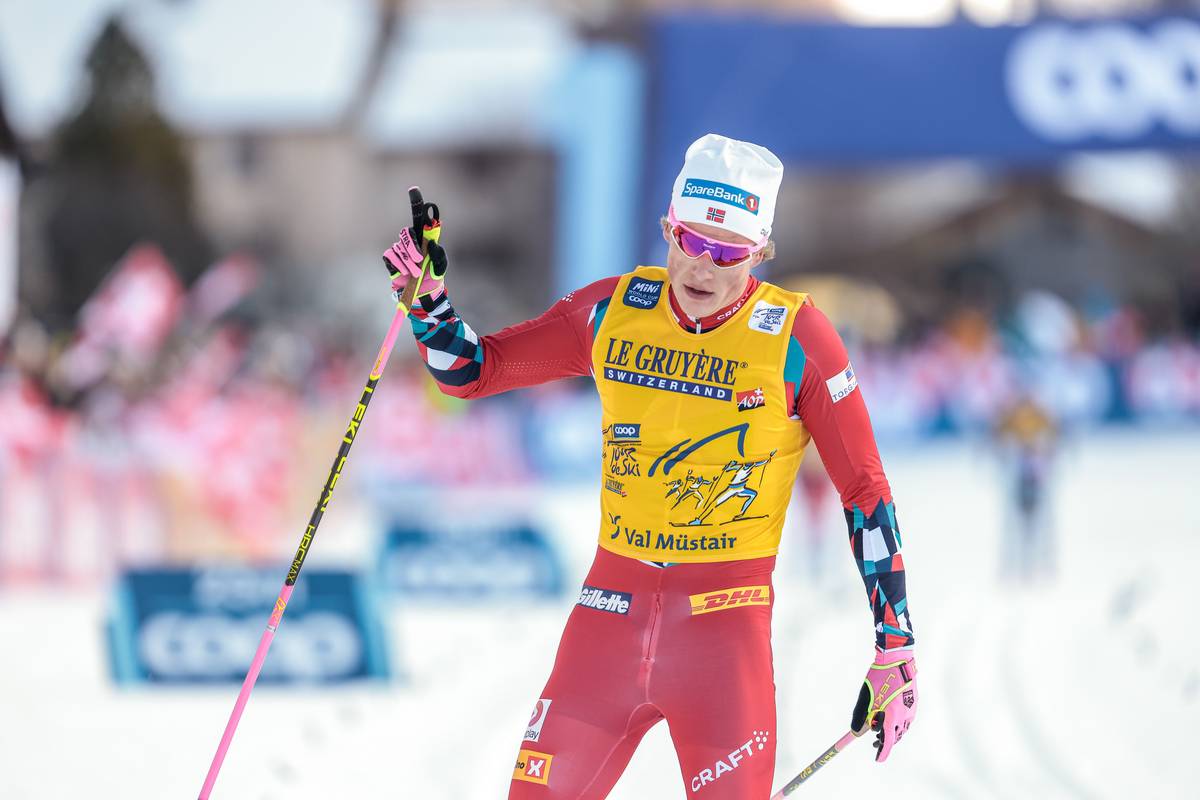
 This World Cup coverage is made possible through the generous support of Marty and Kathy Hall and A Hall Mark of Excellence Award. To learn more about A Hall Mark of Excellence Award or to learn how you can support FasterSkier’s coverage please contact info@fasterskier.com.