From the FasterSkier archive — posts syndicated from athletes’ and coaches’ own blogs between 2004 and 2012, kept online as published. Current coverage is at fasterskier.com.
It’s the most wonderful time of the year — or is it? The Tour de Ski has returned, but Devon has some beef with this year’s watered down format. Plus, recaps of the four races we’ve been through so far, including Jessie Diggins sprint win from heat five.
Send feedback, hate mail and love letters to devon@fasterskier.com. You can send love letters to nat@fasterskier.com. See you in a couple of days.
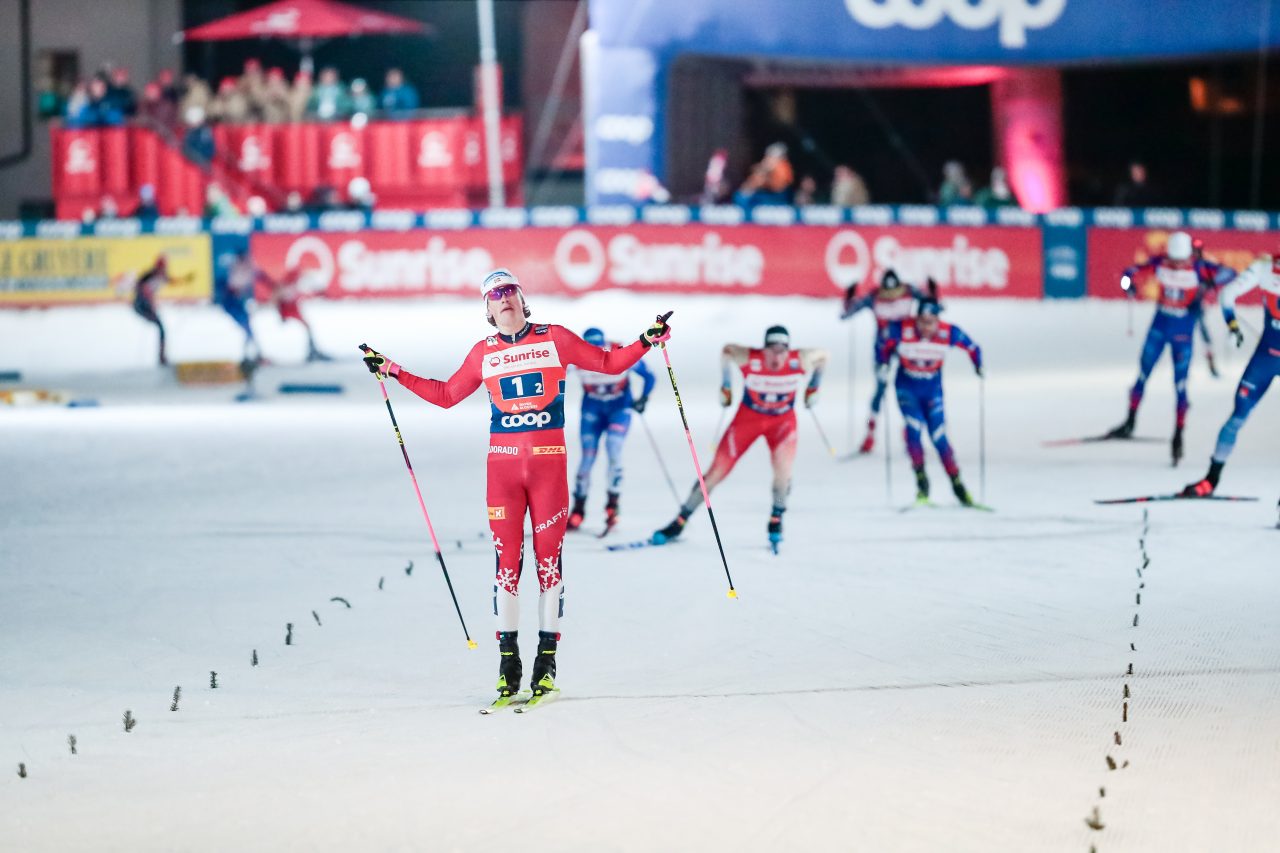
Johannes Høsflot Klæbo, in typically dominating fashion, anchored the Norwegians to a victory in the team sprint in a World Cup in Switzerland earlier this month. (Photo: Modica/NordicFocus)
In cross-country skiing, sprinting is a notoriously inconsistent discipline for a single competitor to dominate. The short distance leaves little time for racers to recover from even small mistakes; sharp corners and tight spaces often produce race-ending crashes.
Which makes the track record of Norway’s Johannes Høsflot Klæbo almost impossible to comprehend.
Klæbo, a five-time Olympic gold medalist, has won the last 10 straight sprint races he’s entered on the World Cup — the highest level of international competition. He often crosses the finish line far enough ahead of his rivals — if you can call them rivals — that he has time to unstrap his poles before crossing the finish line.
Klæbo, 28, has won five out of the six Olympic and World Championships sprints he’s contested, and 52 of his 69 sprint World Cup starts — missing the World Cup sprint podium just once since 2018, according to data from the International Ski Federation.
So: How do you beat this guy?
FasterSkier, when the World Cup made its swing through Canada and Minnesota last season, decided to pose that question to an array of the circuit’s athletes and coaches. We’ve put together a kind of brief oral history below, seeking to appropriately describe Klæbo’s supremacy and the best ideas about how to take him down.
Enjoy.
What kind of tactics would you use to beat Klæbo in a sprint?
Håvard Solås Taugbøl, a Norwegian World Cup racer and one of the nation’s (and globe’s) best sprinters: That’s the $1 million question. I have never managed to do it.
Swiss sprinter Valerio Grond: Maybe break his poles or something? I don’t know.
French sprinter Lucas Chanavat: I mean, if I had the answer, I would have won the last one. You just focus on yourself, do the best race you can. It’s about my strengths. I think you have to be really perfect on every move you do. That’s the fun part about competing with him. It’s, like, you have to be perfect. And that’s really motivating.
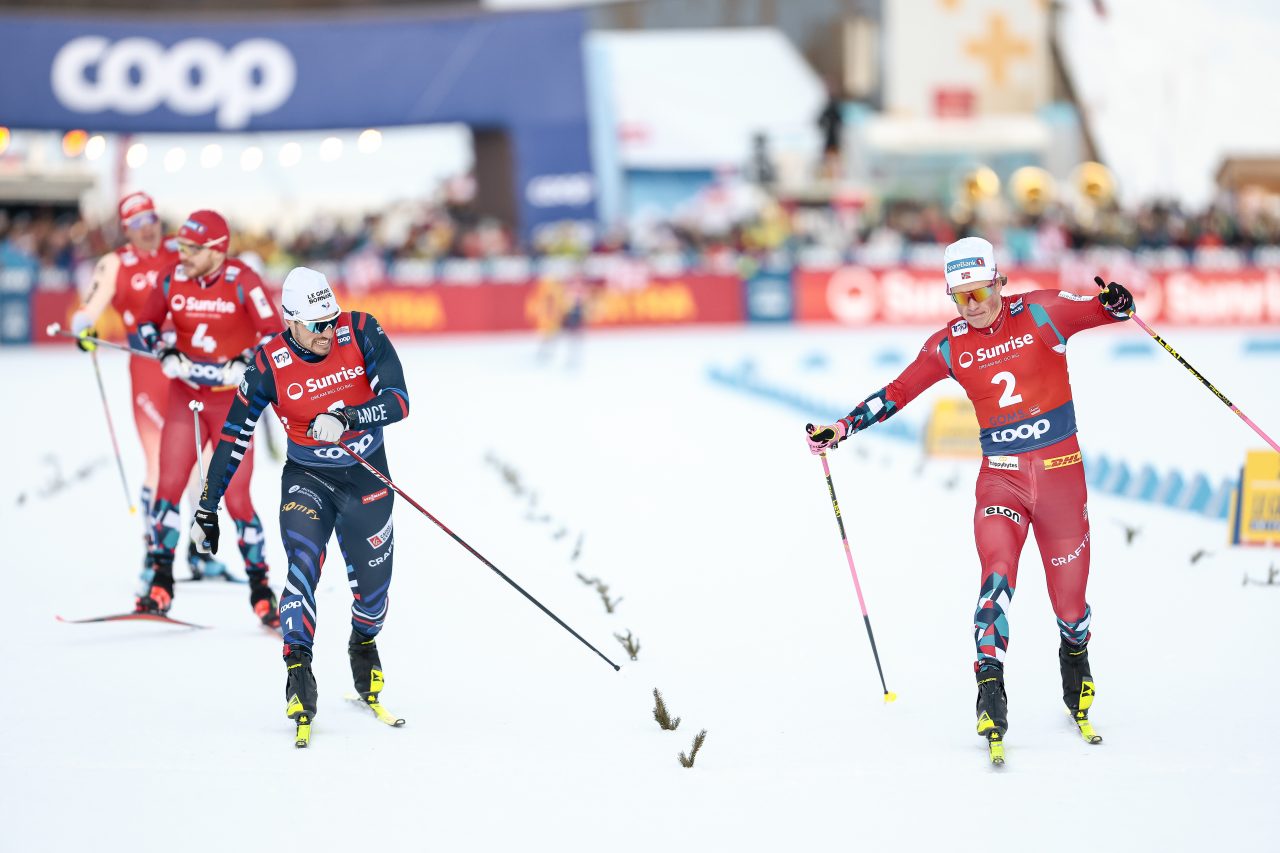
Lucas Chanavat of France alllllmost beat Klæbo at a World Cup sprint race in Switzerland last year. But he didn’t. (Photo: Modica/NordicFocus)
Sweden’s team manager, Anders Bystrom: I think, first of all, you have to mentally know that he’s not unbeatable. Because I think many people think so. He’s shown that he is almost unbeatable, so it’s fair that people think that. But we don’t talk about him like that.
Jonna Sundling, the Swedish Olympic champion from 2022 in the women’s sprint: I would go hard from the start, and don’t leave any power. Just go, all that I have. I don’t think I could take him in the final meters — he’s too quick for me. The men, maybe they’re scared sometimes — I don’t know, I think they can do more than what they think they can do. Maybe.
Maja Dahlqvist, a Swedish Olympic sprint medalist: I would try to sprint him down, like waiting til the end. But I guess a lot of people try to do that, and people are not so successful.
Grond: If he’s in his top shape, he’s almost unbeatable. He’s really, really always in a good spot. But when he’s maybe not in the best spot, you have to take advantage of this and put in an attack.
Canadian national team coach Robin McKeever: Break his pole?
Swedish sprinter Edvin Anger: I think we need to push him really hard, and take our chances. I don’t think I need to go hard early, but I think I need to have a good place. And when I take my chance, I really need to take my chance. And I need to push from the place in the track that I think is best for me. I can’t wait to see what he will do, because I need to do the thing first.
Norwegian sprinter Erik Valnes: How to beat Johannes in sprint is all about him being in bad shape. [Laughs] I think maybe it’s about the finish — or, to be able to have a good finish after a high-speed final. There are many things that have to be right to beat him. You just need to start the finishing sprint before him, and be ahead. Because as long as you’re behind him, you’re one step behind him in the mind games as well.
McKeever: I think the only way is by surprising him. And they’re trying.
What makes Klæbo so good at sprinting?
Chanavat: He’s strong in every aspect of the sprint race. He has, like, amazing turns, an amazing finishing sprint, he’s insane in stamina. He’s good at everything. He’s the GOAT [Greatest Of All Time].
Grond: He’s so good in every technique and part of the race, and also tactically. He’s simply the best skier in history.
Dahlqvist: He’s good in everything. He can go hard, he can wait, he can go from the start.
Norwegian distance specialist Simen Hegstad Krüger: He often likes to control the heat and he gets a lot of respect. And you have — I think there’s a lot of guys that think there’s no chance to beat him so they just give him room and then they give it away to him. He has earned the respect but especially in sprint you can’t give anything away and you have to take your place and take your positions. And I think he’s the best in that but I think sometimes he gets the best positions a little bit too easily.
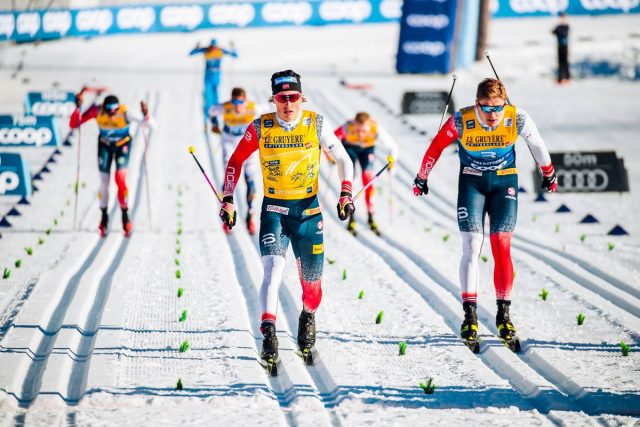
Klæbo wins a Tour de Ski stage just ahead of his Norwegian teammate Erik Valnes. (Photo: Modica/NordicFocus)
Valnes: I’ve been angry with myself sometimes because of bad tactical decisions. Because many times I’ve just, in my unconsciousness — you think, ‘Just follow him, and you’ll get a good result.’ But then you will not get past him.
Bystrom: If you meet him in a heat, you almost adapt to what he’s doing. Because you have to see, ‘Okay, what’s Johannes going to do now?’ Because you know he has this X-factor in many parts of the course.
Does Klæbo have any weaknesses in sprinting?
Chanavat: You should probably ask him. That would be the best.
Klæbo: That’s going to be a secret. [chuckles] I don’t think I will tell everyone. I think I’ll keep that for myself and I’ll tell everyone when I’m done racing. That’s my answer.
Norwegian sprinter Even Northug: Maybe none.
Valnes: No. That’s the thing with him. He’s not having any weaknesses. You can say, like, maybe double-poling long flats. But he’s quite good there.
Krüger: Not that I’ve seen so far. Even in distance races, it’s not so many weaknesses to find.
French sprinter Jules Chappaz: I think running [uphill], like in Ruka [the Finnish ski resort that hosts the season-opening World Cup races each year]. First it was the ‘Klaebo run,’ but now I think I’m really good at it. Maybe, hopefully next year in Ruka, I can run faster, beat him. [He didn’t.] He is sick a lot of times — maybe that’s sort of his weakness.
Klæbo coasts to the win in Ruka this year, beating everyone, including Jules Chappaz. (Photo: Modica/NordicFocus)
Anger: It’s a hard question. But I think we need to push him and then make him a little stressed — that’s what I think.
Bystrom: Mayyyyyybe it’s skating without poles — using your legs to be able to, maybe, go past him. But it’s really hard to say. He’s the best. He’s shown that many times. He’s so good in so many areas. It’s hard to say there’s one where you could beat him when there’s 28 areas where you can’t beat him.
Are there ways athletes can train over the long-term, like over next summer or multiple seasons, to beat Klæbo?
Chappaz: Just trying to focus on ourselves. This spring, I will compete in the Ski Classics [marathon races] to improve my double poling. To look to the Olympics, 2026, with the Val di Femme finish — I hope it will improve my double poling skills, to [be able to] beat him.
Dahlqvist: Maybe they need another team like us, like the Swedish women, because you can use your team more. So, maybe a whole team needs to be stronger, to try to beat the Norwegian. They could do team tactics in a way, like everyone knows where they will go.
Anger: I’m still young — I’m just 21 years old. And he has a lot of training hours. A lot more than I have. With one or two years more, with good summers, also with a lot of hours, I think it will be better for me. And maybe I will be better in the final — I’m good in the quarters and the semis right now, but maybe I miss a little in the finals. I need to be a little harder and stronger.
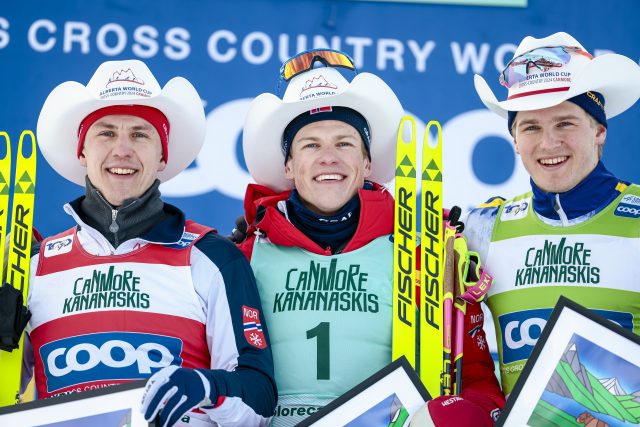
Valnes, Klæbo and Anger pose for a podium photo after Klæbo won a World Cup sprint in Canada last year. (Photo: Modica/NordicFocus)
Grond: We’ve just got to work hard. It’s also about learning how to ski against the best skier, for me. So, I’m trying, also, to get some experience on how they ski and where I can be better than them.
Valnes: It’s more about improving the base level, the capacity, the VO2 max. If you have that base, from May until September, then you can build a little bit on that with specific training in October and November and just before the season starts.
McKeever: The reality is, how do you beat Klaebo? Have him age out a little bit.
Northug: Training.
Norwegian national team coach Eirik Myhr Nossum: You have to train, of course. But there were a lot of people training for the 100-meter dash, as well: Usain Bolt still won. So, if everybody in the world trains the best they can, still one will win — and it’s hard to beat Johannes. It’s possible, but he’s probably the best skier that’s ever been. And now it’s harder than ever, and he still wins.
The 2022 FIS Junior/U23 World Ski Championships trip has been made possible through support from the National Nordic Foundation (NNF), which has identified this invaluable opportunity for developing athletes as one of its “Pillar Projects”. You can support the NNF and the next generations of America’s top skiers by making a donation here.
LYGNA, Norway – The second U23 event took place Saturday morning in the form of a 1.2-kilometer skate sprint. Qualification occurred under a sunny blue sky, with temperatures around 20°F, though moving into the heats it started to get cloudy as the wind picked up.
Moa Hansson of Sweden won the women’s qualifier in a time of 2:33.13. Abigail Jarzin (University of Utah/Salt Lake City, Utah) led the US women, finishing 43rd (+13.16). Behind her came Lucida Anderson(University of New Hampshire/Golden Valley, Minnesota) in 45th (+14.02), and Anabel Needham (Michigan Tech University/Houghton, Michigan) in 46th (+14.08).
Needham spoke to FasterSkier after the race saying, “it was a tough day, I was really hoping to possibly make heats, just felt a little tired. But the sprint course was so much fun. Super fast, and an actual sprint, so that was really cool.”
Anabel Needham races the freestyle sprint qualifier during the 2022 Junior World Ski Championships in Lygna, NOR. (Photo: flyingpointroad.com)
Rena Schwartz (Dartmouth Ski Team/Middlesex, Vermont) rounded out the US finishers in 54th, +17.95. For the Canadian women, Anna Pryce finished 35th, +10.98 back. Beth Granstrom was 44th, +13.35, Anna Parent 47th, +14.68 and Bronwyn Williams came in 52nd, +16.85.
Qualification for the men was won by Valerio Grond of Switzerland in 2:10.10. For the US, Gus Schumacher (Alaska Winter Stars/Anchorage, Alaska) and Noel Keeffe (University of Utah/Steamboat Springs, Colorado)advanced to the rounds, with 22nd and 29th places respectively. Jonny Hagenbuch (Sun Valley Ski Education Foundation/Ketchum, Idaho), the only other American U23 man competing, finished in 39th, +10.64 back. Canada had one qualifier in Pierre Grall-Johnson who finished 25th in the qualifier. Sam Hendry finished 56th for Canada, +16.54, Joe Davies 65th, +21.6 and Leo Grandbois did not start.
As usual, the women completed their quarterfinals first. The five rounds of heats saw a few broken falls, a crash or two, and the two lucky loser qualifiers coming from heat number three, Anna Grukhvina of Russia and Lisa Lohmann of Germany.
For the men, both Americans were competing in heat number four. Also in that heat was the second-fastest qualifier, Norwegian Ansgar Evensen, who won the skate sprint at Norwegian Nationals in 2020 (though notably Johannes Høsflot Klæbo did not race). Evensen broke the field apart on the first climb out of the stadium, with Czech skier Ondřej Černý keeping pace.
Those two remained clear of the field as they descended and entered the final “waffle hill”. Schumacher was in fifth, still in contact with Jaume Pueyo of Spain and Jan Stölben of Germany, while Keeffe followed. Into the finish straight, Schumacher executed a quick no-pole skate that brought him into fourth place and appeared to be a good lucky loser time. Keeffe finished 6th, +7.11 behind heat winner Černý (CZE).
Noel Keeffe (bib 29) and Gus Schumacher (bib 22) race the quarterfinal of the freestyle sprint during the 2022 Junior World Ski Championships in Lygna, NOR. (Photo: flyingpointroad.com)
“It was great, so excited to ski in a heat again,” said Schumacher after the race. Ultimately, heat five proved to be the quickest and Schumacher was bumped out of lucky loser position. Schumacher spent nearly the last month in Zhangjiakou, China, competing in his first Olympics. From there, he traveled with the US Ski Team to Helsinki. While the rest of the World Cup squad continued to Lahti for this weekend’s World Cup event, Schumacher flew to Oslo to meet up with the junior/U23 team.
When asked how the transition has been, Schumacher replied, “It’s incredibly refreshing, I can relax a lot more I feel like and it’s nice to be in Norway where there’s definitely more of a fun ski vibe, like it’s more about just doing it. It’s nice to be back with these guys, this team.” Comparing the wind today to the infamous gales of Zhangjiakou, Schumacher said, “It’s not as cold, but it is definitely picking up a little bit. But I’m fairly used to it, I’ve got my tuck dialed.”
With Canadian Grall-Johnson Pierre finishing sixth in his heat, all the North American competitors were out for the day.
In the women’s final, Moa Hansson continued her domination; after winning the qualifier, her quarter-final, and her semi-final, she took gold in the final as well. She was followed by bib 19, Monika Skinder of Poland. Nataliya Mekryukova of Russia rounded out the women’s U23 sprint podium.
Abigail Jarzin races the freestyle sprint qualifier during the 2022 Junior World Ski Championships in Lygna, NOR. (Photo: flyingpointroad.com)
The men’s final started with some drama as Jules Chappaz of France snapped a pole immediately out of the start gate. He quickly got a replacement and was able to move himself into fourth as the skiers entered the final hill. Though Grond (SUI) was out front, the pack was tight, and as they crested the hill, Chappaz (FRA) became tangled and fell, taking him out of contention. Grond held his lead to the finish to take gold. Runner-up was Denis Filimonov of Russia, followed by Magnus Øyås Håbrekke of Norway in third. Evensen (NOR) finished fourth.
Tomorrow the program switches back to the juniors in the morning, with a skate sprint for the U20 racers. That will be followed by a mixed-relay for the U23’s in the afternoon to conclude the week of racing here in Lygna.