From the FasterSkier archive — posts syndicated from athletes’ and coaches’ own blogs between 2004 and 2012, kept online as published. Current coverage is at fasterskier.com.
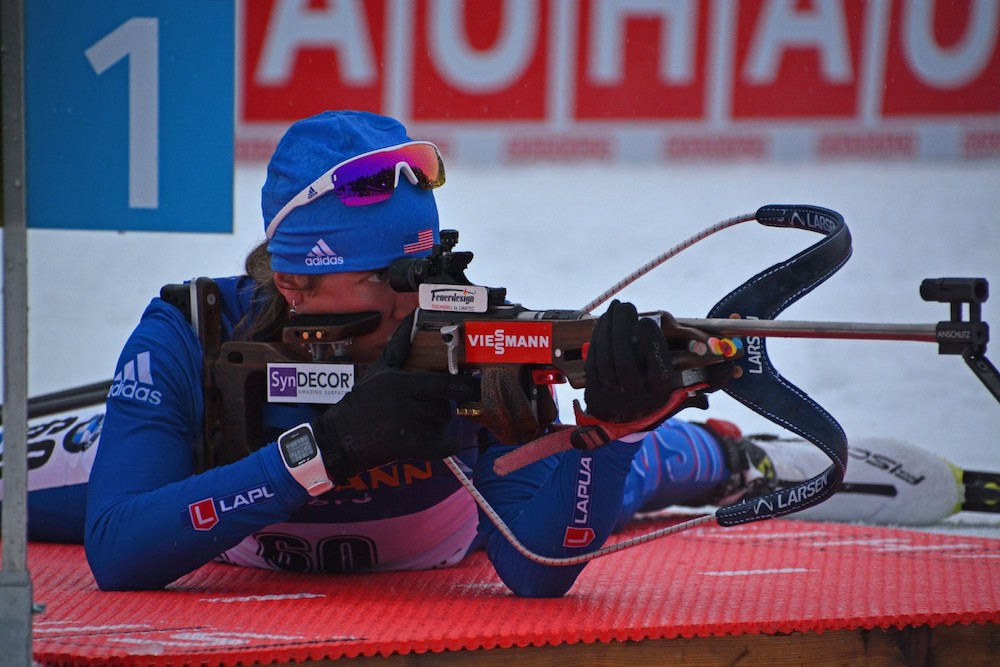
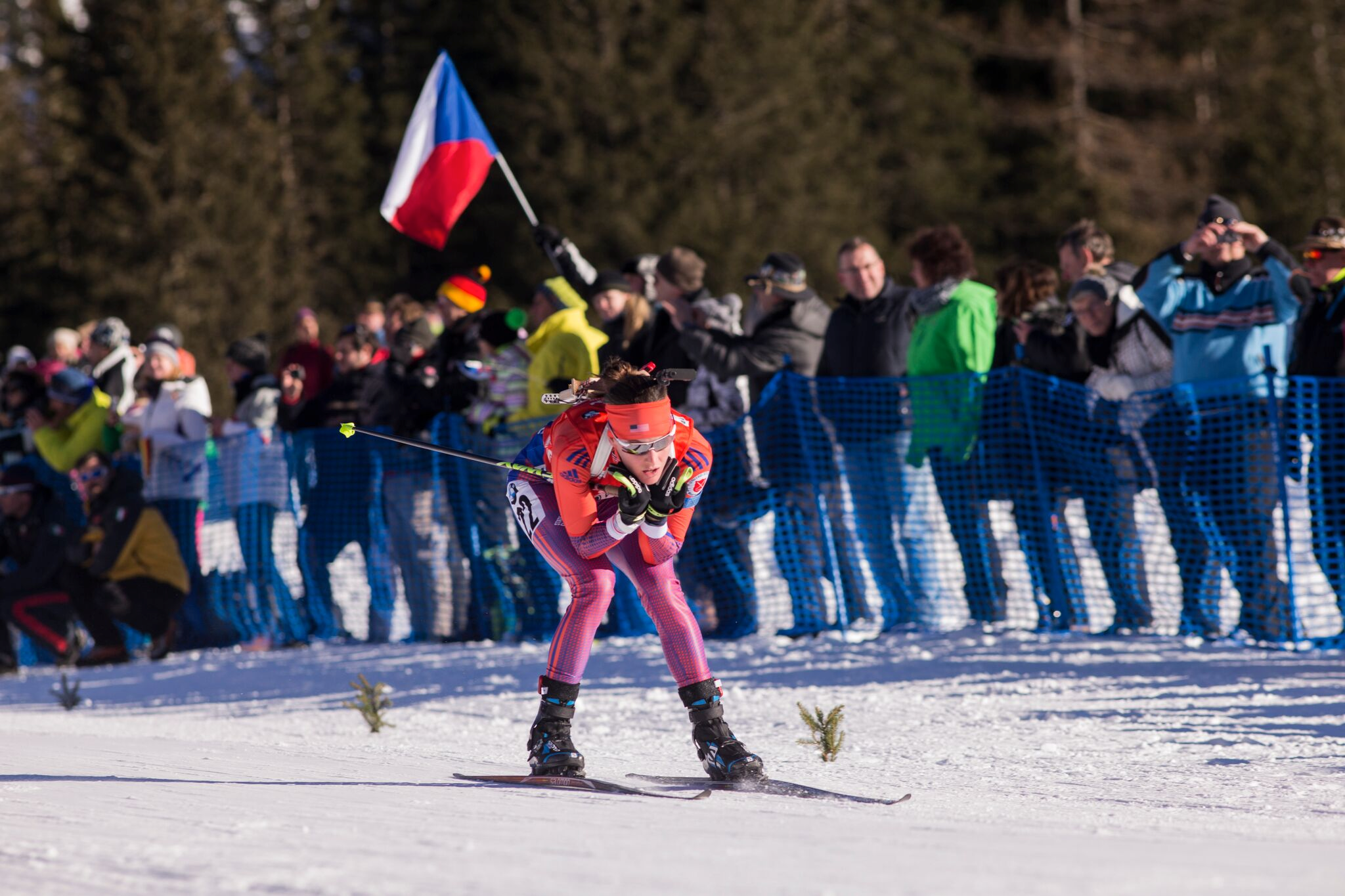
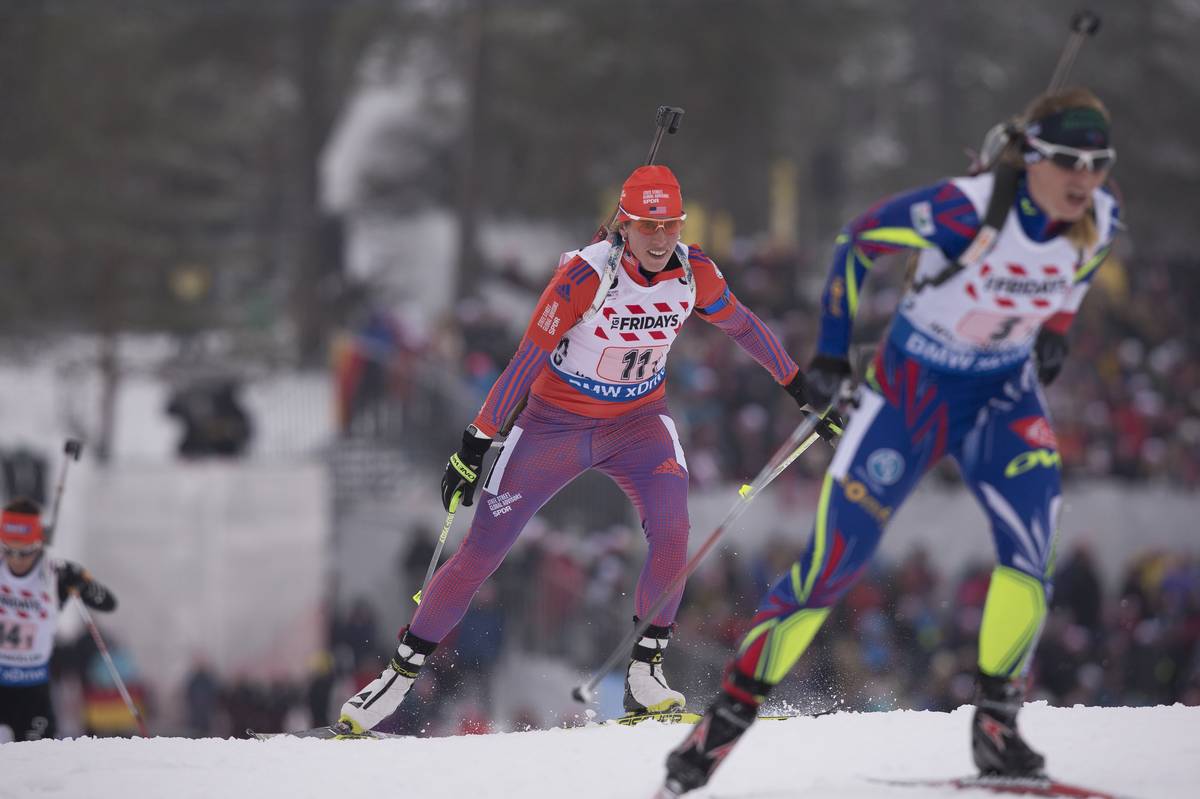
Susan Dunklee (US Biathlon) hitting every target in the prone shooting stage of the women’s 7.5 k sprint at the IBU World Cup in Annecy, France, on Thursday. She ended the day in 10th place with perfect 10-for-10 shooting. (Photo: Glen Crawford)
Susan Dunklee’s start to another International Biathlon Union (IBU) World Cup season hadn’t played out as she’d hoped, specifically in terms of results. Coming off a banner winter, with a silver at 2017 World Championships (in the women’s mass start), Dunklee 31, had so far placed 53rd, 79th and 97th, respectively, in non-relay races over the last two weeks. She had yet to race a mass start, but also had yet to qualify for a pursuit in two World Cup sprints.
So she went back to the drawing board, back to basics and to a “moose garden”.
“My confidence took a big hit these past couple weeks and it was a real challenge was working through that,” Dunklee wrote in an email to FasterSkier on Thursday.
“I tried to find some non-biathlon activities like visiting a ‘moose garden’ in Sweden and seeing the ‘Krampus’ in Austria,” she explained, referring to an Advent costume tradition, “to keep my mind fresh so I wouldn’t obsess 24/7 over disappointing results. I also tried really hard to take a moment each evening to appreciate all the positive things that happened over the course of the day. And I kept telling myself that I am resilient.”
After missing eight targets in last week’s snowstorm sprint in Hochfilzen, Austria, she sat down to brainstorm with US Biathlon consultant Matt Emmons, a 2004 Olympic champion in rifle shooting.
“All summer I’ve been working on some fancier shooting skills, such as wind shading,” Dunklee explained. “Basically we decided I could benefit from focusing back on the absolute basics of shooting: sight alignment, trigger squeeze and follow [through]. That’s what I’ve been doing the last few days.”
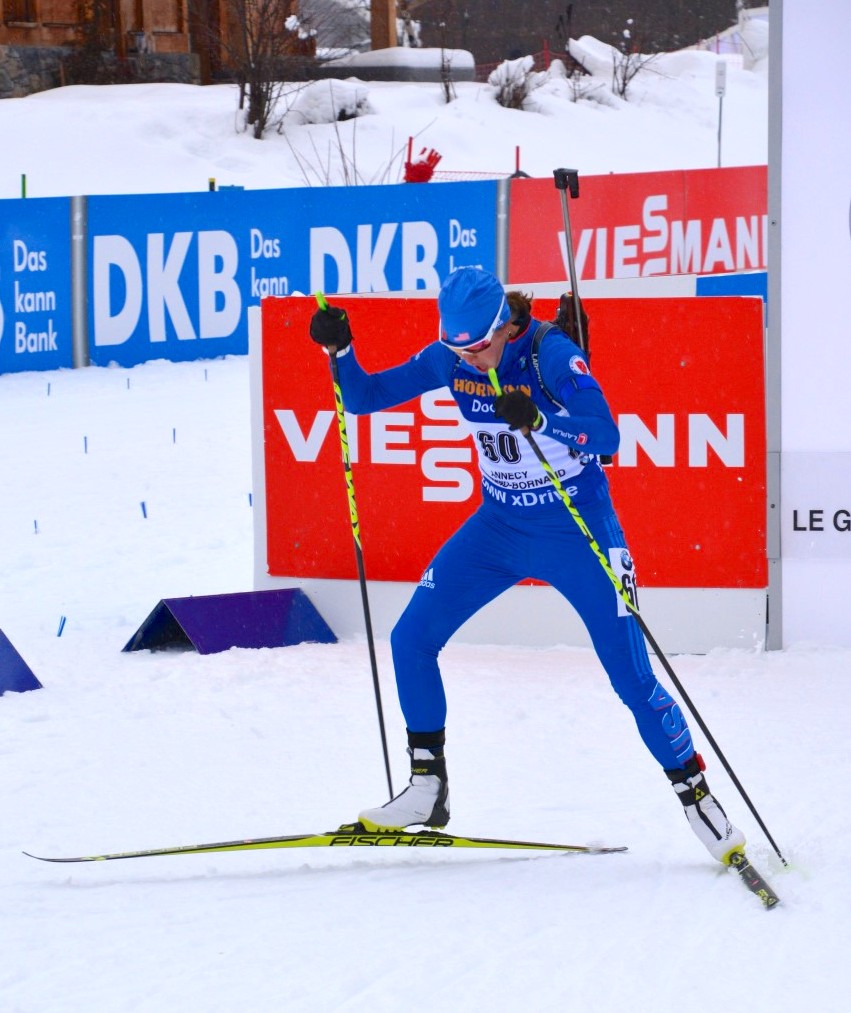
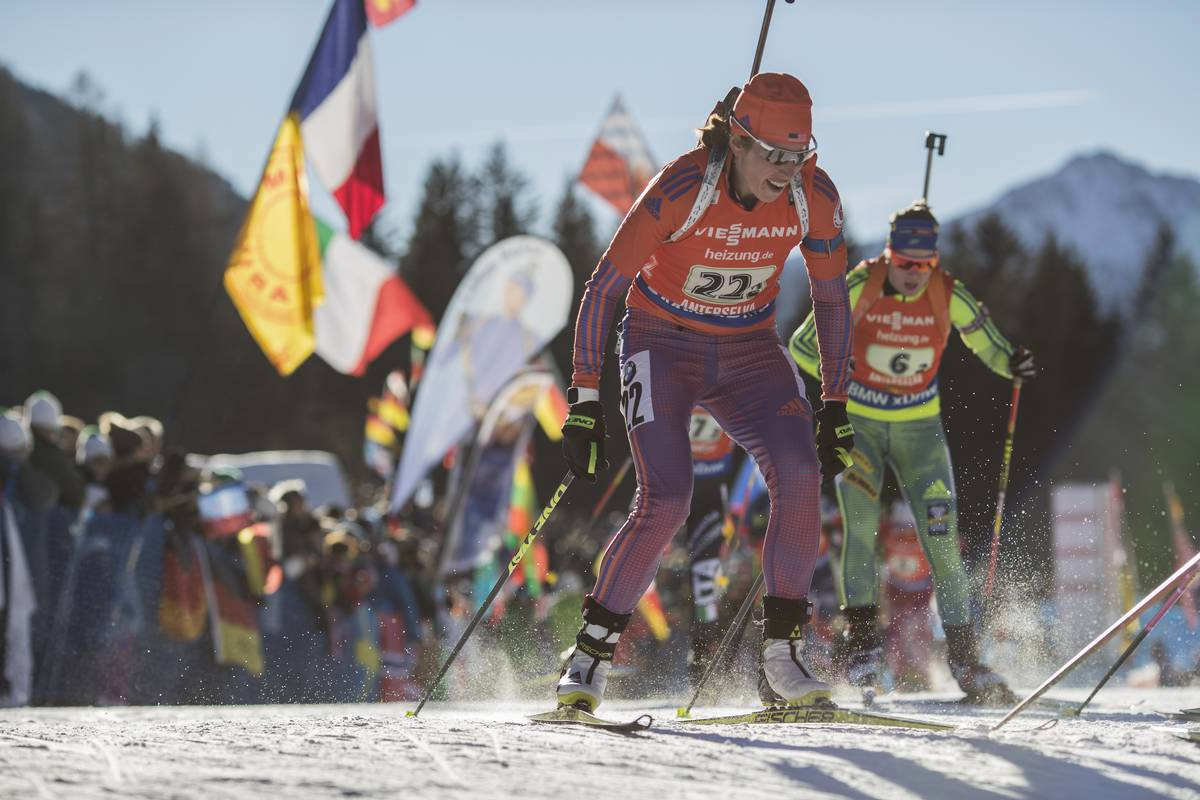
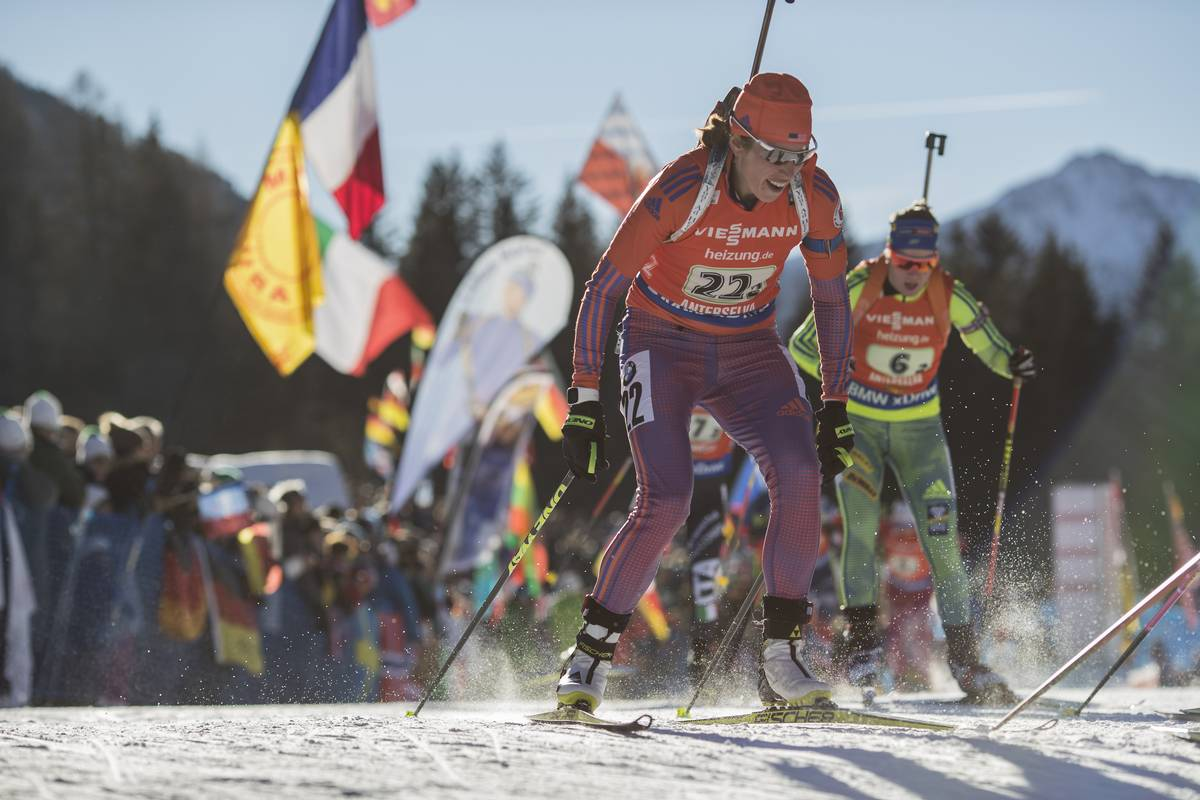
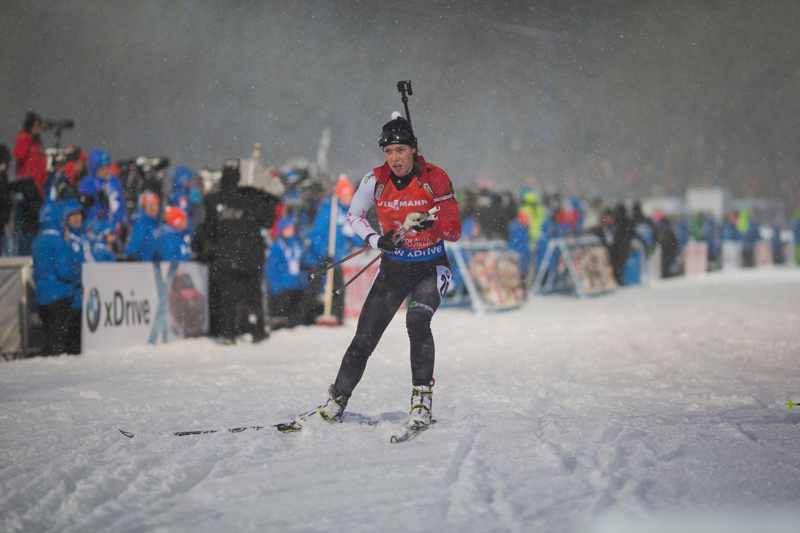
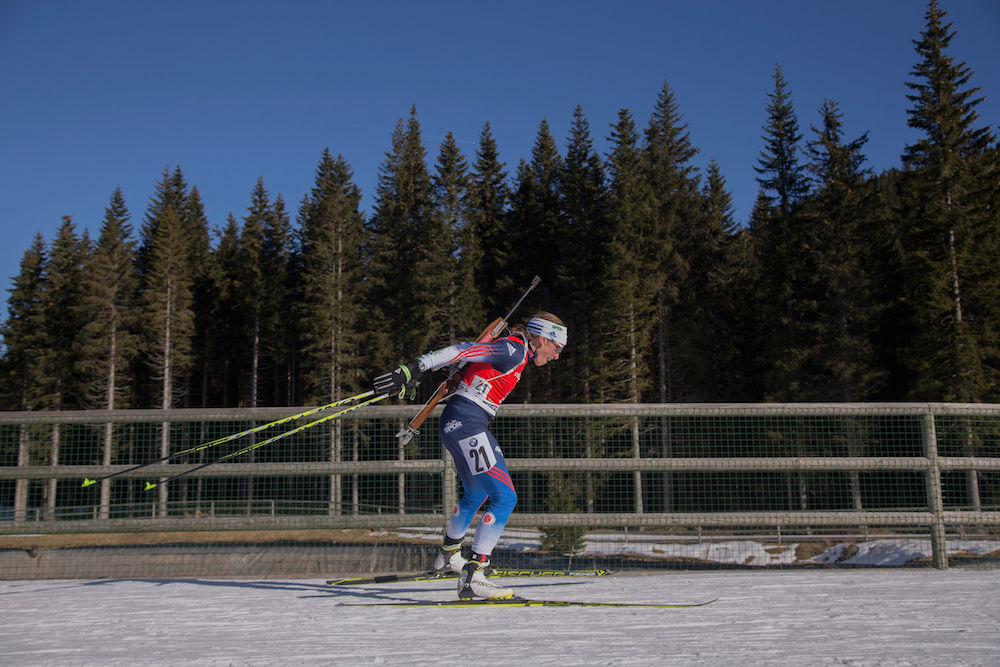
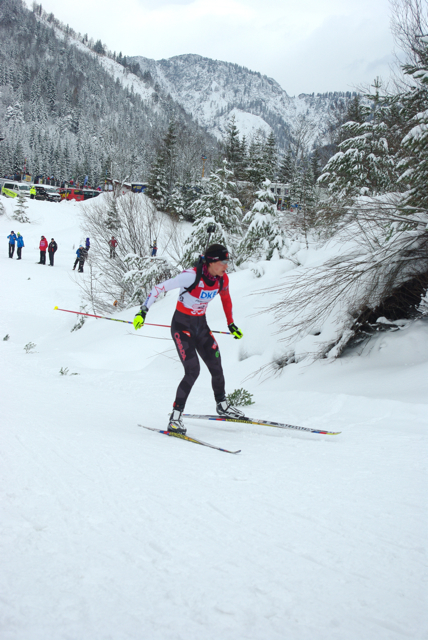
Susan Dunklee (US Biathlon) out of the start of the IBU World Cup women’s 7.5 k sprint on Thursday in Annecy, France, where Dunklee placed 10th overall for her best result of the season. (Photo: Glen Crawford)
On Thursday, she started 60th out of 93 in the women’s 7.5-kilometer sprint in Annecy (Le Grand Bornand), France. In warm, slushy conditions with little wind, as Dunklee described it, she fired away for perfect 10-for-10 shooting to put herself in ninth at the finish.
Dunklee was ultimately bumped one spot down to 10th overall, 1:16.8 minutes behind the winner, by Germany’s Laura Dahlmeier, who started in bib 86 and ended up second — 33.9 seconds behind Slovakia’s Anastasia Kuzmina in first.
Kuzmina, who notched her second-straight individual World Cup win with a time of 20:59.6, and the rest of the top-four finishers — Dahlmeier, Ukraine’s Vita Semerenko in third (+41.4) and Italy’s Lisa Vittozzi in fourth (+50.0) — all shot clean, just like Dunklee. Semerenko’s twin sister Valj, who placed seventh (+1:06.8), was the other woman in the top 10 to hit every target.
Dunklee spent all of the race in the top 10, ranking eighth after the first of three loops and seventh after the second loop.
“All the difference today for me was made on the shooting range,” Dunklee wrote. “The skiing has been fine all season. I backed off approaching the range, and I took enough time to make sure I was taking good shots.”
Her top 10 was her best result since placing seventh in a sprint last March in Oslo, Norway. By landing in the top 60, Dunklee qualified for the Annecy pursuit on Saturday, which will be her first of the season.
“Today helped me put to rest some doubts I was starting to have in my abilities,” she wrote. “I am very grateful to qualify for the pursuit. It will be a good opportunity for some head to head racing which I haven’t seen much of yet this year.”
Kuzmina in Control
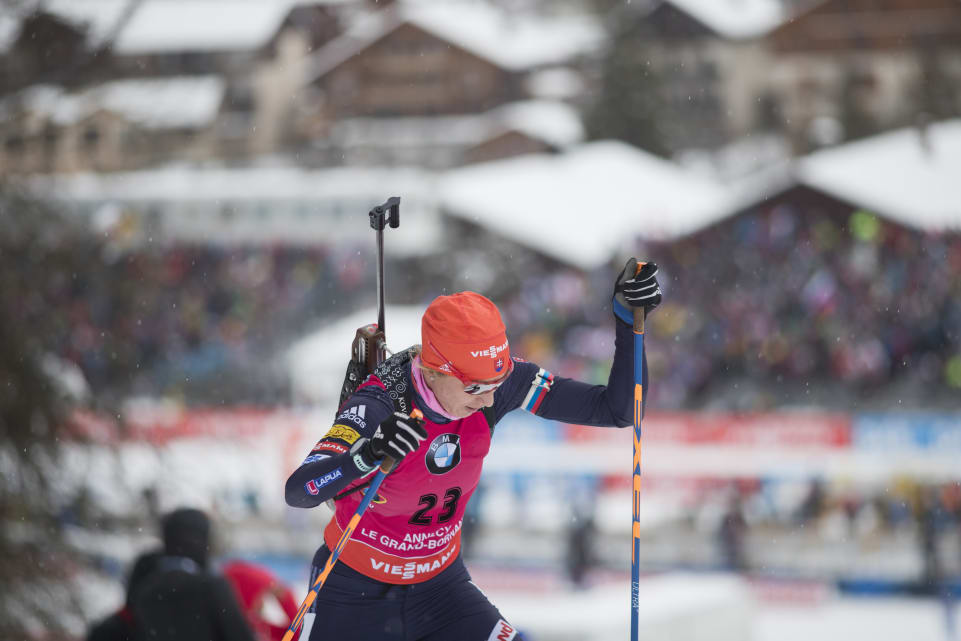
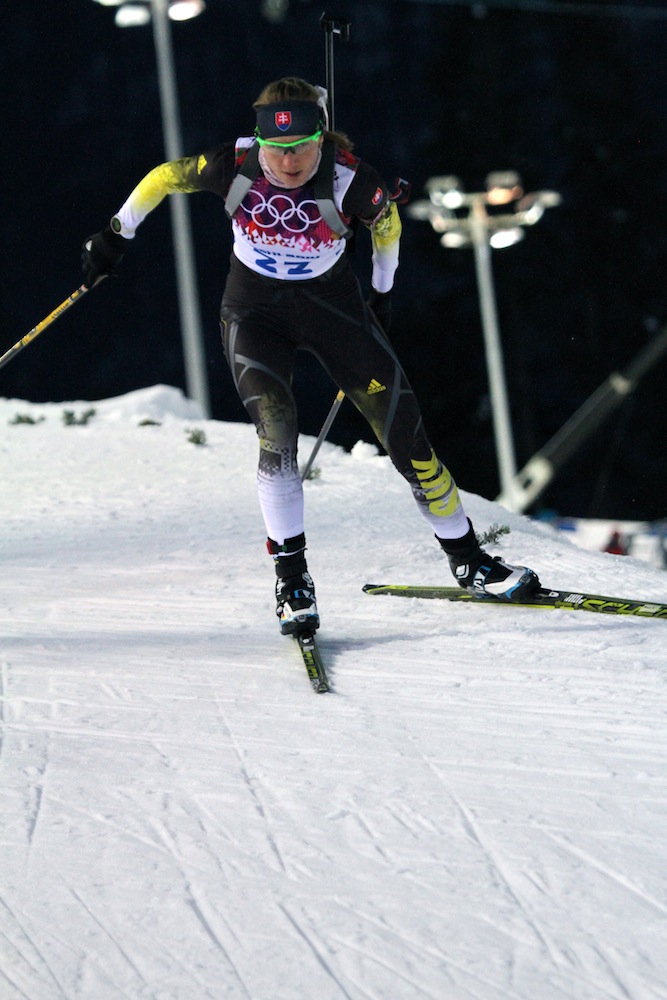
Slovakia’s Anastasia Kuzmina racing to a nearly 34-second win in the women’s IBU World Cup sprint on Thursday in Annecy, France. (Photo: IBU/biathlonworld)
Starting in bib 23, Kuzmina rocketed to first place with the fastest course time and fourth-fastest shooting and range times, all while hitting every target.
“It is always a great feeling to be a winner, especially when the race was pretty good from start to finish,” Kuzmina, a two-time defending Olympic sprint champion (from 2010 and 2014), told the IBU, according to a press release. “It was really important to shoot two times zero. The snow condition was not too comfortable for me; I really want to thank my service team for the skis. That was an important part of my victory.”
The Russian-born Slovakian (whose brother is Russian biathlete Anton Shipulin) took the lead after the first shooting, leaving the range 6.3 seconds ahead of Germany’s Denise Herrmann, who started ahead of her in bib 16 and also cleaned prone. Herrmann had a penalty lap in the standing bout to slip to sixth and 45 seconds back, while Kuzmina cleaned again to start her final loop 35 seconds clear of Vittozzi, who was in second at the time wearing bib 13.
Germany’s Laura Dahlmeier prepares to hit all five targets in the standing stage of the IBU World Cup women’s sprint on Thursday in Annecy, France. (Photo: Glen Crawford)
A much later starter in bib 86, Dahlmeier cleaned prone to move into third, 6.7 seconds off Kuzmina’s time. Her next time in the range, Dahlmeier shot clean again to improve to second, but she was still 25.8 seconds short of Kuzmina’s time with one loop to go. Kuzmina skied the second-fastest last loop (about two seconds slower than Switzerland’s Selina Gasparin) to lock up first, while Dahlmeier ended up nearly 34 seconds back in second place.
“This was the first podium in an individual-start race of the new season for me and that makes me very very happy,” Dahlmeier told German broadcaster ZDF, according to a translation. “I am excited that it worked out today, it took a while until I now got back in shape. I am not at 100 percent yet, but today was a super race and I am just happy about that, it was a lot of fun to race today.”
Thursday marked Dahlmeier’s fourth race of the season after she missed the World Cup opener in Östersund, Sweden, due to illness. In Hochfilzen, she anchored the women’s 4 x 6 relay to the win and placed 10th in the pursuit and 16th in the sprint.
“It’s a bit of an unusual situation for me to have such a late bib in an individual race, but as an anchor in relays I am kind of used to that, passing the time by listening to music or something like that,” she said. “When I was at the start gate I was focused again and just tried to do my on race. It has its pros and cons, I just tried to make the best of it.”
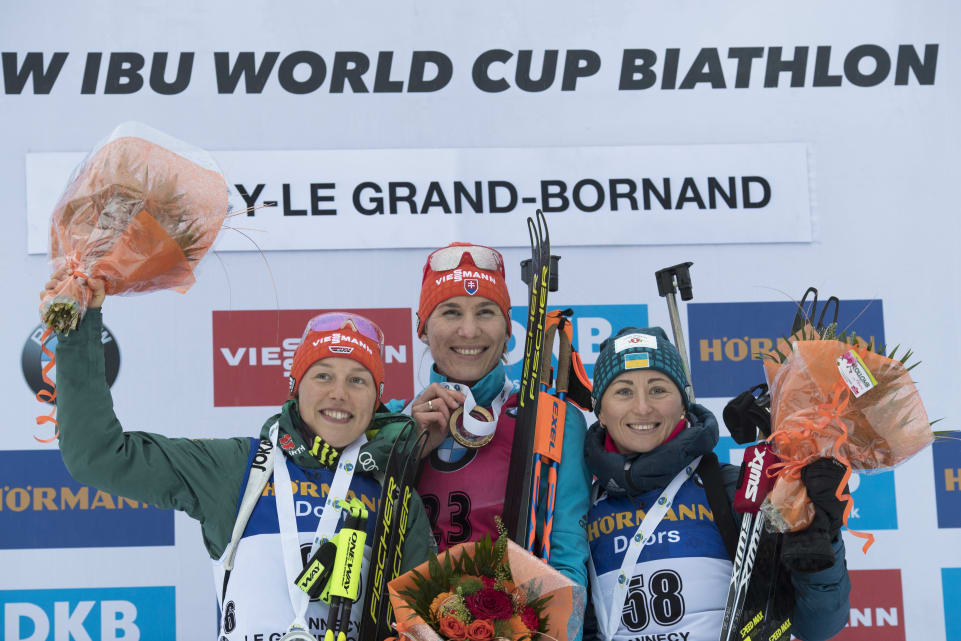
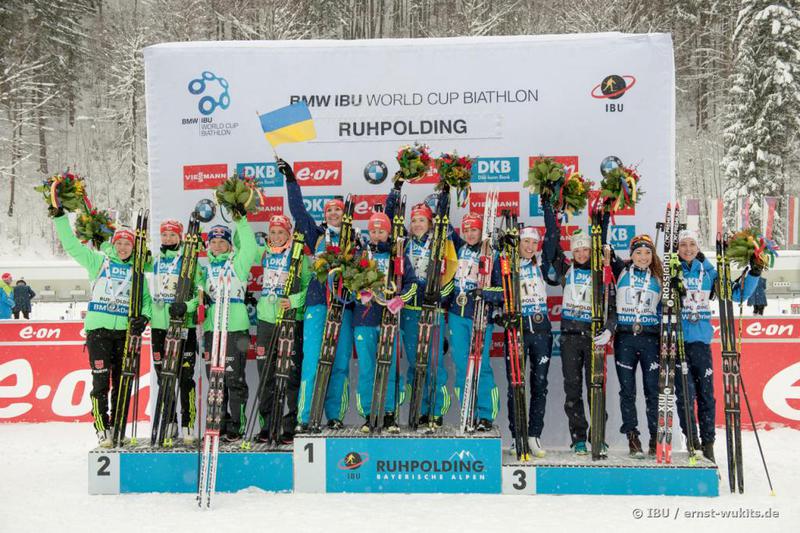
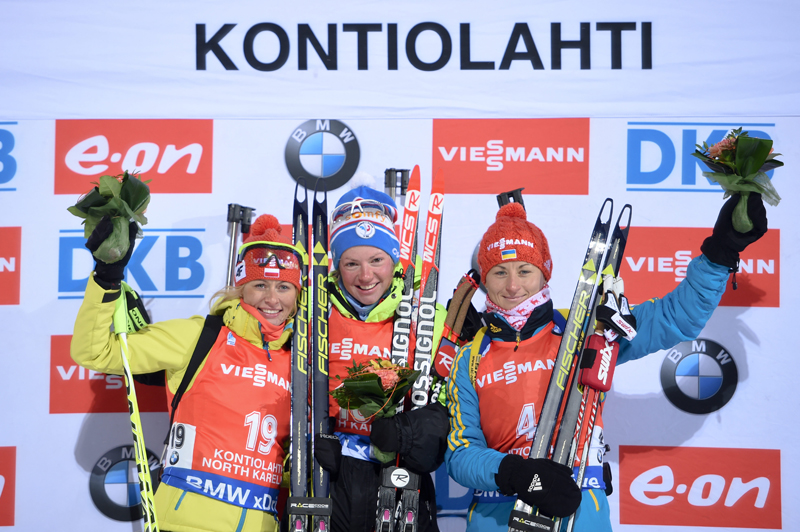
The women’s IBU World Cup sprint podium on Thursday in Annecy, France, with Slovakia’s Anastasia Kuzmina (c) in first, Germany’s Laura Dahlmeier (l) in second, and Vita Semerenko (r) in third. (Photo: IBU/biathlonworld)
For Vita Semerenko, it was her first podium since taking bronze in the sprint at the 2014 Olympics. She missed the two seasons that followed due to a back injury, and gave birth to her son just over a year ago.
“I will never forget my first training after giving birth,” she told the IBU. “My coach said, ‘If we don’t give it a try, we will not find out what happens next.’ I said ‘OK’, but I had a lot of anxiety about coming back to biathlon, as I understood that coming back after three years would be tough. I am also thankful to my husband who told me every day after I had my child, ‘Vita, come on, come on, let’s make a comeback!’ ”
Herrmann was the top finisher with a penalty (0+1) on Thursday in fifth place (+50.6), while Gasparin was just behind in sixth (+53.4) with one miss as well (1+0).
“I am noticing that I am not feeling as fresh anymore as in Östersund, it was quite the number of races for me already,” Herrmann, who won both the sprint and pursuit in Östersund, told ZDF. “And I’d say deep snow conditions like today aren’t ideal for athletes over 60 kilograms. But nevertheless it was a good race, I really tried to hit every shot, and lost quite a few seconds with my shooting time. But I am back on track compared to last weekend, and hope I can continue my successes in the pursuit race.”
In the women’s 10 k pursuit on Saturday, Kuzmina will start 34 seconds ahead of Dahlmeier in second, and Vita Semerenko will head out another 7 seconds later in third. Dunklee will start 1:17 back and just 4 seconds behind Valj Semerenko in seventh.
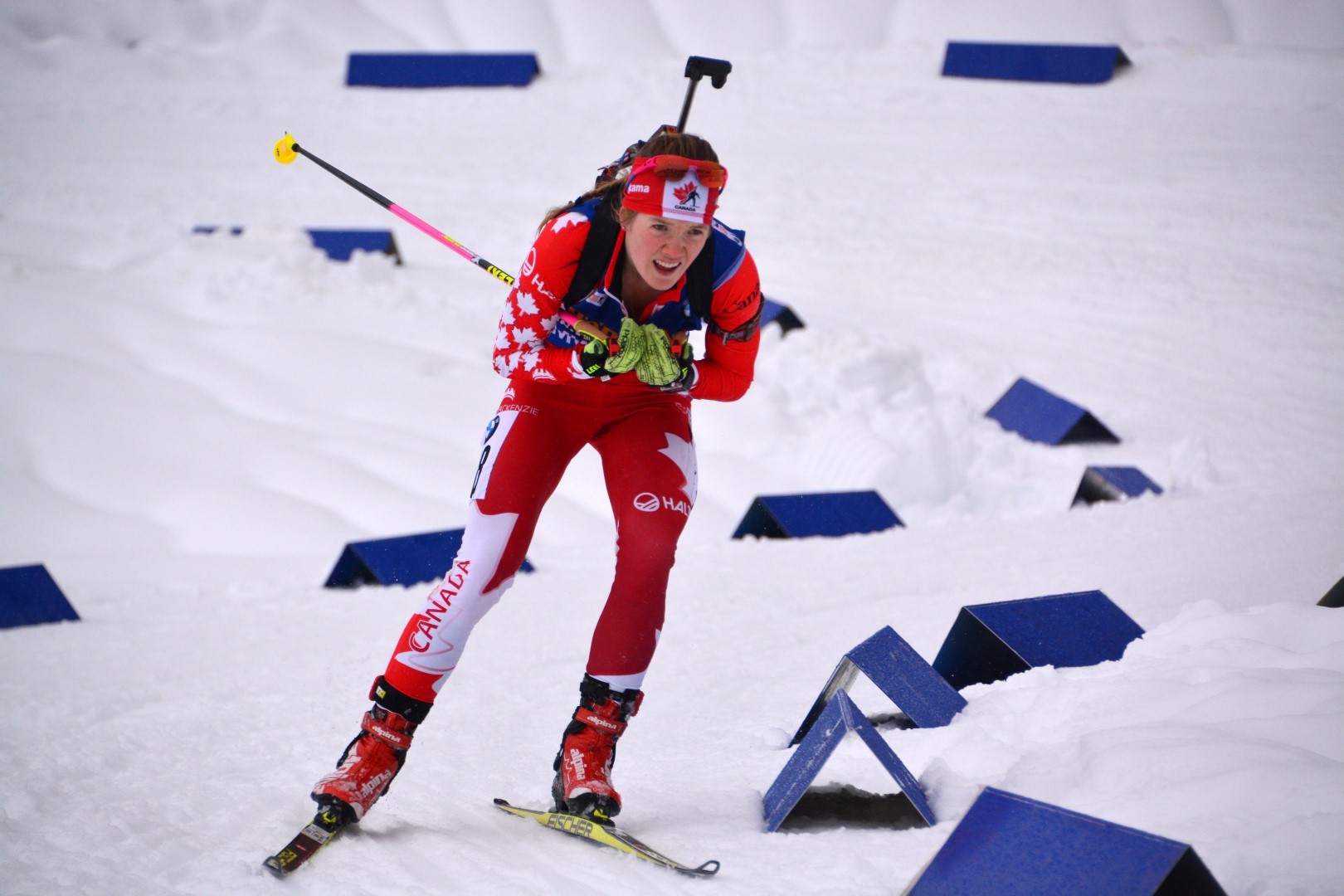
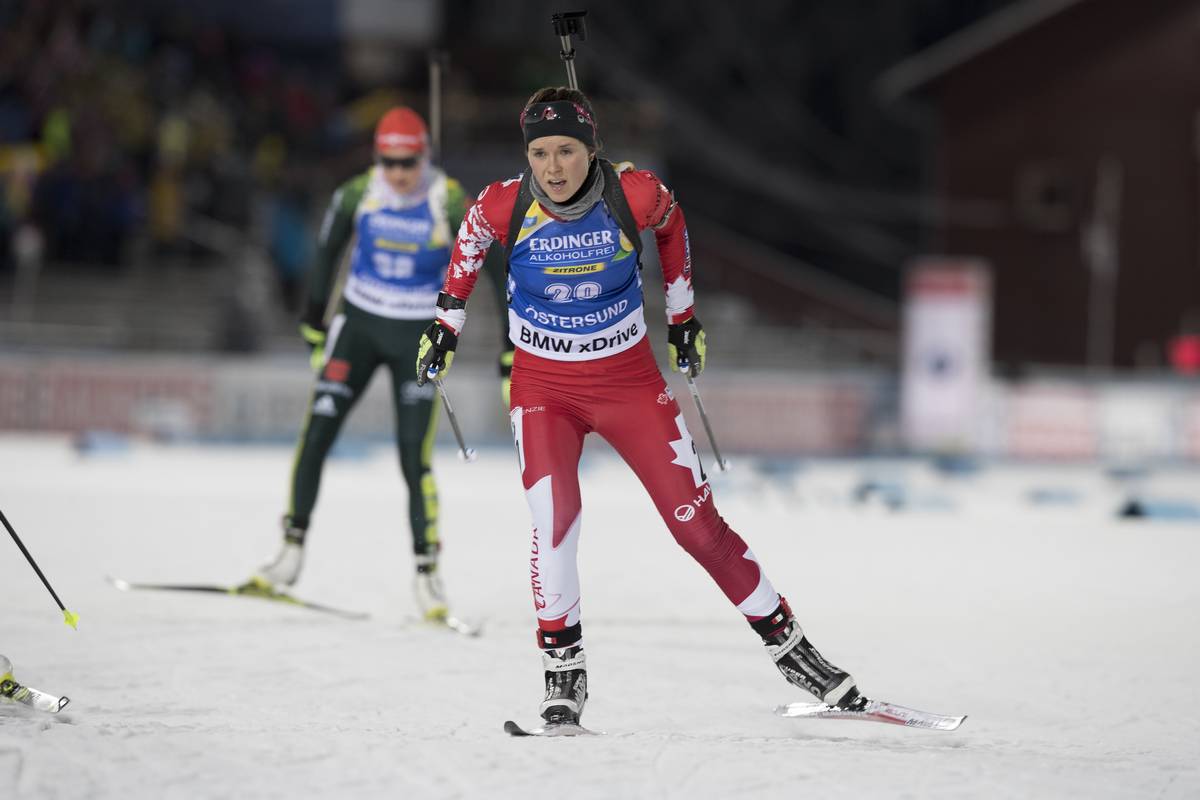
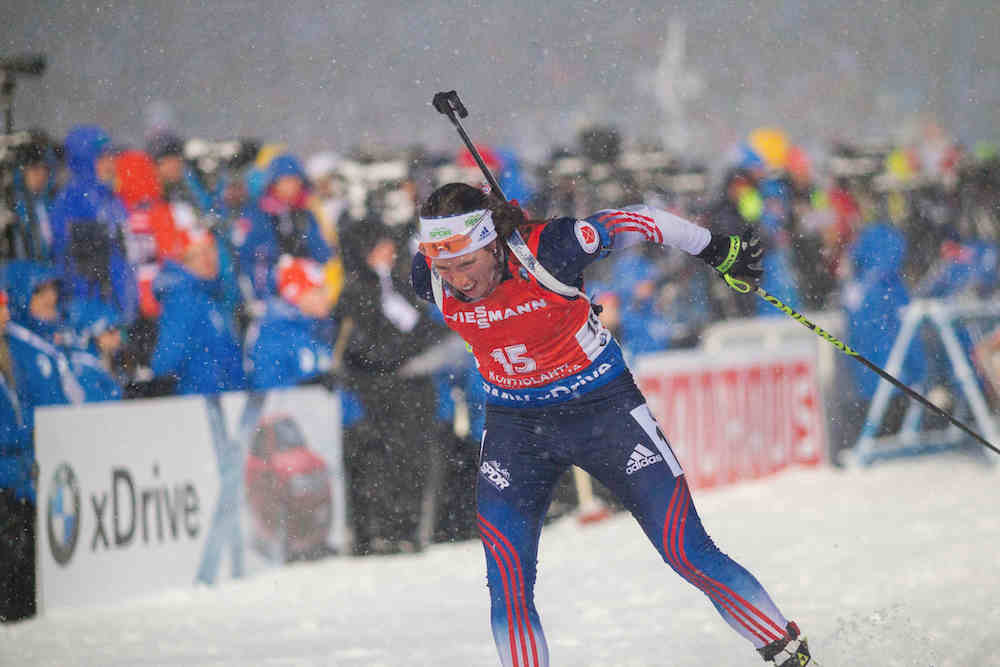
Emma Lunder (Biathlon Canada) racing to 34th in the IBU World Cup women’s 7.5 k sprint on Thursday in Annecy, France. (Photo: Glen Crawford)
Three Canadians qualified for the pursuit, with Emma Lunder leading them in 34th (+2:07.4) with one standing penalty (0+1). Julia Ransom followed in 39th (+2:13.9) with one prone miss (1+0) and Rosanna Crawford snuck into the top 60 in 60th (+2:39.1) with two penalties (1+1). They will start the pursuit 2:07, 2:14 and 2:39 back, respectively.
Also for Biathlon Canada, Megan Bankes missed the cutoff in 65th (+2:51.5) with one penalty (1+0).
For the U.S., Clare Egan finished 81st (+3:43.7) with three misses (1+2), and Emily Dreissigacker was 88th (+4:36.0) with three penalties as well (2+1).
The Annecy IBU World Cup men’s 10 k sprint takes place Friday, starting at 8:15 a.m. EST.
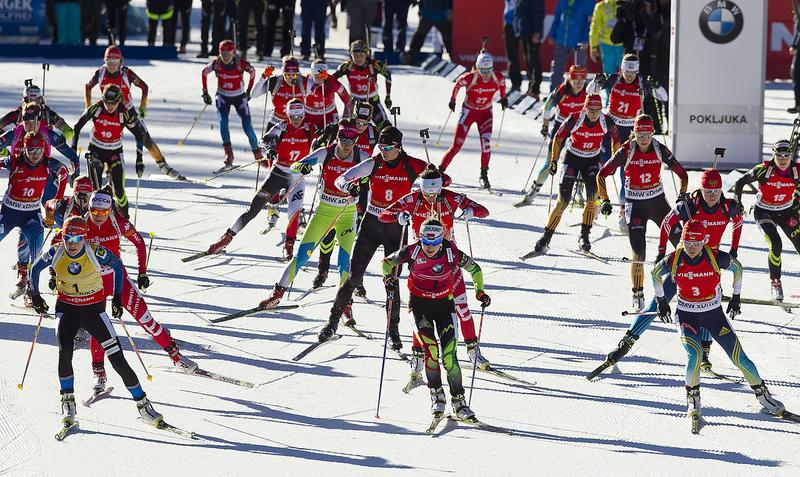
US Biathlon’s Susan Dunklee (l) before the women’s IBU World Cup sprint in Annecy-Le Grand Bornand, France. (Photo: US Biathlon/NordicFocus)
Susan Dunklee (US Biathlon) during the standing stage of the women’s IBU World Cup sprint in Annecy, France. She went on to place 10th. (Photo: Glen Crawford)
Emma Lunder (Biathlon Canada) racing to 34th in the IBU World Cup women’s 7.5 k sprint on Thursday in Annecy, France. (Photo: Glen Crawford)
Julia Ransom (Biathlon Canada) racing to 39th in the women’s IBU World Cup sprint in Annecy, France. (Photo: Glen Crawford)
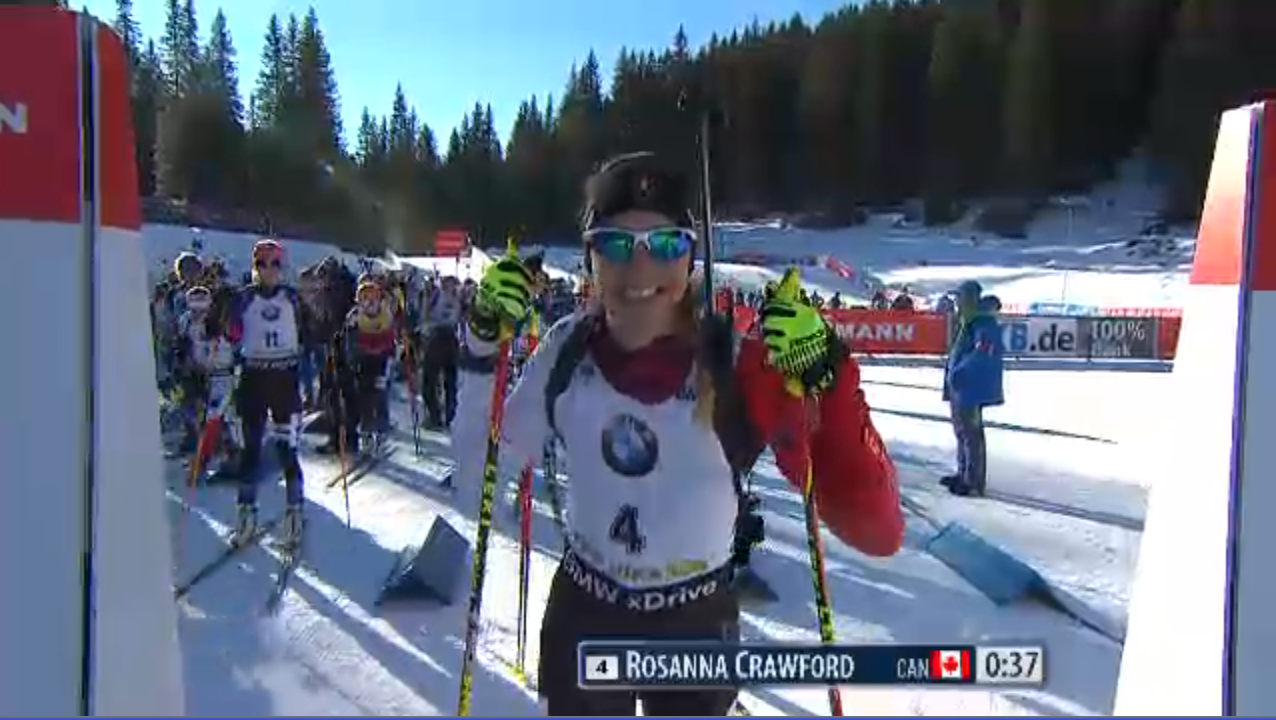
Rosanna Crawford (Biathlon Canada) leaving the range during the women’s IBU World Cup sprint in Annecy, France. She placed 60th to qualify for the Annecy pursuit on Saturday. (Photo: Glen Crawford)
Megan Bankes (Biathlon Canada) lunging at the finish of the IBU World Cup women’s sprint in Annecy, France. She placed 65th. (Photo: Glen Crawford)
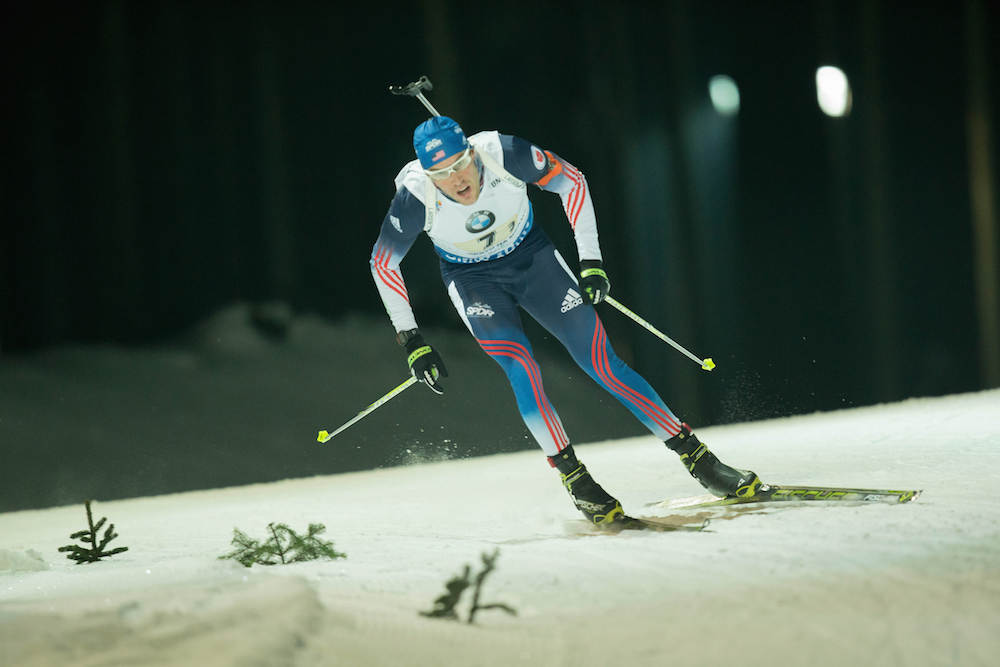
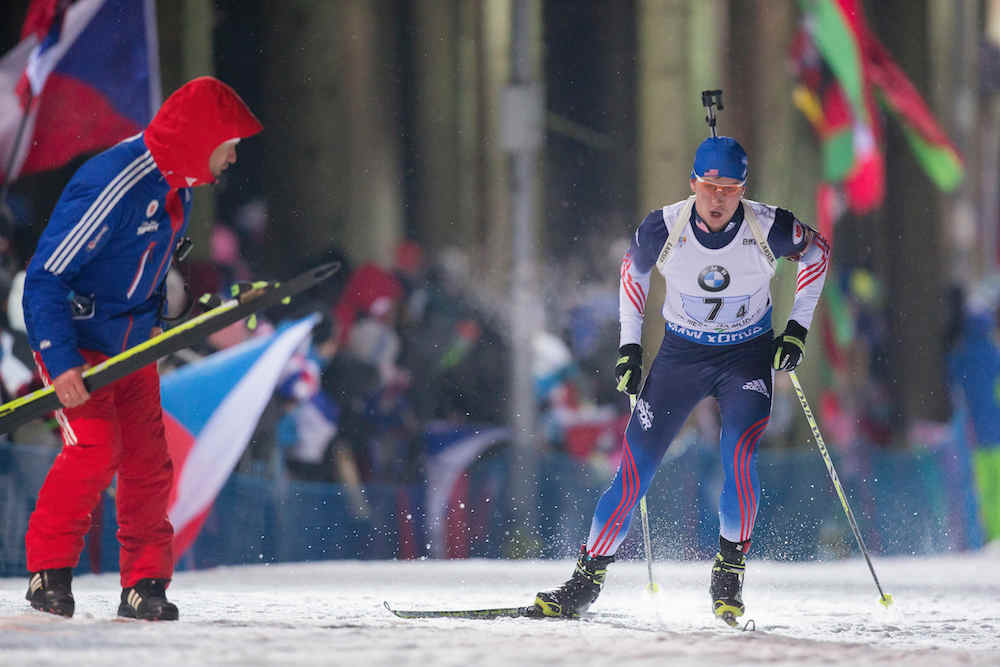
Leif Nordgren (US Biathlon) skiing the second leg of the IBU World Cup men’s 4 x 7.5 k relay on Sunday in Hochfilzen, Austria. The U.S. men ended up ninth overall out of 26 teams. (Photo: IBU/NordicFocus)
Strong gusts of wind on the range required strong nerves and a lot of luck in the women’s and men’s relay races that concluded the International Biathlon Union (IBU) World Cup in Hochfilzen, Austria, on Sunday afternoon.
While the relays concluded with teams on the podium one might expect there, tempestuous weather conditions that at times made it almost impossible to hit the targets also gave outsiders a good chance, and both the U.S. men and Canadian women remained in contention for a long time. The men’s 4 x 7-5-kilometer relay was particularly wild with more than 100 penalty laps, and it began with a big surprise.
Belgium’s starter Michael Rösch tagged off in first place for the first time in the history of that team, representing a country that until now, rarely had enough athletes for a relay and had thus far had a 24th place at the 2016 World Championships to its credit. And on his tails was Norway’s Ole Einar Bjørndalen, and shortly behind them US Biathlon’s Lowell Bailey in third.
The three aforementioned athletes all raced in the Olympic relay more than a decade ago at the 2006 Winter Games in Torino, Italy, but back then Rösch raced for Germany and won gold with his team.
“I wanted to tag off in first at all costs, to see the Belgian flag at the top,” Rösch told TV broadcaster ARD on Sunday while the race was still going on. “But Ole made it really hard for me. … I was on my last fumes, I tumbled into the finish, I was just seeing black, but it definitely was worth it.”
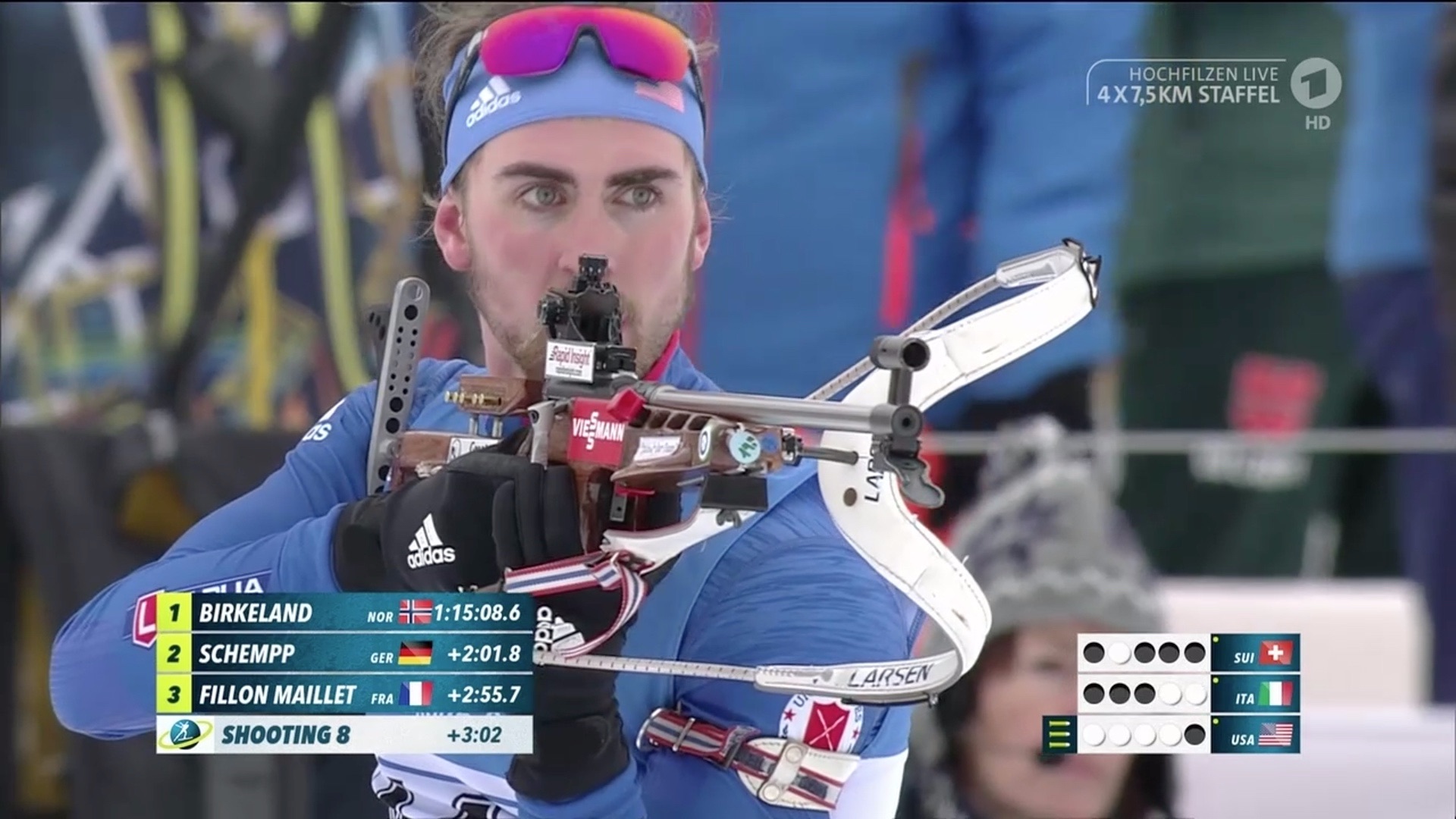
Just a turn behind, Bailey had gotten off to a strong start for the U.S. team, temporarily taking the lead out of the arena on the first lap before shooting clean in his prone stage to put himself in the lead group of seven. Facing strong wind in his standing stage, Bailey missed two targets but avoided the penalty lap with his last spare in that stage (0+0, 0+3), and tagged off to teammate Leif Nordgren in third position, 23.8 seconds out of first.
Nordgren ended up with a penalty in his first prone after missing two targets, and returned to the course in fifth. While his penalty had increased the gap to first by 50 seconds, Nordgren made up a few seconds with a clean standing bout, hitting all targets without requiring a spare (1+3, 0+0).
Italy and France passed him on the final loop, and Nordgren handed off in seventh, 1:34.2 minutes behind Norway setting the pace up front.
“The team came pretty close to a good result today in a relay with nasty weather,” Nordgren wrote on his Instagram account. “Personally I’m quite disappointed with my skiing, it’s been a struggle to find the top gears so far this season and I’m far from where I know I should be. It’s a long season though and there is still plenty of time to turn it around.”
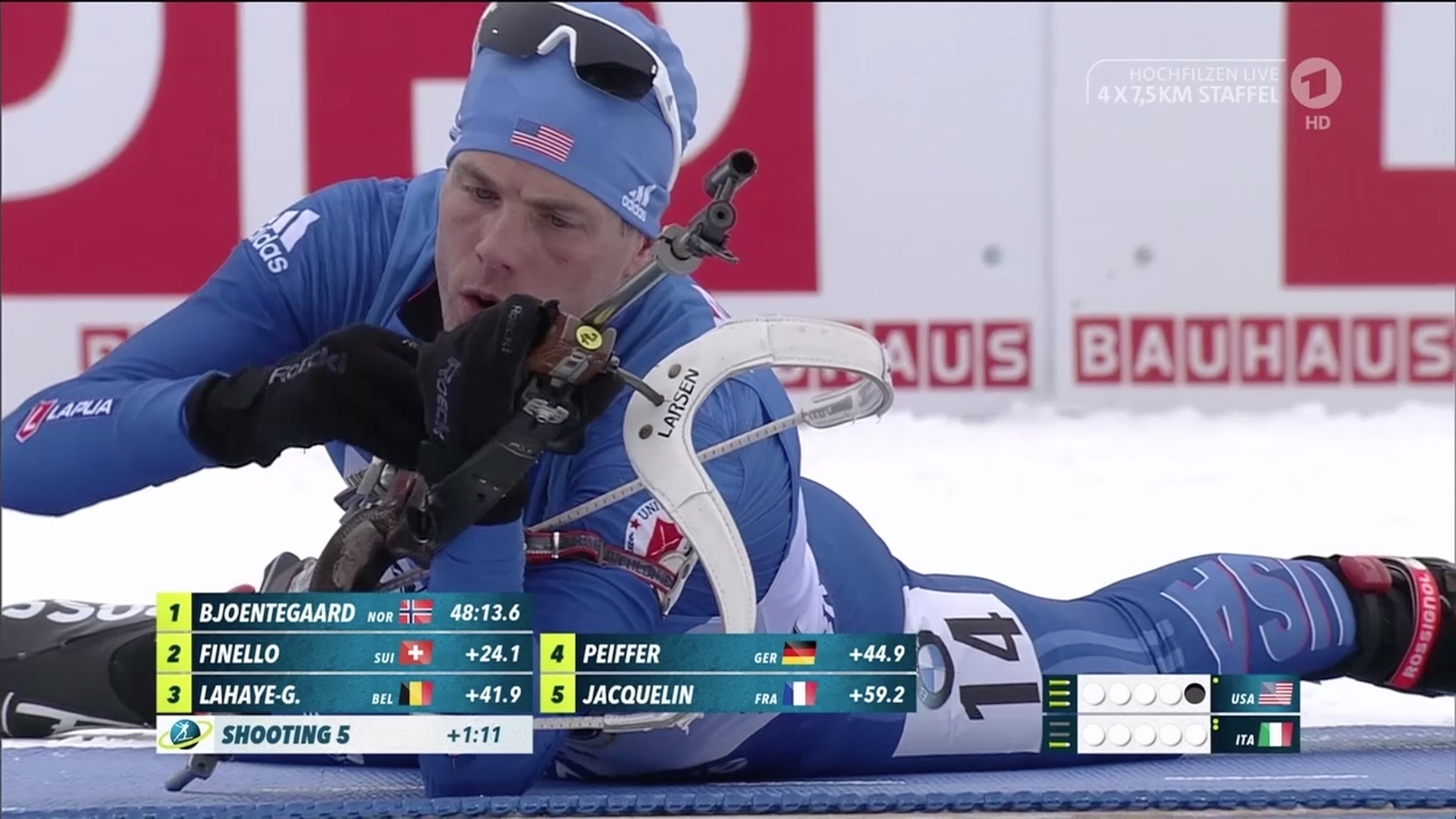
US Biathlon’s Tim Burke loading a spare in his prone stage of the men’s relay at the 2017/2018 IBU World Cup in Hochfilzen, Austria. The team went on to finish 9th. (Screenshot: ARD broadcast)
Taking over next for the U.S. was Tim Burke, who pointed out this was one of the most challenging races in terms of wind that he’d experienced.
“This was definitely one [of the] windiest races that I have taken part in,” Burke wrote in an email to FasterSkier. “We knew it would be very challenging right from the start but our team tried to look at it as an opportunity for a top result. I feel like our team did a great job at avoiding any big disasters on the range and this allowed us to stay near the front for most of the race.”
After only needing one spare in his prone shooting to hit his last target, Burke incurred a penalty in his standing stage (0+1, 1+3), but kept his position on the final loop in a hard race against Switzerland’s Jeremy Finello to exchange still in seventh, now another minute back (+2:49.4).
“I was not surprised to see a mix of different teams near the front today,” Burke wrote. “It was one of those days that any team could find themselves with multiple penalty loops after a windy shooting stage.“
Taking over from Burke as the U.S. anchor leg was Sean Doherty, coming off two strong shooting performances in the sprint and pursuit earlier this week.
U.S. relay anchor Sean Doherty taking aim in difficult wind conditions during his standing stage of the men’s relay at the 2017/2018 IBU World Cup in Hochfilzen, Austria. His team finished ninth. (Screenshot: ARD broadcast)
In his prone stage, Doherty again shot clean and fast (with the second-fastest prone shooting time on his leg) and overtook Switzerland to move into sixth. He kept that position on the course, vying for a position in the top five with the teams from France, Italy, Ukraine, and Russia also in his vicinity.
“Today was a crazy one for sure,” Doherty wrote in an email. “The conditions on the course were decent, firm tracks and we had good skis. The wind was whipping, so that really just made some sections a lot harder than normal when you added in the head wind. I have done races in bad weather before but today was amongst the most windy.
In the standing stage, Doherty hit his first four shots in another fast sequence before missing the last one. It looked as if he had thought that final shot was also a hit as he dropped his rifle slightly, but then realized he had to load spares. Unable to clear the last target, Doherty ended up with the team’s third penalty.
“With the shooting you try to get a general idea of how far the wind is pushing the shots and do the best you can,” Doherty explained. “It’s a total toss up and the finish order is just a ranking of who battled the wind the best and had most to least luck along the way.”
He set out on his last loop in eighth place with Ukraine’s Dmytro Pidruchnyi and Switzerland’s Mario Dolder right ahead of him, and Russia’s Anton Shipulin ten seconds behind.
“The fight on the last lap is always tough,” Doherty wrote. “Although I felt better today I was not able to hang with the two guys I left the range with. I was able to ski a good lap but not enough to hold off Anton.”
After Shipulin passed him up the big last climb, Doherty came to the finish in ninth position, 3:38.3 minutes behind the winners with a team total of three penalties and 13 spares.
“We were not too excited with the end result because we saw the potential was there for a top 5,” Burke concluded for the team. “We are also all far from our best on the tracks right now, but are hopeful that will come with more racing.”
Norway Successful with Its ‘Second Unit’
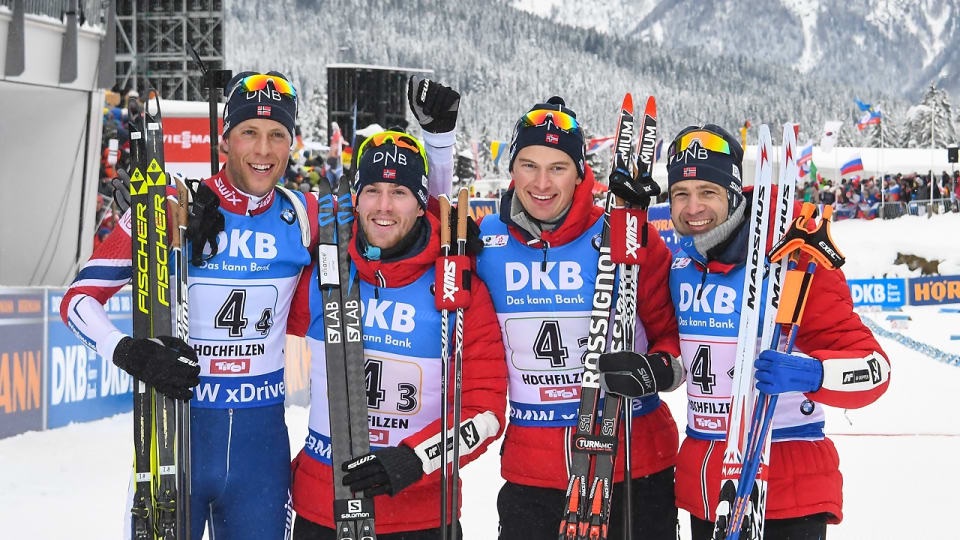
Norway’s Lars Helge Birkeland, Erlend Bjøntegaard, Henrik L’Abée-Lund and Ole Einar Bjørndalen (left to right) following their victory in the men’s relay at the 2017/2018 IBU World Cup in Hochfilzen, Austria. (Photo: IBU/Biathlonworld)
Norway started the men’s relay race without Emil Hegle Svendsen, who was sidelined with a cold, and also rested brothers Johannes Thingnes Bø and Tarjei Bø, both of whom had already won races this season.
But shooting was more important than skiing in a relay decided by strong crosswinds on the range, and that’s where the Norwegians coped by far the best. While Norway also required nine spares, which usually is a rather average performance in a relay, on Sunday this was the top shooting performance of the men’s relay.
After veteran Bjørndalen, Henrik L’Abée-Lund and Erlend Bjøntegaard had created a fairly comfortable lead of almost a minute on the first three legs, Lars Helge Birkeland anchored them to the victory by shooting clean in prone and only needing one spare to hit every target in his final stage despite some widely spread shots.
“It is really nice; a good start for Norway and good self confidence for the the rest of the season,” L’Abée-Lund said at the post-race press conference.
“It’s always fun to compete on the highest level with the best guys,” Bjøntegaard said. “I think I did pretty good on my leg today. It was tough conditions as it was for everyone else. I am just happy to show what I am capable of.”
“It feels great, it was an amazing feeling on the last loop, and really satisfied with my own leg,” Birkeland said. “I just decided to be offensive and attack and don’t think about the others and just do my own race. … We have a really strong team with a lot of good guys, so we don’t need to have all the best at the start to have a chance to win.”
All hopes for Germany’s Simon Schempp to contend with Birkeland for first were dashed when Schempp required three spares to clear both his prone and standing stages, narrowly avoiding the penalty lap twice.
Due to the huge distances between the top-three teams, the final loop was more of a cool down for their anchors, with Norway taking the win in 1:21:21.8 hours, just under two minutes ahead of Germany, with Erik Lesser, Benedikt Doll, Arnd Peiffer and Schempp, in second (+1:54.9, with zero penalties and 17 spares).
“At least we avoided the penalty loop, for me it was definitely close in standing,” Peiffer told German broadcaster ARD. “There was so much wind that it was impossible to shoot calmly and controlled. … It was clear that today there would be some upsets, like Belgium being in the mix in front. You just had to somehow avoid the penalty lap.”
“The last years in Hochfilzen we have never been on the podium, so it’s the first time in like six years we are back again,” Peiffer said at the press conference. “So that’s a good start for us because normally we are struggling here and we don’t know why.”
France, which had rested its star Martin Fourcade and started Jean-Guillaume Beatrix, Simon Desthieux, Emilien Jacquelin, and anchor Quentin Fillon Maillet, finished another 40 seconds later in third (+2:34.0, with three penalties and 13 spares).
Another 20 seconds back, Sweden with Peppe Femling, Jesper Nelin, Sebastian Samuelsson, and Fredrik Lindström crossed the line in fourth (+2:54.8, with three penalties and 12 spares).
“Today was very hard, very strange result, because when we look at all the penalties on the result list it was just crazy,” Beatrix said at the press conference. “I am satisfied for the team, and I am also really satisfied for the newcomer Emilien because it’s his first two weeks on the World Cup and first relay, and he did a every good job and brought us to the podium.”
“Today I was a little bit stressed, because the French guys are so strong and I had to be at their level, so I am happy to do a good relay today,” the 22-year-old Jacquelin said.
And what happened to the brave team from Belgium? With three athletes who had just made an overnight trip from an IBU Cup race in Lenzerheide, Switzerland, they came through the second exchange in second place after Florent Claude only needed one spare in standing. On the last two legs, however, three penalties for both Tom Lahaye-Goffart and Thierry Langer put them in 16th at the finish (+6:24.9) , which was still a team-best relay result for Belgium.
Just ahead of them in a finishing sprint anchored by Brendan Green was Biathlon Canada, with a lineup that earned bronze at the 2016 World Championships in Oslo, Norway. On Sunday, however, the Canadians’ race began with difficulties for brothers Christian Gow (1+3, 2+3) and Scott Gow (1+3, 2+ 3), each having to ski three penalty laps and exchanging in 21st position already 4:45.7 minutes back. Then Nathan Smith (0+0, 0+2) and Green (0+3, 0+3) were able to move them up a bit again, with Smith putting them as high as 13th by the final exchange and Green anchoring them to 15th (+6:22.5, with six penalties and 20 spares).
Of 26 teams in the men’s relay, Norway and Germany were the only ones that succesfully avoided the penalty lap.
Hochfilzen World Champs Women’s Podium Repeats
Later on Sunday afternoon in the women’s 4 x 6 k relay in slightly better conditions than the men’s race, last season’s reoccurring winner Germany struck gold again.
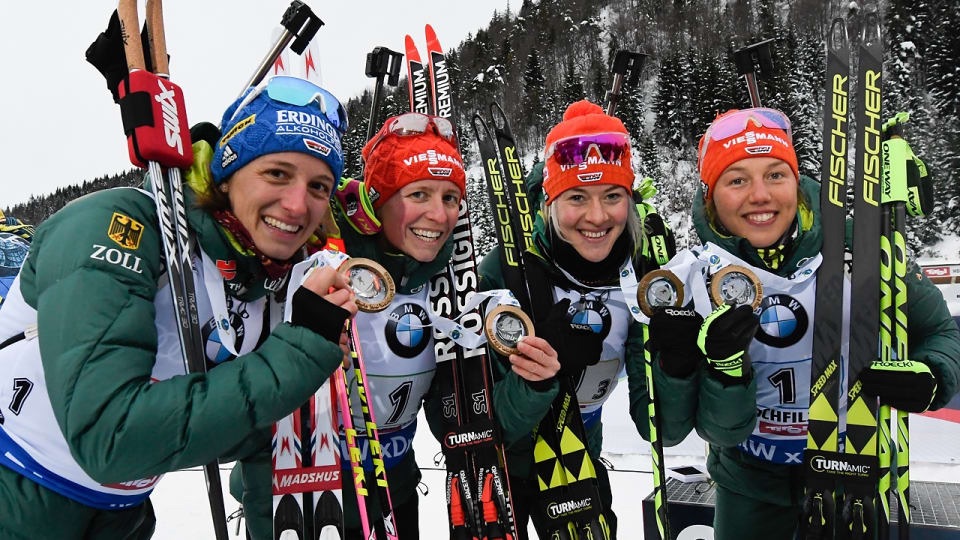
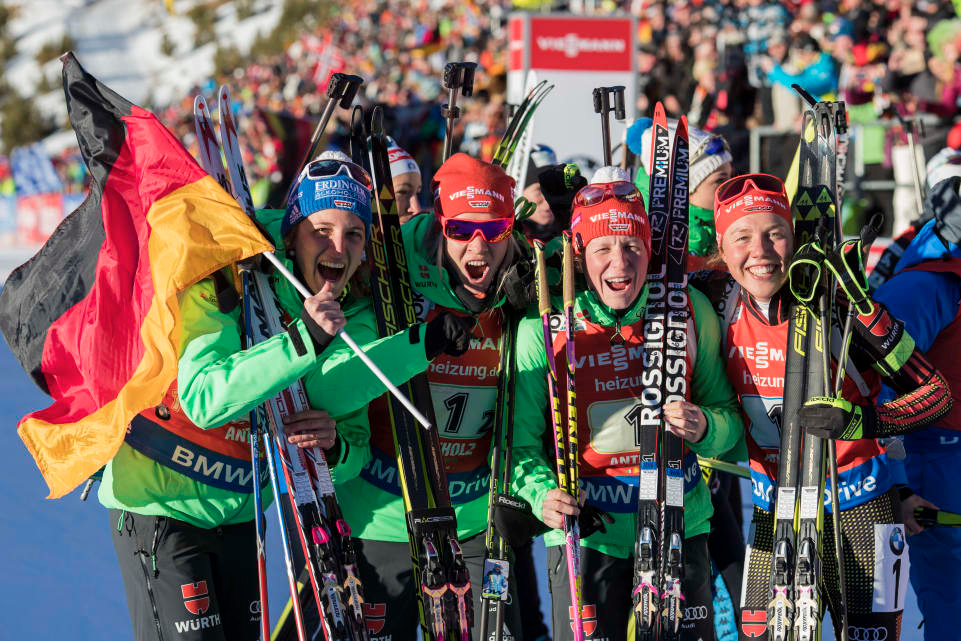
Germany with (left to right) Vanessa Hinz, Franziska Hildebrand, Maren Hammerschmidt and anchor Laura Dahlmeier shows off their medals following their victory in the women’s relay at the 2017/2018 IBU World Cup in Hochfilzen, Austria. (Photo: IBU/Biathlonworld)
The victorious world-champion quartet of Vanessa Hinz, Franziska Hildebrand, Maren Hammerschmidt,and Laura Dahlmeier won with a large lead ahead of Ukraine (+44.9) and France (+1:04.5). The first-, second- and third-place teams were a repeat of last season’s World Championships relay in Hochfilzen this past February.
Fighting for position with Ukraine and Switzerland on the third leg, Hammerschmidt got her team on the road to victory when she cleaned every target within 24 seconds despite difficult conditions to reclaim the lead, erasing the gap she had been handed of almost 30 seconds to first.
“For me it was very important to have a good standing shooting today, because the last two days were not so good,” Hammerschmidt said at the press conference. “I thought it was one of my best standing shootings, and I was so happy to go on the last loop and fight for every second to give to Laura.”
Dahlmeier returned to the World Cup after missing last week’s opening races with a cold, then had no major problems defending the lead. Dahlmeier used just one spare in each of her shooting stages, while Switzerland’s Irene Cadurisch as the closest pursuer had to ski a penalty lap. Germany finished in a time of 1:14:36.4, with zero penalties and nine spares.
“It’s a really cool feeling to be here again,” Dahlmeier said at the press conference. “Especially with the team. We know we can make a good race, but it’s important for every person to be good on the range and on the tracks. Relays are special races.”
“From the last year we have good memories about Hochfilzen … and today it was a good place, too,” Hildebrand said “I was really impressed with [Ukraine’s] Yulia Dzhima’s standing shooting, because she took all targets out while I used two extra bullets and was happy I could go out on the track again.”
Ukraine’s Olena Pidhrushna anchored her team, with Vita Semerenko, Yulia Dzhima and Valj Semerenko, to second (+44.9), thanks to the best team shooting performance of zero penalties and five spares, and despite a fall on the first leg by Vita Semerenko.
“I think our team spirit is very strong, without that we wouldn’t be on the podium, so I am very thankful to all the girls and our staff for making this happen,” Valj Semerenko said at the press conference, via a translator.
“My start this season was not so good … Actually today I was so nervous ahead of the relay,” Pidrushna explained. “But I saw that we had a little bit of extra time at the last exchange, and I calmed down a little bit and it worked well in the end. … And I think my team believes in me [to anchor it successfully].”
Twenty seconds behind her, France with Marie Dorin Habert, Celia Aymonier, Justine Braisaz and the current women’s World Cup leader Anaïs Bescond, passed Russia’s Ekaterina Yurlova-Percht on the final loop to claim third place (+1:04.5, with two penalties and 13 spares).
“Honestly at the beginning when I started I didn’t think a podium was still possible, but loop after loop I thought maybe I can still catch a podium [position],“ said Bescond, who skied the fastest course time on the final leg amidst strong competition.
A few seconds behind, Russia with Victoria Slivko, Tatiana Akimova, Irina Starykh, and Ekaterina Yurlova-Percht finished fourth (+1:09.0, with no penalty and nine spares).
Another 16 seconds back, Switzerland, with Elisa Gasparin, her older sister Selina Gasparin, Lena Häcki and Cadurisch finished fifth (+1:25.7, with two penalties and 12 spares) for Switzerland’s best women’s relay result, which fulfilled its national qualification criteria for the Olympics.
Canada in Contention
For Biathlon Canada, Emma Lunder started off the race in the middle of the field, and managed hit all her targets with one spare in her prone stage to leave the range in 16th position.
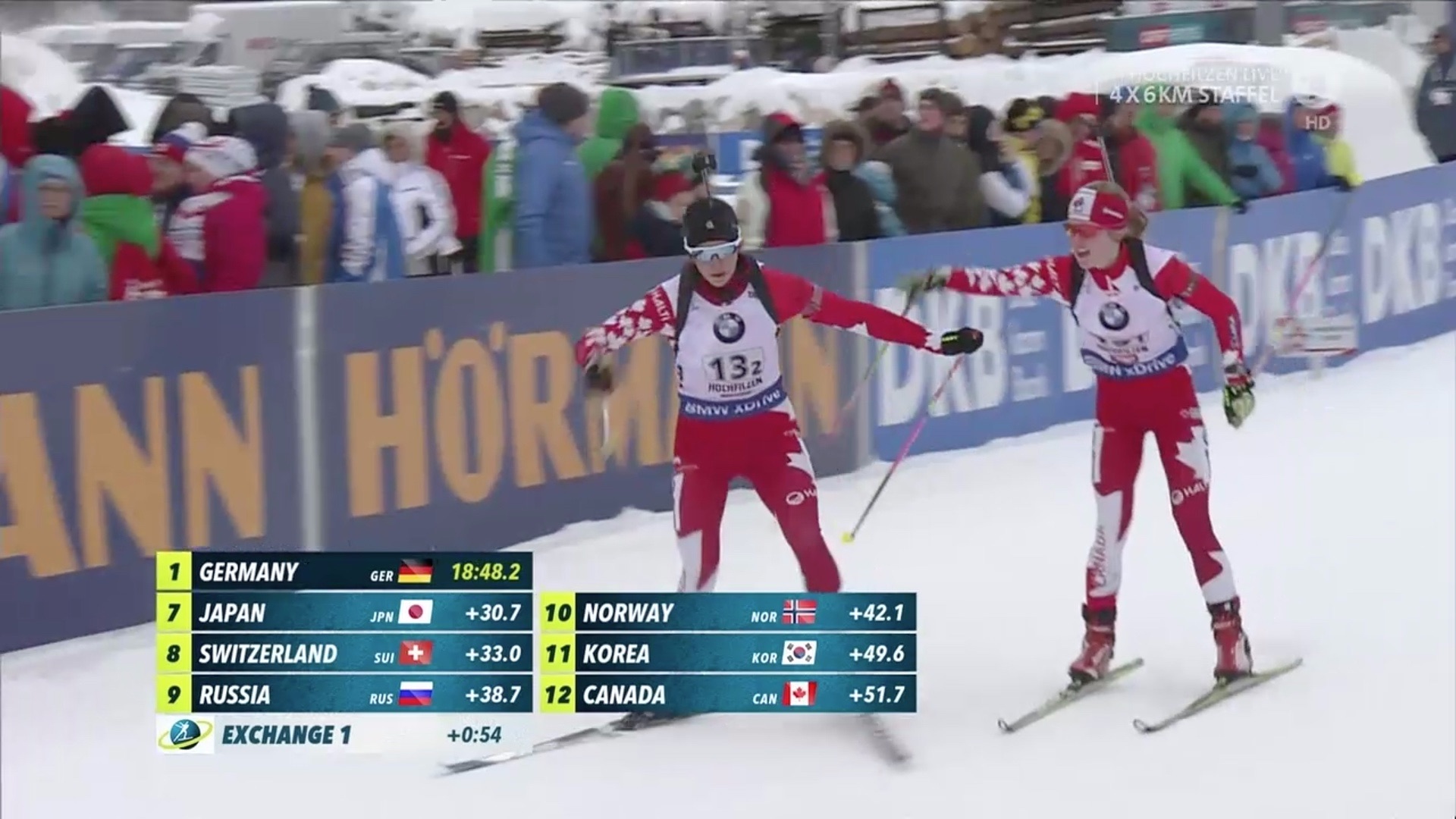
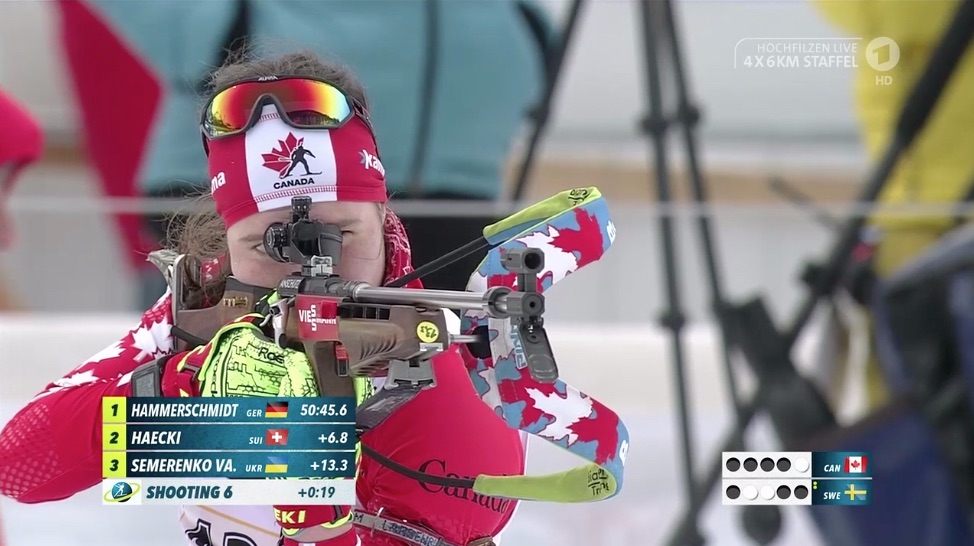
Biathlon Canada’s starter Emma Lunder (r) exchanging to Rosanna Crawford in the women’s relay at the 2017/2018 IBU World Cup in Hochfilzen, Austria. Crawford temporarily moved up to fifth before the team finished in ninth position. (Screenshot: ARD broadcast)
While a number of competitors, including France’s Dorin Habert, incurred penalties, Lunder again needed just one spare to clean (0+1, 0+1) and moved Canada up to 1oth. After losing a few more seconds on her last loop to the leaders, with Germany’s Hinz up front, she tagged Rosanna Crawford in 12th position, 51.7 seconds back.
Crawford started out fast and also needed just one spare to hit all five prone targets, improving by three places to ninth.
“It was a tricky shooting day today, you really had to be aware of the wind, and be prepared to do a correction even part way through a bout of shooting,” Crawford wrote in an email. “In prone I made a correction of 5 left and 2 up and it was enough to keep me pretty centred.”
Then in her standing stage, she picked off four more positions with clean shooting and no spares to leave the range in fifth place, while most teams around her needed spares or even incurred a penalty in seemingly difficult wind conditions.
“I was really happy with my standing today,” Crawford explained. “I saw Brendan [Green] right before zero and he said that it’s worthwhile to take your time and make each shot a good one. So I really thought about that as I came into the shooting, there was a big gust right off the start, so I waited and could hear the women around me missing. Each shot was really precise. My shooting time was 33 seconds which is really slow for standing but still the 2nd fastest of my leg, which says a lot about the wind today!”
Biathlon Canada’s Megan Bankes shooting in her standing stage in the women’s relay at the 2017/2018 IBU World Cup in Hochfilzen, Austria. The team finished ninth overall. (Screenshot: ARD broadcast)
Crawford tagged Megan Bankes in fifth (+36.3), after having regained 15 seconds on the leaders and skiing the second-fastest course time on the final loop.
“It’s always fun to tag off in a high position but today was a bit of a lucky draw for what you got in the range,” Crawford concluded.
The 20-year-old Bankes as Biathlon Canada’s youngest team member started out just as fast, nearly maintaining that time gap on the first loop.
“I was super stoked to be tagged in such a good place, but I definitely still felt that I was able to ski my own race,” Bankes wrote in an email. “I wanted to ski my best, and not lose to much time on the tracks, but also be controlled on the range, because I knew it was going to be a tricky shooting day.”
She was able to get through the prone stage with two spares in a stage when all leading teams needed them, keeping her in fifth. Bankes followed that up with just one spare in her standing shooting, temporarily moving up to fourth after overtaking Sweden’s Mona Brorsson.
“Coming into the range I was focussed on my own shooting more than anything else,” Bankes wrote. “I knew that the wind was pretty variable, and that I needed to make sure I took good, smart shots, and correct appropriately for the wind. I was super happy with how I ended up doing on the range, and also with my speed on my first couple of laps.”
On the last loop, Brorsson and Russia’s Starykh passed her, and Bankes came through the final exchange in sixth place (+1:28.8).
“I died a bit at the end, but I still managed to tag Julia in a good position, so for me it was a pretty great race!” Bankes concluded.
Shown on television in the exchange zone, looking back at the final curve to see when Bankes would arrive, Ransom took over as the anchor and skied a very fast first loop, just 1 second off the fastest pace on that loop.
She then managed to still clean all five targets in a controlled fashion, leaving the range again in fifth position, with Switzerland in sight and Russia nearby as well.
After a slower second loop, Ransom struggled to clean all her targets in the final stage, but avoided the penalty lap with her last shot and left the range in ninth position. Sweden’s anchor Anna Magnusson was still in sight, 10 seconds ahead, but extended her lead on the final loop, while Japan’s anchor Rina Mitsuhashi was already more than a minute behind Ransom in 10th.
Ransom crossed the line in ninth place (+2:31.6) with zero penalties and nine spares for the team.
“A top 10 is a decent result for our team, it’s nice that we were fighting for a top 6 for most of the race,” Crawford wrote. “Our team has come a long way and I’m really proud to be a part of this team! Emma and Megan had a great leg and Julia an awesome prone and then it was quite windy for her standing, but most teams have their strongest women on the last leg, so it’s always a hard fight!”
In other good news for Biathlon Canada this weekend, the team finished eighth in an IBU Cup mixed relay and national team member Megan Tandy raced to 11th place in the sprint followed by ninth place in the pursuit this weekend in Lenzerheide, Switzerland.
“Another #perfect#shooting day! I was hoping for more, but you gotta work with what you got – in my case very heavy legs skiing. Nonetheless, a solid race,” Tandy wrote on Instagram after shooting clean in both the sprint and mixed relay.
The U.S. Women and Nation Cup Standings
US Biathlon could not start a women’s relay on Sunday because it only has three women currently on the World Cup circuit: Susan Dunklee, Clare Egan and Emily Dreissigacker. US Biathlon had hoped that its fourth woman Kelsey Dickinson, would qualify for the first trimester of World Cup racing by scoring necessary points at the IBU Cup opener in Sjusjøen, Norway. But unfortunately that did not work out.
In addition to Dickinson missing out on the World Cup starts because of that technicality, and her teammates now missing out on one of only three opportunities on the World Cup competition calendar to prepare for the relay in the upcoming Olympics, this also means they lost out on valuable points for the Nation Cup Score. That ranking is its own award category in the World Cup season (last year Germany won it for both the women and men), but more importantly for the North American teams, also determines the starting quota for the following season.
With a third of the races counting towards that already completed (unlike at World Championships the races at the Olympics don’t apply, neither do pursuits and mass starts), the U.S. is currently in 21st position for the women with 676 points and in danger of losing its fourth starting position for next year again, which would make team selections and travel planning even harder.
While certainly not impossible — last year the U.S. women also did not start a relay in Pokljuka, Slovenia — it will be a bit of an uphill battle to make that up the rest of the season, requiring a number of strong results. For instance, South Korea is currently 357 points ahead in 17th, the benchmark for a fourth quota spot.
The Canadian women are currently in 14th position with 1220 points. Last season they were 15th and the U.S. 14th. For the men’s teams, Canada is currently in 12th position with 1260 points, the U.S. is 13th with 1198.
The teams will now travel to Annecy-Le Grand Bornand, France, for the next World Cup from Thursday, Dec. 14, to Sunday, Dec. 17.
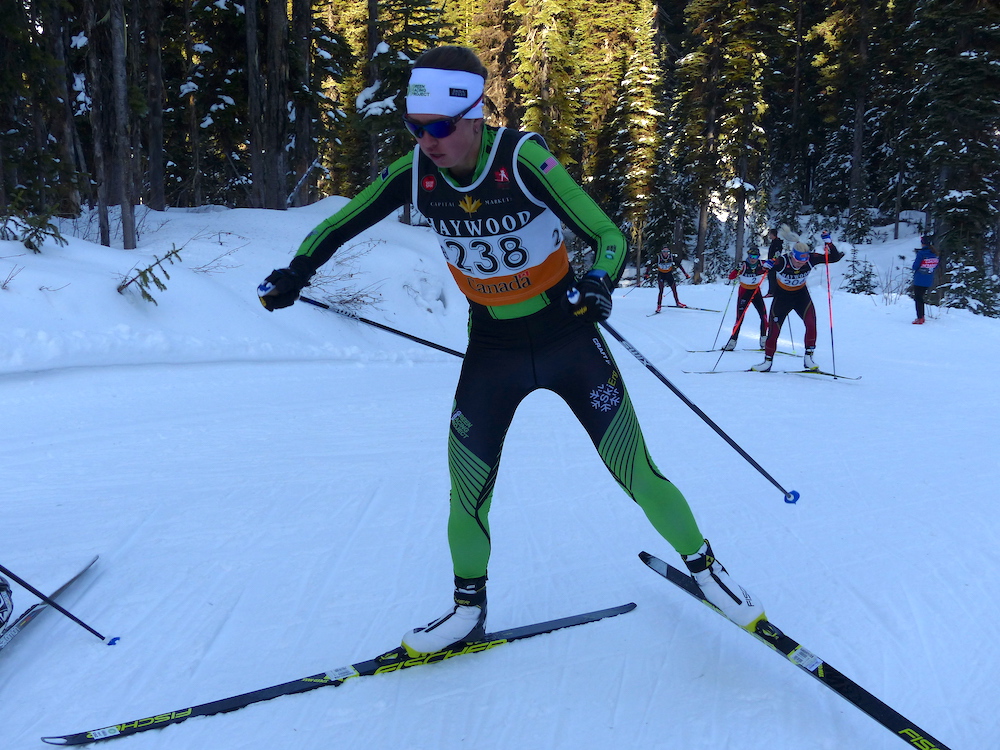
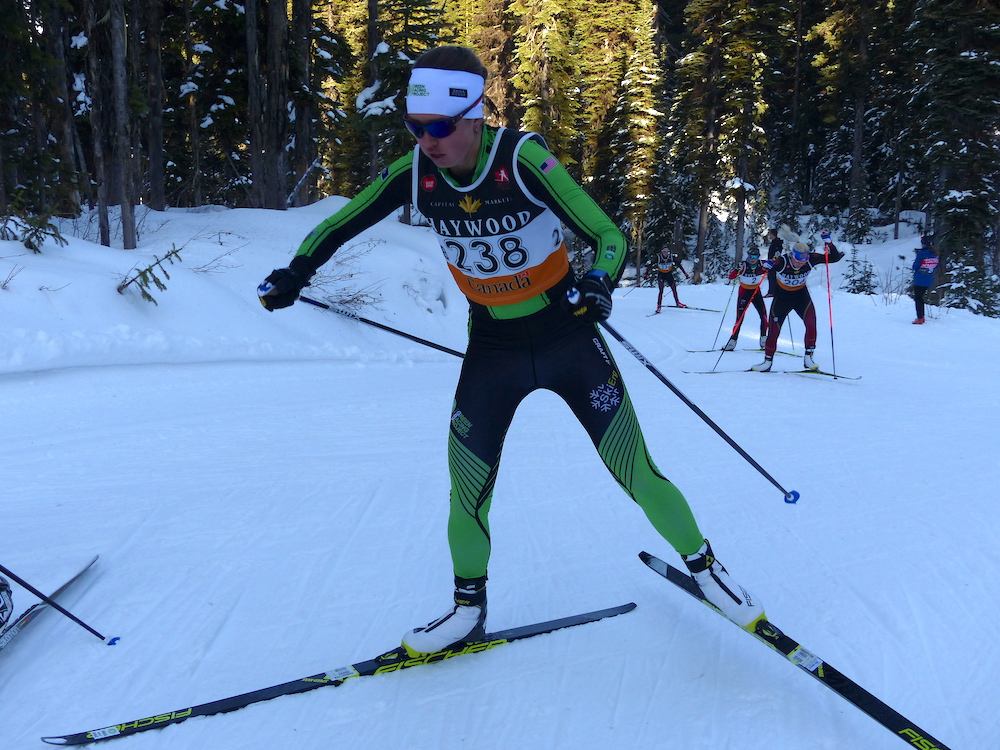
Caitlin Patterson (Craftsbury Green Racing Project) charging up the wall climb en route to the win in the women’s 10 k freestyle on Sunday at the Sovereign Lake NorAm/SuperTour near Vernon, B.C. (Photo: Peggy Hung)
NorAm/SuperTour (Sovereign Lake near Vernon, British Columbia): 10/15 k freestyle
VERNON, B.C. — The combined NorAm and SuperTour event at the Sovereign Lake Nordic Centre continued with individual-start distance races and continued with the theme of U.S. domination of the leaderboard.
Ian Torchia, of Northern Michigan University (NMU) and the U.S. Ski Team D-team, started the day with a big victory in the men’s 15 k freestyle, finishing in 36:29.7 minutes and on the heels of Canadian Para-Nordic guide Graham Nishikawa, who started 30 seconds ahead of him and ended up sixth. Jack Hegman of the Sun Valley Ski Education Foundation (SVSEF) placed second, 19.0 seconds back, to complete his good weekend. Canadian Para-Nordic superstar Brian McKeever rounded out the podium in third, 22.6 seconds back.
Graham Nishikawa (l) and Ian Torchia worked together after Torchia closed the 30-second gap en route to a victory in the men’s 15 k freestyle on Sunday at the Sovereign Lake NorAm near Vernon, B.C. (Photo: Peggy Hung)
The women were next to get some time in the sunshine with two laps for 10 k. Caitlin Patterson of the Craftsbury Green Racing Project (CRGRP) upgraded from Saturday’s silver to gold on Sunday with winning time of 27:13.0. Rosie Frankowski of Alaska Pacific University (APU) snatched second, 30.7 seconds back. Caitlin Gregg (Team Gregg) raced to third, 1 second behind Frankowski.
Former Canadian national-team biathlete Zina Kocher started her new cross-country career as the top Canadian in seventh (+1:31.2).
The weather was a repeat of Saturday: -2 degrees Celsius, windless and sunny. Smiles were evident everywhere, even for athletes who didn’t quite nail the pacing on an unforgiving course.
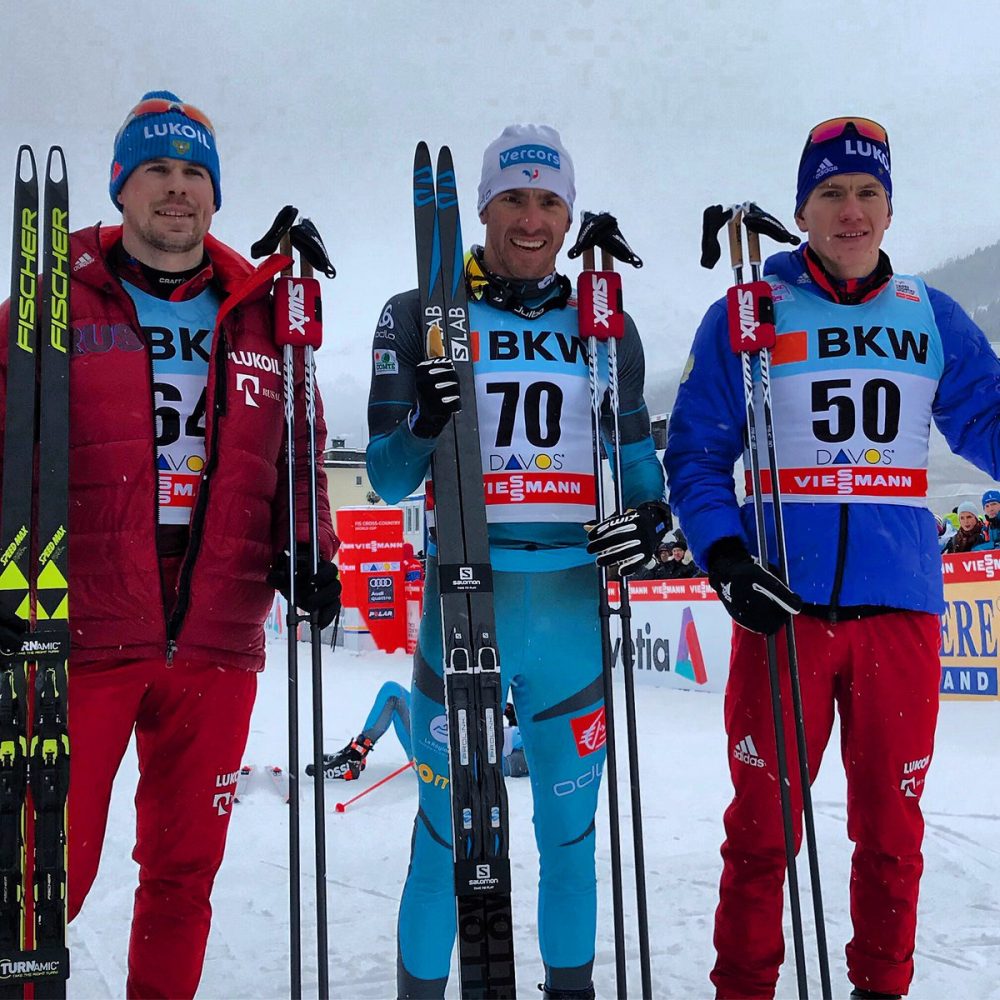
France’s Maurice Manificat (c) after winning the men’s 15-kilometer freestyle on Sunday in Davos, Switzerland. He finished ahead of Russians Sergey Ustiugov (l) and Alexander Bolshunov in second and third respectively. (Photo: FIS Cross-Country/Twitter)
FIS Cross Country World Cup (Davos, Switzerland): 10/15 k freestyle
After a day of sprinting, cross-country racers returned to the Davos World Cup venue on Sunday for the women’s 10-kilometer and men’s 15-kilometer freestyle individual start competitions.
For his first World Cup win in almost two years, France’s Maurice Manificat took the men’s 15 k race title in a time of 33:56.2. Exactly 4 seconds flat behind Manificat in second place was Russia’s Sergey Ustiugov. Ustiugov’s teammate Alexander Bolshunov, finished 10 seconds behind Ustiugov and 14.6 seconds behind Manificat for the men’s third and final podium spot.
The remainder of the men’s top ten included Norway’s Simen Hegstad Krüger in fourth (+21.3), Switzerland’s Dario Cologna in fifth (+26.5), Sweden’s Marcus Hellner in sixth (+35.4), Russia’s Denis Spitsov in seventh (+36.1), Hans Christer Holund of Norway in eighth (+36.9), Russian Alexey Chervotkin in ninth (+54.2), and Alex Harvey of Canada in 10th (+1:01.2).
The next best male North American finisher was American Patrick Caldwell in 41st (1:50.2).
Canada’s Devon Kershaw placed 44th (1:59.8), Graeme Killick 59th (+2:27.8), Russell Kennedy 68th (+2:43.4), and Julien Locke in 94th (4:27.5). Knute Johnsgaard did not start.
For the U.S., Noah Hoffman finished 48th (2:05.5) and Scott Patterson 88th (3:46.2). Simi Hamilton did not start and Andy Newell did not finish.
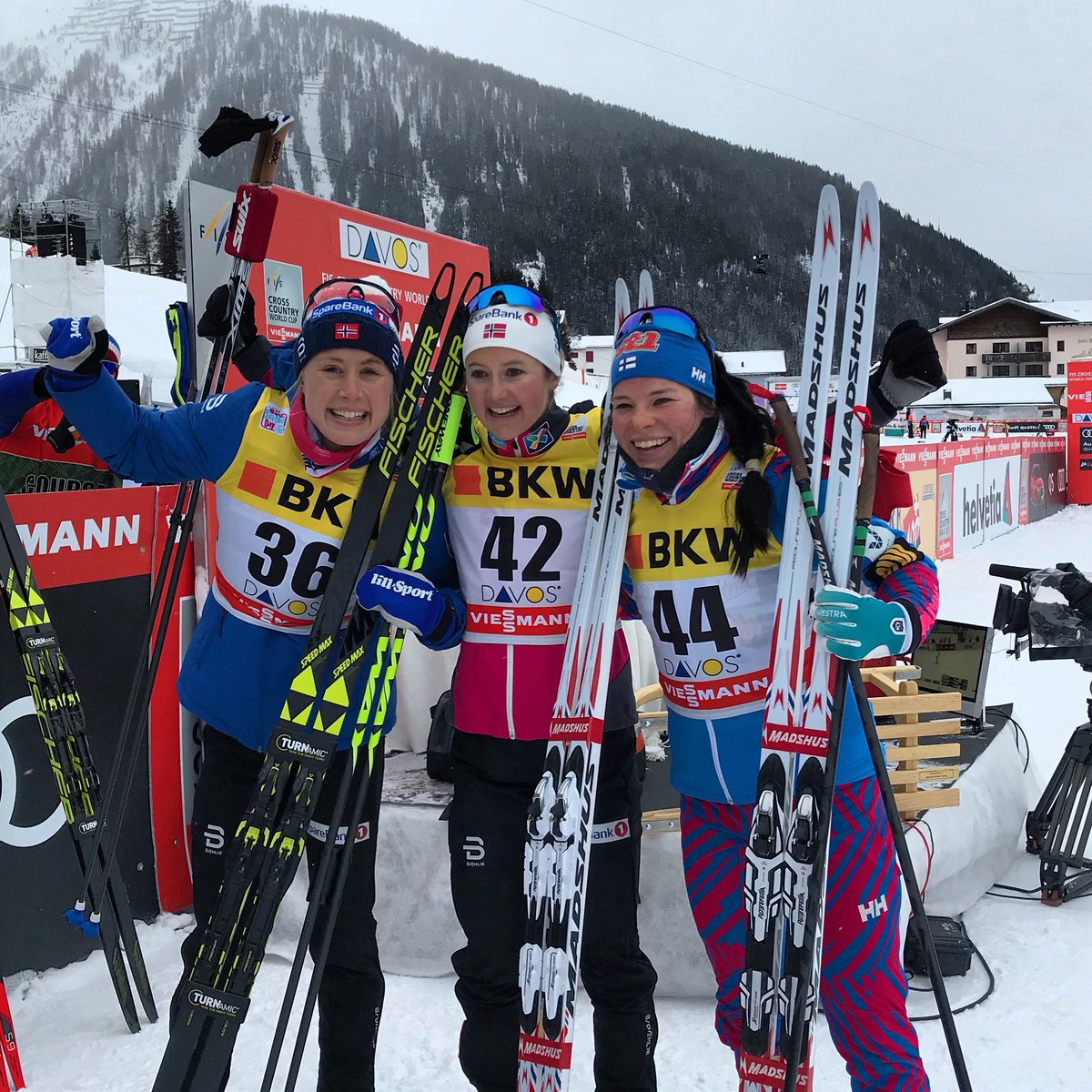
The women’s 10 k freestyle podium on Sunday at the Davos World Cup in Switzerland, with Norway’s Ingvild Flugstad Østberg (c) in first and Ragnhild Haga (l) in second, and Finland’s Krista Parmakoski (r) in third. (Photo: FIS Cross Country/Twitter)
In the women’s 10 k, 75 starters finished the 10 k course with Norway’s Ingvild Flugstad Østberg claiming first in a time of 25:28.5. Her Norwegian teammate, Ragnhild Haga finished 5.9 seconds behind her for second place. Krista Pärmäkoski of Finland raced to the third and final podium spot, 7.9 seconds back from Østberg’s winning time.
Rounding out the women’s top ten was Heidi Weng in fourth (+14.5), Austria’s Teresa Stadlober in fifth (+16.4), Switzerland’s Nathalie von Siebenthal in sixth (+16.4), Finland’s Kerttu Niskanen in seventh (+24.9), Sweden’s Charlotte Kalla in eighth (+26.8), Norwegian Marit Bjørgen in ninth (+35.9), and Astrid Uhrenholdt Jacobsen in tenth (+37.6).
Leading the U.S. women was Sadie Bjornsen in 12th (+44.6), seven seconds outside the top ten. The next two Americans finishers were within 3.1 seconds of each other, with Kikkan Randall finishing 14th (+56.8) and Jessie Diggins in 15th (+59.9).
Also scoring World Cup points for the Americans, Rosie Brennan finished in 17th (+1:11.2) and Chelsea Holmes in 29th (+1:32.9).
The U.S.’s Liz Stephen and Sophie Caldwell finishedin 40th (+1:58.5) and 52nd (+2:20.1), respectively.
For the Canadians, the team was led by Cendrine Browne in 45th (+2:05.9), followed by Emily Nishikawa in 50th (+2:18.4). Dahria Beatty placed 73rd (+2:53.0) and Katherine Stewart-Jones 79th (+3:44.6).
IBU World Cup (Hochfilzen, Austria): Men’s and women’s relays
Men’s and women’s relays took place on the final day of racing in Hochfilzen, with Norway winning the men’s 4 x 7.5 k and Germany topping the women’s 4 x 6 k by considerable margins.
Norway’s Ole Einar Bjørndalen, Henrik L’Abée-Lund, Erlend Bjøntegaard, and Lars Helge Birkeland raced to first in 1:21.21.8 hours, nearly two minutes clear of Germany in second, after taking the lead on L’Abée-Lund’s second leg. They avoided the penalty loop and used a total of nine spares, and never lost hold of first place for the rest of the race.
Germany raced to second (+1:54.9) with Erik Lesser, Benedikt Doll, Arnd Peiffer, and Simon Schempp, with zero penalties and 17 spares, after Peiffer lifted them from fourth to second on the third leg. Schempp held them there, despite using a maximum of three spares on each of his shooting stages, in the final leg.
France claimed third (+2:34.0) with Jean-Guillaume Béatrix, Simon Desthieux, Emilien Jacquelin, and Quentin Fillon Maillet, despite three penalties and 13 spares. Two of their penalties came on Beatrix’s first leg and another in Fillon Maillet’s final shooting. After being tagged in fifth, Jacquelin raced them up to third on the third leg and Fillon Maillet held onto that position for the last spot on the podium.
The U.S. men finished ninth (+3:38.3) with Lowell Bailey, Leif Nordgren, Tim Burke, and Sean Doherty, after they combined for three penalties and 13 spares. Bailey avoided the penalty lap and put them in third at the first exchange, while Nordgren slipped to seventh after a penalty, Burke remained in seventh with one penalty as well, and Doherty had one more penalty to anchor the team to ninth.
Canada placed 15th (+6:22.5) with six penalties and 20 spare rounds, with Christian Gow, Scott Gow, Nathan Smith, and Brendan Green. After being tagged in 21st, Smith raced them up to 13th, using just two spares to clean. Green anchored them to 15th after using six spares and skiing the 15th-ranked time on that last leg.
In the women’s relay that followed, Germany won by 44.9 seconds over Ukraine, with Vanessa Hinz, Franziska Hildebrand, Maren Hammerschmidt, and Laura Dahlmeier using nine spares while staying out of the penalty lap.
After Hinz raced them into first, Hildebrand slipped to fourth after using four spares on the second leg. Hammerschmidt raced the fastest third leg to put them back in first, and Dahlmeier held them there to the finish, crossing first in 1:14:36.4.
Ukraine (0 penalties, 5 spares) took the lead on the second leg but ultimately settled for second with Vita Semerenko, Yuliia Dzhima, Valj Semerenko, and Olena Pidhrushna. Dzhima put them in second heading into the race’s halfway point, but Valj Semerenko lost two places to tag Pidhrushna in third. Pidhrushna used just two spares on the final leg to bring them to second, about 20 seconds ahead of France in third.
Despite a tough first leg for Marie Dorin Habert, in which she had two penalties and tagged off in 14th, France rose to third place at the finish (+1:04.5) thanks to strong skiing and shooting from anchor Anaïs Bescond.
The team had a total of two penalties and 13 spares. Celia Aymonier used four spares to put them in ninth after the second leg, and third-leg Justine Braisaz lifted them one more place to seventh before Bescond skied the fastest last leg to pick off four more places.
Canada placed ninth (+2:31.6) with Emma Lunder, Rosanna Crawford, Megan Bankes, and Julia Ransom, with no penalties and nine spares. Crawford put them in fifth after the second leg, Bankes lost one place on the third leg, and Ransom slipped three more with three spares on her final shooting to finish ninth.
Julia Ransom (Biathlon Canada) racing to ninth in the women’s 15 k individual on Wednesday at the IBU World Cup opener in Östersund, Sweden. In her first World Cup race of the season, it was Ransom’s career-best result and Biathlon Canada’s best individual result since 2015/2016. (Photo: Biathlon Canada/NordicFocus)
Entering this season, members of Biathlon Canada had everything to gain and not a whole lot to lose. They had already had their funding reduced to zero by Own The Podium, save for a $50,000-dollar provision that paid for a coach, and its athletes were left to determine their offseason plan: stay home to train or self-fund training camps elsewhere. Many chose to spend most of their summer at the team’s base in Canmore, Alberta, and most started the season on the fly — without any preseason tuneup races in Europe — this week in Östersund, Sweden.
Julia Ransom was one of those athletes. After prequalifying for Canada’s International Biathlon Union (IBU) World Cup Team for the first trimester of racing, Ransom, 24, jumped into the 2017/2018 season with the Östersund mixed relay this past Sunday — three days after flying over from Canada.
There, she raced the second leg of the relay and tagged off in 15th, down two spots from where her teammate Emma Lunder tagged her in 13th. The team ultimately finished 15th, with teammates Scott Gow and Brendan Green.
“Today was a tough day for me. My legs were lead on the course,” Ransom wrote in a post-race email to FasterSkier on Sunday.
Three days later on Wednesday, it was another ballgame. With little to lose in the women’s 15-kilometer individual in Östersund, Ransom raced to a career-best ninth, which stood as her team’s best non-relay result in two seasons.
In the first individual race of the season, Ransom is well on her way to securing a spot on Biathlon Canada’s 2018 Olympic team, meeting half of the team’s “Priority 2” Olympic criteria standards. She needs another top 16 to fulfill that second-tier criteria. Priority 1 is one top-eight result in a World Cup (or World Championships, in a championships year like last season) or a top-three in a World Cup relay.
So far, she is the only one on her team who has cracked the top 16 in two seasons. Last winter, her best result (and her previous personal best) was 18th at 2017 World Championships in the 15 k individual. Canada’s best non-relay result in 2016/2017 was Scott Gow’s 17th place in a 20 k individual World Cup race.
And again, it’s the first race of the season.
“I am still in shock with how well today went,” Ransom, a Penticton, British Columbia, native in her fourth World Cup season, wrote in an email to FasterSkier on Wednesday.
“It is such a relief to start racing again,” she continued. “I wasn’t too nervous today; I had a race plan that I had confidence in and I was excited to give it a go. I also was looking for redemption after my painful relay leg on Sunday.”
Conditions were chilly, at -12 degrees Celsius (10 degrees Fahrenheit), but calm, accounting for clean shooting for seven out of the top-nine finishers. Ransom was one of them.
She started 20th (out of 102) and cleaned all four stages in the longest-format women’s race on the circuit. In individual races, shooting is weighed heavily; a minute is added to a competitor’s final time for each missed shot. Fortunately for Ransom, she hit all 20 targets.
“I was getting some pretty exciting splits during the whole race (top 5, second place, catching the leader etc) so I had an idea this was going to be a good day as long as I kept my shooting together,” she reflected. “I took a sigh of relief after the 20th target went down and just tried to ski as well as I could to the finish. I did take look at the big screen as I left the range, just to make sure I was hearing the techs right!”
Ransom initially crossed the finish line in third, 28.8 seconds behind Sweden’s Mona Brorsson in first and 9.8 seconds behind Eva Puskarčíková of the Czech Republic in second. Both Brorsson and Puskarčíková also shot clean.
The 55th starter, Nadezhda Skardino of Belarus, ultimately posted the best shooting and skiing performance of the day, racing to her first World Cup win (and first podium in three years) in 42:57.4 minutes with 20-for-20 shooting. Norway’s Synnøve Solemdal started 75th and shot clean but came up 2.9 seconds short at the finish to place second, bumping Ukraine’s Yuliia Dzhima to third (+12.0). The top-four women all cleaned with another Ukrainian, Valj Semerenko, placing fourth (+30.1).
Slovakia’s Paulina Fialková finished fifth (+32.2) with a single penalty (0+0+0+1), while Brorsson ultimately placed sixth (+49.6) and Puskarčíková seventh (+1:08.6).
Ransom ended up ninth for her best World Cup level performance by nine places, ahead of Norway’s Marte Olsbu in 10th and about eight seconds behind France’s Justine Braisaz in eighth.
“Starting off the season with a top ten has validated the hard work our team has put in and also given me a lot of confidence going forward. It’s a great building block to say the least,” Ransom wrote.
Asked what she thought made the difference with her training this year, she explained that she’d honed in on increasing her shooting speed.
“It’s still a work in progress but I am happy where I am so far,” she wrote. “I also did a ton of extra strength work and core stability and it has proven to make a big difference on the skis.”
On Wednesday, Ransom’s overall shooting and range times ranked in the middle of the pack, around 50th, while her overall course time was slightly faster in 42nd.
Biathlon Canada Head Coach Matthias Ahrens praised Ransom’s ability to perform under pressure.
“Especially as the tension mounted, with each clean bout, Julia was closer the podium and she managed the pressure very well,” he said, according to a team press release. “She didn’t get too excited or too nervous, executing clean shooting each time.”
Four Canadians started Wednesday’s 15 k, with Rosanna Crawford finishing 39th (+3:32.6) with three penalties (0+0+1+2), following her crash in Sunday’s single mixed relay.
“Rosanna, considering the crash of Sunday, had a really nice race,” Ahrens said in the press release. “It wasn’t certain if she’d race today, and we went in with a strategy not to risk any further injury. She managed a very good race, with a quite good ski time. Her rifle also required repairs from Sunday’s race. Overall, not knowing how she would hold up, particularly on one of the hardest Individual courses on the circuit, it was a nice result for her, in the World Cup points.”
Megan Bankes finished 75th (+6:28.9) with three misses (2+1+0+0) and Lunder was 83rd (+7:06.3) with five penalties (0+0+2+3).
US Biathlon started three women, with Susan Dunklee leading the team in 53rd (+4:12.7) with four penalties (1+0+1+2). Clare Egan finished 79th (+6:52.5) with five misses (0+2+1+2) and Emily Dreissigacker was 81st (+7:03.5) with three misses (0+0+1+2).
The men start their season with a 20 k individual on Thursday at 11:15 a.m. Eastern Standard Time.
US Biathlon’s Susan Dunklee ahead of Sweden’s Chardine Sloof during the second leg in the women’s 4 x 6 k relay at the 2017 IBU World Cup in Antholz, Italy. (Photo: USBA/NordicFocus)
As they had done in the first two relays this season, Germany and France occupied the top two positions on the podium in the women’s 4 x 6-kilometer relay on Sunday at the IBU World Cup in Antholz, Italy. And to the joy of over 20,000 raucous fans in the sunny arena, home team Italy claimed the third place. So far, so not very unusual.
But at the halfway point of the race, Susan Dunklee had moved the U.S. team into second position, just 33 seconds behind Germany in first. A potential surprise was in the air.
“Head-to-head shooting and hunting people down on skis are two of my favorite racing experiences, so I was thrilled with today,” Dunklee stated, according to a US Biathlon press release.
Starting the race in bib 22 out of the last start row, her teammate Clare Egan had slightly moved up on the course coming into the first prone stage, and with a clean shooting performance left the range in fourth place just 3.1 seconds behind the leaders.
US Biathlon’s Clare Egan on the course skiing the opening leg of the women’s 4 x 6 k relay at the 2017 IBU World Cup in Antholz, Italy. (Photo: IBU/Christian Manzoni)
“I rarely get to do mass starts but I love them,” Egan wrote in an email to FasterSkier. “I shot clean and was the first athlete off the mat so my plan worked. I just tried to position myself as best I could and then pass on the shooting range.”
She was able to keep up with the teams around her on the next loop, and with one spare in the standing shooting, she managed to hit all her targets, skiing back on the course in ninth place.
“Last week I also hit 9/10 targets, but then I had to use all three spares to get that last target down, because I got so nervous,” Egan explained. “So this week I really tried to prepare mentally for shooting my spares and it helped.”
On the final loop she managed to overtake the Austrian team while getting passed by Switzerland, and while Egan lost a bit more time to the French and German teams leading the race at that point, she tagged off to Dunklee in the ninth and just 21 seconds behind France and Germany.
Dunklee quickly began to close gaps and overtook several of the teams around her, including Sweden, Belarus, Slovakia and Norway.
“I felt sharper on skis than earlier this week,” Dunklee wrote in an email. “I think my body adjusted better to the altitude each day. I did not follow any sort of pacing plan today; I saw people ahead of me early and I went after them, and then held on as best I could on the last loop.”
In her prone shooting stage Dunklee needed two spares to hit all targets, leaving the range in fourth position. But she kept gaining ground on the loop and with a clean standing stage, while most of the athletes around her needed spares.
“I was disappointed to miss my last two shots in prone again, but standing felt good,” Dunklee wrote. “I took a few extra breaths before the first shot and then used an assertive cadence.”
Keeping Italy and Norway behind her on the final loop and only losing a few more seconds to Germany’s Maren Hammerschmidt, Dunklee tagged her teammate Joanne Reid in second (+32.9).
Reid, who is in her first full season with the US Biathlon World Cup team, was able to keep up with the leaders on the first loop, skiing close to the eventual podium finishers Anaïs Bescond of France and Alexia Runggaldier of Italy.
Reid cleaned the prone stage without any spares, but as most of the teams around her did the same, several teams remained close together. On the next loop, Reid was nearly able to hold her distance to the leaders, but was passed on the biggest climb by Ukraine’s veteran Valj Semerenko.
She may have invested a bit too much energy trying to keep up with the best teams on that loop, and in the following standing shooting Reid missed her first shots and eventually ran out of spares, having to ski twice through the 150-meter penalty lap to lose more than a minute and a half.
Reid tagged teammate Maddie Phaneuf in 13th position (+2:24.3). For Phaneuf, it was only her second time anchoring a U.S. World Cup relay.
“My very first World Cup two seasons ago, I anchored for our team (Susan Dunklee, Hannah Dreissigacker, and Annelies Cook) in Ruhpolding,” Phaneuf wrote in an email. “I remember our team did not have a very good race, and I got lapped.”
This time, it went better, especially due to her shooting performance only requiring one spare in standing (0+0, 0+1) and achieving a top-10 range time.
“I was pleased with my shooting today, especially coming out of the Individual race from earlier this week with so many mistakes,” Phaneuf explained. “The wind was much calmer on the range, which helped. The biggest thing for me was that I found myself less distracted by the atmosphere and more focused on my shooting, which I’ve been trying to deal with the past few races. It can be tough with all the TV cameras, excited crowds, and announcers!”
On the final loop Phaneuf was able to keep Slovakia’s Jana Gerekova behind her, but was unable to bridge the gap to two other teams due to a small mishap.
“By the last loop I was hanging with the Polish and Norwegian girls [Krystyna Guzik and Rikke Andersen], but I caught my ski on some fencing coming around a corner into a downhill and lost a lot of momentum,” she wrote. “I was really bummed, because then I lost the chance to draft these girls into the finishing stretch. But I am happy to see that my ski speed is improving with every race, and it’s making me more and more excited for World Championships in a couple of weeks.”
Back again in 13th place where she had begun, Phaneuf crossed the finish in 1:11:58.9 hours, 2:46.5 minutes behind the winners. The U.S. had two penalties and seven spares.
“Today was a great day for our team and I am proud of how all of my teammates performed and the effort they gave,” Dunklee commented. “We can see that we are not far off a top 10 or even better, and that is motivating.”
While the U.S. team faded back a bit in the second half of the race, several of the more experienced teams fought for the places on the podium.
From left to right: Germany’s Vanessa Hinz, Maren Hammerschmidt, Franziska Hildebrand and Laura Dahlmeier celebrate their victory in the women’s 4 x 6 k women’s relay at the 2017 IBU World Cup in Antholz, Italy. (Photo IBU/Christian Manzoni)
Germany’s Laura Dahlmeier struggled to control her last shots, gasping heavily in the thin air of the Antholz biathlon arena some 1,600 meters above sea level during the final standing stage. But with her last spare, she managed to avoid the penalty lap and secured the victory for her team with Vanessa Hinz, Hammerschmidt and Franziska Hildebrand. Dahlmeier even had enough time to grab a flag from a fan on the finishing stretch before crossing the line in 1:09:12.4 hours, with 12 spares and zero penalties.
“That’s why you have six spares in the relay,” Dahlmeier said with a laugh when asked by German broadcaster ZDF about her shooting stages, where she needed five spares to clean. “And when you ski over the line in first, you can’t have done all that much wrong. I wasn’t actually scared [of a penalty lap], but I made it a bit too suspenseful with my shooting and was happy the other girls had given me a lead.”
Germany had also won the two prior relay races of the season in Pokljuka, Slovenia, and Ruhpolding, Germany.
“Three relay competitions in this season, three victories – of course that makes us the favorites for the World Championships,” Hildebrand said, according to an IBU press release. “I think as a team we are strong enough to handle this pressure.”
Crossing the line 24.2 seconds behind Dahlmeier, France’s Marie Dorin Habert comfortably secured second place for her team on the final loop, with eight spares and zero penalties. Despite requiring fewer spare rounds, the French team of Anaïs Chevalier, Justine Braisaz, Bescond, and anchor Dorin Habert was not quite able to keep up on the course on Sunday.
“Maybe at the last shooting, almost,” Bescond said at the press conference when asked if, during the race, she thought her team might claim the victory. “Unfortunately we were not strong enough to catch the German team today.”
Just like it was the third victory for Germany, it was also the third second-place finish of the season for the French women. “We are happy, but we want to beat Germany, maybe at World Championships,” Chevalier said at the press conference.
On the final round Italy’s Dorothea Wierer tried everything to get a podium on her home course, following two weaker performances in the individual and mass start races, but Ukraine’s 22-year-old Anastasiya Merkushyna didn’t make it easy for her, fighting back to take a small lead. But on the last small climb into the arena, Wierer broke her resistance, celebrating her third place when she skied into the arms of the teammates Lisa Vittozzi, Federica Sanfilipo and Runggaldier awaiting her. Like the other teams on the podium Italy had no penalty, and required nine spares.
“I was going away from the shooting range with Merkushyna,” Wierer commented in the press conference on her last loop. “I felt really good, and I don’t know if she was only playing with me, but she seemed not so strong on skis. But then she made a little sprint and I pushed so hard to keep [up with] her. And on the last uphill I made another sprint hoping she would not take me anymore, but I wasn’t sure.”
“We are not always shooting so well,” she said when asked about Italy’s chances for the World Championships relay. “But I think we are getting better and more confident. And I think we will beat the German and also the French team!”
“I am kidding,” she added with a laugh, turning to Germany’s Hildebrand sitting next to her. “I am not kidding!”
Ukraine’s relay with Yuliya Zhuravok, Yulia Dzhima, Semerenko and Anastasiya Merkushyna finished fourth (+37.5), with six spares and zero penalties.
Canada 18th Despite Strong Shooting
Biathlon Canada’s Megan Tandy (center, bib 11) skiing the opening leg of the women’s 4 x 6 k relay for the 2017 IBU World Cup in Antholz, Italy. (Photo: IBU/Christian Manzoni)
The Canadian relay of Megan Tandy, Julia Ransom, Emma Lunder, and Rosanna Crawford shot as well as some of the teams on the podium, requiring only eight spare rounds and incurring zero penalties, but could not keep up with the leaders.
After starting in the fourth row in bib 11 and skiing close to the top group on the first loop, Tandy required four spare rounds (0+2, 0+2) setting her back early in the race. She improved by two positions on the final loop, but tagged off in 18th place, more than a minute behind the leaders. Ransom improved one place to 17th with two solid shootings (0+0, 0+1) but doubled the deficit, and Lunder kept them in that position with a clean standing before losing one spot again on her last loop (0+1, 0+0) to exchange in 18th. Crawford (0+2, 0+0) was only briefly able to move the team up to 16th place before losing those positions to China’s Xuelan Wang and the Czech Republic’s Veronika Vitková (who rested their star Gabriela Koukalová on Sunday) on the last loop to ultimately finish 18th (+4:12.1).
“I think we were hoping for another top 10 today,” Crawford wrote in an email. “Antholz even on a calm day has tricky shooting, the altitude and the flat run into the range I think catches people off guard. We had some good skis today but [it] just wasn’t enough to keep us in contention. We had some great results though this week, with Emma’s 21st [in the individual race] and Scott [Gow] making his first Mass Start.”
Recently struggling a bit to get her speed up to her level from last season, Crawford posted the 15th-ranked course time on the fourth leg of Sunday’s relay after an extended recovery.
“We had decided to change the training plan around because skiing was just getting worse and worse each race,” Crawford explained. “So I didn’t race the pursuit in Ruhpolding or the Individual here, took a few days off and kept this week really easy … So hopefully the rest I took will pay off for World Champs.”
The IBU World Cup now enters a two-week break ahead of the World Championships in Hochfilzen, Austria, which begin on Feb. 9 with a mixed relay.
During this period, there will also be the 2017 Open European Championships beginning this Wednesday in Duszniki-Zdrój, Poland, which several World Cup starters including representatives from the U.S. and Canada plan to race in.
France’s Martin Fourcade crosses the finish first to meet his teammates after anchoring the mixed relay to gold to open the 2016 IBU World Championships in Oslo, Norway, Germany’s Simon Schempp secures second behind him, and Norway’s Tarjei Bø comes onto the final stretch to claim bronze. (Photo: IBU/Evgeny Tumashov)
Martin Fourcade versus Simon Schempp: Two perennial rivals who still greatly respect each other’s performances, duking it out on the final loop of Thursday’s mixed relay.
It was a fitting end to the first race of the 2016 International Biathlon Union (IBU) World Championships in Oslo, Norway, a finish sprint into the famous Holmenkollen ski arena with two athletes at the top of their game, in a repetition of a scene similar to what biathlon fans have witnessed repeatedly in recent seasons.
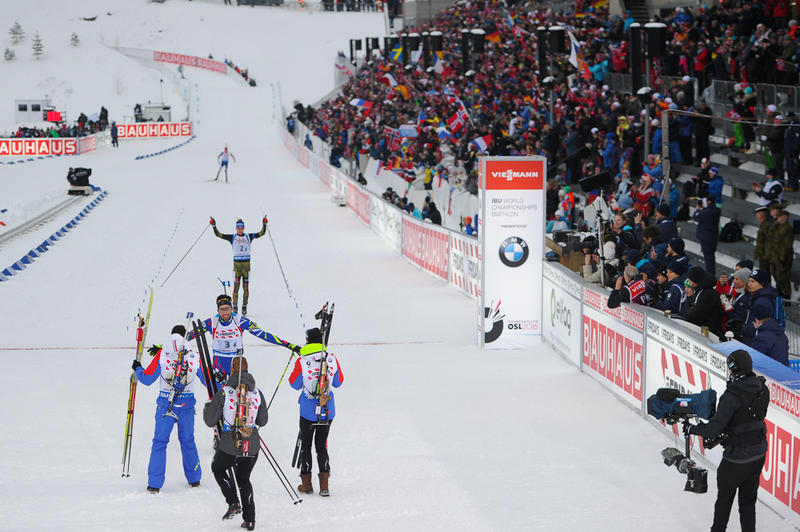
This time, France’s overall World Cup leader Fourcade prevailed against Germany’s anchor, skiing over the last bridge in the stadium and taking a little bow in the style of a telemark ski turn. He crossed the finish line in 1:14:01 and celebrated the gold medal with his excited teammates. Combined, the four-person French relay had no penalties and seven spare rounds.
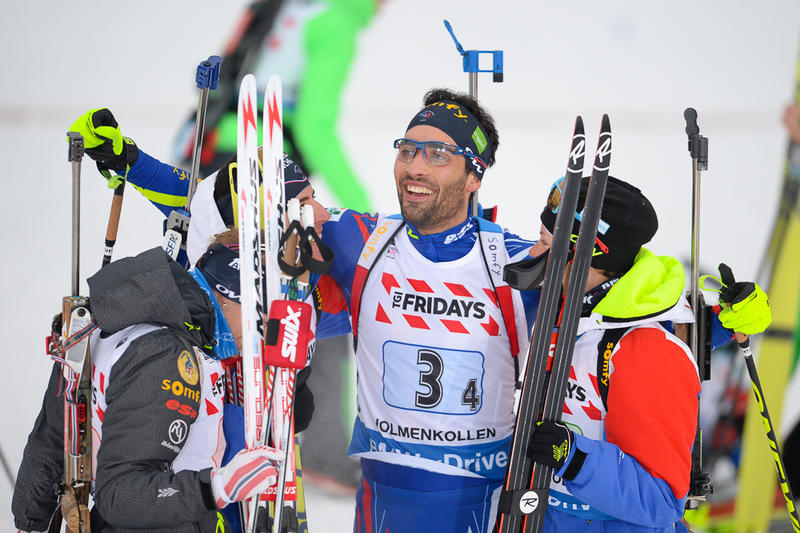
Martin Fourcade celebrates with his teammates after anchoring France’s mixed relay to gold in the first race of 2016 IBU World Championships in Oslo, Norway. (Photo: IBU)
“Today was really emotional, because it was my first, our first victory in a team race in World Championships since 2009,” Fourcade said at the post-race press conference.
“Of course we were among the favorites so we were thinking about [the gold medal],” Fourcade added in an interview with the IBU. “But in biathlon you never know until the last shooting. We were fighting for gold as well as for the fourth place.”
Germany finished second, just 4.3 seconds back, and also with seven spares.
“I tried to bring out everything I had, but in the end I honestly was too exhausted,” Schempp told German TV broadcaster ARD. “We are totally happy about silver.”
“The way Fourcade threw himself into the snow afterwards, I think that shows Simon [Schempp] pushed him to his limits,” Germany’s third leg skier Arnd Peiffer told ARD. “Martin definitely didn’t have it easy on the final loop today … With that ‘telemark’ move he was just showing his excitement, that had nothing to do with arrogance.”
Another 10 seconds back, Norway’s anchor Tarjei Bø secured the bronze medal for the home team (+14.4), with ten spares, to the huge joy of the audience.
The U.S. finished 10th (+2:19.6), with five spares, falling back on the last three legs after starter Susan Dunklee rocketed through the first exchange in first place. Canada placed 11th (+2:30.8), with 11 spares, unable to quite keep up with the leaders throughout the race due to too many misses on the shooting range.
After a festive opening ceremony at a central square in Oslo on Wednesday night, the Biathlon World Championships opened with the mixed relay, including two women and two men per team, with all other rules just like in a traditional relay.
The two women begin, and each ski 6 kilometers with one prone and one standing shooting stage, while the men have to ski 7.5 k each. The athletes can use three spare rounds per stage, and if they fail to clean their targets with those spares, they have to ski a 150-meter penalty lap for every miss.
The IBU first experimented with mixed relays 11 years ago as a special event during the World Cup finale. Since 2007, the discipline has been part of the official program at World Championships.
Initially it was a bit of an afterthought, with a number of countries with large teams using it as an opportunity to give their lower-ranked biathletes a start at championships, and saving their best ones for the individual starts and the traditional women’s and men’s relays.
That has changed in recent years, since the event also became part of the program at the 2014 Olympics in Sochi, Russia. This year in Oslo, small and larger teams alike certainly pulled out all the stops, with almost every nation entering the its best athletes.
Low-hanging clouds and fog on the range had been predicted, but for Thursday’s competition, the view of the targets on the shooting range was actually clear despite a cloudy sky and a little fog shrouding the big ski jumps that tower over the Holmenkollen arena.
The French team, with Anaïs Bescond, Marie Dorin Habert, Quentin Fillon Maillet, and Fourcade, initially hit a snag when Bescond required all spares to hit her targets in her standing stage, narrowly avoiding the penalty lap and coming through the exchange in seventh place, 35 seconds behind Dunklee.
Then Dorin Habert crashed in a ski tunnel out on the course, in snow conditions some athletes described as “glazed” in certain sections.
“Nothing terrible, it was just a mistake by me,” Dorin Habert said of her fall at the press conference.
She quickly recovered and moved her team into third place at the next exchange, with Fillon Maillet and finally Fourcade able to close out successfully by pushing hard up the final small climb and U-shaped turn in the arena to create a little gap.
Similarly to France, Germany’s starter Franziska Preuss initially lost 20 seconds to the top due to two misses in her first prone stage, but moved back up to fourth place at the exchange. Then Franziska Hildebrand and Peiffer kept the team in contention for the podium, before Schempp was able to claim the silver medal.
Germany’s Simon Schempp after one of his shooting stages during Thursday’s mixed relay at IBU World Championships in Oslo, Norway. He anchored Germany to second, 4.3 seconds behind France. (Photo: IBU)
In his last shooting, Schempp thought he had hit all shots taking down his rifle to head back out on the course, before realizing he had missed one and — like Fourcade -– still had to use a spare. Schempp made his shot and left the range just 1.7 seconds behind Fourcade. While Schempp was able to catch up on the course, he did not have the energy left to beat his rival in the final sprint.
Ahead of World Championships, fans and the media put a lot of expectations on the home team from Norway with Marte Olsbu, Tiril Eckhoff, Johannes Thingnes Bø and his older brother Tarjei Bø.
At the 2014 Olympics, Norway had won the gold medal in the mixed relay, though only Eckhoff, who grew up just a stone’s throw away from the Holmenkollen arena, was a part of the lineup back then.
In front of thousands of spectators, including Norway’s King Harald V, the team did not disappoint, with Olsbu and Eckhoff delivering some of their best performances of the season to tag off in second and first place, respectively. From there, the Bø brothers kept the team in podium contention.
“I was very nervous,” Olsbu said at the press conference. “I am just so happy that I made a good race today.”
Johannes Bø tried to make a move on his last loop, yet the other teams just behind him closed the gap again before the exchange.
After needing all spares in his prone shooting on the anchor leg, his brother Tarjei fell back 18.4 seconds, but was able to reduce that again to 7.4 with fast skiing and a clean final shooting stage. While he tried everything in his power, he could not quite catch up to Fourcade and Schempp again.
“Of course we are happy to have a medal at the Championships [at] home,” Johannes said during the press conference. “But we are athletes who want to win. So we are 90 percent happy [with bronze], and we take the last 10 percent next week.”
“Simon and Martin were too strong for me,” anchor Tarjei Bø said.
When a French journalist asked his rivals if Fourcade maybe gained a psychological advantage for the remainder of the World Championships after a win on Thursday, Tarjei Bø laughed and exclaimed: “Yeah, he is unbeatable. He’s so unbeatable that I will not race any more at these World Champs!”
“That’s a good idea,” Fourcade replied with a big smile on his face.
For a long time, four teams had been in close contention for the medals, but after a strong race Ukraine, with Valj Semerenko, Olena Pidhrushna, Sergey Semenov and Dmytro Pidruchnyi, could not quite keep up on the anchor leg with two spares in the last shooting. Ukraine finished fourth (+29.8), with nine spares.
Fifth place (+1:07.1) went to Austria, with Dunja Zdouc, Lisa Theresa Hauser, Simon Eder and Dominik Landertinger, which combined for a team total of just three spares, the fewest of any nation. Meanwhile, the defending world champions in the mixed relay, the Czech Republic, with Veronika Vitková, Gabriela Soukalová, Michal Slesingr and Michal Krcmar finished sixth (+1:23.3), with five spares.
Dunklee in the Lead
Susan Dunklee (US Biathlon) trails France’s Anais Bescond during the first leg of the mixed relay at 2016 IBU World Championships on Thursday in Oslo, Norway. Dunklee went on to tag off in first, 1.6 seconds ahead of Norway. (Photo: USBA/NordicFocus)
For US Biathlon, Dunklee started out strong, shooting clean in the first prone stage to leave in second behind France’s Bescond. Then she again hit all of her targets in standing to leave the range 4.5 seconds behind Norway’s Olsbu and Italy’s starter Dorothea Wierer (an athlete with multiple World Cup victories this season. Italy went on to finish eighth).
This time, Dunklee was not satisfied just staying behind the athletes at the top, immediately attempting to overtake Wierer and move up to Olsbu.
“I love the thrill of starting relays,” Dunklee wrote in an email after the race. “I have been close behind the leader tagging off many times, but I have never tagged off in first. On the last loop I was hungry to finally win my leg today and I wanted to give Hannah [Dreissigacker] the experience of leaving in the lead in front of a packed Norwegian crowd.”
Of all the first-leg skiers, Dunklee’s course time was the fastest.
“I do love the Holmenkollen crowds and the hilly course,” she wrote. “I felt relaxed and focused on the shooting range and felt very strong skiing. Our staff put together incredible skis today.”
“I love the thrill of starting relays. I have been close behind the leader tagging off many times, but I have never tagged off in first. I was hungry to finally win my leg today…” — Susan Dunklee, who put the U.S. in first at the first exchange on Thursday
Dreissigacker initially was able to keep up on the course with France, Norway, Ukraine, and Germany at the top.
“It was a fun race and definitely a real thrill [to] get the tag in first place,” Dreissigacker wrote in an email. “Susan really did us all proud out there. I did my best to ski my own race, but it’s always hard when you have lots of adrenaline and find yourself in first place.”
After requiring a spare in prone, she was still in third place, only 1.7 seconds back. Then having more trouble maintaining the leaders’ pace on the next loop and with another missed shot in standing, she fell back 22.7 seconds to fifth place. On her final loop, Soukalová, the overall World Cup leader, passed her on the course, and Dreissigacker lost another half a minute to the leaders, tagging off in sixth, 51.3 seconds back.
“I felt like I was in control on the first and second laps, trying to keep in touch with the leaders as much as possible without overdoing it,” Dreissigacker explained. “But I definitely didn’t have too much gas left in the tank for the last lap, and it didn’t help that I had really lost all contact with the women ahead of me. But that was also a group of the very fastest women in the world, so I am not surprised that they put lots of time on me in the last lap.”
The U.S. team’s third leg, Lowell Bailey had a strong performance on the shooting range and stayed clean both times just like Dunklee, but continued to lose time on the course, and his course time ultimately ranked 19th of the third-leg skiers. He tagged off in eighth place, 1:35.5 minutes back.
“The course was tricky today,” Bailey wrote in an email. “The new snow packed down and glazed, making some of the downhills and especially the stadium fairly treacherous. It wasn’t my best day on skis, but hopefully I’ll feel better as the Championships roll forward.”
Anchoring the U.S. relay, 20-year-old Sean Doherty required a spare in both his prone and standing stages, and with the 16th-ranked course time on his leg, he slipped two positions to finish 10th (+2:19.6), one position ahead of Canada.
“Today’s race was an exceptionally high level,” Doherty said in a US Biathlon press release. “We showed that we can shoot with the best teams and be very competitive. I am really happy with my leg and feeling strong looking ahead to the sprint.”
“The mixed relay is a format we often think of as one of our best medal hopes, so from that perspective our result today is disappointing,” Dunklee wrote. “After our 4th place in Canmore I think we all went into today with high hopes… On the range we put together an excellent performance, one of our best I would say. Tenth is solid, but we know with that good of [a] shooting we can be capable of much more. The good news is that we have many races still to come.”
“It was just tough, tight competition out there and I think we had a really solid team performance,” Dreissigacker commented. “Using only 5 spares for the whole team is great shooting!”
As Bailey pointed out, a top 10 is a top 10.
“It is a tight field and we were close to the leaders for a significant part of the race,” he wrote.
The Canadian team with Julia Ransom, Rosanna Crawford, Nathan Smith, and Brendan Green was hoping to build on its ninth place in the mixed relay in Östersund, Sweden, and sixth place at home in Canmore.
On Thursday, Ransom started in bib 5, and had some trouble to keep up with the leaders. With one miss in both her prone and standing stages, she found herself 36.5 seconds behind going onto the final loop, and then lost more time to tag off in 11th place, 1:03.4 minutes back.
Crawford was able to maintain the pace with the seventh-best course time on her first loop, before dropping off a bit the third time around the Holmenkollen 2 k course.
“It was nice on those first two laps to be working with Sweden and trying to stay with Soukalová,” Crawford wrote in an email. “I had a tumble on the same hill as Dorin [Habert] in warm up and broke a pole, but the race was smooth and I didn’t have to deal with any sketchy people on the downhill.”
But she couldn’t make up positions or time with a miss in her prone shooting and two spares in the standing stage, where she had some additional issues.
“I had some trouble with standing where my shell got stuck, and I wasted some time getting that fixed, and then missed two targets on top on that,” Crawford wrote. “So I am quite disappointed with my shooting. Getting the jitters out before Saturday’s race though hopefully!”
She handed off in 14th place, 1:27.7 back.
Currently the highest-ranked Canadian on the World Cup, Smith skied fast on the course, posting the fifth course time on his leg.
“I’m very happy with my skiing today,” Smith wrote in an email. “I’ve been struggling over the last 7 weeks to feel good on the skis. I wouldn’t say I felt like a total beast skiing, but I knew my shape was good just because I was able to more or less maintain position with top guys like [Russia’s] Garanichev and [Austria’s] Eder… I don’t actually particularly like this arena. I find the gentle ramp through the stadium surprisingly challenging. The ski loops are interesting though, and obviously great views.”
But like his teammates, he could not quite stay clean on the range, requiring two spares in prone and another one in standing.
“Shooting conditions were perfect,” Smith stated. “Very little wind and no fog. Earlier in the day it looked nasty but everything cleared up for us.”
Smith moved up the team a few positions to tag off in 10th (+1:35.9).
“I wouldn’t say I felt like a total beast skiing, but I knew my shape was good.” — Nathan Smith, who skied the fifth-fastest course time on the third leg to bring Canada from 14th to 10th
Canada’s anchor, Green also did not have a perfect day on the range, needing one spare round in prone and two in the final standing stage. Combined with his skiing (13th ranked course time), he lost some additional time to the top, with Canada closing out the race behind the U.S. in 11th place, 2:30.8 behind the winners.
“In my portion of the race there wasn’t anything too out of the ordinary,” Green wrote in an email. “The track was really glazed in some sections and the skiing in general felt like a bit of a balancing act at times.
“There has been a bit of wind during the last few days [of] training, but it dropped a bit this afternoon which was nice,” he wrote of the shooting conditions. “A slight but manageable wind from the left. I was a bit worried about the fog that was lingering throughout the day but fortunately it moved off and the range was clear.”
Asked if their team result was within expectations, Crawford wrote, “11th is a disappointing result for our team, we are capable of a top 8 on an average shooting day and for sure top 6 if we all have a great day on the range. 11 spares is not a normal day for our team I’d say.”
“11th is nothing to write home about but still a decent result,” Smith stated. “We knew everyone would be putting in their best teams.”
“Overall, today wasn’t a true representation of what our team is capable of,” Green wrote. “It’s day one of the Championships and I know we’re all hungry for more.”
Races in Oslo continue on Saturday with the first individual races: the men’s and women’s sprints. All races as well as shorter recaps can be streamed live or time-shifted (most with English commentary) on Eurovision Sports.
“I just want to get one [individual] title, that’s my aim,” Fourcade said at the press conference.
“The atmosphere was great!” Bailey wrote. “Cheering along the track and extremely loud in the stadium. I think it will be even bigger on the weekend.”
“On Saturday we’ll come out fighting,” promised Green. “The atmosphere was pretty awesome today. The stands were full and the stadium was loud. It’s a good vibe and if today is any indication, we’re going to be in for a fun couple weeks of racing.”
Ukraine’s Olena Pidhrushna (l) boxing out Germany’s Laura Dahlmeier (r) in the final meters of the women’s 4 x 6 k relay in front of a packed Chiemgau Arena at the IBU World Cup in Ruhpolding, Germany. (Photo: IBU/Ernst Wukits)
It’s not often that you can hear catcalls and booing in a ski stadium. A football, basketball or soccer game maybe, but biathlon? On Sunday, 20,000 spectators packed the Chiemgau Arena in Ruhpolding, Germany, and many were not pleased with how the IBU World Cup women’s 4 x 6-kilometer relay played out. Just before the finish, Ukraine’s anchor Olena Pidhrushna, skiing in first, cut off local fan-favorite Germany’s Laura Dahlmeier to claim the ideal left lane in the final stretch. That ended Dahlmeier’s furious chase on the last loop to finish, and Ukraine took the win by 1.2 seconds in 1:16:14.2.
Ukraine, with Iryna Varvynets, Yuliia Dzhyma, Valj Semerenko, and Pidhrushna, incurred one penalty lap and only needed four spare rounds (three prone and one standing), while Germany, with Karolin Horchler, Miriam Gössner, Maren Hammerschmidt and Dahlmeier, had two penalties and required eleven spares (six prone, five standing), but the latter three athletes all skied the fastest course times on their legs to make up the deficit.
Behind them, Dorothea Wierer anchored Italy — which had no penalties and used 10 spares — to third (+43.8), about a second of Russia’s Olga Podchufarova, after the Russians had two penalties and required seven spares. Thus the same teams that had already been on the podium after the first relay of the season December in Hochfilzen, Austria, made it again, except Italy and Ukraine swapped positions.
Teams from 22 countries started on Sunday and 17 finished without being lapped.
Canada, with Julia Ransom, Rosanna Crawford, Megan Tandy, and Zina Kocher, placed ninth (+1:59.5) with no penalties and seven spare rounds, while the U.S., with Annelies Cook, Susan Dunklee, Clare Egan, and Joanne Reid, finished 16th(+5:39.8) with three penalties and eleven spare rounds.
‘Of course you are angry in the moment’
At first, Dahlmeier was visibly annoyed about the end of the race, after she erased a 27.7-second gap on the last leg (and was still 9.2 seconds behind heading into the last loop). After getting blocked she switched back to the middle lane, but once she realized she couldn’t beat Pidhrushna, Dahlmeier stopped pushing and slammed her right pole into the snow across the finish.
“The final loop was really hard. Of course you are angry in that moment, after going at full throttle for 6 kilometers, and then it fails on the last few meters,” said Dahlmeier, who anchored Germany to a relay gold at 2015 World Championships, told TV broadcaster ZDF. “But we can be very, very happy about the second place, especially with the penalty laps that were shot, and with this lineup. I think that’s really nice, and a beautiful finish for the days in Ruhpolding.”
“It was a hard last loop,” Pidhrushna said at the post-race press conference through a translator. “I know Laura is a really good skier, and I knew that I would have to fight for every meter. I am really happy that the team won. I just held the shortest line to the finish. I really wanted to win; it was a big battle but it is sport.”
After seeing a replay again, Dahlmeier agreed in a later interview with ZDF: “That was all correct, you can’t say anything against that. For me, it’s too bad; it didn’t help to switch lanes, and then it was already all over. Maybe I have to train a little bit with the cross-country skiers, pick up some things on how they solve sprints in order to become better.”
“That’s biathlon, that’s the race,” her teammate Hammerschmidt said at the press conference. “It was the same in Hochfilzen [where Germany lost a finishing sprint to Italy], maybe in the next relay we are first. But I think it was OK, and the girls [from Ukraine] make a good job, congratulations to the first place.”
The German athletes did not complain for long, knowing their day could have ended much worse after second leg Gössner incurred two penalty laps earlier in the race, at that time falling back to 15th position with the podium seemingly out of reach.
(Story continues below)
The women’s 4 x 6 k relay podium at the IBU World Cup in Ruhpolding, Germany; with Ukraine (c) in first, Germany (l) in second, and Italy (r) in third. (Photo: IBU/Ernst Wukits)
Race Day
Several teams had opted to rest good athletes for Sunday’s relay at the end of a long block of races, including Germany. Franziska Hildebrand, who already won two World Cups this season, had asked her coaches for a break, and then Vanessa Hinz also had to defer her relay start due to a cold, while teammate Franziska Preuss missed the entire Ruhpolding weekend with a hairline fracture in her tailbone.
That prompted the coaches to change their second-place relay from Hochfilzen on three positions, and make a call to Karolin Horchler, 26, who originally had other plans for Sunday:
“[Saturday] afternoon I had been on my way to Ridnaun, South Tyrol [Italy], because I was supposed to compete there in an IBU Cup mixed relay today,” Horchler told ZDF. “And shortly before the arrival Gerald [Hönig, women’s head coach] called me and said I should please turn around. All in all, it was on the road for five hours… To start here in my second home in Ruhpolding, that’s what I always dreamed of.”
“It’s surely not a very common lineup,” coach Hönig told ZDF before the race. “But in general our expectation is that any relay team we start contends for a spot on the podium.”
Similar to Germany, the Czech Republic chose to rest overall World Cup leader Gabriela Soukalová, France rested Marie Dorin-Habert, currently second place in the World Cup standings, Italy’s Federica Sanfilippo sat out the relay, and Austria’s top skier Lisa Theresa Hauser missed it as well. Finland didn’t enter a team, missing their best athletes Kaisa Mäkäräinen and Marie Laukanen.
The newly called-up Horchler began the race well for her team, skiing at a pace that allowed her to stay in contact with the best and requiring only one spare each in prone and standing. She tagged off in fifth place, 22 seconds behind Norway’s Marte Olsbu in the lead, with Ukraine’s Varvynets in second after shooting clean.
“It was a really crazy day, in the morning I heard that I can start here. The second place is very good for the team. It’s wonderful,” Horchler said in the press conference after the race.
“It’s surely not a very common lineup, but in general our expectation is that any relay team we start contends for a spot on the podium.” — German Women’s Head Coach Gerald Hönig
Germany’s second skier,Gössner skied out fast on her first loop making up positions, but struggled in prone, missing two of her targets and quickly running out of spare rounds.
“Trying to do everything especially well because it’s a relay is a fitting description,” Gössner told ZDF while the race was still going on, with tears welling up in her eyes. “I really can’t explain myself how I can shoot two penalty laps in prone. I didn’t have the feeling that conditions were difficult or that I was shaking… Then I was completely flustered, I didn’t know if that shot went left or right, just didn’t know where to aim.”
After another fast loop, at least she was able to avoid the penalty lap in the standing position after requiring two spare rounds, usually her more shaky discipline, moving up to 13th place.
“Without my two penalty laps a lot more would have been possible today,” a still-disappointed Gössner later told ZDF after the race. “Our luck was that the other nations also shot penalty laps, so the other two [teammates] could make up some time, and that saved us. But my race was absolutely not good.”
“Yeah, she is very annoyed, but that’s relay,” said Hammerschmidt, who lifted Germany from 11th to second on the third leg. “That happens to everyone, but it’s all the better for her that we still got the second place. And I just told her she is allowed to say two more sentences about her shooting, and then we’ll call it a day.”
“I just told her she is allowed to say two more sentences about her shooting, and then we’ll call it a day.” — Germany’s Maren Hammerschmidt, about her teammate Miriam Gössner
While Gössner had been struggling on the range, Ukraine’s Dzhyma shot clean at the top of the field, and while not quite as fast as the German behind her, also skied the sixth-fastest time on her leg.
“Our skis were really good today, thanks to the service team,” she said in the press conference. “I like the new [additional] snow better.”
Hammerschmidt received the tag 1:48.8 minutes behind Ukraine in 11th place, then began a furious chase to get closer to the top again (“one of the best relay performances I can remember in quite a while” ZDF color-commentator Herbert Fritzenwenger commented).
She missed two shots in her prone shooting stage, and then needed one more spare round in standing.
“I have to say, I was a little too cautious there,” Hammerschmidt told ZDF. “I should have turned [on the sights] immediately but thought ‘maybe it will work,’ and when you think that it usually doesn’t. So I should have reacted earlier, I got pretty nervous there after the two misses. In standing I went with full risk, and thankfully only had to reload once.”
Like Gössner, she skied the fastest course time of all athletes on her leg, and handed off to Dahlmeier in second place, 27.7 seconds behind.
“Of course I would have liked to have a better starting position,” Hammerschmidt told ZDF during the race. “But maybe the pressure was off a little. I just wanted to do my own race, and see that I can catch a good pack. I had really good skis today, and felt good on the course. On the last loop I could catch one after another, that was such a great feeling. And then I was really surprised to be second in the finish.”
Ukraine’s Semerenko skied the third leg, and at this point could have secured a large gap over the rest of the field. She narrowly missed her last shot in prone, but then the usually solid shooter was not able to clean the remaining target with her three spares, and had to ski a penalty lap. That opened the race back up as Belarus’ Nadzeya Pisareva overtook her and some other teams moving back within striking distance of the lead.
“I had nothing left but to run faster,” Semerenko joked in the press conference, according to a translator.
How quickly the fortune of a team in a relay can change was demonstrated once again after the next shooting. Pisareva and Semerenko each needed one spare in standing, with Semerenko still trailing by 9.8 seconds as she left the range. Then suddenly Pisareva completely ran out of energy, and could be seen trying to herringbone up the next hill without any glide.
Semerenko quickly passed her, along with several other teams as well. At the bottom of the next climb, Pisareva stopped next to one of her coaches to exchange a few words, seemingly ready to quit the race, before continuing to ski again.
The Belarusian tagged her teammate Darya Yurkevich 1:28.2 minutes behind in 11th place. Yurkevich would end up losing two more positions, finishing 13th (+2:40), despite Belarus posting one of the best shooting performances of the field for Belarus (no penalties, five spares).
With Belarus now out of the picture, the race for the podium on the final leg came down to Ukraine, Germany (+27.7), Norway (+28.6), Italy (+42.4), Sweden (+43.0), Slovakia (+45.3), and Russia (+45.7), with more teams looming shortly behind.
Dahlmeier set out at a fast pace to close the gap to Pidhrushna, and after both shot clean in prone, the lead had been reduced to 18 seconds. On the next loop, Dahlmeier stormed up the climbs and managed to catch Pidhrushna, overtaking her just before the shooting range. But while the Ukrainian stayed clean in the final standing stage, Dahlmeier required one spare, again falling behind by 9.2 seconds as they left the range.
On the final loop, Dahlmeier had more problems catching up to Pidhrushna again, who managed to preserve her lead through the last flat section and descent into the stadium. Then the most talked-about scene of the race happened, and Ukraine prevailed in that final sprint.
“I was pretty down on my strength, but too bad, at the end it went a little poorly,” Dahlmeier told ZDF. “Maybe I should have stayed behind her and then pick the middle lane. A little unfortunate. But still, considering how it looked initially, we are mega-happy about the second place. That was a grandiose success, and you really see what is all possible in a relay race.”
After a number of changes between several countries vying for third place, Italy,
with Lisa Vittozzi, Karin Oberhofer, Alexia Rungaldier and Wierer, beat out Russia’s Ekaterina Shumilova, Daria Virolaynen, Ekaterina Yurlova and Podchufarova in a second exciting finishing sprint by 1.1 seconds.
“I think the relay is the work of the whole team, everybody has to do their best, it’s not only one man or one woman,” Wierer said in the press conference. “I was in the fourth position when I started, and I was a little bit worried because [there were] also Tiril [Eckhoff] and Laura. I hoped that I would shoot well. I was a little too fast in the standing so I missed the first one. But I was lucky that Tiril shot more misses than me. And then behind me was the Russian, and I was really nervous. I was sure that she will pass me on the finish line, but I gave everything and it was the third place, finally.”
Norway was fifth (+1:11.5) with Marte Olsbu, Fanny Horn Birkeland, Synnøve Solemdal and Eckhoff combining for one penalty and 13 spares. Olsbu tagged the team in first after the first leg, and after Birkeland’s penalty on the second leg, Norway still remained in podium contention, picking off the places with Germany, until Eckhoff required all her spares on the last leg — three in prone, three in standing.
Ahead of the upcoming World Championships at home in Oslo, the Norwegian women have not reached the podium since taking bronze at the 2014 Olympics, though they remain hopeful.
“It may not look like we’re there yet, but we are good enough. It’s about getting the final touches in place,” Eckhoff told Norwegian broadcaster NRK.
Canada in Top 10
Canada’s 22-year-old Julia Ransom (116) during the 2014 IBU Junior World Championships pursuit. (Photo: Katrina Howe)
For Canada, Ransom’s day began with tangle out of the start and a resulting broken pole, but she quickly received a replacement.
“It caught me a little by surprise but I quickly realized that I needed to signal to someone for a spare,” Ransom wrote in an email to FasterSkier. “I was on the opposite side of the trail as all of the coaches, but one of our wax techs was somehow able to get a pole to me despite having a few girls between us. Unfortunately that little mishap put me to the back of the pack, but I was able to sneak my way back in there before the first shooting.”
After the field had stayed closely together on the first loop, Ransom shot fast and accurately in the first prone, cleaning all five targets and leaving the range in fifth place. By the next timing point, she even had moved up to third.
“I was stoked to be skiing with the top 3 girls! I felt strong and controlled on skis,” she wrote. “Unfortunately, I struggled with my [standing] spares and lost those leaders. I’m not letting that happen again next relay! “
In her standing stage, Ransom initially missed just one shot, but then required all three spares to clean it and avoid the penalty lap. She fell back a few positions, and tagged off to Crawford in 11th place, 50.7 seconds behind Norway up front.
Crawford shot flawlessly, cleaning both her prone and standing positions, something only 10 other athletes achieved on Sunday. When she left the range after the last stage she had moved her team back up to fifth place (+1:01.5), then only lost only a few more seconds on the final loop tagging Tandy still in fifth (+1:07.7), behind Slovakia and ahead of Norway.
In the prone stage, Tandy missed two targets, then needed all three spares to clean them, leaving the range in 10th place (+1:17.1) with Germany still behind in 12th. In standing, Tandy was able to stay clean, though she could not make up another position. But she also barely lost any more time, tagging off in 10th and 1:17.6 back.
Kocher winning an IBU Cup sprint in Canmore, Alberta, last season. (Photo: Pam Doyle)
Team veteran Kocher anchored the relay, and like her teammates, displayed a strong shooting performance. She cleaned prone, and then had only one miss in the final standing, leaving the range in the vicinity of a number of other teams fighting for position.
“Last laps are usually my strength so I attacked leaving standing,” Kocher wrote in an email. “Unfortunately, just before the uphills the French competitor [Celia Aymonier] stepped on my pole and it broke, costing me metres of time. I got a pole fairly soon from Norway, but it was very short, and then for the last sprint to the finish switched it for my own pole from our coach Matthias [Ahrens]. But that cost us a potential top 6. Two broken poles for our team, crazy!”
In the end, she finished the ninth for Canada, 1:59.5 minutes back, with no penalties and only seven spares. “Excellent momentum for going forward to next week’s relay for our team,” Kocher concluded.
“Our team had a goal of collectively using 8 spares and stay in the top 10… We also wanted to beat Sweden to maintain our current Nation’s Cup position,” Ransom wrote.
They achieved both those goals. The Nations Cup is its own end-of-season award by the IBU, but also determines the number of starting spots a country gets awarded for the next year. Germany is still in the lead after the races of this weekend, with Canada in 10th position and the U.S. in 15th.
“I was proud of our women’s team today. We all had fairly solid races and had the potential for top 6; unfortunately Zina broke a pole on her last lap, which caused a fall and a few positions. I think we are all fired up for another exciting race next weekend,” Ransom added. “The crowds here in Ruhpolding were fantastic. They brought a lot of energy to the races and were devoted fans in even the worst conditions.”
U.S. 16th with three penalties
For the U.S. the relay got off to a difficult start, when Cook incurred a penalty lap in her first prone shooting, leaving the range in 20th position, 58.6 seconds back behind the leaders.
“I was disappointed in myself today because I had a penalty in the first prone shooting that put me in the back of the pack,” Cook said in a US Biathlon press release. “I was unable to get the girls into a good starting position, although I had a lot of confidence in what could happen after that. It was a crazy day with lots of penalty loops happening to great teams and the standings changed a lot through the race.”
After a better standing stage shooting where she only required one spare, Cook about kept her position but lost a few more seconds to the top (despite skiing the 14th best course time on her leg), tagging Dunklee in 21st (+1:38.4).
Susan Dunklee (US Biathlon) skied the second leg for the U.S. women’s relay on Sunday, picking off three places to bring them from 21st for 18th. They ultimately placed 16th. (Photo: USBA/NordicFocus)
Dunklee, who had been the starter for several years, again moved to the second leg, the same order the team had experimented with in the relay in Hochfilzen. After needing one spare in the prone, she had moved up one position, but had lost additional time to the leaders (+1:58.8) despite skiing the fastest first loop.
In standing, she again had to use one spare and left the range in 19th (+2:26.3). Dunklee barely lost more time on the final loop, and tagged Egan in 18th, having made up three positions on her leg, but almost losing another minute to the top, now 2:29.9 behind.
On Sunday, Egan had one of her best recent shooting performances, cleaning prone and only requiring one spare round in standing.
“I made a breakthrough in my standing shooting at the beginning of the winter, and I’m taking advantage of that newfound confidence. I have bad stages now and then but I am learning from each one and improving all the time,” Egan wrote in an email. “For example I missed 1,3 in the first two stages of Thursday’s Individual, but then pulled myself together and finished the race with 0,0 on the last two stages. Today I missed my last (10th) shot, which is a letdown, but I was able to hit it with my first spare round.”
Clare Egan (US Biathlon) skiing the third leg of the 4 x 6 k relay on Sunday, bringing her team from 18th to 16th with just one spare round. (Photo: USBA/NordicFocus)
Out on the loop, Egan skied the 14th-fastest time of her leg, and was able to move her team up two positions, tagging off 2:45.4 minutes behind in 16th.
“The conditions were relatively fast today,” she added. “It snowed a ton last night but we were lucky and it stopped during our race. Our wax staff gave me excellent skis this morning, but unfortunately I was not able to put them to very good use, as my body was not responding well at all.”
In her first week with the World Cup team, Joanne Reid anchored the relay (in place of Hannah Dreissigacker, who skied that leg during the first relay of the season).
“I think the reason the coaches put me last is because I don’t have the consistency or the experience of the rest of the team, and therefore any mistakes I made would be after they had already raced,” Reid wrote in an email.
Reid emerged from prone having used just one spare, but then struggled in the final standing, running out of spare rounds and ultimately having to ski two penalty laps (0+1, 2+3).
“Today I made what I assume is a classic error for a new biathlete coming in from pure skiing, and came into the range too hard in standing,” Reid explained. “I was intensely focused on catching the two teams in front of me, which was going well until I got to the range. It’s always hard to remember in the heat of the moment that your shooting is just as important as your skiing.”
In her first IBU World Cup relay, Joanne Reid anchored the U.S. women’s team to 16th with the 11th-fastest course time on that leg. (Photo: USBA/NordicFocus)
“The pacing on that lap was certainly my mistake, and not just pacing, but the fact that I don’t have the shooting skill to handle as high of a heart rate or shoot at the same speed as the rest of the girls, not to mention I hand load spares much slower.”
Overall, Reid skied the 11th-fastest course time.
“It was definitely a fast course out there, but still very difficult. I can only imagine how tired the athletes are who have raced the entire world cup period, and also qualified for and raced the mass start this weekend,” she wrote. “For Susan to go out there and ski the fastest leg after all those races (and long ones besides) is incredibly inspiring to me, and I wish I could have given her a better performance on my end.”
“I really enjoyed the course out there today — we were much luckier than everyone in the mass start to have such hard-packed conditions,” Reid added. “I think that’s the only 6 km I’ve ever skied in my life, so I wish I could compare it to something, but until I do a few more biathlons I have no reference point.”
Reid finished in 16th for the U.S., ahead of Romania, with the other five teams behind them lapped.
“We wanted to do better than last time (15th) but unfortunately we fell just short of that today,” Egan concluded in her email.
“This team has so much potential and I really believe in that,” Cook said in a US Biathlon press release. “So many of the pieces are there and are also showing, but not quite enough of them to do what we are capable of. It is frustrating but it is also making us hungry to do better and we have another relay coming up next week.”
“I think a team always goes into a relay with the hope that they can improve on their start position,” Reid wrote. “Obviously for us today, that didn’t happen, but I think we have a lot of the pieces right, and I’m certain this team (whether or not in the future it includes me), can have an incredible day.”
The IBU World Cup now moves on to Antholz-Anterselva, Italy, where there will be another relay for the women and men on Sunday.
View of the indoor section of the ski track and the shooting range inside the arena at the Biathlon auf Schalke, or World Team Challenge, in Gelsenkirchen, Germany. (Photo: Biathlon-aufSchalke.de)
Biathletes competing in the international IBU World Cup tour are used to large crowds by now, with races often attended by 5,000 to 10,000 spectators per day. But the annual World Team Challenge, a two-person relay invitational in Gelsenkirchen, Germany, is on something of a different level. Athletes skied on artificial snow through a park around a huge soccer arena, before entering the pitch inside via a tunnel, and then shooting in front of nearly 41,000 raucous fans, with music blaring and the noise level amplified indoors many times.
Two days ago on Monday, France’s Marie Dorin-Habert and her relay partner Martin Fourcade managed to perform the best among the 10 participating teams in this wild atmosphere, winning the final pursuit in 33:57.6 minutes (for about 12 kilometers of skiing, plus six penalty laps). The Czech Republic’s Gabriela Soukalová and Ondrej Moravec placed second, 12.6 seconds back (with three penalties), and third place went to local fan favorites, Germany’s Vanessa Hinz and Simon Schempp, 22.2 seconds behind with four penalties.
Fourcade already had two 2014 Olympic gold medals, six World Championships titles, and 46 World Cup wins in every discipline and just about every World Cup location. But he had yet to seize a victory in Gelsenkirchen’s arena and was eager to change that.
“It’s amazing, this is the only competition I did not win yet,” he explained in an interview with host TV broadcaster WDR after the race. “This morning I talked to Marie that it would be great to finally win it, and together we are a really strong team.”
The World Team Challenge relay race is held in a special format, with one woman and one man forming a team and exchanging repeatedly, each skiing a 1.3-kilometer loop and having to clean a shooting stage, or ski a short 75-meter penalty lap, before tagging off to their teammate. This mode of competition is fairly similar to biathlon’s new single mixed relay or the team sprint in cross-country.
Yet the location is vastly different, far away from any mountain range, in a flat region of Germany formerly known for its coal mines. And with the teams entering a darkened soccer stadium to a light show, a PA announcer, and loud music including the theme from “Pirates of the Caribbean,” the scene can be likened to the entrance introductions of NBA players or professional boxers.
The World Team Challenge, also known as “Biathlon auf Schalke” by the name of German first-league soccer team Schalke 04, which plays its home games in the domed Veltins Arena under a retractable roof and a large JumboTron-style video cube, was created to be a fun race event during the World Cup season’s holiday break.
The 2015 World Team Challenge podium, with France’s Martin Fourcade and Marie Dorin-Habert (c) celebrating their victory, the Czech Republic’s Ondrej Moravec and Gabriela Soukalova in second place (left), and Germany’s Vanessa Hinz and Simon Schempp in third place (right). (Photo: Biathlon-aufSchalke.de)
Even more so than a regular World Cup, the race is held in a huge party atmosphere. The outdoor portion of the track meanders through a so-called “winter village” Christmas market with food stands for the fans. An abundance of Christmas trees inside the arena form little forests to delineate the track and shooting range, and entertainment includes a “shootout” to determine the starting order, the “Snowball Fight World Championship” (however undisputed that title may be), multiple live pop music performances, and an indoor fireworks show.
Now in its 14th season, the World Team Challenge has become a fixed institution circled on the calendar for many biathletes during the holiday break, ever since the German duo Michael Greis and Martina Glagow (now Beck) won the inaugural event in 2002.
The athletes invited to the race, by and large, take it seriously each year and are impressed by the atmosphere.
“Oh, it’s huge. It’s amazing to ski in front of such an audience,” Germany’s Hinz told WDR. “It’s something very different, the pressure is a little higher because everything goes by so fast … I was just overwhelmed.”
For Hinz and Schempp, it was their first podium finish and first time participating. Hinz, a former cross-country skier who switched to biathlon two seasons ago, achieved her first major success as a member of Germany’s gold medal-winning women’s relay team at the 2015 World Championships. For the World Team Challenge, she hadn’t planned to compete until the night before, as she replaced Schempp’s original partner Laura Dahlmeier who was sidelined with an illness.
“I was completely nervous,” Hinz said, according to news agency SID. “The fans were crazy, a huge compliment to the audience.”
There are no World Cup points to win in the event, yet the stakes are still high. World Team Challenge organizers guaranteed prize money of at least €10,000 for all starting duos, and this year, the winners got €14,000 per person, as well as a newly introduced challenge cup trophy.
In the past, sometimes the winners also received a new car, but arguably that prize was harder to split between two people, plus a small crew of coaches and technicians. Overall, €156,000 ($170,000) in total prize money was awarded.
“The form of this competition, short rounds, fast shootings, I like that, it’s pretty cool, a spectacular show for the viewers,” Germany’s Erik Lesser said in an interview with WDR. Lesser was last year’s runner-up with teammate Franziska Hildebrand.
“In my opinion, this is an event to show people who normally don’t get to watch us what biathlon is all about, and I think we managed to do that today.”
New Track ‘On World Cup Level’
Ukraine’s Valj Semerenko (bib 1, left) and Germany’s Vanessa Hinz (bib 2, right) lead a group of athletes on the outside section of the ski track during the 2015 World Team Challenge in Gelsenkirchen, Germany. (Photo: Biathlon-aufSchalke.de)
For the 2015 edition, the Biathlon auf Schalke organizing committee, led by Herbert Fritzenwenger, an Olympic cross-country skier and biathlete who’s currently a color commentator for biathlon broadcasts on the German TV network ZDF, designed a new track through a park that incorporated multiple more difficult climbs and downhill sections on the part that is built outside the soccer arena.
In the past it was a rather flat loop, but this year it was supposed to more closely resemble what athletes would see “on the World Cup level,” as the organizers announced in a presentation before the race.
“It’s not exactly ‘The Wall’ of Ruhpolding or the ‘Birxsteig’ in Oberhof,” Fritzenwenger said, referencing two notoriously difficult climbs at the two World Cup locations in Germany. “But the athletes will feel that it is more difficult than in prior years.”
Using snow mostly coming from an artificial ski tunnel in a nearby city, every round was now almost 1300 meters long with 30 meters of vertical climb, which added up to about 300 meters for the men and 240 for the women for the whole day.
After some years where the organizers experimented with rifles using a laser aim, the athletes now use their own rifles with real ammunition on the 10-position range again, with bulletproof glass walls and an empty section behind it to protect the audience.
The increased difficulty of the course was evident during the races. Despite an indoor shooting range with no dreaded wind influence, most athletes produced more misses and thus had to skate more penalty laps than they normally would in a World Cup, also due to the fact that they were not allowed to use spare rounds.
The new track was also designed to be wider, offering more possibilities to pass each other and thereby make for more interesting race situations than in prior years.
“The athletes really enjoy it,” Fritzenwenger said in a pre-race press release.
Yet during the competition, it quickly became obvious that a sharp right hairpin turn coming out of a new downhill section was rather difficult. Many athletes not only had to use all their cornering skills to pass this section safely, but even had to resort to snowplowing to slow down and not crash into a fence, something especially the men rarely do during World Cup races. Those who didn’t reduce speed enough had to pay for it, with Russia’s Evgeniy Garanichev falling twice in the same spot, potentially costing his team a podium finish. Other athletes also made contact with the snow in this turn, including Germany’s Lesser and Slovenia’s Teja Gregorin.
“It was quite exhausting,” Hinz said in a post-race interview with WDR. “You can’t relax in the downhill sections because you have to focus so much. In the first rounds it’s still fine, but then it becomes increasingly difficult. It was really hard for me today, because those climbs were also pretty steep.
“We aren’t machines, everyone is giving their best, but for us, this is a regular competition,” she added. “We are trying to win, that’s why were are giving it all we have.”
(Photo: Facebook/Biathlon-aufSchalke.de)
(Photo: Facebook/Biathlon-aufSchalke.de)
(Photo: Biathlon-aufSchalke.de)
(Photo: Facebook/Biathlon-aufSchalke.de)
Two ‘Halftimes’: Mass Start and Pursuit
As in prior years, the field of 10 teams was indeed world class. It was not just comprised of athletes who are all active on the World Cup circuit, but several who are currently in the top 10 in the overall World Cup ranking for both women (1. Soukalová, 2. Dorin-Habert, 3. Hildebrand, 5. Wierer) and men (1. M. Fourcade, 3. Schempp, 8. Garanichev).
It was a long race day for the athletes, with a shootout (more on that later) followed by the main event split into two “halftimes” as the organizers called it, borrowing a term from soccer. At first, a nine-loop mass start (the women skied four loops; the men five) on the 1.3 k course, followed by a pursuit race of that length the same evening, after just a short intermission break. Thus the women had to ski about 10 k, while the men had to ski 13 k.
Prone and standing shootings interchanged, and because the loops were comparatively short and intense, shooting accuracy was even more important than in regular World Cup races. It turned into an up-and-down event, and almost all teams remained in contention for the podium for a long time.
While one athlete was out on the track, crews of wax technicians hurried to clean and prepare the skis of the athlete who was receiving a short pause, very similar to a cross-country team sprint.
“We are mostly using fluid spray-on wax, that is faster [to apply], and also because temperatures outside are about 8 degrees Celsius,” a technician for the two German teams explained, while simultaneously preparing skis during a brief in-race interview with WDR, before his athletes needed them back in the exchange zone.
After what the organizers called the “first half,” the mass-start part of the event, Russia with Ekaterina Yurlova and Garanichev was in the lead with a winning time of 33:47.6, ahead of defending champion Ukraine, with Valj Semerenko and Sergei Semenov 12.8 seconds back, and France 14.3 seconds back in third place. Germany’s Hinz and Schempp were 15.2 seconds out of first in fourth.
The “winter village” outside the arena at the 2015 Biathlon auf Schalke, or World Team Challenge, in Gelsenkirchen, Germany. (Photo: Facebook/Biathlon-aufSchalke.de)
But the organizers have come up with a clever way to make things more interesting for the viewers, and give all teams a fair chance and motivation until the end. They did so by reducing the deficit to the winner by halving each team’s time back, and making the maximum deficit 45 seconds. Thus Sweden and Italy, who had finished the mass start only in ninth and 10th, respectively, still had a chance to move up.
And the podium indeed would be flipped during the “second half” pursuit race.
The Czech Republic with overall women’s World Cup leader Soukalová and teammate Moravec had only finished in seventh, 53.1 seconds behind, but were able to make up a lot of ground in the pursuit, helped by the start rule and shooting only three more penalty laps.
With six rounds left in the pursuit, local favorites Schempp and Hinz briefly took the lead when Hinz managed to clean her targets, while Russia’s Yurlova and Ukraine’s Semerenko had to ski into the penalty loop, causing very excited standing ovations from the home crowd.
“One can only dream to come into the arena in first place, that roar and those masses of people were incredible,” Hinz told WDR.
“The atmosphere when we were in the lead was gigantic, this is something very unique,” added her partner Schempp.
However that excited feeling of being the leaders in front of their fans didn’t last very long. After Hinz missed a shot on the next stage, Dorin-Habert caught up with her again.
As they did repeatedly in the last World Cup weekend in Pokljuka, Slovenia, Schempp and Fourcade skied together for one loop after the exchange, but with three loops to go, Schempp caused another miss in a prone shooting stage while Fourcade cleaned his targets with amazing speed, and was able to create a small gap to Schempp, Moravec, Garanichev, and Ukraine’s Semenov.
“Of course he took a lot of risk in that last prone shooting, he finished very, very fast, but went out with a zero while I had one miss,” Fourcade’s opponent Schempp remembered in a post-race interview with WDR. “Then there was a gap, but nevertheless we can be very satisfied [with the third place], participating for the first time while they already had experience. And we indeed are!”
After Dorin-Habert had managed to keep the lead, Fourcade skied another fast round, jumping up the climbs to come into the final shooting in first place. He cleaned all his targets just before Moravec as the closest pursuer had even begun shooting. Fourcade knew he had beaten out his competitors, immediately turning and raising his right fist.
Moravec managed to clean his shooting stage, too, and defended the second place for the Czech team 12.6 seconds behind France, greeted in the finish by Soukalová.
It was a special event for Moravec not just because of the excellent result, but also because he is soon expecting the birth of his child sometime during the next week.
Schempp was able to still secure the third place for his team, cleaning his last standing shooting after coming into the range behind Austria’s Simon Eder, Garanichev and Semenov, and skiing to the finish 22.2 seconds back.
After coming in fourth place just 7.4 seconds behind the podium, Garanichev was a bit disappointed to have given up the Russian lead from the mass start with too many penalty laps and his two crashes on the track. But it was a hectic race also due to his personal life circumstances. Similar to the Czech Republic’s Moravec, he told reporters that he intended to board a plane back to Russia at 6 a.m. the next morning, hoping to be home in time for the birth of his child expected already for Jan. 1.
Ahead of the pack, Fourcade was able to ski a relaxed final round, repeatedly slowing down a bit to waive to the fans. Dorin-Habert waited for him behind the finish line to hug him immediately after he had crossed it, with the audience cheering for all remaining teams until they were in the finish, too.
“Maybe he has three legs, or three lungs, he is so strong,” a smiling Dorin-Habert joked after the race with WDR. “I don’t know how he does it, he is so fast. And if he is not in shape for once, he [still] shoots very well.”
It was France’s first victory in the event, after the same two athletes had achieved a second place in 2012, and four more podium finishes for other French athletes before.
“In 2012 I was in the lead with Marie Dorin here,” Fourcade recalled. “But then I fell on the last lap and hurt my shoulder. We only came in second, so I was very disappointed.”
This year everything worked out for the French team. “It was a wonderful competition,” Fourcade said. “My family, my friends are here. This is the best way to end 2015.”
French teammates Martin Fourcade and Marie Dorin-Habert hoist the new cup challenge trophy after winning the 2015 Biathlon World Team Challenge on Dec. 28. (Photo: Biathlon-aufSchalke.de)
Official Race Results: 2015 World Team Challenge
France (Marie Dorin-Habert, Martin Fourcade), 33.57.6
Czech Republic (Gabriela Soukalová, Ondrej Moravec), +12.6
Germany I (Vanessa Hinz, Simon Schemp), +22.2
Russia (Ekaterina Yurlova, Evgeniy Garanichev), +29.6
Ukraine (Valj Semerenko, Sergei Semenov), +31.7
Austria (Lisa Hauser, Simon Eder), +46.8
Germany II (Franziska Hildebrand, Erik Lesser), +1:46.8
Slovenia (Teja Gregorin, Jakov Fak), +1:57.6
Italy (Dorothea Wierer, Lukas Hofer), +2:27.1
Sweden (Emma Nilsson, Tobias Arwidson), +2:55.3
Notably Absent
No North American athletes participated in the World Team Challenge this year. In 2008 and 2009 Lanny Barnes and Jay Hakkinen represented the U.S. (placing ninth, then sixth for the best finish to date), in 2010 Tracy Barnes-Coliander and Tim Burke placed 10th, and in 2012 Susan Dunklee again with Burke finished 10th.
As for Biathlon Canada, no Canadian team has participated in the event to date.
It was unknown to the author whether North American teams had not been invited, or simply chose the longer rest over the holidays without additional travel and competition stress.
Norway, which usually has been a mainstay at this event, declined to send a team this year, citing a season preparation focus on the upcoming World Championships at home in Oslo.
Fun Pre-Race Events (i.e. The Shootout)
The 2015 Snowball Fight World Championships took place on Dec. 28 as part of the Biathlon auf Schalke in Gelsenkirchen, Germany. (Photo: Biathlon-aufSchalke.de)
Before the main event there also was a race among local junior teams called the “German Team Challenge,” with the duo Anna Weidel (age 19, perhaps best-known in the U.S. as a silver medalist in sprint and pursuit at the 2014 IBU Junior World Championships in Presque Isle, Maine) and Dominic Reiter (20) victorious.
Also before the two main races, Slovenia’s Gregorin won a lighthearted “shootout” event among all participating women and men, coming from behind after several other athletes missed their final shot and lost time having to reload spares manually. In this competition the athletes — while not wearing skis — were asked to hit 20 targets as fast as possible (five prone, five standing, five prone, and five standing), using as many spare rounds as necessary. Gregorin narrowly beat out Lesser, with Austria’s Eder in third, Fourcade in fourth, Ukraine’s Semereko in fifth, and Czech Republic’s Soukalova in sixth place. Gregorin had already won the women’s first round to move into the final of the best three women and three men.
As for the winners of the mentioned “2015 Snowball Fight World Championships” between 24 three-person teams? That honor went to the defending champions “Hau do Jus” from Wuppertal, Germany, narrowly beating out team “Snow Turtles” with 72 to 70 hits.
Nobody asked Fourcade and Dorin-Habert if they intend to also aim for this title next year.
Next World Cups
The regular IBU Biathlon World Cup season will resume on Jan. 7, with the next two World Cups both held in Ruhpolding, Germany, after the organizing committee in Oberhof, also Germany, had to cancel due to complete lack of snow in the region combined with too warm temperatures to produce artificial one.
“I’m happy that Ruhpolding has accepted the challenge and is doing everything to successfully host this World Cup,” Germany’s Schempp, who has made the town his home, described the difficult snow situation in an interview with German network ARD over the weekend. “It won’t be easy, but they are going all-out to make it happen. Two days ago I was training there, and right now it doesn’t look great with regards to the track, there is only about 1.2 or 1.3 kilometers. But with everything they do and it [the weather] supposed to become colder, I believe we’ll find really good conditions to race there in early January.
“Of course the situation is bitter for Oberhof,” he added.
Ukraine’s Valj Semerenko (r) celebrates her first World Championships victory on Sunday in the women’s 12.5 k mass start at 2015 IBU World Championships in Kontiolahti, Finland. She beat Germany’s Franziska Preuss by 6.2 seconds. (Photo: Kontiolahden Urheilijat/Risto Kuittinen)
KONTIOLAHTI, Finland — Perfect shooting wins the race, at least that was the adage that summed up the women’s 12.5-kilometer mass start on the final day of 2015 IBU World Championships.
Valj Semerenko, a 28-year-old Ukrainian with an Olympic gold medal from last year’s relay and multiple World Cup podiums, sat quietly in the pack throughout most of Sunday’s mass start. She didn’t charge to the front on the first lap, like Darya Domracheva of Belarus did. Instead, she positioned herself in the top 20 of 30 starters and waited for natural opportunities to move up.
Opportunities like the first prone stage, where she and 17 others cleaned on a bluebird, windless afternoon. Semerenko moved into 11th, 15.3 seconds back from Domracheva in first.
While the Belarusian set off for another blistering lap, leaving the range 8 seconds ahead of Russia’s Ekaterina Yurlova in second, Semerenko squeezed into the top 10 before the second shooting.
There, she cleaned again, along with nine others, including Domracheva. As Domracheva set out again in the lead, 6.5 seconds ahead of Russia’s Daria Virolaynen, it seemed like the race could very well continue along the same lines — with Domracheva jetting off the front.
That is, until Domracheva missed two in the third stage and dropped to eighth.
Ukraine’s Valj Semerenko (r) leads a five-woman chase pack into the range during Sunday’s 12.5 k mass start at 2015 IBU World Championships while chasing Darya Domracheva of Belarus (not shown), with Gabriela Soukalova of the Czech Republic, Germany’s Franziska Hildebrand, Russia’s Daria Virolaynen, and Germany’s Franziska Preuss, respectively.
Behind her, Semerenko led a chase pack of five into the range, with the Czech Republic’s Gabriela Soukalova, Germany’s Franziska Hildebrand, Virolaynen, and Germany’s Franziska Preuss, respectively.
The Ukrainian cleaned the first standing stage the fastest, heading out on her fourth lap two seconds ahead of Hildebrand and Preuss, and three seconds ahead of Soukalova — all of which cleaned as well. Domracheva was left with two penalty loops, emerging 36 seconds behind them.
Soukalova, Preuss and Semerenko took turns leading over the penultimate lap, while Hildebrand fell off the pace. In the final standing, Semerenko hit the last of her targets to complete her perfect 20-for-20 day, sending a clear message to the 29 women behind her. She left the range 19.1 seconds ahead of Preuss, who had her first penalty of the race in that stage, and Hildebrand cleaned her fourth stage to move back into third.
“I left the shooting range with Franziska Hildebrand and I thought, ‘Oh god, it’s going to be a hard loop,’ because she’s really in shape at the moment,’ ” Preuss recalled in a post-race press conference. “When I had a look back, I thought, ‘There are much more athletes now.’ I just wanted to give everything.”
While Preuss pushed to close the gap on the last lap, she couldn’t quite reach Semerenko, who finished 6.2 seconds ahead of her for her first World Championships title in 34:32.9.
“I was thinking that when I win, I’m gonna take the Ukrainian flag,” Semerenko told the IBU through a translator. “But when I got to the end with all the people chasing me, I just forgot with all the stress.”
She added that she was grateful for the support of her sister, Vita Semerenko, who has been sidelined this season with an injury.
“I would like to thank her for her support here, and actually she was at the track at the last hundred meters to give me the flag, but I only noticed her when I passed her,” Semerenko said with a laugh.
“I’m the champion and I’m so happy about it,” she said in the press conference. “It is important not only for me but also for my country. I’m full of emotion.”
While IBU Overall World Cup leader Darya Domracheva (Belarus) led the first half of Sunday’s 12.5 k mass start, she missed two standing targets and placed fourth in her last chance to medal at 2015 IBU World Championships in Kontiolahti, Finland. (Photo: Kontiolahden Urheilijat/Kari Kuninkaanniemi)
On the final lap, Italy’s Karin Oberhofer, Domracheva and Soukalova all caught Hildebrand, overtaking her before 11.8 k.
By the finish, Oberhofer dug deep to hold off Domracheva for bronze, finishing 2.1 seconds ahead of her and 12.6 seconds behind Semerenko. The Italian had rebounded from two early penalties — one on each prone stage.
“I had wonderful skis, I tried to do my best and I’m very, very happy,” Oberhofer said through a translator.
While Domracheva took fourth (+14.7) with the fastest overall course time, Soukalova was another 11.5 seconds behind in fifth (+26.2). Hildebrand finished sixth, 5.5 seconds later, and Germany put three in the top eight with Laura Dahlmeier in eighth (+39.9).
For Preuss, the silver matched her World Cup career best, in which she placed second in the mass start in January in Ruhpolding, Germany. On Friday, she helped the German women’s team achieve gold in the relay.
“The week started really good for me with my [21st] birthday [on March 11], then the gold medal in the relay,” Preuss said. “It was absolutely amazing to stand on top of the podium and unbelievable, and today, the second individual medal in the mass start, it’s really amazing.”
Dunklee 20th, Heinicke 24th
Susan Dunklee (US Biathlon) en route to 20th in the women’s 12.5 k mass start at 2015 IBU World Championships on Sunday in Kontiolahti, Finland. (Photo: USBA/NordicFocus)
Susan Dunklee narrowly qualified for the mass start in the 30th and final spot available after winning a tiebreaker with Finland’s Mari Laukkanen (Dunklee had the single-best individual result between of the two of them in 12th at these World Championships).
Considering that, she was grateful to have made it.
“It was kind of like an icing-on-the-cake moment,” Dunklee said after the race. “I’ve done what I needed to do at these championships, now I can kind of relax and have fun and see what happens. Sometimes I have my best races when I’m in that position. That didn’t happen today, but it could have.”
Dunklee finished 20th, 2:01 behind Semerenko, with five penalties: one on each prone stage, two in the first standing and another in the final standing.
“I haven’t seen where my shots went yet, but I have a feeling I had a couple split-outs,” she explained. “I could’ve sworn one of the standing I had a paddle quiver, but not fall. … I had a couple that felt like good shots, but I don’t know what happened. You miss one, it puts you right away toward 20th place coming into the second shooting, and then if I keep missing one, that holds steady. I knew [I needed to] not miss one if I wanted to move up.”
While the 29-year-old Dunklee left the range in 23rd after the last stage, she skied the fifth-fastest course time overall to finish in the top 20. She ended World Championships with two individual top-20 results, eighth place in the mixed relay, and 12th in the women’s relay.
“I always set really high goals for myself,” Dunklee said of her season overall. “I got a few top 10’s this year. I was hoping for more for sure. I was hoping to get to them earlier in the season, too. I’ve made some huge improvements with my ski technique. My shooting percentage I think has been a little more consistent, and now I’ve got a lot of things I know I want to work on as soon as summer rolls around.”
There is still one more stop on the World Cup circuit, with a sprint, pursuit and mass start in Khanty-Mansiysk, Russia, this coming Thursday through Sunday.
Megan Heinicke (Biathlon Canada) on her way to 24th in the women’s 12.5 k mass start at 2015 IBU World Championships on Sunday in Kontiolahti, Finland. It was only the second mass start of the 26 year old’s career.
Canadian Megan Heinicke qualified for Sunday’s race as well in 26th, for the second mass start in her career. She competed in her first two months ago at the Ruhpolding World Cup, where she placed 23rd.
“When I was zeroing today, I had to look at my coaches like, ‘Um, prone, prone, standing, standing, right?’ ” she said of the shooting order.
Heinicke got that down, hitting 19 of 20 targets with a single prone miss. One of nine women who shot 95 percent or better, she finished 24th, 2:22.2 behind the winner.
“That was a pretty awesome end to the season,” Heinicke said. “That was my last race and I had really good shooting again with just one miss.”
In the last eight days of individual racing, Heinicke tallied four top-30 results (including the mass start), with 21st in the 15 k individual, 23rd in the sprint and 28th in the pursuit. In all of those races and the women’s relay on Friday, she hit at least 90 percent of her targets.
“I guess I had really high expectations shooting-wise because I’ve been shooting so well,” Heinicke said of the mass start. “Skiing, I know to expect it to feel hard. We had really great skis this week so I was kind of trusting the skis to be good, and I just wanted to try to ski smart … and not kill myself the first few runs up the hill and make sure I was kind of settled enough for good shooting.”
Heading into her last lap, after cleaning her third-straight stage, she glanced at the scoreboard and saw that she was 20th.
“I was like, top 20, is it possible?” the 26 year old said. “… Mostly I was like, ‘It’s your last race, be ready to fight. Just kill yourself if you have to.’ ”
Despite a long bout with illness leading up to World Championships, which derailed some of her skiing fitness, Heinicke explained she was excited about the gains she’d made in shooting.
“This year has been a really big step forward for me in terms of shooting and consistency, so every time this keeps happening, I’m just … super happy, super relieved, and really, really motivated for next year,” she said.“I feel like I’m at maybe 60 percent of my potential skiing, with health and training things, so I’m like, ‘Oh, if I have a healthy season next year, if I can maintain the shooting, then I’m just really motivated about the potential.’ ”
She was also inspired by performances she’d witnessed by her teammate, Rosanna Crawford, as well as Dunklee.
“I’m watching … what they’re able to achieve, and I’m just like, ‘OK, I want to fight to be there, too,’ ” Heinicke said.
France’s Marie Dorin Habert celebrates her second win in two-straight races at 2015 IBU World Championships after taking gold in Sunday’s 10 k pursuit in Kontiolahti, Finland. She finished 15.3 seconds ahead of Germany’s silver medalist, Laura Dahlmeier. (Photo: Kontiolahden Urheilijat/Jarno Artika)
KONTIOLAHTI, Finland — Ask anyone who follows biathlon who the favorites were going into the 2015 IBU World Championships, and they would have been sure to mention Finland’s Kaisa Mäkäräinen and Darya Domracheva of Belarus. Of course there were others, but Marie Dorin Habert — the French skier who gave birth to her first child in September?
She couldn’t believe it, either.
“I don’t have words,” Habert, 28, said in a press conference following her third medal in as many races at World Championships and her second-straight gold. “It’s just crazy for me, and everything is right with me in these World Championships.”
After winning Saturday’s 7.5-kilometer sprint and starting with a 10-second lead in the women’s 10 k pursuit on Sunday, Habert kept herself in contention for another victory by hitting all of her targets in her first two stages.
The competitor who started closest to her, Weronika Nowakowska-Ziemniak of Poland, held her own in second for the first two stages as well, despite missing one on her second prone. She came out of the penalty loop 43.8 seconds after Habert, yet remained in second until the third shooting.
There, Habert came into standing first and missed two targets. Her clean streak had ended and some 12,800 spectators in the stands wondered what would become of Habert.
Germany’s Laura Dahlmeier racing to silver in the women’s 10 k pursuit on Sunday at 2015 IBU World Championships in Kontiolahti, Finland. (Photo: Kontiolahden Urheilijat/Kari Kuninkaanniemi)
Meanwhile, Germany’s Laura Dahlmeier, who started fourth, 29 seconds after Habert, had moved into third by the first stage despite an early prone miss. Dahlmeier cleaned the second prone as well as the first standing to leave the range 20 seconds behind Habert, who had just completed her two penalty loops.
“When I missed two, I said, ‘Ooh! It’s bad for me. I have to be fast,’ ” Habert recalled.
She went on to ski the second-fastest course time on her third lap and remained ahead of Dahlmeier. Both missed one in the second-and-final standing, and Habert headed out on her third lap with a 27.3-second lead.
Meanwhile, Nowakowska-Ziemniak had two additional penalties on her third stage to slip to third, 43.8 seconds behind Habert. While she cleaned her final stage, she left the range in fourth, five seconds behind Russia’s Ekaterina Shumilova, the only woman to hit all 20 of her targets.
The final clean stage lifted Shumilova, who started sixth, from fourth to third — until Nowakowska-Ziemniak tracked her down on the final lap.
“I asked myself, ‘Weronika, do you fight, or do you get just a fourth place and it’s still OK?’ ” Nowakowska-Ziemniak reflected in the press conference. “After one second, I answer to myself, ‘Of course, I am fighting.’ I was trying to catch [Ekaterina] as fast as possible and I did it quite fast … On the uphill, my coach told me she’s twenty meters behind me, so I realize that, yes she fall down, and then I push even harder to not let her catch me.”
“I asked myself, ‘Weronika, do you fight, or do you get just a fourth place and it’s still OK?’ After one second, I answer to myself, ‘Of course, I am fighting.’” — Poland’s Weronika Nowakowska-Ziemniak, pursuit bronze medalist
While Nowakowska-Ziemniak left the Russian behind in the race for bronze, Habert continued to forge ahead up front, entering the finishing straight alone and grabbing a large French flag from the sidelines. She waved it proudly and completed her trifecta of medals (silver in the mixed relay, gold in the sprint, and now gold the pursuit), crossing the line first in 30:07.7. Dahlmeier finished 15.3 seconds later for silver, her first World Championships medal.
Poland’s Weronika Nowakowska-Ziemniak en route to bronze in the women’s 10 k pursuit at 2015 IBU World Championships in Kontiolahti, Finland. (Photo: Kontiolahden Urheilija/Jarno Artika)
“I’m totally happy. It was a big dream since I was a little child,” the German said in the conference. “Now I have this silver medal and it’s a perfect day for me, and also, I’m really happy for Marie. It’s perfect.”
Nowakowska-Ziemniak finished 31.6 seconds after Habert and 17.1 seconds ahead of Shumilova for bronze, her second medal in as many races after notching her first World Cup-level podium on Saturday.
“It’s crazy because I was waiting so many years to be on the podium and yesterday I get the first medal and today the second,” Nowakowska-Ziemniak said. “I was feeling much better on the track, but the shooting range I wasn’t perfect, but it’s still a medal so I’m really happy.
“You can’t imagine how happy people in Poland were with the medals because in the winter sport, this winter wasn’t so good for the Polish teams, for ski jumpers and cross-country skiers,” she added. “So the medal in biathlon, it was something really, really important for the association and for my teammates.”
Marie Dorin Habert of France racing to gold in the women’s 10 k pursuit at 2015 IBU World Championships on Sunday in Kontiolahti, Finland. It was her third medal in as many races at these World Championships and second-straight gold.
Habert simply stated: “I’m more happy than yesterday.”
Saturday’s sprint bronze medalist, Valj Semerenko started 20 seconds after Habert and ended up 19th (+2:23.8) after missing three on her first prone. She had another penalty on her second stage, then cleaned her first standing before missing two more for a total of six penalties.
Mäkäräinen could lay claim to the most impressive ski of the day, racing up from 35th to 12th with the fastest overall course time. She finished 1:28 behind Habert with two prone penalties and a standing miss.
Domracheva had the second-fastest course time, 33 seconds slower than Mäkäräinen, yet rose from 25th to finish seventh with two total penalties — one on the second prone and another on the second standing.
Gabriela Soukalova of the Czech Republic improved from 18th to fifth (+58.0) with a single miss on the first stage, and Germany’s Franziska Hildebrand went from 10th to sixth (+1:00) with two penalties.
Despite temperatures around 40 degrees Fahrenheit with misting precipitation, conditions were firmer and even icy for the women’s race — which followed the men’s pursuit earlier in the afternoon.
Crawford, Heinicke in the Top 30
Rosanna Crawford (Biathlon Canada) on her way to 25th in the women’s 10 k pursuit at 2015 IBU World Championships in Kontiolahti, Finland. She started 32nd.
Among the North American women, Rosanna Crawford of Canada knocked off seven places to finish 25th (+2:51.5) after starting 32nd, 2:13 after Habert.
While she missed two early prone shots, Crawford cleaned her second stage to move back into the top 30. One more miss on her first standing put her in 27th leaving the range, and she proceeded to clean her final stage.
“On my first prone, I shanked one to the left, one to the right and one to the center,” Crawford explained. “Usually when I see that on the board I say, ‘Oh you idiot, just hit the frickin’ targets,’ and I did.”
All things considered, with the sixth-fastest range time and 24th-ranked course time, she said she was happy.
“To be 32nd [yesterday] and two-thirds back was very surprising so I was happy to make some points and still know I’m in it for the rest of the championships,” she said. “Two less misses on that first one would have been glorious.”
In doing so, Crawford would have matched her boyfriend Brendan Green’s 95-percent shooting in the men’s pursuit. “I’ll let him have it this time,” she said.
Also for Biathlon Canada, Megan Heinicke finished in the top 30 for the second-straight race after starting 23rd. She ended up 28th (+3:19.4) with 90-percent shooting, missing one early prone and another target on her last standing.
Megan Heinicke (Biathlon Canada) en route to 28th in the women’s 10 k pursuit at 2015 IBU World Championships in Kontiolahti, Finland. She started 23rd.
“I’m … relieved,” Heinicke said. “Two times in the top 30, I’m really glad with that and considering my fitness coming in, I basically feel like I put pretty close to my best out there. Tried to ski tactically, skied behind people when I could.”
Sick for much of the last month, she explained her expectations for her skiing form were low coming into World Championships.
“I need to count on the shooting and I’m really glad I brought it together,” she said. “I’m kind of sad about the prone miss because that one was really on me, and I was like, ‘Oh dang it, you just did that,’ but the standing miss, I don’t actually know what happened so I’m not gonna beat myself up about it either way.”
On most of Heinicke’s best days, there’s a common theme: her strength in shooting. While she excelled in shooting as a junior, she said she struggled with it in the last few seasons. However, this season, she felt more at ease.
“I’ve had some big changes in my life recently and I’m feeling a lot more relaxed and a lot more balanced,” Heinicke said. “I’m under a lot less pressure, internal and external, and I’m just enjoying it. Instead of standing there, like, ‘Please hit this, let it be OK,’ or really worrying about results, I’m way more task-oriented and I’m like, ‘Oh yeah, I worked on this, and I’m confident.’ ”
Dunklee Third-Fastest Skier
American Susan Dunklee had the third-fastest ski time after Mäkäräinen and Domracheva, and improved from starting 42nd to finishing 34th (+3:58.1) despite six penalties.
Susan Dunklee (US Biathlon) started 42nd and skied up to finish 34th in the women’s 10 k pursuit at 2015 IBU World Championships in Kontiolahti, Finland.
“The prone shots that I missed were really bad shots,” Dunklee said after missing two in each of her first two stages. She went on to miss two apiece in both standing stages.
“Skiing felt better today. The shooting was more normal speed, and I’m really happy after yesterday,” she added. “You start getting this little seed of doubt in your mind about your shooting ability when you pull a stunt like that, so I was glad to have normal-feeling shooting even if it wasn’t a great percentage.”
While 42nd wasn’t where she had hoped to end up in the sprint, which has implications for next Saturday’s mass start (as does the pursuit), Dunklee made sure to push to the end.
“Partway around the last loop yesterday, I reminded myself, ‘You are a fighter. I don’t care how you’re doing, that’s part of who you are and you’ve got to live up to that today,’ ” she recalled. “So that’s what I did.”
The second U.S. woman in her first-ever pursuit, Clare Egan started 40th and finished 52nd (+6:29.2) with seven penalties (1+1+3+2).
Canada’s World Championships rookie, Julia Ransom placed 57th (+8:02.8) after starting 52nd. She also missed seven (1+2+2+2).
“My legs were basically cooked from yesterday,” Ransom said. “To have consistent misses, that was hard and I feel like it was something that I had to get out of my system. It was my first pursuit on the World Cup and I had to pay my dues.
“I really enjoyed racing,” she added. “There are some parts where you miss and you’re near the back and you want to cry, the bottom lip starts to quiver a bit, but at the end of the day I’m proud that I made it here.”
With two days off until the next race in Kontiolahti (the women’s 15 k individual), most of the racers were excited for a break.
“I’m going to start with a massage and go from there,” Ransom said.
The women’s podium in Saturday’s 7.5 k sprint at the 2015 IBU World Championships in Kontiolahti, Finland. (From l-r) Weronika Nowakowska-Ziemniak of Poland (2nd), Marie Dorin Habert of France (1st), and Valj Semereko of Ukraine (3rd). (Photo: Fischer/Nordic Focus)
KONTIOLAHTI, Finland – While many men complained of the blustery Finnish weather in Saturday’s 2015 IBU World Championships sprint, they would soon become thankful for their race conditions after the start of the women’s sprint. Just half an hour before the start of the race — a 7.5-kilometer sprint — the wind strengthened and was joined heavy snow, making for blizzard-like conditions on the second day of competition in Finland.
While the weather did its best to subdue the competitors, it was Marie Dorin Habert of France who landed on top of the podium. She earned her first-ever World Championships gold in addition to a first-career victory after cleaning prone and missing one shot in standing to notch a time of 22.16.8. Behind her was Weronika Nowakowska-Ziemniak of Poland, the only competitor to clean both prone and standing. The Polish biathlete, whose silver medal is the first podium of her career, finished 9.6 seconds back. Rounding out the podium was Valj Semereko of Ukraine, who missed one in standing to cross the line 19.7 seconds behind Harbert.
Saturday began with numerous expectations, the most popular of which was a predicted showdown between hometown-favorite Kaisa Mäkäräinen and overall IBU World Cup leader Darya Domracheva of Belarus. Mäkäräinen, who started with bib 6, battled the worst of the weather and faced a slow course that had barely been skied-in ahead of her. When she reached the first shooting stage, the 32 year old had posted the fastest course time on the first loop. But her lead would soon be gone as the Finnish skier missed three shots to the audible shock of the crowd. Mäkäräinen eventually missed two more shots in standing to finish 35th.
Kaisa Mäkäräinen of Finland was a favorite in the 7.5 k sprint but ultimately finished 35th.
Next up was Dormacheva in bib 10. The Belarusian had a promising start after missing one shot in prone and skiing the fourth-fastest course time, but eventually succumbed to the conditions in standing where she missed four of five shots to ultimately finish 25th.
With the two favorites out of contention, an opportunity was presented to the rest of the field. Semerenko, in bib 4, had already finished and posted the time to beat after notching the fastest range and shooting times of the day. Habert, in bib 16, wasn’t far behind Domracheva and chased the Belarusian. In the process, she posted the fastest cumulative time in the first lap. Her second and third laps were the second and third fastest of the day — enough to move her past Semerenko.
Meanwhile, Nowakowska-Ziemniak was three starters behind the Frenchwoman. Where she failed to match Habert in course time she overcame in range speed, earning the seventh overall ranked time on the day. After she cleaned the second round of shooting, the Pole worked to make full use of her advantage. In the end, however, it wasn’t enough to overcome Habert.
According to Habert, she knew before the race that a podium was likely but never expected to take her first individual gold in the 7.5 k sprint.
“I didn’t expect it was possible for me” she said in a press conference. “I wanted to be on the podium, but to win I think that it’s too hard for me, but it was done so it was nice.”
Habert explained that she didn’t mind the conditions, but acknowledged that her favorable view of the strong wind and blowing snow was likely due to her victory.
“It was hard conditionsn but it’s right for me so I’m happy for these hard conditions,” she said. “It was hard on the track because of the snow and shooting range because of the wind, but today it was nice for me.”
Valj Semereko of Ukraine racing to bronze in Saturday’s 7.5 k sprint at teh 2015 IBU World Championships in Kontiolahti, Finland. (Photo: Fischer/Nordic Focus)
The French biathlete gave birth in September. While she trained during her pregnancy, Habert said that she was uncertain as to how she was able to come back for such a successful season.
“Maybe I’m stronger before,” she explained. “I don’t have an answer of this progress, but I’m happy I’ve progressed.”
In second place, Nowakowska-Ziemniak said that she believed the 2015 World Championships would be her last prior to her podium. With Saturday’s silver medal, however, the Polish biathlete said that the joy of being on the podium might convince her to stay in the sport longer.
“I didn’t win, but I’m sure that I am the most happy person today here,” she said in a press conference. “It’s an amazing moment here in my career.”
Two of Nowakowska-Ziemniak’s teammates also finished in the top 10, with Krystyna Guzik in fifth and Magdalena Gwizdon in seventh. The bronze medalist explained that although the Polish women faced a hard season where results failed to live up to expectations, she was proud of her teammates for performing when it mattered.
“As a team, we’ve got many problems during this season with the shape but I’m triple happy that the whole team showed today that we are really strong and we deserve to be this high in the world,” she said. “I’m very happy for myself and for my teammates also.”
The sprint’s bronze medalist, Semerenko, has been on the podium four previous times this season and said that her main objective on Saturday was to achieve a solid position for Sunday’s pursuit.
“This is indeed a very good season for me,” Semerenko said. “I’m very happy about this race although I didn’t expect to be on the podium today, but I wanted to be close for pursuit race.”
Megan Heinicke racing to 23rd in Saturday’s 7.5 k sprint in Kontiolahti, Finland at the 2015 IBU World Championships. (Photo: Fischer/Nordic Focus)
Canada’s Heinicke Skis to 23rd; North Americans Left Wanting More
The snow and wind took a hard hit on the North Americans as they battled the elements to ski and shoot to the best of their abilities.
Canada’s Megan Heinicke was ultimately the top finisher in 23rd after missing one in prone and cleaning standing. Although she had the 78th-fastest course time, Heinicke was able to notch a top-30 result with precise shooting and the 18th-fastest range time.
“I was really happy with the shooting,” Heinicke said in a post-race interview. “Standing I was really satisfied with because I waited and I took the shots in the right moment. Usually standing shooting in the wind is something I’m not super confident about, and I feel like it’s been a weakness over the last years, so I’m really satisfied with the standing today.”
Heinicke was originally slated to start World Championships on Thursday in Canada’s mixed relay, but sat out to continue recovering from illness in Germany.
“I have been sick for 17 days out of the last 30, and I have two more days of antibiotics to go so I flew in late and didn’t do the mixed relay,” she explained.
The 26 year old said she entered Saturday’s sprint with no result-oriented goals, but instead was focused on shooting well and skiing smart. She was also aided by the earlier success of her teammate Nathan Smith, who was the first Canadian male to earn a World Championships medal after placing second in the preceding 10 k sprint.
“I was getting ready for the race and I was like, ‘I’m not gonna cry, just focus on your own race,’ ” Heinicke said. “I feel like we have a few athletes that have been flirting with the podium so it’s just really, really amazing to have someone do it.”
Behind Heinicke in 32nd was teammate Rosanna Crawford. The 26 year old, who was one of the first starters in bib 5, just ahead of Mäkäräinen, dealt with the worst of the blowing snow but managed to notch the 10th-fastest split in the first loop after cleaning prone. It was in standing that Crawford ran into trouble, ultimately missing three shots and losing precious time.
“I knew it was going to be the hardest in standing,” Crawford said in an interview. “Maybe I accepted defeat before I even got to the range.”
Susan Dunklee racing to 42nd in Saturday’s 7.5 k sprint at the IBU World Championships in Kontiolahti, Finland. (Photo: USBA/NordicFocus)
Once in the penalty lap, Crawford explained that the loop was incredibly slow due to the new snow and lack of skiers ahead of her.
“The penalty loop was awful because nobody was had been skiing in it,” she said. Crawford added that while she faced an “uphill battle” in her quest to qualify for the World Championships final mass start next weekend, she is looking forward to racing again.
The next North American and top U.S. biathlete in the women’s sprint was World Cup newcomer Clare Egan. A late starter, Egan said she benefitted from the break in snowfall that occurred midway through the race. However, the break in weather wasn’t the only reason for her success. According to the former University of New Hampshire skier, the steep hills on the 2.5 k course suited her skiing and aided her in qualifying for her first World Cup-level pursuit.
“[The course] has a really big climb in it and I pushed up that climb,” Egan said. “I’ve been working a lot with our coaches since we’ve been here on how to ski the flats and I think I did a pretty good job with what we’ve been working on.”
Egan missed two shots in both prone and standing, but said that compared to her previous World Cup shooting record, Saturday’s performance was an improvement. Prior to the World Championships sprint her previous best result was 73rd in a Nove Mesto sprint earlier this season.
“I wish I would have shot a little better, but honestly, I think I missed four in standing in both the other World Cup sprints I’ve done. Today I only missed two so that was an improvement and hopefully I’ll keep improving,” she explained.
Just two places behind Egan was veteran U.S. biathlete Susan Dunklee. The 29 year old has consistently placed in the top 30 and is no stranger to the top 10. In the sprint, Dunklee explained she lost confidence in the shooting range. She missed one in prone and two in standing, and marked the 101st-ranked range time of 103 finishers.
“I’m really bummed,” Dunklee said after the race. “I spent more time on the range than maybe ever. I was one shot at a time because it was so windy and so gusty. I just kind of lost my rhythm and flow and confidence, especially in the standing.”
While Dunklee acknowledged the difficult weather was a factor in her shooting, she said it was a part of racing that every competitor had to deal with. According to Dunklee, she entered the sprint with the goal of performing at the level she’s been at in the 2015 season, but hoped for something even better.
“I did want it, maybe a little bit too badly,” she said. “That’s the curse.”
First-time World Championships competitor Julia Ransom of Canada cleaned prone to rank 13th after the first shooting but fell to 52nd position after missing three in standing. She said she was very pleased with her result, which was the best of her World Cup career.
“I’m pumped. It’s the first pursuit I’ve made on World Cup and it’s been a really big jump from IBU Cup to World Cup so I’m happy,” Ransom said.
Ransom is no stranger to Kontiolahti. In 2012, she earned a silver medal in the Junior World Championships pursuit. Although this year is her first senior World Championships, Ransom said that the experience hasn’t been too different from the World Cups she’s attended.
“It’s feeling relatively the same. Nothing too exciting, but racing at night is fun, different. We’re going to bed at midnight, waking up at 9:30 and 10,” she said. “It’s the same faces just different names.”
Finishing 61st, U.S. biathlete Hannah Dreissigacker was one spot away from qualifying for Sunday’s 10 k pursuit. Dreissigacker said that she was interested to review her shooting with her coaches, as she was surprised the wind affected her so negatively.
“It was windy so I’m sure that affected me. Normally in prone, I’m not intimidated by the wind. I take clicks and I’m confident,” she explained.
Teammate Annelies Cook finished 68th and said her skiing felt much better than it had all season. At the same time, she explained that she was disappointed in her shooting. “I felt good skiing, but I let myself down in my shooting,” she said. “I definitely struggled a lot in standing with the wind, and I made a careless mistake in prone, accidentally pulling the trigger when I didn’t mean to.”
Canadian Audrey Vaillancourt ended the day in 77th and said that while the day was bad for her, she was read to move on to the next race.
“When I came into prone it was like a tornado. Prone is not that bad normally. I don’t think I clicked enough. It was very, very hard today,” she said.
Leif Nordgren (US Biathlon) raced the third leg of Friday’s IBU World Cup mixed relay to put his team in fourth heading into the final exchange in Nove Mesto, Czech Republic. The U.S. ended up seventh. (Photo: USBA/NordicFocus)
Note: This article has been updated to include comments from U.S. anchor Sean Doherty.
Friday’s mixed relay had to have been one of Leif Nordgren’s best races of all time. Just last week, the 25-year-old US Biathlon A-teamer skied up from 51st to 19th in the men’s 12.5-kilometer pursuit at IBU Open European Championships in Otepää, Estonia, but US Biathlon Chief of Sport Bernd Eisenbichler didn’t see that race in person.
What he did witness was one of Nordgren’s most memorable performances in the mass start at 2011 World Championships in Khanty-Mansiysk, Russia, in which he placed 17th with three misses. And that rivaled what he did on Friday as the third of four legs in the 2 x 6 + 2 x 7.5 k mixed relay.
Nordgren brought the U.S. from 10th to fourth before the final exchange with clean prone shooting and a single standing miss. He used his spare to clean that stage and left the range for the last time in fourth, about a minute and a half behind the three race leaders (Norway, Ukraine and the Czech Republic).
“You have to give a really big compliment to Leif today; he had world-class shooting today,” Eisenbichler said on the phone after Friday’s race, the second of two mixed relays (with Annelies Cook and Tim Burke placing ninth for the U.S. in the single mixed relay).
“I never saw him in as good running shape as 2011 at World Championships … For sure, this was his best performance, and from 2011 to now, that’s four years so that’s really encouraging,” he added. “I’m extremely happy with where he is right now and I think he’s still going up to [2015] World Championships.”
American Sean Doherty hung in fifth for most of Friday’s mixed relay at the IBU World Cup in Nove Mesto, Czech Republic, before finishing seventh. (Photo: USBA/NordicFocus)
Building on the foundation teammates Susan Dunklee and Hannah Dreissigacker laid as the first and second legs, respectively, of the Americans’ mixed relay on Friday, Nordgren tagged Sean Doherty in fourth.
The 19-year-old Doherty anchored them to seventh, 2:23.8 behind the Norwegian winners (Fanny Welle-Strand Horn, Tiril Eckhoff, Johannes Thingnes Bø, and Tarjei Bø) and 0.2 seconds behind Germany in sixth.
“We were only two-tenths of a second out of the flower ceremony today, which is an exciting accomplishment, and it also makes us very hungry for more,” Dunklee wrote in an email. “Everyone skied very well today, and the guys did some fantastic work with the shooting.”
Dunklee used a total of four spares (two on each stage) to put the team in fourth after the first leg. She handed off to Dreissigacker, who used five spares (three prone and two standing) to tag Nordgren in 10th. Nordgren used just one spare, and Doherty used one in prone and two more in standing to finish seventh with a team total of 13 spares.
“I was really happy with the race today for my part,” Nordgren wrote in an email after posting the fifth-fastest course time and fifth-fastest range time on the third leg. “This whole year I’ve struggled to put both good shooting and good skiing together on the same day. Today I did just that, so I think I can be happy that things seem to moving in the right direction as we approach [World Championships] in Finland.”
Dunklee raced the fastest time of all 22 starters, leaving the range in 17th after her first shooting and improving to 10th before her last lap. By the time she got to Dreissigacker, Dunklee was up to fourth.
“I always expect Susan to crush it and pass people like crazy and tag off near the front,” Dreissigacker wrote in an email. “That’s normal for her. But she really outdid herself with the passing today! I had to laugh when I saw how much she’d moved up by the time I’d made my way over to the exchange zone. I was psyched!”
“I used more spares than I would have liked and channeled the frustration from the range into speed on the ski track,” Dunklee explained. “At the start of the second loop, I forgot entirely about pacing for a couple minutes and focused solely on regaining contact with the main pack. Then my body reminded me that that wasn’t a sustainable pace.”
She spent her last loop trying to ski “smarter” and save energy for the last climb. Leaving the range, she caught Switzerland’s Elisa Gasparin then slingshot by her before the last uphill.
Dreissigacker reflected that her first lap skiing in the top four felt fast, “but I wasn’t really feeling too much…so I was able to go harder than I maybe should have,” she wrote.
She seized the chance to ski behind France’s Marie Dorin Habert on her first lap, then slipped to seventh after her first shooting.
“I think that the wind was a bit variable on the first stage, but mostly I just wasn’t super well-settled,” Dreissigacker wrote. “I’ve been having a bit of a prone-shooting slump for the last few days, so I’m hoping to improve on that.”
Feeling the fatigue start to set in on her last two laps, Dreissigacker reminded herself how much she liked the course and “kept fighting.”
“In standing, I felt good through the first 5 shots, but had one close miss and then I got shaky shooting spares,” she wrote. “I accidentally fired one spare way too early when I wasn’t even on target, so I was just happy to hit that last one!”
Pushing to stay with Russia’s Ekaterina Shimulova on the last lap, Dreissigacker wasn’t able to do so and tagged Nordgren in 10th, 13 seconds behind Shimulova in eighth and 11.6 seconds back from Italy’s Federica Sanfilippo in ninth.
“I wanted to stay with [Shimulova] and catch up to the pack ahead so that Leif would have a good pack to ski with,” Dreissigacker wrote. “Luckily he had an awesome day and managed to catch the pack all by himself. The rest of the team did so well and it was really fun to watch the rest of the race and cheer as I cooled down.
“It was such an exciting finish!” she added. “Sean did awesome…and in a year or two, if not way sooner, he’ll be winning those photo-finishes.”
For Nordgren, fast skis helped, he explained, as he caught the group ahead of him on the first loop.
“I felt totally in control the first two loops, and I was able to push hard the last loop also,” he explained.
Nordgren added that by the end of last week, he could already feel like his shooting was starting to come around. He felt similarly about his ski shape: “I had glimpses of good shape in Antholz, but with an additional 3 races in Estonia I think it really forced that good shape to come back a little quicker,” he wrote.
“I really like that tracks here in Nove Mesto, I think they suit me perfectly, combine that with the near perfect snow conditions that we’ve had all week, and it just makes it really nice skiing,” Nordgren added. “As a team we all decided last night that we’d like to finish ahead of our bib number (7). So it was really close today, everyone from the team put in a really good effort, but sometimes it comes down to a few cm!!”
Doherty hung in fifth for most of his race before France’s Martin Fourcade and Germany’s Benedikt Doll passed him before the finish. The youngest member of the U.S. team, Doherty pushed to stay with them, but finished 2.3 and 0.2 seconds back, respectively.
“Funny thing, from where the warm up track is here in Nove Mesto you are a little bit out of the action, so I did not really know how well Leif was doing until I got into the start pen,” Doherty wrote in an email. “I was excited to be in such a good position, it is a great challenge and I am feeling good on the skis so I was excited to go against the other top athletes.
“Really I just tried to keep a good pace,” he added. “For standing I was trying to focus on the good things that I had been working on in training. It did not work out as well as it could have but that is biathlon and it was still a good fight to the line. … I am very happy with my personal performance, I am feeling stronger and stronger on the skis. As for the team overall it is great. It is nice to have everyone at full health and it is a good sign that our program is improving as a whole.”
At the end of the day, Eisenbichler was pleased, especially with both the team’s single mixed relay and four-person mixed relay finishing in ninth and seventh, respectively.
“Top 10 is really something we should always reach for,” he said. “It was really, really tight, especially in the mixed relay.”
Tarjei Bø celebrates his win for Norway in the 2 x 6 + 2 x 7.5 k mixed relay on Friday at the IBU World Cup in Nove Mesto, Czech Republic. He held off Ondrej Moravec (l) of the Czech Republic by four seconds.
Norway won the four-person relay in 1:12:49.2 with six spares, holding the Czech Republic (with Veronika Vitkova, Gabriela Soukalova, Michal Slesingr, and Ondrej Moravec) by 4.1 seconds. The Czechs used five spares, and Ukraine (Iryna Varvynets, Valj Semerenko, Dmytro Pidruchnyi, and Sergey Semenov) held tough for third (+1:21.3) with one penalty (from Semenov on his prone stage) and seven spares.
“Moravec is one of the fastest standing shooters, so today I wanted to show Moravec that I am the fastest,” Norway’s anchor, Tarjei Bø, told the IBU.
Using just one spare in prone and cleaning standing, he took the lead by 13.9 seconds with one lap remaining. Moravec, who used one spare on his last stage, closed on him in the final kilometers to come within four seconds of Bø, who had enough time to grab a large Norwegian flag before the finish.
Czech Ondrej Moravec mocks Russian Alexey Volkov’s finish-line celebration after Moravec finished second in Friday’s mixed relay. Earlier that afternoon, Volkov anchored Russia to the single-mixed-relay win.
“I think we can be really happy with second,” Slesingr told the IBU. “[Ondrej and I] spent a little more time in standing … Before the race we would have been happy with second so there is no disappointment … We were able to give something back to all of the fans who came here … we can feel their support that has made biathlon almost the number one sport in Czech Republic.”
Russia placed fourth, France was fifth and Germany was sixth.
Canadians 14th
Canada skied in the top 15 throughout the race with Audrey Vaillancourt, Rosanna Crawford, Nathan Smith, and Brendan Green ultimately placing 14th (+5:12.3).
“Overall I think the team had a rough day, we all seemed to have problems with our standing shooting,” Vaillancourt wrote in an email.
After her first mass-start experience on the World Cup, she cleaned the first shooting, but used three spares in standing to tag Crawford 1:28.4 back in 14th.
“I had a good start, but on the second hill a girl stepped on my pole and it fell off my hand. I had to go backwards to get it back and therefore lost the pack,” Vaillancourt explained. “Then I tried to catch up, but couldn’t do it before the first shooting.
“Skiing felt good, but I had a hard time making up for the time I had lost,” she added. “It might have affected my standing shooting. I wanted to get in, clean, and leave as fast as I could, but it didn’t work out so well. Instead I ended up using 3 spares.”
Her skiing felt better than in past weeks, she added, after her team spent a week of training “on lots of real snow” in Mittenwald, Germany.
Crawford explained she was starting to feel like her “old self” as well on Friday, after she skied the 10th-fastest course time of the second-leg skiers. She used two spares on her first stage, and then used three more and had a penalty loop after standing.
“I wanted to catch the pack of three just in front of me so I could have someone to ski with. That worked but then I lost what ever I had gained with poor shooting,” she wrote.
Crawford handed to Smith in 15th, 2:30 back.
“I was a bit surprised by the analysis. I thought I skied better than it looks on paper,” she wrote. “But hopefully this will just have gotten all the gears running again and tomorrow [the sprint] will be better. It’s a really hard 2.5km course. One of the tougher ones on [World Cup] I’d say. So good technique and proper pacing will be important. But it’s also only 3 loops so you have to be sharp!”
Smith cleaned prone to bring Canada up to 13th, but used two spares in standing and dropped one spot on the last lap to 14th. Green kept them there, with a clean first stage but had three spares and one penalty on his last shooting. He finished 14th, more than a minute and 10 seconds behind Italy in 13th.
“We had little hiccups starting with Audrey loosing a pole and loosing contact to the group, Rosanna having a penalty loop, Brendan having a penalty loop, Nathan not being able to stay with [Austria’s Julian] Eberhard when he was passed,” Biathlon Canada Head Coach Matthias Ahrens wrote in an email. “Anyhow I believe we could be where the US team was today whom I congratulate for a great race by all members.”
“I think we’re disappointed. But are looking forward to the weekend,” Crawford wrote.
Tarjei Bø (l) receives the Norwegian flag from an excited fan as he cruises down the finishing stretch to celebrate his win for Norway in the 2 x 6 + 2 x 7.5 k mixed relay on Friday at the IBU World Cup in Nove Mesto, Czech Republic.
Fireworks are set off at the Biathlon World Team Challenge in Gelsenkirchen, Germany. Photo: Karsten Rabas/www.biathlon-aufschalke.de.
There was plenty of hype going into Saturday’s Biathlon World Team Challenge, a two-person relay event held in the Veltins Arena stadium of the Schalke 04 soccer team in Gelsenkirchen, Germany.
A mostly-annual event since 2002, the races feature many of the World Cup’s top biathletes in competing in relay-style mass starts and pursuits. And for the first time, Martin Fourcade of France, the reigning World Cup Champion, multiple medalist at the Olympics in February, and commonly deemed the best biathlete in the world, was participating.
But biathlon in a soccer arena is not the same as biathlon on real ski trails, and Fourcade didn’t make much of a splash. He and French teammate Anais Chevalier – whom Fourcade had specifically picked for the event – finished eighth in the mass start and fifth in the final pursuit.
Fourcade was still impressed with the whole shebang, though. “What a great experience in @BiathlonWTC!!!” he tweeted after all was said and done.
Serhiy Sememov of Ukraine leads Erik Lesser of Germany in the World Team Challenge. Photo: Karsten Rabas/www.biathlon-aufschalke.de.
What’s crazier about the event: is it the biathlon, or the race, surroundings, and spectators themselves? We look at each. And if you want a true taste of the event, check out the broadcast by Germany’s ZDF, which has been posted on YouTube.
Ukraine On Top
In each race, the women started by skiing a small loop, which took around three minutes, then shot prone. They skied any penalty loops they might have accrued, then tagged off to the male member of the team, who skied and then shot prone. This continued for eight shooting stages in total: women prone, men prone, women standing, men standing, and then all over again. The men got the honor of racing the final loop to the finish line.
(The format has since been adopted for the World Cup as the “super sprint mixed relay” and will see its debut in Nove Mesto, Czech Republic, this year.)
Germany’s Franziska Hildebrand excelled both on the range and on skis.
Fourcade and Chevalier were beset by shooting woes, and with such short loops of skiing, Fourcade was unable to make up ground on the trails as he can in World Cup racing. Two other pairs were similarly unlucky: Switzerland’s Elisa Gasparin and Benjamin Weger never figured into either race, and Norway’s Fanny Welle-Strand Horn and Lars Helge Birkeland were never close to the front.
It wasn’t just the short loops that kept strong skiers from strutting their stuff. The entire format is an anomaly for those used to racing difficult World Cup courses with natural terrain. For instance, consider the range approach: the final loop of skiing around the stadium before the ten-lane range (facing a section of the stadium which was blocked off to spectators – no problem, as well over 40,000 people still got to watch live) culmintated in a man-made bridge requiring a few quick and hard V1 strides and then a fast downhill, sharp corner, and the shooting range.
Skiing could still win out over shooting, though. Italy’s Dorothea Wierer and Lukas Hofer won the mass start competition despite having five penalties to the four by runners-up Laura Dahlmeier and Florian Graf of Germany.
Yes Valj, you’re going to win!
Another German team, Franziska Hildebrand and Erik Lesser, were leading until Lesser – whose shooting speed was unparalleled throughout the day – missed three shots in the final stage and lost the win.
Less than an hour later, the ten teams regrouped and raced again. The format was the same, except it was an interval start based on the finish from the sprint. It would seem that winning the mass start would be a huge advantage – but Wierer and Hofer had a disastrous race, unable to replicate their efforts from earlier in the evening. With nine penalties combined, they finished second to last.
Instead, Valj Semerenko and Serhiy Semenov of Ukraine climbed steadily through the field from their fifth-place starting position to finish on top by seven seconds. They had just four penalties in the second competition.
The podium from the final pursuit competition in Veltins Stadium. Photo: Karsten Rabas/www.biathlon-aufschalke.de.
Hildebrand and Lesser matched that tally and finished second, while Russia’s Yana Romanova and Evgeniy Garanichev had the same tally and climbed from seventh into third – not only thanks to the good shooting, but to an aggressive final loop by Garanichev where he not only pulled off a pass of the Czech Republic’s Evgeniy Garanichev, but then put four seconds on him in the final few hundred meters.
The Scenery and Sideshows
Here’s another thing that World Cup racing doesn’t usually feature: institutionalized snowball fights. The event is also the host of the 2014 World Snowball Fight Championships, where teams of three have two three-minute periods to try to annihilate the competition. Helmets and goggles were required.
Also on the docket? A huge display of indoor and outdoor fireworks.
The soccer stadium was filled completely with snow, and trails delineated with large plantings of Christmas trees in the middle to make route easier to follow from the stands. Of course, many a ski race has seen lanes marked with evergreen twigs – but organizers at Schalke take that to a whole new level, creating fake forests of perfectly-spaced trees between the looping ski trails.
The podium from the snowball fight. Photo: Karsten Rabas/www.biathlon-aufschalke.de.
The luckiest spectators were not in the stands but got to watch trailside, on the snow level of the arena. A few of central Europe’s ubiquitous wooden huts were built to serve hot mulled wine.
Between loops, each team’s technicians furiously applied and brushed out layer after layer of fresh fluoros to the skis before athletes grabbed them and ran back to the exchange zone. In the center of the stadium, ski service was as much on display as the skiing.
And finally, a few snafus happened in the race that would rarely be seen on the World Cup: for instance when, at one of the many transitions, Norway’s Fanny Welle-Strand Horn forgot to bring her rifle.
“It was so hectic between stages,” she told Norway’s NRK news broadcaster. “It did not dawn on me until I see Lars Helge come into the exchange. I saw that people were beginning to point towards my back, and suddenly I realized I did not have a gun on my back. Then you get a little panicked.”
Finland’s Kaisa Mäkäräinen celebrates her 7.6-second victory over Anais Bescond of France (back left) on Sunday in the 12.5 k mass start at the IBU Cup in Pokljuka, Slovenia. (Photo: IBU/Rene Miko)
No matter what anyone else thought, Kaisa Mäkäräinen knew she still had it. Even at the end of a long string of 10 IBU World Cup races in 22 days, even as the laps wore on in Sunday’s 12.5-kilometer mass start, even after falling nearly 29 seconds back with two penalties in her third shooting.
“I did not feel too bad this morning and hoped some of the other girls would be more tired,” the 31-year-old Finnish biathlete told the IBU after the last race in Pokljuka, Slovenia. “After the third shooting, I felt that I had to work a little bit harder.”
Kaisa Mäkäräinen racing to second in Saturday’s 10 k pursuit at the IBU World Cup in Pokljuka, Slovenia. (Photo: Fischer/NordicFocus)
And so she did.
Embarking on her fourth of five 2.5 k laps, she came within 15 seconds of France’s Anais Bescond, who found herself in the lead after the first standing with clean shooting through three stages. Mäkäräinen latched onto Ukraine’s Valj Semerenko, who, like her, had also been in the top two without a miss up until the third bout. There, a single penalty lap put Semerenko 13.2 seconds out of the lead in fifth.
On the second-to-last lap, the two worked to catch the four women ahead of them: Bescond, Germany’s Vanessa Hinz, Gabriela Soukalova of the Czech Republic, and Nadezhda Skardino of Belarus. Hinz, Soukalova and Skardino had also hit all of their shots to that point.
At the last shooting, Bescond led Hinz and Soukalova into the range, carefully hit all of her shots and left the range in first once again. Hinz missed her first shot, and Soukalova and Skardino both cleaned, followed closely by fast-shooting Mäkäräinen and Semerenko, who also hit all five targets on the last standing.
France’s Anais Bescond leading on her own with one lap to go in the Pokljuka mass start.
Bescond, 27, left the stadium with a 9.8-second head start on Soukalova, tucking on her own on a descent, catching her breath and preparing for a tough final lap.
Mäkäräinen took off in fourth, 18 seconds out of first and 4.3 seconds behind Skardino in third. It didn’t take long for Mäkäräinen to get around Skardino and Soukalova, and the three-woman chase quickly formulated — then soon after dissipated when Skardino and Soukalova couldn’t keep up.
With just over a kilometer to go, Mäkäräinen caught and passed Bescond, who gave everything she had to stay with her. Skardino was another 11 seconds back in third, followed closely by Soukalova, and Semerenko, now 23.6 seconds behind.
Mäkäräinen took her tempo to the next level on a downhill leading into the final rise before the stadium. On the descent, she cruised toward the finish uncontested, pumped her arms and swung one fist up victoriously.
She had done it again, winning her 13th World Cup in 34:18.8 and tallying her eighth podium of the season. Bescond held onto second, 7.6 seconds behind Mäkäräinen, and waved to the crowd as she celebrated her second-best World Cup result and best mass-start finish.
“Today was a perfect day for me,” Bescond told the IBU. “My feeling on the skis was better and the shooting was perfect. I am happy to finish 2014 with a podium.”
Skardino locked up third, 15.8 seconds back, and Soukalova held off Semerenko by 1.1 seconds in fourth (+24.1).
Rosanna Crawford (Biathlon Canada) finishing 12th on Sunday in the IBU World Cup mass start in Pokljuka, Slovenia.
Canada’s Rosanna Crawford finished 12th, 1:25.2 back with three penalties (1+1+1+0), for her second-best mass-start result after a series of career bests in Pokljuka and Hochfilzen, Austria, the weekend before.
“I was feeling really confident going into the race, feeling like maybe today could be the day for that elusive 20/20,” Crawford reflected in an email on Monday. “There was a bit of wind, but nothing crazy. My shooting average has been great so far, 88% I think, much better than I’ve ever shot, but prone is definitely my weak spot right now and it’s almost always one miss!”
In three weeks of racing, she missed more than one shot in a single stage just twice.
“So I am happy with [that], but I really need some 100% races if I want to be on the podium,” she wrote. “Skiing was decent today, our skis were good, nothing like the Hochfilzen pursuit ski feeling, but that race was one of that ‘awwww yea’ days that don’t happen too often!”
Crawford explained she struggled on the longer uphill, but usually caught back up to her closest competitors on the second half of the course. On the last lap, she glanced back to see Italy’s Karin Oberhofer just behind her.
“I knew if I could just make it to the top of the hill first I would hold her off!” Crawford wrote. “Last loops have been good for me this year. I feel like I usually have bit of gas left to make up some ground or hold someone off, but still cross the finish line totally empty, knowing that I passed the race well.”
At the end of the day, she posted the third-fastest range time with 85-percent shooting and wrapped up the first trimester in eighth overall in the World Cup. On Monday, she was flying home to Canmore, Alberta.
“I am really happy with where I am heading into the Christmas break, only one race that wasn’t in the top 16,” she wrote. “I’ll take a few days to recover and spend time with my family and dogs and then try to get some good training in before coming back to Europe. … After a mental break, I’ll put some focus into prone shooting and see if I can stop missing one shot every time :)!”
Susan Dunklee (US Biathlon) racing to 22nd in the women’s 12.5 k mass start at the IBU World Cup in Pokljuka, Slovenia. (Photo: Fischer/NordicFocus)
The other North American in the race, American Susan Dunklee finished 22nd (+2:26.9) with four penalties (2+1+1+0) to put herself 22nd in the overall World Cup.
“It was a beautiful, sunny day to end on in Slovenia and I had fun in my last race of 2014,” Dunklee said in a US Biathlon press release. Like Crawford, she had been battling a cold since earlier in the week.
“My body felt a lot better than [Saturday’s pursuit] and even though I missed a couple shots early in the race and lost touch with the lead pack, I had people to chase down every loop,” she said. “Team USA is looking forward to the holiday break and some time back home. All the European athletes are jealous that we’ll have lots of snow; it looks like a green Christmas for everyone over here.”
Mäkäräinen (l), Domracheva (c), and Valj Semerenko (r) leading the women’s 12.5 k mass start on Sunday at the Pokljuka World Cup in Slovenia. (Photo: IBU/Rene Miko)
Also worth noting, early in the race after the first shooting, Darya Domracheva of Belarus fell out of contention as she was exiting her penalty loop after one miss. The Pokljuka pursuit winner, she had been leading the mass start with Mäkäräinen throughout the first lap, but collided with another racer, who was heading into the loop. Crawford was right behind Domracheva when it happened.
“It was a pretty crazy crash,” she recalled. “Darya and I were the first ones to enter and as we were leaving I was looking left to make sure I could get out unscathed and then smack, she collides right with a French athlete, lands right on her back/rifle and spins a bit, looked like it hurt!”
Halfway around the second 2.5 k lap, Domracheva rebounded to pass Crawford and a number of others. But she struggled with her spare rifle in the second prone, missed four, and pulled out of the race on the third lap.
While Crawford described the incident as “unfortunate,” she added, “I’m pretty sure the rule is that people leaving the penalty loop have to yield to people entering. This penalty loop is also one of the more sketchy ones for that happening.”
With the DNF, Domracheva currently sits third overall in the World Cup, behind Mäkäräinen in first and Semerenko in second.
Rosanna Crawford (Biathlon Canada) smiling for the camera before the start of the IBU World Cup 10 k pursuit on Saturday in Pokljuka, Slovenia. She started fourth and finished seventh.
(Note: This article has been updated to include comments from Canada’s Megan Heinicke, who had a career-best pursuit result on Saturday in 14th.)
Ever since last Sunday, Rosanna Crawford’s been trying to keep her success in perspective.
“I try not to bring previous results with me into my next races,” she told FasterSkier on Thursday. That was after she topped her career-best fifth, which she achieved in the IBU World Cup pursuit Dec. 14 in Hochfilzen, Austria, with a fourth-place finish in the World Cup sprint in Pokljuka, Slovenia.
Rosanna Crawford one place away from the podium on Thursday in the women’s IBU World Cup 7.5 k sprint in Pokljuka, Slovenia. (Photo: Rosanna Crawford/Facebook)
Where would she go from there? The 26-year-old Canadian tried not to think about it. Overconfidence could be her enemy, but nerves? Those were unavoidable.
She started to feel them just before breakfast on Saturday, the morning of the women’s 10-kilometer pursuit in Pokljuka. Crawford was slated to start fourth, 37 seconds behind Gabriela Soukalova of the Czech Republic, who won Thursday’s sprint to lead the pursuit.
So she went for a jog.
“Then it slowly started to sink in,” Crawford recalled in an email.
At the start, she lined up with the likes of Soukalova, Italy’s Dorothea Wierer in bib 2, and Ukraine’s Valj Semerenko in bib 3. When the cameraman stood in front of her, she smiled and called out “Hey Brendan!” to her teammate and boyfriend, Brendan Green.
Then she took a breath. This was it — her chance for a podium, or at least a top finish. But she’d have to gain at least 12 seconds on Semerenko and hold off 56 other women behind her.
Soukalova went out first, 18 seconds ahead of Wierer. She held her own until the first shooting, where she missed three to drop to 18th and nearly a minute behind Wierer, who cleaned her first prone to take the lead.
Crawford lost her position on an early climb out of the stadium, when Darya Domracheva of Belarus in bib 6 passed her near the 0.7 k mark.
“Darya came flying by on the first loop and I stayed with her for a bit but then decided it was too fast for me,” she wrote.
In the range for the first shooting, Crawford missed two and slipped to 21st, 1:07.9 behind Wierer after two penalty loops.
Her goal had been to maintain her focus from her first shots during zero all the way through the race.
“Unfortunately the pressure still got to me for the first shooting and I missed one left, one right and the hits were all centre, so it was all me,” Crawford wrote. “But this was good information to get before my next prone, that I just needed to be bit more settled and focused for each shot.”
From there, she clawed her way back into the mix with perfect shooting through the next three stages. She lifted herself to seventh after the final standing, then posted the sixth-fastest course time on the last lap to finish seventh overall.
Domracheva held steady as well with clean shooting through the first three stages. After the first shooting, she left the range 10.8 seconds behind Wierer in first, and 5.5 seconds behind Semerenko. She passed them both before the second stage to enter the range first and stayed there through the finish.
Despite missing her last shot and having to ski a penalty loop on the last standing, she fended off Finland’s Kaisa Mäkäräinen, who started 15th and charged hard in the final laps, by 10 seconds for her second win of the season in 29:55.9. Semerenko outsprinted Wierer by 0.4 seconds for third, 36.8 seconds behind Domracheva.
An exhausted Darya Domracheva (Belarus) celebrates her second win of the IBU World Cup season on Saturday in the Pokljuka pursuit. (Photo: Fischer/NordicFocus)
“Today I felt I was very concentrated on the shooting range and in control of the race,” Domracheva told the IBU after the race. “Maybe I left too fast from the last shooting stage … but you see as always, I never give up.”
However, she did look back to make sure she didn’t let off the gas too early. As Domracheva crossed the finish line, Mäkäräinen — who had a single miss on her second prone — came soaring down the final descent into the stadium.
Domracheva went down onto her knees and doubled over with exhaustion. Mäkäräinen threw up her arms a couple times to the crowd, as if to say, “I tried.”
Forty-six seconds behind the Belarusian after the third stage, Mäkäräinen in third passed Semerenko early as they left the stadium together on the fourth of five laps. From there, she began her quest for first.
“I was a bit unsure before the start today because my shooting was so bad in the sprint,” Mäkäräinen told the IBU after placing 15th with four penalties in Thursday’s qualifying race. “Today I told myself that it was just a bad day at the office and my shooting would get back to normal.”
While Domracheva was finishing her penalty loop, Mäkäräinen got settled for her final shooting. She cleaned and had 23.6 seconds to make up over the last 2 k. At the end of the day, she posted the fastest course time, 26 seconds faster than Domracheva, who ranked second.
Semerenko was a little slower on skis, with the 17th-ranked course time, but hit 19-of-20 targets as well (with one miss on the third stage) to hang around second and third for most the race.
Wierer had two penalties on the second shooting to drop to sixth, then came back with clean shooting in her standing stages to finish fourth (+37.2).
Germany’s Laura Dahlmeier skied up from ninth to fifth with a single miss on the first stage, and finished 1:12.1 after Domracheva without anyone close to her. Another Belarusian, Nadezhda Skardino took sixth (+1:15.7) with clean shooting.
Finland’s Kaisa Mäkäräinen secures second after pushing hard to close the gap to winner Darya (Photo: IBU/Rene Miko)
She was one of two women to clean all day; the other was Canada’s Megan Heinicke — who improved from 41st to 14th.
“Perfect shooting is never easy and on any given day there are usually only a handful of ‘clean’ shooters in this sport,” Heinicke wrote in an email “I am just glad I was able to do it today — this was my first time ever shooting 20/20 in a world cup race.”
Crawford took seventh (+1:20.7), holding off Italy’s Karin Oberhofer, who left the range behind her in eighth, by 5.5 seconds at the finish.
“After hitting the last standing target I knew it was fighting time! Dalhmeier and Skardino were just in front of me and Oberhofer was just behind,” she explained. “I knew that if I could get to the top of the hill in front of the Italian that she probably wouldn’t catch me. Top 6 was so close, but with how skiing felt today I am really happy with top 10! This has been the best start to the season ever for me and I can’t wait to see what the rest of the season holds.”
Despite achieving her third-best World Cup result, Crawford didn’t feel in top-top shape on Saturday, still fighting a sore throat which she came down with earlier in the week.
“But just like last week, feeling bad one race doesn’t mean that tomorrow I won’t feel good, hopefully!” she wrote, referencing Sunday’s 12.5 k mass start.
As the lone Canadian starter in bib 8, she’ll aim to mimic her teammate’s perfect shooting.
“It’s really motivating and inspiring to see Megan Tandy hit 20/20 today and move up so many spots! I’ll try to channel my inner Megan tomorrow :)!” Crawford wrote. “I’m sitting in 8th place for overall World Cup points. All I can control tomorrow is skiing well and hitting the targets, if that happens, then anything is possible!”
For Heinicke, the pursuit marked her second-best World Cup result after finishing 12th in the individual race in Östersund, Sweden, at the start of this season. Her previous best in a pursuit was 29th.
“This was my first time ever shooting 20/20 in a world cup race.” — Megan Heinicke (Biathlon Canada), after starting 41st and skiing up to her second-best World Cup result in 14th on Saturday
With the clean shooting and the 11th-fastest time on the range, Heinicke worked her way up from 28th after the first stage to 14th by the end of the final shooting. She finished in that position, 2:09.5 behind Domracheva.
Before the start, she thought she’d be pleased with a top 30.
“My main ski goal going into this race was to ski a bit more tactically and aggressively in the group with the other girls — even with start bib 41 I started in a good pack of girls,” Heinicke wrote. “My main goal on the range was to follow my race plan for standing. I have shot quite well prone so far this season but have struggled a few times with my standing shooting so that was critical.
“I was getting information about my position on course and I was really happy to have moved into the top 30 after my 2 clean prone shootings,” she added. “Because I knew that standing shooting would be the hardest part of the race for me I didn’t really celebrate too soon … even after my first standing I kept that little voice in my head that was telling me this was an awesome race pretty quiet because I know how fast everything can change. I didn’t really believe it until after the last standing.”
“Even after my first standing I kept that little voice in my head that was telling me this was an awesome race pretty quiet … I didn’t really believe it until after the last standing.” — Heinicke
Susan Dunklee (US Biathlon) racing to 28th in the women’s IBU World Cup 10 k pursuit on Saturday in Pokljuka, Slovenia. (Photo: USBA/NordicFocus)
Two Americans qualified for the pursuit — Hannah Dreissigacker and Susan Dunklee — and they started within three seconds of each other in 18th and 19th, respectively, a minute back from Soukalova.
With a clean first prone, Dunklee was up to 12th, 48 seconds behind the leader. She went on to miss one in each of the next two stages, then three on the final standing to drop to 32nd with one lap to go. She passed four people on that lap and finished 28th (+3:17.1).
“I have been struggling with a head cold and a sore throat and today I was in survival mode,” Dunklee explained in an email. “Often it is smarter to not race through sickness, but this is the last week of the trimester and we get a long break after tomorrow.”
She wanted to finish the trimester off in the top 25 overall, which comes with full support from the IBU in the form of room and board. It would also help her lock down more mass-start opportunities.
“I have started the season on the wrong side of that top-25 bubble in the past and it’s an uphill battle to earn mass start rights later,” Dunklee wrote. “Today’s performance wasn’t pretty and I lost a lot of places because of that disastrous last stage, but tomorrow is a new day and I get to race the mass start.”
Currently ranked 22nd overall, she’ll start in bib 22 on Sunday in row 8 of 10. Mäkäräinen stands as the overall World Cup leader, followed by Domracheva and Semerenko, respectively.
Dreissigacker fell out of the top 30 on the first stage with two misses, then missed two more on her second prone. In an email, she attributed her initial penalties to rushing a bit, and thought she might have lost her focus for a “split second” on the second stage.
Hannah Dreissigacker (US Biathlon) en route to a career-best 17th place in the IBU World Cup sprint on Thursday in Pokljuka, Slovenia. (Photo: USBA/NordicFocus)
She cleaned her first standing, but missed two more on her last stage to leave the range in last place. She passed Sweden’s Emma Nilsson on the final lap to finish 56th with six penalties, but was hit with another two-minute penalty for miscounting her penalty loops.
“My biggest regret about the race is that I somehow forgot a penalty loop after my second prone stage,” Dreissigacker explained. “This is a huge, DUMB mistake and I am really kicking myself about it.I guess my brain just shut off for a minute, and I only did one lap instead of two … I was having a bad day anyways, and I can analyze that a lot, but in the end the only thing that was unacceptable about today was the missed penalty loop.”
After tallying a career-best 18th in the sprint, she was especially excited for the pursuit. But like, Crawford, she tried to be cautious.
“I knew that ‘biathlon giveth, and biathlon taketh away,’ ” Dreissigacker wrote. “I’m not sure who said that, but it’s the truth.I was hoping to ski better today, pacing off of the girls around me. Instead, I felt flat and just sort of empty during the skiing.”
Leaving Pokljuka and flying home to Craftsbury, Vt., on Monday, she’ll hold onto her “awesome memory of the sprint race, and look forward to more races like that after the Christmas break,” she wrote. “I think that our whole team will just be getting stronger as the season progresses, and there is still lots of time!”
Kaisa Mäkäräinen of Finland shooting her way to the win in today’s pursuit.
In today’s 10 k World Cup pursuit in Östersund, Sweden, the race actually didn’t come down to the last shooting stage.
Instead, all the action came one stage earlier, the first time the women’s field hit the mats for standing. As had been true all day, the wind was blowing hard. The leaders took their shots, took their chances on the wind, and missed.
Kaisa Mäkäräinen of Finland came in just behind them. She had led earlier in the race, accrued two penalties, and then worked her way back. When she got to the shooting mat, she stood, and she waited. Then carefully, little bit little, she knocked down each of her five targets.
“My shooting was going up and down in the summertime,” Mäkäräinen said in an IBU video interview. “But now it’s getting better in the races, and when you get one good race, like in the individual where I had only two penalties, it gives you more self-confidence. And then you are more ready in the next races.”
Kaisa Mäkäräinen leading the pack on the first loop of the IBU World Cup 10 k pursuit. Photo: Fischer/NordicFocus.com.
Behind her, Dorothea Wierer of Italy did the same thing, but seven seconds faster. The four women ahead of them had all missed two or three targets apiece; Mäkäräinen and Wierer sailed out onto the course while they were stuck in the penalty loop.
“It was the key moment today, to shoot clean in the third shooting,” Mäkäräinen said in a press conference.
Third-place Valj Semerenko was 34 second back by the time she left the penalty loop.
Mäkäräinen quickly dropped Wierer. By the time she came into the range for her last bout, there was little doubt that she would stay on the podium. Even with one penalty, she had been skiing so fast that she’d probably win.
Mäkäräinen did miss one shot, but then Wierer missed two. Semerenko missed one of her own.
Leaving the range, Mäkäräinen had a 45-second advantage, and a clear win. She just didn’t know it.
“I didn’t know what had happened until the middle of the last loop, when my coaches told me,” she said. “So until then I just skied as fast as I could, because I didn’t know if it was ten seconds, or a lot more.”
It was a lot more. By the end, her lead was almost a minute, and she took some much-deserved time to celebrate coming down the finishing straight.
Women’s podium (l-r): Semerenko, Mäkäräinen, and Wierer. Photo: Fischer/NordicFocus.com.
Semerenko caught Wierer from four seconds back and tried to bury her. Initially, it looked like Wierer was going to be left behind. But the Italian gritted her teeth and caught back up. Visibly grimacing, she stuck to the Ukrainian Olympic medalist’s ski tails for the entire 1500 meters to the finish.
“I was really dead,” Wierer admitted in the press conference. “But it was a good last round for me. I wasn’t training so much the last days, I was more [sick] in bed than on the track, but I can feel that with a few more days I can get better again.”
Wierer knew that the course finished on a downhill, and that if she could just stay behind Semerenko until then, she might be able to use the slingshot effect to snag second place. The two shot into the finishing lanes one after the other, Wierer doing her best to use her added height on the diminutive Ukrainian to propel her past.
It was a valiant effort, but she came up 0.4 seconds short. It was Semerenko’s second podium of the weekend after placing third in the 15 k individual, and the second podium of Wierer’s career.
“This has been a quite successful competition for me,” Semerenko said through a translator in the press conference. “I’ve been two times on the podium… I’m a top athlete and my goal is to always compete.”
Darya Domracheva of Belarus finished fourth; after losing the lead to Mäkäräinen on that decisive third shooting bout, she could never make her way back. She remains in second place behind Mäkäräinen in the World Cup Total Score.
“I didn’t expect such a start, but of course I am very very happy with this,” said Mäkäräinen, who used early wins in Östersund to help secure the overall title in 2011.
Teja Gregorin of Slovenia and Tiril Eckhoff of Norway rounded out the flower ceremony.
Rosanna Crawford was the lone starter for Canada, setting out in 12th place. With a single penalty in every shooting stage, she could never manage to move up in the rankings despite aggressive skiing – she racked up the 12th-fastest course time of the day. Crawford ended up 14th, 1:48 behind Mäkäräinen.
“It terms of shooting, missing one target isn’t that bad, but when you miss one every time it can be pretty frustrating,” she wrote in an e-mail. “Especially since I missed my last shot standing, there was no need for that :)! Overall I am happy with how the week went, sitting in 12th for overall World Cup is pretty exciting! But I know there is so much potential, I am really looking forward to the rest of the season!”
The lone U.S. woman to qualify for the pursuit, Susan Dunklee, finished 19th.
Darya Domracheva celebrates her 20th World Cup victory on Thursday in the 15 k individual in Östersund, Sweden. (Photo: IBU/NordicFocus)
Something about the medals the top women received on Thursday in their first individual IBU World Cup of the season fascinated Darya Domracheva. Standing atop the podium after the 15-kilometer race in Östersund, Sweden, she spoke excitedly about it to Finnish runner-up Kaisa Mäkäräinen, who smiled and agreed — yeah, it was pretty neat.
Domracheva was borderline chatty during the flower ceremony, smily and upbeat after another World Cup victory — her 20th, according to an IBU press release.
The 28-year-old Belarusian biathlete, who won three Olympic golds in Sochi, is often unstoppable. Once she gets ahead in a race, she’s often hard to match. And on Thursday, with her long, flowing pony tail and snowflake earrings, Domracheva kind of seemed flawless — except for when she missed two targets and tripped over a rock on the last loop.
“I crashed on the last loop, which was scary but most importantly, a rock ruined my ski,” she told the IBU afterward. “I just hope that my servicemen can repair it.”
Finland’s Kaisa Mäkäräinen after placing second in the 15 k individual in Östersund, Sweden. (Photo: IBU/NordicFocus)
Rock or not, she was well on her way to the win and ended up topping Mäkäräinen by 27.9 seconds in 46:43.6. Mäkäräinen, in second throughout the five-loop race, started four minutes ahead of Domracheva in bib 13 (of 96), and finished with first. The whole time, however, she knew she’d have to ski like crazy and be perfect on the range to beat Domracheva.
Mäkäräinen had two penalties as well, one on each of the second and third bouts, and Domracheva shot clean through the first two stages before missing one her third and fourth time in the range.
“It was my mistake; I was leaving the shooting range a bit earlier than I should have!” she said. “Still it was a good shooting result for me.”
Conditions on Thursday were better than what the men experienced in the 20 k individual the day before. High, variable winds on Wednesday evening calmed to a gentle breeze for the women’s race. But with well-above-freezing temperatures, the snow was still chewed up and slow.
“It was really tough and deep snow around the tracks; you never had a chance to rest,” Mäkäräinen said. “In downhills, you had to be careful not to fall down. I got lucky because a Russian girl fell in front of me and somehow I managed to get around her without a fall.”
After Domracheva cleaned the first prone, Mäkäräinen trailed by 6.3 seconds in third. From that point on, the two remained relatively close, with Domracheva posting the fastest-overall course time by 15 seconds over Mäkäräinen in second. Domracheva skied the third-fastest last loop because of her crash, behind Mäkäräinen and Germany’s Franziska Hildebrand, an early leader in bib 8.
Valj Semerenko (Ukraine) after shooting clean to place third in the 15 k individual in Östersund, Sweden. (Photo: IBU/NordicFocus)
The initial top finisher, Hildebrand ended up sixth overall with two penalties, 2:25.7 behind Domracheva. Ukraine’s Valj Semerenko shot perfectly for third, finishing 10.2 seconds behind Mäkäräinen with the eighth-fastest course time. Semerenko was one of three women in the field to notch 20-for-20 shooting.
“I seemed to have lost my shooting touch in our last training camp but somehow I found it today!” Semerenko told the IBU after notching her sixth-career podium.
Semerenko bumped another Belarusian, Nadezhda Skardino, to fourth (+2:04.3) after Skardino — who had one penalty — took the lead at the finish from Hildebrand. (Mäkäräinen finished shortly after to claim the top position before Domracheva.)
Veronica Vitkova of the Czech Republic was the third fastest on course to overcome three penalties and place fifth (+2:09.1). After Hildebrand, Norway’s Tiril Eckhoff was seventh, Russia’s Ekaterina Glazyrina eighth, Sweden’s Elisabeth Högberg achieved her first-ever top 10 in ninth, and France’s Sophie Boilley was 10th.
Olga Podchufarova of Russia took 11th, about 19 seconds ahead of Canada’s Megan Heinicke, who recorded a career-best 12th with a single miss on the second stage (+3:31).
Heinicke started 62nd and initially finished 11th, only to be bumped one place by Glazyrina.
While Domracheva said she was taking it race by race and trying not to look too far ahead, Semerenko dedicated her third-place finish to her sister, Vita, who tried to recover from back surgery this summer and fall. Last week, Ukrainian Biathlon Federation President Vladimir Bryzhnak announced that she would miss the entire season because of a herniated intervertebral disc.
“This was a hard competition today. It is hard without my sister here now,” Valj Semerenko told the IBU. “I now have to work for two people. Out on the tracks, I felt her support; I was competing for both of us.”
Gabriela Soukalova of the Czech Republic in 62nd slipped out of contention with four penalties in the first prone and an additional miss on each of the second and last stages for six total. Germany’s Miriam Gössner placed 68th with seven penalties after suffering a concussion in a rollerski crash in the offseason.
Kaisa Mäkäräinen, Finland’s IBU Overall World Cup champion, with her crystal globe at the IBU’s Trophie Night. (Photo: IBU/Evegeny Tumashov)
When the IBU World Cup kicks off in Östersund, Sweden, on November 30, the women’s biathlon field will look considerably different than it has for the past few years. While several veterans have retired, rising younger stars are also taking the season off for a variety of reasons – from pregnancies to injuries. Here’s a summary of what’s going on with last year’s top competitors:
This Oslo podium from last season won’t be seen again: Tora Berger (l) retired. But Darya Domracheva is back with a new coach, and U.S. athlete Susan Dunklee saw her first podium last season. Photo: NordicFocus/UBSA.
Last year’s overall World Cup champion Kaisa Makarainen of Finland is gearing up for a home World Championships in Kontiolahti. When the U.S. women’s team visited her for a training camp there this summer, she did an interview with FasterSkier, where she said that the most important thing to be able to excel this winter would be to stay healthy, something she has struggled with in the past.
Norway’s Tora Berger, last year’s runner-up and the previous season’s overall champion, has retired. Races will be much less exciting without her on the start line – or more importantly, charging into the finish.
Darya Domracheva of Belarus has spent the summer making the most of her three Olympic gold medals from Sochi, and is doing a lot of outreach and media work. She also has been working with a new coach. She had previously worked with Klaus Siebert, who recently returned to his native Germany. The new coach of the Belorussian team is Austrian Alfred Eder (whose son Simon is an Olympic medalist himself). “Training plans are strikingly different since last season,” Domracheva said at a press conference earlier this month.
Gabriela Soukalova celebrates with the Czech flag as she wins the 10 k pursuit in Ruhpolding, Germany, in January.
Gabriela Soukalova was the biggest breakout star of the last two years, and in 2014 was youngest member of the World Cup top five. The Czech spent last year training with the men’s team, and after winning mass start silver in Sochi seems poised to go head to head with Makarainen and Domracheva for the World Cup title this season.
Olga Vilukhina of Russia was a continued strong performer last season, albeit an inconsistent one. She won silver in the sprint in Sochi, the only Russian woman to take an individual medal. But it was recently reported in the Russian media that the star will sit out this season. There’s speculation that it’s due to a baby, but Vilukhina has denied this and said that the goal is to recover from several old injuries.
Anastasiya Kuzmina of Slovakia winning the 7.5 k sprint at the Olympics in February.
Anastasiya Kuzmina became the first woman to defend an Olympic gold medal when she won the sprint in Sochi. She also finished off the year strong with pursuit and mass start victories at the culminating Oslo World Cup. Kuzmina trains notoriously seriously, and she’ll be back. Last year she traveled to Canmore, Alberta, for Frozen Thunder, and is rumored to be returning for a fall training camp again this season.
Norway’s Tiril Eckhoff had a breakout season last year, rising to the level of her more famous teammates Tora Berger and Ann Kristin Flatland. With both those older mentors retiring, Eckhoff is clearly Norway’s best hope next season. She has stayed active and fast during the summer, winning the Odlo City Biathlon in Puttlingen.
Speaking of Puttlingen, Valj Semerenko won the qualification round there, and was also on the podium at the Tyumen summer biathlon competition. Her sister Vita Semerenko (the bronze medalist in the Sochi sprint) had surgery, but is now back in training. The biggest thing holding the twins and their Olympic champion relay teammates back this season may be money: the Ukrainian federation is strapped for cash given the civil problems in the country. The federation has been spending its own money for several months, but it is unclear whether it will be paid by the government, and funds may soon run out. The twins also publicly commented that they did not receive the apartments in Kiev promised by the former president to any medal winners in Sochi.
Veronika Vitkova of the Czech Republic joined Soukalova as a podium presence last season. She won the sprint at Czech national championships this summer. In the off-season, she has proved to be more focused than Soukalova; will that continue when racing really begins?
Andrea Henkel, Veronika Vitkova and Valj Semerenko (r) in the World Cup pursuit last season in Oberhof, Germany.
The biathlon world will also feel the absence of German veteran Andrea Henkel, who retired at the end of last season after over a decade at the top of the sport.
Selina Gasparin became the first Swiss biathlete to ever win a World Cup when she took top honors in the Hochfilzen sprint last season. Then she earned silver in the individual in Sochi – another Swiss first. Gasparin just announced that she’ll sit out the season because she is pregnant: she married Russian skier Ilia Chernousov this summer.
Russian veteran Olga Zaitseva has been fending off implications that she should retire. Most recently, a sports club announced that she had joined their coaching staff – but Zaitseva herself denied it, saying that she is still an active athlete and couldn’t possibly also coach.
Other news:
Miriam Gössner, a German biathlete, on her way to a fourth-place finish at FIS Cross Country World Championships in 2013, her last full season competing.
Miriam Gossner of Germany sat out most of last season after being unable to recover from a bad accident in time for the Olympics. A top competitor the previous season, she’s back now – but just suffered a concussion in a rollerski crash, which offered a further setback to her training. Nevertheless, she will likely be a presence on the World Cup again this season – but will the dramatic shooting improvements that allowed her to capture her first podiums remain, or has she regressed to her formerly erratic shooting?
Marie Dorin Habert of France missed part of last season with a foot injury, but came back strong with a podium in the final World Cup weekend in Oslo. This year will also be a bit unusual for her: she just gave birth to a daughter, Adele. However, Dorin Habert has trained through her pregnancy and made waves when photos of her rollerskiing with a very large belly surfaced from a French team training camp. She may return to competition at the end of the season.
Ann Kristin Flatland of Norway retired, as didMarie Laure Brunet of France.
Olena Pidrushna of Ukraine pushes through the last leg of the women’s biathlon relay, earning Ukraine their first winter Olympic gold medal since 1992.
FasterSkier’s coverage is made possible through the generous support of Swix.
KRASNAYA POLYANA, Russia – It’s not often that a press conference at a sporting event starts with a moment of silence.
But that’s what happened today after Ukraine won gold in the women’s 4 x 6 k biathlon relay. Before she would answer any questions, Olena Pidrhrushna, the sprint World Champion from last season who anchored the team, stood up.
“Because of the events that happened in Ukraine, I would ask you for a minute of silence for those who died there in the last few days,” she said through a translator.
Everyone in the room obeyed, honoring the more than 70 people who have been killed in violent uprisings against the current president. Hundreds more have been wounded and hospitalized; 67 policemen are also reportedly being held hostage.
After the moment of silence, though, the Ukrainian women wanted to move on. But the press did not, asking questions like, who are you dedicating this win to?
“We will dedicate this victory to Ukraine first and foremost,” Pidhrushna said. “This is our first gold in biathlon in the history of Ukraine.”
In fact, it was the country’s first gold medal at all since 1992, when Oksana Baiul won in figure skating.
After a few more questions, Pidhrushna, who seemed to have been elected to speak for her teammates, answered with a more succinct explanation.
Vita Semerenko kicking things off for Ukraine.
“There is not a single question without politics today,” she said. “Actually every journalist asks the same. As for the concentration, we are professionals. We have been training over 15 years for this event. Despite all that is happening at home, we only thought about what we could do, what we should do, and how to do it. Correspondingly it bore fruit.”
Make no mistake: the biathletes care deeply about what is going on in their country. But they had decided that the best thing they could do is win a gold medal.
They were not about to pull a Bogdana Matsoska and leave the Olympics to go support their country. They were going to support it by succeeding in thrilling fashion, as they had done on the World Cup several times before but never in a championship event. Team handlers had been careful not to let them know the full extent of what was happening in Ukraine.
“We only know the minimum about what is happening there, and that is a great thing,” Pidhrushna explained.
So when Vita Semerenko, already a bronze medalist in the sprint, took the starting line, she just did her thing. That happened to be shooting well – just one spare round in two stages – and skiing the fourth-fastest course time. She tagged off in second place, 4.7 seconds behind Russia.
Juliya Dzhyma, up next, shot perfectly and took the lead by ten seconds.
Valj Semerenko, Vita’s twin, took over and built her lead to 45 seconds, but then used all three spare rounds in standing. No matter: she still tagged off with a 23-second margin over Russia.
Then it was down to Pidhrushna, who has not been having a good Olympics so far. This time, she delivered, using a spare in prone and then cleaning standing with no problem. She had just 11 seconds on Olga Vilukhina of Russia.
“As soon as I left the shooting range, it felt very difficult,” Pidhrushna said. “I felt that Olga was right behind me. She shot very fast and I knew she was very strong. I didn’t know where Tora [Berger] was, how far she was behind me. All along the leg the coaches advised me that I could win, and honestly I really felt my legs and hands shake. But I told myself, for everyone. I wanted very much to win.”
Luckily, she could. To be sure, it wasn’t the toughest competition Ukraine has ever faced: it wasn’t like their World Cup win in Hochfilzen, Austria, over strong German and French teams.
Today, German scramble-leg skier Franziska Preuss fell, which resulted in a broken pole and snow crammed into her rifle. She also looked unfocused, likely in part because of the news of a positive doping test by her teammate Evi Sachenbacher-Stehle. After Preuss’s leg, the Germans were in 16th place, almost three minutes back. While the rest of her teammates shot well, using only two spare rounds between the three of them, none skied impressively.
Germany eventually finished 11th.
“We’re talking about very young athletes, especially Preuss and [Laura] Dahlmeier, and they’re under pressure after the Games hasn’t gone as planned,” said U.S. High Performance Director Bernd Eisenbichler, German himself, referring to the single Olympic medal so far by the sport’s usual powerhouse. “If that’s linked to the [doping] case I’m not sure, but a lot of news came out during the day and for sure the girls were probably not unaffected by it… I’m too far away from the team to say how much. But this was probably one of the worst relay performances ever that Germany had at the Olympic Games.”
At least they finished: the French team withdrew after a single loop of skiing, when scramble skier Marie Laure Brunet suffered a vasovagal reaction, with her blood pressure dropping; she collapsed on course and had to be carried out on a stretcher, although she recovered afterwards.
Up-and-coming relay teams of Belarus and Poland took themselves out of competition with crashes and then poor shooting in the first stage; Krystyna Palka of Poland had to ski four penalty loops, while Liudmila Kalinchik of Belarus had one. Poland finished 10th, while Belarus was saved only by the incredible anchor-leg skiing of Darya Domracheva to finish fifth.
Of the other favorites, that left just Russia and Norway in medal contention. And by the final lap, neither was a threat to Pidhrushna.
Vilukhina had sat out a race earlier this week because she was sick. Although she said she was “alive and kicking”, she was in no shape to fight Pidhrushna.
“I can’t remember the last leg,” Vilukhina said. “I could not perceive what I was doing. I gave all of my strength and I really fell as soon as I crossed the finish line. Certainly I wanted to struggle for the gold, but I used one extra round [so I couldn’t]. But the struggle was very interesting. We are happy because silver is like gold for us.”
Norway started the final loop only 25 seconds behind Ukraine and 14 seconds behind Russia. Their anchor leg, Tora Berger, is accustomed to making up huge deficits on her skis. But today she faltered, and also lost time on Pidhrushna.
“I tried to fight as hard as I could today, but it was too long,” said Berger. “They were too far away from me. I had no chance to take Russian and Ukraine. I wasn’t so strong. It was too much seconds behind.”
Nevertheless, Norway claimed bronze over the Czech Republic, which finished almost another minute back.
Biathletes Andrea Henkel (l) of Germany, Veronika Vitkova (second from r) of the Czech Republic, and Ukraine’s Valj Semerenko (r) in a World Cup pursuit last season in Oberhof, Germany. Semerenko placed third in the pursuit behind Russia’s Olga Zaitseva (not shown) in first and Vitkova in second. (Photo: Wikimedia Commons)
About halfway through the IBU World Cup women’s 10-kilometer pursuit on Sunday, Valj Semerenko’s luck started to change.
A penalty on her first prone had put her in 11th with four loops to go at Le Grand Bornand in Annecy, France. The Ukrainian had started third behind Switzerland’s Selina Gasparin and Finland’s Kaisa Mäkäräinen, respectively; backwards wasn’t the direction Semerenko was hoping for.
Most of the eventual top 16 cleaned the first stage, except Gasparin, Semerenko and Germany’s Franziska Preuss. Meanwhile, Mäkäräinen, Gabriela Soukalova of the Czech Republic, and Russia’s Olga Vilukhina moved to the front of the pack, all cleaning their second prone.
The first standing, however, threw a stick in their tracks. Mäkäräinen entered the range first and came out with three penalties, and Vilukhina missed one. Soukalova cleaned again for a 10-second lead over Semerenko and another Ukrainian, Olena Pidhrushna, who cleaned the first three stages.
Ukraine was quickly moving up in the standings, along with Russia’s Irina Starykh and Vilukhina, another 10 seconds behind heading into the final standing.
With the pressure on, Semerenko entered the range third behind Soukalova and Starykh, respectively. The Czech World Cup leader missed one, Starykh cleaned once more and Semerenko did the same to put 20 seconds into Soukalova and Norway’s Tiril Eckhoff, who came back from a penalty in the third stage.
With a kilometer remaining and the top two women accelerating toward the finish, Semerenko attacked on the final climb to drop Starykh and win her first World Cup in 28:05.4. Starykh was 4.2 seconds behind, and Eckhoff overtook Soukalova for third and her first World Cup podium, another 11.3 seconds back. Soukalova finished fourth (+21.9) about seven seconds ahead of Germany’s Laura Dahlmeier, who cleaned for fifth. Gasparin finished sixth (+37.1).
“I did not expect such success here in France,” the 27-year-old Semerenko, who turns 28 on Jan. 28, told IBU. “It is a nice New Year present to myself. I am happy to win, especially after such a battle with a great competitor like Irina on the last lap … It is just starting to sink in.”
After 20-for-20 shooting, Starykh dismissed suggestions that she was Russia’s top woman. “I do not think I am the top woman. This is the result of my summer training. I am only concerned about results,” she told IBU.
Despite her first World Cup podium, Eckhoff was similarly straightforward. “It was just my day,” she said. “I shot well and did my work.”
Crawford Cracks Top 20
Biathlon Canada’s Rosanna Crawford at last week’s IBU World Cup in Hochfilzen, Austria..
Out of four Canadian women in the pursuit, Rosanna Crawford had the best position from the beginning, starting 26th and a minute behind Gasparin. Her first prone didn’t go so well and she racked it up to the range’s quick entry from a downhill, which was especially tough in lanes 25 through 30.
“My first prone don’t think I switched over soon enough. The shots were everywhere,” Crawford wrote in an email. “From there I made sure to start my range entry sooner.”
The 25 year old then cleaned her second prone and missed one more on her first standing. She rose from 37th on the second loop to 29th on the third (with the ninth-fastest loop time), and finally 20th before her final loop. With Norway’s Fanny Well-Strand Horn about eight seconds ahead of her on the last loop, Crawford worked hard to catch her and credited her fast skis for helping her do so.
She finished 19th for her best pursuit result, 1:47.5 behind Semerenko and 1.1 seconds ahead of Horn.
“Anything is always possible in a pursuit,” Crawford explained. “It’s been a good 4 weeks in Europe but I am ready to go home and recover and see my family! The next trip will be a long one.”
The IBU World Cup resumes Jan. 3 in Oberhof, Germany.
Crawford’s teammate Megan Heinicke rose from 50th to 33rd with two penalties – one in the first and third stages – for her second-best pursuit result at the World Cup. Starting 1:41 behind, Heinicke figured a top 30 was possible given how tightly packed everyone was from the start.
Despite missing her first shot in the first prone, Heinicke, 25, clocked the third-fastest range time. The second time around, she was second fastest on both the range and the loop.
“The fast shooting times were part of my plan … I wanted to go into the shooting confident, focused, fast and aggressive,” Heinicke explained in an email. “While I did make a conscious decision to shoot aggressively on the whole I was more focused on the shooting process today which was a good thing.”
She ended up with the fastest overall shooting time, which surprised her.
“The ski times came about more naturally,” Heinicke wrote. “I was feeling a bit tired today and the loop times partially reflect my own feeling as well as the speed of the different groups I was skiing with.”
She finished 2:25.2 behind the winner and was pleased to end the day and trimester with 90-percent shooting.
“I feel a mixture of frustration and determination,” she said of the last five days in Annecy, which started with the Canadian women notching an unprecedented fourth in Thursday’s relay. “I have seen fast enough skiing, fast enough shooting and good enough shooting from myself to know that the top 30 and top 16 are realistic goals. Of course, to reach these goals I will need to do a better job of bringing everything together on the same day which makes me very determined to train smart and focused over Christmas.”
Heinicke’s headed home to her husband and son Predo Emil, who turned 3 in November and was at the races last week in Hochfilzen, Austria.
Rounding out the Canadian performances on Sunday, Megan Imrie placed 41st – one place behind where she started – with four standing penalties. Three came on the first standing and she missed one more on the last stage.
Zina Kocher had seven penalties to drop from 45th to 52nd (2+1+2+2) and American Susan Dunklee finished 53rd of 58 with 15-for-20 shooting (1+1+1+2).