From the FasterSkier archive — posts syndicated from athletes’ and coaches’ own blogs between 2004 and 2012, kept online as published. Current coverage is at fasterskier.com.
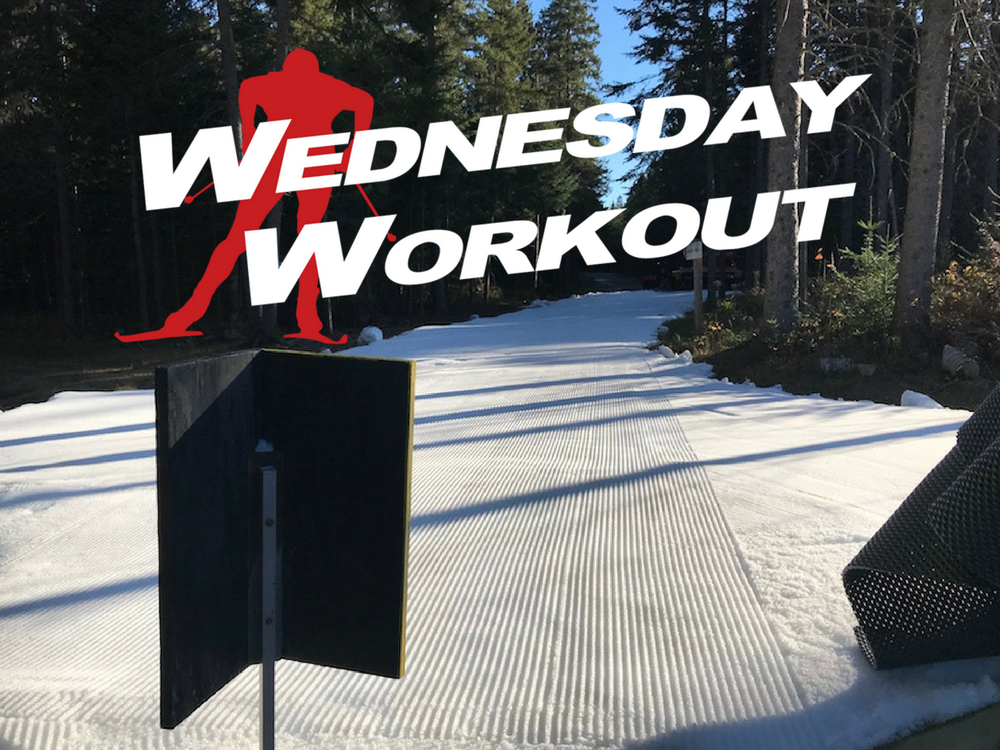
A look at Mount Van Hoevenberg’s freshly groomed, machine-made trail in late October during a U.S. Paralympics Nordic Program camp in Lake Placid, N.Y. (Photo: BethAnn Chamberlain)
It’s that time of year when everyone’s raring to get on snow. Let’s say you’re lucky enough to find some — even just a few hundred meters — like the U.S. Paralympics Nordic team did late last month at a training camp at Mount Van Hoevenberg in Lake Placid, N.Y.
Seven athletes — a combination of high-performance and development skiers — spent a week at Van Ho from Oct. 23-29 for the nordic center’s earliest opening yet on machine-made snow. Starting Oct. 1, the area’s SnowFactory blew enough snow for a 480-meter loop wide enough for two-way skiing. And it did so despite daytime temperatures hovering around 70 degrees Fahrenheit.
U.S. Paralympics Nordic’s 2017 Lake Placid camp attendees:
High-performance athletes:
– Jeremy Wagner
– Eric Fraizer
– Bryan Price
Development athletes:
– Julius Schram
– Chris Rassmusen
– Dave Nicholes
– William Ward
On top of that, Van Ho organizers constructed a two-point, 10-meter Para biathlon range, which was connected to the loop and gave the team’s biathletes a place to practice shooting.
But on Day 2 of camp, the rains came, putting a sizable dent in the skiable terrain. While Van Ho was rebuilding its loop for the end of the week, the Para skiers switched gears to dryland training, shooting and rollerskiing/mountain boarding at the venue’s full-size biathlon range and rollerskiing the paved loop at Lake Placid’s Olympic Jumping Complex — the latter of which is known for its challenging terrain.
“This was a first for us and proved to be a great training site for all of our sit skiers,” BethAnn Chamberlain, the US Biathlon Paralympics development coach who led the camp, explained in an email, referring to the jumping-complex trails. “Late in the week, despite the continued warm temperatures, the Mt Van Hoevenberg crew was able to put together a short strip of snow for us again, including giving us access to our Biathlon range area.”
What did they do to make the most of their on-snow time? Chamberlain shared an agility workout for “even the smallest stretch of snow.”
The Workout: Early season agility
What you need: At least 200 meters of snow, cones, and if possible, a corner on the track (cones can substitute if no corner is available)
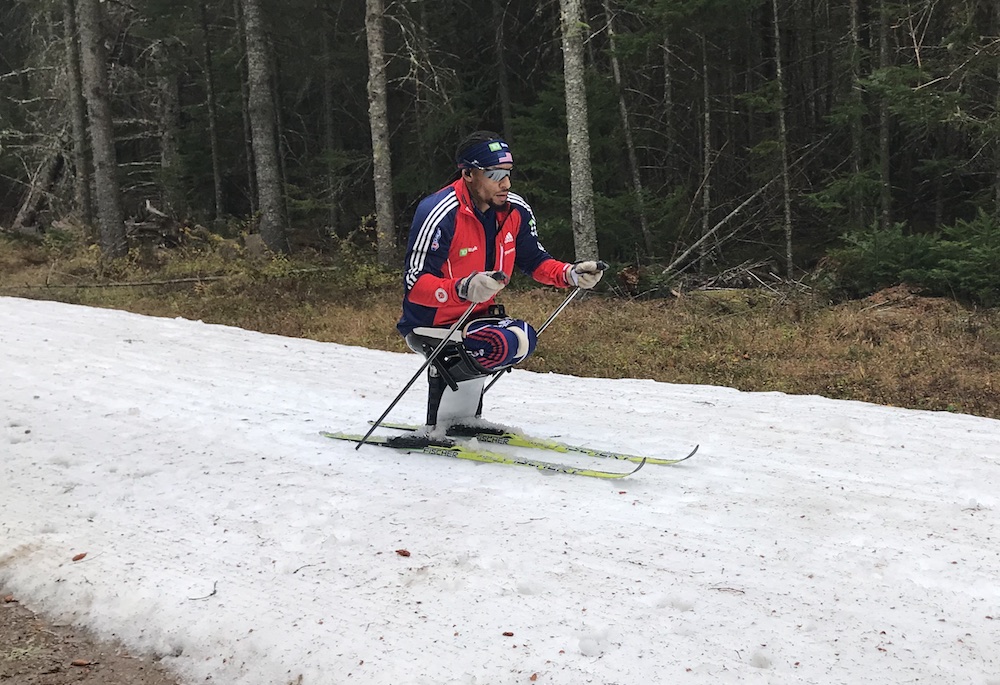
U.S. Paralympics Nordic high-performance athlete Bryan Price (Casper Mountain Biathlon Club) rounds a corner during an agility workout at a U.S. Paralympics on-snow camp in late October at Mount Van Hoevenberg in Lake Placid, N.Y. (Photo: Mt. Van Hoevenberg/Facebook)
What you should know: “The basic premise of this workout is to have the athletes ski corners and around cones at different speeds and by taking different lines, and doing so on their own as well as in groups,” Chamberlain explained. “This not only helps the skiers develop a better feel for how their sit ski responds to their movements around corners, but also opens up the idea of the near infinite approaches and techniques to get around a corner or to maneuver around other skiers on course. (It only take a few minutes of skiing in a sit ski to truly appreciate how difficult it is to maneuver and stay upright, and do so with speed in a sit ski. I highly recommend everyone, adaptive and non-adaptive skiers to give it a try.) This is a speed workout disguised as an agility workout.”
Setup: Using cones, construct two slalom courses for the athletes to race through, head to head.
Warmup: 20 minutes of easy skiing
The workout: (45 minutes to 1 hour total)
First, ski course at an easy speed and work up to a sprint speed.
Then, start the “races”, with two athletes racing at a given time, competing against each other on the parallel courses.
Throughout the session, change it up. “You can continue to run ‘races’ in this manner, change the position of the cones, to create different corners to practice on,” Chamberlain wrote. “You can then move onto 180-degree turns, long sweeping turns in both directions and every other kind of other turn you can think of. Athletes will ski these corners on their own as well as in groups or pairs at easy speeds to start and ramping up to race speed.”
“A continued change in the position of cones creates changes the turn they have to make and keeps the athletes engaged and challenged to practice different lines and approaches through out the workout,” she added. “Run these drills along with additional variations such as shuttle run ‘races’ & slalom style turn relays for 45 minutes to an hour.”
Cool down: 20-30 minutes Level 1 skiing.
“We had a great week of training in Lake Placid,” Chamberlain noted. “The folks at ORDA [New York State’s Olympic Regional Development Authority] and Mt Van Hoevenberg were amazing and worked very hard making snow for us, which we were able to use for skiing and for Biathlon training.”
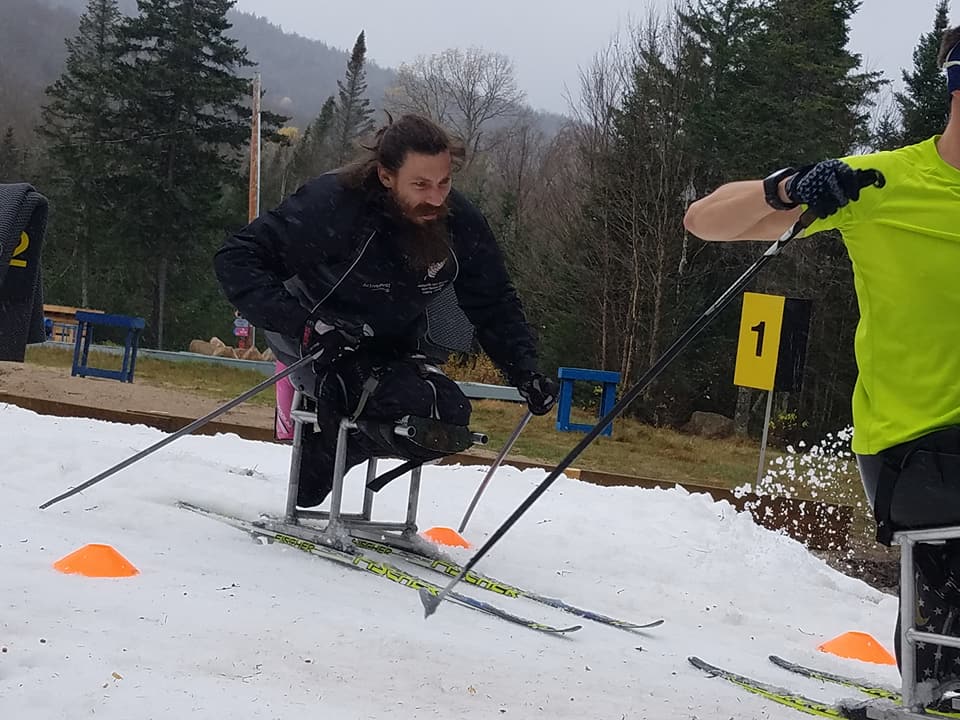
Jeremy Wagner (in black) chases Bryan Price, his U.S. Paralympics Nordic and fellow 2014 Paralympian, during an agility workout at a team training camp in late October at Mount Van Hoevenberg in Lake Placid, N.Y. (Photo: Mt. Van Hoevenberg/Facebook)
Kris Cheney Seymour, the nordic program and events manager at Mt. Van Ho and ORDA, which owns the venue, explained in an email that while the week was reminiscent of 2017 Junior Nationals (which were also forced to relocate to the jump-complex trails), it was certainly worth it.
“Hosting the U.S. Paralympic on-snow fall camp is a wonderful opportunity and provided a timeline that pushed boundaries to do something that is normally outside the realm of possibility,” Seymour wrote in an email. “The effort to pull this off was more about effective planning and management of the process. Of course the dedication of our staff to pull off all pieces was considerable, but everyone had a pieces and executed it well.
“We started with 480-meter-long stretch of snow, 2 feet deep and 16 feet wide,” he explained. “The SnowFactory snow was very durable to skier traffic. In the middle of the week we had a significant rain storm with high winds that compromised the loop and we had to rebuild for the end of the week. … It was a small flashback to the weather we dealt with last year at Junior Nationals.”
The nordic center is currently stockpiling snow from the SnowFactory in order to open to the public. Over the course of the winter, Van Ho has a stated goal of being open 150 days with skiable snow; last year, it was open 139 days thanks to the SnowFactory (as opposed to 39 days the year before without it).
“We have a SnowFactory because of unpredictable winter weather,” Seymour wrote. “… Without the SnowFactory this past season we would have lost the stadium and connector trails just under 40% of the days we were open. Our season would have been closer to 85 days if we only had natural snow. … As pioneers with the SnowFactory in North America we are still learning from the machine and perfecting our warm weather snow management. TechnoAlpin has been helpful in sharing how others have used the SnowFactory around the planet, but to some extent, all locations have their own challenges.”
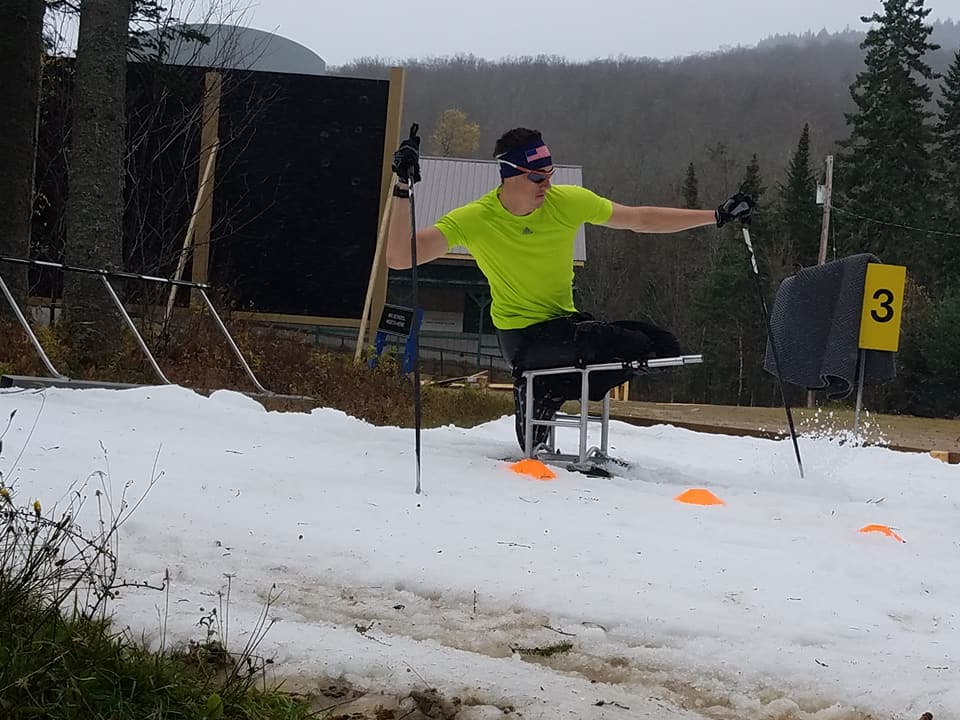
U.S. Paralympics high-performance athlete Eric Frazier training in late October on machine-made snow at Mount Van Hoevenberg in Lake Placid, N.Y. (Photo: BethAnn Chamberlain)
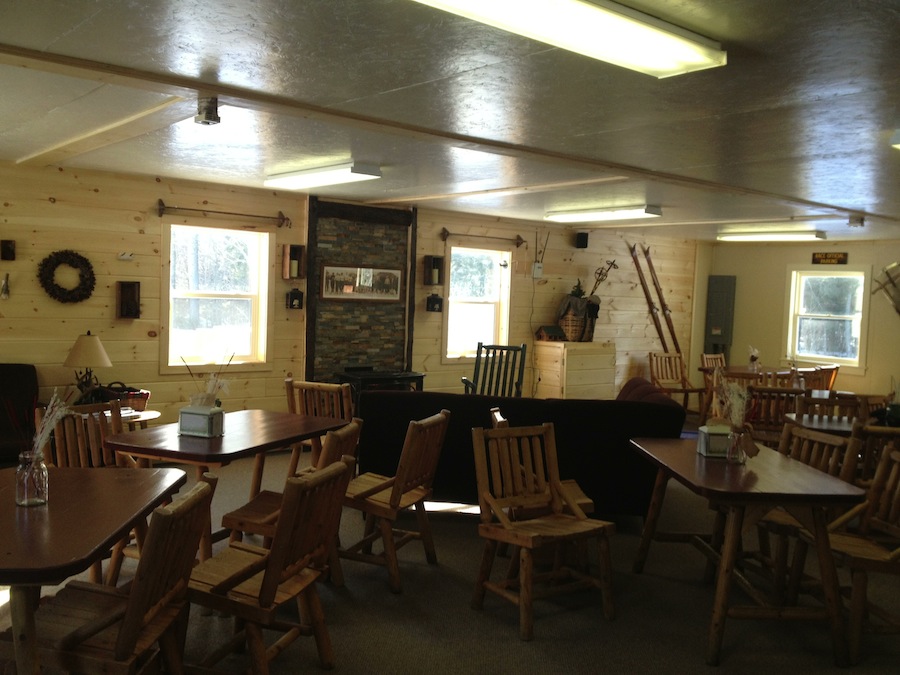
Part of Mt. Van Hoevenberg’s renovated lodge, as seen in January 2013, in Lake Placid, N.Y. A new bar area (not shown) was added in December 2013 and was still under construction on Dec. 21. According to ORDA program coordinator Rebecca Dayton: “We have also put in a small bar area with a plan to serve wine, beer and light snacks during the season.”
Editor’s Note: This is a follow-up article regarding the improvements New York’s Olympic Regional Development Authority (ORDA) has made to its Mt. Van Hoevenberg property, specifically its lodge, and what has yet to be planned. The first article, “Lake Placid: Mount Van Hoevenberg at the Crossroads,” originally appeared in April 2012.
***
LAKE PLACID, N.Y. — A picture of garaged machinery shouldn’t get a skier excited. But this was different.
Attached to a text message – “It’s here!” – was a photo of a brand new Pisten Bully 100, delivered to Mt. Van Hoevenberg in Lake Placid, N.Y., in November 2012. That was one of several improvements that came to Van Ho, the home of the 1980 Winter Olympics.
Known as “Van Ho,” the 50-plus-kilometer nordic area and nearby sliding track is operated by the Olympic Regional Development Authority (ORDA). After the 1980 Olympics, New York state created ORDA to manage all of its Olympic venues, including Lake Placid’s Olympic Center and speed-skating oval, the jumping complex, Olympic Training Center, and the alpine-ski areas, Whiteface, Belleayre and Gore.
To get the Pisten Bully out, Van Ho maintenance crews rebuilt some bridges to support the weight of the new groomer.
In the summer of 2012, ORDA also remodeled its cross-country lodge. On one side, walls were removed to create more usable space. Paneled with blond wood, the new space relieves crowding on busy days. Last but not least, if you’re a master blaster with a toddler in tow – there’s a new baby changing station in the men’s room. Equal rights have made it to Van Ho.
This past spring, ORDA Communications Manager Jon Lundin outlined some of the criteria for the authority’s annual planning. One doesn’t just cut a six-figure check for a snow cat. According to Lundin, ORDA assesses its needs during the winter and makes final plans in the spring.
“Purchase of grooming equipment depends on availability of snow cat and timing of funding,” Lundin wrote in an email. “[It] could take 8-10 months or could be quicker depending on both variables.”
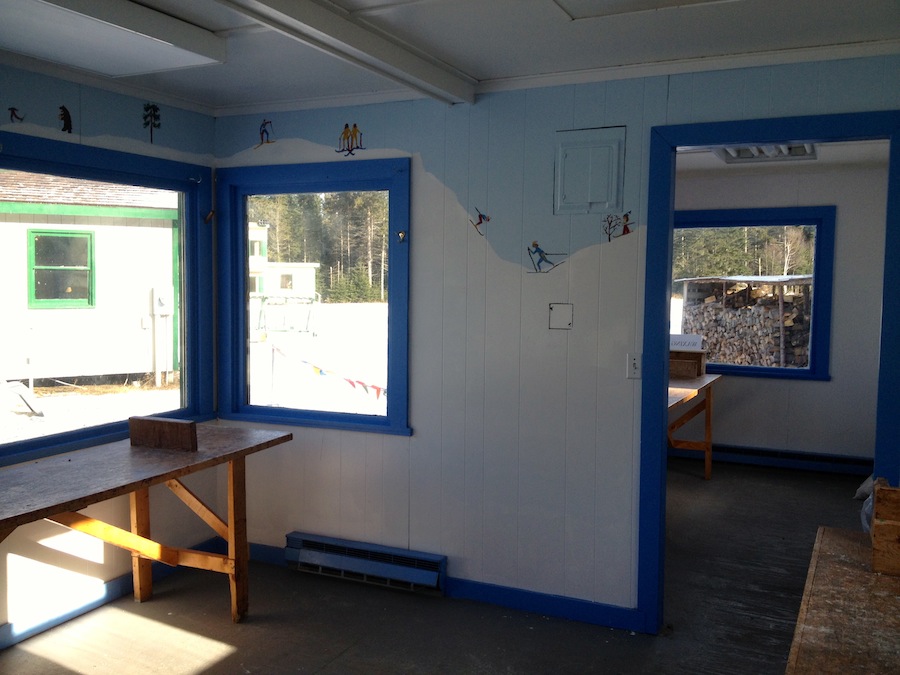
Interior of new wax room at Mt. Van Hoevenberg cross-country lodge.
Larger capital improvements have a longer timeline. For example, “[Alpine] ski lifts have to do with preliminary engineering, market variables such as number of lifts being installed in North America (availability of materials based on that) and funding,” Lundin wrote. “Eighteen months is a good and fair barometer” of the time it takes to put in a ski lift.
This year, ORDA made additional improvements to its cross-country lodge, expanding the lounge area into the former wax rooms for more public seating. The wax rooms are now in the New York Ski Educational Foundation (NYSEF) changing building behind the lodge, and the NYSEF team moved into the timing building, ORDA’s Olympic Sports Complex program coordinator Rebecca Dayton explained.
“More room and better flow for them as they are now in the same building as their wax facilities and more room and better ventilation for other skiers,” she wrote in an email.
As of Dec. 21, a small bar area was also under construction with the intent “to serve wine, beer and light snacks during the season,” Dayton added. Outside the lodge, trail homologation is complete with FIS certificates for six separate loops ranging from 1.4 to 7.5 km in length, she explained.
Laundry List of Long-Term Projects
While these are welcome improvements, more could be in store. But navigating the waters can be tricky.
Located in the Adirondack Park, most of Van Ho’s land is owned by the Department of Environmental Conservation (DEC), and ORDA operates Van Ho under an agreement with the DEC. It remains subject to Article XIV of New York’s Constitution, which mandates that Adirondack Park land shall be “forest preserve… forever…wild.”
The Adirondack Park Agency (APA) oversees land use in the park. According to the APA, Van Ho is designated as an “intensive use” area. Their State Land Master Plan specifies that Van Ho should be maintained as a “year-round sports facility meeting international standards for such sports as … cross country skiing on improved cross country ski trails under developed, competitive conditions.”
Under APA’s guidelines, ORDA and the DEC prepare a Unit Management Plan (UMP) outlining how Van Ho will be developed. There are dozens of UMPs for various public land parcels in the Adirondack and Catskills parks.
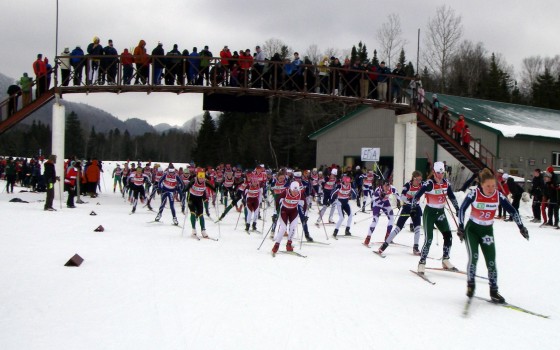
The women’s EISA field starts a race at Mount Van Hoevenberg in 2010. Leading are Ida Sargent (USST/Craftsbury) and Rosie Brennan (APU), then racing for Dartmouth College. Lake Placid is an important venue for developing racers.
Approved in 1999, Van Ho’s plan calls for, among other things, refurbishing and repurposing the biathlon lodge as a ski-tourism lodge. It includes building a new cross-country lodge “in a location with better drainage” than the site of the current lodge.
In a previous FasterSkier article, Greg Stratford, then-assistant manager of the Olympic Sports Complex, discussed the concept of replacing both the existing lodges with a single building on the site of the current cross-country lodge.
“One of the problems is that if we build a new stadium, it would need to be suitable for both cross-country and biathlon,” he said in April 2012. “Each of the different sports that use our facilities has their own specifications and requests and wants and needs. We need to get everybody together to determine what would be the best scenario for Mt Van Hoevenberg.”
Asked where the biathlon range might be sited for a single lodge, Lundin wrote, “Nothing contemplated.”
When asked whether a combined lodge to serve both Van Ho’s cross-country and accompanying sliding track was under consideration, he replied, “That concept has not been part of our planning process.” Dayton confirmed that there are no plans to build a new lodge currently in the works.
Environmental and Financial Challenges
The author’s daughter, Laurel Minde, 11, weathers rain and slush at the start of the Ladies’ 5K near the cross-country lodge at Mt. Van Hoevenberg on Dec. 21.
Whatever the future holds, if a new lodge was to be built at Van Ho, or snowmaking installed, it’s not as simple as drawing blueprints and soliciting bids from contractors.
Reviewing Article XIV case law, the UMP’s authors conclude that the improvements proposed for Van Ho “are consistent with the mandates of Article XIV.”
But a in a subsequent section, the UMP separates planned improvements into two categories: those that that don’t require an amendment to Article XIV and those that do.
Purchasing new grooming equipment, remodeling the biathlon lodge as a destination for recreation, and trail maintenance, for example, don’t require a constitutional amendment.
However, installing a new snowmaking system, building a new cross-country lodge “in a location with better drainage” than the current lodge, and rebuilding the tunnels under the access road – among other things – would require an amendment to Article XIV.
Would a new cross-country lodge, built on the site of the current one, require an Article XIV amendment? Dayton declined to comment. “That is outside my area of expertise,” she wrote.
What is it exactly about these improvements that would require a constitutional amendment?
“The proposals in the Van Ho UMP are compliant with the State Land Master Plan for Intensive Use,” APA spokesman Keith McKeever explained in an email, while adding, “With regards to the constitutional questions raised, APA does not make those determinations. That would be done by the Attorney General’s Office.”
The New York State Attorney General’s office declined to comment.
According to DEC spokesman David Winchell, ORDA would need to discuss proposed improvements with the DEC, which would decide whether a constitutional amendment would be necessary. The DEC “would determine whether the proposed action is acceptable” and would collaborate with ORDA “to determine whether an amendment should be pursued.”
Asked why ORDA hadn’t pushed for an amendment to Article XIV for Van Ho, Lundin wrote, “We have not pursued it at this time.”
The LA Group of Saratoga Springs, N.Y., conducted much of the environmental impact analysis for the plan. When asked what environmental road blocks there might be to improvements at Van Ho, director of environmental planning Dean Long declined to comment. “Our last work at the facility was in 1996,” Long wrote.
Resolving a possible Article XIV issue is only one challenge. ORDA would also have to find a way to pay for major improvements such as a snowmaking system. In addition Mt. Van Hoevenberg, ORDA has to budget for improvements at its other venues. Besides the Pisten Bully and an excavator for Van Ho, in its last fiscal year, ORDA renovated part of a Whiteface ski lift and purchased new snow cats for Whiteface and Gore.
Everything You Were Afraid to Ask in Civics Class
“You have conversations. There’s dialogue before a bill is introduced,” according to a person closely involved with the New York State Legislature.
Declining to be identified, the source explained that either ORDA or the DEC might approach a legislator to sponsor an amendment to Article XIV. The bill would pass through committee before being introduced to the entire legislature.
Hypothetically, any bill to amend Article XIV would have to be passed by two separate sessions of the N.Y. legislature. The legislature is up for election every two years. If a bill passes that hurdle, it would then be presented to the electorate as a referendum If an amendment to Article XIV was brought before the legislature, it would take about five years to pass.
The approach to amending the constitution is anything but casual. The source stressed that the legislature is “judicious in how frequently this is done.” Once an amendment makes it to the ballot, they do everything possible to ensure its success. It’s “critical to have environmental organizations on board,” he concluded.
The Future for Van Ho
Skiers warm up for the 2013 Lake Placid Loppet at Mt. Van Hoevenberg’s stadium in Lake Placid, N.Y.
Completed in 1999, Van Ho’s UMP was “proposed to be accomplished in five phases over the next five years.” It acknowledged that development could take longer.
In 2000, Van Ho’s 1980-vintage luge and bobsled tracks were replaced with one spectacular state-of-the-art sliding track. New York kicked in $13.5 million of the $20-million dollar cost, with the federal government covering the balance. The new track didn’t require an Article XIV amendment. The sliding track was a major piece in Van Ho’s UMP.
The Whiteface Memorial Highway illustrates the challenges facing Van Ho. If you’ve raced the Climb to the Castle, you’ve experienced this road’s frost heaves, bumps and sections of cracked pavement that can break poles and upend skiers.
Like Van Ho, the highway is located on DEC-owned land and managed by ORDA. The highway signs are property of the New York Department of Transportation. None of these bodies has the budget for repaving the highway. For over 40 years, the road didn’t see a major repaving project and deteriorated over time. Only recently, New York Governor Andrew Cuomo announced that he would appropriate $12 million dollars to repave the highway and refurbish the summit castle and toll house.
Over the last two years, ORDA has made significant changes at Van Ho. But some of the biggest projects in the UMP require significant expenditure and effort. Determining whether a constitutional amendment is necessary is only one challenge. Financing the improvements is another.