From the FasterSkier archive — posts syndicated from athletes’ and coaches’ own blogs between 2004 and 2012, kept online as published. Current coverage is at fasterskier.com.
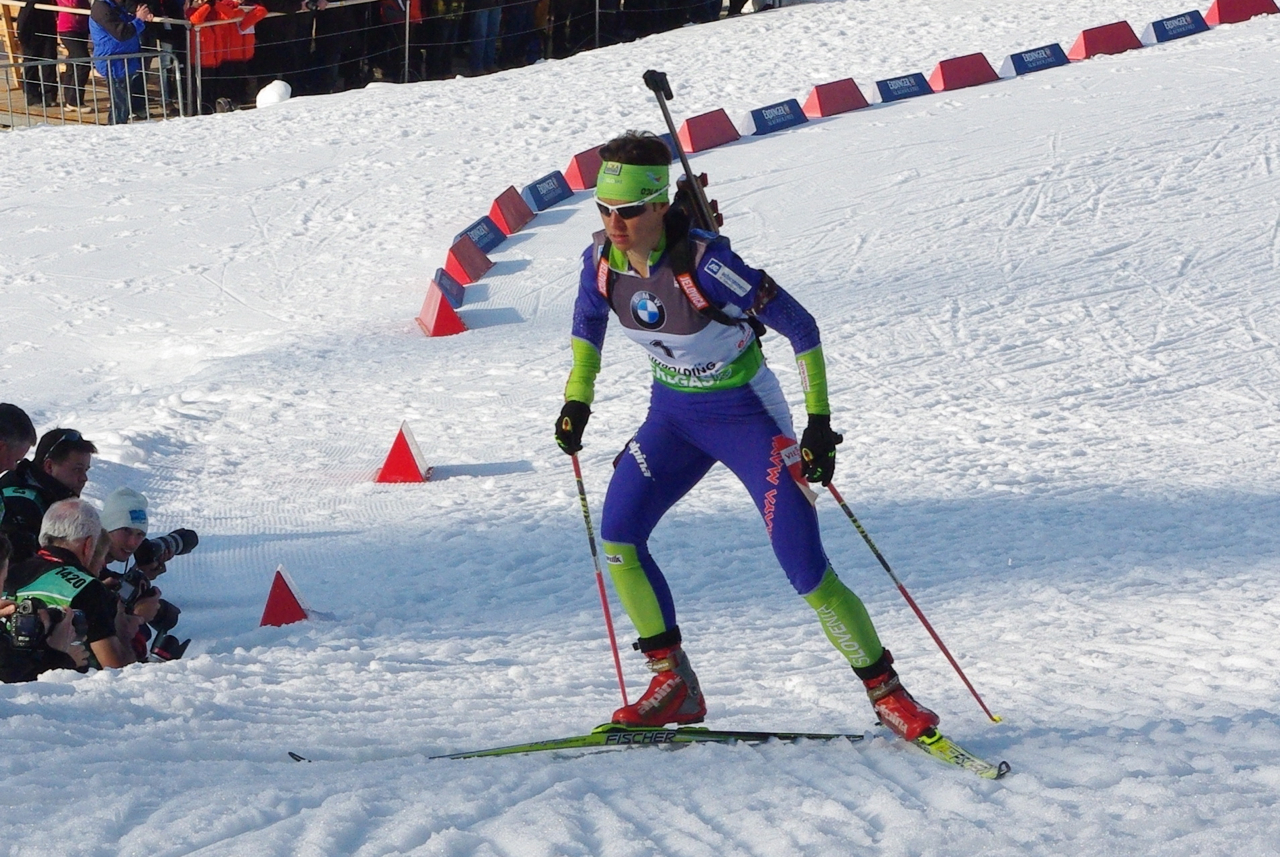
Teja Gregorin of Slovenia racing at 2012 World Championships in Ruhpolding, Germany.
The International Olympic Committee (IOC) recently finished re-testing stored urine samples from the 2010 Olympics in Vancouver, Canada. The goal was to use new analytical methods to detect substances which were not detectable back in 2010.
Of the more than 1,000 samples re-analyzed, only those belonging to a single athlete were found to be positive for prohibited substances, the IOC announced earlier this month.
That athlete is now revealed to be Slovenia’s Teja Gregorin, a biathlete who finished fifth in the mass start in Vancouver. Reportedly, three different samples belonging to Gregorin tested positive, all for Growth Hormone Releasing Factor-2 (GHRP-2), a growth hormone releasing peptide. Gregorin has been provisionally suspended by the International Biathlon Union while her case proceeds.
“I accept temporary suspension,” Gregorin said in a press conference organized by the Slovenian ski federation, according to a translation. “I will participate in the follow-up proceedings, but I ask for understanding because the World Anti-Doping Code prohibits public comments on ongoing cases. I sincerely apologize to all who have been affected my actions in any way.”
Gregorin read from a prepared statement and did not take questions from the press.
This entire class of substances were banned by the 2010 WADA Prohibited List in section S2, which bans “The following substances and their releasing factors” before listing growth hormones. This was later clarified; the 2017 Prohibited List explicitly lists GHRP’s, prohibiting “Growth Hormone (GH) and its releasing factors including… GH-Releasing Peptides (GHRPs), e.g. alexamorelin, GHRP-6, hexarelin, and pralmorelin (GHRP-2).”
GHRP’s are not the same as human growth hormone (hGH), a widely discussed treatment in professional sports and one for which Estonian cross-country skier Andrus Veerpalu tested positive.
Instead, these peptides spurs the body’s own production of growth hormone. As such, they improves health, recovery, the immune system, and anti-aging. GHRP-2 is a synthetic drug used to treat growth hormone deficiency. In a doping context, it is known to help maintain a lower level of body fat.
Gregorin finished ninth in both the sprint and pursuit in Vancouver.
Four years later in Sochi, she earned bronze in the pursuit at the 2014 Olympics with a determined and gutsy long sprint finish. She also placed fourth in the mass start there.
A team veteran, Gregorin also competed in the 2006 Olympics. She won silver in the 15 k individual at 2009 World Championships and later contributed to a silver-medal mixed relay effort for Slovenia at 2012 World Championships along with Andreja Mali, Klemen Bauer, and Jakov Fak.
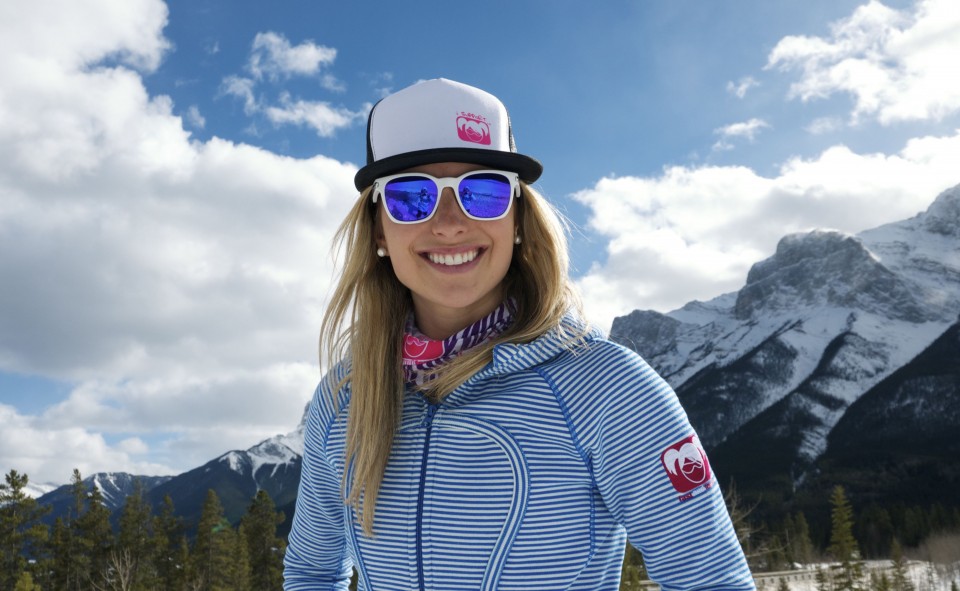
Fast and Female founder/president Chandra Crawford retired from competitive-nordic racing this spring after 14 years in the sport (and five more in biathlon). She was recently accepted into the University of Calgary’s business school. (Photo: Chandra Crawford/chandracrawford.com)
Chandra Crawford knows a thing or two about headspace, and as she smiled at the program director for the University of Calgary’s Executive MBA (Master of Business Administration) program as the they reviewed admission requirements, the director told her she’s never met anyone so excited to take the GMAT (Graduated Management Admission Test).
Born and raised in nearby Canmore, Alberta, Crawford, now 30, finished high school 14 years ago and catapulted into competitive nordic racing. Before that as a junior, she had been a biathlete for five years, but by age 22, she was known on the world scope as one of the most promising cross-country sprinters — a surprise gold medalist in the skate sprint at the 2006 Torino Olympics.
Crawford celebrating her gold medal in the freestyle sprint at the 2006 Olympic Winter Games in Turin, Italy.
That moment changed her life forever, defining her career and who she was as a skier.
Crawford put off education in pursuit of loftier goals in skiing — but after a gold medal, where does one go from there? She went on to win her first World Cup gold in Canmore in 2008 and repeated the feat two months later at a World Cup sprint in Lahti, Finland. She competed at two more Olympics in Vancouver in 2010 and most recently in Sochi, Russia.
In her blog, Crawford recalled her former teammates and Canada’s gold and silver medalists, Beckie Scott and Sara Renner, saying it would take “ten years to get good.” That kind of commitment is was kept Crawford onboard through the Sochi Games, after she opted to train apart from the national team last spring and spent much of last season playing catchup.
Gold medals six years ago weren’t enough to secure her international starts this past season without first proving herself, and Crawford went through the process just as any Canadian not on the World Cup Team would — by giving it all she had at trials. In January at the Canadian Olympic trials in Canmore, Crawford won the freestyle sprint to earn her trip to Sochi. She had previously raced two World Cup sprints in December in Davos, Switzerland, and Asiago, Italy, placing 43rd and 45th, respectively.
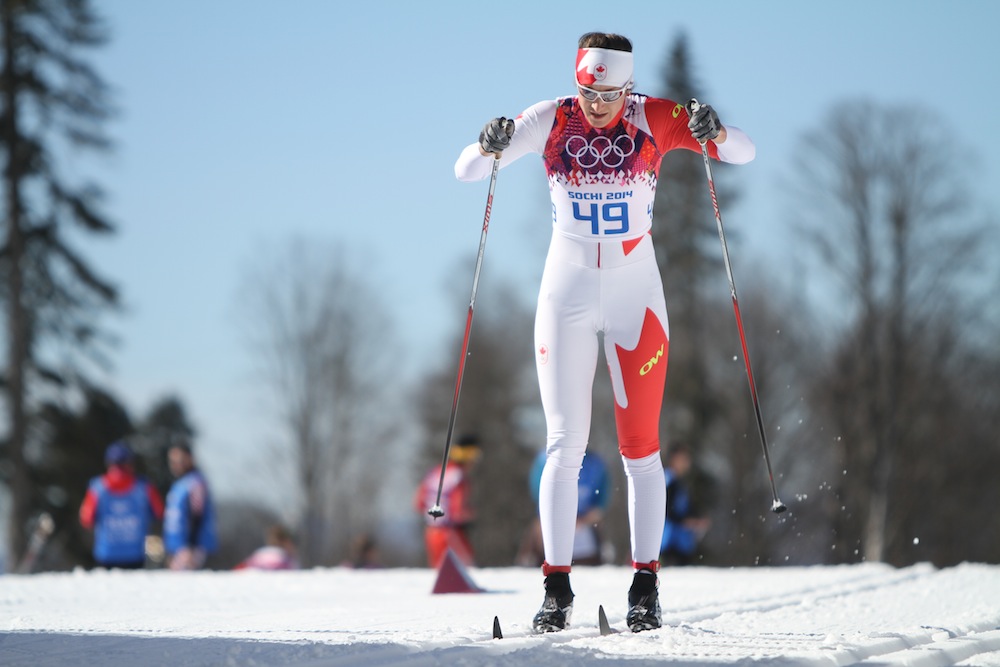
Back on the World Cup in February in Toblach, Italy, she finished 34th in the freestyle sprint, just shy of the top 30 needed to make the sprint rounds. Crawford went on to race one event at the Olympics — the skate sprint — where she placed 44th.
“Looking back on it now, it seems like things never really came around physically,” she said on the phone from Canmore in late April. “How much I had burned out from my tough years — I didn’t really have the time to recover from it.”
Two seasons ago in February 2013, Crawford had put racing on hold after the pre-Olympic World Cup in Sochi — flying home to Canmore to recover before her last season-long Olympic push. She didn’t race again that 2012/2013 season, and resumed training last spring as a member of the newly formed Team Ninja, a band of four independent female racers in Canmore.
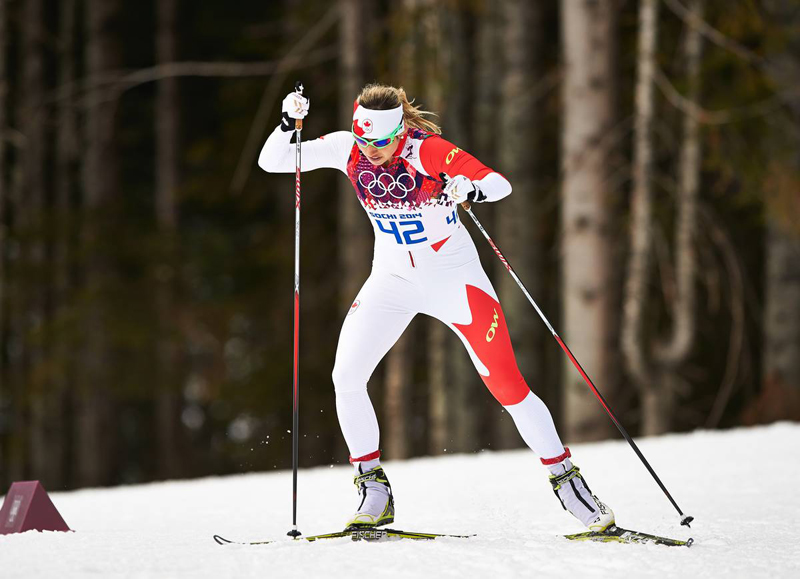
Crawford in what would be the final race of her career, the Sochi Olympics freestyle sprint qualifier, in which she placed 44th. (Photo: Fischer/Nordic Focus)
While she had always hoped for a comeback story, it didn’t come to fruition. Her energy levels went through highs and lows, something she attributed to thyroid and iron issues, which she explained as a direct result of overtraining.
“It’s not bad luck, it’s just what happens,” she said of her underactive thyroid, which doctors discovered last fall. “Your endocrine system just gets blown out.
“The energy was different at different points throughout the normal training and racing year, but I never really got going fast,” she explained. “I was always working hard, but I was never really [skiing] hard. I was maximizing other aspects, like am I doing everything I can technically? … I always came out that I’m going 10 out of 10 on the process. This normally works.”
Come spring, she was about ready to be finished altogether.
“I was on the fence if I would continue through Sochi or not,” Crawford said. “I redefined success into my own terms. That’s what enabled me to carry on and ski through Sochi. It was a great feeling, like the feeling you get from the last rep and last international race of a career — everything leading up to it was my last taper or my last World Cup…”
Crawford was optimistic at the Olympics, and she enjoyed what turned out to be the final race of her career while back with the national team.
“This year was amazing,” she said. “The less I needed from the team, the more I enjoyed it.”
“It was a great feeling, like the feeling you get from the last rep and last international race of a career — everything leading up to it was my last taper or my last World Cup…” — Chandra Crawford, on ending her racing career with the Sochi Olympics
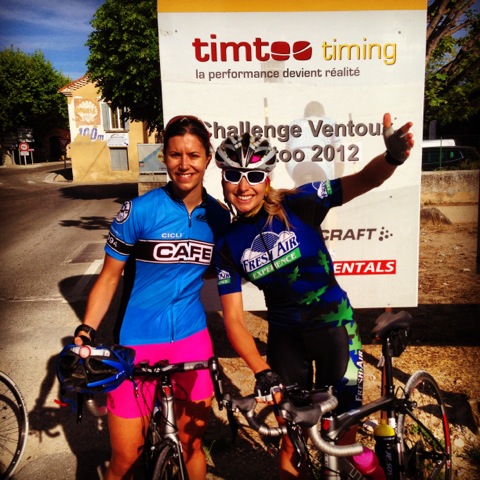
Rosanna (l) and Chandra Crawford on one of their bike outings during the Gold Medal Plates trip last month in Provence, France. (Photo: Rosanna Crawford)
Crawford spent the rest of the Olympics cheering on her younger sister, Rosanna, a Canadian biathlete in her second Olympics. There, Rosanna posted her Olympic best of 25th in the 7.5-kilometre sprint.
“Chandra has been one of the major factors in my career, watching her get her gold medal when I was 18 really helped motivate me to strive for the Olympics,” Rosanna, 25, wrote in an email. “It was always a dream of mine to go but once I saw her go and win it made me realize that if she can then I could too! She has always been my biggest fan and always rooting for me.”
The sisters recently spent two weeks wining, dining and biking in Provence, France, with Gold Medal Plates (GMP). The foundation auctions exotic destinations as a fundraiser for Own The Podium and to support “Canadian Excellence in cuisine, wine, the arts and athletic achievement,” according to its website. This marked the Crawford sisters’ second-straight trip overseas with GMP; last year they visited Tuscany, Italy. Chandra was on year No. 6 with the program.
“I feel so lucky to have such an awesome sister that’s taught me it’s ok to be strong and powerful and to follow your dreams,” Rosanna added. “Her work with Fast and Female has also motivated me to be a good role model and know that there are always people looking up to you.”
Nearly nine years ago, Crawford founded Fast and Female, a series of sports-based events designed to empower females ages 9 to 19, with the help of her teammates on the Canadian National Team in 2005. The concept took off and spread throughout the nation by 2007, at which point the program became a registered-nonprofit corporation with a board of directors. Crawford became president, overseeing the nonprofit’s mission and vision while focusing on her job as an athlete — which Fast and Female championed front and center.
It wasn’t long before the series caught on the U.S. and other countries overseas. According to Crawford, Fast and Female had 105 ambassadors in 24 sports as of April, and was on track for a record-smashing 3,000 participants this year.
“Fast and Female really took itself internationally,” she said, pointing out events in Sweden and Norway this past winter, and a presence in Australia. “We’re running with a lot of volunteer-based energy. We’re a really small team based here in Canada with how big we are.”
Looking forward, she’s like to make the series “more profound,” extending beyond sport experience to working together to “create solutions in the environment,” she said. “I just can’t say enough about the American program and how I learned from everything Kikkan [Randall] and [U.S. women’s coach] Matt Whitcomb and the American team create.”
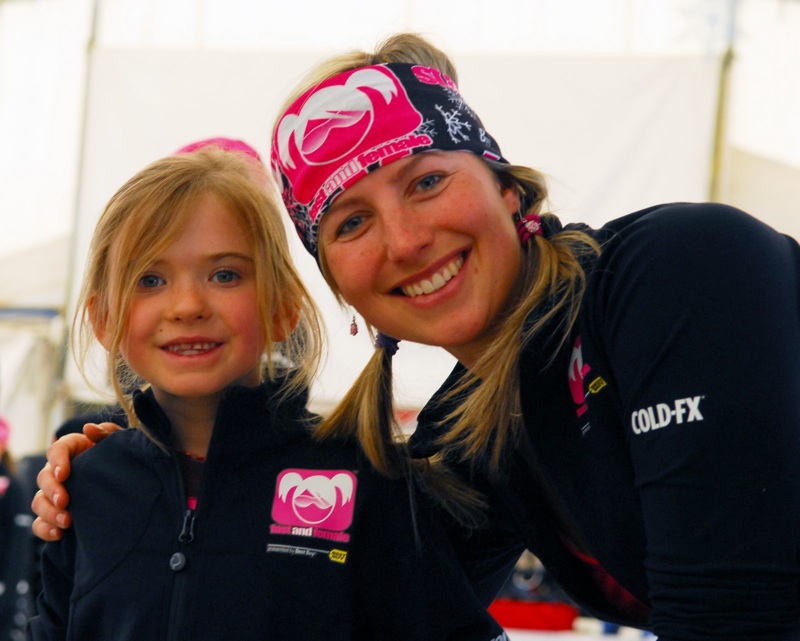
Chandra Crawford during a Fast and Female event in 2009.
Fast and Female celebrates its nine-year anniversary in November. While Crawford will remain president/founder, she’s going to spend the next two years learning how to be a better business leader and generate more revenue for her program moving forward.
That’s right, Crawford go into Calgary’s Haskayne School of Business, scoring a 540 on the GMAT “with about 25 hours studying math and by being a positive game-day performer,” she wrote in an email.
“It was so fun to wake up on test day with the exact feeling of a race morning: ‘Today is the day I get to do the thing I prepared for!’ she recalled. “ ‘Right on!’ ”
In addition to a score of at least 500, she needed 10 years of work experience to get in (without a university degree). Everything she learned with Fast and Female — from brand marketing to relationships — qualified, she explained.
“It’s going to be extremely challenging to do two years of business school, but I’m ready to get growing way out of my comfort zone and am at a great time in my life to invest in my skills through education,” she added.
“It was so fun to wake up on test day with the exact feeling of a race morning: ‘Today is the day I get to do the thing I prepared for! Right on!’ ”
Her goals with the program include becoming a better leader for Fast and Female and a more-effective motivational speaker for business groups, all while staying open to possibilities “because at least half of the amazing things in anyone’s life could not have been predicted,” she said.
“It’s great to see Chandra so excited about this next phase of her life,” her father, Glen Crawford, wrote in an email. “I think I can speak for both Louise & myself when I say, as a parent, our biggest priority was giving our 3 children the opportunity to experience many things. We started doing that really early on. I think it was a good move because it seems that with kids, by the age of about 5 or 6, they already know what they like and what they don’t like.”
The key was choosing activities they had fun with at an earlier age.
“The other thing that was key was raising our kids in Canmore,” Glen added. “I think Chandra & Rosanna are testament to the fact that if you build facilities, you will train Olympians. Without the ’88 Olympics and the Canmore Nordic Centre, I’m sure our girls would have still gone on to do great things, but it probably wouldn’t have been Nordic ski racing.”
The owner of his own media-production business, Glen made the following video for Chandra’s retirement party last month, which highlights some of the great moments he shared with her as a cameraman at many of her races.
Dasha Gaiazova of the Canadian World Cup Team racing to 44th in the 10 k classic individual start at the 2014 Olympics in Sochi, Russia. After 10 years of World Cup competition and two Olympics, Gaiazova recently decided to retire.
Two-Time Olympic Cross-Country Skier Daria Gaiazova Calls it a Career
—World Cup medallist to retire after back-to-back home Olympics—
CANMORE, Alberta — It turns out Daria Gaiazova took her final international cross-country ski race where her career all began – in her native Russia at the 2014 Olympic Winter Games.
The dual citizen, who along with teammate Ivan Babikov had the rare opportunity to race back-to-back home Games in Canada and Russia, has decided to call it a career. The 30 year old, of Banff, Alta., raced 10 years on the World Cup circuit where she captured two bronze medals.
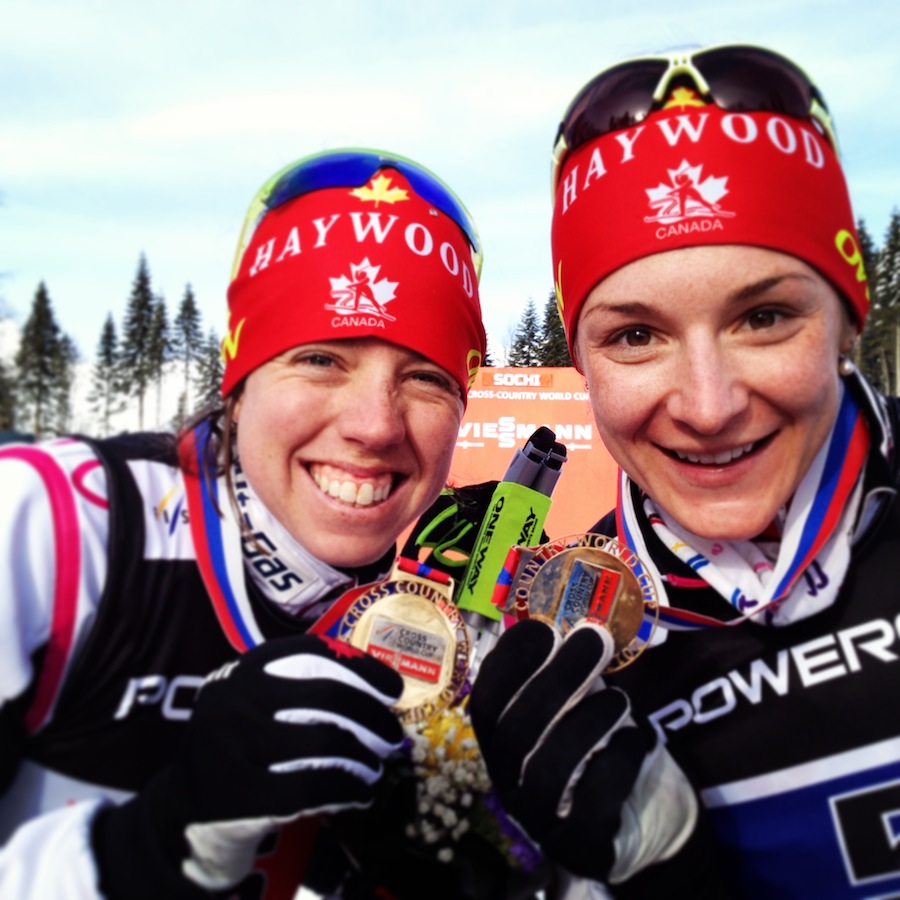
Canadians Dasha Gaiazova (r) and Perianne Jones celebrate bronze in the Sochi pre-Olympics World Cup classic team sprint in 2013. (Photo: Chandra Crawford)
“I thought I had a little more left in the tank, but having some good discussion with my dad while on a bike trip in Scotland, I realized the time is right to leave the competitive side of sport,” said Gaiazova. “Truly I can’t think of a better way to go out. To have a rare opportunity to race two Olympic Games in my home countries.”
The top-ranked female skier over the last four years in Canada, Gaiazova twice climbed onto the podium in team sprint races. Her first medal came with Chandra Crawford in Dusseldorf, Germany, in 2010. She then teamed up with Perianne Jones to win another bronze medal at the Olympic test event in Sochi one year out from the Games. Her best individual World Cup finish came in a classic-sprint race in Liberec, Czech Republic in 2013 where she placed fourth.
“As much as I’d love to race competitively forever, there comes a time when the body says it is time to go,” said Gaiazova. After 10 years of intense training, and living out of a suitcase while competing around the world, Gaiazova is thinking of settling down in Alberta’s Bow Valley Corridor in search of the next opportunity life presents her.
“The last four years have been nothing short of a grind, and right now I want to take some time this summer and research what I want to do next,” said Gaiazova. “I know one thing for sure is I still want to be involved in sport at some capacity. I love giving back and inspiring our country’s next generation of Olympic and Paralympic athletes. I will take some time and do something that I love.
“I will miss the countless hours of training alongside the girls and all of my teammates. My team and I have been through a lot in all corners of the planet. I will miss all of the great coaches that have pushed me to be my best, but I will take the precious memories that I have accumulated to the next stage in life. I can’t thank every one enough in the Nordic community for your incredible support. It has been an exciting ride.”
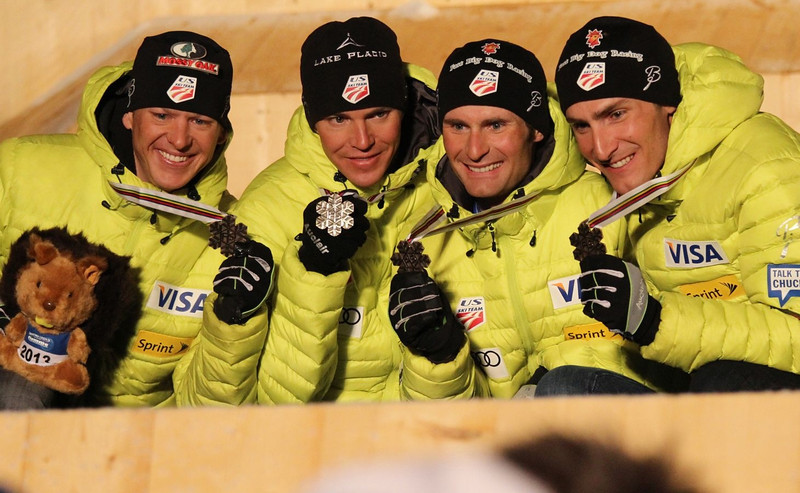
Billy Demong (second from l) with U.S. Nordic Combined teammates Todd Lodwick (l), Bryan Fletcher and Taylor Fletcher (r) after taking bronze at 2013 Nordic Combined World Championships in Val di Fiemme, Italy. (Photo: Fiemme2013)
Billy Demong’s in for a big weekend. A short detour to his old stomping grounds in Lake Placid, N.Y., for the US Ski Jumping and Nordic Combined Championships this weekend will be followed by a Monday morning flight to Europe for his team’s final overseas training camp in Austria and Germany.
On Sunday, he’ll shoot for his first national title in Lake Placid (the championships alternate between there and Park City, Utah where Demong and most of the U.S. Nordic Combined Team are based now). Raised in Vermontville about 20 miles away from Lake Placid, the Olympic gold-and-silver medalist and eight-time national champion has some fond memories of Placid and a little unfinished business.
But he’s not too stressed about it. For the better part of this fall, his life’s been much of a whirlwind. Late last month, a two-day trip to Chicago for one of his newest and biggest sponsors, USG, led him to Colorado Springs the next day to meet more members of the construction corporation. One day later, Demong was back home in Park City for an all-day U.S. Olympic Committee media summit and photo shoot, then hopped on a plane that night for Los Angeles. His 9:30 p.m. departure was delayed to 11, and Demong arrived in L.A. at 1 a.m.
The next morning, he woke up at 6. He was supposed to do intervals before another jam-packed day of non-skiing business.
“I said, ‘I’m not going to make it,’ ” Demong recalled in a recent phone interview. So he skipped the workout.
Some athletes would look at a schedule like that and think, what a pain, but not Demong. Just over a week ago, he had an interview with Men’s Health scheduled and NBC was coming to his house for five or six hours the same day.
“They want the family here, too,” Demong said, which meant his wife, Katie, and 2 ½-year-old Liam. “They want breakfast with the Demongs.”
They also planned to film while he trained.
“It’s part of the job,” Demong, 33, said. “I feel like we owe it to nordic skiers in particular to take advantage of these opportunities. It’s all well and good to be a champion; you can win a race, but if you don’t appeal to the public, then it doesn’t help grow the sport outside of the normal beat.”
Billy Demong became the first American to win gold in a nordic event at the 2010 Olympics. Without as much pressure for the 2014 Games in Sochi, Russia, he’s hoping to close his career on another high note.
Ever since the 2010 Olympics in Vancouver, B.C., where Demong became the first American nordic skier to win gold and also captured silver in the team event, he’s noticed a trend. U.S. Nordic Combined’s success in Vancouver was unprecedented and with that came recognition. But over the years, memories fade.
Four years later, Demong said most people don’t recognize him outside his community or out of context anymore. But some, like the man who recently picked him up at the airport, remembered Demong as “that skier.”
“We’re not so famous that we get recognized by face, but people are starting to think about our success,” he said. “We have a lot more darts to throw at the board.”
By darts, Demong meant talent across nordic sports: athletes like Kikkan Randall, the defending cross-country World Cup sprint champion who captured a historic gold with teammate Jessie Diggins at 2013 World Championships; and fellow Lake Placid-area native, Tim Burke, a U.S. biathlete who notched a career-best silver at World Championships last winter.
“Over the last few years, we’ve gotten a lot more opportunities to be in the public eye outside of skiing,” Demong explained. “Now with the success that we can have in the Games, we can build our brand and nordic.”
So with the pressure on, so to speak, how does Demong manage it with all those camera crews around and a family at home?
“I feel pressure, but it doesn’t feel the same,” Demong said. “Going into Vancouver and for my entire career, I always felt like we were trying to break down barriers and really do something outside the box. This time around, we know we can do it. We’ve all been on the podium.”
Every member of U.S. Nordic Combined’s premier squad – Demong, Todd Lodwick, Bryan Fletcher, and Taylor Fletcher – has stood on the podium at World Championships and individually on the World Cup. Last year, the team tallied its first-ever World Cup relay podium and went on to take bronze in the same four-man event at World Championships.
“I’m not worried about not winning a medal,” Demong said. “The best part I feel is the potential to do what we did all over again. I’m not trying to top Vancouver. My personal pressure is more healthy.”
That was in stark contrast to the sentiment surrounding the last Olympics. Looking at the relative age and potential of the team at the time, many of its athletes figured it was then or never.
“I was like, ‘If we don’t get this done, we might never get a medal,’ ” Demong recalled.
After the Games, he considered retiring. Two weeks after winning two medals and proposing to his wife, Demong asked head coach Dave Jarrett what he thought he should do. “Am I going to quit skiing? Because I’d be OK with it,” Demong remembered saying.
Jarrett gave him the option of flexibility, so Demong built a house, got married and had a child. With a more-relaxed training plan, he made it to the 2011 World Championships in Oslo, Norway, where he placed sixth and seventh individually, and fourth with his team. Demong spent the following two seasons gradually gearing up for his fifth Olympics.
He went about doing so systematically, knowing that things like playtime in the park with Liam would take up some valuable training time. Fortunately, he discovered that was helpful.
“It’s a healthy distraction,” Demong said. “I have to be able to compartmentalize my time. I’ll get out the door and run for five or six hours if I have to. It makes you enjoy the sections of your day more.”
On work outings, like his recent whirlwind trip from the Midwest, West Coast and back, he follows a similar strategy. He took advantage of sea-level training in Chicago with a 10-mile run along Lake Michigan. Before flying out of Colorado a day later, he woke up early to get another run in.
“You just have to get more disciplined,” Demong said. “This is where I’ve come from, this is where I’m going, and this is what I have to do to get through the next week.”
An attitude like that gives him confidence heading into the 2014 Sochi Games, an Olympics that will likely be his last.
“I’m planning on retiring,” he said, adding, “I planned on retiring after Vancouver. … I look forward to the Birkebeiner and maybe go on vacation skiing. Anything’s possible, but I’m not betting my life that I’ll be done, but that’s my plan. There’s a lot of motivation for me to do well this year.”
As it is, he plans to leave Sochi at the end of February and head straight home to Park City. If all goes according to plan, Demong figured he’ll have nothing left for the end of the season.
“If you really attain a good physical peak you can really plan on quitting the season within a month after the peak,” he said. “It’s a goal of mine as much to get a medal is to peak at the same time.”
“I look forward to the Birkebeiner and maybe go on vacation skiing. Anything’s possible, but I’m not betting my life that I’ll be done, but that’s my plan. There’s a lot of motivation for me to do well this year.”
His method of achieving that maximum performance on cue has been tried and tested since his high-school running days. At the National Sports Academy in Lake Placid, Demong learned that athletes with a good coach and solid training plan were more likely to win big events. When his former teammate, Dave Jarrett became one of his coaches in 2002, the two started refining Demong’s long-term regimen.
According to Demong, Jarrett’s fresh perspective paired with a degree in exercise physiology, something no other U.S. Nordic Combined coach had at the time, was key.
“In 2007, which was my first World Championships medal I remember playing a lot on the treadmill and playing around with different [lengths of] rest periods,” Demong said. “Now it’s a recipe to follow because I had good success with it in 2007, 2008, 2009, 2010, 2011, 2013.”
He said it feels weird to say, but he doesn’t worry at all about his training. In January, Demong and his team will return to the U.S. for some fine-tuning before the Olympics. They won’t compete in the weeks before, yet Demong knows he’ll be “a minute and a half faster” when he gets to the Olympics.
That lack of complete trust in one’s plan limits a lot of endurance athletes from reaching their ultimate peak, he said.
With one last Games on the horizon, Demong’s looking forward to seeing several members of his family in Russia: his mom and stepfather, his sister and her boyfriend, Katie and Liam, who will be 3 in January. He’s hoping Sochi could be one of Liam’s first memories, and it could very well be – the toddler remembered what he carved for a pumpkin last year: Elmo.
Demong soaks up victory atop the podium at the 2010 Olympics in Vancouver, B.C.
Looking back over the last four years, Demong said the 2010 Olympics feel like yesterday.
“I think I did a good execution of my plan: ‘I’m going to keep skiing, but I’m going to be able to back off so that I’m charging in 2014,’ ” he said. “Certainly my concentration and focus has begun to draw a narrow point again. … I feel like I’m at a good stable platform and something that I can raise in preparation for the Games.”
Earlier this month, Demong had one of his best jumping results of the summer in a team competition in Park City. He won the jump ahead of Bryan and Taylor Fletcher, respectively, then Taylor came back in the rollerski to beat Demong by about 15 seconds.
“Yeah, it sucks to get beat, but for me, the jumping has been the struggling point the last year or two,” Demong said.
At this point in his career, that’s where he needs to excel, he added.
“Last year I didn’t have an exceptionally fast season overall, but I was able to have the fastest time in a couple World Championships races,” he said. “We’ve got probably the fastest guys in the sport and a couple guys that can be the best jumpers. I’m really satisfied with our progress this summer in jumping and overall.”
He attributed the team’s improvements to new jumping coach Marc Nölke, an Olympic ski jumper who coached the German and Austrian national teams. Demong also recognized the contributions of former coach Chris Gilbertson.
“Gilbo was a great coach and we had some awesome years,” he said. “It’s like a lot of different sports where you need a fresh perspective. … I’ve been in this for so long that it can be even cyclical; I had Chris Gilbertson in the late ’90s and he came back in my career in 2009. It’s not necessarily that anything’s broken.”
In Demong’s case, tweaking his jumping equipment in the spring, going back to fundamentals and feeling safe on the hill helped him rebuild confidence and ultimately improve.
“[With] ski jumping, you feel like you’re getting better, but there’s usually baby steps,” he said. “It’s easier to feel the change before you see it. Then there’s usually an epiphany; instead of going a couple meters farther, you go twenty meters farther. You can’t be worrying about your in-run position on the way down … you have to be in the moment that you’re in.”
Lucky for Demong, he’s there, and on Sunday, he’ll strive for another national title. After that, he’ll be recognized as Aquaman in Austria and Germany. In the second year of an ongoing bet between Demong and Taylor Fletcher, Demong lost the battle for the fastest accumulated time over the last World Cup season. Last year, Fletcher had to wear a Captain America suit at all times around Europe; this year, Demong’s going to be Aquaman based on the results of an NBC Facebook poll (the other choices were astronaut and cowboy).
“I already bought the costume and shipped it,” Demong said before the results were in. But he won’t be sporting it in Lake Placid, like Fletcher suggested.
“I might sport it for fun, but I thought that it was weird to be able to trade days [instead of wearing it the whole time in Europe,]” Demong said. “He’s already paid his price. … I’m pretty jealous with his costume.”
***
2014 U.S. Nordic Combined Championships schedule
Olympic Jumping Complex, Lake Placid, N.Y.
Sunday, Oct. 13
9:30 a.m. trial round
11 a.m. U.S. Ski Jumping Championships (1st and 2nd round)
3 p.m. U.S. Nordic Combined Championships 10 k rollerski
4 p.m. Olympic sendoff, celebration and awards ceremony
Sarah Hendrickson taking flight during a summer competition in 2011. Photo: Dan Campbell.
When talking about women’s ski jumping in 2012, it’s impossible not to frame the discussion within the context of the sport’s long fight to be recognized as an event worthy of inclusion at the Olympics. Lindsay Van and Co.’s failed 2009 legal battle against the Vancouver Games captured the attention of the mainstream media as a strikingly medieval story for the twenty-first century.
It was announced in the spring of 2011 that women’s ski jumping would finally be included in the 2014 Games in Sochi, Russia, and the International Ski Federation held the inaugural women’s World Cup circuit last winter. Remarkably, or perhaps fittingly, its overall winner had not been part of the original fight to bring her sport to the highest international stage — she had been in the middle of high school at the time.
That 2012 crystal globe-winner is 17-year-old Sarah Hendrickson, who picked up ski jumping in Park City, Utah, at the age of seven when the sport was still thirteen years away from being an Olympic event. Of course, that fact hardly mattered to Hendrickson at the time; “When you start a sport at that age, you continue doing it because you love it,” she said.
In less than ten years, however, Hendrickson was competing at the highest international level. At the inaugural World Championship event in 2009, when she was 15, she placed 29th. In 2010 she won bronze at World Juniors at podiumed four times on the Continental Cup, which was then the only international circuit that existed for women. In 2012, she handily won the World Cup overall and led the U.S. women to the Nation’s Cup title. This fall, she graduates high school.
Injury forced Hendrickson to take a break from the usual round of competitions this summer. She had surgery to fix microfractures in her knee in April and has spent the off-season recovering and finishing up school. As a result, the sequel to her storybook 2012 is largely a question mark. The season starts in Lillehammer, Norway, on November 24. Just a few weeks before her departure for Europe, we asked Hendrickson a few questions.
FasterSkier: First of all, thanks for fitting in this interview into your last month of high school. How has the summer and fall been?
Sarah Hendrickson: Good. Right now I’m obviously trying to finish high school; I graduate in November. The training season this summer is kind of winding down, and I’m looking ahead to [a few weeks] from now when we have our first World Cup. We just got snow today, so I can’t believe its already happening again.
FS: How’s your knee?
SH: I spent my whole summer recovering; it was an extensive surgery as far as recovery-time goes and I didn’t jump for six months. So while I was doing rehab I was focusing on school. I’ve been jumping for about a month now, so that’s all good.
I first injured it in the summer of 2011 and it bothered me throughout this winter. It wasn’t super painful but I knew it wasn’t going to get better and it was definitely the best year to get the surgery done. Basically it’s called microfractures. The knee is common place to get injured. It’s more of an overuse thing, and is definitely pretty vulnerable in ski jumping world.
FS: Let’s talk about last season. Now that you’ve had a few months to think about it, what stands out as the most memorable part?
Hendrickson with her crystal globe. Photo: Women’s Ski Jumping USA.
SH: Well, going into the winter season before that first World Cup, I hadn’t compete all summer again because I had school. I’d decided to stay home while the girls went over to the summer competitions. So going into that first World Cup I had no idea what to expect. I knew I was jumping well but I didn’t know how that compared with girls from around the world. So I just put on my skis and jumped like I’d been training and obviously it was good enough to win and I was super pumped.
People were like, ‘Oh, is it your goal to win the overall?’ And, you know, it was one comp. We still had 13 more; who knows what was going to happen. After that I came back home for Christmas and then went back to Europe for two and a half months, which was pretty crazy; I’d never been on the road for that long and especially for a 17-year-old that’s pretty intense. I didn’t know how my body was going to react, and ski jumping is a huge mental game so I had no idea what to expect.
Every day I just kept having fun showing up to the hill, each World Cup I got into a rhythm of it, and every day was super memorable and looking back onto the season I had so much fun.
FS: At what point did you think you could win the overall?
SH: I don’t know. Like for me, I set my goals pretty high but I never really voiced them just because I don’t want to be disappointed. I have one teammate who’s also the same age as me. And she said, you know, ‘Have you seen the globe? That could be you. You could have that.’ And we kind of had like an inside thing; we’d say that to each other. But I never really would say it to reporters or anything.
I guess when I got wind I’d finalized it in Japan. It was one of the comps where it was one jump and the weather wasn’t good enough to take a second, and I was in second place [for the comp] and I had created a big enough point distance between me and the next girl that no matter what happened in the next two comps I had still won the overall. And I remember riding down the chairlift from that second jump we didn’t get to take, then my teammates hugging me and realizing that I had gotten it and it was so cool.
We won the nations cup too, which is a huge accomplishment and pretty cool to share with the girls you spend so much time with. We’re really close, like sisters basically, traveling the world together.
And then I started up my senior year in April and I went to school all summer. Which was actually kind of nice because I couldn’t jump, so I had something to focus on.
Hendrickson jumping in training at the 2011 FIS Nordic Ski World Championships in Oslo, Norway. Photo: Women’s Ski Jumping USA.
FS: Do you feel like your life has changed a lot since?
SH: No, nothing too out of the ordinary. Ski jumping’s not that popular in the US, but I don’t want glory or fame or anything, I like to go under the radar.
FS: In the context of your teammates’ fight to get the sport included at the Olympics, and this winter being the first year there was a World Cup, is last season that much more memorable?
SH: I was a little bit too young for that [fight]. Kudos to the older girls for that; they went up to Vancouver, and Lindsay’s been fighting for that forever. That might have been my first year I started going to Europe for the continental cup circuit.
FS: Was the absence of Olympic-level competition something you ever thought about as you were starting out in ski jumping?
SH: I started skiing age of 2; I born and raised in Park City and my parents were both big skiers, and then in 2002 when the Olympics came to town that kind of intrigued me. I’d been skiing for so long I decided to try it, and also my brother Nick did it. He started when he was 8, I started when I was 7. So I kind of followed in his footsteps. I was sick of watching him do it and I wanted to try it. So I tried it one year, and never looked back.
Starting at that young age when you start a sport, you continue doing it first because you love it. You don’t think about the money or the sponsors when you’re that young. You really have to love it. And as time progressed I realized it wasn’t an Olympic sport and there were some struggles you had to deal with but I couldn’t step away from it. I loved it way too much.
FS: Do you feel like the level of competition is rapidly improving now?
SH: Oh, yeah. Just looking over the past four years since when I started, there’s this huge gap. So much has progressed. We have 70 girls now that are at the level maybe 20 girls were at four years ago. It’s really growing. Getting added to the Olympics helped us — there’s interest with sponsors, it’s just going to keep growing in the years to come and it’s awesome to see.
For the men there’s a lot of attention in Europe; they make a lot of money and national governing bodies fund their teams. The girls are getting the recognition they deserve slowly. We were televised last year which is a huge help and I think it’s all part of the process of a growing sport.
FS: What are your goals this season?
SH: It’s hard to say. Going into this first period I honestly don’t know, I haven’t competed since March with the surgery. I’ll just go in like I did last year; do what I do and assess what’ll happen for the rest of the winter.
As far as results go, I don’t really know. It’s definitely not going to be easy to get the overall again. It’s also a World Championships year, so that’s obviously going to be a big focus. I’ve never really done well at World Champs, so that’s one of my main goals. It’ll be really nice to medal there. I have another year at World Juniors; I’ve gotten silver and bronze there, so winning that would be a huge accomplishment.
We still have this season and one more summer before the Olympics, which is crazy to think. Anything can happen between now and then, nothing is guaranteed. So we’ll just get through this season and see how that carries into the next.
Dirk Van Wijk with rake in hand (Photo: Brad Jones)
While the majority of cross country ski fans last February were plumping pillows on couches, clearing work schedules, and getting Andy Newell’s name embroidered onto a foam finger, Dirk Van Wijk was gearing up to make sure the cross-country race courses met the standards of the best skiers in the world. Van Wijk, as chief of course preparation at Whistler Olympic Park (WOP) during the 2010 Games last February, was the man responsible for battling unpredictable weather to create perfect tracks for both Olympians and Paralympians.
For Van Wijk, getting tapped as the chief of course preparation was just an outgrowth of his longtime interest in trail grooming. “Even as a young kid, skiing around our home in the Gatineau Hills, I liked nice tracks,” said Van Wijk, in a recent interview with FasterSkier. “I would snowshoe pack and then pull a toboggan with two wooden blocks attached under it.”
From his days with snowshoes and toboggans, he moved up to using a Bombardier Alpine snowmobile to set tracks at the Nakkertok Ski Club in Cantley, Quebec, just outside of Ottawa, Ontario. In 2003, the Van Wijk family purchased the property on which Nakkertok’s trails are located, and began to improve the existing trail network. Once the club’s volunteer groomer, Dave Mallory, showed Van Wijk how to operate the Piston Bully, his interest in grooming really took off.
Van Wijk’s summers are usually jam packed with work. He and his wife, Claudia, own and operate two whitewater adventure companies – OWL Rafting and the Madawaska Kanu Centre. However, as those businesses are seasonal, it leaves Van Wijk with a little free time in the winter to pursue other hobbies, such as laying perfect corduroy on the trails at Nakkertok.
Dirk Van Wijk in the cab of the Piston Bully (Photo: Claudia Van Wijk)
At the 2008 Canadian National Championships, held at WOP, Van Wijk (attending as a part of the Nakkertok support team) met with event organizers Mike Edwards and Rob Bernhardt. He was told that the Olympic Organizing Committee was looking to put together a team of 10 to 12 groomers for the cross-country venue.
Subsequently, Van Wijk was selected to help with the International Ski Federation (FIS) cross-country World Cup in January 2009, as well as the International Paralympic Committee (IPC) World Cup that March. After demonstrating considerable skill, both behind the sticks of a Piston Bully and with logistics, Van Wijk scored his role as chief of course preparation for the Olympic and Paralympic Games.
If you were thinking of volunteering to become an Olympic groomer so that you could stand on the finish line watching Petter Northug Jr. battle Devon Kershaw, you might want to reconsider. Van Wijk assured us that it is no cushy posting. The 12 groomers were split into three shifts, and there was always at least one groomer on-site.
However, Van Wijk always wanted to be present while the essential and finishing grooming was being done. For nights without precipitation, grooming started at 4 p.m. directly after the conclusion of the last event day. But for nights with snow, rain, sleet, or any other of Whistler’s manifold forms of precipitation in the forecast, the crew would start around 1 a.m. and finish just before the event began.
In addition, Van Wijk would be on site during the day to help with ongoing trail maintenance, meet with forecasters from Environment Canada to pore over weather projections, discuss the next day’s grooming details with the chief of course and jury, and deal with any mechanical issues.
Before the Olympics, the grooming crew knew that their greatest challenge would be Whistler’s incredibly unpredictable weather. The team included three veteran machine operators who had been employed at the WOP in the years leading up to the Olympics and had experience with the wide range of conditions the mountain could throw at them. But despite their wealth of accumulated wisdom, Van Wijk still said that there were difficult and tense days, especially “the very warm, soft, and wet snow nights.”
To tackle the tricky grooming, the course crew was well outfitted with equipment. In use were five machines in three Piston Bully models: the 100, EDGES Trail, and 400. For smaller jobs, a selection of Skandic snowmobiles were available, with Yellowstone roller attachments.
When conditions deteriorated on those warm, wet, and soft days, Van Wijk broke out his secret weapon: the salting (or, technically, fertilizing) equipment. While the grooming crew had limited experience with salting (it had been used sparingly at Canadian Nationals in 2008, but not the World Cup or IPC World Cup in 2009), Van Wijk said the technique worked “incredibly well!”
While acquiring large amounts of fertilizer is not recommended due to homeland security concerns, for those wanting to try it at home, groomers spread a combination of ammonium nitrate and/or urea on the WOP courses. “Basically, the salt melts a small amount of snow, which then immediately refreezes by the surrounding snow,” Van Wijk said. “It transformed the snow as if the temperature would have dropped from above to below freezing.” The technique made the snow firmer and faster, and the areas of the course that took the most abuse, like tracks and uphills, survived much longer.
If the forecast looked like salt would be necessary, at 7:00 a.m., in conjunction with the race jury, the course crew would test the technique on a patch of the warm-up track. If it worked well, they would fan out onto the course, even if it meant having the tracks closed to athletes for an extra hour before the start of the event.
To spread the salt, the groomers used a few different machines. On the race trails, they used snowmobiles with rear-mounted electric spreaders, and in the stadium they used a ‘Park Monkey’ – essentially a motorized back-pack that spread the salt like a leaf blower.
The snowmobile-mounted spreader in action. (Photo: Brad Jones)