From the FasterSkier archive — posts syndicated from athletes’ and coaches’ own blogs between 2004 and 2012, kept online as published. Current coverage is at fasterskier.com.
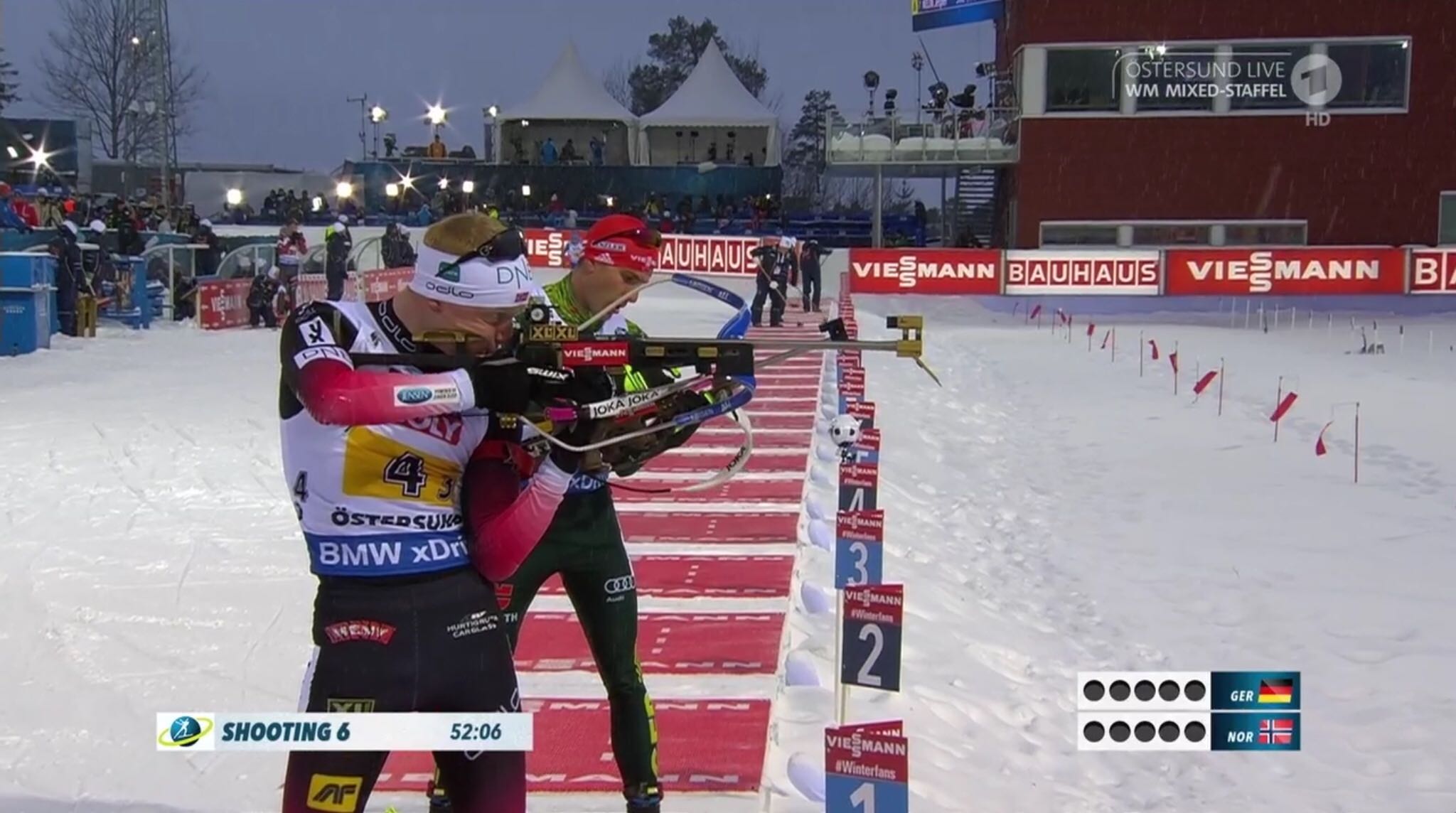
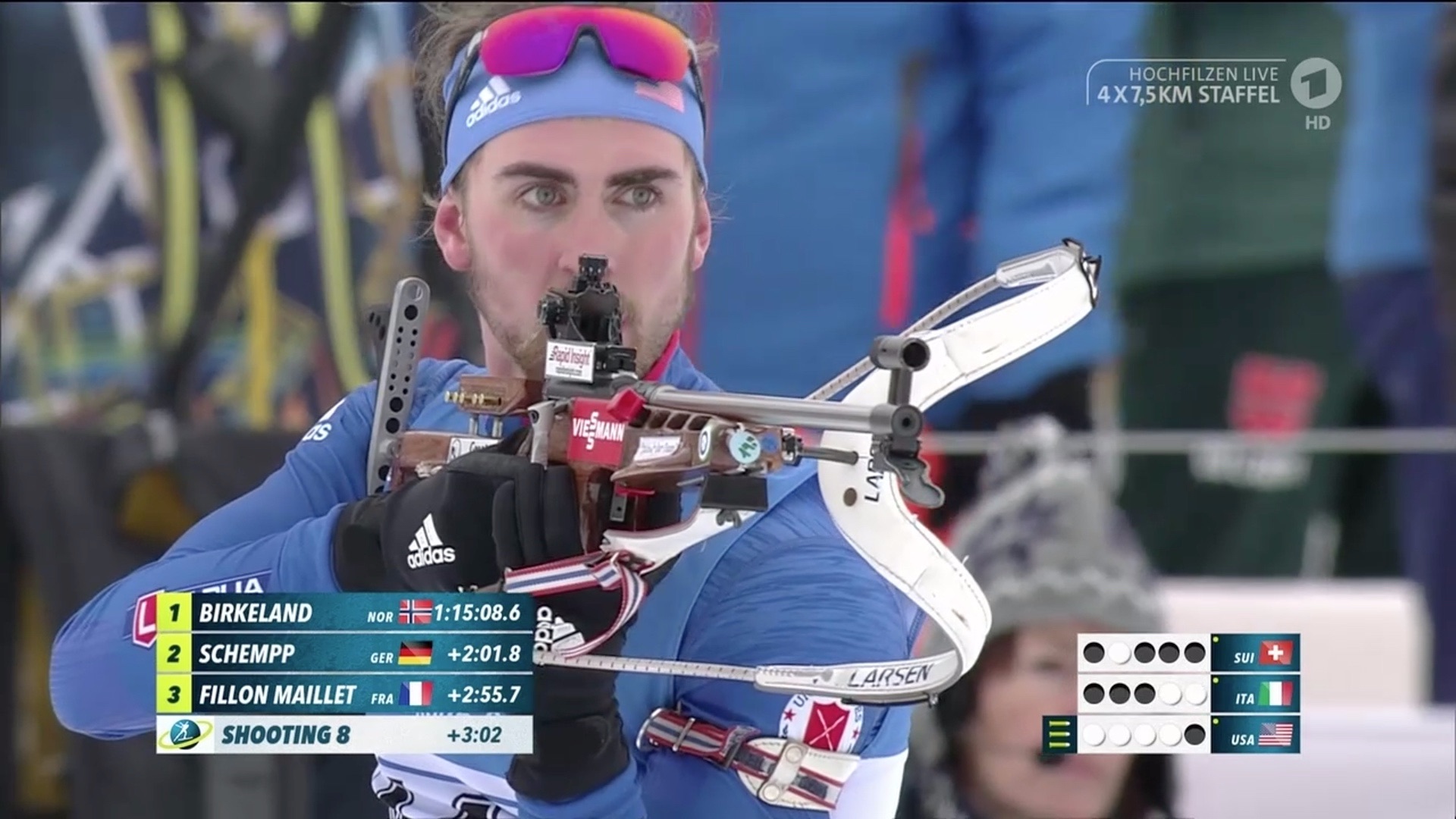
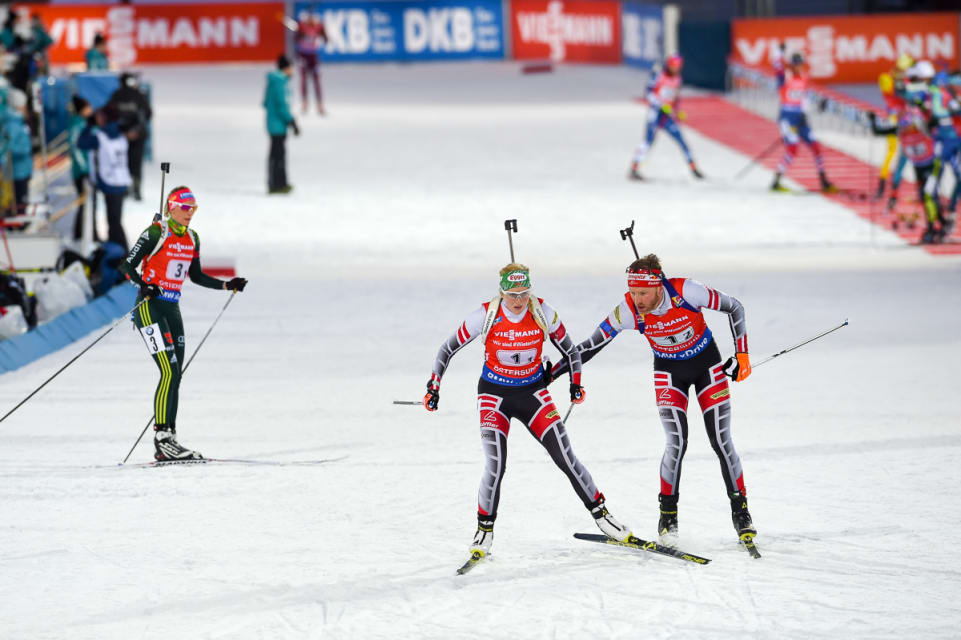
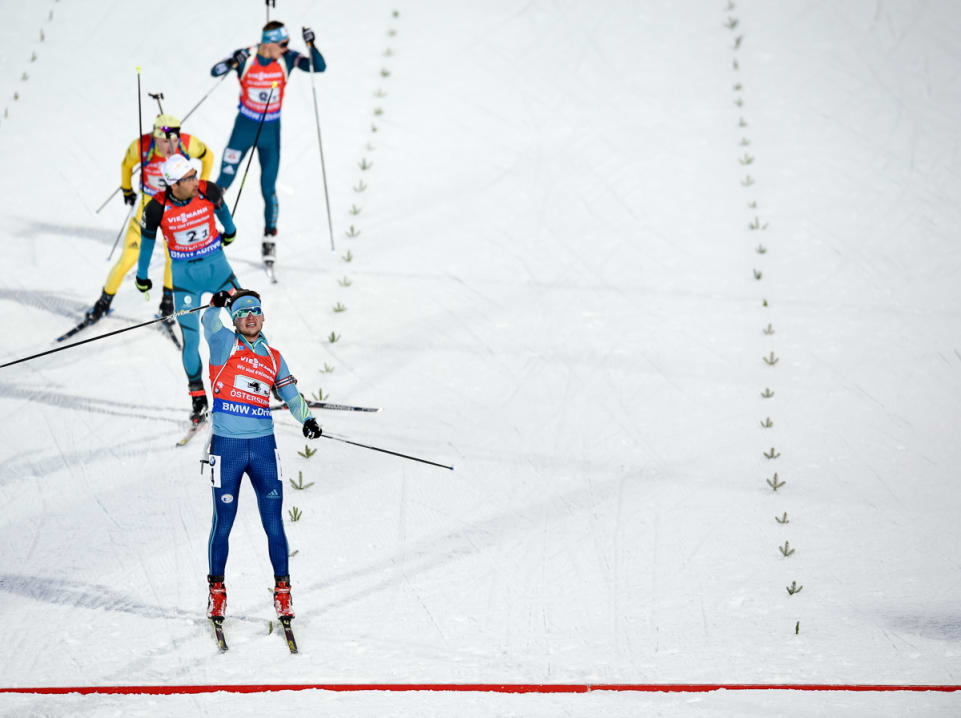
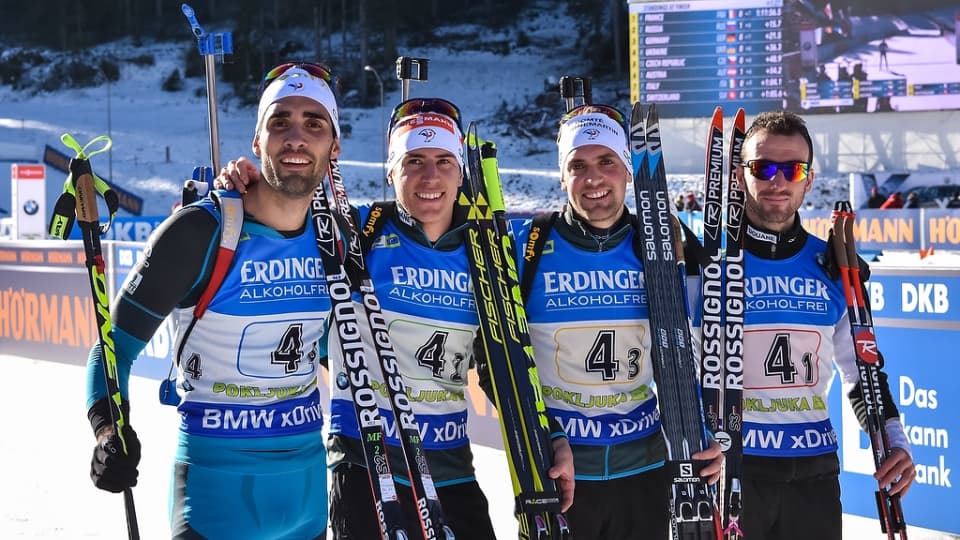
Johannes Thingnes Bø of Norway (bib 4) during the mixed relay at the 2019 IBU World Championships. (Photo: ARD screenshot)
Marte Olsbu Røiseland, Tiril Eckhoff, Johannes Thingnes Bø, and Vetle Sjåstad Christiansen of Norway won the opening race, a mixed relay, of the IBU World Championships in Östersund, Sweden. The foursome won the race in 1:17:41.3 hours.
The race format requires women to contest the first two legs, or 2 x 6-kilometers, whereas as the men ski the final two legs, or 2 x 7.5 k. On the way to the win, Norway used seven spares.
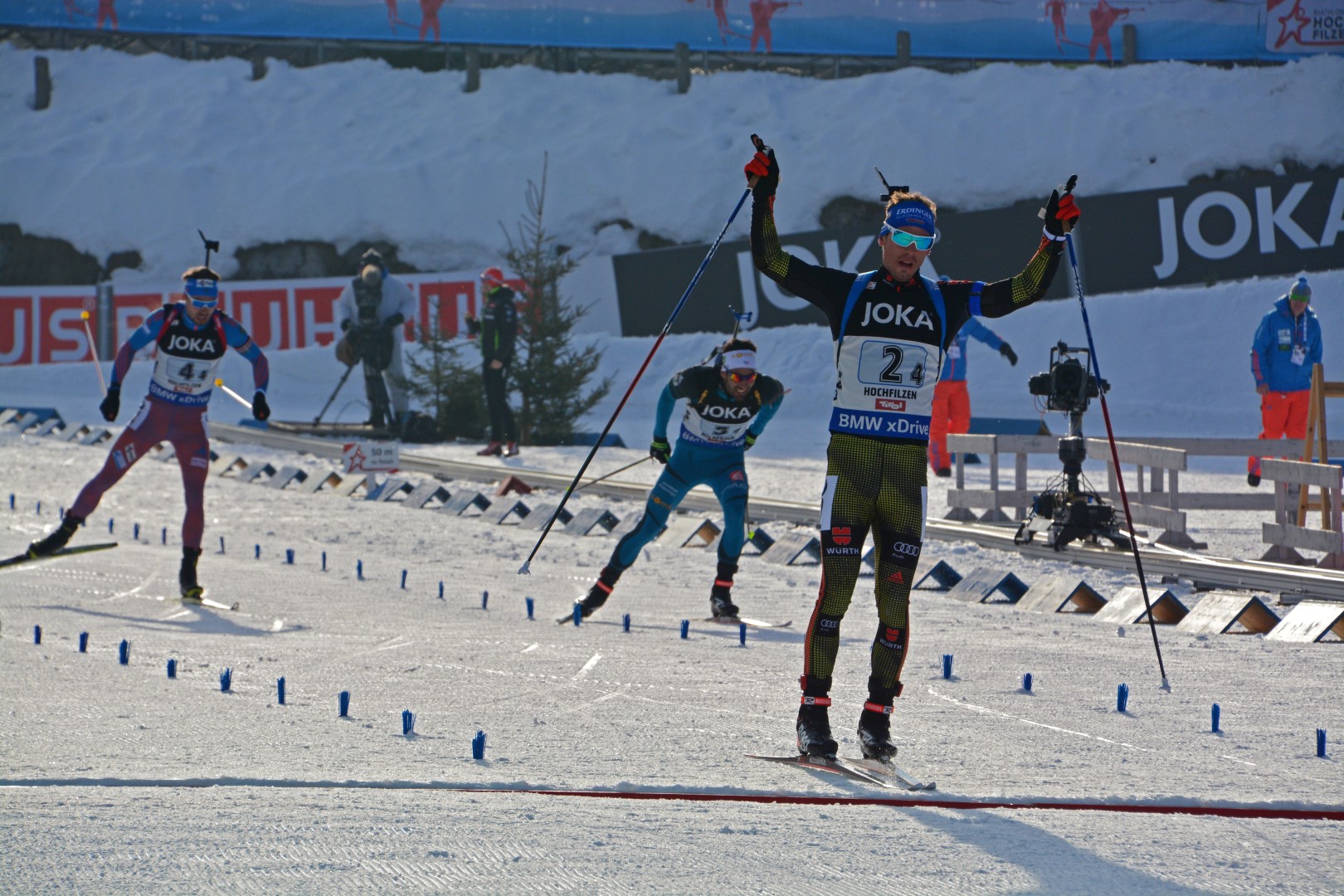
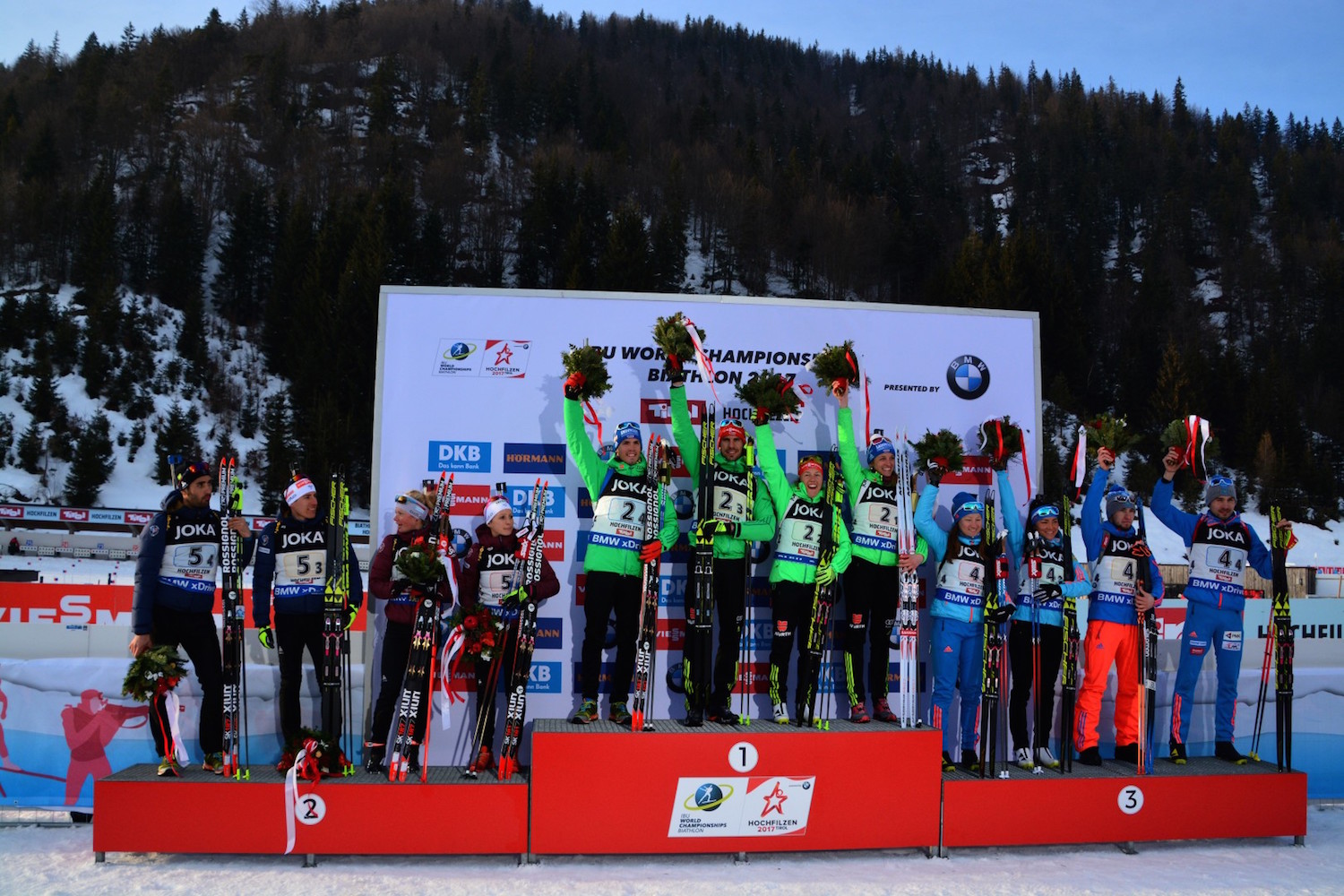
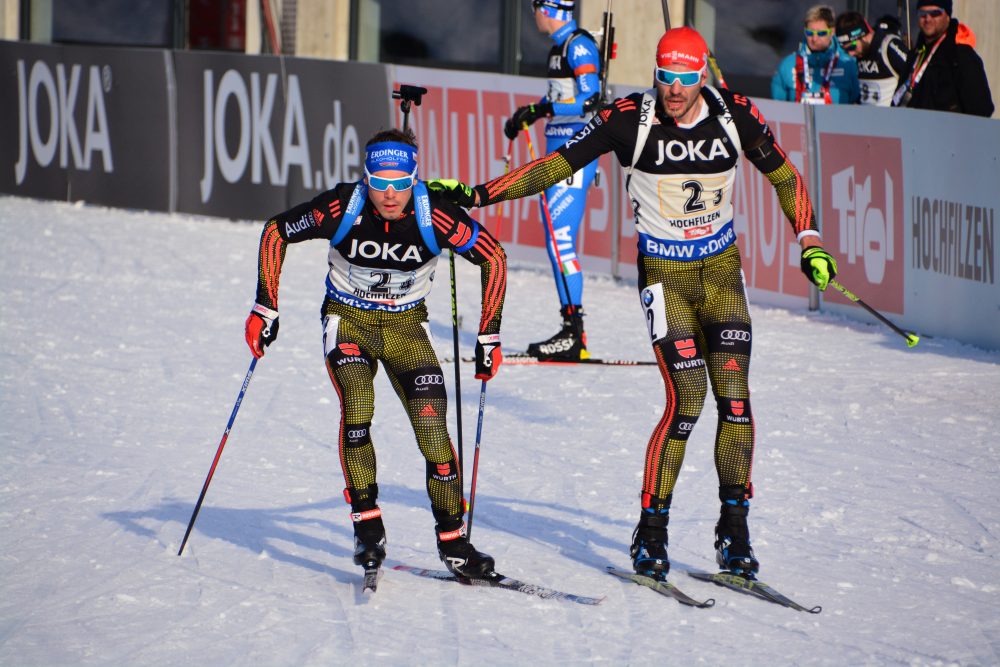
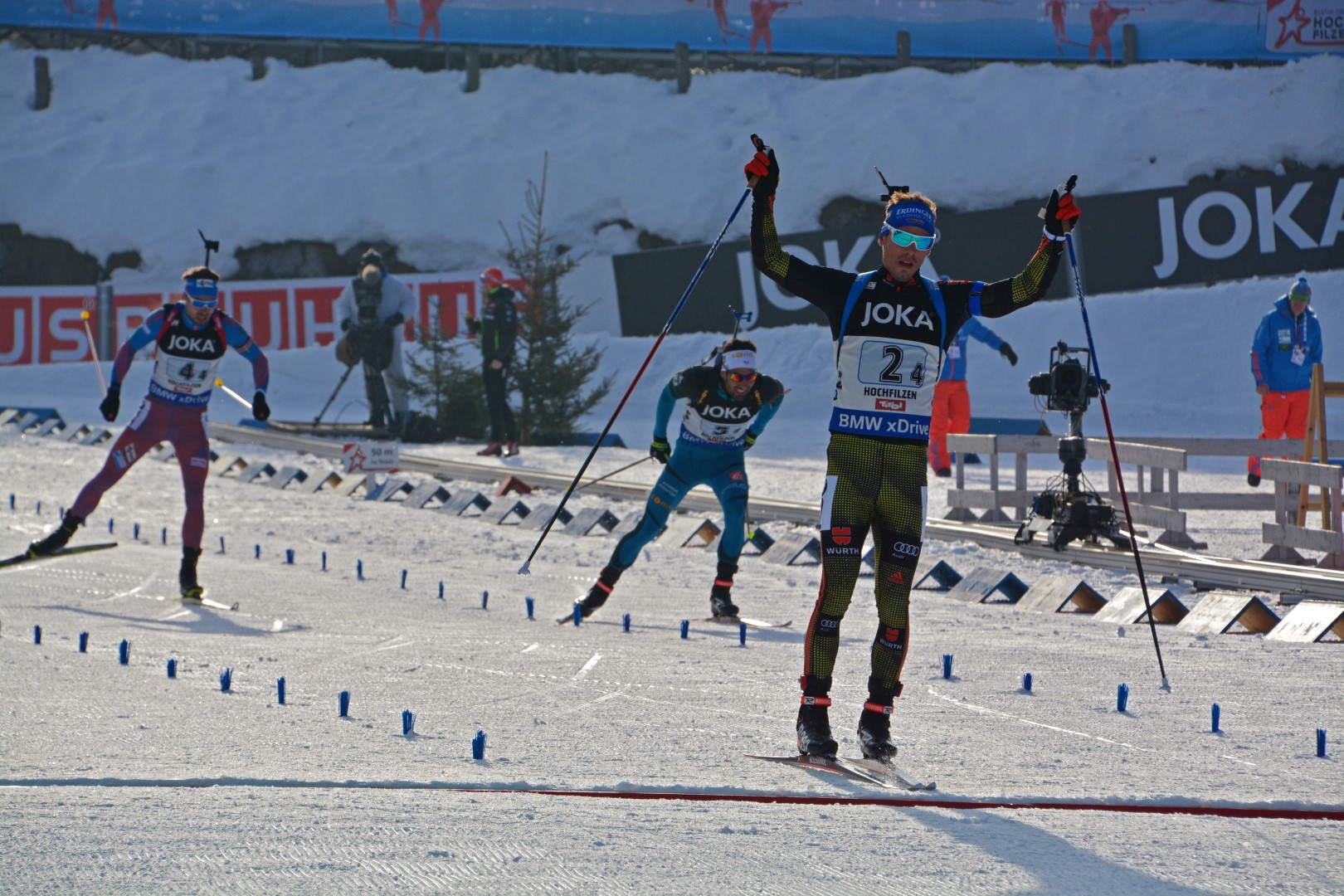
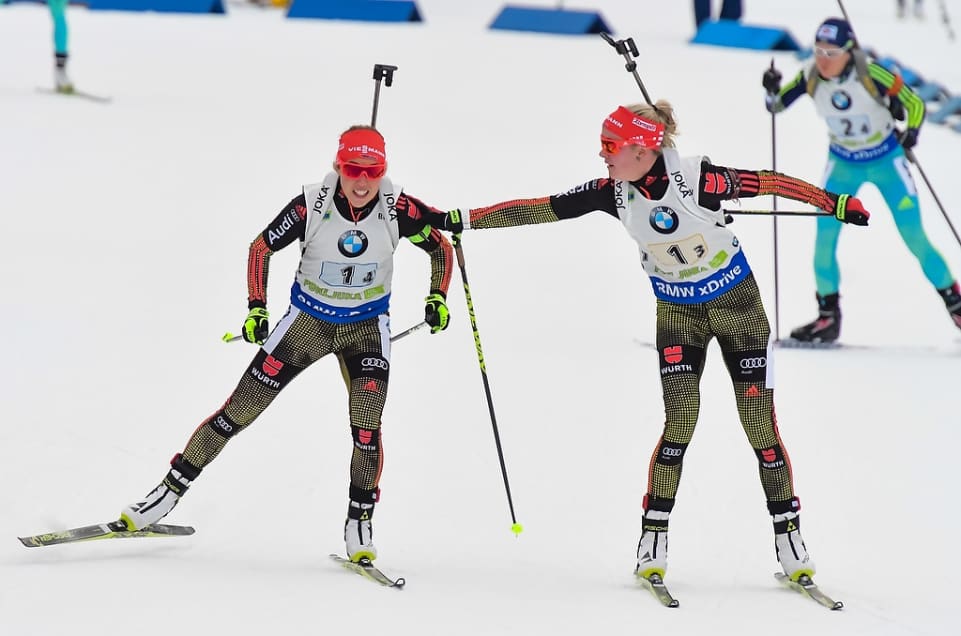
Germany’s Vanessa Hinz, Denise, Herrmann, Arnd Peiffer, and Benedikt Doll placed second, 13.1 seconds behind after using nine spares total. Herrmann’s skiing prowess, she is a former World Cup cross-country skier for Germany, brought her team into the lead as she tagged Peiffer.
The Norwegians ultimately took control of the race as they gapped Germany in second place, and put 1:09.6 minutes into Italy’s Lisa Vittozzi, Dorothea Wierer, Lukas Hofer, and Dominik Windisch for third overall.
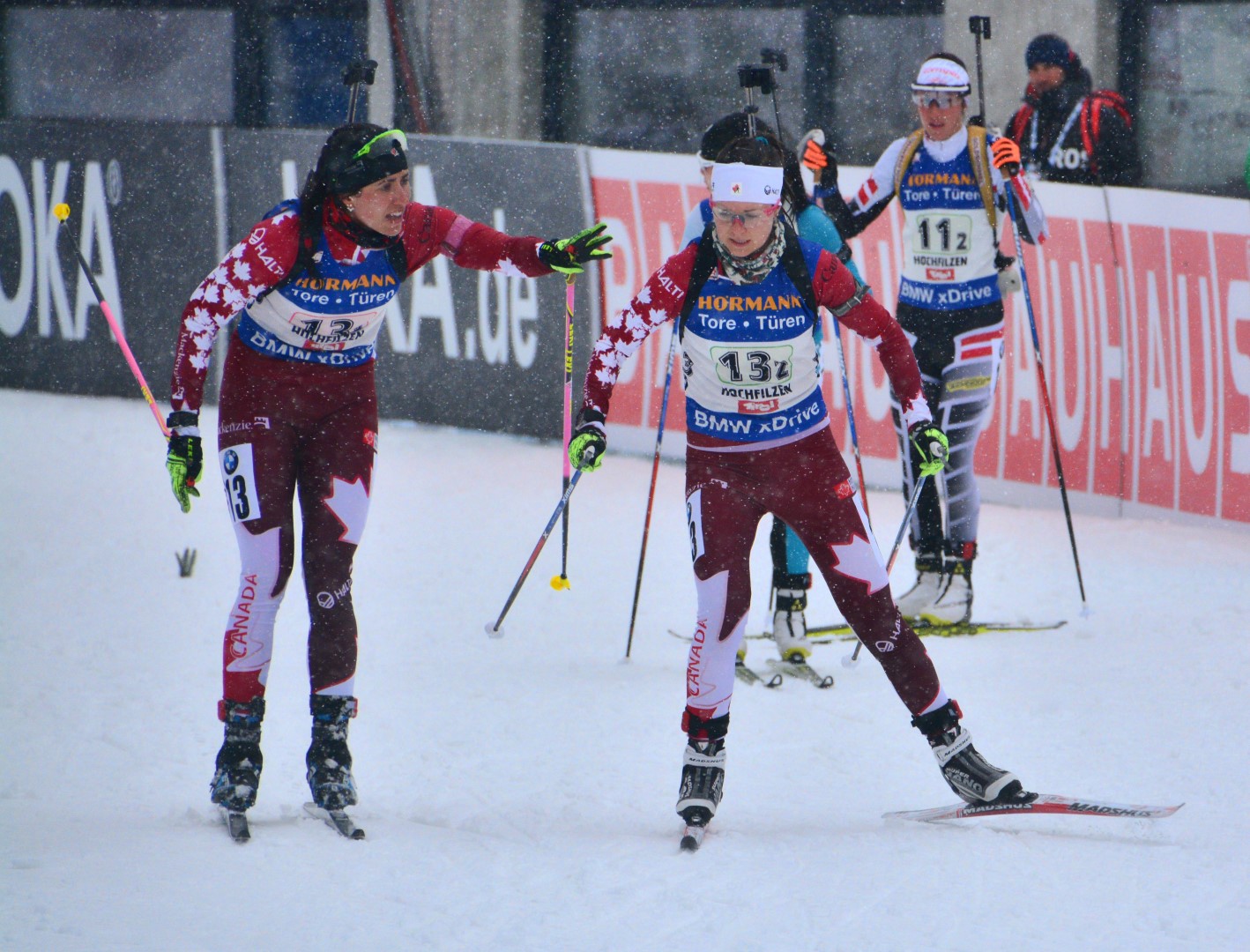
Canada’a Rosanna Crawford, Sarah Beaudry, Christian Gow, and Scott Gow placed 16th overall (+4:35.5). The team had one penalty while using eight spares.
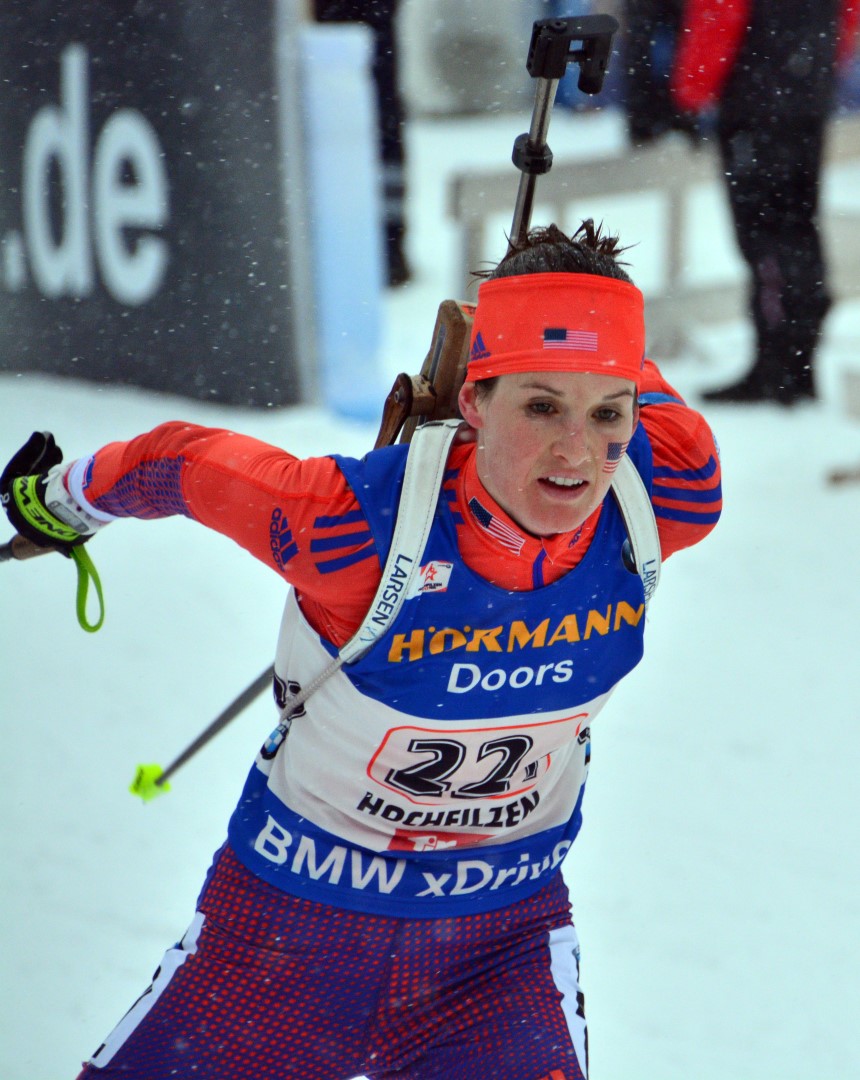
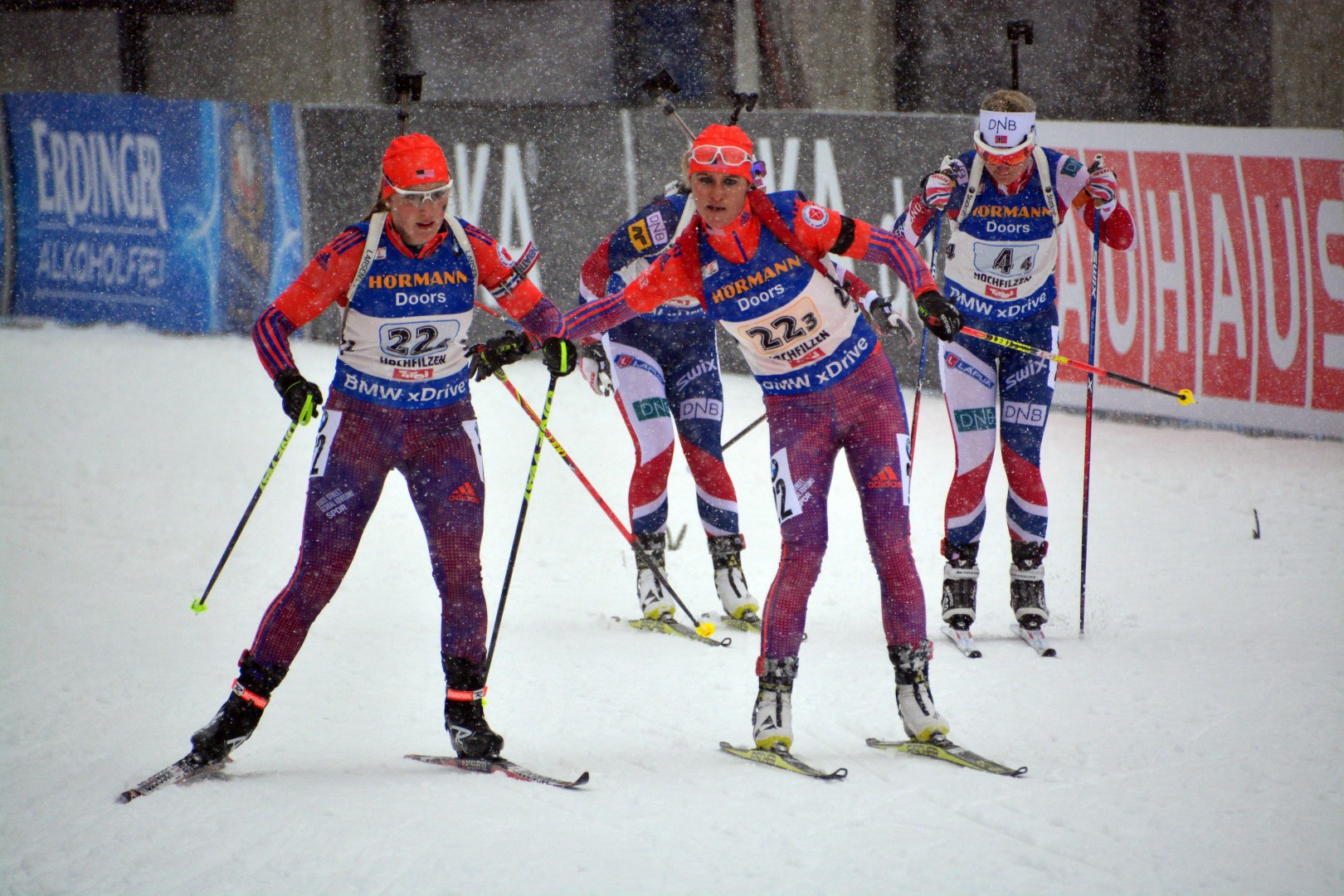
Susan Dunklee, Clare Egan, Sean Doherty, and Leif Nordgren of the U.S. placed 19th (+7:21.2). The U.S. team accrued three penalties while using 13 spares.
Racing continues tomorrow for the women with a 7.5 k sprint.
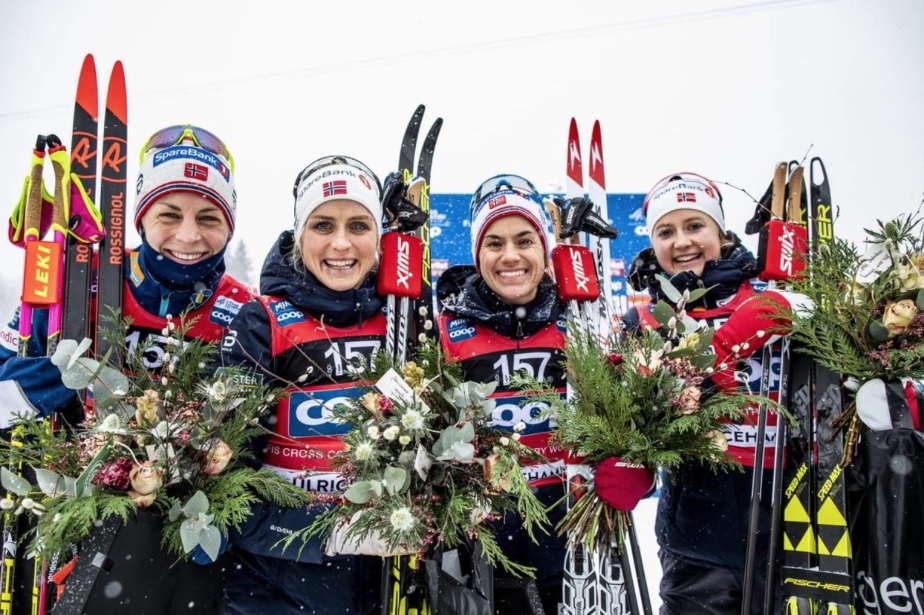
The winners of the 2019 4 x 5 k relay in Ulricehamn, Sweden: (l-r) Norway’s Astrid Uhrenholdt Jacobsen, Therese Johaug, Heidi Weng, and Ingvild Flugstad Østberg. (Photo: fis-ski.com screenshot)
FIS World Cup Ulricehamn, Sweden 4 x 5 k / 4 x 7.5 k relay
The sun rises, the sun sets, and Norway wins the women’s 4 x 5-kilometer relay in Ulricehamn, Norway on Sunday. For the 11th time in a row, a Norwegian women’s team bested the world in the storied race format.
Heidi Weng, Therese Johaug, Astrid Uhrenholdt Jacobsen, and Ingvild Flugstad Østberg won in a time of 57:06.3 minutes. For the first tag, nine teams came in separated by 8.1 seconds. Johaug, skiing the second leg for Norway, opened a gap of 9.3 seconds over Russia I by the 10 k mark.
The time back to second-placed Sweden I stretched to 37.4 seconds by the finish.
Sweden I’s team consisted of Evelina Settlin, Ebba Andersson, Charlotte Kalla, and Jonna Sundling.
Finland I placed third (+41.2) wth Laura Mononen, Krista Pärmäkoski, , Riitta-Liisa Roponen, and Evelina Piippo.
The U.S. team of Sadie Bjornsen, Rosie Brennan, Caitlin Patterson, and Jessie Diggins finished in sixth (+1:26.6).
In the men’s 4x 7.5k relay, Russia II and Russia I came away in first and second place respectively.
Russia II’s team of Evgeniy Belov, Alexander Bessmertnykh, Denis Spitsov, and Artem Maltsev won in a time of 1:17.53.2 hours.
Russia I’s Andrey Larkov, Alexander Bolshunov, Andrey Melnichenko, and Sergey Ustiugov finished 20.8 seconds back.
In third was Norway, 35.8 seconds behind. Hans Christer Holund, Didrik Tønseth, Sjur Røthe, and Simen Hegstad Krüger, Norway’s foursome, were 35.8 seconds back. On the first leg, at 9.7 k, Norway was in ninth place, with a 43.1-second deficit.
The U.S. team of Erik Bjornsen, Scott Patterson, David Norris, and Ben Lustgarten placed 13th (+4:10.8).
IBU World Cup Antholz, Germany 12.5 k / 15 k Mass Start
On Sunday in Antholz, home country athlete Germany’s Laura Dahlmeier won in 35:32.8 minutes while skiing a single penalty lap during her first prone stage. The Czech Republic’s Marketa Davidova placed second (13.1, 0+0+1+0), with Vanessa Hinz of Germany in third (+16.4 1+0+0+0).
“It’s a fantastic feeling to be right at the top again,” Dahlmeier told the IBU. “I started very badly and I felt slow. But I came back strongly and I remained virtually without error in the shooting. It was a good weekend for me.”
US Biathlon’s Clare Egan raced and shot to 15th overall, 1:05.8 back, with two penalties in her first prone stage, otherwise she shot clean.
Rosanna Crawford of Canada placed 28th (+3:50.2, 0+1+3+1).
In the men’s 15 k mass start, there was one new development: Johannes Thingnes Bø of Norway did not win. He did, however, place second to France’s Quentin Fillon Maillet. He won the race in 34:39.4 seconds while shooting clean in all four stages. Depositing between PLN 60 and PLN 199, we will receive a bonus of 125% of our deposit (a maximum of PLN 1,600), as well as a package of 50 free spins Vulkan Bet on the Doom of Dead slot machine. On the other hand, if we deposit at least PLN 200, we will get 100 free spins after the game as a reward, as well as a bonus of as much as 200% of our own deposit (a maximum of PLN 2,800 to visit).
Bø was 14.3 seconds back in second place, with a single miss in each of his standing stages. Germany’s Arnd Peiffer was third (+24.6, 0+0+0+0).
Christian Gow of Canada was the sole North American in the race. He placed 27th (+3:22.5, 1+1+0+1).
Lake Placid SuperTour 10 k/15 k mass start classic
Kaitlynn Miller (CGRP) won the women’s 1o k classic mass start in 36:12.7 minutes. Coming in 2.9 seconds back was Jessica Yeaton(APU/Australian National Team) in second place. In third, skiing for Dartmouth, was Katharine Ogden (37:27.8).
Kyle Bratrud (SMS T2) won the men’s 15 k classic mass start in 46:41.3 minutes. In second place was Adam Martin (CGRP) who raced to a time of 46:55.0. Canada’s Andy Shields (Lappe Nordic) placed third in 47:41.6.
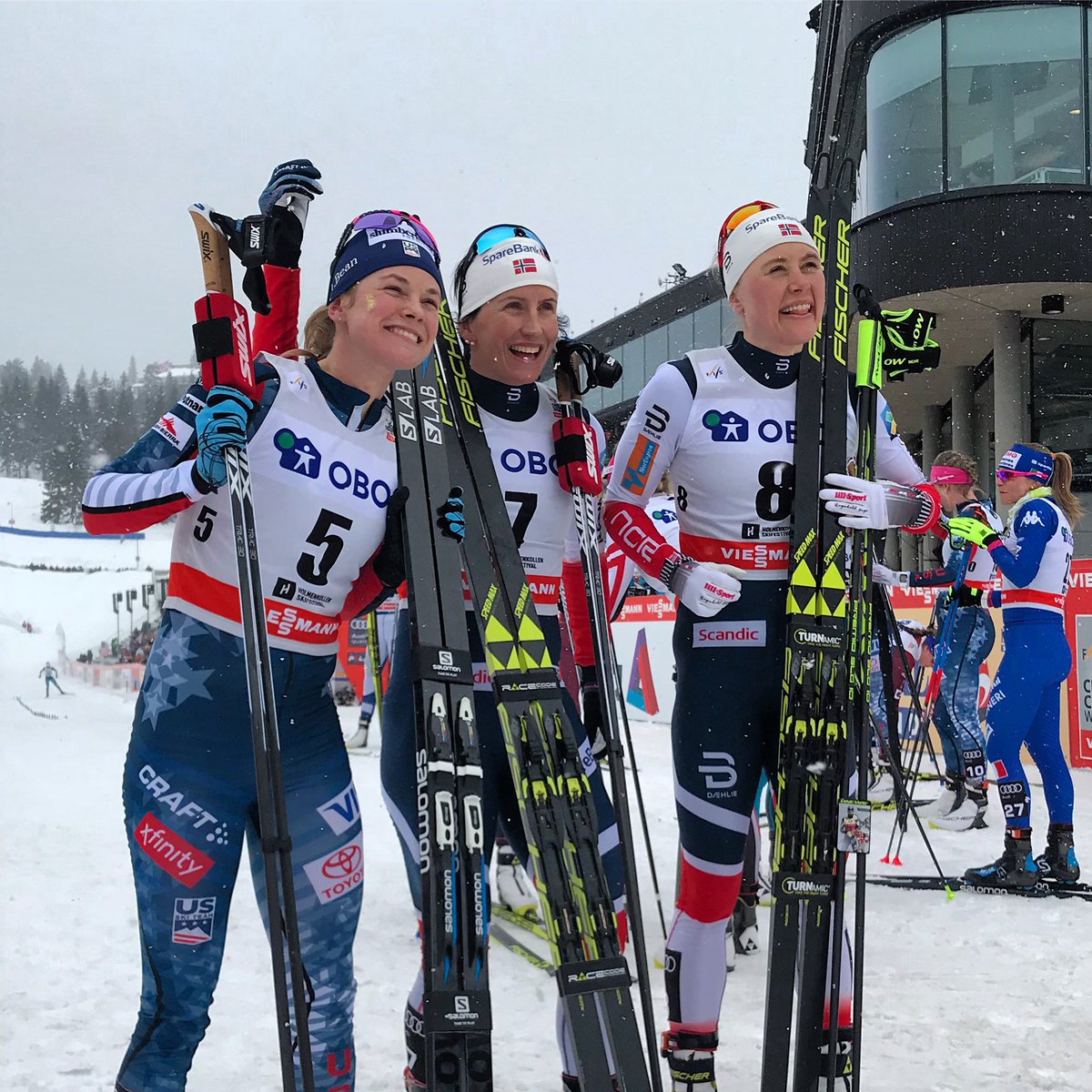
The Holmenkollen women’s 30 k freestyle mass start podium on Sunday in Oslo, Norway, with Jessie Diggins (l) in second, and Norway’s Marit Bjørgen (c) in first and Ragnhild Haga (r) in third. (Photo: FIS Cross Country/Twitter)
FIS Cross Country World Cup (Oslo, Norway): Women’s 30 k freestyle mass start
Marit Bjørgen, the Norwegian queen of distance cross-country events, racked up another victory at Holmenkollen in the women’s 30-kilometer freestyle mass start on Sunday for her seventh win in the World Cup’s ultimate distance event at the famed Norwegian venue. (She had previously won in 2005, 2010, 2012, 2014, 2015 and 2017).
But she did so in not-so-typical fashion. Instead of breaking the field mid-race and skiing to a comfortable win, like she did in the last race of the 2018 Olympics in PyeongChang, South Korea (a 30 k classic mass start), Bjørgen came from behind to win Sunday’s Holmenkollen 30 k and wasn’t able to let off too much before finish. She didn’t take the lead until less than a kilometer to go and put just enough time into her competition to take the win in 1:18:12.4 hours, while American Jessie Diggins outlasted the chase group of three to place second (becoming the first American woman to reach the Holmenkollen podium), 3.6 seconds behind Bjørgen. Norway’s Ragnhild Haga edged Sweden’s Charlotte Kalla by 0.1 seconds for third place (+4.3), while Kalla settled for fourth (+4.4).
The rest of the field was strung out, with Norway’s Astrid Uhrenholdt Jacobsen finishing fourth (+11.5) and Ingvild Flugstad Østberg nearly another 1 1/2 minutes back in fifth (+1:39.5). Finland’s Krista Pärmäkoski placed seventh (+1:51.7), Germany’s Stefani Böhler notched eighth (+2:10.2), Austria’s Teresa Stadlober ninth (+2:10.2), and Sweden’s Ebba Andersson 10th (+2:11.9). Less than a second behind Sweden’s Ida Ingemarsdotter in 11th (+2:22.8) was American Sadie Bjornsen in 12th (+2:23.4).
In the Distance World Cup standings, Diggins gained some valuable points to keep herself in third, now 63 points ahead of Pärmäkoski in fourth. Heidi Weng, who finished 18th on Sunday, still leads the distance standings by 104 points and Østberg is second, 51 points ahead of Diggins.
In the Overall World Cup, Weng leads by 153 points over Østberg. Diggins is another 104 points back in third, 100 points ahead of Pärmäkoski in fourth. At World Cup Finals next week in Falun, Sweden, a total of 300 points is up for grabs for the winners (50 for freestyle sprint, 50 for classic individual start, and 200 for freestyle pursuit).
The U.S. had three in the top 20 and four in the points (top 30) in Sunday’s 30 k, with Kikkan Randall in 19th (+3:21.9) and Caitlin Patterson in 28th (+4:13.1). Rosie Frankowski (Alaska Pacific University) missed the top 30 by about 28 seconds in 31st (+4:45.4), Liz Stephen placed 51st (+10:01.7) and Kaitlynn Miller (Craftsbury Green Racing Project) finished 53rd (+16:05.0).
Cendrine Browne led four Canadian women in 36th (+6:16.1), Emily Nishikawa was 44th (+7:36.1), Zina Kocher (Foothills Nordic) finished 47th (+8:52.0), and Dahria Beatty placed 49th (+9:45.1).
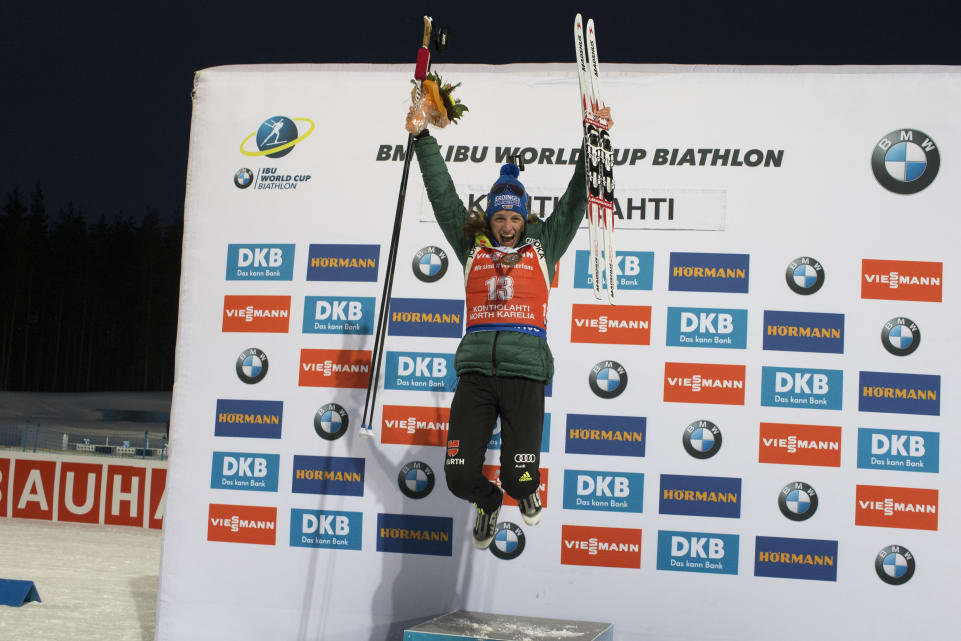
Germany’s Vanessa Hinz celebrates her first IBU World Cup win and podium in the women’s 12.5 k mass start on Sunday in Kontiolahti, Finland. (Photo: IBU/Biathlonworld)
IBU World Cup (Kontiolahti, Finland): Men’s and women’s mass starts
(Note: This rundown has been updated to include comments from Lowell Bailey and Rosanna Crawford.)
Germany’s Vanessa Hinz won her first International Biathlon Union (IBU) World Cup race (and achieved her first World Cup podium) and Austria’s Julian Eberhard won his first race of the season (and first mass start of his career) in the women’s 12.5 k and men’s 15 k mass starts on Sunday in Kontiolahti.
Germany’s Vanessa Hinz celebrates her first IBU World Cup win and podium in the women’s 12.5 k mass start on Sunday in Kontiolahti, Finland. (Photo: IBU/Biathlonworld)
Hinz shot an impressive 20-for-20 with the third-fastest range time and fifth-fastest shooting time to take the win in 35:47.9 minutes. Third after the first prone stage, she moved into second, then third after cleaning the next two stages. After knocking down her final five targets in the last standing, Hinz left the range almost 24 seconds ahead of France’s Anaïs Chevalier in second and 26 seconds ahead of Italy’s Lisa Vittozzi in third. Hinz stayed ahead of her challengers on the final loop, finishing 13.5 seconds clear of Vittozzi, who claimed second. Chevalier finished third, 16.8 seconds back, while Finland’s Kaisa Mäkäräinen was next across the line in fourth (+43.4) with a gap to Sweden’s Hanna Öberg in fifth (+1:02.1).
Vittozzi and Chevalier both cleaned the first three stages then had to ski a penalty lap after the last standing bout (0+0+0+1). Mäkäräinen missed three (1+0+1+1) yet skied the second-fastest course time on her home course, and Öberg missed two (0+0+2+0). The fastest course time of the day was clocked by Darya Domracheva of Belarus, who had to ski five penalty laps (0+1+1+3) and ended up 10th (+1:18.2).
“I always dreamed of shooting four times clean and today I did it,” Hinz, 25, said, according to an IBU press release. “I was so often close to the podium. I knew I could do it. Today, I said, ‘OK, let’s try it and if it works, it is OK … and if not there is another season waiting and other races.’ Now I am on top of the podium and it is crazy.”
Vittozzi, who placed fourth in the mass start at the 2018 Olympics, was glad to improve on a third-place finish in Friday’s sprint by placing second on Sunday.
“I have been third so many times and that was not satisfying for me,” Vittozzi said, one day after she won the mixed relay with her team in Kontiolahti. “Today I am very happy about my second place.”
For Chevalier, it was her first individual podium of the season and it came a day after she and Antonin Guigonnat won the single mixed relay. Chevalier, 25, was severely injured when she was hit by a car last spring, according to an IBU press release.
“I am very happy to be here today, because it was a very hard season,” she told the IBU. “I forgot how nice it is to be on the podium … I forgot that it was not easy, so I am very happy … I did my best on the last lap; [Vittozzi] was faster, but I am third and happy with that!”
Canada’s Rosanna Crawford shot 19-for-20 to place 13th (+1:25.9) with her only miss coming in the second prone stage (0+1+0+0). Her overall shooting and range times were 10th fastest of the 30-woman field, compared to her 26th-ranked ski time. Crawford had been in 11th after cleaning the final standing stage, then slipped two spots to finish 13th in her second mass start of the season.
“Since the skiing wasn’t feeling great today I made sure I was super focused in the range,” Crawford wrote in an email to FasterSkier. “I knew that was my only chance to get a good result today. My one prone miss was a bad trigger pull, but the rest were nice solid hits. I made sure to have a solid set up and then just trusted my rhythm and shooting.
“I knew that I wanted that top 15, so I just kept fighting and trying to stick with the women when they caught me,” she wrote of her last loop. “The last time up the wall I managed to stay close to [France’s] Anais Bescond, and hold off the two people behind me. Really happy to be in the top 15 again.”
Clare Egan was the lone American woman to qualify for Sunday’s mass start, and it was the second mass start of her career. She was on track for a top-15 result after missing just one target in the first three stages, but she had to ski three penalty laps on the last standing (0+1+0+3), which put her in 23rd by the finish (+2:05.6). Notably, she skied the 14th-fastest overall course time.
“I didn’t have quite the same energy level tonight as the last two days, but I still had the 14th rank course time and that means anything is possible in the race,” Egan wrote in an email to FasterSkier. “To put it in perspective, the winner of the race, Hinz, had the 13th rank, just 2 seconds faster than me. This is the first time I’ve felt totally comfortable skiing with the fastest women, and I certainly hope I can maintain this speed for one more week of World Cup racing.”
Egan was pleased with her 9-for-10 prone shooting and her clean standing stage (“which is the first time I’ve cleaned a standing stage in an individual race this entire year, believe it our not,” Egan wrote).
“But when I missed my second shot on the final stage, I let that throw me off my game, and really blew the rest of the stage,” she explained. “It’s so hard to keep 100% focus in every scenario, and I find it gets harder and harder towards the end of the race when I’m not necessarily the most lucid. I know that I have to work on so I have a goal to manage the final stage better next week and in the future.”
Her 23rd-place finish was one better than her previous World Cup mass start finish, which was 24th last season in Hochfilzen, Austria.
“In my only other mass start, which was last year at World Championships, I felt like an imposter,” Egan reflected. “Maybe because I was the first ‘reserve’ to get called up when one of the top women [did not start]. But this was totally different. I knew I deserved to be there today and was confident about competing with the other top women.”
“In my only other mass start, which was last year at World Championships, I felt like an imposter … This was totally different. I knew I deserved to be there today and was confident about competing with the other top women.” — Clare Egan (US Biathlon) on Sunday’s mass start
While the women raced Sunday night, the men’s 15 k mass start took place in the afternoon, when Eberhard passed the likes of France’s Martin Fourcade and Russia’s Anton Shipulin after a tangle late in the race to take the win.
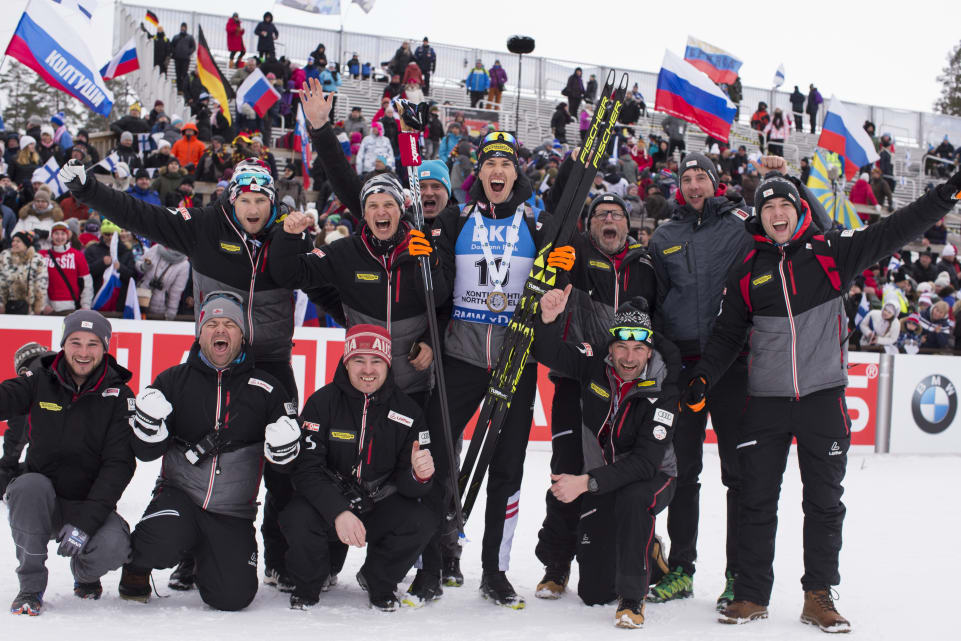
The Austrian team celebrating Julian Eberhard’s fourth career victory, his first this season and his first in a mass start on Sunday after the IBU World Cup men’s 15 k mass start in Kontiolahti, Finland. (Photo: IBU/Biathlonworld)
The Austrian had cleaned the first two prone stages to move into third by the race’s halfway point, behind Germany’s Benedikt Doll and Arnd Peiffer in first and second, respectively. Eberhard missed one in the next standing stage, yet left the range in second, 15 seconds behind Peiffer (who cleaned) in first, while Doll missed one as well to slip into third, 19 seconds back.
With two loops to go, Fourcade was coming back from two early prone penalties and found himself in fifth after a clean standing stage, less than a second behind Shipulin in fourth. On the next standing stage, Fourcade cleaned to take the lead and left the range about five seconds ahead of Shipulin (who also cleaned) in second.
Eberhard missed one yet remained in contention in third, 17 seconds behind Fourcade. On the last loop, Shipulin caught Fourcade before the course’s notorious climb known as “The Wall”, and Eberhard closed on the two frontrunners as they ascended it. Still several seconds behind over the top, he caught Shipulin on the bridge before the stadium, but the two tangled skis and Shipulin fell. Eberhard stayed upright and pulled even with Fourcade, passing him to take the win in 38:04.8. Fourcade finished second (+6.9) and Shipulin third (+19.3).
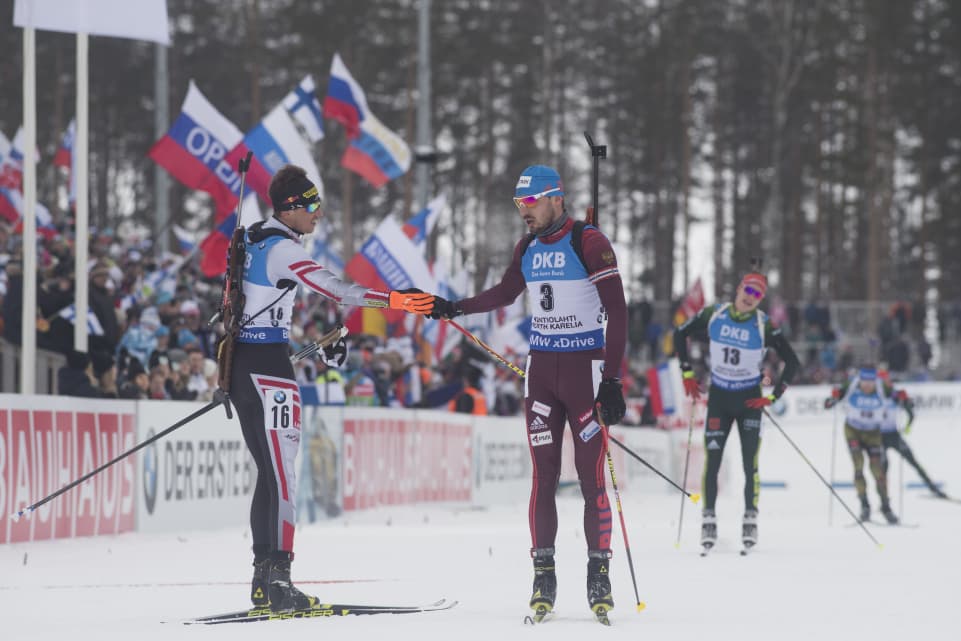
Austria’s Julian Eberhard (l) and Russia’s Anton Shipulin after the finish of the men’s 15 k mass start the IBU World Cup in Kontiolahti, Finland. Shipulin fell when his skis tangled with Eberhard’s. While Eberhard raced to the win, Shipulin placed third. (Photo: IBU/Biathlonworld)
“I wanted to be in a sprint with all three, but the bridge is too small for this,” Eberhard said, according to an IBU press release. “I came up the bridge with too much speed. Anton and I were in the same track and there was an accident. I apologized to Anton at the finish but he said these things can happen and it was OK with him.”
“I hold no grudge against Julian,” Shipulin told the IBU. “This can happen in sports and is all fair … I am in good shape and want to preserve this and perform my best in the last World Cups.”
Fourcade explained that illness caused him to sit out Thursday’s sprint, and he was only able to train three hours this week.
“It is really difficult to race in this situation without any feeling or training,” Fourcade told the IBU. “I did not know what to expect today but I am quite satisfied. I would have liked to win, but I used too much energy trying to come back in the early laps and had no energy when it was time to attack.”
Behind them, Doll picked off one place on the final loop to finish fourth (+21.9), passing his German teammate Erik Lesser, who finished fifth (+23.9). Peiffer followed in sixth (+27.1) as Germany had three in the top six.
American Lowell Bailey raced to 14th (+1:06.3) with two penalties, both of which came in the standing stages (0+0+1+1). Bailey had been fourth after cleaning the second prone, 16 seconds behind Doll in first, but slipped to 10th after missing one on the next bout. He had to ski another penalty lap on the last stage, and left the range in 14th.
Overall, Bailey posted the 10th-fastest shooting time, 15th-fastest range time and 18th-fastest course time.
“I finally felt like I was back in the spot that I ended last season,” Bailey wrote in an email when asked about his consistency. “I felt controlled and able to keep the pace with the top of the field throughout the race. It was nice to be back in the mix.
“Although I would have liked to see this ski speed a few weeks ago, better late than never!” he continued.
Next week’s World Cup in Oslo, Norway, will be his last of the season and his career.
“After nearly two decades of international racing, Oslo will be my final World Cup as a U.S. Biathlete,” Bailey wrote. “I’m sure it will be emotional but I hope to end my World Cup career on a high note!”
Germany en route to a clean sweep of the podium in the men’s nordic-combined individual large hill/10 k on Tuesday at the 2018 Olympics in PyeongChang, South Korea, with Johannes Rydzek (5) leading Fabian Rießle (6) and Eric Frenzel (4). They went on to place first, second and third, respectively. (Photo: FlyingPointRoad)
A few shooting errors by pursuit bronze medalist Anais Bescond were not enough to derail France, as the team of Marie Dorin Habert, Bescond, Simon Desthieux, and Martin Fourcade took gold in the mixed relay. Skiing the first leg, Dorin Habert shot clean and tagged off just seven seconds behind the leading team from Italy. Bescond then used four spare rounds over the course of her relay leg, dropping the team to fourth (+48.9) at the halfway point. But both Desthieux and Fourcade shot 10/10, capitalized on the errors of others, and ended up with a clear 20.9 second margin for gold at the finish.
Susan Dunklee put the U.S. in fifth after the first leg of the mixed relay. (Photo: FlyingPointRoad)
Norway came back from a rough start to earn silver despite a whopping eleven spare rounds and a penalty loop. Marte Olsbu had three spare rounds to tag off in ninth, 32.8 seconds back, and then Tiril Eckhoff used two spare rounds in prone and then took a penalty loop in standing. But Johannes Thingnes Bø used just one spare round and skied the team from tenth to fourth, in contact with the medal pack, on his relay leg, and then Emil Hegle Svendsen used one spare round in each shooting stage to climb into a clear second; he skied alone on the final loop before crossing the line for silver.
There was controversy about bronze, however. Germany had led much of the race thanks to a solid leg by Vanessa Hinz to start and then a brilliant leg by Laura Dahlmeier; Erik Lesser also excelled, and at the third exchange the team had used just two spare rounds and had a 32.6-second lead on the field. But sprint gold medalist Arnd Peiffer couldn’t keep it together and first used a spare round in prone, then took a painful penalty loop in standing.
He exited the loop just as Italy’s Dominik Windisch went past. Lisa Vitozzi had put Italy in the lead after one leg thanks to perfect shooting, and despite three spare rounds Dorothea Wierer had tagged off in second at the halfway point. Lukas Hofer had maintained that position and Windisch was really only in fourth because of three of his own spare rounds.
Windisch and Peiffer battled all the way around the final 2.5 k, with Windisch leading the final downhill; the pair were nearly even coming into the stadium, but Windisch sprinted for the finishing lanes and in doing so angled from one far side of the trail to the farthest finishing lane, just barely getting there ahead of Peiffer and debatably choosing a lane before the lane markings began. Peiffer, who had skied a straight course all the way from the downhill into the finish, was forced to then switch lanes and couldn’t regain the momentum to keep up with the Italian, who crossed the line in third place.
The Germans protested, but the race jury ultimately decided to keep the Italians in third place, awarding them bronze, and the Germans finished fourth.
“The jury has decide to keep the bronze medal for Italy; Peiffer did not have to alter his speed, therefore no reason to disqualify Windisch,” the IBU stated in a tweet. (The response to that tweet has nearly unanimously condemned it as the wrong decision.)
The IBU 2016 Competition Rules give only a vague definition of obstruction, stating, “It is strictly forbidden to impede other competitors in any way at any time during the competition.”
The Canadian team of Rosanna Crawford, Julia Ransom, Brendan Green, and Christian Gow finished 12th, +2:36.7, with nine spare rounds.
The U.S. team of Susan Dunklee, Joanne Reid, Tim Burke, and Lowell Bailey finished 15th, +3:31.1, with three penalty loops and nine spare rounds.
Germany pulled off a podium sweep in the second nordic combined combined competition of the Olympics, with Johannes Rydzek, Fabian Riessle, and Eric Frenzel earning gold, silver (+0.4 seconds), and bronze (+0.8 seconds), respectively. They had been ranked fifth, sixth, and fourth after the jumping round on the big hill, but edged Norway’s Jarl Magnus Riiber off the podium. Riiber had the second-best jump of the day and ended up just 2.8 seconds out of a gold medal. Japan’s Akito Watabe topped the jumping scores and finished fifth, +12.5 seconds.
For the U.S., Bryan Fletcher led the way again and just like in the normal hill competition, finished 17th. This time he was ranked 23rd after the jump and made up six places to cross the line +1:42.9. Ben Berend, Ben Loomis, and Jasper Good finished 39th (+4:28.2), 40th (+4:38.8), and 43rd (+5:50.2).
Germany’s Laura Dahlmeier racing to her first Olympic gold (and first Olympic medal) on Saturday in the women’s 7.5 k sprint, the first biathlon race of the 2018 Winter Olympics in PyeongChang, South Korea. (Photo: FlyingPointRoad)
(Note: This article has been updated to include comments from Canada’s Julia Ransom.)
“Perfectionist” is a term the coaches of Germany’s Laura Dahlmeier often use to describe her.
On Saturday, this quality helped Dahlmeier to brave difficult wind conditions on her way to winning the gold medal in the women’s 7.5-kilometer sprint that opened the biathlon competitions at the 2018 Winter Olympics in PyeongChang, South Korea, ahead of Norway’s Marte Olsbu in second and the Czech Republic’s Veronika Vítková in third place.
“A childhood dream is coming true,” Dahlmeier told German broadcaster ZDF after the race, according to a translation. “I have always imagined this, that some day I would stand at the very top at the Olympics, that I could win a gold medal. And somehow exactly that happened to work out today. I am incredibly grateful and proud. It’s an amazing feeling, and I don’t think I have fully realized it yet.”
On the shooting range, Dahlmeier twice adjusted her rifle’s sights in the prone stage to successfully cope with changing winds. Coming into the standing stage, she hit three targets in rhythm, then waited for what seemed like excruciating seconds for a gust to pass, before triggering her fourth and fifth shots. Both targets flipped over to white.
She had taken so long that she only recorded the 76th-ranked shooting time in this stage in the field of 87 athletes, 22 seconds off the pace and almost as long as the time it takes to ski a penalty lap. But that she had hit all shots mattered the most. Only two other athletes managed to clean all 10 targets on Saturday.
Dahlmeier followed that up by skiing the fastest course time on the final loop, and fourth-best overall. She crossed the finish line in a time of 21:06.2 minutes, lunging to not squander even a tenth of a second more, before pounding her chest and raising her arms in jubilation, knowing the time she had set would be hard to beat. Indeed her mark could not be improved again by any athlete starting later.
“I believe if you want to win a race like this one, that doesn’t happen by chance,” Dahlmeier told ZDF. “A lot goes into that. It’s true, I really had to work for it in the race today. But also the team around me, what they had to work during the last days, weeks, months, years, that is embodied by today’s result. It’s just beautiful that I was allowed to fulfill that dream today.”
Olsbu claimed the silver medal, 24.2 seconds back with one penalty in her prone shooting stage and just 1.6 seconds ahead of Vítková on the bronze podium spot, who had missed one target in the standing stage.
France’s Marie Dorin Habert placed fourth (+33.1) with one penalty in prone, while Dahlmeier’s teammate Vanessa Hinz was fifth (+40.3), losing out on a potential medal when she missed the last shot of her competition. Several other favorites struggled with the wind conditions and incurred a number of penalties.
For the two runner-ups, winning a medal at the Olympics was also a dream come true.
“Of course I am happy, it was my best race ever,” first-time Olympian Olsbu, 27, said when asked in the press conference if she was satisfied with the silver medal. “It was difficult on the shooting range today because it was so windy, but I just stuck to my plan. And I was so happy when I crossed the finish line. … That was a dream from when I started in biathlon. Of course [compatriot] Ole Einar Bjørndalen was my hero when I was a child, and I was hoping that one day I will do the same. I don’t know what to say, it is just amazing and today I am sitting here with an Olympic medal.”
“Yeah, it was my dream too, like for Marte, and I am happy that my dream is here,” Vítková, 29, said of her first individual Olympic medal in her third Winter Games.
Starting early in bib 12, Vítková initially appeared dissatisfied when she crossed the finish line and saw that she had not managed to beat Olsbu’s time, after the Norwegian had finished the race just one bib ahead. The Czech feared more athletes would finish ahead of her and still push her several positions down, but aside from Dahlmeier starting in bib 23, no one managed to do that.
So at the “flower ceremony” in the arena, where the podium finishers each received a stuffed animal as their prize (a snow-white tiger called Soohorang that is the official mascot of the 2018 Winter Olympics), Vítková was beaming just like her two peers. The Olympic medals will be awarded in an separate ceremony later.
“I am very happy, because this medal is my first ‘big’ medal in an individual race,” Vítková explained at the press conference. “I had a [silver] medal from the Olympic Games in Sochi, but it was a mixed relay medal. And now I have MY medal!”
Last season, Dahlmeier set a record by winning five events at a single International Biathlon Union (IBU) World Championships, taking gold in every race but the sprint (where she placed second) in Hochfilzen, Austria. But winning the gold medal in PyeongChang was indeed the fulfillment of a lifelong dream. As an elementary school student, Dahlmeier reportedly had written two career goals into a class book: Olympic champion in biathlon and becoming the manager of an Alpine Club hut, since mountaineering continues to be her other big passion. One down, one to go.
“Today was a victory Laura had to work very hard for, that wasn’t automatic,” German women’s national team coach Gerald Hönig told ZDF, according to a translation. “My highest respect for how she withstood the conditions today. How she repeatedly had to make the right decisions by herself on the course and on the range in order to be successful. She did that great, and she is outshining a great overall team result.”
In 2014 at her first Olympics in Sochi, Russia, the biathlon competitions for Dahlmeier, who was 20 at the time, and the rest of the German women’s team had started off as disappointing with no individual medals, and then descended into turmoil when on the eve of the women’s relay, the doping case of Evi Sachenbacher-Stehle due to a tainted food supplement came to light (her suspension later was reduced to six months) and the team again failed to reach the podium.
“For our team this medal is particularly important,” Hönig said. “We still have the defeats of Sochi somewhere in the back of our minds. Well, I particularly do, so for me this is a gigantic moment. I believe having a medal in the very first race here makes the tasks that lie ahead much easier … It’s the prerogative of young athletes like Laura to chalk that off faster, but I have repeatedly thought about these days in Sochi … Laura showed coolness today, but also executed everything she had worked for in training.”
Dahlmeier, now 24, became the second German athlete to win a gold medal at the Winter Olympics in the women’s sprint, after Kati Wilhelm claimed the title at the 2002 Games in Salt Lake City, Utah.
Mixed Day for North American Starters
Canada’s Julia Ransom was the best North American in the sprint, finishing in 40th place (+2:08.8) after she shot fast and accurately, incurring just one penalty in her standing stage.
Julia Ransom (Biathlon Canada) racing to 40th in the women’s 7.5 k sprint at her Olympic debut in PyeongChang, South Korea. (Photo: FlyingPointRoad)
On the course she skied the 68th-ranked time of the day, consistently losing about 45 seconds on each loop to the blazing pace set by Slovakia’s defending Olympic sprint champion and current World Cup Sprint standings leader Anastasiya Kuzmina, who ended up 13th place with three penalties (2+1).
For Ransom it was her first start in an Olympic race, building on three appearances at Biathlon World Championships.
“It was amazing to start the race today,” Ransom wrote in an email to FasterSkier. “Some of my family were in the stands and the others had woken up early in Canada to catch it. Definitely feeling the love!”
She described the conditions as “windy with some extremely strong gusts,” Ransom wrote. “I noticed it more out on course than in the range. I was quite happy with my shooting today, but unfortunately my legs were just cooked (for whatever reason)! However, I think this was a good leg blowout, and after some rest, I’ll be ready for the pursuit!”
All four Canadian women that contested Saturday’s sprint finished in the top 60 to qualify for Monday’s pursuit, with Rosanna Crawford next in line in 53rd (+2:23.0) after shooting three penalties (1+2).
Canada’s Rosanna Crawford (22) racing to 53rd in the women’s 7.5 k sprint on Saturday at the 2018 Olympics in PyeongChang, South Korea. (Photo: FlyingPointRoad)
“It was really tough,” Crawford told FasterSkier in the mixed zone after the race when asked about the conditions. “The wind made it hard for shooting and on the course, all of a sudden these gusts would come and blow your poles right out from underneath you. In prone, I made a correction and missed my first shot which shouldn’t have happened, and in standing I overheld [the rifle] for my second miss so I’m pretty disappointed.”
Starting fairly early in bib 22, the race was still going on at the time of her interview, so Crawford feared she might miss the cutoff for the pursuit. At least that did not happen.
“The sprint sets you up for the rest of the week, for two weeks, so I’m pretty bummed,” she continued. “I’m still looking forward to the relays, so that’s definitely positive. It’s just so unfortunate that the sprint dictates the other individual races, other than the 15-kilometer [individual race]. Hopefully I’ll qualify for the pursuit and can go out there and fight again. I love the 2 k course here, so I’m really looking forward to it.”
In her third Olympics, Crawford skied the 44th-ranked course time of the day.
Canada’s Emma Lunder racing to 54th in her Olympic debut on Saturday in the women’s 7.5 k sprint in PyeongChang, South Korea. (Photo: FlyingPointRoad)
Just behind her, Emma Lunder in her Olympic debut placed 54th (+2:24.2) with two misses in the standing stage (0+2). Her course time ranked 65th.
Megan Tandy, in her third Olympics, finished 57th (+2:36.6) with a penalty in each stage (1+1). She skied the 69th-ranked course time.
“Although I am somewhat disappointed with today’s result (57th with 2 misses and heavy legs) I am thinking positive,” Tandy wrote on Instagram on Saturday. “8 years ago I was the only woman to qualify for the pursuit, this Olympics all 4 of us will be putting up a fight.”
(Note: FS missed interviewing Ransom, Lunder and Tandy in the mixed zone, and with the race in the evening local time they could not be reached for comments at press time.)
In her first Olympic race and on her first year with the senior women’s team, Team USA’s Emily Dreissigacker was the top American 51st place (+2:21.0) after shooting 9-for-10.
American Emily Dreissigacker racing to 51st in the women’s 7..5 k sprint on Saturday at the 2018 Olympics in PyeongChang, South Korea. It was her career-best result at the World Cup level. (Photo: FlyingPointRoad)
“I did I shot zero plus one [0+1], so I’m pretty happy with that,” Dreissigacker told FasterSkier after the race. “The wind was a little tricky out there. I was just trying to stay calm and think about what I could control…. Happy to make the pursuit!
“It was kind of gusty and changing a lot,” she commented on the conditions. “Like on prone, I got a little lucky, the wind was pretty much what I had zeroed in [target practice], which was still pretty windy, but at least was consistent. Then in standing, I mean, it definitely wasn’t terrible, but I could feel the wind pushing my barrel around a little bit.”
Dreissigacker’s course time ranked 74th overall and she slipped 10 places on the final loop.
“I definitely died a little bit on the last lap,” she said. “I think the hills are hard. … You’re not really recovering [anywhere] before you climb back up to come back down into the stadium.”
Previously Dreissigacker’s best result on the IBU World Cup in a sprint had been a 59th place at last month’s race in Antholz, Italy, followed by a 56th place in the pursuit.
For the rest of the US Biathlon women, things did not work out as well as they had hoped on Saturday.
Clare Egan (US Biathlon) racing to 61st in the women’s 7.5 k sprint at the 2018 Olympics in PyeongChang, South Korea. (Photo: FlyingPointRoad)
Also starting in her first Olympic race, Clare Egan just missed the cutoff for the pursuit race in 61st place (+2:45.4) with three penalties (1+2), only two seconds behind Emilia Yordanova of Bulgaria.
“Honestly as I was warming today it felt like I was warming up today for any other race, which I think is a good thing,” Egan told FasterSkier after. “I knew I was ready to go today and I was excited to do what I’ve been training to do and become an Olympian.”
But then her race began with a mishap on the course.
“I fell on the first loop at the bottom of the big hill, which is kind of a nightmare. I haven’t fallen in a couple years probably, but I don’t know, it just happened,” Egan said. “Weird things happen in big races I guess, but besides that I am really pleased with my skiing considering I was really sick in our pre-Olympic training camp.”
Skiing only the 71st course time on the first loop due to the fall, her pace improved from there, capped by the 30th-ranked time on the final loop (57th overall).
“I’m really happy with the prone,” she said of her shooting performance. “It was really tricky shooting today, windy, missed one but I am very satisfied with that. Standing I started out really solid, had three good hits and felt good about what I was doing and then I misfired actually. My bullet didn’t eject and I wish I had refocused better after that. I had to kind of pick the bullet out and I didn’t reset adequately. So then I missed my last two shots and I am not happy about that, but it was sort of a mediocre race overall.”
Team veteran Susan Dunklee incurred an uncharacteristic five penalties (1+4) to finish in 66th position (+3:06.9).
Starting early in the race in bib 6, she could be seen on the broadcast making a wind adaptation in the prone stage after missing her fourth shot, then went on to hit the last one having to ski once around the 150-meter penalty lap.
She came back on the course with what would later be the 28th-ranked split time, but in the standing stage, things then turned south and with four additional penalty laps, she could not make up the deficit.
“I’ve had better days,” the 2017 World Championships silver medalist told FasterSkier after the race. “I missed five shots. You can’t be anywhere close to where you need to be with 50-percent shooting. It’s very frustrating. You work for four years and you have big dreams, you see what’s possible, and it all comes down to one of these races like this and the sprint is so important for the rest of the races here. You really have to have a good sprint to qualify for the pursuit, to qualify for the mass start, so I’m really bummed about that, that’s for sure.”
Unlike her teammates, Dunklee skipped Friday’s Opening Ceremony of the Winter Olympics while “fighting off a small cold,” according to a US Biathlon Instagram post.
She skied the 42nd course time of the day and didn’t want to blame her misses all on the weather conditions.
“The conditions are actually really nice,” she said. “It’s a little bit cold but not so cold as it was when we first got here. You can feel your fingers, which is really nice. Seems like it’s fair. You’ve got really hard-packed good tracks.
“I think I’m going to have to figure out how to allow myself to be disappointed for another hour or so, get it out of the system a little bit and then put it behind me and move on,” Dunklee concluded.
Joanne Reid (US Biathlon) racing to 86th in the women’s 7.5 k sprint at the 2018 Olympics in PyeongChang, South Korea. (Photo: FlyingPointRoad)
Also in her first Olympic race, the fourth U.S. starter Joanne Reid finished 86th (+5:12.6) with seven penalties (4+3), though she explained it wasn’t due to any race jitters already having competed in front of far bigger crowds on the World Cup before.
“I try and approach every race the same,” Reid told FasterSkier. “Same warm up. Same mentality. Just go out there and hope you hit your targets which didn’t really work out for me today.”
She skied the 67th-ranked race time of the day overall.
“It’s much worse on the cross-country side,” she said of the biathlon course and range conditions. “Everything is real open [to wind] over there. We have only the stadium area and the range [that] gets all the wind, but on the backside it’s pretty good, it’s sheltered. It’s actually really fun, it’s really ripping, it’s up and down with some swoopy corners.”
Reid explained that for her standing shooting she had planned to use the wind cover from a hill on the far left side of the range, as many athletes like Dahlmeier had also done, but that was not possible when she came in to her shooting stage as all those lane positions were occupied.
“Definitely in standing the farther lanes have less wind and when I came there was no farther lane,” Reid said. “It was 30, 29, 28, 27, 26 were all full and then big gusts coming in and that was pretty brutal. Then the longer you stand the more your muscles shake, so you know, that’s life.”
Career Best for Johanna Talihärm
Unlike for most of the North Americans except Dreissigacker, for Estonia’s Johanna Talihärm it was a career-best race in her second Olympics, finishing 22nd (+1:20.8) with one penalty (0+1).
The resident of Bozeman, Montana, is well known on the U.S. collegiate cross-country skiing circuit as a Montana State University junior and a second-team All-American at last year’s NCAA Skiing Championships.
This January leading up to the Olympics, she competed in cross-country races at the U.S. Cross Country Championships in Anchorage, Alaska, and in West Yellowstone, Montana.
Her previous best result on the IBU World Cup was a 29th place in a pursuit race in Hochfilzen earlier this season.
In the PyeongChang women’s sprint, she was the lone racers for Estonia. In Sochi, she finished 48th in the sprint for her best individual result and placed 16th in the women’s relay.
The biathlon competitions in PyeongChang continue on Sunday with the the men’s 10-kilometer sprint, followed by the women’s and men’s pursuit on Monday.
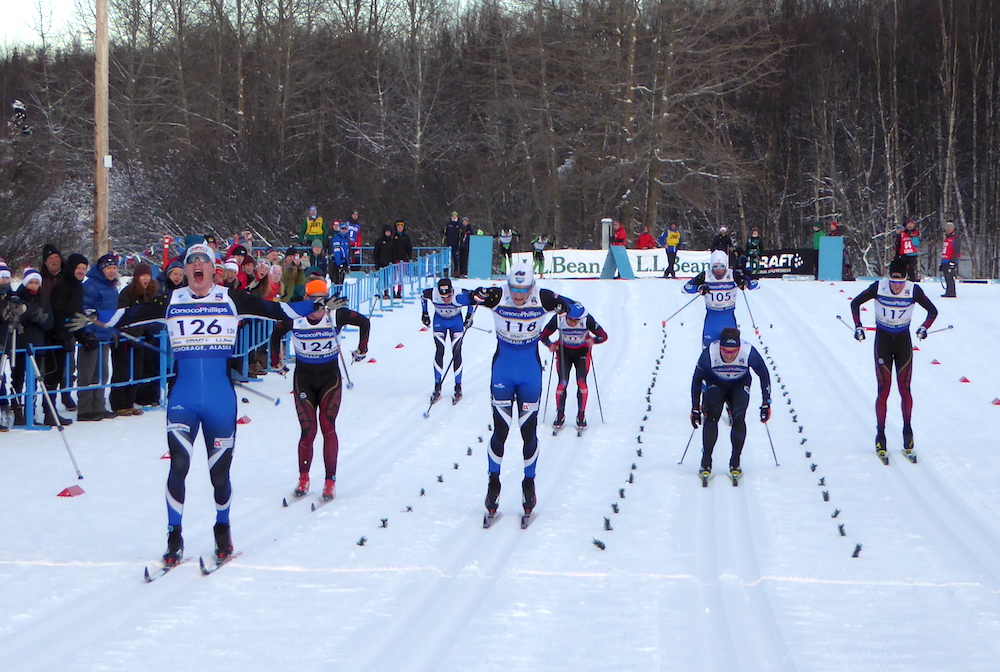
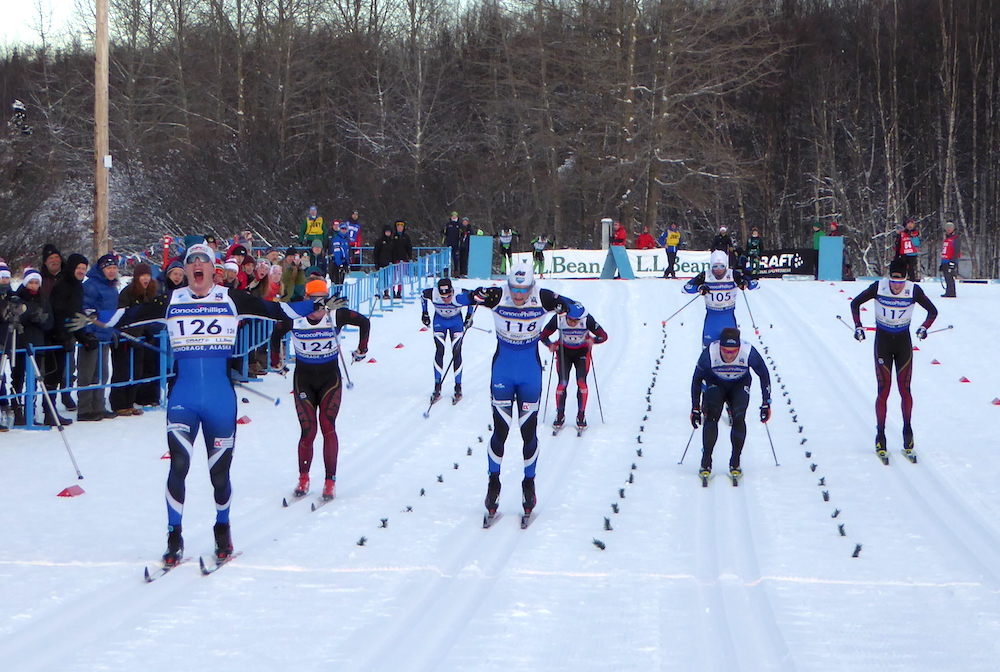
APU’s Tyler Kornfield (126) leads APU’s Eric Packer (118) and DU’s Eivind Romberg Kvaale (124) to the line in the men’s 30 k classic mass start at 2018 U.S. Cross Country Championships on Sunday in Anchorage, Alaska. Kornfield, Packer, and Kvaale finished first, second and third, respectively. Kris Freeman (10, second from left) was fourth overall and the third American.
U.S. Cross Country Championships (Anchorage, Alaska): 20/30 k classic mass starts
Sweden’s Hedda Bångman denied Caitlin Patterson of her first outright victory of the week at 2018 U.S. Cross Country Championships, but Patterson as the first American racked up her third-straight national title in the women’s 20-kilometer classic mass start at Kincaid Park on Sunday in Anchorage, Alaska.
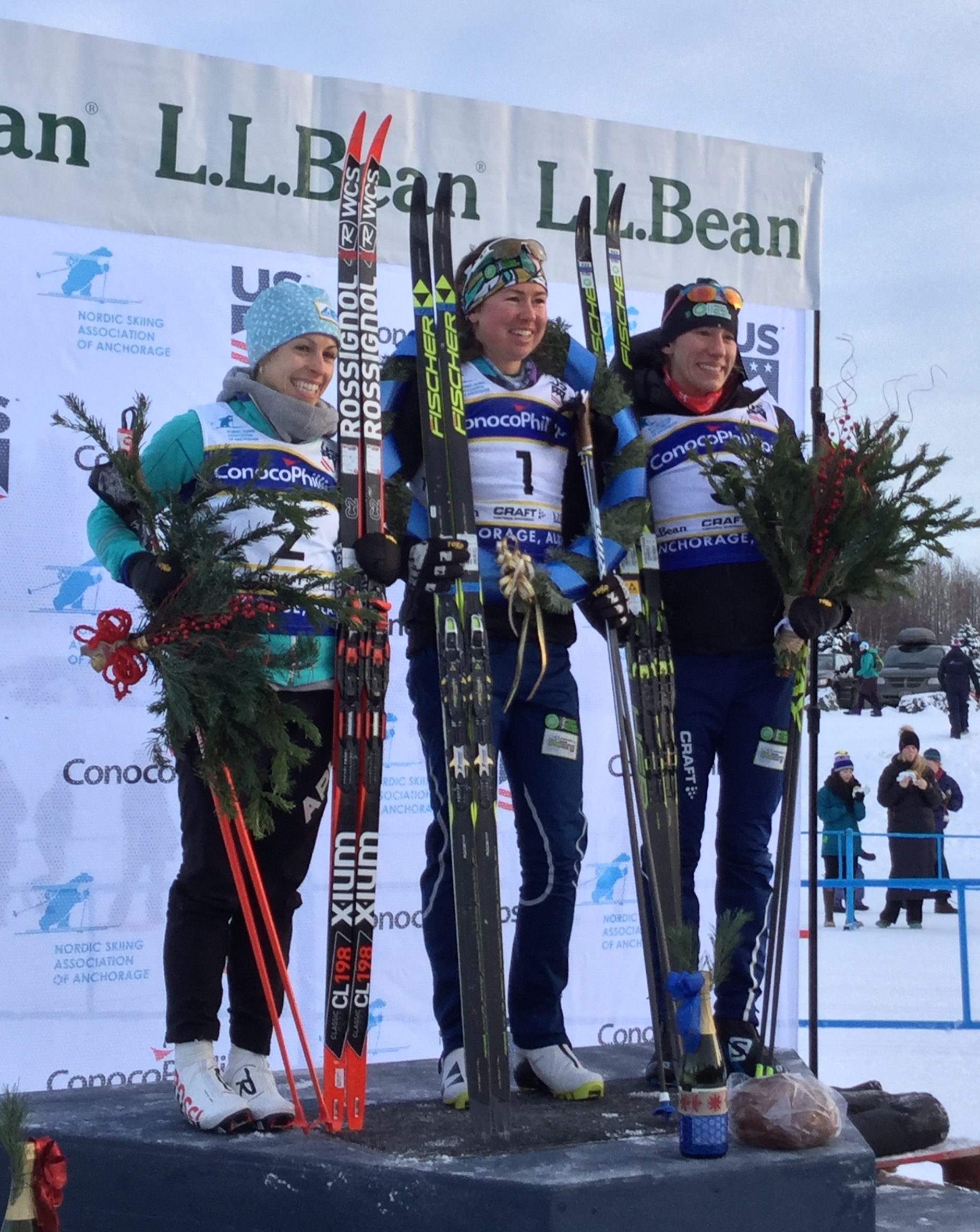
The top-three Americans in the women’s 20 k classic mass start on Sunday at 2018 U.S. nationals in Anchorage, Alaska, with Caitlin Patterson (1) of the Craftsbury Green Racing Project (CGRP) in first, Rosie Frankowski of APU (l) in second, and Kaitlynn Miller (r) of CRGP in third.
Bångman, a 22-year-old freshman at the University of Colorado Boulder (CU), pulled off a 15.9-second win in the mass start, crossing the line in 1:00:55.3 hours. Patterson, of the Craftsbury Green Racing Project (CGRP), finished second, but was the top American in the event for the third time this week, and Rosie Frankowski, of Alaska Pacific University (APU), notched third (second American), 19.6 seconds back.
Rounding out the top 10 was Jessica Yeaton, who trains with APU and races for Australia, in fourth (+44.1), Kaitlynn Miller (CGRP) as the third American in fifth overall (+1:13.5), Alayna Sonnesyn of the University of Vermont (UVM) in sixth (+1:25.3), Chelsea Holmes (APU) in seventh (+1:55.4), Norwegian CU skiers Christina Rolandson and Anne Siri Lervik in eighth (+1:55.7) and ninth (+1:56.1), respectively, and Erika Flowers of the Stratton Mountain School (SMS) Elite Team in 10th (+2:14.6).
The men’s 30 k classic mass start was incredibly close, with APU’s Tyler Kornfield taking his first-ever distance national title (he was the 2012 classic sprint national champion) in 1:21:43.6. He edged his teammate Eric Packer by 0.7 seconds at the line, and Eivind Romberg Kvaale, a sophomore at the University of Denver (DU), finished 1 seconds back in third.
Kris Freeman (Caldwell Sport) was just off the overall podium in fourth (+1.6), but was the third American. Another DU skier, Dag Frode Trollebø, also from Norway, finished fifth (+2.0), and APU had three in the top six with David Norris in sixth (+2.5). Noah Hoffman (Ski & Snowboard Club Vail) finished seventh (+2.6), Scott Patterson (APU) eighth (+3.6), and Craftsbury’s Adam Martin and Ben Lustgarten followed in ninth (+14.7) and 10th (+14.9), respectively. With Brian Gregg (CXC/LNR/Team Gregg) in 11th (+16.1), the men’s top 11 were separated by less than 17 seconds.
IBU World Cup (Oberhof, Germany): Men’s and women’s relays
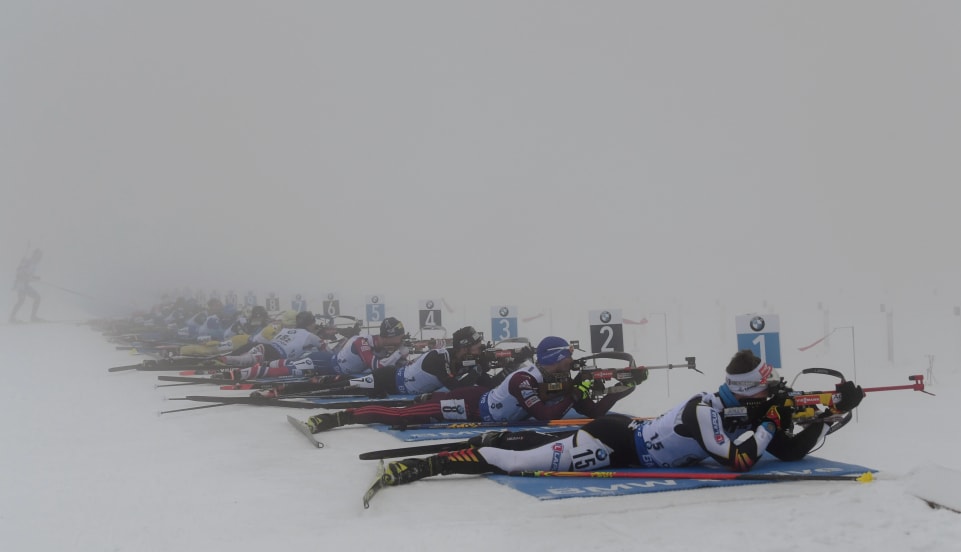
Racers on the range during the men’s 4 x 7.5 k relay on a foggy Sunday at the IBU World Cup in Oberhof, Germany. (Photo: IBU/Biathlonworld)
The Swedish men’s team and French women won the second relays of the International Biathlon Union (IBU) World Cup season on Sunday, with Sweden winning the men’s 4 x 7.5 k relay by 1:10.8 over Italy, and France besting Germany by 32.4 seconds.
Notably, most of the top teams didn’t start all of their “A” teamers.
In the men’s race, Sweden’s Martin Ponsiluoma, Jesper Nelin, Sebastian Samuelsson, and Fredrik Lindström combined for their first win together — and the first win for most of the members on the team.
“It is a dream when you are a kid to compete in a World Cup,” Samuelsson said, according to an IBU press release. “To have a win is really amazing!”
The Swedish women’s team also landed on the podium in third (+48.2).
“What a race by the whole team,” said Lindström, who also has one non-relay World Cup win (from 2012) to his name. “It could not be better.”
Conditions could not have been much more difficult for shooting on Sunday, with the fog that had descended early in the day for the women’s race worsening for the men’s race. When there wasn’t fog, there was wind.
Misses were common throughout the two races, and even with racers being able to use three spares per shooting stage to clean, there were a high number of penalty laps.
But the Swedish men kept their penalties to a minimum, with just one for the entire team and a total of nine spare rounds used among them. After Ponsiluoma came through the first exchange in sixth, Nelin skied them into third, Samuelsson picked off another place despite skiing a penalty after his standing stage to put them in second, and Lindström anchored them to first.
“The conditions today were so special. Somehow I felt not so nervous, I was calm and had luck on my side,” Lindström said at a post-race press conference about his nearly flawless shooting (0+0; 0+1).
“I have never [been first] before,” he added. “Not like this in a relay at least. That’s really fantastic.”
“I had to look up to see if I was aiming the right way,” Nelin said after cleaning prone (0+0) then using two spares to clean standing (0+2). “I had no idea where I was aiming, so it was really difficult. But I hit, and it was good. Maybe these conditions fit me and I should never see anything.”
Italy placed second with Thomas Bormolini, Lukas Hofer, Dominik Windisch, and Thierry Chenal combining for two penalties and 11 spares. Hofer had skied them up from eighth to second, and Windisch then took the lead on the third leg to put them in first at the final exchange, 1 minute ahead of Sweden. But Chenal slipped with the seventh-fastest last leg time and a penalty after standing.
“Being on the podium with the team is always a special feeling,” Hofer said at the press conference. “For Thierry, it’s the first year in the World Cup, and he does a really good job, not just today. I am really happy that he could close out this relay. Second place is like a win for us.”
Norway placed third (+2:04.6) with Vetle Sjåstad Christiansen, Henrik L’Abée-Lund, Lars Helge Birkeland, and Tarjei Bø. Together, they had three penalties (two from L’Abée-Lund and one from Birkeland) and 14 spares.
“I grew up on Holmenkollen so I practiced a lot there [in fog],” L’Abée-Lund said. “But today was really really hard, I didn’t see anything in prone. Standing was OK, but prone was really difficult.”
“It’s great to be on the podium,” Christiansen said. “Of course Norway always wants to win, but today we are very happy for our brothers in our neighbor-country Sweden.”
The Canadian men placed 10th (+6:23.1) out of 25 teams with Christian Gow, Scott Gow, Brendan Green, and Carsen Campbell having a combined six penalties and 20 spares. Three of those penalties came on Scott Gow’s second leg, two from Campbell’s anchor leg, and one on Christian Gow’s first leg.
After a penalty on his first prone stage (1+3), Christian cleaned standing with a spare (0+1) and tagged Scott in 11th, 53 seconds out of first. Scott then had two penalties in prone and three in standing, but managed to improve to eighth given how much everyone else was struggling with the shooting as well. Green kept them in eighth with two clean stages (0+2, 0+3), and Campbell, in his first World Cup relay, cleaned prone (0+2) but had two standing penalties (2+3) to put the team in 10th at the finish.
In an interview with German broadcaster ARD halfway through the race, Canadian coach Matthias Ahrens called the range conditions, which ranged from thick fog to unpredictable wind, “very hard to assess.”
“… To be honest, the good thing was that conditions were very bad,” he later added. “So regarding visibility, almost everyone was on the range at the same time [with the same irregular conditions]. They had to wait very long, and of course had bad conditions to shoot, but much of the field was there at the same time.”
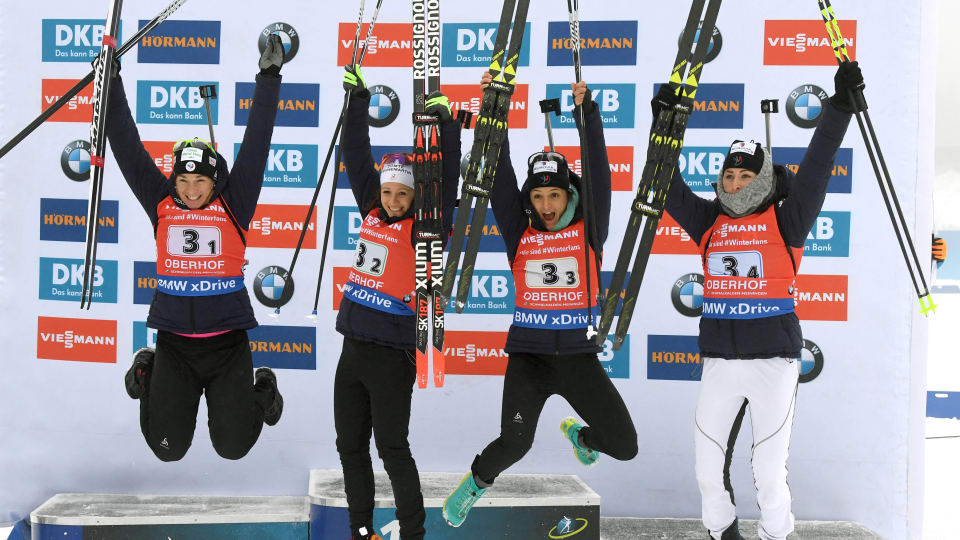
The French women’s team, of Anais Bescond, Anais Chevalier, Celia Aymonier, and Justine Braisaz, celebrate their relay victory on Sunday at the IBU World Cup in Oberhof, Germany. (Photo: IBU/Biathlonworld)
In the women’s race, with better shooting visibility, France’s Anais Bescond, Anais Chevalier, Celia Aymonier, and Justine Braisaz took the win in 1:12.42.4, with one penalty and 10 spares. After Bescond put them in first through the first exchange, 6 seconds ahead of Italy in second, Chevalier had to ski a penalty loop after prone but cleaned standings (1+3, 0+0) and tagged off in second, 23 seconds behind Italy, now in first.
One loop later, France was back in first thanks to Aymonier, who cleaned with just two spares (0+0, 0+2), and they extended their lead from 0.8 seconds at the last exchange to 32 seconds at the finish with Braisaz, who shot 0+1, 0+3, and skied the fastest anchor leg.
“I know that it’s always good for Justine to start in the first position, so I really wanted to pass the relay to her in that,” Aymonier said in a press conference after.
“I was nervous, too,” Braisaz said. “That kind of shooting turned my mind upside down, actually. The crowd was very loud, and … I wasn’t very focused on what I did. It was a bit foggy, too, so that made it harder. But finally it was a French day, maybe.”
“In my mind the whole team is really strong, and really able to get the first place,” Bescond said. “After years and years and years behind Germany’s team we finally did it. So just Oberhof spirit I think.”
Germany placed second with Vanessa Hinz, Denise Herrmann, Franziska Preuss, and Maren Hammerschmidt. They combined for two penalties and 13 spares; with a penalty on Hinz’s first leg and one more on Hammerschmidt’s last shooting. After being tagged in 14th, Herrmann skied them into fourth, 40 seconds out of first, and Preuss elevated them to second, which Hammerschmidt held onto.
“I was struggling a little bit in the prone shooting,” Herrmann said. “But the skiing was good today, and also the standing [shooting]. I tried to go fast on the track and catch some girls.”
Sweden, with Linn Persson, Anna Magnusson, Elisabeth Högberg, and Mona Brorsson, avoided the penalty loop and used eight spares to reach the podium for the first time in six seasons. In sixth place at the first exchange, they slipped one place to seventh on the second leg, but Högberg raced them up to fourth with near-perfect shooting (0+0, 0+1) with one leg to go. Brorsson then anchored them to third with clean shooting (0+2, 0+1) and the third-fastest last leg.
“It’s just super nice for us! I am super happy,” Magnusson said. “We were very emotional at the finish.”
When Brorsson was asked if she believe she could fight for the podium, she responded, “Not really. But I said to Linn, ‘Maybe it is our day today. Please let it be our day today.’ ”
The Canadian women finished 14th (+6:37.5), out of 20 teams, with two penalties and 13 spares. Sarah Beaudry initially put them in 15th after shooting 0+1, 0+2, then Julia Ransom had a standing penalty (0+2, 1+3) to slip one place to 16th. Megan Tandy picked off three places with clean shooting (0+0, 0+2) and tagged Emma Lunder in 13th, and Lunder had a penalty in prone but cleaned standing (1+3, 0+0) to finish in 14th.
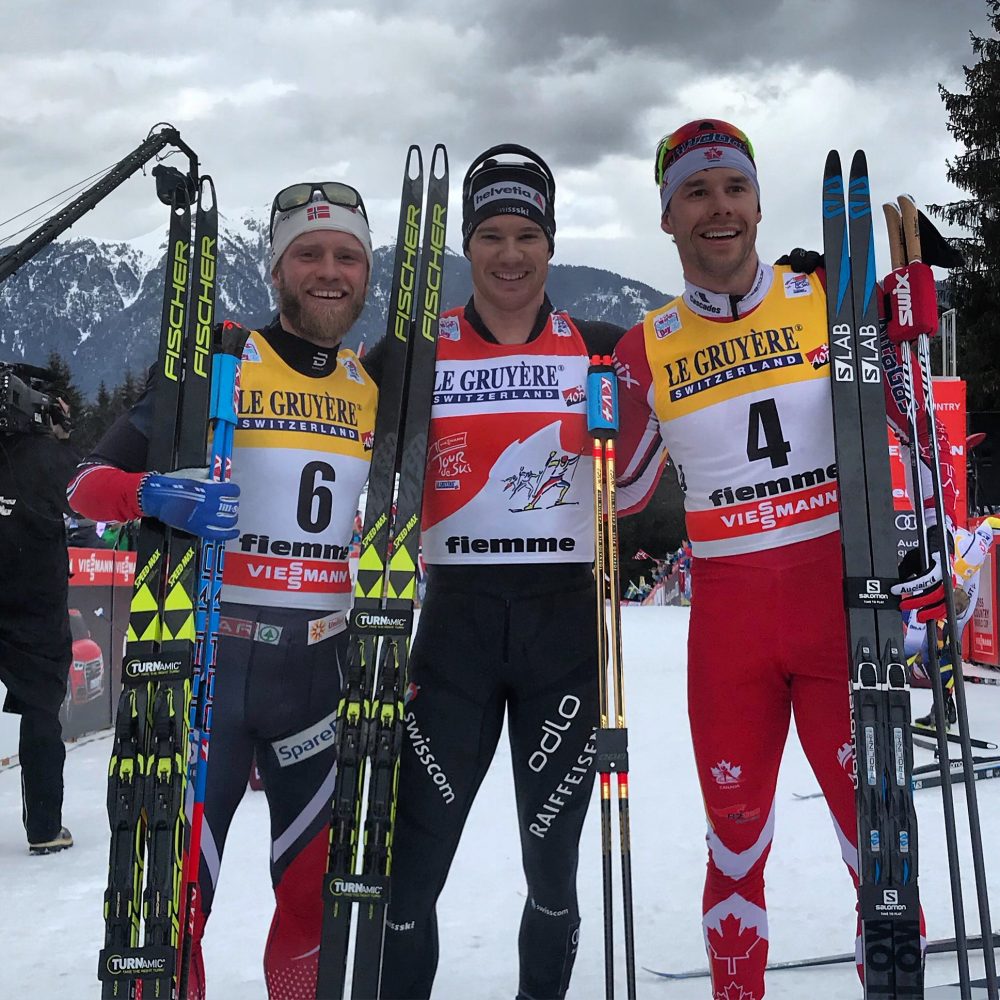
The men’s overall 2018 Tour de Ski podium atop Alpe Cermis after the final Stage 7 hill climb: with Switzerland’s Dario Cologna (c) in first, Norway’s Martin Johnsrud Sundby (l) in second and Canada’s Alex Harvey (r) in third. (Photo: FIS Cross Country/Twitter)
Dario Cologna of Switzerland added a fourth Tour de Ski (TdS) title to his list of accolades on Sunday, winning the 2018 edition of the race in dominant fashion, with a 1:26.5-minute win over Norway’s Martin Johnsrud Sundby. And Canada’s Alex Harvey scored his first TdS overall podium in third.
The 31-year-old Cologna started the 9-kilometer freestyle pursuit up Alpe Cermis 1:15 ahead of Kazakhstan’s Alexey Poltoranin in second. Russia’s Sergey Ustiugov, slated to start third, did not start due to a back injury. Thus Harvey was the third man off the start line, 1:23 behind Cologna.
(Sweden’s Marcus Hellner, 13th after Saturday’s Stage 6, also did not start the Tour’s final stage.)
Early on, Cologna started putting time into his competitors, extending his lead on Poltoranin to 1:20.5 and Harvey to 1:24 at 1.8 k.
By 4 k, however, Harvey had used his speedy skiing on the flatter portions of the race leading up to the climb to catch Poltoranin, and the two clocked through that checkpoint 1:19.4 behind Cologna. Behind them, Russia’s Alexander Bolshunov skied just ahead of Sundby, another 21 seconds and 22 seconds back, respectively, in fifth and sixth.
While Harvey clawed back a few more seconds on Cologna, he was still 1:17.8 back at 6.2 k, with Poltoranin just 0.7 seconds behind him in third.
Harvey remained in second until around 8.5 k; with just a half kilometer to go, Sundby had caught both Poltoranin and Harvey, passing them both. Sundby held that position and finished second, 1:26.5 behind Cologna, who won in 28:52.1.
Harvey stayed strong for third (+1:30.6) while Poltoranin dropped off the Canadian’s pace in the final half kilometer and finished fourth (+1:41.7). Norway’s Hans Christer Holund placed fifth (+2:17.8), Bolshunov lost a spot to finish sixth (+3:09.7), France’s Jean-Marc Gaillard finished seventh (+3:16.7), Sweden’s Daniel Rickardsson eighth (+3:20.8), and Russia’s Alexey Chervotkin and Andrey Larkov took ninth (+3:33.5) and 10th (+3:37.8), respectively.
France’s Maurice Manificat, known for his strength in freestyle hill climbs and pursuit races, rose from 14th to 11th (+3:45.7) with the second fastest time of day, 12.8 seconds slower than Sundby as the time of day winner in 28:36.4. Cologna’s time was fourth fastest (+15.7), behind Russian U23 skier Denis Spitsov in third (+14.3) (Spitsov started 20th and finished 13th). Holund’s time ranked fifth (+20.6) and Harvey’s time was sixth fastest (+23.6) of the 43 men that finished the race.
The lone American man to complete this year’s Tour, Paddy Caldwell (U.S. Ski Team) skied the 22nd fastest time of day for 38th overall (+11:54.8).
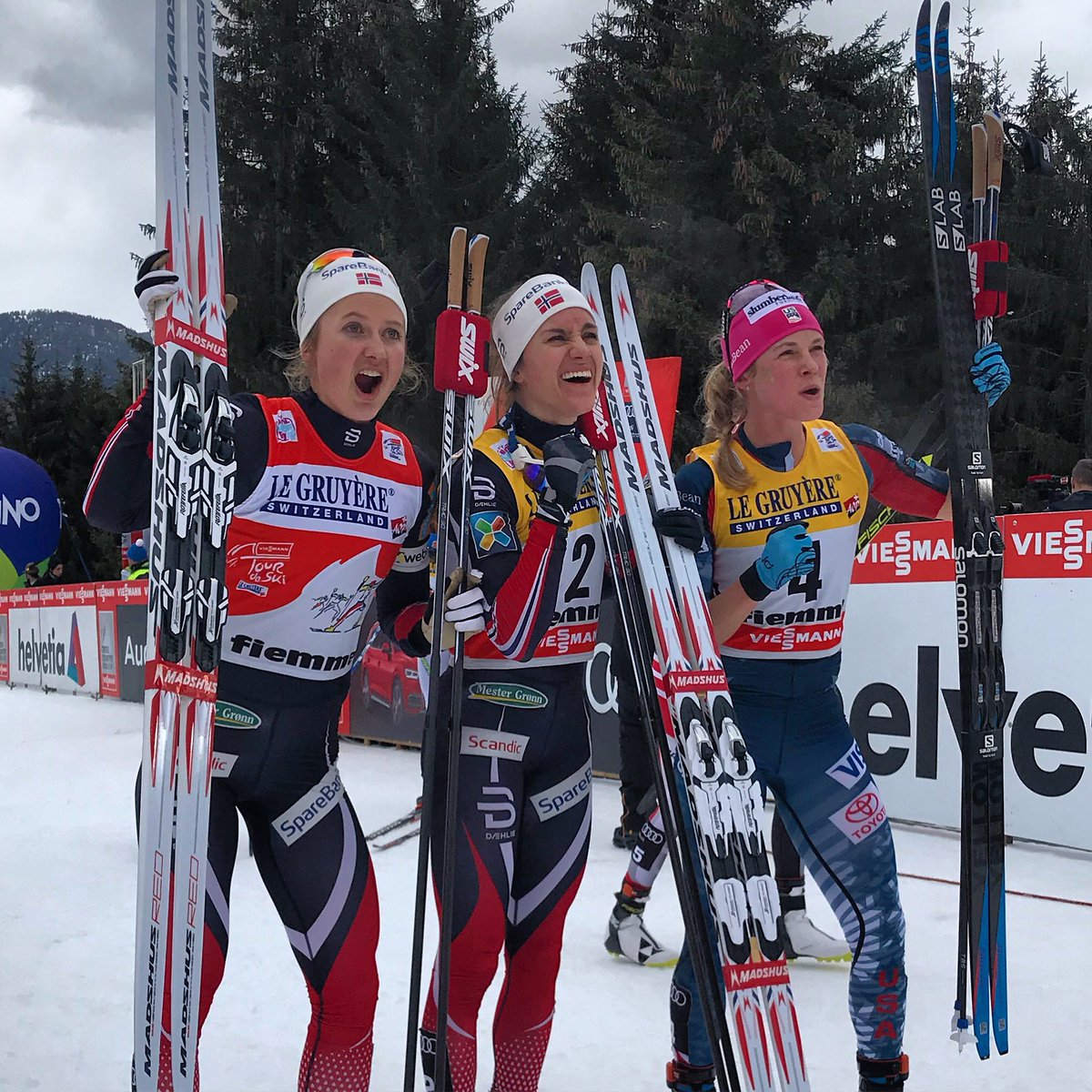
Heidi Weng (center) celebrates her second Tour de Ski victory, with teammate Ingvild Flugstad Østberg second and the U.S. Ski Team’s Jessie Diggins third. (Photo: FIS Cross Country/Twitter)
In the women’s hill climb that kicked off the day, Heidi Weng raced to her second consecutive TdS title. The Norwegian started the day within two seconds of teammate Ingvild Flugstad Østberg, and the two skied together for the flat section of the nine-kilometer stage of the competition. But when the climbing got steep on Alpe Cermis, Weng left her teammate behind and eventually racked up a 48.5-second win.
The battle for third was less predictable. Jessie Diggins of the United States started the day in fourth, but made up the ten seconds to third-place KristaPärmäkoski of Finland in the first few kilometers. The pair climbed together for a while before Diggins attacked. Pärmäkoski tired on the final sections of the Alpe Cermis and Diggins took the podium in definitive style, 2:23.2 behind Weng and 24 seconds ahead of Pärmäkoski. It’s the first overall Tour de Ski podium for Diggins or any American athlete.
Teresa Stadlober of Austria finished fifth (+3:09.4), Kerttu Niskanen of Finland sixth (+4:17.0), Russia’s Anastasia Sedova seventh (+4:49.6), and Switzerland’s Nathalie von Siebenthal eighth (+4:56.1).
Sadie Bjornsen started eighth and slipped one spot to finish ninth (+6:15.0), giving the U.S. two top-ten finishers in the Tour de Ski for the first time. Liz Stephen finished 16th (+8:25.8) and Rosie Brennan 24th (+10:59.6).
En route to her win, Weng notched the fastest time of the day on the 9 k stage. Stadlober’s time was second, Diggins third, Østberg fourth, and Stephen fifth.
32 women finished this year’s edition of the Tour de Ski.
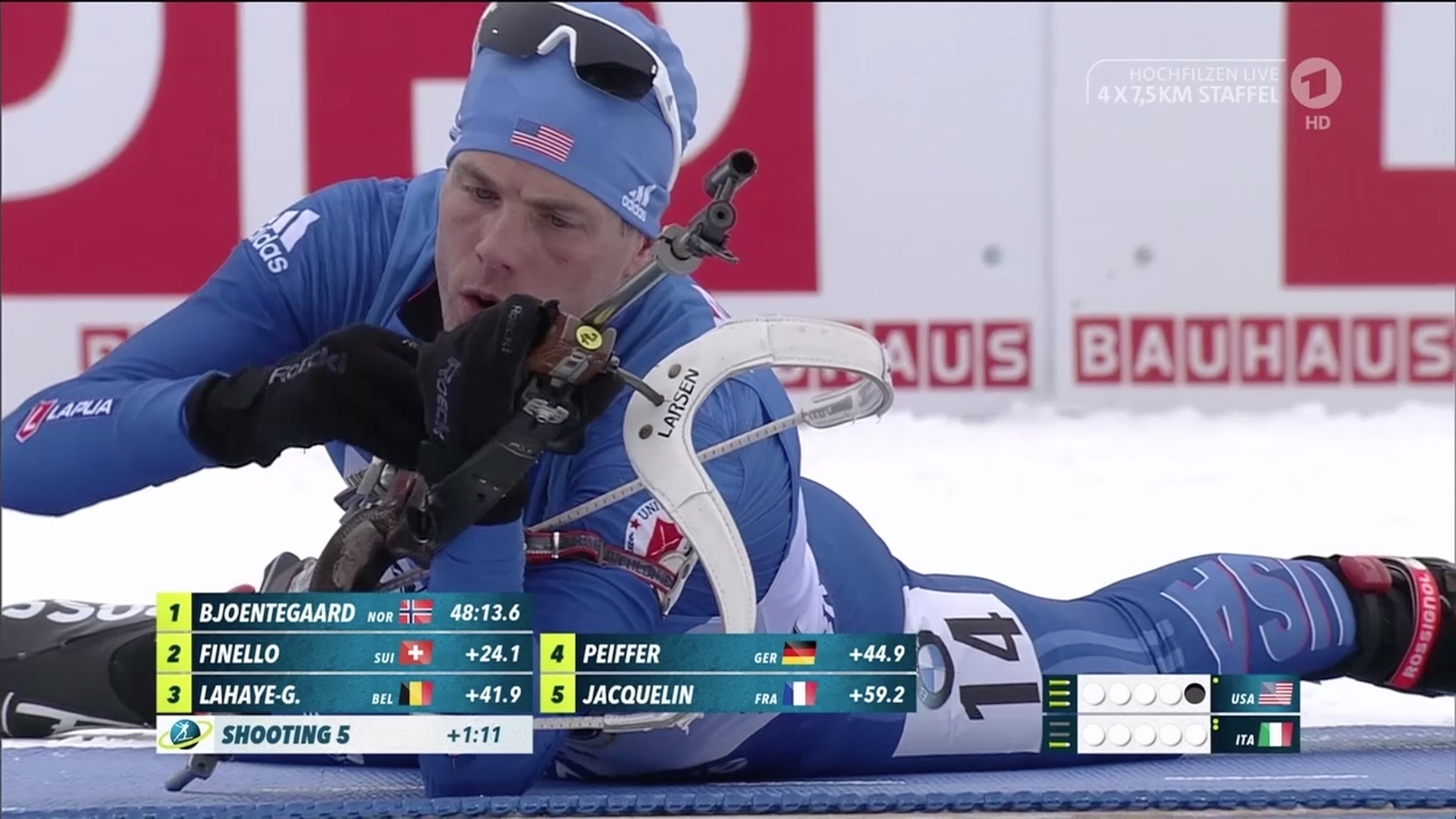
Leif Nordgren (US Biathlon) skiing the second leg of the IBU World Cup men’s 4 x 7.5 k relay on Sunday in Hochfilzen, Austria. The U.S. men ended up ninth overall out of 26 teams. (Photo: IBU/NordicFocus)
Strong gusts of wind on the range required strong nerves and a lot of luck in the women’s and men’s relay races that concluded the International Biathlon Union (IBU) World Cup in Hochfilzen, Austria, on Sunday afternoon.
While the relays concluded with teams on the podium one might expect there, tempestuous weather conditions that at times made it almost impossible to hit the targets also gave outsiders a good chance, and both the U.S. men and Canadian women remained in contention for a long time. The men’s 4 x 7-5-kilometer relay was particularly wild with more than 100 penalty laps, and it began with a big surprise.
Belgium’s starter Michael Rösch tagged off in first place for the first time in the history of that team, representing a country that until now, rarely had enough athletes for a relay and had thus far had a 24th place at the 2016 World Championships to its credit. And on his tails was Norway’s Ole Einar Bjørndalen, and shortly behind them US Biathlon’s Lowell Bailey in third.
The three aforementioned athletes all raced in the Olympic relay more than a decade ago at the 2006 Winter Games in Torino, Italy, but back then Rösch raced for Germany and won gold with his team.
“I wanted to tag off in first at all costs, to see the Belgian flag at the top,” Rösch told TV broadcaster ARD on Sunday while the race was still going on. “But Ole made it really hard for me. … I was on my last fumes, I tumbled into the finish, I was just seeing black, but it definitely was worth it.”
Just a turn behind, Bailey had gotten off to a strong start for the U.S. team, temporarily taking the lead out of the arena on the first lap before shooting clean in his prone stage to put himself in the lead group of seven. Facing strong wind in his standing stage, Bailey missed two targets but avoided the penalty lap with his last spare in that stage (0+0, 0+3), and tagged off to teammate Leif Nordgren in third position, 23.8 seconds out of first.
Nordgren ended up with a penalty in his first prone after missing two targets, and returned to the course in fifth. While his penalty had increased the gap to first by 50 seconds, Nordgren made up a few seconds with a clean standing bout, hitting all targets without requiring a spare (1+3, 0+0).
Italy and France passed him on the final loop, and Nordgren handed off in seventh, 1:34.2 minutes behind Norway setting the pace up front.
“The team came pretty close to a good result today in a relay with nasty weather,” Nordgren wrote on his Instagram account. “Personally I’m quite disappointed with my skiing, it’s been a struggle to find the top gears so far this season and I’m far from where I know I should be. It’s a long season though and there is still plenty of time to turn it around.”
US Biathlon’s Tim Burke loading a spare in his prone stage of the men’s relay at the 2017/2018 IBU World Cup in Hochfilzen, Austria. The team went on to finish 9th. (Screenshot: ARD broadcast)
Taking over next for the U.S. was Tim Burke, who pointed out this was one of the most challenging races in terms of wind that he’d experienced.
“This was definitely one [of the] windiest races that I have taken part in,” Burke wrote in an email to FasterSkier. “We knew it would be very challenging right from the start but our team tried to look at it as an opportunity for a top result. I feel like our team did a great job at avoiding any big disasters on the range and this allowed us to stay near the front for most of the race.”
After only needing one spare in his prone shooting to hit his last target, Burke incurred a penalty in his standing stage (0+1, 1+3), but kept his position on the final loop in a hard race against Switzerland’s Jeremy Finello to exchange still in seventh, now another minute back (+2:49.4).
“I was not surprised to see a mix of different teams near the front today,” Burke wrote. “It was one of those days that any team could find themselves with multiple penalty loops after a windy shooting stage.“
Taking over from Burke as the U.S. anchor leg was Sean Doherty, coming off two strong shooting performances in the sprint and pursuit earlier this week.
U.S. relay anchor Sean Doherty taking aim in difficult wind conditions during his standing stage of the men’s relay at the 2017/2018 IBU World Cup in Hochfilzen, Austria. His team finished ninth. (Screenshot: ARD broadcast)
In his prone stage, Doherty again shot clean and fast (with the second-fastest prone shooting time on his leg) and overtook Switzerland to move into sixth. He kept that position on the course, vying for a position in the top five with the teams from France, Italy, Ukraine, and Russia also in his vicinity.
“Today was a crazy one for sure,” Doherty wrote in an email. “The conditions on the course were decent, firm tracks and we had good skis. The wind was whipping, so that really just made some sections a lot harder than normal when you added in the head wind. I have done races in bad weather before but today was amongst the most windy.
In the standing stage, Doherty hit his first four shots in another fast sequence before missing the last one. It looked as if he had thought that final shot was also a hit as he dropped his rifle slightly, but then realized he had to load spares. Unable to clear the last target, Doherty ended up with the team’s third penalty.
“With the shooting you try to get a general idea of how far the wind is pushing the shots and do the best you can,” Doherty explained. “It’s a total toss up and the finish order is just a ranking of who battled the wind the best and had most to least luck along the way.”
He set out on his last loop in eighth place with Ukraine’s Dmytro Pidruchnyi and Switzerland’s Mario Dolder right ahead of him, and Russia’s Anton Shipulin ten seconds behind.
“The fight on the last lap is always tough,” Doherty wrote. “Although I felt better today I was not able to hang with the two guys I left the range with. I was able to ski a good lap but not enough to hold off Anton.”
After Shipulin passed him up the big last climb, Doherty came to the finish in ninth position, 3:38.3 minutes behind the winners with a team total of three penalties and 13 spares.
“We were not too excited with the end result because we saw the potential was there for a top 5,” Burke concluded for the team. “We are also all far from our best on the tracks right now, but are hopeful that will come with more racing.”
Norway Successful with Its ‘Second Unit’
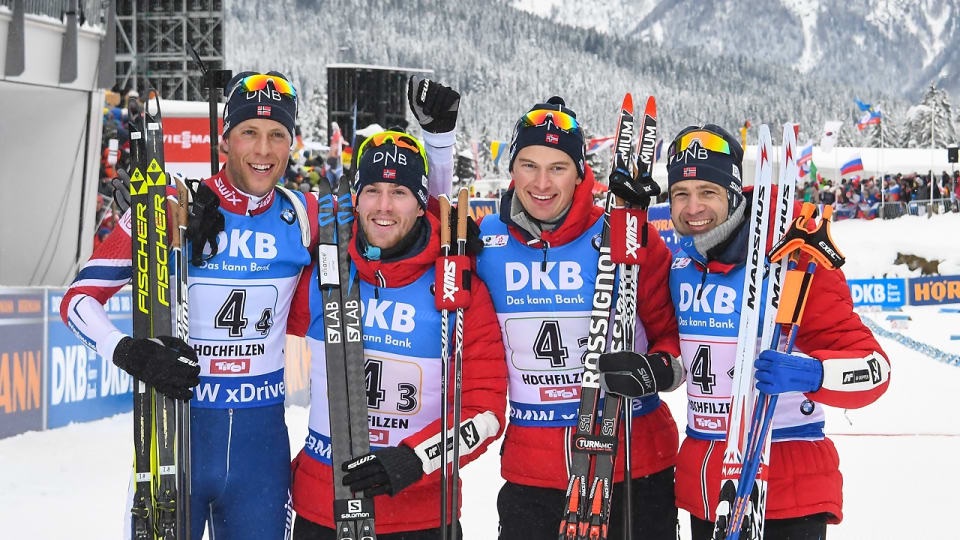
Norway’s Lars Helge Birkeland, Erlend Bjøntegaard, Henrik L’Abée-Lund and Ole Einar Bjørndalen (left to right) following their victory in the men’s relay at the 2017/2018 IBU World Cup in Hochfilzen, Austria. (Photo: IBU/Biathlonworld)
Norway started the men’s relay race without Emil Hegle Svendsen, who was sidelined with a cold, and also rested brothers Johannes Thingnes Bø and Tarjei Bø, both of whom had already won races this season.
But shooting was more important than skiing in a relay decided by strong crosswinds on the range, and that’s where the Norwegians coped by far the best. While Norway also required nine spares, which usually is a rather average performance in a relay, on Sunday this was the top shooting performance of the men’s relay.
After veteran Bjørndalen, Henrik L’Abée-Lund and Erlend Bjøntegaard had created a fairly comfortable lead of almost a minute on the first three legs, Lars Helge Birkeland anchored them to the victory by shooting clean in prone and only needing one spare to hit every target in his final stage despite some widely spread shots.
“It is really nice; a good start for Norway and good self confidence for the the rest of the season,” L’Abée-Lund said at the post-race press conference.
“It’s always fun to compete on the highest level with the best guys,” Bjøntegaard said. “I think I did pretty good on my leg today. It was tough conditions as it was for everyone else. I am just happy to show what I am capable of.”
“It feels great, it was an amazing feeling on the last loop, and really satisfied with my own leg,” Birkeland said. “I just decided to be offensive and attack and don’t think about the others and just do my own race. … We have a really strong team with a lot of good guys, so we don’t need to have all the best at the start to have a chance to win.”
All hopes for Germany’s Simon Schempp to contend with Birkeland for first were dashed when Schempp required three spares to clear both his prone and standing stages, narrowly avoiding the penalty lap twice.
Due to the huge distances between the top-three teams, the final loop was more of a cool down for their anchors, with Norway taking the win in 1:21:21.8 hours, just under two minutes ahead of Germany, with Erik Lesser, Benedikt Doll, Arnd Peiffer and Schempp, in second (+1:54.9, with zero penalties and 17 spares).
“At least we avoided the penalty loop, for me it was definitely close in standing,” Peiffer told German broadcaster ARD. “There was so much wind that it was impossible to shoot calmly and controlled. … It was clear that today there would be some upsets, like Belgium being in the mix in front. You just had to somehow avoid the penalty lap.”
“The last years in Hochfilzen we have never been on the podium, so it’s the first time in like six years we are back again,” Peiffer said at the press conference. “So that’s a good start for us because normally we are struggling here and we don’t know why.”
France, which had rested its star Martin Fourcade and started Jean-Guillaume Beatrix, Simon Desthieux, Emilien Jacquelin, and anchor Quentin Fillon Maillet, finished another 40 seconds later in third (+2:34.0, with three penalties and 13 spares).
Another 20 seconds back, Sweden with Peppe Femling, Jesper Nelin, Sebastian Samuelsson, and Fredrik Lindström crossed the line in fourth (+2:54.8, with three penalties and 12 spares).
“Today was very hard, very strange result, because when we look at all the penalties on the result list it was just crazy,” Beatrix said at the press conference. “I am satisfied for the team, and I am also really satisfied for the newcomer Emilien because it’s his first two weeks on the World Cup and first relay, and he did a every good job and brought us to the podium.”
“Today I was a little bit stressed, because the French guys are so strong and I had to be at their level, so I am happy to do a good relay today,” the 22-year-old Jacquelin said.
And what happened to the brave team from Belgium? With three athletes who had just made an overnight trip from an IBU Cup race in Lenzerheide, Switzerland, they came through the second exchange in second place after Florent Claude only needed one spare in standing. On the last two legs, however, three penalties for both Tom Lahaye-Goffart and Thierry Langer put them in 16th at the finish (+6:24.9) , which was still a team-best relay result for Belgium.
Just ahead of them in a finishing sprint anchored by Brendan Green was Biathlon Canada, with a lineup that earned bronze at the 2016 World Championships in Oslo, Norway. On Sunday, however, the Canadians’ race began with difficulties for brothers Christian Gow (1+3, 2+3) and Scott Gow (1+3, 2+ 3), each having to ski three penalty laps and exchanging in 21st position already 4:45.7 minutes back. Then Nathan Smith (0+0, 0+2) and Green (0+3, 0+3) were able to move them up a bit again, with Smith putting them as high as 13th by the final exchange and Green anchoring them to 15th (+6:22.5, with six penalties and 20 spares).
Of 26 teams in the men’s relay, Norway and Germany were the only ones that succesfully avoided the penalty lap.
Hochfilzen World Champs Women’s Podium Repeats
Later on Sunday afternoon in the women’s 4 x 6 k relay in slightly better conditions than the men’s race, last season’s reoccurring winner Germany struck gold again.
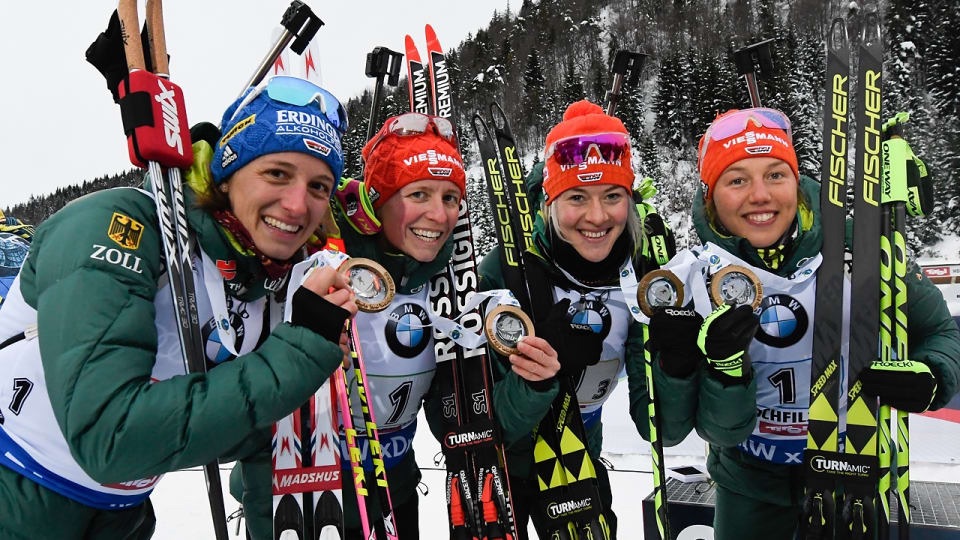
Germany with (left to right) Vanessa Hinz, Franziska Hildebrand, Maren Hammerschmidt and anchor Laura Dahlmeier shows off their medals following their victory in the women’s relay at the 2017/2018 IBU World Cup in Hochfilzen, Austria. (Photo: IBU/Biathlonworld)
The victorious world-champion quartet of Vanessa Hinz, Franziska Hildebrand, Maren Hammerschmidt,and Laura Dahlmeier won with a large lead ahead of Ukraine (+44.9) and France (+1:04.5). The first-, second- and third-place teams were a repeat of last season’s World Championships relay in Hochfilzen this past February.
Fighting for position with Ukraine and Switzerland on the third leg, Hammerschmidt got her team on the road to victory when she cleaned every target within 24 seconds despite difficult conditions to reclaim the lead, erasing the gap she had been handed of almost 30 seconds to first.
“For me it was very important to have a good standing shooting today, because the last two days were not so good,” Hammerschmidt said at the press conference. “I thought it was one of my best standing shootings, and I was so happy to go on the last loop and fight for every second to give to Laura.”
Dahlmeier returned to the World Cup after missing last week’s opening races with a cold, then had no major problems defending the lead. Dahlmeier used just one spare in each of her shooting stages, while Switzerland’s Irene Cadurisch as the closest pursuer had to ski a penalty lap. Germany finished in a time of 1:14:36.4, with zero penalties and nine spares.
“It’s a really cool feeling to be here again,” Dahlmeier said at the press conference. “Especially with the team. We know we can make a good race, but it’s important for every person to be good on the range and on the tracks. Relays are special races.”
“From the last year we have good memories about Hochfilzen … and today it was a good place, too,” Hildebrand said “I was really impressed with [Ukraine’s] Yulia Dzhima’s standing shooting, because she took all targets out while I used two extra bullets and was happy I could go out on the track again.”
Ukraine’s Olena Pidhrushna anchored her team, with Vita Semerenko, Yulia Dzhima and Valj Semerenko, to second (+44.9), thanks to the best team shooting performance of zero penalties and five spares, and despite a fall on the first leg by Vita Semerenko.
“I think our team spirit is very strong, without that we wouldn’t be on the podium, so I am very thankful to all the girls and our staff for making this happen,” Valj Semerenko said at the press conference, via a translator.
“My start this season was not so good … Actually today I was so nervous ahead of the relay,” Pidrushna explained. “But I saw that we had a little bit of extra time at the last exchange, and I calmed down a little bit and it worked well in the end. … And I think my team believes in me [to anchor it successfully].”
Twenty seconds behind her, France with Marie Dorin Habert, Celia Aymonier, Justine Braisaz and the current women’s World Cup leader Anaïs Bescond, passed Russia’s Ekaterina Yurlova-Percht on the final loop to claim third place (+1:04.5, with two penalties and 13 spares).
“Honestly at the beginning when I started I didn’t think a podium was still possible, but loop after loop I thought maybe I can still catch a podium [position],“ said Bescond, who skied the fastest course time on the final leg amidst strong competition.
A few seconds behind, Russia with Victoria Slivko, Tatiana Akimova, Irina Starykh, and Ekaterina Yurlova-Percht finished fourth (+1:09.0, with no penalty and nine spares).
Another 16 seconds back, Switzerland, with Elisa Gasparin, her older sister Selina Gasparin, Lena Häcki and Cadurisch finished fifth (+1:25.7, with two penalties and 12 spares) for Switzerland’s best women’s relay result, which fulfilled its national qualification criteria for the Olympics.
Canada in Contention
For Biathlon Canada, Emma Lunder started off the race in the middle of the field, and managed hit all her targets with one spare in her prone stage to leave the range in 16th position.
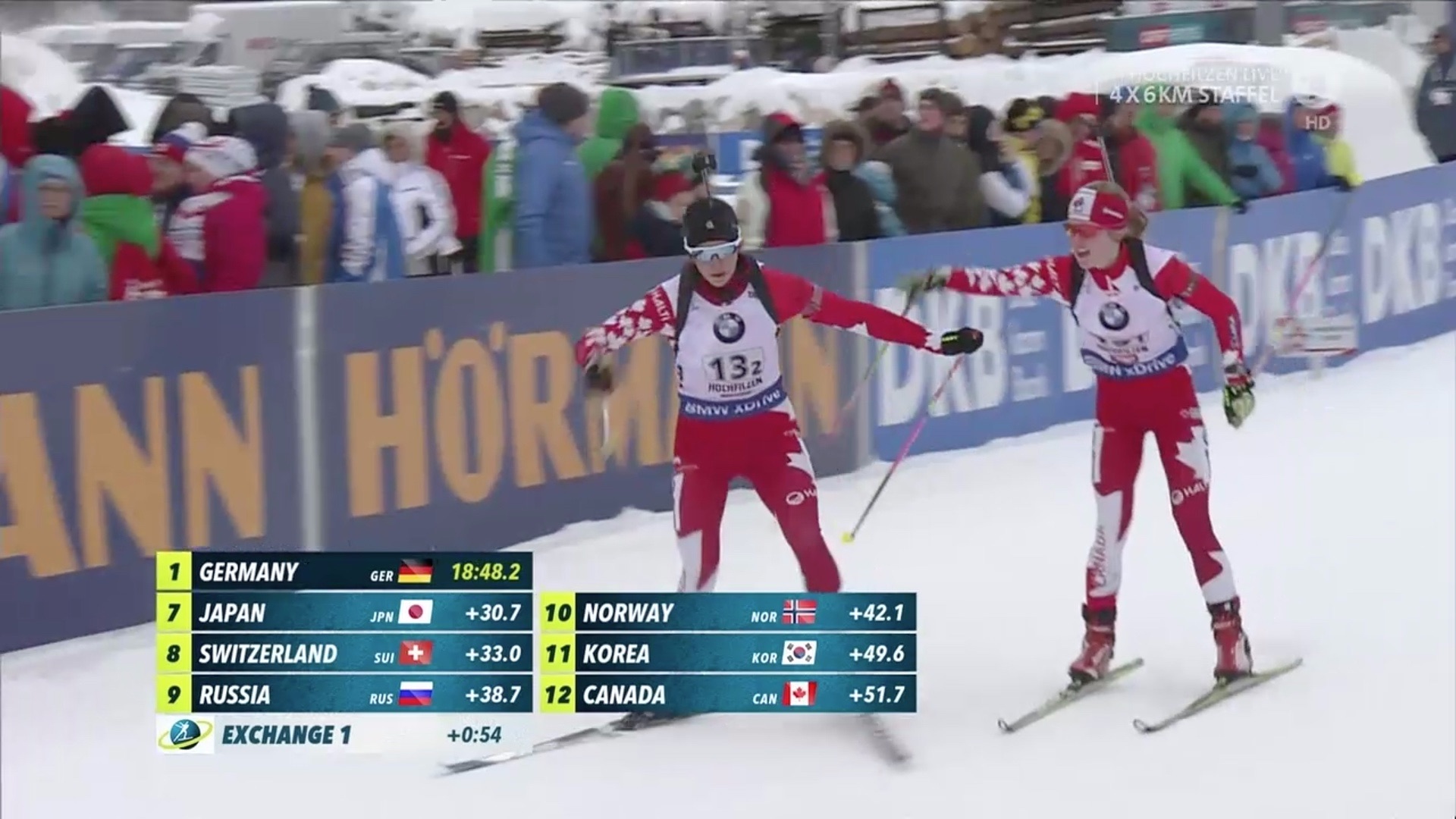
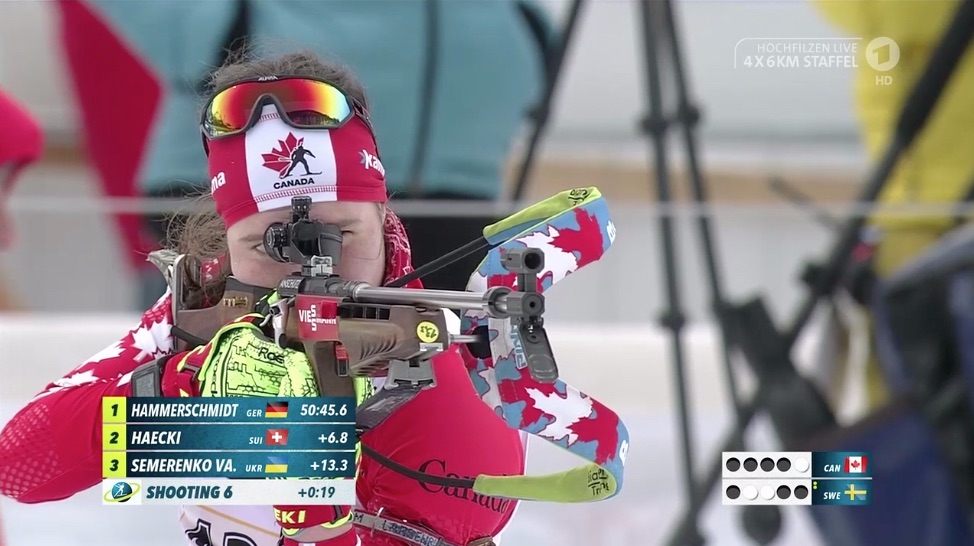
Biathlon Canada’s starter Emma Lunder (r) exchanging to Rosanna Crawford in the women’s relay at the 2017/2018 IBU World Cup in Hochfilzen, Austria. Crawford temporarily moved up to fifth before the team finished in ninth position. (Screenshot: ARD broadcast)
While a number of competitors, including France’s Dorin Habert, incurred penalties, Lunder again needed just one spare to clean (0+1, 0+1) and moved Canada up to 1oth. After losing a few more seconds on her last loop to the leaders, with Germany’s Hinz up front, she tagged Rosanna Crawford in 12th position, 51.7 seconds back.
Crawford started out fast and also needed just one spare to hit all five prone targets, improving by three places to ninth.
“It was a tricky shooting day today, you really had to be aware of the wind, and be prepared to do a correction even part way through a bout of shooting,” Crawford wrote in an email. “In prone I made a correction of 5 left and 2 up and it was enough to keep me pretty centred.”
Then in her standing stage, she picked off four more positions with clean shooting and no spares to leave the range in fifth place, while most teams around her needed spares or even incurred a penalty in seemingly difficult wind conditions.
“I was really happy with my standing today,” Crawford explained. “I saw Brendan [Green] right before zero and he said that it’s worthwhile to take your time and make each shot a good one. So I really thought about that as I came into the shooting, there was a big gust right off the start, so I waited and could hear the women around me missing. Each shot was really precise. My shooting time was 33 seconds which is really slow for standing but still the 2nd fastest of my leg, which says a lot about the wind today!”
Biathlon Canada’s Megan Bankes shooting in her standing stage in the women’s relay at the 2017/2018 IBU World Cup in Hochfilzen, Austria. The team finished ninth overall. (Screenshot: ARD broadcast)
Crawford tagged Megan Bankes in fifth (+36.3), after having regained 15 seconds on the leaders and skiing the second-fastest course time on the final loop.
“It’s always fun to tag off in a high position but today was a bit of a lucky draw for what you got in the range,” Crawford concluded.
The 20-year-old Bankes as Biathlon Canada’s youngest team member started out just as fast, nearly maintaining that time gap on the first loop.
“I was super stoked to be tagged in such a good place, but I definitely still felt that I was able to ski my own race,” Bankes wrote in an email. “I wanted to ski my best, and not lose to much time on the tracks, but also be controlled on the range, because I knew it was going to be a tricky shooting day.”
She was able to get through the prone stage with two spares in a stage when all leading teams needed them, keeping her in fifth. Bankes followed that up with just one spare in her standing shooting, temporarily moving up to fourth after overtaking Sweden’s Mona Brorsson.
“Coming into the range I was focussed on my own shooting more than anything else,” Bankes wrote. “I knew that the wind was pretty variable, and that I needed to make sure I took good, smart shots, and correct appropriately for the wind. I was super happy with how I ended up doing on the range, and also with my speed on my first couple of laps.”
On the last loop, Brorsson and Russia’s Starykh passed her, and Bankes came through the final exchange in sixth place (+1:28.8).
“I died a bit at the end, but I still managed to tag Julia in a good position, so for me it was a pretty great race!” Bankes concluded.
Shown on television in the exchange zone, looking back at the final curve to see when Bankes would arrive, Ransom took over as the anchor and skied a very fast first loop, just 1 second off the fastest pace on that loop.
She then managed to still clean all five targets in a controlled fashion, leaving the range again in fifth position, with Switzerland in sight and Russia nearby as well.
After a slower second loop, Ransom struggled to clean all her targets in the final stage, but avoided the penalty lap with her last shot and left the range in ninth position. Sweden’s anchor Anna Magnusson was still in sight, 10 seconds ahead, but extended her lead on the final loop, while Japan’s anchor Rina Mitsuhashi was already more than a minute behind Ransom in 10th.
Ransom crossed the line in ninth place (+2:31.6) with zero penalties and nine spares for the team.
“A top 10 is a decent result for our team, it’s nice that we were fighting for a top 6 for most of the race,” Crawford wrote. “Our team has come a long way and I’m really proud to be a part of this team! Emma and Megan had a great leg and Julia an awesome prone and then it was quite windy for her standing, but most teams have their strongest women on the last leg, so it’s always a hard fight!”
In other good news for Biathlon Canada this weekend, the team finished eighth in an IBU Cup mixed relay and national team member Megan Tandy raced to 11th place in the sprint followed by ninth place in the pursuit this weekend in Lenzerheide, Switzerland.
“Another #perfect#shooting day! I was hoping for more, but you gotta work with what you got – in my case very heavy legs skiing. Nonetheless, a solid race,” Tandy wrote on Instagram after shooting clean in both the sprint and mixed relay.
The U.S. Women and Nation Cup Standings
US Biathlon could not start a women’s relay on Sunday because it only has three women currently on the World Cup circuit: Susan Dunklee, Clare Egan and Emily Dreissigacker. US Biathlon had hoped that its fourth woman Kelsey Dickinson, would qualify for the first trimester of World Cup racing by scoring necessary points at the IBU Cup opener in Sjusjøen, Norway. But unfortunately that did not work out.
In addition to Dickinson missing out on the World Cup starts because of that technicality, and her teammates now missing out on one of only three opportunities on the World Cup competition calendar to prepare for the relay in the upcoming Olympics, this also means they lost out on valuable points for the Nation Cup Score. That ranking is its own award category in the World Cup season (last year Germany won it for both the women and men), but more importantly for the North American teams, also determines the starting quota for the following season.
With a third of the races counting towards that already completed (unlike at World Championships the races at the Olympics don’t apply, neither do pursuits and mass starts), the U.S. is currently in 21st position for the women with 676 points and in danger of losing its fourth starting position for next year again, which would make team selections and travel planning even harder.
While certainly not impossible — last year the U.S. women also did not start a relay in Pokljuka, Slovenia — it will be a bit of an uphill battle to make that up the rest of the season, requiring a number of strong results. For instance, South Korea is currently 357 points ahead in 17th, the benchmark for a fourth quota spot.
The Canadian women are currently in 14th position with 1220 points. Last season they were 15th and the U.S. 14th. For the men’s teams, Canada is currently in 12th position with 1260 points, the U.S. is 13th with 1198.
The teams will now travel to Annecy-Le Grand Bornand, France, for the next World Cup from Thursday, Dec. 14, to Sunday, Dec. 17.
Caitlin Patterson (Craftsbury Green Racing Project) charging up the wall climb en route to the win in the women’s 10 k freestyle on Sunday at the Sovereign Lake NorAm/SuperTour near Vernon, B.C. (Photo: Peggy Hung)
NorAm/SuperTour (Sovereign Lake near Vernon, British Columbia): 10/15 k freestyle
VERNON, B.C. — The combined NorAm and SuperTour event at the Sovereign Lake Nordic Centre continued with individual-start distance races and continued with the theme of U.S. domination of the leaderboard.
Ian Torchia, of Northern Michigan University (NMU) and the U.S. Ski Team D-team, started the day with a big victory in the men’s 15 k freestyle, finishing in 36:29.7 minutes and on the heels of Canadian Para-Nordic guide Graham Nishikawa, who started 30 seconds ahead of him and ended up sixth. Jack Hegman of the Sun Valley Ski Education Foundation (SVSEF) placed second, 19.0 seconds back, to complete his good weekend. Canadian Para-Nordic superstar Brian McKeever rounded out the podium in third, 22.6 seconds back.
Graham Nishikawa (l) and Ian Torchia worked together after Torchia closed the 30-second gap en route to a victory in the men’s 15 k freestyle on Sunday at the Sovereign Lake NorAm near Vernon, B.C. (Photo: Peggy Hung)
The women were next to get some time in the sunshine with two laps for 10 k. Caitlin Patterson of the Craftsbury Green Racing Project (CRGRP) upgraded from Saturday’s silver to gold on Sunday with winning time of 27:13.0. Rosie Frankowski of Alaska Pacific University (APU) snatched second, 30.7 seconds back. Caitlin Gregg (Team Gregg) raced to third, 1 second behind Frankowski.
Former Canadian national-team biathlete Zina Kocher started her new cross-country career as the top Canadian in seventh (+1:31.2).
The weather was a repeat of Saturday: -2 degrees Celsius, windless and sunny. Smiles were evident everywhere, even for athletes who didn’t quite nail the pacing on an unforgiving course.
France’s Maurice Manificat (c) after winning the men’s 15-kilometer freestyle on Sunday in Davos, Switzerland. He finished ahead of Russians Sergey Ustiugov (l) and Alexander Bolshunov in second and third respectively. (Photo: FIS Cross-Country/Twitter)
FIS Cross Country World Cup (Davos, Switzerland): 10/15 k freestyle
After a day of sprinting, cross-country racers returned to the Davos World Cup venue on Sunday for the women’s 10-kilometer and men’s 15-kilometer freestyle individual start competitions.
For his first World Cup win in almost two years, France’s Maurice Manificat took the men’s 15 k race title in a time of 33:56.2. Exactly 4 seconds flat behind Manificat in second place was Russia’s Sergey Ustiugov. Ustiugov’s teammate Alexander Bolshunov, finished 10 seconds behind Ustiugov and 14.6 seconds behind Manificat for the men’s third and final podium spot.
The remainder of the men’s top ten included Norway’s Simen Hegstad Krüger in fourth (+21.3), Switzerland’s Dario Cologna in fifth (+26.5), Sweden’s Marcus Hellner in sixth (+35.4), Russia’s Denis Spitsov in seventh (+36.1), Hans Christer Holund of Norway in eighth (+36.9), Russian Alexey Chervotkin in ninth (+54.2), and Alex Harvey of Canada in 10th (+1:01.2).
The next best male North American finisher was American Patrick Caldwell in 41st (1:50.2).
Canada’s Devon Kershaw placed 44th (1:59.8), Graeme Killick 59th (+2:27.8), Russell Kennedy 68th (+2:43.4), and Julien Locke in 94th (4:27.5). Knute Johnsgaard did not start.
For the U.S., Noah Hoffman finished 48th (2:05.5) and Scott Patterson 88th (3:46.2). Simi Hamilton did not start and Andy Newell did not finish.
The women’s 10 k freestyle podium on Sunday at the Davos World Cup in Switzerland, with Norway’s Ingvild Flugstad Østberg (c) in first and Ragnhild Haga (l) in second, and Finland’s Krista Parmakoski (r) in third. (Photo: FIS Cross Country/Twitter)
In the women’s 10 k, 75 starters finished the 10 k course with Norway’s Ingvild Flugstad Østberg claiming first in a time of 25:28.5. Her Norwegian teammate, Ragnhild Haga finished 5.9 seconds behind her for second place. Krista Pärmäkoski of Finland raced to the third and final podium spot, 7.9 seconds back from Østberg’s winning time.
Rounding out the women’s top ten was Heidi Weng in fourth (+14.5), Austria’s Teresa Stadlober in fifth (+16.4), Switzerland’s Nathalie von Siebenthal in sixth (+16.4), Finland’s Kerttu Niskanen in seventh (+24.9), Sweden’s Charlotte Kalla in eighth (+26.8), Norwegian Marit Bjørgen in ninth (+35.9), and Astrid Uhrenholdt Jacobsen in tenth (+37.6).
Leading the U.S. women was Sadie Bjornsen in 12th (+44.6), seven seconds outside the top ten. The next two Americans finishers were within 3.1 seconds of each other, with Kikkan Randall finishing 14th (+56.8) and Jessie Diggins in 15th (+59.9).
Also scoring World Cup points for the Americans, Rosie Brennan finished in 17th (+1:11.2) and Chelsea Holmes in 29th (+1:32.9).
The U.S.’s Liz Stephen and Sophie Caldwell finishedin 40th (+1:58.5) and 52nd (+2:20.1), respectively.
For the Canadians, the team was led by Cendrine Browne in 45th (+2:05.9), followed by Emily Nishikawa in 50th (+2:18.4). Dahria Beatty placed 73rd (+2:53.0) and Katherine Stewart-Jones 79th (+3:44.6).
IBU World Cup (Hochfilzen, Austria): Men’s and women’s relays
Men’s and women’s relays took place on the final day of racing in Hochfilzen, with Norway winning the men’s 4 x 7.5 k and Germany topping the women’s 4 x 6 k by considerable margins.
Norway’s Ole Einar Bjørndalen, Henrik L’Abée-Lund, Erlend Bjøntegaard, and Lars Helge Birkeland raced to first in 1:21.21.8 hours, nearly two minutes clear of Germany in second, after taking the lead on L’Abée-Lund’s second leg. They avoided the penalty loop and used a total of nine spares, and never lost hold of first place for the rest of the race.
Germany raced to second (+1:54.9) with Erik Lesser, Benedikt Doll, Arnd Peiffer, and Simon Schempp, with zero penalties and 17 spares, after Peiffer lifted them from fourth to second on the third leg. Schempp held them there, despite using a maximum of three spares on each of his shooting stages, in the final leg.
France claimed third (+2:34.0) with Jean-Guillaume Béatrix, Simon Desthieux, Emilien Jacquelin, and Quentin Fillon Maillet, despite three penalties and 13 spares. Two of their penalties came on Beatrix’s first leg and another in Fillon Maillet’s final shooting. After being tagged in fifth, Jacquelin raced them up to third on the third leg and Fillon Maillet held onto that position for the last spot on the podium.
The U.S. men finished ninth (+3:38.3) with Lowell Bailey, Leif Nordgren, Tim Burke, and Sean Doherty, after they combined for three penalties and 13 spares. Bailey avoided the penalty lap and put them in third at the first exchange, while Nordgren slipped to seventh after a penalty, Burke remained in seventh with one penalty as well, and Doherty had one more penalty to anchor the team to ninth.
Canada placed 15th (+6:22.5) with six penalties and 20 spare rounds, with Christian Gow, Scott Gow, Nathan Smith, and Brendan Green. After being tagged in 21st, Smith raced them up to 13th, using just two spares to clean. Green anchored them to 15th after using six spares and skiing the 15th-ranked time on that last leg.
In the women’s relay that followed, Germany won by 44.9 seconds over Ukraine, with Vanessa Hinz, Franziska Hildebrand, Maren Hammerschmidt, and Laura Dahlmeier using nine spares while staying out of the penalty lap.
After Hinz raced them into first, Hildebrand slipped to fourth after using four spares on the second leg. Hammerschmidt raced the fastest third leg to put them back in first, and Dahlmeier held them there to the finish, crossing first in 1:14:36.4.
Ukraine (0 penalties, 5 spares) took the lead on the second leg but ultimately settled for second with Vita Semerenko, Yuliia Dzhima, Valj Semerenko, and Olena Pidhrushna. Dzhima put them in second heading into the race’s halfway point, but Valj Semerenko lost two places to tag Pidhrushna in third. Pidhrushna used just two spares on the final leg to bring them to second, about 20 seconds ahead of France in third.
Despite a tough first leg for Marie Dorin Habert, in which she had two penalties and tagged off in 14th, France rose to third place at the finish (+1:04.5) thanks to strong skiing and shooting from anchor Anaïs Bescond.
The team had a total of two penalties and 13 spares. Celia Aymonier used four spares to put them in ninth after the second leg, and third-leg Justine Braisaz lifted them one more place to seventh before Bescond skied the fastest last leg to pick off four more places.
Canada placed ninth (+2:31.6) with Emma Lunder, Rosanna Crawford, Megan Bankes, and Julia Ransom, with no penalties and nine spares. Crawford put them in fifth after the second leg, Bankes lost one place on the third leg, and Ransom slipped three more with three spares on her final shooting to finish ninth.
Simon Eder tags off to Lisa Theresa Hauser for Austria during the single mixed relay World Cup in Östersund, Sweden. The pair raced to a 16.5-second win. (Photo: IBU/biathlonworld)
This year, same race, same place, Smith sat out because of a sore throat but Crawford and Christian Gow teamed up for Canada to take on the event again. Partway through the race they were in podium position before a serious crash took them more than out of medal contention; the team was lapped and finished 22nd.
“Pretty bummed,” Crawford said.
Through the first leg, she had used two spare rounds but still tagged off in third place, just 7.1 seconds out of the lead. Then Gow shot perfectly to hang onto fourth, 18.4 seconds out of the lead as the Austrian duo of Lisa Theresa Hauser and Simon Eder had taken control of the race and would never be out of the lead, eventually winning by 16.5 seconds.
Crawford chased hard and passed Italy’s Alexia Runggaldier.
“I thought, I’ll just tuck in behind the Italian, but then I thought, oh, she’s going too slow,” Crawford said. “That’s always an amazing feeling when you think, I feel stronger than you, I can pass you.”
After a tough season for much of the Canadian team last year, that feeling was particularly nice, she added.
Crawford was skiing in third just on the tails of Germany’s Vanessa Hinz when she hit ice on one of the last downhills of the loop and “did a few somersaults.” She stayed on the ground for several seconds and Canada’s hopes for another podium were dashed.
“My head was fine,” Crawford said. “There were quite a few physiotherapists who ran over, so they were asking what’s my name, where am I, what date it was. I got all of that right. But when I went to go and push myself up, my shoulder was really sore.”
After at least a minute or two, Crawford headed back out onto the trail, but in a very different part of the race than she had been before. Then there was the issue of her rifle, which she said didn’t have any serious damage but at the time wasn’t working well.
“Just snow everywhere,” Crawford said. “I think the sights might be twisted a little bit, or something happened because then when I did take a shot I was, like, 10 cm above the standing target. Something was off.”
Even with spare rounds which are allowed in relay races, Crawford was left doing two penalty loops and in the meantime, the leaders lapped through. Canada’s day was over.
While Crawford doesn’t have any serious injuries, her shoulder was banged up.
“It is just bruised,” she explained. “The skin tore a little bit where the rifle must have hit it… I probably should have just stopped. Our physio here [later] said, yeah, you have quite a bit of adrenaline going through, so if something feels like it still hurts, then it means that it’s probably pretty bad.
“But it’s so hard, especially in relays,” Crawford said. “Christian is such an amazing shooter, he’s so fast and so accurate and he had done so well. I really didn’t want to let him down. And then I was also thinking about Nations Cup points. If I didn’t finish then we would get no points, whereas even if we were lapped at least we would get some points. So all of that was going through my head.”
Canada finished 22nd, and did get a few Nations Cup points.
Another lesson: stick with the plan.
“My race plan was to not take that inside corner,” Crawford said of the spot where she crashed. “I changed it halfway through the race bcause other people were taking it… On my second time down the hill, so after my first prone shooting, I was behind Hauser, and she took the inside line and I lost a little bit of a gap on her. So I thought, okay, next time I will take the inside line. So the third time going down the hill I was behind Hinz. She took the inside line and I was right behind her.
“In hindsight I probably should have just stuck with my race plan and taken it a little bit wide, because I have been here many, many years,” she concluded.
Austria Shines as France Falters
Meanwhile, the Austrian duo was extending their lead. France had come in as heavy favorites, with Martin Fourcade and Marie Dorin Habert having won the same race last season, Fourcade having won the overall World Cup, and Dorin Habert finishing fourth in the women’s World Cup Total Score last season.
Kazakhstan’s Maxim Braun celebrates third place ahead of Martin Fourcade of France, Sebastian Samuelsson of Sweden, and Dmytro Pidruchniy of Ukraine. (Photo: IBU/biathlonworld)
But the duo put together a sloppy shooting race, using 10 spare rounds over 40 targets. The Austrians, on the other hand, were nearly perfect, using just two spare rounds and cleaning their targets quickly.
By the time Eder came in for the final shooting bout, he could have used at least two spare rounds and still left with the lead. Instead, he cleaned.
“First race, first victory – this is a dream,” Eder said in an Austrian Ski Federation press release. “It already paid off to toil for another year. I knew this would be one of the toughest single mixed competitions, because you always carry the exhaustion from the last climb to the shooting range. But I could pace myself well. I think tactically it was a strong performance, and that’s the most important thing in the single mixed. It’s not about always going full throttle, otherwise the shooting series won’t work out anymore. It was just perfect on the range today.”
“It’s just incredible to immediately be on the top of the podium in the first race,” she said in the same press release. “The first race is always something special, because you are extremely stressed.”
Behind them, an interesting race was unfolding. The German team used nine spare rounds and had only a single perfect shooting stage, and Hinz said that her legs were “not yet quite where I’d like them to be.” But teammate Erik Lesser was aggressive on the trails, having the third-fastest time on each of his relay legs, and he skied across the finish line in second place, well clear of the rest of the field.
And that’s where things got really crazy. A number of teams had left the range the final time quite close together: Kazakhstan with Maxim Braun, then Lesser (who immediately passed him), then Italy and Ukraine. Italy’s Thomas Bormolini charged hard and skied his way into third position.
But on one of the final downhills Bormolini fell, taking out Dmytro Pidruchnyi of Ukraine as well. That allowed Braun, who had been left behind, to sail past them. It also allowed Fourcade and Sebastian Samuelsson of Sweden, who had started the final loop many seconds back, to catch further up.
In the end it was Braun taking third place for Kazakhstan, France fourth, and Sweden fifth.
“I opened my eyes and I saw the athletes from Sweden and Ukraine just lying in the trail,” Braun said through a translator in the post-race press conference. “I would like to have watched the race myself to realize what was going on. I realized it was my chance and I grabbed it… this summer we worked really really hard, and this is a fantastic beginning of the season for us.”
While he acknowledged that he had “a little bit of luck,” it was also good biathlon: with just five spare rounds, Kazakhstan had the second-best shooting of the day.
Americans 19th After Fast Start
The single mixed relay was the first World Cup start of Emily Dreissigacker’s career. The Americans started in bib six and Dreissigacker soon found herself among the race leaders.
Emily Dreissigacker of the United States competing in the single mixed relay in Ostersund, Sweden. (Photo: USBA/NordicFocus)
“My plan was to get in behind someone and try to pace myself and relax on the first lap, especially up the first hill,” Dreissigacker wrote in an email. “But it turns out I just have this instinct in a mass start to get to the front. At the time it felt easy and it was super fun to lead even if it was just for a hot sec. But of course once the adrenaline wore off I definitely paid for it.”
Dreissigacker got through the first shooting stage with perfect shooting, and headed out again. But the effort early on was indeed catching up with her.
“I think it’s important in a single mixed relay to pace yourself on the first leg, which is something I did not execute well today,” she wrote. “My legs flooded really badly and didn’t start to clear at all until my very last loop.”
She had to use all three spare rounds in standing, and tagged off to Leif Nordgren in 20th. Nordgren, though, used only one spare round total over his next prone and standing stages, and was able to bring the Americans into 12th.
Dreissigacker then took a penalty loop in both of her second-leg shooting stages, and then Americans ended up in 19th place after being lapped.
“Prone felt good but my group moved right and down,” Dreissigacker explained. “I’m not sure why, it could have been the wind, it could have been something slightly off in my position but I was happy to at least hit all of my spares… Overall I’m happy with [the race]. I have a lot to learn still and a lot I can improve upon, but you have to start somewhere.”
That’s a sentiment for Nordgren, too, who is hoping for better things later in the year.
“It’s a long season with the highlights being the Olympics so I didn’t really expect much from today,” Nordgren wrote. “That being said it’s always nice to get a chance to race, it’s a different type of stimulus for the the body then just a hard intervals session. Emily had a rough day on the skis. It’s a pretty brutal single mixed course here, so if you aren’t ready to go hard right from the start you’ll pay for it later. The snow was a little deep today as a result of the grooming so that makes it a little bit tougher on the legs too. It’s not the end of the world not getting to race the second leg – it was nice to get back in race mode even if just for a little bit.”
For Nordgren, just to be racing and feel good was an achievement compared to last year, when it was on this very day that he realized a toe injury sustained just before the start of the race season was actually a big problem. Nordgren ended up taking several weeks off of racing completely to heal.
“Last year it was a dark time for me!” he wrote. “It’s really nice to have not had any trouble like that heading into the season. Overall the preparation has been pretty good this year, so I’m excited to get into the individual races starting next week.”
Germany’s Vanessa Hinz leading the first leg of the women’s relay, followed closely by France’s Anais Chevalier and Norway’s Kaia Woeien Nicolaisen on Friday at IBU World Championships in Hochfilzen, Austria. (Photo: Glen Crawford)
HOCHFILZEN, Austria — Coming into the women’s 4 x 6-kilometer relay at World Championships, there was certainly one overwhelming favorite: Germany.
Not only had the German women won every relay in the World Cup season so far, but the German mixed relay team won gold to kick off the Championships. Plus, anchor leg Laura Dahlmeier had two individual gold medals to her name and one silver so far.
“As a team we tried to put no additional pressure on us, at least not more than we already had,” Maren Hammerschmidt told German broadcaster ARD. “For me, I can say that it was not easy to resist the pressure today. I think that was similar for my colleagues.”
While the weather in Hochfilzen changed today from the hot, bright sun athletes had adapted to all week – instead, a snowstorm dumped wet flakes onto the course and slowed down the skis — the German team weathered the storm and again came out on top.
It hadn’t seemed like a given. On the first leg of the relay, it looked like it was going to be a fight.
Vanessa Hinz led the race out of the start and cleaned prone, just like you would expect from the best team in the world. Then she used two spare rounds in standing, which provided an opening for other teams.
“In standing the second miss annoyed me greatly,” Hinz told ARD. “I just wanted to do it too fast because I noticed Anais [Chevalier] next to me had already begun shooting, so I got too distracted by that. At least I managed to hit the spares so it was alright.”
France’s Chevalier used only one spare round, leaving the range in first place. Lisa Vitozzi of Italy also used just one spare, and left 6.3 seconds back. Chevalier, the bronze medalist from the sprint, extended her lead by another 1.2 seconds by the time she tagged off.
“For sure everybody wants to hand over first, but not everybody could,” Hinz said in a press conference. “With ten seconds back, it was quite okay.”
Hammerschmidt received the tag in third place, and despite four spare rounds, pulled the Germans into second.
That was partly because the previous leader, Celia Aymonier of France, struggled, using all three spares to hit her standing targets, and slowly.
Germany’s Franziska Hildebrand (c) tagging her team’s anchor Laura Dahlmeier (l) in first during the women’s 4 x 6 k relay on Friday at IBU World Championships in Hochfilzen, Austria. (Photo: Glen Crawford)
“I’m in good shape, but on the last shooting my leg was shaking and the mat was wet, so I [slipped] a little bit,” she said of the snowfall. “So it was really hard for me to shoot. But I am happy to put all my extra [bullets] in, so it’s okay, it’s enough for my teammates. They are strong.”
On the third leg, Alexia Runggaldier – the bronze medalist in the pursuit – faltered on the range, losing Italy’s lead with two spare rounds in prone. That gave Germany’s Franziska Hildebrand all the room she needed. With two clean sheets, she moved her team into the lead and they never looked back.
“I was very happy to shoot two times clean and I could give a little bit of time forward to Laura,” Hildebrand said.
Laura: the one everyone was waiting for. Dahlmeier didn’t disappoint, skiing the fastest anchor leg despite already being in the lead. She used three spare rounds, but even then held the lead and delivered another gold medal for Germany – and her fourth of the Championships, a feat no other German biathlete has ever accomplished.
The German team of (l-r) Laura Dahlmeier, Franziska Hildebrand, Maren Hammerschmidt, and Vanessa Hinz celebrate World Championships relay gold. (Photo: Evgeny Tumashov/IBU/Twitter)
“Of course that is gigantic,” Dahlmeier told ARD. “But I mostly want to point out that we were a really really good relay today, like already during the whole season. It’s just a lot of fun that we are now on the podium together, a great day for us.”
The other Germans agreed, and emphasized that despite the high expecatations, they were simply happy to work together.
“I think we are a strong team, and we had very good results in the past during World Championships,” Hildebrand said. “We can do it all together and have fun.”
While Italy had faded to just out of the picture, the fight for silver was intense. Gabriela Koukalova of the Czech Republic, Olena Pidhrushna of Ukraine, and Marie Dorin Habert of France all left the final stage within 10 seconds of Dahlmeier, and more than that, within four seconds of each other.
“During the last loop I was remembering the last year all the time,” Pidhrushna said. “In every relay last year, it was the fight on the last loop for me.”
The three women skied together for about half a loop, until Pidhrushna’s skis proved superior on a downhill and she glided past the other two. She took the opening and put in a surge up the next hill. Koukalova dropped first, undone by seemingly slower skis, and Dorin Habert couldn’t hang on either. Silver belonged to Ukraine.
“When I overtook the girls under the bridge I realized, this was my chance and now I have to jump for a medal,” Pidhrushna said. “And so I did, and it worked and I’m really happy.”
She finished 6.4 seconds back. France earned bronze (+8.1) and the Czech Republic was left in fourth place (+14.0).
“I’m very happy about this medal with all the team,” Dorin Habert said in a press conference. “It was very stressful for me. I know that Olena is a very good finisher. And of course Gabi is just crazy, she is the top this season, so in my head it wasn’t very easy to make it. So I’m happy to get this.”
Perhaps the happiest woman on the podium was Anastasiya Merkushina of Ukraine. Just 22 years old, she was appearing at her first senior World Championships.
“I have no words because it’s too much emotions for me,” she said in the press conference. “I cannot believe that this is my first World Championships and silver medal, it’s too big. I did not expect this result. Of course I believe in my team, but it’s really great.”
U.S. 14th, Canada 16th
Neither the U.S. nor Canada had perfect shooting days, with 13 spare rounds apiece; Canada also had two penalty loops.
Clare Egan racing the first leg of the U.S. women’s 4 x 6 k relay at IBU World Championships on Friday in Hochfilzen, Austria. (Photo: Glen Crawford)
Both teams had good, yet frustrating starts.
The U.S. started in bib 22, after they did not field relay teams for the first part of the season and thus lost out on team ranking points.
“The first leg, it’s so slow [with the new snow] to pass and it takes so much energy that my coaches basically said, ‘Unless there’s room in a good track to go around, don’t bother’,” Clare Egan said. “So I looked at it almost as a 4 k race after the first stage.”
She used one spare round in prone, and then took all three in standing. Despite that, she managed to move up on the trails on every single loop, and tagged off in 16th.
“I was really hoping to clean the prone so that I would be in a good position for that second lap, but I missed my first shot,” Egan said. “Then standing, maybe that 4 k approach meant I was a little over the redline in my shooting. I went really slowly [with the shooting], that was the problem, but I hit my targets. I missed two and then I missed the first spare. Then I had two targets, two bullets, and I’m just really happy that I managed that situation well.”
Susan Dunklee took over and skied the fastest second-leg time among all teams, cleaning prone and then using two spares in standing. Like Aymonier, she struggled with the copious wet snow falling on the range.
“The standing, the mats are really slippery, and I almost fell over just trying to stand up on the mat,” Dunklee said. “Then I just didn’t really take the time to set up in my position, I just felt like my legs were going out from under me the whole time.”
By the time her work was done the U.S. was in seventh place, and had moved from 1:20.7 back to just 36.7 seconds back from the lead.
“I really like having big packs of people in front of me,” Dunklee said. “It’s just really thrilling to chase them down. The course… it’s one of those glazed days where your shin muscles get all tight and it is hard to sprint. So you have to stay right in the middle where people have skied. I had to be a little patient, and when I went I had to go hard, 100%, for a few cycles just to get around people.”
Joanne Reid (r) tagging U.S. teammate Maddie Phaneuf (l) in 12th during the final exchange of the women’s 4 x 6 k relay on Friday at IBU World Championships in Hochfilzen, Austria. (Photo: Glen Crawford)
Joanne Reid took over, using four spares, then Maddie Phaneuf used three spares on the anchor leg. The team finished +3:37.0.
“The last loop was so hard,” Phaneuf said. “The snow was just so slow compared to every other day this week. The Swiss girl [Elisa Gasparin] I was with when I left the range did one long impulse up a hill when she passed me and I didn’t have any energy to stay with her. I tried, but nope. I knew there was nobody behind me anywhere, so I just tried my hardest to get to the finish line.”
For Canada, Rosanna Crawford kicked things off by using just two spare rounds, and shot fast, but was tripped up on the trail.
“I was pretty angry on my first loop,” she said. “I had moved up quite a few spots and then the Austrian [Dunja Zdouc] kind of shoved into me, and I spun around facing the wrong way so I lost a lot of time on that first loop, which I’m super pissed about. But the rest was good and the last loop was good, I was catching some girls.”
Austria was later disqualified when Julia Schwaiger used four spare rounds in her prone shooting stage; only three are allowed.
Canada’s Rosanna Crawford (l) tagging her teammate Julia Ransom in 13th in the women’s 4 x 6 k relay on Friday at IBU World Championships in Hochfilzen, Austria. (Photo: Glen Crawford)
Crawford tagged off in 13th. But with Julia Ransom skiing two penalty loops in standing, the team dropped to 20th. Megan Tandy pulled Canada back to 16th, and Emma Lunder regained 16th after slipping to 17th after a few more spare rounds on the range. The team finished +5:59.4.
“Even though we weren’t in an amazing position, it was still my first World Championships relay, so I wanted to make sure I enjoyed it,” Lunder said. “Last year here at the World Cup in the relay we were 10th. And we also had a 10th in Ruhpolding this year where we shot super well. But I think maybe it just wasn’t there for everyone today. Korea is our last chance this year, so we’ll see what we can make happen.”
The mixed relay podium on the opening day of 2017 IBU World Championships in Hochfilzen, Austria, with Germany in first (c), France (with Martin Fourcade at far left) in second, and Russia in third (r). (Photo: Glen Crawford)
Germany was front and center for the first race of 2017 International Biathlon Union (IBU) World Championships on Thursday in Hochfilzen, Austria, but there was a sideshow that stole a good chunk of the limelight between France (namely Martin Fourcade) and Russia (namely Alexander Loginov).
The action began with the 2 x 6 + 2 x 7.5-kilometer mixed relay, a co-ed event where teams start women for the first and second legs, followed by men for the third and fourth legs.
Germany ran away with the lead with a rock-solid performance from third-leg Arnd Peiffer, who cleaned both his prone and standing stages without using any spare rounds, but the team had to credit second-leg Laura Dahlmeier, who built the lead in the first place.
Dahlmeier, the World Cup Total Score leader, raced from sixth to first after getting the tag from her teammate Vanessa Hinz just 9.8 seconds out of first. Dahlmeier used two spares to clean prone and another two to clean standing, yet she avoided the penalty lap and remained in third for much of her race — behind Italy’s Dorothea Wierer and France’s Marie Dorin Habert.
As she left the range for the last time and embarked on her last loop, Dahlmeier remained in third, nine seconds behind Wierer in first. Dorin Habert remained on Wierer’s heels, 1.6 seconds back.
Dahlmeier caught both by the second exchange and tagged Peiffer in first, 0.8 seconds ahead of France and 3.8 seconds ahead of Italy.
The rest was history as Peiffer extended the gap to 11.1 seconds over Italy’s Lukas Hofer after the first shooting stage on the third leg. With another clean bout one loop later, Peiffer was up to 20 seconds ahead of Hofer, who used one spare in prone and cleaned standing without a miss.
“After the prone shooting I was alone on the loop, that is a pretty thankless job,” Peiffer told German broadcaster ZDF after. “Then I tried to focus on my tempo, to keep pushing into the standing shooting, and that worked well. But it was not clear to me while on the course that it would work out like that.”
Germany’s Arnd Peiffer (r) tagging his teammate Simon Schempp during the final exchange of the mixed relay at 2017 IBU World Championships on Thursday in Hochfilzen, Austria. Peiffer tagged in first, and Schempp held the lead through the finish. (Photo: Glen Crawford)
Peiffer tagged German anchor Simon Schempp 21.2 seconds ahead of Italy’s last leg, Dominick Windisch, and 46.5 seconds ahead of France’s Martin Fourcade in third. Russia entered the final exchange with France, with Loginov tagging Anton Shipulin just 0.9 seconds behind France.
That’s where things got interesting. Schempp executed as needed to secure the win — cleaning prone without any spares and using just one in standing — and Windisch as his most immediate threat fumbled on the last stage when the he missed two and left the range in fourth, 32 seconds behind Schempp.
There, Fourcade moved into second with his second-straight flawless stage (0+0, 0+0), 17.9 seconds behind Schempp, and Shipulin remained in third (+18.6) after cleaning both stages as well (0+0, 0+0). Fourcade and Shipulin started the race together and jockeyed between third and fourth for the first two loops, until both moved ahead of Windisch and had the opportunity to battle for second place on the last loop.
For Fourcade, who had already won 10 races (including relays) this season and entered the World Championships mixed relay as a defending champion with France, it wasn’t so much about the silver. It was about beating Russia.
As Fourcade and Shipulin descended a downhill together on the last loop, Fourcade took the lead by the bottom and attacked on the long uphill that immediately followed. Shipulin remained on his heels as the two came within view of Schempp, who was skiing what appeared to be a casual pace off the front — although Schempp would later say he was going full speed.
“I think you could see that they wanted to get back up to [Schempp],” German men’s head coach Mark Kirchner told ZDF of Fourcade and Shipulin on the last loop. “But when they reached the highest point of the course it looked like they rather skied tactically, who becomes second and who becomes third. Then I was sure that this would end well for us.”
About 100 meters before the finish, Schempp glanced back to see Fourcade and Shipulin charging hard. Schempp appeared unfazed and maintained his pace, holding his arms up to celebrate before he crossed the line first.
Germany’s Simon Schempp (2) celebrates his team’s victory in the mixed relay on the opening day of 2017 IBU World Championships in Hochfilzen, Austria, after he held off France’s Martin Fourcade (second from r) in second and Russia’s Anton Shipulin in third. (Photo: Glen Crawford)
Germany took the relay gold in 1:09.06.4 hours, while Fourcade finished 2.2 seconds later to secure silver for France. One second later, Shipulin anchored Russia to bronze (+3.2).
“Fourcade really attacked enormously,” German men’s assistant coach Andreas Stitzl told ZDF. “Thank God Fourcade and Shipulin were not totally in agreement, so it went our way.”
Schempp later said he realized those two were getting closer, “but there was a bit of a buffer,” he told ZDF. “I wasn’t certain, so I still skied full speed … Of course this is an enormously cool start for our team into the World Championships, immediately with a first place. And I think I am speaking for everyone that we are overjoyed.”
It was the first mixed-relay win for Hinz and Dahlmeier.
“These are big emotions, winning it all in a team together with the men,” Dahlmeier told ZDF. “I have never won a mixed relay before, and this is only my second one ever. I think this means a lot to the whole team, that we became world champions right in the first race.”
“I am still a little bit speechless,” Hinz said. “I was very happy that the coaches trusted me with this assignment, and it means quite a lot to me.”
During the flower ceremony, Germany’s four racers stood on the highest step of the podium. France followed them to the second step, with Anais Chevalier, Dorin Habert, Quentin Fillon Maillet, and Fourcade, and Russia was introduced third, with Olga Podchufarova, Tatiana Akimova, Loginov, and Shipulin.
As the four Russians approached the French team to shake hands in usual fashion, Fourcade shook the hands of the two women, but did not come in contact with the two men. As Russia proceeded to its spot on the podium, Fourcade clapped sarcastically, then stepped down from the podium and attempted to leave the ceremony. Not long after, he returned, likely having been instructed to.
“I’m a bit sad,” Fourcade said at the post-race press conference. “I just want to remember that one week ago the president of the Russian federation asked the IBU to take disciplinary sanctions against me because I did a tweet about Loginov and today they decide to not shake my hand on the podium so I’m a bit surprised the president of the Russian federation wants to disqualify his own athletes.”
While it’s tough to pin down exactly which tweet Fourcade was referring to, he wrote on Twitter, “We didn’t think it was possible so they did it………….” on Wednesday, the day before the opening race of World Championships, likely when he learned Loginov would be starting the relay. Loginov is coming off a two-year ban for EPO use and dominated the competition at last month’s IBU Open European Championships.
Russia’s Alexander Loginov (l) takes a tumble after tagging his teammate Anton Shipulin (third from l) in the final exchange of the 2017 IBU World Championships mixed relay in Hochfilzen, Austria. France’s Martin Fourcade (second from l) skated left after getting the tag from his teammate Quentin Fillon Maillet (far r). (Photo: ORF screenshot)
Whether the Russian men didn’t shake Fourcade’s hand on the podium, or vice versa; whether they were upset about his tweet or the fact that he appeared to go out of his way to trip Loginov in the exchange zone on Thursday (after Loginov had tagged Shipulin right after Fourcade), one thing is clear: there is some definite tension between Fourcade and Team Russia.
And it’s not all on Fourcade; this has been months in the making after World Cup athletes demanded that the IBU implement stricter anti-doping policies and measures. Fourcade walked out of a meeting last month, telling NRK, “I am pissed off.” The next day, the IBU Executive Board announced it would hold an “Extraordinary Congress” before World Championships to vote on rule changes. The IBU announced the Congress decisions on Wednesday, which included plans to impose higher fines and reduced quotas for nations that violate anti-doping rules. Moreover, 2021 World Championships will not be held in Tyumen, Russia.
An IBU press release on Thursday didn’t get into details beyond the mixed relay itself: “Today is not the best example of a sprint finish battle that I could have done,” Shipulin said, according to the release. “I hope the rest of the World Championships it will be better.”
In terms of shooting performance, Russia was the best of the 25-team field with a total of four spares (three of which came on Loginov’s standing stage) and zero penalties. France had eight spares and overcame one penalty (on Fillon Maillet’s standing stage), and Germany used a total of seven spares but avoided the penalty lap.
“I was expecting us to be in the mix and fight for the medals,” Kirchner told ZDF, “but you can’t plan it working out like this, standing on the first position is always a surprise.”
Norway’s Marte Olsbu (front left) and Italy’s Lisa Vittozzi (front right) leading early in the mixed relay at 2017 IBU World Championships on Thursday in Hochfilzen, Austria. (Photo: Glen Crawford)
Italy (Lisa Vittozzi, Wierer, Hofer, Windisch) placed fourth, 28.7 seconds out of first and 25.5 off the podium, with six spares and zero penalties.
Vittozzi initially put the team in first at the first exchange, 1.8 seconds ahead of Norway’s Marte Olsbu in second. There, Austria’s Lisa Theresa Hauser followed 5.7 seconds back in third, and American Susan Dunklee was fourth, 7.6 seconds out of first.
Dunklee used two spares to clean prone and another two in standing (0+2, 0+2), but posted the second-fastest course time of the first-leg skiers to stick with the leaders through the first exchange. While Vittozzi hit all 10 of her targets (0+0, 0+0), Olsbu used a spare (0+1, 0+0) and Hauser required two (0+2, 0+0).
“It wasn’t overly tricky wind but there is more mental pressure in championship situations,” Dunklee wrote in an email about the conditions and why many of the top racers struggled on the range on Thursday. “The days when it matters most can be the days that it’s hardest to perform normally.”
She explained that she was disappointed with her shooting percentage but happy with her speed.
“My skiing feels sharper than it has all year and my body feels ready. That’s a big confidence booster going into the rest of the week,” Dunklee added.
Susan Dunklee racing the first leg of the 2017 IBU World Championships mixed relay for the U.S. She tagged off in fourth and the U.S. went on to finish 16th. (Photo: Glen Crawford)
The U.S. finished 16th (+3:20.2), with two penalties and 13 spares. Second-leg Clare Egan remained in the top 10 until her standing stage, where she skied a penalty lap (0+1, 1+3) and slipped to 17th by the exchange, 2:01 minutes out of first. There, Lowell Bailey took over and used one spare in each stage (0+1, 0+1) and skied the sixth-fastest third leg to hand off in 16th, 2:24.2 back. The team’s anchor, Sean Doherty had the team’s second penalty in his prone, but cleaned standing without any spares (1+3, 0+0) to finish 16th.
“We had a disappointing result as a team, but the Championships are long,” Dunklee wrote. “The most important thing is to take one day at a time and come to the venue fully focused and ready to make the most of each opportunity.”
Canada’s Julia Ransom (r) tagging teammate Rosanna Crawford after the first leg of the mixed relay at 2017 IBU World Championships in Hochfilzen, Austria. Canada went on to finish 13th. (Photo: Glen Crawford)
Canada finished more than a minute ahead of the U.S. in 13th (+2:18.2), with nine spares and zero penalties. Julia Ransom started the Canadians off and used four spares (0+3, 0+1) to tag Rosanna Crawford in 18th, 59 seconds out of first. Crawford used three spares as well in prone but also avoided the penalty lap, and cleaned standing (0+3, 0+0) to tag her boyfriend Brendan Green in 15th, 1:29 back.
Green improved one place to 14th, using just one spare in his prone stage (0+1, 0+0) and tagged Scott Gow 2:06.8 out of first. Gow cleaned prone and used one spare in standing (0+0, 0+1) to finish 13th, just 0.6 seconds ahead of Switzerland in 14th.
“The goal during my leg was to ski hard and push the shooting as much as I could,” Gow wrote in an email.
Both his shooting and range times were sixth-fastest among the anchor legs.
“My shooting was good, and all I can attribute it to is my prep the last two weeks,” Gow explained. “Shooting conditions were quite good, a little bit of wind here and there, so the environment wasn’t too much of a factor. I spent the last two weeks adding extra stress to my shooting and making sure all the fundamentals were in place, and that is what helped me today.
“I’m happy with my race and our team is optimistic for what is to come,” he added. “There were a lot of positives from the past two weeks within the whole team, so there a lot of possibilities.”
Personally, Gow’s main focus for the championships is the men’s relay after Canada earned a historic bronze in the event at 2016 World Championships.
“Last year our team had an incredible result in the relay and it would be great to have another awesome team result at these championships,” he wrote. “Aside from the relay, I’m looking most forward to the sprint. I’ve had some great sprints this year and I’d like to continue the good trend.”
IBU World Championships continue Friday with the women’s 7.5 k sprint at 8:45 a.m. Eastern time. Watch it live on Eurovisionsports.tv.
Germany’s mixed relay team, (from left to right) with Vanessa Hinz, Laura Dahlmeier, Arnd Peiffer, and Simon Schempp, after winning the first gold of 2017 IBU World Championships in Hochfilzen, Austria. (Photo: IBU)
IBU World Championships (Hochfilzen, Austria): Mixed relay
The unshakable Germans. That was the takeaway from the first race of the 2017 International Biathlon Union (IBU) World Championships on Thursday in Hochfilzen, Austria, the 2 x 6 + 2 x 7.5-kilometer mixed relay, after second-leg Laura Dahlmeier put the team in a position to win, and teammate Arnd Peiffer and Simon Schempp held onto first through the finish.
After first-leg Vanessa Hinz put the Germans in sixth, 9.8 seconds behind Italy in first, Dahlmeier skied the fastest second leg to overcome using four spares rounds — two on her prone stage and two in standing. Skiing in third as she started her final lap, Dahlmeier passed Italy’s Dorothea Wierer and France’s Marie Dorin Habert to enter the second exchange in first, 0.8 seconds ahead of Dorin Habert in second and 3.8 seconds ahead of Wierer in third.
From there, Peiffer ran away with the lead, cleaning both stages without any spares and tagging Schempp with a 21.2-second lead over Italy’s Lukas Hofer in second. France’s anchor, Martin Fourcade was tagged third, 46.5 seconds out of first and less than a second ahead of Russia’s Anton Shipulin in fourth.
From there, Schempp cleaned his prone stage and used one standing spare to leave the range for the last time with a 17.9-second cushion to Fourcade in second, while Italy’s Dominik Windisch slipped to fourth after using two spares in standing. On the final lap, Fourcade and Shipulin continued battled for silver while Schempp skied a leisurely pace up front. Even as Fourcade and Shipulin came within view of the German at the finish, Schempp glanced back, unfazed in the finishing stretch and beat them both with 2.2 seconds to spare. Fourcade attacked on a long climb and Shipulin chased him closely in third to the finish, crossing the line 1 second after Fourcade for third place (+3.2).
Germany secured the first gold of 2017 World Championships with a total of seven spares and no penalties in 1:09:06.4 hours. France, with Anais Chevalier, Dorin Habert, Quentin Fillon-Maillet, and Fourcade, was second with eight spares and one penalty (on third-leg Fillon-Maillet’s standing stage). Russia took bronze with Olga Podchufarova, Tatiana Akimova, Alexander Loginov, and Shipulin, with four spares and no penalties.
Canada placed 13th with no penalties and nine spares, with Julia Ransom, Rosanna Crawford, Brendan Green, and Scott Gow. The U.S. (Susan Dunklee, Clare Egan, Lowell Bailey, Sean Doherty) finished 16th (out of 25 teams) with two penalties (Egan and Doherty) and 13 spares.
IBU World Championships continue Friday with the women’s 7.5 k sprint at 8:45 a.m. Eastern time. Watch it live on Eurovisionsports.tv.
US Biathlon’s Susan Dunklee ahead of Sweden’s Chardine Sloof during the second leg in the women’s 4 x 6 k relay at the 2017 IBU World Cup in Antholz, Italy. (Photo: USBA/NordicFocus)
As they had done in the first two relays this season, Germany and France occupied the top two positions on the podium in the women’s 4 x 6-kilometer relay on Sunday at the IBU World Cup in Antholz, Italy. And to the joy of over 20,000 raucous fans in the sunny arena, home team Italy claimed the third place. So far, so not very unusual.
But at the halfway point of the race, Susan Dunklee had moved the U.S. team into second position, just 33 seconds behind Germany in first. A potential surprise was in the air.
“Head-to-head shooting and hunting people down on skis are two of my favorite racing experiences, so I was thrilled with today,” Dunklee stated, according to a US Biathlon press release.
Starting the race in bib 22 out of the last start row, her teammate Clare Egan had slightly moved up on the course coming into the first prone stage, and with a clean shooting performance left the range in fourth place just 3.1 seconds behind the leaders.
US Biathlon’s Clare Egan on the course skiing the opening leg of the women’s 4 x 6 k relay at the 2017 IBU World Cup in Antholz, Italy. (Photo: IBU/Christian Manzoni)
“I rarely get to do mass starts but I love them,” Egan wrote in an email to FasterSkier. “I shot clean and was the first athlete off the mat so my plan worked. I just tried to position myself as best I could and then pass on the shooting range.”
She was able to keep up with the teams around her on the next loop, and with one spare in the standing shooting, she managed to hit all her targets, skiing back on the course in ninth place.
“Last week I also hit 9/10 targets, but then I had to use all three spares to get that last target down, because I got so nervous,” Egan explained. “So this week I really tried to prepare mentally for shooting my spares and it helped.”
On the final loop she managed to overtake the Austrian team while getting passed by Switzerland, and while Egan lost a bit more time to the French and German teams leading the race at that point, she tagged off to Dunklee in the ninth and just 21 seconds behind France and Germany.
Dunklee quickly began to close gaps and overtook several of the teams around her, including Sweden, Belarus, Slovakia and Norway.
“I felt sharper on skis than earlier this week,” Dunklee wrote in an email. “I think my body adjusted better to the altitude each day. I did not follow any sort of pacing plan today; I saw people ahead of me early and I went after them, and then held on as best I could on the last loop.”
In her prone shooting stage Dunklee needed two spares to hit all targets, leaving the range in fourth position. But she kept gaining ground on the loop and with a clean standing stage, while most of the athletes around her needed spares.
“I was disappointed to miss my last two shots in prone again, but standing felt good,” Dunklee wrote. “I took a few extra breaths before the first shot and then used an assertive cadence.”
Keeping Italy and Norway behind her on the final loop and only losing a few more seconds to Germany’s Maren Hammerschmidt, Dunklee tagged her teammate Joanne Reid in second (+32.9).
Reid, who is in her first full season with the US Biathlon World Cup team, was able to keep up with the leaders on the first loop, skiing close to the eventual podium finishers Anaïs Bescond of France and Alexia Runggaldier of Italy.
Reid cleaned the prone stage without any spares, but as most of the teams around her did the same, several teams remained close together. On the next loop, Reid was nearly able to hold her distance to the leaders, but was passed on the biggest climb by Ukraine’s veteran Valj Semerenko.
She may have invested a bit too much energy trying to keep up with the best teams on that loop, and in the following standing shooting Reid missed her first shots and eventually ran out of spares, having to ski twice through the 150-meter penalty lap to lose more than a minute and a half.
Reid tagged teammate Maddie Phaneuf in 13th position (+2:24.3). For Phaneuf, it was only her second time anchoring a U.S. World Cup relay.
“My very first World Cup two seasons ago, I anchored for our team (Susan Dunklee, Hannah Dreissigacker, and Annelies Cook) in Ruhpolding,” Phaneuf wrote in an email. “I remember our team did not have a very good race, and I got lapped.”
This time, it went better, especially due to her shooting performance only requiring one spare in standing (0+0, 0+1) and achieving a top-10 range time.
“I was pleased with my shooting today, especially coming out of the Individual race from earlier this week with so many mistakes,” Phaneuf explained. “The wind was much calmer on the range, which helped. The biggest thing for me was that I found myself less distracted by the atmosphere and more focused on my shooting, which I’ve been trying to deal with the past few races. It can be tough with all the TV cameras, excited crowds, and announcers!”
On the final loop Phaneuf was able to keep Slovakia’s Jana Gerekova behind her, but was unable to bridge the gap to two other teams due to a small mishap.
“By the last loop I was hanging with the Polish and Norwegian girls [Krystyna Guzik and Rikke Andersen], but I caught my ski on some fencing coming around a corner into a downhill and lost a lot of momentum,” she wrote. “I was really bummed, because then I lost the chance to draft these girls into the finishing stretch. But I am happy to see that my ski speed is improving with every race, and it’s making me more and more excited for World Championships in a couple of weeks.”
Back again in 13th place where she had begun, Phaneuf crossed the finish in 1:11:58.9 hours, 2:46.5 minutes behind the winners. The U.S. had two penalties and seven spares.
“Today was a great day for our team and I am proud of how all of my teammates performed and the effort they gave,” Dunklee commented. “We can see that we are not far off a top 10 or even better, and that is motivating.”
While the U.S. team faded back a bit in the second half of the race, several of the more experienced teams fought for the places on the podium.
From left to right: Germany’s Vanessa Hinz, Maren Hammerschmidt, Franziska Hildebrand and Laura Dahlmeier celebrate their victory in the women’s 4 x 6 k women’s relay at the 2017 IBU World Cup in Antholz, Italy. (Photo IBU/Christian Manzoni)
Germany’s Laura Dahlmeier struggled to control her last shots, gasping heavily in the thin air of the Antholz biathlon arena some 1,600 meters above sea level during the final standing stage. But with her last spare, she managed to avoid the penalty lap and secured the victory for her team with Vanessa Hinz, Hammerschmidt and Franziska Hildebrand. Dahlmeier even had enough time to grab a flag from a fan on the finishing stretch before crossing the line in 1:09:12.4 hours, with 12 spares and zero penalties.
“That’s why you have six spares in the relay,” Dahlmeier said with a laugh when asked by German broadcaster ZDF about her shooting stages, where she needed five spares to clean. “And when you ski over the line in first, you can’t have done all that much wrong. I wasn’t actually scared [of a penalty lap], but I made it a bit too suspenseful with my shooting and was happy the other girls had given me a lead.”
Germany had also won the two prior relay races of the season in Pokljuka, Slovenia, and Ruhpolding, Germany.
“Three relay competitions in this season, three victories – of course that makes us the favorites for the World Championships,” Hildebrand said, according to an IBU press release. “I think as a team we are strong enough to handle this pressure.”
Crossing the line 24.2 seconds behind Dahlmeier, France’s Marie Dorin Habert comfortably secured second place for her team on the final loop, with eight spares and zero penalties. Despite requiring fewer spare rounds, the French team of Anaïs Chevalier, Justine Braisaz, Bescond, and anchor Dorin Habert was not quite able to keep up on the course on Sunday.
“Maybe at the last shooting, almost,” Bescond said at the press conference when asked if, during the race, she thought her team might claim the victory. “Unfortunately we were not strong enough to catch the German team today.”
Just like it was the third victory for Germany, it was also the third second-place finish of the season for the French women. “We are happy, but we want to beat Germany, maybe at World Championships,” Chevalier said at the press conference.
On the final round Italy’s Dorothea Wierer tried everything to get a podium on her home course, following two weaker performances in the individual and mass start races, but Ukraine’s 22-year-old Anastasiya Merkushyna didn’t make it easy for her, fighting back to take a small lead. But on the last small climb into the arena, Wierer broke her resistance, celebrating her third place when she skied into the arms of the teammates Lisa Vittozzi, Federica Sanfilipo and Runggaldier awaiting her. Like the other teams on the podium Italy had no penalty, and required nine spares.
“I was going away from the shooting range with Merkushyna,” Wierer commented in the press conference on her last loop. “I felt really good, and I don’t know if she was only playing with me, but she seemed not so strong on skis. But then she made a little sprint and I pushed so hard to keep [up with] her. And on the last uphill I made another sprint hoping she would not take me anymore, but I wasn’t sure.”
“We are not always shooting so well,” she said when asked about Italy’s chances for the World Championships relay. “But I think we are getting better and more confident. And I think we will beat the German and also the French team!”
“I am kidding,” she added with a laugh, turning to Germany’s Hildebrand sitting next to her. “I am not kidding!”
Ukraine’s relay with Yuliya Zhuravok, Yulia Dzhima, Semerenko and Anastasiya Merkushyna finished fourth (+37.5), with six spares and zero penalties.
Canada 18th Despite Strong Shooting
Biathlon Canada’s Megan Tandy (center, bib 11) skiing the opening leg of the women’s 4 x 6 k relay for the 2017 IBU World Cup in Antholz, Italy. (Photo: IBU/Christian Manzoni)
The Canadian relay of Megan Tandy, Julia Ransom, Emma Lunder, and Rosanna Crawford shot as well as some of the teams on the podium, requiring only eight spare rounds and incurring zero penalties, but could not keep up with the leaders.
After starting in the fourth row in bib 11 and skiing close to the top group on the first loop, Tandy required four spare rounds (0+2, 0+2) setting her back early in the race. She improved by two positions on the final loop, but tagged off in 18th place, more than a minute behind the leaders. Ransom improved one place to 17th with two solid shootings (0+0, 0+1) but doubled the deficit, and Lunder kept them in that position with a clean standing before losing one spot again on her last loop (0+1, 0+0) to exchange in 18th. Crawford (0+2, 0+0) was only briefly able to move the team up to 16th place before losing those positions to China’s Xuelan Wang and the Czech Republic’s Veronika Vitková (who rested their star Gabriela Koukalová on Sunday) on the last loop to ultimately finish 18th (+4:12.1).
“I think we were hoping for another top 10 today,” Crawford wrote in an email. “Antholz even on a calm day has tricky shooting, the altitude and the flat run into the range I think catches people off guard. We had some good skis today but [it] just wasn’t enough to keep us in contention. We had some great results though this week, with Emma’s 21st [in the individual race] and Scott [Gow] making his first Mass Start.”
Recently struggling a bit to get her speed up to her level from last season, Crawford posted the 15th-ranked course time on the fourth leg of Sunday’s relay after an extended recovery.
“We had decided to change the training plan around because skiing was just getting worse and worse each race,” Crawford explained. “So I didn’t race the pursuit in Ruhpolding or the Individual here, took a few days off and kept this week really easy … So hopefully the rest I took will pay off for World Champs.”
The IBU World Cup now enters a two-week break ahead of the World Championships in Hochfilzen, Austria, which begin on Feb. 9 with a mixed relay.
During this period, there will also be the 2017 Open European Championships beginning this Wednesday in Duszniki-Zdrój, Poland, which several World Cup starters including representatives from the U.S. and Canada plan to race in.
The women’s freestyle-sprint prologue podium on Thursday, the final day of 2017 U.S. Cross Country Championships at Soldier Hollow in Midway, Utah. Canada’s Dahria Beatty (AWCA/NST U25 Team) took first, Hannah Halvorsen (Sugar Bowl Academy/USST) second, and Caitlin Gregg (Team Gregg) third.
U.S. Cross Country Championships (Soldier Hollow): Freestyle-sprint prologue
[UPDATED] One and done. That was the case Thursday for the U.S. Cross Country Championship’s freestyle sprint at Soldier Hollow (SoHo) where only a qualifier was held to determine the final standings — no heats were contested. With just-under-freezing temps and a light snow falling, the men set off at 15-second intervals.
The men’s podium was an all-Canadian affair as they swept the top-three positions. Jess Cockney of the Canadian World Cup B-team placed first in 3:15.20. Julien Locke of the Alberta World Cup Academy (AWCA) and Canadian National U25 Team skied to second (+2.69), his AWCA/U25 Team teammate Knute Johnsgaard was third (+2.72).
The top American skier was Alaska Pacific University’s Logan Hanneman in fourth (+3.37). The second-fastest U.S. skier was Sun Valley Ski Education Education Foundation (SVSEF) Gold Team skier Cole Morgan (+5.03). Morgan was the sixth-fastest athlete overall. The third American and seventh overall was John Hegman (+5.71) also of the SVSEF Gold Team.
The women’s skate sprint also featured a preliminary with no heats. Canada’s Dahria Beatty (AWCA/NST U25 Team) placed first in 3:13.60. Sugar Bowl Academy and U.S. Ski Team Development Team member Hannah Halvorsen was second (+3.15), and Team Gregg’s Caitlin Gregg third (+4.80). The third-fastest American was APU’s Chelsea Holmes (+7.24) who finished sixth overall.
The national championship week at Soldier Hollow has concluded.
IBU World Cup (Ruhpolding, Germany): 4 x 6 k women’s relay
[UPDATED: includes quotes from Canada’s Rosanna Crawford and Americans Susan Dunklee and Maddie Phaneuf]
The women’s 4 x 6-kilometer relay in Ruhpolding, Germany, came down to the very end, with Germany’s Laura Dahlmeier holding off France’s Celia Aymonier and Norway’s Marte Olsbu to the finish. Dahlmeier secured the win in the first women’s relay of 2017, crossing the line in 1:09:53, just 3.5 seconds ahead of Aymonier and 4.5 ahead of Olsbu.
The Germans used six spare rounds and avoided the penalty lap for the victory, with Dahlmeier lifting them from fifth at the final exchange to first at the finish.
While both Aymonier and Olsbu cleaned both shooting stages without any spares, Dahlmeier had to use one on the final standing stage. She had to pass Olsbu twice to secure the victory.
“I wanted to slowly pull myself up to her, not over-pace, and have enough energy left for the next climb,” Dahlmeier recalled in a post-race interview with Germany’s ARD. “At some point I knew we had the top equipment today. If I’m ahead for the last downhill then I will bring the win home.”
The German women’s 4 x 6 k relay team, with (from left to right) Vanessa Hinz, Maren Hammerschmidt, Franziska Preuss, and Laura Dahlmeier after winning Thursday’s IBU World Cup at home in Ruhpolding, Germany. (Photo: IBU)
She teamed up with Vanessa Hinz, Maren Hammerschmidt and Franziska Preuss for the win. It was Preuss’s first race back after a long break due to illness. While she said she was “very nervous”, Preuss cleaned her prone stage and used two spares to clean standing.
On the second leg, Hammerschmidt and Fenne tangled on a downhill turn. The came through the exchange in second and fourth, respectively, behind Ukraine’s Anastasiya Merkushyna (who brought her team from 10th to first by the race’s halfway point).
“Thankfully, it still worked out fine in the end,” Hammerschmidt told ARD.
France took second, using a total of seven spares and no penalties, with Anais Chevalier, Justine Braisaz, Anais Bescond, and Aymonier, respectively.
Norway had near-flawless shooting all around with just one spare, used by third-leg skier Tiril Eckhoff, who teamed up with Kaia Wøien Nicolaisen, Hilde Fenne and Olsbu for third place.
The Norwegians held off Ukraine by 4.3 seconds for the final spot on the podium.
Canada placed 10th (+3:00.6), using just three spares and no penalties, with Megan Tandy, Rosanna Crawford, Emma Lunder, and Julia Ransom. Crawford elevated the team to eighth after the second leg, but they slipped two spots over the third and fourth legs.
“We had a great shooting day today, and some really fast skis,” Crawford said, according to a Biathlon Canada press release. “I think with just three spares for the whole team, our expectations should be quite a bit higher, but this year the ski speed seems to be below where we usually are.”
The U.S. women finished 17th (+5:08.2), with 11 spare rounds and no penalties, with Susan Dunklee, Maddy Phaneuf, Clare Egan, and Joanne Reid. Dunklee started the team off and raced to 11th at the first exchange, then they slipped back to 16th and finally 17th at the finish out of 23 teams.
“I enjoy the extra challenge of starting at the back of a mass start,” Dunklee said, according to a US Biathlon press release. “I’m good at weaving through crowds and it’s incredibly satisfying to pass lots of people.”
“Shooting on Point 2 is exactly where I wanted to be at that point in the race, and I felt comfortable there,” she added.
Dunklee tagged to Phaneuf, who, in her first World Cup race of the season, used two spare rounds to clean 10 targets.
“I’m happy to have the opportunity to be racing on the World Cup again,” Phaneuf told US Biathlon. “Today’s race went OK, the shooting was average for me and the skiing was tough. The atmosphere here in Ruhpolding is so amazing, so that made the racing very exciting. I’m looking forward to race the sprint on Saturday. Huge shoutout to the wax techs and staff for some fast skis and support.”
“It was wonderful to finally put together a full women’s team and we look forward to improving upon today’s performance in the coming weeks,” Dunklee added.
US Biathlon’s Susan Dunklee skis through the arena during the women’s 12.5 k mass start at the 2017 IBU World Cup on Sunday in Oberhof, Germany. (Photo: USBA/NordicFocus)
After twice shooting clean on Sunday, American Susan Dunklee found herself in third place going out on the next loop of the women’s 12.5-kilometer mass start at the International Biathlon Union (IBU) World Cup in Oberhof, Germany, pushing hard to keep up with Czech Republic’s Gabriela Koukalová and Germany’s Laura Dahlmeier.
“I was not skiing a sustainable pace,” Dunklee explained in an email to FasterSkier. “Sometimes it makes more sense to keep yourself in the race as long as you can and worry about consequences later.”
While Koukalová stayed clean also in the next two shooting stages to win the race in a time of 37:20.5 and Dahlmeier only shot one more miss to finish second (0+0+1+0, +31.5), Dunklee had to pay a bit for her tempo when she incurred a penalty in the first standing stage and two more in her last standing bout.
She left the range after the final shooting in ninth position, but was challenged on the long Birxsteig climb by four athletes who shot clean in the last stage: Norway’s Marte Olsbu, Sweden’s Anna Magnusson, Poland’s Magdalena Gwizdon, and Russia’s Tatiana Akimova.
“Skiing hard earlier in the race (e.g. with Gabi and Laura) meant that I didn’t have much fight in me on the first huge climb and I lost time there,” Dunklee wrote about the last loop. “To make up for it, I tried to conserve some energy for the last hills, rely on faster skis than the girls around me (our techs did a fantastic job today) and ski tactically.”
Dunklee fought back, and managed to overtake all of those four skiers again to finish ninth (+1:43.5) with three penalties (0+0+1+2) and the 12th-ranked overall course time. She was passed on that loop only by Finland’s veteran Kaisa Mäkäräinen, who had a rough day on the range with seven penalties, but skied the best course time to finish eighth (+1:39.9).
During the week’s races in Oberhof, Dunklee missed more targets than she usually does to finish 50th in the sprint with four penalties and 44th in the pursuit with nine penalties.
“I created a very specific periodization plan for my shooting this year and I believe in it,” Dunklee wrote. “Each week has its own focus, which creates subtle differences in how I approach the shooting. I have now learned that the type of focus I had for this week (and incidentally, Östersund) doesn’t work well. Today I shifted over early to the speed focus I had planned for next week and that was a good decision. My periodization plan is an experiment and a work in progress that I hope to have nailed for next year.”
“My standing shots all felt good except for my very last shot,” Dunklee said, according to a US Biathlon press release. “I couldn’t get the barrel to stay on the target. Rather than taking an extra breath to reset, I over held it. That is my only regret of the day.”
When the provisional start list was first released on Saturday, Biathlon Canada’s Rosanna Crawford narrowly missed the qualification for the elite mass start field (with starts being awarded to the top-25 ranked athletes in the overall World Cup plus five more not among those with the best results of the competition week). But she was excited to learn the night before the race that she would be “called up” from a reserve standby list to replace a sick athlete.
“I love Mass Start races, there is so much potential!” Crawford wrote in an email to FasterSkier. “The best are nervous and the rest of us are the underdogs wanting to prove we belong.”
Biathlon Canada’s Rosanna Crawford after finishing 25th in the women’s mass start at the 2017 IBU World Cup in Oberhof, Germany. (Photo: ZDF screenshot)
After a clean shooting performance in the Oberhof sprint, Crawford was able to shoot well again on Sunday, totaling just two penalties (0+1+1+0), but was unable to keep pace with the leaders with the 28th-ranked course time.
“Like the last two races, it’s skiing that is really holding me back,” Crawford explained.
“So I just went out for a good workout and a chance to work on my shooting. I am really angry at my prone miss, just like yesterday [in the pursuit] that was all me! But 18/20 is still a pretty good day. I can only hope that the ski shape turns around in the next few weeks. Our wax techs again did a good job today!”
Crawford waved to the spectators on the finishing stretch and took a bow as she crossed the line in 25th place (+3:08.6).
“The crowds here are pretty incredible, there was a lot of people cheering ‘Go Canada’ which really helped fuel me around the course,” she wrote.
The spectators were particularly fired up after seeing a double-victory for Germany’s Simon Schempp and Erik Lesser in the men’s mass start earlier on Sunday. And with the return of home-crowd favorite Dahlmeier after a longer rest and training period over the holiday break, as well as her teammate Franziska Hildebrand also fighting for a position at the top, they had every reason to cheer during the women’s race as well.
“I think I did everything right,” Dahlmeier told German broadcaster ZDF of her reason for skipping the sprint and pursuit races. “I did not exactly know good my form would be after the break. Today I had a bit heavy legs from training. But I am happy with the second place and glad that the return worked out like this. It was a lot of fun to ski in front of such an audience today.”
“The first three World Cup weekends were more strenuous, due to the good results and the yellow bib [of the overall World Cup leader],” she added. “When I go to the start, I want to give it 100 percent, not just coast along. So my feeling was that it would be useful to skip a race, and that this happened to be in Oberhof was due to the competition calendar. But I am glad that I could do this one race.”
“I didn’t have so good expectations for this,” Koukalová said at the press conference on her race week in Oberhof, with two victories and a second place. “The main goal of the season is the World Championships in Hochfilzen. So I hope that I am still not in the best shape now, because I know it is more difficult to win there than here.”
Czech Republic’s Gabriela Koukalová (bib 1, first place) and her teammate Eva Puskarčiková (bib 12, third place) celebrate at the finish of the women’s 12.5 k mass start on Sunday at the 2017 IBU World Cup in Oberhof, Germany. (Photo: IBU)
Koukalová was also excited that teammate Eva Puskarčiková placed third (+45.4 with no penalties) to stand on the podium with her, and that they were the only two athletes in the field who shot clean. It was the second World Cup podium of the career for Puskarčiková, after a third place in the pursuit in Pokljuka, Slovenia, earlier this season.
“I don’t know how to say it, but I have many times deeper feelings than to stand there alone,” Koukalová said at the press conference. “It’s very positive and I am very happy for Eva, because she was still sick around Christmas and so she is something like a hero for me. It’s amazing, she is crazy.”
“I hope so, I hope it will be better and better,” Puskarčiková said with a smile when questioned if her confidence is increasing with each success now.
In a three-way sprint finish, the fourth place went to Kazakhstan’s Galina Vishnevskaya, the best result of the 22 year old’s career (+1:11.6 with one penalty), ahead of Ukraine’s Yulia Dzhima (+1:12.6 with three penalties) and Germany’s Hildebrand (+1:14.0 with two penalties).
If the IBU, which likes to stress its “biathlon family” motto, had a fair-play award, it should have gone to Austria’s Lisa Theresa Hauser, who voluntarily gave up a pole to Germany’s Vanessa Hinz after accidentally breaking hers by stepping on it. Hauser’s good deed was not rewarded, as she soon after fell on a steep downhill turn, clogging the sights of her rifle with snow and had to pull out of the race. Hinz finished 21st.
The IBU World Cup resumes with a men’s relay on Wednesday, Jan. 11 and a women’s relay on Thursday, Jan. 12 in Ruhpolding, also located in Germany.
Canada’s Macx Davies celebrates as he is cheered on by 42,000 fans during the final lap of the 2016 Biathlon auf Schalke invitational race. The Canadian relay team, with his partner Megan Tandy, finished 10th. (Photo: Biathlon-aufschalke.de)
A biathlon relay with athletes skiing around and through a huge soccer arena in a city with no snow seems like a crazy idea.
But in the 1990s, the German cross-country skier and biathlete Herbert Fritzenwenger, who had retired from active sports after competing in the 1988 Calgary Olympic Games, believed there had to be some way to make biathlon even more attractive for viewers. He wanted to mix sports and entertainment bringing the sport out of the forest and closer to the people, the way city sprints are now doing it for cross-country. He also believed a discipline where women and men compete together would be more interesting to watch.
Thus the World Team Challenge was born, a two-person mixed relay invitational, with each team representing a country. In 2002, Frizenwenger took the next step to bring that race to an even higher level of awareness. Together with the then-manager of first-league soccer team Schalke 04, he moved the event to the team’s newly constructed Veltins Arena in Gelsenkirchen, Germany. Only problem: The arena, which features a retractable roof, is located in a flat region of the country far away from any mountain range with predictable snowfall. But using manmade snow from a nearby ski hall to create a course just for this race every year the concept instantly worked, and has drawn some of the biggest crowds for any biathlon event in the world ever since.
Now in its 15th year, the “Biathlon auf Schalke” race has become a Christmas holiday break tradition on TV in Germany, also broadcast live in several other countries. Many biathletes love the event for its atmosphere in front of 42,000 raucous fans in the arena, and as an interesting way to keep the race shape sharp during the break.
This year’s edition took place on Wednesday evening, and it was the first time a Canadian relay was at the start, with Megan Tandy and Macx Davies teaming up to represent Canada in a show event that combines a mass start with a pursuit after a short “halftime” intermission.
In both races, the Canadian pair quickly incurred a number of penalty laps (unlike in other relays the athletes are not allowed to use spares in the fast-paced competition) and slipped to the back of the field of 10 teams, tagging off to the partner after each shooting stage to chase once more over the 1.3-kilometer course around the arena.
But Davies finished the event to huge cheers, with the audience elated by a victory of the home teams seemingly not wanting the show to be over yet, and screaming until he had crossed the line.
“The atmosphere was GREAT!!!” Davies wrote in an email to FasterSkier. “Very loud and very fun crowd. They even cheered most of our shootings! (When we were the only ones in the range.) It was amazing to ski through the tunnel the last time to such a big ROAR from the stadium.”
The arena was rocking particularly loudly as Germany’s fan-favorite Simon Schempp entered the finishing stretch for his first victory at Schalke with his partner Vanessa Hinz, crossing the line in a time of 33:11.4 minutes (with four penalties).
Originally, the German coaches hadn’t selected Hinz to compete at Schalke, but she replaced her sick teammate, Franziska Preuss, to team up with Schempp. Last year, Hinz and Schempp had placed third in the World Team Challenge, with Hinz also subbing in at the last moment. This year, it was their time on the top of the podium.
“Yeah, this is pretty crazy,” Schempp told German TV broadcaster ZDF after the race, in an interview that was heard throughout the arena. “That must be how soccer players feel every week. The atmosphere is gigantic. This is much more extreme than in a biathlon arena because there is a roof. I don’t know how many exactly, but I believe 40,000 people are here and it’s just crazy fun. [Cheers in the arena] You can hear it, craziness.”
The announcer asked Hinz how she stayed so calm in front of her home crowd on the shooting range.
“That’s what we do all year, but in front of such an audience your knees get weak,” she said. “It’s just brutal. We just want to say many thanks, because to experience something like this is unique.”
The audience in the arena was happy to hear that, erupting in huge cheers again. Germany last won the event in 2013 with Laura Dahlmeier and Florian Graf. Dahlmeier, the current women’s overall IBU World Cup leader, took a break this year, as did the defending World Team Challenge champions Marie Dorin Habert and Martin Fourcade of France.
The 2016 Biathlon auf Schalke podium on Wednesday night, with (from left to right) Germany’s Erik Lesser and Franziska Hildebrand (second place), Germany’s Simon Schempp and Vanessa Hinz (first place), and Russia’s Olga Podchufarova and Alexey Volkov (third place). (Photo: Biathlon-aufschalke.de)
Despite usually entering multiple teams at Schalke, Germany had not been able to claim first and second on the podium — until this year, which sent the arena into frenzy.
For Germany’s second team, Franziska Hildebrand teamed up with Erik Lesser for the second-straight year after the duo finished seventh in 2015. They came close to the overall victory this time, winning the mass start by 15 seconds ahead of Hinz and Schempp, and later staying in their vicinity throughout the pursuit. But Lesser missed his final standing shot when he still had a small chance to catch up to Schempp in first.
“Of course [the atmosphere] is pushing me,” Hildebrand had told ZDF at halftime, after the mass start. “It’s such an incredible audience. It’s so beautiful when you come into the arena as a German athlete and experience such a loud support. That is always a total buzz, a breathtaking moment.”
On the first loop of the pursuit Lesser broke his pole after stepping on it, and did not receive a replacement until after the exchange to Hildebrand.
“For the shooting I don’t need a pole, and afterwards that half-a-second I lost I can deal with that, before someone runs over and probably breaks his foot,” he told ZDF after the race, causing a big laughter in the arena. “Such a great atmosphere. The spectators are really picking it up. And that’s why I am here.”
At times more than a minute ahead of the field, the German teams made the race relatively close again with two laps to go, when standing next to each other both Hinz and Hildebrand shot two penalties despite their otherwise almost-flawless shooting performances.
The third place on the podium went to Russia’s Olga Podchufarova and Alexey Volkov (who won gold with the men’s relay at the 2014 Olympics), narrowly edging out France’s Anaïs Bescond and Jean-Guillaume Béatrix (+42.6), Austria’s Julia Schwaiger and Simon Eder (+43.0) and Norway’s husband-and-wife team of Fanny Horn Birkeland and Lars Helge Birkeland (+43.3) on the final loop and finishing sprint.
Long Day on a Challenging Course
Originally, Tandy — who trains and lives in Germany for part of the year — had planned on racing with Biathlon Canada teammate Nathan Smith, but Smith returned to Canada after struggling in the initial World Cup races of the season with unclear symptoms, which he has since been trying to resolve.
“After Nathan went home I was talking with Megan and [coach] Matthias Ahrens about if it would be possible to race,” Davies explained. “Because I have been watching this race for a long time now and always thought it would be an awesome event to compete at, which it is! So I changed my plans so we could start an all-Canadian team and I am very happy to have raced the World Team Challenge!”
View of the indoor section of the ski track and the shooting range inside the domed Veltins Arena during the 2016 Biathlon auf Schalke invitational. (Photo: Biathlon-aufSchalke.de)
Even more so than a regular IBU World Cup, the race is held in a huge party atmosphere, with athletes skiing through a winter village park with food stands and sponsor exhibition tents lining the artificial snow track around the huge soccer arena, before entering the pitch inside the arena again via a darkened tunnel with light effects. And then having to shoot in front of the 42,000 fans, frequently with loud music blaring, and the noise level amplified indoors many times.
The World Team Challenge relay race is also executed in a special format, with one woman and one man forming a team and exchanging repeatedly, each skiing a loop of about 1.3 k and having to clean a shooting stage — or ski a shorter-than-usual 75-meter penalty lap — before tagging off to their teammate again. While one athlete was out on the track, crews of wax technicians hurried to clean and prepare the skis of the athlete who was receiving a short break. This mode of competition is fairly similar to the new single mixed relay in biathlon or the team sprint in cross-country.
It was a long race day for the athletes, with a “shootout” followed by the main event split into two “halftimes,” as the organizers called it, borrowing the terms from soccer. At first a nine-loop mass start (the women skied four loops, the men five including the final loop) on the 1.3 k course, followed by a pursuit race of that same length after just a short intermission. Thus the women had to ski about 10 k in total, while the men had to ski 13 k.
The gaps to the best team in the mass start were halved respectively, capped at a maximum of 45 seconds for the pursuit, so even the teams at the back of the field like Canada could still have a realistic shot at the podium.
Prone and standing stages interchanged with each partner shooting twice in prone and twice in standing per race, and because the loops were comparatively short and intense, like a sprint, shooting accuracy was at least as important as in regular World Cup races.
“I really like the format of this race, and think maybe it should replace the Single Mixed relay,” Davies explained in his email. “But maybe only race once, doing both was very challenging. But it is a fun event nonetheless!”
In the first few years of the Biathlon auf Schalke event, the course was a relatively flat loop, but after a redesign last year added longer climbs and a downhill section on the part of the track that meanders through the park outside the arena, it is supposed to more closely resemble what athletes would see “on the World Cup level,” as the organizers announced in a presentation before the race.
Using artificial snow mostly coming from a ski hall in the nearby city of Neuss, every loop is now 1,300 meters long, featuring 30 meters of vertical climb nicknamed the “Ruhrpott Glacier”, which added up to about 300 meters for the men and 240 for the women for the whole race day.
“It’s really not just a show race,” Schempp told broadcaster ZDF. “The legs are really burning very much. Because you have those short individual loops, but that just makes it even worse because you just ski that kilometer even faster than at normal competition speed. And because of that it is really challenging, but still is a lot of fun.”
“The course is really good for what they have,” Davies wrote in his email. ”The stadium is exciting with all the corners and I think the track is decently difficult, though below World Cup level. I think they did a better job on the downhill corner this year, because it was easier to ski, the athletes don’t like to see crashes.”
The athletes had fewer problems with that downhill section leading into a sharp-right hairpin turn than during the prior year when that was introduced, but the Czech Republic’s defending World Cup winner Gabriela Koukalová fell this year, grimacing and rubbing her thigh as she got back up. She finished seventh with her partner, Michal Šlesingr, after placing second with Ondrej Moravec in 2015.
“We just saw [a replay of] Gabriela slipping out there,” Hildebrand told ZDF when questioned about her more conservative downhill snowplow technique. “I wanted to avoid that at all costs, so I chose the safety version.”
After some years where the organizers experimented with rifles using a laser-aiming system, the athletes now use their own rifles with real ammunition on the 10-position range again, with bulletproof glass walls and an empty section behind it to protect the audience.
The difficulty of the course was once again evident during the races. Despite the indoor shooting range with almost no wind influence, many athletes who are known as good shooters incurred more misses and thus had to skate more penalty loops than they normally would in a World Cup.
“The shooting range was good, no wind, which is nice, but you are skiing very hard into the range and must shoot fast and accurately to stay with the leaders,” Davies commented.
2016 World Team Challenge Results
Germany I (Vanessa Hinz/Simon Schemp) 33:11.4
Germany II (Franziska Hildebrand/Erik Lesser), +16.7
Russia (Olga Podchufarova/Alexey Volkov), +40.2
France (Anaïs Bescond/Jean-Guillaume Béatrix), +42.6
Canada’s Megan Tandy at the start of the pursuit race during the 2016 Biathlon auf Schalke invitational event. (Photo: ZDF broadcast)
Tandy and Davies became the fifth North American team to be invited to the Biathlon auf Schalke event, and the first Canadian one. In 2008 and 2009, Lanny Barnes and Jay Hakkinen represented the U.S., placing ninth and sixth for the best finish by a North American team to-date. In 2010, Tracy Barnes-Coliander and Tim Burke finished 10th, and in 2012, Susan Dunklee teamed up with Burke for 10th.
“What a fun event last night,” Davies summed up his experience on his Facebook page. “I am very thankful to have been able to compete in the Biathlon World Team Challenge and I hope to be invited back to show you how good Canada can be! (Unfortunately we didn’t do very well this time…) Till next year.”
“I second everything Macx wrote ☺ ☺ ☺,” Tandy commented on his status.
Pre-Race Events with a Farewell to a Former World Champion
Before the two main races of the evening, Russia’s Volkov won a “shootout” event among all participating women and men, narrowly edging out Austria’s Eder, who is known for his fast shooting performances on the World Cup circuit, with Germany’s Hildebrand finishing third and Schempp fourth. Tandy and Davies had not qualified for the final of that event.
In this competition the athletes — while not wearing skis — were required to run up to the shooting mats and hit 20 targets as fast as possible (5 prone, 5 standing, 5 prone, 5 standing), using as many spare rounds as necessary.
The organizers also used the shootout event as a farewell to Germany’s national team member Daniel Böhm, men’s relay gold medal winner at the 2015 World Championships in Kontiolahti, Finland, and silver medalist in the relay at the 2014 Olympics in Sochi, who announced his retirement from biathlon earlier this month. He qualified for the final round of the shootout, where he finished fifth. Böhm plans to begin a training program to become a helicopter pilot with the German federal police.
“In the shootout I was a little bit shaky,” Böhm told ZDF. “It is something very special to compete here at Schalke. And I think there is nobody who can completely tune this out. It’s crazy what the fans are doing here, and great that I am allowed to say goodbye on this stage. That is a special honor, and now I can enjoy it looking on from the outside.”
While the IBU has adopted the mixed and single mixed relay formats in the last years as attractive new disciplines, Biathlon auf Schalke is an invitation-only race not hosted by the IBU, so there were no World Cup points to win in the event. However about €168,000 ($175,000 dollars) in prize money were awarded.
The IBU World Cup will resume next week Jan. 5-8 in Oberhof, Germany, with sprint races, pursuits and mass starts.
Canada Biathlon’s Megan Tandy (in black) greets her relay partner Macx Davies in the tech service area after the mass start race during the 2016 Biathlon auf Schalke invitational event. (Photo: ZDF broadcast)
Eric Frenzel (r) leads German teammates Vinzenz Geiger (c) and Fabian Rießle (l) toward a sweep of the podium in the Nordic Combined World Cup individual normal hill/10 k on Sunday in Ramsau, Austria. (Photo: FIS Nordic Combined/Facebook)
Welcome to The Rundown, your quick primer of need-to-know information about the day’s racing. We’ll be updating this digest as the day goes on with additional results, photos and quotes. The Rundown is NOT a race report; stay tuned for complete race reports later today with interviews from the day’s top racers.
***
FIS Nordic Combined Continental Cup in Klingenthal
[UPDATE] Ben Loomis tallied two top 10’s and his U.S. Nordic Combined teammate Ben Berend notched eighth place this past weekend at the Continental Cup in Klingenthal, Germany.
Loomis ended the three-day series on Sunday by placing fifth in the large hill/10 k for his second-best result at the Continental Cup level (he finished fourth last year in the normal hill/10 k competition in Park City, Utah). Loomis put himself in position by jumping to sixth then racing to fifth, 49.9 seconds behind Japan’s winner Go Yamamoto, who finished in 24:06.4.
Florian Dagn of Austria placed second (+6.0) after jumping to first. Yamamoto jumped to second and headed out on the course seven seconds behind him.
Norway’s Sindre Ure Soetvik placed third (+28.8), after starting the 10 k in third. Germany’s David Welde finished fourth (+36.0), moving up after jumping to eighth.
Also on Sunday, Berend placed 15th (+2:25.3) and Jasper Good was 35th (+3:07).
Berend started the long weekend out with an eighth-place finish in the large hill/5 k on Friday. He jumped to fourth and finished the ski race in eighth, 1:09.2 minutes behind Germany’s Maximilian Pfordte, who won in 10:58.9.
Pfordte posted the best jump to start the 5 k first, then held his lead for a 16.4-second victory over Yamamoto in second. Dagn placed third (+18.3) after jumping to second, and Yamamoto’s jump ranked third.
Also for the U.S., Good finished 21st (+2:05.8) for his best result of the weekend, Loomis was 28th (+2:50.5) and Stephen Schumann 29th (+2:52.1).
On Saturday, it was Loomis who tallied another eighth place for the U.S. in the large hill/10 k. He jumped to 10th then improved to eighth, finishing 58 seconds behind German winner Tobias Simon. While Simon dominated the jump as well as the race, winning by 10.1 seconds, Yamamoto repeated in second place and Austria’s Thomas Joebstl reached the podium in third (+38.3).
Berend finished 25th (+1:45.9) and Good 45th (+3:24.9) on Day 2.
The Nordic Combined World Cup resumed this weekend in Ramsau, Austria, with Germany not only topping but sweeping the podium in both individual normal hill/10 k competitions.
On Saturday, Team Germany swept the top four, with Johannes Rydzek notching his third individual win of the season, ahead of teammates Fabian Rießle (+1.5) and Eric Frenzel (+8.7). Vinzenz Geiger completed the sweep in fourth (+15.0), a career best for the 19 year old after placing seventh earlier this month in Lillehammer, Norway.
Frenzel led after the jump on the 98-meter hill, which put him 2 seconds ahead of the second-best jumper, Austria’s Mario Seidl, in the 10 k Gundersen start. (Seidl went on to place seventh.)
Rydzek posted the third-best jump and started 10 seconds back, while Rießle started another 10 seconds later in seventh. Rydzek went on to ski the fifth-fastest course time and Rießle was third fastest en route to first and second at the finish.
Americans Taylor Fletcher and Bryan Fletcher finished 27th (+1:17.6) and 29th (+1:18.4), respectively, and Adam Loomis was 47th (+3:16.2).
Taylor started 41st, 1:18 back, and Bryan started five seconds later in 43rd. Bryan posted the seventh-fastest course time and ended with a photo finish with Finland’s Arttu Maekiaho, which Maekiaho took by 0.1 seconds for 28th. Loomis started 50th.
Day 2 in Ramsau went to Frenzel, who won the normal hill/10 k in 22:49.4. Rießle repeated in second (+0.8) and Geiger improved on his career best for his first podium in third (+23.4). Seidl again jumped to first and this time ended up fourth (+24.3).
Frenzel started third and raced to first, Rießle moved up from fourth in the jump to second, and Geiger made the most of his second-best jump.
Taylor Fletcher skied the third-fastest course time to move up from 46th after the jump to 22nd at the finish (+1:20.2). Bryan Fletcher finished 32nd (+1:33.5), losing one place after starting 31st.
The Nordic Combined World Cup goes on holiday break until resuming Jan. 7-8 in Lahti, Finland.
The NorAm mini tour in Rossland, British Columbia, wrapped up with a classic pursuit race on Sunday.
In the women’s 10 k classic, APU’s Chelsea Holmes continued her strong form, winning the mini tour with an aggregate time of 1:08:04.4. Holmes finished the 10 k in 35:35.4 minutes, 6.2 seconds behind fastest woman of the day, Katherine Stewart-Jones (NTDC Thunder Bay).
SMS Elite’s Erika Flowers continued her podium-filled visit to Canada with the third-fastest ski of the day, 48.1 seconds behind Stewart-Jones, to take second overall, 2:23.9 behind Holmes. AWCA’s Olivia Bouffard-Nesbitt was the fifth fastest in the 10 k to hold on to third overall (+3:25.2), while Stewart-Jones was just 0.5 seconds back in fourth overall.
NTDC Thunder Bay’s Evan Palmer-Charrette used a fourth-fastest ski in the 15 k to keep the overall title, with an aggregate time of 1:28:54.0. Alexis Dumas (CNEPH) skied 1:14.7 faster than Palmer-Charrette to climb from sixth at the start to second overall (+52.2). AWCA’s Jack Carlyle had the second-fastest time of the day, 29.9 seconds behind Dumas, to climb into third overall (+1:10.1).
National Para-Nordic guide Erik Carleton had the third-fastest 15 k time, 1:01.3 back, but it wasn’t enough to catch Team R.A.D.’s Russell Kennedy, who placedfourth overall (+1:20.8).
Full results (with tabs for the overall and time of the day)
***
FIS Cross-Country World Cup in La Clusaz: Men’s and women’s relays
Team Norway I emerged victorious in Sunday’s men’s 4 x 8 k mixed relay event in La Clusaz, France, with Didrik Tønseth leading the winning group’s first classic leg.
After crossing in seventh, Tønseth handed off to Martin Johnsrud Sundby for a second classic leg. Sundby dropped a spot, finishing his classic leg in eighth. Sundby tagged off to Anders Gløersen for the first freestyle leg.
Gløersen rocketed the team to first, and held the position straight through his 7.5 k. The final leg for Norway’s winning team went to Finn Hågen Krogh. The Norwegian men’s team completed the relay event in a total time of 1:11:25.7
Second place overall, two-tenths of a second behind, was team Russia, led by Evgeniy Belov for the first classic leg. Belov handed off to Alexander Legkov for the second classic leg, with Legkov putting down the third fastest time by the time he returned to the exchange zone.
The third and first freestyle leg for Russia went to Alexey Chervotkin, who maintained the team’s third place position. Anchoring the team was Sergey Ustiugov, who managed to maneuver the team from third place to second during his final freestyle leg.
The men’s 4 x 8 k relay podium on Sunday in La Clusaz, France, with Russia in second (left four) Norway first (center four) and France third overall. (Photo: FIS Cross-Country/twitter)
Rounding out the men’s mixed relay podium on Sunday was France I (+7.7).
Jean-Marc Gaillard led team France’s first classic leg, racing in a sixth position into the exchange zone. Gaillard handed off to Alexis Jeannerod, who moved up to fifth place by the end of his classic leg.
Skiing the third and first freestyle leg was Clement Parisse who held onto fifth place and tagged off to Maurice Manificat for the final freestyle leg. Manificat managed to move around Sweden’s Axel Ekstrløm and Germany’s Lucas Bøgl for third place overall.
Neither Canada or the U.S. entered a men’s relay team due to illness.
In the women’s 4 x 4 k relay event, it was another Norwegian team who stood atop the podium.
Ingvild Flugstad Østberg led the women’s first classic leg, skiing in first place until her hand-off to Marit Bjørgen. Bjørgen maintained the first place position during her classic leg, tagging off to Ragnhild Haga.
Haga completed the first freestyle leg for Norway, handing off to Heidi Weng, who anchored the team’s last freestyle leg. The Norwegian women finished in a total time of 39:23.3.
In second was team Finland, 50.2 seconds behind Norway’s winning time. Aino-Kaisa Saarinen started the first classic leg for Finland, passing off to Anne Kyllønen.
The women’s 4 x 4 k mixed relay podium on Sunday in La Clusaz, France. Norway (c) took the win ahead of team Finland in second (l) and Sweden in third. (Photo: FIC Cross-Country/Twitter)
Taking on the first freestyle leg for Finland was Riitta-Liisa Roponen, who tagged off to Laura Mononen for the final freestyle leg.
Rounding out the relay podium in third overall was team Sweden (+1:08.9). Emma Wiken raced the first classic leg, who tagged off to Stina Nilsson for the second classic leg. Maria Rydqvist raced the first freestyle leg and handed off to Anna Dyvik, who anchored the team to third.
Only one U.S. women’s relay team was entered on Sunday, with both Jessie Diggins and Sadie Bjornsen out due to illness. Sophie Caldwell led the U.S.’s first classic leg, followed by Rosie Brennan. Liz Stephen followed Brennan, taking on the first freestyle leg. Anchoring the team was Kikkan Randall in the final freestyle leg. The Americans finished in seventh overall (+2:26.0).
Canada also entered a women’s team in Sunday’s relay. Emily Nishikawa led the first classic leg, and handed off to Cendrine Browne for the second classic leg. Dahria Beatty raced the first freestyle leg and tagged off to Sophie Carrier-Laforte, who anchored the team to 12th overall (+4:07.9).
IBU World Cup in Nove Mesto: Men’s and women’s mass starts
Gabriela Koukalová of the Czech Republic looks to her home crowd as she wins the women’s 12.5 k mass start on Sunday at the IBU World Cup in Nove Mesto, Czech Republic. She fended off Germany’s Laura Dahlmeier (r), who took second. (Photo: IBU)
Despite skiing in 14th at one point in the men’s 15 k mass start on Sunday, France’s Martin Fourcade came back to win the International Biathlon Union (IBU) World Cup in Nove Mesto, Czech Republic.
That makes him seven for eight in individual races so far this season.
Fourcade started with bib 1 as the overall World Cup leader and finished first in 36:18.9 minutes, despite a penalty on his second prone that put him in 14th and 22 seconds back heading out on his third loop.
He rebounded with a clean third shooting to move into third, 2.5 seconds behind Ukraine’s Dmytro Pidruchnyi in first and 1.3 seconds behind Russia’s Anton Babikov in second.
By the final shooting stage, Fourcade was back in first with clean shooting (0+1+0+0), 28 seconds clear of Babikov in second. Babikov had his first penalty of the day on the final stage (0+0+0+1) to drop out of contention.
Germany’s Simon Schempp (1+1+0+0) came out on top of an eight-way battle for second place on the final loop. Schempp took it, 8.3 seconds after Fourcade and 1.1 seconds ahead of Babikov in third (+9.4).
The Czech Republic’s Ondrej Moravec was 0.3 seconds off the podium in fourth (+9.7), Pidruchnyi placed fifth (+10.2), Russia’s Matvey Eliseev finished sixth (+11.0), Norway’s Ole Einar Bjørndalen was back in the top 10 in seventh (+11.3), France’s Quentin Fillon Maillet notched his second-straight top 10 in eighth (+13.7), and Norway’s Johannes Thingnes Bø finished at the back of that pack in ninth (+19.8).
American Lowell Bailey missed the top 20 by 10 seconds in 21st (+1:17.1). He had three penalties, two of which came on the last stage (0+1+0+2) to drop him from ninth to 20th at the start of the final loop.
Bailey retained his spot in ninth in the overall World Cup standings, while Fourcade continues to lead, 158 points ahead of Shipulin in second.
In the women’s 12.5 k mass start, Gabriela Koukalová delivered to her home fans in Nove Mesto, Czech Republic, racing to her second win of the season in 34:42.1.
“I was so nervous before the race so it was amazing,” Koukalová said, according to an IBU press release. “I have so many emotions; it’s even more emotional than at the Olympics. I would like to say thanks to all the spectators and I hope I was able to make a nice Christmas present to all of them.”
The defending World Cup champion beat the current World Cup leader, Germany’s Laura Dahlmeier, by 3.1 seconds after shooting a single penalty and cleaning the last two stages (0+1+0+0) to move into first. Dahlmeier missed two on the first stage to drop 23rd, but cleaned her last three stages (2+0+0+0) to capture second at the finish. She passed three athletes on the last lap, including Italy’s Dorothea Wierer, who ended up third (+9.7) with one miss (1+0+0+0).
“I don’t really know what happened with those two misses,” she told German broadcaster ARD. “But in terms of skiing I had a great day on the course, and I had skis that were the bomb. It’s just a lot of fun when you can make the podium reaching the second place despite a large deficit in the beginning. I am overjoyed.”
Germany’s Vanessa Hinz rebounded from Friday’s sprint (where she placed 73rd) to end up fourth (+15.5) with a single penalty (0+0+1+0). None of the 29 finishers hit every target, and American Susan Dunklee did not start.
Dahlmeier leads the overall World Cup standings by 98 points over Finland’s Kaisa Mäkäräinen, and Koukalova is third, just seven points behind Mäkäräinen. Dunklee is 11th.
The IBU World Cup now goes on holiday break until resuming Jan. 5 in Oberhof, Germany.
The third IBU Cup was held on Dec. 16-17 in Obertilliach, Austria. In the men’s 20 k individual on Friday, the top three finishers were France’s Antonin Guigonnat, with a winning time of 49:58.6, Russia’s Yury Shopin in second (+32.2), and Germany’s Florian Graf in third (+35.6). Each of the top three had one miss, and Canada’s Matthew Hudec was the top North American in 34th (+4:11.3) with two penalties (0+2+0+0). Also for Canada, Carsen Campbell finished 38th with three penalties (1+2+0+0), Matthew Neumann was 53rd with three penalties (0+2+0+1) out of 118 finishers.
In the women’s 15 k individual on Friday, Germany’s Karolin Horchler took the win with clean shooting (0+0+0+0) in 44:54.7. France’s Coline Varcin was 1.1 seconds back in second with one penalty (1+0+0+0), and third went to Russia’s Daria Virolaynen (+30.2), who had one miss as well (0+1+0+0). Canada’s Nadia Moser was the top North American in 35th (+5:10.8) with two penalties (0+1+1+0). Also for Canada, Erin Yungblut placed 66th with five penalties (0+3+0+2).
In the men’s 10 k sprint on Saturday, two Norwegians took first and second with Henrik L’Abee-Lund winning in 23:29.9, and Vetle Sjastad Christiansen 13.9 seconds back in second. Third was claimed by Germany’s Phillipp Nawrath (+29.5) and all of the top three shot clean. Neumann led Canada in 47th (+2:20) with one miss (1+0). Campbell missed two (1+1) and finished 59th (+2:47.4), and Hudec was 64th (+2:58.9) with two penalties as well (1+1). Canada’s Pearce Hanna finished 87th, with two misses (2+0), out of 125 finishers.
In the women’s 7.5 k sprint, Russia swept the podium with Virolaynen winning in 20:31.5, followed closely by Uliana Kaisheva (+3.7), and then Anna Nikulina (+23.1). Virolaynen missed one (0+1), Kaisheva cleaned (0+0) and Nikulina had a standing miss as well (0+1). The top North American was Canada’s Megan Bankes in 30th (+2:08.1), with one prone penalty (1+0). Also for Canada, Sarah Beaudry finished 34th (+2:18.1), with two standing misses (0+2), Yungblut was 45th (+2:40.6) with clean shooting (0+0), and Moser finished 49th (+2:45.5) with two misses (1+1), out of 85 women.
The French men’s relay team after their IBU World Cup win on Sunday in Pokljuka, Slovenia, with (from left to right) Martin Fourcade, Quentin Fillon Maillet, Simon Desthieux, and Jean-Guillaume Béatrix. They beat Russia by 15.7 seconds for the win. (Photo: IBU)
Welcome to The Rundown, your quick primer of need-to-know information about the day’s racing. We’ll be updating this digest as the day goes on with additional results, photos and quotes. The Rundown is NOT a race report; stay tuned for complete race reports later today with interviews from the day’s top racers.
***
Note: This recap has been updated to reflect the correct positions each of the four Canadian women exchanged in during Sunday’s 4 x 6 k IBU World Cup relay.
IBU World Cup in Pokljuka: Men’s & Women’s Relays
Germany and France reached the podium in both the men’s 4 x 7.5-kilometer and women’s 4 x 6 k sprints on Sunday, the final day of the International Biathlon Union (IBU) World Cup in Pokljuka, Slovenia.
France won the men’s race by 15.7 seconds over Russia with a total of seven spare rounds and zero penalties. Jean-Guillaume Béatrix started off by putting the French team in fourth, then Quentin Fillon Maillet elevated them to first, a position both Simon Desthieux and Martin Fourcade held for the victory in 1:11:56.5.
“When we started the relay, we thought that winning was possible,” Béatrix said, according to an IBU press release. “At the same time, the competition was very tough. There were many strong teams today.”
“I was very happy to tag Martin with a 20-second lead,” Desthieux said. “This is good for my confidence.”
Russia placed second with Maxim Tsvetkov, Anton Babikov, Matvey Eliseev, and Anton Shipulin, the four of which combined for one penalty (on Eliseev’s third leg) and six spare rounds.
Germany rounded out the podium in third, 21.5 seconds behind France, with Erik Lesser, Matthias Dorfer, Benedikt Doll, and Simon Schempp. In ninth after Lesser’s first leg, Dorfer brough the team to eighth and Doll raced them into second before Schempp lost one place to end up third. They used a total of 11 spares but avoided the penalty lap.
Canada placed 10th of 22 teams, 1:44.7 out of first with one penalty and seven spares. Christian Gow started the team out with clean shooting and tagged off in sixth at the first exchange, and his older brother Scott Gow also shot clean without any spares to move up to fourth at the second tag. Macx Davies required three spares and had to ski a penalty lap on his prone stage, then used another spare to clean standing and tagged off in 14th place. Brendan Green anchored the Canadians to 10th, using three spares but avoiding a penalty in prone, then cleaning standing without any spares.
“I had a somewhat disappointing pursuit race yesterday, and my goal for today was to refocus on the range and push the ski speed as much as possible,” 28-year-old Scott Gow told Biathlon Canada, according to a press release. “I was happy with the overall performance I was able to put forward for my leg of the relay, and I was especially happy with another clean shooting day.
“Today was an acceptable result for the team,” he added. “Christian and I are very proud of our results so far this season. We worked very hard all year to try and elevate our racing abilities to the next level, and we saw our hard work pay off today with great skiing and perfect shooting for both of us. It’s also a big confidence boost going forward with the season knowing we are capable of competing among the best.”
Germany’s Karen Hammerschmidt (l) tagging her teammate Laura Dahlmeier in second place at the final exchange of the women’s 4 x 6 k relay at the IBU World Cup in Pokljuka, Slovenia. Dahlmeier anchored the team to the win by 10.1 seconds over France. (Photo: IBU)
In the women’s relay on Sunday, Germany took first by 10.1 seconds over France, using nine spares but no penalties.
Vanessa Hinz started the Germans out and tagged off in fifth, and second-leg Franziska Hildebrand moved them up into second by the halfway point. Karen Hammerschmidt held that position, which was enough for Laura Dahlmeier who anchored them to the win in 1:11:31.1.
“This was a brutally beautiful race today,” Dahlmeier told German broadcaster ZDF after her third win in as many races in Pokljuka. “It was very fun, and I was very relaxed because I knew we were competing as a team. Even if you don’t have as much power left there are still three others. I was on top of my game and just enjoyed it. I really looked forward to the race, although yesterday I was knocked out. But on the course I had a good feeling right from the start.”
France in second and Ukraine in third (+37.7) both required just three spare rounds and no penalties per team. France secured second place with Anais Chevalier (who initially tagged off in 11th), Justine Braisaz (who picked off eight places to move into third), Celia Aymonier (who tagged off in first), and Marie Dorin Habert (who cleaned without any spares but came up 10 seconds short of Dahlmeier at the finish).
Ukraine reached the podium with Iryna Varvynets, Yuliia Dzhima, Olena Pidhrushna, and Anastasiya Merkushyna.
Canada placed 11th (+3:33.1) with a total of just four spares and no penalties. Sarah Beaudry initially tagged off in 23rd, Rosanna Crawford skied them into 18th, Megan Tandy shot clean without any spares and tagged off in 14th, and Julia Ransom anchored them to 11th out of 23 teams.
The U.S. did not field a men’s or women’s relay team, with just three men and three women in Pokljuka.
FIS Cross-Country World Cup in Davos: Freestyle Sprints
In the men’s 1.6-kilometer freestyle sprint on Sunday it was Russia’s Sergey Ustiugov who emerged victorious, besting Finn Hågen Krogh of Norway and his Norwegian teammate Sindre Bjørnestad Skar for first.
After qualifying 29th overall, Ustiugov crossed first in his quarterfinal and held the led through his semifinal and into the final, winning in a time of 2:24.65. Krogh crossed 0.59 tenths of a second behind him for second place and Skar took the final podium spot, crossing 3.29 seconds after Ustiugov.
Also in the sprint final was Russia’s Alexey Petukhov, who finished just off the podium in fourth (+3.47), Norwegian Emil Iversen in fifth (+5.52) and France’s Lucas Chanavat —who won the qualifier — ended the day in sixth (+11.48).
Lucas Chanavat of France had the fastest men’s qualifying time in the Davos World Cup freestyle sprint on Sunday.
Canada’s Lenny Valjas was the top North American finisher for the day, qualifying 12th and advancing to the quarterfinals where he finished in 14th overall. No other Canadians made the sprint heats, with Alex Harvey left just outside advancing in 33rd, Devon Kershaw ending the day in 49th, Knute Johnsgaard 60th, Bob Thompson 67th, and Andy Shields 73rd. Jesse Cockney did not finish the race.
Simi Hamilton led the U.S. in 24th (+3.88). Andy Newellwas just outside the heats in 36th, and Eric Packer placed 95th (+21.62).
In the women’s 1.6 k freestyle sprint, Maiken Caspersen Falla of Norway took the overall win, crossing in a time of 2:44.63. Just 0.53 tenths of a second behind Falla was her Norwegian teammate Ingvild Flugstad Østberg in second place overall. The final women’s podium finisher, Hanna Falk of Sweden was 0.60 tenths of second off Falla in third.
U.S. Ski Team member, Jessie Diggins made the final, racing to a fifth place overall (+5.91), behind Sweden’s Jonna Sundling in fourth (+1.04) and ahead of Russia’s Natlalia Matveeva in sixth (+6.80).
The United States put three other women into the heats, including Sophie Caldwell who finished 11th, Sadie Bjornsen 15th, and Ida Sargent 20th.
American Caitlin Patterson ended the day 47th, Kikkan Randall 58th, and Liz Stephen 61st.
Dahria Beatty was the top Canadian on Sunday, finishing in 25th overall. Cendrine Browne ended the day 53rd and Sophie Carrier-Laforte 59th.
NorAm/SuperTour at Sovereign Lake: 10/15 k Freestyle
[UPDATE] It was Americans owning the podium again Sunday at Sovereign Lake, and a little bit more. It was warmer on Sunday, -7 Celsius, and snowed lightly throughout.
The men’s 15 k freestyle was first on the schedule. APU’s Scott Patterson won in 40:00.2, followed by Saturday’s A-finalist Matt Gelso at 13.2 seconds and Vail’s Tad Elliot at +26.6.
The top Canadian was Team R.A.D.’s Russell Kennedy in ninth, at 1:38.8 behind.
In the women’s 10 k freestyle, the podium was owned by APU’s Chelsea Holmes in 30:42.9. SMS Elite’s Katharine Ogden was second at 13.4 seconds, also winning the junior category. Her teammate Erika Flowers was third, 36.4 behind.
AWCA’s Olivia Bouffard-Nesbitt was the top Canadian for the second day, placing 13th at 1:51.8.
Joanne Reid (US Biathlon) racing to a career-best 29th in the IBU World Cup women’s 15 k individual on Wednesday in Östersund, Sweden. She led her team, with Clare Egan also finishing in the points in 40th. (Photo: USBA/NordicFocus)
Wind and Joanne Firesteel Reid — a dangerous combo that worked to the American’s favor on Wednesday.
In her fourth-ever individual World Cup race (as in, not counting relays), US Biathlon’s fastest-rising up-and-comer finished 29th for a career best in the first individual race of the 2016/2017 International Biathlon Union (IBU) World Cup season: the women’s 15-kilometer individual in Östersund, Sweden.
Considering that Reid, 24, picked up the sport a little over a year ago, it’s even more impressive that she recorded her first World Cup top 30 in the longest-format (four-stage) biathlon race on one of the windiest race days in recent memory.
“This was definitely my best result, probably more due to luck than anything else,” Reid wrote in an email on Wednesday night.
Of 99 finishers, only one woman hit all 20 targets: third-place finisher Darya Yurkevich of Belarus. Four racers hit 19 of 20, and Reid was among 10 with three penalties or less.
Joanne Reid (US Biathlon) during her final shooting stage of Wednesday’s 15 k individual IBU World Cup in Östersund, Sweden. Reid missed two in that stage (for a total of three penalties) and placed 29th for a career best.
A member of US Biathlon’s X-team, she ended up leading the U.S. women on Wednesday.
“Had I been the top American because I cleaned the whole race, and skied unbelievably fast, that would be a much different feeling than being the top American because I happened to wander into the range when the wind wasn’t quite as crazy,” Reid wrote. “You are no more your best race than you are your worst race, really. But an individual is a very strange race to ski, and I actively chose to not go out and ski like the ground was on fire, because I watched so many misses happening with all the early starters — a minute penalty per miss is a LOT, and a lot of skiing leeway time.”
Reid started 72nd, at the opposite end of the field of Germany’s Laura Dahlmeier, who wore bib 3 and won in 46:14 minutes. About 30 minutes into the individual-start race, the wind noticeably picked up.
“It was a relatively difficult race today,” Dahlmeier said in a post-race interview with German broadcaster ARD. “I had an early bib, and I didn’t get right into it from the start. My feeling was that I was a bit on the slower side, but apparently that feeling was deceiving.”
She ended up winning by 15.8 seconds over France’s Anais Bescond, who cleaned three-straight stages until missing on the final standing.
“I believe it was a difficult race for everyone,” Dahlmeier continued. “It was very icy, a lot of grainy snow. No easy conditions, and in addition there was the wind on the shooting range. During the last shooting, I stood there forever together with Doro [Wierer]. I think I’ve never experience a shooting stage where Doro stood that long on the range. I had to really fight, but in the end it now looks very very good. I would not have expected that.”
Known for her fast and accurate shooting, Wierer, of Italy, ended up 31st on the day, 5:11.5 minutes out of first with seven penalties (0+2+2+3). Reid was about 10 seconds faster in 29th (+5:01.8) with three misses (0+1+0+2).
“An individual is a very strange race to ski, and I actively chose to not go out and ski like the ground was on fire, because I watched so many misses happening with all the early starters.” — Joanne Reid, (US Biathlon) 29th for a career best on Wednesday
After the first three stages, Reid, whose previous best was 57th in a sprint last season, was skiing in 11th at one point. But she didn’t know it.
“I believe the whole staff was under strict instructions not to tell me [what place I was in],” Reid wrote. “It’s not always wise to tell a shooter something that will make them feel more pressure, especially one that’s as new as myself. So, I had absolutely no idea.”
Two more penalties on her final prone stage put her in 26th, but she held on for a top 30 — despite dropping a pole while leaving the range for the last time.
“Oh yeah, I dropped my pole. Not because the pole was defective, but mostly because I’m defective,” Reid wrote. “If you’re fast and skilled at it, you can slide the loop of the Leki strap right into the pole as you push off, but those are brand new poles (two days ago) and the system is just a touch different than my old pair, so I didn’t click in correctly, and I also didn’t realize. It was completely my fault, I shouldn’t have tried that with a brand new pole at speed mid-race. But hey, maybe I skied faster because I knew I had to make up seconds after I picked it up, who can really say?
“I did pause for a split second trying to figure out if I actually had to pick it up, or if I should keep skiing, or if the range rules require that I pick it up,” she added. “In the end, it’s my pole and I wanted it, so I went back for it. No pole left behind!”
Overall, her range and shooting times ranked in the middle of the pack in 64th and 54th, respectively. And she pointed out that her prone stages brought that shooting time down, with both of those range times ranking 84th or slower.
“Since I have very little experience shooting in wind, but I do a lot of shooting slow, I decided to take my time in the range and really focus,” she explained.
“When I arrived for the second prone stage the wind was blowing the other direction, so I moved three back to center and then three left, only when I looked up again it had died down, so I moved three back right (to center), and this ended up being so distracting to me (I’m still learning wind) that I forgot to actually load my next magazine into my rifle,” she recalled. “So I had to come back up, unhook the sling, load the magazine, and shoot. Pretty sure THAT helped the range time….”
Comparably, Dahlmeier took her time to shoot more accurately than most, with her overall range and shooting times ranking 60th and 69th. She skied her way to first place with the fastest overall course time.
“I never would have expected that my course time would be so good,” Dahlmeier said. “I was pretty satisfied in terms of skiing technique, but I had pretty heavy legs, so I thought I wasn’t quite as fast and that surely there would be faster ones. But I said to myself‚ ‘It’s all right,’ and to just focus on my shooting. The individual race has a strong emphasis on the shooting, so that’s what matters…”
The fastest shooter of the top three and the only competitor to clean, Yurkevich was the 22nd fastest on the range and the 29th fastest shooting overall. She ended up 1:17.3 behind Dahlmeier at the finish for third place.
Germany had three in the top 10 with Franziska Preuss in fourth (+1:37.9, three misses) and Vanessa Hinz in 10th (+3:32.0, three misses).
“I am really satisfied with [the race] today. That’s the best individual race performance I’ve had here [in Östersund],” Preuss told ARD. “Normally I remember this course as very tough, but today it went all right, and on the shooting range I am pretty satisfied with the three misses considering the difficult conditions.
“There were changing winds, and then you start to think, then the legs start shaking from standing around for so long,” she added.
Germany’s women’s coach Gerald Hönig was impressed with Dahlmeier and the women’s team in general.
“This is a great debut for Laura, she just picked up where she left off last year, and that is very successful,” German women’s coach Hönig told ARD afterward. “As a team, one can only wish for a debut like this. … And that shows the last weeks in training went very well, since we didn’t specifically prepare for the start of the season in Östersund because it is a long season, but we are already in pretty good shape. And that lets us look confidently into the future.”
Clare Egan finished 40th (+6:19.3) for the U.S. with five penalties (1+4+0+0), and Canada’s Julia Ransom was 42nd (+6:23.4), also with five misses (0+2+2+1).
Canada’s Megan Tandy placed 53rd (+7:33.0) with five penalties (1+1+0+3), American Susan Dunklee was 73rd (+8:53.6) with nine minutes worth of penalties (4+2+0+3), and Canada’s Rosanna Crawford was 80th (+10:06.2) with eight penalties (2+3+2+1).
“I had the misfortune of shooting during some big gusts for three of my four stages,” said Dunklee, who started 32nd, according to a US Biathlon press release. “The wind was consistent and manageable for my second prone. Four minutes is a disheartening amount of time to lose in the first stage. All I could focus on then was just putting one foot in front of the other.”
She described the snow as “sugary and deep with some ice patches beneath.”
” ‘Wallowing’ might be the right word to describe the uphill skiing,” Dunklee added. “We had two women in the World Cup points today, which is a great achievement. We lost two of our top women to retirement last spring, Hannah (Dreissigacker) and Annelies (Cook), so it is very hopeful to see Joanne and Clare performing so well.”
Germany’s Denise Herrmann (9) races alongside teammate Sandra Ringwald (2) and American Sophie Caldwell (3) during Stage 4 of the 2016 Tour de Ski in Oberstdorf, Germany. (Photo: Marcel Hilger)
On Wednesday, German cross-country World Cup skier Denise Herrmann announced a new chapter in her athletic career at age 27: a switch to biathlon.
“This step and the timing is certainly surprising to many, but I have pondered these thoughts for a while now,” Hermann stated in a German Ski Federation press release and in a post on her Facebook page. “I owe a lot to cross-country skiing, it was a great time with many highlights, but now I want to face new goals. The switch to a new discipline will be a big challenge, I am aware of that, but I am confident that I can do it with diligence, courage, and determination!”
Germany’s Denise Herrmann (11) leads American Jessie Diggins (in white) in the women’s 6 x 1.2 k freestyle sprint final at 2015 World Championships in Falun, Sweden. Germany finished fourth behind Norway, Sweden and Poland, respectively, while the U.S. placed eighth. (Photo: FlyingPointRoad)
The German Ski Federation (DSV) wants to support Herrmann in her new career direction.
“Denise has been one of our most important performers in cross-country skiing for many years,” DSV director of sports Karin Orgeldinger said in the press release. “She will surely leave a gap there. On the other hand, we are happy that Denise is looking for a new challenge in biathlon, so she will remain available to the German Ski Federation as an elite athlete.”
Professional cross-country skiing and biathlon are both organized under the same association in Germany, not in separate entities as is the case in the U.S. or Canada. The press release did not include comments from a biathlon coach or team manager.
Herrmann made her debut in the FIS Cross-Country World Cup in February 2009. Mostly known as a sprinter, she earned bronze medal at the 2014 Olympics in Sochi, Russia, with the German women’s 4 x 5 k relay, and was second overall in the Sprint World Cup at the conclusion of the 2013/2014 season. She achieved six individual World Cup podiums plus two in team sprints, and twice finished the overall World Cup in ninth place (2013/2014 and 2014/2015). She narrowly missed a medal at World Championships, placing fourth in the team sprint at the 2015 championships in Falun, Sweden, as her best result. At the end of last season (2015/2016), Herrmann finished 12th in the Sprint World Cup and 23rd in the overall standings.
While it can be considered a bold step for a successful cross-country skier to switch disciplines to biathlon in the middle of her career, it is certainly not unheard of, and even the German Ski Federation has seen several athletes make the transition back and forth.
Herrmann is good friends with and a summer training partner of Maren Hammerschmidt and Vanessa Hinz, both current members of the German national biathlon team. Similar to Herrmann, Hinz also switched from cross-country skiing in 2012. A 2002 and 2010 Olympic gold medalist, Evi Sachenbacher-Stehle switched from cross-country to biathlon toward the end of her career for the 2012/2013 season, before retiring after the 2014 Olympics following a positive doping test. Miriam Gössner, another member of the current biathlon national team, earned silver medals with German cross-country women’s relay teams early in her career at the 2009 World Championships in Liberec, Czech Republic, and the 2010 Olympics in Vancouver, Canada.