From the FasterSkier archive — posts syndicated from athletes’ and coaches’ own blogs between 2004 and 2012, kept online as published. Current coverage is at fasterskier.com.
On June 17th, an update was posted on the Worldloppet International Ski Federation website following the annual general meeting in Isafjordur, Iceland to announce the end of the FIS Worldloppet Cup series. While skiers will still be able to earn FIS points in each of the individual marathon races across the globe, the series will no longer be sanctioned by FIS, meaning cumulative points earned by the winners will no longer be totaled and there will no longer be an overall Cup champion each year. The Worldloppet Ski Federation believes that this will shift the focus away from the recruitment of elite skiers toward better serving the larger popular ski community.
“In order to meet our vision of being the voice of popular skiing, we feel like we have to strengthen our focus on the popular skiers,” said Epp Pall, the CEO of Worldloppet in the announcement.
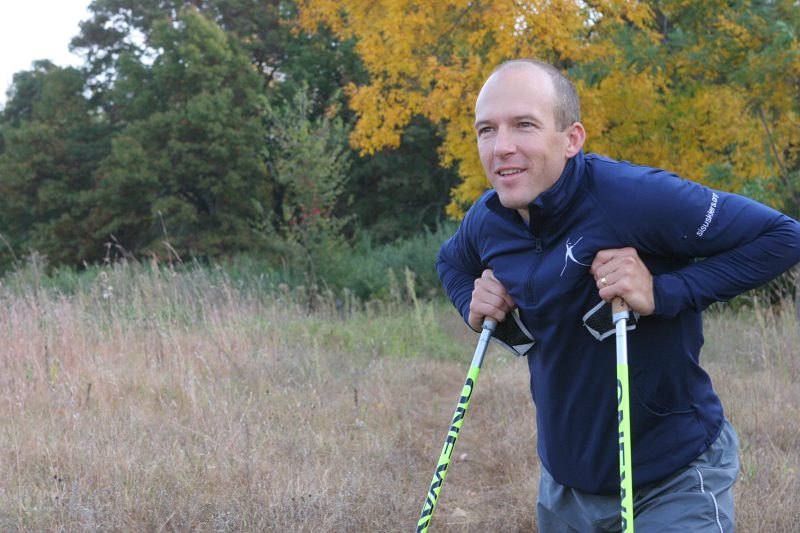
Ben Popp (American Birkebeiner Ski Foundation courtesy photo)
FasterSkier spoke with Ben Popp, the Executive Director of the American Birkebeiner Ski Foundation (ABSF), about the background of the Worldloppet Cup, the discussions that took place at the meeting and the impact this decision will have on the American Birkie and more broadly, on the Worldloppet.
The History
Popp explained that twenty years ago, the Worldloppet Ski Federation was approached by FIS about running a marathon championship series, as FIS was responsible for running the shorter World Cup events. The FIS sanction did not include monetary resources, but Worldloppet accepted the proposal. It seemed to be an opportunity to unite popular skiing and elite skiing by having recreational skiers line up with World Cup level athletes at marathons around the world.
“The interesting thing about the Worldloppet is that it’s sort of the funding of skiing when you look at it,” explained Popp. “There are about 140,000 people that ski the different Worldloppet races a year that are paying full price for skis or watching [the World Cup] on TV. They really are the economy of skiing. So it was this concept of maybe this is the first step in marrying the elite World Cup skiers to the popular skiers, which are driving it financially.”
However, despite a strong concept, the Worldloppet did not feel that the cup was achieving what it set out to do by taking that first step, partly due to the amount of money available to support the Cup.
“In concept it’s great, but in reality, the prize money is not that great,” stated Popp. “It varied anywhere between $25-40,000 euros per year based on how many teams were in it. Sometimes there were seven cup races, sometimes nine, so that fluctuated. And the reality was that it was a struggle to get athletes.”
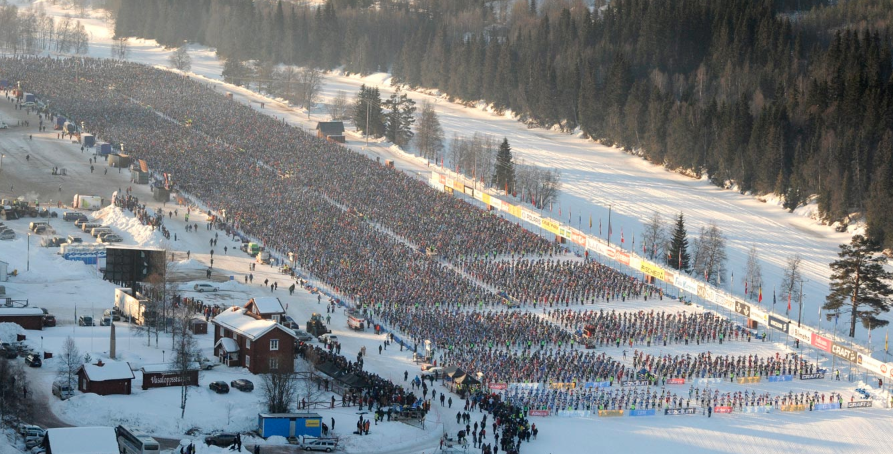
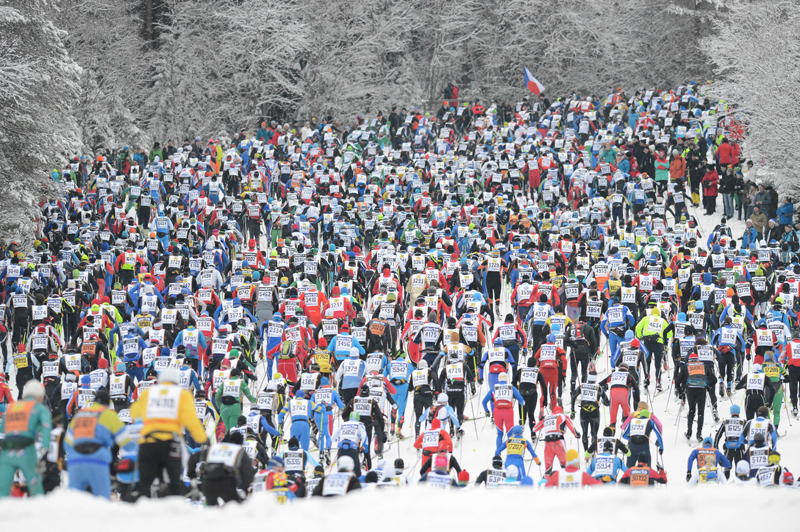
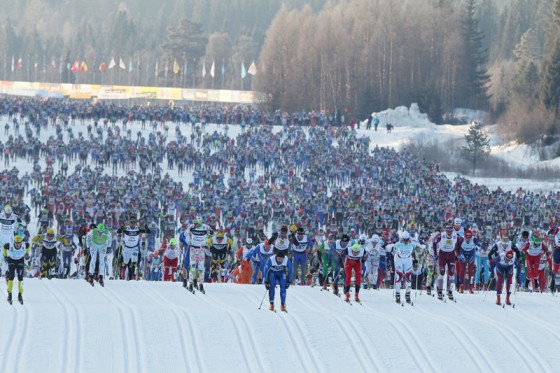
12,500 racers participated in the 90-kilometer classic race at the Vasaloppet in Mora, Sweden in 2019. (Photo: vasaloppet.se)
Because each race had a limited budget and trade teams were unable to fund athlete travel to the different races, the race organizers were couldn’t draw sufficient depth in the elite field, in particular, for the overall cup standings which were a cumulative result of multiple races. Last year, only four women raced four or more of the seven World Loppet Cup races, and only eight did so for the men. Like the World Cup, the winner of a race earns 100 points, 80 for second, 60 for third, and so on. Because of the lack of depth, an athlete who won one event would place in the top-10 in the overall, as was seen in the men’s results this year.
“So the competition wasn’t there, and I think overall, the cup was not doing what it was designed to do, which was to draw high-level athletes to the popular ski races to try to marry popular skiing with the best skiing in the world,” Popp explained. “So that was the premise and it wasn’t really happening.”
Because of this, the Worldloppet decided it would be best to reallocate the resources focused on recruiting elite athletes and issuing prize money into better serving the popular ski community. Popp described this as “an evolutionary time for the Worldloppet” and an opportunity to reconsider the purpose of the federation.
“FIS does a great job of managing and overseeing World Cup skiing at the highest level,” stated Popp. “Which is awesome. What is that the Worldloppet does? We’re really good at popular skiing and marathons where there are lots of people. So maybe our role is not so much trying to manage and somehow marry elite level skiers who are the best in the world to popular skiing. Maybe we should just be the voice for popular skiing and the resource for popular skiing. Whether that’s calendars or travel or whatever it is to make those events more accessible for more people to travel around the world and ski. Maybe that’s our role.”
He added that some of this reevaluation reflects adapting to the needs of a more modern ski community. When the Worldloppet was started in 1978, there was little opportunity for popular skiing, air travel was more difficult, and access to the internet was limited.
“It was a great first step at creating opportunity for popular skiing,” said Popp about the inception of the federation. “Now, travel and information is much more accessible and easy. I think the shift from the Worldloppet standpoint is going to be a good one because it allows the Worldloppet to focus its energy and resources on what kind of things can we provide for popular skiers around the world that will enable them to ski more races. And to really bring that ski community together, similar to what FIS does for the World Cup level of races.”
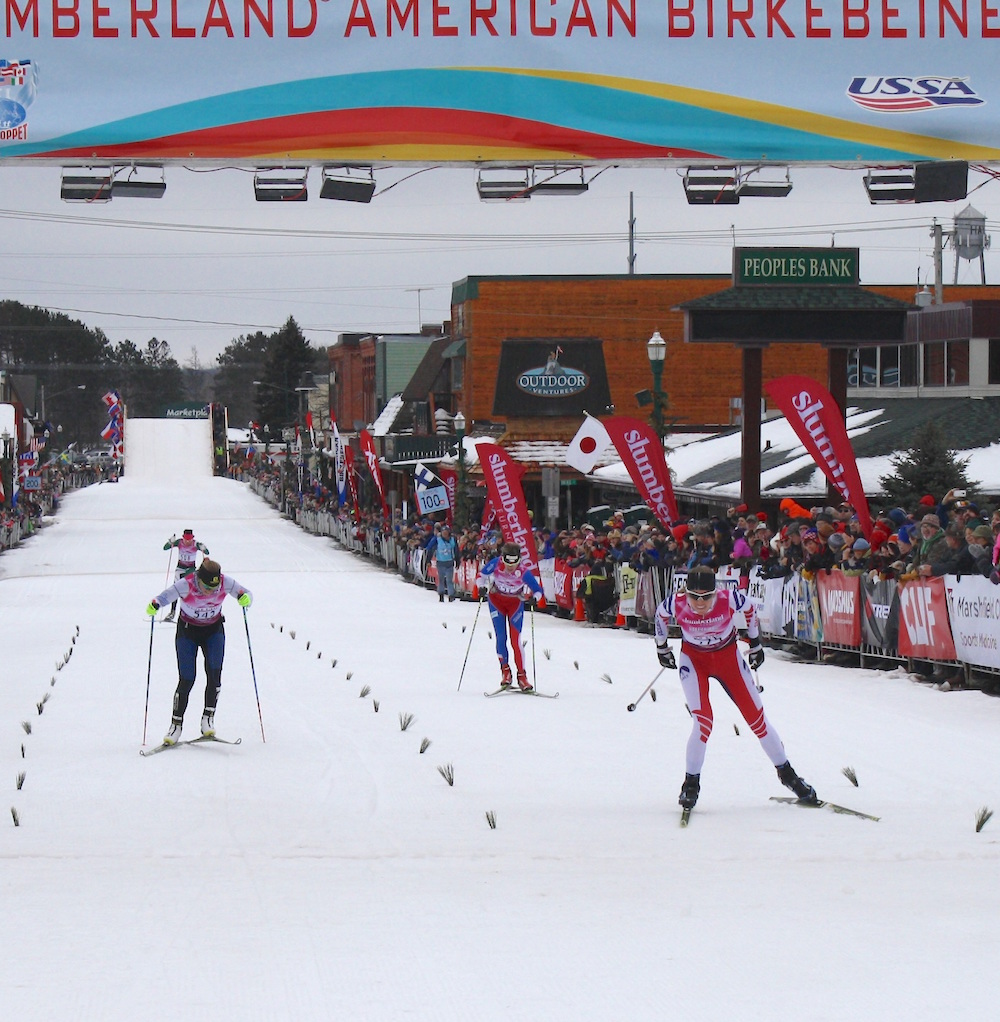
Erika Flowers of the SMST2 Team (r) racing to third in the 2016 American Birkebeiner in Hayward, Wis., ahead of Italy’s Elisa Brocard (l) and Klára Moravcová of the Czech Republic in fourth and fifth, respectively. (Photo: Worldloppet)
The Impact on the American Birkie
As the American Birkebeiner has not consistently been a member of the Worldloppet Cup Series, the cessation of the cup does not have a significant impact. Popp explained that ABSF was spending about $10,000 per year to be a member of the series on the years they were included, which he thinks could be better used to recruit domestic skiers.
“If the goal was to bring elite level skiers here, we’re better off using our dollars to pay the Kikkan Randall’s and Alex Harvey’s and those athletes to come,” he said. “Because they are what really draw our tie to the [North American] popular skiers.”
Popp illuminated that the majority of Worldloppet Passport holders are in fact from the United States.
“So that tells us that at the Birkie what we need to do as part of the Worldloppet is: how can we educate the American skiers or give them the information they need to go ski overseas?” he questioned. “Whether that’s at the expo or by using our distribution list. So the loss of the cup wasn’t so important so much as it helped tell us what the skiers might want or need.”
Further Discussions at the Worldloppet Meeting
Participants in the 2019 Birkie had the option of purchasing this reusable gear bag as part of the American Birkebeiner Ski Foundation’s green initiatives. (Photo: birkie.com)
Apart from the FIS Worldloppet Cup decision, participants in the Worldloppet Annual General Meeting collaborated on other topics including green initiatives to make the Worldloppet events more environmentally friendly. In recent years, the ABSF has introduced a custom reusable gear bag manufactured by SWIX which is available for purchase at registration for Birkie events. This bag can replace the plastic bags previously issued to hold participants warm up clothing and additional gear that needs to be transported from the start in Cable to the finish in Hayward.
The Worldloppet members are considering designing a Worldloppet gear bag for the same purpose, which could be used at any Worldloppet event. Not only would this reduce plastic usage, it would also be another way to unite popular skiers participating in the races.
Popp concluded that he walked away from the meeting in Isafjordur inspired by the unity in the goals of the Worldloppet Ski Federation, despite the drastic differences between the size of different ski communities or number of participants in events. The Ushuaia Loppet in the Southern Patagonia region of Tierra del Fuego, Argentina drew approximately 250 racers to its races, while the Vasaloppet which finishes in Mora, Sweden hosted over 12,500 skiers in the 90-kilometer marathon alone (see second photo above).
“You have this huge disparity of infrastructure, business structure, and all those things, and yet, it’s pretty unanimous when everyone gets together,” said Popp emphatically. “’How do we get more people skiing and racing and loving the sport, knowing that it’s really still a small fragment of the population?’ So it’s always really energizing to come away from the meetings with that sort of excitement and new or different ideas.”
The start line of the Ushuaia Loppet, a 50-kilometer classic race in Tierra del Fuego, Argentina (Photo: ushuaialoppet.com/)
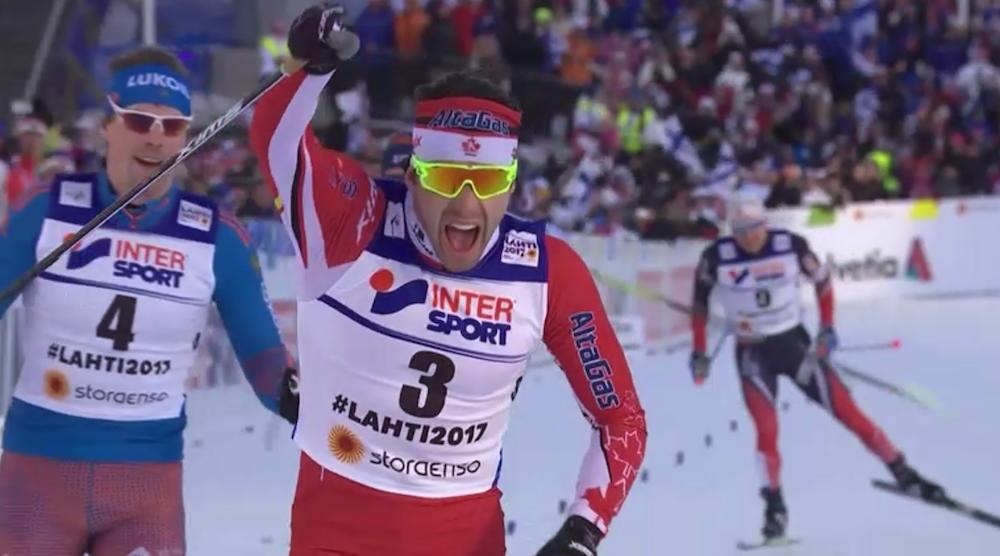
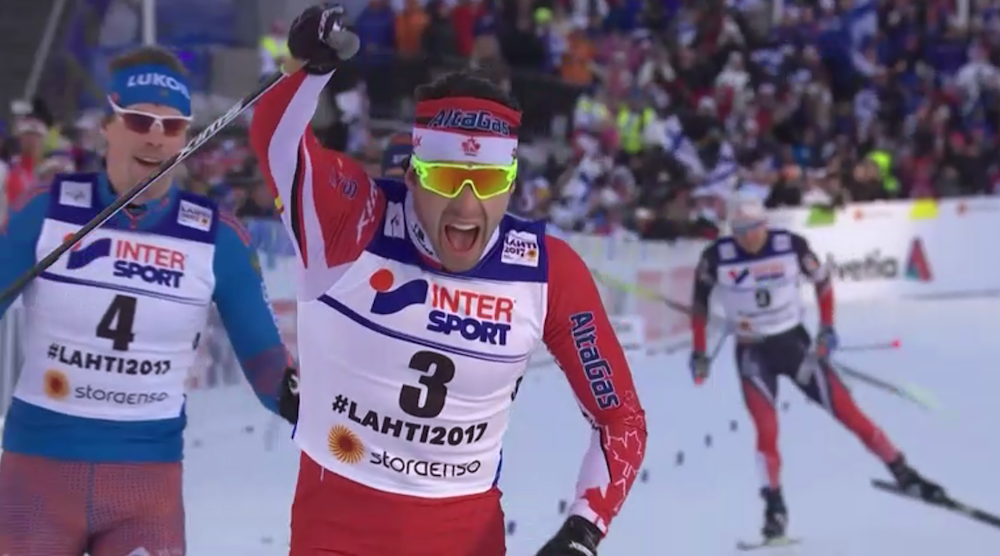
Canada’s Alex Harvey (3) celebrates his win in the men’s 50 k freestyle mass start, his first individual gold medal at a World Championships, on Sunday at 2017 Nordic World Championships in Lahti, Finland. He beat Russia’s Sergey Ustiugov (l) by 0.6 seconds while Norway’s Sjur Røthe (9) can be seen coming in for sixth place, behind (not pictured) Finland’s Matti Heikkinen, Great Britain’s Andrew Musgrave and Norway’s Martin Johnsurd Sundby, respectively. (Photo: NBC Sports screenshot)
FIS Nordic World Championships (Lahti, Finland): Men’s 50 k freestyle mass start
After a week of missing out on the medals at 2017 Nordic World Championships, Canada’s Alex Harvey, a four-time World Championships medalist from 2011, 2013 and 2015, achieved his first individual gold medal in the final race of this year’s World Championships in Lahti, Finland.
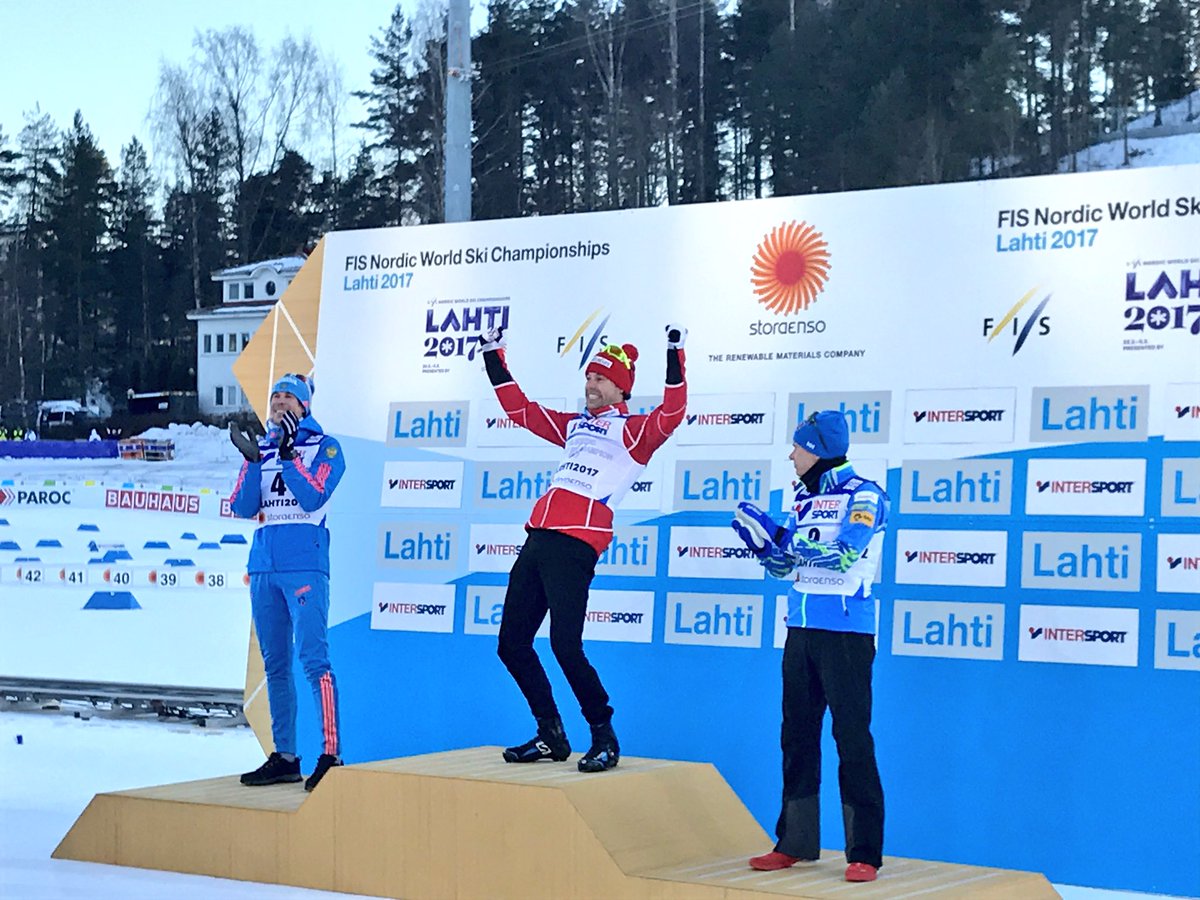
Harvey, 28, won the men’s 50-kilometer freestyle mass start in a drag race to the finish. Entering the final descent into the stadium with Norway’s Martin Johnsrud Sundby and Russia’s Sergey Ustiugov, Harvey rode his fast skis past both of them then had the most finishing kick in the final straightaway for a 0.6-second victory. He finished in 1:46.28.9 hours, while Ustiugov followed him across the line in second and Finland’s Matti Heikkinen from behind for third (+1.4), after passing Sundby around the outside of the last corner.
Canada’s Alex Harvey (c) celebrates gold in the men’s 50 k freestyle mass start on Sunday at 2017 Nordic World Championships in Lahti, Finland, with Russia’s Sergey Ustiugov (l) and Finland’ Matti Heikkinen (r) joining him on the podium in second and third, respectively. (Photo: Cross Country Canada/Twitter)
Sundby appeared to miss a pole plant soon after Heikkinen passed him and let off the pace a few meters before the finish. That’s where Great Britain’s Andrew Musgrave continued to accelerate and took fourth place, 2.9 seconds behind Harvey and 0.1 seconds ahead of Sundby in fifth. Norway’s Sjur Røthe followed another 0.4 seconds back in sixth, Switzerland’s Dario Cologna was seventh (+8.9), Norway’s Petter Northug eighth (+12.3), France’s Maurice Manificat ninth (+13.4), and Norway’s Hans Christer Holund 10th (+14.3).
“I had really good skis,” Harvey said in a post-race interview with FIS. “I knew if I came into the corner in second place, that was the optimal position. So I was able to fight hard and hit that last corner in second and slingshot by Martin along the flat and then that was good after that.”
“This is the best race of my life, for sure,” he added. “So I’m really happy.”
Tad Elliott (Ski Club Vail) led the Americans in 27th (+3:16.8). Noah Hoffman (U.S. Ski Team) finished 50th (+8:53.1) and Kyle Bratrud (CXC Team) did not finish.
Canada started four men, with Devon Kershaw finishing 38th (+5:45.5), Graeme Killick 43rd (+7:04), and Knute Johnsgaard in 55th (+12:03.3).
For Harvey, the medal is his fifth at three World Championships and his first individual gold after winning the classic team sprint with Kershaw in 2011.
IBU World Cup (PyeongChang, South Korea): Men’s and women’s relays
Between the men’s and women’s relays on Sunday at the International Biathlon Union (IBU) World Cup in PyeongChang, South Korea, Canada had two teams in the top eighth, with its men’s team finishing seventh in the 4 x 7.5 k and women’s team eighth in the 4 x 6 k. Behind them, the U.S. men finished 10th and U.S. women 14th.
France won the men’s relay by 33.8 seconds over Austria, using a total of 10 spare rounds but avoiding the penalty lap. Martin Fourcade anchored France to the win in 1:12:09.5 hours, after Jean-Guillaume Béatrix initially tagged them in first, his older brother Simon Fourcade raced them into second with near-perfect shooting (using just one spare to clean), and Simon Desthieux picked off one more place to give Fourcade a 16-second lead for the final leg.
Austria achieved second place with Lorenz Wäger, Simon Eder, Julian Eberhard, and Dominik Landertinger combining for zero penalties and nine spares.
Norway finished third (+45.4) with Vetle Sjåstad Christiansen, Ole Einar Bjørndalen, Vegard Gjermundshaug, and Henrik L’Abée-Lund. They had one penalty on Gjermundshaug’s third leg, and used a total of eight spares.
Canada’s Christian Gow, Scott Gow, Nathan Smith, and Brendan Green finished seventh (+3:03.1) with zero penalties and nine spares. After Christian tagged his older brother Scott in ninth, Scott raced them into sixth place before Smith slipped four places to 10th at the final exchange. On the final leg, Green raced them into seventh, requiring two spares to clean.
The Americans finished about nine seconds later in 10th (+3:12.8) with Lowell Bailey, Leif Nordgren, Paul Schommer, and Sean Doherty combining for zero penalties and nine spares, just like Canada. Bailey had originally put them in second at the first exchange, Nordgren dropped to seventh, then Schommer to 13th, before Doherty finally brought them back to 10th out of 24 teams.
In the women’s relay, Germany pulled off a 22.8-second win over Norway, with one penalty and eight spares. Nadine Horchler put Germany in third at the first exchange, then Maren Hammerschmidt raced them into first by the race’s halfway point. From there, Denise Herrmann, a former cross-country World Cup regular, had to ski a penalty lap and tagged off in second, 13.5 seconds out of first. With teammate Laura Dahlmeier sitting out the relay, Franziska Hildebrand anchored Germany to the win in 1:07:35.6 after she used just one spare to clean.
Norway placed second with Kaia Wøien Nicolaisen, Hilde Fenne, Tiril Eckhoff, and Marte Olsbu accumulating one penalty and 11 spares. Olsbu beat out the Czech Republic’s Gabriela Koukalová by one-tenth of a second at the finish, as the Czechs placed for third (+22.9), with Jessica Jislová, Eva Puskarčíková, Lucie Charvátová, and Koukalová (with a total of one penalty and nine spares).
Canada took eighth (+1:34) with Rosanna Crawford, Julia Ransom, Megan Tandy, and Emma Lunder. Crawford tagged in second at the first exchange, Ransom slipped one place to third, Tandy lost another place to tag in fourth, and Lunder ultimately anchored them to eighth.
The U.S., with Clare Egan, Susan Dunklee, Joanne Reid, and Maddie Phaneuf, finished 14th (+3:08.3) with one penalty and 10 spares. After Egan had a penalty on the first leg, Dunklee skied the fastest second leg to move the team from 19th to 14th, then Reid put them in 11th by the final exchange. Twenty-one teams competed in the women’s race.
Ski Classics 90 k Vasaloppet (Sälen to Mora, Sweden)
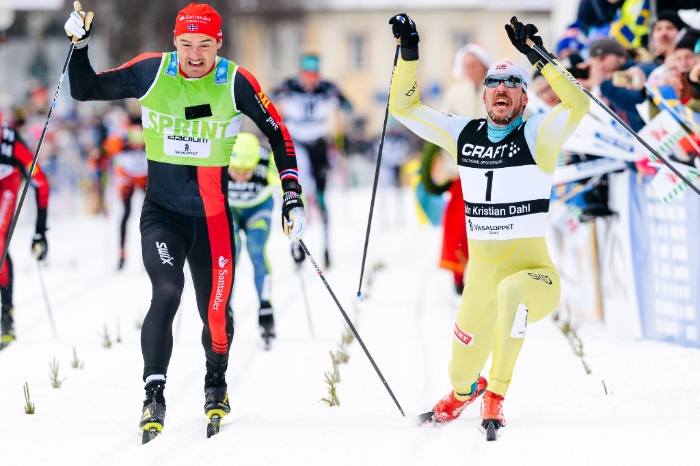
John Kristian Dahl (r) of Team United Bakeries outlunges Ski Classics sprint leader Andreas Nygaard (r) of Team Santander for the win in Sunday’s 90 k Vasaloppet in Mora, Sweden. (Photo: Visma Ski Classics)
[UPDATED] In Sunday’s 93rd annual 90-kilometer Vasaloppet from Sälen to Mora, Sweden, the ninth event of the Ski Classics series, John Kristian Dahl (Team United Bakeries) outlasted Andreas Nygaard (Team Santander) by one-tenth of a second for the win in 3:57:18.1 hours. The race came down to a five-way fight for first, with Stian Hoelgaard (Team Leaseplan) finishing 0.6 seconds back in third. The top 15 men were all within 21.7 seconds of the podium, and Brian McKeever, a member of Canada’s Para Nordic Ski Team, placed 20th (+2:31.1).
“It has been a fight all day,” Dahl said, according to a Ski Classics press release. Three days ago, he had been unsure about starting the Vasaloppet following a back injury. “I was tired already after 30 k and had to let go of the lead group, but I fought my way back taking it step by step and hill by hill.”
In the women’s race, Britta Johansson Norgren (Lager 157 Ski Team) broke away from the field to win by 1:37.9 minutes in 4:19.43.4.
Astrid Øyre Slind (Team United Bakeries) finished second, and Sara Lindborg (Team Serneke) placed third, 9 minutes and 4.2 seconds behind Norgren. Kateřina Smutná (Team Santander) dropped out of the race about halfway through.
“I am very tired but also so happy to win today,” Norgren said, according to the press release. “It felt pretty easy until Oxberg [Sweden] with 30 k to go, but then it got really tough and I had to fight all the way to the finish.”
It was Norgren’s first Vasaloppet win after placing second the last three years. She increased her lead in the overall Ski Classics to 215 points over Smutná, while Tord Asle Gjerdalen continues to lead the men’s overall standings ahead of his Santander teammate Nygaard, who is 349 points behind in second place. Gjerdalen did not race Sunday’s Vasaloppet.
Tord Asle Gjerdalen (l) and Britta Johansson Norgren (r) after winning the 2016 Marcialonga 70 k classic. In July, Johansson Norgren won the Blink Classics 60 k rollerski race — but received only 20 percent as much prize money as Petter Northug got for winning the men’s race. (Photo: Visma Ski Classics)
At the end of July, Norwegian professional cross-country skier Astrid Øyre Slind hit the podium in the new 60-kilometer classic race at her country’s Blink ski festival. She faced a payout that seemed unusual: a big discrepancy between men’s and women’s prize money.
The American Birkebeiner pays $7,500 to both the men’s and women’s winners.
But Blink Classics is not one of these established marathons: it is a rollerski competition in its very first year of existence. It did, however, attract the attention of the Norwegian government, which was concerned that the festival was violating the country’s equal pay act.
“For us it has not been easy to have this situation with the girls,” Blink Festival press secretary Arne Idland told FasterSkier. “And then when they are not satisfied with the money it is really difficult. We will try as hard as we can to find a solution.”
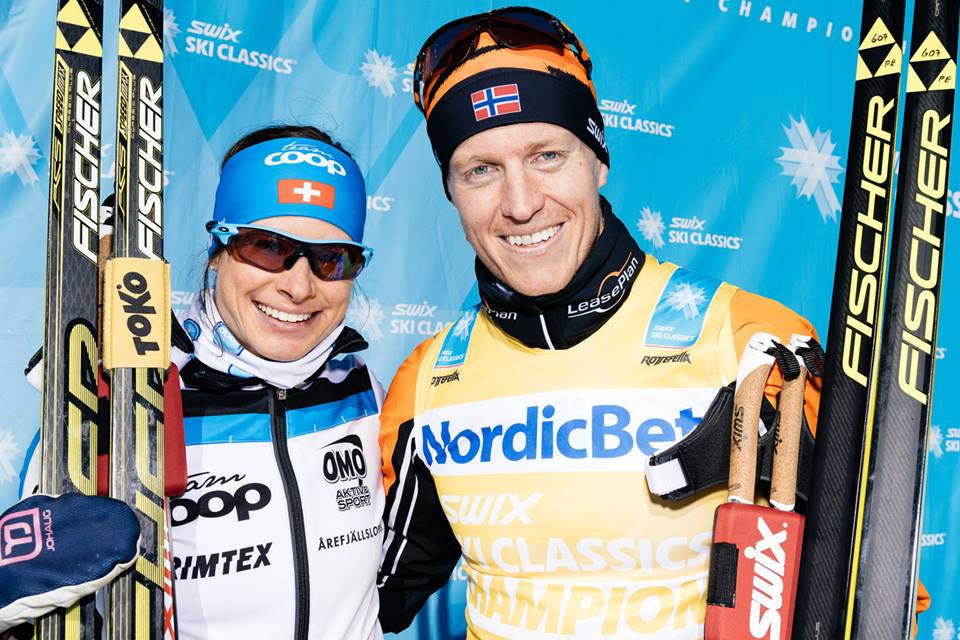
Seraina Boner (l) of Switzerland and Team Coop and Petter Eliassen of Norway and Team LeasePlan Go won the 2015 Årefjällsloppet, receiving equal payouts. (Photo: Ski Classics)
New Race for a Booming Festival
The Blink ski festival is now a giant on the summer racing circuit, with athletes from all over Europe and even North America coming to compete on rollerskis in cross-country skiing, biathlon, and the famous Lysebotn Opp hill climb. Recreational and junior classes are also a big focus, making it accessible to fans and professionals alike.
But adding a long-distance race to the mix was not easy for organizers, who still have to make sure that the festival breaks even financially. Idland explained that Blink Classics had been in the works for three years.
“The main challenge this year is that we, for the first time, were going into car traffic — this race was on ordinary roads with traffic [rather than the city square], and we had to close it to traffic just like they do in cycling races,” he explained.
That entailed paying for policemen, for one thing. Having a fourth day of racing (previously there had been three, the Lysebotn Opp and two more days in the Sandnes city center) also meant more production by NRK, Norwegian national television, as it followed a long-distance race rather than staying in a set location downtown.
“If you have live production it has to be in high definition,” Idland said. “Then it’s really expensive.”
Then last autumn came the news from the Norwegian Ski Federation: none of the national team “A” or “B” team women would compete in the 60 k. The women usually focus on doing all three of the other days of racing, and adding a 60 k at the beginning of consecutive days of racing would be too much volume and intensity during the summer training season. Some of the men, like Eirik Brandsdal and Sjur Rothe, would do the longer race; Martin Johnsrud Sundby was interested but later pulled out.
Concurrently, Idland said, NRK was telling the Blink organizers that it wouldn’t be possible to broadcast the men’s and women’s 60 k competitions together. It would have meant following two races at the same time — double the filming budget and staffing — and deciding all the time which feed to broadcast and commentate. NRK didn’t have expertise in doing this and said that they needed to develop it. So they would only broadcast one, and with the national team women out of the competition but the national team men in it, organizers agreed it should be the men’s race.
“When I contacted the teams from other nations, I was open and said that this [women’s] long distance race will not be broadcast on TV and no women from the national team would start there,” Idland said of his communication with other countries’ teams last winter, before registration began. “So I advised them all not to start in this race, but to come do the three other races.”
Johansson Norgren, the winner, is a mainstay on the Visma Ski Classics circuit and won the 2016 season title as well as numerous individual marathons. Masako Ishida, who finished third at Blink Classics, was the winter series’ fourth-ranked woman. So the podium at Blink was not so different than a podium one might see at a top winter event.
But the decision about prize money had been made long before.
“We said that we need good prize money on the men’s side, because the other competitions that we compare with have good prize money,” Idland said. “We also need some sprint primes. We had a total of 190,000 kroner, or about 20,000 Euros, for the men. And we had just over 5,000 [Euros] for the women. That was decided before we opened entry.”
Even for the women, it was more prize money than was available at the other competitions in the Blink festival, Idland said. In those other races, prize money is equal for men and women and each total prize-money purse is roughly 2,000 Euros.
“So it is double amount of money in this women’s class in any of the other races, including Lysebotn Opp,” he said. “We thought we were really doing well for the women. And it’s not every rollerski race having prize money, either.”
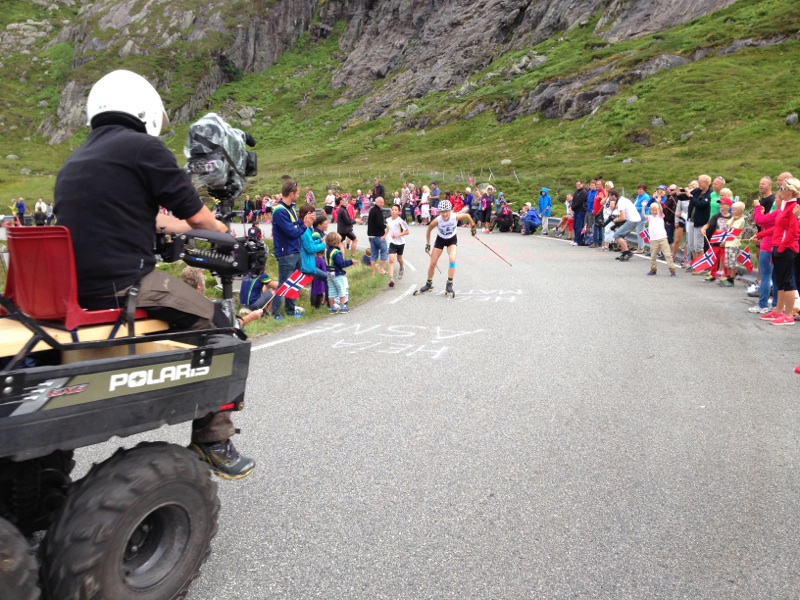
Finland’s Kaisa Mäkäräinen climbs to victory in the Lysebotn hill climb at the 2013 Blink festival as a cameraman captures the action. The women’s hill climb is televised, unlike the Blink Classics. (Photo: blinkfestivalen.no)
Building Women’s Pro Fields Takes Time
But the discrepancy still felt unusual to some of the women, who are used to getting paid the same amount as their male counterparts for a win.
The gulf between men’s and women’s participation is greater in long-distance racing than on the World Cup. As a result, marathon organizers have to grapple with a somewhat different set of considerations as they develop the payout structure for their competitions.
Most of the biggest ski marathons in Europe — including the Birkebeiner, Vasaloppet, and Marcialonga — are part of the Visma Ski Classics series, where organizers have come up with compromise solution when it comes to year-end rankings.
Prize money is equal for the top three overall series finishers, but the men’s field also pays out to the fourth- and fifth-place athletes while the women’s field does not.
“For me it sounds very strange,” Visma Ski Classics CEO David Nilsson told FasterSkier in an interview last week referring to the Blink prizes. “We have in our rules that they must have the same first prize to men and women. It is also important to reflect on the percentage [of field size], and it shouldn’t be so much more difficult for the men to get [prize money] than for the women — but you can never do more than win, so of course that has to be equal for first place.”
In the winter, far fewer women than men are on Visma Ski Classics professional teams. But women’s races are hotly contested and often extremely dramatic, like Seraina Boner’s come-from-behind win at the 2016 Birkebeiner after passing Ishida and Poland’s Justyna Kowalczyk in the final kilometers.
In the 2016 season, 39 different women scored points toward the overall titles. There is even an all-women’s pro team, Sweden’s Team SkiProAm, whose top athlete finished eighth in the season rankings.
According to Nilsson, Visma Ski Classics has carefully tried to promote women’s participation, with equal prize money for first place being one component.
“We worked very hard on this,” he said. “When I started 6-7 years ago, we had 4-5 women that were competing [professionally] in long distance skiing because it was a bigger step for them from shorter distance [World Cup] skiing than for the men.”
While they left the women’s competition out of the spotlight this year, the Blink Classics organizers don’t think that should always be the case. Like the Visma Ski Classics, they want more women on the start line.
“Our aim and our goal is also to have the world’s best women at the start in future,” Idland said.
One reason for low numbers at Blink might be that long-distance racing just isn’t as popular among women in Norway as it is in neighboring Sweden, home of the Visma Ski Classics brand, said Nilsson.
“In Norway, which we all know is very strong in cross-country skiing, we don’t see so many female participants in long-distance skiing,” he mused. “They are more from Sweden. We don’t know why the Norwegian women are not coming more.”
The Blink 60 k is part of a three-race series of long-distance rollerski competitions called the World Classic Tour. Indeed, the second leg of the Tour was held in Sweden. Called the Alliansloppet, it is also a more established event.
Twenty-five women finished that 48 k race, including several past Visma Ski Classics champions and members of the Swedish national team (Hanna Falk, a three-time World Cup podium finisher, won the race). Prize money was equal for men and women, including a 10,000 Swedish kroner sprint prize ($1,000) for both men and women.
The World Classic Tour overall awards use a similar idea to the Visma Ski Classics, in that the men’s and women’s title winners earn equal paychecks but the men’s field will pay out to six places and the women’s to just three.
Yet the series does not appear to have a policy for its constituent races in how to organize prize money at individual competitions.
If organizers like those at the Blink festival want to develop a strong women’s competition, Nilsson suggested that they need to actually promote the women’s races.
“We also made sure that there was much more focus on the women [than there had been before],” he said of the Visma Ski Classics efforts. “The women should have be starting [wave] before the men to have their own competition… and have [television] production of the race and their own media. When we created the system, all the attention was on the men. Then we made it so the pro teams had to get points from both the men’s and the women’s classes. This together has made the increase of the women.”
Idland conceded that with more prize money, they might have drawn a slightly larger women’s field. But he believed the circumstances of the festival, with the three subsequent days of racing, were the bigger reason for low participation.
On the Blink Festival website, the news story about the 60 k Classics race features five paragraphs and three photos about the men’s race, but only one paragraph and one photo of the women.
Nilsson believed that some changes could be made without disrespecting the male athletes.
“When you have 100 men and not so many women registered, it wouldn’t be fair to get the same [prizes],” Nilsson said. “It would be easier for the women. So it has been for us to push the development [of women’s skiing] but not to be unfair to the men’s skiers. That’s the reason we have in the prize money, five men and three women. And that reflects a little bit to the female factor, to be honest, in terms of the number of participants and the amount of professional skiers. It has to be the same difficulty to win a prize in both categories.”
What Does Equality Mean?
Race organizers are continuously trying to come to a more perfect solution, and one common thread seems to be that prize money must be earned by quality racing and exciting performances. Until the women’s fields are deemed to have provided that, they might not see as much compensation.
Visa Ski Classics, for example, continues to make changes. For the 2016/2017 season, women will for the first time be able to vie for a sprint title, worth five percent of the total prize money, just as the men have done for years.
“The reason it wasn’t the case [previously] is that there weren’t so many women — last year was the first time that there was really a group at the front,” Nilsson said. “Before it was just one or two who went away, so it wouldn’t have been interesting. The same people would have won the race as the sprint bibs. Now both men and women get a sprint bib, which is a step forward. Our goal is to make it equal the number of participants and who gets prizes.”
Nilsson guessed that the availability of intermediate prize money may also change the tactics of the women’s races and contribute to an exciting spectacle on television.
For his part, Idland insisted that the Blink organizers’ decision about prize money was not sexism. It could have gone the other way, he wrote in a letter to the Norwegian government explaining the discrepancy in pay.
“I was trying to give an example with the opposite situation,” Idland said. “If Marit [Bjørgen], Therese [Johaug], Heidi [Weng], Charlotte [Kalla], and maybe some of the Americans said to us that this race we would very much like to do, and the men said they didn’t want to do it and just let the [marathon] specialists do it, then I am quite sure we would have done the opposite thing. We would have led the coverage with the women, if the level was higher.”
After being contacted by the authorities, the Blink Festival is trying to work together with the government to achieve equality.
“Our answer was that they would really much like to come in dialogue with us to try to make a plan for the future,” Idland said. “And that we try to build up this competition with a clear aim to have everything on an equal basis in some number of years.”
JoJo Baldus at the 2016 Birkebeinerrennet in Norway. He completed the 54-kilometer classic marathon, also known as the Birken, in mid-March. (All photos: JoJo Baldus)
(Editor’s note: JoJo Baldus is a nordic skier from snowy Minneapolis, Minn., who spent this past winter “living the dream,” as he described it, as a volunteer journalist and photographer for FasterSkier while enjoying a gap year before starting at Macalester College in St. Paul. He set a goal to complete nine Worldloppet ski races this winter, three of which were canceled due to low snow. He did five — including the Finlandia-Hiihto — but did not race the Jizerská because it was shortened. This is a tale of his most memorable experiences.)
***
People travel in a wide variety of ways and for quite varying reasons. Many flock like pigeons to big, famous, ridiculously densely populated cities. Historic sites often attract the hordes. And the great outdoors also allure many travelers.
Being on a ‘gap year’ exploring Europe before college, I immersed myself in the international ski scene this winter. It is just my kind of travel: being outdoors, meeting interesting skiers from all over the world, and experiencing different ski cultures from one country to the next. Italy and Finland and Norway, oh my!
After following around the World Cup race scene in December and January reporting for FasterSkier, interviewing athletes and photographing races at the Tour de Ski, I embarked on what I called a marathon of ski marathons. Originally I prepared myself to endure these nine Worldloppet races:
Jan. 10: Jizerská 50: 50 k classic, Liberec, Czech Republic
Jan. 24: Dolomitenlauf: 60 k skate, Lienz, Austria
Jan. 31: Marcialonga: 70 k classic, Predazzo, Italy
Feb. 6: König Ludwig Lauf: 50 k skate, Oberammergau, Germany*
Feb. 14: La Transjurassienne: 68 k skate, Morez, France*
Feb. 21: Tartu Marathon: 63 k classic, Tartu, Estonia*
Feb. 28: Finlandia-Hiihto: 50k skate, Lahti, Finland
March 6: Vasaloppet: 90 k classic, Mora, Sweden
March 19: Birkebeinerrennet: 54 k classic, Rena, Norway
Of course the weak winter that plagued Central Europe this year had a different vision. The Konig Ludwig Lauf, La Transjurassienne, and Tartu Ski Marathon were all unfortunately canceled (*see above) due to a lack of snow and soberingly warm temps. But the golden lining — you appreciate each of the other races just that much more!
As winter melts away to spring and we mournfully watch the beautiful white snow turn to brown slop, we can keep the season alive a little longer by recalling, sharing, and reliving all the fun and joys of the past months on snow. For everyone stateside, with tulips blooming, I hope to capture a little snippet of each of the races I did; bringing the scene to life, and piquing passions and curiosities for all to ski abroad.
The Norwegian Birkebeiner: Properly, the Grand Finale
Start line at the Norwegian Birke with 3.5-kilogram backpacks representing the weight of 18-month-old Prince Haakon, whom the Birkebeins skied to safety.
2016 Birkebeinerrennet
At the high point of the course, Midtfjellet.
2016 Birkebeinerrennet
If there is a place where skiing is king, it’s Norway. And the Birke certainly made a strong case for that idea in many ways. It was the full package event: beautiful scenery, incredible atmosphere, wonderful skiing — all anyone could ever ask for.
The big day begins in Rena. But don’t forget about your Prince; he desperately needs saving! The race truly begins the night prior, with preparing the obligatory 3.5-kilogram backpack representing the young prince. It’s all part of the fun, and this twist serves to mix the race scene up, adding some unique spice to the event. At the start-line clothes bag drop, big metal balances are set pre-weighted with 3.5-kilograms to test your bag. Hopefully you got it right on, or else you better throw in a few fistfuls of gravel right there on the spot.
At the start, from the sound of the gun, it was as smooth as butter. It is a wave-start format, and felt different than any other race I’ve ever done. There were only a couple hundred people in my wave, I didn’t see a single crash or tangle, and not a trace of a broke pole. That seemed like a naturally good way to start the day — definitely a plus of the race, in my mind.
High temps, wet snow, and a lot of freeze/thaw action in the days prior meant klister conditions on race-day Sunday. But we also lucked out with a perfectly sunny day and a quite comfortable temperature.
With or without the sun, the course is magnificently beautiful. As commonly mentioned, the course is definitely windy in some exposed sections over the mountains, but the endless stunning vistas more than make up for it. The Birke was easily the most scenic race of all, which made the race very well-rounded and balanced. The beauty takes the pain right out of racing and singlehandedly makes the whole trek worthwhile. What a great way to see some of Norway’s incredible natural landscapes.
It is the celebratory, cultural atmosphere of the Birke that makes it especially unique. Norway is like the promise land for cross-country skiers. It is in the culture here, in the air, in their blood. Andbeing a part of that energy, that buzz, passion, and love — it’s an amazing feeling.
“The Birke was easily the most scenic race of all, which made the race very well-rounded and balanced. The beauty takes the pain right out of racing and singlehandedly makes the whole trek worthwhile.”
Everyone is out: old folk and young bucks, serious racers and family-shufflers. Norway’s Crown Prince Haakon himself even raced, personally challenging the Danish Prince. Skiing is in the royal blood — skiing is royal in Norway. The Birke is a major cultural event for all. Ask almost anyone here and they’ll most certainly know the Birke. And it is amazing how well many of these people can ski, too. Sound technique and undoubting fitness is impressively the standard throughout the crowd of skiers.
The course challenges even the toughest of skiers, but also rewards the efforts. The course crosses over three mountaintops, so naturally, long climbs give way to splendid views. The first 13 kilometers out of the gate are continuously uphill, but very comfortably stride-able. Then, after a long, screaming downhill, the climb resumes for about five kilometers, to reach the second peak. The third and final peak, and high point of the course comes 34 k in, at Midtfjellet. Make it there, and you should be set to enjoy some flatland through to beautiful Sjusjøen, and then the long 10+ kilometer descent down to celebrating at Birke Skistadium.
All in all, I thoroughly encourage all skiers to take the pilgrimage and go save Prince Haakon at least once in your life. The Birkebeiner felt like the epitome of cross-country skiing, and for me proved to be a perfect grand finale for a season of Worldloppet marathons.
Vasaloppet: The Long Haul, 90 k for King Vasa
The start-line scene with skis for 15,000 racers
The start-line scene with skis for 15,000 racers
2016 Vasaloppet
View of the finish down main street in Mora, Sweden.
Two weeks earlier, I raced the Swedish Vasaloppet with 15,000 other skiers. This event takes the prize for the biggest hoopla.
The place to experience is Mora, with the buzz of fellow racers descending en masse upon this little town. The race finish is right down main street and is set up the week of the race, filling the whole town with race cheer. Multiple other Vasaloppet event races finish downtown daily. Tear-jerking inspirational videos about the Vasaloppet play on a mega screen. Thousands of people pour in and out of the giant expo tent; emerging with their very own red Vasaloppet bib packet. The Vasaloppet museum located by the finish is worthy of a stop to peruse race lore and general nordic ski history. Everyone is out and about main street preparing for their own race, becoming a part of something bigger.
Race morning comes quick, starting with a brutally early wake-up. The buses from Mora to the start left at 4 a.m. Hours before race time, skis line the tracks at the start to save spots, something like 25 lanes across, hundreds and hundreds of rows back — quite a sight to behold. To be in this extensive company easily sends a jolt of adrenaline down one’s spine — quite thrilling.
It’s a true mass start, with all 15,000 starting at the sound of the gun. After a couple hundred meters of wide open double poling, the course comes to a slight rise and turns a bit to the right. Here I stole a gaze back towards the start, as a friendly Vasaloppet veteran had recommended at the start line. A dense, colorful sea of fellow racers stretched on and on in a ribbon of humanity. During the entire 90 kilometers I was never even remotely alone. Vasaloppet racers are all in it together, which is simultaneously exciting, encouraging and a pain!
The first three kilometers of the race is a rather steep climb that was admittedly not too much fun. Deep mashed-potato snow, shoulder-to-shoulder herringboning with people stepping all over everyone’s equipment. Brute double-poling steep uphills — trying to channel my inner-pro — none of it worked too pleasantly.
After this initial climb with the sea of humanity, the Vasaloppet has a reputation for being a flat, double-pole derby. Compared with the Birke, this is true, but there is still definitely a rolling nature to the course. There is plenty of climb even mid-race, and with 90 kilometers to survive, you feel every hill. The 30 k to 45 k section boasts some relentless continuous climbing, which can easily put one into the pain cave with still 45 k to ski.
“There is plenty of climb even mid-race, and with 90 kilometers to survive, you feel every hill.”
This year provided remarkably better snow and trail conditions than in the race’s recent past. But even starting in group 3, the tracks were fairly obliterated, rutted and iced over for most of the race. I think that is largely dependent on snow conditions to begin with, but I sure did appreciate the beautiful tracks the Birke had to offer alternatively.
The impressive length of the race and number of participants all tackling it at once makes the Vasaloppet a really exciting event just to be a part of and offers an undoubtable sense of satisfaction to finish. The crowdedness and excitement fills Mora and you feel like you’ve been a part of more than a race — but rather a grand, inspired gathering.
Marcialonga: The Miracle on (Manmade) Snow
The trail as seen in the training days leading up to the race.
2016 Marcialonga
2016 Marcialonga
2016 Marcialonga
Predazzo, at the 45 k mark, the day before the race.
The Marcialonga takes place in Val di Fiemme, which is also a race site for the FIS Cross-Country Ski World Cup and Tour de Ski.
The fact that the Marcialonga even happened at all this year was quite impressive, and furthermore, still on the full 70-kilometer point-to-point course. The whole week leading up to the race was in the 40s and even edging into the 50s. Some days bore full sun and birds chirping about — nothing short of a balmy beach day. It felt like we just skipped right over winter and were budding into springtime.
No snow had fallen and none was forecasted either. Instead we had nice spitting rain here and there. A month or so prior, the race organizers took advantage of freezing temps and packed down an initial track of manmade snow; a little ribbon of trail just wide enough. They also prepared massive mounds of manmade snow dotted throughout the valley, which they were able to spread along parts of the trail closer to race day. There is no doubt; sections of the course were extremely slushy, dirty, puddle-y, grassy, and rocky. But holding the event was still quite a feat, as we learned by our three following races getting canceled despite arguably more favorable conditions.
The Marcialonga means ‘the long march’ in Italian. And that it was. 70 kilometers of classic. I don’t think I had ever skied that long straight through, especially not in very slow, 45-degree conditions, 99 percent double poling, and with a horde of others. Let’s just say that I was quite enthused to cross the finish line, accomplishing the first and foremost goal of every race.
The course runs primarily right along the valley floor starting from Moena, heading out to Canazei, and then looping back around, through Moena, Predazzo, and to the finish in Cavalese.
It was especially tough because I was in one of the last waves. The course was shredded, destroyed, utterly annihilated; the classic tracks thoroughly did not exist at all. And I was amongst a teeming swarm of skiers, a fair portion of whom were not super capable nor fast. I was not in the best race shape ever, but it was quite tough to come to any slight uphill and have to herringbone through six inches of mush in the jostling crowds, only to wait in line at the top of the subtlest of descents to snowplow walk down.
It was not very encouraging to tire out my triceps by 5 k due to bracing myself with my poles, inching down the descents. After 20 k of brutally progressing like that, it was 50 k of double-poling monotony. By the end, my shoulders and triceps felt like they were going to rip, tear and explode in ten different places, but I managed to push through and enjoy the finish.
“By the end, my shoulders and triceps felt like they were going to rip, tear and explode in ten different places, but I managed to push through and enjoy the finish.”
The Marcialonga finish features a notorious final cascade climb, two-and-a-half kilometers long and very, very steep. At the base of this hill, there are many wax service stations. After endless kilometers of flat double poling, most racers stop for a quick and generous coat of kick wax before running like banshees up to the finish line right in the heart of the classic Italian cliff town of Cavalese.
The Dolomitenlauf: Maiden Voyage
The Dolomitenlauf is Austria’s contribution to the Worldloppet series, with the 60-kilometer skate being the main event. But this year, also due to lack of snow, it was shortened to a 42 k composed of four laps, and moved up the mountain from Lienz to Obertilliach.
Compared with the other races, the Dolomitenlauf was a small affair. There were only a few hundred participants, and therefore naturally a more low-key, homespun atmosphere. This was my first ever ski marathon — the weather, course, and conditions were very accommodating for my maiden voyage. Fast, flat and sunny, but keep in mind this was the alternative course. The course was mostly manmade snow, but the organizers had done well to thoroughly cover the whole course and make it very compact.
As with many of these ski races, the start was hectic. The announcer gave commands in both German and English, which was handy no doubt. I was in the third of four mass-start sections, lined up shoulder to shoulder, skis tip to tail. Without a countdown, the gunshot echoed and we were off. Although, at first it was a brutally slow pace. One double pole every couple seconds; we inched forward with a wall of people in front of us. The first kilometer out of the start did not seem to be too well equipped to handle the mass of racers packed together. It was quite narrow and contained a handful of little climbs and rather sharp turns right away.
Then, for at least the first half of the race, I could not find anyone to ski with cruising at my speed. Unluckily, as international racers, we are predestined to one of the latter starting blocks, holding primarily the slower, less-competitive skiers. Between that and a conservative navigation of the wild start, I was stuck with a bit slower crowd than ideal. Maybe also due simply to the lower number of participants compared to the other races. The competition was not cutthroat at all though, so I was just able to enjoy the skiing and my first-ever marathon race.
“The competition was not cutthroat at all though, so I was just able to enjoy the skiing and my first-ever marathon race.”
Spectators cheered in German, Italian, and English alike, adding a festive international aura. The race bibs had each individual’s name, so it was fun to know I was skiing behind people with names like Giacomino and Helmut. Although it was not as festive, the smaller crowd made it very manageable and still had the fun element of international competition. The Dolomitenlauf was a great, relaxed race to ease into the winter of marathons.
***
Travel structured on a winter full of Worldloppet ski races was a truly fruitful experience. Each race offered a bit different flavor, yet all complimented each other so well. Any one of these races offers a great opportunity to get a taste of another country’s, and a generally more international, ski scene. As a skier from the United States, where the sport is far from front and center, it is amazing to sample these more ski-steeped cultures.
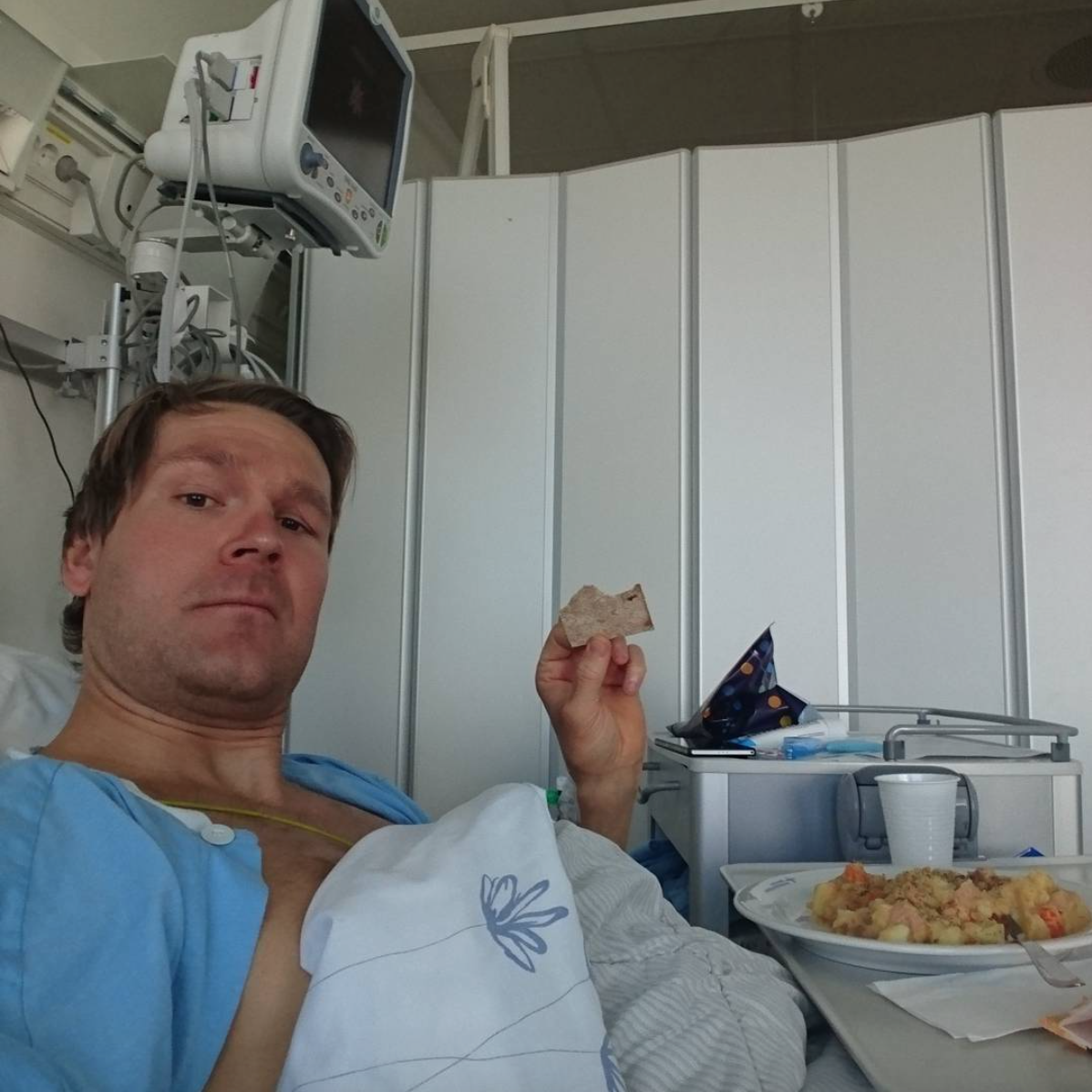
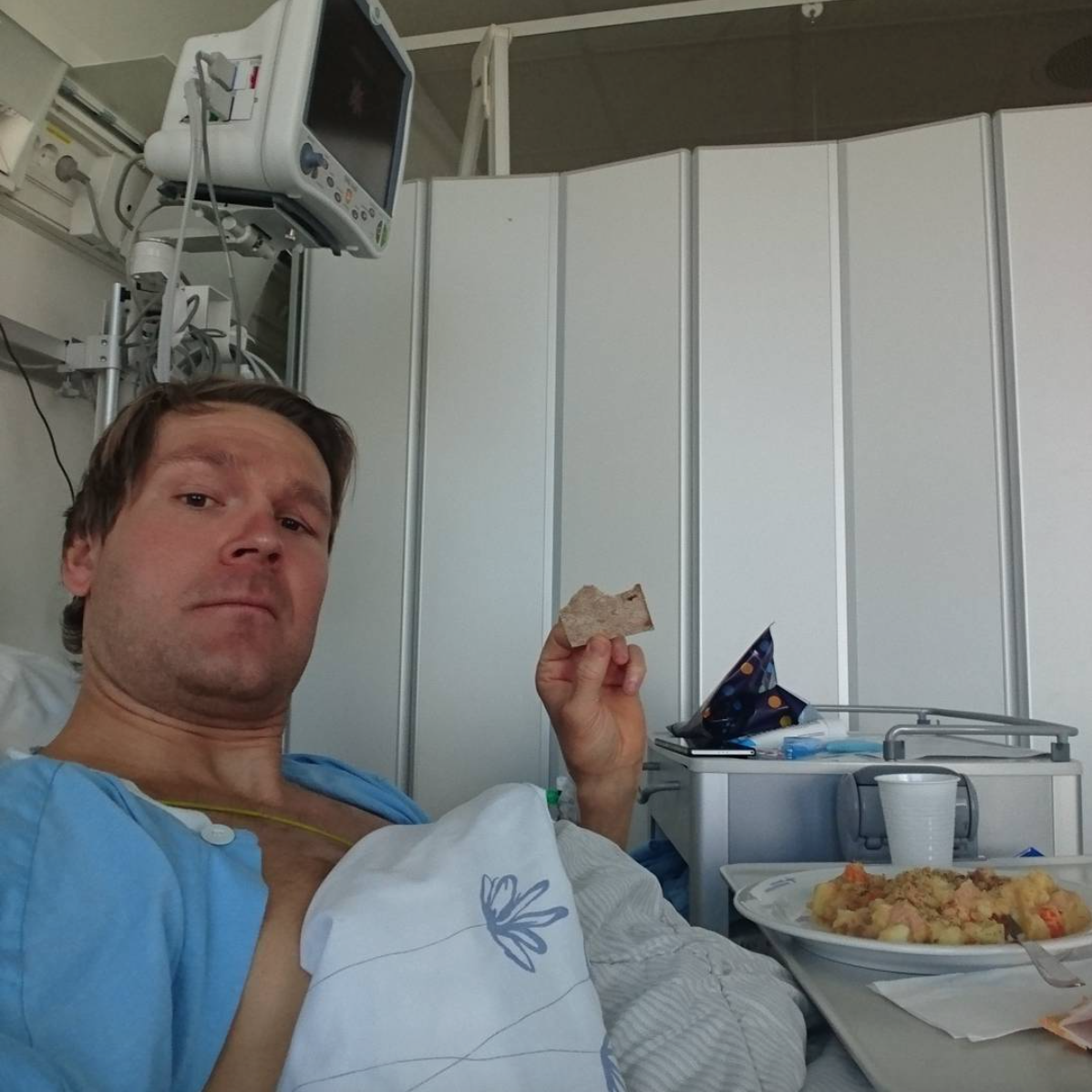
Norwegian sprinter-turned-distance skier Øystein Pettersen Instagramed a photo of himself in the Ahus hospital in Norway on Monday, showing his highlight of the day: stew and flatbread. (Photo: Øystein Pettersen/Instagram)
Øystein Pettersen went to the emergency room on Sunday night after feeling unbalanced following a training camp with Team United Bakeries. The 32-year-old Norwegian Olympian, nicknamed “The Sausage”, snapped a selfie of himself from the hospital bed and posted on Instagram, explaining that he had been admitted to Ahus outside Lillestrøm, Norway, with a low pulse and too much fluid retention.
“What’s wrong, we do not know, but since Friday the body has been out of balance,” Pettersen wrote, according to a rough translation.
Later on Monday, he joked in another post about his “absolute highlight” of the day: stew and flatbread. “Taking a bunch of tests and know not yet what is wrong,” he wrote.
He was in good spirits, he added, and was “delighted” that he had some time before his gastroscopy on Tuesday. He imagined the exam of his upper digestive track would reveal he ate stew.
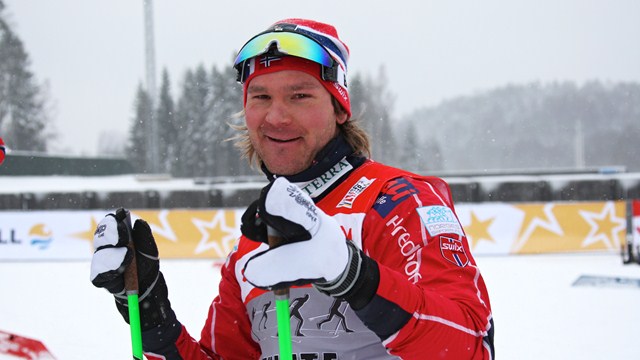
Norway’s Øystein Pettersen in 2014. (Photo: FIS/NordicFocus)
“I will not be broken by an all-inclusive stay in the ER,” he added, quoting Norwegian celebrity Ramsey Suleiman, “ ‘If you are not living on the edge, you are taking up too much space.’ ”
According to Team United Bakeries manager Henrik Kvissel, Pettersen left camp in Mallorca, Spain, before the team (which returned to Norway on Monday), but not for any alarming reasons. His wife had been sick, Kvissel told Aftenposten, and while they were waiting on the results of his hospital tests, the manager speculated that the recent training load may have been too much for Pettersen.
“He is in good hands and we are all thinking of him,” Kvissel said.
Update: Pettersen Instagramed a photo of himself traveling home on Tuesday. “The body is still not in balance, but I am healthy,” he wrote. “Heart, kidneys, liver, blood, blood pressure, electrolytes and nutrients, all is well. Still have a lot of fluid [retention] and I must return to Ahus tomorrow for more tests. We believe that the body will [fix itself] through rest, good diet and through quality family 🙂
“When I can train again I do not know, the only thing I know is that I will use the time it takes,” he added. “In addition, I take lessons from the event, so that I can continue with cross-country skiing and development. For that I need a body that works…”
A 2010 Olympian who won gold with Petter Northug in the team sprint in Vancouver, Pettersen has traditionally been known as a sprinter. However, since joining the Team United Bakeries distance squad in the spring of 2014, he has become a favorite for certain marathons, including Sweden’s 90-kilometer Vasaloppet. He placed third in the 57 k Marcialonga in January, and fourth in last year’s Vasaloppet.
In late July, Pettersen and his wife, Ellen Sanbakken, announced the birth of their second child.
On Saturday, a day before he was hospitalized, he posted a photo on Instagram of him napping with his son.
“Our little baby can teach me a lot,” he wrote. “[For example] a baby sleeps when it is tired, no matter what time it is or what day it is. The body says it is tired so …. today I do the same…”
Øystein Pettersen with his son, who was born in July. (Photo: Øystein Pettersen/Instagram)
Petter Eliassen after double poling his way to a victory at the Norwegian Birkebeiner on March 22. The 29-year-old Norwegian went on to win the 2014/2015 Ski Classics title in his first season on the circuit. (Photo: Kent Murdoch)
How did Petter Eliassen do it? A month ago, the 29-year-old Norwegian from Trondheim double poled his way to a victory in the Norwegian Birkebeiner and went on to win the final Ski Classics race of the season — Sweden’s Årefjällsloppet — to claim the overall 2014/2015 Ski Classics title. It was his fourth-straight win on the circuit, making him the first racer to do so in Ski Classics history.
FasterSkier recently spoke with Eliassen, a Norwegian national team member two seasons ago, on the phone, and he happily shared his training strategies. The following interview has been translated from Norwegian to English.
A rookie to the long-distance circuit, he was content with the opening of his season, placing among the top 10 in the first five races of the Ski Classics series.
But Eliassen did not expect to close the season with a four-race winning streak — starting with the König Ludwig Lauf in Germany on Feb. 2, then a Vasaloppet win in his very first attempt at the legendary 90-kilometer classic race in Sweden on March 9. He won the Norwegian Birkebeiner on March 21, and finished the season off with a final victory in the Årefjällsloppet on March 28.
And he certainly didn’t expect to win the overall circuit crown in his first try. Eliassen beat established elite racers, such as the Aukland brothers of Norway, and former Vasaloppet champions, like Norway’s John Kristian Dahl and three-time Vasa Champion Jörgen Brink of Sweden, as well as a long list of merited marathon specialists, including Sweden’s Jerry Ahrlin, Oskar Svärd and Daniel Tynell, and Czech super-veterans Lukáš Bauer and Stanislav Řezáč.
Petter Eliassen (r) of Norway and Team LeasePlan Go and Switzerland’s Seraina Boner (l) of Team Coop won the Årefjällsloppet on March 28, the last of nine events in the 2014/2015 Swix Ski Classics marathon series. (Photo: Ski Classics)
What’s your key to marathon success?
“I definitely benefit from years of racing experience,” Eliassen said, adding that the support and depth on Team LeasePlan Go made a difference. “We have a support crew and a race team that is very experienced and very well run. That’s huge both prior to the races and also in the offseason.
“Training-wise, I have done much the same leading up to this season as I did when I was on the national team. We do a lot of volume and some strength, but I have focused a bit more on double poling than I used to and much less on skating,” he said, adding that he does miss skating.
“I enjoy skating, and I still do some skate workouts throughout the season, but it’s definitely not the main part of the volume.”
While the Ski Classics organizers have not ruled out including freestyle events to the race schedule in the future, Eliassen doesn’t see that happen in the near future.
“So many of the established long-distance elite racers are highly specialized and spend so much of their training effort on perfecting their double-pole technique and strength that I think they would object,” he said.
Practice your weaknesses, race your strengths
While double poling isn’t his specialty, Eliassen is constantly trying to improve that aspect of his classic technique. He explained his team spends many of its group workouts focusing on tight finishes and does a lot of intense intervals in all kinds of terrain to prep for those.
“My favorite terrain is uphill. But many of the Ski Classics events have flat or even slight downhill finishes, so we spend a lot of time on that,” he said.
His race strategy is to determine how the race will play out well ahead of the finish line to avoid a double-pole showdown.
“I always go into the race with the intention to stay with the lead group as long as I can, but I try to pull away while there is still some distance to go and preferably in terrain that I’m good at,” he explained.
Skiers are made in the summer
During the season, Eliassen generally puts in one or two double-pole workouts per week, which last from one to three hours depending on how he feels and how much time there is between the races. When there are several weeks between events, he does longer workouts, and when the races come like rapid-fire, his main focus is recovering from one event to the next.
But the bulk of his double-pole training is completed even before the snow falls. During the dryland season, Eliassen and his teammates log several long rollerski workouts each week, with two to four hours of double poling.
“I am definitely not the one who logs the most volume on our team, but in the summer, I do at least two of those each week,” he said.
While rollerskiing isn’t his choice dryland workout, he loves running and also puts in a fair amount of time on his bike.
“I have to admit that my favorite summer workouts are long runs in the mountains. That’s where I really feel at home,” he said.
Strength and recovery
Eliassen stressed that plenty of variety was the key to staying injury free, along with a healthy dose of general strength, flexibility and recovery.
“It’s really important to do a lot of core strength in order to protect your back, shoulders and arms,” he said. “Also make sure to stretch. When you do a lot of ski-specific and double-pole specific training, you tend to get very tight, especially in the front of your body.
“And definitely make sure you allow yourself plenty of recovery time between the hard and long workouts, especially the rollerski double-pole sessions,” he added, pointing out that tendinitis issues often are a result of overuse and under-recovery.
In terms of building double-pole specific strength, he believes in simply double poling a lot.
“I don’t do any of the double-pole machines … I know a lot of skiers use them, but I believe there are several training methods that will lead to success, and so far, I haven’t used those,” he said.
If it ain’t broke, don’t fix it
Based on his experiences and results from his rookie season on the marathon circuit, Eliassen planned to continue with his training plan from last season.
“I will train mostly the same way as I did prior to this season, but of course, I will try to improve my test results even a little bit more,” he said.
Generally, Team LeasePlan Go does a one-week training camp each month during the dryland season, and in between, its athletes train independently.
“We live all over the country, so it’s nice to meet on a regular basis, but I also enjoy the flexibility of setting my own training schedule,” Eliassen said.
“I think the marathons really is my arena,” he added with a smile.
A scene from the front of the pack at the Vasaloppet in Sweden, part of the FIS Marathon Cup Swix Ski Classics. (Photo: www.swixskiclassics.com )
Exciting new developments have been announced for this winter’s Swix Ski Classics. The marathon series has expanded from six races to nine and includes a new race format for the prologue called the ProTeam Tempo, which is modeled after team events in cycling.
The series will begin on Dec. 13 in Livigno, Italy. The organizers of the Swix Ski Classics explained in a press release that there was a demand to start the series in December instead of mid-January when it has started in the past.
The opening event in Livigno will be a 15 km classic prologue that will feature the new ProTeam Tempo format; it will be the only event in the Swix Ski Series in which amateur skiers cannot compete.
In the prologue the women will begin the race first in a mass start. They will be followed by the men on each pro team, starting together with a two-minute gap between each team. The teams will start based on how they finished in the team competition last season, with the winning team from 2014 starting last. The ProTeam Tempo event will add some early season excitement to the season-long team competition. The team competition is calculated by adding the times of the fastest woman and two fastest men on each pro team.
Following the prologue, the series will continue the next day in Livigno with the 35 k La Sgambeda. After a four-week break following the La Sgambeda, January will be a busy month for the teams with four consecutive weekends of marathon racing.
Jan. 11 will see the teams travel to the Czech Republic for the 50 k Jizerska Padesatka. The next weekend the series will move to Switzerland for the 65 k La Diagonela. The Swiss race now features a new course in the Engadin Valley that works its way through the villages of St. Moritz, Zuoz and Pontresina.
The following weekend on Jan. 25, teams will compete in the 70 k Marcialonga in Italy. A week later on February 1, the series will travel to Oberammergau, Germany for the König Ludwig Lauf. In all, this month of racing will see skiers cover 235 km in four countries.
Following the König Ludwig Lauf, teams will rest and train with a five-week break until the 90 k Swedish Vasaloppet on March 8. Two weeks later the teams will travel to Norway for the 53 k Birkebeinerrennet. The series will end a week later in Northern Sweden on March 28 with the 75 k Årefjällsloppet.
Swix Ski Classics CEO David Nilsson called the expanded calendar a great improvement for athletes and TV-stations.
“We have also worked hard in order to be able to start off the season already in December,” he said. “It will then be interesting to see how the ‘January-madness’ of 4 events, 4 weekends in a row turns out. The introduction of the new ProTeam Tempo format will make the Swix Ski Classics Pro Teams competition even more interesting. The ProTeam Tempo format has been developed in discussions with athletes and teams. Now we are all just waiting for December to come in order to start off the best Swix Ski Classics calendar so far!”
The first hill on the Vasaloppet course – and it looked a lot worse by the time I got there. 15,800 skiers start at once, and it took me 35 minutes to go three kilometers. Photo: Rauschendorfer/NordicFocus.
MORA, Sweden – I just climbed into a car with three people I don’t know: Lars and Raffa, tall jovial Swedes, and Ingunn, a beautiful wispy-thin Norwegian. After a quick trip to the grocery store, we’re trying to navigate our way back through Mora. The problem is, it is two days before the Vasaloppet, the only thing that ever happens in Mora. Traffic is at a standstill.
Eventually, we make it to the other side of the town. My three companions are having a lively discussion in Swedish which I don’t understand. After a series of hesitant turns, I can see the thought “ah well, screw this” pass across Ingunn’s face and next thing I know, we’re driving the wrong way down a one-way street. Then the men jump out of the car and Ingunn and I come to rest in something that is not a parking space.
“The liquor store,” she says.
The three are supporting a friend at the Vasaloppet, and to get through tonight and tomorrow until they actually have something to do on race day, they are going to need some booze. I know their friend Mattias, who generously offered to let me join their group, a godsend since organizing yourself for a point-to-point race is pretty complicated. But Mattias is off testing wax, so here I am.
The men eventually return and Raffa tells me to sit in the front. Soon we’re back on the road. Lars and Raffa are packing snus and drinking beer (and doing who knows what else) in the back seat, and the beautiful Norwegian is driving with one hand on the wheel and a distinct attitude of ennui.
We are making our way toward Sälen, the start of the famous 90 k Vasaloppet and where we will stay this weekend. Along the way we pass the race trail quite a few times. It’s raining out. There are people skiing and it looks completely miserable.
Mattias has told me next to nothing about where I’ll be staying and who I’ll be with. Cryptic and strangely capitalized e-mails have told me that it will be very crowded in the house, but there will for sure be space for one more; that a woman has already cooked all the food so I should just plan to eat with them; and to bring sheets.
When we arrive in Sälen (after a few wrong turns and confusion along the way), I walk into a cheerful, large cabin that appears freshly decorated along a tasteful black-and-white theme. It’s warm and smells like dinner. The kitchen is already full, but not of people I know. In fact, of the 15 or so people who will be staying in the house this weekend, Mattias is the only connection I have. He’s not here.
“Welcome to Robin’s team!” a middle-aged woman named Lenita tells me and gives me a hug.
We sit down for dinner. They try to tell me what the food is, but decide it can’t be translated. Even after we’re done with the meal, I have no idea what I have just eaten. It’s delicious though – rice and some sort of meat in a sauce, and we sprinkle flaked coconut, peanuts, crushed pineapple, and banana slices on top.
“It’s one of Robin’s favorites,” Lenita explains. “Good luck food.”
Robin Bryntesson, in bib 40, skiing the Vasaloppet.
As it turns out, I have joined Robin Bryntesson’s team for the weekend.
Yes, that Robin Bryntesson – the famous Swedish skier, a two-time U23 sprint champion who might be best-known to North Americans because he won the World Cup team sprint with Emil Jönsson in Vancouver back in 2009. It turns out that Mattias grew up with Robin in the tiny town of Rossön, and the two are something like best friends. The gang from Rossön is all here, family and friends alike, to support Robin in his quest to win the Vasaloppet. I’m along for the ride.
* * *
I’m not here to win the Vasaloppet. When I moved to Europe a year and a half ago, I thought I should try some of the big ski marathons. The Vasaloppet was the one I was least interested in – too much double-poling, I really need hills – but was living in Sweden, and if you’re a skier you can’t leave Sweden without doing the Vasaloppet. I signed up, buying an entry off the black market website startplatser.se from a guy named Micke who wished me luck.
“Please race hard for me,” he wrote in one of our last e-mail exchanges. “I will think of you.”
Come Vasaloppet time, I was even worse off than I had expected, fitness-wise, because I had just gotten back from the Olympics. The race trails in Sochi were not open to journalists like me, and there weren’t any other trails to ski on. Even the running was inadequate. Not that it mattered – I had brought my running shoes and envisioned long training runs in the Sochi sun, but I was working far too many hours to have any energy for training. I called it the “live high, train not-at-all” strategy.
So, three days after arriving home from Russia, I was still exhausted and at a huge sleep deficit. I hadn’t skied in a month. The weather was warm and I secretly wished that the race would be canceled. Instead, they brought snow in and used helicopters to dump it on the course. Anything for the Vasaloppet.
On Friday, I got on a train for Mora. Direct route, no connections. I wore a raincoat and could not have been less excited. I’m pretty sure that’s not how you’re supposed to feel right before you do the biggest ski race in the entire world.
But it’s hard to feel discouraged when you’re with Team Robin. First, there is Robin himself. Everyone had been friendly, but Robin was even more friendly and even more outgoing. Just watch the video on the front page of his website and you will get a sense of this. He has founded his own team and the uniforms tend to be hot pink with strange patterns and other bright colors.
All this, combined with the fact that it’s Team Robin, goes strongly against the Jantelagen, a de facto cultural law of Sweden about how you conduct yourself. Some examples of the Jante laws:
#1: You’re not to think you are anything special.
#7: You’re not to think you are good at anything.
#9: You’re not to think anyone cares about you.
So to have a garishly rainbow uniform and advertise your own name is distinctly un-Swedish. But people love Robin. It’s his personality, but perhaps also what he stands for. Robin has diabetes, and spends a lot of time and energy working with kids who also have diabetes, and generally raising awareness about how it’s possible to still be anything even if you are diabetic.
Robin’s title sponsor for the Vasaloppet was Changing Diabetes, a campaign by the pharmaceutical company Novo Nordisk. Saturday morning I helped shoot a little video of Team Robin, in which he explained how his suit had been specially doctored to hold his insulin monitor and transmitter, and how the whole team (gleefully messing around in the background) would be supporting him with lots of feeds to keep his blood sugar stable.
It’s not just a public persona. When I arrived that first night, Robin walked right up, introduced himself, and asked if I’d had trouble picking up my bib. More than most of the others, he made sure to translate bits of conversation into English so I’d sort of know what was going on. I couldn’t believe that anyone was doing this for me, a fat out-of-shape American girl seeded in start group six who would take many more hours than him to ski the 90 k.
* * *
Saturday unfolds in a haze of jokes, laughing, skiing, and race prep. Besides Robin, his friend the biathlete Magnus Jonsson was also racing, and another friend Anders Strid, who is now a coach in Östersund and tells me he is both helping and racing. We all go skiing on Saturday. It’s the first time I have skied in a month and I feel surprisingly good.
We relax all afternoon at home, but I still begin to get a sense of what it takes to try to win the Vasaloppet, especially if you have diabetes. First there are the predictable things, like skis. Mattias is out all day testing wax and structure. He’s in the garage waxing skis until late at night. He’s out again at 3 a.m. the next morning, and he and Robin’s brother Pierre shuttle back and forth to test and rewax race skis.
But the logistics are even more complicated. There are no less than seven cars in the driveway. On race day, three of them will get “Vasaloppet Elitservis” signs to put in the window so that they can drive the road from Sälen to Mora and take turns onto smaller roads that serve as access points for the more remote parts of the trail. Each night we talk for over an hour about how to coordinate all the feeds and the timing of who can drive to which spot.
Or, they talk – it’s in Swedish and I have no idea what they are saying. I pretend to not be bored. Mattias sits beside me drinking a beer and occasionally translates something.
To keep morale high for this huge group of people who are helping Robin, we pool our money to bet on a race horse. Lars, one of the guys who had originally picked me up in Mora, drives trotting horses. He organizes the betting. I pay my 100 crowns. Maybe we’ll all get rich.
I sleep on a blow-up mattress in the living room, next to Robin’s aunts, who snore loudly. One of them tells me that if it’s too much, I should stick a sock in her mouth, but only if it’s a clean sock. Then she bursts out laughing. Everyone laughs here.
Then, it’s race day. I wake up at 5 a.m. to find much of the crew has been awake for quite a while already. I try to eat as much porridge as I can (I try milk and jam this time) and organize my things. Jonas, one of the helpers, has agreed to drive me to the start.
Here’s how the Vasaloppet starts: it is divided into an elite group, plus ten more seeding groups based on your times in other races. Everyone lines up in a giant pen in their start group, but at 8 a.m. the lines are all raised at once and 16,000 people take off together. There are horrible bottlenecks as the trail quickly narrows down. On top of that, less than a kilometer into the race there is a huge hill which is quite steep at first but becomes more gradual, lasting at least a kilometer or two in total.
Robin, Magnus, and Anders don’t have to go early – there are something like 250 people in the elite wave, and so they can show up and grab their choice of starting positions. I, however, am in start group six. There are 1,500 people in start group 6 alone, and over 5,600 in front of us. I don’t want to be in the back of my start group. Some people have showed up as early as 4 a.m. to line up at the front when the gates open at 5:30. I don’t need to be on the front line either, but I want to get there early.
I pack everything into Jonas’s car and say my goodbyes. Everyone wishes me luck.
“Have you eaten enough?” Mattias asks.
I tell Mattias I love him for making me amazing skis, and he tells me to wait to say that until after the race.
We leave the house at 5:45. Normally it would take seven minutes to drive to the start, but the traffic is horrible. Eventually Jonas has to just drop me off on the side of the road because he has to return to the house and then head out again to go do his job with feeds. I jog the rest of the way to the start.
It’s just like so many other huge marathons. There are people milling about everywhere, huge DHL trailers to drop off your bag (tagged with your bib number) for transit to the finish, separate number-tagged trash bags for your warm-up clothes which you should keep on until just before the race starts. In the middle of each start group is a giant raised platform where there are women dancing along to music and urging skiers to dance too, to help stay warm. I have an hour and a half to spend here. I manage to snag a place in the fourth or fifth row of group six and make friends with two Finnish guys next to me. After a fun but disconcerting weekend, I feel at home: some things about ski racing are the same no matter where you go.
* * *
What is there to say about the race? It takes me 35 minutes to go the first three kilometers, through the bottlenecked start and up the first part of the big hill. I manage to not fall down, not get tangled, not break anything. I heed the advice to keep my poles close to my body, and try to do what Mattias had said and look far up ahead of me to see which lines were moving the fastest.
It is kind of exhilarating. I am still searching for gaps 10 k into the race, when I realize that I should probably calm down. There are 80 k to go. Settle back and enjoy the ride, don’t use up your energy now.
Every marathon has its high points and low points, and I don’t just mean in terms of topography. You’re guaranteed to feel terrible at least once or twice. I feel pretty bad, about 30 k in, for a while. But I stop to eat a couple of times and make good use of the feed stations. I don’t like blueberries, but I guzzle blåbärssoppa (blueberry soup) like it’s my job. I start feeling better. In fact, I feel pretty great. I can’t really believe it.
Then, with about 30 k to go, I feel decidedly not great. I bonk: run out of energy completely, glycogen stores depleted. It’s hard to come back from a bonk, to un-bonk yourself. You can eat, but you have crossed a line that is something quite definitive. I stop on the side of the trail, eat a bar, and feel a little better. Just a kilometer later, though, I’m be back to walking. There is no long-term solution for a bonk.
I try to console myself: I had already skied 60 k, which is farther than I had ever raced in my life. If it were a normal marathon, I would have been tired at the end but things would have gone pretty well. I would be finished already. Making it 60 k before having major problems should maybe be considered a victory, especially considering that probably nobody had prepared for this race worse than I had.
But it is hard not to get depressed. 30 k to go is a long, long way. You ski, or walk on your skis, painfully and slowly, only to learn that these minutes that have felt like a lifetime have only brought you to the point where you have 28 k to go. Like 30 k, 28 k is a long, long way.
At the finish: I was not moving as fast as this picture suggests. Photo: Simon Evans.
On top of that, the trail is a mess. There was natural snow for the first 30 k or so, but then it was trucked-in snow. It is warm and everything fell apart completely. The slush is deep and in many places there are no tracks at all. People are falling down all around me, getting their skis caught in piles of slush or divots in the trail. It’s a minefield. I am proud of this one thing, that I did not fall down.
I want to quit, but I couldn’t: Mattias and all of Team Robin got me to the start. I have to finish, for them, even if I do horribly. Doing horribly is still better than dropping out.
Hundreds of people flow past me. Maybe even thousands. Everybody and their brother is passing me, and their father is passing me, and maybe even their grandfather. A snail or a turtle could both ski faster than I am skiing.
You have not bonked until you bonk with 30 k left in the Vasaloppet. Only then do you understand the true meaning of “bonk.”
The last feed station is with nine kilometers to the finish, and they surprise us with coffee. I am elated. The caffeine gives me a burst of energy and for the next few kilometers, I hook on to a group of two other women and we are double-poling well, passing people. My original time goal had been six hours, but now I glance at my watch and guess that maybe, if I stay with this group, I could make it in seven hours. But five kilometers later I have been dropped and I’m dying again. Really dying.
The last two kilometers are maybe the worst of the entire race. Even though I am so close, I don’t know how I can possibly keep moving.
You ski over a small bridge before descending to the finish, and as it happens, my club teammate Simon is standing there with his camera. I can only imagine how many hours ago he had finished. He waves and I practically stop skiing as I beseech him, no pictures! Please! Allow me some dignity!
Then I am done. Seven hours and six minutes. I couldn’t even make it under seven hours, but who cares, I’m finished.
* * *
I eventually find Jonas, who has agreed to also pick me up at the finish.
“Congratulations!” he says. “You did great!”
I don’t feel like I did great. I feel like an unprepared idiot.
I hand my skis over to a storage area where they are tagged with a number, then get on a bus to the area where we can collect our bags. I haven’t planned well, and although I have clothes to change into, I have no other socks. I put my bare, wet feet in my running shoes and walk back to find Jonas. We had talked about eating in the cafeteria, but I just want to go home.
I ask how Robin’s race went. Not perfectly, it turns out. He was with the lead group until deep into the race, but a few feeds didn’t go as planned. Whether because of that or the complexities of racing or his disease, Robin’s blood sugar crashed. Jonas said they first noticed because for the last 20 k, Robin was supposed to be taking feeds on the right side of the trail. But he didn’t remember, and stayed on the left side.
Later, he was woozy, and “cross-eyed.”
Miraculously, though, he hung on to finish 52nd, less than two minutes behind Norway’s John Kristian Dahl, who won. He was in a good mood afterwards.
“What a stud,” I say. “We say that in America.”
“We say, he has a big forehead,” Jonas said wistfully. “Doesn’t translate.”
In the car we talk to the family, most of whom are on their way back to Rossön. They all congratulate me. Mattias texts me that “the conditions was tuff” and that I did a great job.
A lot of people dropped out. I didn’t. And I can cross the Vasaloppet off my life’s to-do list.
U.S. teammate Kikkan Randall (l) and Sophie Caldwell celebrate the first U.S. double podium in Saturday’s World Cup skate sprint in Lahti, Finland. (Photo: Fischer/Nordic Focus)
Were the Olympics just a dream? After a whirlwind couple of weeks on the ground in Sochi, Russia, it certainly feels so for us. However, just because the Olympics are over doesn’t mean the season has ended, and as this past weekend proved, we may have some of the most exciting skiing of the season ahead of us.
World Cup action kicked off with Saturday’s freestyle sprint in Lahti, Finland, where the women of the U.S. Ski team made history. For the first time two American women sat upon the podium, with Kikkan Randall in first and Sophie Caldwell in third.
For Randall, the win was redemption for a disappointing two weeks in Sochi where she finished 18th in the freestyle sprint, an event she was favored to win.
Fellow U.S. Ski Team members Kikkan Randall (l) and Sophie Caldwell after finishing an unprecedented first and third, respectively, in the Lahti World Cup freestyle sprint on Saturday in Finland. (Photo: Fischer/Nordic Focus)
For Caldwell, it was her first World Cup podium. The podium adds to what has been a momentous season for the 23-year-old, who placed sixth in the Olympic sprint. In doing so she achieved the top result for an American woman at an Olympic Games.
Completing the podium was Slovenian Katja Visnar, who finished second, placing her in the middle of an American sandwich.
On the men’s side, Canadian Alex Harvey pushed through his post-Olympic 50 k exhaustion to place seventh. American’s Simi Hamilton and Andy Newell also placed in the top 30 in 20th and 28th. Hamilton, who suffering from illness, and Newell, who lost both a pole and a ski in his heat, were unable to advance from the quarterfinals.
The race was eventually won by Norwegian Paal Golberg. He was followed by Russian Alexey Petukhov and Norwegian teammate Eirik Brandsdal.
Sunday’s World Cup races were dominated by Norwegians fighting to become the overall World Cup Champions. For the women, Marit Bjørgen skied a smart and controlled race to finish first in the 10 k freestyle by a whopping 26.9 seconds. Behind her was Charlotte Kalla in second and a frustrated Therese Johaug in third. While Johaug still holds the overall World Cup lead, Bjørgen is closing in with every race.
Randall was the top North American in 21st followed by teammate Liz Stephen in 32nd.
In the 15 k individual freestyle, overall World Cup leader Martin Sundby of Norway extended his lead by outpacing second place finisher Daniel Richardsson of Sweden by over ten seconds. On the podium for the second day in a row, Petukhov placed third.
U.S. Olympian Sean Doherty (c) tops the podium in the first race of the 2014 IBU Youth World Championships in Presque Isle, Maine. Doherty won Friday’s 7.5 k sprint ahead of Germany’s Marco Gross (l) in second, and Russia’s Dmitri Shamaev in third. (Photo: Craig Cormier)
This weekend also marked the start of the IBU Youth World Championships in Presque Isle, Maine where American Sean Doherty claimed gold in both the 7.5 k sprint and 10 k sprint. This marks the third Youth World gold medal for the 18-year-old, who was fresh off his first Olympic start in the 4 X 7.5 k in Sochi.
American Maddie Phaneuf placed fourth in the women’s 5 k sprint and finished 24th in the 7.5 k pursuit. Canada’s Danielle Vrielink was the top North American in the pursuit with a 15th place finish.
The Vasaloppet also took place this weekend in Sweden. John Kristian Dahl waited to the last minute to make his move, chasing down fellow Norwegian Laugaland to win his first Vasaloppet. Laila Kveli of Norway won the women’s race in an impressive of display of double poling strength to become the first women to win the race without kick wax.
02.03.2014, Mora, Sweden (SWE): athletes at the first climb – FIS Marathon Cup Vasaloppet, Mora (SWE). Photo: Rauschendorfer/NordicFocus.
The Vasaloppet was held Sunday despite fears that a snow shortage and warm temperatures could force the cancellation or shortening of the great race. A massive snow moving operation was put into place last week to prepare the course with trucks hauling snow and shovel teams working to distribute it to spotty areas. The organizers even had helicopters at the ready to dump snow on the trails just before the race, should the need arise. Luckily, the helicopters stayed grounded and the 14,611 skiers left the start at Sälen for Mora, 90 kilometers away.
As the race passed the town of Risberg, after 35 k, Norwegian Espen Harald Bjerke made a break from the leading group. Bjerke took the Hill Prize at the town of Evertsberg, some 12 k past Risberg, and just past the halfway point in the race, at Evertsberg, Bjerke was leading by 1:49. Bjerke was able to hold onto the lead for a considerable length of time, but was finally caught 3 hours and 44 minutes into the race by fellow Norwegian Audun Laugaland, who had himself broken away from the lead group by a few seconds.
02.03.2014, Mora, Sweden (SWE): leading group after 36 km, Jorgen Aukland (NOR), Morten Eide Petersen (NOR), Bob Impola (SWE), (l-r) – FIS Marathon Cup Vasaloppet, Mora (SWE). Photo: Rauschendorfer/NordicFocus.
Laugaland continued to put time on the leading group, and he had a 35 second margin at Eldris, nine kilometers from the finish line. As close a 1.5 k from the finish line the helicopter view showed that Laugaland had a visually impressive lead between himself and front pack of skiers, which was now in a frenzied state to try and catch what appeared to be an insurmountable amount of ground. Laugaland, though, didn’t seem him to have a final burst of energy left in him, and as the race dwindled to less than a kilometer, the yellow suits of Team United Bakeries John Kristian Dahl and Johan Kjölstad appeared baring down behind him and skiing hard.
Whether Laugaland knew that Dahl was about to overtake him or not wasn’t clear, he never turned to look behind him, and Dahl blew past him with around 500 meters to go. A few seconds behind him was Kjölstad, and then in the finishing stretch, Jörgen Brink, the three time Vasaloppet champion, overtook Laugaland, his teammate on Team Leaseplan Go. Dahl won with a time of 4:14:33, 2.8 seconds ahead of Kjölstad, and 4.6 over Brink.
“I made a real push and used my last reserves and got a few metres,” said Dahl at the finish. “Conditions were tough today. I tested roughed up skis before the start, but chose to ski with ‘smooth’ [skis], I was pretty worn out around 60-70 kilometers, but so were we all.”
“It was difficult conditions, soft tracks, very slow speed in the front, very hard, but in the end the course was fast, and the tracks were better, said Dahl to Swix Ski Classics. “With 2 kilometers left I decided to go all in and maybe I win and if it doesn’t work I’m thirtieth and far behind. But I tried and I won,” Dahl said laughing. When asked if he spoke to Kjölstad during the race he said, “At the end I tried to gather the team and I wanted our helpers to stay in the front and to have good speed, but the speed was difficult because there was only one track that we could go in, so it was very difficult. In the end I decided I needed to do this alone.”
“I heard the gap to Bjerke was very big,” continued Dahl, “over two minutes, and suddenly he was there in the front, and then Laugaland went ahead in the front and I thought, ‘we can’t make this.’ Then I heard 30 seconds [to Laugaland] with 3 kilometers left and it’s very hard in the end, you have to work all the time, and with 1.5 kilometers left, I saw Laugaland, maybe 25 seconds ahead and I decided to go for it.”
02.03.2014, Mora, Sweden (SWE): leaders after 1 km: (r-l), Oystein Pettersen (NOR), Franz Gˆring (GER), Robin Bryntesson (SWE) – FIS Marathon Cup Vasaloppet, Mora (SWE). Photo: Rauschendorfer/NordicFocus.
When asked what makes Team United Bakeries so strong Dahl replied, “We have been training very much and very hard. This is four hours and twenty minutes hard race, but we train five or six hours. Train hard, win easy.”
“I was aiming to win but it wasn’t quite enough. They’re strong, these boys in yellow!” Brink said, in reference to Dahl and Kjölstad’s United Bakeries uniforms. Brink had struggled with a fever early in the week, but decided he would start the race anyway. “I had a sort of dizziness during the week, everything wheeling around in my head, and I was in bed until Thursday. But I picked up and skied a bit yesterday. Today it felt very, very much better than I’d expected.”
In the women’s race, Britta Johansson Norgren and Laila Kveli took turns leading with Annika Löfström skiing behind them. Norgren took the Hill Prize in Evertsberg, eight seconds ahead of Kveli and with 42 kilometers of skiing left. Then, Kveli took over the lead. By the time they reached Oxberg, with 28 kilometers remaining, Kveli led by eleven seconds in front of Norgren, and 28 seconds ahead of Löfström. Kveli continued to increased her lead, and at Hökberg with less than 20 k to go, her lead had grown to 1:10 ahead of Norgren and Löfström, both teammates on the Team SkiProAm, an all women’s marathon team based in Sweden, and who were now skiing together. Towards the end of the race, Norgren went ahead of Löfström, having broken away from her teammate.
“After Evertsberg I had just gone ‘all in’ all the way, so I’m very happy that I made it,” said Kveli. Kveli is the first women to have won the Vasaloppet without grip wax. “I tried not to drive too hard on the start hill. Then I had good skis, good control over myself and the distance,” said Kveli, who won with a time of 4:31:57. Norgren chose go on roughed skis. “I think that was best for me today. The skis went a little heavier where there was fresh snow. But I felt some stomach cramp around Evertsberg. It would probably have been tough for me to pole the whole distance. I’ve done all I could today, so I’m very pleased about that,” said Norgren, who finished 1:06 behind Kveli.
Speaking to the Swix Ski Classics after the race Norgren said, “I had a good start and I was trying to stay with the guys, but from Evertsberg I had problems staying with Laila [Kveli] and then it was like 10-15 seconds, but I couldn’t take it, but I’m satisfied with second place. I wanted to win the race and we had 10 seconds to Laila [Kveli] but Annika [Löfström] was tired and thought it was too much to make it on her, so I stayed with Annika [Löfström ], so we could continue together.”
Löfström said after her race, “It was a very good race, I went with skate skis today, double pushing the whole race, so I’m very happy with third place. I was at the front doing very much the whole race and I was very tired. When there was 5 kilometers left I don’t have so much muscle in the arms.”
A full replay of the Vasaloppet with English commentary can be watched here.
Entry for the 2015 Vasaloppet will open on March 16th, 2014 at 9:00am CET on vasaloppet.se. The registration is expected to sell out fast, the 2014 race was filled just 10 minutes after registration opened.
Men’s Results:
1 John Kristian Dahl (NOR) 4.14.33
2 Johan Kjölstad (NOR) 4.14.36
3 Jörgen Brink (SWE) 4.14.38
4 Audun Laugaland (NOR) 4.14.42
5 Stanislav Rezac (CZE) 4.15.50
6 Andreas Nygaard (NOR) 4.14.50
7 Daniel Tynell (SWE) 4.14.52
8 Stian Hoelgaard (NOR) 4.14.52
9 Oskar Svärd (SWE) 4.14.52
10 Christoffer Callesen (NOR) 4.14.52
How things change. With just eight days to go until the Vasaloppet, she was 1,500 miles away in Russia, racing a 30 k in the Olympics.
“This is maybe not the best preparation but we will see,” Boner said after placing ninth today, by far the best Olympic result of her career. “This is probably my last Olympics, though, and I can always do the Vasaloppet next year.”
When your specialty is racing over such long distances – Boner is the best female marathon skier in the world – sometimes you get a little bit of perspective.
An opportunity opened up for Boner when Switzerland was unable to fill its Olympic quota along the strict lines laid out by its Olympic Committee. Athletes need one top-15 or two top-25s on the World Cup to be allowed to represent Switzerland, and no female distance skiers had met that mark.
Boner raced the 10 k freestyle in Davos in December, mostly because she lives there and wanted to compete in front of a home crowd. She finished an unimpressive 29th.
In Szklarska Poreba, Poland, in January, Boner tried again and finished 11th in the 10 k classic in a weakened field that did not include the Norwegians, Finns or Swedes. It was enough to meet the requirement, but she was still almost two minutes behind the winner, Justyna Kowalczyk. There were doubts within Switzerland about how well their marathon star could do competing in normal-length races.
Boner is not a member of the national team, instead racing on the Team Coop marathon team in Scandinavia. But Swiss coach Guri Hetland said that it was a “no brainer” to include Boner, who sometimes trains with her athletes, on their Olympic roster.
“She is the best distance skier we have,” Hetland said. “We all know that the level in long-distance skiing is also really good and is improving.”
And at the Olympics, things have been going better. Immediately after arriving, Boner got the call to replace Laurien Van Der Graaf in the team sprint. The format couldn’t be more different from the long distances Boner is used to covering, but she held her own. Not only did she and teammate Bettina Gruber – a bona fide sprinter – qualify for the final, but they finished seventh.
“I was able to be skiing right in with them, with these girls who are the sprinters,” Boner said. “We still came in seventh place, which is really cool.”
Switzerland had finished 17th and last in the team sprint four years ago in Vancouver, and had not entered a team in the event’s first appearance in Torino.
But more than that, it was exciting because it gave Boner some confidence in her form heading into today’s 30 k, the race she had flown to Russia to compete in.
“She showed in the team sprint that her shape is really good, and we all know that 30 k should be a better distance for her,” Hetland said.
Still, Boner was not used to racing against the likes of Marit Bjørgen and Therese Johaug.
“I wasn’t sure where I would be in this field,” Boner said. “I made a lot of different plans to maybe use. But it turned out that I was in that pack fighting for, I think, fourth place. So I found more motivation near the end because of this.”
When Bjørgen, Johaug, and Kristin Størmer Steira broke away from the main field, Boner stuck tight in the chase pack and even led it for sections of the race. She ultimately couldn’t find the same finishing speed as some of her competitors, but still placed 9th, about halfway deep in the pack.
It was the best result by a Swiss woman at the Olympics since 1998, when Brigitte Albrecht Loretan finished seventh in the 30 k skate in Nagano.
Boner said that the course here, with its notoriously long and brutal climbs, might have contributed to her much-improved result.
“I like long climbs, it is a little bit more like what the long distance races are like,” she said. “I like minutes, not 30 seconds here or there. So I guess this was good for me.”
Hetland didn’t care too much about why it was a good race – she was just happy to see a Swiss suit up front, something that has been rare in women’s distance racing in the last few years.
“I’m really impressed that she is making such a good race and result,” Hetland said. “It’s great for female skiing in Switzerland to see that it’s possible.”
As for Boner? Now that the race is over, there’s other fish to fry, namely that pesky Vasaloppet.
“I fly home and then straight to Sweden,” she laughed.
Early morning in Bruksvallarna. Photo: Simon Evans.
About the author: Simon Evans is a British postdoctoral researcher in the Animal Ecology department of Uppsala University’s Evolutionary Biology Center, and an avid skier. In 2013, his second year in Sweden (and thus his second year skiing), he finished the 90 k Vasaloppet in five hours and 57 seconds, placing him 692nd of the 15,800 total participants. Unsurprisingly, he was the first Brit. He is now planning a long-distance bike trip in northwestern Canada.
Uneasy in the icy conditions, I move out of the tracks for the steep downhill route that leads – via a tunnel that I am going to have to negotiate at speed – to the relative tranquility of the flatter tracks alongside the river. It’s my first time on skis for the winter and I am aware how conspicuously I look like Bambi as I struggle to portray myself as anything other than Horrendously Misplaced Brit, a characterisation my Swedish friends – schooled to ski from a young age – so often amuse themselves with. On this occasion, though, I was out of the door and clipping in my boots whilst they slept off our late arrival the previous evening. The result is an absence of sympathetic, friendly faces to turn to for reassurance, as far more accomplished skiers – Charlotte Kalla, Jörgen Brink and the Thunell brothers, to name a few – effortlessly glide past, seemingly immune to the difficulties I face, and clad in bright kit that boldly pronounces their national allegiances. My confidence takes a battering and after a couple of short loops I beat a hasty retreat to the safety of the lodge, consoling myself with unconvincing mutterings about “the wrong kick wax”. But how did a guy raised in a seaside town in southern England come to be sharing the tracks with some of the sport’s biggest names?
I moved to Sweden two years ago, having completed my PhD in the UK and been offered a job at Uppsala University, a small city about an hour north of Stockholm. Eager to make the most of what Scandinavia has to offer, and having been a keen runner, cyclist and university rower, the decision to take up cross-country skiing was an easy one. So it was that within a month of arriving in Sweden, I found myself in one of Uppsala’s sports stores worrying how a complete novice – and an appropriately impoverished graduate to boot – can justify spending several thousand kronor on a couple of thin planks and some flimsy carbon fibre poles.
Yet, as you probably already know from your own experience if you’re visiting this website, cross-country skiing is an enormously enriching pastime, so it didn’t take long before I was hooked. For someone with a marked sensitivity to the cold (and an accompanying hatred of being chilly), this speaks loudly of just how enjoyable Nordic skiing is. The weekends of my first winter were spent tracing circles across a frozen lake, the only place where the marginal snow depth of that year didn’t pose a threat to the precious base of my skis. As my second winter approached, my local ski shop’s friendly assistant, endlessly plagued by my questions on glide waxes, optimal skier weight and the rolling resistance of roller-ski wheels, pushed a pamphlet for the local ski club into my hands. I tentatively attended my first training session a few weeks later and, whilst my self-taught technique raised much amusement (“your technique is about 40 years out of date”, somebody eventually ventured to tell me), everyone was welcoming. My technique remains pretty rough, but I at least know now what I should be striving (and striding) for.
Now, with my second year of skiing behind me and my third winter in Scandinavia approaching, I joined a few club mates for an early-season trip to Bruksvallarna,in the Swedish mountains. Being decidedly less fashionable than their Alpine counterparts, Sweden’s ski resorts offer much better value for money, and my share of our lodge cost me 800 kr for four nights. This, for a lodge that was sited less than fifty metres from the tracks. And – this being Scandinavia – equipped with its own sauna.
We arrived a week after the snow in Funasfjällen, the umbrella name for the five neighbouring skiing resorts that have interlinked their ski trails and other aspects of their organisation, to create what is, in effect, a meta-resort. Whilst the other centres were yet to start preparing trails, at Bruksvallarna (or ‘Bruks’, as it’s generally called by those in the know) the snow machines had been working overtime to create thick trails in advance of the opening FIS races scheduled for the following weekend, from which Sweden would choose its World Cup team. There were thus a couple of fairly technical loops open and in heavy use, by both national teams and serious club skiers who were eager to get in some early training on the white stuff before it arrives in places like Mora.
Alongside these loops, there was also a trail open that led up the slope overshadowing Bruks, which climbs steadily for perhaps 5 k. The high plateau and offers great views of the ski slopes of Ramundsberget, the northernmost of the five resorts that nestles into the head of the valley. The Mittåkläppen trail then descends into a depression in the plateau, terminating at a river crossing some 11k from Bruks. After my ‘Bambi’ moment and a cup of tea in the chalet to restore my bravado, it was up the mountain that I fled, where I could remind myself how to ski without feeling embarrassed in front of more accomplished practitioners. More relaxed, having found myself alone on the trail, with the aggressively undulating terrain of the trail loops down in the valley replaced by a satisfyingly elongated ascent (for some reason, I love going uphill), my limbs started cooperating. And the views from the ridge top are pretty special, more than enough to draw a smile on my face as I sucked in the pleasingly cold air and tried to focus on the technical flaws my club’s coaches had highlighted during the autumn’s roller-skiing. Here, on snow rather than a rural road, the skis slid near effortlessly with each heave of my quads or push on my poles. Having earlier arrived back at the chalet in a state of intimidation (at both skiing and skiers), I returned in a state of reverie, that feeling of wonderful bliss that accompanies many ski outings. And for me, that’s one of the greatest features of this addictive sport, that the simple act of a training ‘run’ takes me into some stunning terrain, beautiful scenery that I am immersed in as I traverse the landscape.
So it was that I largely abandoned the valley tracks over the next few days and instead pursued the vistas that the ridgetop track presented. I’d set my alarm to rouse me while it was still dark, distractedly eat some breakfast as I gazed out of the window at the oncoming daybreak, and then dash up the mountainside so as to be above the treeline as the colours of dawn were thrown over the peaks and gradually spilled down the slopes. By the time I’d made it to the trailhead and was on my way back, the sun would be flirting with the horizon.
It was still very early to be skiing, and we were lucky that fresh snow fell in the days before we arrived. We enjoyed two good days but on the third the wind turned, bringing warmer air that forced the mercury up and the thin covering of snow on the Mittåkläppen accordingly began to subside. As long as the accumulated efforts of the snow machines left the valley tracks unaffected, I persisted with my morning routine (although now armed with universal klister), eager to get my fix of mountain sunrise. However, with a lot of debris on the snow and the tracks barely existing, I struggled for grip on the long ascent out of the valley. So I unexpectedly began the next phase of my development as a nordic skier: skating. And this proved something of a revelation, for I discovered that freestyle is not necessarily the brash upstart I had assumed it to be. Rather, it had a serene rhythm all of its own.
This unplanned introduction to a whole new dimension of skiing challenges would make the long drive into the mountains worthwhile on its own. But when placed alongside the confidence regained, the friendships made and the household names spotted, our short break in the early season snow was even better than I had hoped.
Now, back in the flatlands of Uppsala, with the mountains and skiable tracks of Bruksvallarna far beyond the horizon, my clubmates wait impatiently for the arrival of snow. As for me, I’ve got more pressing concerns: which skate skis should I buy?
Swiss national team coach Guri Hetland checks Team Coop’s Seraina Boner’s time on a threshold interval on Wednesday.
DAVOS, Switzerland – Seraina Boner hasn’t been part of the Swiss national team since the 2010 season, when the 2006 Olympian was left off the squad for the first time.
But has that stopped her? Not at all. Boner decided three years ago to focus on long-distance racing, and has become the world champion in that discipline. A two-time Birkebeiner winner, last year she also won the prestigious Marcialonga marathon in Italy and the Engadin Marathon in her home region here in Switzerland.
At 31 years old, she might not be part of the national team, but she’s still welcome.
“My philosophy is that anyone who wants to train with us, can,” Swiss head coach Guri Hetland told FasterSkier. “It’s good to have her here to push the women.”
On a recent Wednesday morning Boner was at a national team training session that actually didn’t include any other women, just Dario Cologna and Roman Furger. She was taking advantage of the fact that Hetland was driving the men down a long, narrow, winding hill – not ideal for skiing down – in between intervals, and hopped in for the workout.
“It’s really good for me to join the training group in Davos when I’m back home, and I’m back home pretty often,” Boner said at the end of the session. “It’s more fun if there are more girls around. There are not so many up here, but we try to fix some workouts together, and that helps.”
Boner, who is part of the Team Coop marathon squad, is focused exclusively on racing very long distances. But that doesn’t mean that she can’t train with the other Swiss women, who are primarily focused on sprinting (Laurien Van Der Graaf and Bettina Gruber are tops on the team). In fact, she doesn’t think that she trains many more hours than them, and still does plenty of fast workouts.
“I think that the basic training is pretty much the same probably,” Boner said. “The ones that are more specializing for sprints will have some specific workouts, and I will have some specific workouts for long distance, but the average is pretty much the same… sometimes it’s good to have company, especially in speed workouts. You can help each other a lot when you’re in a group.”
Boner putting in the hours in Davos.
Boner is also still no slouch at shorter distances. This past season, she won two titles at Swiss national championships. In the 5 k skate, she was fourth behind Americans Liz Stephen, Jessie Diggins, and Holly Brooks. The next day, with the Americans sitting out, she won outright in the 10 k classic pursuit.
But while national teams around the world are gearing up for the Olympics, Boner is focused on the Vasaloppet, a race where she has “always struggled a bit.” She is doing more double-pole training, including a recent 48 k workout in southern Sweden, far from the mountains she is used to here.
“I’ve been three weeks in Norway this summer, so there I focused a lot on double-poling,” Boner said. “And also when we’re at training camps with the team we have a lot of double-poling sessions. But you can also find some flat parts like here, you just have to look for it a bit more.”
And so continues the renaissance of Boner’s career. 41st in her only individual start in the Olympics back in 2006, she has now won the Swix Ski Classics title as well as almost every major European marathon except the Vasaloppet, where she finished third the last time she tried.
Boner has to look outside of Switzerland for support. Despite her dominance at long distances, she is not the star she would be in Norway or Sweden.
“Cross country skiing is not so big in Switzerland,” she said. “Of course, since Dario is racing pretty okay it’s getting bigger and bigger.”
She jabbed Cologna, who was sitting next to her in the team van.
“But it’s not as big as in Scandinavia, at least not marathons and stuff,” she explained. “There is some support, but for doing the long distance I had to join a Scandinavian team and that helps me a lot of course.”
With Scandinavian backing, she hopes to add the legendary Swedish 90 k race to her list of conquests this year.
“That is kind of the biggest, so it’s a goal to have a good race there,” she said.
Torin Koos competing at U.S. Nationals in January. (Photo: Bert Boyer)
On January 7, 2013, Torin Koos made a race-winning move up the final hill of the 30 k classic at U.S. Nationals that Tim Baucom, one of the Bridger Ski Foundation coaches, later called “unbelievable.” As competitors struggled in his wake, Koos bounded up the formidable Hermod’s Hill on the Olympic course at Soldier Hollow like it was a bunny hill. A few minutes later, he crossed the finish line comfortably in the lead to claim his first national title in a distance event.
Koos’ skiing that day was part of a season that marked a turning point for the veteran racer. The win was not a surprise to Koos himself, but it was still his first career win at the championships in a race longer than 2 k. As the winter progressed he accumulated more distance accolades, including his first World Cup distance points (albeit in a prologue) and victory in the 50 k at Canadian Nationals in the spring. For Koos, who didn’t even compete in many distance races for the first seven years of his World Cup career, last season may prove to be the start of a new phase of his career.
Koos celebrated his thirty-third birthday last month. After such a milestone, there is a tendency to take a retrospective look at an athlete’s career and come up with measurements of its success and longevity. There are several ways to do this — the number of competitions started, number of wins, and number of results above a certain threshold. A skier’s resume doesn’t always paint a complete picture of his career, but it covers enough of the canvas to depict and decent outline.
In the U.S., few cross-country skiers still actively competing have had a more packed career than Koos. His World Cup debut took place at Soldier Hollow, Utah, in 2001, when he was just 20 years old. The next winter, he competed in his first of three Olympic Games in Salt Lake City. He’s been to six World Championships and has logged 80 World Cup starts. He’s been on the podium at U.S. Nationals six times, including five wins and two trips to the very top step within the same week in January 2013, at the same venue where he first appeared on the international stage.
Koos after his 30 k win at U.S. Nationals, 2013. (Photo: USSA/Tom Kelly)
It is somehow necessary to preface anything written about certain athletes with these kinds of numbers, and in Koos’ case it is because they illustrate just how impressive his recent distance highlights are. Out all 80 of his World Cup starts, including stage events, 56 have been individual sprints while only ten have been individual distance races. Koos’ first distance race on the World Cup was a 15 k classic in Kuusamo, Finland, in 2008. Since then, half of the non-sprints on his World Cup resume took place last season alone, when he earned himself a trip to Europe by climbing to the top of the overall SuperTour rankings and the right to start every race in Period IV.
It is not unusual for sprint-specialists to see few distance starts on the World Cup, but this can mean that, from the outside looking in, Koos’ potential distance talent went untapped for years. Or perhaps his distance skiing has developed, as he’s gotten older. Either way, his experience last season confirmed for Koos he can be successful in longer events and that, at the age of 33, he has just begun to explore an exciting, new aspect of his skiing.
“I think [sprinting] is where, at the international level doing World Cup-type courses, I still have my top results,” Koos said on the phone last month from Bozeman, Mont. “But I’m really interested to see where I can take the distance racing, too. It feels like it opened up some doors, figuring out how good I can be in the longer distances… I think it was just a confirmation that something I hadn’t had much opportunity to do — it was confirmation that I could be really solid to maybe great at some of those races.”
Koos with “Team Sjusjoen” after the Drammen sprint last season. Jon Anders Gaustad (L) and Petter Hagen (R). (Courtesy photo)
Finding new ways to enjoy the sport is what keeps Koos motivated all these years into his career. But his undeniable forte is still in sprinting, and his focus will remain there for the upcoming Olympic year. He may have revealed his distance chops last season, but Koos also proved he is as strong a sprinter as ever on both the domestic and international stage. He hadn’t seen a World Cup bib since being cut from the U.S. Ski Team in 2011, but despite the extended break from the international circuit Koos came back with an 18th-place finish in the classic sprint in Drammen, Norway, last March.
Ten-plus years of experience of racing World Cup heats clearly hadn’t gone away, which Koos feels was important for him to prove to both himself and the world, particularly with the Sochi Olympics on the calendar this season.
“The last time I [raced World Cups] I qualified second in Canmore and finished 11th that day, so when I left, when wasn’t able to race World Cups any more, I felt like I left it at a really high level,” Koos said. “So I always knew I could be back in that same performance zone and it was just a confirmation of that, as well. You have ideas, you have belief, but you also have to do it and show some other people again. I feel like it was a really solid year to build for this upcoming year, you know? So I think it’s a really good platform that I can take coming into this year. I feel like I’m coming into this year with some momentum and still with a lot to prove as well, to myself.”
Asked what his major goals are for the coming season, Koos knows when he wants to have the race of his life down to the day. The freestyle sprint in Sochi takes place on February 11, 2014, and he wants to be there and ski “better than ever.”
Koos competing in the team sprint at the 2010 Olympics in Vancouver.
Koos has been a part of three Olympic teams, and with the confidence he reestablished in himself last winter he thinks a fourth trip to the Games could be his best yet. But the hardest part of meeting his Sochi goals may be in qualifying — in order to meet the U.S. Ski and Snowboard Association’s objective criteria he would have to move into the top 50 in the World Cup sprint standings from the 69th position he occupied last year. And to do that, he first has to be able to log results on the World Cup before January 12, 2014.
Koos was not the Continental Cup leader at the end of last season and therefore won’t be that on the World Cup in Period I with that particular start right. Period II starts after the Tour de Ski on January 11, which doesn’t leave him much of a window to get on the ranking list even if he does end up leading the SuperTour in the fall. Discretion, therefore, may be Koos’ best chance at getting named to the team, but he hopes he somehow gets to compete on the World Cup before the team is named and objectively show he belongs on it.
“If I can get some more opportunity, I really feel that’s attainable,” Koos said. “It would be nice to get the opportunity again to show what I can do on the World Cup, and I feel that this year’s going, so far, much better than even last year.”
That is to say, Koos thinks his summer training is going well — perhaps better than it ever has. After the season ended at SuperTour Finals, where his races were hindered by a bout of illness, he took a quick vacation in Hawaii before going back to Salt Lake City, Utah, in time for summer classes at Westminster College. While there, he trained both on his own and with other athletes in the area, including former running teammates from his University of Utah days and with Miles Havlick, who is soon headed to Sun Valley but has been in town for the summer finishing his undergraduate degree.
Overall, Koos is encouraged by how sessions have been going. He finished his penultimate class last month and now has even more time to devote to training — and at the moment he is in Canmore at a Bridger Ski Foundation camp.
“I feel like I have a lot of control over how the body’s responding and how I plan training and everything like that, and now I’ll have a little less distraction with school, which all-in-all should be a good thing,” Koos said.
His overall approach to the sport is a reflection of how long he’s been doing it. Though he has goals like returning to the Olympics and doing well there, he generally tries to take things one day at a time. Koos doesn’t know, for example, how long he’ll keep racing, or what exactly he’s going to do with his distance skiing now that he has indicators that he could pretty good at it. This is part of what makes now such an exciting time for Koos. Yes, sprinting will continue to be his focus for at least the coming year, but after that he’s not sure what his future holds.
“I guess you have to find new parts about the sport, and that’s kind of what’s interesting about the distance racing part,” Koos said. “For a lot of years I did two, three, four distance races a year, maybe. And I feel like that whole part of the sport, it’s kind of new and exciting. And from there, there’s also some cool races that you hear about and you dream about, like the Vasaloppet. You can still see with people — I have a friend who’s on the LeasePlan Go Team with Thomas Alsgaard, and he says Thomas is really training to win the Vasaloppet. And I don’t know how old Thomas is, 40, 41 — many-time World Champion, Olympic Champion, coach, mentor, rally car driver, commentator. So for somebody like him, he can still find some new challenge in the sport, and that’s interesting and impressive.”
And so while Koos’ skiing future may be uncertain, you can be sure that he’ll be racing as long as it continues to motivate him like it does now.
“I honestly just try to take it day by day, season by season,” Koos said. “And so long as you wake up every morning and you’re like, ‘I’m really ready to give, go out and train,’ and that’s what you want to give 100% for, then yeah, I won’t question it… As an athlete you do think in four-year blocks, but right now I’d rather focus on what’s coming up rather than thinking too far down road.”
Koos rollerskis up Badger Mountain, from the Columbia River Valley to Waterville, Washington during a steady state threshold session. (Courtesy photo)
The 2013 Worldloppet Annual General Meeting met in Cable and Hayward, Wis., from June 13-16. (Photo: ABSF)
Thirty-five years ago, Tony Wise rounded up delegates from eight nations – including himself – and threw some mud at Telemark Lodge in northern Wisconsin.
Five years earlier in 1973, Wise founded the American Birkebeiner, a 48-kilometer cross-country ski race from Cable to Hayward, Wis. He dreamed up the creation to commemorate the Norwegian Birkebeiners, which skied little Prince Haakon to safety in 1206, and the race evolved into the largest ski marathon in North America.
Wise had no way of knowing what it would become, but he had big plans. It wasn’t long before he was thinking internationally and sharing his vision of a Worldloppet with different nations hosting marathons across the globe.
“His concept was to provide average citizen skiers the opportunity to achieve something on a truly global scale,” explained Wise’s former PR director, Tom Kelly, now the vice president of communications at the U.S. Ski and Snowboard Association. “Some 35 years later, it’s gratifying to see his dream still growing.”
In March of 1978, nine nations met in Uppsala, Sweden, to officially form the Worldloppet federation. The series drew slightly more than 50,000 participants that year with nine races. The Worldloppet has held an Annual General Meeting (AGM) every year since in each of its member nations, which grew to 16 last year with the addition of Russia and its Demino Ski Marathon.
Worldloppet Races:
1. Jizerská padesátka, Czech Republic 2. Dolomitenlauf, Austria
3. Marcialonga, Italy
4. König Ludwig Lauf, Germany
5. Tartu Maraton, Estonia
6. La Transjurassienne, France
7. Finlandia-hiihto, Finland
8. Vasaloppet, Sweden
9. Engadin Skimarathon, Switzerland
10. Birkebeinerrennet, Norway
11. Bieg Piastow, Poland
12. American Birkebeiner, U.S.A.
13. Gatineau Loppet, Canada
14. Sapporo International Ski Marathon, Japan
15. Demino Ski Marathon, Russia
16. Kangaroo Hoppet, Australia
17. Marcha Blanca & Ushaia Loppet, Argentina*
18. Merino Muster, New Zealand*
19. Vasaloppet China, China*
20. Fossavatn, Iceland*
*Associate members pending inspection and approval at 2014 AGM
In 2012/2013, the grand total for race participation in all 16 races exceeded 135,000 people. Last weekend, the AGM returned to Cable for the first time in 15 years, and approximately 45 delegates made one of the federation’s most historic decisions to date.
Four nations were tentatively named associate members: Argentina, China, Iceland, and New Zealand. The idea was to open the gate to more countries eager to host Worldloppet marathons and loosen some requirements, namely the participant minimum.
“It wasn’t too controversial,” said Worldloppet Executive Committee member Dennis Kruse, who represented the overseas nations (U.S., Canada, Japan, and Australia) at the AGM meeting from June 13-16.
The federation had been talking about adopting these races since last year’s meeting, when it welcomed Russia as a full member. According to the Worldloppet constitution, a marathon can become part of the circuit if it meets certain criteria (i.e. it’s the only Worldloppet race in that country, has existed for at least five years, has computer timing and has a minimum of 1,000 participants). The size standard was where nations like Argentina struggled.
“In the last few years we’ve kind of adopted a new theme or model,” Kruse said. “We think that Worldloppets should really be the voice of nordic skiing across the world.”
That meant letting Argentina host its race, the Marcha Blanca and Ushaia Loppet, as long as it passes inspection in the coming year. Next June, the AGM will meet again and vote to confirm the associate nations’ status – and if all goes well, those races will be on the 2013/2014 Worldloppet calendar.
Associate members will pay federation dues and attend meetings, but won’t have voting rights. Kruse said that isn’t a huge deal because nations can be promoted to full members if they expand to meet all criteria.
“China, we expect in a few years, will come back to us and say we would like to be a full member,” Kruse said.
Besides the anticipated economic boost to developing ski nations (the American Birkie brings in around $5 million to the area each year), the addition of four nations to the series makes a longer to-do list for Worldloppet Passport holders. Kruse said that’s a good thing.
Worldloppet Secretary General Angelo Corradini from Italy enjoys a dance with a local Ojibwa Chippewa dancer during an Indian Pow Wow at the 2013 Worldloppet Annual General Meeting last weekend at Lakewoods Lodge near Cable, Wis. (Tom Kelly)
One man – a Worldloppet Master – has filled his Passport book with the required 10 races 25 times, he said. One woman has achieved 20 Worldloppet Masters, which means she’s completed at least 200 marathons in various nations.
“They just keep doing this repeatedly on a gerbil track, just circling the globe doing world marathons,” he said. “This gives them another challenge.”
The federation hadn’t decided whether Global Skiers needed to complete the four associate races as well as the required 16. Either way, Kruse felt their addition would give avid Worldloppet racers a better shot at getting into capped races.
Some of the most popular marathons, like Sweden’s Vasaloppet, the Norwegian Birkebeinerrennet and Italy’s Marcialonga, have sold out in minutes. The Vasa is currently the largest race in terms of participants, limiting registration to 15,800 skiers for its 90 k classic race. The American Birkie recently set its cap at just under 10,000 for its 50 k skate, 54 k classic and 23 k Kortelopet events. For the first time in Birkie history, registration for its 2014 events can only be submitted online.
How quickly registration fills up is actually a problem for Worldloppet race organizers, and its something they’ve been trying to remedy as marathon popularity has grown, Kruse said. For certain races, like the Vasa, Marcialonga and Norwegian Birkie, people have been known to enter their information online ahead of time and press send as soon as registration opens. That can pose a problem for people living several time zones away.
“We’ve said we need to be user-friendly for our skiers coming from outside the country,” said Kruse, a former Birkie president who now serves as competition director. “There’s definitely an effort by every country, and we do the same.”
With races like the Birkie filling up faster every year, one might wonder how long marathons will be a hot item and whether their prime audience of masters is aging with them.
Kruse said the Birkie went through some stagnant years, but has recently seen a resurgence in participation and younger average age from what it used to be in the mid 40s and 50s.
“Our [average participant age] was creeping upward, that’s why I felt like we needed to invest in financial support for youth programs,” he said. “I said, ‘Look, it doesn’t take much to predict the future, and nobody skis the Birkie when we’re all dead.’ ”
More people in the 20- to 30-year-old bracket are doing the Birkie now, he said, but generally, it’s an older population that has the time and financial ability to travel the world and complete Worldloppets.
“Typically people are doing this when their kids are gone, when their career is not on the fast track for promotion any more, or they’re retired,” he said.
But a trip to Argentina might be appealing to anyone, and so might the chance to ski with some of the world’s best.
“There’s not many sporting events where a guy in his 60s gets to line up with Peter Northug, with top international skiers who are doing the same course at the same time,” Kruse said. “Obviously some skiers want to have really good results and some skiers want to have a tourist experience and come visit.”
Our blogs are being a little wonky, but we didn’t want to leave you without some international skiing news. Here’s the roundup for June 13, which usually appears on The Inside Track:
— Thought you’d heard the last of Janne Immonen, the Finnish skier who blew his team’s reputation at the 2001 World Championships? He’s back on trial. On Thursday, the former World Cup skier was indicted with two others for using erythropoietin (EPO), a banned substance, and for perjury after lying to a court in 2011. He admitted to both, and with the trial ongoing, prosecutors are demanding jail time for Immonen, Harri Kirvesniemi and Jari Isometsä, according to NTB.
Immonen, 55, used a blood-plasma expander called hydroxyethyl starch (HES) back at the 2001 World Championships, and was caught, disqualifying his gold-medal relay team. Immonen received a two-year suspension before officially retiring in 2003. At the 2011 court case, his former coach Kari-Pekka Kyrö stated that Immonen used EPO as well.
— Miss the racing scene? On June 22, you can start following the FIS Rollerskiing World Cup when it kicks off in Croatia. The circuit tours Italy, Russia, and France before concluding in Toblach, Italy, in late September.
— Wondering what Sami Jauhojärvi is up to? According to a press release, the 32-year-old Finnish skier recently signed with the Austrian-based Snowproof Racing. The team currently has eight athletes, many of which are professionals: Jauhojärvi, Antti Lampinen and Riitta Liisa Roponen from Finland, Martin Koukal of the Czech Republic, Slovenia’s Martin Bajcicak, Manuel Hirner of Austria, Ukraine’s Valentina Shevchenko, and Italy’s Stephanie Santer.
“By signing Jauhojärvi, Lampinen and Hirner we fulfilled most of our wishes,” team director Marc Hager said. “We wanted to have athletes from a Scandinavian country, which are well known in the scene, as well as one athlete from Austria who should represent the team’s nationality.”
Best known for classic sprinting, Jauhojärvi is apparently going the distance in his first season of marathons.
“We’ve planned to start in 3 to 4 marathon races with a special attention to the Ski Classics series,” he said. “Together with a strong team we’re for sure aiming for some top results.”
— We’re all for originality, especially when it comes to making your own theme songs. Check out this intro video for the Swedish Winter Sports Research Centre and scroll around for other interesting training tips (i.e. “The Role of the Pole”, “Strength Training for X-Country Skiing”).
The start of the 2012 Vasaloppet. Photo: Fischer/Nordic Focus.
When Canadian racer Andrea Dupont got the call to go to Europe, it was for a very big – and very short – event. She had been picked to represent her country at FIS World Championships in Val di Fiemme, Italy, and would be contesting the sprint.
To warm up, she was offered a World Cup start in Davos, Switzerland, the week before.
“Once I found out that I was heading over and I had some sprint starts, I decided that the two sprints were five days apart and that was a long way to go for just two short starts,” Dupont told FasterSkier “I started looking for what else I could do while I was over there.”
After World Championships, where she placed 49th in the classic sprint final, she hopped over to Hirschau, Germany, where she placed eighth in an Alpen Cup sprint and then 16th in a 15 k mass start the next day.
But it wasn’t until her last stop on the trip that Dupont really shone. Unusually, for a sprinter, that was Sweden’s 90 k Vasaloppet marathon, which traverses from Salen to Mora – where Dupont finished 11th.
“Once I saw the Vasaloppet, I just really wanted to do it!” Dupont exclaimed. “I’m a strong double-poler and I have a couple of 50 k’s under my belt, so I thought it would be an amazing experience. It was a challenge to get into the race at the last minute, but one of our national team coaches called the Swedish national team coach and got me in. That was very, very helpful.”
Andrea Dupont (CAN) skiing to 49th place in the classic sprint at World Championships.
That help also got her seeded into the elite seed along with about 20 other women. The Vasaloppet, which was held on Sunday, attracts 16,000 participants. Only about 2,000 of them are women, and most are sprinked throughout the seed groups. But 200 elite men get to start at the very front, just ahead of Dupont’s group of women. That was a lucky break, but Dupont had no illusions of staying with the winner right from the gun.
“I really had no expectations, so it’s not like I was shooting for the top ten or anything,” she said. “I had never done anything longer than a 50 k, and obviously the marathons in Canada are much less competitive. So I had no idea the level that I would see over there. I knew it would be higher, but I didn’t know where I would fit into that. I just wanted to do it, and finish and feel like I had given it as much as I could. I think I did that.”
About 60 k into the race, she said, she finally got some information from one of the coaches from a club that was helping her out, and knew that she was in a good position. She and a handful of women in front of her went back and forth, but Dupont said she “faded a bit” in the last third of the race. Her time at the finish was four hours, 51 minutes, and 48 seconds.
That put her 29:24 behind winner Laila Kveli of Norway, and about 20 minutes from the podium. The women’s race was much more spread out than the men’s.
“The women had yellow bibs so you can pick them out – they were the only women I saw at all,” Dupont said regarding the three ladies who finished directly ahead of her.
Instead, she spent most of her time racing them men who had started just behind her, which she said worked out well.
“You can just try to hang on with the guys who started a little bit behind you, and try to hang with the fast guy for as long as you can, then when you have to let go of one of them you try to hang on to the next one,” she explained.
So much was new about the race: the sheer number of skiers, the distance, and the fatigue. Usually, Dupont said, she has done well in marathons in the past; in a strange way, they fit the sprinter physiology well.
“The pace is a bit lower so you’re just below threshold for a very long time, and then at the end you have a little bit of a sprint if you have something left,” she said. “You don’t generate a lot of lactic acid. As a sprinter I generate a lot of lactate when I’m going really hard, so the shorter distances tend to be quite brutal.”
One reason that she had picked the Vasaloppet was not just its status as a classic, but also the technique required: double-poling, which is one of Dupont’s strengths as a skier.
“In distance races and sprinting I love the flat stretches, it’s where I feel like I can make up a lot of ground,” she said.
It’s undoubtedly what helped her to a strong finish. But she said that she underestimated just how much of the technique was involved. (At least she could kick: the top four men in this year’s race all went without kickwax, so double-poled all 90 kilometers.)
“In this race, you’re just hoping to find a hill so you can stride and change the tempo a little bit,” she laughed. “I have to say I didn’t [prepare]. And if I did it again, I would prepare a little bit more. The amount of double poling in the race is just incredible. I would say it’s maybe 60 kilometers that is just double poling.”
While she sometimes does hour-long double-pole sessions to work on strength, that’s nothing compared to what’s required in the Vasaloppet. Dupont said that if she did the race again, at the very least she’d add in a few three-hour double pole sessions, just to get her body used to the sort of effort required.
The trip was made possible by two local ski clubs, “I was surprisingly well-supported,” Dupont said. She stayed with a family in Mora, the endpoint of the race, who helped her with waxing her skis, previewing the course, and generally settling in.
Her general impression of Swedish skiing was, she said, actually a comfort: even though there were 16,000 people in the race, more than you would ever see in North America, it’s still the same culture, just writ large.
“All week they were just so supportive and helpful,” she said of her host clubs. “It’s similar here, I think, in that clubs are really supportive of their athletes. So it’s neat to see that’s skiing culture all over.”
Will she be back for another crack at the Vasaloppet, maybe with more double-pole hours under her belt?
“I would love to,” Dupont said. “It has always been a childhood dream of mine to do the Norwegian Birkebeiner, so maybe I’ll go back and do the Vasa and the Birkie one year. But I’d say that will probably be when my sprint-focused training is over.”
Defending Vasaloppet champion Jörgen Brink (Madshus) won the 2011 Vasaloppet in an amazing race effort. A pole break cost the Swede a lot of time, but with his incredible strength and determination, as well as super fast skis, Brink was able to catch back up to the lead group of four. In the last 500 meters, nobody could beat Jörgen Brink this day.
The entire podium was a Madshus party: Madshus Marathon team racer Stanislav Rezac (CZE) took second place just a second behind Brink, and teammate Jerry Ahrlin (SWE) finished third. With Rikard Andreason (SWE) in fifth, Madshus has four athletes in the top five – totally dominating the 2011 Vasaloppet.
Madshus’ increased focus on ski marathon racing has proven a great success. With the incredible Vasaloppet triumph this weekend, Madshus athletes have won almost all the races in the FIS Ski Classics series this season: Marcialonga (Jerry Ahrlin), König Ludviglauf (Jerry Ahrlin), and Tartu Ski Marathon (Jerry Ahrlin).
Madshus Ski Classics podiums also include Madshus Marathon team racers such as Stanislav Rezac and Susanne Nyström. Madshus and our Marathon team athletes are now looking ahead to the Norwegian Birkebeiner March 19 and the final Ski Classic event at Norefjell in the beginning of April.
Madshus off to a Good Start at the IBU Biathlon World Championships in Khanty-Mansiysk (RUS)
Madshus is present at the Biathlon World Championships in Khanty-Mansiysk (RUS) with an experienced service crew to assist the Madshus athletes, a solid troop of potential medal candidates.
While everyone has big expectations for two of the Nordic ski world’s biggest talents, Ole Einar Bjoerndalen and Emil Hegle Svendsen of Norway, 3-time Olympic gold medalist Michael Greis of Germany also appears to have nailed the peak for the World Championships. Additionally, Madshus racers Olga Zaitseva and Anton Shipulin are among the Russian home favorites.
After three days of competitions, Madshus racers have already helped
themselves to two gold medals (Ole Einar Bjoerndalen and Ann Kristin Flatland in the mixed relay), and two silver medals (Michael Greis in the mixed relay and Emil Hegle Svendsen in the pursuit).
Distans race Tuesday give a silver medal to Madshus when the Home athlete Maxim Maximov step up at the podium, and overall on Tuesday 4 madshus athletes in top 10
2:place Maxim Maximov 4:th place Emil Hegle Svendsen
5:th place Ole Einar bjoerndalen and Michael Greis at place nr 6.
The IBU World Championships started with the mixed relay on March 3, and will conclude on March 13 with the women’s relay.
Madshus is looking forward to the rest of the races, which includes individual and mass start races for both men and women, as well as both men’s and women’s relays.
OSLO, Norway – Joergen Aukland and fellow Norwegian Kjartan Roland were the original marathon specialists, who almost singlehandedly represented Norway consistently in the large international ski marathons outside of Norway.
But that was ten years ago. Today, thousands of Norwegians travel to marathons such as Italy’s Marcialonga, and the races now boast a number of high-profile athletes, including Aukland and his brother, Anders.
Both have fought for fame and glory, mostly for their own personal bragging rights, but with the launch of Ski Classics, they now have to consider their team – in this case, Team Xtra Personell. Ski Classics is a points-based competition running across all the season’s big marathons, with a Tour de France-style yellow jersey for the overall Ski Classic Champion, a pink jersey for the top racer under 25, a sprint jersey and a team jersey. Team points are awarded to the top two men and top two women in each race.
“It’s really exciting that we get something like this. I’ve dreamt about it for a decade. Now we can race even more like a team in the big marathons,” Joergen Aukland told Langrenn.com.
Sprint points will also count toward the overall team points throughout the season. One tricky issue for Team Xtra Personell is that they lack a strong female skier on their squad, who would have the potential to earn the women’s points. Both brothers Aukland and team manager Nils Marius Otterstad, exchanged furtive glances when Langrenn.com asked about who might step into that role during the formal launch of the Ski Classics in Oslo on November 29.
The races in Ski Classics 2011:
1 – Jizerska Padesatka, Czeck Republic, January 9, 2011
2 – Marcialonga, Italy, January 30, 2011
3 – König Ludwig Lauf, Germany, February 6, 2011
4 – Vasaloppet, Sweden, March 6, 2011
5 – Birkebeinerrennet, Norway, March 19, 2011
Final – Norefjellrennet, Norway, April 2, 2011
All six events will be televised live for Norwegian viewers via TV2, except for the Birkie, which can been seen live on NRK.
From Langrenn.com, November 30, 2010. By Geir Nilsen, translation by Inge Scheve
OSLO, NORWAY – Oslo’s local ski organization Skiforeningen and Thomas Alsgaard’s new distance initiative Team United Bakeries dish up a 10K classic suffer fest with more than 1,200 feet elevation gain. Start is Sørkedalen, Oslo, finish at Tryvann.
Jörgen Brink Photo: Madshus AS
According to the start list, both Team United Bakeries and Team Xtra Personell are well represented in the elite wave. Both current Vasaloppet champion from Team United Bakeries, Jörgen Brink (SWE), and 2008 Vasaloppet champion Jørgen Aukland (NOR) from Team Xtra Personell are registered and ready to duke it out for bragging rights. Add 2008 and 2009 Vasaloppet champion Sandra Hansson (SWE) in the women’s race to the mix for a total of three Vasaloppet champions on the start line.
“We’re really excited to have this kind of a marathon field. We think this event has potential, and next year, we’re planning to have the finish in the new roller ski arena at Holmenkollen,” Ole Kristian Sørland of Skiforeningen says to the Norwegian web site birken.no.