From the FasterSkier archive — posts syndicated from athletes’ and coaches’ own blogs between 2004 and 2012, kept online as published. Current coverage is at fasterskier.com.
Click here to read part 1 and part 2 of this series, which takes a look at international news surrounding the Russian athlete ban through the spring. For how these bans have impacted a broader cross-section of the sporting world and analysis of the complex questions surrounding whether Russian athletes should be able to compete, check out this recent Sports Illustrated article by Michael Rosenberg.
Historically, athlete bans meant to pressure a government have not been short. South Africa was banned by the IOC over its racial apartheid policies for 27 years from 1964 until 1991. In 1992 the U.N. sanctioned Serbia and Montenegro over the shelling of Sarajevo and urged their athletes to be banned from international competition. The IOC took up the ban, but reversed course and allowed Serbian athletes to compete under a neutral flag at the 1992 Olympics.
Stepanova has pointed out this example on her Instagram page as a precedent that should be followed, though it should be pointed out that Serbia was absent at the 1994 Lillehammer Games. All told, the Serbian state was largely exiled from international sport from 1992 – 1995.
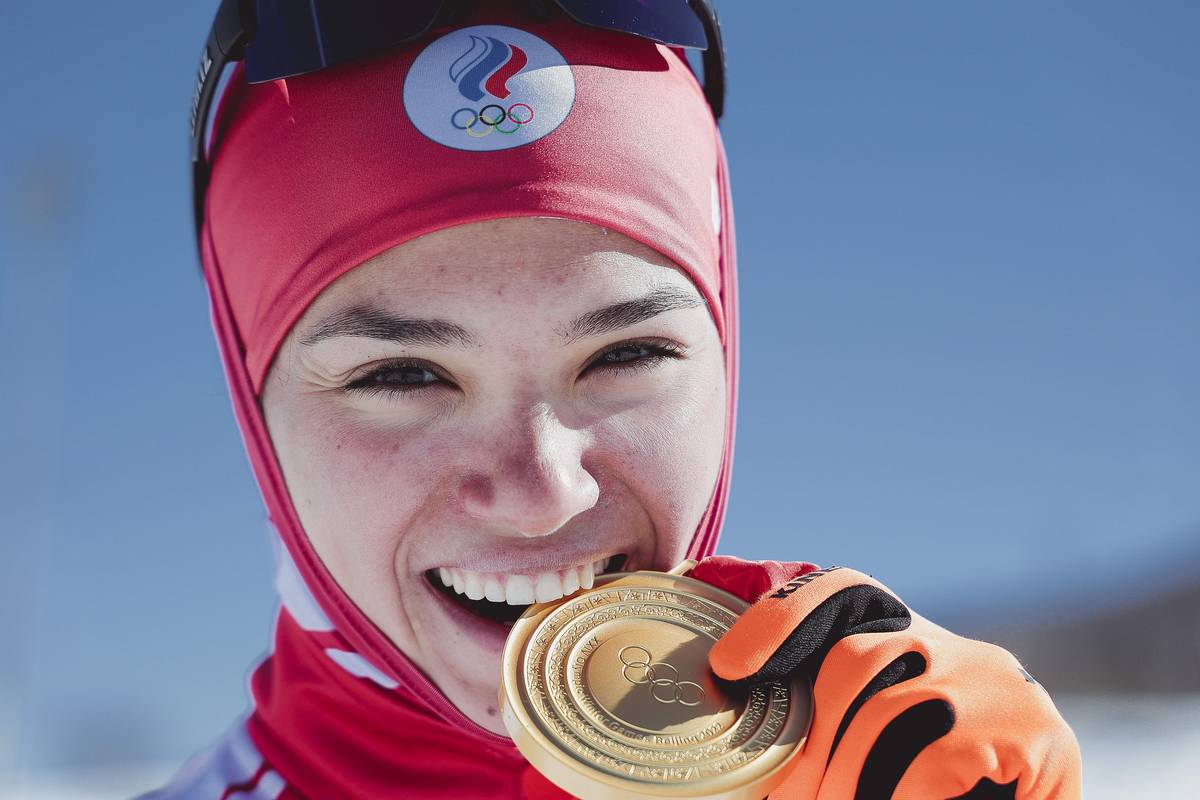
Veronika Stepanova flexes with her Olympic relay gold medal during the 2022 Games in Zhangjiakou, CHN. (Photo: NordicFocus)
Stepanova’s request to compete under a neutral flag rings a little hollow: the Russian ski team is already a little over two years into its four year WADA ban for state sponsored doping that requires it to compete under a neutral flag at championships.
A similar neutrality option was offered as a solution to the Russian national soccer team which was due to face Poland in a playoff match for qualification at the FIFA World Cup. Poland rejected the idea saying, “We are not interested in playing this game of appearances.” The Polish refusal to play Russia under any terms helped to force the IOC’s swift decision to recommend banning Russia from all sports.
“If doping wounds were quite successfully treated by time, then here the situation is different,” wrote an anonymous Russian blogger. “In fact, government policy has come into direct and insurmountable conflict with the ability to participate in the global sports movement. And now it seems that all this will last for years, if not decades.”
***
Even if Russia were to return to the World Cup next season, it’s unclear that they would be able to operate at the same level as in the past, which has helped to fuel what US Ski Team Coach Matt Whitcomb refers to as a “waxing arms race” on the World Cup circuit.
According to Team Manager Elena Vyalbe, funding the Russian ski machine has been a challenge. She reported that the team’s budget in 2020 amounted to around 50 million rubles, roughly $600,000 at the time. According to Markus Cramer, who coached for Russia until this spring, the cost of supporting an athlete over the course of a year is more than $150,000—a figure that calls into question Vyalbe’s statement about the team’s budget.
However, the Russian funding structure is murky, with much additional regional support to athletes provided by local extraction industries. Vyalbe complained in 2020 that sponsorships were scarce, saying, “No matter how well [Bolshunov] performed last year, we did not have a single new sponsor. God forbid that the current ones do not go away.”
In an April 5th interview with Championat, Vyalbe clarified the sources of the team’s funding: “We get most of the funds from the Ministry of Sports, the [Russian Olympic Committee] gives money for some things,” and that sponsorship amounted to “not even tears, but some kind of snot. We have a small budget.”
The team’s primary sponsorship has come from Lukoil Oil Company since 1997. Whether or not Lukoil will be able to continue to fund Russian skiing remains to be seen. The company reported its highest annual profit in seven years at the same time that its shares plummeted on the London Stock Exchange after the invasion, losing 91% of their value before trading was halted March 3rd.
Though the ruble has recovered from its post invasion plummet, inflation in Russia is likely to reach at least 16% this year. That, coupled with uncertainty over the team’s competition status and the dismal prospects for the Russian economy, which is predicted by the IMF to contract 8.5% this year, has the potential to squeeze the team’s budget.
Individual athletes also find themselves in a difficult position. Brav, the parent company of Swix and Toko, was quick to cancel sponsorship agreements with Russian athletes, as did Kinetixx gloves. Expressen reported that Swedish ski company SkiGO was maintaining their partnership with Bolshunov, though SkiGO boss Christer Majbäck denied this, saying, “We don’t have any cooperation at all, it’s absolutely impossible. You don’t even have to ask me or SkiGO what we think about the war.”
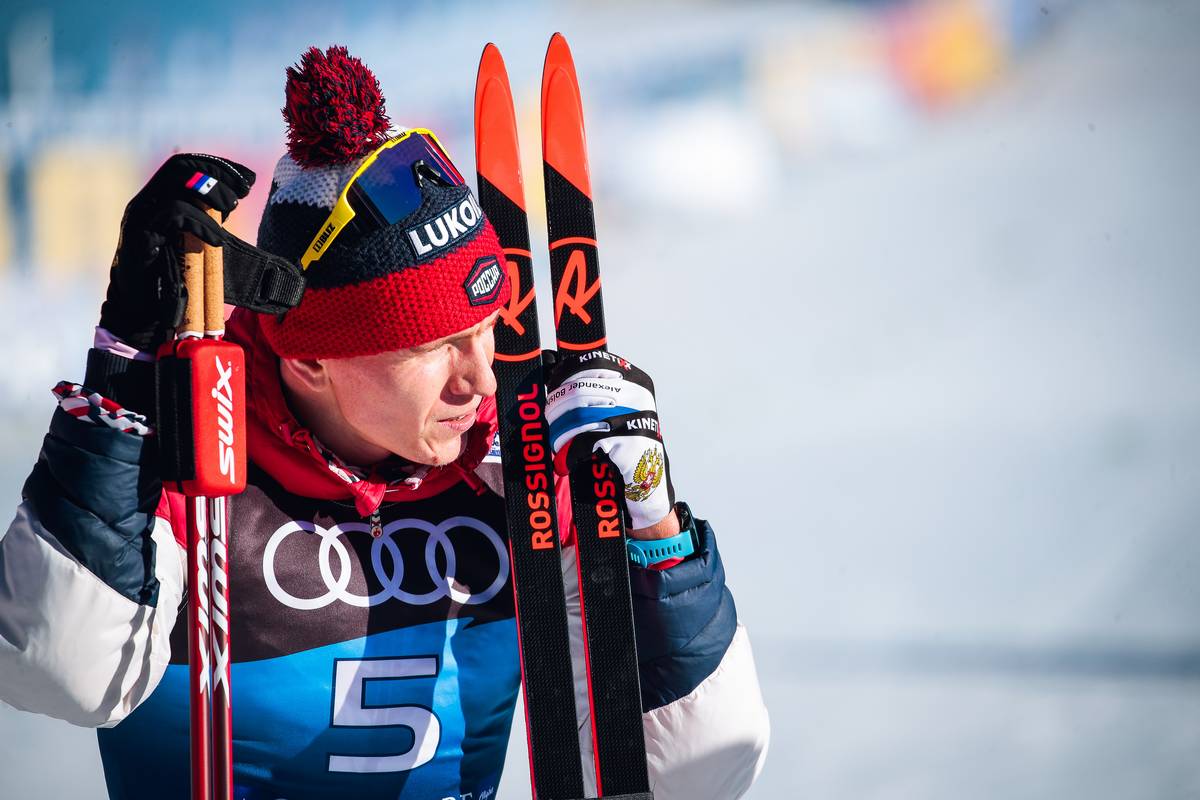
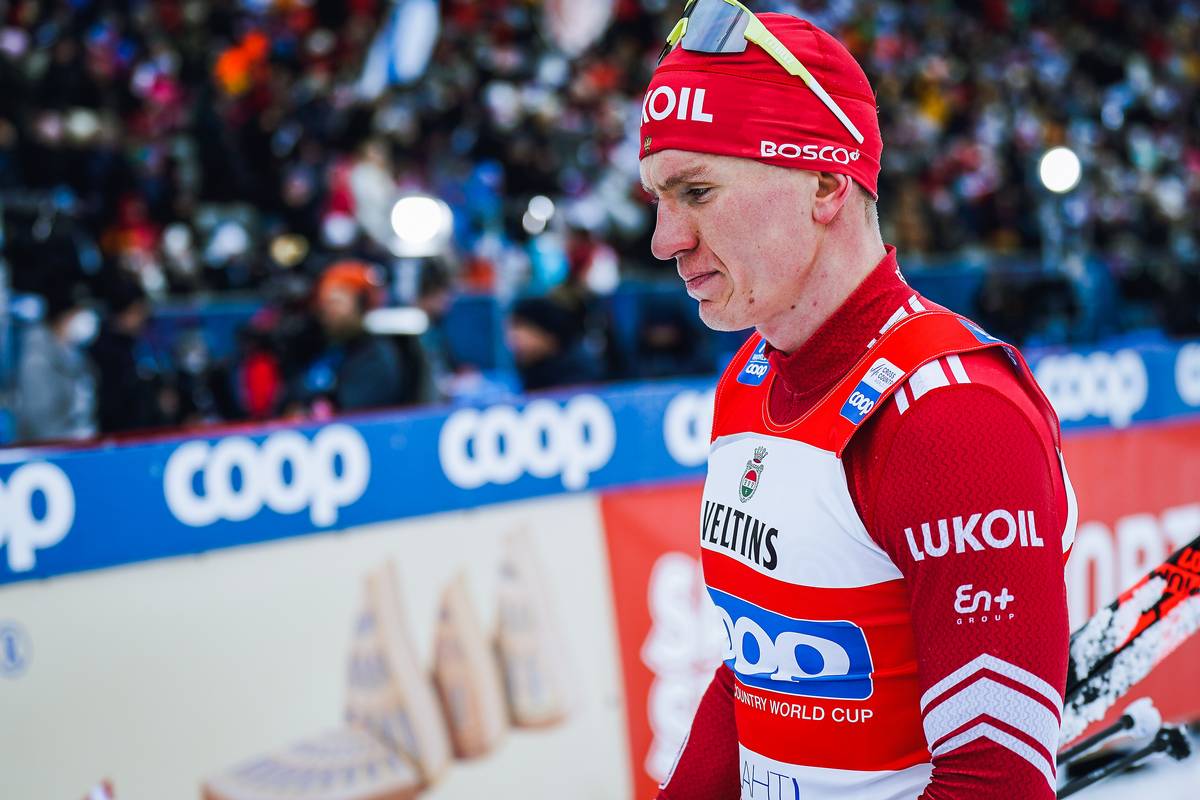
Alexander Bolshunov observes trailside during the 2021-2022 Tour de Ski in Oberstdorf, Germany. (Photo: NordicFocus)
Rossignol was standing by Bolshunov until an Instagram photo proved to be too much: not long after Russia was banned, Bolshunov visited a museum and posed for a photo in an old-timey Soviet race suit, captioning the photo “USSR 1980” —which happened to be the year that Soviet Union invaded Afghanistan, though it may also have been a reference to the 1980 boycott of the Moscow Olympics. In any case, Rossignol demanded Bolshunov remove the photo, which he did, but by the following day Rossignol said it was no longer supporting Russian athletes and removed them from its website.
Bolshunov could keep his skis, Rossignol said, but no new skis would be sent to Russia.
Similarly Fischer removed Russian athletes from its site. Fischer Communications Director Franz Fottinger wrote in an email, “All our contracts with athletes are based on their participation in World Cup races. If racers are excluded from the World Cup, there is no more basis to fulfill the contract.”
***
The Russian athletes have not exactly lost their ski partnerships, rather they are suspended until their return to the international circuit. Nevertheless, this has provoked a strong reaction in Russia, with calls to revamp ski production in the country.
The only significant ski production facility in Russia is the STC factory in Balabovo, around 100 km southwest of Moscow. It employs 350 workers making mostly recreational and kids skis. Whether the factory can be retooled to the demands of making race stock skis is questionable.
Alexander Pechersky, the head of service for the Russian ski team said that “No matter how optimistic I am, I understand that the process is not fast and it can take at least 4 to 6 years to produce skis of an acceptable competitive level.”
Pechersky continued, “Miracles do not happen, but I want to try … I still look at this idea with optimism, it is very interesting to deal with it. If things move forward, then the Russian sports market can get a model that, for relatively little money, will cover the needs of at least youth sports.”
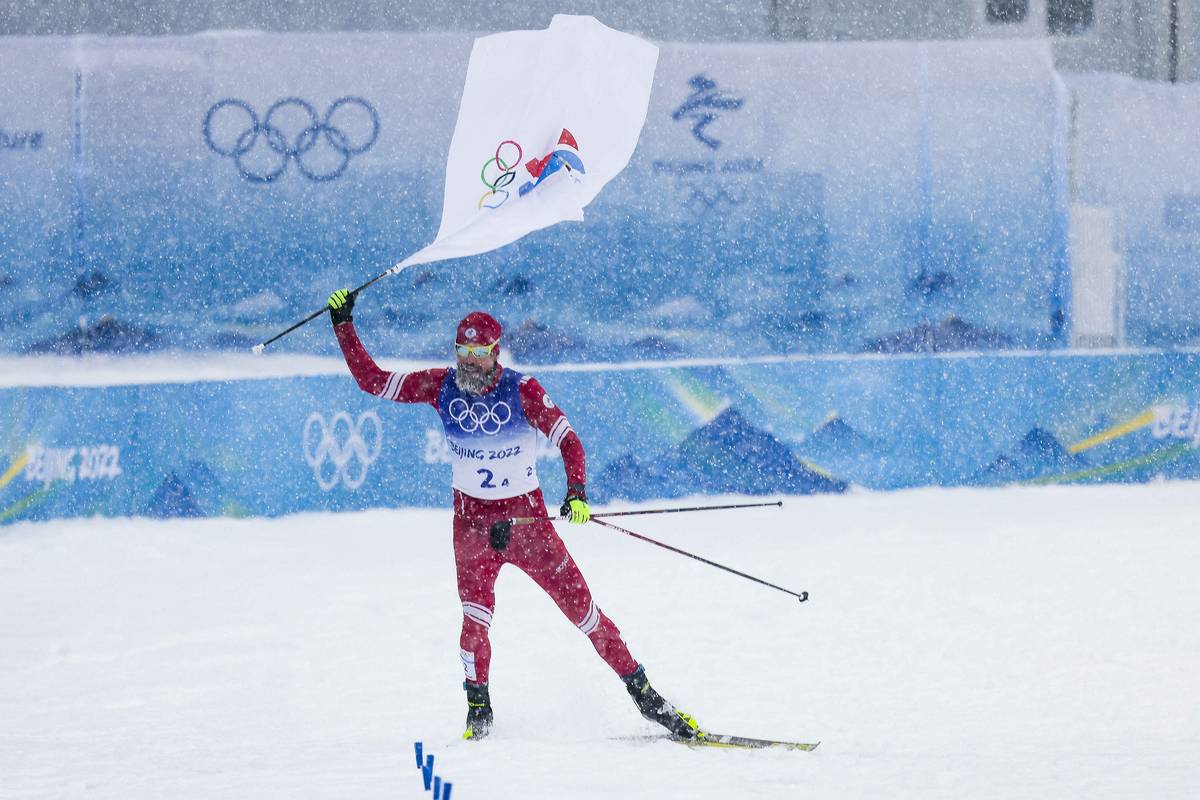
The Russian Olympic Committee takes gold in the men’s 4 x 10 k relay in Zhangjiakou. (Photo: NordicFocus)
Despite the public separation between sponsors and Russian athletes, some critical items are still quietly being made available to the team, according to Viktor Golovin, the deputy head of ski service for the Russian national team. “I will not name the companies, Golovin said, “but the Russian team at the start of the summer season is provided with new rollers in full, despite all the restrictions.
The conflict in Ukraine also threatens to continue to squeeze the international supply of skis. Europe’s largest ski factory is located in Mukachevo, Ukraine and has traditionally produced some 800,000 pairs of cross country skis annually, primarily for Fischer. After a fire destroyed the facility in October of 2020, the factory remained offline for all of 2021 and was rebuilt into a state of the art ski production center. Just as final certification for the factory arrived in early February, the war broke out.
The factory’s director, Andriy Ryabich, wrote on his Facebook page on February 26th that “The work of the Fisher-Mukachevo enterprise has been suspended and the majority of the people went to the army in different directions and will defend our city, region and all [of] Ukraine.”
With much of the ski factories workforce at war during the critical spring months of ski production, ski shortages could once again factor in next season.
***
For their part, the Russian Ski Federation has ordered the team to prepare with the expectation that they will compete on the World Cup, though their draft schedule indicates the team is planning to stay in Russia through next spring.
Curiously, in the face of unprecedented challenges the national team has expanded–to a historically large 46 skier strong team, divided into five training groups.
The team was dealt a blow with the departure of Markus Cramer this spring. He will join the Italian national team, though he will continue to coach Ustiugov from afar.
Former Russian ski coach Markus Cramer joins the Italian National Team for the 2022-23 season. (Photo: Nat Herz / ADN)
Cramer’s tenure was instrumental in revamping the team’s training methods. Of the five training groups, three are closely tied to his methodologies. Two groups are led by Cramer protégés Egor Sorin and Petr Sedov, and a third by Sorin’s former assistant—Andrey Nutrikhin.
The group led by Yuri Borodavko—who subscribes to a more Soviet era training philosophy and who was once suspended for doping activities—will add big names such as Yulia Stupak and Ivan Yakimushkin to an already impressive roster that includes Bolshunov and Neprayeva. Unmoved by the political climate, Borodavko’s group will begin the training year on May 15th with a controversial camp in Russian occupied Crimea.
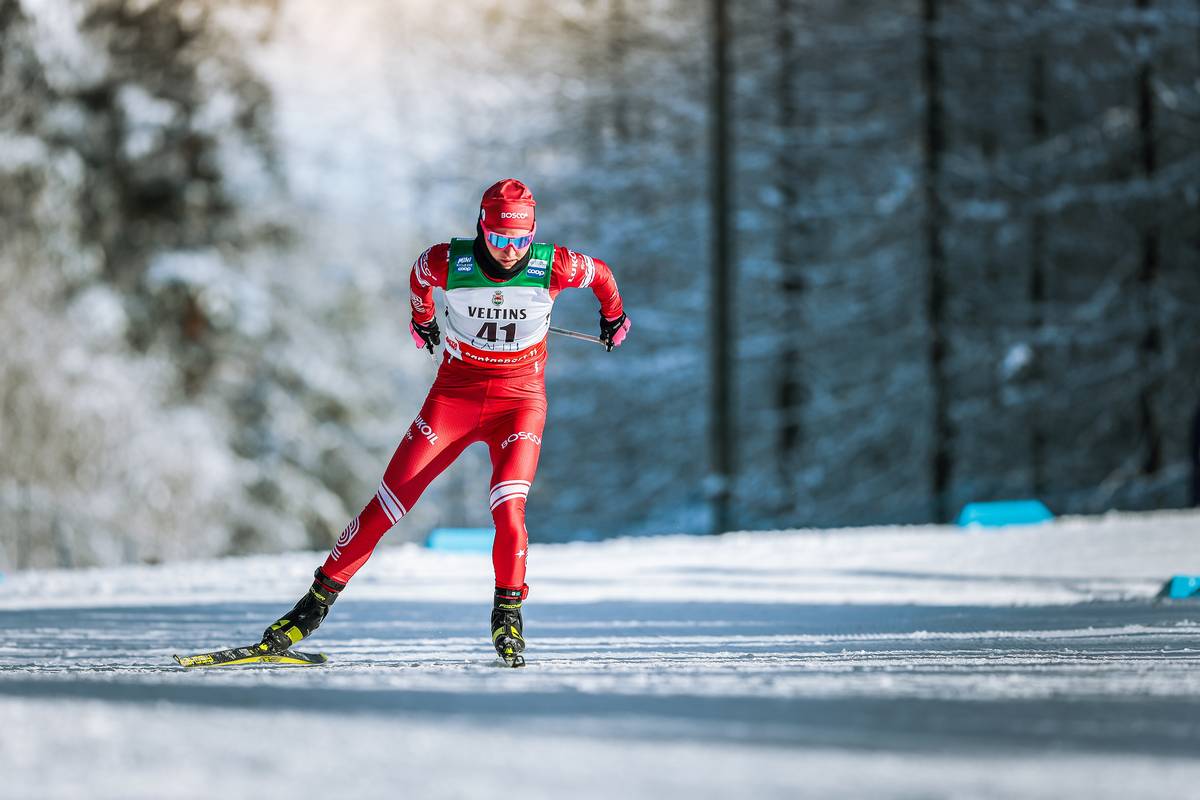
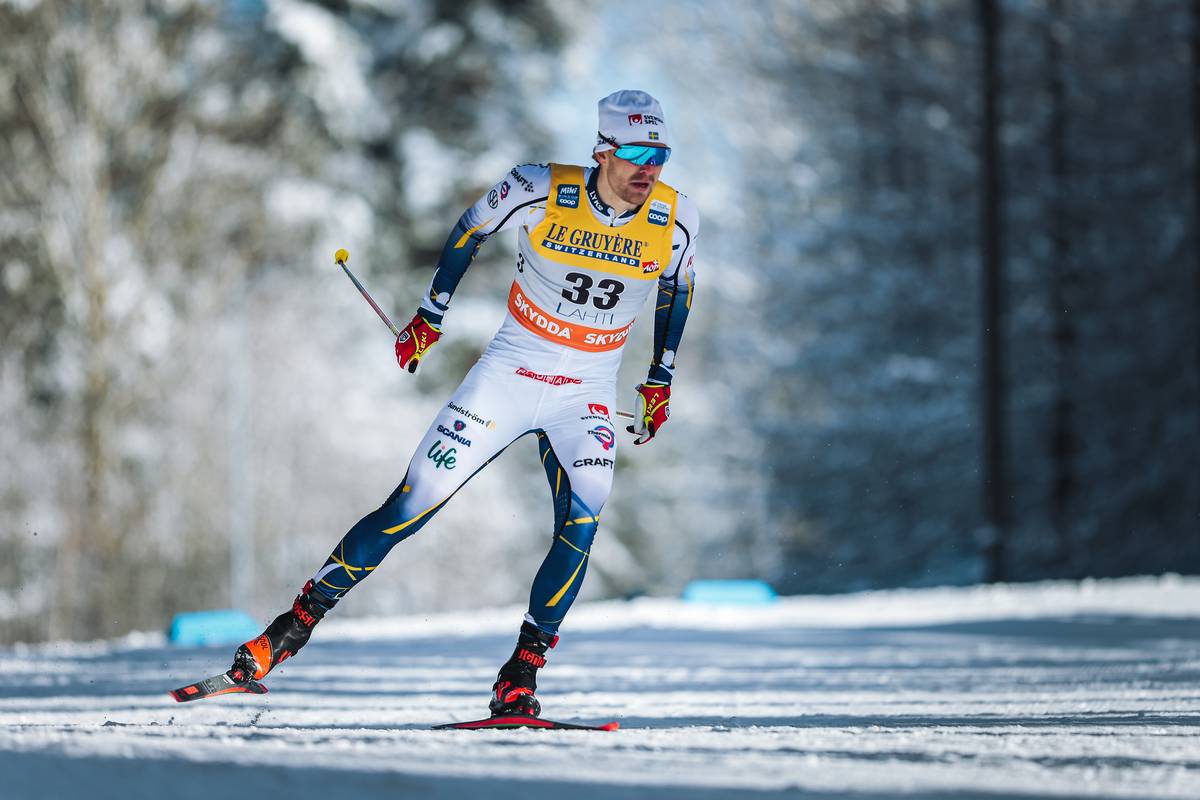
Yulia Stupak (RUS) races a freestyle sprint qualifier in Lahti, FIN in February 2022. (Photo: NordicFocus)
A Russian return to the World Cup is complicated by the unusually acidic edge the team has brought to the circuit, with acrimony spilling over into social media trolling and confrontations on the ski course.
Russian sport media has reacted strongly to the FIS ban by portraying the decision as a Norwegian power move and athletes such as Johannes Høsflot Klæbo who have supported the ban have been subjected to vitriol from Russian officials. Even before the invasion, Russian media has, in the post Sochi era, covered skiing in an increasingly strident and conspiratorial manner, dominated by a narrative of sporting victimhood and Russophobia.
Should Russia remain banned next season, or even longer, their absence may help FIS enact one of the most challenging maneuvers they have undertaken—the transition to fluoro-free racing, which FIS has now committed to enforcing next season.
Chris Grover downplayed the idea that Russia’s absence will make the transition easier, writing, “It doesn’t matter so much which nations are present at a given World Cup weekend. We need a testing system that all of the athletes, coaches, technicians and fans can trust.”
Fears of an imperfect test for fluoros have been punctuated with not so subtle hints of suspicion aimed at the Russian team. Golovin addressed these concerns, saying, “The Finns told us directly that the Russians are closed, no one knows what they do with skis. I suggested that they come to our wax truck and have a look…Come and see, and there is no need to make unfounded accusations.”
Nevertheless, Russia’s absence may lessen unstated distrust on the circuit, and perhaps improve cooperation and tolerance as the ban is enforced.
To that end, it may be a mistake for FIS to end the ban before next season regardless of whether or not the war in Ukraine ends in the interim. All of the justifications for the ban are likely to continue into next season: security threats to Russian athletes, the Kremlin’s use of skiers for pro-war propaganda, and the inability of Ukrainian skiers engaged in the country’s defense to prepare for next season. Finally, there has been no attempt at reconciliation by Russian skiing toward the wider ski world, with intransigent blaming of Norway for the present situation. In short, Russian skiing has rejected the rest of the ski world and has found itself in the cold.
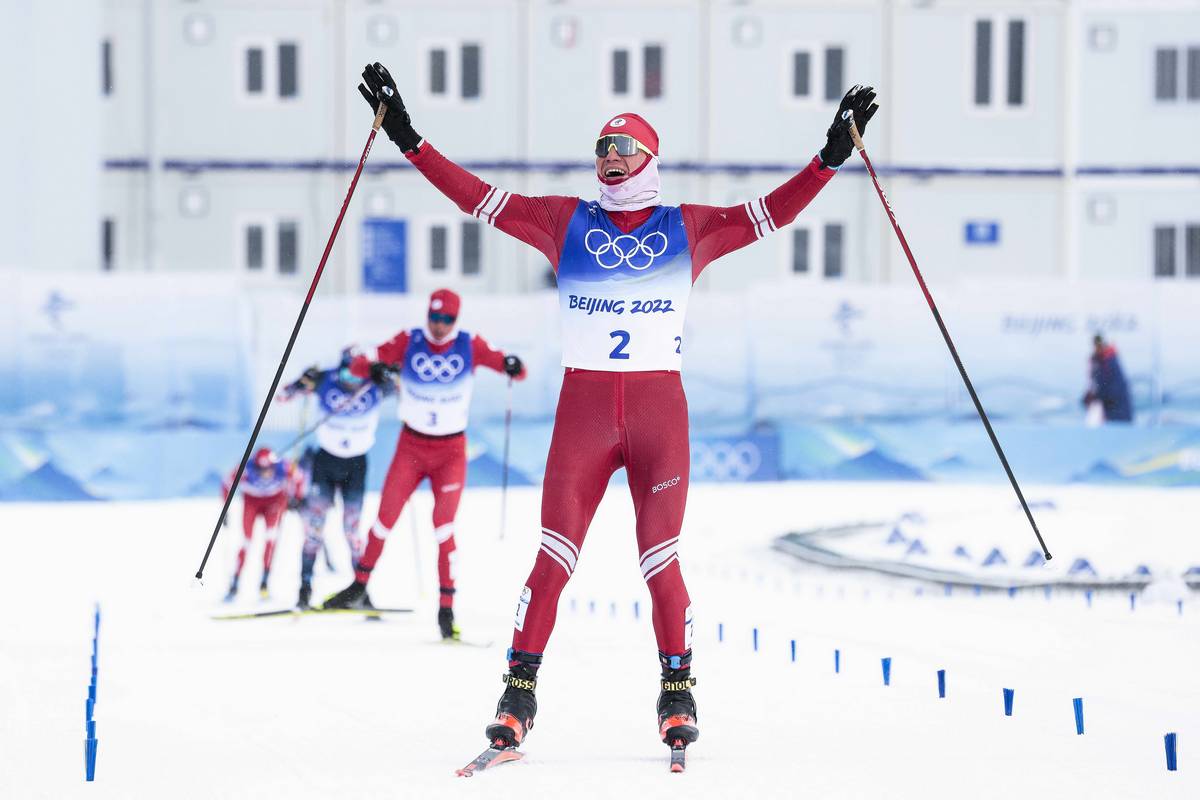
Alexander Bolshunov takes Olympic gold in the men’s mass start 30 k, shortened from 50 k due to temperatures and extreme wind. (Photo: NordicFocus)
As Ulvang pointed out, skiing cannot be separated from society.
“It’s very important that we split [distinctions] between the sanction against a nation and the sanction against the Putin regime,” Ulvang told FasterSkier reporter Nat Herz in March. “I hope I’m still friends with the athletes and that we’re able to split between a reaction against the regime. It’s nothing personal. In the big picture we are all repping our nations and our regimes. We need legitimacy from society to exist. We need public money [for] our training facilities and to make tracks and courses and we need support.”
Click here to read part 1 of this series, which takes a look at international news surrounding the Russian athlete ban through the spring. For how these bans have impacted a broader cross-section of the sporting world and analysis of the complex questions surrounding whether Russian athletes should be able to compete, check out this recent Sports Illustrated article by Michael Rosenberg.
Concerns over both fair play and propaganda have been tied to the necessity of the ban on Russian athletes. Yet ultimately the reason given by FIS for the ban was to “ensure the safety and security of all athletes”. This wording removed any political connotations, and was criticized for its weak stance that failed to condemn the war in Ukraine.
Natalia Nepryaeva slides for the heat win during a sprint stage of the 2021-2022 Tour de Ski in Oberstdorf, GER. (Photo: NordicFocus)
Still, there were real concerns over the safety of the Russian athletes at European races. On March 1st, due to threats, the organizer of the World Junior Championships for jumping moved the Russian contingent out of their hotel in downtown Zakopane, Poland with the aid of 200 police officers. In Norway, Neprayeva reported being threatened in the team’s hotel in Oslo, and the Norwegian Ski Association was flooded with messages insinuating that if the Russian athletes started a race they would not finish.
“[The] FIS followed the IOC decision and based [the ban] on security,” Ulvang said in a call in March with FasterSkier reporter Nat Herz. “This has also become a legal case because Russia has taken this to CAS [The Court of Arbitration for Sport].”
While the FIS cited athlete security for the ban, the Federation took their cue from the IOC which recommended banning Russia due to the violation of the Olympic truce. This historical agreement, presented at the UN prior to the start of the Games, calls for the “cessation of hostilities” surrounding the Games, incorporating the Olympic values of sportsmanship and unity “with a view to protecting, as far as possible, the interests of the athletes and sport in general, and to harness the power of sport to promote peace, dialogue and reconciliation more broadly.”
Russia’s invasion of Ukraine on February 24th, 2022 violated the agreement, co-sponsored by the Russian Olympic Federation, to abide by the truce from February 4th through March 20th, surrounding both the Olympic and Paralympic Games in China.
“We will see,” continued Ulvang, “whether this is within the overall statutes of sport or FIS actually, because our rules are not made for such special things. This is a very, very special circumstance. I have spoken to many lawyers who think this is an interesting question.”
Waving the flag for the Russian Olympic Committee, Sergey Ustiugov brings home a win in the men’s 4 x 10 k Olympic relay. (Photo: NordicFocus)
Russia has pursued aggressive appeals of bans in a variety of sports, though with exception of Luge, largely without success. On May 21st, Vyalbe conceded that after consultations with lawyers, the Russian Ski Federation would not appeal the ban in CAS, saying, “We won’t win.”
An anonymous Russian blogger examined the legal considerations of banning Russia, and found that while the IOC had operated outside of its normal boundaries to call for a blanket ban, it had done so out of the special circumstances. Previously, it was the UN that called for athletic exclusions, such as that of Serbia during the siege of Sarajevo.
In this case, with Russia being a permanent member of the UN Security Council, any resolution could be unilaterally vetoed by the country, so in turn the burden fell to the
IOC to take an action that was theoretically beyond its scope—though roughly in keeping with previous cases.
For Russia, there is no easy recourse for dealing with sporting sanctions. Unlike economic ones, they do not inflict mutual pain and any victories achieved in the sport courts could easily be undermined by canceled visas or boycotts.
Yet a sustained ban on Russian athletes is likely to reshape skiing in a number of ways, beginning with the sport’s media position. Russia now comprises the largest audience for cross country skiing, averaging 1.5 million per World Cup race and accounting for at least a third of the sport’s total audience.
After Russia was banned this spring, Match!TV—a large Russian public broadcaster— pulled coverage of all international ski races and redirected its energies toward covering domestic competitions where it is likely to remain focused until Russian athletes return to the World Cup.
Compounding the difficulties of that loss will be the continued transfer of ski racing from public TV in Norway, Sweden, and Finland to streaming service Viaplay, which charges a hefty subscription fee—as much as €40/month in Finland.
Traditionally, public broadcasts in the Nordic countries accounted for half of skiing’s total audience. In 2020/21 that share fell to a third, in part because of Covid restrictions that kept their teams at home. Norway especially tuned out, with a 55% reduction in viewers, and numbers in Sweden, Finland, and Germany also declined.
Offsetting this loss has been Russia, whose star skiers have propelled coverage of the World Cup from subscription channels to public TV in their country, boosting domestic viewership in 2020/21 by 600%.
The men’s 4 x 10 k Olympic relay podium: the Russian Olympic Committee (ROC) came out on top ahead of Norway in second and France in third. (Photo: NordicFocus)
While last season’s viewership numbers have not yet been published by FIS, during Period 1 of the World Cup last season, VG found that the races shown on Viaplay averaged far fewer viewers than would be typical for an NRK broadcast.
Should broadcasting continue to sustain a loss of 40% of its audience in the Nordic countries while also losing the majority of Russian viewers, the sport may find itself in crisis, as sponsors balk at paying for low return advertising. Still, it may be too soon to write Viaplay off completely—the service recorded more than a million Swedish viewers tuning in to the World Cup weekend in Lillehammer.
As a whole, FIS cross country skiing has struggled to hold its audience, and losses in some regions have been more than offset by the recent tide of Russian viewers.
While Russian viewership is huge, most sponsors of the FIS World Cup are not particularly oriented toward Russia. Coop—the title sponsor of the Cross Country World Cup—is a Norwegian grocery chain. Coop early on sided with the Norwegian Ski Association in calling for the exclusion of Russian skiers. Many other sponsors have no business in Russia, and some, like Audi, have halted operations there.
Despite the €29 million that Russian viewership is estimated to be worth to sponsors, the audience may hold little allure, perhaps because of the average Russian’s low purchasing power. In 2021 the average Russian made around 40,000 rubles annually, or about $6,400. Now, with many western businesses pulling out of Russia, there is even less value placed on reaching Russian fans.
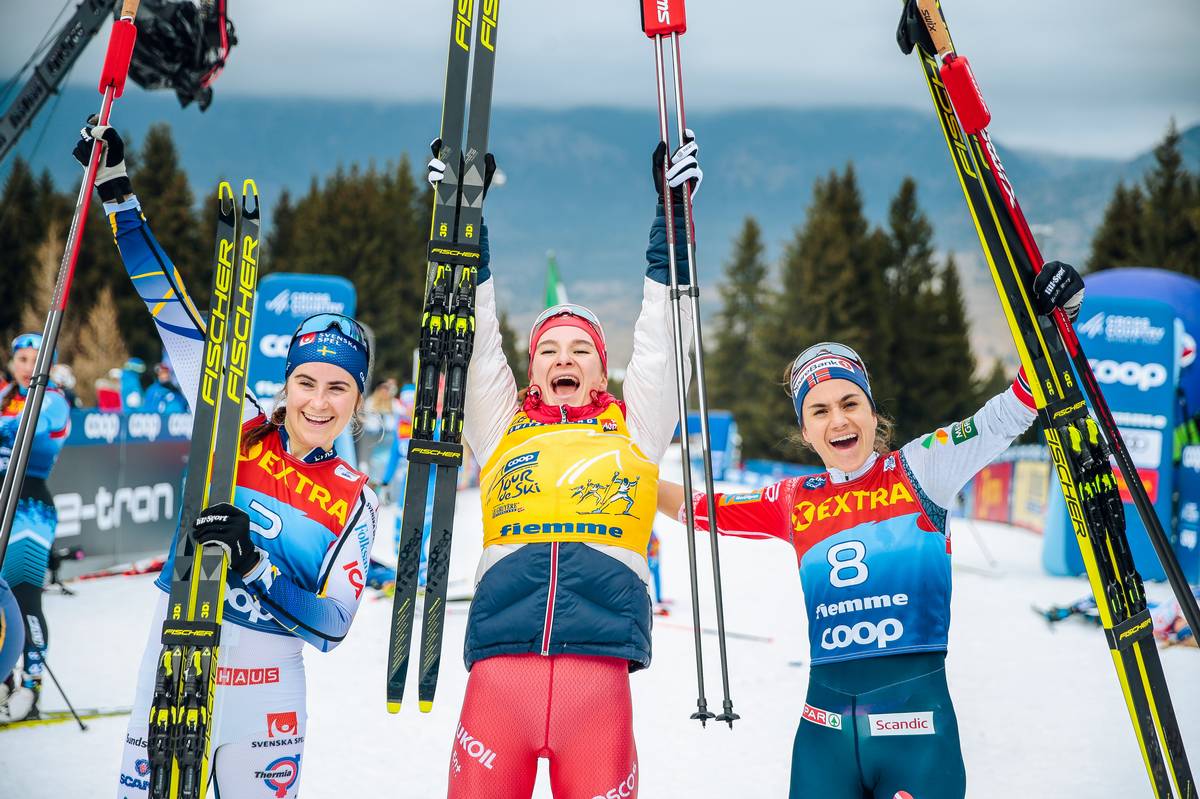
The women’s overall podium of the 2021-2022 Tour de Ski: Natalia Nepryaeva (RUS) was the overall champion ahead of Ebba Andersson (SWE) in second and Heidi Weng (NOR) in third. (Photo: NordicFocus)
For sponsors, the Russian exclusion may ultimately be beneficial. Germany, and Central Europe in general, are a core market for skiing—a market which has been drying up in an era of poor performances by the region’s skiers.
With the German women winning gold at the Olympics and the retirement of the dominant force in distance racing, Norway’s Therese Johaug, the opportunities for success of sidelined countries could become plentiful on the women’s side with the additional absence of Russia.
On the men’s side of skiing, though Norway remains poised to dominate, a potential lack of a Russian team would create significant podium opportunities for up-and-coming American, Canadian, French, German, and Czech athletes. In recent seasons the rivalry between Norway and Russia has consumed almost three quarters of the World Cup podiums. The long term absence of Russia could allow the podium of men’s skiing to once again take on a broader flavor.
Chris Grover, U.S. Ski & Snowboard Cross Country Program Director, clarified that a continued ban on Russian athletes wouldn’t change the quota system, writing, “We’ll have the same number of athletes starting each race. Obviously, Russia has a lot of the top performers, so there will be more opportunities for many other nations to secure podiums, gather World Cup prize money and points, and improve Red Group standing.”
Julia Kern leads the way in the first leg of the 4 x 5 k mixed relay in Falun, SWE in Mar. 2022. (Photo: NordicFocus)
All told, the changes that skiing will endure if Russia remains banned through next season may not be as dire as Russian sporting officials have suggested.
“The tired rhetoric that world sport will not be able to fully develop without Russia does not seem to inspire the speakers themselves anymore,” wrote the anonymous blogger. “It is no coincidence that you can already hear talk about alternative tournaments, leagues, and other ways of self-reliant development.”
The alternative for Russian skiing is to try to create its own circuit among friendly nations. To date, Russian skiing has only managed to solidify a sporting partnership with Belarus, via a cooperative agreement signed in May.
Stay tuned for Part 3, which considers historic athlete bans, and barriers the Russian program face to keep their program operating in the interim.
Alexander Bolshunov takes fifth in his final World Cup race of the 2021/2022 season, a 15 k classic in Lahti, FIN. (Photo: NordicFocus)
With Russian athletes banned from all FIS competitions, and no end in sight for the war in Ukraine, there is a growing belief that Russian skiers are unlikely to rejoin the World Cup next season.
Some commentators have gone further, proclaiming that we have seen the last of Bolshunov, Neprayeva, and the rest of the Russian team on the international stage. The pessimism is rooted in the history of similar bans—which tend to be long lived—and the uncertainty over what circumstances would allow for the Russians to rejoin.
Will the ban end when Ukrainian athletes can return fully to competition? That may not be possible until long after the end of the conflict. Perhaps a negotiated peace settlement? That possibility could still create discontent with athletes such as Bolshunov being used to fuel propaganda at home. Does the ban require the Putin regime to end? That could be a distant future.
“I expect that this situation will last as long as the conflict is unsolved,” said Vegard Ulvang, the outgoing chairman of the FIS Cross Country Committee, “but that’s of course up to the FIS Council or IOC.”
Ulvang was outspoken in calling for the Russian exclusion from the Norwegian hosted World Cup events this spring. Ulvang said in a call, “We have a fairness rule in FIS that there should be equal opportunities. When one nation cannot compete because they have to go home to defend their country, and the attacking country is racing, that’s not nice.”
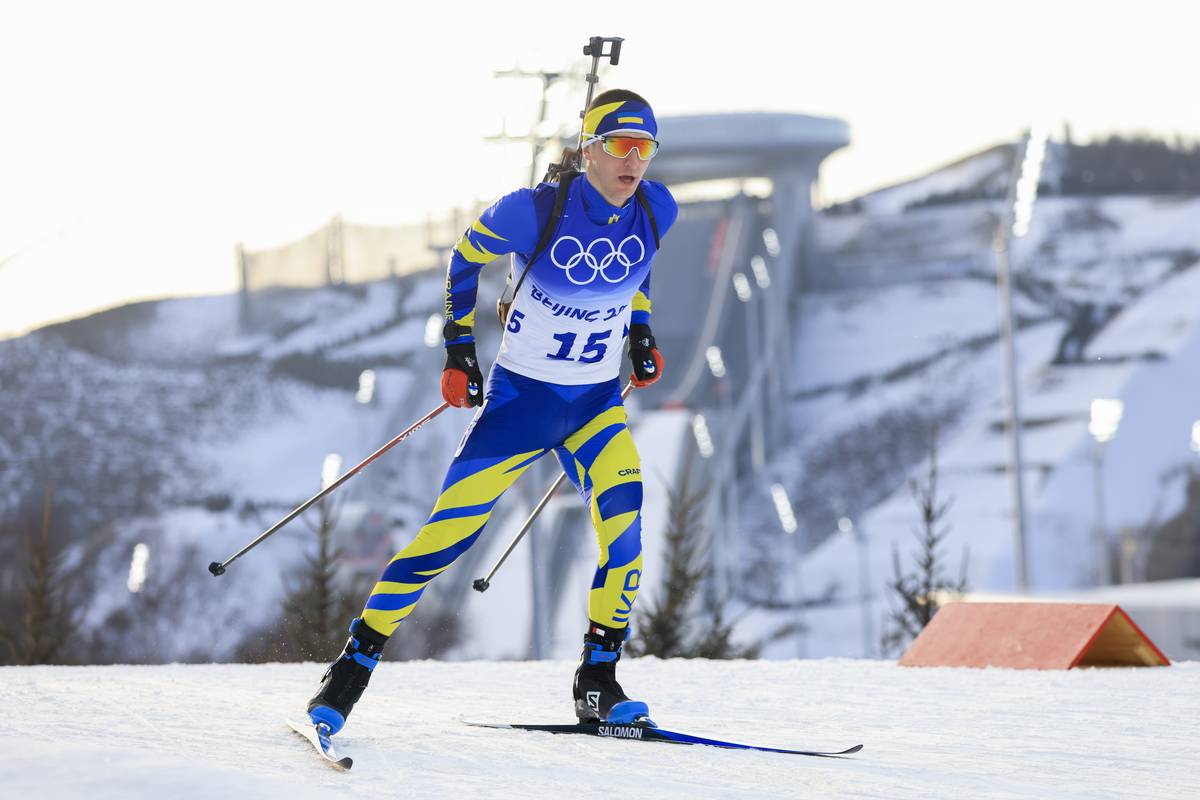
Ukrainian biathlete Dmytro Pidruchnyi competes in an Olympic sprint during the 2022 Games, shortly before being called into military service to protect his country amidst Russian invasion. (Photo: NordicFocus)
Ulvang’s point is underscored by the Ukrainian athletes now fighting on the front lines, with many called up just days after returning from the Beijing Olympics. Among the Olympians taking up arms was Dmytro Pidruchnyi, a biathlete who has won gold in the World Championships. The danger faced by the athletes defending their country was made clear early on in the conflict with the tragic loss of nineteen year old biathlete Yevhen Malyshev, who was killed defending Kharkiv on February 26th.
Another explanation for the ban was that it would help send a message to everyday Russians and deprive the state of a propaganda tool.
The charge that athletes were being used for propaganda purposes was confirmed during Russian President Vladimir Putin’s March 16th pro-war rally in Moscow. The event, titled “For a World Without Nazism” was MC’d by longtime biathlon TV commentator Dmitry Guberniev. Stars of the Beijing Olympics—including Alexander Bolshunov—were trotted out in front of the (reportedly) 100,000 strong audience in the Luzhniki stadium.
Questions remain about whether the athletes attended of their own accord, and there has been speculation about whether Bolshunov’s decision not to wear a letter Z pin on the stage—a pro-war symbol—reflected an ambivalent attitude to the conflict now raging near his home.
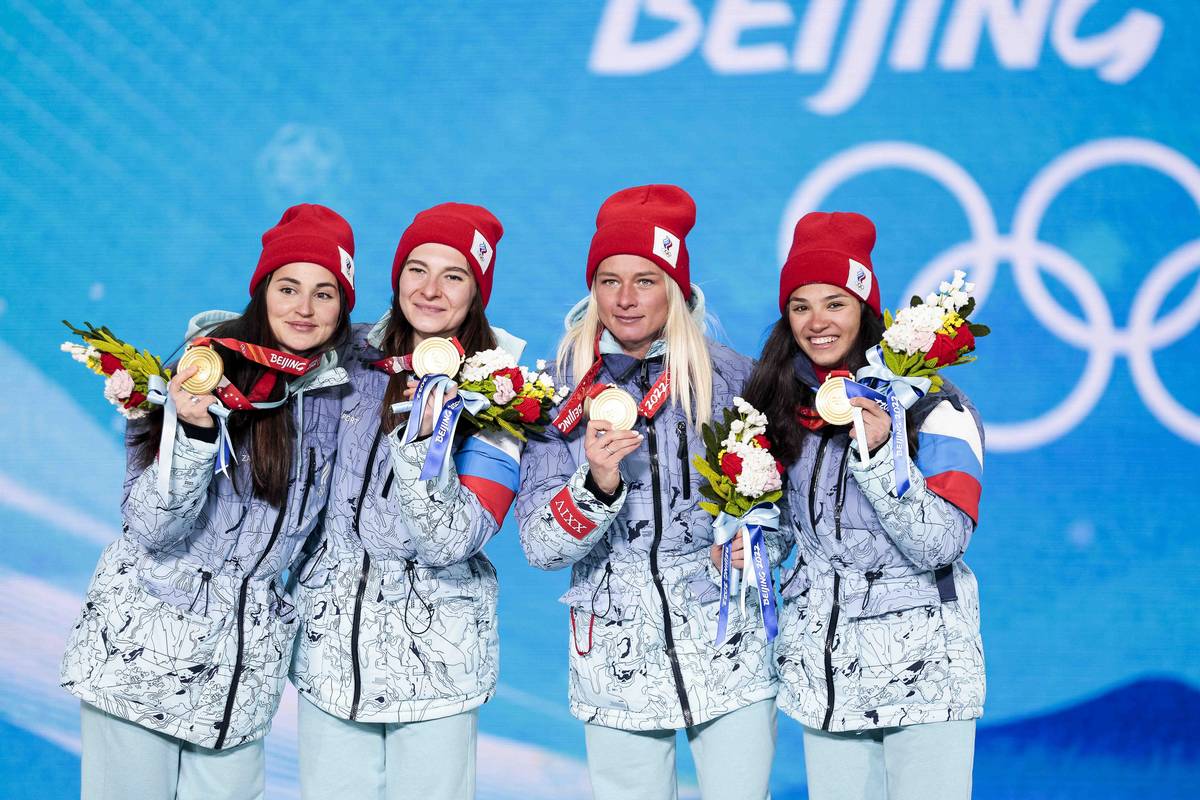
The women representing the Russian Olympic Committee strike gold in the 4 x 5 k relay. From left to right, Yulia Stupak, Natalia Nepryaeva, Tatiana Sorina, and Veronika Stepanova. (Photo: NordicFocus)
On April 26th, a host of Olympic heroes were called to receive state awards by Vladimir Putin in a ceremony that required the athletes to quarantine prior to the visit. Putin congratulated the skiers, saying “First of all, I would like to note the long-awaited victories in the relay race…We have not had a simultaneous victory of both the women’s and men’s teams for exactly half a century. This is a big result.”
A few notable Russian stars missed the Kremlin occasion: Bolshunov for dental surgery, Neprayeva because she arrived to quarantine sick, and Ustiugov because his wife had recently given birth.
Bolshunov’s absence at the event stirred further speculation that he had intentionally scheduled the surgery to avoid the ceremony, and with it the possibility of a personal ban set against him by FIS, much as FINA – the International Swimming Federation – did by banning Yevgeny Rylov for nine months after he stood next to Bolshunov at the March 16th rally.
Elena Vyalbe, who heads the Russian Ski Federation, manages the national team, and sits on the FIS council, dismissed this speculation, saying, “Who wrote that Alexander [Bolshunov] refused? I already spoke about this…He was scheduled for surgery on the 24th [of April].”
However, during the Olympics Bolshunov made it clear he dreaded the idea of the quarantine required to meet Putin, saying, “If they put me in jail forcibly, I’ll run away in two hours. I can’t just take it and throw 10-14 days out of my life. It’s unrealistic.”
During the Kremlin ceremony, Putin singled out the missing Bolshunov for special praise: “I note that Alexander Bolshunov has collected a solid collection of awards in Beijing,” Putin said. “Everyone knows this well. He has three gold, silver and bronze medals. And the absolutely well-deserved symbolic title of king of skis.”
Alexander Bolshunov displays four of the five Olympic medals he collected in Beijing, bringing his career total to nine medals earned over two Olympic Games. (Photo: NordicFocus)
The political significance of the event, which was delayed due to the war in Ukraine, was not lost on anyone. Veronika Stepanova, the upcoming ski star from Kamchatka seized the moment to make a splash.
Addressing Putin and the Kremlin audience, Stepanova said, “I am the same age as the century—I was born in January, 2001. Before my very eyes, Russia has again become strong, proud, and successful. Not everyone in the world likes it. It is obvious. But we are on the right track. And we will definitely win, as we won at the Olympics.”
The overt statement of support from Stepanova far exceeded expectations of decorum that called for perfunctory public speaking at most. That Stepanova would jeopardize a burgeoning ski career for a soundbite even shocked Russian commentators who speculated that the 21 year old was positioning herself for a transition to politics. For her part, Stepanova responded saying, “Negative consequences for my international career? They don’t scare [me].”
Far from distancing herself from the comments, Stepanova has brashly doubled down, saying, “Was I nervous when I spoke at the meeting with Putin? You have to believe in what you say. The presence of the president does not confuse or frighten, on the contrary, it energizes. You feel tremendous confidence next to him, you feel a special energy.”
Stepanova’s words have reverberated as she has gained a following in the west: outgoing and fluent in English, as well as adept at social media, many fans as well as fellow competitors felt they could relate easily to her.
Helene Marie Fossesholm of Norway was one such skier that enjoyed a friendly rapport with Stepanova off the ski trails. In the wake of her Kremlin speech, Fossesholm told NRK she was uncertain of how the friendship would continue, saying, “I can not answer that until I have experienced it. But it is clear that it will not be forgotten, at all.”
Flooded with foreign media requests to explain herself, Stepanova responded via her Instagram page, writing “I have an answer to [Western journalists]: Did you expect anything else from me? Just because I smile, speak a little English and am almost always ready for some nonsense, does that make me ‘another type of Russian?’ The peak of naivety!”
21-year-old Veronika Stepanova anchored the Russian gold medal winning women’s 4 x 5 k Olympic relay team during the 2022 Beijing Winter Games. (Photo: NordicFocus)
Vyalbe has been among Stepanova’s detractors this spring, criticizing her by saying that she may be suffering from “star disease” and that “now she is not an athlete, but a patriotic blogger.” For the head of Russian skiing, Stepanova has become irksome. “My senior leaders ask me questions about her,” Vyalbe told Championat, “and I feel ashamed and unpleasant.”
For her part, Vyalbe faced pressure in her bid to remain on the FIS council, after the Ski Federations of Poland, Finland, and Sweden moved to bar her from running for reelection at the FIS Congress on May 26th. FIS, however, allowed Vyalbe’s candidacy.
In allowing Vyalbe to run, FIS may have looked at the difficulties endured by the International Luge Federation (FIL). In early March FIL had voted to ban Russia in much the same manner as FIS, though Luge went a step further—voting in favor of expelling elected officials from Russia.
In April, Russia won their appeal in the FIL’s own Court of Arbitration, and saw the ban removed on the grounds that they were—according to the Russian Luge Federation—”dictated solely by political motives and had no legal grounds for adoption”.
For FIS, the Luge ruling was likely a reminder that barring Vyalbe from running could run afoul of their own laws against politically motivated rulings.
Apart from from the symbolism of being Russia’s representative to FIS, Vyalbe had escalated tensions in the ski world by laying the blame for the ban squarely on the shoulders of Norway’s FIS representatives—Erik Røste, the head of the Norwegian Ski Federation and FIS councilor, and Vegard Ulvang, the outgoing chairman of the FIS cross country skiing committee.
In response, Røste said, “Norway will not vote for Russia because of the terrible things happening in Ukraine.”
The Vyalbe election saga has proven to be a tender subject for Russian commentators. When Swedish skier Markus Grate commented that “There is no possibility that Vyalbe will remain on the council,” biathlon TV commentator Guberniev declared that if Grate was suggesting that Vyalbe be excluded on the basis of her nationality, then “he is a Nazi, these are the words of a Nazi.”
Marcus Grate (SWE) races a freestyle sprint qualifier in in February 2022 in Lahti. (Photo: NordicFocus)
In any case, Vyalbe lost the election on May 26th at the FIS Congress—finishing last. “In this situation, it was expected,” Vyalbe said. “There was a letter from the Ukrainian Federation, which says that everything should be politicized.”
With Vyalbe out of the FIS council, Russian skiing will likely recede further into seclusion.
Stay tuned for parts 2 and 3 of this series, which will be released over the next week.
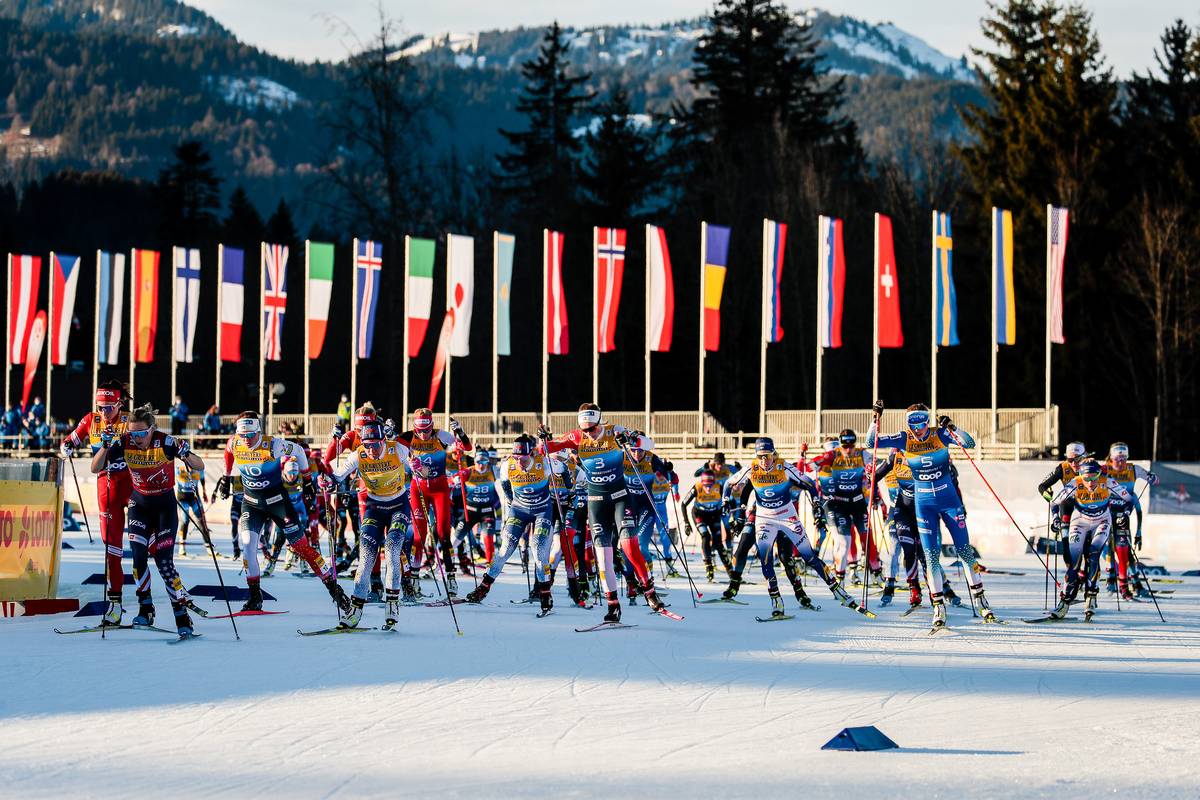
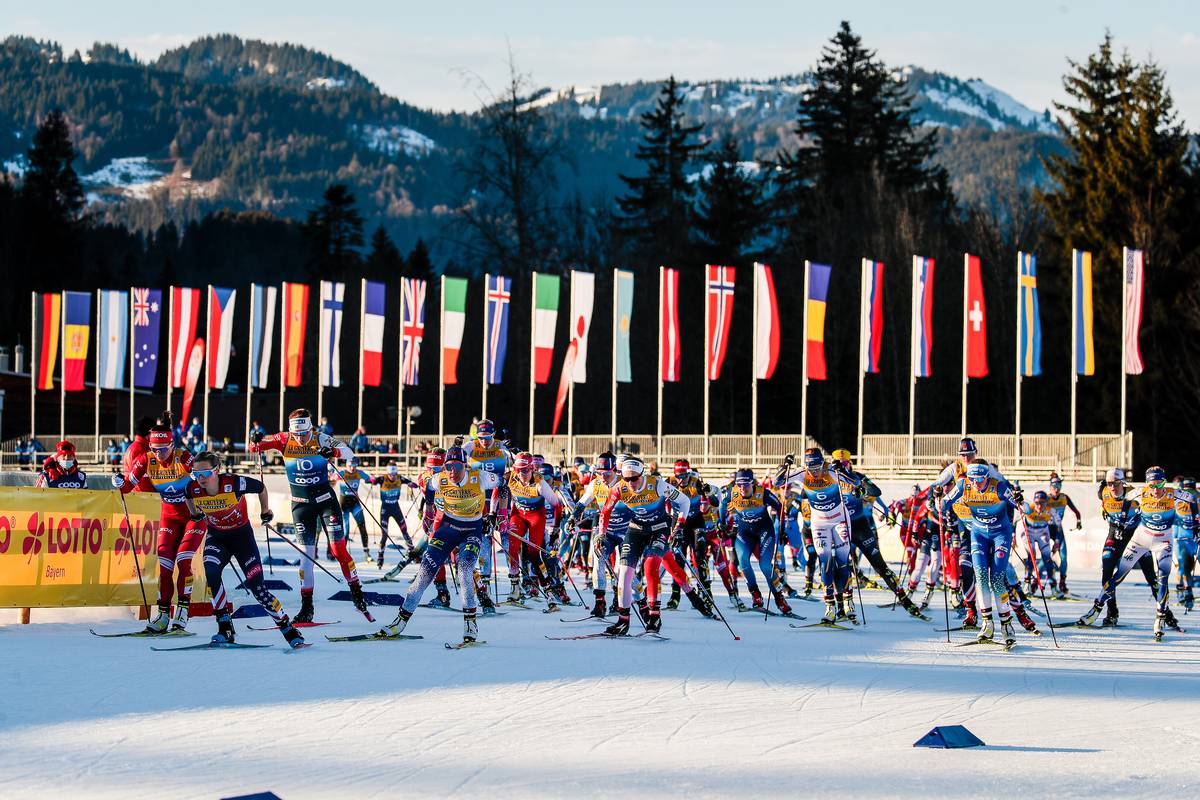
The start of the women’s 10-kilometer mass start free during Stage 3 of the 2021/22 Tour de Ski in Oberstdorf, Germany. (Photo: NordicFocus)
This press release originally appeared on fis-ski.com on Wednesday, March 18, 2022.
May marks the month of the FIS Committee meetings, debriefing the season and setting up task and changes for the upcoming ones.
All proposals that were elaborated by Sub-Committees and working groups members came on the table of the Cross-Country Committee (CCC) on Wednesday, 18th May. The Committee discussed them and forwarded the confirmed proposals on to the highest authority in FIS, the FIS Council.
All proposals, including the extract of the major proposals presented below, are therefore subject to the approval of the FIS Council which will meet on 26th May.
Decisions of the FIS Cross-Country Committee
Equal Distances for Women and Men
The question, if women and men are to race equal distances has been a very important topic for years and a prominent discussion building up to this year’s Cross-Country Committee meetings as the decision was on the agenda.
With 57%, the CCC voted for equal distances for women and men.
A historical decision.
The implementation will be effective from the upcoming World Cup season on the World Cup level as well as on Junior and U23 World Ski Championships (JWSC/U23 WSC) and Youth Olympic Games (YOG) level for now. The decision whether to implement it on World Ski Championships level will be discussed with all stakeholders and decided in May 2023.
In a second step, the voting members decided about the formats that will be in place and voted to use the following standard distances
For World Cup: Sprint | 10km | 20km | 50km with Skiathlon being 20km (10km + 10km)
For U23 WSC and JWSC: Interval 10km | Sprint | Mixed Relay 4x5km | Mst 20km
For YOG: Interval 7.5km | Sprint | Mixed Relay 4x5km
The National Ski Federations, of which the voting members consist, did not go into a long discussion but came with a clear opinion. All up front, the main argument to vote for equal distances was that there should not be any question whether women were capable of racing the same distances as men, as they prove that they physically are capable of doing so already.
The main argument against was the time that women need to cover the same distance as men and the effective TV time.
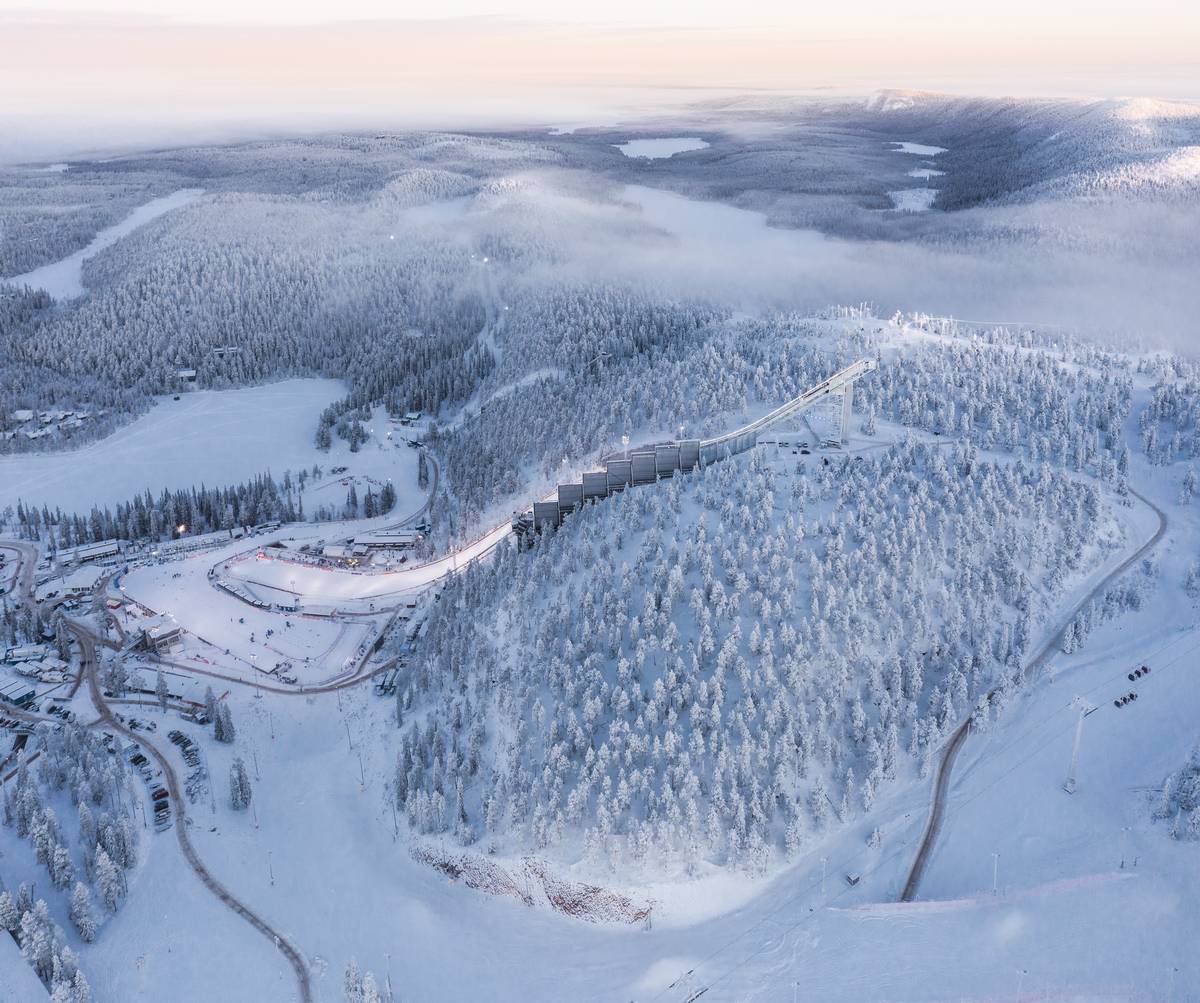
Above the Arctic Circle: Ruka, FIN is blanketed in frost and fresh snow for the opening of the World Cup season in November 2021. (Photo: NordicFocus)
FIS Cross-Country Calendar
The updated version of the calendar will be uploaded once approved by the FIS Council.
Starting out with the traditional Nordic weekend at Ruka (FIN) from 25th to 27th November, the FIS Cross-Country family will stay in Scandinavia and move to Norway for two event weekends in Lillehammer and Beitostølen before going to altitude in central Europe with the famous Davos Nordic weekend in Switzerland, which will take place on 17th and 18th December.
The Tour de Ski is set from 31st December to 8th January with stages in Val Müstair (SUI), Oberstdorf (GER) and Val di Fiemme (ITA).
After a competition-free weekend, the World Cup family remains in Italy for the City Sprint in Milano, a three-day event in Les Rousses(FRA) and Toblach (ITA) as the final preparation before the World Ski Championships in Planica that is scheduled for 22nd February to 5th March 2023.
The final period of the Cross-Country World Cup starts in Norway with Oslo and Drammen before heading to Falun (SWE), Tallin (EST) and Lahti (FIN) for the World Cup Finals.
World Cup Points
A dedicated working group compiled a new World Cup point table that is set to decrease the gaps between athletes in the overall standings without devaluing top results. The table that was approved by the CCC gives the opportunity to a wider range of athletes to score World Cup points and gives a higher value for Distance athletes to participate in Sprint races and vice versa.
The new World Cup Point table will be uploaded in the World Cup Rules once approved by the FIS Council.
Course bibs dedicated to female staff
US Ski & Snowboard had submitted a proposal to add a number of course access bibs per team for female service staff only, with the wish to therewith encourage more National Ski Federations to invest into the education of female staff in the ski service field in cross-country skiing. The proposal was accepted by the CCC.
The podium of the first 4 x 5 k mixed gender relay in March 2022. USA I took the win in Falun, SWE ahead of Finland I and Norway I. (Photo: NordicFocus)
Quota for Team competitions
Small nation’s quota
To give more nations the possibility to join Team competitions, the CCC approved that every nation with a basic quota of less than four athletes has the right to start with four athletes per gender also in all individual competitions if there is a Relay or Team Sprint during the same World Cup stage.
Mixed Relay starting order
For the future Mixed Relay competitions, each nation will have the right to enter 2 teams per nation. The starting order will alternate between the order Woman | Man | Woman | Man and Man | Woman | Man | Woman.
Mixed Nations
The CCC approved that nations can enter mixed nations teams (athletes from max. two different nations), if they do not have enough athletes to form their own team.
Vegard Ulvang steps back from his position as chairman of the FIS Cross-Country Committee. (Photo: fis-ski.com/NordicFocus)
The Chairman says goodbye
For Vegard Ulvang, Chairman of the Cross-Country Committee this was the last meeting after well 20 years in position as he announced to step back. His replacement will be elected via the FIS Council.
The FIS Cross-Country family has gone through significant changes under the watch of the Chairman. As a former world-class athlete himself, Vegard stepped into position with an incredible experience and passion for his position and the sport.
FIS Cross-Country sat down together with Vegard to reflect on his time as a Chairman of the Cross-Country Committee. Especially milestones such as the Sprint introduction in 2001, a renewed WSC program from 2005 and of course the introduction of the Tour de Ski were just some of the milestones set in Vegards’ Committee career.
The extended FIS Cross-Country family would already now like to thank Vegard for his tireless dedication for the work behind the scenes of the Cross-Country sport. He gave an unparalleled commitment and took over the large responsibility that comes with the job and has triggered, influenced, and managed many historic decisions. Thank you Vegard for leading the way.
For his contribution, Vegard was proposed to become a Honorary Member and will need to be confirmed by the FIS Council.
ZHANGJIAKOU, CHINA — A month ago, I met with a source close to the Chinese government in a tiny room in this mountain resort outside Beijing, which hosted the 2022 Olympic cross-country skiing events.
There, the source explained how a decision by international skiing officials to disqualify a Chinese cross-country skier from a race was like killing a baby.
China does not have, exactly, a long tradition of success in winter sports like cross-country skiing. But after several years of work and hundreds of millions of dollars invested in facilities, Scandinavian and Russian coaches, athlete development and gear, it was hoping for big results in Beijing, especially from star sprinter Wang Qiang.
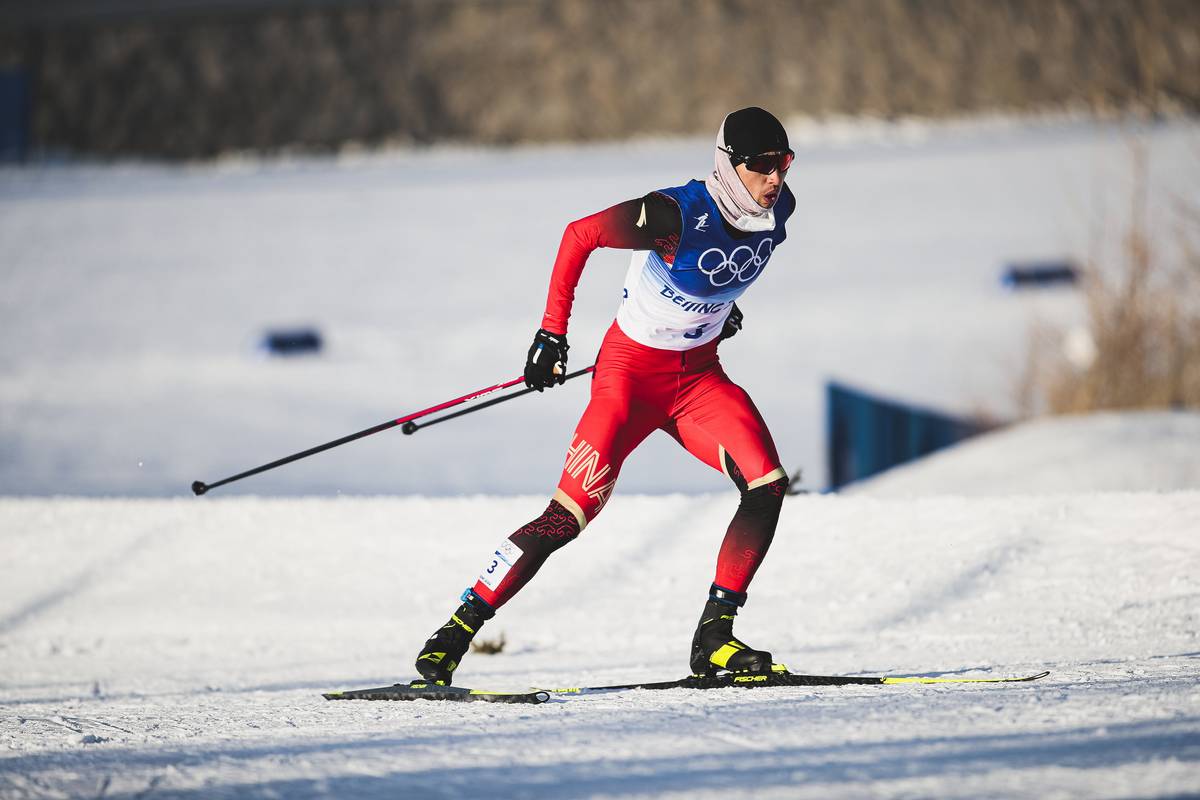
China’s Wang Qiang races to fifth in the freestyle sprint qualifier in Zhangjiakou during the 2022 Beijing Olympic Winter Games. (Photo: NordicFocus)
Wang, in cross-country’s Olympic skate sprint last month, was poised for a top-10 finish, and maybe even a medal — definitely the only hardware that China’s cross-country ski team had a chance to win on home snow during the Games.
But in one of the event’s preliminary head-to-head knockout rounds, Wang tangled with a Norwegian skier, Pål Golberg, who crashed. The International Ski Federation jury overseeing the race relegated Wang to 30th place, ruling that he’d obstructed Golberg, even though China vehemently disagreed.
Hence the tamped-down outrage I was witnessing from my source, who wanted international followers of cross-country skiing to understand his country’s anger over the disqualification.
China had just poured huge amounts of money into hosting the Olympics and building up cross-country skiing; thousands of volunteers had put their lives on hold to pull off the Games during a pandemic. The ski federation, known as FIS, couldn’t give Wang the benefit of the doubt? In a country with hundreds of millions of potential new cross-country skiers and skiing fans, where the sport was still in its infancy?
“You don’t kill infants,” the source said.
This is a Chinese-friendly perspective on Wang’s disqualification, and many others disagree, saying that Wang committed a clear infraction and that skiing’s rules must be enforced without regard to politics or business.
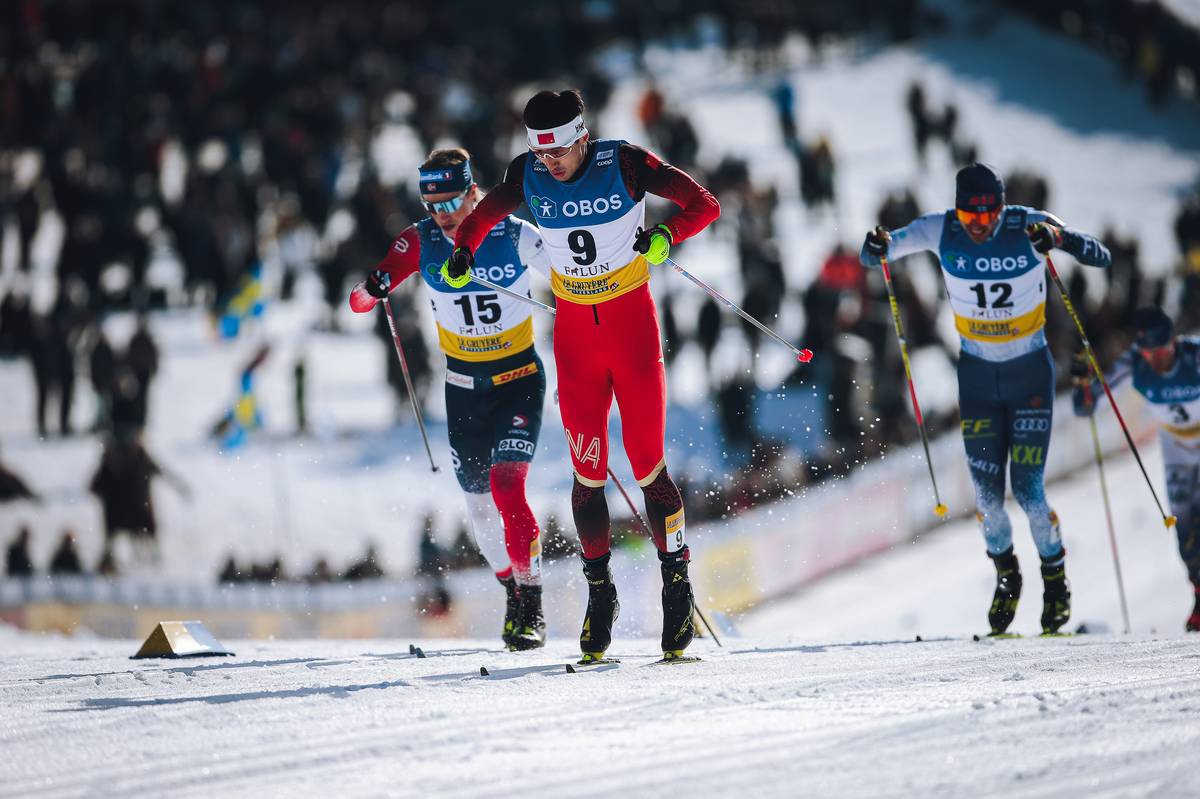
China’s Wang Qiang races through the heats during a classic sprint in Falun, Sweden. (Photo: NordicFocus)
But the Chinese perspective on the event is one that’s worth understanding. Because doing so can help answer one of the most interesting, and important, questions in cross-country skiing right now: Will China keep up its investment in the sport?.
“What I’m very curious about is: What next?” Vegard Ulvang, the retired Norwegian Olympic gold medalist who now chairs FIS’ cross-country committee, said in a phone interview. “Will they continue? Will they have a national team? Will they join the World Cup? To be honest, we don’t know. I have no information on what they will do.”
The question has enormous implications for the sport of cross-country skiing, given the size of China’s potential market for skis, wax and television broadcasts.
But I got conflicting answers when I asked the people who would know the answer.
The source close to the government said Wang’s disqualification soured China’s sports minister, Gou Zhongwen, on further investment in cross-country skiing, and he said the sport’s future in the nation looks deeply uncertain. Many of the team’s Scandinavian employees have contracts that end in May, without assurances they’ll be renewed.
“Everything is political, and the culture is completely different,” said Tor Arne Hetland, a Norwegian coach and former Olympic gold medalist who’s worked with Chinese athletes. “If the sports minister says, ‘We are not going to pursue winter sport or cross-country skiing or biathlon,’ then of course, there will not be any money for it. And the project will be completely dead.”
But in an interview in Zhangjiakou during the Games, Zhang Bei, the Communist Party official who leads China’s cross-country ski team, struck a positive note.
She said her country’s commitment to training athletes will continue into next year, and plans have already been announced that the team will keep sending athletes to train in Finland through the 2026 Games. Wang also proved his potential with a podium performance on the top-level World Cup circuit earlier this month in Drammen, Norway.
One of the multiple vehicles that China’s cross-country ski team had stationed at the 2022 Olympics in Zhangjiakou. (Photo: Nat Herz)
But Zhang would not reveal details about China’s cross-country budget. And she also suggested, logically, that the country would be scaling back its investment in skiing infrastructure from its big Olympics build-up.
“There is a saying in China: Everything is difficult to start,” Zhang said in the interview, conducted through a translator. “After you have the bases for the infrastructure, then of course, there is an adjustment.”
Ulvang has closely watched China’s cross-country program and, as the country’s athletes trained in Scandinavia before the Olympics, he hosted two of the nation’s top female prospects, Bayani Jialin and Dinigeer Yilamujiang, for a week at his home.
Ulvang described China’s efforts to train ski champions as “all out.” But he’s still waiting to see if the country’s commitment will last, because, he said, developing a durable skiing culture takes time.
“We need to see if this was motivated by the medals on the home field,” Ulvang said, “or if this was part of a long term strategy.”
“Starting from zero”
China’s huge pre-Games spending on cross-country skiing was fueled by Zhongwen’s belief that the discipline was one of the best measures of a nation’s overall prowess in winter sports, said the source close to the government.
The country spared no expense. Among its investments was a $150 million, 1.3-kilometer indoor ski tunnel that athletes can use to train year-round; one Chinese team employee showed me a video of another contraption that resembled an enormous plate with snow on top, which spun in circles while athletes stayed in the same place by skiing in the opposite direction.
China hired dozens of Scandinavian coaches and experts at yearly salaries that reached $120,000. The government recruited hundreds of Chinese athletes from other sports into cross-country skiing, and sent them to training centers in Norway and Finland. (Chinese officials considered Alaska as an option, where athletes could fly in helicopters to train at Alaska Pacific University’s facility on Eagle Glacier, but Zhang said securing visas proved too difficult.)
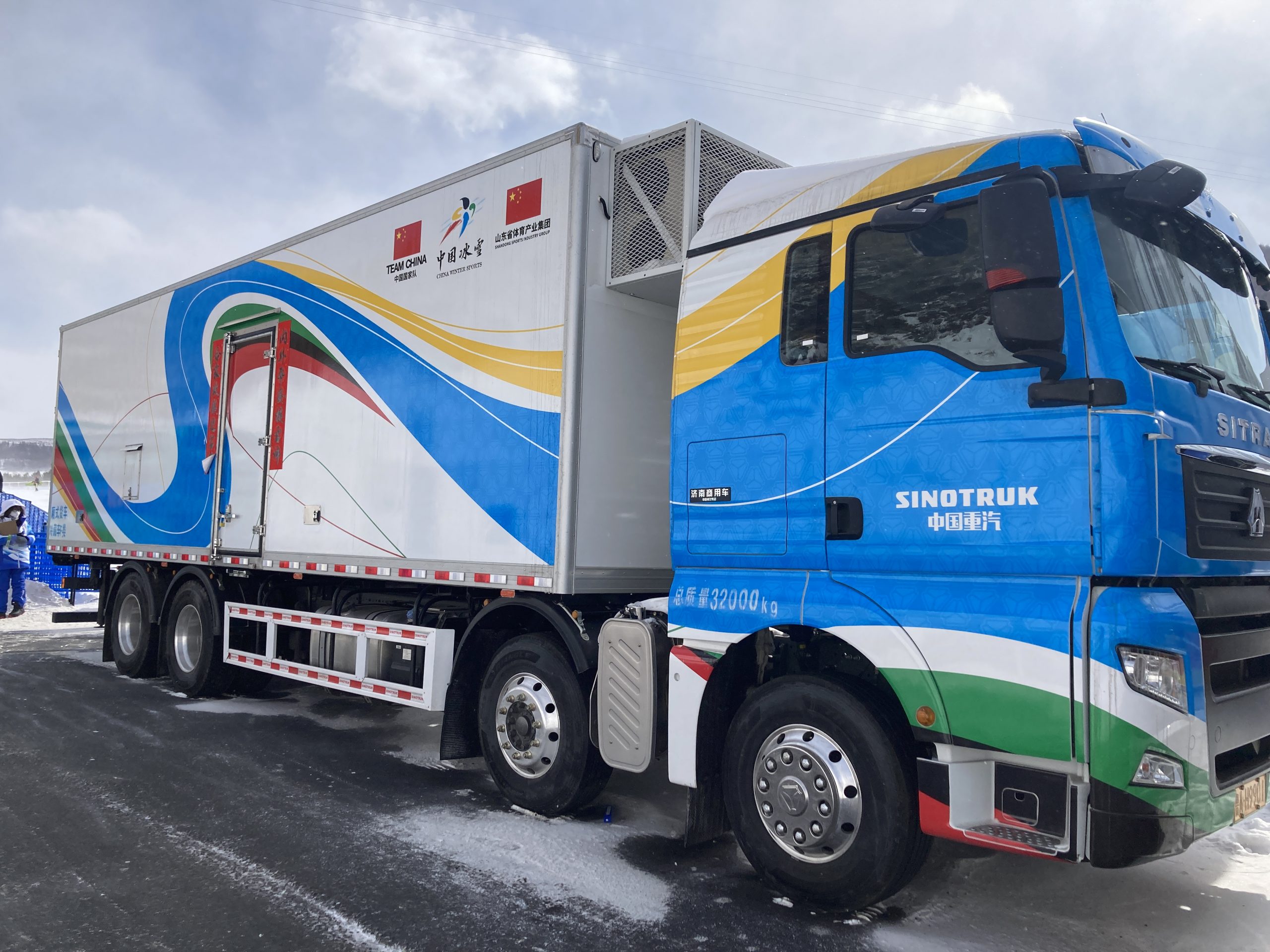
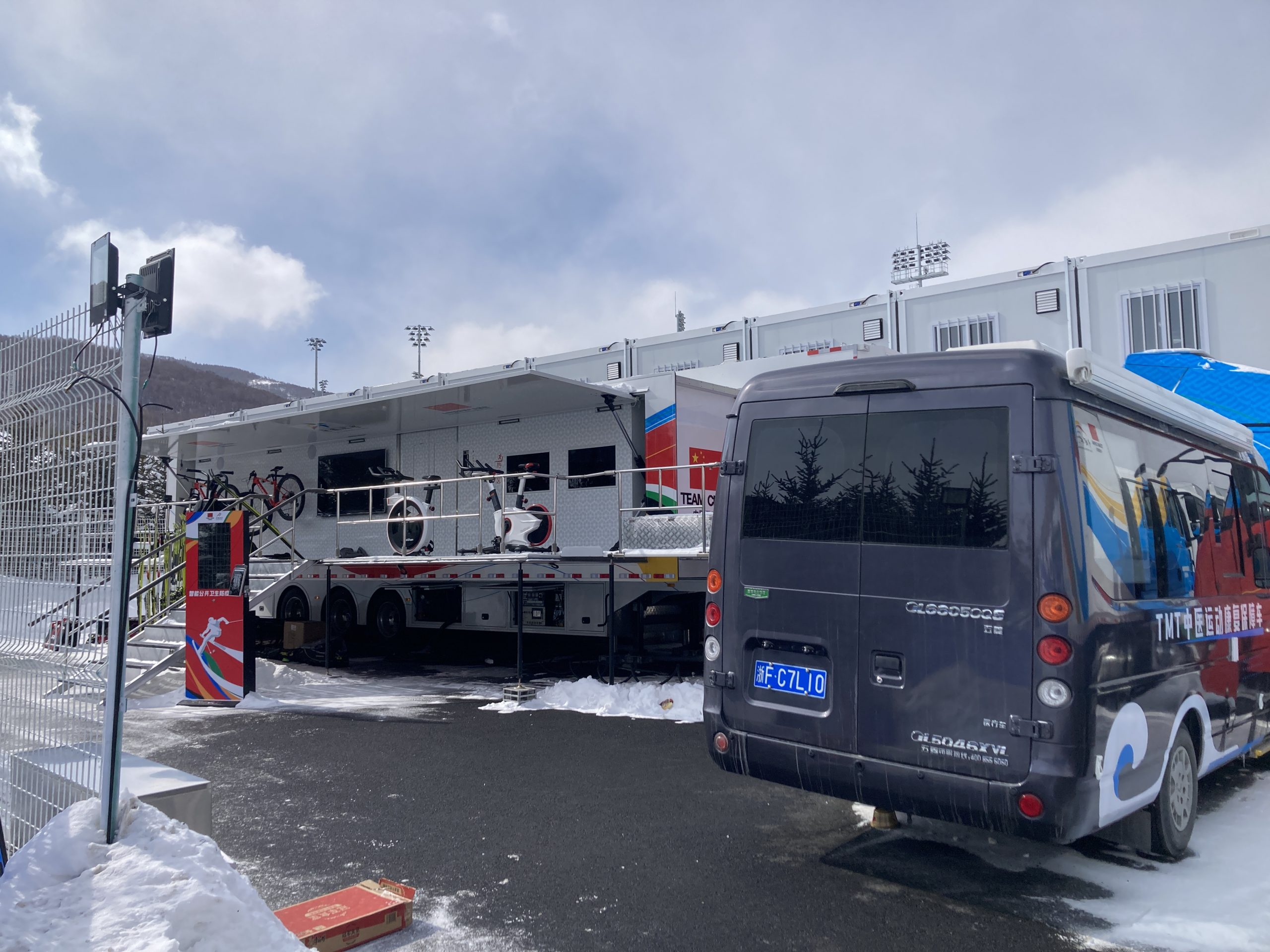
The team spent millions more on wax and equipment. In Zhangjiakou, the Chinese team had access to the Games’ only on-site ski waxing bus, which has sliding doors and facial recognition technology.
The Chinese ski team’s main wax bus at the 2022 Olympics in Zhangjiakou. (Photo: Nat Herz)
“They have started from zero,” said Hetland. The skiing infrastructure that the country has built up, he added, “is more than what Norway has done in the last few years.”
In the years before the Olympics, the team’s athletes recorded impressive results, even though some had only been skiing a few years — unlike many European athletes who have raced for the majority of their lives.
Yilamujiang and Bayani both cracked the top 30 on the World Cup circuit, and notched top-15 results at the world championships for juniors and athletes under 23 years old. Wang, China’s star male skier, performed at a similar level.
But at the Olympics, other than Wang, none of China’s cross-country skiers cracked the top 30. Some people close to the team described the event as a disappointment, given the Chinese athletes’ proven potential.
Former employees of the Chinese team said two dynamics help explain the results.
One was a tendency by Chinese team leaders to disrupt the Scandinavian coaches’ training programs, by pushing athletes through brutally difficult workouts that the Chinese staff thought were needed.
The other was the decision by team leaders to pull China’s athletes out of the World Cup circuit during the COVID-19 pandemic — a move that kept the skiers safe but deprived them of experience against international-caliber competition on trails outside their home country. (Chinese officials did hire semi-elite Russian athletes to travel to China to give the country’s athletes more racing experience.)
“They need to spend even more time in Scandinavia and learn from everybody in the environment that is around a skier,” said Hetland, the Norwegian coach. “And that has been maybe the biggest challenge for the team, when due to COVID they have stayed at home in China in the last two years.”
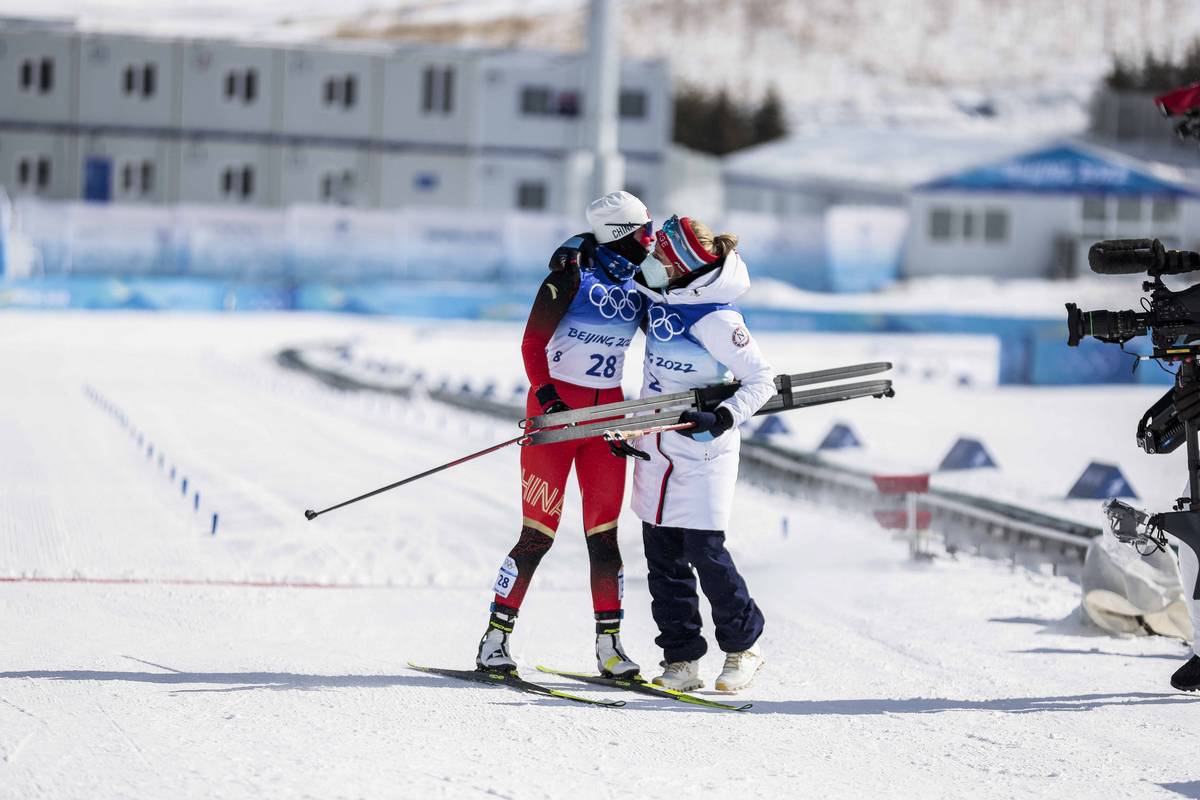
Olympic 30 k winner Therese Johaug (NOR) greets last place finisher Dinigeer Yilamujiang of China who finished over 25 minutes behind the Norwegian (Photo: NordicFocus)
Hetland said it’s important to remember that China has its own distinct culture from those of the European nations that have historically dominated cross-country skiing. Adapting that culture takes time, he and others said.
“I visited China two years ago, and I was clear to the officials there that developing or training up a good skier, fighting for medals, is not a quick fix,” said Ulvang, the Norwegian FIS official. Still, he added: “It’s really special to see such fast development into some of the best racers in the world.”
Zhang, the Chinese leader, had no complaints about her team’s Olympic results.
“I am very much satisfied with the performance of our athletes,” she said. “I also feel very satisfied that each of our athletes is enjoying the competition, and that they are happy.”
“They cut him”
Zhang spoke with me in a busy athletes’ lounge in the bowels of Zhangjiakou’s biathlon building.
With the help of some of her European coaches, I’d picked her out of her white-jacketed, fur-hatted entourage at the cross-country skiing venue a few days before. She reacted with surprising openness, and agreed to an interview after I supplied her with enough details to get approval from her superiors.
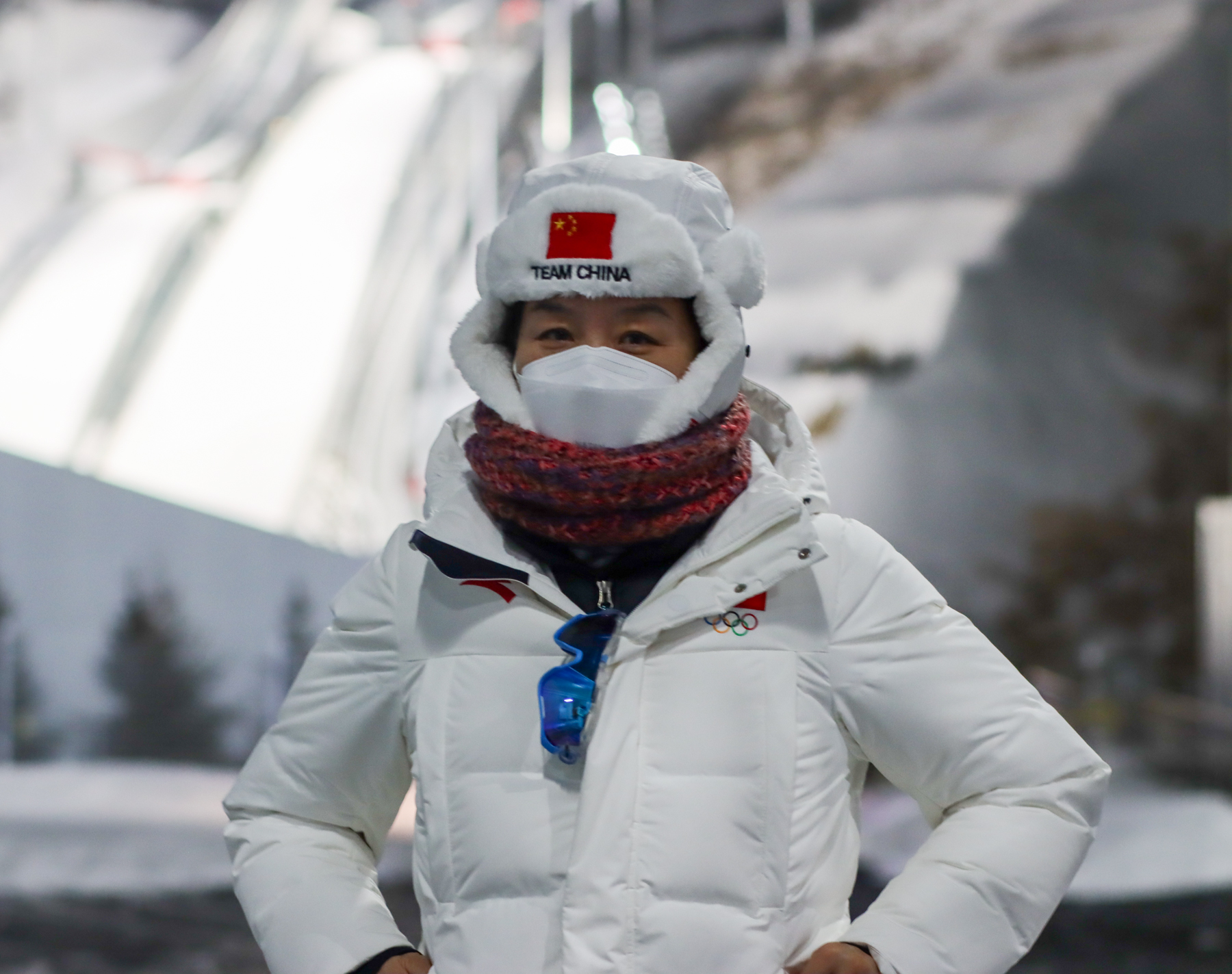
Zhang Bei is the Chinese Communist Party official in charge of the country’s cross-country ski team. (Photo: Nat Herz)
Zhang embodies China’s recent foray into winter sports: She came to her job four years ago, with a background as an elite rower, and only recently took up cross-country skiing herself. She told me she was too shy to try it in front of her athletes because she was worried they’d laugh at her.
In our hour-long discussion, Zhang came across more like a politician or ambassador than a coach or executive, striking a vague but upbeat tone that glossed over some of the challenges I’d heard about from former employees.
“We have a very good start,” she said in response to a question about her program’s future. “Most importantly, we have many young people that are interested in cross-country skiing. And we have to help them to fulfill their dream.”
The only time Zhang acknowledged even a hint of tension or conflict was on the subject of the disqualification of Wang, China’s star athlete. She said she and other team members were upset about the decision at the Olympics, which Zhang called “wrong.”
Technically, FIS’ race jury ruled that Wang would be “ranked as last” in the freestyle for breaking international competition rules against obstructing other skiers.
Slow motion replay of the event shows Wang in his neck-and-neck sprint heat edging to his right in a way that appeared to impede Golberg, the Norwegian, who was skiing alongside Wang and ultimately crashed. (The video cannot be posted here due to Olympic broadcasting rules, but FasterSkier can provide a copy by email upon request.)
The video isn’t exactly conclusive, and the jury’s decision has its critics — including, apparently, Gou, China’s sports minister.
Four separate sources told me that Gou learned of the disqualification during a dinner with Johan Eliasch, the FIS president, where Gou subsequently “lost his appetite” and raised his concerns with Eliasch directly. (A FIS spokesperson said in an email that the federation “does not comment on speculation about discussions between individuals during private dinners.”)
China ultimately appealed the jury’s decision, but the appeal was rejected, said Ulvang. The source close to the government said China also asked FIS to extend some type of goodwill gesture after the disqualification, but that request wasn’t granted either.
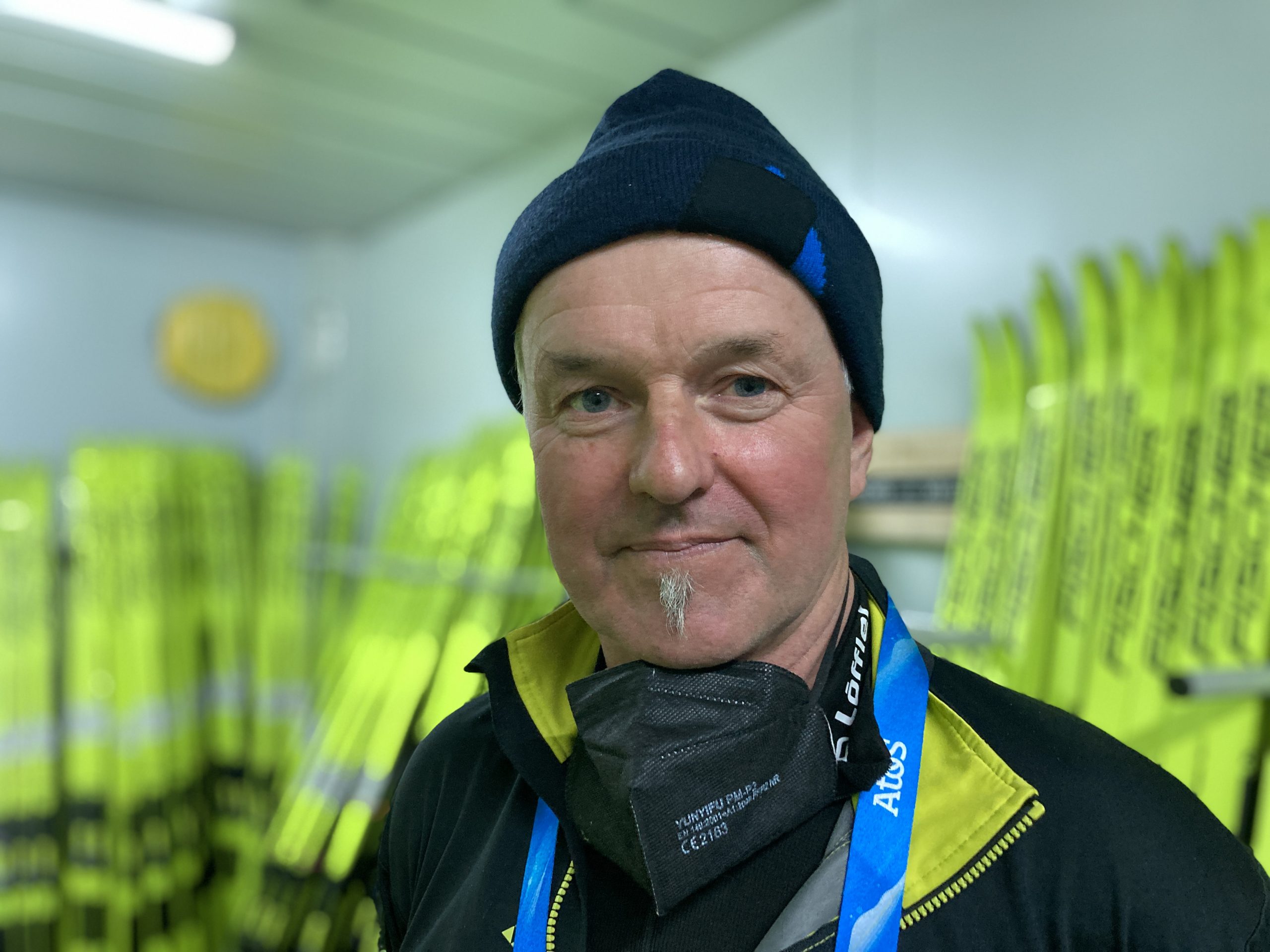
Representatives from cross-country ski equipment manufacturers were frustrated, too. Currently, the industry sells only small amounts of gear and skis in China, and only to elite athletes there — not to “normal people,” said Hans Hubinger, an official from ski giant Fischer who was working at the cross-country venue in Zhangjiakou.
“It’s not easy for us to see if there’s a future for the Chinese market or not,” Hubinger said in an interview.
Hans Hubinger is an official from ski company Fischer who was working at the 2022 Olympics in Zhangjiakou. (Photo: Nat Herz)
Wang was the industry’s only hope for a Chinese cross-country skiing medal, which could have stimulated new interest, and gear sales, in the nation’s massive market. That market could also bring much-needed television viewers to cross-country skiing’s broadcasts — a major source of revenue for the sport.
Hubinger said he thought Wang’s disqualification was a close call where the jury could have given him the benefit of the doubt.
“I think, ‘Oh, this is the chance now, to turn some guys into heroes’…and they cut him,” he said. “If the rules are clear, then you have to cut him. But this rule is not clear.”
Pierre Mignerey, FIS’ cross-country skiing race director and a member of the jury that disqualified Wang, said he sees the situation completely differently.
In an interview in Zhangjiakou, Mignerey said it would be completely inappropriate for a race jury to weigh political factors, like the size of China’s ski market or its investment in the Games, in their decisions.
“Sports mean that we have some rules. And that would be, in my opinion, quite shocking if the rules would not apply to everyone in the same way, regardless of if it’s the host nation,” said Mignerey, a retired French racer. “What would people say if the jury had decided something else?”
Others placed responsibility for the disqualification on Chinese team leaders, arguing that their decision to skip international races during the pandemic left athletes like Wang without enough experience in the kind of tight-quarters competition that happened in the Olympic sprint.
In the weeks after the Games, Wang delivered results that only underscored the opportunity he missed when he was disqualified — regardless of who bears the ultimate responsibility for that decision.
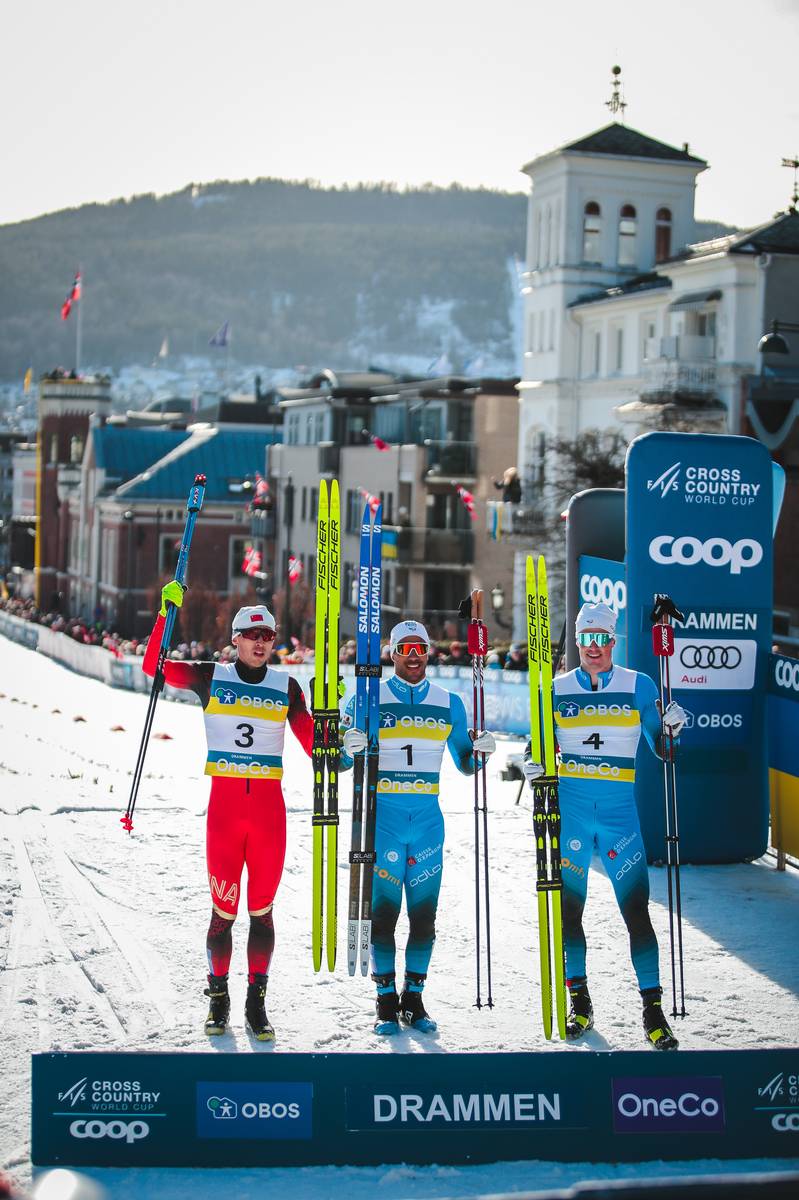
In his first World Cup race after the Games, in Finland, Wang, 28, finished a career-best sixth place. The following week, in Norway, he landed on the podium for the first time.
That result delivered a shot of hope to those who want to see the Chinese program continue.
On social media afterward, Wang made clear his intentions to continue in the sport, even if his country’s commitment to its skiing program remains something of a mystery.
“Today is a milestone. This is the first time a Chinese athlete stands on the podium of the World Cup series. We have won the respect of the world,” Wang said on a platform called Weibo. He added: “I will continue to pursue my dream with a humble attitude.”
Richard Jouve (FRA) takes the win in Drammen, NOR, with a first podium for China’s Wang Qiang, who took second ahead of Lucas Chanavat (FRA) in third. (Photo: NordicFocus)
On February 26th, the Norwegian Ski Association (NSA) released a statement indicating that in light of the nation’s recent invasion of the Ukraine, Russian participation was not welcome at the upcoming World Cup sprint races in Dramman or the storied Holmenkollen distance races outside of Oslo. In addition to these cross country events, Norway is scheduled to host competitions in alpine, nordic combined, and ski jumping, including the World Ski Flying Championships in Vikersund.
A press release shared by Norwegian news source NRK stated: “The board of the Norwegian Ski Association has today discussed the situation related to Russia’s invasion of Ukraine, and how this affects the upcoming World Cup races and the world championship in Norway. The Norwegian Ski Association’s message to Russia and Russian athletes is crystal clear; We do not want their participation!”
NSA president Erik Røste told NRK that a request had been made to the International Ski Federation (FIS) to officially bar the Russian program from participating, but as of Saturday, FIS had not taken action to comply with the request, instead pointing to the official cancellation of remaining FIS events held in Russia.
“The attack on the Ukrainian people and the great suffering we see pictures of now, the sport can not remain passive and be neutral,” Røste said of the request. “Therefore, the board of the Norwegian Ski Association was clear that this must have consequences beyond what has already been decided. Therefore, we will send a clear and distinct signal to FIS that we do not want Russia and Russian athletes to participate in competitions in Norway in the coming weeks.”
Ultimately, it is up to the board of FIS whether Russia will be allowed to compete in the remainder of World Cup events. A response NRK received via email today stated:
“The FIS board has been clear in its approach to Russian athletes in all FIS competitions. To ensure fair and inclusive competitions at all FIS events, national federations and local organizers should not exclude athletes on the grounds of gender, race, nationality or sexual orientation.”
Alexander Bolshunov (RUS) wins the 2020 Holmenkollen 50 k in the fog, ahead of Norway’s Simen Hegstad Krüger. (Photo: NordicFocus)
As such, no Russian athletes or coaches have been denied entry to Norway, and Stefan Marx, the general manager of Holmenkollen ski festival, indicated there is little more that the organizers can do to prevent Russian participation in the events.
“We must let them participate,” Marx said to NRK. “Those who FIS and the Norwegian Ski Association say must be allowed to participate. We do not have the authority to refuse anyone to participate, but we have supported the Ski Association and the Sports Association’s position. It is up to FIS or the authorities to decide, but we are clear in our support for the Ski Association’s proposal that Russian athletes are not wanted due to violations of international law that have been committed.”
After flying from Helsinki following the Lahti World Cup races, Russian teams have begun to arrive in Norway. When pressed by the media upon his arrival, World Cup distance leader and favorite for the upcoming 50 k classic at the Holmenkollen, Alexander Bolshunov chose to remain silent. NRK did, however, receive comments from multiple Russian coaches, including head coach Marcus Cramer who felt that sport and politics should be kept separate.
“What do sports and athletes have to do with this situation? It’s really tough. I just get sad that the Norwegian association thinks like that. We really have a good communication between us. With everyone who works there. It’s sad to hear this, especially when they take it to the press and not us first,” said Cramer.
Another Russian coach, Jegor Sorin, who had been working at the Junior/U23 World Championships in Lygna, NOR and planned to join the Russian team in Oslo, echoed that Russian athletes should not be held accountable for the
“I am very upset that the Norwegian association wants this,” Sorin told NRK. “I can understand that no one wants to travel to Tyumen for the World Cup, but I do not know what happens to us… We are Russian athletes. We are here, we are not in any war. We are athletes, not soldiers. Maybe they think we have weapons. We want peace and for me this is very strange.”
Alexander Bolshuonv is photographed with his four Olympic medals from the 2022 Games, with one event remaining. He would leave the Games with three gold medals, and a total of nine Olympic medals including those won in 2018. (Photo: NordicFocus)
Though the Russian coaches focused on a separation between sport and politics, others have pointed out the direct ties between sporting success and military recognition. Used as an example, Bolshunov and Denis Spitsov were promoted to the rank of captain in Russia’s National Guard in recognition of their success during the 2022 Olympics. Bolshunov, who has earned a medal in each of his nine Olympic appearances, including three gold medals in Beijing, received additional honors in the form of the Alexander Nevsky Order, given in recognition of “special service for the fatherland.”
FIS cross-country committee leader, Vegard Ulvang told NRK, “Russian athletes are [military] officers. This makes the symbolic value [of their participation] even greater.”
A similar statement was made by Global Athlete representative and former U.S. Ski Team athlete Noah Hoffman.
“While I feel for the individual athletes, all Russian skiers should be banned from the FIS Cross Country World Cup for the rest of the season,” Hoffman tweeted. “Their results are used to drum up nationalism and bolster the Russian State. Allowing them to compete aids Russia. #StandWithUkraine.”
Ulvang is urging a stronger response from the Norwegian Ski Federation, suggesting that they relinquish the FIS World Cup status of the events at the Holmenkollen in order to gain the authority to prohibit Russian participation.
Jan Petter Saltvedt, a Sports Commentator for NRK described Ulvang’s statements as a “moral ultimatum.”
“Ulvang demands an open rebellion from NSF against his own superiors,” Saltvedt said. “And he should get it. Vegard Ulvang puts so much pressure on the Norwegian Ski Association that they can not help but act… At the same time, he expresses a very strong and clear criticism of FIS, where he himself is one of the powerful committee leaders, but still does not feel he is heard at all.”
Norwegian athletes who have been asked for comment have given mixed responses, often acknowledging the complexity of the issue and whether the athletes themselves should be at fault for government decisions.
Among those with a clear stance, Erik Valnes spoke of disallowing Russian participation. “There is a heavy symbolism in it. It would send a signal. Since [Bolshunov] is [a captain of the Russian National Guard], they have already mixed sports and politics in a way. It is difficult. It is a great pity that it will be like that.”
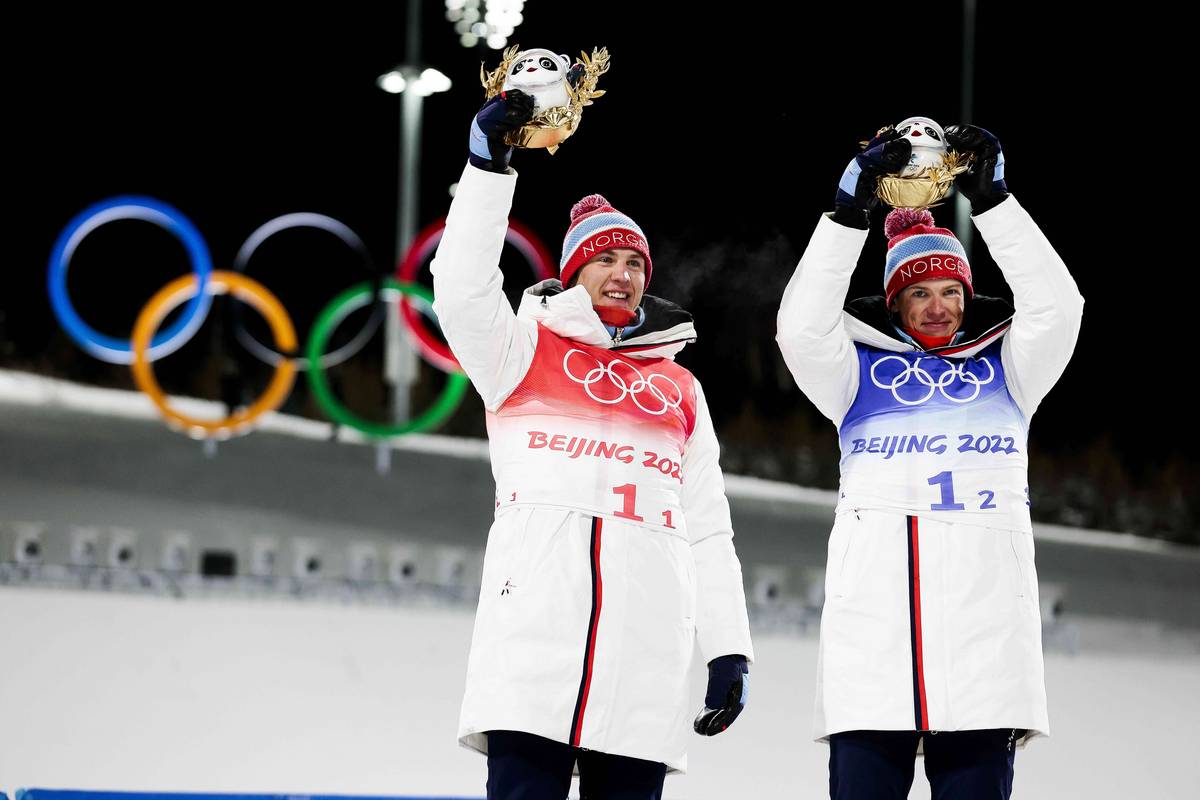
Erik Vales and Johannes Høsflot Klæbo earn gold in the classic team sprint during the 2022 Beijing Games. (Photo: NordicFocus)
Johannes Høsflot Klæbo also spoke in support of the NSA urging FIS to remove Russian athletes from competition.
“As an athlete, you want the best to start. We train all year to compete and then you want the best to participate,” Klæbo said to NRK. “At the same time, I support the attitude of the ski association now. There is no doubt about what is happening in Ukraine, and Russia must be condemned. I strongly condemn it and I think it is good that the association takes a stand.”
Therese Johaug acknowledged that athletes may not have direct involvement in the military actions of Russia, speaking instead to their role in representing their country through sport.
“I feel sorry for the athletes, first and foremost, I understand that they have nothing to do with this,” Therese Johaug told NRK after narrowly winning Lahti’s 10 k classic over Russian Natalia Nepryaeva. “But on the other hand, I think it is completely wrong. They front their country and the flag both on the chest and on the forehead. And that a country should also ravage the sports arena and fight for victories and front their country in the situation we are in – I think that is completely wrong.”
Therese Johaug voices her thoughts on Russian World Cup participation following her win in Lahti’s 10 k classic. (Photo: NordicFocus)
The stance is not unanimous amongst the Norwegian team. Sindre Bjørnestad Skar, who took third in Lahti’s freestyle sprint, spoke to the unfairness for Russian athletes.
“Of course, I am 100 percent against everything that is happening between Russia and Ukraine now. It is completely inconceivable. But then I also do not think that the fact that they have a Russian passport, means that they should be punished and deprived of the opportunity to do their job. In a way, I think that is a bit unfair too,” Skar told NRK.
For the time being, no further changes in Russian participation have been reported. FasterSkier will continue to follow this story as it evolves over the next few days. World Cup classic sprint races are currently scheduled in Drammen Thursday, with the women’s 30 k mass start classic in Oslo happening Saturday March 5th, followed by the men’s 50 k on Sunday.
Vegard Ulvang at fifty six years old remains an icon in Norway. With Olympic and Championship medals, a World Cup Overall title in 1990, he’s in the lineage of Norwegian skiing royalty.
Away from the tracks, Ulvang began and then sold a profitable clothing company. He fills his time making documentaries and television features. He is also, as you’ll hear at the top of the interview, committed to living a life of exploration, calculated risk, and adventure. The South Pole, Northwest Passage, and monumental kite-skiing expeditions to Greenland have shaped his post-racing life.
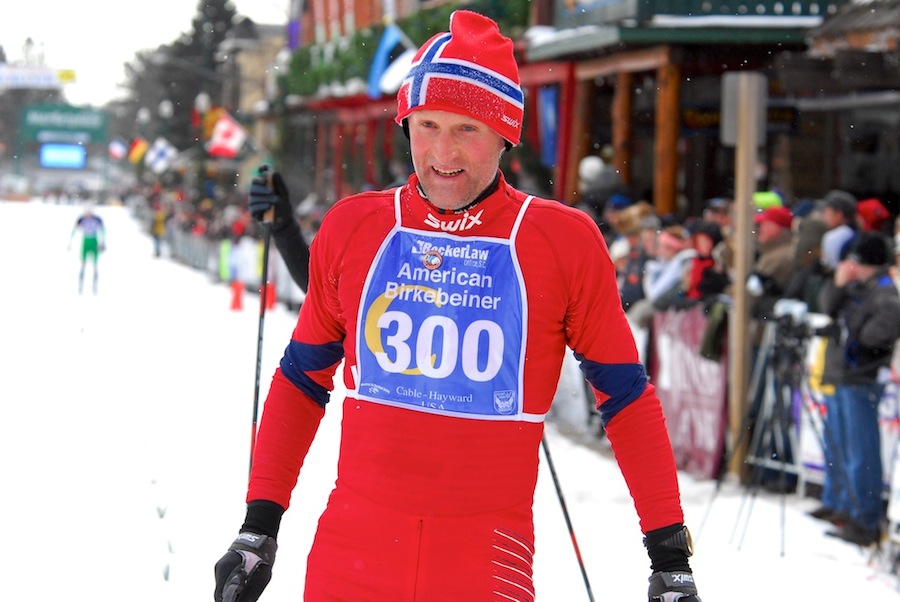
Six-time Olympic medalist and FIS cross-country chairman, Vegard Ulvang of Norway, after his first American Birkebeiner in 2012. (Photo: Darlene Prois/American Birkebeiner)
Ulvang is still connected to international sport as the chairman of the executive board of the International Ski Federation’s (FIS) cross-country committee. He’s been in this role since 2006. Coordinating the World Cup calendar, juggling race format changes, rule upgrades, and evolving wax protocols as government regulations come into play – they all filter through Ulvang. He is often quoted in Norwegian media when it looks for guidance on how to interpret the state of skiing today.
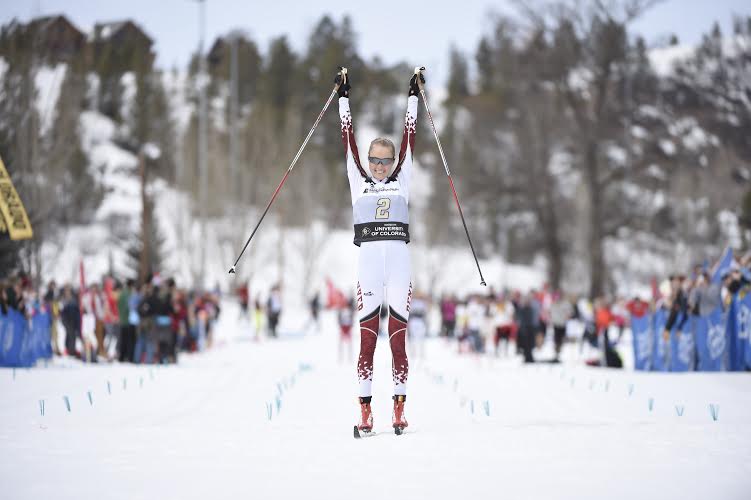
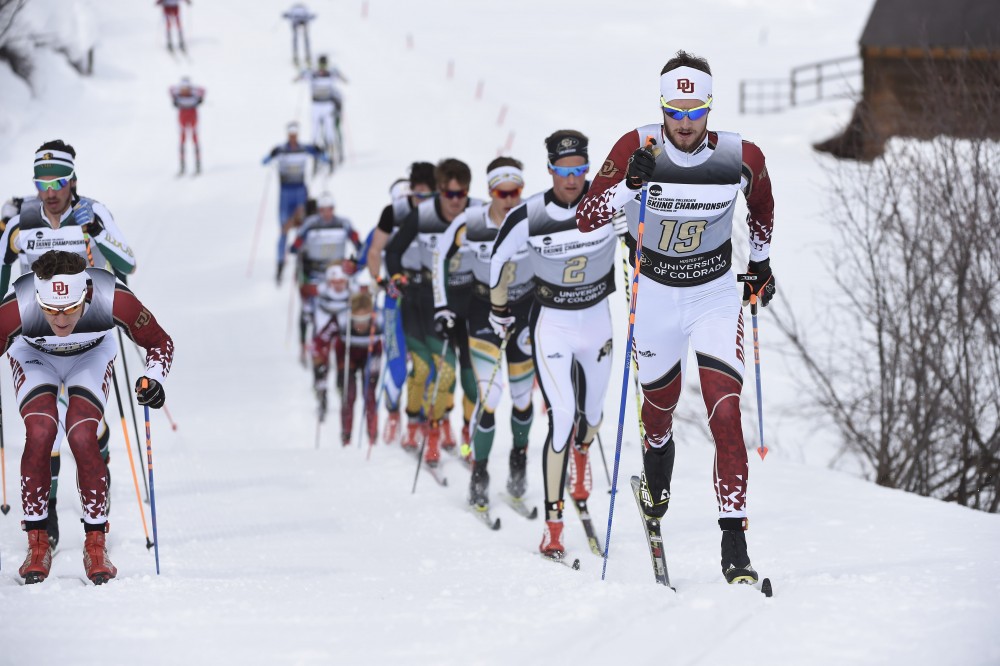
Linn Eriksen of the University of Denver celebrates her win in the women’s 15 k classic mass start at the 2016 NCAA Skiing Championships in Steamboat Springs, Colo. (Photo: Jamie Schwaberow/NCAA Photos)
In March, FasterSkier recently published an article (Part I) on college ski racing in the U.S. and what a change to National Collegiate Athletic Association (NCAA) Championships might require in regards to adding a sprint race. In the second part of the series, we explore why men’s and women’s race distances are different at the collegiate and World Cup level and whether this constitutes a need for change.
***
Men | Women. Women | Men. Scanning the athletics webpage for an American institution of higher education that boasts a varsity sports team becomes a sail down the Casiquiare canal, with gender bifurcation an obligatory outcome.
Resting under the canopy of NCAA sports, however, nordic skiing presents itself as somewhat of an anomaly. Shared race days. Shared coaches. Shared course site. Shared team. At the surface level, gender in collegiate nordic skiing is almost arbitrary.
Olivia Amber (r) of Colby College and teammate Amy Bianco celebrate their top-20 finishes in the women’s 15 k classic mass start at the 2016 NCAA Skiing Championships in Steamboat Springs, Colo. (Photo: Colby.edu)
Yet, closer inspection reveals one particular area in collegiate cross country skiing where the genders differ: Race distance. In most individual nordic events at the college level, the course length of women’s and men’s races are not the same. The trend is a 5-kilometer deficit for women’s race events in comparison to men’s events.
For Molly Peters, the head nordic coach at Saint Michael’s College and former NCAA All-American in nordic skiing for Middlebury College, this is a problem.
“We’re sending a message to all the young women who have a goal to ski in college,” Peters said in a phone interview. “I just can’t imagine that they feel like their equal as people or athletes when they look and they see, ‘Oh, look every single race I’m going to be skiing 5-kilometers less.’ How are men every going to look at women equally and how are women ever going to look at themselves as being equal if you’re always skiing 5-kilometers less?”
With that in mind, Peters promised herself to reshape the sport.
“It had to be my mission in life to get it changed,” Peters said. “I feel like my best bet to get it changed is to change the NCAA Championships because everyone bases all their racing off of what the NCAA does. Every EISA [Eastern Intercollegiate Ski Association] Carnival is basically not equal because they follow whatever the NCAA does. It all trickles down.”
The Trickle Effect: One Theory on Why Race Distances Differ
A single change can create countless more. When Title IX was passed in 1972, a change was instituted in the treatment of both genders by federally funded college institutions. Within the realm of campus athletics, the alteration brought about numerous others, including an increase in the number of women participating in college sports, the scope of sports available to women and men (in certain instances, harmfully so), and perceptions of women who choose to ‘play.’
Recent Middlebury College returnee, Annie Pokorny, points out that this sort of ‘trickle down’ change should not be looked at lightly.
“When women entered sport, some rules were tweaked to account for physiological differences, but also to support the idea that athletics could be harmful to women, (particularly their reproductive systems,” Pokorny wrote in an email.
Pokorny is completing her undergraduate senior thesis on feminist philosophy and the philosophy of sport. While she admits she is not an expert, her studies and experience in nordic skiing quantify her knowledge on the subject.
Pokorny explained that myths surrounding the female body and exercise in the 20th century, caused men “to adjust sport to make it safer and more “womanly”), which turned into a conceptual connection between women and the need to protect them.”
“That conception turned into tradition, one that still thrives today in the form of shortened distances for female endurance athletes,” Pokorny added.
The top 10 in the women’s 5 k freestyle race at the 2016 NCAA Skiing Championships in Steamboat Springs, Colo. (Photo: Matt Johnson/MSU)
For Pokorny and Peters, these types of traditions were made to be broken.
“The best things that have ever happened are from people changing tradition,” Peters said. “My purpose is to get the NCAA Championships changed to be the same distance for men and women because that will trickle down to the smaller races.”
But implementing change in the NCAA Championship event and NCAA skiing is no easy task.
“NCAA skiing is comprised of a wide variety of institutions: Division I, II and III; private and public; and large and small,” Dave Stewart, head nordic coach at the University of Denver, wrote in an email. “Any choices about race format, distances, etc. must take into consideration the perspectives of this diverse group and, ideally, the decisions should be made with the goal of broadening participation at the NCAA level and increasing competition.”
If Stewart is right, the question becomes: Would making race distances equal between men and women broaden participation and increase competition?
A Second Theory & the Distance Debate: Should Men Race Shorter or Women Race Farther?
When it comes to long distance endurance events, some research argues women fare better than men.
“Women can race just as long as men,” Montana State University (MSU) incoming senior Anika Miller said on the phone. “If [the NCAA] wanted us to do a 50 k in college, sure we could do it, but it wouldn’t make any sense athletically.”
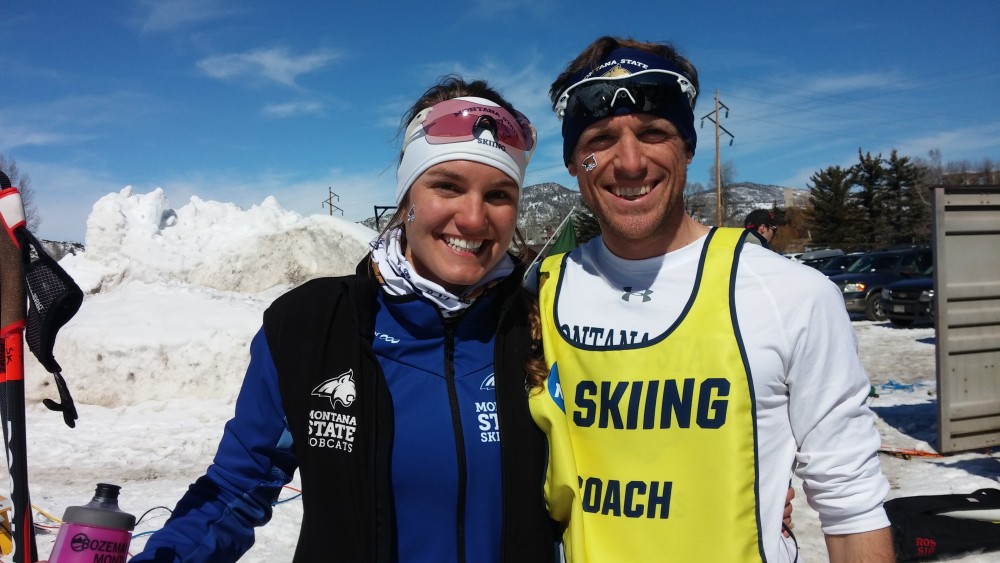
Montana State University’s Anika Miller (l) with head coach Matt Johnson after Miller took won the women’s 5 k freestyle at the 2016 NCAA Skiing Championships in Steamboat Springs, Colo. (Courtesy photo)
Miller — a native of McCall, Idaho, and this year’s NCAA champion in the 5 k freestyle — doesn’t doubt the ability of women to race the same distance as men.
What she questions is whether it’s necessary for women to do so.
“It’s kind of a hard conversation to have as a female athlete because you don’t want to say that women are inferior,” Miller said. “My opinion on it is that the race distances are good as they are as far as women doing a shorter distance than the men. Because time wise … for the 15 k versus the 20 k at least, sometimes the guys only race it five minutes different than the women, which isn’t really that large of a margin, [meaning] effort wise, it’s more equal.”
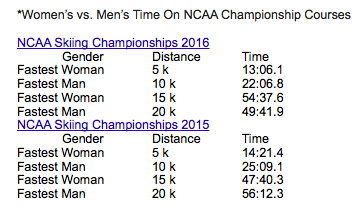
The point Miller makes is that women and men are currently racing equal. Equal amounts of time on course, at least in the 15 k and 20 k events (*see men’s and women’s course times).
Oscar Friedman, coming off his senior season at Dartmouth where he was a captain of the men’s nordic team, also argued that close to equal amounts of time on course is more important than equal course distances between men and women.
“The point of having those different race distances was to make the men’s and women’s races equally competitive,” Friedman said on the phone. “That being said, if women are internalizing it, then that’s a bigger issue. If there’s a push from within the sport, women should be the ones deciding the race distances.”
The push from women within the sport varies, but much revolves around whether women race longer or men race shorter distances. Kelsey Phinney, coming of her senior season and also a captain at Middlebury, admitted that originally the idea of equal distances didn’t appeal to her because she assumed women would be required to race farther.
“I think the misconception has been that equal distances meant that women had to race longer,” Phinney on the phone. “But it doesn’t mean that women have to go 10 k and 20 k it could mean that men go 5 k and 15 k. Or that the races range from sprints to 30 k.”
Rachel Hampton, an incoming senior at Harvard University, advocated that while women are capable of racing men’s distances, men would benefit from racing shorter lengths.
“There’s a feminist side of me that wants to say that girls can do anything boys can do and there’s no theological reason why we shouldn’t be able to race the same distance as them,” Hampton said on the phone.
“I will say I sometimes feel bad for the guys because it seems like they only race long races. I think if we added sprinting and a few 5 k races for the guys and did a wider range of distances, that would be better for them. And I think if the men were on that plan, the women could then get on the same distance plan.”
However, when men competing in college were asked if they would be willing to race the same length as women, responses were often shaped by race distances at other levels of nordic competition.
“Shortening the men’s distances would be a huge disservice because as I see it, the goal of NCAA skiing is to make American skiers as competitive as possible on the World Cup,” Friedman said. “I would be completely against shortening the men’s races. But if women want to make the call and race longer, they should fully be able to do that.”
For a few women, however, simply adjusting the women’s race lengths to match those of the men sends a certain message: Women have to be like men to be equal.
“I think the message it sends depends a lot on whether you shorten the distance of men or you increase the distance that women have to race,” Bates College ’16 grad and skier Britta Clark said on the phone. “Trying to increase the distance that we race in the name of equality, but at the same time really just saying that equality is women doing what men do, I don’t think it’s necessarily speaking to the issue.”
Clark’s point is supported by Dartmouth College Women’s Head Nordic coach and Director of Skiing Cami Thompson-Graves, also a member of the NCAA Men’s and Women’s Skiing Rules Committee, chair of the USSA Cross Country Committee, and most recently, a member of the International Ski Federation(FIS) Ladies’ Cross Country Committee.
“I don’t feel the need for women to do men’s distances,” Thompson-Graves said on the phone. “Why don’t we just do women’s distances? Why can’t we just be different … I’m a big believer in being proud to be a woman, and not a little man.”
Harvard’s Rachel Hampton leads a Dartmouth skier during the 2016 Colby Carnival. Hampton went on to compete at the NCAA Skiing Championships in Steamboat Springs, Colo. (Photo: FlyingPointRoad.com/Harvard Facebook)
Increasing women’s distances strikes some as a forfeiture of female identity for one that is male. Which is one reason Peters more strongly advocates for decreasing men’s distances to be the same length as women’s.
“In skiing, I think the men should come down,” Peters said. “The 20 k is really irrelevant, even at the international level. I see nothing wrong with the 5 k, I think men should do 5 k. Five k is super exciting and can be a great race. I think it should be 5 k, 10 k, 15 k, and then add in the relays and sprints.”
However, a men’s 5 k race doesn’t appear on numerous nordic race calendars — national or international — either.
“I don’t think at the national or international level men race 5 k so maybe that’s a distance skill set that would only be applicable to college skiing in the U.S.,” Raleigh Goessling, coming of his senior season at the University of New Hampshire, said on the phone. “If the race distances were changed, I feel like the distances that are contested at other levels of the sport and other formats should also play into it.”
The Window Between U.S. College Racing and the World Cup
At the international level, women and men rarely race the same distance. FIS course lengths — like the NCAA — are designed around the gender of the athletes competing.
FIS Cross-Country Committee Chair and Norwegian Olympian Vegard Ulvang indicated that similar to college racing in the U.S., FIS race distances have been different for decades. One potential reason for these differences aligns with Porkorny’s findings. According to Ulvang, how female athletes were viewed in endurance sports when they started ski racing influenced the original length of women’s race courses.
“The history behind the differences comes from the time where the nations believed that women were weaker — [with the] first female race in 1952,” Ulvang wrote in an email to FasterSkier. “Today we of course know better. Female athletes are better prepared for longer distances than men, so principally the distances should be equal.”
Principality does not always equal response. Ulvang indicated that even if the race distances should principally be equal, one major driving force for the committee to keep women’s race distances shorter than men’s rests on the race experience for spectators.
“The argument has been that the time gap between the 20 best women is bigger than that of the men,” Ulvang wrote. “Longer distances would create a ‘worse TV product’ — with one racer skiing alone [during the race].”
T.V. time does not strike Peters as an excuse for NCAA Championships and U.S. college cross-country ski schedules to follow the same format as the World Cup.
The men’s 20 k classic mass start at the 2016 NCAA Skiing Championships in Steamboat Springs, Colo. (Photo: Jamie Schwaberow/NCAA)
“A lot of people will say well, look at what they do at the Olympics, and look at what they do at the World Cup — it’s vastly different,” Peters said. “The women do so much less. But that doesn’t make it right. That’s a reason why NCAA follows it and EISA follows it, but that doesn’t make it right.”
Stewart, who has helped the Denver Pioneers achieve five NCAA Championship titles, supports the idea that NCAA skiing in the U.S. could act as a catalyst for change.
“As long as FIS schedules longer races for men than for women in international championships, there will be some resistance to equal distances at other levels, but I see no reason why the NCAA should not be a trendsetter and work to turn the tide on this,” Stewart wrote in an email.
He supports equal distances in cross-country skiing, seeing it as a statement that should be sport-wide, not just within NCAA nordic skiing.
“Equal distances for men and women should be implemented in our sport, both at the NCAA and international levels,” Stewart wrote. “We have had equal distances in the sports of swimming and track and field at the international and collegiate levels for many years. Equal distances would reinforce gender equity and would send the right message about our sport.”
Yet, when it comes to World Cup race lengths versus those contested at the NCAA, some argue the Championship event is already sending a message to other levels of cross country competition.
“I actually think that NCAA’s, where the women race 15 k and the men race 20 k, is much more equal than on the World Cup when the women race 15 k and the men race 30 k,” Rosie Brennan, Dartmouth grad and current U.S. Ski Team (USST) member, said on the phone.
Brennan is not opposed to a more balanced race length distribution between men and women. Her concern with changing race distances at the World Cup and NCAA collegiate level is ensuring that the racers’ performance and perspective are taken into account.
“I think it would be nice if they tried to make the [race distances] a little closer,” Brennan said. “I also think the reason the distances were different in the first place was the idea that the time the race takes should be fairly equivalent, so the effort is the same. If the time differences [between men and women] are getting to be much greater, to the point that the races are no longer requiring the same amount of effort, then I think it’s worth proposing some sort of a change and [is] something to re-visit over time.”
Brennan’s suggestion to visit the race experience for athletes doesn’t go unsupported. Men’s and women’s race distance differences have been discussed at the collegiate and World Cup level. But the actual number of times the topic has been statistically ‘re-visited’ remains a bit blurry.
Regarding conversations within the college circuit, Peters indicates that implementing changes to men’s and women’s race distances has been thrown around for some time.
“Patty Ross, who coaches at Middlebury, she’s been fighting it for 25 to 30 years and she’s had no success,” Peters said.
Ross could not be reached for comment.
Within the FIS Cross Country Committee, Ulvang indicated that the turn of the millennium was when most conversations regarding the different course lengths at the World Cup level of racing began.
“[The] question has been discussed in the FIS committee a few times the last 15 years,” Ulvang wrote.
Beyond that, four-time Olympian, USST member, Fast and Female USA President, FIS athlete rep, and now a new mother Kikkan Randall revealed that World Cup athletes have also had at least one opportunity to make their opinion about equal distances known.
Fast and Female USA President Kikkan Randall leading a Fast and Female session two years ago in Bend, Ore. (Photo: Matt Whitcomb)
“It’s an interesting topic that actually comes up quite often on the World Cup,” Randall said. “As the athlete rep to FIS, I do a survey at the end of each season and couple years ago, as part of the survey, I sent out that question [of equal distances].”
The responses Randall received found most women on the World Cup circuit — at least a few years ago — did not want to race the same distances as men.
“The majority of women actually said that they were not interested in racing the same distances as the men,” she said. “I’m considering putting that same question on the survey again this year because the comment was brought up a couple times this spring.”
And how might women racing on the World Cup respond to shortening men’s distances to make the lengths equal? The question has not been posed, but Randall may incorporate it into her next athlete poll.
“That would be another interesting take on the same question,” Randall said. “This year on the World Cup I feel like the distances were reduced a little bit with so many tour [multi-stage] events, so again it’d be an interesting time to poll the athletes and see how they feel.”
Conclusion: Connecting Part I and Part II
As long as there is snow around, colleges with nordic programs in the U.S. will continue to attract a cohort of cross-country skiers looking to compete, while simultaneously continuing their education. For many, choosing college over a club team is not the end of a cross-country skier’s long term career. It is also the potential beginning.
“The way our country is, you’re always going to have athletes choosing to go to college after high school no matter what path they’re on,” Brennan said. “So I think the more that that can be facilitated, the better it is. I mean there are a lot of good club programs that offer alternatives for people who choose that, but I think the NCAA can provide a route as well.”
Some individuals also see the NCAA as an opportunity for Americans to attend college in the U.S. and potentially compete against athletes from other countries.
“As a venue for athletes to develop into international level skiers, [the NCAA circuit] is a great place because there are really high-level skiers from all over the world in the small microcosm of NCAA skiing,” Chad Salmela, outgoing nordic coach of the College of St. Scholastica, said on the phone.
With an assured influx of athletes choosing skiing and school — and the opportunity for some to race international athletes at ‘home’ — many don’t deny the difficulty of disconnecting U.S. collegiate racing and higher levels of nordic competition.
“From a purely objective standpoint, I would say that a junior athlete who chooses to skip college (at least until they are completely done with their racing career, whenever that may be) and pursue ski racing full-time starting at age 18, is much better set up to ski faster on the World Cup level later in their career,” current USST member and former Middlebury skier Simi Hamilton wrote in an email.
“However, because of the small numbers of junior skiers we have in our country (relative to all the other skiing powerhouse nations), college is a great way to keep kids engaged and in touch with racing during a period of their lives when they may have decided they want to do something completely different,” he added.
Yet, if NCAA racing is to preserve itself as one potential path for athletes looking to make professional steps in the sport, college and World Cup racers alike agree that conversations about change — be those for adding sprinting or making race distances equal between men and women — need to continue.
“I think incorporating sprints at the NCAA is definitely worth talking about and pushing forward because that’s at least one-third of the races we do [on the World Cup], if not more,” Brennan said. “I think trying to stay current is a valuable thing.”
Ida Sargent, a Dartmouth grad and current USST member, agreed that sprinting deserves spotlight attention in present-day skiing.
“I can obviously only speak for the women’s distances but I liked how there was a short and a longer distance race,” Sargent wrote in an email regarding NCAA race distances. “I think a more important change would be adding in more sprint races. We race a sprint almost every weekend on the World Cup and when I was in college we would have one a year at the most.”
With one more year of college racing left at MSU, Miller also pushed adding more sprint races to the college race circuit to foster cross country skiers’ development.
“I think it’s unfortunate that we don’t have sprinting,” she said. “Because that’s such a great development tool.”
Though Miller and Sargent are at odds with Pokorny’s press for equal distances, all three do seem to agree that changing customs can create better opportunities and a better outlook for cross-country skiers.
World Cup skiers released this photo from a gathering in the Kuusamo, Finland, ski stadium on Sunday.
Last time the United Nations held a climate change summit, U.S. cross-country skier Andy Newell traveled to New York City to walk in the People’s Climate March, the biggest climate change protest in history.
But that was summer – when it’s easy to schedule in a rest day and make the drive from Vermont.
This time around, the United Nations is holding talks in Paris and Newell is on the road in Scandinavia as he embarks on a new World Cup competition season.
So two days after placing fourth in the opening race of the year, he gathered international ski stars in a stadium in Kuusamo, Finland, and together they called on international leaders to make progress in Paris.
“I was going to be in Paris with them myself if I could during this week, but it doesn’t work out,” Newell said by phone from Lillehammer, Norway, the next stop on the World Cup circuit. “I felt like it was the least we could do to try to rally some international support through some of these big-name skiers. It shows that no matter what country you’re from, we’re all united in supporting these meetings and hoping that the U.N. can come up with a more substantial agreement than they did the last time around, and hopefully make a legally-binding agreement to hole countries responsible for their energy usage.”
Why is Newell so motivated? Among other reasons, snow sports enthusiasts will have a harder time finding their recreation opportunities in a changing climate. Numerous studies have shown that projected shifts in temperature and precipitation will shrink the area where winter sports are available.
“This is so important to our sport because our sport is changing. Last year we raced on real snow ONCE. That’s all. One race on the whole World Cup wasn’t on man-made stuff. I’d really like to share this awesome sport we do with my grandkids someday, and I hope that will be possible.”
—Jessie Diggins, U.S. Ski Team & Stratton Mountain School SMST2, on her blog
For example, in the Tyrolian Alps of Austria and Italy, ski areas will have to quadruple their snowmaking capacities to guarantee a 100-day season by the middle of the century. Many areas might not be able to afford such investment.
Andy Newell during Friday’s 1.4 k classic-sprint qualifier in Kuusamo, Finland, in which he advanced in 12th. Newell went on to make the final and placed fourth for his best World Cup result since 2013. (Photo: Fischer/NordicFocus)
In New Zealand snow depth is likely to be just half of its current level at ski resorts by the end of the century, with the same researchers predicting that in the Australian Alps our grandkids could experience snow just 20% as deep as we see now.
In the French and Spanish Pyrenees, less than half of ski resorts would survive a 2°C warming given their current infrastructure; with more investment in snowmaking that percentage would rise. But with more warming, current snowmaking technology would no longer be able to produce snow, meaning that even the best-prepared resorts might go under.
And most analyses of snowpack for the ski industry are based on alpine resorts, which are often at higher elevations than cross-country ski areas. In other words, cross-country skiing likely faces an even faster loss of trails.
Besides teammates from the U.S. – Liz Stephen and Simi Hamilton helped him organize the event – Newell was joined by Charlotte Kalla and some Swedish teammates, Eirik Brandsdal and some Norwegian teammates, and athletes from Germany and Finland.
While the trio of Americans were the galvanizing force in gathering the group, Newell said that he didn’t have to push hard.
“From talking with Charlotte [Kalla] and some of the Norwegians and Scandinavians in general, they are all very progressive when it comes to energy and being environmentally conscious,” he said. “If anything I’d say that the Scandinavians are more advanced than your average American when it comes to the rights and wrongs of energy and leaning towards more sustainable energy. So it was cool to talk with them about it.”
“That’s my general advice the ski community and really to everybody in the U.S.: try to be heard. Try to pester your senators to make sure they are making the decisions. Work on a statewide basis, and then hopefully these are trends that we can spread onto a national scale and onto a global scale to help move away completely from the fossil fuel industry and to more renewable energy.”
—Andy Newell, U.S. Ski Team & Stratton Mountain School SMST2
FIS Cross Country Chairman Vegard Ulvang joined the group as well. Just a week earlier in his introduction to the new season, Ulvang had already touched on the topic of climate.
“In the short term perspective, we have to trust in our snow guns and snow storages,” he said, according to FIS. “But also they need minus degrees which already last season forced us to cancel a lot of races. Within 50 years it is a fact that we will need new technology that can produce snow in plus degrees in a sustainable way, if it should be possible to ski around many ski resorts and cities where most people live today.”
In that talk, Ulvang noted that the World Cup and the Paris climate negotiations were beginning at the same time.
If only the climate talks could be successful, he urged.
“We can just hope that there will be taken new small steps in the global goal of cutting our common CO2 emissions that is so necessary for our future winters,” he said. “But we do also, all of us, have a personal responsibility to do whatever we can to save our future winters, both lifestyle wise as well as by choosing and branding the necessary new and sustainable technology.”
Newell was pleased that FIS leaders were thinking strategically about climate change.
“I wasn’t surprised, because they are all smart guys,” he said. “And FIS, whether it’s on their agenda or not, they are directly affected by climate change. They want to do everything they can to raise awareness and influence change.”
But he emphasized that although Ulvang agreed with him, the idea for the rally came from the athletes.
“It wasn’t organized by FIS, it was organized by the athletes ourselves,” he explained. “That makes it more genuine, I think. It’s not like FIS was like, okay guys, you need to be at the stadium at a certain time and say x and y to the media. It was much more from the athletes in a personal way.”
Newell is hoping that the rally will get picked up by news organizations in Scandinavia, carried by the names of Kalla, Brandsdal, and other stars.
Nordic countries seem receptive to the message, he said.
“Finland is pretty cool – the day I arrived in Finland I actually did an interview with YLE, which is the national broadcasting network, and they were doing a special about the Paris climate talks,” Newell explained. “For sure they are tuning into what’s happening in Paris during this week and are very committed to making some big changes.”
And while he hopes that more people will urge their leaders to make meaningful, legally-binding agreements in Paris, Newell also knows that change starts at home.
“I would say to ski fans to try to continue to reduce our usage,” he said. “But my big thing is not just reduction on a personal scale, but really getting on the backs of our politicians and our state representatives to try to make a smooth transition to more renewable energy. Really, we need to get on the backs of the guys and women in the U.S. who make these decisions and put some pressure on them.”
The men’s 15 k classic podium in the first World Cup distance race of the 2014/2015 season in Kuusamo, Finland: with Finland’s Iivo Niskanen (c) in first and Sami Jauhojärvi (r) in third, and Norway’s Martin Johnsrud Sundby in second. Finland hopes to replicate that podium success when they host 2017 World Championships in Lahti. (Photo: FIS Cross Country/Twitter)
Finnish skiers have been using supplemental oxygen at their early on-snow camps high in the mountains, according to multiple Finnish news outlets.
Ilta-Sanomat checked in on the national cross-country ski team at a training camp in Val Senales, Italy, where a glacier offers skiing thanks to its location at 10,000 feet above sea level.
The skiers were training wearing backpacks full of oxygen, with tubes leading to facemasks which supplied the flow.
The newspaper reported that the team had also used supplemental oxygen at an August training camp in Pontresina, Switzerland.
Team physiologist Ville Vesterin explained that at such training camps, it’s not possible to live high and train low: athletes live high, and also train high. By providing oxygen, more ideal training conditions can be simulated.
“Additional oxygen can help you avoid the pitfalls associated with high-altitude training,” Vesterin told Ilsa-Sanomat.
The skiers reportedly use the oxygen primarily for the first 45 to 50 minutes of a workout, as their bodies adjust to to training in high-altitude conditions and overexertion could diminish the quality of the rest of the workout.
Martti Jylhae (left) on the World Cup podium with Anders Gloeersen, and Sergey Ustiugov in Davos, Switzerland, in 2013. (Photo: Fischer/Nordic Focus)
“It has been used since the 1990s, but the method to be used is new,” Vesterin told Kestävyys Urheilu. “Usability is better than with the old method.”
Martti Jylhä, a national team sprinter, seemed to be a fan of the setup despite the bulky look of the backpack which carried his two-liter oxygen tank.
“At the beginning of such a camp my legs are usually really heavy,” said last year’s 25th-ranked sprinter in the world to Ilsa-Sanomat. “This will help a lot. It interferes with skiing very little.”
“It all seems a bit strange, in every possible way,” said Vegard Ulvang, the chair of the International Ski Federation (FIS) Cross Country Committee and a three-time Olympic gold medalist. “Meanwhile, there is no prohibition against it, and whether it is possible to create something prohibiting it, I do not know … I realize that it creates debate. At the same time, I doubt that this is in practice any benefit. The Finns believe they get more quality with this, but it’s small margins in question.”
The World Anti-Doping Agency (WADA) currently considers the use of supplemental oxygen while training to be similar to the use of altitude tents or hyperbaric chambers for recovery: it’s permitted.
Yet even some within Finland are skeptical that it could help them win medals in 2017, when they host World Championships in Lahti.
“When I heard about it, I thought right away that this does not feel quite right,” Henrik Byggmästar, the head of the Swedish-speaking ski association in Finland, told Finnish news service YLE. “I do not think it sounds legitimate.”
(Swedish is the mother tongue of about 5 percent of Finland’s citizens, or more than 250,000 people; a strong historical population built by both immigration and deliberate colonization, the “Swedo-Finnish” are considered a separate ethnic group.)
“[The masks] help so that when you are at high altitude you can maintain a higher exercise intensity,” Byggmästar said. “You recover faster and can train at an even harder pace than you might otherwise do. They are allowed, but maybe there are other things you could fix before you start with this in particular? … You have got to hope they know what they are doing.”
This FasterSkier series will examine the growing challenge to the national team model by privately funded ski teams and independent sponsorship agreements. Will national teams be able to support themselves in the future, or will corporate teams take over cross country skiing? This first article in the series will look at Petter Northug, Jr.’s record deal with Coop and the implications it has for the Norwegian National Team and the sport as a whole.
***
Last May, Petter Northug, Jr., the bombastic figure of nordic skiing, called a press conference and announced that he was leaving the Norwegian National Team. The news hardly came as a surprise to Norwegian ski fans; for weeks prior to the announcement rumors had swirled in the press that the ski star had signed a lucrative deal with Coop, a Norwegian grocery chain.
The deal was indeed a profit windfall for the then 27-year-old Norwegian. Though the financial terms of the agreement haven’t been made public, the three-year deal was widely reported to be worth somewhere between 10 to 20 million Norwegian kroner a year, or $1.6 to 3.3 million dollars.
Predictably, Northug’s decision to leave the Norwegian National Team, or the Norges Skiforbund (NSF) as it is known in Norway, caused a certain amount of backlash at home. Northug’s career has been rife with moments of controversy, but his decision to leave the NSF may well be a watershed moment for skiing, one that comes to redefine the role of national teams in the international ski arena. This spring will likely see what the future holds for skiing, as the NSF debates whether it will allow Northug to continue to ski for Norway, and other ski stars watch and weigh their options.
“I’m going out of the national team and will train independently,” Northug said at his press conference last year. “I want to prepare myself mostly alone. Motivation makes me draw this initiative. If you are not 100-percent motivated, you’re done. I want to control things myself.”
“There are major challenges,” Northug’s father Petter Northug, Sr., better known by his middle name, John, said. “He chooses not a good arrangement for the national team, but said he had to do this to get greater motivation.”
John Northug added that the cause of his son’s flagging motivation was the stagnation of having already spent seven years on the national team.
“This was the new personal challenge he needed,” he continued. “I see that he thrives on it and he thinks it is brilliant to have responsibility for himself. He is in high spirits everyday. It has given him a new dimension to govern himself.”
Inevitably, Northug’s announcement caused a stir. Some accused him of being unpatriotic, even traitorous, a point of view that Northug says he understands. The older generation of Norwegians is more critical of Northug’s perceived lack of patriotism, while younger Norwegians are more sympathetic with his financial desires.
To counter the fallout, Northug brought NSF Cross Country Head Coach Åge Skinstad to sit beside him in front of the press. Looking like an older, somewhat elfin version of Northug with his similarly shaggy hair, Skinstad was there to lend his protégé support, if not his stamp of approval.
Åge Skinstad, Norwegian National Team head coach (Photo: Jarle Vines)
“We have discussed the consequences,” Skinstad said. “And although we have disagreed about the decision, there have been good discussions. … We still have a common goal towards next season with the Olympics, the Tour de Ski, and the World Cup.”
Skinstad stressed that all the funding and support that Northug had enjoyed from the NSF would end immediately. But he added, “When we come to the [World Cup] ski races in Kuusamo [Finland], then Petter will get the same support as the others.”
Northug penned the agreement in the belief that he would still be able to compete for Norway at World Cup competitions, the Olympics, and World Championships through a representation agreement. Since only national teams are allowed to compete at these competitions, temporary representation agreements are often drawn up to allow skiers who are not normally on the national team to temporarily join the team when they qualify for competitions.
It is this representation agreement that continues to put the NSF in a bind. The problem is simple: sponsor exclusivity.
“… [Northug] has signed a major sponsorship agreement with Coop, which is a competitor of NSF’s sponsorship Norgesgruppen/Spar,” Stein Opsal, NSF secretary general, stated on the NSF’s website. “NSF sponsors have industry exclusivity in their agreements. It has therefore been important for the NSF to fulfill our partners’ interests. It is these partners who contribute to the financing of … Norwegian cross country skiing.”
“At the same time,” wrote Opsal, “it has been our clear desire to contribute to Petter getting the best possible athletic program before the Olympics, within the limits we can defend.”
For a star like Northug to be absent from the team for 10 months of the year, while partnering with the NSF’s sponsor’s closest competitor, creates a vexing problem for Opsal and his organization. They were counting on Northug to provide them with Olympic medals in Sochi, and felt that they could scarcely afford to sacrifice that all-important marker of success over exclusivity clauses.
For that reason it was to no party’s advantage to see him left out of the team in a critical Olympic season, but with the 2014 Games behind him his future is in some doubt. Partly it depends on the desires of the Norgesgruppen. If the food conglomerate insist upon total exclusivity, then Opsal will be under serious pressure to exclude Northug entirely. If, on the other hand, Norgesgruppen decides that his temporary inclusion on the national team still elevates its sponsorship profile, or fearing a negative backlash if they force him out, the company may let the issue rest. In any case, Northug correctly gambled that he wouldn’t be pushed out, though that may change.
From his announcement last May, Northug was unable to come to terms with the NSF over a representation agreement until October 13, 2013, an unusually long time for what Opsal called a “general representation agreement.” That agreement also came with “an attachment that governs the relationship between Northug’s sponsorship and NSF sponsorship.”
The Agreement Itself
That attachment seems to have been an awkward compromise at best. As part of his deal with Coop, Northug has become a face of the store, and a poster boy for its healthy living campaign. His visage is on everything from juice, cereal, and bread in the store, and as part of the contractual agreement, all Northug-related products and advertisements that were launched after October 30 had to be removed from stores between January 30 and February 28, 2014, so as not to interfere with Spar’s Olympic exclusivity.
If the products remained in the stores, Northug risked being suspended from the Games, and fearful store managers scrutinized their aisles for Northug items that could have caused trouble. One store manager, Erik Tangstad, said that he didn’t even dare let the advertisements stay in the warehouse, and threw everything away for fear that banned items could be mistakenly be brought into this store during the Olympics.
How long these sorts of arrangements can remain feasible is uncertain.
“It is clear it can be a challenge for the national model,” Opsal told NRK. “It is something we will now evaluate after the season, for our loyalty lies primarily with our partners. So if we feel we have gone above and beyond what we feel is reasonable [with representation agreements], we will tighten it for next season.”
Northug has also put himself at disadvantage in these agreements by having a poor season. Having struggled with sickness in the fall, Northug was lackluster at best on the World Cup and dreadful at the Olympics. Additionally problematic, at least for Northug, was the emergence of Martin Johnsrud Sundby as the Tour de Ski and Overall World Cup winner at the end of the season. Throughout the Northug era Norwegian ski fans have worried that there wasn’t another world-class man on the team. In the one season that Northug was a non-entity, Sundby suddenly emerged as the world’s best all-round skier. With Sundby in good form, Opsal may now feel less pressure to come to an agreement with Northug for the 2014/2015 season.
While Opsal speaks cryptically about tightening agreements, Vegard Ulvang, former Norwegian ski star and head of the FIS Cross Country Committee, is more direct.
Vegard Ulvang
“It’s a very difficult issue,” Ulvang told Aftenposten. “In principle, the Norwegian national model is built on a strong Norwegian National Team, which all contribute to the economy [of the NSF]. If the model is broken … then we need to align ourselves with another system, to lay down the national team and let the [professional teams] take over.”
Ulvang questioned who would provide the infrastructure and support system that national team skiers now enjoy. “If you let [skiers] be free,” said Ulvang, “the system will not work the way it does today. In my mind there is not any other way, either to finance or organize this, than we do today. Then everyone must contribute.”
As a longtime advocate for the national-team structure Ulvang does not think that skiing will go the way of cycling with its professional teams. In a June 25 interview with NRK he ranted, “Our sport is not developed alone in a hotel room in Italy. The development of the national [team] environment and the Petter Northug training culture today is a product created over 50 years where everyone has contributed. To break out of the federation’s national system is a serious violation of the way we are organized.”
“I fear that Petter has started something that more will [choose],” he continued. “I am very concerned that this will be the trend. It is important that Northug and all others that are good give knowledge and expertise back to those who come after them. There’s supposed to be a new Northug one day. Therefore, we must avoid that the best break out of the national system once they have received the best fruits contained therein. There is enough flexibility in the national team, so this is about one thing only: Economy.”
“Petter is not the first star who has had the opportunity to do things differently,” Ulvang fumed. “But in previous cases, we have always found flexible solutions within the system.”
“What people are saying I do not care so much about,” Northug responded. “I follow what I want and what I feel.”
New Money
Jürg Capol, former FIS race director and current marketing chief, supports Northug’s route.
Jürg Capol
“The ability to concentrate on one’s own, with major sponsors at one’s back, is too good to miss,” Capol said. “[It’s] essentially a luxury problem: that there is so much money in the sport.”
The fact that there is so much money now in the sport is an issue that national teams have been slow to respond to. The last decade and half has seen a concerted effort by FIS to turn World Cup skiing into a TV-friendly event. The reinvention of race formats and coverage quality has paid off handsomely. The 2013 Cross Country World Cup season boasted an aggregate audience of 1.86 billion viewers over 1,135 hours of broadcast time. This represented an audience increase of 25 percent from the 2012 season alone, and with it, sponsorship revenue.
It’s not just the World Cup races that are popular to watch on TV. The Vasaloppet captures 73.9 percent of the television audience in Sweden the first Sunday morning in March. It’s such a TV event that former race director Jonas Bauer, looking to expand the Vasaloppet’s market abroad, concocted a new marathon circuit: the Swix Ski Classics.
The Swix Ski Classics was inaugurated in 2011 with the Tour de France as a role model, and the races follow in that tradition. There are now 32 professional ski teams that compete on the circuit, and 200,000 euros in prize money. The series consists of six long-distance classic races: La Diagonela, Marcialonga, König Ludwig Lauf, Vasaloppet, Birkebeinerrennet, and the Årefjällsloppet. These races were broadcasted last year in 50 countries with 20 million live viewers.
Though far from equaling FIS’s TV audience, the Ski Classics is only in its fourth year and growing rapidly. This alternative ski circuit has fueled the creation of private ski teams, particularly in Scandinavia, where sponsorship money is ripe for the picking. It is precisely these ski teams that are now catching the eye of many top cross-country skiers.
A former member of the Norwegian junior and recruit national teams, Chris Andre Jespersen left the national team in favor of Team United Bakeries. Jespersen had a breakout season this winter, finishing second in the Tour de Ski. At the summit of the Alpe Cermis after the race, he was asked whether or not he would join the national team the next season. Shrugging off the question he thanked United Bakeries for the support they’d given him.
“I got an offer last year,” Jespersen said on top of Alpe Cermis. “We get good financial support, all of the camps, private physio — we really have it all. There is no reason why we should not go as fast.”
Norway’s Chris Arne Jespersen racing in shorts at the 2014 Winter Olympics 15 k classic in Sochi, Russia.
He doubted whether he would receive the same kind of treatment in the NSF. Asked about his future on April 2, Jespersen gave a cautious answer, “I’ve decided, but I do not want to say what I’ve decided.”
All of this leads back to the Northug debate, and the amount of money that Northug had left on the table while still on the national team. Public tax statements indicate that Northug’s income in 2012 was 1.6 million kroner ($268,000), the lowest amount that Northug has reported since 2008. As more money is available in the sport, Northug has apparently been making less.
The high water mark for Northug was in 2011, the year the World Championships were held in Oslo when he reported 3.59 million kroner. All told, according to Bergens Tidende, Northug’s net worth in 2012 was 11.9 million kroner ($2.18 million dollars). Compared to these numbers, the 10-20 million kroner ($1.5-3.6 million) Coop is now paying him seems too good a prize for him to have passed by.
For skiers on the national team, the base salary is 200,000 kroner ($33,500), while its top stars earn 450,000 kroner ($75,400). Prize money and additional sponsorship make up the rest of a skiers income. Even so, Therese Johaug reported an income in 2012 of 1.1 million kroner ($184,000) while Marit Bjørgen made only million kroner herself, though her total wealth is estimated at $3.6 million.
All of this comes as the NSF’s sponsorship revenue has exploded. In 2009 the team collected 20 million kroner ($3.3 million) in sponsorship funds. In 2013 that number was 66 million kroner, or $11 million.
To what extent Northug was responsible for the 10-million kroner increase per year is up for debate. Skinstad dismissed the idea saying, “It is impossible to say what Northug has had on the economy [of the team]. I believe that the total interest is not very dependent on individuals.”
Northug’s manager Are Soerum Langås, has a different take. “Peter has contributed an amazing amount in all the years in which he has been part of the national system, including by increasing the FIS market,” Langås said.
In the minds of Camp Northug, Petter has already contributed his share, and has seen his personal income drop while the profits of FIS and the bankroll of the national team have soared.
Bernt Halvard Olderskog, the NSF’s commercial manager questioned the notion that Northug helps attract sponsorship to the NSF in a March 2014 interview with Adressa. Olderskog noted that this year with Northug only temporarily on the team, the NSF received 73 million kroner in sponsorship funds, up 7 million from the previous year, an increase of 10 percent.
“We expect an increase next year,” said Olderskog. “The large income jump we have already taken, but there is additional revenue in license products and equipment sales.”
Olderskog defended the fact the NSF’s ski stars make less than their earning potential while they’re on the team. “It’s a social democracy that prevails in the national team,” he said. “Marit and Therese could have earned more …”
Will Others Follow?
The biggest threat to the National Team’s economic model of course is losing more of its star athletes. Of chief concern are its leading ladies, Marit Bjørgen and Therese Johaug, both hugely popular figures in Norway. The NSF receives sponsorship from ASKO specifically for Bjørgen and Johaug, and if it lost them, the team would likely find itself much less attractive to partners and its overall revenue would decline. The NSF will likely never be able to offer athletes the money and exclusive perks of a well-funded corporate team, instead for the time being they are relying on other methods to keep their athletes on board. What the team can offer is top-notch resources and personnel, not to mention prestige, national pride, and camaraderie.
To prevent the further loss of athletes, Opsal is debating his options. Ulvang is encouraging the total exclusion of Northug from the national team to set a precedent, while Opsal seems to be favoring a more moderate approach.
An April 2, 2014 article in NRK stated that Opsal is actively reviewing the NSF’s representation agreement policy and would come to a conclusion on the matter by the end of May of this year.
“It is wrong to talk about possible outcomes at this stage in the process,” Opsal said. Nevertheless, NRK proceeded to outline the three possible outcomes:
1) The policy will remain the same. Athletes can sign representation agreements even if they have other conflicting sponsorship agreements.
2) Athletes can sign representation agreements only if they have no conflicting sponsorship agreements.
3) Athletes that are offered membership on the national team but opt not to join will be refused the right to sign representation agreements.
Eldar Rønning may leave the the Norwegian National Team after the 2014/2015 season
While it’s unlikely that the NSF would choose Option 3 and essentially force skiers onto the national team, Opsal must choose whether or not to allow sponsorship conflicts to continue. His decision will be shaped by how threatening he finds Northug’s private initiative to be for the future of the national team. With Jespersen likely to remain with United Bakeries, and Eldar Rønning hinting that he may pursue something similar after next season in order to be more “family friendly,” Opsal may heed Ulvang’s warning.
Yet Opsal knows that if he goes with Option 2, it is very unlikely that Northug will leave his partnership with Coop. Therefore, if he changes the terms of the representation agreements, Northug will almost certainly no longer ski for Norway. Whether Norway can remove the sting of the Olympics with a Northug-free relay team at next years World Championships in Falun, Sweden, is also a question that must be on his mind.
The reality is that Northug is fully prepared to no longer ski for Norway. He has already won everything there is to win, and though he surely would like to win more, he and the NSF don’t get along very well, and never really have.
His disagreements with the NSF began at the very beginning of his career: he was contentiously left off the Norwegian team for the 2006 Olympics, and has said he has not yet forgiven then National Team Coach Krister Sørgård for the decision. The bad blood he felt between himself and the national team from this episode has remained with him throughout his career, and with each new conflict he can taste it again — a sense of mistreatment and injustice.
The Northug Complex
Petter Northug
To understand Northug is to know that for him skiing has always been about proving people wrong. His motivation seems to stem from a sense of himself being set against the world. Many thought he would mellow with age, but so far at 28, that hasn’t quite happened. Even as he became arguably the best skier of his time, he kept up his war of words: belittling Sweden at every opportunity, mocking his rivals, and making boastful comments whenever a microphone was in front of him, much to the delight of reporters.
Media outlets like NRK have covered him extensively, and the following two sections are based largely on their reports.
Perhaps the most telling example of his attitude was Northug’s warmup jacket at the 2013 World Championships in Val di Fiemme, Italy. Emblazoned on the back of the jacket was a picture of Northug’s face holding up a single, shushing finger over his mouth, while an inscription on his sleeve read in English: “Haters gonna hate.” If that wasn’t clear enough, Northug took it upon himself to point out the inscription whenever the cameras rested on him.
Critically, though, for Northug, he wasn’t able to maintain a harmonious relationship within the insular national team. In April of 2008, Northug was reprimanded by his teammates at the end of the season evaluations for “contributing too little in training.” The grievance was that he was too concerned with training at the right intensity to fully participate and push his teammates in the harder workouts. Northug’s occasional lack of effort at training sessions has continued to be a bone of contention on the team.
Northug’s sponsorship battles are also nothing new. In November of 2008, he showed up on the TV show “Grosvold” with his personal sponsor, a decision his teammates criticized him for. His sponsorship conflicts really heated up though the following year, when Northug signed on with Red Bull. The NSF did their best to stop the Red Bull deal going forward, despite the fact that on the NSF’s alpine team, the famous Aksel Lund Svindal was enjoying a rewarding partnership with the very same brand.
The NSF threatened to revoke Northug’s racing license over the issue, and he was accused of sending “unfortunate moral signals” by pursuing the deal. Northug in the end was allowed to keep his Red Bull contract, but for him the experience equaled the injustice he felt following his 2006 Olympic team omission. It was then, in the fall of 2009, when the Red Bull tensions were at their highest that Northug first began to privately consider a career for himself outside of the national team.
More Conflicts
Of course there have been many other flare-ups along the way. He was outraged at not being given a bib in the sprint race at the 2009 World Championships in Liberec, Czech Republic, the race he felt gave him his best chance to win gold. After a poor performance in the 15 k at the 2010 Olympics Northug declared that something had been done to his skis.
Petter Northug during his first day at the 2010 World Series of Poker
While it was never confirmed whether anything had happened to his skis, tension remained high throughout the Games as his father stepped in, giving Northug the equipment and wax service he needed to be successful in Vancouver.
In April 2010 he was hounded by the Confederation of Norwegian Sports over his poker habit, and that May he failed to show up to a national-team camp citing illness, but was skewered in the press after it was revealed that he had actually gone instead to play a soccer match for Mosvik, a lower-division club he occasionally plays for. That revelation was relatively benign compared to the popularly held belief that he had skipped the camp to get blindingly drunk on the Spanish island of Mallorca.
In December 2010, Ulvang howled that he was “embarrassed to be a Norwegian” after Northug showed up late to an award ceremony after a World Cup race in La Clusaz, France. Last year, Sundby called him a coward, and Northug had to fight to be allowed to ski in the World Cup races in Sochi, preparation he said was vital ahead of an Olympic year. All told, by the end of the 2012/2013 season he simply ran out of patience with the national team and its “haters-gonna-hate” attitude, as his sleeve that year attested.
It’s likely Northug had been developing his strategy for a national-team exit for some time before his announcement last May. To understand how he managed to land such a momentous agreement with Coop, one need not look farther than Northug’s father.
The Ultimate Ski Patriarch
John Northug is nothing if not the ultimate ski patriarch. He is the father of three sons, all skiers: Petter, Thomas, and Even, and he has been instrumental in developing their ski careers. Aside from his eldest son Petter’s obvious success, Thomas, age 23, is a member of the National Team, and Even, 18, is on his way up. When Even took third in a Norwegian rollerski race last summer, Petter exclaimed: “We don’t play around, we don’t play around. F*ck, we’re good.”
For three years John has managed Petter’s career, helping him reach an unprecedented level of success and fame. Yet the relationship between the two was argumentative, often tense in the public sphere and said to be even more turbulent behind closed doors.
Petter Northug at the 2011 Bislett Games. Photo: Chell Hill
“When I started, it was because Peter wanted it. And I was positive. We both agreed that I was the right man for the job,” John told Dagbladet. “In the aftermath, we can say that it was a misjudgment.”
After three years, they decided that John would move on from his managerial role, and he told Dagbladet he was relishing a return to the simple life of living on his farm and working at the Agricultural Office in Inderoy.
“Now I have it good,” John said at the time. “Now I have found serenity. When I was a manager, I walked around with a tension in my body all the time. What would show up today? It was something all the time.”
He didn’t last long at the Agricultural Office. If John Northug thought he was ready to return to the simple life of a municipal worker, and leave his role as chief of the “Northug Circus” as his son’s exploits are referred to, he was kidding himself.
“It is just a little bit that I do some other things too well,” he said about he decision to leave the municipality.
He then joined a sport-management company based in Trondheim, Norway, called Nye Høyer, or “New Heights” in English. As a senior consultant with New Heights, his role was largely to help the company develop its activities relating to major Worldloppet ski events such as the Marcialonga, Dolomitenlauf, and the Engadin.
It was no accident then that Northug arrived at the doorstep of New Heights, the company he actually signed with when he left the national team in 2013. Whether John was hired by New Heights with the expectation that they would manage Petter’s business affairs in the future, or whether that idea was borne later, by last spring it was decided that Northug would partner with New Heights, and that they would, “handle all areas around the Petter Northug brand.” The deal they arrived at with Coop didn’t disappoint the company motto of, “a profitable journey of continuous improvement.”
With New Heights, Northug has the experience of his father backed up with the support and connection of a well-oiled management company. New Heights cited their connection to the legal firm Pretor Advokat and the Trondheim branch of the international auditing house PricewaterhouseCoopers to provide Northug with extra legal, financial and tax assistance.
To what extent New Heights is currently leveraging their connections to assure that their golden boy remains able to compete for Norway in big competitions is unknown. Perhaps his future will lie entirely in the world of marathon races, and if so he may lift those events to even greater prominence. In any case, whatever Opsal decides and despite Ulvang’s cries of alarm, the sport of cross-country skiing is not likely to proceed in the same way for long. FIS has been successful in making skiing popular to watch, and there is money in the sport in a way there never has been before. With Norwegian national-team salaries capped at $73,000 and most other nations paying their athletes significantly less, it’s only a matter of time before more skiers opt for a more remunerative route.
If Opsal opts to change the agreements he may delay the inevitable for some time in Norway, but star athletes from other countries will likely soon hear the siren sound of private teams, exclusive contracts, and real wealth.
***
This series will continue by examining Therese Johaug and her path to a successful career while on the Norwegian National Team.
Russia I’s Maxim Vylegzhanin leading Norway II’s Paal Golberg in the World Cup 6 x 1.6 k classic team sprint in Nove Mesto, Czech Republic. (Photo: Fischer/Nordic Focus)
How much skate skiing should be allowed in a classic sprint race? Quite a bit, if Wednesday’s race in Drammen, Norway, was any indication. U.S. women’s coach Matt Whitcomb was well positioned to observe the technical shenanigans at play in Drammen.
“It was in the men’s qualifier race,” Whitcomb said. “I was actually standing on the corner where the infractions took place. There were at least eight skiers that were out of the tracks at the top of the course going around a left hand corner and really the only way to legally do it would have been to be in the tracks double poling. It was almost impossible not to skate. Our athletes and the more experienced Drammen skiers knew that they needed to be in the tracks, otherwise they’d be skating on a corner that was being controlled via technique monitors and jury members. It’s just not legit to be skating on a corner that has tracks.”
Ultimately the FIS jury decided to issue a written reprimand to 15 athletes. Two more athletes were disqualified as it was their second infraction for skating this season.
Michal Lamplot, a media director with FIS, wrote in an email to FasterSkier, “Both [Joeri] Kindschi (SUI) and [Siim] Sellis (EST) got the yellow card today for the classical technique violation. In their cases, it was the second yellow card, which means it led automatically to DSQ.”
“I was really disappointed by the call the jury made,” said Whitcomb of the decision to issue written reprimands instead of disqualification. “But that’s the call the jury makes, and I’m really supportive of that process. I was very certain that we would find out that Simi Hamilton would be in the heats after they made their decision. So we had Simi stick around and continue the cool down/warm up process before the heats.”
USST Coach Matt Whitcomb
Hamilton finished 31st in qualifying, just one position and .23 seconds away from making the heats. In light of so many infractions, it seemed reasonable for Whitcomb to expect that Hamilton would be handed a starting lane in the quarterfinals.
“They ended up just giving written reprimands,” said a frustrated Whitcomb. “I don’t think it was the right call; I think classic skiing took a step backwards. I don’t think the line between what’s legitimate for classic technique was respected yesterday, and I think it opens a can of worms that makes the line very fuzzy now.”
“At least half a dozen athletes I would have disqualified. And I would say the same if it were our own athletes. We teach technique legally and we play by the rules. It’s not always that we’ll be in the right on certain technical matters because in sprint racing you have to push the limits to fight for survival, as was the case with Sadie [Bjornsen]. That’s an accident and we can own up to that. But it’s too bad they supported the skating.”
Vegard Ulvang, the head of the International Cross Country Committee for FIS and a Norwegian ski legend, sounded the alarm about the future of classic skiing after the men’s 15 k in Sochi. Ulvang is worried about what is called “alley skating” in Norway will take over the sport. “Alley skating” is when a skier frequently changes tracks, skating across the alley between classic tracks.
“Juries must be tougher,” said Ulvang to NRK. “It is allowed to change tracks, but when, as in the sprint in Asiago before Christmas, we see that a skier is switching tracks three times on the same slope, then we must begin to discuss it.”
“I’ve even seen races where it is quite obvious that many are skating,” said Ulvang. “They cheat! There is a problem.”
The skating on display in Drammen wasn’t quite “alley skating” by its typical definition. Skiers were skiing outside of the tracks as it was slightly faster, and taking skating strides to round the corner.
“During the World Championships in Lahti in 2001 there was so much skating in classic races that it was totally unacceptable,” recalled Ulvang. “We did not have enough rules. Afterwards we made the rule. I would argue that it’s the rock of classic cross country skiing: where there are set tracks, you are not allowed to take direction altering thereof.”
Vegard Ulvang
Ulvang is also concerned about the creeping prevalence of double poling classic races in their entirety. Exclusive double poling has long been a part of men’s sprint racing including Drammen, and flat long distance events such as the Marcialonga and Vasaloppet. Now, Ulvang sees a potential for skiers to use skate skis on all courses.
“We have seen examples of skiers who have [double poled] a 15 kilometer race. Johan Kjølstad double poled the extremely tough course in Beitostoelen and was number twenty in the national opening this season. It makes me worried,” said Ulvang, wondering, “What happens in five or ten years? I think we will soon see skiers double poling 15 km at the World Cup.”
Ulvang thinks that using skate skis in classic races is more practical now because the skiers are stronger, the glide is faster, and the poles are lighter and stronger, making double poling more effective than it was in the past.
Tor Arne Hetland, a former Norwegian sprint star and current Swiss National Team Coach, told NRK after the Drammen race that he didn’t believe Ulvang’s hype about classic skiing being corrupted. “I would say that there was much more skating during classic races in Ulvang’s time, in the late 80’s and 90’s. Then there was much less control. Now there is actually pretty good control,” said Hetland, coach of disqualified skier Joeri Kindschi.
Hetland also raised the point that the rules are not necessarily evenly enforced across all World Cup races. “There should be a more consistent interpretation of the rules,” Hetland suggested. “One must consider if the exact same jury should travel around to all the World Cups. Only then will there be identical decisions. It is important that the skiers know where the boundaries are.”
In Hetland’s eyes the rise of double poling classic races is a sign that the sport is developing further. “For me to watch the skiers go diagonal up a hill is one of the most beautiful things,” Hetland said. “But seeing two skiers in a double pole duel, such as that between Ola Vigen Hattestad and Pål Golberg here in Drammen is also beautiful. It certainly has its place in cross country skiing.”
Jesper Modin (R) double poles past Petter Northug (L) during the final
Ulvang’s view on the matter has also changed. “I would say that it is not as important today as it once was,” he said of the separation of disciplines on the World Cup, an issue that Ulvang had been outspoken about. “It won’t be a disaster for the professional portion of the cross country sport if it just has skating.” But, Ulvang added, “It will be considerably worse for recreational skiing.”
Ulvang was referring to the steady increase in recreational skiers that choose to skate, causing him to worry that classic skiing might disappear as a way that the average skier chooses to ski. Ulvang is now more concerned with protecting the integrity of classic technique in the big traditional races such as the Vasaloppet, Marcialonga and the Birkebeinerrennet.
“That we want to have classic cross country has to do with tradition, culture, and history,” said Ulvang. “But above all, it’s the most natural movement for most of us when we go skiing.”
Though Hetland and Ulvang disagree about the impact that these techniques will have on the sport, both men agree on one thing: we will soon see skiers double poling 15 k races on the World Cup.
World Cup athletes competing in Oslo, Norway, in 2012. Television interests have influenced the evolution of the Holmenkollen 30/50 k over the last few years, and the event continues to represent the challenge of keeping cross-country relevant while staying true to the sport. Photo: Fischer/Nordic Focus.
Every year, at the International Ski Federation’s (FIS) spring Calendar Conference, the media company responsible for the production and distribution of FIS World Cup and World Championship race coverage gives a presentation surveying TV audience data from the last season. The presentation from Infront Sports and Media is a kind of performance review for the entire sport. Coaches, administrators and organizers from around the globe attend the meetings to play a part in the creation of future World Cup calendars, but a key part of the process is the consideration of how many people tuned in to the races they either participated in or produced over the last year.
The inclusion of a television viewership presentation at this meeting makes clear the fact that media plays a significant role at the highest level of the sport. FIS makes no secret of this; last summer, newly promoted FIS Cross-Country Race Director Pierre Mignerey spoke openly about television’s influence on the World Cup in an interview.
“We can like it or not but today a high-level sport cannot live without television,” he said. “Without substantial television coverage in Germany, Cross-Country skiing, like most winter sports, would get in great difficulties and even probably perish in short term. Germany and Poland are the largest countries in terms of Cross-Country skiing viewers. It is no coincidence that the most important World Cup sponsors are German companies.”
In short, television viewership is critical to the very existence of the sport. The size of the World Cup’s audience every year directly affects the amount of sponsorship dollars that TV, organizers, FIS and ultimately athletes and national teams can negotiate.
“The development of our sport (like all high-level sports) requires to take into account the interests and wishes of television,” Mignerey continued last July. “This does not mean that we accept all the proposals but generally what television has looked for (create dynamic competitions, attacks, failures, strategy. Etc.) has been in the right way and has never put the essence of our sport in danger.”
A central challenge of FIS’s spring meetings, therefore, is to set a new World Cup calendar that strikes a balance between the interests of television and the interests of the other parties who play a role in the circuit: organizers, national governing bodies, national teams and, of course, the athletes. Representatives from each demographic play a role at the conference on committees and sub-committees, and the decisions reached at the meetings are, in theory, a compromise between all parties involved.
This spring, those compromises included the decision to keep a longer ski exchange penalty in the 30/50 k in Oslo, Norway, the creation of a new nordic opening weekend across all nordic disciplines in Kuusamo, Finland, a temporary break from city sprints, and an overall shorter season.
Knowing that television plays no small role in the World Cup calendar, it’s worth asking which calendaring decisions were made with whose interests in mind. To begin to understand the reasoning behind next season’s schedule design and their implications for national teams, we called up U.S. Ski Team head coach Chris Grover, who attended last month’s Conference and sits on the cross-country World Cup committee and the Executive Committee.
Athletic Decisions Dominate Pre-Olympic Races
According to Grover, the Conference was relatively low-key this spring. Many of the calendaring changes between the 2013/2014 season and the one before it have to do with athletic needs, not television’s. Specifically, many early season race formats were set to accommodate training and team selection needs before the Olympics, which is the highlight of next season.
“There are some variances in terms of the schedule from year to year — how many relays you can get in, if you can get in a skiathlon before Christmas,” Grover said. “I think one of the main considerations that always plays into that, especially in an Olympic year, is that a lot of the teams and coaches really want to use the World Cup as their trials, and want to be able to pick their Olympic teams based on races they’re going to see at the Games.”
This is why there are so many skate sprints and classic 10/15 k races before February; those races are the shorter, individual events that will be seen in Sochi.
“Bigger teams in particular are trying to pick out their four best skate sprinters and their four best classic skiers, and so that becomes a little more paramount in an Olympic year,” Grover said.
The Olympics also partly explain why there are no city sprints on the schedule. Grover says that coaches generally want to pick their Sochi sprinters based on results from courses that most closely resemble Sochi’s challenging terrain, and city sprints are simply too flat.
The calendar also makes considerations for a pre-Olympic altitude training block, Grover said. The last pre-Olympic World Cup was placed in Toblach, Italy, specifically for the venue’s proximity to popular altitude training venues in central Europe, where most World Cup athletes will likely train on the break before flying to Russia.
Where Audience Influences the Calendar: Strategies to Generate Hype
One major difference on the calendar next season is on the very first weekend. Kuusamo, Finland, site of the Ruka Triple mini-tour, is the season opener next season instead of its usually start in Northern Scandinavia. FIS decided to start the World Cup in Kuusamo this winter because its possession of a jumping hill allows that weekend to be a one-stop season kickoff for cross-country, ski jumping and nordic combined. Grover says FIS hopes the event will boost hype at the start of winter.
“One goal of the cross-country committee and FIS is to really have a nordic opener. So Kuusamo has the opportunity to combine forces with nordic combined and special jumping,” Grover said. “They feel that’s a way to build interest in the nordic sports when you start them all at once, so I think we’ll continue to see that be the kickoff weekend. Over the next few years that opening weekend may rotate a little bit more between Kuusamo and Lillehammer.”
Television’s interests show again in Oslo, the penultimate weekend on the World Cup. It’s one of the highest-profile events of the year, and it’s also a venue that has already seen significant change to its races in the name of spectator interest. The 30/50 k, originally an individual event, became a mass start in 2009 before ski changes were added to increase the importance of strategy and increase spectator interest. Last year, the race was changed again with the audience in mind; more distance was added to the ski exchange pit to add even more drama.
After a trial run of the newest format, it appears that the penalty component — and its accompanying ski changes — are here to stay for at least another year in Oslo.
“The feedback from television was positive; it provided more interest to the television spectator,” Grover said. “And the athletes — Kikkan [Randall, one of FIS’s athlete representatives] surveyed them, and she’s obviously surveying athletes on all kinds of issues on the World Cup. And they were mixed on that particular question, as I recall.”
According to Grover, approximately one third of the athlete survey respondents were supportive of the exchange penalties, another third preferred exchanges without the added time, and another third were against the concept of ski changes altogether.
“So it kind of comes out a little bit of a mixed message, but I think what you end up with is two thirds of the athletes saying ski exchanges are great, but some debate within that group in terms of how long [the penalty] should be,” Grover said. “So right now, it’ll stay at that longer distance.”
Grover added that his personal opinion on the penalty wasn’t strong one way or another.
“It did not play to our advantage last year, but that’s just because we had some athletes that didn’t necessarily make the best tactical decision as to whether to change skis or not on some of those exchanges,” he said. “I think they learned their lessons a little bit about it, and will be stronger in the event next year. But…as a nation it’s the same decision making process for everybody, so everybody’s in the same boat and I don’t think it necessarily takes away from the race from an athletic perspective.”
How Much Television Influence is Acceptable?
One of the ideas Randall brought to the conference as an athlete representative was a proposal to return the Oslo marathon to its original form — an individual event with no possibility for ski changes, just every athlete against the clock. The last time Holmenkollen hosted an individual 30/50 k was in 2008.
The motion didn’t go through for 2013/2014 — Vegard Ulvang, the leader of the FIS cross-country committee, told the NRK last month that an immediate change would be impossible for organizers. But he also suggested the individual format could be considered again down the road.
“It is very interesting that today’s practitioners so strongly desired [to bring the] interval start back,” Ulvang said via translation. “It is clear that the idea of the individual’s struggle with himself through the forest remains very strong. So the question is whether the public thinks the same way, or if the athletes want to sing a song that nobody is interested in listening to.”
The kind of event that takes place in Oslo, and the ongoing discussion surrounding the format, can be seen as a distillation of the challenges skiing faces to meet the sometimes-conflicting needs of its stakeholders — to keep itself relevant while maintaining the “essence of the sport,” as Mignerey put it.
As the leader of the U.S. national team, Grover believes it is part of his job and of others in a similar position to help keep the sport relevant.
“Frankly, it’s part of our responsibility is to make sure that cross-country stays popular, and cross-country continues to grow in popularity and that people are interested and tuning in and watching it,” he said.
Regarding the mass start, ski change, and penalty aspects to the Oslo 30/50 k, he says, “if it’s one of those things that can make a difference in terms of popularity then I think we need to support it.”
Ultimately, Grover thought the evolution of formats and rules on the World Cup should account for the interests of everyone that participates in the circuit, from the athletes, to television, to the organizers, teams, and coaches.
“It’s a balance for sure…all those energies really need to be balanced in these calendaring decisions, and decision about the rules for a specific event,” Grover said. “The television is a big part of it. And you know, there’s other sports that are part of the FIS family that are really struggling with their television viewership and maintaining their market share, and I think we’re probably very fortunate in cross-country in that we’ve had leadership over the past however many years that has allowed this port to change, that has made steps to modify the types of races that we do to make those races more attractive for television. And because of that, we’ve built interest and a fan base in the sport and I think it’s critical that we continue to do so.”
Team Norway poses after their 4×10 k relay victory last season in Nove Mesto. This winter, they'll have 10 fewer kilometers to work with. Photo: Fischer/Nordic Focus.
The 2012 edition of the spring International Ski Federation (FIS) Congress draws to a close on Thursday in Kangwonland, South Korea. While the selection of the 2017 World Championships host has yet to be announced, several decisions have been finalized pertaining to World Cup races for next season. The Norwegian National Team’s official website details some of the most notable developments and includes comments from FIS cross-country committee chairman Vegard Ulvang.
Many of the decisions listed below pertain to FIS’s ongoing effort to increase the marketability of cross-country skiing while maintaining quality of racing. Television viewership in Europe skyrocketed this year, but there are still tweaks being made to race formats, including:
A shortened men’s relay. For the two World Cup relays on the calendar this coming winter, the distance of each leg will be shortened from 10 k to 7.5 k. The World Championships relay in Val di Fiemme will still be the traditional 4×10, but if the trial during the regular season proves that a shorter run time makes for a more exciting race, we could see shorter Olympic and championship relays in the future. There are no alterations planned for the women’s 4×5 k.
Ski changes during the Holmenkollen 30/50 k will be penalized next year. Previously, athletes could switch skis during the course of the race and enjoy faster boards at no cost. FIS wants there to be a bigger tactical component to the race, so skiers will now have to make an extra lap of the stadium if they choose to change equipment, forcing individuals to carefully weigh whether a fresh pair of skis is worth the extra distance.
Women’s sprints can now be up to 1.6 k long, up from the previous 1.4 k limit.
The future of city sprints on the World Cup will be under review this season. None have been cut from the calendar (and Quebec presents an addition), but the practicality of the format is constantly being considered. “[It] is very good for the sport, but races are often a challenge for organizers,” Ulvang said. “Therefore, FIS will make a policy assessment over the next year whether city sprints should be on the schedule or not. Tracks have often not been good enough, but there was agreement at the meeting to proceed with city sprints at least another season.”
Lillehammer, Norway, will host the World Cup season opener in 2013. This isn’t necessarily a marketing-related decision, but the number of spectators at the 1994 Olympic venue will likely be quite high.
Norway's celebrated six-time Olympic medalist and world champion, Vegard Ulvang, leads a group at a "Ski with Vegard" event for the top fundraisers on behalf of MS research two days before the 2012 American Birkebeiner in Cable, Wis., on Feb. 23.
All American Birkebeiner coverage is brought to you through the generous support of Concept2, makers of the SkiErg.
Dr. Ian Duncan’s first phone call to Vegard Ulvang two years ago met a little dead air. It wasn’t that Ulvang, the executive director of the International Ski Federation’s cross-country committee, didn’t want to talk. He couldn’t at the time.
The former Norwegian cross-country skiing superstar had the Olympics to tend to.
Last summer, Duncan, a world-renowned National Multiple Sclerosis Society researcher at the University of Wisconsin-Madison, had his second chance with Ulvang on a bike ride.
During one of his stem-cell advisory trips in Norway, Duncan arranged to meet Ulvang and his family. Already chummy with eight-time Olympic gold medalist Bjørn Daehlie, the MS Society’s first ambassador at the American Birkebeiner in 2009, Duncan wanted to persuade both Daehlie and his former teammate, Ulvang, to come to Wisconsin for the 2012 Birkie.
Dr. Ian Duncan (l) and Ulvang during the "Ski with Vegard" session, in which top fundraisers for MS had a chance to ski with the Norwegian legend before the 2012 American Birkebeiner.
For Daehlie, the decision to ski North America’s largest ski marathon three years ago was fairly easy. His mother had MS, a chronic and often disabling disease that affects the central nervous system. Daehlie contacted Duncan to help her.
Aside from being a professor, BVMS, PhD and FRCPath, Duncan was also a leading researcher in determining how cell transplants could repair MS-damaged nerve fibers. The connection between the Wisconsin doctor and Daehlie led the retired skier to come to the U.S. on behalf of MS research. Participating in the Birkie was secondary, but it generated a lot of attention.
Three years later, Duncan hoped to attract two Norwegian ski celebrities to the event as MS research ambassadors. After learning that Daehlie couldn’t make it, Duncan asked Vegard, who had already agreed to participate in his first Birkie, for some help.
“I simply said, ‘Why don’t you get Bjørn to go with you?’ ” Duncan recalled in a phone interview.
The two Norwegians had a long history of training together and co-hosting a television travel series called “Guys on Tour.” They might as well be a package deal.
“He said, ‘The problem is, if [Daehlie] came we would just race the whole way,’ ” Duncan said.
That wouldn’t be a bad thing, either.
In the Wisconsin Chapter of the MS Society’s fourth year as the American Birkebeiner’s “Skiers for Cures” cause, Ulvang stood alone just fine. The 48-year-old finished second in the 54-kilometer classic race from Cable to Hayward, Wis., in 2:51.17.1. He was less than two seconds behind winner David Chamberlain of Boulder Nordic Sport.
That was pretty good considering the six-time Olympic gold medalist said he aiming for time rather than place. Retired from racing but extremely active, Ulvang recently skied 800 miles to the South Pole to celebrate its discovery 100 years ago. He finished Dec. 14 with three others, and just over two months later, traveled to the U.S. with his wife and two daughters.
Vegard Ulvang's wife, Grete (l), and daughters, Nora and Rune (r), follow him (not shown) at the beginning of a "Ski with Vegard" session in Cable, Wis., on Feb. 23.
For 13-year-old Nora and 11-year-old Rune, it was their first time in the states. They visited New York City first and arrived in northern Wisconsin a few days before the Birkie.
On Thursday, the whole crew skied with several MS fundraisers and donors at a “Ski with Vegard” session. Along parts of the Birkie trail, the legendary World Champion gave technique tips to the group.
After the ski, Duncan said the fundraiser and sale of Birkie MS pins raised more than $31,000 for MS research. Ulvang’s easygoing personality and dedication to the sport paired with his athletic accomplishments made him a no-brainer for the ambassador position, Duncan said. Who better to follow Daehlie?
“I call them our bookends,” Duncan said. “Bjørn on one end and Vegard on the other. You couldn’t get two bigger names in skiing.”
Top fundraisers for the 2012 American Birkebeiner's Skiers for Cures cause pose with Vegard Ulvang on the Birkie trail during a "Ski with Vegard" session on Feb. 23.
***
FasterSkier had the opportunity to chat with Ulvang on Thursday, two days before the race. He talked about everything from competing to recovery and the big picture when it comes to international cross-country skiing.
FasterSkier: How has your trip gone so far?
Vegard Ulvang: It’s so fun to meet and engage people. [Americans] like cross-country. I’m impressed.
Thirteen-year-old Nora Ulvang (l), Rune, 11, and their mother, Grete, inside the North End warming cabin on Feb. 23. Vegard Ulvang brought his family along for his first Birkie. Grete, 51, finished 12th in the 50 k skate, Nora placed third in her age group in the 23 k Kortelopet and Rune was second in the 3.5 k Junior Birkie.
FS: Why did you decide to come?
VU: For me, it was a great opportunity just to see this part of America. I brought my family so it’s a combination. It’s our winter vacation. We’re having a fantastic time.
FS: What are your training and race expectations like these days?
VU: No expectations. … I’m fit. I ski quite often, five to six times a week, but I never compete anymore so it’s more a question of time and priority. I follow my girls to the races every weekend now instead of racing myself. If I race too much I will be disappointed because the feeling will never be as it was so I prefer staying with the old memories.
I also have some back problems. I had two surgeries at the end of my career and they are good for diagonal and not good for double poling. So I am going for the uphills now, not for double poling.
FS: How have you recovered since your 800-mile expedition in December?
VU: Quite good. I got my weight back during Christmas, two or three weeks after. I was a little bit tired for a while but I’m OK. I lost 18 kilos (nearly 40 pounds). That’s quite a lot, but I added 10 before I started so the net loss was only eight (18 pounds) and that’s acceptable. I was skinny but not too skinny.
Vegard Ulvang on the podium at the 2012 American Birkebeiner.
FS: Since taking on the role of FIS Cross-Country committee chairman in 2006, how has your perspective changed from being a full-time athlete?
VU: A lot. As an athlete, you see it, ‘What is the best benefit for me? What events, what’s good for me?’ When you stop, you have a much wider angle. You see organizations from all viewpoints.
FS: How much does television dictate the direction of the sport?
VU: For the World Cup circuits, [we are] depending on TV coverage. All professional sports depend on TV coverage. If not for TV, we are dead, or we are a much smaller sport. There would be no prize money. We could not afford the travel costs or whatever. All the economy of the sport is based on television.
That was the first thing that I realized, that we have to cooperate closely with TV to make a product that people like to see [and] is not so expensive to produce, which makes some limitations of course.
[That] makes some changes that, in my head, have been really necessary to do. But still, we have to be aware of not changing too much because if you change all of the sport, you change it to something else. That’s a balance. In my opinion, we have found that balance.
FS: What has that balance entailed?
VU: We have the same distances that we had always. For the men, we have the 15 [k], the 30 and the 50. We have the sprints in addition. It’s been challenging, but I think that we have a balance between history, culture, the main values of cross-country. We have nature, forests, white snow on the trees. We have uphills, we have downhills.
We shouldn’t ski in a flat stadium around, that’s not cross-country. We have to be in the forest; [there are] some basic values that we have to stay with, even if TV wants something else or it’s easy to produce it in another way, and I think we have done that.
We have had some mistakes along the way with some bad organizations of course, but all over, I’m really happy for the development that has been going on for the past 20 years, which means introducing the mass starts, the pursuits, the sprints and still we have spent a lot of time with [making] the courses wide enough, uphills, downhills, curves, standardization, to make the same courses here as in Norway as in Russia, that’s very important.
Common competition rules [are] always developing. … Athletes are creating new ideas and we are running after, making the rules.
FS: How much more do you expect the sport to change?
VU: It’s a continuous process. The world is going faster around now than it did 30 years ago, but we shouldn’t change too much and not change for [the sake of] change.
The product that we have now, I mean the competition program and the championships, is good. I think it will stay for many, many years. But of course you never know what will happen. The athletes started to skate and we have to split the talent. … The masters like me come after and make the rules.
FS: What new ideas are cropping up within FIS?
VU: You never know what happens, but from our side, there’s more fine-tuning of the competition concepts. We hope to have another world championships for the Tour de Ski. (Note: Ulvang innovated the Tour de Ski multi-stage event).
We have three years where we have World Championships, Olympic Games, and then one rest year like this year. We see clearly that the interest from the media falls when they have no championships so we want to organize that world ski championships like Tour de Ski in February/March in 2016, 2020 and 2024.
That’s the next goal that we are working for. That’s a political work; it needs support from the TV companies, which we haven’t got yet. It needs support from the FIS council, the presidential guys. (Laughs.) So we are working on that, that’s our next project actually.
FS: Any foreseeable changes on the World Cup?
VU: We are working with improving every single organizer, making better events, better experiences for the spectators who come and for the fans.
We have [a habit of] hiding away our stars. They go into the forest and they come back and they come into the [stadium] area, but you never see them. When we bring fans or spectators to that ski race, we want them to see them … we want to bring them closer to their stars. Our idea, actually, is to improve every single event, which we are.
Norway's Vegard Ulvang (r) holds up the arm of Joe Dubay, who was originally proclaimed the winner of the 2012 American Birkebeiner men's classic race before being disqualified for not registering and racing in his college teammate's bib. Dave Chamberlain (l) moved from second to first, and Ulvang ultimately placed second.
Note: This story has been updated to include thoughts from David Chamberlain, who was later proclaimed the 2012 American Birkebeiner classic champion.
***
All American Birkebeiner coverage is brought to you through the generous support of Concept2, makers of the SkiErg.
Before and during the American Birkebeiner 54 k classic race on Saturday, the thought of being disqualified never crossed Joe Dubay’s mind.
The 21-year-old said he didn’t think twice when his College of Saint Scholastica teammate Chris Parr gave him his bib, or when he started with Wave 1 and the elites in Cable, Wis., or as he contended for the win with seasoned veterans Vegard Ulvang of Norway and David Chamberlain of Boulder Nordic Sport.
The look on Parr’s face at the finish told him something was wrong, Dubay said in a phone interview on Monday.
As the college freshman sprinted to the line and narrowly beat Chamberlain followed by Ulvang for the victory in his first Birkie, Dubay realized there might be a very big problem. Living only a couple of hours away in Minneapolis, he had been announced as the winner as he came through, but that was only because someone recognized him.
According to the entry list, he was Chris Parr.
Dubay said he contacted some race officials immediately after the race.
“I told them, ‘I’m not Chris Parr. My name’s Joe Dubay. What do you want me to do about this?’ ” he said. “I was pretty sure I would get immediately disqualified.”
Instead, Dubay said the officials told him to sit tight while they sorted things out. The said he should go to the podium ceremony and press conference in the meantime, he said.
“I felt like was in a difficult spot because I made a mistake,” Dubay said. “It should have been somebody else up there not me.”
About an hour after the press conference, the results reflected Dubay’s disqualification. He didn’t hear back from race officials, but discovered the DQ upon checking the results later in the day. While there was no money at stake in the 54 k classic race, the mixup caused a podium shift with Chamberlain moving to first and Ulvang placing second. Murray Carter of Manitoba was third.
According to American Birkebeiner Executive Director Ned Zuelsdorff, Dubay was disqualified for not registering for the 2012 classic race and skiing in another racer’s bib. That violated rules set by the International Federation of Skiing and the American Birkebeiner Ski Foundation, he explained in an email.
Zuelsdorff quoted a statement from the Birkie website:
“Do not allow another skier to use your bib. If this does occur, the skier and finish time will be disqualified from the race, and both you and the person using your bib will each be required to pay a $150 penalty before being allowed to enter a future event. You and the skier may also prohibited from entering a future event for a period of time.”
The statement explained that skiing in someone else’s bib can cause issues with age class and overall standings. For safety purposes, it was important for a racer to be identified in case of a problem out on the course.
Zuelsdorff wrote the problem wasn’t new — they had a similar situation with a Kortelopet 23 k “winner” and age-class discrepancies in the past — but this was the first with a Birkie winner.
Dubay said he was working with his college coach, Chad Salmela, to right his wrong.
“Basically, I’d just like to express to them that I definitely regret that and apologize for causing a bit of a mess for them for the other athletes that had to deal with the confusion,” Dubay said. “Racing under Chris’s bib was not the right thing to do in the first place.”
Nearly a month ago, Parr offered Dubay his bib upon qualifying for Junior Nationals. Parr decided to skip the Birkie in preparation for the races March 3-10, but came to cheer on Dubay.
He picked up his bib — registered for Wave 1 of the classic race — and gave it to Dubay. In the classic race, the elites and Wave 1 start together, so Dubay jumped in and contended with six-time Olympic medalist Ulvang and Chamberlain, the race service director at BNS.
Dubay, who won a 30 k Finnish Junior Championship in 2009, said he felt good throughout Saturday’s race, but regretted how things turned out.
“I didn’t really understand how big the race was, which also probably led to me not putting two and two together there,” he said. “I went to the start and did my thing. I was in shock the whole time; I was like, ‘Holy smokes, I really didn’t know this was going to be this big.’ ”
The American Birkebeiner and its associated races reached an all-time high with more than 9,000 participants and an estimated 20,000 spectators this year.
The man who was retroactively dubbed the classic champion, Chamberlain didn’t have any hard feelings.
“I have to hand it to Joe Dubay, he skied a great race, smart tactics and a good sprint at the end,” Chamberlain wrote in an email. “When it came down to the finish straight none of us could follow him. Nobody can take away his effort on Saturday, and the number he had on his back certainly didn’t affect his performance.”
On his end, Chamberlain was pleased with how the pack racing played out. He felt good and his skis were fast, making the 54 k more enjoyable. However, nothing topped skiing alongside one of Norway’s greatest racers of all time.
“The best part of my day on Saturday was the chance to compete with my childhood hero, Vegard Ulvang,” Chamberlain wrote. “I always have admired him, and getting the chance to exchange a few words with him during the race and have a talk with him at the podium ceremony afterwards was really special for me. I can say after skiing behind him during the race that he still has a lot to teach about classic technique, every kick and pole is in the right place with no wasted effort.”
Laurie Landgraf lights the Birkie Torch in Hayward, Wis., on Thursday night in memory of husband and one of three American Birkebeiner "founders," Dave Landgraf. Photo Credit: Kelly Randolph.
All American Birkebeiner coverage is brought to you through the generous support of Concept2, makers of the SkiErg.
CABLE, Wis. – Whether or not it’s your first time following or participating in the American Birkebeiner, a point-to-point race from Cable to Hayward in northern Wisconsin, here are few pieces of information to bring you up to speed on what’s happening at the 39th annual event.
1. The biggest one of all. The Birkie as the largest cross-country ski marathon in North America set a new record with approximately 9,183 entrants in its full- and half-distance races this year.
2. That’s 347 more than last year. Numbers based on combined total from 50 k skate, 54 k classic and 23 k Kortelopet races. This is the third straight year the race reached its cap.
3. “Iron Three” original founders: Dave Landgraf, John Kotar and Ernie St. Germaine, who raced every Birkie through 2011. Landgraf died after being struck by a car while bicycling just south of Hayward, Wis., in late August. He was 62.
A ceremonial start will take place at 7:45 a.m. Saturday with Landgraf’s children, Cole and Emalea, carrying their father’s ashes along the 50 k trail and taking turns wearing his red racing bib. “Ski Like Landgraf”hats for sale. Proceeds go to Emalea’s Ski Strong foundation.
4. Vegard Ulvang: The six-time Olympic medalist and one of Norway’s best skiers of all time, Ulvang is here with his wife and two kids. The 48-year-old executive director of the International Ski Foundation (FIS) will compete in the classic race, but isn’t going for the victory, Ulvang said on Thursday. He is the Birkie’s first Multiple Sclerosis Society research ambassador since his friend and former teammate Bjorn Daehlie completed the race in 2009. Look for Ulvang in bib 300.
5. Estimated economic impact exceeds $5 million dollars annually, making the Birkie the largest tourism event in northern Wisconsin, The Capital Times reported.
6. Depth of snow on Birkie trail is about 3-6 inches, according to Birkie officials.
7. Time to set your alarm for Saturday morning if you want to watch the elites go at the Cable Union Airport at 8 a.m. local time. Ten waves total.
8. Number of feeds on the Birkie trail. Eleven total, including food and medical stops. About 2,400 volunteers involved.
9. Second feed at 9 k, where Birkie and Korte trails split. Stay right for the Birkie. (First feed at 4.5 k).
10. Bobblehead Hill: Named after snowmobilers wearing the big helmets, who heckle racers at 10 k on a tricky downhill.
11. Number of Birkie “founders,” who skied the first 10 Birkies starting in 1973.
12. 12 k Prince Haakon race includes more than 400 skiers and starts at 10:15 a.m. Saturday.
13. At least 48 states and 20 nations represented by a diverse group of skiers, including Norway’s Tore Martin Gundersen, who won last year’s 50 k skate on one of the coldest Birkies on record. Temperatures were minus 10 degrees Fahrenheit at the start.
14. One of 14 international ski marathons on the Worldloppet circuit. Also one of 14 races in American Ski Marathon series.
15. Two hours, 32.8 seconds: Last year’s winning time in the 50 k skate, clocked by Gundersen. The record is 1:56.58, notched by Italy’s Fabio Santus in 2010. Caitlin Gregg (CXC) set the women’s 50 k record last year, winning in 2:15.26.
16. Two hours, 48 minutes, 16 seconds: The winning time of Sweden’s Eric Ersson in the inaugural 48 k Birkie in 1973. The lone woman that year, American Jacque Lindskoog raced in the men’s class and finished in 4:33.35.
17. Tony Wise’s creation. The Birkie’s innovator wanted to commemorate the famous journey of the Norwegian Birkebeiners, who wore protective birch bark leggings in 1206 while carrying the son of King Sverresson and Inga of Vartieg to safety. They brought him from Lillehammer to Trondheim, and the boy went on to become King Haakon Haakonsson IV.
18. The first Birkebeiner ski race was held in Norway in 1932. Norwegian skiers in the Worldloppet’s Birkebeinerrennet still carry a pack to symbolize the weight of the 18-month-old child.
19. Number of Kortelopet entrants in 1973.
20. Birchleggers: If you finish 20 Birkies, you’re in the club and get to wear a purple race bib.
21. The population of Hayward is 2,129. Cable has 836 residents. Combined, they equal less than a third of the number of Birkie/Korte racers.
22. Some 20,000 spectators expected for the 2012 Birkie. Wise envisioned that one day the Birkie would attract 15,000 skiers and spectators.
23. At 23 k, cross “OO” county road and continue south for second half of Birkie.
24. Wave starts began in 1984.
25. Classic and skate courses converge at 25 k.
26. 6,281 registered for the Birkie, up more than 200 from last year. 2,902 in the Korte, up 123 from last year.
27. Race day temperatures expected to reach a high of 27 degrees Fahrenheit.
28. For first time in 28 years, American Birkebeiner canceled because of lack of snow. In 1981, the race was postponed for two weeks and in 1998, warm weather led to a shortened race.
29. Back in ’81, foreign and elite skiers raced eight 6 k laps around Mt. Telemark in temperatures exceeding 60 degrees. In 1998, the Birkie was just 25 k and elite sprints were held on rollerskis.
30. More than $30,000 dollars raised for the National Multiple Sclerosis Society from the sale of Birkie Skiers for Cures pins. The Wisconsin chapter aimed to raise $100,000 with the sale of $20 pins and donations. Finishers with the MS pin on their Birkebeiner or Kortelopet bibs will randomly be selected for prizes, including free entries in next year’s Birkie.
31. Age of Caitlin Gregg, the Birkie’s defending 50 k skate women’s champ and course record holder, Central Cross Country (CXC) skier and 2010 Olympian. She’s back for this year’s race.
32. Grete Nykkelmo: At 50, the wife of Vegard Ulvang and former Norwegian biathlon team member is a force to be reckoned with in the 50 k skate. She’s starting with the first women’s elite bib, No. 500. Gregg is 501.
33. Nearly 3,300 classic skiers between this year’s Birkie and Korte.
34. 5,740: Total number of skate skiers in the Birkie and Korte.
35. “Spirit of the 35”: The idea of 13-year-old Katie Kotar, daughter of Birkie “founder” John Kotar, to honor the 34 men and one woman that skied the inaugural American Birkebeiner in 1973. These bibs will be worn by skiers that have done the most Birkies.
36. Holly Brooks: Coming off several months in Europe at the World Cup, Brooks decided to sign up for her first domestic race of the year. She was second in the 2010 Birkebeiner by one-tenth of a second to Rebecca Dussault. Both are racing the 50 k skate this year for Salomon.
37. Tad Elliott: U.S. Ski Team member also taking advantage of an off-weekend on the World Cup. Last time he raced here, Elliott was second about seven seconds off Santus’s record-setting time.
38. Mosquito Brook Hill shortly after the 38 k feed. Get ready for three big climbs with Bitch Hill at 40 k (and the costumed “bitches” on it). After that, conquer the last hill at 45 k and it’s a long downhill to Lake Hayward.
39. Total purse of $39,000 distributed among top six male and female finishers in 50 k skate. First place gets $7,500, second $4,500, third $3,000, fourth $2,000, fifth $1,500, sixth $1,000.
For more pre-race specifics for participants, visit BirkieGuide.com.
Six-time Norwegian Olympic Medalist’s Participation Supports the National Multiple Sclerosis Society
AUBURN, N.H. — Fischer Sports, the world’s leading cross country ski manufacturer, today announced it is sponsoring six-time Norwegian Olympic medalist Vegard Ulvang’s participation at the 39th American Birkebeiner. Ulvang, who raced on Fischer skis throughout his exceptionally successful career, will serve as Research Ambassador for the National Multiple Sclerosis Society at the Birkie to support fundraising for the organization. Skiers will have the opportunity to meet and ski with Ulvang throughout the three-day event taking place in Hayward, Wis., February 23-25.
“From his race-winning legacy to his leading role today with the International Ski Federation’s cross-country committee, Vegard brings a wealth of experience and passion to Birkie participants and the public alike,” said Peter Ashley, vice president of the Fischer Sports U.S. Nordic Division. “We are excited to support Vegard’s special participation and fundraising efforts at North America’s most popular cross country skiing event.”
Ulvang will be available to skiers and the public through numerous appearances. Highlights include a Fischer poster signing event at the Birkie Expo on Friday, Feb. 24, from 10-11 a.m.; the Birkie Torch Lighting; the Worldloppet breakfast; an appearance at New Moon Ski & Bike; and the Birkie 50K skate race. Ulvang will also host a live presentation titled, “800 Miles to the South Pole … on Skis,” during which he will provide a first-hand account of his recent expedition celebrating the centennial of Amundson’s South Pole expedition in 1911. A complete listing of Ulvang’s appearances is available online at http://www.birkie.com/page/show/457128-vegard-ulvang-calendar-of-appearances.
The Birkie’s popular Ski for the Cure pin will once again be available for $20 at the expo and online at www.wisMS.org. Those wearing the pin on their Birkebeiner or Kortelopet race bib when crossing the finish line will be eligible to win randomly selected prizes, including a pair of Fischer skis autographed by Ulvang.
Vegard Ulvang has a long history of winning on Fischer skis, including three Olympic gold medals at the 1992 Winter Games in Albertville, as well as silver and bronze medals at the 1988 and 1994 games. He won the Holmenkollen 50K in 1989, 1991 and 1992, and the World Cup in 1990. Since 2006, Ulvang has served as executive director of the International Ski Federation’s cross-country committee.
The Birkie is North America’s largest cross country ski marathon, with more than 11,000 participants across its events. This year’s fundraising will once again be led by Skiers for Cures in support of the National Multiple Sclerosis Society. Last year the program raised more than $62,000 for the same organization, bringing the total three-year Skiers for Cures donation to the cause to more than $220,000.
About Fischer Sports Nordic Ski Division
Founded in Austria in 1924, Fischer Sports is the world’s preeminent Nordic ski manufacturer, with a long history of dominating the race circuit as well as recreational sales. Fischer athletes dominated the 2011 global race circuit, capturing 79% of the ski podiums and 33% of the boot podiums in the 2010-2011 Nordic World Cup. In addition to skis, the company also markets bindings, boots and poles for Nordic racing, cruising, touring, jumping, backcountry and recreational skiing. For more information please visit www.fischersports.com.
5 Reasons to Attend the Birkie Welcome and Torch Lighting
Press release — Get ready for some great new additions to the Official Welcome and Torch Lighting at Birkie 2012. The festivities start at a new time–5:30 p.m. on Thursday, February 23, on Hayward’s Main Street, under the holiday lights. It all starts with the traditional parade of flags, presented by skiers from both Hayward and Drummond high school ski teams. Here’s what else is happening:
THE LANDGRAF FAMILY. You can help extend a warm Birkie welcome to Laurie Landgraf, who will be lighting the Birkie Torch. Laurie is the wife of Dave Landgraf, Birkie Founder and friend, coach, and skiing buddy to many, who passed away after a tragic bicycle accident in August.
SKI UNDER THE LIGHTS. New this year, you are invited to ski on Main Street under the holiday lights and start a new Birkie tradition with family and friends.
PRIZES! Five great prizes–One Way Ski poles, Rudy Project sunglasses, a Fischer ski bag, Mizuno jacket, and your choice four Salomon trail running shoes—will be given away in a random drawing. Prizes will be presented by Norway’s Vegard Ulvang.
TRY OUT GIANT SKIS. There will be two pair of the 25-foot-long Giant Skis to try. These are the same skis used the next day, Friday, at the Giant Ski event on Main Street. The skis have snowshoe bindings, so you can hop right on with family and friends.
MORE OF VEGARD ULVANG. The Welcome and Torch Lighting is held immediately following the presentation by Ulvang about his 2011 expedition to the South Pole, to be held at the Hayward High School from 4:00 to 5:00. Hayward High School is right next to the Hayward Middle School—site of the Birkie Expo—on Greenwood Lane.
For details call 715-634-5025. Email media@birkie.com. Visit www.birkie.com.
Recognized as one of Norway’s Top Ten Nordic skiers of all time, Vegard Ulvang also just completed an 800-mile ski to the South Pole on December 14, 2011, in celebration of the 100th Anniversary of Amundsen’s famous expedition in 1911. Attend his rare presentation on Thursday, Feb. 23 of Birkie Week and hear first-hand from Ulvang about the experiences of his team during this historic trek. Check out the team’s South Pole Expedition Blog.
WHERE: Hayward High School Auditorium, next to the Hayward Middle School, site of the Birkie Expo.
FEE: $20 per person or your “Ski for the Cure” Pin. You can purchase a pin at the door, or at various places in Hayward, including the Birkie office, New Moon Ski & Bike, and the Birkie Expo. Wear this pin on your race bib on Feb. 25 for a chance to win one of many great door prizes!
Make Your Reservation by February 16.
Email: birkie@birkie.com
Subject Line: Reservation
SEATING & AVAILABILITY:
Limited seating is available for this presentation on a first-come, first-served basis. Reservations are not required but suggested and can be made through February 16, 2012. Email birkie@birkie.com. Please put “Reservation” in the subject line.
A Fundraiser for Multiple Sclerosis:
The Vegard Ulvang presentation is part of the fundraising efforts for Multiple Sclerosis. Admission is $20 per person or your “Ski for the Cure” pin. Pins are also available for sale at the Birkie office and New Moon Ski & Bike in Hayward, and at the Birkie Expo. Wear this pin on your race bib on Feb. 25 for a chance to win one of many great door prizes!
About MS and Skiers For Cures
This is the third year in a row the American Birkebeiner has supported the National Multiple Sclerosis Society through its Skiers for Cures program. Top international skier, Vegard Ulvang, has offered to be part of this program in 2012 to help raise funds for MS and to create awareness for MS research.
Details about all three Skiers for Cures fundraisers can be found at the National MS Society-Wisconsin Chapter’s website www.wisMS.org, or by calling 800-242-3358 or emailing: info.wisms@nmss.org.
Funding the Cure
Proceeds from the Skiers for Cures fundraisers support the Society’s mission of driving research for a cure. The Society funds more MS research worldwide than any other nonprofit organization. In 2011, the nonprofit organization invested $39.5 million to support more than 325 research initiatives.
About MS – Who Gets It
MS interrupts the flow of information from the brain to the body and stops people from moving. It is an unpredictable, often disabling disease of the central nervous system. Symptoms range from numbness and tingling to blindness and paralysis. MS is two to three times more common in women than men, and most people are diagnosed between the ages of 20 and 50. One in 500 Wisconsin residents lives with MS, giving the state one of the highest incidence rates in the country. While the progress, severity and specific symptoms of MS in any one person cannot yet be predicted, advances in research and treatment are giving hope to those affected by the disease.
MS stops people from moving. We exist to make sure it doesn’t.
Find Out How You Can Ski for a Cure!
Visit the American Birkebeiner’s Skiers for Cures information page and find out how you can Ski for a Cure in 2012!
For More Information
For questions or additional details about Vegard Ulvang at the 2012 American Birkebeiner, please contact media@birkie.com.