From the FasterSkier archive — posts syndicated from athletes’ and coaches’ own blogs between 2004 and 2012, kept online as published. Current coverage is at fasterskier.com.
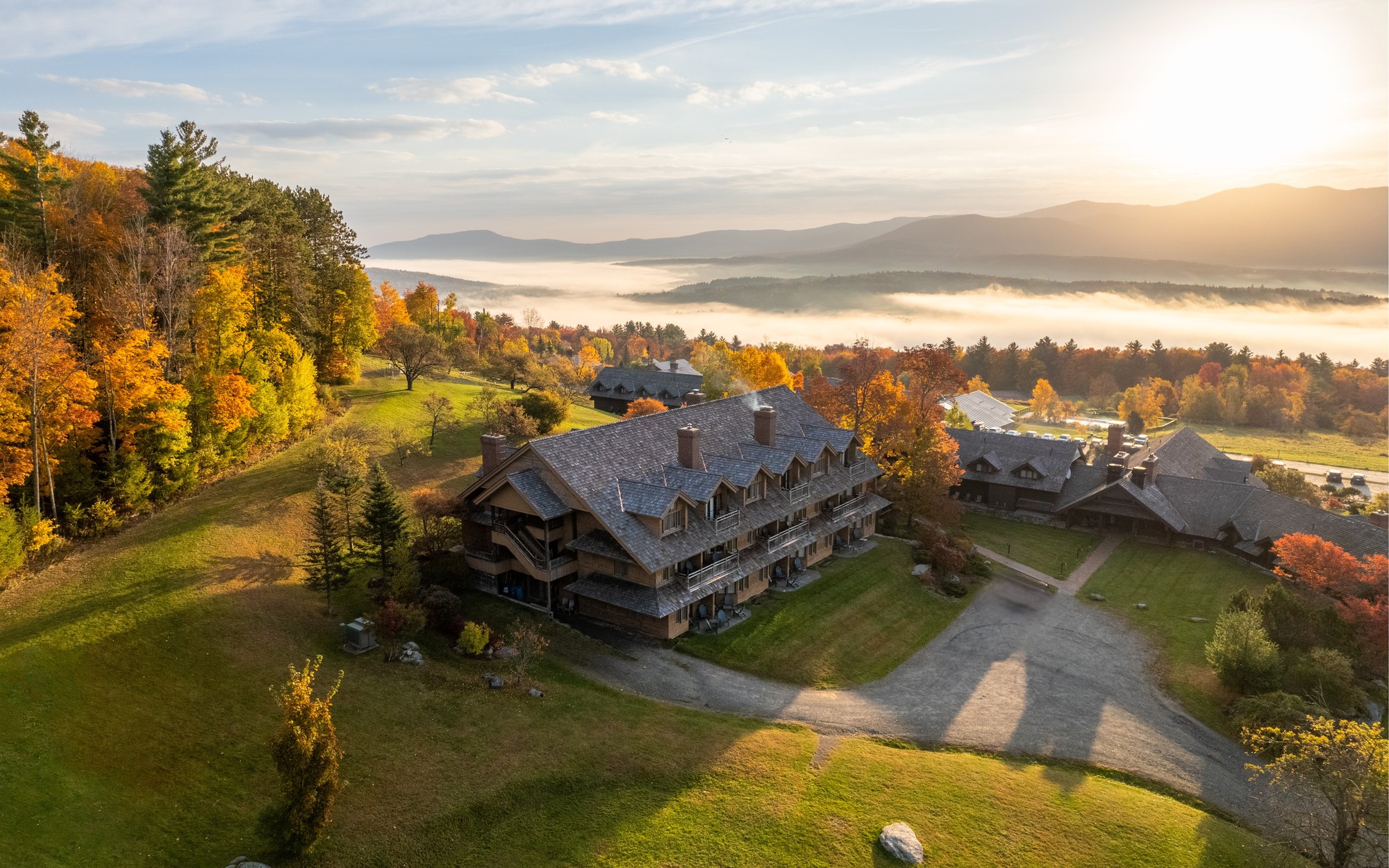
Morning fog fills the valley below the von Trapp Family Lodge & Resort in Stowe, Vt. (Photo: Chadwick Estey)
The von Trapp Family Lodge & Resort has received the Historic Hotels of America® Legendary Family Historic Hoteliers of the Year Award, announced October 15 at the 2026 Historic Hotels Annual Awards of Excellence Ceremony and Gala. The honor was conferred on the von Trapp family by Historic Hotels of America, an official program of the National Trust for Historic Preservation.
The lodge is one of more than 300 hotels and resorts in the United States recognized by Historic Hotels of America for preserving and maintaining its historic integrity, architecture, and ambiance.
“This recognition is especially meaningful to our family because it honors not only our history, but the generations of dedication that have kept our family’s legacy alive,” said Kristina von Trapp Frame, granddaughter of Maria and Georg von Trapp.
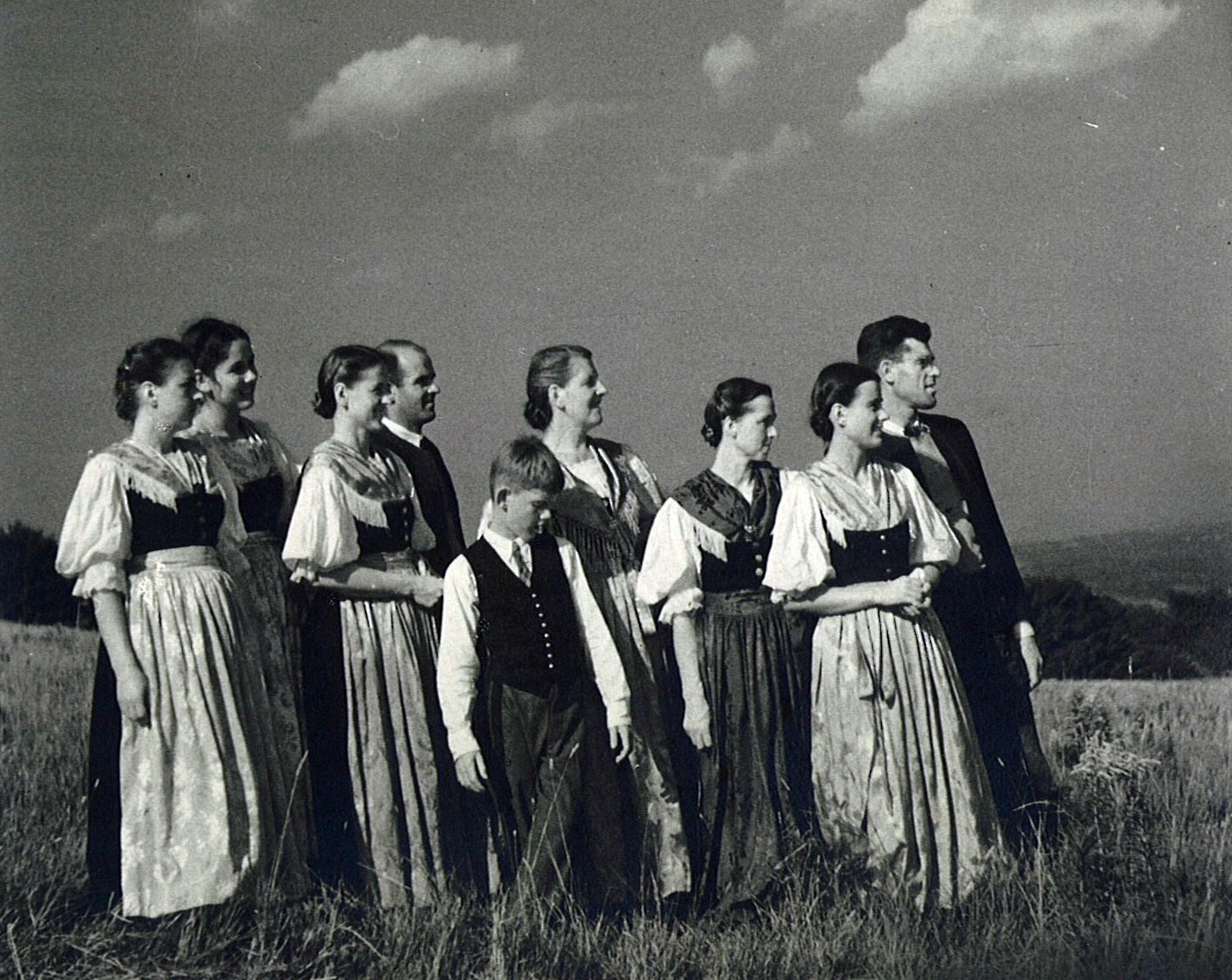
The Trapp Family Singers, who performed in more than 30 countries before and after making their home in Vermont. (Photo: von Trapp Family Lodge & Resort archive)
From Austria to Stowe
The family left Austria in 1938, months after its annexation by Nazi Germany, and spent the years that followed on the road as the Trapp Family Singers. The choir would eventually perform in more than 30 countries, and the family’s story became The Sound of Music.
In 1942 they settled in Stowe. They named their home Cor Unum, Latin for “one heart,” on a hillside looking across to the Worcester Range, and from 1945 to 1955 they ran the Trapp Family Music Camp nearby.
“What began with my grandparents’ dream of creating a home in the Vermont mountains has grown into a place where we have welcomed guests from around the world for more than 75 years,” Frame said.
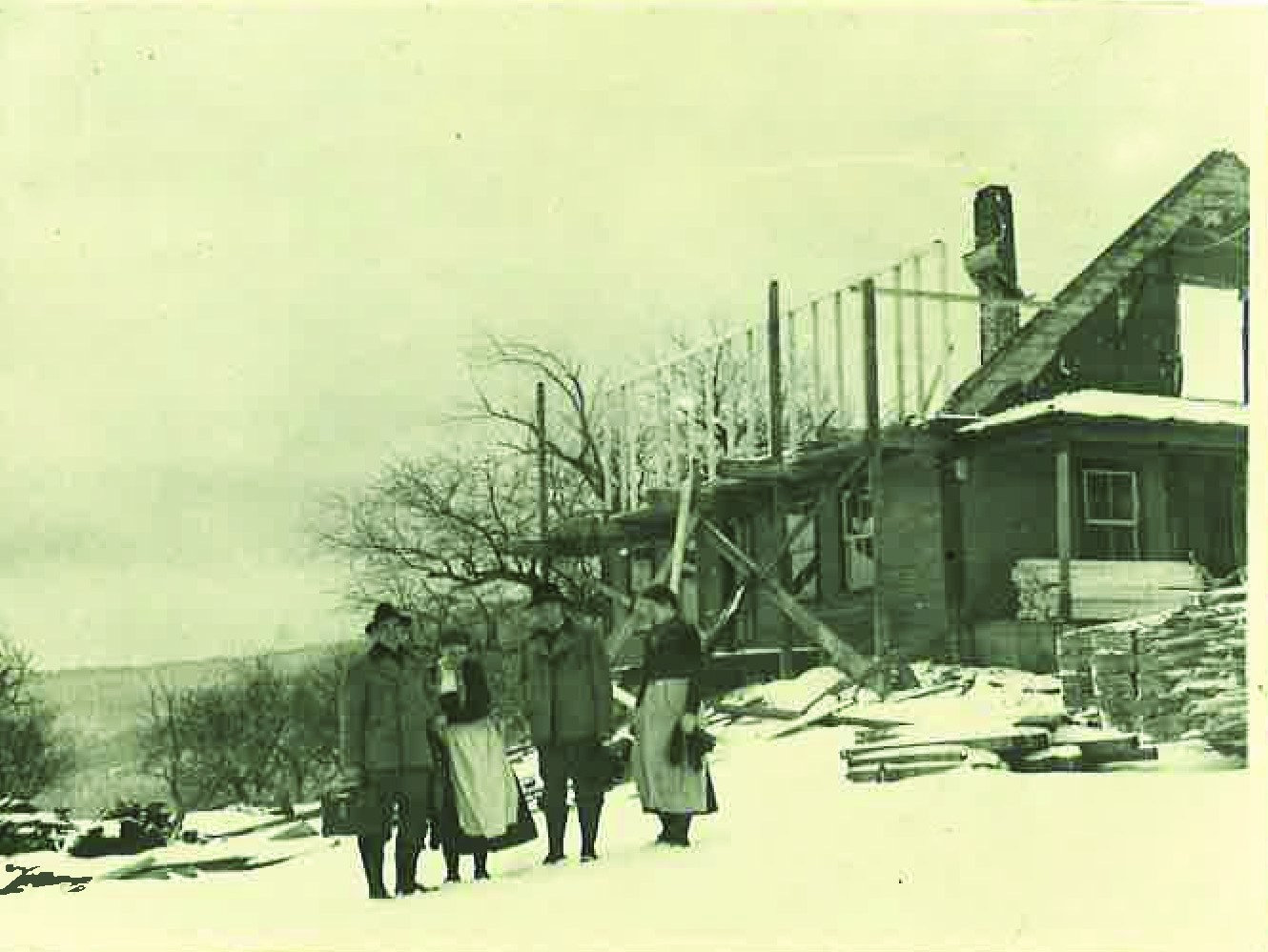
Building the family’s new lodge in Stowe, 1943. (Photo: von Trapp Family Lodge & Resort archive)
Opening the Doors in 1950
In 1950 the family opened their expanded home to guests as the Trapp Family Lodge. Maria ran it first. Her youngest son, Johannes, took over from her and turned a ski lodge into a year-round destination.
Three generations on, it is still family operated. The property covers 2,600 acres and pairs Austrian-inspired hospitality with outdoor recreation, a craft brewery that began making lager in 2010, farm-to-table dining, and wide-open mountain views.
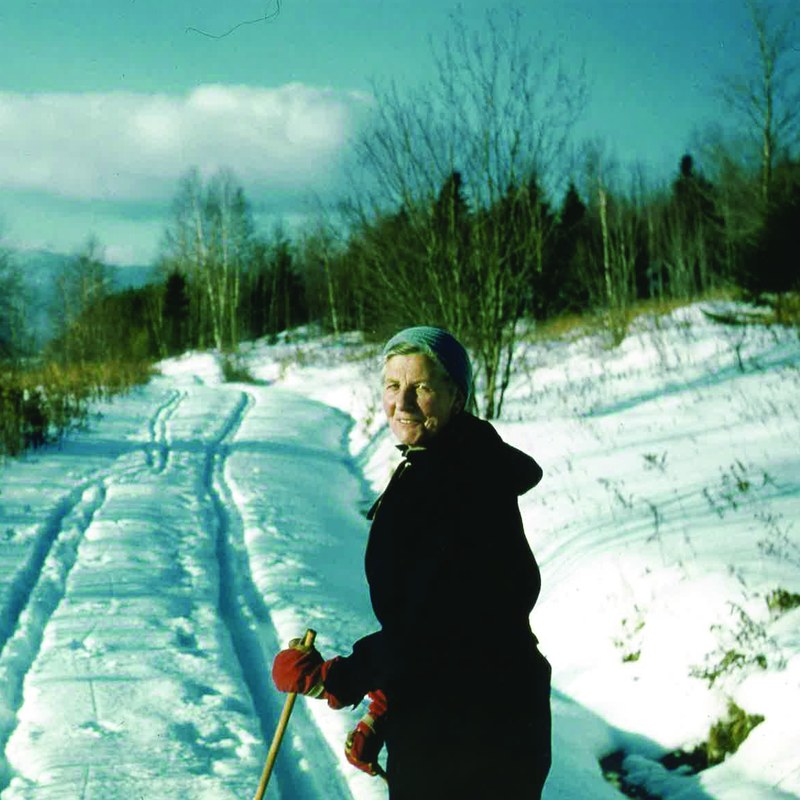
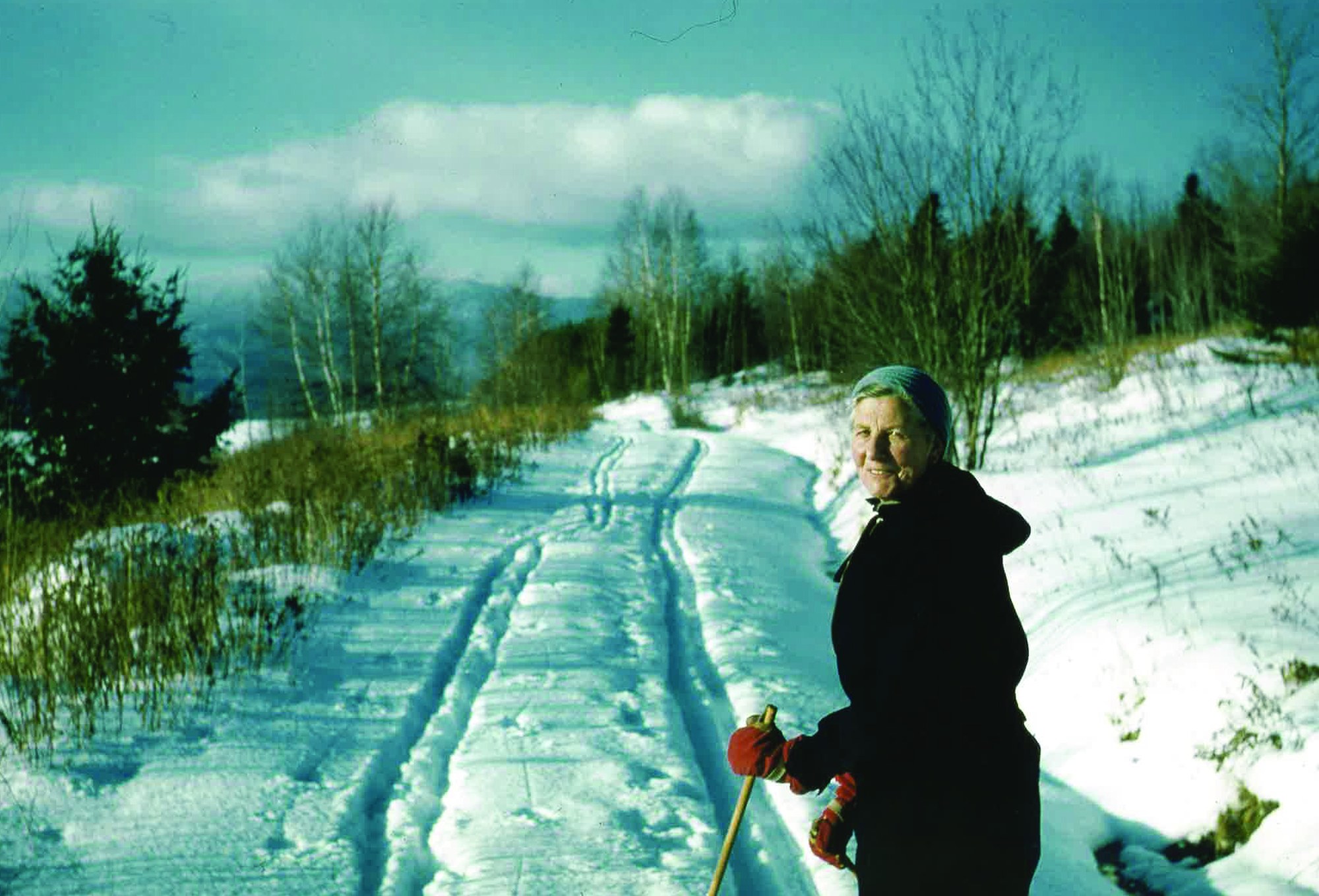
Maria von Trapp out on skis. (Photo: von Trapp Family Lodge & Resort archive)
Where American Cross-Country Skiing Got Its Start
Skiers know the place for something else. In 1968 Johannes opened a cross-country ski center at the lodge, the first in America.
The trails have stayed close to the sport ever since. Johannes helped revive the Stowe Derby in 1972, and in 2014 the lodge hosted U.S. Junior Nationals, with Johannes himself handing out the medals.
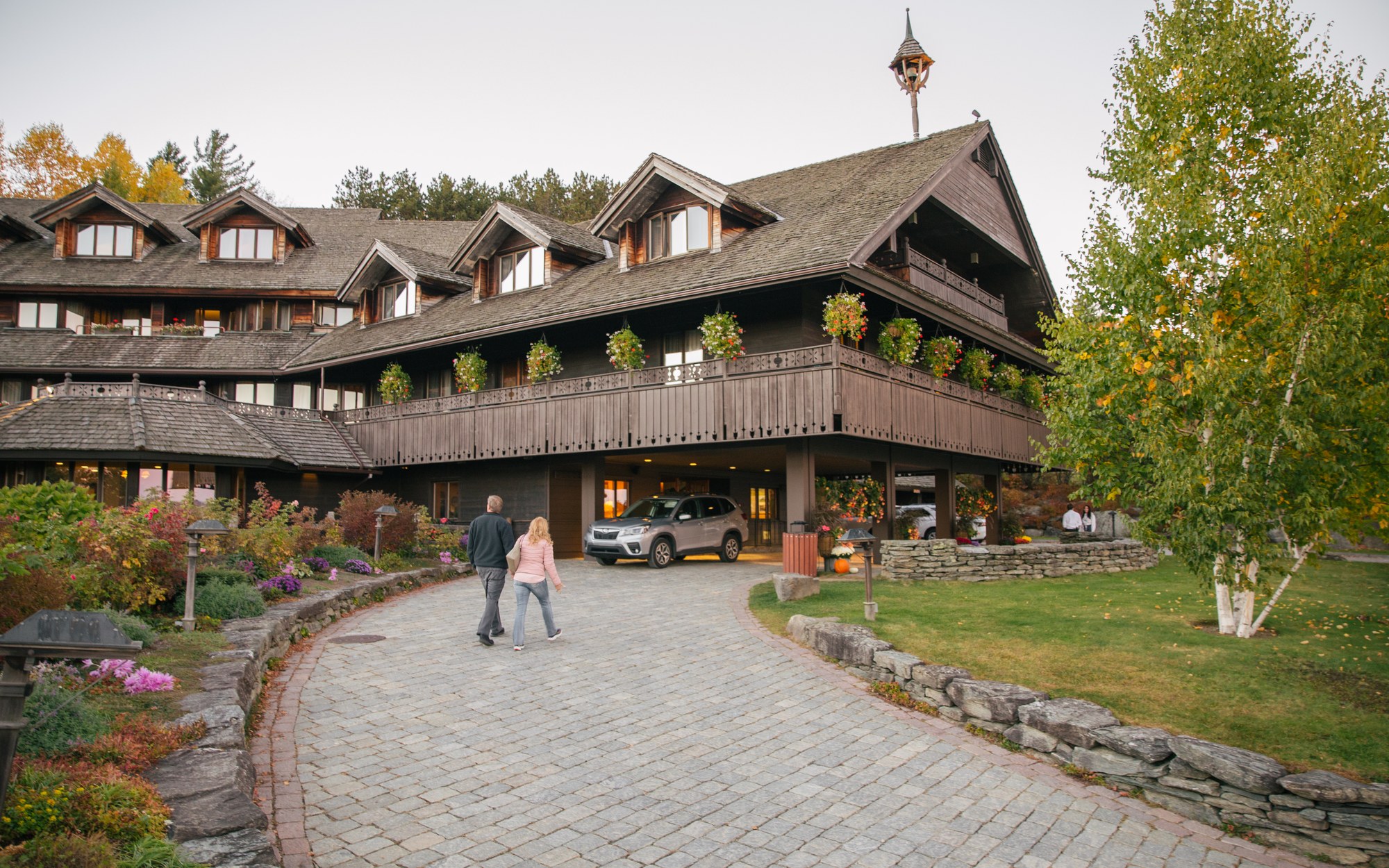
The main lodge, rebuilt in the Austrian style the family brought with them to Stowe. (Photo: Chadwick Estey)
Honored in Williamsburg
Through its Annual Awards of Excellence, Historic Hotels of America recognizes the historic hotels, hoteliers, and leadership practices that do the most to further the recognition, preservation, and celebration of these hotels and their histories. Eleven historic hotels and seven individuals were honored in 2026.
The winners were announced before an audience of owners, general managers, senior decision makers, and guests from many of the finest historic hotels in the world, at the Williamsburg Lodge, Autograph Collection (1939) in Williamsburg, Virginia. The ceremony closed the 2026 Historic Hotels Annual Conference.
“We are delighted to honor the von Trapp Family with this prestigious award. It was chosen from an exclusive group of nominees and considered for several categories. It stands among the finest hotels and hoteliers in the world,” said Lawrence Horwitz, Executive Vice President of Historic Hotels of America and Historic Hotels Worldwide. “We applaud the dedication and passion of the individuals working at these iconic and legendary historic hotels, the people who keep the stories alive from the past and make staying or celebrating special occasions at these historic hotels memorable experiences.”
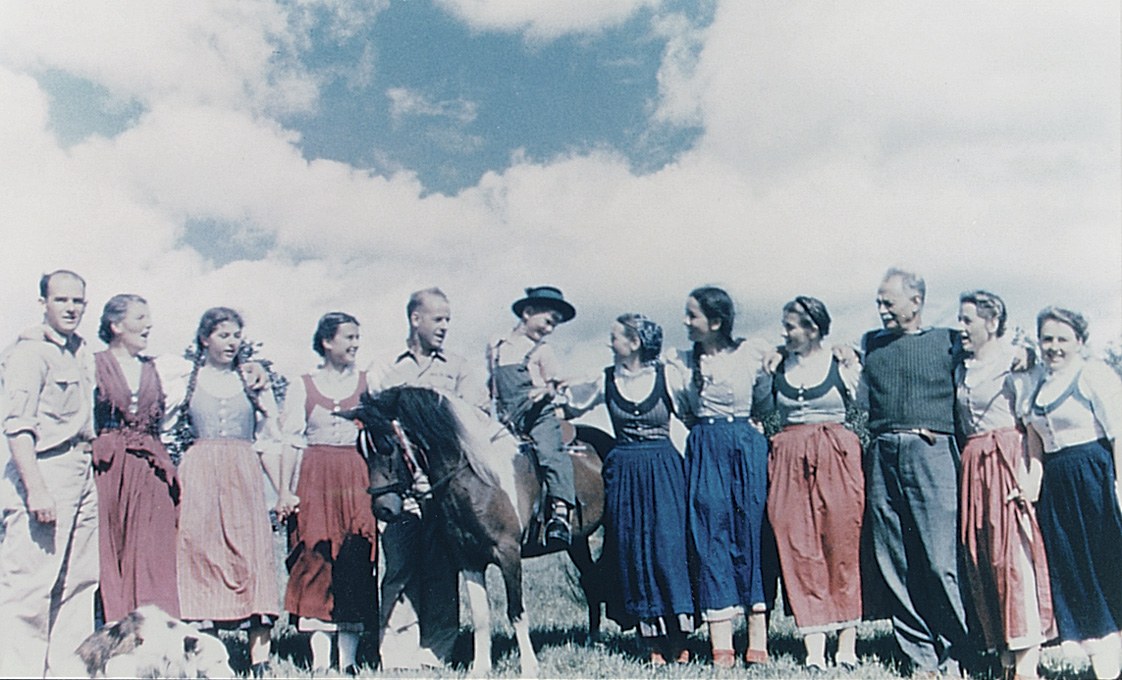
The von Trapp family lined up in a Stowe field, with Johannes on horseback. (Photo: von Trapp Family Lodge & Resort archive)
Carrying It Forward
“We are incredibly proud to carry on their traditions of warm hospitality, family, music, and a love of the outdoors,” Frame said. “Receiving the Legendary Family Historic Hoteliers of the Year Award is a wonderful tribute to our family, our dedicated employees, and the countless guests who have become part of our story.”
About von Trapp Family Lodge & Resort
Founded in 1950 by the von Trapp family, whose story inspired The Sound of Music, the von Trapp Family Lodge & Resort is a third-generation, family-operated, four-season destination in Stowe, Vermont. Situated on 2,600 acres, the property offers Austrian-inspired hospitality, outdoor recreation, a craft brewery, farm-to-table experiences, and breathtaking mountain views while preserving the family’s rich history and traditions. Learn more at vontrappresort.com.
About Historic Hotels of America®
Historic Hotels of America is the official program of the National Trust for Historic Preservation for recognizing and celebrating the finest historic hotels across the United States. The National Trust for Historic Preservation was chartered by the U.S. Congress in 1949 and is a private 501(c)(3) nonprofit organization. To be nominated and selected for membership, a hotel must be at least 50 years old; designated by the U.S. Secretary of the Interior as a National Historic Landmark or listed in or eligible for listing in the National Register of Historic Places; and recognized as having historical significance. More than 300 historic hotels from 41 states, the District of Columbia, the U.S. Virgin Islands, and Puerto Rico have been inducted. Learn more at HistoricHotels.org.
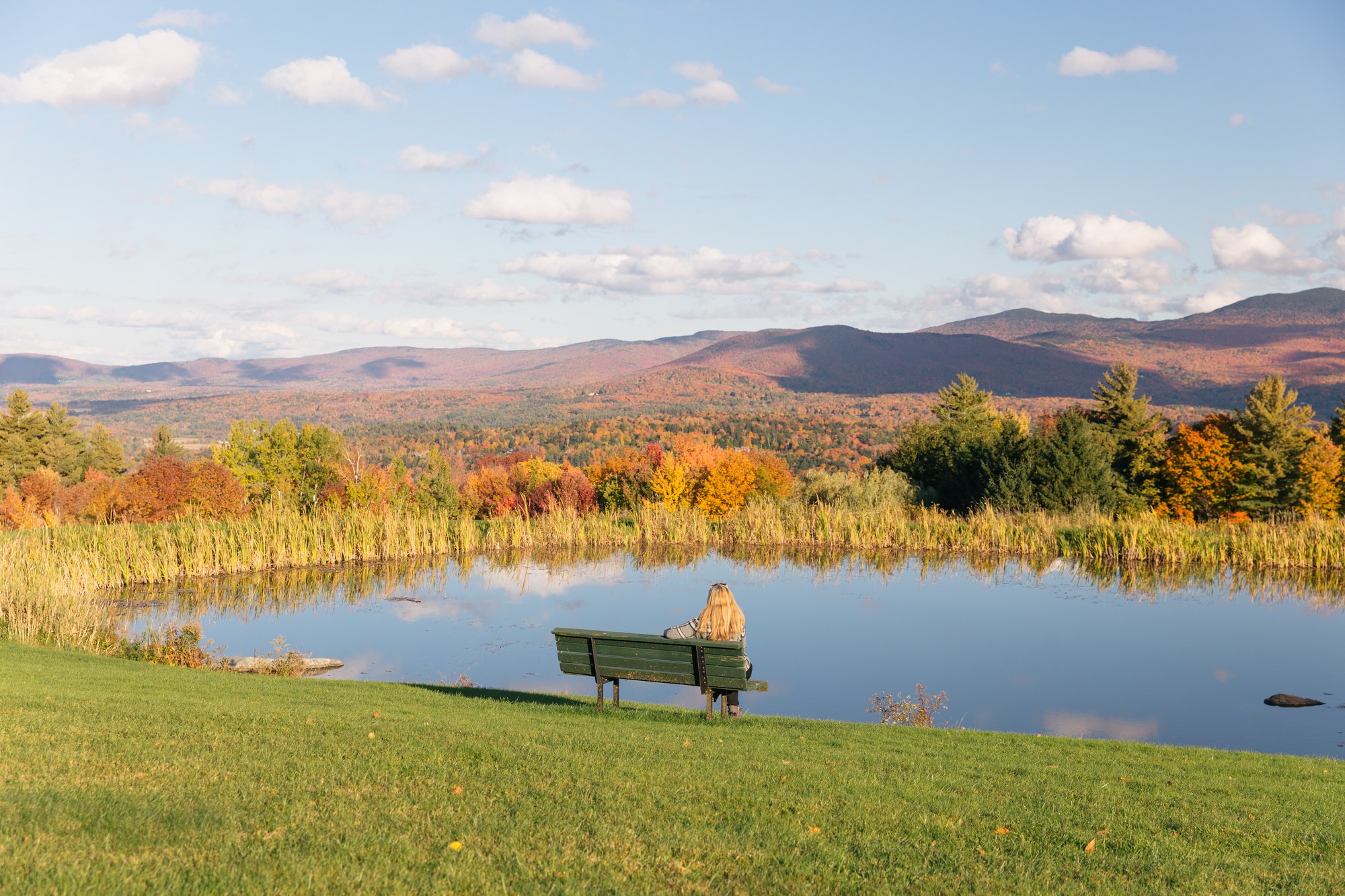
A guest takes in the view from the pond at the von Trapp Family Lodge & Resort. (Photo: Chadwick Estey)
For Ben Ogden, the strangest change since taking home two medals from Milano Cortina has not been that more people started recognizing him around Vermont.
He admits he is still adjusting to the newfound fame, but that part has mostly been fun. There have been school visits, community events and moments in Burlington restaurants when strangers stop by to say they watched him at the Olympics. After the winter Ogden had just put together, with two silver medals and a historic breakthrough for American men’s cross-country skiing, the attention made sense, even if it still felt a little surreal.
What was harder to make sense of was everything that came next, which has made the last few months a bit difficult to sum up neatly. While Ogden has spent the spring and early summer being celebrated for the best season of his career, he’s also been going through the first major injury setback of his life. One part of the experience has pulled him outward, back into the local Vermont ski community that helped shape him. The other has forced him inward, into the slower world of surgery, crutches, rehab exercises, and patience.
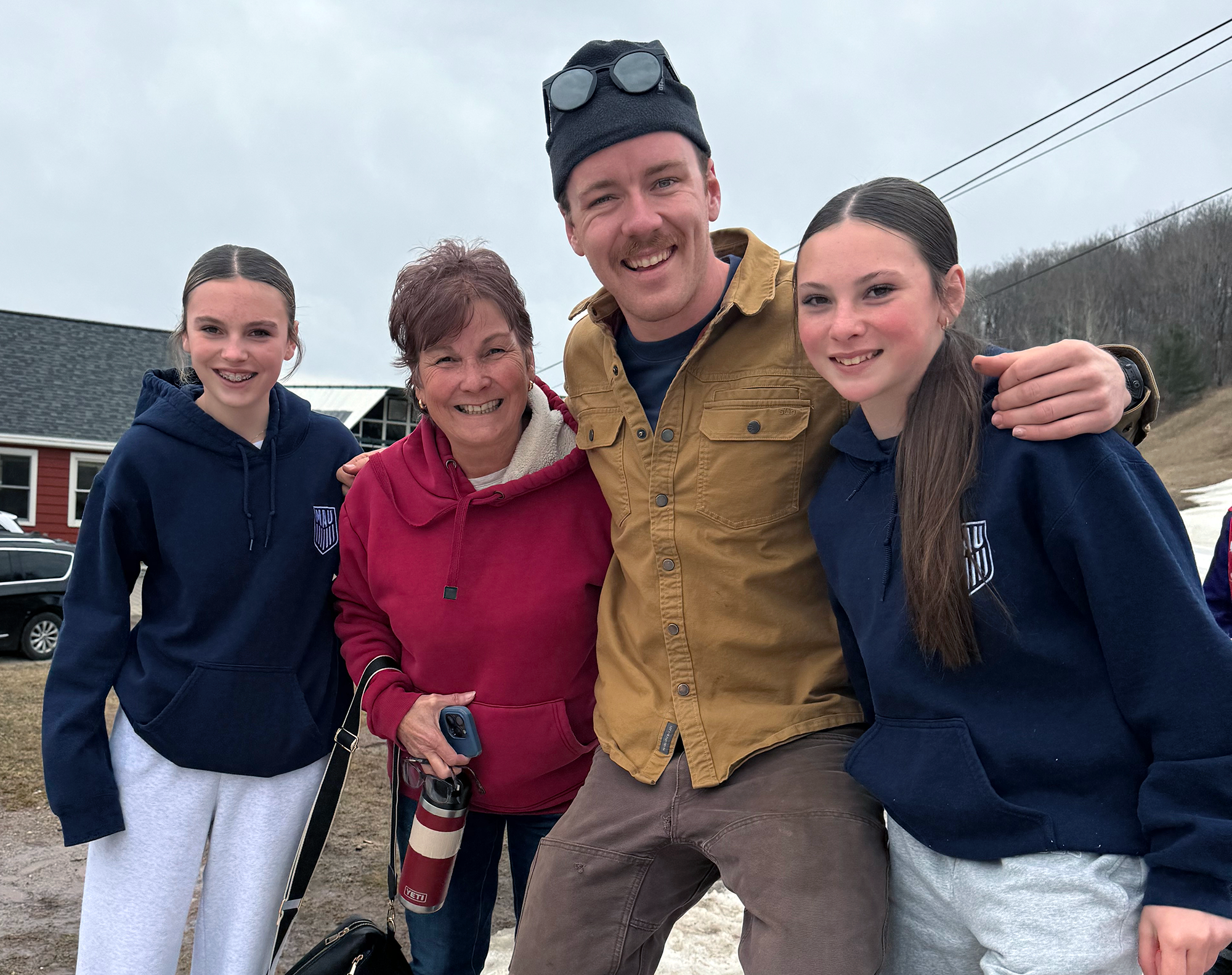
Ben Ogden posing for a photo with a few of his fans and the closest of friends of FasterSkier at the “Medals in the Mountains” community fundraiser held at Bromley Mountain Resort in Peru, Vermont, on April 12, 2026. (Photo: Jozefiak)
A New Kind of Attention
“It’s been different in some ways and similar in other ways,” Ogden said. “There are more people around Vermont who recognize me now, which is pretty crazy and fun. I’ve been invited to a lot of events, and gotten to go to a ton of schools, and just kind of been in the community a little bit more than normal.”
That part, he said, has been one of the real joys of the post-Olympic stretch. Ogden has always championed his identity as a product of the Vermont ski world, and the last few months have given him more chances to be present in it. Not just as a skier people watched on television, but as someone who could show up, talk to kids, say yes to local events and feel the reach of what happened in Italy.
“Outside of anything athletic related, it’s always a goal of mine to take my position and try to give back to the community as much as I can,” Ogden said. “There’s been a good amount of that, which has been great.”
In some ways, he said, life still feels mostly normal. It is still a Vermont summer. Burlington is still Burlington. Richmond is still close enough to feel like a small ski-world hub. But the medals have changed the way people interact with him, even in everyday places.
“It’s never tiring having people coming up to me and saying, ‘Oh, my son loves watching you,’ or, ‘We watched you this winter,’” Ogden said. “I love that, and it really makes me feel good. People are always, especially here in Vermont, just always so kind and thoughtful with their time and my time, so it’s never overwhelming.”
Still, there is a strange adjustment that comes with being recognized more often. Ogden laughed a little while describing it, not because it is a major burden, but because it is new enough to still catch him off guard. Sitting at a restaurant one time, he said two or three people came over to say they loved watching him race. Then he remembered, in a small way, that he is moving through the world a little differently now.
“You’re in the public eye a little bit more,” Ogden said. “I think you’re constantly reminded that people here in Vermont, especially, recognize me wherever I go. Again, I have no misgivings about it, but it’s hard to escape it a little bit.”
That visibility took on a more formal shape in May, when Ogden returned to UVM for commencement. He graduated from the school in 2022 with a mechanical engineering degree, and at first, he thought the university might just want him to be present or say a few words. Little did he know he would end up as the special guest speaker in front of nearly 3,700 graduates.
“I was like, ‘All right, yeah, sounds great,’” Ogden said. “And then it eventually got like, ‘Oh, you’re going to be the guest speaker,’ and I was like, ‘Whoa.’”
Ogden was characteristically candid with his explanation of how unfamiliar that setting felt. He was not answering questions in a mixed zone, talking through race tactics or explaining what it felt like to stand on an Olympic podium. He was sitting on a stage in front of graduates, faculty and families, waiting through the first part of the ceremony with his own speech still ahead of him.
“I haven’t really learned how to do public speaking properly,” Ogden laughed. “But it was really fun. The sense of relief was just staggering,” he said. “It felt so good. It felt like one of those moments where you feel like you can do anything after finishing something that scares you, and it’s just an immensely satisfying feeling. So it was fun, and I really appreciate UVM for reaching out and thinking of me and having me. That was a really fantastic honor.”
In his address, Ogden spoke about goals, but also about the people who make them possible. It was a fitting theme for an athlete whose Olympic winter was historic on paper, but communal in feeling. The medals were his, and in the team sprint, shared with Alaska’s Gus Schumacher, but Ogden has often framed the breakthrough as something larger than one person.
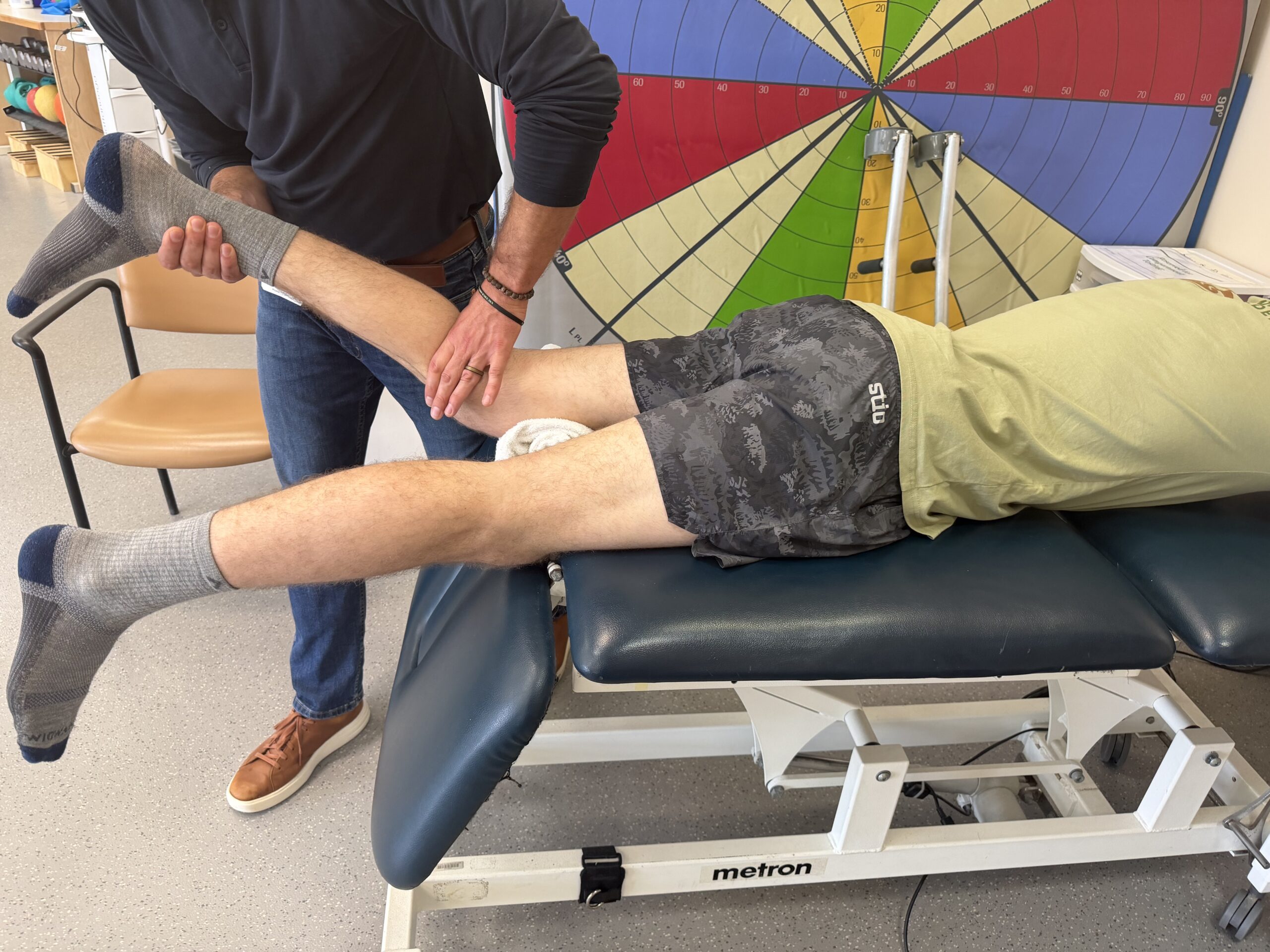
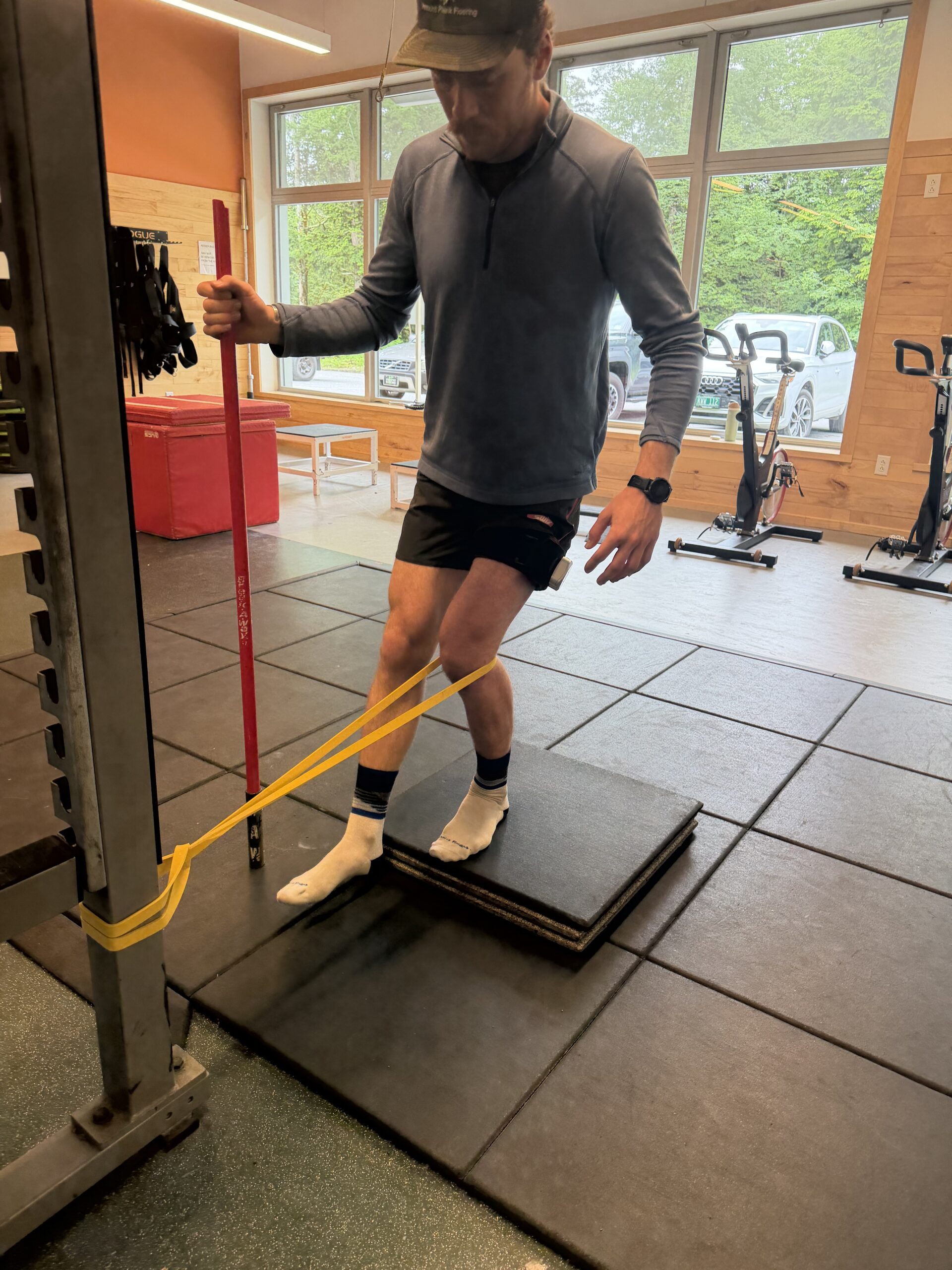
Ben Ogden getting some PT on his injured knee. (Photo: courtesy photo)
One Blow After Another
That same idea has followed him through the spring. The medals gave him a larger platform in the community, while the injury reminded him how much he still depends on one.
The knee injury happened on April 10, during what Ogden described as a typical day of spring training, until it wasn’t.
“It was a moment, but it wasn’t like I rode in the ambulance,” Ogden said. “At the time it didn’t really feel like anything bad. I was just spring skiing and doing a hockey stop, kind of, to slow down. I was going pretty fast on my cross-country skis, not denying that. But I just caught some slush and tweaked my knee.”
The first signs were not too alarming. Ogden knew he had tweaked something, but he stood up, tested it and finished skiing. The next morning, though, the knee was stiff enough that he eventually went in to have it checked out. According to the doctor, all the major ligaments were intact, and the hope was that the MRI would rule out a meniscus tear.
It did not.
“At first I was a little bit spooked, but I thought it was going to maybe be a week of slowing down or something,” Ogden said. “Then after I went to the guy, he was like, ‘Oh yeah, if it’s a meniscus tear, maybe it’ll be a month or two months.’ And then it ended up being a complete meniscus tear, so I had to have it repaired, which leveled up the situation even worse.”
Ogden had surgery at the end of April and spent six weeks fully non-weight-bearing on his left leg. When he spoke with FasterSkier in late June, he was about seven weeks removed from surgery and had started a weight-bearing progression, sometimes using one crutch and sometimes none. Even with that progress, it had been a hard adjustment.
“It was a little bit like I just got one blow after another for probably a week there,” Ogden said. “I was definitely pretty down, feeling pretty bummed, especially because it happened just doing something random. It so easily could have been avoided. But then again, stuff happens.”
He’d dealt with illness and little tweaks here and there before, as most endurance athletes do over the course of a career. But this was different. It was his first surgery and the first time he had to take a major step back from the sport because of an injury.
“On the mental side, it’s definitely hard,” Ogden said. “I think that an injury of this caliber would be hard for anybody mentally, just because being on crutches is incredibly frustrating, and it limits you so much. I won’t lie and say that wasn’t hard for me. Those weeks were brutal.”
The hardest part, Ogden said, was not just the crutches. It was the way the injury stripped away the pieces of daily life that usually make him feel like himself. He could still drive, because the injury was to his left knee, so he was not fully stuck in the house. He had physical therapy almost every day, a strong group of people around him, and enough structure to keep his days from feeling completely empty. But he could not move the way he wanted. He could not train the way he was used to training. He could not go outside with teammates and friends to just disappear into the rhythm of a long session.
“The two biggest things were just that I couldn’t really move, I couldn’t really do the things that I like to do, and I also couldn’t train,” Ogden said. “As a cross-country skier, or any type of athlete, really, not being able to do what you do, you quickly start to feel like you’re losing ground. That’s a really, really hard thing.”
It’s left him in a strange middle ground, where he has been through enough seasons, enough ups and downs, to understand that a few months do not define everything. But understanding that and feeling it every day are not the same thing.
“I feel like I’m at a point in my career where I’m better equipped to deal with that than I ever have been,” Ogden said. “But it’s still really hard to sit around.”
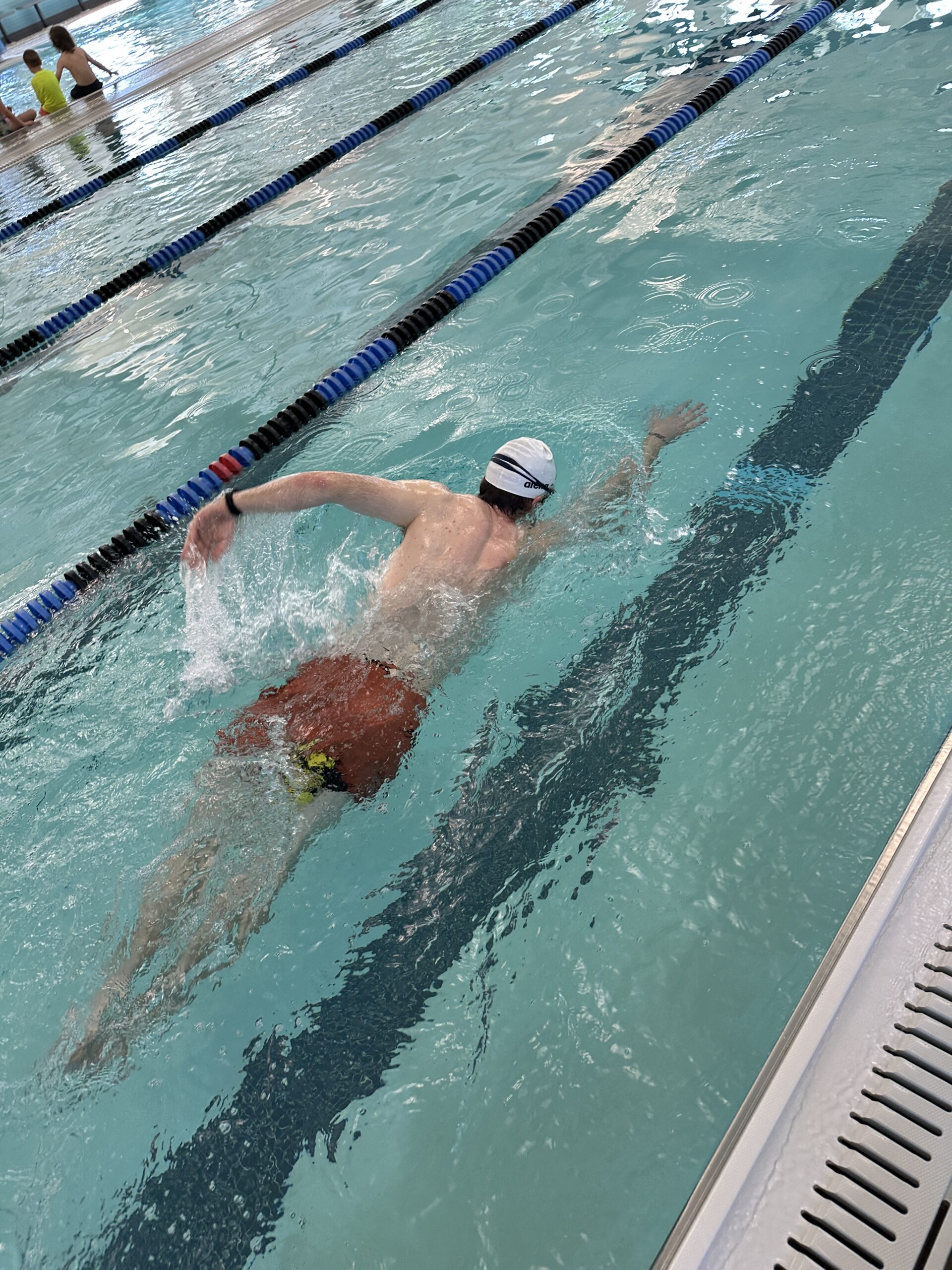
With the helpful coaching of friend, teammate and neighbor Julia Kern. Ogden took to the water to try to maintain fitness. (Photo: courtesy photo)
Finding a Way Through
One major comfort is that he has not had to figure it out all on his own. Ogden said the U.S. Ski Team’s medical system has been well prepared to handle a knee injury like his, in part because other disciplines under the U.S. Ski & Snowboard umbrella see them more often. Alpine skiing, in particular, has no shortage of knee injuries, and Ogden joked that compared to what some alpine athletes have endured, his injury is “junior varsity.”
That has not made the recovery easy by any means, but it has made the process clearer. From the start, he had a plan, a protocol and a timeline.
“I knew the timeline on day one,” Ogden said. “That sucked, because it was a major blow knowing how long I’d be out for, but now I’ve just sort of had to work with it.”
In some ways, he said, that has been easier than dealing with an illness, where there may be no clear date or progression. A meniscus repair brought bad news, but at least that bad news came with some kind of structure.
The training itself, for now, is limited and not always exciting, but Ogden has filled the space as best he can, with swimming, upper-body strength work and more time on the SkiErg than he would probably care to count.
“I’m able to fill my days with the training modes available to me,” Ogden said. “I still get frustrated. Sitting at the SkiErg, it’s great and it’s something to do, you get the heart rate up, it feels good, but it is just horrendously boring.”
That boredom has been one of the smaller but more persistent reminders of what he is missing. For Ogden, training has never just been about the work itself. It’s about being outside, sharing those hours with friends and teammates, and feeling connected to the sport in a way rehab cannot quite replace.
“So much of what motivates me as an athlete is being outside and enjoying training with friends and teammates and all that stuff,” Ogden said. “You kind of lose it all.”
Physical Therapy has a big part of Ogden’s life since his surgery. (Photo: courtesy photo)
The Next Step
Still, he has been able to see steady progression in his recovery. At the time of the interview, Ogden was starting to walk more normally again, though he said that process itself felt almost like something he had to relearn. His left leg had lost muscle and range of motion. Once walking felt solid, he expected to add more training options, including the spin bike, then outdoor biking, then eventually rollerskiing.
He hopes to be on snow at a normal time in November, though what “normal” means for racing fitness is still unclear. This season, he said, may become more of a “train into it” year. Rather than targeting early World Cup racing in November, he could end up building toward later points in the season, perhaps after the Tour de Ski and closer to the World Championships portion of the calendar.
“I’m still hopeful,” Ogden said. “It’s a blow for sure, and somewhere unlike any I’ve ever experienced, but I don’t necessarily think it has to be a complete loss. I think I’ll get through it.”
For now, he is trying not to get too far ahead of himself. The surgeon told him to view the recovery on something closer to a year-long scale, not because he cannot train for a year, but because returning fully to where he was in strength and aerobic fitness will take time. Ogden’s hope is to beat that timeline by a few months if possible and feel like himself again by late January, February or March. That would still leave room for something meaningful to come from the season.
“I’ve tried not to put a crazy amount of thought to it,” Ogden said. “I try to just focus on the present with this as much as I can. My goals are to do what I can, try to be patient, and try to feel like I get to that top race form, or something resembling it, at some point in the season.”
That might not sound like the goal of someone who just won two Olympic silver medals. But that is the reality of the spring Ogden has been given. The medals did not make him immune to bad luck. They did not make rehab move faster. They did not make the SkiErg more interesting.
They did, however, give him a new kind of perspective on what progress can look like.
Ogden said he always likes to come out of a season with something to be proud of, something that can carry energy into the next year. This time, that “something” might look different.
“I want to find that something this season,” Ogden said. “Whether or not that’s coming back from this injury a few months ahead of what the surgeon thought I could, or getting a top 10, getting a top 15, whatever, on the World Cup despite a major setback, that’s what I need to be reinvigorated for next year.”
In the meantime, the goals are much smaller. They are also more immediate, and maybe that is what makes them useful.
Rather than sit on the couch and think about missing a year of the thing he loves most, Ogden has tried to narrow his focus. First, he could think about walking again and getting away from the crutches. Then he could think about biking outside. To do that, he needs more range of motion in the knee, more quad strength and more consistency with the everyday work.
The scale has changed, but the mindset is familiar.
“There’s always the next thing,” Ogden said. “It’s the same in ski racing, honestly. It’s the same mindset that you have to take as an athlete. Obviously, I had to take 20 steps back, where instead of trying to get that podium or get that whatever, I’m just trying to get walking. But it’s the same thing, and you still feel good about it when you accomplish something.”
That may be the simplest way to understand Ogden’s first spring as an Olympic medalist. It has been a season of celebration, community and unexpected attention, but also one that has forced him to slow down, start over in small ways and rethink what progress looks like.
The medals are still there. So is the community that helped him reach them. And now, so is the work of getting back, one smaller goal at a time.
For Ogden, the next big thing does not need to be another Olympic podium just yet. For now, getting outside for a bike ride will do.
Help Support Our Coverage!
If you value the thoughtful work and access FasterSkier provides, please consider becoming a Voluntary Subscriber. Your support directly fuels our work to cover the people, places, and moments that make our sport special.
Saint Michael’s College, a Division III liberal arts institution located in Colchester, Vermont, is seeking a Head Nordic Ski Coach to lead its program. The successful candidate will oversee all aspects of a year-round program, from training and competition to recruiting and budget management, while building meaningful relationships with student-athletes and the broader campus community.
Position Details
Institution: Saint Michael’s College (Colchester, VT)
Status: Full-Time
Salary: $48,000–$54,000
Benefits: Health, dental, vision, employer-paid life and disability insurance, 401(k), generous paid time off, employee and dependent tuition benefits, parental leave, flexible spending accounts, discounted gym membership, paid volunteer time, and access to athletic facilities and the library
Responsibilities
Plan and conduct daily practices during the season
Coach athletes throughout competition
Manage year-round recruiting and maintain prospect database via ARMS software
Counsel student-athletes with a focus on personal development and academic excellence (minimum 3.0 GPA expected)
Collaborate with the Head Alpine Coach to supervise the Kelley Ski Center
Manage program budget, equipment, and travel planning
Serve as event manager for non-Championship segment competitions
Engage the team in life skills programming, community service, and department-wide initiatives
Attend monthly staff meetings and respond to inquiries from within and outside the College
Qualifications
Bachelor’s degree required
Minimum five seasons of coaching Nordic skiing at the collegiate, professional, Olympic, or club level (competitive experience at the collegiate, national, or Olympic level will count toward this requirement)
US Ski and Snowboard L100 coach’s certification required
Current CPR and Basic First Aid certifications
Must meet Saint Michael’s College driver eligibility requirements
Familiarity with Microsoft Office and ARMS recruiting database
Strong communication and problem-solving skills across a range of audiences
This article was made possible through the generous support of our voluntary subscribers who have helped put our Nat Herz on the ground at the Olympics. If you value coverage like this, please support FasterSkier with a voluntary subscription.
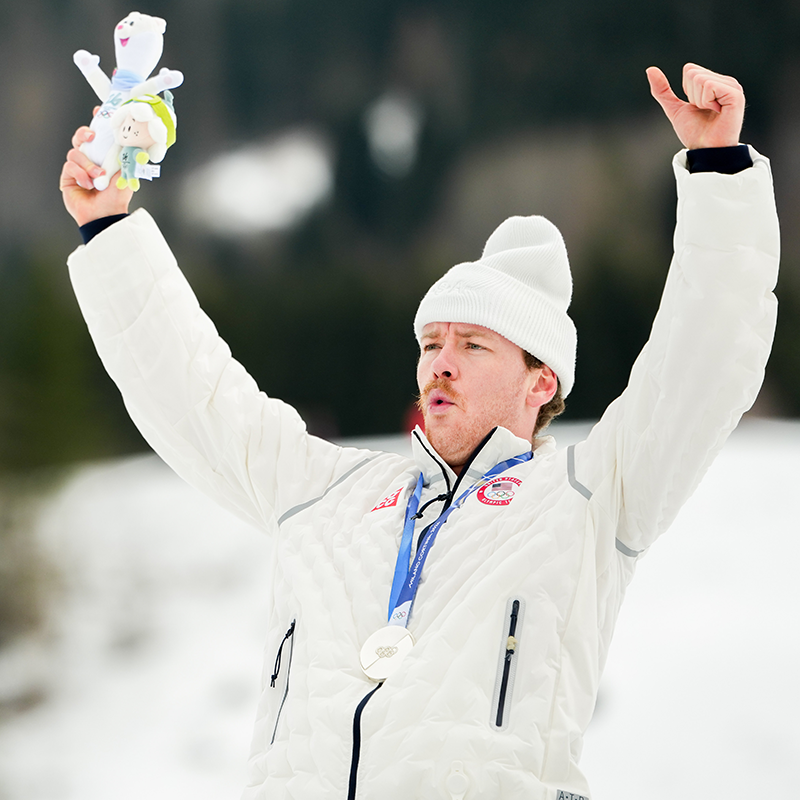
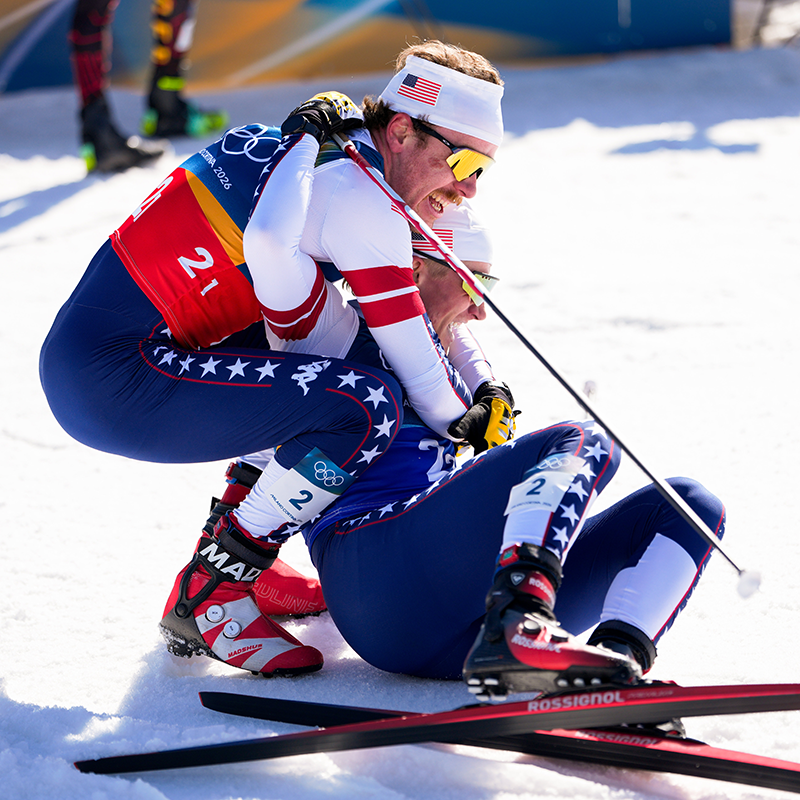
Ben Ogden, left, celebrates his Olympic silver medal in the team sprint with Gus Schumacher. (Davide Barbieri/Nordic Focus)
TESERO, ITALY — After Gus Schumacher and Ben Ogden on Wednesday won only the third-ever U.S. men’s medal in cross-country skiing at the Olympics, one of the biggest grins in the stadium was on the face of their teammate, JC Schoonmaker.
Schoonmaker, who lives in Anchorage and trains with Schumacher at the Alaska Pacific University Club Program, was basking in his teammates’ silver glow.
But he was also already starting to dream about when he and Schumacher return home to Alaska, medal in tow.
“There’s going to be so many juniors out skiing, just so hyped. And that’s the coolest part, I think,” Schoonmaker said.
Schoonmaker, 25, had his own standout performance at the Olympics, finishing eighth in the individual sprint last week. He said he was himself inspired by the 2018 gold claimed by Americans Kikkan Randall and Jessie Diggins — underscoring how medals can plant the seeds of future medals.
“I liked Nordic skiing,” Schoonmaker said. “But watching that, I was like, ‘I need this.’ That gave me such a drive.”
Eight years later, Schoonmaker’s teammates will be bringing their own hardware to their homes at far ends of the country — Schumacher to Alaska, and Ogden to Vermont.
And unlike Diggins, who is retiring at the end of the season, Ogden, 26, and Schumacher are still just getting started — with long careers, and likely more medals, still in front of them.
Schumacher has spoken openly about competing through the 2034 Olympics, which will take place on U.S. soil in Utah.
“You just see these guys, the energy building,” Erik Flora, Schumacher’s coach in Anchorage, said in an interview in Italy after Wednesday’s race. “You have this momentum now.”
Gus Schumacher and Ben Ogden (USA), (l-r) celebrate finally getting onto the Olympic podium together. (Photo: Barbieri/NordicFocus)
Both American medal winners were talented juniors, with Schumacher featured in news coverage at age 13. And early in their careers, each man found success in the events where they perhaps had more natural talent — Schumacher in longer distance races, and Ogden in shorter-distance sprints.
The team sprint event that the Americans medaled in Wednesday is unusual in the way it demands both the speed that’s Ogden’s strength, and the fitness that Schumacher is known for. The two athletes, and their coaches, said that the podium performance was a reflection of focused training that Schumacher and Ogden did in an effort to become more well-rounded.
The work Ogden and Schumacher did to put themselves in medal contention Wednesday didn’t happen overnight, though. It took years, with strong teammates pushing them and elite coaches to advise them — building on a foundation of years more of junior racing and playing on skis with their local clubs, said Matt Whitcomb, a longtime coach of the U.S. team.
“It’s just not about this last year’s training plan,” he said. “It’s about the very first coach, the support their parents put in, their siblings, the camaraderie there with their friends.”
Which is one of the things that Whitcomb and other team members say is great about winning an Olympic medal: the chance to share it with everyone who pitched in along the way.
Ogden, in an interview after his first medal, described feeling anxious as he worked with a press officer to draft an initial Instagram post: What if he forgot to mention someone?
“It’s so overwhelming to think of all the people you want to thank,” he said. “When the time comes, you’re just like, ‘Oh, my God. This is too many. It’s too hard.”
He added: “There were so many people that went into that success.”
Schumacher described feeling the same kind of gratitude as he crossed the finish line Wednesday — for a chance to share his elation with the many teammates, family members and others who were in Italy to witness it in person.
Flora, his coach, said that “maybe the best thing about this Olympics is all the people that it touches.”
“Everyone that’s been involved. Everyone that’s a fan of skiing, all the coaches that worked with all these people. All the athletes that are buddies and helped push — it’s just a very collective good feeling,” Flora said.
The Americans still have a few weeks of racing left on the international circuit after the Olympics close Sunday, capped with a final weekend of World Cup racing on home snow in Lake Placid, New York.
Then, after a chance to celebrate the medals and a few weeks away from training, it will be back to work — likely alongside newly inspired teammates.
Gus Schumacher and Ben Ogden (USA), (l-r) on the podium showing their silver medals to their fans after the Olympic Men’s Team Sprint. (Photo: Barbieri/NordicFocus)
“Everyone’s going to be so pumped and motivated and just firing, ready to go,” said Schoonmaker, the Olympian who trains with Schumacher in Anchorage. “It’s just going to be sick.”
Fed by that kind of energy, the Americans were eager to talk about how the results might look different, and better, by the next Games. Schumacher’s charge up the final hill, where he largely kept pace with Norwegian superstar Johannes Høsflot Klæbo — who’s undefeated in five races in Italy — had his coach’s head spinning.
“To see him put his head down and try to chase him, and he was holding his own, was unbelievable,” Flora said. “That he could fight with Klæbo in the future? I think so.”
Flora added: “I think he’s just going to get better. We’re just starting to see what the potential is.”
Help Support Our Olympic Coverage!
FasterSkier will have our own Nat Herz on the ground at the Olympics, which, to be honest, is a very big financial lift for us. If you value the thoughtful work and access FasterSkier provides at championships like this one, please consider becoming a Voluntary Subscriber. Your support directly fuels the work we do to cover the people, places, and moments that make our sport special.
The Craftsbury Outdoor Center is hiring for two coaching roles within its Green Racing Project (GRP), a year‑round elite Nordic ski program supporting post‑collegiate athletes pursuing national and international competition. These positions are in‑person roles based in Craftsbury Common, Vermont and are integral to the daily training, development, and competitive success of GRP athletes.
Head Ski Coach – Green Racing Project
The Head Ski Coach is responsible for leading the GRP ski program and overseeing all aspects of ski training and athlete development. This role works collaboratively with other GRP coaches and Craftsbury Outdoor Center staff to design and implement a comprehensive, high‑performance training program while fostering a healthy, sustainable, and athlete‑centered team culture.
Primary Responsibilities
Design and implement annual and daily training plans for GRP ski athletes
Lead on‑snow and dryland training sessions year‑round
Guide athlete development with a focus on long‑term performance and well‑being
Collaborate closely with other GRP coaches, support staff, and leadership
Plan and support domestic and international training camps and competitions
Uphold and model the mission, values, and community responsibilities of the Craftsbury Outdoor Center
Desired Qualifications
Significant experience coaching Nordic skiing at a competitive or elite level
Strong technical knowledge of training theory and athlete development
Excellent communication and organizational skills
Ability to work effectively as part of a collaborative coaching team
Commitment to sustainable living, community engagement, and shared responsibility
Assistant Ski Coach – Green Racing Project
The Assistant Ski Coach supports the Head Ski Coach in delivering daily training and competition support for GRP athletes. This role is hands‑on and collaborative, contributing to training sessions, athlete monitoring, and program logistics while gaining experience within a high‑level, professional Nordic ski program.
Primary Responsibilities
Assist with on‑snow and dryland training sessions
Support athlete monitoring, feedback, and communication
Help with training logistics, travel, and competition support
Contribute positively to team culture and daily program operations
Participate in the broader work and community life of the Craftsbury Outdoor Center
Desired Qualifications
Experience competing in or coaching Nordic skiing
Strong interpersonal and communication skills
Willingness to learn and work collaboratively in a high‑performance environment
Ability to take initiative and manage responsibilities independently
Alignment with GRP and Craftsbury Outdoor Center values
Compensation & Details
Position details including compensation, benefits, schedule, and start date vary by role and are outlined in the full job postings.
How to Apply
Please review the full job descriptions for full details and submit your application through the appropriate link below:
The Green Racing Project is a year‑round elite training program based at the Craftsbury Outdoor Center. GRP supports post‑collegiate athletes in Nordic skiing, biathlon, rowing and running while emphasizing excellence, sustainability, teamwork, and active participation in a mission‑driven community.
The hills above Moretown are the kind that teach you to move without thinking about it: long grades through maple and birch, a tangle of dirt roads, a thousand sneaky rollers perfect for running shoes or a classic stride. From the valley floor, you can see Sugarbush and Mad River Glen, their lifts still in October and their trails crisscrossed by hikers who’ll be skiers in a few short weeks. This is the terrain that shaped Tabor Greenberg, and it’s never been far from him. He grew up here, learned to love motion here, and now—a few towns and a handful of highway exits away—wears UVM green while settling into his sophomore year and his first season as a member of the U.S. Cross-Country Ski Team.
He smiles about the small details—like the tiny airfield that doubles as the local ski area where he first wore Nordic skis—and shrugs at the big ones, the ones that make headlines. He’s Vermont in that way: spare with words, long on work. “I’ve been skiing my whole life,” he says, recalling the first slip-on-your-boots skis and the BKL weekends that threaded winters together.
Tabor Greenberg at the 2024 Junior Nationals in Lake Placid, New York. (Photo: courtesy of Olympic Regional Development Authority / Phillip Belena)
His dad was an alpine racer who transitioned to Nordic skiing after sustaining injuries; the family kept everyone in motion, engaging in hiking and running in the summer, as well as soccer and lacrosse.
By seventh grade, Greenberg had joined GMVS, stepping into a team culture that combined high standards with a sense of play. Older athletes, such as Brian Bushy and Josh Valentine, became the big brothers who made training feel like a privilege rather than a chore. “Their enthusiasm always made the workouts more fun,” he says. “Seeing them go to U18s in Estonia or Youth Olympics, I didn’t even know what those things were at first. I just saw them going to Europe to do these bigger races and thought, ‘That seems fun.’ I want to do that.”
That is as close to a “secret formula” as you’ll get from him. There’s no magic threshold session in his story; it’s a years-long accumulation of good days outside with people he liked being around. “Most of my motivation comes from that,” he says of the lifestyle—then adds, almost apologetically, that he’s built the discipline to do the work even when motivation lags.
A tough first year—and a reset
College arrived with promise and some hard lessons. Greenberg’s first season at UVM was marred by extended illness. He red-shirted, raced sparingly, and spent too many days horizontal. “I struggled being sick all season,” he says. “So this year it’s mainly been just trying to stay healthy—good recovery, sleeping a lot, staying hydrated, having a good connection to doctors if something does come up.”
UVM’s Head Coach, Patrick Weaver, doesn’t sugarcoat it. “Tabor’s first year was undoubtedly a tough transition, as he came in dealing with an extended illness that he struggled with throughout the year, so he essentially ended up not racing for UVM at all,” Weaver says. “This year he has come back in great shape and stayed healthy so far, so that’s been great—to see what he can do as a healthy person.”
Weaver sees something else, too: a young athlete who changes the room simply by how he works. “He works extremely hard, and it’s his work ethic that’s been a valuable asset to the team,” says Weaver. “Leading by example like this helps bring up the overall level of the team.”
And there’s the local angle that still means something in Burlington. “Having a Vermonter on the team is super important for the program. Having a fast Vermonter on the team is even better,” Weaver says. “We felt very fortunate that Tabor wanted to stay in Vermont and represent UVM and the state. This is something he’s super proud of, which is really fun to see.”
Engineering the comeback
Ask Greenberg about academics, and he answers as matter-of-factly as he does about training. He’s a mechanical engineering major, plotting a five-year path that allows the academic load to align with travel and race blocks. “I can do 12 credits a semester instead of 15 or 16 for the most part,” he explains. “It should ease the load a bit… hopefully manageable while traveling.”
If the men’s U.S. Ski Team has a surprising number of engineers, Greenberg doesn’t read much into it. The field simply makes sense to him, a way to invest time in “quality concepts” while keeping a door open for life after skiing. But it’s easy to see the overlap when he talks technique: leaning farther into the hill in both V1 and V2, getting the arms forward, experimenting with double-pole positions, learning to find “forward without actually getting the feet up,” and keeping his shoulders relaxed while playing with different hip-drive patterns. He’s not obsessing over new lifts in the weight room—”not really,” he says when asked about special gym work—so much as building a better mental model and then holding those shapes during long skis.
And there’s a plan behind the plan. Greenberg still consults with longtime coach Colin Rogers while working daily with Weaver. “Especially when I’m not at school, my plan is I kind of run it by both Colin and Patrick,” he says. “Going into races, I’ll make a plan that makes sense to both of them.” The dual-mentorship model mirrors the arc of other Vermonters who’ve succeeded after leaving UVM, and it’s part of why Weaver talks about schedules and guardrails. The U.S. Ski Team opens doors—camps, resources, broader input—but also adds travel and volume. “With all the other opportunities available, it is challenging to create a schedule that ensures a student-athlete does not overextend themselves,” Weaver says. “We’re working on it to ensure he can excel academically and still maintain a high level of performance in skiing.”
The day the D Team call came
The call confirming his spot on the U.S. Ski Team didn’t arrive with a trumpet solo; it found Greenberg on a beach in Mexico. He was decompressing after a winter that had felt like a dead end. “I was pretty unhappy with skiing at the moment,” he admits. Then teammate Murphy Kimball texted to say his points might have slipped him under the sub-400 distance-racing criterion. “Later, Kristen [Bourne] called me,” Greenberg says. He already knew by then, and his reaction was classic Tabor—pleased but unsentimental. “It’s cool to be on the national team, but it’s not really, like, a game-changer. On the D Team, now you race World Cups and see there is still work to do.”
That pragmatism tracks with how the spot was earned. Last year, sick more often than healthy, he raced only eight or nine times. But when he did line up healthy, he made it count—most notably at the Cable SuperTour 20k classic mass start, where he finished fifth in a front group on a good points day. Those points, stacked with a handful of other starts, slid him inside the threshold.
U.S. Head Coach Matt Whitcomb sees a different kind of threshold in Greenberg, one that’s about temperament and fit. “This kid, he’s a really special kid,” Whitcomb says. “He takes a little bit to get to know. He’s a little quiet, but what I learned from his coaches is that he is always listening. You might be having a meeting with him, and he’s kind of looking off to the side a little bit, and you think you’ve lost him. And then there’s this little pause, and he’ll come right back at you with just the most on-point question.” Whitcomb calls that attentiveness a key to belonging on a team where the banter never stops. “Our guys rip on each other all day—in the right way, the loving way—and I see Tabor instantly plugging into the men’s team already.”
It’s not just the ear; it’s the engine. Whitcomb points to Greenberg’s anchor leg on the 2023 U18 relay—”he came from way behind and caught Norway in the stadium”—as a marker of racecraft and mindset. “Tabor’s that kind of competitor,” Whitcomb says. “He’s a hunter, both literally and figuratively.” The literal part showed up at the team’s Utah camp; the figurative part is the one that matters in March.
Vermont pride, Vermont places
Greenberg didn’t choose UVM because he was unaware of other options available. He did the homework, looked West, and still chose home. “Growing up in Vermont, we’d go to an Eastern Cup that overlapped with Carnival, and it was always the UVM guys winning,” he says. “When I was younger, I was like, these guys are the best there is then… I really enjoyed the venues here more than out West. I kind of just had a gut feeling this was the right place.”
Ask him where he’d send an out-of-state friend to understand his Vermont, and he has a ready list: Trapp Family Lodge when the snow is deep; Mad River Glen on a powder day; the Long Trail from Lincoln Gap to Appalachian Gap and on to Waterbury when the leaves go red and gold. He’s not performing here; this is simply the life that restores him. Between classes and training blocks, he’ll thread in a bit of fishing, the occasional bow-hunting session if the calendar allows. In Utah, he saw a pair of bucks at 250 yards and later walked to within 80 before choosing—wisely—not to take the shot; he hadn’t practiced enough. “It’s definitely peaceful,” he says of being in the woods, then stops short of over-claiming the performance benefits. “I don’t know if there’s that much of a correlation.”
Maybe he doesn’t have to draw the line. Anyone who’s tried to race well knows that a happy athlete is a better one, and his habits read like a local’s guide to contentment: early bedtimes, long skis, ridge-line hikes, a few casts before dinner.
Goals, set quietly
Greenberg’s target list for the season is crisp: Junior Worlds, NCAAs in Bozeman, and—if the form and selection break right—a World Cup start in Lake Placid. “Same game plan no matter what,” he says. “Ski fast.” The sequencing matters: peak well for Nationals and you put your Junior Worlds case on solid footing; hold fitness and you can ride the rhythm into March.
For now, he trains with the UVM group and will tweak the plan as winter approaches. “Right now it’s pretty similar to everyone else,” he says. “In the winter, I’ll try to work in a few bigger weeks or blocks that’ll help me get ready for that March racing period.” If the path sounds simple, that’s the point. When you’ve just dug yourself out of a year of being sick, you don’t complicate success.
What coaches see
Whitcomb’s portrait is of a listener who processes information quickly and competes more intensely. “Thoughtful,” “very funny,” “great technician,” “great competitor”—words that land differently because they’re delivered with the caution of a coach who doesn’t over-praise. Whitcomb is equally quick to underscore the growth curve ahead. Greenberg absorbed a challenging year, he says, and handled the reset maturely. “He was very smart in his buildup this year, and he’s brought himself back to a very high quality level of training,“ Whitcomb says. “It’s going to be a fun career to watch.”
The thing about top-30s
The U.S. men’s program now has a new normal—medals and crystal-globe chases—but Whitcomb is adamant that the sport’s middle rungs still matter. A first World Cup top-30 for a young American is still a scene, a bus-wide celebration. “When a guy like Tabor or Lucas Wilmot gets their first top-30, it will be just as exciting for the team as someone, on that same day, on the podium,“ Whitcomb says. That’s the context for Greenberg’s ambitions: real, reachable steps on a ladder that’s higher than it used to be.
The Vermont through-line
It’s not nostalgia to suggest that place still matters in American skiing; it’s simply observation. Vermont has sent a steady stream of athletes into the national team pipeline, and UVM is a key contributor to that current. Greenberg is another link in that chain, one who still resembles the kid who ran those ridges, played those pickup games, followed older teammates into bigger arenas, and filled in the knowledge with discipline.
Then there’s the image that may say more about him than the résumé line: a kid in Utah walking a buck into 80 yards and passing on the shot because the practice wasn’t there yet. It’s not caution; it’s calibration. It’s someone who knows the difference between wanting and being ready.
If you’re looking for a template, that might be it. A Vermont upbringing that made movement a joyful experience. A high school program that made hard work fun. A first college season that reminded him that things can go sideways. A reset that prioritized health and attention to detail. Two coaches who trade notes and coordinate calendars so a student-athlete can keep a broader life in balance. And an athlete who understands he needs to put in lots of hard work to be ready to take the shot when it presents itself.
Love Stories Like This? Help Keep Them Coming.
Feature interviews like this one take time, access, and care to produce. If you value thoughtful storytelling and independent ski journalism, please consider becoming a Voluntary Subscriber. Your support directly fuels the work we do to cover the people, places, and moments that make our sport special.
The first time you meet Patrick Weaver, you might not realize you’re talking to one of the most quietly influential coaches in American skiing. There’s no bravado, no self-promotion. Just an easy Vermont calm — a man who measures his words the same way his athletes measure their training: carefully, purposefully, with feel.
On a fall morning, the UVM Nordic team threads through the mist at the Craftsbury Outdoor Center, the quiet hum of rollerskis against asphalt echoing in the distance. Weaver watches from the side, hands in his jacket pockets, hat pulled low. He doesn’t bark instructions. He doesn’t need to. The rhythm of his teams speaks for itself.
Wilmington, Vermont’s Sophomore Luke Rizio. (Photo: Philip Belena/EISA)
“I always say it’s not the individuals that make the team fast — it’s the team that makes the individuals fast,” he says. “Once they believe that, the motivation takes care of itself.”
For nearly twenty years, that philosophy has shaped the University of Vermont into one of the most respected programs in NCAA skiing — not through hype or heavy recruiting, but through a culture of trust, humility, and balance.
Lessons in Motion
Weaver’s path to coaching wasn’t linear. It’s more like a relay through decades of ski mentors who left their fingerprints on his philosophy.
“I never had one coach through my whole career,” he says. “There were a lot of influential people — high school, Stratton, college, the national team. I just learned to take things from each of them.”
He spent a post-graduate year at Stratton Mountain School under Sverre Caldwell before skiing for Cory Schwartz at UNH — a relationship that would define his sense of what a team could feel like.
“Cory was probably the most influential,” he says. “The way he ran that program — it was a family. I took that with me when I came to UVM.”
After college, Weaver worked under a rotating cast of national and international coaches: Gordon Lange, Christer Skog, Sten Fjeldheim, Torbjørn Karlsen. Each brought a different rhythm to training. The mosaic of ideas shaped the adaptable style he’s known for today.
“There’s not one way to coach,” Weaver says. “And because of my background, I’m not a ‘my way or the highway’ coach. I’ve seen too many ways that work.”
Patrick Weaver racing in the 15 k Classic at the 2002 Olympics in Soldier Hollow, Utah. Weaver finished in 16th place. (Photo: UNH Ski Team)
The Season He Cut His Hours
In 2002, the year of his second Olympics, Weaver did something radical. He trained less.
After years of logging 800-plus-hour seasons, he realized the grind was killing his joy. So he cut down to 600 hours — just one session a day, mornings only.
“I was kind of burned out,” he says. “I’d dread the afternoon workouts. I loved the sport, but I wasn’t feeling good anymore. When I stopped doing the PM sessions, I felt better — I started looking forward to training again.”
It’s a story he still tells his athletes, not as dogma but as permission. Permission to rest. Permission to find balance.
“I’m never afraid to tell an athlete to train less,” he says. “Sometimes that’s the thing that gets them going faster.”
That season became a turning point — not just in Weaver’s career, but in his view of what performance really means. It was the seed of a coaching style rooted not in metrics, but in intuition.
Ben Ogden celebrates after sweeping the 2022 NCAA Championships in Midway, Utah. Ogden became 1 of only 4 skiers (alongside US Ski Team teammates Novie McCabe and Sophia Laukli) to win an NCAA Championship and represent the US at the Olympics in the same season. (Photo: Tobias Albrigtsen / @untraceableg)
Coaching Ben Ogden — and the Art of Listening
If Weaver’s name is not immediately known outside the NCAA world, it should be. One of his former athletes — UVM graduate Ben Ogden — is now one of the most dynamic racers on the World Cup circuit. Their partnership, built over seven years, is the epitome of Weaver’s coaching DNA: patient, collaborative, and deeply human.
“I’m not Ben’s day-to-day coach,” he explains. “He’s got great people at Stratton and the U.S. Ski Team. But we talk — a lot. Strategy, planning, recovery, the big picture. And it’s never me saying, ‘Do this.’ We talk it through and find what makes sense logically.”
That logic isn’t written in a spreadsheet. There are no lactate meters, no elaborate testing protocols.
“We’re very unscientific,” Weaver says with a grin. “Ben appreciates the go-with-the-flow training plan. It’s all feel-based. If it feels good, we go with it.”
The two share what they call the “Gus Workout” — a set of smooth, fast intervals inspired by Gus Schumacher. “It’s not about killing yourself,” Weaver says. “It’s about moving fast with good technique.”
It’s fitting that one of America’s most promising World Cup athletes traces his development back to a coach who believes that skiing, at its best, is about rhythm and relationship more than data and drive.
The UVM Way
Weaver took over the Catamount program with a straightforward goal: strip away the clutter.
“When I first got here, I just explored,” he says. “I found training venues close to campus — trails and loops that were right here. We stopped driving hours to ski. It simplified everything and gave athletes more time to recover.”
That ethos — local, focused, efficient — defines UVM’s identity. Training isn’t glamorous, but it’s deliberate. The team atmosphere is close-knit, even familial. “There’s nothing special about UVM,” Weaver jokes, “and that’s what makes it special.”
He points to the campus support network — trainers, nutritionists, sports psychologists, and strength coaches all under one roof — as one of the program’s hidden advantages. “It’s on par with professional teams,” he says. “The athletes can see everyone they need in one day.”
That infrastructure helps athletes stay healthy, grounded, and balanced — which, for Weaver, is the real key to longevity.
“We’ve had international athletes come in liking skiing, and they leave loving it,” he says. “That’s when I know we’ve done something right.”
Junior Owen Young (Anchorage, Alaska) and Sophomore Fin Bailey (Peru, Vermont). (Photo: Phillip Belena/EISA)
Through Change and Uncertainty
Weaver has been around long enough to see college skiing evolve from a regional stepping stone to a legitimate World Cup pipeline. He’s also watched it collide with new realities: NIL money, early recruitment, the escalating costs of youth development.
“When I was at UNH, I was training 500 hours a year and thought that was a lot,” he says. “Now I’ve got athletes training 700 or 800 hours — and managing school on top of it.”
That dedication, he says, is a sign of progress — but also a warning.
“Kids are training more and more at a younger age,” he says. “Sometimes it worries me. Are they doing it because they want to, or because they’re being told to?”
He worries, too, about the economic side. The college landscape, reshaped by NIL and revenue sharing, could make Olympic sports harder to sustain.
“We’re fundraising to pay athletes while big schools make $200 million a year off TV deals,” Weaver says. “It’s hard to see how that’s sustainable.”
He laughs softly when asked what NCAA skiing looks like fifteen years from now. “I hope we’re still here,” he says. “I really do.”
The Long Game
If the world of college skiing is shifting underfoot, Weaver’s motivation remains rooted in something simple: people. Every year brings a new roster, a new set of personalities, a new chance to start fresh.
“You do something long enough, it’s hard to stay motivated,” he admits. “But each fall I get new athletes, new relationships. First-year students I barely know become seniors I can’t believe are leaving. That cycle keeps it exciting.”
He pauses, then adds, almost to himself:
“Maybe that’s what success really is — watching them fall in love with skiing all over again.”
UVM Sophomore Rose Horning from Leadville, Colorado. (Photo: Phillip Belena/EISA)
Vermont’s Quiet Legacy
Weaver doesn’t measure his legacy in NCAA titles or Olympic appearances, though UVM has had plenty of both. He measures it in the quiet mornings at Craftsbury, Jericho, or Sleepy Hollow, where athletes rediscover why they started skiing in the first place.
He doesn’t see himself as a gatekeeper of results but as a caretaker of culture — one that prizes simplicity, joy, and belonging in a sport that often forgets how to slow down.
In a world obsessed with metrics, Weaver’s story is a reminder: sometimes the best architectures of success are invisible — built in the space between workouts, in trust, and in the quiet confidence that skiing, at its best, should always be fun.
“The best thing I can do,” he says, “is help people love the sport.”
Coach Weaver chats with his first-year from St. Paul, MN, Hanna Koch. (Photo: Philip Belena/EISA)
Green Racing Project (GRP) Ski & Biathlon teams are now accepting applications for the 2024-25 training year. Applications will be due by the end of day March 24 and decisions will be made by April 10. (U23 skiers’ and biathletes’ summer program is its own program for 2024. Find information about U23 programming here.)
GRP is looking for skiers and biathletes who have shown good ski speed over the past couple years. Skiers who have not yet tried biathlon will be given the opportunity if they’re interested.
In exchange for coaching, use of training facilities and travel support, GRP year-round athletes are asked to do work that contributes to the mission and operation of the Center. Projects include coaching youth and masters in skiing, biathlon, and mountain biking; managing and improving the trail system; growing vegetables for the Dining Hall; organizing events and programs at the Center; assisting the Communications Team with writing, blogging and social media.
Margie Freed (CGRP) topped the podium in the Lost Nation Roll 10 k (Photo: Paul Bierman)
If this sounds like work you would enjoy, while taking your skiing and/or biathlon to the next level, then you may be a good fit. Read more about the team at their website: www.greenracingproject.com. The application is available here for year-round, residential training and you will find FAQs for biathlon and skiing. Any remaining questions may be addressed to grpski@craftsbury.com and grpbiathlon@craftsbury.com.
Athletes applying, or thinking of applying, should talk with Head Coaches Pepa Miloucheva (ski) and Mike Gibson (biathlon) at season ending races or email and schedule Facetime or a Zoom call.
Editor’s note: This is the third essay in our series, “Letters to my younger self.” Lauren Fleshman provided the modern locus classicus for this genre, while John Wood and Adam Verrier kick-started the series on FasterSkier.
When the private school at which my husband teaches offered him a sabbatical for the 2020-21 school year, we quickly began to fantasize about the ski town(s) in which we’d spend the following winter. A February 2020 trip to the Alley Loop Marathon had me captivated by the tiny high-altitude town of Crested Butte, which, despite being roughly 40 miles from our home in Carbondale as the crow flies, is over four hours by car in the winter, over 2,000’ higher in elevation, and has a truly magical community surrounding its nordic center. It’s pure paradise for cross country skiing.
We lucked into a rental on Craigslist in mid-February, only a few weeks before the pandemic descended on the US and made such rentals (and prices) impossible to find as a mass exodus from cities began for those who were suddenly able to work from anywhere in the world. We also lucked into jobs at the Crested Butte Nordic Center, myself coaching in the masters programs and instructing private lessons, and my husband coaching the youth programs.
It was in the masters performance group that I had the chance to work alongside Murray Banks, whose reputation as a one-of-a-kind, enthusiastic, high-energy coach with a keen eye for technique preceded him.
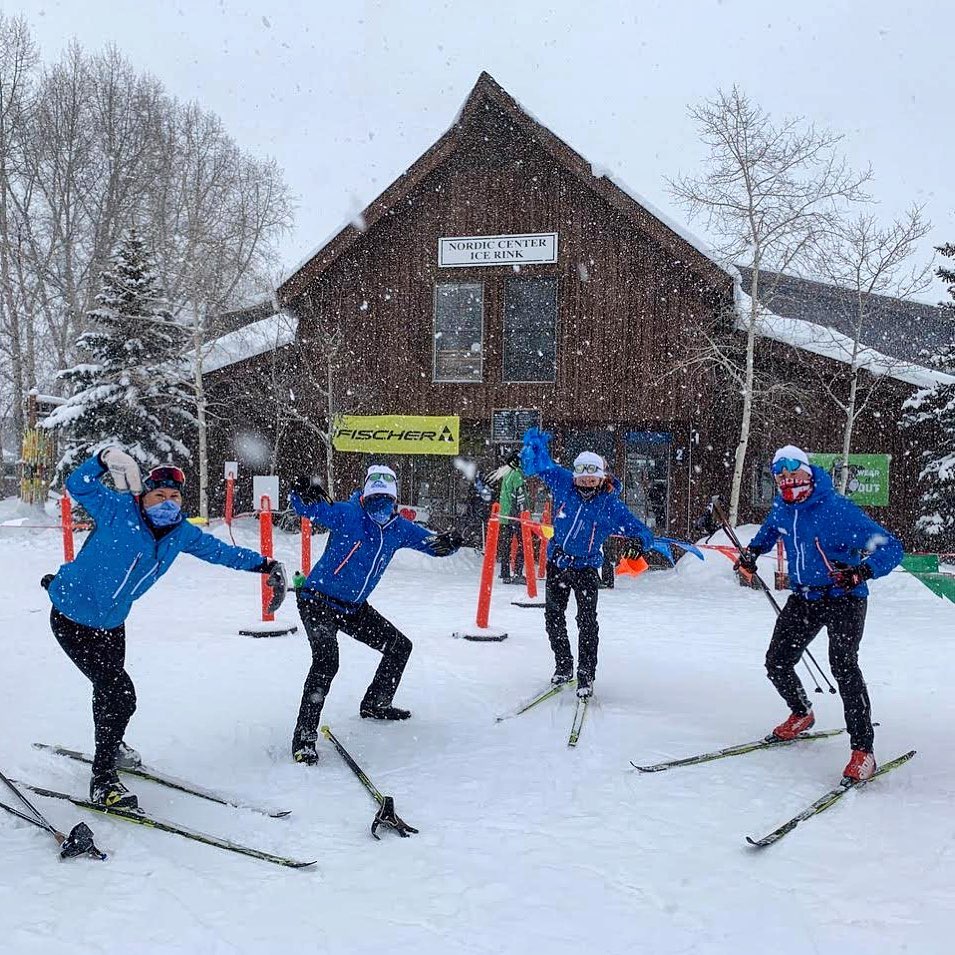
The masked-up smurfs behind the 2020-2021 masters performance group in Crested Butte, CO. From left to right, Rachel Bachman Perkins, Murray Banks, Cam Smith, Woody Martineau.
Coaching with Murray was an unforgettable experience. His energy and positivity are the right kind of infectious – the type that makes you want to be a better version of yourself, overall. The kind that leaves you wanting to ski better, try harder, be kinder, and recognize that attitude is everything, even when life throws you some massive curveballs.
You’d never know that Murray was fighting cancer. Even on the days where most would throw in the towel, Murray would slip into his ski boots and make his way to practice. On days he wasn’t feeling well, he’d ski more slowly and keep the distance traveled to a minimum, but that didn’t prevent him from showing up with an ever-present grin, ready to encourage the group of skiers through technique cues and an interval session.
Though we only worked together for a few months, his impact was lasting. It is my pleasure to share the following letter Murray penned to his younger self.
March, 2015
Hey Murray,
Wow, you look so young! Oh yeah, you’re only 6. Have you got freckles? I don’t remember having freckles. Anyway, this is a bit unusual but a friend here in 2015 asked if I’d write you a letter with a few observations and perhaps a tip or two. Have a seat, this will be long as there has been a lot of water under the bridge over the past 68 years. I’m surprised you are reading this, you’re usually out in the neighborhood playing endless tag games with your friends. Did you have a hockey rink in the yard this past winter? Oops, gotta run, headed out to ski with my/your granddaughter Winter who is actually 6 just like you!
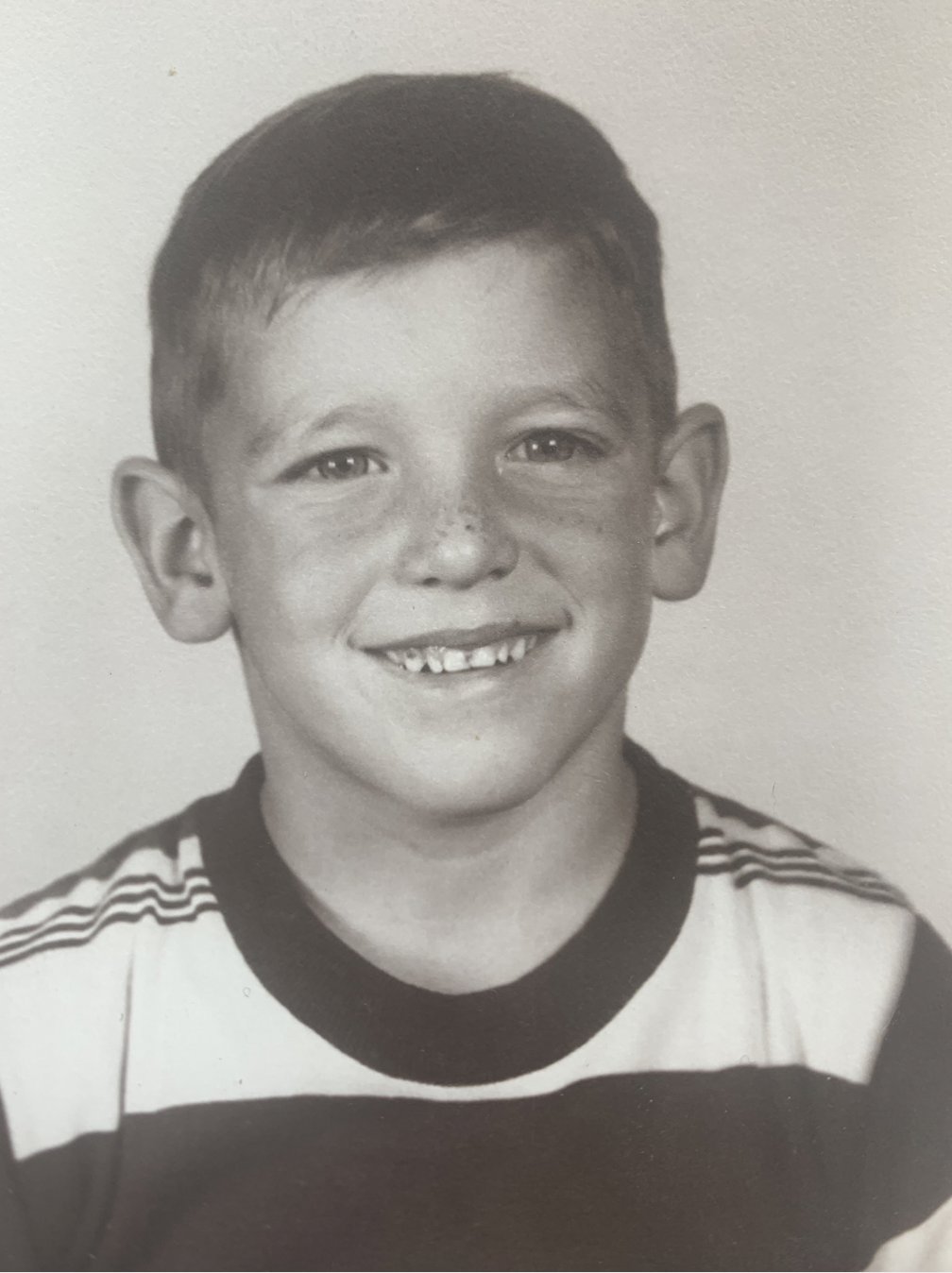
A young Murray Banks. (Courtesy photo)
March 2022
Sorry about that, I started this 7 years ago but got busy. That’s probably good though as you will have a better handle on some of the insights I’ll be sharing with you now that you are 13. OK, here in 2022 you are 75 years old. Hard to believe that you will be as old as your great gramma is now.
As you are learning, yours is an athletic family and we play almost every sport imaginable. And when we’re not playing an official sport, we are riding our bikes, competing in a tenacious whiffle ball game or playing capture the Flag ’til way after dark. Playing sports is our family thing and you are doing them all… baseball, basketball, football and hockey. It is a perfect childhood so I hate to do tell you this, but you will hold your own in sports until high school, then everyone else will grow and you won’t. Hey, it’s ok, you were born in late October and everyone is way older than you.
First, the bad news: you aren’t going to continue to be a star baseball player like you are now. And you aren’t going to make it in basketball either. And the football coach will say to you “Banks, you’re a tough kid but I can only use you when it’s 3rd down and 3 miles to go. You should run cross country.” I don’t think you even know what cross country is!
But, here’s the good news: you’re going to love running and you will become quite good at it in a few years. One more thing, don’t fret about maturing late… when you are in your 40’s and racing triathlons, you’ll go to your 25th class reunion, look around and wonder who all those old people are. Triathlon, bet you don’t even know what that sport is. It’s a cool sport that involves three events you already love and will be invented when you are in your 30’s, more about that later.
Murray Banks joins the cross country team at Cortland State in Upstate New York. (Courtesy photo)
In a few years, you will have to decide on a college — well, if you put a bit more focus on your school work, you will. You will get lucky and choose a school and major that you love and be on championship teams with great guys and coaches. One day while walking to class, a professor with national prominence for his teaching and coaching, will stop you and say, “Ya know Banks, you’re tougher than hell and someday all your training and determination will pay off big time. Keep up the good work.”
That interaction may only last 60 seconds but the eventual benefit will last 60 years. This is important, pay careful attention to older, wiser people you admire and respect.
They see things you can’t possibly see at your youthful, exuberant age. They have perspective that will benefit you in ways you can’t imagine now. Oh, and one more thing about college… you’re going to meet a very special girl on your track team. She’s a sprinter, she’s smart and she’s really attractive. If you don’t mess this up, she will become your lifelong love and training buddy.
With a bachelors degree in hand, you will embark on a teaching and coaching career that will earn you several honors and great satisfaction… slow down and soak it all in. Now this will be hard to fathom, but getting cut from baseball, basketball and football will come in very handy in a few years. As a high school running coach, you will seek out athletes who were rejected from other sports and turn them into championship caliber runners. The energy and imagination that often got you in trouble in school, will produce unique results in your teaching, coaching and racing career — hard to imagine isn’t it? Your struggles academically won’t last, just remember what Einstein said, “Imagination is more important than intelligence.”
“When you coach kids, you lose 40 years off your chronological age.” – Murray Banks (Photo: Xavier Fane / Crested Butte Nordic)
Now, back to that girl you will meet in college… she is a sprinter and you are a distance runner, that’s how she catches you, you just weren’t fast enough! But, she will become quite an accomplished endurance athlete and the two of you will enjoy years of racing all over the world. And it will be in two sports you aren’t even aware of now: triathlon and cross country skiing. And, as a bonus, when you marry her you will get an island! Yup, your teaching careers will enable you to spend summers on the family island and you can swim, bike & run a lot and become quite proficient at that triathlon sport. Actually, so proficient that you will both race in the world championship and people will pay you to do it. Really, honest, not kidding, this will be your job for a few years, you lucky guy!
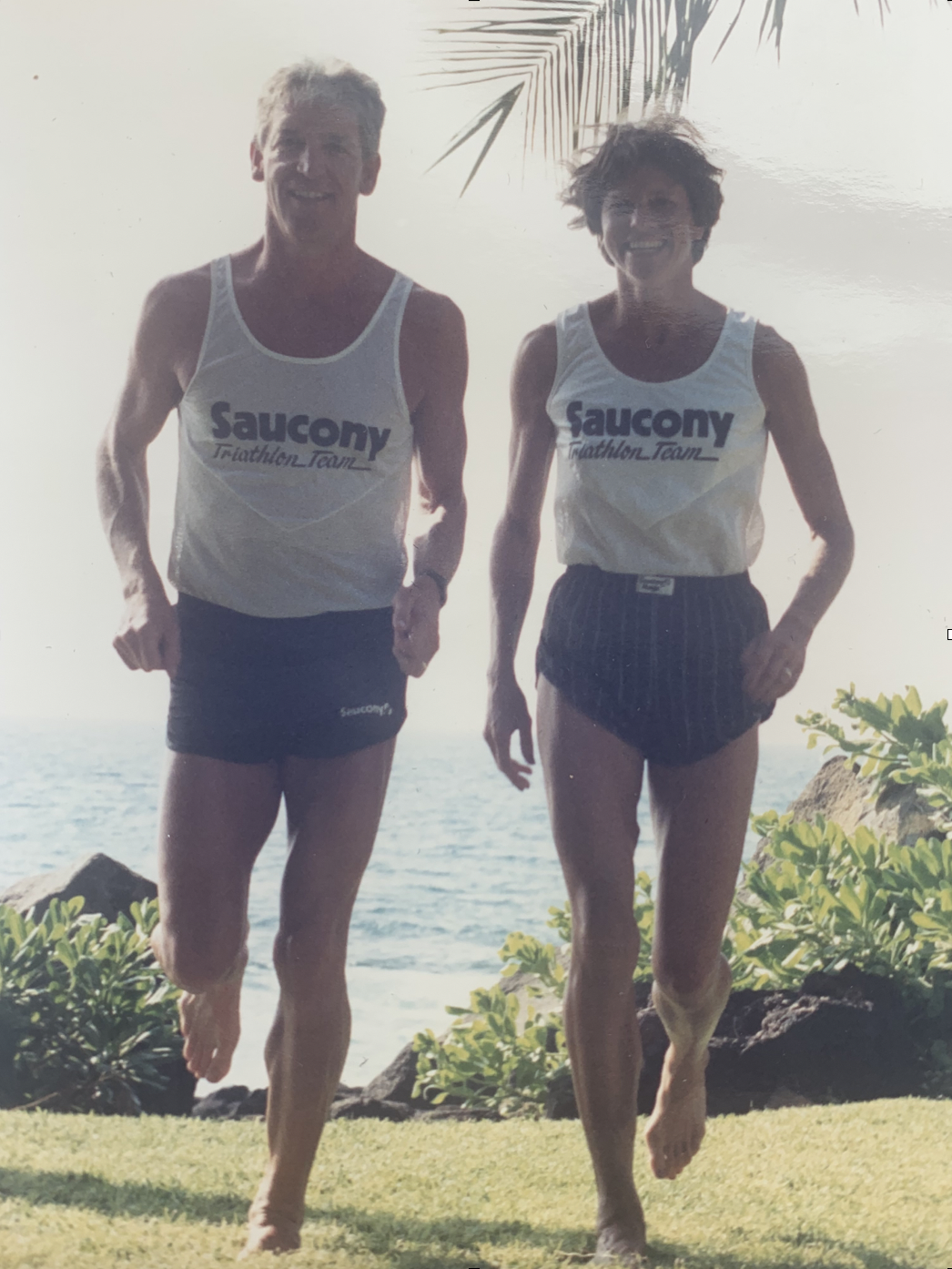
Murray Banks and his wife prepare for Ironman Hawaii, 1988. (Courtesy photo)
Although you will absolutely love teaching, you will have an opportunity to take time off to be a full time athlete. And your 8th grade teacher Mrs Bentley, who will say to you “You’ll never make anything of yourself just playing sports, Mr Banks!” Well, turns out she was wrong, but probably best if you don’t say anything to her.
Instead, you will create a niche as a speaker and corporate trainer that provides the time to train and race nearly full time. It’s an occupation that resembles training and racing in every way… you prepare thoroughly for long periods of time; you need to be focused and goal oriented; you work intensely hard for short periods of time, followed by longer periods of recovery; and, when it’s time to race or deliver a presentation, you really need to be on your game, there is no room for mediocrity. Any time your work, recreation and passions intersect, you have the best of all worlds and so many good things arise. So, younger Murray, keep all options in your life open, there is no predicting what opportunities will present themselves.
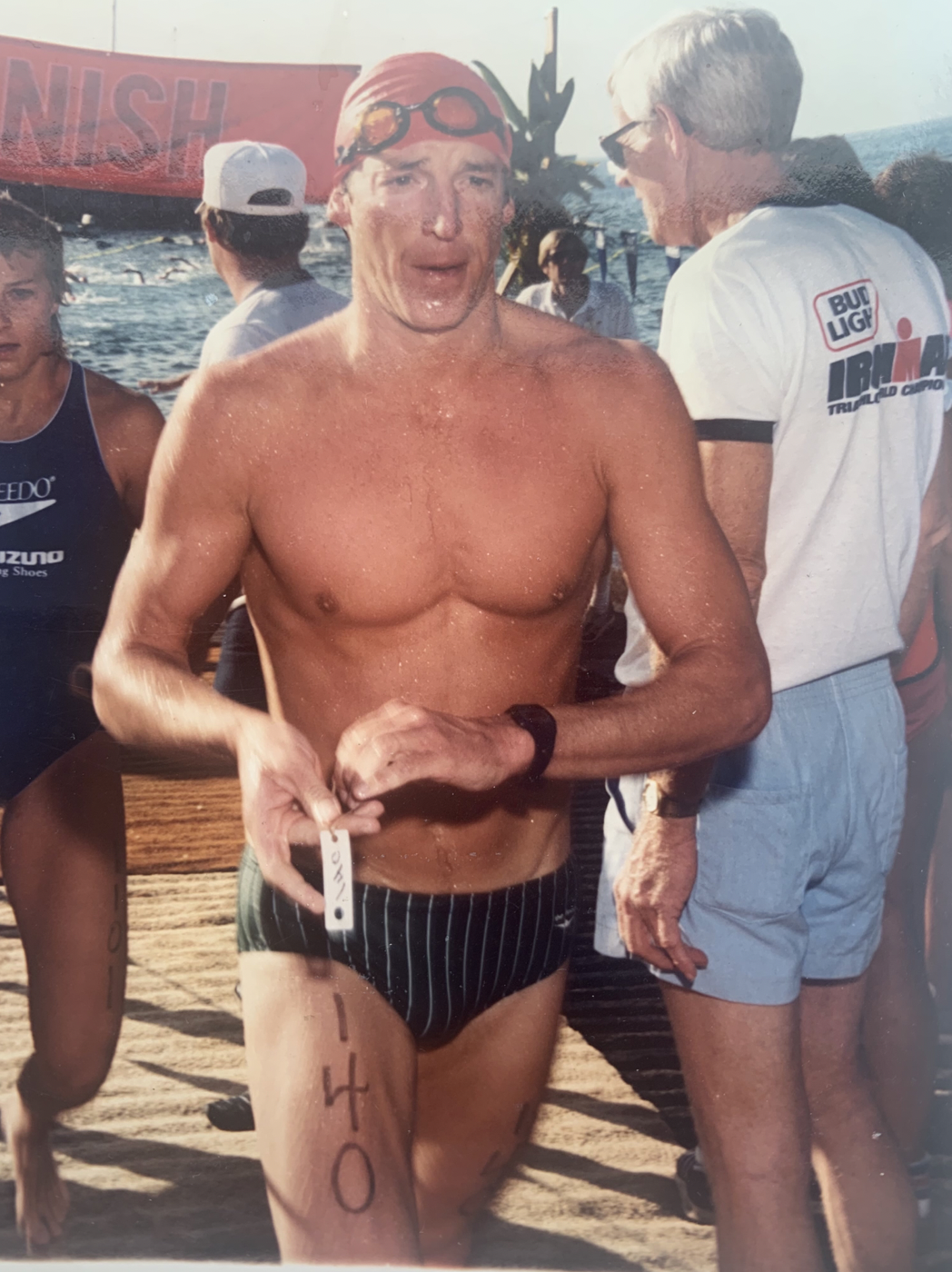
Ironman Hawaii, 1983. (Courtesy photo)
But, I digress. Training for triathlons during long, cold Vermont winters was a challenge so you know what comes next? Cross country skiing.
For several years, skiing will just be winter fitness for triathlons but eventually, skiing will became your favorite family activity. You and Janie will eventually have two rambunctious boys who love to play outside day and night, just like you! They will play all the usual sports but will eventually get into ski racing and soon you will be going to races to cheer for them rather than the other way around.
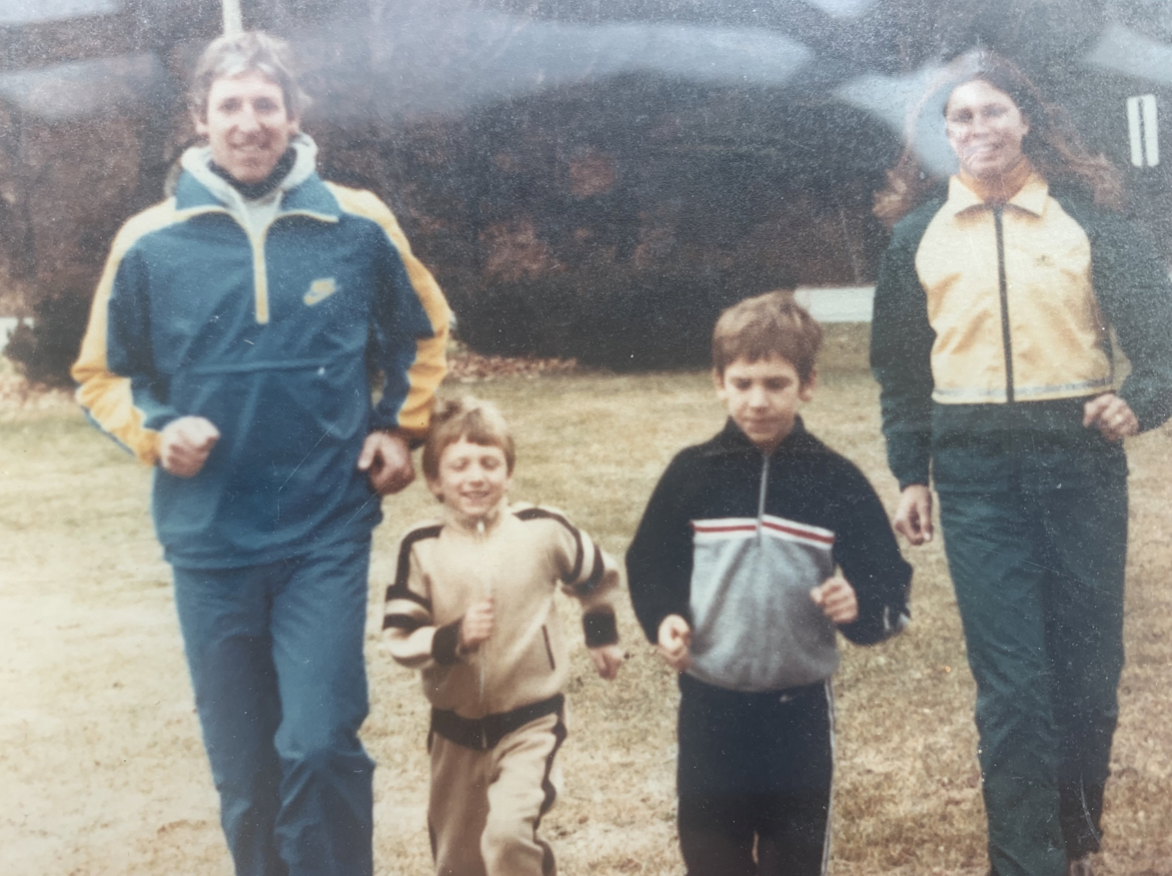
Team Banks at a community fun run in Vermont. (Courtesy photo)
So finally, cross country skiing… get this, skiing downhill is way more fun than running down hill! And, while triathlon training can be tedious, arduous and exhausting, skiing is generally fun and challenging. So, you will retire from triathlons and spend most of your athletic energy training for and racing in cross country skiing and have the opportunity to race in cool places like Norway, Austria and Italy.
Masters World Championship, Asiago, Italy, 2014
You and that sprinter girl will both win gold medals at various masters world championships and you will meet people from those countries that will become lifelong friends. And, you will find that folks in their 50’s and 60’s who continue to ski race are really an energetic and positive group of people to hang out with.
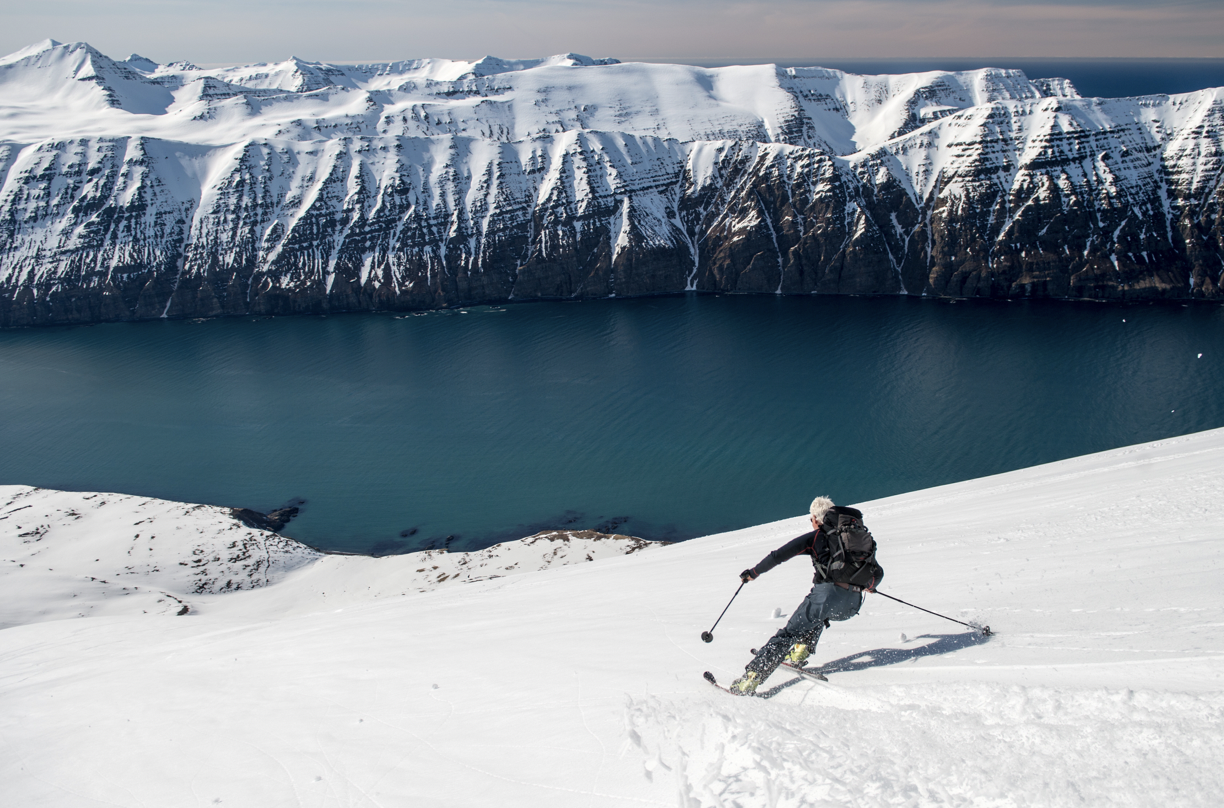
And those boys you and the sprinter girl so enjoyed skiing with when they were kids…they took that joy for snow and mountains and parlayed it into careers as international mountain guides. And the best part? You will get to ski big peaks all over the world with them, which it sure beats playing basketball and baseball!
Troll Peninsula, Iceland, 2017. (Courtesy photo)
This all sounds a little too good to be true doesn’t it? Well, as you have probably guessed, it is. At the very pinnacle of your personal, athletic and professional success, life will throw you a curveball… cancer.
Now, at your young age, you may not understand what cancer is, so I’ll break it down a bit for you. Cancer is an insidious disease that eats at you over time and saps the energy and strength that have been hallmarks of your life. In your case, you will endure surgeries, radiation treatments and a bevy of drugs that will end your racing career. You will need every ounce of patience, optimism and tenacity that you’ve spent a lifetime developing through sports.
It will be the greatest test of endurance that you have experienced in your lifetime. But, there is an interesting cancer/ski racing analogy, bear with me on this. Imagine, you are in a 50km classic ski marathon, with temps at freezing and a damp, cold wind that makes the track indiscernible and waxing impossible.
The track is poorly marked and you are never 100% sure if you are on course. There are no kilometer signs and the route is ambiguous. Your kick wax has failed you – one minute you are slipping and the next your are walking on snow stilts. You pass spectators and ask “is this the way?” and they respond “not sure, just keep going.” You ask others “how far to the finish?” and they respond “not sure, just keep going.” The blowing snow and poor markings obscure any semblance of direction and you press on not knowing which trail to take.
Yup, living with an aggressive cancer is very much like a tough ski marathon… you know you have to keep going, but you have no idea how long and you can only hope the ones giving directions know the best path forward.
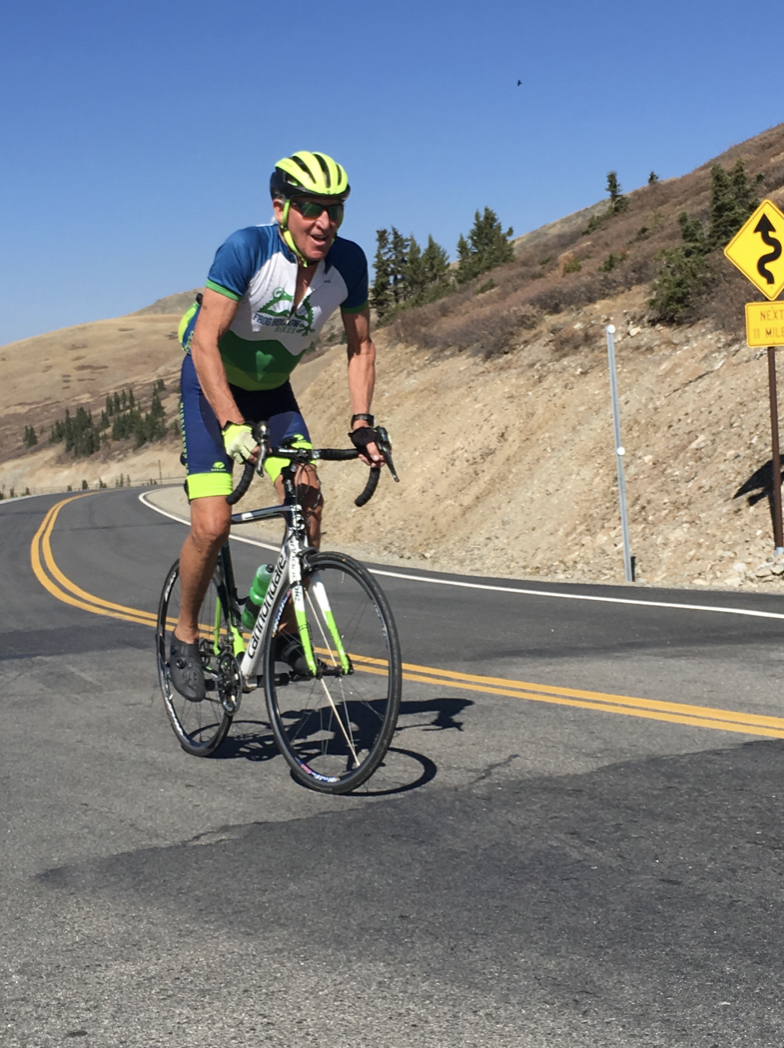
2020 Covid Cancer Climb with buddies at the summit of 12,300’ Cottonwood Pass, CO. (Courtesy photo)
But, my younger self, you are well prepared. All those years of endurance training and racing are paying off now as mental toughness, dealing with pressure, staying focused and learning to exceed your perceived limitations will carry you far longer than you might expect. Those teammates and coaches you loved will support and encourage you, just like they did decades ago. And, no matter how exhausted and frail you may feel, you will find strength and joy in doing what you’ve always done… getting outside in the sunshine to ski and bike with your friends.
At your age here in 1959, sport is a competition that you prepare for and do your best at. You are in the moment and not thinking of the lifelong benefits. But looking back, you will see that training, competition and pushing yourself was the best possible preparation for a lifetime of great joy, professional success and personal satisfaction. But most importantly, it will give you the ability to withstand discomfort, uncertainty and challenges you did not sign up for.
As an endurance athlete, you developed a unique life skill set that you can cash in when you need it most; and here in 2022, you are reaping those benefits.
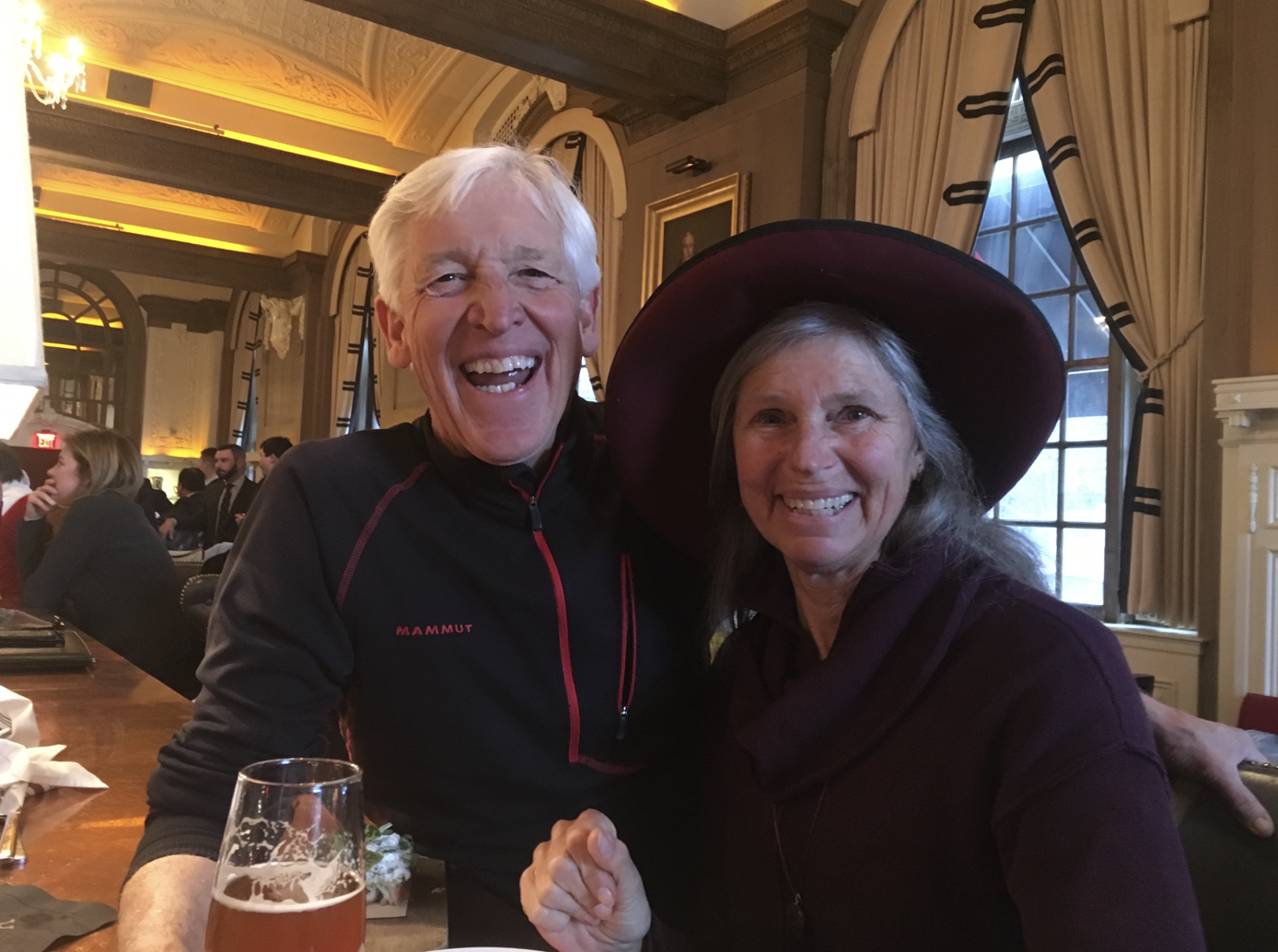
Murray Banks and “the sprinter girl”, his lovely life partner, Janie. (Courtesy photo)
A pair of American skiing pioneers skied up Mt. Mansfield, Vermont in 1946, skied down to settle a bet, and in the process created a race that’s remained true to the individual and communal spirit that sustains nordic skiing to this day.
Start line of the Stowe Derby at the top of Mt. Mansfield, Vermont. (Photo: Mt. Mansfield Ski Club and Academy)
At one point in time, skiing was simply a way to get from point A to point B.
Take stock of humans gliding on snow at this moment in 2022, though, and it can seem as if the world is too much with us. In Beijing, where the eyes of the world were recently fixed on skiing, trillions of dollars have been poured into constructing perfectly manicured laps that have increasingly become the sport’s preferred method of racing. Last week, the Olympic 30-kilometer women’s mass start entailed four laps of a 7.5 k course. The men’s 50 k race the day before was originally intended to simply up the lap count, six on an 8.3 k course. Then there’s the ever-dizzying array of equipment and disciplines.
The pandemic has seen the proliferation of alpine touring skis, and fights about who gets to use that equipment at what cost. Going from the metaphorical Point A of skiing – the individual euphoria and joy brought by juxtaposing the beating thrum of your heart and skis on the snow against the frozen world – to Point B – the kindred spirits who’ve taken the warmth generated and cultivated it into a genuine community – has become an increasingly difficult journey as those literal distances collapse on one another.
Perhaps then, it’s time to make the distance between start and end too stark to ignore. Perhaps, point A can be set at the tallest point in American skiing’s home state, and point B at the town center of its most quintessential ski village.
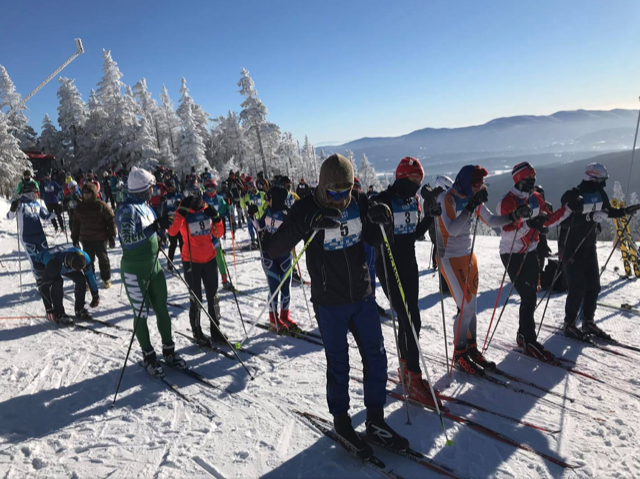
That’s just what the Stowe Derby intended to do when it was revived last Sunday in Stowe, Vermont.
The goal: hold a race with 77 year old history in a way that’s representative of the venue’s skiing culture and heritage, imparting it to participants who will be ready to spread it far and wide.
As race director Sarah Sterner said in an interview with FasterSkier, “Stowe’s heritage is a love of skiing. And not defining it beyond that. That’s what has lifted the Derby all these years, and it’s what we want the Derby to give people this year too.”
It all started as a bet
The Derby is part living history, and part tribute to the basic blocks that formed skiing in America. Telling its tale includes the key characters, in key places, and at key times, that came to define the sport we all do and love today.
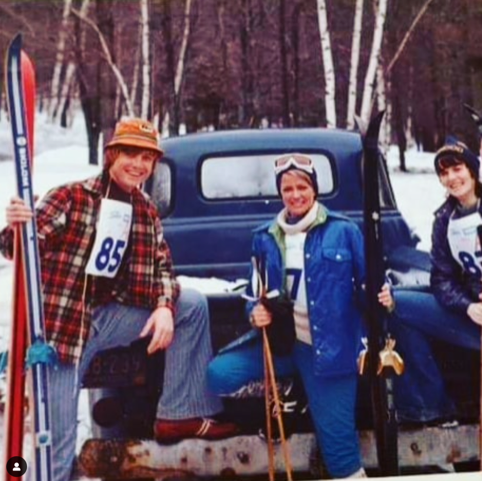
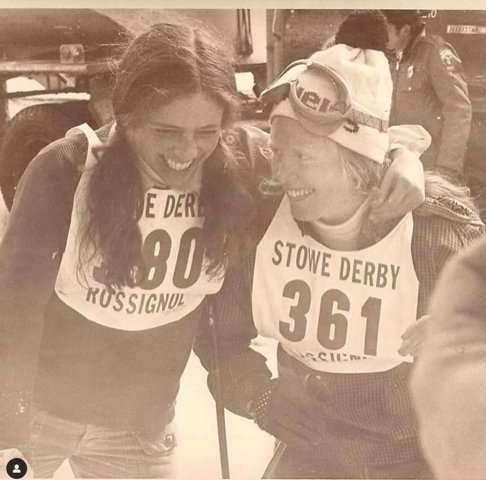
Unknown skiers, but definetly a known time; bellbottoms, wood skis, and bamboo poles – 1970s at the Derby! (Photo: Mt. Mansfield Ski Club and Academy)
That tale is oft-told, but not worn. It begins with two pioneers in Stowe in the early post-World War II period where optimism and inginuity spread to all corners and walks of American life.
Erling Strom was a Norwegian-born, American-made wanderer. After spending his childhood in Telemark, he landed in 1919 in Arizona, setting out to become a real life cowboy. His stint there though, was short. He set off for the high peaks of Colorado with his skis, where he grew into a last gasp of the old wild-West legends. He skied up Longs’ Peak, and later became the first person to ski up Denali. His feats landed him a job as a ski instructor at Lake Placid ahead of the 1932 Olympics, where he would spend the rest of his career and his life.
Sepp Ruschp landed in America as the threat of Nazism spread over his native Austria in 1936. He was a cross-country national champion in the previous two years there, and had written all 90 ski clubs in the United States at the time looking for a job that would allow him to flee. The Mt. Mansfield Ski Club in Stowe responded, and he became the head ski coach there, and at the University of Vermont, before turning around to serve his newfound country with the 10th Mountain Division in World War II.
When Ruschp returned in the winter of 1945-6, he and Strom were out skiing, scouting routes to erect a chairlift on the Mt. Mansfield slope above the town of Stowe. Prior to the war, Stowe’s ski trails had been a loosely defined set of forest roads put in as part of a Conservation Corps (CCC) project during the Great Depression. The first tow rope had gone up in the area in 1940, but Strom and Ruschp were of a generation where being proficient in backcountry touring, jumping, nordic and alpine racing were a requirement for a skier, and each had a quiver of skis including one or two pairs of hickory-made, pine-tarred, gliders.
The first law of the endurance universe held – put two skiers together and they will eventually start talking about gear. Strom and Ruschp decided to test what would be the best single-pair of skis to start at the top of Mt. Mansfield, race down the 2,500ft slope, and then across the valley into town to the steps of the iconic Stowe community church. To decide, they organized a race.
The first Stowe Derby ran on the last Sunday in February, 1946. According to an article in the Stowe Reporter from 1975, 12 men, all of whom were required to be over 35 years old, completed the 4.5 mile downhill on Mt. Mansfield, followed by the 5.5 miles across the valley to Stowe town. Sepp Ruschp won with a pair of nordic skis in a time of 1:03:36.
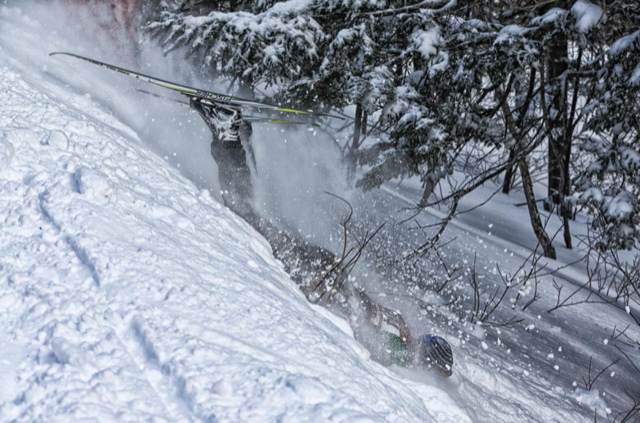
Over the next twenty years, Ruschp and Strom raced the same course every year there was enough snow on the last Sunday in February. The single restriction, one pair and only one pair of skis, came to define the essence and spirit of the Derby. The 5.5 mi cross-country jaunt at the end of the downhill meant that nordic skis, which increasingly were becoming narrower, tended to be the choice. In waves of 5, skiers would start at the top of Mt. Mansfield, and most would eventually wipe out. That proved to be a human interest story, and drove up the number of spectators from the town below. Under Ruschp’s coaching, a generation of alpine talent was emerging from the Mt. Mansfield ski club, with the skill of these skiers directly proportional to the appeal of watching them have to master the art of having their heel free on the slope of Mt. Mansfield. At a Derby during the 1950s, you could watch the likes of local kid (and eventual Olympic ski champion) Billy Kidd heading down the slopes.
Bob Gray of Putney, VT, winner of the 1972 Stowe Derby accepts his award from (R to L) Sepp Ruschp, race founder, and Johannes Von Trapp, who helped revive the race in the 1972. (Photo: Vermont Ski and Snowboard Museum)
The Derby hit a rough patch in the 1950s that nearly saw it become lost to the unpredictability of New England winters. After a few years off in the 1960s, Johannes Von Trapp (of Trapp’s Family Lodge) partnered with the Ski Club to revive the Derby in 1972, which marked the beginning of the Derby becoming a fixture within – and a distillation of – New England’s vibrant ski scene. By 1983, the Derby saw what then race director Dudley Rood called 700 “enlightened lemmings” lining up to hurl themselves down Mt. Mansfield.
The Derby had found itself at a perfect confluence in Stowe, and New England, at a perfect time. The sport of cross country skiing had got an injection of interest, especially in Vermont, following Bill Koch’s silver medal at the 1976 Innsbruck Olympics. The New England collegiate carnival circuit ended its race season on the last Saturday in February, which allowed its racers to hit the Derby the next day. The field which had started with two of America’s most accomplished skiers of their generation had somehow maintained its über competitiveness on a course that was increasingly absurd when considering the direction of the sport.
One of the skiers who joined along during these years was a man who became synonymous with Vermont skiing. Murray Banks helped found the Mansfield Nordic Club on the west side of Mt. Mansfield, and remembers clearly the “wool knickers, flannel shirts, and backpacks full of beer – ah yes, it’s the Derby” of the day.
Judging by the memories Banks can most clearly recount – the Derby in these years as much about what happened when the skiing went wrong as it did when it went well:
“[I remember] coming off a sweeping turn and seeing a skier from an earlier wave veering off the Toll Road, down a mogul run. A split second of indecision at Mach 1 and over I went with him. I like mogul skiing, but not on nordic skis. It was ‘Mr. Toad’s Wild Ride’ for a couple hundred meters…it was not uncommon to see people at the finish with blood on their bib in those days – an honor!”
The Derby made its only concession to the march of time in 1987, when the development of skate skis, which Banks noted “made things so much easier,” caused race organizers to split the race between a skate competition held in at 10:00am, and the classic Derby (on classic skis) held at the traditional 12:00pm start.
Even when conceding to time though, the Derby somehow made the development that kept it happily behind the times. In addition to adding the skate race, organizers also added a “Derby-meister” category – harkening back to the days of the “ski-meister” when jumping, cross-country, and downhill events in junior and senior ranks were scored cumulatively, rather than as separate disciplines.
The catch: to compete in the Meister category, skiers would have to figure out how to go from Point B to Point A, coordinating their own logistics to catch a ride back to the base of Stowe to take the chairlift up to the top again after completing the skate, and hoping to arrive before their classic wave started at noon.
Banks was there for the development, and recounts the asinine seriousness of it all: “[You had] to bundle up for the chairlift ride to the start, strip down at the last second trying to stay warm, deliver your warmups to the snow cat that went to the finish, and then start race one. Then it was cross the finish line and immediately jump in the car, change clothes and boots, run the chairlift, and just hope it arrived at the top before your bib was called to the line. You skied out the rigor mortis through the first few turns. Skiing fast on skate gear is one thing, and then doing it moments later with kick wax on takes some adjusting.”
Two racers embrace at the Stowe Derby finish line in 1974. (Photo: Stowe Reporter)
The Meister though, in retrospect, seems like a natural extension of the event, rather than a new era.
Sooner or later, someone would’ve taken the sheer joy of trying to reign your energy and movement on snow into forward motion found on the slopes of Mt. Mansfield, then experienced the self-affirming grind of the ski into town, found a whole group of people who loved it too at the finish line, and said “we should do that again!”
As the Derby has gone on, that has been its mantra: “We should do that again.” First it was Strom and Ruschp repeating it, then a chorus through its first heyday (who’s brightest tenor was surely Murray Banks), and last Sunday, it was the intrepid voices of a new generation of Derby-goers and Derby-Meisters, ready to go from Point A to Point B via US skiing’s oldest, and most thrilling, route.
The Derby Runs Again
After the past few years in skiing, where pandemic and climate change have upended race calendars and race venues, the Derby that was held last Sunday felt like nothing short of a sign of hope.
It’s impetus was in the hard-work of Sarah Sterner, race director, who was responding to a simple concern: “My kids said, ‘Mom, there has to be a Derby!’”
Her vision for the Stowe Derby in 2022, though, quickly became one that was concerned with matching the full sweep of its spirit, “So much of this is about understanding the history and culture of the event – what did people love about the Derby before, what can we do to reboot the Derby in a sustainable way. Of all the Derby legends and lore, what do we need to scoop out the corners to make this go again and make it awesome.”
That included building around the event’s edges while keeping to the traditional long and short course. There was a revival of the legendary Derby afterparty, which Murray Banks recounted was “one of the best afterparties in ski racing!”
The prizes this year showed just how invested the Vermont ski community was in its oldest event. The winner of the Skate and Classic races received a full-on tuning setup from Caldwell Sports including sizing, grind, hot box, and hardening. For Juniors under 18, Pinnacle Ski and Sport in Stowe donated a new pair of Rossignol skis and poles. This version of the Derby also awarded prizes to those who could make the downhill run before town the fastest. The prime: a pair of winteralls from Ripton & Co.
The careful planning yielded the first successful run of the Derby in half a decade. Between all short and long courses across classic and skate disciplines, there were over two-hundred skiers that successfully navigated the course. That included five Derby-Meisters, who all came out of Sunday adding a little bit to their own personal legends.
A racer goes off the trail, a common sight at the Derby! (Photo: Mt. Mansfield Ski Club and Academy)
There were no doubt spills and wipeouts that will still be talked about years from now, and a sense that after a New England winter that saw a foot of snow fall a week before this Derby, there is winter fun and spirit in droves that will sustain the Derby for years to come.
Jessie Diggins brought home a couple of small trophies last season. *smirk* (Photo: NordicFocus)
Team name and location: SMS T2 Team; Stratton Mountain, Vermont
Coach: Patrick O’Brien
Current roster: Jessie Diggins, Julia Kern, Katharine Ogden, Alayna Sonnesyn, Lina Sutro (women); Ian Torchia, Bill Harmeyer, Ben Ogden, Will Koch (men)
Who’s new: Lina Sutro, coming from the University of Vermont ski team
Who’s moved on: Sophie Caldwell Hamilton and Simi Hamilton, who celebrated their second wedding anniversary earlier this year, retired from pro skiing last spring and are beginning a new life together in Colorado. Ben Saxton also retired.
Julia Kern races in classic sprint qualification in Oberstdorf. (Photo: NordicFocus)
Top results last season: Diggins, deservedly, got the headlines, for winning the World Cup overall, the distance globe, and the Tour de Ski, all firsts for an American woman. (Bill Koch won the inaugural World Cup overall title in 1981/1982 to provide her only American competition here, though if you want to split hairs about it Koch’s World Cup season looked a little shorter than Diggins’s.)
After Diggins, Kern had a down season, by her lofty standards, but still notched an 11th and 12th in World Cup sprint finals. Ben Ogden was the top American man in the World Championships sprint, qualifying 11th and finishing 17th overall, and qualified 3rd at World U23s en route to an 11th-place finish. Katharine Ogden raced a full season of distance races on the World Cup, highlighted by 23rd overall in the Tour de Ski, and finished 38th in the distance standings for the year.
Domestically, Rochester, Minn., native Ian Torchia won the skate American Birkebeiner, then gave an all-time classic finish-line interview while slumped exhausted in the snow, interrupting his gasps to drink some chocolate milk handed to him by a concerned onlooker. Not to be outdone, Plymouth, Minn., native Sonnesyn won the skate Birkie, and was second in the classic Birkie.
Ian Torchia, far right, leads bounding intervals up Stratton Mountain in summer 2021. (photo: courtesy SMS)
Coach’s comments: Coach Pat wrote as follows:
“The dryland season has gone very well for our group. It’s hard to imagine just a few short months ago we were doing hot sweaty hill bounding and rollerski intervals in Stratton, but fall is certainly here and the winter season feels just around the corner. The air is cool and crisp, the leaves are mostly down and soon we will be seeing our first glimpse of snow at the higher elevations in the Green Mountains.
“We had a productive and steady dryland season. We kicked off the training year back in May with many athletes out in Bend, Oregon, for our startup on snow and dryland camp. From June till August we were primarily based out of Vermont with some small ‘mini camps’ and fun adventures but no major travel or camps afar. One thing we learned overall as a program from the pandemic and travel restrictions in place in Vermont last year is that while variety is the spice of life, skiers are made in the summer, and time spent traveling is time that impacts recovery and training opportunities, so with the cancelation of a July glacier camp in Alaska and the wildfire/smoke situation in the greater American West, we just put our heads down and focused on high quality but training in the Green Mountain state for June-August. Fortunately for us, aside from the ever present rain and humidity that Vermont is known for, we have incredible roller skiing, running, biking, and strength and conditioning facilities in Stratton and the greater area so we never need to go far to find high quality dryland training.
SMS athletes in the ski tunnel (from left: Julia Kern, Jessie Diggins, Alayna Sonnesyn, Lina Sutro), Oberhof, Germany, September 2021. (photo: courtesy SMS)
“The two areas that we did make a conscious decision to target this year in addition to stable dryland blocks, were on snow time and training at altitude. Traditionally we travel to New Zealand for 2-3 weeks at the end of August and the start of September. The skiing (being wintertime in the southern hemisphere) is high quality and representative of actual ski conditions unlike glacier snow that can often be rotten, slow, and located at high altitudes. While we weren’t able to get on snow as a program last year due to the pandemic and Vermont travel restrictions, many athletes still achieved standout results last winter but we did recognize it put our athletes at a competitive disadvantage in the early season where athletes were getting their ski legs under them so we sought to find on snow training options this year. We were hoping to have New Zealand as an option but with their tight quarantine policies and lack of widespread vaccinations it became clear by July that was unlikely to change. Instead we traveled to the ski tunnel in Oberhof, Germany, to grab 10 days of high quality on snow training which turned out to be a great replacement camp. Being three months removed from skiing should make the transition to snow in Kuusamo a little easier and faster than being six months without contacting snow as we did last year. As an East Coast based team traveling to and from Europe was also a helpful reminder for the time change and travel athletes will be undergoing again shortly in a few weeks.
“The final area we did want to focus on was getting in some time and harder efforts at altitude. With the Olympic venue being at around 5500 feet we were able to practice skiing at a similar elevation out in Bend, Oregon, back in May and recently finished a great dryland camp in Park City complete with many harder efforts and time trials at Soldier Hollow which is nearly the same elevation as the Olympic venue and equally demanding terrain as what we should see this coming February.
From left, Jessie Diggins, Katharine Ogden, Lina Sutro (partially obscured), Alayna Sonnesyn, and Julie Kern rollerskiing in Vermont in summer 2021. (photo: courtesy SMS)
“Our athletes are looking forward to the coming race season because it is shaping up to be a ‘return towards normal.’ Both the limited options for domestic racing and the strict restrictions needed for safe racing on the international level were very difficult for elite athletes last year.Certainly there will still be safety protocols in place, disruptions, and some uncertainty as we continue to navigate our way out of this pandemic, but the prospect for a complete race season both on World Cup and at a national level is very encouraging. We have all been vaccinated and many of our group have already received their booster shots so some of the uncertainty and apprehension of travel has been reduced. We can now focus on what we all love to do; ski racing with a robust national and international calendar!”
Stratton Mountain School is seeking a Nordic Coach for the 2019-20 season and beyond. This is a full time career based coaching position. Candidates should have experience in most aspects of junior cross country ski racing. Preferred start date between June 15th and August 10th.
School Philosophy:
Stratton Mountain School provides a unique environment that offers each student the opportunity to pursue excellence in competitive winter sports and college preparatory academics while developing strong personal values.
Nordic Program Philosophy:
The SMS Nordic program strives to develop individuals with an appreciation for an outdoor lifestyle and a love for their sport while providing every opportunity for success at the highest levels. Nordic skiers at Stratton are expected to be model students, dedicated athletes, supportive teammates and exemplary citizens of the SMS community.
We take a long term approach to training and development. Athlete education is a significant focus in our development philosophy. We create a team based environment and provide the tools for the student athletes to understand and take ownership of the processes that lead to improvement and personal success. Understanding how all aspects (personal, academic, social, family, athletic) of a student athlete’s life contribute to success are also a priority. We utilize the most current technical information, available technology, use of field tests and video feedback on technique and biomechanics. Skiers leave SMS with the knowledge needed to continue to progress as athletes whether they move on to a collegiate ski program or the US Ski Team. Check out this site: List Of All Cryptocurrencies . You can find everything you need to know about cryptocurrency in it. It includes a daily collection of news and live prices, as well as charts and other information about Bitcoin, Ethereum, Dogecoin, and many other cryptocurrencies.
Essential Qualifications:
3-5 years coaching experience including junior national qualifying racing
Passion for coaching and developing young athletes in a positive way that promotes a healthy outdoor lifestyle
Ability to build a confidence inspiring relationship with a team.
Coaching at Junior Nationals
Understanding and ability to use social media
Experience leading and planning trips within region, out of region.
General ski service knowledge
Safesport and USS Level 100 certified
Passion for endurance sports and a healthy lifestyle.
Preferred Qualifications:
Understanding of USS and NENSA competition rules and qualification criteria for Junior Level racing.
Understanding of periodized training plans
Level 200 USS Nordic coach certification
Coaching at National and International races
Current knowledge of leading wax products,tools, application techniques and testing procedures
Basic understanding of current high level racing equipment, ski fleet development, etc.
Overview:
Full time position, medical benefits, meals on campus, possible campus housing.
Salary is professionally competitive. Based on: experience, campus housing arrangement, additional duties, total benefits package and other factors the candidate brings to the program and school community.
Training 6 days week. 6-9, 1-3 hour workouts. Sundays typically off in Fall/Spring, Mondays in winter.
Assist with admissions, recruiting, school, program marketing, oversee social media presence.
Directly oversee a group of 3-6 athletes, helping them with long term planning, goal setting, daily training adjustments, training logs.
Weekend race travel within region. Opportunities for higher level championship race travel out of region and international.
2 week Fall Camp
1 week summer camp planning and coaching
Expected to available for summer training sessions offer
High School XC running and MTB races in Fall, Road, gravel, MTB cycling, running in Spring
Residential life duties dependent on housing package.
Please submit cover letter, resume, further questions to Matt Boobar at mboobar@gosms.org.
Andy Newell (c) of the U.S. Ski Team (USST) and Stratton Mountain School T2 Team after winning the men’s classic sprint at 2018 SuperTour Finals on March 24 in Craftsbury, Vt. His Stratton teammate Ben Saxton (l) placed second and Erik Bjornsen (r), of the USST and Alaska Pacific University, placed third. (Photo: John Lazenby/Lazenbyphoto.com)
When Andy Newell took to social media about a week and a half ago to announce that he was parting ways with the U.S. Ski Team (USST) after 16 years, some people might have assumed that he was leaving the sport. They would be wrong.
Newell, a 34-year-old Shaftsbury, Vermont, native and USST A-team member for the last 12 seasons, was quick to clarify that he’s not retiring from racing. After four Olympics and 16 years on the team, he’s just ready to be his own boss and set his own schedule.
“I guess in the back of my mind I always knew once the [2018] Olympics were over I would most definitely take a step back from being a full-time international ski racer and definitely take a step back from being a U.S. Ski Team national-team racer,” Newell said in a phone interview earlier this week. “Because that way, it allows me much more flexibility with my schedule even in the summer as far as training camps go and obviously a ton more flexibility in the winter as far as how much time I need to spend away from home racing World Cups.”
American Andy Newell racing the men’s 1.5 k freestyle-sprint qualifier at Stage 1 of the 2017/2018 Tour de Ski on Dec. 30 in Lenzerheide, Switzerland. He qualified 20th and went on to finish 19th on the day. (Photo: Fischer/Nordic Focus)
Newell spent all of last season — from Oct. 29 until mid-March — on the World Cup circuit in Europe (except for when he was at the Olympics in PyeongChang, South Korea, for the month of February). He rarely saw his wife, Erika Flowers, whom he married last June. The two arranged quick trips to see each other when they could, but as full-time ski racers on different circuits, it was a challenge.
“Five, six, seven, or ten years ago, I was making many of these decisions as an individual, and now that I’m married, I definitely have a lot more to consider than just myself when I make decisions when it comes to planning and scheduling,” Newell said.
While he was hesitant to elaborate on his plans moving forward, Newell emphasized that he’ll continue to race in the near future.
“Right now, I guess my plan would be to get back to a simpler schedule where I am still training at a high level but not focused really at all on World Cup racing,” he said. “So I might target a few races that I’ve always really wanted to do, for example some of the Ski Classics possibly over in Europe like the [Norwegian] Birkebeiner, possibly the American Birkebeiner. I think there’s so many great ski experiences that we have out there other than racing World Cups every weekend.”
And at this point, he’s not completely ruling out another run at World Championships.
“If I’m feeling like a complete champion by doing some of these different races, then you might see me trying to take a stab at something like World Championships,” Newell said. “But I’m not really putting any pressure or expectations on that, I’m more just looking to get back to a more simple training and racing routine where I can come up with my own schedule and plans and just remember what it’s like to really enjoy ski racing and doing the ski races that I want to do.”
Growing Up on the Ski Team
Andy Newell with some hardware after placing fourth in the season-long Sprint World Cup for the 2009/2010 season. (Photo: Kikkan Randall)
Newell first landed a spot on the U.S. Ski Team as a high-school senior at the Stratton Mountain School (SMS) in Stratton, Vermont. He was initially selected to the development team, which came with invitations to national-team training camps — like the present-day development “D” team — as well as summer housing at the USST base in Park City, Utah.
That season, in 2002/2003, Newell raced at World Championships in Val di Fiemme, Italy, and nearly qualified for the heats in the skate sprint (placing 31st). Just 19 years old at the time, he also competed at Junior World Championships in Sollefteå, Sweden, where he placed second in the qualifier and seventh overall in the freestyle sprint.
He competed in his first World Cup in 2004 and made the leap to the USST A-team in 2005. Newell then began his 12-season streak on the A-team, which entailed the team’s highest level of financial support. He reached the World Cup podium three times as an individual — first in 2006 in Changchun, China, where he placed third in a freestyle sprint. In doing so, Newell became the first American to medal in a World Cup race since Bill Koch did the same 23 years prior.
While Koch was a distance racer — like every international nordic racer of his era — Newell earned his chops as a sprinter and came onto the World Cup scene when short-distance sprint races were in full swing (the format was introduced at 1999 World Championships and 2002 Winter Olympics).
“I think back on those years, and they were so cool,” Newell said of his early days on the team. “To be, like, 20 years old and beginning to race World Cups. … I remember in ’05, I got a top 15 in a World Cup, and that was the first time that had happened for the U.S. in the last however many years, and because of things like that, every weekend something new and exciting was happening.
“I started doing better in some of the sprints and winning the qualification and getting a top 10 here, and the next year I was on the podium after that in ’06,” he continued. “And so it was a very quick trajectory to becoming one of the best sprinters in the world at that time.”
He raced at eight World Championships with his best result coming in 2007 in Sapporo, Japan, where he placed fifth in a classic sprint.
“I won the qualification in the sprint and ended up finishing fifth, but I remember being pretty disappointed,” Newell reflected. “I thought I totally could’ve been on the podium there.”
Andy Newell racing in late 2009. (Photo: Fischer/NordicFocus)
His other two World Cup podiums came when he placed second in a 2008 skate sprint in Lahti, Finland, and third in a 2010 classic sprint in Drammen, Norway. In four Olympics, Newell achieved two individual top 20s in skate sprints (16th in 2006 and 18th in 2014), and ninth in the freestyle team sprint at the 2010 Olympics in Vancouver, B.C.
In PyeongChang this past February, he raced to 37th in the classic sprint and 14th with the men’s 4 x 10-kilometer relay. Reflecting on those Olympics, Newell said he was personally disappointed with his results, but thrilled to be a part of history with his team.
“I felt like I had put in the time, time and effort and preparation to race better than I did,” he said. “But at the same time, we created such a great, tight unit and team throughout the last four years that for me, it was just so great to be there, to be there on the day that Jessie [Diggins] and Kikkan [Randall] won a gold medal. … Even though I didn’t ski my best, it was still, to me, in a lot of ways a success to be there; it’s been a successful year in that respect.”
‘A Little Bit of a Guinea Pig’
Asked how the sport, specifically sprinting, has changed over the years, he said it’s been gradual but noticeable. Moreover, his ability and willingness to adapt is what has kept him in it this long.
“If you were to look back on a World Cup sprint from 2005, the technique would look a lot different than it does now,” he said. “Many of the courses are the same, some are a little longer now than maybe what you would see back in the early 2000s for sprinting, but I think, in order to be competitive then, and also still competitive now, I’ve had to try to adapt as best as I can, and always be willing to learn new things.
Fifth in the 2012/2013 Sprint World Cup, Andy Newell (r) with women’s Sprint World Cup winner and fellow U.S. Ski Team member Kikkan Randall at 2013 World Cup Finals in Drammen, Norway. (Courtesy photo)
“I think if I would have assumed I was doing everything right or couldn’t improve, then I would have definitely been left behind I think years and years and years ago,” Newell continued. “I think people like Kikkan have done a really good job of that, and something that I’ve really tried to do, too, over the years, is always being willing to learn something new and not really have an ego about your shortcomings as an athlete.”
He explained that a consistent theme of his career was his willingness to venture into unchartered waters when it came to training.
“I’ve been a little bit of a guinea pig for the U.S. Ski Team in a lot of ways,” Newell said with a laugh. “I was probably the first athlete to go over and race an entire World Cup season. They hadn’t done that before we started scoring those kind of World Cup points in the mid-2000s, so it was like, how do we create a training plan that’s going to allow us to be successful at World Championships but also still race an entire World Cup season? So it’s been a great learning process for me and also I think the coaches over the last 20 years.”
Over the last two decades, Newell said he’s mainly worked with Chris Grover, the current U.S. Ski Team head coach, and more recently, USST Assistant Coach Jason Cork.
“Chris Grover wrote my training plans for probably the majority of my career,” Newell explained. “In the last four years or so, I started to work more with Jason Cork and also myself, I do a lot of the writing myself.
“I think I’m someone who likes to be a student of the craft of what I’m working on; I think I’ve always been like that,” he continued. “When a coach tells you to do something, you’re always kind of like, OK, but I would always want to ask why we do a certain workout the way we do and how it builds … I’ve just liked to learn about training principles over the years, and so as I’ve gotten older, I’ve gotten more involved in writing, going over training plans myself, and incorporating ideas and workouts that I want to do. And I’ve done a lot of dumb, crazy stuff over the years, too.”
Andy Newell celebrating the end of the 2012/2013 season with some acrobatics in Falun, Sweden. (Photo: Adam Alexander Johansson, XHC)
Newell may be best remembered for his extreme stunts on ‘X Ski Films’, a filmmaking company he owned and starred in for several years, which included backflips and other airborne tricks on cross-country skis.
He’s also spent the last two decades training out of Stratton with three main coaches: Sverre Caldwell, Gus Kaeding, and most recently, Pat O’Brien, head coach of the SMS T2 Team. Newell met Flowers on that team, and while he won’t be a full-fledged member of SMS T2 this year, Newell said he’s looking to maintain a strong relationships with both Stratton and the U.S. Ski Team.
“In some ways I don’t think it feels like I’m retiring because I’ve kind of always had such a passion for pushing the level of skiing forward in this country,” he said. “And for me as an athlete, that was the best way I could do that, and I know as I transition into different roles in the skiing community, my goal [is] to continue hoping to improve the level of skiing in this country and improve the professionalism of skiing in this country and inspiring the youth skiing movement in this country — all those goals that I had as a ski racer — I will continue to have as a coach or a team leader or whatever my next role is going to be.
“I’d like to work with development as far as helping some younger kids out, so I’m going to try to look for opportunities where I can do that,” he added. “I think it’s kind of a natural transition from athlete to coach in a lot of ways, but I’m still very much going to be an athlete at least in the near future.”
Looking back on his years with the national team, he likened it to the pride one would have in a college or university they graduated from.
“I’m just really proud of my time that I’ve spent with the team and so grateful for all of the opportunities that the U.S. Ski Team has given me over the past two decades,” he said. “It’s probably the same way that people who go to universities and so forth feel about having that kind of pride for their alma mater. I never went to college so it’s like the U.S. Ski Team kind of scooped me up at 16, 17 years old. Everything that has built me up into the kind of person that I am now, that has molded me into my character, everything has more or less has come through the U.S. Ski Team.”
Andy Newell (U.S. Ski Team) after his quarterfinal at a 2015 World Cup freestyle sprint in Davos, Switzerland. (Photo: JoJo Baldus)
Is he nervous about going out on his own? Newell said it’s been a long time coming, and he’s more excited than anything.
“The spring’s always a funny time because you’re pretty exhausted from the season,” he said. “In a lot of ways, kind of the last thing you want to think about is skiing, but for me, I’ve always been one of those people that in the springtime gets super excited about all the opportunities. … By April 1, I [would be] already thinking, ‘Oh, what can I do for training next year?’ … and I start throwing around all these crazy ideas. I think that’s one of the things that’s kept me in the sport for so long, is having that excitement around training and preparation.
“I think it will be exciting in a lot of ways to try to be my own boss and do some of the training camps I want to do and partner up and train with some of the athletes that I want to train with,” he said of this spring and summer. “Not that I was ever held back by the U.S. Ski Team, but you definitely had to adhere to a certain schedule so I think it will be exciting to do some different things.”
From Sprints to Marathons?
In late January 2016, shortly before Newell spoke with FasterSkier about mulling retirement, or at least taking a step back from full-time ski racing, he double poled his way to second place in the 42-kilometer Dolomitenlauf classic marathon (part of the FIS Marathon Cup series) in Lienz, Austria. Never one to like being labeled a “sprint specialist”, Newell is looking forward to trying more marathon races like that.
American Andy Newell (r) outsprints Italy’s Mauro Brigadoi, for second place in the 2016 Dolomitenlauf 42 k classic race in Lienz, Austria. (Photo: Fischer/NordicFocus)
“I have a lot of great friends who train for the Ski Classics [marathon series] and a lot of my Norwegian buddies who I have raced World Cups with over the years have gone that route after their World Cup racing career,” he said. “It’s a cool idea because those races are super fun, there’s great prize money, there’s a lot of excitement over them, and I think it’s really impressive when you see somebody just crush 90 k’s of double poling like they do in the Vasaloppet.
“So I’m definitely inspired by those guys and I, as an athlete, really like classic skiing,” he continued. “I love traditional-style classic skiing and I like double poling, so I think maybe in the future I will try to get into a few of those races, but it’s hard to do those and not be committed 100 percent because those guys that do those, they’re training to crush double pole like nobody’s business, so it’s hard to just show up on a weekend and race one of those races.”
Andy Newell and Erika Flowers, both of the Stratton Mountain T2 Elite Team, after both won the 2014 Jim Bridger Trail Run in Bozeman, Montana.
Aside from the fitness required to double pole an entire marathon, the logistics of these races — many of which start in one town and end in another — is particularly challenging without a full-support crew or team.
“I’d really like to do the [Norwegian] Birkebeiner and I think it will take a few times to be able to consider yourself a threat to the podium in a race like that,” Newell said. “I would be foolish to think I could just jump into a Ski Classics race and crush it, but it’s definitely a goal of mine to maybe do some of those over the next years because I think they’re such legendary, badass ski races.”
In the near future, Newell and Flowers are headed out on a three-week “surf trip” to Australia and Indonesia.
After that, “it’s yet to be seen how everything will fit in,” Newell said in regards to his future plans, both living, training, racing, and otherwise. “There will be more to say later as far as what I have going on for next year as far as what my goals will be.”
Chloe Levins racing at the IBU Cup in Ridnaun, Italy, as part of the U.S. Biathlon Association’s Olympic trials series. (Photo: USBA/NordicFocus)
In an effort to showcase the North Americans competing at this week’s International Biathlon Union (IBU) 2018 Youth and Junior World Championships in Otepää, Estonia, we asked those qualifying athletes several questions about themselves — actually, we had them fill in the blanks. Here we have 19-year-old Chloe Levins, who is representing the United States at her first Junior World Championships. She previously represented the U.S. at Youth World Championships, including a fourth-place finish in the pursuit last season. Levins also made the short list of the U.S. Olympic Team and competed on the IBU Cup as part of Olympic Trials.
On Thursday, Levins placed sixth to lead her team in the junior women’s 12.5 k individual (+3:37.4 with three penalties).
***
“My full name is Chloe Levins but you can call me Chlo.
I was raised in Vermont, and I learned to ski by following my three older siblings.
I spent the time before Worlds in school at Middlebury College.
Chloe Levins racing in Ridnaun. (Courtesy photo)
The most memorable workout I did in the last training year to prepare for this was skiing with my coach. He doesn’t ski often, so it’s really special when he chooses to ski with me.
One thing I’m working on this season to improve my biathlon is (and probably always will be) my patience.
This is my first time in Estonia and fourth year racing internationally, and so far it’s been real winter with temperatures in the single digits (F) and falling snow.
One difference I’ve noticed between Estonia and the United States is the lack of fruit.
One of the things I’m most excited about for World Junior Championships in Otepää is experiencing a new world-class venue.
One race I’m especially targeting there is the next one.
Watching the Olympics in the leadup to my own races was hard to do at school. One of the most memorable moments of the Games was when Jessie Diggins overtook Stina Nilsson to earn US Women’s XC Skiing their first ever Olympic medal. I want to ski like Jessie, because she skis with more heart than anyone I’ve ever seen.
At Worlds, I really hope I can practice speaking German with my friends from Deutschland.
My favorite thing at the breakfast where we are staying is the lemon ginger tea.
Before this trip, if you said “Estonia”, the first thing I’d think of would have been the cold temperatures.
Now that I’m here, I’m pretty sure something I’ll always remember will be the cold temperatures.
If I had a totally free day here and didn’t have to worry about race fitness or training, I’d still spend it on skis.
The best way to follow me on social media is on Instagram@chlolevins or SnapChat @chlevins.”
Chloe Levins racing at IBU Cup Trials in Mount Itasca, Minnesota. (Courtesy photo)
John Caldwell with his three sons. (From left to right) Sverre Caldwell, Tim Caldwell, John Caldwell, and Peter Caldwell. (Photo: Sophie Caldwell)
Flashback to 1964. That’s six years after the mega-fad of hula hooping, and five years before the psychedelic haze of Woodstock. A time when the country teetered towards war protest and Tricky Dick … (as in, “I am not a crook.” — Richard Nixon).
What could possibly supplant hula hoops and pending cultural disruption? You guessed it, cross-country skiing.
In 1964, John Caldwell wrote the first edition, of eight editions in total, what’s now considered a classic, The Cross-Country Ski Book.
While not quite on the scale of hula hooping, Caldwell’s book spawned a cross-country ski boom. The book popularized the sport that offered skiing as a path to enjoying the outdoors in silent-sport mode.
John Caldwell and the art of flexing skis. Here, he’s helping his granddaughter Sophie Caldwell, a U.S. Ski Team member, pick skis. (Photo: Sophie Caldwell)That’s not to say Caldwell doesn’t come with serious racing street cred. He was a 1952 Olympian and coached the U.S. Cross-Country Ski Team from 1965 to 1972 and was an Olympic coach in ’68, ’72, ’80, and ’84. He’s coached hallmark U.S. cross-country skiers like Martha Rockwell and Bill Koch.
At 88 years old, Caldwell lives in Putney, Vt., his hometown since 1941. He’s looked to for sage advice or a spicy quote on how the power brokers at the elite levels of U.S. skiing need to change and up their game.
One of Caldwell’s rules of engagement for the following “Nordic Nation” interview was no discussion of his grandkids. That brings us to the fact that his grandkids are still in the World Cup ski game. Granddaughter Sophie Caldwell and grandson Paddy Caldwell are current U.S. Ski Team members. (Note to listeners: Like any good grandparent, Caldwell did indeed mention his grandkids during the interview.)
The logo for Burke Mountain Academy in East Burke, Vt., shows both alpine and nordic ski racers side by side in this photo from December 2016. (Photo: @BurkeMountainAcademy/Instagram)
A recently promised revival of the nordic program at Vermont’s Burke Mountain Academy (BMA) now seems to be on hold, following a recent change in leadership and what appears to be the school’s subsequent decision to cut ties with its recently hired nordic coach Will Sweetser. As the first day of the 2017/2018 school year approaches in less than a month, Sweetser remains in Wyoming, far from northern Vermont. And the school remains without a publicly announced plan for the future for its nordic ski program.
Revival and retreat?
For several months earlier this year, the future of nordic skiing at a private school in northern Vermont that describes itself as “the preeminent ski academy” was bright. A press release on the BMA site, dated March 7, proclaimed, “BMA Revives Nordic Program with Olympic-Level Coach.”
The school announced that Sweetser had been hired as head nordic coach “effective immediately in preparation for the 2017-2018 academic year.” Then-Head of School Jory Macomber enthused about the school’s “revived Nordic program,” and said that the school had “always … aim[ed] at delivering world class alpine and Nordic racers.”
Two months later, on May 9, the Facebook page for BMA Nordic announced “The first camp of the new era,” to be held in late June, reflecting this nordic revival.
Later that month, Sweetser was featured in a May 26 article on FasterSkier. “We felt really welcomed there,” Sweetser said of the Burke community. He dismissed concerns that the school’s nordic program had lain fallow during the 2016/2017 season (there were “no athletes and no coaches” on the nordic side that year), saying that “the board of directors seemed totally disinclined to let nordic die, so I feel like there is a tremendous support for nordic at the school.”
Sweetser appears to have been employed by BMA as recently as late June. An archived version of the school’s coaching staff website (archived on June 21) lists Sweetser as head nordic coach. (The same URL, burkemtnacademy.org/skiing/nordic/coaching-staff/, now redirects to a site ending in skiing/alpine/coaching-staff/. This page lists 17 different coaches, none of them with an explicit nordic affiliation. The total student body at Burke Mountain Academy is 66 kids. The school claims nine “teaching faculty” and 16 “coaching/athletic staff” on its website.)
As of June 22, Sweetser was still listed (in both the cached and current versions of the site) as running the BMA Nordic Assessment Camp, held on the Burke campus from June 21-25. And a June 23 Facebook post for BMA Nordic asked, “Want to find out what Burke Mountain Academy Nordic can do for you? We’d love to help!” while giving Sweetser’s BMA email address as the point of contact.
There have been no updates on the BMA Nordic Facebook page since June 25, when a post described the final day of the Nordic Assessment Camp and looked to the future: “Great finish to a fantastic camp. Yoga, hike up Burke Mountain and some planning for the future. Thanks BMA (especially Dave, our chef), can’t wait to come back!”
If something then happened between Sweetser and BMA that led to or reflected a relationship souring, it happened fast. FasterSkier spoke with Sweetser by phone less than three weeks later, last Friday, July 14.
“I am no longer employed by Burke Mountain Academy,” Sweetser told FasterSkier at that time. “And I can’t comment further,” he added, alluding to the possibility of pending litigation.
No comment from Burke Mountain Academy
FasterSkier spoke with BMA Director of Development & Communications Jodi Flanagan on Friday afternoon. “I don’t have information on that,” Flanagan said by phone when asked about Sweetser’s employment status. She pledged to provide contact information for someone who could answer these questions.
Flanagan subsequently provided an email address for Head of School Willy Booker. She stated that Booker was traveling in Europe, but would be glad to answer questions for this story.
FasterSkier emailed Booker last Friday (evening European time), and again on Tuesday, with a number of questions. On Wednesday, Booker wrote back, in full, “Thank you for your note. I’m traveling abroad with limited access to email. I will respond upon my return the first week of August.”
Phone messages left with a number of other coaches within the BMA athletic program were not returned.
Turnover at the top
After what the school has described as “15 years of stable leadership” under a single man, BMA has seen at least four different leaders within the last thirteen months.
Will Sweetser with his wife Sarah Dominick and their 1-year-old daughter, Aesklyn, near their home in Cody, Wyo. (Courtesy photo)
Former Headmaster Kirk Dwyer left that position effective June 2016, the school announced a full year in advance, vacating a position he had held since 2000. Dwyer was followed by Macomber, in a position that by this point had the job title of head of school. But less than ten months later Macomber was on his way out; a BMA press release dated April 13, 2017, said that he was resigning for “personal reasons.” Steve Berlack was announced as interim head of school for the next few months.
Two months later, a June 2 press release announced the school’s fourth leader in roughly a year, Booker. The press release stated that Booker would be the next head of school “effective July 31, 2017.” In practice, Booker is currently listed on the BMA staff directory as head of school, and was media representative Flanagan’s recommendation for an appropriate person to answer FasterSkier’s questions about Sweetser and the school’s nordic program.
Sweetser “started having conversations with Burke in late February,” he told FasterSkier, and accepted the position at BMA on “March 3 or 4.” Macomber was the BMA head of school at the time that Sweetser would have been discussing his potential employment with the school. By the time Sweetser was no longer employed by BMA in late June or early July, first Berlack and then Booker had assumed that role.
Booker gave only the polite placeholder response quoted above to a follow-up email asking whether there is any connection between a change in school leadership and a change in Sweetser’s employment status.
What happens next
As Sweetser intimated, there may be litigation between the parties in the future. As of Tuesday afternoon, docket searches suggested that no case involving Sweetser and BMA had been filed in either Vermont state or federal court. (There are numerous steps that often precede the filing of a formal civil lawsuit, such as letters between the parties and attempts to reach a settlement without resorting to litigation.)
The future of the BMA nordic program, which dates back over 30 years and counts U.S. Ski Team athletes Liz Stephen and Ida Sargent and NCAA champion Sam Tarling as its most prominent alumni, is also unclear.
Sweetser said in May that “Priority number one” for his first year there was “to recruit.” He added, “My first priority is rekindling that core group [of nordic athletes]. We do have interest. Two kids are committed to coming and I am in discussions with several others that I think we will start the year between four and six athletes for next year. My goal is to have enough athletes on campus to have a consistent group of somewhere between 18 to 24 athletes. I recognize that is going to take a while, but that will be a program that is several coaches, full-age cohort in both men’s and women’s high school ages. I am very optimistic about the potential.”
(FasterSkier has been unable to contact any athletes who were recruited to BMA for nordic skiing with Sweetser this fall. If you would like to speak with FasterSkier about this, you may email gavin (at) fasterskier.com.)
This potential comes with a steep price tag: annual tuition at BMA is over $55,000 for 2017/2018 (down to $42,000 for a day student needing tuition alone, sans room and board). “Approximately one third” of the 66-person student body received financial aid in 2016/2017.
The fall semester for the 2017/2018 academic year begins on Aug. 14.
Will Sweetser snaps a selfie with his wife Sarah Dominick and their 1-year-old daughter, Aesklyn, near their home in Cody, Wyo. Sweetser recently accepted a position as head coach of Burke Mountain Academy’s nordic program in East Burke, Vt. (Courtesy photo)
If you are from New England, you’ve probably heard of Will Sweetser. Originally from Auburn, Maine, Sweetser, 47, has been coaching nordic for the last 25 years. He skied for Dartmouth and coached at Bates College, the Jackson Hole Ski Club, Carrabassett Valley Academy, and Rangeley Lakes Ski Club before spending 15 years with Maine Winter Sports Center (MWSC) from 2000-2015. He started with MWSC as a cross-country coach and evolved into its competitive programs director, but in 2015, MWSC announced its Olympic Development Team was being restructured. It changed its name to the Outdoor Sports Institute and expanded its mission to four seasons of outdoor sports in Maine.
With a baby on the way, Sweetser and his wife, Sarah Dominick, a former assistant nordic coach at Bowdoin College, decided to leave their home in Stockholm, Maine, and move west to Cody, Wyo. There, the two started a post-grad, gap-year program called Mountain Endurance Sports, which also offered personalized coaching services and an online ski store. Last season in its second year, the program had two post-grads, Lance McKenney and Daniel Streinz. McKenney placed 20th in the classic sprint at 2017 Junior World Championships in Utah, and according to Sweetser, Streinz ended the season with the best International Ski Federation (FIS) point ranking of any junior man in the U.S.
In March, the Burke Mountain Academy in East Burke, Vt., announced Sweetser would be returning back to New England to serve as its new head nordic coach. He said he accepted the job in early March and with his wife Sarah and their one-and-a-half-year-old daughter, Aesklyn, the family of three planned to head East in June for the first training camp of the season at Burke.
FasterSkier caught up with Sweetser on the phone earlier this month from his current home in Cody.
***
FasterSkier: What drew you to Burke and back to New England?
Will Sweetser: My wife and I spent 20 years in Maine, and I grew up in Maine. I love the East, really, I’m a Mainer through and through, but certainly New England has been my home. My wife and I did something very similar to this 20 years ago, we moved out West after I had been coaching for a while in the East, in order to try to race, and we made it about a similar amount of time, about two years. I guess I would say my wife loves the trees, she misses them, that’s part of it.
Part of the move out here was to get a break after MWSC and to get a chance to be with family. I mean, I was constantly putting in 60 to 75 hour weeks at MWSC, so it was a good opportunity for me to change things up. I looked at jobs over those two years and had conversations with a number of different options, and Burke has been the best fit for us. Part of the attraction is that it is a very small rural town, it feels like a lot like where we just were in Maine, at the same time, I can drive an hour and 15 minutes and be in Hanover, where I could drive an hour fifteen in northern Maine and still be absolute nowhere.
It’s a good change for us, but it preserves a lot of the things we really loved about Maine, while offering us an opportunity. … We were looking for a place to raise our daughter, the opportunity to raise her somewhere the strive for excellence is real so that was a big draw. And last, it seems like a great fit for both of us to be able to work there when the time is right with our family. We felt really welcomed there.
FS:How difficult of a decision was that?
WS: Like I said, I had other job offers; I interviewed at other places the last two years. It was pretty easy for us to decide that those things weren’t right. … It wasn’t a difficult decision, every time you move it’s a big deal, so we wanted to make sure the fit was right. We spent quite a bit of time there looking things over, and we tried to do a good job making that decision with our eyes wide open, so we spent a better part of a week on campus, and I went back and visited again.
FS:When did the hiring process start and how long did it take?
WS: It was all pretty quick. I started having conversations with Burke in late February, and we went and visited the last couple days of February and first couple days of March and I accepted a position March 3 or 4. We knew that we were looking for something, I talked to groups in Canada, and I interviewed for two other positions while I was out East, but I was recruiting for Burke by the time JN’s [Junior Nationals] started [in March].
FS:What are your key priorities in your first year at Burke and what is the status of its nordic program?
WS: Priority number one is to recruit. I don’t know if you know the history of Burke, but it’s a longstanding nordic program, for over 30 years they’ve had a nordic program, and they produced some excellent skiers, from people like [U.S. Ski Team members] Liz Stephen and Ida Sargent, [and Ford Sayre’s] Sam Tarling a little after them. Heading into this with them having had no athletes and no coaches last year, essentially the program was dead. In name it was not dead, and they have always had a nordic skier on their school logo, and the board of directors seemed totally disinclined to let nordic die, so I feel like there is a tremendous support for nordic at the school.
My first priority is rekindling that core group. We do have interest. Two kids are committed to coming and I am in discussions with several others that I think we will start the year between four and six athletes for next year. My goal is to have enough athletes on campus to have a consistent group of somewhere between 18 to 24 athletes. I recognize that is going to take a while, but that will be a program that is several coaches, full-age cohort in both men’s and women’s high school ages. I am very optimistic about the potential. There are a lot of great things that Burke has to offer, such as skiing on campus, which I think is a big plus, so we are looking at homologating a couple of race courses right there. We are going to grow a fairly robust gap-year program, and we will have a pretty extensive camp schedule coming up. I will run one camp this summer and then see where that leads us.
Will Sweetser, former MWSC competitive programs director, holding Welly Ramsey, whom he coached for six years at the MWSC, during a season-ending team ski in April 2015 in Fort Kent, Maine. (Photo: Facebook/Welly Ramsey)
FS:How is the Burke position different than your position at Maine Winter Sports Center?
WS: Well, one, it’s vastly less travel. I am going to spend, I don’t even want to guess the number of fewer miles I am going to drive, but a significant amount. The proximity of other strong programs is just outstanding. One of the things that makes New England the strongest region in the nation is that we have such a strong club system, thanks in large part to NENSA [New England Nordic Ski Association], but the proximity to GMVS [Green Mountain Valley School] and Stratton and Craftsbury is just great. I think it is excellent that all those programs are in Vermont, not too far from one another and can bang heads, and for that matter, [NENSA Head Cross-Country Coach] Margaret [Maher’s] program over at Lake Placid, and then the rekindling of the Dublin School if you go a little further out. I think that if you drew a radius around [Vermont’s] upper valley, you really get to some super-strong programs.
Some of the other things that I think will really help Burke and that I did not have access to at MWSC is I got access to snowmaking both at Burke and at Craftsbury and I think I am going to be able to capitalize on that. And it will be different in that my duties are different. My role at MWSC was in no way shape or form confined to coaching junior racers. Almost the whole time I was there, I had extensive other duties: community building, facilities management. It’s not like those things are going to go away, but it’s all right there, which is really different from driving across the whole state of Maine trying to grow those things. It is much more ‘grow it at home’ and I will have a lot more contact hours with athletes than I have ever been able to have.
FS: Will Mountain Endurance Sports continue and if so in what capacity?
WS: It will happen in a modified iteration, the latest iteration. We are still working on the ins and outs of where to keep the business. It very well may change name, certainly we will continue to retail and do team sales for Maplus wax and Rex Ski Wax, we are working on details with how our arrangement with KV+ will move forward, and as far as the coaching goes, no, we are not going to do a gap-year program anymore — that’s going to be Burke — but I will continue a coaching relationship with some athletes who are older than high school. I am still talking with several athletes that I have worked with in the past about their athletic future. I am for sure working with Austin Huneck, who was with me for two gap years with MWSC then he was a standout freshman at the University of New Mexico two years ago, spent last year in Sweden not ski racing, but now he is coming back to ski racing. I am working with him as his coach, and somehow, he and a few other guys are going to be part of, I don’t know what to call it yet, maybe like a Burke Mountain training group, something like that. It’s not a full senior program yet, but give me a few years.
FS: What has kept you coaching and in the sport for the last 25 years?
WS: It was really at Dartmouth where I developed a passion for skiing and I coached first. I was a writing major. I was writing and coaching, and then I was teaching English and coaching, and then it turned out I could make a better living coaching. But more than that, I lost a brother to drugs in 1998 and since then I have been pretty motivated to help kids make better choices, and I have been doing that through skiing ever since then, so that’s a lot of what has kept me in it. That is my driving passion: working with kids and helping them make good decisions, and that was a big piece of MWSC. And the other piece is that my wife and I have done this for essentially all our adult lives, we really enjoy the lifestyle, the people we get to work with are fantastic. It’s a great way to travel and it’s a great way see other parts of the world. We really enjoy just being outdoors and being fit. Even two years ago, I wasn’t coaching essentially, we were out in the mountains hiking, skiing, doing all the things you do for ski training, just because we love them, so it’s a really easy fit for us, and we look forward to sharing more of those things with people who are passionate about those at Burke. The Burke community is really motivated.
FS: Do you know where you will be living yet when you move in June?
WS: We don’t know; we would like to know. I am hoping by the time I go to run this camp in June that I will know and I will be able to look at where we will live and then can pack appropriately. We are leaving a lot of our stuff here. Cody is not a ski town, but its a great place to train for skiing. The elevation is excellent, the climate is excellent, the mountain biking is growing in leaps and bounds, so the trail system is fantastic right in town. Cody sits at 5,000 feet and the mountains around it goes up to 12,000 feet. If everything goes as well as we think it’s going to go, I am sure we will have a permanent location at Burke in a few years. For now, I anticipate that we will live near or on campus.
We are looking forward to being back. It really does feel like our family. The New England ski family feels like our family. Even on the circuit the last two years, we have been astonished by the continued support we get from New England, even when we lived out here, so it really does feel like a homecoming for us.
Craftsbury’s Caitlin Patterson before anchoring “Vailbury Green” to second in the mixed relay at 2016 SuperTour Finals in Craftsbury, Vt. (Photo: John Lazenby/Lazenbyphoto.com)
Welcome to ’17 Questions for 2017′, where we are catching up with top American and Canadian athletes before the beginning of the winter season.
***
Craftsbury Green Racing Project skier Caitlin Patterson had a tough end to the winter in 2016: she locked up the overall SuperTour title, but got sick before the Ski Tour Canada and was unable to compete in the final World Cup series of the year, something that had been the focus for so many North American athletes.
But that SuperTour title earned her World Cup start rights for the first period of racing this season, and Patterson headed to northern Europe a bit early to get some early starts in Muonio and Saariselkä, Finland.
While the top Finns were present in Muonio, as well as Polish star Justyna Kowalczyk, the field in Saariselkä was primarily Russian, with the German national team also present.
“The races this past weekend were a bit of an adventure – 0°C and very tricky classic conditions,” Patterson wrote in an email about the races in Saariselkä, where she finished 23rd in the 5 k classic and 14th in the classic sprint. “And the courses had some funny 180 degree corners which are not what you usually see, and yet the races felt pretty big and official with all the different nations represented and especially so many Russians. Once again it was fun for me to put on a bib and race, and though I definitely didn’t feel my best for the distance race, I had quite a good sprint day and was happy to end the weekend on a good note.”
Patterson, 26, is now ready for to represent as the SuperTour leader.
“Yes, I am ready for the World Cup to start, or will be by the weekend at least!” Patterson wrote after traveling to Ruka, where the first weekend of racing will be held. “I have a few more days to become more familiar with the courses, test skis, do some pre-race intensity and then it will be go time! Of course I’m nervous, it’s the World Cup, but I’m also very excited and looking forward to racing!”
1. Biggest change in your life in the last five or so months since the ski season ended?
I got a car, my first one. Yes, I’m 26. I drove my parents’ cars during high school, but I never had a car in Vermont until this summer.
2. Biggest change in your training?
A little more volume, better quality all around. There haven’t been any huge changes, just a progression that makes sense while following the same training philosophy as the past years with the GRP.
3. Major areas of improvement you’ve seen so far?
Strength, particularly core stability/body connectivity, which has helped me ski with better and more stable technique.
4. Whom you’ve been working closest with this offseason (coaches or training partners)?
I’ve been working as closely as ever with coach Pepa Miloucheva, and enjoying training sessions with all of my GRP teammates.
5. Best trip in the last five months (and why)?
Oo that’s a tough one, I’ve been on several great trips, one to Alaska to ski on the Eagle glacier for the first time, and one to Slovenia and Austria to train on snow there. I’d have to go with the Slovenia/Austria trip, because the Julian Alps of Slovenia were great for exploring and make me want to go back soon for more hiking. And Ramsau, Austria is a spectacular place and great for fall training; I am building up lots of good memories from the three September camps I’ve been to on the Dachstein glacier in Ramsau.
6. Favorite cross-training?
Running, which luckily is a staple of my summer and fall training
7. Favorite non-athletic activity or pastime this summer?
Looking at close-up details of the natural world, and sometimes photographing them.
8. Song that was your jam this summer?
I enjoy hearing what other people come up with for pump-up workout music or music for the gym and car rides, but I’m not exactly great at coming up with that stuff myself, or staying on top of current trends. Some of my favorite music is by a folk group called Crooked Still.
9. All-time favorite race moment?
Of my personal race moments, the 10k skate mass start in Falun last year, where I first scored World Cup points, stands out. During the race I had no idea what place I was skiing in, but I was fighting for every second and pushing myself as hard as I ever have. It was incredible to learn in the finish pen that the hard work had been worth it, I had skied to a 25th place result!
10. First thing you pack in your bag when you leave for Europe?
Metaphorically, I pack my camera first. Physically the camera doesn’t go into the bottom of my bag, that would be my ski boots.
11. Venue/event you’re most excited to visit this season?
All of the World Cup venues in Period I, since they’ll all be new to me. So we can start with Ruka, Finland, since that will be first!
12. Who will win the World Cup title this year?
Oestberg and Sundby
13. Biggest sacrifice you feel you’ve made choosing this career path?
I don’t regret that skiing has been my highest priority for a long while now, but sometimes I do wish that I could give my full effort to academic studies or an engineering career. As a ski racer my time and attention is just so divided, with training and travel and racing, that I’ve never been able to commit 100% to intellectual work. Some day in the future I will, but for now there’s no rush.
14. If you could change one thing about your sport, what would it be?
Doping. I wish there was a better way to ensure that all athletes are competing clean, to be able to trust our fellow competitors and have the public trust the integrity of the athletes.
15. What did you have for breakfast this morning?
This morning I made egg-banana pancakes and ate them with yogurt, berries, and honey. It took me a few days to fill in all these questions and I had to change this answer every day! I really like eating something different just about every morning, because breakfast foods are nice, and fun to cook! Especially this past week as one of the last that I’ll be able to cook for myself for a while, I’ve been rotating through many of my favorites. I just have to be careful not to let myself launch into complex or long-lasting breakfast projects most days because I need to get out the door and train.
16. In 5 years, I’ll be ____?
Either ski racing at the Olympics, or engineering bridges while skiing on the side. Only time will tell which path is right.
17. In 50 years, I’ll be ____?
Still skiing and enjoying playing outside as much as ever.
Katharine Ogden (left) training with U.S. Ski Team teammates (r-l) Jessie Diggins, Liz Stephen, and Sophie Caldwell in New Zealand this summer. (Courtesy photo)
Welcome to “17 Questions for 2017″, where we are catching up with American and Canadian national-team members before the beginning of the winter season.
***
Katharine Ogden of the Stratton Mountain School kicked off last season by winning the SuperTour 10 k skate in West Yellowstone, Montana – then picked up a fourth-place finish at U.S. National Championships, two top-20’s at World Junior Championships, and finished the season off with her first World Cup starts in the Ski Tour Canada.
Ogden just turned 19 years old. The U.S. Ski Team “D” teamer placed fourth in both the sprint and 10 k classic at New Zealand Championships this summer and has spent serious time training with the women’s national team.
1. Biggest change in your life in the last five or so months since the ski season ended?
Biggest change in my life since the past season was graduating high school. So far I’m loving being able to just ski without having school work to worry about.
2. Biggest change in your training?
Since I’m not in school I’ve upped my training hours considerably since last year. I also started on a new strength plan.
3. Major areas of improvement you’ve seen so far?
The biggest improvement I’ve seen so far has been in my double poling. I’ve worked really hard for years now to correct my back position in that technique and it is finally starting to come along.
4. Whom you’ve been working closest with this offseason (coaches or training partners)?
During the summer I’ve been training predominantly with the SMS Elite Team girls and coach Pat O’Brien.
5. Best trip in the last five months (and why)?
Left to right: Ida Sargent, Sophie Caldwell, Katharine Ogden, Liz Stephen, and Jessie Diggins racing at New Zealand National Championships at Snow Farm, New Zealand. (Photo: Matt Whitcomb)
My favorite trip this summer was definitely New Zealand in September. It was totally awesome to get on snow then and it was also an extremely productive camp for me. I also just loved everything about the place the people and the food there. Honestly might have been one of my favorite camps of all time.
6. Favorite cross-training?My favorite cross training is mountain biking.
I just got a new bike and I’m loving it so much.
7. Favorite non-athletic activity or pastime this summer?
My favorite non-athletic pass time this summer was eating a big yummy brunch on off days.
8. Song that was your jam this summer?
I don’t really have a favorite song. I mostly listen to audiobooks. My favorite is The Night Circus by Erin Morgenstern.
9. All time favorite race moment?
My all time favorite race memory is from my first ever Junior Nationals at Soldier Hollow in Utah. I was just barely picked as the third member of New England’s “A” relay team for U16 girls, my teammates were Zoe Snow and Julia Kern. Our team and the Alaskan team were super close the whole race and Julia was out anchor leg. My favorite moment was when the three of us found out that Julia had out lunged the Alaskans at the line to win the race!
10. First thing you pack in your bag when you leave for Europe?
First thing in the bag when I pack to go to Europe is oatmeal and peanut butter. You new know with the food in a new place so I always pack the essentials.
11. Venue/event you’re most excited to visit this season?
U.S. Ski Team D-team skier Katharine Ogden (r) during a sprint time trial at the USST’s annual training camp in Park City, Utah, which ran this year from Oct. 17 until Oct. 31. (Photo: Bryan Fish)
The event I’m most looking forward to this year is the SuperTour races in Silver Star BC. I’ve never been to Silver Star but it’s so many people’s favorite place so I’m really excited.
12. Who will win the World Cup title this year?
Jessie Diggins. duh.
13. Biggest sacrifice you feel you’ve made choosing this career path?
I think choosing to pursue skiing as a career has caused me to give up some things but they really arent worth considering because this lifestyle gives back much more than it takes. I wouldn’t give up the opportunities to travel, make new friends and learn about myself for anything.
14. If you could change one thing about your sport, what would it be?
If I could change one thing about the sport I would make it snow more. I guess that’s not specifically about the sport but the one bummer about being a skier is when you want to ski but there isn’t enough snow.
15. What did you have for breakfast this morning?
For breakfast today I had french toast but I usually have peanut butter banana oatmeal.
16. In 5 years, I’ll be ____?
Hopefully racing on the World Cup, living the dream.
17. In 50 years, I’ll be ____?
Living in Vermont and I’ll hopefully have cute grandkids that I can ski around with.
Left to right: U.S. teammates Ida Sargent, Jessie Diggins and Katharine Ogden during their first ski of the camp at Snow Farm in Wanaka, New Zealand. (Photo: Erika Flowers)
Paddy Caldwell rollerskiing around Mount Moosilauke in New Hampshire this fall. (Photo: Pat O’Brien)
Welcome to “17 Questions for 2017″, where we are catching up with American and Canadian national-team members before the beginning of the winter season.
***
U.S. Ski Team D-teamer Patrick “Paddy” Caldwell was all over the place last year: taking classes and training at Dartmouth College, racing in the west, winning a SuperTour and college carnival in Vermont, traveling to Romania for U23 World Championships, and then back to Vermont, where he finished third in the 15 k skate at SuperTour Finals.
This season will be his last as a U23, and he’s looking forward to concluding that part of his career on home soil in Soldier Hollow, Utah.
1. Biggest change in your life in the last five or so months since the ski season ended?
No major changes since last winter. I was in Hanover this summer taking classes at Dartmouth, now I am back in Stratton with the SMS Elite Team.
2. Biggest change in your training?
Paddy Caldwell trail running in Park City, Utah. (Photo: Simi Hamilton)
This summer I focused more on speed/power than I have in the past.
3. Major areas of improvement you’ve seen so far?
I think my top-end speed has improved since last year.
4. Whom you’ve been working closest with this offseason (coaches or training partners)?
Pat O’Brien, the SMS Elite Team coach.
5. Best trip in the last five months (and why)?
I had an amazing trip out to Colorado and Utah last month first visiting my girlfriend’s family in Loveland, Colorado, then heading to Park City for the annual USST training camp. I love being out west and exploring new places to run and hike.
6. Favorite cross-training?
Trail running.
7. Favorite non-athletic activity or pastime this summer?
Hanging out at the cabin and paddling around the lake.
8. Song that was your jam this summer?
Hamilton.
9. All time favorite race moment?
Nordic/Biathlon team relay at the Youth Olympic Games in Seefeld, Austria.
10. First thing you pack in your bag when you leave for Europe?
An excited Paddy Caldwell (Dartmouth College/SMST2/USST) (center), Tad Elliott (SSCV) (l), and Kris Freeman (Team Freebird) during the podium ceremony for the SuperTour men’s 10 k freestyle on Feb. 6 in Craftsbury, Vt. (Photo: John Lazenby/Lazenbyphoto.com)
Starbucks VIA and a cribbage board.
11. Venue/event you’re most excited to visit this season?
Soldier Hollow for the U23 World Championships. Its awesome that such a big event is happening in the US and it will be amazing to see all the different teams racing on a home course.
12. Who will win the World Cup title this year?
Harvey and Diggins.
13. Biggest sacrifice you feel you’ve made choosing this career path?
I love the skier lifestyle and am so thankful for the opportunity to pursue ski racing. The biggest sacrifice for me is not being able to see friends and family on the road.
14. If you could change one thing about your sport, what would it be?
I would make skiing 100% doping free.
15. What did you have for breakfast this morning?
Coffee. Cereal, yogurt, peanut butter, banana and blueberries.
16. In 5 years, I’ll be ____?
27 and, with any luck, I’ll be happy, healthy and chasing snow.