From the FasterSkier archive — posts syndicated from athletes’ and coaches’ own blogs between 2004 and 2012, kept online as published. Current coverage is at fasterskier.com.

Tag: Veronika Stepanova

  • Cross-Country Skiing Mulls a Long Term Future Without Russia (Part 3)

    Cross-Country Skiing Mulls a Long Term Future Without Russia (Part 3)

    Click here to read part 1 and part 2 of this series, which takes a look at international news surrounding the Russian athlete ban through the spring. For how these bans have impacted a broader cross-section of the sporting world and analysis of the complex questions surrounding whether Russian athletes should be able to compete, check out this recent Sports Illustrated article by Michael Rosenberg.

    Historically, athlete bans meant to pressure a government have not been short. South Africa was banned by the IOC over its racial apartheid policies for 27 years from 1964 until 1991. In 1992 the U.N. sanctioned Serbia and Montenegro over the shelling of Sarajevo and urged their athletes to be banned from international competition. The IOC took up the ban, but reversed course and allowed Serbian athletes to compete under a neutral flag at the 1992 Olympics. 

    Stepanova has pointed out this example on her Instagram page as a precedent that should be followed, though it should be pointed out that Serbia was absent at the 1994 Lillehammer Games. All told, the Serbian state was largely exiled from international sport from 1992 – 1995. 

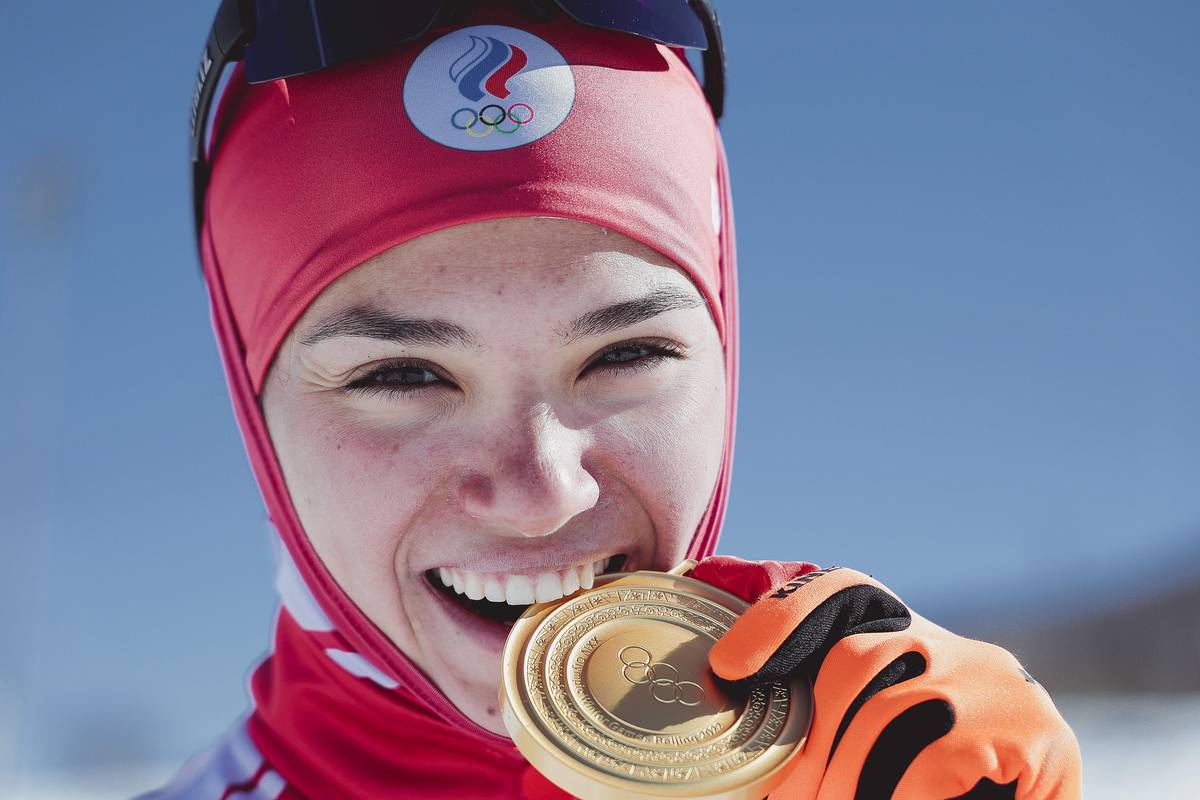
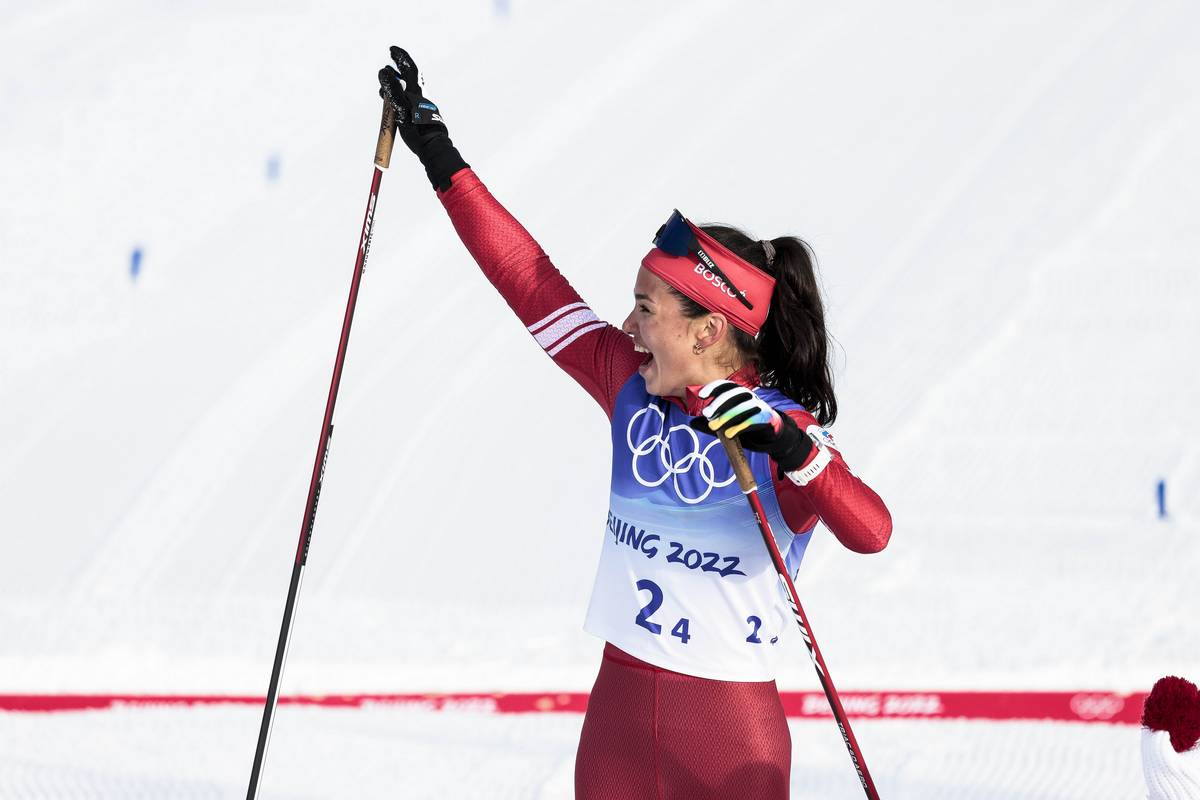
    Veronika Stepanova flexes with her Olympic relay gold medal during the 2022 Games in Zhangjiakou, CHN. (Photo: NordicFocus)

    Stepanova’s request to compete under a neutral flag rings a little hollow: the Russian ski team is already a little over two years into its four year WADA ban for state sponsored doping that requires it to compete under a neutral flag at championships. 

    A similar neutrality option was offered as a solution to the Russian national soccer team which was due to face Poland in a playoff match for qualification at the FIFA World Cup. Poland rejected the idea saying, “We are not interested in playing this game of appearances.” The Polish refusal to play Russia under any terms helped to force the IOC’s swift decision to recommend banning Russia from all sports. 

    “If doping wounds were quite successfully treated by time, then here the situation is different,” wrote an anonymous Russian blogger. “In fact, government policy has come into direct and insurmountable conflict with the ability to participate in the global sports movement. And now it seems that all this will last for years, if not decades.”

    ***

    Even if Russia were to return to the World Cup next season, it’s unclear that they would be able to operate at the same level as in the past, which has helped to fuel what US Ski Team Coach Matt Whitcomb refers to as a  “waxing arms race” on the World Cup circuit.

    According to Team Manager Elena Vyalbe, funding the Russian ski machine has been a challenge. She reported that the team’s budget in 2020 amounted to around 50 million rubles, roughly $600,000 at the time. According to Markus Cramer, who coached for Russia until this spring, the cost of supporting an athlete over the course of a year is more than $150,000—a figure that calls into question Vyalbe’s statement about the team’s budget.

    However, the Russian funding structure is murky, with much additional regional support to athletes provided by local extraction industries. Vyalbe complained in 2020 that sponsorships were scarce, saying, “No matter how well [Bolshunov] performed last year, we did not have a single new sponsor. God forbid that the current ones do not go away.” 

    In an April 5th interview with Championat, Vyalbe clarified the sources of the team’s funding: “We get most of the funds from the Ministry of Sports, the [Russian Olympic Committee] gives money for some things,” and that sponsorship amounted to “not even tears, but some kind of snot. We have a small budget.”

    The team’s primary sponsorship has come from Lukoil Oil Company since 1997. Whether or not Lukoil will be able to continue to fund Russian skiing remains to be seen. The company reported its highest annual profit in seven years at the same time that its shares plummeted on the London Stock Exchange after the invasion, losing 91% of their value before trading was halted March 3rd. 

    Though the ruble has recovered from its post invasion plummet, inflation in Russia is likely to reach at least 16% this year. That, coupled with uncertainty over the team’s competition status and the dismal prospects for the Russian economy, which is predicted by the IMF to contract 8.5% this year, has the potential to squeeze the team’s budget.

    Individual athletes also find themselves in a difficult position. Brav, the parent company of Swix and Toko, was quick to cancel sponsorship agreements with Russian  athletes, as did Kinetixx gloves. Expressen reported that Swedish ski company SkiGO was maintaining their partnership with Bolshunov, though SkiGO boss Christer Majbäck denied this, saying, “We don’t have any cooperation at all, it’s absolutely impossible. You don’t even have to ask me or SkiGO what we think about the war.”
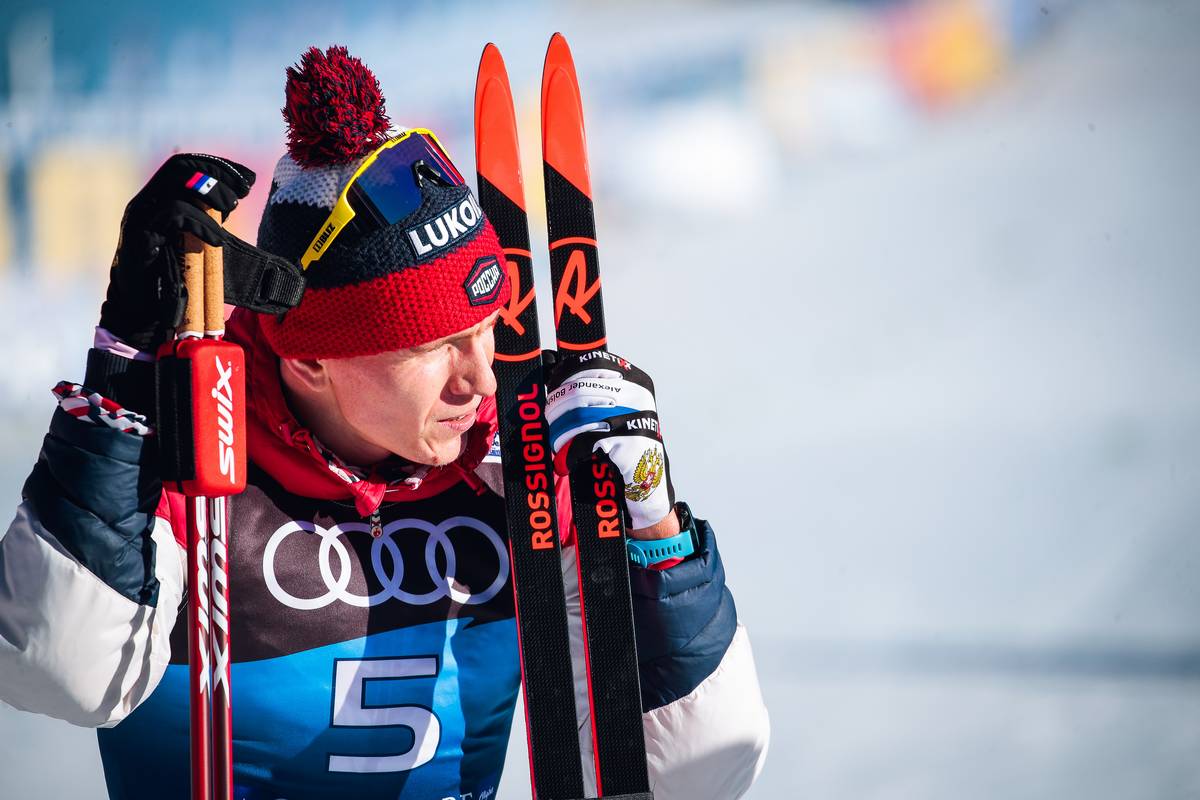
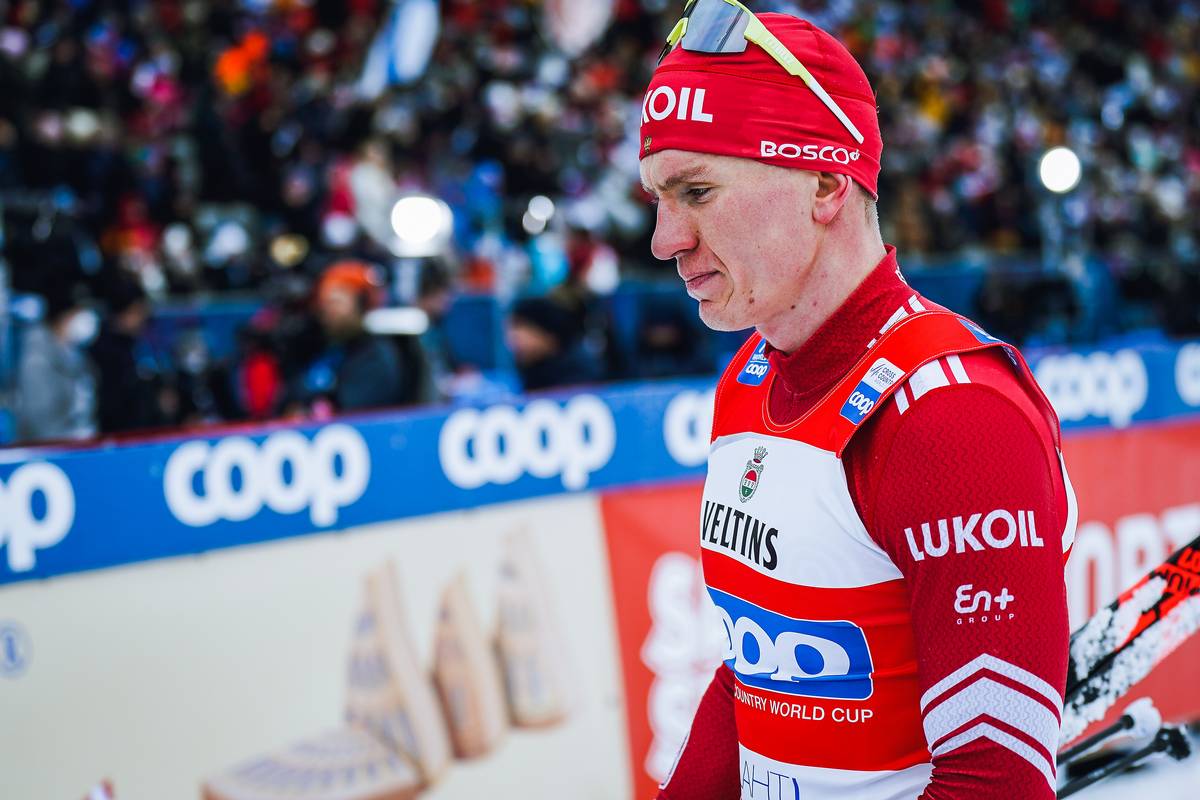
    Alexander Bolshunov observes trailside during the 2021-2022 Tour de Ski in Oberstdorf, Germany. (Photo: NordicFocus)

    Rossignol was standing by Bolshunov until an Instagram photo proved to be too much: not long after Russia was banned, Bolshunov visited a museum and posed for a photo in an old-timey Soviet race suit, captioning the photo “USSR 1980” —which happened to be the year that Soviet Union invaded Afghanistan, though it may also have been a  reference to the 1980 boycott of the Moscow Olympics. In any case, Rossignol demanded Bolshunov remove the photo, which he did, but by the following day Rossignol said it was no longer supporting Russian athletes and removed them from its website. 

    Bolshunov could keep his skis, Rossignol said, but no new skis would be sent to Russia. 

    Similarly Fischer removed Russian athletes from its site. Fischer Communications Director Franz Fottinger wrote in an email, “All our contracts with athletes are based on their participation in World Cup races. If racers are excluded from the World Cup, there is no more basis to fulfill the contract.” 

    ***

    The Russian athletes have not exactly lost their ski partnerships, rather they are suspended until their return to the international circuit. Nevertheless, this has provoked a strong reaction in Russia, with calls to revamp ski production in the country.

    The only significant ski production facility in Russia is the STC factory in Balabovo, around 100 km southwest of Moscow. It employs 350 workers making mostly recreational and kids skis. Whether the factory can be retooled to the demands of making race stock skis is questionable.

    Alexander Pechersky, the head of service for the Russian ski team said that “No matter how optimistic I am, I understand that the process is not fast and it can take at least 4 to 6 years to produce skis of an acceptable competitive level.”

    Pechersky continued, “Miracles do not happen, but I want to try … I still look at this idea with optimism, it is very interesting to deal with it. If things move forward, then the Russian sports market can get a model that, for relatively little money, will cover the needs of at least youth sports.”

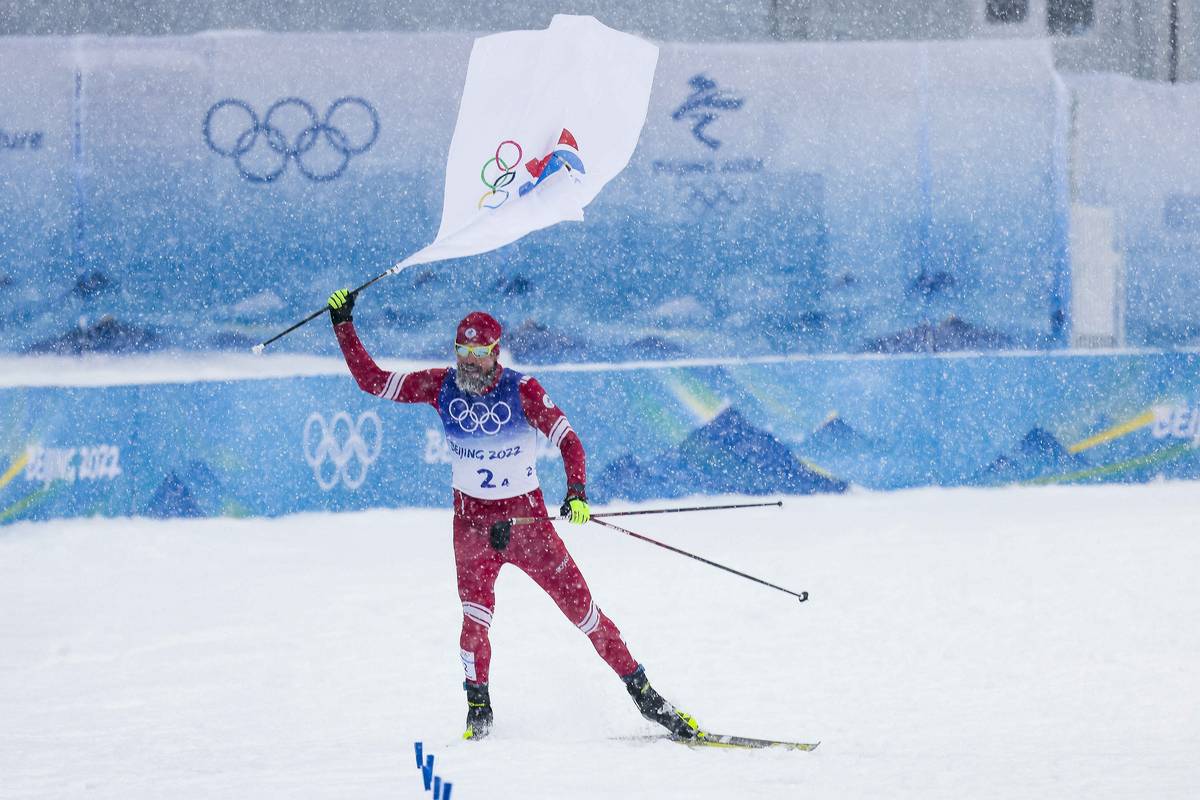
    The Russian Olympic Committee takes gold in the men’s 4 x 10 k relay in Zhangjiakou. (Photo: NordicFocus)

    Despite the public separation between sponsors and Russian athletes, some critical items are still quietly being made available to the team, according to Viktor Golovin, the deputy head of ski service for the Russian national team. “I will not name the companies, Golovin said, “but the Russian team at the start of the summer season is provided with new rollers in full, despite all the restrictions.

    The conflict in Ukraine also threatens to continue to squeeze the international supply of skis. Europe’s largest ski factory is located in Mukachevo, Ukraine and has traditionally produced some 800,000 pairs of cross country skis annually, primarily for Fischer. After a fire destroyed the facility in October of 2020, the factory remained offline for all of 2021 and was rebuilt into a state of the art ski production center. Just as final certification for the factory arrived in early February, the war broke out. 

    The factory’s director, Andriy Ryabich, wrote on his Facebook page on February 26th that “The work of the Fisher-Mukachevo enterprise has been suspended and the majority of the people went to the army in different directions and will defend our city, region and all [of] Ukraine.” 

    With much of the ski factories workforce at war during the critical spring months of ski production, ski shortages could once again factor in next season.

    ***

    For their part, the Russian Ski Federation has ordered the team to prepare with the expectation that they will compete on the World Cup, though their draft schedule indicates the team is planning to stay in Russia through next spring. 

    Curiously, in the face of unprecedented challenges the national team has expanded–to a historically large 46 skier strong team, divided into five training groups. 

    The team was dealt a blow with the departure of Markus Cramer this spring. He will join the Italian national team, though he will continue to coach Ustiugov from afar. 
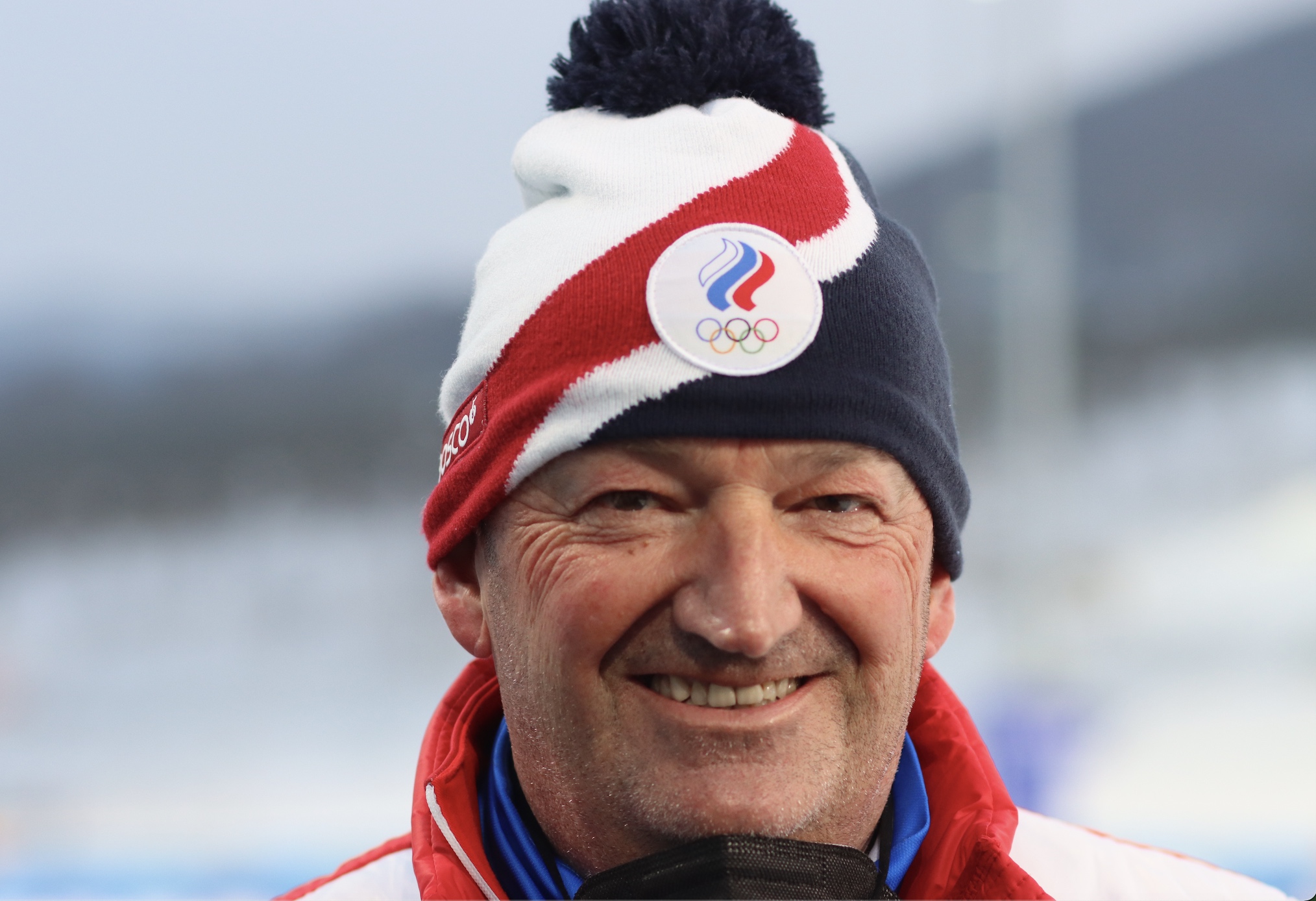
    Former Russian ski coach Markus Cramer joins the Italian National Team for the 2022-23 season. (Photo: Nat Herz / ADN)

    Cramer’s tenure was instrumental in revamping the team’s training methods. Of the five training groups, three are closely tied to his methodologies. Two groups are led by Cramer protégés Egor Sorin and Petr Sedov, and a third by Sorin’s former assistant—Andrey Nutrikhin.

    The group led by Yuri Borodavko—who subscribes to a more Soviet era training philosophy and who was once suspended for doping activities—will add big names such as Yulia Stupak and Ivan Yakimushkin to an already impressive roster that includes Bolshunov and Neprayeva. Unmoved by the political climate, Borodavko’s group will begin the training year on May 15th with a controversial camp in Russian occupied Crimea.
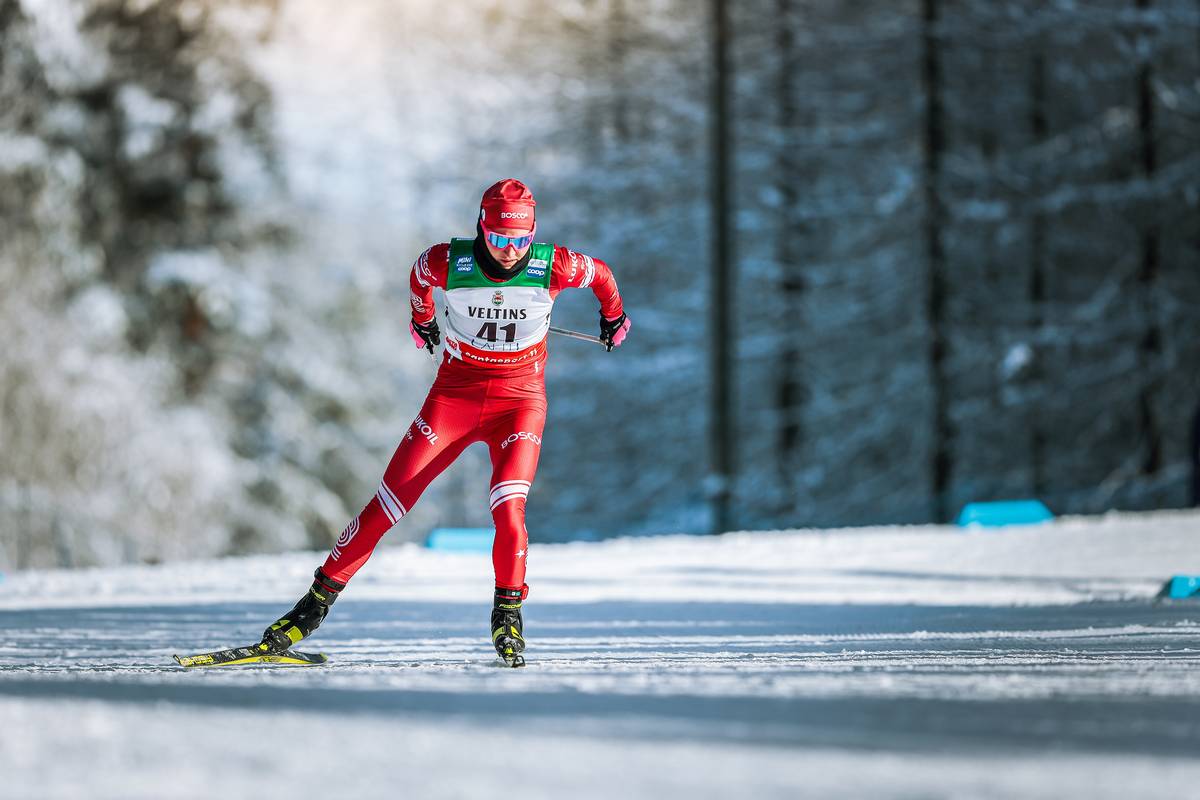
    Yulia Stupak (RUS) races a freestyle sprint qualifier in Lahti, FIN in February 2022. (Photo: NordicFocus)

    A Russian return to the World Cup is complicated by the unusually acidic edge the team has brought to the circuit, with acrimony spilling over into social media trolling and confrontations on the ski course.

    Russian sport media has reacted strongly to the FIS ban by portraying the decision as a Norwegian power move and athletes such as Johannes Høsflot Klæbo who have supported the ban have been subjected to vitriol from Russian officials. Even before the invasion, Russian media has, in the post Sochi era, covered skiing in an increasingly strident and conspiratorial manner, dominated by a narrative of sporting victimhood and Russophobia. 

    Should Russia remain banned next season, or even longer, their absence may help FIS enact one of the most challenging maneuvers they have undertaken—the transition to fluoro-free racing, which FIS has now committed to enforcing next season. 

    Chris Grover downplayed the idea that Russia’s absence will make the transition easier, writing, “It doesn’t matter so much which nations are present at a given World Cup weekend. We need a testing system that all of the athletes, coaches, technicians and fans can trust.” 

    Fears of an imperfect test for fluoros have been punctuated with not so subtle hints of suspicion aimed at the Russian team. Golovin addressed these concerns, saying, “The Finns told us directly that the Russians are closed, no one knows what they do with skis. I suggested that they come to our wax truck and have a look…Come and see, and there is no need to make unfounded accusations.” 

    Nevertheless, Russia’s absence may lessen unstated distrust on the circuit, and perhaps improve cooperation and tolerance as the ban is enforced.

    To that end, it may be a mistake for FIS to end the ban before next season regardless of whether or not the war in Ukraine ends in the interim. All of the justifications for the ban are likely to continue into next season: security threats to Russian athletes, the Kremlin’s use of skiers for pro-war propaganda, and the inability of Ukrainian skiers engaged in the country’s defense to prepare for next season. Finally, there has been no attempt at reconciliation by Russian skiing toward the wider ski world, with intransigent blaming of Norway for the present situation. In short, Russian skiing has rejected the rest of the ski world and has found itself in the cold. 
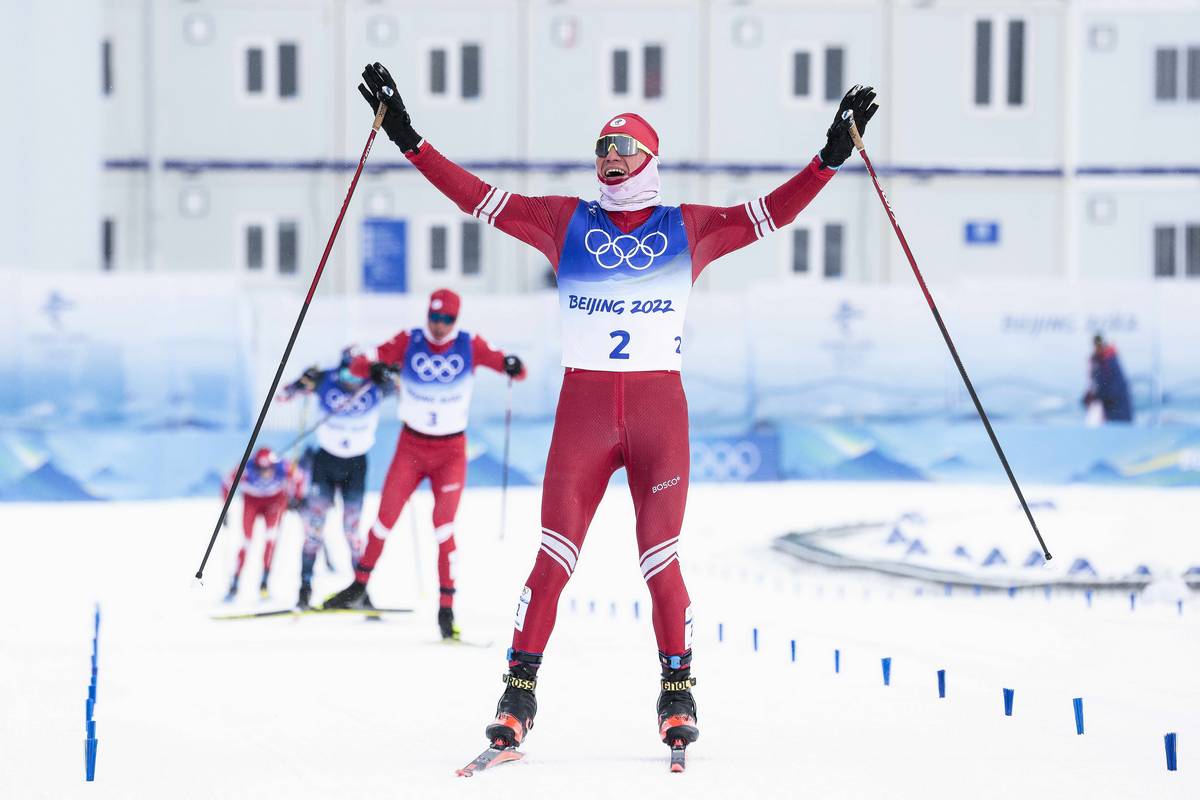
    Alexander Bolshunov takes Olympic gold in the men’s mass start 30 k, shortened from 50 k due to temperatures and extreme wind. (Photo: NordicFocus)

    As Ulvang pointed out, skiing cannot be separated from society. 

    “It’s very important that we split [distinctions] between the sanction against a nation and the sanction against the Putin regime,” Ulvang told FasterSkier reporter Nat Herz in March. “I hope I’m still friends with the athletes and that we’re able to split between a reaction against the regime. It’s nothing personal. In the big picture we are all repping our nations and our regimes. We need legitimacy from society to exist. We need public money [for] our training facilities and to make tracks and courses and we need support.” 

  • Cross-Country Skiing Mulls a Long Term Future Without Russia (Part 2)

    Cross-Country Skiing Mulls a Long Term Future Without Russia (Part 2)

    Click here to read part 1 of this series, which takes a look at international news surrounding the Russian athlete ban through the spring. For how these bans have impacted a broader cross-section of the sporting world and analysis of the complex questions surrounding whether Russian athletes should be able to compete, check out this recent Sports Illustrated article by Michael Rosenberg.


    Concerns over both fair play and propaganda have been tied to the necessity of the ban on Russian athletes. Yet ultimately the reason given by FIS for the ban was to “ensure the safety and security of all athletes”. This wording removed any political connotations, and was criticized for its weak stance that failed to condemn the war in Ukraine. 

    Natalia Nepryaeva slides for the heat win during a sprint stage of the 2021-2022 Tour de Ski in Oberstdorf, GER. (Photo: NordicFocus)

    Still, there were real concerns over the safety of the Russian athletes at European races. On March 1st, due to threats, the organizer of the World Junior Championships for jumping moved the Russian contingent out of their hotel in downtown Zakopane, Poland with the aid of 200 police officers. In Norway, Neprayeva reported being threatened in the team’s hotel in Oslo, and the Norwegian Ski Association was flooded with messages insinuating that if the Russian athletes started a race they would not finish.

    “[The] FIS followed the IOC decision and based [the ban] on security,” Ulvang said in a call in March with FasterSkier reporter Nat Herz. “This has also become a legal case because Russia has taken this to CAS [The Court of Arbitration for Sport].”

    While the FIS cited athlete security for the ban, the Federation took their cue from the IOC which recommended banning Russia due to the violation of the Olympic truce. This historical agreement, presented at the UN prior to the start of the Games, calls for the “cessation of hostilities” surrounding the Games, incorporating the Olympic values of sportsmanship and unity “with a view to protecting, as far as possible, the interests of the athletes and sport in general, and to harness the power of sport to promote peace, dialogue and reconciliation more broadly.” 

    Russia’s invasion of Ukraine on February 24th, 2022 violated the agreement, co-sponsored by the Russian Olympic Federation, to abide by the truce from February 4th through March 20th, surrounding both the Olympic and Paralympic Games in China.

    “We will see,” continued Ulvang, “whether this is within the overall statutes of sport or FIS actually, because our rules are not made for such special things. This is a very, very special circumstance. I have spoken to many lawyers who think this is an interesting question.”

    Waving the flag for the Russian Olympic Committee, Sergey Ustiugov brings home a win in the men’s 4 x 10 k Olympic relay. (Photo: NordicFocus)

    Russia has pursued aggressive appeals of bans in a variety of sports, though with exception of Luge, largely without success. On May 21st, Vyalbe conceded that after consultations with lawyers, the Russian Ski Federation would not appeal the ban in CAS, saying, “We won’t win.”

    An anonymous Russian blogger examined the legal considerations of banning Russia, and found that while the IOC had operated outside of its normal boundaries to call for a blanket ban, it had done so out of the special circumstances. Previously, it was the UN that called for athletic exclusions, such as that of Serbia during the siege of Sarajevo.

    In this case, with Russia being a permanent member of the UN Security Council, any resolution could be unilaterally vetoed by the country, so in turn the burden fell to the 

    IOC to take an action that was theoretically beyond its scope—though roughly in keeping with previous cases.  

    For Russia, there is no easy recourse for dealing with sporting sanctions. Unlike economic ones, they do not inflict mutual pain and any victories achieved in the sport courts could easily be undermined by canceled visas or boycotts. 

    Yet a sustained ban on Russian athletes is likely to reshape skiing in a number of ways, beginning with the sport’s media position. Russia now comprises the largest audience for cross country skiing, averaging 1.5 million per World Cup race and accounting for at least a third of the sport’s total audience. 

    After Russia was banned this spring, Match!TV—a large Russian public broadcaster— pulled coverage of all international ski races and redirected its energies toward covering domestic competitions where it is likely to remain focused until Russian athletes return to the World Cup. 

    Compounding the difficulties of that loss will be the continued transfer of ski racing from public TV in Norway, Sweden, and Finland to streaming service Viaplay, which charges a hefty subscription fee—as much as €40/month in Finland. 

    Traditionally, public broadcasts in the Nordic countries accounted for half of skiing’s total audience. In 2020/21 that share fell to a third, in part because of Covid restrictions that kept their teams at home. Norway especially tuned out, with a 55% reduction in viewers, and numbers in Sweden, Finland, and Germany also declined. 

    Offsetting this loss has been Russia, whose star skiers have propelled coverage of the World Cup from subscription channels to public TV in their country, boosting domestic viewership in 2020/21 by 600%.

    The men’s 4 x 10 k Olympic relay podium: the Russian Olympic Committee (ROC) came out on top ahead of Norway in second and France in third. (Photo: NordicFocus)

    While last season’s viewership numbers have not yet been published by FIS, during Period 1 of the World Cup last season, VG found that the races shown on Viaplay averaged far fewer viewers than would be typical for an NRK broadcast. 

    Should broadcasting continue to sustain a loss of 40% of its audience in the Nordic countries while also losing the majority of Russian viewers, the sport may find itself in crisis, as sponsors balk at paying for low return advertising. Still, it may be too soon to write Viaplay off completely—the service recorded more than a million Swedish viewers tuning in to the World Cup weekend in Lillehammer. 

    As a whole, FIS cross country skiing has struggled to hold its audience, and losses in some regions have been more than offset by the recent tide of Russian viewers.

    While Russian viewership is huge, most sponsors of the FIS World Cup are not particularly oriented toward Russia. Coop—the title sponsor of the Cross Country World Cup—is a Norwegian grocery chain. Coop early on sided with the Norwegian Ski Association in calling for the exclusion of Russian skiers. Many other sponsors have no business in Russia, and some, like Audi, have halted operations there. 

    Despite the €29 million that Russian viewership is estimated to be worth to sponsors, the audience may hold little allure, perhaps because of the average Russian’s low purchasing power. In 2021 the average Russian made around 40,000 rubles annually, or about $6,400. Now, with many western businesses pulling out of Russia, there is even less value placed on reaching Russian fans. 

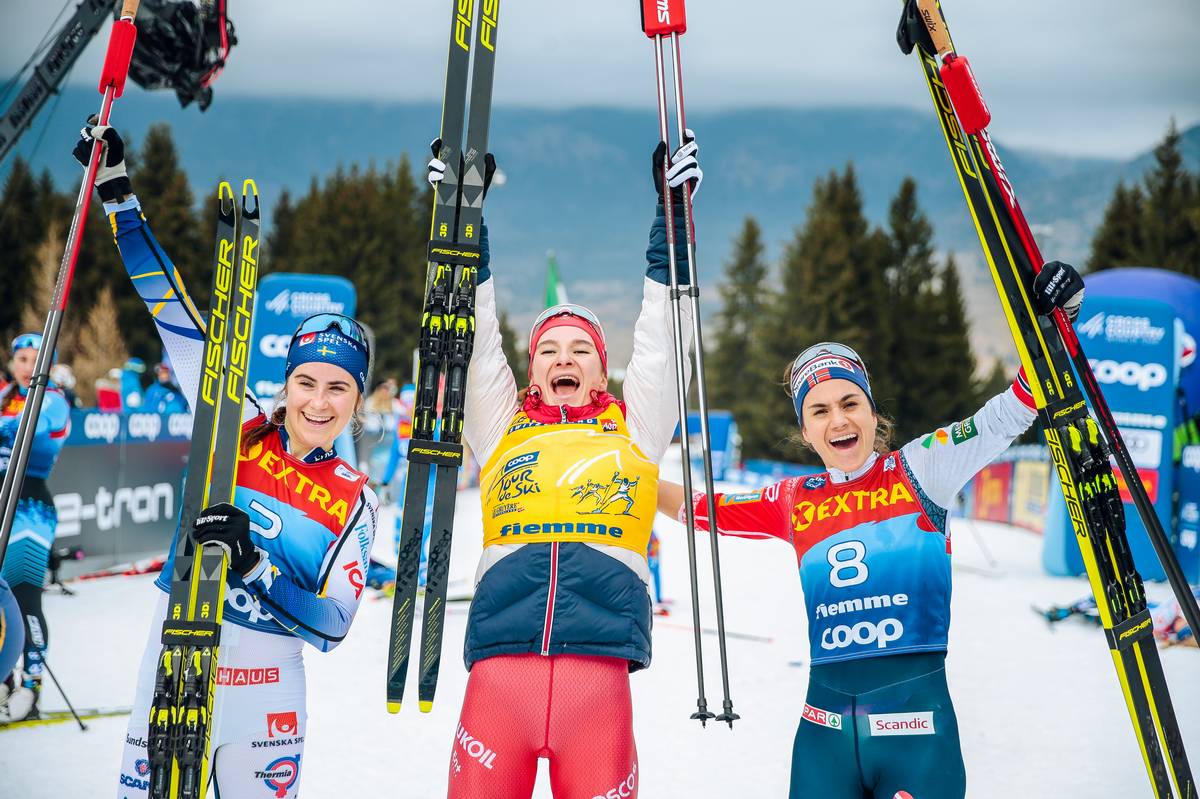
    The women’s overall podium of the 2021-2022 Tour de Ski: Natalia Nepryaeva (RUS) was the overall champion ahead of Ebba Andersson (SWE) in second and Heidi Weng (NOR) in third. (Photo: NordicFocus)

    For sponsors, the Russian exclusion may ultimately be beneficial. Germany, and Central Europe in general, are a core market for skiing—a market which has been drying up in an era of poor performances by the region’s skiers. 

    With the German women winning gold at the Olympics and the retirement of the dominant force in distance racing, Norway’s Therese Johaug, the opportunities for success of sidelined countries could become plentiful on the women’s side with the additional absence of Russia.

    On the men’s side of skiing, though Norway remains poised to dominate, a potential lack of a Russian team would create significant podium opportunities for up-and-coming American, Canadian, French, German, and Czech athletes. In recent seasons the rivalry between Norway and Russia has consumed almost three quarters of the World Cup podiums. The long term absence of Russia could allow the podium of men’s skiing to once again take on a broader flavor. 

    Chris Grover, U.S. Ski & Snowboard Cross Country Program Director, clarified that a continued ban on Russian athletes wouldn’t change the quota system, writing, “We’ll have the same number of athletes starting each race. Obviously, Russia has a lot of the top performers, so there will be more opportunities for many other nations to secure podiums, gather World Cup prize money and points, and improve Red Group standing.”

    Julia Kern leads the way in the first leg of the 4 x 5 k mixed relay in Falun, SWE in Mar. 2022. (Photo: NordicFocus)

    All told, the changes that skiing will endure if Russia remains banned through next season may not be as dire as Russian sporting officials have suggested. 

    “The tired rhetoric that world sport will not be able to fully develop without Russia does not seem to inspire the speakers themselves anymore,” wrote the anonymous blogger. “It is no coincidence that you can already hear talk about alternative tournaments, leagues, and other ways of self-reliant development.” 
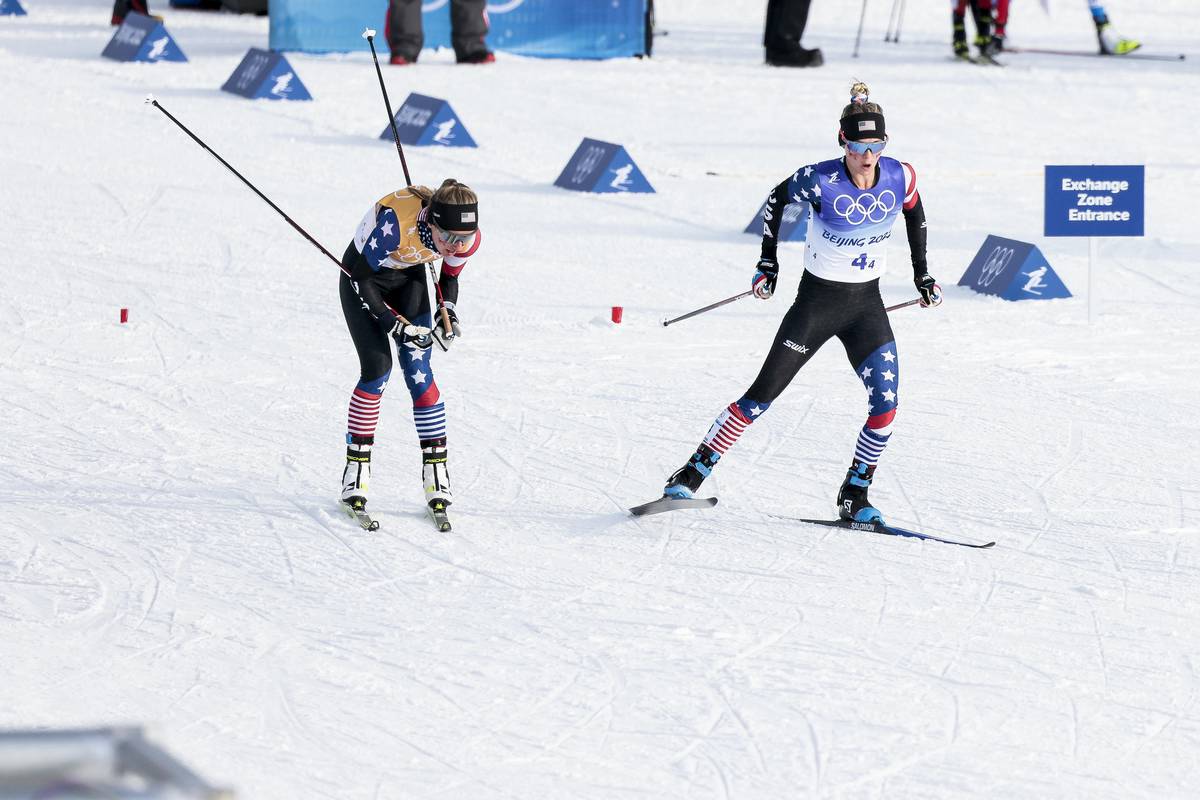
    The alternative for Russian skiing is to try to create its own circuit among friendly nations. To date, Russian skiing has only managed to solidify a sporting partnership with Belarus, via a cooperative agreement signed in May.

    Stay tuned for Part 3, which considers historic athlete bans, and barriers the Russian program face to keep their program operating in the interim.

  • Cross-Country Skiing Mulls a Long Term Future Without Russia (Part 1)

    Cross-Country Skiing Mulls a Long Term Future Without Russia (Part 1)

    Alexander Bolshunov takes fifth in his final World Cup race of the 2021/2022 season, a 15 k classic in Lahti, FIN. (Photo: NordicFocus)

    With Russian athletes banned from all FIS competitions, and no end in sight for the war in Ukraine, there is a growing belief that Russian skiers are unlikely to rejoin the World Cup next season. 

    Some commentators have gone further, proclaiming that we have seen the last of Bolshunov, Neprayeva, and the rest of the Russian team on the international stage. The pessimism is rooted in the history of similar bans—which tend to be long lived—and the uncertainty over what circumstances would allow for the Russians to rejoin. 

    Will the ban end when Ukrainian athletes can return fully to competition? That may not be possible until long after the end of the conflict. Perhaps a negotiated peace settlement? That possibility could still create discontent with athletes such as Bolshunov being used to fuel propaganda at home. Does the ban require the Putin regime to end? That could be a distant future. 

    “I expect that this situation will last as long as the conflict is unsolved,” said Vegard  Ulvang, the outgoing chairman of the FIS Cross Country Committee, “but that’s of course up to the FIS Council or IOC.” 
    Ulvang was outspoken in calling for the Russian exclusion from the Norwegian hosted World Cup events this spring. Ulvang said in a call, “We have a fairness rule in FIS that there should be equal opportunities. When one nation cannot compete because they have to go home to defend their country, and the attacking country is racing, that’s not nice.”
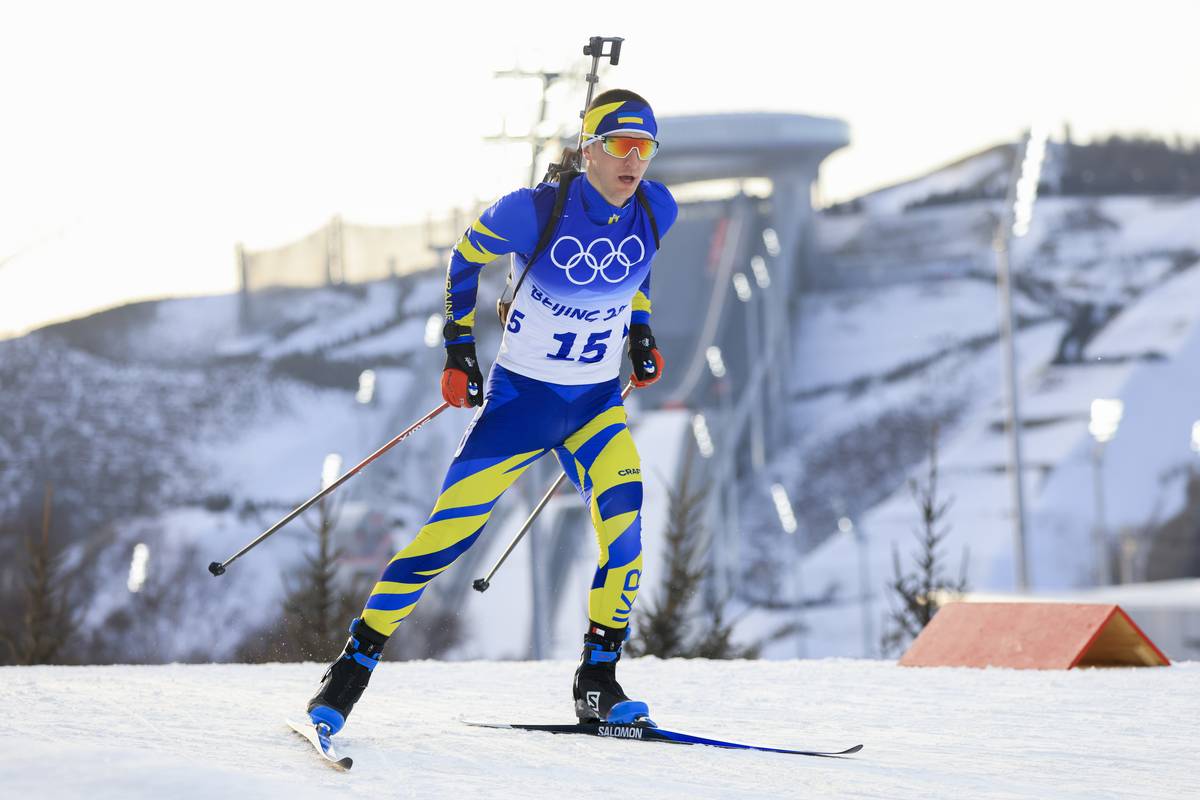
    Ukrainian biathlete Dmytro Pidruchnyi competes in an Olympic sprint during the 2022 Games, shortly before being called into military service to protect his country amidst Russian invasion. (Photo: NordicFocus)

    Ulvang’s point is underscored by the Ukrainian athletes now fighting on the front lines, with many called up just days after returning from the Beijing Olympics. Among the Olympians taking up arms was Dmytro Pidruchnyi, a biathlete who has won gold in the World Championships. The danger faced by the athletes defending their country was made clear early on in the conflict with the tragic loss of nineteen year old biathlete Yevhen Malyshev, who was killed defending Kharkiv on February 26th. 

    Another explanation for the ban was that it would help send a message to everyday Russians and deprive the state of a propaganda tool. 

    The charge that athletes were being used for propaganda purposes was confirmed during Russian President Vladimir Putin’s March 16th pro-war rally in Moscow. The event, titled “For a World Without Nazism” was MC’d by longtime biathlon TV commentator Dmitry Guberniev. Stars of the Beijing Olympics—including Alexander Bolshunov—were trotted out in front of the (reportedly) 100,000 strong audience in the Luzhniki stadium. 

    Questions remain about whether the athletes attended of their own accord, and there has been speculation about whether Bolshunov’s decision not to wear a letter Z pin on the stage—a pro-war symbol—reflected an ambivalent attitude to the conflict now raging near his home. 

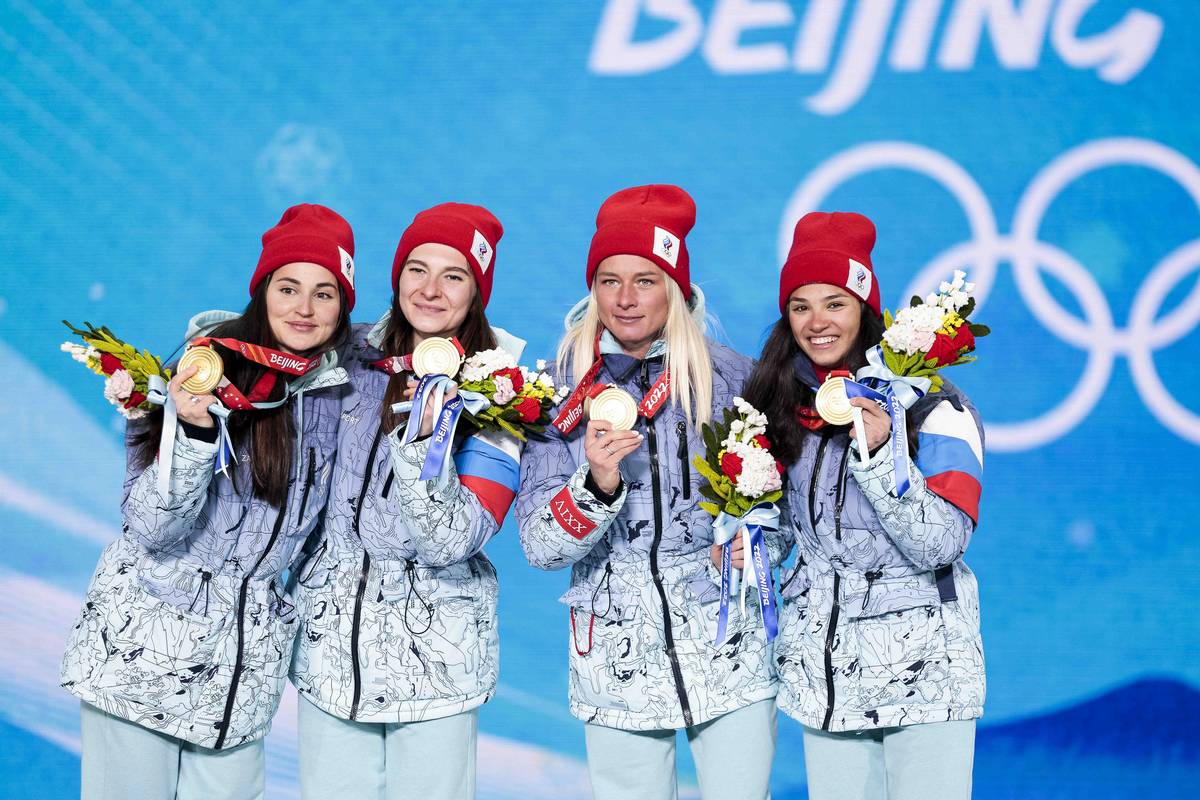
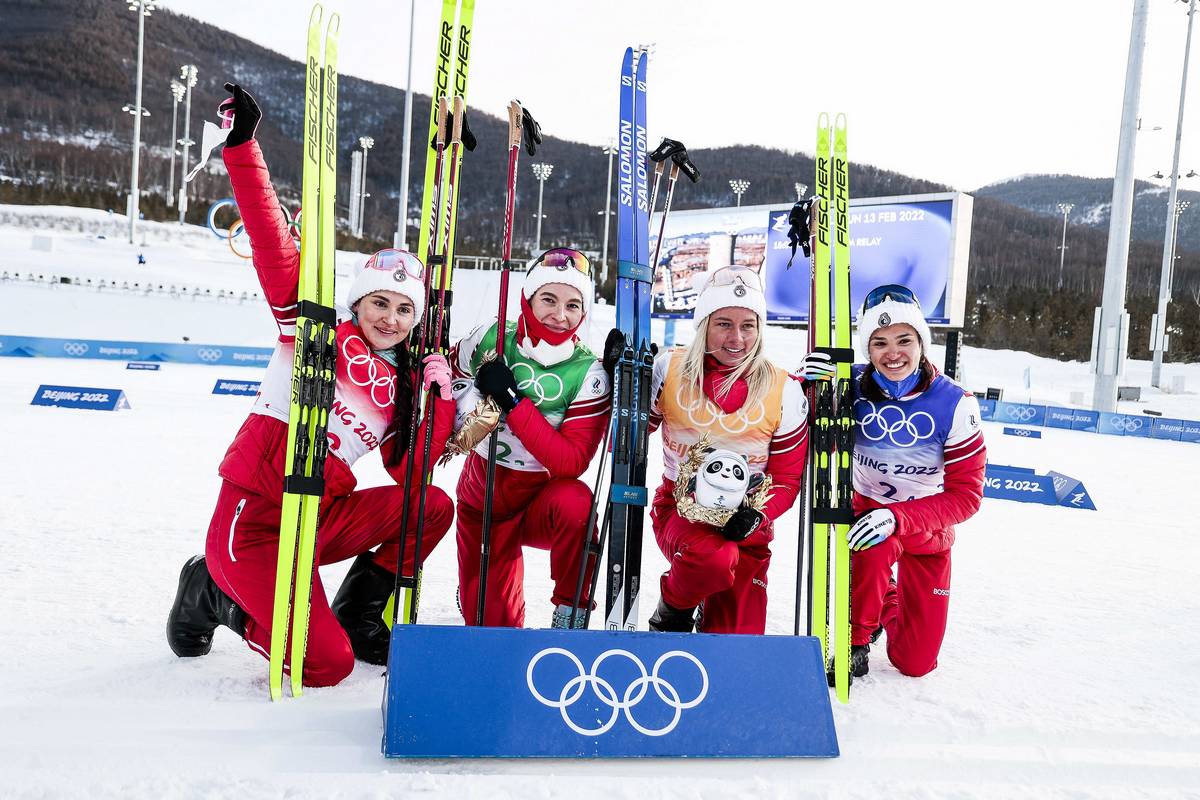
    The women representing the Russian Olympic Committee strike gold in the 4 x 5 k relay. From left to right, Yulia Stupak, Natalia Nepryaeva, Tatiana Sorina, and Veronika Stepanova. (Photo: NordicFocus)

    On April 26th, a host of Olympic heroes were called to receive state awards by Vladimir Putin in a ceremony that required the athletes to quarantine prior to the visit. Putin congratulated the skiers, saying “First of all, I would like to note the long-awaited victories in the relay race…We have not had a simultaneous victory of both the women’s and men’s teams for exactly half a century. This is a big result.”

    A few notable Russian stars missed the Kremlin occasion: Bolshunov for dental surgery, Neprayeva because she arrived to quarantine sick, and Ustiugov because his wife had recently given birth. 

    Bolshunov’s absence at the event stirred further speculation that he had intentionally scheduled the surgery to avoid the ceremony, and with it the possibility of a personal ban set against him by FIS, much as FINA – the International Swimming Federation – did by banning Yevgeny Rylov for nine months after he stood next to Bolshunov at the March 16th rally.

    Elena Vyalbe, who heads the Russian Ski Federation, manages the national team, and sits on the FIS council, dismissed this speculation, saying, “Who wrote that Alexander [Bolshunov] refused? I already spoke about this…He was scheduled for surgery on the 24th [of April].”

    However, during the Olympics Bolshunov made it clear he dreaded the idea of the quarantine required to meet Putin, saying, “If they put me in jail forcibly, I’ll run away in two hours. I can’t just take it and throw 10-14 days out of my life. It’s unrealistic.”

    During the Kremlin ceremony, Putin singled out the missing Bolshunov for special praise: “I note that Alexander Bolshunov has collected a solid collection of awards in Beijing,” Putin said. “Everyone knows this well. He has three gold, silver and bronze medals. And the absolutely well-deserved symbolic title of king of skis.”

    Alexander Bolshunov displays four of the five Olympic medals he collected in Beijing, bringing his career total to nine medals earned over two Olympic Games. (Photo: NordicFocus)

    The political significance of the event, which was delayed due to the war in Ukraine, was not lost on anyone. Veronika Stepanova, the upcoming ski star from Kamchatka seized the moment to make a splash.

    Addressing Putin and the Kremlin audience, Stepanova said, “I am the same age as the century—I was born in January, 2001. Before my very eyes, Russia has again become strong, proud, and successful. Not everyone in the world likes it. It is obvious. But we are on the right track. And we will definitely win, as we won at the Olympics.”

    The overt statement of support from Stepanova far exceeded expectations of decorum that called for perfunctory public speaking at most. That Stepanova would jeopardize a burgeoning ski career for a soundbite even shocked Russian commentators who speculated that the 21 year old was positioning herself for a transition to politics. For her part, Stepanova responded saying, “Negative consequences for my international career? They don’t scare [me].”

    Far from distancing herself from the comments, Stepanova has brashly doubled down, saying, “Was I nervous when I spoke at the meeting with Putin? You have to believe in what you say. The presence of the president does not confuse or frighten, on the contrary, it energizes. You feel tremendous confidence next to him, you feel a special energy.”

    Stepanova’s words have reverberated as she has gained a following in the west: outgoing and fluent in English, as well as adept at social media, many fans as well as fellow competitors felt they could relate easily to her. 

    Helene Marie Fossesholm of Norway was one such skier that enjoyed a friendly rapport with Stepanova off the ski trails. In the wake of her Kremlin speech, Fossesholm told NRK she was uncertain of how the friendship would continue, saying, “I can not answer that until I have experienced it. But it is clear that it will not be forgotten, at all.”

    Flooded with foreign media requests to explain herself, Stepanova responded via her Instagram page, writing “I have an answer to [Western journalists]: Did you expect anything else from me? Just because I smile, speak a little English and am almost always ready for some nonsense, does that make me ‘another type of Russian?’ The peak of naivety!”

    21-year-old Veronika Stepanova anchored the Russian gold medal winning women’s 4 x 5 k Olympic relay team during the 2022 Beijing Winter Games. (Photo: NordicFocus)

    Vyalbe has been among Stepanova’s detractors this spring, criticizing her by saying that she may be suffering from “star disease” and that “now she is not an athlete, but a patriotic blogger.” For the head of Russian skiing, Stepanova has become irksome. “My senior leaders ask me questions about her,” Vyalbe told Championat, “and I feel ashamed and unpleasant.”

    For her part, Vyalbe faced pressure in her bid to remain on the FIS council, after the Ski Federations of Poland, Finland, and Sweden moved to bar her from running for reelection at the FIS Congress on May 26th. FIS, however, allowed Vyalbe’s candidacy.

    In allowing Vyalbe to run, FIS may have looked at the difficulties endured by the International Luge Federation (FIL). In early March FIL had voted to ban Russia in much the same manner as FIS, though Luge went a step further—voting in favor of expelling elected officials from Russia. 

    In April, Russia won their appeal in the FIL’s own Court of Arbitration, and saw the ban removed on the grounds that they were—according to the Russian Luge Federation—”dictated solely by political motives and had no legal grounds for adoption”.

    For FIS, the Luge ruling was likely a reminder that barring Vyalbe from running could run afoul of their own laws against politically motivated rulings. 

    Apart from from the symbolism of being Russia’s representative to FIS, Vyalbe had escalated tensions in the ski world by laying the blame for the ban squarely on the shoulders of Norway’s FIS representatives—Erik Røste, the head of the Norwegian Ski Federation and FIS councilor, and Vegard Ulvang, the outgoing chairman of the FIS cross country skiing committee. 

    In response, Røste said, “Norway will not vote for Russia because of the terrible things happening in Ukraine.”

    The Vyalbe election saga has proven to be a tender subject for Russian commentators. When Swedish skier Markus Grate commented that “There is no possibility that Vyalbe will remain on the council,” biathlon TV commentator Guberniev declared that if Grate was suggesting that Vyalbe be excluded on the basis of her nationality, then “he is a Nazi, these are the words of a Nazi.”

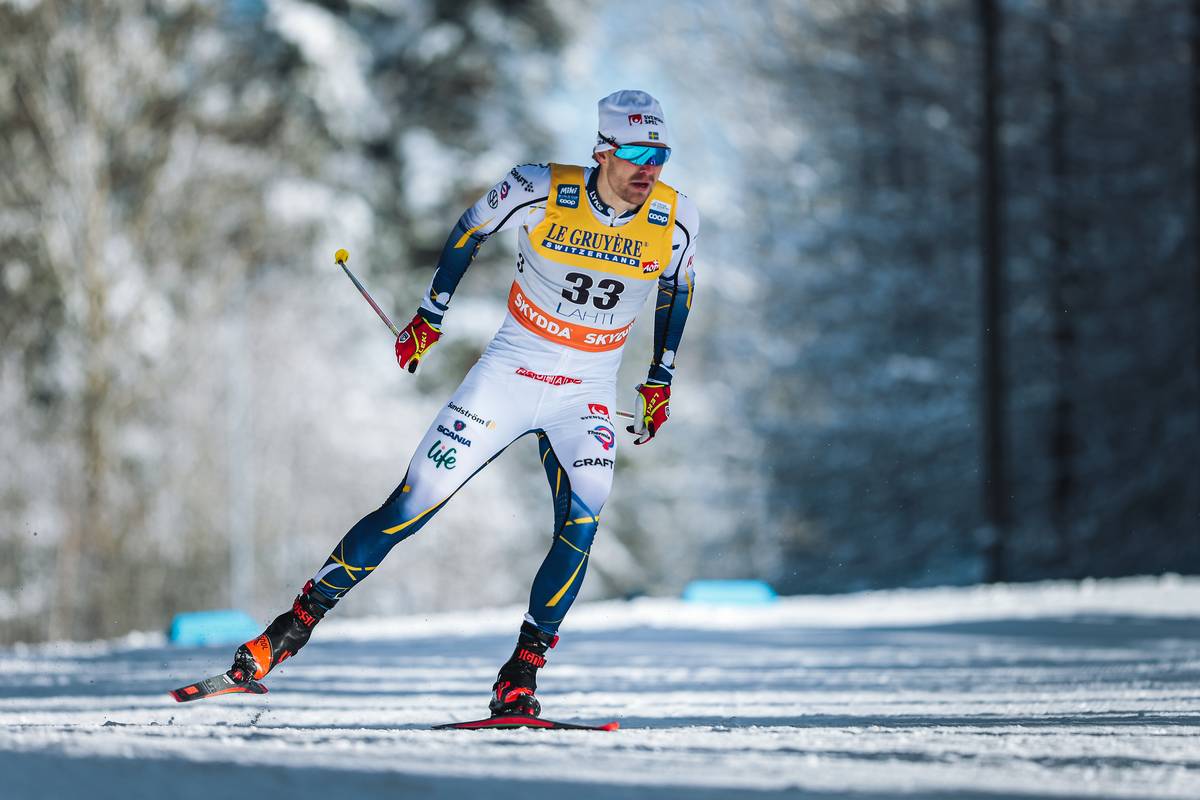
    Marcus Grate (SWE) races a freestyle sprint qualifier in in February 2022 in Lahti. (Photo: NordicFocus)

    In any case, Vyalbe lost the election on May 26th at the FIS Congress—finishing last. “In this situation, it was expected,” Vyalbe said. “There was a letter from the Ukrainian Federation, which says that everything should be politicized.” 

    With Vyalbe out of the FIS council, Russian skiing will likely recede further into seclusion. 

    Stay tuned for parts 2 and 3 of this series, which will be released over the next week. 

  • Stepanova Anchors ROC to Gold in the Women’s 4 x 5 k Relay; USA 6th

    Stepanova Anchors ROC to Gold in the Women’s 4 x 5 k Relay; USA 6th

    This World Cup coverage is made possible through the generous support of Marty and Kathy Hall and the A Hall Mark of Excellence Award.  To learn more about A Hall Mark of Excellence Award or to learn how you can support FasterSkier’s coverage please contact info@fasterskier.com.


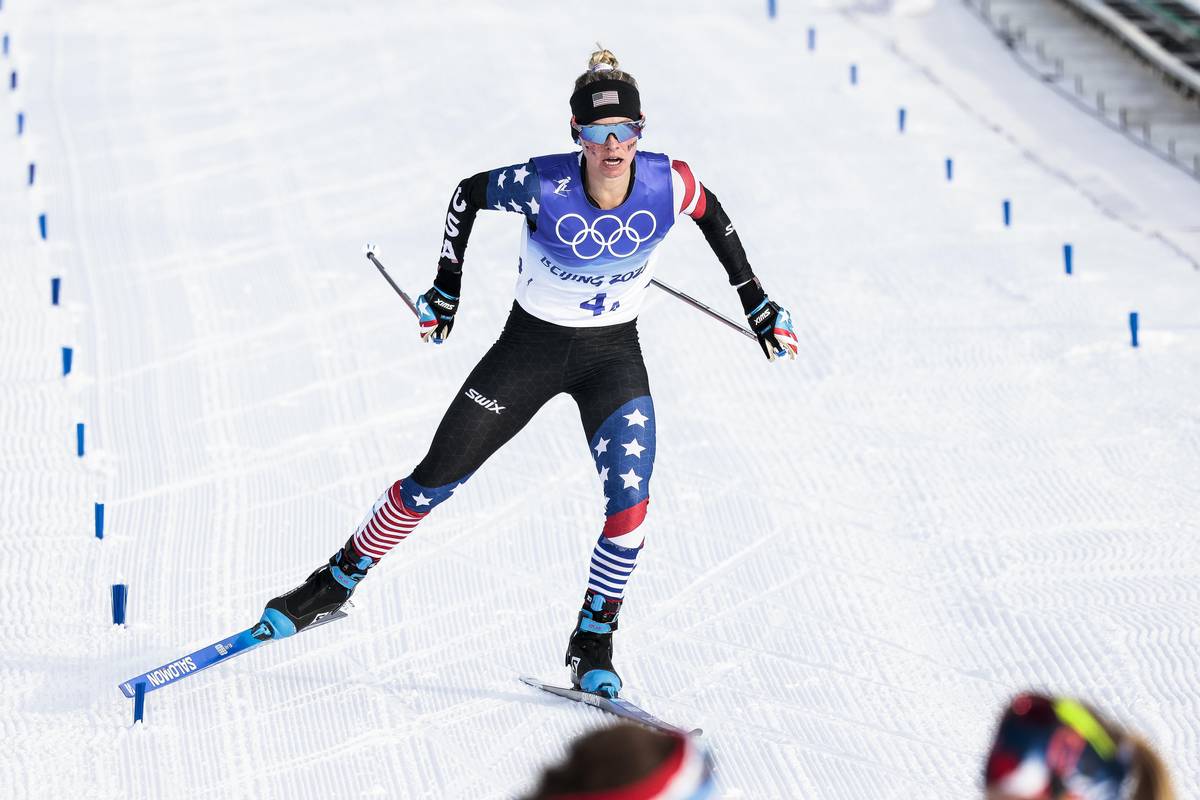
    A relay medal evaded the American women’s 4 x 5-kilometer team for another Olympic quadrennial today, as Hailey Swirbul, Rosie Brennan, Novie McCabe, and Jessie Diggins finished sixth, +1:28.2 behind the winners from the Russian Olympic Committee (ROC). Silver went to the German team, who finished +18.2 back on the ROC, while bronze went to Sweden (+19.7), who took Finland to the line, leaving them 0.5 shy of a medal in fourth.

    The relay is seen as a testament to a program’s depth and breadth; with two classic and two skate legs, it’s not enough to have one or two podium-caliber skiers who are specialists in one technique or the other. A team needs to have four strong women who can compete at the top of the field, and the program must have the technical proficiency to maintain contact with the front as the race switches from classic to skate.

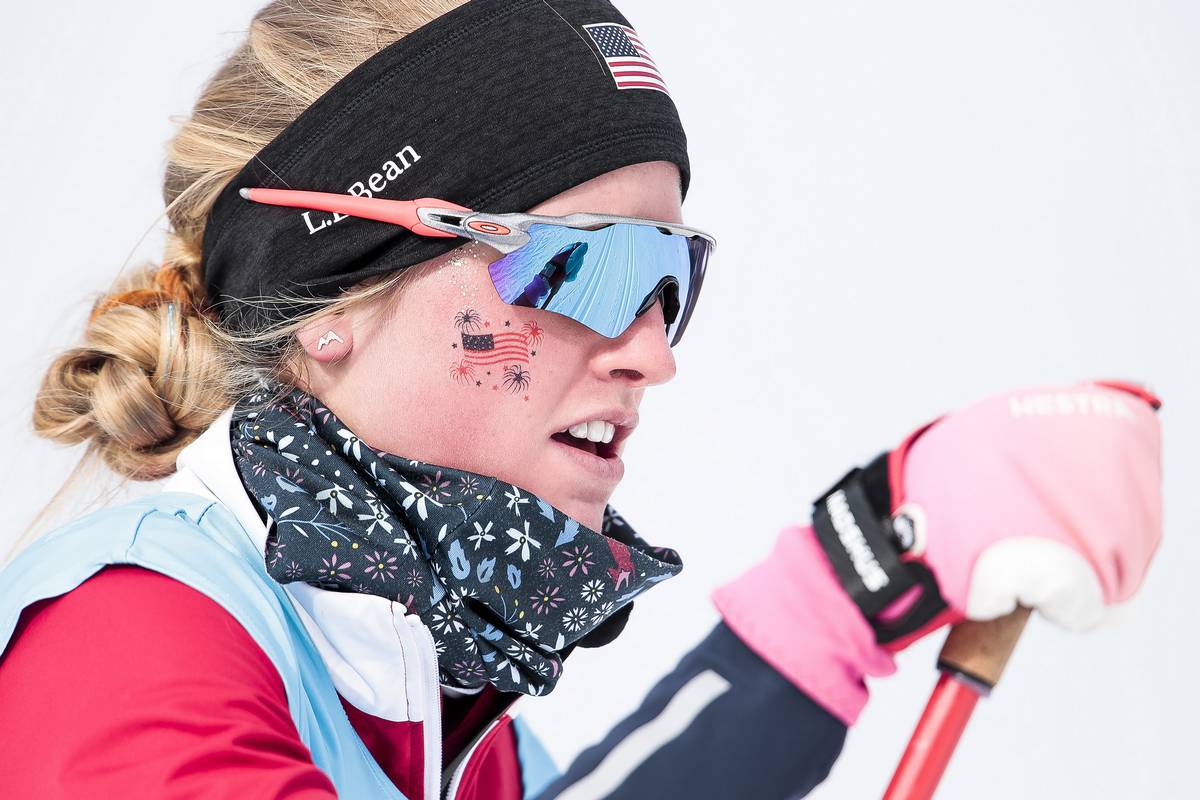
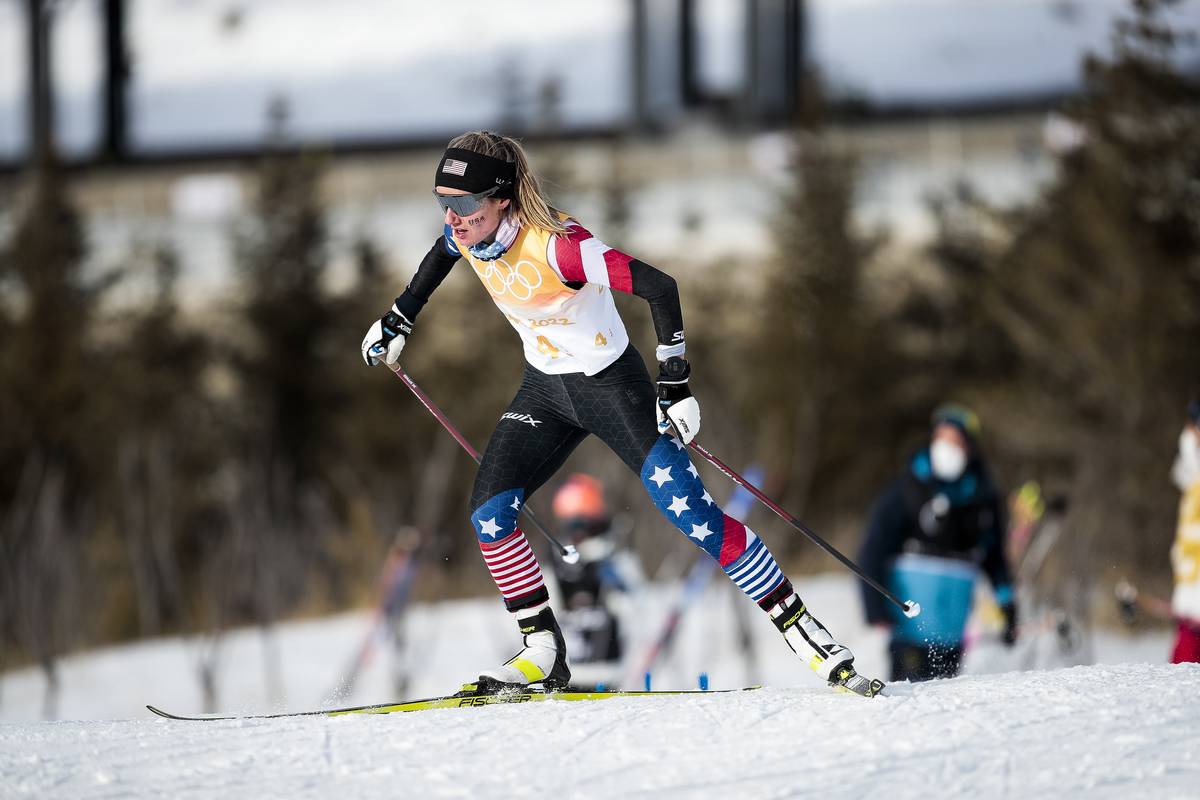
    A glittery flag tattooed on her cheek, Hailey Swirbul warms up to lead the American 4 x 5 k relay team. (Photo: NordicFocus)

    And, those four strong women need to have all the pieces come together on the day. “It’s really hard to have four people have an amazing day on the same day,” Brennan said after today’s race.

    The American team has steadily become a medal contender in the event as the level of the program has continually elevated over the last four Olympic cycles. 

    In 2010, Kikkan Randall was the sole member of the relay team who was reaching the World Cup podium, as she raced alongside Caitlin Compton (now Gregg), Holly Brooks, and Morgan Arritola. The American women finished 11th in Vancouver, nearly +3:40 behind the Norwegian gold medal team, which was anchored by a young Therese Johaug. 

    Eight years ago in Sochi, a team of Jessie Diggins, Randall, Liz Stephen, and Sadie Bjornsen (now Maubet) pulled the team up to 7th, +2:30 behind the Swedish winners. Four years later in PyeongChang, Sophie Caldwell, Bjornsen, Randall, and Diggins again brought Team USA 70 seconds closer to the podium, finishing fifth, +1:20 behind Norway. 

    Over the last three World Championships, the Americans finished fourth in 2017, 30 seconds behind the Finnish bronze medal team, and fifth in 2019, one minute behind Russia in third. 

    At the 2021 World Ski Championships in Oberstdorf, Germany, the Americans were impossibly close to the podium. In a final sprint between anchors Krista Pärmäkoski (FIN) and Diggins, the Finn closed hard in the final kilometer to pull ahead of the Americans, taking bronze by just 0.8 seconds.

    While only one of the four relay team members from the 2018 Olympic team remains on the team in 2022, three of the four members from last year’s World Championships made today’s list. That lineup was Swirbul, Bjornsen, Brennan, and Diggins.

    Hailey Swirbul heads out to lead the American 4 x 5 k relay during the 2022 Beijing Olympic Winter Games. (Photo: NordicFocus)

    Today, Swirbul would again lead the Americans skiing the first classic leg, this time followed by Brennan, who was 13th in the 10 k classic on Thursday. McCabe skated the third leg in her second Olympic appearance, tagging off to Diggins as the anchor. 

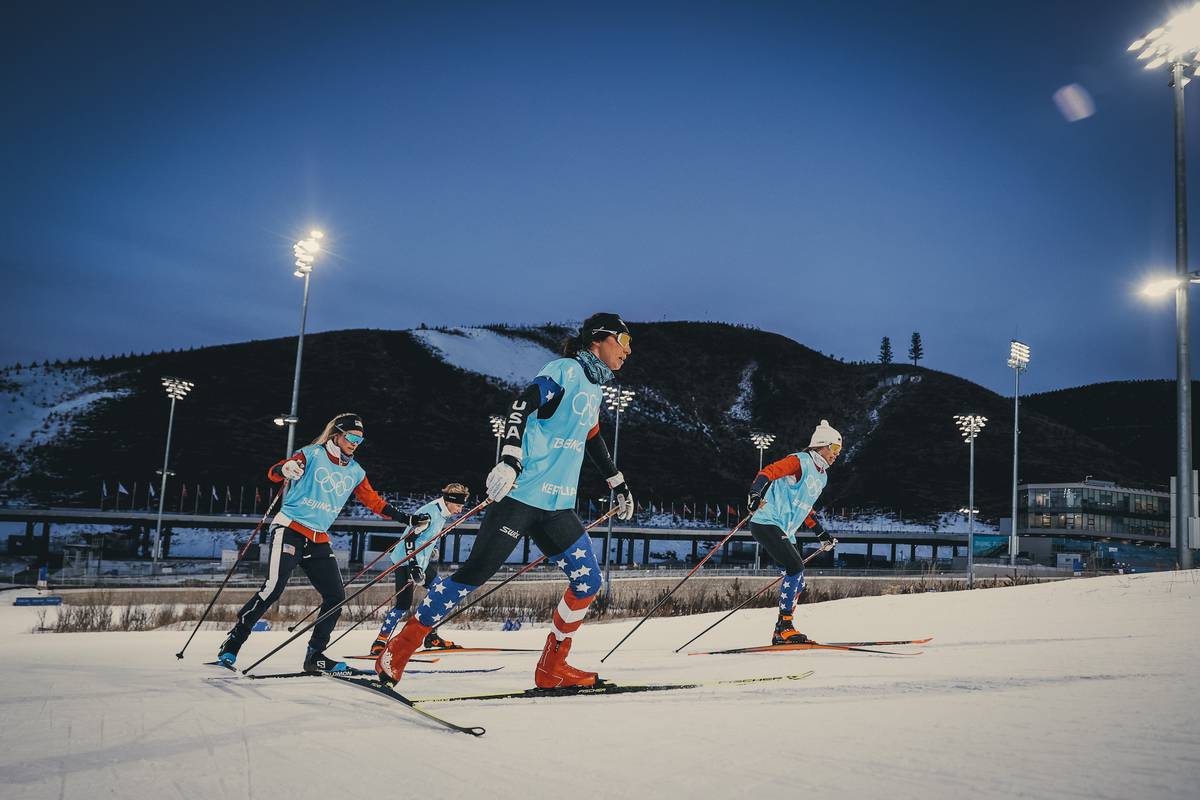
    Keeping with tradition, all four women – along with current NBC analyst Randall calling from a booth in Connecticut – wore knee-length striped “relay socks”, with beglittered cheekbones to feed their enthusiasm for the event. In a program that remains focused on team, even when standing on an individual podium, glitter and socks are merely symbols of the cohesion that has fostered the American’s rise to success. 

    The ROC’s Yulia Stupak pulls away in the first lap of the women’s 4 x 5 k relay. (Photo: NordicFocus)

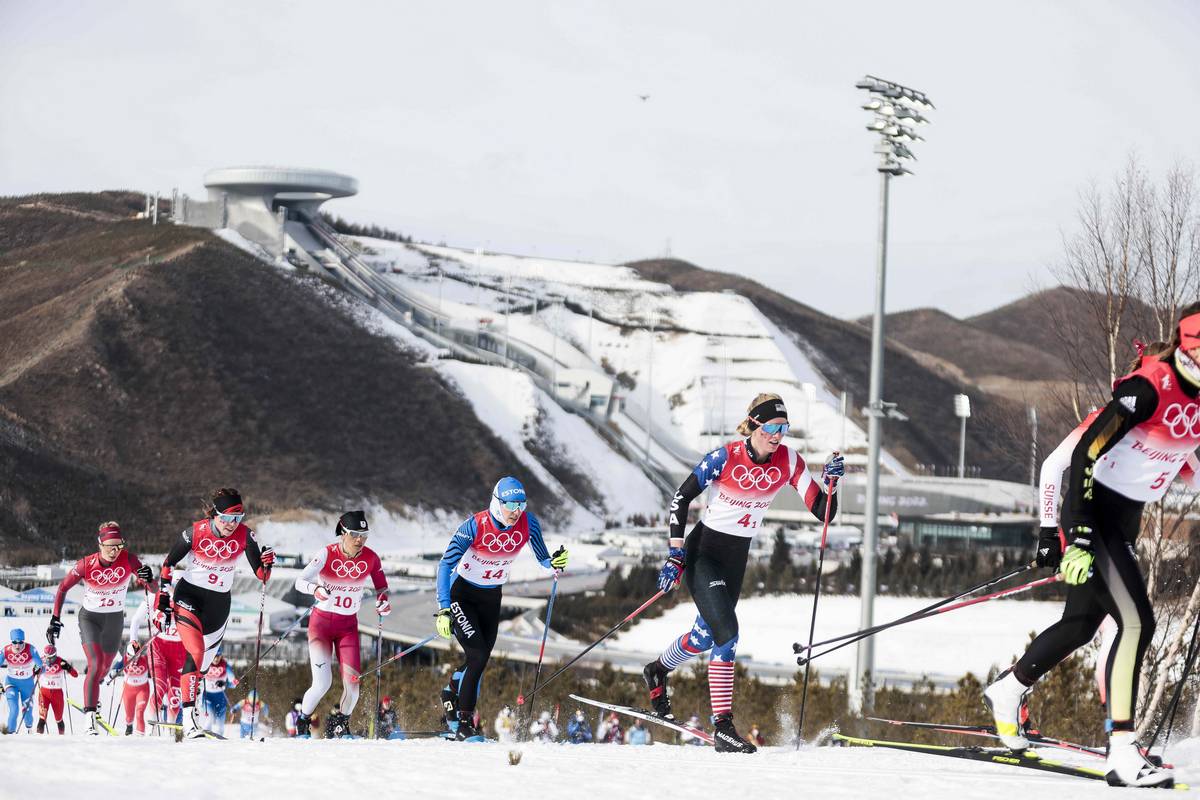
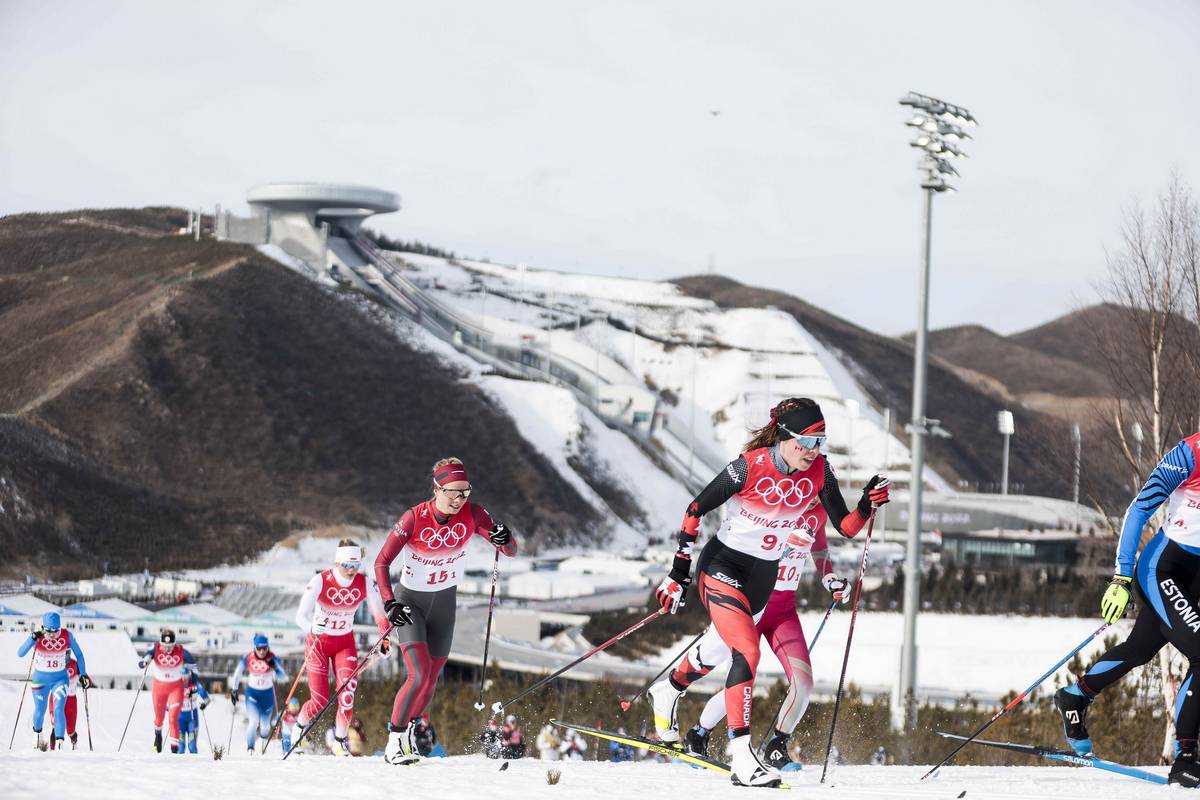
    As the first two-lap 5 k classic leg took to the course, the ROC’s Yulia Stupak charged off the front, creating a 12 second gap by the end of the first lap while the next eight team remaining tightly spread, with less than three seconds of separation. In the final kilometer of the first leg, the German team dropped the chase pack to tag its second skier just 1.5 seconds behind the ROC. Masako Ishida tagged off in third for Japan, with Finland just behind in fourth, and Sweden a few seconds behind in fifth. 

    Swirbul tagged off for the Americans in seventh, +24.7 back on the ROC and Germany, and +12.4 seconds on the podium chase pack. The Canadian team, led by Katharine Stewart-Jones, tagged off in 10th (+43.2).

    Katharine Stewart-Jones skis the opening leg of the women’s 4 x 5 k relay. (Photo: NordicFocus)

    The Germans are often a dark horse in the relay, despite frequenting individual World Cup podiums less often than other countries like Norway, Russia, or Sweden. Germany won a silver medal in the women’s relay in the 2010 Games in Vancouver, followed by a bronze in Sochi. They were roughly 20 seconds behind the Americans in fifth at the 2021 World Championships, and 20 seconds ahead of the Americans in fourth place in 2019.

    In this Games, two of the four members of the 2021 World Championships team were again in the lineup, Victoria Carl and Katharina Hennig, both of whom have seen top-10 finishes in the Games so far. Hennig, who would ski the second classic leg, was fifth in the 10 k classic on Thursday, while the third leg skater Carl was 10th in Tuesday’s freestyle sprint. Anchor Sofie Krehl was 8th in qualification and 11th in the final during the freestyle sprint, while classic opener Katharine Sauerbrey was 11th in the 10 k classic and 13th in the 15 k skiathlon. A deceptively stacked lineup.

    Meanwhile, Norway’s Tiril Udnes Weng had tangled with a Latvian skier, causing a crash that robbed her momentum. Already at a deficit with two of their eight athletes, including Lillehammer World Cup relay team member Heidi Weng, waylaid due to positive COVID tests just prior to the Games, the team that would otherwise be a podium threat faced yet another setback.

    Katharina Hennig (GER) follows Natalia Nepryaeva (ROC) during the second leg of the 4 x 5 k relay. (Photo: NordicFocus)

    In the second classic leg, the ROC and Germany remained at the front, trading off in the lead at each checkpoint as they built their lead over third place to come through the exchange with nearly double the gap to third. This time, it was Germany’s Hennig in the lead, with the ROC’s Natalia Nepryaeva four seconds behind. Gold medalist in both distance events so far this Olympiad, Norway’s Therese Johaug brought her team back into podium contention, tagging Helene Marie Fossesholm in third (+22.8), just ahead of Sweden and Finland. 

    Norway’s Therese Johaug brings her team back into podium contention in the second leg of the 4 x 5 k relay. (Photo: NordicFocus)

    The Americans lost an additional 12 seconds over the course of Brennan’s leg, but held their ground in seventh (+36.4). Canada’s Dahria Beatty tagged teammate Cendrine Browne in eighth after a sizable gap (+1:42.7). 

    Rosie Brennan follows Sweden’s Ebba Andersson during the second leg of the women’s 4 x 5 k relay. (Photo: NordicFocus)

    While Germany and the ROC continued the story at the front, Norway and Finland began making up time on the leaders, with Fossesholm and Thursday’s 10 k classic silver medalist Kerttu Niskanen gaining roughly 8 seconds during the first skate leg. Norway was less than 15 seconds back at the final exchange, with Finland an additional three seconds behind. Sweden was in fifth, exactly 35 seconds off the leaders and just over 20 seconds behind Norway, but they were about to prove they were not out of the running. 

    Novie McCabe skates a strong third leg for Team USA in the 4 x 5 k relay. (Photo: NordicFocus)

    McCabe had brought the Americans into sixth (+1:34), in a dead zone with 30 seconds to the next racer on either side. The Canadian women tagged off in 8th, +2:21.2 back on the leaders. 

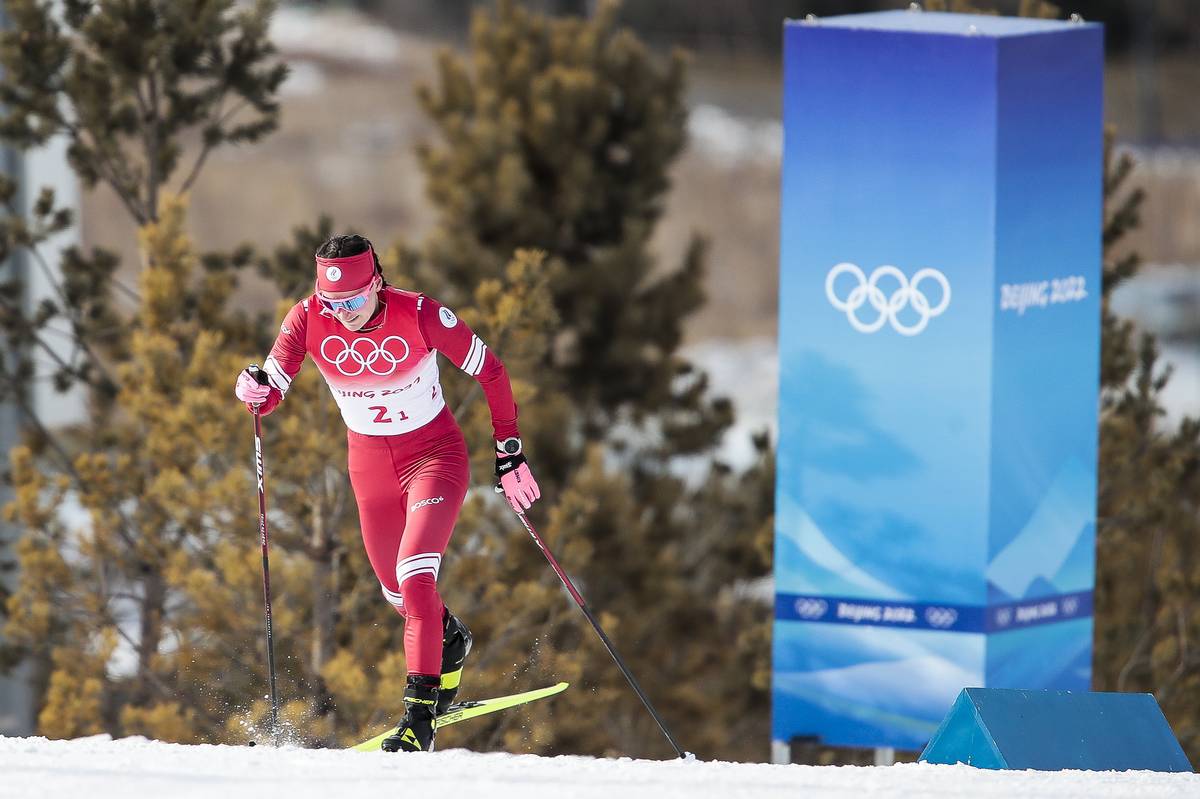
    In the final leg, the ROC’s Veronika Stepanova quickly began to reel in Germany’s Krehl. 

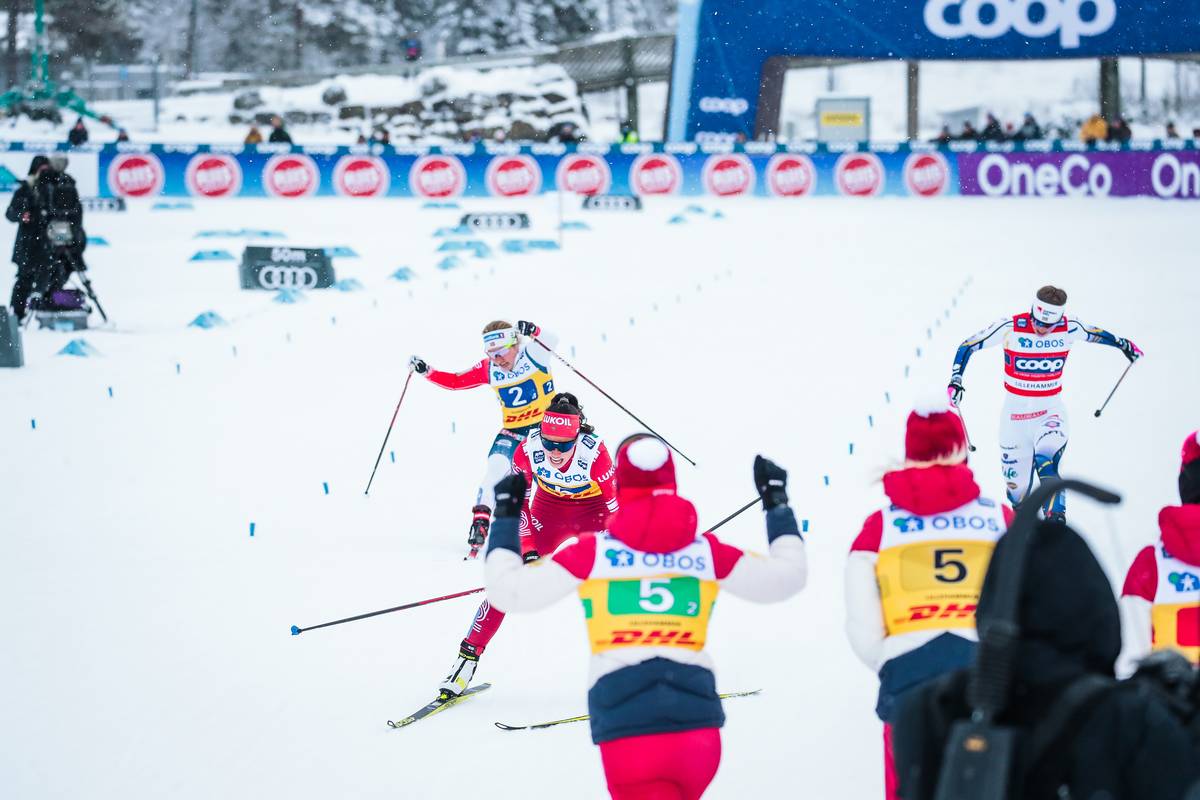
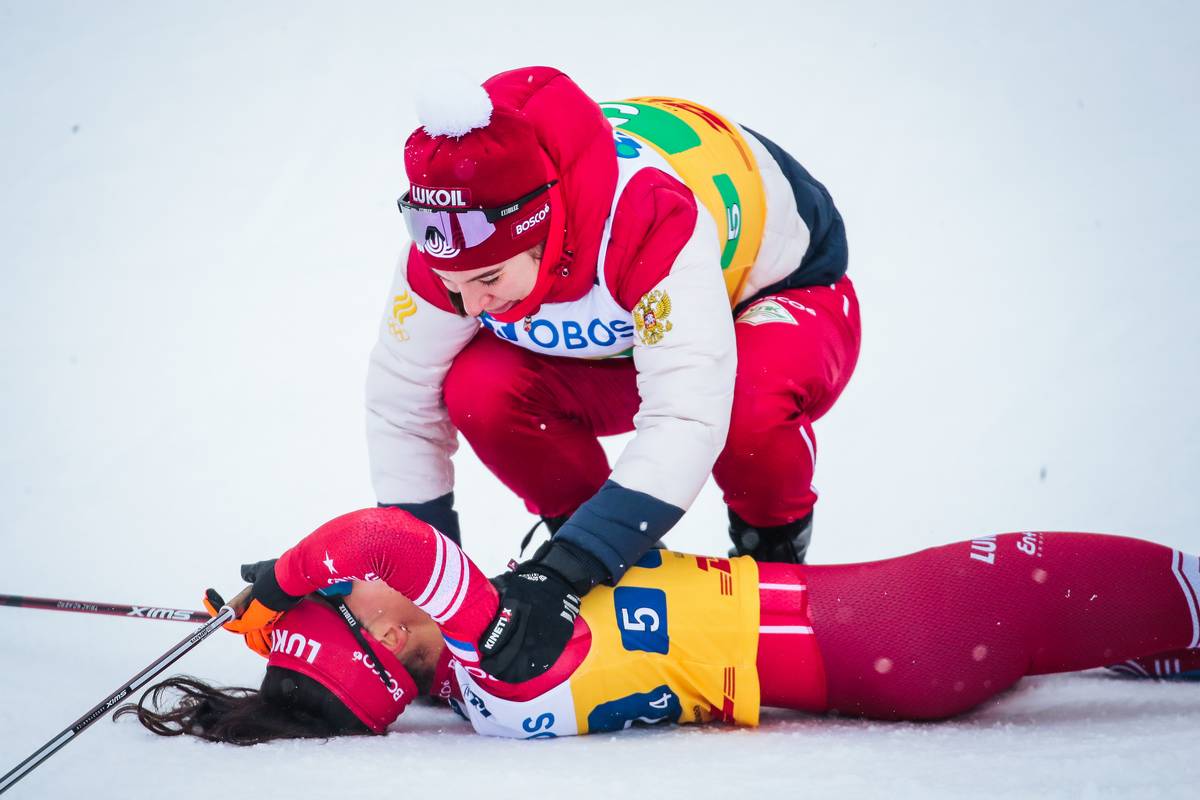
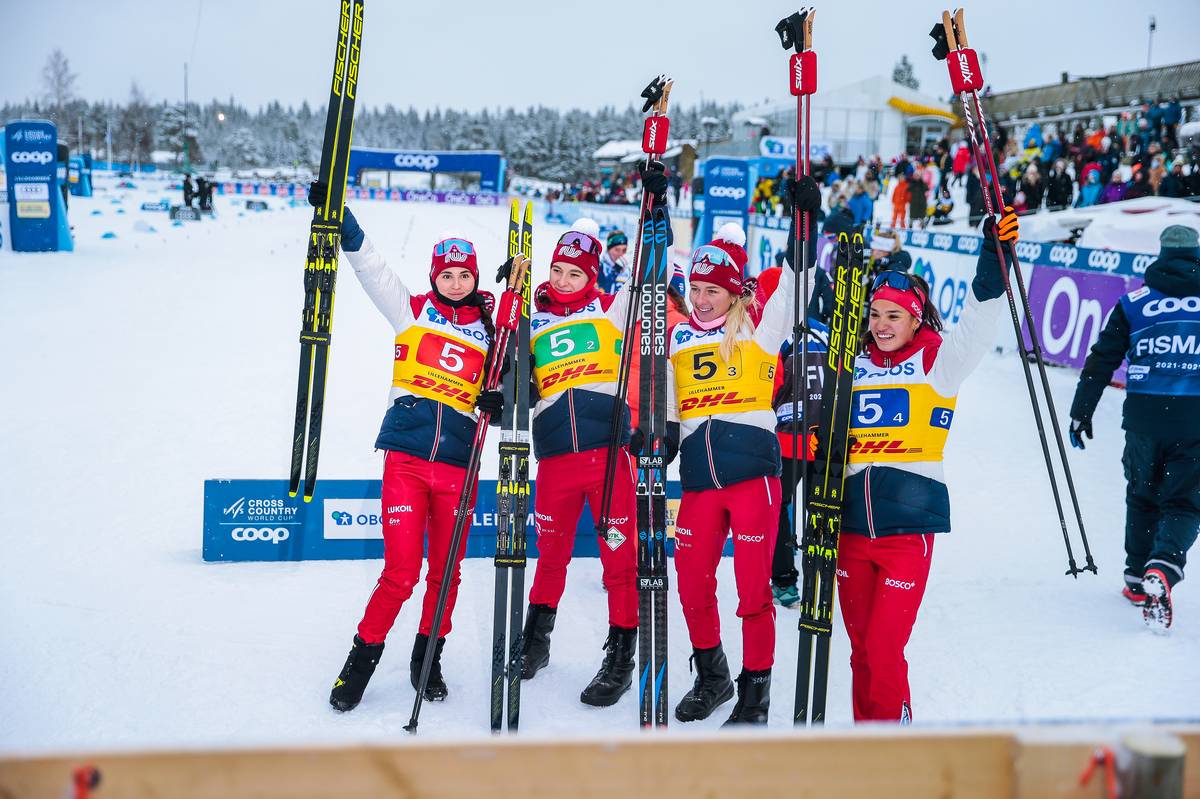
    Establishing herself as a strong closer at just 21 years of age, Stepanova also anchored Russia’s winning relay team in Lillehammer back in December to a thrilling finish, narrowly beating Norway and Sweden in a three-way sprint to the line. 

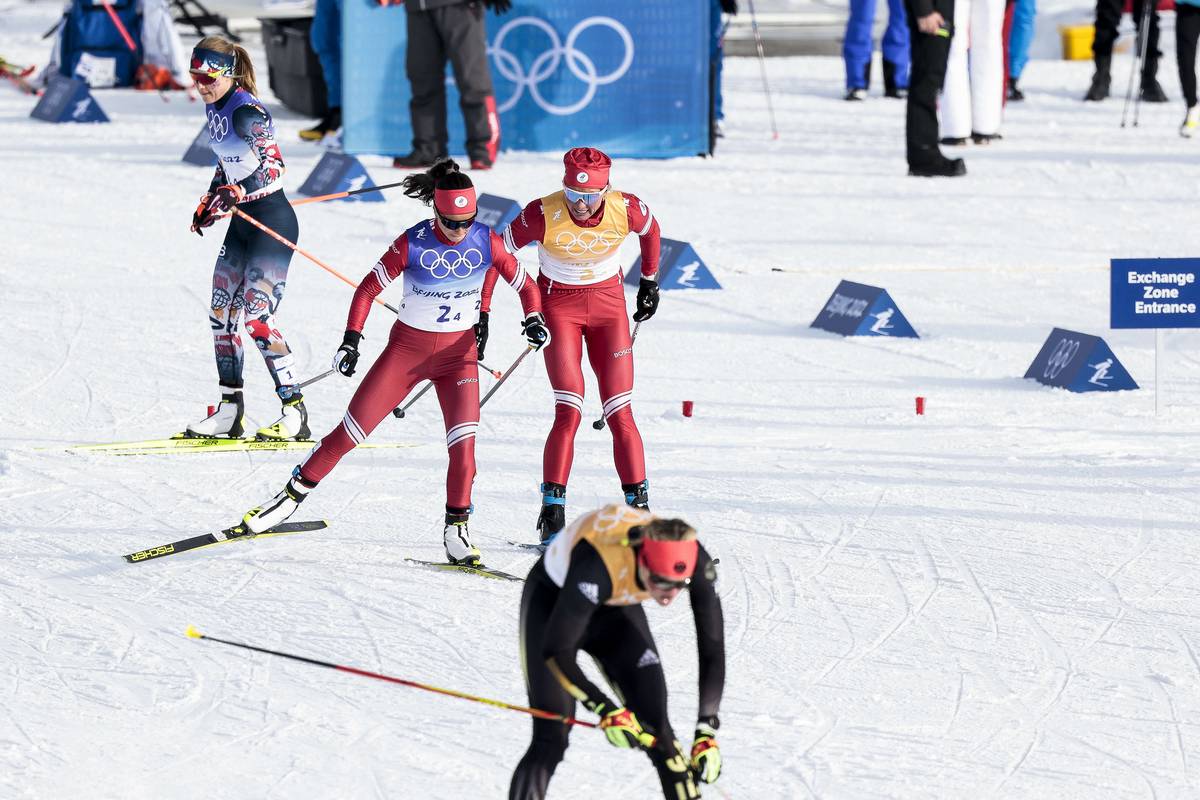
    In the lead at the final exchange, Germany’s Victoria Carl tags Sofie Krehl during the Olympic 4 x 5 k relay. (Photo: NordicFocus)
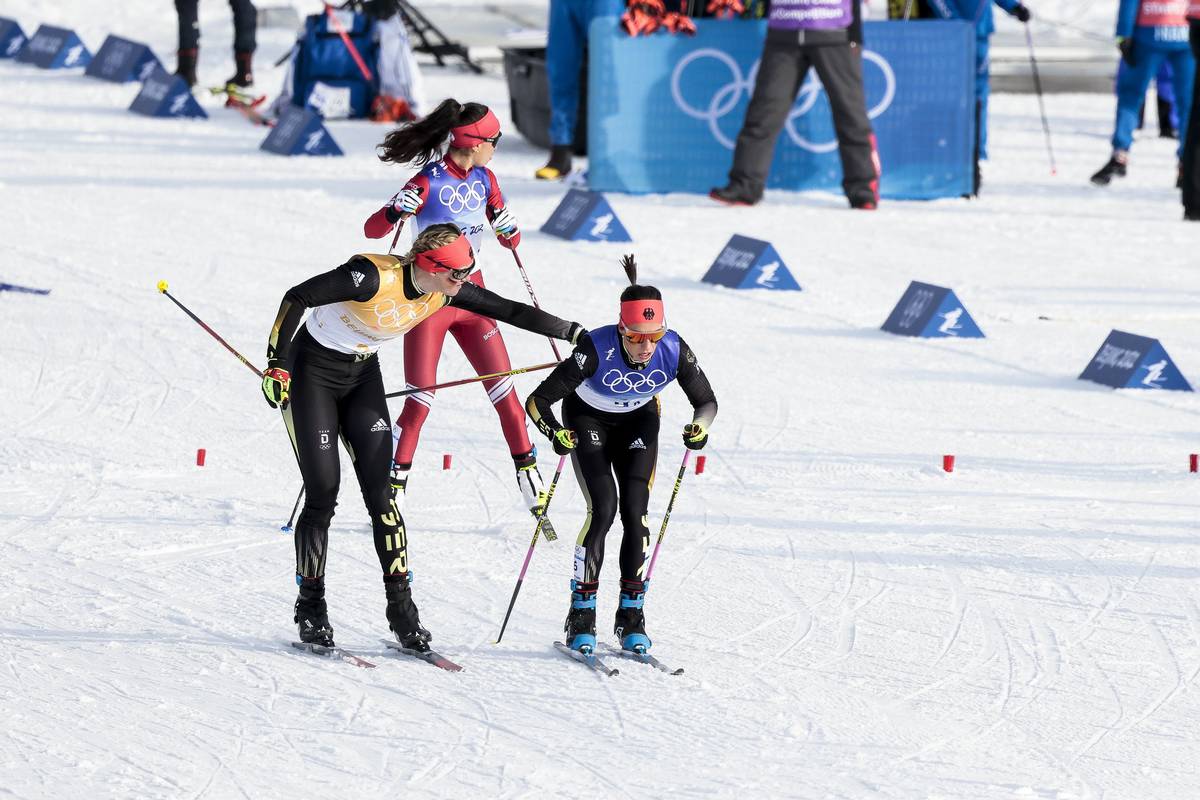
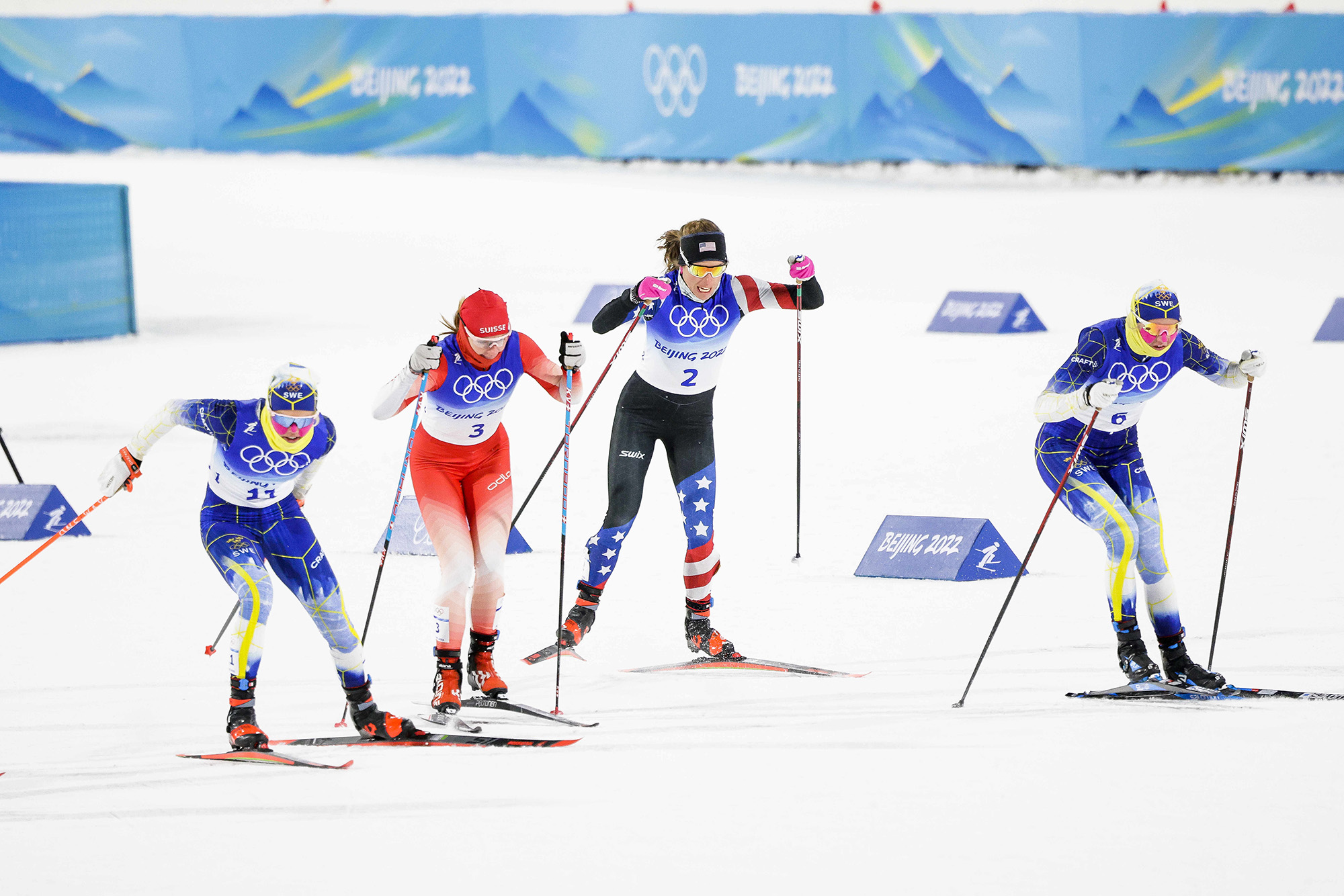
    Tatiana Sorina tags Veronika Stepanova as the ROC chases down Germany in the final lap of the 4 x 5 k relay. (Photo: NordicFocus)

    This time, it did not look as if the ROC was looking for a climactic ending for its spectators. Stepanova had Krehl in her sights at the lap, and was now just 1.5 seconds behind. Stepanova kept the effort high, leaving the German five seconds back a kilometer later. 

    Then, Krehl began to fade rapidly. 

    As the ROC soon looked to have the gold medal on lock, the question became whether Germany could hold onto silver. Sweden’s sprint gold medalist Jonna Sundling was showing her stamina against Pärmäkoski, who looked to be repeating the approach that allowed her to take bronze for Finland in the 2021 World Championship where she was facing Diggins. 

    The pace stayed hot as the Finnish veteran steadily fatigued the legs of the sprint champion, and over the final lap, the pair brought Krehl into contact. Heading into the stadium, Krehl was hanging onto her lead by a thread. 

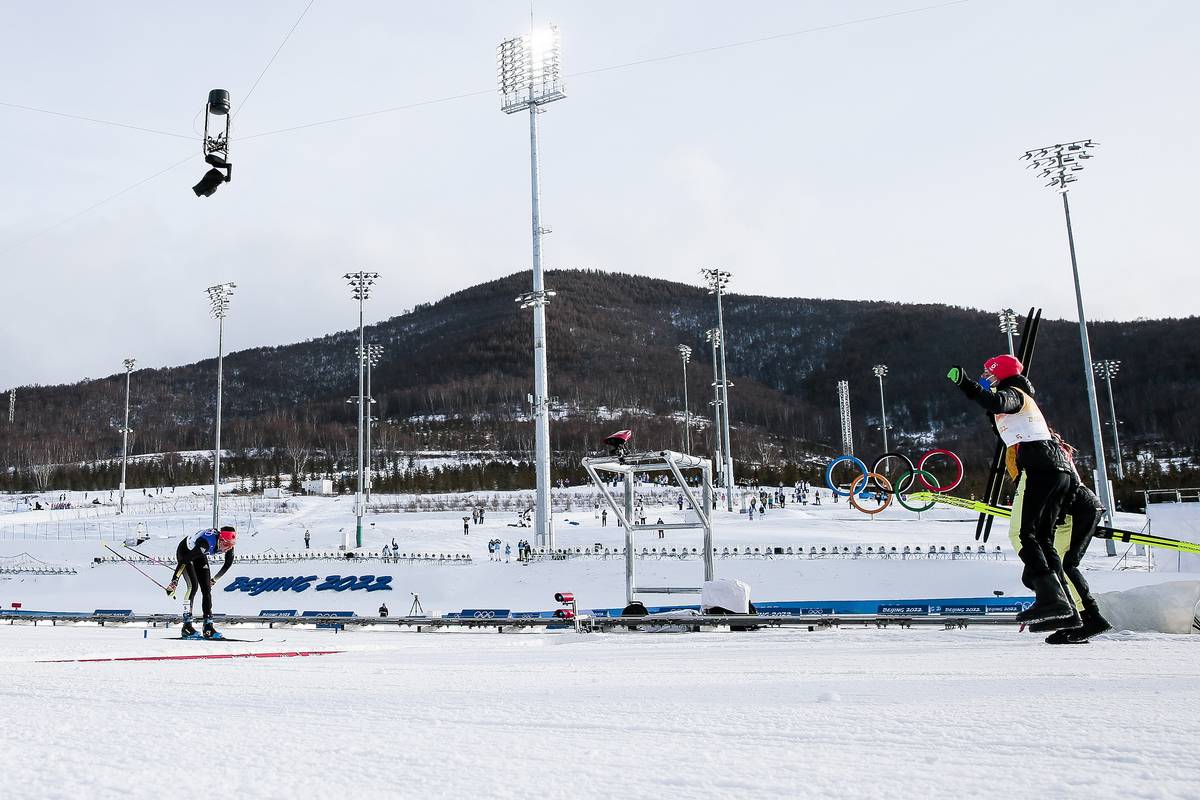
    Sofie Krehl hangs on to anchor the German team to silver in the 4 x 5 k relay. (Photo: NordicFocus)

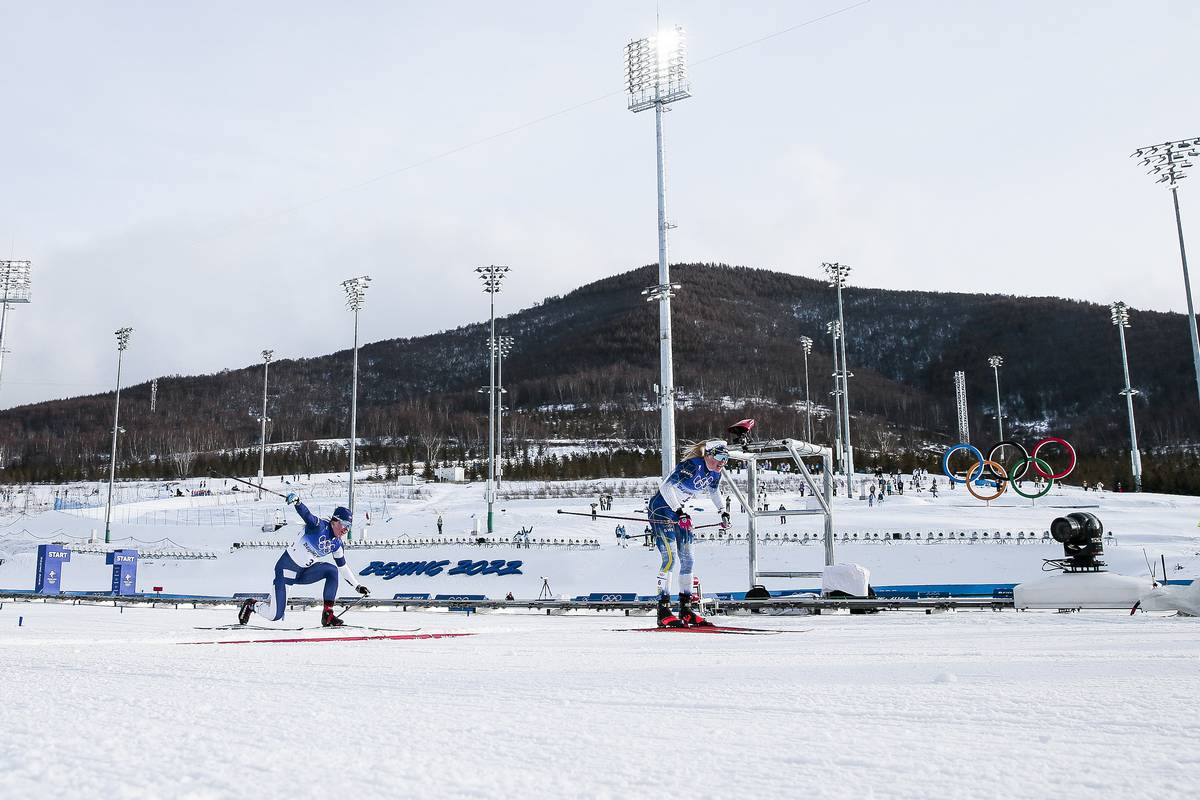
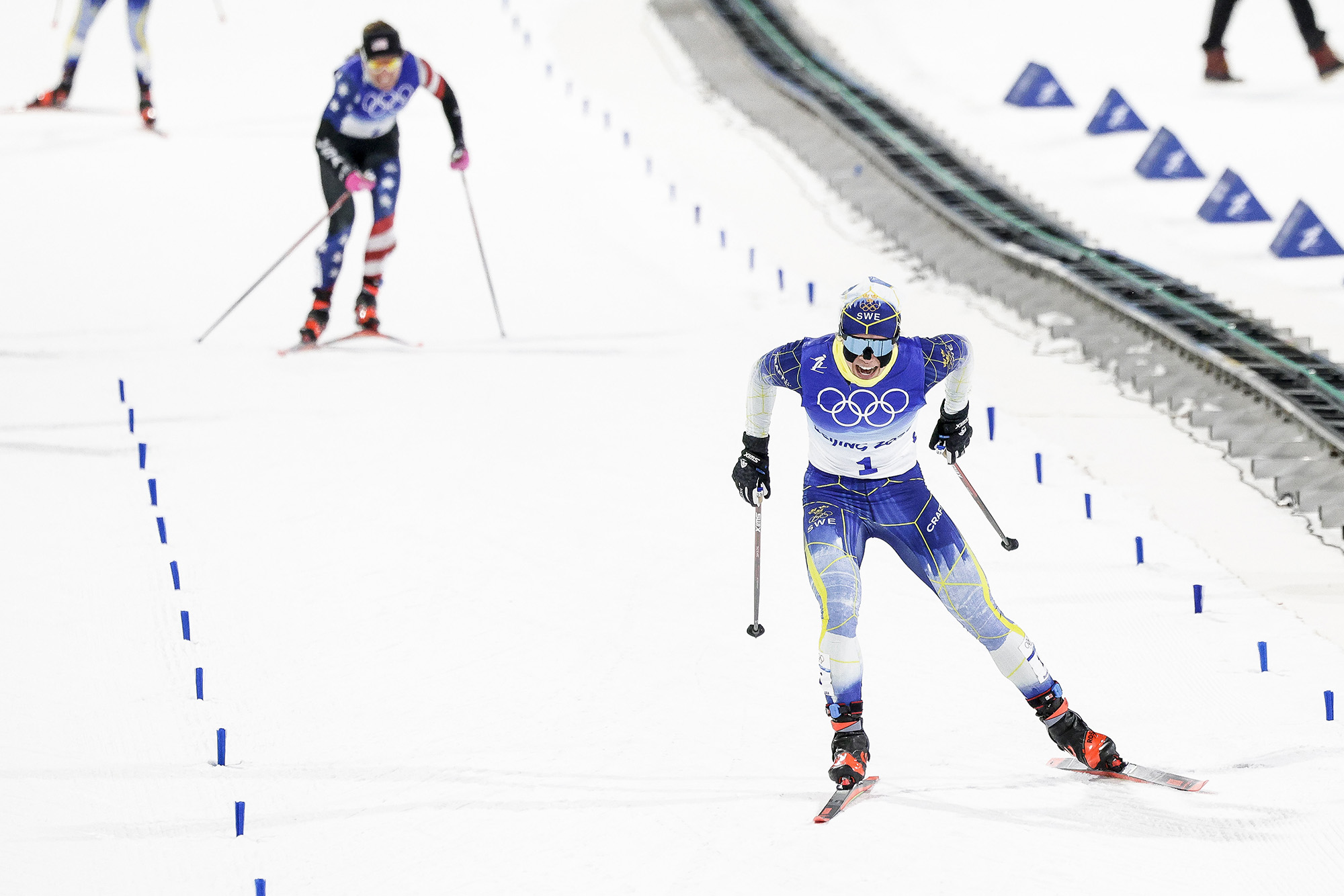
    Cameras panned away as the German rounded the final bend into the stadium, returning just as she crossed the line, only ten meters ahead of Sundling and Pärmäkoski, who V2ed side by side through the lanes.

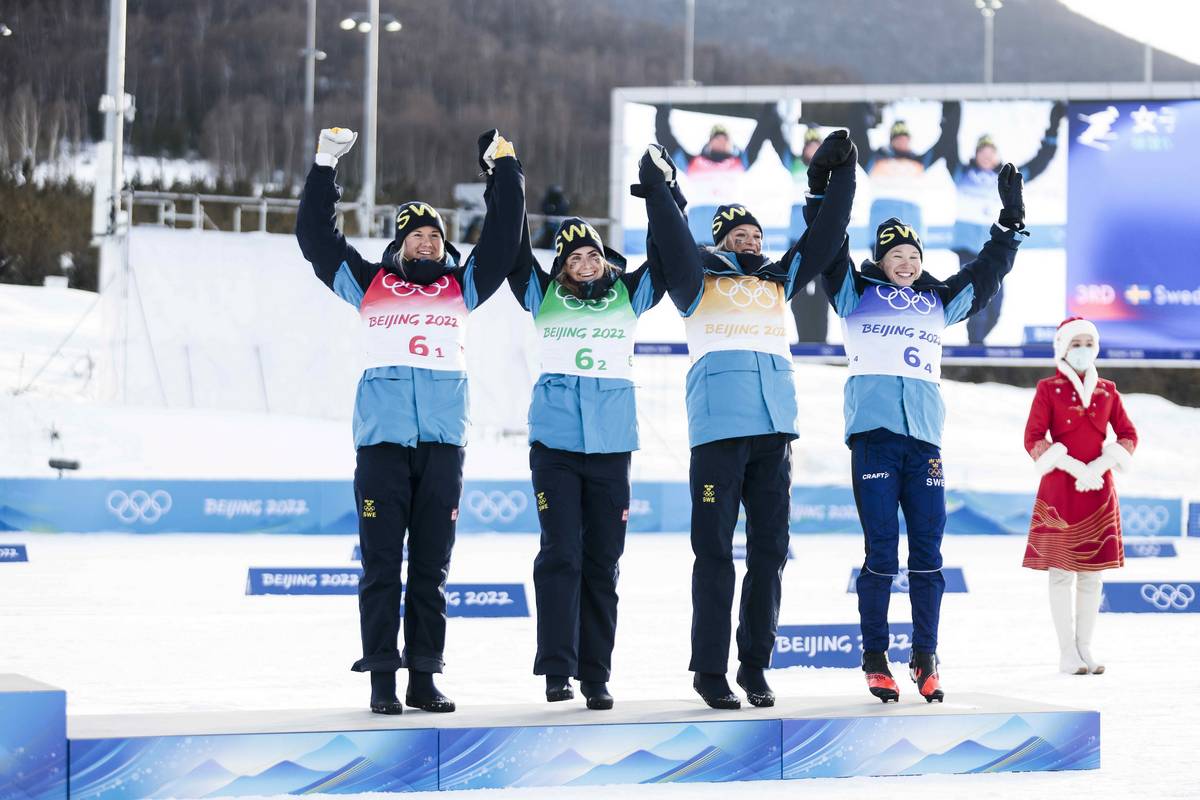
    Ultimately, Sundlings sprint prowess gave Sweden the advantage, as she nipped Pärmäkoski by 0.5 seconds at the line for the bronze medal. 

    Jonna Sundling (SWE) takes bronze by 0.5 seconds ahead of Krista Pärmäkoski (FIN). (Photo: NordicFocus)

    It was the ROC for gold in 53:41.0, with Germany in second (+18.2), and Sweden third (+20.7).

    “Of course, it is a special day,” Stepanova told the media after the race. “It was really tough because we have a win in the World Cup, and a lot of people know we can win, so they say, ‘You must win, you must win.’ So I am like, ‘OK, we need a good result,’ and I do what I can do.”

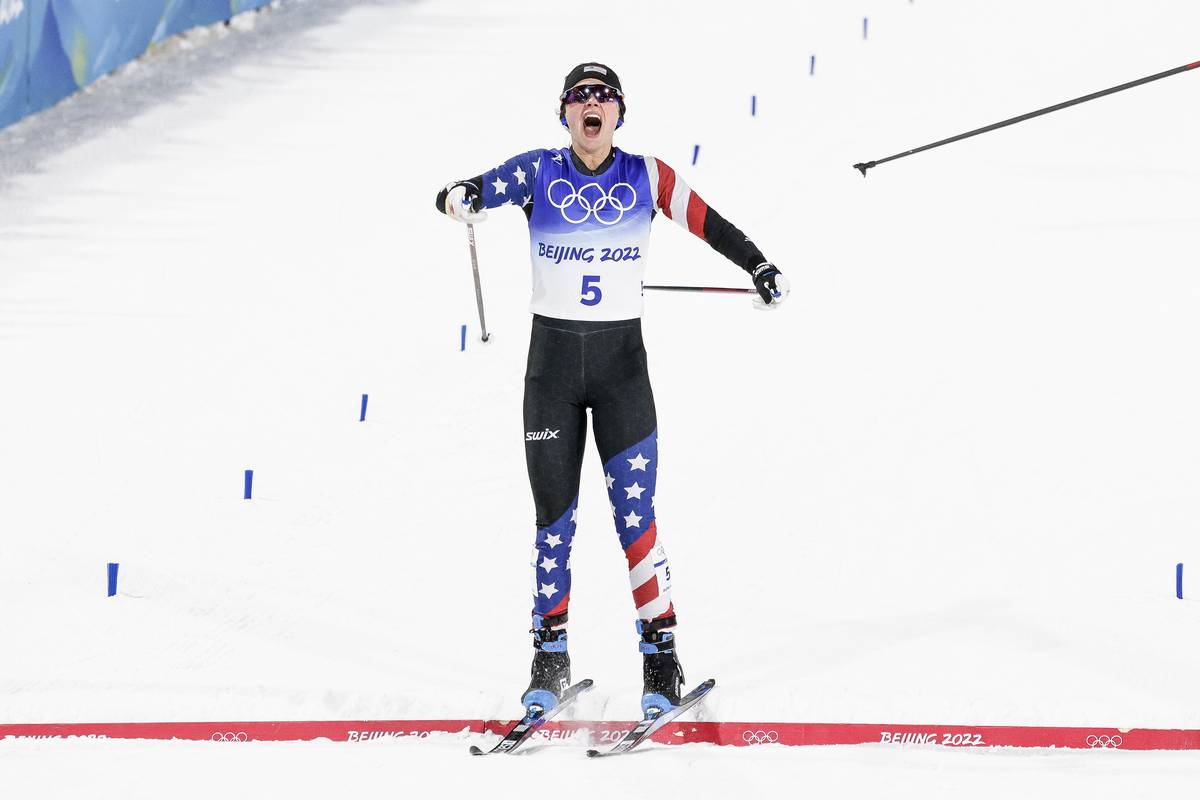
    Veronika Stepanova anchors the ROC to gold in the women’s 4 x 5 k relay. (Photo: NordicFocus)
    The Russian Olympic Committee celebrates gold in the women’s 4 x 5 k relay as anchor Veronika Stepanova crosses the line with a solid lead. (Photo: NordicFocus)

    While the depth of its women’s team made the ROC a good choice as a podium pick, Stupak made it clear in her post-race comment that the team had also been targeting the event, saying the result was “not a shock.”

    “We prepared for this race the whole year,” she explained. “It’s a good result for everybody in our team. We were ready for this medal.”

    On the ROC’s approach and early lead, Stupak continued, “We tried to push the limit. We had big motivation and good concentration before the start. It was a hard race but it was a good race for us.”

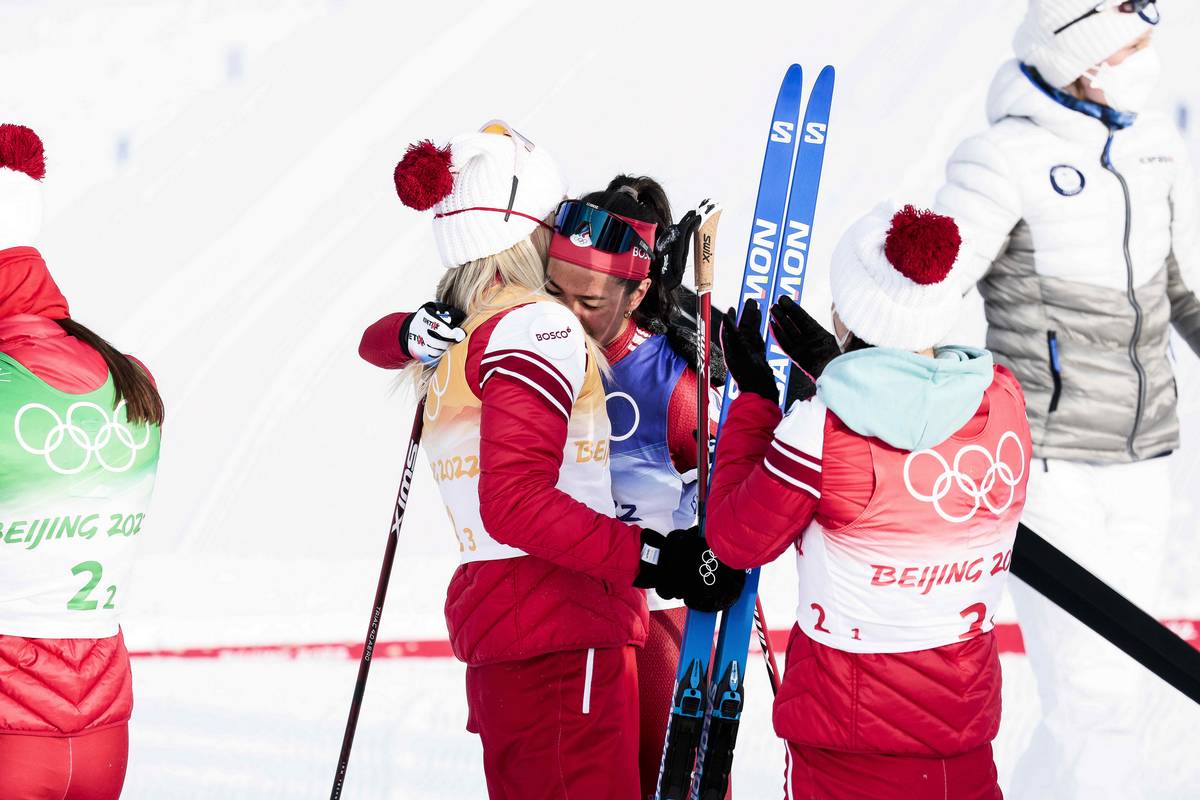
    The 4 x 5 k relay gold medalists of the ROC: Yulia Stupak, Natalia Nepryaeva, Tatiana Sorina, and Veronika Stepanova (l-r). (Photo: NordicFocus)

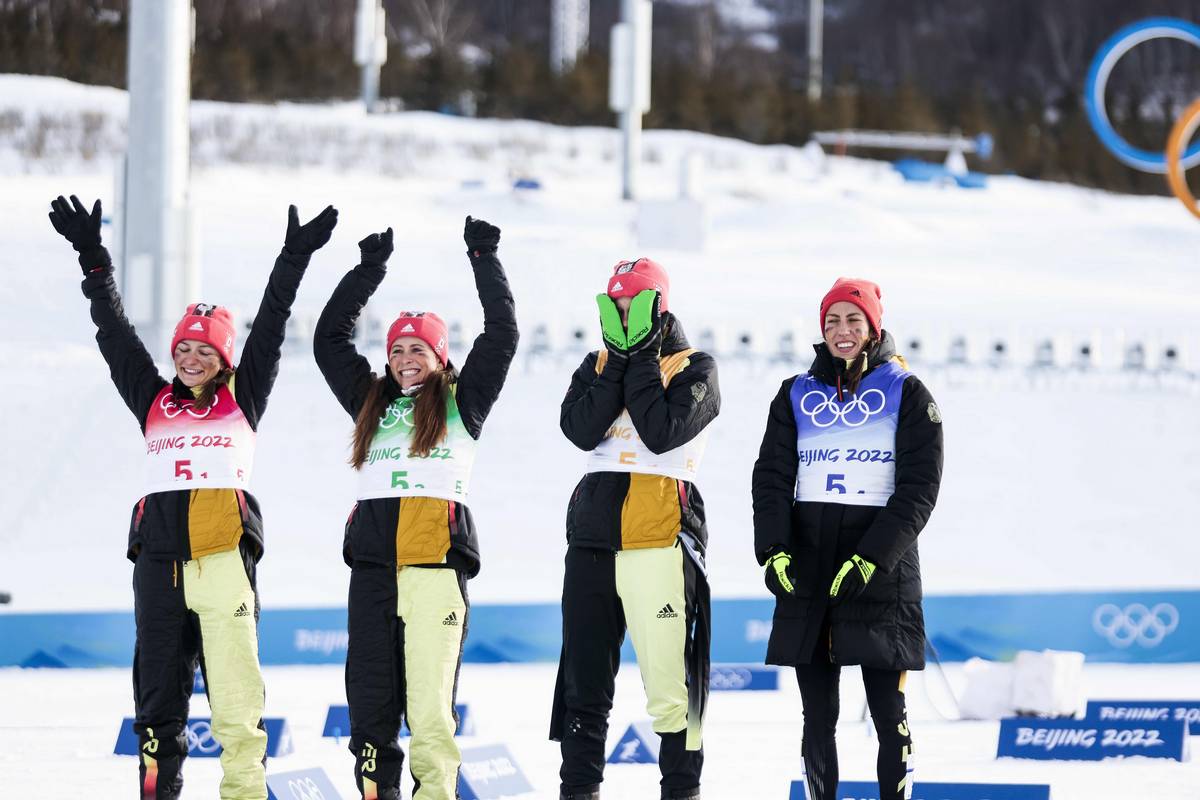
    For the Germans, the tone implied less certainty that a medal would be earned. Rather, it was the culmination of strategic pacing and hard work, leading to what Krehl called a “surprise” ending. 

    “We are so happy and excited,” Hennig said. “This is a special day for us and we are so thankful that all the hard work pays off now for the whole team and all of cross-country Germany. So we are very, very happy. We had a good plan and our plan worked. And we did our best, and so it was an exciting and amazing day.”

    The German team welcomes anchor Sofie Krehl to the finish, earning a silver medal in the 4 x 5 k relay. (Photo: NordicFocus)
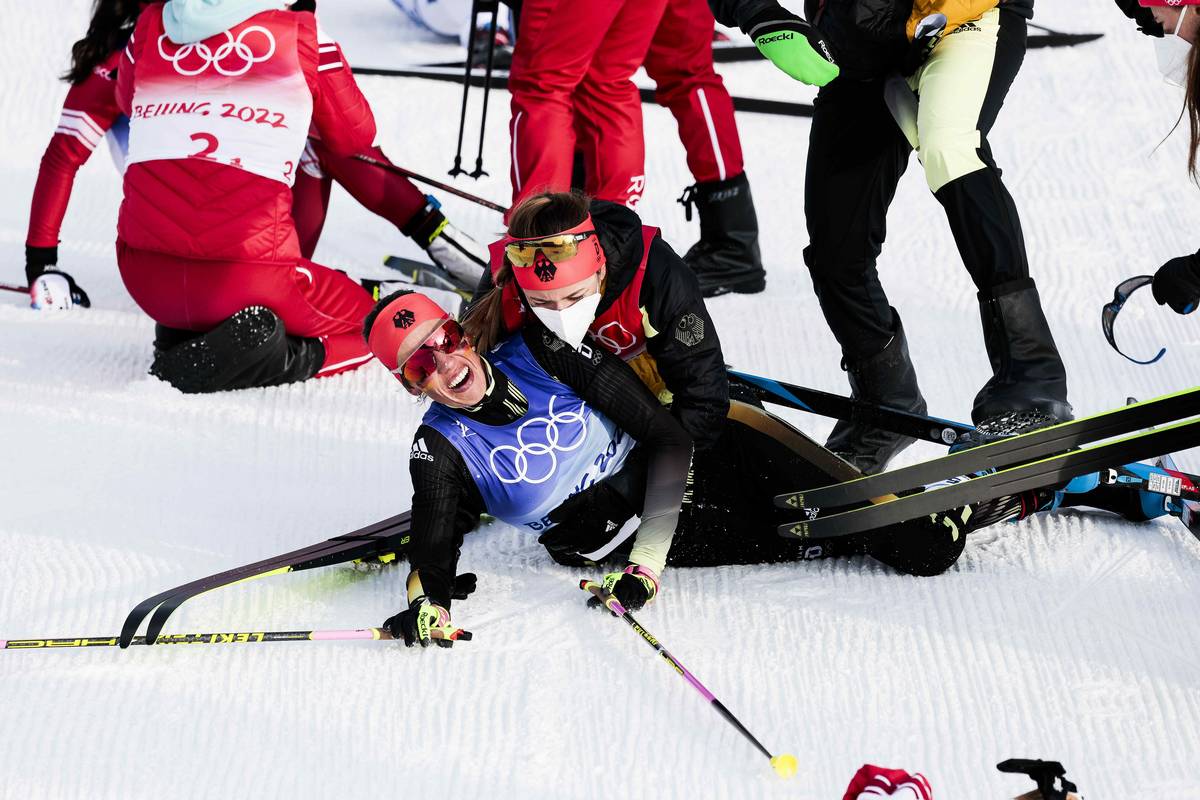
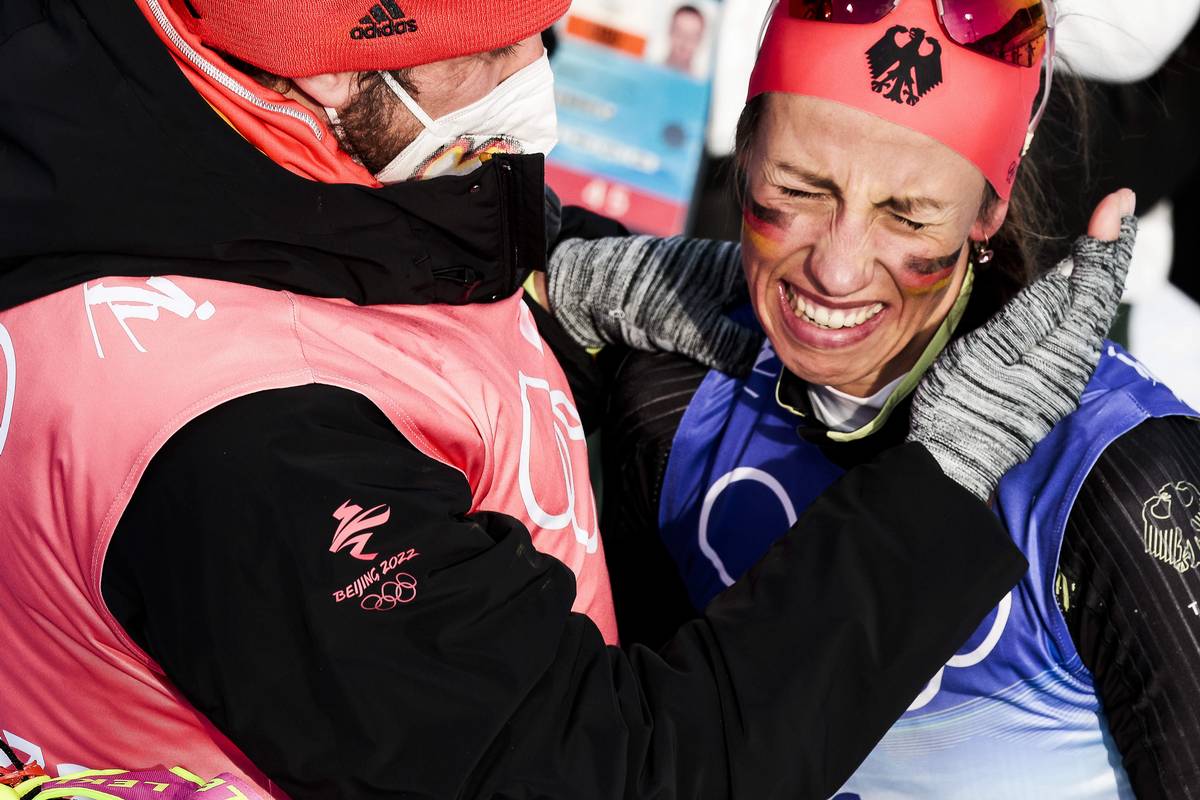
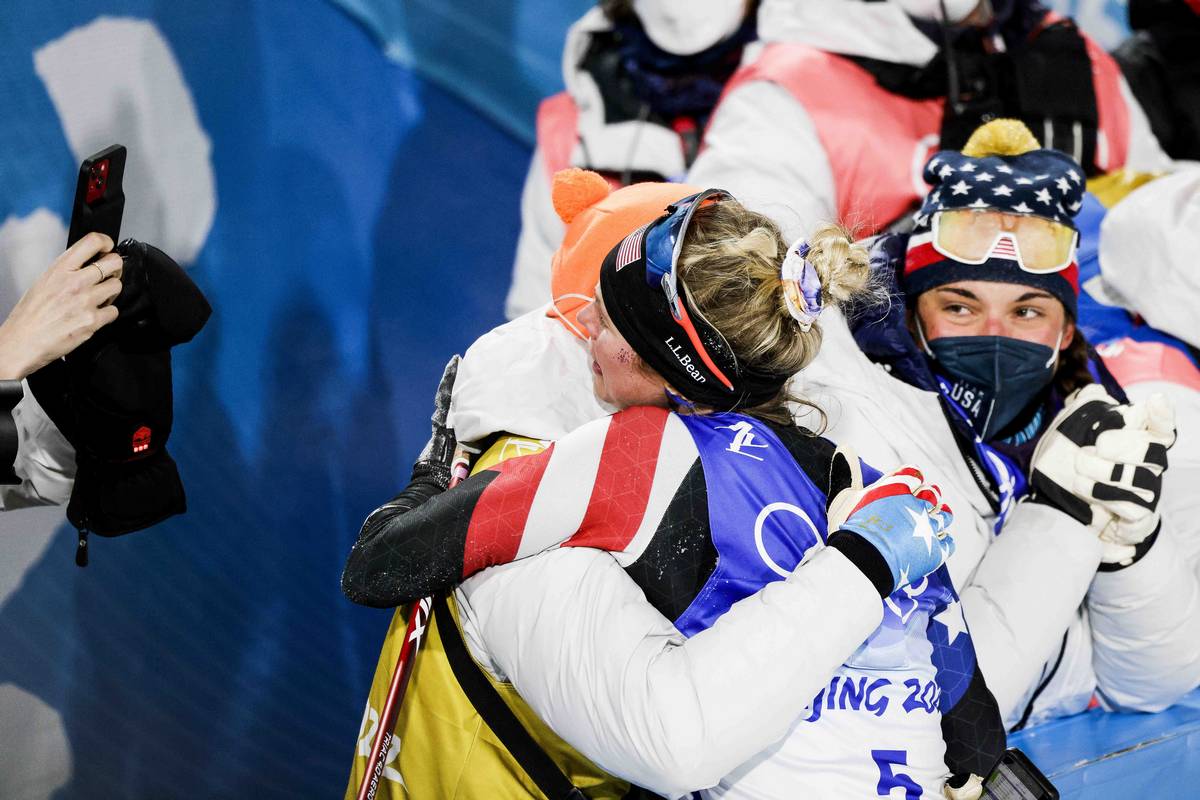
    Caught by the emotion of earning a silver medal for Germany, Sofie Krehl is embraced by her coach at the finish of the 4 x 5 k relay. (Photo: NordicFocus)

    Krehl explained that she had skied her first lap defensively, expecting Stepanova to catch her sooner. In the second lap, she described the ROC athlete as “too good”, causing her to let go of gold. Though she was nervous when she began to feel Sweden and Finland closing on her, she was able to hold on for a result she described as “good for the whole team”, including the German coaches and wax technicians.

    “It’s a lot of emotion,” Krehl said. “It feels like a dream. Maybe I need some time and then I can recognize what we have done.”

    Putting together a gutsy performance, Katherine Sauerbrey, Katharina Hennig, Victoria Carl, and Sofie Krehl (l-r) earn silver for Germany. (Photo: NordicFocus)
    The Swedist team of Maja Dahlqvist, Ebba Andersson, Frida Karlsson, and Jonna Sundling (l-r) earn silver in the 4 x 5 k relay. (Photo: NordicFocus)

    Behind the podium contenders, Norway had lost contact with the Swedes and the Finns over the final lap, fading to fifth (+28.8). Racing alone through her lap, Diggins crossed the line for Team USA a minute later in sixth (+1:28.2).

    “Personally, I’m really, really proud of this team,” Diggins said in the mixed zone. “Every single one of these girls went out and skied so hard and skied gutsy races. And we gave it everything we have. And some days that ends up in the results of your life and some days it doesn’t. But either way, all you can control is going out there as hard and as smart as you can. And this team did that.”

    Jessie Diggins brings the Americans home in sixth in the women’s 4 x 5 k relay. (Photo: NordicFocus)

    Though they did not walk away with Olympic hardware, the energy and enthusiasm were high in the mixed zone, with laughter filling the gaps between the athletes’ comments. 

    On a team composed of two veteran Olympians, Brennan and Diggins, and two first-timers, Swirbul and McCabe, experience and insight helped unify the group and set the Americans up for their best chance at putting together a strong performance. 

    Leading the breakdown of the race, Swirbul shared, “It’s always important, I think, to try to ski my own race, even though you’re in the field. I definitely had advice from Rosie last night to make sure to pace it how I would face the race – and Jessie. We’re focusing on time, so the fastest time that we can get around that course [for] each person is the best, no matter what place you come in.”

    Rosie Brennan races the second leg of the 4 x 5 k Olympic relay. (Photo: NordicFocus)

    Brennan’s performance in the sprint demonstrated her impressive mental strength to overcome setbacks and not count herself – or in this case, her team – out of the running. A bad pole plant directly onto her ski in the sprint quarterfinal could have shaken her confidence, but she rebounded to ultimately finish just over a second off the podium in fourth place.

    She approached today with a similar resolve. 

    “I knew it was full of a lot of the heavy hitters, so I knew I had a tough job ahead of me,” Brennan said. “So I tried to ski smart, but also find something extra to dig a little deeper, but I knew there was going to be some hard fighting at the end. I felt really good about my climbing. And I was a little disappointed with my inability to stick with [the other women] over the top of the hill in the double pole section, but it was all I had out there. So, I have to be happy with that. And I guess I know what I’ll be working on in the future.”

    At 21-years-old, McCabe is the youngest member of the relay team. 

    “It’s so cool to be a part of a team with three legends and I had a lot of fun doing it, even though I was extremely nervous beforehand,” she said with a laugh.

    Novie McCabe tags Jessie Diggins for the final leg of the 4 x 5 k relay. (Photo: NordicFocus)

    Her mom, Laura McCabe, is a two-time Olympian who skied the third leg of the relay in both 1994 and 1998. However, Novie laughed that she had not talked to her mother in several days and thus had not received any advice heading into the relay. After much deliberation, the team had only been decided the afternoon prior.

    “I tried on the first lap to just stay relaxed,” McCabe explained of her plan. “I knew that there was  a chance I would blow up and end up losing a lot of time to that group ahead of me. So I was just trying to focus on [pacing] for the first lap, and on the second, I kind of tried to drop the hammer and do what I could to not lose time.”

    In her lap, McCabe lost just 11 seconds to Sweden’s distance standout, Frida Karlsson. She had accomplished her goal.

    Diggins explained she headed out for the final leg optimistically hoping things would shake out differently than they ultimately did.

    “I basically just swung for the fences and thought, ‘Okay, I’m gonna go out as hard as I can. Because if there’s a chance that [the women ahead of me] monkey around and don’t want to lead, then I’ve got to go for it.’ I thought, ‘You know, if I get lucky and they’re messing around in tactics, there’s a chance I can glom on the back.’ Unfortunately, they did not, as much as I had hoped. And I definitely paid for it in the second lap. I could not feel my legs at all.”

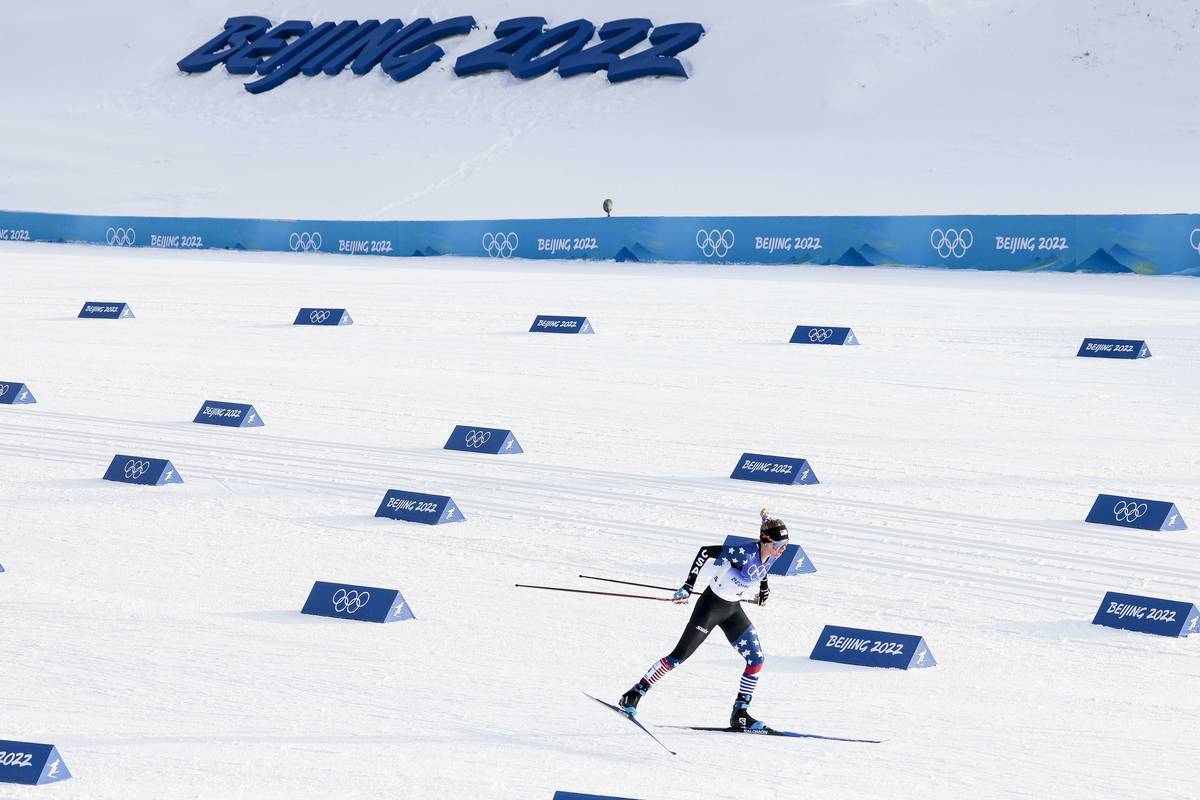
    Jessie Diggins anchors the Americans to 6th in the 4 x 5 k relay. (Photo: NordicFocus)

    After a windy skiathlon and 10 k classic that left tracks blown in with loose snow, the women expressed that conditions today were the best they’ve experienced in racing so far. Though two inches of snow came down overnight, perhaps an unexpected twist in the weather patterns, the Americans each affirmed that their skis were competitive, with Swirbul and Brennan adding the change was especially favorable for their classic legs.

    “I actually got to ski in the tracks today, which is so nice,” Brennan said. 

    On the camaraderie of the team, Brennan shared, “It’s an individual sport, but we also spend close to five months on the road a year together. So it would be pretty boring if you only ever care about yourself. [That’s] not very fun or fulfilling – it doesn’t mean that much. So when we get to actually, truly be out there together, and all of our times count for each other. I think that brings like a new level of meaning and purpose to what we’re doing. And it’s really special to get to share that with your teammates.” 

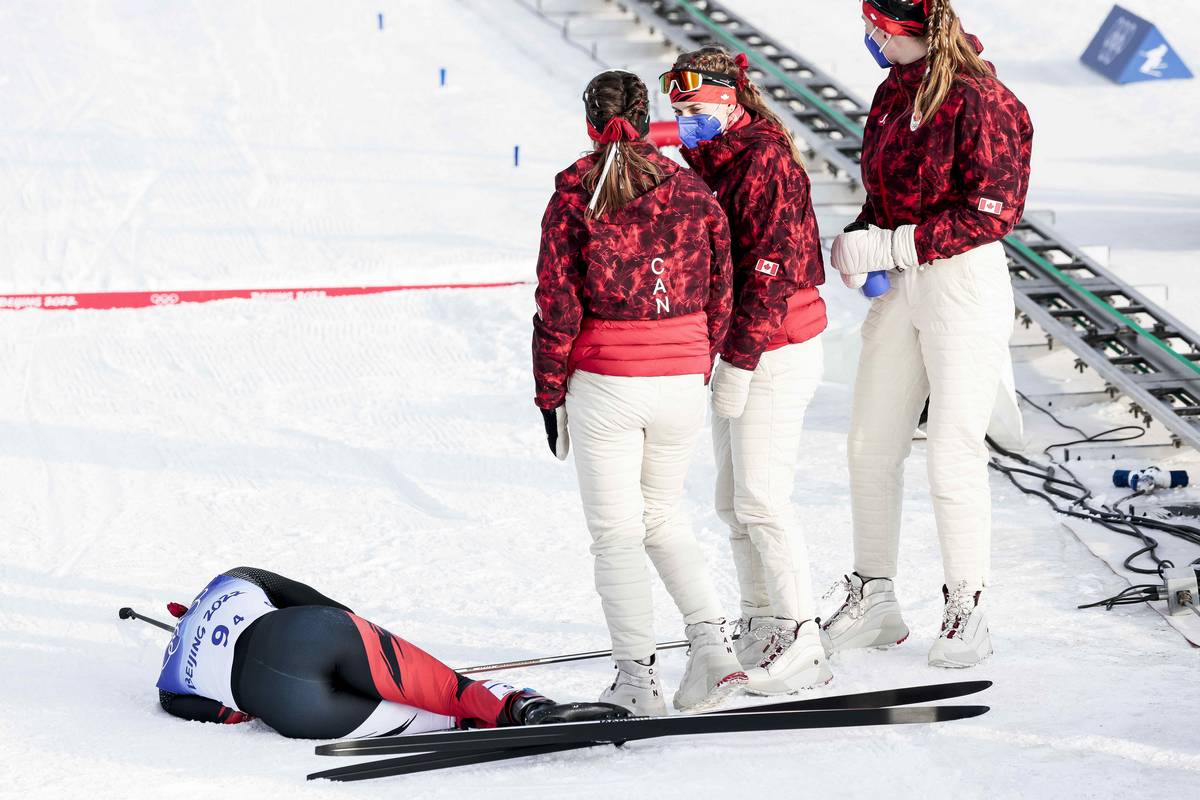
    Olivia Bouffard-Nesbitt (CAN) collapses as she’s greeted by her team at the finish of the 4 x 5 k relay. (Photo: NordicFocus)

    Closing for Canada, Olivia Bouffard Nesbitt lost one spot to the Italian team in the final leg. The Canadian women ended their day in 9th (+3:39.9). 

    Results

  • The Devon Kershaw Show: Holy smokes that women’s Olympic relay

    The Devon Kershaw Show: Holy smokes that women’s Olympic relay

    OMG that was awesome.

    Devon and Nat are back to break down an epic finish to the women’s Olympic relay, with some details on the Russian victory, the surprise German silver and Jonna Sundling helping to deliver a bronze for Sweden. Plus some notes on the Americans in sixth.

    Send questions and feedback to devon@fasterskier.com and nat@fasterskier.com. We’ll be back tomorrow.

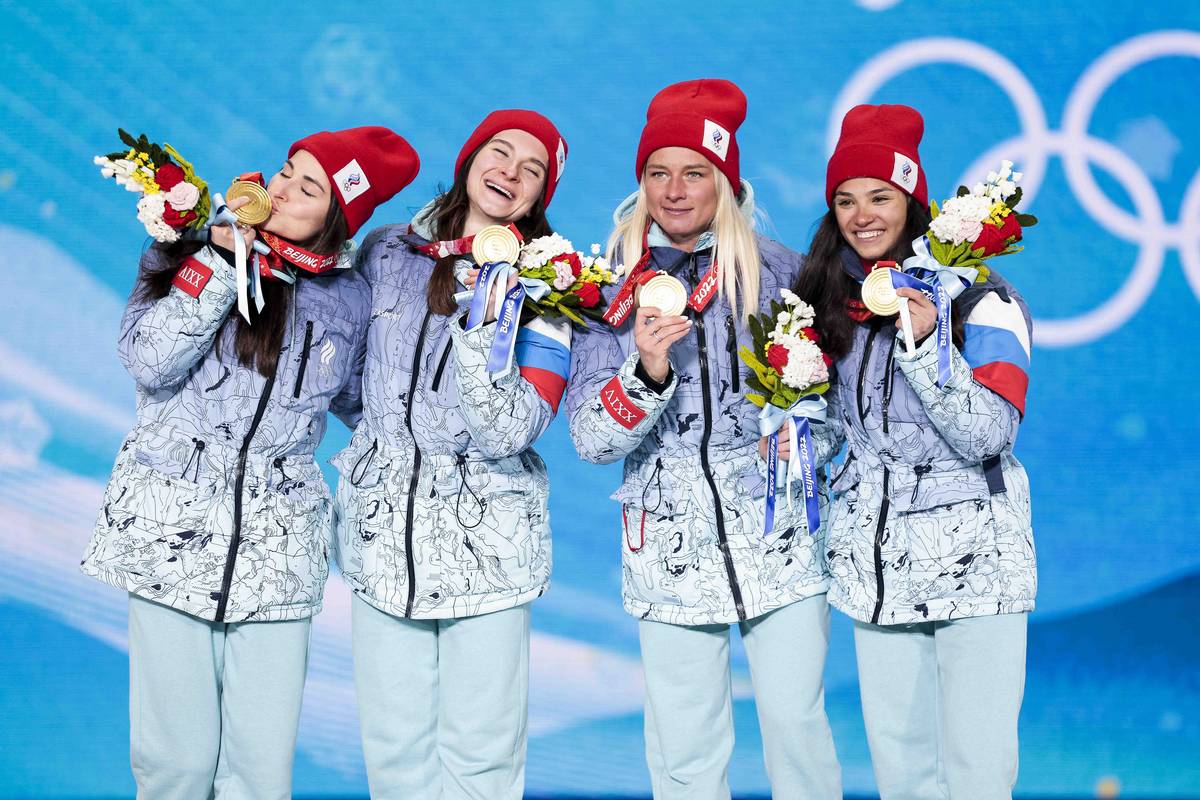
    The Russian Olympic Committee’s 4 x 5 k team of Yulia Stupak, Natalia Nepryaeva, Tatiana Sorina, and Veronika Stepanova (l-r) collects their Olympic gold medals. (Photo: NordicFocus)
  • Diggins Writes History as First American Woman to Earn Individual Olympic Medal With Bronze in the Freestyle Sprint

    Diggins Writes History as First American Woman to Earn Individual Olympic Medal With Bronze in the Freestyle Sprint

    This World Cup coverage is made possible through the generous support of Marty and Kathy Hall and the A Hall Mark of Excellence Award.  To learn more about A Hall Mark of Excellence Award or to learn how you can support FasterSkier’s coverage please contact info@fasterskier.com.

    The History:

    A survey of the last five Olympic cycles shows a clear trend in American women’s sprint results: upward. In the 2002 Games in Salt Lake City, no Americans qualified in the freestyle sprint. Tessa Benoit was the top qualifier in 38th, with an up-and-coming Kikkan Randall next for Team USA in 44th. Randall was then 20 years old. 

    In the freestyle sprint four years later in Torino, Randall was the only American to qualify for the heats. She was 10th in qualification, then moved to 9th in the final standings. Switching to classic for the 2010 Games in Vancouver, Randall again qualified in 10th to be the only American in the heats, this time racing her way up to eighth. 

    And then there was Sochi. 

    The 2014 Games in Sochi were a turning point for the American squad, with all four women qualifying inside the Top-30 in the freestyle sprint. This time, a new name topped the list for qualification: Sophie Caldwell in 9th. Not to be overlooked, USA also had Jessie Diggins 12th, Kikkan Randall 18th, and Ida Sargent 25th.

    Racing in her first Olympiad, Caldwell (now Hamilton) entered uncharted territory as she won her quarterfinal to advance into the semis, which she finished in a thrilling boot slide to be 0.1 seconds behind heat winner Ingvild Flugstad Østberg of Norway. Though she crashed in the final, she again moved the needle upward for the Americans by finishing sixth in the final heat. 

    The remaining American women also finished inside the Top-20, though none made it beyond the quarterfinals. Diggins was 13th, Randall 18th, and Sargent 19th.

    The American women’s sprint team prepares for the individual freestyle sprint. (Photo: NordicFocus)

    Carrying momentum from these Games through the next Olympic quad, the Americans had three women in the Top-30 for the classic sprint in PyeongChang in 2018, with Sargent just outside in 33rd. 

    This time it was Diggins in 7th – the top Olympic qualification result of any American woman – with Sadie Bjornsen 9th, and Caldwell 12th. 

    Despite it being her weaker technique, Diggins raced with confidence, landing in second in both her quarter and semi to advance automatically into the final. Losing touch with the leaders, Diggins repeated Caldwell’s historic result to finish 6th overall. 

    Perhaps a less apparent victory, Caldwell also raced into the semis, finishing 8th overall after taking third in her semi and missing a lucky loser spot in the final by just 0.18 seconds. Bjornsen was eliminated in her quarter after taking third in her quarter, on the wrong side of the lucky loser mark, but just barely, to end her day in 14th. 

    Fast forward four years and get excited. 

    Rosie Brennan (USA) on her way to the 2nd fastest time during qualification. (Photo: NordicFocus)

    Sweden’s Jonna Sundling smashed the qualification round of the 1.5-kilometer freestyle sprint, setting the mark at 3:09.03. The next name on the list? Rosie Brennan in second (+5.80), ahead of Nadine Fähndrich (SUI) in third (+6.62), Yulia Stupak (ROC) fourth (+7.98), and… Diggins in fifth (+8.69). 

    Have you been reading closely? Both Brennan and Diggins both exceeded the previous best result in qualification from any American woman in history. 

    Also posting a strong qualifier, Julia Kern was 14th in qualification (+11.66), rebounding from Saturday’s skiathlon which left her wanting more. The final American starter, Hannah Halvorsen, finished 43rd (+20.10)  in qualification – outside the Top-30, but still above Randall’s result from her first Olympic Games 20 years ago.

    Jessie Diggins (USA) skis the 5th fastest time during qualification. (Photo: NordicFocus)

    You may be wondering about the spread of times; the top-10 were nearly 11 seconds apart. After a quick descent out of the stadium, the course in Zhangjiakou features a 30-meter climb – nearly 100 vertical feet – followed by a sweeping downhill that leads back toward the stadium. From there, athletes face a 14-meter climb back into the stadium, finishing with a gradual rise to the line. Combined with cold dry snow, these factors can contribute to an above-average spread amongst the top qualifiers. 


    Here we go: the heats.

    Brennan lined up alongside Sweden’s Sundling in the first quarterfinal heat. With nerves running high, a false start brought the six women back into the gate after the first starting beep. On the second go, the women pushed through the wands cleanly, but on one of her first doublepole pushes, Brennan caught the edge of her boot, dropping down to her knees and losing any momentum she had picked up as the field rocketed away from her. 

    Not willing to let the day end there, Brennan collected herself and focused on the task at hand, regaining contact with the group at the bottom of the climb and grinding her way into second position, looking strong as she crested the top of the hill just behind Sundling and rounded the curve to head into the descent. 

    After stumbling out of the start, Rosie Brennan (USA) charges back to the front of her quarterfinal heat. (Photo: NordicFocus)

    Given the effort required for such a comeback, would there be enough left in the tank for the B-climb or had the matches been burned early? With Sundling holding steady in the lead Brennan was challenged by Slovenian sprint champion Anamarija Lampic as the women pushed up the final climb, but found another gear for a commanding second-place finish, +2.4 behind Sundling, but +0.7 ahead of Lampic, who would advance as a lucky loser. 

    The second heat featured medal favorite Maja Dahlqvist of Sweden, who qualified in sixth. Norway’s Tiril Udnes Weng set the pace, leading up the A-climb with Dahlqvist alongside, and Russia’s Natalia Nepryaeva on their tails. Powering out of the B-Climb, Dahlqvist held the advantage at the front, while Nepryaeva and Weng slid over the line in a photo finish for second and third. A closer look showed Weng’s boot accelerate as she reached forward, just in time to nip Nepryaeva at the line by 0.03 seconds for the automatic advancement to the semifinal. The second heat was six seconds slower than the first, leaving Nepryaeva out of the running for a lucky loser spot.

    A fast third heat saw Nadine Fähndrich of Switzerland and Maiken Caspersen Falla advance automatically, pulling Germany’s Victoria Carl over the line as the second lucky loser.

    Dancing and smiling in the start gate, Diggins got out with a clean start, positioned near the front and looking powerful as the women headed into the downhill curve out of the stadium. Around this curve, she was pushed to the outside as she skied defensively to dodge potential snags with the other skiers’ equipment, leaving the curve near the back of the pack.

    Jessie Diggins (USA) leads Emma Ribom (SWE) in the early rounds. (Photo: NordicFocus)

    Then, Diggins put on a show up the climb. Steadily moving up along the outside, she was perfectly balanced in a crisp V2 while other were in V1, catching the Swedish leader Emma Ribom. Leading over the top, Diggins kept the pace high to take the sting out of other sprinters. Carrying momentum out of the descent and again holding a strong V2 up the B-Climb, Diggins carried her lead through the finish to win by over 2 seconds, with Ribom next. There was no doubt that Diggins was looking good heading into the semi.

    In the final quarter, Julia Kern pushed the pace in the first half, positioning herself in the lead as the pack headed out of the climb. She held her position through the downhill and around the hard right turn, carrying momentum into the hill. Perhaps paying for her efforts early on, Kern was dropped on the final climb as Veronika Stepanova (ROC) and Sofie Krehl (GER) broke away before heading into the stadium. Kern kept herself in the fight, staying in contact with Alina Meier (SUI) through the false flat to the finish, but ended up fourth in the heat, +3.5 back from the leader and behind the mark needed for a lucky loser spot in the semis. A gusty and tactical performance in her first Olympic sprint appearance.

    Julia Kern (USA) led her quarterfinal early during the individual freestyle sprint. (Photo: NordicFocus)

    To regroup: we now have two Americans in the semi, matching the previous best result from 2018.

    Lining up in the first heat of the semis, Brennan got out of the start smoothly, tucking into the back of the back to safely descend out of the stadium and carry momentum out of the left-hand bend and into the A-climb. 

    Following the effective, albeit unforeseen, strategy from her first round, Brennan pushed her way up the A-Climb, moving from sixth place into the lead. The American kept the effort high as she pulled Sundling, Dahlqvist, Fähndrich. Brennan charged the downhill, stepping powerfully around the right hand bend to head into the B-climb at high speed. In the second climb, the two Swedes, Sundling and Dahlqvist, worked their way around Brennan, with Fähndrich also accelerating. No relief until the finish, Brennan did not let up in the undulating terrain that follows the B-climb, rounding the final curve in fourth place just behind Dahlqvist.  

    After setting a fast pace for the heat, Rosie Brennan finishes fourth in her semifinal to advance as a lucky loser. (Photo: NordicFocus)

    Sundling stretched out the spread of the top-four in the final stretch to take the win in 3:11.94, with Fähndrich second, Dahlqvist third, and Brennan fourth, +1.35 behind Sundling. Brennan’s efforts to keep the pace hot contributed to a lightning fast heat, with Sundling’s time nearly four seconds faster than the top finish in the quarterfinal. This left Brennan in good standing for a lucky loser spot in the final, but she would need to hold her breath to see what the second heat would decide.

    The second semi was quick out of the gate, with Sweden’s Ribom leading up the start of the A-climb. Diggins was comfortably tucked into the pack, beginning to set her race plan into action as she V2ed steadily up the side of the track, holding her form longer than the others as she moved into the lead. Nearing the high point, Diggins switched to a rapid tempo V1 with Norway’s Falla matching pace to head out of the climb in first and second. 

    Diggins sat in a low tuck at the front, stepping around the sweeping left-hander and heading into the B-Climb with Ribom and Falla trying to match pace and challenge at the front. Ribom moved ahead near the top of the climb to lead into the final curve. Diggins sat on the Swede’s tails, with Stepanova alongside. A bobble zapped some of Diggins’ momentum and could have been devastating, but the American kept her composure and stayed upright, staying in contact with Ribom as they headed into the finish lanes. 

    With Ribom in the lead, Diggins powered toward the finish line to secure a second place auto-qualifier spot for the final. She crossed the line +0.4 behind Ribom’s mark of 3:15.22, with Falla and Stepanova crossing in third and fourth a few meters back. 

    As the second heat times were roughly four seconds slower than the first, Brennan could let out a sigh of relief. The second lucky loser spot was now hers. 

    And now, we watch history unfold. Two American women in the final, as Brennan and Diggins set a new mark for the stars and stripes. 

    The final lineup saw Sundling, Dahlqvist, and Ribom racing for Sweden, alongside Diggins and Brennan, with Fähndrich representing Switzerland in red.

    Emma Ribom (SWE), Nadine Faehndrich (SUI), Rosie Brennan (USA) and Maja Dahlqvist (SWE), (l-r) get up to speed at the beginning of the women’s individual sprint final. (Photo: NordicFocus)

    Taking charge from the start, Sundling skied with authority, smoothly leading her teammates Dahlqvist and Ribom up the A-climb to put Sweden in first through third heading out of the climb. Diggins was fourth as they crested the high point, with Fähndrich on her tails and Brennan just behind.

    Utilizing the speed of her skis and her strength in the downhill, Diggins moved up alongside the Swedes in the descent, looking for position heading into the final climb. Maintaining her command of the race, Sundling rocketed off the front to gap the remaining five women who all remained in contention for a medal leaving the climb.

    Ribom quickly fell off the pack, leaving Dahlqvist leading a tight group of four over the undulating terrain that led to the final bend before the stadium. Diggins and Brennan looked to be boxed out as they headed around the final curve in third and fourth, respectively, but the Americans were patient versus panicked, which could put them at risk of a fall. 

    Coming out of the curve, Diggins accelerated around Fähndrich to challenge Dahlqvist for the silver medal. Brennan followed her teammate to surge past the fading Swiss athlete, setting the stage for a three-way sprint for two podium positions.

    Sundling had gold on lock, nearly three seconds ahead as she crossed the finish line in 3:09.68. 

    Jonna Sundling (SWE) with a commanding victory in the individual freestyle sprint comes to the finish with Rosie Brennan (USA) in the background on her way to fourth. (Photo: NordicFocus)

    In her wake, Dahlqvist and Diggins were taking it to the line, with the Swede carrying a slight advantage in the final meters. Still, with Brennan close behind and both Fähndrich and Ribom off the back, the Americans were almost guaranteed their first individual medal in history. 

    Skiing their fastest splits of the day, Dahlqvist held her ground to the silver medal (+2.88), with Diggins on her right, less than a ski length back for bronze (+3.16).  

    Jessie Diggins crosses the line in third to earn the first individual Olympic medal in women’s cross country ski history. (Photo: NordicFocus)

    Just over a second back, Brennan crossed fourth (+4.49), for the second best individual finish in American women’s history. The Americans maintained a gap to Fähndrich in fifth (+7.21) and Ribom sixth (+11.11). 

    Diggins collapsed to the ground, overcome by the emotion of what she had accomplished. Perhaps a testament to her team-centric approach, she was heard saying, “Good job, Rosie!” between gasps, as she got back to her feet to immediately hug the coaches, support staff, and teammates that lined the edge of the course.

    Jessie Diggins hugs her coaches and teammates after finishing third in the individual freestyle sprint in Zhangjiakou. (Photo: NordicFocus)
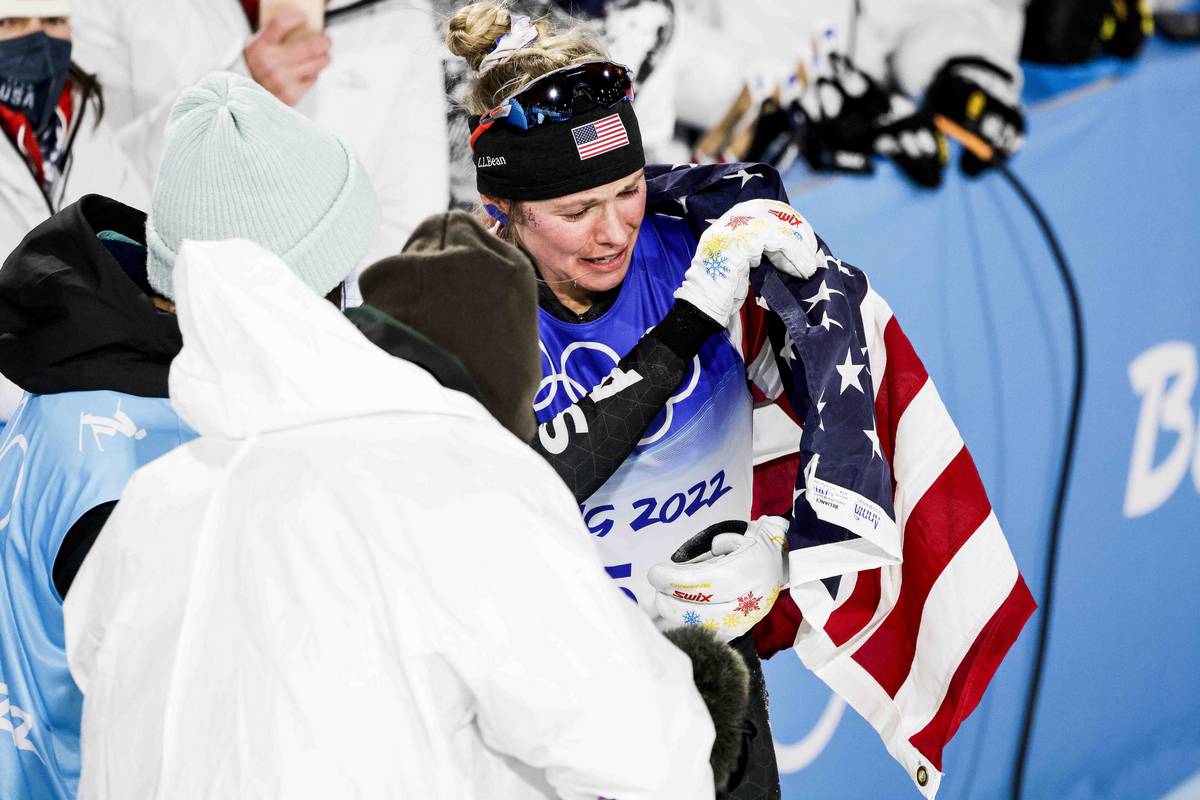
    An emotional Jessie Diggins wraps the American flag around her shoulders after taking bronze in the freestyle sprint. (Photo: NordicFocus)

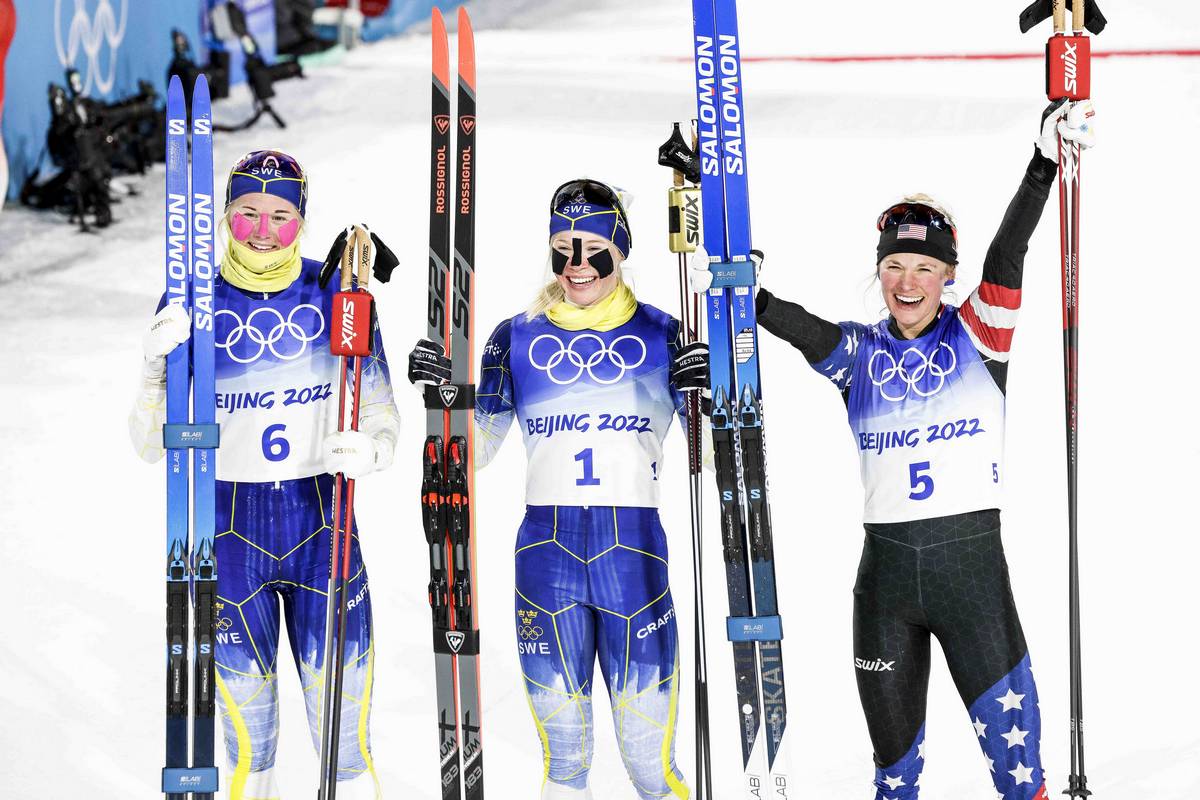
    Tearfully wrapping an American flag around her shoulders, Diggins was aglow as she savored the moment before heading back to the finish to stand alongside Sundling and Dalhqvist for the podium shot. 

    Jonna Sundling (SWE) takes gold in the freestyle sprint, ahead of Maja Dahlqvist (SWE) and Jessie Diggins (USA). (Photo: NordicFocus)

    Though she was the one whose name would be highlighted in history books, Diggins focus on the importance of those around her remained at the forefront as she celebrated the many victories of the American team in today’s event. 

    “It was so cool to be there with Rosie,” Diggins said in the mixed zone. “She’s skiing so amazingly well… and I’m just so grateful. That’s the overwhelming emotion, because it takes so much from such a huge team to make this happen. And we had obviously amazing skis, but also amazing teammates for years and years and years, helping me train, pushing me, supporting me – amazing coaches, amazing volunteer staff. You can’t even imagine how much it took from so many people, and so I’m just so thankful because I feel like this medal belongs to about 1000 different people. And I hope they really feel that and know that.”

    Jessie Diggins takes Olympic bronze in the freestyle team sprint. (Photo: NordicFocus)

    Of her approach to the course, Diggins gave a simple response, acknowledging that she has a way of blacking out while having great races, “which is really annoying,” she laughed, “because I’d love to be able to remember exactly what I did.”

    “I was just so focused on trying to push as hard as I could,” Diggins explained. “Just trying to ski as well as I could and stay balanced. The snow felt a little greasy, so especially in the finishing lane, just trying to put as much power as I could into every single push. And honestly, that’s all I can remember.”

    Jessie Diggins (USA) on her way to the USA’s first ever individual women’s medal in the Olympics. (Photo: NordicFocus)

    Perhaps the FasterSkier audience needs no reminder that Diggins came into the 2022 Games as a gold medalist, having won the freestyle team sprint with Kikkan Randall in 2018, a day that brought many Americans, including this writer, to tears. Diggins was asked to reflect on the last four years, and the progress she’s made in her career. 

    “The last four years, I’ve really found my voice,” Diggins said confidently. “I’ve really found a lot of my purpose, and I feel like I’ve grown a lot. But also, I’m exactly the same person in pretty much every other way. I think one of the big things has been dealing with is the pressure and expectations, because there’s been a lot of it, and it hasn’t been easy. So for me, I think it was such a victory just to make it to the final and know that I’m skiing well. I came into this as prepared as I could be, which one of my biggest goals was to come in prepared. The second goal, cross the finish line with nothing left. And the third goal was to just have fun, and keep focusing on the process, because that’s what gets me where I am today. Like win, lose, or draw, it’s just focusing on the process and, and executing those process goals to the very best of my ability, because then I’m always proud of how I finished. I’m just proud of this effort today as I was at the skiathlon, even though they were different outcomes.”

    Jessie Diggins was all smiles as she passed through the mixed zone following her bronze medal performance in the women’s individual sprint. (Photo: Nat Herz/FasterSkier-ADN)

    Fourth place at the Olympics – fourth in the world on its most prestigious stage – is both a truly incredible feat and perhaps the most challenging final rank to wrap one’s head around. The “wooden medal”, just shy of the Olympic hardware skiers dream about from their youth. 

    “Fourth place was hard,” Brennan said honestly in the mixed zone. “You feel really happy and also frustrated at the same time. I have a lot of mixed emotions about it. But I did everything I could today, and maybe not everything went perfectly my way. But I have to be happy with that at the end of the day.”

    Jessie Diggins (USA) and Rosie Brennan find their position in the early moments of the women’s final. (Photo: NordicFocus)

    Asked what she would have said if four years ago, someone told her she would be in this position, Brennan laughed, “I probably wouldn’t have believed it so much.”

    She talked through a rough start to the day, sharing that she has always struggled with start gates and had spent the last six weeks practicing to ensure a clean start.

    “So, there I was on the ground, I was like, ‘So much for all that practice.’ But I knew my strength was in the climb, so I just had to pull it back [together] and focus on the all the time I had left and see what I could do to try and make it up.” 

    On her approach through the heats, Brennan played to her strengths, recognizing she could take the lead, work the hills, and not let her heats unfold as a casual first 1200 meters with a tactical final sprint that might leave her in the dust.

    “My strength lies more in the endurance aspect of it,” she explained. “I tried to just keep the pace high so that I could count on being a lucky loser – by having a fast heat time. So that was my strategy in the semifinal, and it worked. Once I got to the final, I tried to then be a little more smart about my racing. I tried to be patient and wait until the last climb. I was a little far back, so I kind of got the door closed on me to make it through. So I had to kind of adjust and go for a strong finish sprint, which isn’t always my strength. But I did all I could do.”

    With Ben Ogden racing into the semis in the men’s race, it was an historic day for the American program as a whole. Speaking to this landmark day, Brennan concluded with an inspiring message for those who dream of following in their footsteps.

    “I think it shows the growing depth in our country. And I hope it shows a lot of people just to have some patience and keep training, keep going for it. You never know where you’ll end up.”

    Jonna Sundling (SWE) takes gold in her first Olympic appearance in the women’s freestyle sprint. (Photo: NordicFocus)

    Taking a closer look at the winner, Sundling is the 2018 World Champion in the freestyle sprint. Returning from injury, she has built her way into the season. Though Dahlqvist has shined as the undefeated World Cup star for Sweden, Sundling has crept up alongside, taking second to Dahlqvist in the individual sprint in Dresden, and working together to win the team sprint. Sitting out the Tour de Ski, Sundling beat Dahlqvist in their next matchup in a Scandinavian Cup race in Falun, Sweden.

    This is Sundling’s first Olympic appearance, though she and Dahlqvist will be a likely pairing in the classic team sprint next Wednesday.

    Once the final rounds were complete, Kern’s final placement was determined to be 18th. This marks a significant step forward from her first appearance in the skiathlon, where she finished 53rd. 

    Julia Kern (USA), who finished in 18th place overall, pushes to the finish during her quarterfinal round. (Photo: NordicFocus)

    “It was really tough out there, but a lot of fun to have a challenging course and give it my all,” Kern told FasterSkier in the mixed zone.

    Dahria Beatty 28th in qualification (+14.51) to be the only Canadian woman to make the heats. Beatty raced in the first semifinal, where she finished fifth in the heat to finish 25th on the day. 

    Just 0.7 seconds off the top-30 mark, Cendrine Browne was 35th in qualification (+15.82) with Olivia Bouffard-Nesbitt close behind in 40th (+16.89). Laura Leclair rounded out the Canadian team in 58th (+26.28). 

    Dahria Beatty (CAN) races in the quarterfinals on her way to 25th place overall. (Photo: NordicFocus)

    An Australian dual citizen who is a long-time APU team member, Jessica Yeaton was 52nd (+23.82) in the qualifying round. 

    Results:

    Qualification | Final

  • Russia Takes the Women’s Relay in Final Sprint; Americans Rebound to Fourth

    Russia Takes the Women’s Relay in Final Sprint; Americans Rebound to Fourth

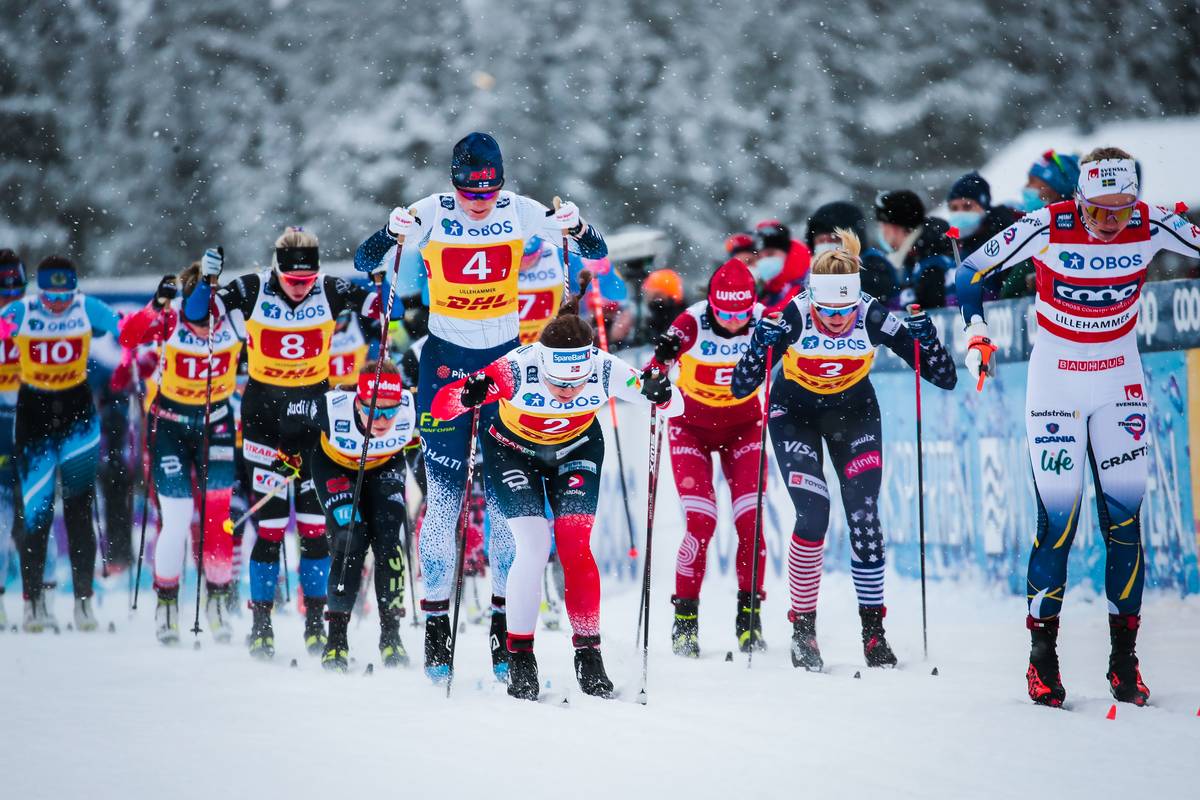
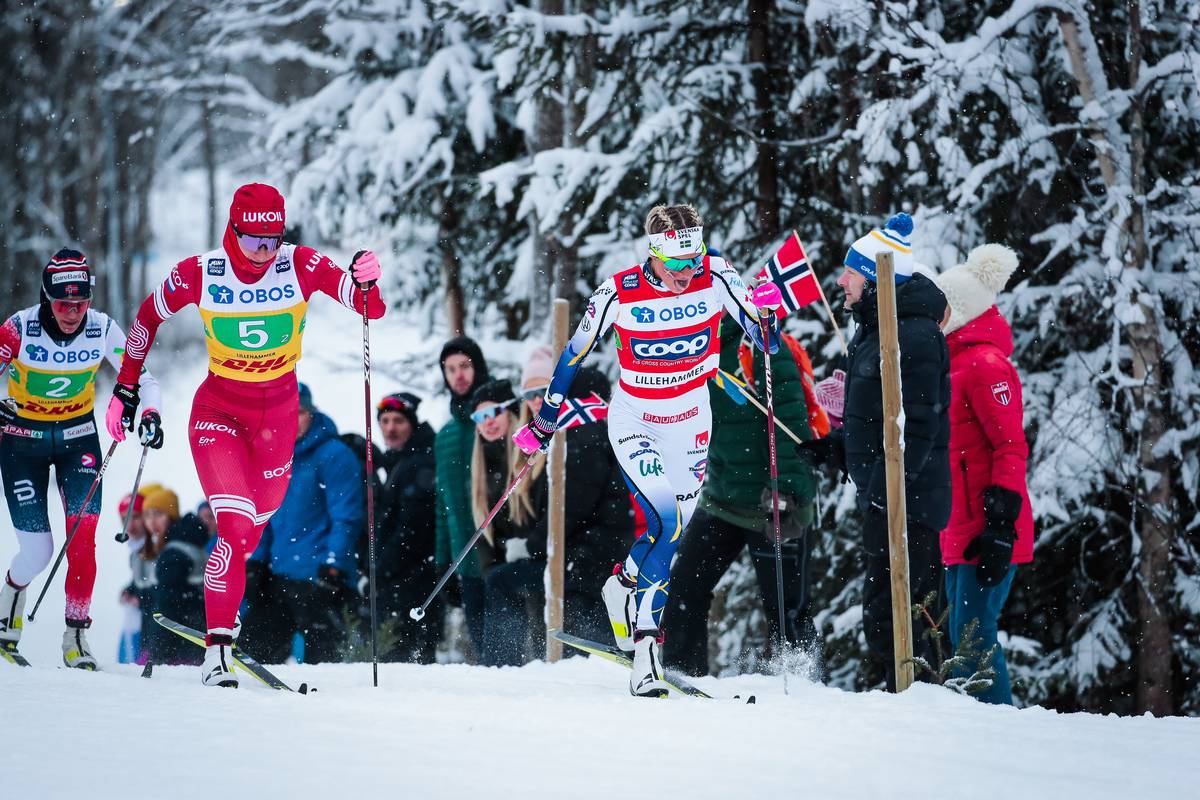
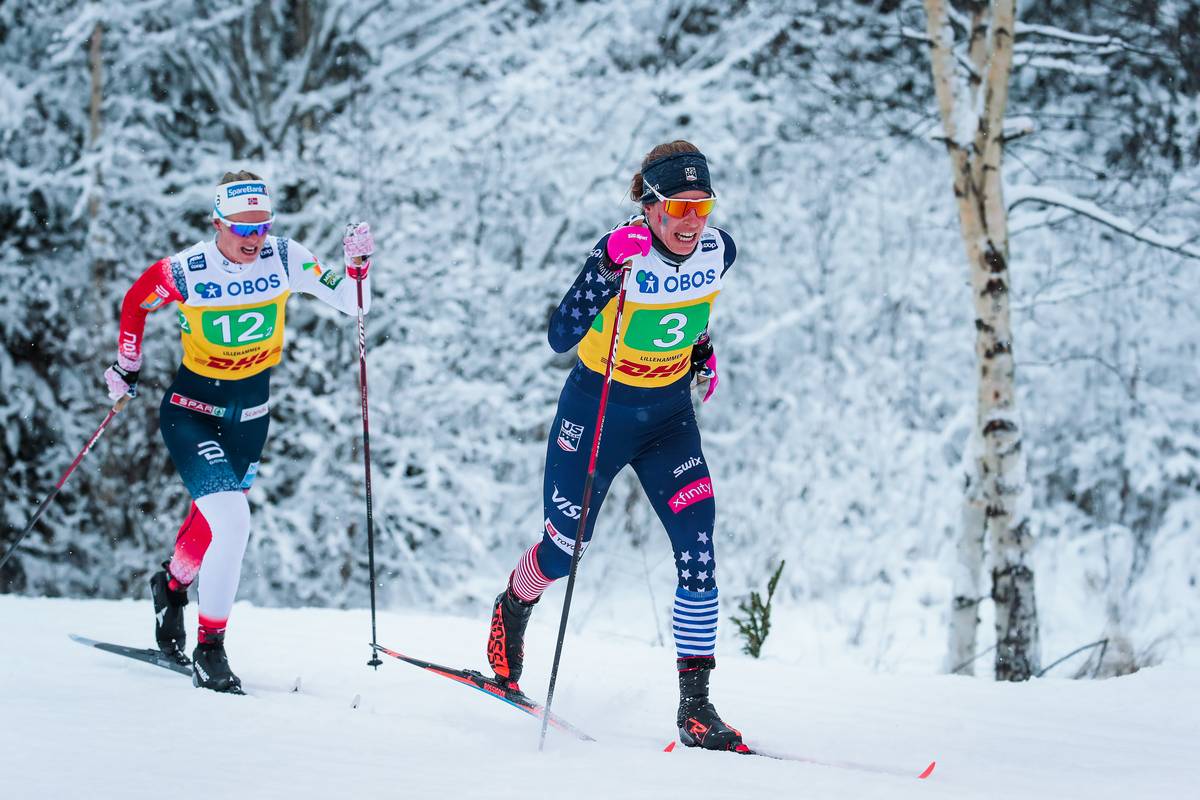
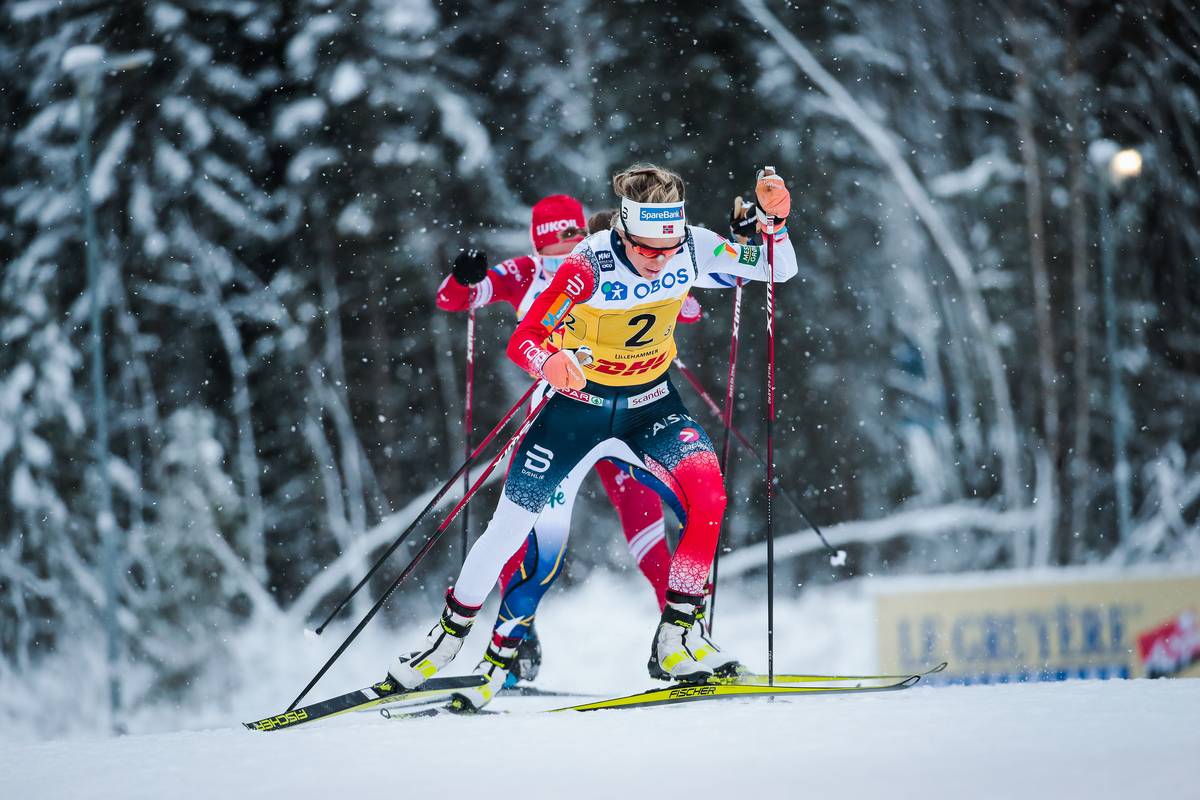
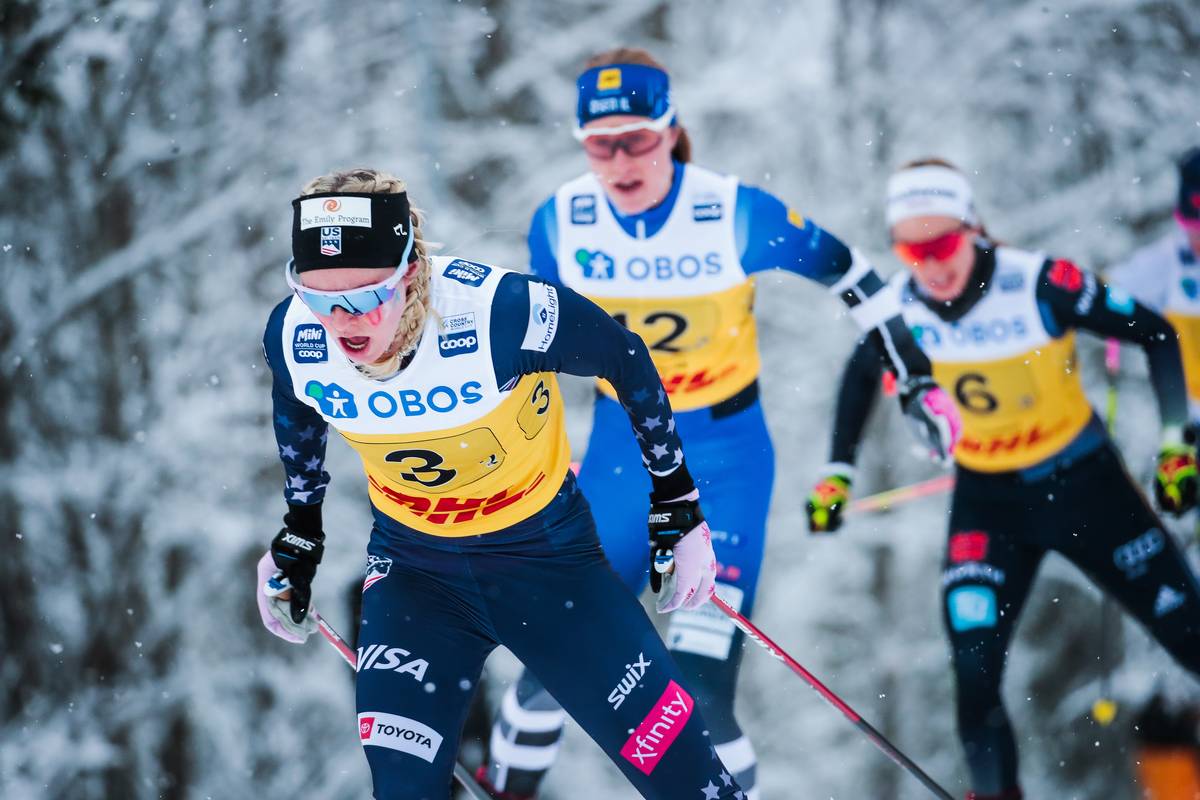
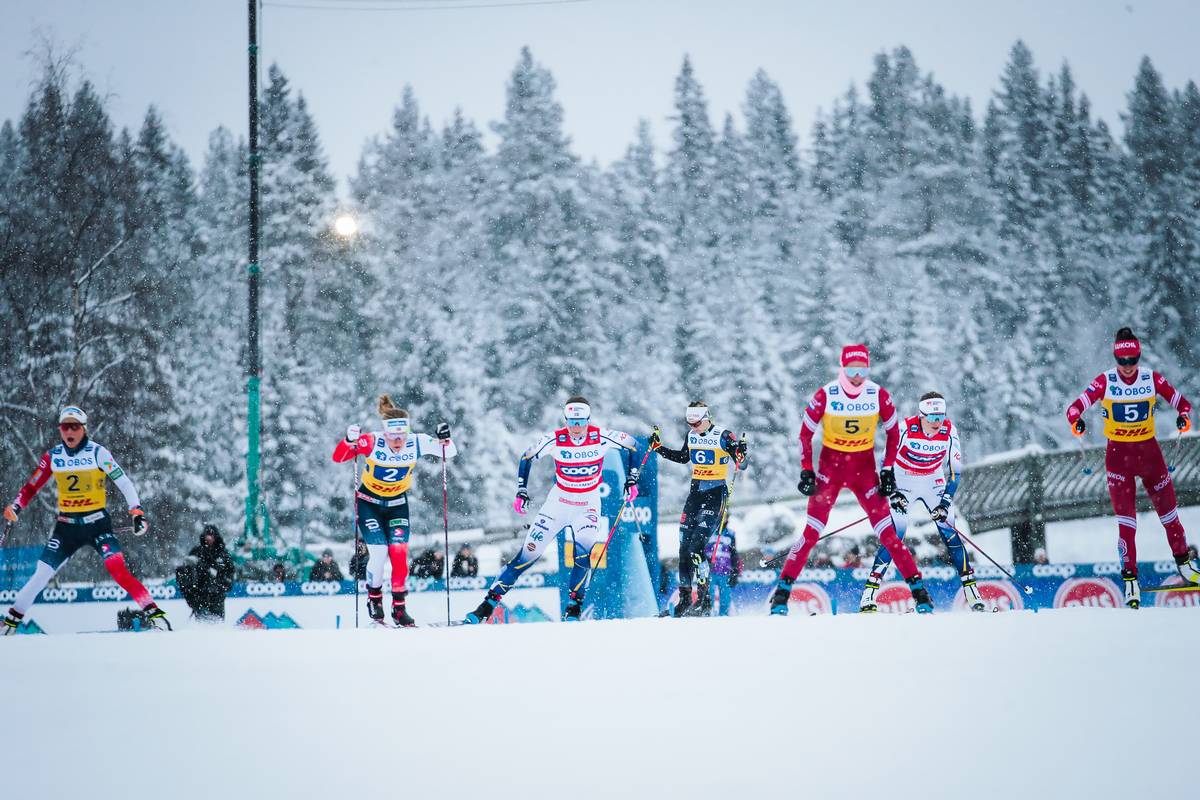
    And they’re off. The start of the women’s 4 x 5k relay in Lillehammer. (Photo: NordicFocus)

    This World Cup coverage is made possible through the generous support of Marty and Kathy Hall and the A Hall Mark of Excellence Award. To learn more about A Hall Mark of Excellence Award or to learn how you can support FasterSkier’s coverage please contact info@fasterskier.com.

    Bring out the high socks and glitter, it’s a relay day on the World Cup.

    Whereas the early legs of the men’s race skied like an accordion, the first four teams pulling the field apart before each exchange, then biding their time as the next few groups regained contact, the top three teams in the women’s race seemed evident from the onset of the second lap. 

    This statement should not imply that the race was in any way less suspenseful. Within this lead group were some of the top Swedish athletes, who have proven to be a force in both sprint and distance, racing against a deep Russia I team, whose members have not yet earned a World Cup podium this season. 

    On home turf with history pointing in their favor, Norway has won 17 of the last 18 World Cup relays, and took the gold medal in the event at last year’s World Championships in Oberstdorf, Germany with the same team that started today. As the top three teams pulled ahead, the Norway I team evidenced the determination to continue this streak. 

    At the first exchange, these three teams were joined by Germany, which was led by Katharina Hennig, and the Finland I team, led by Johanna Matintalo. 

    Despite a broken pole basket, Hailey Swirbul skied a strong opening leg in the women’s 4 x 5k relay in Lillehammer. (Photo: NordicFocus)

    The United States I team, led by Hailey Swirbul, who tagged off to Rosie Brennan in 9th (+21.6). At 2k, U.S. I was only a few seconds back on the leaders. Unfortunately for the Americans, shortly thereafter Swirbul broke a pole basket. Racing in fresh snow, Swirbul slowly began to bleed time, fighting to keep the time lost to a minimum. 

    By the second exchange, Sweden I, Russia I, and Norway I, were within 1.2 seconds of one another, but nearly 20 seconds ahead of the chase group. In this lineup was yesterday’s 10k skate winner, Frida Karlsson (SWE) facing Heidi Weng (NOR) who took ninth, and Natalia Nepyaeva (RUS) who finished fifth.

    Frida Karlsson (SWE) leads the charge in the second leg ahead of Natalia Nepryaeva (RUS) and Heidi Weng (NOR). (Photo: NordicFocus)
    Gaining ground for U.S. I, Rosie Brennan powers through the second leg of the women’s relay. (Photo: NordicFocus)

    Ceding a few seconds to the leaders, but advancing in position, Brennan pulled the U.S. I team into sixth, within reach of Finland I and Germany, who tagged off ten seconds ahead. 

    In the first skating leg, Norway’s distance champion Therese Johaug was matched against Ebba Andersson (SWE) and Tatiana Sorina (RUS). Andersson made an early push to set the tone as the final lap neared, but she was unable to break away. The women stayed together through the final exchange, where they tagged off within a second of one another. 

    Therese Johaug (NOR) pulls Ebba Andersson (SWE) and Tatiana Sorina (RUS) during the third leg of the women’s relay. (Photo: NordicFocus)

    Building upon Brennan’s momentum, Jessie Diggins skated the third leg for the Americans. Giving the energy we’ve come to expect from Diggins during relays, she hammered her leg of the course, gaining time on the leaders and advancing her team into fourth place at the final exchange. Still at a deficit of 26.4 seconds, a podium finish appeared unlikely in Lillehammer. 

    However, the effort highlighted the collective grit of her team, sending the message that a future podium is not out of reach. While there are no tests of relay mettle between now and the Olympic Games in February, the event will certainly be a focus as the American women build toward their peak this season. 

    After the race, Diggins commented on her experience racing in third, a new position for her, and explained how she worked together with Norway II’s Ragnhild Haga to advance both teams position in the field. 

    Pulling the Americans into fourth, Jessie Diggins charges through the third leg of the women’s relay in Lillehammer. (Photo: NordicFocus)
    The final exchange: Norway I, Sweden I, and Russia I all evenly matched. (Photo: NordicFocus)

    At the halfway mark of her leg, the Norway I anchor, Helene Fossesholm, began to hit it hard. She created a three second gap with 1.6 k to go, but then it appeared that she had burnt a few too many matches to continue at that effort. Moa Olsson (SWE) and Veronika Stepanova (RUS) regained contact and the threesome headed through the final kilometer and into the stadium tightly grouped. 

    In the final push, Stepanova accelerated at the front to take the win for Russia I, while Olsson and Fossesholm slid in for a photo finish just behind. It was determined that the Swede’s boot was ahead of the Norwegian’s, locking in the podium with Russia I stopping the clock at 54:40.6, followed by Sweden I in second (+1.1) and Norway I in third (+1.2). 

    Veronika Stepanova takes the win for Russia I as her teammates rush forward to celebrate. Meanwhile Helene Fossesholm and Moa Olsson slide for second and third. (Photo: NordicFocus)

    After the finish, an ecstatic Russian team provided the following comments to FIS. 

    “It was really nice,” leader Yulia Stupak said on behalf of her team. “We’re so happy today. Today was a good race. And we also have a small joker today, our new young star. She was really good.” 

    Natalia Nepryaeva celebrates Russia’s relay victory with her breathless teammate Veronika Stepanova who highlighted the anchor leg. (Photo: NordicFocus)

    Stupak handed it over to Stepanova, who at 20-years-old is the youngest member of the team. Showing her range, Stepanova was the national champion in both the 15k freestyle and the freestyle sprint at last year’s Russian National Championships in Kirovo-Chepetsk, and also won the 5k free at the 2021 World Junior Championships in Voukatti, FIN. This weekend is only her second time racing at the World Cup level, and has been her first World Cup starts of the season.

    “This was a great one,” Stepanova laughed as she charismatically took the mic. “I have an amazing team – thank you, girls.”

    When asked about the focus on the Olympic relay and the team’s outlook, the women looked to one another optimistically.

    “This [will be] a good competition,” Stepanova said simply. 

    Russia I upset the Norwegian favorites in todays 4 x 5k women’s relay in Lillehammer. (Photo: NordicFocus)
    Julia Kern powers down the home stretch alongside Finland’s Jasmi Joensuu. (Photo: NordicFocus)

    Anchoring the U.S. I team, Julia Kern tucked in with Germany’s Victoria Carl, utilizing the draft and conserving for a tactical final sprint, which she identified as a strength. Halfway through the leg, the chase group was just over ten seconds behind the leaders, before a crash put a wrench in the plans. 

    Recovering in time to put in a final surge, Kern powered around the curve into the stadium, neck in neck with Finland’s Jasmi Joensuu. The two women accelerated to the line evenly matched, throwing their boots over the line in a photo finish. Times were declared even to the tenth of a second, but Kern was determined to have a marginal advantage over Joensuu, putting the American women in fourth after a valiant team effort.

    After the race, Kern explained her tactical approach to the anchor leg, along with additional insight into what was missed by cameras, conditions on the course, and the American women’s outlook as they keep their eyes on the Olympic relay. 

    Julia Kern slides in for fourth place in the women’s relay. (Photo: NordicFocus)
    The boot slide aftermath. (Photo: NordicFocus)

    A testament to the development of cross-country skiing in the U.S., a second American women’s team raced in Lillehammer today. Comprised mostly of U23 athletes, the team of Sydney Palmer-Leger, Katharine Ogden, Sophia Laukli, and Novie McCabe skied to 13th today (+4:30.9). The first American team could be seen waiting at the finish to welcome their teammates across the line.

    In a post-race interview, U.S. Ski Team Head Coach Matt Whitcomb provided insights into the women’s team selections, how new snow affected racing, and the team’s collective effort to thrive during back-to-back long weekends of racing this early in the season. (Note: This audio includes comments on both the men’s and women’s relays, with men spoken to first.)

    Katharine Ogden races the second leg for the U.S. II Team. (Photo: NordicFocus)
    Dahria Beatty (CAN) on course during the women’s 4 x 5k relay in Lillehammer. (Photo: NordicFocus)

    Also racing for North America, the Canadian women’s team of Dahria Beatty, Katherine Stewart-Jones, Cendrine Browne, and Maya MacIsaac-Jones finished 16th (+5:31.9).

    Racing continues next weekend in Davos, SUI with a freestyle sprint on Saturday December 11th followed by a 10/15k freestyle distance on Sunday the 12th.

    Final Results

  • Saturday Race Rundown: U.S. U20 Men Win Relay, U20 Women 4th at World Juniors (Updated)

    Saturday Race Rundown: U.S. U20 Men Win Relay, U20 Women 4th at World Juniors (Updated)

    The U20 World Juniors 4 x 5 k relay first place team from the U.S, (l-r) Johnny Hagenbuch, Ben Ogden, Luke Jager, and Gus Schumacher. (Photo: JWSC2019 / Mikaela Takala)

    2019 U23 World Ski Championships in Lahti, Finland 4 x 3 k and 4x 5 k relay

    Full U20 Men’s Race Report

    In a historic first for the U.S., the U20 men’s team won the 4 x 5-kilometer relay today in Lahti, Finland at the 2019 World Junior Ski Championships. Luke Jager skied the first classic leg for the U.S., Ben Ogden skied the second classic, Johnny Hagenbuch skied the first initial skate leg and Gus Schumacher raced the anchor leg.

    The foursome won in a time of 45:34.7 minutes, and beat second-place Russia by 3.8 seconds.

    Russia’s team was comprised of Egor Trefilov, Andrey Kuznetsov, Yaroslav Egoshin, and Alexander Terentev.

    Germany’s team of Jakob Milz, Florian Knopf, Anian Sossau, and Friedrich Moch took third finishing 6.3 seconds behind.

    For Canada, Remi Drolet , Sam Hendry, Xavier McKeever, and Thomas Stephen skied to 11th (+2:29.7).

    Nineteen teams were entered in the race.

    Men’s U20 Results

    In the 4 x 3.3 k U20 women’s race, Norway’s Kristin Austgulen Fosnaes, Astrid Stav, Helene Marie Fossesholm, and Kristine Stavås Skistad won at the line in 35:24.7 minutes.

    Russia’s Anastasia Faleeva, Kristina Kuskova, Veronika Stepanova, and Anna Grukhvina were a close second, stopping the clock 1.0 seconds back.

    Louise Lindström, Frida Karlsson, Tilde Baangman, and Lin Svahn for Sweden placed third (+33.3).

    The U.S. team of Mara McCollor, Kendall Kramer, Sydney Palmer-Leger and Novie McCabe skied to fourth place, 40.5 seconds back.

    For Canada, Anne-Marie Petitclerc, Jasmine Drolet, Anna Pryce, and Molly Miller placed 11th, 3:01.4 minutes behind.

    U20 Women’s Results

    ***

    FIS Cross Country World Cup Ulricehamn, Sweden 10/15 k freestyle

    In what is his skiing canvas, the 15 k freestyle, France’s thirty-two-year-old Maurice Manificat won his first World Cup of the season in Ulricehamn, Sweden today in 34:55.4 minutes. It was a tight race in that Norway’s Simen Hegstad Krüger Simen Hegstad Krüger who placed second finished 1.1 seconds back. Teammate Didrik Tønseth was third (+8.7).

    Canada’s Alex Harvey was the best placed North American in ninth (+31.4). Lenny Valjas skied to 57th (+2:32.1), and Bob Thompson 77th (+4:16.6).

    For the U.S., Scott Patterson finished 35th (+1:26.5), David Norris 53rd (+2:11.3), Ben Lustgarten 64th (+3:04.7).

    Men’s Results

    Norway’s Therese Johaug kept her distance win streak alive at eight wins in eight starts on the World Cup this season. She won the women’s 10 k skate race in 25:48.2 minutes, with teammate Astrid Uhrenholdt Jacobsen in second, 22.8 seconds back. Third place went to Sweden’s Ebba Andersson, 24.9 seconds behind.

    The U.S. Ski Team’s Jessie Diggins skied to fourth place (+38.3), while teammate Sadie Bjornsen was 15th (+1:25.1). Caitlin Paterson (CGRP) had her best World Cup result of the season, skiing to 23rd (+1:49.9). Rosie Brennan (APU) placed 28th (+2:03.2), and Rosie Frankowski 42nd (+2:28.0).

    Dahria Beatty was the only Canadian entered. She finished 56th (+3:54.7).

    Women’s Results

    ***

    IBU World Cup Antholz, Italy 10/12.5 k pursuit

    In the women’s 10 k pursuit, Italy’s Dorothea Wierer won in a time of 29:20.1 after skiing two penalties (1+0+0+1). Second place went to Germany’s Laura Dahlmeier, who finished 6.0 seconds after Wierer after one missed shot (0+0+1+0). Saturday’s third place went to another Italian, Lisa Vittozzi, who finished 16.2 seconds behind the winner after tying Wierer’s shooting score.

    Clare Egan led the way for the U.S., racing to 11th (+1:31.9) after skiing two penalties (0+0+0+2).

    “I’m really happy with my race today,” Egan wrote in an email. “The wind and altitude are always a challenge here, but I took my time on the range and capitalized on the fast glide of my skis to save energy on course. I made a costly and dumb mistake on my last shot but still came away with my second-best career result. I’ll take what I learned from today and go for it again tomorrow in the mass start! Can’t wait!”

    Joanna Reid was the next American to finish, placing 29th (+2:55.2) after three missed shots (1+0+0+2).

    For Canada, Rosanna Crawford finished 34th (+3:30.8) after skiing five penalties (2+1+1+1) and her teammate Megan Bankes finished 39th (+3:37.1) with five misses (1+0+3+1). Also skiing for Canada, Sarah Beaudry placed 46th (+5:07.5), also with five penalties (4+0+1+0).

    Women’s 10 k Results

    In the men’s 12.5 k pursuit, Norway’s Johannes Thingnes Bø
    won in a time of 31:33.7 after skiing three penalties (1+1+0+1). France’s Antonin Guigonnat raced to second place, 34.8 seconds behind with one missed shot (0+0+1+0). The third and final podium spot on Saturday went to France’s Quentin Fillon Maillet, who skied two penalties (1+0+0+1) and finished 40.6 seconds back from the winning time.

    Sean Doherty for the U.S. placed 47th (+4:39.1, 3+2+1+0). Jake Brown was lapped and was not given an official time.

    For Canada, Jules Burnotte skied to 54th (+5:42.8, 1+3+1+1), and Scott Gow 55th (+6:39.7, 4+0+2+3).

    Men’s 12.5 k pursuit results

    ***

    Lake Placid SuperTour Classic Sprint

    Canada’s Antoine Briand (CNEPH) was the fastest qualifier on the day in 3:14.71 minutes and won the men’s final. Dominique Moncion-Groulx (Nakkertok) placed second in the final, with Ben Saxton (SMS T2) in third.

    Saxton was the second fastest qualifier, with Oliver Hamel (CNEPH) third fastest.

    Men’s Qualification | Men’s Heats

    For the women, Sophie Caldwell (USST/SMS T2) scorched the qualifier in 3:40.44 minutes with Jessica Yeaton (APU/Australian National Team) qualifying in second (3:50.49). Dartmouth’s Katharine Ogden qualified third (3:51.79).

    Caldwell went on to win the final in 3:37.06, with Yeaton in second and Kelsey Phinney (SMS T2) in third.

    Women’s Qualification | Women’s Heats