From the FasterSkier archive — posts syndicated from athletes’ and coaches’ own blogs between 2004 and 2012, kept online as published. Current coverage is at fasterskier.com.
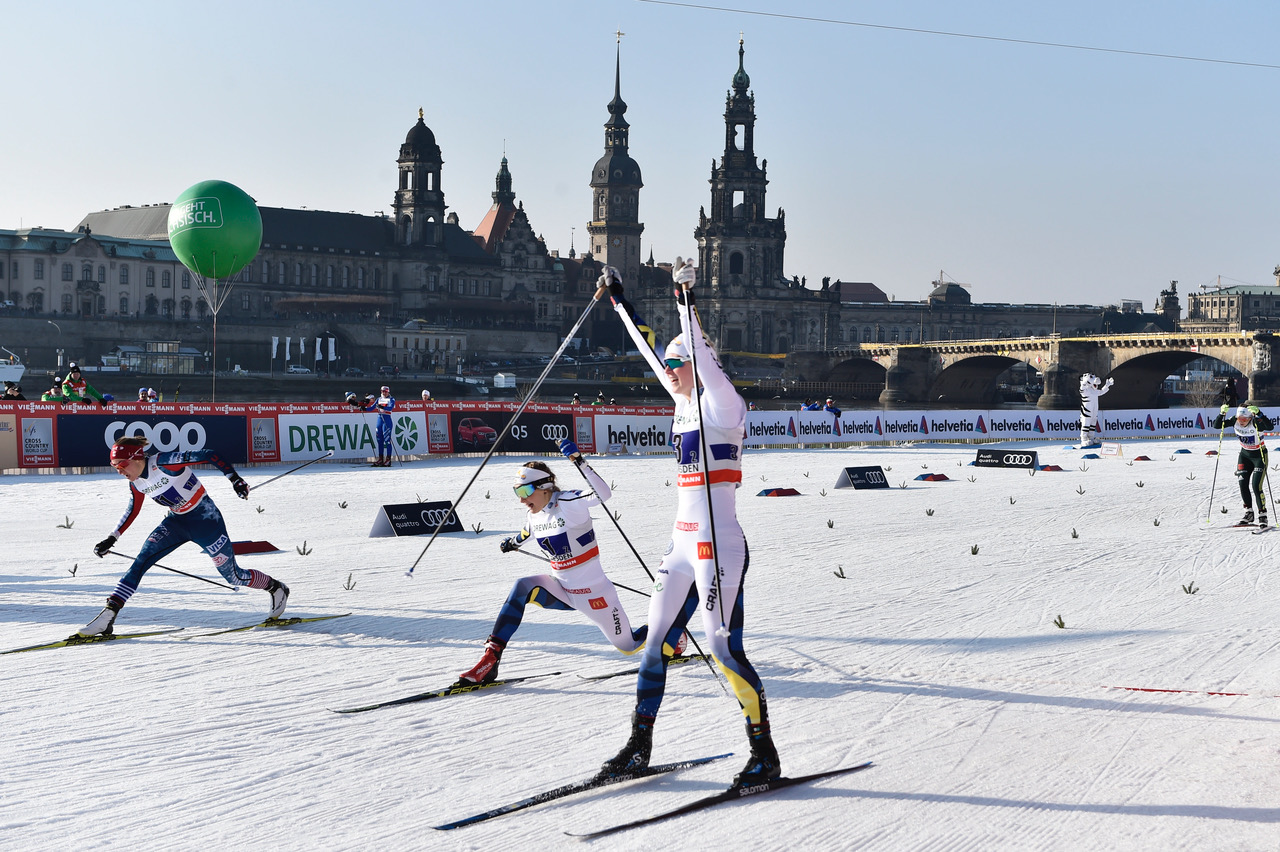
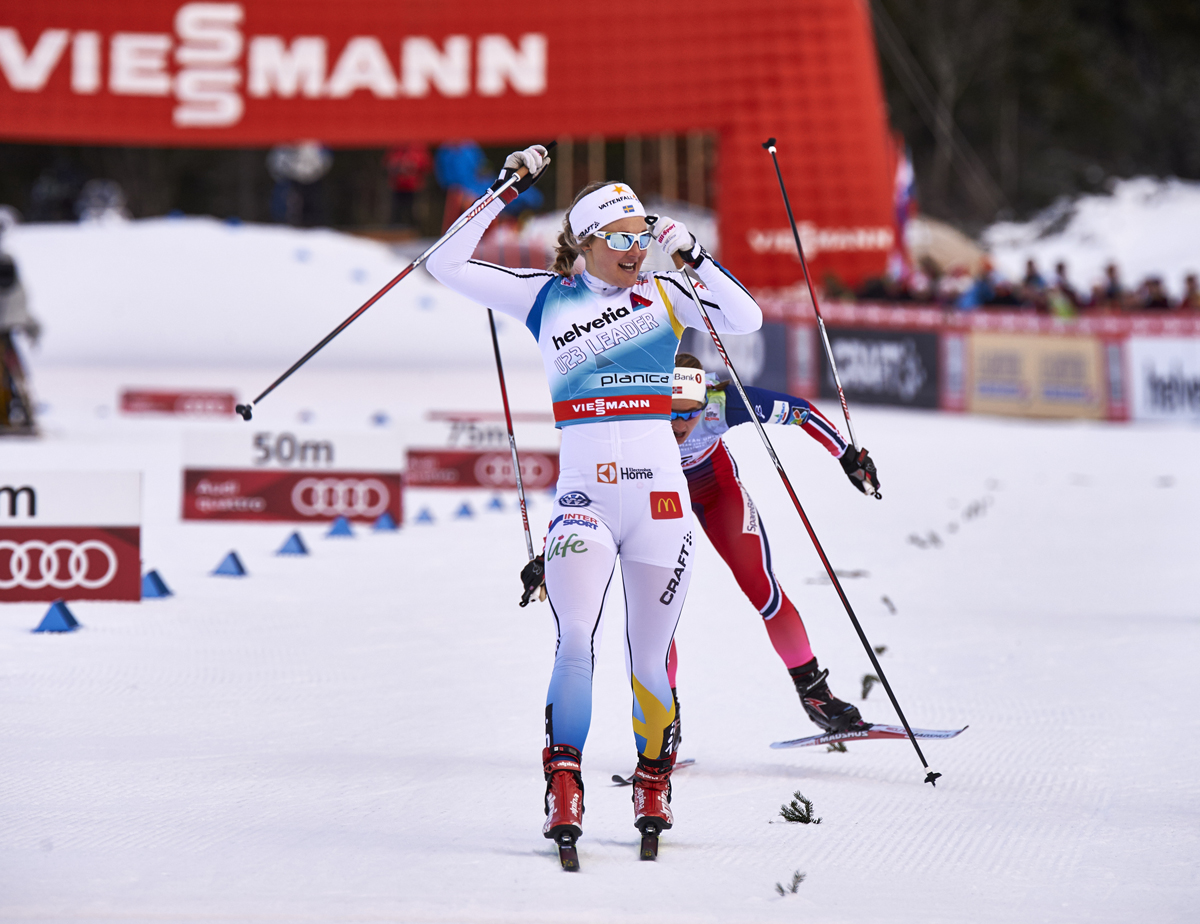
The finish of the women’s 6 x 1.2 k freestyle team sprint final, with Sweden II’s Maja Dahlqvist (near) celebrating her win ahead of Sweden I’s Stina Nilsson (c) and American Sophie Caldwell (l), who placed second and third, respectively, in a photo finish. (Photo: Fischer/NordicFocus)
DRESDEN, Germany — Just over 15,000 people gathered at the Elbe River bank on Sunday, some donned in sunnies and carrying sauce-laden brätwurst from pop-up food carts, though all took pause around 11:14:59 a.m. It wasn’t to take in the Altstadt baroque-style buildings that make up the city skyline, nor was it to bask in the bright, mid-morning sun hovering on the horizon.
A new attraction had come to the capital city, and all eyes were on it: the start of the International Ski Federation (FIS) women’s 6 x 1.2-kilometer freestyle team sprint. The city race organizers had trucked nearly 5,000 cubic meters of manmade snow to the grassy green bank, creating a skiing venue where one had never previously existed before. (Dresden has never before hosted a World Cup; the closest place to find natural snow being around 95 kilometers away).
Though it was the first of its kind, the crowd was still on edge as racers anticipated the snap of the gun for the women’s final. Even amid artificial conditions, the scene was naturally mystifying for onlookers.
With the gunshot, life roiled back into those in the stands and competitors became absorbed in the race for the win. Leading out Lap 1 was Ida Ingemarsdotter, racing for Sweden’s second team with Maja Dahlqvist (who placed third in Saturday’s individual skate sprint).
Ingemarsdotter was closely followed by her compatriot, Hanna Falk, who had won Saturday’s sprint and was racing for Sweden’s first team on Sunday. Hanna Kolb, racing for Germany I, Ida Sargent racing for U.S.A. I, and Alenka Cebasek racing for Slovenia, were all in hot pursuit.
Also on course was Nadine Fähndrich of Switzerland, Giulia Stuerz on Italy , Jessica Yeaton of Australia, Caitlin Patterson (U.S.A. II), and Katharina Hennig (Germany II).
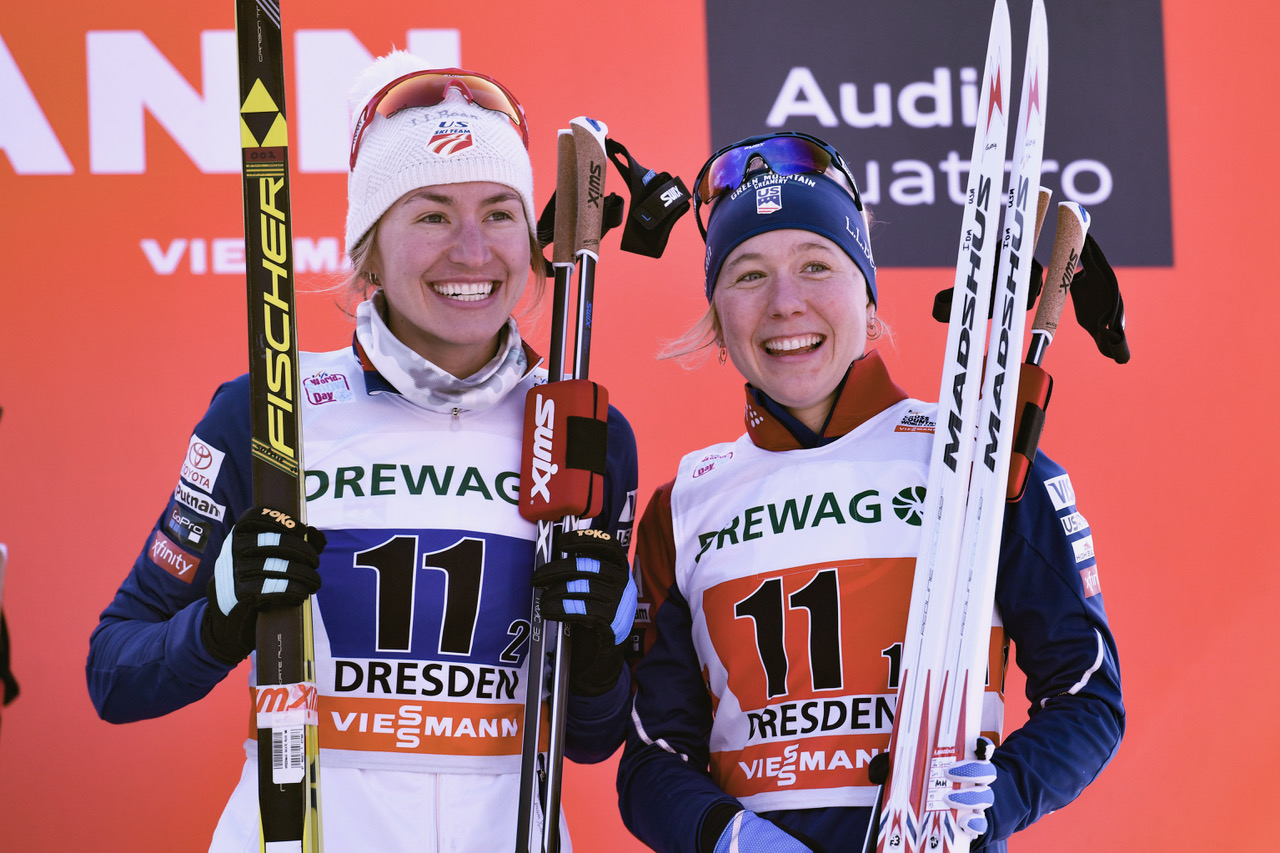
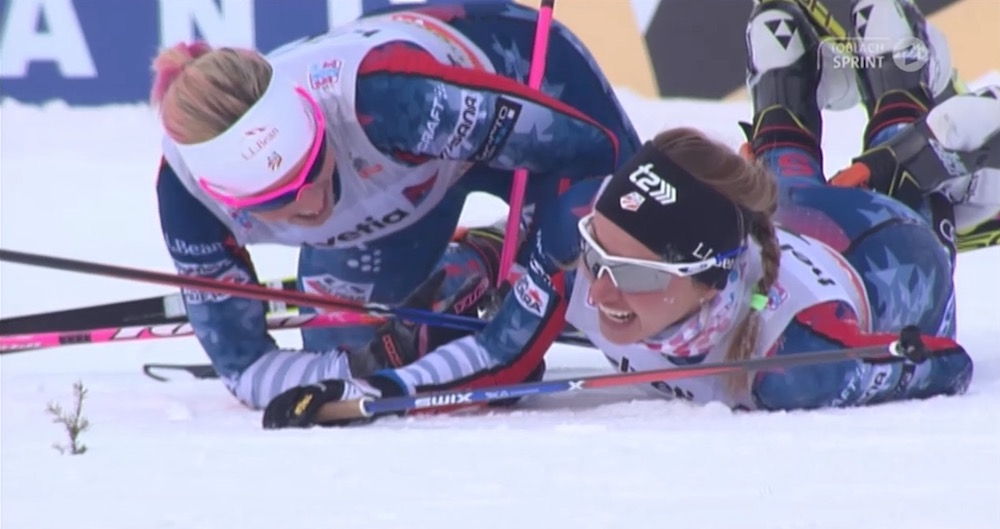
U.S. Ski Team members Sophie Caldwell (l) and Ida Sargent after placing third in the World Cup freestyle team sprint on Sunday for their World Cup second podium together in the event. (They finished third in the pre-Olympic World Cup freestyle sprint last year in PyeongChang, South Korea.) (Photo: Fischer/NordicFocus)
Through the exchange it was Ingemarsdotter in first, Falk second, Kolb third, and Sargent fourth. Coming through in seventh was Patterson, of the Craftsbury Green Racing Project, handing off to Kikkan Randall (U.S. Ski Team).
“I think I tend to let myself accordion to much, so I had to watch that and really focus to stay in it,” said Patterson, who arrived in Dresden on Thursday after being crowned a four-time 2018 national champion last week in Anchorage, Alaska.
“Being efficient … keeping it together and keep[ing] it tight,” Patterson added, referring to her race strategy on Sunday. “Because I know Kikkan has so much experience in heats and she can really maneuver well; she did such a good move on the last leg of that semifinal to keep us in it.”
In the final, as Patterson handed off to Randall, while Sargent passed off to Caldwell (who had placed third in Saturday’s sprint). Still in the lead was Ingemarsdotter tagging to Dahlqvist, Kolb to her teammate Sandra Ringwald, and Falk to Stina Nilsson.
The women stayed in a close pack, but thanks in part to the cheers of a large fanbase behind her, Germany’s Ringwald had worked her way to the front. As the skiers approached their third exchange, Germany had taken over the lead. Following Ringwald was Caldwell in second and Slovenia’s Vesna Fabjan in third. Randall was also gaining ground and gave the race back to Patterson in sixth as the field headed into Lap 3 of 6.
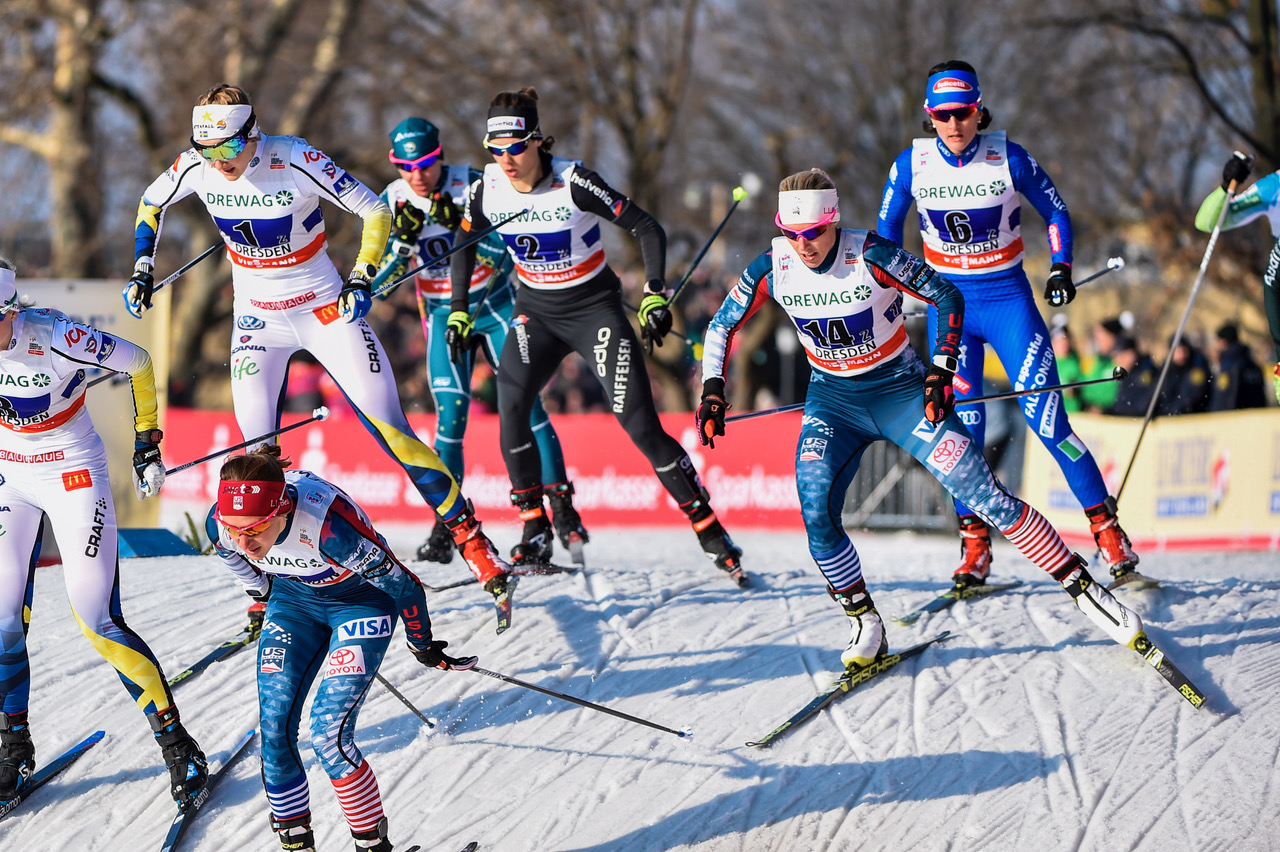
Americans Sophie Caldwell (front r) and Kikkan Randall (14) racing together in the women’s 6 x 1.2 k freestyle team sprint final on Sunday at the World Cup in Dresden, Germany. USA I, with Ida Sargent (not shown) and Caldwell went on to place third, while USA II, with Caitlin Patterson (not shown) and Randall, finished eighth. (Photo: Fischer/NordicFocus)
“This is my first real racing weekend back and yesterday was a little frustrating because my body felt good but I just didn’t quite have the speed fully ready yet,” said Randall, who had pulled out of the Tour de Ski due to an ongoing issue with one of her foot tendons and has been working on recovering since. “So I am really glad I got the opportunity to race today.
“It was great to have Caitlin ski really strong and get into the final,” Randall added. “I just wanted to get six rounds and I did. It was fun, fast paced, and I am happy with the way I felt. Of course, it’s fun to have another team in the race, too, and kind of be working together a bit.”
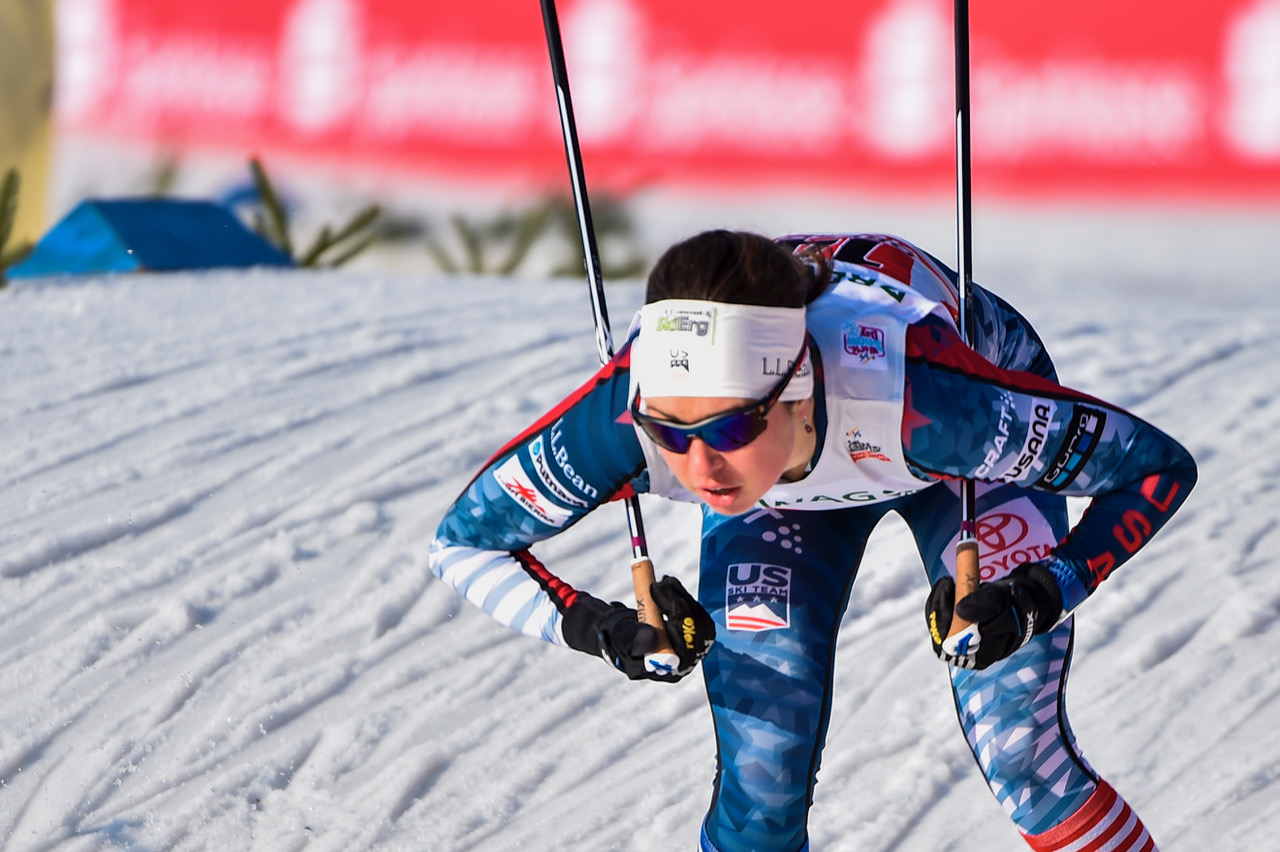
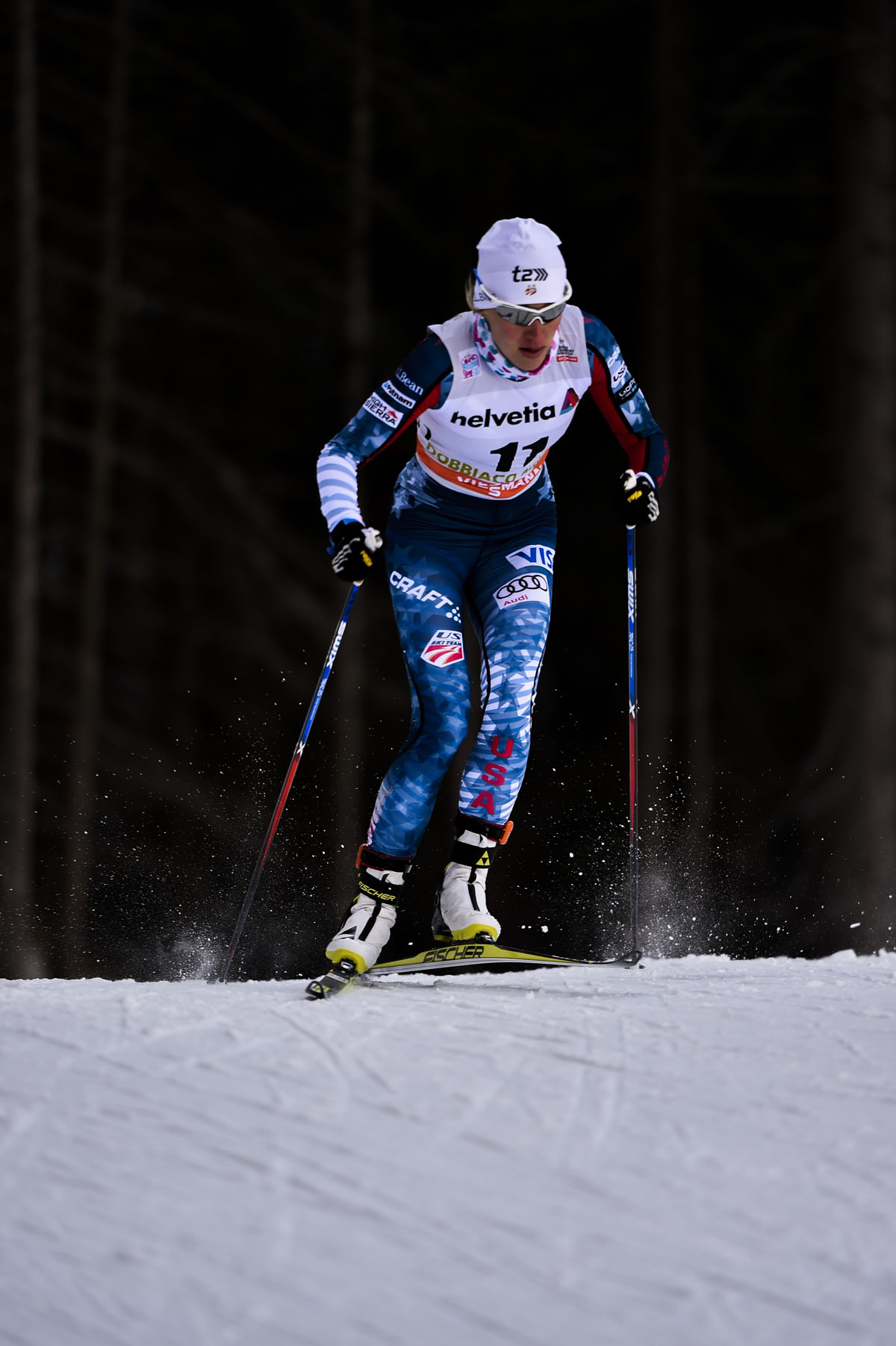
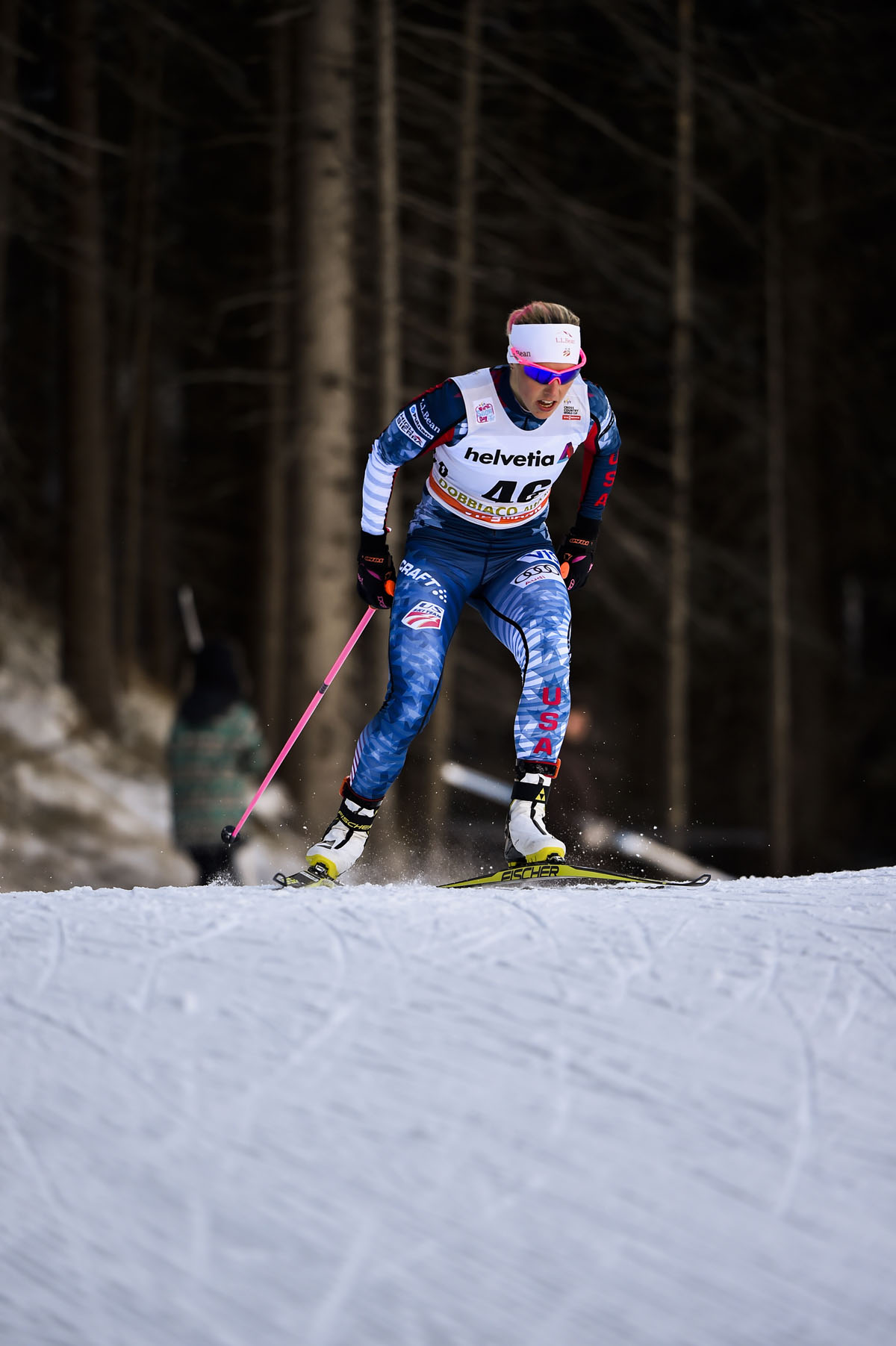
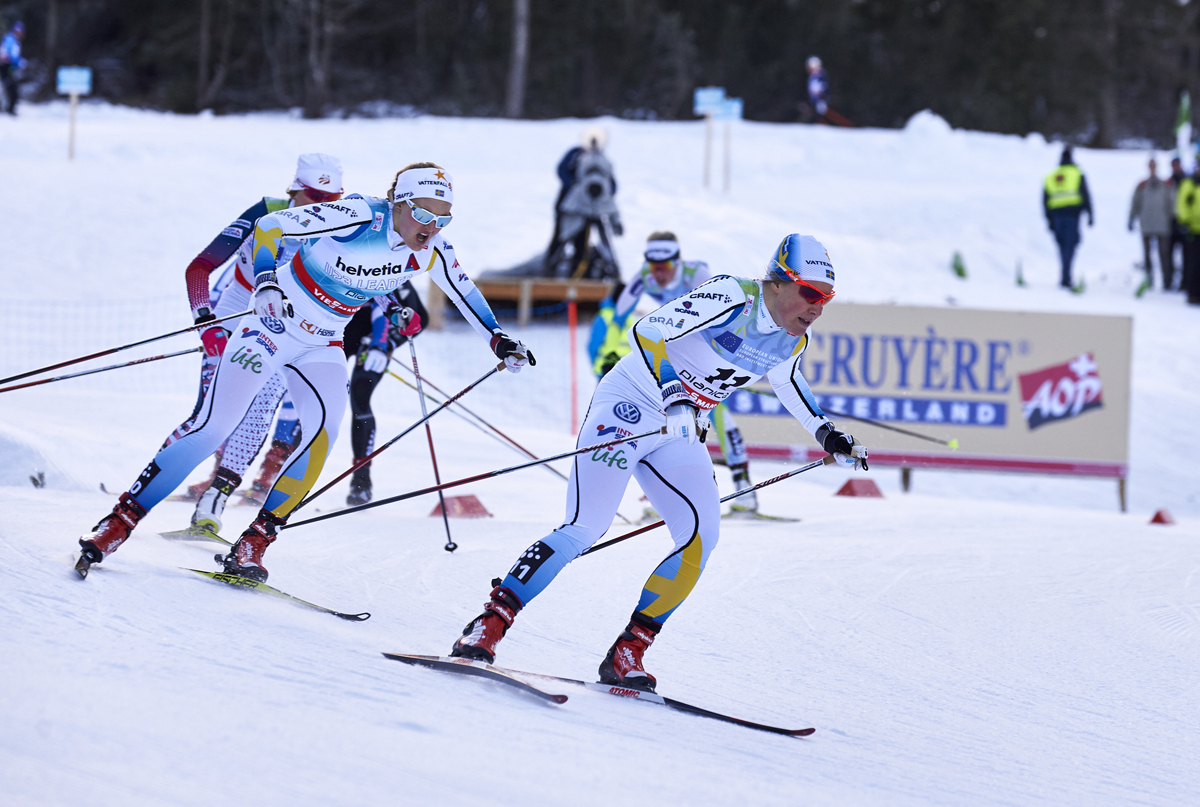
Caitlin Patterson racing for USA II in the women’s 6 x 1.2 k freestyle team sprint on Sunday at the World Cup in Dresden, Germany. (Photo: Fischer/NordicFocus)
As racers struck out into Lap 3, Switzerland’s Fähndrich was at the helm, which she held until she tagged off to her teammate Laurien van der Graff. The Swiss skiers had a smooth exchange and van der Graff was out front. Breathing down her neck behind her, however, were two Swedes: Nilsson and Dahlqvist. As the group approached the course’s most notable climb, Nilsson powered her way around van der Graff and to the front, Ringwald in tow.
With the fourth exchange coming into sight, the top two spots were with Sweden, Switzerland third. U.S.A. I was in fifth, U.S.A. II in eighth.
“It’s hard to pass, so we definitely wanted to stay toward the front,” Caldwell said of her and Sargent’s plan heading into the final. “It’s such a short and fast course that anything can happen and I think it is always fun to be right there in the mix.”
With just two laps to go, Falk, who came out of the exchange first, began to push the pace, while Fähndrich, Sargent and Ingemarsdotter chased her down. Though Falk had put a bit of a gap on the field by the course’s turn heading back to the stadium, it had closed by the course’s single climb. Here, Fähndrich made her move and maneuvered around Falk to the front.
After the fifth exchange and heading into the final lap, the two Swedes, van der Graff, and Caldwell tried to separate themselves from the rest of the teams in the final. But within a few meters three more teams — Slovenia, and Germany I and II — had rejoined them.
As they approached the aforementioned uphill, Nilsson went for it, propelling herself to the front. Dahlqvist went with her, and Caldwell dodged to van der Graff’s left, pulling a hard V1 to get around the Swiss skier. Approaching the finish, it was Dahlqvist to the far right, Nilsson in the middle and Caldwell to the left.
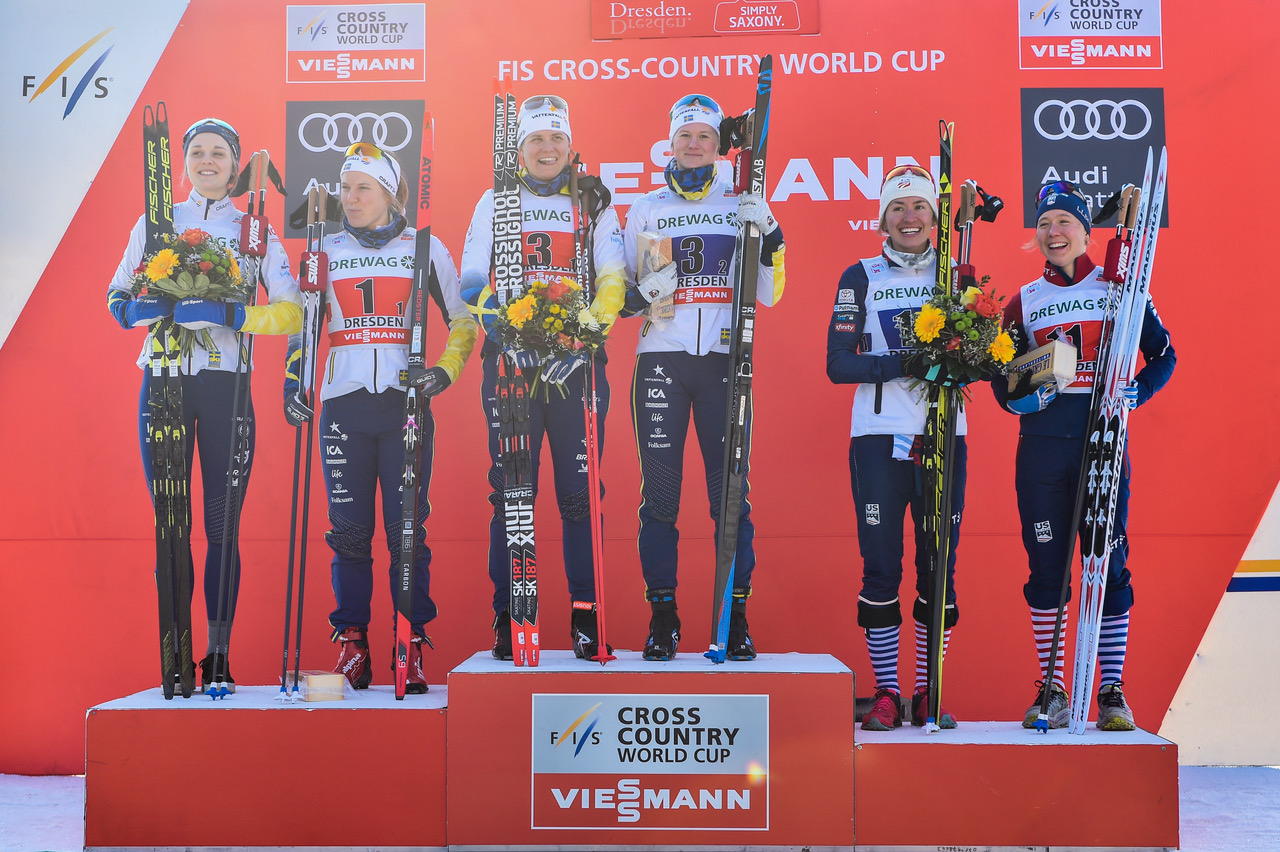
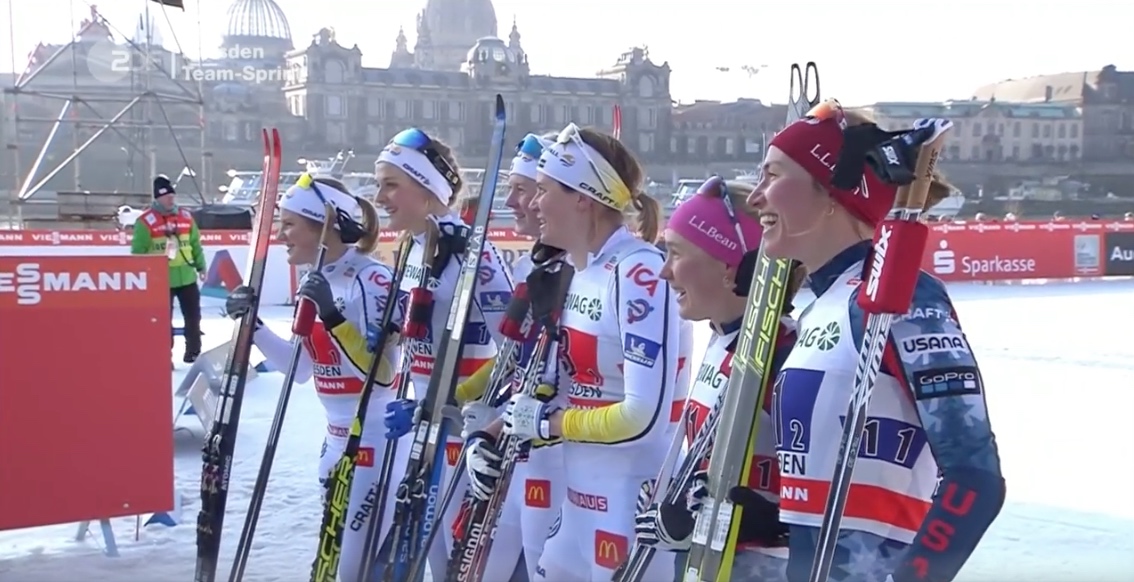
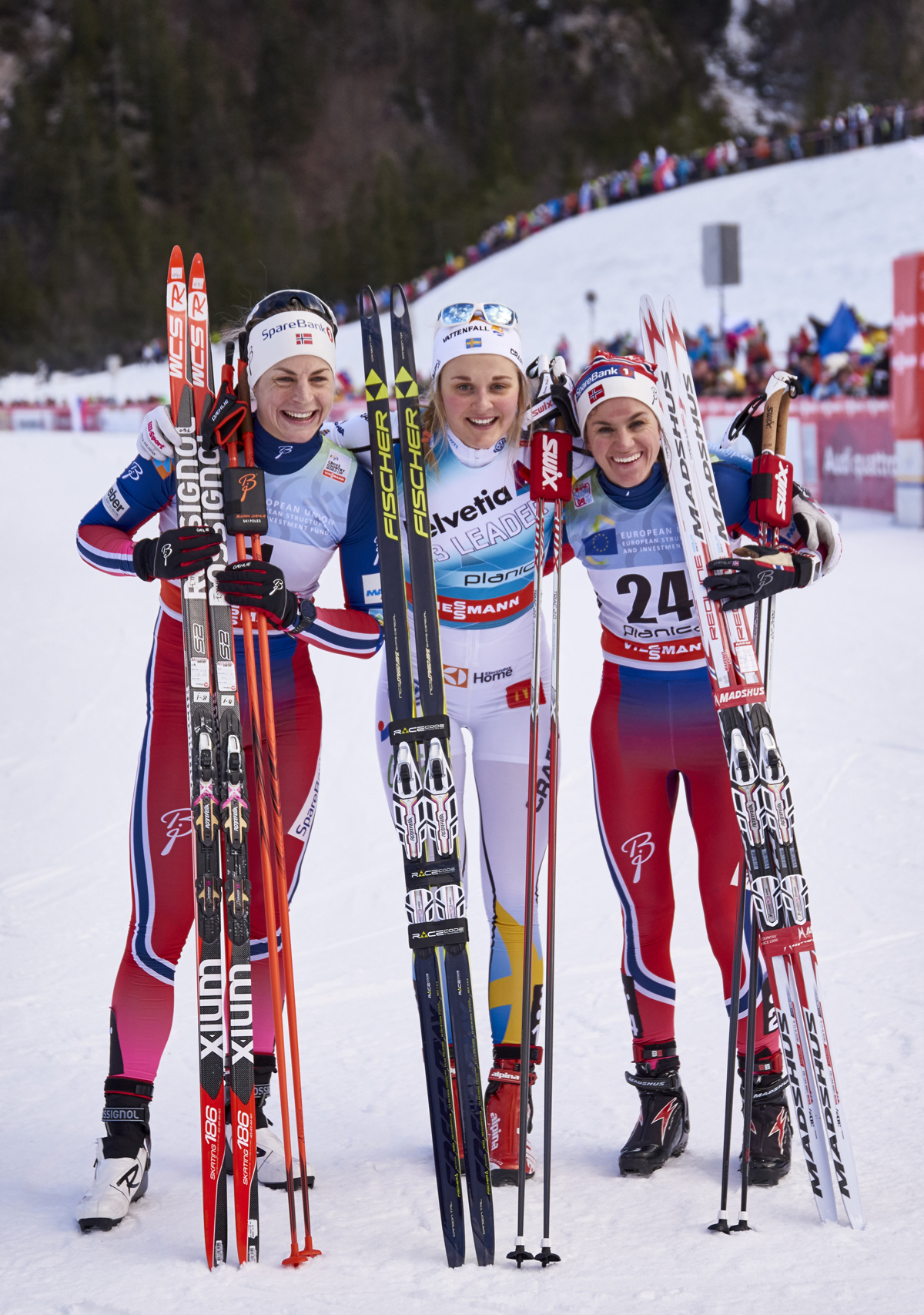
The women’s 6 x 1.2 k freestyle team sprint podium at Sunday’s World Cup in Dresden, Germany, with Sweden II’s Ida Ingemarsdotter and Maja Dahlqvist in first (c), Sweden I’s Stina Nilsson and Hanna Falk in second (l), and USA I’s Sophie Caldwell and Ida Sargent in third (r). (Photo: Fischer/NordicFocus)
Both Swedes appeared to have an edge on Caldwell, but the American made a gritty final few pushes and all three lunged for the line. Dahlqvist was just ahead and took it by 0.16 seconds over Nilsson, and Caldwell placed third for the second day in a row, just 0.07 seconds out of second place and 0.23 seconds out of first. Sweden’s No. 2 team had won it with a cumulative time of 13:33.40, about four seconds faster than the fastest semifinal.
“I was actually left wishing the finish was a little longer, which I don’t know if I have ever said about a race before,” Caldwell, who leans toward sprint disciplines, said after the race. “Ida skied awesome and I was proud with how I skied, so it’s really fun when you feel like both legs kind of do their best and you get a good result to celebrate that with.”
Finishing in fourth (+2.11) was Germany I, Slovenia placed fifth (+4.46), Germany II placed sixth (+4.62), Switzerland (+5.09) USA II eighth (+7.95), Italy I ninth (+10.89) and Australia 10th (+27.53).
To start the day, Sweden I, with Falk and Nilsson had won the first semifinal in 13:37.97, by 0.17 seconds over Sweden II’s Ingemarsdotter and Dahlqvist. The top-six teams from that heat qualified for the final, with Switzerland in third, Italy in fourth, Slovenia in fifth, and Australia in sixth.
The American teams took the top two in the second semifinal, with Sargent and Caldwell winning 13:46.51, and Patterson and Randall following in second, 0.11 seconds back. Germany I and Germany II qualified from that heat as well with fast-enough times.
Sunday marked the first and last team sprint of the season so far before the Winter Olympics in PyeongChang, South Korea, where a freestyle team sprint will be contested on Feb. 21.
The World Cup has two more weekends of racing before the Olympics, with all-classic races next weekend in Planica, Slovenia (classic sprint and 10/15 k classic individual starts), followed by freestyle races in Seefeld, Austria, on Jan. 27-28 (skate sprints and 10/15 k freestyle mass starts).
— Ian Tovell and Alex Kochon contributed reporting
The women’s 6 x 1.2 k freestyle team sprint podium at Sunday’s World Cup in Dresden, Germany, with (from left to right) Sweden I’s Hanna Falk and Stina Nilsson in second, Sweden II’s Ida Ingemarsdotter and Maja Dahlqvist in first (c), and USA I’s Ida Sargent and Sophie Caldwell in third (r). (Screenshot: ZDF broadcast)
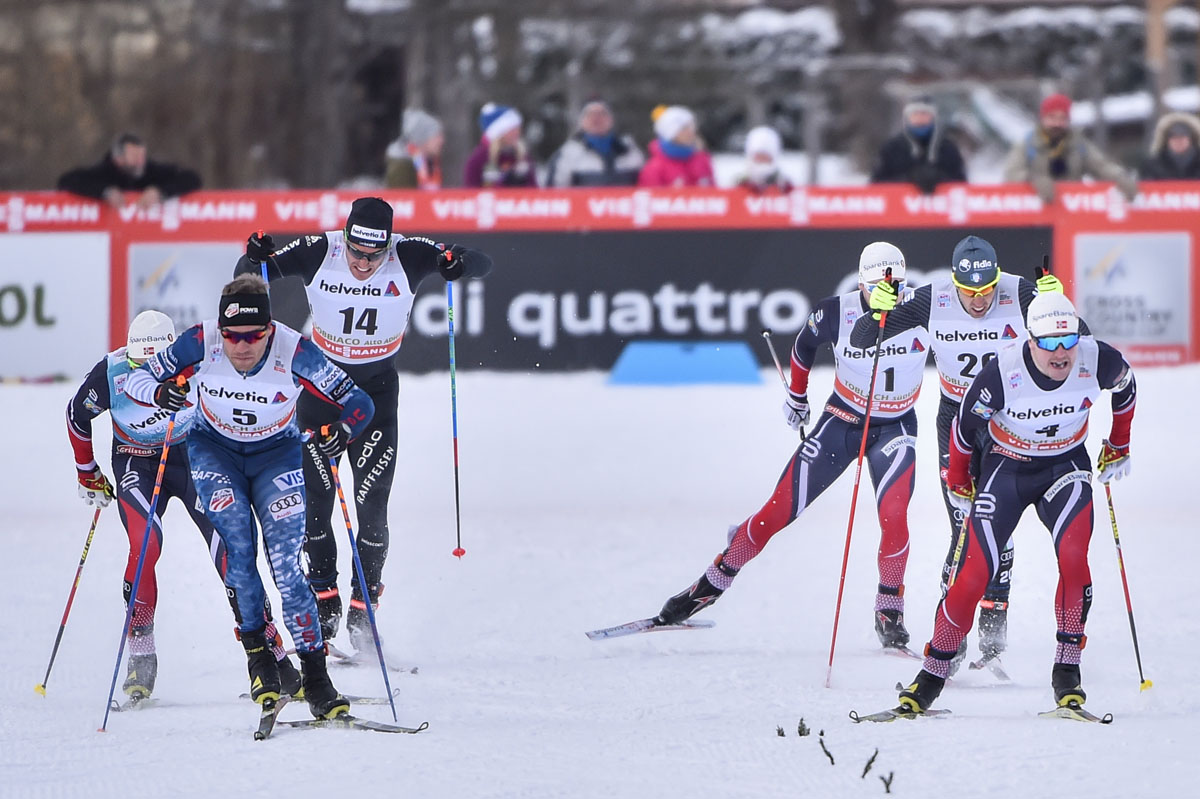
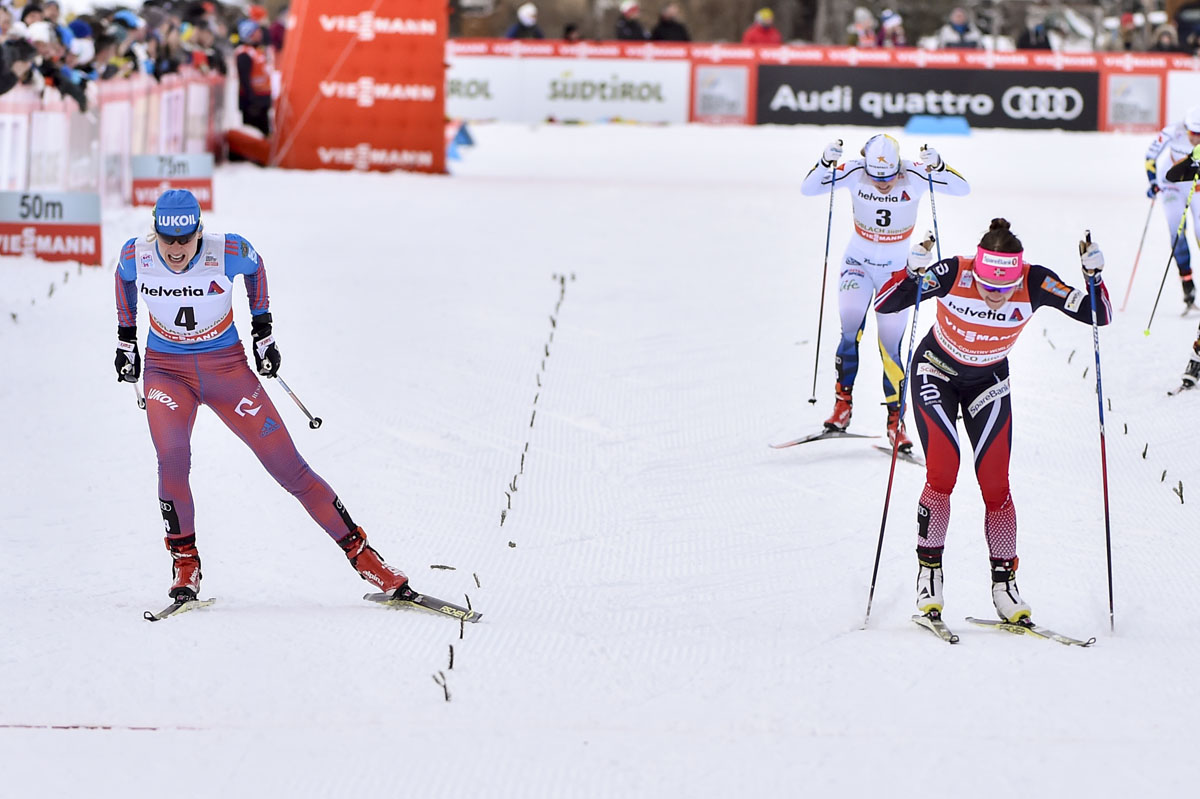
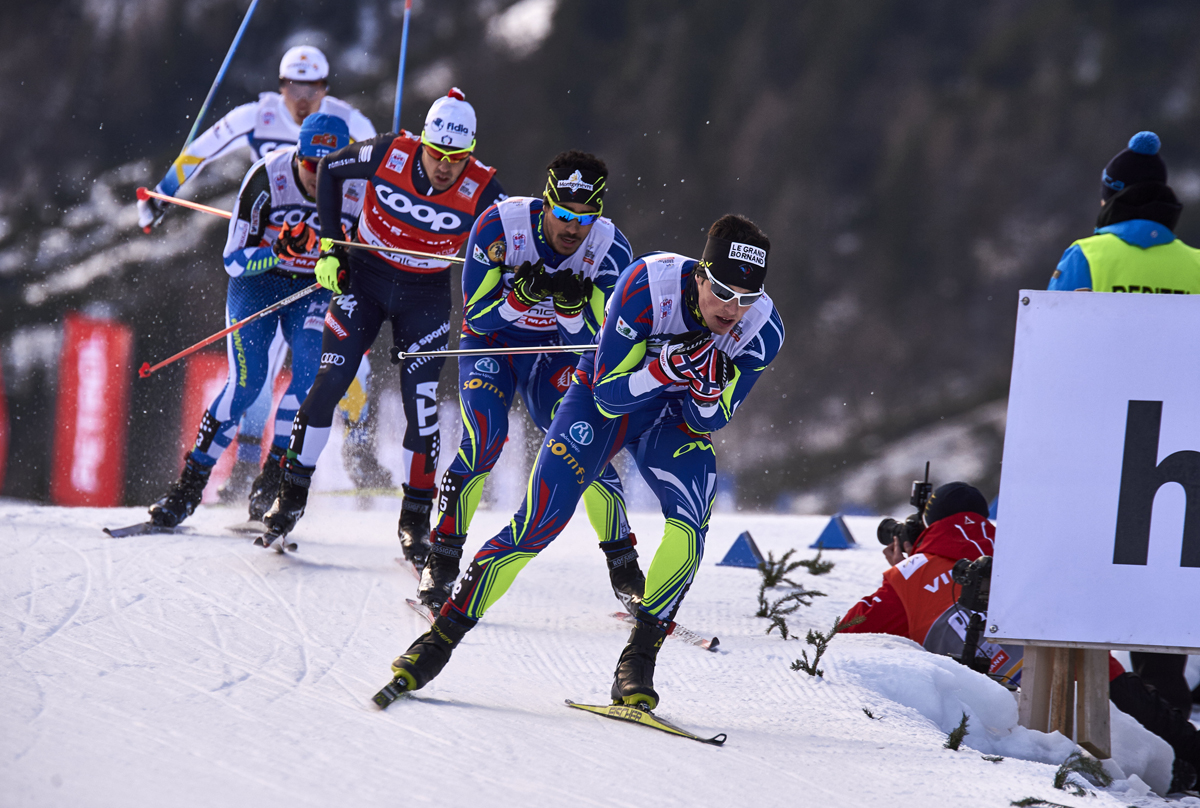
American Simi Hamilton (5) racing for the win with Norway’s Sindre Bjørnestad Skar (r) as they lead the men’s final down the finishing stretch of Saturday’s 1.3 k freestyle sprint at the World Cup in Toblach, Italy. Skar won the photo finish with Hamilton by 0.03 seconds. (Photo: Fischer/NordicFocus)
The feeling was beyond déjà vu. Simi Hamilton remembered the exact moment so clearly: almost exactly 13 months ago, he had led the World Cup men’s freestyle-sprint final in Toblach, Italy, into the last climb and ensuing descent into the stadium. There he was, leading the six-man final and racing for first place. Italy’s Federico Pellegrino took it from him after taking advantage of the downhill draft, slingshotting from second to first, while Hamilton secured second. It was the second podium of Hamilton’s career and first in a non-stage World Cup.
Great moment, but on Saturday, the U.S. Ski Team member was out to make it even better on the same 1.3-kilometer sprint course in Toblach.
In an instant, Hamilton recalled his positioning on that last hill and how those final seconds played out last season as he approached the last hill of Saturday’s final. Hamilton charged from behind to put himself in second by the top, right behind Pellegrino.
“I remember thinking coming down that long downhill, ‘This is awesome because this is exactly what Federico did to me last year,’ ” Hamilton said on the phone after Saturday’s race. “He got a really good draft off of me coming down that downhill and he was able to slingshot through the corner and into the finish stretch so I was really psyched. I was like, ‘This could be a really good thing right now.’ ”
His observations were spot on as the U.S. sprinter — who has worked to improve his distance racing as well — slingshot around Pellegrino to lead into the final curve before the finishing straight. There, he skied over a pocket of softer snow, which caught him off guard and put him back on his heels, he said.
“It kind of it messed with my head a little bit,” Hamilton said. “So I think it took me a second to recover from that, and I was just focusing so hard on not doing anything really stupid in the last 100 meters with the snow conditions kind of being a little funky there.”
At the same time, he knew he had as good a shot at ever at winning.
“I knew that I was fighting for first right there and fairly confident I was going to be on the podium at that point, but I really wanted that first spot, especially with having gotten second last year,” the 29-year-old Colorado native said.
Behind him, Norway’s Sindre Bjørnestad Skar had also taken advantage of the draft, as well as Hamilton’s slight bobble under the archway banner 100 meters before the finish, and came up on Hamilton’s left side to challenge him for first place.
The two went stride-for-stride to the line, which ended in a photo finish for first. Skar celebrated across the line, holding one arm high, while Hamilton teetered out of exhaustion and face planted alongside him. It took several moments to determine the actual winner. Finally, the results revealed that the 24-year-old Skar had taken it by three-hundredths of a second (winning the final in 2:47.91 minutes) for his first individual World Cup victory. For Hamilton, second place marked his first podium this season and the fourth of his career.
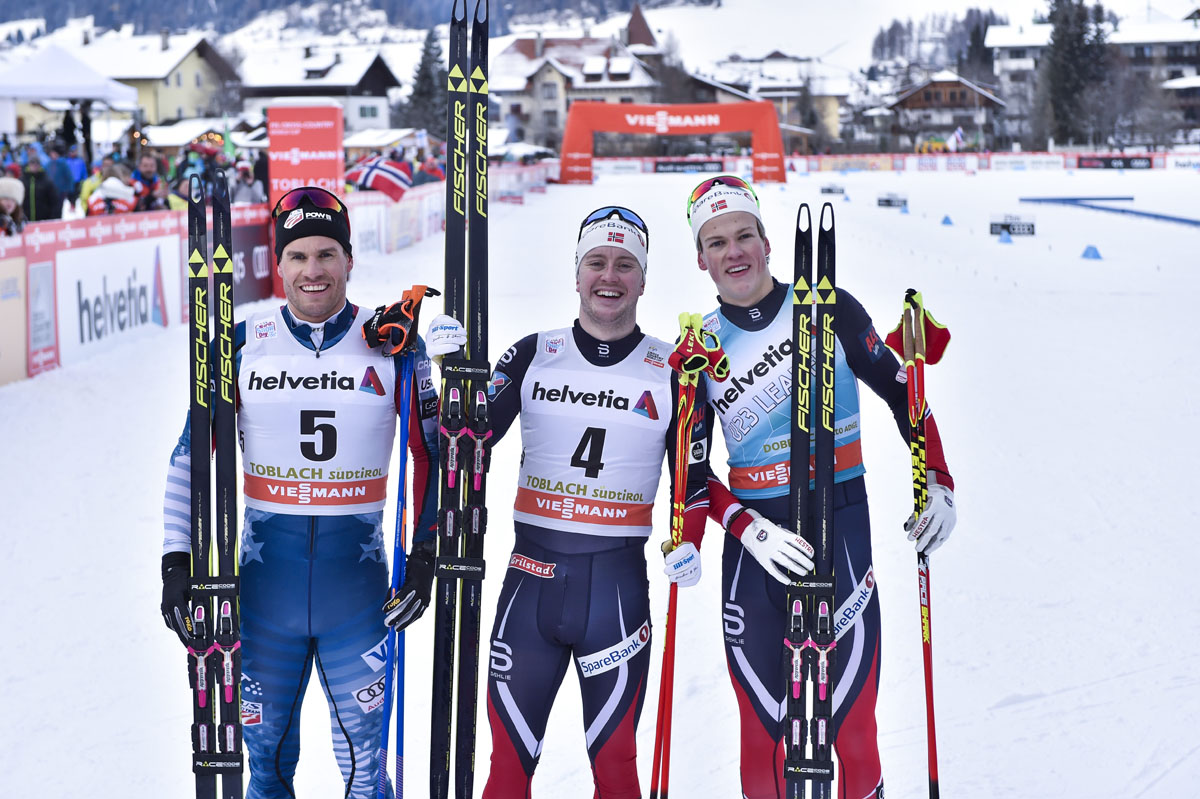
The men’s freestyle sprint podium at Saturday’s World Cup in Toblach, Italy, with American Simi Hamilton (l) in second, Norway’s Sindre Bjørnestad Skar (c) in first and Norway’s Johannes Høsflot Klæbo (r) in third. (Photo: Fischer/NordicFocus)
“He had a really really solid last 100 meters,” Hamilton said of Skar. “We both threw for the line and he was just coming up a little faster than I was. … It was a little frustrating, for sure, to be second again for the second year in a row, but at the same time he skied really well, and all of those other guys in the final. It is great to share the podium with a bunch of other really talented, strong skiers, who are the best sprinters in the world.”
Norway had two on the podium with 20-year-old Johannes Høsflot Klæbo in third (+0.66).
Pellegrino missed out on the podium by 0.61 seconds in fourth (+1.27), Switzerland’s Jovian Hediger placed fifth (+1.84) and another Norwegian Håvard Solås Taugbøl was sixth (+3.77).
For Skar, who turns 25 on Jan. 22, the victory (which was his third podium this season and his career) was another check mark on his list of season goals.
“Getting my first World Cup victory and then qualifying for the World Championships was one of my goals this year and it seems like that’s going well,” he told NRK after.
After qualifying in fourth (0.78 seconds behind Taugbøl, who won the qualifier in 2:47.38), Skar went on to win the first men’s quarterfinal in a photo finish with Hediger, then placed second in the first semifinal. Taugbøl won that semifinal by just six-hundredths of a second over Skar, while Hamilton was just another 0.05 seconds back in third and Hediger 0.03 seconds behind Hamilton in fourth. All four advanced to the final, where Skar positioned himself in the middle of the pack for much of the two-lap race, skiing in third up the second-to-last climb.
“It was almost like a lottery,” Skar said of the frequent change of leaders in the final during a post-race, televised interview with the International Ski Federation (FIS). “I just tried to stay calm and to have a good sprint.”
He had a feeling that he had the edge on Hamilton, but “it was very, very tight,” Skar said.
For Hamilton, who qualified fifth (+0.83), the podium confirmed what he had been searching for. So far this season, he has only competed in six World Cup races. Three of them were sprints, and his best result before Saturday had been 18th in the skate sprint at the Tour de Ski’s first stage in Val Müstair, Switzerland. After leaving the Tour after Stage 2, Hamilton competed in two OPA Cup races last weekend in Planica, Slovenia. There, he won the skate sprint and finished fifth in the 10 k skate.
“That definitely increased my confidence and I felt much better about where I was fitness-wise and speed-wise with those races last weekend,” Hamilton said. “And I knew that I have skied this course well before and I really enjoy racing here. It is a great place and I love it, and I was just psyched to see what I could do today, and fortunately it ended pretty well.”
U.S. Ski Team Head Coach Chris Grover said it was “incredible” that Hamilton has placed second in Toblach’s sprint two years in a row.
“It’s been fun watching him train on this course this week,” Grover said on the phone Saturday. “He did a big intensity session on the sprint course on Thursday, and when you watch him do it, he just looks like somebody who could be on the podium in this race, and of course he looked like that last week when he won the OPA Cup, too. He was able to go out there and make moves at will and see an opening and take it.
“He’s shown a mastery of this course, and his fitness is quite high,” Grover added. “It’s also worth mentioning that we had incredible skis today. Athletes kept coming back saying, ‘My skis are incredibly fast!’ That’s a key part of the equation.”
As for Hamilton’s form leading up to World Championships late next month?
“I’m hoping that I am not peaking right now because obviously we have quite a bit more time to go before Lahti, but I am definitely feeling like things are still going in the right direction,” Hamilton said.
All 7 Americans Advance
Men and women combined, five Americans and two Canadians started Saturday’s sprint — held less than a week after the nine-day Tour de Ski (TDS) ended last Sunday. Three of those Americans were women; the two Canadians were both men. Just one of them completed the Tour. Most of the competitors in Toblach this weekend did not compete in this year’s TDS.
Of those seven North Americans, all of them finished in the top 30 of their respective qualifiers on Saturday to advance to the heats.
Hamilton led the group in fifth, and just another 0.27 seconds back, his U.S. teammate Andy Newell qualified in sixth, 1.1 seconds behind Taugbøl.
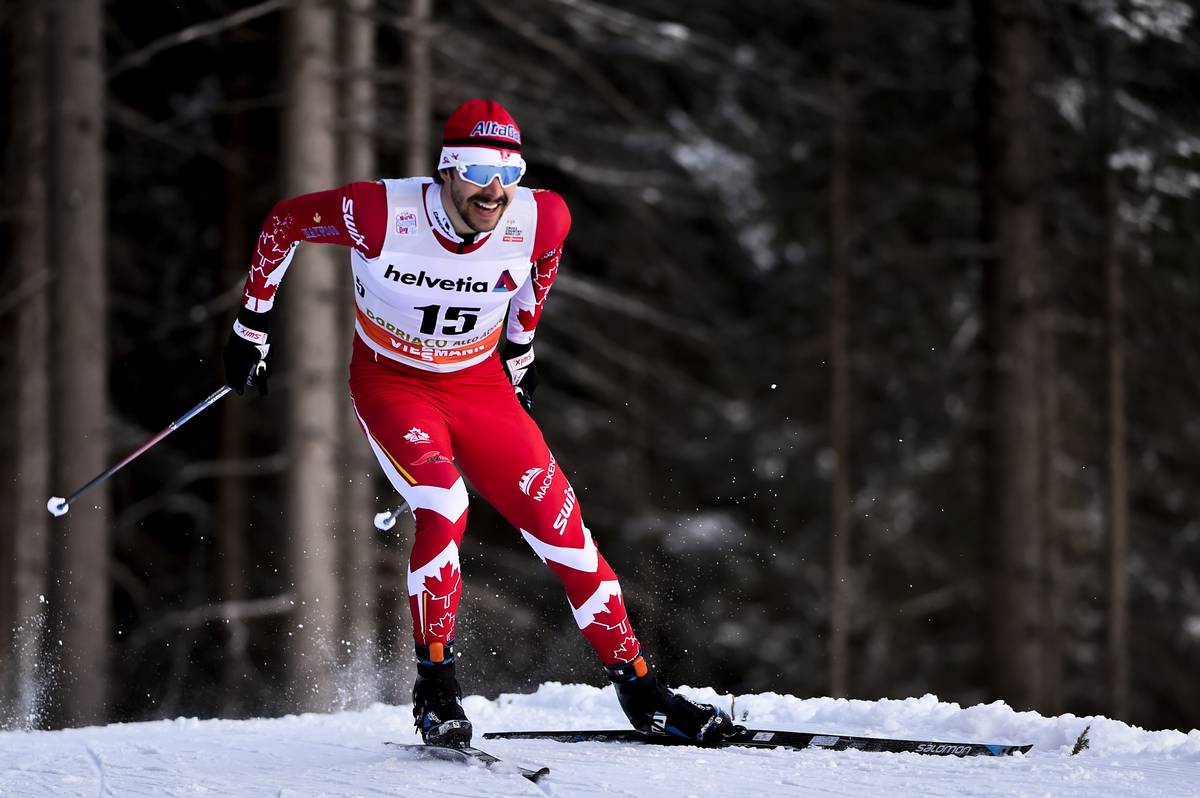
Canada’s Alex Harvey racing to eighth in the men’s 1.3 k freestyle sprint qualifier on Saturday at the Toblach World Cup in Italy. (Photo: Salomon/Nordic Focus)
Canada’s Alex Harvey qualified eighth (+1.73) and Len Valjas 23rd (+4.16) out of 70 starters. (Of note: Russia’s TDS winner Sergey Ustiugov finished last in the qualifier in 70th, nearly 42 seconds off Taugbøl’s time.)
In the first men’s quarterfinal, Newell took third at the finish, 0.38 seconds behind Skar in first. Their quarterfinal time wasn’t fast enough to put Newell through as a lucky loser, and he ended up 13th on the day for his best result this season. In his fourth World Cup sprint this season, Saturday marked Newell’s first time qualifying in the top 30.
“Skate skiing and I haven’t been on great terms the last year or so haha,” Newell wrote in an email. “But in all seriousness I knew this year was meant to be a rebuilding process for me so I’m happy to be back on track.
“I finished last season not ever wanting to race a sprint race again, so I knew mentally and physically it was going to take some work to build back up to being a medal contender again,” he added. “I have to keep reminding myself that it’s still just January and to be patient and continue to try to make small gains and build throughout the season. Points and standings aren’t important to me at this time, just staying healthy and strong and building toward the World Championships and especially the Olympic year.”
Harvey raced to fourth in the second quarterfinal, 0.42 seconds behind Hamilton, who won that heat. The Canadian ended up in a photo finish with Norway’s Sondre Turvoll Fossli for third in that quarterfinal and missed it by 0.08 seconds. Neither Fossli nor Harvey advanced to the semifinals, and Harvey placed 17th overall (moving him up to fourth in the overall World Cup standings).
“I think that was my best qualifier in two years so I was a bit surprised,” said Harvey, who was coming off a career-best seventh in the TDS and had originally planned to skip the individual sprint to rest up for Sunday’s freestyle team sprint, according to a Cross Country Canada (CCC) press release. “It was such an easy trip to come down to Toblach. I just felt if I’m doing race prep I might as well put a bib on and see what happens. I felt a lot of speed today and was quite happy.”
Harvey noted the precise tactics of the Toblach sprint with a “good course here that has you always turning left,” he told CCC. “You need to keep on the inside lane because it is a little quicker, especially with the fresh snow, so if you took the lead it was hard for someone to go by you. I was just not quick enough from the start.”
Valjas also finished fourth in his quarterfinal, 1.58 seconds behind Pellegrino who won that heat, to place 20th overall. While Valjas remained in contact with the leaders throughout, he found himself at the back of the group early and moved up slightly to secure fourth at the finish.
Three U.S. Women in Semis
Meanwhile in the women’s race, the three U.S. entrants — Sophie Caldwell, Ida Sargent and Kikkan Randall — qualified for the heats in 15th, 16th and 27th, respectively.
Caldwell’s 15th-ranked qualifying time was 4.82 seconds behind the qualifying winner, Norway’s Maiken Caspersen Falla, who completed the 1.3 k course in 3:10.89.
American Sophie Caldwell racing to 15th in the women’s 1.3 k freestyle sprint qualifier at the World Cup in Toblach, Italy.(Photo: Fischer/NordicFocus)
Sargent was another 0.27 seconds back in 16th (+5:09), and Randall was 7.52 seconds off Falla’s qualifying mark.
All three U.S. women reached the semifinals, with Caldwell and Sargent automatically advancing after taking second in their quarterfinals. In the first quarterfinal, Caldwell finished 0.18 seconds behind Sweden’s Hanna Falk, and Sargent was 0.23 seconds behind the winner of the fifth quarterfinal, Slovenia’s Vesna Fabjan. Randall reached the semis as a lucky loser, after placing fourth in the fourth quarterfinal, 1.42 seconds behind Germany’s Sandra Ringwald in first.
For Randall, it marked her first semifinal appearance in two years (she took last season off to have a baby).
“I am feeling a little closer to my normal sprint gears every race,” Randall wrote in an email on Saturday. “Today’s qualifier was a good start. In the quarterfinals I was in a really fast heat and just tried to stay relaxed in the pack. We had really fast skis today and I was able to be strong in the finish so it was really exciting to advance to the semis.”
In the first semifinal, Randall and Caldwell squared off against a stacked heat with Norway’s Falla, Sweden’s Falk and her teammate Ida Ingemarsdotter, and Russia’s Natalia Matveeva. During the first lap, Caldwell positioned herself in third and trailed Matveeva and Falla on the descent before the start of Lap 2. There, on the downhill, Randall rode up into Caldwell and both tumbled to the ground and out of contention before the second lap.
“Our skis were incredibly fast today and that was actually a little bit of the problem,” Randall explained. “When our pack came down the hill that first time in the semi, everyone came together into the corner. The other girls went right so I could really only take the inside. I came up on Sophie faster than expected and tried to sneak by on the inside. But there wasn’t much space and I think I may have knocked her boot with my ski.
“When she lost balance there was nowhere to go and my skis went underneath her as we fell,” she continued. “I feel really bad because I think I caused the crash. It was a real bummer because I think both of us were feeling good and ready to mix it up. But luckily we are both OK and there was no broken bodies or equipment.”
U.S. teammates Kikkan Randall (l) and Sophie Caldwell (r) after colliding in the first women’s semifinal on Saturday at the World Cup skate sprint in Toblach, Italy. (Photo: ARD broadcast screenshot)
In what appeared to be a slow-motion tangle, both Randall and Caldwell appeared to smile at each other as they realized their misfortune. Caldwell particularly had trouble freeing her ski. The two finished fifth and sixth in that heat (Randall 22 seconds back in fifth, and Caldwell a minute back from Falla as the winner of that semifinal in sixth).
“[Kikkan] asked if I was okay and apologized,” Caldwell recalled. “It’s a bummer, but it’s unfortunately part of ski racing and there are no hard feelings.”
“We’ve had problems with that same thing before,” Grover noted. “Everyone from behind runs up on everyone who’s in front, and then, depending on if you’re pinched on the inside, or if you can make some space on the outside, you can end up making it through or you can end up in some trouble. It’s a pinch point, a tough point on the course, for sure.”
He added that Randall “took full accountability” for the crash, and there were no hard feelings.
“She felt quite bad about it, and Sophie bears no grudge about it because she knows that’s the kind of thing that happens in sprint racing all the time,” he said. “Those guys are good and they are going to be sprint teammates tomorrow, so we’ll start looking forward to the next day.”
Grover said his staff had to make the tough call of picking two women out of three for Sunday’s team sprint.
Sargent raced to sixth in the second semifinal on Saturday, just 0.86 seconds out of first. She had moved up to third on the final climb, trailing Norway’s Astrid Uhrenholdt Jacobsen and Germany’s Ringwald, respectively, and held her position on the final curve into the finishing straight. There, both Jacobsen and Sargent were overtaken by Slovenia’s Fabjan (who came on strong for second place) and Switzerland’s Laurien van der Graaff (third), following Ringwald in first.
Kikkan Randall (U.S. Ski Team) racing to a season-best 10th on Saturday in the World Cup freestyle sprint in Toblach, Italy. (Photo: Fischer/NordicFocus)
At the end of the day, U.S. women occupied 10th through 12th place, with Randall in 10th, Caldwell in 11th and Sargent in 12th.
“I tried to stay relaxed in the heats, but I felt really good so I just tried to ski near the front of the pack,” Sargent wrote in an email. “The course is really frustrating though with a long downhill with a draft that brings everyone back together but I just tried to stay out of trouble. I thought that I was in a great position in the semifinal going into the finish but then I hit something and I’m not really sure what it was, but it stopped my ski dead and I almost fell. After that bobble it was hard to get going again and so I was really bummed to lose all the places and not advance.”
For Sargent, 12th was her best result in over a year.
“I felt really strong today so I’m happy with my fitness at this point in the season,” she wrote. “We had a small staff this weekend but they did an amazing job and I’m very thankful for such awesome skis!”
In terms of how the U.S. coaches made the call for between those three for Sunday’s team sprint, Grover said it wasn’t easy.
“… As luck would have it, we had three athletes finish 10, 11, 12 on the day today, which did not make it any easier,” he said. “You actually had three athletes who are fairly evenly matched in a lot of respects right now, in terms of how they’re skiing. In the end, we decided that we really wanted to have Kikkan’s experience, in team sprint in particular and in closing out a team sprint, and in the second leg, we wanted Sophie to be able to rely on her aerobic conditioning at the moment … It was a very hard decision for us … I really wish we had a fourth woman here, so we could start two teams.”
Matveeva Gets First Win in Nearly a Decade
While the three U.S. women missed Saturday’s final, Russia’s Matveeva — who hadn’t won a World Cup race since 2007 — went on to outlast Falla for her 12th-career individual podium. Eight years ago, Matveeva tested positive for EPO was was suspended from competing from December 2009 to March 2011. After that, she reportedly had two ACL tears. Now 30, Matveeva captured her second-career sprint win on Saturday by eight-hundredths of a second over Falla.
Russia’s Natalia Matveeva (l) winning Saturday’s freestyle sprint final, by 0.08 seconds over Norway’s Maiken Caspersen Falla (r), for her first World Cup win since October (!) 2007. Sweden’s Hanna Falk (3) placed third. (Photo: Fischer/NordicFocus)
“I’ve waited a lot of time to be [here],” Matveeva told FIS in a post-race interview. “I’m very happy and the Russian team is very happy. Thank you very much my service team. Good job today.”
Matveeva charged to an early lead in the final, while Falla challenged her on the first of two climbs on the second lap. Matveeva followed her closely leading into the last climb, where Falla beat her to the top with a quicker-tempo V1. As the two descended into the stadium with a slight gap to Falk in third place, Matveeva drafted Falla then rode up alongside her, taking the outside line around the turn. The two sprinted toward the line, with Matveeva getting one extra push in for first place in 3:04.13.
“I don’t feel particularly well so second place is all right, but of course it’s frustrating to be beaten in the final stretch,” Falla told NRK. “I knew she would be fast in the final stretch. I’m a little lighter than everyone else, and that’s not an advantage.”
At the same time, Falla wasn’t bitter.
“It’s good that more people are fighting for the top spots before the World Championships; it’s more exciting then,” she said. “We have to see the positive in it all.”
Falk took the final spot on the podium in third (+2.41), and Ringwald was one second shy of it in fourth (+3.46). Ingemarsdotter finished fifth (+5.88) and Fabjan was sixth (+19.39).
In Sunday’s 6 x 1.3 k freestyle team sprint, Caldwell and Randall are teaming up in the first women’s semifinal, while their men’s team of Newell and Hamilton will be in the second men’s semifinal. Also in that second men’s semifinal are Canada’s Valjas and Harvey.
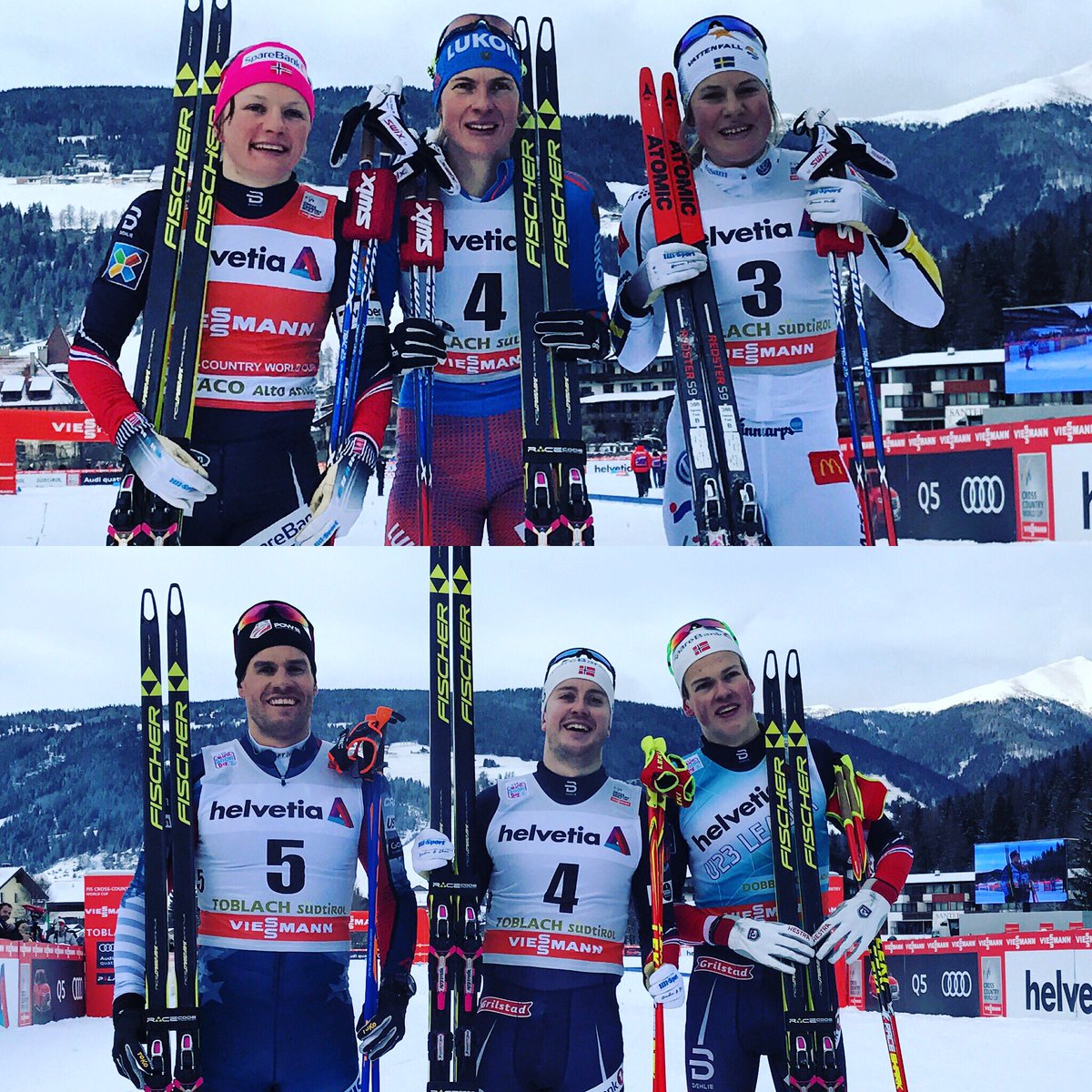
The women’s (top) and men’s (bottom) podiums at the World Cup 1.3 k freestyle sprints on Saturday in Toblach, Italy. Russia’s Natalia Matveeva (top center) won the women’s final, ahead of Norway’s Maiken Caspersen Falla (top left) and Hanna Falk (top right). American Simi Hamilton (bottom left) took second in the men’s final, behind Norway’s Sindre Bjørnestad Skar (bottom center) and ahead of Norway’s Johannes Høsflot Klæbo (bottom right) in third. (Photo: FIS Cross Country)
FIS Cross-Country World Cup (Toblach, Italy): Freestyle sprints
Simi Hamilton is back on the World Cup podium and was three-hundredths of a second away from the win on Saturday in the men’s 1.3-kilometer freestyle sprint in Toblach, Italy. The American qualified fifth and went on to win his quarterfinal then advance as a lucky loser in third out of him semifinal. In the men’s final, Hamilton waited until the last hill to strike and used his conserved energy in the two-lap race to outlast the likes of Italy’s Federico Pellegrino and Norway’s Johannes Høsflot Klæbo at the finish. Hamilton put it all on the line in a photo finish with Norway’s Sindre Bjørnestad Skar, with Skar taking his first individual World Cup victory in 2:47.91. Hamilton placed second for his first podium of the season and fourth of his career. It was also Hamilton’s first time in the final this season.
Klæbo was the second Norwegian on the podium in third, 0.66 seconds behind Skar, Pellegrino placed fourth (+1.27), Hediger was fifth (+1.84), and Norway’s Håvard Solås Taugbøl (who won the qualifier to start the day in 2:47.38) took sixth (+3.77).
“I just had a good feeling that I was a little bit before [Hamilton],” Skar said in a post-race interview with FIS of his immediate finish-line celebration before confirming that he won. “It was very, very tight.”
Skar, who turns 25 on Jan. 22, qualified fourth and won his quarterfinal and finished second in his semifinal, 0.05 seconds ahead of Hamilton.
Also for the U.S., Andy Newell qualified for the heats in sixth and took third in his quarterfinal for 13th overall. Canada’s Alex Harvey qualified eighth and finished fourth in his quarterfinal for 17th overall, and the second Canadian racing this weekend, Len Valjas, qualified 23rd and took fourth in his quarterfinal for 20th.
In the women’s race, Russia’s 30-year-old Natalia Matveeva notched the 12th individual podium of her career (all in sprints) and first victory since 2007. She challenged Norway’s Maiken Caspersen Falla on the last climb and overtook her in the finishing stretch of Saturday’s 1.3 k skate sprint final for the win in 3:04.13. Matveeva qualified fourth to start the day, then placed second in both her quarterfinal and semifinal en route to the victory. Falla won the qualifier in 3:10.89, and continued to dominate her quarterfinal and semifinal before ending up second on the day, just 0.08 seconds out of first.
“I’ve waited a lot of time to be [here],” Matveeva told FIS afterward. “I’m very happy and the Russian team is very happy. Thank you very much my service team. Good job today.”
Sweden’s Hanna Falk reached the podium in third (+2:41), Germany’s Sandra Ringwald placed fourth (+3.46), Sweden’s Ida Ingemarsdotter was fifth (+5.88), and Slovenia’s Vesna Fabjan sixth (+19.39).
Americans Kikkan Randall and Sophie Caldwell tangled in the first semifinal and ended up 10th and 11th, respectively, at the end of the day. Also for the U.S. Ski Team, Ida Sargent qualified for the heats in 16th (behind Caldwell in 15th while Randall qualified 27th), and reached the semifinals as well, placing sixth in the second semifinal after skiing in third into the finishing stretch. Sargent ended up 12th for her best result in over a year.
Finland’s Kaisa Mäkäräinen posts a 22-second win for her first victory of the season and first time shooting without a miss in an individual race since the Ruhpolding sprint almost exactly a year ago. Dunklee leads North Americans in 33rd and qualifies for the pursuit, along with Canada’s Rosanna Crawford (55th), Megan Tandy (56th) and Julia Ransom (60th).
Ski Classics Kaiser Maximilian Lauf (Seefeld, Austria): 60 k classic
[UPDATED] Imagine knee-deep snow drifts over the course of 60 k. That’s what faced racers in Saturday’s Kaiser Maximilian Lauf, the fourth stop in the 2016/2017 Ski Classics series, in Seefeld, Austria.
Team Santander’s Kateřina Smutná and Andreas Nygaard fared best in the conditions, racing to the women’s and men’s victories in 3:43:48.7 and 3:21:44.5, respectively.
Smutna won the women’s race by 10.8 seconds over Astrid Øyre Slind (Team United Bakeries), and Britta Johansson Norgren (Lager 157 Ski Team) finished more than three minutes later in third place (+3:35).
“It was the right decision to go with kick today,” Smutná said after, according to a Ski Classics press release. “It was hard for us to be in the lead and open the tracks for men. We waited for them to catch up and do the work on our behalf. I noticed it was tough for Britta because she was double poling. So, Astrid and I decided to work together in the final section of the course, and it worked perfectly.”
The men’s race was much closer with Nygaard holding off his Team Santander teammate Tord Asle Gjerdalen by 0.6 seconds. Stian Hoelgaard (Team Leaseplan) placed third, another 0.6 seconds back.
“It was a tough race because there was so much snow on the course,” Nygaard said, according to the press release. “At some point, we were knee-deep in soft snow. The pace was slow, but you get tired after a while because you have to work hard when it’s snowing like this. I just kept telling myself that I need to keep up with the guys and win the race in the end. This is something that I didn’t expect to happen when the season started. Let’s see how long I can keep the yellow [leaders] bib.”
The overall Ski Classics series leader, Nygaard is also the sprint leader as well. On the women’s side, Johansson Norgren possesses both the overall and sprint bibs as well.
FasterSkier Editor-at-Large Chelsea Little placed 17th.
Norway’s Maiken Caspersen Falla (pink headband) leads out of the start of the women’s 1.2 k freestyle sprint final on Sunday in Beitostølen, Norway. (From left to right) Norway’s Mari Eide, Slovenia’s Vesna Fabjan, Falla, Norway’s Heidi Weng, Slovenia’s Anamarija Lampic, and Norway’s Silje Øyre Slind all reached the final. (Photo: Aleks Tangen)
BEITOSTØLEN, Norway — For the reigning Sprint World Cup champion who never lost a classic sprint last season (and placed first or second in all but one World Cup skate sprint), Sunday’s 1.2-kilometer freestyle sprint was about starting where she left off.
Norway’s Maiken Caspersen Falla did just that, qualifying first then cruising through the heats to win the women’s freestyle sprint on Sunday in Beitostølen. Part of a three-race series, it was held on the final day of Norway’s International Ski Federation (FIS) season-opening weekend — one weekend before the World Cup starts in Finland.
Falla, 26, took control of the day early, winning the prologue in 2:47.79 minutes. Afterward, she told NRK that she was satisfied with the result and that it was fun to race the sprint prologue. She carried her momentum through her quarterfinal and semifinal, advancing in the top two in each round, before beating Slovenia’s Vesna Fabjan in the final with a time of 2:42.3. Fabjan finished 0.2 seconds later in second, and Norway’s Mari Eide outlasted Heidi Weng for the final spot on the podium in third (+1.6). Weng, one of Norway’s top women who placed second in both distance races on Friday and Saturday, placed fourth (+2.4), while Slovenia’s Anamarija Lampic finished fifth (+3.2) and Norway’s Silje Øyre Slind was sixth (+5.2) in the final.
In an interview with FasterSkier on Saturday, Weng pointed that she didn’t qualify for the heats at last year’s sprint opener in Beitostølen. On Sunday, she qualified soundly in seventh, 4.2 seconds behind Falla.
Falla skated every heat with good control and technique, and kept her challengers from posing any real threats. Out of the start, the six finalists darted off the line at a high pace, and Falla immediately took control. Fabjan tried to challenge her in the final stretch, but Falla proved to be stronger. Her winning time in the final was the fastest of the day.
The prologue began at 8:30 a.m. and temperatures around -4 Celsius (25 degrees Fahrenheit). The highest-ranked athletes started first and the final standings already began to develop as the prologue came to an end. Falla, Eide and Fabjan clinched the first three qualifying places, just as they did in the final.
“I’m satisfied with the result and I’m happy to be in a sprint race again,” Falla told NRK after the race.
Of the 30 qualifiers, Norway’s 22-year-old Renate Bergset Tjetland was right on the edge in 30th (+18.26). Annika Taylor, who is originally from California but competes for Great Britain (while training with Norway’s Lillehammer Skiklub/Team Coop Talent), qualified in 27th, (+17.14). She started in the second heat and placed fifth, 12.1 seconds behind Weng, who won that quarterfinal.
“I’m happy about qualifying for the quarterfinal,” Taylor told FasterSkier afterward. “I feel like I got off to a good start and I tried to find the right lines, but I wasn’t able to follow in the final climb.”
The five quarterfinals starting at five minute intervals were won by Falla, Weng, Slovenia’s Katja Visnar, Eide and Fabjan, respectively. Slovenia’s Alenka Čebašek crossed the finish in second after Visnar, but was disqualified for an illegal lane change that impeded Norway’s Lotta Udnes Weng. Čebašek was relegated to last in the heat and 30th overall, while Lotta Weng advanced to the semifinals in second (where she went on to place fifth for 10th overall). Falla started out faster than everyone in her quarterfinal, but slowed down considerably in the final stretch, opening the door for teammate Astrid Uhrenhold Jacobsen to win the heat in 2:45.4, while Falla finished with the same time in second.
Falla seemed just as relaxed in her semifinal, which she won by 0.9 seconds over Heidi Weng.
“I thought it was a lot of fun and I’m really happy because I’ve never been in the final in Beito before,” Weng told journalists immediately after advancing to the final in second. “But I’m going to have to start better and work on keeping my speed up all the way when we get to the World Cup.”
Eide won the second semifinal by 0.2 seconds over Fabjan, while Lampic and Slind qualified for the final as lucky losers from the second semifinal in third (+0.6) and fourth (+1.0), respectively.
Canada’s Madison Fraser and Isabella Howden, both of Team Hardwood, placed 43rd (+29.12) and 45th (+43.07), respectively, in the qualifier.
France’s Lucas Chanavat (front) and Richard Jouve (second from r) lead Italy’s Federico Pellegrino during their 1.2 k freestyle sprint quarterfinal at the World Cup in Planica, Slovenia. Pellegrino won the heat, Jouve placed second and Chanavat faded to sixth. (Photo: Fischer/NordicFocus)
Six days ago on Sunday, Jan. 10, the famed hill-climb finale up Alpe Cermis in Val de Fiemme, Italy, wrapped up the 10th annual Tour de Ski. This weekend, standard World Cup racing has resumed in Planica, Slovenia, marking the first time a World Cup event has been held in Planica — better known as a biathlon center. The last World Cup races in Slovenia took place in 2011 in Rogla, about 200 kilometers east.
On Saturday, two familiar faces in the sprint scene topped the men’s and women’s 1.2-kilometer freestyle sprint.
Italian record-breaker Federico Pellegrino raced to his fourth-consecutive freestyle sprint victory this season. He is the first racer in history to do so, and according to the International Ski Federation (FIS), is the only male to reach the podium more than once in these four races. The list of firsts goes on when it comes to 25-year-old Pellegrino.
Last season, Pellegrino became the first athlete to win three consecutive skate sprints between December 2014 and January 2015. With Saturday marking his seventh World Cup win, he is now the winningest Italian male cross-country skier of all time, according to FIS. He was previously tied with Pietro Piller Cottrer with six wins.
“Statistics are made to be changed,” Pellegrino told La Gazzetta della Sport, according to a translation. He said he had “great feelings” during the qualifier, which he won by 1.59 seconds over France’s Lucas Chanavat.
He went on to win his quarterfinal (by 0.26 seconds ahead of another Frenchman Richard Jouve), and advanced out of his semifinal after placing second, 0.6 seconds behind yet another French skier Baptiste Gros.
In the final, a trio of Frenchman (Gros, Jouve and Renaud Jay) trailed Pellegrino into the last few hundred meters before the finish, with Gros leading the charge behind him. Pellegrino skied away to the victory in 2:15.12, holding off Gross by 0.88 seconds. Jouve placed third (+1.71) and Jay completed France’s sweep of second through fourth in fourth place (+2.23).
Gros had also placed second to Pellegrino in the Davos World Cup skate sprint in December — Pellegrino’s first win of four in a row.
Russia’s Gleb Retivykh and Germany’s Sebastian Eisenlauer finished behind the French contingent in fifth (+4.18) and sixth (+4.19), respectively.
Easily the favorite going into the race, some pressure inevitably rode on Pellegrino. He reflected feeling like he “could only lose the race.”
“It felt very good in the qualification,” he told FIS after the final, “But I was worried it could get worse.”
He proceeded to comfortably advance through the heats with strategic execution. He won the third quarterfinal, which turned out to be the fastest and produced two lucky losers: Finland’s Martti Jylhä in third and Sweden’s Calle Halfvarsson in fourth.
Pellegrino then carefully navigated a loaded semifinal, with all six competitors qualifying in the top eight. Gros took the lead at about halfway through, with Pellegrino stuck a few spots back. After being boxed out of the inside lane turning into the final climb, Pellegrino fought his way into second on the final climb to ensure he’d automatically advance in the top two. Gros cruised to a fairly commanding semifinal win, which did not go unnoticed by Pellegrino.
“I learned in my semifinal how to ski in the final,” Pellegrino told FIS. “I expected Baptiste to be fast on this course, so my plan was to go in the front and get a gap on the others.”
Confident in his chances in the semi, Gros had his doubts entering the final: “In the semifinal I thought I could win, but in the final it was clear that Federico [would] win,” he later told FIS.
Gros led the final for most of the first half, while Pellegrino sat back around fourth place. This time, however, he didn’t let Gros get out of reach. About halfway through the race, Pellegrino made his move: passing on the inside, accelerating to the front of the pack ahead of Gros and significantly cranking up the pace.
With that, the race proved to be as good as done. Pellegrino created a gap leading into the final downhill, breezed up the final climb with an unmatched tempo, enjoying a sizable gap on the field before throwing his arms up to celebrate across the line.
Notably, there were no Norwegians in the men’s final. This starkly contrasts from most races throughout the World Cup season and the team’s Tour de Ski results, with the Norwegian men claiming seven of the overall top 10.
That said, a number of top contenders did not race on Saturday — largely to rest and recover after completing the Tour de Ski — including Norway’s Martin Johnsrud Sundby, Finn Hågen Krogh, Petter Northug, and Didrik Tønseth. The strong Russian sprinter, Sergey Ustiugov, also was missing from the scene.
“Today was another great day,” Pellegrino told La Gazzetta. “But it was a very difficult victory because I had to emotionally handle it right against the French, which always start as horses, head down, and it is difficult to rule them all. Fortunately with my skiing, I always managed to extricate myself from their traps, in the semifinals I figured out how to run the final and I did it. I can count on energy that I know I have.”
“I am very confident of the work I’ve done,” he added. “At home, I can store hours of work that allow me to maintain this state of form. The success allows me to put more hay in the barn…”
Pellegrino currently leads the Sprint World Cup by 196 points over Norway’s Sondre Turvoll Fossli, who placed eighth on Saturday after being eliminated in the semifinal (behind Gros, Pellegrino and fellow Norwegian Eirik Brandsdal, respectively). Gros ranks third overall, 224 points out of first.
Stina Nilsson Earns Second Sprint Victory
Sweden’s Stina Nilsson celebrates her second-career World Cup victory on Saturday at the 1.2 k freestyle sprint in Planica, Slovenia. She beat three Norwegians — Astrid Uhrenholdt Jacobsen, Heidi Weng and Ingvild Flugstad Østberg, respectively — to do so. (Photo: Fischer/NordicFocus)
In the women’s 1.2 k sprint, Sweden’s 22-year-old Stina Nilsson claimed her second World Cup victory in two months. She previously won the December freestyle sprint in Davos, Switzerland.
With this win, Nilsson, the U23 leader, took the Sprint World Cup lead as well, ahead of Norway’s Maiken Caspersen Falla. While Falla’s doctor apparently warned her against starting Saturday, (“she was not in top form,” according to NRK), she raced the qualifier anyway and placed an uncharacteristic 45th, more than 14 seconds behind qualifying winner Astrid Uhrenholdt Jacobsen, her teammate.
Nilsson started her day with the 10th-fastest qualifying time, 5.82 seconds behind Jacobsen. She proceeded to win her quarterfinal — the first one of the day — by 0.1 seconds over teammate Hanna Falk and 0.92 seconds ahead of American Sophie Caldwell in third.
From there, Nilsson met one of Norway’s biggest threats in any race: Ingvild Flugstad Østberg. Both Nilsson and Østberg had raced the entire Tour de Ski (eight races in 10 days from Jan. 1-10), with Nilsson placing 24th and Østberg second overall. Yet less than a week later, here they were. Nilsson later told NRK she skied for a total of 35 minutes this week before Saturday’s race.
Slovenian Vesna Fabjan led their semifinal of the gate, while local spectators cheered her on. Nilsson shadowed her until taking the lead about halfway through and creating a fairly big gap before into the finish. Nilsson won the semifinal by half a second over Østberg, who held off Fabjan by 0.33 seconds to advance to the final.
Sweden’s Hanna Falk leads teammate Stina Nilsson (l) and Sophie Caldwell (behind Nilsson) during their 1.2 k freestyle sprint quarterfinal at the World Cup in Planica, Slovenia. While Falk was eliminated in the semifinal (after placing fourth), Nilsson ultimately won the final. (Photo: Fischer/NordicFocus)
For Nilsson, the final was her 11th straight in as many World Cup sprint starts — both skate and classic — since December 2014.
On Saturday, she squared off in the final round against Germany’s Sandra Ringwald, Italy’s Gaia Vuerich, and three Norwegians: Østberg, Jacobsen and Heidi Weng. Third in the Tour de Ski, Weng was back in action less than a week later asa well.
In Vuerich’s third final of her career, the Italian initially led out of the start, while Ringwald and Nilsson skied in second. Into the next downhill, Nilsson took the lead, with Vuerich hanging onto second.
At about halfway through, Østberg accelerated on a climb to get in front of Nilsson. By the top of this hill, Østberg maintained her position with a fairly brisk pace, Nilsson held onto second, Jacobsen had moved into third, and Weng skied in fourth.
But could Østberg, who had been in contention for the Tour de Ski overall title until the final grueling mountain climb, hold that high tempo six days later? The last uphill on the sprint course had proved crucial throughout the day. It led up into the stadium and into the finishing straight.
As that climb approached, Nilsson rode the draft and her slick skis up alongside Østberg to challenge her to the top. She used the momentum to overtake Østberg, who began to fade at the crest of the hill, and Nilsson led over the top and toward the finish.
Behind her, the three Norwegians fanned out in a wave, one in each lane to try to chase her down. Jacobsen moved into second ahead and Weng charged late for third, just ahead of Østberg.
The women’s World Cup freestyle sprint podium in Planica, Slovenia: with Swedish winner Stina Nilsson (c), Norwegian runner-up Astrid Uhrenholdt Jacobsen (l), and Heidi Weng, also of Norway, in third. (Photo: Fischer/NordicFocus)
Nilsson captured the win in 2:33.03, 0.34 seconds ahead of Jacobsen in second and 0.55 seconds ahead of Weng in third. Østberg missed the podium by five-hundredths of a second in fourth (+0.60), Ringwald finished fifth (+2.78), and Vuerich waved to crowd as she cruised in for sixth (+26.26), happy to make the final.
“I am really happy for the second win this season. I had a great day,” Nilsson told FIS. “My plan was to ski as much as possible in the front. I am excited to be in the lead of the Sprint World Cup.”
Falla did not qualify for heats after she had been “battling illness,” according to FIS.
A sprint specialist, Falla left the Tour de Ski after winning the first stage: a freestyle sprint in Lenzerheide, Switzerland. On Saturday, she dropped to third in the Sprint World Cup standings 94 points behind Nilsson in first. Østberg ranks second, 58 points behind the leader.
According to NRK, Falla planned to travel back to Norway and skip Sunday’s freestyle team sprint.
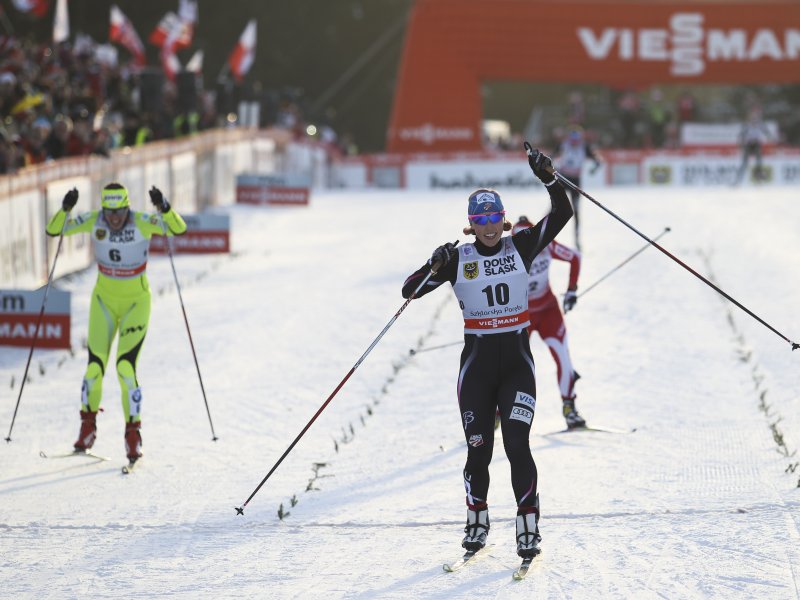
Kikkan Randall (U.S. Ski Team) celebrates her second-straight sprint win in back-to-back World Cup weekends on Saturday in Szklarska Poręba, Poland. Randall topped Germany’s Denise Herrmann for the victory, her ninth-consecutive freestyle sprint podium, and Slovenia’s Vesna Fabjan (l) was third and Poland’s Sylwia Jaskowiec (behind Randall) placed fourth. (Photo: Fischer/Nordic Focus)
Two years ago at a World Cup freestyle sprint in Szklarska Poręba, Poland, Kikkan Randall’s run for the podium was almost over soon after it began.
The U.S. Ski Team standout had made it all the way to final, where she squared off against two Norwegians (Maiken Caspersen Falla and Astrid Uhrenholdt Jacobsen), a Swede (Ida Ingemarsdotter), Laure Barthelemy of France, and Russia’s Natalia Matveeva. Skiing in the middle of the pack as all six women exited the stadium, Randall went down, taking Matveeva with her. Spectators gasped, and the Norwegians, Ingemarsdotter and Barthelemy skied away.
Moments later, Randall was back on the train, skiing in fifth and suddenly challenging the leaders up the outside of the track. She ended up hanging in third, giving Ingemarsdotter a run down the finishing stretch, but ultimately running out of steam. The Swede won and Falla edged Randall in a photo finish for second.
It was a great result, one Randall could be proud of after an unfathomable recovery, but this Saturday’s 1.5-kilometer freestyle sprint was a chance to rewrite history. Racing once again in Szklarska Poręba on a slightly tighter and more technical course than two years ago, Randall had an opportunity to win her second-straight World Cup skate sprint (after winning a week ago in Nove Mesto, Czech Republic) and display another one of her strengths: devouring flat courses.
Randall’s known for a lot of things: skate sprinting, sprinting in general, childhood (and adult) inspiration, pink hair, and powerful attacks on hard climbs. Szklarska Poręba’s new sprint course didn’t have any of those hills for Randall to work her magic on — instead one long gradual in the middle of the loop — followed by a gradual downhill where no-pole skating was key.
“The snow was packing down super hard today and it was kind of hard to balance on,” Randall explained on the phone.
The final corner before the finish — tighter than before — proved to be the most troublesome throughout the day. Qualifying in 10th (3.79 seconds back from Italy’s Greta Laurent, who was fastest in 3:08.69, without any Norwegians, Finns or Swedes competing), Randall won her quarterfinal and semifinal en route the final. Laurent finished fifth in the quarterfinal (behind Randall), failing to advance, while Randall moved along and made tactical changes throughout the heats. Among the most important: how to approach the last turn.
“Everyone was coming in together with the downhill and then you come around that corner,” Randall explained. “It was definitely tricky. This was one of those kind of sprints where you have a lot more people around you, there is not really a good opportunity to try to get away. You just have to try to be smart and hold your position and hope for the best.”
U.S. Ski Team Women’s Coach Matt Whitcomb explained the course as “85 seconds of kind of false flat uphill V2 from the start to the first corner where you get into V2/V1 hill.
“Kikkan has a really effective V2,” he added. “She just kind of bounces along like a spring: loads, unloads, load, unloads, and she can do it for a long time. Several years ago, we probably wouldn’t have said this was a good course for Kikkan, … [but] Kikkan has definitely shown her strength.”
Emerging from the wooded part of the course toward the stadium, Randall found herself in a similar position to two years ago, hanging with the leaders and contending for a win in Saturday’s final. Gliding out of the downhill, she used her legs alone to ski up even with Germany’s Denise Herrmann, who led throughout the first half of the final.
“She just kind of bounces along like a spring: loads, unloads, load, unloads, and she can do it for a long time.” — U.S. Ski Team Women’s Coach Matt Whitcomb, on Kikkan Randall’s success in Szklarska Poręba
Randall later said she was happy Herrmann led out of the start, as she could “tuck in right behind her” and let everybody else — including fellow American Jessie Diggins — file behind.
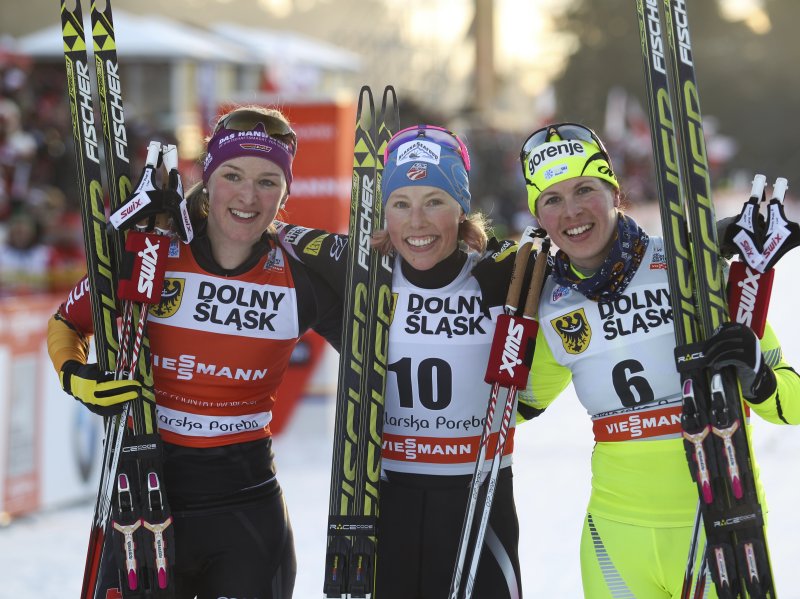
Women’s 1.5 k freestyle sprint podium at Saturday’s Szlarkska Poreba World Cup in Poland: winner Kikkan Randall (c), Germany’s Denise Herrmann (l) in second, and Slovenia’s Vesna Fabjan in third. (Photo: Fischer/Nordic Focus)
“[Denise] was keeping the pace at a pretty high rate so that was good to power over the top,” Randall explained. “As we came out into the main flat part again I was able to use the draft and then work out to the side and work really hard to get in front of her before we got to that last downhill.”
Heading into the final turn, Randall made sure she was ahead. She had waited longer than usual to make her break, but it ended up working to her favor as she extended her lead on Herrmann into the final straightaway and won by 0.25 seconds in 3:06.89.
“I was happy to find a lot of good feelings and a lot of power left in my legs on that finish stretch,” Randall said after notching her ninth-consecutive freestyle sprint podium.
She threw her arms up in celebration, acknowledging the Polish crowd that cheered for her as if she was one of their own, not realizing what happened behind her.
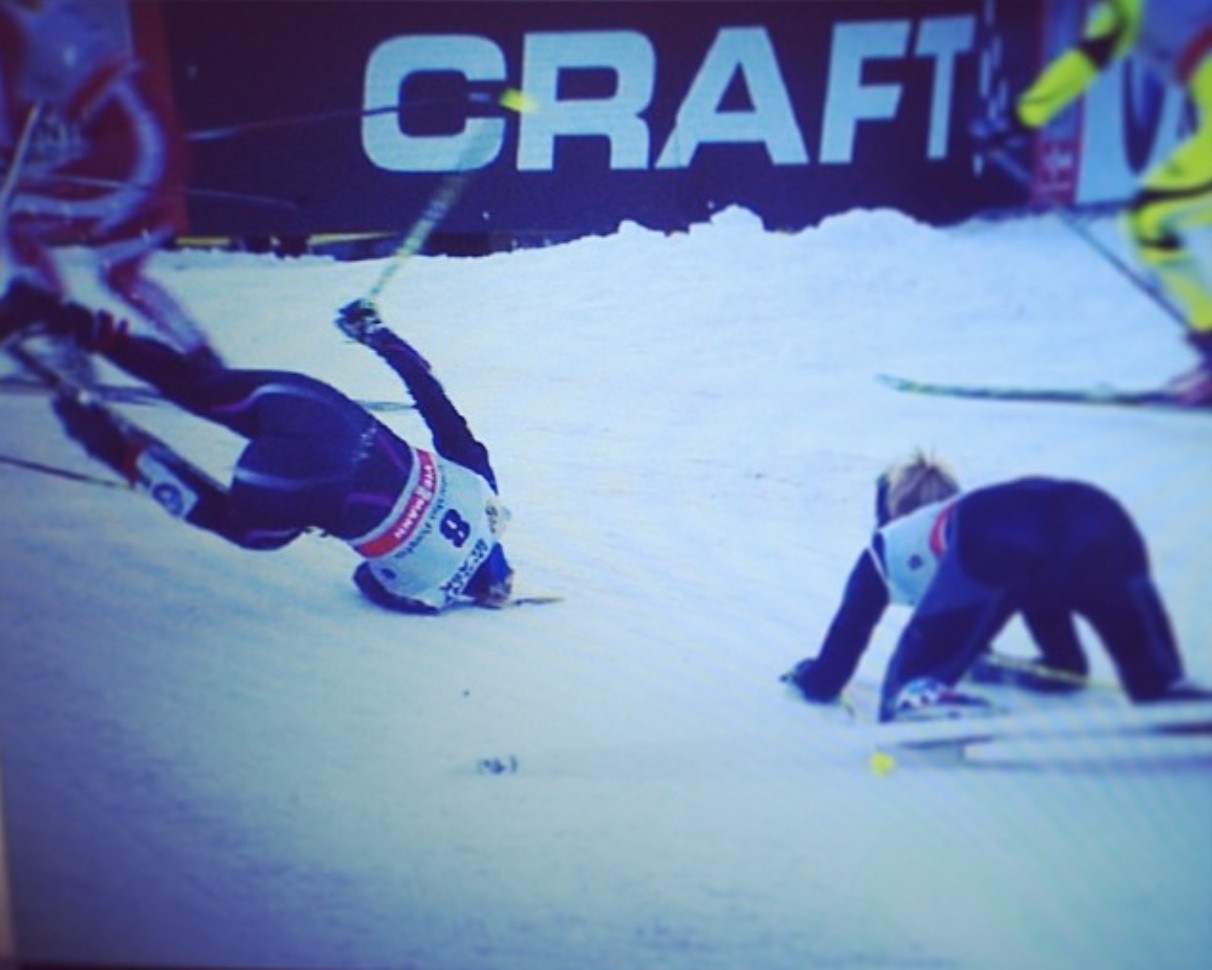
Diggins, who had tucked behind Randall in third on the long descent, fell victim to a slip-up by Switzerland’s Laurien van der Graaff. With van der Graaff leading her into the last turn, Diggins explained in an email that van der Graaff went left while she tried to go right, then fell in front of her.
Jessie Diggins (l) tumbling headfirst over Switzerland’s Laurien van der Graaff, who fell right in front of her on the last turn of the women’s 1.5 k freestyle sprint final at the World Cup in Szklarska Poreba, Poland. (Photo: FIS Cross Country/Instagram)
“I pitched forward over her and got up as fast as I could but lost the pack,” Diggins wrote. “While that’s of course a little heartbreaking since I had been in third and was feeling great, that’s sprint racing and I’m happy knowing I can do better!”
Qualifying in eighth then winning her quarterfinal — the fastest of the day — by 0.64 seconds over Herrmann, Diggins advanced to the final as a lucky loser. She placed third in her semifinal behind Slovenia’s Vesna Fabjan and Poland’s lone skier to advance out of the quarterfinals, Sylwia Jaskowiec, who posted the second-fastest qualifier time.
All three made it to the final, where Fabjan avoided the late crash to place third, 1.10 seconds behind Randall, and Jaskowiec skied up to fourth (+1.42).
Diggins ended up fifth, 6.99 seconds after Randall, and van der Graaff recovered slowly, finishing 18.97 seconds later in sixth. For Diggins, it was a careest-best sprint result and a good indicator after rebounding from an illness. Friday marked her first intensity workout since the Tour de Ski ended nearly two weeks ago, and she wrote that she was nervous coming into Saturday’s race.
“But I was feeling great all day, my skis were silly fast and the course really played to my strengths — gradual workable downhills are my jam!” she wrote. “I am so proud of the team for skiing so well and the techs for nailing it, and I was so excited to get a sprinting PR!”
“Jessie had podium capabilities out there today,” Whitcomb said. “The performance was unbelievable.”
“My skis were silly fast and the course really played to my strengths — gradual workable downhills are my jam!” — Jessie Diggins, fifth
With two women in the final, the U.S. had three in the top seven. Fourth in the qualifier after Herrmann in third, Sophie Caldwell won her quarterfinal and finished third in her semifinal behind Randall and van der Graaff, respectively, just 0.74 seconds out from automatically advancing for seventh overall.
Whitcomb was pleased with the team’s all-around success, with Ida Sargent nearly making the semifinals to finish 13th and Liz Stephen notching a career-best sprint result of 15th. While Stephen first qualified in a World Cup sprint stage at last season’s Tour de Ski, Saturday was the first time she had made the heats in an outright World Cup.
“I think she missed lucky loser by seven-one-hundredths of a second,” Whitcomb said.
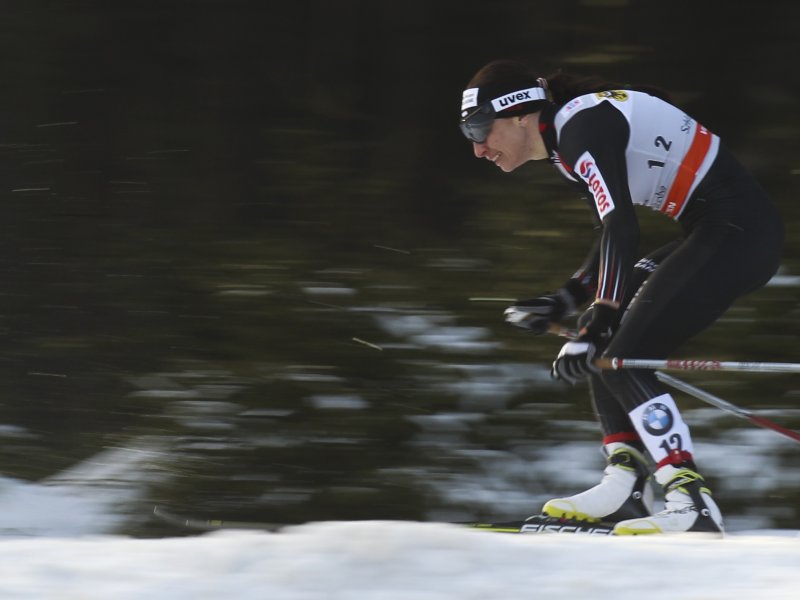
Poland’s Justyna Kowalczyk, who qualified in 12th, and placed fourth in her quarterfinal (0.01 seconds behind American Liz Stephen in third) for 17th overall. (Photo: Fischer/Nordic Focus)
But she did edge Poland’s pride and joy, Justyna Kowalczyk, by one-hundredth of a second for third in the quarterfinal.
“It was exciting for sure, but the fans go absolutely hysterical for Kowalczyk and any Polish athlete,” Whitcomb explained. “But Kikkan is a close second to Kowalczyk in terms of popularity here; it’s pretty cool. The amount of noise that a group of 5,000 fans can make in a small crowded stand when they’re into it is incredible. The fans are some of the best.”
And why do they get behind Randall? “Probably the same reason everybody loves her, smiley, just a great ambassador to the sport,” Whitcomb said. “Kikkan runs right over to the crowd after the flower ceremony and chucks her flowers. She just connects with the crowd. She spends a ton of time signing autographs.”
Randall said the finish was incredibly loud, pushing her to give her all and never look back before securing the win. She was careful not to preemptively celebrate, remembering when Canadian Devon Kershaw capitalized on Russian Nikolay Morilov’s lackadaisical sprint finish two years ago.
“The Russian guy celebrated and Devon snuck through,” she recalled. “I was just totally focused on skiing as strong as I could until I got to that finish line and making sure I went all the way through.”
While a win is a win three weeks before the Olympics kick off in Sochi, Russia, Randall noted there were only 13 seeded athletes in the women’s race.
“When the Scandinavians aren’t here, that certainly takes a lot of top people out, but the nice thing was that the top end was still there,” she said, adding that she was grateful to have so many opportunities for skate sprints before the Olympics.
“Denise has been on the podium several times this season, Vesna has been on a lot of podiums in skate sprinting, Laurien was on the podium last weekend and we knew that there was going to be a lot of really good girls at the top end,” she added. “It is still a great competition, but it was great to see our team get in there and ski well through the rounds. It is good practice for us as we go on.”
As for a back injury she sustained nearly three weeks ago, Randall said it’s “doing great.”
“It was really smart for me to not do the team sprint last weekend because the sprint last weekend definitely put some pressure on me, but I was able to just keep moving forward,” she said. “Now it is in a really great place and I am looking forward to racing tomorrow.”
Kikkan Randall lived up to the hype on Sunday, winning the U.S. Ski Team’s first sprint of the season in Beitostølen, Norway. Randall topped Slovenians Vesna Fabjan (l) in second and Katja Visnar in third in the 1.2 k freestyle FIS sprint after qualifying in seventh and placing second in both her quarterfinal and semifinal. (Photo: FIS Cross Country)
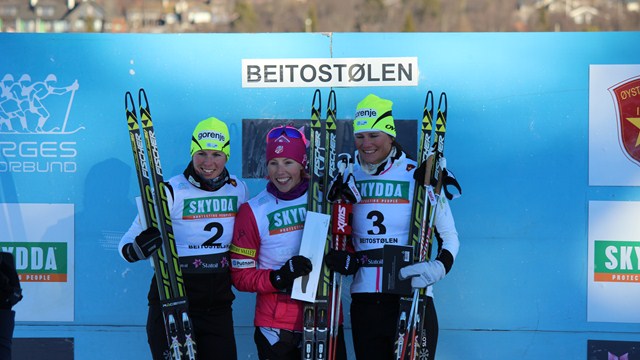
The U.S. Women’s Nordic Ski Team finished off their weekend opener in Beitostølen, Norway, with a bang on Sunday, as reigning World Cup sprint champion Kikkan Randall claimed a win in the 1.2-kilometer freestyle sprint FIS race.
Seventh in the qualifier then second in the her quarterfinal and semifinal, Randall won the final in 2:17 minutes, 0.8 seconds ahead of runner-up Vesna Fabjan of Slovenia. Coming in third, Slovenian Katja Visnar followed her teammate by 1 ½ seconds.
In an email, Randall explained Brun-Lie, who won the qualifier along with her quarterfinal and semifinal (beating Randall by 0.4 seconds in the semi), led out the final, but lost her balance halfway through. According to Randall, that opened up the race. Randall ended up trailing Fabjan until midway up the final climb, then decided to make a move over the top.
“I thought I might get challenged on the homestretch but the shadows never came,” Randall wrote.
Following the top three, three Norwegians – Marit Bjørgen, Celine Brun-Lie and Ingvild Østberg – took fourth through sixth respectively, all within less than a second and a half of each other, but more than three seconds behind Randall.
When it came to Randall’s game plan, the 30-year-old Alaska Pacific University (APU) skier explained it was simple.
“Pretty much ski hard, play with some different tactics and get a hard workout!” she wrote. “In both the quarter and semis I was always following someone off the final turn and then making sure I was strong on the homestretch to guarantee moving on each time.”
All she needed to do was make the top two in each heat. Easier said than done, but the world champion did it. On Friday, Randall placed 10th in the 10 k classic race – her first of the season.
“ I am happy to have two solid races under my belt,” Randall wrote. “This weekend was mostly about waking up the body before the World Cup opener [in Kuusamo, Finland] next week. It’s a good confidence boost to stack up well against a strong field. But the real tests begin next week!”
Four other U.S. Ski Team (USST) women advanced to the heats and ended up in the top 20, failing to make the semifinals.
Ida Sargent (Craftsbury Green Racing Project) tallied 13th – an improvement from finishing 29th in Friday’s 10 k. She qualified in 13th and went on to place third in her quarterfinal, 1.8 seconds behind Norwegian quarterfinal winner Maiken Caspersen Falla (who ended up seventh) and 0.5 seconds behind Mari Eide (who placed 10th).
“It was a short fast sprint and the qualifier was over before I knew it,” Sargent wrote in an email. “In the quarterfinal I wanted to get out fast but I got pushed outside on the first corner and ended up in 4th going down the downhill. I moved up to second on the uphill where I was feeling strong but I skied the finishing stretch really poorly.”
In retrospect, Sargent felt she chose the wrong technique.
“[I] should have been using V2 alternate instead of V2 on the fast snow,” she wrote. “I was just skiing really awkward and bobbled and almost fell and then I lost ground.”
On the whole, her experience was positive. “I’m just excited to be back racing again and finding improvements with each race,” she wrote. “It was still really fun to race a heat against lots of really fast ladies. The Norwegian women are so strong and the Slovenians are also skiing really fast so it was great to race them.”
In the women’s freestyle sprint quarterfinals in Beitostølen, Norway, U.S. Ski Team rookie Sophie Caldwell keeps contact with Marit Bjørgen (second from left) and Slovenia’s Vesna Fabjan (c), who ended up second overall. Bjørgen ultimately placed fourth in the final, and Caldwell did not advance to the semis, placing 18th overall. (Photo: Noah Hoffman/noahhoffman.com)
The rest of the U.S. women came in 17th through 19th, with Jessie Diggins, Sophie Caldwell and Sadie Bjornsen, respectively.
Fourth in her quarterfinal and just a tenth of a second behind Sargent, Diggins explained in an email it hadn’t been an easy training week leading into Beitostølen, leaving her a little sore and tired before Sunday’s race. But that was part of the plan.
“It’s a long season ahead!” Diggins wrote. “I was psyched that the two races this weekend went as well as they did, especially since it’s the plan to work into the season.”
She qualified in eighth, but ran out of room in the quarterfinals, she explained.
“This sprint was wicked short — like 2:15 in the qualifier,” she wrote. “I like much longer sprints, because it takes me longer to work into it. … I felt better and better in the finishing lanes and was picking up speed, but needed a longer course to do some damage. But it was a great way to get back into the feel of sprinting, get used to the warming up and testing ski process again.”
Teammate Sophie Caldwell got a little too cold during the prelim and felt a bit stiff in her legs, but was happy to qualify in ninth. From there, she said her quarterfinal was “fun,” going up against top women like Fabjan, Bjørgen, and Norway’s Heidi Weng, who took first through third in the heat, respectively.
“I didn’t realize I had Marit in my heat until I toed the start line and then I just tried my best to tuck in behind her,” Caldwell wrote. “I had a good start and was able to stay in 2nd for the first half of the race before moving back to 4th. It was exciting to have all five girls qualify, so hopefully that means we’re in a good place!”
Additionally, she was excited to watch one of her teammates win outright and teammates Andy Newell and Simi Hamilton place sixth and 27th, respectively.
Bjornsen, who notched fifth in Friday’s 10 k classic, qualified in 14th and went on to place fourth in her quarterfinal. She was 0.8 seconds out of first, with Visnar, Randall and Norway’s Hilde Landheim taking first through third.
“It was fun to sprint again,” Bjornsen wrote. “… [And] a good warm up for next weekends world cups which I am looking forward to! This weekend was about getting back into the grove of racing. Warm-up, ski selection, nerves, pacing. It was a practice race before it really counts.”
The last time she started her season in Europe – two years ago – the team didn’t do that, Bjornsen explained.
“So now I am really looking forward to Finland and a fun season ahead!!” she added.
Petra Majdic chatting with FasterSkier at the Canmore World Cup, 2010.
What You May Have Missed Last Season
Majdic was her dominant self on the sprint course last season, winning four sprints to become the Sprint Cup victor for the third time in her eleven-year World Cup career.
We know, it’s crazy that someone who won the Sprint Cup, finished 13th in the distance rankings, and sixth in the overall could be called ‘disappointing’, but that’s the standard her rabid fans, and she herself sets.
While it’s clear that Majdic knows how to sprint, the Slovenian women coming up behind her have learned a thing or two about speed as well. Following closely in Majdic’s sprinting footsteps are Vesna Fabjan and Katja Visnar, who actually recorded the exact same number of World Cup points – 266 each – this season.
In particular, the two Slovenians put on quite the show during the skate sprint in Rybinsk, Russia. After qualifying first and second, they cruised through the rounds, and topped off their day by dominating an Italian-packed final, Fabjan taking the win, and Visnar holding off Justyna Kowalczyk for second.
Slovenia's Petra Majdic after her win in the classic sprint in Otepaa, Estonia.
Majdic has retired, leaving a massive hole on the team, and on the World Cup in general. She was a permanent fixture, earning 33 World Cup podiums in her career. She also seemed to have a knack for generating big headlines, big excitement, and without a doubt put Slovenia on the map in terms of cross country skiing. Whether you’re a fan of the exuberant Slovenian or not, you have to appreciate her success in the sport.
While Majdic is walking away, it’s pretty clear that Visnar and Fabjan are more than ready to take over and carry the load – at least on the sprinting front, as they finished eighth and ninth on the Sprint Cup respectively. While Fabjan is primarily a skate specialist, she can still qualify in classic, and Visnar can do both. As well, at 26 and 27 years of age, have plenty of prime years ahead of them.
Unfortunately, distance skiing is going to be tough for the Slovenians this year. Fabjan picked up a grand total of 2 points, while Barbara Jezersek added 26 in the limited World Cup action she saw.
The Slovenian men continue to be pretty much nonexistent, at least in the points scoring department, failing to notch any for another year, a status that is unlikely to change immediately.
Look! A Slovenian male skier hiding behind Torin Koos!
Also, for those concerned, there is no word yet on whether the Slovenians will be dazzling the World Cup with their – let’s call them ‘distinct’ – suits.
Who You Should Watch
Rok Trsan is the Slovenian of the future. He has a disgustingly awesome name, finished 4th and 13th at World Junior Championships in Otepaa, and still has another year of junior skiing to make some noise. While the women are doing the damage now on the World Cup, it won’t be long before Trsan will be mixing it up.
It took four tries, but Russian sprint specialist Alexei Petukhov finally got a World Cup victory on home soil, breaking away from the pack to win the men’s freestyle sprint in Rybinsk, Russia.
In the women’s event, a Petra Majdic-less Slovenia claimed the top two spots with Vesna Fabjan and Katja Visnar beating out Justyna Kowalczyk (POL).
As in Friday’s pursuit, many of the top skiers were missing – including the entire Swedish team and any representation from North America. But the men’s race still featured plenty of firepower, and with final spots on the Norwegian World Championship team at stake, there was more than World Cup points and cash on the line.
Petukhov won the qualification round by .74 seconds over Anders Gloeersen (NOR) and easily advanced through the first two rounds. In the final he employed what has become the tactic of choice for Russian sprinters – go out hard, and open a gap early.
With teammate Nikolay Morilov in tow, Petukhov did just that. The strategy does not always work, but today, in front of thousands of fans at the Demino stadium, Petukhov opened an insurmountable gap, creating enough space to celebrate in the final meters.
“I am so glad,” Petukhov said. “I took second place here twice already, and of course wished to win. This time I decided to escape, not looking back.”
Morilov, along with the other four skiers in the heat, was unable to maintain the pace. Norwegian sprinter Ola Vigen Hattestad, after determining he could not match Petukhov, settled in to race for second. He bided his time before staging an impressive late attack with Gloeersen, giving the duo the final two podium spots.
“I’m satisfied with my second place,” Hattestad said following the race. “Alexei was very strong, and made such a gap that I could not reach him. But I chose good tactics staying behind the other athletes and was able to control the race.”
Martin Jaeger (SUI), in his first World Cup sprint finals appearance, just missed out on the podium when the two Norwegians overtook him. He still ended up a career-best fourth, topping his ninth in the same event one year ago.
The women’s race, despite strong Italian and Slovenian contingents, lacked depth – just 34 women started the qualification round, and there were clear gaps in ability level throughout the quarterfinals.
Qualification times accentuated these differences. Visnar set the pace, gapping the field by an impressive 2.49 seconds. Fabjan qualified second, and Magda Genuin (ITA) placed third, over four seconds off Visnar’s time.
Alenka Cebasek, a relatively unknown Slovenian participating in just her seventh World Cup race, was seven seconds back as the tenth qualifier – an eternity in sprint racing.
With the exception of Finnish skiers Aino Kaisa Saarinen and Riita Liisa Roponen, all of the top women advanced to the semifinals.
Fabjan, despite being a step slower in qualification than her teammate, was clearly in top form today. She and Visnar controlled the final, leading from wire to wire. Kowalczyk, participating in her weakest event – the freestyle sprint, managed to come back with a fierce attack on the last hill. She closed the gap, and was in position for the final sprint.
Fabjan was clearly the fastest, and Visnar secured second with a lunge. Kowalczyk settled for third – her first time on the podium in skate sprint this year.
For Fabjan, Rybinsk is quickly becoming a favorite venue. She won the individual sprint last year and teamed with Visnar to claim victory in the team sprint.
“It is just amazing,” Fabjan said. “I like the course in Rybinsk and I have good tactics for it – that is maybe the key of the success.”
Visnar was thrilled with her result – the first time she has stood on the World Cup podium in an individual event.
“Satisified” is the word Kowalczyk used to describe her feelings on the day, but she went on to express some disappointment.
“I am not normally often on the podium in free technique sprints, but on the other hand I felt I could do more today,” Kowalczyk said. She spent the first part of the final stuck behind the Italian trio of Genuin, Arianna Follis, and Marianna Longa.
In the battle for the last two spots on the men’s Norwegian World Championship team, Gloeersen easily came out on top. His coach informed him that his third place result earned him a trip to Oslo.
The last spot would go to Oystein Pettersen if today’s results are the final criteria. Pettersen placed seventh – the fastest man to miss the finals, while his competition, John Kristian Dahl and Johan Kjoelstad suffered significant misfortune.
Kjoelstad placed last in qualification, almost certainly due to a crash. Dahl, who was left of the 2010 Olympic squad despite a World Cup victory earlier that season, advanced to the heats, but crashed out in the quarterfinals, ending the day in 26th.
World Cup racing continues on Sunday with a 4×5/10km relay, before going on break until the pre-World Championship races in Drammen, Norway.
That was the message Kikkan Randall sent with her skiing in Dusseldorf, Germany on Saturday, racing to a sensational second place in a freestyle sprint on a short course that doesn’t even suit her strengths.
After qualifying in eighth and blazing through the first two rounds, Randall overcame a poor start in her final heat, flying past Slovenian Vesna Fabjan on the homestretch to take her fifth-ever podium finish, just behind winner Arianna Follis (ITA).
Kikkan Randall (r, in black) chasing Vesna Fabjan (middle, in neon) and Arianna Follis (l) in the women's sprint final in Dusseldorf.
With a longer skate sprint on tap in Davos, Switzerland next weekend, Randall said that she is ready to take on Bjoergen, the undefeated Norwegian who has dominated the World Cup circuit this fall—and who was the only woman to get the better of Randall in a sprint race in Norway last March.
“I’ve been wanting a chance with her in the skate sprint since Oslo last year,” Randall said.
Randall wasn’t the only American who had a strong race on Saturday. Canadian Chandra Crawford was eighth, finishing fourth in the preliminary round and then leading her semifinal heat before fading late. The result was enough to pre-qualify Crawford to compete at the 2011 World Championships in March.
For Follis, the victory was her first in an individual sprint since she won a world title in the event in 2009.
She has raced every single edition of the Dusseldorf World Cup since its inception in 2002, but in nine tries, Saturday was the first time she cracked the podium in the individual sprint. (She won the team event last year, with Magda Genuin.)
“A podium that seemed haunted to me here—this time, I really enjoyed it,” Follis told the Gazzetta dello Sport.
But Follis was unchallenged over the last 200 meters, which meant that the real excitement was behind her, with Randall pinballing her way back to the front of the pack after a poor start.
After jetting to an early lead in her first two heats—crucial on the Dusseldorf sprint course, which at 828 meters is one of the flattest and shortest on the World Cup circuit—Randall was glacial off the line in the final, heading to the first corner sitting fifth in a field of six racers.
“My poles slipped a little bit, and so I was a little slower coming out. And then I kind of panicked—kind of got my weight a little too far forward, so I didn’t build the momentum on that first stretch that I had in the earlier rounds,” she said.
With the women taking just two minutes to complete a circuit, Randall didn’t have much time to make up ground. But while she knew that she would have to be “really aggressive,” Randall also didn’t panic.
“You…don’t want to be too frantic and too aggressive, because then you might end up getting tangled up with someone and going down,” she said. “You’ve gotta be smart.”
On the back side of the course, heading up the tiny hill known as “Mount Dusseldorf,” Randall said she was getting ready to follow Hanna Falk, the 21-year-old Swedish phenom who won the Dusseldorf sprint last year in a breakout performance.
But, Randall said, she could tell that Falk was starting to flag, so instead, she snuck into a narrow opening behind Follis and Fabjan, who were working their way up the climb on the opposite side.
“I could definitely feel another skier right there, and I barely got into the spot,” she said.
The move left Randall in third place going into the final turn, still trailing Follis, who was leading, and Fabjan, the Slovenian who had set the fastest time in qualifying.
One of the tricks that Randall had learned on the Dusseldorf course, she said, was that cornering is crucial. “If you can accelerate out of a turn really well, then that can give you some space,” she said.
And accelerate she did, passing Fabjan on the final straight, and even making up ground on Follis before running out of room. After a tough race last weekend in Finland, where she failed to qualify for the heats in the classic sprint, Randall said that the result was a relief.
“All I could think was, ‘that’s more like it!’” she said. “This is really where I want to be—I want to be challenging for the
Kikkan Randall in one of Dusseldorf's many corners.
podium every time in a skate sprint.”
Randall said that she was especially satisfied with her finish given that her big moves in past sprints have typically come on tough climbs—which were nowhere to be found on Saturday. In her two previous races in Duesseldorf, she had never placed higher than 28th.
“It was a big question mark,” Randall said. “I was really excited today to feel so strong and powerful on the flats, because I think that’s where I’ve really been trying to improve my skate sprinting.”
While Randall kept her cool during Saturday’s final round, her composure had already been tested numerous times over the last 48 hours.
After a few days of training in Finland, the U.S. Ski Team (USST) was supposed to arrive to Dusseldorf on Thursday. But a strike by Finnair’s flight attendants left the Americans marooned in Helsinki for a night, and they didn’t arrive in Germany until Friday.
Snowy weather then forced the USST to do their typical pre-race tune-up workout on foot, rather than on rollerskis. Even more problematic, the athletes were without their baggage.
Fortunately, Head Coach Chris Grover had been around long enough to know not to depend on baggage handlers.
“Before we left, we told [the athletes], ‘in your backpack that you carry on, have your skate boots, have your race suit, have your warm-ups,’” he said.
The USST also had all of its skis, thanks to a cargo van that had already driven from Finland to Germany earlier in the week. As a result, Randall had everything she needed for Saturday’s race—except for her poles, which the USST shipped on the airplane with the rest of its baggage.
While Andy Newell was forced to borrow a pair of poles from the Swedish team, Randall had a spare set—although they were a centimeter too short. But they worked well early in the day, Randall said, and she stuck with them, even though the Americans’ bags showed up in time for the finals.
From Dusseldorf, Randall will now head to the resort town of Davos, Switzerland, for a distance classic race and another skate sprint. Ida Sargent headed home after last weekend’s races in Finland, so the U.S. women will not start Sunday’s team sprint.
While Randall was disappointed to miss another day of racing, she said she was also looking forward the Davos sprint course, which suits her better than Dusseldorf’s. The women will be racing 1.4 kilometers—400 meters longer than last
Kikkan Randall (r) congratulating Arianna Follis on her win in Dusseldorf.
year, and the same distance as the men.
That event will give Randall her first shot at Bjoergen in a skate sprint since Oslo, and according to Grover, the Alaskan is firing on all cylinders.
“She’s proven all fall that her fitness is unbelievable,” he said. “She probably needed a skate sprint to be able to demonstrate how good in fact it was.”
Before Davos, though, will come at least a little merriment, with help from the 10,000 Swiss francs (just over $10,000) that Randall earned for her second place.
“It’s a good day at the office,” she said. “[I’ll] definitely be taking the team out and celebrating tonight.”
The Slovenians managed to ski their way into the top 10 on the Nations Cup with only three skiers – all female – contributing to their points total. Embarrassing for other countries? Slightly, but when the three athletes you’re facing are Petra Majdic, Vesna Fabjan and Katja Visnar, it’s not so bad. All three finished in the top 11 in the sprint cup standings, no small feat.
In what could be the understatement of the year, you probably have heard of Petra Majdic. After the Olympics, she needs no introduction, although if you really need a reminder, there are plenty of places that recount her Olympic experience.
Fabjan and Visnar are not quite as well known, but rest assured, if you watched a World Cup this winter, you would have seen them. Mostly because of Slovenia’s choice of the highlighter-yellow racing suit (which they tragically eschewed in Vancouver), but also because they sprint really fast.
Vesna Fabjan rocking the highlighter-yellow
Fabjan tore up the sprint circuit, failing to qualify just once and finishing on the individual podium twice. Her best weekend of the year was in Rybinsk, Russia, where Fabjan took her first World Cup victory in the individual, then won team sprint silver with Visnar. Fabjan and Majdic were a lock to make the Olympic team sprint an event to remember for Slovenia, until Majdic’s injuries forced her to bow out.
What You Should Know For This Season
Petra Majdic is back! More importantly, she’s healthy! She also specifies that finishing second in the sprint cup last year – despite not racing a single event after the Olympics – just isn’t good enough. She wants the Crystal Globe.
If Majdic can regain her form – and when she’s in top shape she is one of the absolute best on the circuit – things will go well for Slovenia. If not, Fabjan and Visnar will be able to pick up the slack sprinting – though the distance results will be non-existent.
Oh, right, and just in case you thought FasterSkier was being sexist, there are literally no males on the radar for Slovenian skiing. The odds are good, boys!
Who You Should Watch
Katja Visnar was good last year – she went 11 for 11 in qualifying for the heats in the sprints she started, including the Olympics. While she never stood on the podium as an individual (she did get that second in the team sprint in Rybinsk), the kind of consistency she displayed in classic and skate sprinting means that it’s only a matter of time – especially with Majdic there to guide her.