From the FasterSkier archive — posts syndicated from athletes’ and coaches’ own blogs between 2004 and 2012, kept online as published. Current coverage is at fasterskier.com.
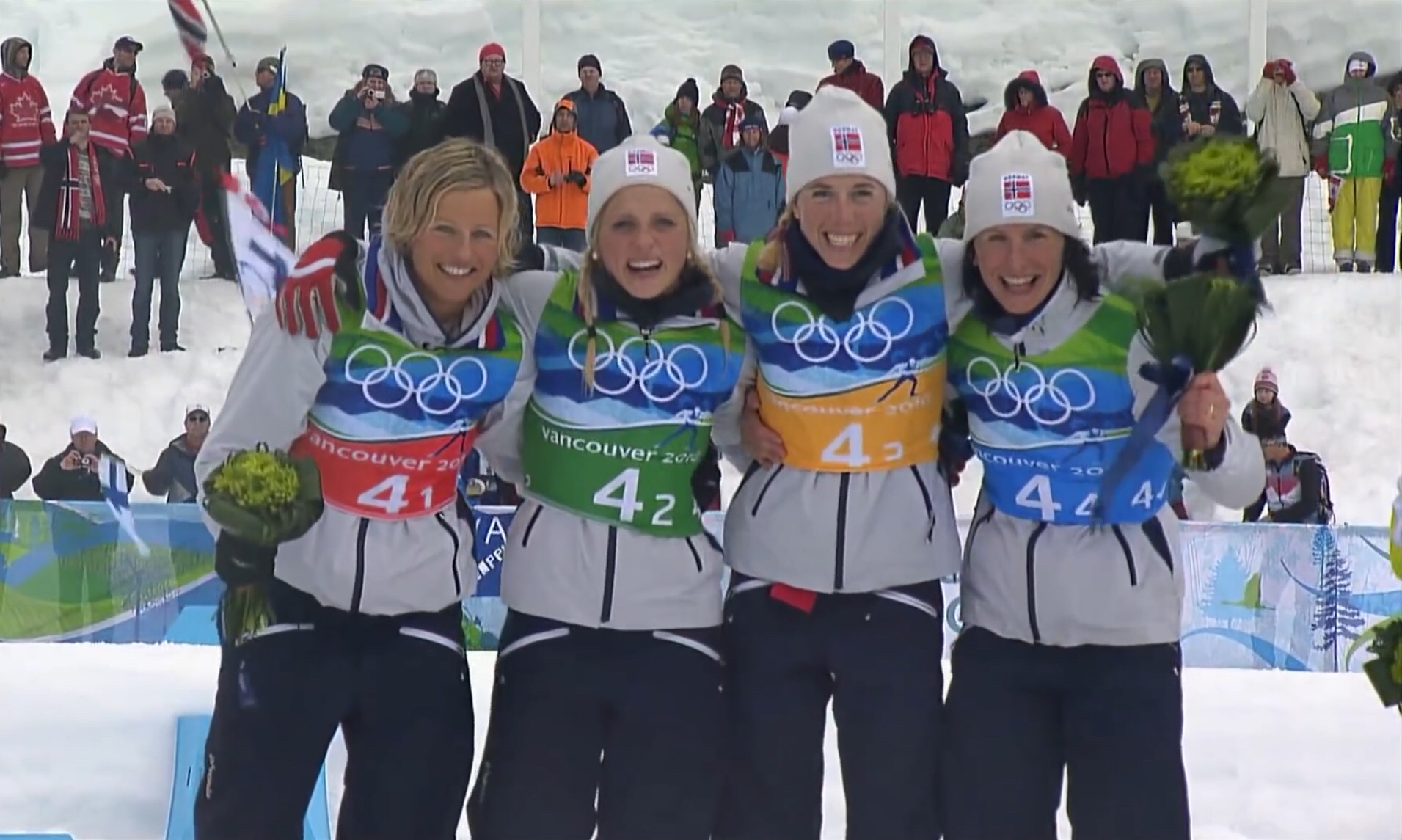
Norway’s gold-medal women’s relay at the 2010 Olympics in Vancouver, B.C., with (from left to right) Vibeke Skofterud, Therese Johaug, Kristin Størmer Steira, and Marit Bjorgen. (Screenshot: 2010 Vancouver Olympics relay video)
(Note: This article has been updated to include comments from Vidar Løfshus, head of the Norwegian cross-country ski team, and the team’s former performance manager, Åge Skinstad.)
The death of Norway’s Vibeke Skofterud shocked the international cross-country skiing world on Sunday, and as of Monday, multiple renowned skiers, particularly in Norway, had reacted publicly.
“I am shaking and am in complete shock over this horrible news that I received today,” Marit Bjørgen wrote in a press release, according to a translation. “Dear Vibeke, this was way too soon.”
Bjørgen and Skofterud were teammates on the Norwegian national team for well over a decade until Skofterud retired in 2015. They won gold together in the women’s relay at the 2010 Olympics and at World Championships in 2005 and 2011. Kristin Størmer Steira was also on all three of those winning relays, and Therese Johaug teamed up with the three to win in 2010 and 2011.
“I have lost one of my best friends,” Johaug wrote in another press release quoted by NRK. “A friend who lit up the room when she entered, one who gave everyone around her lots of energy, love and care. I take with me all of the nice moments and experiences in and outside of the trails and I will miss her. My thoughts go to her family and those left behind.”
Bjørgen added that she was “incredibly happy about all of the nice moments we had with each other. A tough competitor in the course, but more importantly, the warmest, nicest, toughest woman in the world,” she wrote. “We have experienced much together, from an Olympic gold medal in the relay … and I will cherish the memories for a long time. My thoughts go to her families and those closest to her. Love you Vibeke. Rest In Peace.”
Petter Northug wrote that the news was “incomprehensible and sad to hear,” according to News in English.no. “We had many fun years together on the national team.”
Odd-Bjørn Hjelmeset, a former skier who competed until 2011 and became a national team coach, recalled her “infectious humor”. Erik Røste, president of the Norwegian Ski Federation since 2012, said she was “an important ambassador for the sport of skiing with her winner’s spirit and great engagement.”
“Vibeke was that joyful girl who always contributed positively to the community she was a part of, definitely with her good results on the course,” Vidar Løfshus, head of the Norwegian cross-country team, told Aftenposten, according to a translation. “The fact that we have lost girl like her, who was always open, honest and spoke her opinion, is a loss to the entire community and inconceivable.”
“It is incredibly sad,” Åge Skinstad, a former national-team performance director who is currently TV 2’s cross-country expert, told TV 2, according to a translation. “The first thing you think about is the family and those closest to her. Vibeke was a fantastic human-being. She was a very, very good skier.”
One of her former competitors, Charlotte Kalla of Sweden, told Expressen that she was shocked by the tragedy.
“It feels uncomfortable and difficult to accept that such a joyful, positive, and full of energy kind of competitor such as Vibeke is longer with us,” Kalla said, according to a translation. “Vibeke was one of my role models when I entered the national team. A positive person who spread joy and really contributed to the cohesion with Norwegian team. She was a character within the sport who offered a lot of herself. It is with great sorrow that I now think of Vibeke and those closest to her. Rest In Peace Vibeke.”
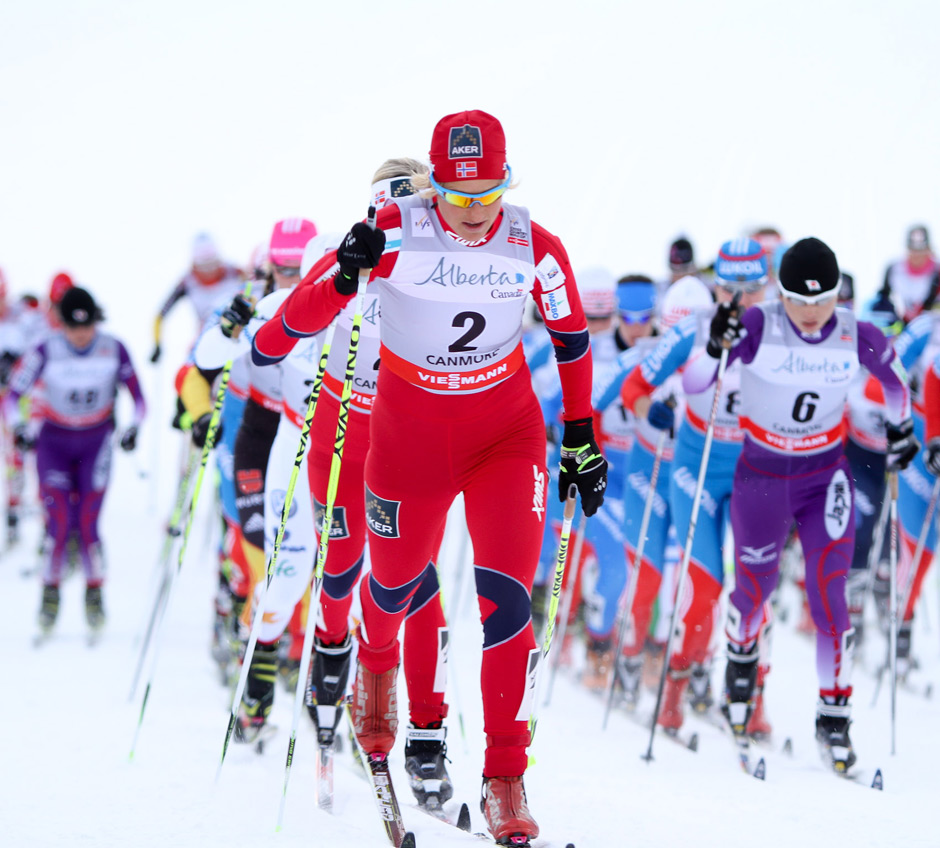
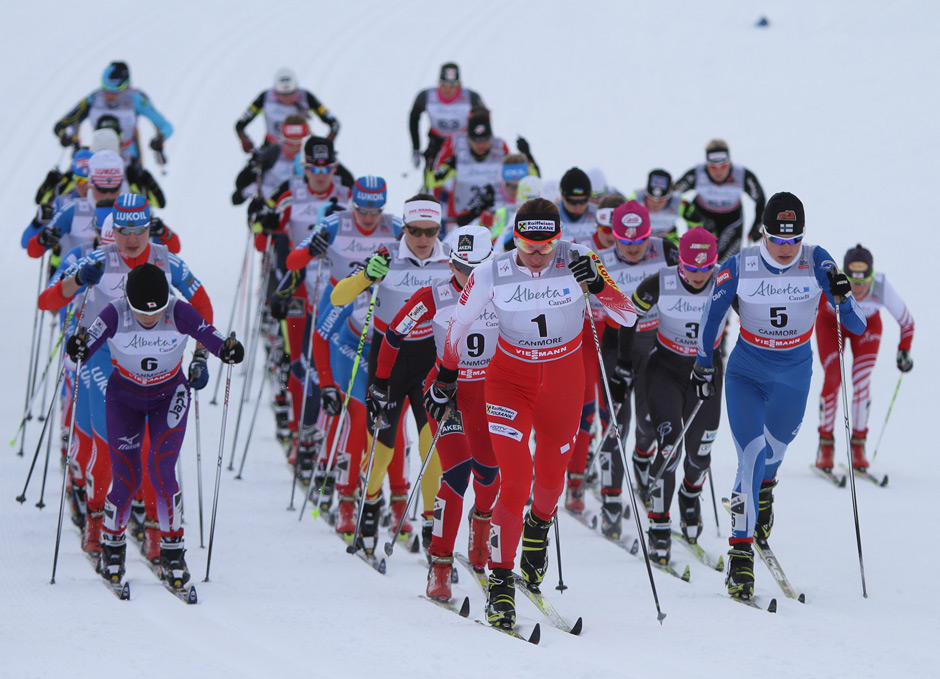
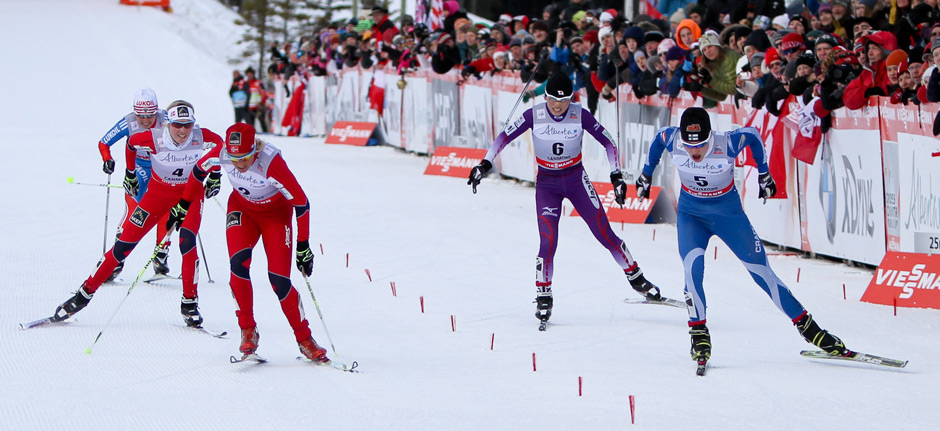
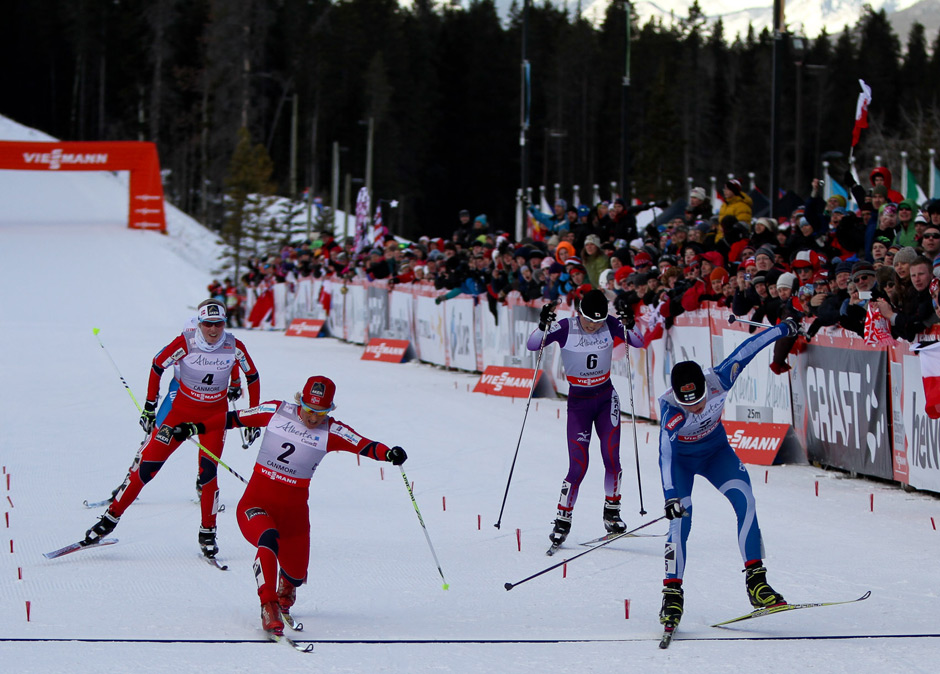
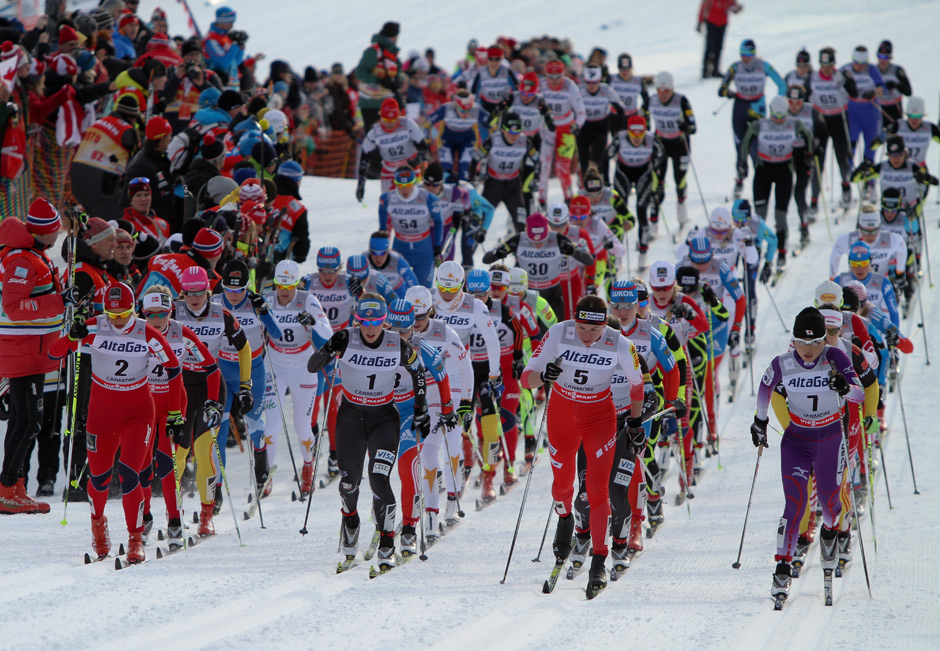
Norway’s Vibeke Skofterud (2) leading the pack in a 2012 World Cup in Canmore, Alberta.
Note: This article has been updated to include more detail about Vibeke Skofterud’s accident as well as comments from her partner, Marit Stenshorne.
A former member of Norway’s prestigious national ski team and a gold medalist in the 2010 Olympic 4 x 5-kilometer relay, Vibeke Skofterud, 38, was found dead on Sunday morning after a jet ski accident near an island in southern Norway.
According to NRK, Skofterud was reported missing around 1 a.m. Sunday morning, but it took a rescue boat until 11:30 a.m. to find her. She was found on the island of St. Helena outside of Arendal and declared dead at the scene. On Monday, police said they believed she died around midnight when her jet ski hit land, according to multiple news reports. No one else was believed to have been involved with the accident and she had been alone on the personal watercraft.
On Saturday night, Skofterud reportedly posted an Instagram video of herself and her partner jet skiing in the Arendal area and later posted another video of the two at a music festival in Arendal.
According to News in English.no, her partner, Marit Stenshorne, reported Skofterud missing after the concert when Skofterud didn’t return to their cabin on another local island, Tromøya, where they had just begun vacationing.
Stenshorne posted about the tragedy on Instagram on Sunday: “Vibeke my great love, my girlfriend, my lover, my hero, my mentor and best friend. We said: the two of us forever. We were going to become old and wrinkly together. Life will be so sad and difficult without you. You gave me so much positivity, gratefulness, laughter, joy, knowledge and love. Love you @vibekeskofterud.”
Skofterud was one of Norway’s top female skiers from 2001 to 2015, reaching the podium 15 times as an individual. In multiple World Championship relays, she earned two golds, one silver and a bronze medal between 2005 and 2011. She competed at two Olympics, 2002 and 2010, posting a best individual result of eighth in the 30 k classic in Salt Lake City. She retired in August 2015.
Police said they had called in Norway’s national accident investigation board, but explained it may take several weeks to determine what happened to Skofterud. As of Monday, they suspected darkness and high speed as probable causes. Lightning, thunder and heavy rain in the area on Saturday night may have contributed to poor visibility.
“We’re examining the [jet ski], the area and the deceased,” Bård Austad, operations leader of the Agder Police District, told NRK. “We’re also questioning any witnesses.”
— Aleks Tangen contributed reporting
Two days ago, Vibeke Skofterud posted a photo of herself rollerskiing and captioned it with a hashtag: #passionforlife. (Photo: Instagram)
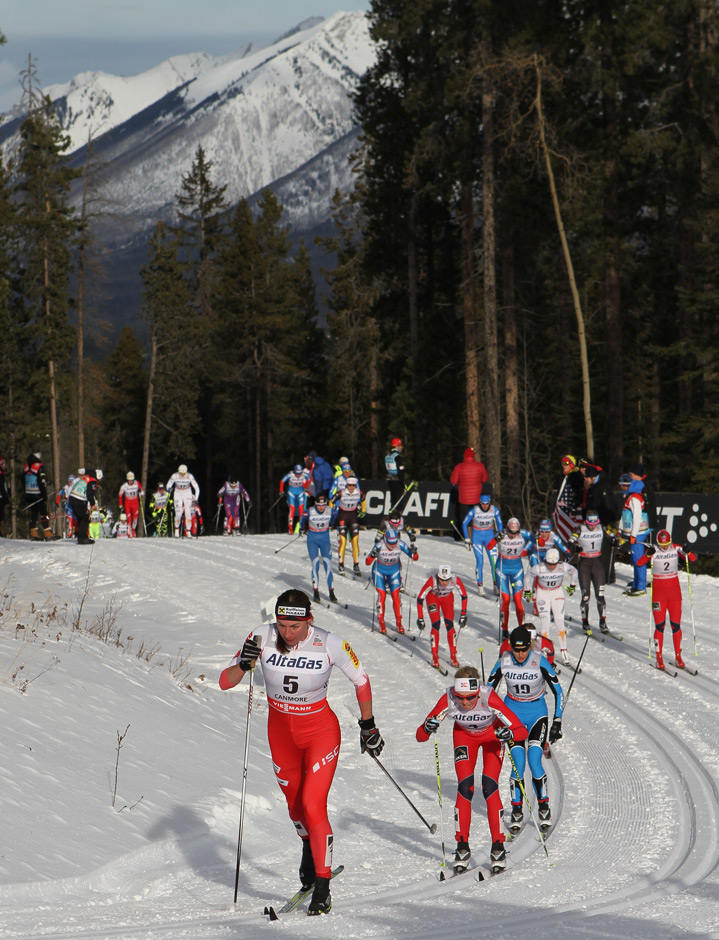
Norway’s Vibeke Skofterud competing in a World Cup in Canmore, Alberta, in December 2012.
Norwegian ski star Vibeke Skofterud has been opening up about her past eating disorders in the last few weeks, hoping to make a positive impact on young women and athletes.
“To be a top athlete is seldom a bed of roses,” the former national team member wrote on her blog, according to a translation. “I’ve written before that achieving success is all about taking the right choices in life. What affects those choices can be so many things. I broke through in 2001, and got headlines like ‘nordic world has a new pop star,’ fearless Vibeke, new stars, etc. … It went pretty well until I failed to fulfill either my own or others’ expectations, and I began to lose weight. I am a person that is triggered by the extremes, and unfortunately that is also true in terms of losing weight.”
Skofterud has had success at all levels of skiing, with 14 individual World Cup podiums, a relay gold medal from the 2010 Olympics in Vancouver, and four World Championships relay medals with Norway. She has also won major marathons and is a sports personality in her home country. She has been open about her eating disorder in the past, including that it caused her to end the 2008 season early.
After retiring from the national team, she has been focusing on marathon racing, which is just as lucrative and in-the-spotlight as World Cup racing in Scandinavia. Although she sat out the 2014/2015 season to heal injuries, Skofterud is in the spotlight not only because of her skiing exploits but because of mainstream exposure (if the two can even be separated in Norway): she made the semifinals of the reality television show “71 Degrees North: Norway’s Toughest Celebrity.”
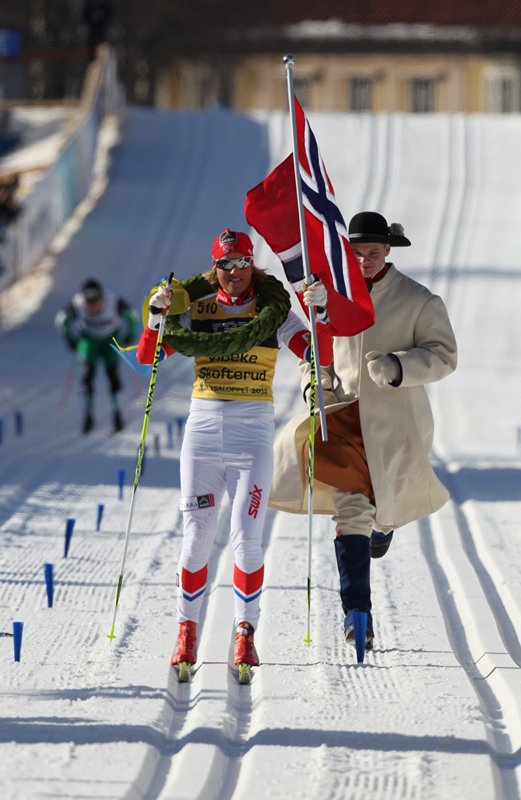
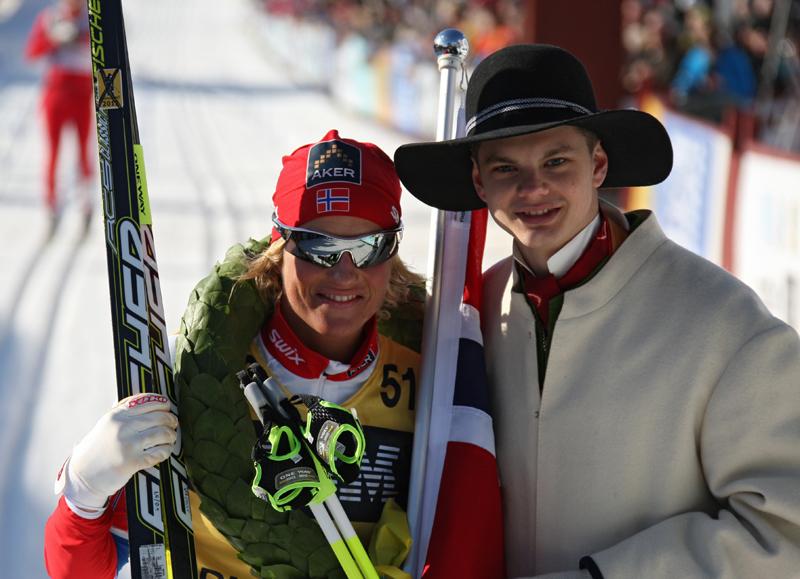
High point: Vibeke Skofterud became the first Norwegian woman to earn the title of Vasaloppet champion in 2012. (Photo: Fischer/Nordic Focus.com)
She wrote on her blog in late April that during a particularly low period in her life, her weight could vary by as much as 10 kilograms (20 pounds) during the course of a month.
“That in itself is not consistent with performance over time,” she wrote. “… I ate too little over time, and I ate too much, I threw up … Everything came down to personality, because I could not totally see who I was.”
When pressure was particularly high, Skofterud explained, she lost weight. But later, she gained some.
“Food was dope,” she wrote. “Food became a substitute for the self-care I could not give myself. I maybe didn’t quite see my value as a human being.”
What Are The Stakes?
There are many ways to measure the magnitude of the disordered eating problem in athletics, but here are a few metrics:
An oft-cited 2004 article in the ClinicalJournal of Sports Medicine found that 13.5 percent of athletes surveyed, compared to just 4.5 percent of the normal population, had clinically-defined eating disorders or borderline behavior. The study was carried out in Norway and used more than 1600 athletes and almost 1700 “control” subjects.
The largest study of NCAA athletes, which surveyed over 1,400 men and women, found that female athletes were significantly more likely to engage in binge eating, vomiting and the use of laxatives than male athletes. They were also more likely to use diet pills. This study found that 34.75 percent of women compared to 9.5 percent of men were at risk for anorexia, while 38 percent of athletes overall were at risk for bulimia.
A 2013 study, though it had a small sample size, found that only 9 percent of female NCAA athletes surveyed were consuming enough calories to sustain their training load. A study of over 400 female Division-I swimmers and gymnasts found that 30 percent self-reported some form of disturbed eating habits.
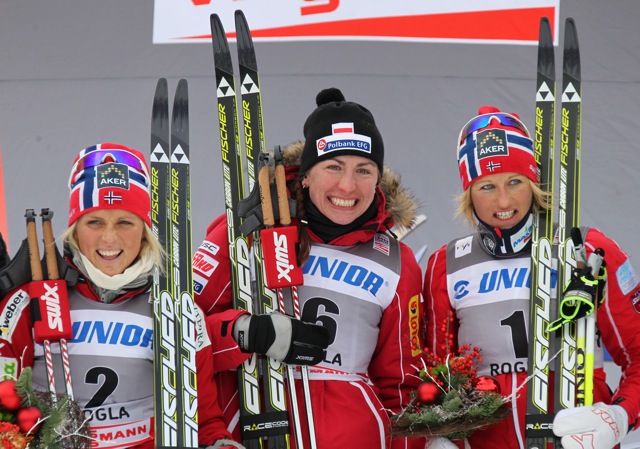
Therese Johaug, Justyna Kowalczyk, and Skofterud (right) on the World Cup podium in Rogla, Slovenia, in 2011. (Photo: Fischer/Nordic Focus.com)
While disordered eating is more prevalent among female than male athletes, it’s also in some ways more dangerous for women. Having low available energy can lead osteoporosis. Bones are perpetually remodeling, with some bone being reabsorbed and new bone forming; low available energy can mean that while some bone is reabsorbed, not enough forms to replace it. This is a long-term health problem, but also a short-term one for athletic performance, as bone loss can lead to stress fractures.
A three-year study of elite high school distance runners found that although the young women learned some important concepts of sports nutrition over their careers, they reduced their caloric intake over the study period. At the same time, the incidence of stress fractures increased from 13 percent to 31 percent.
Thus, eating disorders are part of what is referred to as the “female athlete triad:” disordered eating, bone loss and skipping periods (amenorrhea), which in itself can lead to long-term problems and even infertility. In a survey of 788 Iranian women athletes, about 10 percent who skipped periods had polycystic ovary disorders, which can lead to not only infertility but mood disorders and heart disease.
But there are other connected side effects, too, such as gastrointestinal problems, reduced immune system functioning, and hypothyroidism. And even without a clinically-diagnosed eating disorder, behavior tending in that direction can still lead to the complications of bone loss, menstrual irregularity, and other problems, a 2002 study reported.
Why So Many Eating Disorders?
There are a lot of different reasons that an individual might develop an eating disorder. In sports, where it’s undeniable that certain body types are more ideal for high performance in a particular discipline than are others, there’s particular pressure. The National Eating Disorders Association writes on its website that athletes are particularly at risk if they work with “coaches who focus primarily on success and performance rather than on the athlete as a whole person.”
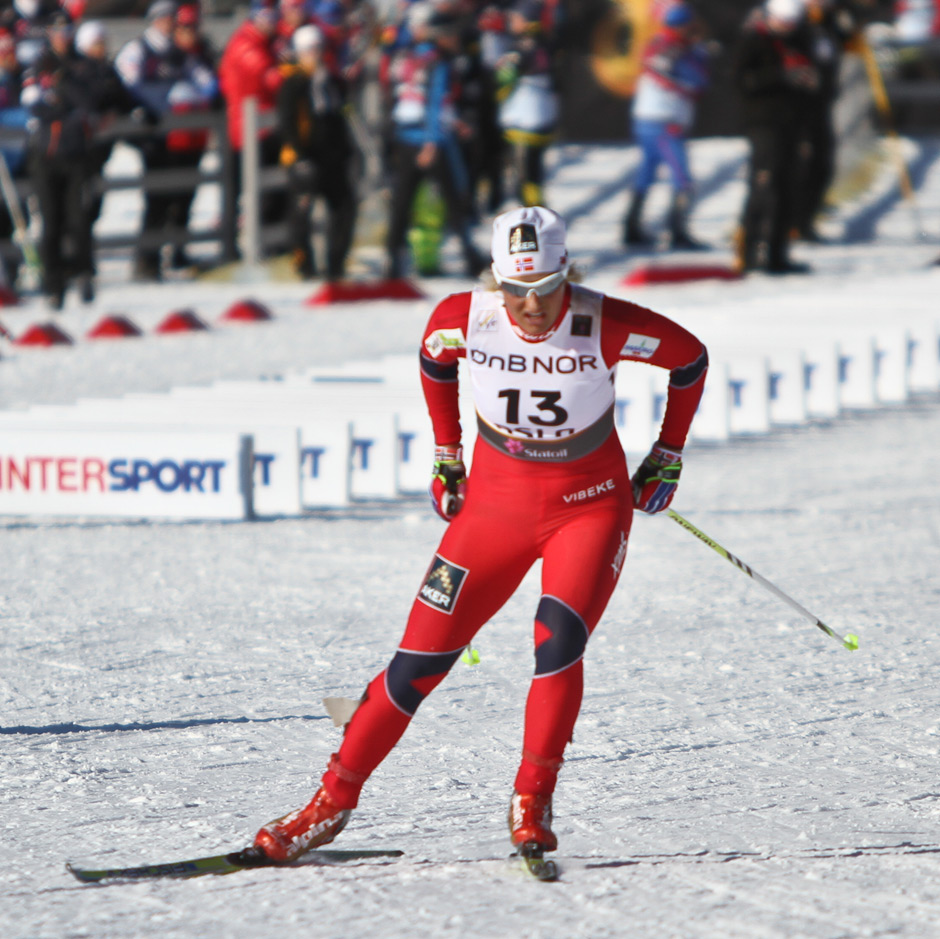
Norway’s Vibeke Skofterud en route to finishing sixth in the 30 k skate at 2011 World Ski Championships in Oslo.
But a 2011 study in the European Eating Disorders Review found that in elite female athletes, eating disorders were almost inextricably tied to issues of body image. Even if they had the same actual weight, female athletes who developed eating disorders perceived themselves to be fatter than other athletes.
This has two components. One is the fact that in endurance sports which emphasize leanness, athletes are pressured to be thin and commonly believe that being thinner will help their performance. Thus, some disordered eating by athletes is related to sport-specific body image. A recent study found that 62 percent of Australian female cyclists competing at national and continental championships thought that their body weight was not ideal for competition.
This was certainly the case for Skofterud. On her blog she posted an excerpt from her diary in 2011, before a World Cup in Davos, Switzerland.
“Every day I avoid the mirror so I don’t see myself,” she wrote. “I cannot bear to remind myself how weak I was … it is crazy. I get fatter and fatter, and life as a top athlete is almost distant. In two days I will go the World Cup. Compete against the world’s best … I’ll try not to think about that ski suit does not fit properly.”
In the 10 k classic race, Skofterud finished second, 10.9 seconds behind Virpi Kuitunen of Finland. Clearly, she was in fact among the world’s best.
Later in her career, she has become more cognizant of her own problems with eating. In 2012, she focused not only on the World Cup but also on the Vasaloppet, a 90-kilometer classic race in Sweden. She succeeded in becoming the first Norwegian woman ever to win the race, and lowered the record time by over eight minutes on the way. She also finished sixth in the World Cup distance standings that season.
It was partly because of better diet that this was possible.
“Some have [an eating] plan, while others eat by emotion, desire and needs,” she wrote in a May blog post. “I have previously told about my turbulent relationship with food, but this season was better mostly. I hit my match weight thanks to close monitoring of by the Olympic trainers and grueling discipline of myself.”
But body image is not only related to sport, it is also related to social norms. Even if a woman is satisfied with her body as it relates to athletic performance, once placed in a social setting she may have negative self-image. Thus social body image can also drive disordered eating.
And Skofterud wrote about this, too.
“My focus was no longer on performance, but to try to look nice enough to walk around in ski suits,” she wrote.
“I also worked continuously to get a better ass, a flatter stomach, better stamina, nice skin, be funnier, smarter, and more productive,” she wrote in a more recent post.
Speaking Up
“At the time when I developed my eating disorder, it was a very ‘shushed’ theme,” Skofterud wrote. “No talking loudly about it…”
She thinks this should change, and is also increasingly worried about the portrayals of dieting in pop culture – that eating is “no longer focused on health, but focused on looking good.” Skofterud cited Norway’s version of the television show “The Biggest Loser” as one which creates unhealthy perceptions of how to be healthy.
Skofterud after her Vasaloppet victory. (Photo: Fischer/Nordic Focus.com)
“I have great respect for the participants and program leaders,” she wrote. “For me, Adrian and Tonje are two great role models in all possible ways. But to create entertainment where overweight people will compete to go as fast as possible, to lose weight in the shortest possible time – it will be too much for me when I know what the repercussions might be.”
Chasing aesthetics takes away from the important things in life, and Skofterud recently wrote about how important it is to take time to think about all the positive things one has accomplished. Whether it was dieting or training more than 1,000 hours a year for skiing, she felt that for long periods of time, she didn’t do that. She hopes others will and seeks to be an inspiration.
“What doesn’t need be the case is how we treat ourselves badly,” she wrote. “I completely forgot to appreciate what I did and what I accomplished, to give myself a pat on the back. To be proud of my achievements … Do not forget why you’re doing what you’re doing. Do not forget what makes you happy. What is it that really makes you happy?”
For all the international-racing junkies out there, the Swedish and Norwegian Ski Associations recently announced the nominations to their 2014/2015 national teams.
Sweden’s male and female teams both grew from eight to nine members apiece, according to the Swedish Ski Association, with the additions of Simon Persson, 22, and Jonna Sundling, 20, and to men’s and women’s A-teams, respectively.
Norway’s Cross-Country Committee nominated 25 athletes to its three national teams (women’s, men’s all-around, men’s sprint), according to Norges Skiforbundet. Kathrine Harsem, 25, and , 23, received the call up to the women’s elite team. On the men’s side, Simen Andreas Sveen, 25, and Didrik Tønseth, 22, are new to the all-around team, and Sondre Turvoll Fossli, 20, is the newest sprinter.
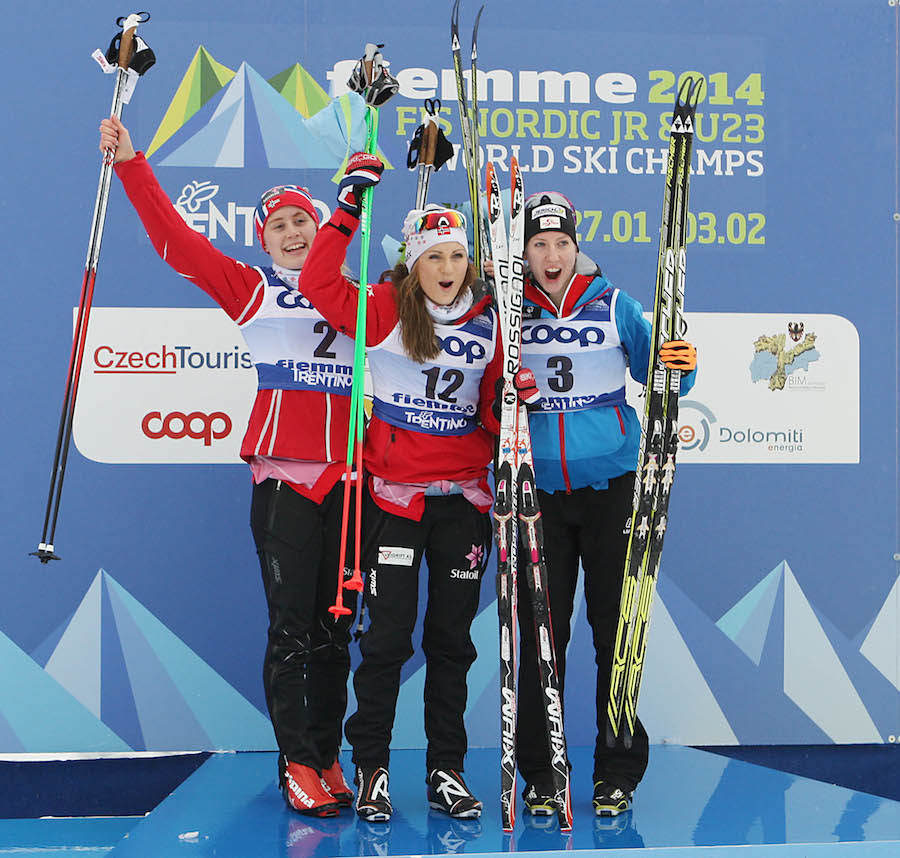
Martine Ek Hagen (c) after winning the women’s 15 k skiathlon at U23 World Championships last season in Val di Fiemme, Italy, with teammate and runner-up Ragnhild Haga (l), and Teresa Stadlober of Austria, who placed third (r). (Photo: Fiemme2014)
No longer with the Norwegian national team, Vibeke Skofterud, Øystein Pettersen, Petter Eliassen, Niklas Dyrhaug and Tord Asle Gjerdalen are pursuing different paths and interests.
A 2010 Olympic gold medalist in the team sprint, Pettersen, 31, whose nickname is “The Sausage,” recently told NRK that he plans to focus on distance races while skiing for Team United Bakeries.
“In recent years I trained hard to break into sprints but it did not happen,” he said, according to a translation. “Then I lost faith in myself in the sprint and I cannot continue another season training for something I have lost confidence in.”
He explained that the Vasaloppet and 2015 World Championships will be his main focuses for next season.
According to FIS, a few Norwegians are switching specialties: Pål Golberg from sprint to all-around, Finn Hågen Krogh from all-around to sprint. Simen Østensen returns to the all-around team along with Chris Jespersen, who’s now back on the elite national team.
Sweden
A Team
Ladies
Sofia Bleckur, IFK Mora SK
Hanna Erikson, Åsarna IK
Anna Haag, IFK Mora SK
Ida Ingemarsdotter, Åsarna IK
Charlotte Kalla, Piteå Elit
Sara Lindborg, Falun-Borlänge SK
Stina Nilsson, IFK Mora SK
Jonna Sundling, IFK Umeå
Emma Wikén, Åsarna IK
Men
Calle Halfvarsson, Falun-Borlänge SK
Marcus Hellner, Gellivare Skidallians
Emil Jönsson, IFK Mora SK
Anton Lindblad, Sollefteå Skidor IF
Lars Nelson, Åsarna IK
Johan Olsson, Åsarna IK
Daniel Richardsson, Hudiksvalls IF
Simon Persson, IFK Umeå
Teodor Peterson, Åsarna IK
Team 2015
Ladies
Anna Dyvik, Falun-Borlänge SK
Hanna Falk, Ulricehamns IF
Sofia Henriksson, Strömnäs GIF
Magdalena Pajala, Piteå Elit
Evelina Settlin, Hudiksvalls IF
Marika Sundin, Sollefteå Skidor IF
Julia Svan, Vansbro AIK
Jennie Öberg, Piteå Elit
Men
Simon Andersson, Falun-Borlänge SK
Martin Bergström, Piteå Elit
Jens Burman, Åsarna IK
Martin Johansson, IFK Mora SK
Simon Lageson, Åsarna IK
Jesper Modin, Piteå Elit
Carl Quicklund, Östersunds SK
Marcus Ruus, Gillberga SK
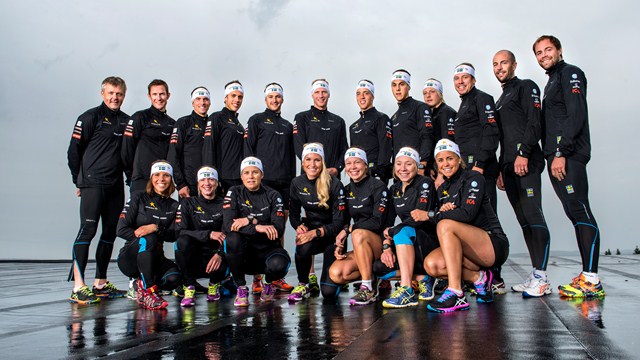
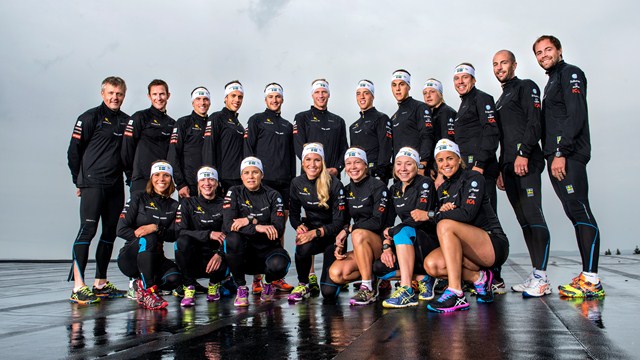
The Norwegian National Team last season on the World Cup circuit. (Photo: FIS/Nordic Focus)
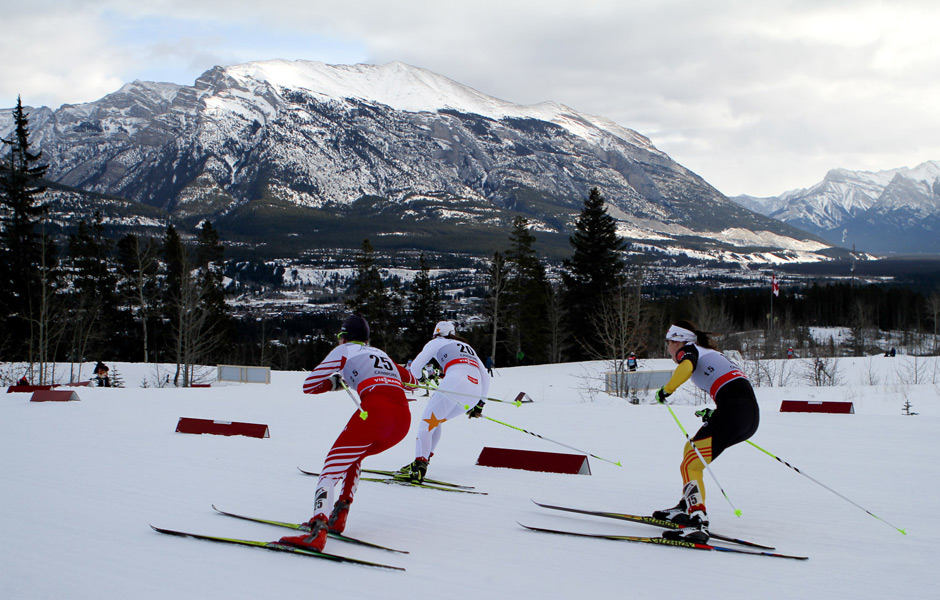
The view from a higher point at the Canmore Nordic Centre during the 2012 Alberta World Cup, which took place Dec. 13-16 in Canmore, Alberta. It was the area’s fourth World Cup since 2005.
Note: This article has been corrected to omit the Salt Lake Olympic venue from the list of places that several interviewed skiers haven’t visited.
Most skiers dream of skiing like a World Cup racer.
Okay, one article can’t change your VO2 max, your last eight years of training and your technique. The next best thing is skiing where the WC Euro-stars like to ski. FasterSkier asked a few at the recent World Cup in Canmore, Alberta.
Here’s what they had to say. It’s worth noting there are almost as many favourite places as there are skiers. Also, assume that everyone loves their hometown and their “home” training centre.
North America
There is a lot of what Joran at StatisticalSkier would call selection bias here. All of the favourite venues have hosted WC races. Most of the skiers interviewed aren’t old enough to have skied at Lake Placid, N.Y., or Thunder Bay, Ontario. While Quebec City throws a great party, none of the skiers got to the permanent ski areas outside the city.
— Kristin Størmer Steira (NOR):
“I must say Canmore, it is so beautiful although I also raced in Vernon/ Silver Star and that’s a beautiful place, and of course the Olympics in Whistler was great, but this scene with all this beautiful mountains, it is great. … [Canmore] is a great course.”
— Anna Haag (SWE):
“It is hard; I really like Canmore. It was the first place I saw in Canada. For sure, it is special. But then Whistler, I have my Olympic medal so that is special. But I like it over here, I like to compete in Canada. … [Sovereign Lake/Silver Star] was really nice. The amount of snow was amazing and I think we had like almost 50 centimeters of snow during the time we were there and the conditions were perfect. [Courses] are really tough over here, especially here in Canmore. I think [Canmore is in] the top three of the toughest course I ever skied, especially with the altitude it gets even more tougher. But they are really nice and they are really fair, and that is really important for competition.”
— Tobias Angerer (GER):
“Canmore. I was many times here and I love this area with the nature, with this mountains, and the track is perfect. It is so wide, and yeah, you have place for skiing. It is really good and the atmosphere is really good. I think every year more and more people are coming and the atmosphere is better every year.”
Sweden’s Jens Eriksson (l) racing to a NorAm 15 k mass start victory on Dec. 8 at the Sovereign Lake Nordic Centre in Vernon, British Columbia. (Eriksson photo: www.teamjens.se)
— Emil Jönsson (SWE):
“You can’t be sad when you are here [in Canmore].”
— Vibeke Skofterud (NOR):
“That is hard to say. I love Canmore. I love Silver Star; I have been there for one time. To race here in Canmore, it’s amazing. It’s really hard course, but good course, it’s wide, the snow conditions is really good, and the preparation is really good, the training course is good, and we stay at the Radisson [laughs]. The nature is good. I have only positive things to say. Right now, I have to say Canmore, but also Silver Star is a really good place to stay.
— Jens Eriksson (SWE):
“The conditions in Canmore was the best I have ever competed in, hard groomed tracks and perfect conditions. … [Sovereign/Silver Star] was just a great place for anyone who loves skiing. It was really a lot of snow in Silver Star and so many nice groomed tracks every day. It was just great and very fun to train and prepare for the World Cup there.
Europe — Angerer:
“I have many, many favourite places. Davos, maybe. Holmenkollen. Trondheim is a very good track.”
— Haag:
“I have a lot of favourites. I think since me and Emil having an apartment in Davos, I think Davos is one of my favourite places in Europe.”
— Skofterud:
“Norway is good! Davos is good. I like Kuusamo, because I always race good there. A lot of nice places.”
— Eriksson:
“It’s really fun to be part of the World Cup Final in Falun [Sweden].”
— Steira got carried away and didn’t answer the question, but she did say she is going to Davos to relax before returning home for Christmas.
General:
Many skiers were excited about going to Val di Fiemme, Italy, but whether that excitement was for the 2013 Nordic Ski World Championships, the food, the skiing or some combination of these was unclear.
The Venues:
— Val di Fiemme:
The Tour de Ski finishes here, the World Championships are coming for a second visit, and Petra Majdič (SLO) loves the food. — Davos:
Swiss superstar Dario Cologna’s home, and a favourite training area for skiers from Canada, USA, Norway and Sweden. — Holmenkollen:
The race trails with ocean views are on Oslo’s mass transit system. The 2,700-kilometer trail system includes Drammen, another world cup venue. More than 100,000 spectators attended the final day of 2011 World Championships. — Falun:
Morderbakken and the World Cup Final. Enough said. — Canmore:
Elevation: 1,400 meters. Annual snowfall: 2.4 m (8 feet). Trails: 20 k in early season, or ski to the next town (Banff) once the snow starts falling. Season: October 15th to mid-April.
Events this year: World Cup, various regional XC and biathlon events.
Past Events: 1998 Olympics, 2005 World Cup, 2008 World Cup, 2010 World Cup.
Funding: 65% government support, 35% users fees. $925,000 in special grants for 2012 World Cup.
Short story: Frozen Thunder opens the new season with leftover snow from the previous winter. The natural snowfall is fairly low, but the largest nordic snowmaking system in the world provides great skiing. The facilities are as spectacular as the scenery: the Alberta government provides funding that other regions can only envy, and that money has been spent well. Accommodation is in Canmore, with the downtown less than 2 k from the stadium.
Skiing: The Olympic (classic) 3.75 k loop is brutal, even by World Cup standards. The Centennial (skate) 3.75 k loop is much more flowing and can be enjoyed by middle-aged, middle-speed masters. The descents on both trails are on the challenging side, with no recovery except on the final drop into the finish straight. The recreational trails vary from beginner-friendly to very advanced. By Christmas, it is possible to ski to Banff and catch a bus back.
At Whistler Olympic Park in April 2009, some of the nordic combined Olympians arrived early at the start line for the Woppet. Claudia Nystad was the women’s winner that year, practicing for her Olympic gold medal. (Photo: Gerry Furseth)
Elevation: 900 m. Annual snowfall: over 4 m (13 feet). Trails: 56 k. Season: Mid-November to mid-April.
Events this year: Nationals (cross country, biathlon, nordic combined, ski jumping), Payak, BC Cup.
Past Events: 2010 Olympics, 2010 Paralympics, 2009 World Cup, 2008 Nationals.
Funding: A mixture of Legacy funding and user fees.
Short story: If you want to ski a 50k/30k/15k race without worrying if there will be snow, try the Payak. This is a place with a lot of snow at low elevation, with an average 1.9m snow base by February, and much more in April. The season length is limited more by post-Olympic mandate/funding constraints than snow. Accommodation is at Whistler or Squamish. The 2010 Olympic season was by far the worst snow in the short history of the venue.
Skiing: The Olympic loops are fairly easy by WC standards, with easy descents that allow recovery. Despite this, big pack finishes were rare. The Olympic loops flow through many transitions and are fun to ski at easy pace. There are also 42 k of recreational trails.
Top of the Upper World Cup 5 k in October at Sovereign Lake Nordic Centre. (Photo: Gerry Furseth)
Elevation: 1600 m. Annual snowfall: 7 m (23 feet). Trails: 50 k + 60 k. Season: mid-November to mid-April. There is often a May re-opening for team camps.
Events this year: NorAms, BC Cup, Sovereign Lake Loppet.
Past Events at Sovereign: 2011 World Masters, 2005 World Cup.
Past Events at Silver Star: 1991 World Cup.
Funding: Sovereign is a non-profit club: one third season passes, one third day passes, the rest is event fees, fund raising and government grants. Silver Star’s nordic financials are blended in with the resort.
Short story: Although appearing as Vernon on the FIS results, this is actually two interconnected trail systems. Vernon is a town of 30,000 people (20 minutes drive and 1200 m below the skiing). Sovereign Lake is a ski club of 1,700 members that hosts races, and Silver Star is a ski resort (alpine, nordic, and village with accommodation). Most visitors buy the dual-area pass and never notice the area borders.
Skiing: The 3.75 k World Cup loops used in 2005 are fairly easy, as World Cup trails go, and were designed to be skied by club members between races. The lower (skate) 2.5 k loop and upper (classic) 5 k loop look FIS moderate on the course profile, but feel harder at race pace. Pacing an individual start on the upper 5 k is particularly challenging. Upper world cup 5 k has one challenging hairpin, otherwise descents are easy and allow recovery. The Master’s World’s 15 k loop is very flat and easy skiing. The recreational trails are only hard in the sense that climbing to the viewpoint at 1890m elevation can leave you breathless. Luckily, a dual-area pass includes one chairlift ride to the top viewpoint.
The view from 1,870 metres at Sovereign Lake on Sunday. (Photo: Gerry Furseth)
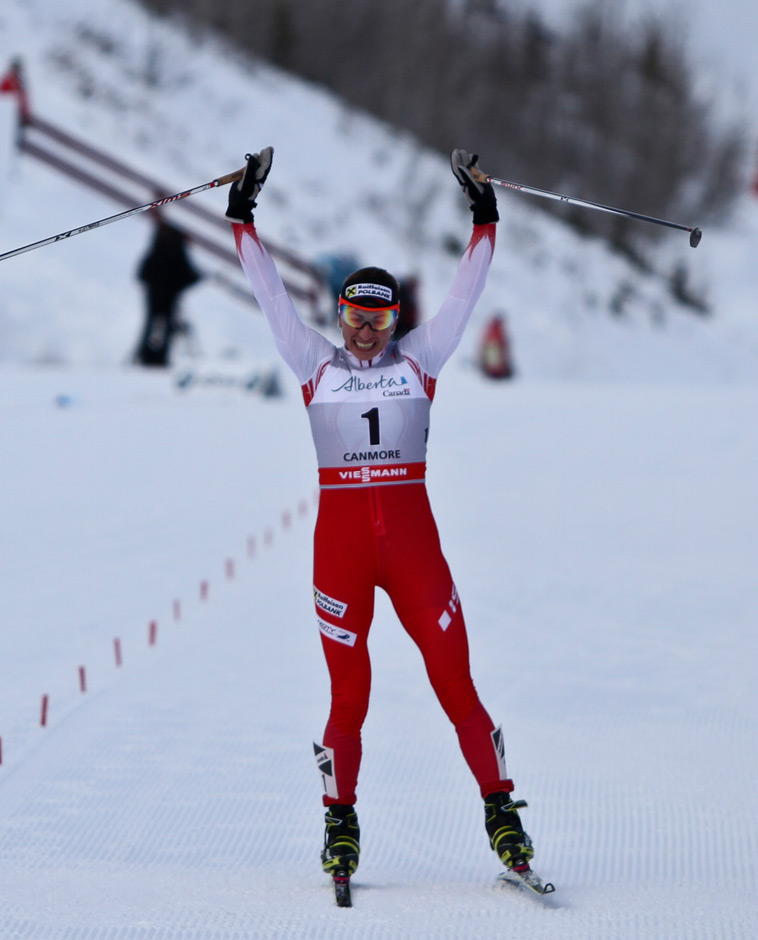
CANMORE, Alberta – Justyna Kowalczyk knows a thing or two about racing in Canmore. Among them, hard tracks, big hills and cold snow. Perfect, she thought before Sunday’s World Cup 15-kilometer skiathlon.
Every single distance race Poland’s pride and joy has done at the Canmore Nordic Centre, some 1,400 meters (4,600 feet) above sea level, she’s made the podium. Last year’s overall World Cup runner-up, Kowalczyk has won four races in Canmore since 2008, and two of them came this week.
After a victory in Thursday’s 10 k classic mass start, the 29-year-old rebounded from a less-then-stellar skate sprint on Saturday (in which she was 21st) to win the skiathlon. Doing so didn’t seem to be much of a problem; she created a gap of nearly a minute and ended up finishing in 42:51.5 minutes, 34.9 seconds ahead of Finland’s Anne Kylloenen in second.
Just one-tenth of a second behind, Vibeke Skofterud of Norway took third after Kylloenen outsprinted her to the finish. Kristin Størmer Steira (NOR) was fourth (+35.8) after initially trying to hang on to Kowalczyk with Skofterud for the first half of the race. Skofterud dropped off the pace on the second of four laps, but Steira held on.
Kowalczyk opened up an 11-second gap by the transition, and over the next kilometer, Steira fell off the pace. Skofterud picked up the slack and led a six-person chase group, but the 30-second deficit progressively increased. With one lap to go, Kowalczyk was nearly 50 seconds ahead.
“My plan was not so fast the first lap and then … ,” Kowalczyk said with a laugh.
The rest was self explanatory. She created a gap that made her essentially untouchable, even as the group worked together to catch up – albeit slightly – with three kilometers to go. Kowalczyk’s lead went from 52 seconds to about 35 at the finish.
“This was good plan I think,” she added.
Steira tailing Kowalczyk in the classic portion of the race.
Kowalczyk said she expected Steira and Skofterud to stick with her, and was surprised to drop Skofterud relatively early. Meanwhile, Kowalczyk tried to maintain a steady pace in the classic leg and accelerate when she put on her skate skis, and was pleased to find she wasn’t tired at the transition.
“My ski was working better today [and] I feel good,” she said. “It was really nice, not-so-fast snow, perfect for me.
Her win put her atop the World Cup standings ahead of American Kikkan Randall (who was eighth on Sunday) and Norway’s Marit Bjørgen, respectively.
“I have good feelings here, great memories,” she added, acknowledging a crowd with dozens of Canmore-based Polish supporters. “Sprint skating is not perfect for me, but all races, number one or number two is perfect.”
First place was probably preferable on Sunday. Kylloenen, 25, was more than happy with her silver, which matched the previous personal best she set Thursday. Kylloenen hadn’t been on a World Cup podium before this week, and on Sunday, she climbed from skiing outside the top 10 early to do so.
“I know that I’m in very good shape now,” Kylloenen said in a press conference. “I also tried to stay in the group and I know that I’m very strong that last part.”
Skofterud early in the race.
She edged Skofterud as well as Steira, Masako Ishida (JPN), Valentina Shevchenko (UKR) and Alija Iksanova (RUS), respectively, by less than two seconds at the finish. Kikkan Randall was next across the line in eighth, 1:18.4 minutes back, Ingvild Flugstad Oestberg (NOR) was ninth (+1:18.5) and Anna Haag (SWE) was 10th (+1:19.2).
Skofterud said she didn’t feel well during the classic portion, but hung in and found the 7.5 k skate leg was an entirely different race. About 10 seconds back on Steira at the transition, she led the chase group out on the next lap while Steira fell off the pace.
“I had to fight hard to stay in the group and when I get my skating skis I felt better and
better,” Skofterud said. “In the end I was looking forward to the sprint and I was looking for where Kylloenen was because I know she has a good last hundred meters, but I’m happy.”
After placing fourth in Thursday’s 10 k, she was pleased to capture her first individual World Cup podium of the season. The 32-year-old said she’s been having problems with her lungs in Canmore.
“This year I have not been feeling that good so I have been fighting hard to get in shape,” Skofterud said. “Today I felt better than I did Thursday, but still not 100 percent, but it’s going the right way and it’s good to go home to Christmas with better feeling.”
From here, she’ll prepare for the second World Cup period, minus the Tour de Ski. She made the decision to skip the Tour in order to maintain her form and training through the holidays and peak at World Championships. Without the conflict, it was an easy decision to race in Canmore.
Skofterud (l) and Kylloenen (r) battle to the line.
“I wanted to race every race before Christmas except for the sprint,” she said. “I think it was positive.”
Narrowly missing the podium in fifth and sixth, Ishida and Schevchenko took turns leading the chase pack, but ultimately, Skofterud drove the pace. Steira also got in the mix after climbing back from seventh place.
“I was surprised [with] myself with this day and that made me feeling even better than I did,” Skofterud said. “When I saw that I had possibilities to take part in the sprint, it was a good feeling and that made me stronger. It was cool to ski down into the stadium in front.”
Coverage of the Canmore World Cups was made possible through the generous support of Travel Alberta and Tourism Canmore.
The women’s 10k classic gets underway in Canmore.
CANMORE, Alberta — Despite a nine month absence, Justyna Kowalczyk (POL) did not need help finding the top step of the podium.
While her last straight win came back in February of last year, more than 30 World Cup victories was a trail of crumbs with enough staying power to allow the Polish star to retrace her steps.
Precipitous climbs, high altitude, classic skiing — all the ingredients for a Kowalczyk victory — made the three-time World Cup Champion the race favorite, despite a two-week layoff.
“Before the race you have some questions in the head,” she said of putting the bib back on. “But I know about my body and my skis. I was not afraid.”
Over the years Canmore has been good to Kowalczyk. She won for the third time in the picturesque western Canadian mountain town.
“It is a really hard course,” Kowalczyk said after skiing to a 14 second victory in the women’s 10km mass start classic in Canmore, Alberta. “One of the harder in the world,” she continued, before stating simply, “I am strong here.”
Strong indeed.
After starting the season slowly, as is her wont, Kowalczyk skipped the Quebec City sprints and came directly to Canmore after the Kuusamo mini-tour. Ten days of training clearly served her well as she showed the power and high gear that is her trademark.
“It is good to be outside Europe. For the head, for everything,” Kowalczyk said of her time in Canada. “Good altitude, a lot of snow, nice weather, sunshine,” she described her days of training.
Similar conditions greeted racers as they lined up for the start, but there would be no time to enjoy the scenery and fine weather. Unsurprisingly, the pace was high right from the gun.
Kowalczyk held position at the front of the pack through the first of three 3.3-kilometer loops. As the race approached the half-way mark, headed up the monstrous climbs for the second time, Kowalczyk accelerated, and gradually pulled away from the field.
Kowalczyk beginning to pull away the second time up the climbs.
“This was my tactic,” she explained. “Ski the first 5k together with the others and then try to ski faster.”
She took the preem at the high point of the course at 4.2k, earning an additional 15 World Cup points. The ageless Valentina Schevchenko (UKR) gave chase, cresting the climb just several seconds back, but Kowalczyk was not to be denied, and the Ukrainian was soon consumed by the chasers, a group that included the Norwegian quartet of Maiken Caspersen Falla, Vibeke Skofterud, Ingvild Flugstad Oestberg and Kristin Stoermer Steira as well as Kikkan Randall (USA).
As Kowalczyk pulled away, the battle for second became a race of attrition, with women steadily dropping off the back.
The Norwegians stayed strong, as did Randall while Anne Kylloenen (FIN) made her way up through the field to join the pack.
Primarily a sprinter by trade, the 25-year-old Kylloenen just missed the podium two weeks ago in the Kuusamo classic sprint, placing 4th.
The third time up the “wall,” the biggest climb of the course, Kylloenen made a move. To the surprise of most observers, no one could respond.
Finnish head coach Magnar Dalen said he was “shocked” when Kylloenen struck. He told FasterSkier that he liked her chances at the end of the race given the strength of her double pole and her sprinting skills.
“I was a little bit worried of course,” he said, but Kylloenen was feeling good.
“I had very much power,” she said of her final time up the big hills, and didn’t look back, skiing clear to second place, 14 seconds out ahead of third.
She described her first World Cup podium as “amazing,” but not completely unexpected.
“I know that I am in very good shape,” she said. “And it is very good conditions for me.”
Dalen was beside himself with the performance. He was hoping for a top-10, and the 2nd place marked a big step for Kylloenen.
“To see a young athlete climbing up to the podium for the first time, that is the best payment a coach can get…The best feeling in a coaches heart,” Dalen said.
A very happy Kylloenen crosses the line.
He described the progression Kylloenen has made, much like a parent would recount the accomplishments of a child — her first World Cup points, then a top-20, a 13th, a 12th, and now the podium.
In his 25th year of international coaching, Dalen has been around the block a time or two, and says he has seen “many stars raised up and then the hard way down again.”
He sees a difference between the breakthroughs of skiers like Kylloenen and the day-in, day-out efforts of the usual suspects.
“Bjørgen, Kowalczyk, Saarinen, and those like Northug, Cologna, that is more like professional gladiators fight,” he said. The success of his young athletes, however, is “more important to me than my salary.”
Kylloenen was not the only young sprinter to excel today. Falla, second last year in the Sprint Cup to Randall, put her speed to good use, besting teammates Skofterud and Oestberg and Randall in the homestretch to earn her first distance World Cup podium.
“I do not know what happened,” Falla told Norwegian broadcaster NRK after the race. “This was great fun.”
The Canmore finish stretch is notorious for requiring perfect execution. Coming off a fast downhill, drafting is crucial, and the associated slingshot effect is often the difference maker in head-to-head sprints to the line.
Coming from the back of the group Falla said “I didn’t realize I had a chance until the last 20-meters when I saw I had the highest speed.”
Randall, who finished in 6th was right in the mix but was unable to get the position she needed headed into the homestretch.
“I didn’t play my cards right at the finish,” she said. Slotting into second on the downhill behind Skofterud, she didn’t get enough of the draft effect to hit the podium.
“Maiken played it perfect,” Randall said. “She really had the best slingshot…and she is a really fast sprinter over the last 100 meters.”
Falla holding her own celebration.
Falla noted the absence of some of the world’s top women, including her teammates Marit Bjørgen, Therese Johaug, Marthe Kristoffersen and Heidi Weng, as well as the likes of Charlotte Kalla (SWE) and Krista Lahteenmaki (FIN), recognizing her placing was in part due to the depleted field.
Americans Jessie Diggins and Liz Stephen were also last-minute scratches.
But you need to show up to win, so while Kylloenen and Falla may have been harder pressed to reach the podium in a European World Cup, they still end the day with 80 and 63 additional World Cup points respectively.
Kylloenen can also talk about field strength all the way to the bank to deposit her 10,000 CHF of prize money. Falla, for her part, takes home a tidy 5,000 CHF.
Racing continues on Saturday with a freestyle sprint.
Of Note:
– Norway placed four in the top-7
– Masako Ishida (JON), a strong classic skier, and a podium contender entering the day, crashed early and never made it all the way back.
– Schevchenko ended up in 9th place.
– Russia had 5 women in the top-20, but none in the top-10. Norway was the only other nation to do so with Ragnhild Haga placing 20th.
GÄLLIVARE, Sweden – It was more or less a foregone conclusion that Norway would win today’s 4 x 5 k World Cup relay.
After all, how many relays hasn’t Norway won recently? Their team was particularly stacked for today’s edition, with Saturday’s winner Marit Bjørgen and runner-up Therese Johaug on tap, as well as sixth- and eighth-place finishers Vibeke Skofterud and Martine Ek Hagen.
While Skofterud initially faltered (she took the wrong lane at the lap, and Sweden said they would protest the fact that Norway received only a warning), over the second half of the scramble leg she made up ground on the leader – who also happened to be her teammate, Heidi Weng, skiing for Norway II. The pair tagged off together, with a slight lead over Ida Ingemarsdotter of Sweden and, surprisingly, Virginia de Martin Topranin of Italy.
Randall chasing Johaug.
But that’s where things got interesting. Johaug took over for the second classic leg, and was expected to extend Norway’s lead and ski away towards the usual blowout. But the reigning Olympic and World Champions never again had a lead of over ten seconds. While Sweden faded and Italy shot towards the back, Kikkan Randall of the United States built on a solid scramble leg from Holly Brooks and actually gained ground on Johaug.
“I knew that it’s a fast course, but I wanted to play it safe so I made sure I started off with a little bit left,” Randall, who had started with an 11.7 second deficit, told FasterSkier. “I caught up with those girls in front of me and sat behind them for a little bit. And then I just took a good line around one of the corners and got in front of them and thought, well, we’re already halfway through this race, I’d better go. And then I looked up and, whoa, Johaug is right there. I need to go after her!”
That extra motivation allowed Randall to turn in the fastest second-leg time in the entire race. Staying ahead of Randall was no easy task, even for Johaug, who responded to questions from the Norwegian press about whether relays were simply a walk in the park for her team.
“Everybody has to do their job,” she told NRK. “It’s not just going out there and being first. But today, we did our jobs.”
When Johaug tagged off to Martine Ek Hagen, her lead had been cut to eight seconds – which actually could have caused some anxiety. At just 21 years old, she has little World Cup experience and has competed in only one relay, at least year’s opener in Sjusjøen, Norway. There, she competed on Norway’s fourth team, and she didn’t stand out. Nevertheless, she was called on to replace veteran Kristin Størmer Steira. Hagen was nervous.
“I am inexperienced and thought they would keep the same team [despite yesterday’s results],” Hagen told Norwegian newspaper Dagbladet. “I felt that if I did a bad leg or fell in a ditch, then I would be doing a disservice to the whole team.”
If there was an opening for the U.S. – or perhaps for another team, like Sweden or Finland – this was surely it. And with third-leg skier Liz Stephen out for blood after a frustrating crash in yesterday’s race, it looked like the Americans had a chance.
Hagen, with Stephen chasing.
“I was just chipmunking around,” Stephen said of her leg. “I didn’t know what was going on. I just looked ahead and wanted to catch red. I didn’t look back, it wasn’t about who was behind me, I just was going for the red. I wanted to hand Jessie [Diggins] off right with [Marit] Bjørgen.”
Stephen couldn’t quite catch Hagen, but she put in a valiant effort, cutting the lead to just four seconds while preventing Sweden and Finland from gaining any ground. But Hagen was strong.
“I think Martine did a fantastic job,” Johaug told Dagbladet after the race. “It’s not easy to just go out there on the first team for Norway. You might get a little tight in the shoulders when you feel like you have to perform at that level. I told her that she had to ski her own race, and she did that in an awesome way.”
When Bjørgen took off with the lead, there were even fewer doubts about who would end up on the top of the podium. The star never seemed to put it into top gear, instead cruising around the course while extending her lead to 20 seconds.
“I tried to go out aggressively,” Bjørgen told NRK. “I quickly got back to eight seconds to Diggins, and Kalla did not come near.”
Bjørgen, agressive.
Behind her, Diggins was feeling the pressure that Hagen had just a few minutes before. She was faced with a starting position that sandwiched her between two of the strongest skaters in the world: Bjørgen, and Charlotte Kalla of Sweden.
“I think I lost a lot of energy hyperventilating,” Diggins said. “I’m not kidding. I almost had a full-blown panic attack. I saw Liz go by in second place and I looked at Matt, like, ‘Oh my God!” And started breathing really hard. I had to take five deep breaths. I was shaking before I even started.”
Diggins was unable to keep Bjørgen’s pace, and couldn’t hang on when Kalla flew by her, either. The Swedish crowd went crazy when Kalla took the lead; just one day before, it had been Randall edging Kalla for the final spot on the World Cup podium. Today, second place seemed secure.
Kalla working to second in front of the home crowd.
Diggins was eventually caught by Marthe Kristoffersen of Norway II, and the two climbed the final hill into the stadium together. Diggins was clearly flagging, exhausted. But she managed to rally a bit more energy, putting on a furious surge to pass the Norwegian and hold onto third as she came down the finishing stretch.
Diggins, anchoring the first US Women’s relay podium.
“At the end I could really feel it,” Diggins told FasterSkier. “I thought, I do not want to lose us a medal here, the girls and the team, the whole team worked so hard this year. I’m not going to screw this up right now. I was able to get just enough energy to get to the end. And then I thought I was going to die. I think I might have been crying.”
While Norway and Sweden were happy with their finishes – Hagen seemed particularly thrilled to be part of a winning relay team – it was the Americans that the TV cameras lingered on the longest. After Diggins collapsed into the snow, her teammates spent maybe ten minutes in the finishing pen – taking her skis off, hugging each other, celebrating. It was the first World Cup relay podium for the American women, ever.
“We’ve been working on this, and building it up step by step,” Randall said.
Stay tuned for more about the American women’s performance.
All 2012 FIS World Cup Finals coverage is brought to you through the generous support of Fischer Sports USA, proud sponsors of Kikkan Randall, 2012 overall Sprint Cup Champion.
FALUN, Sweden – It is amazing how interesting a 2.5-3.3-kilometer individual start race can be.
There might not be the head-to-head drama of sprints and mass-start events, but observing how skiers approach the prologue distance, and the challenging nature of the “not a sprint, not a distance race” leaves plenty to talk about.
With Mördarbacken (killer hill) falling within the first kilometer of the race, racers appeared to apply one of two basic strategies—throw down from the start and hope to hold on in the later gradual terrain, or open more moderately and accelerate over the top of the hill.
In the men’s race, the Norwegain team notably chose the later. On the lower pitches of Mördarbacken the first time around (the men added their extra distance by climbing the first third of the hill a second time), almost to a man, the Norwegians appeared to be having a collective bomb of a day.
Compared to many of their competitors, they were moving with a slow tempo and little explosiveness—maybe appropriate for the early stages of a 50k.
But this had changed when they appeared again as they attacked the last hill with a vengeance.
The results sheet supported the observations with eight of nine Norwegians improving their placing after the steepest pitch of the Mördarbacken.
Most notably Niklaus Dyrhaug, who was 4th moved up 13 spots, Sjur Roethe 11, Martin Johnsrud Sundby 19 and John Kristian Dahl 21.
Canadian Head Coach Justin Wadsworth told FasterSkier that “at the start of a race like that you can be really stressed and high tempo,” basically inefficient.
Despite the experience of most of these athletes, many appeared to fall prey to this trap.
A number of the Russians started hard, only to fall back later in the race.
Petr Sedov, however, was not one of them. He improved a remarkable 32 places over the final 2.1 kilometers of the race, from 44th to 12th.
Going the other direction was teammate Dmitriy Japarov, who fell 21 places from 15th to 36th.
Notable: Ponytail.
The women showed somewhat less volatility, most likely due to the fact there was just the single large climb.
The top-6 at the finish all were within that number at the top of the hill and only Jessie Diggins and Laure Barthelemy moved up double digits among the top-25.
Diggins improved 12 places from 20th to 8th and Barthelemy moved up 16 from 26th to 10th.
Notable: Barthelemy under control on the climb.
In addition to starting pace, there were quite a few differences in technique choice among the skiers—again more so with the men.
A few, like Jean Marc Gaillard, impressively chose to V2 the entire first portion of Mördarbacken, while others quickly switched to V1.
Completely anecdotally, the V1 choice seemed the better bet. The top three men, Alex Harvey, Dario Cologna and Devon Kershaw all used a powerful V1 relatively early in the hill, while the two most notable V2-ers, Gaillard and Marcus Hellner placed 24th and 9th respectively, with Hellner slipping after leading at the top of the hill.
German Josef Wenzl appeared to employ the Norwegian slow-start strategy, but someone forgot to tell him he was supposed to speed up later in the race.
The sprinter looked more than a little sluggish early in the climb and ultimately beat only American Sylvan Ellefson, who crashed hard and required on-course medical attention.
Notable: Face of the day courtesy of Aino Kaisa Saarinen (FIN)
Watching the women up at the crest of Mördarbacken revealed different technique choices as well.
Some quickly switched out V1 as they crested the steepest pitch, V2-ing the remaining gradual climb, while others continued to V1.
Again, unscientifically, it seemed that V1 was the better choice for most.
Some women, notably the Norwegians, hugged the outside of the climb on skier’s right, sticking to the shaded part of the track along the barrier.
Heidi Weng hugging the wall.
Most of the Norwegians executed this to the extreme, staying outside of even the twists, while other skiers opted to take a better line.
Two of the top Norwegian women did not start the race, withdrawing from the mini-tour.
Vibeke Skofterud made the decision not to race after warming up.
“She is a little bit tired after the Vasaloppet (the 90k Swedish ski marathon that Skofterud won two weeks ago),” Norwegian women’s coach Egil Kristiansen said.
He added that she is having some minor issues with her elbow after the double-pole fest that is the Vasaloppet.
Astrid Jacobson also passed on the prologue citing stomach problems according to Langrenn.com.
Their teammate, Therese Johaug, however, was in fine form, placing 6th and climbing to 19th in the World Cup Finals standings.
“It is a steep hill here in Falun and it is really hard, but I like to climb these hills,” said Johaug.
She attacked the Mördarbacken with her usual double-time tempo.
“I train a lot for this one in the summer at home in Dalsbygda and when I was a little girl, my grandfather said, ‘If you should be a good cross country skier you have to train on uphills,’” she said.
And thus she trains uphills, something she “likes very much.”
At this point, Johaug is considered the best climber on the World Cup circuit after twice winning the Tour de Ski final climb.
“I push myself to do my best,” Johaug continued. “The important thing is to not be too far away from first place…In the end it is a tour and that’s the reason to get to the top.”
Johaug doing what Johaugs do best—climbing.
Eirik Brandsdal, winner of the Royal Palace Sprint continues to lead the World Cup Finals after placing 31st in the prologue, a result he was pleased with.
“It was a good race,” Brandsdal said. “I saved some power on Mördarbacken, and from there I just pushed as hard as I could.”
Climbing, Brandsdal said, is his strong suit, so the course suited him.
He is currently three seconds ahead of Harvey entering the third day of competition.
Following the prologue, he had yet to consider the possibility of going for bonus seconds in Saturday’s mass start.
“I think I will just try to stay with these guys [Harvey at al] as long as possible,” Brandsdal said. “I am a sprinter, so it will be hard for me, but I will do my best.”
He added that his performance in the mini-tour thus has already exceeded his expectations.
The start of the 2012 Vasaloppet, Mora (SWE). Photo: Fischer/Nordic Focus.
The 90-kilometer Vasaloppet is one of the most prestigious non-World Cup ski races in the world—such a big deal in fact that Petter Northug made the race his primary focus in 2012 following the Tour de Ski.
Unfortunately for Northug, a stomach bug kept him from even reaching the starting line, and we can only guess at how he would have fared.
Of course safe money would have been on Northug if he had been able to hang with the lead group for the duration of the event. The men’s race came down to a four-man sprint, Northug’s forte.
But it was Joergen Brink of Sweden who took the top spot, edging out countryman Daniel Tynell, marathon specialist Stanislav Rezac (CZE) and World Cup stalwart Daniel Rickardsson (SWE) at the line.
Brink also won the Tartu Marathon in Estonia in February.
“Today was such a perfect day where I could be aggressive all the time and just go for it,” Tynell told Swedish ski website Längd.se. “It does not feel like I lost a gold, but like I won a silver medal.”
Brink’s winning time of 3:38:41 was the fastest ever in the Vassaloppet.
The top nine finishers were all within five seconds in the men’s race, in strong contrast to the women’s race, where Vibeke Skofterud, with much less fanfare than Northug’s aborted attempt, took time off from the World Cup to ski to a clear win.
Skofterud, a mainstay on the Norwegian relay team, and who, despite missing the Tour de Ski due to illness, is ranked ninth in the overall World Cup standings bested runner-up Laila Kveli (NOR) by just over three minutes.
Skofterud also set a new time record in the race, despite losing a pole when another skier stepped on it. The Norwegian had to go back and pick it up, allowing Hansson to take a temporary lead.
The 24-year-old Kveli is in her first season racing the marathon circuit, and reached the podium for the first time in the Vasaloppet, bettering her fourth place finish in the 70k Marcialonga in Italy.
Racing for the Norwegian Team Xtra Personnel, Kveli was nearly three minutes up on Team Exspirit’s Seraina Bonner (SUI) with veteran marathoner Hansson (SWE) in fourth.
The top American finisher was Andreas Halvorsen, who placed 245th in a time of 4:15:07.
Brian McKeever paced the Canadians in 83rd. McKeever was skiing in the top-20 before breaking a pole and dropping back.
Megan McTavish was the top Canadian woman in an impressive 52nd place.
Ruth Oppliger was the top American woman in 616th.
Marit Bjorgen celebrates a victory for Norway I after anchoring the team to first in the 4×5 k relay at the World Cup in Nove Mesto, Czech Republic, on Sunday. Photo: Fischer/NordicFocus
As the sunlight sliced through rows of majestic trees in Nové Město na Moravě, Czech Republic, Sunday around noon, a few of the Norwegians could have afforded to soak up the scenery in the women’s 4×5 k relay.
They probably didn’t, though.
Marit Bjørgen finally lifted her head to look around as she entered the stadium to seal the Norwegian win. With a nearly 40 second lead, Bjørgen as the Norway I anchor threw up her hands and smiled. For the second time in as many relays this season, Norway had won it.
Therese Johaug builds on the lead for Norway I as the second leg in the 4×5 k relay at Nove Mesto, Czech Republic, on Sunday. Photo: Fischer/NordicFocus
For three of four legs, Norway’s ‘A’ team led comfortably. Vibeke Skofterud started off the relay in a tight battle with her teammate on the national team, Heidi Weng, the first leg on Norway II. Skofterud and Weng tagged off together, with Skofterud giving Norway I the slight edge.
Therese Johaug took that advantage and ran with it. Within a few strides, she dropped Ragnhild Haga of Norway II and went on to give teammate Astrid Uhrenholdt Jacobsen a nearly 30-second lead. Russia was the new contender for second with Finland, and Haga fell back to fourth.
For Norway I, the race was essentially in the bag – especially with Bjørgen heading out 33.7 seconds ahead of anyone else. They refused to let up.
“We never take a relay victory for granted,” Jacobsen told FIS News. “In a relay, [anything] can happen. … It was hard to race alone the whole way in front. You have to push always because you can lose quite quickly a lot of seconds.”
Finland and Norway II, which finished second and third in a photo finish, would have likely preferred to ski alone for the win. The Swedish and American anchors in Charlotte Kalla and Jessie Diggins probably felt the same way.
After Finland and Norway II successfully dropped Russia on the third leg, the two continued to battle for second. More than 30 seconds ahead of Sweden, Germany and the U.S. at the last handoff, they looked liked they had a handle on the podium.
Meanwhile, Kalla tried to close on Finland’s Krista Lahteenmaki and Ingvild Flugstad Oestberg of Norway II. Diggins went with her.
Jessie Diggins chases Charlotte Kalla of Sweden in the anchor leg of the 4×5 k relay in Nove Mesto, Czech Republic, on Sunday. Kalla edged Diggins at the line for fourth place. Photo: Fischer/NordicFocus
For all 5 kilometers of their skate leg, Kalla and Diggins skied together, with Diggins looking back to see who was behind them. Russia was closest, some 40 seconds behind them in sixth, and Germany had fallen further back.
Coming into the stadium after their first lap, Diggins moved ahead of Kalla, a two-time Olympic medalist from the 2010 Vancouver Games. Her gold and silver didn’t faze Diggins; it gave her strength.
“I’m sure I was in a lot of pain,” Diggins wrote in an email, “But I was so excited at the chance to race neck-and-neck with and Olympic Gold Medalist that I didn’t feel a thing!”
Kalla regained the lead after 2.5 k and continued to make a run for third. When it became clear that more than 20 seconds was too much to overcome, she and Diggins refused to let up and kept pushing for fourth.
There, Kalla had the edge by 0.1 seconds, and Diggins finished fifth (+54.8) collapsing on the ground while several teammates, including Holly Brooks, Ida Sargent and Liz Stephen, rushed over to congratulate her. It was the Americans’ best relay result of the season.
“I was so incredibly proud of our team today – racers, athletes cheering, coaches, wax techs,” Diggins wrote. “It was so amazing how everyone just shrugged off the disappointment of yesterday and woke up ready to give this race everything they had.”
A Fresh Start
Going into the race, the U.S. women’s coach Matt Whitcomb said in a phone interview that the game plan was to rebound from Saturday, after every American placed outside the top 30 in the classic distance mass starts. Many of the women had been dealing with lingering colds and felt tired after competing in Russia, he said.
“So today was a hugely positive result,” Whitcomb said. “[We were] hoping that they could all tie together four really strong legs, and they did that so we were just ecstatic.”
The U.S. women's relay with Ida Sargent (l), Liz Stephen, Holly Brooks and Jessie Diggins (r) celebrating it's fifth-place finish in Nove Mesto, Czech Republic, on Sunday. Photo courtesy of Andy Newell.
Without Kikkan Randall in the lineup because she was recovering from a cold, Brooks rallied to lead the team as the first leg. She did not finish Saturday’s 15 k because of digestive problems, which plagued her since last week’s race in Moscow, but knew she had to be ready for the relay.
“I was worried and anxious about what kind of performance I would be able to deliver,” Brooks wrote in an email. “It’s one thing to let yourself down but it’s a completely different thing to let down the rest of a relay team!”
Fortunately, her body held up for 5 k and she put the team in eighth, 34.6 seconds behind the leaders.
“My goal today was to stay in contact with the other teams and luckily, I was able to do it,” she wrote, noting an aggressive start in which she had to “extend” her elbows.
In her first time skiing the scramble position, Brooks wrote that it suited her strengths and she had a lot of fun. It also gave her a chance to cheer on her team in its best performance in recent memory.
“I’m ecstatic about our team performance, especially given the fact that we didn’t have one of our strongest teammates on board,” she wrote, referring to Randall, who was resting before the last freestyle sprint of the year on Friday in Poland. “I think our 5th place finish today goes to show the depth of our team right now.”
Whitcomb said that Brooks was their wild card, considering she felt the worst going into the relay.
“She laid down an incredible leg and the team just fed off of that,” Whitcomb said.
Usually leading off, Sargent tried out the second leg and brought the U.S. to sixth, passing Kazakhstan and France in the process. Feeling good, Sargent wrote in an email that she skied as hard as she could to pick off as many places as possible on the second lap.
“My goal for today was to ski my own race and go as hard as I could,” she wrote.
Whitcomb said it was Sargent’s best performance in her third World Cup relay. She was 1:06.4 out of first when she tagged Stephen, who kept the team in sixth and passed off to Diggins in a crowded exchange zone with Sweden and Germany.
“As soon as Liz came through the tag zone and I realized I was right behind Kalla, I threw my plans of ‘skiing my own race’ out the window and proceeded to glue myself to Kalla,” Diggins wrote. “It was great to ski with her and though I couldn’t get around her in time to pull a great sprint at the end, I’m psyched out of my mind to have been in a photo finish with Charlotte Kalla!”
Jessie Diggins reacts to her CXC coach Jason Cork after anchoring her team to fifth place in the 4×5 k relay at the World Cup in Nove Mesto, Czech Republic, on Sunday. Photo courtesy of Andy Newell.
While Whitcomb was hardly surprised with Diggins’ performance, especially since she was the only woman who was completely healthy, he was impressed with her anchor leg.
“To hear over the radio that, ‘Jessie’s now leading Kalla on the second lap,’ … was an incredible thing to hear,” he said.
She came as close as 18 seconds to third place and skied the fastest fourth leg of the day.
U.S. head coach Chris Grover said the team’s overall performance showed its depth and potential.
“It was really gratifying for us to be able to field such a competitive team with kind of our marquee woman out of the mix,” he said of Randall, who usually starts first or second.
Whitcomb said the made a conservative but good decision to rest Randall, who was aiming to keep her lead in the World Cup sprint standings.
“Without Kikkan, we still had a strong team, we felt, and we fully supported the move to make sure she is 100 percent healthy as we travel to Poland,” Whitcomb said.
“We’ve known for a couple years that when this team starts to really pull together in the direction that it’s pulling, the medals will be getting closer and closer,” he said of the relays. “And you can sure see the possibility now.”
Congratulating one another at the finish, the U.S. women wrapped up the weekend with the feeling they were used to: excitement.
“We definitely had the most fun out there with glitter, face paint, knee high red white and blue striped socks and huge smiles,” Sargent wrote. “We were so pumped in the finish area that Vibeke Skofterud and some of the other Norwegian girls on the winning team started taking pictures of us.”
“We really had fun out there today as a team,” Diggins wrote. “And it definitely showed.”
Marit Bjoergen (NOR) and Justyna Kowalczyk (POL) during classical mass start in Nove Mesto (CZE). Photo: Fischer/Nordic Focus.
The Marit Bjørgen (NOR), Justyna Kowalczyk (POL), and Therese Johaug (NOR) show continued in Nove Mesto, Czech Republic, as the three packed the podium once again, this time in the 15km classic mass start.
The recipe is simple, and easily repeatable. Take the three women listed above, mix together well in any type of distance race format, add in a hearty shake of snow, and bake for 15 to 45 minutes.
The result will be a lovely podium tinged in red and black, though some variation should be expected in the exact pattern.
There seemed to be some hope for a little variety in women’s distance racing last week when Charlotte Kalla (SWE) battled with Bjørgen in the 10km skate mass start in Rybinsk, Russia.
Kalla placed second in that race, and Marthe Kristoffersen (NOR) outsprinted Johaug for third. With Kowalczyk struggling to seventh, only one of the big three was on the podium.
But it was business as usual the following day in the skiathlon. This time it was Bjørgen who was not in top form, but Johaug skied away from Kowalczyk for the win, and Bjørgen took third.
Today was even more within the norm. By the 5k mark, the trio had opened a small gap that predictably continued to grow.
The three skied in lockstep through 12 kilometers before Johaug began to struggle with her kick and fell off the pace.
Kowalczyk pushed at the front, with Bjørgen dialed in on her tails. The Norwegian looked relaxed, and in no danger of succumbing to any attack that Kowalczyk might throw down.
Headed into the stadium the final time, Bjørgen moved into the lead, riding faster skis to a 5 meter gap. Stronger over the rise in front of the crowds, she ended any last hope for Kowalczyk and double poled home for the win.
Johaug easily held position for third, and Vibeke Skofterud, back in form after missing the Tour de Ski due to illness, was fourth, besting an impressive Masako Ishida (JPN) in the homestretch.
The win moved Bjørgen back into the overall World Cup lead by a mere 12 points. Kowalczyk won both intermediate bonus sprints, but with Bjørgen second each time, the Pole only gained an additional six points.
Of course, with the narrow margin separating the women, those points could be the difference come March.
Johaug solidified her third spot in the overall, and Kalla, who was sixth behind Ishida, jumped past an idle Kikkan Randall (USA) into fourth.
Kalla’s performance, if not the most impressive, was at least exciting. She spent most of the race further back in a small chase group, before attacking hard in the last lap to finish at the front of the group.
As is common in women’s World Cup racing, the pack quickly broke into numerous smaller clusters due to the high pace set by the leaders out of the start.
While there may not be much drama at the front, there is plenty of moving around back in the field, with attacks, responses, and attempts to bridge up.
And while the predictability of the podium composition may get old, the fight between Bjørgen and Kowalczyk will be one for the ages, bringing to mind 2000 when Bente Skari (NOR) overtook Kristina Smigun (EST) on the final day to win the title by ten points. Smigun had the overall wrapped up with less than two k to go in the last race when she crashed, losing several places and the crystal globe.
Bjørgen, in a previous incarnation as the world’s best skier, experienced such a battle for the overall back in 2006.
She held off a hard charging Beckie Scott (CAN) to win by just 16 points. On the final day of the season, Scott won the 15k skiathlon and Bjoergen was 4th,11 seconds ahead of Valentina Schevchenko (UKR) in 6th.
Had Shevchenko and Katerina Neumannova (CZE) in 5th, gotten the upper hand, Scott would have been champion.
Back in the present, Bjørgen pulled of something of an upset. The 15k classic is Kowalczyk’s best event, so the Norwegian was especially pleased to take the win.
She pointed to her fast skis, which gave her an edge on the final descent as the key, but said that prior to the race she was not sure she would be able to defeat Kowalczyk in the finish straight.
Early in the race, Kowalczyk noted the superiority of Bjørgen’s glide, and did her best to get away on the climbs. With a skate sprint next weekend in Poland, Kowalczyk does not believe she will take back the top spot immediately, but with plenty of classic races yet to come, her chances are still good.
While Johaug remained within 14 seconds of the leaders, her last lap was not so good.
“I was little bit tired in the last lap and I also lost grip in the uphills, and my skis were not the fastest in thee downhills,” Johaug said, describing a perfect storm of slowness.
She was plenty happy with third place however, and enjoyed the fine weather—moderate temperatures below freezing, firm tracks and sunny skies—a rare combination this season.
Johaug might not be in contention for the overall, but she is a big piece of the desert that is women’s World Cup ski racing. And for the moment at least, Bjørgen is the biggest slice of that pie. In just over a month however, all that matters is who ends up as the whipped cream on top.
Of Note:
– Norway placed three in the top four, and five in the top eight with Astrid Jacobsen and Heidi Weng in seventh and eighth respectively.
– Three teams, Norway, Sweden, and Russia, combined for 17 of the top-30 spots.
– Russia had just one skier in the top-18, Alija Iksanova in 10th, but then packed five women into 19 through 24.
– The result was the second-best of Iksanova’s career, behind only a 6th in Rogla this season. The 28-year-old has just 17 World Cup starts, all but two coming this year.
– Ishida’s 5th was her best since placing 3rd in the 30km classic in Trondheim in 2009.
– In three out of the last four World Cup distance races, Germans Nicole Fessel and Katrin Zeller have finished within two places of each other. In two of those races they finished in consecutive places. Today they sprinted to a photo finish, with Fessel gaining the upper hand to place 13th.
– Sofia Bleckur (SWE), only an occasional World Cup presence for Sweden was 17th, her second-best career result. The 28-year-old will race the relay tomorrow.
Back in December I posted a short note about how Vibeke Skofterud has a tendency to ski considerably better in the early part of the season. Since we’re in the midst of a break between WC periods I thought it might be good to check in and see how things are progressing:
Those are her distance results (using standardized percent behind the median skier) with her 2011-2012 results shown in red. As you can see, there was a bit of a gap between her early races and her most recent one, but based on that one race things seem to be following her typical trend. As for her sprint results:
Overall, the backward trend with sprinting isn’t quite as clear, but she appears to be following up on this one as well so far.
Kowalczyk, way ahead of the field. Photo: Fischer/Nordic Focus.
After struggling to match her form from last winter, Justyna Kowalczyk (POL) was finally back on top of the World Cup podium on Saturday in Rogla, Slovenia for the 10 k mass-start classic distance. Throughout the beginning of the five-lap race, Kowalczyk traded the lead on and off with Therese Johaug (NOR), who ended up fading to second at 22.1 seconds back. Her teammate Vibeke Skofterud (NOR) made a late-race challenge for silver, but ended in third (+27.4).
Finland’s Aino Kaisa Saarinen, who finished 4th, was a contender early on as well. But the contest eventually whittled down to three women, and then to two as Johaug and Kowalczyk battled each other and Skofterud failed to respond in time.
When Kowalczyk initially took the lead, it seemed like the risky move of someone with something to prove. Her season so far has been relatively slow—a 5th in the Davos 15 k was her best result prior to Saturday, while last season at this point she’d already been on the podium more than once. Speculation on her seeming lack of fitness has swirled around the Polish star for the past few weeks.
Johaug leading the pack early in Rogla. Photo: Fischer/Nordic Focus.
For the time being, at least, Kowalczyk let spectators and competitors know they were wrong to doubt her. Johaug took back the front position for a time, but never quite shook Kowalczyk, who had much faster skis on the downhills. Kowalczyk re-passed and put a gap between herself and the struggling Norwegians in the final kilometers.
“Rogla is good place for me,” said a grinning Kowalczyk in the post-race press conference. “There must be a good air for me.”
“I expected the fight with Therese to be harder,” she added.
Johaug, on the other hand, suffered. She and Skofterud lay in the snow for an unusually long time after collapsing in the finish area. Afterwards, she told the NRK that she had just completed the most painful race of her career.
“I’ve never been so tired when I reached the finish,” said Johaug, and summed up the experience as “the worst.”
Skofterud, with Saarinen (FIN) just behind. Photo: Fischer/Nordic Focus.
Skofterud echoed the sentiment. “I gave everything I had and it was really hard in the second [lap],” she said at the press conference. Though she got a second wind as she started to gain on Johaug in the third and fourth laps, by the final sprint she had “no power left” and was unable to surpass her teammate.
Like the men’s race, conditions for the women were challenging: soft snow with a strong headwind. But the women didn’t have a tightly-packed lead group to split the workload of breaking the wind, especially in the final laps.
The women’s race featured a single intermediate sprint for bonus World Cup points, but it had less of an impact on mid-race strategy when compared to the men’s race. The field was so strung out by lap three that there would have been minimal shifting amonst the top 10 women even if they’d really fought for the points.
The fresh snow on the Rogla trails made the tracks slower and the course more of a challenge than the one athletes practiced on the day before. With the field so spread out, there were slight downhills that skiers had to actively push down where they’d picked up natural speed earlier in training.
“For only being a 2 k course, it was plenty challenging,” said Kikkan Randall (USA), who finished 11th on Saturday. “There were tough striding sections, sections where you really had to work the transitions, and there were short rest breaks. The wind added another element—you’d come over one of the big climbs into the headwind.”
Randall hung in the top-5 for the first part of the race, but when she started to tire, had trouble staying with the women who overtook her.
Despite not being able to maintain her position, eleventh is still Randall’s best-ever classic distance result. It wasn’t quite enough to maintain her overall 3rd-place ranking on the World Cup, however—Johaug now sits above her by 48 points, and is only eight points away from bumping Skofterud (in 2nd) down a peg, too.
(Despite not racing at all this weekend due to illness, Marit Bjoergen (NOR) still maintains a 103-point lead after Saturday’s 10 k, so even if Skofterud wins Sunday’s sprint, Bjoergen will remain the World Cup leader at the end of Period 1).
“My intention this year was to go out aggressively and see how long I could hold it,” said Randall of the impressive season she’s had so far. With another crack at a skate sprint on Sunday, the way things have been going she may be holding on a bit longer.
Spectacular conditions in the stadium on Saturday morning in Davos, Switzerland.
Davos, Switzerland – There is no doubt that the Norwegian women’s ski team is currently the best in the world.
On Saturday morning, during the 15 k individual start freestyle in Davos, Switerland, they absolutely dominated the leader board, putting six women in the top ten, and taking the first four places.
Surprising no one, Marit Bjoergen (NOR) crossed the line with the fastest time, leaving Vibeke Skofterud the silver medal, 41.8 seconds back. Therese Johaug finished 42.2 seconds back of Bjoergen for third, securing the podium for the Norwegian women.
Young 22 year old Marthe Kristoffersen finished fourth, while Kristen Stoermer Steira was sixth.
Only Justyna Kowalczyk (POL) was able to put a dent into the Norwegian armour, finishing fifth, a long 1 minute 26.4 seconds back of her Norwegian rival.
Justyna Kowalczyk (POL) heads out on her first 5 k loop – she finished 5th on the day.
But in the early stages of the race, it wasn’t the Norwegians who appeared dominant, but the Americans.
Holly Brooks (USA) held the best time through the first time check for a significant portion of the race, with Kikkan Randall (USA) and Liz Stephen not far behind – at least until the Norwegians showed up.
“Of course it’s always fun to hear that you’re in the lead but you have to put that in perspective,” said Brooks of her fast start in an interview with Fasterskier after the race.
“I wasn’t super worried [about fading], because I felt like I was in control,” she said.
In the end, at the 4 k mark Brooks has the 7th fastest time, and was looking comfortable, but behind her the inter-Norwegian battle was heating up. First Kristoffersen bettered the early lead times set by Charlotte Kalla (SWE) and Kowalczyk, followed by Johaug, and finally Bjoergen.
Bjoergen then took the race over, putting big time gaps back to Johaug and Skofterud with ease, and pulling up before the line to celebrate on her way to her 49th career World Cup victory.
“I had a very good feeling today,” said Bjoergen after the race.
Marit Bjoergen (NOR) on her way to dominating the field in Davos Saturday.
“I kept good technique at the beginning of the race and maintained speed in the flat section.”
On the heavy climbing course, it appeared Johaug was going to be a solid lock for second, as she went through every time check in second, and looked strong. With a 5.6 second lead over Skofterud at 11.5 k, the race was still on, and after Johaug crossed the line, Skofterud hammered down the finishing straight almost exactly a minute later, stick out her toe to take the silver away from the ‘Energizer Bunny’.
“The hills were really tough,” said Johaug in an interview with FasterSkier after the race.
“It was a really good race for me today.”
But Johaug didn’t hide her disappointment with letting second place slip away from her.
“Of course, I was number three, I was just .4 of a second back of Skofterud, but I’m really happy with my race and I think I did the best I could today,” she said.
Of the strong showing of Norwegian women today and this season, Johaug attributed it to having a good team atmosphere.
“We are training a lot together,” she said. “We push each other a lot in the training.”
Third place finisher Therese Johaug (NOR) in the mixed zone after the race in Davos.
So I tune into the FasterSkier podcast tonight during my run, only to hear that I’m apparently the lead topic, by way of Kikkan Randall’s strong classic sprint (and distance) results in Kuusamo. Fair enough. As fun as it would be to turn this into a full on blog war, I actually think we’re all on the same page here.
Colin and Christopher had expressed a fair degree of confidence in their first podcast this season about Randall’s chances of winning the overall sprint WC. I disagreedslightly. I guess I’d just point out that they made those claims before Randall’s good classic results, so my point that she’d have to vastly improve her classic results seems pretty spot on to me. Also, one weekend of strong classic races does not a trend make. (But I’m certainly hopeful!)
And I’m still not sure how Randall can win the sprint WC overall without beating Bjørgen at least once in a classic sprint. But if Bjørgen really does skip two freestyle sprints in December, that will help enormously.
Vibeke Skofterud
This is just going to be a Nordic Commentary Project heavy post. Christopher Tassava lays out a fairly good case arguing that Vibeke Skofterud tends to ski fast early in the season, but fades considerably as the season wears on. I’m certainly glad that my new graph making tools proved useful!
He asked if I’d weigh in on the issue, and I’m glad that he did. You see, statisticians spend a lot of time being Debbie Downers. People come to us with interesting questions and we spend a lot of time, a lot, disappointing them. You don’t have enough data. There’s no clear trend. There’s not much difference. Nothing happened.
So you can imagine how delighted I was when I sat down to look at Skofterud’s distance results condensed into a single “season” so we can see trends by month:
She’s had a handful of strong races in early to mid March, but this is a pretty clear picture, I think. The blue line is the median by month. The situation is only marginally less obvious with sprinting:
That wacky hiccup at the very beginning is because I’m aggregating on month, and there were only those ~3 races in October back in the day. Ignore those for the moment, and you can quite clearly see a distinct shift beginning in January.
I’m not going to speculate on the reasons, as I’m sure I have no idea. I’m just going to bask in the pleasure of confirming someone’s hypothesis rather than refuting it, or worse, saying that we can’t tell for sure.
Marit Bjørgen racing in Norway in 2009. Photo, Geir Olsen.
Nobody was surprised to see Marit Bjørgen atop the leaderboard after the second stage of the Ruka Triple in Kuusamo, Finland today.
The Norwegian star was the last to start, thanks to her win in the classic sprint yesterday, and had all the information she needed to beat her competitors – not that she needed it. Over just five fast kilometers, Bjørgen racked up a sizeable lead and cruised across the finish. It was a stark contrast to the earlier finishers, who had sprinted for all they were worth and collapsed immediately.
The refreshing thing about Bjørgen, though, is that even if she dials it back in the last hundred meters and still wins by more than ten seconds, she’s humble and gracious, smiling and raising her arms as she crosses the finish line for each win.
In comments to the press, the star – who picked up her 50th World Cup win with the victory – attributed her performance to good skis from the Norwegian wax techs. She also said that the final stage of the triple, a classic pursuit, would be difficult because “the other girls are getting stronger and stronger all the time, and they’ll try attack me but l just do my best and see the results after finish line.”
That’s a pretty notable lack of swagger coming from a woman who is literally entering uncharted territory: she recently passed Bjørn Dæhli and taken the all-time win record. Bjørgen doesn’t seem to be slowing down, and will likely further obliterate Dæhli’s tally by the end of 2012. After that, who knows how many more wins she will rack up, but one thing is for sure: nobody will touch her record, whatever it is, for years and years. Especially if they can’t get a single win as long as she’s competing.
With Bjørgen holding the top step of the podium hostage, a number of other talented women are left fighting for the remains. Charlotte Kalla of Sweden and Vibeke Skofterud of Norway finished second and third, repeating the podium that fans have seen in each of the World Cup races so far this season.
“I could get used to being on podium,” Skofterud joked to the press.
The 31-year-old has added two distance podiums to a collection that was previously quite small; the last time she collected a top-three finish in a World Cup that wasn’t a sprint or a relay was here in Kuusamo two years ago.
“It’s strong, it’s fun and it’s really well-deserved,” Bjørgen said of her teammate’s finish today when talking with NRK, the Norwegian state television station.
But despite the winner’s kind words, Skofterud indicated that she didn’t want Bjørgen to get too comfortable at the top. She’s willing to go as far as working with non-Norwegians in an attempt to take her down in the pursuit tomorrow.
“We have to work together with Kalla to chase Bjørgen,” she said.
A Resurgent Jacobsen
Jacobsen (L) with Maiken Caspersen Falla after finishing third in the team sprint at 2011 World Championships.
Her teammate Astrid Uhrenholdt Jacobsen – who won the World Championships sprint back in 2007 as a twenty-year-old – was the story of the day and sat in the leaders chair for the majority of the race, ultimately winding up sixth, 27 seconds behind Bjørgen.
Jacobsen was plagued by injuries in 2007 and then suffered from a horrific biking accident in 2009; she’s also a medical school student, something that would seem crazy in the U.S. but is completely unheard of in Norway. Jacobsen had some strong performances last season, including tenth overall in the Tour de Ski, a bronze medal in the sprint at World Championships, and a fifth place overall finish at World Cup Finals.
At the end of the season, she considered leaving the sport – but then decided to stay through the next Olympic cycle, focusing this year on the Tour de Ski and the overall World Cup rankings, where she hopes to finish in the top three.
But Jacobsen finished 12th in the 10 k in Sjusjøen and 74th in yesterday’s sprint. As part of an incredibly dominant Norwegian women’s team, her results didn’t cut the mustard and people wondered whether she was devoting too much time to her medical studies and not enough to skiing.
That changed today. The seventeenth starter, Jacobsen floated up the steep hills of the Kuusamo course with fluidity and a high tempo. At the 3.1 k timecheck, she demolished the previous lead time, which had belonged to Liz Stephen of the U.S.
It took another 61 starters for anyone to be able to beat her time, and while they tried, the television cameras kept panning to Jacobsen happily ensconced in the leader’s chair, actually looking rather bored.
Other Notable Performances
Therese Johaug of Norway finished fourth, just one second away from the podium.
2011 World Cup overall winner Justyna Kowalczyk of Poland finished fifth, and didn’t have the form she has shown in some past competitions. While it probably didn’t keep her off the podium, she had a tough time in the last few hundred meters – she needed to pass Canada’s Dasha Gaiazova, but tried to take the inside line around a corner and couldn’t squeeze through. She didn’t appear to have tracked Gaiazova, so it’s not clear that the Canadian did anything wrong, but Kowalczyk’s poor strategy may have cost her a few seconds.
Riika Sarasoja-Lilja of Finland finished seventh, her second-best World Cup performance to date and her first distance top-ten.
22-year-old Norwegian Marthe Kristoffersen also had one of her best World Cup races to date, finishing eighth, just ahead of teammate Kristin Størmer Steira.
The start of the women's 4x5km relay. American Ida Sargent is on the left, Ida Ingemarsdotter (SWE) is center, and Vibeke Skofterud (NOR) on the right in red (Photo: flyingpointroad.com)
After packing seven women into the top 10 on Saturday, it was undisputed that Norway was the team to beat in Sunday’s 4×5 k women’s relay.
And the Norwegians showed no signs up letting up, starting four teams that all contained talented skiers. However, it was obvious that only one was a clear standout – Norway I. Featuring the same quartet — Vibeke Skofterud, Therese Johaug, Kristin Stoermer Steira, and Marit Bjoergen — as they did to win the World Championship relay in Oslo last February, the Norwegians sent a message that beating them on their home turf was going to be tough.
As it turned out, it was more than tough — it was impossible, as Norway picked up the gold, leaving Norway’s ‘B’ team and Finland to collect silver and bronze, respectively, after a multi-leg battle.
Immediately following the starters’ gun, Skofterud led out the pack and quickly set a pace that very few could follow, stringing out the field by the end of the second 2.5 k loop.
By the end of the first leg, only Norway II remained in contact with Skofterud when she tagged off to Therese Johaug. World Champion in the 30 k skate last February, Johaug played a critical classic role in the relay team, and from the second that she received the tag, she started putting time into her pursuers. She skied away from the chasers, and Norway I never looked back, skiing unchallenged to the finish line.
“We did definitively took the relay serious and not as granted,” Skofterud said in an FIS Ski post-race interview. “We started the new day this morning with a new focus — the relay.”
While it was apparent early that the gold medal was not up for grabs barring a disaster (or miracle, depending on your allegiance), the fight for the bronze and silver medals place heated up quickly.
The Swedes, which ranked second coming into the relay, suffered early, as lead-off skier Ida Ingemarsdotter had a difficult leg, handing off in 10th position, 42 seconds off the lead. After Anna Haag received a brief ride from hard-charging Justyna Kowalczyk (POL), who did some second-leg heroics to move from 15th into 5th, Sweden moved within seven seconds of 6th.
Maria Rydqvist then held the fort, pulling the Swedes up to 6th before handing off to anchor Charlotte Kalla who skied to the fastest fourth leg of day. However, despite her stellar skiing, Kalla just ran out of racetrack, leaving the Swedes to finish fourth, 12 seconds back of a podium position.
Meanwhile, the Finns, who were brought back into second place with a solid classic leg by Aino-Kaisa Saarinen, were in a tight battle with Norway II for the silver medal. Ingvild Flugstad Oestberg of Norway II tagged off to biathlete Tora Berger, while Saarinen tapped Riita-Liisa Roponen.
Berger and Roponen then dueled for 5 km before the rifle-less biathlete put four seconds into her Scandinavian rival before the final tag — Marthe Kristoffersen for Norway II and Riika Sarasoja-Lilja for Finland.
After some back and forth action, Sarasoja-Lilja was attacked in the last 700 meters by Kristoffersen, and couldn’t hold on, making it a Norwegian one-two finish on the day.
The surprise of the day were the French women. After they were led in Saturday’s 10 k freestyle by Laure Barthelemy in 23rd, it seemed unlikely that they were going to be a factor. However, Aurore Jean held France in it for the first leg, tagging off in second before they slipped to 5th on the day on the back of a strong third skate leg by Anouk Faivre Picon, who finished 31st on Saturday.
With no Canadian women taking part, the American women were tapped to uphold the North American pride.
However, it was apparently a tough day for lead-off skiers named Ida, as Ida Sargent (USA) struggled mightily coming into the exchange over a minute back, leaving second-leg skier Kikkan Randall with some ground to cover. And cover it she did, skiing the second-fastest two-spot leg of the day before tagging off in 12th position to Liz Stephen, who continued to make up ground before Holly Brooks rounded out the foursome by crossing the line 9th in a tight pack finish with Russia I and Germany I.
Coming off the best distance result of her career (eighth in Satuday’s 10 k freestyle), Randall was particularly impressive. In the second leg, the former sprint-specialist took some big-name scalps.
She was just 13 seconds back of Kowalczyk, and just ahead of Therese Johaug, a promising indication of her distance skiing shape.
There were plenty of surprises in Saturday’s World Cup opener in Sjusjoen, Norway. Marit Bjoergen (NOR) was most definitely not one of them.
The “Queen” of the 2011 World Championships with four golds and a silver served notice that she would once again be the woman to beat on cross-country skiing’s biggest stage.
Marit Bjoergen charging to victory (Photo: flyingpointroad.com)
The 31-year-old Bjoergen threw down from the get go, building an early lead en route to a 27.1 second victory over Charlotte Kalla (SWE) in the 10km freestyle event. Bjoergen’s teammate, Vibeke Skofterud (NOR) rounded out the podium in third, 1.9 seconds behind Kalla.
Bjoergen’s victory is hardly unexpected, but the performance of the Norwegian women’s team turned heads—no easy feat in this global ski powerhouse of a country.
In a showing reminiscent of certain men’s World Cup classic events on Norwegian soil over the past decade, the women loaded the top of the result sheet, placing seven skiers in the top-10, and an almost unheard of nine in the top-13.
Biathlete Tora Berger impressed with a fourth place result, ahead of Marthe Kristoffersen and Therese Johaug. American Kikkan Randall, a somewhat surprising candidate to break up the Norwegain juggernaut, finished eighth in her best career World Cup distance race.
Then another red suit—four-time World Junior Champion Ingvild Flugstad Oestberg in ninth, and defending overall World Cup Champion Justyna Kowalczyk (POL) tenth.
With the added nation’s group quota, 18 Norwegian women got the call. They dominated the event from the early bibs on. Berger, with no cross-country resume of note, set the time to beat.
Known for her tenacity, the Olympic gold medalist in the individual biathlon event, attacked the first climb as if it were the last, driving the tempo, face twisted with exertion.
At the end, she couldn’t hold off the xc specialists, missing out on the podium by 14 seconds. But Berger represented the biathlon side quite well. While male Norwegian biathletes have fairly regularly taken a stab at straight cross-country races, including playing integral roles on Championship relay teams, the practice has been less common for the women.
Given the strength and depth of the Norwegian women’s distance team, it is unlikely Berger will follow suit, but if today she proved that she can ski with the best, rifle or no.
Skofterud, starting later, took over from Berger, establishing a new standard. She led at every time check, and spent many minutes ensconced in the leader’s chair at the finish. Kalla, who started slowly, skiing smooth and strong crept up the leader board as the race progressed, and was able to squeeze in front of Skofterud for a relatively quiet second place finish.
Despite all the impressive results at the top of the field, the biggest story of the day may have been the relatively uninspired performance of Justyna Kowalczyk (POL).
While Bjoergen is unequivocally the favorite in any given race, it has been Kowalczyk who has won the last three overall World Cup titles with her day-in and day-out labors.
But on this day she appeared a mere mortal at best. Her stride was labored and her skate technique, always somewhat unorthodox, stood out for its lack of efficiency.
With man-made snow packed firmly on top of a paved roller-ski course, the track was rock hard when the women hit the course. Hard and fast conditions have never favored Kowalczyk, but that wouldn’t explain the full 1:12 deficit to rival Bjoergen.
It would have taken an exceptional performance for Kowalczyk to unseat the Norwegian. Skiing like a machine, every stroke a perfect balance of power and control, Bjoergen started fast and got faster.
She never gave an inch, even leading at the meaningless time-check 30 seconds into race.
The victory gave Bjoergen a record 47th World Cup victory, moving her ahead of another Norwegian great, Bjorn Daehlie.
“I’m very happy with the race,” Bjoergen said at the finish. “I was a little bit nervous before the start because I didn’t know how the shape was and what the other girls have done in the summer.”
Clearly they hadn’t done enough to close the gap. And if today is any indication, the rest of the world is going to have its hands full with the Norwegian women as a team.
“I knew that we have a very good team,” Bjoergen said. “Today you can see it on the results.”
Kalla executed her race plan perfectly, telling reporters after the event, that her strategy was to was “have the race under control and then to increase my speed.”
She did that so well, that when she hugged Bjoergen in the finish pen, the Norwegian needed to ask where Kalla finished, expressing surprise as the Swede was not a major factor in the splits earlier in the race.
And like Bjoergen, Kalla was not sure what to expect of her bidy in the first real test of the season.
“I was a bit nervous before the race,” Kalla said, mirroring Bjoergen’s remarks. “I did not know in what shape I was.”
With Norway front-loading the results, there had to be a number of disappointed skiers from other nations. The first race of the year always produces some anomalies, and today the likes of Aino Kaisa Saarinen (FIN), Katrin Zeller (GER), Stephie Boeller (GER) and Hannah Brodin (SWE) all struggled.
Young Krista Lahteenmaki (FIN) was solid in 11th, but did not show the snap that characterized her 2011 breakout season.
Anna Haag (SWE) was a not-too-shabby 15th, but as the defending Olympic silver medalist in the skiathlon Haag wasn’t thrilled. “Had hope for faster legs today,” she tweeted after the race. “Hope for a better day tomorrow!!”
The American women are not going to match the Norwegians in terms of sheer numbers, but the mood in the waxroom following the race had to be as jubiliant.
Randall’s eighth bettered the 11th she earned last March in Lahti in the 10km skiathlon. Add to the fact that Randall’s best individual start distance races have come in classic, and today’s peformance is an excellent sign.
The former sprint-specialist looked strong and controlled throughout the race—though appropriately spent in the homestretch. She missed out on seventh by a literal fraction of a second, crossing just one tenth behind World Champion Johaug.
Randall wasn’t the only American with an outstanding day. Liz Stephen showed no ill-effects from the foot problems that plagued her last year, demonstrating that her strong performances at World Championships were a step up the ladder, not a blip.
Stephen, starting at bib five had few splits to work off of, and was consistently among the early leaders. Her 18th place matched her own career best set last year in La Clusaz. And while that was a mass start race, which can skew points somewhat, Stephen ‘s 49.24 points today were far and away a best as well.
Three other Americans raced. Holly Brooks finished 36th, Sadie Bjornsen was 54th and Ida Sargent 66th.
A full report on Randall and Stephen’s races can be found here.
The Canadian women’s team competed in a small race in Sweden yesterday and is not participating in the opening World Cup weekend.
Regardless of nation affiliation, Therese Johaug was possibly the highlight of the entire World Cup season. Whether you call her ‘Go-Haug’, the ‘Energizer Bunny’, or ‘that tiny blonde chick who never seems to get tired’, Johaug had a massive bounce-back season, churning out top results over the course of the entire year.
She won two Stage World Cups, including a commanding one-minute lead on the Final Climb up Alpe Cermis during the Tour de Ski, which brought her up to second in the event.
It was the same hill-climbing prowess that catapulted Johaug to victory at World Championships in Oslo, where she pulled away from Marit Bjoergen and Justyna Kowalczyk to become World Champion in the 30 k skate. Most importantly, Johaug’s prowess broke up the Bjoergen-Kowalczyk club, and introduced a new power into womens skiing.
With Bjoergen knocking the stuffing out of every single woman on the circuit this year, and Johaug stepping up to a new level, the Norwegians have an unbeatable 1-2 punch in women’s skiing. Add in the aging but not-quite-done Kristen Stoermer Steira, and one of Astrid Jacobsen, Marthe Kristofferesen, or Vibeke Skofterud, and it’s not hard to understand why the Norwegian women won every single 4-woman relay they entered this year (they didn’t bother going to Rybinsk, Russia).
Speaking of Stoermer Steira, the lanky distance-specialist was on her way to yet another wooden medal (that would be a fourth place finish) at a major event, when Charlotte Kalla stepped on her pole, putting her to the ground.
After being called on the carpet by FasterSkier last year for terrible distance skiing ability, the Norwegian men didn’t really rise to the occasion. (And yes, we know that the Norwegian World Cup team probably doesn’t read FasterSkier season previews.)
Regardless, Northug was once again alone in the top 15 of the Overall World Cup standings, while Ola Vigen Hattestad was 18th, and Eldar Roenning was 19th – again, that’s just not good enough for a country like Norway.
However, there were flashes of brilliance, as Roenning finished in the top 10 every time a 15 k classic popped up on the scheduled, including a silver-medal winning effort at World Championships, just ahead of Martin Johnsrud Sundby. And 21 year old Finn Haagen Krogh had a stellar World Cup Final in Sweden, where he won the second last stage before falling to Northug on the final day of racing.
Everyone knows Northug is fantastic skier, so much so that it barely rates mentioning at this point. His finish-line and mid-race exuberancehas almost overtaken his skiing ability in news-worthiness. But Northug might want to put things in perspective – the all-time World Cup win leader is Bjorn Daehlie at 46 victories, and Northug only has a piddly ten. And if the
Northug stepping across the line in the 4x10km relay in Oslo after coming to a full stop just inches before the finish.
Norwegian biathletes have their way, he won’t be picking up another one this weekend.
What You Need To Know for This Season
The vaunted Norwegian Sprintgutta is without a doubt the most bad-ass ski institution in existence. Between their ridiculous website, their unbelievable strength training videos, and their on-course antics, it impossible not to get excited about the men of ‘Den Roede Arme’ – especially when they pack four of their members into the top 15 in the Sprint Cup standings.
Marit Bjoergen became the all-time leader in World Cup wins last season with an astounding 46, and the superstar had one hell of a season (just look at that FIS results page – it can’t get much better), before sitting out the Tour de Ski, where her main rival, Justyna Kowalczyk took the victory.
But this year, Bjoergen isn’t letting the Tour de Ski slide – the dominant Norwegian who has won just about everything there is to win in cross-country skiing is focusing on the Tour, and if it goes as well as the last two major events she focused on (Vancouver Olympics, 2011 Oslo World Champs), there won’t be any room left in her trophy cabinet.
Former World Junior Champion Marte Elden has opted to take some time away from skiing at just 25 years old. She had an outstanding World Cup season in 2010-2011, finishing 20th in the World Cup Overall, and a shocking ninth in the Tour de Ski. Despite those stellar results, she pulled the plug due to health concerns.
Ola Vigen Hattestad, who has been a force on the sprint circuit the last couple of years, is also doing the Tour de Ski this year. While his distance skiing is nothing to write home about, it should make things harder for the all-around athletes to get sprint points, making things exciting.
In just her fifth season on the World Cup, the 23 year old Johaug finished fourth in the World Cup Overall, second in the Tour de Ski, picked up two World Championship gold medals, and has 11 career World Cup podiums. To say that the future is bright for Norway is an understatement.
Johaug is also a headline generator – FasterSkier could probably write an entire preview just about all the stuff she’s done over the summer, which includes gymnastics, watching her own race with Bjoergen, and climbing a mountain.
Who You Should Watch
With Norway, it’s pretty tough to predict stand-out performances. This is mainly due to the depth of the team, but also because there are so many that it’s tough to define what truly is a ‘breakout season’ for a young Norwegian.
However, FasterSkier doesn’t shy away from making predictions, so this season we’re going to bank on young Sindre Bjornestad Skar as the up and comer to watch.
The Norwegian squad is so deep that this 19 year old junior likely won’t get too many World Cup starts, but he was one of the strongest Norwegian juniors last season. Skar won the 10 k skate at World Junior Championships in Otepaa, Estonia, last winter, as well as finished 10th in the sprint, and 14th in the pursuit.