From the FasterSkier archive — posts syndicated from athletes’ and coaches’ own blogs between 2004 and 2012, kept online as published. Current coverage is at fasterskier.com.
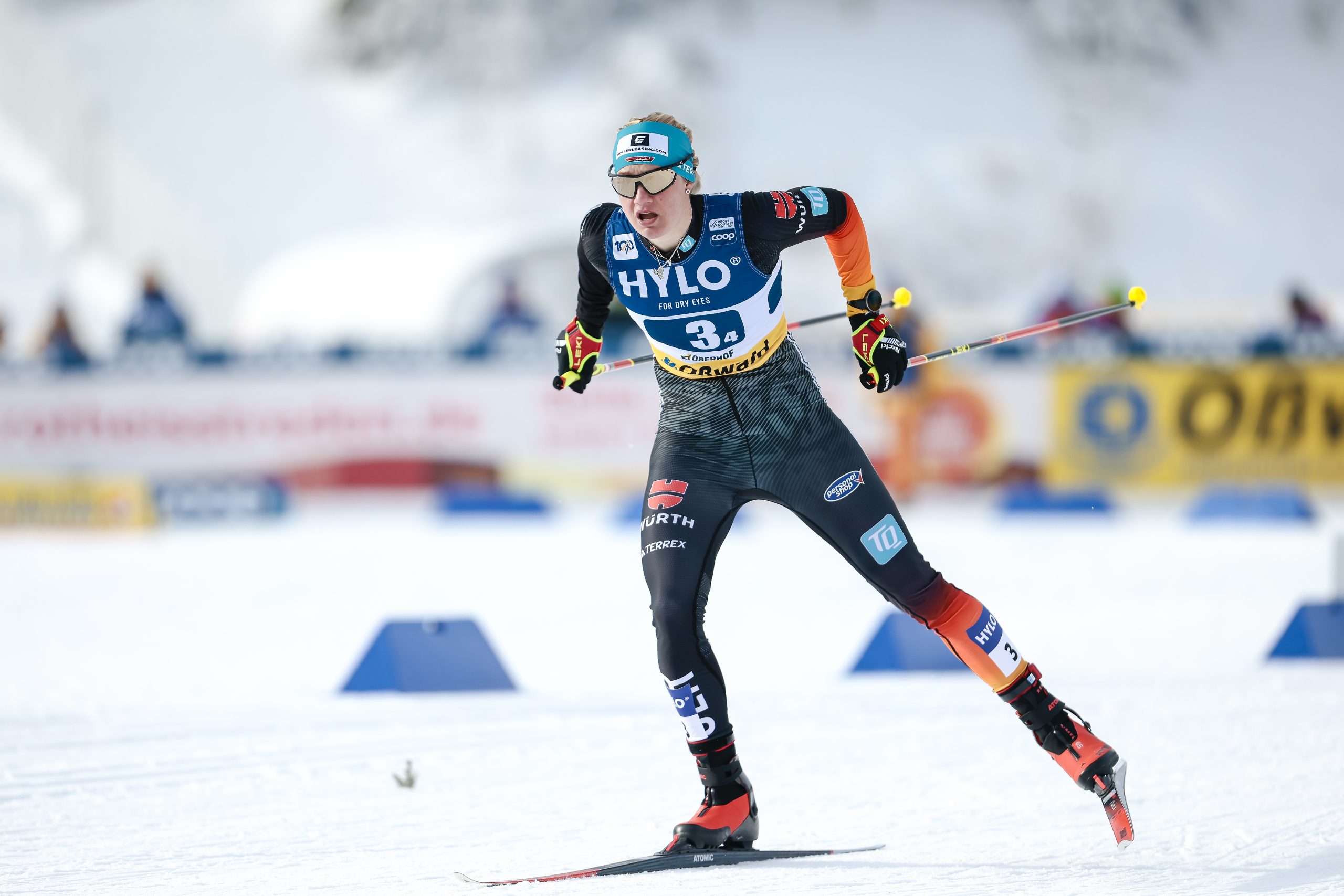
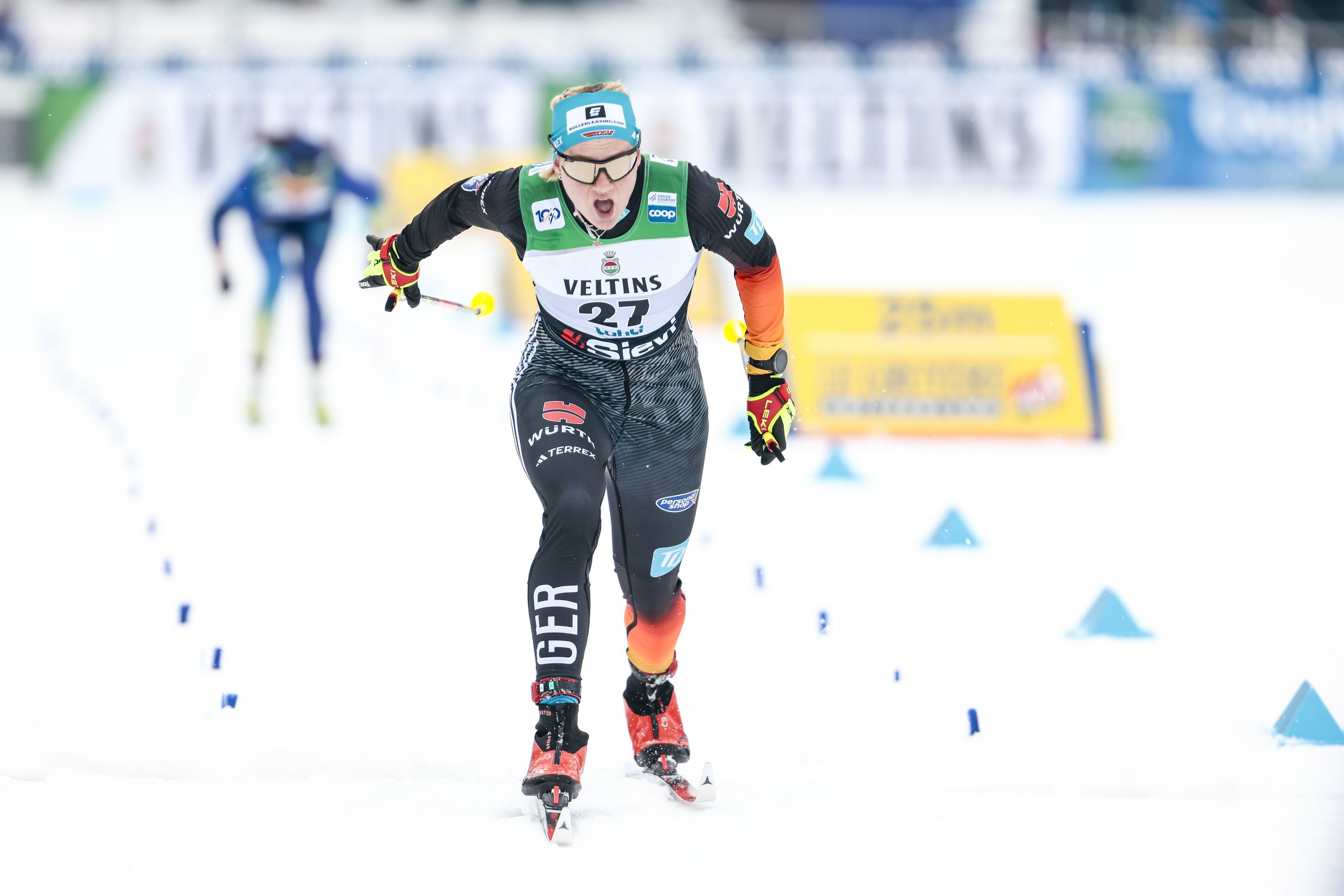
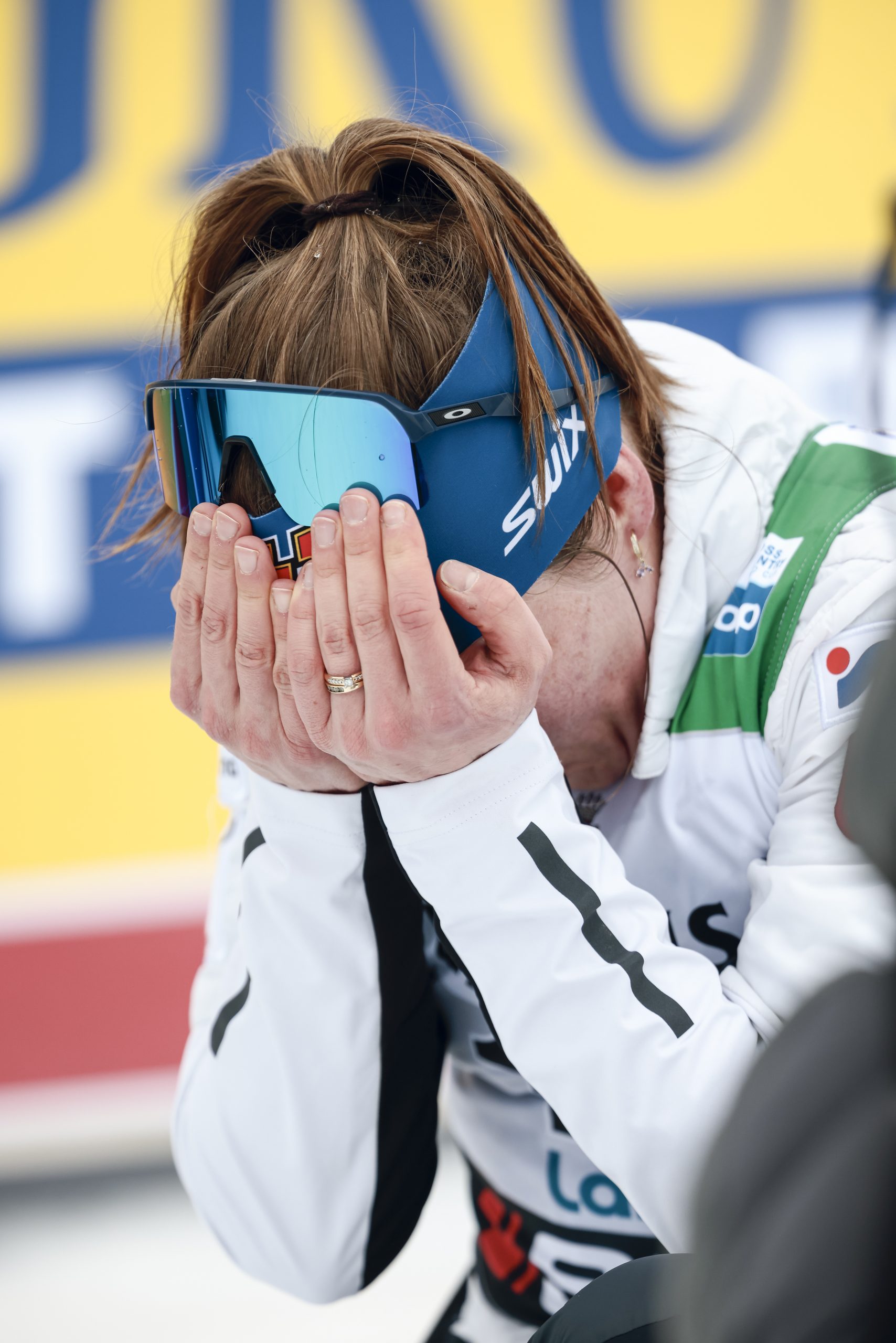
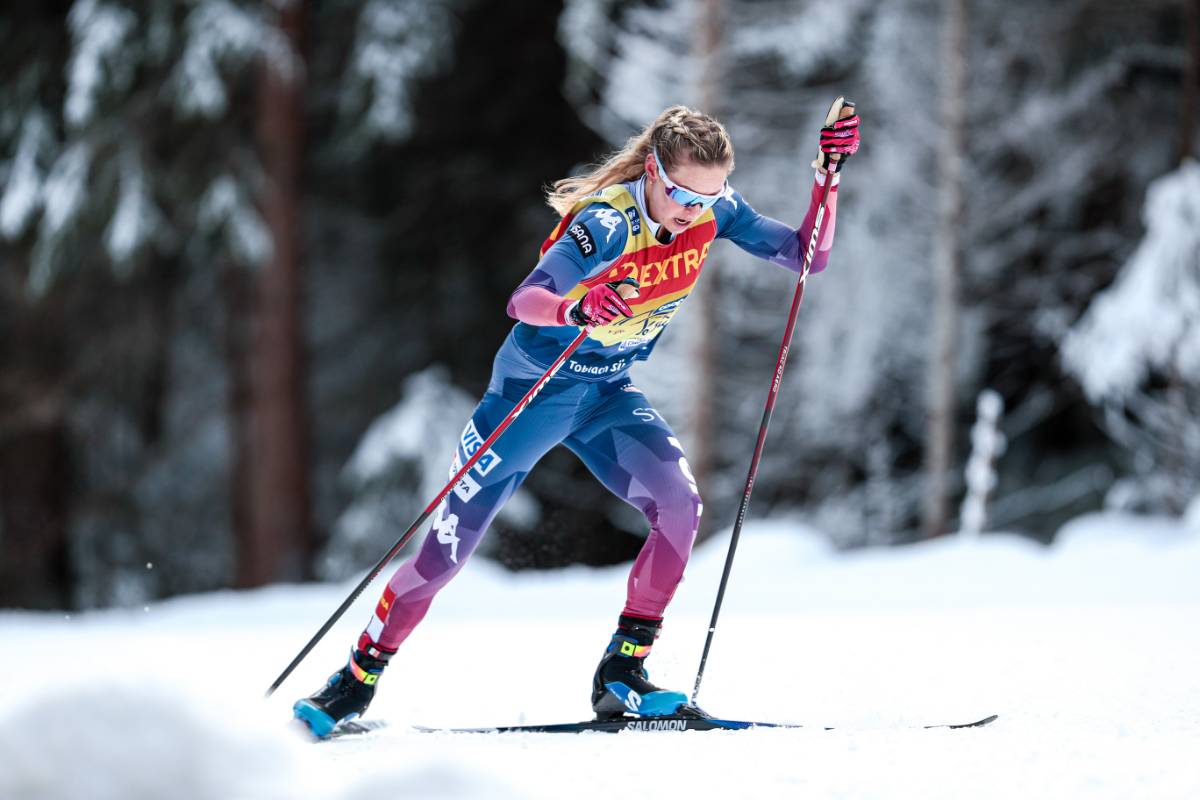
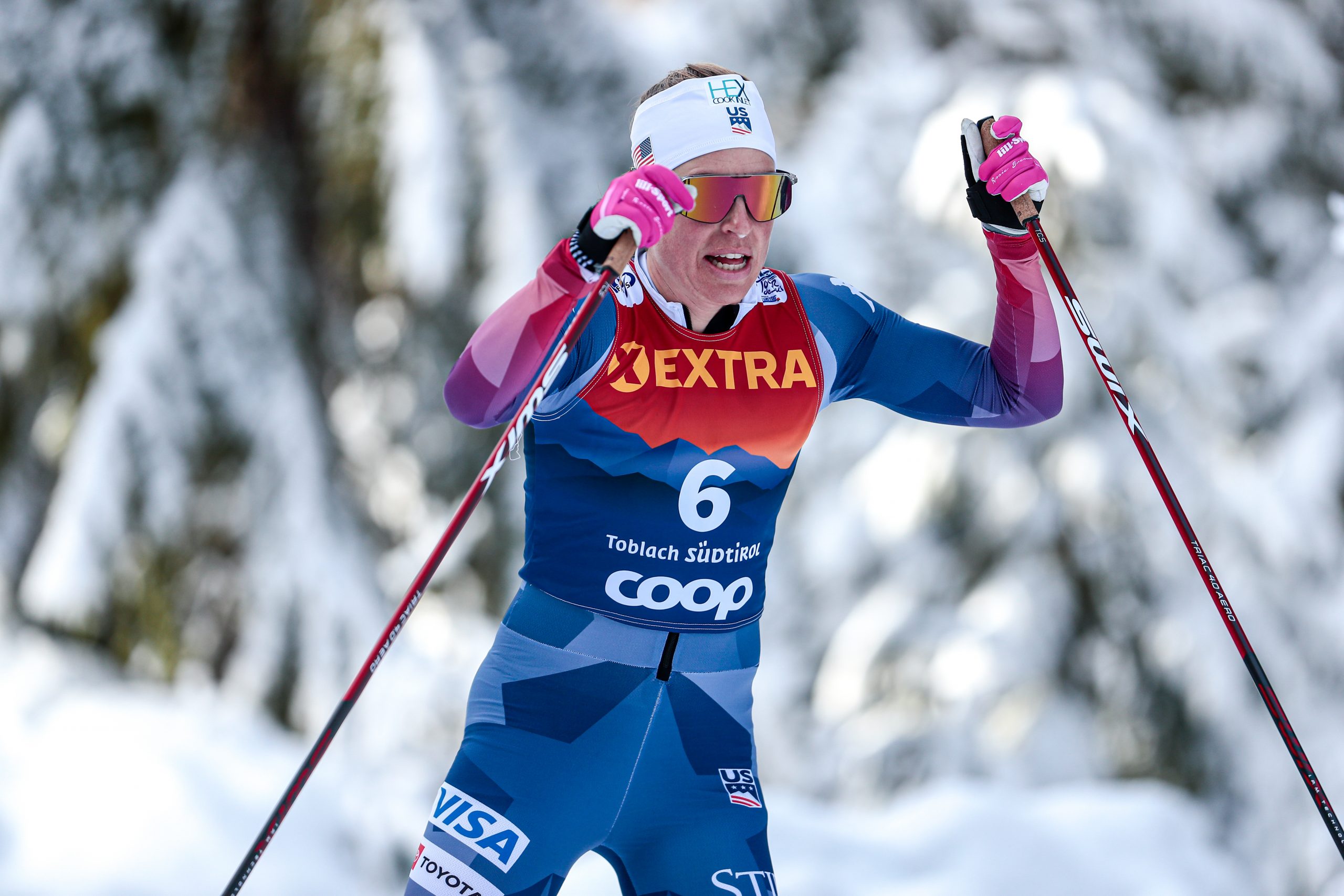
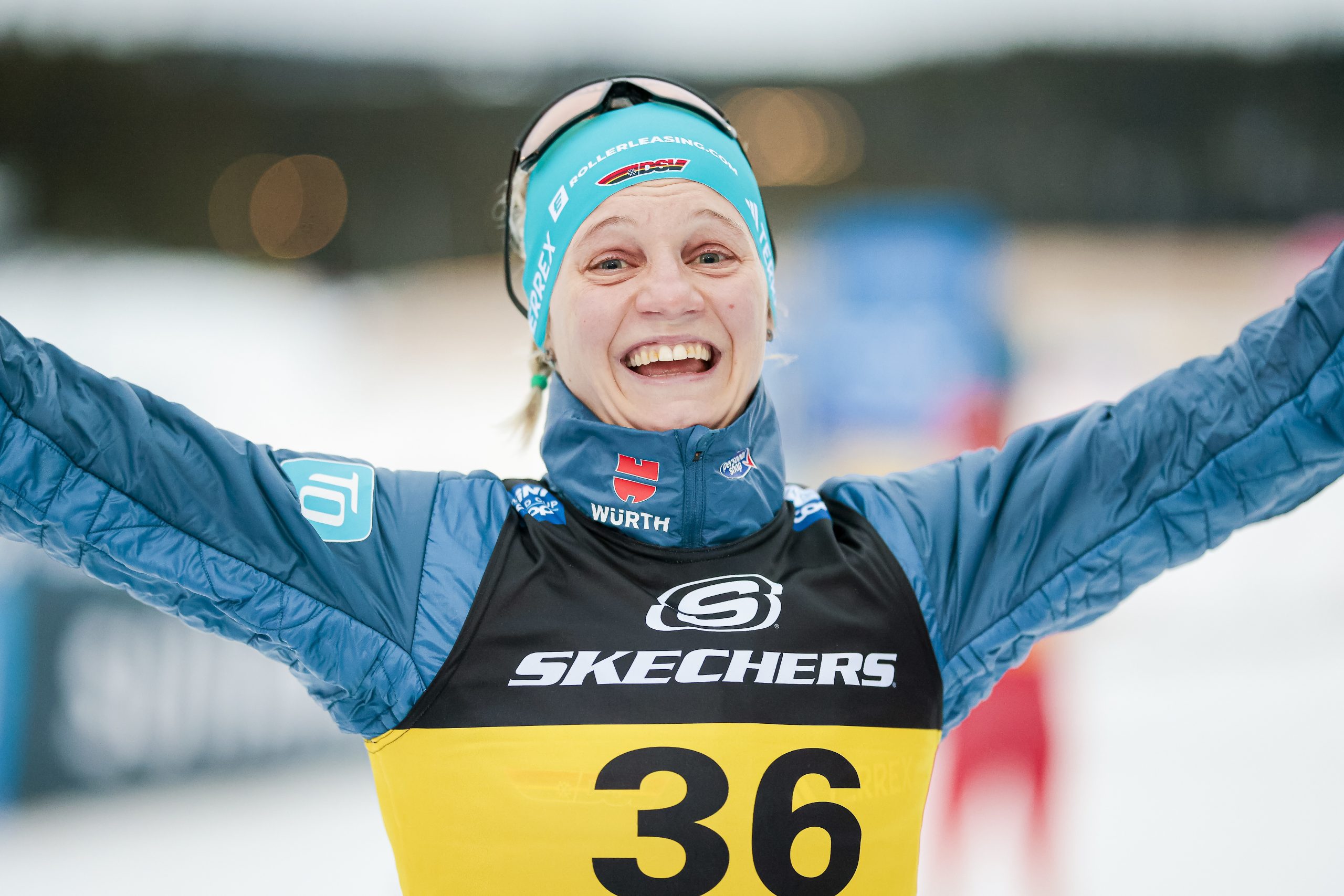
Victoria Carl (GER) finds herself the latest in a long lone of athletes claiming innocence when it comes to positive tests for performance enhancing drugs. Whether innocent or not, Carl is likely to face suspensions that could prevent her from competing in the upcoming Winter Olympics. (Photo: NordicFocus)
The nefarious use of performance enhancing drugs is not limited to shadowy old communist nations that once hid behind the Iron Curtain. There are also those many cases involving relatively believable (though equally questionable) explanations of the circumstances—food contaminations, mistaken prescriptions, innocent mistakes, misunderstood limitations and/or applications. As FasterSkier cited in an earlier article, Martin Johnsrud Sundby claimed to have had no knowledge of the illegality of the mechanism (a nebulizer) with which he administered his asthma medication. He was suspended, and had his World Cup overall championship stripped. In professional cycling, Tour de France champion, Alberto Contador, claimed to have an anabolic steroid in his system as a result of having eaten tainted beef. His Tour championship was subsequently awarded to the second place finisher. Similarly, Therese Johaug, tested positive for clostebol—an anabolic steroid—which she attributed to a lip sunscreen purportedly given to her by team physicians. Johaug’s subsequent suspension caused her to miss Olympic opportunities in 2018 (when she was a definite favorite to sweep al the Distance events).
In 1987, American biathlete, Kerry Lynch, forfeited his World Championship silver medal after admitting that he had engaged in “blood packing,” the process of adding one’s own blood to the system (via transfusion) in order to facilitate oxygen transfer. Lynch reported that he had received approval for the procedure from Jim Page (Director for the USSA’s nordic program) and Doug Peterson (Coach of USA Nordic Combined). There was no way to test for blood packing, and Lynch could have simply denied the allegation. To his credit—and his detriment—he did not.
Even a close friend of mine—an American professional cyclist—tested positive for a banned substance. He responded to the accusation by buying out the entire supply of the supplement that he suspected may have caused the positive test, and paying to subject those sealed canisters to controlled tests in an attempt to prove he had ingested the substance inadvertently. The tests proved his point; the manufacturer indeed had mistakenly contaminated the product, and the presence of the performance enhancing drug in the cyclist’s system had been the fault of the manufacturer (who obviously did not include the banned substance in their ingredients listed on the label). The athlete proved his innocence, acknowledged by the Court of Arbitration for Sport. Regardless, he was suspended for two years.
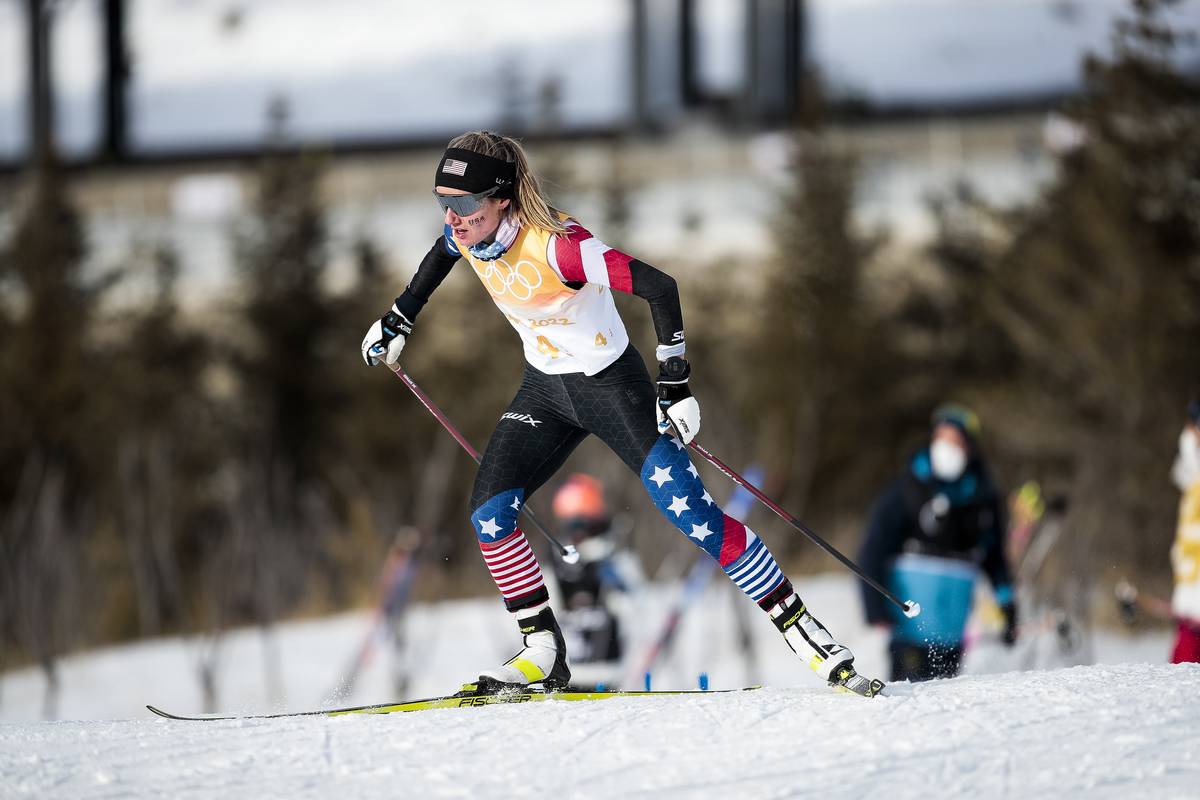
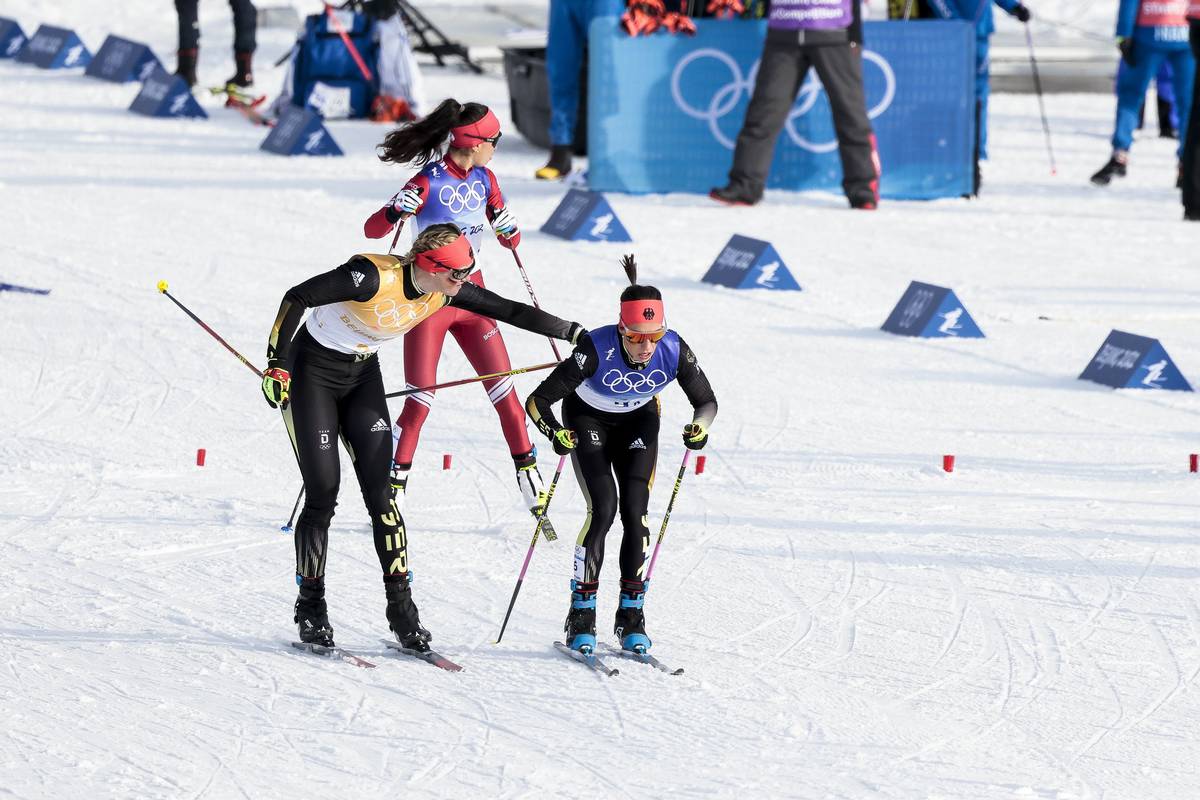
Germany’s gold medal team sprint partners, Katharina Hennig and Victoria Carl. (Photo: NordicFocus)
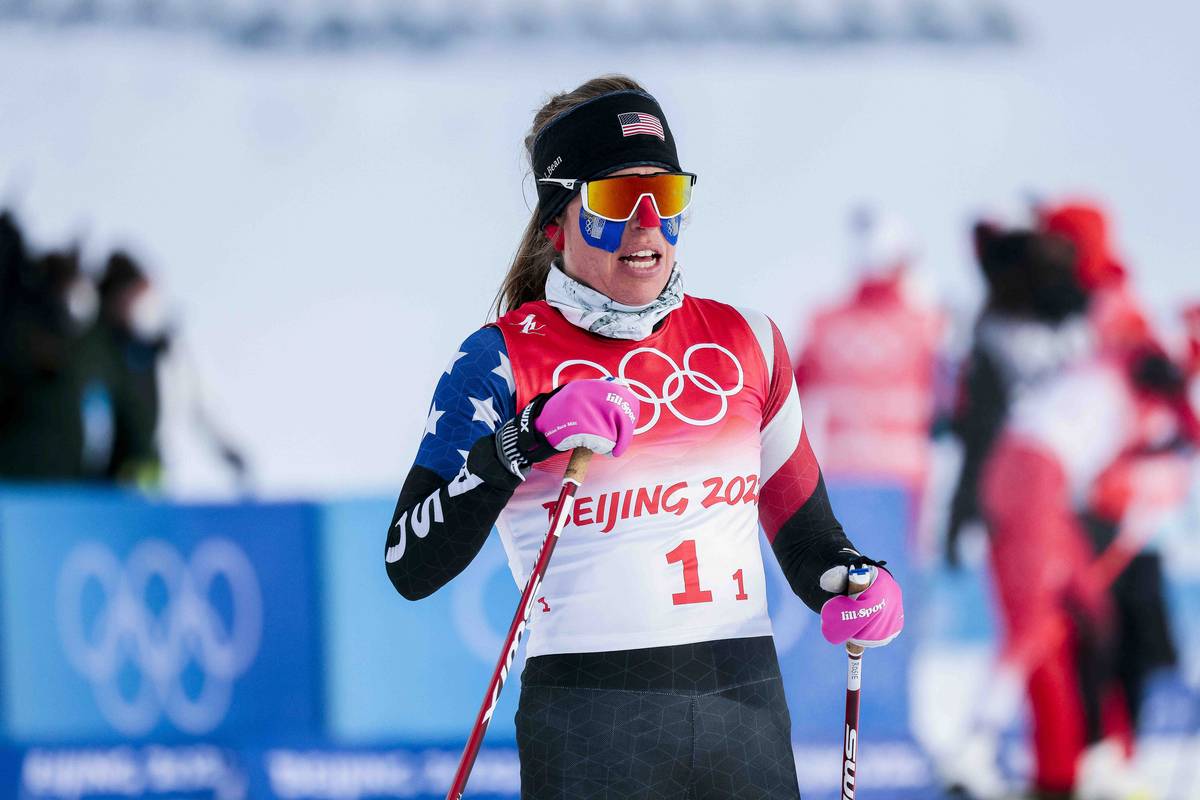
Now, in recent announcements, it’s been revealed that Germany’s Victoria Carl (Olympic gold and silver medalist from 2022) tested positive for the presence of clenbuterol (an anabolic steroid). The presence of the substance in her system has been explained as an ingredient in a cough syrup that Carl was given by team doctors during the Winter Military World Games. The German Federation is insisting on an “acquittal” in regard to the incident. That’s a truly rare response to any situation in which an athlete has legitimately been found to have a banned substance in their system.
“From the point of view of the German Ski Association, this is an unfortunate isolated case that was caused by an unfortunate chain of organisational and medical circumstances,” a DSV statement said. “But not by an intention of deception on the part of the athlete.”
If Carl finds herself suspended for the results of this latest positive test, she would likely miss the Olympics in 2026.
This coverage is made possible through the generous support of Marty and Kathy Hall and A Hall Mark of Excellence Award. To learn more about A Hall Mark of Excellence Award, or to learn how you can support FasterSkier’s coverage, please contact info@fasterskier.com.
Ebba Andersson (SWE) hadn’t won a World Cup race since 2023 in Trondheim, a drought that she broke in dramatic fashion with her striking victory in Falun’s 10 k Classic Interval Start. (Photo: NordicFocus)
World Cup Nordic racing is a funny thing: so many of the race venues provide large grandstands at the finish lines, though almost no fans fill those seats. It’s not because too few fans attend the races; especially in Scandinavian countries—where fans really do know their cross country skiing—the most energetic and vociferous cheering sections are found on the significant parts of the race course where cheering can have the greatest effect on the skiers those fans root for. That’s why Ebba Andersson (SWE) may have experienced a different race from what most other skiers experienced today in Falun. On her way to a masterful victory in the Classic 10 k Interval Start, Andersson would have ascended the daunting Mordarbacken climbs amid a gloriously deafening wave of Swedish exhortation. The Swedes love Nordic skiing, and Andersson delivered just the sort of victory those fans hoped for.
Heidi Weng (NOR) spent many seasons as a “podium machine” in the FIS World Cup. As her second place finish in Falun’s 10 k Classic will attest, she appears to be returning to that winning form just in time for the upcoming World Championships in Trondheim. (Photo: NordicFocus)
Andersson had not won a World Cup event since 2023 (in Trondheim). So when she stormed through the race’s intermediate checkpoints with leads that continued to grow ahead of Norway’s Heidi Weng (ultimately second on the day) and Germany’s Victoria Carl (the final podium finisher), the crowd knew that Andersson’s long winless drought was over. She seems to be rounding into form just in time for the world Championships, set to begin in ten days in Trondheim where this same event—10 k Classic Interval Start—is on the championship schedule.
Jessie Diggins (USA) raced into tight contention with the leaders at all intermediate checkpoints on the Falun course, holding her pace and her technique to the very end where her efforts earned her an impressive fourth place. Naturally, all eyes were on her now-infamous left foot where she has dealt with issues of plantar fasciitis. Falun’s Classic course—one designed to reward skiers who stride most efficiently (rather than just those who can crank the double pole)—would pose a serious test for Diggins, a test she passed with flying colors.
Jessie Diggins (USA) showed that all her hard work on her classical technique this summer had not been lost while she was plagued by plantar fasciitis in January. (Photo: NordicFocus)
With the FIS World Championships just days away, most national teams are coming into clearer focus. Other American finishers in Falun included Sophia Laukli 26th, Julia Kern 30th, Alayna Sonnesyn 34th, Kate Oldham 43rd, and Sydney Palmer-Leger 48th. Canadians were led by Alison Mackie (straight off her double medal performance at the Junior World Championships) in 31st, and Amelia Wells 60th.
Even so, significant starters were absent from today’s race. Norway’s Astrid Oyre Slind (leader in the FIS Distance standings) was a late-announced non-starter. Therese Johaug (NOR) is presumably at home training in anticipation of World Championships, as must be her Swedish rival, Frida Karlsson. Those are other likely contenders for World Championship medals in Trondheim, though it would’ve taken a lot for either of them to unseat an excellent and inspired Ebba Andersson on this cold, windy day in Falun.
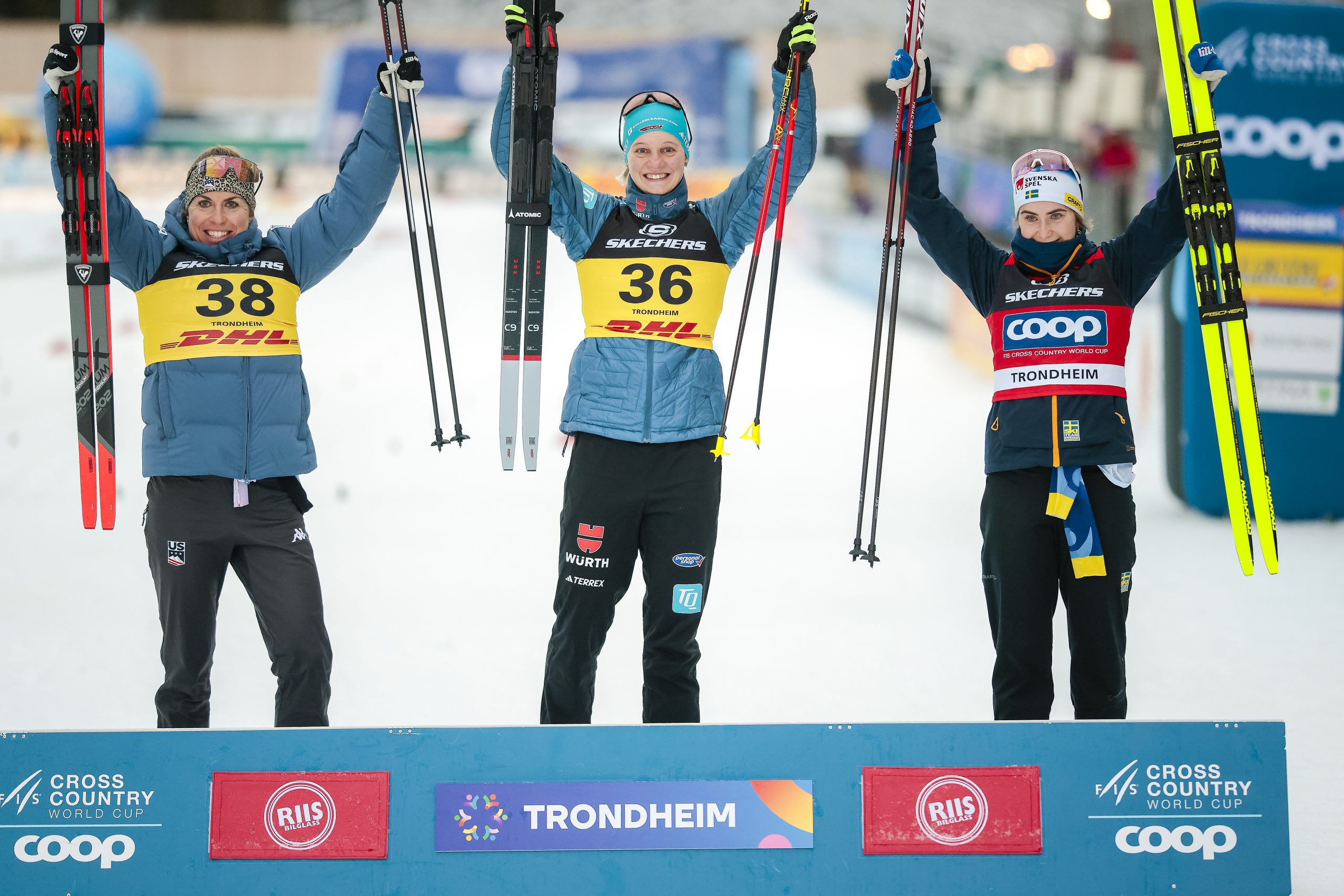
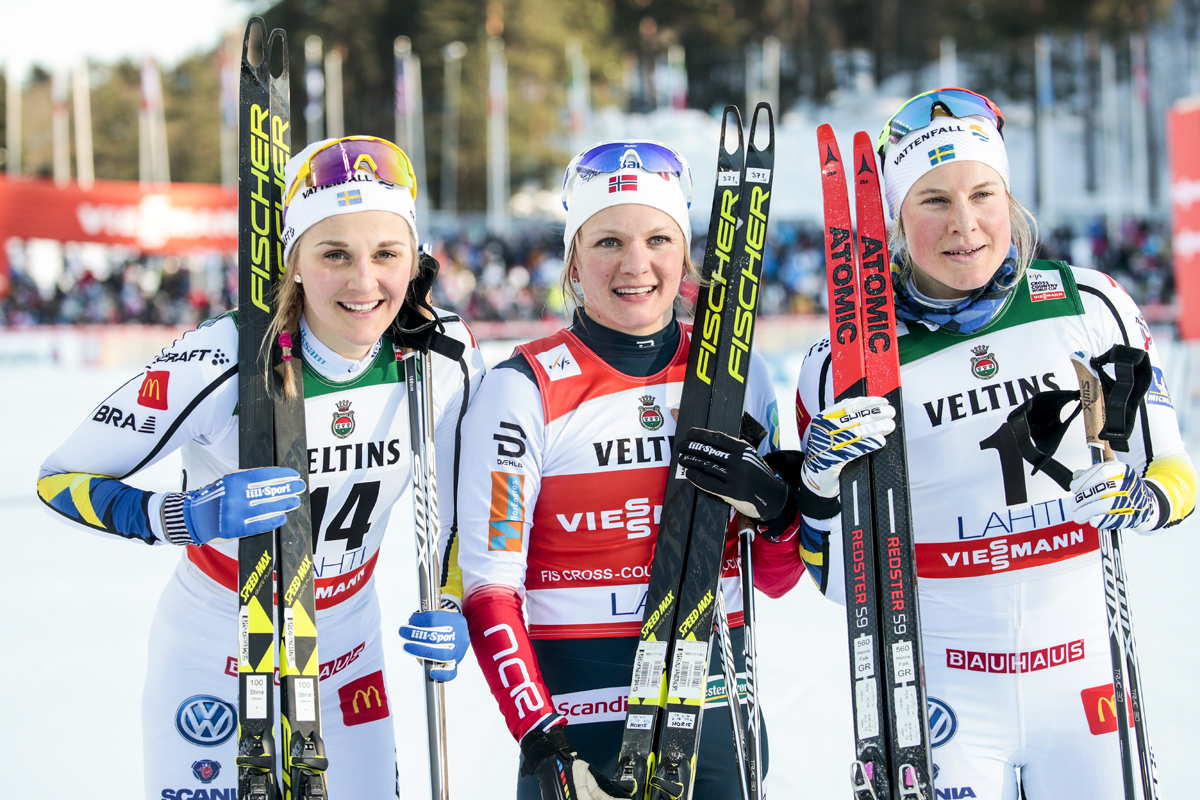
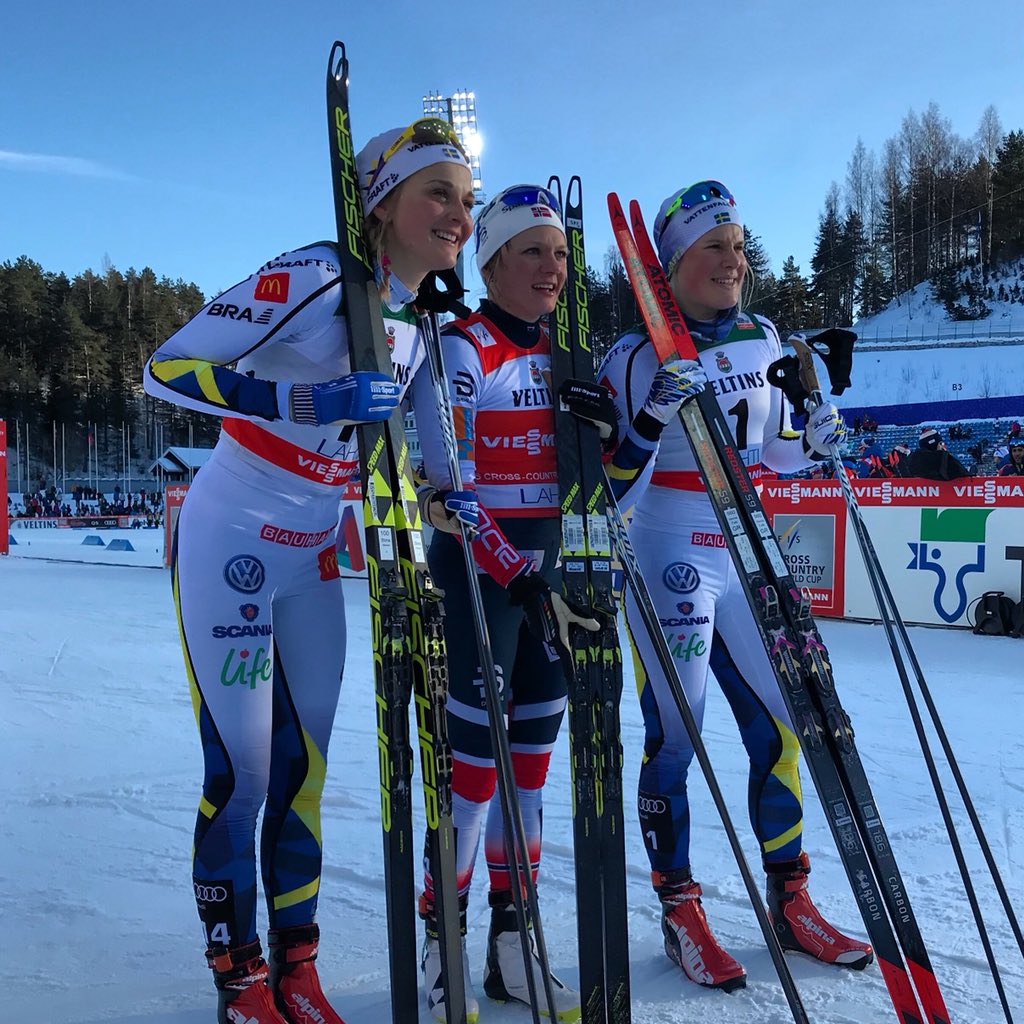
Heidi Weng (NOR), Ebba Andersson (SWE), Victoria Carl (GER) on the 10 k Classic podium in Falun, Sweden. (Photo: NordicFocus)
Falun 10 k Classic Interval Start
With overcast skies and cold temperatures (minus 6.4 Centigrade at race time), Falun dawned chilly and windy. The waxing would be fair, but the conditions would continue to challenge as the tracks began filling with steadily falling snow.
“(It’s) a complicated course: 3.75 kilometer red loop, followed by a 3.75 kilometer blue, and finally a 2.5 kilometer blue,” explained US Coach, Matt whitcomb. “You have the small Mordarbacken, then you have the big Mordarbacken, And you don’t want to do those hills any more, so you go to the 2.5, which is just the field, plus the Sprint loop, and finish.”
“It’s a wintry day; people are going to have to pace this really well,” Whitcomb explained. “There’s not a lot of time in a 10 k. Our plan is to take it out hot.”
Fans can always count on Jessie Diggins (USA) to give it her all. In Falun, her fearless brand of racing delivered a fourth place finish, and extended her lead in the season-long race for the Overall Crystal Globe. (Photo: NordicFocus)
Diggins would start 60th, well after all her closest rivals. She’d have all the information available to her as she made her way around a Falun’s winding course. Diggins was third at 2.5 kilometers, seven seconds behind a streaking Andersson, and just another three seconds behind Carl. After Diggins’ recent win in the Cogne 10 k Freestyle World Cup, she has shown that she can manage the challenges of this distance. And her ability to work hard and suffer during races is already well established. In Falun, Diggins did race with intensity (as she always does) but also with an impressive degree of control, maintaining even splits (in relation to her rivals) all the way to her fourth place finish.
Starting 48th, Weng was able to compare her on-course performance to that of Carl and Andersson. By the time Carl finished, she led by over 30 seconds . . . but Andersson and Weng were still on course, and storming through progressive checkpoints. Andersson, especially, seemed buoyed by the cheering of the Swedish crowd, a wave of support and enthusiasm that she rode all the way to the finish line. While Weng was able to overcome the early lead of Carl, Andersson was not to be caught on this day.
Victoria Carl (GER) was the earliest starter among serious contenders, setting the early pace and claiming a third place finish in Falun’s 10 k Classic. (Photo: NordicFocus)
“It has really been a struggle for me to this victory again,” said Andersson. “It’s the first time I’m standing on top of the podium here in Falun, on home ground. So I’m really happy.”
I struggled with Covid last season, Andersson explained. “Now it feels great again to take this victory, and to do it in front of the home crowd.”
Complete Falun 10 k Classic Interval Start RESULTS
Heidi Weng (NOR), Ebba Andersson (SWE), Victoria Carl (GER) after Falun’s 10 k Classic Interval Start. (Photo: NordicFocus)
This coverage is made possible through the generous support of Marty and Kathy Hall and A Hall Mark of Excellence Award. To learn more about A Hall Mark of Excellence Award, or to learn how you can support FasterSkier’s coverage, please contact info@fasterskier.com.
Team USA celebrates the victory of Jessie Diggins (USA) in the World Cup 10 k Freestyle Interval Start in Les Rousses, France. (Photo: Modica/NordicFocus)
When Jessie Diggins (USA) first stepped onto the World Cup scene (as a fresh-faced Minnesota school kid straight out of Junior Nationals), her only real chances to excel were in Freestyle Sprints or 5 k Freestyle races. Memorably, she showed everyone her Sprint abilities by out-dueling World Cup Sprint champion, Stina Nilsson (SWE), for Olympic Gold (with Kikkan Randall). A season later, she was proving herself to be a threat at 5 k Freestyle events . . . until that event just plain went away. The 5 k distance once was a staple for women’s World Cup racing; but FIS’ efforts to apply distance equality between men’s and women’s fields meant that the 5 k was replaced with 10 k races. Suddenly, Diggins’ best shot at a distance medal became a race twice as long. Well, if the last few seasons are any indication—and if Diggins’ performance today in Les Rousses offer any additional proof—she has more than adjusted to this distance challenge.
Today in Les Rousses, Diggins started fast (a bit of a risk on this particular Distance course with its immediate and super-steep uphill), and just kept building her lead throughout the distance. She won going away with only Victoria Carl in her vicitity (19 seconds behind) followed by Astrid Oyre Slind in third (at 20 seconds).
“Originally, I had planned to pace the race a little bit slower,” said Diggins. ” But then we were watching the men’s race, and we were like ‘Holy moly, a 19 minute 10 k. This is going to be so fast! Talking with the coaches, I was like ‘I don’t think I can afford to give up any seconds anywhere.’ I gave Ben a big hug after his race, and asked if he had any tips. He said, ‘Yeah, I started really hard!” So I did end up being influenced by Ben Ogden, and it ended up being a great thing for my race.”
Sophia Laukli (USA) posted an impressive eighth place finish in the 10 k in Les Rousses, an indication that she is recovering from her efforts in the recent Tour de Ski. (Photo: Authamayou/NordicFocus)
Among Americans, Diggins was followed in the standings by a resurgent Sophia Laukli in 8th, Lucinda Anderson 22nd, Rosie Brennan 28th, and Alayna Sonnesyn 34th (tie). Among Canadians Katherine Stewart-Jones and Lilliane Gagnon both skied strongly for 14th and 15th respectively, followed by Allison Mackie 33rd, and Olivia Bouffard-Nesbitt 38th.
Jessie Diggins (USA) is known for leaving it all on the race course, a level of effort that earned her the victory in the 10 k Freestyle Interval Start in Les Rousses. (Photo: Modica/NordicFocus)
Les Rousses 10 k Freestyle Interval Start
The 10 k Distance course at Les Rousses is one that demands both courage and fortitude: courage in addressing the need to attack the initial uphill (which, if raced too aggressively, results in racers being totally gassed at the top, struggling through a fog of lactic acid, and still with nine kilometers to go), and fortitude in dipping into physiological and psychological reserves to finish strongly on this unrelenting three lap course. It’s a level of discipline that only seasoned racers are likely to possess. Diggins is not the only seasoned competitor in the field, but she may just possess more fortitude than any skier in the world. Today in Les Rousses was an opportunity for her to put that fortitude on display.
Jessie Diggins in full flight is a sight to behold. Her fans got a look at “that Jessie” today. Starting fast and fearlessly, Diggins’ split times must have broken the hearts of her competitors. Frida Karlsson (SWE) started out even with Diggins, then consistenly lost time to her throughout the race. Karlsson would finish the day in seventh, 38 seconds off the lead.
Astrid Oeyre Slind (NOR) chased Diggins throuhgout the race, only surrendering additional time to her rival in the final kilometer. (Photo: Authamayou/NordicFocus)
Slind would remain close to Diggins at every time check, but could not overcome Diggins’ finishing surge. Slind would finish third, 20 seconds behind.
Carl was the only competitor to take a conservative approach to the early kilometers, and successfully accelerate through the finish. She chipped away at Diggins’ lead at every time check, ultimately powering into second place (19 seconds behind).
Victoria Carl (GER) was the most adept at negative splitting her effforts on the challenging course at Les Rousse. She would finish the day in second place, just 19 seconds behind Jessie Diggins ((USA). (Photo: Authamayou/NordicFocus)
For such a short race (the shortest Distance race that World Cup fields contest), the Les Rousses course was extremely daunting. Laukli shed some light on the particular challenges of the Les Rousses course: “It was definitely a challenge to balance pacing and avoid blowing up, but also not going too slow,” Laukli said. “I’m typically not one to start very fast so for me I just had to go all out and hope I didn’t blow up, which mostly worked out.”
Sophia Laukli (USA) raced bravely and aggressively in an event that hadn’t initially seemed likely to play to her strengths. (Photo: Modica/NordicFocus)
Laukli ended the recent Tour de Ski less than satisfied with her performance, and hampered by injuries sustained in a fall during one of the Tour’s mass start stages. Though 10 k is not her favorite distance, today’s strong result in Les Rousses felt like a bit of redemption for Laukli.
“Today’s race was a really really fast 10km and definitely a bit shorter than I would’ve liked,” said Laukli. “But because of that I’m happy with my result because it was really not a distance skiers course, so I probably did the best I could. I was unsure if I would be back racing this weekend after the tour just because of some injury and bad feelings over the tour, so I was just happy to be back and able to race, and closer to what I know I’m capable of.”
Following Diggins’ victory in today’s race, she takes over the leader’s bib in the World Cup Distance standings.
“I do feel like I’m well rested and recovered from the Tour,” said Diggins. “It was great to feel like my body bounced back well.”
I was really really thrilled and relieved that it didn’t hurt at all during warmup, that it didn’t hurt at all during the race,” said Diggins. “Crucially, it did not hurt at all afterwards. It was really nice to NOT be limping my way out of there.”
Diggins also explained her recent injury and the ways it has affected her training and race preparation. “I have plantar fasciatis, but also a partial rupture of the fascia down by where it attaches to my heel bone,” explained Diggins. “It’s less than 50% ruptured, but still a much bigger risk. And so we are gonna take it super super carefully, because my primary goal is to be skiing and running for my whole life.”
If that primary goal is carefully pursued, it seems (based on today’s results) like Diggins might also be pretty ready when World Championships roll around next month in Trondheim.
It’s vacation time. We hear from some of the U.S. Ski Team men holed up in their Christmas cottage in Davos, Switzerland — featuring a new lightning round quiz segment — and Devon and Nat take us through the weekend’s results. Happy holidays: We’ll be back during the Tour de Ski.
Questions, comments, want us to use less (or more) profanity? Reach us at devon@fasterskier.com and nat@fasterskier.com.
This coverage is made possible through the generous support of Marty and Kathy Hall and A Hall Mark of Excellence Award. To learn more about A Hall Mark of Excellence Award, or to learn how you can support FasterSkier’s coverage, please contact info@fasterskier.com.
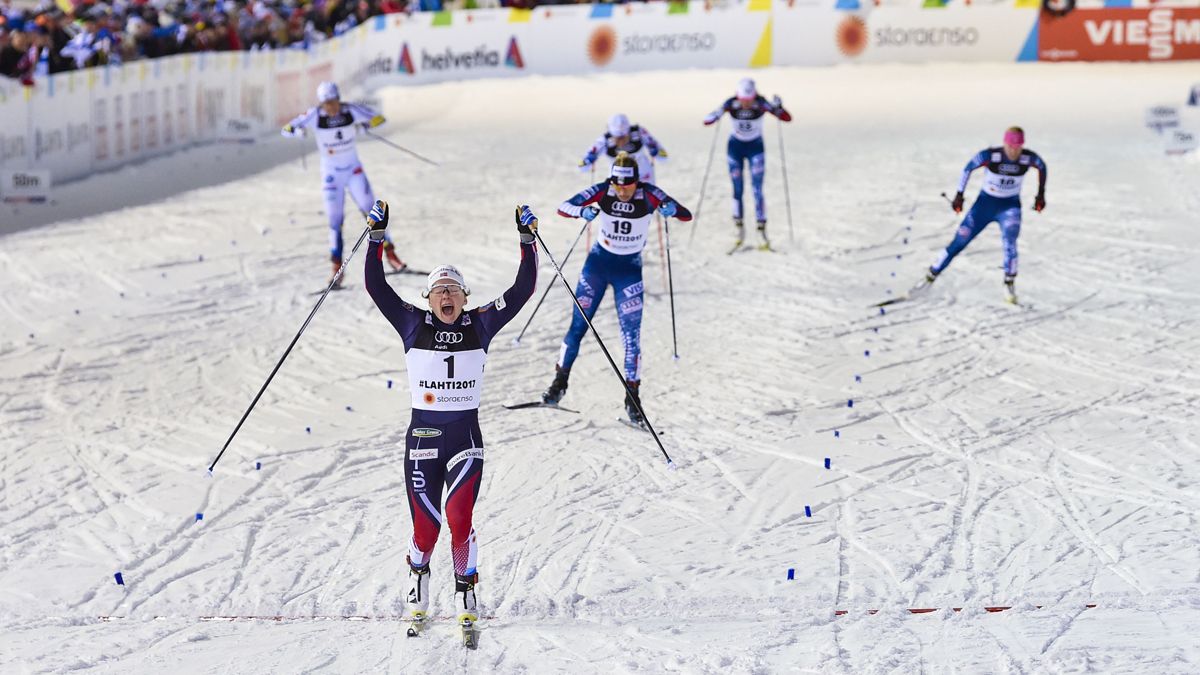
Six years after her last World Cup victory, Krista Parmakoski (FIN) returned to the top of the World Cup podium in front of Lahti Finland’s delighted fans. (Photo: Modica/NordicFocus)
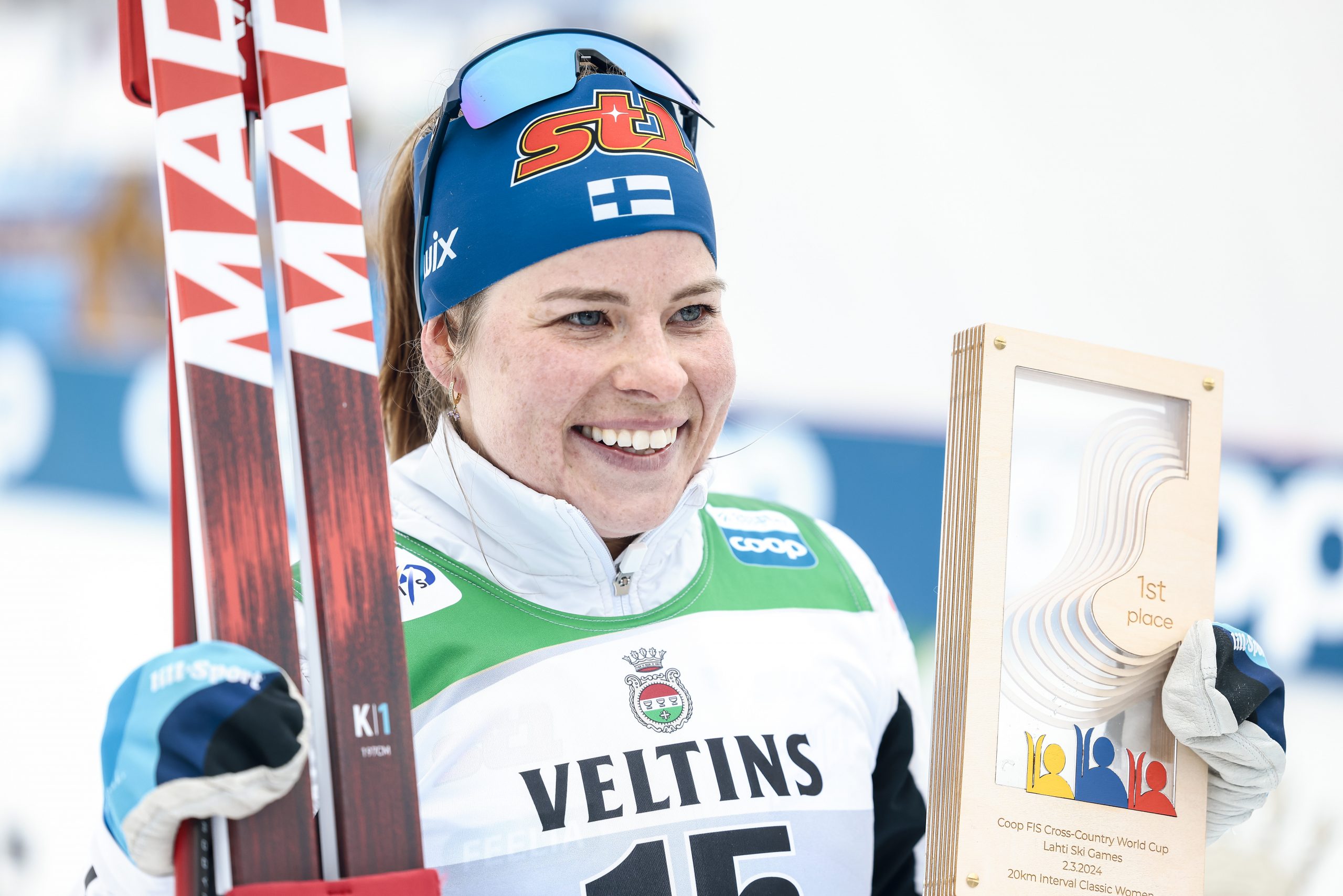
Krista Parmakoski (FIN) has battled the greats: Marit Bjorgen, Therese Johaug, Charlotte Kalla, Justyna Kowalczyk, Heidi Weng, Jessie Diggins. Across fifteen years of World Cups, World Championships, and Olympics, whomever was the dominant skier in the women’s field always had to contend with the brave and aggressive racing of Parmakoski. In Lahti—six years after her last World Cup victory—Parmakoski thrilled a sparse but energized Finnish crowd, winning the 20 k Classic Individual Start with a narrow margin over Victoria Carl (GER) and Kerttu Niskanen (FIN).
“An emotional day. I’m so happy that I’m back on the podium,” said Parmakoski in post-race comments. “It’s so nice to take the victory in the home crowd.”
Among Americans, Rosie Brennan finished ninth, Jessie Diggins 21st, and Sophia Laukli 26th.
“I love interval start racing,” said Brennan. “I get to push where I want and relax where I want and more or less just hold a steady pace which I think is one of my strengths so I think the challenge of doing that for 20k is awesome and I wish we did more intervals starts.”
Kerttu Niskanen (FIN) is a consistent threat in any Classic race. In Lahti, she secured a third place finish to join her countrywoman, Krista Parmakoski (FIN), on the podium. (Photo: Modica/NordicFocus)
Women’s 20 k Classic Individual Start
On a day like this—in a technical discipline like this—there’s simply no place to hide. Old, sugary snow, finnicky klister under every ski, temperatures hovering around freezing, and a layer of low clouds hanging over the flat-topped ridges that define the course in Lahti. After a sprint day marred by numerous crashes due to the challenging klister conditions, athletes knew that their four laps of Lahti’s five kilometer course would be a serious challenge, both physically and mentally. Every skier would feel slow today, every skier would suffer slips today. Would the kick hold? Would there be enough glide? The true test would be continuing to battle while the psyche continued to be tested. Pacing and patience, aggression and ambition, courage and consistency: it would not be an easy day.
“The conditions were wet and soft but honestly not that bad by Lahti standards,” commented Brennan. “This place has some of the toughest waxing on the circuit. The course demands a lot technically and physically so I really felt that focusing solely on good skiing was my best chance to put together a decent race. I’m proud my classic has come to a place that that is possible and that leaves me happy with the day.”
Leaders indicated by early splits included Frida Karlsson (SWE), Sundling, Carl, Parmakoski, and Niskanen. At five kilometers, Brennan was within ten seconds of the leaders. She would maintain her pace and remain in contention throughout, ultimately finishing ninth.
The challenges faced by the Americans were evident early on.
“With this being the last seven races of the season, I went out there and skied as hard as I could today,” said Diggins. “Unfortunately, we had some challenges with the glide—that’s okay; that happens—so I felt like the results did not reflect the effort and grit that I put into that race, but I skied a race and an effort level that I do feel really proud of. And I’ll continue doing that for each of the races that we have left!”
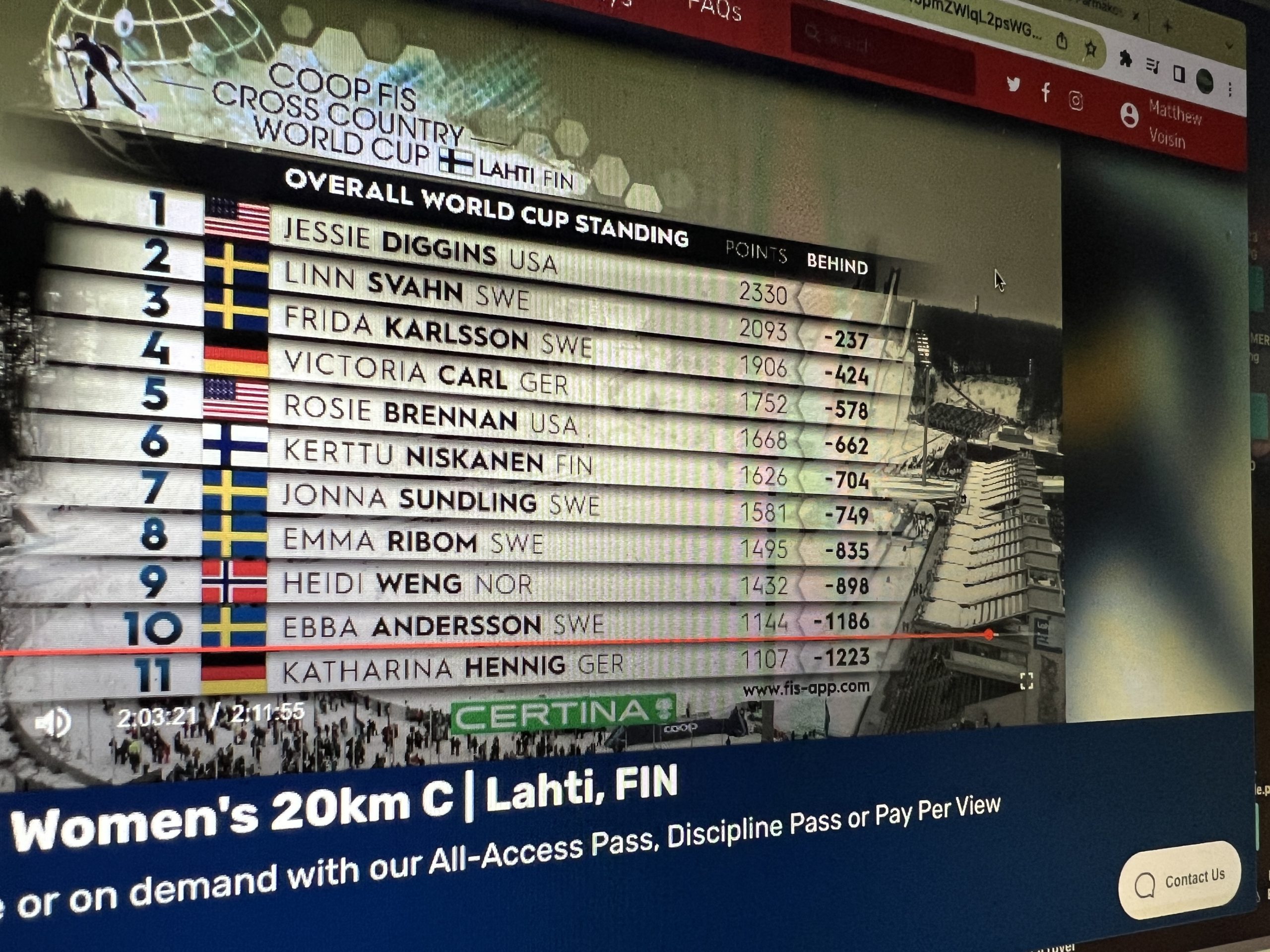
If part of the interest in today’s racing was the ongoing competition between Diggins and Linn Svahn (SWE) for the Overall World Cup championship (in which Diggins 2290 points at the start of the day ahead led Svahn’s 2033 points), then their comparative splits would tell the story. Diggins already trailed Svahn by eight seconds at the 1.1 kilometer check point, by 25 seconds at 3.4 kilometers, by 45 seconds at ten kilometers. By the 13.4 kilometer checkpoint, Svahn could begin to see Diggins skiing just ahead. Having started a minute behind, Svahn could definitely tell how much she had gained on her rival in the chase for the Overall World Cup. Svahn (11th place) would catch and pass Diggins (21st place) just before the finish line.
Victoria Carl (GER) was the mid-race leader, only to be overtaken by a late-race surge from eventual winner, Krista Parmakoski (FIN). (Photo: Modica/NordicFocus)
But this was not just a race for a season-long prize. It was definitely a race for World Cup individual honors. Earlier in this World Cup season, Victoria Carl (GE) won the 10 k Classic Individual Start in Trondheim. In Lahti, Carl surged into the mid-race lead, marked closely by Karlsson, Parmakoski, and Niskanen.
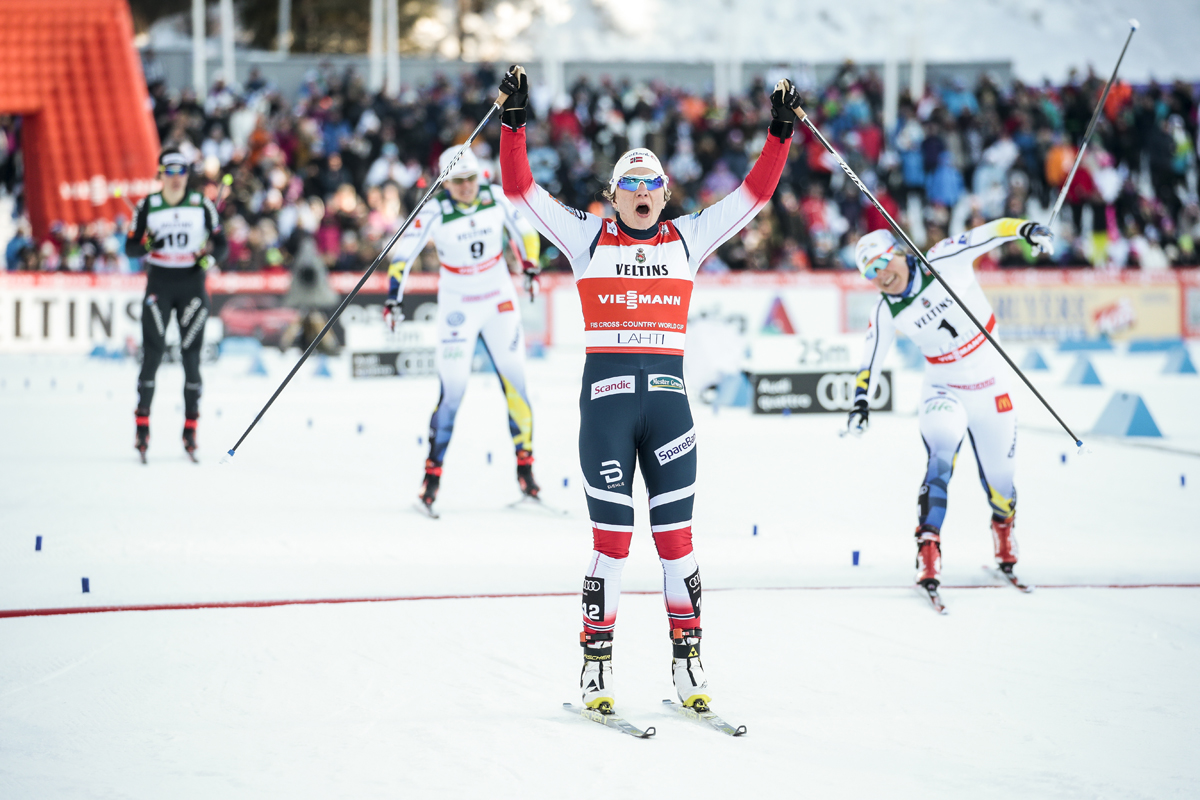
Krista Parmakoski’s (FIN) emotional victory in the 20 k Classic Individual Start seemed a sweet form of athletic redemption. (Photo: Modica/NordicFocus)
Carl and Parmakosi remained virtually tied with just under four kilometers remaining. Ultimately, it was a late-race surge that delivered Parmakoski her sixth career World Cup win ahead of Carl and Niskanen. Jonna Sundling (SWE) continued to demonstrate her fine form with a fourth place finish. The win was Parmakoski’s first at 20 k Classic (all her other victories had been earned at 10 k Classic), and her first World Cup win since Falun in 2018. Siox years is a long time to wait—a long time to work—and Parmakoski’s emotional felt like redemption, indeed.
In the race for the season-long overall championship, Linn Svahn’s (SWE) 11th place finish made up ground on current leader, Jessie Digins (USA), who finished the day 21st. Diggins (with 2330 points) continues to lead Svahn (2093) in the race for the Overall World Cup. With 1328 points, Diggins also continues to lead in the Distance standings ahead of Carl (1112 points), Ebba Andersson (SWE) (1090 points) and Brennan (1044 points).
Post-race standings: Jessie Diggins (USA) continues to lead Linn Svahn (SWE) in the season-long race for the Overall World Cup.
Prince of Quebec Alex Harvey and his protege on the Canadian team, Tony Cyr, check in with us after a three-day weekend of racing in Germany. We went kinda long. Also: We have a first-of-its-kind waxing and service report from U.S. Ski Team technician Eli Brown.
Let us know what you think: We’re at devon@fasterskier.com and nat@fasterskier.com. We’ll be back after another weekend of racing in Switzerland before the World Cup circuit heads to North America.
American star Gus Schumacher joins us from Switzerland to break down the first three stages of the 2024 Tour de Ski. And Devon gives us the goods on Norway’s social event of the year: Therese Johaug’s wedding.
Send us your questions and feedback: devon@fasterskier.com and nat@fasterskier.com. We’ll be back in a couple days.
This coverage is made possible through the generous support of Marty and Kathy Hall and A Hall Mark of Excellence Award. To learn more about A Hall Mark of Excellence Award, or to learn how you can support FasterSkier’s coverage, please contact info@fasterskier.com.
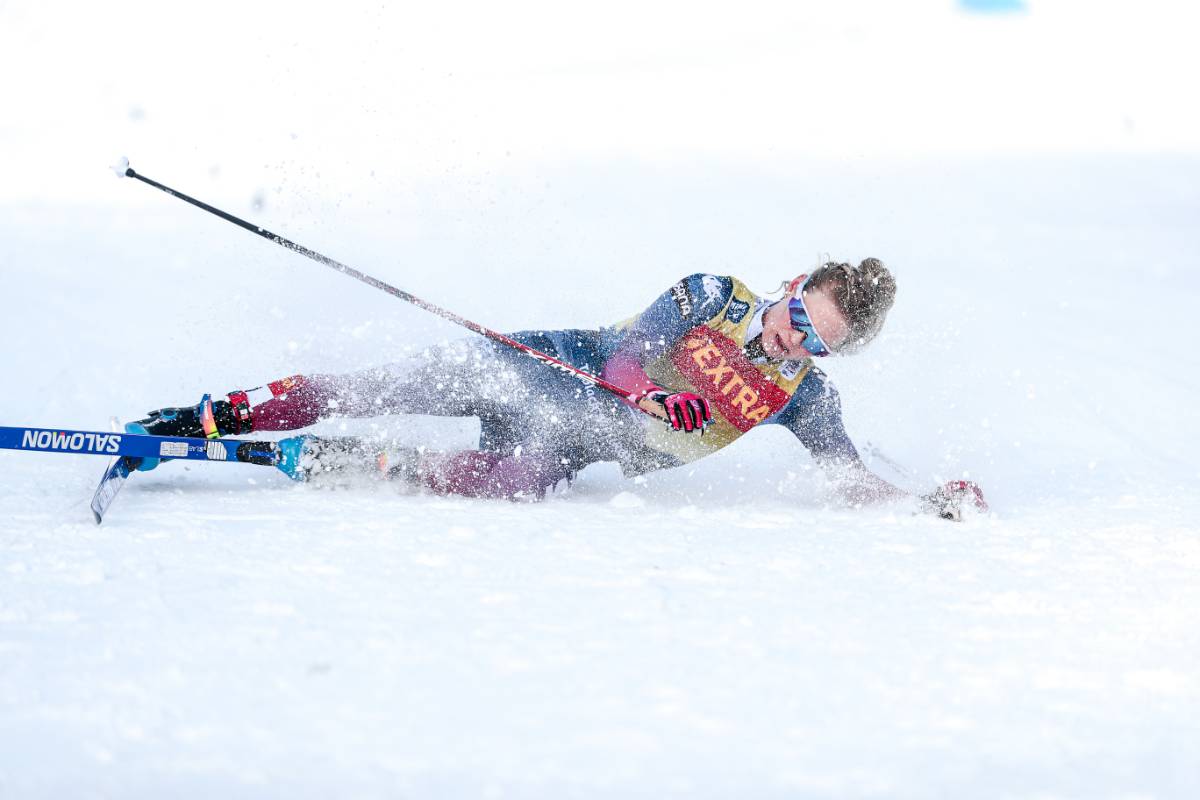
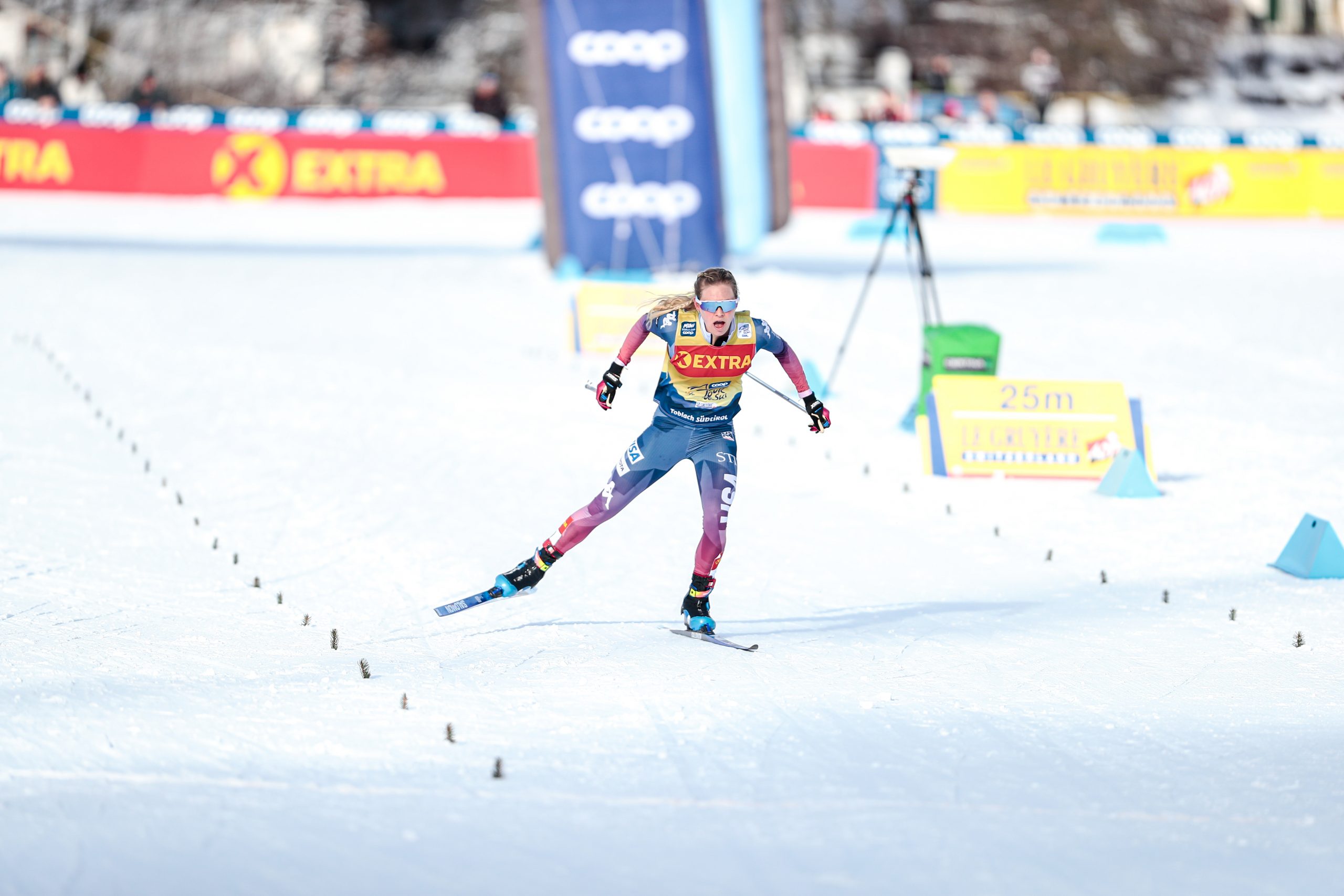
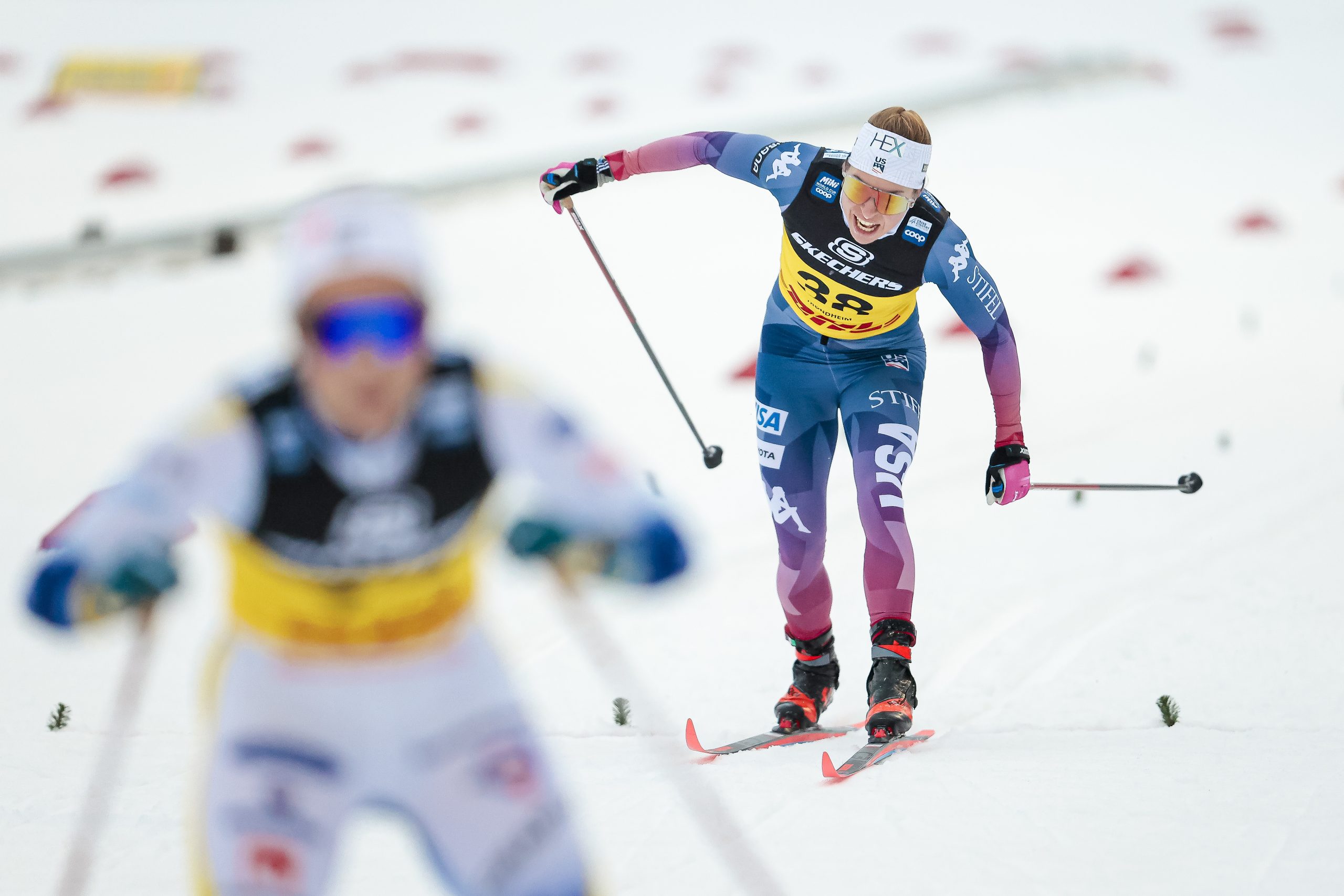
Jessie Diggins (USA) slides through the finishing area after leaving everything out on the course. She turned what could have been a tactical day into a dominating performance. (Photo: NordicFocus)
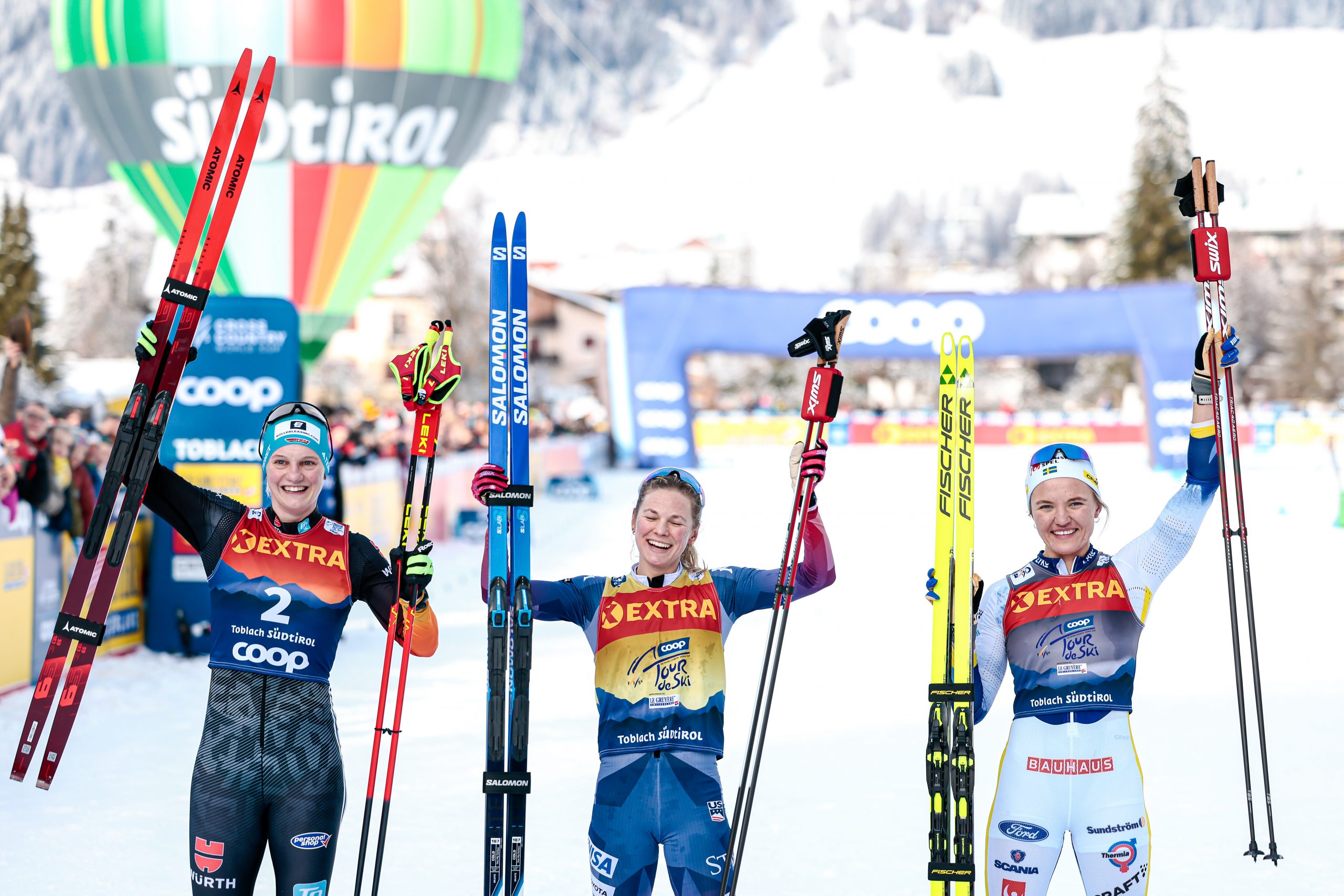
As the world rings in the New Year, the U.S. Stifel Cross-Country team was hoping that flipping the page on the calendar wouldn’t flip their momentum. The team has been on a roll. On the men’s side, Ben Ogden sat in third overall in the Tour de Ski (TDS) standings going into racing today. On the women’s side, the picture was even brighter: Jessie Diggins (USA) sat atop the TDS standings, seven seconds ahead of Victoria Carl (GER), and 11 seconds ahead of Linn Svahn (SWE). Rosie Brennan (USA) was in sixth, only 24 seconds away from a podium spot.
In Monday’s 20 k Freestyle Pursuit, Diggins would put her first place standing on the line. The Pursuit race is an exciting format: the skier with the overall lead starts first and then each successive skier starts after them, separated by the amount of time they are trailing in the overall standings. For Diggins—who has made a career of chasing down skiers—it meant she would be the one being chased. With Carl and Svahn starting so close to Diggins, it was expected that the competition for the top spot would be fierce throughout the race, and that Carl and Svahn would work together to quickly chase down Diggins.
But for Diggins, today’s race in Toblach turned into another signature moment in her career. She started the race like she was shot out of cannon and never let up for one second. She turned in one of the most dominant performances of her career, and never let the rest of the field get close to her. Tactics and strategy were tossed aside. Early on, Diggins sent a message: if the rest of the field wanted to catch her, they would have to pay a mighty high price to do so.
Jessie Diggins (USA) started only seven seconds ahead of the next competitor, but set a blistering pace. No one could catch her. (Photo: NordicFocus)
Diggins ended up winning by over 46 seconds, extending her lead over Carl. Ultimately, the fastest skier on the day was Astrid Oeyre Slind (NOR), but it was definitely Diggins who dominated the field.
For Rosie Brennan, it was a difficult day. She ended up losing significant time and finished over two minutes behind Diggins. She is now 15th in the Tour. Sophia Laukli had the ninth fastest time of the day, and now stands 21st in the Tour, 3:13 off of the lead. Novie McCabe had the 25th fastest time and is in 27th place, with Julia Kern 44th, and Samantha Smith 47th.
There are no Canadian women left competing in the Tour.
Women’s 20 k Freestyle Pursuit
At the beginning of the race, Svahn quickly closed the gap on Carl. They would ski together to try reeling in Diggins, but Diggins had other ideas. She put her foot to the accelerator right from the start, and in the time it took for Svahn to close on Carl, Diggins had already put six seconds on the pair. The pace of Diggins’ start was ferocious: a mere 1.4 kilometers into the race, she had lengthened her lead to 21 seconds. It was clear that all the potential strategies of group racing were off the table for her; she would go hard from the start and push the entire way. By 4.4 kilometers, Diggins had extended the lead to 28 seconds over the chase group. It was like a heavyweight prize fighter coming out and throwing nothing but haymakers right from the start. It was hard to believe the intensity of Diggins start, and it was a reasonable question to ask whether Svahn and Carl were going to give up on catching Diggins and concentrate on the fight for second, or whether Diggins had gone out too hard?
At every time check Jessie Diggins (USA) increased her lead over the two chasers behind her. (Photo: NordicFocus)
At every time check, the gaps just kept getting larger. In a mere seven tenths of a kilometer, Diggins had put another six seconds on the chasers, and was now up by almost 35 seconds! The longer the race went on, the more Diggins appeared to be skiing in a world of her own. More time checks; more of a gap. At 8.8 kilometers she was over 40 seconds ahead of Svahn and Carl.
Behind Diggins, Svahn and Carl were not giving each other an inch. They continued to ski within a second of each other and were 30 seconds ahead of the chase group behind them.
Rosie Brennan had a tough day. She started the day only 24 seconds off of the podium, and ended up in 15th spot over a minute off the podium. (Photo: NordicFocus)
As Diggins was continuing to surge, Brennan was beginning to slip. She had started 28 seconds behind Carl and was now almost a minute back. Brennan ended up having a tough day. “I did what I believed was the best prep over the break,” said Brennan. “For whatever reason my body isn’t responding the way I hoped. If there’s one thing I’ve learned about the tour is that things can change on a dime so I’m doing my best to move on and keep hope.”
Diggins was relentless in imposing her will on the field; her lead just continued to grow and at 13.2 kilometers it was over 53 seconds. As long as Diggins could keep herself together, the only remaining questions would be whether the second chase group could close on Carl and Svahn to challenge them for the podium, and whether any of the women in the second group could put time into Diggins .
As Diggins continued to punish the field, Carl and Svahn were fighting to keep the remaining chasers behind them. At 14.6 kilometers they had a 24 second lead over the rest of the field. The second chase group of Frida Karlsson (SWE), Heidi Weng (NOR), Emma Ribom (SWE), and Astrid Oyre Slind (NOR), began to turn the screw and increased their pace. They were gaining time on Carl and Svahn and were even starting to put a little time into Diggins.
Carl and Svahn continued to work together, but their lead over the chasers had been reduced to a scant 10 seconds. With only 2.4 kilometers left, it appeared they would be swallowed up by the other chasers, who were now close enough where they could see Carl and Svahn. Meanwhile, the two chasers were giving every ounce of energy to hold off the second chase pack with Karlsson at the lead of that group.
Victoria Carl (GER), Linn Svahn (SWE) skied almost the entire race together until Carl pulled away just before the finish. (Photo: NordicFocus)
With half a kilometer to go, Carl decided that it was time to commit her last reserves into play to avoid being caught up in a sprint finish. She pushed ahead of Svahn to create a gap of six seconds. Simultaneously, the second chase group was putting in a big surge and gaining time on everyone. While she had the race in hand, Diggins was losing a bit of her cushion in the overall TDS standing to some of the women in the chase group.
The chase pack soon had swallowed up Svahn, though Carl’s earlier strategy of separating herself from the pack was now paying dividends.
Diggins charged into the finish, winning by forty-six seconds over Carl, who was able to maintain her separation going into the stadium and crossed the line two seconds ahead of the chase pack. As the remaining pack of skiers charged to the finish, Svahn and Sundling surged to the front in an all-out sprint with Svahn bettering Sundling in a photo finish.
It was a glorious, gutsy day for Diggins, and race fans had been treated to an enthralling spectacle.
“That was so hard.” Diggins commented after the race. “I went out and skied as hard as could. I wanted to ski a brave race; try and go out hard and see what I could hold.” Without being asked, Diggins answered whether she had gone out too hard. “I was blown out the last two laps,” she said. “I couldn’t really feel my legs, but I did hear my family out there cheering and a lot of other families from the U.S., and that kept me going. I just kept looking for every second. I crossed the line with nothing left, and that was the goal.”
Diggins also revealed that she had a bit of drama before the race’s start. While practicing on a fast icy downhill she took a dramatic tumble. “I slid maybe 100 meters,” she said, admitting that she even needed to change out her poles before the start. “I got it out of the way . . . It had me running scared in the race. I guess it got me going.”
Sophia Laukli (USA) delivered the ninth fastest time of the day, improving her position to 21st overall in the 2024 Tour de Ski. (Photo: NordicFocus)
Impact of Tour de Ski Standings
Even with as good a day as Diggins had holding off the field, she actually lost some time to the skiers in the chase group. Slind (NOR), Karlsson (SWE), and Weng (NOR) all ended up with slightly faster race times than Diggins. But Diggins’ TDS lead is still substantial. She now leads Victoria Carl by 47 seconds, and Svahn and Sundling (SWE) by 48 seconds. Slind and Heidi benefited today from skiing in the pack, and while they didn’t cross the finish line first, they are lurking 52 and 53 seconds back. It’s a considerable lead for Diggins, but certainly not insurmountable.
The next stop on the Tour is Davos, Switzerland. The American team has generally performed well there. “I’m excited to go back to Davos,” said Diggins. “That’s a hard Sprint, so it will be day to day.”
It was a thrilling day of racing for fans and for team USA.
Diggins didn’t have the fastest time of the day, but she put a big gap on Carl and Svahn to expand her lead in the 2024 Tour de Ski. (Photo; NordicFocus)
This coverage is made possible through the generous support of Marty and Kathy Hall and A Hall Mark of Excellence Award. To learn more about A Hall Mark of Excellence Award, or to learn how you can support FasterSkier’s coverage, please contact info@fasterskier.com.
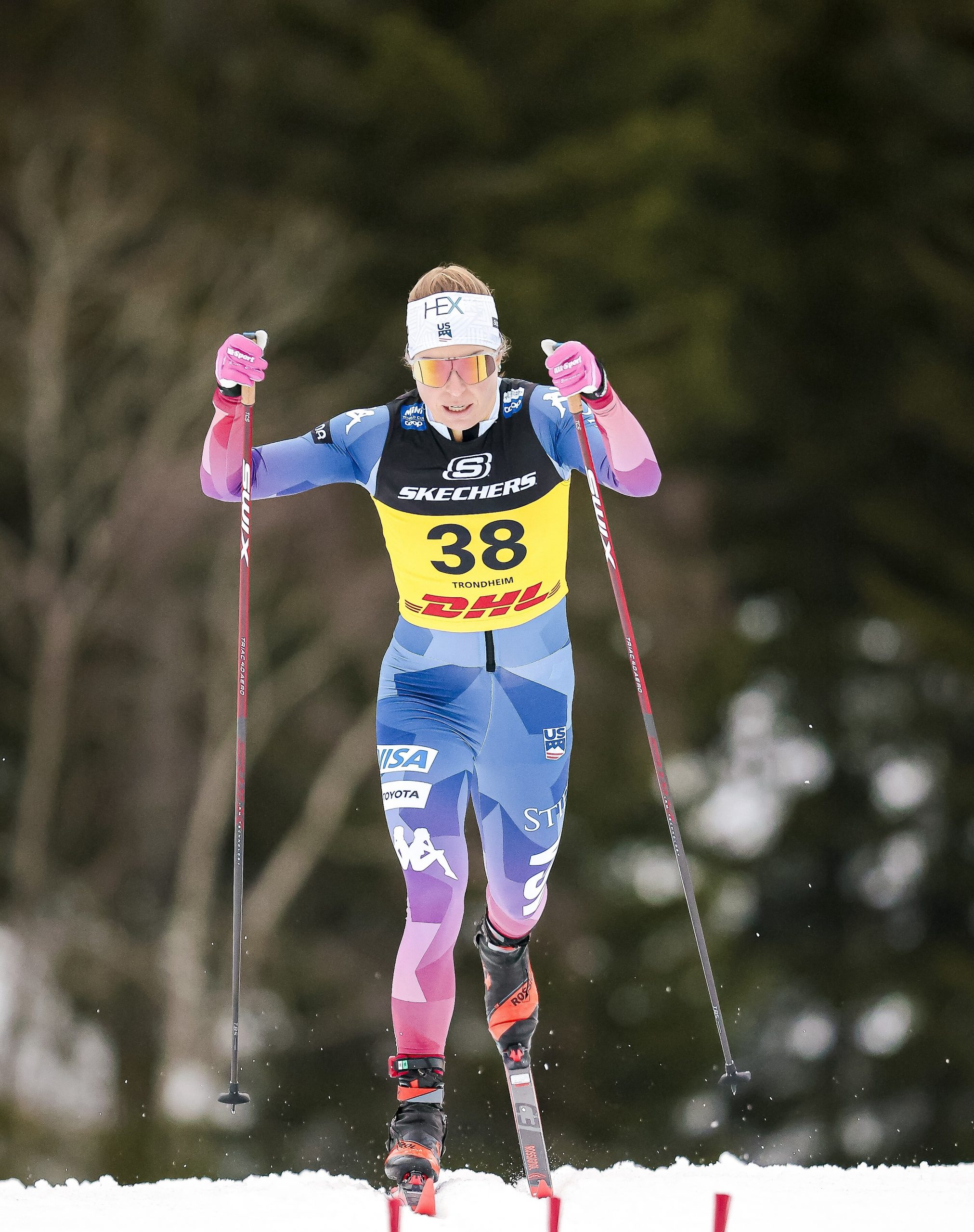
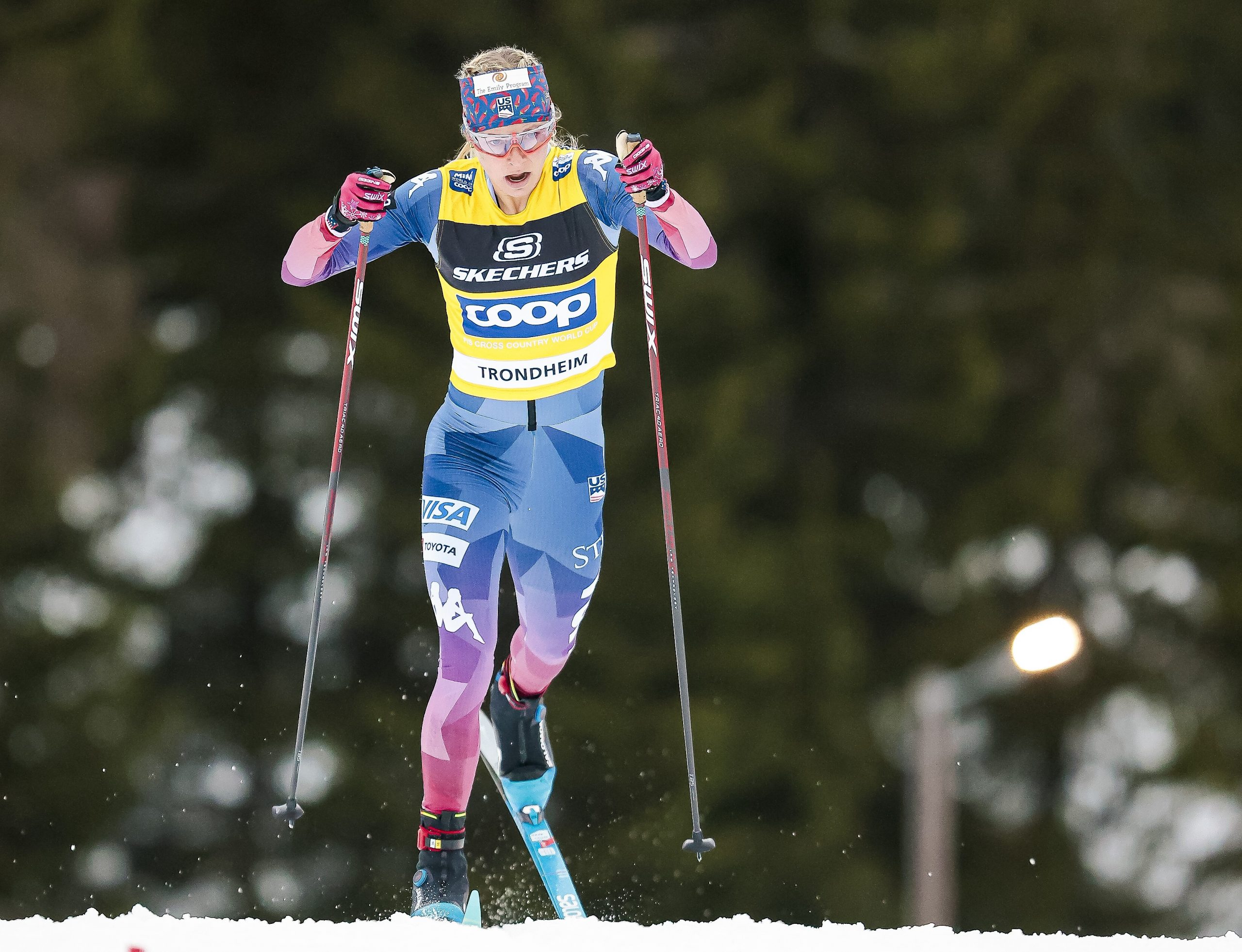
Today wrapped up three days of racing in Trondheim, Norway, where the 10 k Classic individual start race was contested this morning. The “10 k” race name was a bit of a misnomer, as the actual distance raced was 11 kilometers. The American women have set a blistering pace this season: Rosie Brennan finished second in this event three weeks ago in Ruka. Jessie Diggins’ Classic skiing this year has looked especially crisp. So, hopes were high for the American squad.
It was another great Classic race day for Rosie Brennan (USA). She finished second. (Photo: NordicFocus)
Standing in their way were the ever-present Swedish women: Ebba Andersson (SWE) took first in the same race where Brennan had finished second, and Frida Karlsson (SWE) was nipping on Brennan’s heels in that race. But Karlsson was a last minute DNS on Sunday in Trondheim, and was substituted with Johanna Hagstroem. Naturally, whenever there’s a Classic race of some distance, oddsmakers will factor in Kerttu Niskanen (FIN); the Classic expert has won all of her five individual World Cup victories in 10 k Classic Individual Start races!
Diggins had another excellent Classic performance, finishing fourth. (Photo: NordicFocus)
In another warm day in Trondheim—temperatures in the mid-30s and Classic tracks glazed—it was Victoria Carl (GER) taking the win and making German history. Brennan repeated her second place Classic performance, and Ebba Andersson (SWE) came in third.
Jessie Diggins missed the podium by seven seconds, finishing fourth. Other American finishers were Novie McCabe, 25th and Alayna Sonnesyn, 48th. Sophia Laukli missed the weekend of racing due to illness.
The top Canadian was Katherine Stewart-Jones in a very impressive 18th. The other Canadian finisher was Amelia Wells in 51st.
Women’s 10 k Classic Interval Start
Warm conditions meant that it was another klister day for skiers. Under the new fluoro rules, in individual start races competitors need to have their skis turned in 30 minutes before their start time: another change to which skiers and technicians are being forced to adapt. “Later starters don’t have access to the race course for testing with their technicians,” U.S. coach Chris Grover told FasterSkier. “When the race starts they close the course—and with conditions like we have now—that means there’s almost no other skiing available, so the tests that you’ve done are earlier on.” Conditions with the warm weather were variable. Grover described it as “sugary with ice underneath, with glazing tracks.”
Rosie Brennan (USA) had a relatively low bib number for the seeded athletes which made her one of the early pre-race favorites to go through time checks. Niskanen started shortly behind her. Diggins was in an excellent starting position, getting bib number 56 with only a handful of serious contenders starting behind her. Diggins has said in the past that she doesn’t usually listen to split times during the race but, with today’s lineup, she would be able to hear reports of the progress of most of her competition ahead of her. The crowd gave Diggins an enthusiastic cheer to send her off.
Early on, Astrid Oeyre Slind (NOR) set the standard with the fastest time at the two kilometer mark. But Carl (GER) quickly supplanted her taking a nine second lead. Carl has been skiing well; she had her first World Cup podium last week and had extra motivation today. No German—East, West, or Unified; male or female—has ever won a World Cup 10 k Classic individual start race. That was about to change . . .
Brennan was only two skiers behind Carl and would be able to chase her throughout the day. Brennan was third when she went through the two kilometer mark but, as other skiers came through, she dropped to fourth. As the seeded skiers continued to pass the two kilometer mark, Carl’s time continued to hold. When Diggins passed the timing mark, she was in fourth, and after the rest of the pack went through, she had dropped to sixth.
Carl continued to set the standard as she progressed to the 3.4 kilometer mark. As the top skiers passed through, Carl’s mark was still unmatched. But the question lingered as to whether she had gone out too hard?
Slind then put in a turn of pace and moved into second only three-tenths of a kilometer later. It was already a pitched battle for second and third but, shockingly, no one was putting a dent into Carl’s lead.
Carl’s lower start number meant that she would finish ahead of most of the other skiers in contention. When she crossed the finish line, she had a whopping 47 second advantage over the skiers who had already finished. It was a massive margin that seemed untouchable, but most of the top contenders were still on course. Brennan, Diggins, Andersson, and Slind were still lurking.
Brennan had another great race. But it was Victoria Carl (GER) who made history today. (Photo: NordicFocus)
One by one, the top-ranked skiers crossed the finish. One by one, they each fell short of Carl. They were gut-wrenching moments for the German as she stared on in disbelief while her time continued to hold. When Brennan came through the finish, she was 19.6 seconds behind Carl, in second place, but several of the top skiers were still on course.
Niskanen finished after Brennan, but she never really factored into the leaders’ chase today. She was third as she crossed the finish line, but it was clear that her time wouldn’t hold up. She ended up fifth.
Andersson seemed to have one of the best chances to top Carl. But as she came into the stadium her pace began to lag, and the clock told the story that, for the time being, Carl remained safe. Andersson pushed hard in the last several meters but couldn’t displace Carl. Andersson’s time was good enough for third, 21.6 seconds behind Carl, and only two seconds behind Brennan, who remained in second.
Now it was Diggins’ turn to see if she could dislodge Carl. At the 8.9 kilometer mark she was in third, 20 seconds off the lead, and at 9.8 k she had drifted to 23 seconds back. It was clear before she entered the stadium that Diggins would not be able to match Carl’s time. Diggins turned in a final burst trying to find the podium but crossed the line fourth. She was seven seconds behind Andersson, and 28 seconds away from Carl.
It was an emotional win for Victoria Carl (GER); a mixture of tears and joy as she took her first victory on the World Cup, and the first for Germany in a 10 k Classic Interval Start race. (Photo: NordicFocus)
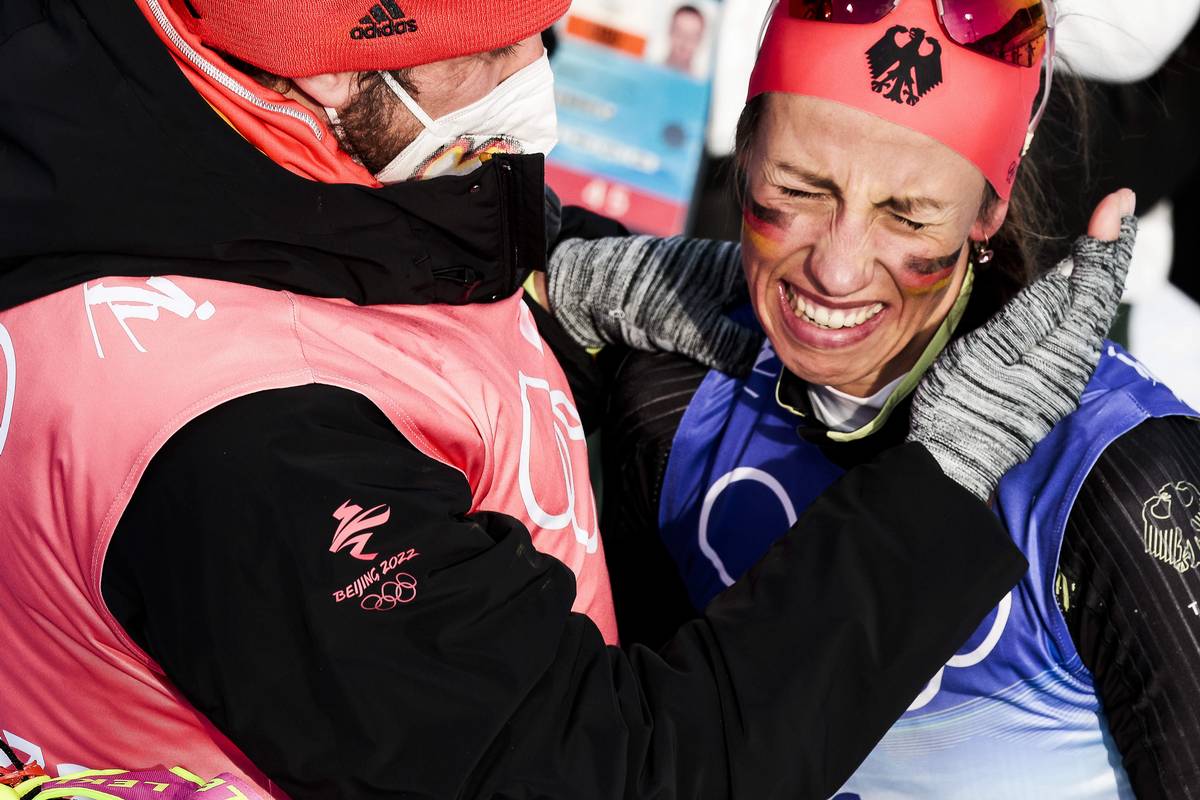
Carl shook her head as she saw finisher after finisher unable to match her time. After Diggins crossed the line, Carl’s victory was secured. She cried in disbelief as she not only found her first World Cup victory but made history for Germany.
After the race Carl commented that she started a little slowly to save energy. She said her first World Cup victory was unbelievable. “It was crazy!’” she beamed. “The whole team is on fire, we had very good skis.” It was clearly an emotional moment for Carl who finally found victory after 138 World Cup starts.
Another Classic podium held special meaning for Brennan. “Getting another Classic podium is great,” She told FasterSkier. “It’s reassuring that my Classic is good, that [the prior podium] wasn’t a fluke. I’m feeling really strong in Classic. I felt like if I pushed like I did yesterday, there would be a good chance at a podium.”
Even though Brennan got faster as the race went on, it wasn’t a tactic. “I didn’t intentionally increase my pace,” Brennan said. “I tried to start very hard, but I’m just not good at starting hard. Sometimes it takes me a little to get going, and find a relaxed state to get the most out of my skiing.”
Like Brennan, Diggins turn of speed in the second half of the race was not strategic. She said, “I think certain sections of the course suited me better. The sections where you had to herringbone in sugar were challenging for me; that’s still a technique that I’m really working on. That’s probably my biggest weakness. So I tried to really hammer the sections where I was able to.”
The tricky conditions were challenging, but the Americans seemed happy with their skis. “The service team absolutely hit it out of the park today,” Grover told FasterSkier. “They figured it out … the kick, the glide, the structure, we had really good skis all day.” Brennan concurred: “My skis were pretty good,” she said. “When I started I had some slips and kind of panicked, but I think that was me just not skiing my best. When I found my groove and my rhythm, I felt great. I love klister skiing”
For Diggins, today was a new strategy for kick wax. She said, “I’ve been working on having the confidence to not ask for an additional kick wax bump. Yesterday I did, and that might have been part of why my glide was so slow on the Classic side. So today, I was … all right, I’m going to ski with confidence, if this blows up in my face, at least I tried something different. In testing the skis were good and I’m going to assume they are going to stay good, and they did! I was really impressed with our skis”
American skiers once had to deal with the label of being primarily Skaters; that’s no longer the case. Grover said, “Both [Brennan and Diggins] have made really nice improvements in their Classic technique”. He continued that, “Rosie and Jessie have put in a lot of time on the technique, and it’s paid off already. There have been a lot of comments trickling back to us that both those athletes have made a lot of adjustments … noticing the improvements they’ve both made.”
Another point of pride for team USA which Grover pointed out, was that the Americans are in third place in the Nations Cup standings. Another huge achievement for the U.S. as they currently hold a lead over Finland, Germany, and France.
Rosie Brennan (USA), Victoria Carl (GER), Ebba Andersson (SWE), (l-r) took the podium in the 10 kilometer Classic. Carl was able to make history as the first German to win a 10 kilometer Classic individual start race. (Photo: NordicFocus)
This World Cup coverage is made possible through the generous support of Marty and Kathy Hall and A Hall Mark of Excellence Award. To learn more about A Hall Mark of Excellence Award, or to learn how you can support FasterSkier’s coverage, please contact info@fasterskier.com.
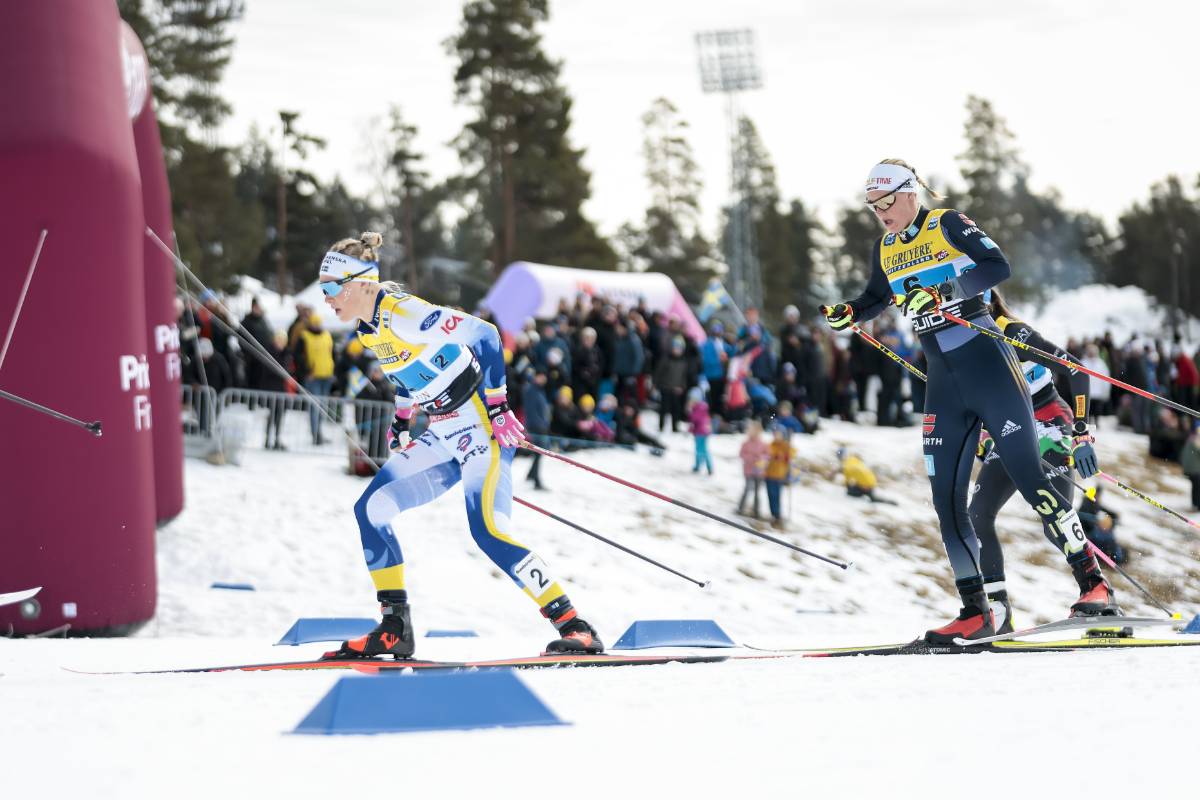
There had been glimpses of Swedish firepower all day. Into the first exchange, Calle Halfvarsson (SWE) had shot through the field. When Federico Pellegrino (ITA) broke away on leg three, Edvin Anger (SWE) had done enough to stick with the lead pack. It wasn’t until the last hill on the last leg, though, that the roar surged up from the Swedish crowd gathered in Falun. The newly-crowned world sprint champion—Sweden’s sprint champion—Jonna Sundling, launched away from the field and finished the mixed 4 x 5 k team relay with a home win.
Sprint champion Jonna Sundling (SWE) delivered a powerful final burst to help put the home country on top in Falun. (Photo: NordicFocus)
It was the second consecutive year that Falun played host to a mixed relay to close out its annual World Cup weekend, but the first time it gained “official” designation after having been a test event last season. In that test last year, the United States’ closed the season with a win. In the first “official” running in Beitostolen last December, Norway dominated on home soil. The mixed 5 k relay is new game to play skiing-wise, with teams and organizers alike still figuring out the rules and tactics. There’s obvious appeal in the format, and the appeal of watching skiing’s best athletes and tacticians figure something new out in real-time. Take one of skiing’s longest running formats—the distance team relay—and inject it with the currents the sport has been riding the past few years. Old and new: what’s not to like?
For the athletes racing, unpredictability was a main selling point. Hailey Swirbul said to FasterSkier that, “I appreciate the unpredictable aspects of relay day- you never know what your race will look like because it depends completely on what the racers before you have done out on course. I always find it easier to push to a painful place when I have teammates counting on me, much more so than I’m able to in an individual race. I love the energy of the team events.”
The latest tinkering with the new mixed relay format meant that, in Falun, women would finish the race in the anchor leg while the men would lead out the race in the first classic leg. That switch had observers eyeing which of the best from the women’s field were slotted in the fourth spot; almost all eyes were turned to Sundling who would finish out Sweden I’s lineup of Halfvarsson, Moa Ilar, Anger. The anchor leg geared towards the sprinters, with Anne Kjersti Kalvaa on for Norway I, Victoria Carl on for Germany I, and Julia Kern on for USA I. The rest, though, was a mix of skills and specialties that would provide a mixed up race. At times, the best sprinters and the best distance skiers were on course at the same time, skiing the same course, in very different ways. In Leg 3, for example, 50 k World Champion and Holmenkollen winner Simen Hegstad Krueger (Norway I) and Federico Pellegrino (Italy I) were trading blows head-to-head.
The USA I and USA II teams show off their relay socks in Falun. USA I finished 8th, USA II finished 11th. (Photo: NordicFocus)
The excitement surrounding that roster of big names, however, put into relief how many other big names were absent. The Team Relay is a non-scoring World Cup event in the new World Cup point system, leading most skiers contending for World Cup Crystal Globes to sit out the event. The top five women in the Cup standings were all absent today, including Jessie Diggins and Rosie Brennan. The United States fielded two teams with Ben Ogden leading the USA I lineup that included Novie McCabe, Scott Patterson, and Julia Kern. USA II included Luke Jager, Hailey Swirbul, Kevin Bolger, and Sammy Smith.
Mixed 4 x 5 k Team Relay
The first relay leg escalated into a sprint after Ben Ogden (USA I) pushed the pace early, culminating in an all-out run on the final climb of Falun’s 5 k course. (Photo: NordicFocus)
Ben Ogden began the week of World Cup racing with a full-gas effort in Drammen’s city sprint heats. He would end his week the same way. Ogden pushed the pace from the beginning of the scramble leg; through the rest of the lap it just kept gaining momentum. Canada’s Antoine Cyr strided up to Ogden, then Norway I’s Martin Loewstroem Nyenget pushed it at three kilometers. By four kilometers, the pace was a full sprint. A strung-out field ultimately snapped as the leaders ran up the final climb, with Halfvarsson putting in an extra burst to bring a lead pack—Sweden I, Norway I, Norway II, Italy I, Canada I—into the first exchange. Ogden had initiated the moves, and he continued hanging on by a thread. He led USA I into the exchange (10 seconds behind the leaders) at the front of a chase group that contained USA II’s Luke Jager who managed to enter the exchange in eighth.
In post-race comments to FasterSkier, Ogden said that, “todays race was fun, [but] 5k is definitely a tricky distance. You can’t just charge from the beginning, but you are able to hold a very high pace for the entire distance. In todays scramble leg I started out pretty hard and couldn’t help myself from cranking up the big climb. We had fabulous kick and it’s just such s perfect hill for striding I was loving It. After that in the last two k or so the Norwegian cranked up the pace in the double pole and I fell off just a little bit before the sprint course and stadium where It was just an all out sprint to the tag zone.”
The second leg saw a steady pace that contrasted the bashings and bursts of the first. The main action came from Germany I’s Katharina Hennig, who took a hand-off from Albert Kuchler in 11th place, but by the end of her lap had pulled her team into first place. That put Germany I into a lead pack alongside Norway I, Norway II, and Sweden I, with Italy I in contact enough through the hand-off from Caterina Ganz to Federico Pellegrino that they could rejoin the pack in the early part of leg 3. Hailey Swirbul skied from the chase group to keep USA II in 6th place, alongside Canada I’s Katherine Stewart-Jones in 7th. USA I was in 11th with Novie McCabe handing off to Scott Patterson.
Hailey Swirbul pointed to an ability to embrace the new challenges of the mixed relay as contributing to her strong performance today, saying post-race to FasterSkier that, “It was quite fun to be on leg two of a relay for the first time I can remember! I have really enjoyed being the scramble leg for many of the relays I have been part of, but the mixed relay provides a different opportunity with the men racing first. I thought it was fun to be on the hunt, rather than be hunted or try to defend my space.”
Simen Hegstad Krueger (Norway I), Harald Oestberg Amundsen (Norway II), Anger (Sweden I), and Pellegrino (Italy I) got caught in tactical stasis on leg 3, as the sprinters—Pellegrino and Anger—looked to mark the Norwegian distance duo. That allowed Germany I’s Anian Sossau to hang onto the lead group. While Krueger did lift the pace three kilometers into the lap—dropping Sossau from the lead pack—the lapse allowed the Germans to stay within striking distance. Pellegrino put in a move to the outside on the final climb that gave Italy as much advantage as he could produce. That advantage turned out to be less than a second, as Amundsen handed off to Ragnhild Gloeersen Haga for Norway II and Krueger handed off to Anne Kjersti Kalvaa for Norway I. Sweden I was in fourth, and Germany exchanged from Sossau to Victoria Carl in fifth, 11.6 seconds back. Kevin Bolger kept USA II in the top ten in eighth place, while Scott Patterson handed off to Julia Kern for USA I in 13th place.
Julia Kern skied a hard-charging anchor leg that was among the fastest in the field to help the USA I team finish 8th place. (Photo: NordicFocus)
As Sundling wound through the last lap for Sweden I, the race grew tense. The Norwegian pair of Kalvaa and Haga would have to make a move; it was just a matter of when. Behind them, Germany’s Victoria Carl was working her way back to the lead back with simple grit: 1.5 kilometers into the lap, she had cut the gap in half. By the 2.5 kilometer mark, she was back in contact. Then, the pack went again: Kalvaa accelerated at the four kilometer mark, but Sundling led over the top of the hill opening the winning gap over with Kalvaa. At the finish line, Sundling eased into the arms of her teammates. Kalvaa did the same in second. Victoria Carl put the finishing touches on her superb comeback, and threw a boot over the line to put the Germany I team on the podium in third place. Behind her, Julia Kern was showing the same kind of grit for USA I. Kern moved from thirteenth to finish in eighth place, with a split that only Carl and Sundling surpassed. USA II finished eleventh, behind the relay debut of Sammy Smith.
Mixed Team Relay Kicks off World Cup’s “Experimental” Phase
The kind of tinkering and the toying on display throughout the Mixed Team Relay continues next week during World Cup events in Tallinn, Estonia when that city will host a city-center sprint on Tuesday. This first-ever World Cup stop in the Estonian capital will also act as a test event for the initiation of World Cup wax protocols. For the first time, a World Cup event will be conducted with all skiers utilizing the same glide wax: no miracles and mysteries from the somewhere deep in the wax trucks; everyone will race on exactly the same wax.
Next week will also mark the resumption of the chase for the Overall Crystal Globe, as the World Cup quickly winds towards its final weekend in Lahti, Finland.
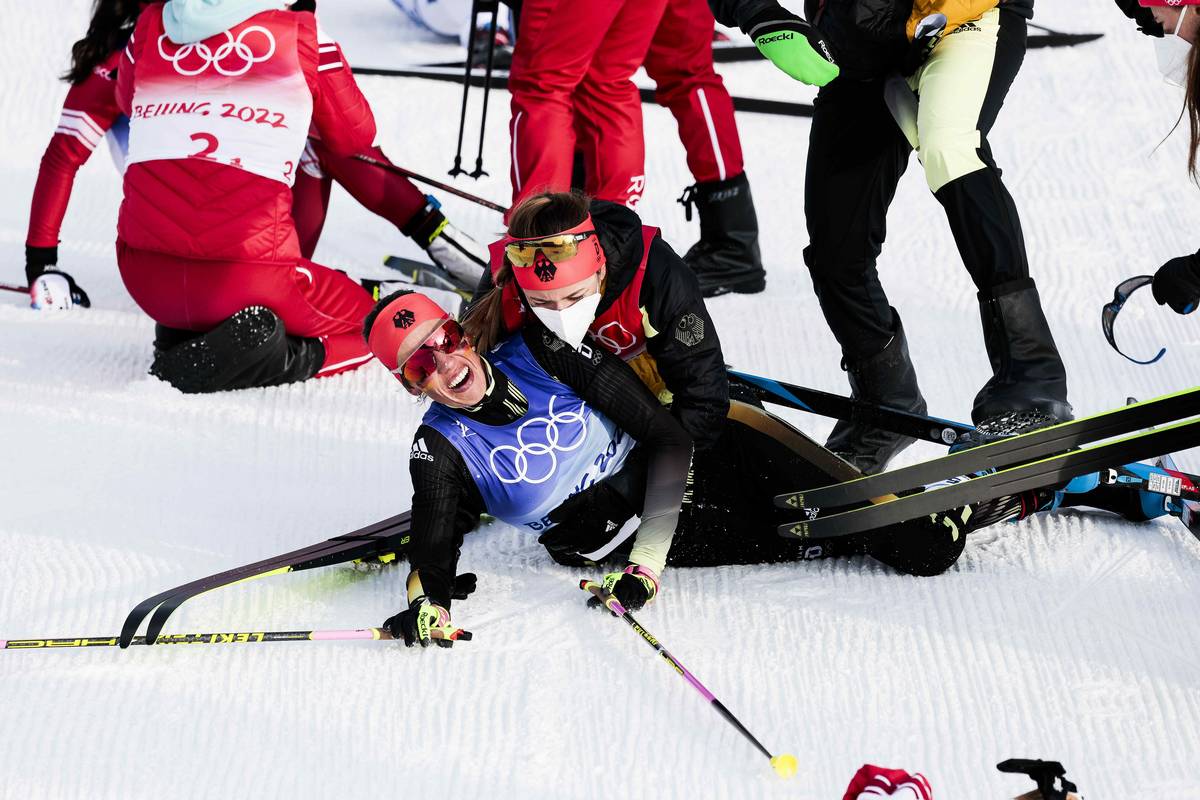
Wednesday’s Olympic team sprint offered another thrilling set of races at the venue in Zhangjiakou — we’re back to break down an epic performance by the German women, a critic-silencing race from Norway in the men’s event and a U.S. women’s result that left a medal just out of reach.
Thanks to everyone for sending in questions and feedback — we’re trying to keep our heads above water on the homestretch here, but you can be sure Devon will still have plenty to say post-Games. In the meantime, you can get us at devon@fasterskier.com and nat@fasterskier.com.
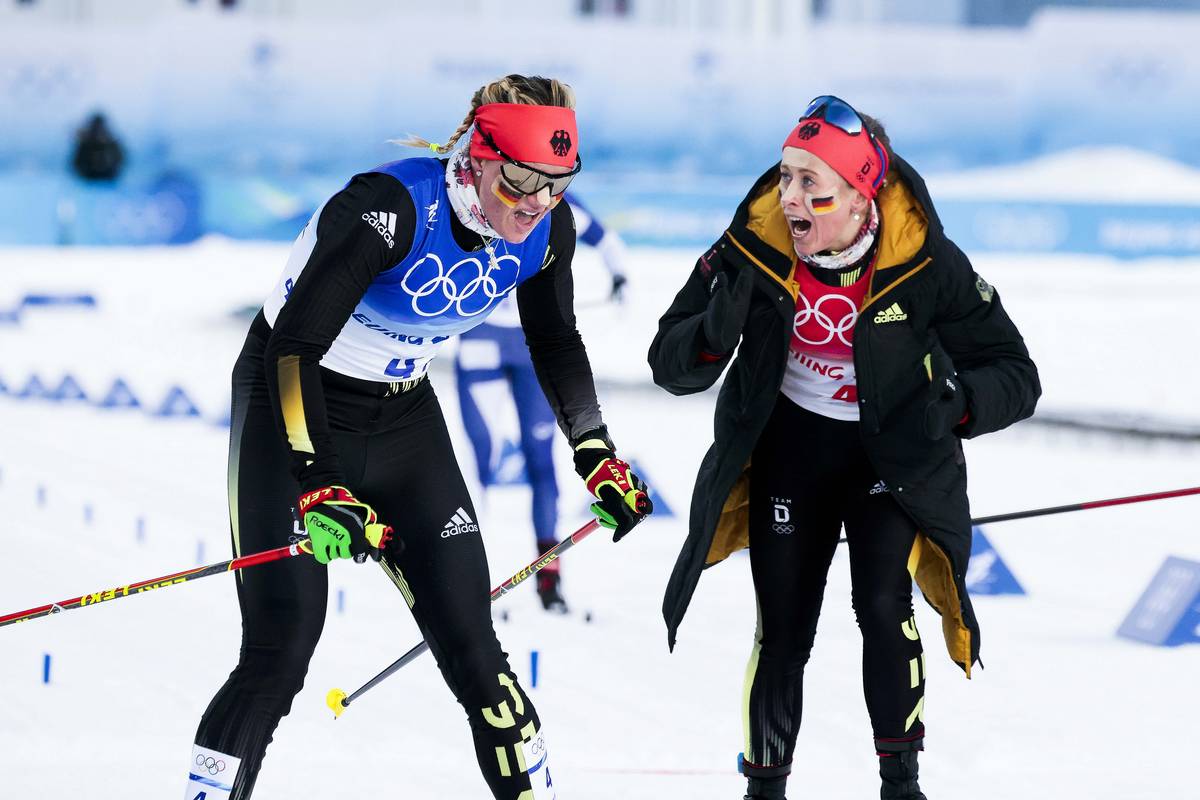
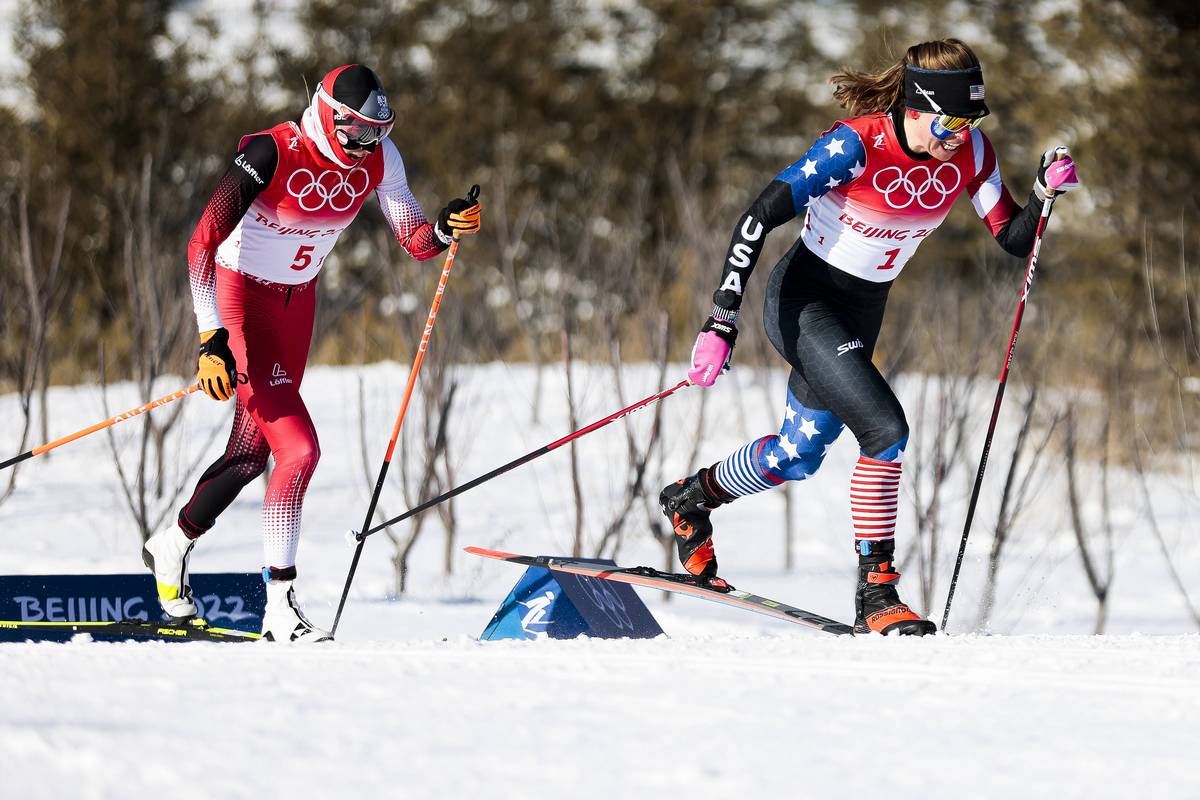
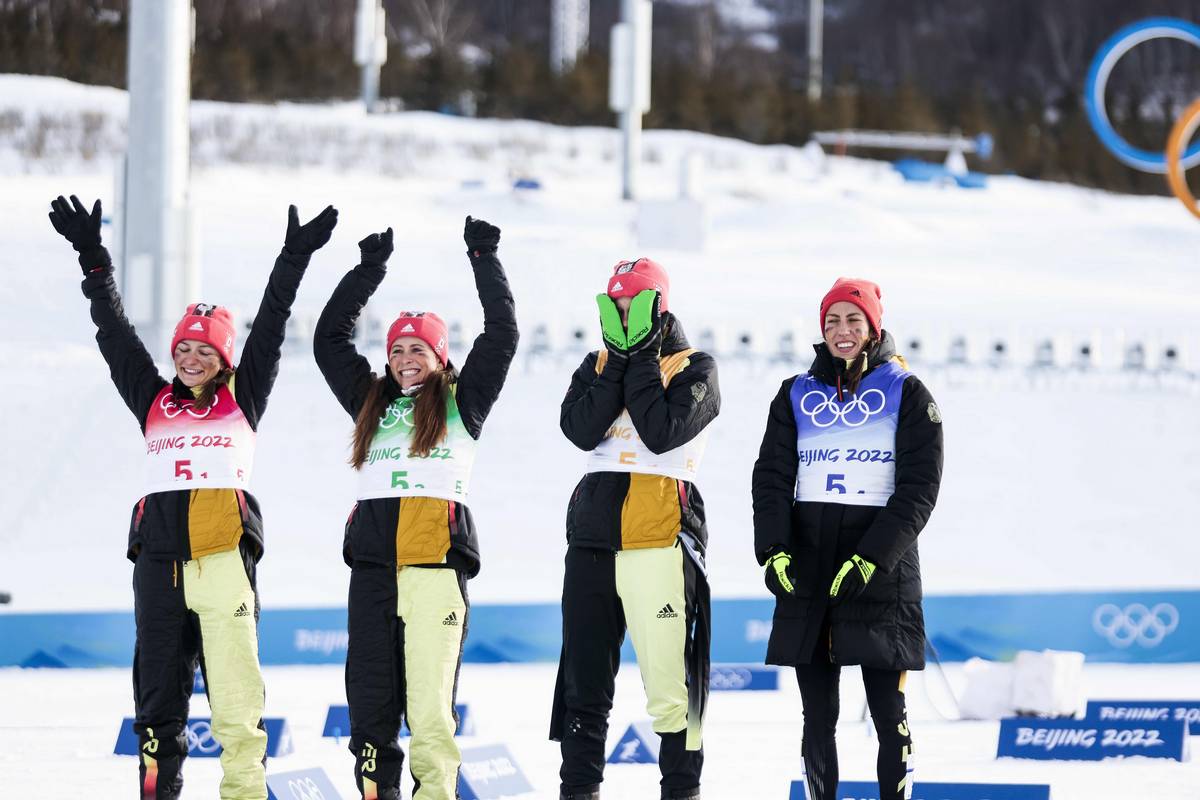
Katharina Hennig and Victoria Carl win gold for Germany in the classic team sprint. (Photo: NordicFocus)
This World Cup coverage is made possible through the generous support of Marty and Kathy Hall and the A Hall Mark of Excellence Award. To learn more about A Hall Mark of Excellence Award or to learn how you can support FasterSkier’s coverage please contact info@fasterskier.com.
The team sprint: two skiers racing three laps each at roughly 1.5-kilometers a piece with a long climb thrown into the middle of the course and temperatures in the single digits Fahrenheit. It boils a sport that already requires both power and endurance down to its essence.
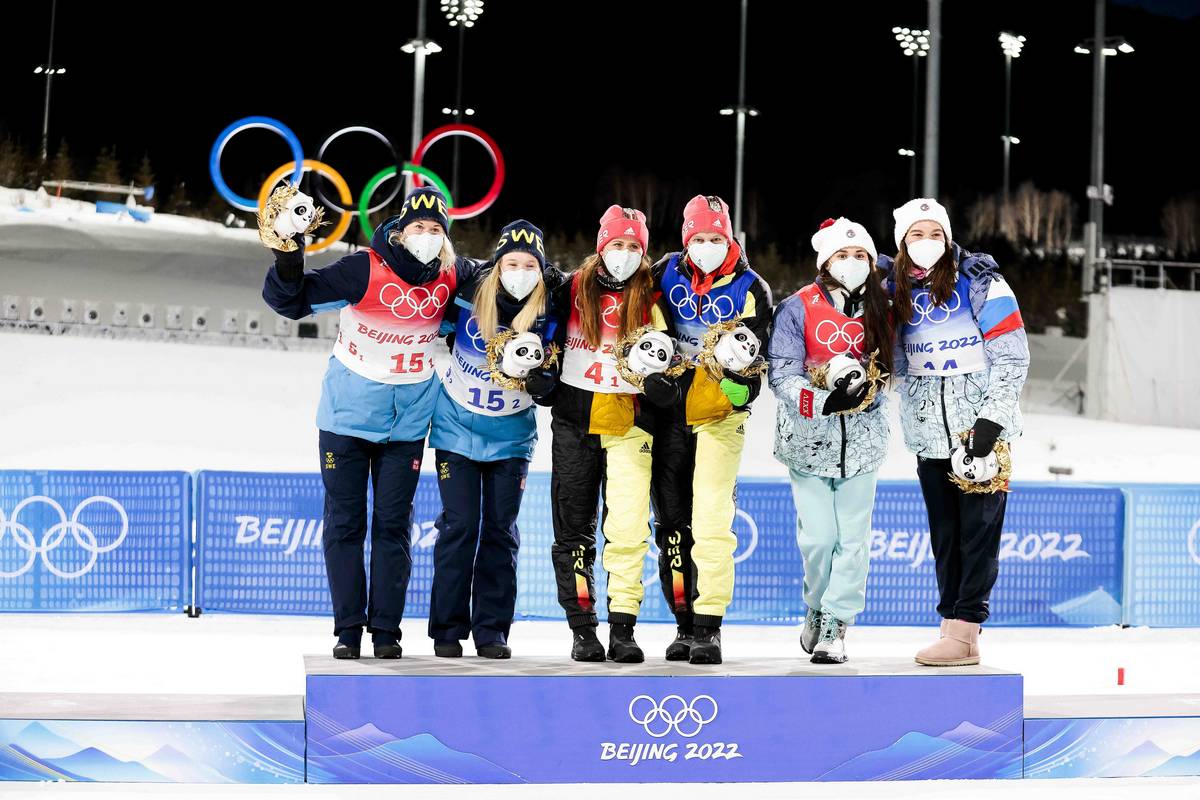
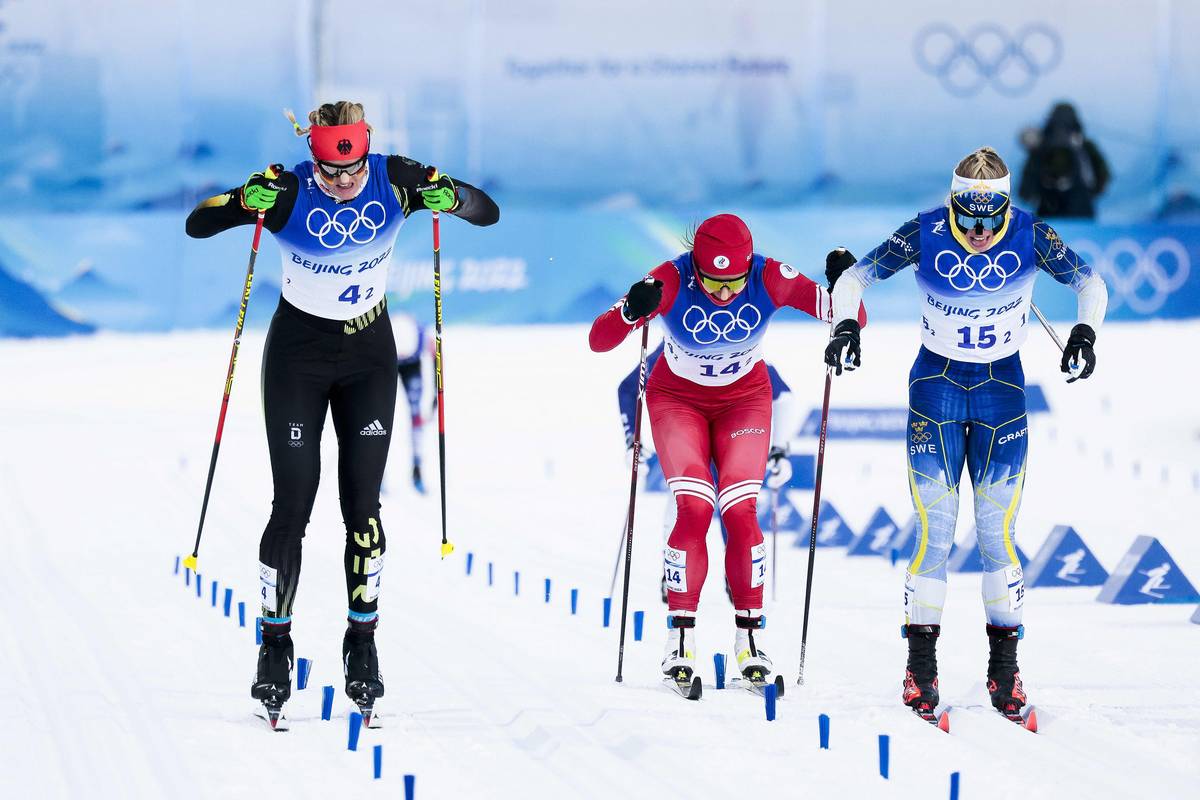
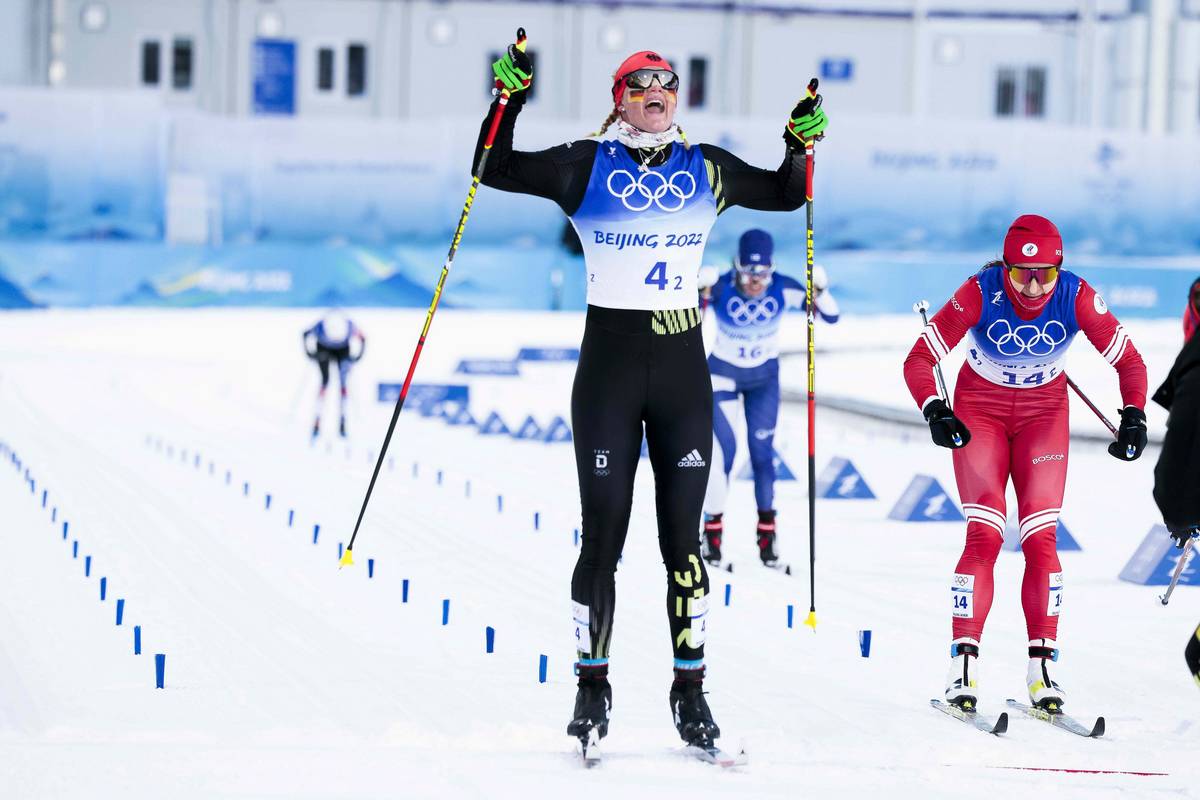
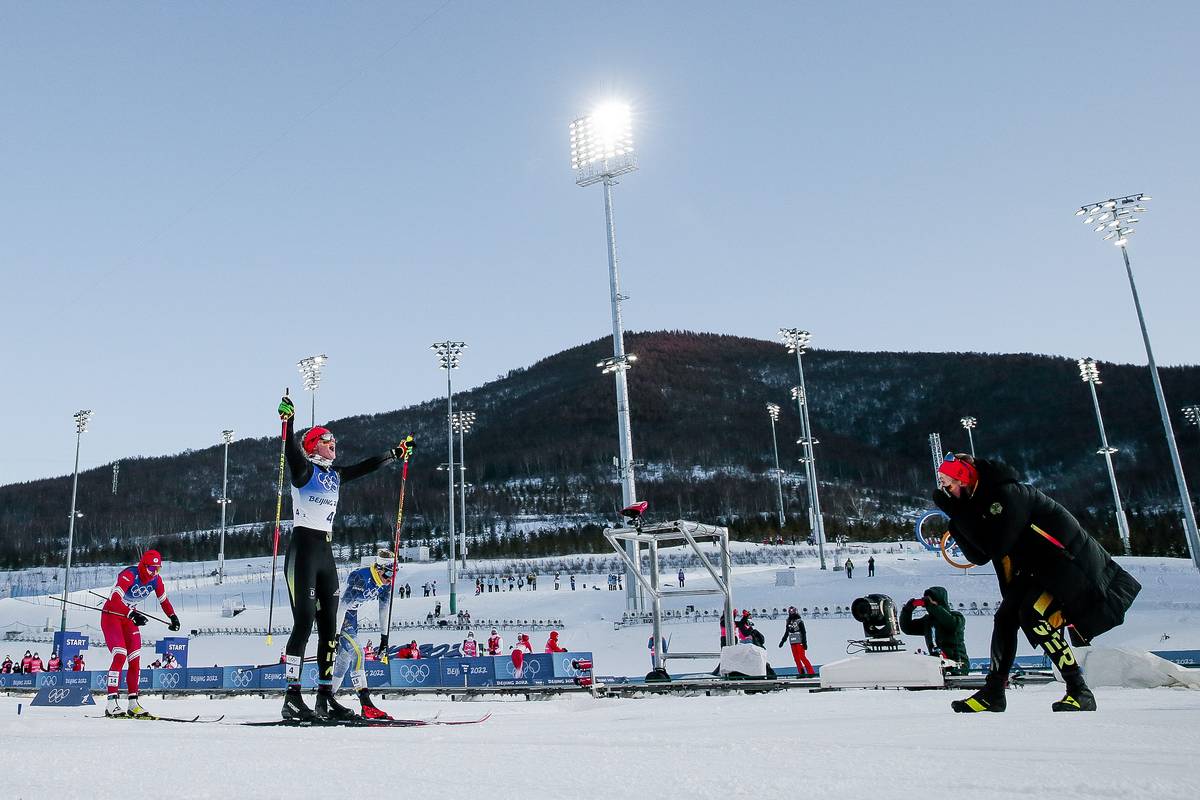
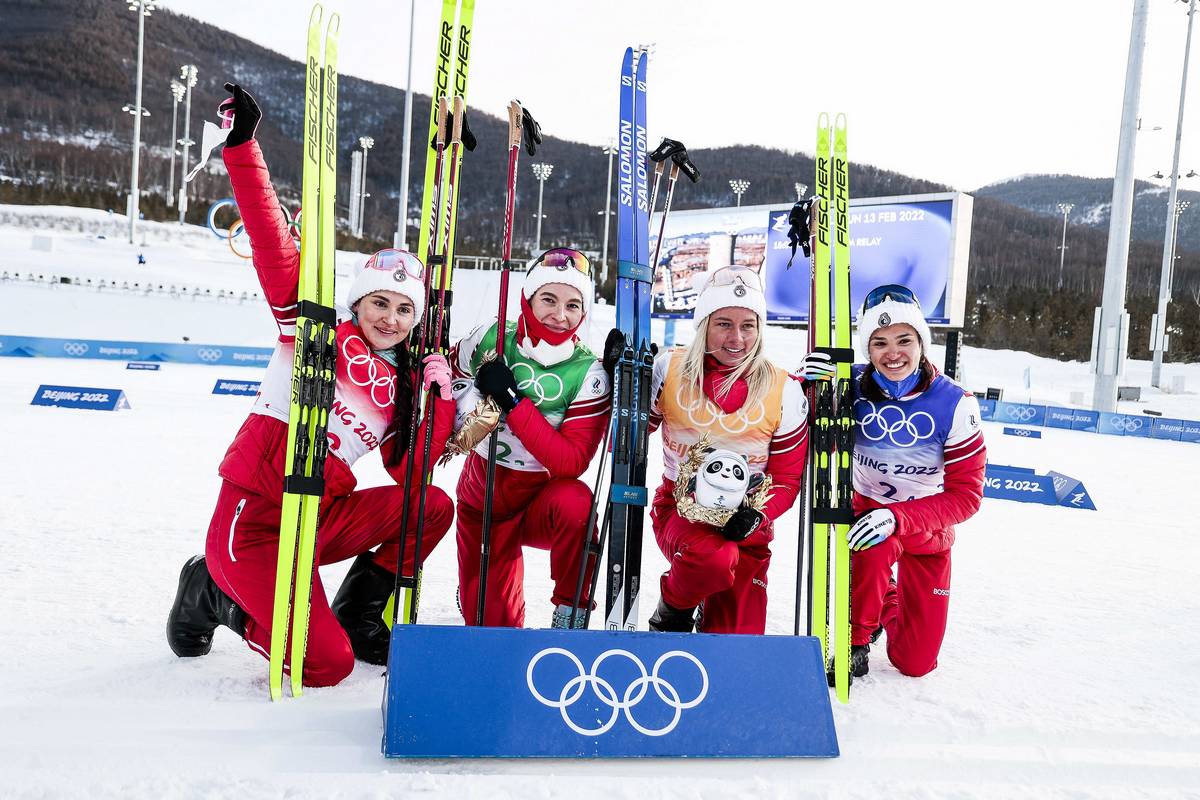
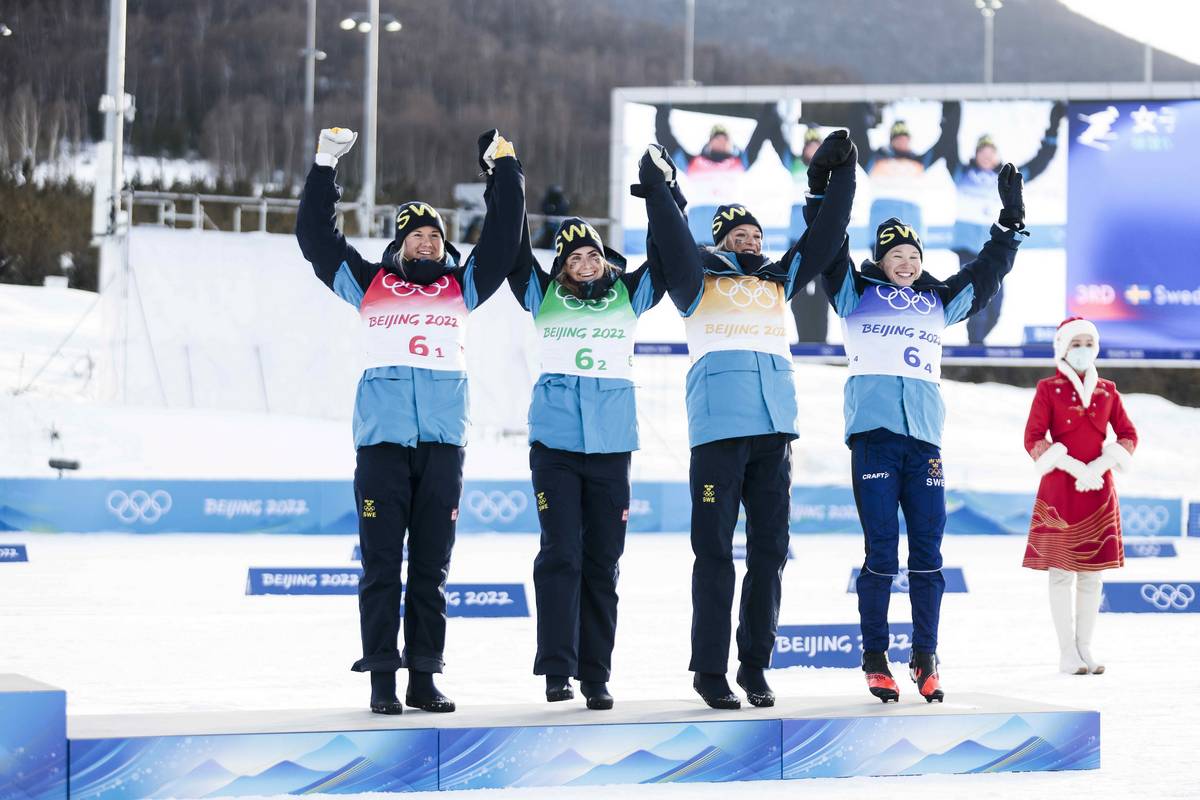
Riding the high of their silver medal in the women’s 4 x 5 k relay, the duo from Germany, Katharina Hennig and Victoria Carl, won a thrilling sprint finish to decide the medals, collecting gold in a time of 22:09.85. To take the stop spot, the anchor, Carl, out-sprinted the Swedish individual freestyle sprint gold medalist, Jonna Sundling, in the final meters to win by just 0.17 seconds, while the Russian Olympic Committee’s Natalia Nepryaeva crossed just behind in third (+0.71).
Sweden, Germany and Russia share the women’s classic team sprint podium. (Photo: NordicFocus)
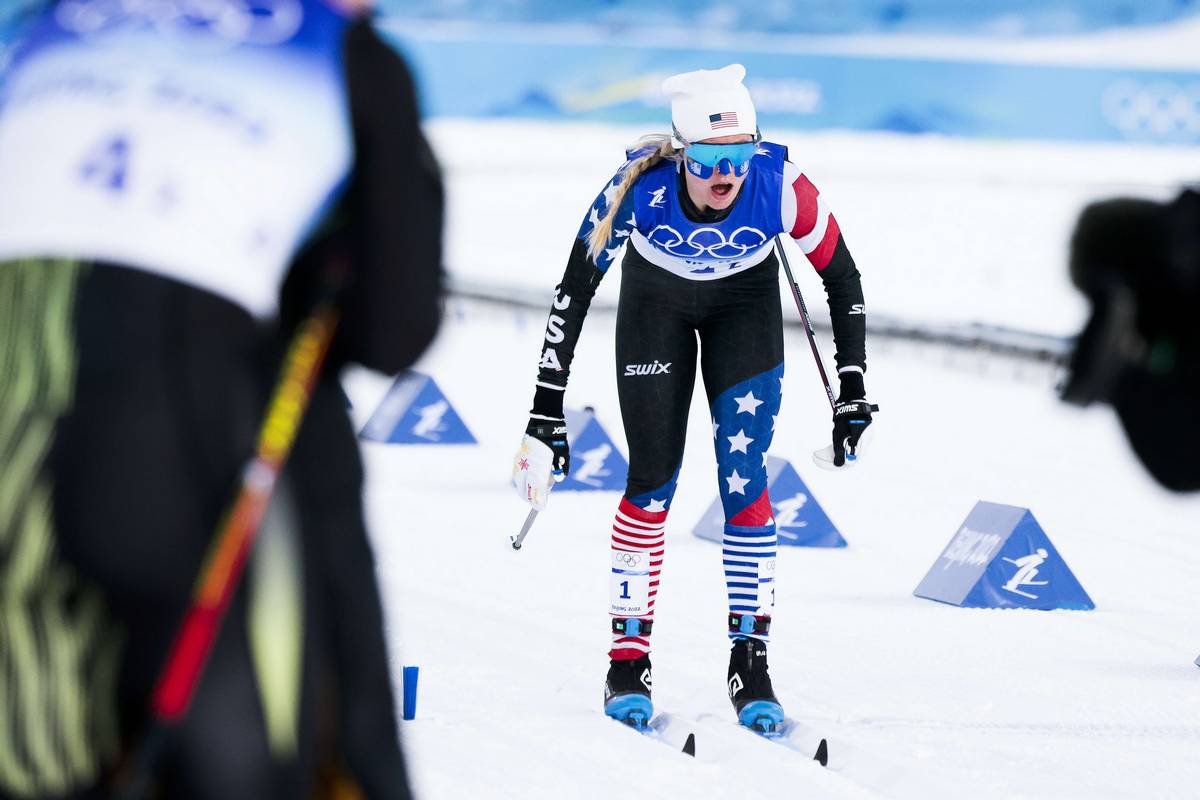
After holding strong in medal contention throughout the first five of six laps, the American pair of Rosie Brennan and Jessie Diggins lost contact with the leaders in the final leg, crossing the line fifth (+12.93) behind Finland in fourth (+3.86).
Now, let’s take a step back.
There is, perhaps, no reminder needed that USA won the team sprint in 2018; Kikkan Randall and Jessie Diggins collected the first Olympic medal for the United States in cross country skiing – a gold, no less – since Bill Koch took silver in the 30 k classic in 1976. However, the team sprint in PyeongChang was raced freestyle, whereas today’s team sprint would be held in classic.
“I’m not trying to compare today to four years ago,” said Diggins in the mixed zone after the race. “It’s a different course, different altitude, different technique, like literally nothing is the same and, and that’s okay. I think today, I was going out there and skiing for Rosie and skiing as hard as I could and as best I could… but I’m really proud of this race and proud of giving it our best fight.”
Rosie Brennan helps the Americans finish second in the first team sprint semifinal, automatically advancing to the final. (Photo: NordicFocus)
We have to look back eight years for a classic team sprint at the Olympic Winter Games, to the 2014 Games in Sochi. Norway took the gold that day in dominant fashion ahead of Finland and Sweden, who were stretched behind by roughly ten seconds a piece. Only one of the six women on the podium returned to the Games in 2022, again making the team sprint roster: Finland’s Kerttu Niskanen. The American pairing of Sophie Caldwell (now Hamilton) and Kikkan Randall were sixth in Sochi, +35.06 back on the Norwegian winners.
In the intermediate FIS World Championships, the Americans finished fifth both years, racing Brennan and Sadie Bjornsen (now Maubet) in the freestyle competition in Oberstdorf, Germany in 2021, and pairing Bjornsen with Diggins for the classic team sprint in Seefeld, Austria in 2019. In Oberstdorf, the Americans missed the podium by roughly 2.2 seconds, finishing 2.8 seconds behind the winning team from Sweden. In 2021, they missed the podium by an equivalent margin, this time finishing 5.8 seconds back in the overall standings, again to Sweden. It’s a mark of consistency and depth across techniques for the American women.
Yulia Stupak (ROC), Kerttu Niskanen (FIN), and Katerina Janatova (CZE) lead the way early in the women’s classic team sprint semifinal. (Photo: NordicFocus)
To make the team sprint final, each team must finish in the top-two of semifinal A or B, or be within the next six fastest times from either heat. The U.S. was second to Germany (+4.03) in Semifinal A, while the ROC won the second semi in a close finish with Finland in second (+0.35) and Sweden third (+1.0). Austria and Switzerland also advanced from the first semi, with Sweden, Norway, France, and Poland filling the remaining spots from semifinal B.
With bursts of frozen mist released from their mouths, the athletes took to the course for the final round, with Yulia Stupak (ROC), Maja Dahlqvist (SWE), Kerttu Niskanen (FIN), Tiril Udnes Weng (NOR), and Katharina Hennig (GER) racing with Brennan at the front of the pack.
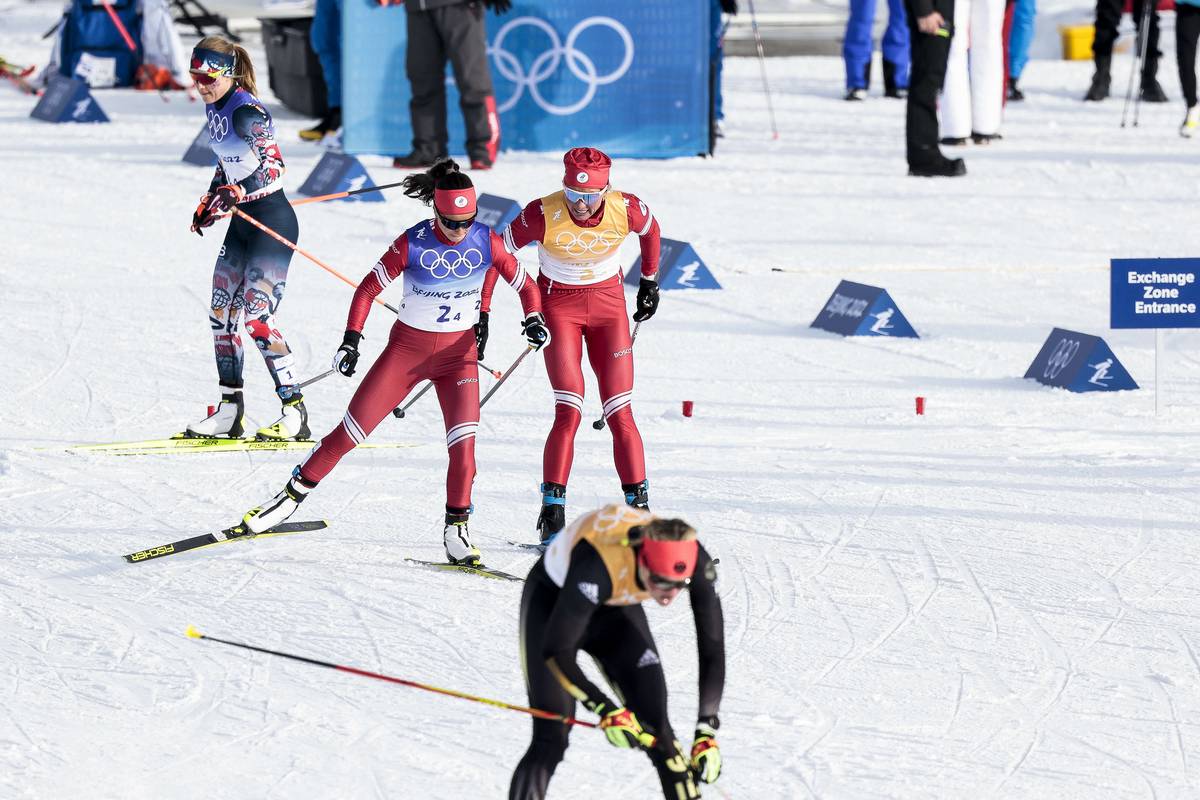
With a hooded parka draped over her, face tape obscuring her normally glittery cheekbones, and heated socks inside her boots, Diggins waited in the exchange for the tag. She would be facing Natalia Nepryaeva (ROC), Jonna Sundling (SWE), Krista Pärmäkoski (FIN), Maiken Caspersen Falla (NOR), and Victoria Carl (GER) in the even-numbered legs.
Racing comfortably near the front with skis that looked competitive for both kick and glide, Brennan tagged Diggins +1.1 second back on Finland in fourth, well within the lead group. In what would become a pattern for her first two legs, Diggins quickly moved to the front to control the race and ensure a fast pace, perhaps risking accumulating her own fatigue while also taking the sting out of the legs of the individual sprint gold and silver medalists of Sweden, who had also won the World Championship gold in 2021.
Diggins races at the front of the lead pack during the classic team sprint final. (Photo: NordicFocus)
Diggins tagged Brennan virtually even with Sweden and Finland after her first lap, a position Brennan was able to hold through her second leg. Near the bottom of the long, grinding climb to the high point of the course, Norway’s Weng wobbled slightly, placing her pole in front of Dahlqvist’s ski to catch her balance. Weng’s pole snapped, leaving her running up the sidelines of the climb with one pole, detaching her strap to grab another from a coach who stood along the fenceline. This lost Norway several seconds, which they were unable to regain in subsequent legs, leaving the team out of podium contention.
On the odd legs, Niskanen of Finland consistently controlled the race at the front, putting the powerful stride that earned her a silver medal in the 10 k last week on display as she led up the climb in each round. She tagged her teammate Pärmäkoski in the lead at the halfway mark, with Germany, the ROC, and USA within a second back.
Kerttu Niskanen (FIN) sets the pace in the first lap of the women’s classic team sprint final. (Photo: NordicFocus)
Diggins again charged to the front, her hands and legs pumping metronomically as she drove her skis up the climb. Diggins crested the hill in front, with Sundling and Pärmäkoski on her tails heading into the descent. A gap had opened to Germany and the ROC, but these teams had lightning fast glide and were able to regain contact in the descent.
At 6 k, with four of six legs complete, it was Sweden and Finland in the lead at the exchange, with Brennan receiving a tag 2.5 seconds back. Niskanen again set the pace at the front, still looking strong as she pushed the pace up the A-climb, with Dahlqvist matching pace behind. In a critical moment where loss of contact might have meant accepting a podium was not in the cards on the day, Brennan accelerated up the climb, steadily closing the gap to the Swede ahead of her.
Rosie Brennan (USA) awaits her turn during the women’s team sprint. (Photo: NordicFocus)
An aerial shot showed Brennan upping her tempo as she brought the U.S. back in contact with the leaders, bringing Hennig and Stupak along with her. All five women dropped into a tuck as they headed downhill together, rounding the sweeping right-hand bend and sprinting up a final climb before the last exchange. Throwing her hands up the hill in a run, Brennan challenged Sweden’s Dahlqvist on the final uphill, double poling around a left-hand bend into the exchange in third behind Germany and Finland.
In the last lap, Diggins went hunting. With Pärmäkoski and Carl leading the charge up the climb, Diggins would need to work the hill. Striding powerfully, Diggins did everything she could to keep her team in contact with the leaders, but it was not enough on the day. Doublepoling across the false flat before the descent, it was Pärmäkoski leading Carl, Nepryaeva, and Sundling.
The leaders were four abreast coming around the final bend, with Pärmäkoski and Sundling pushed into the outer two lanes, leaving them at a deficit as they headed up the final climb to the stadium.
Cresting the rise, Carl looked to be falling off the pace, while Nepryaeva and Sundling pulled to the front, the Swede leading around the final left-hand corner into the finish.
But Germany wasn’t done yet. Carl moved up along the outside of the bend, challenging Sundling as they headed into the finish lanes. Doublepoling powerfully, Carl began to slowly pull ahead of Sweden, with the ROC dropping back a few meters behind.
Coming to the line to decide the medals, it was Victoria Carl (GER), Natalia Nepryaeva (ROC), and Jonna Sundling (SWE) (l-r). (Photo: NordicFocus)
In a surprise upset of the Swedish favorites, Carl took it to the line, holding off Sundling as she crossed the line in 22:09.85, welcomed by her ecstatically screaming partner Hennig. Sundling was just 0.17 seconds back for silver, with Nepryaeva unopposed for bronze on their tails (+0.71).
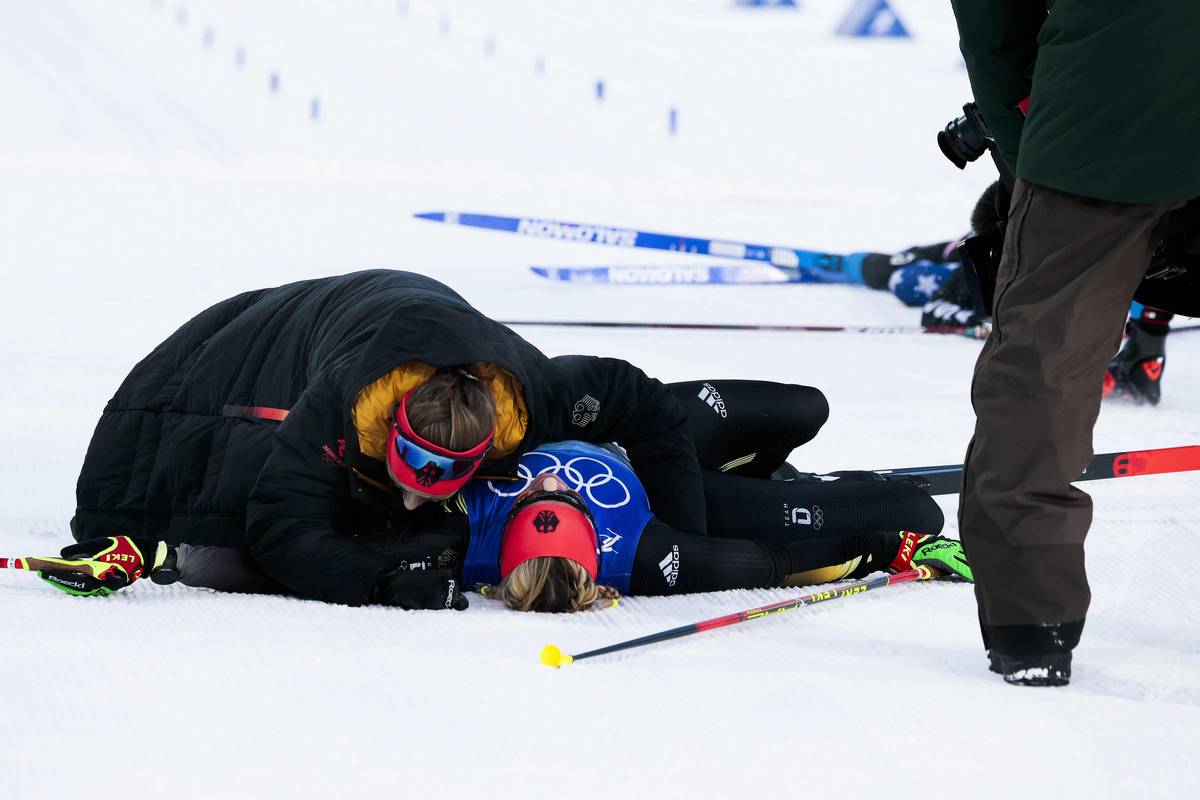
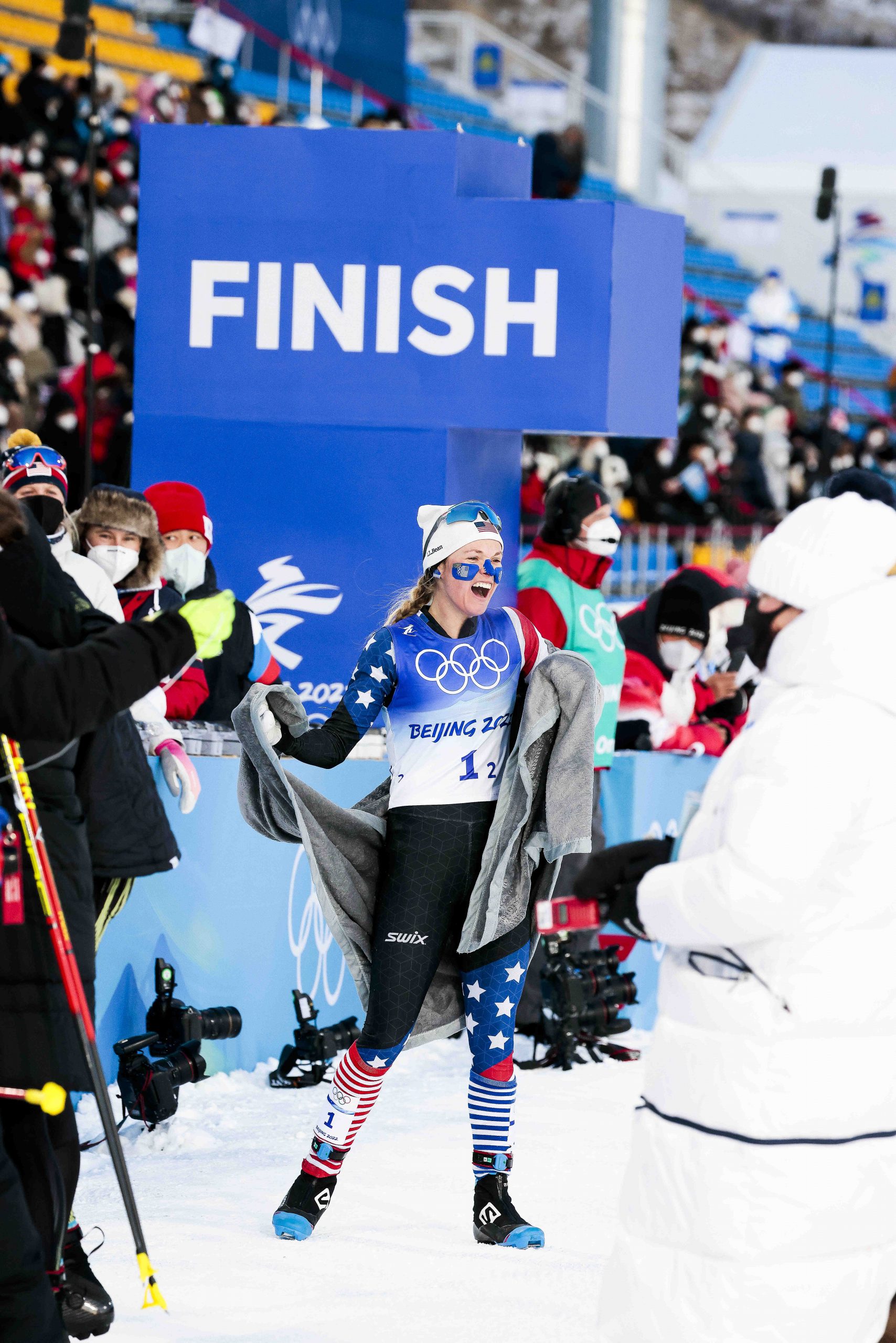
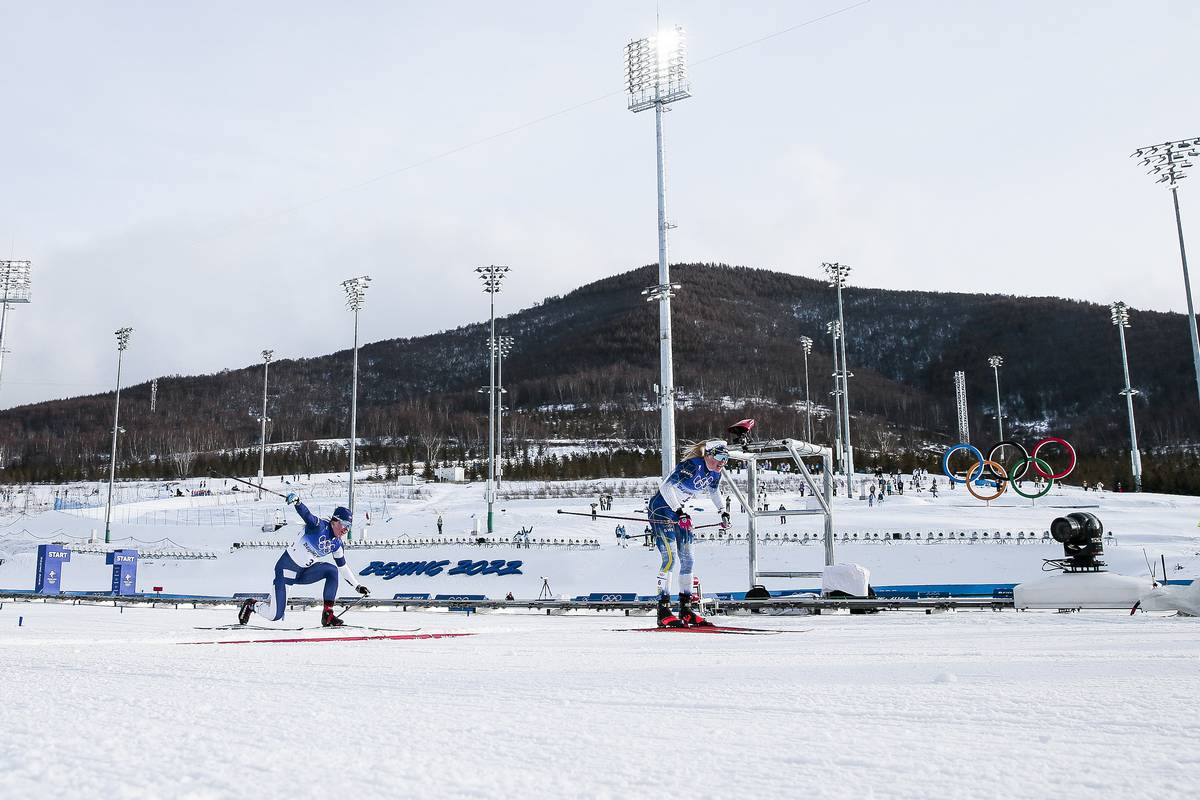
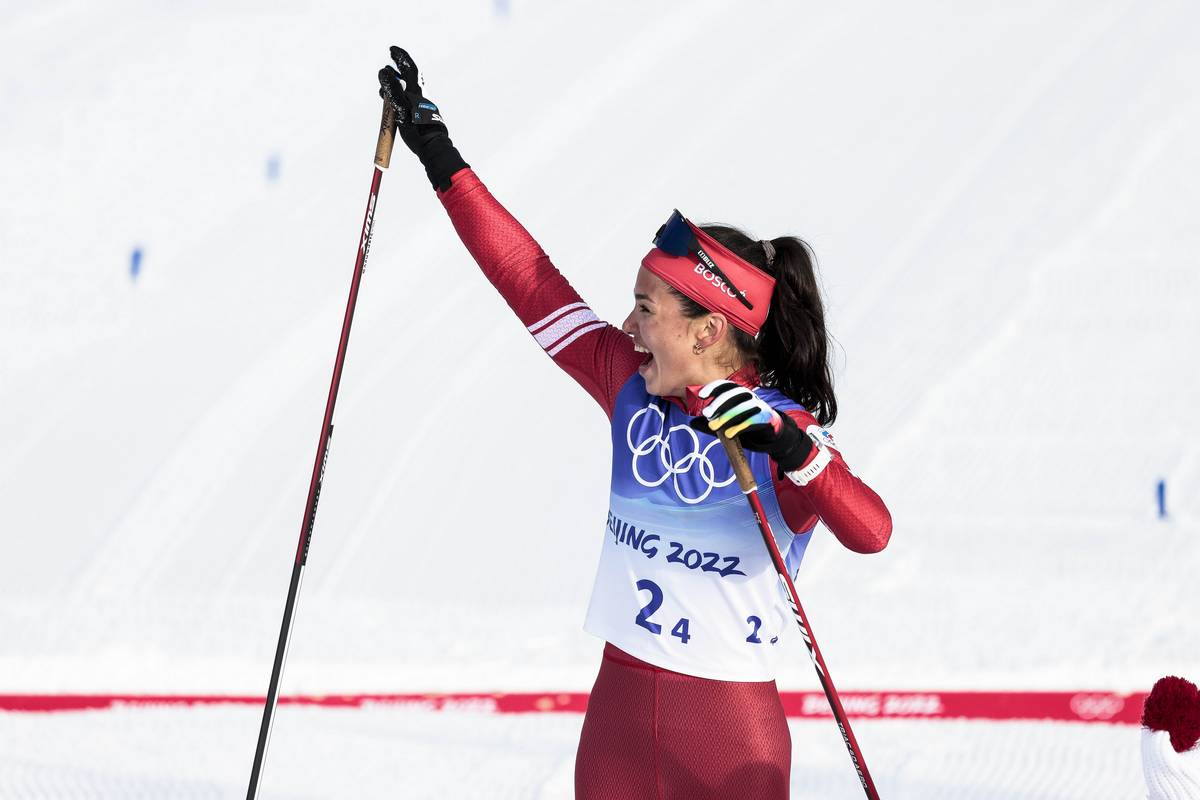
Victoria Carl (GER) celebrates gold in the women’s team sprint while Natalia Nepryaeva brings the ROC across the line in third.(Photo: NordicFocus)VIctoria Carl takes gold in the classic team sprint, while partner Katharina Hennig awaits in disbelief. (Photo: NordicFocus)
After falling off the leaders in the final climb, Pärmäkoski brought Finland to the line in fourth (+3.86) with Diggins holding strong after a gap to cross fifth (+12.93).
“It means a lot for us,” Hennig told the media after her race. “Also the silver medal in relay and today the gold medal in team sprint. It means a lot and we are very thankful for the whole team. It’s very important for cross-country in Germany.”
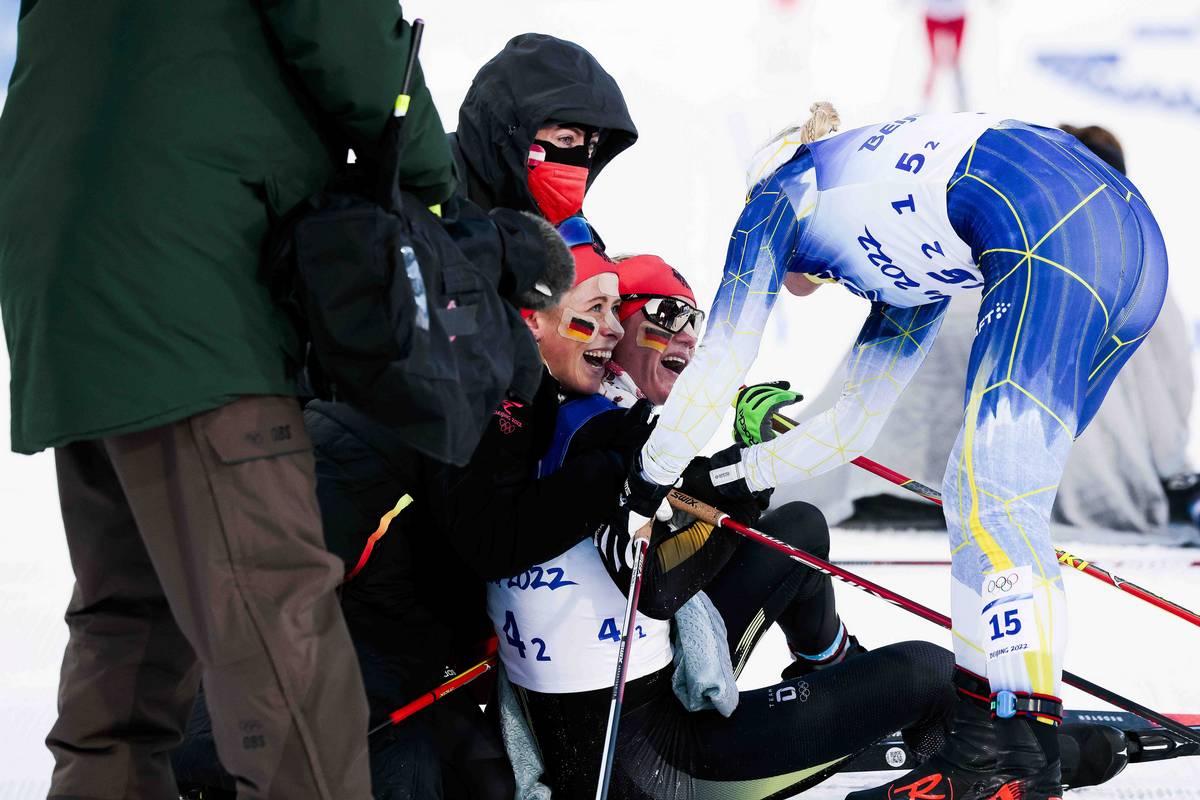
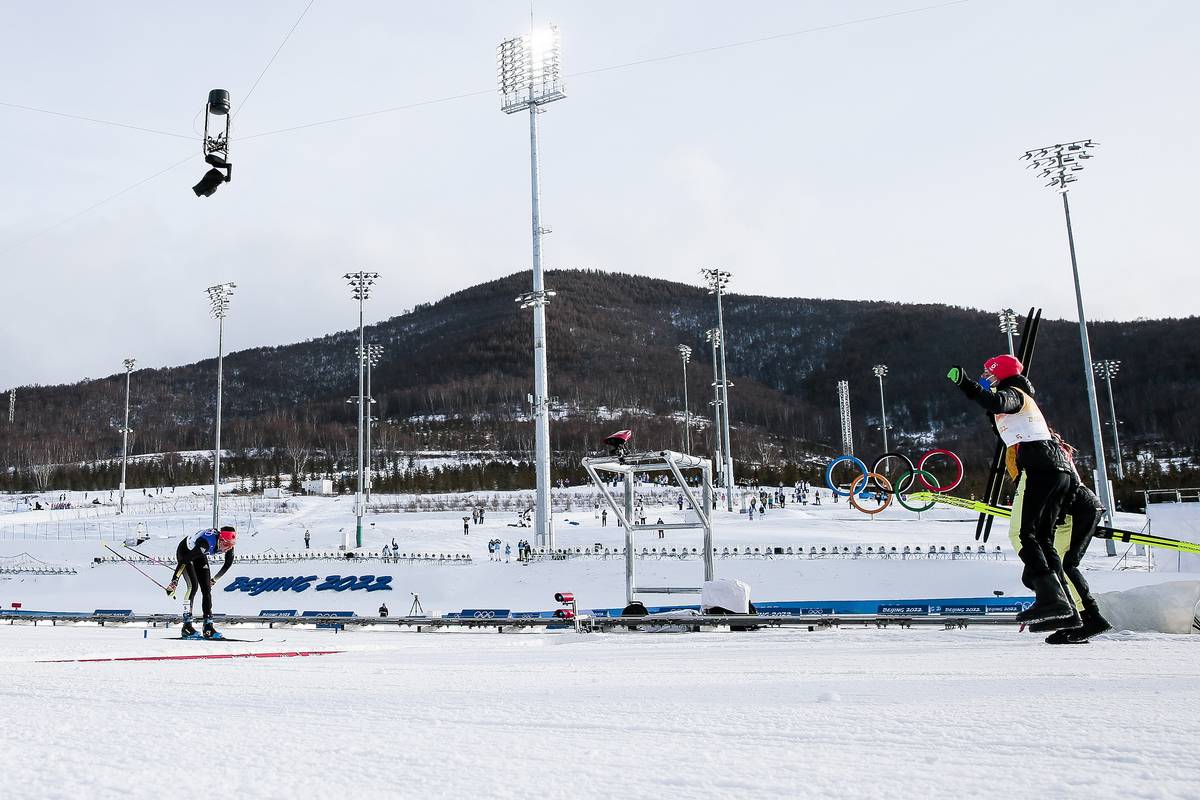
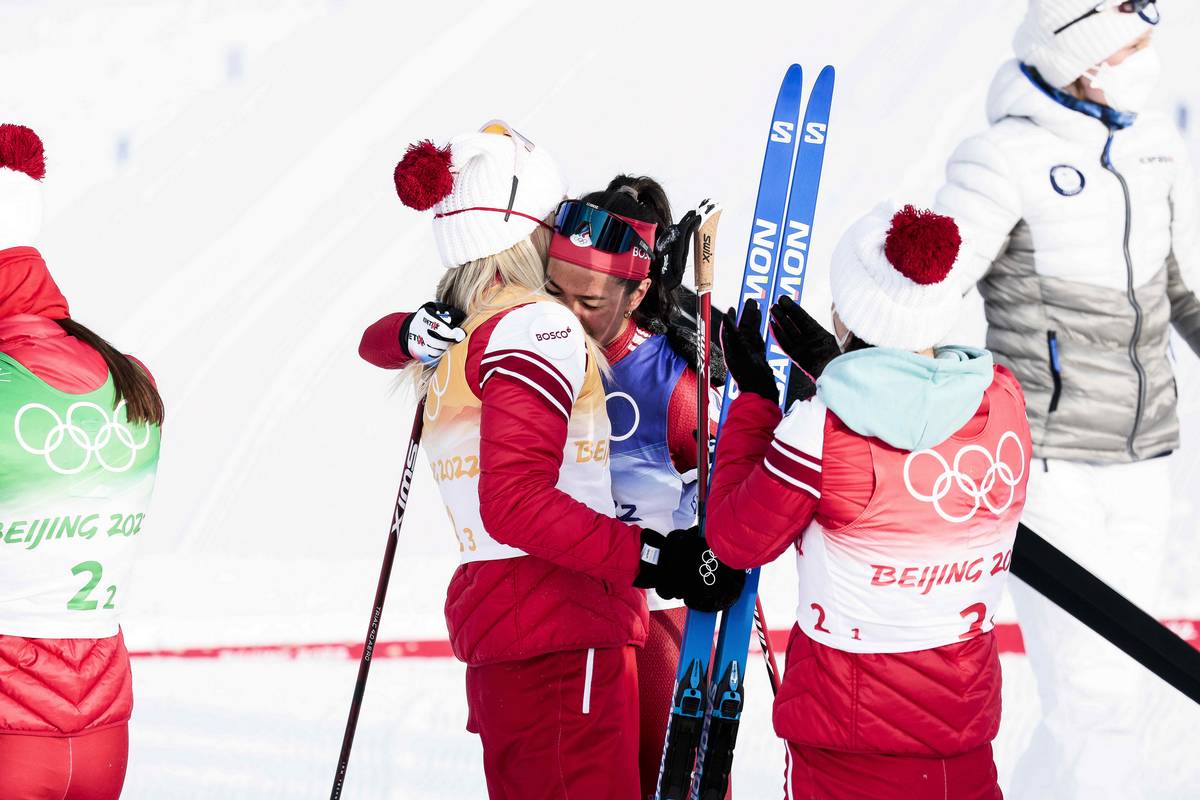
Excitement was high at the finish of the women’s team sprint, as Victoria Carl narrowly took the win for Germany, racing with partner Katharina Hennig. (Photo: NordicFocus)Katharina Hennig hugs her exhausted teammate Victoria Carl at the finish of the women’s classic team sprint. (Photo: NordicFocus)
Though she was the key player in the final lap, Carl was not originally on the start list. She was substituted for Katherine Sauerbrey, who had skied the first leg of the women’s relay on Saturday. German coach Peter Schlickenreider, who celebrated his 52nd birthday today, explained in the mixed zone that Saurbrey had made a “great decision” to let the team know that she was feeling fatigued and as though she may be getting sick.
From there, the calculus became: “Okay, you have a silver medal, you did a good race [in the relay], and we have prepared Victoria Carl, so she’s ready,” Schlickenreider explained. “So then let’s do the safe thing.”
He added that Germany had raced an athlete, Nicole Fessel, in the team sprint during the 2018 Games who was feeling sick, which proved to be a significant mistake as Fessel struggled with her health for the following three months, before ultimately ending her career. The coaches had vowed never to make this error again.
Jonna Sundling (SWE) congratulates Victoria Carl and Katharina Hennig on Germany’s gold medal in the classic team sprint. (Photo: NordicFocus)
On the performance of the German skis, which have allowed the team to excel throughout the Games, Schlickenreider explained that waxing has been a focus for the team over the last quadrennial.
“We worked really hard the last four years to get this good team. And I think that’s the main thing, that everybody’s working together so that the athlete and ski technicians were communicating quite well.”
Jessie Diggins (USA) comes to the line in fifth in the women’s team sprint. (Photo: NordicFocus)
After winning gold in the event, it’s easy to look at a fifth place finish as a disappointment for the American team. But observing the last five seasons, it remains a testament to the consistent strength of the American women’s program, the depth of the field racing at this level, and the fact that ultimately, an Olympic medal is viewed among the highest accomplishments an athlete can achieve purely because it requires the fortuitous coming together of infinitely many pieces to do so.
Both Brennan and Diggins stated with confidence that they were happy with their performances today, highlighting advances made in classic racing throughout the Games.
“I felt really good about my skiing today,” Brennan said. “I think it was one of my better classic races this week, so I’m really happy to put it together by the end of the Olympics. And I did what I could to stay in contact to give Jessie her best shot. And I’m happy with that.”
Rosie Brennan (USA) strides up the A-climb in the women’s team sprint semifinal. (Photo: NordicFocus)
“I’m really proud of how we skied,” Diggins affirmed. “It was so cool seeing Rosie just crushing, and I went as hard as I could. And there’s no doubt in my mind that I could not have possibly tried harder. I finished with zero sugars left and was dizzy and sick. And I’m currently wearing all the clothes of Team USA… I think we had great skis, or at least I definitely had the kick that I needed. I felt like, technically, this was some of my best classic skiing. And yeah, I’m just really proud of giving it our all because that’s all you can do.”
Jessie Diggins anchored the women’s classic team sprint to fifth. (Photo: NordicFocus)
In NBC’s broadcast, team sprint gold medalist turned analyst Kikkan Randall explained that the Americans knew that competitive skis would be a requirement to allow Brennan and Diggins to fight for a medal today.
Both athletes expressed that their skis were up to the task, particularly for A-climb, which is roughly 400 meters in length (a quarter mile) with nearly 100 feet of elevation gain. Ascending this three times each in the final, optimizing kick could be essential.
“I have to have enough kick, or else I really struggle,” Diggins explained. “So I definitely asked for an extra bump. In hindsight, maybe I shouldn’t have but also, that’s on me. And I know that that’s what I need. I need to be able to get up the hill. And that was my biggest priority. And so I think having not enough kick would have made me lose more time.”
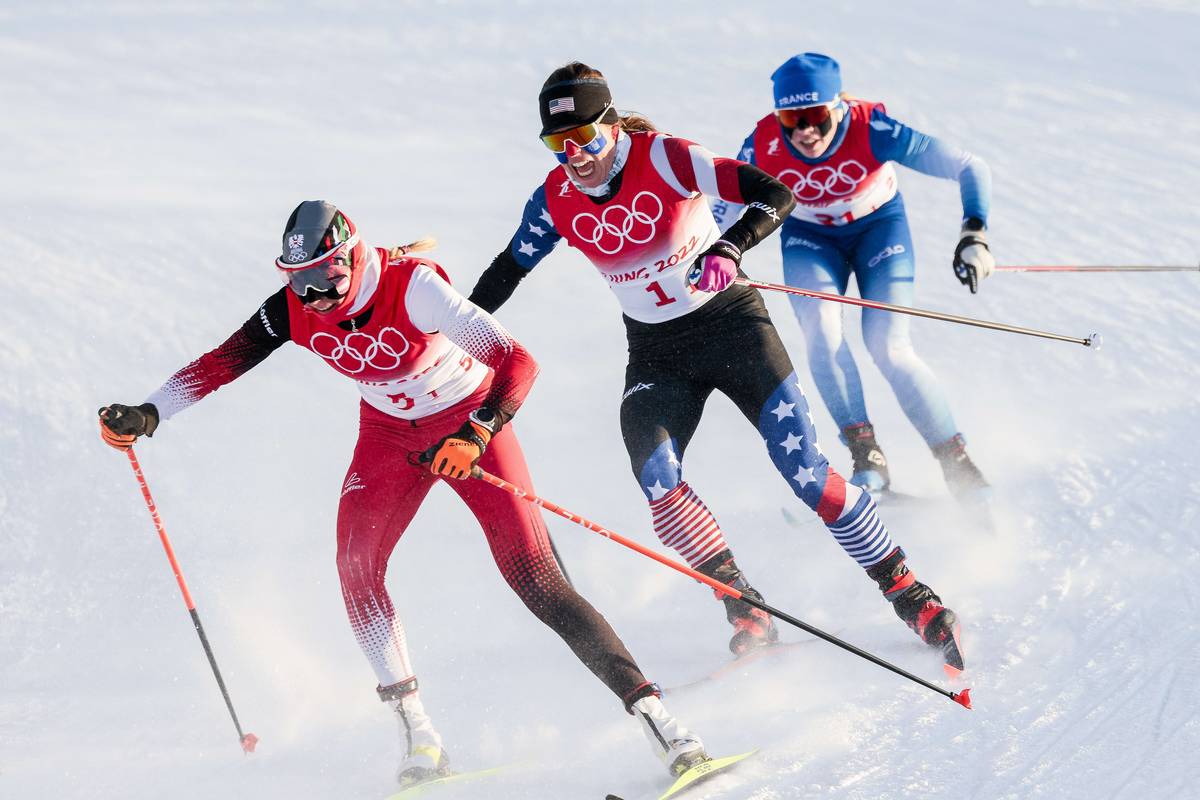
Jessie Diggins (USA) marks Victoria Carl (GER) during the women’s team sprint semifinal. (Photo: NordicFocus)
Both athletes confirmed that they would be racing the final event of the 2022 Olympic Winter Games on Sunday, the 30 k mass start freestyle, barring unforeseen changes. With one last opportunity to fight for medals, Brennan encapsulated the Americans’ outlook on the whirlwind of racing and Olympic hype.
“One thing that the US is really bad at is only caring about the Olympics,” Brennan said in the mixed zone. “But we’re racing and World Cups every weekend all winter long and World Championships on the [odd] years, so if you look at the results from all of those races, you know, this is in the ballpark. I wouldn’t say I had the world’s best races [here] and certainly not the world’s worst races. So it’s been a good experience and we will head straight back to the World Cup and keep fighting for more.”
Dahria Beatty (CAN) races in semifinal A during the women’s classic team sprint. (Photo: NordicFocus)
Racing for Canada, Katherine Stewart-Jones and Dahria Beatty took sixth in the first semifinal and did not advance. They ended the day in 12th overall.
This World Cup coverage is made possible through the generous support of Marty and Kathy Hall and the A Hall Mark of Excellence Award. To learn more about A Hall Mark of Excellence Award or to learn how you can support FasterSkier’s coverage please contact info@fasterskier.com.
A relay medal evaded the American women’s 4 x 5-kilometer team for another Olympic quadrennial today, as Hailey Swirbul, Rosie Brennan, Novie McCabe, and Jessie Diggins finished sixth, +1:28.2 behind the winners from the Russian Olympic Committee (ROC). Silver went to the German team, who finished +18.2 back on the ROC, while bronze went to Sweden (+19.7), who took Finland to the line, leaving them 0.5 shy of a medal in fourth.
The relay is seen as a testament to a program’s depth and breadth; with two classic and two skate legs, it’s not enough to have one or two podium-caliber skiers who are specialists in one technique or the other. A team needs to have four strong women who can compete at the top of the field, and the program must have the technical proficiency to maintain contact with the front as the race switches from classic to skate.
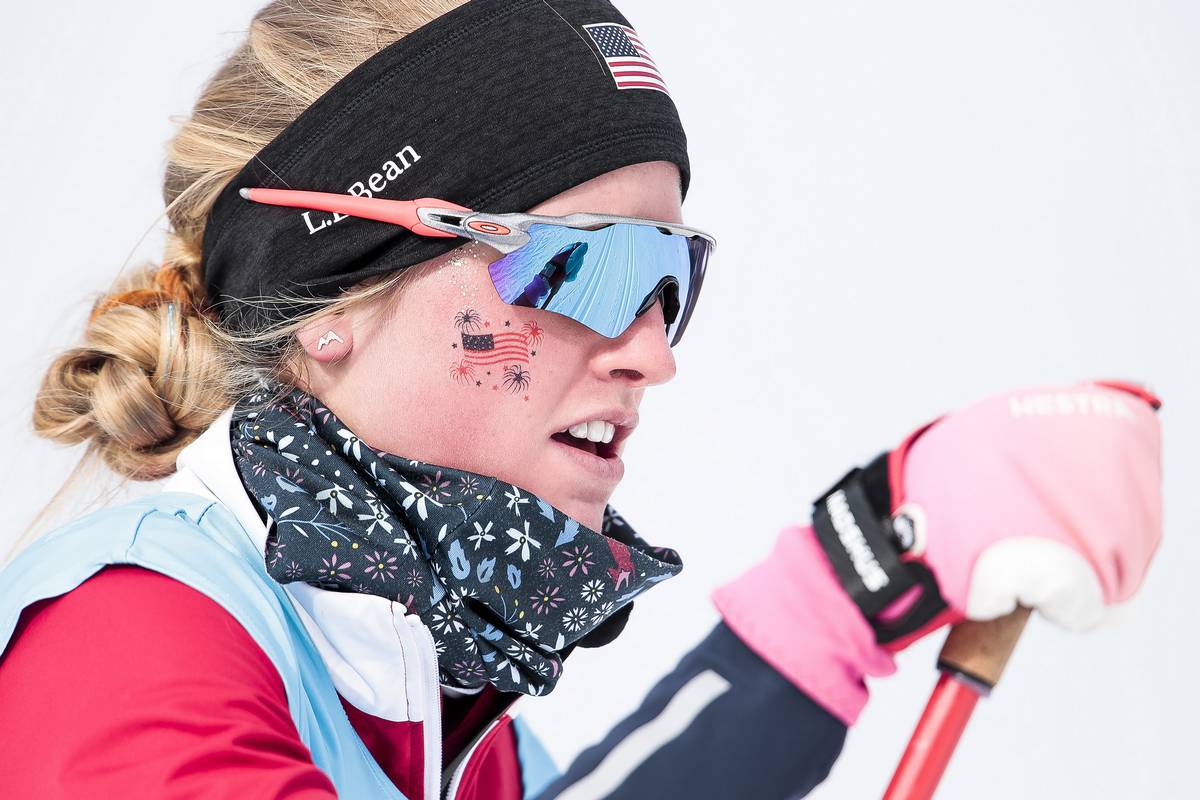
A glittery flag tattooed on her cheek, Hailey Swirbul warms up to lead the American 4 x 5 k relay team. (Photo: NordicFocus)
And, those four strong women need to have all the pieces come together on the day. “It’s really hard to have four people have an amazing day on the same day,” Brennan said after today’s race.
The American team has steadily become a medal contender in the event as the level of the program has continually elevated over the last four Olympic cycles.
In 2010, Kikkan Randall was the sole member of the relay team who was reaching the World Cup podium, as she raced alongside Caitlin Compton (now Gregg), Holly Brooks, and Morgan Arritola. The American women finished 11th in Vancouver, nearly +3:40 behind the Norwegian gold medal team, which was anchored by a young Therese Johaug.
Eight years ago in Sochi, a team of Jessie Diggins, Randall, Liz Stephen, and Sadie Bjornsen (now Maubet) pulled the team up to 7th, +2:30 behind the Swedish winners. Four years later in PyeongChang, Sophie Caldwell, Bjornsen, Randall, and Diggins again brought Team USA 70 seconds closer to the podium, finishing fifth, +1:20 behind Norway.
Over the last three World Championships, the Americans finished fourth in 2017, 30 seconds behind the Finnish bronze medal team, and fifth in 2019, one minute behind Russia in third.
At the 2021 World Ski Championships in Oberstdorf, Germany, the Americans were impossibly close to the podium. In a final sprint between anchors Krista Pärmäkoski (FIN) and Diggins, the Finn closed hard in the final kilometer to pull ahead of the Americans, taking bronze by just 0.8 seconds.
While only one of the four relay team members from the 2018 Olympic team remains on the team in 2022, three of the four members from last year’s World Championships made today’s list. That lineup was Swirbul, Bjornsen, Brennan, and Diggins.
Hailey Swirbul heads out to lead the American 4 x 5 k relay during the 2022 Beijing Olympic Winter Games. (Photo: NordicFocus)
Today, Swirbul would again lead the Americans skiing the first classic leg, this time followed by Brennan, who was 13th in the 10 k classic on Thursday. McCabe skated the third leg in her second Olympic appearance, tagging off to Diggins as the anchor.
Keeping with tradition, all four women – along with current NBC analyst Randall calling from a booth in Connecticut – wore knee-length striped “relay socks”, with beglittered cheekbones to feed their enthusiasm for the event. In a program that remains focused on team, even when standing on an individual podium, glitter and socks are merely symbols of the cohesion that has fostered the American’s rise to success.
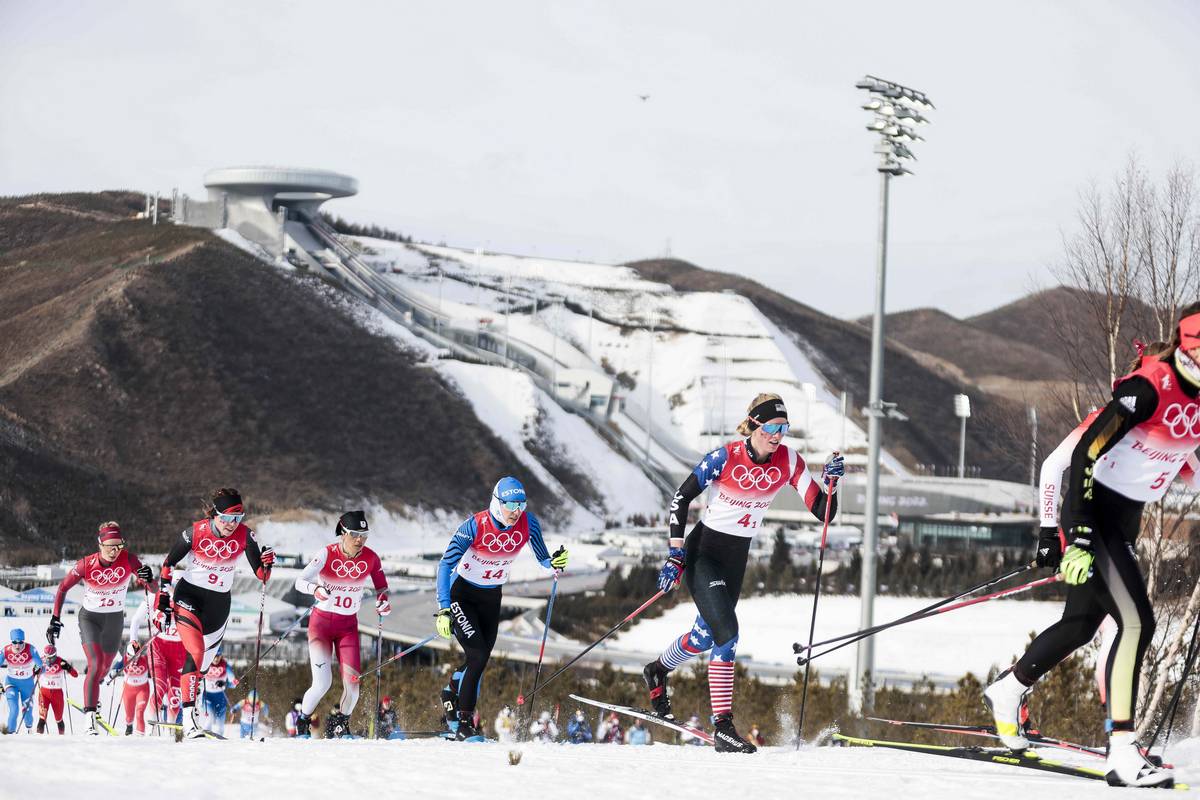
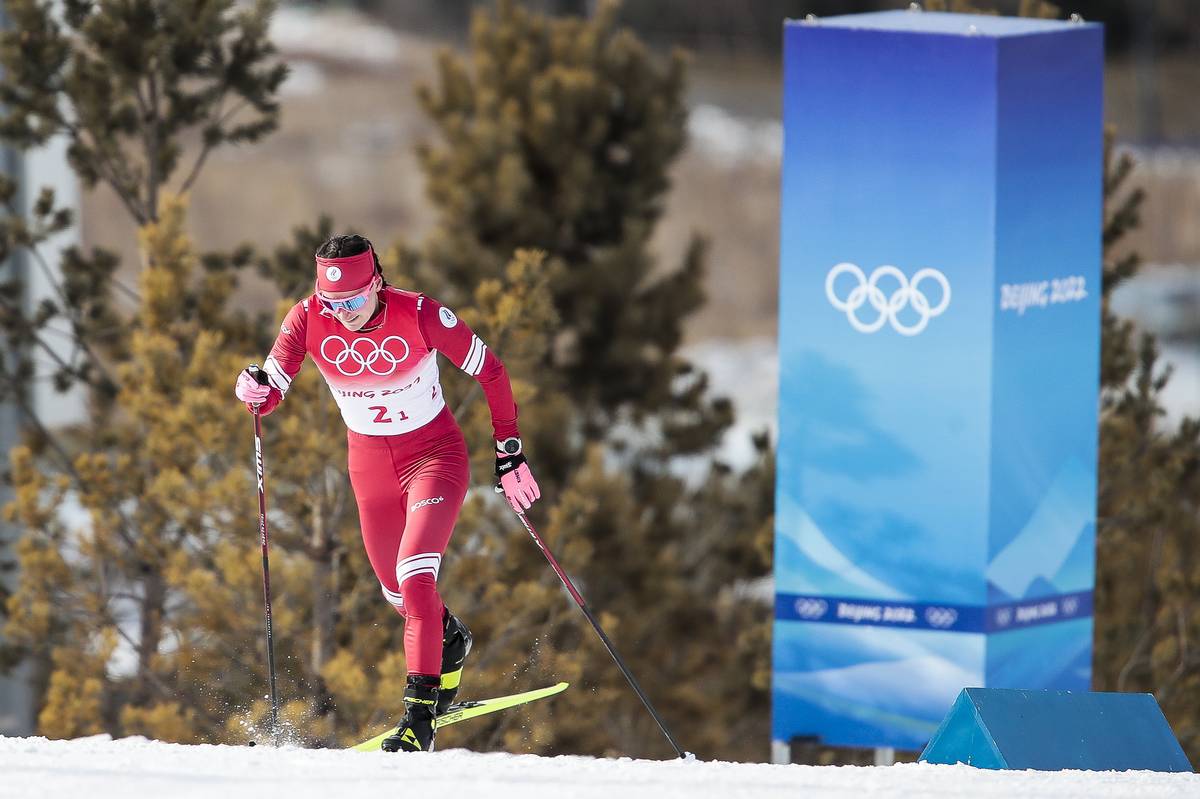
The ROC’s Yulia Stupak pulls away in the first lap of the women’s 4 x 5 k relay. (Photo: NordicFocus)
As the first two-lap 5 k classic leg took to the course, the ROC’s Yulia Stupak charged off the front, creating a 12 second gap by the end of the first lap while the next eight team remaining tightly spread, with less than three seconds of separation. In the final kilometer of the first leg, the German team dropped the chase pack to tag its second skier just 1.5 seconds behind the ROC. Masako Ishida tagged off in third for Japan, with Finland just behind in fourth, and Sweden a few seconds behind in fifth.
Swirbul tagged off for the Americans in seventh, +24.7 back on the ROC and Germany, and +12.4 seconds on the podium chase pack. The Canadian team, led by Katharine Stewart-Jones, tagged off in 10th (+43.2).
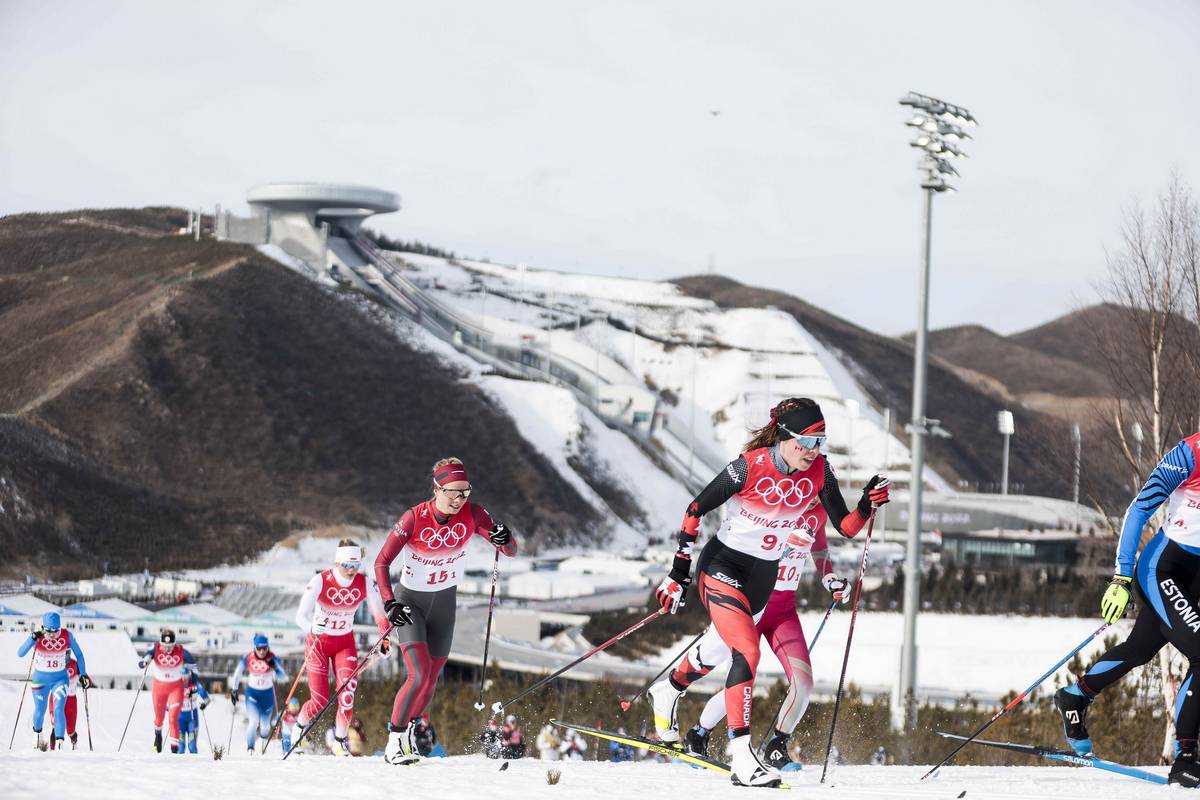
Katharine Stewart-Jones skis the opening leg of the women’s 4 x 5 k relay. (Photo: NordicFocus)
The Germans are often a dark horse in the relay, despite frequenting individual World Cup podiums less often than other countries like Norway, Russia, or Sweden. Germany won a silver medal in the women’s relay in the 2010 Games in Vancouver, followed by a bronze in Sochi. They were roughly 20 seconds behind the Americans in fifth at the 2021 World Championships, and 20 seconds ahead of the Americans in fourth place in 2019.
In this Games, two of the four members of the 2021 World Championships team were again in the lineup, Victoria Carl and Katharina Hennig, both of whom have seen top-10 finishes in the Games so far. Hennig, who would ski the second classic leg, was fifth in the 10 k classic on Thursday, while the third leg skater Carl was 10th in Tuesday’s freestyle sprint. Anchor Sofie Krehl was 8th in qualification and 11th in the final during the freestyle sprint, while classic opener Katharine Sauerbrey was 11th in the 10 k classic and 13th in the 15 k skiathlon. A deceptively stacked lineup.
Meanwhile, Norway’s Tiril Udnes Weng had tangled with a Latvian skier, causing a crash that robbed her momentum. Already at a deficit with two of their eight athletes, including Lillehammer World Cup relay team member Heidi Weng, waylaid due to positive COVID tests just prior to the Games, the team that would otherwise be a podium threat faced yet another setback.
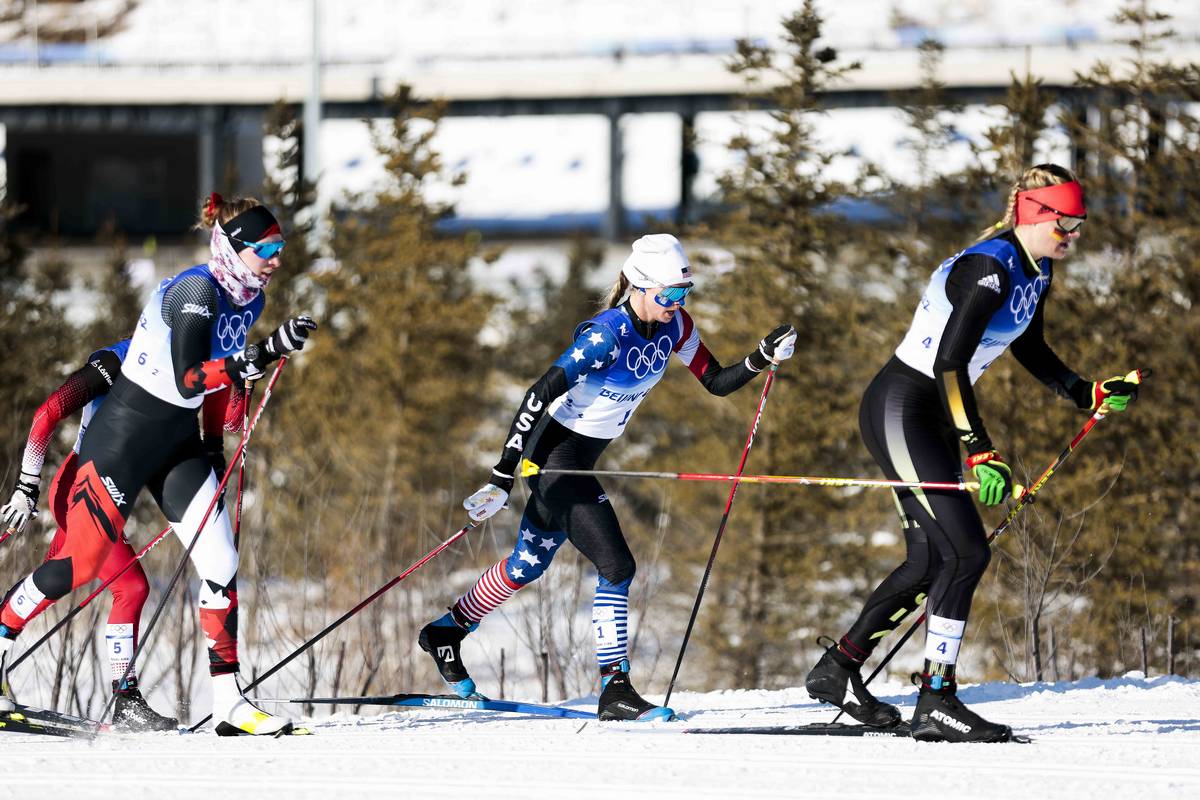
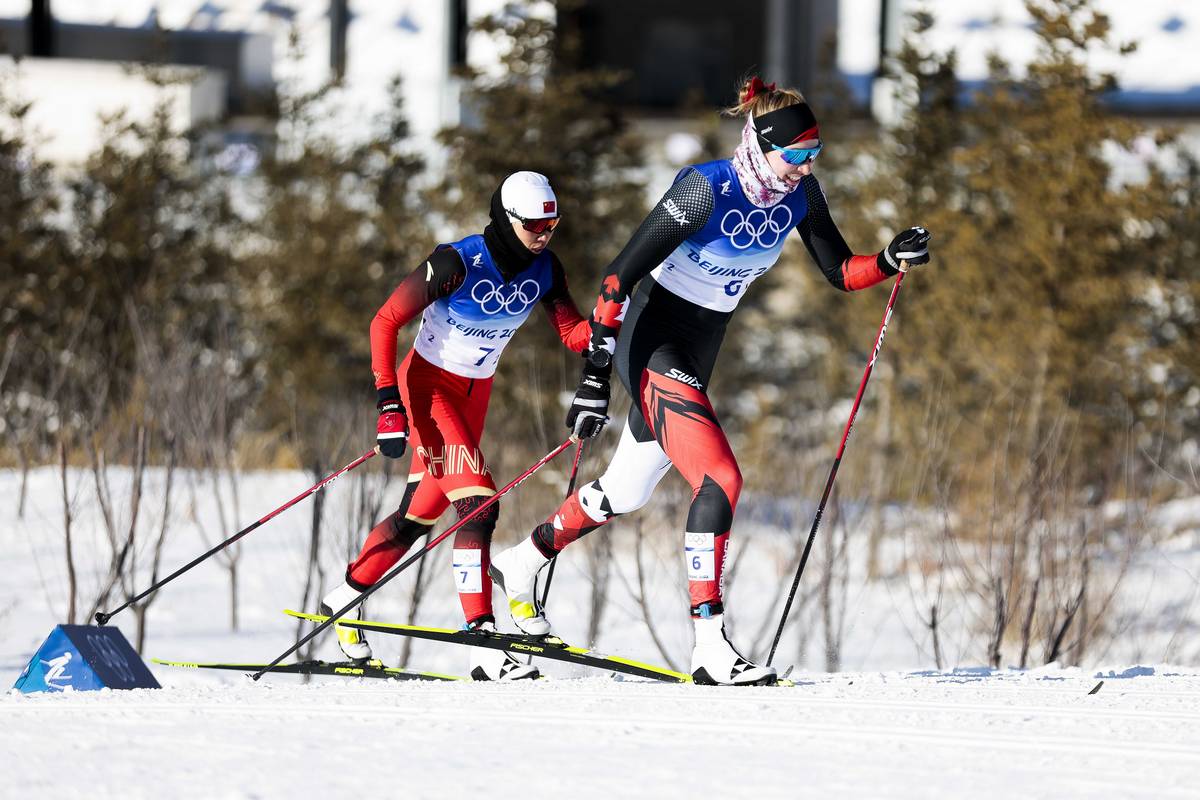
Katharina Hennig (GER) follows Natalia Nepryaeva (ROC) during the second leg of the 4 x 5 k relay. (Photo: NordicFocus)
In the second classic leg, the ROC and Germany remained at the front, trading off in the lead at each checkpoint as they built their lead over third place to come through the exchange with nearly double the gap to third. This time, it was Germany’s Hennig in the lead, with the ROC’s Natalia Nepryaeva four seconds behind. Gold medalist in both distance events so far this Olympiad, Norway’s Therese Johaug brought her team back into podium contention, tagging Helene Marie Fossesholm in third (+22.8), just ahead of Sweden and Finland.
Norway’s Therese Johaug brings her team back into podium contention in the second leg of the 4 x 5 k relay. (Photo: NordicFocus)
The Americans lost an additional 12 seconds over the course of Brennan’s leg, but held their ground in seventh (+36.4). Canada’s Dahria Beatty tagged teammate Cendrine Browne in eighth after a sizable gap (+1:42.7).
Rosie Brennan follows Sweden’s Ebba Andersson during the second leg of the women’s 4 x 5 k relay. (Photo: NordicFocus)
While Germany and the ROC continued the story at the front, Norway and Finland began making up time on the leaders, with Fossesholm and Thursday’s 10 k classic silver medalist Kerttu Niskanen gaining roughly 8 seconds during the first skate leg. Norway was less than 15 seconds back at the final exchange, with Finland an additional three seconds behind. Sweden was in fifth, exactly 35 seconds off the leaders and just over 20 seconds behind Norway, but they were about to prove they were not out of the running.
Novie McCabe skates a strong third leg for Team USA in the 4 x 5 k relay. (Photo: NordicFocus)
McCabe had brought the Americans into sixth (+1:34), in a dead zone with 30 seconds to the next racer on either side. The Canadian women tagged off in 8th, +2:21.2 back on the leaders.
In the final leg, the ROC’s Veronika Stepanova quickly began to reel in Germany’s Krehl.
Establishing herself as a strong closer at just 21 years of age, Stepanova also anchored Russia’s winning relay team in Lillehammer back in December to a thrilling finish, narrowly beating Norway and Sweden in a three-way sprint to the line.
In the lead at the final exchange, Germany’s Victoria Carl tags Sofie Krehl during the Olympic 4 x 5 k relay. (Photo: NordicFocus)Tatiana Sorina tags Veronika Stepanova as the ROC chases down Germany in the final lap of the 4 x 5 k relay. (Photo: NordicFocus)
This time, it did not look as if the ROC was looking for a climactic ending for its spectators. Stepanova had Krehl in her sights at the lap, and was now just 1.5 seconds behind. Stepanova kept the effort high, leaving the German five seconds back a kilometer later.
Then, Krehl began to fade rapidly.
As the ROC soon looked to have the gold medal on lock, the question became whether Germany could hold onto silver. Sweden’s sprint gold medalist Jonna Sundling was showing her stamina against Pärmäkoski, who looked to be repeating the approach that allowed her to take bronze for Finland in the 2021 World Championship where she was facing Diggins.
The pace stayed hot as the Finnish veteran steadily fatigued the legs of the sprint champion, and over the final lap, the pair brought Krehl into contact. Heading into the stadium, Krehl was hanging onto her lead by a thread.
Sofie Krehl hangs on to anchor the German team to silver in the 4 x 5 k relay. (Photo: NordicFocus)
Cameras panned away as the German rounded the final bend into the stadium, returning just as she crossed the line, only ten meters ahead of Sundling and Pärmäkoski, who V2ed side by side through the lanes.
Ultimately, Sundlings sprint prowess gave Sweden the advantage, as she nipped Pärmäkoski by 0.5 seconds at the line for the bronze medal.
Jonna Sundling (SWE) takes bronze by 0.5 seconds ahead of Krista Pärmäkoski (FIN). (Photo: NordicFocus)
It was the ROC for gold in 53:41.0, with Germany in second (+18.2), and Sweden third (+20.7).
“Of course, it is a special day,” Stepanova told the media after the race. “It was really tough because we have a win in the World Cup, and a lot of people know we can win, so they say, ‘You must win, you must win.’ So I am like, ‘OK, we need a good result,’ and I do what I can do.”
Veronika Stepanova anchors the ROC to gold in the women’s 4 x 5 k relay. (Photo: NordicFocus)The Russian Olympic Committee celebrates gold in the women’s 4 x 5 k relay as anchor Veronika Stepanova crosses the line with a solid lead. (Photo: NordicFocus)
While the depth of its women’s team made the ROC a good choice as a podium pick, Stupak made it clear in her post-race comment that the team had also been targeting the event, saying the result was “not a shock.”
“We prepared for this race the whole year,” she explained. “It’s a good result for everybody in our team. We were ready for this medal.”
On the ROC’s approach and early lead, Stupak continued, “We tried to push the limit. We had big motivation and good concentration before the start. It was a hard race but it was a good race for us.”
The 4 x 5 k relay gold medalists of the ROC: Yulia Stupak, Natalia Nepryaeva, Tatiana Sorina, and Veronika Stepanova (l-r). (Photo: NordicFocus)
For the Germans, the tone implied less certainty that a medal would be earned. Rather, it was the culmination of strategic pacing and hard work, leading to what Krehl called a “surprise” ending.
“We are so happy and excited,” Hennig said. “This is a special day for us and we are so thankful that all the hard work pays off now for the whole team and all of cross-country Germany. So we are very, very happy. We had a good plan and our plan worked. And we did our best, and so it was an exciting and amazing day.”
The German team welcomes anchor Sofie Krehl to the finish, earning a silver medal in the 4 x 5 k relay. (Photo: NordicFocus)Caught by the emotion of earning a silver medal for Germany, Sofie Krehl is embraced by her coach at the finish of the 4 x 5 k relay. (Photo: NordicFocus)
Krehl explained that she had skied her first lap defensively, expecting Stepanova to catch her sooner. In the second lap, she described the ROC athlete as “too good”, causing her to let go of gold. Though she was nervous when she began to feel Sweden and Finland closing on her, she was able to hold on for a result she described as “good for the whole team”, including the German coaches and wax technicians.
“It’s a lot of emotion,” Krehl said. “It feels like a dream. Maybe I need some time and then I can recognize what we have done.”
Putting together a gutsy performance, Katherine Sauerbrey, Katharina Hennig, Victoria Carl, and Sofie Krehl (l-r) earn silver for Germany. (Photo: NordicFocus)The Swedist team of Maja Dahlqvist, Ebba Andersson, Frida Karlsson, and Jonna Sundling (l-r) earn silver in the 4 x 5 k relay. (Photo: NordicFocus)
Behind the podium contenders, Norway had lost contact with the Swedes and the Finns over the final lap, fading to fifth (+28.8). Racing alone through her lap, Diggins crossed the line for Team USA a minute later in sixth (+1:28.2).
“Personally, I’m really, really proud of this team,” Diggins said in the mixed zone. “Every single one of these girls went out and skied so hard and skied gutsy races. And we gave it everything we have. And some days that ends up in the results of your life and some days it doesn’t. But either way, all you can control is going out there as hard and as smart as you can. And this team did that.”
Jessie Diggins brings the Americans home in sixth in the women’s 4 x 5 k relay. (Photo: NordicFocus)
Though they did not walk away with Olympic hardware, the energy and enthusiasm were high in the mixed zone, with laughter filling the gaps between the athletes’ comments.
On a team composed of two veteran Olympians, Brennan and Diggins, and two first-timers, Swirbul and McCabe, experience and insight helped unify the group and set the Americans up for their best chance at putting together a strong performance.
Leading the breakdown of the race, Swirbul shared, “It’s always important, I think, to try to ski my own race, even though you’re in the field. I definitely had advice from Rosie last night to make sure to pace it how I would face the race – and Jessie. We’re focusing on time, so the fastest time that we can get around that course [for] each person is the best, no matter what place you come in.”
Rosie Brennan races the second leg of the 4 x 5 k Olympic relay. (Photo: NordicFocus)
Brennan’s performance in the sprint demonstrated her impressive mental strength to overcome setbacks and not count herself – or in this case, her team – out of the running. A bad pole plant directly onto her ski in the sprint quarterfinal could have shaken her confidence, but she rebounded to ultimately finish just over a second off the podium in fourth place.
She approached today with a similar resolve.
“I knew it was full of a lot of the heavy hitters, so I knew I had a tough job ahead of me,” Brennan said. “So I tried to ski smart, but also find something extra to dig a little deeper, but I knew there was going to be some hard fighting at the end. I felt really good about my climbing. And I was a little disappointed with my inability to stick with [the other women] over the top of the hill in the double pole section, but it was all I had out there. So, I have to be happy with that. And I guess I know what I’ll be working on in the future.”
At 21-years-old, McCabe is the youngest member of the relay team.
“It’s so cool to be a part of a team with three legends and I had a lot of fun doing it, even though I was extremely nervous beforehand,” she said with a laugh.
Novie McCabe tags Jessie Diggins for the final leg of the 4 x 5 k relay. (Photo: NordicFocus)
Her mom, Laura McCabe, is a two-time Olympian who skied the third leg of the relay in both 1994 and 1998. However, Novie laughed that she had not talked to her mother in several days and thus had not received any advice heading into the relay. After much deliberation, the team had only been decided the afternoon prior.
“I tried on the first lap to just stay relaxed,” McCabe explained of her plan. “I knew that there was a chance I would blow up and end up losing a lot of time to that group ahead of me. So I was just trying to focus on [pacing] for the first lap, and on the second, I kind of tried to drop the hammer and do what I could to not lose time.”
In her lap, McCabe lost just 11 seconds to Sweden’s distance standout, Frida Karlsson. She had accomplished her goal.
Diggins explained she headed out for the final leg optimistically hoping things would shake out differently than they ultimately did.
“I basically just swung for the fences and thought, ‘Okay, I’m gonna go out as hard as I can. Because if there’s a chance that [the women ahead of me] monkey around and don’t want to lead, then I’ve got to go for it.’ I thought, ‘You know, if I get lucky and they’re messing around in tactics, there’s a chance I can glom on the back.’ Unfortunately, they did not, as much as I had hoped. And I definitely paid for it in the second lap. I could not feel my legs at all.”
Jessie Diggins anchors the Americans to 6th in the 4 x 5 k relay. (Photo: NordicFocus)
After a windy skiathlon and 10 k classic that left tracks blown in with loose snow, the women expressed that conditions today were the best they’ve experienced in racing so far. Though two inches of snow came down overnight, perhaps an unexpected twist in the weather patterns, the Americans each affirmed that their skis were competitive, with Swirbul and Brennan adding the change was especially favorable for their classic legs.
“I actually got to ski in the tracks today, which is so nice,” Brennan said.
On the camaraderie of the team, Brennan shared, “It’s an individual sport, but we also spend close to five months on the road a year together. So it would be pretty boring if you only ever care about yourself. [That’s] not very fun or fulfilling – it doesn’t mean that much. So when we get to actually, truly be out there together, and all of our times count for each other. I think that brings like a new level of meaning and purpose to what we’re doing. And it’s really special to get to share that with your teammates.”
Olivia Bouffard-Nesbitt (CAN) collapses as she’s greeted by her team at the finish of the 4 x 5 k relay. (Photo: NordicFocus)
Closing for Canada, Olivia Bouffard Nesbitt lost one spot to the Italian team in the final leg. The Canadian women ended their day in 9th (+3:39.9).
Norway’s Maiken Caspersen Falla as she wins the women’s 1.2-kilometer freestyle sprint at the 2019 World Championships in Seefeld, Austria. (Photo: John Lazenby/lazenbyphoto.com)
Norway’s Maiken Caspersen Falla torched the start of the women’s 1.2-kilometer freestyle sprint on Thursday at the 2019 World Championships in Seefeld, Austria. She skied snappy and smooth – her compact frame channeling energy downstream and towards the awaiting finish line.
Like a prize fighter knowing she had her peers against the ropes, Falla first appeared to give the knock-out blow a minute into the race. She pushed over the top of the first climb, making a slight gap on three chasing Swedes: Stina Nilsson, Jonna Sundling, and Maja Dahlqvist.
With slick skis complimenting her over-the-hilltop move, Falla initially strung out the chasers as they glided into the long straight. But as Falla pulled from her tuck and began her free-skate, the Swedes had closed in and latched on. Falla then hammered a furious V1 up the final climb. The three Swedes ceded no ground. As the course curved right over the top, Dahlqvist tumbled. Without looking back, Falla must have sensed the moment as she powered ahead and gained twenty meters in a blink. She never let up taking the win in 2:32.35 minutes.
“I have been really worried about these tracks and the high speed,” Falla told the International Ski Federation (FIS) after the race. “I have been practicing all season to have good timing on the last meters. Today I really succeed. And also, the skis, they are amazing today, and everything feels right.”
It was Falla’s eighth career World Championship medal. (Falla also won the 2017 championship skate sprint in Lahti, Finland.)
Nilsson of Sweden placed second (+1.66), while Norway’s Mari Eide placed third (+2.84). Sundling of Sweden was fourth (+3.17), Germany’s Victoria Carl fifth (+5.71), and Dahlqvist sixth (+31.49).
Norway’s Maiken Caspersen Falla celebrates her win in the women’s 1.2-kilometer freestyle sprint at the 2019 World Championships in Seefeld, Austria. (Photo: John Lazenby/lazenbyphoto.com)
It was Falla’s eighth career World Championship medal. Falla also won the 2017 championship skate sprint in Lahti, Finland.
Nilsson of Sweden placed second (+1.66), while Norway’s Mari Eide placed third (+2.84). Sundling of Sweden was fourth (+3.17), Germany’s Victoria Carl fifth (+5.71), and Dahlqvist sixth (+31.49).
Nilsson had not raced a World Cup since Jan. 19, in Otepää, Estonia. She won the classic sprint qualifier in Otepää but pulled from the competition after injuring her hamstring/groin in the semifinal.
Sadie Bjornsen of the U.S/. Ski Team placed 18th overall in the women’s 1.2-kilometer freestyle sprint at the 2019 World Championships in Seefeld, Austria. (Photo: John Lazenby/lazenbyphoto.com)
For the U.S., the paradigm of solid success now dictates the narrative. All four women entered in Thursday’s sprint solidly qualified: Sophie Caldwell qualified in fourth, Sadie Bjornsen in 14th, Jessie Diggins 15th, and Julia Kern in her first World Championships 22nd.
“For sure we are all feeling disappointed in the day because we certainly thought it was a big opportunity for a lot more in terms of results,” U.S. Ski Team Head Coach Chris Grover said in a call after the race. “But it is early in the championship too, we have a lot of races to come.”
Taste success many times as the U.S. women have on every stage – World Cup, World Championships, and the Olympics – and the near miss results don’t resonate on the success scale as they have in the past. Championships, when the women are concerned, are for medals.
“All four ladies easily in the rounds that is a great start to the day,” Grover added. “I think heat selection went well too. I think we felt good about where everybody was and what their opportunities were for passing through their quarterfinals. But then once we got into the heats, it just was one of those days where luck wasn’t quite on our side. … Some days you need a little bit of that to be on the right side of those battles and we just weren’t there.”
Sophie Caldwell in the women’s 1.2-kilometer freestyle sprint qualifier at the 2019 World Championships in Seefeld, Austria. (Photo: John Lazenby/lazenbyphoto.com)
Here’s how that hard effort and lack of luck unfolded. Caldwell ended her day 14th overall. She finished a tight third in the first heat, 0.13 seconds from first. Her heat was too slow to produce a lucky loser spot. Bjornsen finished fourth in her heat, 0.92 seconds from first. She was 18th overall. Kern tangled with a skier during her heat to lose time. She was eliminated after placing fifth to finish 23rd. Diggins won the heat that included Kern, but she too placed fourth in the second semi and did not advance. Diggins was eighth overall.
“I think the frustrating part for all of the women, all four of them said they felt great,” said Grover. “And that is really encouraging for the rest of the championships. All of them are healthy. All of them feel really fit right now. It just did not come together.”
The sentiments from skiers after the race were much the same as Grover’s – that sprint racing has its high risk high reward template, but the day left the U.S. collectively wanting more.
“I was definitely disappointed in my end result today because I was feeling good and enjoy this course, but sometimes that’s sprint racing,” Caldwell emailed. “I’m not sure what I could have done differently other than have a little extra something in the finish stretch, so that gives me some peace of mind, but I was for sure left wanting more. I know I’m feeling good and fit and while you always want to have your best performance at world champs, there are more races to come that I’m looking forward to.”
Julia Kern during the women’s 1.2-kilometer freestyle sprint at the 2019 World Championships in Seefeld, Austria. (Photo: John Lazenby/lazenbyphoto.com)
For Kern, the season has been a quick jump to the World Cup after racing SuperTours during Period 1. She placed 19th in Dresden’s skate sprint, and fourth in the team sprint. She made the heats last weekend in Cogne, Italy where she placed 11th overall. In her first World Championships, Kern came in with a mindset to maximize forward momentum.
“It was a pretty short sprint course, I knew that times were going to be tight so I told myself the whole race, every second counts, every push counts, every half second counts.” Kern said in a call. “And I kept saying that every push, and I kept repeating that in my mind. I knew it was going to be one of the more tighter qualifiers and given a championship event everyone is on their top game and fitness.”
Everybody knows Diggins. There’s no mystery that her moxy and finishing speed can devastate the field. That was on full display as she won the fifth heat. And as an eternal optimist, Diggins could reflect on the performance more than the day’s end result as a measure of her mental and physical preparedness.
“I’m really excited for everything to come and I think today was a really good indication of where my fitness was; my final 100 meters I was moving faster than my first 100 meters and I think that’s a really good place to be in and it gives me a lot of confidence,” Diggins said in call.
Diggins was repeatedly boxed out by the front four skiers in her semi-final. She skied in the back, not dangling off, just simply unable to find daylight and emerge near the front. Then as the pack of skiers rolled over the top of the final hill and slung around a high-speed left hand turn into the finish straight, Diggins went wide, far wide to the outermost lane.
“That was the only place I could go, so I took a really wide line,” reflected Diggins. “I could feel myself gaining – if I had another 50 meters, that would have been really fun. But I went out into a really mushy lane that hadn’t been skied in yet and I’m just like ‘alright, I’m just going to motor as fast as I can go and put my head down and just, you know’, because I felt like I had a lot of pent up energy because I kept getting boxed out so I wasn’t able to ski as hard as I could. It was encouraging to know my speed at the end of the race is there, my finishing kick is alive and well, and I think that bodes well for our races coming up.”
Jessie Diggins during the women’s 1.2-kilometer freestyle sprint qualifier at the 2019 World Championships in Seefeld, Austria. (Photo: John Lazenby/lazenbyphoto.com)
If nothing else, the day’s sprint was a fine spectacle. The high stakes racing was tight and sporting for both the men and women. That came to mind as Diggins went wide on Thursday. It would have been easy to count her out 30 seconds from the finish.
But who would do that?
She finished 0.37 seconds from first and 0.21 seconds from heading to the final.
Racing continues on Saturday in Seefeld with the men’s and women’s skiathlon.
Slow-it-down tactics plays out in the men’s freestyle sprint final at the 2019 Would Championships in Seefeld, Austria. (Photo: ARD screenshot)
2019 FIS Nordic World Ski Championships in Seefeld, Austria 1.2 k/ 1.6 k freestyle sprint
Welcome to The Rundown, your quick primer of need-to-know information about the day’s racing. We’ll be updating this digest as the day goes on with additional results, photos and quotes. The Rundown is NOT a race report; stay tuned for complete race reports later today with interviews from the day’s top racers.
The women’s 1.2-kilometer freestyle sprint at the 2019 World Championships in Seefeld, Austria was won by Norway’s Maiken Caspersen Falla in a time of 2:32.35 minutes. Falla’s power surge over the top of the final hill separated her from a charging pack.
Stina Nilsson of Sweden placed second (+1.66), while Norway’s Mari Eide placed third (+2.84). Jonna Sundling of Sweden was fourth (+3.17), Germany’s Victoria Carl fifth (+5.71), and Maja Dahlqvist of Sweden sixth (+31.49).
All four Americans entered qualified for the heats. Sophie Caldwell qualified as the fastest American in fourth. Caldwell was 1.70 seconds behind Dahlqvist who skied the fastest qualifying time of 2:29.44 minutes.
Sadie Bjornsen qualified in 14th (+4.38), 15th (+4.61), and Julia Kern in her first World Championships qualified 22nd (+6.32).
Diggins advanced to the second semi where she placed fourth (+0.37). Diggins ultimately placed eighth overall.
Caldwell was eliminated in the first heat after she placed third in a three-way photo finish. She was the second highest ranked American placing 14th overall. Bjornsen placed 18th in the final standings, while Kern ranked 23rd.
No Canadian women advanced to the heats. Dahria Beatty just missed out as she placed 31st (+8.05) with only the top-30 skiers advancing to the heats. Katherine Stewart-Jones finished in 40th (+9.95), and 52nd (+12.20).
In the men’s 1.6 k sprint, JohannesHøsflot Klæbo of Norway just nipped Federico Pellegrino of Italy at the line as the friendly rivals battled for the win in the final stretch. Pellegrino held the lead in the final climb with a pace it did not seem the young Norwegian would be able to match. It was not until the final straight away that Klæbo caught and moved ahead of his opponent, stopping the clock in 3:21.17 with Pellegrino just 0.23 seconds behind.
Gleb Retivykh of Russia finished third (+1.37), Richard Jouve of Francefourth (+1.99), Emil Iversen of Norway fifth (+2.25), and Lucas Chavanat of France sixth (+21.5).
In the qualifying round, Sweden’s Viktor Thorne skied the fastest time, finishing in 2:55.58. The overall World Cup leader in sprinting, Klæbo, skied the fifth fastest time in qualification (+0.91). Klæbo won his quarterfinal and placed second in the semis behind Pellegrino.
Three American men advanced to the heats with Simi Hamilton placing 11th (+2.90), Logan Hanneman (APU) 20th, and Kevin Bolger (SVSEF) 23rd (+5.97). Andy Newell did not place in the top 30 and ended his day in 41st.
Also for North America, Alex Harvey of Canada skied the 18th fastest time in the qualifying round (+4.06). His teammate, Len Valjas, finished 42nd (+11.66), and Evan Palmer-Charrette finished 64th (+17.43). Russell Kennedy was ill and did not start.
Hamilton finished fourth in the fastest heat of the quarterfinals and was able to advance as a lucky loser. Neither Bolger nor Hanneman advanced from their quarter. Bolger’s final ranking was 19th, Hanneman 27th.
Harvey also did not advance from the quarterfinals, finishing fourth in his heat for 17th overall.
Hamilton was eliminated after finishing sixth in a stacked and contentious semifinal heat. Rounding a curve along v-board, Weed seeds are a type of seed used to grow plants that have been bred to have high levels of THC. Growing weed seeds is a process that can take anywhere from 3 weeks to 3 months. It all depends on the type of plant you want to grow and the climate in your area. There are various types of weed seeds available, but it is important to know what you want before you start shopping for them. Source: weedseeds.garden Klæbo tangled skis with Sergey Ustiugov of Russia. Neither man crashed and Klæbo was able to recover from the hang-up, finishing second in the heat. Ustiugov finished fifth and did not advance. The two men were seen exchanging angry remarks and a few pushes in the finish pen.
American Sadie Bjornsen skiing just behind Germany’s Katharina Hennig during the women’s 10 k classic mass start at 2018 World Cup Finals in Falun, Sweden. (Photo: Fischer/NordicFocus)
Welcome to FasterSkier’s World Cup Preview, where we check in with the top-10 teams from last year’s FIS Cross Country World Cup tour before the season starts with the Ruka weekend in Kuusamo, Finland, on Nov. 24 with a classic sprint.
***
Germany
Overall in Nations Cup Last Year: 8th
Women’s Ranking 2017/2018:
Men’s Ranking 2017/2018:
Germans to look out for: If there’s one woman returning to Germany’s national ski team from last season who is hungry for a sprint podium and on the watch list, it’s 28-year-old, Sandra Ringwald. The Lahti, Finland freestyle sprint left her in fourth, just shy of her first World Cup podium. Prior to Lahti, she raced to a seventh and sixth, respectively, in the Davos and Lenzerheide freestyle sprints.
While freestyle sprinting may appear to be the magnum opus of Ringwald’s cross-country skiing, she also finished last season with top thirty performances in a series of other disciplines, most notably a 12th place finish in the Tour de Ski 10-kilometer freestyle pursuit in Lenzerheide, Switzerland. She led the German women in last year’s Overall Cup Standings, finishing in 23rd behind Finland’s Aino-Kaisa Saarinen and ahead of Sweden’s Anna Jönsson Haag.
Chasing down Ringwald on the Overall Cup Standings is her teammate, Stefanie Böhler who ended last season ranked 25th in the overall. The 37-year-old Böhler raced into the top ten three times during last year’s World Cup season, holding out for eighth in Oslo, Norway’s famed Holmenkollen 30 k.
Along with Böhler and Ringwald, Germans Victoria Carl, Nicole Fessel, and Katharina Hennig scored points in the 2017/2018 season and are back on the team, ready to hit the World Cup circuit in search of more top thirties. Not returning to German’s national cross-country ski team after announcing her retirement this spring is Hanna Kolb.
Leading the charge on the men’s side for Germany will be Thomas Bing. The 28-year-old Bing ended last season with five top fifteen World Cup performances, his strongest being a ninth place in the Tour de Ski 15 k freestyle mass start in Oberstdorf, Germany. Along with Bing, Lucas Bögl is another name to look for from Germany. Bögl bust into the top-25 five times last season, most notably the Final Climb in the Tour de Ski 9 k pursuit in Val di Fiemme, Italy.
Germany’s Steffi Böhler during the FIS women’s 5-kilometer classic in Olos, Finland on 11/10/18. She placed sixth overall in what was used as a warm-up race for the German team. (Photo: Instagram screenshot)
Pre-Season Racing: Many German National team members are lined up at the FIS races in Olos, Finland scheduled from Nov. 9-11. In Friday’s 1.4 k classic sprint, Ringwald and Laura Gimmler placed first and third respectively. Gimmler had limited World Cup exposure last season, but notched two top-20s.
For the men, Bing was the best placed German in the sprint placing third overall.
In Saturday’s 5 k classic, the German women stacked five athletes in the top-6. Carl placed first, Hennig second, and Poland’s Justyna Kowalczyk was third. Also for Germany, Julia Belger skied to fourth, Pia Fink fifth, and Böhler sixth.
The men raced a 10 k classic. Jonas Dobler raced to 6th as the best placed German.
Sunday featured a 10 k skate for the women. Russia’s Natalia Nepryaeva won, while Carl was second, Ringwald third.
In the men’s 15 k skate, Dobler was the best placed German in fifth place.
The women’s 1.4 k freestyle sprint podium at Saturday’s World Cup in Lahti, Finland, with Norway’s Maiken Caspersen Falla (c) in first, and Sweden’s Stina Nilsson (l) and Hanna Falk (r) in second and third, respectively. (Photo: Fischer/NordicFocus)
Eight points. That’s the number that separated Norway’s Maiken Caspersen Falla and Sweden’s Stina Nilsson in the Sprint World Cup standings before Saturday’s freestyle sprint in Lahti, Finland.
Three sprints. That’s the number of World Cup sprint races that remained in the 2017/2018 calendar, one of which took place on Saturday.
With one down and a classic sprint and skate sprint to go, Falla’s lead has grown to 28 points. It’s not much, with 150 sprint points remaining in the two remaining races (100 for winning the Drammen classic sprint and 50 for winning the skate sprint at World Cup Finals in Falun), but she’s getting there. Let’s just say neither of these two women can afford to skip a sprint.
Coming off her last race of the Olympics, the team sprint (where Norway took bronze behind the U.S. and Sweden), Falla had 10 days to recover before Lahti. Nilsson had six days after notably racing to third in the 30-kilometer classic mass start on the last day of the 2018 Winter Games in PyeongChang, South Korea.
Six time zones away from Korea in Finland, Falla and Nilsson faced off once again, but instead of racing for gold (which Nilsson had claimed in the Olympic classic sprint), they’re in a race for the Sprint Crystal Globe (of which Falla is the two-time defending champion).
Norway’s Maiken Caspersen Falla celebrates her gold medal in the 2017 World Championships freestyle sprint in Lahti, Finland, ahead of Americans Jessie Diggins (19) and Kikkan Randall (r), who placed second and third, respectively. The third U.S. woman in the final, Sophie Caldwell (second from r) finished sixth. (Photo: Fischer/NordicFocus)
As alluded to, Falla had the edge on Saturday, winning the women’s 1.4 k skate sprint by 0.36 seconds over Nilsson in 2:54.83 minutes. She did it by leading from start to finish — a tactic she hadn’t necessarily planned nor desired —on the same course that she won on at World Championships last year. In that skate sprint, Falla bested Americans Jessie Diggins and Kikkan Randall for gold. Diggins and Randall placed second and third in that race, respectively, but the two did not contest Saturday’s sprint in Lahti. Instead, they were coming off a New York City media tour that involved several appearances with major TV networks.
But back to Falla. The 27-year-old left her competition chasing on Saturday, advancing to the final after placing second in her quarterfinal (0.71 seconds behind Nilsson) and first in the first semifinal (just 0.04 seconds ahead of Nilsson in second place).
She had qualified for the heats in 12th, 7.96 seconds off of the top time of 2:54.72 set by Sweden’s Hanna Falk.
“I was really stressed in the prologue,” Falla said afterward, according to an International Ski Federation (FIS) press release. “In the heats I had a better feeling.”
She had to fend off three Swedish heavy hitters in the final: Nilsson, Falk and Ida Ingemarsdotter.
But Falla never let any of them get ahead of her — an impressive feat on Lahti’s sprint course with two major climbs. The lone Norwegian in the final, Falla jetted out of the gate and into the lead, with Falk quick to challenge her before the first uphill. But Falla stayed ahead.
“I didn’t want the first position, but I just got it in the start,” Falla told FIS in a televised post-race interview. “So I just had to lie in front and do the best I could.”
While Falla continued to drive the pace, Sweden’s Falk took a breather near the back while Ingemarsdotter and Nilsson slotted into second and third. Germany’s Sandra Ringwald, in her first World Cup sprint final since the Tour de Ski in late December, skied in fourth, ahead of Falk and Switzerland’s Laurien van der Graaff.
Norway’s Maiken Caspersen Falla celebrates her win in the women’s 1.4 k freestyle sprint on Saturday at the World Cup in Lahti, Finland. (Photo: Fischer/NordicFocus)
Falla led the downhill then into last long, multi-tiered climb, while the three Swedes assembled hungrily behind her. Nilsson began her attack when they hit the steepest section near the top, but Falla was at least a step or two ahead as they rounded the 180-degree turn and began to descend down the other side.
Tucking into the stadium, Falla got low and used her fast skis to gain a few more meters on Nilsson. She then took a couple of strides to keep her momentum and finally launched her final V2 push toward the finish.
No one could match her; not Nilsson skiing closest to her, nor Falk or Ringwald just behind. She didn’t even have to lunge to secure the victory over Nilsson, but Falk and Ringwald did as they placed third (+0.78) and fourth (+0.88), respectively. For Ringwald, fourth place marked her best individual World Cup result in a little over a year (after she placed fourth in a 2017 skate sprint in Toblach, Italy).
For Falla, it was her second individual World Cup win of the season and first victory since Dec. 2 in Lillehammer, Norway, where she won the classic sprint. Falla was the 2014 Olympic champion in the individual skate sprint. And let’s not forget, she won the World Championships sprint in Lahti last year as well as the 2016 Lahti World Cup skate sprint.
“Last year here and also two years ago I was in front down the last downhill, and I succeeded there for the last three years so I knew it is very possible to lie in front as well,” Falla told FIS. “In the final I had Stina and Hanna behind me and I knew both of them are really fast. I have a big respect for them and I am very happy I could win today.”
Nilsson, who bested Falla for the classic-sprint gold medal in PyeongChang, had qualified for Saturday’s heats in 14th, 8.26 seconds out of first.
“I felt pretty good in the prologue, but in the end I was missing some seconds, which I probably lost after the start,” she told FIS. “In the heats I found my pace and I could keep all the way through to the final. In the final, I was not so fast after the start but I am happy to be on the podium again. It is very good for the sport that the battle for the Sprint Crystal Globe is still going.”
Falk also said she was satisfied with her end result, after winning her quarterfinal and advancing as a lucky loser in third in the semifinal with Falla and Nilsson.
“I had a very good qualification,” Falk told FIS. “I tried to fight in every heat. The final was hard but I am happy to be third today. I had a good speed before the last corner but it was always tight there. It was a tough fight between me and Sandra [Ringwald]. I’m happy to be third.”
Sadie Bjornsen (U.S. Ski Team) qualified fifth in the women’s 1.4 k skate sprint at the World Cup in Lahti, Finland, and went on to finish 17th overall. (Photo: Fischer/NordicFocus)
Four Americans in Top 30
Leading the Americans in the qualifying round was Sadie Bjornsen in fifth, 3.88 seconds off Falk’s fastest time. Sophie Caldwell qualified in 17th, Ida Sargent advanced in 21st and Rosie Brennan followed in 29th.
For Brennan, it was her first time back in the heats in about two months after she qualified in 21st in the Tour de Ski classic sprint on Oberstdorf, Germany. While the heats were canceled that day due to a storm, Brennan went on to finish the Tour in 24th overall. Since then, however, the U.S. Ski Team (USST) member has finished outside the top 40 in four World Cup races and one Olympic event (the 15 k skiathlon).
Despite finishing sixth in her quarterfinal on Saturday, 4.91 seconds behind Ingemarsdotter in first, Brennan’s overall result of 29th indicated she was back on track.
“I have been struggling with health and recovery since the tour,” Brennan wrote in an email to FasterSkier. “I’ve just been taking things day by day and trying to work through whatever issue I am facing. The Olympics was a huge disappointment for me. I did what I thought was best to prepare for the games, but have struggled with my health and my body and as a result was far from where I wanted to be at that time.”
In PyeongChang, she raced one event — the skiathlon — and placed 58th. She stayed with the team for the duration of the Games, hoping to have the opportunity to race the 30 k. But that wasn’t in the cards.
“It’s very challenging to be at the games and not be participating in the events that you have trained for over so many years,” Brennan reflected. “I have had some good races this year and have made some improvements so I am doing my best to remember that and try to see each day as a new opportunity. My goals moving forward are more about my feelings, my body, and my health than any results. I am very happy to have made a step forward today and am hoping my distance skiing will see the same results. I wasn’t able to ski my quarterfinal as well as I would have liked, but it’s been awhile since I’ve raced now so to just get another stab at it was a great step forward.”
Sophie Caldwell (U.S. Ski Team) racing to 17th in the Lahti skate sprint qualifier. She went on to reach the semifinals and place eighth overall. (Photo: Fischer/NordicFocus)
Out of the four Americans in the quarterfinals, Caldwell was the lone U.S. woman in the semifinals. She had raced to second in her quarterfinal, finishing 0.25 seconds behind Ringwald, who won that heat. But her road there wasn’t an easy one, as Caldwell skied up from near the back of the pack into second coming out of the final downhill. There, she scooted ahead of Norway’s Heidi Weng, who had been second at the time, while Weng dropped to last in the heat.
“… I had the ambition to do well, and it’s incredibly annoying when something like that happens,” Weng said, according to a loose translation.
She added that she didn’t discuss it with Caldwell after.
“I can’t do anything about it now,” Weng said. “Things like that happen in a sprint…”
Caldwell reflected that it might’ve been worth conserving less energy and using more to get in a better position before that last downhill.
“I found myself in the back there with no room to pass or respond to a move,” Caldwell wrote in an email to FasterSkier. “… There is a big draft on the final downhill and if you’re leading, you need to send it and have a good bullet tuck, and if you’re within contact of the leader, you can try to work the draft and in my quarter I was able to do that. I don’t remember there being contact with Heidi, but we both definitely bobbled a bit on the final corner.”
Caldwell’s first World Cup podium came in Lahti four years ago. Last year at World Championships, she reached the skate-sprint final and placed sixth overall.
On Saturday, she made it to the semifinals and finished fourth in the second semi, 1.46 seconds behind Ringwald in first.
“I have had some success in Lahti before and I’ve also had some disappointing results, and I think today was somewhere in between,” Caldwell wrote. “I enjoy how tactical this course can be with all the corners and transitions. I was feeling quite good today, but I struggled to find that extra punch and didn’t ski with the confidence or control I know I’m capable of, so even though the result is by no means a bad one, I was just disappointed in how I skied mentally in the semi final.”
She was pleased with her recovery after the Olympics, where she placed eighth in the classic sprint and fifth with the women’s 4 x 5 k relay.
“The Olympics can be physically and emotionally exhausting, so I made sure I took some time to take it easy and get my feet under me again,” Caldwell wrote. “I was really looking forward to getting back in the World Cup routine in Europe. We had a very long travel day, so we were feeling a little rugged the first day here, but some good sleep, food, and training had me feeling quite good a couple days later. I did some light intervals on Thursday that felt quite good and was psyched for today.”
Bjornsen described having some trouble transitioning from the Olympics back to the World Cup. She raced four events in PyeongChang, with a top individual result of 14th in the classic sprint.
“It was an interesting step back to the World Cup today,” Bjornsen wrote in an email to several media outlets. “It has been a real ‘homesick’ week here coming back from the Olympics, and sometimes hard to feel how your actual muscles are feeling instead of your head. Fortunately, my muscles felt surprisingly good in the qualifier and I felt really excited to see what I could do today!”
In her quarterfinal, she recalled getting “tangled” and losing her positioning on the first turn, leaving her chasing the rest of the group.
“I finally caught them on the very top of the course, but just narrowly missed getting into their draft down the hill, and missed moving with those top three,” Bjornsen wrote. “Sprinting has been everywhere from amazing to frustrating this year, and what I have learned is that you can never think too hard about it. Often for me, the difference between a fantastic day, and a frustrating day is some super move that I either find, or I miss.”
She ended up fourth in her quarterfinal, 2.84 seconds behind Falk in first, which put Bjornsen 17th overall.
“I am just looking forward to heading into tomorrow with a head that is back excited again, and some muscles feeling good!” Bjornsen wrote of Sunday’s 10 k classic. “I put a lot of focus into my form at the Olympics without much thought about afterwards. Fortunately, the majority of the World Cup field is in the same state, so now we are all just racing with what sort of energy and excitement we have left. I always kind of like that. It is raw and fun.”
Sargent finished the day in 27th overall after placing sixth in her quarterfinal, 1.07 seconds behind Sweden’s Anna Dyvik in first. After skiing in fourth in the middle of the race, Sargent moved up to second on the final downhill toward the finish. But on the tight lefthand corner before the finishing straight, she lost her position and momentum and slipped to sixth.
“Today wasn’t great but it was a huge step forward for me,” Sargent wrote to FasterSkier. “I haven’t raced much recently and was struggling with injury so I’m just super happy to be racing again and very excited to have a bunch more racing in the next few weeks.”
“I’m excited to feel like my fitness is still there after so much travel and not much racing,” Sargent wrote.
Canada’s Dahria Beatty just missed making the rounds in 34th place on Saturday in the Lahti World Cup skate sprint. (Photo: Fischer/NordicFocus)
Beatty 34th for Canada; Phinney 36th in First World Cup
Canada’s Dahria Beatty missed qualifying for the heats in 34th, 0.9 seconds out of 30th place. While she was the lone Canadian woman competing on Saturday, three other American women started, with Kelsey Phinney of the Sun Valley Ski Education Foundation (SVSEF) racing to 36th, 1.25 seconds out of qualifying, in her World Cup debut.
“I was pretty happy with my effort, definitely a little bummed to miss out on the heats, but cool to know that I’m pretty close to that level!” Phinney wrote in an email to FasterSkier. “I’m psyched to be here and getting a World Cup start was one of my main goals of the season. Being a second out of qualifying will for sure help stoke the fire for next year and I learnt a lot today from things that went right and things that didn’t.
“This was my first World Cup start and everyone has been so welcoming,” she continued. “I’ve been having a lot of fun and just trying to take it all in. … It’s hard to put the feeling of being at the start line of a World Cup into words, it’s something I’m hoping to get to experience a lot more of!”
(Her Sun Valley teammate Kevin Bolger, also in his first World Cup, placed 11th overall after reaching the semifinals in the men’s 1.6 k sprint. “I am so proud of Kevin, it was so special to get to watch him holding his own with the best in the world in the heats today! Really cool to see your teammate crush it in his first World Cup.”)
Phinney explained that Saturday was a one-time opportunity since she’ll be joining the OPA Cup trip on Monday before flying back to the U.S. for SuperTour Finals in Craftsbury, Vermont, later this month. She’s spent the better part of the last month racing in Norway, placing sixth in a FIS skate sprint in Åsen and 13th in a Scando Cup skate sprint last weekend in Trondheim.
“She had a really impressive Scando Cup Sprint last weekend, and has shown she can skate sprint with the best of them,” SVSEF Head Coach Chris Mallory wrote in an email to FasterSkier. “I thought she might squeak into the top 30 with a good day. She skied the first half of the sprint today very fast, so the pacing was just a touch off. But still, very solid effort for her first WC. She’s shown the speed is there, so she’ll be back.”
Kaitlynn Miller (Craftsbury Green Racing Project) on her way to 61st in the World Cup skate sprint qualifier in Lahti, Finland. (Photo: Fischer/NordicFocus)
Also for the U.S., two Craftsbury Green Racing Project (CGRP) skiers, Caitlin Patterson and Kaitlynn Miller, placed 56th (+20.12) and 61st (+21.70), respectively.
***
Notes: In the first women’s quarterfinal, Germany’s Victoria Carl skied up on the ski tails of Finland’s Krista Pärmäkoski, which caused both women to crash out of contention on the final downhill. Pärmäkoski had been skiing in second at the time, behind Nilsson in first. She finished fifth in that heat (+12.11) and Carl, who appeared to hit her head, took a long time to stand back up and crossed the line in sixth (+49.5). Carl was relegated to last (30th place) for obstruction.
German coach Janko Neuber told reporters after that, “She crashed, fell on the head and bruised the back of her neck. As a precaution she is being taken to the hospital for evaluations, but we are optimistic that it isn’t anything serious.”
Pärmäkoski, who finished the day in 21st overall, wrote in Instagram: “This was a bit tough but today, with the fall, shorts [sprints] were short. Fortunately tomorrow is another chance.”
The men’s 1.6 k freestyle sprint podium at Saturday’s World Cup in Lahti, Finland, with Italy’s Federico Pellegrino (c) in first, Russia’s Gleb Retivykh (l) in second and Norway’s Johannes Høsflot Klæbo (r) in third. (Photo: FIS Cross Country/Twitter)
FIS Cross Country World Cup (Lahti, Finland): Men’s & women’s freestyle sprints
The defending world championships from the 2017 freestyle sprint prevailed again in Lahti on Saturday, with Norway’s Maiken Caspersen Falla winning the women’s 1.4-kilometer freestyle sprint final and Italy’s Federico Pellegrino coming out on top in the men’s 1.6 k final at last year’s World Championships venue.
Falla’s rise to the final started with her qualifying in 12th, 7.96 seconds off the fastest qualifying time set by Sweden’s Hanna Falk in 2:54.72. Russia’s Natalia Nepryaeva qualified second (+0.63) and Finland’s Krista Pärmäkoski third (+3.62), just ahead of Germany’s Victoria Carl in fourth (+3.88) and American Sadie Bjornsen in fourth (+3.88). Four American women qualified for the heats, with Sophie Caldwell in 17th, Ida Sargent in 21st and Rosie Brennan in 29th.
The women’s 1.4 k freestyle sprint podium at Saturday’s World Cup in Lahti, Finland, with Norway’s Maiken Caspersen Falla (c) in first, and Sweden’s Stina Nilsson (l) and Hanna Falk (r) in second and third, respectively. (Photo: FIS Cross Country/Twitter)
Falla went on to place second in the first quarterfinal, 0.71 seconds behind Sweden’s Stina Nilsson in first. According to the race jury’s ruling, Carl obstructed Pärmäkoski coming out of the last downhill before they entered the finishing straight and both crashed out of contention, with Pärmäkoski finishing fifth in the heat (+12.11) and Carl sixth (+49.5). Carl was relegated to last (30th place) for the obstruction.
Falla then won the first semifinal by just 0.04 seconds over Nilsson in second. The two other Swedes in that heat, Falk and Ida Ingemarsdotter, advanced to the final as well as lucky losers with fast-enough times.
In the final, Falla found herself at the front of the pack early then held her position to the finish, crossing the line in 2:54.83 and beating Nilsson by 0.36 seconds. Sweden had two on the podium with Falk in third (+0.78), Germany’s Sandra Ringwald placed fourth (+0.88), Ingemarsdotter was fifth (+1.83), and Switzerland’s Laurien van der Graaff placed sixth (+3.02).
Caldwell was the lone American woman to make it past the quarterfinals, as she placed second in her quarterfinal, 0.25 seconds behind Ringwald in first, then fourth in the second semifinal, 1.46 seconds behind Ringwald, who also won that heat. Overall, Caldwell finished the day in eighth.
Bjornsen placed 17th overall after finishing fourth in her quarterfinal, 2.84 seconds behind Falk in first. Sargent had been second in her quarterfinal until the final tight lefthand corner into the finishing straight, where she slipped to sixth and ultimately finished sixth, 1.07 seconds behind Sweden’s Anna Dyvik in first. Overall, Sargent finished the day in 27th, and Brennan placed 29th overall after finishing sixth in her quarterfinal, 4.91 seconds behind Ingemarsdotter in first.
Two American men advanced to the heats as well, with Kevin Bolger of the Sun Valley Ski Education Foundation (SVSEF) qualifying in 16th in his World Cup debut, 6.38 seconds behind Norway’s Johannes Høsflot Klæbo, who topped the qualifier in 2:59.06. Erik Bjornsen of the U.S. Ski Team qualified 29th, 8.29 seconds back.
Meanwhile, Pellegrino qualified for the heats in third (+1.9) behind France’s Baptiste Gros in second (+1.23).
There, Pellegrino won the first quarterfinal by 0.19 seconds over Klæbo, with the Norwegian visibly backing off before the finish — comfortable enough to automatically advance to the semifinals in second place. But Klæbo showed Pellegrino what he’s made of in the first semifinal and beat the Italian by nine-hundredths of a second.
Bolger also raced in that first semifinal after placing fourth in his quarterfinal, 0.73 seconds behind Russia’s Gleb Retivykh in first. Bolger’s time was good enough for one of two lucky loser spots in the semifinals, where he went on to finish sixth, 1.86 seconds after Klæbo. Overall Bolger finished the day in 11th.
Erik Bjornsen placed 20th on the day after finishing fourth in the first quarterfinal (with Pellegrino and Klæbo), 1.56 seconds out of first.
In the final, Klæbo set the tone, slowing the pace to almost a stop at one point, while he and Pellegrino stood side by side at the top of the course. On the way down, they accelerated, but Norway’s Sindre Bjørnestad Skar was the one who truly attacked. It might’ve been a bit too early, as Pellegrino caught him by the top of the final climb and took the lead on the following downhill into the stadium. Pellegrino held off his challengers, including Retivykh who came on strong out of the downhill, to take the win in 3:16.73, 0.77 seconds ahead of Retivykh in second and 0.9 seconds ahead of Klæbo in third. Skar settled for fourth (+1.3), Finland’s Ristomatti Hakola placed fifth (+1.44) and France’s Lucas Chanavat finished sixth (+7.55).
In the qualifier, Canada’s Dahria Beatty finished 34th, +13.39 and just 0.9 seconds from making the quarterfinals. She was the only Canadian woman competing.
American Kelsey Phinney (SVSEF) was also close to making the cut. In her first European World Cup, she placed 36th in the qualifier, +13.74. Caitlin Patterson and Kaitlynn Miller, both of the Craftsbury Green Racing Project, placed 56th (+20.12) and 61st (+21.70).
Mathilde Petitjean of Togo, a primarily Quebec-based skier, finished in 59th (+20.80).
In the men’s qualifier, Logan Hanneman (APU) placed 49th (+11.45). Paddy Caldwell (U.S. Ski Team/SMS T2) finished 59th (+13.55), and APU’s Reese Hanneman and David Norris placed 61st (+14.33) and 67th (+19.27).
Julien Locke led Canada in 42nd place (+9.78), and Andy Shields finished 60th (+14.29).
American Chloe Levins racing to seventh in the junior women’s 7.5 k sprint on Saturday at IBU Junior World Championships in Otepää, Estonia. (Photo: Terri Dickson)
Poland’s Kamila Zuk won her second race in a row, taking gold in the junior women’s 7.5 k sprint after also winning the individual at World Junior Championships. Zuk had one penalty to two by second-place Marketa Davidova of the Czech Republic, who finished 26.0 seconds back. Bronze went to Myrtille Begue of France, who shot clean to finish 52 seconds back.
The sole U.S. starter, Chloe Levins followed up her sixth-place finish in the individual with seventh place in the sprint. Levins had a single penalty and finished +1:31.7.
For Canada, Megan Bankes was close behind Levins in ninth, with two penalties and +1:49.5. Teammate Nadia Moser was 21st, also with two penalties, +2:46.2. Emily Dickson finished 36th, +3:50.5 with two penalties, and Zoe Pekos just missed the pursuit cutoff in 66th (+6:22.4) with four missed shots.
In the junior men’s 10 k sprint, Vasilii Tomshin of Russia took the gold with perfect shooting. France’s Martin Perillat Bottonet was second, less than a penalty-loop’s worth of time back at 20.5 seconds – and he did have one penalty. Norway’s Sverre Dahlen Aspenes took bronze (+29.4) with two missed shots.
Trevor Kiers led Canada in 16th, a breakthrough result; his previous World Juniors best was 39th in the pursuit last season. Kiers missed two shots, both in prone, and finished 1:34.9 behind the time set by Tomshin.
Adam Runnalls placed 26th for Canada (+2:08.3) with three missed shots. Teo Sanchez also qualified for the pursuit by placing 53rd (+3:19.2) with one penalty, and Angus Tweedie was left on the outside looking in with 69th place (+4:41.3) with three missed shots.
Cody Johnson led the Americans in 37th, with clean shooting, 2:31.1 back from Tomshin’s time. Tim Cunningham was the next finisher in 71st (+5:13.5) with seven missed shots, followed by Jacob Pearson in 79th (+6:24.2) with two penalties and Cam Christiansen in 86th (+7:52.5) with three penalties.
Sweden’s Charlotte Kalla winning gold in the first race of the 2018 Winter Olympics in PyeongChang, South Korea, the women’s 15 k skiathlon, on Saturday ahead of Norway’s Marit Bjørgen (behind, in red) and Finland’s Krista Parmakoski, respectively. (Photo: FlyingPointRoad)
PYEONGCHANG, South Korea — Hot from the start, the expected Olympic-opening pace in the women’s 15-kilometer skiathlon on Saturday was a blistering tease. With the U.S. Ski Team’s Jessie Diggins, Norway’s overall World Cup leader Heidi Weng and Sweden’s Charlotte Kalla striding three abreast on the opening climb, the tactics were clear: hang with chargers from the get-go. That’s the blistering part.
Much is at stake on the Olympic stage and making the cut with the skiers up front on Saturday’s skiathlon required high-rev, keep-in-contact speeds with just enough pedal off the gas to keep hopes alive. On a course built into a golf course that would seem to require golfers to be marathon-fit — the hills are for real — the attrition from the back was steady. Yet at 3.75 k into the classic leg, the race hadn’t been decisively shattered. There was still a semblance of an organized field of skiers. Twenty-four skiers ranging from Germany’s Victoria Carl in first to Finland’s Laura Mononen in 23rd, were separated by 4.3 seconds at 3.75 k. That part was the tease.
Germany’s Victoria Carl (front), followed by Sweden’s Charlotte Kalla and American Jessie Diggins, leading the women’s field on a downhill during Saturday’s 15 k skiathlon at the 2018 Winter Olympics in PyeongChang, South Korea. (Photo: FlyingPointRoad)
Although it may have appeared like it could have been any one of those skier’s race, that was only a mirage. Already the skiathlon champ from the 2010 and 2014 Olympics, Norway’s Marit Bjørgen, had moved into the front. Her control move wasn’t decisive, but it was a reminder to the young corps of racers in her midst that her final Games wasn’t a farewell tour.
Bjørgen skied in front, but the likes of two Swedes, Charlotte Kalla and Ebba Andersson, kept a checkmate-type watch on the venerable queen of international cross-country skiing. Also on Bjørgen’s flanks were teammates Weng and Ingvild Flugstad Østberg, Finland’s Krista Pärmäkoski, Switzerland’s Nathalie von Siebenthal, and Austria’s Teresa Stadlober. And right in there, for moments in contact, then out of contact, then right there again, was perhaps the most tenacious in the bunch, Diggins.
Weng was the first out of the ski exchange at 7.5 k followed in order by Østberg, Bjørgen, Kalla, Pärmäkoski, Andersson, Stadlober, Russia’s Natalia Nepryaeva, Diggins and von Siebenthal.
Jessie Diggins (standing, in blue) in the ski exchange while Norwegians Heidi Weng (r) and Ingvild Flugstad Østberg (second from r) prepare their departure at the halfway point of the women’s 15 k skiathlon on Saturday at the 2018 Olympics in PyeongChang, South Korea. (Photo: FlyingPointRoad)
Immediately after the exchange, a long grinder of a hill kicks up out of the stadium. And it was not as if Kalla played her full house of a hand at the start of the skate portion, but she certainly made it clear her fitness and motivation were no bluff.
From 9 k to 11.5 k, the race was all about gamesmanship. At moments, Kalla and Andresson appeared to be setting the pace in an attempt to prevent others from upping the tempo. The two Swedes slowed around 26:40 minutes, and allowed Bjørgen to take over the pace-making. Although Bjørgen’s limited World Cup run this year has shown a smidge of mortality — she’s won two of 10 World Cup races entered — one couldn’t help but think that Bjørgen would simply pull away after some herculean effort and dust the field.
Around 12 k into the race, roughly 32:40 minutes in, Kalla dug into a powerful V2 and sure enough gapped the lead group by five then ten meters. With 1.5 k to go, Kalla had a 9.6-second lead on Bjørgen in second. Bjørgen led the chase, with Andersson, Pärmäkoski, von Siebenthal and Diggins close behind her.
The women’s 15 k skiathlon medalists on Saturday at the opening race of the 2018 Olympics in PyeongChang, South Korea, with Sweden’s Charlotte Kalla (c) in first, Norway’s Marit Bjørgen (l) in second and Finland’s Krista Parmakoski (r) in third. (Photo: FlyingPointRoad)
“I knew that she was trying to attack in that area, so I was looking for her,” Bjørgen said of Kalla during a post-race press conference. “We had a downhill and then she attacked when we were down. I tried to follow her, but we were too many girls and I didn’t get her back like I wanted to. So she got some meters early in the attack, and then I knew that it was hard. I tried and pushed hard to attack her, but she was too strong.”
Kalla’s version of her winning move illustrates the singular focus with which she’s skied on the World Cup this season. The 30-year-old Swede has entered eight races, winning three and placing second twice.
“I didn’t know exactly where Marit was,” Kalla recalled in the press conference. “I knew that she was in the front somewhere, but I just tried to focus on my performance when I increased the speed and not what the others did. … Yes, there were thoughts about what are the others doing but I just tried to focus on my performance all the time and just look forward and I knew that I have been in pain many times during the summer.”
Kalla’s victory, however, never really seemed certain with Bjørgen chasing — as if the 37-year-old Norwegian could simply roll back the years and gobble up meter after meter until she clung to Kalla’s tails.
Only after Kalla had gone up and over the steep final climb and came bolting down a sweeping banked turn close to the stadium’s straightaway finish, was her win assured. With enough distance on the chasers, Kalla raised her arms in victory and scored gold.
Winning the skiathlon in 40:44.9 minutes, Kalla became the first Swedish women to have won three gold medals at the Olympics. The victory is her second in a non-relay event at the Games, with her last individual gold coming in the 10 k freestyle back in 2010 in Whistler, British Columbia. Her second gold came four years ago at the Olympics in Sochi, Russia, where she anchored Sweden’s 4 x 5 k relay team to the win.
Bjørgen pulled slightly ahead of Pärmäkoski and Andersson to place second, 7.8 seconds behind Kalla. Before the descent into the stadium, Pärmäkoski passed Andersson on the last climb stayed just ahead of her to the finish, toeing for bronze (+10.1), while Andersson, a 20-year-old first-time Olympian, placed fourth (+10.9). Diggins pushed for fifth (+14.7), which stands as the best Olympic finish by an American female cross-country skier.
Norway’s Marit Bjørgen (r) leads the pack through the stadium heading into the second lap of the skate portion in the women’s 15 k skiathlon at the 2018 Winter Olympics in PyeongChang, South Korea, while Sweden’s Charlotte Kalla (5) and Ebba Andersson (16) and Switzerland’s Nathalie von Siebenthal (10) follow. (Photo: FlyingPointRoad)
Bjørgen remarked at the press conference that her years racing at the sharp end of the World Cup has allowed her to fully understand how to peak for the big events.
“Since before Sochi, I was doing actually the same, competing before Christmas and then not competing so much before the Olympics,” she said of her established tapering plan. “I have been training and not doing the Tour de Ski, so that has been good for me, and I really wanted to do the same this year.”
One race into the Olympics, that recipe has worked. But Bjørgen knows, too, her time is divided with caring for a young child, and afterall, she is Marit, so a limited World Cup race schedule might not be such a big deal.
“Things are different for me now, to be a mom also it’s harder to do every race,” Bjørgen said. “And of course I am 37 years old … I think that’s not good for me to do every race. And also, I don’t need so many races to do a good race.”
So while it was an all-Scandinavian podium (or more accurately, all-Nordic nations podium) on Saturday, Diggins is knocking.
During the classic portion of the skiathlon, there were moments when it appeared the U.S. Ski Team (USST) member would pop just enough off the lead pack to acquiesce the ground lost. But that is not her style. She skied fierce.
Diggins (near) and Kalla racing during the women’s 15 k skiathlon at the 2018 Winter Olympics in PyeongChang, South Korea. (Photo: FlyingPointRoad)
The splits on the results sheet don’t indicate what was evident. Diggins willed herself to keep in the bronze-medal hunt. On the last hill before the finish, Diggins went for it. Whatever fumes were left gave the momentary appearance that just maybe she could close the gap to Pärmäkoski and even Bjørgen. To say the American skier came up short is to get it wrong. She has proven she’s in the Olympic medal hunt. This athlete came through.
“I am really psyched with today,” Diggins told FasterSkier after the race. “It was a really good race. It was not my best race, but in terms of skis, tactically, physically, mentally, that was a really really good race for me. I was just struggling with some cramps out there, like my triceps were twitching on me and I couldn’t quite feel my legs. And so when I was trying to go and make my move, I just … I was pushing so hard and my body wasn’t quite responding the way I was hoping it would.”
Diggins went on to explain that she’ll focus on her race hydration and fueling to temper the prospects of cramps.
A fifth place for Diggins in a gutsy performance was a confidence boost.
“Being seconds out of a medal is so exciting because I know it’s possible,” she added. “I have the belief, I have the confidence, and I have the love and support from home. And I definitely have the boards, oh my gosh, our techs did such a good job, my skis were so fast. So I am really happy with it.”
Canada’s 24-year-old Cendrine Browne, of Cross Country Canada’s National U25 Team, was the next best-placed North American, finishing in 33rd (+3:17.0). In her first Olympics, Browne explained that her pre-race nerves were settled after an anxious Olympic-qualifying series before the Games.
Cendrine Browne (Canadian U25 Team) racing to 33rd in her first Olympic race, the 15 k skiathlon at the 2018 Winter Olympics in PyeongChang, South Korea. (Photo: FlyingPointRoad)
“I was really calm actually, I was more stressed out for trials [in early January] before coming here because I really wanted to be here,” Browne said. “So now that I’m here, I just want to enjoy and race and do my best. I just want to finish every race and tell myself, yes, I did everything I could today.”
American Caitlin Patterson (also in her first Olympics) skied to 34th (+3:30.0). U.S. Ski Team member Kikkan Randall placed 40th (+4:02.3).
In her fifth Olympics, Randall explained after the race that she still felt those pre-race nerves.
“Just because you’ve done it more times doesn’t mean it gets any easier,” Randall, 35, explained. “I definitely was nervous. It helped to walk in the Opening Ceremony last night because that’s always such a highlight. I’ve been having a really good time with the girls.”
Randall knows the pulsing nature of race dynamics and that the scorching pace someone like Bjørgen, Kalla or Diggins can throw down isn’t insurmountable if it’s your day.
“I was definitely nervous coming into today just because I knew when I ski well and ski in the pack, I can have a really good performance,” Randall said. “But it’s always kind of a critical point out there when the pace is high and whether or not you can hang with it. So I wanted to try and be able to hang with that pace today and that was my goal. I did it for about 2 k and then I kind of fell apart. It’s just how it goes.”
Randall admitted she was surprised she didn’t have better sensations during the race after what she stated was a solid week of training.
Canadian World Cup Team member Emily Nishikawa finished 44th (+4:31.7), Canada’s Anne-Marie Comeau (a Laval University student at her first Olympics) finished 48th (+4:57.9), Australia’s Jessica Yeaton (who trains with Alaska Pacific University) was 50th (+4:59.9), Canada’s Dahria Beatty 52nd (+5:32.4), and American Rosie Brennan 58th (+6:51.1).
“It wasn’t a great day for me as I’ve been struggling with some illnesses the last month and it’s kind of just left me a little bit of an empty feeling,” Brennan told FasterSkier after the race. “I was hoping that it would have turned around by now but I wasn’t quite there so I’m happy to be here and happy to have finished my first Olympic race and I’m hoping I still have some time to turn things around in the coming weeks.”
The men’s 30 k skiathlon is the next cross-country event on the schedule in PyeongChang, set for Sunday at 1:15 a.m. Eastern Standard Time.
— Harald Zimmer, Alex Kochon and Aleks Tangen contributed
The finish of the women’s 15 k skiathlon, with (standing, from left to right) Sweden’s Charlotte Kalla, her teammate Ebba Andersson and Norway’s Marit Bjørgen looking on, while American Jessie Diggins (near) recovers on the ground with Austria’s Teresa Stadlober (4) and Switzerland’s Nathalie von Siebenthal after the first race of the 2018 Olympics in PyeongChang, South Korea. (Photo: FlyingPointRoad)
Germany’s Thomas Bing (7) leads Sweden’s Daniel Rickardsson (2) and Switzerland’s Jason Rüesch during the first leg of the men’s 4 x 10 k relay at 2017 World Championships in Lahti, Finland. (Photo: John Lazenby/Lazenbyphoto.com)
Welcome to World Cup Windup, where we check in with the top-10 teams from last year’s FIS Cross Country World Cup tour before the season starts with the Ruka Triple in Kuusamo, Finland, on Nov. 24.
GERMANY
Overall in Nations Cup Last Year:Seventh
Women’s Ranking 2016/2017:Sixth
Men’s Ranking 2016/2017: Ninth
Who’s Back:
Nicole Fessel and Steffi Boehler, top-20 in the World Cup distance standings; sprint finalist Sandra Ringwald; Victoria Carl and Katharina Hennig, who joined Ringwald and Boehler to finish second in the World Cup relay in Ulricehamn; Florian Notz, Elizabeth Schicho, Laura Gimmler, and Thomas Bing, each of whom had a single World Cup top-10 last season, and Hanna Kolb, who had two.
Who’s Missing:
Veteran sprinter Tim Tscharnke retired partway through the summer. The 2010 Olympic team sprint medalist has struggled with back problems and finally called it quits. “The last three years of my career were riddled with many mediocre months, punctuated by health problems and athletic setbacks,” he said.
Pre-Season Results:
The World Cup women’s 4 x 5 k podium on Jan. 22 in Ulricehamn, Sweden, with (from left to right) Germany (Stefanie Boehler, Sandra Ringwald, Victoria Carl, Katharina Hennig) in second, Norway (Ingvild Flugstad Østberg, Heidi Weng, Astrid Uhrenholdt Jacobsen, Marit Bjørgen) in first, and Sweden in third (Ida Ingemarsdotter, Sofia Henriksson, Charlotte Kalla, Hanna Falk). (Photo: Fischer/Nordic Focus)
Earlier this month in Davos, Switzerland, Thomas Bing won a sprint race and Laura Gimmler was the runner-up in the women’s race. Katharina Hennig and Steffi Boehler went 2-3 in a distance race.
Recent Drama:
After being sick in both August and September, Florian Notz is aiming for a World Cup debut in Davos in December, not earlier. “I did not have any real training for two to three months,” he told Südwest Press. “That’s why Kuusamo is too early for me… I have set myself as a goal, that I want to attack fully [in Davos]. I am still optimistic that I can be in shape by then. But of course, everything has to go right.” If not, Olympic qualifying will be tricky.
Lucas Bögl is among the athletes joining the new “Athleten für Deutschland” athlete union, which was recently founded as an independent alternative to the athletes’ council run by the German Olympic Committee. The head of the German Olympic Committee is not a fan, saying basically that athletes trying to make demands will only bring problems upon themselves. Bögl disagreed. “The club should help the athletes commission and support the athletes,” he told OBV-online. “That should be in the interest of everyone involved.” He also said: “Cross-country skiing is not something you do for the money, it’s more of a way of life. I have turned my sport into a profession. I feel privileged that I don’t have to sit in an office. I can do that for a long time after my career is over.”
Sandra Ringwald, who just missed making the 2014 Olympic team for Germany, and is particularly focused on 2018 Games this winter. “I want to fulfill my Olympic dream and be in PyeongChang,” she told the Südkurier newspaper in an interview. “However, I’m going easy on the whole thing. In the past few years I have often set my goals too high… I’m not working just for Olympic qualification. My aim is to play a good role in the World Cup as well. I want to show what I can do at the very first races.”
Best Social Media Presence:
Steffi Boehler is a consistent Instagram poster, and also includes some of her artwork along with training and daily-life pictures.
Sprinter Sebastian Eisenlauer also posts gorgeous training shots: