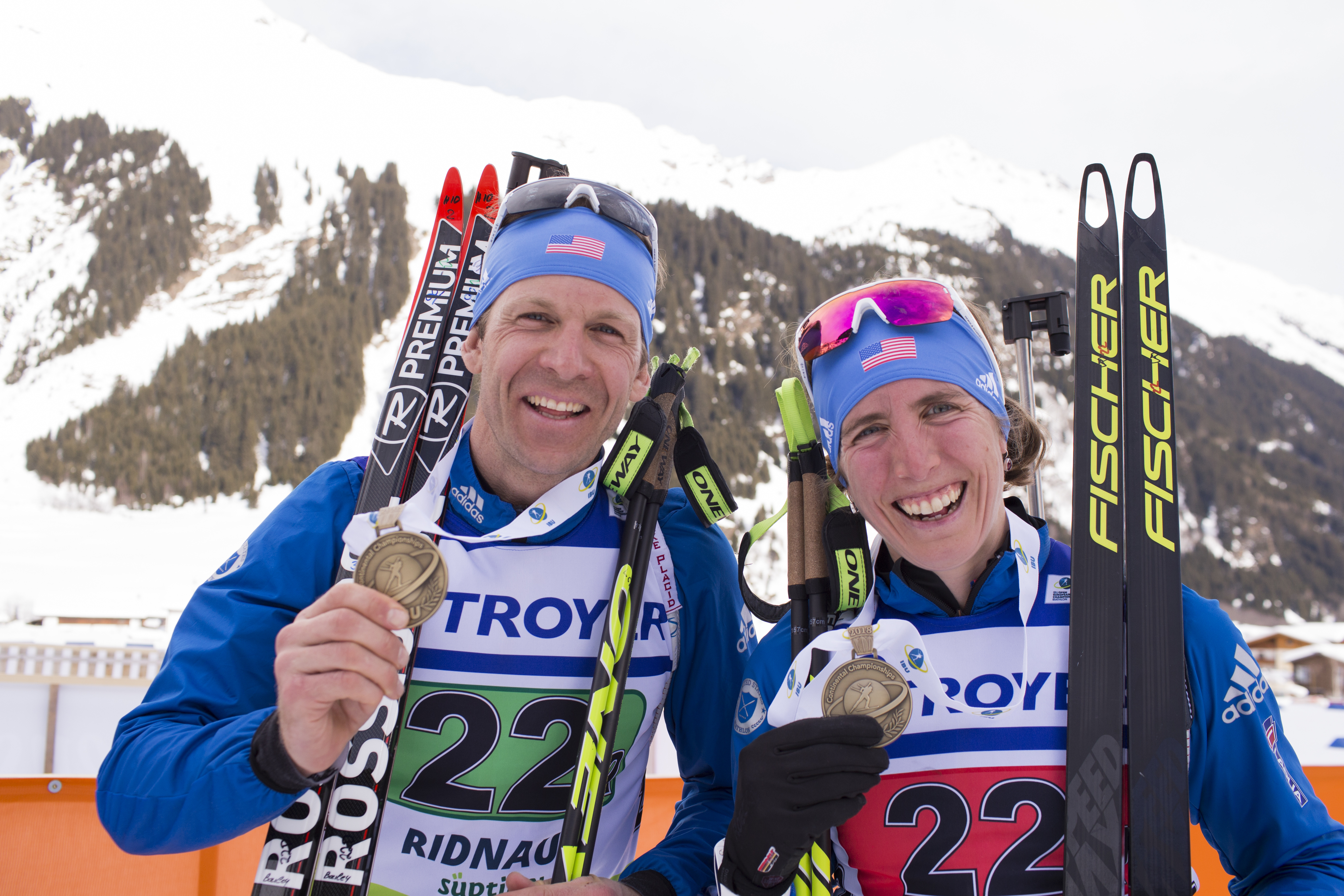
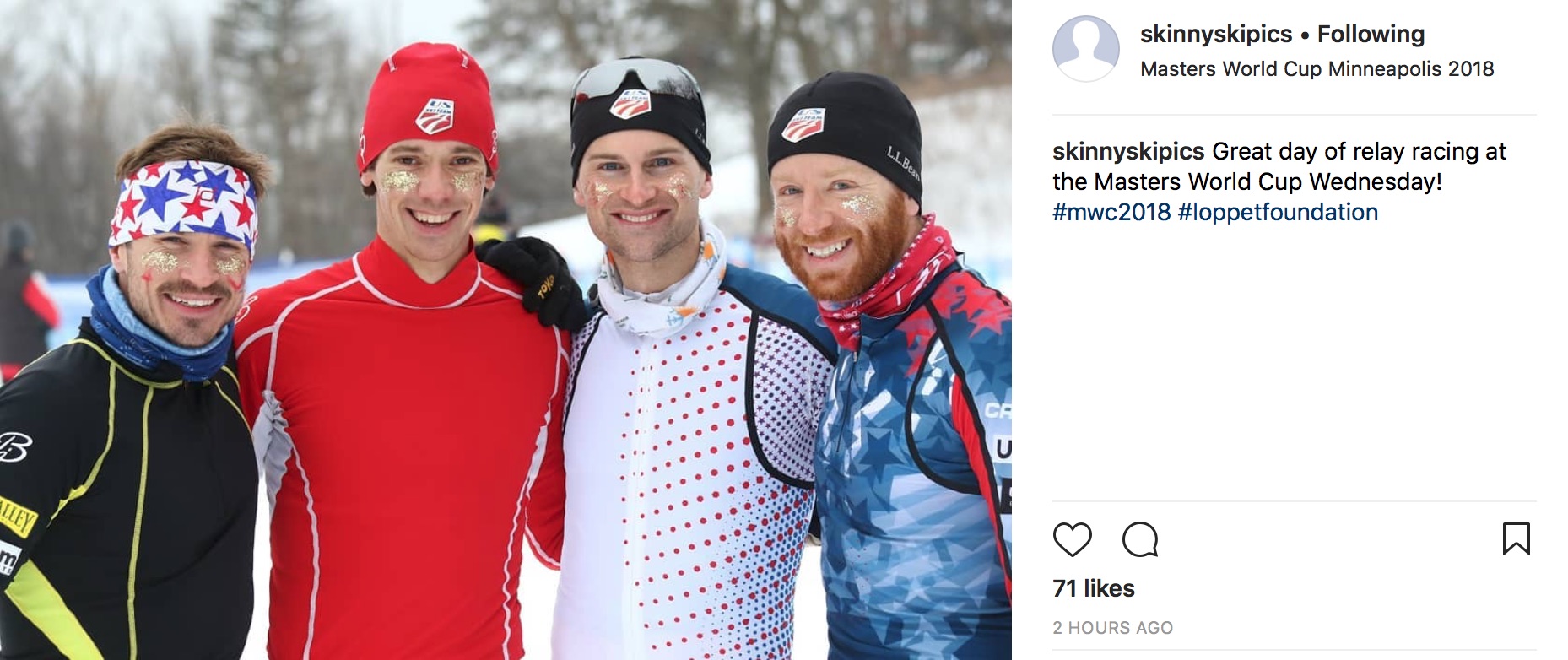
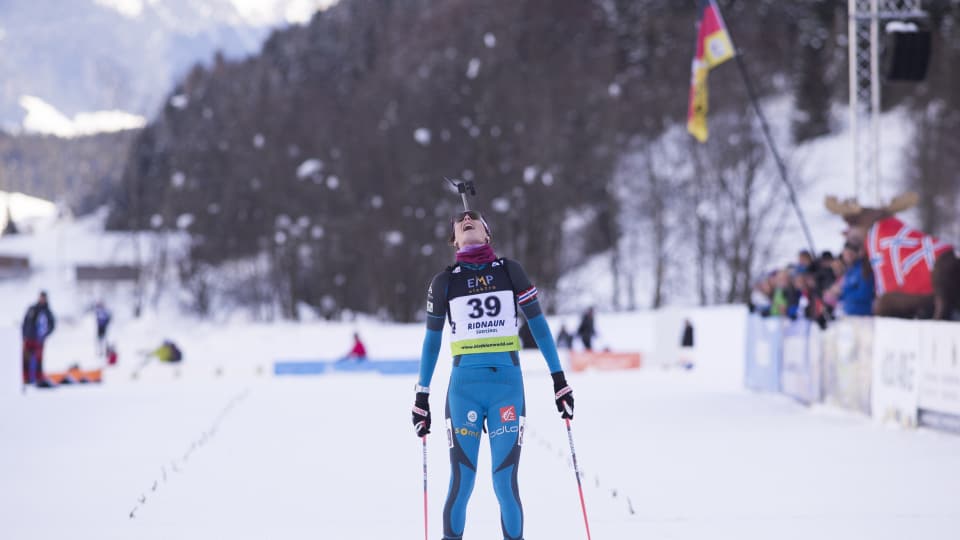
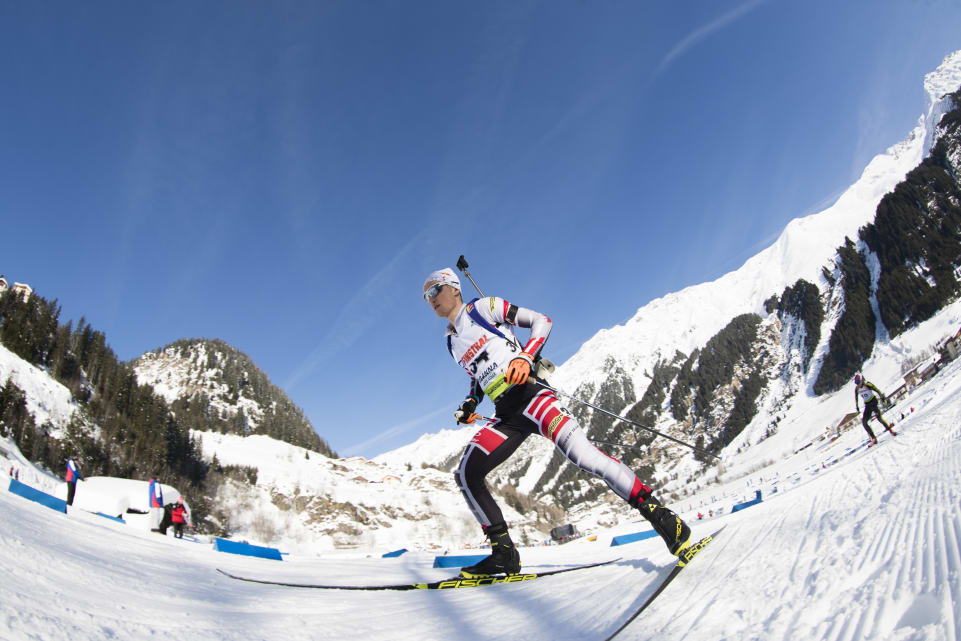
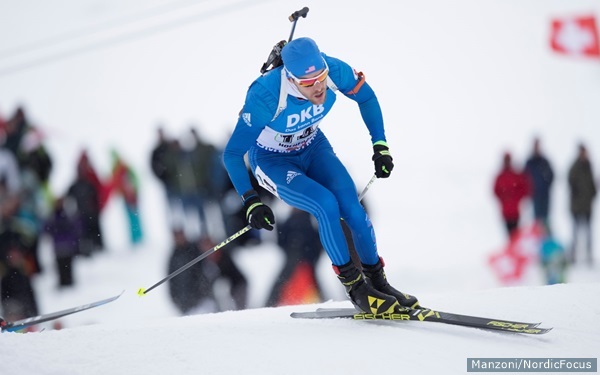
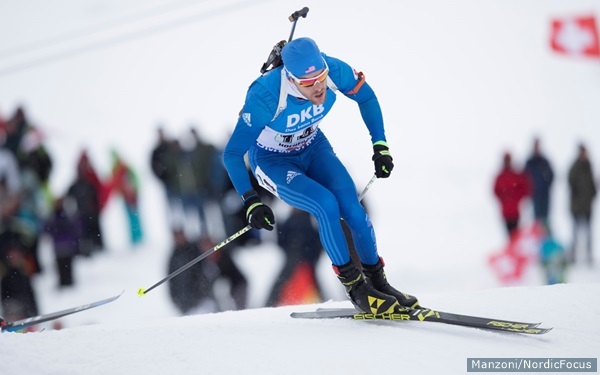
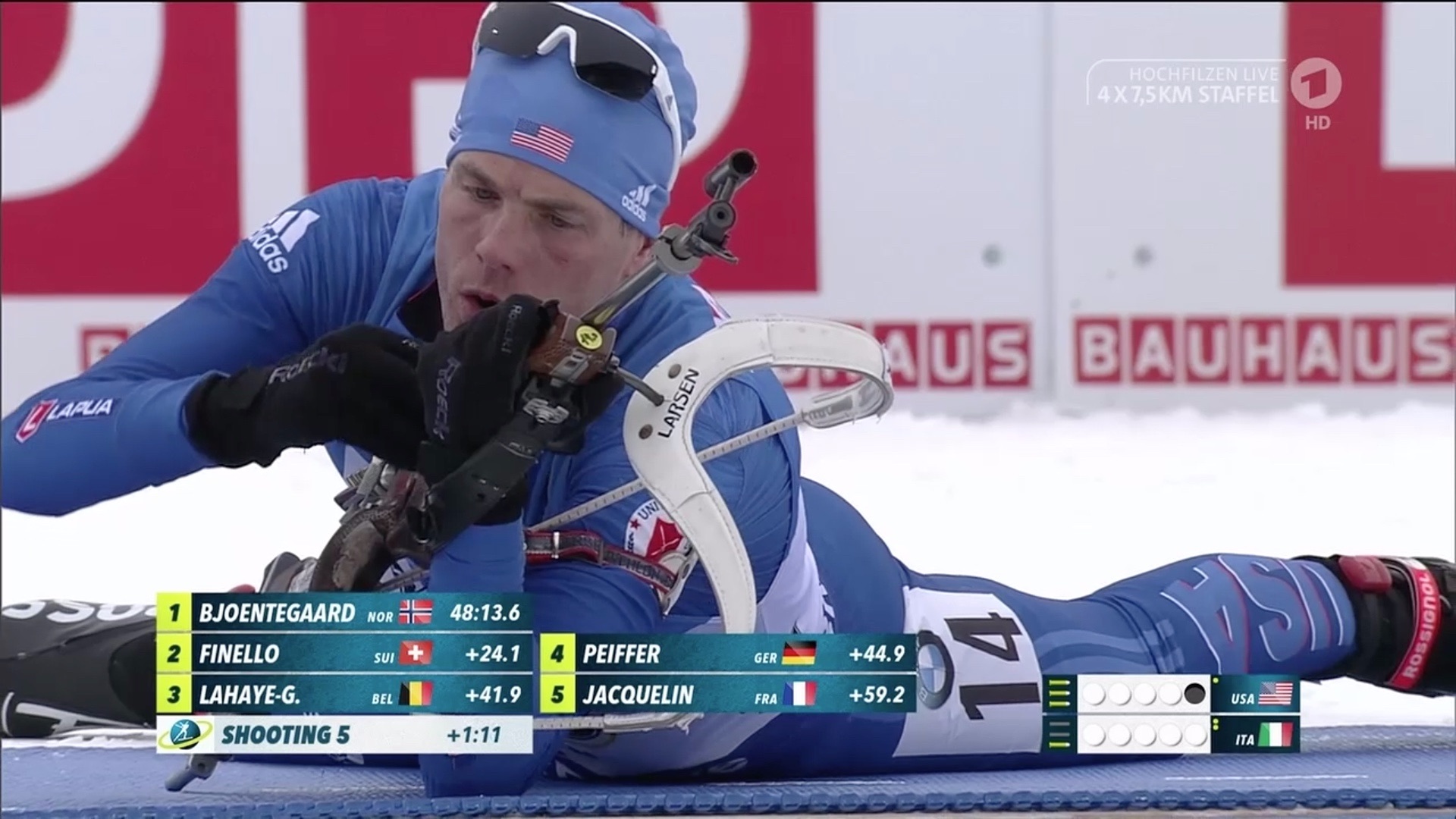
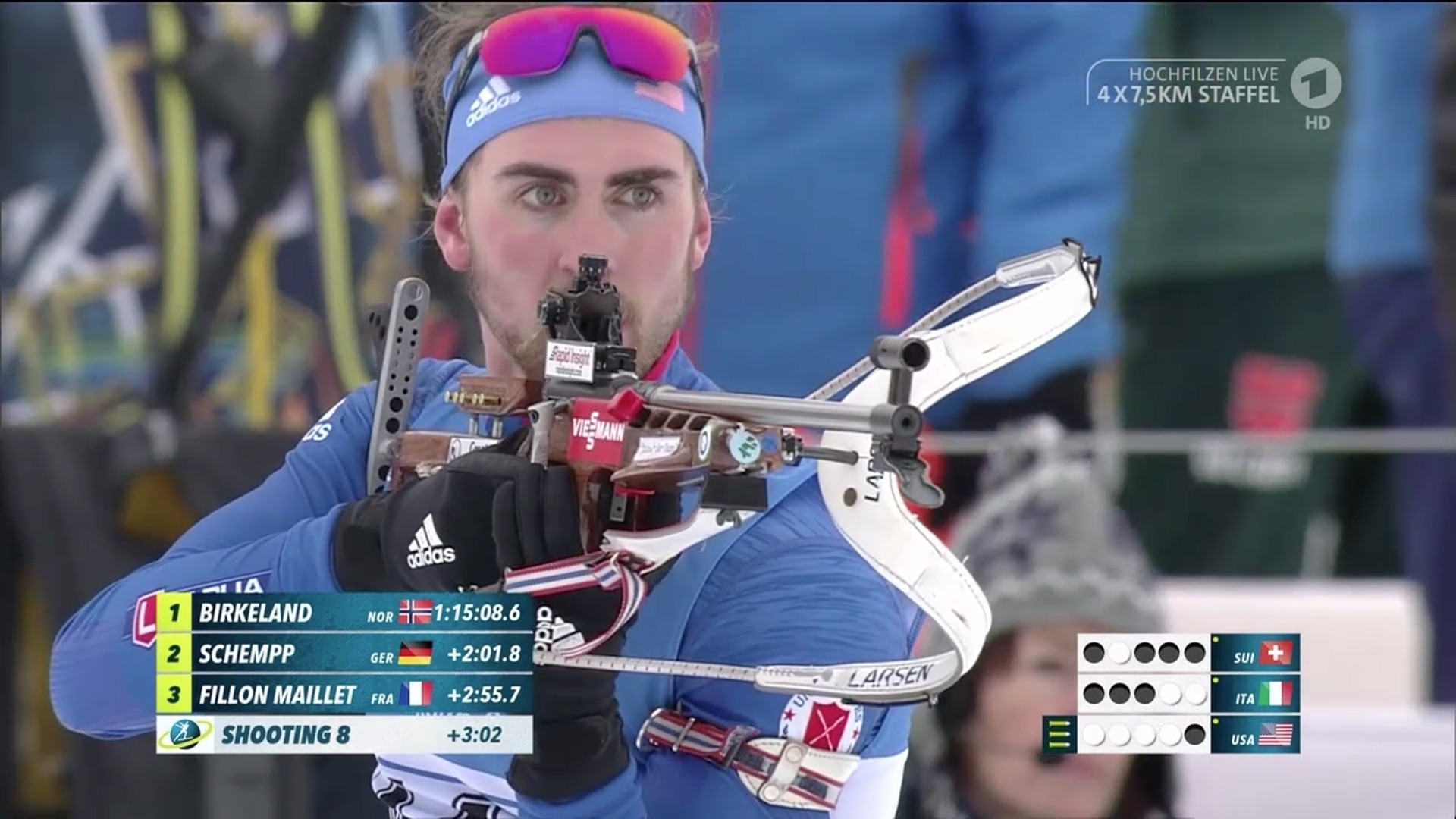
US Biathlon’s Lowell Bailey (l) and Susan Dunklee after teaming up for bronze in the single mixed relay at 2018 IBU Open European Championships on Sunday in Ridnaun, Italy. (Photo: Manzoni/NordicFocus)
IBU Open European Championships (Ridnaun-Val Ridanna, Italy): Single mixed & mixed relays
Susan Dunklee and Lowell Bailey teamed up for the final day of the 2018 International Biathlon Union (IBU) Open European Championships in Ridnaun, Italy, and raced to a bronze medal in the single mixed relay.
The American duo, both of which earned individual medals at last year’s IBU World Championships, finished just 9.1 seconds out of first, which went to Norway’s Thelka Brun-Lie and Vetle Sjåstad Christiansen. The Norwegians won in 35:39.6 with zero penalties and six spares. They took the lead after Brun-Lie’s second leg, where she cleaned both stages without spares.
France placed second, 8.6 seconds back, with Julia Simon and Emilien Jacquelin, who combined for no penalties and 11 spares. They led the first half of the race, but slipped to second behind Norway on Simon’s second leg.
Dunklee put the Americans off in second on her first leg, which she cleaned with a spare in each stage, then they slipped one place to third on Bailey’s first leg, where he cleaned as well and used three spares. In all, they used 10 spares and avoided the penalty loop, and finished half a second out of second place.
“Over Christmas, we trained a little bit with the French athletes, including Jacquelin,” Bailey said, according to a US Biathlon press release. “So I know that he has quite a fast finish, and I thought I am kind of an old man here, I should maybe try to go harder on the first part of the lap. But he stayed with me all the time and had me in the end.”
“It was a good opportunity to tune up the race shape, build some confidence and find that sharp feeling heading into the Olympics,” Dunklee told US Biathlon. “The single mixed relay is one of my favorite race formats and today was a blast!”
Canada’s Sarah Beaudry and Carsen Campbell placed eighth of 24 teams in the single mixed relay, finishing 1:03.6 out of first with just eight spares and zero penalties. In 11th after the first leg, they moved into eighth on Campbell’s first leg, which he cleaned with one spare. Beaudry then cleaned her second leg without any spares, and Campbell anchored them to eighth.
The U.S. entered a team in the mixed relay that followed, with Chloe Levins, Deedra Irwin, Paul Schommer, and Alex Howe placing 17th (+5:55.5) of 19 teams with no penalties and 12 spares.
Ukraine won the mixed relay to conclude the championships, with Yuliia Zhuravok, Iryna Varvynets, Artem Pryma, and Dmytro Pidruchnyi combining for zero penalties and six spares and finishing in 1:11:40.1.
Russia placed second (+11.7) with Victoria Slivko, Anastasia Zagoruiko, Evgeniy Garanichev, and Alexander Loginov combining for zero penalties and nine spares.
Norway followed in third (+33.2) with Emilie Ågheim Kalkenberg, Kaia Wøien Nicolaisen, Håvard Gutuboe Bogetveit, and Fredrik Gjesbakk combing for no penalties and just four spares.
U.S. SuperTour (Craftsbury, Vermont): 5/10 k freestyle
Two Alaska Pacific University (APU) athletes topped the podium on Sunday at the SuperTour in Craftsbury, Vermont, with David Norris winning the men’s 10-kilometer freestyle individual start in 21:54.9 and Becca Rorabaugh topping the women’s 5 k freestyle in 12:06.4.
Norris won the men’s race by 6 seconds over Canada’s Andy Shields (Lappe Nordic) and Kevin Bolger of the Sun Valley Ski Education Foundation (SVSEF) placed third (+15.8). Kris Freeman (Caldwell Sport) was the third American in fourth overall (+23.7), and three Canadians took fifth through seventh with Michael Somppi (Lappe Nordic) in fifth (+27.9), Evan Palmer-Charrette (NTDC Thunder Bay) in sixth (+37.5) and Scott Hill (Barrie Cross Country) in seventh (+37.6), ahead of Brian Gregg (Team Gregg/LNR/CXC) in eighth (+39.4), Tad Elliott (Ski Club Vail) in ninth (+44.3) and Jack Hegman in 10th (+50.4).
Rorabaugh won the women’s race by just 2.2 seconds over her APU teammate Rosie Frankowski in second, and Erika Flowers of the Stratton Mountain School (SMS) T2 Team placed third (+4.6). Two Craftsbury Green Racing Project (CGRP) skiers finished fourth and fifth, with Kaitlynn Miller in fourth (+12.1) and Liz Guiney in fifth (+22.5), Kelsey Phinney (SVSEF) was sixth (+25.8), and Canadians Olivia Bouffard-Nesbitt (Rocky Mountain Racers) seventh (+26.4) and Frederique Vezina (Pierre-Harvey National Training Centre) eighth (+36.0). Corey Stock, of the Bridger Ski Foundation (BSF) placed ninth (+39.9), and Felicia Geisor (CXC Team) was 10th (+44.4).
On Saturday, the Craftsbury Outdoor Center hosted its 37th annual Craftsbury Marathon, with Nils Koons winning the 48 k men’s race in 2:28:51.0 hours and Hannah Dreissigacker winning the 48 k women’s race in 3:01.48.7.
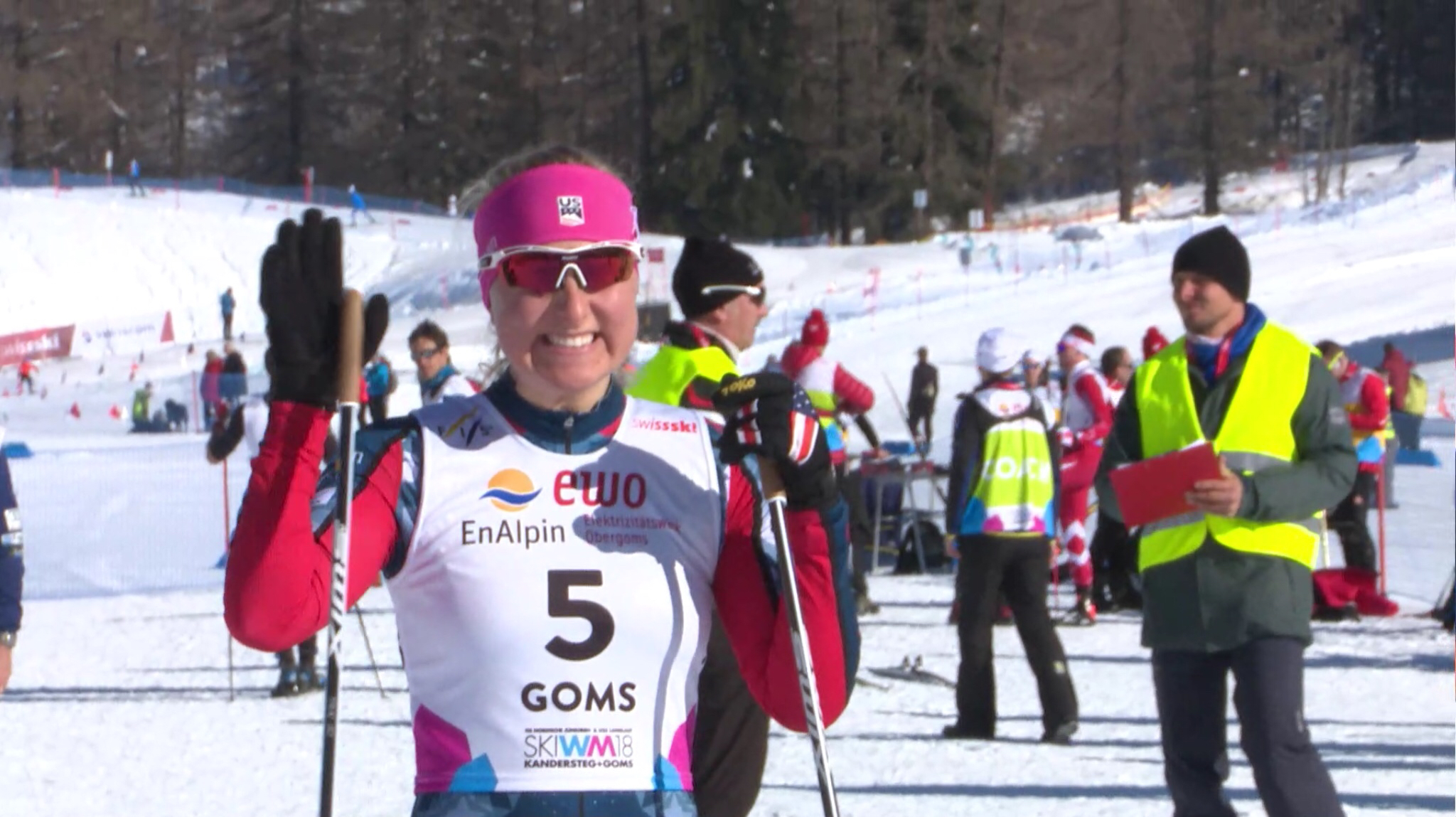
Hannah Halvorsen of the U.S. Ski Team and APU on the start line in Ulrichen, Switzerland, after finishing fifth in the sprint qualifier. (FIS screencap)
FIS Cross Country World Junior Championships (Ulrichen, Switzerland): Freestyle sprints
World Junior Championships kicked off today with freestyle sprints in Ulrichen, Switzerland. Moa Lundgren of Sweden claimed with women’s title by 1.89 seconds over Kristine Stavås Skistad of Norway in the final, with Sweden’s Frida Karlsson finishing third (+1.89).
Hannah Halvorsen of the United States qualified in fifth place before skiing to second in her quarterfinal heat. Halvorsen hovered around third or fourth place through much of her semifinal and was unable to snipe any spots in the finishing straight, ending up fourth in the heat and eighth on the day.
Fellow Americans Margaret Gellert and Sofia Shomento also made the quarterfinals, finishing 18th and 23rd, and Canada’s Hannah Mehain wound up 29th on the day.
The new men’s junior world champion is Tom Mancini of France, who nipped Norway’s Jørgen Lippert by just 0.10 seconds to take the win. Valerie Grond gave the Swiss crowd a thrill by making it all the way to the final and taking home bronze, despite qualifying in just 21st position. The Swiss junior narrowly edged France’s Vincent Buiatti for the final step on the podium.
Canada’s Graham Ritchie finished second in his quarterfinal after qualifying in 28th position, earning an automatic spot in the semifinals. There he finished sixth (+9.30 behind Mancini), winding up 12th on the day. Teammate Antoine Cyr also made the quarterfinals where he had an impressive crash, slinging off the trail and into the infield, finishing 30th on the day. For the U.S., Gus Schumacher was the lone qualifier for the heats. He finished fourth in his quarterfinal and was just 0.22 seconds away from a “lucky loser” spot in the semifinals. Schumacher finished 19th on the day.
In the junior women’s race, Hannah Rudd of the United States finished 35th in qualification, +18.15. For Canada, Annika Richardson finished 52nd (+24.09), Catherine Reed-Metayer 56th (+28.25), and Alexandra Racine 69th (+37.27).
In the junior men’s sprint, Canada’s Reed Godfrey finished a tough 31st, just 0.21 seconds out of making the quarterfinals. Etienne Hebert rounded out the Canadian finishers in 36th place (+11.81) in the qualifier. Canyon Tobin was 41st in qualification for the U.S. (+13.46), followed by Karl Schulz in 54th (+16.90) and Luke Jager in 60th (+18.15).
FIS Nordic Combined World Cup (Seefeld, Austria): Individual normal hill/15 k
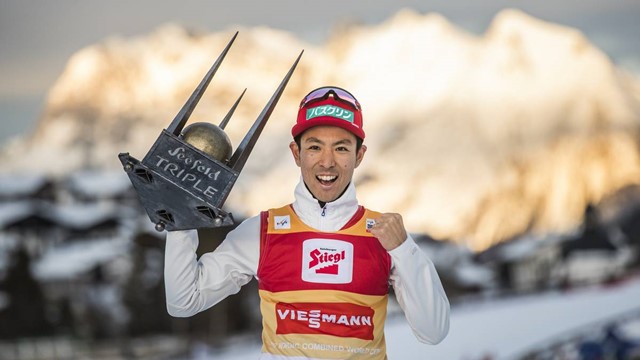
Japan’s Akito Watabe after winning the 2018 Seefeld Triple Nordic Combined World Cup. He is the only athlete besides Germany’s Eric Frenzel to win the event. (Photo: FIS Nordic Combined)
On the final day of the Seefeld Triple, Japan’s Akito Watabe completed his sweep of the three-day weekend and Norway’s Jarl Magnus Riiber reached the podium for the third-straight day, placing second. Germany’s Fabian Rießle placed third for his second podium in the last two days.
Watabe jumped to first on the normal hill and started the 15 k Gundersen 48 seconds ahead of Riiber in second. He went on to win the race by 1:14.9 minutes in 34:58.6, becoming the only man besides Germany’s Eric Frenzel to win the Seefeld Triple in its five-year history.
After jumping to fifth, Rießle won a photo finish for third (+1:57.9), edging Germany’s Vinzenz Geiger by less than a tenth of a second. Geiger moved up from ninth in the jump to fourth overall (+1:57.9).
Norway’s Jørgen Graabak followed in fifth (+2:02.4),Frenzel placed sixth (+2:07.4), Norway’s Jan Schmid was seventh (+2:09.8), Finland’s Eero Hirvonen eighth (+2:13.5), Norway’s Espen Andersen ninth (+2:28.0), and Austria’s Mario Seidl 10th (+2:42.1) out of 28 finishers.
No Americans contested the final day of the Triple, the last World Cup before the 2018 Winter Olympics in PyeongChang, South Korea.
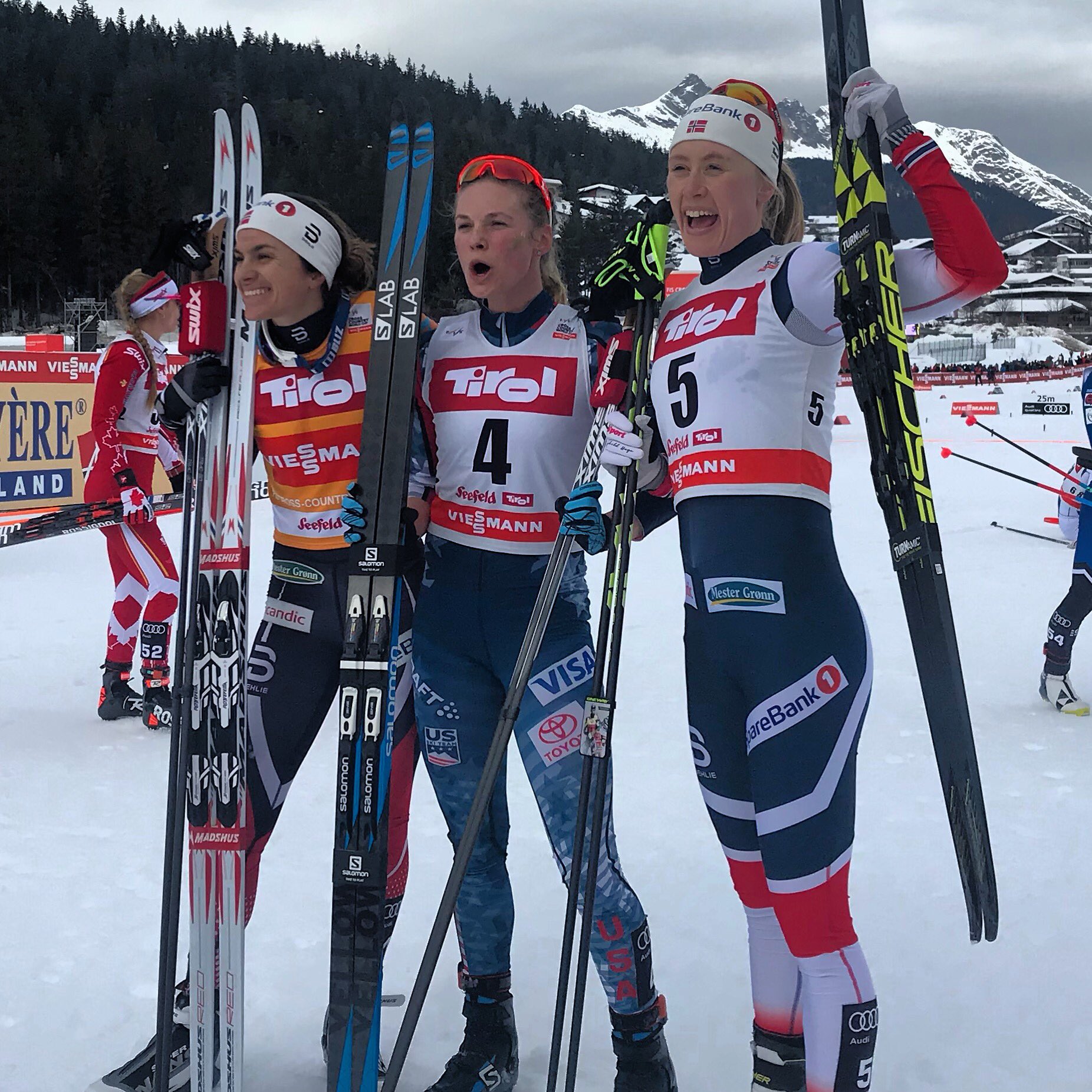
Jessie Diggins of the U.S. Ski Team (center) celebrates after winning the 10 k mass start freestyle in Seefeld, Austria, over Heidi Weng (left) and Ragnhild Haga of Norway. (Photo: FIS Cross Country/Twitter)
FIS Cross Country World Cup (Seefeld, Austria): 10/15 k mass start freestyle
In the final World Cup race before the 2018 Olympics, Jessie Diggins achieved the ultimate goal to give herself the utmost confidence heading into PyeongChang — winning the women’s 10-kilometer freestyle mass start at the World Cup in Seefeld, Austria, on Sunday.
The win was her first of the season and fourth individual victory of her career. Diggins, a 26-year-old U.S. Ski Team member, pulled it off by attacking on a long climb and leaving Norway’s Heidi Weng, Ragnhild Haga and Ingvild Flugstad Østberg chasing. While Diggins was several seconds ahead over the top and all alone on the long descent that followed, Weng and Haga worked to close the gap — and nearly did in the finishing stretch. But Diggins held them off, winning by 0.7 seconds over Weng in second place and 1 second ahead of Haga in third, and threw her fists down in celebration as she crossed the line first in 23:08.5 minutes.
“I just put my head down and it wasn’t pretty, but I just hammered,” Diggins told the International Ski Federation (FIS) in a televised post-race interview.
She was the only non-Norwegian in the top five, with Østberg in fourth (+8.7) and Marit Bjørgen in fifth (+16.7). Austria’s Teresa Stadlober placed sixth (+16.9), Norway’s Kari Øyre Slind was seventh (+19.1), and American Sadie Bjornsen placed eighth (+20.5), ahead of Switzerland’s Nathalie von Siebenthal in ninth (+30.3).
The U.S. had three in the top 15 with Kikkan Randall (U.S. Ski Team) in 14th (+48.5), and two more women in the top 30, with Caitlin Patterson (Craftsbury Green Racing Project) in 23rd (+1:00.7) and Liz Stephen (USST) in 29th (+1:18.2). Rosie Brennan (USST) finished 53rd (+2:26.9).
Emily Nishikawa led the Canadians in 35th (+1:36.5), followed closely by teammate Cendrine Browne in 37th (+1:36.6). Dahria Beatty finished 45th (+1:58.9).
Dario Cologna of Switzerland (center) won the men’s 15 k skate mass start in Seefeld, Austria, over Alex Harvey of Canada (left) and Martin Johnsrud Sundby of Norway (right). (Photo: FIS Cross Country/Twitter)
The Olympics are nearing and so Switzerland’s Olympic legend Dario Cologna is ramping up: after winning the Tour de Ski, he took another win in the 15 k mass start skate in Seefeld, Austria, on Sunday.
With much of the field staying relatively close together until the finish, Cologna nabbed the win by 1.4 seconds over Canada’s Alex Harvey, who took his second podium of the season in addition to also finishing third in the overall Tour de Ski.
Norway’s Martin Johnsrud Sundby was third (+2.9), then teammate Didrik Tønseth in fourth (+5.9) and France’s Maurice Manificat in sixth (+7.5).
The U.S. Ski Team’s Erik Bjornsen had a breakthrough day finishing ninth (+9.3), followed by Simi Hamilton in 12th (+12.4). Behind them, Scott Patterson placed 27th (+23.4), then Patrick Caldwell 49th (+1:26.2), Ben Lustgarten 55th (+1:42.7), and Tyler Kornfield 77th (+3:00.0).
Canada’s Devon Kershaw and Graeme Killick finished 30th (+26.5) and 31st (+27.4), respectively. Len Valjas placed 58th (+1:53.1), Knute Johnsgaard 82nd (+3:23.1), Bob Thompson 87th (+4:27.5), and Julien Locke 92nd (+4:56.9).
Matt Liebsch (l) and his men’s age-group “1” 4 x 5 k winning relay team on Wednesday at 2018 Masters World Cup in Minneapolis, Minnesota. (Photo: SkinnySki/Instagram)
2018 Masters World Cup (Minneapolis, Minnesota): 4 x 5 k relays
Matt Liebsch, 34, anchored the winning relay of the youngest men’s age group (AG 1) at 2018 Masters World Cup on Wednesday, crossing the line in 45:57.2 minutes (the fastest relay time of the day) and teaming up with fellow Americans Christopher Harvey, Mark Johnson and Zach Varty. Two teams competed in that age group’s 4 x 5 k relay, with Italy finishing second, 1:22.6 minutes back.
The U.S. won all five women’s 4 x 5 k relays on Wednesday, and eight total between the men’s and women’s age groups. Finland had the second-most relay victories with five in the men’s categories.
Canada won the men’s AG 4, beating out four other teams with Gabriel Babin, Bruce Macneil, Luc Tremblay, and Michel Labrie, who finished the 4 x 5 k in 49:41.9. Germany placed second (+36.4), and the U.S. third (+54.1).
Piotr Bednarski, head coach of Loppet Nordic Racing, which is based out of Theodore Wirth Park, anchored the men’s AG 5 to a win in 49:39.1, with teammates Rune Harkestad, Dennis Paul and David Sjogren.
Masters World Cup continues with 15/30/45 k classic distance races on Thursday at Wirth Park.
Day 4 Age Group (AG) 4 x 5 k Relay Winners
Men:
AG 1: USA (Christopher Harvey, Mark Johnson, Zach Varty, Matt Liebsch) 45:57.2
AG 2: Finland (Jouni Leinonen, Mika Kilpeläinen, Johan Gustafsson, Joachim Gustafsson) 47:53.4
AG 3: Russia (Ivan Batyutenko, Andrey Lushnikov, Sergey Degtyarev, Aleksandr Pushkarev) 46:43.3
AG 4: Canada (Gabriel Babin, Bruce Macneil, Luc Trembley, Michel Labrie) 49:41.9
AG 5: USA (Rune Harkestad, Dennis Paul, David Sjogren, Piotr Bednarski) 49:39.1
AG 6: USA (Milan Baic, Odd Bersvendsen, Kent Murdoch, Barry Makarewicz) 48:48.3
AG 7: Finland (Heikki Ruokonen, Tapio Tikkanen, Timo Pullinen, Aito Pennanen) 51:56.3
AG 8: Finland (Leino Nisula, Pauli Halonen, Yrjo Teravainen, Harri Makela) 54:58.4
AG 9: Finland (Veikko Piirainen, Tapio Ikaheimonen, Paavo Raisanen, Vaino Paakko) 58:18.9
AG 10: Finland (Alpo Virtanen, Tapio Wallenius, Jouko Laiho, Riku Kyllonen) 1:02:39.7
Women:
AG 1: USA (Kathleen Dewahl, Tamra Kornfield, Davya Flaharty, Gina Chythlook) 56:49.3
AG 2: USA (Bonnie Weiskopf, Kim Rudd, Mary Mckelvey, Mary Wellington) 56:23.9
AG 3: USA (Elizabeth Youngman, Kelly Milligan, Jan Guenther, Kelly Skillicorn) 56:23.6
AG 4: USA (Kate Ellis, Magdenla Bowen, Joann Hanowski, Muffy Ritz) 1:00:33.6
AG 5: USA (Gabriele Andersen, Constance Meek, Dagmar Eriksson, Kati Campbell) 1:14:23.4
France’s Chloe Chevalier after winning the women’s 15 k individual on Day 1 of IBU Open European Championships in Ridnaun, Italy. (Photo: IBU/Biathlonworld)
IBU Open European Championships (Ridnaun-Val Ridanna, Italy): 15/20 k individual
The International Biathlon Union (IBU) Open European Championships opened Wednesday in Ridnaun (Val Ridanna), Italy, with several North Americans competing in the women’s 15- and men’s 20-kilometer individual races.
Austria’s Felix Leitner racing to the win in the first race of 2018 IBU Open European Championships, the men’s 20 k individual, on Wednesday in Ridnaun, Italy. (Photo: IBU/Biathlonworld)
Canada’s 23-year-old Carsen Campbell raced to 19th in the men’s 20 k, shooting 19-for-20 (1+0+0+0) and finishing 3:18.5 minutes behind the winner, Austria’s Felix Leitner, who clocked the fastest time in 53:32.8 — also with one penalty (0+0+0+1).
Leitner, 21, won by 43 seconds over Tomas Krupcik of the Czech Republic, who also had a single penalty in the last standing stage (0+0+0+1) and placed second.
Germany’s Philipp Horn reached the podium in third (+56.6), with 19-for-20 shooting as well (1+0+0+0).
According to an IBU press release, Leitner is one of the youngest athletes to win the 20 k, the longest race on the circuit.
“I had many problems with my shooting lately, but today it was probably the best in the last two seasons,” Leitner said, according to the release. “I believed in myself and knew that I have to run fast from the beginning, and if the shooting would be as good as during the training, I could be in the top.”
Campbell, of Biathlon Canada’s National “Z” Team, was the top North American in 19th in his second trip to Open European Championships. Previously, his best individual result was 64th last year.
Paul Schommer led the U.S. men in 46th (+5:22.6) with three penalties (0+1+1+1). Max Durtschi also shot 17-for-20 (1+0+1+1) and ended up 56th (+6:18.5), Jakob Ellingson followed in 58th (+6:23.5) with two penalties (0+0+1+1), and Jake Brown finished 74th (+8:06.7) with seven penalties (1+1+3+2). Alex Howe did not start.
For Canada, Macx Davies, a senior national team member who is headed to the Olympics, placed 67th (+7:32.7) with five penalties (2+2+1+0). Matt Hudec was 96th (+12:00.5) with six penalties (0+2+1+3), and Aidan Miller 105th (+14:49.0) with nine penalties (2+1+1+5).
In the women’s 15 k that followed, Sarah Beaudry, of Biathlon Canada’s Senior National Team as well as Olympic team, was the top North American in 23rd, 4:55.6 out of first. Beaudry, 23, shot 18-for-20, with her two misses coming in the first prone (2+0+0+0).
France’s Chloe Chevalier won the women’s race, with spring-like temperatures around 6 degrees Celsius, in 46:32.9 with a single penalty, also in the first stage (1+0+0+0). The second- through fourth-place finishers all shot clean, with Italy’s Alexa Runggaldier placing second (+47.7), Russia’s Victoria Slivko taking third (+55.9) and Ukraine’s Yuliia Zhuravok missing the podium by half a second in fourth place (+56.4).
“After that penalty in the first prone, I relaxed and did not worry about the result,” Chevalier said after, according to an IBU press release. “I just enjoyed being out on the tracks on a beautiful sunny. Maybe the key to success is relaxing and not worrying about the result.”
Two Canadian women entered the event, with Erin Yungblut finishing 83rd (+13.19.9) with eight penalties (2+3+1+2).
Chloe Levins was the top American woman in 60th (+7:18.6) with four penalties (1+2+1+0), and Maddie Phaneuf, who made US Biathlon’s Olympic team, followed in 65th (+8:10.8) with four misses as well (1+2+0+1). Deedra Irwin finished 82nd (+13:15.8) and Jennie Bender was 87th (+15:05.0), both with 10 penalties apiece.
Open European Championships continue Friday with the men’s and women’s sprints, followed by pursuits on Saturday and relays on Sunday.
Leif Nordgren (US Biathlon) skiing the second leg of the IBU World Cup men’s 4 x 7.5 k relay on Sunday in Hochfilzen, Austria. The U.S. men ended up ninth overall out of 26 teams. (Photo: IBU/NordicFocus)
Strong gusts of wind on the range required strong nerves and a lot of luck in the women’s and men’s relay races that concluded the International Biathlon Union (IBU) World Cup in Hochfilzen, Austria, on Sunday afternoon.
While the relays concluded with teams on the podium one might expect there, tempestuous weather conditions that at times made it almost impossible to hit the targets also gave outsiders a good chance, and both the U.S. men and Canadian women remained in contention for a long time. The men’s 4 x 7-5-kilometer relay was particularly wild with more than 100 penalty laps, and it began with a big surprise.
Belgium’s starter Michael Rösch tagged off in first place for the first time in the history of that team, representing a country that until now, rarely had enough athletes for a relay and had thus far had a 24th place at the 2016 World Championships to its credit. And on his tails was Norway’s Ole Einar Bjørndalen, and shortly behind them US Biathlon’s Lowell Bailey in third.
The three aforementioned athletes all raced in the Olympic relay more than a decade ago at the 2006 Winter Games in Torino, Italy, but back then Rösch raced for Germany and won gold with his team.
“I wanted to tag off in first at all costs, to see the Belgian flag at the top,” Rösch told TV broadcaster ARD on Sunday while the race was still going on. “But Ole made it really hard for me. … I was on my last fumes, I tumbled into the finish, I was just seeing black, but it definitely was worth it.”
Just a turn behind, Bailey had gotten off to a strong start for the U.S. team, temporarily taking the lead out of the arena on the first lap before shooting clean in his prone stage to put himself in the lead group of seven. Facing strong wind in his standing stage, Bailey missed two targets but avoided the penalty lap with his last spare in that stage (0+0, 0+3), and tagged off to teammate Leif Nordgren in third position, 23.8 seconds out of first.
Nordgren ended up with a penalty in his first prone after missing two targets, and returned to the course in fifth. While his penalty had increased the gap to first by 50 seconds, Nordgren made up a few seconds with a clean standing bout, hitting all targets without requiring a spare (1+3, 0+0).
Italy and France passed him on the final loop, and Nordgren handed off in seventh, 1:34.2 minutes behind Norway setting the pace up front.
“The team came pretty close to a good result today in a relay with nasty weather,” Nordgren wrote on his Instagram account. “Personally I’m quite disappointed with my skiing, it’s been a struggle to find the top gears so far this season and I’m far from where I know I should be. It’s a long season though and there is still plenty of time to turn it around.”
US Biathlon’s Tim Burke loading a spare in his prone stage of the men’s relay at the 2017/2018 IBU World Cup in Hochfilzen, Austria. The team went on to finish 9th. (Screenshot: ARD broadcast)
Taking over next for the U.S. was Tim Burke, who pointed out this was one of the most challenging races in terms of wind that he’d experienced.
“This was definitely one [of the] windiest races that I have taken part in,” Burke wrote in an email to FasterSkier. “We knew it would be very challenging right from the start but our team tried to look at it as an opportunity for a top result. I feel like our team did a great job at avoiding any big disasters on the range and this allowed us to stay near the front for most of the race.”
After only needing one spare in his prone shooting to hit his last target, Burke incurred a penalty in his standing stage (0+1, 1+3), but kept his position on the final loop in a hard race against Switzerland’s Jeremy Finello to exchange still in seventh, now another minute back (+2:49.4).
“I was not surprised to see a mix of different teams near the front today,” Burke wrote. “It was one of those days that any team could find themselves with multiple penalty loops after a windy shooting stage.“
Taking over from Burke as the U.S. anchor leg was Sean Doherty, coming off two strong shooting performances in the sprint and pursuit earlier this week.
U.S. relay anchor Sean Doherty taking aim in difficult wind conditions during his standing stage of the men’s relay at the 2017/2018 IBU World Cup in Hochfilzen, Austria. His team finished ninth. (Screenshot: ARD broadcast)
In his prone stage, Doherty again shot clean and fast (with the second-fastest prone shooting time on his leg) and overtook Switzerland to move into sixth. He kept that position on the course, vying for a position in the top five with the teams from France, Italy, Ukraine, and Russia also in his vicinity.
“Today was a crazy one for sure,” Doherty wrote in an email. “The conditions on the course were decent, firm tracks and we had good skis. The wind was whipping, so that really just made some sections a lot harder than normal when you added in the head wind. I have done races in bad weather before but today was amongst the most windy.
In the standing stage, Doherty hit his first four shots in another fast sequence before missing the last one. It looked as if he had thought that final shot was also a hit as he dropped his rifle slightly, but then realized he had to load spares. Unable to clear the last target, Doherty ended up with the team’s third penalty.
“With the shooting you try to get a general idea of how far the wind is pushing the shots and do the best you can,” Doherty explained. “It’s a total toss up and the finish order is just a ranking of who battled the wind the best and had most to least luck along the way.”
He set out on his last loop in eighth place with Ukraine’s Dmytro Pidruchnyi and Switzerland’s Mario Dolder right ahead of him, and Russia’s Anton Shipulin ten seconds behind.
“The fight on the last lap is always tough,” Doherty wrote. “Although I felt better today I was not able to hang with the two guys I left the range with. I was able to ski a good lap but not enough to hold off Anton.”
After Shipulin passed him up the big last climb, Doherty came to the finish in ninth position, 3:38.3 minutes behind the winners with a team total of three penalties and 13 spares.
“We were not too excited with the end result because we saw the potential was there for a top 5,” Burke concluded for the team. “We are also all far from our best on the tracks right now, but are hopeful that will come with more racing.”
Norway Successful with Its ‘Second Unit’
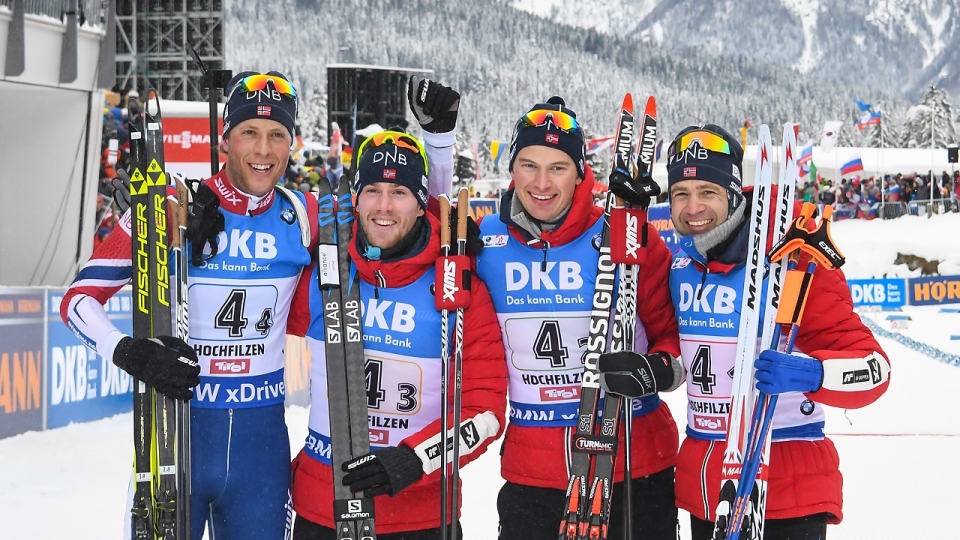
Norway’s Lars Helge Birkeland, Erlend Bjøntegaard, Henrik L’Abée-Lund and Ole Einar Bjørndalen (left to right) following their victory in the men’s relay at the 2017/2018 IBU World Cup in Hochfilzen, Austria. (Photo: IBU/Biathlonworld)
Norway started the men’s relay race without Emil Hegle Svendsen, who was sidelined with a cold, and also rested brothers Johannes Thingnes Bø and Tarjei Bø, both of whom had already won races this season.
But shooting was more important than skiing in a relay decided by strong crosswinds on the range, and that’s where the Norwegians coped by far the best. While Norway also required nine spares, which usually is a rather average performance in a relay, on Sunday this was the top shooting performance of the men’s relay.
After veteran Bjørndalen, Henrik L’Abée-Lund and Erlend Bjøntegaard had created a fairly comfortable lead of almost a minute on the first three legs, Lars Helge Birkeland anchored them to the victory by shooting clean in prone and only needing one spare to hit every target in his final stage despite some widely spread shots.
“It is really nice; a good start for Norway and good self confidence for the the rest of the season,” L’Abée-Lund said at the post-race press conference.
“It’s always fun to compete on the highest level with the best guys,” Bjøntegaard said. “I think I did pretty good on my leg today. It was tough conditions as it was for everyone else. I am just happy to show what I am capable of.”
“It feels great, it was an amazing feeling on the last loop, and really satisfied with my own leg,” Birkeland said. “I just decided to be offensive and attack and don’t think about the others and just do my own race. … We have a really strong team with a lot of good guys, so we don’t need to have all the best at the start to have a chance to win.”
All hopes for Germany’s Simon Schempp to contend with Birkeland for first were dashed when Schempp required three spares to clear both his prone and standing stages, narrowly avoiding the penalty lap twice.
Due to the huge distances between the top-three teams, the final loop was more of a cool down for their anchors, with Norway taking the win in 1:21:21.8 hours, just under two minutes ahead of Germany, with Erik Lesser, Benedikt Doll, Arnd Peiffer and Schempp, in second (+1:54.9, with zero penalties and 17 spares).
“At least we avoided the penalty loop, for me it was definitely close in standing,” Peiffer told German broadcaster ARD. “There was so much wind that it was impossible to shoot calmly and controlled. … It was clear that today there would be some upsets, like Belgium being in the mix in front. You just had to somehow avoid the penalty lap.”
“The last years in Hochfilzen we have never been on the podium, so it’s the first time in like six years we are back again,” Peiffer said at the press conference. “So that’s a good start for us because normally we are struggling here and we don’t know why.”
France, which had rested its star Martin Fourcade and started Jean-Guillaume Beatrix, Simon Desthieux, Emilien Jacquelin, and anchor Quentin Fillon Maillet, finished another 40 seconds later in third (+2:34.0, with three penalties and 13 spares).
Another 20 seconds back, Sweden with Peppe Femling, Jesper Nelin, Sebastian Samuelsson, and Fredrik Lindström crossed the line in fourth (+2:54.8, with three penalties and 12 spares).
“Today was very hard, very strange result, because when we look at all the penalties on the result list it was just crazy,” Beatrix said at the press conference. “I am satisfied for the team, and I am also really satisfied for the newcomer Emilien because it’s his first two weeks on the World Cup and first relay, and he did a every good job and brought us to the podium.”
“Today I was a little bit stressed, because the French guys are so strong and I had to be at their level, so I am happy to do a good relay today,” the 22-year-old Jacquelin said.
And what happened to the brave team from Belgium? With three athletes who had just made an overnight trip from an IBU Cup race in Lenzerheide, Switzerland, they came through the second exchange in second place after Florent Claude only needed one spare in standing. On the last two legs, however, three penalties for both Tom Lahaye-Goffart and Thierry Langer put them in 16th at the finish (+6:24.9) , which was still a team-best relay result for Belgium.
Just ahead of them in a finishing sprint anchored by Brendan Green was Biathlon Canada, with a lineup that earned bronze at the 2016 World Championships in Oslo, Norway. On Sunday, however, the Canadians’ race began with difficulties for brothers Christian Gow (1+3, 2+3) and Scott Gow (1+3, 2+ 3), each having to ski three penalty laps and exchanging in 21st position already 4:45.7 minutes back. Then Nathan Smith (0+0, 0+2) and Green (0+3, 0+3) were able to move them up a bit again, with Smith putting them as high as 13th by the final exchange and Green anchoring them to 15th (+6:22.5, with six penalties and 20 spares).
Of 26 teams in the men’s relay, Norway and Germany were the only ones that succesfully avoided the penalty lap.
Hochfilzen World Champs Women’s Podium Repeats
Later on Sunday afternoon in the women’s 4 x 6 k relay in slightly better conditions than the men’s race, last season’s reoccurring winner Germany struck gold again.
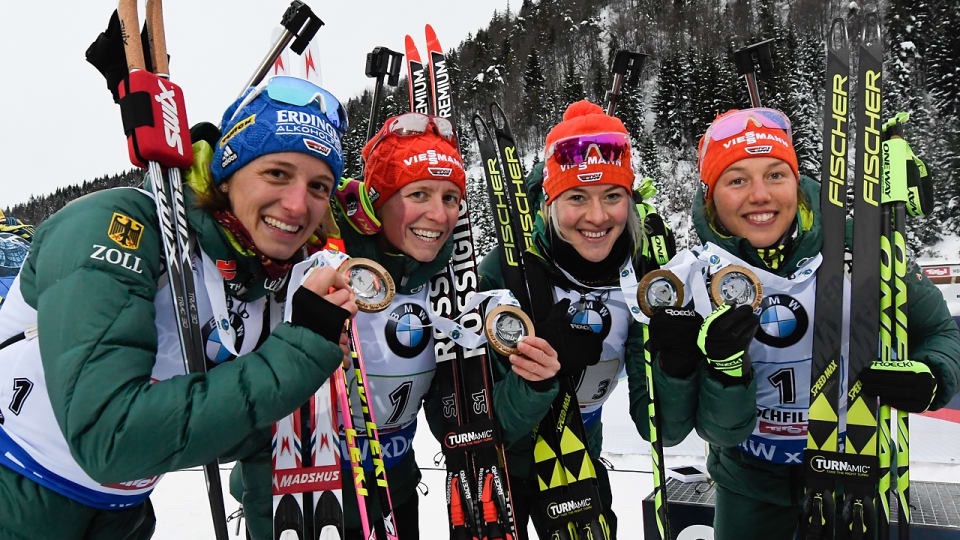
Germany with (left to right) Vanessa Hinz, Franziska Hildebrand, Maren Hammerschmidt and anchor Laura Dahlmeier shows off their medals following their victory in the women’s relay at the 2017/2018 IBU World Cup in Hochfilzen, Austria. (Photo: IBU/Biathlonworld)
The victorious world-champion quartet of Vanessa Hinz, Franziska Hildebrand, Maren Hammerschmidt,and Laura Dahlmeier won with a large lead ahead of Ukraine (+44.9) and France (+1:04.5). The first-, second- and third-place teams were a repeat of last season’s World Championships relay in Hochfilzen this past February.
Fighting for position with Ukraine and Switzerland on the third leg, Hammerschmidt got her team on the road to victory when she cleaned every target within 24 seconds despite difficult conditions to reclaim the lead, erasing the gap she had been handed of almost 30 seconds to first.
“For me it was very important to have a good standing shooting today, because the last two days were not so good,” Hammerschmidt said at the press conference. “I thought it was one of my best standing shootings, and I was so happy to go on the last loop and fight for every second to give to Laura.”
Dahlmeier returned to the World Cup after missing last week’s opening races with a cold, then had no major problems defending the lead. Dahlmeier used just one spare in each of her shooting stages, while Switzerland’s Irene Cadurisch as the closest pursuer had to ski a penalty lap. Germany finished in a time of 1:14:36.4, with zero penalties and nine spares.
“It’s a really cool feeling to be here again,” Dahlmeier said at the press conference. “Especially with the team. We know we can make a good race, but it’s important for every person to be good on the range and on the tracks. Relays are special races.”
“From the last year we have good memories about Hochfilzen … and today it was a good place, too,” Hildebrand said “I was really impressed with [Ukraine’s] Yulia Dzhima’s standing shooting, because she took all targets out while I used two extra bullets and was happy I could go out on the track again.”
Ukraine’s Olena Pidhrushna anchored her team, with Vita Semerenko, Yulia Dzhima and Valj Semerenko, to second (+44.9), thanks to the best team shooting performance of zero penalties and five spares, and despite a fall on the first leg by Vita Semerenko.
“I think our team spirit is very strong, without that we wouldn’t be on the podium, so I am very thankful to all the girls and our staff for making this happen,” Valj Semerenko said at the press conference, via a translator.
“My start this season was not so good … Actually today I was so nervous ahead of the relay,” Pidrushna explained. “But I saw that we had a little bit of extra time at the last exchange, and I calmed down a little bit and it worked well in the end. … And I think my team believes in me [to anchor it successfully].”
Twenty seconds behind her, France with Marie Dorin Habert, Celia Aymonier, Justine Braisaz and the current women’s World Cup leader Anaïs Bescond, passed Russia’s Ekaterina Yurlova-Percht on the final loop to claim third place (+1:04.5, with two penalties and 13 spares).
“Honestly at the beginning when I started I didn’t think a podium was still possible, but loop after loop I thought maybe I can still catch a podium [position],“ said Bescond, who skied the fastest course time on the final leg amidst strong competition.
A few seconds behind, Russia with Victoria Slivko, Tatiana Akimova, Irina Starykh, and Ekaterina Yurlova-Percht finished fourth (+1:09.0, with no penalty and nine spares).
Another 16 seconds back, Switzerland, with Elisa Gasparin, her older sister Selina Gasparin, Lena Häcki and Cadurisch finished fifth (+1:25.7, with two penalties and 12 spares) for Switzerland’s best women’s relay result, which fulfilled its national qualification criteria for the Olympics.
Canada in Contention
For Biathlon Canada, Emma Lunder started off the race in the middle of the field, and managed hit all her targets with one spare in her prone stage to leave the range in 16th position.
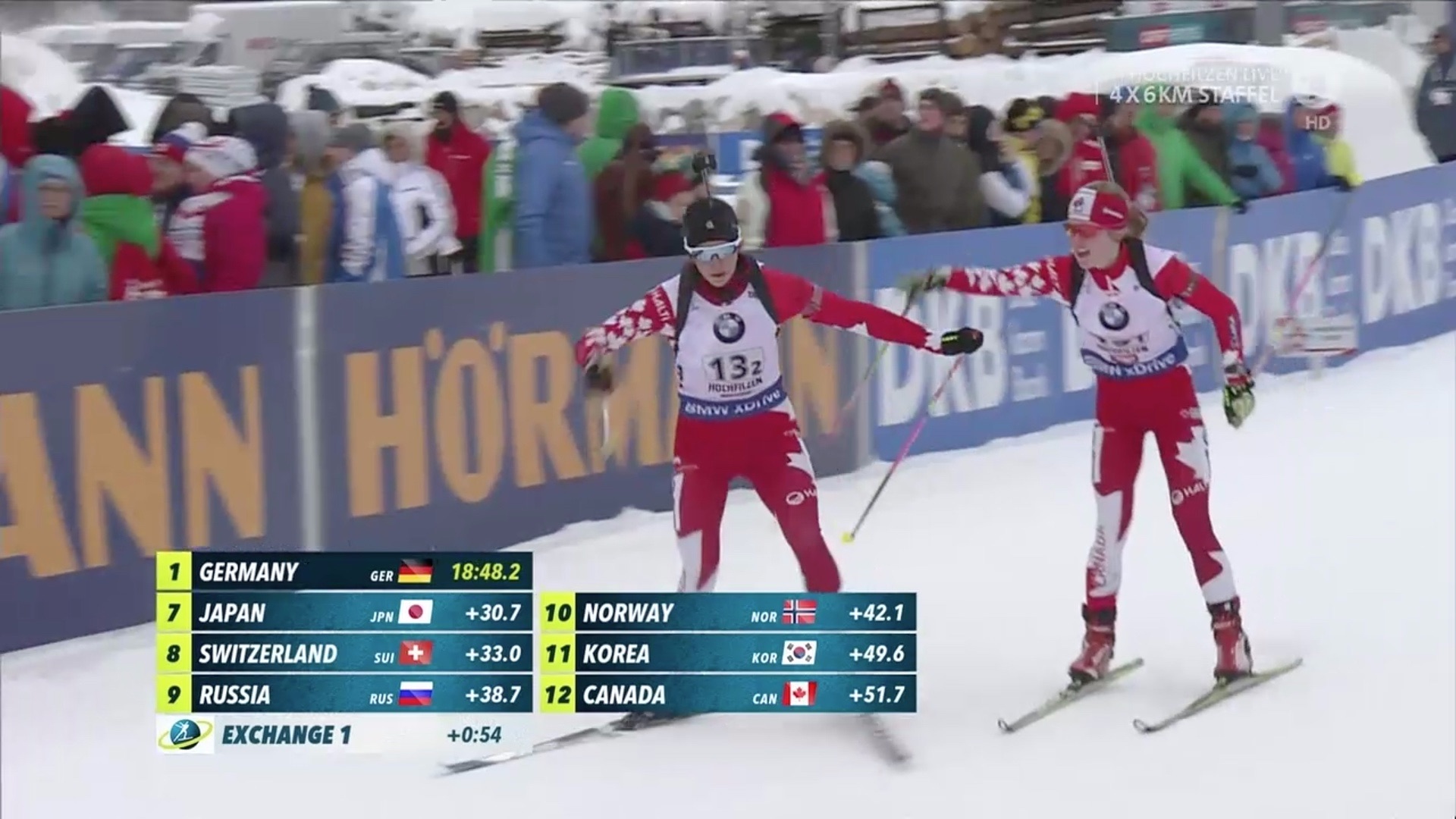
Biathlon Canada’s starter Emma Lunder (r) exchanging to Rosanna Crawford in the women’s relay at the 2017/2018 IBU World Cup in Hochfilzen, Austria. Crawford temporarily moved up to fifth before the team finished in ninth position. (Screenshot: ARD broadcast)
While a number of competitors, including France’s Dorin Habert, incurred penalties, Lunder again needed just one spare to clean (0+1, 0+1) and moved Canada up to 1oth. After losing a few more seconds on her last loop to the leaders, with Germany’s Hinz up front, she tagged Rosanna Crawford in 12th position, 51.7 seconds back.
Crawford started out fast and also needed just one spare to hit all five prone targets, improving by three places to ninth.
“It was a tricky shooting day today, you really had to be aware of the wind, and be prepared to do a correction even part way through a bout of shooting,” Crawford wrote in an email. “In prone I made a correction of 5 left and 2 up and it was enough to keep me pretty centred.”
Then in her standing stage, she picked off four more positions with clean shooting and no spares to leave the range in fifth place, while most teams around her needed spares or even incurred a penalty in seemingly difficult wind conditions.
“I was really happy with my standing today,” Crawford explained. “I saw Brendan [Green] right before zero and he said that it’s worthwhile to take your time and make each shot a good one. So I really thought about that as I came into the shooting, there was a big gust right off the start, so I waited and could hear the women around me missing. Each shot was really precise. My shooting time was 33 seconds which is really slow for standing but still the 2nd fastest of my leg, which says a lot about the wind today!”
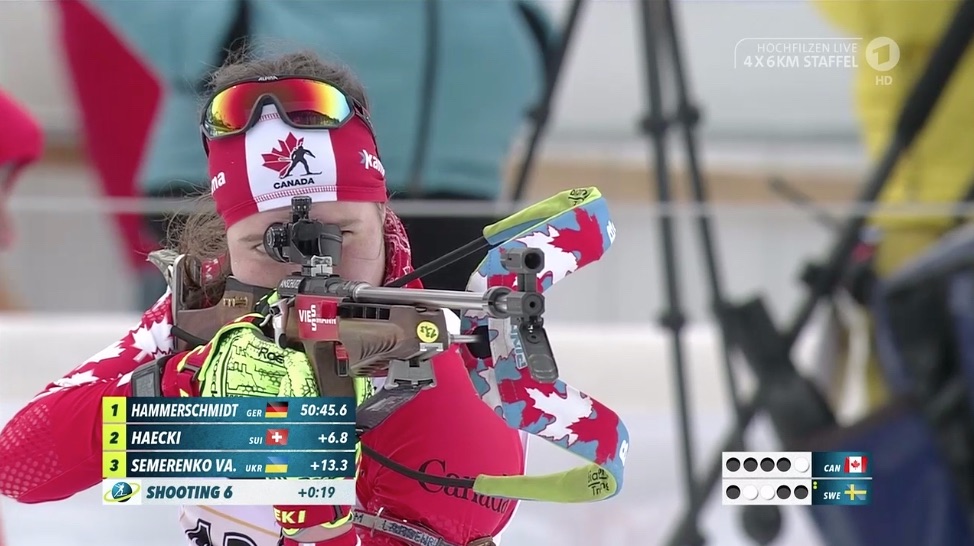
Biathlon Canada’s Megan Bankes shooting in her standing stage in the women’s relay at the 2017/2018 IBU World Cup in Hochfilzen, Austria. The team finished ninth overall. (Screenshot: ARD broadcast)
Crawford tagged Megan Bankes in fifth (+36.3), after having regained 15 seconds on the leaders and skiing the second-fastest course time on the final loop.
“It’s always fun to tag off in a high position but today was a bit of a lucky draw for what you got in the range,” Crawford concluded.
The 20-year-old Bankes as Biathlon Canada’s youngest team member started out just as fast, nearly maintaining that time gap on the first loop.
“I was super stoked to be tagged in such a good place, but I definitely still felt that I was able to ski my own race,” Bankes wrote in an email. “I wanted to ski my best, and not lose to much time on the tracks, but also be controlled on the range, because I knew it was going to be a tricky shooting day.”
She was able to get through the prone stage with two spares in a stage when all leading teams needed them, keeping her in fifth. Bankes followed that up with just one spare in her standing shooting, temporarily moving up to fourth after overtaking Sweden’s Mona Brorsson.
“Coming into the range I was focussed on my own shooting more than anything else,” Bankes wrote. “I knew that the wind was pretty variable, and that I needed to make sure I took good, smart shots, and correct appropriately for the wind. I was super happy with how I ended up doing on the range, and also with my speed on my first couple of laps.”
On the last loop, Brorsson and Russia’s Starykh passed her, and Bankes came through the final exchange in sixth place (+1:28.8).
“I died a bit at the end, but I still managed to tag Julia in a good position, so for me it was a pretty great race!” Bankes concluded.
Shown on television in the exchange zone, looking back at the final curve to see when Bankes would arrive, Ransom took over as the anchor and skied a very fast first loop, just 1 second off the fastest pace on that loop.
She then managed to still clean all five targets in a controlled fashion, leaving the range again in fifth position, with Switzerland in sight and Russia nearby as well.
After a slower second loop, Ransom struggled to clean all her targets in the final stage, but avoided the penalty lap with her last shot and left the range in ninth position. Sweden’s anchor Anna Magnusson was still in sight, 10 seconds ahead, but extended her lead on the final loop, while Japan’s anchor Rina Mitsuhashi was already more than a minute behind Ransom in 10th.
Ransom crossed the line in ninth place (+2:31.6) with zero penalties and nine spares for the team.
“A top 10 is a decent result for our team, it’s nice that we were fighting for a top 6 for most of the race,” Crawford wrote. “Our team has come a long way and I’m really proud to be a part of this team! Emma and Megan had a great leg and Julia an awesome prone and then it was quite windy for her standing, but most teams have their strongest women on the last leg, so it’s always a hard fight!”
In other good news for Biathlon Canada this weekend, the team finished eighth in an IBU Cup mixed relay and national team member Megan Tandy raced to 11th place in the sprint followed by ninth place in the pursuit this weekend in Lenzerheide, Switzerland.
“Another #perfect#shooting day! I was hoping for more, but you gotta work with what you got – in my case very heavy legs skiing. Nonetheless, a solid race,” Tandy wrote on Instagram after shooting clean in both the sprint and mixed relay.
The U.S. Women and Nation Cup Standings
US Biathlon could not start a women’s relay on Sunday because it only has three women currently on the World Cup circuit: Susan Dunklee, Clare Egan and Emily Dreissigacker. US Biathlon had hoped that its fourth woman Kelsey Dickinson, would qualify for the first trimester of World Cup racing by scoring necessary points at the IBU Cup opener in Sjusjøen, Norway. But unfortunately that did not work out.
In addition to Dickinson missing out on the World Cup starts because of that technicality, and her teammates now missing out on one of only three opportunities on the World Cup competition calendar to prepare for the relay in the upcoming Olympics, this also means they lost out on valuable points for the Nation Cup Score. That ranking is its own award category in the World Cup season (last year Germany won it for both the women and men), but more importantly for the North American teams, also determines the starting quota for the following season.
With a third of the races counting towards that already completed (unlike at World Championships the races at the Olympics don’t apply, neither do pursuits and mass starts), the U.S. is currently in 21st position for the women with 676 points and in danger of losing its fourth starting position for next year again, which would make team selections and travel planning even harder.
While certainly not impossible — last year the U.S. women also did not start a relay in Pokljuka, Slovenia — it will be a bit of an uphill battle to make that up the rest of the season, requiring a number of strong results. For instance, South Korea is currently 357 points ahead in 17th, the benchmark for a fourth quota spot.
The Canadian women are currently in 14th position with 1220 points. Last season they were 15th and the U.S. 14th. For the men’s teams, Canada is currently in 12th position with 1260 points, the U.S. is 13th with 1198.
The teams will now travel to Annecy-Le Grand Bornand, France, for the next World Cup from Thursday, Dec. 14, to Sunday, Dec. 17.