From the FasterSkier archive — posts syndicated from athletes’ and coaches’ own blogs between 2004 and 2012, kept online as published. Current coverage is at fasterskier.com.
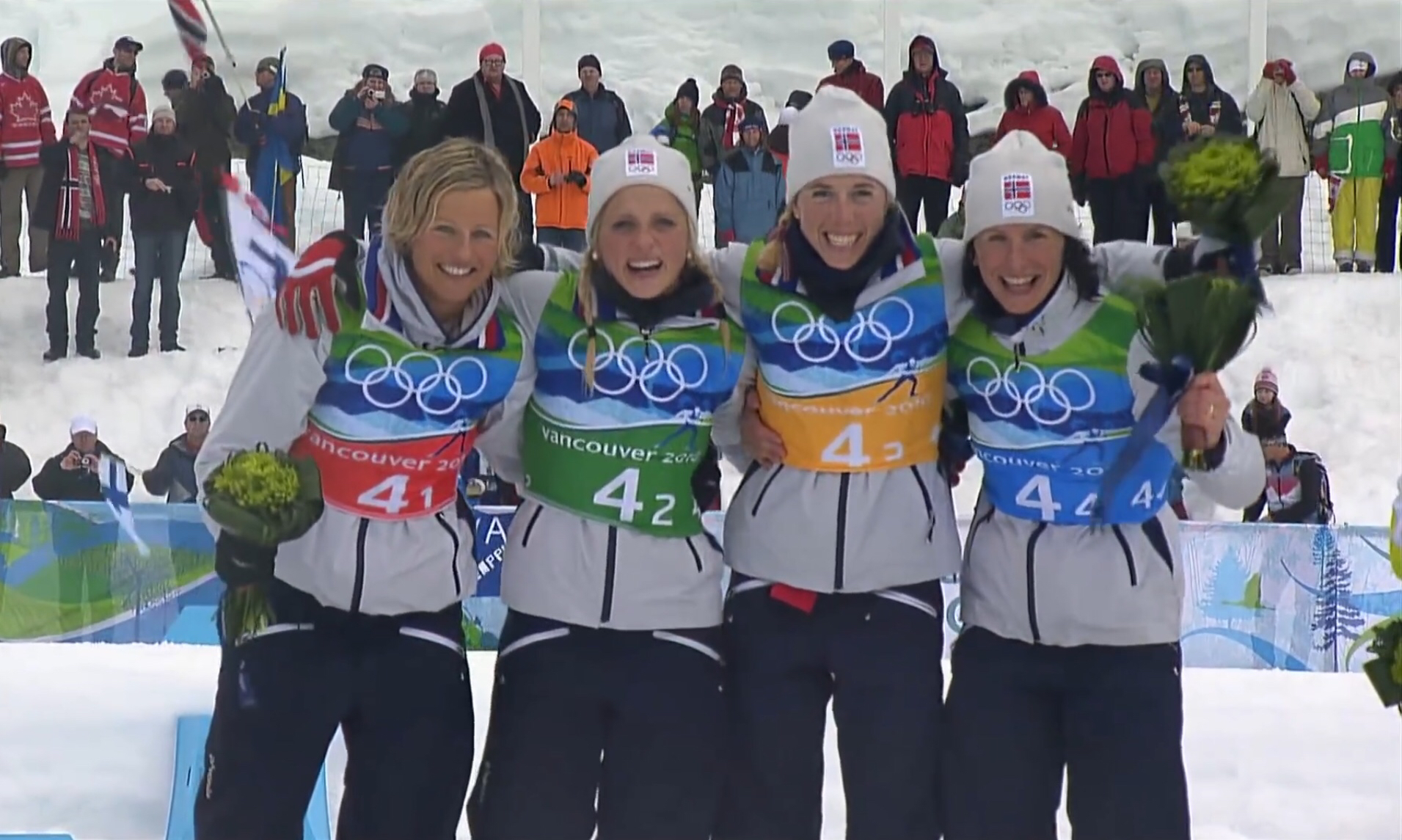
Norway’s gold-medal women’s relay at the 2010 Olympics in Vancouver, B.C., with (from left to right) Vibeke Skofterud, Therese Johaug, Kristin Størmer Steira, and Marit Bjorgen. (Screenshot: 2010 Vancouver Olympics relay video)
(Note: This article has been updated to include comments from Vidar Løfshus, head of the Norwegian cross-country ski team, and the team’s former performance manager, Åge Skinstad.)
The death of Norway’s Vibeke Skofterud shocked the international cross-country skiing world on Sunday, and as of Monday, multiple renowned skiers, particularly in Norway, had reacted publicly.
“I am shaking and am in complete shock over this horrible news that I received today,” Marit Bjørgen wrote in a press release, according to a translation. “Dear Vibeke, this was way too soon.”
Bjørgen and Skofterud were teammates on the Norwegian national team for well over a decade until Skofterud retired in 2015. They won gold together in the women’s relay at the 2010 Olympics and at World Championships in 2005 and 2011. Kristin Størmer Steira was also on all three of those winning relays, and Therese Johaug teamed up with the three to win in 2010 and 2011.
“I have lost one of my best friends,” Johaug wrote in another press release quoted by NRK. “A friend who lit up the room when she entered, one who gave everyone around her lots of energy, love and care. I take with me all of the nice moments and experiences in and outside of the trails and I will miss her. My thoughts go to her family and those left behind.”
Bjørgen added that she was “incredibly happy about all of the nice moments we had with each other. A tough competitor in the course, but more importantly, the warmest, nicest, toughest woman in the world,” she wrote. “We have experienced much together, from an Olympic gold medal in the relay … and I will cherish the memories for a long time. My thoughts go to her families and those closest to her. Love you Vibeke. Rest In Peace.”
Petter Northug wrote that the news was “incomprehensible and sad to hear,” according to News in English.no. “We had many fun years together on the national team.”
Odd-Bjørn Hjelmeset, a former skier who competed until 2011 and became a national team coach, recalled her “infectious humor”. Erik Røste, president of the Norwegian Ski Federation since 2012, said she was “an important ambassador for the sport of skiing with her winner’s spirit and great engagement.”
“Vibeke was that joyful girl who always contributed positively to the community she was a part of, definitely with her good results on the course,” Vidar Løfshus, head of the Norwegian cross-country team, told Aftenposten, according to a translation. “The fact that we have lost girl like her, who was always open, honest and spoke her opinion, is a loss to the entire community and inconceivable.”
“It is incredibly sad,” Åge Skinstad, a former national-team performance director who is currently TV 2’s cross-country expert, told TV 2, according to a translation. “The first thing you think about is the family and those closest to her. Vibeke was a fantastic human-being. She was a very, very good skier.”
One of her former competitors, Charlotte Kalla of Sweden, told Expressen that she was shocked by the tragedy.
“It feels uncomfortable and difficult to accept that such a joyful, positive, and full of energy kind of competitor such as Vibeke is longer with us,” Kalla said, according to a translation. “Vibeke was one of my role models when I entered the national team. A positive person who spread joy and really contributed to the cohesion with Norwegian team. She was a character within the sport who offered a lot of herself. It is with great sorrow that I now think of Vibeke and those closest to her. Rest In Peace Vibeke.”
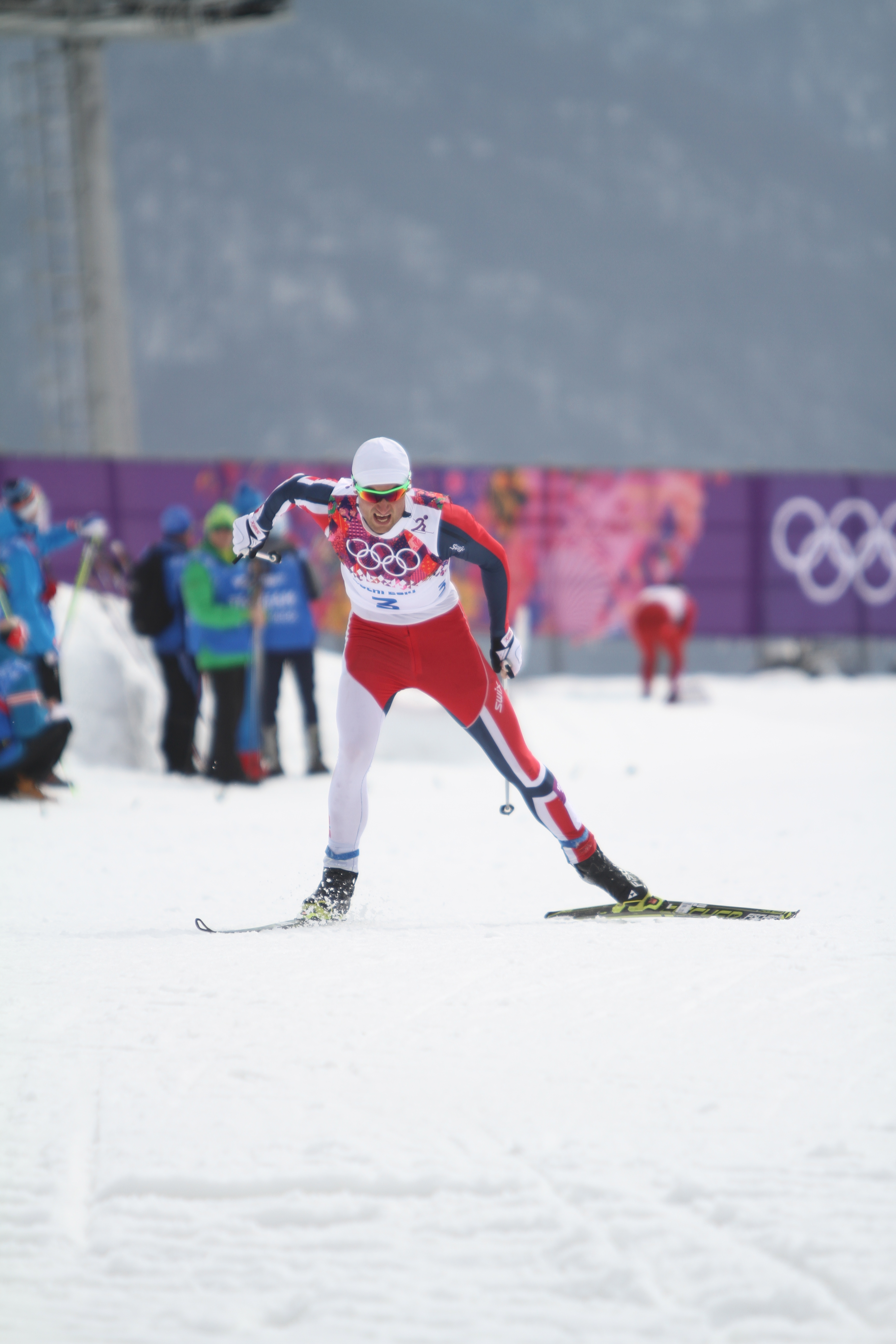
Petter Northug of Norway competing in the freestyle sprint qualifier on Sunday. Northug went on to qualify for the semifinals and finish 10th overall.
FasterSkier’s coverage is made possible through the generous support of Rudy Project.
SOCHI, Russia – When 92 men head out on course at the Laura cross-country venue today, the most famous Norwegian skier will not be among them.
Petter Northug Jr., who won the 15 k freestyle at World Championships last season, will not be contesting the classic version of the event here at the Olympics. Northug, a gold medalist in both the 50 k and the team sprint at the last Olympics, has entered two racse here in Sochi so far. He finished 17th in the 30k skiathlon, almost a minute and a half behind gold medalist Dario Cologna of Switzerland. In the freestyle sprint, where he finished 10th after being bumped out in the semifinals.
Norwegian coach Vidar Lofshus told FasterSkier that Northug is sitting out the 15 k in an effort to get in better race form in time for Sunday’s 4 x 10 k relay, where Norway is a favorite to win.
“We’re hoping that he’ll feel better for the relay, so hopefully he’ll be in better shape,” Lofshus said. “He’s not definitely going to race it, but hopefully he is going to race it.”
This season, Northug has not been able to find his usual speed or fitness. He finished 6th in the 15 k classic World Cup before the Olympics in Toblach, Italy; at Norwegian national championships just before that, he was third in the 30 k skiathlon. His only victories have been in a stage of the Tour de Ski (where he finished fourth overall) and in the La Sgambeda ski marathon in Livigno, Italy.
“It’s hard to tell, but he had a really hard summer and fall with sickness,” Lofshus said of the cause of Northug’s struggles. “That’s the main reason. It’s not any harder to explain than that… He’s trying to rest now because he has been training a lot coming into the Olympics just trying to get into the level. We’ll see.”
As to the final decision of whether Northug will join the relay team or not, Lofshus said that was still undecided and to some extent up to Northug himself, or at least based on what Northug tells coaches about his fitness and feeling.
“It’s mostly his own feeling,” Lofshus said. “He won’t race if he’s not in top shape… I think he is, right now, he is having a good time I think. He is pretty sure of himself that he’s coming back.”
Another surprising name missing from Friday’s start list was Alexander Legkov, the Russian who won the 15 k classic race held in Italy just before the Olympics.
Legkov trains separately from the Russian national team; his coach, Reto Burgermeister, told FasterSkier on Thursday that Legkov’s absence was based on a decision by the Russian Ski Federation.
He wouldn’t directly answer a question about whether Legkov – currently ranked third in the overall World Cup standings and the top Russian – had wanted to compete in the Olympic 15 k, instead noting the strength of the other Russian men entered in the race.
Legkov was the third Russian in the 30 k skiathlon, finishing 11th overall and just 27 seconds behind the leader. Maxim Vylegzhanin placed fourth after getting possibly obstructed by Norway’s Martin Johnsrud Sundby in the finishing lanes, and Ilia Chernousov was fifth, 13 seconds behind the lead pack of four men. Russia’s fourth starter, Evgeniy Belov, placed 19th.
Burgermeister acknowledged that the Russian cross-country team’s results at the Olympics so far – they haven’t won a single medal in cross country skiing – have been inadequate, and that they were under pressure to ski faster.
Belov is the only starter from the 30 k who was given the opportunity to compete in the 15 k. Vylegzhanin and Chernousov, the 8th- and 10th-ranked distance skiers in the world, were also cut. Replacing the three are Dmitry Japarov, ranked 15th in the distance standing; Stanislav Volzhentsev, ranked 22nd; and Alexander Bessmertnykh, ranked 31st. The trio have six World Cup top-10’s between them this season, half of which came in stages of mini-tours or the Tour de Ski.
Finally, also sitting out are: Johannes Duerr, the Austrian who is ranked seventh in distance skiing and sixth in the overall World Cup standings; Sjur Røthe, the Norwegian ranked 11th in distance skiing and ninth in the World Cup; and Maurice Manificat of France, who won a 15 k World Cup in Davos, Switzerland, earlier this season.
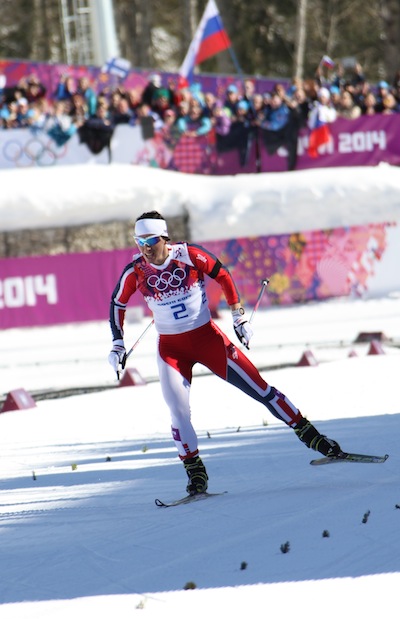
Marit Bjørgen wearing a black armband on her left arm in honor of teammate Astrid Jacobsen’s brother, who died the day before Bjørgen won the Olympic skiathlon.
SOCHI, Russia – Saturday’s Olympic skiathlon was an emotional day for the Norwegian women’s ski team. The day before, team member Astrid Jacobsen’s brother, a close friend of the team, died unexpectedly. In complete shock, the women rallied and all four starters (Jacobsen was not among them) skied strong races, including gold by Marit Bjørgen and bronze by Heidi Weng.
In the race, the women wore black armbands in honor of their fallen friend.
On the podium, they cried.
The International Olympic Committee took issue with all of this, and sent a written warning to Norway’s Olympic Committee. The alleged violation? Wearing a symbol that promotes anything other than the Olympics.
The IOC also banned freestyle skiers from wearing helmet stickers in memory of deceased skier Sarah Burke, a friendly and inspiring member of their community.
There is no specific rule which prohibits athletes from wearing memorial patches or stickers. And in the case of the black armband, the gesture did not even include a logo or symbol.
“It is not about the rule, it is about the question of what is appropriate,” IOC spokesman Mark Adams told the press regarding the issue. “We would say that the competitions themselves are not the right place to do this.”
The rule he is referring to is the one that prohibits “political protests.” Both the freestyle skiers and the Norwegian women’s team have pointed out that in no way is their commemoration of a friend’s life a political statement.
Such rules are not enforced in this manner at other competitions. For instance, at biathlon World Championships two years ago, the Japanese and Korean teams wore black armbands in support of Japanese athlete Itsuka Owada. The morning of the women’s relay, she heard the news that her parents’ remains had been found in the wake of the country’s devastating tsunami. Owada managed to race, likely in part because of the support of the two teams.
However, the IOC has a different attitude.
“We understand their desire to honor their friend’s memory, but we believe that a competitive arena, where the atmosphere is one of celebration, is not the right place to do it,” IOC spokeswoman Emanuelle Moreau told the VG newspaper. “”With 2,800 athletes, there are unfortunately many who have lost friends and loved ones. We understand your grief, but we do not want to allow the competition to become a place of mourning.
Bjørgen has said that she does not regret the team’s actions, and that it was the right thing to do.
Meanwhile, the women’s coach Vidar Løfshus said that they knew they might get in trouble, but decided to wear the armbands anyway.
Others have called this action arrogant.
The head of Norway’s Olympic Committee, Inge Andersen, immediately said that he would protest the IOC’s action. Later, he went to bat for the women’s ski team and set up meetings with IOC President Thomas Bach and his right-hand man, Gilbert Felli.
Norway’s IOC member Gerhard Heiberg also weighed in, angering various people at various times. In his latest statement to the Dagbladet newspaper he said, “The IOC would really like to show a human face, you know, the kind with two eyes and smile.”
By Andersen’s account, the IOC knows that it made a tone-deaf blunder. However, that doesn’t mitigate the pain it caused the Norwegian women’s team to be told they weren’t allowed to mourn for a friend, and that it was their job to make competition venues a cheerful place even if they were feeling anything but.
“Gilbert Felli said bluntly that the IOC understands Norway, and will look at the regulations,” Andersen told Norwegian newspaper Aftenposten. “The IOC was very humble. Felli listened to what I said and promised to follow up after the Olympics. Then the IOC will look at the regulations. He definitely knew what I expressed on behalf of Norway Sports. The conversation between us lasted quite a long time.”
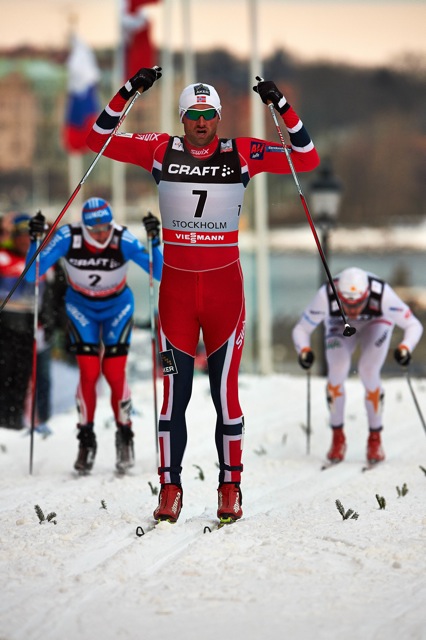
Petter Northug (NOR) began and ended his World Cup Finals campaign in Stockholm and Falun, Sweden, with victory, and his win in the 15 k pursuit on Sunday secured his claim on the overall World Cup crystal globe. Photo: Fischer/Nordic Focus.
He won the mini tour. He won the BMX trophy drive. He won the overall World Cup.
“We’re going to let loose and do something fun tonight, but whatever that is, I still don’t know,” Petter Northug (NOR) said after finishing the 15 k freestyle pursuit on Sunday.
You can hardly blame him. Northug completed an astonishing reversal in the season standings, finding late winter form and motivation to take his second overall World Cup title, his first since the 2010.
With this victory at World Cup Finals, Northug becomes only the second Norwegian to take more than one overall title. He’s still shaded by Bjørn Dæhlie’s six triumphs, but Northug is in rare company.
Leading into Sunday’s 15 k freestyle pursuit the question on everyone’s lips asked what Northug’s tactics would be. Would he try to keep the chasing pack away, or would he be caught and have to sprint for the finish?
A yawning gap separated Northug from his closest competitor in the Falun mini tour on the start line; Maxim Vylegzhanin (RUS) started 30.5 seconds after Northug.
Northug wasn’t concerned about Vylegzhanin.
In prerace interviews he indicated to FIS that “I don’t care much about Maxim Vylegzhanin. I have to keep Legkov and Cologna behind.”
Realistically, neither had a chance to overthrow Northug. Cologna started 1:20 behind the Norwegian. Indeed, Northug had gone as far to say that he would cancel his holiday if he lost it.
“I’ll go on a camping trip in Falun,” Northug said to Aftenbladet after being asked what he’d do if he lost. “I don’t think that’s very pleasant.”
Legkov, the closest to Northug in the overall, started 1:47 back. Barring a spectacular implosion, the title was Northug’s for the taking.
Judging by Northug’s start, it appeared his tactic would be to slot in behind Vylegzhanin and pace himself to the finish. Northug came out of the starting gate sluggishly, without his characteristic spark.
At the first 1.4 k checkpoint the clock revealed another story. Northug passed the mark in 3:47.7, with Vylegzhanin coming through 32 seconds later. The Norwegian had started in earnest.
Further back, Martin Johsrud Sundby (NOR) had already latched onto Eldar Rønning, whom had started third, 40 seconds behind Northug.
Rønning, the classic specialist, was already leaking time. After the first 3.6 k loop, the race began to take shape. Rønning faded, and Vylegzhanin formed an elite group of chasers containing Sundby and Finn Hagen Krogh (NOR), whom had already eaten up a significant margin after starting 54.4 seconds behind Northug.
The chase was on, but the spirit of the chasers might have dampened after one lap through the stadium when they found themselves 39.8 seconds down to a determined Northug.
As the chase group approached the uphill spectators were treated to some theatrics by Vylegzhanin when he took a drink from a coach and face planted after he poled between his legs. Perhaps World Cup racers are more human than we suppose. That misfortune effectively ended Vylegzhanin’s fight for a mini-tour podium. Seeing the Russian lying on the track behind them, Sundby and Krogh ratcheted up the pace and left the Russian for dead.
Northug passed the 5 k mark in 12:38.5, coaxing his 83 kilograms up the long uphill. Half a minute later Sundby and Krogh roared past in hot pursuit of their teammate, taking 8 seconds out of Northug’s lead in the steep pitch.
Northug’s overall rivals hadn’t made the necessary inroads to pose a real threat, with Cologna and Legkov passing the 5 k mark over 90 seconds down.
It appeared the real drama would be if Northug could hold off his teammates. Sundby and Krogh were clearly hunting Northug, and if they didn’t have the same race suit on you’d have hardly thought they were Norwegian. Northug wasn’t getting any favors. Yet for all of Sundby’s and Krogh’s advances on the uphill, their downhill track craft muted their climbing prowess.
Northug conceded seconds on the climbs but stabilized the losses on the downhill, taking advantage of the untidy snowplowing of his teammates.
As they came into the stadium for the second time, a huge group had formed 1:36.7 behind Northug, led by Legkov. Even if the overall appeared out of his reach, the fight for second place between he and Cologna was on.
As Northug crested the big hill again, Sundby and Krogh had sight of their teammate, only 24.9 seconds back at the 8.6 k mark.
Vylegzhanin passed through in damage control after his fall, 1:10 behind Northug, while the pack led by Legkov and Ilia Chernousov (RUS) came through 1:26.9 seconds down.
In the chasing pack Krogh took charge and tried to close those final meters to Northug, but the tall Norwegian was doing just enough to keep the chasers at bay. At the 12.2 k mark Northug had 14.9 seconds to play with in the final 3.7 kilometers of the season.
Out of the stadium Northug grimaced up the last hills and swooped into the stadium, while Sundby and Krogh attacked each other behind.
A few quick glances over his shoulder, and Northug knew he had done it. He cruised into the stadium and took his time towards the finish while Krogh and Sundby lit up the afterburners to fight for second place.
In the end Northug stuck his toe across the line only 0.7 seconds ahead of Krogh, who got the better of Sundby in the end. Northug finished in a time of 35:48.3.
In the end Northug’s margin of victory in the overall flattered to deceive, with a 180-point margin over Legkov by virtue of the 200 points awarded the Falun mini tour victor.
Northug afterward was unexpectedly emotional.
“It’s really fun to do it,” Northug told the NRK.. “It’s not simple to win the World Cup; many of my competitors prioritize the overall over world championships, and that is huge.”
With Ja Vi Elsker, the Norwegian national anthem, playing over the loudspeakers as he raised the second crystal globe of his career, tears welled in his eyes. The jubilant champion felt relief after the pressure of the last two weeks.
“It feels a little like I’ve stolen the overall title,” he said. “It has been a fantastic season. I won an individual world championships gold, additionally in an individual start, and the world cup overall. I’m very satisfied.”
Even the head of the Norwegian ski federation Vidar Løfshus expressed his admiration.
“We came here to win the crystal globe, and we did it,” he told the NRK. “Both the support crew and the athletes have done a great job.”
Northug leaves Falun with a hefty payday and a new BMW. But you won’t see him driving it, as he’s donated the vehicle to charity.
It was Northug’s day, but he wasn’t the only one with something to celebrate.
Like Rønning the day before, Krogh delivered one of his best results of the season to take second place in the mini tour. He also posted the fastest time on the day in 34:54.6.
“On a good day I can deliver a good result,” Krogh said to the NRK. “In the future I will deliver more consistent results than this year. I am prepared to train a lot to be even better next year.”
Sundby was third and Legkov fourth in a time of 35:05.5 and 35:14.7 respectively.
In the final analysis Legkov fell just short of his first overall World Cup title, but he can take consolation in claiming the distance world cup, winning the Tour de Ski, and improving upon two successive seasons where he finished the season fifth in the overall rankings. If his career arc continues on the same trajectory, he’ll be a contender for the overall next year.
Northug topped the prize money list for the season, earning himself a substantial payday of 212,500 CHF. Legkov and Cologna were second and third, padding their bank accounts with 165,625 CHF and 136,250 CHF respectively.
Norway took the Nations Cup competition with a 14,208 points. Russia accrued 9,130 points for second place, and Sweden third with 6,352 points.
Finnish athlete Virpi Kuitunen is one of two athletes to win a gold medal at a major championship event after winning the Tour de Ski.
Want to win a race at World Championships or the Olympics? Then you might want to stay away from the top step of the Tour de Ski podium.
Of the 32 World Championship and Olympic individual gold medals awarded over the past six years, just two of them have gone to athletes who won the Tour de Ski earlier in the year: Finland’s Virpi Kuitunen, who won the 30 k classic at World Championships in Japan in 2007, and Polish star Justyna Kowalczyk, who won the 30 k classic at the Vancouver Olympics in 2010.
Other Tour winners, including Germany’s Tobias Angerer and the Czech Republic’s Lukas Bauer, have subsequently collected silver and bronze medals at major championship races, but failed to capture the most coveted prizes.
The Tour is still a relatively new phenomenon: there have been just four editions—and eight winners, male and female—preceding a major championship.
As a result, teams are still searching for the best way to keep their athletes at peak form for both events. But they’re “getting closer to a solution,” said Vidar Løfshus, the Norwegian cross-country ski team’s director.
“It’s possible, but I think what you need is a good plan,” Løfshus said in a phone interview Monday.
The Tour de Ski hangover is a trend mirrored in another analysis that looked at the winners of the last men’s World Cup races before the Olympics and World Championships.
The analysis—done by a Norwegian commentator, Jann Post—showed that the winners of the World Cups had failed to win an Olympic or World Championships race since Finland’s Mika Myllylä in 1999.
When it comes to the Tour, Løfshus said, teams have begun to adjust their training and racing plans to account for the grueling nature of the event, which consists of as many as nine races in 11 days, in two or three different countries.
After watching several athletes succumb to illness after completing the Tour, Løfshus said that his squad has scaled back the racing schedules for those taking part.
This year, only two of Norway’s 12 Tour starters also competed in World Cups in Canada earlier this month, Løfshus said; other
Dario Cologna (r) came up empty at the 2011 World Championships in Oslo after winning the Tour de Ski that year.
stars with high Tour aspirations like Switzerland’s Dario Cologna and the Czech Republic’s Lukas Bauer also sat out.
“A lot of people skipped the World Cups abroad, because it was too exhausting to do all the racing,” Løfshus said.
Løfshus was adamant that winning the Tour shouldn’t preclude victories at World Championships or the Olympics, and he said that Norway’s two top skiers, Marit Bjørgen and Petter Northug, were both planning to compete in the 2013 edition, before the Sochi Games.
But Løfshus added that in addition to being careful about racing too much, athletes need to avoid the distractions that stem from Tour success, like parties and commitments to sponsors.
“The focus needs to be on training and upcoming championships,” he said. “There’s a lot of other things going on after [the] Tour de Ski: press, sponsors…you need to have the plan in your training, and you need to have the plan to handle things going on afterwards.”
The Numbers
FasterSkier looked at the results of the podium finishers in the four editions of the Tour de Ski preceding major championships, in 2007, 2009, 2010, and 2011.
Only two winners, Kuitunen and Kowalczyk, went on to win gold medals. However, out of 27 finishes by Tour winners at subsequent championship events, 11 of them resulted in medals—or roughly 40 percent.
Kowalczyk fared especially well at the 2011 World Championships in Oslo—after winning the Tour, she went on to capture two silver medals and a bronze, even though she failed to secure a gold. That year, three of the individual races were won by Bjørgen, who had skipped the Tour entirely.
While Kowalczyk held her own in Oslo, Cologna, her male Tour-winning counterpart that season, had a disastrous set of races, failing to podium in all four of his individual races.
Second-place finishers at the Tour actually did better than Tour winners at subsequent championships, collecting medals in 11 of 22 races, including six golds.
Third-place Tour finishers, however, were almost completely shut out of championship podiums, collecting just one medal in 18 attempts. That one was a gold at the Vancouver Games in 2010, which went to none other than Cologna—perhaps some premature karma to balance out his dismal performance in Oslo a year later.
World Champion Matti Heikkinen (FIN) crosses the line.
At the 2009 World Championships in the Czech Republic, Finland’s Matti Heikkinen combined a well-timed peak with a great pair of skis to take bronze in the 15 k classic, on a challenging wax day.
That medal was Heikkinen’s first time on the podium in an international race. Since then, he’d finished in the top three a few times more—twice on the World Cup, and also in a couple of stages of the Tour de Ski.
But coming into the 15 k classic at the 2011 World Championships, Heikkinen still was far from a favorite. Few people expected him to defend his medal from 2009. And even fewer expected him to win the race outright.
But on Tuesday in Oslo, Heikkinen did just that, topping Norwegians Eldar Roenning and Martin Johnsrud Sundby in tough conditions that took out several favorites.
“I started skiing when I was nine years old. I have had lots of bad days, and lots of good days, but this was the perfect day,” he said.
According to Heikkinen, both his body and his skis were flawless on Tuesday, but the same can’t be said for his competition.
Favorite Daniel Rickardsson suffered the dreaded smørebom
After poor kick and glide took the Swedish men out of contention in Sunday’s 30 k pursuit, the team again suffered from a smørebom—Norwegian for “missed wax”—in Tuesday’s race.
Favorite Daniel Rickardsson (SWE), the winner of the World Championships tune-up 15 k in Drammen, was more than three minutes down on Heikkinen in Oslo, battling with Italian sprinters rather than the leaders, on his way to 42nd place.
“I know I am better than this,” Rickardsson said. “I showed it to the world just a week ago.”
Others contenders confounded by the conditions included Switzerland’s Dario Cologna, who called the 15 k a “wax race,” as well as the Czech Republic’s Lukas Bauer, the defending silver medalist.
Both Bauer and Cologna told FasterSkier that they struggled with glide more than kick, and indeed, with temperatures a few degrees below freezing, American technician Randy Gibbs said that it wasn’t too difficult to get good grip in Oslo’s powdery tracks.
Tougher was finding an option that was also fast—especially with the 15-kilometer course tackling two different loops on separate parts of the hillside. Roenning said that he tested seven pairs of skis on Monday.
“You can have klister; you can have only hard wax; and you can have klister on the bottom, and hard wax on the top,” he said in a press conference after the race. “I was testing all the alternatives yesterday, and also today, and I think we made a really good choice—it was really difficult conditions.”
While the Finnish team struggled with their wax earlier in the championships, they’ve fared much better since then, with all four of their athletes cracking the top eight in Monday’s women’s race.
Roenning kicking out of the stadium with 5k to go.
On Tuesday, it was again clear that they’d nailed it. Just as Heikkinen was starting, his teammate Ville Nousiainen was hitting the time check at the 2.2 kilometer mark with a huge lead over the first 50 starters; he ended up with the second-fastest opening split.
While Nousiainen ultimately faded to eighth, it was clear his skis weren’t holding him back. Neither did those of the Norwegians.
Roenning started fast, describing his approach as “offensive.” By the seven-kilometer mark, he had opened an eight-second lead on Heikkinen.
Sundby started just 30 seconds ahead of Roenning, and the eventual silver medalist could see him up ahead on the long, open Holmenkollen climbs. But by the time Roenning hit the 10-kilometer mark, he had slowed, and he and Heikkinen were in a dead heat.
“I was thinking if I could reach Martin, then maybe I would have a chance for the gold,” Roenning said. “When I was passing 10 k, and I was equal with Matti, I was thinking ‘this is going to be hard.’”
By the finish, Roenning had tired, and lost 13 seconds to Heikkinen. He did not feel a slower start would have made a difference, however; he said that there wasn’t much he could have done to make the gap at the finish any closer.
“Thirteen seconds was 13 seconds too much for me,” he said. “I gave all my power, and had nothing more.”
Sundby also got off to a fast start, but it wasn’t because he was in good form. He felt bad during his opening loop, and on the first hill, he said he was thinking, “‘Oh, man—this is going to be a tough race.’”
Sundby getting his drool on.
“I didn’t believe I could reach top-10 today in the first four kilometers. I really had to struggle with myself, and the tracks,” Sundby said.
But the hometown hero—his first race at Holmenkollen was when he was nine years old—was spurred on by the crowd, most importantly in the last few kilometers, when everything was “almost black.”
For Heikkinen, the crux came between seven and ten kilometers – where he made up those eight seconds on Roenning.
“You have to really find your limits, and know how fast you can start, and how fast you can ski after seven kilometers,” Heikkinen said. “Normally, for me, the most difficult period during the race is from seven to 10 k. On a bad day, there will be a big gap to the podium….When you have perfect day, then it is possible to push all the time.”
Crossing the line, Heikkinen was able to briefly raise his arms before collapsing forward onto the snow. He knelt for a minute, then started retching. Course officials rushed to his aid, but it was a few minutes before he could be escorted out of the finish pen—without any real salute or celebration.
“I think it was quite impossible,” Heikkinen said. “When I push myself really hard, it is a little bit [of a] bad feeling when I come to the finish line, and there is a black moment for some minutes.”
The 27-year-old Finn was still in shock at the press conference, telling assembled press that it would take some time for the reality of his accomplishment to set in.
Something of a specialist, all of Heikkinen’s top results, including each of his three previous podiums, have come in the 15 k distance.
Heikkinen showing the golden form.
At the 2010 Olympics, Heikkinen, like the rest of the Finnish team, came in flat, and never found his form. He pinned the challenging week of racing—during which he placed 39th in the 15 k, and did not finish the pursuit—on heavy training and racing leading into the Games.
“If you want to make [a] gold medal, you have to take some risks,” Heikkinen said. “Last year, we were competing and training quite a lot—more than ever. And if you make that kind of training and competing, there is a risk you may be dropping down.”
Heikkinen and his coach made adjustments based on what they learned in 2010 and, as he put it, “it is nice to see that the results will come back.”
Heikkinen’s gold was the first not to go to a Norwegian in the last four events in Oslo—which even the host country’s national team sports director, Vidar Løfshus, recognized wasn’t a bad thing.
“It’s good for the sport that it’s not just the Norwegians who win,” he said.
There’s a strong chance that the Norwegian men could be back on top in Wednesday’s team sprint, though—the country is defending champion, and will be represented by individual sprint medalists Ola Vigen Hattestad and Petter Northug.
But if the Norwegians are favored, they still have to contend with a strong Swedish team, whose waxers will no doubt be looking for a chance to redeem themselves.
Though the team sprint comes less than 24 hours after the 15 k, it still won’t be soon enough for the Swedes, who have now been outwaxed by the Norwegians in both men’s distance races here.
“We struggled a little bit with the conditions here in Holmenkollen. We are working as hard as we can as a team to get the right things for the waxing, and also keep the athletes so they can be positive in their mind, and really believe that they can manage to make good results in the races that are coming,” said Joakim Abrahamsson, the Swedish head coach. “We need to push the team, and work with them so we can hopefully move forward.”
While Abrahamsson would probably describe it in different terms, Sundby said he saw the challenge of waxing as “the charm of cross-country skiing.”
“Always, the waxing is difficult—you have to make the right choices,” he said. “For sure, I think [the others] had the same choices we did, and part of the game is choosing the right skis.”
–Inge Scheve contributed reporting.
Sundby and Roenning share a moment after the race.Lukas Bauer, another pre-race favorite was in the mix for the first 7k, but slow skis doomed him as well.
Stupid, nonsensical, and “completely in the wrong.”
Those were the descriptions by elite cross-country skiers and coaches of German sprinter Josef Wenzl’s actions in the Dusseldorf team sprint on Sunday.
“Everyone knows that it makes no sense to pass on those final corners; it is simply too dangerous. I can’t understand what
Oystein Pettersen (R) gestures at German sprinter Josef Wenzl.
Wenzl was thinking,” wrote U.S. Ski Team Head Coach Chris Grover in an e-mail. “I feel bad for [Dahl’s team]. They deserved to be on the podium and receiving their prize money.”
Wenzl did not show any contrition afterwards—indeed, video from the finish pen showed him jawing with Dahl’s teammate Oystein Pettersen, even exchanging a few grabs and light pushes. But later in the day, Wenzl did apologize, according to Vidar Lofshus, the sports director for the Norwegian ski team.
“Wenzl showed great sportsmanship by taking all the blame for the incident, and has excused his behavior to Dahl,” Lofshus wrote in an e-mail to FasterSkier.
By Monday, tempers had cooled. Pettersen even told Norwegian media that he had lunch with Wenzl after the incident. But that didn’t change the result sheet—nor the fact that Dahl and Pettersen had missed out at a shot at the $12,000 check for the winning team.
The Norwegians saw the collision as a clear case of obstruction by Wenzl, Lofshus said. And indeed, International Ski Federation (FIS) rules state that it is the responsibility of a passing skier to avoid interference.
But according to the Norwegian newspaper Dagbladet, the race jury ruled that Dahl was equally at fault as Wenzl, because he took a step to the outside of the corner, towards the German. While the Norwegians disagreed, Lofshus said that “there will be no appeal or protest.”
Pierre Mignerey, a jury member and the assistant cross-country race director for FIS, declined to comment. The jury, though—which included two Germans out of five total members—was the only group willing to take any blame from Wenzl’s shoulders. In interviews and e-mails with four North American athletes and coaches, all took Wenzl’s actions to task.
“I don’t know what [Wenzl] was thinking. They had pulled away from the pack,” said U.S. sprinter Andy Newell in an interview
John Kristian Dahl (L) and Josef Wenzl collide in the final corner of Sunday's Dusseldorf team sprint.
Sunday. “They went two wide into that corner—you don’t ever want to do that at any time in a race, not to mention if you have the podium already wrapped up.”
Canadian sprinter Devon Kershaw also placed responsibility squarely on Wenzl, saying that Dahl had the best line heading into the final turn. But he also said that he recognized it can be tough for sprinters to think clearly at the end of a race. Instead, they’re “completely blasted, stressed out, and amped knowing they have a chance to win the whole thing.”
Kershaw is no stranger to full-contact racing himself—in a Tour de Ski city sprint in Prague in 2008, he made his own Wenzl-esque kamikaze attack against Swedish skier Marcus Hellner.
“I moved in on him, when there was absolutely no reason to—and we both went down,” Kershaw wrote in an e-mail on Monday. “I had qualified first, and was poised to perhaps slot into the top three in the overall tour had I moved through my quarterfinal. Instead, even though Hellner and I had a gap, I took him out fighting for the best line for no reason, and it was a disaster.”
As his own actions demonstrated, “stupid things happen in sprint racing,” Kershaw said.
“With so many dudes, so little space and really only one ‘direct line,’ it’s not really a surprise when things like this happen,” he added.
Especially on the tight and technical Dusseldorf course, where, according to U.S. sprinter Kikkan Randall, “it’s a tricky course to stay on your own feet anyway, let alone with a bunch of people around.”
Dahl and Wenzl in the snow as the podium finishers go by.
Add a home crowd and put thousands of dollars on the line, and you’ve got a potent mix for a 25-year-old German. Dusseldorf is Wenzl’s stomping grounds—it’s where he had his first and only victory, in 2007. But after he finished 46th in Saturday’s sprint and didn’t even make the heats, German Head Coach Jochen Behle ripped Wenzl publicly, telling the press that he “expected much more.”
So if there was any rational explanation for Wenzl’s actions on Sunday, it was that they were born out of desperation: over the last two seasons, he had only once finished on the podium in an individual sprint—and that was at a race in Whistler with a weak field.
And the crash notwithstanding, Wenzl still seemed to impress Behle with his performance in the team sprint, which left the Germans just one clean corner away from the podium. After the race, Behle told Die Welt newspaper that his men had skied well, “even if the results are not exactly what I wanted to see.”
Justyna Kowalczyk (POL) has been training five to six hours a day for the past few weeks
For the last few weeks, Justyna Kowalczyk of Poland has been training five to six hours a day.
Seriously. We asked her four times, just to be sure. Granted, she said that only three to four of those hours were skiing—the rest were in the gym. But it’s still a lot of volume in advance of a World Cup.
Kowalczyk’s approach to her training underscores athletes’ varying strategies during this final period leading up to the 2010 Olympics in Whistler. Some see the World Cup races in Canmore as a throwaway—just a small stepping stone on the path to a medal—but for others, it’s the last opportunity to test out the motor in a competitive field, and to make some final adjustments.
A good chunk of the World Cup field is racing in Canmore, but of those, very few are shooting to have their best results here. And others, like the Norwegian Olympic team, decided to skip the races altogether, opting instead for an altitude camp in Sun Valley, Idaho.
“Less distraction, less traveling—we just want to make sure that we have all the power for the Olympics,” said Vidar Lofshus, one of the coaches of the Norwegian B-team competing in Canmore.
Lofshus said the elevation in Sun Valley was significantly greater than that in Canmore, and that the Norwegian athletes want to stay at that higher altitude for as long as possible. And avoiding the additional travel, too, puts the team at a lower risk of getting sick.
In addition to the Norwegians, the other conspicuous absences include the Estonians, the Czechs, the French men, and the Finnish women.
Of those athletes that have chosen to race here, most are still at the tail end of some big training blocks.
Their plans are tailored towards a peak at the Olympic events that take place in a couple of weeks, and the athletes won’t put too much stock in their results here.
“”I’m pretty wasted….It beat me up badly,” said Canadian Devon Kershaw, referring to his last three weeks of training. He said before Friday’s race that he expected very little to show for his efforts, and that indeed was the case, as he struggled to 37th in the 15k skate.
But according to coaches, the Canmore races are close enough to the Olympic venue that it’s still worth the trip for a chance to test the legs, especially given the reliable conditions with the man-made snow here.
“It’s the last chance before the Olympics to have a competition on a high level…and to get in the normal rhythm,” said Jochen Behle, the coach of the German national team. “Therefore we do the races.”
For some countries with large Olympic teams, like Germany’s, coaches will be parsing the results from Canmore to guide their selection of starters for the first races in Whistler.
René Sommerfeldt's (GER) 11th place finish today could impact his plans for the 2010 Olympics
Behle said that he will be looking at them carefully—especially since Friday’s distance skate races will be replicated at the Games in just ten days.
The two efforts should also provide a good gauge for coaches to judge how the last month of training has affected each skier.
“After this race, then we know if we must go a little bit harder with some training, or if we have to be a little bit softer—exactly where are the athletes standing?” said Joakim Abrahamsson, the Swedish head coach. “From now on until the Olympics, you can only make little small changes, but it can be very important.”
Abrahamsson said that his staff would be shooting video out on course this weekend, which will be used to help athletes make some last refinements with their technique.