Tag: Vincent Vittoz

  • Manificat Thrives in Davos 15 k Skate; Harvey Steady in 10th

    Manificat Thrives in Davos 15 k Skate; Harvey Steady in 10th

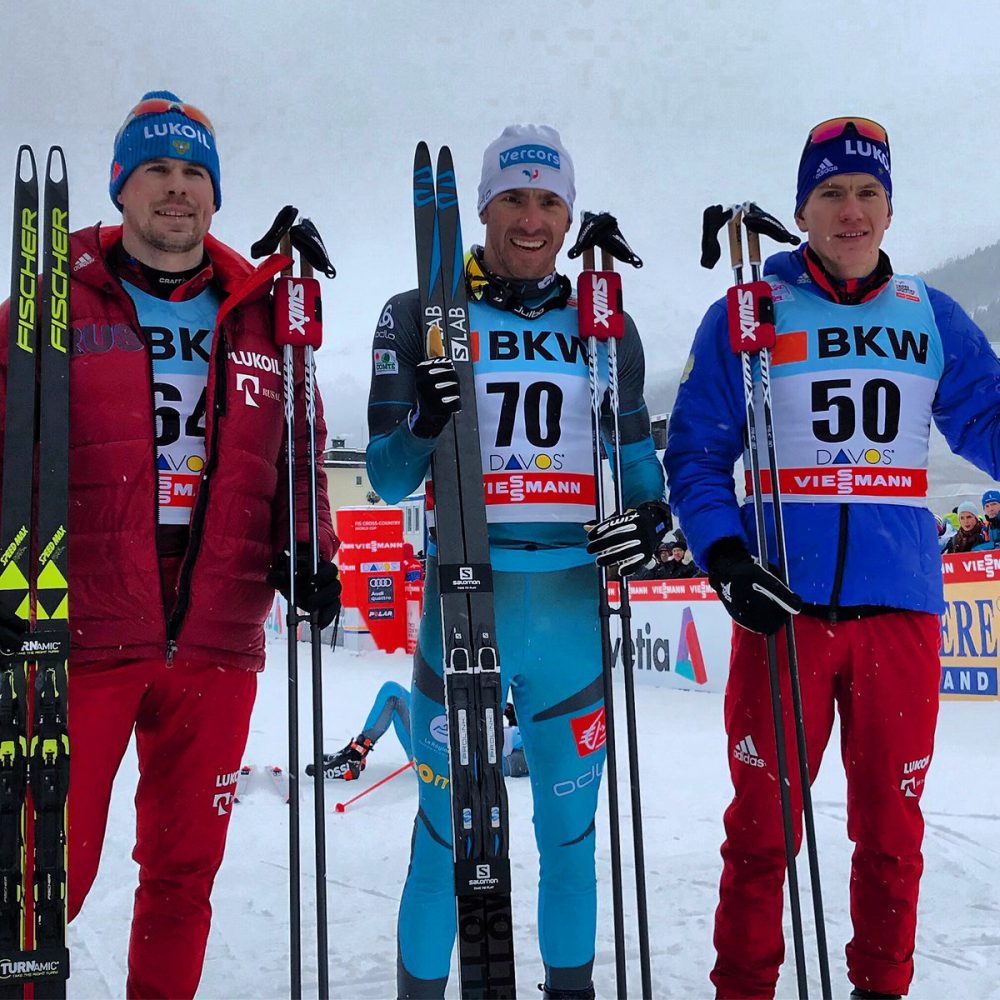
    France’s Maurice Manificat (c) after winning the World Cup men’s 15-kilometer freestyle on Sunday in Davos, Switzerland. He finished ahead of Russians Sergey Ustiugov (l) and Alexander Bolshunov in second and third, respectively. (Photo: FIS Cross-Country/Twitter)

    There’s always a bit of pomp and circumstance in Davos, Switzerland, where you’re as likely to spot a world banker, posh fur coat or World Cup skiers taking center stage. With a brisk wind, clouds descending from the Alps, and light snowfall on Sunday, it was 15-kilometer freestyle time in Davos.

    With an interval-start format and the traditional three laps of the course that essentially climbs to 3.3 k then descends through forest to the valley floor — a solid but tempered start, sustainable pacing, and big lungs in the 5,120-foot altitude of Davos are critical.

    If you parse the data, France’s Maurice Manificat shows up in Davos. Before Sunday, Manificat and Norway’s venerable Bjørn Erlend Dæhlie shared the honor of most Davos podiums with four apiece. 

    After Sunday’s race, Manificat now stands alone on the top step. The Frenchman won the 15 k skate in 33:56.2 minutes for his fifth-career Davos podium and his ninth World Cup victory. Manificat shares the title for most distance World Cup wins for France at nine with countryman Vincent Vittoz. Before Sunday, Manificat’s best finish in a Davos 15 k (skate or classic) was third place in 2009. He’s placed second twice and has one victory in 30 k skate races in Davos.  

    Russia took the next two steps on Sunday’s podium. Sergey Ustiugov finished second, exactly 4 seconds off Manificat’s winning time, and Alexander Bolshunov was 14.6 seconds back in third.

    Post-Davos, Norway’s Johannes Høsflot Klæbo leads the World Cup overall with 626 points. (Klæbo won Saturday’s skate sprint and opted to sit out Sunday’s race.) Bolshunov remains second overall with 402 points. Norway’s Martin Johnsrud Sundby sits in third with 339 points. Sundby placed 20th on Sunday. 

    In what amounts to a race of truth —  to poach from the ranks of cycling journalism — the interval-start format sends skiers off in 30-second increments. Early starters are lucky if they can tag onto a fresh-legged seeded skier as they lap through at the 5 or 10 k mark. But in essence, this Davos 15 k skate remains a hold-the-pedal-down, time-trial-style sufferfest.

    Manificat was dialed from the start. Early on it was his race to let fade away or grasp with an oxygen-deprived grip.

    “I am really happy. It was a tight race for sure,” Manificat told FasterSkier in Davos. “It is more comfortable when you have 10 or 15, 20 seconds ahead of the field. But for the suspense and for the public watching the race there is more excitement.”

    Despite his admitted fear that his lead would fade, Manificat kept a race-leading pace.

    “I was really afraid because I was eight seconds ahead, then five, then four, then two seconds,” Manificat said. “I know Ustiugov has a strong finish. But when I saw four seconds and green, I say, ‘Ahh yes!’”

    With the climb to the top and speed-down format of the race course, the descent is no place to cede time. It’s a working downhill.

    “It was an exciting race, but for me, I thought I could fight to the end,” Manificat noted. “The end of the race is crucial. The long downhill you have to be active all along the track. It is really important to be active. I felt I could do it.”

    During his interview, Manificat explained his pleasure with the win since the 15 k freestyle will be contested at the upcoming 2018 Olympics in PyeongChang, South Korea.

    “I am happy because it is a format of the Olympic Games and it is my goal so I am happy to win,” Manificat said.

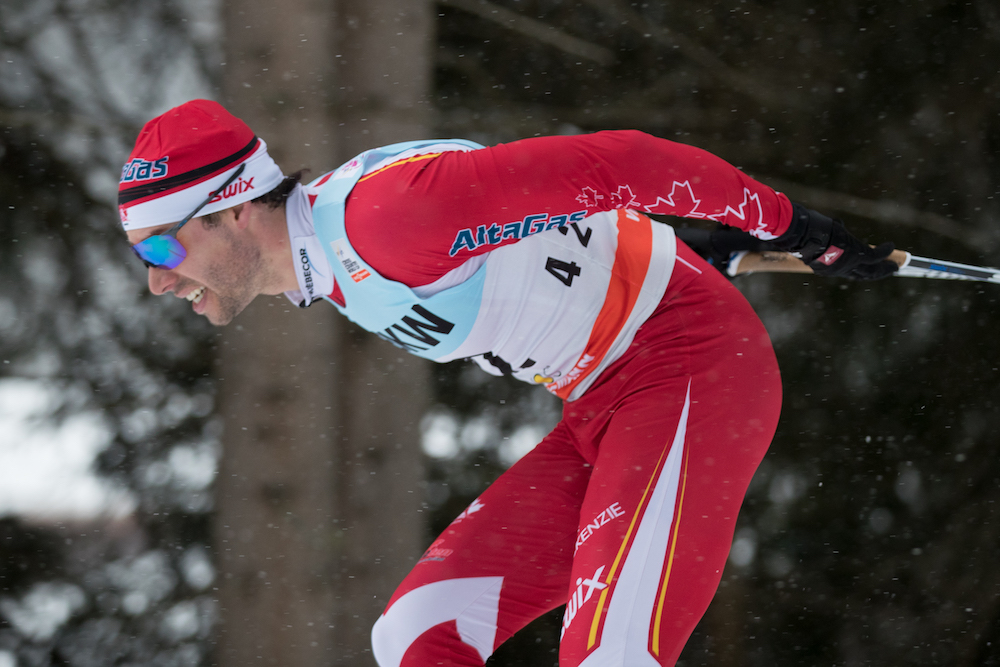
    The best placed North American skier was Canada’s Alex Harvey in 10th place, 1:01.1 minutes out of first. Like Manificat, Harvey has more long-range goals for the season: each race an incremental part of peaking for the Games.
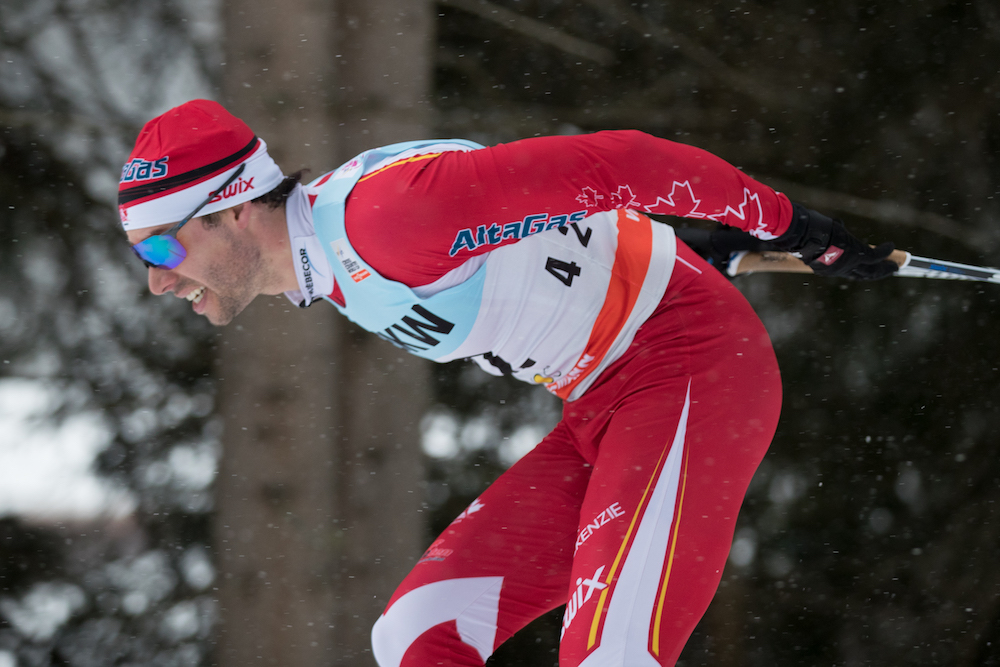
    Canada’s Alex Harvey racing to 10th in the World Cup men’s 15 k freestyle on Sunday in Davos, Switzerland. (Photo: Reese Brown / U.S. Ski & Snowboard)

    Harvey’s 10th-place finish on Sunday is his best distance result in Davos. He was 12th in the 30 k skate there in 2016. The Canadian skier, however, feels he is never his best at altitude.

    “I was good … I mean, I always struggle at altitude, but I think I’m gonna be just outside the top 10 so, yeah, it’s good,” Harvey said in the Davos mixed-zone before all the skiers had finished. “It’s all I have here, but it was a good race.”

    For Harvey, the pacing strategy focused on accelerating on the last lap.

    “I was thinking about the last lap, and I think I was about to move well in the rankings on my last lap,” Harvey explained. “So that was the plan. … I mean, you gotta think about your last lap –whether it’s a 10 k or a 15 k, like, you gotta be strong on the last lap.”

    Harvey played that strategy well. He was in 15th at the five and 10 k mark but moved up to 13th at 13.2 k, and 10th by the finish.

    Before moving onto the other North American finishers, it’s worth noting the importance of this race for U.S. Ski Team (USST) Olympic qualification. Race formats on the World Cup that are featured in the 2018 Olympics are an opportunity for automatic qualification with a top-eight result. In other words, place in the top eight on Sunday’s 15 k skate, and you’ve punched your ticket to South Korea.

    Although at altitude, the race did have that added selection criteria weight. No U.S. skiers met that criteria today.

    According to the selection-criteria document, “Athletes ranking in the top-50 in the distance World Cup standings or the top-50 in the Sprint World Cup standings as of January 15, 2018, shall be selected to the team.”

    The season is still extremely early; only four distance races have been contested on the World Cup. Seven distance races remain before Jan. 15 (including the final Alpe Cermis final climb of the Tour de Ski).

    After Sunday’s race, USST member Erik Bjornsen (who sat out Sunday’s event) is ranked 37th, teammate Paddy Caldwell 41st, and Noah Hoffman 58th. USST distance skier Scott Patterson has not skied into the points this season.
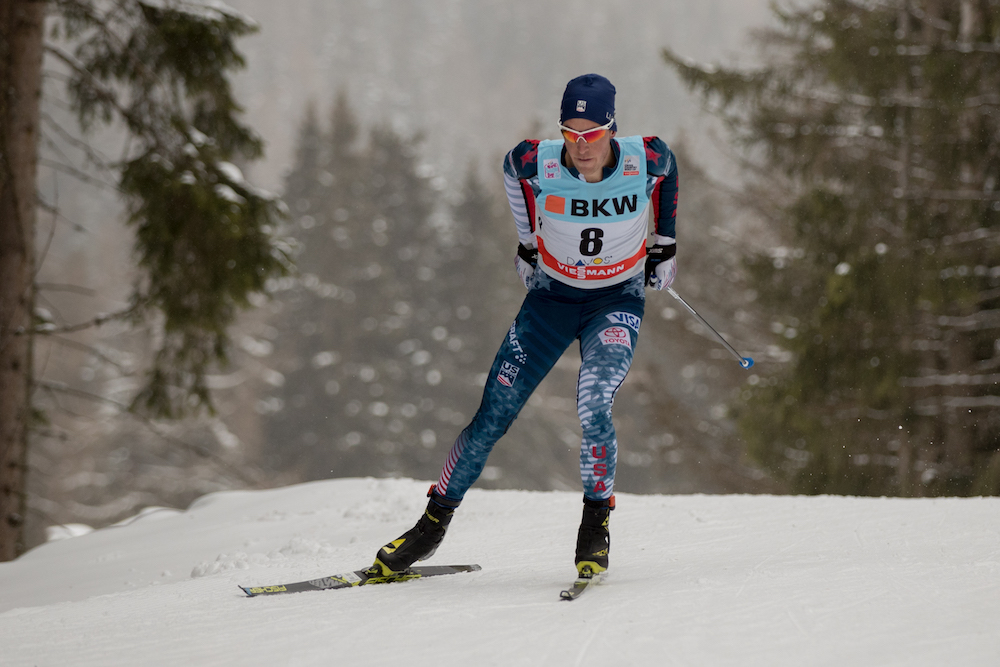
    Paddy Caldwell (U.S. Ski Team) racing to 41st in the World Cup men’s 15 k freestyle on Sunday in Davos, Switzerland. (Photo: Reese Brown / U.S. Ski & Snowboard)

    Caldwell was the best placed American on Sunday in 41st (+1:50.2). Sunday’s 15 k marked Caldwell’s 10th career World Cup. New to the U.S. Ski Team B-team this year, he’s still in learning mode when it comes to course pacing in places like Davos.

    I think it was pretty good,” Caldwell told FasterSkier about holding his race pace.

    “I felt like I wasn’t totally on it, the last lap. Legs were starting to go and it’s a really funky course with the pacing. I think you have to punch it in the right spots, and I was having a hard time figuring out where I could redline and where not to. So I think that’s a bit of a learning process, but I think overall the pacing was good.”

    Caldwell said he’ll finish Period 1 of the World Cup, and spend the holidays in Seefeld, Austria. Otherwise, his race schedule is yet to be determined.

    Hoffman placed 48th (+2:05.5) and Patterson 88th (+3:46.2). Andy Newell did not finish, and Simi Hamilton did not start.

    According to USST Head Coach Chris Grover, Erik Bjornsen planned on sitting out Sunday’s race as he preps for next weekend’s two distance events.  

    Canadian World Cup Team member Graeme Killick, who placed 59th (+2:27.8), gave some insight into how he has mapped out the season and how to place Davos in perspective.

    “The goal is to kind of build into the training camp for the Olympics, and then just have the best races there that I can,” Killick said. “As long as the happens, and the best race of the year are at the Games, I think, I’ll be happy with that.”

    Canada’s Devon Kershaw placed 44th (+1:59.8), Russell Kennedy 68th (+2:43.4), and Julien Locke in 94th (+4:27.5). Knute Johnsgaard did not start.

    Racing continues in Toblach, Italy, next Saturday with more 10/15 k skate individual starts and 10/15 k classic pursuits on Sunday.
    Results

  • After 8 Years, France Finds Relay Podium Again; Norway Wins La Clusaz Men’s Relay

    After 8 Years, France Finds Relay Podium Again; Norway Wins La Clusaz Men’s Relay

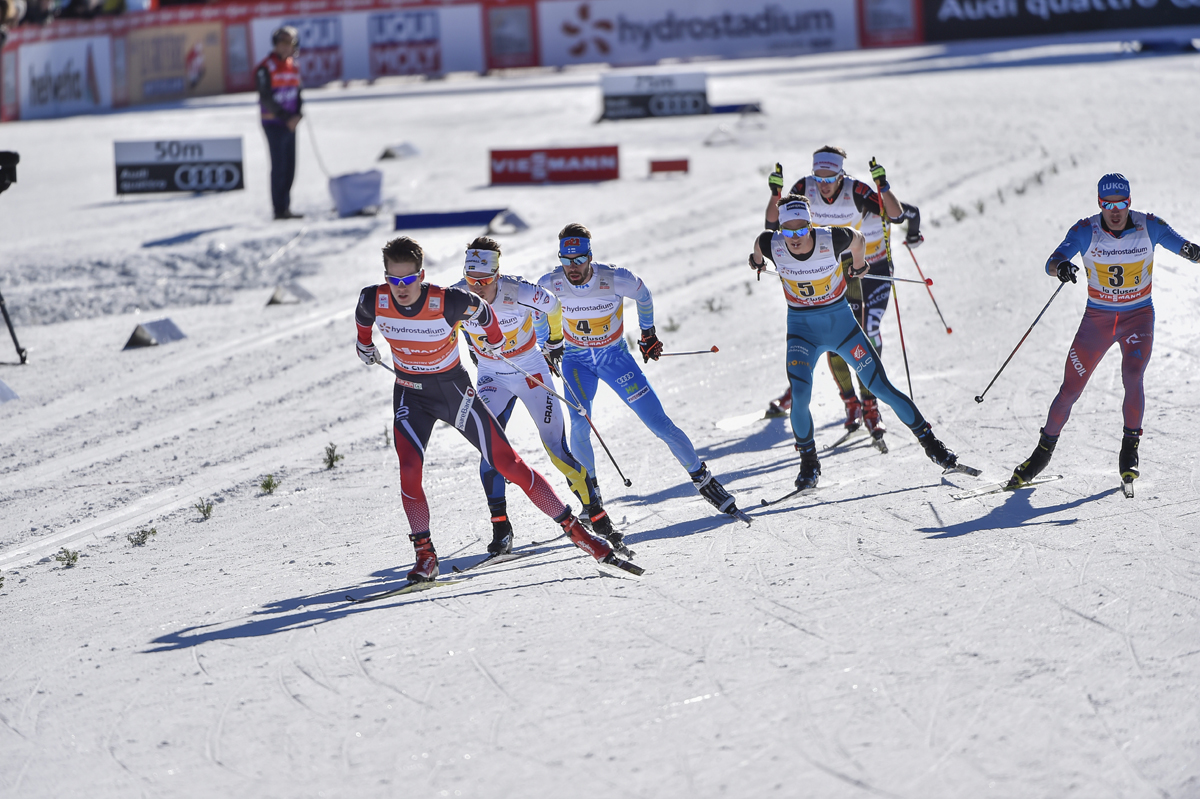
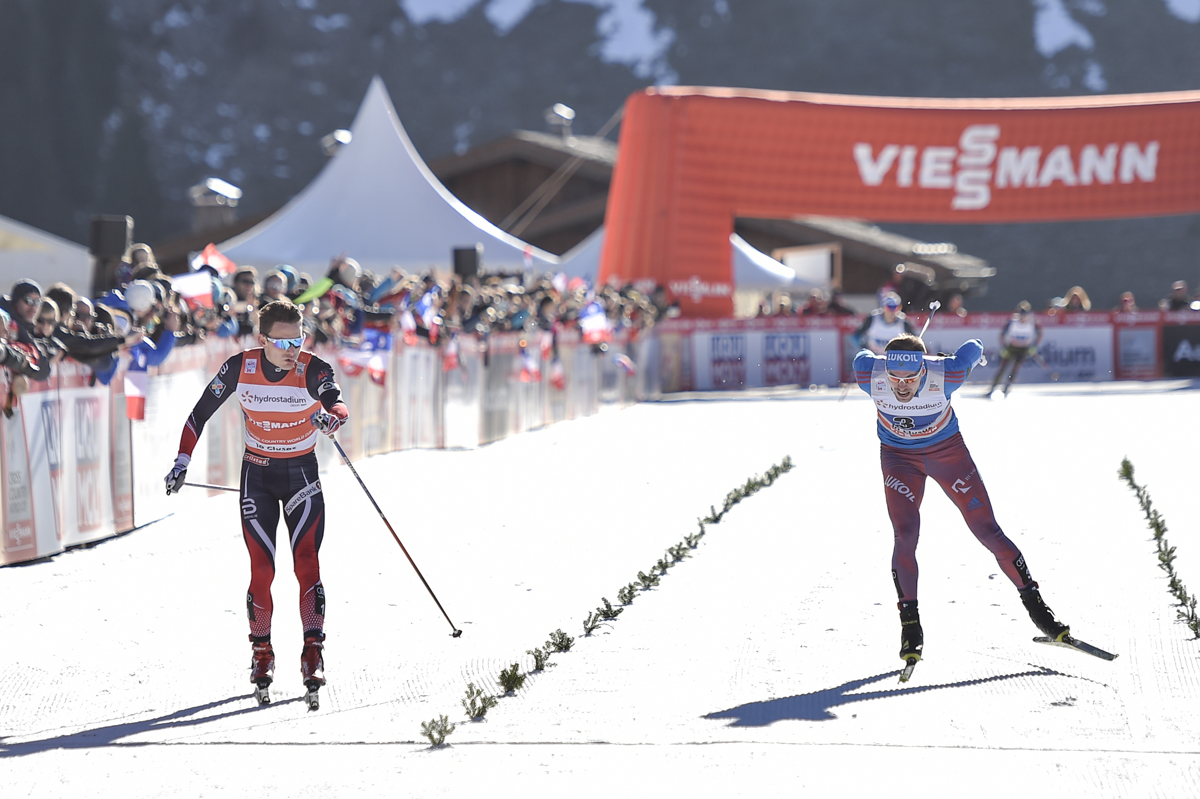
    Finn Hågen Krogh (l) crossing the line ahead of Russia's Sergey Ustiugov to give Norway the win in the men's 4 x 8 k relay, the first of the World Cup season, in La Clusaz, France. (Photo: Fischer/NordicFocus)
    Finn Hågen Krogh (l) crossing the line ahead of Russia’s Sergey Ustiugov to give Norway the win in the men’s 4 x 8 k relay, the first of the World Cup season, in La Clusaz, France. (Photo: Fischer/NordicFocus)

    Eight years ago, France’s Maurice Manificat and Jean-Marc Gaillard waved to the French cheers of their country’s fans as they climbed onto the men’s World Cup relay podium in La Clusaz, France. The two — along with their former national-team teammates, Vincent Vittoz and Emmanuel Jonnier — had secured the final podium spot by less than a minute, just barely missing out on second place.

    Little did they know as they climbed down that it would be close to a decade later before they would reach a relay podium again during the regular World Cup season.

    On Sunday, for the first time since December 2008, both Manificat and Gaillard — joined this time by their teammates and current French national-team members, Alexis Jeannerod and Clement Parisse — reclaimed their podium spot in the men’s 4 x 8-kilometer relay, once again against the backdrop of La Clusaz.

    “It was a great day for our team,” Manificat said, according to an International Ski Federation (FIS) press release. “Everybody did an awesome job on their legs. I knew Finn [Hågen Krogh] and Sergey [Ustiugov] would be the biggest opponents today on the last leg. My plan was to ski with them and eventually go away. Finn and Sergey were stronger but it is great to finish on the podium.”

    (Article continues below)

    Starting in Row 2 behind Russia’s Evgeniy Belov, Gaillard skied the first classic leg for France, holding tightly to a third place for much of the first part of his race, behind Belov and Norway’s Didrik Tønseth.

    By the 3.5 k mark, Pål Golberg of Norway’s second team and Sweden’s Emil Jönsson had overtaken the lead and Gaillard was getting pushed back to fourth then fifth and eventually seventh.

    Yet the Frenchman’s skis proved faster than most in the field and by 6 k he had regained his position in third. Belov had also found his way back to the front. As the group rounded for their final lap Goldberg charged the group to the exchange zone, putting Norway’s second team on the attack.

    Gaillard ultimately tagged off in sixth to Jeannerod for the second classic leg. Norway’s first team came through in seventh, handing off to Martin Johnsrud Sundby. Russia I tagged off in second to Alexander Legkov.

    It didn’t take long, however, for Sundby to put Norway’s first team back in the lead. By the 2 k mark it was his red bib that led the chase pack, with the Norwegian double poling on skate skis. Within the next 2 k, however, Italy’s Francesco de Fabiani, Legkov and Sweden’s Jens Burman had swallowed up Sundby, while Jeannerod now sat in seventh.

    With 2.5 k to go of the second leg, de Fabiani quickened the pace and Sundby struggled to keep up while double poling the course climbs.

    The second exchange came down to a battle between Italy and Norway’s second team, with Norway’s Niklas Dyrhaug outsprinting de Fabiani to be the first through. Russia’s first team exchanged in third, while France I was now positioned in fifth. Sundby was the last of the chase pack to come through in ninth, tagging off to Anders Gløersen for the first freestyle leg.

    “It’s necessary to take a proper stance for the classical diagonal technique,” Sundby said told VG. “I did that today by getting a real beating.”

    As the first freestyle leg began to unfold, it was Sweden’s Martin Johansson who led the charge, not far behind was Russia’s Alexey Chervotkin and France’s Parisse. Also working his way back into the mix — despite the 20 meters Sundby had lost on the lead group — was Gløersen of Norway’s first team.

    In fact, by the 3 k mark, Gløersen had propelled himself to the front and taken command of the lead.

    Norway's Ander Gløersen leading the third leg of the men's 4 x 8 k relay on Sunday at the World Cup in La Clusaz, France. (Photo: Fischer/NordicFocus)
    Norway’s Ander Gløersen leading the third leg of the men’s 4 x 8 k relay on Sunday at the World Cup in La Clusaz, France. (Photo: Fischer/NordicFocus)

    “Anders did a great job on his leg and put us back in contention,” Finn Hågen Krogh, the anchor for Norway’s first team, said according to a FIS press release.

    With the lead returning to Norway, France, Russia, and Sweden were back in the hunt. The 4 k mark found a front group of seven nation’s relay teams — Norway I, France I, Germany, Sweden, Russia I, Finland, and Italy.

    Rounding the corner for the final exchange, it was Norway I, followed by Sweden, and Russia. Parisse, who tagged off to Manificat, came through in fifth.

    The anchor for Russia’s first team, Sergey Ustiugov, wasted no time moving to the front of the group to set the pace. The six other frontrunners followed closely behind, with Krogh and Germany’s Lucas Bøgl positioned in second and third respectively.

    Then came the waiting game. The group slowed, Ustiugov and Krogh casting a few glances over their shoulders to see who would make the first move. Ultimately it was Ustiugov first. The Russian began to push the pace around the 3 k mark, initiating a scramble. Yet within another kilometer, Ustiugov slowed giving the lead back over to Krogh.

    “In my leg I wanted to save some energy and gave everything in the last corner and in the finish stretch,” Krogh said, according to a FIS press release.

    The front group had now split in two, with Germany, Norway I, France I, and Russia I breaking away. Sweden, Finland and Italy had fallen behind.

    As they approached the final course climb, the real sprint began with Krogh and Ustiugov going head-to-head straight to the last 100 meters. In a lunge to the line, Krogh bested Ustiugov by two tenths of a second for the overall win in a time of 1:11:25.7. Crossing 7.7 seconds later was Manificat, securing France on the podium in third.

    “I gave everything I had in the finish,” Ustiugov said, according to a FIS press release. “The speed increased in the last two laps. It is always disappointing to lose, but Finn was very strong on the home stretch. But it is still a very good result to be second and to share the podium with my teammates.”

    Neither Canada nor the U.S. fielded a men’s relay due to illness. Racing will resume Dec. 31 in Val Mustair, Switzerland, for Stage 1 of the 2016/2017 Tour de Ski.

    Results

    — Aleks Tangen contributed reporting

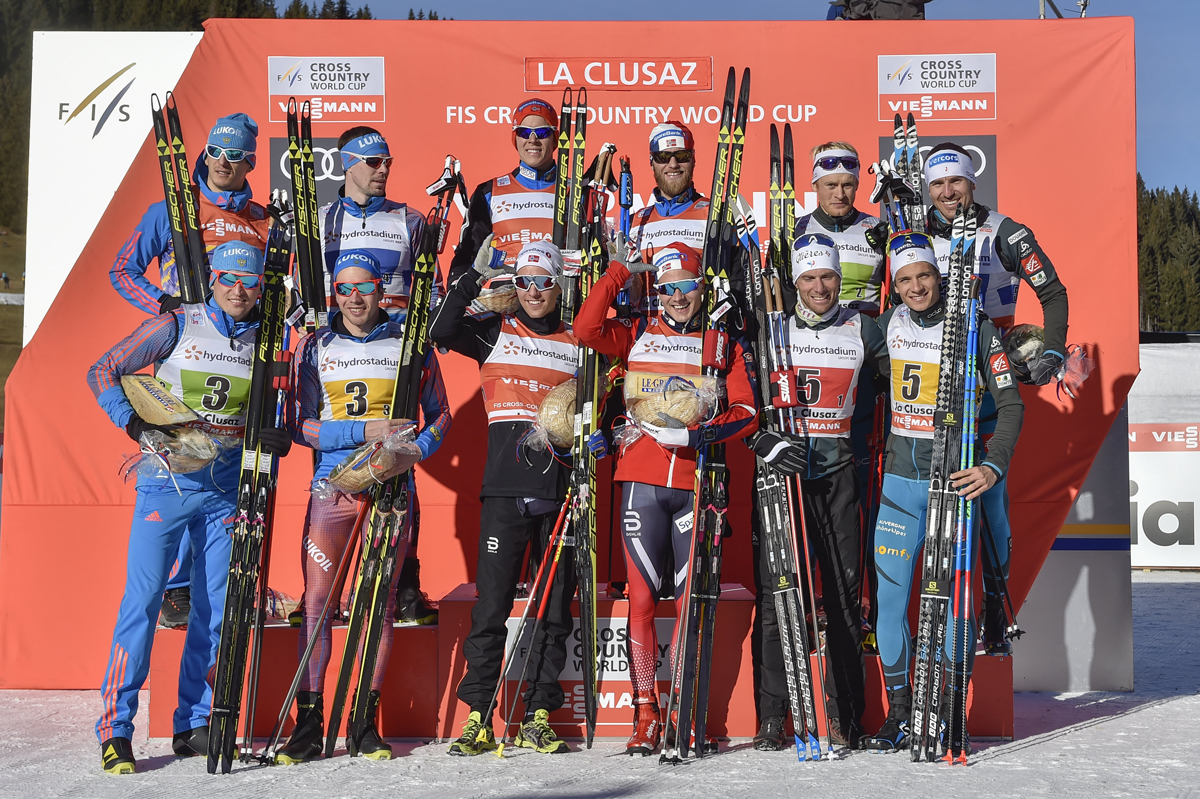
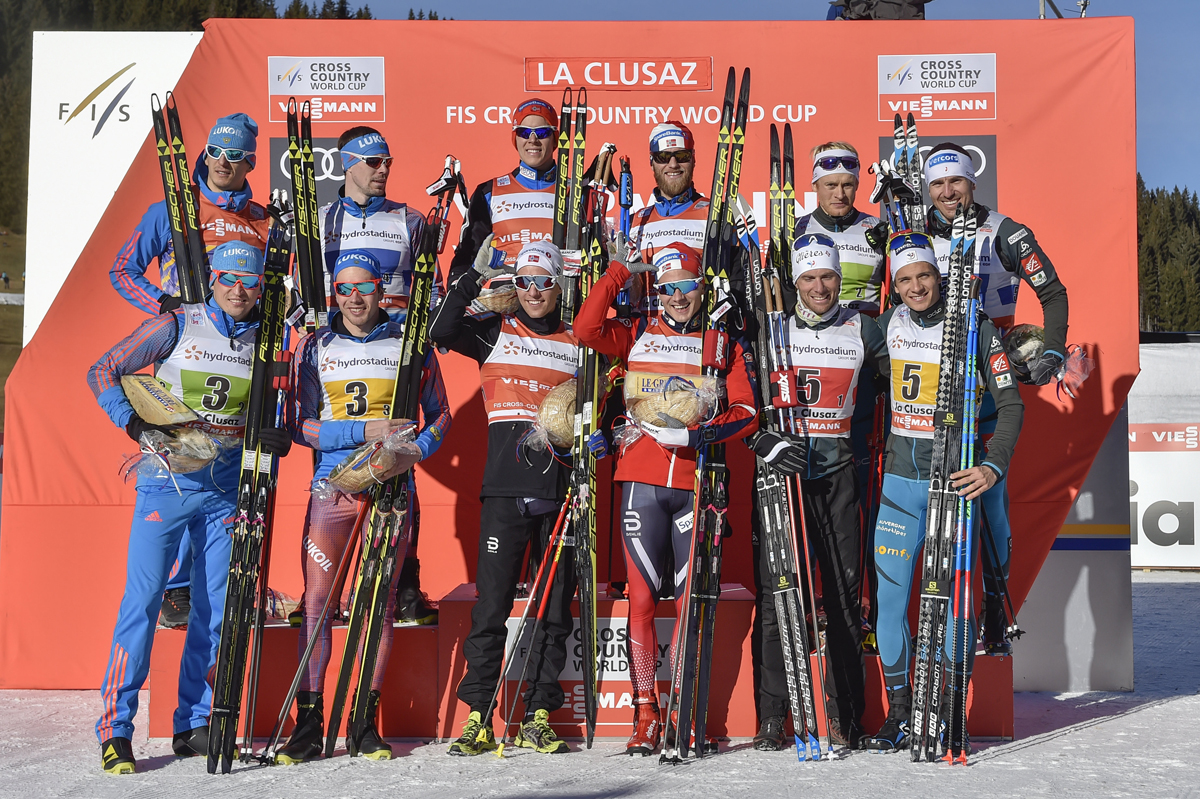
    The men's relay podium at the La Clusaz World Cup on Sunday, with Norway in first (c), Russia in second (l) and France with its first World Cup podium in eighth years in third (r). (Photo: Fischer/Nordic Focus)
    The men’s relay podium at the La Clusaz World Cup on Sunday, with Norway in first (c), Russia in second (l) and France with its first World Cup podium in eighth years in third (r). (Photo: Fischer/Nordic Focus)
  • Team 8: France

    France

    2009-2010 Nations Cup Ranking: 7th (2477 pts)

    2010-2011 Nations Cup Ranking: 8th (2733 pts)

    Men: 6th (1869 pts)

    Women: 9th (864 pts)

    2011/2012 World Cup Team Men

    Jean Marc Gaillard

    Maurice Manificat

    Robin Duvillard

    Cyril Miranda

    Roddy Darragon

    Women

    Laure Barthelemy

    Aurore Jean

    Karine Laurent Philipot

    What You May Have Missed Last Season

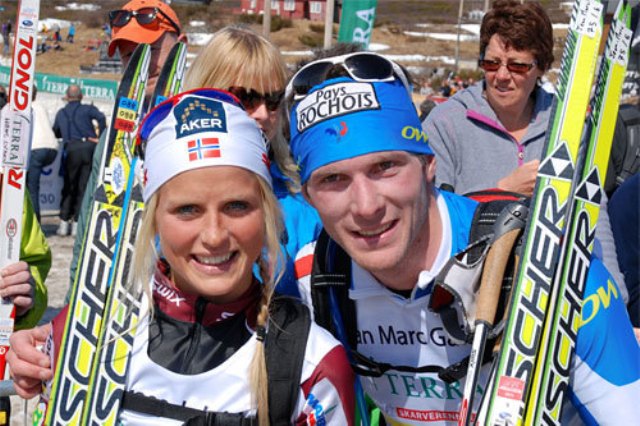
    Jean Marc Gaillard picked up the win at a late-season marathon in Norway, along with Therese Johaug. Photo courtesy of Skarverennet.no.

    Unless you’ve been living under a rock, you probably noticed that Vincent Vittoz Vittoz said au revoir to life as an athlete. The great French hope had his worst season since 2002, finishing (for him) a measly 23rd in the overall World Cup rankings. Vittoz had some good races – he finished fourth in the final climb in the Tour de Ski and third in the 20 k pursuit in Lahti – but he wasn’t his old medal-winning self.

    While the most famous Frenchman might have had a disappointing season, his teammates Jean Marc Gaillard and Maurice Manificat continued to show solid speed on the World Cup circuit. Gaillard moved up from eleventh to ninth in the overall rankings on the back of a sixth-place effort in the Tour de Ski and eighth in World Cup Finals.

    As for Manificat – who is also getting his masters in biology – he actually slipped eight places to thirteenth in the rankings, mainly due to a slow start to the season. He failed to wow in the first period of racing and then slogged through the Tour de Ski to finish 17th. But as the season progressed, Manificat upped his game, starting with a podium in Rybinsk, adding a very respectable 6th-place finish in the World Championships classic, collecting another podium in Lahti, and finishing to fifth in World Cup Finals.

    And oh yeah: a quick biathlete, Alexis Boeuf, showed up and finished 20th in the sprint in Davos.

    The French men capped the season off with a bang. At a FIS race in Tana, Norway, Manificat and Gaillard turned the podium into a Sami Jauhojaervi sandwich, and then they took the top two places in Finland’s Tour de Barents. Maybe they  need to work on their peaking plan?

    While the men have had a solid 1-2-3 punch for the last several years, the French women have not found as much success. With solid results but no star power, they maintained their ninth-place ranking from the previous season. Laure Barthelemy broke into the red group for the first time, finishing the year ranked 23rd overall. She’s a solid all-around skier, but a bit stronger in sprints: the high point of Barthelemy’s season was making two finals (one in the Toblach stage of the Tour de ski and the other in Liberec) and then just barely missing the final at World Championships, where she qualified eighth and finished seventh. Aurore Jean was the next Frenchwoman in the final rankings, far below in 46th place – tant pis.

    What You Need To Know for This Season

    Vittoz will be on the sidelines this time around.

    The entire coaching staff looks different, thanks to the retirement of head coach Roberto Gal. Vittoz has taken the reins for the French “B” team. With only a few athletes on the “A” squad, look for the venerable Vincents (his technician is even better, Vincent Meilleur) to work some magic on the young guns. Hopefully he isn’t too bus to groom the kids for success: according to his twitter feed Vittoz has also been getting feted in La Clusaz, walking with donkeys, and vacationing in Morocco. The team’s structure has also shifted, so the big question for this year is whether the changes will lead to improvements or backsliding. In particular, look to see whether the sprinters, who now have their own training group, will improve.

    Ah, the sprint team. The French are in the unusual position of having an Olympic silver medalist on their team, but having virtually nobody expect them to win anything. Roddy Darragon hasn’t done much recently except make a really fancy website with no content. Cyril Miranda had a couple of good seasons, but last year ended up 50th in the sprint cup. If France makes a splash, it will come from younger athletes.

    On the women’s side, Karine Laurent Philippot took last season off to have a baby, but this year she’s back. She had two World Cup podiums a few years back and in the 2009-10 season collected two top-10 finishes in longer races. With Barthelemy appearing to be developing into a sprinter, Laurent Philippot could take over as the lead distance skier on the women’s squad.

    The team trained on their glacier in Tignes earlier this fall and in Ramsau, and have also checked out the ski tunnel in Oberhof – where Manificat tried his hand at moviemaking, with pretty decent results (although the lip-syncing needs some practice). The “A” squad is currently in Sweden, rollerskiing, but the U23 team decided to stay in France, and are reportedly skiing in Tignes. A Gallic advantage?

    Another advantage for the French: Robin Duvillard’s father cooks the team dinner, and apparently it’s very good.

    Who You Should Watch

    For the women, look to  see whether Barthelemy – who made a huge step last season – can become a more consistent presence in sprint semifinals and finals on the World Cup circuit. Also check for up-and-comer Aurelie Dabudyk, who was a steady presence in the top 20 at U23 Championships last year. Dabudyk finished fourth in the overall Alpen Cup standings – two other Frenchwomen were on the podium, but as the youngest of the threesome, Dabudyk probably has the most room to improve.

    On the men’s side, the boring truth is that Manificat and Gaillard will continue to double-team the World Cup field. If Gaillard can have a better start to this season and carry a bit more momentum, he could climb further up the rankings. Manificat, meanwhile has said that he is aiming for a podium in the overall. “The podium in the overall World Cup is my main objective and this requires a very good Tour de Ski and podiums and victories over the various stages of the World Cup,” he told ski-nordique.net.

    The French “B” squad is full of men who could make a breakthrough. They put three racers in the top ten of the Alpen Cup standings, and one of the newest additions is 20-year-old Renaud Jay, younger brother of the Olympic medalist biathlete Vincent Jay.

  • Rookie Gaillard (FRA) wins Skarverennet (NOR)

    Rookie Gaillard (FRA) wins Skarverennet (NOR)

    Skarverennet 2011: Therese Johaug (NOR) and Jean Marc Gaillard (FRA). Photo courtesy of Skarverennet.no.

    Jean Marc Gaillard (FRA) dropped Frode Andresen (NOR), Chris Jespersen (NOR) and Espen Harald Bjerke (NOR) in a fierce sprint to the finish line. But for a long time, Gaillard was not sure he’d be able to catch the 2011 World Champion of the 30K freestyle: Therese Johaug.

    “I really didn’t think we would be able to catch her, but all of the sudden, we were right on her tails,” said Gaillard, who raced Skarverennet for the first time Saturday.

    “It was a fantastic experience,” Gaillard said to Norwegian TV station NRK after the race.

    New this year, Skarverennet featured a pursuit-style event in the elite class, where the elite women were given a 12-minute lead on the elite men, and the first elite skier – male or female – would be the race winner.

    Johaug pulled off a surge midway through the race where she dropped the entire women’s field, and was not chased down by the elite men until the last seven kilometers. The foursome consisting of Gaillard, Bjerke, Jespersen and Andresen caught Johaug just prior to the long descent to the finish at Ustaoset. By the time they arrived in the stadium area, the battle for first place was between Gaillard, Andresen and Jespersen.

    Gaillard crossed the finish line first, clocking in at 1:44:07, with Jespersen in second place and Andresen in third, both a tenth of a second behind Gaillard.

    “Of course, it was bittersweet to lose the prize money, but I feel like I pulled off a good race,” Jespersen said after the race. The winner received 100,000 Norwegian kroner, almost $20,000.

    Biathlete Andresen was disappointed with his third place.

    “In Skarverennet, the winner takes it all – you get the money and a car for a whole year,” he said to the Norwegian biathlon web site Strafferunden.no after the race.

    Bjerke was fourth, 42 seconds behind Gaillard. Emanuel Jonnier (FRA) was fifth in a second sprint finish with teammate Vincent Vittoz, 5 minutes and 44 seconds behind Gaillard for their very last world-cup level event. Jonnier and Vittoz, who have spent over a decade on the French national team, are retiring after this season.

    Johaug crossed the finish line in 2:00:33, almost a full seven minutes ahead of Marit Bjørgen, who was the second female. Martine Ek Hagen was third, another two and a half minutes behind Bjørgen.

    “I have not trained for three weeks, and the conditions were soft and challenging,” Johaug said to NRK after the race.

    Petter Northug also participated in the race, but did not finish among the top contenders. According to the race organizers, Northug took his time and even stopped to greet the recreational skiers along the way. He finished in 71st place.

    The race featured unseasonally springish conditions, and putting on the race was only possible with the generous efforts of the course volunteers who have been working around the clock the last week to add snow to the lower parts of the course, drain creeks away from the trail.

    “We could have raced in bikinis,” Johaug said to NRK, commenting on the warm weather.

    Complete results elite waves.

    (Sources: NRK.no, Langrenn.com, Skarverennet.com, strafferunden.no.)

  • Changing of the Guard in French Skiing

    Vincent Vittoz, who has now retired, racing in the 15 k classic in Otepaa, Estonia, earlier this season.

    When Emmanuel Jonnier, a thirteen-year veteran of the French national team, announced his retirement earlier this month, it was picked up by every major news source in his home country.

    But even then, it was nothing compared to the coverage his teammate, Vincent Vittoz, got two weeks prior when he announced his own retirement – which had happened at about the same time that Roberto Gal, the team’s Italian head coach, also declared that he was leaving.

    For Jonnier, the loss of his teammate and coach played a part in the decision to retire, although he also said that it would have been difficult to keep the form he had in previous years (Jonnier placed 4th in the 50 k at the 2006 Olympics in Torino, which is still France’s best-ever Olympic distance result).

    “With the news of the departures of Vincent Vittoz and Roberto Gal, a page is turning,” Jonnier said in a statement posted on his blog and quoted in the press. “The generation which was my own is going. It’s the right moment.”

    Both Vittoz and Jonnier were born in 1975, and had spent more than a decade skiing together. In the beginning, they raced with the likes of Vladimir Smirnov, Bjoern Daehli, and Vegard Ulvang; in the end, with Marcus Hellner, Dario Cologna, and Petter Northug.

    In 2007, the pair made history by putting two Frenchmen on the podium in a World Cup race for the first time. Vittoz finished second and Jonnier third behind Tobias Angerer of Germany in a 15 k skate race in Changchun, China.

    While Jonnier has his country’s best Olympic result, Vittoz owns a World Championship from the continuous pursuit in Oberstdorf in 2005. Vittoz’s star rose earlier, and he has been lauded by many as the athlete who led a resurgent French team to their current success. Since 2000, Vittoz has stood on the World Cup podium 29 times, including relays, and also won a stage of the Tour de Ski.

    “When I was young, someone told me, ‘why do you do cross-country skiing, a Frenchman will never make it,’” Vittoz told ski-nordique.net, a French ski news site. “That stuck with me. I am satisfied to have succeeded… in the end, I have no regrets, not even the Olympics, because I always gave all that I could.”

    Throughout that decade of success, Gal was by his side.

    “Roberto came to the French team after the Olympic Winter Games in Nagano, so that was in the summer of 1998,” Vittoz told FIS Cross Country. “Back then French skiing was not at the level where it is now.

    “We spent twelve or thirteen years together and yes, we have created a good team in a country where cross-country skiing is not the number one sport, as for example in Norway. During that time we achieved some great results such as the victory in the World Cup relay in La Clusaz in 2004… We proved the French cross-country skiers could fight with the best.”

    While Vittoz joked about the state of the men’s team when Gal took over, the French weren’t actually that bad. The men had a top-20 result in each individual race they entered in the 1998 Olympics, and a different athlete led the team in each competition. However, the team finished an unimpressive 13th in the relay.

    Jonnier, crushed at the finish of the 2010 relay.

    Twelve years later, Jonnier anchored the French team in the relay at the Vancouver Olympics. The team was in it until the end; Jonnier tried to secure silver by making a move to drop Martin Koukal of the Czech Republic and outrun Petter Northug of Norway, but in the end he tired and was betrayed by his slower finishing speed. He was the fourth man across the finish line, and the team considered it a disappointment – quite a change from a decade before.

    “When I arrived, I didn’t think that we could have these results,” Gal told ski-nordique.net last summer. “We waited three years before Vincent had his first podium. Since then, each season it has been between six and ten.” (This is a slight exaggeration.)

    On his blog, Vittoz acknowledged Gal’s years of work with the French team.

    “Thank you for the thirteen years we have passed together,” he wrote. “You invested yourself 100 percent in a team that didn’t look like much at the start. In ten years, you brought much more success to French skiing than in the 50 years which came before.”

    He nevertheless said that Gal’s departure did not affect his own decision.

    “Before he announced his decision, I already felt that it was complicated for me,” Vittoz told ski-nordique.net. “You could have said that having a new coach and new training programs could have motivated me to continue, but I preferred to stop before becoming completely overloaded.”

    Vittoz was widely quoted as saying that in January, he had lost his aggression and was no longer in his place on the World Cup circuit. His last season had ups and downs; after injuring his leg shortly before World Championships, he had a frustrating week and finished 34th in the pursuit, the event he had won four years prior. However, in Lahti, Finland a week later, he stood on the World Cup podium one final time, placing third in a 20 k pursuit.

    Vittoz says he isn’t sure what he’ll do next; on April 14th, he tweeted, “future ????????????”

    He has two young daughters and a farm just west of the Alps. But while a retreat from the spotlight sounds relaxing, there is speculation that Vittoz will take over as the coach of the French U23 national team.

    At World Championships in Oslo, French skiing’s technical director, Fabien Saguez, noted that he would be changing the organizational structure of the team. A new sprint group will be formed, while the “B” team will consist of only U23 athletes. Technique coach Christophe Deloche will keep his job, and a new physical trainer, Patrice Paquier, has been hired.

    The French federation has offered Vittoz the “B” team/U23 position, which he has yet to either accept or decline, but nobody knows who will replace Gal at the head of the program.

    “I hope the new coach will understand that the French Cross-Country team is a small group of people, but that they have a big heart and can achieve great things,” Vittoz told FIS Cross Country in a recent interview.

    With the rise of younger stars like Maurice Magnificat and Jean-Marc Gaillard, Jonnier and Vittoz can rest assured that they aren’t dooming their team to mediocrity as they move on, at 36 years of age, to a new life.

  • After Brutal Two Weeks in Oslo Cologna Back on Top in Lahti; Babikov Eighth

    Dario Cologna celebrating a victory at the 2010 Olympics in Vancouver.

    For Dario Cologna, it’s better late than never.

    After enduring a brutal two weeks at the World Ski Championships in Oslo, where he was stymied by bad skis and bad tactics, the Swiss cross-country superstar finally got things back on track on the World Cup in Lahti, Finland on Saturday.

    At the finish of the men’s 20 k pursuit, Cologna outsprinted Frenchmen Maurice Manificat and Vincent Vittoz for the win—his first since his victory in the sixth stage of the Tour de Ski, way back on January 6.

    “It feels good to be back on the podium,” Cologna told Norwegian broadcaster NRK. “I have known all along that the form has not been that bad.”

    Canadian Ivan Babikov led the North Americans with an eighth-place finish—his second-best of the season so far. The result came at the right time, too, since Babikov is fighting for a berth in the top-50 of the overall World Cup ranking, and an associated start spot at the World Cup Finals in Sweden next weekend. His result on Saturday all but wrapped it up.

    Devon Kershaw was Canada’s next best, in 22nd, while Kris Freeman (USA) was 26th, and Graham Nishikawa (CAN) 57th. Alex Harvey (CAN) withdrew during the second half of the race with back spasms.

    Cologna, though, surely had some pent-up aggression after a disastrous championships. He had had a spectacular season leading into Oslo, with nine podiums in 16 starts, and an overall victory in the Tour de Ski, but then, everything unraveled. At Worlds, he only cracked the top-10 once, in the sprint.

    On Saturday, less than a week after his last race in Oslo, Cologna was going for broke from the start of the pursuit.

    Working with Swede Daniel Rickardsson and Czech strongman Lukas Bauer, Cologna opened a gap on the pack during the classic leg.

    With World Cup points awaiting athletes at an intermediate sprint at the 6.9-kilometer mark, Bauer was surely motivated to mix things up, since he’s sitting in fourth in the World Cup overall, and said earlier this week that he wants to catch Rickardsson, who’s in third. And it surely didn’t hurt that Petter Northug (NOR) was taking the weekend off due to illness. With the Norwegian and his deadly finishing sprint on the bench, there was no reason to hold anything back.

    Rickardsson took the 15 points as the first man across the line at the initial sprint, but Bauer was right behind, and took 10 points of his own. Cologna wasn’t far off, either, capturing the five points on offer to third place.

    At that point in the race, only six other athletes were within 15 seconds of the leaders. But nonetheless, things started to come back together once the men switched to skate gear. Cologna took the second sprint at 13.7 kilometers, with Bauer in second, but by then, Italy’s Thomas Moriggl had bridged the gap, beating out Rickardsson for third.

    By the time the athletes hit the finish, there were 11 men who had caught the early breakaway, but Cologna still had the edge in the sprint, winning by a half-second over Manificat.

    It was a good day for the French team—only the second race this season in which any of their male athletes had placed in the top three. (Jean Marc Gaillard and Manificat took second and third, respectively, in an identical pursuit in Russia, in early February.) For Vittoz, the podium was especially gratifying, coming, as it did, after tough races in Oslo, and an injury that curtailed his racing in the early season.

    “The season has been difficult for me,” he said. “I am especially happy that Maurice is on the podium, too…We wanted to show our fans today that we can be on the podium, after not so good results at Holmenkollen [the competition venue in Oslo].”

    Bauer held on for fifth, while Rickardsson ran out of gas, ending up second-to-last out of the lead group. The Swede ended up giving up 30 points to Bauer over the course of the day, and now leads the Czech skier by just 27, with five races still to come.

    Cologna’s win padded his lead in the overall World Cup standings to a whopping 473 points over Northug, and barring a total collapse, he should be able to hold on. For his part, Northug has a 78-point cushion over Rickardsson.

    Babikov, meanwhile, had started the day sitting in 55th in the overall. The race was essentially his last chance to move into the top 50 and get a start spot for World Cup Finals next week, and he capitalized, capturing 32 points and moving up to 44th.

    In an e-mail, he wrote that he felt sluggish in the classic leg, but “was able to pull back to the pack on skating.”

    Babikov had had decent races in Oslo, but nothing spectacular, and endured a frustrating day in the 50 k freestyle last Sunday, when cramps took him out of the lead pack in the closing kilometers.

    “I knew that I felt good in last couple weeks, but sometime the [racing] is just not going the way you want it to go,” he said. “Today was better.”

    His teammate Kershaw was 22nd—a thoroughly average result. After the race, he tweeted that he’d felt great in the classic leg, and “horrendous” in the skate. Harvey, with whom Kershaw had paired in Oslo to capture gold in the team sprint, “had his back seize up during the first lap of the skate-ski leg, and pulled out of the race for safety,” according to a press release from the Canadian team.

    As for the Americans, Freeman looked strong in the first half of the race, sitting towards the front of the group chasing the three breakaway artists. He didn’t make the lead group in the skate leg, though, and ultimately finished towards the back of the second chase pack, roughly a minute back. Lars Flora, the only other U.S. athlete on the start list, didn’t end up racing.

  • Team 7: France

    Team 7: France

    France

    Nations Cup Ranking: 7th (2477 pts)

    Men: 6th (1864 pts)

    Women: 9th (613 pts)

    2010/2011 A Team

    Men

    Jean Marc Gaillard

    Emmanuel Jonnier

    Maurice Manificat

    Cyril Miranda

    Vincent Vittoz

    Women

    Aurore Jean

    What you may have missed last season:

    Maurice Manificat, or Maurice the Magnificent, absolutely exploding onto the World Cup. Manificat could very easily be labeled the most improved skier last season. It’s tough to believe that in 2008 he scored only seven World Cup points, yet in 2010 finished fifth in the overall standings. He skied a very strong World Cup Final, as well as an impressive Tour de Ski. At only 24 years of age, Manificat has made it clear that he wants to be counted among the next generation of top skiers on the World Cup, and included in the conversation whenever the likes of Hellner or Cologna are mentioned.

    Manificat sucking wind during the Olympic 4×10 k relay

    And France reaped the rewards of Manificat’s jump, which gave them three men in the top 11 of the World Cup overall. Vincent Vittoz, a legend in French cross-country skiing, is aging surprisingly well, ending the season in ninth, but at 35, one cannot keep expecting him to keep posting top 10 results indefinitely.

    Meanwhile, another French national team fixture, Jean Marc Gaillard, skied well all season, only to receive a bad blow to his points total on the very last race weekend of the season. In the 20 k pursuit at the World Cup finals, Gaillard was skiing well, battling at the front with Petter Northug for most of the race and picking up a pile of crucial bonus seconds. However, he briefly forgot that pursuit meant one technique and then the other, not both at the same time, and he received a dishonorable DQ for skating in the classic portion – losing out on a spot in the top 10, if not higher.

    On the sprint circuit, the French deployed two Cyril’s, as well as the big guns. Cyril Miranda, and Cyril Gaillard (for those keeping track at home, he is the brother of Jean Marc), both skied well on occasion, but they failed to qualify consistently – the only way to become a successful sprinter.

    As for the women, France did surprisingly well with very little. Karine Laurent-Philippot skied quietly, never finishing higher than sixth, and finishing in the top 10 a scant three times. Aurore Cuinet was a strong sprinter who started out slow, but gained momentum over the season. Six other women chipped in to help, but none of them are at a level where they’re competitive week in and week out.

    Jean Marc Gaillard's sweet ride

    What You Should Know For This Season

    Karine Laurent-Philippot is pregnant, and opting out of this season. Also, her website is nothing like you would expect. FIS may have linked the wrong one to her profile…

    In keeping with the theme of picking apart the French women’s personal lives, Aurore Cuinet married biathlete Frederic Jean last spring, and is sporting a new name: Aurore Jean.

    Vincent Vittoz is apparently quite the drama queen, and gets some good mileage out of his Twitter account. Check this tweet that came after the Team Sprint at the Olympics.

    The French women will struggle mightily this season, while if Manificat can build on his breakout 2009-2010 season, the men could have one of their best seasons ever. However, as a team, the French need to improve their classic skiing – both Manificat and Gaillard are better skaters, as is Emmanuel Jonnier, who anchored the French Olympic 4x10k relay.

    That relay team proved that you can’t count out France, as the four men finished fourth at the Olympics. The one thing they are lacking is speed on the anchor leg, as Jonnier displayed when he lost the sprint to Petter Northug and Martin Koukal. Jonnier is 35, and compared to the other men now on anchor duty for the other top-tier countries, he lacks the closing speed. On the plus side, he does have a very entertaining blog, complete with pictures of skulls.

    Who You Should Watch

    Robin Duvillard can’t classic ski or sprint to save his life, but he is surprisingly good at distance skate races. He seems to hit 15 k freestyle out of the park on a regular basis, notching a sixth in Davos last year, and he also had a top 20 finish on the brutal Alpe Cermis in the Tour de Ski.

    And if you’re familiar with Adam Sandler, Duvillard is a dead ringer.

    Duvillard's FIS picture, not Adam Sandler
  • Vittoz Looking for Success at “Temple of Skiing”

    The leader of the French cross-country skiing looks back at his excellent 2010 season. He also speaks about his coaches and teammates. Vincent is fully focused at future goals and refuses to talk about his retirement from professional sports.

    Q: Vincent, you will soon begin in a few weeks your 16th season in the World Cup.  What are the secrets of your life at the highest level?Q

    Vincent Vittoz: I am above all, passionate.  I’m not an exception in the world of cross-country skiing. It is a sport  where one can grow older quite well. The alternation of summer preparation, which is packed with different workouts and a tough racing season where we practice cannot make you mentally overloaded.

    Q: This spring Pierre Mignerey left his post as team manager director and Christophe Deloche took this position. Does it imply any changes for you?

    VV: Chris has been with the French staff for several season so he represents continuity. Naturally everybody has slightly different was how to present ideas but there is no revolution. Pierre is still partialy involved with French association and we will see him at every World Cup.

    Q: You are known to have close relationship with your coach Roberto Gal. Could you tell us more about Roberto?

    VV: Our story began 12 years ago. Since his engagement with the French team he has invested 100% effort for us and athletes trust him. He lives for our results and does not want to be too much in focus. It is sometimes hard to change his mind but when it comes to making decisions (e.g. waxing) he is particularly strong. He is especially a good group leader who knows how to create a good atmosphere by natural joie de vivre.

    Q: Back to your summer preparation, did it go well? Did you follow the same training plans as last year?

    VV: I have not experienced any particular problem, I changed some little details but 98% of my program remains the same.

    Q: French team experience very successful season 2009/2010. One could regret that you did not win an Olympic medal. What is your opinion about past winter?

    VV: Since 2004 we have known that French skiers are fully competitive wit others. Maurice came strongly into World Cup last season. We were several times very close to the Olympic medal so from this perspectve it was a disapiontment.  We made the right choice of workouts and our results show that we were well prepared. Everything depends on details and we will optimze them to return home with medals around our necks in future.

    Q: French team posses with you, Jean-Marc Gaillard and Maurice Manificat three leaders who can climb onto the podium.  Is there rivalry between you?

    VV: There is no rivalry among us. All three of us are very different and have own way of daily live.  But we have the same desire to succeed by working hard. We are smart enough to understand that we need a strong team around us to develop but this is the same with the other guys in the team.

    Q: In Oslo 2011 there will be 50km Free. We still remember the Pre-Worlds where you and Maurice did the race. Do you think about World Champion title?

    VV: The 50km of last year will remain one of my fondest memories of my career. Make a 39km long breakaway with a teammate, making World’s number 1 harmless, the return of Piller Cottrer and hypoglycemia of Maurice gave even more spice to the race and I must say I was really happy to get on the podium in 3rd place in a great atmosphere. Now I know very well that every race is different even if the track and  my opponents will be the same. One thing is for sure, world will experience real popular enthusiasm and all skiers have at heart to succeed in this temple of Nordic skiing, me first.

    Q: But before the world championships, there will be La Clusaz, obviously you wish to succeed on your home ground as well?

    VV: Naturally this World Cup is for me very special for me. I can not thank enough all the organizers and volunteers who work very hard to turn racing weekend in La Clusaz into success. It would be wonderful if I could follow up with successes from 2004 or event better with our 3rd place in the relay two years ago. Every time there were fantastic fans.

    Q: Then there will be the Tour de Ski, what are your ambitions?

    VV: Apart from my stage victory in Oberstdorf 2007, I have never succeeded in the Tour de Ski. It is true that I have gaps in sprints, I always lacked explosion and I will not get it with growing age. I am convinced I can perofrme better than my two 18th places overall. This year I plan to change my preparation a bit in December. It’s very complicated  to be in top form  throughout the whole winter. I often start the season very well with benefits of our training on a glacier in the fall. Then I usually have a small drop of shape in late December.  I hope that I’ll find ways to perform better a bit more before the Tour.

    Q: In the longer term, you’ll still be active in Sochi?

    VV: I have not set a date. After the end of every season I will see if I still have motivation to pursue with training and desire for racing. I will retire on the day when I find out everything is too difficult.

    Source: FIS/Mirko Horminal, ski-nordique.net

  • Northug Wins First Holmenkollen Title in Thrilling 50k

    Northug racing last month at the Olympics

    Oslo, Norway – Maybe it is ski switching, maybe the courses are harder, or most likely, the skiers are more aggressive.  Whatever the reason, the long mass start races that are now standard on the World Cup are becoming more and more consistently exciting.

    Last year the traditional Holmenkollen 50km was held in Trondheim due to construction at the Oslo venue, and the race set a new standard for a World Cup mass start race.

    Instead of the large pack stampeding around the course like a herd of enraged bison, each charging hard, but no individual willing to break away from the safety of the group, the race featured numerous attacks, breaks, and comebacks.

    The bar had been raised, aided by several clever decisions by FIS.  The addition of bonus World Cup points at intermediate distances manufactured attacks and despite many of the drawbacks of ski switching, the ability to stop and swap skis created another opportunity for strategy and breakaways.

    The 30km pursuit at the Olympics featured a gutsy break by Johan Olsson halfway through the race, and a heart-stopping finish.  The 50km was certainly not as thrilling as the Trondheim race, but close observation revealed an exciting race underneath the veil of pack skiing.  And depending on the conditions, the course, and even the time of year, mass start races will still feature large bunch finishes.  But it does appear that those races are becoming less prevalent, replaced by the type of competitions witnessed in Trondheim, and today in Oslo.

    If anyone had any doubt that Petter Northug (NOR) is the best all-around skier in the world, today’s race should provide final proof.  Northug withstood attacks from the French duo of Vincent Vittoz and Maurice Manificat and a stunning comeback by Pietro “Killer” Piller Cottrer to claim his 2nd 50km victory in a row.

    Just three days after finishing 2nd in the Drammen classic sprint, Northug won the race at the opposite end of the distance spectrum.  Vittoz and Manificat attacked hard near the 12 kilometer mark, immediately opening a gap.  Northug was the only one to respond, and the trio continued to push the pace.

    One of the criticisms of Northug (at least in the US) has been that he sits back in the pack letting others do the work.  But anyone familiar with bike racing knows that being in a three-man break when you are solo against two teammates is not an easy spot.  And the general rule is that if a team is two strong in a lead pack of three, you had better win.

    Northug withstood the efforts of the Frenchmen to tire him out, taking his turn at the front.

    “I tried to stay in the leading group from the start,” explained Northug.  “I felt there would be many attacks during the competition.  When the French attacked I just tried to stay with them.”

    The lead over the large chase pack grew steadily, reaching a maximum of 1:38 at 33 kilometers.  At this point the chase pack had dwindled to 14 skiers, though in another break from standard 50k protocol, this was not a result of slow attrition – fading skiers dropping off the back consistently over the course of the race.

    The leaders were aided by the work of Jean Marc Gaillard (FRA), who slowed the pace of the chasers to allow his teammates to pull away.

    At the 20k mark, the group chasing Vittoz, Manificat and Northug numbered only 13, with a gap of 20 seconds to the next pack.  And while the focus was on the front, efforts to bridge back up to the chase group provided secondary drama.

    With the large lead approaching two minutes, and just over 15 kilometers remaining, it seemed the podium was set.  But as is often the case in cycling, the pack stepped it up as the leaders began to lose the pace slightly.

    Between 33 and 35 kilometers, the chasers took 26 seconds out of the lead.  As each time check came and went, the gap closed steadily.  At 42k, the lead was down to 28 seconds, the chase pack of ten led by none other than Anders Soedergren, the Swede known for his aggressiveness in mass start competitions.

    Soedergren had done his part, but couldn’t hold the pace over the next two kilometers when the race completely blew up.  Manificat ran out of gas, losing contact with Northug and Vittoz while Piller Cottrer staged his own attack, quickly swallowing up the fading Frenchman and shattering the chase group.

    At 44k, Piller Cottrer was still 20 seconds back in 3rd.  Four kilometers later he was in the lead, pushing Vittoz and Northug.

    Vittoz, like Manificat before him, was spent, and couldn’t match the Italian veteran.  With just 1.4 kilometers to go, Vittoz was 10 seconds behind, and out of the race for the victory, though he still held a solid 30-second lead on 4th.

    Pietro Piller Cottrer racing in Canmore (Photo: Win Goodbody)

    Piller Cottrer and Northug sped past the .5k mark, still glued together.  Piller Cottrer, well aware of Northug’s famed finishing sprint, threw down one last attack on the final climb.  He was nearly successful, but “nearly” will never be enough when it comes to Northug.

    As he has done so many times before, the Norwegian star opened the throttle in the stadium, skiing clear of Piller Cottrer to claim his first victory at Holmenkollen.

    “When Pietro came he was really fast,” said Northug following the race.  “He almost killed me in the last uphill, but I made it and won.”

    Vittoz hung on for 3rd, crossing the line 25 seconds ahead of Soedergren.  The Swedes continued to show fine form, with Johan Olsson, the bronze medalist in the aforementioned 30km pursuit at the Olympics, was 5th,9 seconds behind his teammate.  They were joined in the top-10 by Marcus Hellner, who finished in a tie for 8th with Martin Bajcicak (SVK).

    Manificat blew up in stunning fashion, dropping a total of 2:35 on the leaders in the last 8.4km.  Despite his work for the majority of the race, he ended up 12th.

    Piller Cottrer, who won this same event 13 years ago was plenty satisfied with 2nd.

    “I won in Holmenkollen 13 years ago, so I know how it feels. I really wanted to live this feeling again.”  It wasn’t to be, but midway through the race Piller Cottrer believed he was out of contention completely.

    “In the beginning I was skiing in the chase group and was staying a bit behind.  At that time I thought the race was over for me, but after changing my skis I felt better and better, and my strength increased. When I caught Maurice [Manificat] it gave me extra kick and energy.  I am happy to be second!”

    Vittoz explained the French strategy, saying, “we did not speak before the race about tactics but we knew that if the pace is slow we do not have any chance for podium. Therefore we tried to set a high pace from the beginning.  It could seem to be crazy but it was working.”

    Vittoz was grateful to both Gaillard for his efforts slowing the pack and to the French service team who provided very fast skis.

    “You know without great equipment you cannot think of winning here,” Vittoz said.   “It was tough day for our service men with a lot of work…And Jean Marc [Gaillard] did a great job.”

    “It was a very exciting race today,” concluded Northug.  “It was not hard for me to find motivation as this is Holmekollen and I wanted to win this 50 km in front of the home crowd.”

    And Piller Cottrer wished the young Northug the same skiing longevity he has enjoyed.

    “I am happy to be second, and I wish Petter to win here again in thirteen years.”

    Complete Results

  • Hellner Leads Swedes to Relay Gold

    Hellner Leads Swedes to Relay Gold

    Gold for Sweden

    Whistler, British Columbia – The heavy snow had stopped, and as Marcus Hellner made his way around the stadium, the clouds broke. For the first time in two days, the sun shown down on Whistler Olympic Park, revealing a golden afternoon for the Swedish men’s cross-country team.

    It took 22 years and a return to Canadian soil for Sweden to regain the top step of the podium in the 4x10km relay.  And for the Anders Soedergren, the veteran of five World Championships and two Olympics, the wait after his third leg was nerve-wracking.  Sweden was deadlocked with France and the Czech Republic, with pursuit gold medalist Hellner on course.  And while Martin Koukal for the Czechs and Emmanuel Jonnier for the French were both strong skiers, the real danger was lurking 30 seconds back, in the form of Petter Northug (NOR).

    Hellner brings it home

    The gap seemed too large at the last tag, but upon exiting the stadium after the first of three 3.3km laps, Northug put the hammer down.  Over the next 1.7 kilometers he shaved 10 seconds off the lead, appearing poised to pull off the impossible yet again.

    This is what Soedergren feared—the Olympic gold torn from his grasp by the unstoppable force of Northug in the final kilometers of a race.  He needed more faith in the quiet champion carrying Swedish hopes through the last ten kilometers.

    “I never lose 35 seconds in such a short while…I knew it would be enough,” said Hellner.  Soon the rest of the world would as well.  He had been skiing controlled for the first two laps, and exiting the stadium with just 3.3km to victory, he accelerated to a new level.  Koukal and Jonnier tried to respond, but the day would not belong to them.

    Northug still managed a comeback of epic proportions, closing the final meters on the podium spot halfway up the final climb before throwing down his patented finish sprint—bringing Norway a silver that seemed impossible 45 minutes earlier.

    Koukal held on for the upset bronze, while Jonnier, so close to bringing France the desperately-sought-after medal, covered his face with his bib as he crossed the line and collapsed, head in hands, as the medalists celebrated around him.

    How it Unfolded

    The day started with the weather that has been hyped—but not yet witnessed—thus far during these Olympic Games.

    It was raining in Whistler, with heavy, wet snow at the venue, the flakes outrageously large. Low-hanging fog was an indicator of the dripping humidity.

    32 degrees Fahrenheit, new snow, and a classic race to be run.  The waxers would finally earn their keep.

    The pace was fast but manageable out of the start, and the 14 skiers stayed together through the first lap.  Two times through, the only casualty was the Estonian Algo Karp, struggling mightily on the steep climbs.

    Out of the stadium and up the big climbs for the final time, Jean-Marc Gaillard (FRA) finally succeeded in stringing out the pack.  Finland, Switzerland, Slovakia, Czech Republic, USA, and Kazakhstan struggled to stay in contact over the steepest pitch of the largest hill.  And Canada, as Devon Kershaw, desperately trying to keep the home skiers’ medal hopes alive, slipped off the pace.

    Olsson at the front in the 2nd classic leg

    Back to the stadium for the first handoff, Finland had rallied, while Italy lost ground.  Kershaw was done, unable to produce the first leg he has become known for.

    While he had sat out the 15k freestyle during the first week of the Games in order to stay fresh for the latter half, the relay was still Kershaw’s third race in five days. He said that he felt “terrible” out on the course.

    “I’m obviously not recovered from [Monday’s] team sprint,” he said.

    So, just 10km into the race, the lead group was already down to five: Finland, France, Sweden, Germany and Norway.

    Behind, Harvey had gotten the tag from Kershaw with a thirty-second deficit, and with his country’s hopes for a cross country medal in the balance, he took off in a desperate bid to pull back the front group. With the five teams in front all working together ahead, the Canadian had his work cut out for him.

    Harvey pinned it for the first of his three laps, cutting the gap to the leaders in half, to just over 12 seconds. But that was as close as he could get. Spent from the effort, Harvey faded fast, losing forty seconds over the last six kilometers of his leg.

    “I started really hard,” he said. “That ended up being too much for me…But if we do the same race tomorrow, and I’m in the same position, I’d do exactly the same. I don’t regret that, because we’re not racing for fifth today—we’re racing for the podium.”

    In his effort to bring back the leaders, Harvey had been dragging a number of skiers behind him, including one wily Czech, Lukas Bauer.

    Seeing that Harvey was on a mission and jazzed by the home crowd, Bauer said that he let the Canadian pull him along for their first lap, before turning on the jets and bridging up to the leaders.

    “It’s like I launched him,” Harvey said.

    At the front, Vincent Vittoz had taken over for France. A veteran of four Olympics, a World Champion, and one of the top skiers of his era, Vittoz had yet to lay claim to an Olympic medal.  He focused exclusively on the Olympics this season, designing his racing and training with the sole purpose of a top performance in Whistler. But thus far, he had still been shut out, compromised by bad skis in the pursuit and a crash by his teammate in the team sprint.

    France ran Vittoz second, an unexpected move, but one that immediately paid dividends.  He drove the pace from his first lap, before temporarily giving way to Sweden’s Johan Olsson.  But he was back at the front again for the final loop.

    Vittoz’s efforts were not in vain.  The pack continued to splinter, as Norway’s Odd-Bjorn Hjelmeset, Germany’s Axel Teichmann, and Finland’s Matti Heikinen began losing ground.

    By the end of his leg, Hjelmeset had lost thirty seconds. He was contrite in the press conference, telling journalists that he had “f—ed up.”

    With heavy snow falling at the start of his leg, the 39-year-old classic specialist had opted for hairies (skis with bases that can be sanded to bring up hairs that stick to the snow). When he got them, the skis weren’t kicking well, so Hjelmeset said he sanded them a little more, which caused them to ice up during his leg in the dry snow on the top of the course. Even though he had the legs to stay with the leaders, the skis ruined Hjelmeset’s day.

    Only Bauer and an impressive Alexey Poltaranin (KAZ) could make up ground on Vittoz.  The Kazakhs were too far out, though Poltaranin was able to catch the chase pack. But Bauer was on fire.  Two thirds of the way through his leg, he had reached the leaders, posting the fastest leg time by 8.8 seconds.

    Soedergren Sets the Table

    With the skaters ready to go, the lead group of Bauer, Vittoz, and Olsson held a commanding 30-second lead over the chasers Germany, Norway, and Kazakhstan.  Russia and Canada remained in striking distance, another 15 seconds behind.

    Soedergren, who worked hard to help his teammates to gold and bronze in the pursuit, took over for Sweden.  Maurice Magnificat followed for France, and Jiri Magal for the Czech Republic.

    Soedergren

    Norway could only hope that biathlete Lars Berger could bring them close enough for Northug to work his magic.

    The 24-year-old Magnificat reached the World Cup podium for the first time this season, and was a strong 6th in the 15km.  He quickly took the lead from Soedergren, and the two did the heavy lifting for the rest of the leg.

    At one point, the two could be seen slowing and gesturing for Magal to do his share, but the Czech veteran knew his limits.  He has never been on a World Cup podium, and before a 9th in this year’s Tour de Ski Final Climb, he had not been in the top-10 since March of 2007.

    He was hanging on, pushing the pace would mean disaster.  He continued to ride the draft, aided by good skis.

    Manificat and Magal

    The chase group could do nothing, and as the kilometers ticked by, the gap went up.  At the final exchange, Germany, Finland and Norway were 37 seconds down. The Swedes and French had accomplished their goal: get well clear of Norway and Northug.

    Behind them, Ivan Babikov (CAN) fought hard to bring Canada back into medal contention.  He dropped Pietro Piller Cottrer (ITA) like a ton of Pecorino, putting 17 seconds on the 15km silver medalist in the last 1.8 kilometers.  He moved the Canadians into 7th, closing to within 13 seconds of the chase pack.

    Taking the tag from Soedergren, Hellner controlled the pace, taking it easy for the first 3.3 k. That allowed Northug to make up ground, as the Norwegian shaved ten seconds off  the lead.

    On the last lap, Hellner finally attacked—making his move decisive and devastating.

    Northug stopped gaining for a time, but that was likely due to the fact that Jonnier and Koukal tried to hang with Hellner.  Once they lost them, Northug again began to close, a specter stalking the fading pair through the fog.  The crowd was glued to the video board in the stadium, and each time the racers passed a new camera, Northug could be seen creeping closer.  The crowd roared, demanding an epic finish that would place this event forever in the annals of Olympic cross-country skiing.

    Northug on the hunt.

    And as Hellner cruised into the stadium, taking a Swedish flag for the homestretch, Northug did not disappoint.

    Catching Koukal and Jonnier on the final climb, he immediately moved into the lead over the top and dropped the pace.  Down around the sweeping curve into the stadium, and sprint was on.  Northug immediately accelerated, high in his V2.  Koukal fought to stay on him, but the Frenchman, Jonnier, was lost.

    Throughout his leg, Jonnier was between a rock and a hard place. He could have attacked and pushed the pace, most likely dropping Koukal. But Hellner would have had no problems staying behind him.

    Jonnier, crushed.

    “I didn’t want to take the lead, because I knew Hellner was strong,” a dejected Jonnier said afterwards.

    But with a poor sprint, Jonnier also knew that Northug and Koukal were faster finishers, and if he left it until the line, he’d be out of the medals. When he couldn’t match Hellner’s acceleration on the last lap, Jonnier upped the pace himself, doing his best to shake Koukal. But the Czech hung tough.

    “I knew that the way to the medal was to beat the French guy,” Koukal said.

    Powerless to do anything about the hard-charging Northug, Koukal just sat in, until the top of the final hill.

    When Northug came by, Koukal hopped in behind, following the Norwegian’s sprint to boost himself to third—the Czech Republic’s first relay medal since it also won bronze in Calgary in 1988.

    “I can’t catch [Northug], but actually, he pulled me from the French guy,” Koukal said.

    At the line, Northug crossed clear of his two chasers, avoiding the pile of Swedes already celebrating as he collapsed to the snow.

    Bauer was the first Czech to Koukal, hugging his teammate on the ground, before lifting him to his feet.

    Another relay come and gone.  Sweden has now won Olympic gold five times in the event—a record, breaking a tie with Norway and Finland. With the silver, Northug added another line to his ever-growing list of legendary finishes.

    The Czech Republic’s bronze was the surprise of the day, as they upset Germany, France, Italy, and Canada.

    The Canadians crossed in 7th, George Grey holding his position, and skiing away from Maxim Vylegzhanin (RUS) and Christian Zorzi (ITA) in the stadium. Simi Hamilton (USA) dropped Estonia’s fourth skier on his last lap to take 13th.

    Ivan Babikov
  • Norwegian Biathlete, Bjorgen take Beitostolen Opener

    Before this winter, very few ski fans would have recognized the name Ronny Andre Hafsaas. The 24-year-old Norwegian had competed in just a single cross country World Cup in Switzerland, finishing in 36th place. But for the past two years, Hafsaas has been quietly collecting top-tens on the international biathlon circuit, and today, he stamped his authority on the first race of the World Cup season in Beitostolen.

    Hafsaas beat all of the favorites in the 15 km skate race and just barely held off Frenchman Vincent Vittoz at the line, by less than a quarter of a second. Finland’s Matti Heikkinen finished third, seven seconds down.

    Another Norwegian biathlete, Lars Berger, led the race at the 12.5 km mark, but appeared to have suffered some sort of collapse or fall; he lost thirty seconds over the last 2.5 km and ended in 13th. Favorite Petter Northug was in first through five km, but couldn’t quite hold onto the lead and ended in fourth, twelve seconds back.

    The U.S. Ski Team’s Kris Freeman was the top North American in 22nd. At the halfway point he was sitting in twelfth, but lost thirty seconds in the last five km. But the race was close-ten seconds would have moved Freeman into the top 15.

    Canadian Devon Kershaw had created some speculation by winning a training race in Sweden last weekend, but he couldn’t sustain the momentum, finishing just over a minute down in 37th. “I was like Bambi on ice,” he wrote on Twitter. Russian emigree Ivan Babikov was actually the first Canadian finisher, in 28th, and the young Alex Harvey was 43rd.

    The race was both tight and “rocket fast,” as Andy Newell wrote on his own Twitter feed. Hafsaas’s time was under 35 minutes, and two-thirds of the 99-man field finished within two minutes.

    Bjorgen Skis Away From the Rest

    Marit Bjorgen is back. At the World Cup opener in Beitostolen, the Norwegian veteran showed that she’s ready to compete for Olympic medals by convincingly winning the women’s 10km freestyle race.

    With a strong surge in the last half of the race, Bjorgen put thirty seconds into Swede Charlotte Kalla-her closest competition-and beat all but four others in the 90-woman field by more than a minute. Kalla’s teammate Anna Haag took the final spot on the podium.

    “I knew that I was in good shape, but you never know what the other girls have done,” Bjorgen said in the post-race press conference. “It’s good to be back.”

    Both Kalla and Bjorgen mentioned the challenge posed by the icy, slippery course. Fourth-place Kristin Stormer Steira took a fall, according to Langrenn.com, which cost her a chance for the top-three.

    Video and photos from Beitostolen showed a clear day with what looked to be hard-packed, near-bulletproof conditions, and Bjorgen’s time was fast-less than 25 minutes for a 10km race.

    American Kikkan Randall showed that she has stepped up her distance racing, finishing just over two minutes back, in 21st. The Alaskan skied her way up from 61st at the first time split, a quarter of the way through the race, and gained another 11 places in the last 2.5 km between the second time split and the finish.

    Liz Stephen, eying a return to the top thirty after her strong performances at last year’s World Championships, ended up tied for 48th, just over two and a half minutes back and 25 seconds from scoring World Cup points. Morgan Arritola, the third American women, finished 71st, another 40 seconds behind Stephen and over three minutes behind Bjorgen.

    And in her return to the World Cup after struggling with injuries last year, Canada’s Chandra Crawford-who’s primarily a sprinter-finished in 86th, five and a half minutes down.

    A full recap and analysis to follow–check back soon! For complete results, click here.