From the FasterSkier archive — posts syndicated from athletes’ and coaches’ own blogs between 2004 and 2012, kept online as published. Current coverage is at fasterskier.com.
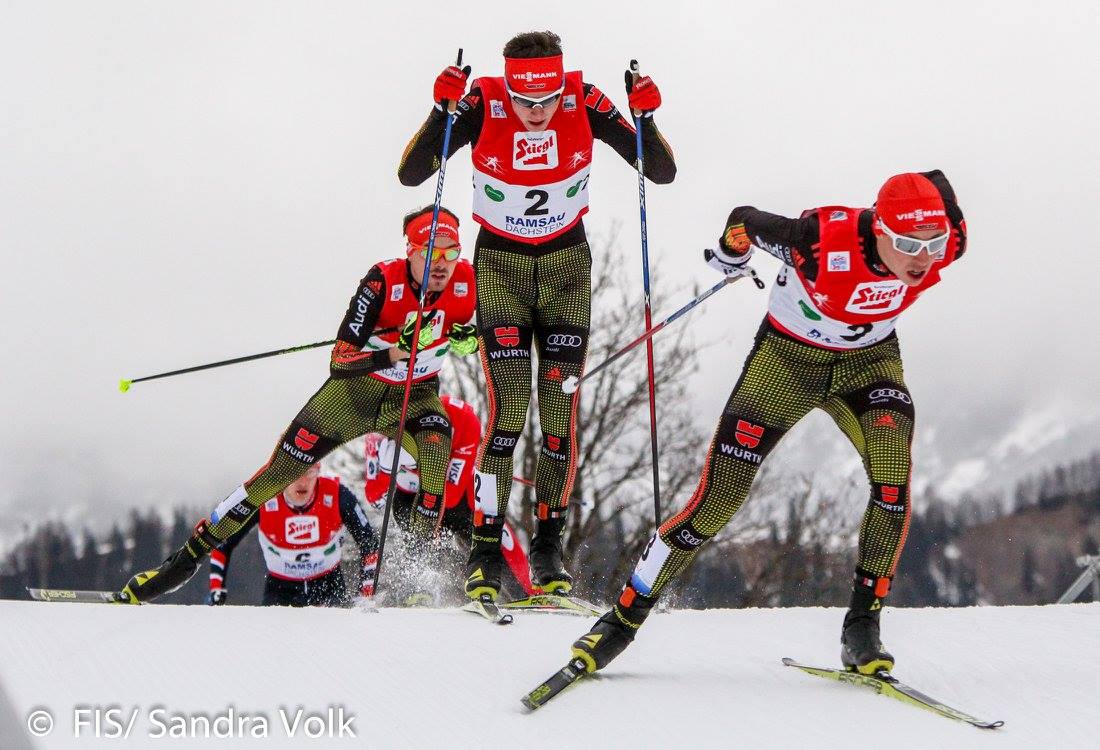
Johannes Rydzek (5) leading his two German teammates, Fabian Rießle (6) and Eric Frenzel, as well as Norway’s Jarl Magnus Riiber toward the finish of the nordic-combined large hill/10 k competition on Tuesday at the 2018 Olympics in PyeongChang, South Korea. They finished in that order, with Germany sweeping the medals. (Photo: FlyingPointRoad)
It was a total team effort on Tuesday for Germany in the second nordic-combined individual event of the 2018 Olympics in PyeongChang, South Korea, with Fabian Rießle, Johannes Rydzek and Eric Frenzel, with the help of Austria’s Wilhelm Denifl, chasing down Japan’s Akito Watabe and Norway’s Jarl Magnus Riiber about 6 kilometers into the 10 k race.
Earlier on Tuesday, Watabe had put himself in first with the best-ranked jump on PyeongChang’s 142-meter large hill. He started the 10 k Gundersen in first, just 1 second ahead of Riiber, who had jumped to second, just 0.3 points behind Watabe.
(Riiber had actually jumped farther with a distance of 139 meters, compared to Watabe’s 134-meter jump, and scored identical marks from the judges but lost points for wind compensation.)
Germany en route to a complete sweep of the podium in the men’s nordic-combined individual large hill/10 k on Tuesday at the 2018 Olympics in PyeongChang, South Korea, with Johannes Rydzek (5) leading Fabian Rießle (6) and Eric Frenzel (4). They went on to place first, second and third, respectively. (Photo: FlyingPointRoad)
Behind them, Denifl started the 10 k race 16 seconds out of first, Frenzel surged out of the start 24 seconds back, Rydzek 31 seconds behind, and Rießle 34 seconds back.
While Watabe led Riiber off the front for the first two laps of the four-lap race, the three Germans caught Denifl before lapping through the stadium for the first time at 2.5 k. From there, 16 seconds behind the leaders, the four-man group worked to reel in first and second place and did so by 6 k.
The lead pack then became six as Riiber and Watabe continued to position themselves up front at the 7.5 k mark.
On the final lap at the 8.58 k marker, Watabe charged to the front in his move to reclaim first. After taking the lead on an uphill, it wasn’t long after until he found himself skiing with three others alongside him: Riiber, Rydzek and Frenzel.
Then, Watabe slipped behind Riiber and the group closed in around him. Watabe clipped a ski, apparently with Rießle, who didn’t stumble, but Watabe did and dropped to the back of the pack. For Watabe, that was the end. For Germany, it was the beginning.
Frenzel led the charge up the final climb with Rydzek and Rießle behind him while Riiber tried to keep pace. Riiber slotted into fourth over the top and the foursome flew down into the stadium, with Rydzek coming out of the draft in first and leading Rießle, Frenzel and Riiber to the finish, respectively.
They finished in that order, with Rydzek taking gold in 23:52.5 minutes, 0.4 seconds ahead of Rießle in second place and 0.8 seconds ahead of Frenzel in third. Riiber crossed 2.8 seconds back in fourth, and Watabe ended up fifth (+12.5).
Germany had four in the top seven with Vinzenz Geiger in seventh (+50.1), behind Finland’s Eero Hirvonen in sixth (+22.1).
“I looked up to the video wall and saw the first three: all Germans,” Geiger recalled in a post-race interview with German broadcaster ARD. “That made me really happy, and of course I can also be happy about my seventh place.”
Bryan Fletcher en route to 17th in Tuesday’s large hill/10 k competition, tying his best result at the 2018 Olympics in PyeongChang, South Korea. (Photo: FlyingPointRoad)
American Bryan Fletcher repeated his result from the normal-hill competition as well, placing 17th on Tuesday, 1:42.9 minutes behind Rydzek in first. Fletcher had started the 10 k 2:04 minutes back in 23rd based on his jump. His teammate Ben Berend started 8 seconds behind him in 24th. Ultimately, Fletcher raced up to 17th with the 10th-fastest course time while Berend slipped to 39th (+4:28.2).
“The second I was in the air I knew I had a good one,” Berend told FasterSkier after the jumping portion of Tuesday’s competition. “Because when you do it right, you’re just flying, and I was really high and I was pulling away towards the bottom of the hill and so I knew, but I couldn’t feel any wind or anything. I was just so psyched, trying to enjoy every second of it.
In his first Olympic race, American Ben Berend on his way to 39th in the large hill/10 k competition at the 2018 Olympics in PyeongChang, South Korea. He started the day by jumping to 24th, which he said was his best competition jump of the season. (Photo: FlyingPointRoad)
“I haven’t had that many good jumps this season so I’ve just been searching for that,” Berend explained. “It’s funny, it’s so easy when you are doing it right and it’s so hard when you’re lost, and so I finally felt like, that might have been my best jump of the season, honestly, so what are the odds of doing that at the Olympics? That’s pretty cool.”
Tuesday was the 22 year old’s first Olympic competition after he sat out the first individual event because his jumping had been going poorly in training, he said. (Each team can only start four athletes per event. Taylor Fletcher sat out Tuesdsay’s competition.)
“I definitely was a little nervous for tonight, even though there is no pressure on me,” Berend said. “… Our coach [three-time U.S. Olympic biathlete Jeremy Teela] texted us, he’s actually our cross-county coach, he’s back at home, and he just said, ‘You guys have nothing to lose. Don’t be scared to fail.’ So that’s kind of our mindset here, and it was good; it kind of works for me.”
American Bryan Fletcher (23) skiing with Norway’s Jørgen Graabak (19) during the cross-country race of Tuesday’s individual large hill/10 k competition at the 2018 Olympics in PyeongChang, South Korea. Fletcher went on to finish 17th while Graabak placed 10th. (Photo: FlyingPointRoad)
After the race, Bryan Fletcher, who had skied up to 13th by 7.5 k, recalled pulling a chase group for most of the four laps. He ended up 17th, 3.2 seconds shy of 16th place, behind Japan’s Go Yamamoto.
“I went all in and just tried to make up as much ground as possible,” Fletcher told FasterSkier after. “I was hopeful and optimistic that I’d have the legs at the end. I knew that they were going to come around me with a pretty hard attack, and both of the guys that were with me have great finishing sprints, so I tried to pace myself a little bit, but I also knew that 17th or 10th or whatever you could get up to, it doesn’t really matter unless you’re on the podium so I was really going all in. … Unfortunately it didn’t work out, but I’m happy with how I skied and happy with the performance I had on the course today.”
American Ben Loomis racing to 40th in the large hill/10 k competition at the 2018 Olympics in PyeongChang, South Korea. (Photo: FlyingPointRoad)
Just behind Berend, his teammate Ben Loomis finished 40th (+4:38.8), up from 43rd in the jump, and Jasper Good followed in 43rd (+5:50.2), up from 46th.
“It was kind of tough jumping … [and] hard to start the race at the back, but overall it was a good race by me and I felt pretty good out there,” Loomis said after. “Regardless of how I have and how I continue to do here, there’s a lot to take away and I’m learning a lot about how to better refine my preparations and just stay relaxed out there and just really put my best foot forward.”
Nordic combined at the 2018 Games will conclude with the 4 x 5 k team event on Thursday.
Germany’s Eric Frenzel celebrates defending his Olympic gold in the normal hill/10 k Gundersen on Wednesday, the first nordic-combined competition of the 2018 Olympics in PyeongChang, South Korea. Japan’s Akito Watabe (l) placed second, 4.8 seconds back. (Photo: FlyingPointRoad)
PYEONGCHANG, South Korea — Wednesday at the Alpensia nordic sport complex, the first of the scheduled three nordic-combined events of the 2018 Olympics got underway. Despite the women’s 15-kilometer individual biathlon event being postponed to Thursday due to high winds, the nordic-combined jumping portion went off earlier in the day as planned.
The men’s individual normal hill/10-kilometer Gundersen competition saw Austria’s Franz-Josef Rehrl scored the highest number of points off the jump with a jump of 112 meters and 130.6 points. Norway’s Jarl Magnus Riiber jumped to second, flying 111 meters and scoring 126.9 points, and Japan’s Akito Watabe posted the third-best jump of 105.5 meters, which scored 123.7 points.
Four U.S. nordic combined skiers entered the competition. After the jump, Bryan Fletcher was the top American in 18th place. Ben Loomis was the next best placed American in 37th, while Taylor Fletcher ranked 39th and Jasper Good 47th.
The pursuit-race format saw Rehrl leave first on the demanding four-lap, 10 k course. Riiber followed in second, starting 15 seconds back, Watabe began with a 28-second deficit.
Germany’s Eric Frenzel (5) leads Austria’s Lukas Klapfer during the individual normal hill/10 k competition on Wednesday at the 2018 Olympics in PyeongChang, South Korea. Frenzel went on to win while Klapfer placed third. (Photo: FlyingPointRoad)
Several skiers ready to chase down the leaders began with reasonable time penalties to overcome. Germany’s Eric Frenzel started 36 second back in fifth, Austria’s Lukas Klapfer was Frenzel’s initial rabbit, starting four seconds before the German in fourth place.
Both Fletcher brothers are renowned for their cross-country skiing. Often ranked in the top three for overall time on the 10 k course, a deficit of over a minute is not an insurmountable gap for the brothers from Steamboat Springs, Colorado. Yet on Wednesday, Bryan began 2:06 minutes back while Taylor looked ahead at a massive 3:37-minute vacuum to Rehrl in first. Loomis began the ski four seconds ahead of Taylor, while Good started in the wave, 4 minutes back.
For the first 2.5 k lap of the race, the 24-year-old Rehrl skied alone until a climb about 5 minutes in, where Riiber caught him. The chase group, with Watabe, Klapfer, and Frenzel, wasn’t much farther behind. At the 2.5 k mark, that group was just 12 seconds behind the two leaders as they lapped through the stadium.
Meanwhile, Bryan pushed out of the start in immediate pursuit of Finland’s Ilkka Herola and Germany’s Fabian Rießle 2 and 3 seconds ahead of him, respectively. At 2.5 k, Bryan was up to 16th, skiing in a pack with Herola, Fabian Rießle, Germany’s Vinzenz Geiger, and Japan’s Hideaki Nagai and Go Yamamoto, about 1:33 minutes back from the leaders.
Halfway through the race at 5 k, Frenzel, Riiber, Watabe, Klapfer, and Rehrl pushed on as a unit, forming the nucleus from which gold, silver and bronze would eventually come. There, Bryan continued to ski in 16th with a slightly more strung-out chase pack, 1:18 behind Frenzel in first.
Frenzel, Watabe and Klapfer swapped leads over the next 2.5 k, while Rehrl dropped to seventh, 25 seconds behind Germany’s Johannes Rydzek and Finland’s Eero Hirvonen, who had 21 seconds between them and the leaders at 7.5 k.
Bryan spent most of that next lap skiing alone in 17th, about 10 seconds out of 16th. By the end of the third lap, he was almost a minute clear of France’s Jason Lamy-Chappuis in 18th.
While Bryan held his ground in 17th for the final 2.5 k, the four-man lead group battled for three medals. Frenzel moved into first with 1 k to go and on the last climb, a long grinder before a descent into the stadium, Frenzel launched his attack. Only Watabe in second could immediately respond, but about halfway up the climb, even he lost sight of Frenzel over the top.
Japan’s Akito Watabe (3) leading Germany’s Eric Frenzel and Austria’s Lukas Klapfer during the 10 k ski race portion of the normal hill/10 k at the 2018 Olympics in PyeongChang, South Korea. Frenzel went on to win, Watabe placed second and Klapfer third. (Photo: FlyingPointRoad)
Frenzel steamrolled into the stadium to cross the finish line first in 24:15.4 minutes, defending his title from the normal hill/10 k four years ago at the Olympics in Sochi, Russia. While Frenzel, 29, is a perennial threat, it was only his second victory of the season, after he won a normal hill/10 k World Cup event in December in Ramsau, Austria. Meanwhile, Watabe came into the Games having won four of the last five individual World Cup competitions. But an Olympic gold still eludes the Japanese skier.
“It was a moment that was hard to stomach for me,” Frenzel recalled of the last few hundred meters of the race in an interview with German broadcaster ZDF. “In that moment I couldn’t yet quite believe that I could come back on the finish stretch in first place, and just tried to enjoy the moment. It was a lot of work up to this place for it to work out today. I waited for this for a long time again. And so I am overjoyed it worked out again.”
Watabe crossed the line 4.8 seconds later for silver, his second medal in as many Olympics after he placed second in the normall hill/10 k behind Frenzel in Sochi. Klapfer held off Riiber for third, 18.1 seconds behind Frenzel, for Klapfer’s second Olympic bronze after taking third with his Austrian teammates in the 4 x 5 k team event in Sochi.
Riiber placed fourth (+22.5), Rydzek was just behind in fifth (+27.9), Hirvonen finished sixth (+51.6), and Rießle and Herkola moved all the way up to seventh (+1:05.3) and eighth (+1:05.5), respectively, finishing with Geiger in ninth (+1:05.5).
With four Germans in the top 10, Frenzel predicted more success for his team at these Olympics.
“I hope there will be more golden moments like this here,” he told ZDF. “I think all of us are in good shape at the moment, especially Fabian [Rießle] who definitively was out of luck on the jump today. He surely can perform at a similar level as I did. So because of that we will keep attacking here over the next few days, especially on the large hill, and then we will see what is in it for us.”
American Bryan Fletcher racing to 17th in the normal hill/10 k Gundersen start on Wednesday at the 2018 Olympics in PyeongChang, South Korea. It was his first individual top 20 at his second Olympics. (Photo: FlyingPointRoad)
Bryan nearly caught Estonia’s Kristjan Ilves in 16th at the line, finishing 0.3 seconds behind him in 17th (+2:12.2) for his best individual result in his second Olympics. The 31 year old’s previous Olympic best was 22nd in the large hill/10 k in Sochi.
In a post-race interview with FasterSkier and other reporters in PyeongChang, Bryan said that he was disappointed with the result and felt that, with faster skis, he could’ve been in the mix. He noticed his skis weren’t up to par with Germany and FInland immediately out of the start, where he said he was sprinting to catch Rießle and Herkola.
“A two-second gap, I should be able to just yo-yo right onto them, and I couldn’t even get there,” he said. “That to me was a surefire sign that something was up. Either my physical performance wasn’t there or the skis weren’t there. It very well could’ve been a combination of both.”
He explained that nordic-combined athletes don’t warm up on race skis. “They were good, but just not quite there,” Bryan said of his skis.
On the day, his course time ranked 22nd, about 20 places slower than usual.
“I dug deep, I’m happy with how I managed that today and limited losses,” he explained. “Positive takeaways from the jump hill I think were really good. I know that I can be in the fight there and also know that with some better skis I can be in fight in the cross-country, so refocus and looking forward to next week.”
American Bryan Fletcher after jumping to 18th on the 109-meter normal hill at the 2018 Olympics in PyeongChang, South Korea. He went on to finish 17th in the 10 k later in the day. (Photo: FlyingPointRoad)
After his jump, he had hoped for a top 10.
“In fact, I think it was completely doable,” Bryan said. “It was only about a minute to eighth so it was a little bit disappointing going in and not being able to close that gap. It’s a big event, it’s one day and certainly anything can happen. And unfortunately today the cards didn’t stack in our favor.”
As a father and the oldest member of the USA’s young Olympic team, Bryan said he had been giving his teammates some pointers.
“I think they’ve been calling me ‘Dad’ all week because they love the advice, so falling into a parent role again,” he said. “It’s been fun and certainly they give me as much energy as I give them.”
Behind him, his younger brother Taylor, 27, finished 35th (+3:27.8) with the 15th-fastest course time, Loomis placed 41st (+4:29.4), and Good 45th (+5:48.4).
American Taylor Fletcher racing to 35th in the normal hill/10 k, after jumping to 39th, at the 2018 Olympics in PyeongChang, South Korea. (Photo: FlyingPointRoad)
Asked about his day, Taylor described it as “Not awesome. I mean it was realistic,” he explained. “Average day on the jump, average day on the cross-country. I know what I did and what I need to do, and I think that’s the harsh reality, for sure, but it was a mix between thinking the skis weren’t so great, me definitely going a little too hard at the beginning and maybe me [trying to figure] out whether it was me or whether it was skis, and honestly I think it was more me.”
Italy’s Alessandro Pittin started the race 4 seconds ahead of him in 38th. Pittin went on to ski the fastest 10 k time of 23:48.9 to end up 19th at the finish.
“Alessandro Pittin is the fastest skier, he’s taken that away from me for sure,” Taylor said. “I think I put a little too much energy on that first lap trying to stay with him and then I actually went passed him and led in the wind going up this hill coming back toward the stadium, and I think that just put me on edge a little bit too much and too early.”
Taylor described the conditions as variable, alternating from glazed and fast to “mush” and “dead” feeling.
“It’s hard to describe where I’ve skied that before, but it has no character, no feeling to it, and it’s really hard to glide on it,” he said of the snow in PyeongChang. “I was struggling on the gradual hill coming back into the stadium and I felt like I couldn’t get up onto my toe for that final kick of V2 so I was very static and heavy on the legs and that’s not where I want to be at all. It’s not fluid for me, and it’s just difficult.”
As for his jumping, he was pleased with his improvement since earlier this season.
“It’s a million times better than it was in December,” he said. “… It’s still got a ways to go, but I’ve shown in these last couple weeks that slightly better jumps are leaps and bounds better for me.”
As the 10th jumper to descend down PyeongChang’s 109-meter hill on Wednesday, Taylor explained that the first three American jumpers got “a little unlucky” with the crosswind on the jump. Good was the first jumper of the day in bib 1, Loomis started ninth, Taylor 10th, and Bryan 26th out of 48 starters.
(Article continues below)
American Ben Loomis jumping to 37th on the 109-meter normal hill at the 2018 Olympics in PyeongChang, South Korea. (Photo: FlyingPointRoad)
“I still had good conditions compared to Jasper, but compared to a lot of the other guys, I was still slightly behind them,” Taylor said. “But for me, I’ve just got to jump a little bit early and a little bit more forward with the speed and it’ll be there.”
Good told reporters that the top of the PyeongChang jump “literally feels like a hurricane. The wind is just howling and the first time we got up there training earlier this week, I was like, there is no chance we’re jumping right now,” he recalled. “But the wind barriers they have set up do an awesome job because when you actually get to the jump the wind is fine so it’s more of a mental battle.”
In his first Olympic competition, the 21-year-old Good’s jump of 76 meters put him last place going into the 10 k. But he started with four other skiers in a wave start, 4 minutes behind the leader.
“It’s a little bit easier to get motivation starting in the back in this event just because it’s so big, you’re on the world stage, and this is the kind of race where everyone has, like, inspired skis regardless of where they’re skiing,” Good said. “It just feels like there’s more to it and there’s more within you, but it’s just awesome to be out competing and achieve a personal dream of mine.”
American Ben Loomis en route to 41st in the normal hill/10 k Gundersen at the 2018 Olympics in PyeongChang, South Korea. (Photo: FlyingPointRoad)
Loomis said that while PyeongChang is probably the windiest place he’s ever jumped, it made for a challenging and exciting competition. He said his jump on Wednesday, at 86.5 meters, was better than most of his training jumps there.
“Most of the training rounds were even a lot windier than today, so we kind of got well-prepared for that, and luckily it was pretty good for the comp today,” Loomis explained. “The winds were about as even as they’ve been here so far.”
At 19 years old, Loomis is coming off a bronze-medal performance and fourth-place finish in two individual races at Junior World Championships in Kandersteg, Switzerland, just two weeks ago.
“It’s my first Olympics and I’m one of the younger guys so I’m looking to take it all in and learn from this and gain as much experience as I can for the next Olympics in four or even eight years out of today,” he said.
The next nordic-combined competition at the Games is set for Tuesday, Feb. 20 with the individual large hill/10 k.
The nordic-combined normal hill/10 k podium at the 2018 Olympics, with Germany’s Eric Frenzel (c) in first, Japan’s Akito Watabe (r) in second, and Austria’s Lukas Klapfer (l) in third. (Photo: FlyingPointRoad)
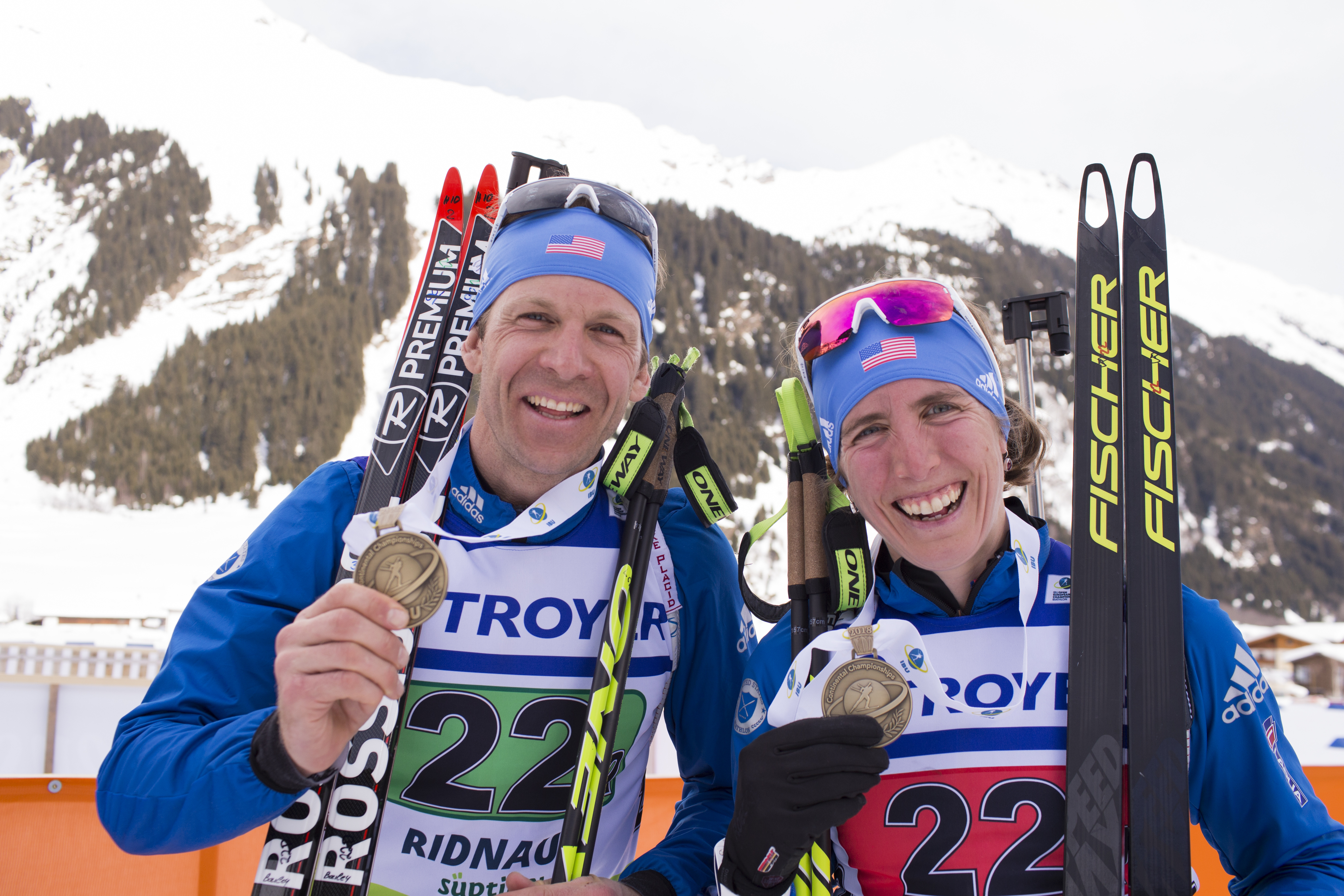
US Biathlon’s Lowell Bailey (l) and Susan Dunklee after teaming up for bronze in the single mixed relay at 2018 IBU Open European Championships on Sunday in Ridnaun, Italy. (Photo: Manzoni/NordicFocus)
IBU Open European Championships (Ridnaun-Val Ridanna, Italy): Single mixed & mixed relays
Susan Dunklee and Lowell Bailey teamed up for the final day of the 2018 International Biathlon Union (IBU) Open European Championships in Ridnaun, Italy, and raced to a bronze medal in the single mixed relay.
The American duo, both of which earned individual medals at last year’s IBU World Championships, finished just 9.1 seconds out of first, which went to Norway’s Thelka Brun-Lie and Vetle Sjåstad Christiansen. The Norwegians won in 35:39.6 with zero penalties and six spares. They took the lead after Brun-Lie’s second leg, where she cleaned both stages without spares.
France placed second, 8.6 seconds back, with Julia Simon and Emilien Jacquelin, who combined for no penalties and 11 spares. They led the first half of the race, but slipped to second behind Norway on Simon’s second leg.
Dunklee put the Americans off in second on her first leg, which she cleaned with a spare in each stage, then they slipped one place to third on Bailey’s first leg, where he cleaned as well and used three spares. In all, they used 10 spares and avoided the penalty loop, and finished half a second out of second place.
“Over Christmas, we trained a little bit with the French athletes, including Jacquelin,” Bailey said, according to a US Biathlon press release. “So I know that he has quite a fast finish, and I thought I am kind of an old man here, I should maybe try to go harder on the first part of the lap. But he stayed with me all the time and had me in the end.”
“It was a good opportunity to tune up the race shape, build some confidence and find that sharp feeling heading into the Olympics,” Dunklee told US Biathlon. “The single mixed relay is one of my favorite race formats and today was a blast!”
Canada’s Sarah Beaudry and Carsen Campbell placed eighth of 24 teams in the single mixed relay, finishing 1:03.6 out of first with just eight spares and zero penalties. In 11th after the first leg, they moved into eighth on Campbell’s first leg, which he cleaned with one spare. Beaudry then cleaned her second leg without any spares, and Campbell anchored them to eighth.
The U.S. entered a team in the mixed relay that followed, with Chloe Levins, Deedra Irwin, Paul Schommer, and Alex Howe placing 17th (+5:55.5) of 19 teams with no penalties and 12 spares.
Ukraine won the mixed relay to conclude the championships, with Yuliia Zhuravok, Iryna Varvynets, Artem Pryma, and Dmytro Pidruchnyi combining for zero penalties and six spares and finishing in 1:11:40.1.
Russia placed second (+11.7) with Victoria Slivko, Anastasia Zagoruiko, Evgeniy Garanichev, and Alexander Loginov combining for zero penalties and nine spares.
Norway followed in third (+33.2) with Emilie Ågheim Kalkenberg, Kaia Wøien Nicolaisen, Håvard Gutuboe Bogetveit, and Fredrik Gjesbakk combing for no penalties and just four spares.
U.S. SuperTour (Craftsbury, Vermont): 5/10 k freestyle
Two Alaska Pacific University (APU) athletes topped the podium on Sunday at the SuperTour in Craftsbury, Vermont, with David Norris winning the men’s 10-kilometer freestyle individual start in 21:54.9 and Becca Rorabaugh topping the women’s 5 k freestyle in 12:06.4.
Norris won the men’s race by 6 seconds over Canada’s Andy Shields (Lappe Nordic) and Kevin Bolger of the Sun Valley Ski Education Foundation (SVSEF) placed third (+15.8). Kris Freeman (Caldwell Sport) was the third American in fourth overall (+23.7), and three Canadians took fifth through seventh with Michael Somppi (Lappe Nordic) in fifth (+27.9), Evan Palmer-Charrette (NTDC Thunder Bay) in sixth (+37.5) and Scott Hill (Barrie Cross Country) in seventh (+37.6), ahead of Brian Gregg (Team Gregg/LNR/CXC) in eighth (+39.4), Tad Elliott (Ski Club Vail) in ninth (+44.3) and Jack Hegman in 10th (+50.4).
Rorabaugh won the women’s race by just 2.2 seconds over her APU teammate Rosie Frankowski in second, and Erika Flowers of the Stratton Mountain School (SMS) T2 Team placed third (+4.6). Two Craftsbury Green Racing Project (CGRP) skiers finished fourth and fifth, with Kaitlynn Miller in fourth (+12.1) and Liz Guiney in fifth (+22.5), Kelsey Phinney (SVSEF) was sixth (+25.8), and Canadians Olivia Bouffard-Nesbitt (Rocky Mountain Racers) seventh (+26.4) and Frederique Vezina (Pierre-Harvey National Training Centre) eighth (+36.0). Corey Stock, of the Bridger Ski Foundation (BSF) placed ninth (+39.9), and Felicia Geisor (CXC Team) was 10th (+44.4).
On Saturday, the Craftsbury Outdoor Center hosted its 37th annual Craftsbury Marathon, with Nils Koons winning the 48 k men’s race in 2:28:51.0 hours and Hannah Dreissigacker winning the 48 k women’s race in 3:01.48.7.
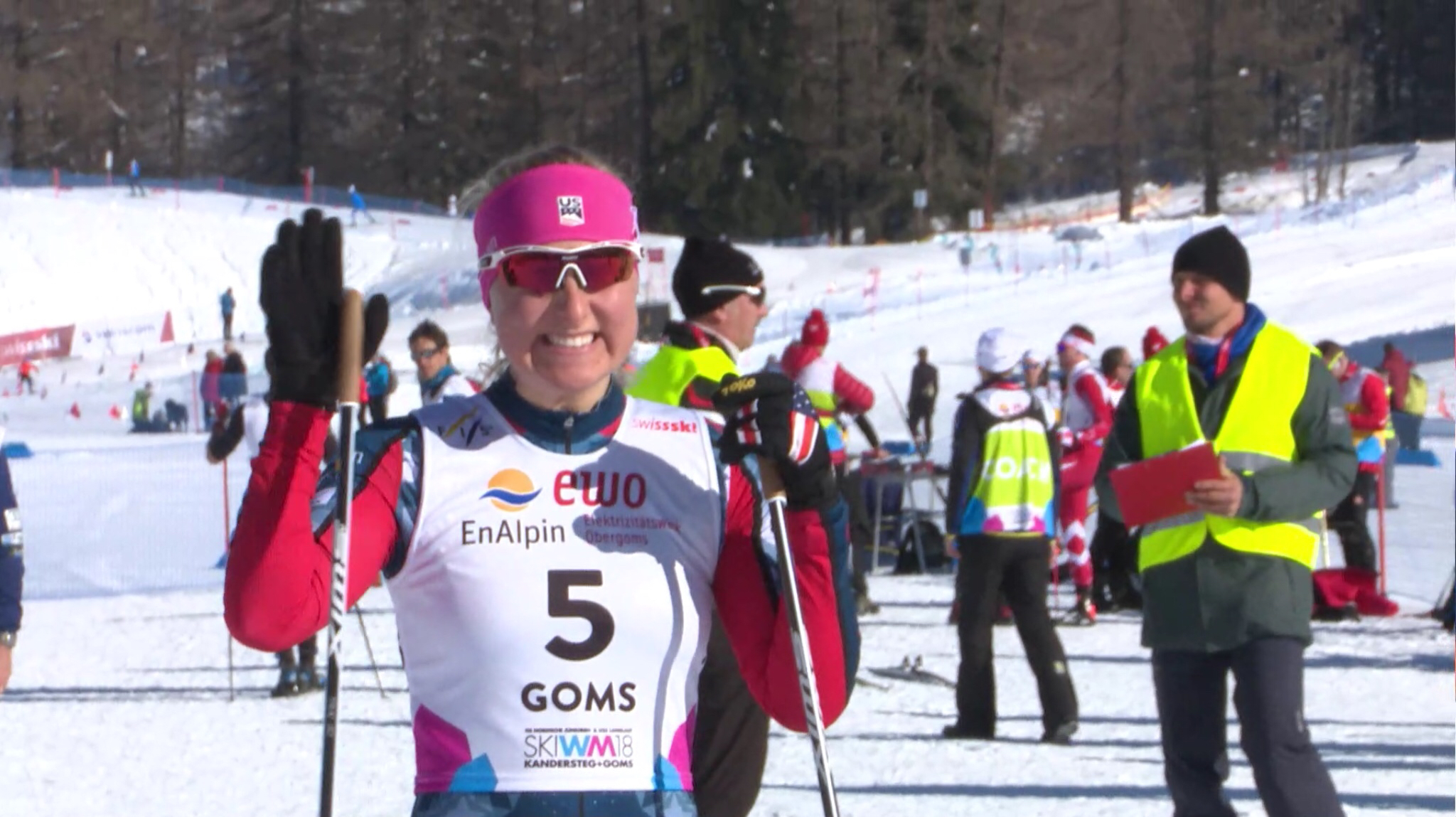
Hannah Halvorsen of the U.S. Ski Team and APU on the start line in Ulrichen, Switzerland, after finishing fifth in the sprint qualifier. (FIS screencap)
FIS Cross Country World Junior Championships (Ulrichen, Switzerland): Freestyle sprints
World Junior Championships kicked off today with freestyle sprints in Ulrichen, Switzerland. Moa Lundgren of Sweden claimed with women’s title by 1.89 seconds over Kristine Stavås Skistad of Norway in the final, with Sweden’s Frida Karlsson finishing third (+1.89).
Hannah Halvorsen of the United States qualified in fifth place before skiing to second in her quarterfinal heat. Halvorsen hovered around third or fourth place through much of her semifinal and was unable to snipe any spots in the finishing straight, ending up fourth in the heat and eighth on the day.
Fellow Americans Margaret Gellert and Sofia Shomento also made the quarterfinals, finishing 18th and 23rd, and Canada’s Hannah Mehain wound up 29th on the day.
The new men’s junior world champion is Tom Mancini of France, who nipped Norway’s Jørgen Lippert by just 0.10 seconds to take the win. Valerie Grond gave the Swiss crowd a thrill by making it all the way to the final and taking home bronze, despite qualifying in just 21st position. The Swiss junior narrowly edged France’s Vincent Buiatti for the final step on the podium.
Canada’s Graham Ritchie finished second in his quarterfinal after qualifying in 28th position, earning an automatic spot in the semifinals. There he finished sixth (+9.30 behind Mancini), winding up 12th on the day. Teammate Antoine Cyr also made the quarterfinals where he had an impressive crash, slinging off the trail and into the infield, finishing 30th on the day. For the U.S., Gus Schumacher was the lone qualifier for the heats. He finished fourth in his quarterfinal and was just 0.22 seconds away from a “lucky loser” spot in the semifinals. Schumacher finished 19th on the day.
In the junior women’s race, Hannah Rudd of the United States finished 35th in qualification, +18.15. For Canada, Annika Richardson finished 52nd (+24.09), Catherine Reed-Metayer 56th (+28.25), and Alexandra Racine 69th (+37.27).
In the junior men’s sprint, Canada’s Reed Godfrey finished a tough 31st, just 0.21 seconds out of making the quarterfinals. Etienne Hebert rounded out the Canadian finishers in 36th place (+11.81) in the qualifier. Canyon Tobin was 41st in qualification for the U.S. (+13.46), followed by Karl Schulz in 54th (+16.90) and Luke Jager in 60th (+18.15).
FIS Nordic Combined World Cup (Seefeld, Austria): Individual normal hill/15 k
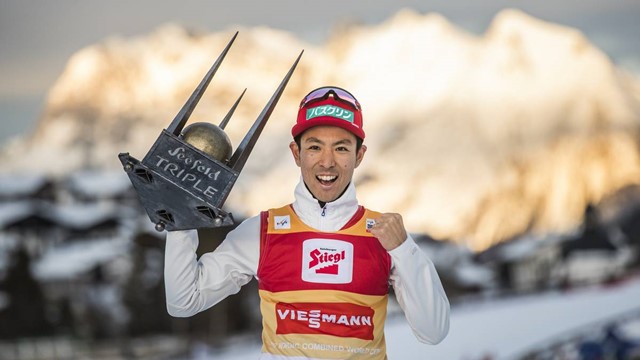
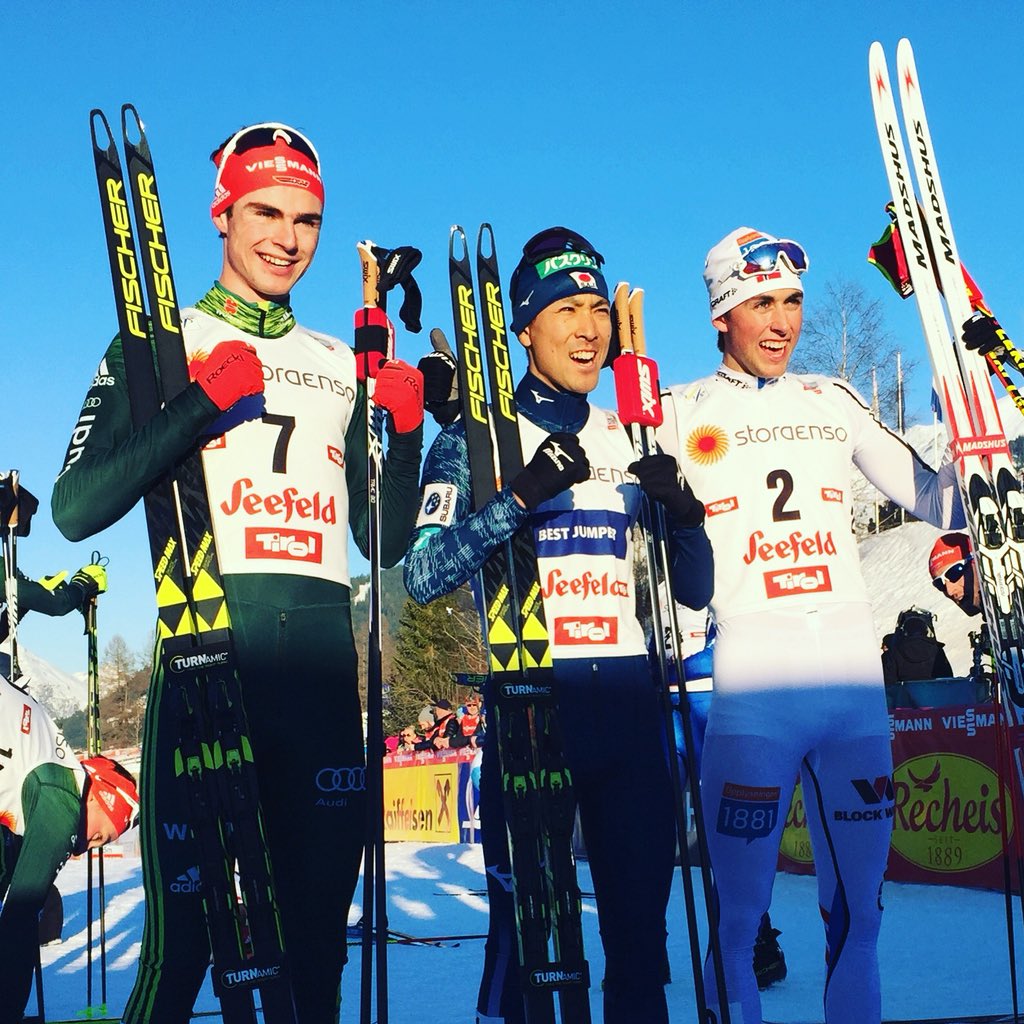
Japan’s Akito Watabe after winning the 2018 Seefeld Triple Nordic Combined World Cup. He is the only athlete besides Germany’s Eric Frenzel to win the event. (Photo: FIS Nordic Combined)
On the final day of the Seefeld Triple, Japan’s Akito Watabe completed his sweep of the three-day weekend and Norway’s Jarl Magnus Riiber reached the podium for the third-straight day, placing second. Germany’s Fabian Rießle placed third for his second podium in the last two days.
Watabe jumped to first on the normal hill and started the 15 k Gundersen 48 seconds ahead of Riiber in second. He went on to win the race by 1:14.9 minutes in 34:58.6, becoming the only man besides Germany’s Eric Frenzel to win the Seefeld Triple in its five-year history.
After jumping to fifth, Rießle won a photo finish for third (+1:57.9), edging Germany’s Vinzenz Geiger by less than a tenth of a second. Geiger moved up from ninth in the jump to fourth overall (+1:57.9).
Norway’s Jørgen Graabak followed in fifth (+2:02.4),Frenzel placed sixth (+2:07.4), Norway’s Jan Schmid was seventh (+2:09.8), Finland’s Eero Hirvonen eighth (+2:13.5), Norway’s Espen Andersen ninth (+2:28.0), and Austria’s Mario Seidl 10th (+2:42.1) out of 28 finishers.
No Americans contested the final day of the Triple, the last World Cup before the 2018 Winter Olympics in PyeongChang, South Korea.
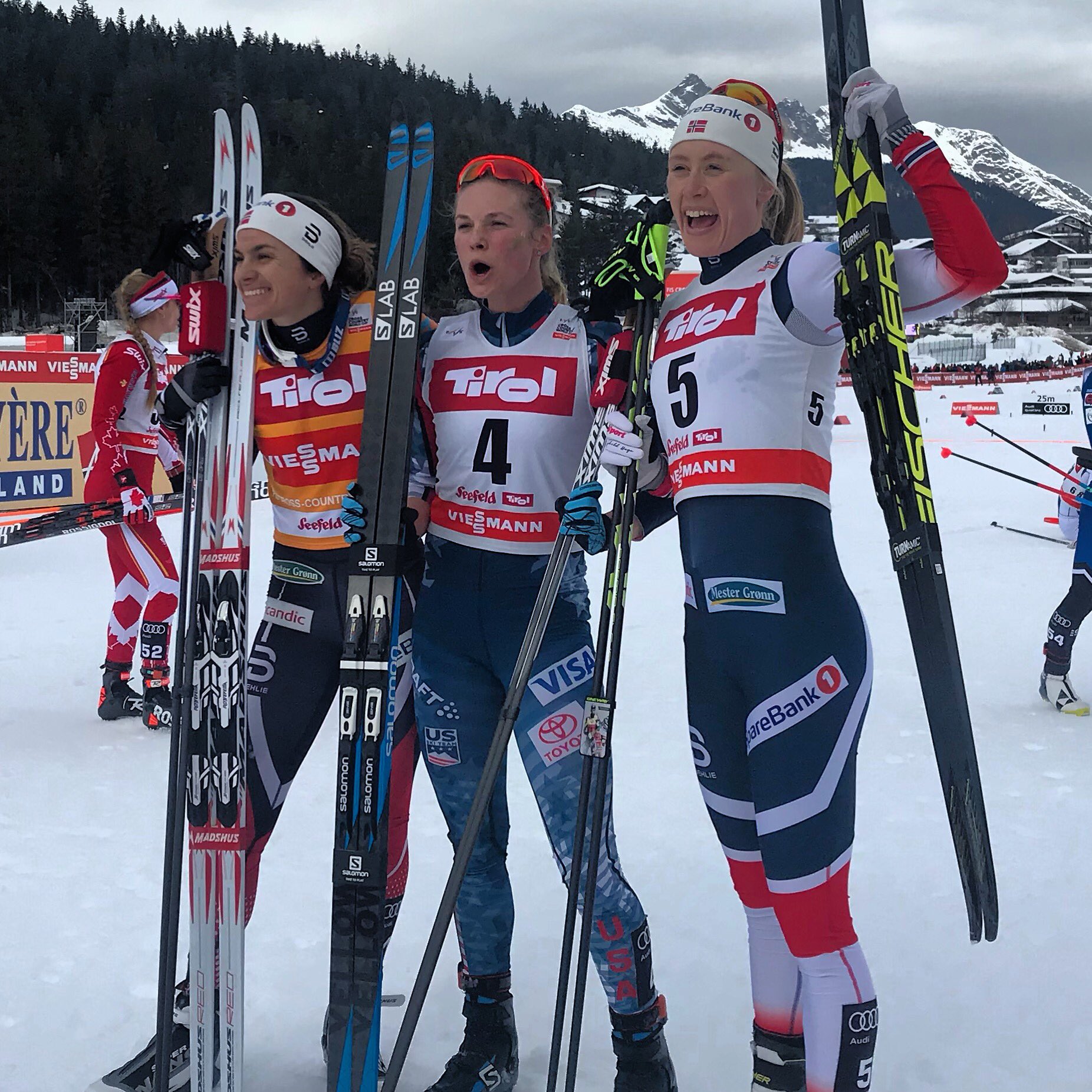
Jessie Diggins of the U.S. Ski Team (center) celebrates after winning the 10 k mass start freestyle in Seefeld, Austria, over Heidi Weng (left) and Ragnhild Haga of Norway. (Photo: FIS Cross Country/Twitter)
FIS Cross Country World Cup (Seefeld, Austria): 10/15 k mass start freestyle
In the final World Cup race before the 2018 Olympics, Jessie Diggins achieved the ultimate goal to give herself the utmost confidence heading into PyeongChang — winning the women’s 10-kilometer freestyle mass start at the World Cup in Seefeld, Austria, on Sunday.
The win was her first of the season and fourth individual victory of her career. Diggins, a 26-year-old U.S. Ski Team member, pulled it off by attacking on a long climb and leaving Norway’s Heidi Weng, Ragnhild Haga and Ingvild Flugstad Østberg chasing. While Diggins was several seconds ahead over the top and all alone on the long descent that followed, Weng and Haga worked to close the gap — and nearly did in the finishing stretch. But Diggins held them off, winning by 0.7 seconds over Weng in second place and 1 second ahead of Haga in third, and threw her fists down in celebration as she crossed the line first in 23:08.5 minutes.
“I just put my head down and it wasn’t pretty, but I just hammered,” Diggins told the International Ski Federation (FIS) in a televised post-race interview.
She was the only non-Norwegian in the top five, with Østberg in fourth (+8.7) and Marit Bjørgen in fifth (+16.7). Austria’s Teresa Stadlober placed sixth (+16.9), Norway’s Kari Øyre Slind was seventh (+19.1), and American Sadie Bjornsen placed eighth (+20.5), ahead of Switzerland’s Nathalie von Siebenthal in ninth (+30.3).
The U.S. had three in the top 15 with Kikkan Randall (U.S. Ski Team) in 14th (+48.5), and two more women in the top 30, with Caitlin Patterson (Craftsbury Green Racing Project) in 23rd (+1:00.7) and Liz Stephen (USST) in 29th (+1:18.2). Rosie Brennan (USST) finished 53rd (+2:26.9).
Emily Nishikawa led the Canadians in 35th (+1:36.5), followed closely by teammate Cendrine Browne in 37th (+1:36.6). Dahria Beatty finished 45th (+1:58.9).
Dario Cologna of Switzerland (center) won the men’s 15 k skate mass start in Seefeld, Austria, over Alex Harvey of Canada (left) and Martin Johnsrud Sundby of Norway (right). (Photo: FIS Cross Country/Twitter)
The Olympics are nearing and so Switzerland’s Olympic legend Dario Cologna is ramping up: after winning the Tour de Ski, he took another win in the 15 k mass start skate in Seefeld, Austria, on Sunday.
With much of the field staying relatively close together until the finish, Cologna nabbed the win by 1.4 seconds over Canada’s Alex Harvey, who took his second podium of the season in addition to also finishing third in the overall Tour de Ski.
Norway’s Martin Johnsrud Sundby was third (+2.9), then teammate Didrik Tønseth in fourth (+5.9) and France’s Maurice Manificat in sixth (+7.5).
The U.S. Ski Team’s Erik Bjornsen had a breakthrough day finishing ninth (+9.3), followed by Simi Hamilton in 12th (+12.4). Behind them, Scott Patterson placed 27th (+23.4), then Patrick Caldwell 49th (+1:26.2), Ben Lustgarten 55th (+1:42.7), and Tyler Kornfield 77th (+3:00.0).
Canada’s Devon Kershaw and Graeme Killick finished 30th (+26.5) and 31st (+27.4), respectively. Len Valjas placed 58th (+1:53.1), Knute Johnsgaard 82nd (+3:23.1), Bob Thompson 87th (+4:27.5), and Julien Locke 92nd (+4:56.9).
The podium for Day 2 of the Seefeld Triple Nordic Combined World Cup, with Japan’s Akito Watabe in first (c), Germany’s Vinzenz Geiger (l) in second and Norway’s Jarl Magnus Riiber (r) in third. (Photo: FIS Nordic Combined/Twitter)
FIS Nordic Combined World Cup (Seefeld, Austria): Normal hill/10 k
Two of the same men from Friday repeated on the podium on Day 2 of the Seefeld Triple Nordic Combined World Cup, with Japan’s Akito Watabe notching his second-straight win on Saturday.
Norway’s Jarl Magnus Riiber, who finished second on Friday, placed third in Saturday’s individual normal hill/10 k Gundersen, while Germany’s Vinzenz Geiger placed second, more than a minute behind Watabe.
Watabe jumped to first and started the 10 k with a 25-second head start on Riiber in second. Geiger started seventh, 1:45 minutes back, and rose to second at the finish, 1:05.5 behind Watabe (who won in 23:28.5) and 3.4 seconds ahead of Riiber in third (+1:08.9).
For the second day in a row, Norway’s Jan Schmid narrowly missed the podium in fourth (+1:14.1), up from fifth after the jump.
Taylor Fletcher was the lone American competing on Day 2, and he ended up 31st, up 10 places after jumping to 41st. Fletcher started the 10 k race 4:44 out of first then finished 3:52.9 behind Watabe.
The Seefeld Triple concludes Sunday with the individual normal hill/15 k Gundersen.
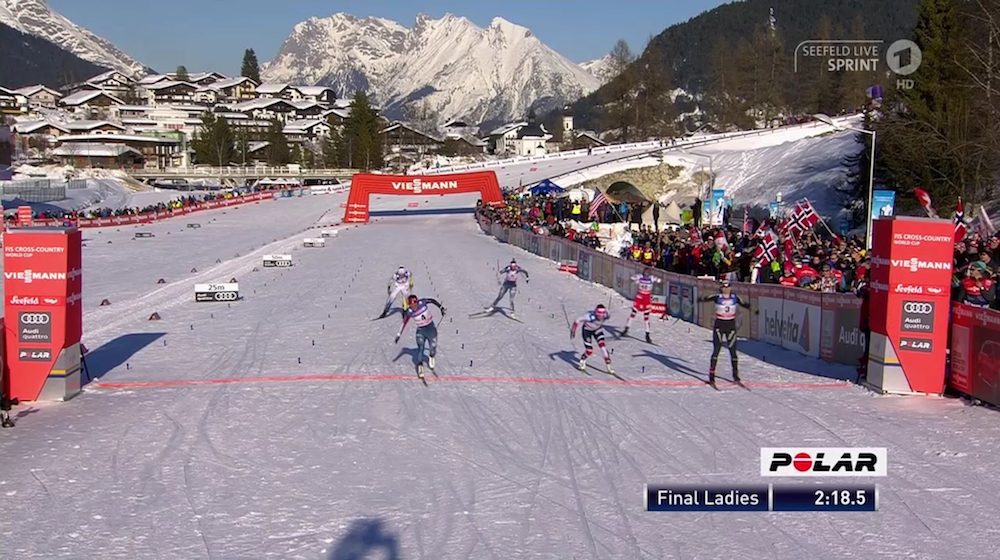
American Sophie Caldwell (l) and Switzerland’s Laurien van der Graaff (r) tied for first on Saturday in the women’s 1.1 k freestyle sprint final at the World Cup in Seefeld, Austria, while Norway’s Maiken Caspersen Falla placed third. (Screenshot: ARD broadcast)
FIS Cross Country World Cup (Seefeld, Austria): Freestyle sprints
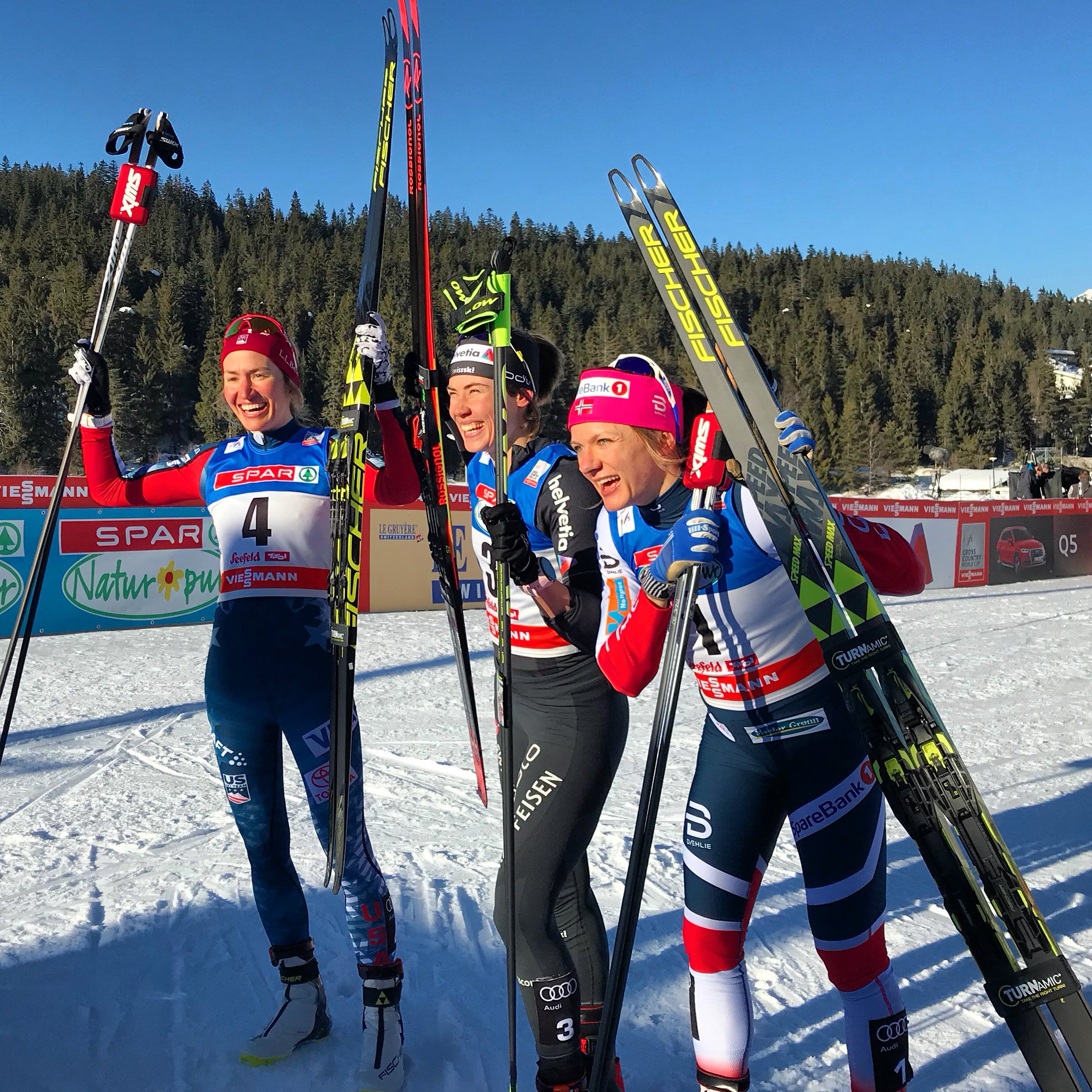
It doesn’t get any closer than that. On Saturday, American Sophie Caldwell and Switzerland’s Laurien van der Graaff tied for first in the women’s 1.1-kilometer freestyle sprint final at the World Cup in Seefeld, Austria. They both finished within one-hundredth of a second of each other to take the victory — the last sprint before the Olympics — in 2:18.65 minutes.
Norway’s Maiken Caspersen Falla finished 0.21 seconds later for third place.
The women’s freestyle sprint podium at Saturday’s World Cup in Seefeld, Austria, with American Sophie Caldwell (l) and Switzerland’s Laurien van der Graaff (c) tying for first and Norway’s Maiken Caspersen Falla (r) placing third. (Photo: FIS Cross Country/Twitter)
“I broke my pole in the semifinal, then I got really tired,” van der Graaff said in a post-race interview with the International Ski Federation (FIS). “But I still believed I can be with Maiken and Sophie, and that I could catch them in the final was just great.”
Norway and the U.S. both had two in the final, with Kathrine Rolsted Harsem of Norway placing fourth (+1.34), Sweden’s Linn Sömskar finishing fifth (+1.83) and American Sadie Bjornsen taking sixth (+2.26).
Falla had raced to first in the qualifying round with a time of 2:21.44, Italy’s Greta Laurent qualified second (+1.43), van der Graaff third (+1.66), Caldwell fourth (+1.84), and Bjornsen fifth (+2.01).
Van der Graaff then won her quarterfinal and placed third in the first semifinal, 0.77 second behind Caldwell, who won it. Falla was second in that semifinal (+0.16) and van der Graaff advanced as a lucky loser.
Caldwell and Falla went head to head in every heat, with Falla winning their first quarterfinal by 0.08 seconds over Caldwell in second.
Bjornsen won her quarterfinal and finished second to Harsem in the second semifinal.
A third American, Kikkan Randall also qualified for the heats, placing 18th in the qualifier then finishing third in her quarterfinal (1.33 seconds behind Sömskar in first) to end up 14th overall.
Canada’s Dahria Beatty placed 30th in the qualifier to nab the last spot in the rounds, then finished fourth in her quarterfinal (1.65 seconds behind Laurent in first) for 20th overall.
For the U.S., Ida Sargent missed qualifying by about half a second in 37th (+8.20), Rosie Brennan finished 42nd (+9.86) and Caitlin Patterson was 52nd (+13.0).
Also for Canada, Emily Nishikawa finished 51st (+12.68) and Cendrine Browne was 54th (+13.34).
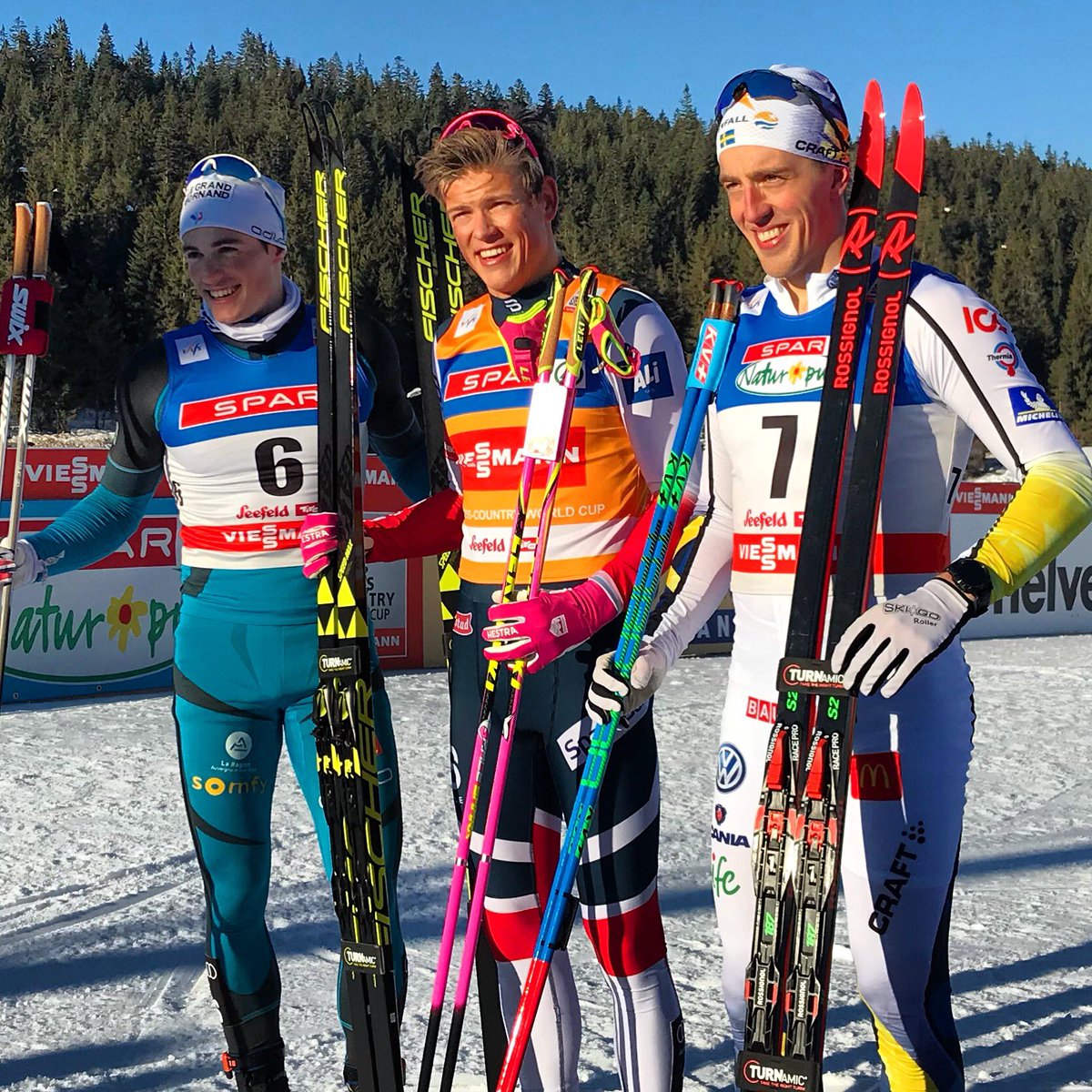
The men’s 1.4 k freestyle sprint podium at the World Cup in Seefeld, Austria, with Norway’s Johannes Høsflot Klæbo (c) in first, France’s Lucas Chanavat (l) in second and Sweden’s Calle Halfvarsson (r) in third. (Photo: FIS Cross Country/ Twitter)
The men raced 1.4 k, with Norway’s Johannes Høsflot Klæbo qualifying first in 2:46.89 then winning his quarterfinal and semifinal before putting the hammer down for one last time in the final, finishing first in 3:02.66.
France’s Lucas Chanavat placed second in the final, 0.48 seconds back, after qualifying sixth, winning his quarterfinal and placing second in the first semifinal (0.33 seconds behind Klæbo). Sweden’s Calle Halfvarsson took the third spot on the podium after finishing 0.97 seconds after Klæbo. Halfvarsson had previously qualified seventh, taken second in his quarterfinal and advanced as a lucky loser in third in the first semifinal (0.52 seconds behind Klæbo).
Italy’s Federico Pellegrino missed the podium in fourth (+1.06), Russia’s Gleb Retivykh placed fifth (+1.17), and Norway’s Emil Iversen was sixth (+5.57).
Canada’s Alex Harvey and American Simi Hamilton both made it to the semifinals, where they finished fourth and fifth, respectively, and did not advance to the finals. Harvey had qualified for the rounds in 22nd and won his quarterfinal, then raced in the second semifinal, where he finished fourth, 0.47 seconds behind Iversen in first. That put Harvey eighth overall on the day.
Hamilton clocked the fifth-fastest qualifying time, 6.46 seconds back from Klæbo’s top time. The U.S. Ski Team member then placed second to Pellegrino in his quarterfinal and was fifth in the first semifinal, 2.61 seconds behind Klæbo. Overall, Hamilton placed ninth.
Also for the U.S., Erik Bjornsen finished 37th in the qualifier, 0.89 seconds out of the top 30 and 11.99 second out of first, Logan Hanneman was 39th (+12.52), Andy Newell 42nd (+12.90), Reese Hanneman 65th (+17.91), and Ben Lustgarten 76th (+21.88).
Canada’s Len Valjas placed 40th (+12.72), Julien Locke 43rd (+13.31), Knute Johnsgaard 51st (+14.74), Bob Thompson 58th (+16.55), Graeme Killick 61st (+17.28), and Devon Kershaw 70th (+19.53).
France’s 22-year-old Chloé Chevalier racing to her second win and third podium of the week in as many individual races at 2018 IBU Open European Championships on Saturday in Ridnaun, Italy. (Photo: IBU/Biathlonworld)
IBU Open European Championships (Ridnaun-Val Ridanna, Italy): Men’s and women’s pursuits
France’s Chloé Chevalier picked up her second win and third podium of the week at the International Biathlon Union (IBU) Open European Championships on Saturday in Ridnaun, Italy, winning the women’s 10 k pursuit, while Russia’s Alexander Loginov rose to the top step of the podium in the men’s 12.5 k pursuit on Saturday.
Chevalier started the women’s pursuit in second, 13 seconds behind Ukraine’s Iryna Varvynets (who won Friday’s sprint and thus started first), and shot clean to take the lead after the third stage — where Varvynets missed one. Chevalier went on to clean the final stage for perfect 20-for-20 shooting and crossed the line first in 29:25.4. Varvynets finished second, 11.0 seconds back after missing a single target in the first standing (0+0+1+0), and France had two on the podium with Julia Simon in third (+43.2). Simon also shot 19-for-20, with her miss coming in the second prone stage (0+1+0+0).
“Three medals in three races is definitely more than I had expected,” Chevalier, 22, told the event’s organizers on Saturday. “Today I saw that Iryna shoots faster than I, and so I really gave my all in the track. Even if it might not look like it, after the many races in the last few days I am noticing that I am getting more and more tired.”
American Chloe Levins rose from 59th at the start to 42nd at the finish (+4:11.8), with three clean stages and two misses in the first standing (0+0+2+0). She had the 28th-fastest overall range time and 30th-ranked shooting time.
In the men’s pursuit, Loginov started first as Friday’s sprint winner Latvia’s Andrejs Rastorgujevs did not start. Loginov held the lead throughout the race despite two misses — one in the first stage and another in the last stage (1+0+0+1) — and secured the win in 32:22.1. Bulgaria’s Krasimir Anev started second, 19 seconds after Loginov, and held his place as well, shooting clean and finishing second, 27.6 second back.
“I am really happy here in Ridanna and the results reflect that,” Loginov, 25, told organizers. “Not to start in the individual event on Wednesday was the right decision because the last few days had been very demanding with six races in eight days. I am cross with my two errors in the shooting range, but very happy with my performance in the track.”
Russia had two on the podium with Evgeniy Garanichev in third (+1:10.7) after Garanichev started in bib 19 and overcame three penalties (1+0+2+0) with the fastest overall course time.
Canada’s Macx Davies started 27th and finished 35th (+4:33.9) with five misses (3+0+2+0), while American Alex Howe rose from 53rd at the start to 43rd (+5:53.5) with five penalties (2+2+1+0).
The 2018 Open European Championships conclude with the single mixed relay and mixed relay on Sunday. American Susan Dunklee and Lowell Bailey are on the start list for the single mixed relay, Canada’s Carsen Campbell and Sarah Beaudry. For the mixed relay, the U.S. has entered Levins, Maddie Phaneuf, Paul Schommer, and Alex Howe.
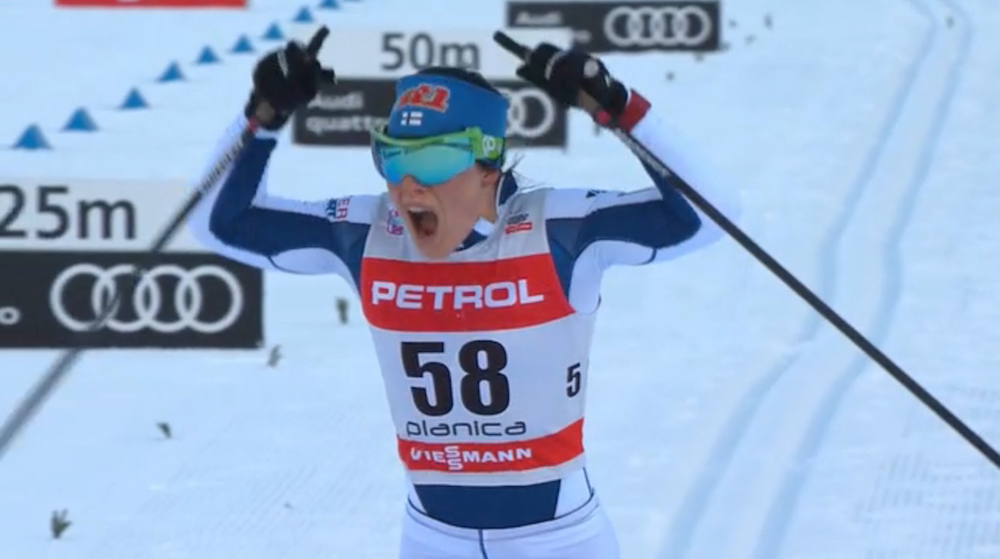
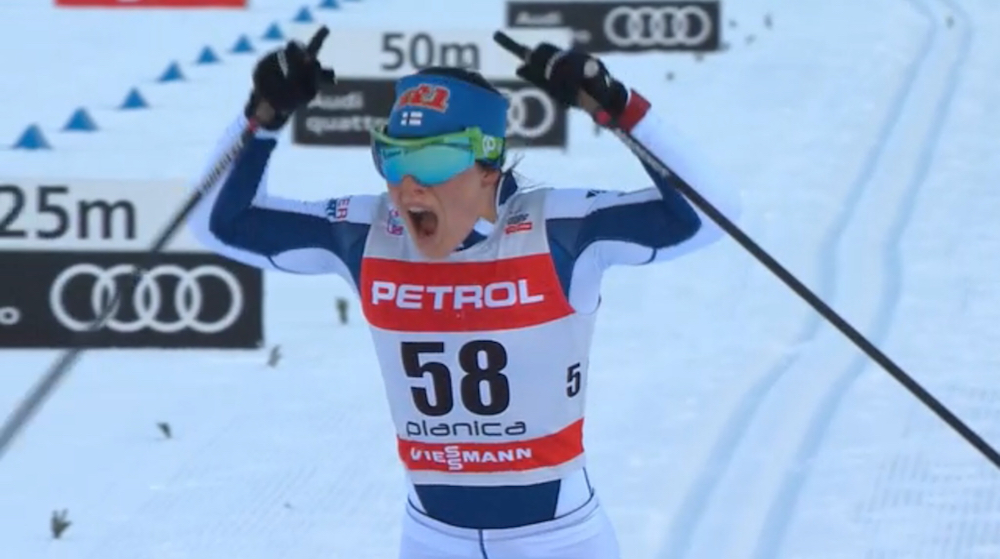
Finland’s Krista Pärmäkoski after winning her first non-stage World Cup on Sunday in the women’s 10 k classic in Planica, Slovenia. She bested Sweden’s Charlotte Kalla’s time by 3.6 seconds. (Screenshot: ARD broadcast)
FIS Cross Country World Cup (Planica, Slovenia): 10/15 k classic
Just when it looked like one of those Charlotte-Kalla days, Finland’s Krista Pärmäkoski swooped in and topped the Swede’s time by 3.6 seconds in the women’s 10-kilometer classic individual start on Sunday for her first-career outright World Cup win.
Outright meaning non-stage; Pärmäkoski has two World Cup wins to her name for setting the fastest time of day in 2016 pursuit races.
But Sunday’s 10 k in Slovenia saw her rising to the challenge and besting Charlotte Kalla’s time of 27:12.3, which was at least 39 seconds faster than the first 57 starters. Kalla had started 32nd and beat the previous top time set by Swedish U23 skier Ebba Andersson (bib 28) by 48.6 seconds.
Austria’s Teresa Stadlober started later in bib 56 and clocked the second-fastest time to Kalla, 39 seconds back.
But it was Pärmäkoski in bib 58 who beat them all. Even Norway’s Heidi Weng, who started 60th, couldn’t come close, as she finished 33.5 seconds off Pärmäkoski’s winning time for third place. That put Stadlober in fourth and Andersson in fifth at the end of the day.
Finland’s Kerttu Niskanen placed sixth (+49.4), Norway’s Kari Øyre Slind took seventh (+49.5), Poland’s Justyna Kowalczyk (who’s more of a marathon skier these days) placed eighth (+1:02.1), Norway’s Kathrine Rolsted Harsem (who placed second in Saturday’s classic sprint) finished ninth (+1:03.2), and American Jessie Diggins was 10th (+1:05.4).
Another American, Caitlin Patterson, of the Craftsbury Green Racing Project (CGRP), broke through with her second-best individual World Cup result in 20th (+1:45.2). (Last year, she finished seventh in the pre-Olympic PyeongChang World Cup 15 k skiathlon in a notably small field.)
Kikkan Randall (U.S. Ski Team) followed in 23rd (+1:50.4), and her teammates Sophie Caldwell placed 31st (+2:17.2), Liz Stephen 35th (+2:34.9), and Ida Sargent 37th (+2:37.5).
For the second-straight weekend, no Canadian women competed.
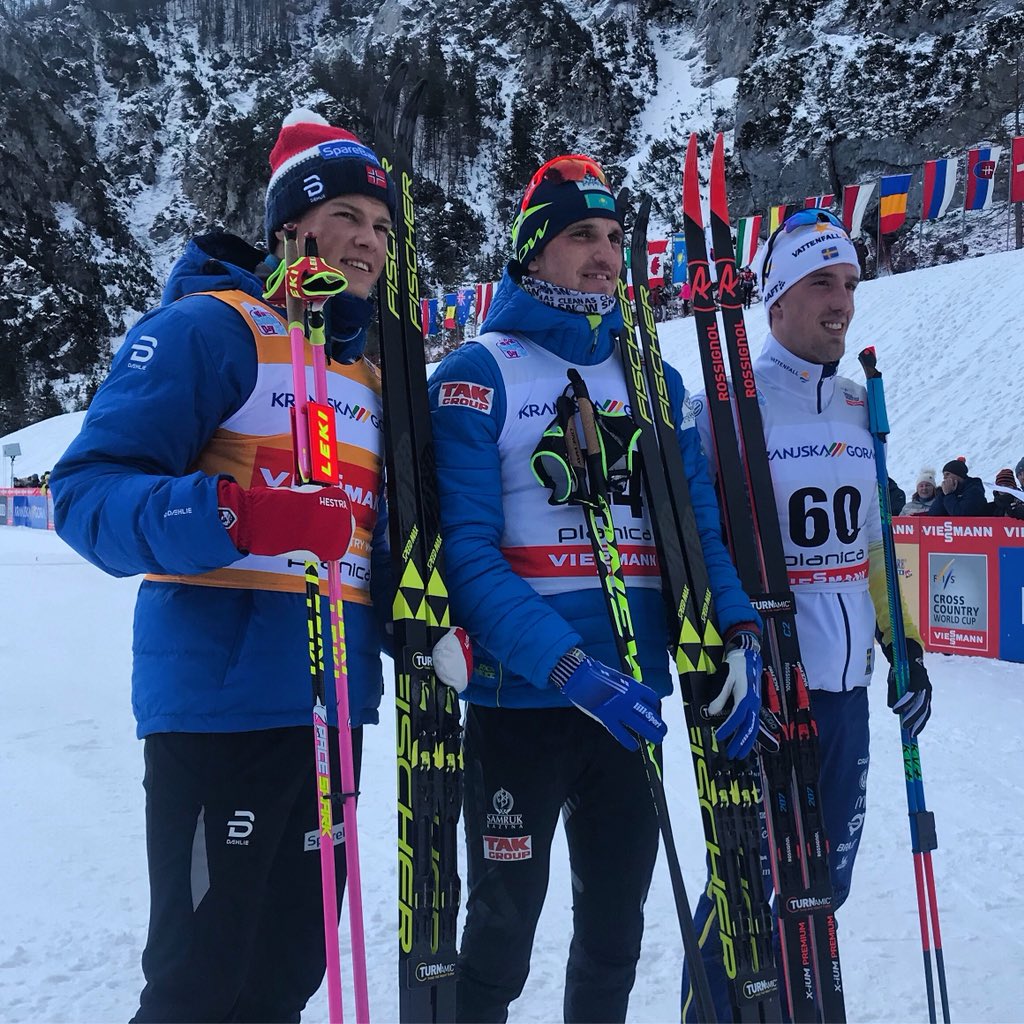
The World Cup men’s 15 k classic podium on Sunday in Planica, Slovenia, with Kazakhstan’s Alexey Poltoranin (c) in first, Norway’s Johannes Høsflot Klæbo (l) in second, and Sweden’s Calle Halfvarsson (r) in third. (Photo: FIS Cross Country/Twitter)
In the men’s 15 k classic, Kazakhstan’s Alexey Poltoranin tallied his second win of the season and first in a race against Norway’s Johannes Høsflot Klæbo on Sunday, winning by 13.2 seconds over Klæbo in 36:54.7.
Poltoranin, 30, started 44th and a minute behind the 21-year-old Klæbo. When Klæbo finished, he bumped Russia’s Ivan Kirillov, also 21, out of the leader’s chair by 43.3 seconds. Then Poltoranin finished 13.2 seconds faster, but Klæbo held onto second when Sweden’s 60th starter, Calle Halfvarsson, finished third (+42.8). It was Halfvarsson’s second podium of the season after placing third in the classic sprint at the November World Cup opener in Kuusamo, Finland. In Saturday’s classic sprint in Slovenia, Halfvarsson qualified second but crashed out of the quarterfinals to finish the day in 30th overall.
Norway’s Emil Iversen started 66th and ended up fourth (+54.7) and Kirillov scored his first World Cup top 10 in fifth (+56.5). Russia had four in the top 10 with Stanislav Volzhentsev in sixth (+57.8), Andrey Larkov in eighth (+1:02.2) and Andrey Sobakarev in ninth (+1:03.4). Norway’s Mattis Stenshagen finished seventh (+1:00.8) and Finland’s Iivo Niskanen took 10th (+1:10.1).
Scott Patterson (U.S. Ski Team) was the top North American in 43rd (+2:56.2), Ben Lustgarten (Craftsbury Green Racing Project) finished 46th (+3:04.9) and Tyler Kornfield (Alaska Pacific University) was 57th (+4:03.7). Andy Newell did not finish.
Canada’s Devon Kershaw returned to the circuit and placed 44th (+2:57.1), Bob Thompson (NTDC Thunder Bay) was 64th (+5:05.0), and Dominique Moncion-Groulx (Alberta World Cup Academy) was 70th (+6:11.7).
Russia’s Stefaniya Nadymova outsprinting Japan’s Ayane Miyazaki at the finish for the win at the inaugural women’s Nordic Combined Continental Cup competition on Saturday in Rena, Norway. (Photo: FIS/Romina Eggert)
FIS Nordic Combined Continental Cup (Rena, Norway): First-ever women’s competitions
Fourteen women, including American Gabriella Armstrong, made history this weekend by competing in the first women’s Nordic Combined Continental Cup in Rena, Norway (after the scheduled opener in Jan. 6-7 in Otepää, Estonia, was canceled), with back-to-back days of individual large hill/5-kilometer Gundersen start races.
On Saturday, Russia’s Stefaniya Nadymova took the win in 16:26.9, just 0.6 seconds ahead of Japan’s Ayane Miyazki in second. Germany’s Jenny Nowak joined them on the podium in third, 16.6 seconds out of first. Armstrong finished 12th (+6:24).
Nadymova, 23, had kicked off the event by jumping to first in the provisional round, which was used for the jumping results, and began the 5 k with a 10-second head start on Nowak in second place. Miyazaki jumped to third and started 14 seconds back. Armstrong jumped to 14th and started 4:08 out of first.
On Sunday, 15-year-old Miyazaki took the win in 16:23.2, swapping places with Nadymova, who finished second, 11.7 seconds back. Nowak, also 15, repeated in third, but finished over a minute and 21 seconds back out of first.
Miyazaki had jumped to first place earlier in the day and started the 5 k with a 20-second cushion to Nadymova in second. Nowak jumped to third and started 1:08 minutes back.
Armstrong, 19, of the New York Ski Education Foundation, jumped to 11th and finished 11th, 4:26.1 after Miyazaki.
Several U.S. Nordic Combined men also competed in Rena, with Taylor Fletcher placing fourth in Saturday’s individual large hill/10 k, 2.7 seconds behind Austria’s Thomas Joebstl in first. Fletcher had skied up from 25th and 2:17 back after the jump with the second-fastest course time.
Also for the U.S., Adam Loomis placed 33rd (+2:30.7) after jumping to 45th with the 12th-fastest course time. Grant Andrews finished 41st (+3:28.7), and Jared Schumate 43rd (+4:10.1).
Fletcher reached the podium in Sunday’s individual large hill/10 k in third behind two Austrians. After jumping to 19th, he skied the fourth-fastest course time to finish third, 3.7 seconds behind Dominik Terzer in first and 2.7 seconds behind Martin Fritz in second.
Loomis improved to 29th (+1:40.9), up from 35th in the jump, and Andrews finished 37th (+2:36.4) and Shumate 40th (+2:57.9).
The men’s large hill/4 x 5 k team event podium on Sunday at the Nordic Combined World Cup in Chaux-Neuve, France, with Norway (c) in first, Germany (l) in second, and Finland (r) in third. (Photo: FIS/NordicFocus)
FIS Nordic Combined World Cup (Chaux-Neuve, France): Saturday & Sunday
Four American men competed at the Nordic Combined World Cup this weekend in Chaux-Neuve, France, with three of them racing in Saturday’s individual large hill/10 k Gundersen and all four racing Sunday’s large hill/4 x 5 k team event.
Norway’s Jan Schmid was the big winner this weekend, racking up an individual win on Saturday and a team victory on Sunday. He won Saturday’s competition after jumping to fourth and starting 27 seconds behind jump leader Akito Watabe of Japan. Schmid worked his way up to first in the 10 k with the third-fastest course time, crossing the line 1.4 seconds ahead of Watabe in 23:32.7.
Watabe finished second and Finland’s Ilkka Herola placed third (+21.5), just ahead of Austria’s Lukas Klapfer in fourth (+21.8).
Ben Loomis led USA Nordic in 37th (+2:49), after jumping to 37th, Stephen Schumann finished 45th (+5:17.0) and Ben Berend 46th (+5:22.2).
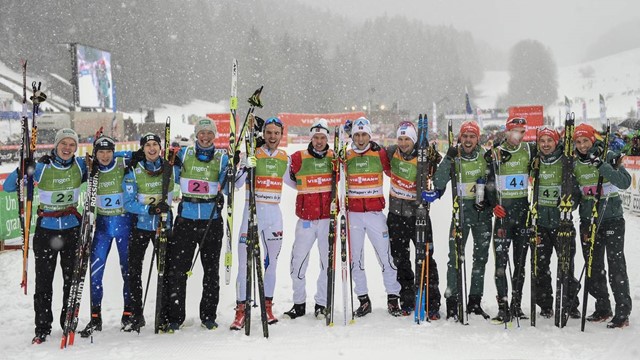
On Sunday, Schmid teamed up with Espen Andersen, Jarl Magnus Riiber and Jørgen Graabak to win the 4 x 5 k team event in 47:22.5 by 13.1 seconds. Germany followed in second, with Eric Frenzel, Fabian Rießle, Johannes Rydzek, and Vinzenz Geiger, and Finland placed third (+20.5) with Leevi Mutru, Arttu Maekiaho, Herola, and Eero Hirvonen.
Norway had led after the jump and started the relay 1:03 minutes ahead of Finland in second. France jumped to third and ended up fourth (+47.4), after being passed by Germany, which had started the relay in fourth.
Japan placed fifth (+2:50.9), Italy sixth (+3:59.9), Austria seventh (+4:06.8), Poland eighth (+5:22.1), Estonia ninth (+5:52.1), Russia 10th (+6:41.2), and the U.S. (with Schumann, Loomis, Berend, and Jasper Good) 11th (+6:52.4).
Western Canadian Championships (Red Deer, Alberta): Relays
Nine men’s teams and six women’s squads contested the open relays on the last day of the NorAm Western Canadian Championships on Sunday in Red Deer, with Ontario’s Team “O” (Scott Hill, Michael Somppi and Andy Shields) winning the men’s 3 x 5 k and Alberta 1 (Annika Hicks, Emma Camicioli and Zina Kocher) winning the women’s 3 x 5 k.
For Shields and Hicks, it was their second win of the weekend after they won their respective classic mass starts on Saturday.
Team “O” posted a 19.9-second win over B.C. Storm (Remi Drolet, Tallon Noble and Greg Kilroy), finishing first in 36:22.6. Alberta 5.1 (Sebastien Boehmler-Dandurand, Sam Hendry and Russell Kennedy) placed third (+52.3).
In the women’s relay, Alberta 1 beat out B.C. Fast, Furious & Freakin’ Awesome (Katie Weaver, Michaela McLean and Kaia Andal) by 2 minutes and 37.8 seconds, winning in 43:17.2. Alberta had two teams on the podium with the Kit Kats (Ember Large, Molly Jane Strum, and Sara McLean) in third (+4:25.8).
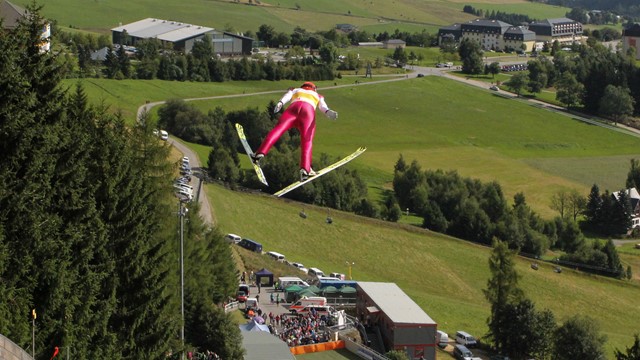
A skier flying during the FIS Nordic Combined Summer Grand Prix 2017 in Oberwiesenthal, Germany. (Photo: FIS)
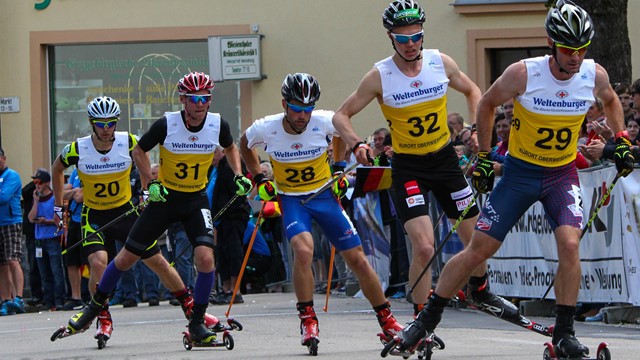
Green grass, plastic jumping surfaces, big jumps, sunshine, rollerskis and no snow means one thing. It’s August in Europe and it’s time for the International Ski Federation (FIS) Nordic Combined Summer Grand Prix 2017.
Last weekend Aug. 19-20, Oberwiesenthal, Germany hosted a two-day Grand Prix event.
Day 1 featured a two-person team event with the requisite jump and 2 x 7.5-kilometer cross-country race to determine the winners.
Czech Republic’s first team (Czech Republic I), comprised of Tomas Portyk and Dvorak Miroslav, won the team competition in 28:52.9 after starting fourth, 11 seconds behind first. Germany I’s Fabian Rießle and Eric Frenzel raced to second (+0.3), and Germany II’s Jakob Lange and Vinzenz Geiger placed third (+11.2).
The U.S. had two teams entered. Bryan Fletcher and Taylor Fletcher (U.S. II) placed 12th (+2:37.0) while Jasper Good and Ben Berend (U.S. I) finished 14th (+3:03.5).
Day 2 of racing was an individual normal hill/10 k Gundersen start.
Austria’s Mario Seidl claimed the win in 25:18.5 after jumping to first and starting the 10 k four seconds ahead of Japan’s Akito Watabe in second. Germany’s Frenzel raced from ninth to second (+10.5), after starting 46 seconds after Seidle. Rießle finished third (+12.3), up from fifth in the jump, while Watabe narrowly missed the podium in fourth (+14.2).
Bryan Fletcher (29) during this weekend’s Summer Grand Prix in Oberwiesenthal, Germany. He finished in 20th in Sunday’s individual normal hill/10 k event. (Photo: FIS)
Four U.S. skiers competed on Sunday, and Taylor Fletcher led them at the end of the day in 11th (+1:17.6) after jumping to 33rd and starting 2:01 minutes behind Watabe. Bryan Fletcher finished 20th, Berend 33rd, and Good 34th.
In an Instagram post, Taylor Fletcher described his first individual race of the series.
“First individual race in the books. I had a decent jump in a hard competition,” he wrote. “I started 33rd and ended up finishing 11th. I had a lot more to give but I thought I had another lap (I wish we did) before the coach said this was the last lap. Now @USAnordic is on the way to the next leg ready for another crack at it!!”
The Summer Grand Prix continues Aug. 23 with another normal hill/10 k in Tschagguns, Austria, and concludes in Oberstdorf, Germany, with back-to-back large hill/10 k competitions Aug 25-26.
The U.S. women’s relay after taking a historic third in the 4 x 3.3 k relay at 2017 Junior World Championships on Sunday at Soldier Hollow in Midway Utah, with (from left to right) Hailey Swirbul, Katharine Ogden, Julia Kern, and Hannah Halvorsen. (Photo: FlyingPointRoad.com)
For fans of North American skiing, some of the last races of U23 and Junior World Championships at Soldier Hollow in Midway, Utah, proved beyond captivating, surpassing most expectations and previous results.
But for the U.S. junior women’s relay, a group of four that had set a goal two years ago at a U.S. development training camp, the podium was exactly where they had envisioned themselves.
Relay bronze
Hailey Swirbul, Julia Kern, Hannah Halvorsen, and Katharine Ogden went out and achieved that very goal on Sunday, racing to third in the 4 x 3.3-kilometer relay on the final day of Junior Worlds.
According to Ogden, who became the first American to capture an individual bronze two days earlier in the women’s 10 k skiathlon, the foursome were at a camp two years ago in Lake Placid, N.Y., when they walked into a store together. In the 1980 Olympic village, they found red-white-and-blue tube socks — just like the socks the U.S. Ski Team women wear in World Cup team events — on sale. They each bought a pair and made a goal of wearing them together in the relay at World Juniors.
“The four of us have a group message, and it wasn’t unusual to open that message and see a note from someone who just couldn’t contain their excitement for this relay and had to share it with the rest of us… and this was up to two years ago!” Swirbul explained in an email. “We didn’t just think or hope we were capable of this result, I think we all KNEW we could do it deep down. It was kind of surreal to wake up on the morning of the race and think, ‘Today is the day, this is what we have been waiting for for so long! Let’s do this.’ ”
So just by getting to the relay start line on Sunday, they achieved their goal. But they knew they were capable of a top, even best-ever, result.
Hailey Swirbul tucking into the stadium as the first skier on the U.S. women’s 4 x 3.3 k relay team at 2017 Junior World Championships at Soldier Hollow in Midway, Utah. (Photo: FlyingPointRoad.com)
Swirbul started the team off by skiing to eighth in the first classic leg.
“My leg of the race started out fast — exactly what I had expected going into it,” Swirbul wrote. “The first kilometer flew by, and before I knew it, I was cresting the peak of the biggest climb of the course with legs that felt like they were made of lead! I tried to stretch them out on the downhill and hung onto the girls around me through the rolling last kilometer of the race. That 3k was tough!!”
She tagged off to Kern, who moved the team into sixth by the race’s halfway point. Kern came down with a cold last Wednesday and sat out Friday’s skiathlon to rest of for the relay.
“I was feeling a lot better today but definitely not 100% healthy,” Kern wrote in an email. “My goal was to go out and ski the best leg I could and fight hard to the finish because every second counts. I wasn’t really nervous until I was hanging around in the start pen waiting to see Hailey throw down a strong first leg. I was most nervous that I wouldn’t be able to ski well since I am not completely healthy and let the team down.”
She focused on skiing strong over the second half of the course, “since it played my strengths and I knew people would be hurting at the point,” Kern wrote. She tagged Halvorsen in sixth, about 25 seconds out of third and 45.5 seconds behind Italy in first.
Skiing the first skate leg for the U.S., Halvorsen focused on third place. She attacked on the climb known as “Horseshoe Hill”, passing Sweden and France to take that position, but France’s Laura Chamiot-Maitral passed her back on the downhill.
After the race, Halvorsen told the U.S. Ski Team media that she had learned a lot about pacing the 3.3 k after placing 13th in the 5 k freestyle earlier in the week (following Ogden, who fifth).
“I realized I just needed to trust myself and not start so fast — just be calm and slowly catch up,” she said.
The final exchange of the 4 x 3.3 k relay, with Americans Hannah Halvorsen (second from left) before tagging Katharine Ogden (l) in fourth, right behind France (6) in third. (Photo: FlyingPointRoad.com)
Halvorsen tagged Ogden in fourth at the final exchange, just 2.1 seconds out of third.
“I knew that no matter what, I needed to catch up to third place,” Ogden reflected in an email. “I honestly didn’t even think about pacing myself and just went hard from the tag.”
On the long, sustained climb on the backside of the 3.3 k loop, Ogden passed France’s Lena Quintin to move into third. As she soared down the other side, within view of her teammates, Ogden continued to push the pace to lock up third.
“I know Katharine’s technique really well so when I spotted a black dot skiing along I knew it could only be Katharine,” wrote Kern, Ogden’s teammate for the last two seasons at the Stratton Mountain School (SMS) in Vermont. Kern, Ogden and Halvorsen are all members of the U.S. Ski Team (USST) development “D” team.
“I waited a few more seconds but still no one came and I knew she had third locked in!” Kern wrote.
“I was crying when I saw her all alone,” Swirbul told the USST.
“I came into the finish and saw the team standing there cheering for me and it was an incredibly special moment,” Ogden reflected.
She finished third, 25.8 seconds behind Russia in first and just 5.2 seconds behind Italy in second. France’s Quintin finished about 40 seconds later in fourth. The bronze was the first for a U.S. women’s relay at Junior Worlds.
The first U.S. women’s team to podium at Junior World Championships: (from left to right) Hailey Swirbul, Katharine Ogden, Hannah Halvorsen, and Julia Kern, after placing third in the 4 x 3.3 k on Sunday at 2017 Junior World Championships at Soldier Hollow in Midway, Utah. (Photo: FlyingPointRoad.com)
“This week at worlds has been amazing,” wrote Ogden, 19, who left the championships with two bronze medals in her final year of Junior Worlds eligibility. “Wonderful skiing and good weather and unprecedented results for the whole team…”
“It was really incredible to stand up at the medals ceremony the other night,” she told the USST. “The only thing I can think of that would be better is standing up there with my friends.”
“This has been a dream for us for more than two years,” Swirbul, and 18-year-old University of Alaska Anchorage freshman, told the USST. “To see that dream come true — I was crying, happy, hugging and screaming — all in one emotion.”
“I was so happy but not in shock — because I knew we could do it,” Halvorsen, 18, of the Sugar Bowl Academy, told the USST.
Halvorsen, of Truckee, Calif., brought her little sister up on the podium with her.
“After having my whole family here: parents, grandparents, four brothers, and baby sister, it was special to bring the littlest one up to the podium,” Halvorsen wrote in an email.
“There is no one I would rather be on the podium with than my best friends and teammates,” Kern, 19, wrote. “Not only did I share the experience with my best friends, but on home soil with all my family and friends there to celebrate with us!
“I am just proud of our team because everyone skied so well and brought their A game today,” Kern continued. “And to have [USST development coach] Bryan Fish there to help us make it happen was amazing because he has worked so hard to help us become the fastest skiers we can be and this has always been a dream of his as well!”
“I am so lucky to be in this generation with these tough competitors that double as amazing teammates, and I think our country is just getting started with more exciting results to come!” Swirbul wrote.
Russia took the lead on the third leg and stayed ahead of Italy for gold, finishing first in 34:45.3 minutes, with Polina Nekrasova, Lidia Durkina, Anna Zherebyateva, and Mariya Istomina. Italy secured second (+20.6) with Martina Bellini, Anna Comarella, Francesca Franchi, and Christina Pittin, while France was fourth (+1:05.0) with Juliette Ducordeau, Flora Dolci, Chamiot-Maitral, and Quintin. Sweden finished fifth (+1:20.3), and Canada placed 12th (+4:41.3) of 12 teams, with Natalie Hynes, Lisle Compton, India McIsaac, and Annika Richardson.
In the junior men’s 4 x 5 k relay that followed, Norway eked out the win over Russia by 0.4 seconds, with Herman Martens Meyer, Jon Rolf Skamo Hope, Harald Østberg Amundsen, and Thomas Helland Larsen, in 49:36.1. After the first leg, which Germany’s classic-sprint winner Janosch Brugger led, the race was a Norway-Russia battle for first, with Russia leading through the second and third exchanges before Larsen outlunged Vladislav Vechkanov at the finish.
Russia took silver with Vechkanov, Egor Kazarinov, Kirill Kilivnyuk, and Yaroslav Rybochkin, ahead of France, which skied most of the race in third in finished in that position (+1:05), with Martin Collet, Camille Laude, Hugo Lapels, and Arnaud Chautemps.
Of 12 teams, the U.S. finished ninth (+4:28.8) with Bill Harmeyer, Kam Husain, Wyatt Gebhardt, and Hunter Wonders, after skiing in sixth during the first two classic legs, then slipping to ninth on the third leg.
Canada followed in 10th (+5:21.6), with Antoine Blais, Ryan Jackson, Philippe Boucher, and Gareth Williams, after skiing in ninth for the first two legs.
Paddy Caldwell switching to skate skis during the halfway point of the men’s 30 k skiathlon on Jan. 4 at 2017 U23 World Championships at Soldier Hollow in Midway, Utah. (Photo: FlyingPointRoad.com)
The day before, in the last races of U23 World Championships on Saturday, American Paddy Caldwell matched his personal best from two days earlier in the 15 k freestyle, placing ninth in the men’s 30 k skiathlon.
Caldwell had been 10th at the ski change halfway through the race, following his U.S. teammate Jack Hegman in ninth by half a second.
Paddy Caldwell, of the Stratton Mountain School and U.S. Ski Team, racing to ninth in the men’s 15 k freestyle at 2017 U23 World Championships at Soldier Hollow in Midway, Utah. (Photo: U.S. Ski Team/Tom Kelly)
“Starting off in the classic leg I was trying to stay relaxed and maintain position,” Caldwell wrote in an email. “For the first half of the classic I was at the tail end of the lead group then started to lose some time over the last part of the classic.”
He and Hegman started skiing together about 8 k into the 15 k classic leg, and remained together for most of the rest of the race. At the transition, they were about 44 seconds behind eighth place and 13 seconds ahead of 11th.
“I was really struggling with breathing during the classic leg so I tried to relax for the first part of the skate leg and maintain our position,” Caldwell wrote. “We put in a surge on the second lap of the skate to try to catch the group ahead of us (5th-8th) but they were just out of contact. On the last lap I put in one last push early on to break away from the French skier in 10th and got just far enough ahead to hold him off on the last climb before the long decent into the stadium.”
With the sixth-fastest skate leg, Caldwell (SMS/USST D-team) finished ninth, 9.2 seconds ahead of France’s Jean Tiberghien in 10th. Nearly 20 seconds after Tiberghien, Hegman finished 11th (+1:53.5) for a career best at his first U23 Worlds.
American Jack Hegman (SVSEF) racing to 24th in the men’s 15 k freestyle on Feb. 2 at 2017 U23 World Championships at Soldier Hollow in Midway, Utah. (Photo: FlyingPointRoad.com)
“I think I am slightly better at skating, but felt really good about my classic skiing today,” Hegman, of the Sun Valley Ski Education Foundation (SVSEF) Gold Team, wrote in an email. “ I think I was able to gain some good time on the classic portion and then hold on in the skate. In the skate portion I tried to follow Paddy as long as I could and conserve energy. I lost quite a bit of time in the last 2k but thankfully didn’t lose too many places.”
“For the entire skate leg, when I realized I was in the top 12, all I was thinking about was holding onto that top 12 position,” Hegman wrote.
The two led three U.S. men in the top 15, with Adam Martin (Northern Michigan University) not far behind in 15th (+2:23.3). For Martin, it was his first skiathlon in three years (he finished 40th in the 20 k skiathlon at 2014 Junior Worlds in Val di Fiemme, Italy).
Adam Martin (Northern Michigan University) racing to 15th in the men’s 30 k skiathlon on Saturday at 2017 U23 World Championships at Soldier Hollow in Midway, Utah. It was his first top 20 in two U23 Worlds. (Photo: FlyingPointRoad.com)
“I wanted to go out hard enough to establish a decent position, but also wanted to conserve sufficient energy to ski a strong back end of the race,” Martin wrote of Saturday’s eight-lap race.
He skied most of it with the Czech Republic’s Petr Knop, who ultimately finished 14th, 1.4 seconds ahead of Martin.
“Sometimes I was following, and sometimes I led and tried to catch up to the skiers in front of us,” Martin wrote.
“I’ve never been top 20 at one of these competitions before, so top 15 is cool,” he added. “I think I’ve had very decent races this week!”
“It is awesome to see three of us in the top 15 today,” Hegman wrote. “I think having the momentum from this week with so many good performances helped us quite a bit today. Also our skis were awesome today (and all week).”
“I am really happy with my results all week,” wrote Caldwell, who notched top 20’s in all three races, including 18th in the classic sprint to start the championships. “It was an amazing week of racing for USA and I was really happy to end on a high note.”
Russia swept the men’s 30 k skiathlon podium with Alexander Bolshunov, Alexey Chervotkin, and Denis Spitsov, respectively, after the three skied together for most of the race, well ahead of France’s Jules Lapierre and Switzerland’s Jason Rueesch in pursuit of them. As the Russians descended down the final hill — clear of any outside contenders for the podium — they locked arms and coasted into the stadium together. Just before the finish line, they stopped to cross as one.
According to a USST press release, the competition jury had to review timing and scoring records, as well as consult photo assets and the finish referee to determine who finished first, second and third. Gold went to Bolshunov, who also won the 15 k freestyle two days earlier, with an official finish time of 1:15:31.5 hours. Chervotkin was listed as second (+0.2) and Spitsov third (+0.5).
Lapierre crossed 11 seconds later in fourth, about three seconds ahead of Rueesch in fifth (+14.3).
Evan Palmer-Charrette (NTDC Thunder Bay) led the Canadian men in 26th (+5:44.6). Alexis Dumas of the Pierre Harvey National Training Centre (CNEPH) finished 33rd (+9:02.7) out of 36 finishers. Several North Americans did not finish, including Canada’s Julien Lamoureux and Julien Smith, and American Cal Deline.
In the U23 women’s 15 k skiathlon earlier on Saturday, Canada had three in the top 30, with Dahria Beatty (Alberta World Cup Academy/Canadian National U25 Team) in 19th (+2:18.1) for her third top 20 of the week. Katherine Stewart-Jones (NTDC Thunder Bay/NST U25 Team) placed 21st (+2:29.3) for her best result at U23 Worlds, and Frederique Vezina (CNEPH) notched a personal-best 29th (+3:36.2). The team’s fourth skier, Jenn Jackson, did not finish.
Jesse Knori, of the University of Colorado-Boulder (CU) led the U.S. women in 30th (+3:40.1). Alayna Sonnesyn (University of Vermont) followed in 31st (+3:42.5), Nichole Bathe (University of Alaska Fairbanks) was 33rd (+4:36.9), and Corey Stock (Bridger Ski Foundation) 36th (+5:42.1).
Another CU skier, Petra Hyncicova, who raced for her native Czech Republic, placed 22nd (+2:30.7) for her second-best result of the week after placing 20th in the classic sprint.
Norway’s 19-year-old Lotta Udnes Weng won the 15 k skiathlon for her first gold of U23 Worlds, finishing in 40:50.9 minutes and besting Finland’s Johanna Matintalo by 3.8 seconds. Russia’s Yana Kirpichenko captured third (+13.9), edging Weng’s twin sister, Tiril Udnes Weng in fourth (+15.6).
“On paper, this is not my best distance,” Lotta Weng, a six-time Junior Worlds medalist, told the USST. “But I knew I could do well in both classic and skate, and that if I had a really good day, I could ski for a gold medal … I knew I would have a good sprint and I was just trusting it.”
American Ben Loomis (10) racing to a career-best ninth in the individual normal hill/5 k competition on Feb. 4 at Nordic Combined Junior World Championships at Soldier Hollow in Midway, Utah. (Photo: U.S. Ski Team/Tom Kelly)
Ninth for Loomis
Also on Saturday, in the last individual competition of nordic-combined Junior Worlds, 18-year-old American Ben Loomis notched his first top 10 in his third Junior Worlds appearance.
Loomis started the day by jumping to 10th on the normal hill at Utah Olympic Park in Park City, his home training base. That put the U.S. Nordic Combined skier 58 seconds out of first and 11 seconds behind Finland’s Arttu Mäkiaho in ninth for the start of the 5 k race at Soldier Hollow. While Loomis didn’t catch Mäkiaho (who raced to second place for his second-straight individual medal after winning the normal hill/10 k to start the week), Loomis picked off one place to finish ninth, 1:22.3 minutes behind the winner, Germany’s Vinzenz Geiger.
“My goals for the 5k competition were to jump into the top ten, and to not lose any ground during the race,” Loomis wrote in an email. “I was able to do this, but was still hoping for a higher finish.”
He explained that a snow flurry during the jumping competition left the last 20 starters on the hill waiting for it to pass. Loomis was the fourth-to-last to jump, out of 49 starters.
“I was able to stay relaxed, focused and have my best competition jump of the week,” he explained. “The home hill advantage made a huge difference in my jumping. Prior to this week, I had little jumps on the hill this winter. Luckily, I know the hill well and was able to get in rhythm with the jump very quickly.”
Considering his starting position in the 5 k, which is half the distance of the usual 10 k in nordic-combined competitions, Loomis said he knew he needed to move up quickly, but do so in a controlled manner.
“5 k really places a big importance on the jumping,” Loomis told the USST. “It’s a lot harder to make up time, and these Europeans are really quick.”
He paced his first 2.5 k, and by the second lap, he worked with Norway’s Lars Ivar Skaarset — who had caught Loomis after starting 12th — to rein in Slovenia’s Matevz Malovrh, who started fourth and was fading. While Skaarset finished 17.4 seconds ahead of Loomis for eighth place, they both beat Malovrh, who placed 10th, 1.8 seconds behind Loomis.
“Overall, I am very happy with my 9th place result. I was hoping for a little more, but to be 9th in the world is very special,” Loomis wrote. “I am already looking forward to next year’s competitions and approaching them with even more experience.”
Earlier in the week, Loomis placed 18th in the normal hill/10 k and skied the third leg of the men’s 4 x 5 k team event, in which the U.S. placed seventh (with Elijah Vargas, Grant Andrews, Loomis, and Stephen Schumann). After Vargas tagged Andrews in 10th, Andrews skied them into ninth, and Loomis brought the U.S. up to seventh, which Schumann held during the final leg.
The U.S. had two in the top 15 on Saturday, with Schumann in 15th (+1:44.3), up from 20th after the jump. Grant Andrews placed 33rd (+2:40.0) and Tucker Hoefler finished 46th (+3:56.9).
Geiger won Saturday’s normal hill/5 k after jumping to first then starting with a 4-second lead over Japan’s Yuto Nakamura in second. Mäkiaho passed seven people to finish second, 22.6 seconds after Geiger, who won in 12:14.9 minutes. France’s Laurent Muhlethaler started fifth and captured third (+23.9), while Nakamura missed the podium in fourth (+42.8).
“It’s great to be on top of the podium today, after the 10k it was so hard for me due to some illness and an injury after I fell at the World Cup in Chaux Neuve,” Geiger said. “It just feels amazing to be Junior World Champion now.”
The Russian men finishing in unison to take first, second and third in the men’s 30 k skiathlon, the final race of 2017 U23 World Championships at Soldier Hollow in Midway, Utah. Alexander Bolshunov (8) was deemed the winner, Alexey Chervotkin (1) was second, and Denis Spitsov (11) third. (Photo: FlyingPointRoad.com)
FIS Nordic Combined Junior World Championships (Park City and Midway, Utah): Normal hill/5 k
American Ben Loomis (6) leads Norway’s Lars Ivar Skaarset (7) during the third leg of the nordic-combined 4 x 5 k team event on Thursday at 2017 Nordic Junior Worlds at Soldier Hollow in Midway, Utah. Loomis brought the U.S. from ninth to seventh, and his team ultimately finished seventh. (Photo: FlyingPointRoad.com)
[UPDATED] In the individual normal hill/5-kilometer Gundersen on Saturday, the last nordic-combined competition of 2017 Nordic Junior World Championships, American Ben Loomis captured his first top 10 in his third Junior Worlds in ninth place.
Eighteen-year-old Loomis jumped to 10th then picked off one place in the 5 k to finish ninth, 1:22.3 minutes behind the winner, Germany’s Vinzenz Geiger.
Geiger led after the jump and started the ski race 4 seconds ahead of Japan’s Yuto Nakamura in second. Geiger was able to hold off Finland’s hard-charging Arttu Mäkiaho, who raced from ninth to second, by 22.6 seconds. France’s Laurent Muhlethaler raced from fifth to third (+23.9) for the final spot on the podium, while Nakamura slipped to fourth (+42.8).
The U.S. had two in the top 15 with Stephen Schumann in 15th (+1:44.3), up from 20th after the jump. Grant Andrews placed 33rd (+2:40.0) and Tucker Hoefler finished 46th (+3:56.9).
FIS Nordic U23 World Championships (Midway, Utah): 15/30 k skiathlon
It was a Russian affair and a head scratcher for the photo-finish crew at U23 World Championships on Saturday, with three Russians putting enough time on the rest of the field in the men’s 30-kilometer skiathlon that they had time to slow to a stop and inch across the line in unison.
The jury ultimately had to decide who won, awarding it to Alexander Bolshunov in 1:15:31.5 hours, 0.2 seconds ahead of Alexey Chervotkin in second. Denis Spitsov was listed as third (+0.5). France’s Jules Lapierre came closest to the Russians in fourth, finishing 11 seconds later.
The field was considerably strung out by the end of the race, with Switzerland’s Jason Rueesh finishing 14.3 seconds out of first in fifth and Norway’s Gaute Kvaale crossing the line in sixth (+33.0), ahead of France’s Valentin Chauvin in seventh (+49.1), and Andorra’s Irineu Esteve Altimiras in eighth (+56.8).
American Paddy Caldwell (SMS/USST) placed ninth for the second-straight race at U23s, finishing 1:24.4 behind the winner.
The U.S. men had three in the top 15 for their best day of the championships, with John Hegman (SVSEF) placing a 11th (+1:53.5) and Adam Martin (NMU) 15th (+2:23.3) for their best results at U23 Worlds.
Evan Palmer-Charrette (NTDC Thunder Bay) led the Canadian men in 26th (+5:44.6). Alexis Dumas (CNEPH) finished 33rd (+9:02.7) out of 36 finishers. Several North Americans did not finish, including Canada’s Julien Lamoureux and Julien Smith, and American Cal Deline.
In the women’s 15 k skiathlon, Lotta Udnes Weng achieved her first gold of U23 Worlds, holding off Finland’s Johanna Matintalo by 3.8 seconds and crossing the line in 40:50.9 minutes. Russia’s Yana Kirpichenko reached the podium in third (+13.9), fewer than two seconds ahead of Weng’s twin sister, Tiril Udnes Weng in fourth (+15.6).
Dahria Beatty, of the Alberta World Cup Academy and Canadian National U25 Team, led the North Americans in 19th (+2:18.1), and teammate Katherine Stewart-Jones (NTDC Thunder Bay/NST U25 Team) was 21st (+2:29.3) for her best U23 Worlds result.
The Czech Republic’s Petra Hyncicova (University of Colorado-Boulder) followed in 22nd (+2:30.7), and three Canadian women finished in the top 30 with Frederique Vezina (CNEPH) in 29th (+3:36.2). Jenn Jackson did not finish.
Jesse Knori (University of Colorado-Boulder) was the top American in 30th (+3:40.1), Alayna Sonnesyn followed in 31st (+3:42.5), Nichole Bathe (University of Alaska Fairbanks) in 33rd (+4:36.9), and Corey Stock (Bridger Ski Foundation) in 36th (+5:42.1).
Mathilde Petitjean, who races for her native Togo but trains with the Quebec-based CNEPH, finished 38th (+6:04.8) of 38 finishers.
FIS Cross-Country World Cup (PyeongChang, South Korea): 15/30 k skiathlon
The women’s 15 k skiathlon podium at the PyeongChang World Cup in South Korea, with Poland’s Justyna Kowalczyk (c) in first, American Liz Stephen (l) in second, and Japan’s Masako Ishida in third. (Photo: FIS Cross Country/Twitter)
The second day of World Cup racing in PyeongChang, South Korea, took place this Saturday, with a skiathlon event for both genders. The women raced a total of 15 kilometers, the first 7.5 k leg classic and the second 7.5 k leg freestyle. Poland’s Justyna Kowalczyk came away with the women’s win (her first in three years), getting back to her old ways of breaking away from the pack to finish first in 43:54.7 minutes. Liz Stephen of the U.S. Ski Team (USST) claimed second place (+56.0), while Japan’s Masako Ishida took third (+1:14.8).
For Stephen, second matched her best individual result in a from two years ago, when she placed second in a 10 k freestyle in Rybinsk, Russia. This year at the Tour de Ski, Stephen posted the second-fastest time up the final climb in Val di Fiemme, Italy. For Ishida, it was her first podium since 2009.
Caitlin Patterson, racing for the U.S., finished just off the podium with a career-best fourth (+1:21.4) for her first top 20 on the World Cup, and American Liz Guiney placed 13th (2:21.7) for her first top 20 as well. Jessica Yeaton, who trains with Alaska Pacific University and races for Australia, came in 24th (4:58.6).
Two Canadian women competed with Annika Hicks leading the team in 26th (+5:17.8) followed by Sadie White in 29th (+6:54.7) for their first World Cup top 30s.
In the men’s 30 k skiathlon that followed, Russia’s Petr Sedov broke away during the skate leg to take a decisive victory over Norway’s Daniel Stock and Mathias Rundgreen, finishing in 1:18:49.6 hours, 22.5 seconds clear of second place. It was Sedov’s first World Cup win and podium, and the first individual podiums for Stock and Rundgreen as well.
Rundgreen edged Russia’s Konstantin Glavatskikh for the final spot on the podium, with both being listed as 42.1 seconds behind Sedov.
While Rundgreen held off three others for third place, including Sweden’s Gustav Eriksson in fifth (+46.8), Japan’s Keishin Yoshida in sixth (+47.1), and Russia’s Alexander Utkin in seventh (+49.0), American Noah Hoffman kept his distance ahead of the second chase group to finish eighth (+1:06.2) for his best result in a non-World Cup stage since placing eighth in a 2012 skiathlon in Canmore, Alberta. (Hoffman won the time of day in the 15 k pursuit four years ago in Kuusamo, Finland.)
Also for the U.S., Scott Patterson was next across the line in ninth (+1:28.4) for his first World Cup points, and Matt Gelso finished 19th (+5:00.8) for his first top 20.
Brian McKeever of Canada’s Para-Nordic Ski Team was the lone Canadian finisher in 29th (+8:48.9). Bob Thompson was listed as placing 32nd of 37 after being lapped, and Simon Lapointe did not finish.
NorAm Eastern Canadian Championships (Cantley, Quebec): Classic interval start
The NorAm mini tour at the Nakkertok Nordic Centre continued on Saturday with Eastern Canadian Championships with classic individual start races.
In the men’s 15 kilometre, Lappe Nordic’s Andy Shields took a lead in the first lap and held on to win in 39:14.7, just 0.7 seconds ahead of CNEPH’s Ricardo Izquierdo-Bernier. Team R.A.D.’s Russell Kennedy collected his second bronze of the weekend, 24.7 seconds back.
SMS Elite’s Anne Hart won the women’s 10 k in a reversal of Friday’s sprint podium. Hart’s 30:03.3 finish gave her a 9.3 second edge on CNEPH’s Sophie Carrier-Laforte and 20.0 seconds on AWCA’s Maya MacIsaac-Jones.
For the 123 men and 77 women doing the full distance, the weekend is a mini tour. For the younger categories, it is three separate events allowing the kids who couldn’t skip school on Friday to race Saturday and Sunday.
There should be over 700 finishers today with 768 on the start list. The volunteers will have more hours of work even after the open categories have finished.
Results will update continuously as more categories start.
Eric Frenzel (r) leads German teammates Vinzenz Geiger (c) and Fabian Rießle (l) toward a sweep of the podium in the Nordic Combined World Cup individual normal hill/10 k on Sunday in Ramsau, Austria. (Photo: FIS Nordic Combined/Facebook)
Welcome to The Rundown, your quick primer of need-to-know information about the day’s racing. We’ll be updating this digest as the day goes on with additional results, photos and quotes. The Rundown is NOT a race report; stay tuned for complete race reports later today with interviews from the day’s top racers.
***
FIS Nordic Combined Continental Cup in Klingenthal
[UPDATE] Ben Loomis tallied two top 10’s and his U.S. Nordic Combined teammate Ben Berend notched eighth place this past weekend at the Continental Cup in Klingenthal, Germany.
Loomis ended the three-day series on Sunday by placing fifth in the large hill/10 k for his second-best result at the Continental Cup level (he finished fourth last year in the normal hill/10 k competition in Park City, Utah). Loomis put himself in position by jumping to sixth then racing to fifth, 49.9 seconds behind Japan’s winner Go Yamamoto, who finished in 24:06.4.
Florian Dagn of Austria placed second (+6.0) after jumping to first. Yamamoto jumped to second and headed out on the course seven seconds behind him.
Norway’s Sindre Ure Soetvik placed third (+28.8), after starting the 10 k in third. Germany’s David Welde finished fourth (+36.0), moving up after jumping to eighth.
Also on Sunday, Berend placed 15th (+2:25.3) and Jasper Good was 35th (+3:07).
Berend started the long weekend out with an eighth-place finish in the large hill/5 k on Friday. He jumped to fourth and finished the ski race in eighth, 1:09.2 minutes behind Germany’s Maximilian Pfordte, who won in 10:58.9.
Pfordte posted the best jump to start the 5 k first, then held his lead for a 16.4-second victory over Yamamoto in second. Dagn placed third (+18.3) after jumping to second, and Yamamoto’s jump ranked third.
Also for the U.S., Good finished 21st (+2:05.8) for his best result of the weekend, Loomis was 28th (+2:50.5) and Stephen Schumann 29th (+2:52.1).
On Saturday, it was Loomis who tallied another eighth place for the U.S. in the large hill/10 k. He jumped to 10th then improved to eighth, finishing 58 seconds behind German winner Tobias Simon. While Simon dominated the jump as well as the race, winning by 10.1 seconds, Yamamoto repeated in second place and Austria’s Thomas Joebstl reached the podium in third (+38.3).
Berend finished 25th (+1:45.9) and Good 45th (+3:24.9) on Day 2.
The Nordic Combined World Cup resumed this weekend in Ramsau, Austria, with Germany not only topping but sweeping the podium in both individual normal hill/10 k competitions.
On Saturday, Team Germany swept the top four, with Johannes Rydzek notching his third individual win of the season, ahead of teammates Fabian Rießle (+1.5) and Eric Frenzel (+8.7). Vinzenz Geiger completed the sweep in fourth (+15.0), a career best for the 19 year old after placing seventh earlier this month in Lillehammer, Norway.
Frenzel led after the jump on the 98-meter hill, which put him 2 seconds ahead of the second-best jumper, Austria’s Mario Seidl, in the 10 k Gundersen start. (Seidl went on to place seventh.)
Rydzek posted the third-best jump and started 10 seconds back, while Rießle started another 10 seconds later in seventh. Rydzek went on to ski the fifth-fastest course time and Rießle was third fastest en route to first and second at the finish.
Americans Taylor Fletcher and Bryan Fletcher finished 27th (+1:17.6) and 29th (+1:18.4), respectively, and Adam Loomis was 47th (+3:16.2).
Taylor started 41st, 1:18 back, and Bryan started five seconds later in 43rd. Bryan posted the seventh-fastest course time and ended with a photo finish with Finland’s Arttu Maekiaho, which Maekiaho took by 0.1 seconds for 28th. Loomis started 50th.
Day 2 in Ramsau went to Frenzel, who won the normal hill/10 k in 22:49.4. Rießle repeated in second (+0.8) and Geiger improved on his career best for his first podium in third (+23.4). Seidl again jumped to first and this time ended up fourth (+24.3).
Frenzel started third and raced to first, Rießle moved up from fourth in the jump to second, and Geiger made the most of his second-best jump.
Taylor Fletcher skied the third-fastest course time to move up from 46th after the jump to 22nd at the finish (+1:20.2). Bryan Fletcher finished 32nd (+1:33.5), losing one place after starting 31st.
The Nordic Combined World Cup goes on holiday break until resuming Jan. 7-8 in Lahti, Finland.
The NorAm mini tour in Rossland, British Columbia, wrapped up with a classic pursuit race on Sunday.
In the women’s 10 k classic, APU’s Chelsea Holmes continued her strong form, winning the mini tour with an aggregate time of 1:08:04.4. Holmes finished the 10 k in 35:35.4 minutes, 6.2 seconds behind fastest woman of the day, Katherine Stewart-Jones (NTDC Thunder Bay).
SMS Elite’s Erika Flowers continued her podium-filled visit to Canada with the third-fastest ski of the day, 48.1 seconds behind Stewart-Jones, to take second overall, 2:23.9 behind Holmes. AWCA’s Olivia Bouffard-Nesbitt was the fifth fastest in the 10 k to hold on to third overall (+3:25.2), while Stewart-Jones was just 0.5 seconds back in fourth overall.
NTDC Thunder Bay’s Evan Palmer-Charrette used a fourth-fastest ski in the 15 k to keep the overall title, with an aggregate time of 1:28:54.0. Alexis Dumas (CNEPH) skied 1:14.7 faster than Palmer-Charrette to climb from sixth at the start to second overall (+52.2). AWCA’s Jack Carlyle had the second-fastest time of the day, 29.9 seconds behind Dumas, to climb into third overall (+1:10.1).
National Para-Nordic guide Erik Carleton had the third-fastest 15 k time, 1:01.3 back, but it wasn’t enough to catch Team R.A.D.’s Russell Kennedy, who placedfourth overall (+1:20.8).
Full results (with tabs for the overall and time of the day)
***
FIS Cross-Country World Cup in La Clusaz: Men’s and women’s relays
Team Norway I emerged victorious in Sunday’s men’s 4 x 8 k mixed relay event in La Clusaz, France, with Didrik Tønseth leading the winning group’s first classic leg.
After crossing in seventh, Tønseth handed off to Martin Johnsrud Sundby for a second classic leg. Sundby dropped a spot, finishing his classic leg in eighth. Sundby tagged off to Anders Gløersen for the first freestyle leg.
Gløersen rocketed the team to first, and held the position straight through his 7.5 k. The final leg for Norway’s winning team went to Finn Hågen Krogh. The Norwegian men’s team completed the relay event in a total time of 1:11:25.7
Second place overall, two-tenths of a second behind, was team Russia, led by Evgeniy Belov for the first classic leg. Belov handed off to Alexander Legkov for the second classic leg, with Legkov putting down the third fastest time by the time he returned to the exchange zone.
The third and first freestyle leg for Russia went to Alexey Chervotkin, who maintained the team’s third place position. Anchoring the team was Sergey Ustiugov, who managed to maneuver the team from third place to second during his final freestyle leg.
The men’s 4 x 8 k relay podium on Sunday in La Clusaz, France, with Russia in second (left four) Norway first (center four) and France third overall. (Photo: FIS Cross-Country/twitter)
Rounding out the men’s mixed relay podium on Sunday was France I (+7.7).
Jean-Marc Gaillard led team France’s first classic leg, racing in a sixth position into the exchange zone. Gaillard handed off to Alexis Jeannerod, who moved up to fifth place by the end of his classic leg.
Skiing the third and first freestyle leg was Clement Parisse who held onto fifth place and tagged off to Maurice Manificat for the final freestyle leg. Manificat managed to move around Sweden’s Axel Ekstrløm and Germany’s Lucas Bøgl for third place overall.
Neither Canada or the U.S. entered a men’s relay team due to illness.
In the women’s 4 x 4 k relay event, it was another Norwegian team who stood atop the podium.
Ingvild Flugstad Østberg led the women’s first classic leg, skiing in first place until her hand-off to Marit Bjørgen. Bjørgen maintained the first place position during her classic leg, tagging off to Ragnhild Haga.
Haga completed the first freestyle leg for Norway, handing off to Heidi Weng, who anchored the team’s last freestyle leg. The Norwegian women finished in a total time of 39:23.3.
In second was team Finland, 50.2 seconds behind Norway’s winning time. Aino-Kaisa Saarinen started the first classic leg for Finland, passing off to Anne Kyllønen.
The women’s 4 x 4 k mixed relay podium on Sunday in La Clusaz, France. Norway (c) took the win ahead of team Finland in second (l) and Sweden in third. (Photo: FIC Cross-Country/Twitter)
Taking on the first freestyle leg for Finland was Riitta-Liisa Roponen, who tagged off to Laura Mononen for the final freestyle leg.
Rounding out the relay podium in third overall was team Sweden (+1:08.9). Emma Wiken raced the first classic leg, who tagged off to Stina Nilsson for the second classic leg. Maria Rydqvist raced the first freestyle leg and handed off to Anna Dyvik, who anchored the team to third.
Only one U.S. women’s relay team was entered on Sunday, with both Jessie Diggins and Sadie Bjornsen out due to illness. Sophie Caldwell led the U.S.’s first classic leg, followed by Rosie Brennan. Liz Stephen followed Brennan, taking on the first freestyle leg. Anchoring the team was Kikkan Randall in the final freestyle leg. The Americans finished in seventh overall (+2:26.0).
Canada also entered a women’s team in Sunday’s relay. Emily Nishikawa led the first classic leg, and handed off to Cendrine Browne for the second classic leg. Dahria Beatty raced the first freestyle leg and tagged off to Sophie Carrier-Laforte, who anchored the team to 12th overall (+4:07.9).
IBU World Cup in Nove Mesto: Men’s and women’s mass starts
Gabriela Koukalová of the Czech Republic looks to her home crowd as she wins the women’s 12.5 k mass start on Sunday at the IBU World Cup in Nove Mesto, Czech Republic. She fended off Germany’s Laura Dahlmeier (r), who took second. (Photo: IBU)
Despite skiing in 14th at one point in the men’s 15 k mass start on Sunday, France’s Martin Fourcade came back to win the International Biathlon Union (IBU) World Cup in Nove Mesto, Czech Republic.
That makes him seven for eight in individual races so far this season.
Fourcade started with bib 1 as the overall World Cup leader and finished first in 36:18.9 minutes, despite a penalty on his second prone that put him in 14th and 22 seconds back heading out on his third loop.
He rebounded with a clean third shooting to move into third, 2.5 seconds behind Ukraine’s Dmytro Pidruchnyi in first and 1.3 seconds behind Russia’s Anton Babikov in second.
By the final shooting stage, Fourcade was back in first with clean shooting (0+1+0+0), 28 seconds clear of Babikov in second. Babikov had his first penalty of the day on the final stage (0+0+0+1) to drop out of contention.
Germany’s Simon Schempp (1+1+0+0) came out on top of an eight-way battle for second place on the final loop. Schempp took it, 8.3 seconds after Fourcade and 1.1 seconds ahead of Babikov in third (+9.4).
The Czech Republic’s Ondrej Moravec was 0.3 seconds off the podium in fourth (+9.7), Pidruchnyi placed fifth (+10.2), Russia’s Matvey Eliseev finished sixth (+11.0), Norway’s Ole Einar Bjørndalen was back in the top 10 in seventh (+11.3), France’s Quentin Fillon Maillet notched his second-straight top 10 in eighth (+13.7), and Norway’s Johannes Thingnes Bø finished at the back of that pack in ninth (+19.8).
American Lowell Bailey missed the top 20 by 10 seconds in 21st (+1:17.1). He had three penalties, two of which came on the last stage (0+1+0+2) to drop him from ninth to 20th at the start of the final loop.
Bailey retained his spot in ninth in the overall World Cup standings, while Fourcade continues to lead, 158 points ahead of Shipulin in second.
In the women’s 12.5 k mass start, Gabriela Koukalová delivered to her home fans in Nove Mesto, Czech Republic, racing to her second win of the season in 34:42.1.
“I was so nervous before the race so it was amazing,” Koukalová said, according to an IBU press release. “I have so many emotions; it’s even more emotional than at the Olympics. I would like to say thanks to all the spectators and I hope I was able to make a nice Christmas present to all of them.”
The defending World Cup champion beat the current World Cup leader, Germany’s Laura Dahlmeier, by 3.1 seconds after shooting a single penalty and cleaning the last two stages (0+1+0+0) to move into first. Dahlmeier missed two on the first stage to drop 23rd, but cleaned her last three stages (2+0+0+0) to capture second at the finish. She passed three athletes on the last lap, including Italy’s Dorothea Wierer, who ended up third (+9.7) with one miss (1+0+0+0).
“I don’t really know what happened with those two misses,” she told German broadcaster ARD. “But in terms of skiing I had a great day on the course, and I had skis that were the bomb. It’s just a lot of fun when you can make the podium reaching the second place despite a large deficit in the beginning. I am overjoyed.”
Germany’s Vanessa Hinz rebounded from Friday’s sprint (where she placed 73rd) to end up fourth (+15.5) with a single penalty (0+0+1+0). None of the 29 finishers hit every target, and American Susan Dunklee did not start.
Dahlmeier leads the overall World Cup standings by 98 points over Finland’s Kaisa Mäkäräinen, and Koukalova is third, just seven points behind Mäkäräinen. Dunklee is 11th.
The IBU World Cup now goes on holiday break until resuming Jan. 5 in Oberhof, Germany.
The third IBU Cup was held on Dec. 16-17 in Obertilliach, Austria. In the men’s 20 k individual on Friday, the top three finishers were France’s Antonin Guigonnat, with a winning time of 49:58.6, Russia’s Yury Shopin in second (+32.2), and Germany’s Florian Graf in third (+35.6). Each of the top three had one miss, and Canada’s Matthew Hudec was the top North American in 34th (+4:11.3) with two penalties (0+2+0+0). Also for Canada, Carsen Campbell finished 38th with three penalties (1+2+0+0), Matthew Neumann was 53rd with three penalties (0+2+0+1) out of 118 finishers.
In the women’s 15 k individual on Friday, Germany’s Karolin Horchler took the win with clean shooting (0+0+0+0) in 44:54.7. France’s Coline Varcin was 1.1 seconds back in second with one penalty (1+0+0+0), and third went to Russia’s Daria Virolaynen (+30.2), who had one miss as well (0+1+0+0). Canada’s Nadia Moser was the top North American in 35th (+5:10.8) with two penalties (0+1+1+0). Also for Canada, Erin Yungblut placed 66th with five penalties (0+3+0+2).
In the men’s 10 k sprint on Saturday, two Norwegians took first and second with Henrik L’Abee-Lund winning in 23:29.9, and Vetle Sjastad Christiansen 13.9 seconds back in second. Third was claimed by Germany’s Phillipp Nawrath (+29.5) and all of the top three shot clean. Neumann led Canada in 47th (+2:20) with one miss (1+0). Campbell missed two (1+1) and finished 59th (+2:47.4), and Hudec was 64th (+2:58.9) with two penalties as well (1+1). Canada’s Pearce Hanna finished 87th, with two misses (2+0), out of 125 finishers.
In the women’s 7.5 k sprint, Russia swept the podium with Virolaynen winning in 20:31.5, followed closely by Uliana Kaisheva (+3.7), and then Anna Nikulina (+23.1). Virolaynen missed one (0+1), Kaisheva cleaned (0+0) and Nikulina had a standing miss as well (0+1). The top North American was Canada’s Megan Bankes in 30th (+2:08.1), with one prone penalty (1+0). Also for Canada, Sarah Beaudry finished 34th (+2:18.1), with two standing misses (0+2), Yungblut was 45th (+2:40.6) with clean shooting (0+0), and Moser finished 49th (+2:45.5) with two misses (1+1), out of 85 women.
Katharine Ogden (SMS/USST) racing to 13th in the 5 k classic at Junior World Championships in Rasnov, Romania. (Photo: Pete Leonard)
Julia Kern (SMS/USST) racing to 18th in the 5 k classic at Junior World Championships in Rasnov, Romania. (Photo: Pete Leonard)
Adam Martin (NMU) racing to a American-leading 23rd in men’s 15 k classic at 2016 U23 World Championships in Rasnov, Romania. (Photo: Pete Leonard)
Kyle Bratrud (CXC) racing to 29th in the men’s 15 k classic at U23 World Championships in Rasnov, Romania. (Photo: Pete Leonard)
Cully Brown racing to 35th in the men’s 10 k classic at Junior World Championships in Rasnov, Romania. (Photo: Pete Leonard)
Kristen Bourne racing to 40th in the women’s 10 k classic at U23 World Championships in Rasnov, Romania. (Photo: Pete Leonard)
Felicia Gesior racing to 41st in the women’s 10 k classic at U23 World Championships in Rasnov, Romania. (Photo: Pete Leonard)
Ian Torchia racing in the men’s 10 k classic at Junior World Championships in Rasnov, Romania. He placed 43rd and went on to notch 15th in the 15 k freestyle there. (Photo: Pete Leonard)
Henry Harmeyer racing to 65th in the men’s 10 k classic at Junior World Championships in Rasnov, Romania. (Photo: Pete Leonard)
Katharine Ogden didn’t worry too much about the slush at Junior World Championships on Tuesday. She tested her skis once, remained confident in her kick and resolved to “hammer the whole thing” because 5 kilometers is pretty short, the 18-year-old Stratton Mountain School and U.S. Ski Team D-team member explained in an email.
“I didn’t notice too much of a change in the conditions between laps, although by my second lap I’m not sure I would have noticed much, it was definitely a sufferfest out there,” she wrote.
Ogden raced to 13th in the 5 k classic individual start on the second day of U23/Junior World Championships in Rasnov, Romania, leading the U.S. team on a classic distance day with temperatures in the mid-to-upper 50 degrees Fahrenheit.
American Katharine Ogden (6), of the Stratton Mountain School and U.S. Ski Team, chases Germany’s Antonia Fraebel during the junior women’s 5 k classic at the Junior World Championships on Tuesday in Rasnov, Romania. (Photo: FIS Nordic JWSC & U23 WSC)
The sixth starter, Ogden finished 56.8 seconds behind the winner Marte Mæhlum Johansen of Norway, who completed the two-lap race in 15:34. In Ogden’s second junior world championships, the result was her third best after placing sixth in the 10 k skiathlon and 11th in the 5 k freestyle last year in Almaty, Kazakhstan.
“I’m psyched about my race and I’m hoping to carry the momentum into the skate 10k which is a much better event for me,” she wrote of Thursday’s race. “I’m mostly focused on the skate race here.”
When asked how Rasnov compares to Almaty, Ogden explained they are “pretty similar in some ways but completely different in others.
“Almaty was a huge industrial city while Rasnov is a small rural mountain town,” she wrote. “The low snow has been common to both venues, however the situation is much worse here in Romania. It’s pretty awesome that we get the opportunity to travel to these crazy places and race because neither place is one that I would ordinarily get to experience.”
Finishing 21.2 second off her teammate’s pace and 1:18 behind the winner, Julia Kern (SMS/USST) notched her second-straight top 20 in as many races at this year’s junior worlds.
Kern finished 18th, and like Ogden, whose time ranked 18th at the halfway point, Kern sped up on her second lap to improve from the 24th-fastest split at 2.5 k.
“Honestly, my plan was to feel it out as I went along because when I saw the first starters lap, they looked like they were in a lot of pain and that it was super slow and grueling,” Kern wrote in an email. “I also had talked with my coach Matt Boobar about water ‘feeds’, where he would dump cold water on me while I was racing so I could cool off a little. I found the cold water helped me cool off a little in the heat.”
She started the race 26th out of almost 80 junior women and felt the conditions were likely similar for everyone: “hot, wet, slow, and slushy,” she wrote.
“Quickly after I had started out, my body set into a pace automatically that was appropriate,” Kern explained. “Is was so slow out there that it was really hard to go significantly faster without wasting a lot of energy; it was almost like the speed you were going was hard to change. … I definitely didn’t feel like I was having a good race just by how slow I was skiing, but I guess the results showed otherwise.”
Her goal had been a top 25, so 18th place exceeded that.
“I am very happy with my result today and pleasantly surprised!” she added. “The coaches had done a great job giving splits out on course, but I knew that when they said I was top 20, there were plenty of fast girls still behind me. It is hard to tell how I feel about the actual race because I don’t think it felt good for anyone; it was all about who could fight through the pain the fastest.”
Finishing 5.3 seconds behind the winner, Norway’s Lotta Udnes Weng placed second for the second-straight day and Germany’s Antonia Fraebel took third (+10.7).
Canada’s Hannah Mehain racing to 44th in the women 5 k classic on Tuesday at Junior World Championships in Rasnov, Romania. (Photo: FIS Nordic JWSC & U23 WSC 2016/Facebook)
Canada’s Marie Corriveau placed 37th, 2:04.8 behind the winner, and explained in an email that she found it difficult to push hard in the slushy conditions.
“I am not used to skiing in those conditions,” Corriveau, of the Pierre-Harvey National Training Centre in Quebec City, wrote. “I know it was the same for everybody, but usually I take advantage because of my good technique, but today it was almost impossible to ski well.
“I am not feeling bad [about] my race, because i know I gave everything!” she added. “For sure, I would expect better for a 5km classic, but with the circumstances, I am pretty happy with this 37th place!”
Behind her, Canada’s Hannah Mehain placed 44th, Natalie Hynes was 58th and Sadie White 62nd. For the U.S., Vivian Hett placed 48th, and Leah Lange was 52nd.
Three Americans in the U23 men’s 15 k classic finished in the top 30, with Adam Martin of Northern Michigan University leading the way in 23rd. Paddy Caldwell (Dartmouth/SMS/USST) placed 27th and Kyle Bratrud (CXC) was 29th.
Unlike the junior women, who raced two laps, the men rounded the 2.5 k loop six times. A few men opted to double pole on skate skis and two of them, including Canada’s Julien Locke, were disqualified for violating classic technique.
“Preparing for this race presented some challenges I haven’t encountered before,” Martin, who previously raced at 2014 Junior World Championships in Val di Fiemme, Italy, wrote in an email. “To preserve snow, race organizers only allowed athletes to ski in short time periods on Sunday and Monday. I don’t think this affected me as I was able to pick my skis and execute the intervals I had planned, but it was definitely something new.”
A bird’s eye view of the race course at U23/Junior World Championships in Rasnov, Romania. (Photo: FIS Nordic JWSC & U23 WSC 2016/Facebook)
The 21st starter out of approximately 70, Martin recalled the snow feeling significantly slower on his third lap.
“I usually make an effort to start very hard, but considering the conditions, my focus was more on being relaxed at the beginning,” he explained. “I am happy with that strategy because it didn’t take long to feel the effort.”
Considering this was his personal best at a world championships, after placing 26th in the 10 k classic at 2014 junior worlds, Martin wrote that it felt great to improve.
“But to be honest it’s hard for me to celebrate too much when there are 22 guys beating me by up to three minutes at the event,” he added after finishing 3:02.2 behind the winner, Jens Burman of Sweden, who took gold in 40:02.
Russia’s Alexey Chervotkin was 26.8 seconds back in second place, and Norway’s Mikael Gunnulfsen placed third (+36.6).
In an email to FasterSkier, U.S. Ski Team Chris Grover recently explained that Martin had turned down World Cup starts for the Ski Tour Canada. In his place, there is one opening on the men’s roster that can be filled with an “outstanding performance” at U23 World Championships.
“As a collegiate skier … I think in some sense NCAAs is my only obligation each year for NMU,” Martin wrote of his decision to decline the spot. “Furthermore, I think I have some improvements I need to make especially in sprinting before I am ready to race a World Cup. Finally, I’m very excited to race some fast guys at NCAAs in a few weeks; I think they will be very high quality competitions.”
Finishing 25.2 seconds back from Martin on Tuesday, Caldwell placed 27th (+3:27.4) in his second U23 World Championships (after placing 15th in the 15 k freestyle and 20th in the 30 k skiathlon in Almaty last year). He started 19th and hung in the top 30 throughout his six laps.
Also in his second appearance at U23 worlds, Bratrud, in bib 22, notched his second-career top 30 after placing 19th in the 15 k freestyle last year. On Tuesday, he finished 3:46.1 back after posting faster splits earlier in the race.
Canada’s Scott James Hill racing to 36th in the men’s 15 k classic at U23 World Championships in Rasnov, Romania. (Photo: FIS Nordic JWSC & U23 WSC 2016/Facebook)
“The race course today was pretty insane,” Bratrud wrote. “Originally it resembled Eagle glacier [in Alaska] which had me pretty stoked but as the race went on it broke down pretty bad. I’m not sure I have ever raced in conditions like that. Definitely an experience. Maybe the longest 15k I have ever done, at least feeling wise.
“I have been targeting these races my whole season so I was definitely disappointed with my result, but all things considered I am not super worried,” the 23-year-old Minnesota native added. “I didn’t feel great warming up and I generally don’t classic well in these type of conditions nor have I raced on them this year or more then a handful of times in my entire career. The wax techs worked extremely hard to give us great skis in these extremely challenging conditions. I am really looking forward to the skate race and the races moving forward [this season] in Germany and Italy.”
About 16 seconds outside the top 30, Canada’s Scott James Hill placed 36th (+4:03.3), Jack Carlyle was 42nd, and Alexis Dumas finished 53rd.
American Logan Hanneman was 55th, coming off 15th place in the freestyle sprint on Monday. He started 53rd, the latest of the North Americans aside from Locke, of Canada, who started 59th but was disqualified for skating.
In the junior men’s 10 k classic, Norway’s Johannes Høsflot Klæbo claimed his second-straight gold in 28:57.8. Coming off three medals at the Youth Olympic Games, South Korea’s Magnus Kim (who is half Norwegian) placed second, 11.2 seconds back, and Finland’s Lauri Lepisto earned bronze (+25.4).
American Cully Brown finished 35th (+2:01.9), Ian Torchia was 43rd, Thomas O’Harra 54th, and Henry Harmeyer 65th for the U.S.
Ryan Jackson was the top Canadian in 46th, followed by Antoine Blais in 52nd, Joey Foster in 56th, and Philippe Boucher in 67th.
In the U23 women’s 10 k classic, Heather Mooney, a former Middlebury skier, was the top American in 38th (+4:27), just ahead of Canada’s Frédérique Vezina in 39th (+4:31).
Russia’s Anastasia Sedova won gold in 28:49.4, while Germany’s Victoria Carl finished 13.1 seconds back in second, and Petra Novakova of the Czech Republic was third (+17).
Also for the U.S., Kristen Bourne placed 40th, Felicia Gesior was 42nd, and Kelsey Phinney 44th.
Canada’s Kendra Murray finished between Gesior and Phinney in 43rd, Jenn Jackson was 45th and Sophie Carrier-Laforte was 46th.
Jasper Good (U.S. Nordic Combined) racing to a career-best 11th in his fourth Junior World Championships on Tuesday in Rasnov, Romania. (Photo: Romina Eggert/Facebook)
Also on Tuesday, 19-year-old Jasper Good raced to 11th for U.S. Nordic Combined in the normal hill/10 k Gundersen. In his fourth Junior World Championships, it was his first individual top 20.
Fifteenth on the hill, he posted the 13th-fastest ski time to finish 11th, 3:48.9 behind the winner, Austria’s Bernhard Flaschberger. Germany’s Vinzenz Geiger crossed the line nearly a minute later in second (+59.6). Germany’s Terence Weber held onto third (+1:08.5) by three-tenths of a second over Eero Hirvonen of Finland in fourth.
“This year’s World Junior Championships are full of schedule changes and an extreme lack of snow here in Rasnov,” Good wrote on his Facebook page. “We were able to get the first individual competition off yesterday and I had a career best finish of 11th place! I didn’t ski my best race, but I was able to move up from 15th after jumping! I’m happy with this and excited to improve in the next competition! “
Also for the U.S., Stephen Schumann placed 31st, Jared Shumate was 37th and Koby Vargas 44th.
Racing continues Thursday with the cross-country 10/15 k freestyle individual starts, replacing the skiathlons. Friday’s junior relays have been shortened to 4 x 2.5 k for the women (and remain 4 x 5 k for the men), and Wednesday’s nordic combined event was postponed.
Nordic combined has two remaining competitions: the normal hill/5 k on Thursday and normal hill/4 x 5 k team event on Friday.
Organizers unload snow onto the course Wednesday during the off-day at U23/Junior World Championships in Rasnov, Romania. (Photo: FIS Nordic JWSC & U23 WSC 2016/Facebook)