Tag: Visma Ski Classics

  • Sovereign2SilverStar Ski Marathon: Building a New Event

    Sovereign2SilverStar Ski Marathon: Building a New Event

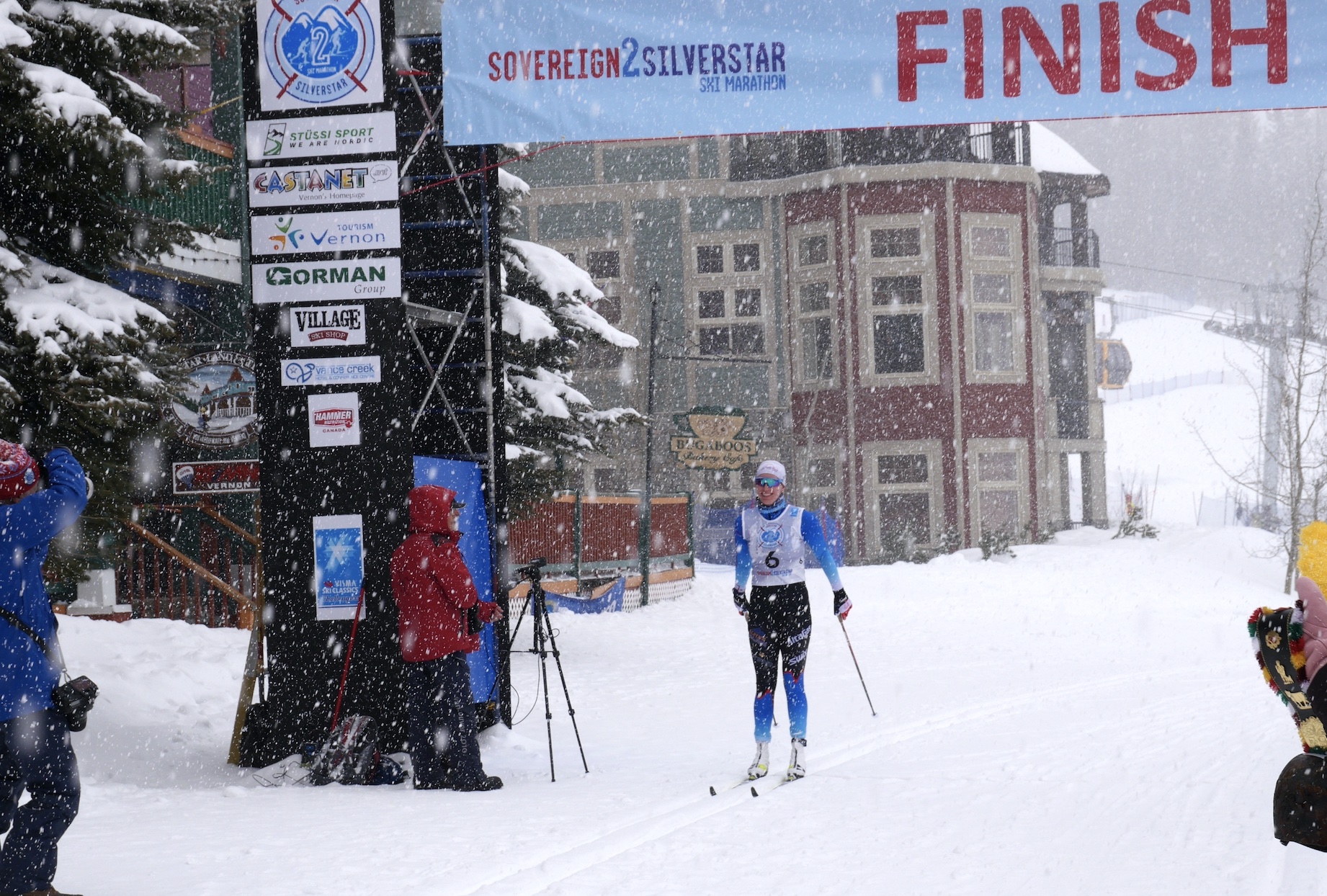
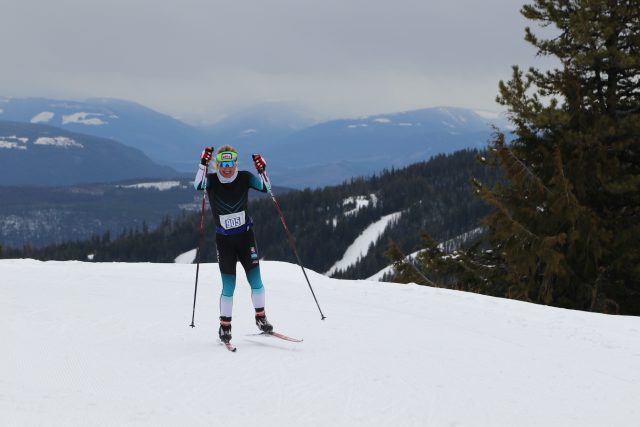
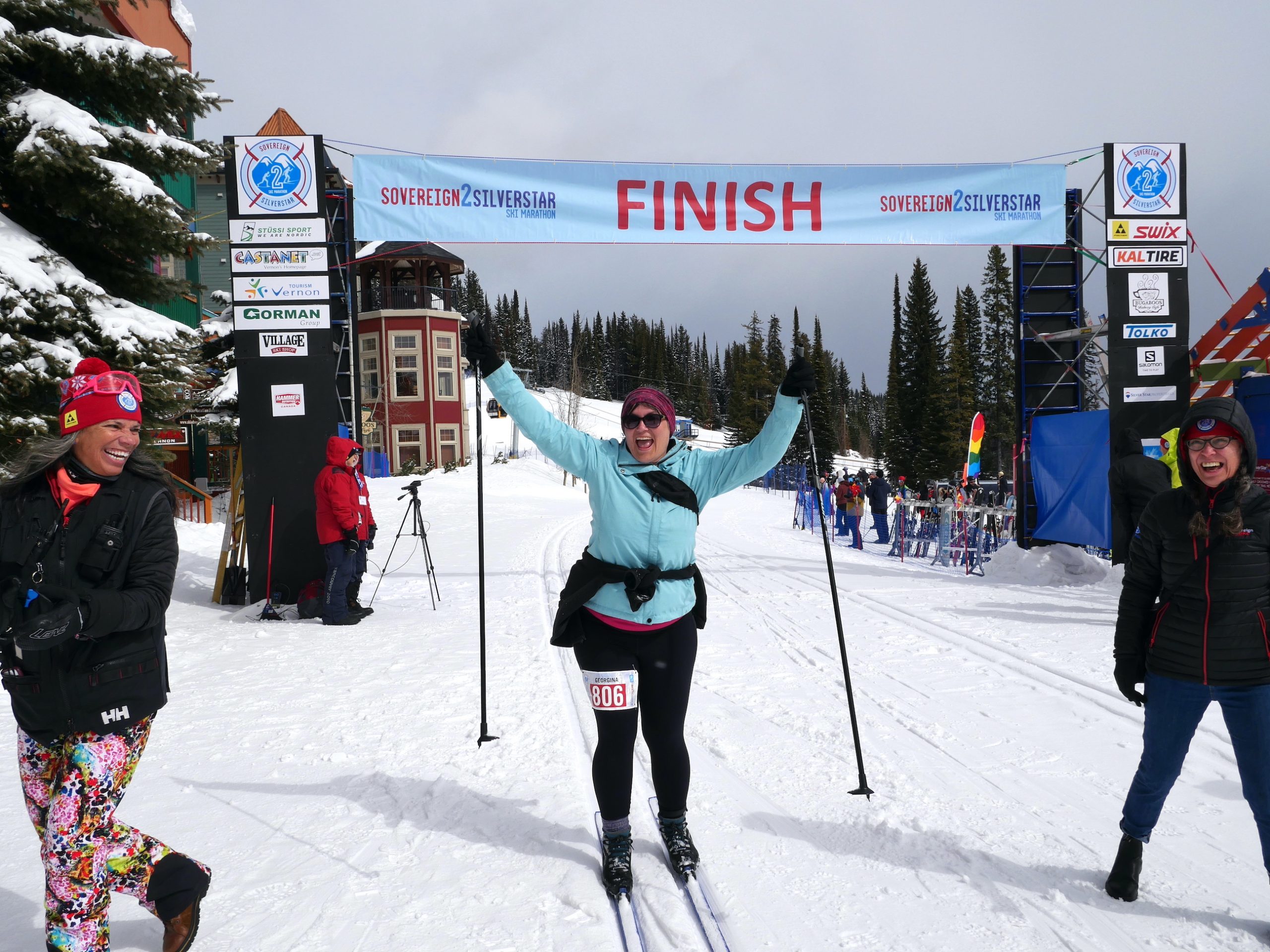
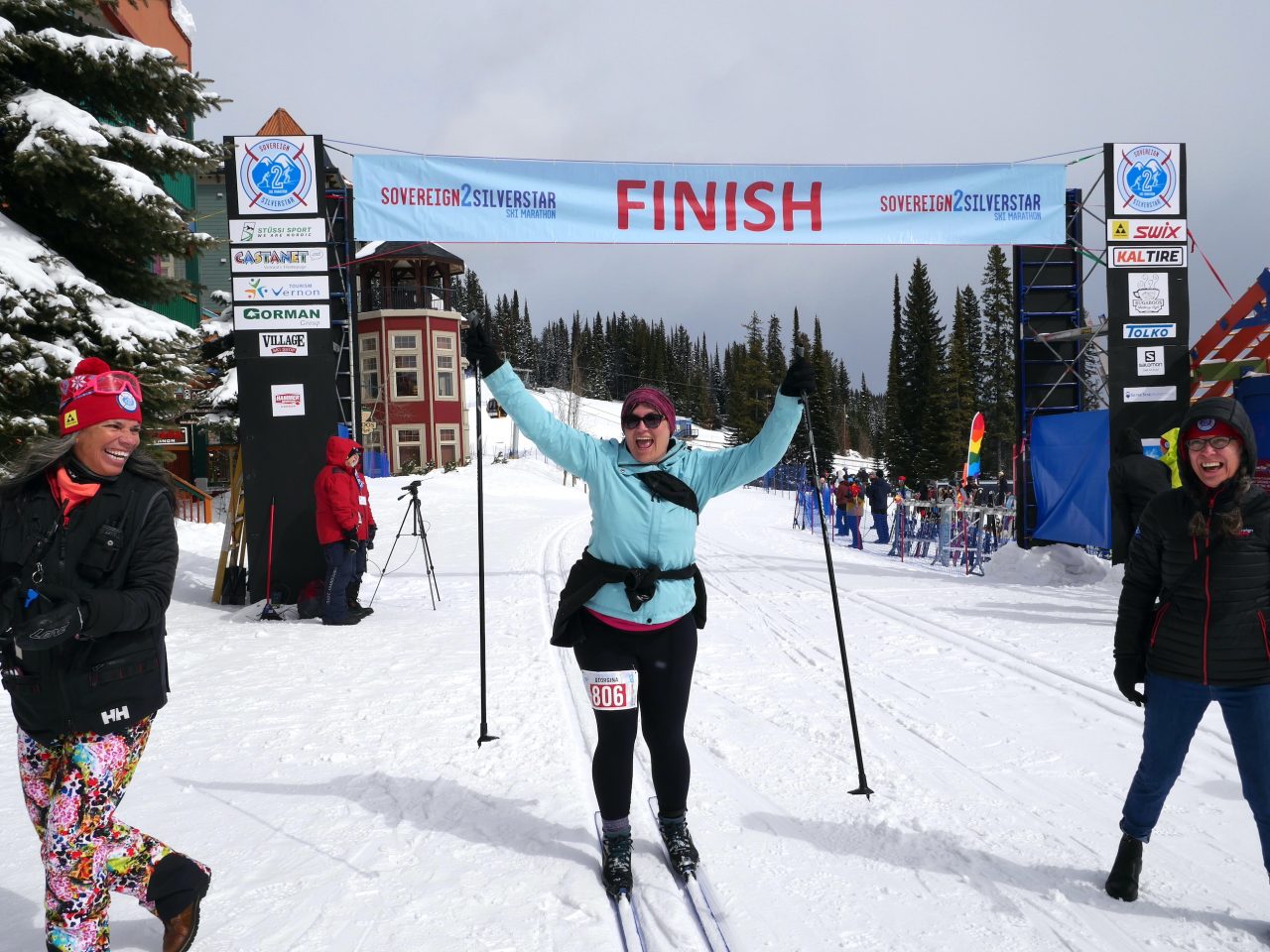
    Finishing with a smile at the Sovereign2SilverStar Ski Marathon (photo: Peggy Hung)

    Disclaimer: The author skied both days and was one member of the large S2S organizing committee. This may seem like a conflict of interest, but also allows a more detailed look behind the curtain at how a new event was built.

    Click here to learn more about the origins of the Sovereign2Silverstar Ski Marathon, and to take a look at the successful first year of the event.

    ***

    The motto for S2S was ‘finishing is winning’, a phrase that also served as the touchstone for the bigger decisions.

    The members of the Organizing Committee (OC) had a lot of experience hosting ski races, from local loppets to Canada Cup/SuperTour weekends to World Cups, and even a combined Nationals plus SuperTour Finals that got cancelled by a pandemic in 2020. A destination event is a different beast, however. High-level events under the FIS umbrella don’t need marketing: athletes follow the events calendar. Local loppets are advertised with a few posters at the neighbouring ski areas. FIS events have required distances, homologated courses, and rules for everything.

    A destination event, by definition, has to entice skiers to travel. In the midst of a pandemic, this is not as easy as it once was, even to a destination with quality late-season snowpack and a mountain backdrop. The question then becomes, ‘What can be done to make the event attractive?’ Immediately followed by ‘how can we keep the participants, volunteers, and local community safe?’

    Year 1 went well, with lots of smiles generated.
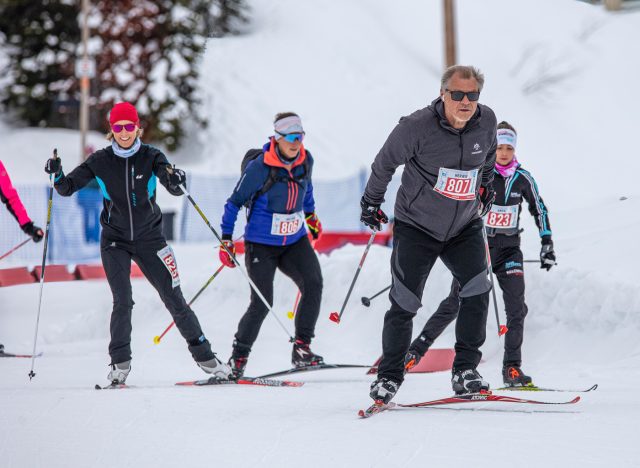
    One of the 21km waves heading out of the stadium on S2S Skate day. Look closer for a mix of ages, a pair of headphones, and a backpack. (photo: Robert Conchie)

    Which skiers?  

    The club already hosts high level events in nordic and biathlon, which led the OC to a focus on inclusion for the new event.

    To get a larger number of skiers, it is necessary to look outside the group of committed competitors and attract recreational skiers. Thus, the motto ‘Finishing is Winning’ was chosen to both appeal to non-racers but also give the OC a vision to follow.

    The motto led to a list of goals: Inclusive. No time limit. Small waves. No technically difficult course features. A minimum of climbing, but enough to discourage classic racers from double poling on skate skis.

    When?

    One of the original goals was to show the trail system at its best, which means late March and early April. March is most often the big snowfall month and has been the choice for the annual 30km for two decades. The elite skiers always visit in early December or late November for Continental Cup races. As a result, generations of racers have visited just before the skiing gets really good. 

    The OC wanted to add to the season calendar instead of competing with existing events. Choosing the same weekend as the American Birkie, for example, would limit future growth.

    The early 2021/2022 international calendar had no events for April 2nd and 3rd.

    Using historical data, there is a 70% chance of blue hard wax skiing on the first weekend of April. Unfortunately, history doesn’t account for climate change and the increasing risk of extreme weather. In 2021, the Vernon area set new records for lowest precipitation in March, April, and May, based on data going back to 1904. In June, heat records were broken all over BC and Washington state. Then, an atmospheric river in November washed away all four highways to Vancouver and dramatically thinned the snowpack.

    With the extreme 2021 weather as a backdrop, there was some nervousness about hosting in April. Club members are usually committed to cycling and paddling by mid-March. An entire web page was devoted to showing what April skiing looks like.

    The final choice also became an effort to change perceptions. In a year where many people were limiting travel and pandemic rules changed monthly, success would depend on persuading local skiers to keep skiing into April. Early data suggests there were more skier visits in late March and early April than previous years.

    Shortly after the OC committed to the dates, the Fossavatn moved to the same weekend and in December the Alex Harvey Classic was announced. The worldwide calendar is crowded, and there really aren’t any ’empty’ weekends.

    Course Design

    At this venue, a long flat double pole route is simply not an option. Sovereign Lake is a small pond and the flat trail around it is less than 1km long. Spectacular mountain views like Canmore or Toblach require nearby mountains and the twin ski areas are just part of the Interior Plateau that was eroded less after the glaciers receded. What the OC does have is twisting, rolling trails through a coniferous forest, tonnes of snow, and a few beautiful viewpoints.

    Many of the OC had skied in events with fast downhills, wild corners, road crossings, and chaotic starts. To be inclusive to newer skiers, the course would avoid tight switchbacks, avoid steep climbs, and be relatively flat.

    Starting in the Sovereign Lake stadium and finishing on Main Street in SilverStar village were the main selling points. With that decided, the Alder Point loop was essential, with views of the Monashee mountains on one side and views of many alpine runs busy with skiers on the other. That decided, it was a matter of building a route with no repeats, no technical sections, a moderate amount of climbing, and exactly 42km long.

    There were many candidate routes that met the requirements, but there was also a 40km route that was more fun to ski.

    After some debate, the OC decided that the fun 40km course fit the ‘Finishing is Winning’ motto best. The first 10km is a flat warmup before the climbing starts. There are three ‘long climb’ sections with about 70m gained over 3km. The finish is a gentle 3km downhill leading into a ‘feature’ finish onto Main Street.

    Exact distances can be important. While every long-time skier has done events that are very different than advertised, some participants want precision. And precision usually means that their watch or phone records the exact advertised numbers.

    There are two common causes of GPS accuracy errors: mountains and trees. As the venue is well equipped with both, the OC quickly learned that only the homologated loops had accurate mapped distances. A sub-team was recruited to get more accurate map data using LIDAR data.

    Scanning through Strava on April 3rd, most of the 40km skiers posted distances between 38km and 41km. The measured elevation gains varied even more. 

    The 21km course splits from the long course at the 5km point, heading directly to SilverStar while the 40km skiers ski a 17km loop to arrive at the same intersection from another direction. The 21km course also skips the final climbing section up Howie’s loop and on the Bergstrasse alpine run.

    Making the 21km a subset of the 40km course and using the same course both days resulted in a huge reduction in volunteer effort.

    Small Waves

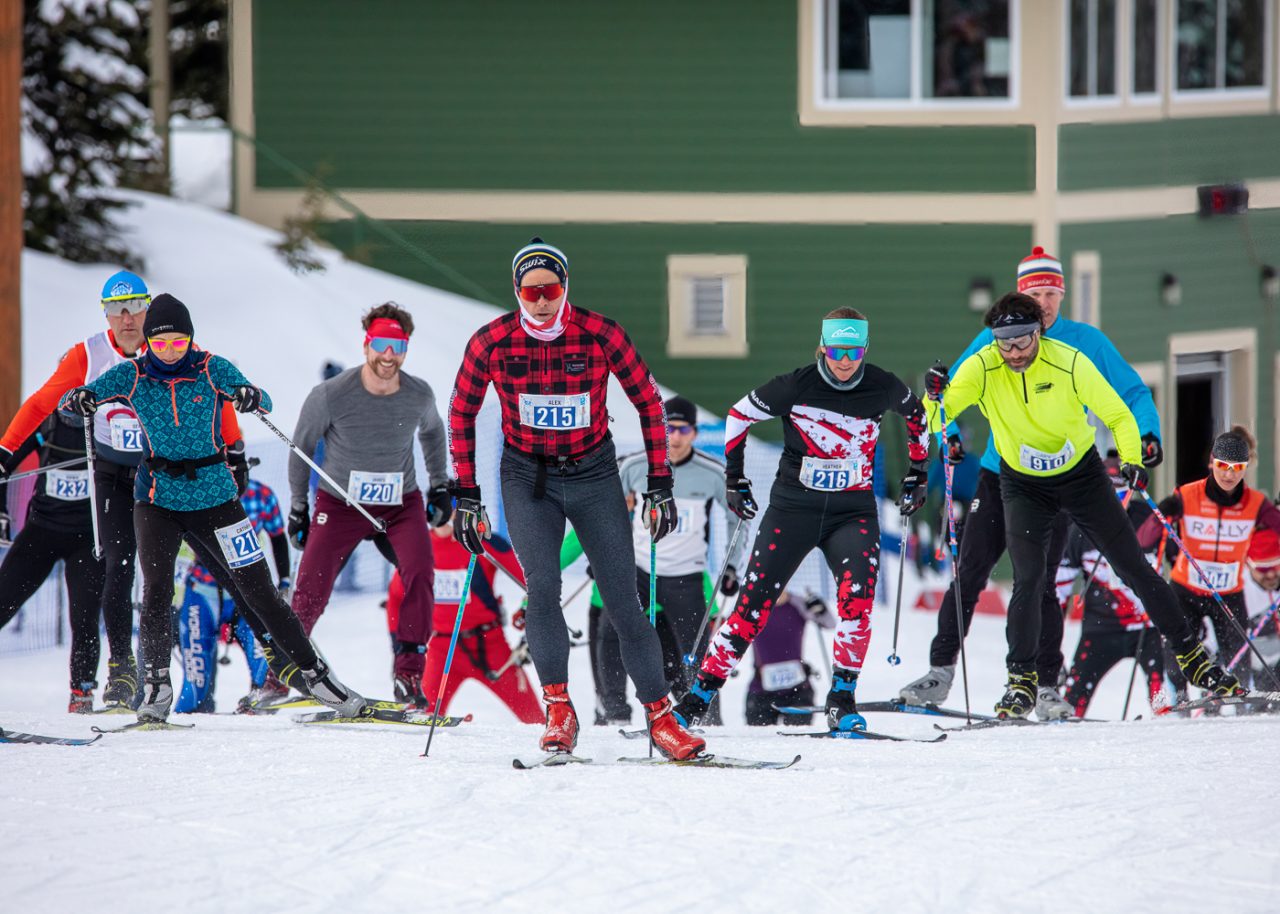
    Many of the OC had skied in major events where there were queues at the first pinch point. To be inclusive to non-racers who aren’t used to skiing in a pack, the decision was made to spread the skiers out so they could watch the scenery instead of the butt of the skier in front. The final choice was a series of waves, spaced three minutes apart.
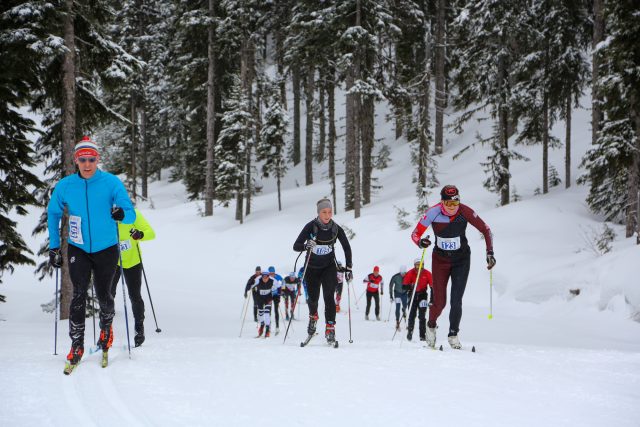
    One of the larger packs 4km into the 40km. (photo: Paul Pickard)

    The largest wave had 42 skiers and it spread out quickly. The telephoto and steep hill combine to compress the B wave group above, which is actually spread out over about 100m of the short climb.

    The first pinch point on the 40km course is at 21km, where the packed trail is only 6m wide and there is just enough room to skate two abreast. The lead pack on classic day was three skiers here, mostly because the short climbs in the Zumas tend to explode packs. 

    A few skiers didn’t like the small waves while most participants loved the space to ski at their own pace. The elite skiers were indifferent to wave size, possibly because they would immediately ski away from any size of group.

    Working Together 

    SilverStar Mountain Resort is a commercial alpine ski area answering to shareholders, with trails for nordic, snowshoeing, and fat biking. Sovereign Lake Nordic Club is a 3,200 member ski club set in a provincial park, answerable to the nordic skiing members and BC Parks. Twin nordic areas to be sure, but fraternal not identical.  

    The differences between the areas can sometimes make it challenging to reach win/win consensus, but the desire to work together gets there in the end. 

    The local community has dreamed of a joint nordic event for years. In 2021, three people came up with a vision that both areas could say yes to, resulting in the birth of the 50/50 event committee. That name was abandoned, as it was quickly apparent that any 50km course would be more epic than inclusive (see an example course profile here).

    The local snowmobile club loaned us 500m of one of their trails for five days, allowing the removal of two tricky hairpins and giving locals a new experience.

    Learning From Others

    The US Birkie and the Gatineau OC’s provided example budgets, registration advice, examples of what can go wrong. And then each event provided a top OC volunteer to spend an hour answering questions from the S2S OC. The nordic skiers on the OC thought this level of assistance was extremely helpful, but not unexpected. The alpine skiers on the OC were surprised that major events would actively help their ‘competition’. 

    Cortina-Dobbiaco is a good example of a fun event: point to point, one day for each technique, and a big effort to create an experience beyond the race.

    The Vasaloppet is an example of how to grow big, but also an example of crowd management. 

    Other events the OC took ideas from include the Birkenbeiner, EngadinHoppet, Merino Muster, Moonlight Classic, and Ski To The Sun.

    The decision to join the Visma Ski Classics challenger series was a surprise. One of the Cortina-Dobbiaco OC had explained the economics of the ProTour series, which put that idea on the year six or later list. Then it was discovered that the chief of volunteers knows every skier in every country, which led to a Norwegian friend of his making a pitch for the Ski Classics Challengers series and a cost-effective way to connect with a worldwide group of skiers who like to build vacations around ski events.

    The Region

    Vernon is an unusual place. The three lakes are just under 400m above sea level. The mountain bike trails at Kalamalka lake sprawl up the east ridge to 1,400m. Some years, the lower mtb trails are good all winter. Other years, the snow level is lower and bikers are waiting for April for the trails to dry. The nordic trails are higher, ranging from 1,500m to 1,915m. Skiing starts in October, with grooming beginning in early November. In April, the grooming stops when the supply of skiers runs out. In non-pandemic years, the Spring Fling snow camp in May provides an opportunity to start the new training year on groomed snow. SLNC and SilverStar have a combined 105km of nordic trails, groomed daily.

    Vernon is a ‘small town’ of 40,000 people with strong sports communities and a high proportion of retirees. Silverstar village has a smaller population and an even larger sense of community. Some of the volunteers that committed hours as course marshals on the alpine run crossings are alpine skiers who have never tried nordic skiing.

    Charitable Partner

    Our target audience of adults who travel to ski events could be called privileged. With so many skiers who appreciate what sport has given them, the OC wanted to find a charity that could give sport to others. KidSport is an organization that helps financially disadvantaged youth participate in organized sport and the local chapter was a good fit for our goals.

    The first year of any event is financially challenging and breaking even can be difficult. With an unknown event during a pandemic that wasn’t ending as quickly as hoped, there was uncertainty around raising a significant amount of money for the cause. Thanks to strong support from sponsors, volunteers, and skiers, the event raised $8,000, about 20% of the local division’s annual budget.

    It turns out that partnering with a charity makes it easier to attract sponsors and volunteers, an unexpected but welcome benefit.

    Promotion

    There is a popular quote: ‘if you build it, they will come.’ A more useful version would be ‘if you invite people, they will come.’

    A good logo and wordmark means the swag looks good.

    Partnering with an alpine ski area comes with some significant advantages here. SilverStar has a marketing team with skills far above what is common in the North American nordic community. A stunning logo, word mark (that ‘text’ brand image), event colour scheme (based on both areas’ existing colours), and a branding document allowed the OC to present a consistent and attractive package to skiers, volunteers, and sponsors.

    While ‘branding’ has always been an essential element in creating a successful business, it is equally valuable in building a new event. Many of the participants commented on how much this first event felt ‘organized’ and ‘polished’. A big part of that comes from providing a good athlete experience, but the polish is a direct result of that branding document.

    Volunteers

    Last on the page, but not last in importance. Over 250 volunteers worked tirelessly to bring energy and enthusiasm to the event day experience. Dozens of skiers made the effort to find someone wearing an ‘OC’ bib to talk about the atmosphere generated by the volunteers.

    How much did the OC value the volunteers? When the financial team had to make hard choices to be ready for a last minute cancellation by any of three levels of government, one of the expenses eliminated was a toque for each participant. Because if you spend all the entry fee money in advance, how will you provide refunds?

    The Volunteer team worked with one of the sponsors to give every volunteer a toque (a toque is a ski hat to Americans, a beanie to Brits). Thanks to supply chain constraints we all are living with, the sponsor had to pay the expense months in advance. Another sponsor provided food and drink for a volunteer party on Sunday afternoon. Many of the elite skiers and past Olympians known to FasterSkier readers made the effort to connect with the volunteers at the party.

    In the end, the volunteers are what brought smiles to the participants faces. The event will need those people next year, which means showing volunteers the love is one of the biggest steps towards a successful second year.
  • Sovereign2SilverStar Ski Marathon Part 1: A Successful First Year

    Sovereign2SilverStar Ski Marathon Part 1: A Successful First Year

    The Sovereign2SilverStar Ski Marathon started with small waves. (photo: Robert Conchie)

    Disclaimer: The author skied both days and was one member of the large S2S organizing committee. This may seem like a conflict of interest, but also allows a more detailed look behind the curtain at how a new event was built.

    When the moment comes to create a new destination ski marathon, how would you compile all of your dreams and mould them into a single cohesive weekend?

    A group of Canadian skiers was faced with that question in the spring of 2021. And they found an answer.

    Start with twos. Two interconnected ski areas. Two days. Two techniques. Two distances. Two finish line parties.

    Using that model, the first annual Sovereign2SilverStar Ski Marathon was a success, at least as measured by smiles. 

    Dahria Beatty crosses the line for the women’s win in classic during the Sovereign2Silverstar Ski Marathon. (Photo: Peggy Hung)
    Fun at the finish line of the 2022 Sovereign2Silverstar Ski Marathon. (Photo: Peggy Hung)

    The weekend kicked off with a classic day on Saturday, April 2nd. The first wave for the 21km course left at 8:30 am, followed by the 40km waves at 9:05. Predicted weather was cloudy with afternoon snow, but the first flurries hit about 8 am, setting the tone for the day.

    Of the 195 finishers on Saturday, the majority were on skin skis. Many of the skiers who chose grip wax were fooled by the race date into waxing for ‘typical’ spring skiing. However, when the groomed track is set at  -5C, with fresh, cold snow overnight and more dry snow falling, blue hard wax is a better choice. Three of the six athletes on the 40km podium chose VR45 covered with VR30. The Organizing Committee (OC) posted a recommendation of Swix VP45 or V45 (the event encouraged fluoro-free waxing) on Friday afternoon. Early Saturday morning, the wax recommendation was updated to VP45 covered by VP40, except that this update didn’t get shared. Oops! Add that to the list for next year.

    Benoit Chauvet last skied on the World Cup in 2010 and now coaches at Toby Creek, in BC. And he did place higher in the skate 40km.

    Skate day on Sunday was overcast without significant snowfall, resulting in faster conditions and a larger field of 255 finishers.

    As on Saturday, the 21km waves started first at 8:30, followed by the 40km waves at 9:05. This added a fun twist as the faster 40km skiers were passing the average 21km skiers coming into the finish. Despite the number of finishers, the largest of the nine waves had 42 skiers, which meant there was a lot of room to work with.

    The course crossed a number of alpine runs on the final long descent to the finish. The course marshals, who were tasked with preventing collisions, were also ringing cowbells to energize the passing skiers. Many alpine skiers and snowboarders stayed on to cheer when the marshals signalled they were free to move. It was a new experience for many participants to see spectators 4km away from the finish, cheering and recording phone videos.

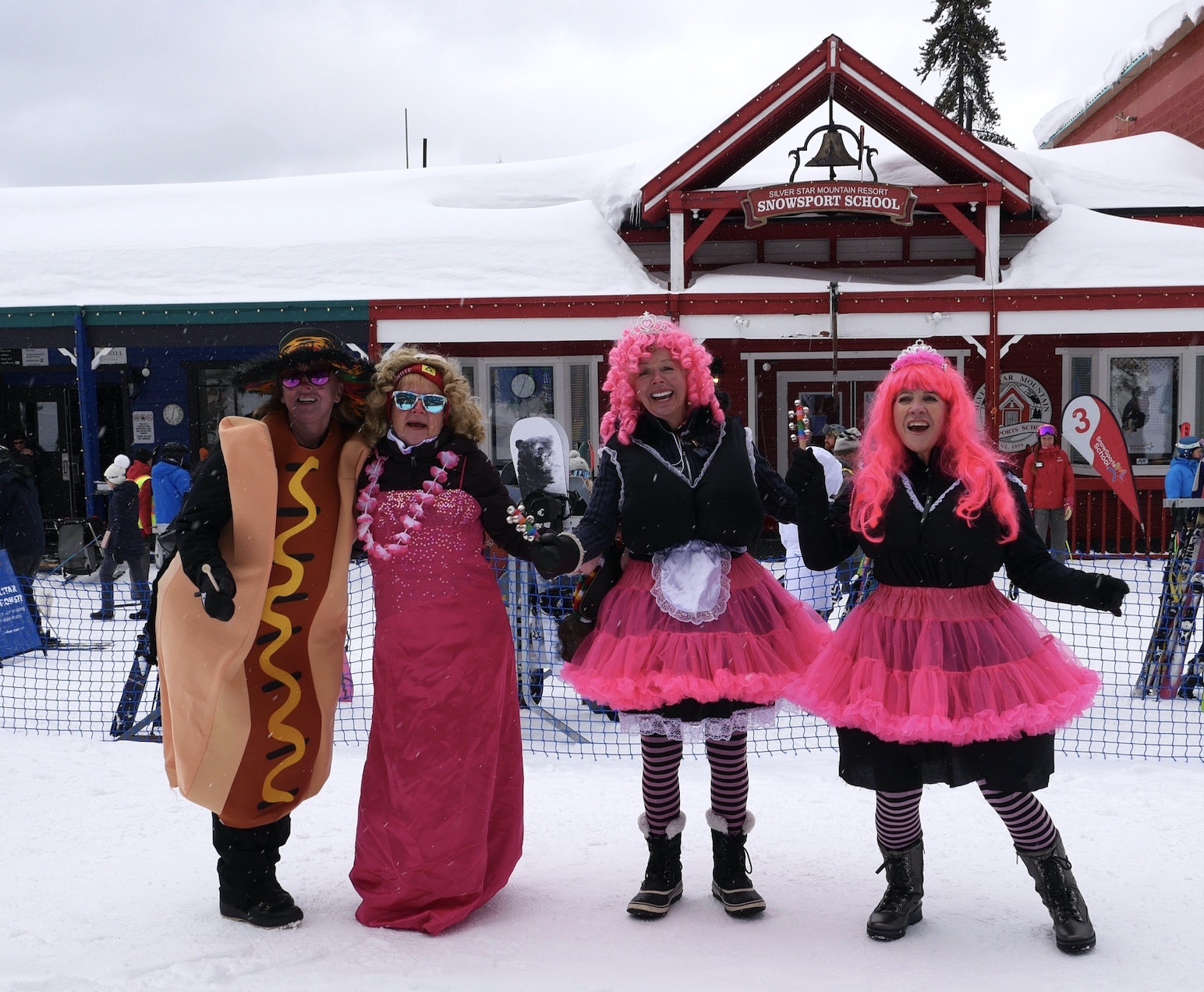
    Participants who skied both days were prepared to be greeted at the finish by a dance team, lead by a hot dog. Some people were smiling because they were excited to have completed the distance, and some were smiling at the welcome.

    The pandemic has greatly reduced international travel, with many skiers choosing to defer trips. S2S had one Europe-based skier registered, a Norwegian-born Swede who happened to be in Canada for a vacation.

    “It’s a very fun course,” Asbjørn Grøvlen said after finishing the 40km classic. “I would recommend this one.” He went on to explain that many Ski Classics courses in Europe are just double poling and it was a nice change to stride more. Grøvlen, like a number of others, chose to do both 40km days.

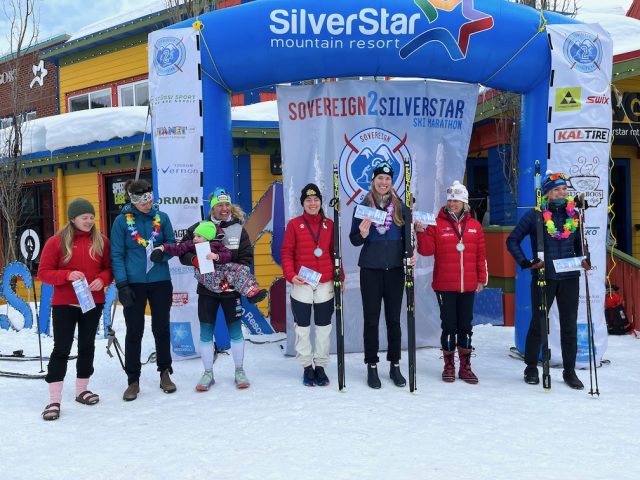
    The overall podium on Sunday. L to R: Annika Hicks, Julia Ransom, Caitlin Gregg, Katherine Stewart-Jones (2nd), Dahria Beatty (1st), Laura McCabe (3rd), Anna Sellers. That is 5 Olympians, 2 biathletes, and 2 mothers.

    The overall podiums went to elite skiers, many of whom volunteered to present medals to the age group podiums.

    Dahria Beatty was the first woman to the finish on the classic day, followed by Katherine Stewart-Jones, Novie McCabe, and Mariah Bredal. Bredal had registered late and started in the second wave, which left her 0.3 seconds behind Beatty for second place overall. Another learning moment for year two, save a few extra bibs in the elite wave for last day registrants.

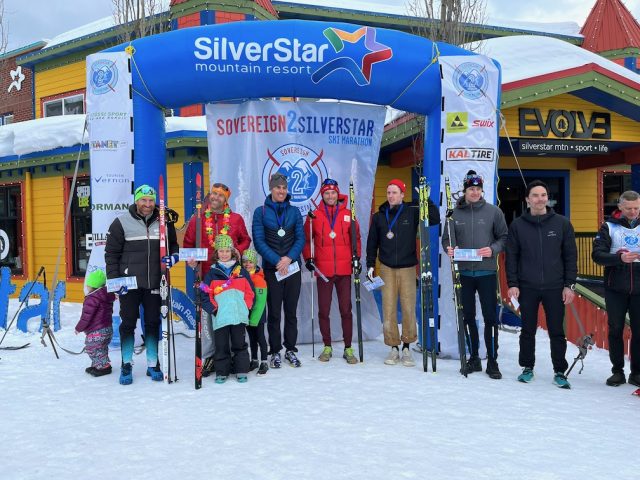
    Sovereign2SilverStar overall podium. L to R: Brian Gregg, Benoit Chauvet, Scott Hill (2nd), Rémi Drolet (1st), Jack Carlyle (3rd), Julien Locke, Jess Cockney, S2S Event Director.

    There was a rumour on Saturday morning that Luke Jager would double pole on skate skis, as he “always does that on long classic courses.” Jager, found before the start while applying grip wax to his skis, disagreed.

    Timing was essential to get the mountain views at Alder Point. (photo: Marshall Moleschi)

    In a world where ‘us versus them’ often creates divisions between similar communities, it was fun to watch alpine skiers and snowboarders stopping on Main Street to cheer on nordic finishers.

    “That is so cool,” one twenty-something snowboarder said to his friends. “We are doing this next year!”

    Mike Mandli, an American master who has travelled the world to ski, summed up the weekend: “This was a skier’s dream. One of the best dreams ever.”

    For results, more videos, Andy Newell’s waxing advice, and over 2,000 photos, visit the event page.

  • Ski News Roundup for the Week: Marit Bjørgen is Back (Just not on the World Cup)

    Ski News Roundup for the Week: Marit Bjørgen is Back (Just not on the World Cup)


    Marit Bjørgen carries the Norwegian flag across the finish line as Norway wins the women’s 4-by-5-kilometer relay at the 2017 Nordic World Championships in Lahti. It was Norway’s 100th world championship medal.

    Bjørgen Returns

    Reported last week by several news outlets, retired World Cup star from Norway, Marit Bjørgen, will return to racing next season. Bjørgen (40), will be a member of Team Ragde Eiendom, managed by Jörgen Aukland. (The team is owned by Anders and Jørgen Aukland.) 

    Bjørgen told Norwegian broadcaster NRK she would focus on winning the 90-kilometer Swedish Vasaloppet.

    It has also been reported that Bjørgen will be joined by the current overall World Cup winner and former teammate Therese Johaug on Team Ragde Eiendom. Johaug will still contest the World Cup.

    Bjørgen, however, did not announce a return to World Cup racing: she retired from that circuit in 2018. That year, she became the most decorated winter Olympian with 15 medals in total, including eight golds, two of which she won in PyeongChang. 


    Free Access to “VISMA SKI CLASSICS PLAY” Until June 30th:

    Like many folks and you might be keen on a video escape for a bit. Visma Ski Classics is offering free access to their video catalog until the end of this month. A few things you should know before gluing into the screen: Visma will ask for your basic info to sign up – a valid email and password. There is a “Free Trial” option ending on June 30, 2020, or you can select the monthly membership for $14.99, or an annual membership for $49.99. That said, we posted this in the news roundup since it appears free videos are yours for the next three or so weeks. 

    There was no prompt for credit card information during signup.

    If you are stoked for a 5.5 + hour marathon viewing session you can spend that time watching the 2020 Swedish Vasaloppet.


    The Davis behind the Davis on the “Davis U.S. Cross Country Ski Team”:

    Beginning last season, some press-releases from U.S. Ski and Snowboard referred to the cross-country team as the “Davis U.S. Cross Country Ski Team”. We have had several inquiries from readers asking “who is this Davis?”

    Here’s some of the backstory from Tom Horrocks, Communication Manager for the cross-country team. The funding is a three-year gift from the Davis Family Foundation. Currently, the team is in the second year of funding from the Davis Family Foundation. Although specific amounts were not disclosed, Horrocks wrote, “The amount of the gift matches our annual cross country team budget from last season. So, we have a flat budget this year, which is an incredible gift and benefit given the current economic downturn. The Davis gift basically ensures that our base level of programming is maintained for three years, giving us an incredible platform to prepare for the 2022 Olympic Winter Games.

    “It is also important to note that U.S. Ski & Snowboard has a budget for domestic governance and events, which is still completely funded by U.S. Ski & Snowboard through our fundraising, sponsorship, etc. In addition, all Davis U.S. Cross Country Team athletes continue to benefit from all the other U.S. Ski & Snowboard departments and programs including sports science, sports medicine, communications, marketing, etc., and that support comes from outside the Davis Family Found gift.”

    Andrew Davis is on the U.S. Ski & Snowboard Foundation Board of Trustees and is part of the Davis Family Foundation.

    Jessie Diggins sprinting in Konnerud, Norway during the 2020 World Cup . (Photo: NordicFocus)


  • American Birkebeiner Becomes a Visma Ski Classics Challenger Race

    American Birkebeiner Becomes a Visma Ski Classics Challenger Race

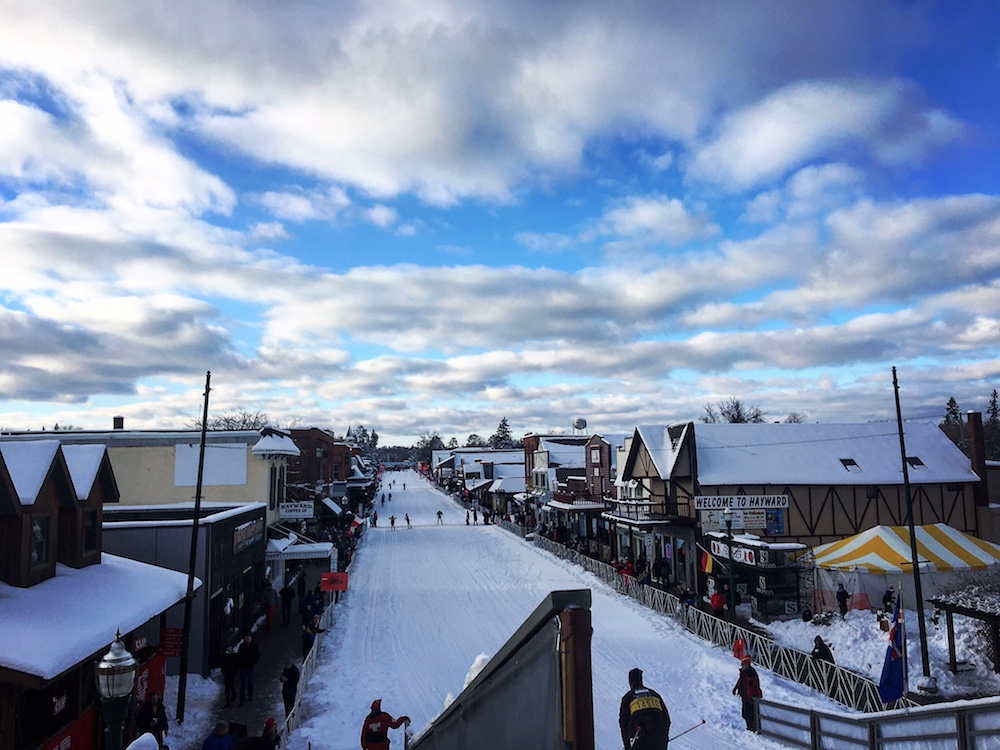
    The view of the Main Street finish the day before the 2018 American Birkebeiner, as seen from the International Bridge. (Photo: Katie Miller)

    Back in June, the Worldloppet International Ski Federation announced the cessation of the FIS Worldloppet Cup. In short, that race series was a collaboration with the International Ski Federation (FIS) and the Worldloppet marrying elite level and popular marathon ski racing.

    The American Birkenbeiner was intermittently a stop on the FIS Worldloppet Cup.

    “It was just not getting traction attracting the elite athletes and tying those elite athletes to popular skiing,” said Ben Popp, the Executive Director of the American Birkebeiner Ski Foundation (ABSF) about the now defunct race series.”

    Enter the Visma Ski Classics, a two-tiered race series offering Pro Tour events and what it calls Challenger events. The Pro Tour is a 12 event European based series. It includes races like the Marcialonga in Italy, the Swedish Vasaloppet, and the Birkebeinerrennet in Norway. The Pro Tour has built in incentives to draw elite racers with bigger purses and more points on offer than Challenger races. The ten race Challenger series still offers points to any elite Pro Tour skier placing in the top-25. Challenger events, however, have fewer points on offer: Skiers earn 200 points for winning a Pro Tour event, 50 points for winning a Challenger race. The Challenger series is primarily a vehicle to  unify and promote longer distance cross-country ski races.  

    Citizen racers at Marcialonga in Italy, part of the Visma Ski Classics. (Photo: Visma Ski Classics Gallery)

    For 2020, the American Birkebeiner becomes a Visma Ski Classics Challenger race. Popp believes the Visma Challenger designation will strengthen what the American Birkebeiner has already captured and optimized — a world class experience for popular skiers. Popp also understands that elite racers are still drawn to the 50-kilometer freestyle event as it remains a part of the SuperTour. But he sees this as an opportunity to also attract both elite and popular skiers from Europe who are keen on racing and following the Visma Ski Classics. 

    Popp said no other Visma Ski Classics are scheduled the same weekend as the American Birkebeiner, which will run on February 22nd. Of the Pro Tour series, Popp said most elite skiers do not ski the full complement of races, so the opportunity is there for them to race the American Birkie. He also intends to capture non-elite skiers by helping to market neighboring ski events that might become a suite of ski races Europeans can seamlessly schedule around their American Birkebeiner adventure. 

    “As a race organization, we say ‘OK what do we do to maximize a racers experience?’” asked Popp.

    Part of the answer is marketing a multi-stop ski race vacation. The City of Lakes Loppet runs long distance classic and skate races on February 1 and 2 respectively. The Gatineau Loppet in Québec features a 50 k skate on February 17th. With the American Birkebeiner the following weekend, ski racing tourists have options for an extended race-cation. 

    “One of the thoughts being a Visma Ski Classic, is that something like 90 percent of the country of Sweden watches the Vasaloppet, and it is a Visma Ski Classic,” said Popp. “And you know why 90 percent of the racers in the Marchalonga in Italy are Norwegians? Because they want to go to a very different race experience. So the thought in our case as a Ski Classic, we can act as a medium to try and reach a lot of these European racers because we know a lot of the citizens racers are engaged in the Visma Ski Classics and are watching it on TV. Maybe this is a medium to reach them and say ‘hey, we have a super cool event in North America, make it a destination, travel over, experience America, experience ski racing which you love. We think this would be a really cool one that you will enjoy.’”

    According to the Visma Ski Classics website, event organizers do not pay a licensing fee for Challenger race designation. They are, however, required to meet minimum requirements for prize money and media distribution for race highlights.

  • Saturday Rundown: Lillehammer, Östersund & West Yellowstone (Updated x 4)

    Saturday Rundown: Lillehammer, Östersund & West Yellowstone (Updated x 4)

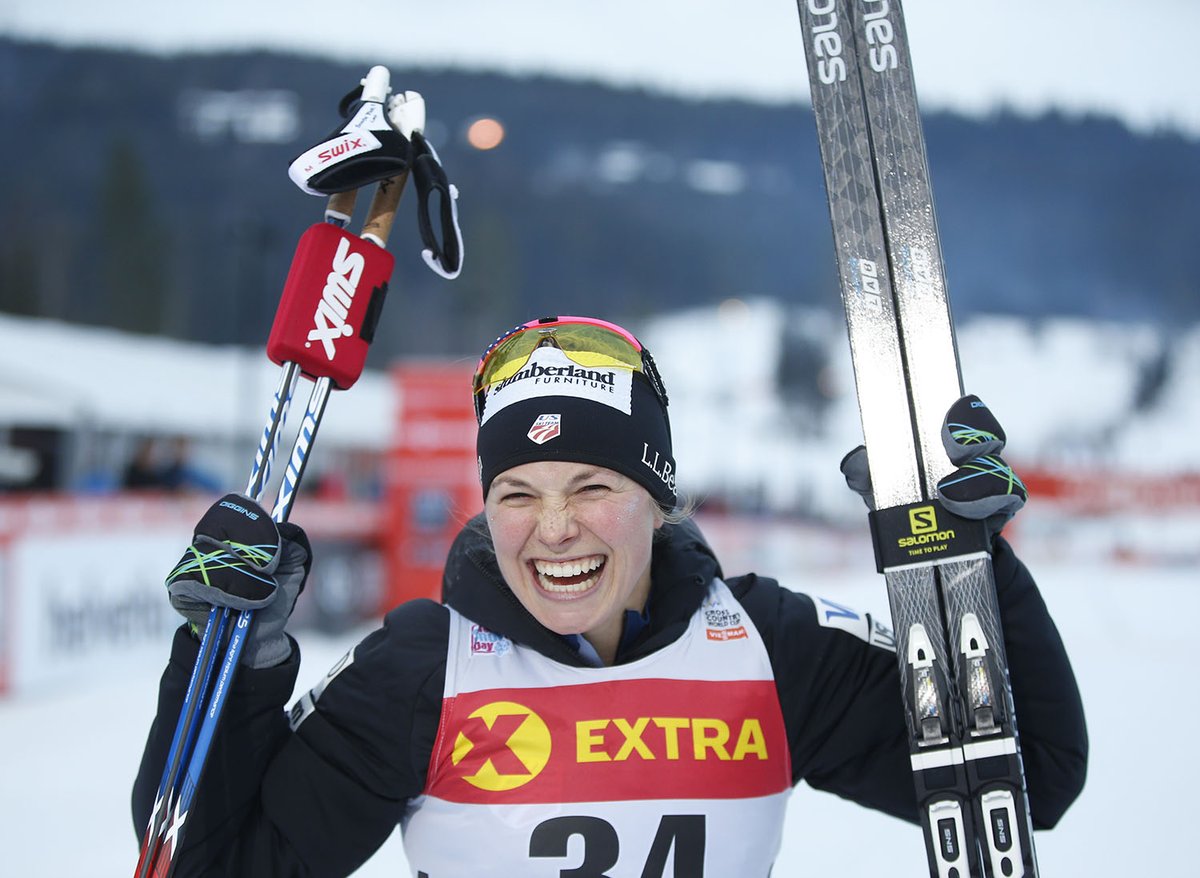
    Jessie Diggins (U.S. Ski Team) won the second individual World Cup of her career on Saturday in the women's 5 k freestyle in Lillehammer, Norway, beating four Norwegians by 4.8 seconds or more. (Photo: USSA Nordic/Twitter)
    Jessie Diggins (U.S. Ski Team) won the second individual World Cup of her career on Saturday in the women’s 5 k freestyle in Lillehammer, Norway, beating four Norwegians by 4.8 seconds or more. (Photo: USSA Nordic/Twitter)

    Welcome to The Rundown, your quick primer of need-to-know information about the day’s racing. We’ll be updating this digest as the day goes on with additional results, photos and quotes. The Rundown is NOT a race report; stay tuned for complete race reports later today with interviews from the day’s top racers.

    ***

    U.S. SuperTour opener in West Yellowstone: Freestyle sprints

    [UPDATE] The U.S. domestic season opened in West Yellowstone, Mont., with 1.3-kilometer freestyles on Saturday, and Matt Gelso and Jennie Bender emerged as the day’s winners.

    Gelso, of the Sun Valley Ski Education Foundation (SVSEF) Gold Team, won the men’s final, and two Alaska Pacific University (APU) skiers, Tyler Kornfield and Reese Hanneman, joined him on the podium in second and third, respectively.

    In the women’s final, Bender, of the Bridger Ski Foundation (BSF), held off Stratton Mountain School (SMS) T2 teammates Erika Flowers and Anne Hart, who placed second and third, respectively.

    Results: Qualifier | Women’s Final | Men’s Final

    ***

    IBU World Cup in Östersund: 7.5/10 k sprints

    [UPDATE] Americans Lowell Bailey and Susan Dunklee led their teams in 13th and 27th, respectively, and five North American men and four women finished in the top 60 of Saturday’s sprint to qualify for Sunday’s pursuits in Östersund, Sweden. Oh, and France’s Martin Fourcade won his third-straight race (in as many races this season) and his second individual race for his 51st career victory. France made it a double with Marie Dorin Habert winning the women’s sprint.

    Men’s report | Women’s report

    ***

    FIS Cross-Country World Cup in Lillehammer: 5/10 k classic

    Women’s report | Men’s report

    There aren’t many 5-kilometer skate races on the World Cup schedule. But when they do come around, Jessie Diggins makes sure to capitalize.

    The 25-year-old U.S. Ski Team member and Minnesota native rocketed to the second victory of her World Cup career on Saturday, winning the women’s 5 k freestyle in Lillehammer, Norway, in 12:40.3 minutes and by nearly 5 seconds ahead of anyone else.

    After winning her first individual World Cup last season in a 5 k freestyle in Toblach, Italy (then reaching the podium three more times in individual races through March 2016), Diggins achieved her first podium of the season in the fourth race of 2016/2017.

    She started 34th of 76 finishers, with top-dog Norwegians like Heidi Weng (who won Friday’s classic sprint) and Marit Bjørgen behind her. Diggins trailed slightly at the first 0.8 k checkpoint, but she drew the race’s attention at 2.2 k, where she overtook Norwegian Astrid Uhrenholdt Jacobsen’s time by 2.1 seconds. At the finish, Diggins bumped Jacobsen out of the leader’s chair by 16.4 seconds, and the American would sit in that seat for the rest of the day.

    Except she didn’t sit much. Diggins chatted with teammates and team staff, smiled and waved at cameras, and bustled about the finishing area. After her closest challenging, Weng in bib 60, finished 4.8 seconds off her time in second place, Diggins knew she had done it. Bjørgen had already finished and was third (+15.8), Jacobsen fourth (+16.4), and yet another Norwegian, Ingvild Flugstad Østberg fifth (+17.2).

    She hugged Weng and told her she had a great race at the finish.

    “Before I started, I knew it!” Weng said to her of Diggins’s win.

    Diggins smiled, and later stood on the podium between Weng and Bjørgen.

    “I’m so happy with my day today. I’m so lucky to have the most amazing team,” Diggins said in a televised interview with FIS. “When you get to train with such cool people, that belief, that confidence, it opens up opportunities. And I had such a great opportunity.

    “My coaches and staff work so hard. so when they gave me this opportunity I really had to take it,” she continued. “… It means a lot that when everything goes right you can ski with the best in the world. Hopefully this will mean a lot back home because I’m not special or different in any way. If I can do it, all the little kids back home, they can do it, too!”

    While Norway occupied four of the top five, the team had six in the top 10, with Ragnhild Haga in eighth (+31.2) and Kari Øyre Slind in ninth (+32.0). Finland’s Krista Parmakoski placed sixth (+26.9) and Laura Mononen was 10th (+36.1), and Russia’s Yulia Tchekaleva placed seventh (+27.7).

    The second U.S. woman in the top 15, Sadie Bjornsen broke through her pattern of 17th in the last three races and place 14th (+41.8). Liz Stephen (USST) scored points in 26th (+51.2) in her first “distance” race of the season.

    Caitlin Patterson placed 38th for the U.S., Rosie Brennan (USST) was 48th, and Sophie Caldwell (USST) 59th, and Ida Sargent (USST) 67th.

    Canada’s Cendrine Browne (NST U25 Team) 50th, Emily Nishikawa (World Cup B-team) 52nd, and Dahria Beatty (NST U25 Team) 62nd.

    Diggins is now third in the mini-tour standings through two days of racing (21.6 seconds behind Weng in first and 0.9 seconds behind Østberg in second), with just Sunday’s 10 k classic pursuit to go, and Bjornsen improved to 12th.

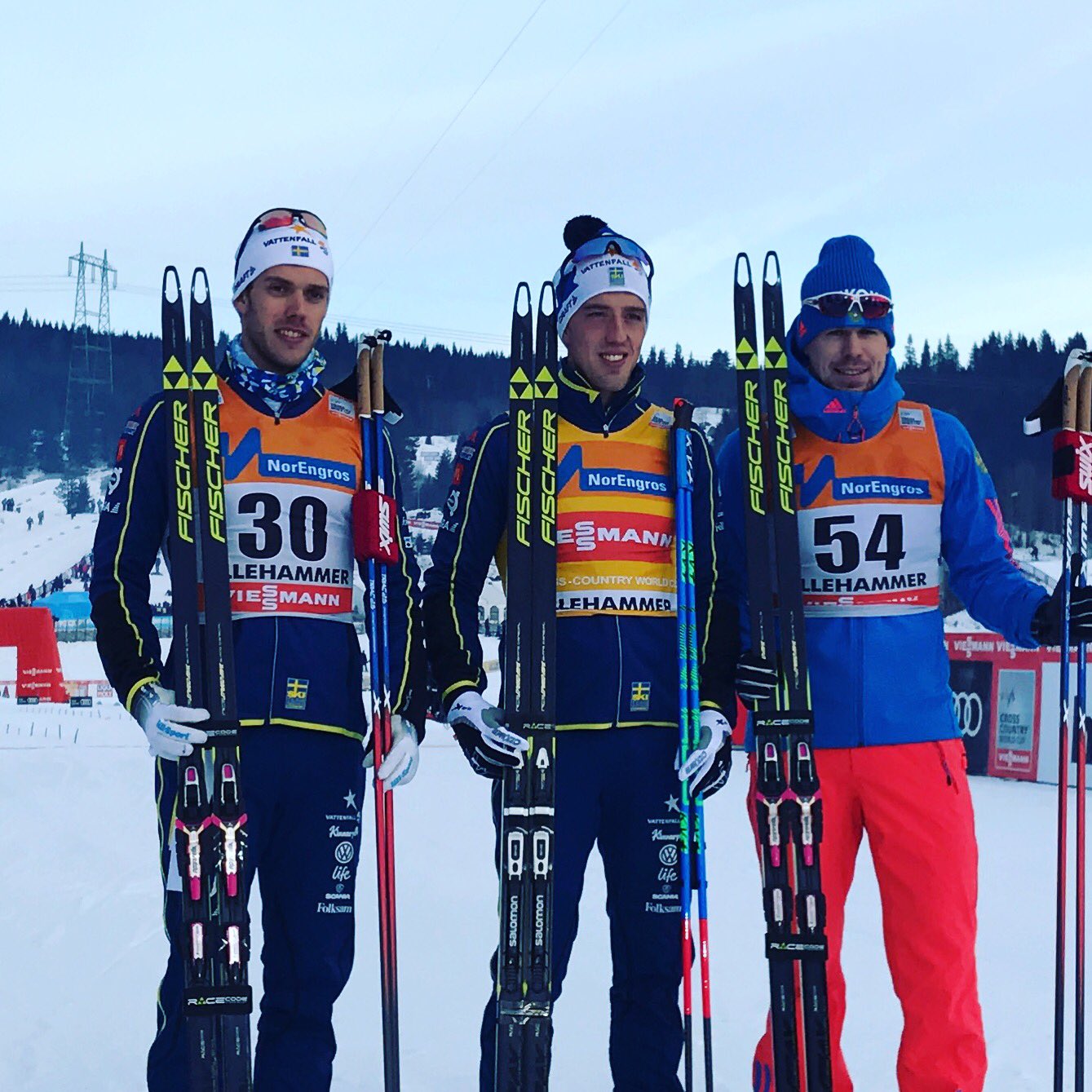
    Calle Halfvarsson (c) gets the win for the second day in a row, while teammate Marcus Hellner (l) is pleased to be on the podium for the first time this year. Russia's Sergey Ustiugov third in the 10 k skate in Lillehammer. (Photo: FIS Cross Country/Twitter)
    Calle Halfvarsson (c) gets the win for the second day in a row, while teammate Marcus Hellner (l) is pleased to be on the podium for the first time this year. Russia’s Sergey Ustiugov third in the 10 k skate in Lillehammer. (Photo: FIS Cross Country/Twitter)

    In the men’s 10 k classic to start the day, Calle Halfvarsson of Sweden made it two in a row, winning the first distance race of the mini tour by 0.8 seconds over teammate Marcus Hellner. The competition is the second day of the World Cup mini-tour, which will conclude on Sunday with a classic pursuit. Halfvarsson also won the classic sprint on the first day of racing. For Hellner, it’s a strong result for the former World Champion after two straight seasons where he only stood on the podium once a apiece.

    Russia’s Sergey Ustiugov slotted into third with a hard closing kilometer, moving from fifth place and nearly nine seconds back at 8.3 k to the podium and only 6.7 seconds behind Halfvarsson at the finish.

    That left Norway off the podium, but the home team swept the next three places with Finn Hagen Krogh (+7.4), Simen Hegsted Kruger (+13.2), and Martin Johnsrud Sundby (+13.5).

    Alex Harvey was the top Canadian in 10th place (+23.5). Devon Kershaw and Lenny Valjas finished 40th (+1:16.7) and 42nd (+1:19.1), respectively, with Graeme Killick 64th (+1:46.6) and Knute Johnsgaard 73rd (+2:22.0). Bob Thompson and Andy Shields rounded out the Canadian roster in 88th and 89th.

    Noah Hoffman led the way for the U.S. men, just outside the points in 33rd (+1:08.6). Erik Bjornsen was 45th (+1:22.2), followed by Simi Hamilton 69th (+1:55.8) and Eric Packer 78th (+2:28.7).

    Results: Women’s 5 k classic | Women’s mini-tour standingsMen’s 10 k classic |Men’s mini-tour standings

    ***

    Visma Ski Classics: La Sgambeda 30 k Classic in Livigno

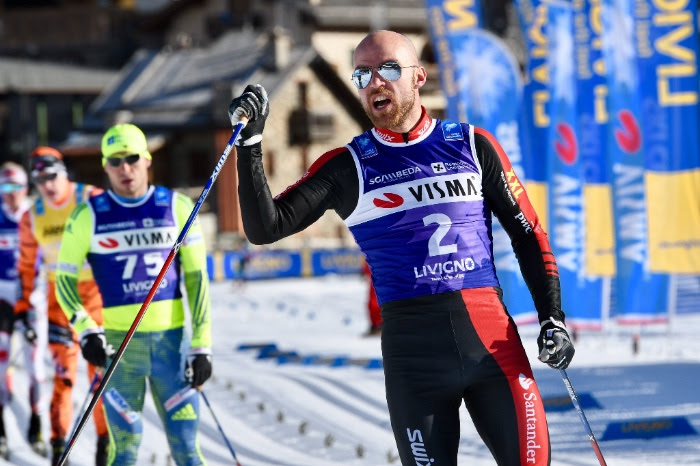
    Tord Asle Gjerdalen (Team Santander) crosses the finish line first in Sgambeda in Livigno, Italy, on Dec. 3, 2016. (Photo: Visma Ski Classics)
    Tord Asle Gjerdalen (Team Santander) crosses the finish line first in Sgambeda in Livigno, Italy, on Dec. 3, 2016. (Photo: Visma Ski Classics)

    The Visma Ski Classics series began last weekend in Pontresina, Switzerland, with 8 k time trials. Racing continued this weekend just down the road in Livigno, Italy, where racers competed in the second race in the series, La Sgambeda. Skiers encountered superb conditions and firm tracks following cold temperatures the night before.

    In the women’s race, a mass start over five laps of a 6 k course, Britta Johansson Norgren of Team Lager 157 took the narrow victory over Katerina Smutná of Team Santander, reversing their finishing positions from Pontresina a week before. Norgren finished 1.3 seconds ahead of Smutná after the two of them broke away from the main pack on the course’s final hill. Sara Lindborg of Team Serneke secured third, 17.4 back of Norgren.

    The men raced on the same five-lap, 30 k course as the women. The men’s race also came down to a breakaway on the final climb. Tord Asle Gjerdalen of Team Santander took the narrow victory, rebounding from his sixth-place finish in the Pontresina prologue. Ilya Chernousov of Team Pioneer Investments was 1.3 seconds back. Team Leaseplan’s Petter Eliassen was third (+2.7) after leading most of the race.

    Norgren and Gjerdalen are now leading the individual standings, with Gjerdalen’s Team Santander the top team, as the Ski Classics series approaches a month-long holiday break. Racing resumes in early 2017.

    Results

  • Sunday Rundown: Ruka, Östersund, Pontresina & Beitostølen (Updated x6)

    Sunday Rundown: Ruka, Östersund, Pontresina & Beitostølen (Updated x6)

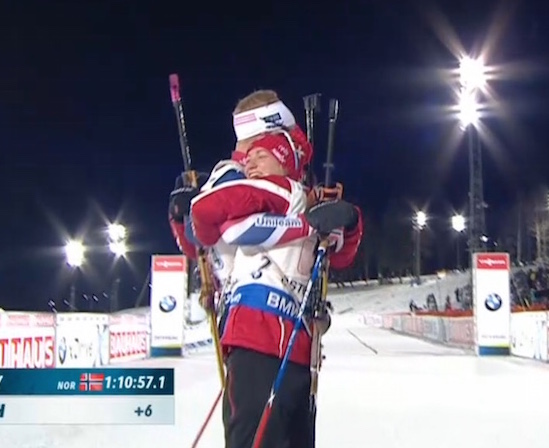
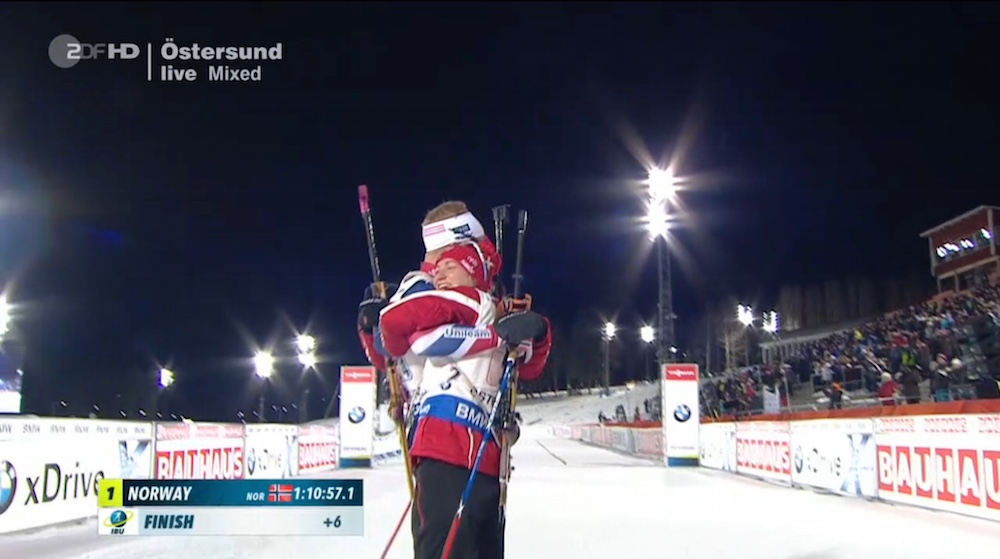
    The Norwegian mixed relay team celebrates after its win in the first IBU World Cup race of the 2016/2017 season on Sunday in Östersund, Sweden. (Photo: ZDF screen shot)
    Two members of the Norwegian mixed relay, Johannes Bø and Marte Olsbu, celebrate their win in the first IBU World Cup race of the 2016/2017 season on Sunday in Östersund, Sweden. (Photo: ZDF screen shot)

    Welcome to The Rundown, your quick primer of need-to-know information about the day’s racing. We’ll be updating this digest as the day goes on with additional results, photos and quotes. The Rundown is NOT a race report; stay tuned for complete race reports later today with interviews from the day’s top racers.

    ***

    IBU Cup in Beitostølen: 7.5/10 k sprints

    [UPDATE] With the second set of men’s and women’s sprints canceled Saturday and moved to Sunday in Beitostølen, Norway, the first IBU Cup relays of the season were bumped off the schedule, and no North Americans competed on Sunday. (American Russell Currier placed 44th in the IBU Cup sprint on Friday.)

    In the women’s 7.5 k sprint, Marketa Davidova of the Czech Republic pulled out a 3.6-second win over Germany’s Nadine Horchler, and Germany had two on the podium with former cross-country skier Denise Herrmann in third (+29.9). Davidova hit 9 out of 10 targets (1+0) en route to the victory in 24:18.3. Horchler missed just one target as well (0+1) and Herrmann (who won the IBU Cup women’s sprint two days earlier) had three penalties (1+2) but skied fast enough for the podium.

    In the men’s 10 k sprint, Russia’s Matvey Eliseev edged his teammate Dmitry Malyshko by just 3.2 seconds for the win in 26:16.8. More than a minute later, Norway’s Henrik L’Abee-Lund placed third (+1:15.9) with four penalties (1+3). Both Eliseev and Malyshko had one miss apiece, with Eliseev missing one in prone (1+0) and Malyshko missing one standing (0+1).

    The next IBU Cup is set for Dec. 6-11 in Ridnaun, Italy.

    Sunday’s sprint results: womenmen

    Friday’s sprint results: women | men

    ***

    IBU World Cup in Östersund: Mixed and Single Mixed Relays

    Single Mixed Relay report | Mixed Relay report

    The first race if the International Biathlon Union (IBU) World Cup season went to Norway, which won Sunday’s co-ed mixed relay (2 x 6 k + 2 x 7.5 k) by nearly 34 seconds over Germany in Östersund, Sweden.

    The Norwegian team of Marte Olsbu, Fanny Horn Birkeland, Ole Einar Bjørndalen, and Johannes Thingnes Bø used a total of six spare rounds to get to the finish line first in 1:10.57.1.

    Germany, with Franziska Hildebrand, Laura Dahlmeier, Benedikt Doll, and Arnd Peiffer, used the same amount of total spares for second place (+33.7), and both teams avoided the penalty loop.

    Italy took third (+44.2), with Lisa Vittozzi, Dorothea Wierer, Lukas Hofer, and Dominik Windisch using a combined 12 spares and having one penalty loop during Hofer’s standing stage.

    The Italians narrowly held off Russia (Olga Podchufarova, Tatiana Akimova, Maxim Tsvetkov, Anton Shipulin) by 0.3 seconds for the final spot the podium.

    France placed fifth (+1:13.3), Sweden was sixth (+1:20.9), the Czech Republic seventh (+1:20.9), and the U.S. eighth (+2:38.5).

    Susan Dunklee started first for the Americans using three spares to clean (0+1, 0+2), then tagging off to Clare Egan, who didn’t need any spares for prone, but had to use all three and skied two penalty loops in standing. Lowell Bailey used just two spares (0+1, 0+1), and Tim Burke locked up eighth for the team with a flawless prone and three spares in standing (0+0, 0+3). In all the team used 13 spares and had two penalty loops.

    Of 24 teams in the race, Canada (Julia Ransom, Megan Tandy, Scott Gow, and Brendan Green) was among the four that were lapped. In seven out of eight stages, the team combined for 11 spares and two penalties.

    Results: Mixed relay | (Single mixed relay, see race report)

    ***

    FIS Nordic Combined World Cup in Ruka: Individual Large Hill/10 k

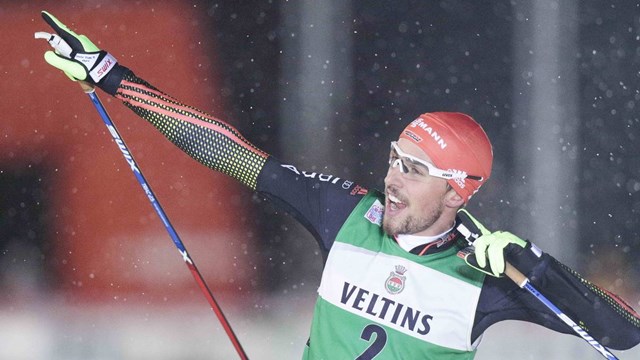
    Germany’s 24-year-old Johannes Rydzek celebrating his first of two wins on Saturday at the Ruka Nordic Combined World Cup in Kuusamo, Finland. He now has eighth career individual World Cup victories. (Photo: FIS)
    Germany’s 24-year-old Johannes Rydzek celebrating his first of two wins on Saturday at the Ruka Nordic Combined World Cup in Kuusamo, Finland. He now has eighth career individual World Cup victories. (Photo: FIS/NordicFocus)

    Germany’s Johannes Rydzek can do the Usain-Bolt-victory stance all the way to the next Nordic Combined World Cup after winning the first two competitions of the 2016/2017 season, with another individual large hill/10 k win on Sunday in Kuusamo, Finland.

    After winning by 34 seconds over his teammate Eric Frenzel on Saturday, Rydzek took a 14.7-second win over Wilhelm Denifl of Austria, while Japan’s Akito Watabe was just 0.3 seconds back in third.

    Rydzek posted the fifth-best jump after Norway’s Jarl Magnus Riiber, Watabe, Denifl, and Austria’s Mario Seidl, respectively. Rydzek started the 10 k Gundersen 1:04 minutes after Riiber and posted the seventh-fastest course time to capture first. Riiber slipped to 10th (+1:07.5) at the finish, with the 37th-ranked course time of 42 in the cross-country race.

    Of note, Frenzel improved from 27th in the jump to 17th (+1:32.4) at the finish with the second-fastest course time.

    Bryan Fletcher was one of two Americans in the race, finishing 31st (+3:40.7). His jump ranked 40th, but he skied the fourth-fastest course time to pick off nine places. Taylor Fletcher placed 40th (+6:24.4), improving slightly from 43rd in the jump.

    The Nordic Combined World Cup now moves to Lillehammer, Norway, for a team and two individual competitions Dec. 2-4.

    Final results

    ***

    Visma Ski Classics Prologue in Pontresina: 8 k Classic

    Petter Eliassen of Team Leaseplan Go (left) and Katerina Smutna of Team Santander (right) celebrate after winning the Visma Ski Classics 8 k prologue in Pontresina, Switzerland. (Photo: Visma Ski Classics)
    Petter Eliassen of Team Leaseplan Go (left) and Katerina Smutna of Team Santander (right) celebrate after winning the Visma Ski Classics 8 k prologue in Pontresina, Switzerland. (Photo: Visma Ski Classics)

    The Visma Ski Classics series started off in Pontresina, Switzerland, with 8-kilometer time trials for both men and women.

    In the women’s race, an individual interval start seeded last to first, Kristin Antonsen of Team Synnfjell set an early best mark. But as the previous season’s top women hit the course times began to come down, and the race ended as a battle between Britta Johansson Norgren of Team Lager 157 and Katerina Smutna of Team Santander. Smutna ended up with the win by just 0.66 seconds over Johansson Norgren, with Sara Lindborg of Team Serneke third (+20.66).

    The men’s race was a team interval start, with the teams separated by five minutes and with skiers at 15 second intervals within that span. Last year’s Visma Ski Classics Champion, Petter Eliassen of Team Leaseplan Go, came out on top with a time of 19:42.66. Bastien Poirrier of Team Gel Interim Rossignol was second (+8.53), leading five members of his new France-based team into the top ten and turning heads along the way. Morten Eide Pedersen of Team BN Bank was third (+15.80).

    Results

    ***

    FIS Cross-Country World Cup in Ruka: 10/15 k Classic

    Women’s report | Men’s report

    Twenty-four-year-old Finnish A-teamer Iivo Niskanen notched his second-career World Cup victory the men’s 15-kilometer classic on Sunday, Day 2 of the Ruka World Cup in Kuusamo, Finland.

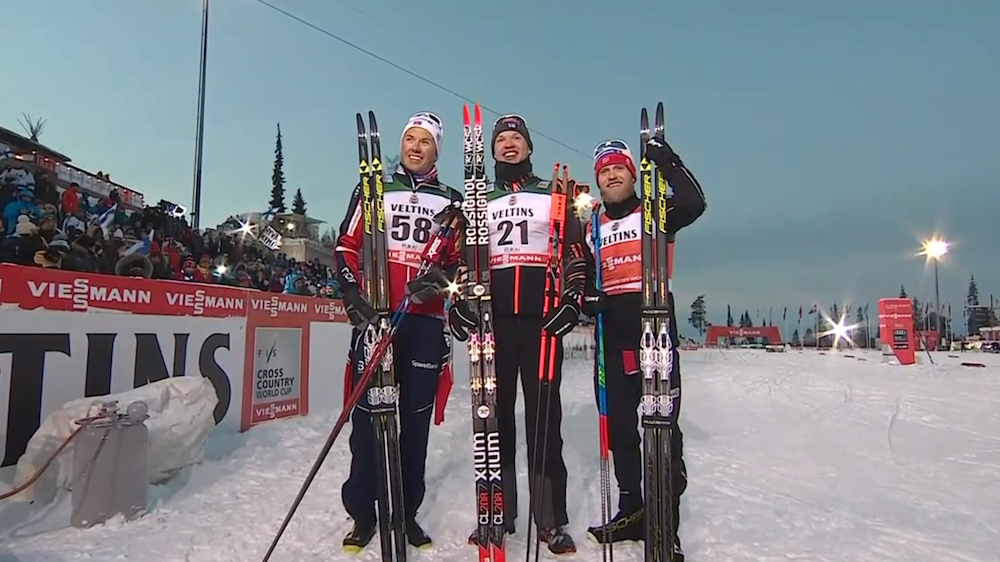
    The men's podium in Sunday's 15 k classic at the Ruka World Cup in Kuusamo, Finland: with Finnish winner Iivo Niskanen (c) and Norway's Emil Iversen (l) in second and Martin Johnsrud Sundby (r) in third. (Photo: NBC Sports screen shot)
    The men’s podium in Sunday’s 15 k classic at the Ruka World Cup in Kuusamo, Finland: with Finnish winner Iivo Niskanen (c) and Norway’s Emil Iversen (l) in second and Martin Johnsrud Sundby (r) in third. (Photo: NBC Sports screen shot)

    Niskanen started 21st of more than 90 in the men’s field and finished in 35:27.6, which stood as the fastest time all day. After the finish, he paced between the leader’s chair and the finishing pen, even jogging around the stadium and course. But every time he looked the Finnish crowd, he was all smiles.

    Niskanen held off three Norwegians in the top four, with Emil Iversen 10.2 seconds behind him in second, Martin Johnsrud Sundby 11.2 seconds back in third, and Didrik Tønseth missing the podium by about six seconds and tying Sweden’s Johan Olsson for fourth (+17.0). Norway’s Finn Hågen Krogh placed sixth (+18.3), Sweden’s Calle Halfvarsson was seventh (+21.2), Russia’s Alexander Bessmertnykh was eighth (+24.3), Finland’s Matti Heikkinen ninth (+32.0), and Great Britain’s Andrew Musgrave 10th (+33.8).

    Canada’s Alex Harvey was close behind in 11th (+35), and was the lone North American man in the points on Sunday. His teammate Devon Kershaw missed the top 30 by 4.5 seconds in 33rd (+1:23.4).

    Erik Bjornsen led the U.S. men in 41st (+1:37.2). Canada’s Graeme Killick was 53rd (+2:12.9), American Noah Hoffman was 64th (+2:42.6). For Canada, Len Valjas was 76th (+3:19.8), Jess Cockney 78th (+3:26), Knute Johnsgaard 85th (+3:53.4), and Andy Shields 91st (+4:26.1), and for the U.S., Eric Packer 87th (+4:01) and Andy Newell 88th (+4:17.4) out of 96.

    In the women’s 10 k classic earlier in the day, Marit Bjørgen of Norway picked up her first win of the season, a 4.6-second win over Finland’s Krista Parmakoski.

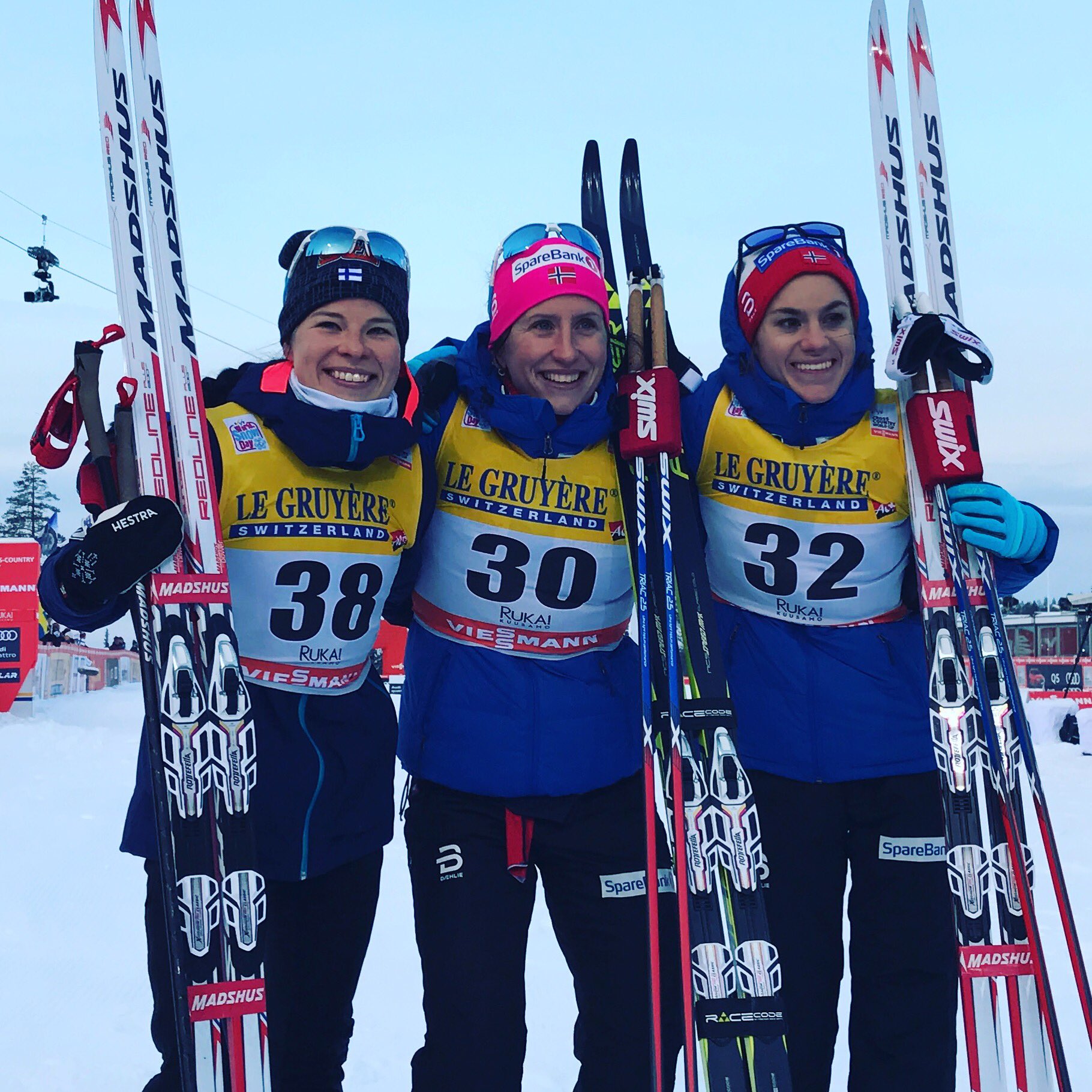
    Marit Bjørgen of Norway (center) collected her first World Cup win of the season in the 10 k classic in Ruka, Finland, ahead of Finland's Krista Parmakoski (left) and Norway's Heidi Weng (right). (Photo: FIS Cross Country/Twitter)
    Marit Bjørgen of Norway (center) collected her first World Cup win of the season in the 10 k classic in Ruka, Finland, ahead of Finland’s Krista Parmakoski (left) and Norway’s Heidi Weng (right). (Photo: FIS Cross Country/Twitter)

    It is the 103rd World Cup win for the 36-year-old Bjørgen, who took last season off to have a baby. Norway followed up Bjørgen’s win with third and fourth place finishes by Heidi Weng (+12.7) and Ingvild Flugstad Ørtberg (+36.8).

    Parmakoski also led a good day for the Finnish team, with Laura Mononen coming in seventh (+50.0). She was just behind sixth-place Nicole Fessel of Germany (+42.4).

    Jessie Diggins led the U.S. women’s team with a 13th-place finish (+1:09.0), one of her best distance classic races ever outside of Tour and mini-tour stages. Sadie Bjornsen followed in 17th (+1.14.9), and 2016 SuperTour champion Caitlin Patterson of the Craftsbury Green Racing Project scored points in 28th (+1:45.4). The U.S. Ski Team rounded out its results with Rosie Brennan 39th (+2:22.2), Kikkan Randall 43rd (+2:29.7), Ida Sargent 44th (+2:30.4), and Sophie Caldwell 61st (+3:13.4)

    Cendrine Browne and Emily Nishikawa slotted into 58th and 59th for Canada, +3:04.8 and +3:07.1, respectively. Dahria Beatty finished 74th (+3:54.4).

  • Unequal Prize Money at Blink Festival Illustrates Challenges for Women’s Distance Racing

    Unequal Prize Money at Blink Festival Illustrates Challenges for Women’s Distance Racing

    Tord Asle Gjerdalen (l) and Britta Johansson-Norgren (r) after winning the 2016 Marcialonga 70 k classic. In July, Johansson Norgren won the Blink Classics 60 k rollerski race - but received only 20% as much prize money as Petter Northug got for winning the men's race. (Photo: Visma Ski Classics)
    Tord Asle Gjerdalen (l) and Britta Johansson Norgren (r) after winning the 2016 Marcialonga 70 k classic. In July, Johansson Norgren won the Blink Classics 60 k rollerski race — but received only 20 percent as much prize money as Petter Northug got for winning the men’s race. (Photo: Visma Ski Classics)

    At the end of July, Norwegian professional cross-country skier Astrid Øyre Slind hit the podium in the new 60-kilometer classic race at her country’s Blink ski festival. She faced a payout that seemed unusual: a big discrepancy between men’s and women’s prize money.

    At the competition, called Blink Classics and part of the inaugural summer season of the World Classic Tour rollerski series, the total prize money available for men was 190,000 kroner, or just over $23,000. For women, it was 50,000 kroner — about a quarter as much.

    Accordingly, Slind’s second-place finish notched her 10,000 kroner ($1,200), while the second-place man, Andreas Nygaard, received 40,000 kroner.

    And men’s winner Petter Northug took home 75,000 kroner, which was 50 percent more than the entire pot of women’s prize money.

    “It’s an enormous difference,” Slind told Norway’s NRK broadcaster.

    Sweden’s Britta Johansson Norgren, who won the women’s competition, did not return FasterSkier’s request for comment.

    In most major ski marathons, women receive equal prize money to the men. At Norway’s Birkebeiner, the prize is 40,000 (Norwegian) kroner or $4,800 apiece; at Sweden’s Vasaloppet, the 2015 prizes went up to 91,000 (Swedish) kroner or $10,700; at Italy’s Marcialonga, it was 5,300 Euros or $5,900 for both men and women.

    The American Birkebeiner pays $7,500 to both the men’s and women’s winners.

    But Blink Classics is not one of these established marathons: it is a rollerski competition in its very first year of existence. It did, however, attract the attention of the Norwegian government, which was concerned that the festival was violating the country’s equal pay act.

    “For us it has not been easy to have this situation with the girls,” Blink Festival press secretary Arne Idland told FasterSkier. “And then when they are not satisfied with the money it is really difficult. We will try as hard as we can to find a solution.”

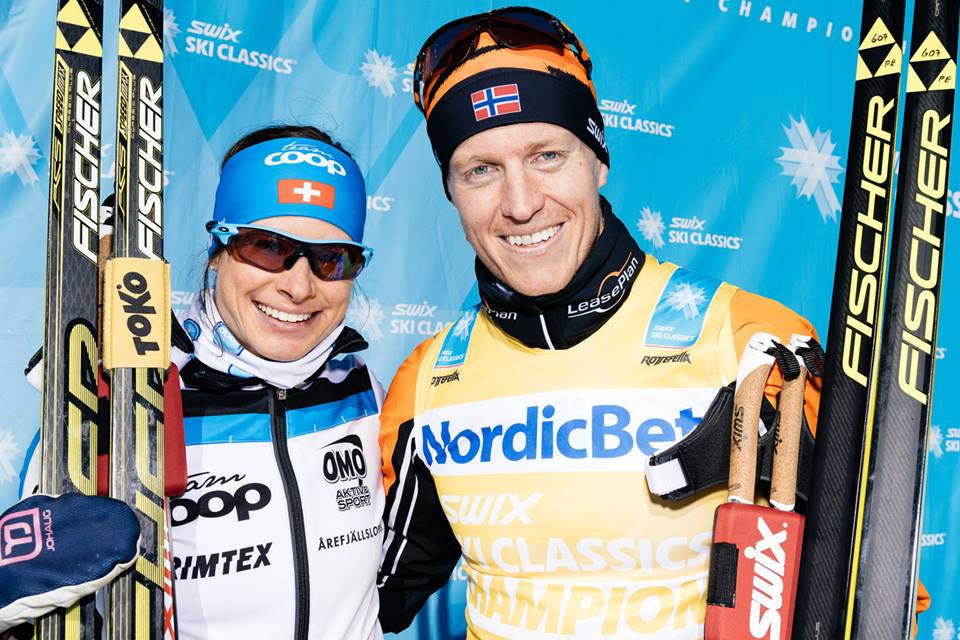
    Seraina Boner (l) of Switzerland and Team Coop and Petter Eliassen of Norway and Team LeasePlan Go won the 2015 Årefjällsloppet, receiving equal paydays. (Photo: Ski Classics)
    Seraina Boner (l) of Switzerland and Team Coop and Petter Eliassen of Norway and Team LeasePlan Go won the 2015 Årefjällsloppet, receiving equal payouts. (Photo: Ski Classics)

    New Race for a Booming Festival

    The Blink ski festival is now a giant on the summer racing circuit, with athletes from all over Europe and even North America coming to compete on rollerskis in cross-country skiing, biathlon, and the famous Lysebotn Opp hill climb. Recreational and junior classes are also a big focus, making it accessible to fans and professionals alike.

    But adding a long-distance race to the mix was not easy for organizers, who still have to make sure that the festival breaks even financially. Idland explained that Blink Classics had been in the works for three years.

    “The main challenge this year is that we, for the first time, were going into car traffic — this race was on ordinary roads with traffic [rather than the city square], and we had to close it to traffic just like they do in cycling races,” he explained.

    That entailed paying for policemen, for one thing. Having a fourth day of racing (previously there had been three, the Lysebotn Opp and two more days in the Sandnes city center) also meant more production by NRK, Norwegian national television, as it followed a long-distance race rather than staying in a set location downtown.

    “If you have live production it has to be in high definition,” Idland said. “Then it’s really expensive.”

    Then last autumn came the news from the Norwegian Ski Federation: none of the national team “A” or “B” team women would compete in the 60 k. The women usually focus on doing all three of the other days of racing, and adding a 60 k at the beginning of consecutive days of racing would be too much volume and intensity during the summer training season. Some of the men, like Eirik Brandsdal and Sjur Rothe, would do the longer race; Martin Johnsrud Sundby was interested but later pulled out.

    Concurrently, Idland said, NRK was telling the Blink organizers that it wouldn’t be possible to broadcast the men’s and women’s 60 k competitions together. It would have meant following two races at the same time — double the filming budget and staffing — and deciding all the time which feed to broadcast and commentate. NRK didn’t have expertise in doing this and said that they needed to develop it. So they would only broadcast one, and with the national team women out of the competition but the national team men in it, organizers agreed it should be the men’s race.

    “When I contacted the teams from other nations, I was open and said that this [women’s] long distance race will not be broadcast on TV and no women from the national team would start there,” Idland said of his communication with other countries’  teams last winter, before registration began. “So I advised them all not to start in this race, but to come do the three other races.”

    As a result just four womencompared to 69 men, finished the 60 k classic race.

    Johansson Norgren, the winner, is a mainstay on the Visma Ski Classics circuit and won the 2016 season title as well as numerous individual marathons. Masako Ishida, who finished third at Blink Classics, was the winter series’ fourth-ranked woman. So the podium at Blink was not so different than a podium one might see at a top winter event.

    But the decision about prize money had been made long before.

    “We said that we need good prize money on the men’s side, because the other competitions that we compare with have good prize money,” Idland said. “We also need some sprint primes. We had a total of 190,000 kroner, or about 20,000 Euros, for the men. And we had just over 5,000 [Euros] for the women. That was decided before we opened entry.”

    Even for the women, it was more prize money than was available at the other competitions in the Blink festival, Idland said. In those other races, prize money is equal for men and women and each total prize-money purse is roughly 2,000 Euros.

    “So it is double amount of money in this women’s class in any of the other races, including Lysebotn Opp,” he said. “We thought we were really doing well for the women. And it’s not every rollerski race having prize money, either.”

    Kaisa Mäkäräinen (FIN) climbs to victory in the Lysebotn hill climb at the 2013 Blink festival. The women's hill climb is televised, unlike the Blink Classics. (Photo: blinkfestivalen.no)
    Finland’s Kaisa Mäkäräinen climbs to victory in the Lysebotn hill climb at the 2013 Blink festival as a cameraman captures the action. The women’s hill climb is televised, unlike the Blink Classics. (Photo: blinkfestivalen.no)

    Building Women’s Pro Fields Takes Time

    But the discrepancy still felt unusual to some of the women, who are used to getting paid the same amount as their male counterparts for a win.

    Prize money is the same for men and women on cross-country skiing’s World Cup. In fact, female superstars like Marit Bjørgen and Therese Johaug earn more than their male counterparts because they are more dominant, grabbing a bigger proportion of the total available prize money for themselves.

    The gulf between men’s and women’s participation is greater in long-distance racing than on the World Cup. As a result, marathon organizers have to grapple with a somewhat different set of considerations as they develop the payout structure for their competitions.

    Most of the biggest ski marathons in Europe — including the Birkebeiner, Vasaloppet, and Marcialonga — are part of the Visma Ski Classics series, where organizers have come up with compromise solution when it comes to year-end rankings.

    Prize money is equal for the top three overall series finishers, but the men’s field also pays out to the fourth- and fifth-place athletes while the women’s field does not.

    “For me it sounds very strange,” Visma Ski Classics CEO David Nilsson told FasterSkier in an interview last week referring to the Blink prizes. “We have in our rules that they must have the same first prize to men and women. It is also important to reflect on the percentage [of field size], and it shouldn’t be so much more difficult for the men to get [prize money] than for the women — but you can never do more than win, so of course that has to be equal for first place.”

    In the winter, far fewer women than men are on Visma Ski Classics professional teams. But women’s races are hotly contested and often extremely dramatic, like Seraina Boner’s come-from-behind win at the 2016 Birkebeiner after passing Ishida and Poland’s Justyna Kowalczyk in the final kilometers.

    In the 2016 season, 39 different women scored points toward the overall titles. There is even an all-women’s pro team, Sweden’s Team SkiProAm, whose top athlete finished eighth in the season rankings.

    According to Nilsson, Visma Ski Classics has carefully tried to promote women’s participation, with equal prize money for first place being one component.

    “We worked very hard on this,” he said. “When I started 6-7 years ago, we had 4-5 women that were competing [professionally] in long distance skiing because it was a bigger step for them from shorter distance [World Cup] skiing than for the men.”

    While they left the women’s competition out of the spotlight this year, the Blink Classics organizers don’t think that should always be the case. Like the Visma Ski Classics, they want more women on the start line.

    “Our aim and our goal is also to have the world’s best women at the start in future,” Idland said.

    One reason for low numbers at Blink might be that long-distance racing just isn’t as popular among women in Norway as it is in neighboring Sweden, home of the Visma Ski Classics brand, said Nilsson.

    “In Norway, which we all know is very strong in cross-country skiing, we don’t see so many female participants in long-distance skiing,” he mused. “They are more from Sweden. We don’t know why the Norwegian women are not coming more.”

    The Blink 60 k is part of a three-race series of long-distance rollerski competitions called the World Classic Tour. Indeed, the second leg of the Tour was held in Sweden. Called the Alliansloppet, it is also a more established event.

    Twenty-five women finished that 48 k race, including several past Visma Ski Classics champions and members of the Swedish national team (Hanna Falk, a three-time World Cup podium finisher, won the race). Prize money was equal for men and women, including a 10,000 Swedish kroner sprint prize ($1,000) for both men and women.

    The World Classic Tour overall awards use a similar idea to the Visma Ski Classics, in that the men’s and women’s title winners earn equal paychecks but the men’s field will pay out to six places and the women’s to just three.

    Yet the series does not appear to have a policy for its constituent races in how to organize prize money at individual competitions.

    If organizers like those at the Blink festival want to develop a strong women’s competition, Nilsson suggested that they need to actually promote the women’s races.

    “We also made sure that there was much more focus on the women [than there had been before],” he said of the Visma Ski Classics efforts. “The women should have be starting [wave] before the men to have their own competition… and have [television] production of the race and their own media. When we created the system, all the attention was on the men. Then we made it so the pro teams had to get points from both the men’s and the women’s classes. This together has made the increase of the women.”

    Idland conceded that with more prize money, they might have drawn a slightly larger women’s field. But he believed the circumstances of the festival, with the three subsequent days of racing, were the bigger reason for low participation.

    On the Blink Festival website, the news story about the 60 k Classics race features five paragraphs and three photos about the men’s race, but only one paragraph and one photo of the women.

    Nilsson believed that some changes could be made without disrespecting the male athletes.

    “When you have 100 men and not so many women registered, it wouldn’t be fair to get the same [prizes],” Nilsson said. “It would be easier for the women. So it has been for us to push the development [of women’s skiing] but not to be unfair to the men’s skiers. That’s the reason we have in the prize money, five men and three women. And that reflects a little bit to the female factor, to be honest, in terms of the number of participants and the amount of professional skiers. It has to be the same difficulty to win a prize in both categories.”

    What Does Equality Mean?

    Race organizers are continuously trying to come to a more perfect solution, and one common thread seems to be that prize money must be earned by quality racing and exciting performances. Until the women’s fields are deemed to have provided that, they might not see as much compensation.

    Visa Ski Classics, for example, continues to make changes. For the 2016/2017 season, women will for the first time be able to vie for a sprint title, worth five percent of the total prize money, just as the men have done for years.

    “The reason it wasn’t the case [previously] is that there weren’t so many women — last year was the first time that there was really a group at the front,” Nilsson said. “Before it was just one or two who went away, so it wouldn’t have been interesting. The same people would have won the race as the sprint bibs. Now both men and women get a sprint bib, which is a step forward. Our goal is to make it equal the number of participants and who gets prizes.”

    Nilsson guessed that the availability of intermediate prize money may also change the tactics of the women’s races and contribute to an exciting spectacle on television.

    For his part, Idland insisted that the Blink organizers’ decision about prize money was not sexism. It could have gone the other way, he wrote in a letter to the Norwegian government explaining the discrepancy in pay.

    “I was trying to give an example with the opposite situation,” Idland said. “If Marit [Bjørgen], Therese [Johaug], Heidi [Weng], Charlotte [Kalla], and maybe some of the Americans said to us that this race we would very much like to do, and the men said they didn’t want to do it and just let the [marathon] specialists do it, then I am quite sure we would have done the opposite thing. We would have led the coverage with the women, if the level was higher.”

    After being contacted by the authorities, the Blink Festival is trying to work together with the government to achieve equality.

    “Our answer was that they would really much like to come in dialogue with us to try to make a plan for the future,” Idland said. “And that we try to build up this competition with a clear aim to have everything on an equal basis in some number of years.”