From the FasterSkier archive — posts syndicated from athletes’ and coaches’ own blogs between 2004 and 2012, kept online as published. Current coverage is at fasterskier.com.

Tag: Vita Semerenko

  • Saturday Rundown: NCAA Champs; Holmenkollen 50 k; Kontiolahti Relays

    Saturday Rundown: NCAA Champs; Holmenkollen 50 k; Kontiolahti Relays

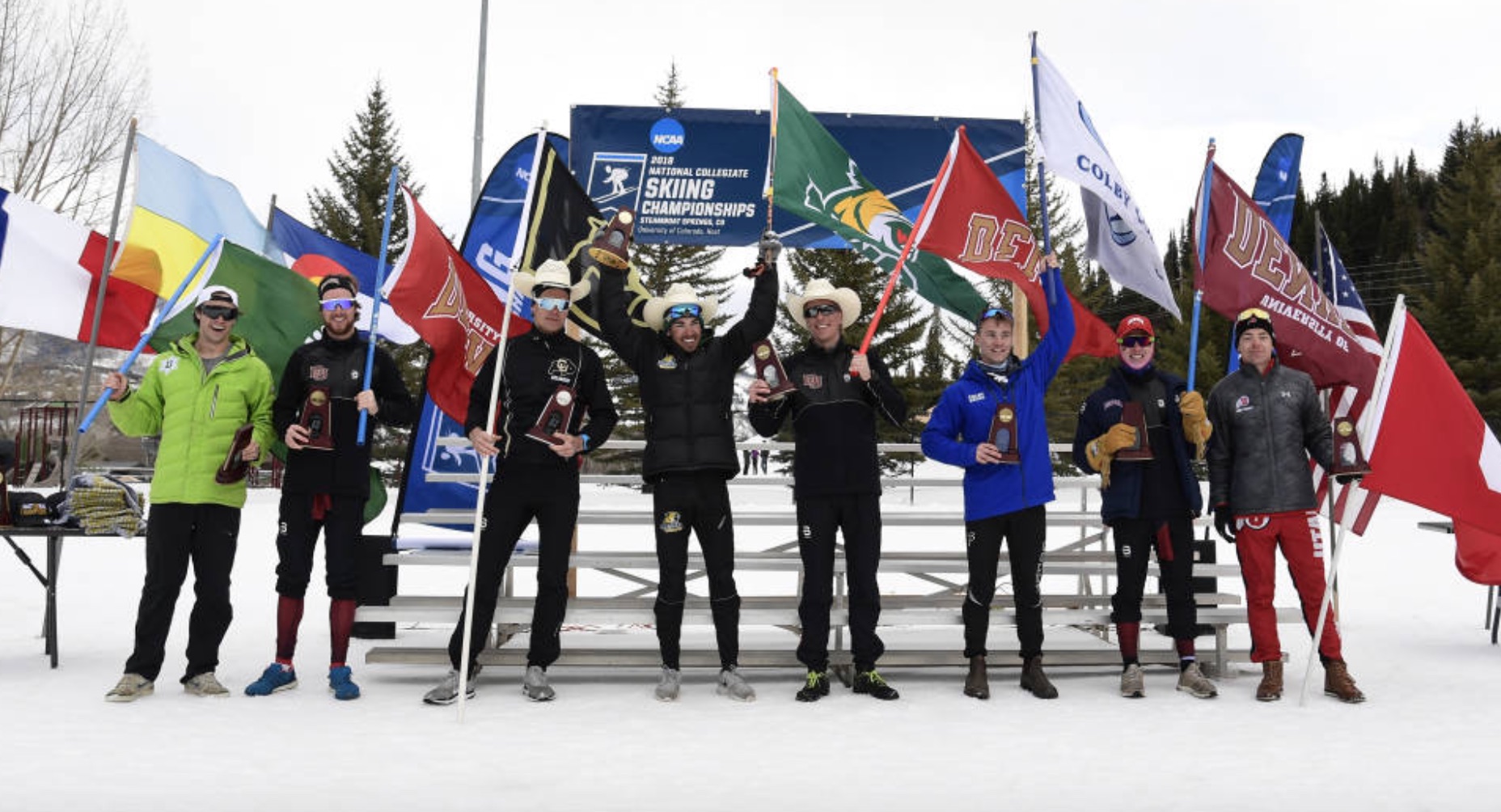
    The top finishers in the men’s 20 k freestyle mass start at 2018 NCAA Skiing Championships in Steamboat Springs, Colorado, with Northern Michigan University’s Ian Torchia (c) in first. (Photo: Dartmouth Sports/Clarkson Creative)

    NCAA Skiing Championships (Steamboat Springs, Colorado): 15/20 k freestyle mass starts

    On the fourth and final day of NCAA Skiing Championships at Howelsen Hill in Steamboat Springs, Katharine Ogden skied to her second-straight national title, Ian Torchia became an NCAA champion and the University of Denver (DU) won its 24th NCAA National Championship.
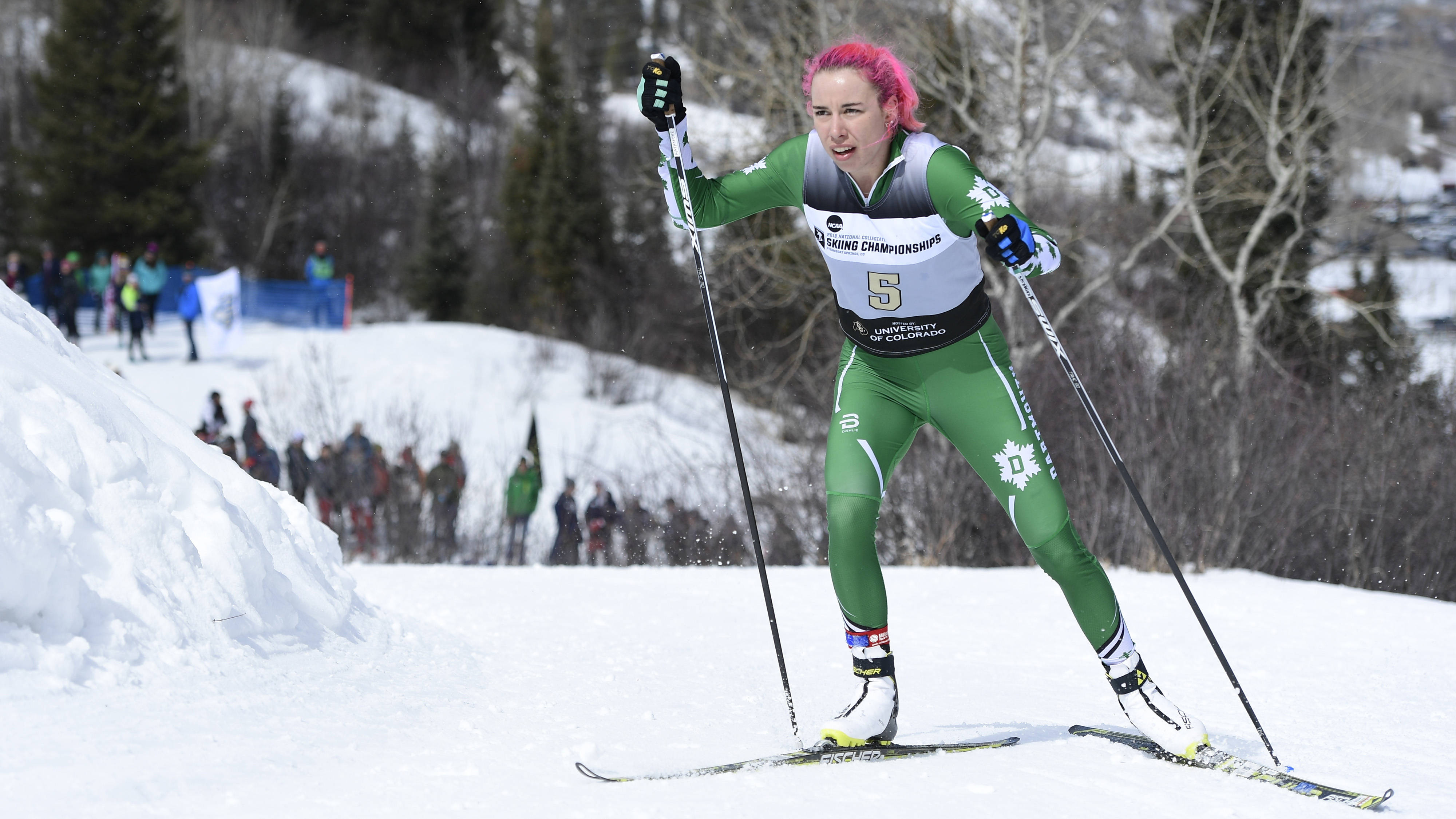
    Dartmouth freshman Katharine Ogden racing to her second-straight victory of the 2018 NCAA Skiing Championships in Steamboat Springs, Colorado. She won Saturday’s 15 k freestyle mass start by more than 38 seconds. (Photo: Dartmouth Sports/Clarkson Creative)

    Ogden, a Dartmouth College freshman, raced to a 38.4-second victory in the women’s 15-kilometer mass start, finishing in 43:22.0 minutes for her second win in as many races at 2018 NCAA Championships. She won the 5 k classic on Thursday and with her win on Saturday, she became the first Dartmouth skier in 56 years to win two national titles in the same year, according to a Dartmouth press release.

    On the second of three laps, Ogden broke away early with close to 10 k to go. According to the press release, she had a “quick fall” near the end of the second lap, but that didn’t derail her as she had time to grab sunglasses from Dartmouth men’s coach Brayton Osgood and a Dartmouth Lone Pine flag before the finish.

    At this year’s championships, Ogden’s two titles are accompanied by victories from Dartmouth men’s alpine skiers Brian McLaughlin (who won the giant slalom) and Tanguy Nef (who won the slalom). This marked only the second time that Dartmouth’s Big Green won four individual titles in a single NCAA Championships; that also occurred 61 years ago.

    “Katharine absolutely wanted this one, and she really likes to win,” Dartmouth Director of Skiing and Women’s Nordic Head Coach Cami Thompson Graves said in the press release. “She wasn’t about to let a fall slow her down, she has such a great competitive fire. But she also showed her playful side grabbing Brayton’s glasses and smiling all the way to the finish line!”

    Hailey Swirbul of the University of Alaska Anchorage placed second and Linn Eriksen (DU) reached the podium in third (+46.3). Denver had three in the top 10 with Jasmi Joensuu in ninth and Taeler McCrerey in 10th. Also landing in the top 10 for All-American honors were Guro Jordheim of the University of Utah in fourth, Emma Tarbath (Montana State University) in fifth, Petra Hyncicova of the University of Colorado Boulder (CU) in sixth, Christina Rolandsen (CU) in seventh, and Lauren Jortberg (Dartmouth) in eighth.

    Torchia, an Northern Michigan University (NMU) junior and U.S. Ski Team Development Team member, became the seventh NCAA champion in NMU Wildcats nordic skiing history, according to an NMU press release. Fredrick Schwenke was the Wildcats’ last nordic champion; he won the 2015 NCAA Championships 20 k classic.

    Torchia drew bib 1 for Saturday’s 20 k freestyle mass start and crossed the finish line first in 54:21.0, just 2 seconds ahead of CU’s Alvar Alev. Eivind Kvaale (DU) finished just four seconds back in third, and Denver had three in the top seven with Dag Frode Trollebø in fourth and Lars Hannah in seventh. Darmouth’s Cal Deline placed fifth, Zane Fields of Colby College finished sixth, and the 20 k freestyle’s 2017 NCAA champion Martin Bergström (Utah), who also won Thursday’s 10 k classic, placed eighth.  CU’s Petter Reistad and Sondre Bollum finished ninth and 10th, respectively.

    In the team standings, Denver beat Colorado by 41 points for the overall win with a total of 604 points between the nordic and alpine events at this year’s championships. Dartmouth placed third, 114.5 points behind Colorado, and Utah was another 63 points back in fourth.

    According to a DU press release, Denver has won at least one national championship in each of the last five athletic seasons (skiing: 2013/14, 2015/16, 2017/18; hockey: 2016-17; men’s lacrosse 2014/15), joining only Stanford on the list of schools that have done so in the last five seasons. (Oregon, West Virginia, Penn State, Oklahoma, Ohio State and Florida could potentially join that list later this year.)

    “It feels incredible,” said DU head coach Andy LeRoy said in the press release. “I am so happy for all of our athletes, they’ve been training all week and all season and to do it in Steamboat in front of our crowd is special.”

    Results: Women | Men| Team 

    Photos

    ***

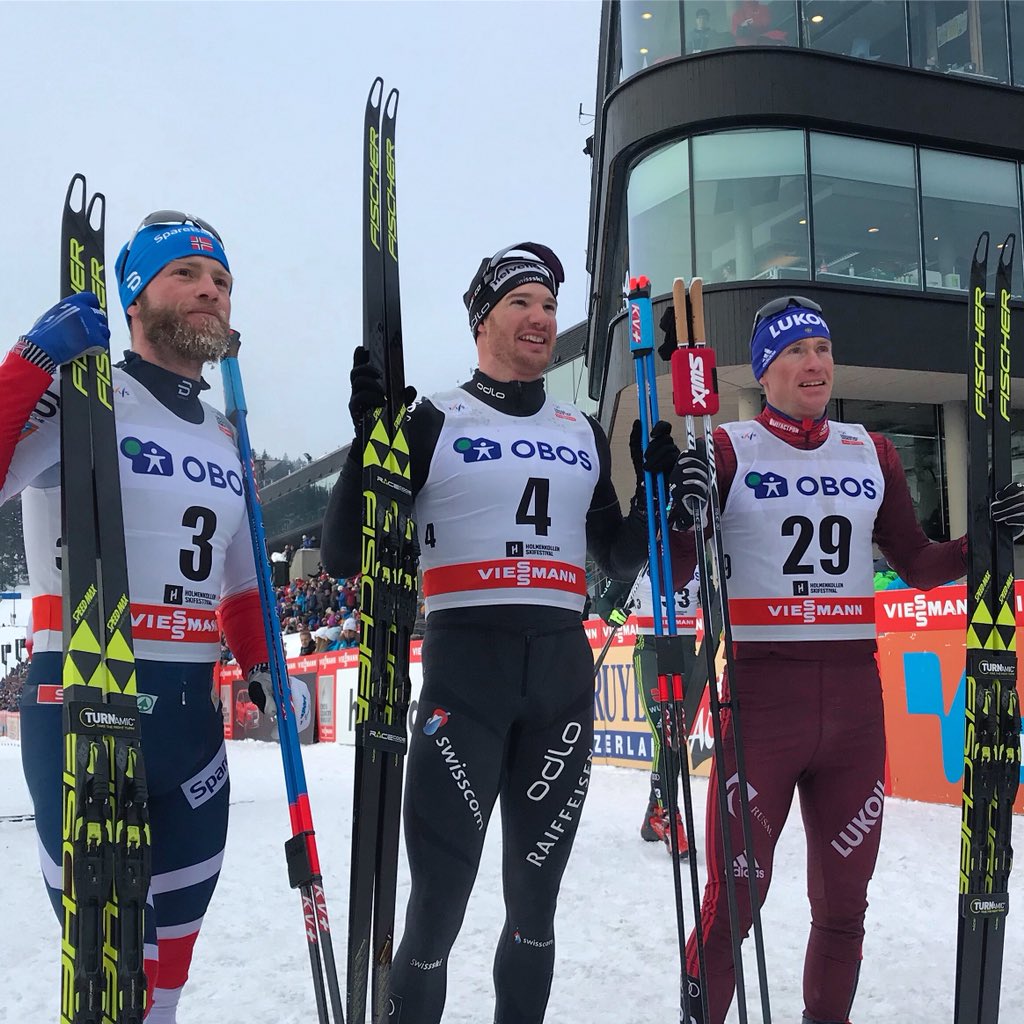
    The Holmenkollen men’s 50 k freestyle mass start podium on Saturday at the World Cup in Oslo, Norway, with Switzerland’s Dario Cologna (c) in first, Norway’s Martin Johnsrud Sundby (l) in second, and Russia’s Maxim Vylegzhanin (r) in third. (Photo: FIS Cross Country/Twitter)

    FIS Cross Country World Cup (Oslo, Norway): Men’s 50 k freestyle mass start

    Full report

    A four-time Olympic champion, Dario Cologna of Switzerland won his first 50-kilometer World Cup race on Saturday, topping the podium in the famous Holmenkollen 50 k freestyle mass start after outlunging Norway’s Martin Johnsrud Sundby (who won the event last year) for the win in 2:01:48.1. Sundby finished one-hundredth of a second behind for second place, ahead of Russia’s Maxim Vylegzhanin, who was 1.1 seconds back in third in his first World Cup race since November of last year.
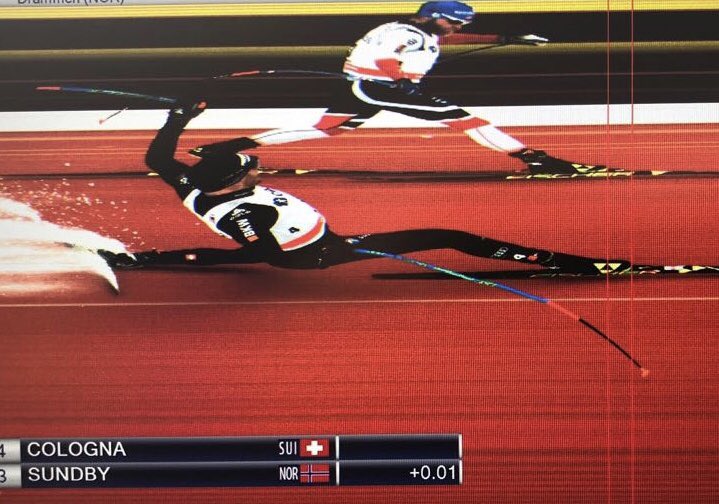
    The photo finish for first between Switzerland’s Dario Cologna (near) and Norway’s Martin Johnsrud Sundby at the Holmenkollen 50 k freestyle mass start on Saturday in Oslo, Norway. Cologna got it by 0.01 seconds. (Photo: FIS Cross Country/Twitter)

    Norway’s Sjur Røthe came out on top in a race for fourth (+4.2), ahead of Russia’s Denis Spitsov in fifth (+4.4) and his Norwegian teammate Hans Christer Holund in sixth (+4.5). Great Britain’s Andrew Musgrave followed in seventh (+15.1), Germany’s Florian Notz placed eighth (+25.9) and Canada’s Alex Harvey finished ninth (+32.4), ahead of France’s Robin Duvillard in 10th (+33.5).

    Scott Patterson led the U.S. in 16th (+56.3) coming off an 11th place in the 50 k classic mass start at last month’s Olympics, and Canada’s Devon Kershaw finished in the points in 28th (+3:43.6). Just outside the top 30, Canada’s Graeme Killick finished 34th (+4:55.1).

    Also for the U.S, David Norris placed 38th (+6:19.7), Paddy Caldwell was 46th (+8:12.3), Noah Hoffman 49th (+10:27.9), Kevin Bolger 52nd (+12:44.2), and Simi Hamilton did not finish.

    Canada’s fourth man in the race, Andy Shields finished 47th (+8:13.6).

    Results

    ***

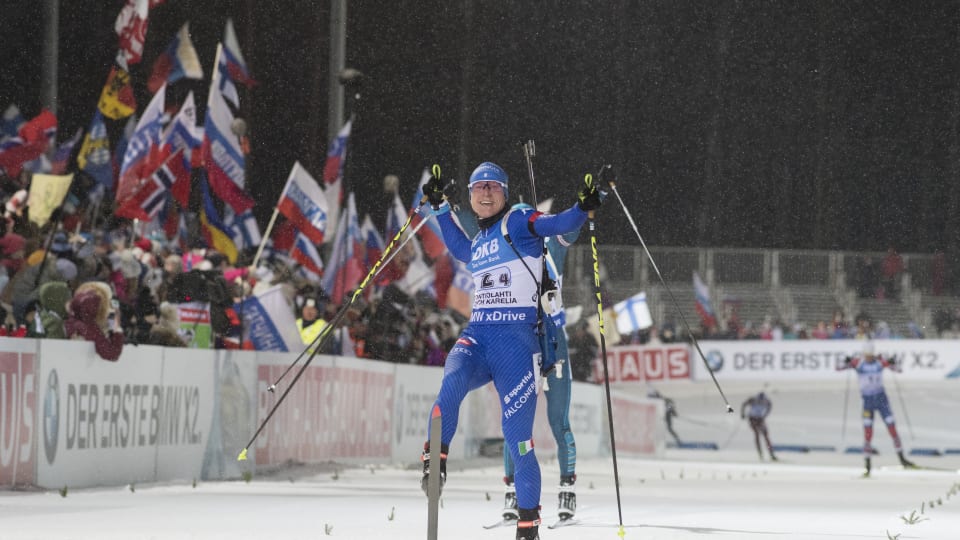
    Italy’s Lukas Hofer celebrates his team’s win in Saturday’s mixed relay at the IBU World Cup in Kontiolahti, Finland. (Photo: IBU/Biathlonworld)

    IBU World Cup (Kontiolahti, Finland): Single mixed relay & mixed relay

    (Note: This rundown has been updated to include comments from Christian Gow and Sean Doherty.)

    In the last single mixed relay and mixed relay of the International Biathlon Union (IBU) World Cup season, France and Italy came out on top, with France winning the two-person single mixed relay and Italy taking first in the coed mixed relay.
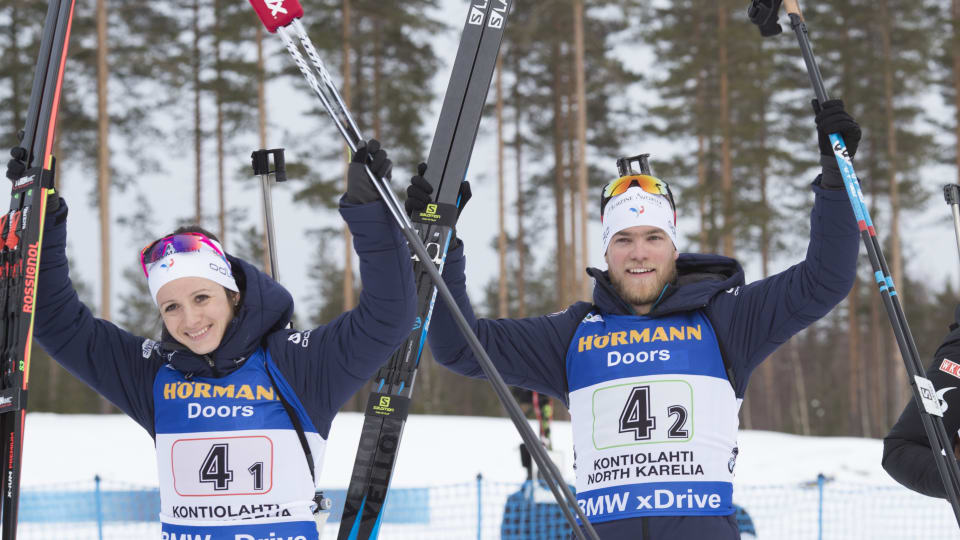
    France’s Anaïs Chevalier and Antonin Guigonnat after winning Saturday’s single mixed relay at the IBU World Cup in Kontiolahti, Finland. (Photo: IBU/Biathlonworld)

    France’s Anaïs Chevalier and Antonin Guigonnat combined for zero penalties and six spares to finish first in the single mixed relay in 33:29.1 minutes. Guigonnat as the team’s anchor secured the win by just 2.4 seconds over Austria’s Julian Eberhard while Norway’s Johannes Thingnes Bø finished 4.4 seconds back for third.

    Chevalier put France in fifth after the first leg, 15.5 seconds behind Ukraine’s Iryna Varvynets in first. Guigonnat used just one spare on his first leg to move them into fourth, 9.2 seconds back while Norway led at the second exchange. On Chevalier’s second leg, she shot clean in both stages to lead through the final exchange, with Ukraine skiing just 6.2 seconds back in second.

    On the final leg, Guigonnat used two spares and stayed out of the penalty lap, keeping the team in first through the finish. Eberhard skied the second-fastest course time on that leg to elevate Austria (with Lisa Theresa Hauser) from fourth at the tag to second place at the finish, and Bø skied all the way up from eighth to third place for Norway (with Marte Olsbu) with the fastest course time.

    Ukraine’s Artem Tyschenko used just one spare but slipped to fourth with the 11th-ranked course time on that leg, as he finished 10.8 seconds behind Norway.

    Behind Russia in fifth and Italy in sixth, Canada placed seventh (+23.8) with Rosanna Crawford and Christian Gow. The duo combined for zero penalties and six spares, and put themselves in third place early in the race. Crawford skied them into third on the first leg, using just two spares and tagging Gow 7.4 seconds out of first.

    Gow went on to take the lead after cleaning prone without any spares, and he cleaned standing as well but slipped back to third while Bø took the lead. Gow tagged Crawford in third, 8.9 seconds behind Norway in first.

    “I didn’t think too much about being tagged in third,” Gow recalled in an email to FasterSkier. “It was exciting for sure, but I let it fade to the background so that I could focus on my job both on the track and in the range.  It was great to leave prone in first place! It was also surprising, but it was a good place to be in.

    “My skiing was ok today,” he continued. “It is a really challenging and demanding race format that we don’t get a lot of practice with.  I was sick after the Olympic Games and only finally coming around the past couple days.  The Sprint race was horrendous for me, so today was much better than that. In the range I just focussed on myself and trusted my shooting.  I tried my best not to get caught up in the race going on around me and it worked to my benefit.”

    Crawford then slipped to seventh and 21 seconds back with three prone spares, but avoided the penalty lap, and Gow held onto seventh through the finish, using just one spare and skiing the eighth-fastest course time on that leg.

    “We are both happy with this result,” Gow wrote. “I think that we are both looking at the 23 second gap to first and thinking that if things had worked out just a bit better we could be there.  It can be both exciting and frustrating to be that close to the podium.  We know we can do it, it’s just a matter of putting it together on the right day. We are happy with 7th, but hungry for more.”

    Susan Dunklee and Lowell Bailey finished 14th for the U.S., 1:13.0 out of first with one penalty and 14 spares. The penalty came on Dunklee’s first leg during her standing stage, after she had cleaned prone without any spares. She tagged Bailey in 14th and he brought them up to 11th, using three spares on that leg, then Dunklee came through the final exchange in 13th after using four spares to clean. Bailey lost one place on the final leg, using four spares but staying out of the penalty lap.

    Twenty-six teams competed in the single mixed relay, compared to 23 in the mixed relay that followed.
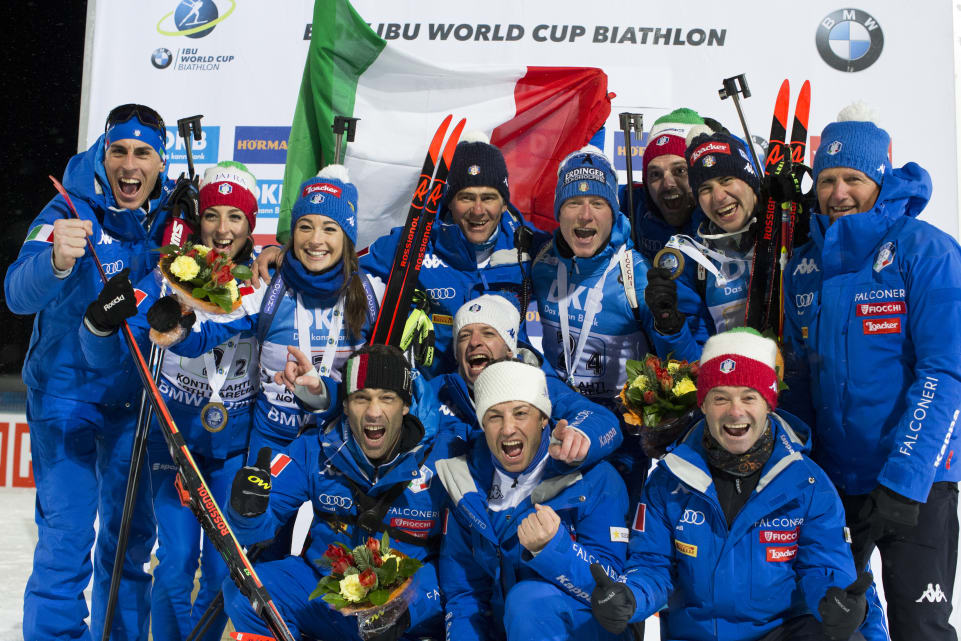
    Team Italia celebrates its win in the IBU World Cup mixed relay on Saturday in Kontiolahti, Finland, with its relay members Dorothea Wierer, Lisa Vittozzi, Dominik Windisch, and Lukas Hofer. (Photo: IBU/Biathlonworld)

    In Saturday’s 2 x 6 + 2 x 7.5 k mixed relay, Italy nabbed a 1.5-second victory over Ukraine in 1:15:08.3. Dorothea Wierer, Lisa Vittozzi, Dominik Windisch, and Lukas Hofer — the same Italian team that took bronze in the mixed relay at last month’s Olympics, although in a different order — combined for the win with one penalty and 13 spares.

    Ukraine, with Anastasiya Merkushyna, Vita Semerenko, Artem Pryma, and Dmytro Pidruchnyi, had zero penalties and just three spares throughout the whole race. For the second-straight relay on Saturday, Norway placed third (+9.1) with Synnøve Solemdal, Tiril Eckhoff, Henrik L’Abée-Lund, and Tarjei Bø totaling zero penalties and nine spares.

    Italy’s lone penalty came in Vittozzi’s second leg, but it didn’t derail the team as it improved from sixth to fifth with Vittozzi, who skied the third-fastest course time on that leg. She tagged Windisch 6.8 seconds out of first, and Windisch, who had anchored the team in the Olympics, took the lead by the final exchange after using two spares to clean. Hofer left the exchange just 3.3 seconds ahead of Norway’s Bø but used just one spare and skied the second-fastest anchor leg to finish first, beating his rivals up Kontiolahti’s infamous climb known as “The Wall”. Ukraine’s Pidruchnyi also shot clean with a single spare and clocked the fastest anchor leg to move his team from fourth to second place. Bø lost one place and finished third after using one spare as well and skiing the third-fastest anchor leg.

    Russia followed in fourth, France fifth, Sweden sixth, Germany seventh, Austria eighth, and the U.S. ninth (+2:48.4). The U.S. team, with Clare Egan, Joanne Reid, Tim Burke, and Sean Doherty, had one penalty and 11 spares. Egan cleaned her first prone but had to ski a penalty lap after her standing stage, tagging Reid in 17th, 58.7 seconds out of first.

    Reid used three spares on the second leg and moved up to 13th by the second exchange, and Burke used three spares as well to pick off one more place and tag Doherty in 12th. Doherty skied the eighth-fastest anchor leg and used two spares to clean to put the team in ninth at the finish.

    “I don’t consider two spares to be anything special, but today it was enough to make up some ground,” Doherty wrote in an email to FasterSkier.”I felt strong skiing, more like myself which is fun even if it’s a little late in the season. We had very good skis which always helps. I have done quite a few laps on this course over the years so the lines and transitions are pretty refined, so that is where I made time on the course.

    “I am happy with my leg. I enjoyed my little battle for 9th,” he continued. “I can’t speak too much for the other members of the relay tonight but I think 9th is a solid effort.”

    Canada finished 17th (+4:34.9) with Emma Lunder, Julia Ransom, Scott Gow, and Brendan Green combining for one penalty and 13 spares. Lunder put them in 12th at the first exchange and Ransom skied up to 10th, but Scott Gow had a penalty on his standing stage to drop to 16th. Green lost one more place on the last leg despite only requiring two spares.

    Results: Single mixed relay | Mixed relay

  • Friday Rundown: Domracheva Tops Kontiolahti Sprint; Crawford 12, Egan 13th

    Friday Rundown: Domracheva Tops Kontiolahti Sprint; Crawford 12, Egan 13th

    Clare Egan (US Biathlon) racing to a career-best 13th in the women’s 7.5 k sprint at Friday’s IBU World Cup in Kontiolahti, Finland. (Photo: USBA/NordicFocus)

    IBU World Cup (Kontiolahti, Finland): Women’s 7.5 k sprint

    Darya Domracheva of Belarus raced to her third World Cup victory of the season on Friday, and American Clare Egan tallied a career best in 13th, just behind Canada’s Rosanna Crawford in 12th in the International Biathlon Union (IBU) World Cup women’s 7.5 k sprint in Kontiolahti.

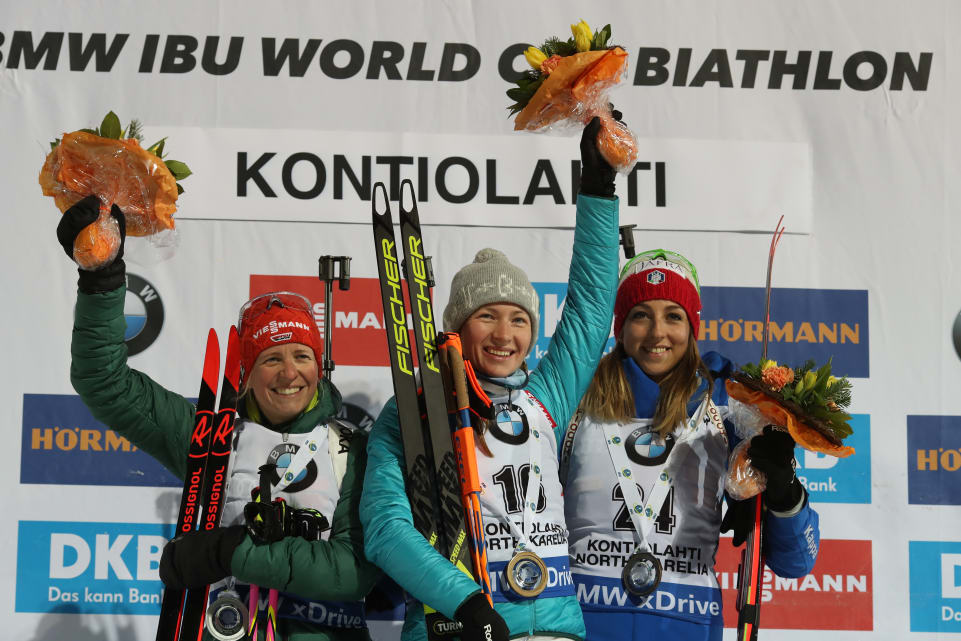
    The women’s 7.5 k sprint podium at the IBU World Cup in Kontiolahti, Finland, with Belarus’s Darya Domracheva (c) in first, Germany’s Franziska Hildebrand (l) in second, and Italy’s Lisa Vittozzi (r) in third. (Photo: IBU/Biathlonworld)

    Domracheva started 16th and shot a perfect 5-for-5 in prone, then missed one in her standing bout, but skied to first with the fastest overall course time. Her position in the leader’s chair looked secure until Germany’s Franziska Hildebrand, who started 49th, shot clean in both stages and headed out on her last loop with a 17.6-second lead on Domracheva’s time. But Hildebrand couldn’t match Domracheva’s pace and finished 0.5 seconds short of the winning time of 20:56.8 at the finish.

    “I really like to compete here in Kontiolahti,” Domracheva said, according to an IBU press release. She won two gold medals there at 2005 Youth/Junior World Championships and went on to win her first two World Cup races there in 2010.

    “This is a tough track, always very difficult but it always a good chance to take some seconds if you are in good shape,” she said. “I have some good memories from here…”

    “I am very proud of myself,” Hildebrand said of her race, according to the IBU. “Dasha made a really strong last loop and I tried to do it as well. It was very close but I am happy to be second … I had to concentrate and have the confidence that I could shoot clean today.”

    Italy’s Lisa Vittozzi started 24th and came within 5.5 seconds of Domracheva’s time, after missing one standing target (0+1), to place third, 5 seconds behind Hildebrand.

    Vittozzi achieved her first career podium in Kontiolahti last year.

    “This is an amazing place for me,” she told the IBU. “I like this track so much and feel in good shape. I tried to do my best in the shooting range and finally I did it.”

    Ukraine’s Yuliia Dzhima shot clean but was 11.7 seconds short of the podium in fourth place (+17.2), Germany’s Laura Dahlmeier followed in fifth (+19.4; one penalty), Veronika Vitkova of the Czech Republic placed sixth (+21.0; no penalties), Ukraine’s Vita Semerenko was seventh (+21.0; no penalties), France’s Marie Dorin Habert eighth (+32.0; no penalties), Germany’s Maren Hammerschmidt ninth (+33.9; one penalty), Finland’s Kaisa Makarainen 10th (+34.4; two penalties), and Belarus’s second woman in the top 11, Nadezhda Skardino 11th (+35.3; no penalties).

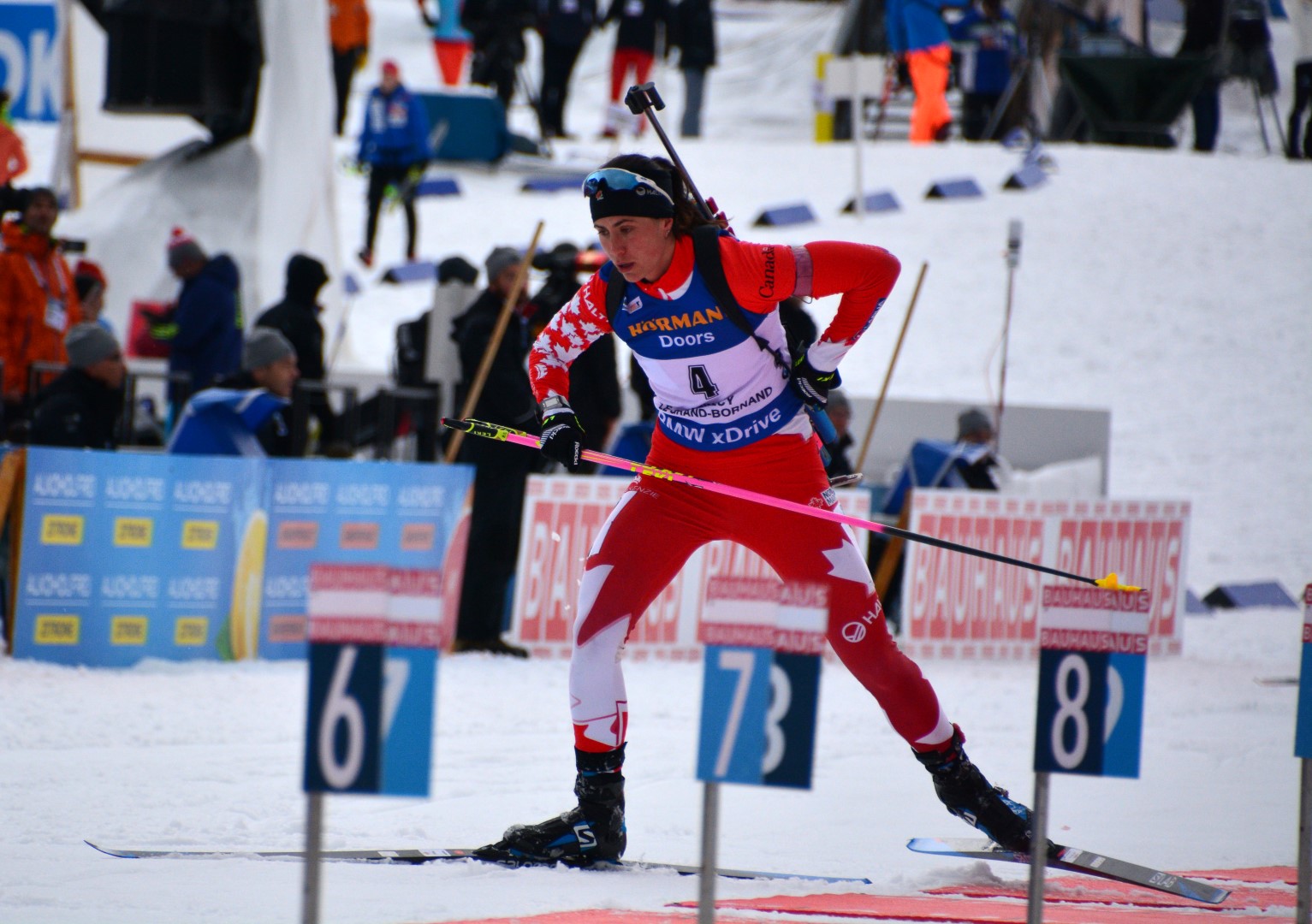
    Rosanna Crawford (Biathlon Canada) leaving the range during the women’s IBU World Cup sprint earlier this season in Annecy, France. . (Photo: Glen Crawford)

    Crawford led Canada in 12th (+46.5) with a single prone penalty (1+0) for her best sprint result since the 2014/2015 season. Also this season, Crawford raced to a career-best third place in a 15 k individual and fourth in a 12.5 k mass start.

    “It was a little bit windy and some fresh snow made for a soft track, but I had amazing skis from our techs and was feeling good skiing,” Crawford wrote in an email. “I’m really happy with how I executed my race today, I really tried to channel my inner Jessie Diggins and never stop fighting! The hills are steep and long here, something I usually struggle with, but I tried to push them mentally aside and focus on what I am good at, there are a lot of flat sections where my two skate one skate is really strong, and on the big up hills I just tried to stick with whoever was around me.

    “I had a lot of fun out there tonight, something I didn’t think I would ever say about this race course!” she continued. “… I am really happy to have some good ski speed in a spring finally!”

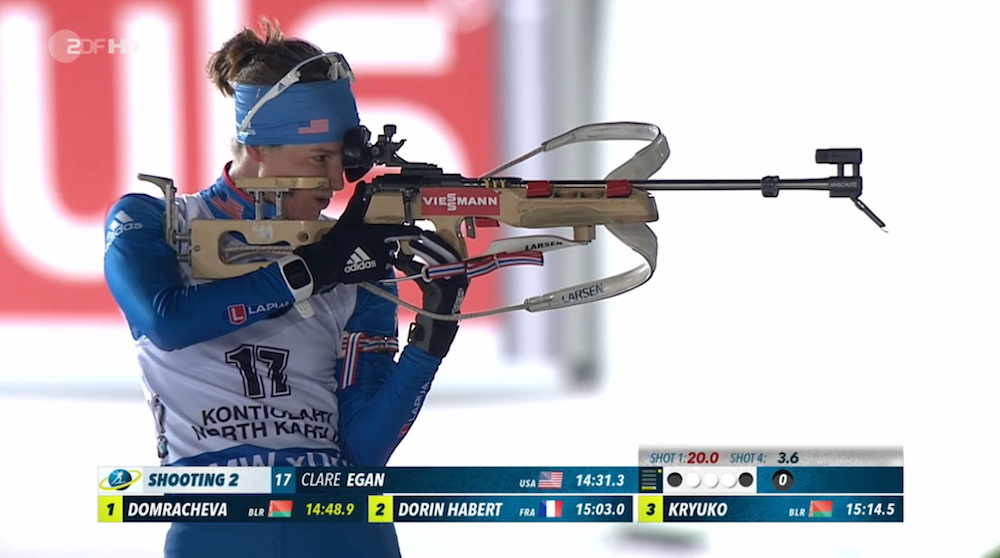
    Egan, of the U.S., achieved her best World Cup result in 13th (+46.9) with a single standing miss (0+1) and the 14th-fastest overall course time. Her previous best was 16th in a sprint four year ago.

    After the Olympics, Egan explained in an email that she rented an apartment in Helsinki and spent the first part of the off-week spending some alone time and doing “some serious R&R. I don’t think I realized how chaotic the Olympics were until I had peace and quiet for the first time in 3 weeks,” she wrote.

    “After a week of mostly easy skiing on my own I was really antsy to race today,” Egan added. “I also felt motivated coming off my season-best performance in the women’s relay in Pyeongchang. My individual results have been really mediocre this year so I was looking to take the momentum and confidence from the relay and carry that into today’s race.”

    Clare Egan (US Biathlon) during her standing shooting of the IBU World Cup women’s 7.5 k sprint in Kontiolahti, Finland. (Screenshot: ZDF broadcast)


    During Friday’s sprint, she noticed her skis were running really well.

    “I can say without any doubt that we had the fastest skis today and that played a big role in my ski time,” Egan wrote. “I had a personal best ski time (rank) by at least 10 places today.”

    After starting one bib and 30 seconds behind Domracheva, Egan knew she was having a good race when she could see the eventual winner for most of the first loop.

    “Our skis were so fast that I honestly had to adjust my technique to account for the extra glide– exceptional!” she added. “On my last loop, I realized I was still ahead of Laura Dahlmeier, who started :30 seconds behind me, and I fought super hard to hold her off all the way to the finish line!

    “I was shocked to have a career best with one miss,” Egan concluded. “But I had a major PR on my ski time rank, and this is biathlon! I’m very, very happy to have a great result, but happier about the performance behind the result.”

    With their results on Friday, both Egan and Crawford earned starts in Sunday’s 12.5 k mass start, according to a provisional start list.

    “I’ll have another opportunity tomorrow in the mixed relay and Sunday in the mass start, which is only the second of my career,” Egan wrote.

    “I was pretty disappointed to not qualify for the mass start at the Olympics,” Crawford wrote. “My bad sprint had many far-reaching consequences. So I am glad I get another chance to go out there and fight with the best!”

    Also for the U.S., Susan Dunklee finished 36th (+1:27.0) with three penalties (1+2), Emily Dreissigacker was 62nd (+2:15.7) with two misses (2+0), and Joanne Reid was 74th (+2:38.7) with two misses (0+2) as well.

    Canada’s Emma Lunder finished 43rd (+1:48.0) with one miss (1+0), Julia Ransom was 58th (+2:07.9) with two penalties (1+1), and Sarah Beaudry finished 66th (+2:20.3) with two misses (1+1) as well.

    This year’s Kontiolahti World Cup does not include a pursuit race. The single mixed relay and mixed relay are set for Saturday, followed by men’s and women’s mass starts on Sunday.

    Results

  • Saturday Rundown: Val di Fiemme Stage 6 and Oberhof Pursuits

    Saturday Rundown: Val di Fiemme Stage 6 and Oberhof Pursuits

    Slovakia’s Anastasia Kuzmina celebrates her second-straight IBU World Cup win in Oberhof, Germany, on Saturday with a 1:04-minute victory in the women’s 10 k pursuit. It marked her fourth win of the 2017/2018 season. (Photo: IBU/Biathlonworld)

    IBU World Cup (Oberhof): Women’s and men’s pursuits

    Men’s report

    So far in 2018, Slovakia’s Anastasiya Kuzmina is undefeated after winning her second-straight race on Saturday at the International Biathlon Union (IBU) World Cup in Oberhof, Germany — this time by 1:04.4 minutes in the women’s 10-kilometer pursuit.

    After winning Thursday’s sprint, Kuzmina started 35 seconds clear of anyone else on Saturday, while Finland’s Kaisa Mäkäräinen headed out of the gate after her in second.

    Veronika Vitkova of the Czech Republic started another 5 seconds back in third, and Germany’s Franziska Hildebrand set out in fourth, 47 seconds after Kuzmina.

    Three Canadians finished in the top 60 of Thursday’s sprint to qualify for the pursuit, with Julia Ransom heading out ninth (+1:14), Sarah Beaudry starting 23rd (+1:39), and Megan Tandy starting 59th (+2:38).

    Throughout the four-stage race, it became more and more evident that no one was going to touch Kuzmina. She cleaned the first prone stage to leave the range 55.8 seconds clear of Hildebrand, who also cleaned to move into second. Makarainen dropped to fourth with a miss and Vitkova left the range in third (+1:08.5) after skiing a penalty lap as well.

    On the second prone stage, Kuzmina missed one target, but the penalty lap only cost her about 10 seconds; Hildebrand cleaned to keep herself in second place with three loops remaining.

    The first standing stage that followed saw Kuzmina miss another target and Hildebrand clean, yet 34.6 seconds still separated them. Kuzmina finally cleaned the last standing to extender her lead back up to a minute, while Hildebrand missed one to lose sight of the podium, slipping to fifth and 1:22.4 back at the start of the final loop.

    Italy’s Dorothea Wierer as the 16th starter steadily worked her way up to podium contention, cleaning all four stages with the third-fastest overall shooting time to put herself in second after the final standing, 1:00.2 behind Kuzmina. Ukraine’s Vita Semerenko raced up from 22nd to third with perfect 20-for-20 shooting as well, leaving the range 11 seconds after Wierer with one loop to go.

    On the final loop, Kuzmina skied the 22nd-fastest time on that loop (compared to Wierer’s 28th-fastest last-loop time) to put a few more seconds into Wierer as the eventual runner-up, winning in 30:49.5. On the day, Kuzmina’s overall course time was eighth fastest.

    “It was a very interesting race for me today,” Kuzmina told the IBU after. “My shape is very good now but I was worried if I could concentrate on the shooting … After the first shooting, I was relaxed and realized it was OK. I just gave the other girls two chances … I must apologize for my emotion [on the shooting range], but I was so happy and enjoyed the last loop.”

    Wierer finished 1:04.4 minutes later for second place, and Semerenko crossed the line in third, 1:10.2 out of first. Poland’s Weronika Nowakowska finished fourth (+1:17.1) after starting sixth, with clean shooting, and Mäkäräinen ended up fifth (+1:23.4) with three penalties (1+0+1+1) and the fourth-fastest overall course time. Belarusian Darya Domracheva followed in sixth (+1:28.8) after starting seventh and shooting 18-for-20 (0+0+1+1), and Germany’s Laura Dahlmeier finished seventh (+1:28.8), up from 13th with one late penalty (0+0+0+1).

    South Korea’s Anna Frolina placed eighth (+1:36.0, two penalties) for her best result since December 2012, France’s Justine Braisaz finished ninth (+1:37.0; three penalties), and another French skier Anais Bescond 10th (+1:37.1; one penalty). Hildebrand lost six places on the final loop to end up 11th (+1:38.7; one penalty).

    Overall, France’s Celia Aymonier skied the fastest course time of the day to rise from 28th to 15th (+2:08.7; three penalties).

    Ransom finished the day in 37th (+3:54.4) with three misses (1+0+0+2). She had been in 16th after her early miss in the first prone stage then hovered around the top 20 as she entered her final standing stage. There, she missed two to drop to 36th and she ultimately lost one more place to Finland’s Mari Laukkanen (who started the loop in 37th and passed Ransom, as well as four others, to finish 32nd).

    In her first World Cup pursuit of the season, Tandy improved to 43rd (+4:31.8) with a single miss (0+0+1+0). Overall, her range time was the 18th fastest and shooting time was 23rd fastest.

    Beaudry finished 51st (+5:36.6) with three misses (1+2+0+0), recovering one place from skiing in 52nd after the second shooting.

    In the men’s 12.5 k pursuit that followed, France’s Martin Fourcade held the lead from start to finish and held off Norway’s Johannes Thingnes Bø by 6.3 seconds for his second-straight win in Oberhof. Both of the Bø brothers reached the podium with older brother Tarjei Bø placing third, 30.9 seconds back.

    Fourcade as starter No. 1 had a single penalty on the first prone to keep himself ahead (1+0+0+0) and finish first in 32:23.6. Johannes Bø had three penalties (1+1+1+0) but still managed to rise from third at the start to second at the finish. Tarjei started fifth and shot clean to reach the podium.

    The fourth starter, American Tim Burke had three penalties (0+2+0+1) and ended up 14th (+1:43.7).

    Meanwhile, Canada’s Christian Gow rose from 36th to 21st (+2:19.2) to tie his career best (which also came in a pursuit this season) with 19-for-20 shooting (0+0+0+1). Scott Gow finished 50th (+4:45.0; six penalties), and Brendan Green placed 54th (+5:26.1; three penalties).

    (Full men’s report)

    The Oberhof IBU World Cup concludes Sunday with the men’s and women’s relays. Canada has entered Beaudry, Ransom, Tandy, and Emma Lunder in the women’s 4 x 6 k, and Christian Gow, Scott Gow, Brendan Green, and Carsen Campbell in the men’s 4 x 7.5 k. The U.S. does not have enough athletes at the Oberhof World Cup to field a team in either race.

    Results: Women | Men

    ***

    Tour de Ski Stage 6 (Val di Fiemme, Italy): 10/15 k classic mass starts

    Men’s report

    Women’s report

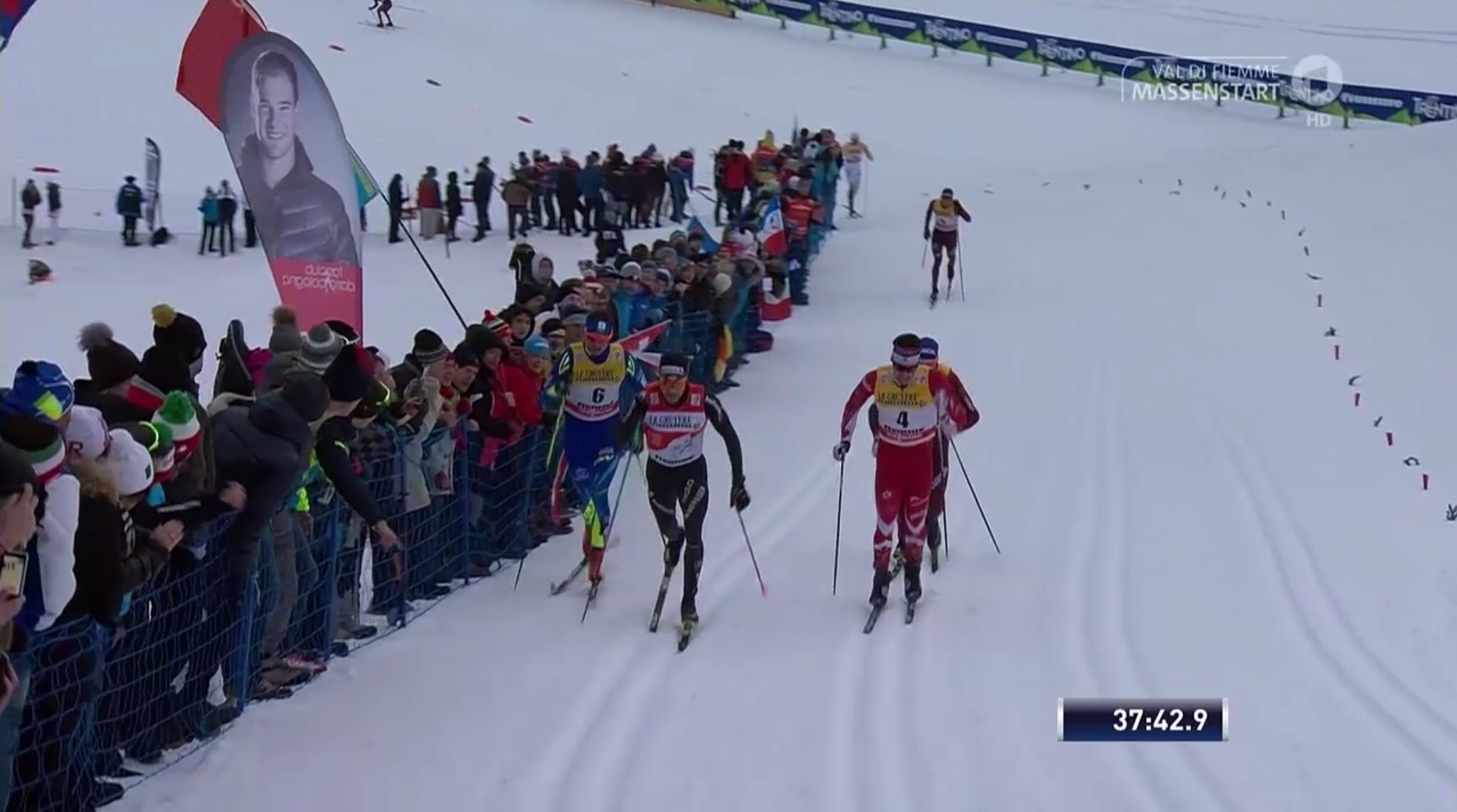
    Alexey Poltoranin (l), Dario Cologna (c), and Alex Harvey (4) charge up the last climb of Saturday’s 15 k mass start in Val di Fiemme, Italy. Poltoranin took the win, with Andrey Larkov (behind Harvey) placing second and Harvey third at Stage 6 of the 2018 Tour de Ski. (Screenshot: ARD broadcast)

    After a soggy and windy stay in Oberstdorf, Germany where the Stage 4 sprint was canceled and the Stage 5 freestyle mass stats were a cluster, the Tour de Ski (TdS) got back to a sense of normalcy in Val di Fiemme.

    Or did they? After dominating the first part of the men’s 15 k classic mass start and picking up valuable Tour bonus seconds, Russia’s Sergey Ustiugov faded, eventually finishing 14th, 42.8 seconds out of the win.

    Instead, Alexey Poltoranin of Kazakhstan made a big push to try to break for it about halfway through the race. Dario Cologna of Switzerland, the Tour de Ski leader coming into the day, followed, as did Canada’s Alex Harvey. The trio had a small gap of a few seconds consistently for several kilometers, before Russia’s Andrey Larkov caught up to them. Behind them, the field continued to fracture into chaos, claiming what would in past years have seemed unlikely victims like Norway’s Martin Johnsrud Sundby.

    After much posturing and pushing in the final kilometer, the lead pack of four came shooting into the downhill finish with Poltoranin claiming the win by 0.4 seconds over Larkov. Harvey finished third, +0.9, and Cologna fourth, +2.3. There was a bigger gap before Russia’s Alexander Bolshunov crossed the line in fifth, +15.0.

    That means that Poltoranin takes over second place in the Tour, while Ustiugov lost ground.

    The only American starter, Paddy Caldwell, finished 48th out of 52 finishers, +3:38.6.

    Results

    The women’s 10 k classic mass start podium at Stage 6 of the 2018 Tour de Ski on Saturday in Val di Fiemme, Italy, with Norway’s Heidi Weng (c) in first, Finland’s Krista Parmakoski (l) in second and Austria’s Teresa Stadlober in third. (Photo: FIS Cross Country/Twitter)

    The women’s race went off as planned: no snafus, only burning lungs and muscles. At the start of Stage 6, Jessie Diggins was ranked third overall in the Tour (+1:56.7). Norway’s Ingvild Flugstad Østberg wore the red bib as the TdS leader, while teammate Heidi Weng was second overall (+57.0).

    As Saturday’s race transpired, Weng proved dominant. She won in 29:07.9. Finland’s Krista Parmakoski placed second (+7.6), and Austria’s Teresa Stadlober third (+8.6).

    Diggins skied a gutsy race to finish fourth (+23.6). Østberg, who at times looked like she could dominate the pace, faded to fifth (+35.2).

    U.S. skiers Sadie Bjornsen finished in 10th place (+1:11.3), Liz Stephen 24th (+2:18), and Rosie Brennan 30th (+2:47.2).

    Heading into tomorrow’s final stage, the formidable climb up the Alpe Cermis, Østberg leads the Tour with a tiny 1.8-second gap on Weng. Parmakoski is third overall (+1:33.5), Diggins fourth (+1:43.1), and Bjornsen eighth (+3:33.1).

    Results: Women’s Stage 6 |

  • Dunklee Proves Her Resiliency, 10th in Annecy Sprint

    Dunklee Proves Her Resiliency, 10th in Annecy Sprint

    Susan Dunklee (US Biathlon) hitting every target in the prone shooting stage of the women’s 7.5 k sprint at the IBU World Cup in Annecy, France, on Thursday. She ended the day in 10th place with perfect 10-for-10 shooting. (Photo: Glen Crawford)

    Susan Dunklee’s start to another International Biathlon Union (IBU) World Cup season hadn’t played out as she’d hoped, specifically in terms of results. Coming off a banner winter, with a silver at 2017 World Championships (in the women’s mass start), Dunklee 31, had so far placed 53rd, 79th and 97th, respectively, in non-relay races over the last two weeks. She had yet to race a mass start, but also had yet to qualify for a pursuit in two World Cup sprints.

    So she went back to the drawing board, back to basics and to a “moose garden”.

    “My confidence took a big hit these past couple weeks and it was a real challenge was working through that,” Dunklee wrote in an email to FasterSkier on Thursday.

    “I tried to find some non-biathlon activities like visiting a ‘moose garden’ in Sweden and seeing the ‘Krampus’ in Austria,” she explained, referring to an Advent costume tradition, “to keep my mind fresh so I wouldn’t obsess 24/7 over disappointing results.  I also tried really hard to take a moment each evening to appreciate all the positive things that happened over the course of the day. And I kept telling myself that I am resilient.”

    After missing eight targets in last week’s snowstorm sprint in Hochfilzen, Austria, she sat down to brainstorm with US Biathlon consultant Matt Emmons, a 2004 Olympic champion in rifle shooting.

    “All summer I’ve been working on some fancier shooting skills, such as wind shading,” Dunklee explained. “Basically we decided I could benefit from focusing back on the absolute basics of shooting: sight alignment, trigger squeeze and follow [through]. That’s what I’ve been doing the last few days.”

    Susan Dunklee (US Biathlon) out of the start of the IBU World Cup women’s 7.5 k sprint on Thursday in Annecy, France, where Dunklee placed 10th overall for her best result of the season. (Photo: Glen Crawford)

    On Thursday, she started 60th out of 93 in the women’s 7.5-kilometer sprint in Annecy (Le Grand Bornand), France. In warm, slushy conditions with little wind, as Dunklee described it, she fired away for perfect 10-for-10 shooting to put herself in ninth at the finish.

    Dunklee was ultimately bumped one spot down to 10th overall, 1:16.8 minutes behind the winner, by Germany’s Laura Dahlmeier, who started in bib 86 and ended up second — 33.9 seconds behind Slovakia’s Anastasia Kuzmina in first.

    Kuzmina, who notched her second-straight individual World Cup win with a time of 20:59.6, and  the rest of the top-four finishers — Dahlmeier, Ukraine’s Vita Semerenko in third (+41.4) and Italy’s Lisa Vittozzi in fourth (+50.0) — all shot clean, just like Dunklee. Semerenko’s twin sister Valj, who placed seventh (+1:06.8), was the other woman in the top 10 to hit every target.

    Dunklee spent all of the race in the top 10, ranking eighth after the first of three loops and seventh after the second loop.

    “All the difference today for me was made on the shooting range,” Dunklee wrote. “The skiing has been fine all season. I backed off approaching the range, and I took enough time to make sure I was taking good shots.”

    Her top 10 was her best result since placing seventh in a sprint last March in Oslo, Norway. By landing in the top 60, Dunklee qualified for the Annecy pursuit on Saturday, which will be her first of the season.

    “Today helped me put to rest some doubts I was starting to have in my abilities,” she wrote. “I am very grateful to qualify for the pursuit.  It will be a good opportunity for some head to head racing which I haven’t seen much of yet this year.”

    Kuzmina in Control

    Slovakia’s Anastasia Kuzmina racing to a nearly 34-second win in the women’s IBU World Cup sprint on Thursday in Annecy, France. (Photo: IBU/biathlonworld)

    Starting in bib 23, Kuzmina rocketed to first place with the fastest course time and fourth-fastest shooting and range times, all while hitting every target.

    “It is always a great feeling to be a winner, especially when the race was pretty good from start to finish,” Kuzmina, a two-time defending Olympic sprint champion (from 2010 and 2014), told the IBU, according to a press release. “It was really important to shoot two times zero. The snow condition was not too comfortable for me; I really want to thank my service team for the skis. That was an important part of my victory.”

    The Russian-born Slovakian (whose brother is Russian biathlete Anton Shipulin) took the lead after the first shooting, leaving the range 6.3 seconds ahead of Germany’s Denise Herrmann, who started ahead of her in bib 16 and also cleaned prone. Herrmann had a penalty lap in the standing bout to slip to sixth and 45 seconds back, while Kuzmina cleaned again to start her final loop 35 seconds clear of Vittozzi, who was in second at the time wearing bib 13.

    Germany’s Laura Dahlmeier prepares to hit all five targets in the standing stage of the IBU World Cup women’s sprint on Thursday in Annecy, France. (Photo: Glen Crawford)

    A much later starter in bib 86, Dahlmeier cleaned prone to move into third, 6.7 seconds off Kuzmina’s time. Her next time in the range, Dahlmeier shot clean again to improve to second, but she was still 25.8 seconds short of Kuzmina’s time with one loop to go. Kuzmina skied the second-fastest last loop (about two seconds slower than Switzerland’s Selina Gasparin) to lock up first, while Dahlmeier ended up nearly 34 seconds back in second place.

    “This was the first podium in an individual-start race of the new season for me and that makes me very very happy,” Dahlmeier told German broadcaster ZDF, according to a translation. “I am excited that it worked out today, it took a while until I now got back in shape. I am not at 100 percent yet, but today was a super race and I am just happy about that, it was a lot of fun to race today.”

    Thursday marked Dahlmeier’s fourth race of the season after she missed the World Cup opener in Östersund, Sweden, due to illness. In Hochfilzen, she anchored the women’s 4 x 6 relay to the win and placed 10th in the pursuit and 16th in the sprint.

    “It’s a bit of an unusual situation for me to have such a late bib in an individual race, but as an anchor in relays I am kind of used to that, passing the time by listening to music or something like that,” she said. “When I was at the start gate I was focused again and just tried to do my on race. It has its pros and cons, I just tried to make the best of it.”

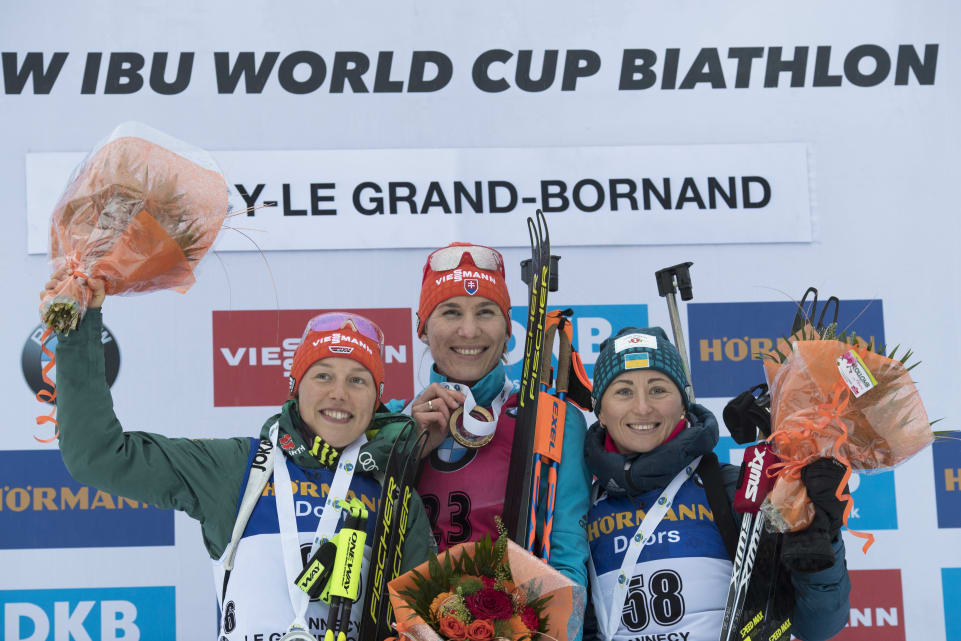
    The women’s IBU World Cup sprint podium on Thursday in Annecy, France, with Slovakia’s Anastasia Kuzmina (c) in first, Germany’s Laura Dahlmeier (l) in second, and Vita Semerenko (r) in third. (Photo: IBU/biathlonworld)

    For Vita Semerenko, it was her first podium since taking bronze in the sprint at the 2014 Olympics. She missed the two seasons that followed due to a back injury, and gave birth to her son just over a year ago.

    “I will never forget my first training after giving birth,” she told the IBU. “My coach said, ‘If we don’t give it a try, we will not find out what happens next.’ I said ‘OK’, but I had a lot of anxiety about coming back to biathlon, as I understood that coming back after three years would be tough. I am also thankful to my husband who told me every day after I had my child, ‘Vita, come on, come on, let’s make a comeback!’ ”

    Herrmann was the top finisher with a penalty (0+1) on Thursday in fifth place (+50.6), while Gasparin was just behind in sixth (+53.4) with one miss as well (1+0).

    “I am noticing that I am not feeling as fresh anymore as in Östersund, it was quite the number of races for me already,” Herrmann, who won both the sprint and pursuit in Östersund, told ZDF. “And I’d say deep snow conditions like today aren’t ideal for athletes over 60 kilograms. But nevertheless it was a good race, I really tried to hit every shot, and lost quite a few seconds with my shooting time. But I am back on track compared to last weekend, and hope I can continue my successes in the pursuit race.”

    In the women’s 10 k pursuit on Saturday, Kuzmina will start 34 seconds ahead of Dahlmeier in second, and Vita Semerenko will head out another 7 seconds later in third. Dunklee will start 1:17 back and just 4 seconds behind Valj Semerenko in seventh.

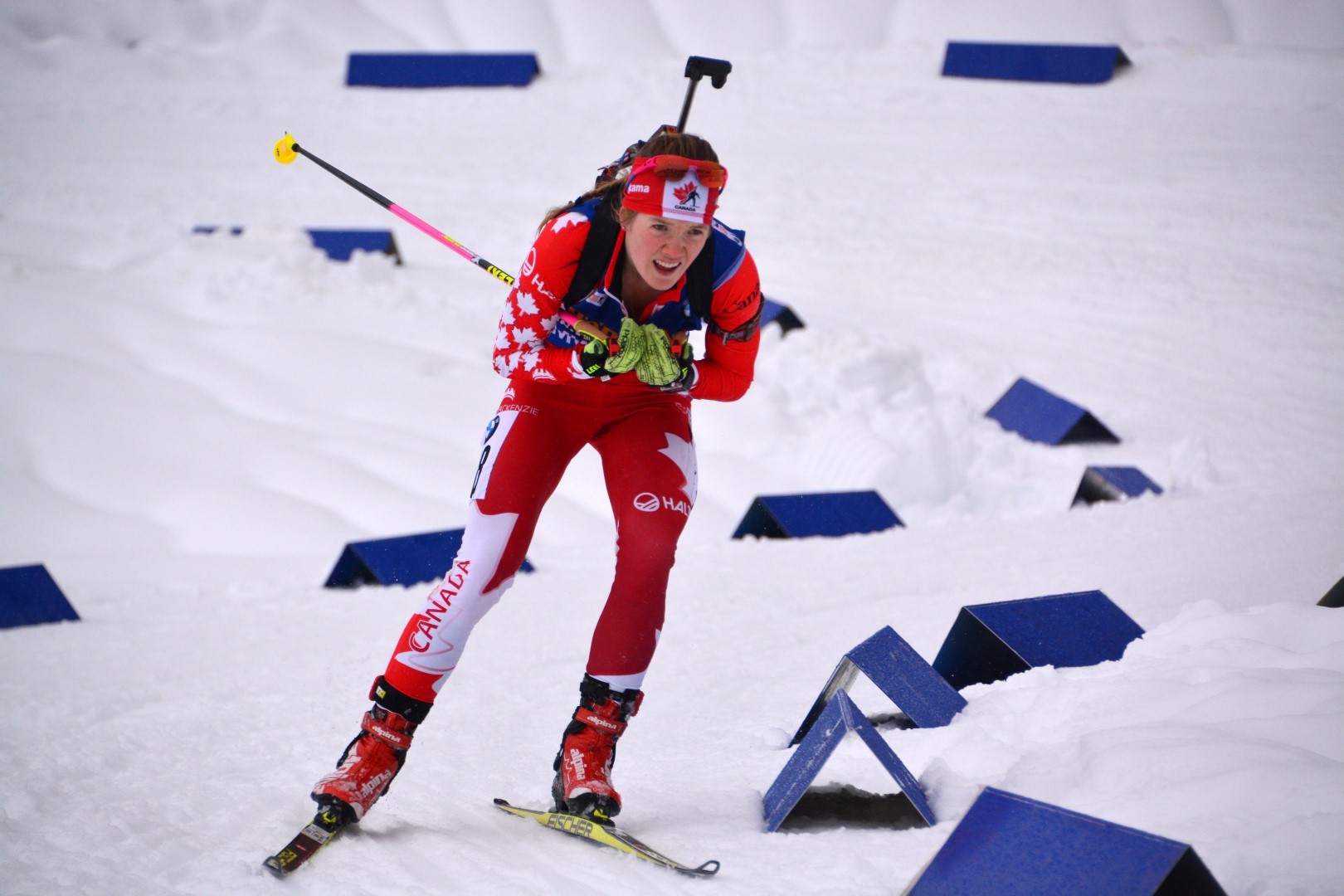
    Emma Lunder (Biathlon Canada) racing to 34th in the IBU World Cup women’s 7.5 k sprint on Thursday in Annecy, France. (Photo: Glen Crawford)

    Three Canadians qualified for the pursuit, with Emma Lunder leading them in 34th (+2:07.4) with one standing penalty (0+1). Julia Ransom followed in 39th (+2:13.9) with one prone miss (1+0) and Rosanna Crawford snuck into the top 60 in 60th (+2:39.1) with two penalties (1+1). They will start the pursuit 2:07, 2:14 and 2:39 back, respectively.

    Also for Biathlon Canada, Megan Bankes missed the cutoff in 65th (+2:51.5) with one penalty (1+0).

    For the U.S., Clare Egan finished 81st (+3:43.7) with three misses (1+2), and Emily Dreissigacker was 88th (+4:36.0) with three penalties as well (2+1).

    The Annecy IBU World Cup men’s 10 k sprint takes place Friday, starting at 8:15 a.m. EST.

    Results | Pursuit start list

  • U.S. Men, Canadian Women 9th in Extra Windy, Hochfilzen Relays

    U.S. Men, Canadian Women 9th in Extra Windy, Hochfilzen Relays

    Leif Nordgren (US Biathlon) skiing the second leg of the IBU World Cup men’s 4 x 7.5 k relay on Sunday in Hochfilzen, Austria. The U.S. men ended up ninth overall out of 26 teams. (Photo: IBU/NordicFocus)

    Strong gusts of wind on the range required strong nerves and a lot of luck in the women’s and men’s relay races that concluded the International Biathlon Union (IBU) World Cup in Hochfilzen, Austria, on Sunday afternoon.

    While the relays concluded with teams on the podium one might expect there, tempestuous weather conditions that at times made it almost impossible to hit the targets also gave outsiders a good chance, and both the U.S. men and Canadian women remained in contention for a long time. The men’s 4 x 7-5-kilometer relay was particularly wild with more than 100 penalty laps, and it began with a big surprise.

    Belgium’s starter Michael Rösch tagged off in first place for the first time in the history of that team, representing a country that until now, rarely had enough athletes for a relay and had thus far had a 24th place at the 2016 World Championships to its credit. And on his tails was Norway’s Ole Einar Bjørndalen, and shortly behind them US Biathlon’s Lowell Bailey in third.

    The three aforementioned athletes all raced in the Olympic relay more than a decade ago at the 2006 Winter Games in Torino, Italy, but back then Rösch raced for Germany and won gold with his team.

    “I wanted to tag off in first at all costs, to see the Belgian flag at the top,” Rösch told TV broadcaster ARD on Sunday while the race was still going on. “But Ole made it really hard for me. … I was on my last fumes, I tumbled into the finish, I was just seeing black, but it definitely was worth it.”

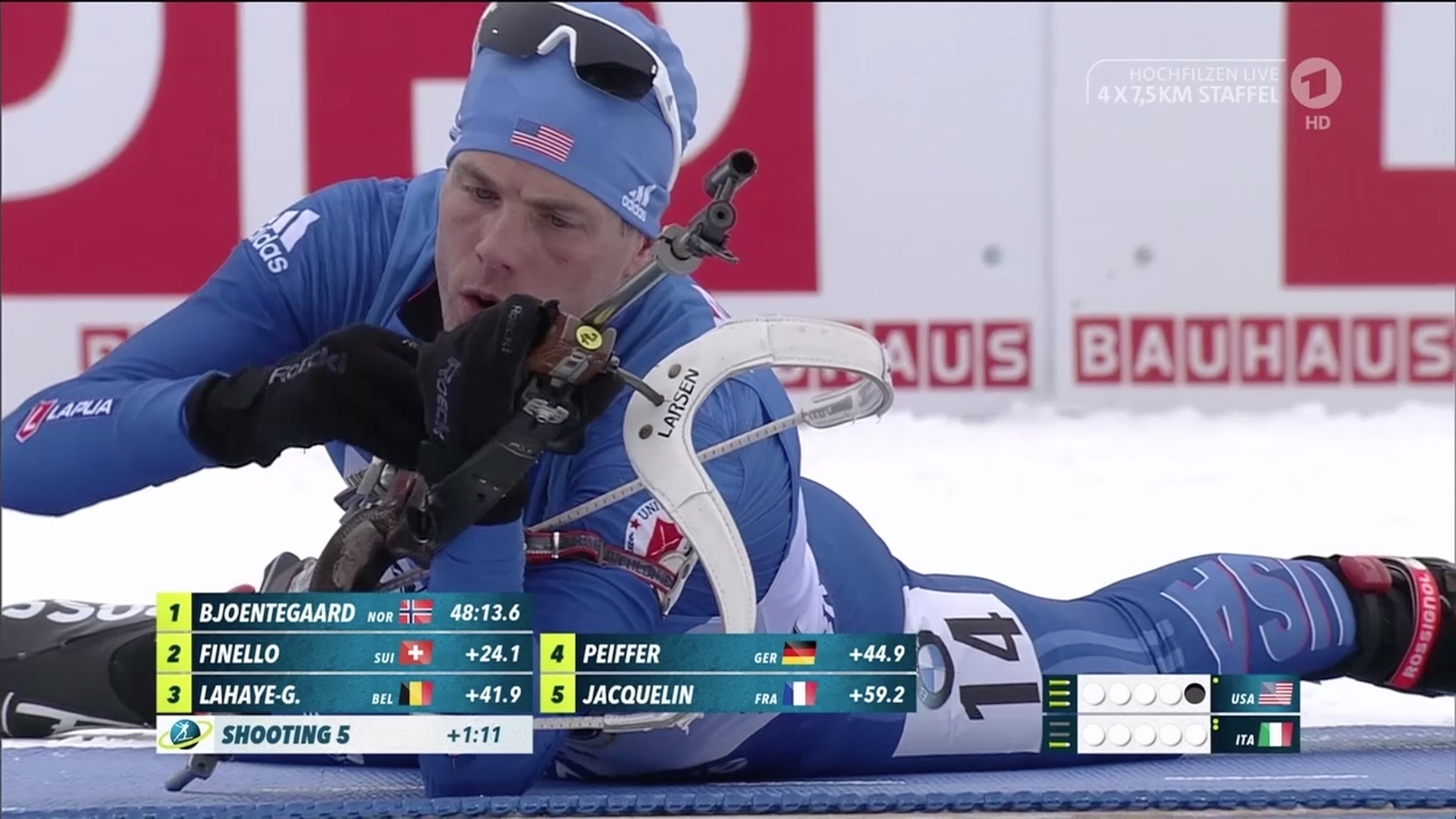
    Just a turn behind, Bailey had gotten off to a strong start for the U.S. team, temporarily taking the lead out of the arena on the first lap before shooting clean in his prone stage to put himself in the lead group of seven. Facing strong wind in his standing stage, Bailey missed two targets but avoided the penalty lap with his last spare in that stage (0+0, 0+3), and tagged off to teammate Leif Nordgren in third position, 23.8 seconds out of first.

    Nordgren ended up with a penalty in his first prone after missing two targets, and returned to the course in fifth. While his penalty had increased the gap to first by 50 seconds, Nordgren made up a few seconds with a clean standing bout, hitting all targets without requiring a spare (1+3, 0+0).

    Italy and France passed him on the final loop, and Nordgren handed off in seventh, 1:34.2 minutes behind Norway setting the pace up front.

    “The team came pretty close to a good result today in a relay with nasty weather,” Nordgren wrote on his Instagram account. “Personally I’m quite disappointed with my skiing, it’s been a struggle to find the top gears so far this season and I’m far from where I know I should be. It’s a long season though and there is still plenty of time to turn it around.”

    US Biathlon’s Tim Burke loading a spare in his prone stage of the men’s relay at the 2017/2018 IBU World Cup in Hochfilzen, Austria. The team went on to finish 9th. (Screenshot: ARD broadcast)

    Taking over next for the U.S. was Tim Burke, who pointed out this was one of the most challenging races in terms of wind that he’d experienced.

    “This was definitely one [of the] windiest races that I have taken part in,” Burke wrote in an email to FasterSkier. “We knew it would be very challenging right from the start but our team tried to look at it as an opportunity for a top result. I feel like our team did a great job at avoiding any big disasters on the range and this allowed us to stay near the front for most of the race.”

    After only needing one spare in his prone shooting to hit his last target, Burke incurred a penalty in his standing stage (0+1, 1+3), but kept his position on the final loop in a hard race against Switzerland’s Jeremy Finello to exchange still in seventh, now another minute back (+2:49.4).

    “I was not surprised to see a mix of different teams near the front today,” Burke wrote. “It was one of those days that any team could find themselves with multiple penalty loops after a windy shooting stage.“

    Taking over from Burke as the U.S. anchor leg was Sean Doherty, coming off two strong shooting performances in the sprint and pursuit earlier this week.

    U.S. relay anchor Sean Doherty taking aim in difficult wind conditions during his standing stage of the men’s relay at the 2017/2018 IBU World Cup in Hochfilzen, Austria. His team finished ninth. (Screenshot: ARD broadcast)

    In his prone stage, Doherty again shot clean and fast (with the second-fastest prone shooting time on his leg) and overtook Switzerland to move into sixth. He kept that position on the course, vying for a position in the top five with the teams from France, Italy, Ukraine, and Russia also in his vicinity.

    “Today was a crazy one for sure,” Doherty wrote in an email. “The conditions on the course were decent, firm tracks and we had good skis. The wind was whipping, so that really just made some sections a lot harder than normal when you added in the head wind. I have done races in bad weather before but today was amongst the most windy.

    In the standing stage, Doherty hit his first four shots in another fast sequence before missing the last one. It looked as if he had thought that final shot was also a hit as he dropped his rifle slightly, but then realized he had to load spares. Unable to clear the last target, Doherty ended up with the team’s third penalty.

    “With the shooting you try to get a general idea of how far the wind is pushing the shots and do the best you can,” Doherty explained. “It’s a total toss up and the finish order is just a ranking of who battled the wind the best and had most to least luck along the way.”

    He set out on his last loop in eighth place with Ukraine’s Dmytro Pidruchnyi and Switzerland’s Mario Dolder right ahead of him, and Russia’s Anton Shipulin ten seconds behind.

    “The fight on the last lap is always tough,” Doherty wrote. “Although I felt better today I was not able to hang with the two guys I left the range with. I was able to ski a good lap but not enough to hold off Anton.”

    After Shipulin passed him up the big last climb, Doherty came to the finish in ninth position, 3:38.3 minutes behind the winners with a team total of three penalties and 13 spares.

    “We were not too excited with the end result because we saw the potential was there for a top 5,” Burke concluded for the team. “We are also all far from our best on the tracks right now, but are hopeful that will come with more racing.”

    Norway Successful with Its ‘Second Unit’

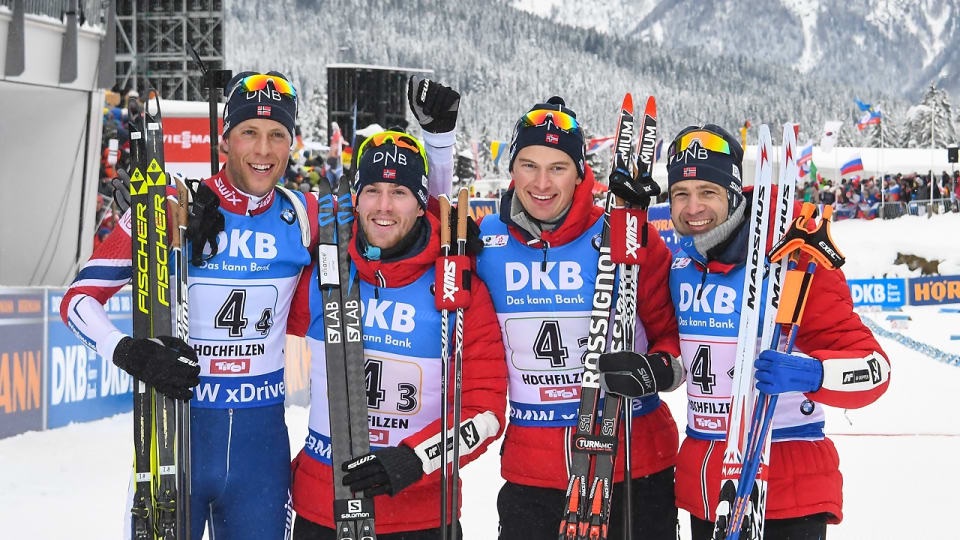
    Norway’s Lars Helge Birkeland, Erlend Bjøntegaard, Henrik L’Abée-Lund and Ole Einar Bjørndalen (left to right) following their victory in the men’s relay at the 2017/2018 IBU World Cup in Hochfilzen, Austria. (Photo: IBU/Biathlonworld)

    Norway started the men’s relay race without Emil Hegle Svendsen, who was sidelined with a cold, and also rested brothers Johannes Thingnes Bø and Tarjei Bø, both of whom had already won races this season.

    But shooting was more important than skiing in a relay decided by strong crosswinds on the range, and that’s where the Norwegians coped by far the best. While Norway also required nine spares, which usually is a rather average performance in a relay, on Sunday this was the top shooting performance of the men’s relay.

    After veteran Bjørndalen, Henrik L’Abée-Lund and Erlend Bjøntegaard had created a fairly comfortable lead of almost a minute on the first three legs, Lars Helge Birkeland anchored them to the victory by shooting clean in prone and only needing one spare to hit every target in his final stage despite some widely spread shots.

    “It is really nice; a good start for Norway and good self confidence for the the rest of the season,” L’Abée-Lund said at the post-race press conference.

    “It’s always fun to compete on the highest level with the best guys,” Bjøntegaard said. “I think I did pretty good on my leg today. It was tough conditions as it was for everyone else. I am just happy to show what I am capable of.”

    “It feels great, it was an amazing feeling on the last loop, and really satisfied with my own leg,” Birkeland said. “I just decided to be offensive and attack and don’t think about the others and just do my own race. … We have a really strong team with a lot of good guys, so we don’t need to have all the best at the start to have a chance to win.”

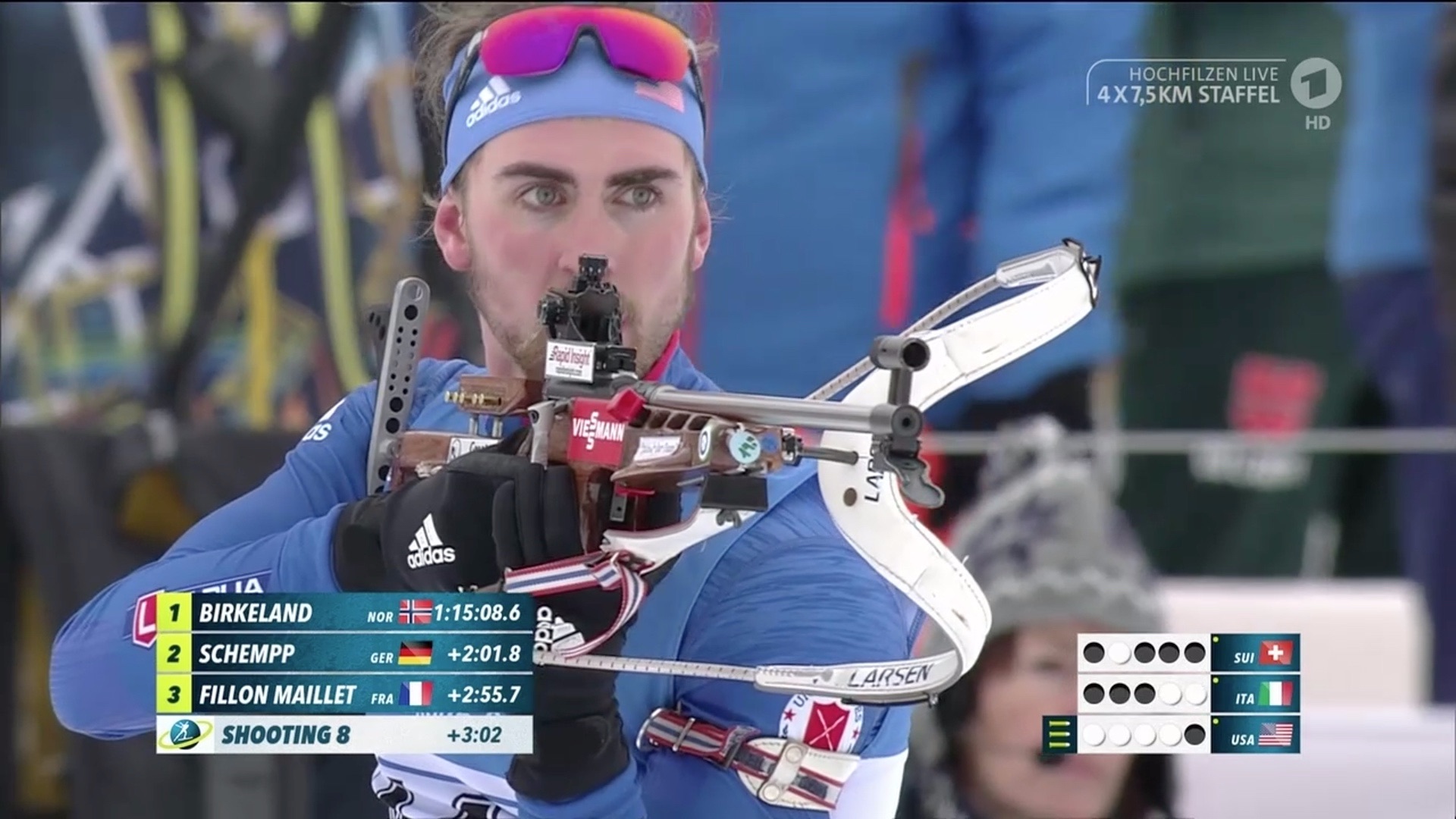
    All hopes for Germany’s Simon Schempp to contend with Birkeland for first were dashed when Schempp required three spares to clear both his prone and standing stages, narrowly avoiding the penalty lap twice.

    Due to the huge distances between the top-three teams, the final loop was more of a cool down for their anchors, with Norway taking the win in 1:21:21.8 hours, just under two minutes ahead of Germany, with Erik Lesser, Benedikt Doll, Arnd Peiffer and Schempp, in second (+1:54.9, with zero penalties and 17 spares).

    “At least we avoided the penalty loop, for me it was definitely close in standing,” Peiffer told German broadcaster ARD. “There was so much wind that it was impossible to shoot calmly and controlled. … It was clear that today there would be some upsets, like Belgium being in the mix in front. You just had to somehow avoid the penalty lap.”

    “The last years in Hochfilzen we have never been on the podium, so it’s the first time in like six years we are back again,” Peiffer said at the press conference. “So that’s a good start for us because normally we are struggling here and we don’t know why.”

    France, which had rested its star Martin Fourcade and started Jean-Guillaume Beatrix, Simon Desthieux, Emilien Jacquelin, and anchor Quentin Fillon Maillet, finished another 40 seconds later in third (+2:34.0, with three penalties and 13 spares).

    Another 20 seconds back, Sweden with Peppe Femling, Jesper Nelin, Sebastian Samuelsson, and Fredrik Lindström crossed the line in fourth (+2:54.8, with three penalties and 12 spares).

    “Today was very hard, very strange result, because when we look at all the penalties on the result list it was just crazy,” Beatrix said at the press conference. “I am satisfied for the team, and I am also really satisfied for the newcomer Emilien because it’s his first two weeks on the World Cup and first relay, and he did a every good job and brought us to the podium.”

    “Today I was a little bit stressed, because the French guys are so strong and I had to be at their level, so I am happy to do a good relay today,” the 22-year-old Jacquelin said.

    And what happened to the brave team from Belgium? With three athletes who had just made an overnight trip from an IBU Cup race in Lenzerheide, Switzerland, they came through the second exchange in second place after Florent Claude only needed one spare in standing. On the last two legs, however, three penalties for both Tom Lahaye-Goffart and Thierry Langer put them in 16th at the finish (+6:24.9) , which was still a team-best relay result for Belgium.

    Just ahead of them in a finishing sprint anchored by Brendan Green was Biathlon Canada, with a lineup that earned bronze at the 2016 World Championships in Oslo, Norway. On Sunday, however, the Canadians’ race began with difficulties for brothers Christian Gow (1+3, 2+3) and Scott Gow (1+3, 2+ 3), each having to ski three penalty laps and exchanging in 21st position already 4:45.7 minutes back. Then Nathan Smith (0+0, 0+2) and Green (0+3, 0+3) were able to move them up a bit again, with Smith putting them as high as 13th by the final exchange and Green anchoring them to 15th (+6:22.5, with six penalties and 20 spares).

    Of 26 teams in the men’s relay, Norway and Germany were the only ones that succesfully avoided the penalty lap.

    Hochfilzen World Champs Women’s Podium Repeats

    Later on Sunday afternoon in the women’s 4 x 6 k relay in slightly better conditions than the men’s race, last season’s reoccurring winner Germany struck gold again.

    Germany with (left to right) Vanessa Hinz, Franziska Hildebrand, Maren Hammerschmidt and anchor Laura Dahlmeier shows off their medals following their victory in the women’s relay at the 2017/2018 IBU World Cup in Hochfilzen, Austria. (Photo: IBU/Biathlonworld)

    The victorious world-champion quartet of Vanessa Hinz, Franziska Hildebrand, Maren Hammerschmidt,and Laura Dahlmeier won with a large lead ahead of Ukraine (+44.9) and France (+1:04.5). The first-, second- and third-place teams were a repeat of last season’s World Championships relay in Hochfilzen this past February.

    Fighting for position with Ukraine and Switzerland on the third leg, Hammerschmidt got her team on the road to victory when she cleaned every target within 24 seconds despite difficult conditions to reclaim the lead, erasing the gap she had been handed of almost 30 seconds to first.

    “For me it was very important to have a good standing shooting today, because the last two days were not so good,” Hammerschmidt said at the press conference. “I thought it was one of my best standing shootings, and I was so happy to go on the last loop and fight for every second to give to Laura.”

    Dahlmeier returned to the World Cup after missing last week’s opening races with a cold, then had no major problems defending the lead. Dahlmeier used just one spare in each of her shooting stages, while Switzerland’s Irene Cadurisch as the closest pursuer had to ski a penalty lap. Germany finished in a time of 1:14:36.4, with zero penalties and nine spares.

    “It’s a really cool feeling to be here again,” Dahlmeier said at the press conference. “Especially with the team. We know we can make a good race, but it’s important for every person to be good on the range and on the tracks. Relays are special races.”

    “From the last year we have good memories about Hochfilzen … and today it was a good place, too,” Hildebrand said “I was really impressed with [Ukraine’s] Yulia Dzhima’s standing shooting, because she took all targets out while I used two extra bullets and was happy I could go out on the track again.”

    Ukraine’s Olena Pidhrushna anchored her team, with Vita Semerenko, Yulia Dzhima and Valj Semerenko, to second (+44.9), thanks to the best team shooting performance of zero penalties and five spares, and despite a fall on the first leg by Vita Semerenko.

    “I think our team spirit is very strong, without that we wouldn’t be on the podium, so I am very thankful to all the girls and our staff for making this happen,” Valj Semerenko said at the press conference, via a translator.

    “My start this season was not so good … Actually today I was so nervous ahead of the relay,” Pidrushna explained. “But I saw that we had a little bit of extra time at the last exchange, and I calmed down a little bit and it worked well in the end. … And I think my team believes in me [to anchor it successfully].”

    Twenty seconds behind her, France with Marie Dorin Habert, Celia Aymonier, Justine Braisaz and the current women’s World Cup leader Anaïs Bescond, passed Russia’s Ekaterina Yurlova-Percht on the final loop to claim third place  (+1:04.5, with two penalties and 13 spares).

    “Honestly at the beginning when I started I didn’t think a podium was still possible, but loop after loop I thought maybe I can still catch a podium [position],“ said Bescond, who skied the fastest course time on the final leg amidst strong competition.

    A few seconds behind, Russia with Victoria Slivko, Tatiana Akimova, Irina Starykh, and Ekaterina Yurlova-Percht finished fourth (+1:09.0, with no penalty and nine spares).

    Another 16 seconds back, Switzerland, with Elisa Gasparin, her older sister Selina Gasparin, Lena Häcki and Cadurisch finished fifth (+1:25.7, with two penalties and 12 spares) for Switzerland’s best women’s relay result, which fulfilled its national qualification criteria for the Olympics.

    Canada in Contention

    For Biathlon Canada, Emma Lunder started off the race in the middle of the field, and managed hit all her targets with one spare in her prone stage to leave the range in 16th position.

    Biathlon Canada’s starter Emma Lunder (r) exchanging to Rosanna Crawford in the women’s relay at the 2017/2018 IBU World Cup in Hochfilzen, Austria. Crawford temporarily moved up to fifth before the team finished in ninth position. (Screenshot: ARD broadcast)

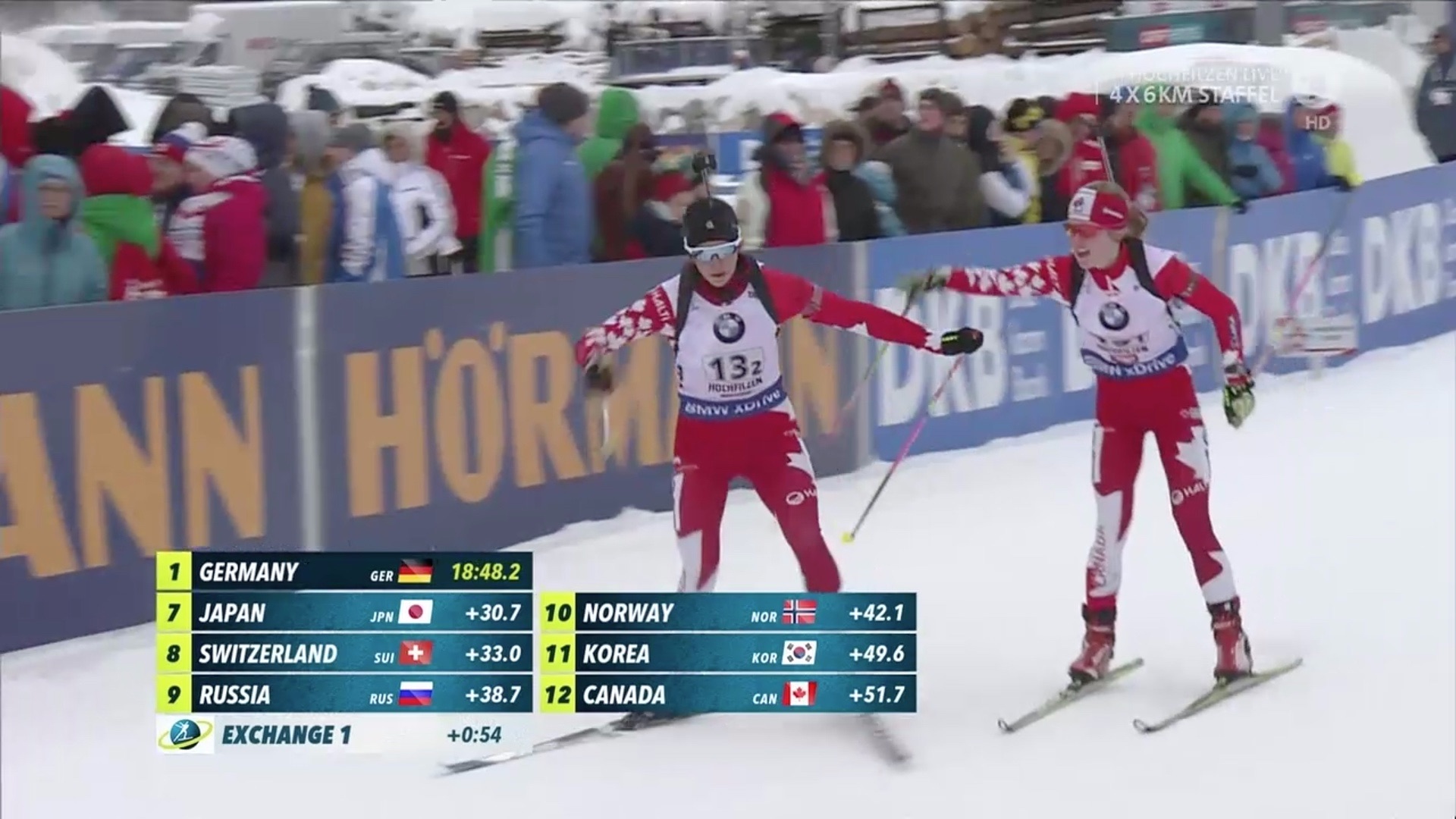
    While a number of competitors, including France’s Dorin Habert, incurred penalties, Lunder again needed just one spare to clean (0+1, 0+1) and moved Canada up to 1oth. After losing a few more seconds on her last loop to the leaders, with Germany’s Hinz up front, she tagged Rosanna Crawford in 12th position, 51.7 seconds back.

    Crawford started out fast and also needed just one spare to hit all five prone targets, improving by three places to ninth.

    “It was a tricky shooting day today, you really had to be aware of the wind, and be prepared to do a correction even part way through a bout of shooting,” Crawford wrote in an email. “In prone I made a correction of 5 left and 2 up and it was enough to keep me pretty centred.”

    Then in her standing stage, she picked off four more positions with clean shooting and no spares to leave the range in fifth place, while most teams around her needed spares or even incurred a penalty in seemingly difficult wind conditions.

    “I was really happy with my standing today,” Crawford explained. “I saw Brendan [Green] right before zero and he said that it’s worthwhile to take your time and make each shot a good one. So I really thought about that as I came into the shooting, there was a big gust right off the start, so I waited and could hear the women around me missing. Each shot was really precise. My shooting time was 33 seconds which is really slow for standing but still the 2nd fastest of my leg, which says a lot about the wind today!”

    Biathlon Canada’s Megan Bankes shooting in her standing stage in the women’s relay at the 2017/2018 IBU World Cup in Hochfilzen, Austria. The team finished ninth overall. (Screenshot: ARD broadcast)

    Crawford tagged Megan Bankes in fifth (+36.3), after having regained 15 seconds on the leaders and skiing the second-fastest course time on the final loop.

    “It’s always fun to tag off in a high position but today was a bit of a lucky draw for what you got in the range,” Crawford concluded.

    The 20-year-old Bankes as Biathlon Canada’s youngest team member started out just as fast, nearly maintaining that time gap on the first loop.

    “I was super stoked to be tagged in such a good place, but I definitely still felt that I was able to ski my own race,” Bankes wrote in an email. “I wanted to ski my best, and not lose to much time on the tracks, but also be controlled on the range, because I knew it was going to be a tricky shooting day.”

    She was able to get through the prone stage with two spares in a stage when all leading teams needed them, keeping her in fifth. Bankes followed that up with just one spare in her standing shooting, temporarily moving up to fourth after overtaking Sweden’s Mona Brorsson.

    “Coming into the range I was focussed on my own shooting more than anything else,” Bankes wrote. “I knew that the wind was pretty variable, and that I needed to make sure I took good, smart shots, and correct appropriately for the wind. I was super happy with how I ended up doing on the range, and also with my speed on my first couple of laps.”

    On the last loop, Brorsson and Russia’s Starykh passed her, and Bankes came through the final exchange in sixth place (+1:28.8).

    “I died a bit at the end, but I still managed to tag Julia in a good position, so for me it was a pretty great race!” Bankes concluded.

    Shown on television in the exchange zone, looking back at the final curve to see when Bankes would arrive, Ransom took over as the anchor and skied a very fast first loop, just 1 second off the fastest pace on that loop.

    She then managed to still clean all five targets in a controlled fashion, leaving the range again in fifth position, with Switzerland in sight and Russia nearby as well.

    After a slower second loop, Ransom struggled to clean all her targets in the final stage, but avoided the penalty lap with her last shot and left the range in ninth position. Sweden’s anchor Anna Magnusson was still in sight, 10 seconds ahead, but extended her lead on the final loop, while Japan’s anchor Rina Mitsuhashi was already more than a minute behind Ransom in 10th.

    Ransom crossed the line in ninth place (+2:31.6) with zero penalties and nine spares for the team.

    “A top 10 is a decent result for our team, it’s nice that we were fighting for a top 6 for most of the race,” Crawford wrote. “Our team has come a long way and I’m really proud to be a part of this team! Emma and Megan had a great leg and Julia an awesome prone and then it was quite windy for her standing, but most teams have their strongest women on the last leg, so it’s always a hard fight!”

    In other good news for Biathlon Canada this weekend, the team finished eighth in an IBU Cup mixed relay and national team member Megan Tandy raced to 11th place in the sprint followed by ninth place in the pursuit this weekend in Lenzerheide, Switzerland.

    “Another #perfect #shooting day! I was hoping for more, but you gotta work with what you got – in my case very heavy legs skiing. Nonetheless, a solid race,” Tandy wrote on Instagram after shooting clean in both the sprint and mixed relay.  

    The U.S. Women and Nation Cup Standings

    US Biathlon could not start a women’s relay on Sunday because it only has three women currently on the World Cup circuit: Susan Dunklee, Clare Egan and Emily Dreissigacker. US Biathlon had hoped that its fourth woman Kelsey Dickinson, would qualify for the first trimester of World Cup racing by scoring necessary points at the IBU Cup opener in Sjusjøen, Norway. But unfortunately that did not work out.

    In addition to Dickinson missing out on the World Cup starts because of that technicality, and her teammates now missing out on one of only three opportunities on the World Cup competition calendar to prepare for the relay in the upcoming Olympics, this also means they lost out on valuable points for the Nation Cup Score. That ranking is its own award category in the World Cup season (last year Germany won it for both the women and men), but more importantly for the North American teams, also determines the starting quota for the following season.

    With a third of the races counting towards that already completed (unlike at World Championships the races at the Olympics don’t apply, neither do pursuits and mass starts), the U.S. is currently in 21st position for the women with 676 points and in danger of losing its fourth starting position for next year again, which would make team selections and travel planning even harder.

    While certainly not impossible — last year the U.S. women also did not start a relay in Pokljuka, Slovenia — it will be a bit of an uphill battle to make that up the rest of the season, requiring a number of strong results. For instance, South Korea is currently 357 points ahead in 17th, the benchmark for a fourth quota spot.

    The Canadian women are currently in 14th position with 1220 points. Last season they were 15th and the U.S. 14th. For the men’s teams, Canada is currently in 12th position with 1260 points, the U.S. is 13th with 1198.

    The teams will now travel to Annecy-Le Grand Bornand, France, for the next World Cup from Thursday, Dec. 14, to Sunday, Dec. 17.

    Results: Men | Women

  • Sunday Rundown: Davos, Hochfilzen and Sovereign

    Sunday Rundown: Davos, Hochfilzen and Sovereign

    CGRP's Caitlin Patterson charging up the wall climb. (Photo: Peggy Hung)
    Caitlin Patterson (Craftsbury Green Racing Project) charging up the wall climb en route to the win in the women’s 10 k freestyle on Sunday at the Sovereign Lake NorAm/SuperTour near Vernon, B.C. (Photo: Peggy Hung)

    NorAm/SuperTour (Sovereign Lake near Vernon, British Columbia): 10/15 k freestyle

    VERNON, B.C. — The combined NorAm and SuperTour event at the Sovereign Lake Nordic Centre continued with individual-start distance races and continued with the theme of U.S. domination of the leaderboard.

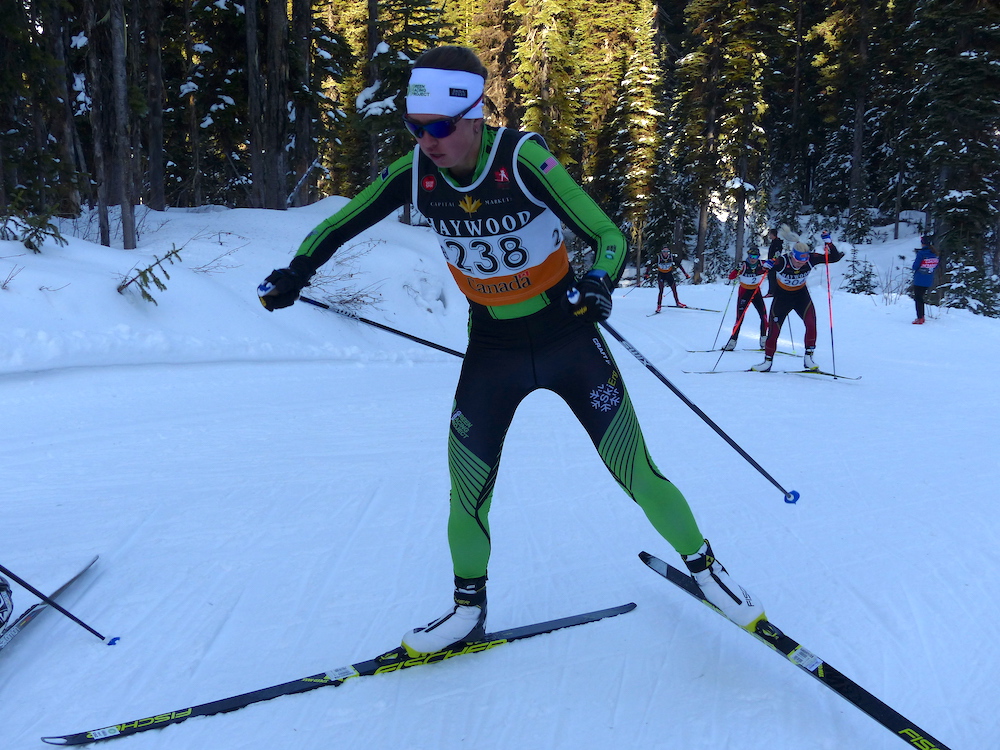
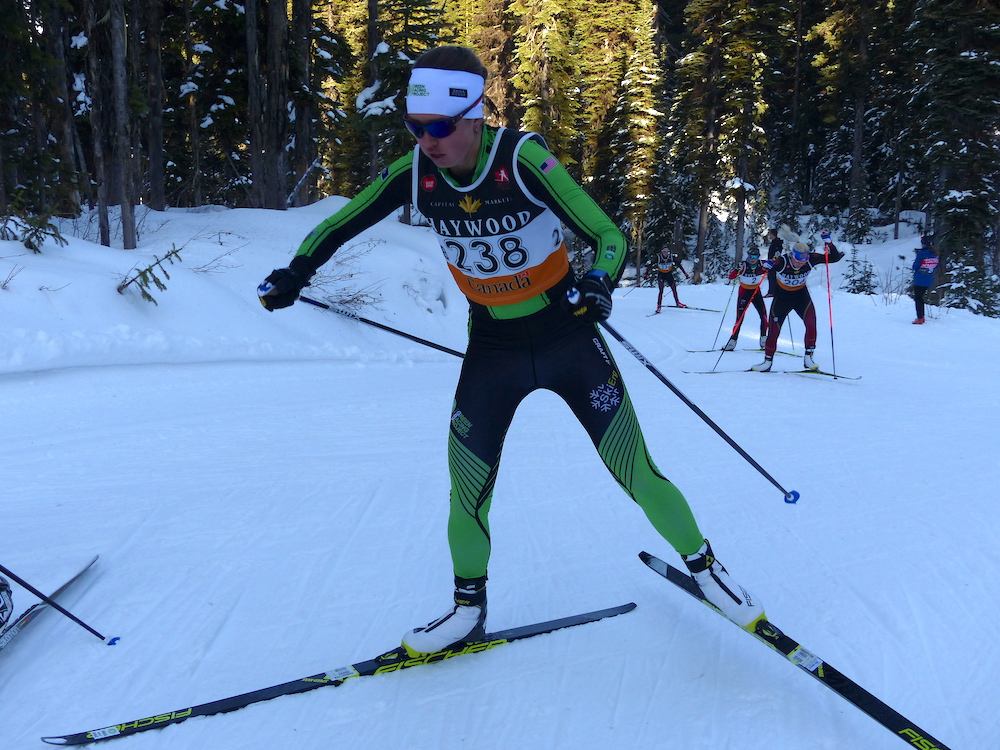
    Ian Torchia, of Northern Michigan University (NMU) and the U.S. Ski Team D-team, started the day with a big victory in the men’s 15 k freestyle, finishing in 36:29.7 minutes and on the heels of Canadian Para-Nordic guide Graham Nishikawa, who started 30 seconds ahead of him and ended up sixth. Jack Hegman of the Sun Valley Ski Education Foundation (SVSEF) placed second, 19.0 seconds back, to complete his good weekend. Canadian Para-Nordic superstar Brian McKeever rounded out the podium in third, 22.6 seconds back.

    Graham Nishikawa and Ian Torchia worked together after Torchia closed the 30 second gap. (Photo: Peggy Hung)
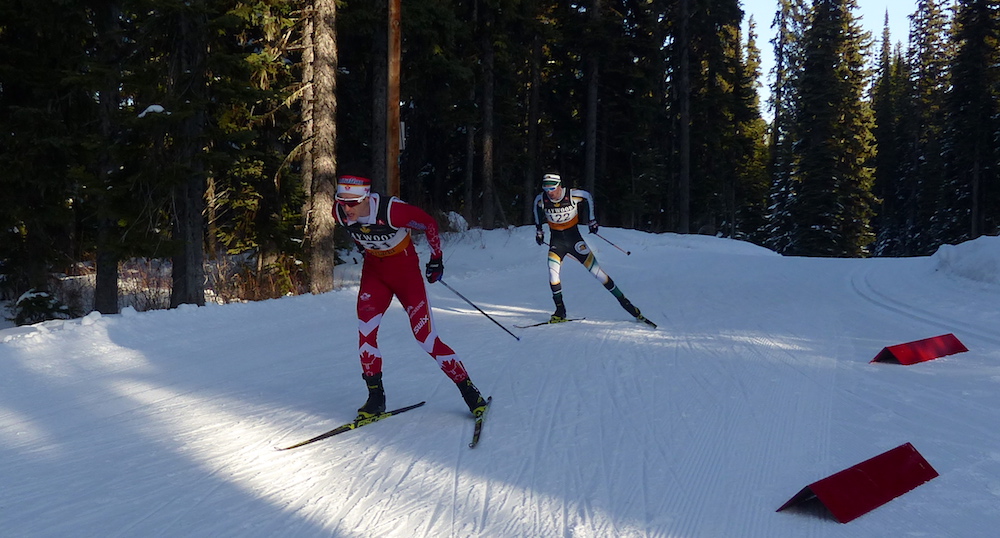
    Graham Nishikawa (l) and Ian Torchia worked together after Torchia closed the 30-second gap en route to a victory in the men’s 15 k freestyle on Sunday at the Sovereign Lake NorAm near Vernon, B.C. (Photo: Peggy Hung)

    The women were next to get some time in the sunshine with two laps for 10 k. Caitlin Patterson of the Craftsbury Green Racing Project (CRGRP) upgraded from Saturday’s silver to gold on Sunday with winning time of 27:13.0. Rosie Frankowski of Alaska Pacific University (APU) snatched second, 30.7 seconds back. Caitlin Gregg (Team Gregg) raced to third, 1 second behind Frankowski.

    Former Canadian national-team biathlete Zina Kocher started her new cross-country career as the top Canadian in seventh (+1:31.2).

    The weather was a repeat of Saturday: -2 degrees Celsius, windless and sunny. Smiles were evident everywhere, even for athletes who didn’t quite nail the pacing on an unforgiving course.

    Results

    ***

    France’s Maurice Manificat (c) after winning the men’s 15-kilometer freestyle on Sunday in Davos, Switzerland. He finished ahead of Russians Sergey Ustiugov (l) and Alexander Bolshunov in second and third respectively. (Photo: FIS Cross-Country/Twitter)

    FIS Cross Country World Cup (Davos, Switzerland): 10/15 k freestyle 

    Women’s report

    Men’s report

    After a day of sprinting, cross-country racers returned to the Davos World Cup venue on Sunday for the women’s 10-kilometer and men’s 15-kilometer freestyle individual start competitions.

    For his first World Cup win in almost two years, France’s Maurice Manificat took the men’s 15 k race title in a time of 33:56.2. Exactly 4 seconds flat behind Manificat in second place was Russia’s Sergey Ustiugov. Ustiugov’s teammate Alexander Bolshunov, finished 10 seconds behind Ustiugov and 14.6 seconds behind Manificat for the men’s third and final podium spot.

    The remainder of the men’s top ten included Norway’s Simen Hegstad Krüger in fourth (+21.3), Switzerland’s Dario Cologna in fifth (+26.5), Sweden’s Marcus Hellner in sixth (+35.4), Russia’s Denis Spitsov in seventh (+36.1), Hans Christer Holund of Norway in eighth (+36.9), Russian Alexey Chervotkin in ninth (+54.2), and Alex Harvey of Canada in 10th (+1:01.2).

    The next best male North American finisher was American Patrick Caldwell in 41st (1:50.2).

    Canada’s Devon Kershaw placed 44th (1:59.8), Graeme Killick 59th (+2:27.8), Russell Kennedy 68th (+2:43.4), and Julien Locke in 94th (4:27.5). Knute Johnsgaard did not start.

    For the U.S., Noah Hoffman finished 48th (2:05.5) and Scott Patterson 88th (3:46.2). Simi Hamilton did not start and Andy Newell did not finish.

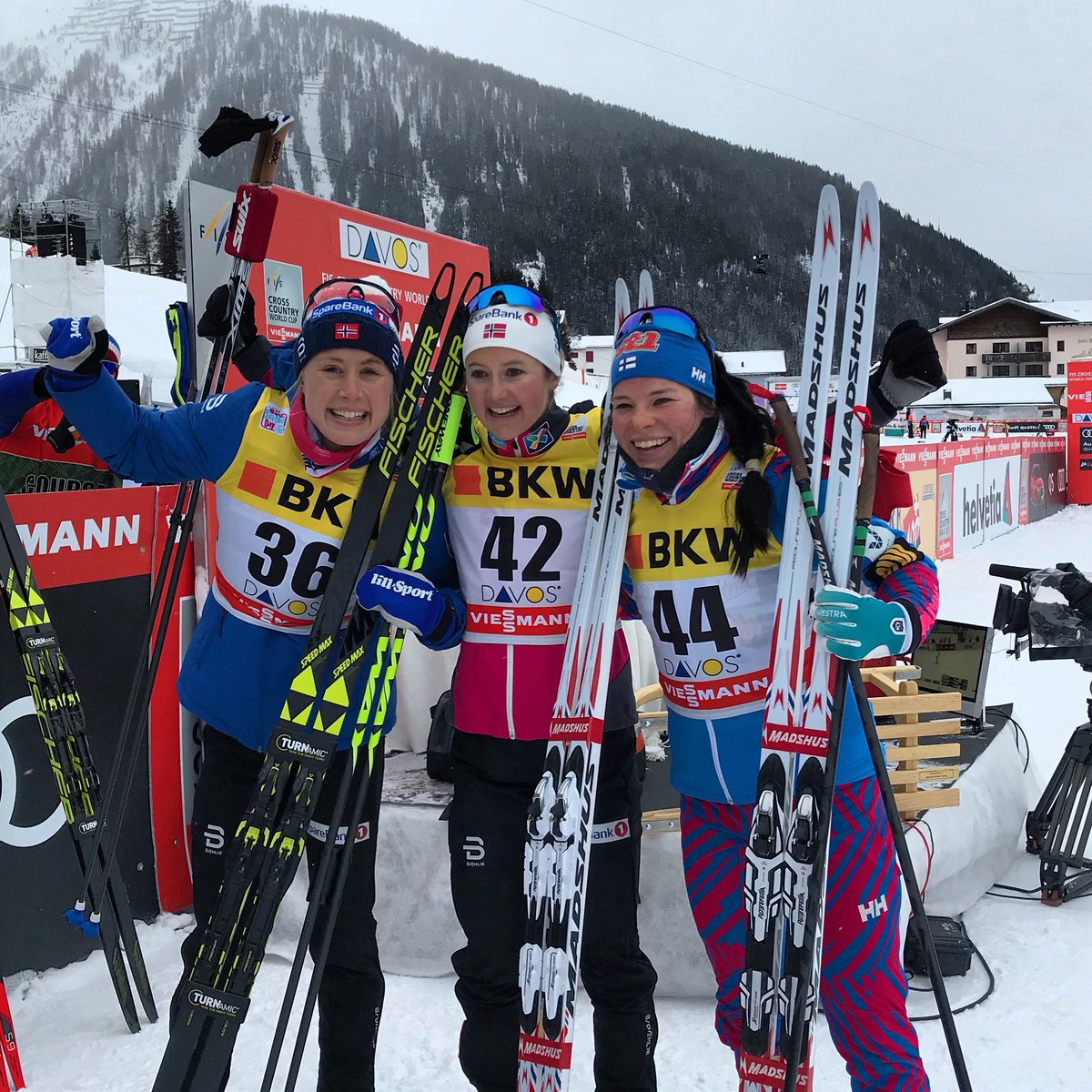
    The women’s 10 k freestyle podium on Sunday at the Davos World Cup in Switzerland, with Norway’s Ingvild Flugstad Østberg (c) in first and Ragnhild Haga (l) in second, and Finland’s Krista Parmakoski (r) in third. (Photo: FIS Cross Country/Twitter)

    In the women’s 10 k, 75 starters finished the 10 k course with Norway’s Ingvild Flugstad Østberg claiming first in a time of 25:28.5. Her Norwegian teammate, Ragnhild Haga finished 5.9 seconds behind her for second place. Krista Pärmäkoski of Finland raced to the third and final podium spot, 7.9 seconds back from Østberg’s winning time.

    Rounding out the women’s top ten was Heidi Weng in fourth (+14.5), Austria’s Teresa Stadlober in fifth (+16.4), Switzerland’s Nathalie von Siebenthal in sixth (+16.4), Finland’s Kerttu Niskanen in seventh (+24.9), Sweden’s Charlotte Kalla in eighth (+26.8), Norwegian Marit Bjørgen in ninth (+35.9), and Astrid Uhrenholdt Jacobsen in tenth (+37.6).

    Leading the U.S. women was Sadie Bjornsen in 12th (+44.6), seven seconds outside the top ten. The next two Americans finishers were within 3.1 seconds of each other, with Kikkan Randall finishing 14th (+56.8) and Jessie Diggins in 15th (+59.9).

    Also scoring World Cup points for the Americans, Rosie Brennan finished in 17th (+1:11.2) and Chelsea Holmes in 29th (+1:32.9).

    The U.S.’s Liz Stephen and Sophie Caldwell finished in 40th (+1:58.5) and 52nd (+2:20.1), respectively.

    For the Canadians, the team was led by Cendrine Browne in 45th (+2:05.9), followed by Emily Nishikawa in 50th (+2:18.4). Dahria Beatty placed 73rd (+2:53.0) and Katherine Stewart-Jones 79th (+3:44.6).

    Results: Women | Men

    ***

    IBU World Cup (Hochfilzen, Austria): Men’s and women’s relays

    Men’s and women’s relays took place on the final day of racing in Hochfilzen, with Norway winning the men’s 4 x 7.5 k and Germany topping the women’s 4 x 6 k by considerable margins.

    Norway’s Ole Einar Bjørndalen, Henrik L’Abée-Lund, Erlend Bjøntegaard, and Lars Helge Birkeland raced to first in 1:21.21.8 hours, nearly two minutes clear of Germany in second, after taking the lead on L’Abée-Lund’s second leg. They avoided the penalty loop and used a total of nine spares, and never lost hold of first place for the rest of the race.

    Germany raced to second (+1:54.9) with Erik Lesser, Benedikt Doll, Arnd Peiffer, and Simon Schempp, with zero penalties and 17 spares, after Peiffer lifted them from fourth to second on the third leg. Schempp held them there, despite using a maximum of three spares on each of his shooting stages, in the final leg.

    France claimed third (+2:34.0) with Jean-Guillaume Béatrix, Simon Desthieux, Emilien Jacquelin, and Quentin Fillon Maillet, despite three penalties and 13 spares. Two of their penalties came on Beatrix’s first leg and another in Fillon Maillet’s final shooting. After being tagged in fifth, Jacquelin raced them up to third on the third leg and Fillon Maillet held onto that position for the last spot on the podium.

    The U.S. men finished ninth (+3:38.3) with Lowell Bailey, Leif Nordgren, Tim Burke, and Sean Doherty, after they combined for three penalties and 13 spares. Bailey avoided the penalty lap and put them in third at the first exchange, while Nordgren slipped to seventh after a penalty, Burke remained in seventh with one penalty as well, and Doherty had one more penalty to anchor the team to ninth.

    Canada placed 15th (+6:22.5) with six penalties and 20 spare rounds, with Christian Gow, Scott Gow, Nathan Smith, and Brendan Green. After being tagged in 21st, Smith raced them up to 13th, using just two spares to clean. Green anchored them to 15th after using six spares and skiing the 15th-ranked time on that last leg.

    In the women’s relay that followed, Germany won by 44.9 seconds over Ukraine, with Vanessa Hinz, Franziska Hildebrand, Maren Hammerschmidt, and Laura Dahlmeier using nine spares while staying out of the penalty lap.

    After Hinz raced them into first, Hildebrand slipped to fourth after using four spares on the second leg. Hammerschmidt raced the fastest third leg to put them back in first, and Dahlmeier held them there to the finish, crossing first in 1:14:36.4.

    Ukraine (0 penalties, 5 spares) took the lead on the second leg but ultimately settled for second with Vita Semerenko, Yuliia Dzhima, Valj Semerenko, and Olena Pidhrushna. Dzhima put them in second heading into the race’s halfway point, but Valj Semerenko lost two places to tag Pidhrushna in third. Pidhrushna used just two spares on the final leg to bring them to second, about 20 seconds ahead of France in third.

    Despite a tough first leg for Marie Dorin Habert, in which she had two penalties and tagged off in 14th, France rose to third place at the finish (+1:04.5) thanks to strong skiing and shooting from anchor Anaïs Bescond.

    The team had a total of two penalties and 13 spares. Celia Aymonier used four spares to put them in ninth after the second leg, and third-leg Justine Braisaz lifted them one more place to seventh before Bescond skied the fastest last leg to pick off four more places.

    Canada placed ninth (+2:31.6) with Emma Lunder, Rosanna Crawford, Megan Bankes, and Julia Ransom, with no penalties and nine spares. Crawford put them in fifth after the second leg, Bankes lost one place on the third leg, and Ransom slipped three more with three spares on her final shooting to finish ninth.

    The U.S. did not enter a women’s team.

    Results: Men | Women

  • Domracheva Rips Östersund 15 k Despite Rocky Last Loop

    Domracheva Rips Östersund 15 k Despite Rocky Last Loop

    Darya Domracheva celebrates her 20th World Cup victory on Thursday in the 15 k individual in Östersund, Sweden. (Photo: IBU/NordicFocus)
    Darya Domracheva celebrates her 20th World Cup victory on Thursday in the 15 k individual in Östersund, Sweden. (Photo: IBU/NordicFocus)

    Something about the medals the top women received on Thursday in their first individual IBU World Cup of the season fascinated Darya Domracheva. Standing atop the podium after the 15-kilometer race in Östersund, Sweden, she spoke excitedly about it to Finnish runner-up Kaisa Mäkäräinen, who smiled and agreed — yeah, it was pretty neat.

    Domracheva was borderline chatty during the flower ceremony, smily and upbeat after another World Cup victory — her 20th, according to an IBU press release.

    The 28-year-old Belarusian biathlete, who won three Olympic golds in Sochi, is often unstoppable. Once she gets ahead in a race, she’s often hard to match. And on Thursday, with her long, flowing pony tail and snowflake earrings, Domracheva kind of seemed flawless — except for when she missed two targets and tripped over a rock on the last loop.

    “I crashed on the last loop, which was scary but most importantly, a rock ruined my ski,” she told the IBU afterward. “I just hope that my servicemen can repair it.”

    Finland's Kaisa Mäkäräinen after placing second in the 15 k individual in Östersund, Sweden. (Photo: IBU/NordicFocus)
    Finland’s Kaisa Mäkäräinen after placing second in the 15 k individual in Östersund, Sweden. (Photo: IBU/NordicFocus)

    Rock or not, she was well on her way to the win and ended up topping Mäkäräinen by 27.9 seconds in 46:43.6. Mäkäräinen, in second throughout the five-loop race, started four minutes ahead of Domracheva in bib 13 (of 96), and finished with first. The whole time, however, she knew she’d have to ski like crazy and be perfect on the range to beat Domracheva.

    Mäkäräinen had two penalties as well, one on each of the second and third bouts, and Domracheva shot clean through the first two stages before missing one her third and fourth time in the range.

    “It was my mistake; I was leaving the shooting range a bit earlier than I should have!” she said. “Still it was a good shooting result for me.”

    Conditions on Thursday were better than what the men experienced in the 20 k individual the day before. High, variable winds on Wednesday evening calmed to a gentle breeze for the women’s race. But with well-above-freezing temperatures, the snow was still chewed up and slow.

    “It was really tough and deep snow around the tracks; you never had a chance to rest,” Mäkäräinen said. “In downhills, you had to be careful not to fall down. I got lucky because a Russian girl fell in front of me and somehow I managed to get around her without a fall.”

    After Domracheva cleaned the first prone, Mäkäräinen trailed by 6.3 seconds in third. From that point on, the two remained relatively close, with Domracheva posting the fastest-overall course time by 15 seconds over Mäkäräinen in second. Domracheva skied the third-fastest last loop because of her crash, behind Mäkäräinen and Germany’s Franziska Hildebrand, an early leader in bib 8.

    Valj Semerenko (Ukraine) after shooting clean to place third in the 15 k individual in Östersund, Sweden. (Photo: IBU/NordicFocus)
    Valj Semerenko (Ukraine) after shooting clean to place third in the 15 k individual in Östersund, Sweden. (Photo: IBU/NordicFocus)

    The initial top finisher, Hildebrand ended up sixth overall with two penalties, 2:25.7 behind Domracheva. Ukraine’s Valj Semerenko shot perfectly for third, finishing 10.2 seconds behind Mäkäräinen with the eighth-fastest course time. Semerenko was one of three women in the field to notch 20-for-20 shooting.

    “I seemed to have lost my shooting touch in our last training camp but somehow I found it today!” Semerenko told the IBU after notching her sixth-career podium.

    Semerenko bumped another Belarusian, Nadezhda Skardino, to fourth (+2:04.3) after Skardino — who had one penalty — took the lead at the finish from Hildebrand. (Mäkäräinen finished shortly after to claim the top position before Domracheva.)

    Veronica Vitkova of the Czech Republic was the third fastest on course to overcome three penalties and place fifth (+2:09.1). After Hildebrand, Norway’s Tiril Eckhoff was seventh, Russia’s Ekaterina Glazyrina eighth, Sweden’s Elisabeth Högberg achieved her first-ever top 10 in ninth, and France’s Sophie Boilley was 10th.

    Olga Podchufarova of Russia took 11th, about 19 seconds ahead of Canada’s Megan Heinicke, who recorded a career-best 12th with a single miss on the second stage (+3:31).

    Heinicke started 62nd and initially finished 11th, only to be bumped one place by Glazyrina.

    While Domracheva said she was taking it race by race and trying not to look too far ahead, Semerenko dedicated her third-place finish to her sister, Vita, who tried to recover from back surgery this summer and fall. Last week, Ukrainian Biathlon Federation President Vladimir Bryzhnak announced that she would miss the entire season because of a herniated intervertebral disc.

    “This was a hard competition today. It is hard without my sister here now,” Valj Semerenko told the IBU. “I now have to work for two people. Out on the tracks, I felt her support; I was competing for both of us.”

    Gabriela Soukalova of the Czech Republic in 62nd slipped out of contention with four penalties in the first prone and an additional miss on each of the second and last stages for six total. Germany’s Miriam Gössner placed 68th with seven penalties after suffering a concussion in a rollerski crash in the offseason.

    Results

  • Despite Crisis At Home, A Golden Moment for Ukraine in Sochi

    Despite Crisis At Home, A Golden Moment for Ukraine in Sochi

    Olena Pidrushna of Ukraine pushes through the last leg of the women's biathlon relay, earning Ukraine their first winter Olympic gold medal since 1992.
    Olena Pidrushna of Ukraine pushes through the last leg of the women’s biathlon relay, earning Ukraine their first winter Olympic gold medal since 1992.

    FasterSkier’s coverage is made possible through the generous support of Swix.

    KRASNAYA POLYANA, Russia – It’s not often that a press conference at a sporting event starts with a moment of silence.

    But that’s what happened today after Ukraine won gold in the women’s 4 x 6 k biathlon relay. Before she would answer any questions, Olena Pidrhrushna, the sprint World Champion from last season who anchored the team, stood up.

    “Because of the events that happened in Ukraine, I would ask you for a minute of silence for those who died there in the last few days,” she said through a translator.

    Everyone in the room obeyed, honoring the more than 70 people who have been killed in violent uprisings against the current president. Hundreds more have been wounded and hospitalized; 67 policemen are also reportedly being held hostage.

    After the moment of silence, though, the Ukrainian women wanted to move on. But the press did not, asking questions like, who are you dedicating this win to?

    “We will dedicate this victory to Ukraine first and foremost,” Pidhrushna said. “This is our first gold in biathlon in the history of Ukraine.”

    In fact, it was the country’s first gold medal at all since 1992, when Oksana Baiul won in figure skating.

    After a few more questions, Pidhrushna, who seemed to have been elected to speak for her teammates, answered with a more succinct explanation.

    IMG_2838
    Vita Semerenko kicking things off for Ukraine.

    “There is not a single question without politics today,” she said. “Actually every journalist asks the same. As for the concentration, we are professionals. We have been training over 15 years for this event. Despite all that is happening at home, we only thought about what we could do, what we should do, and how to do it. Correspondingly it bore fruit.”

    Make no mistake: the biathletes care deeply about what is going on in their country. But they had decided that the best thing they could do is win a gold medal.

    They were not about to pull a Bogdana Matsoska and leave the Olympics to go support their country. They were going to support it by succeeding in thrilling fashion, as they had done on the World Cup several times before but never in a championship event. Team handlers had been careful not to let them know the full extent of what was happening in Ukraine.

    “We only know the minimum about what is happening there, and that is a great thing,” Pidhrushna explained.

    So when Vita Semerenko, already a bronze medalist in the sprint, took the starting line, she just did her thing. That happened to be shooting well – just one spare round in two stages – and skiing the fourth-fastest course time. She tagged off in second place, 4.7 seconds behind Russia.

    Juliya Dzhyma, up next, shot perfectly and took the lead by ten seconds.

    Valj Semerenko, Vita’s twin, took over and built her lead to 45 seconds, but then used all three spare rounds in standing. No matter: she still tagged off with a 23-second margin over Russia.

    Then it was down to Pidhrushna, who has not been having a good Olympics so far. This time, she delivered, using a spare in prone and then cleaning standing with no problem. She had just 11 seconds on Olga Vilukhina of Russia.

    “As soon as I left the shooting range, it felt very difficult,” Pidhrushna said. “I felt that Olga was right behind me. She shot very fast and I knew she was very strong. I didn’t know where Tora [Berger] was, how far she was behind me. All along the leg the coaches advised me that I could win, and honestly I really felt my legs and hands shake. But I told myself, for everyone. I wanted very much to win.”

    Luckily, she could. To be sure, it wasn’t the toughest competition Ukraine has ever faced: it wasn’t like their World Cup win in Hochfilzen, Austria, over strong German and French teams.

    Today, German scramble-leg skier Franziska Preuss fell, which resulted in a broken pole and snow crammed into her rifle. She also looked unfocused, likely in part because of the news of a positive doping test by her teammate Evi Sachenbacher-Stehle. After Preuss’s leg, the Germans were in 16th place, almost three minutes back. While the rest of her teammates shot well, using only two spare rounds between the three of them, none skied impressively.

    Germany eventually finished 11th.

    “We’re talking about very young athletes, especially Preuss and [Laura] Dahlmeier, and they’re under pressure after the Games hasn’t gone as planned,” said U.S. High Performance Director Bernd Eisenbichler, German himself, referring to the single Olympic medal so far by the sport’s usual powerhouse. “If that’s linked to the [doping] case I’m not sure, but a lot of news came out during the day and for sure the girls were probably not unaffected by it… I’m too far away from the team to say how much. But this was probably one of the worst relay performances ever that Germany had at the Olympic Games.”

    At least they finished: the French team withdrew after a single loop of skiing, when scramble skier Marie Laure Brunet suffered a vasovagal reaction, with her blood pressure dropping; she collapsed on course and had to be carried out on a stretcher, although she recovered afterwards.

    Up-and-coming relay teams of Belarus and Poland took themselves out of competition with crashes and then poor shooting in the first stage; Krystyna Palka of Poland had to ski four penalty loops, while Liudmila Kalinchik of Belarus had one. Poland finished 10th, while Belarus was saved only by the incredible anchor-leg skiing of Darya Domracheva to finish fifth.

    Of the other favorites, that left just Russia and Norway in medal contention. And by the final lap, neither was a threat to Pidhrushna.

    Vilukhina had sat out a race earlier this week because she was sick. Although she said she was “alive and kicking”, she was in no shape to fight Pidhrushna.

    “I can’t remember the last leg,” Vilukhina said. “I could not perceive what I was doing. I gave all of my strength and I really fell as soon as I crossed the finish line. Certainly I wanted to struggle for the gold, but I used one extra round [so I couldn’t]. But the struggle was very interesting. We are happy because silver is like gold for us.”

    Norway started the final loop only 25 seconds behind Ukraine and 14 seconds behind Russia. Their anchor leg, Tora Berger, is accustomed to making up huge deficits on her skis. But today she faltered, and also lost time on Pidhrushna.

    “I tried to fight as hard as I could today, but it was too long,” said Berger. “They were too far away from me. I had no chance to take Russian and Ukraine. I wasn’t so strong. It was too much seconds behind.”

    Nevertheless, Norway claimed bronze over the Czech Republic, which finished almost another minute back.

    —Nat Herz contributed reporting

    Results

    IMG_3383
    Pidhrushna celebrating at the finish line.
  • With Surprise Victory, Kuzmina Repeats Olympic Biathlon Sprint Title; Vilukhina Second To Salvage Russian Pride

    With Surprise Victory, Kuzmina Repeats Olympic Biathlon Sprint Title; Vilukhina Second To Salvage Russian Pride

    Anastasiya Kuzmina of Slovakia won her first race in over a year when she took Olympic gold in the 7.5 k sprint today.
    Anastasiya Kuzmina of Slovakia won her first race in over a year when she took Olympic gold in the 7.5 k sprint today.

    FasterSkier’s coverage is made possible through the generous support of Rudy Project. 

    SOCHI, Russia – Sometimes, lightning does strike the same place twice.

    When Anastasiya Kuzmina won the Olympic sprint in Vancouver in 2010, it was the first win of her career at the international level, and came as quite the surprise to the biathlon community.

    “Vancouver was the first gold medal in my life, and it was just a new emotion of my first Olympic games,” Kuzmina said in a press conference today.

    Coming into today’s 7.5 k sprint at the next Olympics, few predicted that Kuzmina would be able to defend her title. She hadn’t won a World Cup race in over a year, and in fact had only three victories since her last Olympics.

    But when Kuzmina, starting in bib 33, crossed the line, she put nearly 30 second into Anais Bescond of France, who was leading at the time. As the rest of the field came through one by one, nobody was able to match Kuzmina’s time, and she ended up a gold medalist by 19.9 seconds over Olga Vilukhina of Russia.

    “Today was just an amazing day for me,” Kuzmina said. “Here it was my second Olympic Games and it was a long way to this gold medal. It’s not the same. It was hard work for four years and just unbelievable…. Today is unbelievable. It is my favorite race.”

    Olga Vilukhina (RUS), silver medal.
    Olga Vilukhina (RUS), silver medal.

    Kuzmina shot clean, as did Vilukhina, third-place Vita Semerenko of Ukraine, and fourth-place Karin Oberhofer of Italy. But among those athletes, Kuzmina’s skiing was in a league of its own. She had the fourth-fastest course time of the day, which paired with her the eighth-fastest shooting was an unbeatable combination.

    When FasterSkier interviewed Kuzmina in November, she said that she had “no expectations” about whether she would be able to defend her medal. And her skiing has clearly come around: her lone podium of the season, at the opening race in Östersund, Sweden, came thanks to her shooting. Her skiing was only ranked 13th.

    The victory today had special significance to Kuzmina, who is originally from Russia. On one hand, it was revenge for her brother, Anton Shipulin, who finished fourth in yesterday’s men’s sprint. Just 0.7 seconds from a bronze medal, Shipulin was also in a position to win until he missed a shot in his final shooting stage; the penalty loop gave him far more time than the 6.4 seconds he ultimately finished behind Ole Einar Bjørndalen of Norway.

    However, Shipulin is still in a good position for tomorrow’s pursuit, making it possible that both siblings will win medals, and possibly even double gold, in the same Olympics.

    “This victory was for him, too,” Kuzmina said. “I hope it inspires him for the pursuit. He can win.”

    Kuzmina herself was thrilled to be back on what she still considers home turf, and also dedicated her performance to Maxim Vylegzhanin, a Russian skier who finished fourth in today’s 30 k skiathlon after being debatably obstructed by Norway’s Martin Johnsrud Sundby.

    “This victory in my homeland is a big thing,” she said. “Yes, I am a Slovakian passport holder, but here I am at home. This atmosphere is so comfortable it is so homey. I am so happy to see my friends and family… they really understand what I was going through, what this means to me.”

    Vita Semerenko bronze sprint
    Vita Semerenko (UKR), bronze medal.

    Not all Russians, though, seemed to support her. Reactions were mixed as she skied through the finishing straight.

    After all, biathlon is a signature sport in Russia, and Kuzmina did take gold away from a Russian who still competes for Russia. However, Vilukhina did still earn the first Russian medal of the Games, taking some of the pressure off the team.

    Like Kuzmina, Vilukhina, had her best performance in almost a year: she was second in the final World Cup pursuit in Khanty-Mansiysk, Russia, last season.

    “Until the very last moment you did not know anything about whether you would stay in second place,” Vilukhina said. “I was only able to relax when I went to the flower ceremony.”

    Vilukhina is part of the same training group as Ekaterina Iourieva and Irina Starykh, who have tested positive for a banned substance presumed to be the blood doping drug recombinant erythropoietin, and are serving provisional suspensions from competition. The coach of this training group, Vladimir Korolkevich, has ties to past doping scandals.

    Until this season, Vilukhina had been part of the training group of Wolfgang Pichler, a German hired in part to clean up the Russian team and who is an outspoken opponent of doping.

    “I would like to thank [Pichler], who I had the honor to work with my previous season,” Vilukhina said.

    But she made it clear that the silver medal – which brings her back to her form 2012, when she won bronze in the pursuit at World Championships – had something to do with switching to Korolkevich’s supervision.

    “Today’s silver speaks for itself,” Vilukhina said. “We had a competent training plan, which developed me well as an athlete.”

    Saying that she had been dreaming of this moment since she was ten years old – Vilukhina is a first-time Olympian – she thanked all of her supporters throughout Russia.

    “I think in my home, I’m more happy because today the entire city got together today to watch the Games,” she said. They made a screen and watched the sprint with an overhead projector, so I’d like to thank everybody that was supporting me sincerely. Today’s silver medal makes me really happy but the Olympics aren’t over yet, and I will only be able to relax on February 23.

    Third-place Semerenko won the first Ukrainian medal of the Olympics, and was rewarded with a three-bedroom apartment courtesy of the President of Ukraine. All Ukrainian athletes who win medals will receive an apartment.

    “This is just my first sprint. This is just the beginning of me winning many apartments,” Semerenko laughed.

    -Alex Matthews contributed reporting.

    Results


  • Germans Gap Field for Relay Win; Canadian Women Capture Unprecedented Fourth, U.S. Repeats in Eighth

    Germans Gap Field for Relay Win; Canadian Women Capture Unprecedented Fourth, U.S. Repeats in Eighth

    The Canadian women jumping for joy after notching Biathlon Canada's best-ever finish in a relay. (Photo: Biathlon Canada/Matthias Ahrens)
    The Canadian women jumping for joy after notching Biathlon Canada’s best-ever finish in a relay. (Photo: Biathlon Canada/Matthias Ahrens)

    Note: The following has been updated to include quotes from Megan Heinicke.

    About halfway through the IBU World Cup women’s 4 x 6-kilometre relay on Thursday in Annency, France, it was pretty evident Germany had the race in the bag.

    Anything can certainly happen, but Andrea Henkel had opened a 10.5-second lead for the Germans by the end of the second leg, and after teammate Franziska Hildebrand’s third leg, they were up by 35 seconds on Norway. Laura Dahlmeier essentially had to go through the paces, shoot as clean as possible and ski strong to hold off Norway and Ukraine, both contending for the podium with somewhat of a surprise charging from behind – the Canadians.

    It wasn’t a surprise for Canada. Chris Lindsay, high-performance director for Biathlon Canada, has known for some time what his quartet of Rosanna Crawford, Megan Imrie, Megan Heinicke, and Zina Kocher were capable of. And on Thursday it was Canada’s best-ever relay result – in a female, male or mixed event. The nation’s previous best was sixth in a mixed relay in 2011 in Hochfilzen, Austria.

    The top teams in the 4 x 6 k women's relay gather around the podium Thursday at the IBU World Cup in Annency, France. Germany won, Ukraine was second, Norway placed third, and Canada notched a historic fourth. (Photo: Biathlon Canada/Matthias Ahrens)
    The top teams in the 4 x 6 k women’s relay gather around the podium Thursday at the IBU World Cup in Annency, France. Germany won, Ukraine was second, Norway placed third, and Canada notched a historic fourth. France placed fifth, Russia was sixth, Italy finished seventh, and the U.S. tied last week’s eighth place. (Photo: Biathlon Canada/Matthias Ahrens)

    The Canadian women placed fourth on Thursday behind Germany, Ukraine and Norway, respectively, with Germans Franziska Preuss, Henkel, Hildebrand, and Dahlmeier winning in 1:06:27.8, and using just three spare rounds in the process.

    Ukraine’s Juliya Dzhyma, Vita Semerenko, Valj Semerenko, and Olena Pidhrushna, placed second 23.3 seconds back with four spare rounds, edging Norway in third by 0.5 seconds with Tinril Eckhoff, Fanny Welle-Strand Horn, Synnøve Solemdal, and Tora Berger, who used a total of 10 spare rounds.

    The Canadians were 1:35.8 back in fourth after using nine spares.

    “Certainly holding the shooting together with the great skiing was the difference,” Lindsay wrote in an email. “Having a big result that is completely owned by the women helps to build an even stronger foundation upon which podiums will follow.”

    Heading out first with 22 other teams, Crawford cleaned her prone and used one spare on her standing to bring the team to fourth by the exchange.

    “I’ve learned from the past couple relays that being aggressive off the start and getting with the lead group will save you a lot of energy and make sure you don’t get tripped up most of the time!” Crawford wrote in an email. “I’ve got a strong double pole so I can usually be right behind the person in front of me and then it’s just a matter of [maneuvering] my way to the front group.”

    A fan of the range at Le Grand Bornand, Crawford explained she took advantage of the calm conditions and focused on one shot at a time. She left her first stage in second behind Switzerland’s Selina Gasparin, who cleaned both stages to tag off in first – but Gasparin wasn’t always in front (and her sisters Elisa and Aita, and teammate Patricia Josh ultimately dropped the lead on the second, fourth and third legs, respectively, so that Switzerland finished 13th).

    Italy’s scramble skier, Dorothea Wierer cleaned her prone and used one spare on her standing to put the team in third behind Germany’s Preuss, who used one spare on each stage to tag off in second.

    “Selina Gaspirin really didn’t want to lead, so we were able to catch up to her and then I passed her right before the range,” Crawford explained. “Standing was good, my hands were pretty cold so I had some trouble with my spares, dropping two, before I got one in and hit the target.”

    For the last loop, Crawford stuck with Preuss and Norway’s Eckhoff just behind the leaders, tagging off in fourth, 11.6 seconds after Gasparin in first and 3.2 behind Preuss in second. Italy tagged in third, Belarus was fifth, and Eckhoff came through in sixth for Norway, 15 seconds behind Gasparin and 3.4 behind Canada.

    With Susan Dunklee scrambling for the second-straight relay, the Americans started the second leg in eighth, 33.3 seconds behind Germany.

    From there, Imrie brought the Canadians to third with a clean prone and one spare in standing. Henkel took the lead for Germany with 10-for-10 shooting, and Imrie tagged just Heinicke 17.3 seconds behind Germany and 6.8 seconds behind Norway.

    Heinicke used three spare rounds – one in prone and two in standing – for the eighth-fastest third leg, but she managed to hold tight in fourth, a minute behind Germany, but just 10 seconds behind Ukraine.

    “I was disappointed about the prone miss because it really shouldn’t have happened, but in the moment I was just focused on doing my job which was loading that spare bullet calmly and efficiently,” Heinicke explained.

    In the second bout, she didn’t realize that her first spare didn’t hit and was partly out of position. “That was too bad, but I didn’t let it get in my head, didn’t hesitate and my second spare hit,” she wrote.

    As for her last lap: “I was feeling exhausted skiing and was just thinking to fight as hard as possible and not to give anything away,” Heinicke wrote. “I was already thinking about Zina and thinking that I just needed to keep that Ukranian within striking distance for her.”

    When Kocher received the final handoff, she tried to relax, focusing on her key words for shooting and most importantly, breathing.

    “I knew it was up to me to complete the task of the day and I felt that pressure,” Kocher wrote in an email. “I’ve been struggling with that a lot before today but I’ve been working all week on my shooting and staying with the process, not on the result and not on anyone else around me.”

    After using three spares in prone, Kocher found her team’s chance at a historic best slipping. France’s Marie-Laure Brunet cleaned both rounds, shooting especially fast on the standing and putting Kocher under pressure.

    “I was over cautious,” Kocher wrote of her first time in the range.

    Fighting for every shot the second time around, Kocher ended up using one spare round in standing and raced away on her final lap to catch Brunet from 20 seconds behind. Kocher passed her and finished 8 seconds ahead in fourth.

    Dahlmeier shot clean to hold off both Ukraine’s Pidhrushna, who also cleaned, and Berger, who used two spares on her standing but closed hard on the last lap to finish third, just a half second behind Pidhrushna.

    Knowing she’s a strong closer, Kocher explained she gave everything she had, but wasn’t sure it would be enough.

    “I did not know if I had enough to hold off the Russian or catch the French,” she wrote. “I just put my head down and focused on gliding.”

    While “a podium would have been incredible,” Kocher explained the team was thrilled to break through in fourth.

    “We are absolutely ecstatic and proud of each other that we all pulled it together what we knew was always possible,” she wrote. “I don’t think this is the last of us. Now we have this confidence and belief in ourselves and each other for the future.”

    In Hochfilzen last Saturday, Dec. 7, the Canadian women placed 11th and the men notched ninth, with JP Le Guellec, Scott Perras, Brendan Green, and Nathan Smith, in the World Cup relay.

    Two years ago in Hochfilzen, Imrie, Kocher, Le Guellec, and Green combined for Canada’s previous best of sixth in a mixed relay, according to Lindsay.

    “We’ve known for a long time that we are capable of a top 6 in a relay,” Crawford wrote.

    “The numbers have shown that we can be up playing with the best – but staying in the game is a skill in itself,” Lindsay explained. “Developing comfort at being in the ‘game’ takes some time.

    “Last weekend the women were mix for most of the race,” he added. “This week they were in it the entire race. There might be weaker races in the future but I have no doubt that we will continue to rack up time in the game and this will lead to medals.”

    U.S. Repeats Feat

    The U.S. women placed eighth in the Hochfilzen relay with Lanny Barnes subbing for one of their core national-team members, Annelies Cook. For all four skiers, it was a career best.

    On Thursday, they repeated the result with Dunklee, Sara Studebaker, Hannah Dreissigacker, and Cook, respectively. They placed eighth with six spare rounds, finishing 2:44.1 behind Germany.

    “Last week when we finished 8th, we were jumping up and down at the finish,” wrote Dunklee, who used just one spare on the second stage. “This week was also very exciting but more contained.  We know we can dream bigger now.  It was inspiring to see the Canadians do so well – if they can do that, we can do it.”

    In her first year on US Biathlon’s A-team, Dreissigacker was the highlight, cleaning both her stages in the third leg to bring the team from 12th to 10th.

    Dunklee got them off to a strong start, jetting out toward the front early to avoid getting stuck behind the pack on the course with several corners and short, steep hills.

    “In the past being so high up may have scared me, but today I felt relaxed and could still transition to the range with a calm focus,” she explained. “My last loop wasn’t great, no gas left in the tank, but I will be smarter pacing for the sprint.”

    Tagged in eighth, Studebaker started alone, nearly 10 seconds ahead of Ukraine in ninth but 22 seconds behind France in seventh. She used one spare in prone, then three in standing.

    “It was tough to ski that first loop mostly alone, and it definitely helped in the second loop to have people to ski with,” Studebaker wrote. “I had a little trouble in standing, missing one from the clip and then taking all three extras to get it.  It was certainly nerve-wracking!”

    Dreissigacker could see Sweden’s Asa Lif about 10 seconds ahead of her when she was tagged in 12th . She caught her and picked off one more place, bringing the team to 10th with fast-and-flawless shooting.

    “Fast shooting is a strength of mine, and when you don’t have to load spare bullets that also makes it a lot easier to pass people there!” Dreissigacker wrote. “I’m hoping that I can continue to shoot well in non-relay races too … and that it’s just that my last two races have gone well and they’ve happened to be relays.  … I think that I do well when I’m relaxed and having fun, and relays are good for that.  And I like to shoot well for my teammates!”

    Just two seconds behind Finland in ninth, Cook wasn’t sure where her team stood when Dreissigacker tagged her. After a close-call in the exchange, Cook was relieved to make it out unscathed, and didn’t see their place until she entered the range for the first time.

    She cleaned the prone and used one spare standing, putting her in prime position for the final lap.

    “I thought that maybe I could catch [Italy’s Karin Oberhofer] and bring us into 7th, but she skied well in her last lap and I couldn’t get her,” Cook wrote.  “I didn’t do anything special, I just tried to ski well and be relaxed when I got into the range – and luckily I hit my targets and the girls around me struggled.”

    Sensing Slovakia’s Anastasiya Kuzmina coming up from behind on that last lap, Cook focused on holding onto eighth.

    “Once I got to the last uphill, I knew I would be fine,” she wrote.

    “Sunday was our best relay in a while and we always try to beat our bib number,” Cook added, referring to their eighth seed. “It was fun to see Susan leading everyone and it’s really cool that Hannah cleaned. Sara also kept us right in the game and fought super hard. Everyone gave it. I was really glad that I could be part of a good result – because I only got to cheer last week!”

    “My lower legs have been feeling better,” she wrote of her bothersome shins, which kept her from last weekend’s competition. “But they usually don’t bother me until I go hard so I was definitely a bit nervous about how they would feel and they were the best they have been so far.”

    “We’re really in a good place right now and I think after two top-8s we’re getting hungry for more!” Studebaker explained. “It’s definitely an exciting place to be in this Olympic season.”

    Results

  • Ukraine Packs the Podium As Surprised Pidhrushna Earns First Career Win – a World Championship Title

    Ukraine Packs the Podium As Surprised Pidhrushna Earns First Career Win – a World Championship Title

    Olena Pidhrushna of Ukraine earned the first win of her career at an opportune time, picking of a World Championship in the sprint.
    Olena Pidhrushna of Ukraine earned the first win of her career at an opportune time, picking of a World Championship in the sprint.

    NOVÉ MĚSTO NA MORAVĚ, Czech Republic – After a men’s sprint that saw three former World Champions pack the podium, the women’s 7.5 k competition threw something different down the pipes: a 26-year-old Ukrainian who had never won so much as a World Cup.

    “Of course it’s a surprise for me to be in first place today,” Olena Pidhrushna said through a translator in the post-race press conference. “I dreamed of being a World Champion and winning a World Cup, but I didn’t think it would happen today – neither I nor my trainers and coaches thought it would be today. So I’m really happy to be first.”

    Pidhrushna is certainly not an unknown, having earned second-place honors at two different World Cup venues so far this season. But to see her atop the podium was something of a surprise nonetheless; so far, most of the best performances have come from teams like Norway and France, whose racers are used to dealing with the intense pressure that comes at World Championships.

    But Pidhrushna, who is a veteran despite her winless status, proved that you don’t have to be a superstar to keep your cool. She was flawless on the range, taking her time to nail all ten targets and avoid the penalty loop. Paired with the sixth-fastest ski time, she safely maneuvered to a 6.4-second win over World Cup overall leader Tora Berger of Norway.

    “I tried to fight as hard as possible, but Olena was too strong,” Berger, who started just one bib behind the Ukrainian, said after the race.

    Tora Berger heading towards the range.
    Tora Berger heading towards the range.

    She explained that she had held back a little bit on her first two loops in order to “save some energy” for the last round of big uphills. And Berger did have the fastest split time on the last 2.5 k loop, cutting five seconds out of Pidhrushna’s lead. But Pidhrushna was also going for the win, and her determination kept her just far enough ahead of Berger to secure gold.

    “After my second shooting I was first, but it was hard – I knew that it would be to die or to win,” Pidhrushna said. “So it depended only on me, how I raced today, and I did the best that I could.”

    When she and Berger crossed the finish line, they bumped another Ukrainian out of the lead: Vita Semerenko, who as the owner of two previous World Championships bronze was far more of a favorite to be on the podium than her lesser-known teammate. Like Pidhrushna, she shot clean. But starting in the first group with bib 19, she knew that her perfect score wasn’t necessarily enough to guarantee her first gold.

    “When I first crossed the finish line, I was confident that I would have a medal, but I didn’t think that it would be a gold medal because a lot of good rivals were behind me and I thought they could pass me,” she explained.

    Then she added, laughing: “And unfortunately they did!”

    So instead, she settled for her third bronze. But Semerenko still seemed pleased, smiling her way through the press conference as she celebrated a great day for her team: twin sister Valj had two penalties to place 22nd, and will also be a factor in the pursuit race tomorrow.

    “Of course I would not tell the secret [of our success], but I think the secret is with our trainers,” Semerenko said, laughing again. “They did a really good job of preparing us for the World Championships. And also our servicemen did a good job today, to give us fast skis, and we did a good job too.”

    Pidhrushna agreed, still in a daze at her good fortunes. Although she had placed second in the pursuit in Antholz, Italy, the last World Cup before the pre-Championships break, being on the podium today was still the last thing she expected.

    “I wouldn’t say that I was confident after Antholz, because after the end of the World Cups I was ill, and I didn’t train for several days,” she said. “It was only last week that I trained, so I would like to thank my trainers because they did everything for me.”

    The Russian women raced well, but were ultimately locked out of the podium as Olga Zaitseva and Olga Vilukhina finished fourth and fifth. An early starter, Zaitseva had one penalty and looked to be in good shape to stay on the podium; she ended up just two seconds behind Semerenko. Vilukhina shot clean, but didn’t have quite the ski speed needed to earn a medal.

    Miriam Gossner of Germany, currently third in the World Cup standings, was undone by two penalties in prone and finished sixth; it was still an improvement from the mixed relay, where she used four spare rounds and was forced to ski a penalty loop, which coupled with slow skis and skiing was a disaster for Germany. Sitting just 33 seconds out of the lead, the World Cup’s fastest skier is definitely a threat for the pursuit.

    Krystyna Palka of Poland finished seventh, followed by a clean-shooting Ann Kristin Flatland of Norway; Kaisa Makarainen of Finland and Veronikia Vitkova of the Czech Republic rounded out the top ten.

    Results

    For Vita Semerenko, it was yet another bronze medal. Better luck next time getting that gold.
    For Vita Semerenko, it was yet another bronze medal. Better luck next time getting that gold.


  • Ukrainian Women Prevail for Biathlon Relay Victory in Miserably Oberhof Conditions

    Ukrainian Women Prevail for Biathlon Relay Victory in Miserably Oberhof Conditions

    Vita Semerenko of Ukraine in sunnier conditions last season, when she took bronze in the pursuit at World Championships. Today she anchored her team to a relay win in the rain.

    When the Tour de Ski swung through Oberhof a few days ago, quite a few skiers were unimpressed by the slush offered up on the German trails. But little did they know, they had a pretty good deal.

    Conditions had seriously deteriorated by the time the women of the IBU World Cup got underway in their 4 x 6 k biathlon relay on Thursday evening. The tracks were every bit as cement-like and disgusting as they had been for the skiers, but there were new delights as well. Like fog. And mostly, rain.

    “Right now it is Oberhofing pretty bad out,” American biathlete Susan Dunklee noted before the competition, which she did not race; the U.S. did not enter a team.

    “It was hard to ski…it was so deep, I felt like I was running on the sand and the rain made it hard to see,” Germany’s Tina Bachmann said after the race.

    And as the IBU’s own Jerry Kokesh noted in his writeup of the race, these were “not unusual Oberhof conditions this evening, with fog, light rain, and ever-softening tracks, making each step a struggle and staying dry impossible.”

    Somehow, the women had to embrace this.

    Not all did. Norway and Russia struggled notably, each requiring eleven spare rounds and still skiing three and two penalty loops respectively. Despite being among the pre-race favorites, neither team really figured in the race for first, and it was remarkable that they managed fourth- and fifth-place finishes.

    The Czech Republic team got off to the best start, tagging off after the first leg with a 14-second advantage over Poland. Then Germany’s Miriam Gössner took off, seeming to delight in the conditions: she is tiny and quick on her feet, and not unlike Noway’s Therese Johaug. Gössner tore through the field, building up a large lead by the time she got to her second shooting stage.

    There, the conditions caught up with her. Gössner missed three targets on her first attempt, and despite using her allotted three spare rounds, she could only knock down one of them. While the rest of the field hit the trails – many had used spare rounds as well – she dolefully headed to the penalty loop.

    “I looked through the sight and just couldn’t see anything,” Gössner, who could be seen shaking her rifle to try to clear the sights in between loading spare bullets, told biathlon-online.de after the race. “You try really hard so that it’s possible to see something black.”

    Despite losing a lot of ground and dropping to fifth place, the German’s quick skiing was able to put her back in second place by the time she tagged off to Franziska Hildebrand. By that time, Poland was in the lead.

    But the third leg, too, was full of surprises. Polish racer Monika Hojnisz almost immediately fell on a downhill, and then struggled in the standing stage to remove her team from contention.

    In fact, the downhills claimed many more racers. There were a number of painful-looking falls from even some of the best women, such as French scramble skier Marie Laure Brunet.

    But the downhills were also a boon to the French. On the third leg, Sophie Boilley was one of the few women to slide the turns and skate aggressively out of them, rather than throwing a huge snowplow at the beginning and tottering her way through off-balance as most racers did. That helped her pass Hildebrand and put France in second place behind Ukraine, who had taken the lead.

    “My fall did not help us today, but my friends were very good today,” Brunet said in the press conference. “Sometimes you are lucky and sometimes not, it is part of the game. I must congratulate my teammates on their work today.”

    And in the final stage, things stayed the way they were. Vita Semerenko of Ukraine cleaned prone and used only one spare in standing, and kept her team’s lead at 45 seconds for a big win, their first of the season.

    “Regardless of our lead, I felt a bit of pressure but I managed to control my nerves and bring a wonderful New Year present to my team,” Semerenko said.

    Marie Dorin Habert shot even better than Semerenko, using not a single spare round, to extend France’s lead over Germany to a minute. Nadine Horchler used three spare rounds to keep her team on the podium.

    After Norway and Russia crossed the line, Italy came through in sixth and Poland and Belarus rounded out the top eight.

    Action continues tomorrow in Oberhof with the men’s relay; let’s hope for better weather.

    results

  • Makarainen, Hofer Are Now Mercedes Owners After Shooting from Tenth to First in Kamchatka Pursuits

    Makarainen, Hofer Are Now Mercedes Owners After Shooting from Tenth to First in Kamchatka Pursuits

    Kaisa Makarainen of Finland competing in the sprint at World Championships in March.

    Friday’s sprints on the remote Eastern peninsula of Kamchatka, Russia, were held in tough weather conditions, with snow falling over the course of the day in an uncharacteristic storm for mid-April.

    In Saturday’s pursuits, athletes faced a different challenge: the wind. Blowing strongly through the range, the gusts wreaked havoc on the field, and didn’t spare even the top competitors.

    Synnøve Solemdal of Norway, the winner of the sprint and a member of Norway’s gold-medal mixed relay team from World Championships, missed ten of twenty shots – and still placed fourth. Mixed relay silver medalist Klemen Bauer of Slovenia and mass start bronze medalist Frederik Lindström of Sweden both missed eleven and finished farther from the podium.
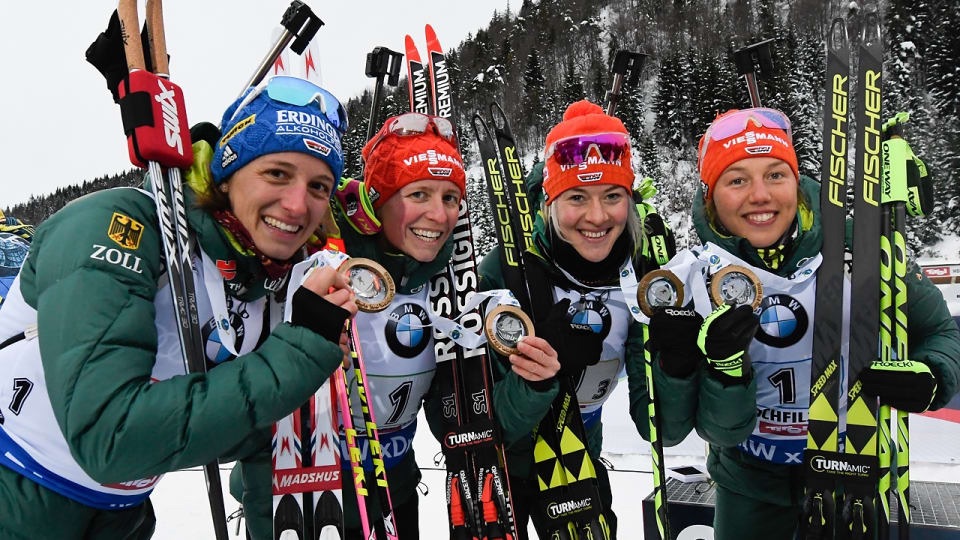
    But good shooting, and skiing, was rewarded handsomely. As is always the case in these lucrative late-season races, the winners of the 10 and 12.5 k pursuits took home shiny new Mercedes cars as their prizes, providing a little more motivation to shoot straight, wind or no.

    In the women’s race, Kaisa Makarainen of Finland was more or less able to do that. She collected four penalties – one in each stage – which would usually be far too many for a racer who started in tenth, 50 seconds out, and wanted to win. But today it tied her for the best shooting of the day.

    The other biathlete to shoot as well was Vita Semerenko of Ukraine, who finished second in the sprint. By the time they made it to the last lap, Makarainen had a slight lead over the Ukrainian. Even though she is a stronger skier than Semerenko, she said it wasn’t easy to win.

    “The most difficult moment in the race was the last lap,” Makarainen told the Russian Biathlon Union. “I am very glad that I could win – by the end of the season we are all very tired. Everyone just uses up everything they have left.”

    Far behind her, over two minutes back, Jana Gerekova of Slovakia outsprinted Solemdal by less than a second for third place. Zina Kocher of Canada moved from 16th up to fifth with just six penalties, narrowly edging out Semerenko’s twin sister Valj.

    The season is finally over for the women, and Makarainen, for one, can go home with a positive feeling for next season.

    “It was difficult to gather my strength after tenth place in the sprint,” she said. “But you should believe in yourself in every race. If you’re going to think that starting in tenth means you cannot win, nothing good will come of it.”

    The Mercedes in her driveway will now be a reminder to the Finn, who won the overall World Cup in 2011: don’t give up.

    *          *          *

    Italy's Lukas Hofer skiing towards a 20th-place finish in the World Championships individual race this season.

    The wind calmed slightly for the men’s race, allowing several top finishers to escape with only two or three penalties.

    Sweden’s Björn Ferry started in the lead after his sprint victory the day before, and held it for much of the race. With three penalties, he seemed to be in good position.

    But as in the women’s race, another biathlete slowly climbed his way through the field: Lukas Hofer of Italy, who like Makarainen had finished tenth in the sprint, this time a minute behind Ferry.

    And like Makarainen, he wasn’t really expecting to make it all the way to the front.

    “Everyone wants to win this race,” Hofer told the Russian Biathlon Union. “It is very difficult to do it in Kamchatka, because the level of competition is similar to the World Cup.”

    But thanks to just two penalties, the 22-year-old closed the gap on Ferry and soon found himself skiing with the previous day’s winner along with Swedish teammate Carl Johan Bergman. After the final shooting bout, Ferry, who had missed a total of three shots, and Hofer left together with a gap on Bergman.

    “I thought that he would be faster on the last lap,” Hofer said of Ferry. “I wanted him to go ahead, but he declined and said that I had to go first.”

    The Italian reluctantly led the way around the final two and a half kilometers, and was able to just barely pull away in the final 500 meters, crossing the line 0.2 seconds before the Swede to win the race and the Mercedes.

    “I finished second today and missed the expensive car by a foot or two,” Ferry tweeted after the race. “I got a knife instead.”

    Bergman was third, 21 seconds back with four penalties, and a clearly exhausted Simon Fourcade of France fourth with two missed shots.

    The two North Americans, Marc-Andre Bedard of Canada and Jay Hakkinen of the U.S., placed 23rd and 34th after missing ten and nine shots respectively.

    Results (PDF): women / men

  • In New Trend, Domracheva Uses Superior Shooting to Best Neuner in Khanty-Mansiysk

    In New Trend, Domracheva Uses Superior Shooting to Best Neuner in Khanty-Mansiysk

    Domracheva celebrating another victory by waving a Belorussian flag.

    It’s not that Darya Domracheva hasn’t been fast before.

    No, that’s not what makes her form in the last several weeks so impressive. She’s always been fast: the 25-year-old Belorussian biathlete has won eight races and picked up 27 more podiums, including Olympic bronze, in the past few seasons.

    But in many of those victories, Domracheva has won by sheer force of will, digging in to the intense head-to-head competition offered up by the World Cup field. This year, her triumphs in the Hochfilzen pursuit and Antholz mass start came despite having one more penalty than the second-place finisher. She only has one sprint victory, and hasn’t won an individual-start race since the very first competition of this season in Östersund, Sweden.

    Recently, Domracheva’s shooting under pressure has taken a step up to the next level, with great rewards. Today in Khanty-Mansiysk, Russia, Domracheva didn’t have to make up so much ground on her skis because even before the final stage, she had one fewer penalty than Magdalena Neuner of Germany, her most frequent adversary. As snow continued to fall at the Siberian venue, the two came into the range for their last bout together, with Vita Semerenko of Ukraine doggedly tucked in behind them.

    Women's podium, l-r: Kaisa Makarainen, Darya Domracheva, Vita Semerenko.

    Just as she had done in the pursuit at World Championships two weeks ago, Domracheva carefully cleaned her final stage. In this case, the others finished shooting before her but were forced to hit the penalty loop. It was a familiar scene: in Ruhpolding, Neuner had come into the range well before the Belorussian, but missed shots while Domracheva cleaned and sailed past her onto the trail.

    “I was very happy with my last shooting stage,” Domracheva said in a press conference after today’s race. “I had good concentration; there were three girls together on the shooting line, and it was not so easy.”

    Domracheva deliberately slowed her shooting to ensure hits.

    “I saw that [Neuner] had two misses, and in my mind I knew that I should clean here.”

    Domracheva left the range with a 22-second advantage over Semerenko, who had missed one shot, and had such a large cushion by the time she re-entered the stadium that she stopped to pick up a full-sized Belorussian flag. It fluttered above her in the final meters, and she waved the green and red colors in jubilation, bowing as she crossed the line.

    The win secured Domracheva the crystal globe for leading the pursuit standings; it was her first discipline title of any sort, and she finished 20 points ahead of Neuner.  Neuner, who holds the lead in the overall rankings, was relegated to fourth place thanks to her penalties in the final stage, and actually lost time to Domracheva on the final loop.

    Semerenko left the range in second, but was only about twelve seconds ahead of Kaisa Makarainen of Finland, who had also cleaned that stage. After barely two minutes, the Finn was pulling even with the Ukrainian. Makarainen made the pass and jetted off down the trail, ending up second.

    Last year’s overall World Cup winner and the 2011 World Champion in this event, Makarainen hasn’t had such good luck this year. She finished up the pre-World Champs period with a thrilling pursuit victory in Kontiolahti, Finland, but then fell ill and missed a crucial training block heading into Ruhpolding. Her only medal at the Championships was bronze in the pursuit.

    “I was motivated to come here,” Makarainen said of her recent troubles. “I maybe skied better yesterday. I felt pretty tired in my legs today, but I like the course here. It fits me well and that helped in the race today.”

    Semerenko, who started the day with bib two after placing second in yesterday’s sprint, was overwhelmed to see her second podium in as many days. Early in the race, she had cleaned her prone stages, but been passed on the trails by Neuner and Domracheva. By the time she hit the fourth loop, Semerenko dug in, refusing to be dropped by the two faster skiers. Even though it took a toll and she was unable to hang onto second in the end, she was still pleased.

    “My task was to shoot clean,” the Ukrainian, who missed a shot in each standing stage, wondered aloud in the press conference. “I did not think it would be possible to stay in the top three… I cannot believe that I stayed in the top three.”

    Tora Berger of Norway finished fifth and Helena Ekholm of Sweden sixth.

    * * *

    Susan Dunklee (USA) battling Marie Dorin Habert (FRA) for eighth place. Photo: NordicFocus/USBA.

    Far enough from the front to be out of contention for the win, but not so far as to be out of the picture entirely, Canada’s Zina Kocher and American biathlete Susan Dunklee battled through the slow conditions.

    Starting just a second apart in ninth and tenth, the two worked together for three loops, cleaning both prone stages and remaining in the top ten.

    “It was a pretty darn exciting [race], and I my favorite part was working with Zina for the first three laps,” Dunklee told FasterSkier in an e-mail.

    In the first standing stage, the two parted ways, with Dunklee cleaning and moving into seventh while Kocher had one penalty and stayed in tenth. But even after separating, the two were well-matched. They missed a shot apiece in the final stage, and their ski times were within three to seven seconds of each other on each loop.

    Dunklee finished ninth on the day after losing a sprint finish to Marie Dorin Habert of France – which she said was one of the only negative things she could find about her race.

    Dunklee was all smiles despite losing to Habert. Photo: NordicFocus/USBA.

    “I started the last loop right behind Marie and let her dictate the pace,” Dunklee explained. “I was confident that I could catch her in a finishing sprint, but I wasn’t very smart about making my move. I sprinted hard up the last uphill into the stadium, but I got stuck on the outside of the corner going over the top and she won the battle. I should have tried to pass her earlier.”

    Despite ending on a slightly sour note, the result was still her best in World Cup racing (she placed fifth in the individual at World Championships) and tied the best four-stage shooting of her career.

    Like Domracheva, Dunklee said her approach on the range was to be careful.

    “My shooting felt very deliberate again today as it as been for the last few races, but I wasn’t entirely in the zone,” she said. “I was more aware than I should have been of what was going on around me. Tora [Berger] shoots fast in standing! Next year I plan to cut down my range times substantially, but right now I am happy to be hitting targets.”

    Dunklee’s teammate Sara Studebaker had a less satisfying day on the range, missing two shots in the first stage and slipped ten places, from 37th to 47th, right off the bat.

    “It’s always hard to miss in the first stage of a pursuit because you lose contact and it’s tough to come back,” she told FasterSkier. “But I felt that I skied a smart race and am happy with the outcome all things considered.”

    After climbing her way back up to 42nd, Studebaker missed two more shots in the last stage. She wound up 44th.

    It wasn’t the way she had hoped to end the season; after struggling to find last season’s form in the first half of the year, Studebaker had placed 15th in the sprint in Kontiolahti, and hoped that it was a sign of things to come for World Championships and these races in Russia. That’s not the way it turned out, however, and the Finnish sprint will end up as her only top-20 of the season.

    “I’m definitely not satisfied with my season this year, but I am looking forward to making some changes and coming back stronger,” Studebaker said. “I had some moments of brilliance with Oslo and Kontiolahti and several other races in the top-40, so I know the potential is there!”

    Canada’s Megan Imrie was lapped and did not finish the race.

    Full results

  • Neuner is Perfect on the Range, Perfect on the Trails, and a Perfect Teammate As She Wins Sprint Title

    Neuner is Perfect on the Range, Perfect on the Trails, and a Perfect Teammate As She Wins Sprint Title

    Germany's Magdalena Neuner passing Eva Tofalvi of Romania en route to gold.

    RUHPOLDING, Germany – What Norway is to skiing, Germany is to biathlon. And the thousands of German fans filling the Chiemgau Arena today wanted only one thing: German gold.

    They’d been denied that pleasure in Thursday’s mixed relay, where a combination of shooting errors and a last-minute time reduction for the Norwegians bumped the German team from what seemed like a sure win down to third place.

    And in the men’s sprint earlier today, the top German was Andreas Birnbacher in 16th. The race – which like so many this year turned out to be between Martin Fourcade and Emil Hegle Svendsen – was exciting, but it wasn’t what the crowd had come for.

    In the women’s 7.5 k sprint, however, the fans’ appetites were finally satisfied: as the late afternoon sun slowly but surely slipped into the mountains, Magdalena Neuner, who last year was named Germany’s female Athlete of the Year, picked up a 15-second win over Darya Domracheva of Belarus.

    Neuner leading Michela Ponza of Italy.

    Neuner, who turned 25 in February, claims to be retiring at the end of the season, and she made the most of her last World Championships sprint.

    “I did enjoy the atmosphere,” she said through a translator in the postrace press conference, refusing to bow to the usual protocol of speaking English now that she’s here in her home country. “I was very relaxed. I was looking forward to the race and I really tried to soak up the atmosphere. I focused on myself, and I focused on what was important. That really brought me to victory today.”

    The top five competitors all shot clean, an unusual occurrence this season and especially rare in sprints. Neuner won six of eight sprints in the World Cup season so far, and half of those victories came with a penalty. (Olga Zaitseva of Russia won the other two, but finished 16th today.)

    Domracheva, starting 12 bibs ahead of Neuner, shot clean and had reason to believe that she might win. A regular podium finisher, she usually has more penalties than the German.

    “I am really excited about my clean shooting today,” she said. “It is the best shooting for the season. When you have a clean shoot, it is always fun and a good emotion for you.”

    Domracheva had the fastest ski time of the day as well. But what stopped her from climbing the final step of the podium was slow shooting: she took 28 more seconds to shoot over the course of the two stages than Neuner, her frequent rival.

    “In my prone shooting, I had some problems with my first bullet, and then I tried to be concentrate more on my next shoot,” Domracheva said.

    Domracheva coming out of the start gate.

    Knowing that Domracheva had shot clean may have put more pressure on Neuner, but she said she was unaware of what had happened on the range before her.

    “I didn’t know what Daria had done,” Neuner said. “I really focused on myself. I didn’t know the shooting scores, but I knew that with no penalties on the shooting I would be sure to get near the top. It was a great feeling especially with the crowds around me.”

    The one thing that could have made Neuner’s day better? She said she wasn’t a fan of the soft, slushy ruts that developed in the seemingly tropical sun here in Ruhpolding.

    But it didn’t slow her down much.

    “I am in good shape, we have seen that during the last two competitions,” Neuner said. “If the course was a little bit harder it would be better, because I don’t like the deep snow too much. But I would say I am very close to 100 % right now.”

    Vita Semerenko of Ukraine was the final podium finisher; this is the second World Championships bronze of her career. But even though she was third in the individual race at last year’s event, Semerenko was not expecting to match that today. Only six different women have finished on the podium in the eight World Cup sprints this season and she was never one of them.

    “This year, it is really a surprise for me,” said Semerenko, whose season-best finish before today had been fifth. “It was a very fast competition and I am very glad to have won bronze.”

    Semerenko.

    Semerenko had a few demons to overcome on the Ruhpolding range. Despite being seeded third, the Ukrainians finished a disappointing 14th place in the mixed relay on Thursday. While nobody on the team had a banner day, Semerenko was the only one to ski a penalty loop, after an error-filled prone stage.
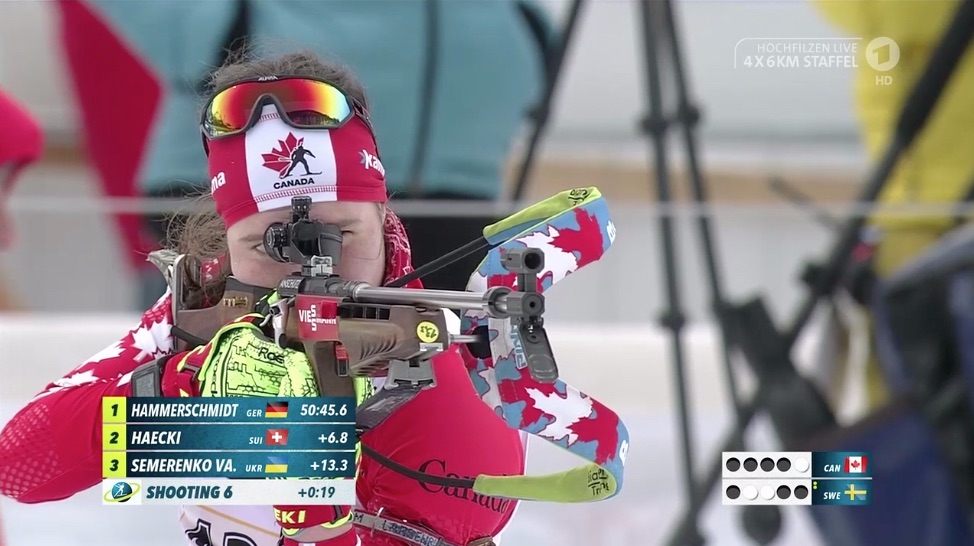
    “After the relay I was really not satisfied, and today it was really difficult for me in the shooting because I knew what had happened two days ago,” she said. “The most important part was shooting clean and I managed to do that.”
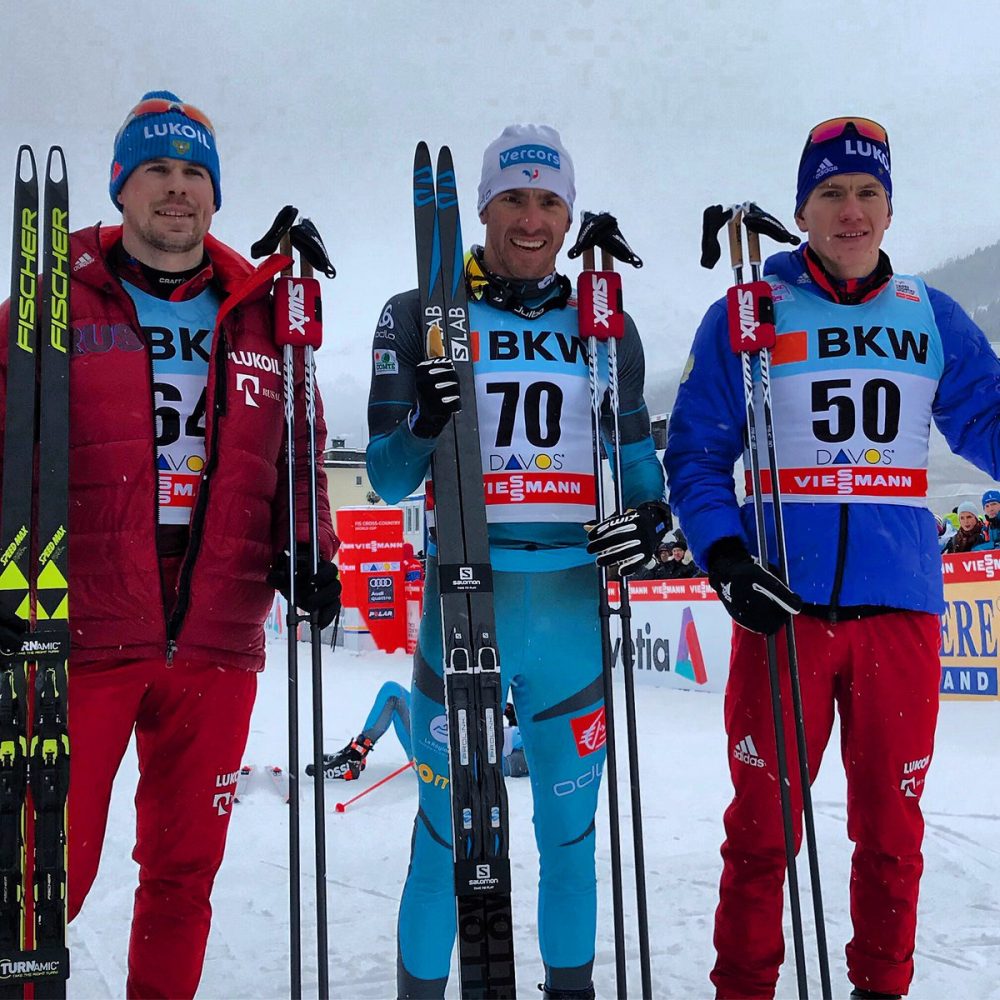
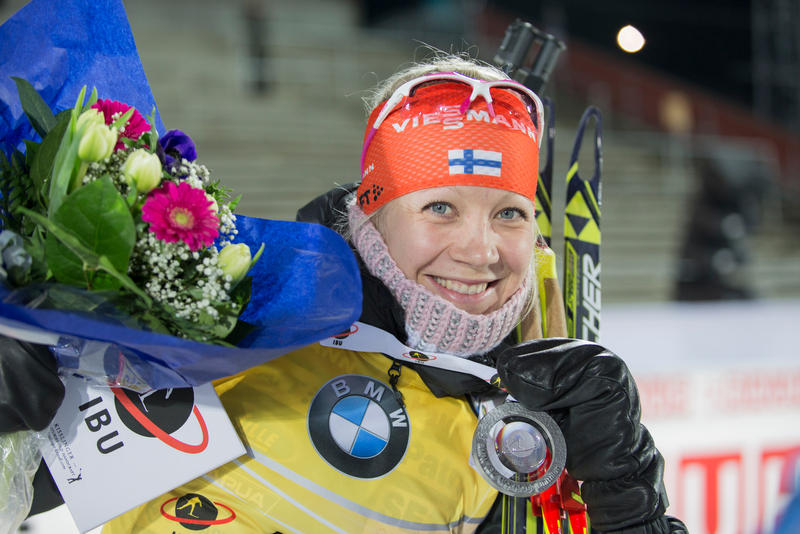
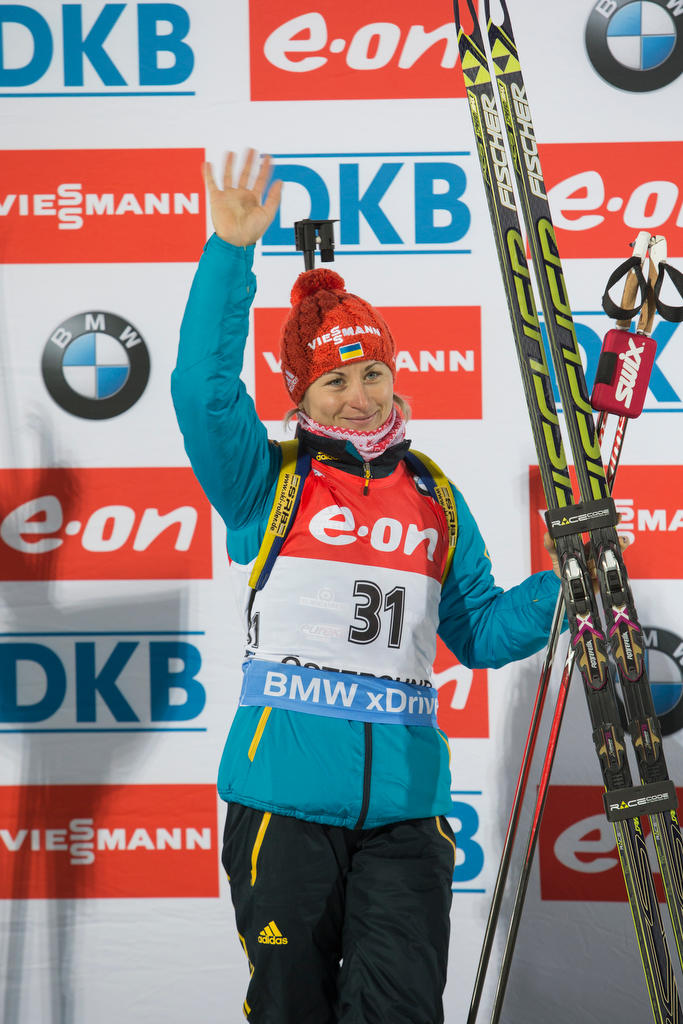
    Semerenko finished 37 seconds out of gold, and today Neuner and Domracheva were truly in a class of their own. Only five competitors managed to finish within a minute of the German; that group was capped by another perpetual foil, Tora Berger of Norway, who missed one shot and finished 52 seconds back in sixth.

    Helena Ekholm of Sweden and Marie Laure Brunet of France, who usually get on the podium if they shoot perfectly, were out of luck today and finished fourth and fifth.

    “I’m very happy,” Ekholm, who has had one of her worse seasons in recent years, told Swedish broadcaster TV4. “When the best shoot cleanly, I’ve still got a chance. It’s a very good position – I’m just in the running for a medal tomorrow, instead.”

    Svetlana Sleptsova and Olga Vilukhina of Russia shot clean to finish seventh and eighth, followed by Marie Dorin Habert of France and Anastasiya Kuzmina of Slovakia rounding out the top ten.

    Before leaving the press conference, Neuner requested to make an unsolicited statement.

    “There’s just something I’d like to say,” she began, before addressing the assembled journalists regarding teammate Arnd Peiffer’s penalty in the last stage of the mixed relay.

    “There was an article in the Bild Zeitung, which is a German tabloid, and it said that ‘Arnd ruined Lena’s gold medal’,” Neuner said. “And I think this is not something one should write. I think Arnd did a great race, he made sure that we would win bronze, and maybe next time people might want to think more about what they are going to write.”

    Then she sat back in her chair and looked at the hundreds of media workers typing away on their computers, daring them to disagree.

    The message was clear: don’t mess with Neuner, on the trails or off. She’s not just a good biathlete, but a teammate, too.

    Full results

  • Hauswald Triples Up in Oslo; Tcherezov Takes Win in Mass Start

    There’s one way to guarantee yourself a good result in a biathlon race: hit all the targets.

    In the men’s 15 k mass start World Cup in Oslo, Russia’s Ivan Tcherezov was the only one of 30 starters to do so, and he won, by 26 seconds, over Austria’s Christoph Sumann and Norway’s Emil Hegle Svendsen.

    From the first loop and first shooting stage, Tcherezov was in the hunt, ensconced in a big group and trailing only Svendsen, Simon Fourcade (FRA), Austria’s Daniel Mesotitsch, and Germany’s Arnd Peiffer.

    By the end of his third clean shooting stage, he was alone—the nearest competitor was Germany’s Andreas Birnbacher, some 20 seconds back.

    Tcherezov never blinked, and never gave his rivals a chance to get back in the race. He said he was struggling on his skis on the “very wet and soft” course, but since nobody else could muster fewer than two misses, the Russian skied to the line essentially unchallenged.

    Sumann had a decent-sized gap over Svendsen, but the latter had to work for his podium place over Birnbacher—the only one collected by a Norwegian male this week. The two left the range for the last time with Birnbacher leading by a few seconds, but Svendsen managed to close the gap and pass the German before the finish to claim third by a few seconds.

    Tim Burke (USA) was with the leaders through two shooting stages, then faltered with two misses in the third round and three in the fourth, ending up in 23rd, nearly two and a half minutes down.

    He said the huge effort to stay with the leaders left him unsteady in the range.

    “I skied with the group up front there, but that was completely out of my league,” he said. “I tried every tactic I had. Nothing worked. I was just too tired in my legs to really hit the targets….That was probably one of the worst standing shootings in my career.”

    While the rest of the U.S. team heads home from Norway, Burke will travel to Khanty-Mansiysk, Russia, for the final World Cup weekend. Currently 14th in the World Cup overall standings, he’ll be looking to maintain that position, or move up.

    Canada’s Jean-Philippe Leguellec was one spot behind Burke in 24th, with two penalties.

    Hauswald Hits the Triple

    While Tcherezov demonstrated one way to win, Germany’s Simone Hauswald took her victory the hard way in the women’s 12.5 k.

    Single penalties in each of her first two shooting stages put her more than thirty seconds off the lead, behind a train of her German teammates led by Andrea Henkel.

    After the two misses, Hauswald said, “I kept my focus, knowing that the race is over after the third and fourth shooting [stages] are over.”

    Hauswald is the fastest woman on the biathlon circuit right now, and even though there were a handful of her competitors who shot clean today, none of them could stop the German from winning her third race in a row. She cleaned both of her standing stages, wresting the race from Henkel after the latter had a miss in her last shooting round.

    Hauswald held on to win by 15 seconds over Vita Semerenko (UKR) and 22 over Magdalena Neuner (GER).

    “I cannot believe what I have done in the last three races,” she said. “Maybe it is the perfection of doing biathlon: body, mind, and soul together.”

    Zina Kocher of Canada was the only American starter, and she had a nightmare day. Nine penalties left her just over seven minutes back.