With the 2022 Winter Olympics only a few years out, it’s time to begin promoting cross-country skiing in the most populous country.
The International Ski Federation (FIS) opened the cross-country rollerski World Cup with events in Beijing, China from July 4-6. . The first day of competition featured a 1.5-kilometer freestyle sprint. Norway’s Johannes Hosfløt Klæbo, the big name presence in Beijing, won the men’s race. The Norwegian wonderkind also won the next day’s 200 m freestyle “supersprint”.
Norway’s Linn Sömskar won both the 1.5 k sprint and “supersprint” in the women’s events.
The third day of racing featured a 15 k women’s mass start skate and a 20 k men’s mass start skate.
China’s twenty-six-year-old Qiang Wang won the men’s race, while Klæbo placed eighth in what was a bunch sprint for the win.
For the women, Sömskar made it a three victory series after taking the 15 k mass start win for the women.
Perhaps the most notable stat reported by FIS was the television share the day’s first racing captured on Beijing TV. The 1.5 k sprint reached 3% of the television viewing market with nine million viewers. That total is nearly the entire population of Norway and Finland combined. (Norway’s population is 5.2 million, Finland’s 5.5 million.)
Russia’s Vitaly Mutko Wins CAS Appeal, Overturning Lifetime Olympic Ban
Back in 2017, the IOC banned Vitaly Mutko from participating in all future Olympics. The former Russian Sports Minister reportedly oversaw state sanctioned doping in the country in the lead up to and during the 2014 Sochi Winter Games. He was banned from the 2018 Games.
In the ruling, the CAS made clear it was beyond the IOC’s power to sanction an individual who was not part of an official delegation, an athlete, or a coach. Vitaly is currently none of these. (Yet, he is Russian Deputy Prime Minister.) Further, CAS claimed the IOC’s Rule 44 allows the IOC to ban individuals for a single edition of the Games, not “all future Games”.
The CAS stated, “the Panel must set aside the Appealed Decision for lack of a legal basis.”
CAS did include language in its ruling leaving the IOC an opening with regards to taking future action against Mutko. The ruling does not impact “any future decision that the Respondent might adopt vis-à-vis the Appellant in reference to any specific edition of the Olympic Games.”
Widescale Anti-Doping Police Action in Europe
And in other doping news, a large multi-organization police action made 234 arrest and took down 17 organized crime groups involved with trafficking anabolic steroids.
“The trade in doping substances is normally decentralized and highly flexible, open to anyone willing to order online or travel to producing countries and buy the substances in bulk from legitimate manufacturers,” Europol wrote in a press release. “Mainly the final consumer, often gym fanatics and bodybuilders, determines the patterns of this trafficking.”
Europol also noted that non-professional athletes, “bikers and body-builders are buying small parcels of steroids, mainly from Asia or eastern Europe to traffic them to gyms”.
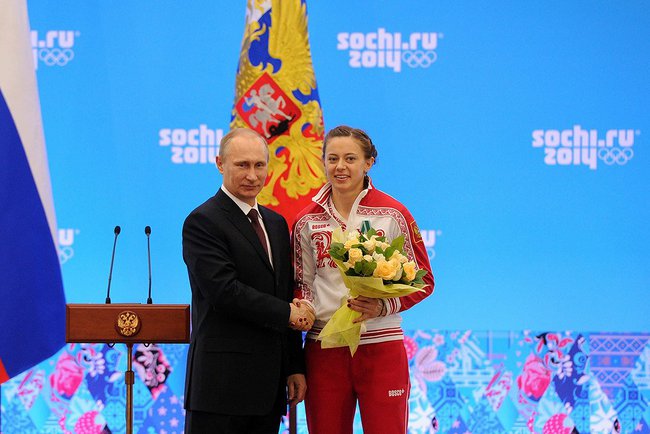
Russian President Vladimir Putin with biathlete Olga Vilukhina on February 24, 2014. (Photo: www.kremlin.ru/Creative Commons)
After an Executive Board meeting today to discuss doping in Russia, the International Biathlon Union (IBU) has provisionally suspended two athletes. The federation opened anti-doping investigations into 29 more.
Meanwhile, the Russian Biathlon Union voluntarily gave up their hosting rights for two events: 2017 Youth and Junior World Championships, slated for Ostrov, and a World Cup stage slated for Tyumen.
Two Suspensions from the 30+ Cases
The IOC has jurisdiction over all anti-doping activity at Olympic Games. That means that any samples collected between Jan. 31 and Feb. 22, 2014 which tested positive for banned substances or showed signs of tampering are the responsibility of the IOC rather than a relevant international sports federation like the IBU.
The IBU noted in its press release that the IOC had opened proceedings against two athletes. The press release did not name the two athletes, but noted that the IBU would suspend them.
Meanwhile, Norway’s NRK broadcaster is reporting that the two athletes were medalists in Sochi. That leaves nine possibilities. Evgeny Garanichev won bronze in the 20 k individual, and Olga Vilukhina silver in the 7.5 k sprint. Vilukhina was joined by Olga Zaitseva, Yana Romanova, and Ekaterina Glazyrina for silver in the women’s relay. And Alexey Volkov, Dmitry Malyshko, Evgeny Ustiugov, and Anton Shipulin won gold in the men’s relay.
At least four biathletes appeared to have “protected” status at the 2014 Games, according to evidence files from the McLaren report. One of those athletes, Romanova, had sample bottles with marks that seem to indicating tampering.
In addition, the IBU is opening investigations into 29 more athletes mentioned in the McLaren report.
The IBU will notify both the athletes and the Russian Biathlon Union. Both entities can comment on the allegations. At the same time, a working group formed by the IBU will continue to investigate. Then the working group will decide whether the case needs to be referred to an Anti-Doping Hearing Panel, which will ultimately decide whether suspensions are required.
The IBU noted only that they would set a deadline for receiving comments from the affected athletes. But otherwise, they did not specify a timeframe for the investigations. Because World Cup racing resumes January 5, 2017, in Oberhof, Germany — just 14 days from today — that means that if any of the 29 biathletes are competing on the World Cup, they will likely continue to do so.
Many in Russia, and outside, were pleased with the decision.
“A balanced decision has been taken,” Deputy Prime Minister Vitaly Mutko told the TASS news agency. “It gives an opportunity to make conclusions in an unhurried manner, not the ones based on the abstract statements or conclusions of just one person… I’m confident our federation will show the majority of athletes [who misused doping] have already been punished.”
The IBU press release noted that in only one case was an athlete already suspended for the same positive test that was noted in the McLaren report.
Several athletes had positive tests explicitly mentioned in different evidence documents. In at least five cases, anti-doping staff reported positive results as negative ones in the World Anti-Doping Agency’s test management database. As a result, the athletes never served suspensions for their violations. One such case occurred at an IBU Cup competition in Ostrov in 2013.
Alexander Tikhonov, a board member of the Russian Biathlon Union and a former Olympic champion, lauded IBU President Anders Besseberg.
“Well, biathlon is not affected,” he told sports.ru. “A positive decision.Besseberg showed that he is our man.”
Russia Gives Up on Hosting Two 2017 Events
Momentum has been growing for an international boycott of biathlon events in Russia. The Czech Republic and Britain led the way by declaring that they would not compete in Russia until the country had a clean bill of health from anti-doping authorities. The Norwegian Biathlon Association expressed support for this position.
Ultimately, such a move will not be necessary. The IBU mentioned in their press release that the Russian Biathlon Union has given up the two events.
“Under the circumstances, [RBU] considers it impossible to conduct the Biathlon World Cup and Junior World Championship, to be held in Tyumen and Ostrov respectively…Determining the place for these activities is up to the IBU,” the Russian Biathlon Union wrote on its website. “The competition should take place in an atmosphere of celebration, and not among suspicions and rumors.”
The IBU has yet to decide where they will be moved to.
“The relocation of both … events will be decided upon later,” the IBU said.
“This is a first important step by the Russian Biathlon Union to show to the IBU and to the world of sport that the current situation is taken very seriously,” Besseberg said, according to the press release. “This will now allow the international biathlon family to focus on biathlon during these events.”
Some in Russia are still upset about the boycott threat.
“These calls for boycotts should entail punishments for athletes,” Mutko told TASS. He elaborated that he thought those advocating for a boycott were in violation of the Olympic Charter.
Athlete Reactions
Some international athletes have also reacted to the decisions.
Punishing the fans instead of real culprits… What a sanction… 👎🏼
Anna Bogaliy-Titovets, who won relay gold with Russia in 2006 and 2010 and now competes for South Korea, had a more nuanced view.
“If the Executive Bommittee IBU made such a decision it means that its members have a good reason, and evidence of Russian athletes involved in doping,” she told sports.ru. “Depriving the whole team of the right to race in international competitions would be extremely unfair.We must respect the decision in the way the IBU presented it.I do not think this is a conspiracy – the Executive Board consists of representatives from different countries. Severe punishment for no reason would not be possible.”
“The IBU has done a solid job,” Norwegian Biathlon Association President Erlend Slokvik told NRK, according to a translation. “And it is good that Russia withdraws.It’s a signal that they have understood the seriousness of the situation.”
(Note: This article has been updated to include a statement from the International Ski Federation regarding the most recent McLaren report, as well as comments from IBU President Anders Besseberg.)
The initial McLaren bombshell came in July when the World Anti-Doping Agency (WADA) disclosed its findings about alleged systematic state-sponsored doping in Russia.
McLaren’s investigative mandate was to further disclose the extent to which Russia’s anti-doping authorities manipulated doping-control samples and how they beat international testing protocols.
Friday’s report disclosed more evidence of systematic Russian doping that McLaren concludes dates back to at least 2011 and continued after the Sochi Olympic Games.
The major findings released today include this: more than 1,000 Russian athletes in more than 30 different sports were involved in the doping coverup. McLaren called it “a coverup that operated on an unprecedented scale” in his opening remarks.
Of those 1,000 athletes, 600 (84 percent) are summer athletes whereas 95 (16 percent) are winter athletes. Those 695 names were reported to 32 international sports federations. The remaining 305 were more or less special cases that could not be disclosed for confidentiality reasons, McLaren explained.
The report states that the “coverup” and “manipulation” of the doping-control process was fine-tuned during the 2012 London Summer Olympics, 2013 Universiade Games, 2013 Moscow IAAF World Championships, and the 2014 Sochi Winter Olympics.
On page 27, the report’s authors did not mince words when it came to describing the freedom to which some Russian athletes could affect a race’s outcome during the 2014 Winter Games:
“The Winter Olympics in Sochi debuted the ultimate fail-safe mechanism in the Russian’s sample swapping progression. A protected winter Olympics competitor likely to medal did not have to worry about his or her doping activities. They could dope up to, and possibly throughout, the Games as they could count on their dirty sample being swapped at the Sochi Laboratory.”
Specific violations that occurred during the Sochi Games were sample swapping and tampering.
“Two female hockey players’ samples contained male DNA … and eight Sochi samples revealed salt content not physically possible in a healthy human,” McLaren stated, explaining that Russian specialized agents, dubbed “magicians”, used salt and “Nescafé coffee granules” to manipulate the samples.
More specifically, McLaren’s team found “physiological impossible” salt readings in two Russian athletes that were “winners of 4 Sochi Olympic gold medals” and a female silver-medal winner.
“Twelve medal winning athletes (including the above 3) from 44 examined samples had scratches and marks on the inside of the caps of their B sample bottles, indicating tampering,” the report stated. “Six winners of 21 Paralympic medals are found to have had their urine samples tampered with at Sochi.”
For Russian doping authorities, the process of preventing samples from testing positive became a nimble and evolving cat-and-mouse game. Russia’s infrastructure put in place to beat the testing protocol was able to evolve, “in response to WADA regulatory changes and surprise interventions,” the report stated.
“For every action by WADA, there was a Russian reaction,” McLaren said.
The first McLaren report detailed the intricate swapping of positive tests for clean tests during the Sochi Games. The second McLaren report alleges that the same protocol continued after the Sochi Games concluded and became a routine “monthly practice” at the Moscow Laboratory at the center of the doping coverup.
“After Sochi, the sample swapping happened approximately every month,” McLaren said. “The ‘magicians’ would be called to the Moscow laboratory to swap … about five to 20 samples … per month.”
How did they get away with tampering with supposedly tamper-proof bottles? According to McLaren, forensics experts determined that “thin strips of the metal were most likely used. They have to be flexible enough to bend and fit between the lid and the bottle, but also strong enough to pull up the metal ratchet ring.”
And who is responsible at the very top? While McLaren’s report does not name Vladimir Putin, it does include former Russian Ministry of Sport Vitaly Mutko (who has since been promoted to deputy prime minister). Mutko appointed Dr. Grigory Rodchenkov, the former director of the Russian anti-doping laboratory, for the job back in 2011 — when doping efforts were found to have begun ramping up for the 2012 London Olympics.
McLaren later explained that there was no evidence that Russian Olympic Committee members were directly involved. He also stressed that this “institutional conspiracy” dates back to at least 2011.
“It is impossible to know how far back the conspiracy goes,” he said. “… Sports fans and spectators have been deceived. It’s time that stops.”
Athletes affected by the post-Sochi sample swapping technique include elite summer and winter athletes. McLaren wrote that the report’s conclusions were established not by verbal testimony, but by testing physical evidence.
“The key findings of the first report remain unchanged,” he said. “Evidence does not depend on verbal testimony from anyone to draw a conclusion, but rather tests the physical evidence and draws a conclusion from the results.”
As of press time, neither McLaren, his report, nor WADA mentioned any athletes by name. McLaren said the evidence has been passed on to WADA, which is asking specific sport federations to handle specific athlete cases.
“It has not been put in the public domain. That will be up to sports federations who have received the information,” he said.
In a press release on Friday, WADA noted that the evidence, described by McLaren’s “Investigation Team as being ‘based on immutable facts’ will be of immediate value to the IFs [International Federations], the International Olympic Committee (IOC), the International Paralympic Committee (IPC) and other organizations — those that are responsible for the Results Management and Adjudication process related to potential anti-doping rule violations (ADRVs) under the World Anti-Doping Code (Code).
“In terms of next steps, the Investigation Team is providing WADA with an Evidentiary Summary for each athlete referred to in the Report by alpha-numeric code,” the press release continued. “Starting today, WADA will provide these Summaries to all IFs whose athletes are mentioned within the Report; as well as, to the IOC, the IPC and other relevant organizations. Once in possession of these Summaries, these organizations will be responsible for reviewing the evidence available for each case; and, for determining whether or not there are sufficient elements to pursue ADRVs or, whether further investigations are required. As is a requirement of the Code, WADA will monitor the Results Management that will be carried out by the relevant authorities.”
As McLaren explained: “It’s up to different parties, like the IOC and the federations [32 of which have reports] for them to make their decisions. They can rely on what’s in the reports and what’s on the website.”
While the IOC did not have an official statement on its website a few hours after the report was published on Friday, the International Paralympic Committee immediately responded with a press release, stating, “The full findings of the report are unprecedented and astonishing. They strike right at the heart of the integrity and ethics of sport. … We wholeheartedly agree with Professor McLaren that the best course of action is to work together to fix the broken and compromised anti-doping system in Russia.”
The IPC explained that it recently appointed a taskforce to work “closely” with the Russian Paralympic Committee (RPC) “to do just that.”
The IPC suspended the RPC in early August “due to its inability to fulfil its IPC membership obligations, in particular its obligation to comply with the World Anti-Doping Code (to which it is a signatory) and the IPC Anti-Doping Code.”
The International Ski Federation (FIS) relayed its official statement in an email to FasterSkier:
“FIS will study the details in the WADA McLaren Report in the coming days and thereafter act decisively, in accordance with the FIS policy of zero tolerance to punish anti-doping violations and the protection of clean athletes. Additionally FIS will coordinate with the IOC, as the responsible body for anti-doping at the Olympic Winter Games, and WADA, in order to address each organisation’s next steps.”
Also in the email, FIS Communications Manager Jenny Wiedeke noted, “Unfortunately, we cannot answer specific questions until we have had a chance to completely review all of the details of the report.”
The International Biathlon Union (IBU) president Anders Besseberg went on the record saying, “First of all you need proof that the Russian Biathlon Union was involved in this thing,” he told Sportschau.de. “Or was it something that went over the head of our federation member — at a state level so to speak, then it is a difficult question.
“But in my opinion that is the key question: if the Russian Biathlon Union was involved,” he continued.
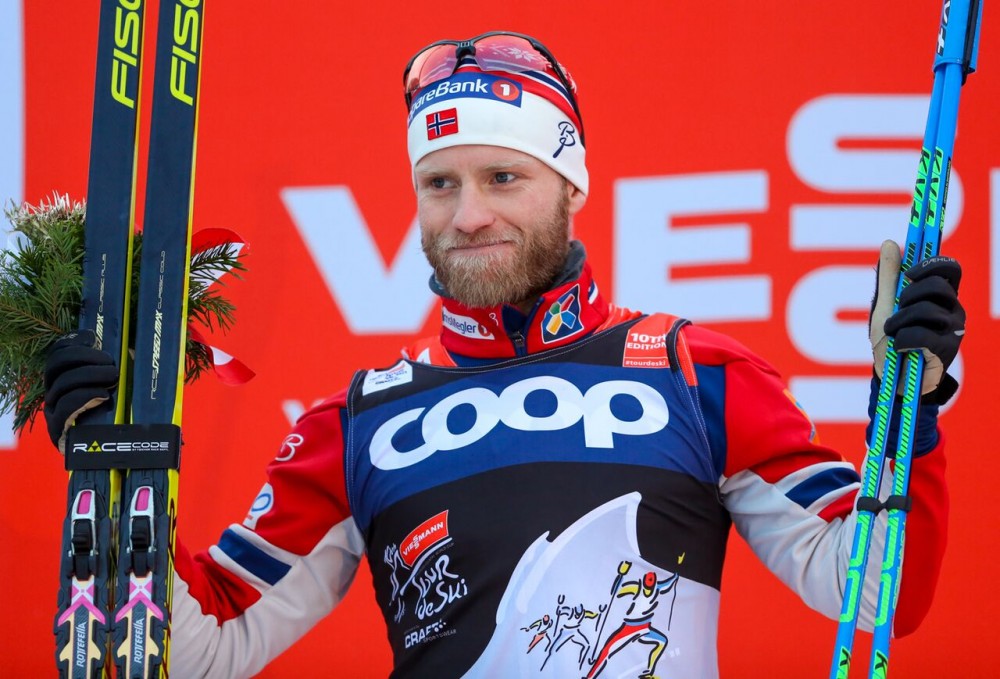
Norway’s Martin Johnsrud Sundby at the 2016 Tour de Ski. (Photo: Marcel Hilger)
As Norwegian skier Martin Johnsrud Sundby continues to consider whether to appeal his doping ban to the Swiss Supreme Court, both he and the World Anti-Doping Agency (WADA) are speaking publicly about the case.
The International Ski Federation (FIS) had initially acquitted Sundby, but WADA appealed the case to the Court of Arbitration for Sport (CAS) and won. The ski champion lost his 2015 Tour de Ski title as well as the 2015 overall World Cup title, although his two-month ban was shorter than most punishments in doping cases.
In Norway’s Aftenposten newspaper, Sundby said that he now regretted keeping the case a secret until WADA won its appeal rather than speaking out about it earlier.
FIS rules do not require acquittals to be made public, but Aftenposten revealed that the Norwegian Ski Federation had even gone as far as having its communications manager, Espen Graff, draft a press release after FIS cleared Sundby. The federation strategized that it would be better to get ahead of the case in the media sphere.
But Sundby stopped the plan from going forward, instead waiting to see the result of WADA’s appeal. He now says he believes that if he had gone public after the acquittal, it would have discouraged WADA from appealing at all.
In the same piece, Sundby said that his failure at 2015 World Championships in Falun, Sweden, was due to the case. He had learned of his positive tests in January and the stress caused him to get sick and miss most of the Championships, then turn in what was by his standards an unimpressive performance in the 50 k.
At issue in the case is whether asthma medication is performance-enhancing at high concentrations. The drug, salbutamol, is also banned because it is a masking agent.
Speaking about the case publicly for the first time, WADA Scientific Director Olivier Rabin told Norwegian newspaper VG that the drug did indeed have benefits for athletes.
“The latest research shows that large doses can have an effect,” he said.
Previous research had indicated that at recommended therapeutic doses, salbutamol did not affect healthy airways. That is, the drug could not relax muscle that was not constricted, for instance by asthma or exercise-induced bronchoconstriction.
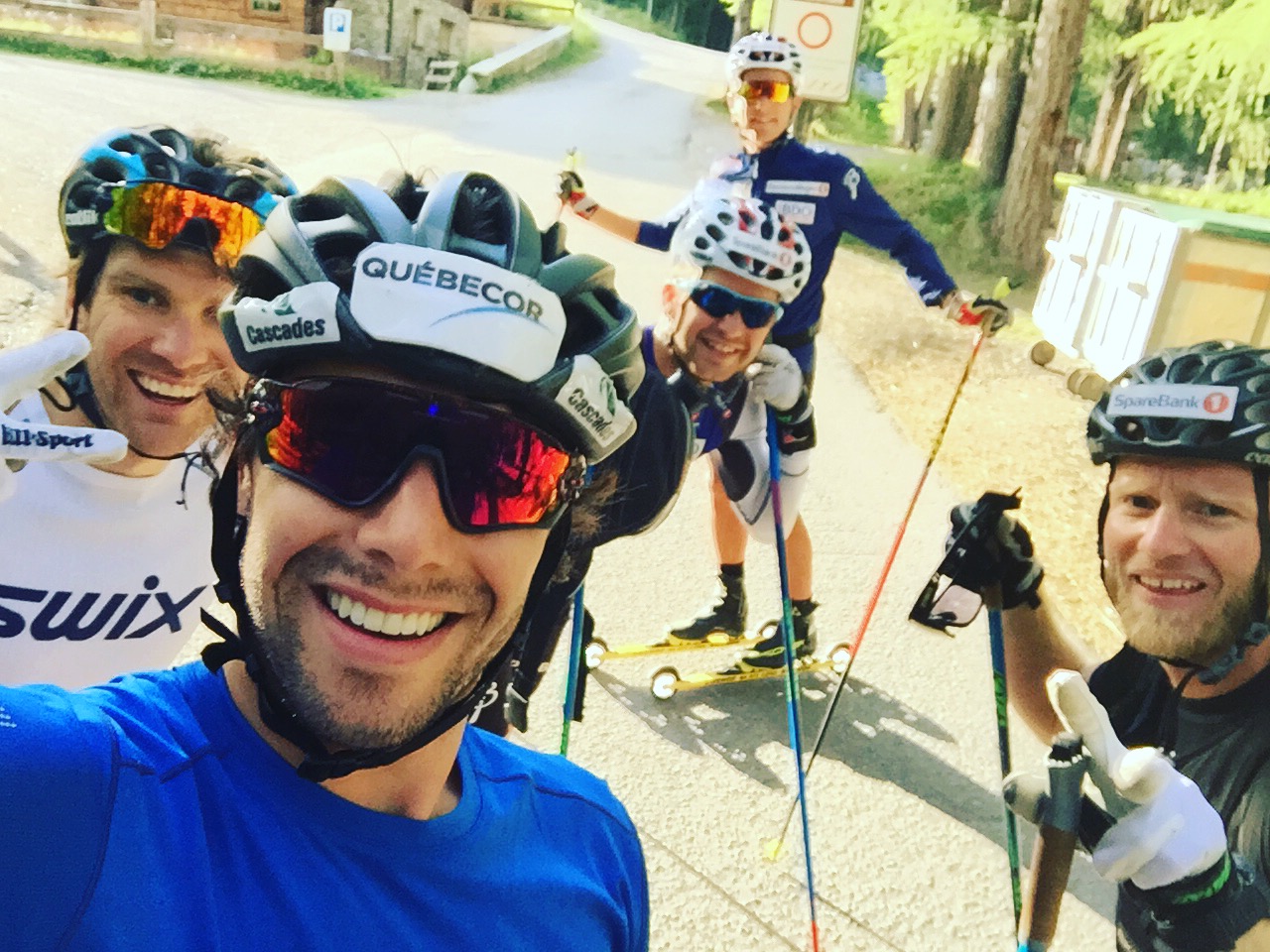
Martin Johnsrud Sundby of Norway (right) training with Canadian skiers in Livigno, Italy, earlier this month. (Photo: Alex Harvey/Instagram)
However, the drug does not work only in lung tissue, and that appears to be part of the argument against high doses.
Jørgen Jensen, a professor at the Norwegian School of Sport Sciences, suggested to VG that the drug may affect skeletal muscle, increase muscle growth and speed recovery. He cited research showing that the class of drugs, beta-2 agonists, appears to be more beneficial to sprinting and power events than to endurance performance.
But the case continues to reverberate in the ski world. Russian World Cup skier Evgeniy Belov accused the Norwegians of corruption since there was a long gap between Sundby’s positive test in January 2015 and the resolution of his case at CAS, which allowed him to complete the whole next season with no competitors the wiser as to his case.
His two-month suspension during the summer also didn’t affect a competition season.
The International Biathlon Union (IBU) has cleared three athletes who had tested positive for the heart medication meldonium in early 2016. Eduard Latypov of Russia, Artem Tyshchenko of Ukraine and Eva Tofalvi of Romania will not serve suspensions because, as the Anti-Doping Hearing Panel concluded, “they bear no fault” in having the drug in their bodies.
The panel did not find evidence that they took the drug after the Jan. 1 date when it was added to the Prohibited List, and decided that they could not have known that it would stay in their bodies for a longer period of time. All three athletes will have relevant results canceled, but are free to return to competition.
Meanwhile, Russian hackers continue to leak files stolen from WADA’s databases, primarily showing Therapeutic Use Exemptions for athletes who competed in the 2016 Summer Olympics in Rio de Janeiro, Brazil. Some data also show positive drug tests in Rio for the same substances.
Several of the cases involved salbutamol and other asthma medications; one TUE was for a drug to treat attention-deficit hyperactivity disorder. Perhaps the majority involved anti-inflammatory medications which are commonly used to treat injuries, but are banned without a TUE.
Data on 29 athletes from a variety of countries has been released so far, but the records of all 10,000 athletes who competed in Rio may be compromised.
“Given this intelligence and advice, WADA has no doubt that these ongoing attacks are being carried out in retaliation against the Agency, and the global anti-doping system, because of our independent Pound and McLaren investigations that exposed state-sponsored doping in Russia,” WADA Director General Olivier Niggli said in a press release. “We condemn this criminal activity and have asked the Russian Government to do everything in their power to make it stop. Continued cyber-attacks emanating from Russia seriously undermine the work that is being carried out to rebuild a compliant anti-doping program in Russia.”
Although law enforcement has asserted that the hacks originated in Russia, the country’s Minister of Sport, Vitaly Mutko, denied it.
“How can you prove that they are hackers from Russia? You blame Russia for everything,” he told The Telegraph.
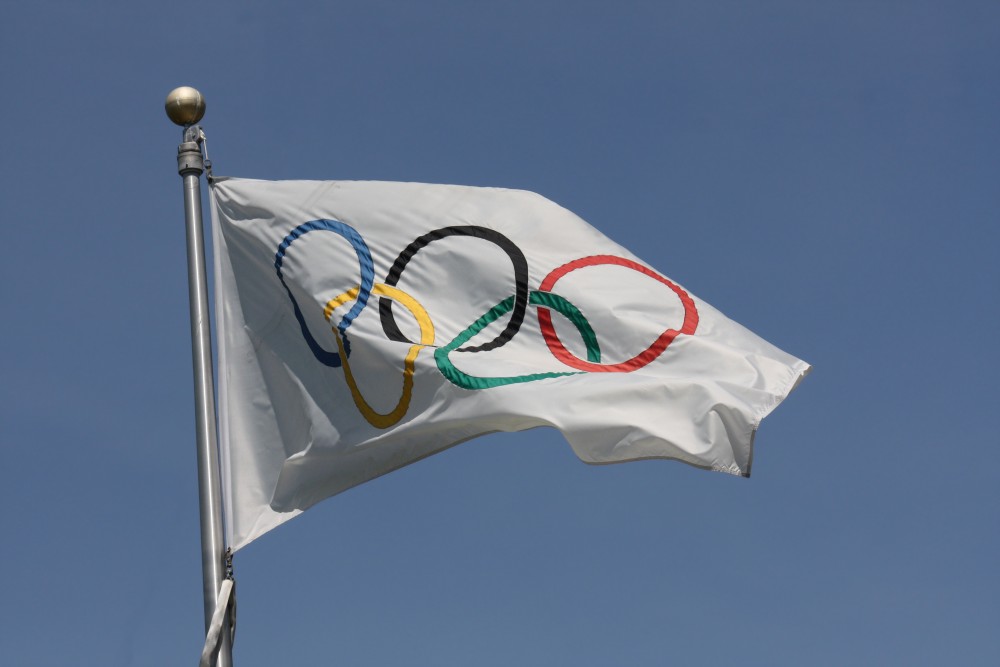
Early next month, the Olympic flag will fly at the upcoming 2016 Summer Olympics in Rio de Janiero, Brazil, but what message is its governing body, the International Olympic Committee, sending in its most recent decision regarding Russia? (Photo: Wikimedia Commons)
Note: The following is an editorial from FasterSkier’s editorial board, consisting of its editors, and is not meant to reflect the opinions of our broader staff.
***
On Sunday, the International Olympic Committee (IOC) Executive Board decided against an all-out ban on Russian athletes at the 2016 Summer Olympics, which start Aug. 5 in Rio de Janeiro, Brazil.
Instead, the IOC asked each individual sports federation (IF) to do a rigorous review of the Russian entries for Rio and determine whether they have undergone sufficient drug testing to be deemed “clean” and cleared to compete.
The IFs have been left just 12 days and no guidance for how to do this.
The decision was the culmination of a long process – just how long depends on who you ask.
Perhaps the process began in 2010, when whistleblower Vitaly Stepanov initially contacted the World Anti-Doping Agency (WADA) with information about systematic doping in Russia.
Or perhaps the process began in December 2014, when German documentarian Hajo Seppelt finally broadcast Stepanov’s information to the public on ARD. It was quickly seen around the world.
Later, WADA commissioned several independent reports, the first of which revealed extensive systematic doping in track and field. The first report, led by former WADA President Dick Pound, dropped in November 2015. Maybe the process began then.
Instead of enacting such a ban, the IOC Executive Board delivered a confusing, unclear decision where Russian athletes may participate after meeting supposedly stringent criteria which are not defined; where Russians with past doping violations are treated differently than those from other countries; and where Russian athletes in different sports may be treated completely differently from one another.
The result will be neither fair to clean athletes who were affected by the Russian government’s manipulation of hundreds of positive doping samples over the last five years, nor to Russian athletes themselves.
Some have noticed. Canadian biathlete and two-time Olympian Brendan Green was one of many sharing this image:
With this in mind, here are some questions for IOC President Thomas Bach and his Executive Board.
1) Do you listen to athletes?
A group of influential athlete representatives held a press conference after McLaren’s last Monday. Among them were Canadian cross-country skier Beckie Scott, the chair of the WADA Athlete Committee, and IOC Athletes’ Commission chair Adam Pengilly.
The group advocated for an unequivocal ban on Russian athletes in both Rio and PyeongChang. Before the McLaren report had even dropped, Pengilly explained, they had circulated a letter stating those aims. The letter was endorsed by athlete representatives from more than 20 different sports federations. Clearly, there was widespread support for such a position.
After the McLaren report came out, that position was solidified.
“We would like to highlight our belief that WADA must allow Professor McLaren and his team to continue their investigation, that Russia should be banned from the Rio Olympics, Paralympics, and other international events, and that International Federations must enact sanctions so as to protect clean sport,” the WADA Athlete Committee said in a statement.
It has been clear for quite some time that the Olympics are not about the needs or wishes of the athletes, but that was underlined by the Executive Board’s decision.
“I believe that the Russian federation has mocked the Olympic movement and I worry about the future of clean sport, I worry about the future for clean athletes, the Olympic movement and the Olympic Games,” Pengilly said told the BBC, where he later said he was “embarrassed” by the Executive Board’s decision. “Some have suggested the IOC has passed the buck and I’d have to agree. There’s been an abdication of responsibility here.”
Fellow IOC Athletes’ Commission member Hayley Wickenheiser, the Canadian four-time gold medalist in ice hockey, had this to say:
2) Do you listen to WADA?
For years – literally – WADA obfuscated, ignored whistleblowers and failed to take action when provided with compelling evidence of doping in Russia.
But in the last few weeks, it appeared that WADA had grown a backbone. After the McLaren report was delivered, the WADA Executive Committee published a list of seven recommendations.
The very first one: “The International Olympic Committee (IOC) and the International Paralympic Committee (IPC) to consider, under their respective Charters, to decline entries, for Rio 2016, of all athletes submitted by the Russian Olympic Committee (ROC) and the Russian Paralympic Committee.”
WADA also suggested that Russian government officials be banned from attending Rio.
That might be the main recommendation that the IOC actually upheld: in their decision they wrote that “Nobody implicated [in the McLaren report], be it an athlete, an official, or an NF, may be accepted for entry or accreditation for the Olympic Games.”
In the McLaren report, Russian Minister of Sport Vitaly Mutko is named as having interfered with at least one positive doping case. Russian President Vladimir Putin’s name is mentioned in the report as having personally appointed a Deputy Minister of Sport who helped hide positive tests.
Will either be banned from Rio? Is that under the purview of any international federation, or only the IOC? Will President Bach sign deny those credentials himself?
Otherwise, WADA – a body which is partially funded by the IOC, but did not have the power to enact a ban on Russian athletes itself – was left in the cold.
“WADA is disappointed that the IOC did not heed WADA’s Executive Committee recommendations that were based on the outcomes of the McLaren Investigation and would have ensured a straight-forward, strong and harmonized approach,” said WADA President Sir Craig Reedie. “The McLaren Report exposed, beyond a reasonable doubt, a state-run doping program in Russia that seriously undermines the principles of clean sport embodied within the World Anti-Doping Code.”
3) What do you mean by “reliable adequate international tests”?
The IOC clearly wanted the process to approve Russian athletes for the Rio Games to be onerous, or at least to seem that way.
Long jumper Darya Klishina will be the only Russian track and field athlete competing in Rio this August. The IAAF cleared her because she lives in Florida and has thus been outside the Russian system. Other federations have clearly not been so strict in making their decisions. (Photo: Wikimedia Commons)
“Under these exceptional circumstances, Russian athletes in any of the 28 Olympic summer sports have to assume the consequences of what amounts to a collective responsibility in order to protect the credibility of the Olympic competitions, and the “presumption of innocence” cannot be applied to them,” the IOC wrote in the preamble to its decision.
And so the board mandated that all athletes be subjected to review by their relevant IFs.
“The absence of a positive national anti-doping test cannot be considered sufficient by the IFs….The IFs should carry out an individual analysis of each athlete’s anti-doping record, taking into account only reliable adequate international tests, and the specificities of the athlete’s sport and its rules, in order to ensure a level playing field.”
Yet there is no definition of reliable – which testing agencies does this include? And there is no definition of adequate – how many tests, over what period of time?
Russian Olympic Committee member Alexander Zhukov was invited to give a presentation to the IOC Executive Board. In it, he asserted that since the first WADA report Russian athletes have been repeatedly tested by international anti-doping agencies and, according to the IOC press release, “the vast majority of the results were negative.”
Yet, the main agency tasked with these tests, UK Antidoping, reported via WADA in June that 16 percent of scheduled tests could not be collected from athletes; a further 736 tests were canceled or declined; and that doping control officers were sometimes harassed and intimidated when they tried to collect samples.
Is this international testing reliable and adequate?
4) Is this fair to Russian athletes?
Without a definition of what constitutes reliable and adequate testing, outcomes for various sports are already vastly different.
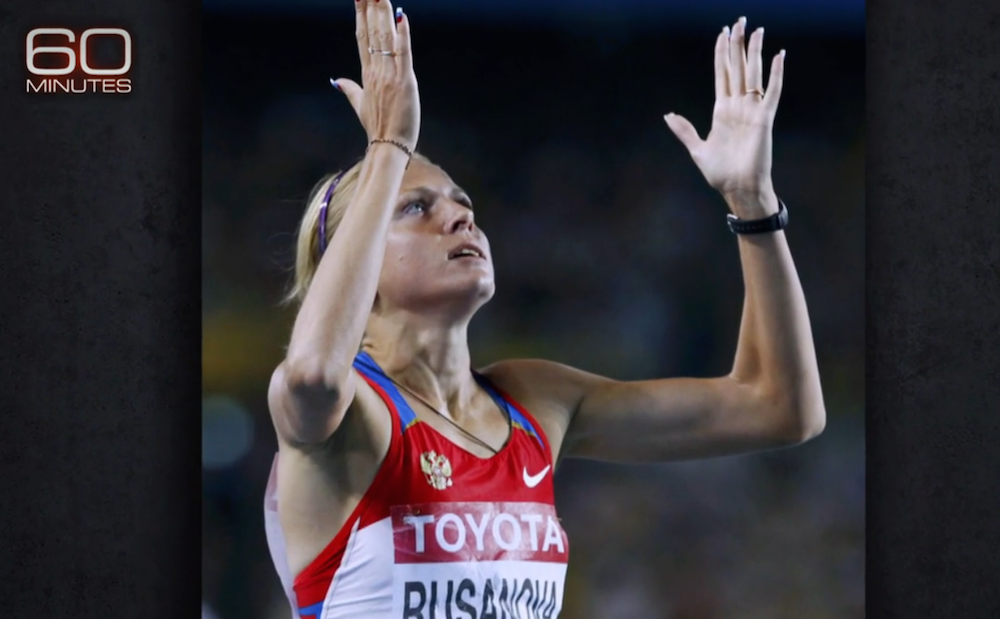
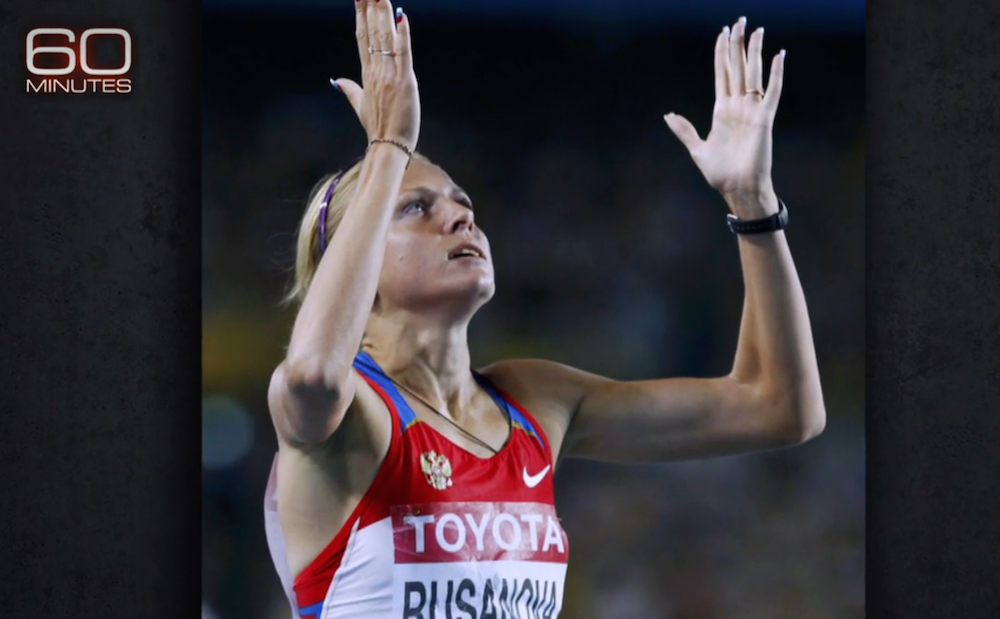
The International Association of Athletics Federations (IAAF) has banned all but two Russian track and field athletes from the Games. (The IOC went on to actually kick out one of those two, Yuliya Stepanova, a whistleblower who helped bring the entire scandal to light. Nice.)
In the past weeks Bach has talked extensively about the need to balance collective punishment for government action against individual justice. He has said that clean Russian athletes who had nothing to do with the scandal should not be punished. But it seems clear now that in some sports they will be, whereas in other sports they will not (or their doping teammates might even be able to compete alongside, or instead of, them).
5) Is this what zero tolerance means?
One of the IOC guidelines states that any Russian athlete who has served a doping ban cannot compete in Rio.
One can almost see the logic: with many tests manipulated, the chances are higher that those athletes could have had a second positive test. If true, this should have led to a second and potentially longer ban which they would still be serving.
But maybe not — what if they did reform and are now clean? The provision sends an extremely confusing message: past dopers from some countries are allowed a second chance, but there’s no redemption if you’re from Russia. How is that zero tolerance, much less fair?
When Justin Gatlin and Tyson Gay (American sprinters previously banned for doping) likely medal in the men’s 100 meters, how will a Russian track and field athlete feel? Probably that it’s absolutely fine to dope – as long as you’re not from Russia.
Yuliya Stepanov, a former Russian track and field athlete who admitted to using several steroids and then became a whistleblower bringing the Russian doping scandal to light. She was cleared by the IAAF to compete in the 2016 Olympics as a “neutral” independent athlete after having fled Russia. (Photo: CBS News)
The International Association of Athletics Federations (IAAF), the global governing body for track and field, has decided to prohibit Russian athletes from competing at the 2016 Olympics in Rio de Janeiro, Brazil.
Widespread, systematic doping, along with cover-ups, political connections and bribery in Russian track and field were revealed over the course of the last year in a series of news documentaries and then investigations by the World Anti-Doping Agency (WADA).
With the reports of systematic doping now spreading into other sports – for instance, 14 Russian cross-country skiers have been accused of doping at the 2014 Olympics, while a top government official admitted that the entire ski team was doped in 2010 – many in the Olympic sphere are watching the IAAF decision closely to see what options other federations might have for dealing with renegade countries in the future.
The All-Russia Athletics Federation (ARAF) was initially suspended from international competition last November. The IAAF then had to decide whether to uphold the ban through the Rio Olympics or whether Russia had made enough progress toward Code compliance to be deemed eligible.
The decision: no.
“Although good progress has been made, the IAAF Council was unanimous that … Russian athletes could not credibly return to competition without undermining the confidence of their competitors or the public,” IAAF President Lord Sebastian Coe said in a live-streamed press conference on Friday.
The IAAF Task Force, which worked for five months to investigate Russian track and field and was led by Norway’s Rune Andersen, suggested four action points, the first of which was that Russia would not be reinstated.
The IAAF Council unanimously adopted the recommendations.
“Under the reinstatement conditions, [ARAF] must show that there is now a culture of zero tolerance towards doping in Russian athletics…,” Andersen said in the press conference, before detailing that he didn’t see those conditions having been met.
“In particular, the deep-seated culture of tolerance or worse towards doping that got [ARAF] suspended initially appears not to have been changed today,” he said. “Certain coaches and athletes appear willing to ignore the doping rules. A strong and effective anti-doping infrastructure capable of detecting doping still has not appeared … [ARAF] appears unable to enforce doping bans.”
WADA filed a report on Wednesday showing widespread avoidance of doping controls by Russian athletes. In a three-month period, over 700 tests failed to be administered because athletes could not be located.
“In order to fix a problem, you have to realize and accept that there is a problem … so I think that is the first step that needs to be taken by Russia, is to acknowledge that there is a problem, from the top level of government and through all levels,” Andersen said.
In their responses to the decision, key players in Russian sports did not acknowledge a problem, and instead pledged to fight the decision.
“[Today’s] decision on the ARAF’s suspension was expected and easy to guess,” Russia’s Sport Minister Vitaly Mutko told Russian news agency TASS. “We will come up with a response.”
How international organizations handle the decision, and Russia’s attempts at appeal, will determine the true precedent of the decision. With allegations of systematic doping by Russian teams popping up in numerous sports (including skiing and biathlon), other federations are likely watching closely to see what leverage they might have over teams if Russia, or other countries, fail to make progress on anti-doping commitments.
Russia could, and likely will, appeal to the Court of Arbitration for Sport (CAS). John Coates, the head of the CAS, has recently said that he found Russian sports to be “rotten to the core”. But since Russia has not yet filed an appeal, it is not yet known who potential arbitrators will be and whether they share his opinion.
There’s another option for Russia, too: the International Olympic Committee (IOC).
“We now appeal to the members of the IOC to not only consider the impact that our athletes’ exclusion will have on their dreams and the people of Russia, but also that the Olympics themselves will be diminished by their absence,” the Ministry of Sport said in an announcement.
The IOC will be having a stakeholder meeting on Tuesday in Lausanne, Switzerland, to discuss the outcome of the IAAF decision.
“Ahead of the Olympic Games Rio 2016, the Olympic Summit will coordinate and harmonise the approach among the International Federations, which take the first decision on the eligibility of athletes with respect to qualification for and participation in the Olympic Games,” the IOC media office said in an announcement. “The discussion will have to address the difficult decision between collective responsibility and individual justice.”
Some see this as an attempt by the IOC to keep Russia in the Olympics.
The IAAF did offer one lifeline to Russian athletes: that if they could prove “clearly and convincingly” that they were clean, for instance because they lived outside of Russia and were tested repeatedly by other authorities (a “credible” testing program, Andersen asserted), then they could compete – but not for Russia.
Andersen said that this decision was made in part after an outside counsel advised them that legally, their ban on the Russian team would be easier to uphold in court if they made some allowance for proven clean athletes to compete, even if the burden of proof was substantial.
In addition, the IAAF decided that athletes who had provided substantial assistance in anti-doping investigations could also compete under an independent flag. That opens the door for Yuliya Stepanova, a whistleblower who helped initially bring the Russian doping scandal to light.
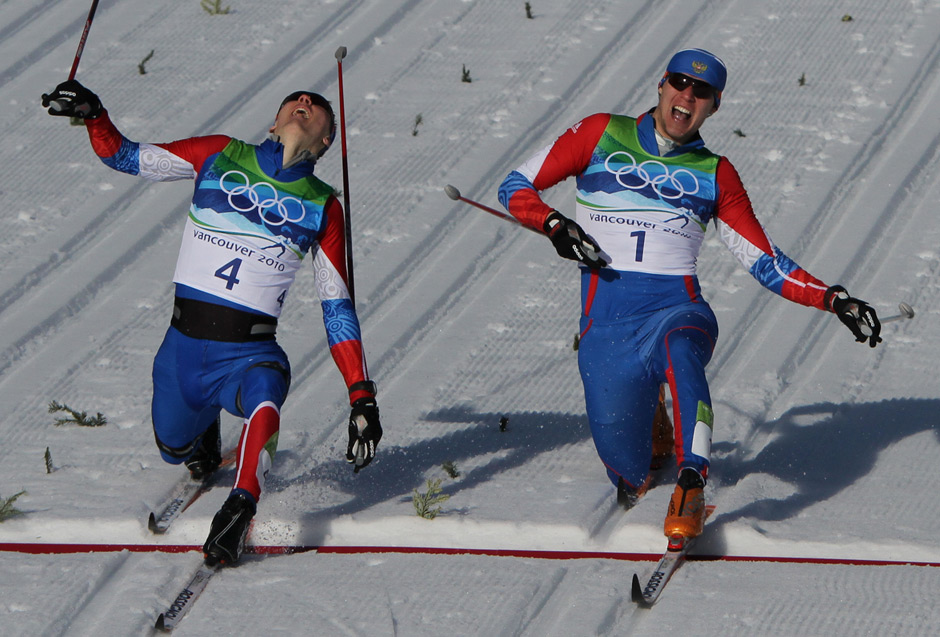
Russia’s Nikita Kriukov (l) and Alexander Panzhinskiy placed first and second in the men’s sprint at the 2010 Olympics in Vancouver, B.C. Russian Minister of Sport Vitaly Mutko recently told Russian media that the entire cross-country ski team was doping at those Olympics: “Of course, I knew all about this, they were all doing the doping,” he said. There are several ways in which the team allegedly avoided positive doping tests.
Allegations in the documentary opened a new possibility for how Russian sports officials avoided positive tests by doped athletes: did they use the Anti-Doping Administration and Management System, ADAMS, to learn when their athletes would be tested and warn staff who might be able to help athletes avoid positive tests?
“The ADAMS doping control database provided to [Anti-Doping Organizations] is an essential tool for managing both an in- and out-of-competition doping control program,” the World Anti-Doping Agency (WADA) explains on its website. “Coordination of doping control programs in the ADAMS system helps to avoid duplication of testing efforts and harmonizes communications between testing authorities, sample collection agencies as well as WADA accredited laboratories.”
But it may have been used for something else.
Government Interference
The 35-minute piece put together by journalist Hajo Seppelt primarily focused on what Russia should have to do in order to send athletes to the upcoming 2016 Summer Olympics in Rio de Janeiro, Brazil.
After widespread indignation over the last year about rampant doping in Russia, Seppelt questioned whether Russia was making a good-faith effort to change. Collusion had been revealed in several of his previous documentaries, as well as by pieces in The New York Times, Sunday Mail, 60 Minutes, and by the World Anti-Doping Agency Independent Commission.
This time, Seppelt revealed more than ever about the involvement of the Ministry of Sport and specific government officials in covering up doping so that Russian athletes could compete – with great success – on the international stage.
Buried in the documentary was an allegation that for two winter sports, the Ministry of Sport had worked to warn coaches and athletes before visits from doping control officers.
The allegations involved Minister of Sport Vitaly Mutko and his anti-doping advisor Natalia Zhelanova, and came from a document signed by Grigoriy Rodchenkov, the former head of the Moscow anti-doping laboratory who has since fled to the U.S. and cooperated with The New York Times.
“Zhelanova deliberately evaded and undermined Test Distribution Plans of [International Ski Federation] and [International Biathlon Union]. Usually, RUSADA was informed two or three days before their [doping control officers] should collect samples from the Russian national team. [Name redacted] immediately notified Zhelanova, then the latter notified Head coaches, and the national team had change location, just escaped.”
Zhelanova was a member of the WADA Finance and Administration Committee from 2010 until 2015.
The documentary notes that not everyone approved of this policy. RUSADA Executive Director Nikita Kamaev apparently registered his concern, telling Zhelanova that “RUSADA was losing credits” in terms of respect and credibility.
The ADAMS system is used by anti-doping agencies for a variety of purposes. One of the main uses is for athletes to report where they are living, training, or staying, a so-called “whereabouts” report.
If a doping control officer comes for a visit and the athlete cannot be located where they said they would be, it is considered a whereabouts violation. Three such violations over the course of 12 months can lead to a suspension from competition.
But another use of ADAMS is for the multiple authorities which test athletes to report and coordinate their efforts. For instance, an athlete is subject to testing by both their international federation and their national anti-doping organization.
“Where reasonably feasible, testing shall be coordinated through ADAMS or another system approved by WADA, in order to maximize the effectiveness of the combined testing effort and to avoid unnecessary repetitive testing,” the 2015 World Anti-Doping Code states.
This use of the system actually addressed complaints by athletes that they were tested to often and too disruptively, according to International Biathlon Union (IBU) Vice President for Medical Issues Jim Carrabre.
“Each nation has access to that data for their national athletes in the IBU test pool so that we minimize the probability of having two separate test authorities test an athlete on the same day,” he wrote in an email. “We each could still choose to do this if we wished but the benefits would be minimal. This was earlier a major complaint by athletes from many countries, and this access in ADAMS improved this complaint immensely.”
FIS Anti-Doping Administrator Sarah Fussek explained the use of the ADAMS system slightly differently.
“If you do register an exact mission in ADAMS beforehand, another organisation can only see this planned testing if the testing organisation has set explicit access in ADAMS for this purpose for each individual organisation,” she wrote in an email on Saturday. “At FIS this is currently not the case for any [national anti-doping agency] and vice versa.”
FIS does register tests in ADAMS once they have been completed.
But he confirmed that all of the tests ordered by the IBU were not only carried out by RUSADA, historically, but were also entered into ADAMS where RUSADA could access them.
“RUSADA could therefore notify internally any one if they had intentions of cheating the system,” he wrote. “This could have occurred but they would have had to check the system regularly if they wanted to know IBU test plans on Russian athletes when they were tested outside Russia. I presume that this was not done or otherwise we would have not caught the ones that we did.”
That’s why even aggressive testing by international federations could have been circumvented by individuals or agencies in Russia: whereabouts violation in reverse.
And, if this was the mechanism used by Zhelanova to warn teams before testing occurred, it could potentially have jeopardized testing by any international federation using ADAMS to pre-register its tests with the national anti-doping organization, as was encouraged by WADA.
Aggressive Testing, For Good or For Naught
Some federations have had concerns about Russian anti-doping efforts for years.
The International Ski Federation (FIS) caught a number of Russian cross-country skiers doping in the mid- to late-2000s, and in June 2010 sanctioned the Russian Ski Association. After fining the federation $185,000, FIS declined to press further sanctions and in November 2010 wrote in a press release that the federation had taken “positive steps” in anti-doping.
At the same time, FIS was avoiding relying on RUSADA to carry out testing missions to a large extent, instead relying on companies which train doping control officers and do the sample collection themselves.
“There was quite a lot of testing missions which were coordinated with [the Russian Anti-Doping Agency, RUSADA], but most were carried out by the FIS-appointed doping control agency with their own personnel and equipment,” FIS Secretary General Sarah Lewis explained to FasterSkier in May. “Most samples were transported to a different laboratory, in Lausanne or Cologne or somewhere else. We weren’t in the position that they could be manipulated in the Moscow laboratory.”
In an email on Thursday, FIS Anti-Doping Administrator Sarah Fussek said that the organization also did not usually notify RUSADA if and when tests were going to take place.
“With the exception of a handful missions, testing in Russia was carried out by a private sample collection provider,” she wrote. “We did have a couple of joint missions some years. Otherwise FIS testing did not give notice to RUSADA when conducting missions within Russia.”
As such, Fussek was confident that the FIS testing program was adequate to ensure that Russian athletes were mostly not cheating.
“Keeping in mind that you can never guarantee that every athlete is clean, we strongly believe that our programme covered testing in the country well and that we did all possible efforts to achieve a regular at home testing on Russian athletes (who most time of the year travelling on the World Cup circuit, plus training camps outside Russia and are tested there regularly as well),” she wrote.
“In the years three years prior to Sochi, the new administration in [the Russian Biathlon Union], Mr Mikhail Prokorov and Mr Sergei Krushenko, were verbally and financially committed to antidoping,” Carrabre wrote. “I had personal meetings with them and they went from one of the countries with the least number of internal antidoping tests to the country with the most number of internal tests in IBU. This effort was appreciated by myself and IBU and was, in my opinion, a large step in the right direction. I even publicly commended the RBU for this action. As I also said publicly, the number of tests does not always equal quality tests so the IBU would not decrease its efforts despite the testing of the RBU.”
The increased number of tests did catch some regional-level athletes, but no Russian Biathlon Union testing ever led to the suspension of a national-team athlete.
IBU testing, however, did, in particular when they tested outside of Russia. As Fussek had noted, athletes spend almost the entire winter, as well as periods of the offseason, training and competing in Europe, offering ample time to take many anti-doping samples.
“No national or international level athletes were ever found with their testing,” Carrabre said of the Russian Biathlon Union. “It was therefore surprising that the IBU would catch several of their athletes in the year prior to Sochi with testing performed outside of Russia while their athletes were at international training camps.”
Superficial Admissions of Guilt
The Ministry of Sport denied that they had interfered with RUSADA business in any way – or that such interference would even be possible.
“How can I exert influence there?” Mutko asked, rhetorically, in the new ARD documentary. “What influence can we exercise on the personnel of the anti-doping organizations?”
Just two days before the documentary aired, Zhelanova had done a question-and-answer session on Twitter, where she stressed that Russia was changing. The full exchanges from June 6 can be found on her twitter feed.
And Zhelanova seemed to admit that even today, it is difficult for doping control officers to do their jobs. U.K. Anti-Doping, which took over testing in Russia after RUSADA was stripped of its authority, reported in May that 40 percent of the tests it was supposed to carry out were impossible because they couldn’t locate the athlete.
Evading a sample or refusing to give a sample are both considered Anti-Doping Rule Violations, the same as a positive test or three missed whereabouts.
The current procedure for testing seemed to still be under negotiation. U.K. Anti-Doping had reported that Russia requested 30-day notice before testing of any athletes in military areas, which is clearly not standard operating procedure in the world of anti-doping.
“We agreed a procedure with WADA to help doping inspectors to carry out their important jobs,” Zhelanova tweeted in response to Rachel Axon of USA Today.
But what is there to discuss? In 2006, the Russian Federation ratified the International Convention Against Doping in Sport, under the purview of the United Nations Educational, Scientific, and Cultural Organization (UNESCO).
Article 12 states,
“States Parties shall, where appropriate:
(a) encourage and facilitate the implementation by sports organizations and anti-doping organizations within their jurisdiction of doping controls in a manner consistent with the Code, including no-advance notice, out-of-competition and in-competition testing…”
The 2015 World Anti-Doping Code further states that “Each government will take all actions and measures necessary to comply with the UNESCO Convention.”
After the documentary aired on Wednesday, Zhelanova was less than thrilled.
“I was very upset and disappointed by the allegations made against me in the recent @ARDde documentary,” she stated in a series of tweets. “These claims are untrue and are made by 1 disgraced person who disagreed with me on the importance of fair & clean sport. I really believe in the fight against doping and dopers and am doing everything I can to create change and restore trust. Reforms are under way but our system won’t be perfect immediately – cultural change takes time.”
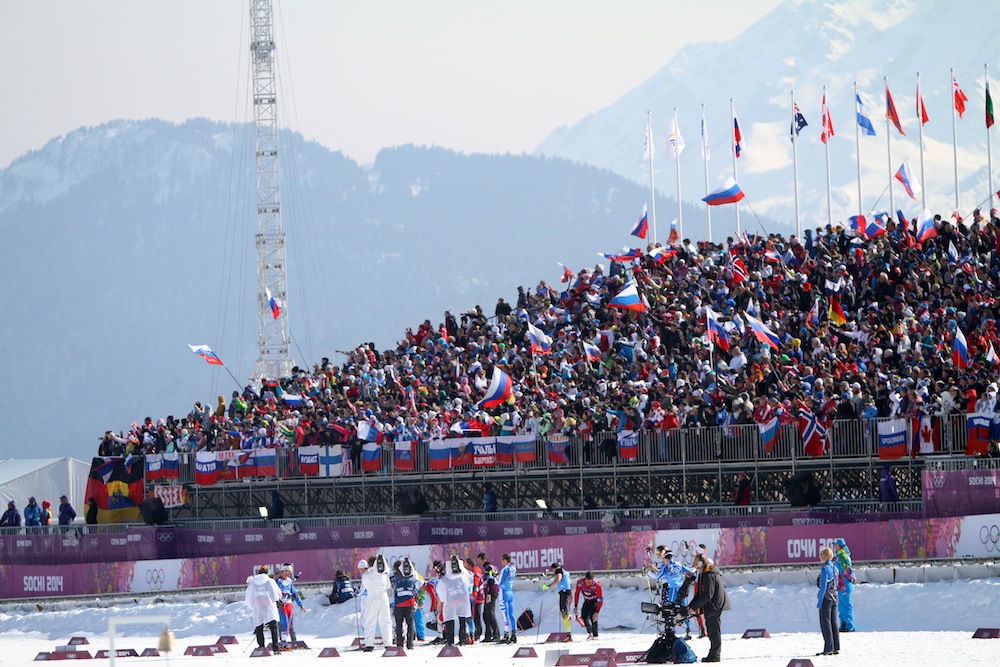
The day of the men’s 4 x 10 k relay at the Laura Cross-Country Ski Center at the 2014 Winter Olympics in Sochi, Russia. Sweden went on to take gold, Russia silver and France bronze in the event.
Max Cobb’s motivation to voice his disdain for doping dates back to the 1992 Albertville Olympics. Justin Wadsworth’s stems from being an athlete who had suspicions, but moreover, from watching his wife Beckie Scott miss out on her chance atop the Olympic podium after having been beat out by two Russians who were eventually disqualified for using performance-enhancing drugs.
For both, when it comes to Russia, they’re direct.
“The level of fraud and deceit that was allegedly put in place for the Sochi Games around the anti-doping effort is just a complete assault on everything that sport and the Olympic movement stand for,” Cobb, president and CEO of US Biathlon, told FasterSkier this past weekend.
He was reacting to The New York Times report, published Thursday, May 12, that suggested dozens of Russians, including 14 cross-country skiers, participated in a state-run doping program at the 2014 Winter Olympics in Sochi, Russia.
“There’s enough evidence in the past, with how many positive doping cases the Russians have had,” said Wadsworth, who recently left his post as head coach of the Canadian cross-country ski team after five seasons with the team. “I think that alone is enough to have reason to try to put some sanctions on them.”
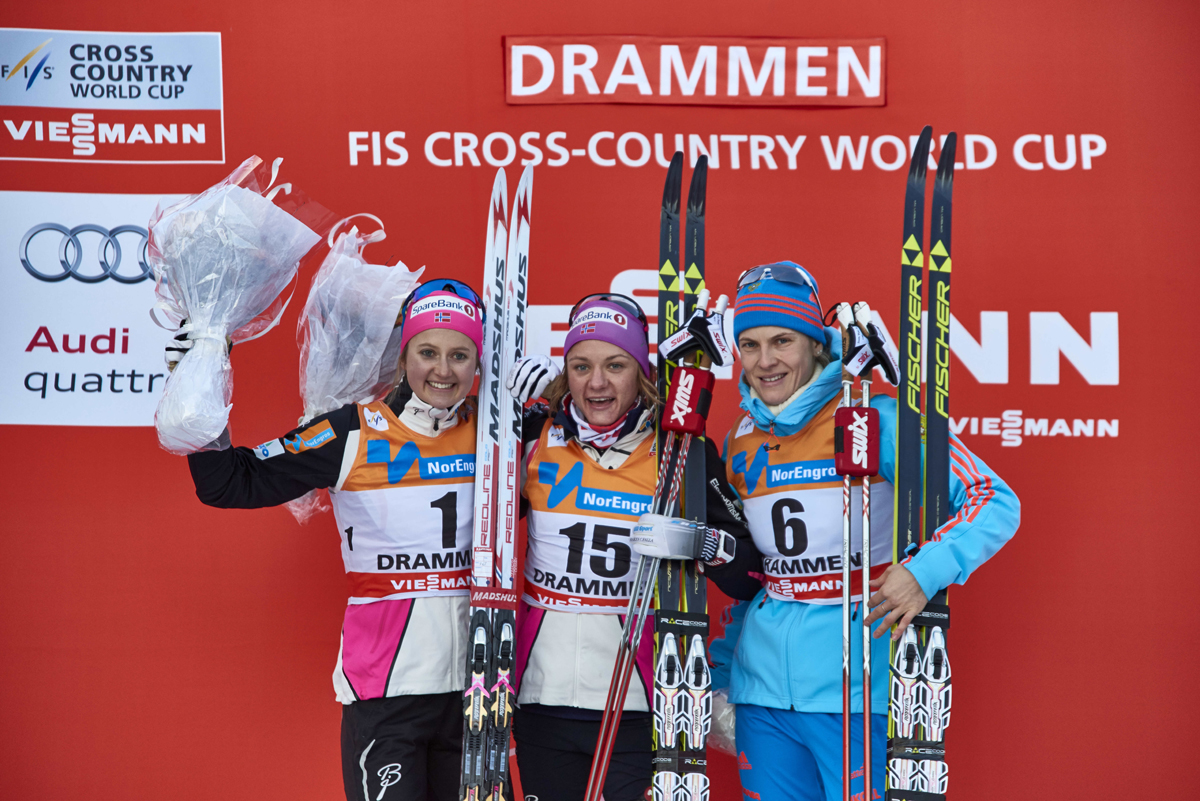
Russia’s Natalia Matveeva (r), who tested positive for recombinant EPO in 2009 and was suspended until March 2011, joins Norway’s Ingvild Flugstad Østberg (l) and Maiken Caspersen Falla (c) on the podium this past February at the 2016 classic sprint in Drammen, Norway. (Photo: Fischer/NordicFocus)
Wadsworth was referring to a trend leading up to the 2010 Olympics, in which about a dozen Russian cross-country skiers were suspended for failing drug tests between 2001 and 2009.
“When I first came onto the international scene in the late ’80s, I went to ’89 World Championships in Lahti, and during that whole time I was naive…,” Wadsworth, a former U.S. Ski Team member, recalled. “You learn over the years, you see enough stuff that you just know what’s most likely an athlete that’s doping. You can’t come out and say, ‘Yeah, for sure,’ unless you see the needle going in the arm.”
That’s what makes the current case so complex, with the head of the Sochi anti-doping lab, Grigory Rodchenkov, releasing a list of Russian Olympians handpicked to receive illegal drugs at the 2014 Games.
It’s his word — a man whom the World Anti-Doping Agency (WADA) accused of taking bribes and destroying more than 1,400 samples, who was forced to resign and now lives in Los Angeles — against the Russian government’s. The tests were allegedly tampered with, so investigators will have to find evidence elsewhere to convict athletes like Alexander Legkov, who won gold in the final race of the Sochi Olympics, the 50-kilometer freestyle mass start.
The Russian Sports Ministry might even sue The New York Times, according to RT, a Russian government-funded media outlet.
“We are considering a lawsuit,” Russia’s Deputy Minister of Sports Yury Nagornykh told the Russian News Agency TASS. “They asked us to give comments on 66 athletes who are a part of Russia’s ‘doping program’. We said that we don’t have such a program.”
Rodchenkov claimed he concocted a “three-drug cocktail of banned substances” mixed with liquor, with “one milligram of the steroid mixture for every milliliter of alcohol.”
Apparently, he dissolved the drugs in alcohol to speed up the absorption, making Chivas whiskey for men and Martini vermouth for women.
“All athletes are like small children,” Rodchenkov told The New York Times (NYT). “They’ll put anything you give them into their mouths.”
“Athletes drink Chivas before competing? I can’t take it seriously,” Russian cross-country skier Sergey Ustiugov, who was not named in the NYT report but competed at the 2014 Olympics, told RT.
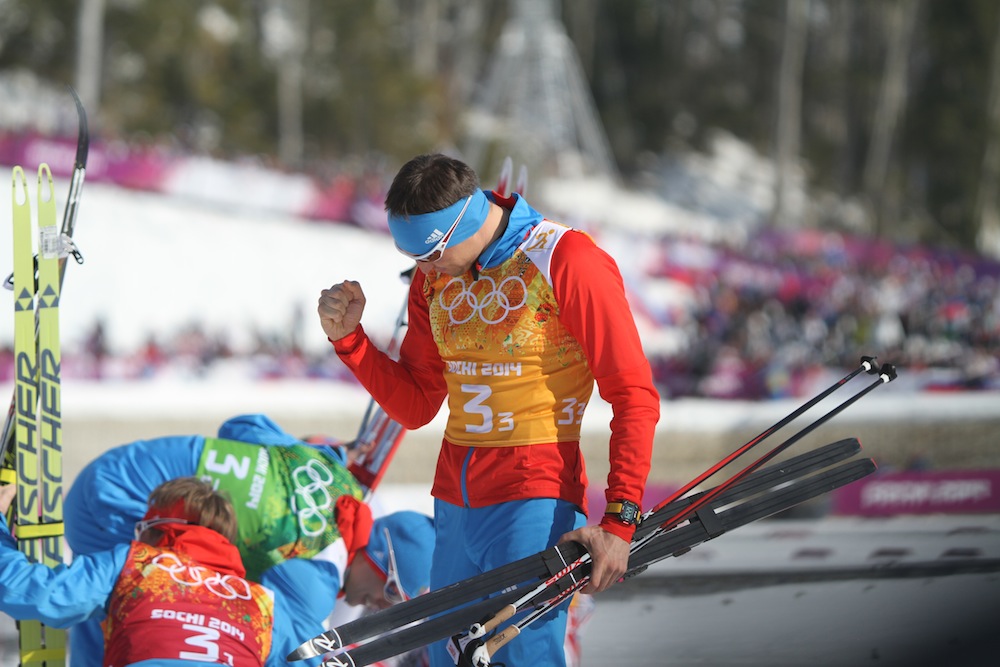
Alexander Legkov (standing) celebrates Russia’s silver in the men’s 4 x 10 k relay, their nation’s first medal in cross-country at the Sochi Olympics. He went on to win gold in the final race of the Sochi Games, the 50 k freestyle mass start, and Russia swept the podium.
“What happened yesterday [the release of NYT article] is totally absurd,” Legkov said at a press conference. “Alcohol with steroids is ridiculous. I didn’t take a sip of alcohol when I was meeting with friends because I was preparing for the Olympic Games. I know nothing about steroids, I don’t know how they look like. I took the article as an April [Fools’] joke.”
Legkov also called Rodchenkov’s comments groundless.
“It is a political game. Everybody is set against our country because it is one of the strongest in the world,” he said.
The NYT pointed out that, according to WADA statistics, Russia had the highest number of athletes caught doping in 2014.
While Russia fights to defend its winter athletes, its sport officials are simultaneously trying to ensure their track-and-field athletes can compete at the 2016 Summer Olympics in August in Rio de Janeiro, Brazil.
“Serious mistakes have been made by the federation management, along with athletes and coaches who have broken anti-doping rules and neglected the principle of fair play,” Russia’s Minister of Sport Vitaly Mutko wrote in a statement to the British newspaper, The Sunday Times, this weekend. “Let us be clear. We are ashamed of them.”
Track and fields’ international governing body, the International Association of Athletics Federations (IAAF), suspended Russia’s athletics team in November following a WADA investigation that found it guilty of state-sponsored cheating.
“We do not deny having a problem in Russia, and we are doing everything possible at state level to eradicate doping, including punishing athletes and coaches,” Mutko wrote.
Russia will find out June 17 whether its track and field team will be allow to compete in Rio.
“We are very sorry that athletes who tried to deceive us, and the world, were not caught sooner,” Mutko added. “We are very sorry because Russia is committed to upholding the highest standards in sport and is opposed to anything that threatens the Olympic values.”
‘The Needle Going in the Arm’
Cobb didn’t witness doping firsthand, but his opinion on the matter goes back to one of his first Olympic experiences, a night or two before the first race in Albertville, France.
“We were up in Les Saisies and one of our coaches who I was in the sauna with was dragged out to go help translate between a Russian coach and the village medical doctor,” Cobb recalled of the 1992 Games. “Because our coach’s English wasn’t that good, I went along to help translate as well. The situation was, the Russian coach said, ‘One of our athletes is very sick and will die if he doesn’t get a cortisone injection.’ So I was helping to translate that to the French doctor, who spoke English pretty well.”
While emphasizing that point over the next few minutes, the Russian coach explained that the athlete was having an allergic reaction to a protein injection he received.
“The French doctor said, ‘Yes, I know. I can see that he’s having an allergic reaction, but cortisone is a controlled and banned substance, and unless I can examine the athlete I can’t give it to him,’ ” Cobb recalled. “ ‘And yes, I know he will die if I don’t give it to him.’
“That was really how my experience at the Olympic Games began,” Cobb continued. “That was the case of [Russian biathlete] Sergei Tarasov, who was given an injection of blood that was either not his own or had been spoiled by not being refrigerated in an effort to blood dope him before the first race in Albertville.”
That story surfaced last year when Tarasov, who went on to win an individual gold at the 1994 Olympics, turned 50 and gave an interview to a Russian magazine.
Cobb recalled that story and compared it to the current accusations against Russian athletes across multiple Olympic sports.
“This is an issue that has been a violation of the basic principles of sport, that has been — because it was, in many cases forced on athletes with the threat of losing their support if they didn’t comply — an issue that needs to change,” he said. “I believe that with whistleblowers, athlete insiders and RUSADA [Russian Anti-Doping Agency] insiders coming forward at this time, taking the immense risk to come forward and tell what’s going on in an effort to change the system, that incredible sacrifice on their part needs to be met with support from sports leaders. If we don’t support that now, I’m sure it will be decades before it would ever happen again.”
Cobb didn’t see the needle going in Tarasov’s arm back then, and he, like everyone but Rodchenkov who has so far come forward about the 2014 Olympics, didn’t witness the Russians cheating in Sochi.
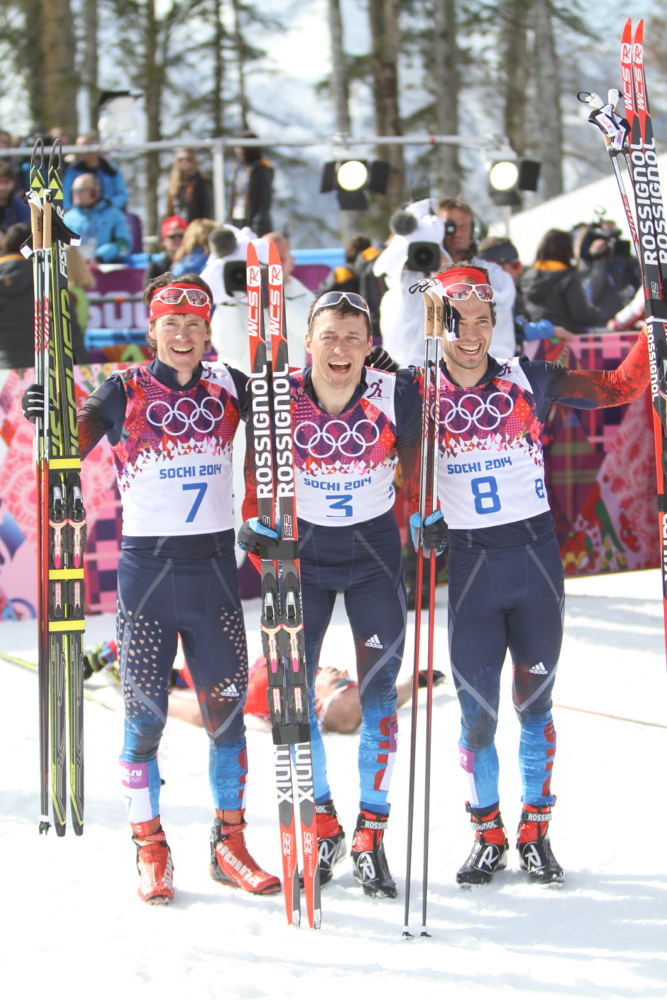
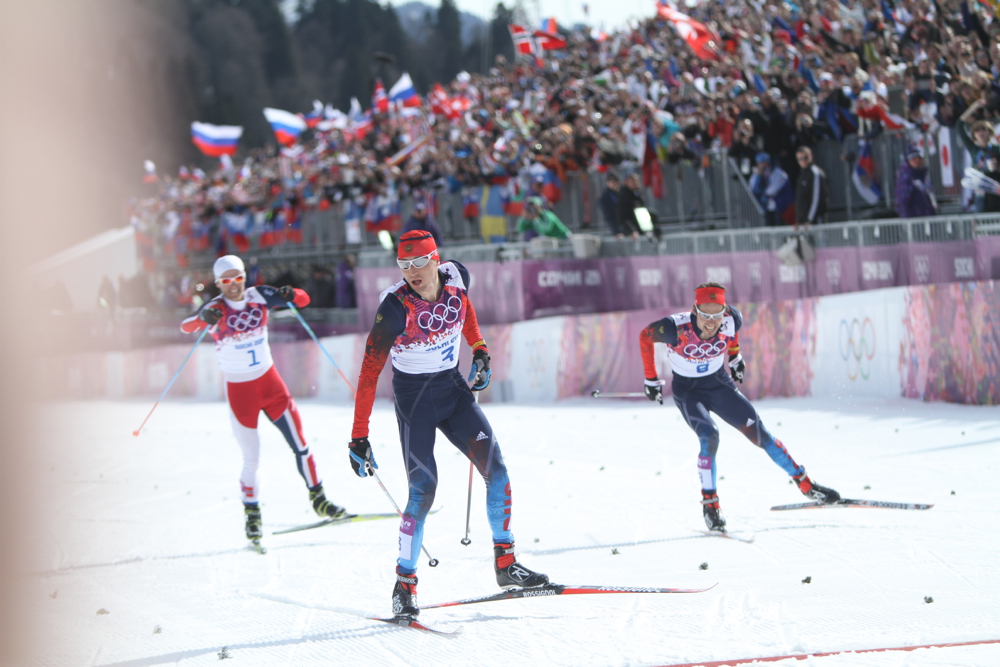
The all-Russian podium in the Sochi Olympics 50 k freestyle mass start, with Alexander Legkov (3) placing first, Maxim Vylegzhanin (7) in second for his third silver medal of the Games, and Ilya Chernousov (8) in third.
But Wadsworth claimed that’s what the Russians were up to immediately after they swept the podium in the 50 k, with Legkov leading fellow countrymen Maxim Vylegzhanin and Ilya Chernousov across the finish, respectively.
“If Rodchenkov knew my story, he would not even mention my name,” Legkov told MatchTV, according to a translation. “Since 2010, I have been working with foreign experts, I am absolutely not with Russian coaches, live all the time in Switzerland in an apartment in Davos. Before the Olympics, I have taken 33 doping tests.”
Meanwhile, Chernousov was another athlete who trained independently of the national team. After the Sochi Olympics in the spring of 2014, Chernousov began working with Vegard Bitnes, a Norwegian coach.
“We were one of the groups from [Russian] Federation, (Reto Burgermeister/Isabelle Knaute was an other),” Bitnes explained in an email to FasterSkier. “I planned all training, and had all control of training … we had our own camps and training.”
In the last two years, Bitnes explained that he and Chernousov only joined the Russian national team for two or three training camps, holding more camps with other national teams, like Sweden.
“We had some camps with Team Northug [Norwegian Petter Northug’s personal team], also with the Canadian team,” Bitnes wrote. “We was in some sport events in Norway, where we had trainings with French team, also US ski team athlete… So, we was almost never with the RUS team.”
Technically, Bitnes was a Russian national-team coach. He recently parted ways with Chernousov to become the head women’s coach of the Austrian biathlon team, effective May 1.
“The end of my work has nothing to do with the latest from RUS team,” he wrote. “I wanted to turn back to the IBU and Biathlon again. I hope for the best for Ilya and his training in the future.”
As for the allegations that 14 of 20 Russian cross-country skiers in Sochi — which may or may not include Chernousov — were doping, Bitnes wrote, “I can not comment so much, because it is from a time before I had anything to do with the RUS team. I can only say that it’s frightening to see/hear about this. Based on a general base. I hope WADA and IOC [the International Olympic Committee] will get to the bottom of those obligations, so we can clean up this mess. If this is true, its a very very sad thing.”
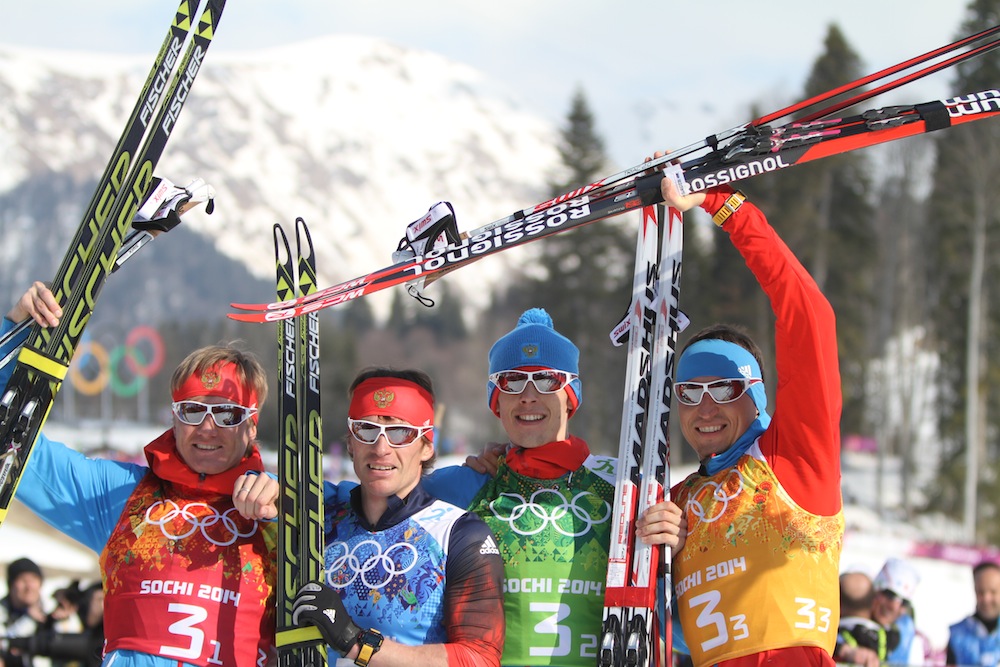
The Russians celebrate their silver medal in the men’s 4 x 10 k relay at the 2014 Sochi Olympics, with (from left to right) Dmitriy Japarov, Maxim Vylegzhanin, Alexander Bessmertnykh, and Alexander Legkov.
Wadsworth is confident it’s true. The former Canadian coach recalled suspecting something fishy was going on with the Russians during the men’s 4 x 10 k relay in Sochi as he watched Legkov put down the fastest time on the third leg.
“What I saw with the rest of his form that year and on that course, when I saw him hop-skating pretty much the whole course, especially the last hill coming into the stadium, the way he was looking on his face after pushing so hard — because the Russians were quite far behind and he really pulled them into medal contention in that race — and I just didn’t believe what I saw,” Wadsworth said. “And then in the 50 k, it was, at the end, the pace and the pushing. In the early part of the race, there were so many guys up toward the front, but in the last few kilometers, again, it just didn’t look right to me. And I always carefully think that through in my head as far as, is this a great performance we’re seeing or is this something else? And what I saw, I just thought it was something else.”
“I always carefully think that through in my head as far as, is this a great performance we’re seeing or is this something else? … I just thought it was something else.” — Justin Wadsworth
So he spoke out about the Russians after the 50 k and accused them of doping in a post-race interview with FasterSkier. FS then asked Legkov what he thought of Wadsworth’s accusation in the post-race press conference. Legkov laughed off the comment.
“I have to always be clear with this, I wasn’t making any excuses for our team, I was simply commenting on something I saw from the athletes on the field of play,” Wadsworth recalled this past Saturday.
“I fully accept our team’s preparation for the Games and our waxing issues … we had our own issues and we debriefed those and learned from those,” he continued. “But I think if I was potentially another coach who had athletes, like [Norway’s Martin Johnsrud] Sundby, who was fourth in that race and missed out on a chance at a medal … I guess I’m always surprised the Norwegians don’t speak out. They have so much power in our sport and they chose to do nothing with it except make things better for themselves on the World Cup.”
An email to Vidar Løfshus, director of the Norwegian Ski Federation, seeking comment on the recent allegations against Russia was not returned by press time.
“It’s just really surprising to me that nobody wants to speak out more. I can understand we all want to focus on our teams and on our own business, but that’s not to the point when there’s something going on like systematic doping,” Wadsworth said.
As for the athletes, “I expect them to focus on their training and themselves, but when it comes down to it, if there’s enough evidence and they’re tired of it, then they should probably speak up,” he added. “The athletes do have a powerful voice and they should use their athlete representatives to push FIS to do a better job and to push the IOC.”
Shocked But Not Surprised
One athlete who carefully crafted his responses in an email to FasterSkier was France’s Robin Duvillard, who placed sixth in the 50 k. Should the Russian cross-country team be disqualified and its results voided in Sochi, Duvillard would move up to third place and technically a bronze medal in that race.
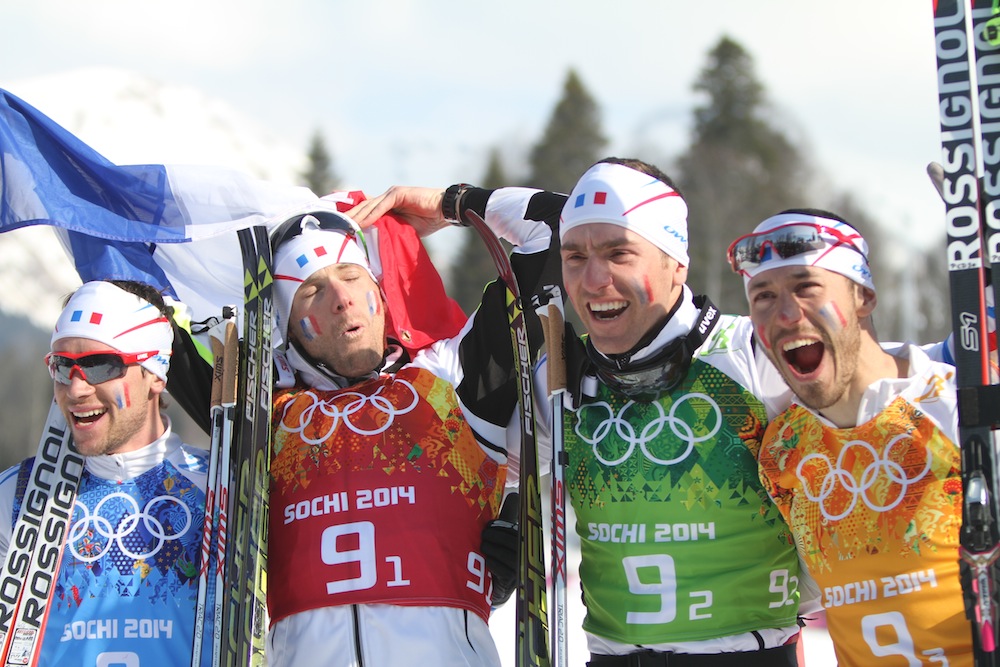
France’s bronze-medal men’s 4 x 10 k relay team at the Sochi Olympics: (from left to right) Ivan Perrillat Boiteux, Jean-Marc Gaillard, Maurice Manificat, and Robin Duvillard.
“I would like to be clear about the fact that what I read in the newspaper yesterday are only suspicions,” Duvillard wrote on Friday. “I don’t want to blame them if some of the information is not true.”
If everything in the reports is true, “I am shocked, sure. But not really surprised,” the 32-year-old continued. “I am shocked about the fact that it was organized by the authorities. Not because some athletes are doped. In the past, we already discovered that athletes were doped, and I know that it can happen again.”
In Sochi, Duvillard stood on the podium with three teammates, earning bronze in the men’s relay behind Sweden in first place and Russia in second.
“The only thing we can do is to trust [WADA] AMA to achieve anti-doping tests,” he wrote. “And what I have read yesterday is that they failed in Sochi, because Russian authorities were more powerful than them. But now I need to keep my faith in AMA’s work if I want to live my sport serenely and not getting paranoiac.”
Considering the news that immediately followed the 2014 Olympics, in which Russian skiers stated they had used xenon gas in training — a controversial but not-yet-banned substance (before WADA banned it in May 2014) — along with the Russian-athletics scandal unveiled last year, Duvillard had his suspicions.
“I suspected that a doping scandal could break out in Sochi, considering the bunch of money they put into it, and because Putin wanted to show the world that Russia is still shining,” he wrote. “But I can’t say I really suspected the cross country athletes being doped in the 50k. Sure, they were way faster than me in the last hill, but they were faster many many times in the past, so why not once again?”
Since the NYT report hit the world wide web last Thursday, Duvillard has received numerous messages congratulating him on the potential bronze medal.
“In a way, I would be glad to get this medal, because that would award all the work I have done to get in shape on that race,” he wrote. “But in another way, the party would be spoiled forever! Because any time I would watch again that 50k, I would find myself crossing the line in 6th place, and any time I would watch the closing ceremony with that amazing podium into the stadium, I wouldn’t see me on it.”
“Sure, they were way faster than me in the last hill, but they were faster many many times in the past, so why not once again?” — Robin Duvillard, sixth in the men’s 50 k at the 2014 Sochi Olympics
The redistribution of medals is a drawn-out process that involves legal battles handled by the Court of Arbitration for Sport, but if you ask Wadsworth, whose wife fought for her medal two years after the fact, it needs to happen.
“If nobody does anything, nothing’s going to change,” Wadsworth said. “… It’s great for [Beckie] to have the gold medal in the house and get recognized for that, but on the day, that’s what you as an athlete, that’s what you dream about, that’s what you work hard towards and when you get that robbed from you, it doesn’t matter what happens in the future.
Alexander Legkov (3) beat out fellow Russians Maxim Vylegzhanin (not shown) and Ilya Chernousov (r) for gold in the Sochi Olympics 50 k freestyle mass start. Vylegzhanin took silver by 0.7 seconds, just a tenth of a second ahead of Chernousov in third, and Norway’s Martin Johnsrud Sundby (1) missed a medal by 0.2 seconds in fourth. Not shown: Sergei Dolidovich of Belarus placed fifth, 14.3 seconds after Legkov, and France’s Robin Duvillard was another 0.6 seconds back in sixth.
“I think what really needs to come out from all this is not the results getting stripped — you know, Robin Duvillard, he might get the medal, but he’s not going to get to feel what it felt like to stand on the podium in the closing ceremonies down in Sochi, to get a medal around his neck, so that whole thing is lost,” Wadsworth continued. “What really needs to happen is things change for the future so that clean athletes have an opportunity.”
Should the entire Russian cross-country team be suspended, some clean Russian athletes will get caught in the aftermath, he noted.
“But those athletes should speak out and say what they know as well because it’s the Russian athletes that’s getting cheated the worst in the very end,” Wadsworth said. “They’re the ones that are going to have the health issues in the future and they’re also the ones that are going to miss out on future opportunities if their team does get allowed to race. And they’re the ones at the end of the day that have to look at themselves in the mirror and know they cheated.”
FIS and the IOC
As for how the International Ski Federation (FIS), the sport governing body for cross-country (as well as several other winter sports), FasterSkier first obtained a statement on the matter via email.
“FIS is deeply disturbed by these allegations and will provide all possible cooperation to WADA and the IOC with the investigation,” the statement noted.
In a follow-up phone interview on Monday, FIS Secretary General Sarah Lewis said, “We also will make sure that we are looking into our processes which we can control, as opposed to the Olympics where we are playing a facilitating role but not directly controlling the testing.
“Certainly for everybody it’s a wake-up call to what may have happened and what therefore has the potential to happen,” she continued. “I’m very sure that there will be a very careful analysis of the situation to make sure that this cannot happen going forward.”
Kikkan Randall (U.S. Ski Team) at the 2014 Olympics in Sochi, Russia. (Photo: Fischer/NordicFocus)
Kikkan Randall, chair of the FIS Athletes’ Commission who competed for the U.S. in Sochi, wrote in an email that the latest news was “definitely disturbing and if it turns out to be true, it is really unfortunate and unfair for those athletes that competed clean in Sochi and missed out on medals.
“The FIS Athlete Commission had previously written a letter to WADA after the news came out about Russian Athletics calling for further investigations into other sports, especially cross country skiing,” Randall added. “We hope WADA can get to the bottom of this and I know FIS will be in full cooperation to help out however they can.”
As for the U.S. cross-country team, head coach Chris Grover said they’ve been following the news closely.
“I guess our initial reaction is that we are disheartened and disappointed, and really disappointed that there might be a tie to cross-country here,” he said on the phone this weekend before convening with the team for its first training camp of the 2016/2017 season.
“It’s something we’ll talk about as a group but we haven’t,” Grover said. “Every time any sort of doping scandal comes up, we definitely talk about it as a group. It reinforces our resolve by lead by competing clean. And the exciting thing that we have talked about before, is that we know that we can win when we are doing it clean, because we’ve done it so many times before. That’s the silver lining for us … We can’t get hung up in what other people may or may not be doing.”
“The exciting thing that we have talked about before, is that we know that we can win when we are doing it clean, because we’ve done it so many times before.” — Chris Grover
Asked if he had suspicions about doping in cross-country skiing, he said, “I’ve never felt 100-percent confident that the sport is 100-percent clean. I’ve felt that it’s clean enough that we can win. I think that all of us feel that it’s a lot cleaner than it was when we first got involved in the sport.
“We’re really interested in how this story unfolds,” he continued. “We are grateful to the media sources that are following this closely and are doing investigations. We will always, from the USSA [U.S. Ski & Snowboard Association] side, take an active role in working with the USOC [US Olympic Committee] and FIS to ensure that proper steps are taken, that we are getting a clean sport and a level playing field.”
Grover is also chairman of the FIS Cross Country World Cup and Continental Cup sub-committees. FIS plans to meet in Cancun, Mexico, for its 50th International Ski Congress from June 5-11.
“To be perfectly honest, the situation was and is on the agenda based on the WADA report on November,” Lewis said of the planned discussion of Russia at those meetings. “It’s on the agenda of the Council. The Congress is not dealing with daily business … The whole WADA report and the situation with the Russians is on the agenda of the Council already, and now obviously there is more information to be able to discuss and address.”
Update: The IOC Executive Board held a special meeting on Tuesday with IOC President Thomas Bach calling for additional anti-doping measures. The IOC retested 454 selected doping samples from the 2008 Summer Games in Beijing, China, and as a result, up to 31 athletes from six sports could be banned from the upcoming Olympics in Rio. The IOC is also planning on retesting 250 samples from the 2012 London Games.
“The aim is to stop any drugs cheats coming to the Olympic Games in Rio de Janeiro,” an IOC press release stated.
“Swift and decisive action will also follow the controversy surrounding the anti-doping laboratory in Sochi,” it continued. “Meeting Tuesday, the EB of the IOC has requested WADA to initiate a fully fledged investigation into allegations that testing at the Sochi Laboratory was subverted. The IOC for its part will instruct the Lausanne Anti-Doping Laboratory, where the Sochi samples are stored for ten years, to proceed in cooperation with WADA with their analysis in the most sophisticated and efficient way possible.”
The IOC has asked the Russian Olympic Committee to ensure the full cooperation of the Russian side in the WADA investigation.
“Based on the result of this investigation the IOC will take swift action,” the release said.

 FIS Rollerskiing in Beijing