From the FasterSkier archive — posts syndicated from athletes’ and coaches’ own blogs between 2004 and 2012, kept online as published. Current coverage is at fasterskier.com.
American Vasek Cervenka (front right) racing at 2016 Youth Olympic Games in Lillehammer, Norway. (Courtesy photo)
In another 20-something-question, fill-in-the-blanks series, we checked in with the world-class U.S. and Canadian biathletes that will be competing at 2017 International Biathlon Union (IBU) Youth & Junior World Championships Feb. 22-28 in Osrblie (also known as Brezno-Osrblie), Slovakia.
Here’s 18-year-old Vasek Cervenka, of Grand Rapids, Minn., who will be representing the U.S. at his second Youth Worlds. Last year, Cervenka spent the winter of 2015/2016 training in the Czech Republic, and he’s been there since January of this year (with plans to stay until mid-April).
“My full name is Vaclav Cervenka but you can call me Vasek (VAH-SHEK). I was born in Boulder, Colo., and raised in Grand Rapids, Minn. I started cross-country skiing when I was able to walk, parents say 9 months old, and started biathlon when I was 13, thanks to my parents.
I currently train in Nove Mesto, Czech Republic, and Grand Rapids, Minn., with the Nove Mesto biathlon team or with Jakob Ellingson and Vladimir Cervenka.
U.S. teammates Vasek Cervenka (l) and Cam Christiansen at the Junior IBU Cup #3 in Pokljuka, Slovenia. (Courtesy photo)
If I’m not skiing, you might find me drinking tea watching ‘Rick and Morty’ or ‘Game of Thrones’.
If I had to pick a favorite book, it would be ‘The Adventures of Captain Underpants’ by Dave Pilkey.
One of the things I’m most excited about for Youth/Junior World Championships in Brezno-Osrblie is meeting pretty foreign girls 🙂 (SC – vashiggy_21)
This will be my second Youth/Junior World Championships, and this year, I’m competing as a youth. One race I’m especially targeting there is the 12.5 k individual.
The best advice anyone ever gave me about skiing or racing was ‘Don’t give a s**t about anyone else racing, focus on yourself.’
One of the best race memories I have is the 2016 Youth Olympic games 10 k pursuit.
If I could meet one World Cup biathlete, it would be Martin Fourcade.
If I don’t end up being a professional skier, I’ll probably be colonizing Mars (sponsor me Elon Musk).
I’m missing zero days of school to be here, and my teachers/professors are probably thinking, ‘Good call doing online school.’
Sean Doherty (Center Conway, N.H./Vermont Collegiate Biathlon) skis to a career-best second place, 3.6 seconds out of first, at the IBU Youth World Championships on Friday in Obertillach, Austria. (Photo: USBA/Nordic Focus)
Sean Doherty knew exactly what he was in for heading into his third International Biathlon Union (IBU) Youth World Championships. The 17-year-old New Hampshire resident had been to two junior world championships before: first in 2011 in Nove Mesto, Czech Republic, and again last year in Kontiolahti, Finland.
His best individual result had been 13th, which he took in the 2012 sprint and pursuit. Pretty good, but Doherty wanted more. Last year, he won bronze in the mixed relay at the Youth Olympic Games in Innsbruck, Austria.
Back in Austria – this time in Obertilliach – Doherty proved to himself and everyone else that he was capable of not only a podium, but nearly a win, in the 2013 youth worlds opener. The Vermont Collegiate Biathlon member raced to silver in Friday’s 7.5-kilometer sprint, finishing just 3.6 seconds behind winner Fabien Claude of France.
Doherty skied the fourth-fastest time of more than 100 competitors in the men’s youth race, rising five places on the last of three laps to place second. Seventeenth after the first lap, he finished in 21:16.0 with two misses – one at each stage.
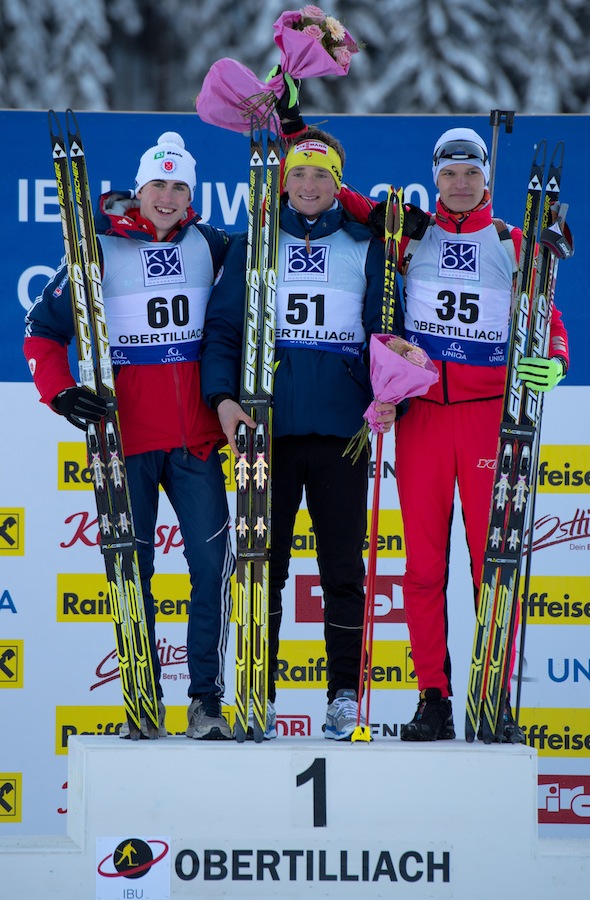
The men’s 7.5 k individual sprint podium at the IBU Youth World Championships on Friday in Obertilliach, Austria. American Sean Doherty (l) was second, 3.6 seconds behind winner Fabien Claude of France (c). Rene Zahkna of Estonia was third. (Photo: USBA/Nordic Focus)
Claude, who won in 21:12.4, shot clean on the first stage and missed two on the second. Estonia’s Rene Zahkna took third, 14.9 seconds behind Claude, with one penalty.
And while Doherty’s ability to fight for first was hardly a surprise, he was still taking it all in. For U.S. Biathlon, it was the best result at IBU Youth and Junior World Championships since national-team member Jay Hakkinen won gold in the 1997 sprint.
“It is hard to believe that I have worked all of this time towards this goal,” Doherty said in a U.S. Biathlon press release. “Now it is here I am still a little bit in shock.”
His game plan had been relatively simple: start in control then pick up the pace. He felt good throughout the race, but expected that after starting conservatively, he wrote in an email.
“The shooting went well but not flawlessly,” Doherty explained. “The last lap came around and I got a split from our coach [Vladimir Cervenka] that I was very close to medal contention and I just really turned up and went as hard as I could.”
While the sprint went exceptionally well, it wasn’t an event Doherty had especially eyed.
“Honestly I try very hard to go into every race I do without expecting a number result,” wrote Doherty, who lives in Center Conway, N.H. “But I am extremely satisfied with this result. … I am focused on all of these events equally. I mean it is the Junior world championships so I am focusing every race.”
Doherty said he’ll try to “keep calm” in Sunday’s 10 k pursuit and approach it like he would any other race, aiming to have a good one.
“We are very exited about Sean’s race today,” Cervenka said in the press release. “He did great and according his plan he saved his best for the last loop. It will be fun to watch the pursuit on Sunday.”
Also notching a top result on Friday, Canadian Stuart Harden made it into the top 20 in 20th, 1:02.6 behind the winner with two misses, both on the second stage. Harden had the fourth-fastest time after the first lap. Also for Canada, Carsen Campbell was 30th (+1:31.7/0+2), Arthur Roots was 59th (+3:07.3/1+2), Matthew Strum was 69th (+3:40.3/2+3).
For the U.S., Jakob Ellingson was 62nd (+3:25.5/3+1), Jordan McElroy was 79th (+4:08.0/2+3), and Brian Halligan was 88th (+5:09.2/4+5) of 108 finishers.
In the women’s 6 k sprint, American Anna Kubek of Duluth, Minn., was the top North American in 34th. She had two penalties, both on the first stage, and was 3:18.2 back from Russian winner Uliana Kaisheva, who completed the course in 18:08.7 (0+1).
Canada’s Sarah Beaudry was 36th with three misses (+3:24.2/1+2). Teammates Leilani Tam Von Burg was 71st (+5:34.3/1+1), Emily Dickinson was 75th (+6:05.7/2+1) and Charlotte Hamel was 80th (+6:50.4/1+1).
For the U.S., Mikaela Paluszek was 65th (0+4), and Aleksandra Zakrzewska was 84th (2+4).
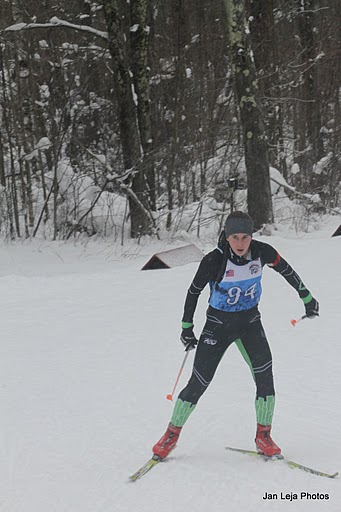
Anna Kubek (Mount Itasca) racing at World Junior trials in Jericho, Vermont, December 2010. Photo: Jan Leja.
(Note: This is the second in a series of interviews with athletes who will be competing at the first-ever winter Youth Olympic Games in Innsbruck, Austria this winter. The first interview was with Sean Doherty.)
Of all the biathletes set to compete at the Youth Olympic Games in January, Anna Kubek of Duluth, Minnesota, might have the least experience: she only picked up biathlon in 2010, and hadn’t even skied before that point.
But to count her out because of her late start in the sport would be a mistake, says coach Vlad Cervenka.
“Anna is clearly the best talent that I have ever coached,” he told FasterSkier in an e-mail.
That’s high praise from a man who has coached the junior national team for years, including Junior World Championships medalist Leif Nordgren, who anchored the sixth-place U.S. relay at senior World Championships this winter.
“Anna knows her body very well, so she can correct her ski technique quickly,” Cervenka wrote. “It is fascinating to see her improving so fast. What is probably the most impressive is her motivation and drive to train. She always likes when practice is hard and more challenging.”
Besides gaining experience on the trails, Kubek revealed herself to be a naturally good shot.
“Last summer when she started, after only one month of training she missed one target out of ten in the sprint competition in the Summer Festival in Jericho,” Cervenka explained. “I can say after a few shooting practices whether an athlete is talented or not, but Anna exceeded all my expectations.”
Kubek gave FasterSkier a quick interview from Minnesota last week.
FasterSkier: What made you want to take up biathlon?
Anna Kubek: I was a gymnast for almost 10 years, but continuous injuries forced me to stop. So one of my good friends invited me to a biathlon practice and I really enjoyed it.
FS: Did your family ski together when you were growing up?
AK: I started to learn the basics how to ski when I was first introduced to biathlon in May of 2010.
FS: When did you start shooting, and how is that portion of the sport coming along?
AK: I started shooting in May of 2010. My biathlon rifle was the first firearm I had ever shot. It took awhile to get used to shooting with a high heart rate and being accurate at the same time, but it is coming along very well. Every practice I feel I have progressed.
FS: What club do you train with now?
AK: I train with Mount Itasca Biathlon which is based in Grand Rapids, MN.
FS: You are probably very strong from your days as a gymnast; are there any other physical advantages you think you’ve had because of your past training?
AK: My previous high intensity gymnastics training has definitely helped me in areas of balance, endurance, and upper and lower body strength.
FS: What about mental issues – does the focus you need to have as a gymnast to do difficult or scary moves translate at all to the focus you need for shooting?
AK: Yes, it is comparable. I need only to focus on what I have been trained to do and be oblivious to what is going on around me.
FS: Would you say you’re a stronger skier or shooter at this point?
AK: They are both pretty equal. It seems as my skiing technique improves, my shooting speed and accuracy increase as well.
FS: Have you ever raced internationally before?
AK: I have never raced internationally before.
FS: Has making the team changed your plans for the summer, fall, and early winter at all?
AK: It has just put more training sessions in my schedule and I have been traveling to different states for training camps. I will be away more for races this coming winter than last. We also tried to accommodate my school schedule so I can remain a full time student at Duluth East high school.
FS: Not all of the teams have been announced yet, but both of the Canadian girls raced at World Juniors last year and many of the other competitors will probably be quite experienced on the international stage as well. Is that scary?
AK: I do not feel intimidated. I have been training very hard and my practices and training camp races are preparing me to face any future competitions. I also have confidence in my coaches for teaching me the skills required to perform well on an international level.
FS: What are you looking forward to most about the trip?
AK: I am looking forward to the international racing experience, getting to know more athletes my age, and traveling to different countries. I am very excited and honored to represent the United States at the Youth Olympic Games.