From the FasterSkier archive — posts syndicated from athletes’ and coaches’ own blogs between 2004 and 2012, kept online as published. Current coverage is at fasterskier.com.
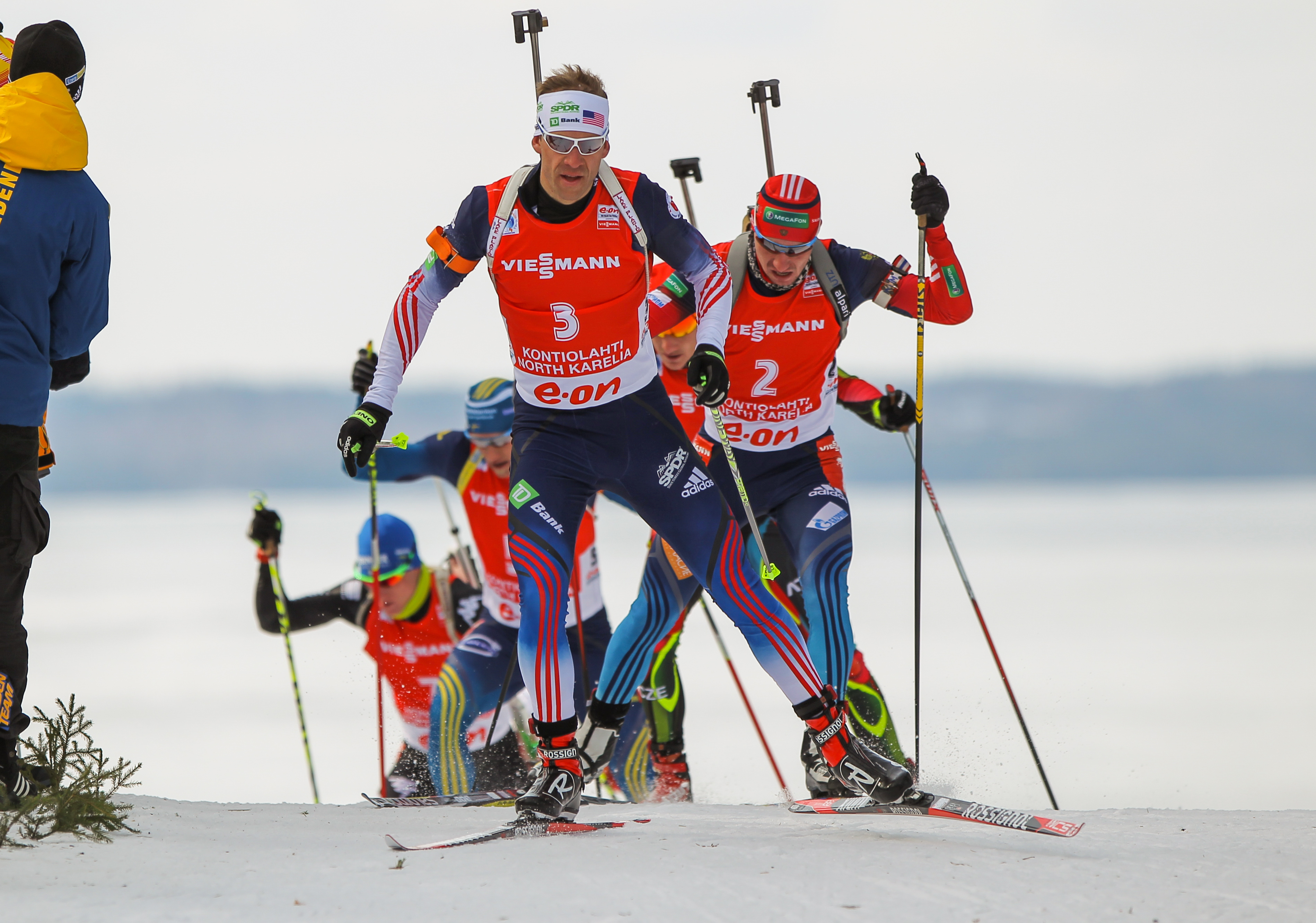
Lowell Bailey (USA) leads Alexander Loginov in a World Cup competition in Kontiolahti, Finland, in 2013. Loginov was later suspended for doping, bumping Bailey’s results and prize money up higher from the weekend of racing. (Photo: NordicFocus.com/USBA)
The Russian rosters for January competition will include two names not seen in a while: Irina Starykh and Alexander Loginov. Both are returning to international competition after serving suspensions for using the blood-doping drug erythropoietin (EPO).
Starykh was initially suspended in January, 2014, in the run-up to the 2014 Olympics. At the time, she was the top Russian woman on the World Cup and had just notched an individual podium. She was also a key member of the Russian relay team. Starykh failed an out-of-competition test in December 2013 month along with teammate Ekaterina Iourieva.
2013-2014 had been a breakout season for her so far. When asked how she had improved so much by a Russian news service, Sports.ru, she replied in December 2013, “When I found out that I was [named to train] in [Vladimir] Korolkevich’s group- I decided to fully trust the coach… he was building my training andI believed that I would approach the winter season in good condition.”
Starykh initially received a two-year ban. When the International Biathlon Union (IBU) re-tested some old samples a few months later, however, they found additional evidence of EPO use. The IBU extended her ban to three years.
Loginov competed in the IBU Cup competitions in Obertilliach, Austria, in December, finishing fourth in the 20 k individual. That’s the same venue where he won the individual race at World Junior Championships in 2013.
Loginov was caught in the same re-testing scheme that earned Starykh her extra year of suspension. His sample from November, 2013, tested positive for EPO when a new method was used several months later. The suspension was announced in November, 2014, and was for two years, plus retroactive disqualification of results between November 2013 and 2014.
Loginov said at his anti-doping hearing that the drug had been included in a medication he took to treat prostatitis. But the IBU’s hearing panel rejected this claim on multiple grounds.
The press release from the Russian Biathlon Union announcing the men’s team for international competition in January did not specify whether he would compete on the World Cup or the IBU Cup.
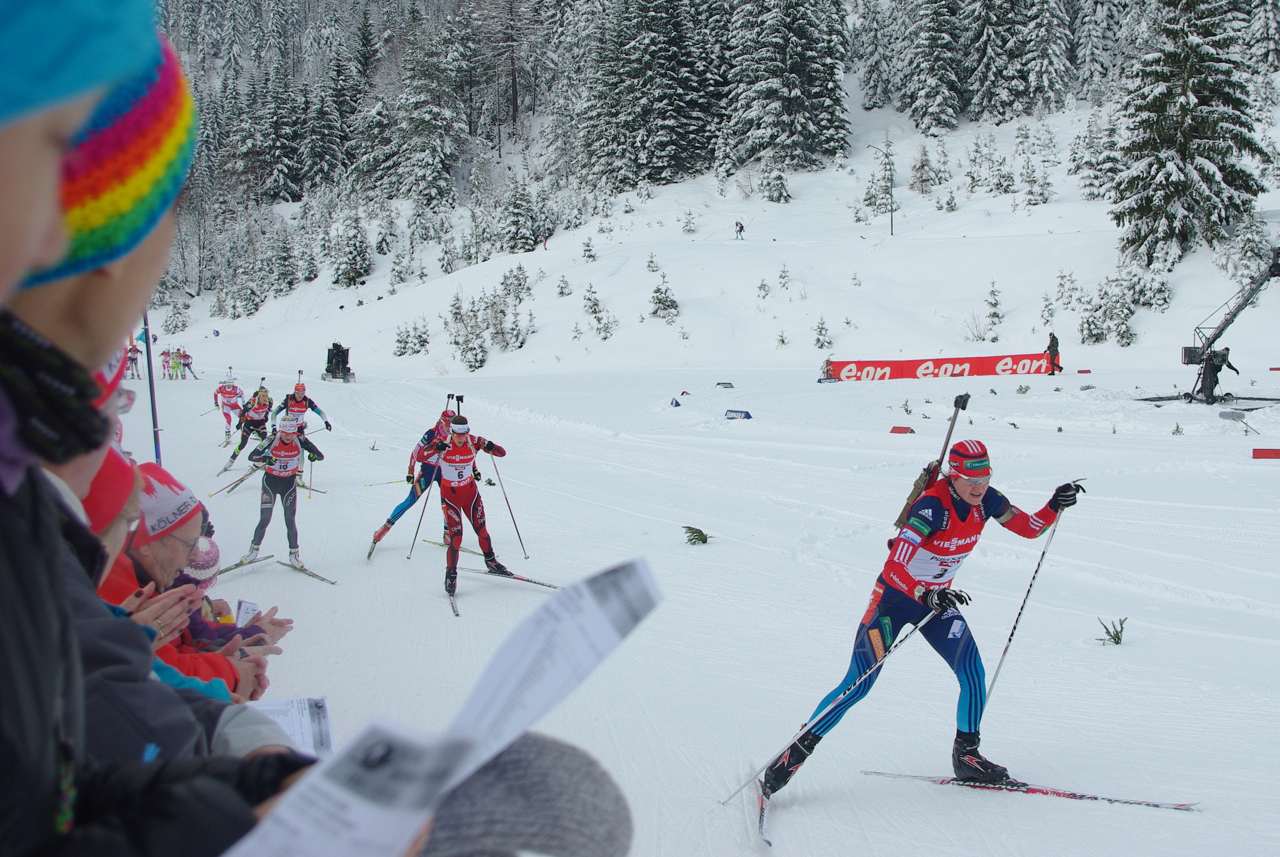
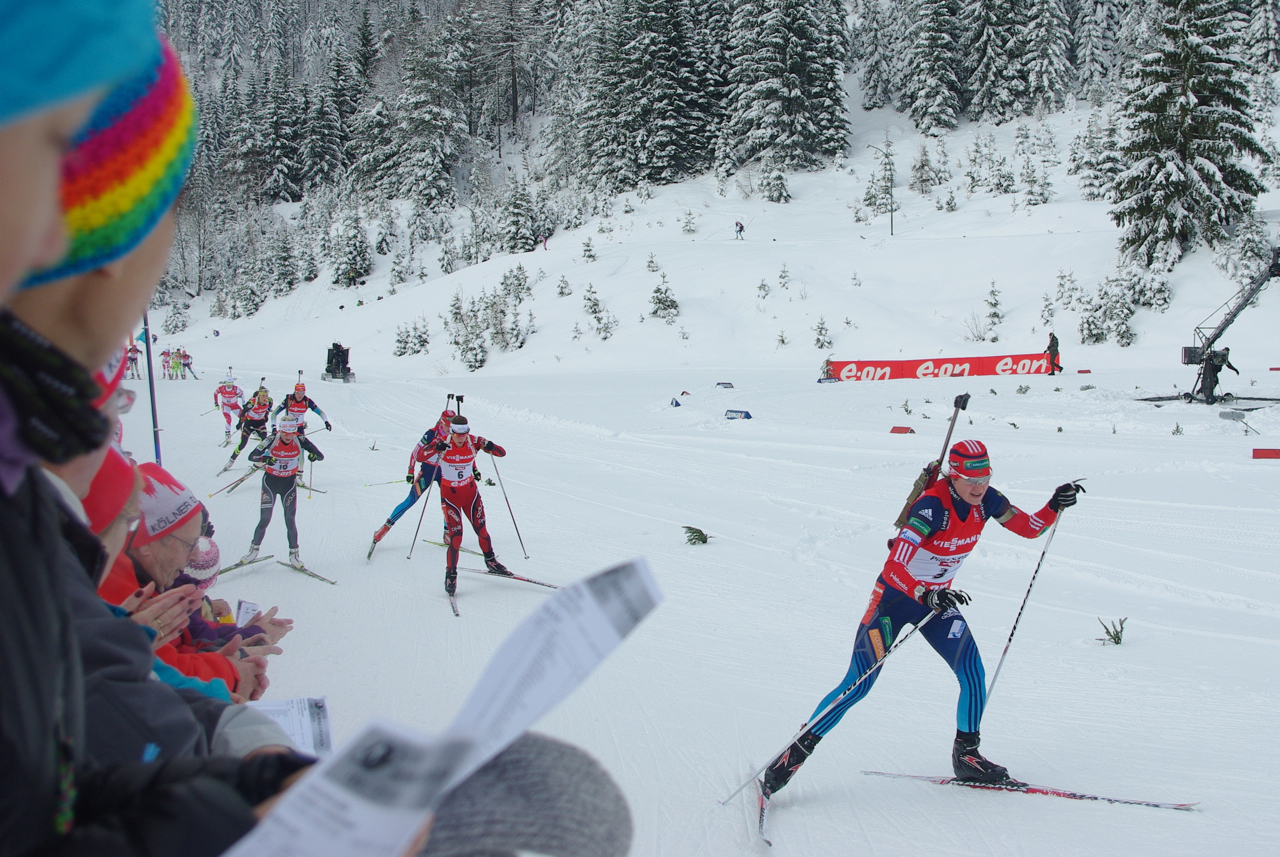
Irina Starykh competing in the World Cup pursuit in Hochfilzen, Austria, in December. That weekend, the Russian finished third and fifth in individual racing.
Over a month after provisional suspensions were issued, the International Biathlon Union (IBU) has released more details on two of the three athletes involved in a doping investigation which began in January. For the first time, the IBU officially acknowledged that two of the athletes in question were Russians Ekaterina Iourieva and Irina Starykh. The names had been released by Russian news site Championnat, but the IBU had refused to confirm any details.
In a press release posted to their website this weekend, the IBU also announced the the banned substance in question was, as had been widely speculated, the blood-doping drug recombinant erythropoetin (EPO). Both athletes’ “B” samples have now been tested and have also showed positive for EPO.
A third athlete who was caught at a similar time, Karolis Zlatkauskas, admitted to doping and waived his right to have the “B” sample analyzed. Separately in the nordic world, Austrian cross-country skier Johannes Dürr was also caught using EPO during the Olympics, bringing the total number of blood-doping cases this season to four.
The IBU wrote that Iourieva and Starykh were caught by out-of-competition testing in Pokljuka, Slovenia, on December 23rd, and that Iourieva also tested positive in the same place on January 1st. The urine samples were collected by the Slovenian anti-doping body on the direction of the IBU.
The “B” samples were analyzed by the Seibersdorf laboratory in Austria whose head, Dr. Günter Gmeiner, was recently invited to join the World Anti-Doping Agency’s Prohibited List Expert Group.
The provisional suspensions were handed out on January 28th. Starykh was the most successful woman on the Russian team this season, and was set to compete in the Olympics. She initially said that she was leaving the Russian team in order to see to the opening of her “B” sample and clear up the investigation, Iourieva’s “B” sample was not tested until February 27th and Starykh’s until March 3rd.
The coach of both women, Vladimir Korolkevich, is originally Russian but obtained Slovenian citizenship in the 1990’s and coached athletes there before returning to Russia. For the past year, he only directly coached half of the Russian women’s team, as the other group (which includes Olga Zaitseva, who placed third in the World Cup mass start in Pokljuka this weekend) is headed by Wolfgang Pichler. The Korolkevich training group had already had one training camp in Pokljuka already this year, a summer session in June.
At the Olympics, Korolkevich – who retained his position despite the doping cases and was even promoted within the Russian federation at the expense of Pichler – told Eurosport that if Starykh had been able to compete, “we would have had different results.”
The IBU’s anti-doping hearing panel has scheduled meetings with both Iourieva and Starykh at their headquarters in Salzburg, Austria, in the next few weeks. Up for debate are the lengths of suspensions to be handed out; it is unclear whether the athletes intend to fight the decisions. “The final decision will be published as soon as it is available,” the IBU noted in their press release.
For further information about Starykh, Iourieva, Korolkevich, and the scandal, please refer to our previous reporting:
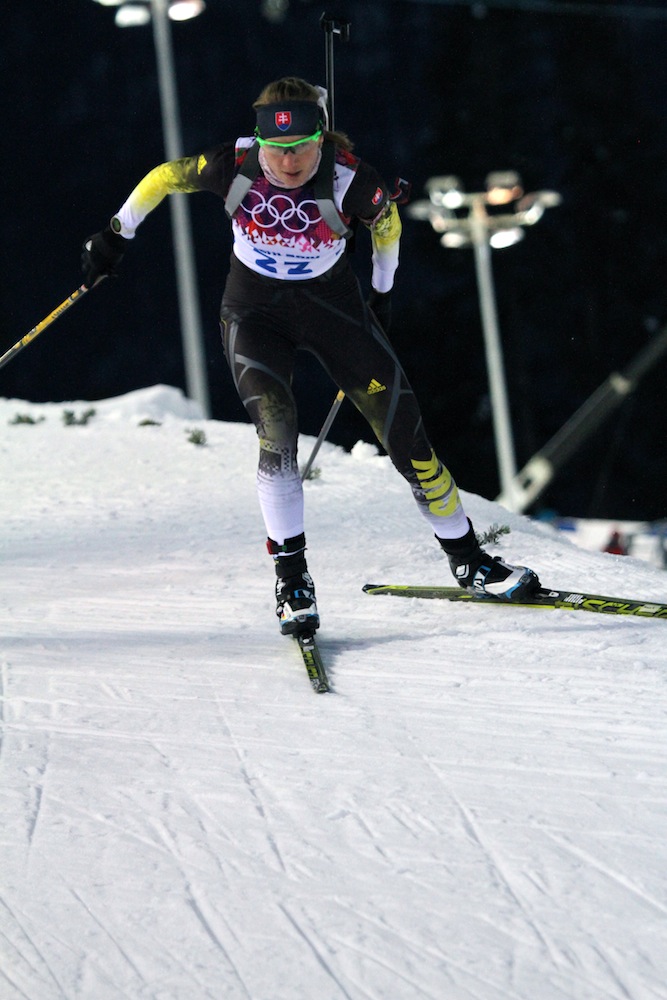
Anastasiya Kuzmina of Slovakia won her first race in over a year when she took Olympic gold in the 7.5 k sprint today.
FasterSkier’s coverage is made possible through the generous support of Rudy Project.
SOCHI, Russia – Sometimes, lightning does strike the same place twice.
When Anastasiya Kuzmina won the Olympic sprint in Vancouver in 2010, it was the first win of her career at the international level, and came as quite the surprise to the biathlon community.
“Vancouver was the first gold medal in my life, and it was just a new emotion of my first Olympic games,” Kuzmina said in a press conference today.
Coming into today’s 7.5 k sprint at the next Olympics, few predicted that Kuzmina would be able to defend her title. She hadn’t won a World Cup race in over a year, and in fact had only three victories since her last Olympics.
But when Kuzmina, starting in bib 33, crossed the line, she put nearly 30 second into Anais Bescond of France, who was leading at the time. As the rest of the field came through one by one, nobody was able to match Kuzmina’s time, and she ended up a gold medalist by 19.9 seconds over Olga Vilukhina of Russia.
“Today was just an amazing day for me,” Kuzmina said. “Here it was my second Olympic Games and it was a long way to this gold medal. It’s not the same. It was hard work for four years and just unbelievable…. Today is unbelievable. It is my favorite race.”
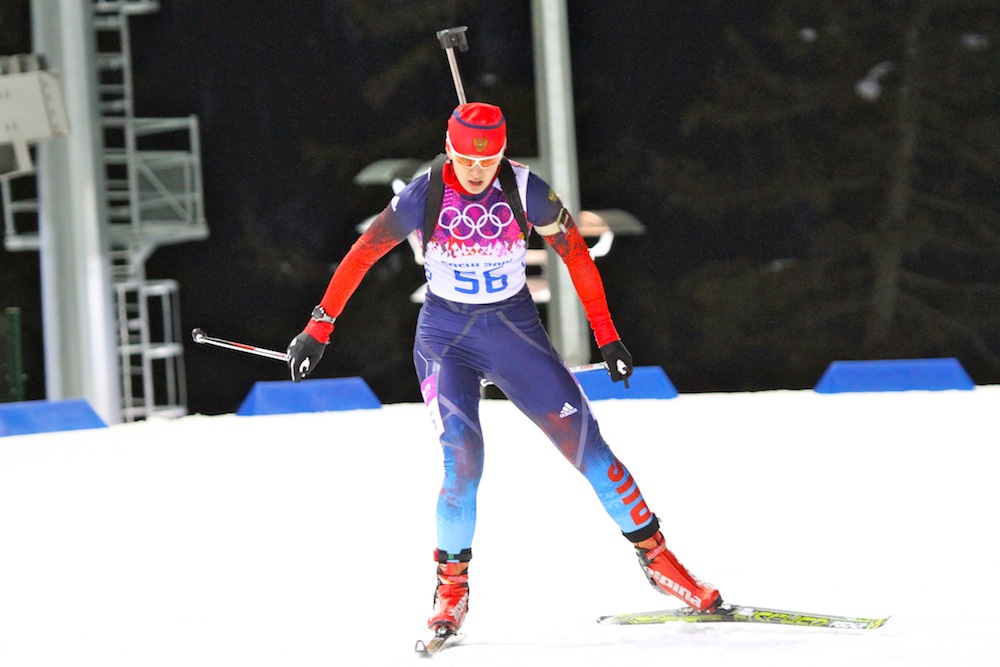
Olga Vilukhina (RUS), silver medal.
Kuzmina shot clean, as did Vilukhina, third-place Vita Semerenko of Ukraine, and fourth-place Karin Oberhofer of Italy. But among those athletes, Kuzmina’s skiing was in a league of its own. She had the fourth-fastest course time of the day, which paired with her the eighth-fastest shooting was an unbeatable combination.
When FasterSkier interviewed Kuzmina in November, she said that she had “no expectations” about whether she would be able to defend her medal. And her skiing has clearly come around: her lone podium of the season, at the opening race in Östersund, Sweden, came thanks to her shooting. Her skiing was only ranked 13th.
The victory today had special significance to Kuzmina, who is originally from Russia. On one hand, it was revenge for her brother, Anton Shipulin, who finished fourth in yesterday’s men’s sprint. Just 0.7 seconds from a bronze medal, Shipulin was also in a position to win until he missed a shot in his final shooting stage; the penalty loop gave him far more time than the 6.4 seconds he ultimately finished behind Ole Einar Bjørndalen of Norway.
However, Shipulin is still in a good position for tomorrow’s pursuit, making it possible that both siblings will win medals, and possibly even double gold, in the same Olympics.
“This victory was for him, too,” Kuzmina said. “I hope it inspires him for the pursuit. He can win.”
Kuzmina herself was thrilled to be back on what she still considers home turf, and also dedicated her performance to Maxim Vylegzhanin, a Russian skier who finished fourth in today’s 30 k skiathlon after being debatably obstructed by Norway’s Martin Johnsrud Sundby.
“This victory in my homeland is a big thing,” she said. “Yes, I am a Slovakian passport holder, but here I am at home. This atmosphere is so comfortable it is so homey. I am so happy to see my friends and family… they really understand what I was going through, what this means to me.”
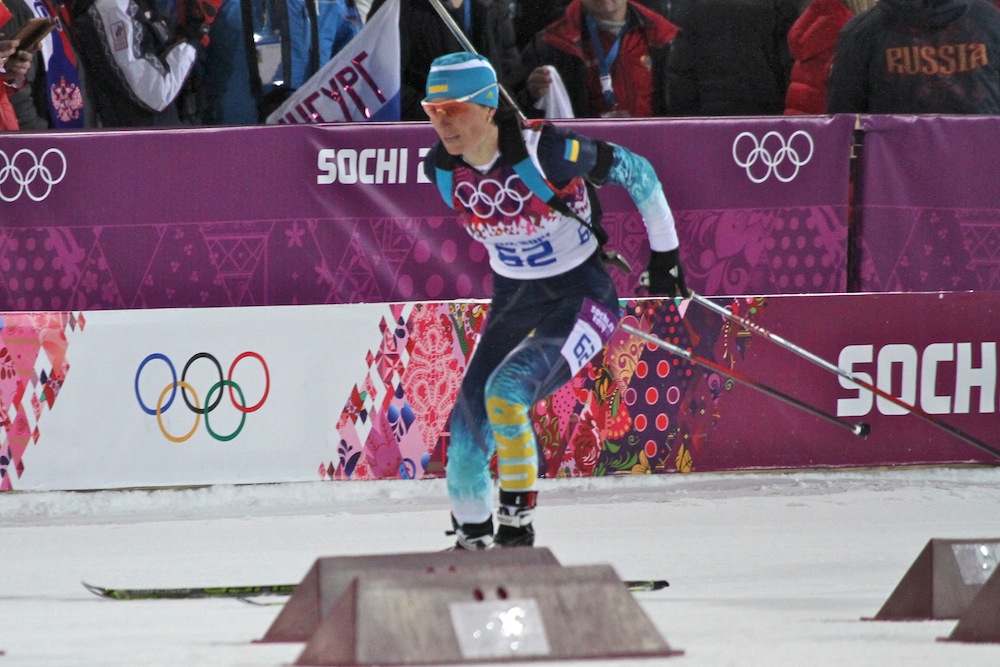
Vita Semerenko (UKR), bronze medal.
Not all Russians, though, seemed to support her. Reactions were mixed as she skied through the finishing straight.
After all, biathlon is a signature sport in Russia, and Kuzmina did take gold away from a Russian who still competes for Russia. However, Vilukhina did still earn the first Russian medal of the Games, taking some of the pressure off the team.
Like Kuzmina, Vilukhina, had her best performance in almost a year: she was second in the final World Cup pursuit in Khanty-Mansiysk, Russia, last season.
“Until the very last moment you did not know anything about whether you would stay in second place,” Vilukhina said. “I was only able to relax when I went to the flower ceremony.”
Vilukhina is part of the same training group as Ekaterina Iourieva and Irina Starykh, who have tested positive for a banned substance presumed to be the blood doping drug recombinant erythropoietin, and are serving provisional suspensions from competition. The coach of this training group, Vladimir Korolkevich, has ties to past doping scandals.
Until this season, Vilukhina had been part of the training group of Wolfgang Pichler, a German hired in part to clean up the Russian team and who is an outspoken opponent of doping.
“I would like to thank [Pichler], who I had the honor to work with my previous season,” Vilukhina said.
But she made it clear that the silver medal – which brings her back to her form 2012, when she won bronze in the pursuit at World Championships – had something to do with switching to Korolkevich’s supervision.
“Today’s silver speaks for itself,” Vilukhina said. “We had a competent training plan, which developed me well as an athlete.”
Saying that she had been dreaming of this moment since she was ten years old – Vilukhina is a first-time Olympian – she thanked all of her supporters throughout Russia.
“I think in my home, I’m more happy because today the entire city got together today to watch the Games,” she said. They made a screen and watched the sprint with an overhead projector, so I’d like to thank everybody that was supporting me sincerely. Today’s silver medal makes me really happy but the Olympics aren’t over yet, and I will only be able to relax on February 23.
Third-place Semerenko won the first Ukrainian medal of the Olympics, and was rewarded with a three-bedroom apartment courtesy of the President of Ukraine. All Ukrainian athletes who win medals will receive an apartment.
“This is just my first sprint. This is just the beginning of me winning many apartments,” Semerenko laughed.
Irina Starykh (RUS) on her way to a World Cup podium earlier this season in Hochfilzen, Austria.
Yesterday afternoon, the International Biathlon Union (IBU) issued provisional sanctions to three athletes who had “A” samples which tested positive for a prohibited substance. The federation did not release much more information, stating that the athletes were from Russia and Lithuania but declining to name them or specify which banned substance had been detected.
The news came on the heels of other positive tests: last week, 12 Russian athletes in seven different summer sports failed doping tests. And just this week, Alexandra Gulyaev, a junior national champion in the 1,500 meter run on the track, also failed a test.
Today, more details came to light as the Russian news site R-Sport alleged that two of the three athletes were Russian, and that they were Ekaterina Iourieva and Irina Starykh. The IBU has not confirmed the athletes’ identities and stated that it will not do so until after the “B” samples have been tested, which should be in roughly a week.
Iourieva, a World Champion in 2008 has already served a doping ban after testing positive for recombinant erythropoietin (EPO) in 2009. While not naming names, IBU Vice President Ivor Lehotan did confirm to R-Sport that it was the second offense for one of the athletes involved.
Starykh has never had a positive test. She is currently Russia’s top female athlete in the World Cup total score, sitting in sixth position. Starykh won the Continental Championships sprint last season, and received a single World Cup weekend of starts after that. This season, she has shot into the spotlight, starting every World Cup race and earning two podiums. Only once did she finish outside the top 30.
While Starykh was named to Russia’s Olympic squad, Iourieva was left off of it.
Both women are trained by Vladimir Korolkevich. Russia has an unusual setup for its women’s team: it is split into two groups, the second of which is trained by Wolfgang Pichler, a German who made his name as the head coach of the Swedish team. If the names leaked by Championat are correct, then none of Pichler’s athletes are implicated. When he took the position in Russia, he issued strong statements against doping and swore not to tolerate it on his squad.
Just one week ago, Korolkevich, who previously coached the USSR, Slovenian, and Ukrainian teams before returning to Russia and initially working with Iourieva as she returned from her ban, was promoted to head coach. That meant that he would supervise Pichler, limiting the German’s influence over his own squad.
Although the Russian Biathlon Union (RBU) held an emergency meeting of their anti-doping committee today, there is no news of whether Korolkevich will retain his position.
Instead, the RBU responded to outrage over the positive tests by condemning the invasion of athletes’ privacy.
“The Russian Biathlon Union urges the media and fans to respect the rights of athletes and to respect international regulations of anti-doping organizations,” the committee said in a statement posted to their website. “… neither the national federation, nor any other organization… has the right to disclose information or comment on the details, give the names of athletes, or especially to adjudicate. Moreover, until the publication of official information no one has the right to call an athlete guilty of doping.”
The executive director of the Russian anti-doping agency, Nikita Kamaev, took no responsibility for the situation in comments to the Russian website Championat.
“At the end of the training cycle for the biathlon team, all of the athletes were clean,” he said.
Meanwhile, some Russians are alleging a conspiracy to smear the host nation of the upcoming Olympic Games. Among them are Sergei Tchepikov, who competed in an astounding six Olympic Games ranging from 1988 to 2006, and won two individual and four relay medals in biathlon.
“It’s strange that the results of samples that were taken in December were just announced now, just before the Olympics,” he told “Soviet Sport”. “Apparently, this was done in order to destabilize our team.”
While he could not spill any details, IBU President Anders Besseberg was quite forthcoming in an interview with Norwegian newspaper VG.
“It is no coincidence that they were tested,” he said. “In this case, we had been aware of these athletes for a long time. This is what it takes… it would be unfortunate if cheaters compete in Sochi. I am very pleased to weed them out of the system before the Olympics.”
Athlete Reactions
Other World Cup and Olympic-bound biathletes were quick to condemn the positive tests, taking to twitter and facebook, and in some cases the media.
Emil Hegle Svendsen of Norway told VG that he had been tested seven times in two weeks.
“It’s perhaps a bit much,” he said. “But I would rather that WADA test too much rather than too little.”
Canada’s Rosanna Crawford echoed his observation.
“I know how much our team is tested and I can only hope that every other nation is tested just as much,” she told FasterSkier.
Others simply vented their frustration.
“Iourieva again!” Canadian coach Roddy Ward tweeted. “… Nice clean up job Russia (not!)”
“I’m disappointed to hear about more positive doping tests in biathlon. But at least the cheaters are getting caught! #cleanitup” tweeted U.S. star Tim Burke.
The North American women’s teams, who had spent the winter competing against Iourieva and Starykh, also offered up their thoughts. In some ways, they said that a positive test wasn’t a complete shock.
“The epic revelations of doping in the cycling world during the past couple years have been eye opening for all endurance sports,” U.S. biathlete Susan Dunklee wrote in an e-mail to FasterSkier. “It has made me wonder, just how clean are biathlon and xc skiing? I fully support the efforts of WADA, USADA and other such agencies. It is very disappointing to know that they do not have a fool-proof system yet, but I feel confident that their continuing efforts are creating a much fairer playing field. As an athlete, I can’t control what others do; my job is to simply focus on training hard myself and competing with integrity.”
Others, like Dunklee’s teammate Sara Studebaker, were discouraged about what the tests meant for the sport’s image leading up to Sochi, their biggest chance to reach viewers and fans in North America and elsewhere.
“While it’s great that the system is catching people and seems to be working, this is terrible for the image of biathlon, especially right before the Olympics,” Studebaker wrote in an e-mail. “I still believe that the majority of the people we’re racing against are clean, so a few bad apples that make us all look bad is really unfortunate.”
Crawford agreed, especially in the case of Iourieva.
“With the names that are being circulated it’s disappointing that one of them has already served a two year ban for doping,” she said. “This just proves that there needs to be a lifetime ban for testing positive.”
While the announcements could be a distraction for competitors honing their final preparations for Sochi, Crawford says the news will make her go even faster.
“It’s a sad truth that there will be athletes who get to compete at the Olympics who have either used performance enhancing drugs in the past or leading into the Games,” she said. “If you want you can use this as your excuse, or you can use it to fuel you to want to beat them even more. There’s no sense wasting energy worrying about it… Right now I will just focus on putting all my energy into my final training phase and leave it up to WADA to catch the cheaters.”