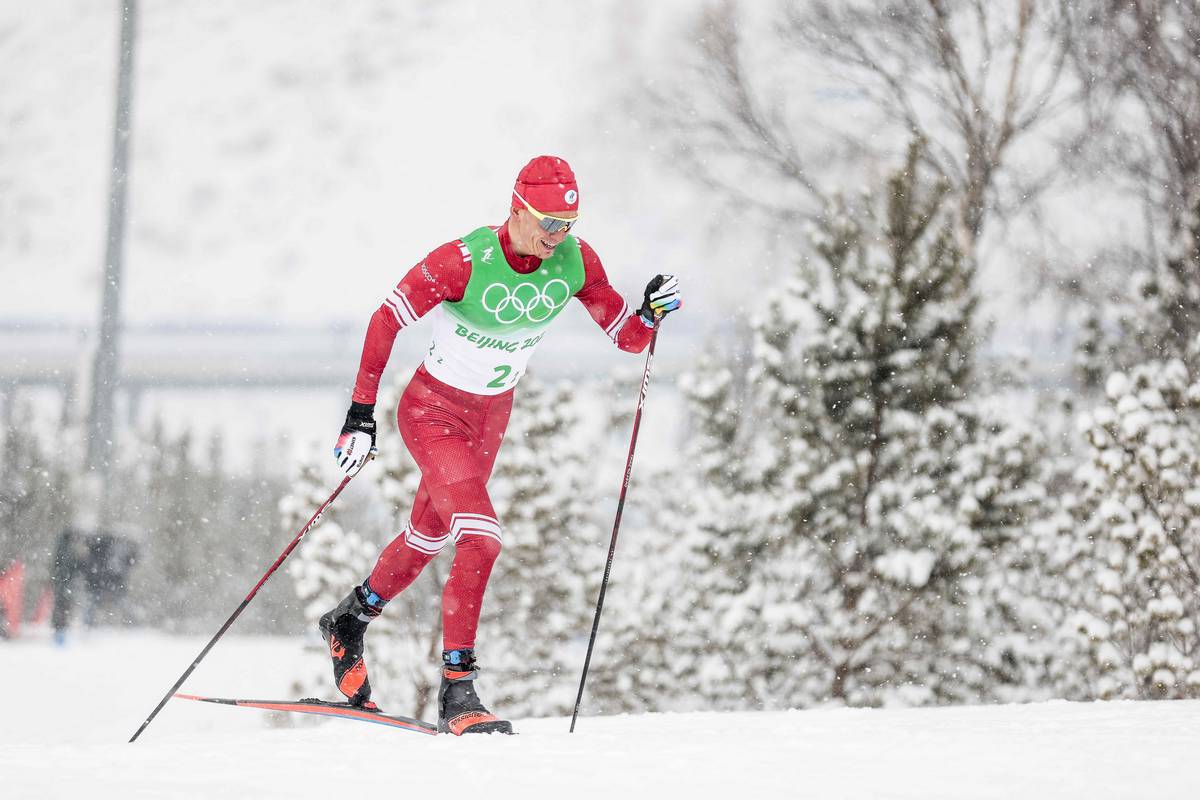
Alexander Bolshunov helps the ROC to a gold medal in the 4 x 10 k relay during the 2022 Olympic Winter Games. (Photo: NordicFocus)
Alexander Bolshunov, the Russian skier who is the odds on favorite to win Saturday’s 50-kilometer freestyle marathon at the Beijing Olympics, may have more on his mind than a momentous ski race: A potential Russian invasion of Ukraine will likely pass near to his childhood home in the rural village of Podyvot’e, in Russia’s Bryansk region.
Bolshunov grew up in Podyvot’e where his father taught him to ski on a pair of green wooden Malyshokas on trails he built by hand in the fields and forests near their home. “I don’t remember my childhood without skis,” Bolshunov has said in an interview.
When Bolshunov was a kid he could travel by ski or otherwise into Ukraine, whose border is only a couple of kilometers from town. That changed in 2014 when Russian forces and Russian backed separatists invaded the Crimea and Donbas regions of Ukraine. Since 2018, Russian men between the ages of sixteen and sixty are banned from entering Ukraine.
Now, with tensions rising as the Russian military surrounds Ukraine, some analysts have pointed to a potential invasion route of Ukraine that would take Russian forces close to Bolshunov’s family home.
A major arterial highway runs through Troebortnoe. On the Russian side of the border it is called the M3 and leads to Moscow. On the Ukrainian side it is the M2 and runs close to Kiev. A Russian invasion would likely need that highway to move forces quickly toward the Ukrainian capital.
The border crossing at Troebortnoe is only about 14 miles from Podyvot’e, separated by fields and a forest that stretches near to the doorstep of Bolshunov’s family home. “Just 500 meters from the house begins a large forest,” said Bolshunov, “Where there are those [loops] that I always run when I go there – 10 k, 15 k.”
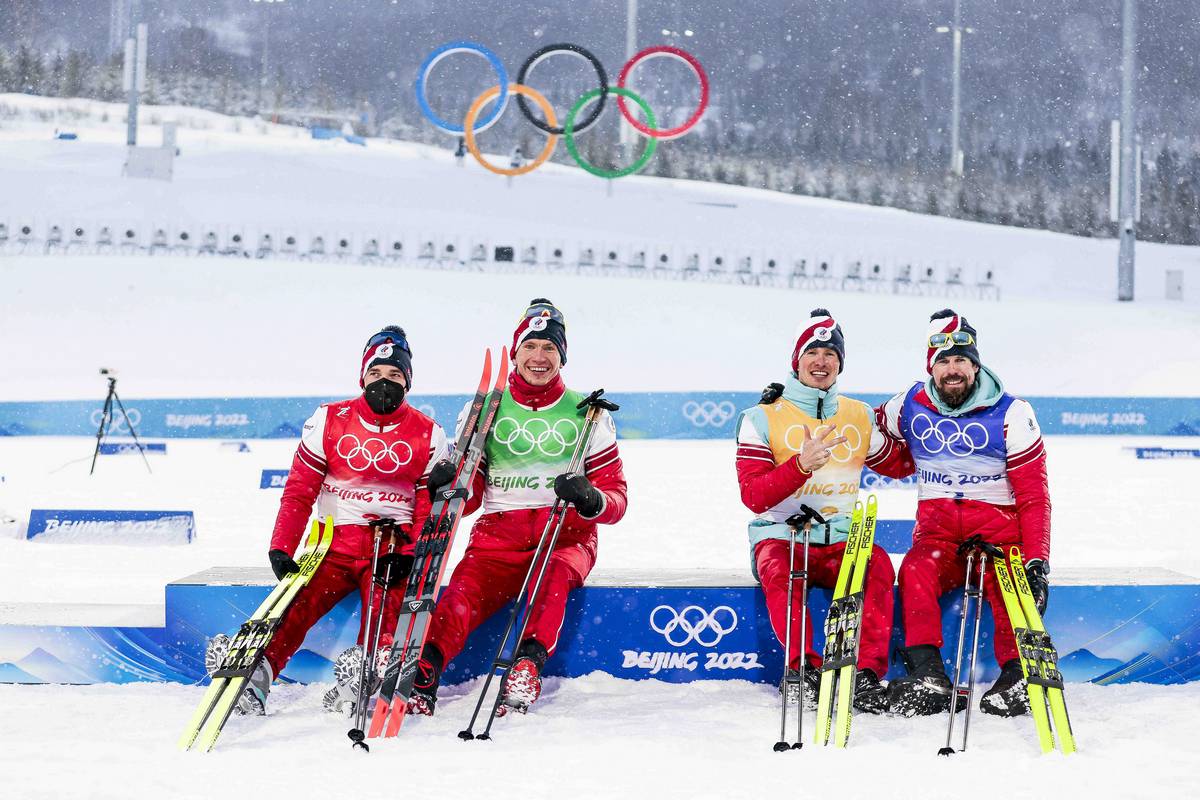
The Olympic gold medal relay team: Alexey Chervotkin, Alexander Bolshunov, Denis Spitsov, and Sergey Ustiugov (l-r) (Photo: NordicFocus)
For Bolshunov, this landscape of birch and pine represents the natural idyllics of his youth. “I love to go to the forest picking mushrooms, [and] also fishing if I have enough time.” Bolshunov said in an interview with FIS.
“Childhood memories of the village—strawberries, for which we often went,” recounted Bolshunov. “Sometimes, 10 liters were collected. Another [were] blueberries—it took six hours to collect a bucket of 5-6 liters. Everything grew near our house.”
For the older residents of Podyvot’e, the forest also carries somber memories: A quiet memorial remembers the 182 villagers that were massacred by the Nazis as they hid in the forest.
Whether conflict will arise again in the area remains to be seen. Should Russian President Vladimir Putin decide to invade this weekend, it would mark the second time he has done so in conjunction with the men’s Olympic 50 k race.
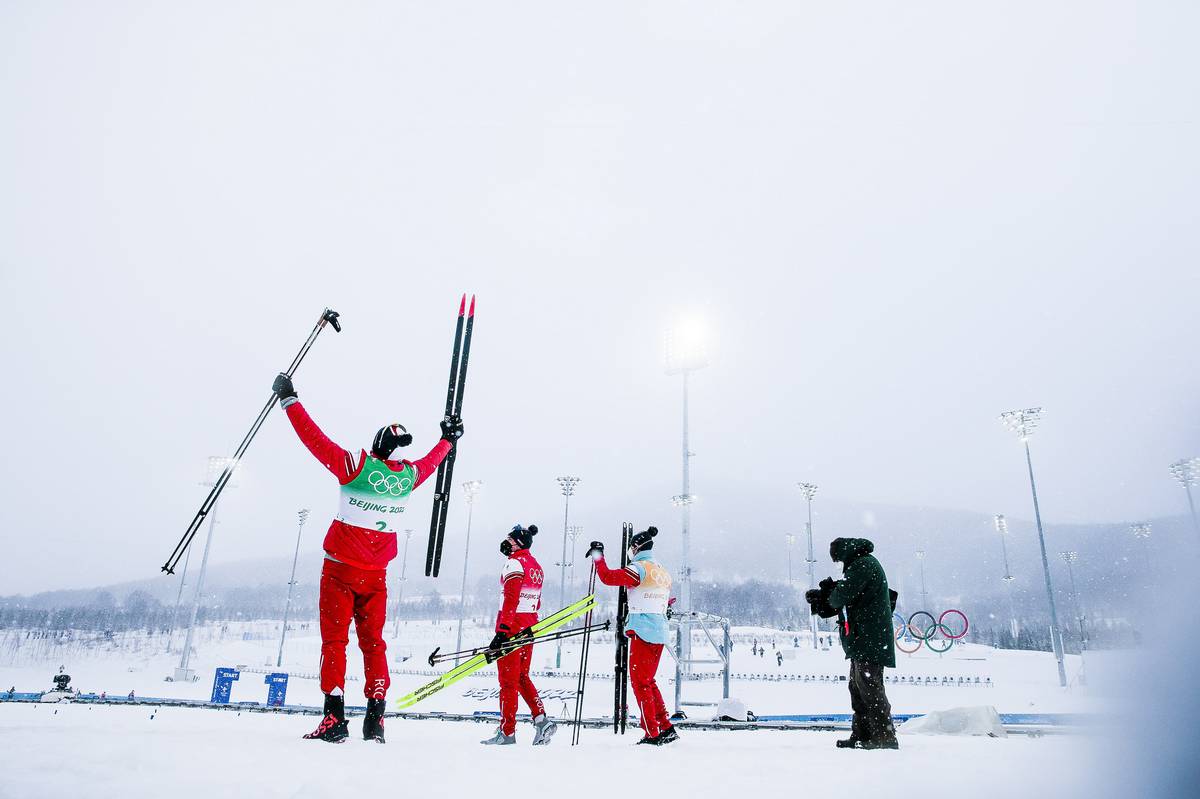
Alexander Bolshunov (ROC) celebrates a gold medal performance as his teammate, Sergey Ustiugov, races the final meters of the 4 x 10 k relay. (Photo: NordicFocus)
In 2014, the night before the final cross country race at the Sochi Olympics—the men’s 50k—Putin held an all night meeting at the Kremlin with his security and defense leaders to discuss the annexation of Crimea.
“We finished about seven in the morning.” Putin told a Russian TV documentary as reported by the BBC. “When we were parting, I told all my colleagues, ‘We are forced to begin the work to bring Crimea back into Russia’.”
Four hours later, the men’s 50 k race kicked off in Sochi and the Russian men notoriously swept the event. Putin would fly back in time for the closing ceremonies where the three skiers received their medals before a packed stadium.
The correlation between the Olympics and Russian military adventures is quite direct. At the Sochi Olympics, the Russian medal haul helped boost Putin’s public approval numbers to record highs, and in his all night war room meeting that February, Putin carefully considered secret polling that showed favor to the annexation issue.
In the Netflix documentary Icarus, former RUSADA head Grigory Rodchenkov who helped to orchestrate the 2014 Russian state sponsored doping program, said of the post Olympic invasion of Crimea, “I felt my personal guilt for such [an] event. [If] Russia had [won] less medals, Putin would not be [so] aggressive.”
Alexander Bolshunov (ROC) celebrates victory in the 30 k skiathlon, the first event of the 2022 Olympic Winter Games. (Photo: NordicFocus)
In terms of medal count, the Russian Olympic Committee (ROC) heads into the final weekend in second place. Their medal haul has been bolstered by the cross country ski team which has won a third of all ROC medals. Of those, four have involved Alexander Bolshunov, who at 25 years old has already become the winningest cross country skier in Russian history. He has won a medal in every Olympic race he has entered and is poised to deliver again in the men’s 50 k on Saturday. For his success, he has been nominated by the State Duma to carry the ROC flag at the closing ceremonies.
For Bolshunov’s father in Podyvot’e, the results of his son have meant more than any economic advantage that his career has provided, and Bolshunov Sr. still prepares his ski trails in the hope that his son might make an unscheduled return. “Neighbors think I’m crazy,” Bolshunov Sr. has said. “But my son has such results. This is worth living for. Money is not manna from heaven, I never needed it.”
Bolshunov Sr. has no plans to leave Podyvot’e. “You can’t kick me out of there with a stick,” Bolshunov’s father said in 2018. “As we lived, so we live. We don’t get into politics. Ukraine is nearby, but no one seems to be coming to us from there. Everything is fine.”
Through no fault of Bolshunov’s own, a possible gold medal in the Olympic 50k could help burgeon feelings of confident nationalism in Russia and put his hometown on the frontlines of what could be the largest European war this century. When it comes to the men’s Olympic 50k race, the stakes are often much greater than gold.
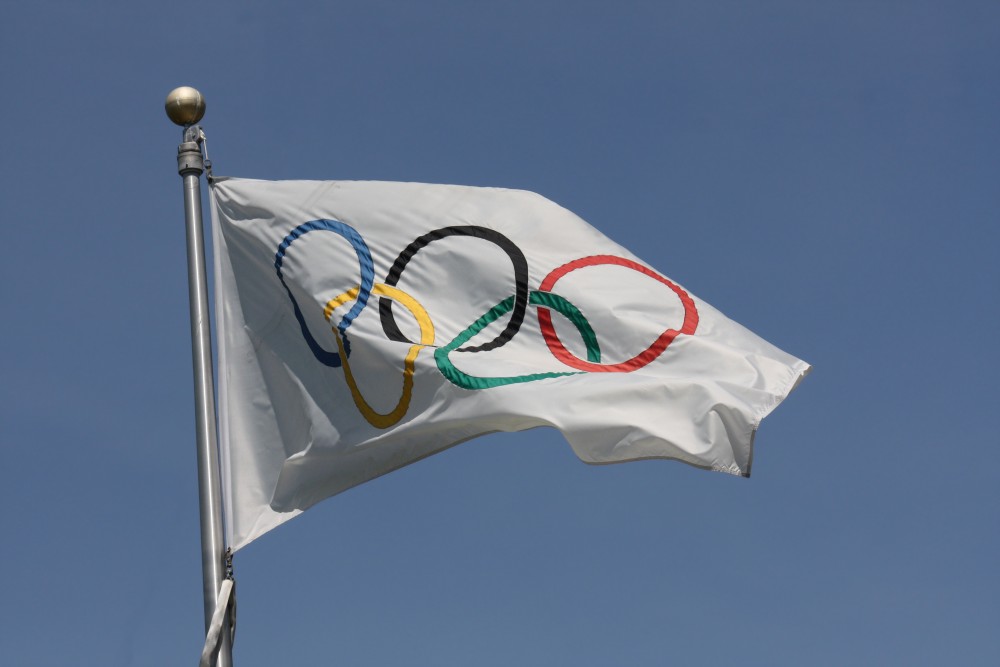
Early next month, the Olympic flag will fly at the upcoming 2016 Summer Olympics in Rio de Janiero, Brazil, but what message is its governing body, the International Olympic Committee, sending in its most recent decision regarding Russia? (Photo: Wikimedia Commons)
Note: The following is an editorial from FasterSkier’s editorial board, consisting of its editors, and is not meant to reflect the opinions of our broader staff.
***
On Sunday, the International Olympic Committee (IOC) Executive Board decided against an all-out ban on Russian athletes at the 2016 Summer Olympics, which start Aug. 5 in Rio de Janeiro, Brazil.
Instead, the IOC asked each individual sports federation (IF) to do a rigorous review of the Russian entries for Rio and determine whether they have undergone sufficient drug testing to be deemed “clean” and cleared to compete.
The IFs have been left just 12 days and no guidance for how to do this.
The decision was the culmination of a long process – just how long depends on who you ask.
Perhaps the process began in 2010, when whistleblower Vitaly Stepanov initially contacted the World Anti-Doping Agency (WADA) with information about systematic doping in Russia.
Or perhaps the process began in December 2014, when German documentarian Hajo Seppelt finally broadcast Stepanov’s information to the public on ARD. It was quickly seen around the world.
Later, WADA commissioned several independent reports, the first of which revealed extensive systematic doping in track and field. The first report, led by former WADA President Dick Pound, dropped in November 2015. Maybe the process began then.
Instead of enacting such a ban, the IOC Executive Board delivered a confusing, unclear decision where Russian athletes may participate after meeting supposedly stringent criteria which are not defined; where Russians with past doping violations are treated differently than those from other countries; and where Russian athletes in different sports may be treated completely differently from one another.
The result will be neither fair to clean athletes who were affected by the Russian government’s manipulation of hundreds of positive doping samples over the last five years, nor to Russian athletes themselves.
Some have noticed. Canadian biathlete and two-time Olympian Brendan Green was one of many sharing this image:
With this in mind, here are some questions for IOC President Thomas Bach and his Executive Board.
1) Do you listen to athletes?
A group of influential athlete representatives held a press conference after McLaren’s last Monday. Among them were Canadian cross-country skier Beckie Scott, the chair of the WADA Athlete Committee, and IOC Athletes’ Commission chair Adam Pengilly.
The group advocated for an unequivocal ban on Russian athletes in both Rio and PyeongChang. Before the McLaren report had even dropped, Pengilly explained, they had circulated a letter stating those aims. The letter was endorsed by athlete representatives from more than 20 different sports federations. Clearly, there was widespread support for such a position.
After the McLaren report came out, that position was solidified.
“We would like to highlight our belief that WADA must allow Professor McLaren and his team to continue their investigation, that Russia should be banned from the Rio Olympics, Paralympics, and other international events, and that International Federations must enact sanctions so as to protect clean sport,” the WADA Athlete Committee said in a statement.
It has been clear for quite some time that the Olympics are not about the needs or wishes of the athletes, but that was underlined by the Executive Board’s decision.
“I believe that the Russian federation has mocked the Olympic movement and I worry about the future of clean sport, I worry about the future for clean athletes, the Olympic movement and the Olympic Games,” Pengilly said told the BBC, where he later said he was “embarrassed” by the Executive Board’s decision. “Some have suggested the IOC has passed the buck and I’d have to agree. There’s been an abdication of responsibility here.”
Fellow IOC Athletes’ Commission member Hayley Wickenheiser, the Canadian four-time gold medalist in ice hockey, had this to say:
2) Do you listen to WADA?
For years – literally – WADA obfuscated, ignored whistleblowers and failed to take action when provided with compelling evidence of doping in Russia.
But in the last few weeks, it appeared that WADA had grown a backbone. After the McLaren report was delivered, the WADA Executive Committee published a list of seven recommendations.
The very first one: “The International Olympic Committee (IOC) and the International Paralympic Committee (IPC) to consider, under their respective Charters, to decline entries, for Rio 2016, of all athletes submitted by the Russian Olympic Committee (ROC) and the Russian Paralympic Committee.”
WADA also suggested that Russian government officials be banned from attending Rio.
That might be the main recommendation that the IOC actually upheld: in their decision they wrote that “Nobody implicated [in the McLaren report], be it an athlete, an official, or an NF, may be accepted for entry or accreditation for the Olympic Games.”
In the McLaren report, Russian Minister of Sport Vitaly Mutko is named as having interfered with at least one positive doping case. Russian President Vladimir Putin’s name is mentioned in the report as having personally appointed a Deputy Minister of Sport who helped hide positive tests.
Will either be banned from Rio? Is that under the purview of any international federation, or only the IOC? Will President Bach sign deny those credentials himself?
Otherwise, WADA – a body which is partially funded by the IOC, but did not have the power to enact a ban on Russian athletes itself – was left in the cold.
“WADA is disappointed that the IOC did not heed WADA’s Executive Committee recommendations that were based on the outcomes of the McLaren Investigation and would have ensured a straight-forward, strong and harmonized approach,” said WADA President Sir Craig Reedie. “The McLaren Report exposed, beyond a reasonable doubt, a state-run doping program in Russia that seriously undermines the principles of clean sport embodied within the World Anti-Doping Code.”
3) What do you mean by “reliable adequate international tests”?
The IOC clearly wanted the process to approve Russian athletes for the Rio Games to be onerous, or at least to seem that way.
Long jumper Darya Klishina will be the only Russian track and field athlete competing in Rio this August. The IAAF cleared her because she lives in Florida and has thus been outside the Russian system. Other federations have clearly not been so strict in making their decisions. (Photo: Wikimedia Commons)
“Under these exceptional circumstances, Russian athletes in any of the 28 Olympic summer sports have to assume the consequences of what amounts to a collective responsibility in order to protect the credibility of the Olympic competitions, and the “presumption of innocence” cannot be applied to them,” the IOC wrote in the preamble to its decision.
And so the board mandated that all athletes be subjected to review by their relevant IFs.
“The absence of a positive national anti-doping test cannot be considered sufficient by the IFs….The IFs should carry out an individual analysis of each athlete’s anti-doping record, taking into account only reliable adequate international tests, and the specificities of the athlete’s sport and its rules, in order to ensure a level playing field.”
Yet there is no definition of reliable – which testing agencies does this include? And there is no definition of adequate – how many tests, over what period of time?
Russian Olympic Committee member Alexander Zhukov was invited to give a presentation to the IOC Executive Board. In it, he asserted that since the first WADA report Russian athletes have been repeatedly tested by international anti-doping agencies and, according to the IOC press release, “the vast majority of the results were negative.”
Yet, the main agency tasked with these tests, UK Antidoping, reported via WADA in June that 16 percent of scheduled tests could not be collected from athletes; a further 736 tests were canceled or declined; and that doping control officers were sometimes harassed and intimidated when they tried to collect samples.
Is this international testing reliable and adequate?
4) Is this fair to Russian athletes?
Without a definition of what constitutes reliable and adequate testing, outcomes for various sports are already vastly different.
The International Association of Athletics Federations (IAAF) has banned all but two Russian track and field athletes from the Games. (The IOC went on to actually kick out one of those two, Yuliya Stepanova, a whistleblower who helped bring the entire scandal to light. Nice.)
In the past weeks Bach has talked extensively about the need to balance collective punishment for government action against individual justice. He has said that clean Russian athletes who had nothing to do with the scandal should not be punished. But it seems clear now that in some sports they will be, whereas in other sports they will not (or their doping teammates might even be able to compete alongside, or instead of, them).
5) Is this what zero tolerance means?
One of the IOC guidelines states that any Russian athlete who has served a doping ban cannot compete in Rio.
One can almost see the logic: with many tests manipulated, the chances are higher that those athletes could have had a second positive test. If true, this should have led to a second and potentially longer ban which they would still be serving.
But maybe not — what if they did reform and are now clean? The provision sends an extremely confusing message: past dopers from some countries are allowed a second chance, but there’s no redemption if you’re from Russia. How is that zero tolerance, much less fair?
When Justin Gatlin and Tyson Gay (American sprinters previously banned for doping) likely medal in the men’s 100 meters, how will a Russian track and field athlete feel? Probably that it’s absolutely fine to dope – as long as you’re not from Russia.
After five days of frantic work covering ski races in the mountains, I finally got to take a trip down the hill on your $8 billion railway. (Okay, the money paid for a road, too.)
At the bottom—in the Soviet seaside getaway of Adler—I expected more of the soulless, overpriced, overbuilt malls and hotels that your people had crammed into the Mzymta River valley, where I got onto the train.
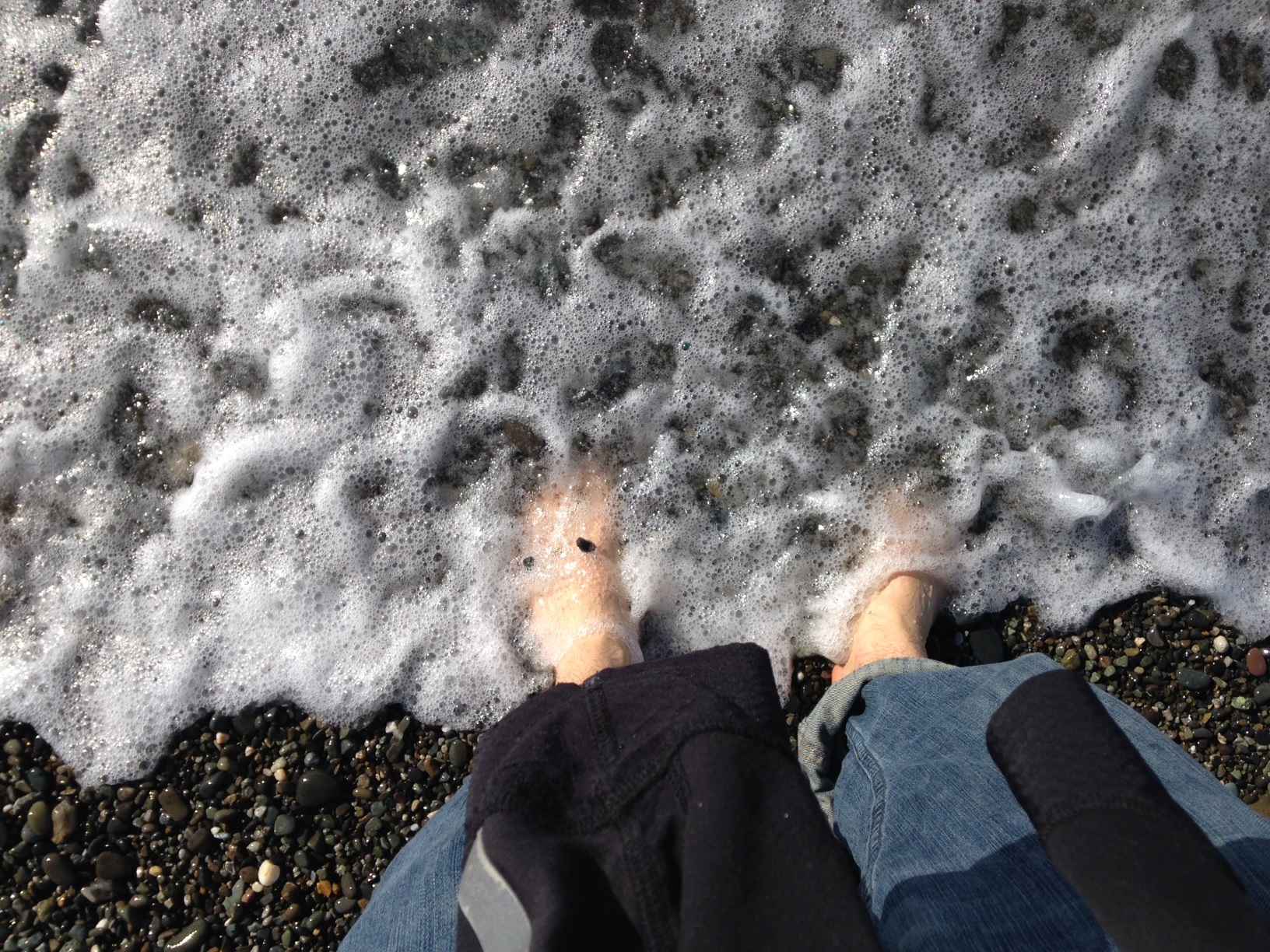
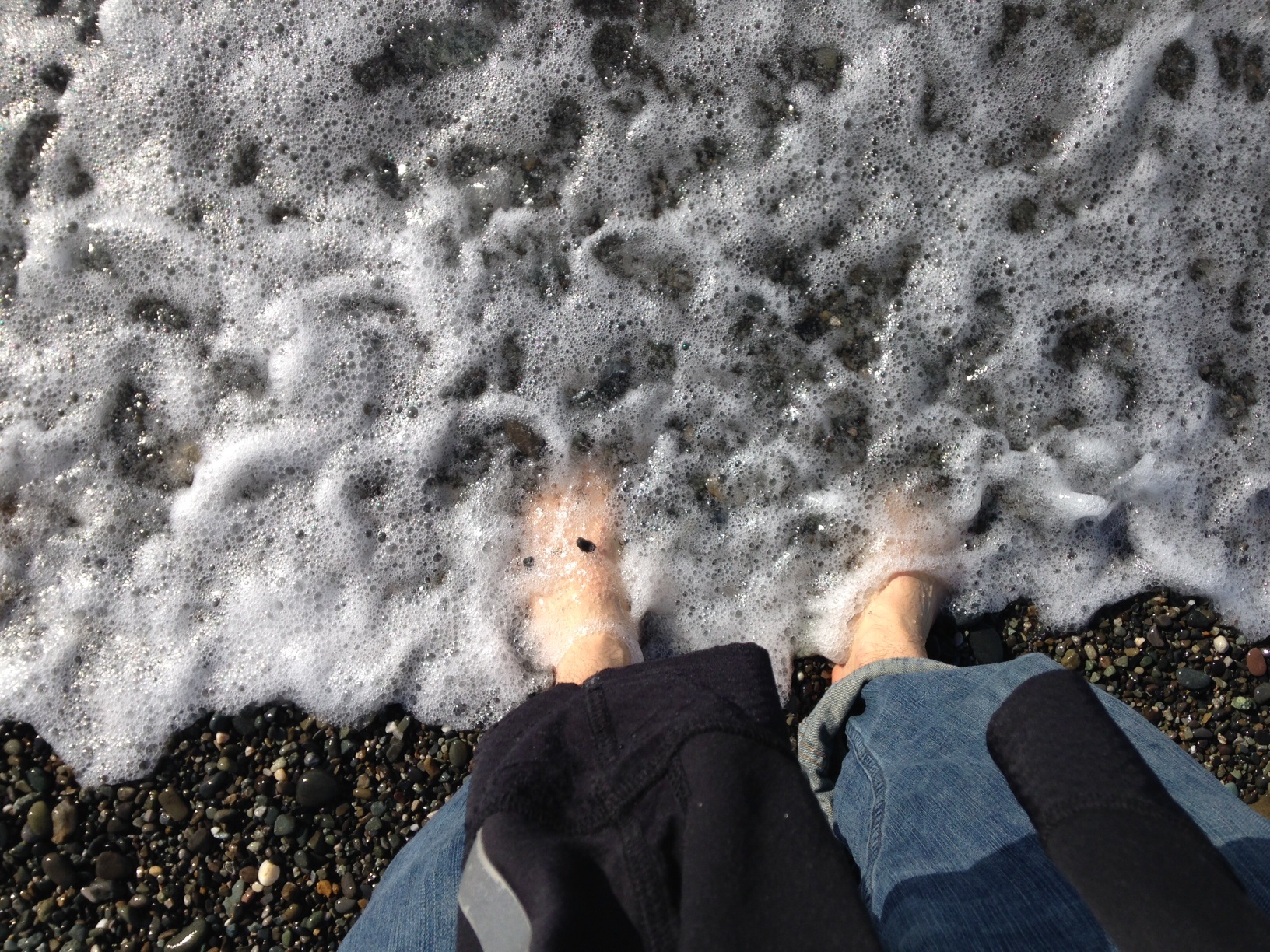
Instead, I strolled off into an open-air market, where I bought a locally grown mandarin orange, a pickle, and a freshly baked chicken turnover before dipping my feet into the cool waters of the Black Sea.
It was 60 degrees.
Score a point for Putin.
Since arriving in the country last week, I’ve wanted to get out of the fantasyland that the Russians constructed in the Western Caucasus mountains, and down to the coast.
The area where I’m staying, Krasnaya Polyana—which is hosting all the skiing competitions during the Olympics—was developed almost entirely from scratch over the last several years in preparation for the games. As was widely reported, some of the construction wasn’t done in time.
By contrast, the seaside cities of Adler and Sochi already existed; Sochi was a resort getaway during the Soviet era.
Simply put, I thought a visit would help me better understand what this part of Russia was like—and in the process help me better understand what role the Olympics had here.
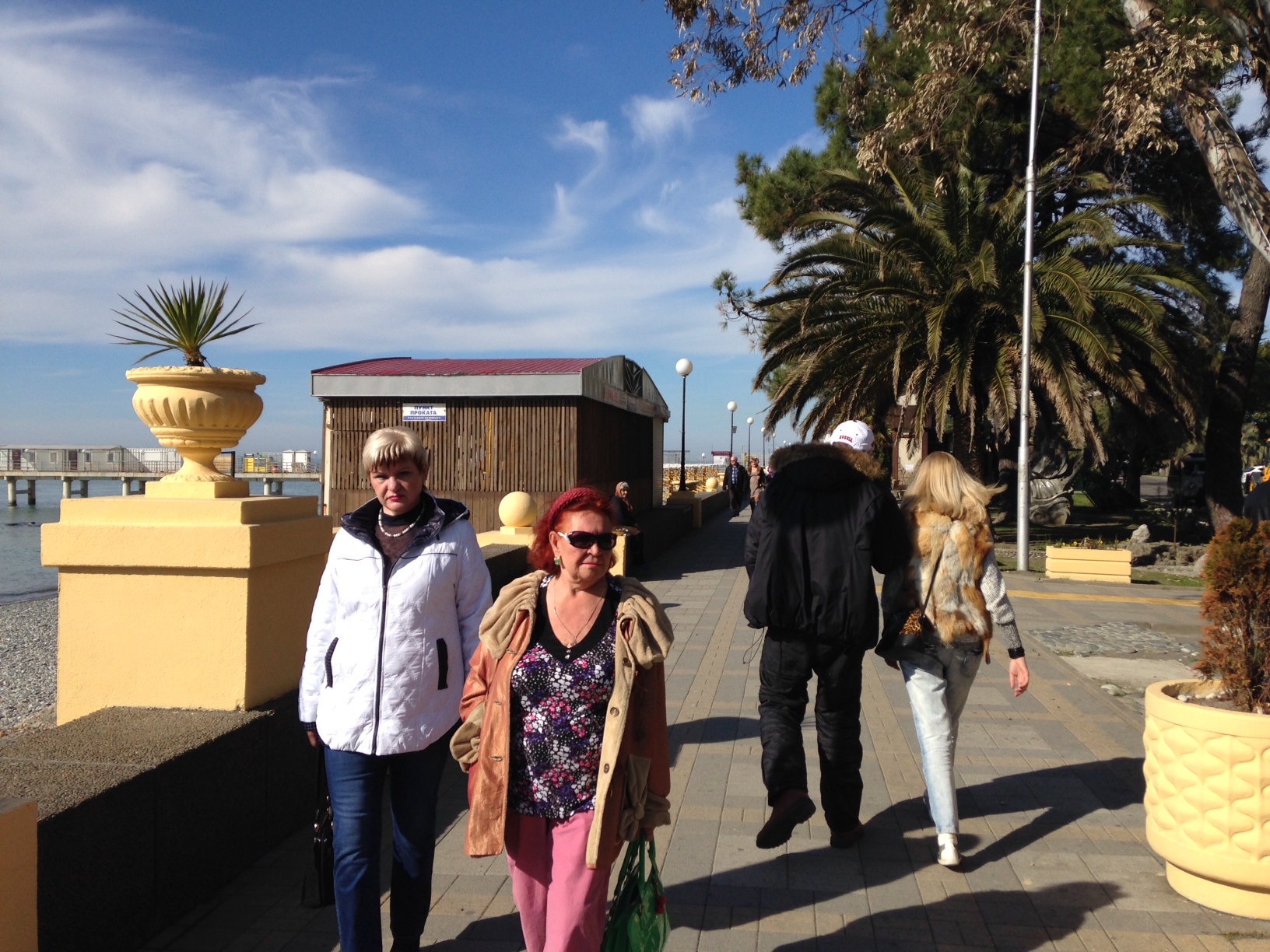
A walk along the water in the city of Adler.
Getting from the mountains to the coast entailed a free, smooth, 40-minute ride on the train. (For the record, as I write this on the way back, we’re crawling along at 17 kilometers per hour.)
As we pulled into the Adler station—a suburb of Sochi—the Black Sea glittered off to the left. A women at an information desk directed me to a bus stop, where she told me to wait for number 124, which would take me to the city center. When it arrived, the “bus” turned out to amount to a large van, with a rickety automatic door that almost shoved me onto the floor when it closed.
The driver grouchily took my 100-ruble bill and gave me change while he shifted gears and made a tight merge onto a busy thoroughfare with, yes, palm trees planted in the median.
He dumped us out at a pullout next to what looked like a tired car dealership, which turned out to be a luxury mall. This was Adler.
I was skeptical as I wandered past some Western-looking shops, covered with logos for perfume, cameras, and iPads.
But my attitude started to change as I kept walking, and started to see things and people that seemed more authentic. (Bear with me if I’m stereotyping, which I probably am.)
There were stands with old, leathery men and women selling Russian flags and Olympic memorabilia; another group of men stood in sweatsuits smoking cigarettes, as two appeared to close a business deal with a handshake.
Then, I stumbled on the open-air market. There were massive cabbages, and mandarins from the nearby province of Abkhazia. I bought one and ate it as I walked down the aisles, staring at the dozens of kinds of smoked fish, the pickled vegetables, and piles of spices.
On my way out, I got my still-warm pastry and headed toward the water, where I took off my shoes and walked out onto a beach of cool, smooth pebbles. To my left, a roundish man was walking into the water wearing only a Speedo.
This was an hour away from the Winter Olympics?
Vladimir Putin, the prime minister of Russia, has been under relentless criticism for the way these games were put together. The price tag, estimated at $50 billion, is estimated to be higher than that of all past Winter Olympics combined, which is said to reflect the diversion of vast sums by corruption.
Make no mistake: I think that’s reprehensible. It’s worse that 90 percent of that money belonged to the public, according to a recent report by a foundation run by the Russian opposition politician Alexei Navalny.
So far, on my trip to Russia, I’ve seen the glittering artifacts of that spending—the massive new Fisht Stadium that housed the
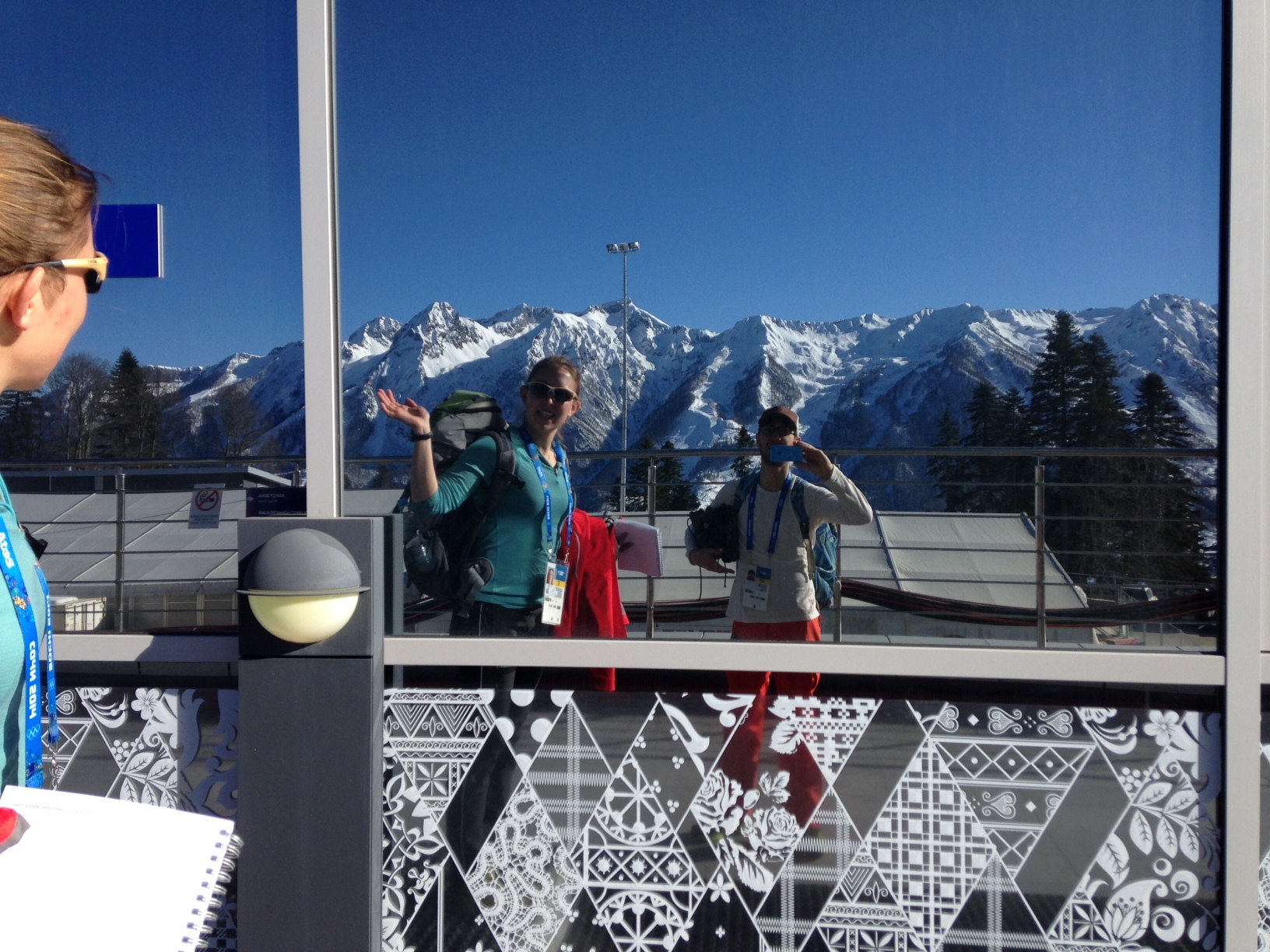
The walls of the five-story biathlon complex in the mountains outside of Sochi, Russia.
opening ceremonies, and the mirrored walls of the five-story biathlon complex, which reflect the spectacular steep slopes of the mountains across the valley.
But I’ve also seen, and read about, the people the Russian state has neglected. I have this vivid image from my jog down from my hotel earlier this week, when I saw a crew of men toiling on the side of the steep access road—one whom must have been 60 years old, with missing teeth and some of the deepest lines in his face I’d ever seen, still doing manual labor despite his seemingly advanced age.
Then, there are stories like the one about the village of Akhshtyr, which sits just across the train tracks from the $8 billion road, but doesn’t have access to it—not to mention access to fresh water.
In many ways, I think it’s a shame that the International Olympic Committee chose to award these games to a country that can’t seem to take care of its own people—one that spends its billions in oil wealth on play areas for the rich, and on sports venues that will probably lapse into disrepair after the Olympics end.
But after my trip to Adler yesterday, I can at least understand what those IOC officials, and Putin, were aspiring to.
I also think it’s cool that thousands and thousands people in a fairly isolated part of Russia are getting a piece of the Olympic experience—from the grouchy guards manning security stations to the teenage volunteers stationed at bus stops, who get to pose for pictures with Marit Bjoergen—the Norwegian cross-country star who has won more medals than many countries.
Should those experiences only go to people who live in countries like my own, or like Canada, which I think most people would agree do a far better job of governing? What if, by bringing the games to this part of Russia, the Olympics expose some of the serious problems in the region, and the country, and spurs change?
What’s the takeaway message here? I’m not sure—maybe I’ll have a better idea at the end of the month, once I’ve had a chance to see more of Sochi and talk to more of the people who live here.
Perhaps it’s simply that things are always more complicated than you expect—especially when you’re thinking and talking about a multi-billion-dollar enterprise that’s halfway around the globe from your home.
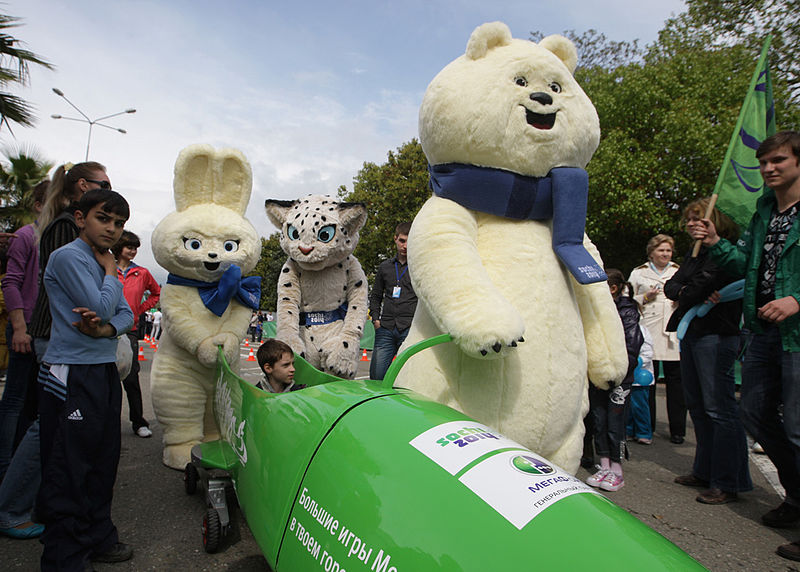
The official mascots of the 2014 Winter Olympics, a polar bear (r), European hare (l) and an Amur leopard (c), walk the city streets in May during the “2014 Winter Olympics: 1,000 Days To Go” festival in Sochi, Russia. (Photo: Wikimedia Commons)
We’re at the 199-days-and-counting mark if you’re keeping track of how much time remains until the start of the 2014 Winter Olympics in Sochi, Russia, and we know many of you are. In case you haven’t been reading every ounce of pre-Olympic coverage, we’ll do our best to stay on it and provide relevant nordic updates throughout the next sixth months.
For now, here’s some noteworthy starter information:
1. Opening ceremony: The 22nd Winter Olympic Games will kick off Friday, Feb. 7, in Sochi, Russia. Closing ceremony 16 days later on Sunday, Feb. 23.
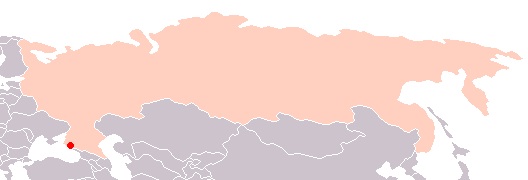
Sochi (as indicated by red dot) in southwestern Russia. (Photo: Wiki Commons)
2. Where: Sochi, which spans some 145 kilometers (90 miles) with a population around 345,000 along the shores of the Black Sea in western Russia.
Krasnaya Polyana, an urban mountain town about an hour drive (70 kilometers) inland from Sochi, is where all the snow-sport events will be held (i.e. cross-country skiing, biathlon, alpine, freestyle, snowboarding). In 2010, it had a population of about 4,500, but expect a lot more people buzzing around in February.
3. Climate: Categorized as humid subtropical, Sochi typically experiences mild winters averaging 11 degrees Celsius (52 Fahrenheit) during the day and 4 degrees Celsius (39 degrees Fahrenheit) at night from December to March. What could that mean for snow sports? Another potentially tricky year, just like in 2010 in Vancouver, British Columbia, and 1998 in Nagano, Japan. In both previous Olympics, weather postponed events, but everything eventually took place. According to Philip Hersh of the Chicago Tribune, the Russians are stockpiling snow.
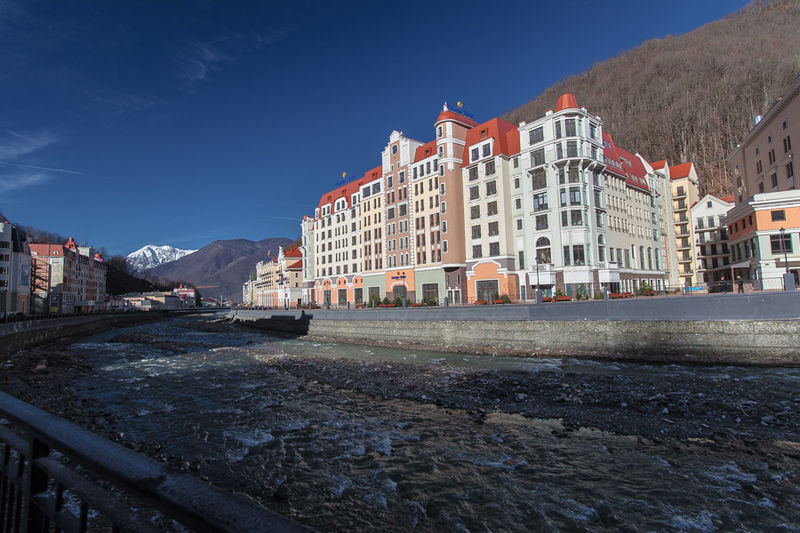
The Golden Tulip Rosa Khutor Hotel on the Mzymta River in Krasnaya Polyana, Sochi. (Photo: Wiki Commons)
4. Money: Hersh posed the question as why a palm-tree-laden, authoritarian nation would be awarded the Winter Games. Because of “Russian supremo [president] Vladimir Putin,” he wrote, who promised an unlimited budget and has already overspent it. Last February, a year from the Olympics, Russia had spent $51 billion dollars, $11 billion more than China’s previous record-setting grand total for the 2008 Summer Games.
Some $130 million dollars alone was set aside for a road connecting Krasnaya Polyana to Sochi, and according to the Christian Science Monitor, that makes it the world’s most expensive byway. “That’s about 50 times the average cost of a highway in the United States,” former deputy prime minister Boris Nemtsov told the Monitor.
5. A first: Neither Russia nor the former Soviet Union ever hosted the Winter Olympics,although it’s long been considered a winter-sports stronghold. Who could forget then-president Dmitry Medvedev’s televised remarks four years ago, after Russia’s showing at the Vancouver Games. “Those responsible should take the brave decision and sign a letter [of resignation]. If they can’t, we will help them,” he said of the Russian officials and sports bureaucrats blamed for a lack of medals and disappointing sixth-place finish in men’s hockey.
6. A dozen new events: Stay tuned for the brand-new biathlon mixed relay, women’s ski jumping, luge team relay, figure skating team event, men’s and women’s halfpipe and slopestyle freestyle skiing, and men’s and women’s slopestyle and parallel slalom snowboarding.
7. How to watch: According to the Tribune, prime-time coverage on NBC will be delayed, but more than half the Olympic events will be live on some NBC network, and every event will be streamed live.
8. Boycotts: Remember Beijing and the civil-rights movements surrounding the Games? Same sort of thing here, except Russia isn’t just ignoring protesters, it’s threatening them to stay away. Putin recently signed a law allowing police officers to arrest tourists and foreigners they suspect of being homosexual, lesbian or “pro-gay,” the New York Times reported. What? Yep, if this stands, those arrested could be detained for up to 14 days – that includes Olympic athletes, coaches, trainers, family members, fans and spectators. Earlier in June, Putin signed another bill classifying “homosexual propaganda” as pornography, which essentially means that anyone who condones homosexuality to someone underage could face fines or jail time.
The International Olympic Committee (IOC) responded with a statement that read, “The IOC would like to reiterate our long commitment to non-discrimination against those taking part in the Olympic Games, the IOC is an open organization and athletes of all orientations will be welcome at the Games.”
A leading international organization, Human Rights Watch (HRW) wrote a letter to the IOC urging it “to take additional steps to send a clear signal to the Russian authorities that discrimination of people based on their sexual orientation and gender identity is at sharply at odds with Russia’s human rights and Olympic commitments.”
HRW also encouraged the IOC to get a guarantee that Russian authorities will not adopt or implement homophobic legislation.
“We also urge you to press the authorities to state publicly that, as Olympic Host, Russia will ensure, without distinction, the safety and the freedom of expression and association of all athletes, coaches, fans, and others who will attend the Sochi Games.”
9. No laundry: Don’t hang it from balconies or use window air conditioners, because Sochi doesn’t want to see it. Residents could face fines up to $46 dollars, The Moscow Times reported, for clothes on the line or air conditioners that look “chaotic.”
The city “should look especially decent in a zone of international hospitality,” Sochi’s deputy mayor Yevgeny Gorlov wrote on the local government’s website last week. “If people have made the decision to install an air conditioner, they should have a symmetrical location on the building and be agreed upon with all the [other] owners … in an agreed scheme.” This is in effect for the preparatory period before the Games, but it brings up a previous concern: are people going to need air conditioners at the Winter Olympics? (See No. 3).
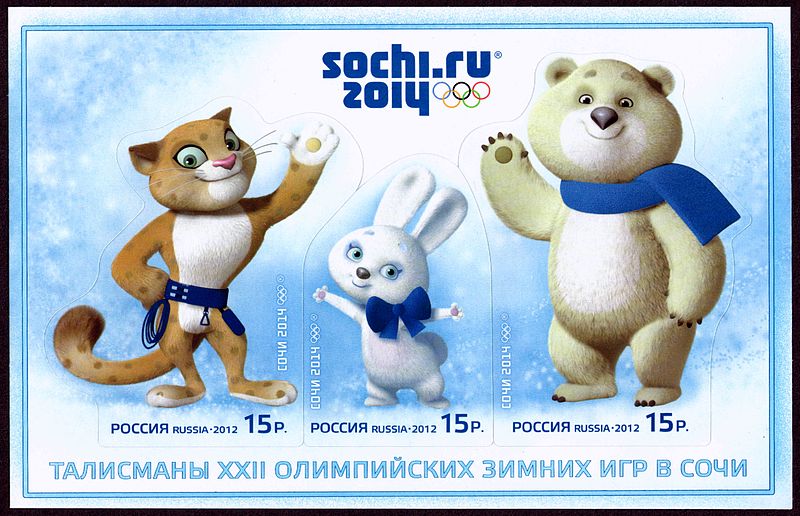
10. A polar bear, a European hare and an Amur leopard: These are the three official mascots of the Games, decided by a public vote (another first for Russia, according to the Sochi 2014 organizing committee).
The official mascots of the 2014 Sochi Winter Olympics (Photo: Wiki Commons)
11. “Hot. Cool. Yours.” The official Olympic slogan. Organizing Committee President and CEO Dmitry Chernyshenko said in a statement it’s aimed to bring more foreigners to Sochi and make Russians proud.
“The Sochi 2014 slogan says it’s impossible not to take part, impossible not to watch, impossible not to get excited and it’s worth being proud because these are our Games,” Chernyshenko said.
“Hot” and “cool” are references to Sochi’s sun-and-snow climate and symbolize progressive movement forward.