From the FasterSkier archive — posts syndicated from athletes’ and coaches’ own blogs between 2004 and 2012, kept online as published. Current coverage is at fasterskier.com.
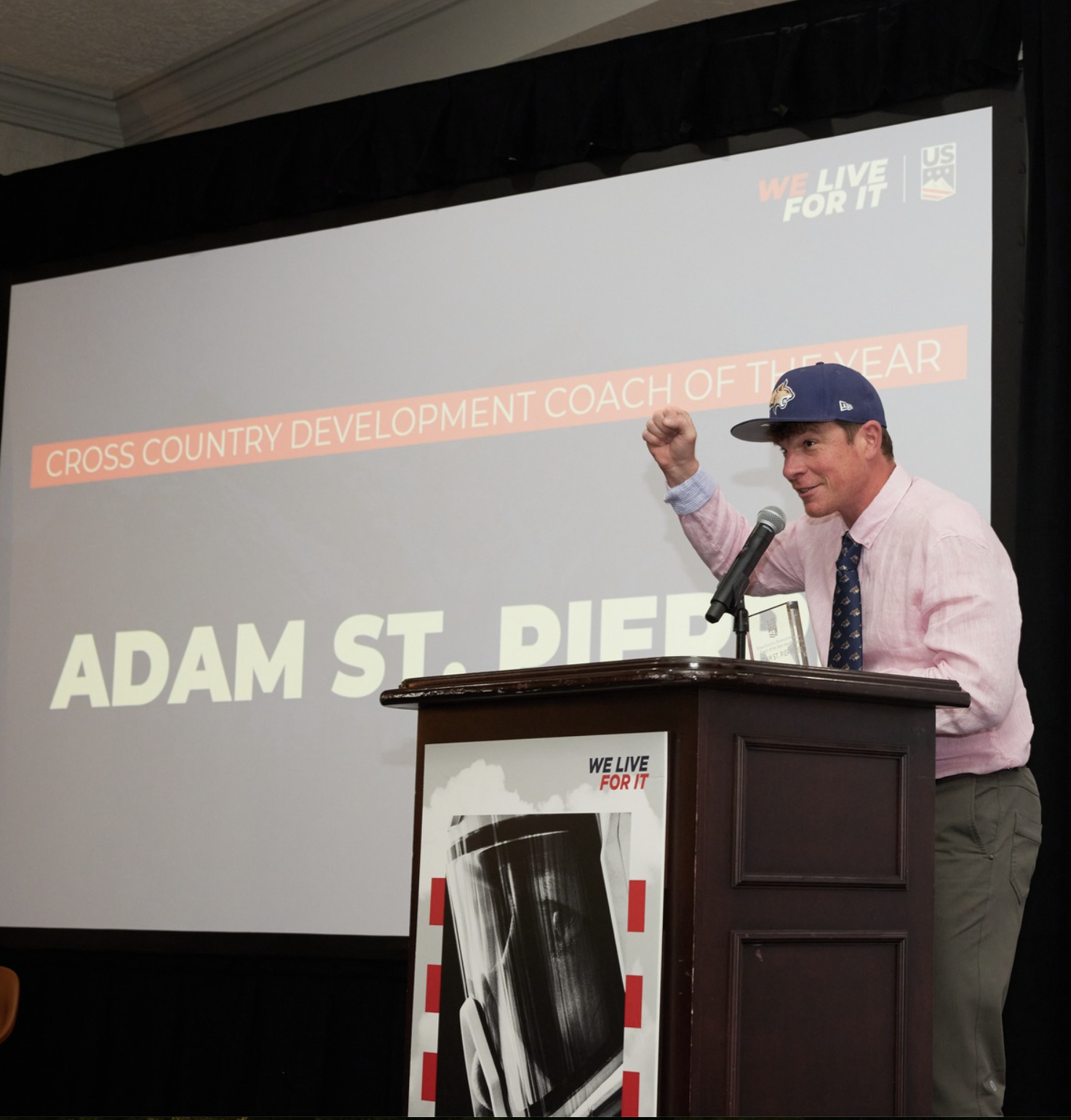
A parent once cornered Adam St. Pierre to complain that he was letting the kids play games. St. Pierre had ten-year-olds on skis running sharks and minnows, shrieking and chasing each other across the snow, and the parent was not paying club dues for that. “I want coaching and training,” the parent told him. “This is…” and you can fill in the disappointment.
St. Pierre thinks sharks and minnows on skis is one of the most effective training tools there is. He was lucky, he says, to have a parent board that backed him up in those rare confrontations, because he had no intention of stopping. Kids who are laughing are kids who come back, and kids who come back are the only kids who ever get good.
That belief sits at the center of a coach who, on paper, should be the last person preaching simplicity. St. Pierre has a master’s in exercise science, a background running lactate and VO2 tests on athletes, and a relationship with a Montana State physiology lab that has done extensive work with U.S. Biathlon on both the metabolic and biomechanical sides. He reads the research. He can talk ratios and thresholds for as long as you’ll let him. And his most strongly held convictions keep coming out disarmingly plain. Go easy most of the time. Be consistent. Make it fun enough that people stick around. The science, in his hands, mostly ends up confirming things your grandmother could have told you.
Consistency over the big block
Start with periodization, the idea that a training year should be built in escalating blocks toward a peak. St. Pierre is skeptical of the old-school version of it, and his reasons are specific. A lot of that model, he points out, traces back to weightlifting research, some of it from an era when the subjects were quietly using anabolic steroids, which is not a foundation you want under your training plan. The rest tends to come from single-event sports. “In the marathon world or the Ironman world, you’ve got one event,” he said. “You just need to be good for that one event, like on August 2nd or whatever.” Skiing is not that. A ski racer has to be good across a whole season, weekend after weekend, from November into March.
He points to a meta-analysis, published fairly recently, that looked at the day-to-day training of today’s top Norwegians. The finding was not a secret block of magic. “It really is consistency,” he said. “They’re not doing a big August and a big October. They do big weeks and recovery, and it’s just a very consistent progression.”
The metaphor he keeps coming back to is one he borrows from Marius Bakken, the former Norwegian runner he half-jokingly calls a father of the Norwegian method. Intensity, in this telling, is not the meal. It is the seasoning. “The base of the soup is your endurance training,” St. Pierre said, “and then you add in a little bit of zip here and there. But if you put in too much zip, the soup is not going to be very good.” Roughly 90 percent of the work, whether on foot, on roller skis, on snow, or on a bike, is easy volume. The intensity is the spice, and Americans, he thinks, are forever dumping in too much.
Only what’s livable
There is also a question underneath all of this that the textbooks tend to skip, which is whether any of it is actually livable. St. Pierre still remembers sitting in a USA Triathlon coaching course, listening to a periodization lecture, and asking what he thought was the obvious question. What about a working person who cannot train 24 hours a week but could manage 16? What do you do with them? The answer from the front of the room was that they should take a vacation day and get the training in. “That’s not it,” he said. “That doesn’t work.” His approach is the reverse. Figure out what someone can actually do, how many hours are genuinely available, and then fill those hours with the best workouts possible.
At MSU that math is dictated by a school calendar, and he has stopped fighting it. His athletes train before 10 a.m. so they can make a 10 o’clock class, and again in the afternoon, with nothing scheduled after 4 or 4:30. That produces a seven-day rhythm rather than the ten-day cycles some coaches prefer. Tuesday is intensity, usually threshold or VO2 work. Wednesday is a double of easy distance, with a few technique drills thrown in at the start to get the neurons firing before the athletes head out. Thursday morning is pure speed. Saturday brings intensity again, often paired with the long distance day. You cannot send skiers out for a two-hour roller ski on a Wednesday morning if they have class at ten, so you don’t. “There’s lots of ways to make a great soup,” he said, and it is not worth inducing a pile of needless stress to chase a perfect one.
Two tests without a lab
For readers without a lab down the hall, two of St. Pierre’s tools travel well. The first he calls a VT1 run, VT1 being the top of the easy zone, the hardest you can go while staying genuinely aerobic. Once a week, on flat ground, his athletes run 20 to 30 minutes at that effort and note the relationship between pace and heart rate. Flat terrain because it is the most reproducible. The point is twofold. It tracks fitness: if you run nine-minute miles at 150 beats in early summer and eight-minute miles at 150 by August, you have improved. And it works as an early-warning system. “One of the first signs of overreaching is a change in that heart rate to workload ratio,” he said. If the pace slows at the same heart rate, and it is not 105 degrees out and you are not dehydrated, it is probably time to rest. The signal can run the other way too. An athlete who normally sees 180 during intervals but suddenly cannot push the heart rate above 160 is, in his words, showing a pretty golden sign. Take some rest.
The second tool he lifted from cycling: a five-minute maximal effort, a long recovery of maybe half an hour with some refueling, then a 20-minute maximal effort. The ratio between the two tells you whether an athlete leans anaerobic and sprint-oriented or aerobic and distance-oriented, no lab required. He built a version of it into his athletes’ training plans. He is quick to add the caveat that governs all of this, in the field or in the lab. Heat, dehydration, and altitude bend every number, and even a lab lactate value shifts with hydration. “No one metric is the god metric,” he said. “You’ve always got to have that context.”
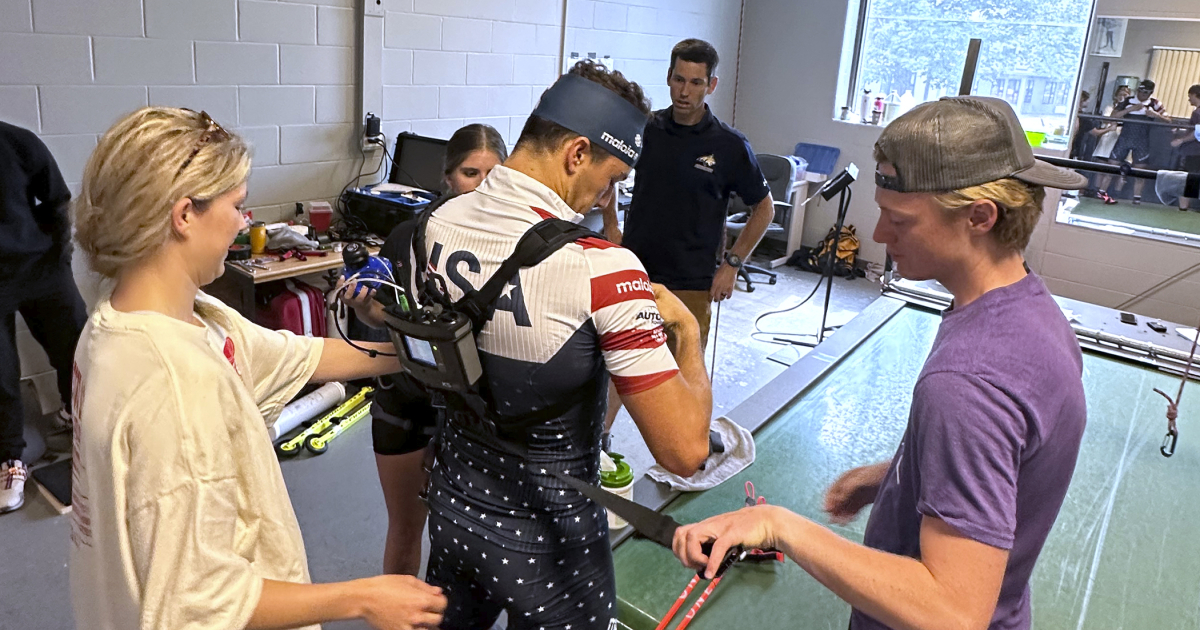
Montana State students conduct physiologic and biomechanical assessments for U.S. Biathlon. (Photo: Montana State University)
Building complete skiers
The individualization matters more now because the college game is about to change. Sprinting is coming to the NCAA Championships, a change St. Pierre cares about personally, because he wrote the proposal years ago and watched it slowly work its way toward reality. In anticipation, he is nudging the team’s intensity mix, keeping most of the hard work at threshold but adding more VO2 and anaerobic speed than a pure distance program would. One test the MSU lab ran compares an athlete’s VO2 at threshold to their VO2 max. A skier sitting well above the roughly 90 percent that is typical probably skews distance and might gain from more VO2 work to lift the ceiling. A skier down in the low numbers might benefit from more threshold. Even so, his priority is all-around development. The sprinters still do threshold. The distance skiers still do speed. He wants complete skiers, partly because a race does not always let an athlete choose its terms. If a distance race comes down to a mass sprint, a distance skier who cannot find another gear finishes 20th.
The place where St. Pierre thinks American skiing has a real and underrated advantage is strength. He knows the reputation, that Norwegians do not lift, and allows it may be true of many of them. He also knows that the Norwegians who have come through his own program found the strength work novel. As part of a university, MSU has a strength coach, Benito, a former mountain bike racer at UVM and one of the rare ones who understands endurance sport, and the two of them build a program meant to complement the skiing rather than pull against it. St. Pierre credits it for keeping his team generally healthy, and he pushes back on the notion that skiers only need core and pull-ups. “If you can produce power with your legs,” he said, “that’s necessary.”
He connects strength to a broader idea about movement economy, and here he reaches, carefully, for the Nike Oregon Project. Setting aside the doping and the scandal that eventually swallowed that program, he finds one lesson from it genuinely useful. Its coach had noticed American distance runners getting outkicked, so the group attacked the last 400 meters with sprint work, max strength, and plyometrics. The athletes did improve their finishing kick. They also got faster over the first 9,600 meters of a 10k. Better economy, it turned out, does not just help you sprint. It lets you hold a faster pace all day.
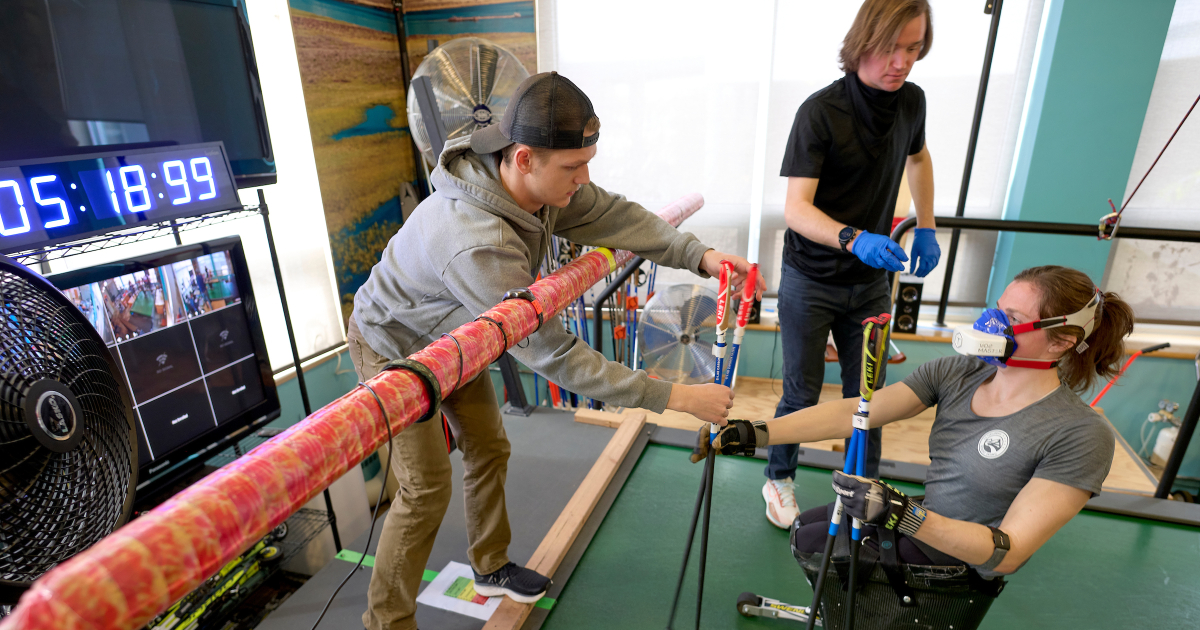
Montana State biomechanics students provide testing for para Nordic athletes. (Photo: Montana State University)
The long game
If that all sounds relentlessly optimized, it is worth returning to the sharks and minnows, because the fun is not a break from the method. It is the method. His college team plays ultimate on skis, using a ball instead of a frisbee to remove the throwing barrier, usually after a track workout, and they lobby to play more. For the youngest kids, he has long argued that the travel race is not really about the race. A ten-year-old drives across the state to ski a 1k, and the actual point is the hotel pool, the snowbanks, the hide-and-seek, the exhaustion on day two that horrifies the parents. “This is why kids get into ski racing,” he said. “It’s not the ski race. It’s hanging out with your friends in the hotel room.” Those bonds are what turn a ten-year-old into a fifteen-year-old who wants to go do a long mountain run with the same crew, and a fifteen-year-old who stays in the sport into an adult who never leaves it.
Which is finally how St. Pierre defines success, and it is not a medal count. He worries a little about the sport’s fixation on the Nations Cup, because doing well in it requires a lot of athletes racing a full season well, and he is not sure the American pipeline has that base yet. He points to Jessie Diggins as the rare skier who reached the level where she could show up week in and week out and land in the top five every time. Whether that season-long consistency cost her an Olympic medal or two is, he admits, a whole separate and unanswerable question. Finding metrics for development beyond international results is genuinely hard, which is part of why he has soft-started a PhD. The idea is to pull two decades of national points lists and track individual athletes year over year. Are American skiers actually getting better as they age, or do they wash out? The kid who was brilliant at 18 and gone by 22 is memorable, he notes, but memorable is not the same as typical. “Is that the rule or the exception? I think that’s the exception,” he said. “I’d like to have some data to back up my opinion.” The numbers are public. He just needs the time.
His personal definition is quieter. He wants his athletes to develop far enough that the door to international racing is open if they want to walk through it, and he wants the ones who don’t to keep loving skiing anyway, as coaches, as parents raising their own little skiers, or simply as people who stay active and outdoors for the rest of their lives. He tries to live it as a father, chasing his own two kids up mountains in the summer and out onto snow in the winter. “There’s so much outside of skiing,” he said, “that makes skiing great.”
Help Support Our Coverage!
If you value the thoughtful work and access FasterSkier provides, please consider becoming a Voluntary Subscriber. Your support directly fuels our work to cover the people, places, and moments that make our sport special.
Two older girls on the Edward Little ski team went looking for bodies. It was the mid-1980s, the boys’ Nordic program at the Auburn, Maine, high school was thin and not very good, and the girls’ team was strong. The two girls, Becky Flynn (SVSEF) and Sarah Pribram (NWVE), knew a freshman who had skied a little in middle school. They asked him if he wanted in.
Will Sweetser’s second cross-country ski race ever was the Maine High School State Championship, he finished 34th, the best result on the team.
The next winter Edward Little won the state title. Sweetser placed seventh in the state — and fourth on his own squad. “I was the fourth guy running, I was the fourth guy skiing,” he said. The sport was tilting toward skating then, and almost nobody his age had figured out how to skate yet. Technique was a wash. So the results sorted themselves out the only way they could.
“It turned out that engines won,” Sweetser said.
That phrase could serve as an epigraph for everything he has done since, except for one inconvenient fact. His own engine was nothing special, at least by his own standards.
He learned exactly how unspecial his was as a freshman skier at Dartmouth, when the team did VO2 max testing. The results put Sweetser, the slowest man on the roster, “squarely in the bottom half of the women’s team.” He ran the numbers on his own future and did not like the answer. “I was already running almost the times they suggest for my VO2 max,” he said. The writing, he decided, was on the wall.
If the engine couldn’t get bigger, the speed had to come from somewhere else.
“Wax makes things faster. Strength makes things faster. I better learn technique,” Sweetser said. “Maybe I was a genetic predeterminist, and that’s why I started learning all the physiology.”
After graduating from Dartmouth, Sweetser took an assistant coaching position at Bates College in Lewiston, Maine, where he went to the library and more or less stayed there.
At Bates, Sweetser became a fixture in the stacks while living with his grandfather, working into the evening. “I literally was in the library more than the team,” he said. For two years, he averaged four or five interlibrary-loan requests a week. He calls what he built in that period “a self-taught, master’s-level survey course” in exercise physiology. He was also, by his own account, one of the first coaches in the country mailing away for VHS tapes of World Cup races, freeze-framing technique frame by frame because there was no other way to see it.
Will Sweetser (right) has worked with Olympian JC Schoonmaker (left), who now lives in Alaska and races for APU, since Schoonmaker was a young skier.
Three decades later, that reading has produced one of the more idiosyncratic coaching minds in American skiing. Sweetser is now based in Soda Springs, California, high on Donner Pass, after a long stretch running the program at the Maine Winter Sports Center. And the first principle he’ll hand you is almost aggressively unglamorous.
It’s consistency. Just showing up.
Sweetser points to a Norwegian study he came across years ago — his recollection puts it around 2006 to 2008 — that examined the country’s top 14 nationally ranked women, essentially its entire World Cup pipeline. Researchers measured everything: VO2 max, speed broken into 20-second segments, correlation after correlation. The single factor that most cleanly separated the top seven from the next seven, Sweetser says, wasn’t engine size or top speed. It was days lost to illness and injury. The lower group averaged roughly two weeks of missed training a year. The top group averaged two or three days.
“That seems to be the most correlated thing,” he said. Stretch it across a four- or five-year Olympic cycle and the gap stops being trivial.
It sounds obvious. It is also not how a great many junior programs actually behave, which is where Sweetser’s second idea comes in, and that one is stranger.
He builds training around fiber type, and he has a field test for sorting it. He’ll have an athlete — 15 or older — run a 400 meters, rest 20 minutes, then run a 3,000 meter. Then he looks at the ratio. A “normal” distance athlete, he says, holds about 76.5 percent of 400-meter pace over 3k. He can quote the figure to the hundredth. Drop below 68 percent and the athlete is built to sprint; climb above 82 and they’re built to grind. “This is how specific they are,” he said of the research he leans on.
The athletes all come to the same session. What changes is the leash. The sprinter types get a short one, where Sweetser wants the heart-rate alarm to go off the instant it “faintly whispers” the next zone, because those athletes overshoot every interval.
Where the distance types might run eight intervals, the sprinters run five or four. Body position stays the same for everyone. Cadence and power output are already different on their own. What he actually teaches, he says, is tactics — where on the course to spend, and where to wait based on each athletes strengths and weaknesses.
This is also why he keeps reaching for the treadmill. It is measurable and it is controllable, and that combination lets him do something he values more than almost anything: build what he calls “an athlete persona that’s rooted in belief, not hope.”
The clearest proof he offers was from an athlete he met at Bates, Sarah Dominick — the woman who would later become his wife and is now his coaching partner. At Bates, her running coaches kept pushing her mileage up, and every time she got much past 25 miles a week, she broke down. It made sense to Sweetser: she had a sprinter’s makeup, but was being asked to train like a distance runner. She was miserable enough that she sat out her junior year of competition entirely.
When she came back as a senior wanting to race the 3k and 5k, Sweetser says her coach called it a waste of time.
His plan went the other direction. He capped her running at roughly three hours a week and backfilled the volume with cycling and roller skiing. Warm-ups and cool-downs were run on grass, in the opposite direction around the track, to spare the leg that always flared. The key session, twice a week, was deceptively small: two sets of 15-seconds-on, 15-seconds-off at 3k race pace, jogging the corners, six minutes of rest between sets. Start to finish, it took about an hour.
She went from 11:38 to 10:00 for 3,000 meters in a month. She became a Division III All-American and set a school record. The following year, training off skiing and running on a dirt road at altitude, she ran 9:27.
The lesson Sweetser took from it is the one he now spends most of his time trying to give away. “Your best training computer is still between your ears,” he said.
Will Sweetser doing lactate testing during a hill-bounding session two season ago with Quinn Holan.
You can see what that looks like in Quinn Holan, the 18-year-old Sweetser coaches most directly and has worked with since the athlete was 11. These days, Holan, Far West’s standout U20 skier, writes his own training plans and brings Sweetser the questions, not the other way around. Increasingly, when the two disagree, the athlete keeps his own counsel, which is exactly the point. “You can call me his coach,” Sweetser said, “but it’s sort of like Klæbo’s grandpa is his coach.”
It is a strange arc for a man who started with so little to work with. Sweetser was the high school freshman recruited because the team needed a warm body, the college skier in the bottom half of the women’s VO2 results, and the coach who had to teach himself the sport one interlibrary loan slip at a time. Thirty years on, the whole project — the fiber-type tests, the treadmill data, the athlete who outgrows his coach — is really just an effort to spare the next kid the loneliness of that library.
Sweetser never did get the engine he wanted as an athlete, but as a coach, he has built something much more durable.
Next: why Will Sweetser thinks American skiing is fighting over the wrong 30,000 people — and what he’s building on Donner Pass to prove it.
Help Support Our Coverage!
If you value the thoughtful work and access FasterSkier provides, please consider becoming a Voluntary Subscriber. Your support directly fuels our work to cover the people, places, and moments that make our sport special.
Åstrand and his co-authors observed in the early 1960s that muscles tended to use roughly 5/6 of all the oxygen delivered at maximal oxygen uptake, and Björn Ekblom would also pay a lot of interest into the relation between oxygen transport and utilization. (Åstrand et al, 1964)
This is part one of a multi-part series titled “Limiting Factors – A Genesis of Blood Doping”. It comes to FasterSkier from Sammy Izdatyev.
Sammy Izdatyev is the pen name of a Finnish sports enthusiast and unaffiliated amateur historian, who has been interested in endurance sports since the turn of the millennium. He hopes that his pro bono – research can provide more information into the body of literature of earlier underresearched areas of the history of sports.
Limiting Factors – A Genesis of Blood Doping
by Sammy Izdatyev
Even when the following essay is an original work by the author, no rights are reserved and therefore it is a work of public domain and can be quoted, distributed and copied freely. The use of copyright material by the author has been kept at the minimum level in order to illustrate a complex viewpoint or to prove that a certain material referred to actually existed in the first place.
Introduction
What is blood doping? This vague term refers to any illicit method to increase the number of red blood cells containing oxygen-carrying hemoglobin, which is very important in endurance events.
The method of the day in the earlier eras was a simple transfusion of one’s own red blood cells which had been stored from earlier, or otherwise-compatible, blood. Scientific progress has later given methods to directly stimulate bone marrow to produce surplus red blood cells, rendering reinfusions somewhat old-fashioned. The best known of these methods is the synthetic version of the hormone erythropoietin, which directly regulates the production of red blood cells.
While it is debatable how prevalent blood doping is today, it is undeniable that we live in an era when everyone is focused on blood values of athletes.
That includes doping testers trying to catch the cheaters. It includes the public seeking sensational scoops about the past. And it includes athletes themselves who simultaneously fear anemia (an illness resulting from lack of red blood cells) and who want to keep the number of oxygen carriers in their blood as high as possible to gain an edge in endurance competitions.
Former elite-level cyclist Tyler Hamilton recalls in his best-selling memoir The Secret Racea team doctor measuring his hematocrit level in the mid ’90s, when the abuse of the red-blood-cell-boosting hormone erythropoietin was endemic. (Hamilton & Coyle, 2012) Hematocrit is the relative amount of red blood cells in blood, the normal healthy reference values for men and women being 40-54 percent and 36-48 percent, respectively.
“Not too bad — you are 43,” the doctor told him.
Hamilton was “struck” that the doctor didn’t say that “you scored at 43” or “your level is 43.”
“Like I was a stock, and 43 was my price,” he recalled thinking at the moment. “Only later would I find out how accurate this really was.”
The same doctor also told another rider that to be a professional cyclist in Europe, one must “be” 49 percent or maybe 49.5 percent.
A similar-sounding view was expressed by late exercise physiologist Bengt Saltin – a coach and anti-doping specialist – who is at the heart of this story:
“You work with a team that is not manipulating their blood, their hematocrit levels are a normal 42-43 percent, and you know they will not be able to compete in major championships,” he lamented in 2001. “You almost want to say, ‘Don’t even bother going.’ ” (Walsh, 2001)
That isn’t just Saltin’s opinion. Many national teams did “bother” going to the 2001 FIS Nordic World Ski Championships. When blood samples from the endurance events were later analyzed by a group of blood-doping specialists, they didn’t give a good picture of the sport. Instead, they indicated that the faith in elevated hematocrit count was prevalent at the highest levels or more worse – those with the most manipulated values tended navigated disproportionally into the highest echelons.
“Of the medal winners sampled, 50% had highly abnormal hematologic profiles, and 33 percent of those finishing from 4th to 10th place also had highly abnormal values,” the authors observe when reviewing the data. In contrast, of skiers finishing from 41st to 50th place, only 3 percent had highly abnormal hematologic profiles. (Stray-Gundersen et al, 2003)
“The results of this study suggest that blood doping is both prevalent and highly effective in cross-country ski racing,” the authors concluded.
While the modern mindset sees this connection between hemoglobin and endurance performance almost self-evident, the way that even the most brilliant minds looked at the issue was different only some 40 to 50 years ago, when nobody cared that much about blood values and one open question was whether blood donation had a detrimental effect on performance. There were diverging opinions on what, today, seems like an obvious question.
Even though there is a huge body of literature in journal articles, documentaries and books on practically every subject of performance-enhancing methods, very little attention has been paid to the origins of blood doping. Usually, it is discussed as given and “already-known” method. The minuscule amount about its details is usually recycled old information from secondary sources. The picture described is occasionally wrong, often incoherent, and sometimes even contradictory.
Correspondingly, there exists no real consensus on when, where, and even why the method was invented. Though a clear majority see the early 1970s as the watershed time period and the 1968 México Summer Olympics at high altitude catalyzing research in the area, other academic researchers claim that the method saw the light of the day significantly earlier, possibly as early as in the 1940s.
To fill this gap in the literature, in the following essay I will attempt to provide the background story about how and why “blood doping” was invented. My conclusion is that the standard version – that the method originated in Sweden around 1970 as a result of research that had started about half a decade earlier – is largely accurate.
While it is borderline impossible to prove negative, that the method wasn’t known earlier, here I can detail a plausible scenario for this standard version of events, and also raise questions that would challenge the revisionist perspective which puts the timeline significantly earlier.
Thus, I will attempt to try to answer the question, “why did the blood-doping research start in the mid-1960s?”
This is a question which is actually two questions. First, why did a group of primarily Swedish exercise physiologists find it interesting to research how the human body reacted to the increase in the amount of the oxygen-carrying red blood cells? What was their motive and the road that led to this?
The other, equally interesting question is why the research started in the mid-’60s and not earlier or later. Why were both the pre-existing research and trends of the era such that blood doping was suddenly a logical topic to take under scrutiny?
“No man is an island,” says the old proverb expressing the importance of being a part of a community in order to thrive. This holds more so true in the case of blood doping research, whose predecessors had built the foundation of their research little by little, usually with inferior technology but sound logic, intuition, and extrapolation, so that their conclusions that were more often on the track than not.
Still, there were elements that made the blood doping research of the late 1960s in many ways unique. The endeavor wasn’t a straightforward process. There was no lack of setbacks or loss-of-faith moments, as we shall later see.
Parts I and II will provide background information on the blood-doping research project, how the primarily Swedish scientists ended up researching the unusualsubject matter in the first place and what were the future prospects of the research. Parts III and IV focus on the actual blood-doping research process that took place in Sweden and on how the method became ”invented”. Parts V and VI explain how the research was received internationally when blood doping itself emerged as a subject of heated debate worldwide while the scientific community’s interest was lukewarm at best.
While I have attempted to keep the essay chronological and focused primarily on the blood-doping trail, some other research trends, as well as the developments in the sporting field, are also discussed as they relate to ongoing blood-doping research. It should also be emphasized that despite the science behind the topic, this essay is partially based on the subjective recollections of the participating scientists, so this is may not meet the strict academic standards of a scientific journal. The look into what media and the commentators of the era wrote is also mostly to illustrate what kind of discussions took place at all. In some instances, there can be a larger trend behind an isolated article, but unfortunately, occasionally some news items can really have been minority opinions.
To help the author and the readers to navigate this often-confusing material, none other than Dr. Björn Ekblom has provided us with his knowledge and recollections on the subject matter. He is a professor at the Karolinska Institutet and an emeritus professor at the Gymnastik- och Idrottshögskolan (GIH), the institution where almost all the research discussed in this essay was conducted. Even when (or perhaps precisely because of) practically every year produced some finding to be referred to even decades later, his memory is vivid:
“This took place 50 years ago so but still – the times were so intense that I will never forget what happened.” — Dr. Björn Ekblom*
*The remarks and recollections of Dr. BjoÅNrn Ekblom are based on email correspondence and on interviews that took place in 2018. His earlier views and remarks are distinguished from his present views with source references. It can’t be emphasized enough that this essay would not have been possible without his collaboration and interest into the subject matter, and I am very grateful to him for his interest in recollecting items that in some instances took place more than fifty years ago.
PART I: The Quest for Limiting Factor (-1965)
“The Orienteer”
Even though young Björn Ekblom showed interest in both sports and medicine, there was little indication that the Swedes would become a famous sports doctor and exercise physiologist and a coauthor of a total of five published research papers on the topic of blood doping.
His sports interest was orienteering, an endurance sport most popular in northern Europe and not particularly well known outside Europe. It is essentially cross-country running between checkpoints through hilly and rough forests with help of a compass and a map.
Though the sport has its strategic elements because wrong and suboptimal routing can cost both time and energy, the physiological demands are very high and similar to that of other endurance sports. When Swedish exercise physiologists conducted various tests on orienteers in the 1960s, their physiological capabilities were as good as those of the runners.
Unsurprisingly, orienteering has been a good summer competition venue for cross-country skiers, and most elite level orienteers succeed in other endurance sports. Perhaps the most famous is steeplechaser Anders Gärderud, who broke world records and became an Olympic gold medalist in 1976.
Ekblom took the sport quite seriously, training up to ten times a week. He used various training methods of the day, such as interval and sprint training. There were various aspects of the sports that interested him:
I got interested in endurance sports because I knew how performance shifted from time to time. It was so interesting that one week you feel weak and the next week you are in top shape. It was interesting to find the factors that cause that.
Ekblom was even occasionally mentioned in the sports sections of the largest Swedish daily newspapers in the mid-’50s, well before his days of international fame. Even while a member of the Swedish national team from 1959 until 1971, his main professional interest wasn’t sport or exercise physiology. Instead, he wanted to become a surgeon.
All that changed around 1962 during a race. Ekblom was running through a forest and felt a sudden pain in his lower leg. At first, he thought that he had stepped on a branch of a tree or a piece of wood. It turned out to be a venomous snake:
I started to feel very bad and lost consciousness when they treated me, and I was rushed into the hospital. The guy who drove the car asked me what I did normally. I said I was studying to be a medical doctor. Then he said that ‘You should come to our laboratory; you are interested in physical activity.’ I remember that I was dizzy. That guy who drove the car was Bengt Saltin.
Bengt Saltin – then also in his mid-20’s – would become a famous exercise physiologist. The laboratory he mentioned was GCI (Gymnastiska Centralinsitutet), an institute renamed in 1966 to be more commonly known as GIH, Gymnastik- och Idrottshögskolan (the Swedish School of Sport and Health Sciences).
It was a fortuitous meeting for Ekblom. Saltin, who was also an accomplished orienteer, would serve as the president of the International Orienteering Federation some 20 years later. But that was not their most important connection. Saltin would become Ekblom’s close colleague and an occasional co-author. He long maintained a healthy skepticism about the idea of blood doping, while never being an outright skeptic dismissing the findings of his younger colleague.
When Ekblom visited the laboratory a few weeks after his first encounter with Saltin, he also met professor Per-Olof Åstrand, who would become his mentor and regular coauthor. Åstrand had already published multiple research papers which became references for later work, and he would go on to co-author the foundational textbook on exercise physiology that many consider the first on the issue.
Åstrand – known as “Peo” by his friends – published material during eight different decades from the 1940s until his death in 2015. Ekblom had a high opinion about Åstrand, whom he describes as ”the most influential exercise physiologist ever,” and whose mind connected dots of then occasionally fragmentary literature like nobody before him:
He was so friendly and helped me in all instances and considered that I was at the same level as he was. When I first read his [1970] textbook – I even read some pages before it was published – then I understood, that he wrote things in that first edition of the textbook, that was not [yet] really scientifically proven. This guy is fantastic in the way he summarized the current knowledge of physiology.
The specific time period when Ekblom literally by accident ended up studying exercise physiology at the GIH coincided with two trends that would change the direction of his own research career.
The first was the more scientific approach to training that was spreading to the practical level. The unscientific trial-and-error methods of training simply weren’t enough to guarantee success anymore. This trend was most clearly seen in cross-country skiing. Whereas Swedes had won every single cross-country skiing event at the 1948 Winter Olympics with more traditional “natural” training methods, they had a disastrous 1952 Winter Olympics in Oslo, where their only medal from cross-country skiing was bronze in the 4×10 km relay. Afterward, the Swedish Ski Federation approached the GCI and proposed working on a more scientific approach to training. Cooperation between the GCI and elite level cross-country skiers intensified. The chief of the institute at the time was Danish physiologist Erik Hohwü-Christensen, who agreed to the new plan in part because he was eager to have access to truly elite level subjects for tests.
The other trend was what a change in what was actually measured by physiologists and exercise scientists because the emerging field of exercise physiology took a very systematic interest in the concept of maximal oxygen uptake. Looking back, it has been observed that interest in the concept, as well as its limiting factors, had started to intensify exponentially in the 1960s. This was seen both as a practical problem and as an academic venue, as new technology made it possible to measure many functions of the human body more accurately than before.
In this context, the most recognizable name in the blood-doping research left the idea of becoming a surgeon behind and ended up focusing on exercise physiology. Because maximal oxygen uptake is so much at the center of this story, it is a concept that should be given a deeper look into what it actually is and how it relates to human performance.
Maximal oxygen uptake: “The best figure to measure fitness…”
Both the popular and scientific literature on blood doping literature are, have been and probably always will be tied to the concept of maximal oxygen uptake like Siamese twins, for two reasons.
While the ultimate goal of “blood dopers” is to directly influence performance, this mechanism takes place through elevated oxygen flow into the working muscles. When blood doping research took off, almost all blood doping researchers focused on maximal oxygen uptake. Peer-reviewed published time-trial performance research has always been almost nonexistent because it is time-consuming to organize and maximal oxygen uptake is a good proxy for performance: it is relatively easy to measure, and maximal oxygen uptake is very much beyond the influence of any mental factors. It’s a purely physiological measure, unlike competition performance.
Then what actually is maximal oxygen uptake, or VO2max, and what was known about it in the mid-’60s when the blood-doping research started?
Maximal oxygen uptake is the uppermost limit of the aerobic engine at a given moment, the highest amount of oxygen that both can be delivered to the muscles and that muscles can use.
The term and the concept were coined in the early 1920s. Many modern incremental test protocols also stem from this era, as does the idea that the “relative” VO2max – that is to say dividing the VO2max by weight – is a better figure in order to evaluate fitness. Because both oxygen uptake and oxygen demand tend to increase proportionally with body dimensions, just focusing on the absolute figure isn’t so informative: knowing that someone has an “oxygen engine” with the size of 5 litres and another one with 4 litres doesn’t convey that much information if it wasn’t known whether the former was double the size of the latter.
The textbook values for normal non-athletic, non-obese males are in the range of 38-45 ml/kg/min, with recreational athletes usually having higher figures and elite-level endurance athletes having figures in excess of 70 ml/kg/min almost without an exception. The high values of athletes are a combination of high baseline figures, good exercise adaptation, and low body fat, of which particularly the first two factors are heavily influenced by genetics
Very early on it was also speculated that elite-level athletes have higher “oxygen engines” than sedentary individuals or recreational athletes, a theory that was confirmed when Sid Robinson published his findings from the Harvard fatigue laboratory measuring famous runners, among them world record holder Don Lash. The runner had extremely high VO2max of 5.35 L/min, which was later expressed in relative figures as 81.5 ml/kg/min. (Robinson et al, 1937)
The interest on the subject went forward both on the level of fundamentals and on the applied level during the 1950s and ’60s. The first indirect method to estimate the figure was published in 1954 by Åstrand and his colleague Irma Ryhming. The simple and clever method consisted of exercise at different submaximal heart rates with low effort and then estimating what the output would be at maximal heart rate. It was prone to later revision and fine-tuning but is still the basis for similar tests used today.
Whereas the data on elite-level athletes had previously been still scarce, researchers all over the world started to systematically test elite athletes during the decades following the World War II, and these results were also published more systematically.
Åstrand and his colleagues tested a group of Swedish cross-country skiers during the 1955 national championships shortly before a race. From highest to lowest, they got figures of 81.7, 81.3, 80.3, 79.1, and 78.5 ml/kg/min from the tests, and the athletes went on to have corresponding positions in the final results in exactly the same order. (Åstrand, 1955) The highest figure was breathed into the Douglas bag by Sixten Jernberg, who would later become arguably the best cross-country skier in the world by winning total of eight gold medals in the Olympic and World Championship venues.
Only 10 years later in 1965, Saltin and Åstrand reported that Swedish cross-country skier Assar Rönnlund tested the unofficial VO2max “world record” with his 85.1 ml/kg/min. He was also an Olympic gold medalist and one of the best cross-country skiers of the ’60s. And only a few years later, another Swedish cross-country skier, Sven-Åke Lundbäck, a 1972 Olympic champion, broke this world record with his 86-87 figure and even later another barrier by going beyond the magical 90 limit.
“It is suggested that the individual’s aerobic capacity per kilogram body weight per minute will give a good measure of his physical fitness,” Åstrand and Ryhming wrote about the importance of the concept in their 1954 paper about the nomogram to measure VO2max indirectly. (Åstrand & Ryhming, 1954)
In a 1967 research paper, Åstrand and Saltin went even further and wrote that oxygen uptake was “a dominant factor for a good performance in endurance events” and correspondingly, “it is natural that the highest values for maximal oxygen uptake are achieved by cross-country skiers, long distance runners, speed skaters, orienteers and cyclists.” (Saltin & Åstrand, 1967)
While exercise physiologist David Costill from Ball State University in Indiana extensively studied several factors relating to endurance running success, he voiced the same opinion. “Based on physiological research with distance runners, one must conclude that the best single predictor of running success is the maximal oxygen uptake value (ml/kg/min),” he wrote a year later about the subject. (Costill, 1968)
“…with some limitations”
While Saltin and Åstrand considered VO2max important in their paper mentioned above, even they didn’t call it “the” but “a” dominant factor, because everyone was still aware that there were other factors influencing performance.
While there has been exponential interest into the subject of maximal oxygen uptake since the ’60s, it was also well known that the figure wasn’t the be-all-end-all, because a one-to-one correlation between oxygen uptake and performance just wasn’t there in the data.
When collecting data from their own laboratory about elite level athletes for the aforementioned study, Åstrand and Saltin appear to have been somewhat surprised that the highest figures they measured weren’t higher than those from the 1930s, even though running records had been shattered in the intervening thirty years.
The researchers explained the difference by “better running technique, ability to work closer to the maximum, difference in the anaerobic power, and better tracks and equipment nowadays.” (Saltin & Åstrand, 1967)
Ekblom recalls that the researchers “weren’t that much interested” in the basic determinants of endurance known today, such as lactate curves or running efficiency, which were barely known during that decade, if at all. When his colleague Bertil Sjödin researched the subject some ten years later, the reception was not very enthusiastic even then:
He was the guy who started the discussion in Sweden about the lactate threshold and 4 mmol/l running pace, both as a figure of measuring performance and also for training at the lactate threshold, that the distance training should the most efficient at that speed. It was not regarded as serious to start with, but he continued and then suddenly he noticed that performance at long-distance races were related to speed at 4 mmol/l lactate.
When Ekblom was directly asked in 1970 whether bicycle ergometer laboratory Vo2Max figures could be translated into cycling performance, he acknowledged that in some cases superior technique could compensate lowish Vo2Max, but only to a certain point. The instance when this came up was when people were worried whether the game was already lost when it was known that the Belgian cycling superstar Eddy Merckx had a higher oxygen engine than his Swedish competitor Gösta ”Fåglum” Pettersson. (Jacobsson, 1970)
Indeed later decades would show that Olympic marathon gold medals would be won with values in “only” the low-70’s, with super efficient running economies. Contrary to high expectations, the VO2max figure of 97.5 ml/kg/min tested from 18-year-old Norwegian cyclist Oskar Svendsen roughly ten years ago didn’t make him the next champion cyclist who would wipe the floor with his competitors. After having followed the issue very closely for over five decades, Björn Ekblom has also observed this phenomenon somewhat regularly:
The strange thing is that those with the best running economy also have low relative VO2max, so if you could combine the best running economy with the highest VO2max, marathons would be run by one hour and fifty minutes or something [like that], but it is strange that these two figures don’t seem to fit in the same body.
The current marathon world record is slightly over two hours. ”This is a strange physiological finding”, Ekblom adds and thinks that while the issue hasn’t ”really been explained”. His view is that the phenomenon might have its cause at the periphery and mitochondrial level and about oxygen affinity to hemoglobin and the P50-value, a value much interested by physiologist which shows the oxygen tension in which half of the hemoglobin is saturated.
Still, maximal oxygen uptake is an easy point of reference, and later blood-doping research would show that increasing relative VO2max of an individual would increase also athlete’s speed regardless of the base level or about other factors that influenced performance.*
*One under-researched area is the mechanism of how submaximal performance is increased after blood doping — because the performance boost is significant in endurance events that are performed below Vo2Max effort.
Why not infinite oxygen uptake?
As early as 1923 it was noticed by physiologist A.V. Hill and his colleagues that there was an upper limit in maximal oxygen uptake of a subject.
Hill and his co-authors observed that even when he had muscular capacity to produce more power, after certain point “[h]owever much the speed be increased beyond this limit, no further increase in oxygen intake can occur: the heart, lungs, circulation, and the diffusion of oxygen to the active muscle-fibers have attained their maximal activity.” (Mitchell & Saltin, 2003)
This observation stated by Hill raises an interesting question: what actually causes maximal oxygen uptake to be what it is, and what are the factors that limit it?
This seemingly simple question can be understood in at least two ways, both of which deal with the phenomena of plateau, the leveling off and response to exercise.
From one viewpoint, it has always been interesting why some people have a naturally bigger “oxygen engine” than others. What are the limitations of trainability? How much can training really change the size of the engine? This is an interesting question today, and it certainly was already some fifty years ago.
“I am convinced that anyone interested in winning Olympic gold medals must select his or her parents very carefully,” Åstrand stated during one of his lectures in 1967, a point illustrated when physiologist Sidney Robinson (who had tested 2-mile world record holder Don Lash) later tested Lash’s 15-year-old son. The teen had a very huge aerobic engine even though he didn’t participate in athletics.
The other equally interesting perspective and perhaps more relevant for training is to focus on why maximal oxygen uptake is such and such at any given moment. One can think of the human body as a snapshot, focus on the different factors that are affecting oxygen uptake, and consider their relative importance.
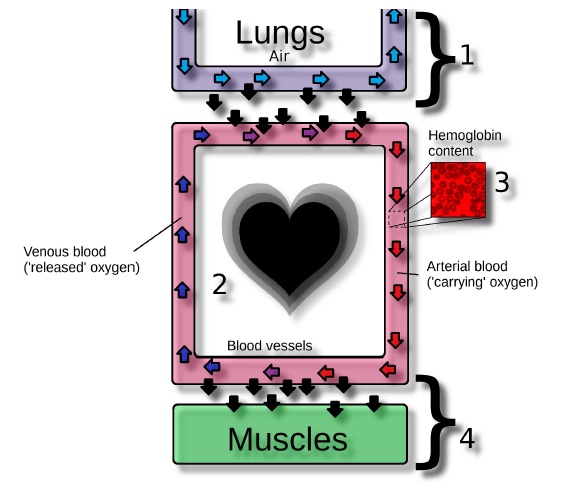
While one could describe the chain of oxygen delivery/utilization in even greater detail, it is easiest to divide schematically into four parts from the moment oxygen enters the lungs to the moment it is consumed by the muscles. While one could describe the links in greater detail, they are most understandably described as 1) lung ventilation/diffusion capacity, 2) maximal cardiac output, 3) the oxygen carrying capacity of blood, and 4) so-called “peripheral factors” accounting forhow much tissues can extract and use the oxygen that actually reaches the tissues.*
*This model is based on the one used by David R. Bassett and Edward T. Howley of the University of Tennessee and in their 2000 essay. (Bassett & Howley, 2000) It is, of course, anachronistic, because when eminent physiologist researched the subject before the late-1960s, oxygen carrying capacity wasn’t considered an independent link.
The first item is linked to the lungs’ capacity to saturate the oxygen-carrying red blood cells that keep constantly flowing through the lungs. Because oxygen is tied to the oxygen-carrying red blood cells, heart function and oxygen carrying capacity are both about oxygen delivery.
The second and third links are related to the circulatory factors of which the interesting is the maximal pumping capacity of the heart, expressed usually as stroke volume and the minute volume, called cardiac output, which is just stroke volume multiplied by heart rate. But just pumping liquid through the body isn’t that interesting, so the oxygen-carrying capacity of blood is also an important link in the chain and the upper limit of the oxygen carrying capacity is set by the concentration of oxygen-carrying red blood cells.
The fourth item is what takes on the periphery, both the release of the oxygen from the hemoglobin molecule and the capacity of muscles to use this offered oxygen. Even when the intuition tells that the maximal power output of muscle isn’t reached in endurance type of activity, there exists an exact component of muscle that consumes the oxygen and these units aren’t infinite in number.
Schematic presentation of the oxygen flow from lungs to the muscles with all the links, lungs (1), heart pumping capacity (2), blood hemoglobin content (3) and peripheral factors (4). According to ”Fick principle”, if one knows the oxygen content of the arterial blood (red arrows), venous blood (blue arrows) and cardiac output ie. how much blood the heart pumps every minute, one can also calculate maximal oxygen uptake by simply multiplying the cardiac output by the difference of the arterial and venous blood.
The first three links are usually called central factors, because they put the emphasis on the capability of the cardiovascular system to deliver oxygen with the heart as the conductor. The fourth item is called peripheral factors, and puts the emphasis on the capability of muscles to extract and use the oxygen.*
*The questions about the importance of the links was far from settled then as it is today. In the essay about the issue from 1992, Bengt Saltin and SoÅNren Strange comment that the subject had been investigated ”for almost a century” and ”it could have been anticipated that a consensus had been reached”, but this wasn’t the case. ”Rather, existing views are presently very far apart”. (Saltin & Strange, 1992)
Almost as soon as these factors were identified, so too started the debate about the relative importance of each link. The quest was and has been to identify which of the links was the so-called “bottleneck,” if there was one, preventing maximal oxygen uptake from being even higher or the link that caused Vo2Max to fell most when its capacity was manipulated down. One way to understand the importance of each of these links and the interplay between them has been to manipulate them in different ways and look at whether the other links compensate for the diminished or increased capability of one link, or whether there is any effect on total oxygen uptake.
There had been some unorganized manipulations of the links even before the early 1960s when Ekblom entered the GIH. Of these, the more thoroughly researched were methods that had subjects inhale mixtures containing more oxygen than regular air and resulted in a marked increase in maximal oxygen uptake. It was equally known that the opposite took place and that exercise capacity was impaired at high altitude where there was less oxygen available.
Even the mechanism was fairly well understood and Hill and his coauthors concluded mainly correctly even before World War II that it was ”necessary, however, to assume that a rich oxygen mixture works primarily by increasing the saturation of the blood with oxygen; there is no other way it may work.”
As one brilliant illustration of deductive reasoning that followed these observations early on, researcher Roger Herbst of the “Sport Hochschule” in Cologne reasoned in 1928 that the increased maximal oxygen uptake when oxygen-enriched air was inhaled also proved that the key limiting factor couldn’t be the peripheral muscle capacity of muscle to use oxygen, because the muscles could clearly use the extra oxygen – otherwise there would be no increase in VO2max.
Lowering blood-hemoglobin concentrations had also been researched and in the context on how blood donation affected performance, but the focus hadn’t been on maximal oxygen uptake, as such was rarely measured, and the results were surprisingly inconclusive from the viewpoint of what we currently know.
While manyresearchers had paid attention to the relative importance of the links, the actual manipulation of those links had been scarce and unsystematic, and the discussion was mostly theoretical and speculative. Åstrand had focused heavily on the maximal oxygen uptake research and explored the matter theoretically in some of his writings as early as the 1950s, but one should remember that at the time when Ekblom began his career at the GIH as a young student in his mid-’20s, exercise physiology textbooks didn’t exist and were not a unified field of “exercise” or “work” physiology. Ekblom recalled that he and Åstrand “discussed these matters from ‘innocence’ of other people’s research.”
Still the field went forward rapidly in the ’50s and ’60s, and a large part of the groundbreakingresearch was conducted at the GIH, the decades that Saltin and his coauthor Sören Strange described several decades later as “the golden age for very elaborate studies on the central hemodynamics during exercise in man”. (Saltin & Strange, 1992)
While the manipulation research had its limits when Ekblom entered the GIH, one of the links that could be manipulated– namely the blood-oxygen carrying capacity – would have a central part in the story how blood doping emerged.
The Blood Doping – Hypothesis For Physiology…
One more functional definition of blood doping in the 1970s was simply transfusion, so what does the almost vampiristic meddling with blood bags has to do with understanding on the links of the oxygen transport chain and the question of whether peripheral or central research factors limit VO2max?
While even up to now surprisingly little has been published about the origins and purpose of this blood-doping research, the simple answer is this: everything.
This is because oxygen carrying capacity of the blood is an interesting link in the chain from lungs to peripheral levels and when the human system was subjected to different tests, this was one in the line. “The background for this commenced in 1962, when I started experiments on the effects of physical training on central circulation and related physiological variables,” Ekblom recalled of the origins of blood reinfusion studies in his short 1982 essay on the subject. “As is well known, total hemoglobin, as well as blood volume, increases with training, and one of the questions that arose from these first experiments was how physical performance, maximal aerobic power, and central hemodynamics would be altered if the oxygen-carrying capacity of the blood is increased or decreased, and if the blood volume is acutely changed”. (Ekblom, 1982)
While even transfusions had been carried out for research purposes, this was a surprisingly new venue of research in the 1960s. ”Regarding the specific effects of increasing blood hemoglobin concentration, there existed no clear-cut trials, that is why such was designed at the GIH”, he also recalled later the origins of the research. (Ekblom, 1972)
As one could’ve expected from the above, in essence the research was conducted in order to understand the relative importance of the oxygen-carrying capacity as a limiting factor for oxygen uptake by manipulating blood hemoglobin content downwards (blood removal) and later upwards and above normal level (blood reinfusion) and to see how it affected the other links in the oxygen delivery chain and whether there was an increase in fall of oxygen uptake and to measure the magnitude of the change.
While lowering hemoglobin concentration was expected to have at least somewhat negative effect on maximal oxygen uptake, the opposite was more of a question mark because hemoglobin concentration hadn’t been manipulated upwards previously. Indeed, there could have been many ways that the increase in oxygen carriers – that is, red blood cells – could have turned out to be futile from maximal oxygen uptake viewpoint, or that it could even have had a negative effect. Thinking back to the links in the oxygen uptake chain, each had uncertainties in the context of such manipulation and there were even three other links involved even in the most simplistic views of the system.
For example, lung capacity isn’t usually considered an important bottleneck at sea level. But while the data collected partly by Ekblom himself during the ’60s would show that red blood cells tended to be well-saturated during sea level exercise among elite athletes, it was also seen in some studies from that decade that some desaturation could take place even among athletes who were clinically healthy people. If a relatively large portion of pre-existing hemoglobin molecules flowing through the lungs couldn’t find an oxygen molecule to attach to, the situation wouldn’t become better if there was even more competition for oxygen in the lungs.
Another open question was whether the heart could keep blood flowing sufficiently, or whether cardiac output would be impaired by the addition of hemoglobin and blood becoming more “viscous”. As we shall later see, there were various logical reasons to think that there could be problems in heart adaptation, and most likely almost all hematologists and cardiologists held the view that adding red blood cells into the ”normal” bloodstream would have no benefit, perhaps to the contrary.
Finally, even if there was an increase in oxygen flow to the muscles, it was always possible that the peripheral limitation theories were in the end sound and regardless of the larger oxygen flow to the muscles, there was no capacity to use this extra oxygen ”offered” but the red blood cells returned to the lungs still the oxygen molecule attached to them.
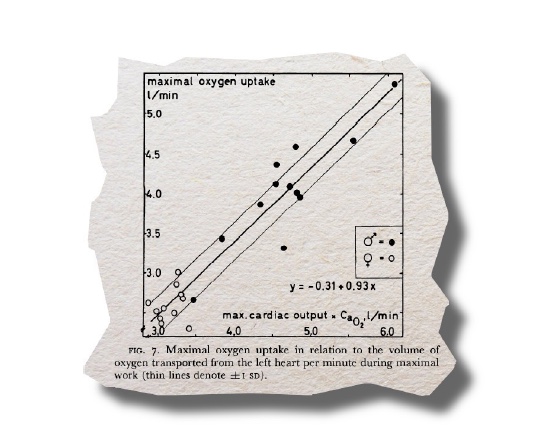
Relating to this, Åstrand and his coauthors published a research paper in 1964 after measuring maximal oxygen uptake and various other variables of 23 participants. When they plotted the data, they noticed and also calculated a very high correlation between the amount of oxygen delivered by the heart (ie. left ventricle) and maximal oxygen uptake, with the amount of oxygen “delivered” calculated simply as the maximal cardiac output times the oxygen content of blood (Q x Ca2). (Åstrand et al, 1964)
While it looked as if Vo2Max could be determined by the amount ”offered”, the blood reinfusion research took place on the margin and it was possible that this correlation didn’t hold when oxygen carrying capacity link was manipulated up.
Åstrand and his co-authors observed in the early 1960s that muscles tended to use roughly 5/6 of all the oxygen delivered at maximal oxygen uptake, and Björn Ekblom would also pay a lot of interest into the relation between oxygen transport and utilization. (Åstrand et al, 1964)
So the research was partly about the adaptation of each link and a subquestion was the importance of oxygen delivery vs. oxygen extraction by the tissues. And it could have been true that the ”central” delivery theory was sound, but that elevated hemoglobin concentration influenced the other central links in a such a manner that there was no extra oxygen offered to the muscles, so that there was no limiting factor at the “end”, but that the negative changes in the other links in the oxygen delivery-chain caused no extra oxygen ever to reach the muscles despite the higher hemoglobin concentration and theoretical oxygen-carrying capacity of blood.
… And Performance
All of the possible outcomes and mechanisms just described relate to maximal oxygen uptake, which was the main focus of the research.
But there was another, related issue, usually addressed indirectly in the research conducted at the GIH: does elevated maximal oxygen uptake increase performance? As seen above, particularly in the ’60s, maximal oxygen was seen having a lot of predictive power when it came to general sports performance, and while this outcome has been occasionally taken as given if VO2max was elevated, the Swedish researchers still paid some extra attention in measuring it.
It was because of this performance aspect, why the method was simply dubbed “blood doping” or “blood boosting” in the media because its practical implications were clearly recognized. In the world of the scientific debates, this blood infusion line of research onmanipulating blood hemoglobin concentration upwards, on the other hand, was described with technical names such as “induced erythrocythemia” or “secondary polycythemia” in the scientific literature.
“What may start as a solid research project may turn into something unethical,” was how Ekblom’s colleague Bengt Saltin described the originally noble background of the research and the not-so-noble outcome some three decades later (Saltin, 1995), and Peo Åstrand also agreed that ”it is possible that scientific research suddenly produces results which create even ethical problems”. (Åstrand, 1973) Ekblom’s recollection is also that in the mid-’60s this was solely an interesting area to do some further research and that there was no discussion about ethics or future developments:
“We didn’t know if there were any effects at all, so we didn’t discuss doping to start with, as far as I remember”, Ekblom recalls the discussion of the mid-1960s. ”It was only when we had the full picture around 1969 or 1970 or so, then the idea about [whether it was] doping came up.”
In the light of this statement, it should be emphasized that elevating and lowering blood hemoglobin concentration wasn’t the only type of research conducted by Ekblom and his GIH colleagues on the chain of the links during the following dozen or so years
“We made experiments to find out the way that body adapts to different situations, lowering oxygen content, increased oxygen content, blood manipulation, atropine, or stimulations of different kinds”, Ekblom emphasizes putting the reinfusion research in the context.
Ekblom’s mentor and coauthor Åstrand later wrote about rationale of the research and on the oxygen transport chain manipulation research emphasizing that “[i]n our efforts to manipulate with this system in order to reveal its adaptability, it was natural to modify the amount of the oxygen carrier, the hemoglobin content of the blood”.All these other similar types of lines of inquiry coincided chronologically with the blood reinfusion research, of which below is only a portion.
There has been a huge amount of research during last few decades about how “volume loading” via saline infusion affects performance and oxygen uptake, but Saltin’s research back in the early ’60s was actually about the opposite case. He measured how fall in plasma volume through dehydration affected maximal oxygen uptake and performance when the blood was thicker but there was less of it, an effect caused by a sojourn in the sauna, where participants lost up to a few kilos of body weight by through sweating in the heat. (Saltin, 1964)
In 1966, Ekblom and coauthors published a research paper on how simulated altitude at 4,000 meters affected performance and while the key outcome of “thinner air“ was already known, they measured and documented the factors causing the fall in performance in greater detail. There was a significant decline in VO2max at this altitude, and the results supported the earlier observation that there was a close correlation between the amount of oxygen delivered by the heart to the muscles and maximal oxygen uptake. (Stenberg et al, 1966)
In the early ’70s there was research on how “blocking” a portion of hemoglobin via carbon monoxide breathing affected exercise capacity because carbon monoxide tied to hemoglobin and prevented oxygen from binding into it, and from the early ’70s is also a paper coauthored by Ekblom on how artificial lowering of maximal heart rate affected performance, an effect that was brought upon by administering two beta-blockaders that interrupted normal functioning of heart. (Ekblom & Huot, 1972; Ekblom et al, 1972b)
And in 1975 Ekblom ended up again tackling the question on how exercise while breathing different mixtures of oxygen-enriched air affected maximal oxygen uptake. (Ekblom et al, 1975)
One interesting and closely related research line focused on how combinations of different muscles and muscle groups affected the VO2max figure because it was known very early on that different testing protocols with different muscle groups gave slightly different figures.
***
To summarize Part I, blood-doping research can be understood only as a part of the larger research trend focusing on the limiting factors of maximal oxygen uptake, as there was never a fully independent blood doping research. In simply following the way oxygen molecules move from the air into the muscles, the hemoglobin concentration of blood was a crucial but surprisingly under-researched aspect of that chain, which was given more attention to.
While the research was unique, the idea of testing how use transfusions affected performance wasn’t a totally novel one, because a few research teams had actual infused blood and measured some performance-related variables. But this unsystematic preceding research had focused on elevating hemoglobin concentration in altitude adaptation context and on how changes in actual blood volume (ie. not hemoglobin concentration) affected heart function and circulation and recovery from anemia. Those lines of research differed from what the was now under investigation, and Ekblom recalled that he and Åstrand weren’t aware of this preceding research at that time anyway.
The findings of this new “Swedish” blood doping research of the 1960s were far from certain with many possible outcomes, into which a more detailed account is given in Part II.*
*P-O AÅãstrand and Kaare Rodahl give a far more complex view of the limiting factor question in their 1970 textbook. “For decades a discussion has been going on concerning the ‘limiting factors’ in maximal oxygen uptake, whether it is the oxygen content of the inspired air, the pulmonary ventilation, the diffusion of oxygen from alveolar space to hemoglobin, the hemoglobin content, the blood volume, the ability of the heart to pump blood, the distribution of blood flow, the ability of muscle tissues to receive the offered blood, the diffusion of capillaries to the working cells, the venous blood return, the efficiency of the mitochondria to transfer aerobic energy to the ATP-ADP machinery, access to fuel, the function of the neuromuscular system, or motivation.” (AÅãstrand & Rodahl, 1970) You have come to the allslotsonline.casino/en/ site. Here you can try your luck and try to win the cosmic jackpot!
This is part one of a multi-part series titled “Limiting Factors – A Genesis of Blood Doping”.
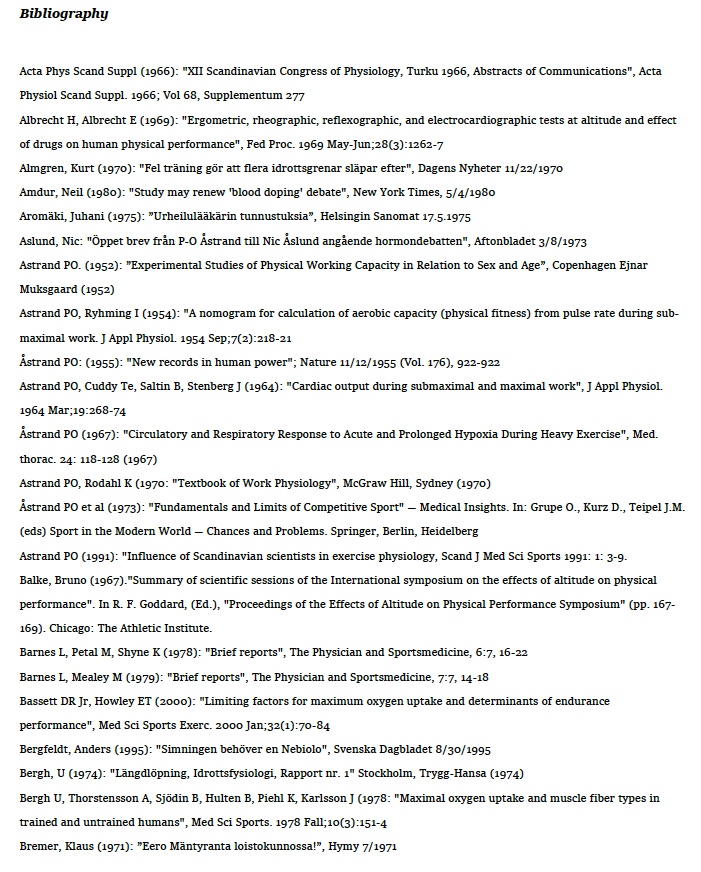
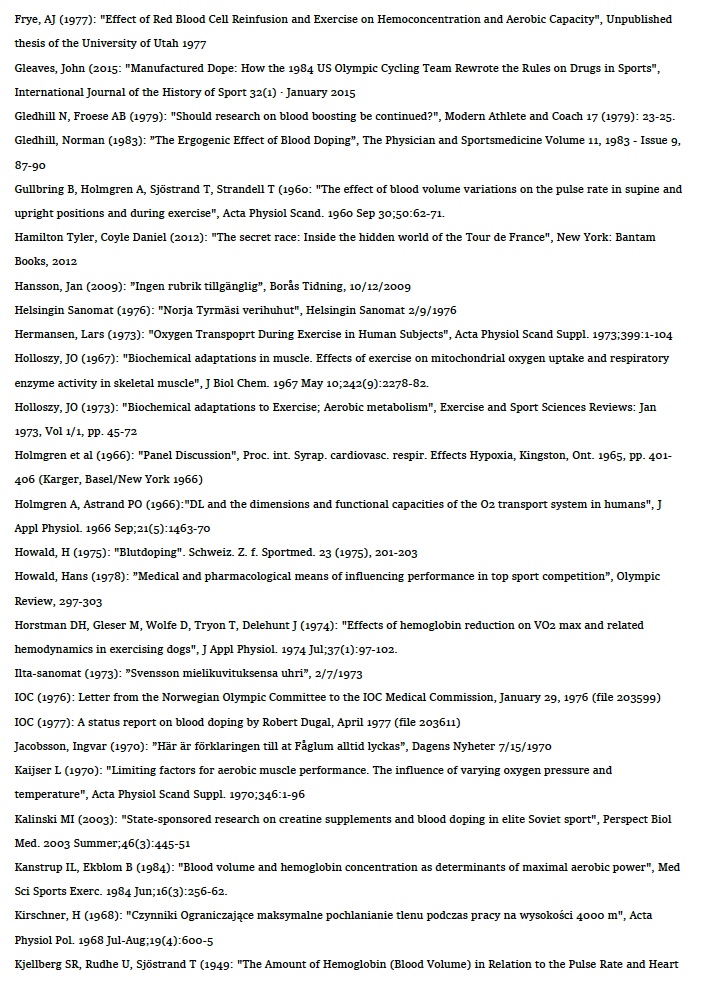
(The bibliography listed below presents the full list of resources used in gathering information for the series.)
Matt Liebsch (Gear West/Salomon) skiing on Haig glacier near Canmore, Alberta, this past July. (Courtesy photo)
Nicknamed “The Dirty Thirty” by Drew Holbrook, FasterSkier’s featured Wednesday Workout for this week comes from Gear West/Salomon athlete Matt Liebsch, offering an end of summer/fall workout sure to boost speed and pain-cave stamina.
***
Dark, damp and delusory — the so-called pain cave is a place perhaps all too familiar with nordic-ski racers. But, at least according to Gear West and Salomon athlete Matt Liebsch, there is a place and time (30-second intervals to be exact) to test pushing past race pace.
“It hurts but one of my favorite workouts is nicknamed ‘The dirty thirty’ … Drew Holbrook came up with that name after his first attempt to complete the workout,” Liebsch, 33, wrote in an email.
The “Dirty Thirty” also known as 30/30s, is a Level 4/Level 5 rollerski workout, aimed at training above race-pace speed, but doing so within a short interval. By mixing the speed work with VO2max work, the end result is, as Liebsch indicated, a high-intensity interval training (HIIT) workout.
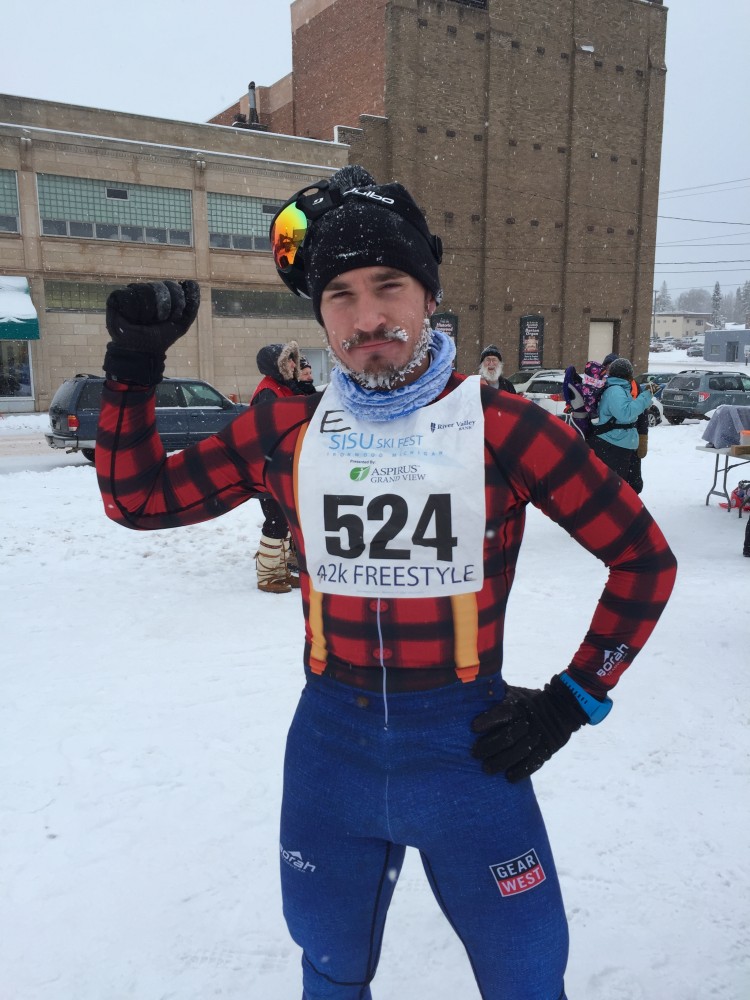
Matt Liebsch (Gear West/Salomon) at the finish of the SISU Ski Fest marathon in Ironwood, Mich. (Courtesy photo)
“This workout seems important when an athlete is bumping up against their ‘ceiling’; Lv3 speed is getting close to V02max speed,” Liebsch explained. “When you do a lot of distance and Lv3 work in the summer, threshold speed and V02max speed seem to get closer to each other… this workout will raise the speed ceiling at V02max allowing more room for growth in Lv3 speed. There is also a very important neuromuscular component to this workout… training the brain to fire muscles quickly is important.”
He recommends doing this workout two to three times a year, usually twice in the summer and once in the fall. Flat or gently rolling terrain is best, as anything too steep makes it difficult to reach max speeds during “on” time.
“It is a very taxing workout and usually the recovery period is 48-72hrs before you feel better,” Liebsch wrote. “I won’t complete this workout if I am feeling on the cusp of illness or if I am having [heart rate] suppression or general fatigue. The post workout recovery is important… just distance training for 3-4 days post session.”
Though Liebsch is not one to turn down a challenge, maintaining that “I love going fast and I love the ‘pain cave’, ” he also suggests that athletes be conscious of what their bodies are telling them prior to and during the Dirty Thirty workout.
“Going hard is fun and can make you faster but there needs to be a balance,” he wrote. “I see way too many masters and juniors going too fast in Lv1/Lv2 and not fast enough in their intensity sessions. The nice thing about the ‘dirty 30’ is once you complete the workout, you won’t feel like skiing too fast in your Lv1 training over the next few days.”
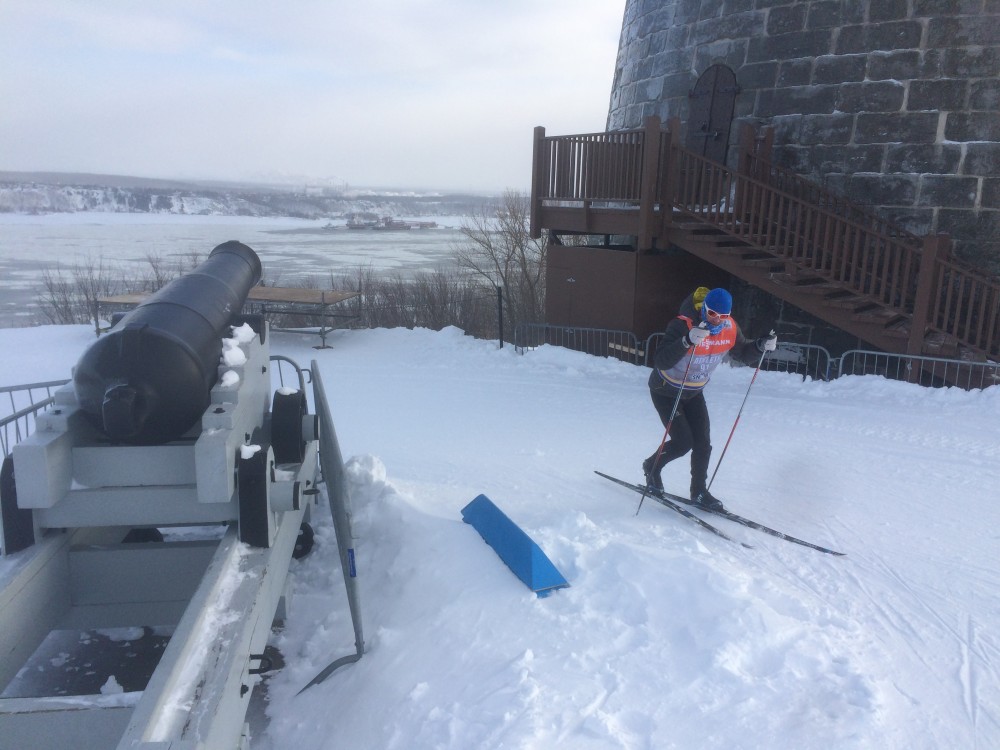
Matt Liebsch (Gear West/Salomon) on a training day at the 2016 Ski Tour Canada in Quebec City, Quebec. (Courtesy photo)
The Workout: Dirty 30 (or 30/30s)
Purpose: Train speed above race pace, while simultaneously taxing body for a short time period
Warmup: 15-20 minutes easy skiing with 5 x 10-second light speeds throughout
Liebsch says the point of the speeds during warmup are to “activate higher level energy systems.”
The set: 30 seconds of “on” time followed by 30 seconds of “off” time
Liebsch suggests 30 minutes of 30/30s for juniors and masters and 60 minutes of 30/30s for senior skiers
Cool down: 20 min: 10 minutes easy skiing followed by 5 minutes of 55 seconds “off” and 5 seconds “on” followed by and another easy 5 minutes
Body exertion, not exhaustion. “Caution!” Liebsch wrote. “Playing with fire can make you hot but it can burn you too. I have been on both sides of the fence with HIIT/Tabata and over-training as an athlete. There is a time and place for extremely taxing workload. Listen to your body, confer with a coach and be smart.”
It’s a matter of mind AND matter. “As a rule of thumb, the first 6-8 minutes of this workout feel pretty good/easy, after that it starts to hurt,” he wrote. “Between 20-40mins the workout will feel unbearable at times… this is where mental fortitude comes into play. When I am ‘not feeling it’ I will cut the workout short, usually stopping around 45 min. If I am feeling good, I can continue up to the 1hr mark. The important thing is to stop this workout when the speed you are able to produce drops or when your technique falls apart. ”
Check out other adventures Liebsch has had this summer in the video below:
U.S. Nordic Combined’s Bryan Fletcher tucks around a high-speed corner at Soldier Hollow en route to a repeat national title at the U.S. Nordic Combined Championships in Midway, Utah. (Photo: USSA/Tom Kelly)
For this week’s workout, we sought the expertise of the reigning national champion, Bryan Fletcher, who won his second-straight title at U.S. Nordic Combined Championships last weekend in Park City, Utah.
The older of two brothers on the U.S. Nordic Combined Team, Fletcher led the championships jump on the large hill and held off his hard-charging teammate, Adam Loomis, in the 10-kilometer rollerski race for the win. Fletcher, 29, edged the 23-year-old Loomis by 5 seconds after starting 26 seconds ahead of him and beat his brother Taylor by 47 seconds after starting 1:04 before him. Loomis placed second and Taylor was third.
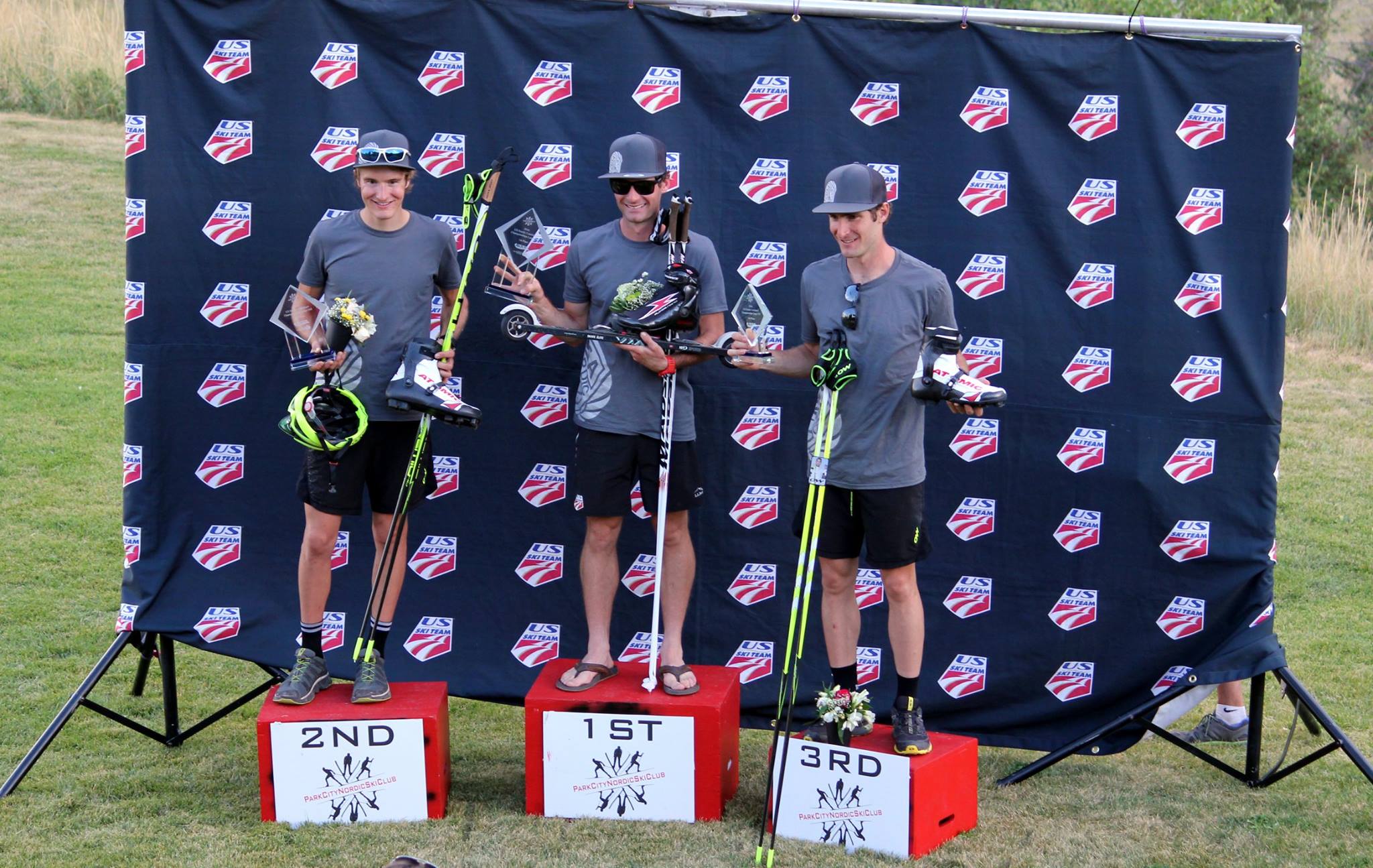
The podium at the 2015 U.S. Nordic Combined Championships, which were held in Park City and Midway, Utah: with winner Bryan Fletcher (c), second-place finisher Adam Loomis (l) and Taylor Fletcher in third. (Photo: USSA/Tom Kelly) Complete gallery
“Nationals last week was awesome,” Fletcher wrote in an email. “The comps were intense because the level was high and everyone had a shot at the podium. I was super stoked to feel the pressure the team put on me the whole time, there was no easy victory to be had.”
Loomis had a “career day,” he added and noted that Taylor’s jumping had improved as well.
“That made me nervous too because in most of our summer time trials he has beaten me by almost 2 minutes,” Bryan wrote. “I knew I need a good race to stand a chance.”
Heading into the 10 k rollerski at Soldier Hollow, Bryan focused on pacing — starting conservatively and skiing methodically and controlled throughout the race.
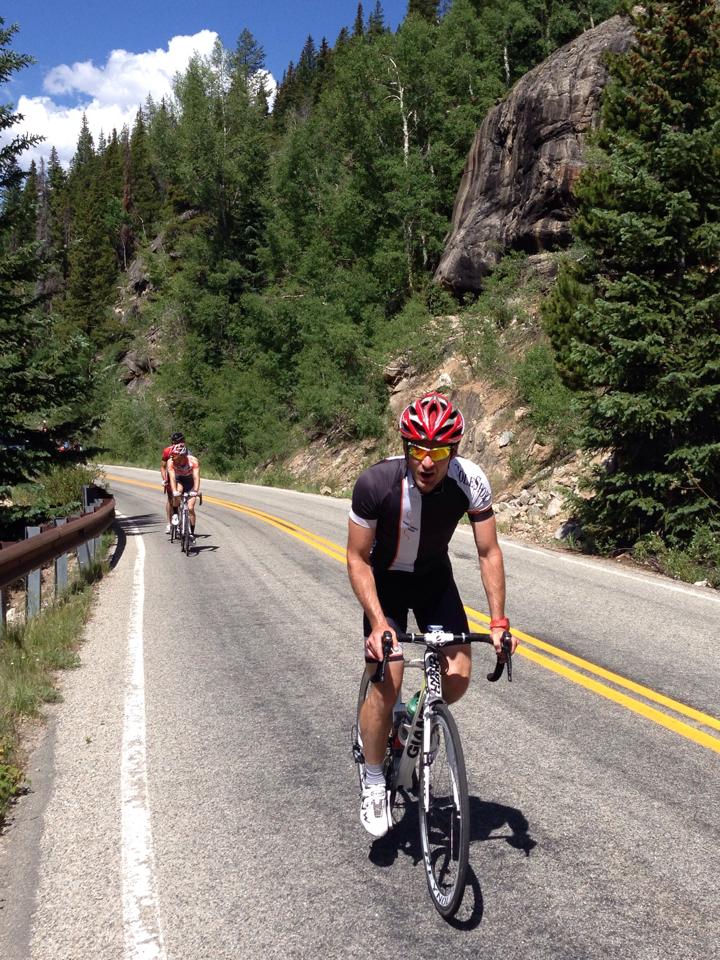
Bryan Fletcher (front) riding up Independence Pass in the Rocky Mountains last year during a cycling camp in central Colorado. (Courtesy photo)
“I needed to have some in the tank for the sprint but the goal was not to let it come down to that,” he wrote. “Luckily the plan worked and I executed it to the best of my ability and came away with the victory. This was a huge relief for me after a long week of school finals, moving to a new apartment, and of course training for the competition.”
In terms of how much a national title means to him, albeit on dry land, he explained he weighed the championships heavily.
“It’s a result a lot of people love hearing about, it adds validity to your resume as a career athlete to be a national champion,” he wrote. “I definitely put some pressure on myself to come away with the win and I am happy I was able to come through on that.”
For a workout he’d recommend, Fletcher picked out one increasingly used by road bikers, and one he assigns some of the athletes he coaches through the Hunter Allen Peaks Coaching Group.
“The cycling world cites the benefit is that it works on both your VO2 max zone and Threshold zone. Or Level 3/4 zone depending on what system you use,” he wrote. “This workout should be done once a month, probably in combination with normal threshold/threshold-plus work.”
The workout is designed for cyclists, but can be done skiing or running, too. “Just adjust the tempo to the corresponding exertion level,” Fletcher explained.
Warm Up: Start with a 20- 30 minute warm up. Include a few pick ups to no longer then a minute and space them out throughout the warm up.
Workout:
– Start with 30 seconds at race pace (90% of max heart rate for the XC crowd) (150% of Functional Threshold Power* for you cyclists)
– Then 30 seconds at Level 2 (60% of max heart rate) or (50% of FTP cyclists)
– Keep this alternation of race pace/Level 2 up for 10 minutes.
– Take a 5 minute break and repeat for a total of 3 sets.
So in total you have, 3 x 10 minutes at 30 seconds on, 30 seconds off.
Cool down: 15-30 minutes at level 1-2 and don’t forget to do your dynamic stretching after!
*FTP or Functional Threshold Power: a term used by many cyclist and cycling coaches. I learned it through Peaks Coaching Group and it simply is the power you can sustain during a 1 hour max TT. This is a cyclist’s true threshold. Many people try to derive this average by only doing a 20 min power test and extrapolating it out to a threshold but often a cyclist has to take 5% of a 20 min test to get a true FTP.
USST coaches administering lactate tests during a sprint workout in Lake Placid, N.Y., in September 2011. At the team’s recent training camp in Park City, Utah, athletes underwent physiological testing in a more controlled environment in the lab at the Center of Excellence.
The U.S. Ski Team’s cross-country athletes finished their final round of pre-season testing last week in Park City, Utah. Athlete blogs currently abound with documentation of skiers pushing themselves to the point of falling off the treadmill in order to collect data on how much they’ve each progressed since their last test. The importance an athlete attaches to his or her test results varies by individual, but in the lab and in training they can help measure fitness and individual year-to-year progress.
For an endurance sport in which performances are measured against a clock, nordic skiing gives its participants relatively few opportunities to measure absolute progress. You can run a personal record on the track know that you’ve never had a better race in your life, but on skis the only improvement marker athletes have to go by is whether they beat people they’ve never beaten before. Skiers of all ages frequently express frustration with the fact that the most concrete feedback available as to whether their training is working depends both on how they ski but also on how everyone else skis on any given day.
Perhaps this is why nordic enthusiasts are so fascinated with physiological testing data of others. Even though they are no substitute for actual results, people still keep track of things like VO2 max records. There’s a reason they don’t hand out medals for setting one, however. Test results say as much about your next race as Peyton Manning’s season passing yards says about whether the Broncos will win on Sunday. They indicate part of how good an athlete you are, but can’t predict the outcome of an actual contest.
This fact, combined with the finicky nature of collecting accurate data in the lab, causes some athletes to place more importance on test results than others. Andy Newell, for example, just completed some of the best treadmill tests of his career last week. The USST has a policy of not disclosing exact data, but speaking qualitatively the American sprinter said his results were highly encouraging.
“I use this data as a sign that the training year has gone to plan and that I’ve done a good job of absorbing the hard training I’ve done in the last few weeks,” Newell said. “It’s always encouraging to have good tests because it confirms that we are getting fitter and stronger and definitely gets me stoked to get the skis on and start racing.”
In his second testing season with the USST, Erik Bjornsen also turned in improved test results.
“My goal this year was to improve my motor and to improve my skating technique. I feel I accomplished both,” Bjornsen wrote in an email. “My goal for the next couple months is to improve power and strength.”
Others athletes and teams don’t set a great deal of store by test results; Canadian National Ski Team head coach Justin Wadsworth doesn’t have any of his men undergo treadmill testing because he thinks he can gauge progress well enough with intervals and time trials.
“Testing, for me, you really need to garner something out of it and to make it worthwhile,” he said last week. “I think a lot of people test just for the sake of testing and I think for our women, we have been trying some new training methods with them and we do want to see what changes are happening, but with the guys [the training] is pretty stable.”
For different reasons, Noah Hoffman took only hemoglobin mass and body composition tests last week and opted out of treadmill and strength testing in Park City. He, too, doesn’t think the data tells him anything he doesn’t already know, but his current training priorities also lie elsewhere at the moment.
“I have chosen not to test because I have never seen results from a testing session that have helped me become a better skier,” Hoffman wrote in an email. “Testing for me, right now, belongs in the same category as altitude manipulation, diet, stretching, specific psychology work, and strength training. They are all important but they do not come close to representing the bulk of my limitations as a ski racer.”
Those limitations, he says, lie mainly in technique, and that’s where Hoffman has decided to spend his most of his time and energy at the moment.
“Technique and energy add up to minutes in a 15 kilometer race. All of the other factors add up to seconds. I hope to reach a point in my career where every factor combines to mean the difference between gold and silver in the Olympics, but right now I’m focusing on the areas that represent the biggest available gains,” he said.
A few other USST athletes didn’t undergo testing for circumstantial reasons last week, such as illness and injury. For those who did participate in testing at the Center of Excellence, data was collected from five major testing categories:
Body composition and functional movement. This included body fat composition, mobility and flexibility tests. From results, athletes can measure where they are putting muscle mass on and can identify where they might be prone to injury. Body fat tests are helpful to Newell, for one, because “it can be easy to get too thin during some of the hard months of training,” he said. “I try to keep a little bit more body fat during the summer and fall because I think it helps me absorb the training better and helps be build more power. So by using tests like this I can make sure my body is holding up to the training.”
Strengthtesting to measure overall power. The team uses force plates to determine whether athletes are building strength and are able to use it quickly in dynamic movements like squat jumps. “We are measuring very small differences but a lot of these tests are good at making sure we are converting out gym workouts into explosive power that can be used on the snow and especially in sprinting,” Newell said.
Double-pole treadmill test. Athletes measure how long they can hang onto the treadmill and the percentage of their max they can ski at while only double-poling. “If an athlete is only double-poling at 60-70 % of their max it’s a good sign that they need to work on double-poling,” Newell said. “Really good double-polers…can hammer along at a very high heart rate,” at around 90-97 % of their VO2 max. The treadmill is set to a constant speed of about 10 mph for this test, and the grade is increased each minute until the athlete falls of the back. “For me this test takes 14 to 15 minutes so it’s a really hard effort,” Newell said. “I usually get very close to my VO2 max while double-poling and the other day put up a lactic acid reading of 15.4 mmol/L.”
The VO2 max test. There are many ways to do this one (running, cycling or skiing), and the USST measures it with classic striding. While gathering data on aerobic capacity, the USST also collects lactate profile, heart rate and lung capacity data. As in the double-pole test, the treadmill is set to a constant speed while the grade increases every minute.
Total hemoglobin mass. During an altitude training block like the national team just underwent in Park City, athletes take a hemoglobin test at the beginning, middle and end of the camp to track the change in total hemoglobin mass, which will change as the athlete adjusts to the thinner air.
Apart from providing feedback on training progress, the USST staff use the results of their athletes’ hemoglobin mass and VO2 max tests to determine when athletes should start living at altitude prior to major high-elevation races like World Championships (Val di Fiemme is just under 4,000 feet) and the Olympics (Sochi’s cross-country and biathlon complex will be around 5,000 feet).
“If we’re looking to enter a championship with the most powerful blood you can arrive with, we need to know how long it takes an athlete to acclimate appropriately, how high they need to be,” said USST women’s coach Matt Whitcomb.
The national team has several locations in Europe of varying altitudes that it uses for pre-competition acclimation. “As we head into World Championships, we have some athletes who will live in Davos, Switzerland, to get a little bump before heading to [Val di Fiemme]. Others who don’t respond well to living at altitude will spend time lower in Ramsau, Austria, or Predazzo, Italy, beforehand to have a post-Sochi [World Cup] speed camp instead,” Whitcomb said.
Similarly, altitude acclimation data will help inform preparation for the main event, the 2014 Sochi Olympics. Newell has learned that his body has the same response to living at 5,000 feet as it does to living at 7,000 feet, and this information will help determine where he’ll live leading up to the Games.
The Americans finished the Park City segment of their camp this week; athletes are headed to Canmore on Thursday for a final on-snow segment. The ultimate test of fitness is still the time-trial, and the USST has distance and sprint races scheduled for Frozen Thunder next week.
Bjørn Dæhlie, shown here in 2010, no longer owns the highest V02max ever publicly recorded.
A few weeks ago 18-year-old Norwegian cyclist Oskar Svedsen turned heads by doing something no one has done before in the world of physiological testing: he recorded a V02max of 97.5 mL/kg/min. The number surpasses the high water mark long held by Bjørn Dæhlie (96 mL/kg/min), making Svedsen the young new king of aerobic capacity.
Whether it has any significance or not, cross-country skiing can no longer lay claim to the best V02max in existence, a fact that was not lost on the Norwegian press. At least one journalist took the opportunity to wonder if a bigger trend was afoot: are the country’s most naturally gifted athletes feeding into cycling over other athletic pursuits, and if so, does Norway have a new national sport on its hands?
Both are interesting questions, but they make the incorrect implication that V02max test results are the predictors of performance in cycling, skiing or any other endurance activity. Svedsen himself acknowledged that lab numbers aren’t everything. “The figures are not what’s important. I’ve been beaten by many with lower O2 uptake than me throughout the years,” he said to Procycling.no.
Svedsen proved on Monday that he could perform on the road, too, winning the junior time trial at UCI World Championships in Valkenburg, Holland. His unparalleled engine undoubtedly helped him along, but a high max VO2 alone is not a guarantee of performance. To use an example from nordic skiing, Espen Harald Bjerke (NOR) once recorded a 96 max VO2 but never came close to matching Dæhlie’s results. Bjerke’s best World Cup finish was a fourth place in Otepää, Estonia, in 2005; Dæhlie is still considered the best cross-country skier in history.
The discrepancy between Bjerke’s and Dæhlie’s results underlines Svedsen’s dismissal of test results as overly important. Aerobic capacity is only just that — capacity. It demonstrates an athlete’s potential if he or she can get other aspects of the sport to fall into place.
For instance, a 2010 study by a group of Swedish and Norwegian sports scientists sought to determine the relationship between “energy delivery and mechanical efficiency” and performance. To do so it collected a handful of physiological data points from Swedish and Norwegian skiers at the world-class and national-levels as they rollerskied on a treadmill. Not surprisingly, the study found that the world-class group was more efficient overall than the national-level athletes and suggested this was likely due to better technique and power transfer. Aerobic capacity wasn’t the only part of the skiers’ physiology affecting results.
The fact that it took a cyclist to finally depose Dæhlie from his throne is also worth noting. VO2max is calculated with an athlete’s weight, and so if two people record the same value for absolute oxygen consumption, the lighter person is going to have a higher VO2max. An elite skier, with a need for upper body strength, is generally not going to weigh less than a cyclist.
So if anything, Svedsen’s ascension to the top of the charts underscores how impressive it was for Dæhlie to have held onto the position for so long. And in an argument over whose sport can claim the best athletes, Dæhlie still owns the title for most decorated winter Olympian of all time.