From the FasterSkier archive — posts syndicated from athletes’ and coaches’ own blogs between 2004 and 2012, kept online as published. Current coverage is at fasterskier.com.
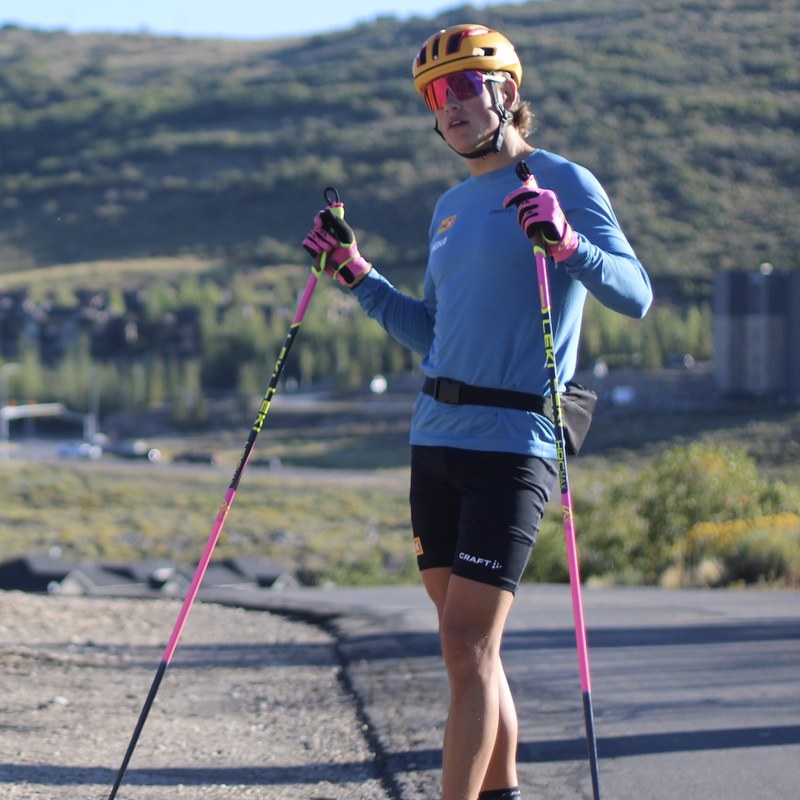
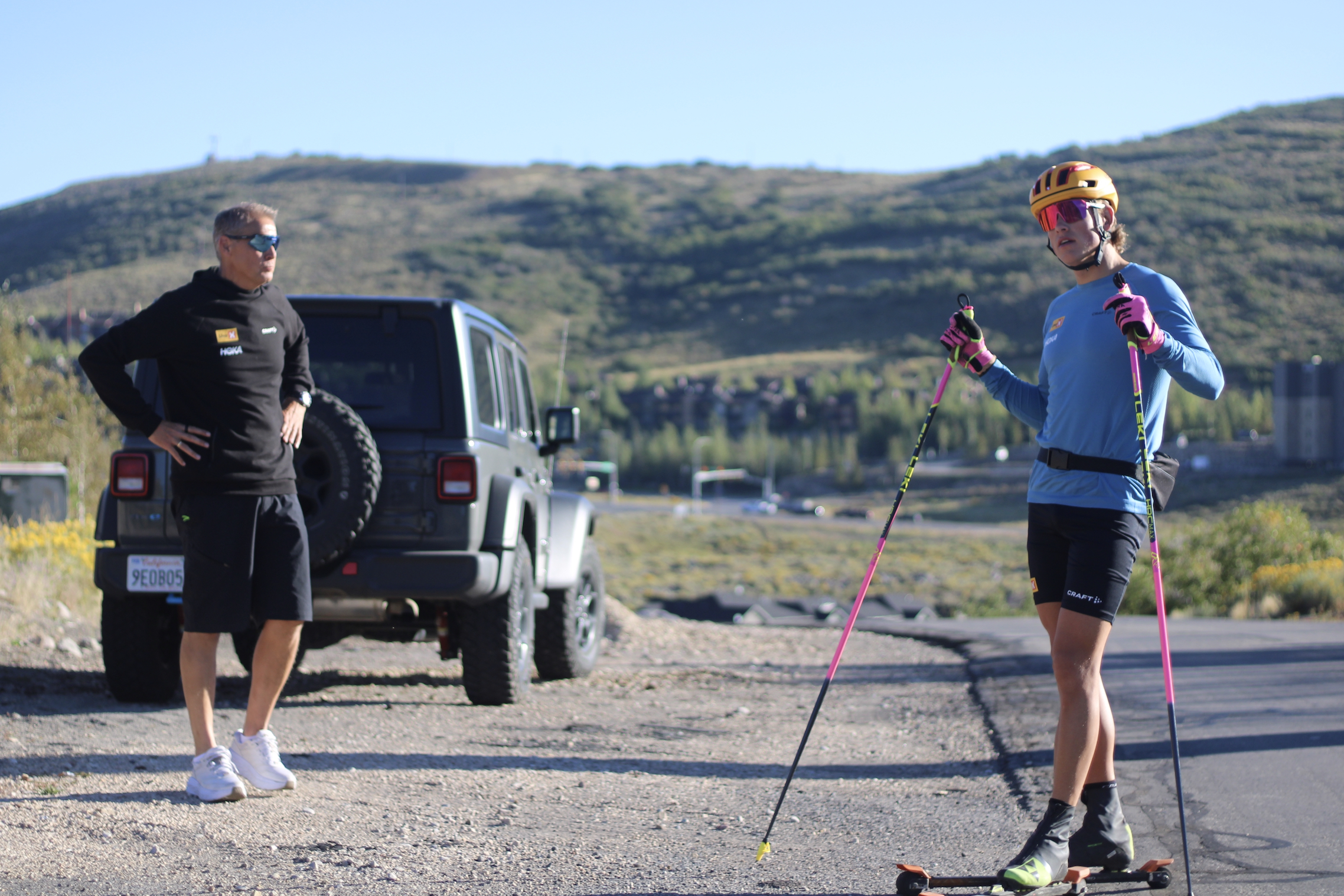
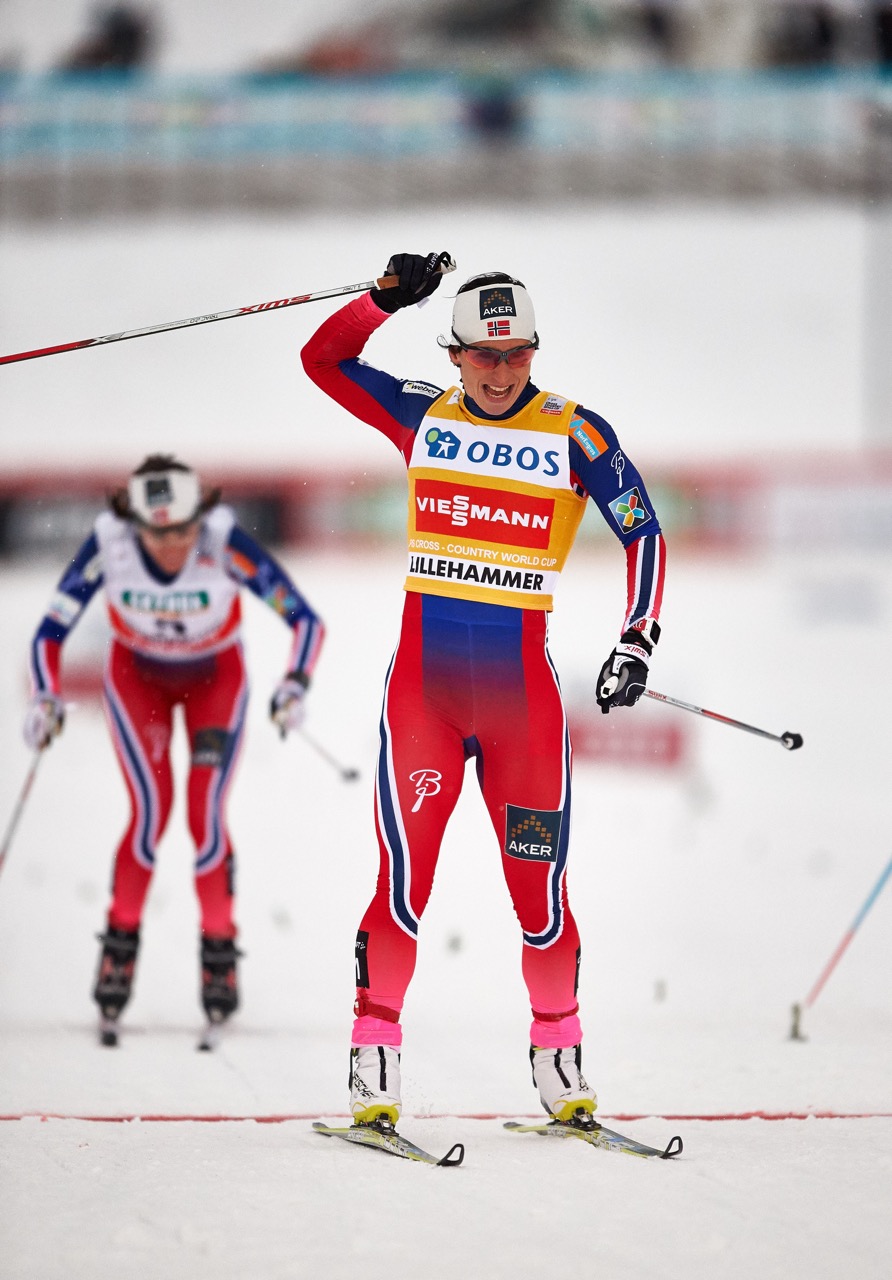
Johannes Høsflot Klæbo and his father, Haakon, during a water break on a rollerski workout in Park City, Utah, in September 2023. (Photo: Nathaniel Herz)
After more than 50 years in endurance sports as an athlete and coach, I recognize many of today’s training debates. We were asking versions of the same questions decades ago: How much training is enough? How hard should it be? When should we increase the load, and when should we allow more recovery? My answers have changed. The biggest change has been how much authority I give the training plan compared with the athlete’s response to it. I still believe in consistent work, appropriate volume, controlled intensity, and patience. But I have become much more willing to change the prescription as I learn how the athlete responds.
I believe it is important for coaches and athletes to build the training process on their own experience. Too many follow current trends, which in the last decade or two have shifted more than they did in the previous 30 years. That deserves recognition and some thought. Modifying what an athlete has done successfully over a few years is a fine and reasonable way to go. Wholesale changes create unknowns that make it impossible to assess what has worked.
What we know to be true, and what experience has demonstrated, should remain the foundation of how athletes train. Consistency is key, training at an appropriate volume load is critical, good control of training intensity should be a primary focus, and being patient and allowing the athlete time and room to adapt is most important.
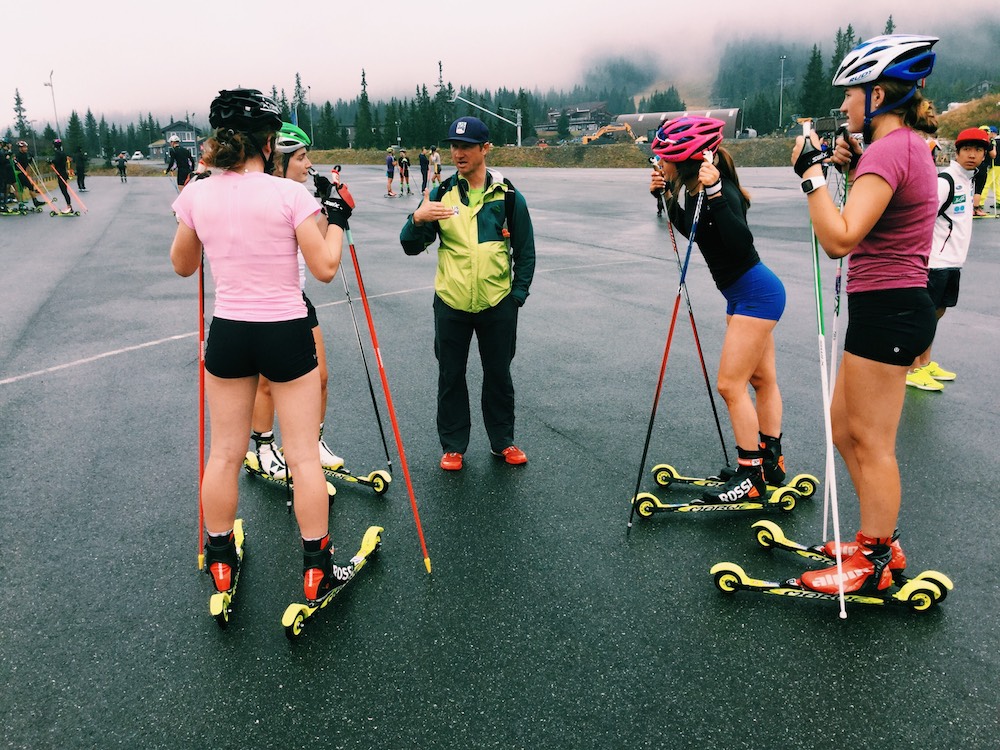
Coach Bryan Fish, in the yellow jacket, works with American athletes at the International Junior Camp in Sjusjøen, Norway, in 2018. How an athlete arrives on a given day can matter more than what the plan says. (Photo: Maria Stuber)
Twenty Years of HRV
Perhaps the most important change I have considered and implemented for anyone I coach is not being a slave to the training plan. I was one of the early adopters of heart rate variability (HRV), some 20 years ago. HRV is a tool I find most valuable in guiding training and in giving athletes the time and space to recover and adapt to it. Of course, following experience and science, I have modified how I analyze HRV over two decades, but the core value is still there. In my experience, HRV helps us refine training so we can give athletes what they need on a given day or week.
Maybe in another decade something better will come along to help with this assessment, and we should be open to that. But we should not throw out something that has demonstrable value.
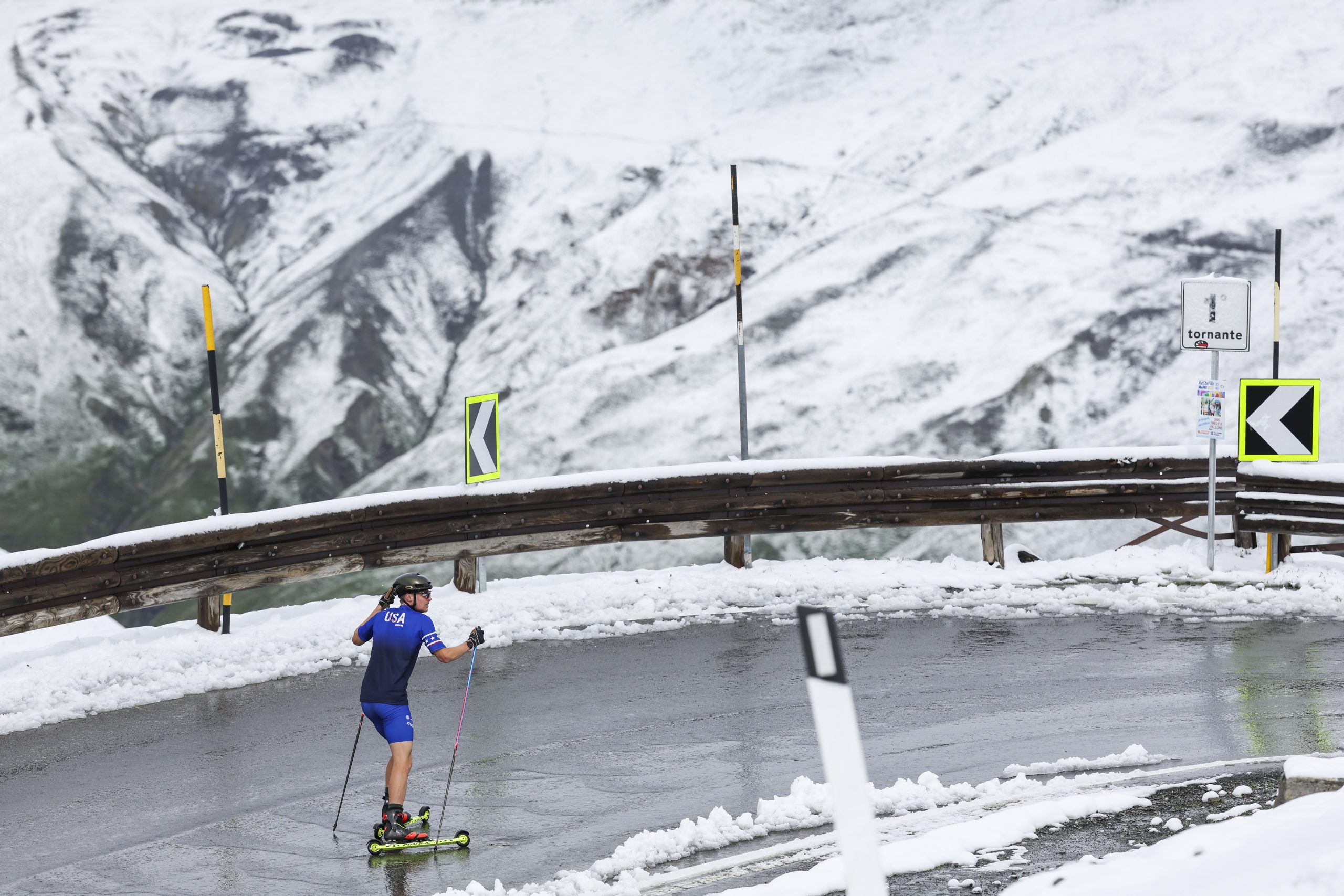
U.S. biathlete Campbell Wright climbs the Stelvio Pass during a summer training block based in Livigno, Italy, in July 2025, with fresh snow along the road. (Photo: NordicFocus)
A Flatter Ramp
Another big change I have made over the past 10 to 15 years is to the periodized training models we follow. When I was competing, we started the year in May at, say, 50 hours, and we progressively built that load month over month to 100 to 120 hours in November. During the later years of my career and into my early coaching years, I remember talking with coaches, physiologists and other athletes about this process. I simply did not see how 50 hours created adaptation that allowed for 60 hours, and how that training load allowed for 70 hours, and so on. It just did not make sense to me. Of course, it took some years to break out of that cultural mode and truly shift how we plan and implement training.
Now I fully believe in a far less aggressive ramp rate: starting the year at higher volume and staying consistent week to week and month to month. Over the course of the year, we can actually do more training with less shock and stress to the system, and with more consistent development. The theory that we need to increase the load week to week and month to month to add stress so we can adapt is, frankly, BS as I see it now. Training compounds week to week, month to month and year to year with consistency.
Simply put, under any model we should strive for consistent implementation, and we should not increase the load until, and only until, we have plateaued and fully adapted to the current load. Being consistent at the correct loads will let us do more training over a year, or over multiple years, than striving for a month-over-month increase.
It is easy to admire a big week or block of training and be impressed. But one big week or block tells us little more than what the athlete did. It does not tell us whether that training was sustainable, consistent, or actually created beneficial adaptation. The athlete who trains consistently day after day, week after week, month over month and year over year receives far less attention, but is the one building a sustainable base of fitness and performance.
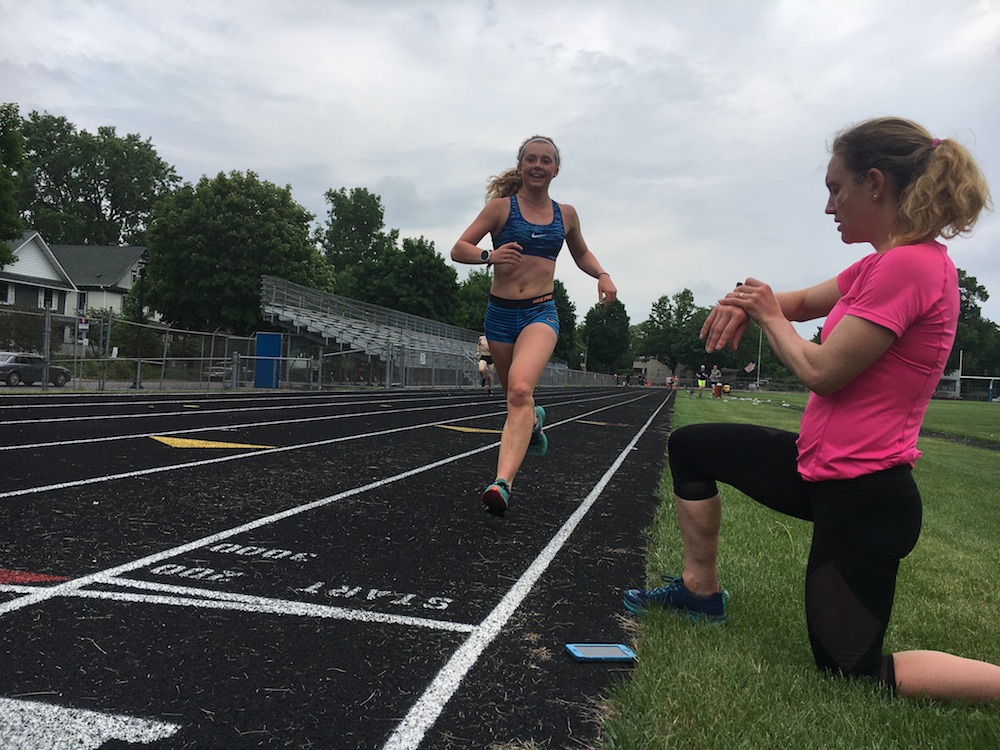
Coach Caitlin Gregg times Loppet Nordic Racing junior Sarah Olsen during a track time trial in the spring of 2018. (Courtesy photo)
The Questions I Ask
So both how I assess training load and recovery with HRV, and how I plan training around consistent loads, have completely changed how I evaluate training decisions. Sometimes the right decision is to add more training load. Often it is not. Other times it is to repeat a sustainable load so the athlete can stay consistent and adapt to it.
I always ask the question: If we do workout X today, or load X this week, how will it affect the athlete next week or next month? We also need to ask what we are trying to improve, what dose we need to improve it, and how we will know if it improved.
Ian Torchia leads L3 intervals with the Stratton Mountain School team in June 2018, with U.S. Ski Team head coach, Matt Whitcomb, following on a bike. (Photo: Pat O’Brien)
Old Becomes New Again
Then we must address the recent trends, and perhaps not so recent, in high-intensity training. In the mid-to-late ’80s and into the ’90s, high doses of threshold training were the “thing.” Then, in the late ’90s and early 2000s, VO2max blocks became the next “thing,” and after that it was back to VO2max workouts in a somewhat more controlled fashion. Now, over the last five or so years, based on the training of a speed skater and some Norwegian triathletes, we are back to so-called threshold and subthreshold training.
In essence, all things old become new again. What is missing from the trends is not the actual training; for some athletes it may well be the correct pathway. What is missing is an assessment of what limits the athlete’s performance. Without judging the merits of either high-intensity methodology, some athletes may need more focus on VO2max work, and others may well benefit from threshold-type workouts. In the simplest terms, an athlete with a very high fractional utilization may benefit more from a higher volume of threshold work, while those who do not have a well-developed aerobic capacity may benefit more from VO2max-type work. For elite athletes with a very high fractional utilization, threshold-type training probably also creates a signal to improve VO2max, or the speed at VO2max, because the intensity is relatively in the same zone.
Regardless of the type of high-intensity training an athlete is doing, we should be most focused on assessing and measuring how efficiently they are moving, their speed, and their durability to sustain that speed. Because no matter what the training methodology is, if you are not consistently improving performance, the training is not working.
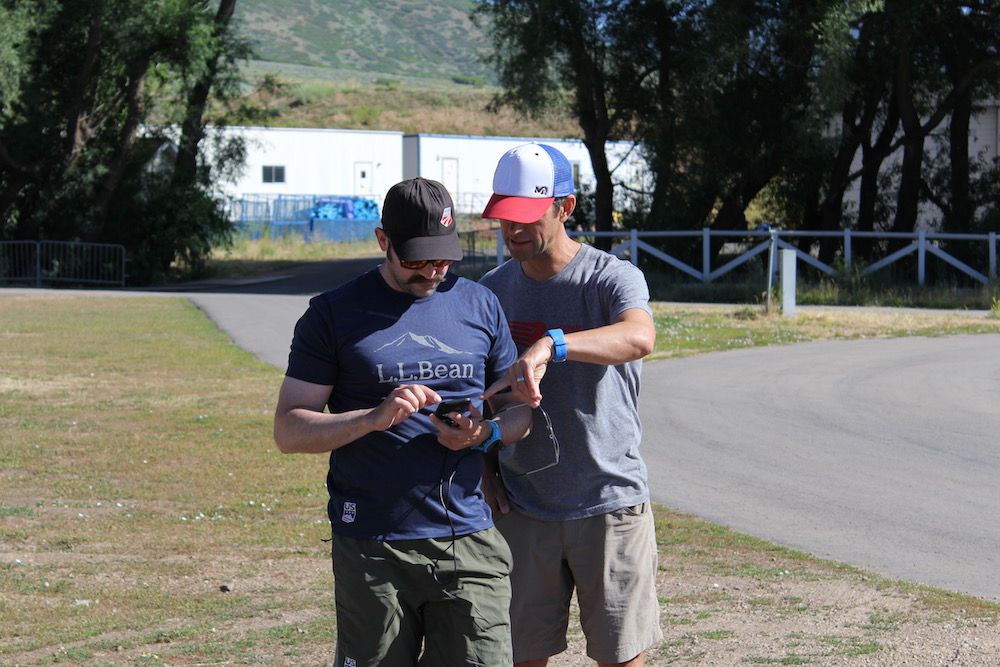
U.S. Ski Team coaches Jason Cork and Chris Grover go over the details for a distance time trial at Soldier Hollow in Midway, Utah, in 2017. (Photo: Pat O’Brien)
The Plan Is a Snapshot
The most basic element, and the one most coaches spend hours and hours on, is the training plan. We plan periodized models of increasing training volume, and when and how to implement high-intensity training. We plan when to do races or time trials, when to focus on speed training, and how to fit in strength training and other aspects of performance. Yeah, that is all well and good, but it is mostly an exercise in futility. In my opinion, the training plan was valuable on the day it was written, based on where the athlete was at that snapshot in time. Once a plan is in place, there is a temptation, if not a certainty, that the athlete will do everything in their control to carry it out regardless of how they are feeling or what they need right now.
I did this for years. I spent hours developing an individual plan and expected the athlete to carry it out as some kind of infallible document. That is not how the body works. Nowadays I still write year plans, but with far less detail on hours and specifics, and more explanation of what we want to accomplish in each period rather than details of volume and periodization. I want the plan to create an environment with flexibility, where we use the data, and how the athletes are feeling and adapting, to adjust the day-to-day training.
After more than 50 years, I still believe in the value of consistent training, appropriate volume, controlled intensity, and patience. What has changed is how I decide what an athlete needs and how willing I am to revise that decision.
I once spent more time asking whether the athlete had completed the plan. Today, I spend more time asking whether the training is producing the response we intended, whether the athlete is absorbing it, and what that tells us about the next step.
I expect some of my thinking will continue to change. Experience gives me a foundation, but it also gives me reasons to keep asking questions. The responsibility I have as a coach is to pay attention, assess honestly, and act on what I learn, even when that means changing a plan I believed in when I wrote it.
Help Support Our Coverage!
If you value the thoughtful work and access FasterSkier provides, please consider becoming a Voluntary Subscriber. Your support directly fuels our work to cover the people, places, and moments that make our sport special.
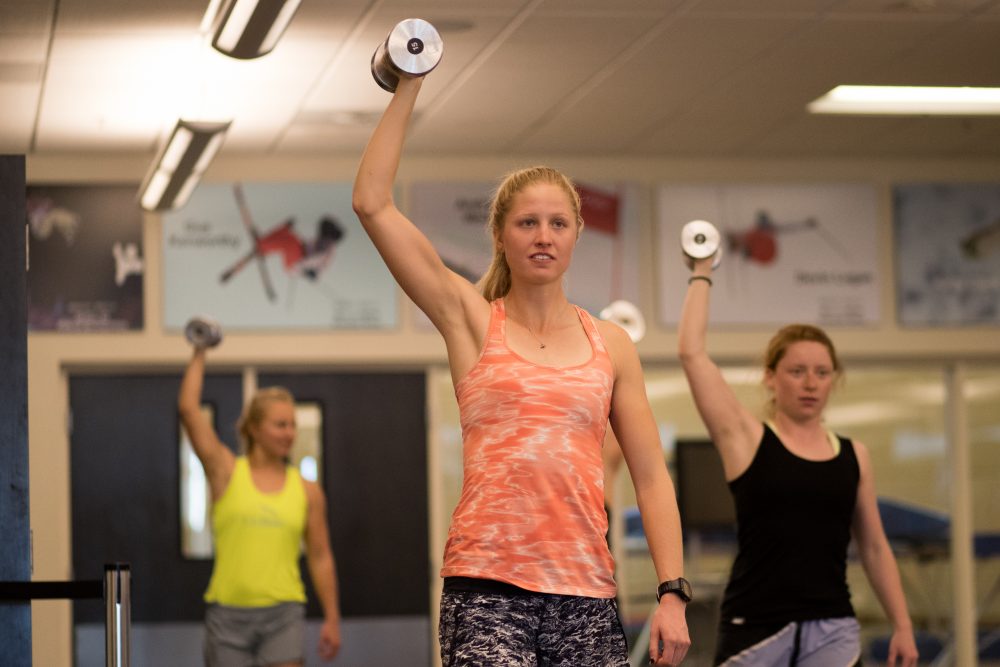
Hailey Swirbul during an intensity session at a U.S. Ski Team camp in Park City, Utah, in October 2018. The same pace can cost an athlete very different amounts from one day to the next. (Photo: Matt Whitcomb)
In my last article on training zones, published on FasterSkier, I tried to describe the challenges we face when we don’t use a common language. There is a lot of talk on social media about Zone 2 training, while most of us in the cross-country ski world understand this same training intensity as Zone 1. Others challenge the use of heart rate to set zones at all. These discussions are great, because they push all of us to better explain our beliefs and how we got there.
Today I want to share why I think heart rate is, for most athletes, a useful, available indicator of cardiovascular stress, even though it doesn’t necessarily capture the complete cost of exercise. I often hear that heart rate is too variable: heat and other environmental conditions can change it; fueling, hydration and fatigue can affect it; it doesn’t stay the same at the same workload (pace or power); and it doesn’t react quickly enough during hard efforts. All of which has some truth to it!
Hannah Halvorsen (left) ski bounding in Park City, Utah, in June 2016. Heat, altitude, fueling and fatigue all change what a given pace costs, and heart rate reflects that cost. (Photo: Bryan Fish)
Cost or Pace?
But let’s break it down. For all endurance work, from easy endurance work below 72 percent of maximum heart rate up to high-intensity work at 95 percent of maximum heart rate, heart rate is an indicator of the physiological demand and strain associated with producing energy. So when it is said that we should use other metrics to implement and track training because of these variations, I say, really? Shouldn’t we train day in and day out based on how the body responds to those external conditions? The same pace, power, speed or workload can carry widely different physiological demands on any given day. So what are we trying to train: the metabolic cost, or the speed, power or pace we can maintain? I would argue both, but in very different circumstances.
I should note that while I use percentages of maximum heart rate to discuss training, that doesn’t mean percentages of maximum heart rate are the best way to determine training zones. It is not a bad method if you test for maximum heart rate, but there may be better ways to use actual performance data to set training zones.
David Norris and Scott Patterson during a set of pre-race classic intervals. Outside of heart rate and perceived effort, few training metrics get measured every day. (Photo: Tom Horrocks)
Every Metric Moves
Then there are those who say we should use lactate, heart rate variability (HRV), rating of perceived exertion (RPE), ventilation, respiratory exchange ratio (RER) and other metrics that change with improved fitness. In fact, those may be better or similar metrics. The problem is that, except for RPE, they are not typically measured daily, so coaches don’t see how much they can vary from one day to the next. Any measure requires context to understand its daily variation. Why? Because the body changes every day in response to life and training stressors.
All of these measures require context, consistent testing protocols and an understanding of their day-to-day variability to be effective. The bottom line is that we need metrics that can be measured daily to understand how athletes are responding and adapting to training. When we are doing aerobic endurance training, often described as Zone 2 and, in the ski world, as Zone 1, the oxygen cost is reasonably reflected in heart rate during exercise.
Certainly, the metabolic cost of training changes from day to day with internal and environmental factors, which can require a higher heart rate to produce the same energy output. We also see heart-rate drift during these workouts: at the same pace or power, heart rate climbs. My response is, OK, this represents an increase in internal cost, and we should definitely respond to it. No metric is perfect, but heart rate captures an important and significant part of the internal strain of training.
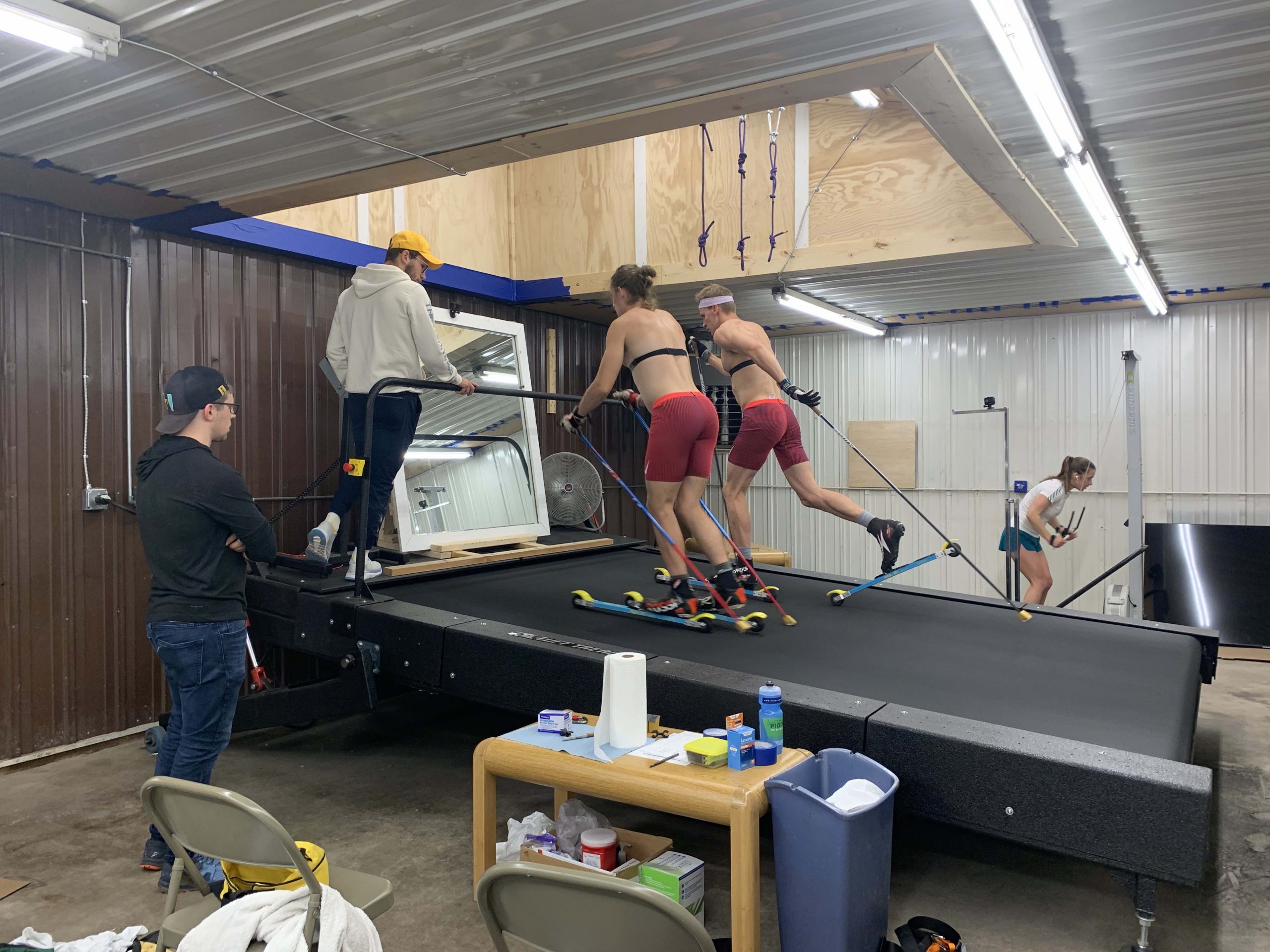
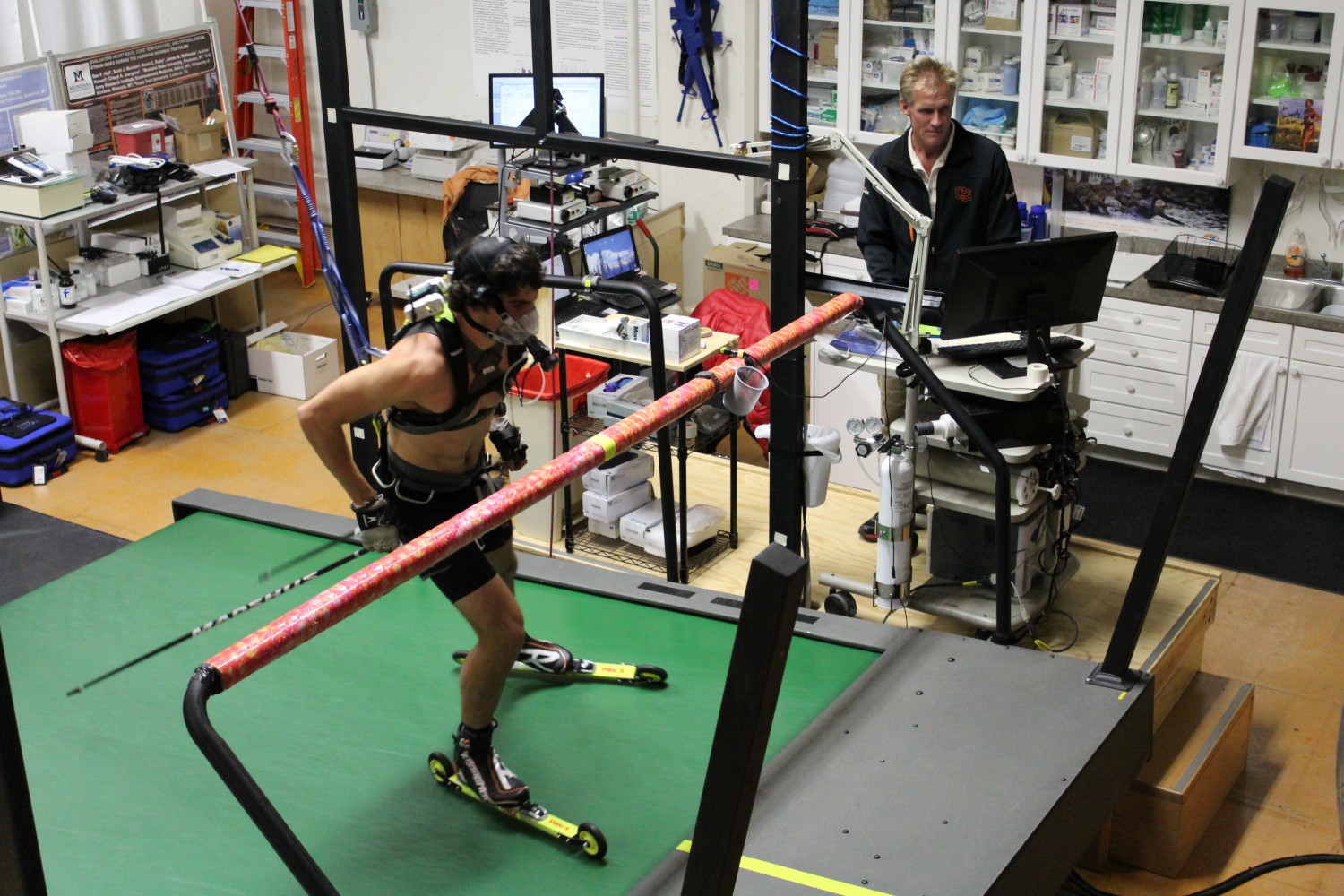
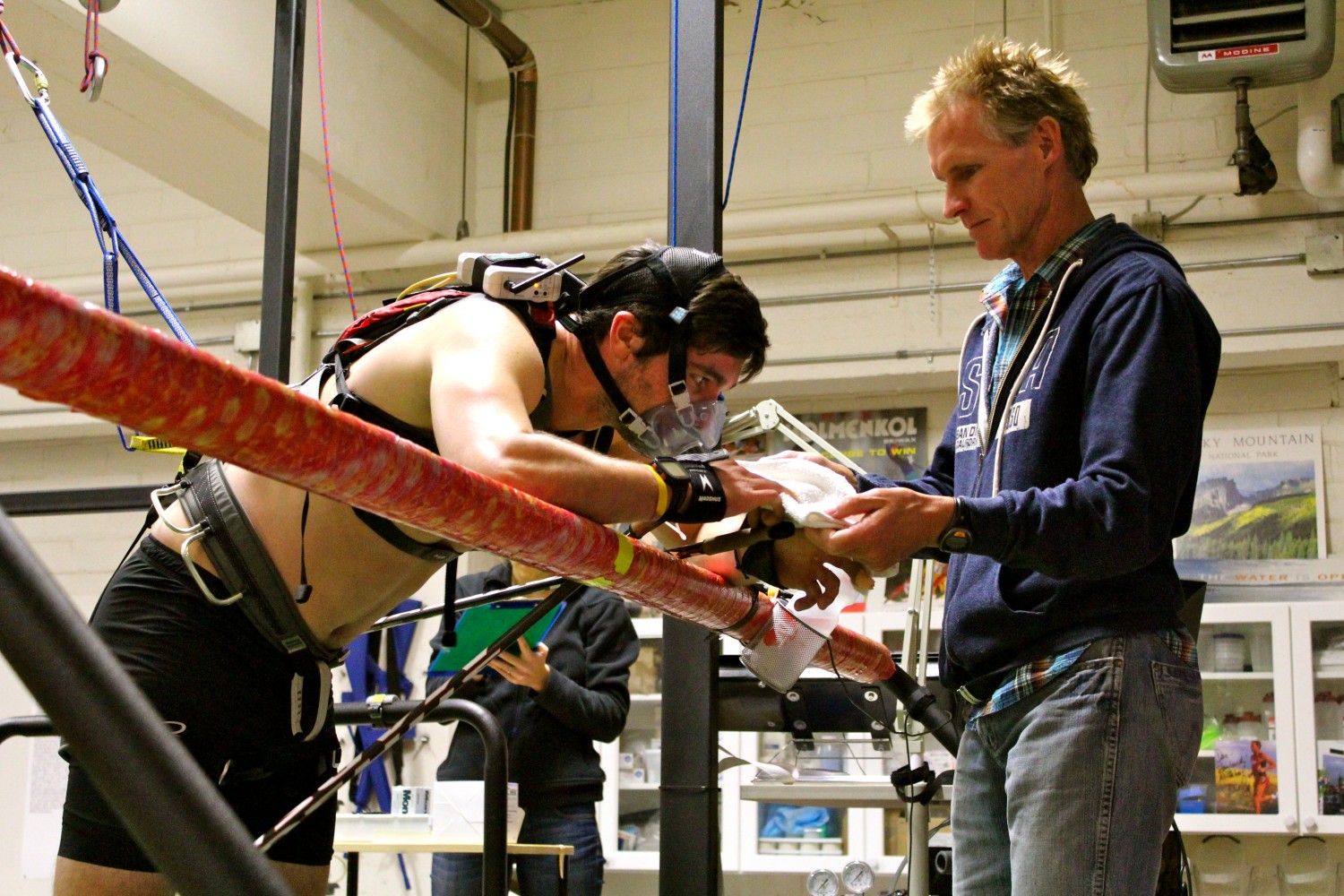
Team Birkie’s Xavier Mansfield (left) and Zak Ketterson share a rollerski treadmill in 2021 while coaches Leo Hipp and Jeremy Hecker give feedback. A lab number is a snapshot unless it is measured often enough to show its own daily variation. (Courtesy photo)
Variation You Never See
To those who say other measures (ventilation, HRV, lactate levels, respiratory exchange ratio, respiration and others) are more accurate, OK. But without seeing how those measures change from day to day, you have no idea of the variation. People use lactate to guide training, for example, and the same goes for newer measures of muscle oxygen saturation and ventilation. They often set training zones at arbitrary levels, or from equally arbitrary estimates based on a visual read of a lactate curve, then assign work based on those values. But if lactate is not measured often during daily training, you have no idea how consistent those values are, or how they vary in response to the same factors that affect heart rate. From my observations, all of those metrics vary as much as heart rate.
No matter how we cut it, none of these measures is as precise as we like to think, because the body changes and responds daily to stress and external factors. And yes, what we are after is a measure we can observe every day. So let’s recognize the facts. Heart rate represents the internal cost of work. Sure, there are daily variations. But over time, and with context, we can understand those changes.
Kendall Kramer (right) in the 10 k classic at the Lahti World Cup on March 8, 2026, an interval-start race she finished in 27:40.8. Galanes puts races of 15 to 30 minutes in the middle of Zone 4. (Photo: Authamayou/NordicFocus)
How I Set Zones
So this is how I use training zones. First, I use the zones as a tool to implement and assess the effects of training on each individual. Those assessments help us determine whether the zones and the training are effective. I believe training zones provide a reasonable method that will work for most athletes and doesn’t require regular lactate or lab testing or other expensive equipment.
So what do I do? I don’t do regular lab testing, because the athletes I coach live all over the country and many don’t have access to or opportunities for it. It is also quite expensive, and most importantly, I have often seen over the years that what we learn in a lab setting doesn’t correlate with what we see in training.
I do a six-minute test, which, according to research by Véronique Billat, corresponds to the pace at which VO2max is achieved. I use the average heart rate of the last two to three minutes of the test, and I assume that to be about 94 to 95 percent of maximum heart rate. Yes, I assume! But the six-minute test also gives me a repeatable field performance and a high heart-rate observation. I use it to inform my initial estimates, not as a direct measurement of VO2max pace or maximum heart rate. The point is to establish workable ranges, observe how the athlete responds and revise them when the evidence warrants it.
I also look at racing and high-intensity workout performance. Short races of 10 to 15 minutes should be in the top range of Zone 4. Races of 15 to 30 minutes should be in the mid-range of Zone 4, and races of 45 to 60 minutes in the low to mid-levels of Zone 4.
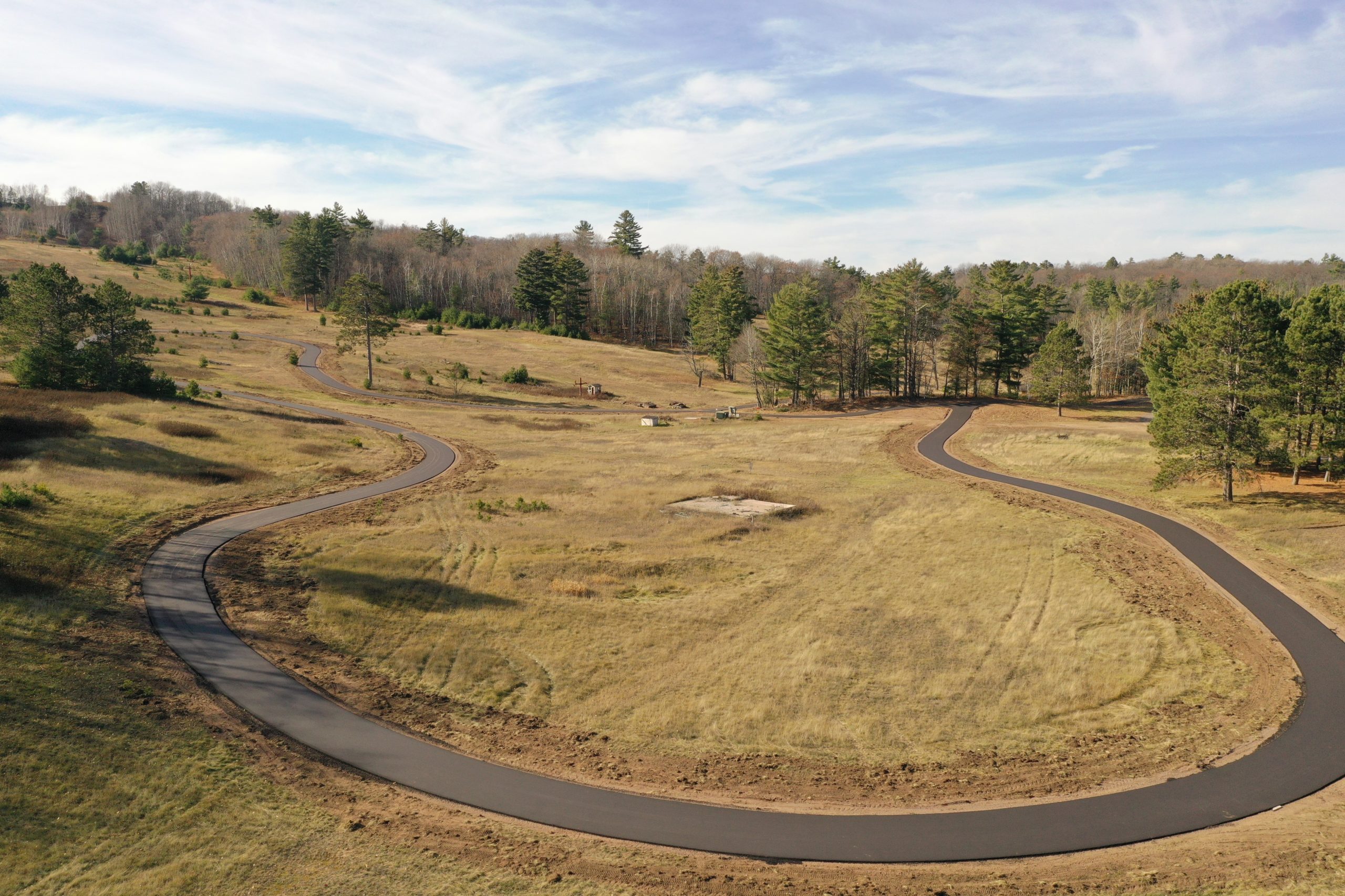
The 5-kilometer paved rollerski loop at the base of Mt. Telemark, outside Cable, Wisconsin, when it was laid in 2023. A fixed loop like this is all a Zone 1 check needs: 45 to 60 minutes of laps, with lactate and heart rate taken after each one. (Photo: American Birkebeiner Ski Foundation)
Checking Zone 1
To confirm the accuracy of Zone 1, I have athletes do 45 to 60 minutes of work on a standard loop of about 15 to 20 minutes, and we take lactate measurements after each loop. If lactate and heart rate remain stable, we know the endurance Zone 1 training is in the correct range. A stable lactate response suggests that the intensity is easy enough, but it does not necessarily identify the first lactate threshold, or LT1.
We need to understand that no method of determining training zones is precise. The body just doesn’t operate that way. For any training adaptation there is an optimal point of adaptation, but also a much broader range in which the adaptation occurs. So the objective when implementing training is to be as close to the optimal point as possible. But knowing where that is day in and day out is impossible, so being within a reasonable range is the goal.
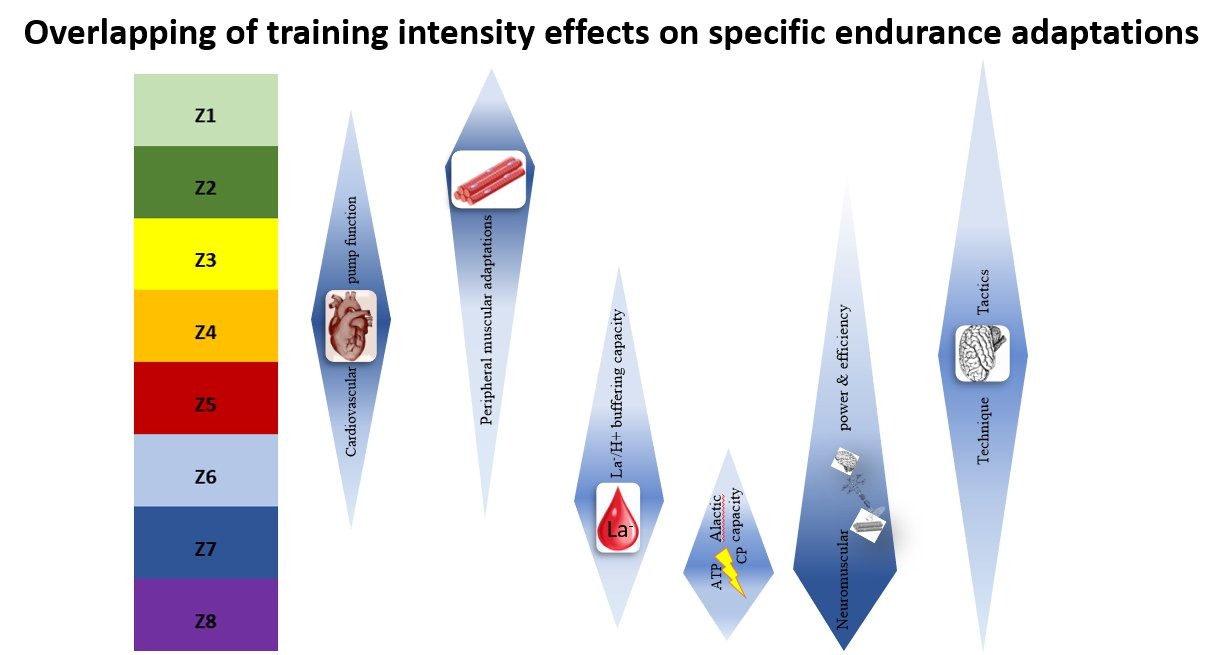
Every adaptation has an intensity where it responds best and a much wider range where it still responds. (Figure: redrawn from Olympiatoppen educational material, 2020)
Close Enough
My conclusion is that using field-testing measures along with training and race performance data to support training-zone determination is adequate, and it allows us to build ranges that can move as fitness changes. There are no ideal “thresholds” or clear metabolic points we can use to determine training zones. LT1 and the second lactate threshold, LT2, are useful reference points, but different protocols and definitions can produce different estimates for the same athlete.
Other thresholds, determined by heart rate variability, DFA alpha1, respiration and muscle oxygen, may prove useful in the future, but so far they have not been fully validated and likewise cannot identify clear physiological thresholds.
So we are left with what is practical and available to developing and recreational athletes. Let’s get close enough, control training effectively and learn what works based on the data for each athlete. Heart-rate metrics fit that need best.
We can debate exactly where one training zone ends and another begins, but no test gives us a number that will describe an athlete perfectly every day. For the athletes I coach, heart rate gives us a practical place to start and a way to follow their response over time. I use field tests and race results to establish working ranges, then look at heart rate alongside pace, perceived effort, conditions and, when available, lactate. If those observations no longer agree, I revisit the zones.
The goal is not to defend a particular method or number on a chart. It is to help an athlete do the work as intended on a given day, learn from the response and make a better decision the next time. That is where training zones earn their value.
Help Support Our Coverage!
If you value the thoughtful work and access FasterSkier provides, please consider becoming a Voluntary Subscriber. Your support directly fuels our work to cover the people, places, and moments that make our sport special.
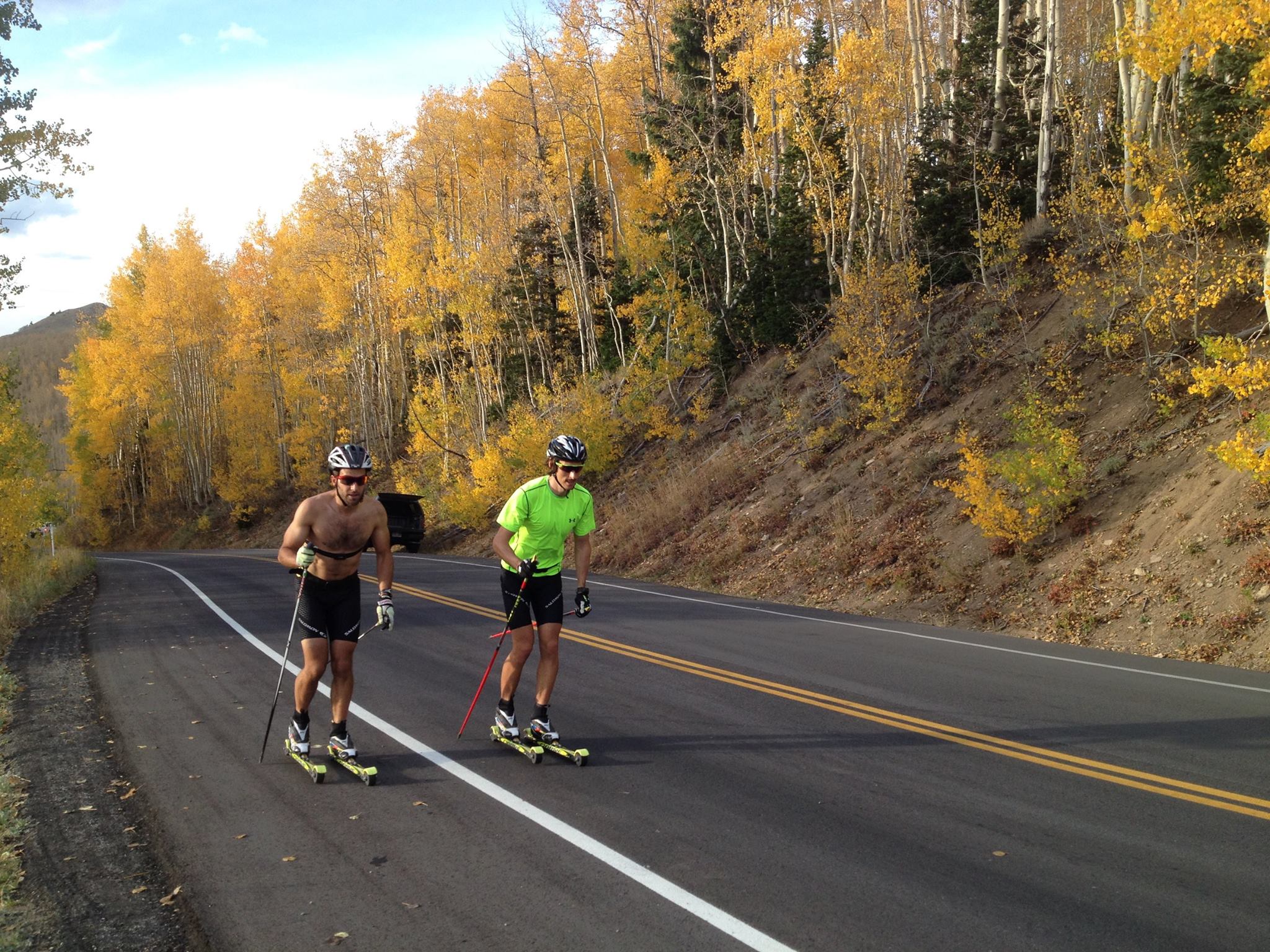
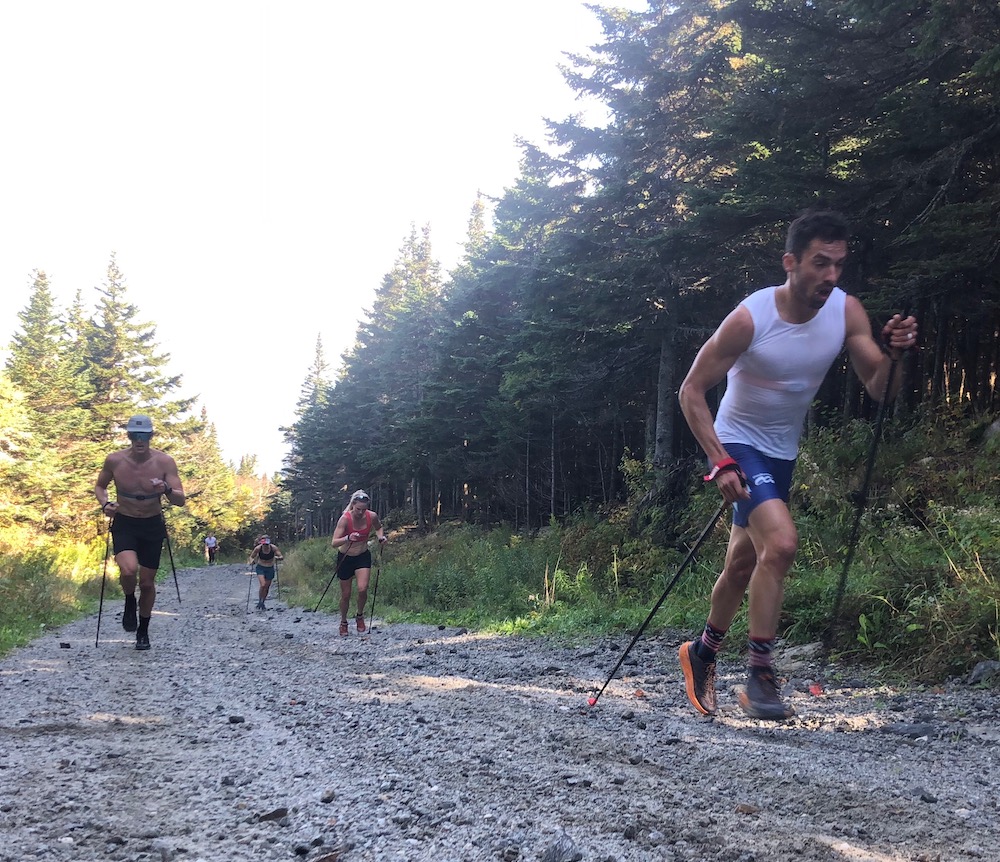
Canadian biathletes Brendan Green and Scott Perras rollerskiing up Guardsman Pass above Park City, Utah, during a fall 2015 camp. (Photo: Matthias Ahrens)
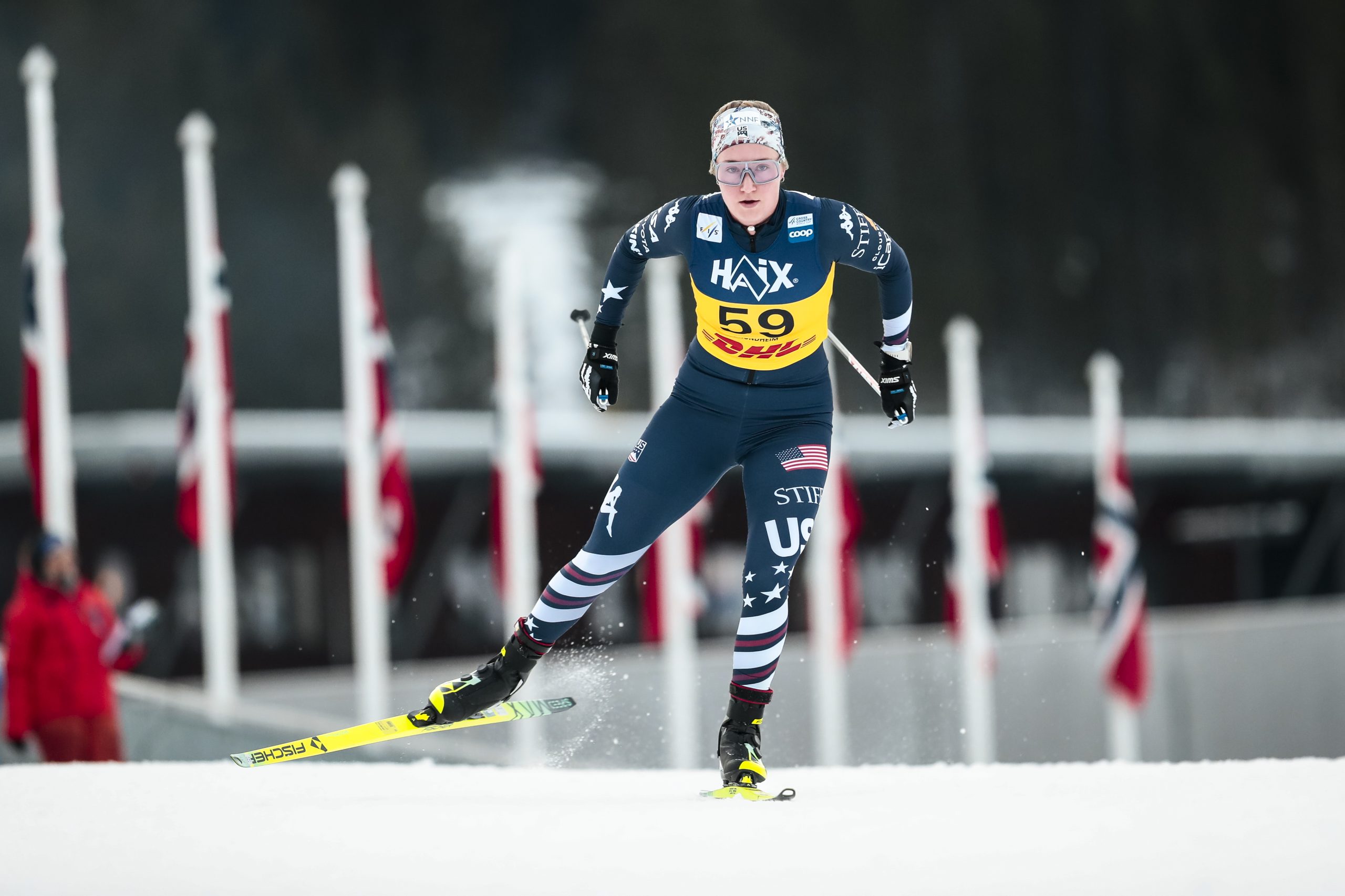
Kate Oldham racing the 10 k freestyle at the Trondheim World Cup in December 2025. Races of 5 to 15 kilometers, Jim Galanes points out, are not raced at threshold. (Photo: Modica/NordicFocus)
For the last couple of decades, the priority for high-intensity training has shifted from threshold, to VO2max, and now back to threshold again. Nowadays threshold training is increasingly presented as the ideal endurance training intensity. The suggestion is a high aerobic stimulus at a low recovery cost, repeatable and sustainable. VO2max is often portrayed as the opposite: a very high stimulus, high stress, very high fatigue, and something to be used carefully, if at all. Folks, we have seen this story before, in the threshold boom of the mid to late ’90s.
From some perspectives this may be intuitively correct and perhaps logical. If we compare one minute of threshold work to one minute at VO2max intensity, the VO2max work is more demanding. That is a no-brainer. There is more carbohydrate use, higher oxygen demand, higher lactate production, greater perceived exertion and generally a greater physiological disturbance. But is that the way training really works? We build training plans around individual workouts and daily and weekly loads, not per minute of high-intensity training.
For example, we might plan 5 x 4 minutes at VO2max intensity, or 20 minutes of total work. Or it might be 4 x 10 minutes at threshold, or 40 minutes of total work. When we look at the load of the whole session, things become far less clear. Both types of training produce similar adaptations, although the adaptive signal from the higher-intensity work is much stronger, and there is little evidence that a threshold session creates less recovery demand than an appropriately controlled VO2max session.
This is really the point I want to make. We need to stop confusing intensity with training load, and, perhaps more important, we need to stop confusing training load with the recovery timeline. They are related, but they are not the same thing.
As I have written before, threshold is a moving target, and defining it is problematic. There are perhaps a dozen or more methods used to determine threshold, and they can produce very different speeds, heart rates, power outputs and lactate values. Some athletes are working just above LT1 and calling it threshold. Others are working around 4 mmol, and others are using ventilatory threshold, critical power, some percentage of race pace, or simply an intensity that feels controlled and hard. So when people say “threshold training,” I am not sure we are even talking about the same thing. That alone should make us careful about assigning a fixed physiological cost or benefit to threshold training.
The generally accepted training model is usually described like this: easy endurance training provides a relatively small stimulus at a relatively low cost, so we need a lot of it. Threshold gives us a much larger aerobic stimulus, still at a manageable recovery cost. VO2max gives us a very large stimulus, but at a very high recovery cost. Again, that makes intuitive sense, but is it true when we compare realistic sessions? I am not convinced it is. In fact, I am certain it is not.
If we think of training load in simple terms, it is a combination of intensity and duration. Higher intensity produces greater load per minute, while longer duration produces more total load. A 3-hour easy workout, for example, produces a bigger training load than a 75-minute workout with 5 x 4 minutes of VO2max intervals. This is obvious, but somehow we often forget it when discussing threshold and VO2max training.
Take a typical VO2max workout of five by four minutes, 20 minutes of work. Using Firstbeat’s TRIMP model, that might create about 55 to 60 TRIMP. Now take a threshold workout of four by ten minutes, 40 minutes of work. That might generate something in the 95 to 100 TRIMP range. With Firstbeat we can also look at EPOC as an estimate of the disturbance of homeostasis. Again, these are estimates and certainly not perfect measures, but 20 minutes at around 90 percent of VO2max might produce an EPOC of around 175 ml/kg, while 40 minutes at around 85 percent might produce an EPOC of 225 ml/kg. Once again the threshold workout produces a significantly higher stress load.
I don’t want to get hung up on whether those exact Firstbeat numbers are accurate, because that is not really the point. The point is that it is entirely possible for the lower-intensity session to produce the larger total load, and that should not surprise anyone, because it is twice as long.
The same thing happens if we use session RPE. Twenty minutes of VO2max work at an RPE of 9 gives us 180 AU (arbitrary units), while forty minutes of threshold at an RPE of 6 gives us 240 AU. Again, the threshold session creates the larger estimated training load. That does not prove threshold is more stressful or that it takes longer to recover from. TRIMP and session RPE are measures or estimates of training load, not measurements of recovery time.
We have at least three different things being discussed as if they were the same: the intensity of the exercise, the total load of the workout, and how long it takes the athlete to recover. A VO2max interval clearly creates greater physiological disturbance per minute. A longer threshold session may create a greater total training load. Neither one, by itself, tells us which athlete will be better recovered 24 or 48 hours later.
High cost per minute is not the same thing as high cost per session, and high session load is not necessarily the same thing as longer recovery.
Otto Invenius, Campbell Wright, Maxime Germain and Adam Runnalls climbing the Stelvio Pass on rollerskis above Livigno, Italy, in July 2025. The adaptations from threshold and VO2max work overlap far more than the zone names suggest. (Photo: Manzoni/NordicFocus)
What Are We Actually Trying to Adapt?
The other issue is that we spend far too much time talking about training zones and not enough time talking about desired adaptations. What adaptations are we trying to create? That should come first.
VO2max training provides a very strong aerobic stimulus at near-maximal oxidative capacity. It can increase maximal cardiac output, improve oxygen transport, create very high muscular oxygen demand and expose the athlete to speeds and power outputs similar to race demands. Threshold training lets us accumulate a large amount of work at a high aerobic fractional utilization. It can improve sustainable speed or power, oxidative capacity at that intensity, and the ability to maintain a high percentage of maximal aerobic power for a longer period of time.
These adaptations overlap a great deal. I sometimes hear people talk as if threshold develops lactate clearance and the muscles’ ability to sustain work, while VO2max develops the central cardiovascular system. But VO2max training creates a large muscular stimulus as well. ATP turnover is very high, calcium flux is high, metabolic disturbance is high, and the signaling associated with mitochondrial biogenesis is substantial. VO2max training is not simply “central cardiovascular training.” It also provides a significant peripheral training stimulus.
Threshold training obviously produces a similar but slightly smaller mitochondrial and muscular signal for adaptation. But I think its real advantage may be something much simpler. Because the intensity is lower, we can normally do considerably more of it. That allows us to accumulate a large amount of work at a high aerobic fractional utilization, with substantial muscular recruitment and a large amount of sport-specific work.
That may be threshold training’s most important characteristic. Not that it creates some unique physiological adaptation unavailable at other intensities, but that it allows us to accumulate considerably more work while still creating a high oxidative demand.
This can be particularly important for an athlete who already has a high VO2max and whose limitation is the fraction of that VO2max that can be sustained. If fractional utilization is relatively low, increasing sustainable aerobic power may be far more important than trying to push VO2max another few percent. For that athlete, a greater amount of threshold work may make very good sense.
But that is an argument based on the needs of the athlete, not an argument that threshold is inherently a better training intensity or that we recover from it more quickly.
Lactate clearance and resynthesis is another area where I think training discussions have become confused. We often hear that threshold training is necessary because the athlete needs to train to “clear lactate.” I have always had a problem with this explanation, because it is neither accurate nor scientifically valid. Remember, it is lactate we are talking about, not lactic acid, as many refer to it.
Lactate is not a waste product that suddenly appears at threshold and then needs to be removed. It is being produced, transported and oxidized all the time, at all intensities, and it is an important fuel. Endurance training improves the ability to transport and oxidize lactate, but there is no reason to believe this only happens at threshold. High-intensity interval training also improves lactate transport and can move lactate threshold substantially.
VO2max intervals also create very high lactate production and turnover. So if we are looking at the lactate shuttle, why would it only, or even preferentially, adapt when lactate is sitting around 2, 3 or 4 mmol? That doesn’t make much physiological sense to me. Producing higher levels of lactate will stimulate resynthesis.
The same is true for mitochondrial biogenesis, oxidative enzymes and capillarization. We cannot neatly assign these adaptations to one training zone, because there is considerable overlap between endurance, threshold and high-intensity training.
That doesn’t mean all intensities are the same. They clearly aren’t. It means we should be careful about inventing unique adaptations for a training zone simply because we have given that zone a name. Threshold training is not the only method, or even the optimal method, to improve lactate oxidation and resynthesis.
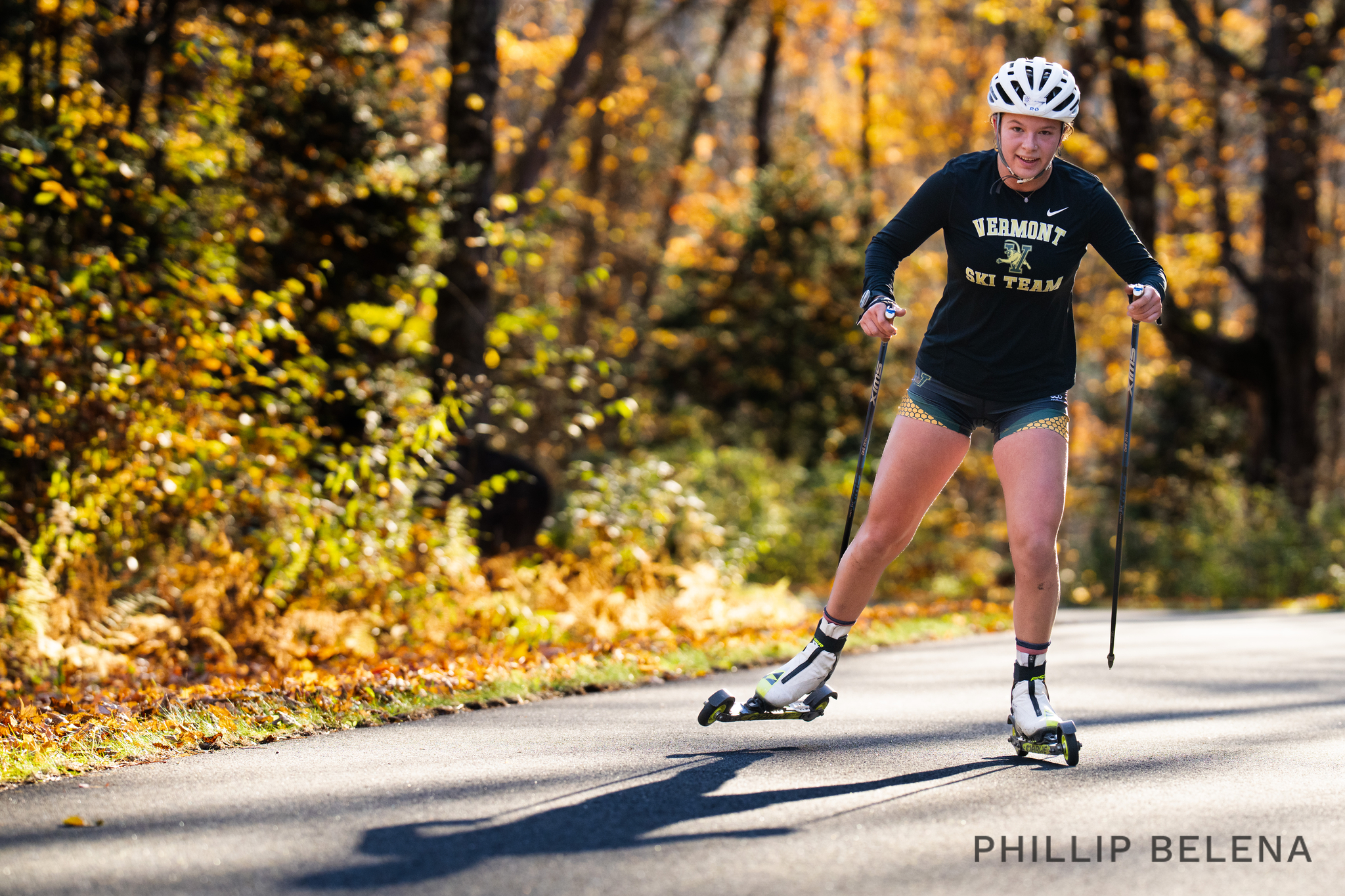
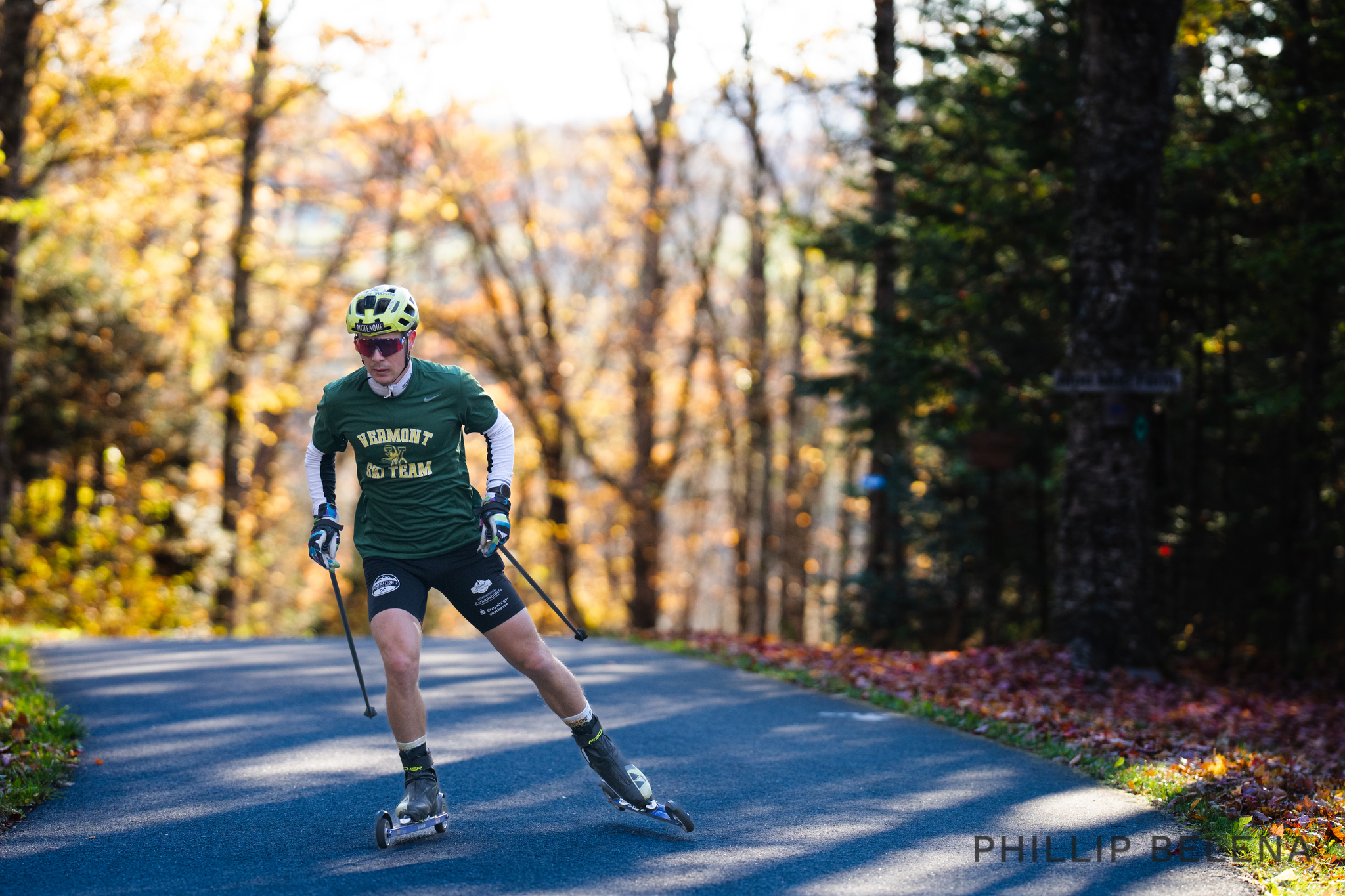
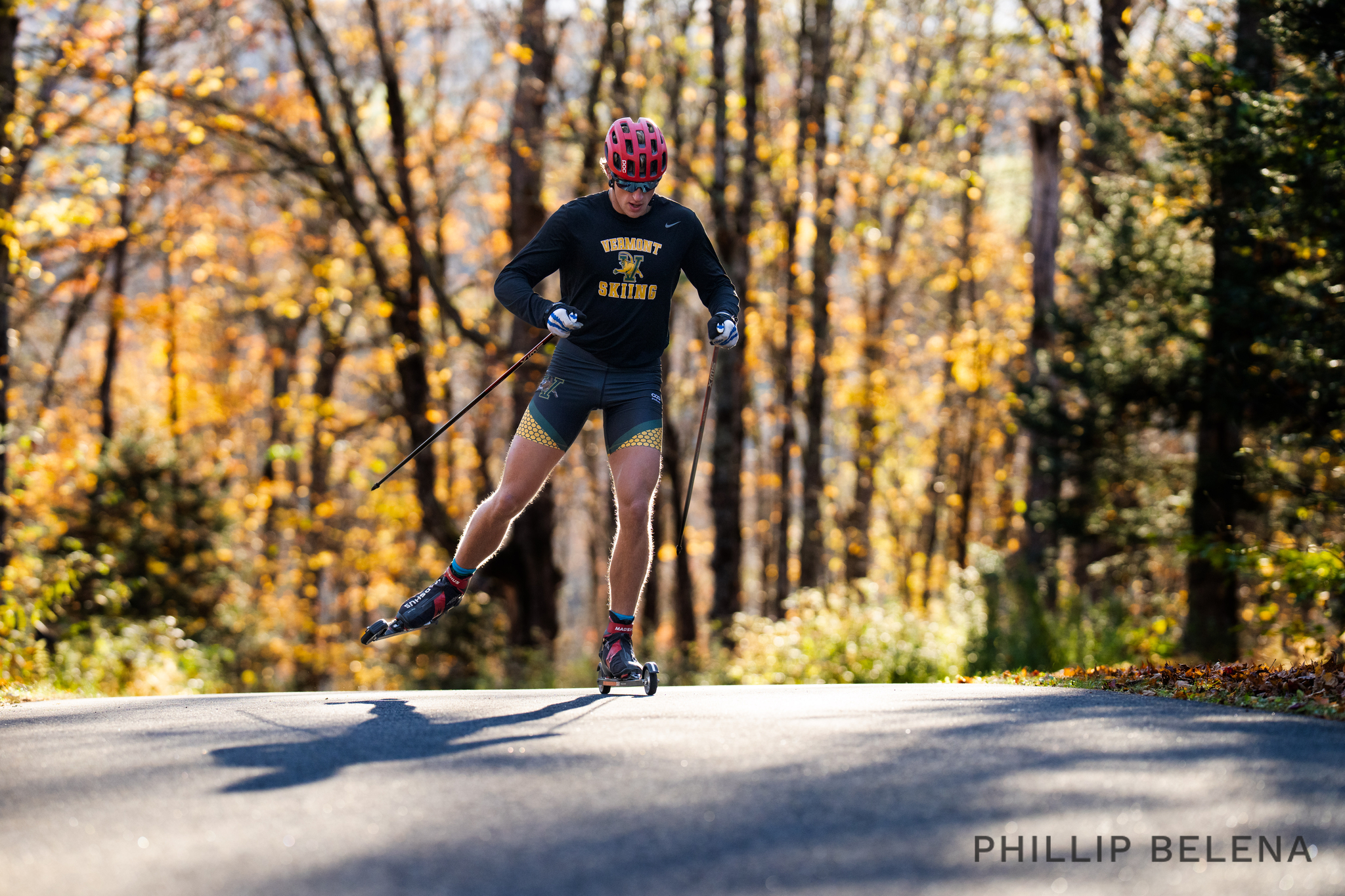
A University of Vermont skier on rollerskis at Craftsbury Outdoor Center in October 2025. Autonomic, glycogen, muscular and mechanical recovery all run on different clocks. (Photo: Phillip Belena/EISA)
What Is Recovery?
Another problem in this discussion is recovery. People will say that threshold is easier to recover from. Maybe, but recover from what? Autonomic disturbance, glycogen depletion, neuromuscular fatigue, muscle damage, mechanical load, dehydration or psychological fatigue? These are not the same thing, and they do not necessarily recover at the same rate. A 2-hour run and a 2-hour rollerski at the same intensity, for example, carry very different mechanical loads to recover from.
HRV may tell us something about autonomic recovery, which should also reflect other aspects of recovery but does not specifically measure them. Resting heart rate can tell us something, but again not everything. Blood lactate tells us something about what is happening during and immediately after the workout, but remarkably little about whether the athlete is going to train well 24 or 48 hours later. Creatine kinase may tell us something about muscle damage, but there is huge individual variation. So when we talk about recovery cost as if it were one number, I think we are being too simplistic.
This is also why I don’t think we can simply use TRIMP, EPOC, duration, distance or session RPE to say one workout takes longer to recover from than another. They can give us useful information about internal load or physiological disturbance, but they are not recovery measurements. Ultimately, recovery must be considered in terms of which physiological systems were stressed and, more practically, what the athlete can do in the days immediately after a hard workout.
Carbohydrate use is another good example. VO2max exercise clearly has a higher rate of carbohydrate use per minute than threshold exercise. But once again, the session matters more than the minute. Twenty minutes at VO2max intensity may have a very high glycogen cost per minute. Forty, fifty or sixty minutes at threshold has a somewhat lower rate, but it is sustained for two or three times as long. We cannot automatically assume that the shorter VO2max workout creates greater total glycogen depletion.
This becomes particularly important when athletes are doing regular quality sessions. If glycogen restoration is an important part of recovery, a long threshold session may impose a very substantial recovery requirement despite producing lower lactate concentrations and feeling much more controlled. An athlete does not have to be lying on the ground after a workout for that workout to have been expensive to recover from.
That is one of the problems I see with the idea that threshold can be repeated frequently simply because lactate is controlled. Low lactate does not necessarily mean low glycogen use, low muscular load or rapid recovery. If we keep extending the duration of the threshold work, at some point the additional work has a cost.
Which brings us to what I think is probably the most meaningful recovery measure, and one that is surprisingly rarely studied: can the athlete perform the next important training session at the expected level?
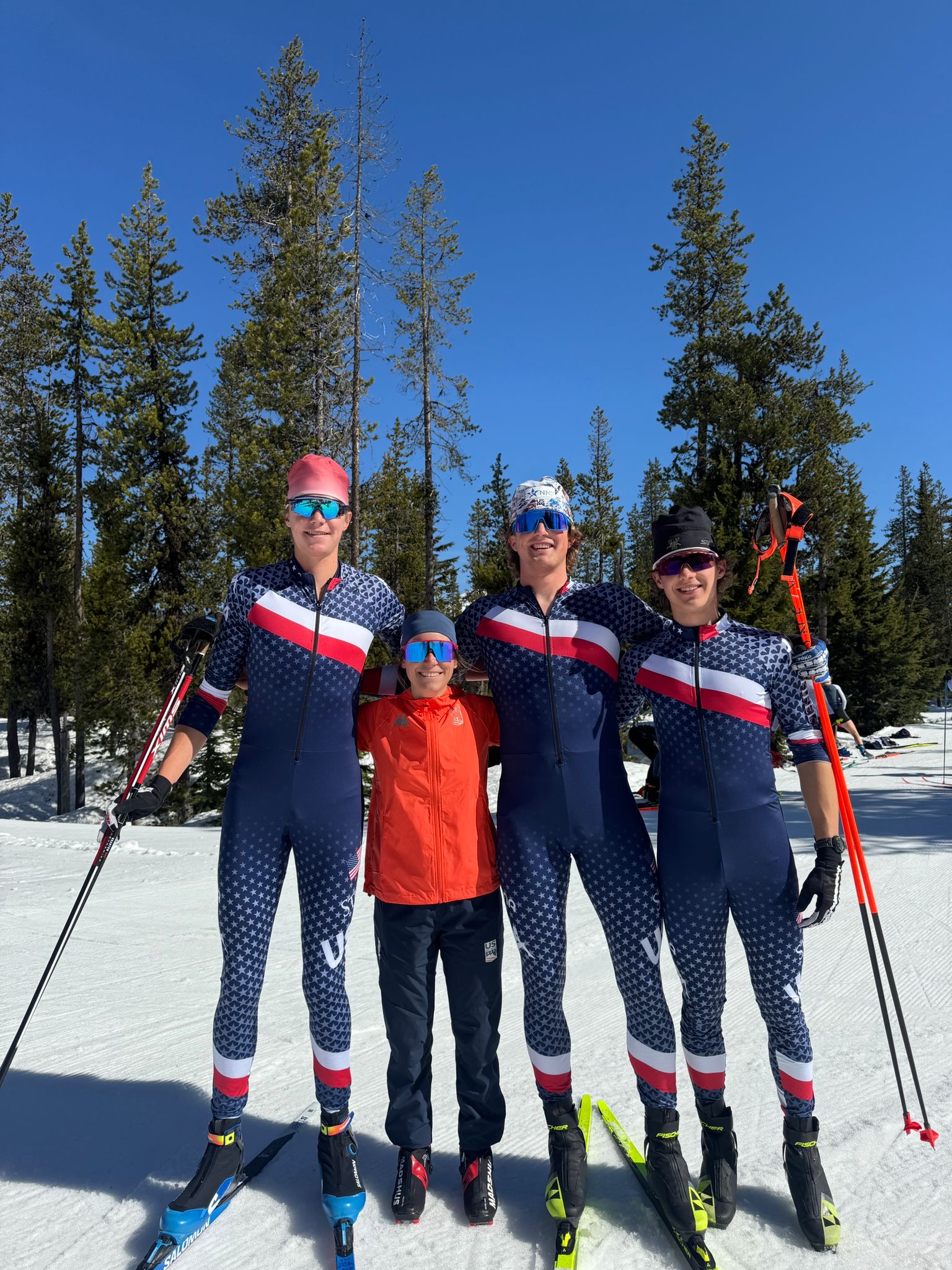
Lucas Wilmot, Kristen Bourne, Murphy Kimball and Tabor Greenberg after their first L3 intervals at a 2025 camp in Bend, Oregon. (Photo: Leann Bentley)
An Interesting Study
One of the more interesting comparisons was made by Seiler, Haugen and Kuffel with highly trained runners. On one occasion the athletes did a threshold session of around 30 minutes between the first and second ventilatory thresholds, and on another, six three-minute intervals at around 95 to 96 percent of VO2max. I would point out that 95 to 96 percent of VO2max is already hard, and above what I would normally call a controlled VO2max session.
The differences between the workouts were substantial. Lactate during the threshold session was around 2.7 mmol, while during the VO2max intervals it was around 7.1. Perceived exertion was also much higher during the VO2max workout. By almost any acute measure the VO2max workout looked harder, so we might reasonably expect recovery to take longer. But HRV recovery following the two sessions was remarkably similar.
Now, this study does not fully answer the question. The threshold work was only around 30 minutes, HRV measures one part of recovery, and there are all kinds of differences between athletes. But it does challenge an assumption that I think is important. Greater acute metabolic disturbance does not necessarily mean longer recovery, but the dose does.
It also raises what I think is an even more interesting question. What would have happened if the threshold session had contained 40 or 50 minutes of work rather than 30? That would be much closer to the threshold sessions many trained endurance athletes are actually doing.
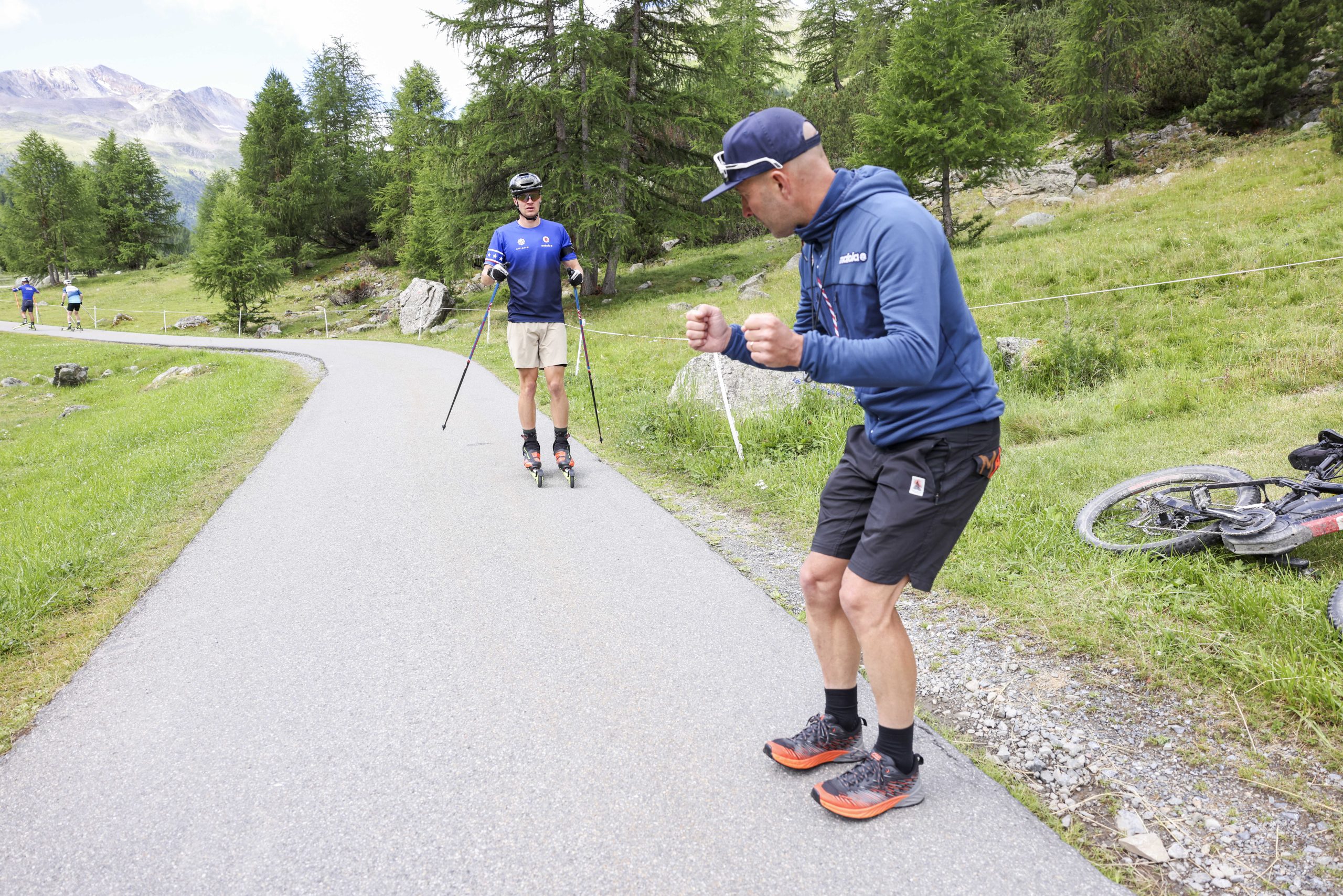
U.S. Biathlon coach Armin Auchentaller with Campbell Wright during summer training in Livigno, Italy, in July 2025. A controlled VO2max session is about time at high oxygen uptake, not about producing as much lactate as possible. (Photo: Manzoni/NordicFocus)
Control of VO2max Training
There is another issue here that I think is important. A lot of people seem to think VO2max training means going as hard as possible. It doesn’t, at least not the way I see it and use it.
If I give an athlete 5 x 4 minutes of VO2max work, I am not asking them to race every interval or see how much lactate they can produce. I am trying to get them to accumulate time at a very high oxygen uptake, typically around 90 to 95 percent of maximal heart rate and VO2max.
If the objective is a cardiovascular and oxidative stimulus, we need sufficient intensity to drive oxygen consumption toward a very high fractional utilization of VO2max. For many athletes, something in the range of 90 to 95 percent of VO2max may be enough to accomplish that. Once we have produced the stimulus we are looking for, going harder does not necessarily make the workout better.
This becomes important when we compare threshold and VO2max training. If someone compares a carefully controlled threshold session with a set of VO2max intervals performed as hard as possible, then of course the VO2max workout is going to look very stressful. But that may simply be a badly controlled VO2max workout.
A well-controlled VO2max session and an all-out interval session are not the same workout, just as a controlled threshold session and a threshold session that slowly turns into a race are not the same workout. Anyone who has coached for very long has seen both.
A University of Vermont skier on the rollerski track at Craftsbury in October 2025. Forty minutes at threshold is a lot of work, and so is fifty, and so is sixty. (Photo: Phillip Belena/EISA)
What Is Threshold’s Real Advantage?
In my view, the strongest argument for threshold training is not that it produces some special adaptation, but that athletes can accumulate a lot of high-quality aerobic work. Forty minutes at threshold is a lot of work. Fifty minutes is a lot of work. Sixty minutes is a lot of work. For an elite endurance athlete doing a very large total training volume, that may be exactly what is needed, provided the athlete can recover from the overall workload of the training period.
Threshold gives us a way to accumulate a substantial amount of work at high oxidative fractional utilization, with considerable muscular recruitment and a lot of sport-specific work. For an athlete with a high VO2max who needs to improve fractional utilization or sustainable aerobic power, this can be valuable.
I think this is where some of the current discussion around threshold becomes problematic. Because it is controlled, because lactate is relatively low, and because the athlete is not destroyed afterward, threshold starts to be treated almost like endurance training. It isn’t. It is still hard training, and if you do enough of it, it carries a substantial training load and potentially a substantial recovery cost.
The question is not simply whether forty or fifty minutes at threshold creates more adaptation than twenty minutes of VO2max work. It probably creates more of some kinds of stimulus simply because we are doing so much more work. The more useful question is whether the additional adaptation we get from that extra work is worth the additional load and recovery cost.
Kevin Bolger in the fog at the Oslo World Cup mass start in March 2026. The first question is what adaptation an athlete needs. The second is the smallest dose that will produce it. (Photo: Authamayou/NordicFocus)
Are We Asking the Wrong Question?
The debate is usually framed as threshold versus VO2max. Which is better? I don’t think that is the right question. The first question should be what adaptation this athlete needs. The second, and I think this is more important, is what is the smallest dose capable of producing that adaptation? It isn’t necessarily 40, 50 or 60 minutes. The third is what effect that dose will have on the training the athlete can perform over the next several days.
We tend to assume that if some training is good, more of it must create a greater adaptation. Up to a point that is probably true. But the objective of training is not to produce the largest possible stimulus in every workout. It is to produce enough stimulus to create the adaptation while still being able to absorb the rest of the training.
If an athlete has a relatively low VO2max and that is limiting performance, perhaps 15 or 20 minutes of controlled VO2max training gives us exactly the stimulus needed. If that is enough to stimulate the adaptation, why do 50 minutes of threshold just because threshold is currently popular?
On the other hand, if an athlete already has a very high VO2max but relatively poor fractional utilization, and cannot sustain a high percentage of it, then perhaps a larger volume of threshold work is exactly what is required. In that case the ability to accumulate 40 or 50 minutes at high aerobic flux may be the important stimulus.
NENSA athletes rollerskiing together in Craftsbury, Vermont. A workout can look great on paper and still be the wrong choice if it costs the next two days. (Photo: Chris City)
The Training Week Matters More Than the Workout
I also think we make a mistake when we look at workouts in isolation. A workout can look great on paper and still be a poor training choice, because the real issue is not simply what happened during those 60 or 90 minutes. It is what that workout allows us to do over the next several days.
Suppose a threshold workout produces 10 percent less adaptive stimulus than a VO2max session but allows the athlete to train substantially better over the following two days. Threshold may clearly have the better stimulus-to-recovery ratio and therefore be the better choice.
But reverse the situation. Suppose 20 minutes of well-controlled VO2max work produces the adaptation we want and the athlete is ready to train normally the next day, while 40 or 60 minutes of threshold creates substantial glycogen depletion and muscular fatigue. In that circumstance, the shorter VO2max workout may have the better stimulus-to-recovery ratio.
We shouldn’t decide the answer beforehand simply because one workout carries the label “threshold” and the other “VO2max.” Threshold is not automatically low cost, and VO2max is not automatically high cost. The dose matters, the athlete matters, the training done before the session matters, what needs to be done after the session matters, and the total training week matters.
Therese Johaug racing the mass start at the Lahti World Cup in March 2025. Even races of up to 90 minutes, Galanes says, are often skied well above threshold. (Photo: Thibaut/NordicFocus)
Dose, Adaptation and Recovery
I am certainly not arguing against threshold training. Rather, I am arguing that the dose needs to be controlled relative to the individual athlete, and that the time to recover is not what is often suggested. I use threshold with athletes who need it, and it can be effective. But I do think we need to be more careful about how it is being presented. It is not automatically what every athlete needs.
Threshold and VO2max training have different characteristics, but their physiological adaptations overlap substantially. VO2max training provides a very large physiological stimulus in a relatively short period of time and appears particularly useful when maximal aerobic capacity is what we are trying to improve. Threshold allows us to accumulate considerably more work at a high aerobic output and can be extremely effective when sustainable aerobic power or fractional utilization is the limitation.
Both can be valuable, and both can be overdone.
In my experience, especially over the last decade, I have seen far more athletes become flat, stale, overtrained or simply stagnant from doing too much threshold training than from doing properly controlled VO2max work. Usually it comes from doing too big a volume of threshold work, too often. That doesn’t mean threshold is bad. It means threshold must be appropriately prescribed and dosed.
I also think the very large amounts of threshold work we sometimes see promoted are primarily appropriate for highly trained elite athletes who are also doing very large overall training volumes and have spent years developing that volume. I would be much more cautious applying the same model to younger athletes, developing athletes, masters athletes, or anyone doing a much smaller overall training volume.
There is another point that seems to get lost. Athletes racing 5, 10 and 15-kilometer events are not racing those events at threshold. I have decades of data showing that even in races of up to 90 minutes, fractional utilization can be well above threshold. The shorter races are at a very high intensity, in what is defined as the VO2max zone. At some point we need to train that capacity directly. Doing more threshold work because it is supposedly lower cost does not eliminate the need to train at race-relevant intensity.
In the end, I think we need to get away from ranking training zones as good, bad, safe or dangerous, and think more in terms of dose, desired adaptation and recovery. What are we trying to adapt, what dose is needed to produce that adaptation (often less than we think), and what does that dose cost us in terms of the training that follows?
The most valuable workout is not necessarily the one that creates the greatest immediate physiological disturbance, nor is it necessarily the one that accumulates the most minutes around some predetermined lactate value. It is the workout that provides enough stimulus to produce the adaptation we are looking for while preserving the athlete’s ability to absorb the rest of the training program.
In the end, that is the balance we are trying to find.
Help Support Our Coverage!
If you value the thoughtful work and access FasterSkier provides, please consider becoming a Voluntary Subscriber. Your support directly fuels our work to cover the people, places, and moments that make our sport special.
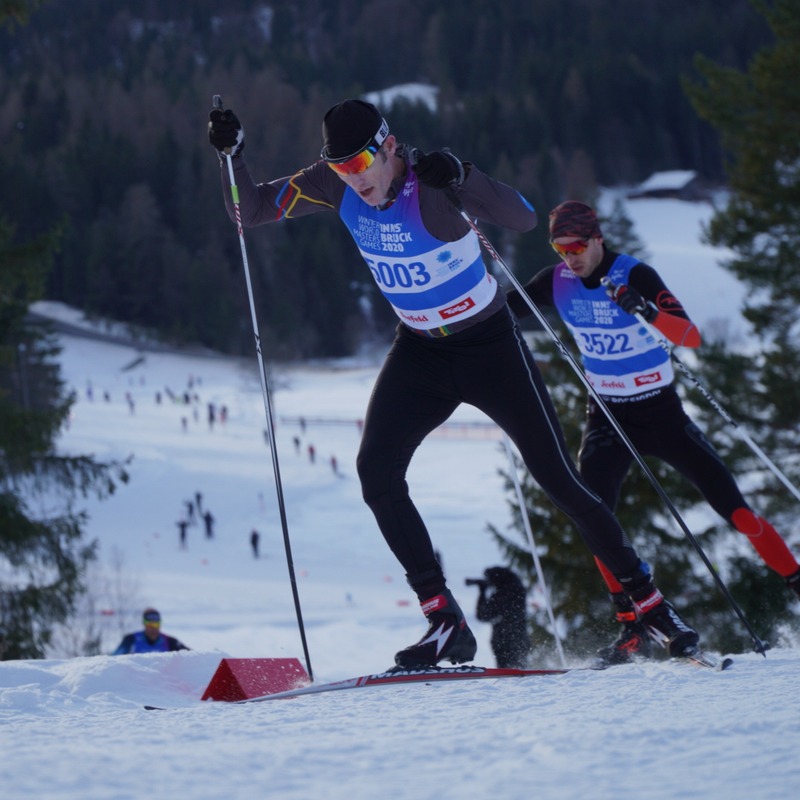
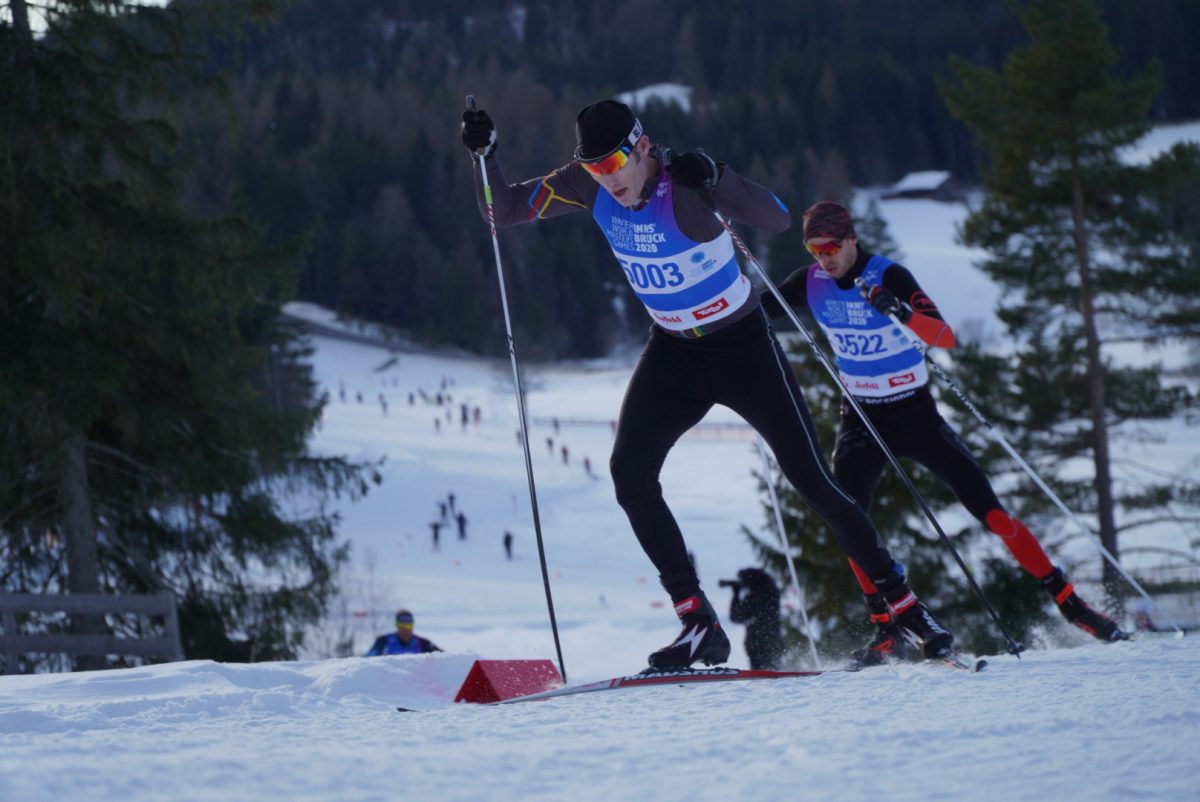
Tim Donahue racing at the 2020 Winter World Masters Games in Seefeld, Austria. Jim Galanes argues that the training masters skiers cut first is often the training that protects what aging takes away fastest. (Photo: Garrott Kuzzy / Lumi Experiences)
There are two common problems I see in the masters athletes I consult with or coach. The first is the same problem we see with athletes of all ages: they tend to train “half hard” every day. Half hard, Zone 1 quickly drifts into Zone 2 or 3. The second is more specific to masters athletes. They try to follow a training plan that is basically a dumbed-down version of an elite athlete’s program.
The first problem is relatively straightforward to address. Determine appropriate training zones and control the intensity of training more accurately.
The second is more complicated. We need to determine the volume of training an athlete can recover from, adapt to and maintain consistently. Then we need to organize that training around the physiological capacities that are most likely to decline as we age.
There is truth behind the conventional advice given to masters athletes. Recovery does change with age. Simply repeating the training we did at 25 or 30, or copying the program of an elite athlete, is never the best approach at 50, 60 or 70.
But there is a problem with how we sometimes respond to that reality. Many of the training components we tend to remove as athletes age are exactly the components that address the physiological capacities declining most rapidly.
The challenge of training as a masters skier isn’t simply figuring out how to recover better. It is figuring out how to provide enough training stimulus to maintain and improve the capacities that are naturally declining with age while still recovering sufficiently to adapt to the volume of training.
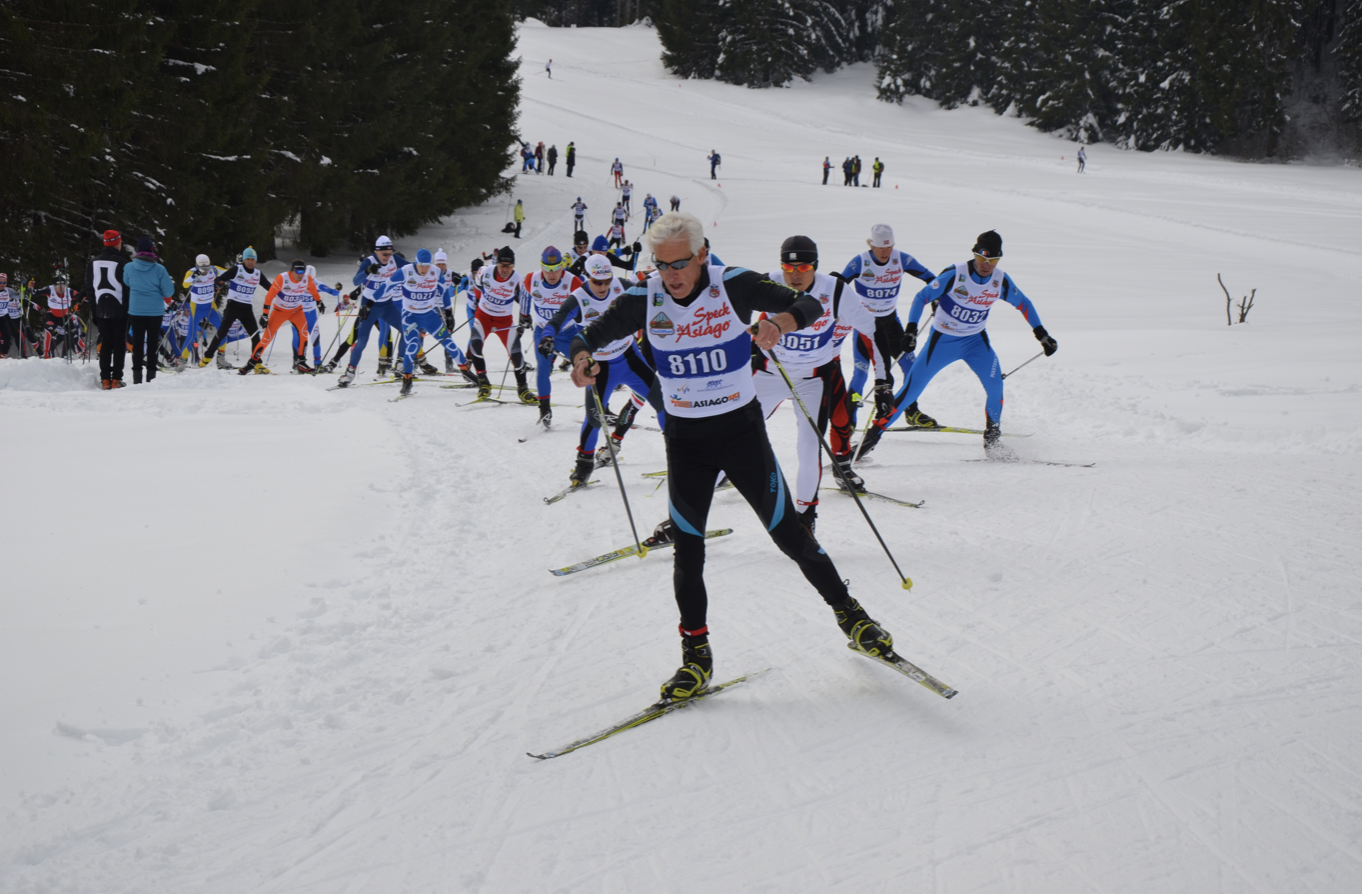
A masters field on the climb at the 2014 Masters World Championship in Asiago, Italy. Endurance performance declines with age, but the individual components of performance do not decline at the same rate. (Courtesy photo)
What Actually Changes with Age?
We know endurance performance declines with age, but the individual components of performance do not decline at the same rate.
One of the largest physiological changes is generally VO2max. Maximum heart rate declines. Muscle mass and maximal strength decline, both of which are important to maintaining aerobic capacity and skiing performance. Type II muscle fibers and explosive power become increasingly difficult to maintain.
Meanwhile, exercise economy and the ability to sustain a relatively high percentage of VO2max can be reasonably well maintained in highly trained older athletes. That should tell us something about training.
If these capacities decline at different rates, it doesn’t make much sense to treat them equally in training.
There is a temptation as we age to gravitate toward the training we tolerate best. The problem is that the capacities we tolerate best may also be the capacities we are already preserving reasonably well.
Training should not simply reflect what aging makes easiest to do. It must continue to address what aging is taking away. If VO2max, strength and power are among the capacities most vulnerable to aging, eliminating high-intensity and strength training in the name of increasing recovery may solve one problem while creating another.
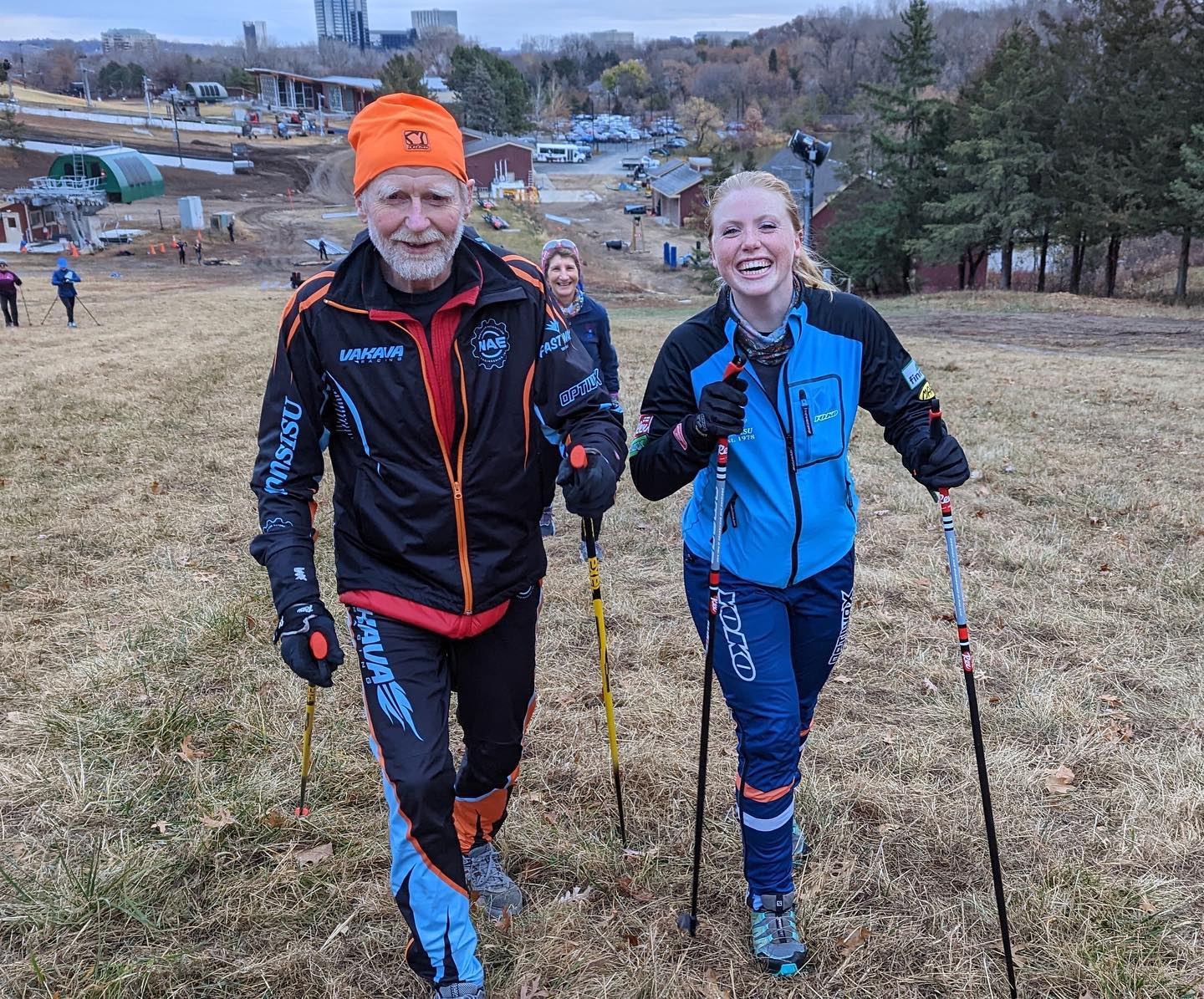
Ahvo Taipale during a Vakava training session. Consistently accumulated aerobic volume remains one of the primary drivers of endurance adaptation, and one of the best defenses a masters skier has. (Photo: Finn Sisu)
Maintain the Aerobic Volume
There has been considerable emphasis in endurance training recently on large volumes of low-intensity training combined with substantial amounts of threshold and sub-threshold work.
There are good reasons for that approach, particularly among highly trained elite athletes. But simply transferring that model to masters athletes can overlook the capacities most threatened by aging, particularly VO2max, strength and power.
So how much Zone 1? How much threshold? How much VO2max?
Those are important questions, but they can obscure something more fundamental.
Consistently accumulated training volume remains one of the primary drivers of endurance adaptation. Masters athletes sometimes respond to aging by progressively reducing volume and attempting to compensate with intensity. There are limits to that strategy.
Mitochondrial development, capillarization, fat oxidation, durability and the ability to maintain performance over long races are built largely through accumulated aerobic work. A two-hour easy ski is not interchangeable with a hard interval workout simply because the interval session produces more acute physiological stress.
For a masters skier who has trained for decades, maintaining as much sustainable aerobic volume as possible may therefore be one of the most important defenses against declining endurance capacity.
The key words are sustainable and consistent training.
The volume has to be performed at the right intensity. It has to be something we can recover from day after day and, most importantly, adapt to over weeks and months.
As we have written previously, occasional hero weeks followed by heavy fatigue and a subsequent reduction in training for recovery are less effective than weeks and months of consistent training at a sustainable level.
UVM’s Fin Bailey drives up a climb on the Craftsbury Outdoor Center track. The answer to aging is not necessarily more high-intensity training, but keeping the frequency of the stimulus while controlling the dose. (Photo: Phillip Belena)
Don’t Abandon Intensity
The opposite mistake is maintaining plenty of volume while gradually eliminating the hard training. This is understandable, particularly for those who enjoy the “half hard” training.
When we stop performing high-intensity training consistently, we lose some of our adaptation to that capacity. Every subsequent interval workout or race is then harder than it used to be, and recovery takes longer, because we have eroded that capacity. That can reinforce the idea that high intensity itself is the problem.
But VO2max is also one of the physiological qualities most strongly affected by aging. So the training stimulus we may most need to maintain becomes increasingly difficult to perform and recover from. The answer isn’t necessarily more high-intensity training. It is maintaining the frequency of the stimulus while controlling the dose.
That may mean less high-intensity work in an individual session, but performing it consistently throughout the year. Fifteen to twenty productive minutes near VO2max may provide a better stimulus than turning every interval workout into a contest to see how much we can do. For many masters skiers, one or two genuinely hard aerobic sessions every seven to ten days may accomplish more than two or three mediocre high-intensity sessions every week.
The appropriate frequency depends on training history, age, fitness and recovery ability, not on a predetermined seven-day formula.
Gunnar Knapp finishes the Engadin Skimarathon. Threshold and sub-threshold training allow considerably more work to be accumulated at a high aerobic rate. (Photo: Garrott Kuzzy / Lumi Experiences)
Threshold Has a Different Job
Threshold training shouldn’t simply become the safer substitute for VO2max training. It is not. In fact, the metabolic and neuromuscular cost of a typical threshold session may be greater than that of a typical controlled VO2max session.
VO2max training provides a powerful stimulus to central aerobic capacity, cardiac output and the ability to deliver and utilize large amounts of oxygen. Threshold and sub-threshold training allow considerably more work to be accumulated at a high aerobic rate while developing the ability to sustain that rate economically.
One of the important considerations in deciding how much emphasis to place on each is fractional utilization: the percentage of VO2max an athlete can sustain for a prolonged period. An athlete with a relatively low VO2max but already high fractional utilization may gain relatively little by continually emphasizing the quality that is already strong while allowing the aerobic ceiling above it to decline.
Conversely, an athlete with a large aerobic capacity but relatively poor ability to sustain a high percentage of it may have considerably more to gain from threshold and sub-threshold training.
This becomes particularly important in highly trained skiers. The speeds elite skiers can maintain at threshold or just below it can be quite close to actual race velocities. That speed and the muscular demands associated with sustaining it are part of what makes the training effective.
For cross-country skiers, both qualities matter.
A skier may have an excellent VO2max but lack the muscular endurance to translate that capacity into sustained double poling or climbing. Another skier may have excellent threshold durability but gradually lose the aerobic ceiling above it.
The question isn’t whether threshold or VO2max training is better. The question is which physiological limitation we are trying to change.
Hailey Swirbul during a strength session at a U.S. Ski Team camp in Park City, Utah. Research in cross-country skiers has shown that maximal-strength training can improve double-poling performance and economy. (Photo: Reese Brown)
Strength Becomes More Important, Not Less
Perhaps the clearest change in training priorities with age should be strength.
Cross-country skiing has become increasingly dependent on upper-body force, whole-body strength and power. At the same time, aging progressively reduces muscle mass, maximal strength and particularly fast-twitch muscle function.
Research in cross-country skiers has shown that maximal-strength training can improve double-poling performance and economy. One likely explanation is relatively simple. If every pole stroke represents a smaller percentage of your maximum force, repeatedly producing that force becomes less metabolically costly.
For masters skiers, developing and preserving maximal strength is particularly valuable because it provides reserve capacity. The goal is maintaining the ability to produce force.
That generally suggests relatively heavy resistance, good technique, low-to-moderate repetition ranges and sufficient recovery, rather than endless circuits of light weights.
Ian Torchia, right, leads bounding intervals up Stratton Mountain. Power tends to decline particularly rapidly with age, and short, fast work preserves it without requiring a large amount of metabolic stress. (Photo: Courtesy Stratton Mountain School)
Power Is the Forgotten Quality
Strength and power are not identical. Strength is how much force we can produce. Power is how fast we can produce it. Power tends to decline particularly rapidly with age.
Acceleration over the top of a hill, changing gears on a climb, responding to an attack, generating force quickly through the poles and maintaining technique at race speed all depend on the ability to produce force quickly.
Masters athletes therefore shouldn’t eliminate every fast movement from training. Short hill accelerations, controlled bounding, short ski sprints and explosive strength exercises can provide a neuromuscular stimulus without requiring a large amount of metabolic stress.
The dosage doesn’t need to be large. What matters is the peak stimulus.
But, as with nearly every aspect of training, consistency matters.
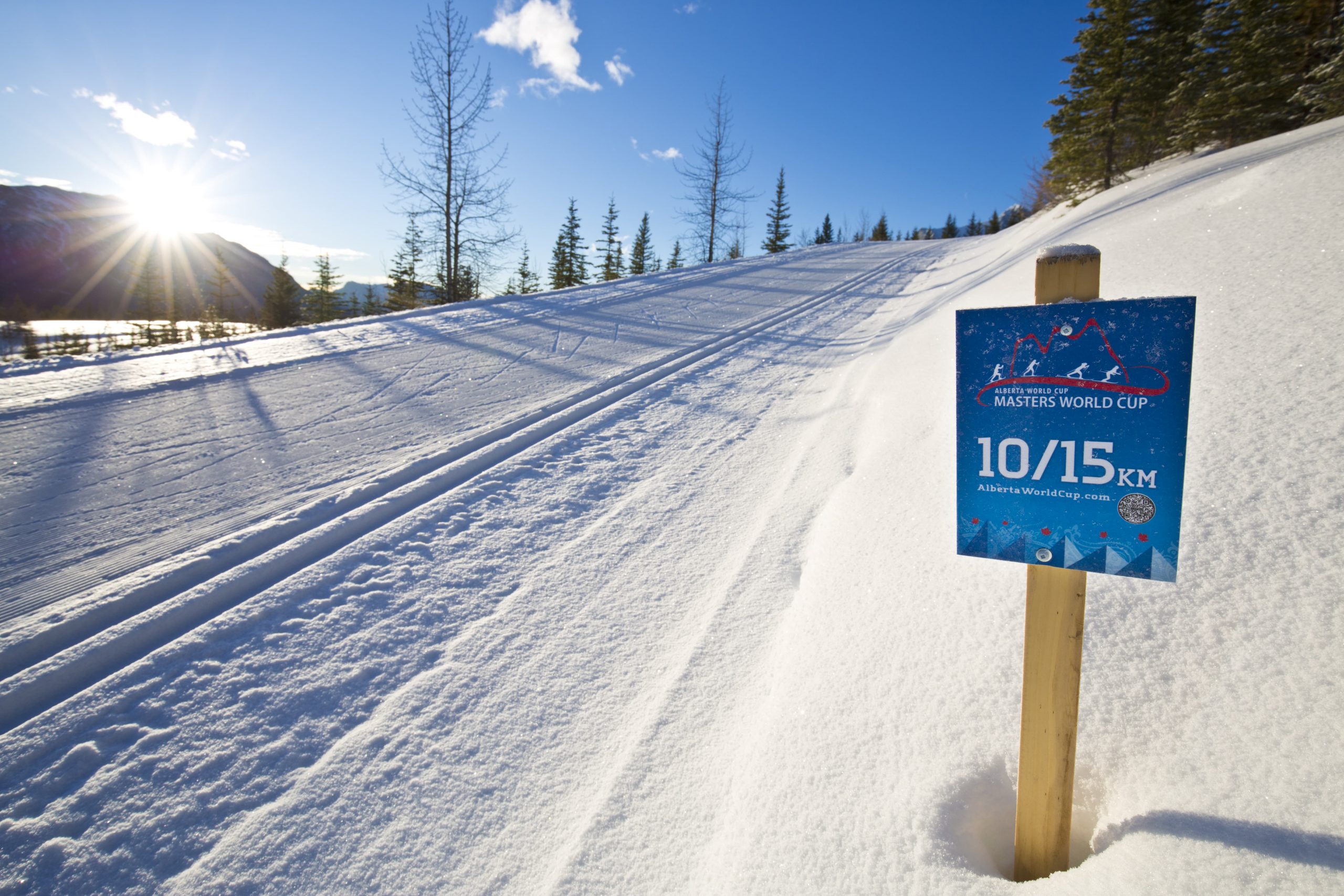
Fresh tracks on the Masters World Cup course in Alberta. Recovery is essential because adaptation occurs between workouts, but maximizing recovery is not the goal. (Photo: GibsonPictures)
Recovery Serves Adaptation
This brings us back to recovery. Recovery is essential because adaptation occurs between workouts. But maximizing recovery is not the goal of an athlete.
Maximizing adaptation is.
The masters athlete must solve a more complicated equation:
Stimulus + Recovery = Adaptation
Too much stimulus accumulated over days and weeks and we fail to recover sufficiently. Without recovery, we fail to adapt. The common theme in underperformance and overtraining is accumulating fatigue and a failure to adapt.
Sometimes the better solution is reorganizing the training. Instead of a pattern of hard, hard, easy, hard, easy, hard, exhausted, rest over seven days, a masters skier might organize training so the important sessions are separated sufficiently to perform them well and adapt to them.
The objective isn’t necessarily fewer quality sessions over the course of a month. It is enough recovery between those sessions to allow the athlete to absorb them.
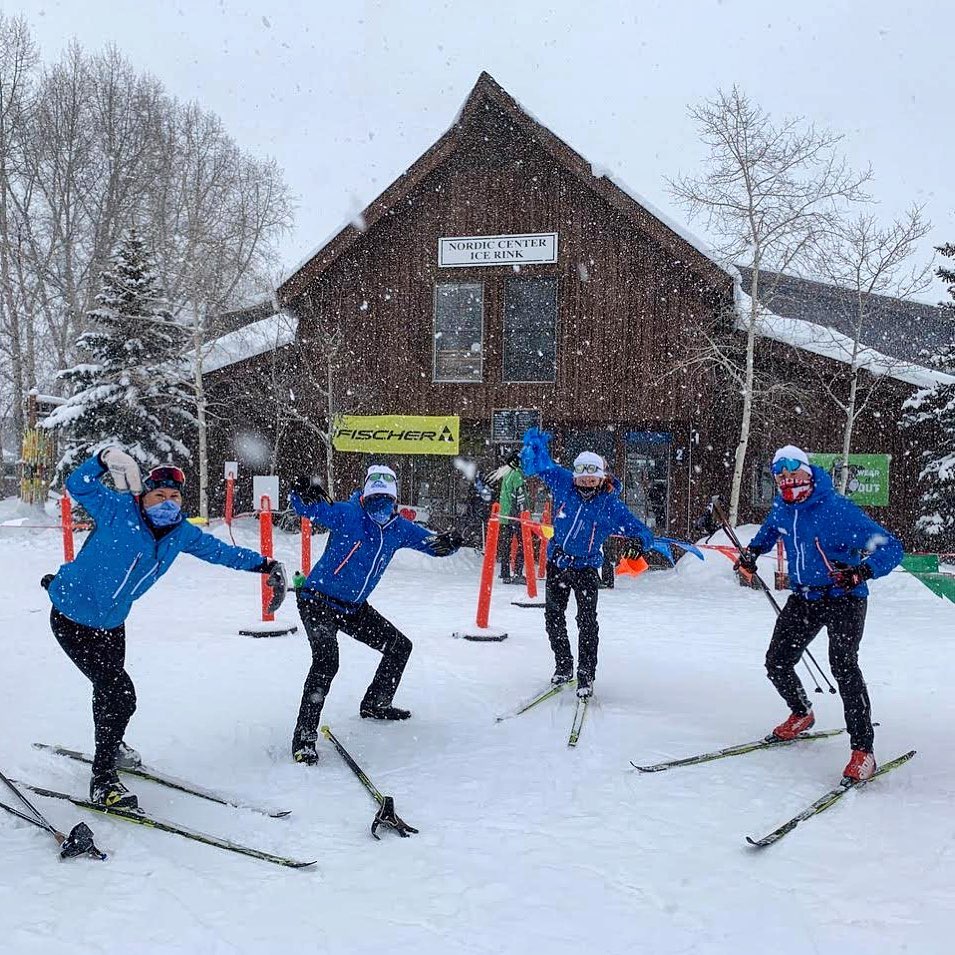
The coaches behind the masters performance group at Crested Butte Nordic in Colorado: from left, Rachel Bachman Perkins, Murray Banks, Cam Smith and Woody Martineau. Fitness is not created by individual workouts. (Courtesy photo)
Consistency Beats Heroic Training
For masters athletes, we need to adjust our perspective. Fitness is not created by individual workouts. It is created by the consistent implementation of easy endurance work, high-intensity aerobic training, strength, power and appropriate recovery.
One big interval session does relatively little. One big training week does relatively little. Forty or fifty good weeks stacked together can produce remarkable fitness.
That changes the definition of a successful workout.
The question is no longer: How much training can I survive today?
It becomes: What training can I absorb today that allows me to continue training tomorrow, next week and next month?
That doesn’t mean avoiding hard work. It means implementing both easy and hard training in a way that provides adequate space for recovery and adaptation.
Murray Banks at the Alley Loop in Crested Butte, Colorado. Chronological age alone doesn’t tell us enough: training history, injury history, available time, sleep, nutrition and life stress all matter. (Photo: Xavier Fane / Crested Butte Nordic)
The Masters Training Equation
Training, of necessity, must be individualized for athletes of every age. A highly trained 60-year-old with forty years of endurance training may tolerate workloads that would overwhelm a recreational 45-year-old who started skiing five years ago.
Chronological age alone doesn’t tell us enough. Training history, injury history, available time, sleep, nutrition, life stress and individual recovery all matter. But the physiological objectives remain surprisingly familiar.
Maintain aerobic volume.
Maintain VO2max.
Develop threshold and muscular endurance.
Preserve maximal strength.
Preserve power.
Maintain ski-specific technique and economy.
Then organize recovery around accomplishing those objectives. That is fundamentally different from starting with recovery and removing training until the athlete can tolerate what remains.
Masters athletes don’t need a watered-down version of elite training. Nor do they simply need more recovery. They need training organized around the physiological capacities most threatened by aging, with enough stimulus to preserve and improve those capacities and enough recovery to adapt to that stimulus.
Aging changes how we assemble the training. It doesn’t change what makes an endurance athlete fast.
The great opportunity of masters sport is discovering how much performance we can preserve, and in many cases still improve, by continuing to give the body both the stimulus and the time and space it needs to adapt.
Help Support Our Coverage!
If you value the thoughtful work and access FasterSkier provides, please consider becoming a Voluntary Subscriber. Your support directly fuels our work to cover the people, places, and moments that make our sport special.
Wilmington, Vermont’s Luke Rizio rollerskiing with the University of Vermont at Craftsbury last fall. Jim Galanes argues that a training year should change the dose of each quality, never remove one of them entirely. (Photo: Phillip Belena/EISA)
One of the biggest misconceptions in endurance training is that we should train one physiological capacity at a time. The traditional model usually follows the same progression. First build an aerobic base, lots of easy endurance training. Then add “threshold” training in the middle of the summer. Then, as we move into the pre-competition period, shift the emphasis toward VO2max and race specific intensity.
The emphasis certainly should change throughout the season. But this approach often leads coaches and athletes to unintentionally neglect important physiological systems for weeks or even months. The problem is that the human body doesn’t work that way.
Aerobic performance is not determined by one physiological system. It emerges from the interaction of multiple systems, each supporting the development of the others. When one begins to decline, it limits the effectiveness of the entire system.
The goal of periodization is not to sequentially build individual physiological systems. It is to continually maintain every important system while changing the emphasis toward the adaptations that offer the greatest opportunity for improvement.
Every Workout Sends a Different Signal
Training isn’t simply stress. Every workout sends a unique physiological signal for adaptation.
Long aerobic training stimulates mitochondrial biogenesis, capillary development, fat oxidation, plasma volume expansion, and cardiac remodeling.
“Threshold” training improves the ability to sustain a high fraction of aerobic power by increasing oxidative capacity, metabolic stability, and lactate transport. It should be noted, in spite of the current buzz, that “threshold” training is not a magic solution. Some athletes may need a heavier focus on VO2max training. Usually “threshold” type training is best for those doing high volumes and with an already high fractional utilization.
(Note: while I use the common term “threshold” here, there is ample evidence that no threshold actually exists and that it is a vastly misleading term. There is also no consensus on what this so-called threshold is. Depending on which of the many methods you use to define it, the speed or intensity at these various definitions can differ by 40 to 50 percent.)
VO2max intervals place the greatest demand on oxygen delivery, stimulating central cardiovascular adaptations while also improving mitochondrial function, the oxidative capacity of Type II fibers, lactate transport, and the speed or power that can be sustained at VO2max.
Sprint training recruits high-threshold motor units, preserves neuromuscular coordination, maintains the oxidative capacity of fast-twitch fibers, and develops the ability to rapidly produce force.
Strength training increases maximal force production, improves movement economy, enhances tendon stiffness, and helps reduce injury risk.
These are not interchangeable adaptations. Each contributes something different to developing aerobic fitness and performance.
The Systems Support Each Other
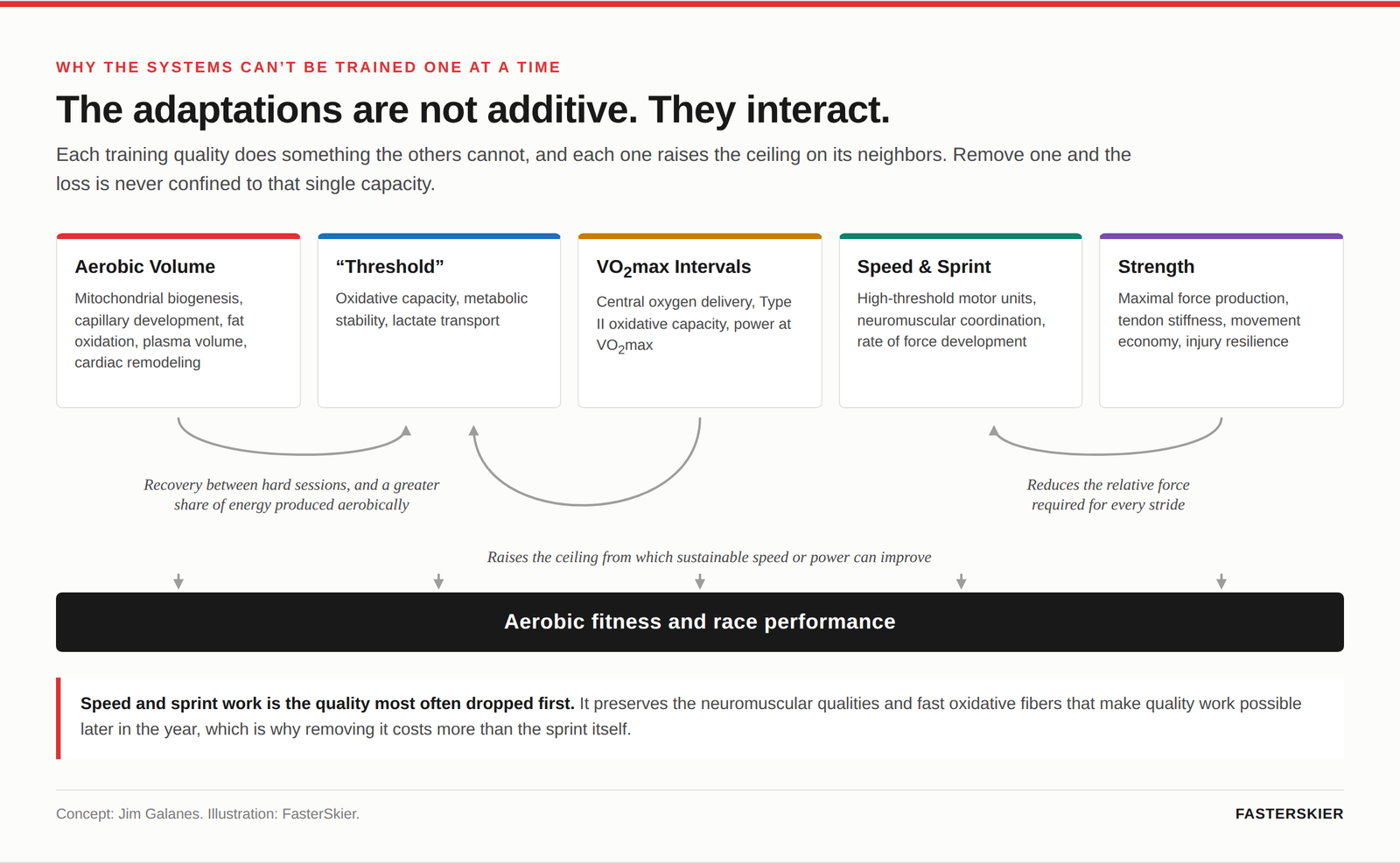
These systems work synergistically. The mistake is assuming the adaptations are simply additive. They are not. They interact, and the combined effect on aerobic fitness is larger than the sum of the parts.
A larger aerobic system allows the athlete to recover more quickly between hard sessions and to produce an increasing proportion of energy aerobically.
Better “threshold” capacity allows more quality work to be performed with less fatigue. Greater maximal aerobic power raises the ceiling from which “threshold” speed or power can improve.
Improved strength reduces the relative force required for every stride.
Sprint training preserves the neuromuscular qualities that improve efficiency even during submaximal exercise. At every intensity, we can move faster and more efficiently.
Aerobic volume, “threshold” work, VO2max intervals, speed and strength each do something the others cannot, and each raises the ceiling on its neighbors. (Illustration: FasterSkier)
What Happens When One System Is Ignored?
Every physiological adaptation has a maintenance requirement. Remove the stimulus long enough and that adaptation begins to decline. An athlete who abandons speed training gradually loses neuromuscular recruitment and maximal power. An athlete who eliminates heavy strength training slowly loses force production and movement economy.
When an athlete reduces aerobic endurance training, they don’t simply lose endurance. They lose the physiological foundation that supports every other adaptation.
An athlete who removes VO2max work for extended periods may maintain excellent endurance while gradually losing the central cardiovascular adaptations that support maximal aerobic performance.
These changes are rarely dramatic at first. What we see instead are the symptoms of overtraining. Performance in training declines. Interval sessions become harder. Race pace plateaus or drops.
Many coaches respond by adding more volume or more intensity. Neither is the likely answer. The solution is to restore the balance between the physiological systems that support performance.
Through the training year the dose and density of each quality moves, but no quality drops to zero. Concept illustration of Galanes’ argument, not a prescribed distribution. (Illustration: FasterSkier)University of Vermont skiers work up a climb during a fall dryland session at Craftsbury, Vermont. (Photo: Phillip Belena/EISA)
Why High-Intensity Training Belongs in the Base Period
One of the most common statements heard during base training is: “We shouldn’t do any hard training yet.”
Current evidence suggests otherwise. High-intensity training during the base period is not about maximizing anaerobic fitness. It is about maintaining the physiological systems that complement the full development of aerobic capacity.
Appropriately dosed high-intensity training helps preserve central cardiovascular function, maintains high-threshold motor unit recruitment, supports the oxidative capacity of fast-twitch muscle fibers, reinforces movement economy at higher speeds, and prepares the athlete for the demands of future training. Just as importantly, these adaptations support aerobic development rather than detract from it.
A stronger cardiovascular system allows greater oxygen delivery during long aerobic sessions. Maintaining fast oxidative fibers improves the ability to perform “threshold” work later in the season. Preserving movement economy reduces the energy cost of every stride. Maintaining maximal aerobic capacity raises the ceiling from which “threshold” performance can continue to improve.
High intensity doesn’t compete with aerobic development when it is properly dosed. It enhances it. This is why elite endurance athletes rarely eliminate intensity completely. They change the dose and the density. Not the presence.
I often hear athletes say their first interval session or time trial in late July felt terribly slow, or metabolically challenged. Of course it did. That should come as no surprise. If high-intensity work has been absent for weeks or months, the physiological systems required to perform it have detrained. The athlete now has to rebuild those systems before meaningful race-specific adaptations can occur.
Emphasis Is Not Elimination
This doesn’t mean every quality deserves equal attention every week. Training emphasis should absolutely change throughout the year. An aerobic development phase should contain more aerobic volume. The pre-competition period should emphasize “threshold” and race-specific intensity. The competition season should prioritize race performance and recovery.
But changing emphasis is very different from abandoning a physiological system. Even during an aerobic block, athletes should continue performing some high-intensity work, sprint training, and strength training.
During race season, aerobic volume remains essential. While emphasizing VO2max development, “threshold” training still supports the ability to perform quality work.
The dose and density change. The physiological adaptation remains.
There Is No Optimal Intensity Distribution
One of the most common questions in endurance sports is: “What is the optimal training intensity distribution?”
The question assumes there is one correct percentage of easy, “threshold”, and hard training. There isn’t. The optimal distribution depends on the athlete’s training background and on which physiological system currently limits performance. Those limiting factors change throughout an athlete’s development.
Early in a career, building aerobic capacity may deserve the greatest emphasis. Later, improving sustainable race pace may become the priority. Still later, improving neuromuscular power, force production, or movement economy may produce the greatest gains.
As those priorities change, training distribution changes with them. Not because the principles change. Because the athlete changes.
The coach’s responsibility is to continually adjust aerobic volume, “threshold” training, VO2max work, sprint training, and strength training so that each enhances the adaptations produced by the others while minimizing interference.
There is no universal training formula. There is only the continual process of identifying the athlete’s current limiter, maintaining every important physiological system, and emphasizing the adaptations that will produce the greatest improvement.
Great coaching is not about prescribing the perfect intensity distribution. It is about continually identifying the athlete’s current physiological limiter while maintaining every system that supports performance. As the athlete changes, the emphasis changes, but the physiology never disappears.
Help Support Our Coverage!
FasterSkier is independent, reader supported, and free to read. If coaching and training coverage like this is worth something to you, a voluntary subscription keeps it coming.
UVM coach Patrick Weaver talks with first year Hanna Koch of St. Paul, Minnesota, during a fall session at Craftsbury. Identifying an athlete’s current limiter, Galanes writes, is the coach’s central job. (Photo: Phillip Belena/EISA)
A new study landed in my feed last week, and I will admit the algorithm has my number. It steered me toward a question I have chewed on more than once here at FasterSkier: when it comes to low-intensity training, are you better off concentrating volume into one big week, or spreading the same volume evenly across several weeks? The easy move is to enjoy a paper that agrees with you and click away. I try not to do that. A study only earns its keep if I am willing to read the ones that argue against me with the same care I give the ones that pat me on the back. This one sits close to my own view, which is exactly why I want to handle it carefully.
What the researchers tested
Walther and colleagues, writing in the International Journal of Sports Physiology and Performance, set out to test whether concentrating low-intensity training into a high-volume block produces any adaptation that even distribution does not. They worked with 20 well-trained junior cross-country skiers in a crossover design, so every athlete completed both approaches and served as their own comparison. Total training volume was matched across the two protocols. Before and after each intervention, the researchers ran a battery of tests: VO2max, peak velocity at VO2max, lactate responses, submaximal economy markers, and subjective measures of recovery and fatigue.
The two protocols differed only in shape:
BLOCK: one week at 160 percent of normal endurance volume, followed by three reduced-volume weeks.
EVEN: the same total volume spread evenly across four weeks.
The point worth holding onto is that the totals were identical. Only the organization of the four weeks changed.
FasterSkier – Even vs Block Protocol – Figure 1: Bar charts comparing the EVEN and BLOCK protocols. EVEN shows four weeks at 100 percent of normal volume. BLOCK shows one week at 160 percent, followed by three weeks at 80 percent. Total volume is identical. The two protocols delivered identical total volume. BLOCK front-loaded a 160 percent week; EVEN spread the same load across four weeks.
The performance results
Concentrating the volume into a block had no effect on performance. Both protocols nudged some variables in the right direction, and the improvements were statistically similar. VO2max, maximal aerobic speed, and lactate-threshold measures all moved to a comparable degree whether the work was stacked into a block or laid out evenly. That matters because block periodization is so often assumed to be the stronger option. Here, concentrating on a low-intensity load produced no extra adaptation beyond what consistent training already delivered.
The two approaches did not feel the same, though. During the high-volume week and the recovery week that followed, the BLOCK group reported lower mood, reduced feelings of recovery, and greater fatigue. The athletes tolerated the work, and there was no indication of increased injury or illness risk, though four weeks is a short window in which to base that claim. The concentrated approach simply costs more on the recovery side without being repaid in results. I would have liked to see heart rate variability tracked across both protocols. Autonomic data might have put real numbers to that recovery cost, rather than leaving it to a subjective report.
FasterSkier – Gains vs Cost – Figure 2: Both protocols improved aerobic measures to a similar degree, but the block week carried a higher subjective recovery cost.
Why this matches what I have seen
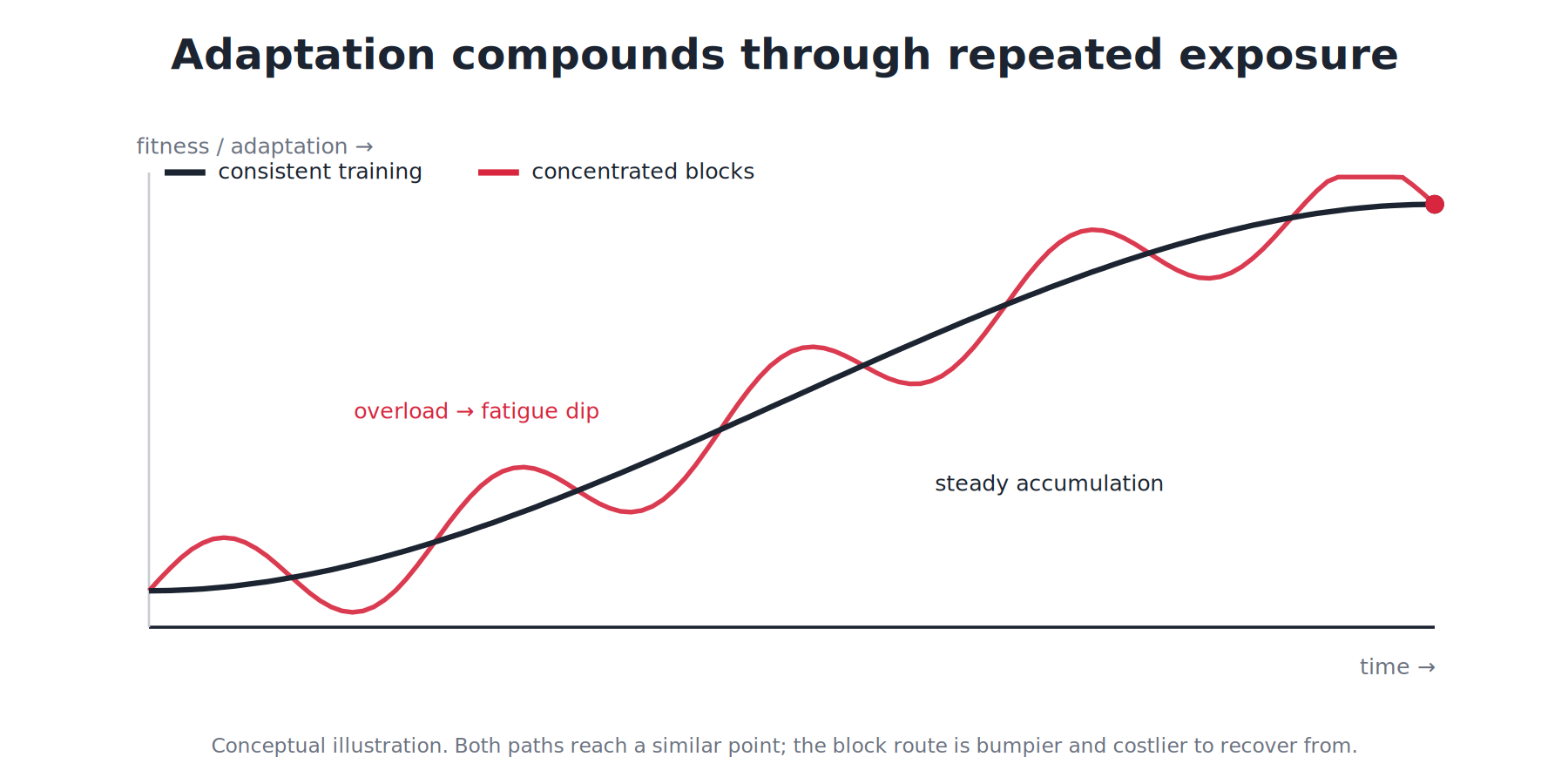
This lines up with something I have watched play out across endurance sport for years. Adaptation comes from repeated exposure, not from the occasional enormous week that flattens recovery and chips away at the very adaptation you are chasing. A training model deserves to be judged on more than whether it works. Time to adaptation matters. So does recovery cost, psychological and autonomic strain, and whether an athlete can actually keep the thing going for months and years. The block protocol led to greater fatigue and poorer perceived recovery without a better outcome. From a coaching chair, that is not a small detail, and it weighs even heavier with junior athletes.
There is a fair counterargument, and it deserves room. Proponents of block periodization will point out that overload blocks build fatigue first and may reveal their benefits only over a longer horizon, and that a four-week window can miss those delayed adaptations. I see the logic, but I lean the other way. The longer the timeline an adaptation needs, the greater the room for overtraining and the thinner the signal you are actually working with. If a block needs four weeks to show its hand, there probably wasn’t much adaptive signal to begin with.
FasterSkier – Block vs Consistency – Figure 3: Over time, adaptation accumulates through repeated exposure. The block route can reach a similar point, but with more fatigue along the way.
Why low intensity is the key qualifier
For low-intensity work, the physiological stress of any single session is modest by design. The adaptation seems to come from stacking many of those sessions on top of one another over time, not from cramming volume into a short window. When the totals match, the body appears to respond to how much training got done, not to how it was parceled out. That helps explain why athletes who lean on the occasional big week rarely pull ahead of the ones who just train, month after month, without drama. The big week feels harder. Harder is not the same as more adaptive.
The authors are careful not to overreach, and so am I. Their findings should not be stretched to cover every form of block periodization. The earlier work showing real benefits from block training generally concentrated high-intensity sessions, where the stimulus is far larger. This study looked only at low-intensity volume. Block periodization may well earn its place when the stimulus itself is potent. There is just little evidence that piling up low-intensity volume creates a stronger adaptive signal.
What it means for junior coaching
For junior endurance athletes, the practical read is straightforward. Do not expect a high-volume, low-intensity camp or an overload week to produce superior adaptations simply because the work is bunched together. Camps still earn their place for logistics, technique, and the team-building that holds a season together. They just do not appear to hand you a physiological edge once total volume is matched.
So here is where I land. Concentrating low-intensity volume into overload blocks does not seem to yield better short-term aerobic adaptation than spreading the same volume out, at least when the total volume is equal. I am not claiming block periodization does not work, or that all concentrated loading is a waste. What the evidence keeps pointing at, for aerobic base development, is that showing up consistently does more for an athlete than the occasional heroic training week. Over a season, the consistent skier and the big-week skier can bank the same hours. Only one of them pays the fatigue tax to get there.
Help Support Our Coverage!
If you value the thoughtful work and access FasterSkier provides, please consider becoming a Voluntary Subscriber. Your support directly fuels our work to cover the people, places, and moments that make our sport special.
Masters’ athletes are often told to “train smarter, not harder,” or the current version: “Go easy on the endurance sessions so you can go hard on the intense sessions.” Those phrases get repeated so often they’ve lost context and meaning. But there is a real physiological reason training for masters’ skiers must be approached differently than training for younger athletes.
The challenge is not simply age itself. The challenge is balancing adaptation with recovery while preserving capacity, durability, consistency, and motivation over many years of training. Older athletes can still improve significantly. Aerobic capacity can improve. Sustainable race pace can improve. Technique can improve substantially. Strength and power can improve. What changes is the recovery required to create adaptation and the recognition that the margin for error narrows considerably compared to when we were younger.
Daniel Schwenk on his way to 9th place in the Men’s Masters’ division of the Climb to the Castle. (Photo: Nancie Battaglia)
The Biggest Mistakes
Many masters athletes carry over the same training structure they used decades earlier, too moderate intensity (Zone 2 and 3 in most 5-zone models), hard sessions stacked too closely together, insufficient recovery between demanding workouts, and not enough attention to technique, strength, mobility, and durability.
The results are absolutely predictable: chronic fatigue, declining velocity or pace in the hard sessions, stagnate or declining performance in spite of continued training, and simply a loss of motivation to train. Ironically, many master’s athletes are functionally overtrained, despite the reluctance in some circles to even use that term.
Recovery and Adaptation Become a Primary Training Variable
As we age, there is a clear reduction in recovery capacity due to reduced anabolic hormone response, decreased muscle protein synthesis, accumulated fatigue, and often greater life stress outside of training.
None of this means that masters athletes cannot train hard. They absolutely can, and should. Maintaining aerobic capacity and muscular strength is strongly associated with health, function, and longevity. But masters’ athletes generally cannot stack hard sessions with the same frequency as younger athletes without compromising recovery and adaptation.
For most skiers I have coached or consulted with, the question should not be, How much can I train? The better question is: How much can I recover from and adapt to consistently over the weeks and months ahead? That distinction is perhaps the most important one.
Tim Donahue mid-race during the 2020 Winter World Masters Games in Seefeld, AUT. (Photo: Garrott Kuzzy / Lumi Experiences)
Consistency Beats Hero Workouts
The most successful athletes at any level are usually not the ones doing the biggest “hero” sessions. They are the ones who maintain consistent training and compound it week after week, month after month, and year after year.
A training model built around sustainability always outperforms the commonly programmed “ramp” approach, where volume and/or intensity continually increase week to week and month to month. The assumption that training load must constantly rise in the short term, to add stress and create more adaptation to improve, is scientifically unsupported and not common practice among athletes who perform well over the long term.
That means, fewer very hard sessions typically 1–2 every 7–10 days, endurance sessions performed at the correct intensity, usually easier than most athletes think, 1–2 true rest or recovery days per week, not “easy training” or so-called recovery workouts, but actual rest, consistent sleep and nutritional fueling, and proper control and management of both low and high-intensity sessions.
One of the biggest contradictions in master’s training is that many athletes improve when they reduce training load. That does not necessarily mean less training volume. More often, it means better control of intensity and reduced accumulated stress.
Masters World Championship, Asiago, Italy, 2014
Intensity Still Matters
One of the common mistakes today, especially with the influence of social media and the one-sided promotion of Zone 2 and threshold training, is the assumption that aerobic improvement comes only from easy or moderate training.
To improve aerobic function, we still need hard training. High-intensity work improves mitochondrial function, increases oxidative capacity in high-threshold motor units, recruits more muscle fibers, and improves high-end aerobic power. The key is proper control of the dose and intensity.
An elite athlete may tolerate three demanding intensity sessions per week plus strength work. That rarely works for most masters athletes. Many would benefit more from one VO2max session and one maximal steady-state session every 7–10 days, combined with two strength sessions and additional speed- and technique-focused work embedded within basic endurance training. While I really dislike rules of thumb or guidelines in a general sense, I feel using the 80/20 rule is a good starting point. Often confused with the duration or mileage of training. It is not that. The 80/20 guide is 80 percent of the total workouts in a week or a month are easy endurance-based, and 20 percent of the workouts are hard. If one applies this measure to the duration of training, I guarantee over-training.
Help Support Our Coverage!
If you value the thoughtful work and access FasterSkier provides, please consider becoming a Voluntary Subscriber. Your support directly fuels our work to cover the people, places, and moments that make our sport special.
BNJRT athletes with coach Adam St. Pierre at JNs in Soldier Hollow 2018. From left to right, Carson Williams, Michael Pickner, Adam St. Pierre, Bettina Burgess, and Ellie Smith. (Photo: David Pickner)
It is well known that XC ski racers have to be incredibly “fit” to be competitive. But how do we measure “fitness”? For decades, we’ve known that a high VO2max is necessary to be a competitive ski racer. Training to improve VO2max involves a large volume of training at a low intensity and a comparatively smaller volume of training at a very high intensity. Over the past 20 years, changes in equipment technology, course preparation, and a change in race formats from primarily individual start events to a mix of individual starts and head to head racing have necessitated a change in our view of “fitness.” It’s no longer all about VO2max.
This spring Thomas Losnegard wrote a review titled “Energy system contribution during competitive cross-country skiing” in the European Journal of Applied Physiology. In this review, Thomas compares the energy demands of skiing to other sports and summarizes the available research into what type of “fitness” is necessary to compete in modern XC skiing. Before I dive into a summary of the review article, I think it’s important to explain metabolism in a nutshell, so I’ll borrow an analogy from my friend and colleague Joe Howdyshell of the Summit Endurance Academy – The Financial Analogy:
Your body has 3 pathways for generating energy in the form of ATP. ATP powers all muscle contractions.
The Phosphagen system, also known as ATP/CP. CP stands for Creatine Phosphate. Your body stores enough energy to power exercise for up to 15-20 seconds… with training you can increase this to maybe 25-30 seconds of stored energy in the muscles. Think of the phosphagen system as the cash in your wallet.
The anaerobic system, also known as non-oxidative or glycolytic systems, is the conversion of Glucose to Lactate. This process does not require oxygen and hence is not measured by VO2max testing. It is quick to produce energy (not as quick as the phospagen system) to meet the demands of training and racing. Think of the anaerobic system as your credit card.
The aerobic system produces the bulk of energy for events lasting longer than 2-3 minutes. Think of the aerobic system as your bank account, with your paycheck deposited regularly by your employer. You could perhaps think of recovery as your employer in this analogy… recovery puts the money back in the bank!
You can train to increase the size of your wallet. You can train to lower the interest rate on your credit card. And you can train to get a bigger paycheck! During an XC ski race. You are constantly balancing the cash in your wallet (ATP/CP) and the amount of debt you can take on (glycolytic) with the amount in your bank account (aerobic). You have to use the aerobic system to pay off the credit card and put cash back in your wallet before you have to pay too much interest.
Here are my most important take-home points from Losnegard’s review:
In XC skiing, there are large variances in speed, power output, and mechanics over the course of a race. The most similar physiological analog to XC ski racing would be short track XC-mountain biking. To adequately prepare for XC ski racing, we must first look into the specific demands of ski races. In the review, Losnegard cites research stating that elite level 10 or 15 km distance races may last 25-35 minutes, of which about 50% of time is spent going uphill, with 25% of time spent on the flats, and 25% on downhills. However, the time spent in any one type of terrain is usually no more than 10 to 35 seconds at a time; sometimes longer, but rarely much over one minute. This means that while racing, skiers must constantly be assessing speed and changing between techniques and sub-techniques approximately 25 times per km in order to maintain the highest speed possible around the course.
In uphill terrain, a skier may work at 120-160% of VO2max for short periods of time, followed by periods of lower VO2max to recover. As you likely know, VO2max is the maximal amount of oxygen the body can use during exercise. It seems odd that an athlete can work at greater than 100% of VO2max. This does not mean they are using more oxygen, it means that anaerobic (aka non-oxidative) metabolism is contributing to the workload. Think of workload as speed in a given terrain and conditions. At workloads above VO2max, a significant amount of energy is derived from anaerobic metabolism. This results in an oxygen deficit. Oxygen deficit is essentially, how much energy had to be produced by anaerobic methods to sustain the workload. Oxygen deficit is difficult to measure and quantify. Typically, exercise at high intensities resulting in oxygen deficit results in the production of Lactate, so the measurement of blood lactate can be used to estimate the extent of oxygen deficit (higher blood lactate levels indicate a greater oxygen deficit incurred).
In general, sprint skiers have a higher anaerobic capacity than distance skiers. This is directly correlated to the fact that sprint specialists tend to have a higher muscle mass than distance skiers. Elite men typically have a 10-30% greater anaerobic capacity than women, largely correlated to women typically having less muscle mass than men. The performance difference between men and women is greatest in techniques relying largely on upper body (e.g. double poling and V2) and least in techniques that are not as upper body dependent (e.g. striding and V1).
The contributions of the arms to XC skiing are obvious, but how training of the upper body impacts performance is not fully understood. Arms generally constitute a much smaller muscle mass than legs. Muscles in the arms have a lower oxidative capacity than leg muscles, even in elite XC skiers. During double poling, the arms release lactate into the blood, where the legs are actually a net importer of lactate- meaning the arms are utilizing a higher percentage of anaerobic metabolism thus producing lactate that must leave the muscle, while the legs are working at an intensity where they are capable of taking lactate from the blood and utilizing it for energy through aerobic pathways. At high intensities in double poling, the energy contribution from the arms plateaus, and any further increase in intensity must come from the legs which increase power output leading to greater vertical changes in the center of mass in order to increase speed (you jump onto your poles more at higher intensities).
It appears that pole contact time may be the ultimate limiter of energy input and thereby speed in flat terrain. With this in mind, training at high speeds to minimize pole contact time (the amount of time the poles are in contact with the ground) may be of great benefit.
Now for my interpretations and some practical implications.
In order to repeatedly perform at workloads above VO2max, an athlete must have a high level of aerobic fitness in order to recover from efforts and regenerate stores of ATP/CP during the short periods between supra-VO2max efforts. Instead of looking at increasing VO2max as the ultimate goal of training, perhaps training to increase an athletes’ maximal accumulated oxygen deficit would yield better results.
The Principle of Specificity is a foundation of exercise physiology. Essentially, you can improve only what you train. It is important that we as coaches (and parents, and skiers), recognize the energy demands of XC ski racing and train our athletes (and ourselves) appropriately. We need to design workouts that mimic the demands of racing to prepare our athletes to race. We need to train to move fast in a variety of terrain utilizing both techniques (skate and classic) and all sub-techniques (herringbone, double pole, striding, V2, V1, etc.)
We need to look at skiing as a non-steady state exercise. There are few instances in ski racing where a skier can grind away for 3-15 minutes at a steady effort/intensity, so why do many coaches (myself included) tend to focus training on this type of workout? Instead, a focus on workouts that mimic the actual demands of XC ski racing- 10-60 sec maximal efforts with 5-30 sec of recovery, may lead to better results in XC ski racing.
Here are my practical recommendations based on this review article and the research summarized in it:
Train to the demands of your event. While workouts like 4 by 10 min L3 certainly improve lactate threshold and VO2max, a workout like 4 by 10 min of 45 sec fast/15 sec recovery may achieve similar aerobic gains and allow for faster movements and greater anaerobic contribution during the workout, perhaps making it more similar to racing. See below for some possible workout progressions. Also, the training necessary for a Wave 1 Birkie skier is different from a Wave 8 Birkie skier which is different from a junior which is different from a World Cup athlete. Identify the demands of your event(s) and target your training towards them.
Include “gear shifts” in intervals. Most intervals should include some portion uphill, but not all. Have you ever heard “transitions are important”? Practice them at speed!
Use ski specific modalities for high intensity work- bounding/ski walking, rollerskiing, or (obviously) on-snow. Intervals on bike or swimming are good for fitness, but not nearly as specific as similar workouts in ski specific modalities, especially given the increased utilization of upper body power.
Train fast movements. Athletes need to be able to move quickly and apply power quickly in racing. In order to do this in races, we need to do it in training. Incorporate short sprints, explosive strength training, and plyometrics into your training. Andy Newell has some great video resources on his website( www.nordicteamsolutions.com ) that can be modified for any level of athlete!
Here is a progression of workouts you may find beneficial to add to your training. These workouts should be done on skis, rollerskis, or bounding/running with poles. Each workout is preceded by a 20-25-ish min warm-up consisting of:
5 min easy, 3 min L3/Threshold, 2 min easy, 2 min L4, 2 min easy, 1 min L5, 5-10 min easy. In an ideal world, this warm-up would be preceded by some mobility and light plyometric work!
Each Main Set consists of 12-20 min of total “on” time, all “on” time is done at sprint race pace/effort. HR will not be useful in guiding the intervals because they are so short, though looking at HR recovery between intervals and the response of HR to the workouts over time can be interesting). I also prefer to have a timer of some sort so you don’t have to look at your watch to know when to start and stop:
24 by 30/30 (24 min, 12 min on time)
5 by 6 by 30/30 w/ 4 min between sets (46 min, 15 min on time)
5 by 8 by 30/30 w/ 4 min between sets (56 min, 20 min on time)
30 by 30/30 (30 min, 15 min on time)
21 by 40/20 (20 min, 14 min on time)
5 by 6 by 40/20 w/ 4 min between sets (46 min, 20 min on time)
5 by 6 by 40/20 w/ 2 min between sets (38 min, 20 min on time)
30 by 40/20 (30 min, 20 min on time)
15 by 45/15 (15 min, 12 min on time)
3 sets of 8 by 45/15 w/ 4 min between sets (32 min, 18 min on time
3 by 10 by 45/15 w/ 5 min between sets (40 min, 22.5 min on time)
20 by 45/15 (20 min, 15 min on time)
12 by 60/30 (18 min, 12 min on time)
4 sets of 4 by 60/30 w/ 2 min between sets (30 min, 16 min on time)
5 sets of 4 by 60/30 w/ 4 min between sets (36 min, 20 min on the time)
20 by 60/30 (30 min, 20 min on time)
10 by 30/30, 5 min easy, 8 by 40/20, 4 min easy, 6 by 45/15 (33 min, 15.5 min on time)
End each workout with a 5-20 min cool-down
I recommend doing one session like this every other week in the summer, one per week in the fall, and one-two per week in the winter (depending on race schedule). For skiers living/training at altitude, it may be necessary to increase the rest between intervals to ensure that the short “on” periods are of sufficient quality to train really quick and powerful movements.
I’d like to give thanks to a few friends and colleagues who aided in the editing of this article: Corrine Malcolm, Duncan Callahan, and Joe Howdyshell.
Adam St. Pierre (left) and former Bowdoin skier and BNJRT coach Sam Shaheen at the start of the 2019 American Birkie. (Photo: courtesy Adam St. Pierre)
Adam St.Pierre is a New Englander who learned all about Exercise Science in grad school then found his way to the Rocky Mountains to coach XC skiing in Boulder, Colorado- where the running trails are plentiful and the snow is just a short drive up a canyon.
Team Asker gets together for a group shot in the ski tunnel in Torsby, Sweden. (Photo: Johanna Lier)
Editor’s Note: The following is the fourth post in a series proposed by Maks Zechel, a 20-year-old Canadian cross-country skier embarking on his first season training abroad. He recently made the big move to Norway, where he’ll be training and racing with Team Asker for the next nine months. Through these updates, Maks hopes to share his personal “observations, stories, and lessons learned” to help close the gap between North American and Scandinavian nordic skiing. Previous posts: #1,#2,#3, and #4.
***
I never thought that on my 20th birthday I would be shivering at the top of a ski resort, a thick fog obscuring the spectacular view of Oslo, listening to 30+ Norwegians sing the Norwegian birthday song for me. But I guess turning 20 was bound to be different!
“No more excuses,” was my first thought. Gone is the security of being a teenager. Rather than impressing people with maturity, it now feels like it is expected. I think it’s a good thing, but it doesn’t make being an adult any easier. My trip to Norway has been full of moments when I suddenly realized, “Oh, I guess I’ll just have to figure this out on my own.” My parents are no longer always present to make introductions, so now it is up to me to advocate for myself. Risks taken as an adolescent do not come with the expectation to produce results. “I’m impressed,” people say, and they applaud you just for trying. But adults are expected to see things through to completion.
Team Asker group core session after a ski in the tunnel in Torsby, Sweden. (Photo: Johanna Lier)
Back on a cold, foggy Norwegian ski slope at the end of August, my teammates and I were about to tackle 6 x 6 minute Zone 4 bounding intervals. In Norway, bounding with poles is called elghufs, or “moose-hooves”. I had never done a bounding workout of this duration and intensity. Despite this, I decided to take a risk and stick with the best runner on the team, who was two and a half minutes faster than me on our last uphill running test. I stuck with him from the first interval, and stayed with him as he threw in big surges on the plateaus between climbs. He added these surges because he is trying to get better at working the flat sections of ski races in the winter, which happens to be one of my goals as well. We did the whole workout together, and I stayed with him until he got away on a downhill and a steep climb at the end. I took a risk in a workout, not caring if I blew up halfway through, and it allowed me to train at a higher intensity than I would have thought possible.
Earlier this summer I listened to a “TED Talk” by Eduardo Briceño on “the learning zone and the performance zone”. At first it didn’t seem like a life-changing lesson, but since I arrived in Norway, his ideas have led me to think differently about my actions, and in particular, my training. Briceño discusses how people, from office workers to athletes, fail to improve at what they do, whether it is a hobby or a job, because they do not give themselves the opportunity to take risks, make mistakes and learn. In our society, the “performance zone” is the default; this is where we only do the things we are comfortable with, because we want things to be perfect, because that is how we envision our end goals to turn out. Briceño argues that we should encourage employees, athletes, and ourselves, to spend more time in the “learning zone,” where we break our ideal performance into the things we need to work on to get there. It is only here that we get better, because it is here that we allow ourselves to try things that we would otherwise never attempt for fear of failure. In the learning zone, risk and creativity produce the most astounding results. Having reached higher comfort levels, it is possible for someone to apply their repeated failures and lessons-learned to a better end result.
Author Maks Zechel doing pull ups: “the most popular Norwegian strength exercise.” (Photo: Johanna Lier)
A few days after “birthday elghufs”, Briceño’s ideas come back to me as I am training in the ski tunnel in Torsby, Sweden. I am back here for a long-weekend training camp with Team Asker. In the tunnel I confront a skiing related fear of mine, developed over a few years of poor performances in classic races. I dread the feeling of my grip giving way while striding up a hill. I am determined to become a better classic skier, the technique I was strongest in when I was younger, so I work hard at anything that I believe will make me a better classic skier: bounding intervals, core, double poling, hours of video technique work, and skiing without poles. If I can ski up a hill legs-only, then surely I can do it with poles in a race, right? Whenever I am on skis, I challenge myself to stride up the steepest hills without poles, but it becomes a challenge that I must perform to perfection, otherwise in my mind I have failed as a classic skier. The pressure that I put on myself leads me to shuffle stiffly and tentatively up hills, not allowing myself any room for error. The result is a poor imitation of the principles of classic skiing, lacking any weight shift, pop in the ball of my foot, or ankle compression. Sure, I made it to the top of the hill, but I didn’t summit the mountain.
On our first morning in Torsby we have a distance classic ski in the tunnel. Rather than skiing slowly around the tunnel for a couple of hours, our coach has added some variety to our workout: one lap legs-only, one lap thinking about good striding on the hills (not thinking about heart rate), and one lap with a short “race pace” acceleration. The variety in this workout is important in early season skiing so that we can take advantage of our short time on snow to train our muscle memory to ski properly, getting rid of lazy habits developed while rollerskiing.
Maks Zechel working on legs-only in the ski tunnel in Torsby, Sweden. (Photo: Johanna Lier)
On my legs-only loops, I decide to take a risk. Instead of pressuring myself to make it up the entire hill, I ski as dynamically as I can, focusing on full commitment to each ski and compressing the wax pocket as if I had perfect grip. Although frustrating, I know that it is better for my development to ski properly up half the hill, than to shuffle up the entire thing. A few times I am rewarded with making it to the top, and other times I almost face plant spectacularly in front of the Norwegian junior national team coach.
The risk of embarrassment is one that I am willing to take. I made a decision to escape my comfort zone when I left Canada, leaving behind family, friends, and a team that I have trained with for nine years. I left behind the chance at another year of racing on the NorAm circuit and seeing marginal, or perhaps substantial, improvements up the results board. I was sick of feeling like there was an order to things. If I beat a friend of mine during a race, that meant that I had had a good day, but if someone finished ahead of me who I was supposed to beat, then the day was unsuccessful. To me, this type of racing environment was toxic, as I struggled through a season of failed expectations. I am fortunate to have had the means to come to Norway, where simple training aspects, things that had lost their magic over the years, are now bringing back the same giddy excitement that skiing originally gave me. I am in a place filled with potential opportunities, but now I need to have the guts to seize them.
Team Asker reparing for an intensity workout in the ski tunnel in Torsby, Sweden. (Photo: Johanna Lier)
While training in Torsby, we were lucky enough to be there at the same time as the Norwegian junior national team and national recruit team (a step below the national senior team), as well as Anders Gløersen, Charlotte Kalla, Stina Nilsson, and Hanna Falk. I watched some of the members of the recruit team doing offset sprints, and it was the fastest I have ever seen someone sprint on skis in real life. Rather than being intimidated, I felt almost relieved to watch some of my idols skiing this fast. The mystery was gone; this is how fast you have to ski to be great, as simple as that, and now I could spend the entire weekend shadowing some of the best skiers in the world.
On our first day in Torsby I had the opportunity to do two things for the first time in my life: rollerski on a treadmill and take aVO2 max test (maximum rate of oxygen consumption). Naturally, because of my name, I prefer to say it in Norwegian: VO2maks.
After an initial stumble on the treadmill, I found it quite easy to classic rollerski on. Before the test started I warmed up on a few different gradients and speeds, unable to stop smiling at myself in the large mirror in front of me. Here I was, rollerskiing in the same laboratory that has tested countless World Cup skiers! The test began at a gradient of 10 percent and speed of 10 kilometers per hour, with the gradient increasing every minute until it reached 18 percent. This felt remarkably steep. From then on the gradient remained the same, but every 30 seconds the speed increased.
The rollerski treadmill/testing lab in Torsby, Sweden. (Photo: Maks Zechel)
During testing there is a harness around your waist so that you don’t fall off the treadmill, a heart rate monitor around your chest, and a mask strapped to your head to measure oxygen consumption. It’s a lot of gear hanging from your body, and your head has to remain relatively steady, but once the test started I found that the pain was an adequate distraction from all of this. Unfortunately, during my test a strap on my mask came undone and the mask fell off while I still had something left to give, so I was robbed of the chance to ski until collapsing (the skier’s dream). My VO2 max result was 74.5 ml/kg. Last year Harald Amundsen, the top skier on the team, reached a VO2 max of 85 ml/kg as an 18 year old (an exceptional result).
Being in a new place, with a new team, and in close proximity to many of the world’s best skiers, there is a lot to take in. It is important for me to absorb as much as I can during my time here, but it is also important to stay consistent with things that I have been working on before I got here. If I jumped to apply every newly learned training philosophy to my training, I would be all over the place and have no chance to improve. I am allowing myself to take risks and make mistakes while staying true to some of the basics that got me to where I am. In the midst of so many talented and competitive skiers, I am trying to create a learning space for myself, devoid of expectations, so that I can learn without restrictions. When winter finally comes, I hope that I can translate my learning to some fast performances on skis. I have had a lot of practice translating after all…
Norwegian Phrase of the Week
Norwegian: Kan jeg få skyss?
Translation: Can I have a ride?
Norwegian: Kan jeg få et kyss?
Translation: Can I have a kiss?
*An important distinction that could add an unexpected twist to your ride to practice, as skyss and kyss sound almost exactly the same.*
***
About Maks: Maks Zechel is a competitive cross-country skier who secretly wants to become a professional mile runner. He loves hiking and going on canoe trips with his family, as well as peanut butter cups in ice cream. Johan Olsson is his favourite skier and he hopes to race the Cortina-Toblach stage of the Tour de Ski one day. He enjoys writing about his experiences. Follow him on Instagram @makszechel.
German nordic-combined stars Johannes Rydzek (c), Eric Frenzel (1) and Björn Kircheisen (8) after taking gold, silver and bronze, respectively, in the individual normal hill/10 k Gundersen at 2017 World Championships in Lahti, Finland. (Photo: John Lazenby/Lazenbyphoto.com)
What are the physiological capacities of nordic-combined athletes and can laboratory tests predict performance capabilities on the World Cup?
Those are the questions that a team of Norwegian researchers set out to answer by testing 12 competitors from eight different countries before a 2015 World Cup competition in Trondheim, Norway.
The study, led by Vegard Rasdal of the Norwegian University of Science and Technology and the Norwegian Olympic Sports Center, was recently published in the academic journal Plos One. It is an open-access journal, so you can read the paper here.
“The sport is always evolving,” Rasdal wrote in an email to FasterSkier about the results. “Today it is no longer enough to be ‘just’ a strong ski jumper or cross-country skier, you really have to excel in both in order to be successful in terms of podiums. Johannes Rydzek and Eric Frenzel, the two most successful athletes last season, were not only two of the best jumpers last season but also the fastest skiers.”
Indeed, they found that the best skiers in the nordic combined field have VO2Max capacities close to those of the best cross-country skiers, period – and even higher than those of Olympic medalist sprinters. Furthermore, this was a good predictor of World Cup results in the Trondheim competition.
Variability in Abilities and Physiology
There have been plenty of physiological studies on top cross-country skiers and some on ski jumpers, but the fascinating aspect of nordic combined is that two very different sports are combined. That creates uncertainty about what the ideal physiology for a competitor might actually be. Should they be light and explosive, for jumping? Strong and enduring, for skiing?
And do nordic-combined atheltes have as much explosive power as ‘special jumpers’, or as high aerobic capacities as cross-country skiers?
“As with most endurance sports, you will find a strong association between VO2Max and performance when the study group is heterogeneous, as e.g. a study group of 200 college students,” Rasdal explained. “Overall, VO2max is widely accepted as the most important factor for endurance performance. However, in a more homogenous study group, such as elite cross-country skiers, all athletes may have a ‘high enough’ VO2max to perform well at an elite level. Thus, other factors such as skiing efficiency becomes a stronger determining factor.”
U.S. Nordic Combined skier Bryan Fletcher jumping to 31st on the large hill at 2017 Nordic Combined World Championships in Lahti, Finland. At the end of last season, he was the top-ranked American in the overall World Cup standings in 34th. (Photo: John Lazenby/Lazenbyphoto.com)
Rasdal and his co-authors wondered whether nordic-combined athletes fell into the first group, with moderately variable VO2Max, or the second group, where all had such high capacity that they had to be distinguished by some other characteristics.
Because some athletes get their start in ski jumping, and all must also train for jumping, the athlete selection process and training background from young ages is different than for cross-country skiers and could lead to more variability among individuals.
“It is not given that all nordic combined athletes have a ‘high enough’ VO2max or vertical jump capacity,” Rasdal wrote. “The shortcomings in one may to some degree be compensated with higher level in the other.”
To address that question, the research team partnered with the International Ski Federation (FIS) to conduct laboratory tests on athletes the day before a World Cup competition.
“FIS was responsible for the invitation of athletes, and each nation in the World Cup was invited and encouraged to participate with two athletes to be tested,” Rasdal explained. “To collect data on the very best athletes in the world is always a challenge, especially so close to an important international competition. We as a research group are extremely grateful that so many World Cup athletes chose to participate in the data collection.”
The athletes ran the gamut from being ranked second to 66th in the previous season’s overall World Cup standings, and included the eighth-best skier and second-best ski jumper.
About Endurance Capacity, and World Cup Success
The hypothesis that nordic-combined athletes were more variable in their physiology compared to single-sport specialists was largely upheld.
“Among the athletes we studied, a VO2peak range of 66.9-80.8 could be found, which does illustrate the heterogeneity in nordic combined,” Rasdal wrote. “This may make subordinate factors such as skiing efficiency relatively less important (although still important) than VO2peak.”
The upper measurements of VO2Max among the 12 athletes are close to those of cross-country skiers.
Furthermore, it was clear that the athletes on the lower end of the VO2Max spectrum were somewhat less successful on the World Cup. At least at this World Cup event, the overall ranking at the end of the day was strongly correlated to an athlete’s VO2Max and ski performance.
“This study together with the study by Tønnessen et al. may indicate that a body-mass normalized VO2Max in the region of 75 ml/kg/min is a sufficient capacity for a strong cross-country performance in Nordic Combined, whereas 80 is at very highest percentile,” Rasdal explained.
However, the Trondheim World Cup course is not necessarily representative of all World Cup venues. And poor cross-country skiing could have been penalized even more at this venue than usual.
“Trondheim is a special arena compared with other courses in the World Cup, with many steep uphills and fast downhill terrain,” Rasdal wrote. “In addition, 2015 was a bad winter in Trondheim, and the course was salted and ice hard. This made the event well suited for technical good skiers with strong upper-body capacity. It is therefore necessary to investigate the impact of ski jumping versus cross-country skiing on overall performance, as well as the associations to laboratory capacities, also at other venues and conditions.”
And About Those Jumps
2017 World Championships jump training on Feb. 21 in Lahti, Finland. (Photo: John Lazenby/Lazenbyphoto.com)
The implication is that perhaps at a different competition, the association between ski jumping performance and overall competition ranking might be stronger.
“Unpublished data does show that [across a whole season], the regression line for ski jumping to overall performance is similar to that of cross-country and the correlation coefficients are similar,” Rasdal explained.
When it came to benchmarking, the researchers also identified laboratory measurements that could predict ski jumping performance by nordic-combined athletes. They tried two measurements: a straight, simple squat-jump, and an “imitation jump” where the athletes were asked to start in the same position they would on a ski jump ramp. The jumping style and technique varied from athlete to athlete.
While it seems logical that these would be good predictors of ski jumping performance, it actually wasn’t a trivial matter. Such measurements have mainly been validated on straight ski jumpers, and because of their different body mass and physiology the relationship between squat jumping and performance, for example, could very well have been different among nordic-combined athletes.
“The time available at the take-off in the [ski jump] hill may present a greater challenge for NC athletes than specialist ski jumpers as two-thirds of the NC athletes’ annual training consists of endurance training,” the authors wrote in the paper. “This does not only leave less time available for power and [jumping-] specific training compared to the specialists, but endurance training may lead to negative effects on muscle strength and power.”
But in the end, the same measurements did predict ski jump performance.
“The jump capacity in the sport-specific imitation jump distinguished performance level better than the general jump capacity in squat jump,” Rasdal wrote. “That supported the argument for sport-specific testing at an elite level.”
Still, the imitation jump wasn’t perfect at predicting actual ski jump performance.
“The upper range of the lowest ranked performance group touches the lower range of the highest ranked performance group,” Rasdal said of the imitation jump measurements. “There is not necessarily a continuous linear relationship with performance. At some level, the ability to utilize the capacity in the field as well as other factors become more determining for performance, e.g. body mass, transition to flight (minimize the loss of speed), flight performance, etc… Ski jumping is an extremely challenging technical task to be performed in less than 0.35 seconds, and where a well execution may compensate more for a lack of physical capacity.”
And then there’s money.
“In ski jumping the equipment plays an important role, and the nations with the highest budgets may for instance have better suits which makes them jump farther,” Rasdal said of other potentially confounding factors in predicting jump performance.
What to Shoot For
At the end of the paper, the authors summarized the ideal characteristics of a nordic-combined athlete: high VO2Max, a strong upper body, a good vertical jump, and low body mass. Hitting all those different metrics at the same time is a tough calculus, but it’s what is required to be a champion these days.
“Although the relative importance of ski jumping to overall performance has varied in the sport over time, the pendulum today appears to lean more towards ski jumping,” Rasdal noted. “That’s both as a result of regulations (e.g. increase of meter-value in large hills in 2015), and also an increase in overall performance level where the best ski jumpers also ski fast.”
What makes the Norwegian women so dominant? The top six women from the 2014-2015 World Cup were put through their paces on a ski treadmill, and their physiology – as well as their year-round training – was described in a new paper. That includes Ski Tour Canada winner Therese Johaug (c), runner-up Heidi Weng (l), and third-place and Ingvild Flugstad Østberg (r). (Photo: Madshus/NordicFocus)
What truly separates the best skiers in the world from the rest of the pack? A team of Norwegian physiologists set out to answer that question, taking advantage of the fact that in the last few years all of the best women on the World Cup have come from Norway.
Dr. Øyvind Sandbakk’s lab at the Norwegian University of Science and Technology gathered top six women from the 2014-2015 season – Marit Bjørgen, Therese Johaug, Heidi Weng, Ingvild Flugstad Østberg, Ragnhild Haga, and Maiken Caspersen Falla – and compared their physiology to that of six national-level competitors. The results are being published in the journal Medicine and Science in Sports and Exercise.
The national-level women had average FIS points of around 72, similar to top-20 distance skiers or top-six sprinters among the U.S. women; two of them had achieved top-15’s on the World Cup that season. Women in both groups were mostly in their mid-20’s with Body Mass Indices around 22, although the World Cup women were shorter and lighter while achieving the same ratio.
After submaximal and max-effort rollerski treadmill tests – completed just before the beginning of the 2015-2016 season – the researchers compared the women’s numbers.
In the submaximal tests, where the treadmill was set to 3 meters per second at a gradual incline for double-poling and 2.25 meters per second on a steep incline for diagonal striding, the World Cup stars were operating at a much lower capacity than the national-level women: 74 compared to 85 percent of their maximal heart rates while double-poling, or 84 compared to 94 percent while striding.
The paper also included a specific description of Marit Bjørgen, the most successful female winter Olympian of all time, noting that she had trained 980 hours the previous year: “Although her VO2peak values normalized to body mass were not outstanding, the combination of high absolute VO2peak, skiing efficiency, and O2 deficit values allowed her to be one of the best WC skiers during the 3-min test with either technique.” (Photo: Fischer/Nordic Focus)
“The submaximal stages with either technique were less demanding for our WC skiers, even though the oxygen cost and skiing efficiency did not differ and the group differences in submaximal cycle characteristics were minor,” the authors wrote. “These findings are in contrast to previous observations on submaximal skiing, where the efficiency with which metabolic energy is transformed into work rate and speed together with cycle length differ between skiers of different levels of performance.”
The World Cup regulars also had lower blood lactate levels, and in diagonal striding took longer striding cycles, covering on average a quarter of a meter more per stride.
In the maximimal tests, it was apparent which athletes belonged to which group as the World Cup top-six covered both more distance (by a margin of six to seven percent) and hit significantly higher speeds during 3-minute timed tests.
In double-poling, this was because about a minute into the maximal tests the speed of the national-group skiers began to decline. The World Cup women were able to maintain their speed for about a minute longer before a drop at the end of the test. They did so by keeping significantly higher cycle rates (i.e., tempo) than the national-group skiers through the final two minutes of the test.
“In the case of [striding], neither cycle rate nor length differed significantly between the two groups, indicating that our WC skiers combine these two factors more effectively than NC skiers to achieve higher speed,” the authors noted.
The World Cup skiers also showed higher VO2Peak: 65 mL min-1 kg-1 compared to 58.8 for the national-level women while double-poling, and 70.9 compared to 65.0 while striding. Measurements of 75 and 71 mL min-1 kg-1 by World Cup skiers were believed to be the highest ever recorded by female skiers in a ski-specific exercise (as opposed to running on a treadmill, for example).
What gave rise to the differences? Any inherent differences between the athletes were compounded by differences in training. According to training diaries, the top six women reported training on average 532 hours between May and October; for the national-level skiers, that number was 411 hours. When training time during the competition season (November to April) was added in, the totals raised to 920 hours for the World Cup skiers compared to 709 for the national level skiers.
Therese Johaug leading Heidi Weng in the Ski Tour Canada. (Photo: Peggy Hung)
Modes of training also differed. The World Cup elite did about 26% more low-intensity endurance training than their national-level counterparts, and more mid-level and speed training but less high-intensity endurance training. The World Cup skiers also did more strength training, and their training was a stable 80-95 hours from June to October while the national-level skiers gradually increased in hours over the course of the off-season.
“Our present observation that the amounts of low- and moderate-intensity endurance training by the two groups differed provides further support for the proposal that such training constitutes the preparatory foundation for competitions in cross-country skiing,” the authors wrote. “Our present observations do not bring the importance of high-intensity training into question, although it can be speculated that in such highly trained athletes as ours, the quality of each session (i.e., optimization of physical, technical, and mental aspects) is more significant than the total number.”
One possible reason for the difference in high-intensity sessions between the two groups is that the World Cup skiers spent nearly twice as much time at elevation: on average, 42 days spent living about 1,500 meters (~5,000 feet). Time at elevation is often spent more on low-intensity than high-intensity training.
Finally, the World Cup skiers spent 33% more time running and 40% more time training skating technique, but no more time classic skiing or rollerskiing than the national-level skiers. For both groups, just over half the training time during the off-season was dedicated to ski-specific training (defined by the authors as skiing or rollerskiing), with the rest accomplished by running, cycling, kayaking, and other activities.
“This variation between sport-specific training and cross-training may help athletes to tolerate such large amounts of training during the preparation period, as well as lower the risk of injury,” the authors noted. “Our cross-country skiers varied their mode of low-intensity training considerably, whereas their moderate and high-intensity training was more ski specific.”
With the recentrelease of VO2maxdata by the Norwegian Olympic and Paralympic Committee and Confederation of Sports, FasterSkier decided to explore similar research taking place in the U.S.
***
BOZEMAN, Mont. — Liz Stephen. Kris Freeman. Wendy Wagner. Torin Koos. The list of nordic skiers goes on. The list, though daunting to many, is simply a part of the project for Dr. Dan Heil.
Currently a professor and program leader of Health and Human Performance at Montana State University (MSU), Dr. Heil has been conducting research on VO2max for 25 years.
“My first research project as a Masters graduate student in Exercise Physiology evaluated changes in VO2max. That project was in 1990,” Heil wrote in an email.
MSU professor and program leader of Health and Human Performance, Dr. Heil (r) controls treadmill speed and incline during a recent rollerski V02max test for BSF elite athlete Akeo Maifeld-Carucci.
Given its dimensions alone, the new rollerski treadmill at the MSU Movement Science/Human Performance Lab (MSL) in Bozeman outmatches the lab’s previous VO2maxresearch equipment.
Beyond increased size, the new treadmill — which the department received in 2010 by as a gift from a university dean — also reaches speeds of up to 25 miles per hour and inclines that range from a -10 to a +40 percent grade.Only five other treadmills of similar caliber are known to exist in the U.S. today. However, the oversized treadmill is not the only piece of equipment that makes Heil’s research unique.
“We call it an upper-body power ergometer … [it] was designed about ten years ago with a former grad student of mine, [Bowdoin College Nordic head coach] Nathan Alsobrook,” Heil said during an interview inside MSU’s performance lab.
Essentially a rowing-machine-gone-double-pole, the aim of the invention, according to Heil, is double-pole simulation.
“The neat characteristic about this is that it integrates ski poles into the double-poling motion … Unless you have access to this lab and this ergometer, you don’t get upper-body power measures,” he explained.
But why bother with upper body power measures? In a predominantly endurance-driven sport, like nordic skiing, shouldn’t the emphasis be on an athlete’s VO2max?
“A high VO2maxis never a disadvantage — Ever!” Heil wrote in the email. “With that said, however, there is only a relatively small window of improvement that each athlete can expect to gain with appropriate training. So the best strategy for training is to make sure that an athlete has optimal opportunity to realize their full V02max potential with training (which can take several years).”
In other words, an athlete’s VO2max, has the potential to change, but only to the extent that physiology and genetics allow.
Where does that leave cross-country skiers who want to continue to improve race performance past their peak VO2max?
According to Heil, power generation.
“What elite [nordic] athletes have been doing over the past decade or so, is a very intense focus on developing muscular strength and power to add on top of the decade or more of aerobic base they’ve already got,” Heil said.
The use of climbing equipment, such as upper-and lower-body harnesses, prevent the athlete from hitting the treadmill in the event of a fall. MSU nordic skier, Karsten Hokanson (fright) gets some final adjustments from Dr. Heil (c) and graduate student/MSU nordic athlete, Lina Hultin (l).
The use of climbing equipment, such as upper-and lower-body harnesses, prevent the athlete from hitting the treadmill in the event of a fall. MSU nordic skier, Karsten Hokanson (l) gets some final adjustments from Dr. Heil (c) and graduate student/MSU nordic athlete, Lina Hultin.
The new treadmill at MSU’s Movement Science/Human Performance Lab, which is 8-feet wide and 10-feet long, can reach speeds of 25 miles per hour and grades from -10 to +40. Here, Dr. Dan Heil (l) explains the rollerski treadmill stages to BSF collegiate PG athlete Mitch Harris prior to testing.
BSF collegiate PG athlete, Mitch Harris receives tips during his first rollerski VO2max treadmill test in mid-November.
BSF postgrad Ben Grodner (l) gets ready to rollerski for the time on a treadmill, while Dr. Dan Heil gives him some pointers on how to start.
Dr. Dan Heil (r) hands BSF elite athlete Nicholas Michaud a towel after his rollerski VO2max test in MSU’s Movement Science/Human Performance Lab.
BSF’s Nicholas Michaud during a V02max test at the MSU MSL in mid-November, 2015.
Graduate student and MSU nordic skier Lina Hultin (l) cheers on Logan Diekmann, full-time BSF PG athlete, as he tests his upper-body power using the ergometer designed by Dr. Dan Heil and Nathan Alsobrook.
MSU graduate student and nordic skier, Lina Hultin reviews upper-body power strength with BSF athlete and rollerski-treadmill veteran Jennie Bender using Dr. Dan Heil’s ergometer.
“If [an athlete is] interested in being able to track their training progress, maybe all they need to be able to track is changes in upper body power, not V02max,” said Dr. Dan Heil, who is pictured with BSF elite athlete Jennie Bender after Bender’s VO2max test at the MSU performance lab earlier this month.
Unlike many endurance sports, cross-country skiing draws upon muscular strength, balance and coordination, as well as aerobic fitness.
For example, though elite distance runners and nordic skiers are often categorized as similar endurance athletes, Heil’s observations provide a notable distinction.
“One of the big differences between these two groups is that virtually all elite distance runners seem to have incredibly high VO2maxvalues and tend to be similar in body size and shape,” he wrote. “Nordic skiers, in contrast, seem to be more varied in body size and shape and not have as consistently high VO2maxvalues. Having a high VO2maxis always going to be a benefit to an endurance athlete, but I think Nordic skiing has evolved to a point where advanced upper body strength and power are almost equally important to success.”
Heil’s current research with MSU graduate student and nordic skier, Lina Hultin of Örebro, Sweden, examines the relationship of race performance to rollerski treadmill VO2maxand upper body power from a Concept2 SkiErg versus the MSL ergometer.
“Usually at least once, if not twice, and sometimes three times a year, we have the [MSU and Bridger Ski Foundation nordic] athletes come in and do a rollerskiing VO2max test that includes lactate threshold,” Heil said.
Using the numbers from these tests, Heil and Hulton will later look at correlations between the athletes’ test results and SuperTour race performances.
“Upper-body power is a good cumulative measure of the strength and power training, as well as the specific aerobic training, the rollerskiing, that the [athletes] have been doing, all in a very concise measure,” Heil said. “VO2max and the lactate threshold can be a little bit more in flux with how someone feels or if are they’re on the edge of getting sick. If [an athlete is] interested in being able to track their training progress, maybe all they need to be able to track is changes in upper-body power, not VO2max.”
“I think Nordic skiing has evolved to a point where advanced upper body strength and power are almost equally important to success.” — Dr. Dan Heil, professor and program leader of Health and Human Performance at Montana State University
In the interest of time, upper-body strength might be the way to go when tracking performance and training progress in the future. However, in the interest of science and skiing, V02max and threshold remain dear to the heart.
“From a coaching standpoint, we use the threshold data more than the VO2maxdata when were planning training,” said MSU Nordic Head Coach Matt Johnson.“They can use their threshold data to tailor individual workouts when doing intervals.”
Dr. Heil (r) hands BSF elite athlete Nicholas Michaud a towel after his rollerski V02max test in MSU’s Movement Science/Human Performance Lab.
BSF elite athlete Jennie Bender also pointed out that the rollerski treadmill “is a great way to work on technique and really pay attention to your body mechanics because it’s such a controlled environment,” she said. “It’s kind of like skiing in the dark or running in the dark. You’re more focused on what your body is doing and you don’t have to watch out for any obstructions.”
Yes, thankfully — for the athletes at least — Heil has not developed virtual potholes for his tests … yet.
What Heil has launched is the continual promise of questions and thought about nordic athletes and sport.
Norwegian biathlete Ole Einar Bjørndalen’s VO2max of 86 mL∙kg∙min-1 is higher than the 95% confidence interval of other Norwegian biathlon medalists. But it’s not the only thing that makes him the King of Biathlon – he shot 89% en route to four gold medals at the 2002 Olympics, and his mental focus and tough training are legendary.
The Norwegian Olympic and Paralympic Committee and Confederation of Sports has authorized the release of VO2max test data by its nordic Olympians – in the name of science.
VO2max, or maximal oxygen uptake, is an important physiological metric for endurance athletes. Coaches take note of the measurement and its development over time as an indicator of aerobic potential.
It’s also not a guarantee of athletic success. In all sports, including cross-country skiing, other aspects of athleticism like technique and mental strength are essential in determining a winner. The athlete with the highest VO2max is often beaten by those with lower maximal oxygen uptake.
But it’s certainly important to have a high VO2max , and several famously successful athletes like Bjørn Dæhlie, Gunde Svan, Harri Kirvesniemi, Ole Einar Bjørndalen, and Anders Aukland have among the highest measurements ever recorded.
Espen Tønnessen, who works for the Norwegian Olympic and Paralympic Committee and Confederation of Sports, was the recipient of this enviable VO2max dataset along with colleagues there and at the University of Agder.
The data included test results from 111 Olympians and World Championships competitors from cross-country skiing, biathlon, and nordic combined, over the years from 1990-2013.
All told, the group had won 62 Olympic and 198 World Championships medals, between one fifth and one third of all the medals available during that time period, depending on the sport.
Tønnessen and his co-authors compared the absolute (in liters per minute) and relative (corrected for body weight) VO2max test data between athletes in the different sports, between medal-winning and non-medal-winning athletes, and between men and women.
The study was recently accepted by the International Journal of Sports Physiology and Performance. You can see a poster version of the findings here.
The authors found a number of interesting patterns. For instance, VO2max wasgenerally higher for cross-country distance skiers than for sprinters, with biathletes somewhere in the middle and nordic combined athletes having a wider range of VO2max.
Just how high were the numbers? Cross-country distance skiers had a relative VO2max of84.3±5.2 mL∙kg∙min-1for men and 72.6±5.1 for women. The lowest male measurements belonged to non-medalist nordic combined athletes, at 73.5±2.9, and the lowest for women to non-medalist biathletes at 62.0±3.1.
In cross-country distance skiing, biathlon, and nordic combined, medalists had an higher average VO2max than non-medalists, although the difference was not statistically significant.
Notably, the range of VO2max values for female biathletes who won medals was much larger than the range for medalists in other sports. This may indicate the importance of the mental aspect of the sport, or that the women’s field is not as deep as the men’s field, perhaps because women’s biathlon was only accepted as an international competition sport much later than women’s cross-country skiing.
Along a similar vein, the difference in VO2max between medalists and non-medalists was biggest in nordic combined.
“This could be explained by the smaller number of athletes competing at the very top end in this sport discipline,” the authors wrote. “Another reason could be that the competition regulations favor athletes with well-developed aerobic capacity compared to ski jumping capabilities. Despite previous studies suggesting that VO2max does not reliably predict endurance performance amongst elite athletes, the current study indicates that in certain winter endurance disciplines high VO2max may differentiate medalists from non-medalists even at the very highest performance level.”
In cross-country sprinting, the averages were virtually identical between medalists and non-medalists. As short-distance races, aerobic fitness is clearly required, but pure speed and anaerobic fitness are also important determining factors for success.
By publishing the data and and the information about testing equipment used by the national teams, Norway is also setting benchmarks that can be used as a measuring stick by other athletes and researchers internationally.
The last time such data had been published was in 1967. Tønnessen found 2% higher relative VO2maxmeasurements for male distance skiers in the new dataset, 9-10% higher measurements for male biathletes, and 12-13% higher measurements for female distance skiers.
Is that because athletic training and performance have improved over the last half-century? Or because testing equipment and methods has also changed? Perhaps both are true.
But for women in particular, there’s evidence that top athletes are becoming more and more fit. Since the 1960’s, for instance, the difference in relative VO2max between men and women has dropped from 30% to 15%, the authors write.
And that difference is likely here to stay, they conclude.
“The current 15% difference in relative VO2max between male and female medal winning skiers is not related to gender differences in training loads, but is well explained by long-established physiological differences in hemoglobin mass, body composition, and relative heart size between males and females,” they write. “This difference seems therefore unlikely to narrow meaningfully over coming decades.”
For the nerds: here’s how the equipment the Norwegians use to do their tests
“A 200×70 cm ELG Woodway treadmill (Woodway Gmbh, Weil am Rhein, Germany) routinely calibrated for speed and incline was used for VO2max testing. During the test, participants breathed into a Hans Rudolph two-way breathing valve (2700 series; Hans Rudolph Inc, Kansas City, USA) connected to metabolic gas analyzers. Gas exchange and ventilatory variables were continuously sampled in a mixing chamber and averaged every 30 s. Oxygen uptake was measured using EOS Sprint (Jaeger-Toennis, Wurtzburg, Germany) from 1989 to 2002 (June), while an Oxycon Pro (Jaeger-Toennis, Wurtzburg, Germany) metabolic test systemwas used from June 2002.”
Welcome back to This Month in Journals, where we read the latest exercise and sports science and pull out some research that might be of interest to skiers.
* Junior, college, and elite skiers often face test after test on a treadmill or double-poling machine, to measure physiological improvements and chase an increase in VO2Max, maximal oxygen uptake. But over the course of a training year, how much change can an athlete really expect to see?
Curious, a team of researchers from the Norwegian School of Sport Sciences in Oslo tracked 13 elite male skiers for a year and asked them to perform five different 1,000-meter tests on a rollerski treadmill. The skiers – some of whom had top-15 World Cup finishes that season – otherwise followed their normal training programs, but made sure to come by for tests during summer and fall training, once during the season, and once the following June as training was just starting up again in earnest.
Earlier hypotheses had suggested that VO2Max changes throughout the year, and the best skiers are the ones that can improve theirs the most by the time competition season rolls around, while the rest are stuck with the same capacity they had in summer training. But writing in the Journal of Strength and Conditioning Research, Thomas Losnegard and colleagues found that VO2Max did not change significantly over the course of a season.
The authors conclude, in agreement with research in cycling, that the time when VO2Max can best be developed is during puberty and the teen years, and after a certain volume of training is reached, the capacity has been reached and will no longer expand. “In high-level athletes, V̇O2Max may have reached their maximal genetic potential after many yearsof training and further increase may be difficult or even impossible, despite the increase in [High Intensity Training] during the season,” they write.
However, the results did not show a complete lack of physiological improvement. The actual times to complete the 1,000 meter test dropped, as did oxygen cost (the amount of energy used, roughly) and oxygen deficit (a measure of the anaerobic system). The takeaway? When looking at test results, athletes may be improving dramatically even if that seemingly-magic V̇O2Max number stays the same. Other parameters may be more useful in assessing athlete trajectories over the course of a season.
* Writing in the journal Sports Medicine, Nick Davis of Bangor University in Britain reviews a new performance-enhancing technique which he deems “neurodoping.” While no drugs are involved, Davis concludes that brain stimulation may lead to improvements in performance just as large as chemically-induced ones, and wonders if this can be regulated.
Currently, there are two main techniques for neurodoping. The first is transcranial magnetic stimulation (TMS), where magnetic pulses are sent towards the brain by a stimulating coil. Place the coil on the head and voila! The brain cells nearest to the center of the coil will fire.
The second technique is transcranial current simulation (tCS), where a current is passed from a negative electrode to a positive electrode, spreading an electric field across the entire brain surface. (Editor’s note: both of these things sound terrifying.)
In both cases, effects can last ten or thirty minutes or more after the stimulation ends, and subjects show better motor skills, response time, and take longer to fatigue during this time. Athletes could spend some their last few minutes before setting out of the start gate getting brain stimulation, and likely perform better. The techniques could also be used during training, as tCS has been shown to help subjects learn skills faster.
Davis is unsure whether all of this would apply to elite athletes, who of course are quite different than the average, untrained study participants used by most researchers. There has been no research into what “doses” of stimulation would be ideal in different athletic situations. Furthermore, there is no way to detect whether someone has undergone one of these stimulation techniques.
So should they be considered doping? Davis suggests that each sport consider whether the technique is in disagreement with its “ethos.”
“There is clearly an important exchange between people who wish to improve skills in sport and those who wish to rehabilitate motor function after brain injury or physical trauma,” he writes. “I would urge researchers to be more explicit about this dialogue.”
* But back to cross country skiers. The question of how to detect fatigue is a perplexing one for endurance athletes: if someone says they are tired, are they? How tired is too tired, depending on the period of training? Are they getting sick? Is this part of the plan and they must just push through?
Morning heart rate has been considered a useful indicator of health and fatigue for years. If it suddenly goes up, then something is going on – the athlete is likely sick or tired. But that doesn’t solve the problem of how to distinguish regular, planned fatigue from overtraining.
A large group of French scientists thought that a different aspect of the heart beat might be the answer: heart rate variability (HRV), or the amount of difference in timing between heartbeats over some period of time, say a minute or two. To examine their hunch, they enlisted 57 members of the French national teams in cross country, biathlon, and nordic combined, and followed them for four years, periodically performing HRV tests.
When they did so, they would also give the athletes a questionnaire to determine how tired they were. If they said “yes” to more than 20 of the 54 items, then they were deemed to be in a “fatigue” state. Each athlete was fatigued for at least a few of the tests, and comparisons were made between that and a normal state for each athlete.
Laurent Schmitt and the team reported in Plos One that not only were heart rates eight to ten beats higher both standing and lying down when athletes were fatigued, but HRV parameters were lower. There was large variation between and among athletes, suggesting multiple ways that the body is stressed and/or copes with exhaustion, but the authors still believed that HRV may be a useful way to detect fatigue. It is less invasive and time consuming than most biological methods, which rely on blood or urine tests to look at hormones or other chemicals in the body. However, they write that more research is necessary to determine whether HRV can help distinguish a high fatigue level from complete overtraining.
We don’t live in Gattaca yet, but the future is coming: in the last several years, scientists have begun to unlock the identity of genes that control humans’ response to endurance training.
“We all have the same genes, but within the genes there is variability so that certain elements of the genes may be different for you or me,” Dr. Carl Johan Sundberg of the Karolinska Institute in Stockholm told FasterSkier in a phone interview earlier this winter.
In other words, the human genome always follows roughly the same map. But at points on that map, individuals could have different specific sequences in their DNA. Some genes are “fixed” in the population, so that everybody has the same copy and there is no variation. Others, however, are “polymorphic”: there are anywhere between two and many copies of the gene circulating in the population, and different copies function slightly differently.
Not everything is controlled by genes; environment plays a big role too, and the two often interact. But what if a skier’s ability to get faster by doing a lot of volume training was controlled by genetics, and polymorphism was the culprit for why your buddy got faster than you did, even though you did the same training? What if genes determined, too, if more intensity training was a better bet than hours of long slow distance?
Anyone who has watched or participated in sports knows that isn’t a crazy idea. And back in the late 1990’s, a study of several hundred adults suggested that the improvement in aerobic capacity, as measured by VO2Max, was roughly 50 percent heritable – that is, dependent on gene copies passed down by their parents, not anything unique to an individual.
Immediately, the researchers asked their follow-up question: which genes accounted for this heritable portion of the response to training? By 2000, an international team led by Drs. Claude Bouchard of Louisiana State University and D.C. Rao of the Washington University of Saint Louis had found several regions of on specific chromosomes that they hypothesized would contain the genes.
By working hard, honing in on these regions in finer detail, and taking advantage of advances in genetic techniques, in 2009 Sundberg and a group of colleagues published another study, indentifying roughly 30 genes that could explain 23 percent of an individual’s gains in performance due to training, or about half of the heritable portion.
“It may be a minor part of it – one out of 1500 [polymorphisms] will make a difference in terms of protein function,” Sundberg said. “We tried to find genes that could explain differences between people. And with endurance training, we did find something that would explain the difference in response.”
How? A Genetics Research Primer
To get to their final result took several steps, and multiple sets of test subjects. Importantly, all of the subjects were untrained, sedentary adults – we’ll get back to what the results mean for athletes a little later.
First, the team took a group of 24 men and put them through a training program, taking a snapshot of RNA expression in muscle tissue before and after the intervention. They found that the training provoked changes in the expression patterns of about 800 genes, which they called the “Training-Response Transcriptome.”
(A transcriptome is simply all of the different RNA produced by a group of cells, and their concentrations. What is RNA? It is produced by copying off of DNA, and has many functions in a cell, from controlling gene expression to synthesizing proteins.)
Some of the genes were expressed more, or “upregulated,” while most were expressed less, or “downregulated.” They likely had a wide variety of functions and controlled many different things in muscle tissue; among those, the team hoped, would be something that determined whether aerobic adaptation took place.
The team then narrowed this down to the 29 best genes that might serve as predictors of training response, and tested them in a second group of 17 study subjects who were also put on a training plan. The prediction was proved true when the expression of these genes correlated to the size of VO2Max improvements in the test subjects.
Finally, the group returned to their large dataset, which is part of what is called the HERITAGE family study. Each of 473 subjects had a personalized 20-week training plan designed based on their existing aerobic capacities. Testing against the VO2Max gains in these 473 men and women, the team found that genetic variation – polymorphism – in a few specific predictor genes was significant in explaining the adaptations.
Even more impressively, the “signature” of these genes could be tested using just 11 single-nucleotide locations in the genetic code extracted from skeletal muscle tissue.
“These variants were common enough in this population to explain the variation,” Sundberg told FasterSkier. “It would explain half of the variability in responsiveness – we found genes that would explain 23 percent of it, which is about half of the genetic component. In the next years, I am sure that there will be studies explaining the other forty percent.”
Can We Predict Olympic Medals?
Sundberg and his colleagues are more interested in public health than in sports – and rightly so. They open their papers by noting that low aerobic capacity is related to inability or lack of exercise, and leads to poor cardiac health and even death. With these studies, they suggest, doctors may be able to tell whether exercise will help their patients gain – back or for the first time – aerobic capacity.
“It is reasonable to state that molecular classifiers (predictors) will be essential for implementing personalized medicine, yet there are limited examples of validated predictors that are able to tailor interventions relevant to the most pressing factors impacting on public health,” Dr. James Timmons, Sundberg, and others wrote in the Journal of Applied Physiology in 2009.
For both cardiovascular health in particular and the emerging field of personalized healthcare delivery in general, the team’s ability to predict and then confirm which genes might determine an individual’s response to treatment was a big step forward.
But what about another application? It’s easy to understand why, if the remaining genes controlling the other half of genetically heritable adaptation are identified, athletes and coaches would want in on this knowledge. They could help tell whether it’s worth pursuing a career into adulthood, how much energy and resources it’s worthwhile for a program to spend on an athlete, or even help identify future stars at a young age.
Let’s not get ahead of ourselves, though. First of all, the training response is not entirely heritable – and the non-genetic component is also incredibly important in determining success.
And even in terms of the genetic component, Sundberg said, the implications for elite athletes are not at all clear. The team was using sedentary subjects, where the range of responses to training was huge. Some saw marked improvement; others didn’t respond at all. What separates one elite athlete from another will be much, much smaller responses, which will be more difficult to detect using these methods.
“When you move to athletes it becomes more difficult,” Sundberg said. “Top level performance is determined by many more genes. It’s extremely difficult to predict who will become a top athlete: we can predict who can respond in a sedentary person, but not who will become a gold medalist.”
For the Curious:
Bouchard, C., Rankinen, T., Chagnon, Y.C., Rice, T., Pérusse, L., Gagnon, J., Borecki, I., An, P., Leon, A.S., Skinner, J.S., et al. (2000). Genomic scan for maximal oxygen uptake and its response to training in the HERITAGE Family Study. J Appl Physiol 88, 551–559. Abstract here.
Timmons, J.A., Knudsen, S., Rankinen, T., Koch, L.G., Sarzynski, M., Jensen, T., Keller, P., Scheele, C., Vollaard, N.B.J., Nielsen, S., et al. (2010). Using molecular classification to predict gains in maximal aerobic capacity following endurance exercise training in humans. J Appl Physiol 108, 1487–1496. Abstract here.
NORWAY – “The interval workouts were structured in a way that we were to complete an interval session,” says the most-winning winter Olympian to date.
“It could be four to eight intervals of varying duration, which were predefined. The goal for these workouts was to finish all the intervals,” Bjoern Daehlie told Langrenn.com. He tries to explain how tough the intervals were using the 5-tiered intensity scale (1 = easy).
“We didn’t use the same terminology or scale, but the intervals were far harder than what currently is referred to as intensity 3 (aka threshold training). Each of our intervals was a PR attempt, and toward the last part of the interval, we were almost always going anaerobic to where you could feel the lactic acid attack. I would argue that this is the right way to do interval workouts. You need to train both your mind and you body,” Daehlie says, and continues: “It’s about getting to know your own body. Intensity training is where you have to fight to finish the interval and then fall to your knees to recover. That should be the rule more than the exception.”
Came prepared
During these tough interval sessions, Daehlie worked at roughly ten beats below max heart rate. The workouts were also an indication of whether he was tired or not. On days when he was tired, he couldn’t get his heart rate up high enough.
“Interval workouts are the most important parts of the training program. Consider the week ahead of you, think about the month as a whole, and set aside time to do these workouts right. You need to feel good and be well rested. I used to spend two or three days prior to these workouts making sure I was rested, and I really enjoyed these workouts,” Daehlie says.
– Did you only do uphill intervals? What do you think about running intervals on flat terrain?
“I only ran uphill intervals. But they don’t need to be super steep. When you’re running uphill, your VOmax is the limiting factor, and your heart rate will go up quickly. That’s just what worked best for me,” Daehlie explains. “But there is another point here too: wear on your body. When you run uphill, you only reach a fraction of the speed you would on flat terrain. Hard running or time trials on easy terrain or a 3,000 meter on the track takes a huge toll on your legs. Uphill terrain is much gentler in this regard,” Daehlie explains.
– Do you still do a lot of hard intervals?
“I actually use a lot of the same terrain as I used to back then, and sometimes I really want to try a real intensity workout again. But I’m afraid it would be sad commentary in the training log,” Daehlie concludes.
From Langrenn.com, September 6, 2010 By Ola Jordheim Halvorsen, translation by Inge Scheve