Tag: Volume

  • Norwegians on Volume: More Isn’t Necessarily Better

    Norwegians on Volume: More Isn’t Necessarily Better

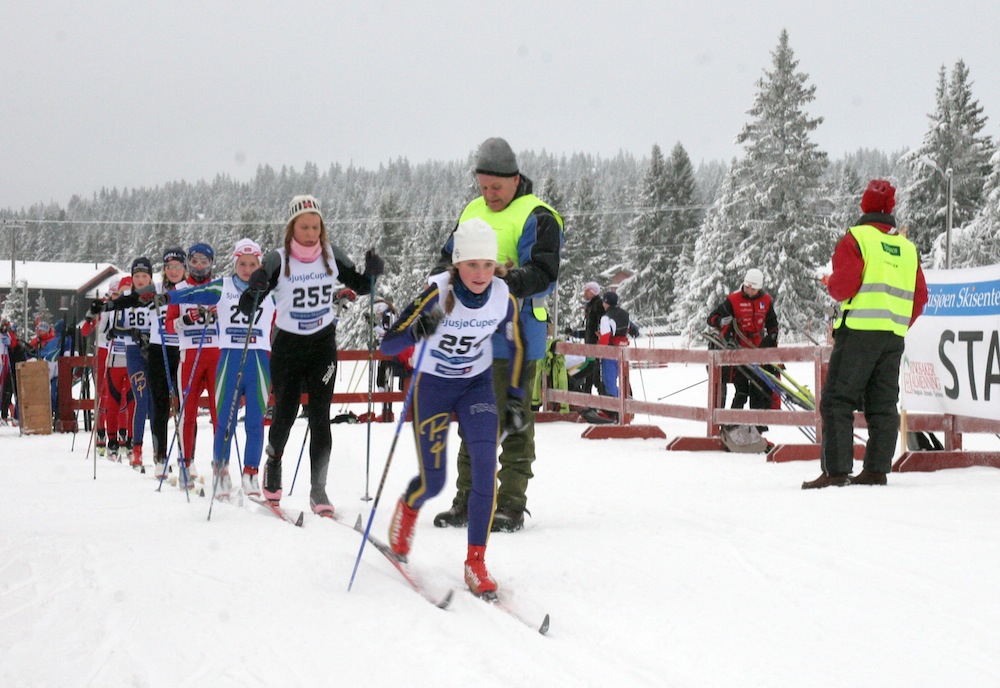
    Junior skiers jet out of the start at the Sjusjøcupen, part of the Hedmark state race series in Norway. (Photo: Inge Scheve)
    Junior skiers jet out of the start at the Sjusjøcupen, part of the Hedmark state race series in Norway. (Photo: Inge Scheve)

    Frode Estil says it’s not how many hours you train. It’s how you train.

    The two-time Olympic gold medalist and individual world champion from Norway says skiers are focusing too much on hours at the expense of training quality.
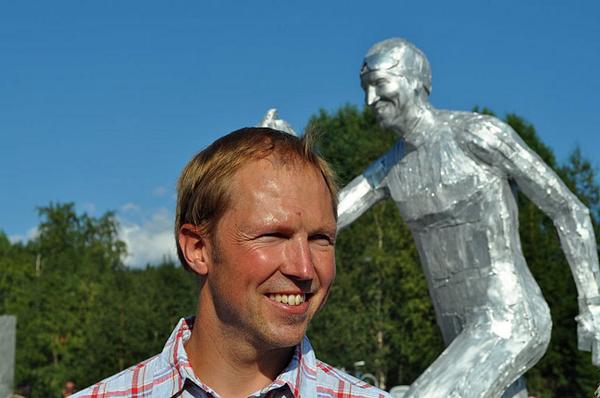
    Frode Estil, an individual Olympic and World Champion from Norway, by a statue of himself in his hometown of Lierne in July. (Photo: FIS Cross Country/Twitter)
    Frode Estil, an individual Olympic and World Champion from Norway, in July after being commemorated with a statue of himself in his hometown of Lierne. (Photo: FIS Cross Country/Twitter)

    “I’m afraid focusing too much on logging hours can be counterproductive to the main goal: ski fast,” Estil, 42, told the Norwegian newspaper Namdalsavisa. “How fast you become depends on more than just how many hours you put in.”

    Estil, who is currently coaching and teaching at the Meråker ski academy in Norway, blames the media and their excessive emphasis to how many hours the World Cup racers train in a year, as well as coaches and athletes for latching onto the elite skiers’ training programs without critical assessment. Other coaches support him.

    Former elite skier Mona Hjellsand, now a coach and coaches’ instructor in the Meråker region north of Trondheim, agrees with Estil. She pointed out that too many training hours can have negative physical consequences.

    “Overuse injuries can be hard to heal, and some can last for life,” Hjellsand told Namdalsavisa. “Biathlete Tora Berger has repeatedly harped that you should not train if you feel run down. You should always be in a good flow, she says, and she is definitely onto something.”

    She added that focusing on completing shorter workouts with 100-percent attention to the task will increase the training quality.

    “It’s important to not burn all your fuel at once,” Hjellsand said. “The younger the athletes, the more important quality is over quantity. The idea is to increase volume over time.”

    “The younger the athletes, the more important quality is over quantity. The idea is to increase volume over time.” — Mona Hjellsand, a former Norwegian elite skier who has spent the last two decades coaching in the Meråker region

    Hjellsand said that youth and junior coaches have to take their part of the blame for the current trend with extreme focus on logging hours.

    “There are still a lot of old-school coaches out there who are focused on training hard and putting in lots of hours. Based on that, I’m really glad that credible resources such as Frode Estil initiate a debate on this topic. It’s an extremely important debate,” she said.

    In her opinion, the biggest issue is curbing the drop off and keeping the skiers in the sport.

    “When I ask the 16 and 17 year olds why they chose to drop out, the answer is almost always the same. There is just too many training hours, and they’re always tired,” she said.  “When the air goes out of the balloon at such a young age, there is something wrong with the way we approach training.”

    “When the air goes out of the balloon at such a young age, there is something wrong with the way we approach training.” — Hjellsand

    The ski coach, who also travels to visit various clubs and teams and give presentations on training, is certain that the juniors are seeing what they do, and are comparing their own training programs to what the World Cup elite is reportedly doing.

    “Skiers such as Marit Bjørgen and Therese Johaug bring the standard for annual volume to a whole new level,” she explained. “The big difference is that these athletes have a support system that takes care of them 24/7. You can’t compare yourself to the full-time elite.

    “I’ve seen so many cases where the junior skiers as well as senior level racers lose the joy of training and their passion for skiing because there is such an emphasis on training hard and logging volume,” she added. “It shouldn’t be like that.”

    Ultimately, she stressed a single priority: make sure training is fun. “The day it’s no longer fun, there is no reason to stick with it,” Hjellsand said.
  • U.S. Ski Team Heads South; For Three Weeks, Volume is Focus

    U.S. Ski Team Heads South; For Three Weeks, Volume is Focus

    The Snow Farm, where the U.S. Ski Team will spend their next three weeks doing a volume camp.

    When Kris Freeman, Andy Newell, Kikkan Randall, and the four other members of the U.S. Ski Team (USST) head out on the first ski of their on-snow camp in New Zealand this week, they will have at least 7,657 reasons to appreciate it.

    That’s number of miles separating Wanaka, the site of the team’s camp, from Park City, Utah, where the team is headquartered.

    The USST leaves Sunday for New Zealand, and for the next three weeks, the group will make its home in Wanaka, at the Waiorau Snow Farm, “on top of this mountain in the middle of nowhere,” as coach Matt Whitcomb describes it.

    At the Snow Farm, the team will get a break from the monotony of the running and rollerskiing in the hot summer sun. They’ll cram in hours of volume, hone technique, and remind themselves just how much real skiing hurts with a few races during the last week of their visit.

    As of Saturday, the Snow Farm was reporting all of its main trails open, groomed for both classic and skating, with a high of -1 C.

    Perched at the top of a 13-kilometer dirt road climb, the ski area is indeed isolated—its location, as Whitcomb euphemistically puts it, “caters to high focus, and good team cohesion.”

    But coming in the middle of the summer, that’s no problem for Newell, who said he is still eager to travel to New Zealand this summer–even after spending time at the Snow Farm in each of his last eight consecutive summers.

    “It’s amazing how it hasn’t gotten old over the years,” he said. “The scenery out there is really awesome, the skiing is just awesome—it’s some of the best skiing we do all year.”

    With other teams finding their summer snow on glaciers in Alaska, Alberta, and Europe, the USST’s trip all the way to New Zealand might raise some eyebrows. But Whitcomb said that the travel and financial costs are roughly equivalent.

    “Anywhere that you’re going to go that’s going to require a trip up to the glacier, let alone maybe a flight up to Alaska, is going to be a massive trip for us…there is no easy option for us to get down on the snow,” he said. “The cost of flying to New Zealand is a little more expensive, for sure, but once there, the dollar carries fairly well, and the camp ends up being on par with most of these other trips.”

    Another factor, Whitcomb said, are the varied weather conditions at the Snow Farm, which give athletes a chance to do thorough testing on new equipment. While many team members have their quivers already dialed in, an athlete switching brands will have to test eight to ten pairs of skis during the trip.

    The flight to New Zealand is a long one, and it’s a six-hour time difference between the Snow Farm and Park City. But according to Newell, the journey out is much less taxing than the trip back, since it’s easier to adapt to jet lag when traveling west.

    “You’re actually sleeping within a day or two, and ready to train hard,” he said.

    Once the team arrives, they’ll move into rooms in the Snow Farm’s lodge, which are relatively spartan—no TVs—but “plenty nice for us,” Whitcomb said.

    The focus of the camp is volume—USST members will be training over 20 hours a week, with a moderate amount of intensity. There’s a gym at the Snow Farm that the team can use for strength workouts, and there are also good roads and trails in the valley below for ski walking, bounding, and running, if the weather deteriorates up high.

    All seven members of the USST are making the trip, as are three coaches: Whitcomb, Pete Vordenberg, and Chris Grover (although Vordenberg will depart a week early, and Grover will arrive a week late). The Canadian National Ski Team will also overlap with the Americans for the second half of the camp, and Whitcomb said that the two groups will share schedules and join up for some longer workouts, “where we can get these nice big groups skiing together and learning from one another.”

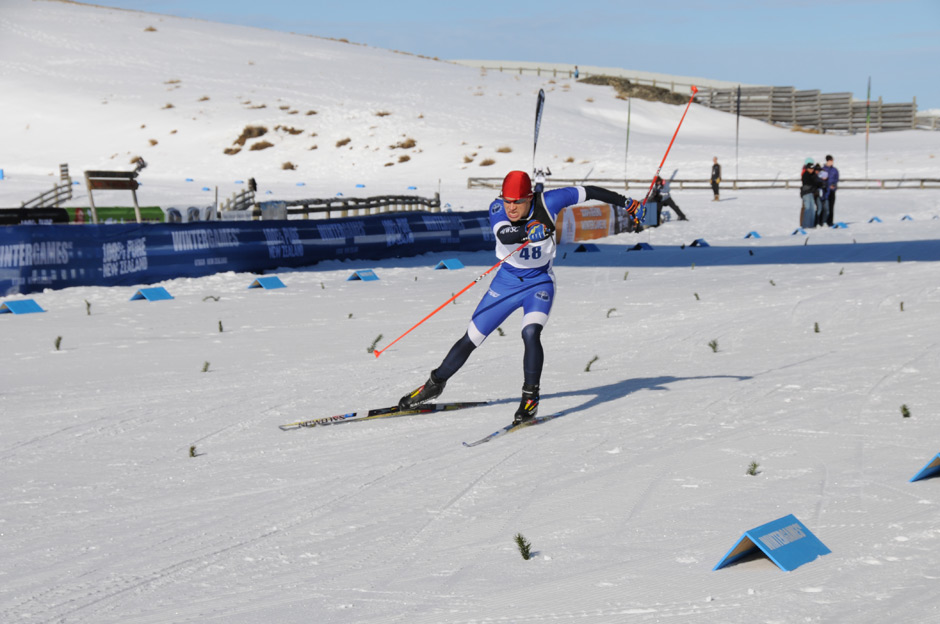
    Maine Winter Sports Center's Pavel Sotskov racing in New Zealand last year.

    As for intensity sessions, the USST will stay sharp with some VO2 max and threshold intervals early in the camp, as well as a few races later on. There’s a skate distance time trial scheduled for the middle of the camp, and then during the team’s last week in New Zealand, there are three races at the Snow Farm sanctioned by the International Ski Federation (FIS): a skate sprint, a classic distance race, and a skate distance race. According to Whitcomb, those events should be “very competitive,” including athletes from New Zealand, Australia, and possibly Russia.

    Skiing is clearly the focus of the trip, but as long as the team is in New Zealand, it’s unlikely that they’ll depart without taking advantage of the extreme sports the island is known for. Grover wants to go bungee jumping, according to Whitcomb, and Newell is hoping for a surfing excursion—or maybe even skydiving.

    The trip back from the Southern Hemisphere is a bit more painful, Newell said—with jet lag coming on the heels of the hours and hours of volume from the camp.

    According to Whitcomb, the USST has looked into doing camps closer to home, on the glaciers in Alaska or Canada, and a future partnership with a North American program is “not out of the question.”

    But, Whitcomb added, “it’s been a 100 percent strike rate down here.”