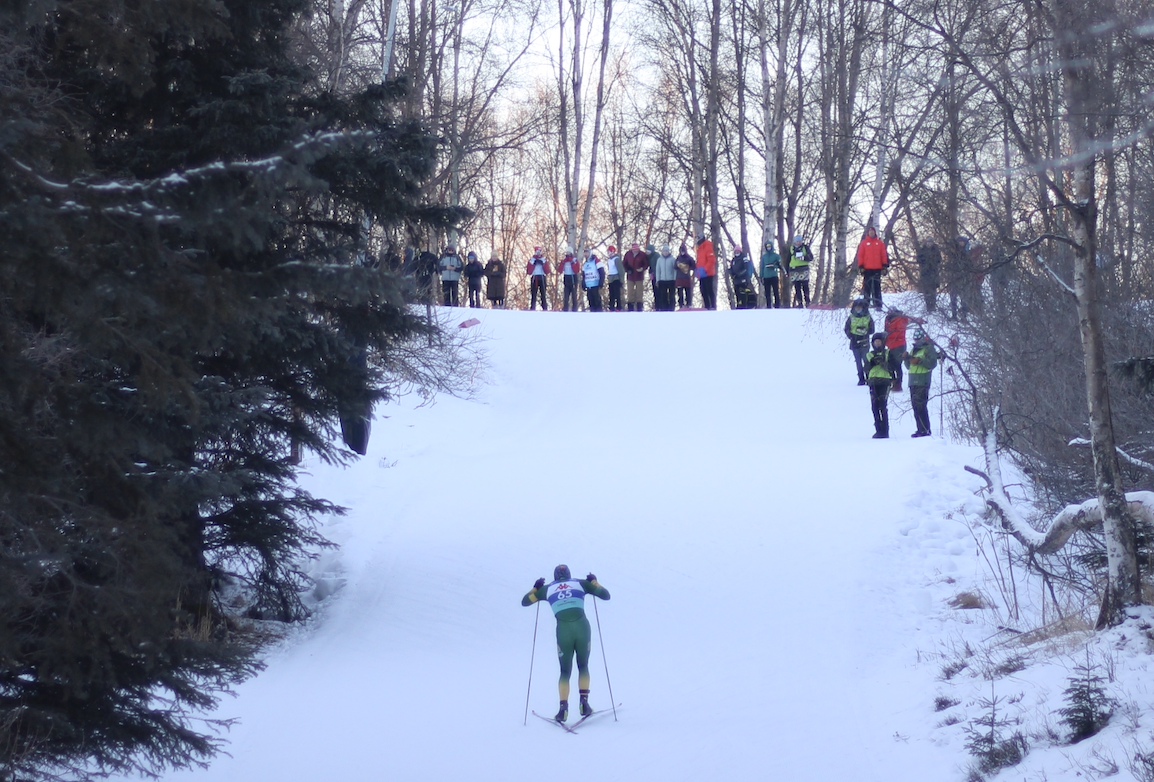
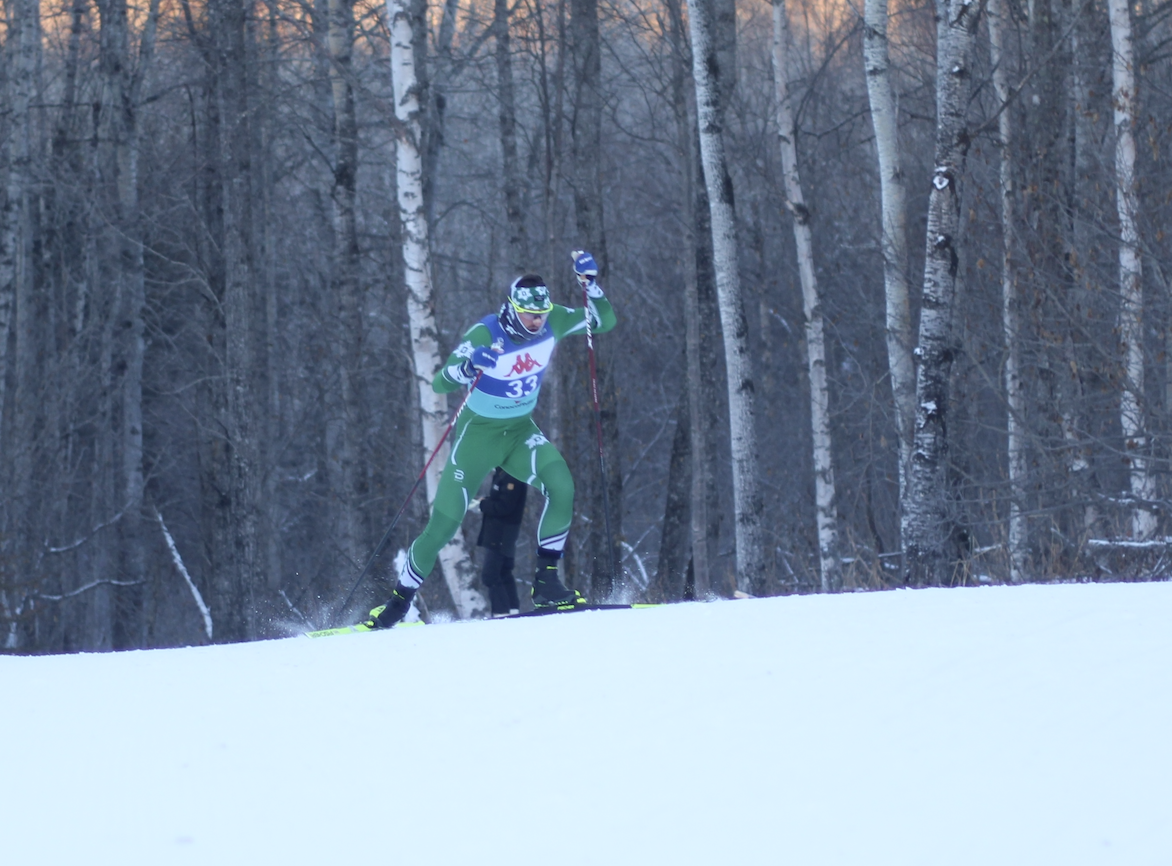
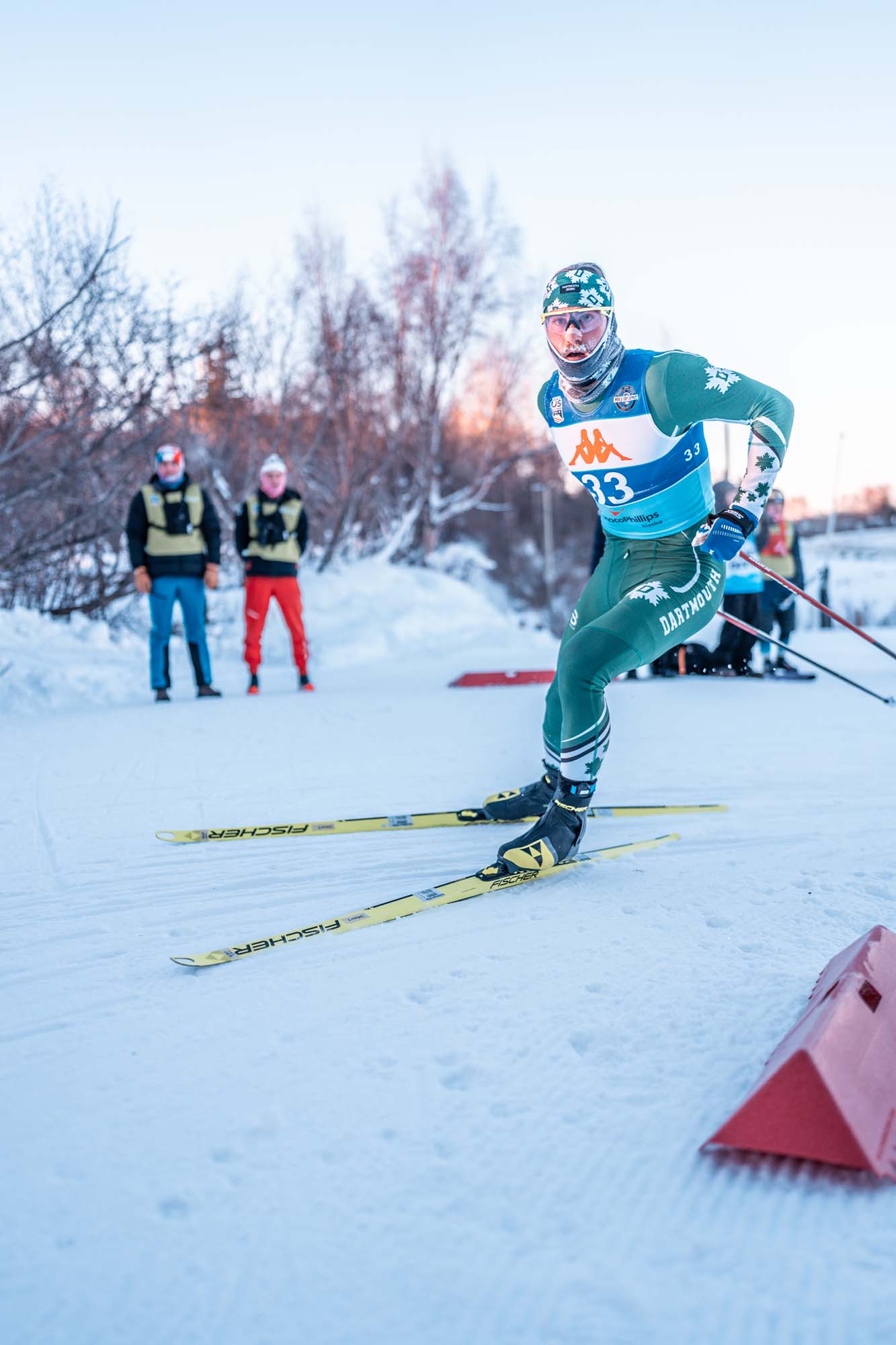
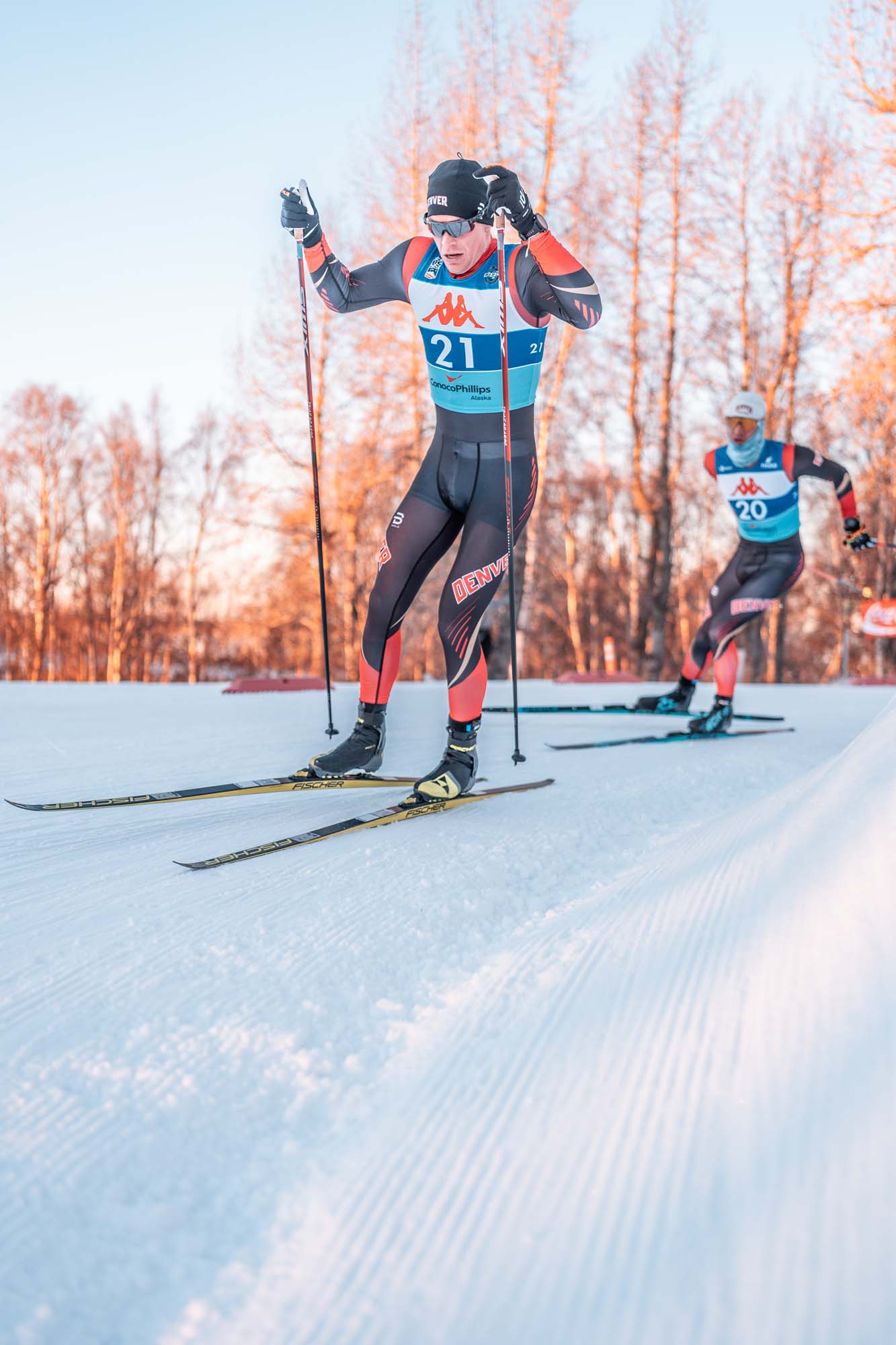
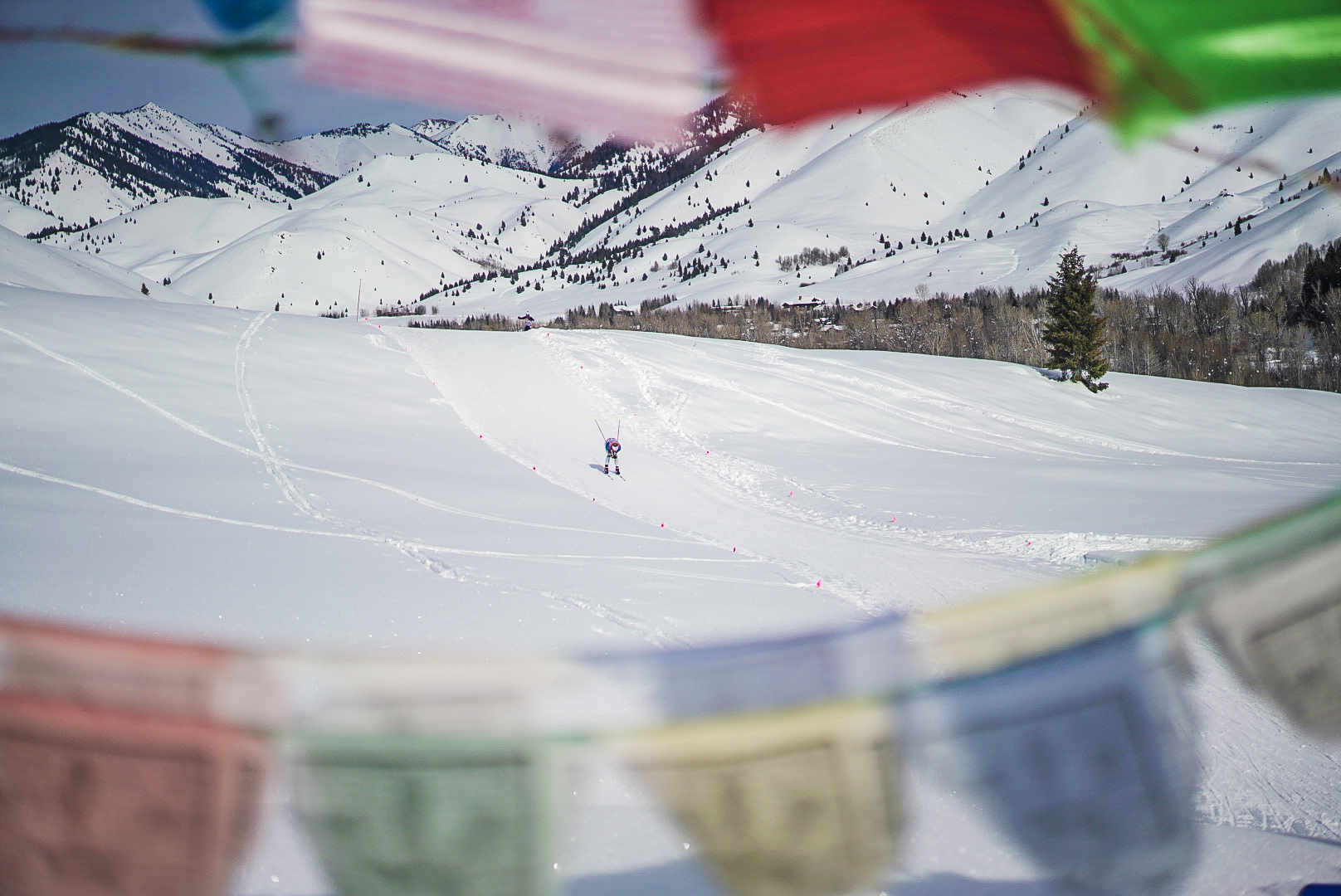
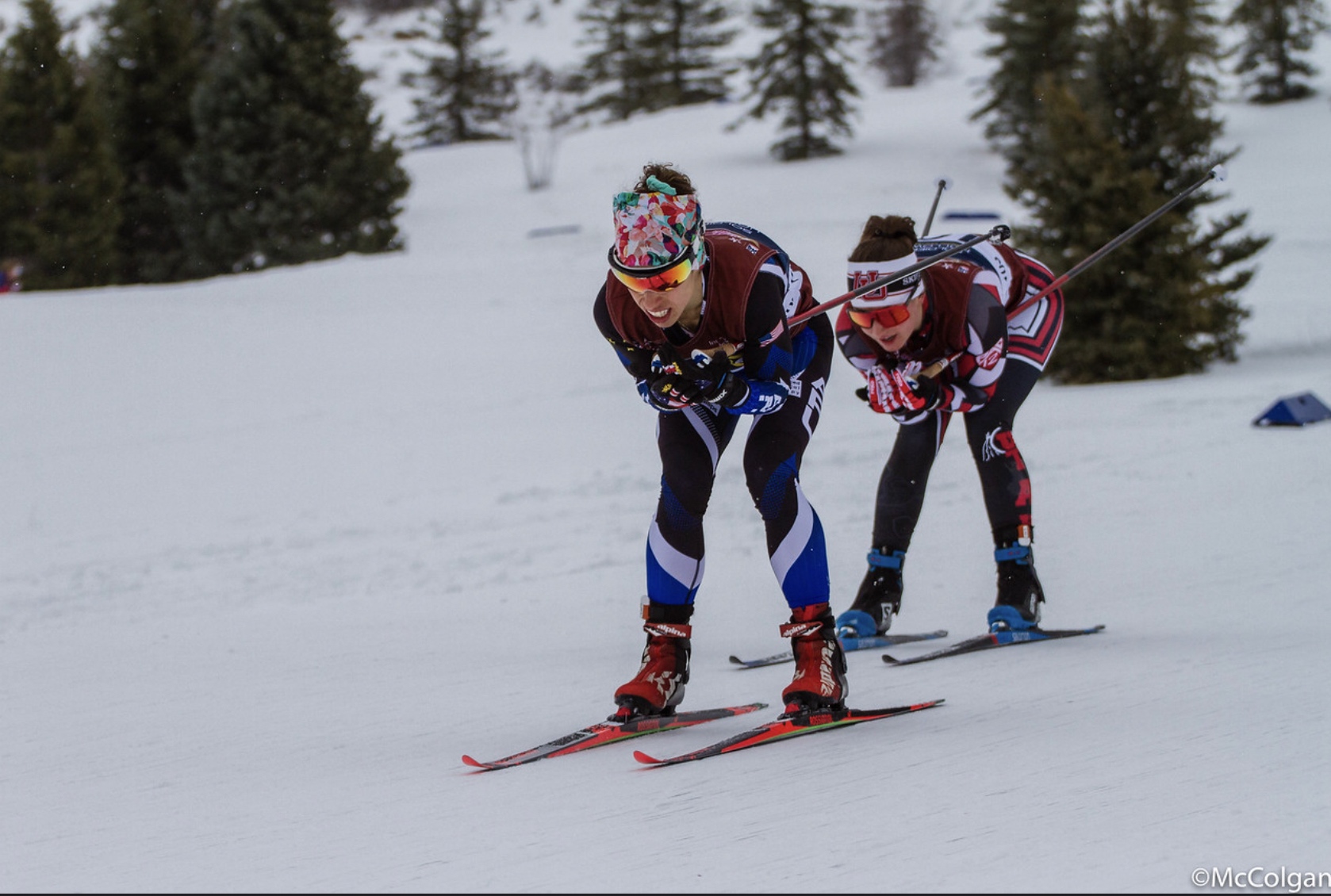
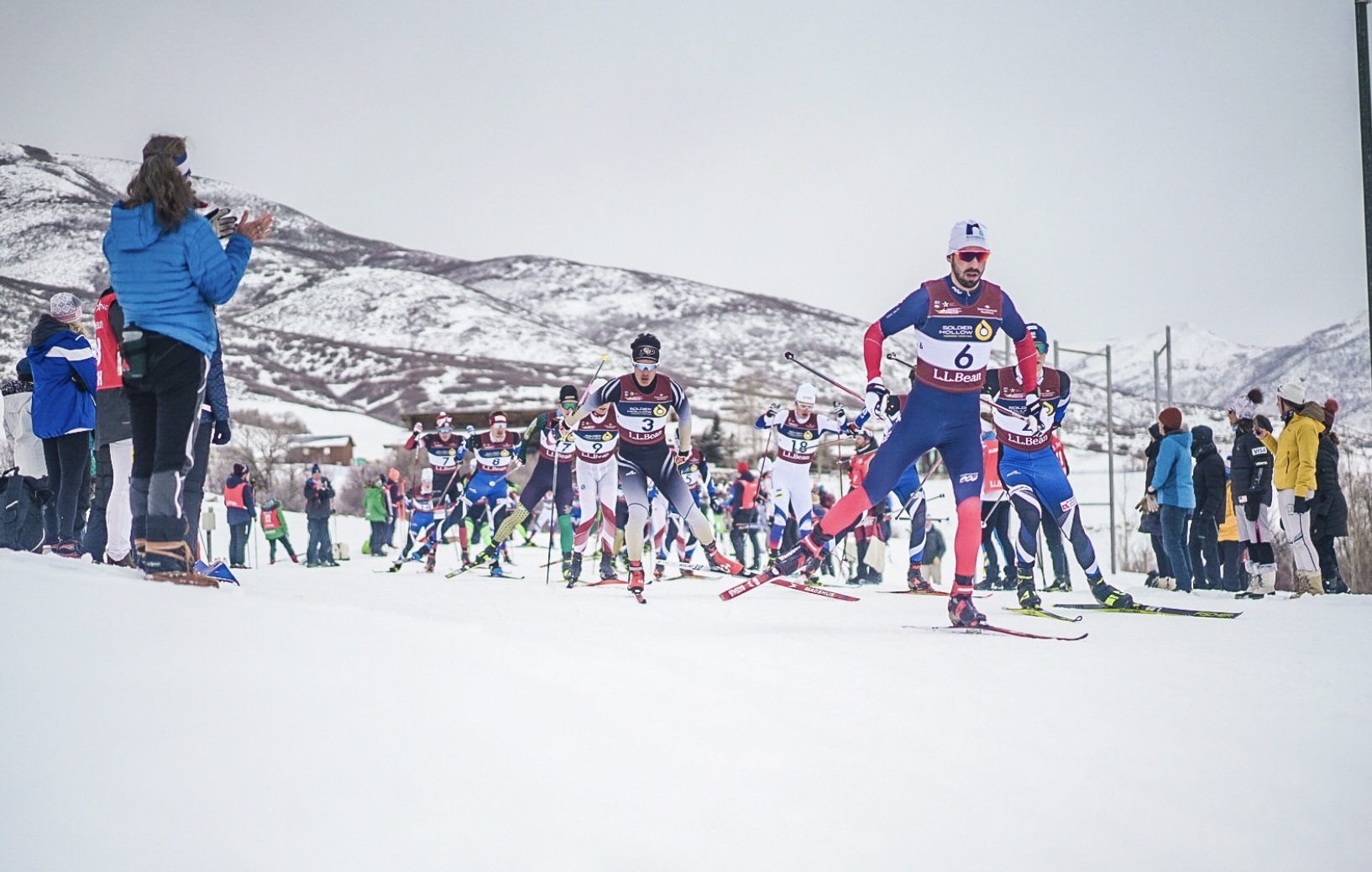
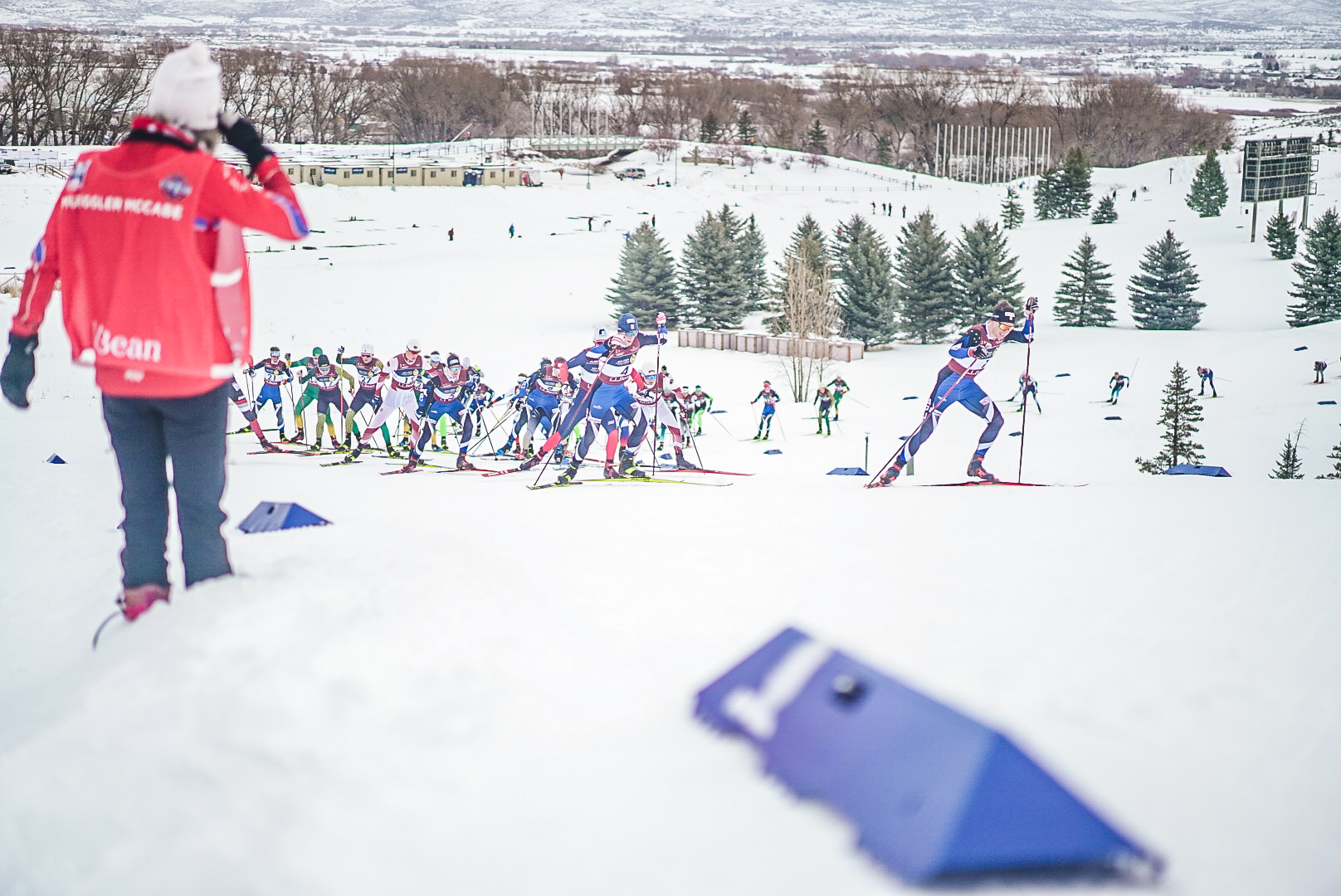
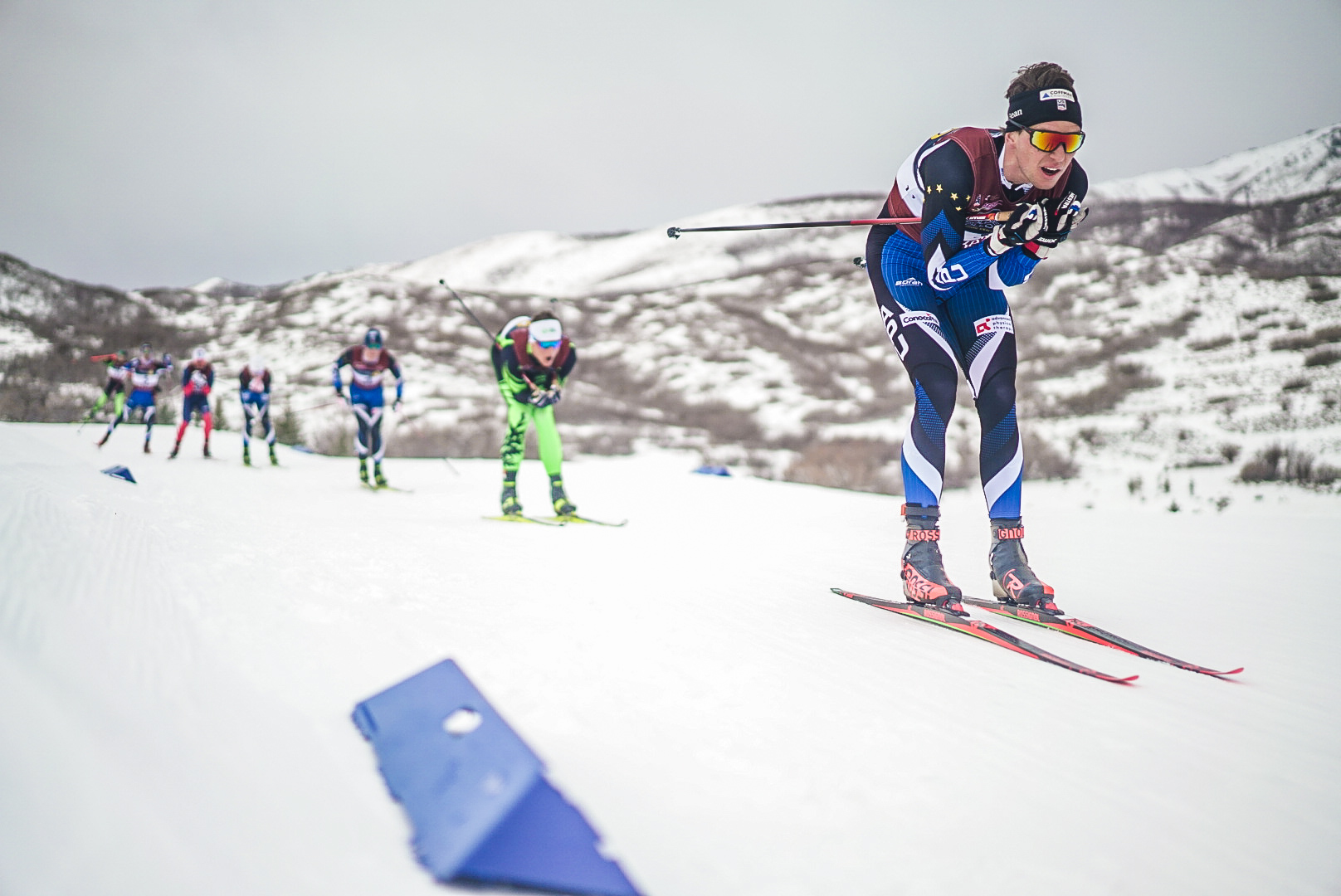
Erling Bjoernstad, a Norwegian freshman racing for University of Alaska Anchorage, climbs a hill toward the stadium at U.S. Nationals Thursday. (Nathaniel Herz/FasterSkier)
ANCHORAGE — Kate Oldham wasn’t expecting to win Thursday’s opening race of the U.S. National Championships.
It was her first competition of the season, after focusing on training in December, and she’d never placed better seventh at previous national championships.
Her coach at Montana State University, Adam St. Pierre, had other ideas about the 22-year-old senior — though he was keeping them to himself.
“I have been predicting Kate as a dark horse national champion for a couple of weeks now,” St. Pierre said. “But not talking about it with her, because she races best when expectations are low.”
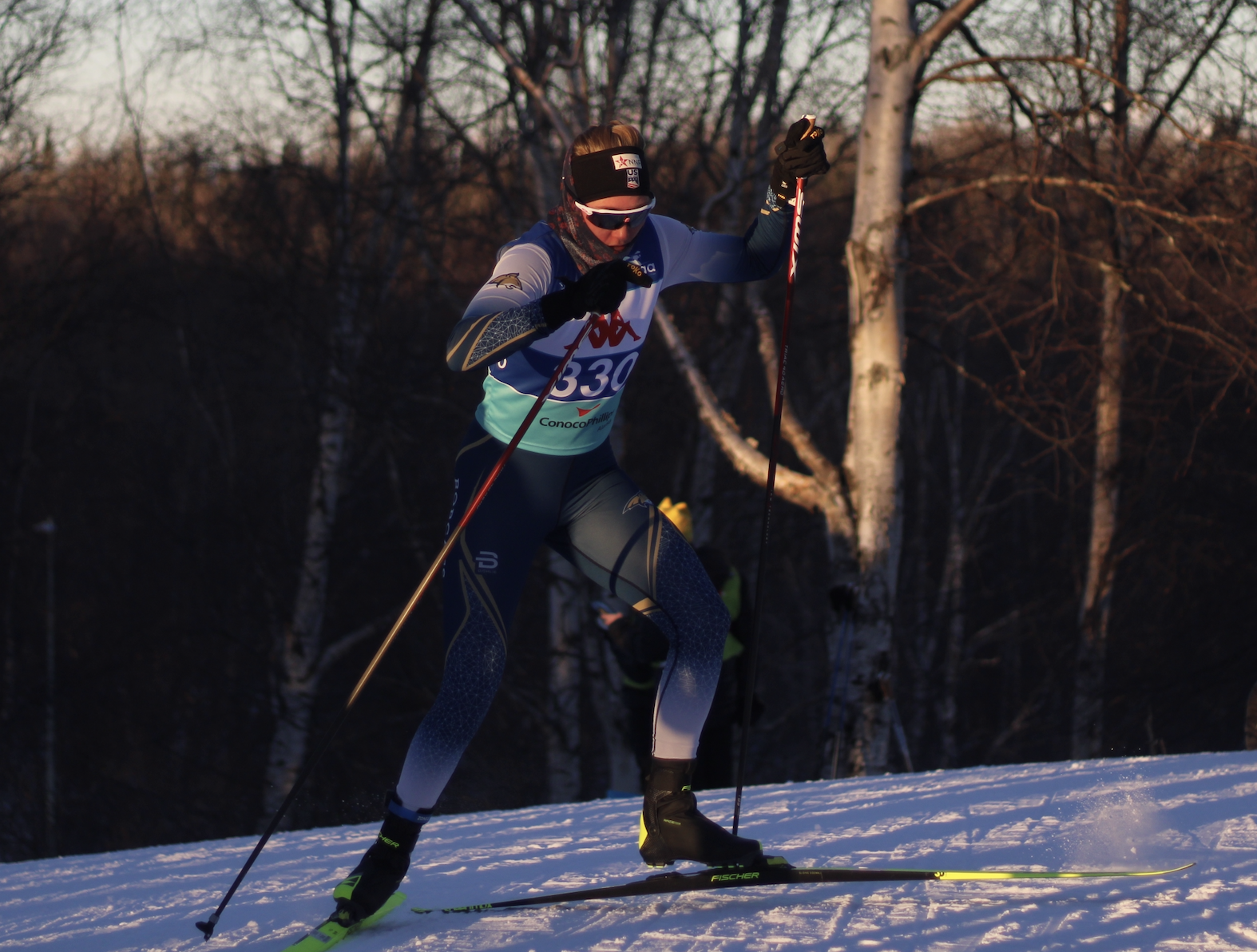
Kate Oldham racing at the U.S. National Championships in Anchorage on Thursday, January 2, 2025. (Nathaniel Herz/FasterSkier)
Oldham, St. Pierre said, is a superb glider on her skis, with a “killer instinct” — which apparently served her well Thursday on the rolling, blazing fast, 10-kilometer course at Anchorage’s Kincaid Park.
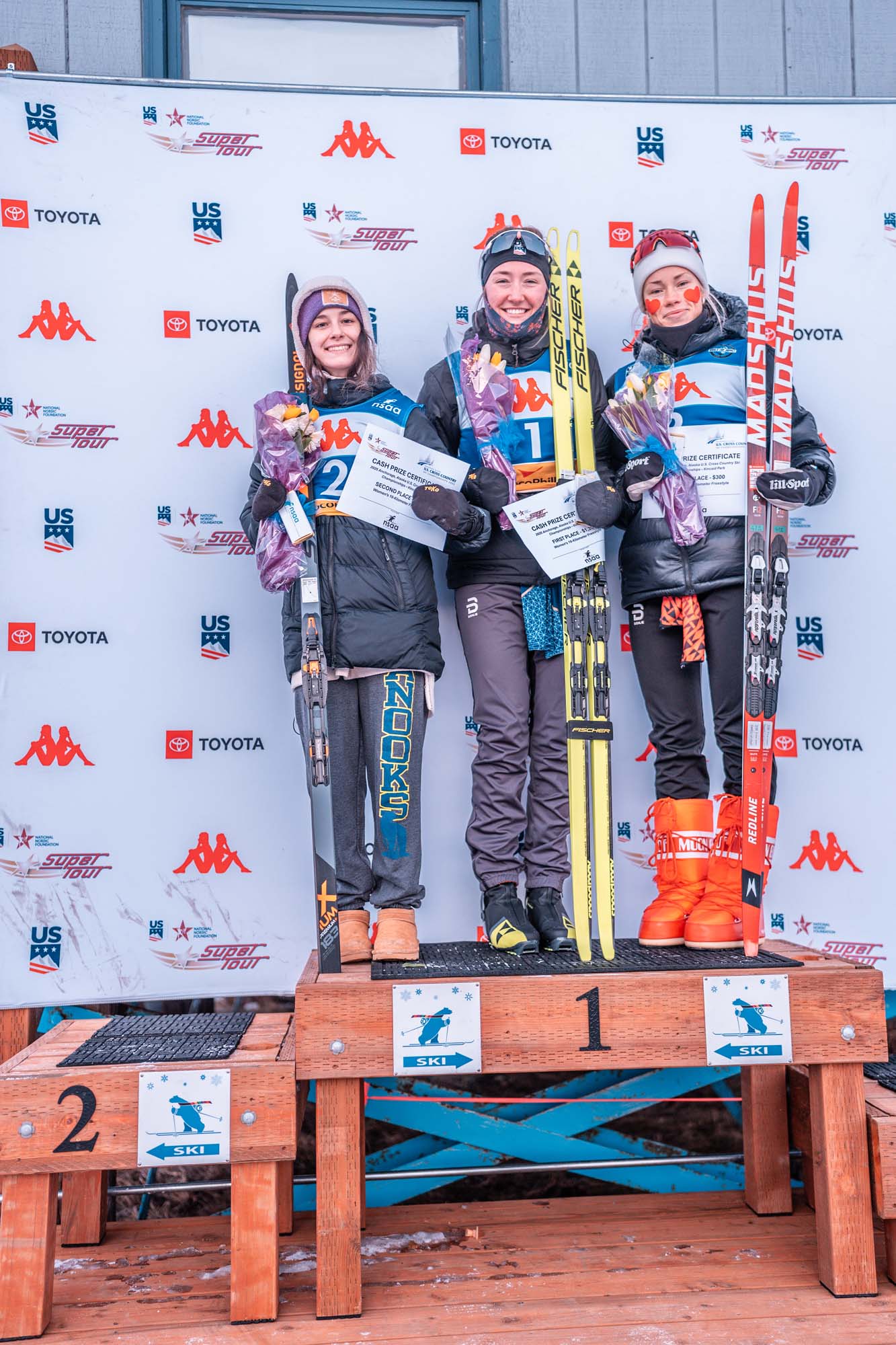
Oldham won her first-ever national championship, edging local favorite Kendall Kramer of University of Alaska Fairbanks to win the individual-start, time trial-style skate event by 11 seconds.
University of Utah’s Erica Laven was third, 28 seconds behind.
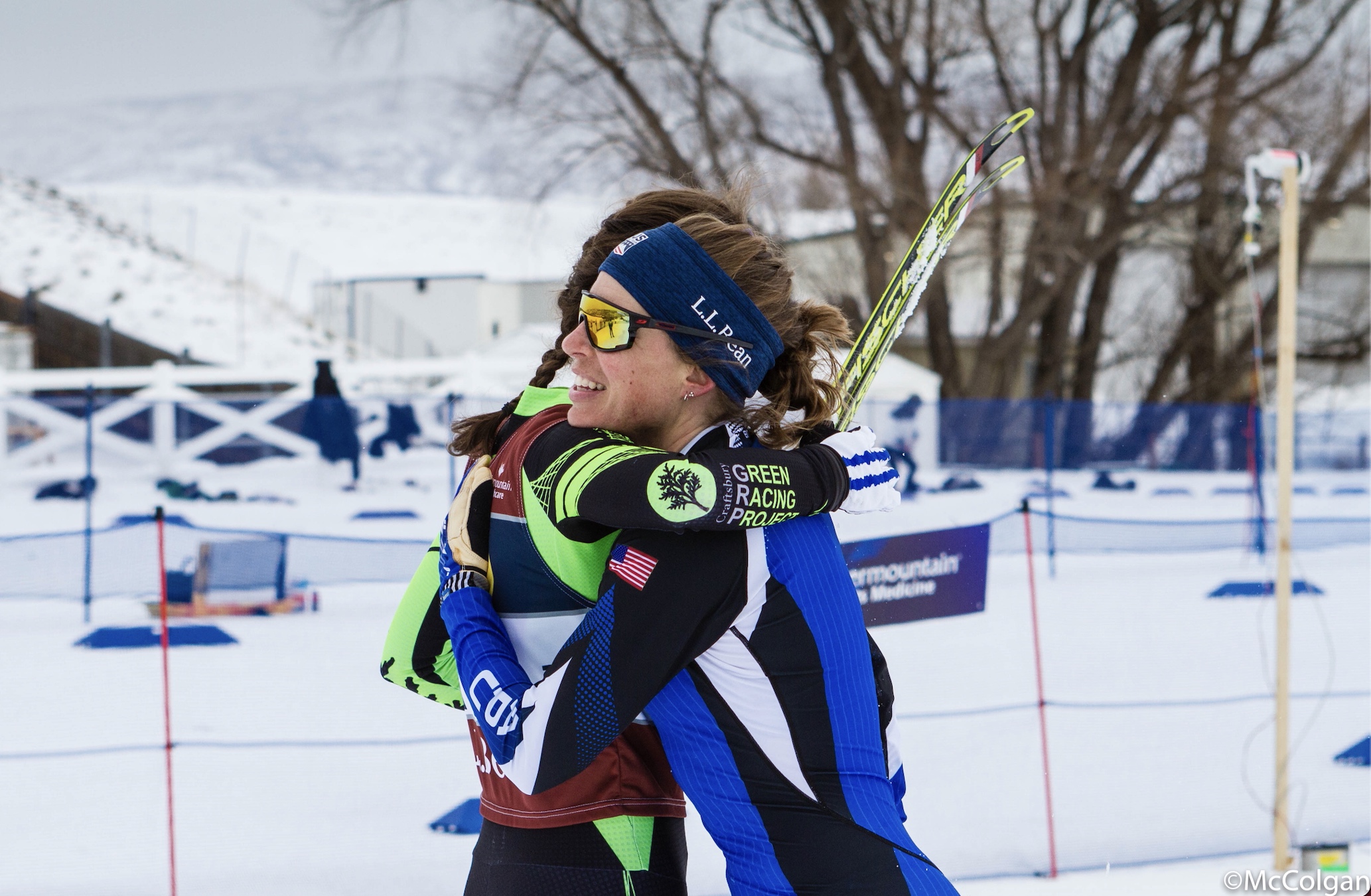
“I did not wake up thinking that was going to happen today,” Oldham said afterward, as she fended off bear hugs from teammates and rivals. “It’s surprising. But it’s also awesome, and makes me cry happy tears.”
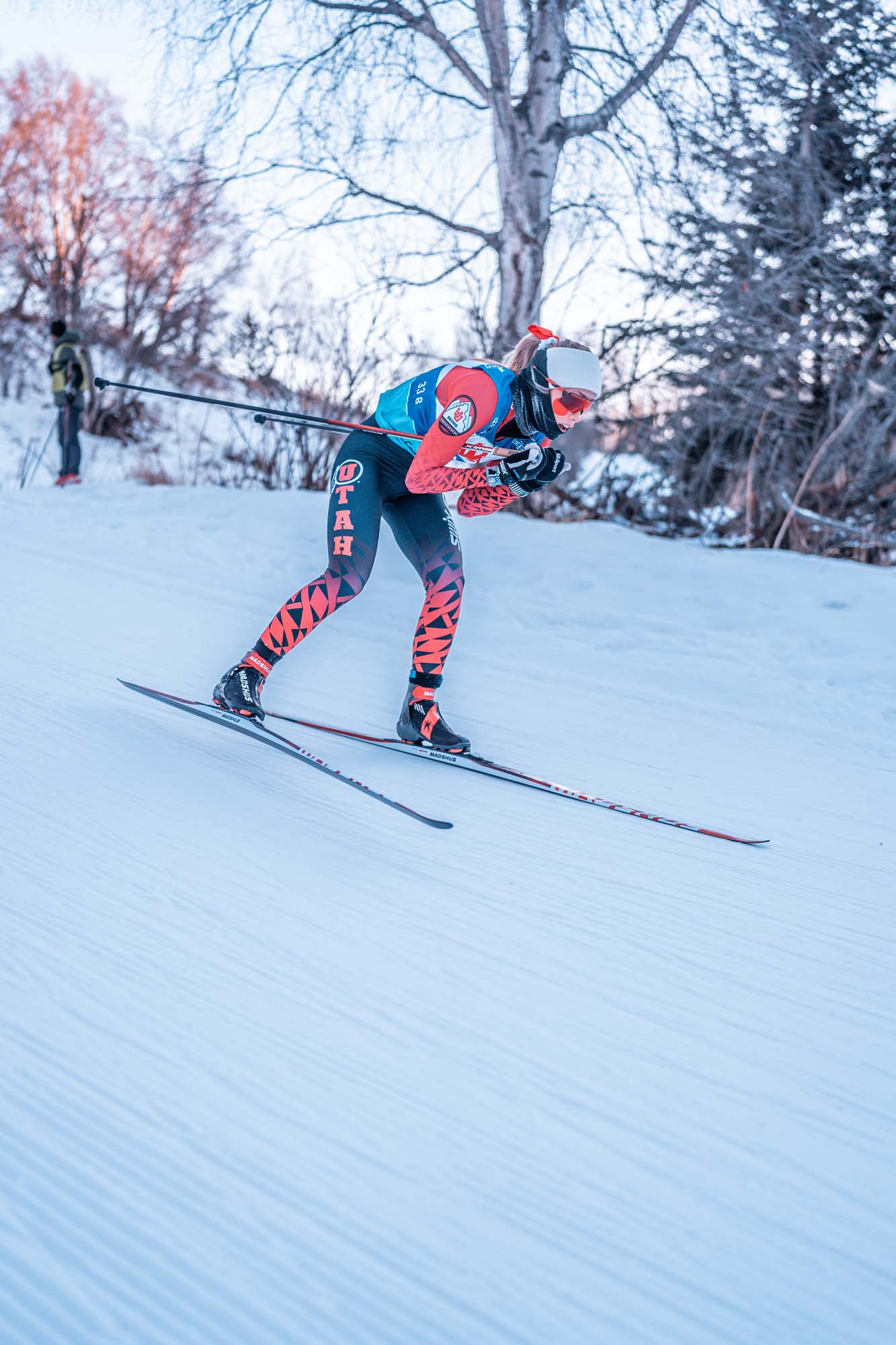
Erica Laven on her way to third place. (Photo: Tobias Albrigtsen / @untraceableg)
If Oldham’s win fell somewhere between a surprise and a shock, John Steel Hagenbuch’s victory in the men’s race was hardly unexpected — though that event was much tighter.
Hagenbuch, a 23-year-old senior at Dartmouth College, already has several national titles to his name, along with solid results last season on the international World Cup circuit.
Hagenbuch held off Andreas Kirkeng, a Norwegian racing for the University of Denver, by a fraction of a second. Walker Hall, who races for the University of Utah, was third, 15 seconds behind.
Thursday’s races were the first of three national championship events at Kincaid Park, with two more to follow over the weekend — plus a non-championship race next week.
While temperatures in Anchorage have dipped recently, to single digits Thursday morning, a rainy, low-snow December required extra work from organizers to pull the races off. Kramer, in fact, was part of a battalion of volunteers, including numerous racers, who spent some of last weekend shoveling clean snow onto dirty patches along the course.
Kramer said she planned a long ski workout that day and kept her watch going while she pitched in on a little shoveling.
“It was kind of like playing in the snow,” she said. “I don’t want to take too much credit, because I wasn’t out there for the whole four hours people were doing it. But I am very grateful, and I was inspired by all of the people who were there.”
Kramer, 22, was in the hunt for the win Thursday, with coaches telling her at one point during the race that she was in the lead.
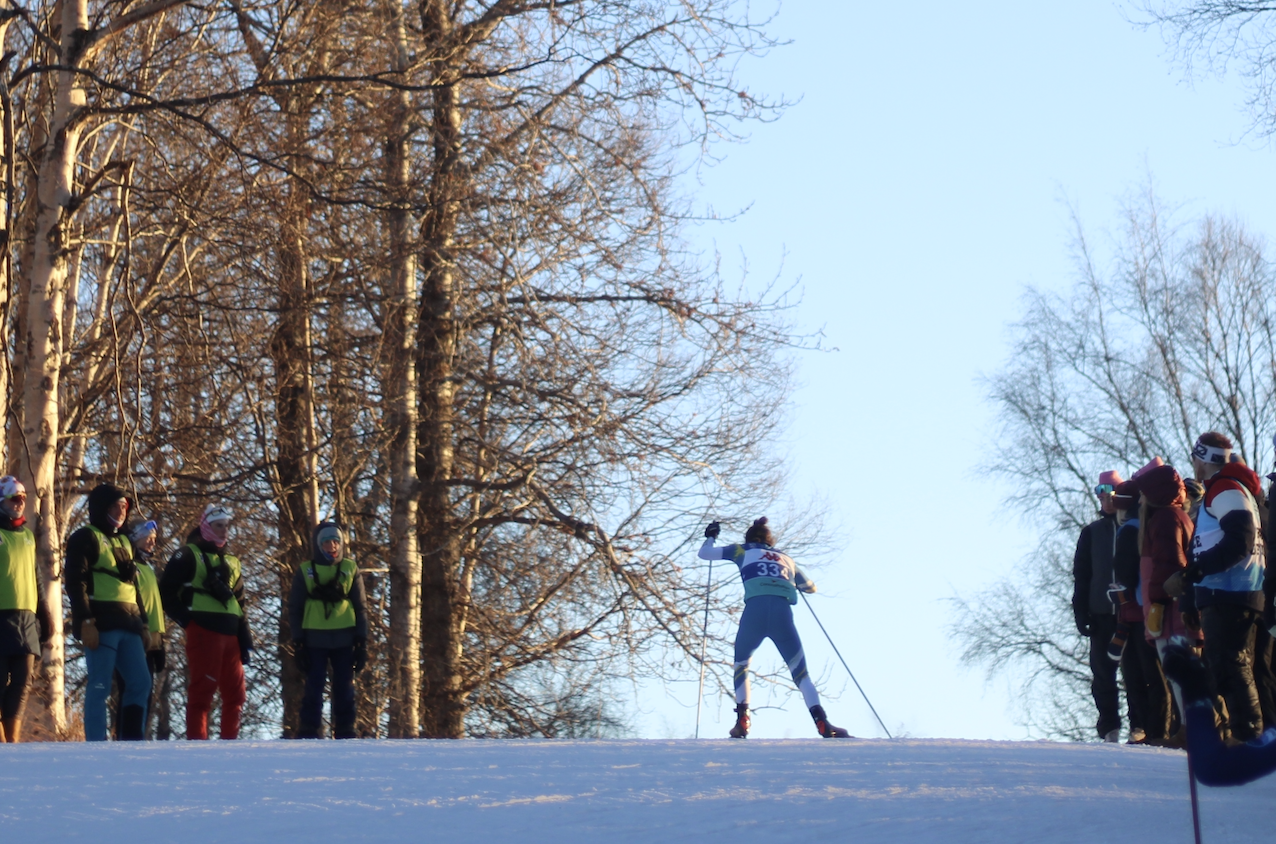
Kendall Kramer crests a hill in Thursday’s race. (Nathaniel Herz/FasterSkier)
But Oldham had the fastest times for each of her two five-kilometer laps, according to official splits. Laven was just one-tenth of a second behind her at the halfway point, though she faded on her second lap.
Oldham grew up in Colorado and spent her holiday break from school training at home, taking advantage of “incredible skiing” in Aspen instead of entering season-opening races, she said.
That plan is geared toward not peaking too soon, so she can notch her best results at the collegiate national championships toward the end of the season, in March. That plan made Thursday’s win even more of a “pleasant surprise,” Oldham said.
“I didn’t really sharpen for it,” she said. “It’s an intimidating way to start the season, because you kind of have no idea (what level) you are coming in. But it’s also really nice to go home and enjoy the holiday and just focus on training.”
Hagenbuch’s approach to the season has been sharply different: He began racing more than a month ago, on the World Cup circuit.
But after a breakout season last year — one in which he won a bronze medal at the World Under-23 Championships and also recorded a top-15 finish in a World Cup race — this year’s efforts have been uneven.
Hagenbuch started the season at World Cups in Finland and Norway, but failed to crack the top 30. Then, he returned to the U.S. and notched four straight podiums on the domestic circuit.
One challenge he faced in Europe, Hagenbuch said Thursday, was that he was having a breathing problem that appears to be a condition called exercise-induced laryngeal obstruction — where, he said, his larynx and vocal cords “seize up and close” during races.
John Steel Hagenbuch works his way up Elliott’s climb at the U.S. National Championships in Anchorage on Thursday, January 2, 2025. (Nathaniel Herz/FasterSkier)
The first time it happened, in Finland, was “definitely pretty scary — I couldn’t breath really at all, and I couldn’t speak for 15 minutes after the race. Couldn’t say a word.”
“It’s kind of multifaceted in what causes it, but I’ve been working through it and trying to figure it out and keep all those muscles relaxed, because it isn’t something you can really address by taking medication,” he said. “It’s something that has to do with controlling your muscles and reducing your stress.”
Hagenbuch said he had a little bit of breathing trouble Thursday, but managed to keep it under control.
He had the fastest first lap of the five-kilometer course, giving him a slight edge over Kirkeng.
But on the second lap, the Norwegian started creeping back.
A 24-year-old senior studying finance at the University of Denver, it’s unlikely Kirkeng would be in contention for a national championship in his home nation, the global cradle of cross-country skiing.
But in the U.S., it’s hardly unusual for European athletes to dethrone their American competitors at marquee races: In fact, Kirkeng won the 10-kilometer distance race at the U.S. National Championships in each of the past two years.
John Steel Hagenbuch on his way to winning the national title. (Photo: Tobias Albrigtsen / @untraceableg)
As Hagenbuch neared the finish line, coaches along the course were giving him split times that showed Kirkeng closing the gap — even though Hagenbuch had started the race conservatively.
“I underestimated how hard it was going to get,” Hagenbuch said. “I thought I was going to lose it — I was hearing the splits go from eight seconds up on Andreas, to six seconds to three seconds to even.”
Kirkeng skied his last lap four-and-a-half seconds faster than Hagenbuch. But in the end, that wasn’t quite enough: Hagenbuch’s first lap was five-and-a-half seconds faster than Kirkeng’s, and he held on to win by eight-tenths of a second.
“The margins were not on my side today. But that’s how racing is,” Kirkeng said afterward. “And it’s been the other way around a couple of times.”
Andreas Kirkeng on his way to second place on the day. (Photo: Tobias Albrigtsen / @untraceableg)
Kirkeng is likely in the twilight of his career — he said he expects to retire after this season and, hopefully, find a finance job on Wall Street or in Boston. If not, he’ll probably return to Norway and enjoy more time with his family.
Hagenbuch’s career, meanwhile, is still taking off.
He said he’s looking forward to the rest of the races in Anchorage, which he expects to follow with more competitions in the U.S. — domestic SuperTour events and the college circuit, culminating in the NCAA championships.
Going back to the international World Cup circuit, he added, probably doesn’t make sense this year, especially after he missed substantial stretches of school while he traveled to races last season.
But even if this year’s European campaign didn’t pan out, Hagenbuch said, he’s not disheartened.
“I know I’m in good shape, and I had a good season of training — the hay is in the barn, if you will,” Hagenbuch said. “It’s just going to take some time for that to show itself.”
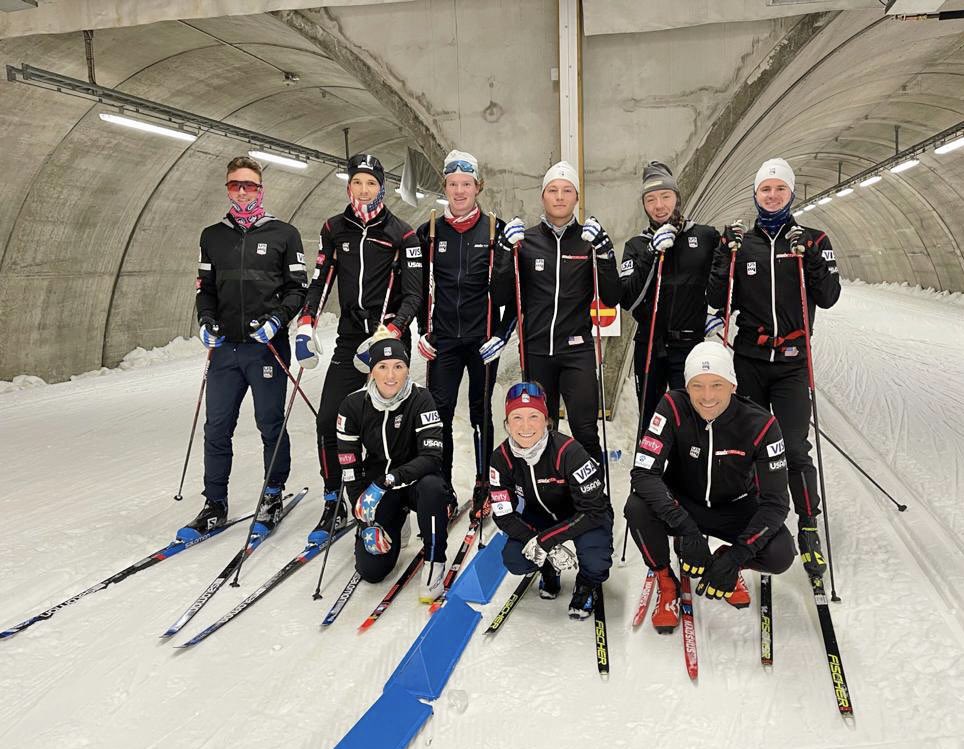
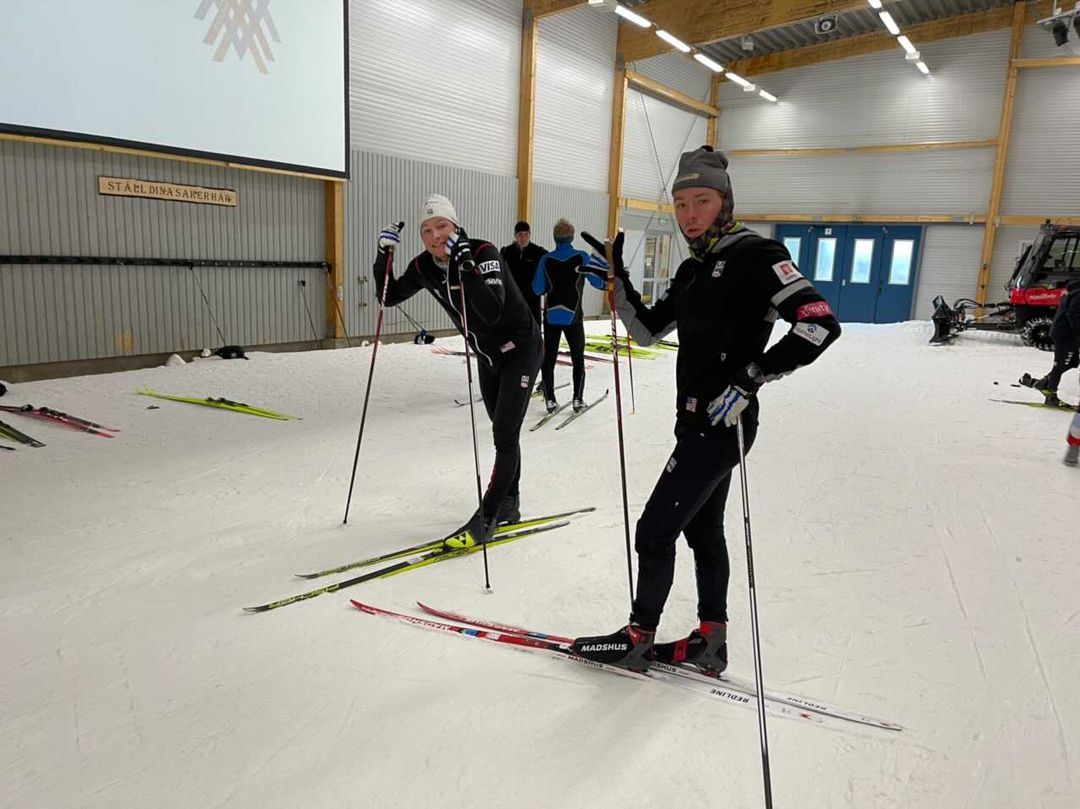
USST athletes and coaches in the Torsby Ski Tunnel, August 2022. Back row, from left: athletes Johnny Hagenbuch, Kevin Bolger, Finn O’Connell, JC Schoonmaker, Ben Ogden, and Walker Hall. Kneeling, from left: coaches Greta Anderson, Kristen Bourne, and Matt Whitcomb. (photo: François Faivre)
If it’s August, it must be time to ski.
Head Coach Matt Whitcomb and roughly half the men on the U.S. Ski Team, accompanied by a couple of well-known distaff guests, have spent the last week on snow in the Torsby Ski Tunnel in southwest Sweden. They raced in the nearby Inge Bråten Memorial rollerski race earlier today, and will compete in the Toppidrettsveka rollerski series in Norway starting on Thursday. It’s a multi-stage Scandinavian adventure to help prepare for next year’s race season.
American World Cup skiers have pursued a variety of options for summer snow over the years, depending on budget, logistics, travel time, and team size. The Alaskans historically gravitate to Eagle Glacier, spending three one-week camps on snow in the Chugach Mountains between June and August. Athletes from the rest of the country have traveled to one or more of the Snow Farm (New Zealand), Falls Creek (Australia), Sognefjellet (Norway), Dachstein Glacier (Austria), Passo dello Stelvio (Italy), Oberhof ski tunnel (Germany), Torsby ski tunnel (Sweden), or Planica ski tunnel (Slovenia), typically toward the end of the northern-hemisphere summer.
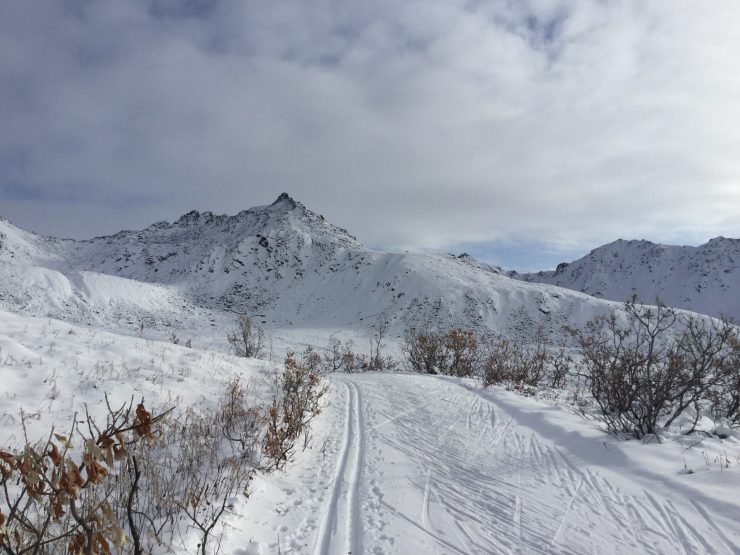
Early-season skiing at Hatcher Pass, October 6, 2019. (photo: Gavin Kentch)
This year, for Whitcomb and six national-team men, the answer is Torsby. Whitcomb flew across the Atlantic on August 12, joined by athletes Johnny Hagenbuch, Kevin Bolger, Finn O’Connell, JC Schoonmaker, Ben Ogden, and Walker Hall, as well as USST coaches Greta Anderson and Kristen Bourne. Their two-week trip includes a week-plus on snow in Torsby, a rollerski race in nearby Sunne, and rollerski races in the Trondheim region.
This year’s trip roster has “just six men,” Whitcomb said in a phone call while driving to the airport last Friday.
Johnny Hagenbuch, Torsby Ski Tunnel, August 2022. (photo: Greta Anderson)
“We’ve been whittled down after Covid,” he said, which among public names claimed Sophia Laukli after her recent brace of wins in the Stranda Fjord trail race and Lysebotn Opp rollerski race. That said, the American men were joined by well-known Swedish guests Maja Dahlqvist and Frida Karlsson, as well as much of the German team. (Dahlqvist and Bolger are dating.)
So why Torsby? In part because it presents a strong training option on the merits, in part because of money.
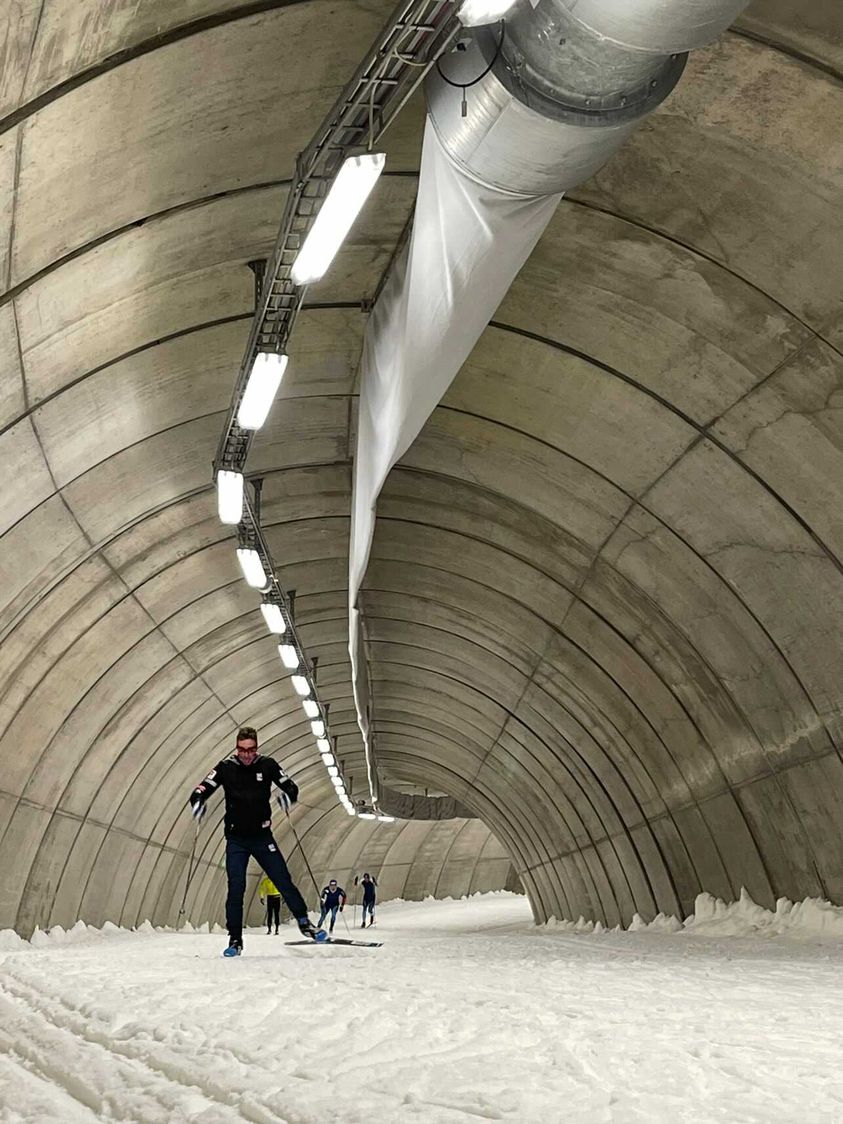
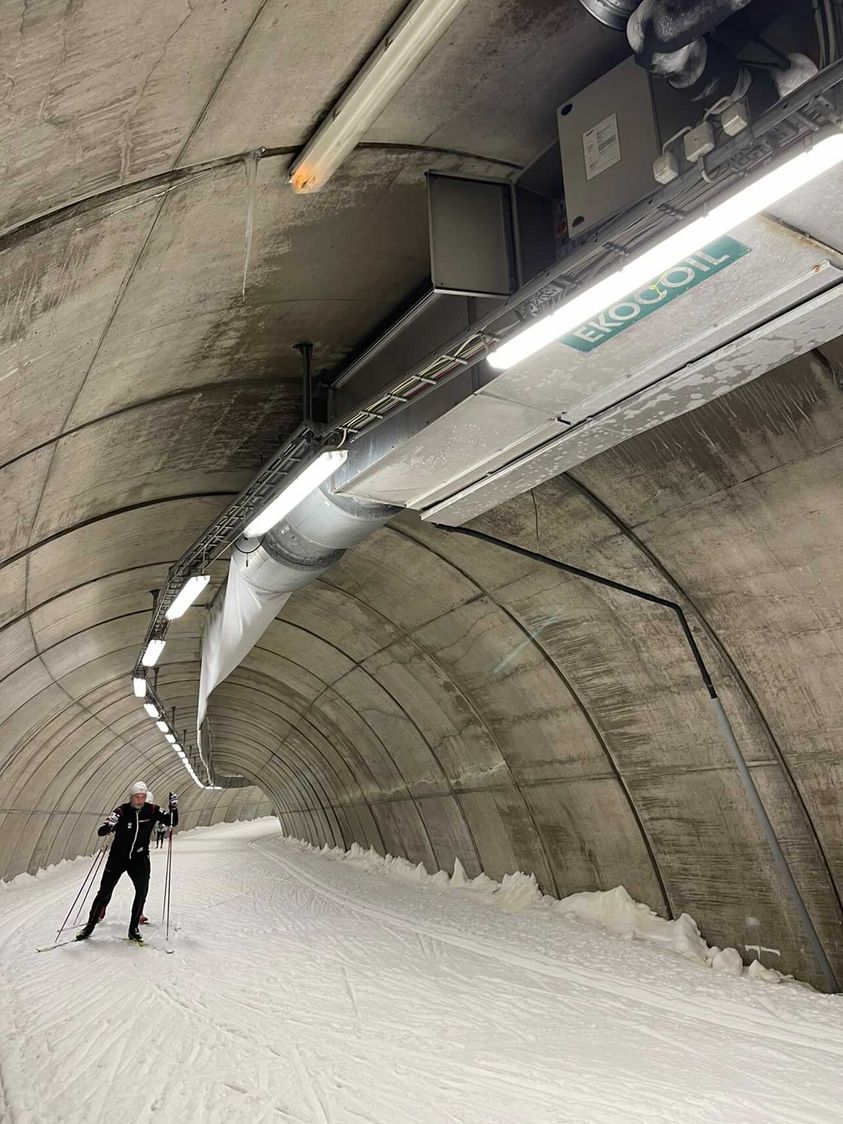
As for the training facility, it’s not just the ski tunnel. In addition to the roughly two-kilometer-long ski track inside a refrigerated tunnel, the area also contains “a rollerskiing track, biathlon stadium (outside and in the tunnel), extensive running trails through the surrounding hills and forests, and a fully equipped gym attached to the tunnel,” as Norway-based Canadian athlete Maks Zechel wrote on this site in 2017.
And as for money, Torsby is closer and cheaper than the southern hemisphere. “We weren’t able to fit it into the budget to have a bunch of people go down to New Zealand or Australia, and the Eagle Glacier facility is closed still,” Whitcomb said. “So we wanted to have an option for those that were maybe already on the East Coast or willing to travel. So we’re pretty excited.”
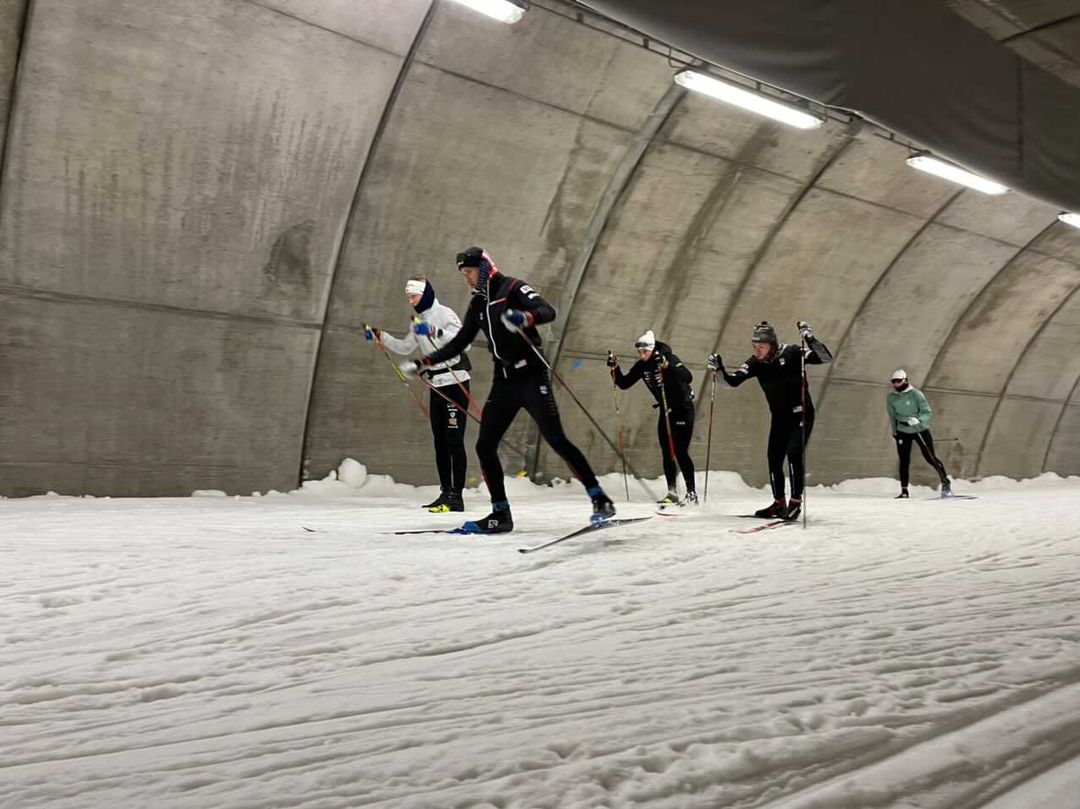
Kevin Bolger leads Ben Ogden, Torsby Ski Tunnel, August 2022. (photo: Greta Anderson)
“It’s been about 10 years since I’ve been to Torsby,” Whitcomb continued. “We brought the women’s team there in 2012 in a joint camp with the Swedes.”
Whitcomb also noted the relative ease of travel within Scandinavia: “In terms of itinerary, it’s a two-hour drive from Oslo [to Torsby]. When we get back to Oslo on the 21st to fly to Trondheim, that’s a 55-minute flight in the middle of the day, so it’s all fairly simple travel once we’re over there. It’s like traveling around New England.”
Another thing in common with New England: klister-cover skiing. Whitcomb described the snow inside the tunnel as manmade – snow guns are visible near the entrance – but as infrequently refreshed. “And so depending on when you’re there, it can be varying degrees of aged snow, but it tends to be fairly stable,” he said. “A variety of classic skis will work, and a variety of waxes will work. Generally a bit of a violet or some sort of 45 base covered tends to work, and some sort of medium grind.”
JC Schoonmaker, left, and Ben Ogden near the entrance of the Torsby Ski Tunnel, August 2022. (photo: Greta Anderson)
The tunnel is a valuable resource, but its terrain is “by no means ideal” as a direct replica of a World Cup course, Whitcomb acknowledged. The tunnel has two hills per lap, Zechel wrote, “which are steeper in one direction and more gradual in the other, making for a great place to work on striding. Most senior men would one-skate the hills at race pace, but they are still steep enough for offset technique work at lower speeds.”
But what does the tunnel have? Snow. Which is, to state the obvious, “a slippery surface,” per Whitcomb. This is specifically opposed to the “surefire kick” of the rollerskis that are most athletes’ go-to summer training modality.
Conditions in the tunnel can sometimes be “mealy,” Whitcomb observes, “even if you’re skating. It requires you to not just set the ski down, but to be able to ride it and negotiate the unpredictable nature of snow. Having a dose of that in the middle of summer has always been, we feel, a beneficial addition to the overall [training] plan.”
Whitcomb drills down on these dynamics when asked about the specific appeal of estival snow, especially what he’s learned over the last two years following no time on snow in summer 2020. Here’s his answer, quoted in full because it’s intriguing:
“One of the things that I have come to believe more and more over the last several years is that all great technique starts with the ability to use our feet well. You have to be able to stand well in your boots. Your boots have to be really comfortable, and that might mean you have to have insoles, or maybe it doesn’t; it might mean you have to have custom boots, maybe it doesn’t.
“And then you have to have a ski that you’re comfortable standing on. And all of that has to do with how comfortable you are with standing on a slippery surface below all of that. It’s like this four-layer deal where you have the body, the boot, the ski, and then the snow. And for anyone that has a hard time being stable on their feet, it’s going to be very difficult to ski well in the rest of the body. And so I think snow definitely allows us to focus by simply dropping our poles and learning to use the feet, just skiing easy for 20 or 30 minutes every session without poles, skating or classic.
“Because for those of us that don’t naturally use our feet well we often tend to use our poles as crutches, and it sort of masks the stiffnesses and the instabilities that we all have, myself included. But you take those poles away and you’re exposed to nothing but your balance, your ability to gain traction by kicking properly. And so that’s something that snow can do for you.”
* * *
The plan was to spend 20–25 hours on snow in the tunnel this past week, with secondary workouts on hillier outdoor terrain when necessary. Intensity in the tunnel was focused on speed; “we want to be a little bit mindful of breathing too hard,” Whitcomb noted.
He explained, “The Swedes are often talking about the challenges of coming from outdoor temperatures into the tunnel, which is quite humid – or at least cold, I don’t know if it’s humid – but they feel like it can irritate the lungs. So any intensity that we’ll do in the tunnel will be more along the lines of controlled threshold, and we’ll be masked up for those that have sensitive airways.”
(Whitcomb calls Bråten, who died in 2012 at age 63, “an old friend of the team, somebody I knew.” A full article on the rollerski races is forthcoming on FasterSkier later this week, but you can find results from Sunne here now, and results from Toppidrettsveka here starting on August 25.)
JC Schoonmaker, Torsby Ski Tunnel, August 2022. (photo: Greta Anderson)
Tomorrow the team flies from Oslo to Trondheim, where “we’ll live out near Aure on an oil facility,” Whitcomb notes. “And we’ll train there and sort of prepare for Toppidrettsveka, which is a four-stage event over three days. And then we’ll fly home on that Sunday,” August 28.
The men will have logged 20+ hours of on-snow time at almost precisely the midpoint between Bend Camp (late May) and the start of the World Cup season (late November). They will have explored the difference between rollerski kick and setting the wax on slippery surfaces. And they will have gotten to engage in high-level rollerski races with other top athletes. They’re all small pieces of the puzzle as the athletes build toward the season-opening races three months from now, be that in Ruka or closer to home.
U.S. Ski & Snowboard recently announced its U.S. Ski Team nominations for the 2022-23 season. Of the 22 athletes named to the team this season, six were not on the previous year’s roster, either newly named or renamed: Michael Earnhart, Walker Hall, Zak Ketterson, Will Koch, Finn O’Connell, and Sammy Smith.
Walker Hall was named to the 2022-23 U.S. Cross-Country D-Team. (Photo: U.S. Ski & Snowboard)
To help fans get to know these new(er) faces, FasterSkier is doing a series of interviews, providing insights into the factors that have contributed to development, progress, and growth for these athletes last season. In this installment, we talk with 20-year-old Walker Hall, who was named to the D-Team this season. Hall grew up immersed in the Methow Valley cross-country ski community and is now entering his sophomore year at the University of Utah.
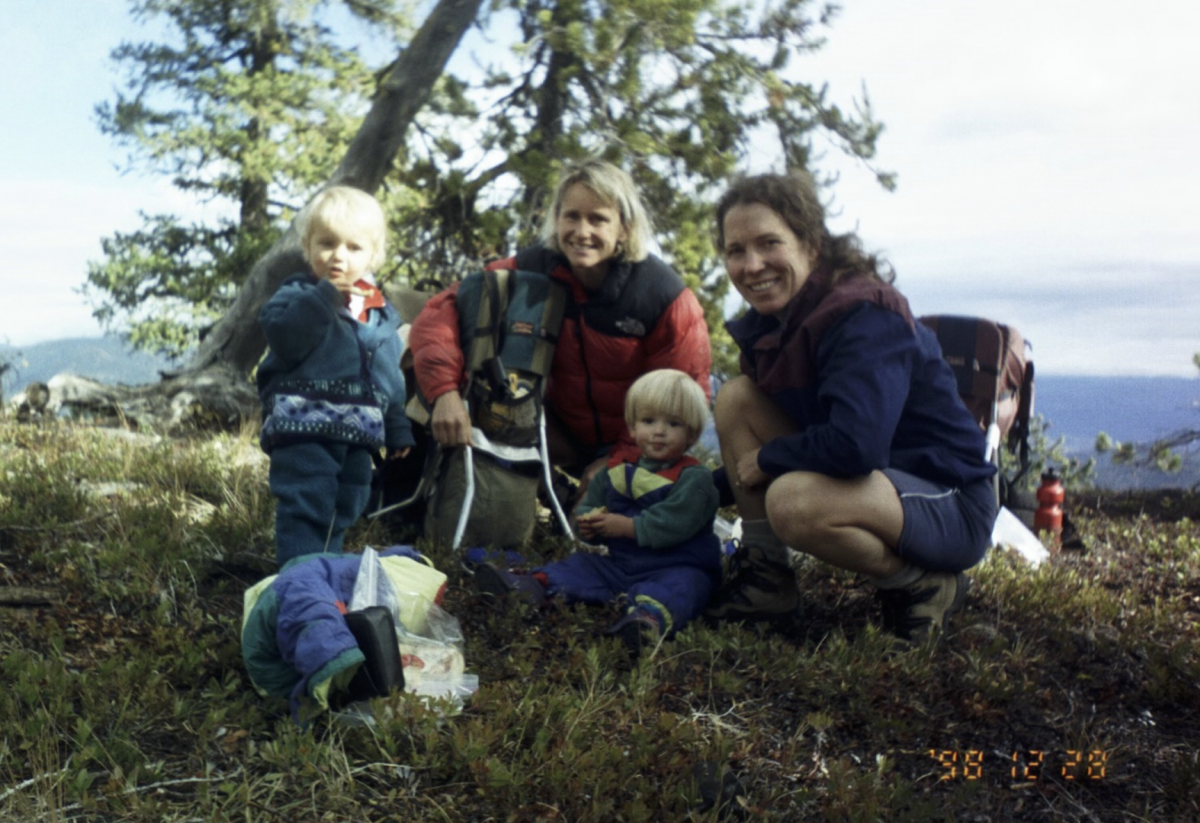
While the Methow has produced a number of outstanding skiers, includingBrian Gregg, Erik Bjornsen, and Sadie Bjornsen Maubet, Hall could find inspiration even closer to home. His mom, Leslie, skied in three Olympic Games between 1988 and 1994, and her best friend and training partner post-professional racing soon became two-time Olympian Laura McCabe, once both women relocated to Winthrop, WA. Still close friends, Walker and Novie McCabe are just six months apart in age, and began tagging along from their infancy on their moms’ training and outdoor endeavors. Both athletes, now U.S. Ski Teammates, developed on the Methow Valley Nordic Team, coached by their mothers.
Methow Valley Nordic Team coaches and Olympians Laura McCabe (left) and Leslie Hall (right) bring Novie and Walker, now U.S. Ski Teammates, along for their training and outdoor endeavors. (Courtesy photo)
In this interview, Walker reflects on some of the other influential experiences – and setbacks – that contributed to a breakout season in 2021-22. Hall won the junior men’s 10 k during the 2022 U.S. Cross-Country Championships in Soldier Hollow, and finished in the top-five in a third of his RMISA races, including a podium performance in Sun Valley. Earning his first spot on the World Junior team, Hall competed in both the 1.2 k freestyle sprint and the 30 k skate individually, and was a contributing member of the U20 bronze medal winning relay team.
– Walker’s sister, FasterSkier assistant editor Ella Hall, contributed to these questions
FasterSkier / Rachel Perkins: You grew up in the Methow Valley, which has a strong legacy within its cross-country ski community and the number of athletes who grew up there and went on to ski professionally. But in your situation, you and Novie McCabe are only about six months apart, and your families are super close and it sounds like you both did a fair amount of tagging along for both of your moms’ training as kids. Can you talk a little bit about your introduction to skiing and what your relationship with the sport was like growing up?
Walker Hall: From as early as I can remember, probably as soon as I was capable of going on skis, that’s when I started – me and Novie both. Regardless of what we were doing, it was mostly outdoor activities, whether that was hiking or climbing or just spending time outside. Our moms would take turns, like one would take care of us while the other went and did some training or a long run or something. So I felt like I got a good training base just from everything I did outside, and started off skiing really young, and it’s always been a big part of my life.
Leslie Hall, with a young Novie McCabe and Walker Hall, share a lifelong love of the outdoors that has developed into successful ski racing careers. (Courtesy photo)
FS: I also noticed you also listed your mom as one of the most influential people in your life in your U.S. Ski Team bio, and I know she was one of your coaches with the Methow Valley Nordic Team (MVNT). Can you say more about that?
WH: She coached [MVNT] up until just this last year – she retired last season. Basically when she was done racing [professionally] and once my parents moved to the Methow in the late ’90s, she really developed the program there.
So she’s been coaching for a really long time, and she had a lot of experience. She coached when my sister was skiing, so I grew up doing what [Ella] did because she’s four years older. My mom was able to give me the support and advice and guidance that is crucial for being good at skiing, and she was not too overbearing or anything, so I think she was just a really good influence on my ski career.
FS: That type of relationship seems important – not being overbearing, but really sharing in a mutual love of the sport. Is that something that you have felt within the Methow community and within your own family?
WH: I’ve definitely felt a lot of support from different people in the Methow, whether it’s my mom or Laura [McCabe] or other people in the ski community there. I’ve always gotten the support that I’ve needed and been pushed when I needed to be, and never felt too much pressure or anything, so it’s been really good for my career in skiing.
Long-time Methow Valley Nordic Coach and 3x Olympian Leslie Hall with the members of the U18/U20 relay at 2019 Junior Nationals in Anchorage, all of whom skied for MVNT. From left to right, Travis Grialou, Garrett Butts, and Walker Hall. (Courtesy photo)
FS: Fast-forwarding a bit, in high school, you spent six months in Meråker, Norway during your junior year, and it sounds like that was a pretty formative experience for you – you had a really positive experience with that program, and the coach, and made some good friends/training partners. Can you share more about how that came about and what your time was like there?
WH: It came about because Ella did a very similar [program] her junior year; she also went to Meråker, but she went for a shorter period of time. But as I got older and learned more about the sport and the people within the sport, it seemed like Norway was the place to be to really improve and learn. Our family had some connections in that area because Ella had been there.
Once I was there, it was definitely a lot different. Coming from the Methow where there’s really not many – there’s a lot of skiers, but it’s such a small area that you’re sort of in your own little bubble. So going to Norway and just seeing the ski culture there and learning a lot about training and what the Norwegians like to do [was really beneficial], because they obviously have a really good method for juniors or whatever age you are in ski racing. I had good coaches, good training partners, and good support there as well. So I definitely learned a lot and sort of knew what I had to do when I got back to really take skiing to the next level.
FS: Was that at a sports academy? Were you going to school also?
WH: It’s actually a public high school, or it’s funded by the government, but it’s a sports school [called the Meråker videregående skole]. So we would train in the mornings until maybe 11, and then shower, eat lunch, go to class for three hours or so, and then maybe train in the afternoon. That was what it was like most days, then on the weekends, it was more on your own because it’s a school program, not a club. When we would go to races – which I didn’t go to too many races – we would go with a local club.
FS: Your sister said that the experience also inspired you to take Norwegian lessons after returning home and that you’re “decent” now. Is this true?
WH: When I was there, I definitely didn’t know that much [Norwegian]. There were two other non-Norwegian students that I took some Norwegian lessons with, just what the school provided, but I definitely never really spoke that much while I was there. I wanted to keep learning and improving [after I got back], so I’ve studied on and off since then. I’m alright at it – I’m pretty conversational, I would definitely not say I’m fluent. But it’s a fun way to stay connected with my friends over there, and some of my teammates at the University of Utah are Norwegian too, so that’s been cool.
Hall also explained that his classes in Meråker were in Norwegian, but since the group size was small, and both his teachers and classmates were helpful, he was able to get by without being fluent in the language.
FS: After graduating high school in 2020, you had planned to go back to Meråker for a gap year, but COVID got in the way of that, and plan-B ended up including a lot of time training on your own in the Methow. Can you talk about that experience and how you adjusted?
WH: I had been planning to go back to Norway, but everything was so strict with COVID [at that point], they were not letting anyone in, basically. So I was just at home and I kept trying to figure it out so that I’d be able to go over there, but it just kept not working. I kept trying, but eventually, I was just at home the whole time.
I was going to races in the winter but it definitely was not an ideal situation for me because I was doing a lot of training on my own, which, it’s not necessarily a bad thing to train on your own, but for me personally, it’s a lot easier for me to train with other people. It’s a lot more motivating, and long term, it’s a lot better to train with other people so you don’t plateau. But I just focused on racing and kept working hard and it wasn’t the worst in the end. That year was alright, but it wasn’t ideal.
Walker Hall trains with the University of Utah team in Fall 2021. (Courtesy photo)
FS: Kind of on the other end of the training group spectrum, for collegiate racing, you originally committed to Dartmouth, but later were offered a spot that opened up at the University of Utah, and made the switch as Utah had been your first choice.
WH: Yeah. Basically, I had planned on going to Dartmouth, and then COVID hit, and it was looking like life at Dartmouth with COVID was going to be a lot different than before. I had been talking to Utah [during my senior year], and they had been saying ‘oh, you should take a gap year and then we’d probably like to take you.’ So there was also a chance that I was not going to take a gap year and just go to Dartmouth, but then when that gap year happened and I got offered a spot at Utah, I just knew that that was going to be the better choice for me.
Last summer before I went to Utah, I came up here to Anchorage for most of the summer, so I was training with a lot of my future teammates. There was a big group of people up here and a good amount of Utah skiers were here, so it was a good way to prepare and it was a really good experience. There’s just such good training up here during the summer. And the winter, I’m sure.
FS: And what does that look like? Are you working with a coach or under a certain program? And how have those experiences being in Anchorage for the summer been valuable for you?
WH: I train with APU when I’m up here. That’s a really solid group to train with, coached by Erik Flora, who I really like and I’ve learned a lot from. It was a really good experience coming up last summer, and I knew I wanted to come again this summer. There’s just a lot of really hardworking people that push me and help me hit big hours, so I think it’s a good place for me to be during the summer.
FS: Going back to University of Utah – what appealed to you about that program? And what was your experience like in that first season of collegiate racing?
WH: There’s a lot [that appealed to me about it.] I knew a lot of the people on the team, and I knew it was such a strong team. I had actually been down there a couple times – or I had been in Park City for ski camps and [races], and I visited Novie for a couple of weeks [during her freshman year at Utah] and really liked it. Me and Novie have always done similar training and whatnot, so I figured if she was liking it a lot down there, then it was a good place for me also.
And I really liked the coaches. I talked a bit with Miles Havlick and Frederick [Landstedt], and I really liked what I’d seen from those guys. Since I’ve been there, it’s been a really good fit.
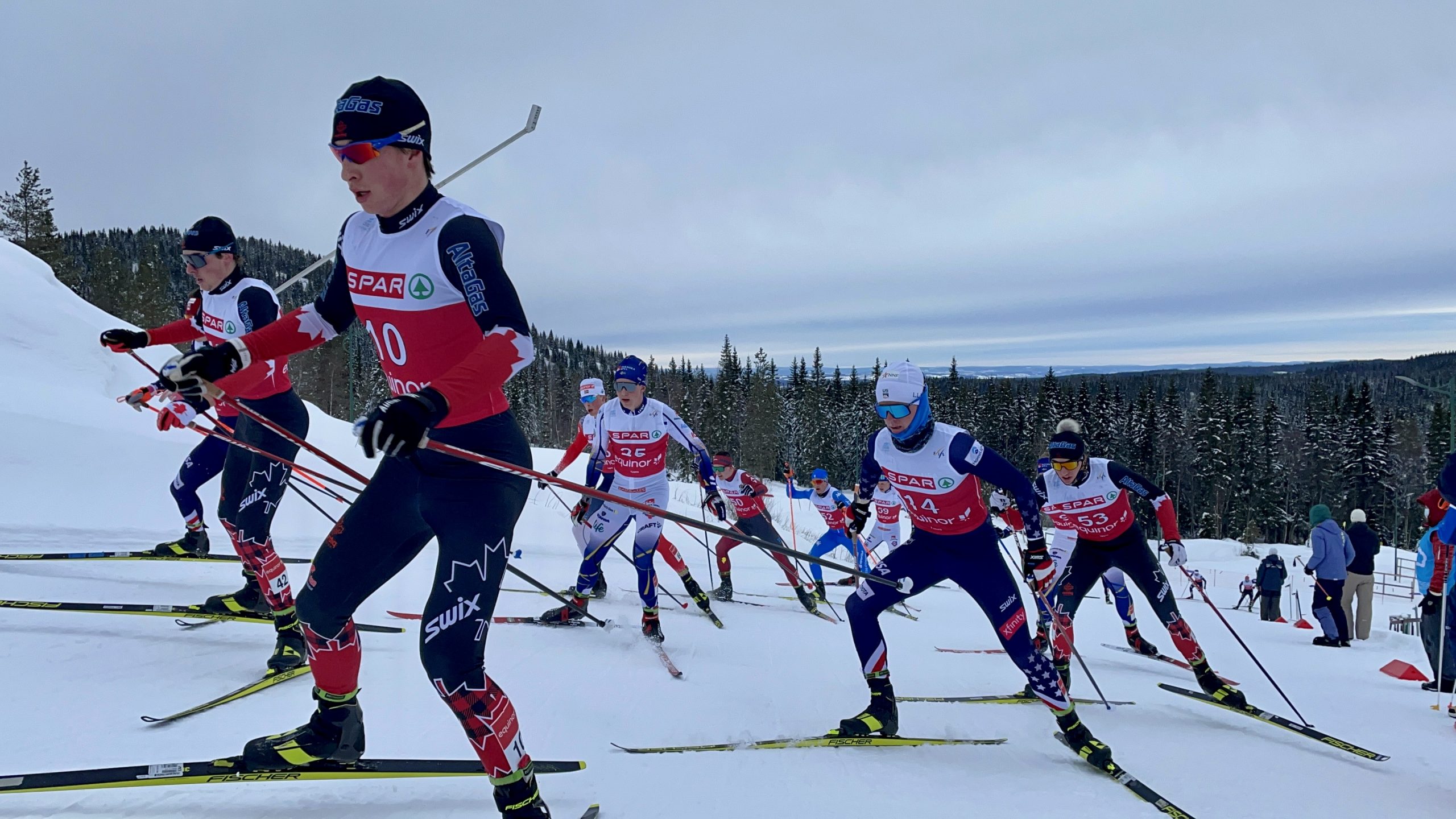
Xavier Mckeever in bib 10 (CAN) and Walker Hall in bib 14 (USA) head up “waffle hill” in the early stages of the men’s 30 k mass start during the 2022 Junior World Ski Championships in Lygna, NOR. (Photo: Ella Hall)
FS: World Juniors in Lygna was your first international trip, and it sounds like you had some bad luck with racing at US Nationals and/or been really close in prior years. What do you think came together for you this season to make that trip? And what were some of the highlights of that World Juniors experience in terms of how it supports your development and goals?
WH: Yeah. In previous years – maybe the past three years or so for this year – there were like two years where I was just coming off of sickness going into nationals, so I never really had the races that I wanted there, and I never ended up making any of those international trips. Which, honestly, I would have liked to go on the trips, but it never really bothered me too much – it wasn’t like demoralizing or anything – because I felt like I knew the level that I was at and that on a given day I could be as good or better than any of the trip. So it was never really too much of a bummer for me. But this year, I wanted to make it on the trip to World Juniors, and I had goals for the races at World Juniors too, it wasn’t just the trip there was the end goal. But just making it definitely felt good, and I had a really good Nationals this year, which was awesome since that’s pretty much the first time that’s happened for me.
I was super happy that the races were in Norway because I just love spending time there, and we got to do our pre-camp in Hafjell, which is right near Sjusjøen, and I’ve spent some time there – it’s [some of] the best skiing in the world. So that was super fun. And I really liked a group of guys and the entire team and staff that was there, so it was a really good experience.
FS: From the outside, it seems like you took a pretty big step forward this past year, which maybe can be attributed to having such a strong group to train with at University of Utah, or some more direction after a tough gap year. In looking back over this year, what are some of the factors that you think allowed you to take those steps forward and what were some of your personal highlights from the season? And those personal highlights do not necessarily need to be a race result, just an experience that stands out to you.
WH: I think the main factor was really taking my training to the next level. Especially over the summer [in Anchorage] and then carrying that through the fall in Utah. I was just training with a really strong group, and really pushing myself, and doing [types of training] that I hadn’t really done in the past. So definitely, a good part is thanks to that. And then also, I’ve had a lot of different experiences over the years and learning from those helps to channel some better results.
As for my highlights – this last season, I was just proud of the way that I trained and was smart with my training, and I didn’t overdo it. And it seems like it’s often hard to put together a good season like your freshman year of college because it’s such a big adjustment. So I was happy that I was able to have a solid season for the most part while going through such new experiences in my first year in college.
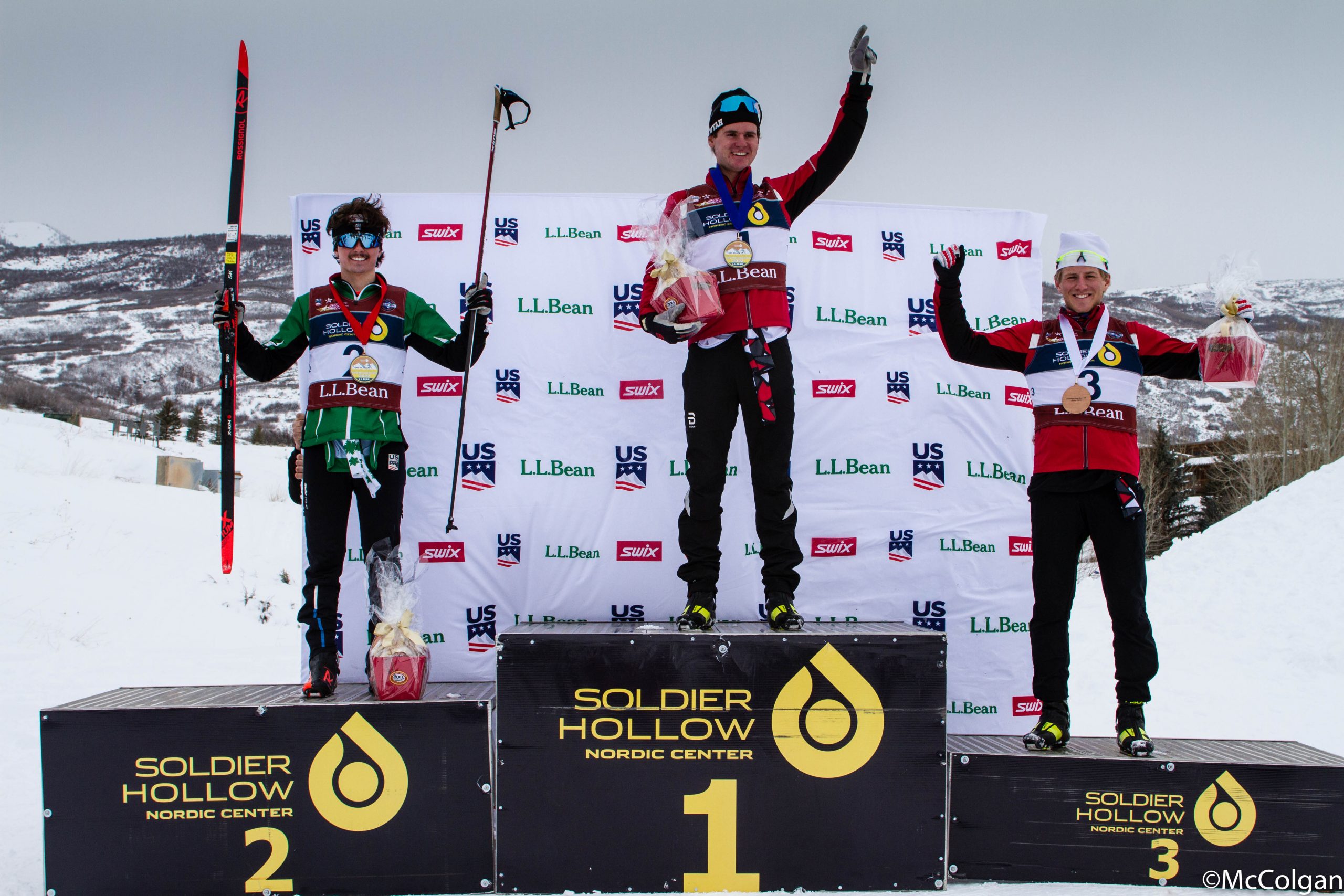
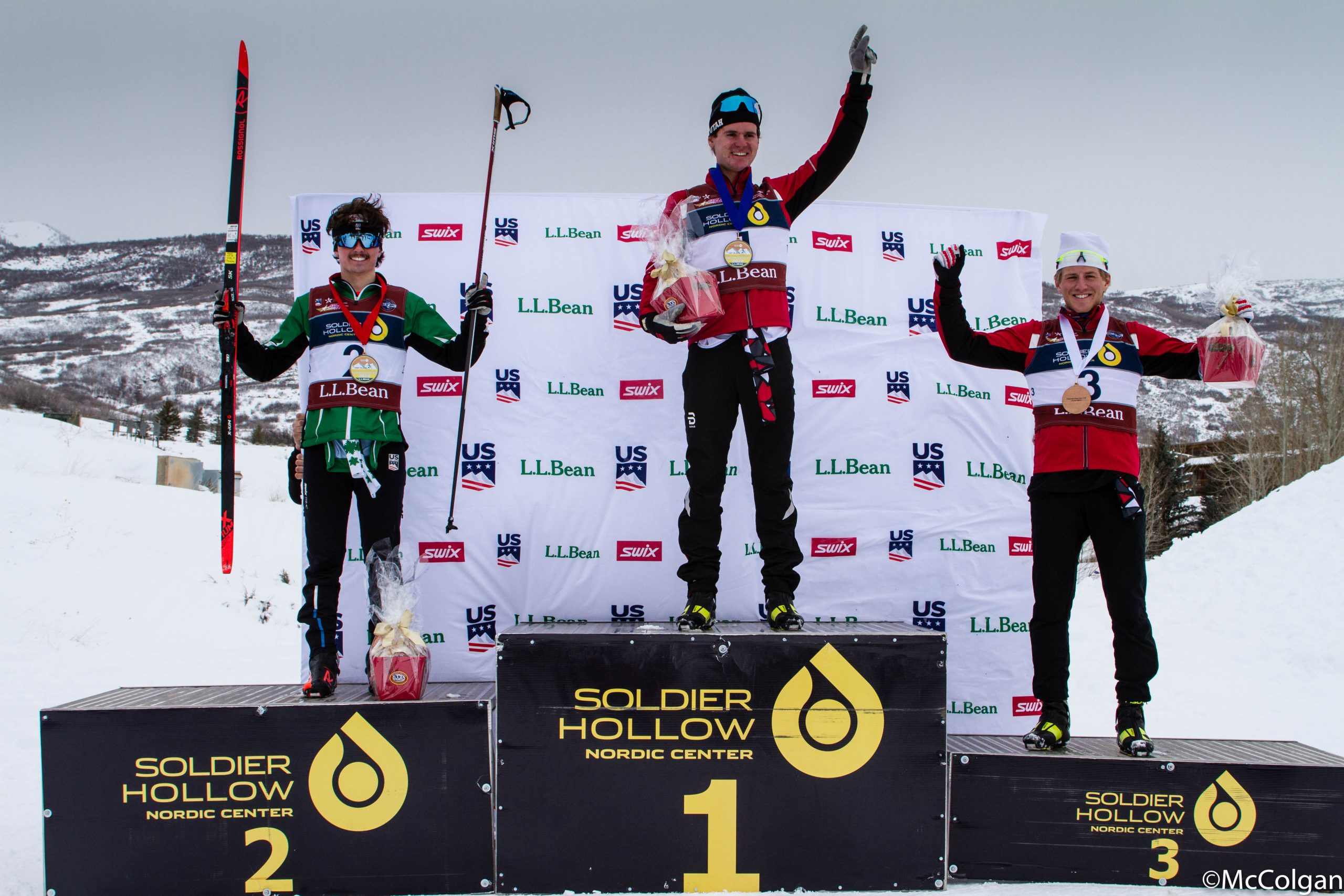
Walker Hall stands atop the podium in Soldier Hollow after winning the junior 10 k mass start freestyle during the 2022 U.S. Cross Country Ski Championships. (Photo: John McColgan)
FS: What are your goals heading into next winter?
WH: It’s gonna be my first year not being a junior, so honestly, I don’t have too many specific goals. But I’d definitely love to race in my first World Cup this year, and just keep improving. On the college circuit, hopefully, get a bunch of podiums in RMISA. And just keep learning from my teammates and pushing with the team at Utah.
FS: Last question for you: with making the D-Team, can you share what that means to you and what you’re excited about in terms of the support and opportunity that opens up for you?
WH: It’s always seemed like probably the biggest step you can make in U.S. skiing is actually making the ski team, so it feels really good to have achieved that. I’m just now realizing the amount of support that means that I’m able to get, so I’m just taking advantage of that and learning from my other teammates on the team – taking advantage of the different opportunities that it grants me, and just enjoying the ride. But I’m definitely thrilled to have made the team.
Coaches, support staff, and athletes celebrate a bronze medal in the men’s 4 x 5 k relay. Staff, left to right: Greta Anderson (front left), Bryan Fish (back left), Dr. Katie Eichten (partially obscured), Olof Hedberg, Pat O’Brien, Julia Hayes (middle row, blue NNF hat), Paul Smith, Anson Moxness, Lizzie Larkins, August Teague, Jack Novak. (Photo: flyingpointroad.com)
The 2022 FIS Junior/U23 World Ski Championships trip has been made possible through support from the National Nordic Foundation (NNF), which has identified this invaluable opportunity for developing athletes as one of its “Pillar Projects”. You can support the NNF and the next generations of America’s top skiers by making a donation here.
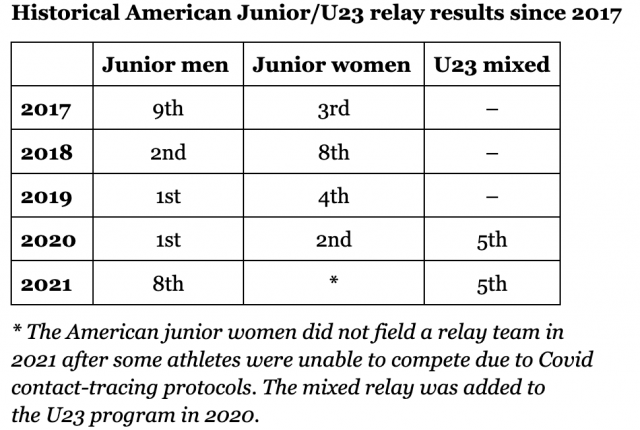
LYGNA, NOR — The second event of the week for 2022 FIS Junior World Ski Championships, and perhaps the most highly anticipated, was the men’s and women’s relays. It was in the relay in 2017 when the US women broke onto the podium on home turf at Soldier Hollow, Utah, starting a cascade of strong American performances in the World Juniors relay. The next year, in Goms, Switzerland, it was the men who landed on the podium with an historic second-place finish, which they then one-upped the next two years to bring home gold from Lahti in 2019 and Oberwiesenthal in 2020. The US women also finished on the podium in 2020, in second place.
After a little lapse in 2021, when the US junior women were not even able to field a team due to Covid contact-tracing protocols, both the men’s and women’s teams were ready to fight today.
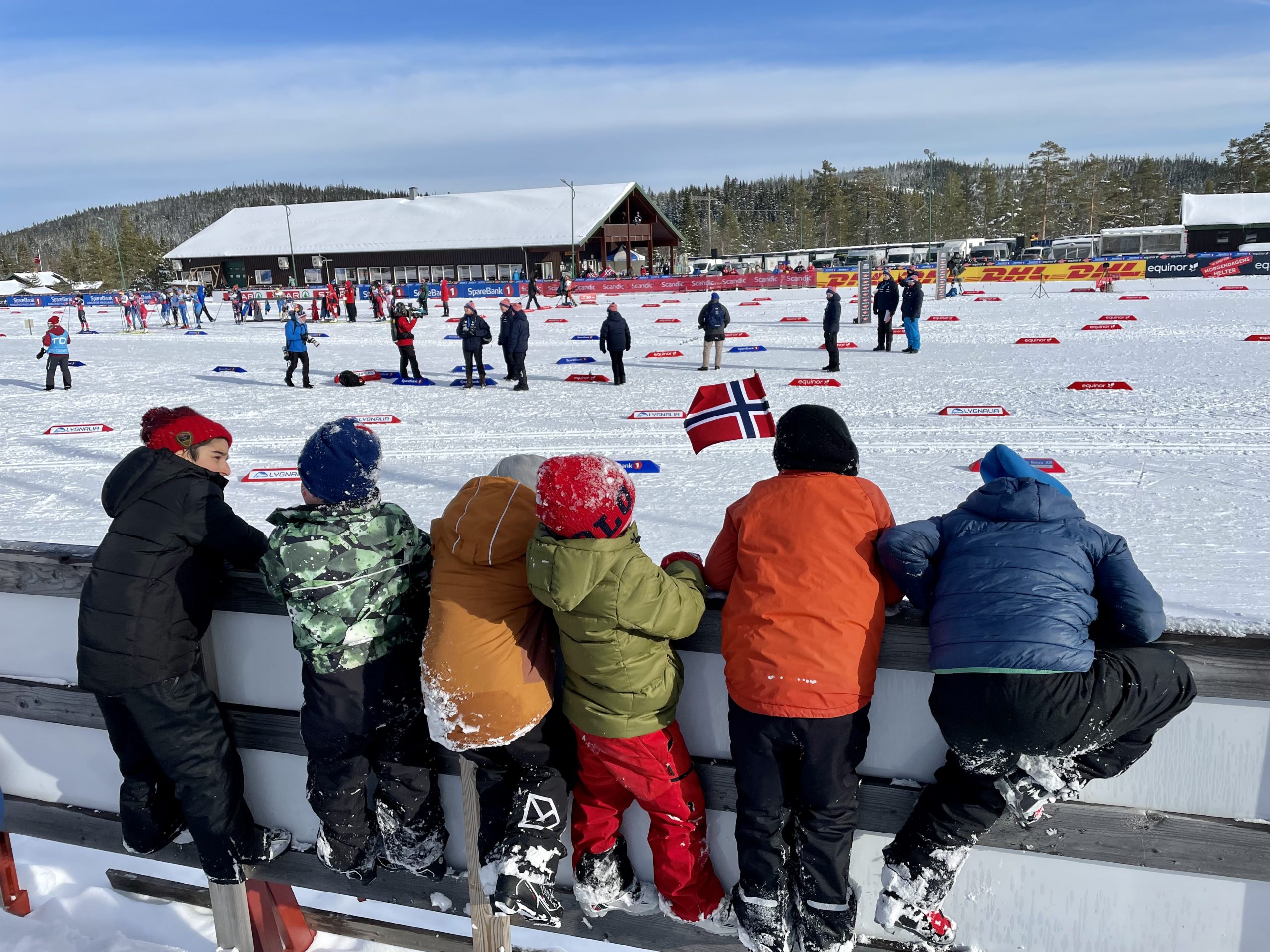
First up was the women’s 4 x 3.3 k, which featured separate courses for the classic and skate legs. As the women warmed up and made final preparations, the stadium filled with eager spectators in the form of young schoolchildren. As the announcer explained, one of the event sponsors had paid for the transportation of hundreds of local school kids to the venue each day. Thus as the start gun went off, it was to the chorus of many small voices shouting “heia, heia!” and many waving Norwegian flags.
Enthusiastic young fans prepare for the start of the women’s 4 x 3.3 k relay (photo: Ella Hall)
Skiing the scramble leg for the US team was Kate Oldham (Aspen Valley Ski Club/Carbondale, Colorado). “It was really fast,” she shared afterwards, “everyone went out really hot, it was fun just trying to ski with the best.” Oldham finished her 3.3 k in a time of 10:03.5 and tagged off to her teammate, Samatha Smith in eighth position.
Kate Oldham skis the first leg of the women’s 4 x 3.3 k relay in Lygna, NOR. (Photo: flyingpointroad.com)
As Russia started to pull away at the front, Smith (Sun Valley Ski Education Foundation/Sun Valley, Idaho) worked to gain ground on the others, moving the team up to fifth place at the completion of her leg. From there, Nina Schamberger (Summit Nordic Ski Club/Leadville, Colorado) took over as the technique switched to skate. Schamberger closed on the Swiss team, who was sitting in fourth, just ahead.
As the skiers entered the final climb, dubbed “waffle hill,” a pack had formed with Russia still out front. “I definitely tried to pace it like a sprint and just really push myself and try to use the downhills to recover as best I could,” explained Schamberger, “but it was definitely very painful but short enough because you were able to push as hard as you could the whole time.”
Kate Oldham tags Samatha Smith during the junior women’s 4 x 3.3 k relay. (Photo: flyingpointroad.com)
For the final leg, Schamberger tagged Sydney Palmer-Leger (University of Utah/Park City, Utah), handing off in seventh place. Up front, Norwegian anchor Anna Heggen was closing the gap to the Russian, Elizaveta Bekisheva and the two entered the stadium together, leading to a sprint finish and lunge which ultimately went in favor of the host nation. The Germans were next in third, +35.4 behind. Palmer-Leger picked off two places on her leg to land the US women in fifth, +1:14.7.
“It was really windy out there and you just try to push every little part because there’s no rest until the end,” said Palmer-Leger.
For three of the four athletes on the US team, this was their first time competing in a relay. When asked if they practiced exchanges at all they said, “it was pretty much just winging it.” Palmer-Leger elaborated saying, “It was pretty smooth, it’s a really short course and just taking a few seconds in the tagging is not going to do much. You don’t want to crash or mess up the hand-off because then that’s 30 seconds so, yeah you kinda just look back and double-pole and then wait for them to tag you.”
The junior women’s 3 x 3 k relay team: Sydney Palmer-Nina Schamberger, Samantha Smith, and Kate Oldham (l – r). (Photo: flyingpointroad.com)
With the women’s race complete, it was time for the men to line up, the race for them a 4 x 5 k with each leg skiing two 2.5 k loops. For the US, Michael Earnhart (APU Nordic Ski Center/Eagle River, Alaska) took the scramble leg. After the first 2.5 k it seemed that Swedish skier Måns Skoglund had broken away but the pack hunted him down as they exited the stadium for the second time, Earnhart tucked in behind Team Norway. Entering the stadium for the second of their two laps, Skoglund (SWE) had again gained a slight lead, with teams Russia and Japan in second and third. Behind them, Earnhart was leading the chase to close them down.
Into the first exchange, the gaps had closed and Brian Bushey (University of Utah/Waitsfield, Vermont) took over for Team USA.
Brian Bushey skis the second leg of the junior men’s 4 x 5 k relay in Lygna, NOR. (Photo: flyingpointroad.com)
Heading out into a ripping headwind, it was Sweden, Japan, Russia, and the US, being chased by Norway. As they descended into the stadium for the first time, there were still four teams up front, though Japan had dropped and Norway had joined. This time with the wind blowing in their favor, the skiers all chose to stay outside the tracks. “The first lap, coming through, I saw everyone hop out of the tracks so that’s when I decided to,” explained Bushey. “It was definitely faster.”
As Russia started to pull away slightly, Norway and the US were slightly detached at the start of the second lap of leg two. Canada was closing in on them and by the time they entered the exchange zone, they were a group of four, behind Russia, the US tagging in second position with Team Canada on their tails.
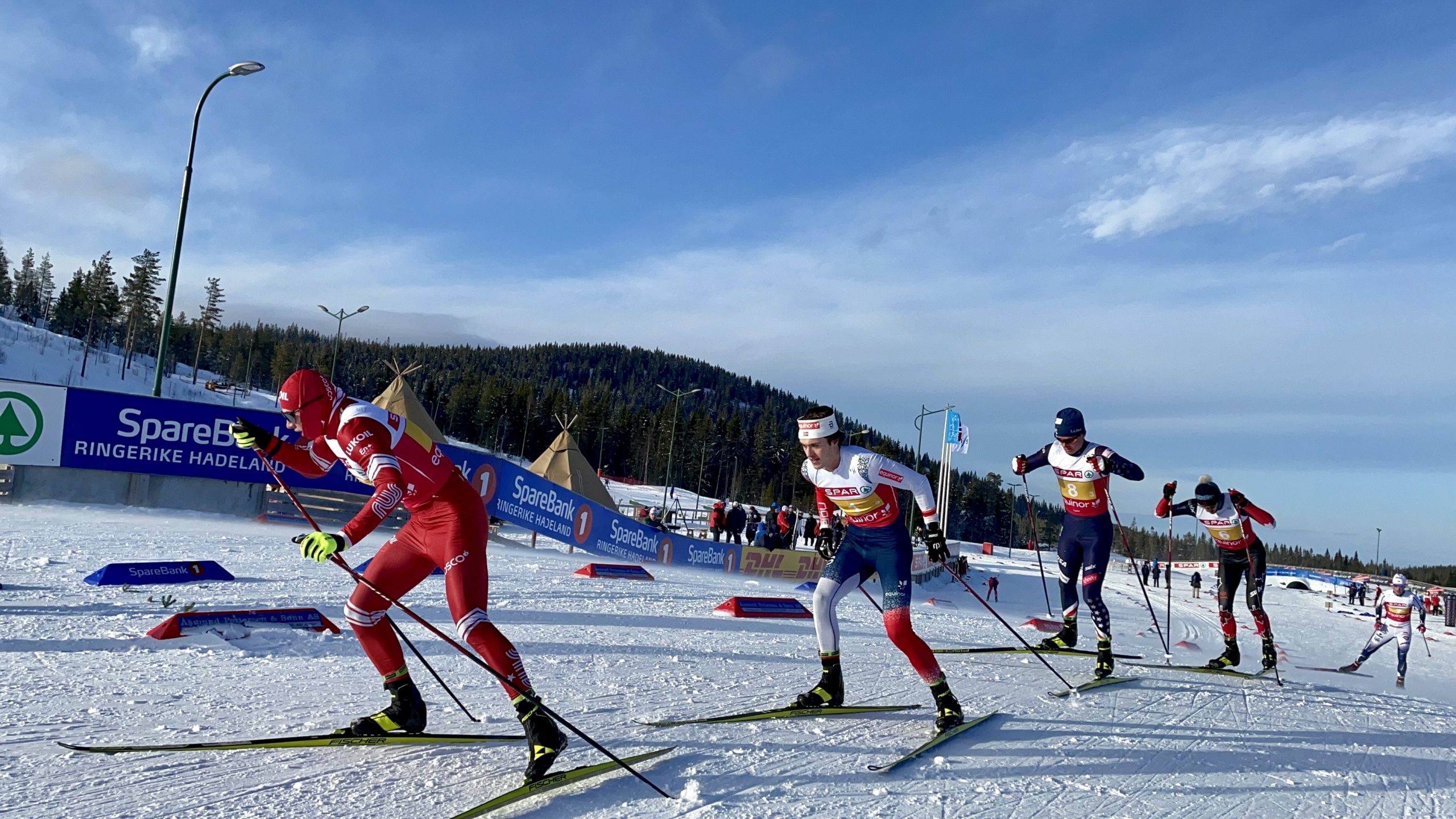
Switching to skate, Walker Hall (University of Utah/Winthrop, Wash.) took over for the US and over the course of his first lap closed the gap to Russia, bringing the lead pack up to five nations. Letting the Russian break the wind, the others slotted in behind as Sweden began to fade.
Nikita Denisov (RUS), Elde Holmbœ (NOR), Walker Hall (USA) and Sasha Masson (CAN) head out for the final lap of leg three as Sweden starts to fade. (Photo: Ella Hall)
Canada too dropped off the pace, leaving Hall and Nikolai Elde Holmbœ of Norway skiing together. Up the steep “waffle hill,” Hall pulled away from the Norwegian, leaving the front three teams all separated by some seconds as they executed the final exchange.
Will Koch (University of Colorado/Peru, Vermont) took the anchor leg for the US. He was soon caught by Aleksander Elde Holmbœ of Norway, the two of them skiing together with Russia off the front. In a scene that brought to mind Rosie Brennan’s efforts in the Olympic 30 k, though admittedly lasting a much shorter duration, Koch tried to get the Norwegian to take on some of the lead work as they headed straight into a bracing wind.
“As soon as that Norwegian caught me, I almost tried to stop and let him by,” said Koch, “but he didn’t want to lead either so he kinda stopped with me, but we luckily didn’t get caught by anyone.”
At this point, they were well clear of Team Canada, who was in fourth position.
Will Koch races Norway’s Aleksander Elde Holmbœ during the anchor leg of the men’s 4 x 5 k relay. (Photo: flyingpointroad.com)
Passing through the stadium, with only the “waffle hill” remaining, Koch had the lead, though he was overtaken by Holmbœ (NOR). The Norwegian seemed to have pulled away, but Koch put in a surge. This move was answered by Norway, and when they came into view on the descent, Norway had maintained its lead. “It came down to just a final sprint over the last hill!” said Koch afterwards.
Team Russia took gold in a time of 49:16.4, followed +21.8 seconds later by Norway. The US was close behind in bronze-medal position, +22.4 back.
“I think we definitely wanted to get on the podium, that was a huge [goal], it would have been fun to win but we’re really stoked with bronze,” concluded Koch. Adding to that Hall said, “Yeah, I think just going out, and skiing the best we could.” Bushey echoed that sentiment saying, “Yeah, we all just had to ski our best.”
The bronze medal winning junior men’s relay team: Walker Hall, Brian Bushey, Will Koch and Michael Earnhart. (l-r) (Photo: flyingpointroad.com)
To the fans following along at home, the boys said “We love you guys, it would not be possible without all of you! Thanks for the support, thank you NNF, go USA!”
The program now switches to U23 competition for a day with a 10/15 k classic race on Thursday. The juniors will resume racing on Friday.
The 2022 FIS Junior/U23 World Ski Championships trip has been made possible through support from the National Nordic Foundation (NNF), which has identified this invaluable opportunity for developing athletes as one of its “Pillar Projects”. You can support the NNF and the next generations of America’s top skiers by making a donation here.
LYGNA, NOR — Originally scheduled to take place in Zakopane, Poland but moved to Lygna, Norway, the 2022 FIS Junior World Ski Championships kicked off a week of competition on Tuesday. Situated roughly an hour north of Oslo at around 2,000 ft, the Lygna stadium could be described crudely as the middle-of-nowhere. But that would be vastly underselling the venue that hosted the Norwegian National Championships in 2019, which features a stout race course and offers classic Norwegian countryside charm.
The first event on the schedule was the 15 k skate mass start for the women and a 30 k skate mass start for the men. The women went first, completing three laps of a 5 k loop. Toeing the line for the US were Sydney Palmer-Leger (University of Utah/Park City, Utah), Samantha Smith (Sun Valley Ski Education Foundation/Sun Valley, Idaho), Nina Schamberger (Summit Nordic Ski Club/Leadville, Colorado), and Kate Oldham (Aspen Valley Ski Club/Carbondale, Colorado).
“This is my third World Juniors,” said Palmer-Leger, “I was in Lahti, my first one. [It’s] definitely the best World Juniors I’ve been to right now, it’s kinda chill, the last couple years are intense. You know, the first World Juniors you don’t know what to expect and now I’m the one with the most experience, being over in Europe so it’s kind of fun to know what I’m doing a little bit.”
Sydney Palmer-Leger leads the women’s 15 k mass start skate during the 2022 Junior World Ski Championships in Lygna, NOR. (Photo: flyingpointroad.com)
Palmer-Leger spent the first part of the season racing Period I of the World Cup with the US Ski Team, including skiing the scramble leg for the second US relay team in Lillehammer. Speaking to the course here in Lygna, Palmer-Leger said, “It’s a pretty hard course, there’s not a whole lot of rest in the first part but, it’s fun, there’s a lot of V1 the first part.” Last year at World Juniors in Vuokatti, Finland, several of the junior US women were not able to compete due to Covid-contact tracing protocols. Palmer-Leger was one of those unlucky few and she explained, “This is my second mass start at World Juniors because last year Novie [McCabe] and I were quarantined. This is my last year as a junior, so that’s really fun.”
15 k later, Palmer-Leger was the first finisher for the US in sixth position, with Helen Hoffman of Germany, Lisa Eriksson of Sweden, and Tuva Brusveen-Jensen of Norway finishing first through third respectively. “It’s sort of difficult doing these races because girls are not very relaxed,” Palmer-Leger explained, “and you’re stepping on each others poles and skis, and [the course] is really tight [in some places], and it goes from a a gradual downhill into a pretty steep uphill and girls sometimes will just stop and it’s like the accordion effect and I got stuck in the middle a bunch of times and luckily I didn’t break any poles. A bunch of Russians broke poles and some of our girls broke poles. I went down once but didn’t break anything.”
After this strong start to the week, she concluded “I’m really excited. Being in Norway is amazing.”
The next US finisher was youngster Samantha Smith. Smith is just 16 years old and the 15 k was her first-ever World Juniors race. She finished in 11th (+1:11.3) behind race winner Hoffmann (GER). Kate Oldham was also competing for the first time at World Juniors and posted a top-thirty finish in 27th place (+3:09.5). Nina Schamberger is also 16 years old and the 15 k was her first World Juniors race. She finished in 41st, +4:04.1 back.
Michael Earnhart (left) and Walker Hall (right) race the 30 k skate during the 2022 Junior World Ski Championships in Lygna, NOR. (Photo: flyingpointroad.com)
Moving right along, the men were soon on the start-line, ready for their six laps. Starting at 3pm local time, the temperature was dropping as a slight wind picked up. Competing for the US was Michael Earnhart(APU Nordic Ski Center/Eagle River, Alaska), Walker Hall (University of Utah/Winthrop, Wash.), Brian Bushey (University of Utah/Waitsfield, Vermont), and Alexander Maurer (University of Colorado/Anchorage, Alaska).
“Last year was my first [World Juniors] but this year is the first year I felt like I had a chance to get top 10 and everything, last year I was like ‘well I’ll be happy if I get top 30’” said Earnhart, after the race. In a competition where Russians took the top four finish positions, Earnhart managed to achieve that goal in the first race of the week, finishing in 10th (+2:33.5).
Talking through his race he said, “ the first half of the race I was just trying not to break equipment, trying not to fall, kinda trying to have fun you know, it’s fun skiing in a pack so I was just trying to stay relaxed. I got pushed a little ways back, I think I was back to 20th or 30th at some points but I just stayed relaxed. Then, on the fourth lap it started to string out and I was like, ‘Ok, I’ve got to get in a better position, get up there.’ Going into the last lap, I think I was in 12th and I knew that top ten gets you on the US ski team and I really wanted that, so I was just looking at 10th. I was like, ‘He’s right there. I gotta keep going.’ He got a little tired and I was hungry so…”
Michael Earnhart leads the American junior men in the 30 k mass start skate during the 2022 Junior World Ski Championships in Lygna, NOR. (Photo: flyingpointroad.com)
Also pre-qualifying for World Juniors in the same event, Brian Bushey finished his day in 16th position, +3:46.5 behind the top Russian, Alexander Ivshin. This in spite of the fact that as Earnhart put it, “Bushey took a big tumble, it’s a learning experience for sure.”
Speaking of learning experiences, Walker Hall was having one out on the course as he made his first World Juniors appearance, racing his first-ever 30 k. “My legs were so tired after like 10 k,” he said at the finish. He landed just outside the top-thirty, coming 31st, +6:01.7 back. Rounding out the U.S. finishers, Alexander Maurer finished 36th, +6:48.9 out, also making his first World Juniors appearance.
Racing continued Wednesday with the women’s and men’s relay events. Coverage of that event to follow.
The final weekend of SuperTour racing in Period II, and the final weekend within the Olympic qualification window, kicked off Saturday at the Lake Creek Nordic Center in Ketchum, Idaho. Part of the 2022 Sun Valley Nordic Invitational, the SuperTour races were held in conjunction with a Montana State University RMISA event and an Intermountain XC junior national qualifier.
Highlighting the size of the event, there were 157 female athletes in the field. With 141 senior and U18 men racing in the 10k, and another 46 racing in the men’s U16 5k. Spanning all age groups, an additional 70 U14 athletes and another 18 U12 athletes raced a 3k and 2k course, respectively. In all, nearly 400 cross country skiers, from Olympians to 10-year-olds in their first seasons on skis, made their way around the tracks in Lake Creek.
An athlete races the 10k interval start free on the Lake Creek trails in Ketchum, ID. (Photo: Tobias Albrigtsen / @untraceableg)
As the World Cup events in Les Rousse, France and Planica, Slovenia were both cancelled due to rapidly increasing coronavirus caseloads with the omicron variant, several athletes who might have headed back to the World Cup for these events found their way to Sun Valley instead, meaning fields were more in line with the U.S. Cross Country Championships than a typical SuperTour.
On the women’s start list for the 5-kilometer individual start skate, which kicked off the weekend of distance racing, were six women who have spent at least part of their season racing on the World Cup: Rosie Brennan (USST/APU), Caitlin Patterson (CGRP), Katharine Ogden (USST/SMS T2), and three University of Utah athletes who are also members of the U.S. Ski Team, Sophia Laukli, Novie McCabe, and Sydney Palmer-Leger.
Likewise, the men’s 10k field included seven World Cup athletes: David Norris (APU), JC Schoonmaker (USST/UAA), Scott Patterson (USST/APU), Hunter Wonders (USST/APU), Zanden McMullen (USST/APU), Luke Jager (USST/U of Utah), and Zak Ketterson (Team Birkie).
Given Ketchum’s elevation of roughly 5,950’, approximately the same as the courses in Soldier Hollow, Utah and those Olympic team members will face in Ziangjiakou in February, the events provided another opportunity to spend time training at the elevation and to hone their approach to racing at altitude. Overnight lows in the single digits meant cold air and snow temps at the start of the women’s race, another important similarity to forecasted Olympic conditions.
According to co-chief of competition Kelley (Sinnott) Yeates, livestream was not available during the Sun Valley Nordic Invitational due to connectivity issues along the courses. As such, FasterSkier’s reporting this weekend is based on live timing and the feedback of those on-site.
Of the course, Sun Valley native Johnny Hagenbuch provided insight into the 5km loop that was raced today in an email to FasterSkier: “The new courses at Lake Creek are very difficult: they essentially removed all the flat from the old course and replaced it with the biggest climb at Lake Creek.”
Senior Women’s 5k Free:
Without the ability to view the race and no intermediate splits in the live timing, the women’s race results left little room for suspense. Given her dominant performance in the 20k skate during the U.S. Cross Country Championships, it was no surprise to see Rosie Brennan’s name top the list. Brennan smashed the 5k loop, finishing in 14:28.6, a full 48.6 seconds faster than the next woman.
Rosie Brennan enjoys a wintery training day before the weekend of World Cup racing in Davos, SUI. (Photo: NordicFocus)
“I decided to come to Sun Valley after the World Cups in France were canceled,” Brennan wrote to FasterSkier in a post-race email. “My coach, Erik Flora, has been up here all week with the rest of my APU teammates, so it made sense for me to come here to be able to work with my coach and teammates. That has been the total silver lining of the World Cups being canceled. Erik is not allowed to come to the Olympics, but is my personal coach and someone who I trust and value immensely, so getting this extra week to work on things with him has been such a welcome surprise.”
Now several weeks into an extended altitude block, Brennan has been training near her childhood home in Park City, UT. The races in Soldier Hollow put her back on familiar tracks with hometown advantage, and the nostalgia continued today.
“It has been a full circle moment for me this weekend as I spent many years racing JN Qualifiers in Sun Valley growing up, so to be back here doing so now as I prepare for the Olympics has brought back all kinds of memories from my whole ski career. My high school and college coach were also out there today cheering and it’s been really special to have this extra time in the U.S. to share moments with people like that who have helped in getting me to where I am today.”
Brennan had originally planned to rejoin the U.S. Team in Europe, but following the cancellations of the two remaining World Cups before the Olympics, has shifted her plans to limit her risk of covid exposure, as a positive test might jeopardize her ability to travel to China, regardless of the severity of her case.
“With travel being risky on all kinds of levels today, I decided to just stay put after the World Cup cancellations and make the most of the training opportunities I have here in the U.S. before heading to Beijing. This weekend is serving as a replacement for the races I would have done in France and also another opportunity to test my limits at altitude. We just incorporated the races into a little intensity block to get my engine running again after a good volume block.”
Rosie Brennan logs hours on home trails during an extended altitude camp near Park City, UT. (Photo: Instagram @rosiewbrennan)
Speaking to her feelings holistically as she prepares for the Olympics, entering the Games on the heels of a career-best 2020/21 season with a host of early-season indicators that she can be a medal contender, Brennan spoke to the stress athletes face amidst the pandemic, which has added layers of complexity in traveling to Beijing and entering the Olympic bubble.
“It’s definitely a stressful lead up to the Games with COVID raging everywhere, a multitude of requirements and things that need to get done to be allowed into China, and figuring out all the details of being prepared for such a long travel to a very foreign country with lots of restrictions. I am doing my best to just stay on top of all the requirements, stay far away from everyone I can, and chip away at the things I need to be prepared for. The training at home has been great and having a coach to work with is so helpful, so from an actual racing perspective, I am feeling good and optimistic. I feel very lucky to have a home base in Park City and that the venues in the area provide good preparation for the Games.”
Sophia Laukli races to second overall and finishes the top collegiate racer in the women’s 5k interval start free in Ketchum, ID. (Photo: Instagram @utahskiteam)
Recovered from racing the Tour de Ski, where both women notched top-10 finishes on the hill climb, Sophia Laukli (USST/U of Utah) took second place (+48.6) today, with Novie McCabe four seconds behind in third (+52.6). Katharine Ogden (USST/SMS T2) was fourth (+52.0) for the women, with Rosie Frankowski (APU) next (+59.8) to round out the top-five.
With their top-three overall finishes, Laukli and McCabe also took home top results in the collegiate standings on behalf of the University of Utah. With teammate Sydney Palmer-Leger in 7th overall (+1:32.5), the Ute’s swept the RMISA podium.
“Today was definitely quite the race,” wrote Laukli after the race. “I was really looking forward to it since I love 5k skates, and courses with lots of climbing. I was also excited to get back into racing after the tour, especially on the domestic circuit which I was starting to miss. I was very happy with how the race ended up today, and it was actually a bit of a surprise (results-wise) just based on how I felt during it. I know I was not alone by getting rather cold out on course, but it felt like quite the shock to the system and difficult to get in a good groove—sometimes that will happen though! While it was probably one of the hardest 5ks I’ve ever done, it’s an awesome course and I just had fun getting back into racing after a short break.”
Commenting on her recovery post-Tour de Ski and her goals over the next couple of months, Laukli continued, “I took the past couple weeks very easy in my training, with minimal intensity, to recover from the tour. I wanted to take advantage of that racing block to really get into my best racing shape so taking a step back in training right after was important. The rest of the season is still a bit up in the air, but I know these races at altitude will be great preparation if I do end up at the Olympics. Either way, I’m planning to continue doing some college races and hopefully NCAAs, so these races will be good prep for that as well.”
With Sophia Laukli and Novie McCabe also taking second and third on the overall podium, Sydney Palmer-Leger brought the Ute’s home for a collegiate podium sweep. (Photo: Instagram @utahskiteam)
Other noteworthy results include the retired, but nevertheless still a contender, Caitlin Gregg, who hopped into the race while still serving as a co-head coach of the Midwest’s Team Birkie. Gregg finished in 8th (+1:37.5), just ahead of the day’s top Craftsbury skier, Alexandra Lawson.
Also, Caitlin Patterson, who earned a spot on the podium in each of the events at the U.S. Cross Country Championships and SuperTour in Soldier Hollow, finished 17th, nearly two minutes behind Brennan. In a post-race Instagram story, Patterson wrote that she had been very cold during the race with numb legs and toes, which left her feeling like a “floppy fish popsicle.” Despite finishing below where she was perhaps aiming, Patterson remains in second place behind Frankowski in the SuperTour overall standings, and in second behind Brennan in the Olympic qualification rankings for distance racing.
Senior Men’s 10k Free:
The men’s field would race the same lap the women did, but twice. That meant there was a time checkpoint at the halfway mark to indicate how the race was shaping up, yielding interesting insights into just how tight a spread the top of US men’s skiing is right now. With World Cup athletes, elite-level domestic racers, and top collegiate skiers from the West, there were plenty of names to watch.
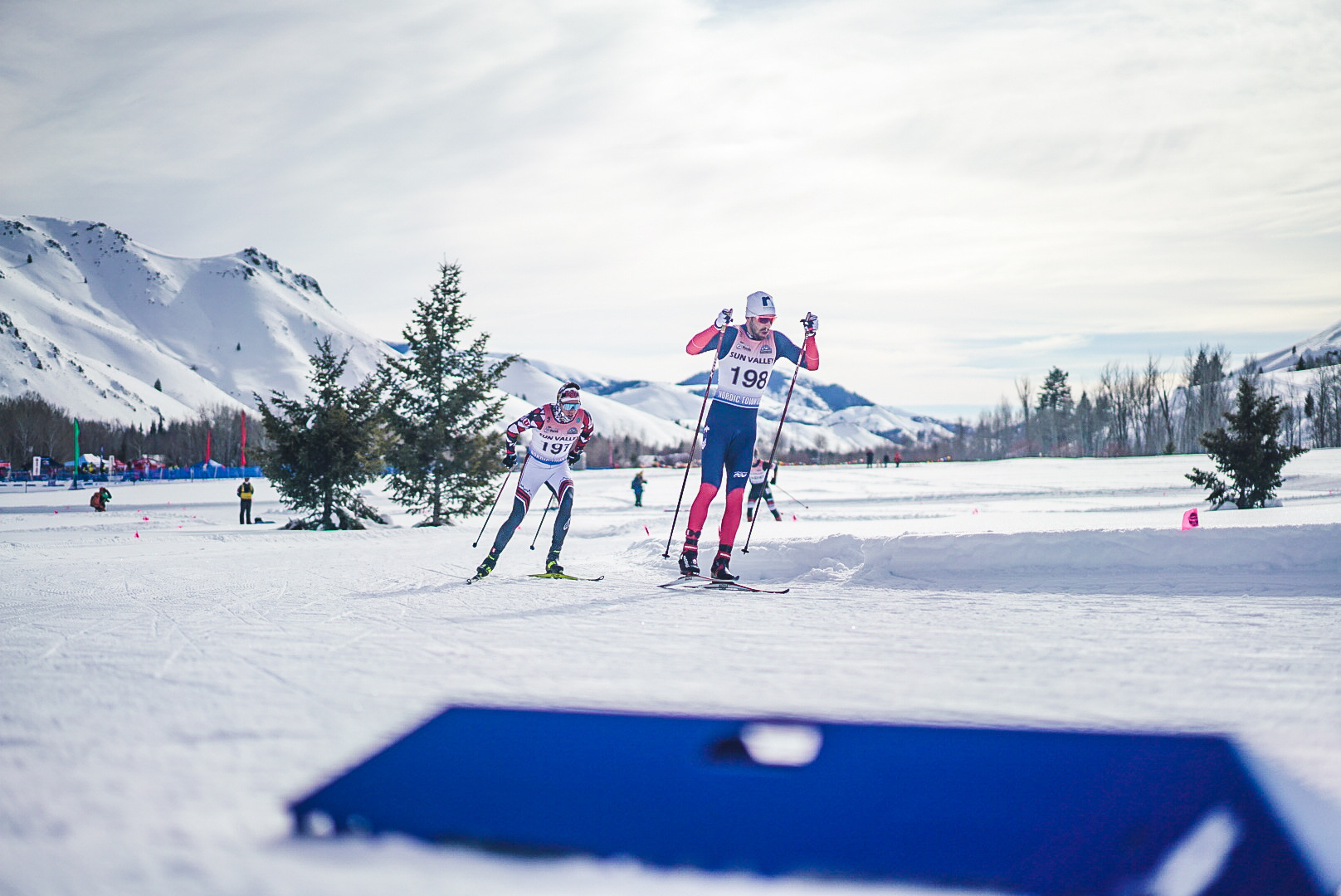
Ian Torchia (SMS T2) leads Sam Hendry (U of Utah) during the SuperTour 10k individual start in Ketchum, ID. (Photo: Tobias Albrigtsen / @untraceableg)
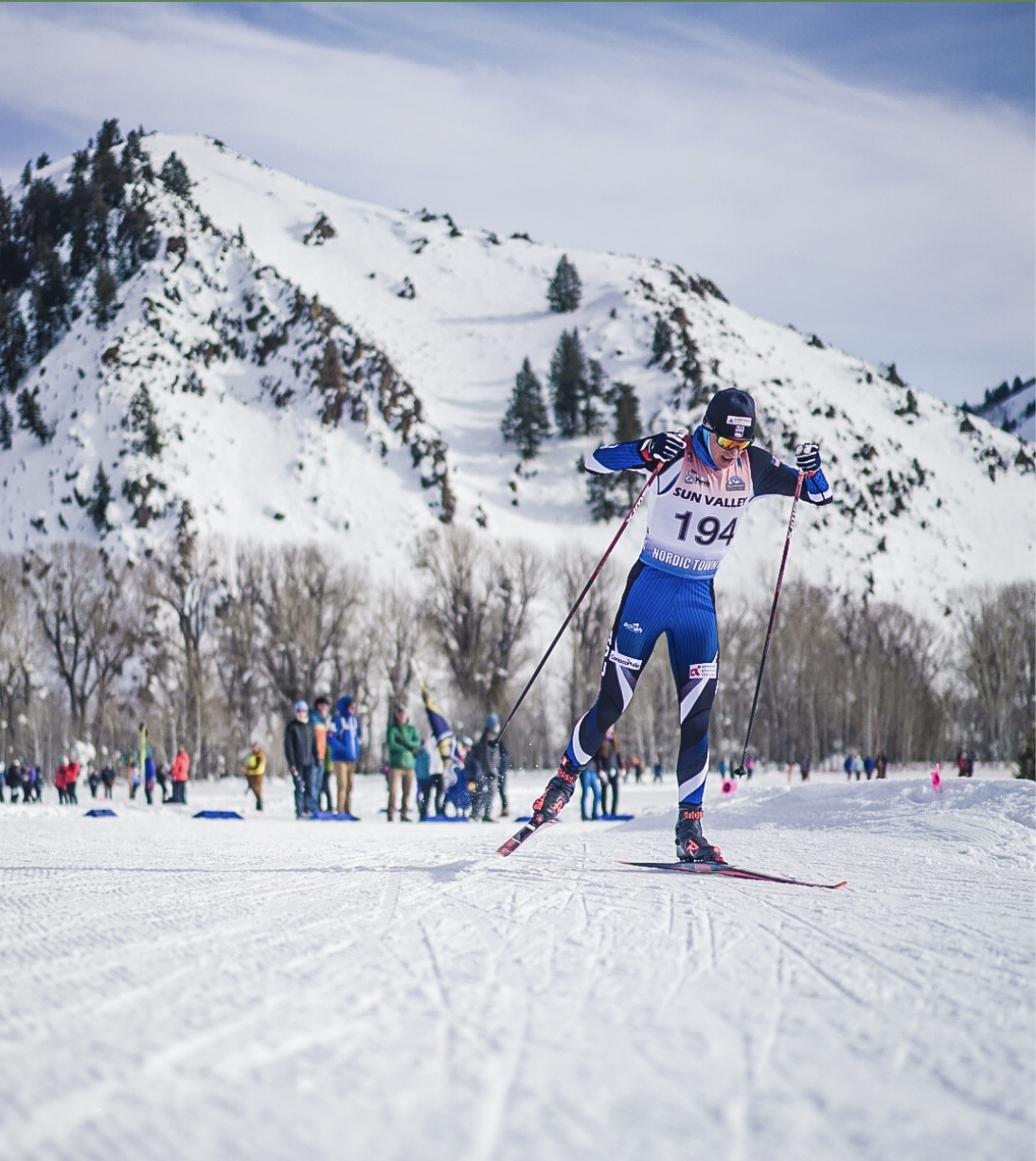
An Aspen, CO native and no stranger to altitude, Graham Houtsma (BSF Pro) was early off the line as the second starter in bib 172. Houtsma came across the 5km split as the early leader at 13:30.3. His mark would look to be the point around which the top of the field clustered for the first part of the race. Then, Scott Patterson (USST/APU) came through in bib 194 and raised the bar. His split topped Housma by a full 30 seconds (13:00.2), and would be chased as the remainder of top-seeded athletes lapped through.
Before diving into that group, however, a caveat. A couple of the top skiers today weren’t assigned splits at all in the live timing, including overall SuperTour leader Adam Martin (CGRP), Johnny Hagenbuch (USST/SVSEF), and top-collegiate finisher, Bernhard Flaschberger (U of Denver). That gave an incomplete picture of what the race looked like through one lap, setting the stage for a few surprises in the eventual final results.
Scott Patterson skis to fifth in the 10k individual start free in Sun Valley. (Photo: Tobias Albrigtsen / @untraceableg)
So what did we know through 5km? If you were just observing, you would have seen Patterson overtaken by one, and only one, skier. Teammate Hunter Wonders (APU) completed the first lap of the course 3 seconds ahead of Patterson at 12:57.9. The field that had splits looked to be shaping up into a tight affair, with the top 5 skiers all within 15 seconds of each other. That included Wonders in the lead (12:57.9), with Patterson next (+2.3), Ian Torchia third (+8.5) seconds, David Norris (APU) in fourth (+10.0), and Finn O’Connell (BSF Pro) in fifth (+12.1). Based on eventual results, it is safe to assume that Hagenbuch, Flaschberger, and Martin all went through in the 13:00 min pack too.
At the finish, Wonders would cross the line in first place at 26:28.7, and slightly increase his lead over the pack in the second lap. Over Torchia, it had grown to 8.5 seconds, and Patterson 20.9 seconds. But it would be the skiers of the “mystery 5k” splits that really made a difference in defining today’s results. Hagenbuch came in soon after Wonders, and crossed the line in 26:15.4. It would prove to be a mark no one could top on the day. Bernard Flaschberger too, would slotted himself into the top of the pack – finishing less than a second ahead of Ian Torchia to claim 3rd.
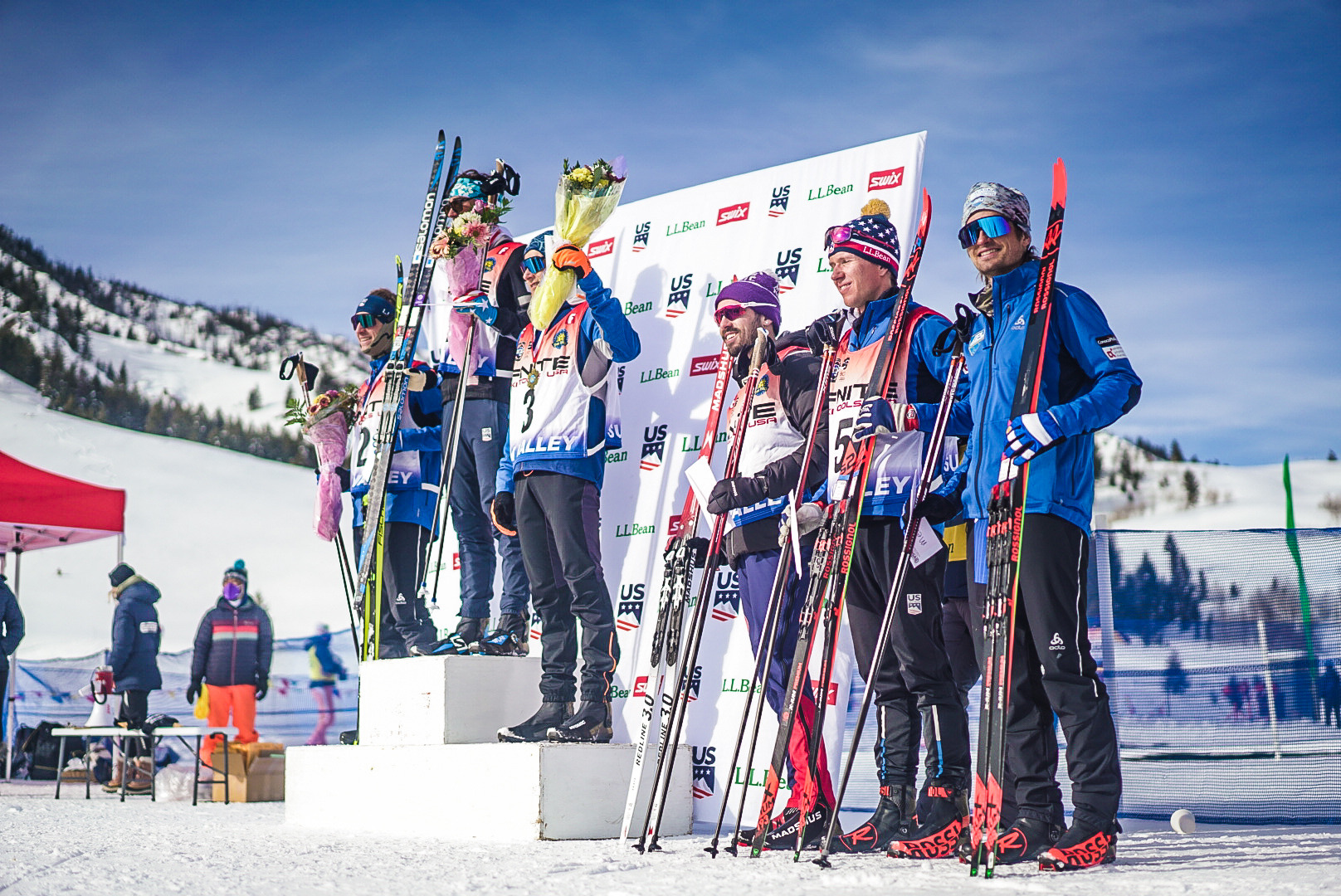
The top 5 of the final results then, looked finished like this: Johnny Hagenbuch with the win in 26:15.4, Hunter Wonders in second (+13.3), Bernhard Flaschberger in third (+27.0), Ian Torchia in fourth (+27.5), and Scott Patterson fifth (+34.2).
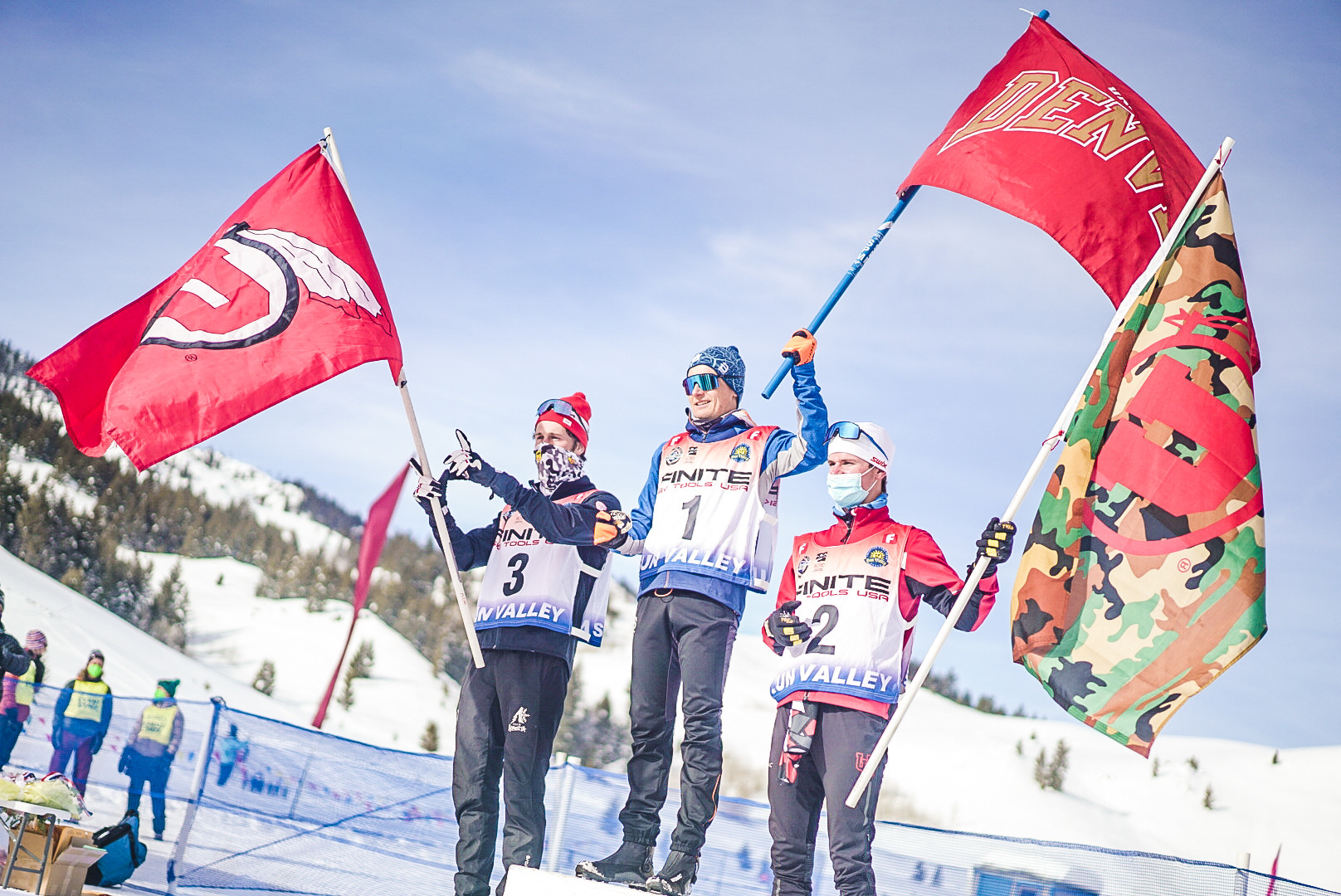
The men’s podium of the SuperTour 10k individual start skate in Sun Valley, including the top-six athletes. (Photo: Tobias Albrigtsen / @untraceableg)
In an email to FasterSkier, Hagenbuch pointed to an intimate knowledge of his home course in Sun Valley as being a key to his impressive margin at the top:
“The conditions were firm and well skied-in, and it was fairly fast. I have skied a whole lot here at Lake Creek in my years, and I knew the race was going to be super hard. I think it’s important to focus on the transitions and more rolling parts of the courses at Lake Creek, as just about everyone will be suffering on the climbs. I tried to ski [with a] really big, powerful V2 on the more gradual north end of the course; the strategy for the uphills was mostly to step on and off the skis quickly.”
With his results, Hagenbuch wins his first SuperTour of the season, on his home course, to boot. Not too shabby for a Saturday morning in Ketchum. He also did so in convincing fashion, rising above a field of seasoned SuperTour athletes to claim a definitive win by a stout margin. It will also improve his 5th place overall in the SuperTour standings, replacing two 6th place finishes from early in the season at Duluth.
On his win, Hagenbuch wrote, “frankly it’s quite a relief to have done well today, as I feel I haven’t really expressed my shape to the fullest for a variety of reasons this season… I’m just taking it day-by-day, [and] it was a real treat to have so many friends and family to cheer me on at home in a field that was deeper than U.S. Nationals.”
Hunter Wonders skis to second place in the men’s 10-kilometer individual start skate race in Ketchum, ID. (Photo: Tobias Albrigtsen / @untraceableg)
Elsewhere in the SuperTour standings, Wonders’ 2nd place finish will improve his distance standing going into today from 12th overall – replacing a 4th place finish in Soldier Hollow in the 15km Classic off his point standings. Overall SuperTour leader Adam Martin finished 7th (26:57.6) on the day, while 2nd place holder JC Schoonmaker was 21st (28:04.3).
“Today was a solid effort,” Wonders wrote to FasterSkier after the race. “It’s been a while since I’ve been home to Alaska and that’s started to weigh on me this week. Leading into the racing I was low energy trying to get my feet back under me after nationals in Utah. It was a good confidence boost and a pleasant surprise when I realized I was having a good day on the course today.”
Shedding light on the course conditions for those unable to watch, Wonders continued, “It was amazing conditions for a race, not too cold with firm grooming which is always welcome. 10k is pretty short, so I knew I had to take it out hot. I was a little concerned about blowing up, but realized that the course had more recovery when you’re at race pace versus easy skiing. The high part of the course is brutal but it sets you up into a ripping decent to the finish. Overall, it was a great day and I’m happy with my racing and thankful for my teammates keeping my spirits up this week and the coaches hooking me up with some great skis.”
In the RMISA collegiate standings, the Utes again had a strong podium showing. With Flaschberger taking the win for Denver, Walker Hall (U of Utah) Sam Hendry (U of Utah) skied into the next two collegiate spots to solidify the overall lead for Utah this weekend.
The RMISA men’s podium of the 10k interval start classic in Sun Valley: Bernhard Flaschberger took the win for the University of Denver, ahead of Utah’s Walker Hall in second and Sam Hendry in third. (Photo: Tobias Albrigtsen / @untraceableg)
By Gavin Kentch, Ella Hall, and Rachel Bachman Perkins
Tuesday brought distance races to Soldier Hollow, in the second full day of racing at 2022 U.S. Cross Country Championships. The story at the front of the field was strong performances by athletes who had begun the year racing on the World Cup, as Rosie Brennan dominated the women’s field to win by over a minute, and Scott Patterson took the men’s race by roughly twelve seconds.
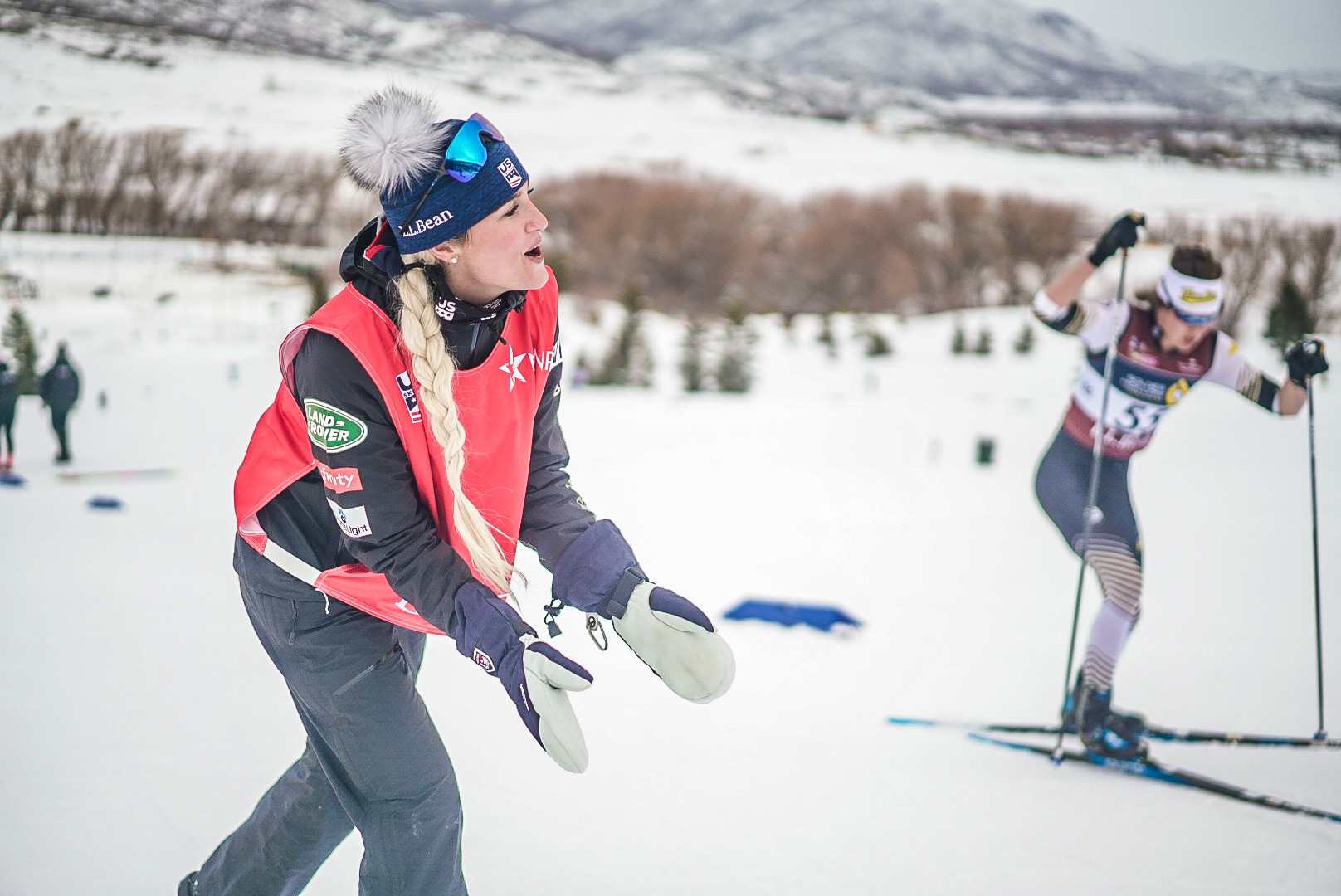
U.S. Ski & Snowboard Development Team Coach Greta Anderson encourages athletes during the men’s 30k distance race in Soldier Hollow. (Photo: Tobias Albrigtsen / @untraceableg)
Brennan was followed by Rosie Frankowski and Caitlin Patterson. Scott Patterson was followed by David Norris and Hunter Wonders, giving APU five out of six podium spots on the day. Craftsbury athletes went 3-4-5 in the women’s race. Notably, four out of six podium finishers were on the north side of 30, with a fifth gaining Master status later this month, underscoring the lengthy developmental curve often required to achieve success in distance racing.
Women’s Race: Rosie Brennan Solos to Victory
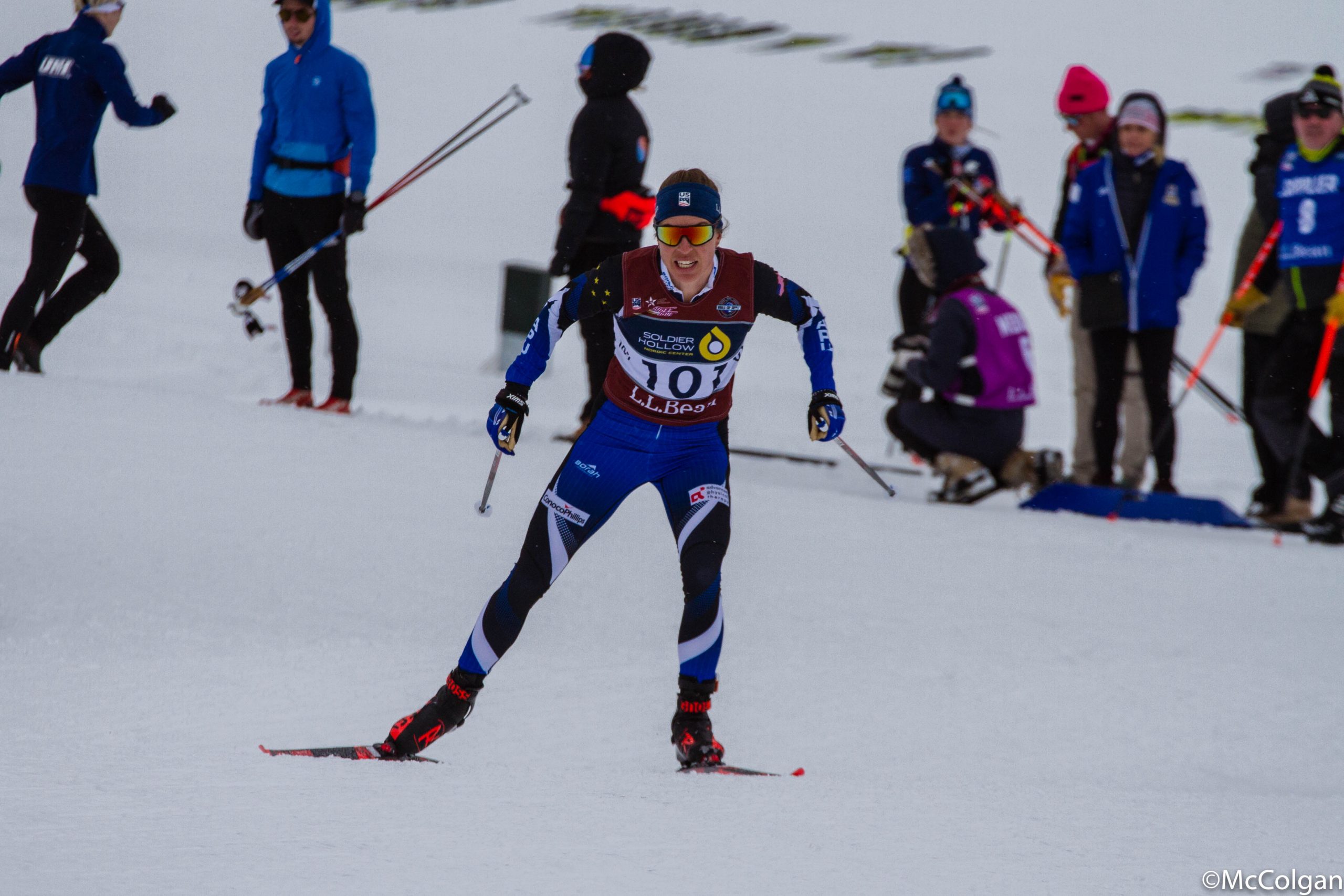
Tuesday’s race, the women’s 20-kilometer freestyle race at 2022 U.S. Cross Country Championships, was, technically speaking, a mass start – but for Rosie Brennan, it skied more like an interval-start race. Brennan wore bib 101, at the sharp end of the chevron start in a field of 55 athletes, and led every one of 20,000 meters of the 20 k, pushing the pace right from the start and never looking back all the way through the finish line. She covered the challenging course in a speedy 53:16.9 to take her seventh national title, and first since 2015, in a dominating performance.
The race began under overcast skies and moderate temperatures. By one second into the race, Brennan (USST/APU) was in the lead. By one minute into the race, she was notably off the front, with only three athletes, Rosie Frankowski (APU), Caitlin Patterson (CGRP), and Sydney Palmer-Leger (USST/Utah) even contemplating whether to follow.
By two minutes into the race, Brennan had a sizable gap, as athletes in the Frankowski-led chase pack had decided that discretion was the better part of valor, and opted to ski their own race and focus on chasing the remaining two spots on the podium. No athletes other than Brennan would appear on screen again in the free livestream until the six-minute mark, in a wide-angle shot of the main climb up the Cabin Loop most of the way through the first lap. This is nothing against the production values of the online broadcast, which were once again superb, just a statement about how quickly Brennan distanced herself from the rest of the field.
Rosie Brennan (USST/APU) skis away with the women’s 30k mass start freestyle national title. (Photo: John McColgan)
After the first of six 3.33-kilometer laps, Brennan’s lead over the chase pack was roughly 26 seconds. After two laps, this gap had nearly doubled, to 49 seconds. The chase pack was now led by Patterson, who collected her tenth national championship earlier this week, and Frankowski, who has a 21st at the Olympics and World Cup top-30s to her name. These were not bad skiers; Brennan was simply unmatched on the day.
Over the next four laps, as the wind increased and a light snow began to fall, Brennan put on a clinic. She V2ed where others V1ed, and added a slight hop at the end of V1 strokes where others adopted a more labored V1 reflecting the tough terrain and elevation. She slowed down through the coaching zone long enough to get a full drink from her feed. She skied the downhills aggressively and took the best lines throughout. It was a 53-minute demonstration of the form and fitness that have already brought her a World Cup podium this season behind Frida Karlsson and Therese Johaug, and an additional five top-six finishes.
Brennan lapped her first skier midway through lap 4. She would ultimately lap 26 athletes in a field of 52 finishers before the end of the race, precisely half the field. In a national championship.
Brennan actually slowed slightly, or the chase pack may have sped up, as the race went on. Her gap over the Frankowski/Patterson duo was “only” 1:02 at lap 3, 1:17 at lap 4, and 1:21 at lap 5. It may have even shrunk by a fraction of a second over the final lap, as Frankowski and Patterson raced for second behind her. But the outcome was never in doubt – and barring multiple broken skis, a devastating earthquake or meteor strike, or some other truly unforeseen occurrence, the outcome was never really in doubt after the first minute of the race.
A young Rosie Brennan prepares to race at Soldier Hollow in a vintage Team Utah Nordic Alliance suit. (photo: @rosiewbrennan Instagram screenshot)
Brennan grew up skiing in Park City, starting in eighth grade, first with Team Utah Nordic Alliance, then with coach Gordon Lange at Park City Nordic. She won her first ever ski race, a Wasatch Citizens race, albeit aided by the fact that “there was only one other girl in my age group,” she told the Park City Park Record for a 2017 profile. She’s come a long way since then.
“It was so great to race at home and have my family and friends cheering me on the whole way!” Brennan wrote in a post-race email. “With COVID, even my Mom has been unable to watch me race for years so it felt really special to be able to race with a hometown crowd before heading to Beijing.”
On her approach to the race, Brennan explained the role that she hoped her effort would play in her preparation for the upcoming Olympics, concluding with her feelings about sitting out the Tour to instead join her club teammates in SoHo.
“I was feeling quite inspired after watching some great performances by the APU men this morning and that gave me faith that our fitness was high and we could grind away,” Brennan wrote. “I wanted to do my best to simulate World Cup racing so I wanted to start hard and then reassess based on what others in the field did and then ultimately keep grinding to get a long hard effort in at altitude, which we haven’t had the opportunity to do on the World Cup this year. The course we raced played into my strengths with a long gradual climb right out of the start so I felt I had to use that every lap to keep building on my strengths and do my best to work on relaxed, powerful skiing the rest of the lap. I am really happy that I had the opportunity to come home and race a long race! I think I may have lost my voice screaming Frankie into the finish as well. It was really awesome to see her dig so deep today and to have APU put in such strong performances all around today.”
Caitlin Patterson (CGRP) and Rosie Frankowski (APU) race through 20k to round out the women’s podium. (Photo: John McColgan)
Behind Brennan, Frankowski and Patterson were locked in a dogfight for second and third. The two women, age 30 and 31, respectively, have raced head-to-head frequently over the years. They have spent much of their careers in that liminal space between being some of the fastest domestic skiers and some of the slower American World Cup skiers, competing for limited start spots on the World Cup or at global championships. In the last Olympic-year National Championships, in 2018 at Kincaid, Patterson was the first American in every race; Frankowski was the 2nd and 4th American in the two distance races; ultimately both women went to Pyeongchang.
Four years later, there the two athletes were again, holding down the chase pack with potential Olympic berths on the line. Patterson, from Anchorage but now skiing for Craftsbury, is taller, with a more upright skate stance and a tempo that looks nearly languid when skiing behind Frankowski. Frankowski, from Minneapolis but now skiing for APU, is shorter, with a somewhat more hunched-over approach to attacking an uphill, and with a higher tempo. (see photo above)
The two are a study in contrasts, but their differing approaches left them evenly matched throughout Tuesday’s race, as they literally occupied the space between the top American World Cup skiers and the top domestic skiers. At the start of lap two, they were separated from one another by 1.6 seconds, skiing in a larger pack that at the time included Alexandra Lawson, Palmer-Leger, and Lina Sutro. By the start of lap three, the chase pack was down to two, Patterson and Frankowski, 0.5 seconds apart. Start of lap four: 0.5 seconds. Start of lap five: 0.5 seconds. You may sense a theme. It was, once again, going to come down to two athletes with divergent strengths.
Writing in the FasterSkier Slack channel on Monday morning, 24 hours in advance of Tuesday’s race, this reporter foresaw Brennan skiing away with the win with relative ease, then one of two things happening behind her, as he jokingly drafted an article for a race that had not yet happened: “Behind Brennan, Rosie F. pushed the pace hard from the start, attempting to create a gap over the rest of the field. She [was ultimately able to do so, and took second slightly ahead of Caitlin Patterson et al.] [was unable to do so, and was swallowed up by Caitlin Patterson/someone else] in the final kilometers.”
This is not to claim any great powers of prognostication. This is rather to say that everyone in the venue, the two athletes on course notably included, knew what Frankowski’s strengths were, and what she would aim to do over the final three kilometers: open up enough of a gap over Patterson that it would not come down to a sprint, or bury herself in the attempt.
A few minutes later, this is precisely what occurred. The sixth and final time up the main hill on the Cabin Loop, Frankowski came into view in the distance at the bottom of the climb, V1ing with an explosiveness and tempo befitting a sprint heat more so than the final lap of a tough 20 k. Patterson was being dropped, but not definitively so, as she followed up the climb with a more human tempo, keeping Frankowski in view the whole time.
Rosie Frankowski (APU) pulls away from Caitlin Patterson (CGRP) to take second in the women’s 20k mass start freestyle in Soldier Hollow. (Photo: John McColgan)
Fast forward to the finish a few minutes later: Frankowski’s surge on the final uphill proved to be just enough. Patterson made up time on the downhill return to the stadium… closed to within a few meters… but was unable to shrink the gap any more.
Frankowski held her off with a progressively ragged V2, crossing the finish line and immediately collapsing into a heap on the snow just past the line. Brennan came over to take off her APU teammate’s skis and offer support. A few minutes later, Frankowski was upright, and giving Patterson a Covid-safe congratulatory hug.
Frankowski’s time was 54:37.5, 1:20.6 back of Brennan. She was 1.9 seconds ahead of Patterson in third.
The women’s 20k mass start freestyle podium: Rosie Brennan (USST/APU) won the national title ahead of Rosie Frankowski (APU) in second and Caitlin Patterson (CGRP) in third. (Photo: John McColgan)
“Today was something I am really proud of,” Frankowski wrote to FasterSkier after the race. “I have targeted this race for the last year and although I was excited, over the days leading up to the race, I was dreading the pain level Rosie B would inflict on the field. My initial plan was to try to stay with Rosie for any length of time, but that plan went out the window in the first kilometer when I thought I would literally pass out at 2k in if I tried her pace. I then had to recover for a lap in the chase pack, and the downhills were giving me real grief so I kept having to surge to get back on the pack or back with Caitlin P. After a few laps, Caitlin and I had a gap and we worked together using our individual strengths to make that gap larger, and that was super fun! Caitlin and I have raced together many times throughout the years so it was great to have the chance to relive some of that today. I knew I was feeling strong on the uphills, and the downhill finish was definitely on my mind, so on lap 5 I tried to push the pace on the ups a bit, and then on lap 6 going up the hollow I just went for it with total abandon. I created a gap that Caitlin narrowed over the rest of the course, but I managed to not fall on the last hermod’s downhill and take 2nd. I could see Rosie B in the finish stretch cheering me on so I was just full speed til that line.”
Frankowski also shared her thoughts on whether or not the race played out as anticipated.
“I’d say one of the surprises was how terrible the wind made the Hermod’s downhill. As someone who struggles with downhills anyways (but has made a lot of progress the last year), the wind drifts and the blowing snow were really dicey. And you couldn’t see the glazed icy spots under the snow so it was very stop-go. Otherwise, the race played out pretty much how I expected (or hoped) and one of the best parts of the day was having my APU teammates and coaches cheering out there, especially on the final lap.”
Rosie Frankowski (APU) leads Sydney Palmer-Leger (USST/Univ. of Utah) during the women’s 20k mass start freestyle. (Photo: John McColgan)
“It was quite the battle between Frankie and I,” Patterson wrote post-race. “However we also had a great time skiing and working together for the first 3/4 of the race or so. At the end certainly it was a furious battle to the finish, but earlier in the race we worked together to use each of our strengths and pull away from the chasers. Frankie and I have quite different styles, uphill vs downhill strengths, but it was really fun racing… Of course I would have been happier to be 2nd and I have slight regrets that I didn’t work my strengths a little better, but overall it was a strong race.”
Also commenting on the effect of wind, Patterson continued, “That was definitely a factor and annoyance on a few parts of the course. The Hollow had a notable head wind as we climbed up, which just added to the grinding nature of that climb. From lap 3 or 4 on, on both the back-side sprint downhill and the big downhill off of Hermod’s hill, there were small pockets of wind drifted snow forming. Especially on the Hermod’s downhill, the wind pockets were blowing across the course and making the downhill a little less predictable as the wind pockets felt much slower than the glazed path. Weather is just an aspect of racing, and while it was annoying, I think we as xc skiers have to learn to adapt to anything and everything, so it just became another variable to work around in the race.”
Patterson concluded with a nod to her brother, acknowledging the setbacks he has faced this season, which are elaborated upon in the men’s recap.
“I was quite nervous this morning watching the men’s race on the live feed, but I’m really proud of my brother Scott for skiing so smoothly and controlling the 30k. It’s awesome to see him showing a return to form and winning, after a tough start to the season attributable to his summertime broken wrist.”
Rosie Brennan (USST/APU) and Caitlin Patterson (CGRP) share congratulations at the finish of the women’s 20k mass start freestyle in Soldier Hollow. (Photo: John McColgan)
Craftsbury skier Alexandra Lawson took 4th (+2:49.2), in a brave effort after skiing solo for basically the entire race. Her teammate Margie Freed came in 18 seconds later for 5th (+3:07.2), giving the green-clad skiers from Vermont 3rd, 4th, and 5th overall on the day.
In the other close finish of the top-10, BSF skier Hannah Rudd (+4:13.5) came in a few seconds ahead of Palmer-Leger (+4:17.6) for sixth, after skiing substantially above the seeding suggested by her 125 bib number. (The start list ranked athletes according to their current USSS distance points.)
Palmer-Leger, in seventh, was notable as one of only four juniors in this senior women’s field.
Looking ahead to the rest of this week, Tuesday marked Brennan’s only planned race in this series. Her plan coming into today was to rejoin the World Cup soon, though those plans may have become somewhat more fluid with the recent cancellation of the Les Rousses World Cup stop set for mid-January. Regardless, even if Brennan were to compete in and win both distance races this week, the second-ranking domestic woman at these championships is still eligible for consideration for potential Olympic selection, due to the precise phrasing of selection criterion four of the USSS criteria document, which excepts athletes otherwise nominated to the team on other grounds. (Brennan has achieved nomination already via criterion one, multiple top-eight finishes in specified World Cup races.)
That is, that second-ranked domestic woman (Frankowski or Patterson, for example, or someone else who does well in the classic race if both these women do not perform as expected) is not guaranteed to be selected, but she certainly could be alongside Brennan.
Kate Oldham (Middlebury) leads the junior women’s 7.5k during the 2022 U.S. Cross Country Championships in Soldier Hollow. (Photo: Tobias Albrigtsen / @untraceableg)
In the junior women’s race, Middlebury’s Kate Oldham paced the 7.5k freestyle ahead of the Ninas, Nina Seeman (Dartmouth) and Nina Schamberger (Summit Nordic Ski Club). The threesome pushed the pace from the front, maintaining a small gap over the remaining women throughout the two-lap course.
In a three-way sprint to the finish, Oldham snagged the win in a time of 20:17.7, +0.7 ahead of Seeman in second place and +1.1 ahead of Schamberger in third.
The junior women’s 7.5k mass start freestyle podium: Kate Oldham (Middlebury) took the win in a tight race ahead of Nina Seeman (Dartmouth) in second and Nina Schamberger (SNSC) in third. (Photo: John McColgan)Ian Torchia (SMS T2) leads the charge at the start of the men’s 30k mass start freestyle in Soldier Hollow. (Photo: Tobias Albrigtsen / @untraceableg)
Men’s Race: Scott Patterson Leads APU Sweep
The first race of the day was the senior men’s 30 k, with 73 athletes completing eight 3.75 k loops. From the gun, the race was about bib number one, Scott Patterson representing APU. Patterson returned to the US after racing most of Period 1 of the World Cup.
Missing only the opening weekend in Ruka, Patterson competed in each of the distance stages despite having surgery on his wrist in late fall, roughly five weeks before he returned to World Cup racing, and still needing a brace to protect the healing injury. After his first race of the season in Lillehammer, Patterson explained that this made it harder for him to use his poles, shifting his energy use more to his legs and altering his technique, which likely impacted his ability to capitalize on the high level of fitness he had built through the summer.
Scott Patterson (USST/APU) leads the men’s 30k mass start freestyle in Soldier Hollow. (Photo: Tobias Albrigtsen / @untraceableg)
Through the first lap most of the field held together, though as the leaders departed for lap number two, a group of fourteen skiers at the front had separated, led by Patterson. Trading leads with Ian Torchia of SMS and Hunter Wonders of APU, the gap to the rest of the field had widened although the front group was still largely together. Among those front fourteen skiers were Johnny Hagenbuch skiing for Sun Valley Ski Education Foundation, David Norris of APU, Peter Wolter (SVSEF), Braden Becker (CGRP), Adam Martin (CGRP), Torchia (SMS T2), Zanden McMullen (APU), Wonders (APU), and the leader, Patterson (USST/APU).
Finishing the third lap in a total time of 27:01, the lead group was down to nine, having lost Hagenbuch and Wolter. Norris (APU) moved to the front for the first time, as the group headed up the Cabin Loop climb on the fourth lap, and upped the pace. This briefly created a gap with Norris, Patterson, and Wonders, though that gap was closed with the downhill draft and the group passed through the lap lane as a group of six, having lost Becker (CGRP).
The lead pack of men push through the 30k mass start freestyle at U.S Cross Country Championships. (Photo: John McColgan)
Climbing the hollow, Norris again put in an effort as he and Patterson created a small gap. Wonders worked to close it, bringing Torchia and Martin with him and once more, they closed on the front two on the sprint course downhill.
Ending lap five and departing for lap six, Patterson had gained a five-second advantage over his teammate, Norris. Through increasing lap traffic, Patterson continued to grow his lead. Despite the windy conditions, Patterson seemed to have no problem out on his own. Initially, Torchia was the sole chaser in second, with a gap to Wonders, Norris, and Martin.
Scott Patterson leads the men’s 30k mass start freestyle during the 2022 U.S. Cross Country Championships in Soldier Hollow. (Photo: Tobias Albrigtsen / @untraceableg)
Entering lap seven, Patterson was well clear of any competition, +24 seconds ahead of Torchia. Over the course of this penultimate lap, Torchia was caught by Wonders, Norris, and Martin and the chase group was once again a group of four.
Patterson held strong out front and entered the last lap after 1:03:58.2 of skiing. Norris and Wonders pulled away from Torchia and Martin, settling into second and third position respectively. Over the final 3.75 k, Norris gained steadily on Patterson, though Patterson had developed such a solid lead he was able to remain unchallenged to the line. Crossing the finish in 1:13:25.0, Patterson claimed his first national 30 k title.
“I went out today with the intention to win and establish myself as a top contender after some tough races early in the season,” Patterson wrote to FasterSkier after the race. “My intention from the start was to keep the pace fast even if I had to do most of the work. It was awesome on the early laps having APU teammates in the pack with the same intention. Although we strung things out earlier, lap 5 and 6 were really the key ones for eventually pulling away. On lap 5, David put a hard move up the cabin hill that gave the two of us a little gap. The front pack came back together in the stadium, but it was clear the next time up the hollow that many others in the pack were tiring. On lap 6 up the cabin hill, I put in a hard effort and found I had space behind me. At that point, I decided to go for it as I was still feeling strong. Climbing the hollow felt like my strength and I solidified my lead there. From that point it was a time trial to the finish while holding off David’s late charge. David and Hunter coming in to sweep the podium for APU and many of our younger skiers posting strong results were cherries on top of my personal success.”
In terms of how the races at U.S. Nationals fit into his season plan and goals, Patterson explained that his wrist injury has forced him to adjust on the fly, making it difficult to set objective goals.
“My grand plans for this season were a bit derailed from the start with my wrist injury and surgery. Mid summer, my intention was to race the full World Cup, but going into Period 1, I knew I had to take everything with a grain of salt. Every week would help my wrist, but also I was just lacking a bit of form following three months of training with one pole, a brace, or other modifications. I felt confident that my general fitness was still strong, but it was buried under a lack of race fitness early on in the season. Period 1 has always been a bit difficult for me and adding a few extra factors didn’t help. Following Davos I knew it was time to regroup a little. Nationals seemed like the best bet with a little more time. Also looking at the Tour [de Ski] races, I didn’t think they really suited my style, especially given my wrist.”
Providing additional insight into his rehabilitation, Patterson also gave an optimistic update on the status of his wrist and it’s lingering impact on his racing.
“Today marked 10 weeks post surgery for my wrist. While over on the world cup for period 1, I raced Lillehammer in a large plastic brace and Davos with it extensively taped. Neither of these were great solutions especially given where I was in the recovery process. Since then it has continued to improve and show signs of healing in all my follow up x-rays. I have also dialed in my taping since Davos. Only in the last week has my wrist really begun to feel that it’s ready for racing (with copious amounts of leukotape).”
Concluding on his plans moving forward, Patterson wrote, “At this point, I’ve got a little more confidence in racing and am looking forward to Thursday’s classic race. I’m not sure what my plans are after that, especially with the recent cancellation of the French World Cup, so I’m focusing on the remainder of races here for now.”
APU teammates Scott Patterson (left) and David Norris (right) head to the start of the men’s 30k mass start freestyle at the 2022 U.S. Cross Country Championships in Soldier Hollow, UT. (Photo: Tobias Albrigtsen / @untraceableg)
Norris, who skied the final lap 11.2 seconds faster than Patterson, finished in second place, +11.7 behind his teammate. Norris won the last 30k freestyle he contested at the 2019 National Championships, ahead of now-retired Kyle Bratrud (SMS T2) in second and Patterson in third.
“I’ve been skiing poorly this season without any explanation as to why,” Norris wrote in a post-race email. “This week I am enjoying being back with my team and seeing tons of friends on the course each day.”
In terms of his race, Norris continued, “Today I felt bad from the gun, but I tried to ignore those feelings and focus on making a race. Although I struggled quite a lot I am still proud to pull out a podium finish and to be part of a strong day for APU. Our coaches did a great job and gave me every opportunity to ski well.”
While Norris is perhaps facing an unlikely reality in terms of his selection for the currently five-man 2022 Olympic Team, his conclusion on the day was process focused.
“Every season I ski much stronger in February and March so I’m sure good form is on the horizon, but that doesn’t help me achieve my goals when I need to be skiing well right now. All I can do now is focus on the 15km classic coming up and then rest and prepare for the next races. After that – I don’t know yet what that will be.”
The men’s podium of the 2022 U.S Cross Country Championships 30k mass start freestyle: Scott Patterson took the win ahead of David Norris in second and Hunter Wonders in third. (Photo: Tobias Albrigtsen / @untraceableg )
Closing out the APU sweep was Wonders, finishing third +27.9 back. A sprint for fourth position went to Martin, while Torchia took fifth.
In the junior men’s 10k, the pace started easy as 121 racers headed out for the first of three 3.3 k loops. Initially Wally Magill (Dartmouth), Will Koch (Colo. Univ), and Walker Hall (Univ. of Utah) traded off in the lead. Up the Cabin Loop hill on the second lap Hall picked up the pace and pulled away with Magill. Koch worked hard to bridge the gap and join the leaders though the effort cost him and as the front two upped the pace once more, Koch dropped off.
The junior men’s podium of the 10k mass start freestyle: Walker Hall (Univ. of Utah) won the event ahead of Wally Magill (Dartmouth) in second and Brian Bushey (Univ. of Utah) third. (Photo: John McColgan)
Cresting the final hill in the last lap, Hall was in the lead though Magill drew even with the draft on the descent. In a sprint finish, Hall crossed the line first in a time of 24:29.4, his second junior championship title of the week. Magill finished second (+0.5), while Brian Bushey (Univ. of Utah) overtook Koch at the line for third (+18.9).
This article has been corrected to reflect the fact that Rosie Frankowski was the fourth American in the 10 k freestyle at 2018 U.S. Nationals, not the third.
Quick Recap:We’ll have a full race report up tomorrow, including athlete comments and plenty of photos, but here is a quick recap of the action in the men’s 30k and women’s 20k, which took place this morning at the 2022 U.S. Cross Country Championships in Soldier Hollow, Utah.
Perhaps becoming a theme of the 2022 U.S. Cross Country Championships, the 20/30-kilometer mass start freestyle distance races were both won by athletes who have spent the last six weeks racing in Europe on the World Cup.
In the men’s 30k, Scott Patterson (USST/APU) led the lead pack of men through an eight-lap course to take the win in 1:13.25. David Norris (APU) was next over the line for second (+11.7), with Hunter Wonders (USST/APU) rounding out the podium in third (+27.2) for an APU sweep. This is Patterson’s first national title in the 30k, though he won the 15k interval-start race in 2016 and 2018.
The men’s podium of the 2022 U.S Cross Country Championships 30k mass start freestyle: Scott Patterson took the win ahead of David Norris in second and Hunter Wonders in third. (Photo: Tobias Albrigtsen / @untraceableg)
Continuing the theme of APU dominance, Rosie Brennan (USST/APU) led from the start to win the women’s 20k free in 53:16.9. Her teammate, Rosie Frankowski (APU), won the race for second place, crossing the line 1:20.6 behind Brennan. Coming down to a final sprint, Caitlin Patterson (CGRP) finished 1.9 seconds behind Frankowski to take third.
In the junior men’s race, Walker Hall (Univ. of Utah) won the 10k in 24:29.4, edging out Wally Magill (Dartmouth) who finished second (+0.5), and Brian Bushey (Univ. of Utah) in third (+18.9). In the junior women’s 7.5k, Kate Oldham (Middlebury) took the win in 20:17.7, ahead of Nina Seeman (Dartmouth) in second (+0.7), and Nina Schamberger (Summit Nordic Ski Club) in third (+1.1).
Stay tuned tomorrow for detailed coverage, athlete interviews, and more photos from the action.
Results, including splits from live timing, can be found here.