Tag: Walt Shepard

  • Friends Remember Charlie Kellogg’s Love for the Sport, the Outdoors and Its People

    Friends Remember Charlie Kellogg’s Love for the Sport, the Outdoors and Its People

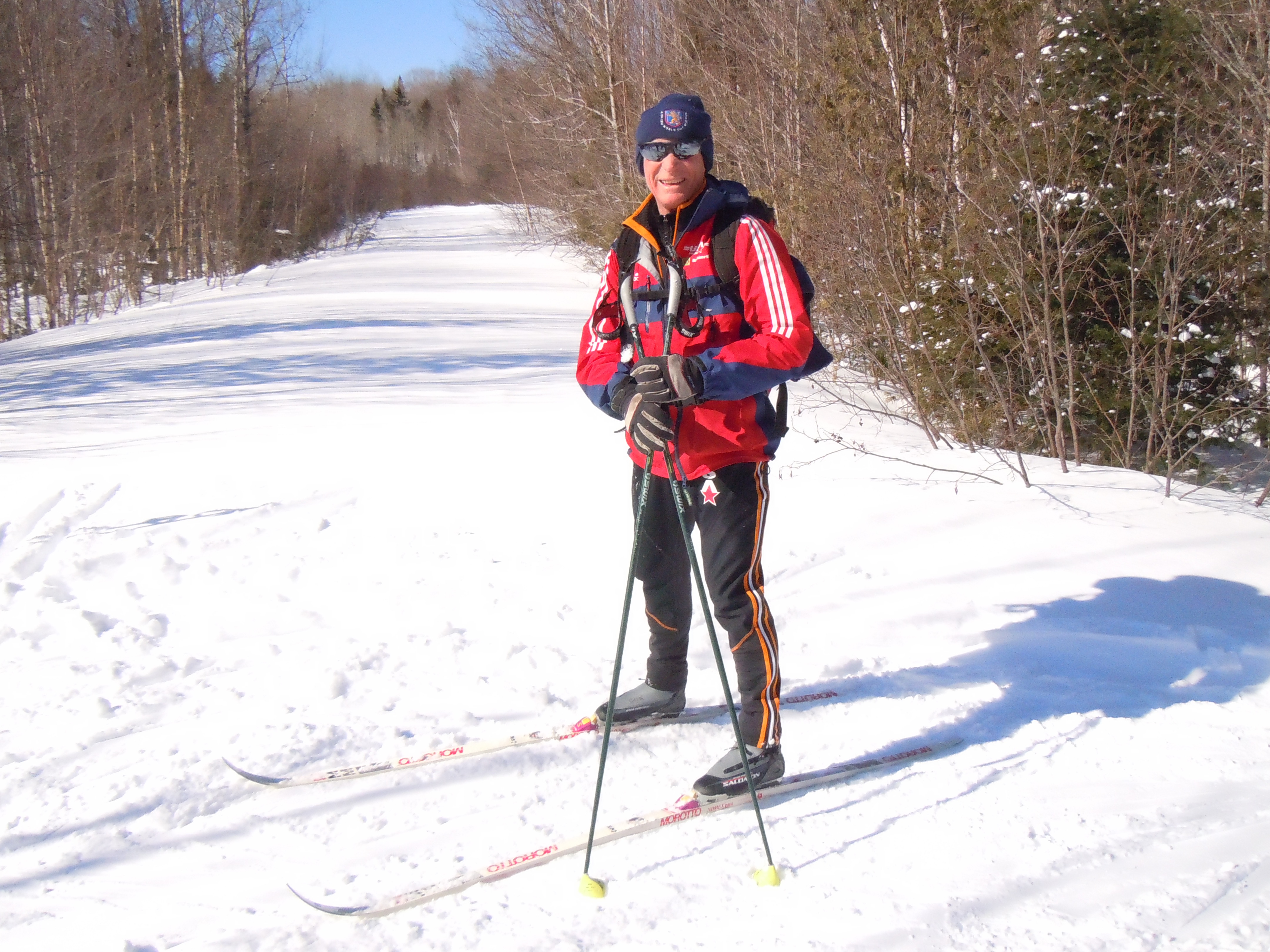
    Charlie Kellogg skiing in Maine with the AMC alumni group the O H Association. (Photo: Doug Hotchkiss)
    Charlie Kellogg skiing in Maine with the AMC alumni group the O H Association. (Photo: Doug Hotchkiss)

    Bob Gray was hiking in the Sierra Nevada mountains, off the grid, when it happened. Later his phone began buzzing, and he learned that his former U.S. Ski Team teammate and friendly rival over decades and decades of races, Charles Kellogg, had passed away.

    Gray was surprised. Kellogg had not been well, but the end came fast once months of excruciating pain was finally diagnosed as a malignant and fast-metastasizing sarcoma.

    “It hit me hard,” the 76-year-old Vermont farmer said on the phone, still from the trail, last Saturday. “It could be me next… I miss him terribly.”

    Kellogg, 75, had been one of the ties that kept Gray and the ski community together.

    “It’s pretty much nose to the grindstone,” Gray said of his life at 4 Corners Farm in Newbury, Vt. “Charlie made a special effort to talk; he was always calling me up. It was great to talk to him. He would drag me out of that focused world.”

    But while it’s hard for Gray, at the moment, to connect to Kellogg’s family or other friends, in a way the mountains are a poetic place for Gray to say goodbye to Kellogg, who was a longtime member of the Appalachian Mountain Club (AMC) and its alumni Old Hutsman (OH) Association, and who always made time for a ski or a hike, even if he had just flown back from a work trip to Asia.

    “It’s been on my mind, these two days, just thinking about him,” Gray said. “I had nothing to do but walk and contemplate, without any distractions. It’s a pretty emotional moment for me.”

    The Storyline
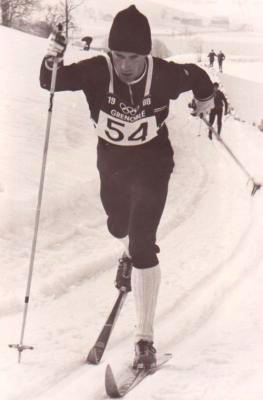
    Kellogg competing at the 1968 Olympics in Grenoble, France. (Photo: US Biathlon Association)
    Kellogg competing at the 1968 Olympics in Grenoble, France. (Photo: US Biathlon Association)

    Kellogg, a 1968 Olympian in cross-country skiing and a national champion, died a week ago on Sept. 21. Known as “Chuck” or “Spike” to some friends, Kellogg was an integral member of the nordic community, a mentor and friendly face to many on the trails.

    As noted in his U.S. Biathlon Hall of Fame induction description, Kellogg wasn’t obviously bound for skiing glory from day one. But the guy who grew up primarily in Andover and Brookline, Mass., picked up skiing at Holderness Academy a few hours north in New Hampshire and never looked back.

    And so perhaps his first impact on the sport was as the fast racer everyone was chasing: in college races for Williams College, then as he took up biathlon and eventually won a national championship in 1965, and then still as he competed as a cross-country skier in the Olympics and raced as a member of the U.S. Ski Team (USST).

    “He was one of a group of half a dozen guys who I would describe as the early generation of capable international-caliber nordic skiers in this country,” said John Morton, an Olympian and coach. “There were a couple of individuals who preceded them, but… I remember when I was on the U.S. ‘B’ team, and those guys set the standard, and the rest of us just desperately tried to keep up.”

    Gray remembers a relay race in Reit im Winkl, Germany, in 1968.

    “Charlie came in in the lead, and Jack [Lufkin] kept it, and I was able to hold on – we won a relay race in Europe,” Gray marvels. “It was amazing. Everybody was going crazy over there. It was kind of unusual for an American team to win a relay.”

    Kellogg’s race career never really ended. In 1998 he won a World Masters Championship in Lake Placid, N.Y.

    There, too, Gray was Kellogg’s teammate.

    “Neither he nor I had very good points,” Gray remembers. “We started in the back. But we both had incredible skis so together we made up to the front through 80 people. All of a sudden we were in the lead. I couldn’t hold it up – Charlie went on to win. He’s a great skater! Talk about tough competition, that’s the best of the best. I know he was very proud of that.”

    Kellogg never boasted about his success, and not all of his friends were familiar with the details of his ski career. But it’s possible to be humble and proud at the same time, and Kellogg was.

    “He was very proud of his achievements,” said Doug Hotchkiss, a friend from near Kellogg’s home in Massachussetts who was part of a nonprofit board and also the O H Association with Kellogg. “Of course, he was very modest, so you would never know it unless you asked him about it. But then it was clear.”

    No matter which year you ask about, his friends and teammates will tell you that he was a great guy to be around. Kellogg was a role model for how to balance a job, a family, and high-level training.

    “I always admired and was continuously impressed with how Charlie was able to balance his training at a high level while working full time for IBM and fulfilling his responsibilities and obligations as a husband and a father,” USST teammate Mike Elliott wrote in an email. “In the late 60s, there just were not many athletes who could do that successfully.”

    “He was disciplined and a very tough athlete,” Gray agreed. “But just a real pleasure to go head to head with.”

    Kellogg never stopped skiing – this year he competed in the White Mountain Classic in Jackson, N.H., and earned an age-group podium in the 10 kilometer at Masters National Championships in Craftsbury, Vt. – but as he grew older he also bettered the ski community in other ways.

    His expertise as a board member was so impressive that a group of biathletes in 2006 lobbied hard for him to be elected vice chairman of the United States Biathlon Association (USBA).

    “While most countries were increasing staff numbers, sponsors, and athlete support, many of us felt that USBA was headed in the opposite direction,” Lowell Bailey, one of the signatories on an open letter before the election, wrote in an email. “Charlie represented one of the new faces that we felt could help facilitate and oversee the difficult changes that USBA would need to undertake in order to remain competitive internationally.”

    Kellogg, who worked in sales at IBM and later at Global Partners, had a knack for business and nonprofit interactions. He was described by colleagues in three different organizations as a model board member. Besides his help with USBA, he was also the president of the Manchester Essex Conservation Trust near his home in Massachussetts, and a board member of the Jackson Ski Touring Foundation, where he and his wife had recently bought a condominium.

    How did he manage it all – these many tasks and passions which added up to more than most people could handle?

    “He was hyperactive is what he was!” Hotchkiss remarked with a laugh. “But he loved it.”

    And people loved Kellogg.

    “We had a regularly-scheduled board meeting this week, and all of us were thinking how much we’re going to miss Charlie,” said Ken Kimball, a friend on the Jackson Ski Touring Foundation board.

    The Hutsman

    Before he became a full-time skier, Kellogg started working in the AMC huts. At just 16 years old, he spent his first season at Lake of the Clouds on Mount Washington in New Hampshire. Soon he was the hut manager.

    His legend preceded him, said Hotchkiss, who didn’t actually meet Kellogg until later.

    “Everything I ever saw him do, he led by example, not by being loud and boisterous and carrying a big stick,” Hotchkiss recalled. “I had heard of Charlie and seen that he had all kinds of records for speed hiking. In those days we kept records of the macho things – it was all boys working in the huts then, no women. It was how much weight you could pack, how fast you could go, all of that. That was the measuring stick amongst guys. How many dishes you could wash in as short a time as possible, how big a pancake you could make. Part of the fun of working in huts was bringing the crew together.”

    When U.S. Supreme Court Chief Justice William O. Douglas visited Lake of the Clouds in 1960 with a National Geographic camera crew in tow, Kellogg was managing the hut. He ended up in photos in the magazine. He was 20 years old.

    Working in the huts was fun and gave Kellogg a chance to stretch his legs. But working on Mount Washington, home to some of the most extreme weather on earth, was also serious. Kellogg wrote in a recent O H Association newsletter of going out in a gale to find and retrieve the bodies of two young hikers who had perished, dressed only in cotton.

    “Of course the terrible visibility contributed to [a lack of volunteers] and the wind was keeping people inside their respective buildings where they plied their trade, such as TV broadcasting, checking weather or testing jet engines,” Kellogg wrote.

    Weather didn’t keep him or his friend Greg Prentiss inside, of course.

    The ties he forged, to other hutsmen, hikers, and the mountains themselves, stayed strong. Kellogg also worked as a mountain guide in the Grand Tetons at one point, and trekked in Nepal.

    Hotchkiss soon met him again, this time in earnest.

    “In 1978 when another Old Hutman and I showed up near Jasper in the Canadian Rockies to do a randonée ski trip,” Hotchkiss said. “We were flown back into a remote camp by helicopter, and then for a week we spent every day climbing up with skis with skins, and descending. Charlie was there with his wife and his brother-in-law and his wife’s sister. And so there were six of us who were connected, but we didn’t know they would be there!”

    After a day of skinning up thousands of feet, taking a few runs, and then descending to camp, Hotchkiss was usually looking for “an ibuprofen and a beer.”

    Not Kellogg or his wife, Gillian.

    “Charlie and Gillian would put on their cross-country skis and go out for more skiing on the frozen lake,” Hotchkiss said. “Every day! And then be ready to go the next morning.”

    While Kellogg spent a decade racing at the top levels of national and international competition, he was also just as happy going out on the trails with friends who hadn’t been elite athletes. He and Hotchkiss went on several O H Association trips to Maine, where groups of hutsmen and women could ski from the Little Lyford Ponds lodges.

    “He was always miles ahead of everybody,” Hotchkiss said. “I’m sure you’ve been hiking with a dog, where the dog goes bolting ahead and eventually will return. That was Charlie’s method.”

    While racing was something he loved – Gray and Morton both recalled that Kellogg would never, ever, let it go in a sprint finish, even after a marathon distance spent going together – non-competitive pursuits were also key.

    “A lot of athletes, they have their competitive life and then they move on to something else,” Morton said. “They may be nostalgic about the old days, when they were in shape and could do the Presidential Traverse in a single day. Charlie Kellogg kept at it. He probably up until relatively recently could still do a Presidential Traverse in one day, and look forward to it.”

    Kellogg was a lifelong steward of ski and hiking trails, as well, not just maintaining AMC trails or those at the Manchester Essex Conservation Trust, but then later in Jackson.

    “As we looked at new trail configurations he’d be out in the field skiing around trying to find a new route,” said Ken Kimball of his time with Kellogg in Jackson.

    “He was always miles ahead of everybody. I’m sure you’ve been hiking with a dog, where the dog goes bolting ahead and eventually will return. That was Charlie’s method.” — Doug Hotchkiss, friend of Charlie Kellogg

    The Racer

    After five summers of training on Mount Washington, in a systematized way or not, Kellogg was beginning to turn heads on the Eastern college circuit. By his senior year at Williams, in 1962, he was the captain of the team.

    The next year, he headed to Alaska to join the Modern Winter Biathlon Team at Fort Richardson to fulfill his Army service. During the war, men like Peter Hale, Terry Aldrich, Dennis Donahue, Bill Spencer, and John Morton paid their dues at Fort Richardson, although not all overlapped with Kellogg.

    “He said it was great,” laughed Hotchkiss. “He got to ski every day!”

    In 1964 Kellogg went to Fairbanks for the Equinox Marathon, which his biathlon teammate Jerry Varnum won, while Kellogg was second. The Fort Richardson program was already a few years old at that point, but it was close to Anchorage, not Fairbanks. The pair’s exploits led the Fairbanks Daily News-Miner to write a blurb, “What does biathlon mean?”

    Kellogg represented the U.S. in international competition including in Östersund, Sweden, where he was the top American finisher at the 1964 World Military Championships.

    After leaving the Fort Richardson program, Kellogg went back to straight skiing.

    “Charlie was very serious in training and when studying the sport of cross-country skiing,” Elliott wrote. “I have nothing but fond memories of my experience of training and racing with Charlie. John Caldwell, as the USST Coach, organized ski team members for running and hiking the length of the Long Trail in summer of 1969. Pictures of that experience shows a bunch of lean fit young men. On that trip were John Caldwell, Peter Davis, Everett Dunklee, Mike Gallagher, Tom Corbin, Ned Gillette, Bob Gray, Charlie Kellogg, Jack Lufkin, and myself, Mike Elliott.”

    Gray, too, remembers that trip well – and the crew that went with it.

    “It raised a lot of awareness for the team,” said Gray, noting that the men would come off the trail and have dinner or drinks with communities in the local towns every night. “The U.S. Ski Team was gaining ground. A few years later, it was Bill Koch. We were sort of the foundation.”

    Elliott said that Kellogg was one of the smartest guys on the team: after eventually making the Olympics, he went to the Tuck Business School at Dartmouth. His LinkedIn profile lists “the Shakespearian authorship question” as a hobby.

    And that cerebral nature also came through in sport. Kimball, who would later work and ski with Kellogg in Jackson, remembers meeting him for one of the first times at an Eastern ski race around 1970.

    “I was at a race at the Swedish Ski Club in Vermont, and I was just coaxing my just-married wife to also start cross-country skiing,” Kimball said. “That was in the day when race courses were quite snowshoed-out, quite different than today. Here’s a guy out talking about snow crystals and how they penetrated different kinds of waxes. In that day that was all very new and scientific and the rest of us were wondering what this guy was really talking about. But obviously his results showed what he was talking about! That was my introduction to Charlie.”

    Kellogg was clearly a leader on the trails.

    “The most accurate way to sum it up would be to say that I was in some of the same races that Charlie was in,” said Kimball, who had raced in college and was continuing while he went to graduate school.

    But racing was no easy task in those days.

    “I was on the U.S. Ski Team for 14 years,” Gray said. “By the last year, they began to have some kind of payments, but I think it was 1500 dollars. To be able to train year round – I didn’t do that until 1970, even then it was hard. By the time I left the team in 1974 I was broke. I mean broke.”

    Yet Kellogg held it all together, seemingly.

    “When Charlie was racing, you really had to have a second job to stay alive,” Kimball said. “It wasn’t like today where you are a professional or semi-professional athlete. He was like everybody else: you had something else that was a major part of your life to sustain your family and your income, which meant that you really had to have a love for the sport to continue to participate at a high level. He obviously sustained that for quite a while.”

    The Board Member

    While continuing to ski, run, hike, and bike for fun, Kellogg also transitioned to professional life. After going to the Tuck School and working for IBM and Global Partners, his personality and skills came to be in great demand in the nonprofit world.

    Hence that letter, which was signed by biathletes Bailey, Tracy and Lanny Barnes, Jeremy Teela, and Tim Burke. Of the four paragraphs dedicated to lobbying for five different nominees, fully half of that text was devoted to Kellogg.

    “As Vice President Mr. Kellogg would support new fundraising initiatives and help USBA gain the necessary resources to reach a medal at the 2010 Vancouver Olympics,” they wrote at the time. “As a successful professional fundraiser, he understands the fine points of generating financial stability within an organization. The new Vice Chairman must be business savvy, but also possess an adequate knowledge of our sport.  Charlie Kellogg is more than qualified in both respects.”

    Kellogg more than delivered once he was elected, according to the biathlon community.

    “What struck me most about working with Charlie was the thoughtfulness with which he promoted biathlon and cross-country skiing at both the elite and recreational levels,” Walt Shepard, a former biathlete who was an athlete representative, wrote in an email. “His love for the sport — coupled with his serious credentials as a former Olympian — inspired enthusiasm from folks in both camps. More than anything, he was just a great guy to have a conversation with. He was very interested in getting to know people, and I really appreciated that about him.”

    “More than anything, he was just a great guy to have a conversation with. He was very interested in getting to know people, and I really appreciated that about him.” — Walt Shepard, former biathlete and athlete representative

    Bailey agreed.

    “[Kellogg] was at the core of a group of newly elected board members and staff who ushered in a new chapter in USBA’s history,” Bailey wrote in an email. “In many people’s eyes this is the period where USBA went from an ‘also ran’ to a legitimate medal contender on the world stage… Perhaps more impressive was Charlie’s genuine love of our sport and the athletes and staff of USBA. I considered him not only a crucial member of our US Biathlon Team, but more importantly, a friend who cared about my life both as an athlete and a human being.”

    It was after the election of Kellogg and other new board members that Burke and Teela hit the World Cup podium for the first time, and then in 2014 Bailey and Susan Dunklee did as well.

    “He was on the board during a time of probably the most dramatic advancement of the sport in America, and the most success for our program and our athletes,” Morton said. “He was part of the leadership which has allowed our team – we’d had individual athletes, but certainly never more than one or two – that so consistently were in a position to be on the podium. He was part of putting that program together, and probably more importantly, securing the funding.”

    In the nonprofit world, moving towards decisions and policies can be a painstaking process if a board of directors is fractured. Kellogg proved to be adept at advocating not only for his own ideas, but for forward progress.

    “He seemed impatient, but he somehow was able to show patience,” Hotchkiss said. “When you’re working for nonprofits it’s more of a consensus-based decision. He had a real talent for moving groups towards that.”

    “He was a very good board member,” agreed Kimball. “I’ve served on a number of boards and some people are just warming a seat, but others really join in and participate. Charlie was one of the latter.”

    Kimball said that Kellogg was particularly good at understanding the challenges Jackson faced, given that many of their trails are situated on private land which makes further development impossible.

    “Charlie was also very good at bringing up his ideas constructively with the board, and pushing his ideas forward, and also trying to make them happen,” Kimball said. “A lot of people are willing to just spit out ideas and hope that someone else will pick up and do all the work. That’s not how I would label Charlie. He was also willing, if people disagreed with him, to accept that as well. It was a real pleasure to work with him.”

    So both at the national and the local level, the ski community was lucky to benefit from Kellogg’s devotion.

    “Charlie has paid it forward by paving the way for so many others that have come after him,” Elliott wrote.

    The End

    Hotchkiss was around this summer as Kellogg’s pain got worse. It was months before the sarcoma was diagnosed as the underlying problem, but Hotchkiss knew Kellogg was in trouble when he took the short route home during a trail-clearing day for the conservation group.

    “That was completely unlike him,” said Hotchkiss, who added that he could never imagine how Kellogg, who was outside at every possible moment, ever held a desk job.

    By August, Kellogg was in the hospital and had to miss Lake of the Clouds’ 100th birthday party, an O H Association event he had been looking forward to.

    “I did get a book of pictures of Mount Washington, and a lot of his friends signed it and put comments it,” Hotchkiss said. “That’s the kind of association we have. We all stick together. I brought it back, and he seemed to enjoy going through that and reading the notes from people who were up there.”

    Others are left looking back at particularly fond memories of their friend.

    “When the UNH Carnival was up here, there was a race for old codgers like Charlie and myself, and we all went out and did our one or two kilometer loop,” Kimball said. “When you ski with Charlie, he always had a big grin on his face. He’s just a good person to be around.”

    ***

    To honor Kellogg, donations may be sent to two organizations he devoted so much time to: the Charlie Kellogg Memorial Funds at the Manchester Essex Conservation Trust, P.O. Box 1486, Manchester, MA 01944 or at the Jackson Ski Touring Foundation, P.O. Box 216, Jackson, NH 03846.

    Do you have any memories of Kellogg to share? Please write them in the comments below.

  • NENSA Welcomes New Members to Board of Directors

    NEW GLOUCESTER, Maine — The New England Nordic Ski Association (NENSA) Board of Directors are pleased to welcome three new members to the NENSA Board, and bids a fond farewell to retiring members, John Attwood of Cape Elizabeth, ME and Greg Elder of Yarmouth, ME. In their stead, Ellen Chandler of New Hampshire, Kate McNay Koch of Vermont, and Walt Shepard of Maine have signed on, each to a three-year term.
    Kate McNay Koch joins the NENSA Board from Peru, Vt., where she lives with husband Bill and their two children Mehana and Will. Over the years, Kate has been involved with many New England Nordic institutions including the Dartmouth Outing Club, the Weston Ski Track, and Southern Vermont’s West River Nordic.
    “I’m looking forward to working with the great team at NENSA to continue to strengthen and grow the Nordic tradition in New England,” said Koch. “We are so fortunate to be part of such a vibrant cross-country skiing community. I love the fact that any day I might run into BKL’ers or Master skiers or Olympians, and all of them are so psyched to be part of this healthy club that is cross-country skiing.”
    Walt Shepard has been a life-long nordic enthusiast, growing up skiing the community trails of Maine each weekend as part of the Bill Koch Youth Ski League. That early passion for skiing and competition led him to explore other opportunities in the sport, which resulted in a 10-year career in biathlon. Walt now lives in Freeport, ME with his wife and son where he works at L.L.Bean managing corporate research for the company.
    “I’m so excited to be joining the NENSA board of directors, supporting Zach and the rest of the staff in the important work they’re doing to strengthen the nordic skiing community here in New England,” said Shepard. “I look forward to re-investing in the development work and other programming NENSA provides regionally, especially as my own family of young skiers grows.”
    Ellen Chandler is the Nordic Director for the Bretton Woods Nordic Center at Omni Mount Washington Resort; and she is a business consultant specializing in promotional campaigns. She has held marketing management positions at Stonyfield Farm, N.H. State Parks (including Cannon Mountain and Mt. Sunapee) and Wildcat; and she managed catalog production at Reliable Racing Supply/Inside Edge Skier’s Catalog. A graduate of Williams College where she was the captain of the ski team, she lives in New London, N.H.
    “I am happy to be joining the board of NENSA because it will give me ‘a good reason’ to think about Nordic skiing, as if I needed one,” joked Chandler. “Really, it is an opportunity to share, learn and be a part of a team that is working to transcend Nordic skiing from sport to lifestyle for more people in the northeast.”
    “The new crop of board members bring a diverse and exciting range of skills and experiences to our group,” said current Board President, Jim Levins of Vermont. “We look forward to working with them as we get ready for another great ski season!”
    Levins spoke for the entire Board and staff in bidding a fond farewell to the two retiring Board members as well, fellow Mainers John Attwood and Greg Elder.
    “We cannot thank John enough for all he has contributed to NENSA over his long tenure as a Board member,” said Levins. “His dedication to the organization was evident in his advocacy for our Masters programming and is his support of our fundraising efforts. His handmade furniture and other creations are always a highlight of our annual fundraising auction.”
    “Several years ago we established the tradition of having an L.L.Bean representative on the NENSA Board of Directors, a role led by Steve Fuller,” continued Levins. “Greg Elder stepped in to fill that role as an indispensable resource bringing his business perspective to the work that we do. We are fortunate to now have Walt step into this role now.”
    A Board Development Committee, comprised of current Board members and the Executive Director work to maintain an engaged and balanced 17-seat Board of Directors. NENSA’s full Board is listed below, and can be viewed along with full Committee rosters at NENSA.net.
    NENSA Board of Directors:
    Officers:
    • President, Jim Levins, Rutland, VT
    • Vice President, Cami Thompson-Graves, Thetford, VT
    • Treasurer, Peter Hendel, Plymouth, NH
    • Secretary, Tim Caldwell, Lyme Center, NH

    Directors:

    • Rob Bradlee: Reading, MA
    • Ellen Chandler: Bretton Woods, NH
    • Judy Geer: Morrisville, VT
    • Diane Halvorsen: Stowe, VT
    • Bob Haydock: Concord, MA
    • David Hosmer: Stowe, VT
    • Kate Koch: Peru, VT
    • Kerry MacDougal: North Conway, NH
    • John Ogden: Landgrove, VT
    • Walt Shpard: Freeport, ME
    • Lucian Snow: Weston, MA
    • Tiffany Teaford: Peru, VT
    • Carol Van Dyke: Stowe, VT
    About NENSA: The New England Nordic Ski Association (NENSA) is the community Olympic development program for cross-country skiing in New England as well as the umbrella for most organized Nordic skiing events in the region. NENSA hosts over 50 events and more than 20 clinics for skiers and coaches at venues across the Northeast. Cross-country skiing, as practiced by our youth skiers and families, is a lifetime activity firmly rooted in New England tradition. Cross-country ski racing, as performed in the NENSA Eastern Cup series, and at our Championship Events, is a fast, explosive, and visually dynamic sport. Learn more a www.NENSA.net.
    NENSA Mission Statement: It is the mission of the New England Nordic Ski Association to implement educational, recreational, and competitive programs at all levels of cross-country skiing. NENSA works to sustain a vital and active skiing community in New England, and to provide the support structure necessary to bring cross-country skiers to their highest potential at regional, national, and international events.
  • Bucking Conventions, U.S. Biathletes Prove That College Isn’t a Barrier to Long-Term Success

    Bucking Conventions, U.S. Biathletes Prove That College Isn’t a Barrier to Long-Term Success

    Lowell Bailey competing in 2012 IBU World Championsips, his seventh. Bailey left biathlon completely for two years during his time as a ski racer at the University of Vermont.

    Note: this is the beginning of a three-part series following several groups of biathletes as they negotiate the college question. .

    In the summer of 2002, Lowell Bailey was a national “A” team biathlete living in a trailer at Camp Ethan Allen, a national guard training site in Jericho, Vermont.

    Lowell Bailey
    Hometown: Lake Placid, NY
    Age: 30
    Results Before College: Three top-20 World Junior Championships races, along with three top-10’s at European Championships; started a World Cup.
    Alma Mater: University of Vermont
    Notable Senior Results: Five World Cup top-10’s, numerous top-20’s, scramble leg for U.S. relay team.
    What’s Up Now: Bailey had his major breakthrough in the 2011-12 season, where he finished 14th in the Total Score, the top-ranked American. He’s planning to continue at least until the Sochi Olympics.
    Quote: “I really think that if I didn’t go to UVM, if I didn’t have college and the things that college has to offer, I don’t think I would have gone back to biathlon. I think I needed that mental break from the sport at that moment in my life.”

    In some ways, his career as a biathlete was looking up: although he had missed the previous winter’s Olympics by two spots, a few veterans had retired, leaving Bailey near the top of the heap on the U.S. team. And after years on the junior national team and the previous season on the senior team, he was beginning to accumulate the kind of training that can make skiers fast.

    There was just one problem, and the trailer and military base had something to do with it.

    “I was at a point in my biathlon career where I was kind of burnt out, believe it or not, at age 21,” Bailey told FasterSkier in an interview last fall. “I was thinking, ‘man, what am I doing?’ The funding for biathlon was pretty much nothing. I had a lot of pressure from my family and my grandparents, and a lot of people that were wondering what I was doing with my life.”

    Ten years later, Bailey is a two-time Olympian and has ascended to the top of the international field. He netted four individual top-ten World Cup results in 2012 and landed 14th in the Total Score. How he got there, however, was by taking the road less traveled – not only by U.S. nordic athletes, but by the other biathletes he is now battling in Europe.

    Bailey spent three years at the University of Vermont, training with the college ski team and racing on the EISA circuit and at NCAA Championships. While he was quick to say that college isn’t for every athlete, Bailey was clear that in his case, it was a career-saver.

    “I really think that if I didn’t go to UVM, if I didn’t have college and the things that college has to offer, I don’t think I would have gone back to biathlon,” he said. “I think I needed that mental break from the sport at that moment in my life.”

    The Changing Face of USBA Development

    Typically, national team coaches in the U.S. don’t support the college model; just this spring, both Matt Whitcomb and Chris Grover told FasterSkier that education was not compatible with athletic commitment to the U.S. Ski Team program. Biathlon coaches agree.

    “It’s for sure nothing that we recommend, going to college, if we see potential for an athlete,” U.S. Biathlon Association (USBA) Head Coach Per Nilsson wrote in an e-mail to FasterSkier. “We prefer to keep them more under our guidance.”

    That was even more true a decade ago, when USBA had a well-funded and successful junior national team program. In 2002, Lanny Barnes, Tracy Barnes, and Carolyn Treacy (now Bramante) teamed up for silver in the World Junior Championships relay, putting the U.S. on the podium for the first time since Jay Hakkinen’s 1997 sprint title, and other athletes were frequently finishing in the top 20.

    At that point, Bramante seriously considered heading off to a university like other high school seniors, and applied to Dartmouth College. But after being accepted she decided to defer, taking summer classes at Colorado College instead.

    Carolyn Bramante
    Hometown: Duluth, MN
    Age: 30
    Results Before College: Silver medalist in World Junior Championships relay in 2002, and three other individual top-20’s.
    Alma Mater: Dartmouth College
    Notable Senior Results: Represented the U.S. at 2006 Olympics in Torino, as well as 2007 and 2009 World Championships.
    What’s Up Now: Just finished medical school at University of Minnesota, headed to Johns Hopkins University for residency in Internal Medicine and Pediatrics; also gave birth to a son, Leo, who has child-sized scrubs.
    Quote: “My choice to go to Dartmouth was definitely what I thought was best for my biathlon career. Skiing wasn’t always a huge strength of mine, so I [wanted] to work on skiing for a year or more, and I knew I would have great training and racing at Dartmouth.”

    “On the ‘A’ junior team nobody was really going to school except for me, and not on the senior national team either,” Bramante told FasterSkier. “Biathlon has only been an Olympic sport for women since 1992, so when I was looking at the women who had gone to the Olympics, none… went to school while they were training. There were very few examples to look at of how to do school and training.”

    The U.S. coaching staff couldn’t give her the answers she wanted, either.

    “When I was a junior I really liked our coaches, but they were very discouraging of going to school,” she said.

    And why wouldn’t they be? The team provided coaching, racing opportunities in Europe, and fast, hardworking teammates; it seemed like a no-brainer for dedicated athletes to stick with biathlon full-time to until finishing their junior careers at age 20. Tim Burke, Walt Shepard, and Anders Osthus were among those who trained with development coach James Upham out of Burlington, Vermont.

    But after the 2002 Olympics, much of that funding disappeared, leaving both juniors and first- and second-year senior racers in the lurch. The development program was routed through the then-still-nascent Maine Winter Sports Center, and although that organization provided support, the timing was ripe for biathletes who wanted to go to college to assert themselves.

    “There was pretty much zero support from U.S. Biathlon at that point, and that was a huge influence on my decision,” Bailey said.

    The reasons to consider college were numerous and highly individual; Bailey and Bramante, who enrolled at Dartmouth a year later, were followed by Annelies Cook heading to the University of Utah, Shepard to Bowdoin College, and Laura Spector to Dartmouth. For Bramante, Spector, and Shepard, finances were less of the equation, since Ivy League and Division III schools cannot offer scholarships.

    But Cook and Bramante, for example, considered themselves strong shooters who wanted to improve their ski speed, and chose college teams accordingly. Shepard wanted to move back to southern Maine, where he had grown up, and to work with former Canadian and U.S. national team coach Marty Hall, who headed the Bowdoin program at the time.

    Bramante racing at the ’09 World Championships (Courtesy Photo)

    And then there was the consideration of life after biathlon.

    “The trend at that point, and to some degree today, is that you do your ski career and then you pick up on real life after that,” Bailey said. “The trouble with that is – I mean, right now I just turned 30, and I’m looking at Sochi very seriously, so at the end of that season I’ll be 32 or 33, and there’s still the possibility of continuing on. If I do choose to retire, I’m a 32-year-old and I have to start from where a 21-year-old college graduate is starting. To me, that’s a pretty scary prospect.”

    Shepard, who retired after the 2010 season, echoed that sentiment in an interview, pointing out that he is now almost 30 and in his first full year in the work force. Cook hopes to go into nursing, which will require additional education, while Spector is planning on a graduate degree and Bramante recently earned her M.D. Not all athletes have such ambitious career goals, but for those who do, the thought of starting undergraduate classes at age 30 is understandably daunting.

    “I didn’t want to push medical school off forever, because medical training is a really long road,” Bramante said. “I was really excited to start learning.”

    The All-American Route: Bailey at UVM

    While Bramante knew exactly what she wanted, Bailey was in more of a general funk – and didn’t have much of an inkling that he would blaze a new path and inspire other biathletes to broaden their horizons. A single interaction with assistant coach Al Serrano, however, changed the course of his athletic career.

    “Al one day mentioned during training that he was the head coach at UVM,” Bailey told FasterSkier. “He mentioned for the first time the possibility of me skiing for UVM, and the fact that scholarship money was available.”

    Bailey now wonders if the comment was made in jest, since he was on track to be a career biathlete. But the idea quickly grew in his mind, and it took only one night before he went back to Serrano and asked how they could make it work. At first, Serrano was careful not to steal Bailey away from the biathlon team, and Bailey wanted to keep racing for the national team that had given him so much support. In 2003, he attempted to compete as both a collegiate skier and an international biathlete.

    “It was probably the busiest year of my life,” he said. “I went and raced the December and early January race circuit in Europe. Then I came back and raced the college circuit and I remember perfectly – we had NCAA’s at Dartmouth that year and I finished the final race, went back and packed my bags, and was on a plane to Russia the next morning. I competed at World Championships for biathlon and I think I was racing five or six days later.”

    Annelies Cook
    Hometown: Saranac Lake, NY
    Age: 27
    Results Before College: Four top-20’s at World Junior Championships, several more in European Cup races.
    Alma Mater: University of Utah
    Notable Senior Results: Competed at 2011 and 2012 World Championships; two World Cup top-40’s
    What’s Up Now: Recently promoted to national team “A” status after the best year of international racing of her career.
    Quote: “You know, I didn’t make the Olympic team [in 2010] and it was heartbreaking, but if you asked me whether I would trade my years at Utah for two weeks at the Olympics, I don’t know that I would do that.”

    Bailey did fine that year – he finished 45th, 50th, and 59th at World Championships, placed second in the 10 k skate at NCAA Championships, and helped UVM to the runner-up trophy – but he realized that it wasn’t sustainable (four years later, Spector would make the same discovery). Believing that he had to pick a single focus, he chose Vermont and said goodbye to biathlon.

    “At that point, as much as I was really grateful to U.S. Biathlon for the opportunities that I’d had racing and the lifestyle and all of that, I thought that I was transitioning into a different phase of my life,” Bailey explained. “I wanted to focus on nordic skiing and school, and enjoy my time at UVM. I really liked the team atmosphere.

    “I mean, there’s nothing like a college ski team.”

    Bailey excelled as a skier: he was an All-American every season at UVM, and in 2004 he replicated his second-place NCAA finish. In 2005, he finished fifth in the U.S. Nationals 10 k classic. Of the four men who beat him, three – Ivan Babikov, Justin Freeman, and James Southam – went on to compete in the Olympics in skiing, and two (Babikov and John Stene of Norway) were foreigners, so Bailey ended up with bronze.

    As graduation drew near, Bailey began thinking about what to do with his degree. Once again, he was approached by a coach. This time it was Upham, the USBA development team coach who had moved to the Maine Winter Sports Center. Upham saw Bailey in Burlington – “I played guitar with him, actually” – and urged him to at least try out his program. After all, the upcoming Olympic trials would be in northern Maine.

    Cook at 2012 World Championships.

    “I even said he could stay at my house,” Upham told FasterSkier.

    Bailey was undeniably in great shape, so despite uncertainty about how quickly his shooting would come back, he figured he might as well “give myself a year to see what I can do in biathlon.” Since then, he has not looked back, except to say thank you – both to USBA for its support early and late in his career, and to college, without which he doesn’t believe he would have made it to the 2006 Olympics.

    “Competing at the college level relieves the pressure of the long term development goals, and we got to focus on the moment and let the rest fall where they may,” Serrano said of Bailey’s years at UVM. “I think this helped him reinvent himself for the next stage of his international career – which he has had do a few other times since. His ability to do this is extraordinary, and I am in awe of what he has accomplished.”

    Bramante and Spector: Olympic-Bound Students

    When Cook headed for Utah, she more or less copied Bailey’s plan, only competing as a biathlete at U.S. Nationals every spring. Shepard, too, mostly eschewed biathlon while he was at Bowdoin, and raced on the EISA circuit until 2010, when he took the year off to train for Vancouver. But athletes also have another option for their college years: remaining a full-time biathlete. Bramante blazed that path in the runup to the Torino Olympics, and since then Spector has done the same thing.

    While coaches feared that athletes leaving biathlon for college skiing would train less, stop shooting, and never return to the sport at a high level, Bramante’s approach carried different worries. In the past several years, only one school – UVM – has had any sort of collegiate biathlon program, meaning that students who want to continue as biathletes have no training or race support and must spend a significant chunk of time and energy on logistics, travel, and planning.

    At Dartmouth, Spector and Bramante had to tackle a lot on their own. Bramante started fixing up the old shooting range at Dartmouth and re-started the Biathlon Club, which had been a division of the school’s Outdoor Programs Office; Spector often traveled an hour and a half to Jericho, Vermont when she needed a better range.

    Laura Spector
    Hometown: Lenox, MA
    Age: 24
    Results Before College: Member of tenth- and seventh-place relay teams at World Junior Championships; placed 11th in a European Cup race.
    Alma Mater: Dartmouth College
    Notable Senior Results: The 2010 Olympian finished 19th in a World Cup in 2010-11, and also had four more top-30 results.
    What’s Up Now: Member of the national team “B” squad, taking the summer off from full-time training to study organic chemistry at the University of Montana.
    Quote: “I plan to not ever in the future be just solely an athlete. Because that just doesn’t work for me. I want to be able to love the sport that I’m doing, and when I have nothing else to balance my time I stop loving it.”

    Despite those challenges, Bramante made the senior national team in 2004-2005, then qualified for the Olympics the next season. In her eyes, she had proven herself. But she still felt pushback from USBA.

    “I think the coaches were definitely impressed that I had been able to do it while being in school, but… they wouldn’t endorse [that approach],” Bramante said. “Bernd [Eisenbichler] was the new High Performance Director and coming from a German background it was understandable that he wouldn’t support me going to school. I don’t want to sound too negative against USBA, because I don’t blame them for not wanting us to go to school.”

    By the time Spector arrived at Dartmouth the next fall, she didn’t get the same feeling. But she also hadn’t received as much support from USBA as a junior, which she said meant that the team was less invested in her sticking to its program.

    She was immediately hit by the challenges of her situation.

    “She was trying to go up to Jericho to train and do the shooting, and then she’s come down and try to train with us , and she’d try to go to the carnivals, and she’d try to go to World Juniors,” Dartmouth women’s coach Cami Thompson told FasterSkier. “It was way too much. She just wasn’t focused enough, and she got tired and run down and it impacted her results. She skied okay, but she could have skied better and she probably could have done biathlon better.”

    The next year, Spector focused entirely on biathlon and qualified for her first senior World Championships. Then in 2010, she became an Olympian, finishing 65th in the sprint and 77th in the individual in Vancouver. Her best season came in 2011, when – still a student – she qualified for two 30-woman mass starts and had her first World Cup top-20.

    Five years after Bailey’s first Olympic appearance changed the game, Spector’s results had a similar effect. At the time, they were landmarks for the U.S. women’s team; the last American to appear in a World Cup mass start had been Rachel Steer six years earlier.

    “Laura is really structured in her personality and can get in the right amount of training,” Nilsson, the current head coach, said. “The compromise for her is shooting and combination training – it gets a little more complicated to find time for shooting when you have studies plus 20 hours of physical training, and then try to squeeze in a drive to go and do combo training. But obviously it’s possible to progress, as she showed last year! She did a good job.”

    You Can’t Always Win, But There’s Accident Forgiveness

    In fact, both women found that they struggled once they left school. Bramante finished Dartmouth in the fall of 2006, had her best season in 2007, then started medical school at the University of Minnesota, which was a “hard decision” to make while thinking about the 2010 Olympics. She ultimately decided to take time off – in Bramante’s world that means getting a masters degree in public health – to prepare for Vancouver.

    That year’s trials were a disaster. Bramante struggled with rifle problems, and also felt that her strategy to spend more time on biathlon had backfired.

    “There was not quite as much academically, and that allowed me to go to training camps,” she said. “I didn’t get any slower in speed, but I didn’t get faster, and I think I almost trained too much that year because I had so much time and I was going to all the camps and whatnot. For some people that amount of training just doesn’t work. There’s a beauty to just doing one thing and getting really into it, but for me that never felt right, and it just wasn’t as successful as when I also had school going on.”

    Spector faced similar challenges. Her last term at Dartmouth came in the summer of 2011, after which she moved to Lake Placid for her first fall training full-time with the national team. But instead of continuing her rise towards the top of the biathlon standings, Spector began backsliding. She failed to make the top 70 in the first period of World Cups, and raced on the Continental Cup for the rest of the season. Spector said in an interview last week that she believed the transition away from school had negatively affected her performance.

    Except for Bailey, who seemed to skate effortlessly from one success to the next, there have been hiccups and disappointments along the way for each athlete who tried the college route.

    Cook, for example, was hoping to replicate Bailey’s route all the way to the 2010 Olympics, but it didn’t work out. After leaving Utah she was immediately invited to the national team, where she initially floundered.

    Laura Spector in a sprint in Atholz, Italy, last year. Photo: NordicFocus.com courtesy of USBA.

    “It was such a big change from the way that I had been training as a nordic skier and college athlete that I had a really terrible year, actually,” Cook told FasterSkier last fall. “I was really burnt out and I didn’t get to build into it at all. Unfortunately that was an Olympic year, so I didn’t make the Olympics and that was kind of a bummer, and then I didn’t get re-named to the team because they restructured everything.”

    Shepard, too, missed the 2010 Olympics; he made it to the last series of trials races in Altenberg, Germany, where six men were competing for the final two spots on the Olympic team. It was disappointing – he had dreamed of racing at the Olympics since he was a kid, and had been preparing for Vancouver ever since missing the Torino team – but Shepard didn’t blame the failure on his training or his decision to attend Bowdoin. Instead, he humbly explained that he just wasn’t good enough.

    “I mean, if Tim [Burke] and Lowell and Jeremy [Teela] weren’t such good friends I would have a lot of cause to write them out of my will for my career coinciding with the glory day of men’s biathlon,” Shepard joked in an interview.

    While Spector has been on the national team for the past several years, Cook, Bramante, and Shepard all spent time off the roster and still either made or came close to making the international racing squads. And that’s one place where USBA policy diverges from that of, say, the U.S. Ski Team.

    For each international tour – such as World Cups, World Championships, and Olympic Games – there are explicit trials procedures. The trials themselves change from year to year, but never more than a handful of national team athletes are prequalified for any competitions; if one of USBA’s own athletes is beat out by someone else, so be it. Discretion seldom comes into play.

    “It was just based purely on the math and the times and the percent back,” Shepard, one of the team’s Athlete Representatives, said of his first trials before Torino. “It was the polar opposite of the way they were choosing the nordic team, which was heavily based on discretion. We had gone the other way because on the nordic side there was a lot of controversy, a lot of people upset about the process, and it created a lot of headaches for USSA.”

    The downside, he said, was that there was no room to accommodate athletes who might be the best pick but had raced poorly for one reason or another. But the upside, for athletes like him, seems obvious: there’s no nepotism, and athletes can’t be penalized for working outside the national team system. If biathletes show up and race well, they’re in.

    For example, Cook trained largely on her own in 2011 – “I had a lot of help from people” – and not only started her first World Cup that season, but also made World Championships. After that she was re-named to the national team, and has since been one of its core members.

    A Matter of Perspective

    The resiliency shown by Cook and others likely isn’t entirely unrelated to their career paths. For instance, several of them talked about how college freed them from getting hung up on biathlon-related disappointments and minutiae.

    “It’s really easy for any biathlete or nordic skier to get wrapped around all the little training elements,” Shepard said. “You wake up in the morning and your heart rate is a couple beats out of whack, and you’re generally being a geek about your life, that to me can be a really negative process, where if you get up and everything isn’t totally in its place then you’re going to have a bad day.”

    Walt Shepard
    Hometown: Yarmouth, ME
    Age: 29
    Results Before College: Two top-20’s at 2002 World Junior Championships, several European Cup top-20’s.
    Alma Mater: Bowdoin College
    Notable Senior Results: Competed in 2005 World Championships; domestically, was a five-time national champion and a three-time North American champion.
    What’s Up Now: Works at a consulting firm in Portland, Maine, and is getting married next week.
    Quote: “Adding the school element put the whole process in perspective for me. It’s really easy for any biathlete or nordic skier to get wrapped around all the little minutia that make up the training elements… it was raising the bar in terms of what I thought I was capable of.”

    Shepard had taken time off after high school to race full-time, but still didn’t feel that he was mature enough as an athlete when he tried out for the 2006 Olympics.

    “There was a lot of pressure, a lot of travel, and not necessarily the kind of perspective that I really needed to be successful,” he said. “That was a big part of the decision-making process for me in deciding to go back to school, was that I just really needed to be a more well-rounded person if I was going to have a shot to make the 2010 Games… When I was in the last year of my career, I was a completely different person.”

    All five biathletes said that the traditional reasons to attend school – scholarship money, the promise of a job after biathlon, new training partners, being surrounded by people one’s own age – were joined by another, and that was balance.

    “If you look at an athlete as a human being who has facets other than just being a good athlete, if you actually look at them as a whole person, then something like college can actually be a good thing,” Bailey said. “It can be a positive for their sports career because it gives you a different perspective, and I think you’re just mentally fresher and more able to put your heart and soul into the training sessions. You’re not faced with the monotony day in and day out.”

    Conversely, having taken time off to compete in biathlon full-time before entering college also improved their educational opportunities.

    “When I went into college, I told myself, I really want to go back into biathlon when I’m done here,” Cook said. “I had four years of training experience under my wing, so I didn’t go to school as an 18-year-old who might have been more prone to wanting to party. I had a good time, but I definitely treated myself as an athlete and a student first.”

    Sheppard sporting Maine Winter Sports Center colors at his last U.S. Nationals.

    Shepard, too, said that he did better at college than he probably might have had he gone directly to Middlebury, where he was accepted after high school. Instead, he lived in Burlington for several years and trained with Burke, Bailey, and company. That made all the difference when he made it to Bowdoin, where he maintained his progression of increasing training hours every year.

    “To go back to school five years later, I had a lot more life experience and perspective, and I think I got a ton more out of my academic experience,” Shepard said. “And it really made me so much more of a calm person when it came to 2010, because when all I was doing was biathlon, that felt pretty easy to me all of a sudden.”

    Does College Slow You Down?

    When Bailey initially left biathlon to attend UVM, his excitement for learning and joining a college team did nothing to answer the questions of whether leaving the national team would cause the kind of athletic decline that many predicted. He and Bramante were the guinea pigs.

    What did they learn? Bailey, for one, was the first to admit that on paper, school isn’t the smartest route for elite athletes, and the reasoning is based firmly in truth.

    “I’m not going to say that it’s the ideal training environment,” he said of college. “If your main focus is having the most ideal training environment, I would definitely say that a college campus isn’t it.”

    Ideal or no, the proof of whether athletes can compromise is in the proverbial pudding: a comparison of the development of athletes who took the college detour and those who didn’t.

    When Bramante was reunited with the Barnes sisters at the 2006 Olympics in Torino, all three were about to turn 24 – on the young side, as most medalists were in their late 20’s or even mid 30’s. Bramante she finished 80th in the sprint, while Tracy Barnes placed 71st in the sprint and Lanny Barnes 64th in the individual. Bramante wasn’t quite even with her peers who had stayed in the national team program, but she was close. (By the time Vancouver rolled around and they reached the age where athletes are more likely to win medals, only Lanny made the Olympics, where she finished 23rd in the individual.)

    Bailey had joined them in Torino and fared better, placing 27th in the individual and in the mid-40s in the sprint and pursuit. That was about as well as Burke had finished, and the men – who had each placed 11th at World Junior Championships in the early 2000’s – still seemed to be back on par.

    Bailey racing at 2012 World Championships. Photo: Nordic Focus.com courtesy of USBA.

    In 2012, that’s still the case. Although Burke had his major breakthrough first, wearing the overall yellow World Cup leader’s bib in 2009, both finished 2012 ranked in the top 20 in the World Cup Total Score; Burke’s top finishes were fourth and sixth, while Bailey placed fifth twice.

    “Lowell was the first person to go to college and take a three year break from biathlon, fulltime, which went against everything that every biathlon coach would ever tell you in this country: that if you stop doing biathlon, there’s no chance for you to have success afterwards,” Shepard said. “And Lowell totally disproved that.”

    Meanwhile, Cook and Spector’s teammates from their World Junior Championships days are no longer competing. While they certainly left the sport for a myriad of different reasons, from other interests to burnout, allowing athletes the chance to pursue education likely wouldn’t worsen the dropout rate – and in some cases, like Bailey’s, it might even make them more likely to continue in the sport.

    “It was a very much needed break,” Cook, who had previously spent three very productive years at the Maine Winter Sports Center, said of her time at the University of Utah. “You can imagine living in northern Maine and not going to college. I did miss out on the whole college scene, and that was at times difficult, I would say. All my friends were doing different things, and I was a full-time athlete.”

    The national team, due to low participation numbers in the sport, admits that it must accept that some athletes will want to go to college; if top biathletes aim to get an education, the team has little choice but to demur. But thanks to this group’s success, taking a break from the sport doesn’t necessarily seem like such a bad option.

    “After your studies, when you have some more experience in life, maybe you still feel that you want to be a really good biathlete,” Nilsson said. “Then you can get back to it with high motivation again. This was the case for Lowell.”

    It takes a highly organized and dedicated athlete to maintain an elite-level training load through college. Nevertheless, there’s been a softening of the biathlon community’s attitude. Instead of saying no, some are asking: why not?

    “You look at a guy like Lowell Bailey, who was able to do really robust training as a junior with us, and then go on and have a really successful career at the UVM, stand on the podium at NCAA’s, and then come back to biathlon and make the Olympic team in 2006 fresh out of college, and continue to be a strong member of the team – I think that’s a good example for us,” Cobb concluded.

    What advice do these athletes have for others currently navigating the college question? Stay tuned for part three of the series, when we’ll check back in with Bailey, Bramante, Shepard, Spector, and Cook, as well as the current crop of juniors. Part two, focusing on USBA’s 2007 and 2008 development teams, will run next Monday.

  • Exclusive Interview: Nilsson, Head of U.S. Biathlon Program, Dishes About Coaching

    Exclusive Interview: Nilsson, Head of U.S. Biathlon Program, Dishes About Coaching

    Per Nilsson in action on the World Cup circuit. Photo: nordicfocus.com courtesy of USBA.

    (Note: this is first in a series of interviews with the coaches and staff of the U.S. biathlon team.)

    When Per Nilsson took over head coaching duties for the U.S. biathlon team after the 2006 Olympic Games, the U.S. men had already begun a slow ascent in the nations cup standings, climbing from 20th place in 2003 to 15th after Torino.

    With Nilsson’s help, the rise has continued: the men have now finished either 10th or 12th in the standings every year since. Last season, U.S. athlete Tim Burke wore the overall yellow leader’s bib on the World Cup circuit, an achievement which earned Nilsson a Coach of the Year nomination.

    And the success didn’t stop there. 2011 was a banner season for U.S. biathlon: Lowell Bailey had a World Cup top-10, Burke was a consistent performer all year, Leif Nordgren notched spectacular performances at World Championships, and for the first time two women qualified for a mass start. In addition, the men raced to a best-ever World Championships relay finish and the women moved up to 15th in the nation’s cup standings, securing themselves another starting position on the World Cup next season.

    How important was Nilsson in all of this?

    “I think he’s been indispensible,” said U.S. Biathlon Association (USBA) President and CEO Max Cobb.

    When Cobb offered Nilsson a job, the Swede was enthusiastic but hesitant. Like most European coaches, he didn’t want to relocate his family to the U.S., and then be gone all winter on the World Cup circuit. But Cobb and USBA understood the predicament, and worked out a plan that enabled Nilsson to stay in Sweden the majority of the time.

    “It wasn’t easy for us to find a good solution for our national team coaches, just because most of biathlon happens in Europe,” Cobb said. “I’m proud of us and of Per for being willing to look at a nontraditional approach to how to set up a national team program.

    “All of us realize how lucky we are to have him in the program… A coach with his experience has a lot of other options.”

    FasterSkier got in touch with Nilsson at his home in Sweden the same way most of his athletes do – via skype.

    A lighter moment, at 2009 World Championships. Photo: nordicfocus.com courtesy of USBA.

    FasterSkier: To start off with, can you explain how you first ended up in the U.S., coaching at the Maine Winter Sports Center in 2001?

    Per Nilsson: I was coaching in my town, Solleftea, at the time, and every couple of years we would have a U.S. exchange student. And one of the exchange students was Walt Shepard. When he came over here he was really not very good, but he improved a lot and got on the junior national team and even got on the podium here in Sweden. So of course Andy Shepard who is his father runs Maine Winter Sports Center. When they needed a coach they called me up and asked me to come.

    [author’s note: Walt Shepard went on to compete at junior world championships three times, senior World Championships once, and win at North American Championships.]

    I was excited because I could kind of do whatever I wanted to with the coaching philosophy and start the program. So that was really great.

    FS: What was your first impression of the U.S.?

    PN: I come from a very small town in Sweden so for me, that part of it wasn’t that bad, although it certainly is very far away in Maine.

    FS: When you returned to Sweden, what program did you coach?

    PN: We have these ski academies and ski gymnasiums, so the athletes are between 16 and 20 years old. That’s the first step to elite athletes in Sweden. I was a coach at the school here in Solleftea for ten years. It’s a really good school, I must say. At the last Olympics in 2010, in Vancouver, from that school we had 12 of 25 athletes. So it’s well known and it’s a gold standard. It’s eight full-time coaches for cross-country, alpine, and biathlon. And it’s fully supported by the government, so it’s really good support and a good start if you want to be an elite athlete.

    FS: I’m assuming there are still a lot of athletes you coached there who are still on the World Cup. Do you stay in touch?

    PN: Yeah, of course, if you’ve had them for four years, you always talk to them. Not coaching them, for sure. But it’s pretty funny, the major part of the Swedish team I had, all of them, when they were juniors. Like Helena Ekholm and the women, and a couple of the men also. Like Fredrik Lindstrom, the newcomer, I had one year before I left for the U.S. But I know them, all of them.

    FS: While we’re talking about Sweden, what do you think about Head Coach Walter Pichler going to Russia?

    PN: Well, more and more you see people moving, like it’s soccer or football. It’s really multinational. Of course it’s a little bit bad timing, but I kind of understand also. Pichler, because he’s had big success in Sweden and many years, so maybe it was time for him to move also.

    FS: What drew you back to the US?

    PN: I had never thought about moving and I did not search for a position. It was after the Olympics in 2006 that Max Cobb called me up and asked if I was interested. The experience from working with the American athletes [had been] really fun.

    It’s a little bit of a culture difference. The Americans are really open to going all in and trying, so it’s a nice culture you have there. So far everybody is fully motivated and they are a little more open to try something, to change a little bit where we are a little more conservative here in Scandinavia if you want to do some small or bigger changes in the training or philosophy.

    So it was, again, like I said in Maine, exciting when I got the offer to work with a new group and work on a new philosophy with the biathletes in the U.S.

    FS: Max told me a little bit about the unusual arrangement you have where you spend most of your time in Sweden. How does that work in practice?

    PN: It works. The World Cup is, as you know, mainly in Europe, so still I’m away from home, but it’s not in the U.S. And then for the training part we have pretty long camps, two to three weeks, so I go work with the team for two or three weeks and then they have home-based training. Most of our athletes stay in Lake Placid where we have coverage with two coaches right now. So they work really hard for two to three weeks and then they have a full training block or sometimes even more of home-based training.

    I mean, all of them are professional. They train hard. And I think it’s good also that you have time to think yourself and listen to yourself a little bit in the periods where you don’t have the camps.

    For the communication part it’s always better if you talk to the athletes, to talk face to face, but it works pretty good with Skype and all these technologies that you have.

    FS: I’ve heard a lot of athletes talk about how well your staff works together as a team. Can you tell me about that, and about your coaching philosophy?

    PN: I think that this is maybe the most important, especially now when we have the World Cup and we have so much travel. I think it is one of our most important tools, is to have a clear philosophy in the training. It’s changeable every year, but still we have the basic philosophies, how much we train and how much intensity and the age at which we do that. I think that’s a strength we have developed. When we talk to the athletes we talk the same language.

    And from the coaching side we are all different nationalities. We have Swedes, Finnish people, Italians, American people, so it’s kind of good for us also to learn from each other, to take the best part from each culture. We are taking it step by step so it isn’t like the wind goes from right to left. Our basic philosophy is there and then you can discuss it.

    We feel right now that we have a really good team with the coaching staff, open-minded and able to discuss all things, and nobody is so proud that they want to take all the credit.

    FS: Very few American coaches have been through a coaching program at school. What did you learn there, and what do you think the difference is between American coaches and European ones?

    PN: I think it’s maybe a different system. Like for us, I went to a sports university and I spent three years there. I didn’t learn too much specific about biathlon there. You get that education through the federation. But to be at the university and learn a lot about the basic principle of physiology and biomechanics, that’s for sure the base for me in my coaching. So maybe that’s something that’s the biggest difference if you compare that to the Americans.

    I always say that I base my training in the theory of physiology and biomechanics and so on, and then you have your practical knowledge and your experience that you can change a little bit. But I will never take shortcuts from the basic theory about the training. That’s always… when you do a plan you have to have that in your mind.

    FS: So on the experience side of things, what have you learned as you worked more with US athletes?

    PN: In the U.S. you want to know why you do things. And I like that, for sure. And maybe when I coached the younger athletes, before, they didn’t know as much. The guys I work with now, they are grown up and they are smart guys and they read a lot about the training, so they have a little better knowledge. But often they ask, “Why do we do this?” And you have to explain, and then they are all in again. So I think that’s a little difference, but I like that. It’s good communication and it’s more motivating if you know why you do certain things.

    FS: Are there any performances or athletes you are the most proud of as a coach?

    PN: If you look at the U.S. team we are moving up a little bit. The level is high so we are happy with everything that we have. Of course with Tim last year when he was the overall leader in the World Cup that was a big achievement for the whole team also. He was the first American that was up there. If you’re the leader of the World Cup after one trimester and the beginning of the year then you have a good level and respect to other athletes also. So that’s maybe the biggest moment if you talk about the performance.

    But then you have other small things also, from the level that each athlete started with, as a coach you feel proud when you have one person shooting clean for the first time, or take their first World Cup points or do something that they haven’t done before. So it’s different levels. But if I could pick one highlight for sure it was when Tim took the yellow bib.

    FS: What are your goals for the team in the future?

    PN: I’m really excited because in our sport, in endurance sports it takes time, and as a team we have worked hard for four years now. We have had good years and bad years and different for different athletes but we always have the goal to move up, and I think that the people who have been in the program for a longer period of time and have put in the hard work, they should have the best years still to come. For the next Olympics – this year we had Tim and even Lowell showing great potential for the men’s side. Then you had Leif with an extremely good World Championships. You have three good athletes there and then you have our most experienced guys with Jeremy Teela and Jay Hakkinen to bring in some good years coming into the Olympics also. For the men’s side it looks better than before. And especially perhaps with Leif that he showed so much [improvement] so now we have five good people.

    And also like you saw for the women, this year was really a breakthrough for them. We have a mixed relay coming up for the Olympics now, and we have two or three athletes showing good results in the World Cups, so I see it more bright than ever for the full team, both men and women.

    FS: How did it feel to be nominated for coach of the year last year?

    PN: It felt a little awkward to be honest because the other guys had…. such good results in the Olympics, that I was pretty sure not to get the award. But I think I got this nomination when Tim got the yellow bib and that’s a big achievement for the respect of the program. So I was happy and proud, but I never thought that I would get the prize.


  • Currier Wraps Up Championships With Mass Start Win

    Currier Wraps Up Championships With Mass Start Win

    Marc-Andre Bedard, Walt Shepard, and Russell Currier shoot in the third stage

    It doesn’t happen that often, but when Russell Currier gets hot on the range, there’s not a lot that can stop him.

    The Maine native is a notoriously fast skier—but also a notoriously inconsistent shooter. Sunday, at the North American Biathlon Championships, he wasn’t exactly on fire—more of a slow burn, perhaps—but the fifteen of twenty targets he hit was just enough to net him a satisfying win in the 15 k mass start race, at the tail end of a frustrating year.

    “15 out of 20 is okay shooting,” said Gary Colliander, one of Currier’s coaches, “but when you show it head-to-head like it was today…this was a great performance.”

    Marc-Andre Bedard early in the race

    Currier’s victory wasn’t assured before getting past the last shooting stage. Having skied most of the previous loop glued to Canada’s Marc-Andre Bedard, the pair headed into the range together.

    As they stepped up to shoot for the fourth and final time, their movements were practically synchronized. But Currier had a big advantage over Bedard before they even started firing: He was using his own rifle.

    Bedard, who had been barred by the Border Patrol from bringing his own gun into the country, was using one that he’d borrowed from Maine Winter Sports Center.

    “I’m still trying to learn how to shoot with this [gun],” he said. “Standing is especially hard.”

    To make matters worse, Bedard jammed his second bullet after hitting his first shot. He had to stop and hand-feed the next round in, as Currier blazed through the stage with just one miss.

    Standing right beside him, Bedard said that by then, he knew he had to hit the next four targets to give himself a chance—then proceeded to miss two.

    By the time Bedard made his way over to the penalty loop, Currier was already heading back out on course, done with his one lap. And from the way Currier was skiing—huge, crisp strides—it was clear that the race had been decided. His coach let him know the size of his advantage, and he skied off assured of the win.

    “A whole penalty is…a good 25 seconds,” he said. “We’re about even on ski speed, so I knew I’d be safe.”

    Russell Currier at the line

    Currier said it was his first win in a mass start race, and it was particularly satisfying since the winter had been such a tough one. He had hoped to qualify for the Olympic team this year, but shot poorly and didn’t even make the initial selection.

    “This has probably been my worst season actually,” he said. “A nice little break like this definitely does the self-esteem good.”

    It did his hometown fans some good as well. Maine Winter Sports Center’s men had been close to breaking through all week, as Walt Shepard took second place in each of the first two races. Today, they finally got a victory.

    Shepard was third Sunday, in what was his last competitive biathlon race; he’s retiring at the end of this season. He was right with Bedard and Currier halfway through, but shot himself in the foot—not literally—with a handful of uncharacteristic misses.

    He had three penalties in his first round, then worked his way back into the race by cleaning the second. But in the standing, he “threw it away again,” with three misses in the third stage and one in the fourth.

    Walt Shepard ends his biathlon career with a bow

    It was especially frustrating, Shepard said, because he felt so good skiing on Sunday. But he was still content with a third consecutive podium finish, giving a big bow to the crowd as he crossed the line.

    “It worked out,” he said. “I’d rather be on the podium than not at all. I had written a little bit better end to the story—it just didn’t come true.”

  • Barnes-Colliander, Simons Win Biathlon Sprint Titles

    Barnes-Colliander, Simons Win Biathlon Sprint Titles

    Casey Simons skiing to victory in the men's 10k sprint at the North American Biathlon Championships

    Neither Tracy Barnes-Colliander nor Casey Simons got what they really wanted this winter, which was a trip to Vancouver to compete in the 2010 Olympics.

    But after today’s 10/7.5k sprint in Fort Kent, those two have pretty good consolation prizes: a North American biathlon title. Pushing through mushy trails, Barnes-Colliander and Simons were the winners of the first event of the three-race championships here, overcoming fields that included Olympic competitors in both genders.

    While Barnes-Colliander had to shoot clean to win her race, Simons found himself still in the thick of things despite three misses in his first of two stages.

    There were just six elite competitors in the men’s race, and none of them shot well in their first round, either. In fact, out of all of them, only one, Russell Currier, could knock down even four targets.  (Currier squandered his chances with three misses in the final stage) Everyone else had a couple of penalties, and the race was still tight as the skiers left the range.

    There’s no scoreboard in Fort Kent, so Simons had no idea where he stood after those misses. All he knew was what he could see, which was a few of his competitors chasing him out on course.

    Then, in his second stage, Simons cleaned, hitting all five targets standing, which he said gave him a big boost on his final lap.

    Hot on his heels, though, was Walt Shepard. Starting a minute behind, Shepard came into the range for his last shooting stage only to see a stoked Simons leaving—without a single penalty.

    Walt Shepard skiing to second place

    “I needed to shoot fast, trying to have a chance to ski with him in the last loop,” Shepard said.

    With retirement on the horizon at the end of the year, Shepard went for broke, squeezing off five rounds, machine-gun style, in the space of about ten seconds. Amazingly, it almost worked, as he hit four of five targets.

    “Not too many races left—gotta go for it,” he said.

    But that one miss left Simons with just enough of an opening, and he held off Shepard by nine seconds for the victory. Bill Bowler was third, 26 seconds back, with two penalties.

    The two Olympians on the start list, Wynn Roberts and Marc-Andre Bedard, were neutralized, respectively, by poor shooting and the U.S. Department of Homeland Security.

    Bedard, a Canadian, was stopped at the border, and without the necessary paperwork to bring his rifle into the U.S., he had to turn around. He still hopes to compete in the races on Saturday and Sunday, according to Pierre Pepin, one of the Canadian coaches.

    Roberts said that he never felt good skiing, and as a result, tried to pick things up in shooting.

    He emerged from the prone stage relatively unscathed, but then felled himself with four penalties in standing, ending up nearly a minute and a half off Simons’ time.

    Tracy Barnes-Colliander on her way to victory in the women's 7.5k sprint. Photo courtesy of Andy Shepard, Maine Winter Sports Center

    The women’s race also came down to a two-person duel, between Barnes-Colliander and Claude Godbout, a 23-year-old Canadian who skis for the country’s national development team. Out of nine senior women in the race, they were the only two who could hit more than six targets.

    Barnes-Colliander’s clean shooting was enough to put her seven seconds ahead of Godbout, who had one penalty in the standing stage. But while that lone miss quashed Godbout’s chances for a win, she had problems during the prone shooting, as well.

    A couple of shots in, the breezy wind that blew all morning picked up into a strong gust. Rather than force her last few rounds and risk missing, Godbout waited patiently until the blowing subsided, then knocked down the rest of her targets.

    The time she took may have cost her the race, but Pepin said Godbout didn’t have any options. While there might not have been a way to beat Barnes-Colliander today, a miss might have cost her third place over Haley Johnson.

    “It’s either [being patient], or spend more time in the penalty loop,” Pepin said. “I think it was a very good move.”

    While there’s no money to be won at the races here, Barnes-Colliander did actually have more on the line today than just bragging rights. She said she has a bet with her twin sister Lanny, who’s currently competing in Europe, about who will miss fewer targets over the last races of the season.

    The competition is called “don’t waste a bullet,” Barnes-Colliander said, and the loser has to buy ammunition for the fall elk hunt.

    Lanny put the pressure on by shooting well at the Olympics (impressively, she hit all 20 targets in the 15k individual race). But now Tracy is firing back.

    “It will be tough [to win the bet], but it motivates both of us,” she said.

    Johnson, in third, was clearly was the fastest skier on the day. She said that she likes the tricky courses in Fort Kent, which aren’t “highway skiing” like

    Haley Johnson skiing to second. Photo courtesy of Andy Shepard, Maine Winter Sports Center

    some others. But she couldn’t overcome her four misses.

    While Johnson wasn’t complaining about the trails here, she was one of few who didn’t struggle. Temperatures here stayed above freezing last night, and the loops were quickly chopped up as 128 athletes made their way around three times each.

    “Really tough conditions out there. It was getting really deep, and so that made the skiing portion really slow and really tough,” Barnes-Colliander said–though she made it clear that it was through no fault of organizers or volunteers. “It was just kind of pushing yourself through it.”

    A few wondered whether the race start could be moved earlier for the next set of races, when the courses might be more firm, but Patrick Coffey, a jury member, said that without a hard freeze at night, a time change won’t make a difference.

    Caitlin Compton, who raced cross-country at the Olympics, struggled through six misses to finish seventh today. Straight off the plane from Norway and using a borrowed rifle, Compton said that the last time she picked up a gun was this summer.

    “I definitely came in a little bit shakey in the range…I’d never seen a rifle shake quite that much,” she said. “But once I settled down, I hit the last two of each stage, so 40 percent isn’t bad for not my rifle, and coming over from Europe, I guess.”

    Numerous other classes raced here today; full results were not yet available. FasterSkier will post a link on the Continental Cup blog as soon as possible. Maine Winter Sports Center CEO Andy Shepard has a photo gallery from the race, available here.

  • Final Round of U.S. Olympic Biathlon Team Trials Begin Tomorrow

    Beth Ann Chamberlain - photo credit: Roy Kjorlien
    Beth Ann Chamberlain – photo credit: Roy Kjorlien

    The IBU Continental Cup , which is the final phase of the U.S. Olympic Biathlon Team selection begins on Thursday, January 7th in Altenberg. U.S. biathletes competing in Altenberg are vying for two available spots on the Men’s Team and three spots on the Women’s Team.

    The roster of athletes competing in Altenberg includes: 2006 Olympian Lowell Bailey (Lake Placid, NY), 2006 Olympian Lanny Barnes (Durango, Co), 2006 Olympian Tracy (Barnes) Colliander (Durango, Co), BethAnn Chamberlain (Presque Isle, ME), Susan Dunklee (Barton, VT), Zachary Hall (Nikiski, AK), Leif Nordgren (Marine, MN), Kevin Patzoldt (Grand Rapids, MN), Wynn Roberts (Battle Lake, MN), Walt Shepard (Yarmouth, ME), Laura Spector (Lenox, MA), and Sara Studebaker (Boise, ID).

    Trials begin with a time-trial Sprint race on Thursday Jan. 7, which will be contested between the U.S. athletes, and will be scored using percent-back – a formula in which the three top times are averaged together to get a base score.

    Racing continues with the start of the IBU Continental Cup on Saturday. The U.S. biathletes will keep their two best scores and the top man and the top two women will be nominated to the U.S Team and the final athletes for each team nominated by the staff. The U.S. Olympic Committee will announce announce the team on Monday January 11, 2010.

    Live race data from the Altenberg races will be available here.