From the FasterSkier archive — posts syndicated from athletes’ and coaches’ own blogs between 2004 and 2012, kept online as published. Current coverage is at fasterskier.com.
We’re off. The 2023-2024 winter kicks off with season opening races across Scandinavia, and the World Cup launches next week.
Devon and Nat go old-school, no guests to recap a bevy of interesting results so far. Send us your comments, questions and criticisms: devon@fasterskier.com and nat@fasterskier.com. We’ll be back next week.
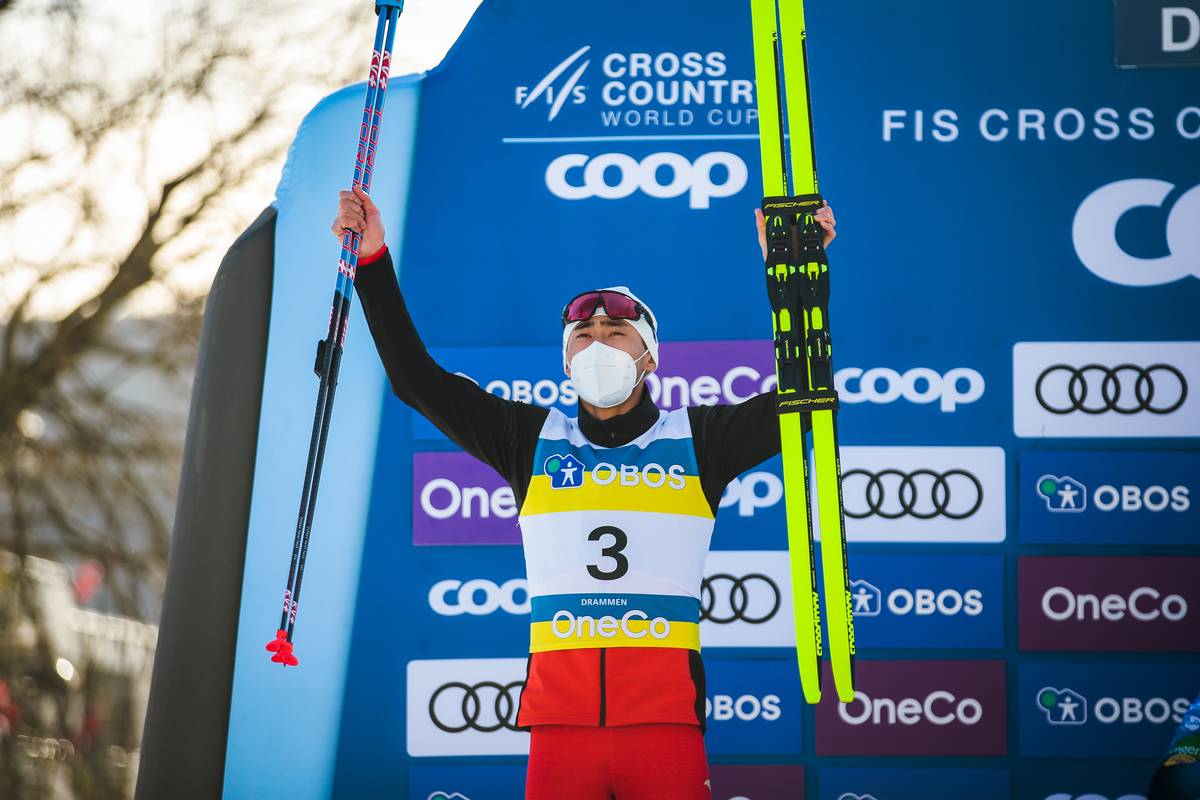
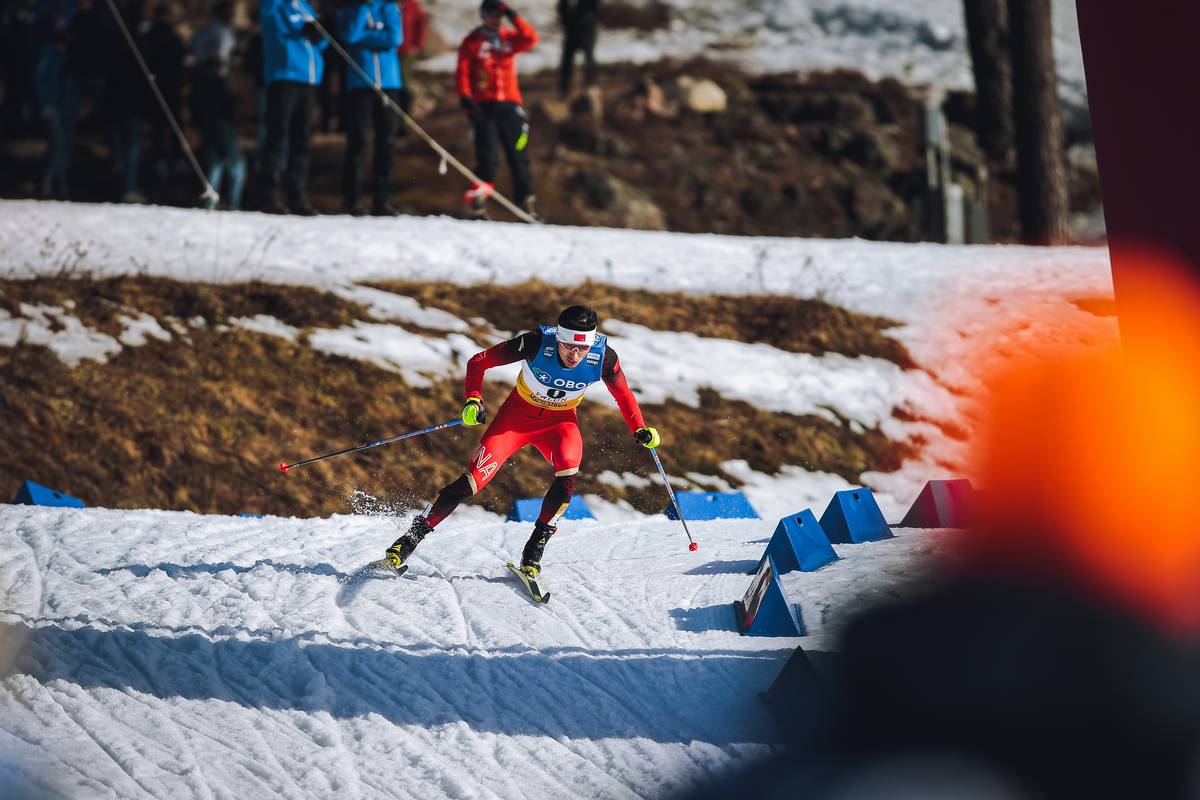
Wang Qiang became the first Chinese athlete to podium in a World Cup last year, finishing 2nd in a classic sprint in Norway. This year, political turmoil has stranded him at home and kept him out of the World Ski Championships in Slovenia. (Photo: NordicFocus)
This World Championship coverage is made possible through the generous support of Marty and Kathy Hall and A Hall Mark of Excellence Award. To learn more about A Hall Mark of Excellence Award, or to learn how you can support FasterSkier’s coverage, please contact info@fasterskier.com.
PLANICA, SLOVENIA – Wang Qiang was cross-country skiing’s Next Big Thing.
Wang, 29, was the product of a colossal investment from his home country to identify and train potential medal winners in the lead-up to the 2022 Beijing Olympics. Communist Party leaders saw cross-country skiing as a prestige sport and poured hundreds of millions of dollars into their national team, building an indoor ski tunnel and recruiting top coaches from Europe.
The effort didn’t produce medals at the Olympics. But a big payoff came just weeks later, when Wang cracked his first podium on the World Cup circuit, a huge accomplishment that came against some of the same competitors he faced in Beijing.
In a sport typically dominated by Europeans, Wang’s podium was a breakthrough — an announcement of a rising power in cross-country skiing.
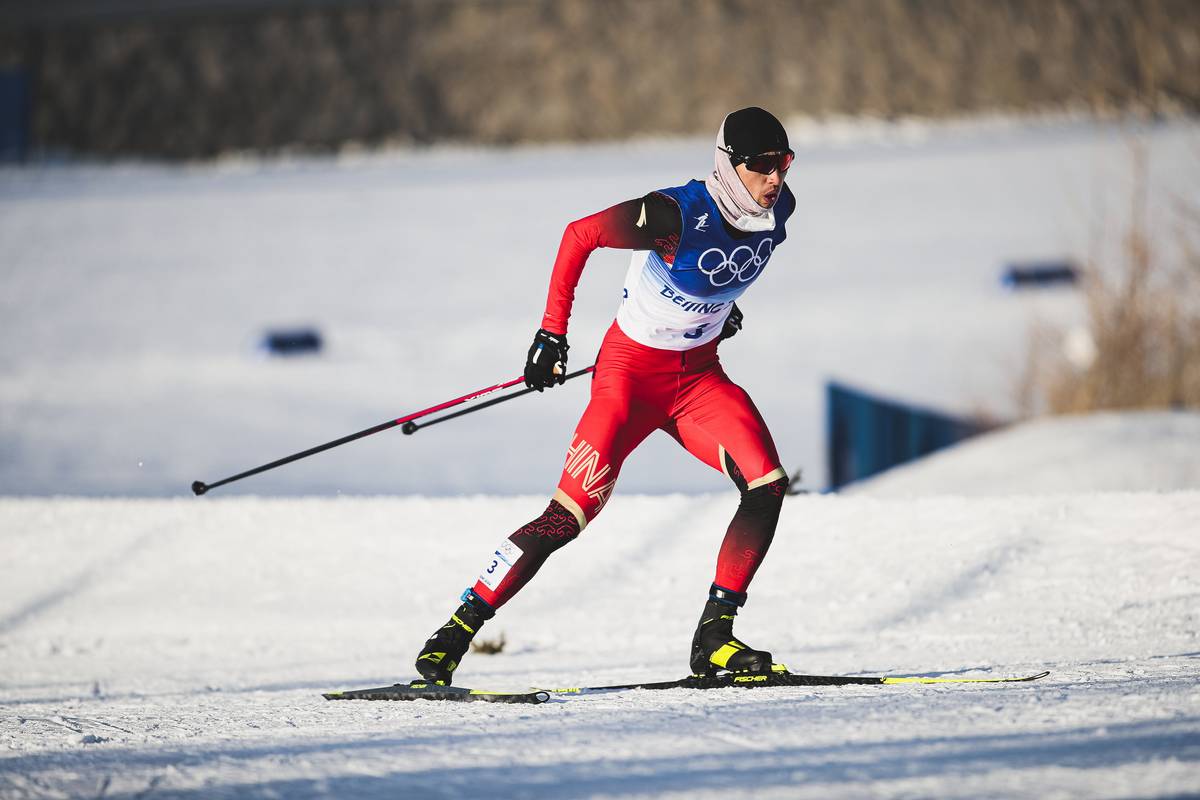
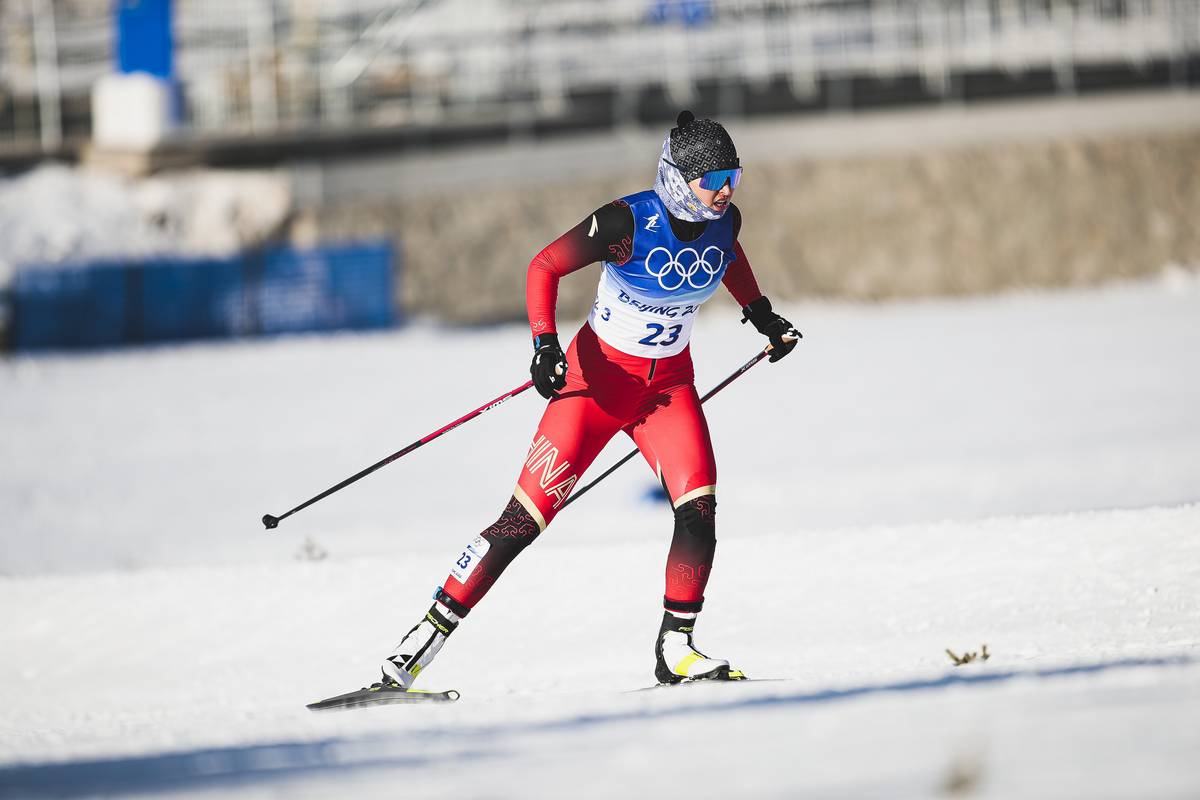
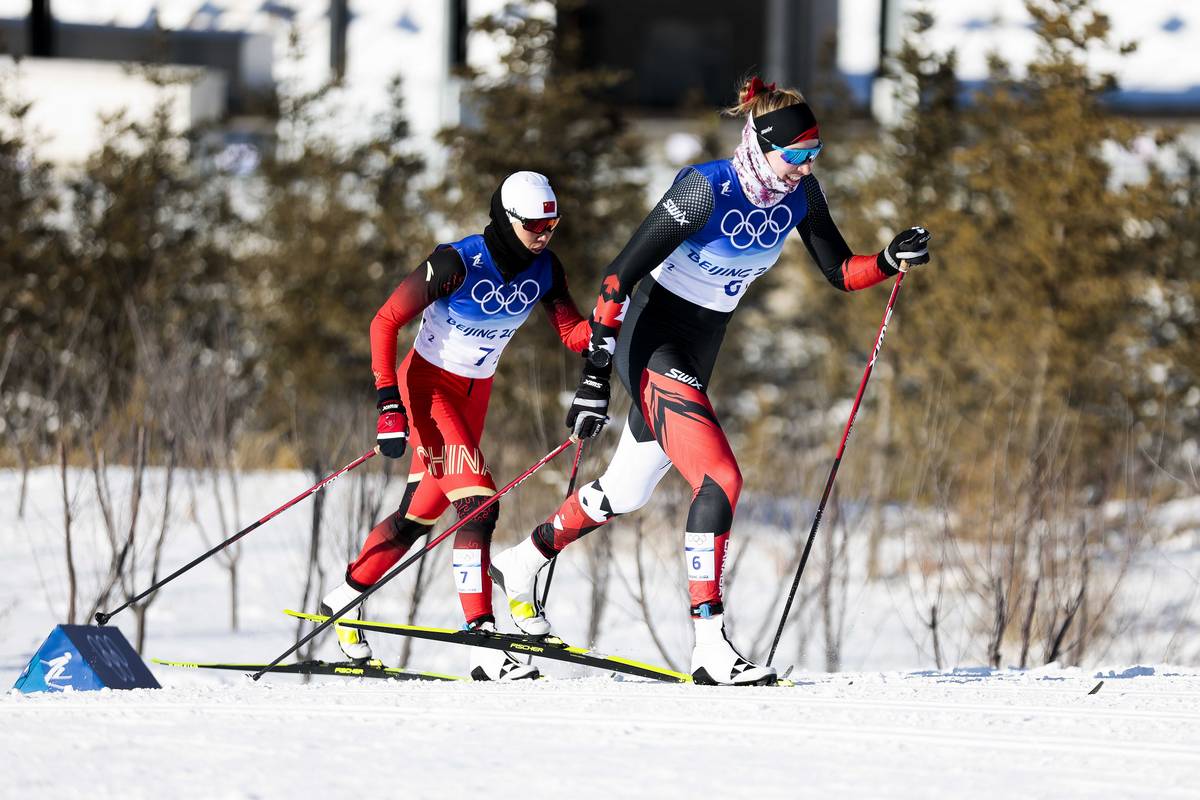
Wang Qiang was fifth in the skate sprint qualifier at the 2022 Beijing Olympic Winter Games. (Photo: NordicFocus)
But when Wang’s best event, the sprint, was held at those championships Thursday, he was missing — apparently back home, in China, where he’d been forced to watch the entire World Cup season from the sidelines. On social media, he published a screenshot of a Norwegian news story about his absence, the latest in a string of posts expressing regrets about his departure from Europe.
The tale of Wang’s unexplained disappearance has become something of a tragedy and a mystery among his friends and competitors on cross-country skiing’s World Cup circuit, who say he’s one of the few athletes with the raw talent to challenge Norway’s superstar sprinter, Johannes Høsflot Klæbo.
“They’ve got this one guy that could be the world’s best skier, and he just doesn’t get to race. I don’t quite understand it,” said Andrew Musgrave, a British cross-country skier who lives and trains in Norway. “It just seems bizarre.”
Wang’s experience is emblematic of what’s happened in Chinese snow sports since the end of the Beijing Olympics: turmoil, without a clear explanation.
The country’s national cross-country ski team has been shut down, and it hasn’t fielded athletes in top-level competitions this year. Its nordic combined team is also missing from the World Championships in Slovenia.
China’s Olympic alpine skiers haven’t competed internationally since Beijing. And the country’s biathlon squad, after its own substantial investment in the lead-up to the Games, has also largely disappeared, skipping World Cup competitions and sending a skeleton crew to recent World Championships races in Germany.
In a strange twist, though, China’s best ski jumpers have been consistently present on the World Cup circuit since January, and are competing at World Championships in Slovenia this week.
In a brief interview outside the team’s wax cabin Friday evening, the Finnish coach who leads China’s jumping squad, Jani Klinga, said the group has a step-by-step, four-year plan building toward the 2026 Olympics.
A nordic combined team is forming some time later, Klinga added, but he said he has no information about the fate of China’s cross-country skiers.
“I don’t know about the cross-country athletes, the situation over there,” Klinga said. “But on our side, everything is moving forward.”
International snow sports leaders also appear to be largely in the dark about China’s plans.
In biathlon, contracts with the foreigners hired to coach the national team were not renewed, and a plan to buy 3,000 laser training rifles each year also has not been carried out, said Max Cobb, the International Biathlon Union’s secretary general.
“They were really making progress as a nation and had some really decent results from their athletes,” Cobb said in a phone interview Friday. “It’s really hard to know what the plan and leadership structure is, and who’s ultimately responsible. We certainly hope that they’ll come back — there’s just, at the moment, not a lot of activity, and it feels like the momentum’s been lost.”
International Ski Federation President Johan Eliasch said his organization is in close contact with the Chinese Ski Association and that “everything we hear is aligned with their stated commitment to proliferate winter sports in China.”
FIS President Johan Eliasch speaks with reporters Wednesday before the start of the World Ski Championships in Planica. (Nathaniel Herz/FasterSkier)
But in remarks to reporters in Planica this week, Eliasch said he couldn’t comment on the Chinese cross-country ski team’s absence from World Championships other than citing the nation’s restrictive coronavirus protocols — which were lifted in December.
The leader of China’s defunct cross-country ski team, Zhang Bei, didn’t respond to an emailed request for comment.
But in phone interviews, two sources close to China’s cross-country program described Wang’s absence as a symptom of a larger realignment in the nation’s sports regime after the 2022 Olympics.
In the lead-up to the Beijing Games, they said, China’s sports minister, Gou Zhongwen, was not actually a sports expert: He was a well-connected Communist Party insider, who used those connections to secure ample budgets for his programs.
The nation’s cross-country ski team was among Gou’s most favored projects, the sources said, because of European countries’ longstanding dominance in the sport: If China could win a medal, it would be a major triumph over the West.
But the massive investment in cross-country skiing didn’t produce any hardware: Wang, the country’s top prospect, was disqualified from the Olympic sprint race when he crashed into a Norwegian competitor.
Once the Games were over, Gou retired. His replacement, Gao Zhidan, is a sports specialist who lacks the same level of political support, and the same interest in cross-country skiing, the sources said.
“After the Olympics, the cards have been reshuffled. And cross-country lost its aces,” said one of the sources, who worked in Chinese sports in the lead-up to the Games.
Around the same time as the change in ministers, Norwegian media reported, Wang was returned home from Europe to China. The national cross-country ski team was also disbanded, the sources said, and its athletes were sent back to their regional teams.
Those regional teams, the sources said, prioritize Chinese national championships over international racing because there’s substantial prize money at stake.
An internal audit of the cross-country program is also underway, according to the other source, a Chinese resident.
There’s a good chance the national ski team will be rebuilt in time for next winter, said the Chinese source, who requested anonymity because of “internal struggles” in their home country. But even insiders don’t really know what will happen, the source added.
“Even if you’re in the Communist Party, you don’t know,” the source said. “You need to be connected with the right people. Otherwise, forget about it.”
During his involuntary break from international-caliber competition, Wang has continued training and stayed relatively optimistic, avoiding direct criticism that could put him in conflict with the political leaders who control his future.
“I am aware that I am missing out on a fantastic season. But I have to accept the situation,” he told a Swedish newspaper recently. “I want to concentrate on training this summer and be in the World Cup next season. I think I’ll make it.”
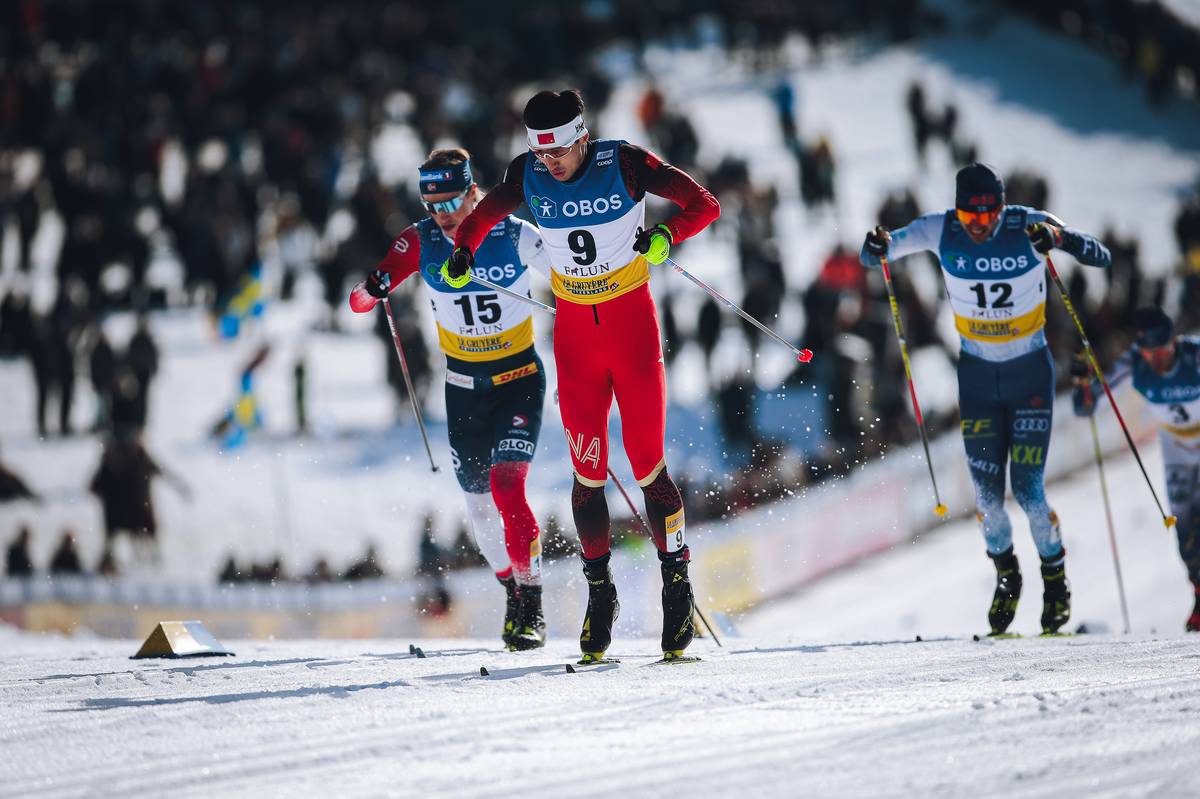
Wang Qiang races in a World Cup classic sprint last year in Falun, Sweden. (Photo: NordicFocus)
But his friends and fellow competitors said they’re worried about the effects of isolation on Wang and his Chinese teammates, who haven’t done much of the kind of tight, close-quarters racing that happens on the World Cup. There’s also Wang’s advancing age: He turns 30 this year.
“It’s difficult when they are not here, because they need the experience in every World Cup race,” said Finnish skier Remi Lindholm, who trained with some of the Chinese athletes for several months in the lead-up to the Olympics.
Like Musgrave, Lindholm said Wang “absolutely” has the potential to beat Klaebo, the Norwegian superstar. Which makes it sad, Lindholm added, that Wang is stuck in his home country.
“He’s a good guy,” Lindholm said. “And he knows that he has to do the job every day to get to the World Cup.”
ZHANGJIAKOU, CHINA — A month ago, I met with a source close to the Chinese government in a tiny room in this mountain resort outside Beijing, which hosted the 2022 Olympic cross-country skiing events.
There, the source explained how a decision by international skiing officials to disqualify a Chinese cross-country skier from a race was like killing a baby.
China does not have, exactly, a long tradition of success in winter sports like cross-country skiing. But after several years of work and hundreds of millions of dollars invested in facilities, Scandinavian and Russian coaches, athlete development and gear, it was hoping for big results in Beijing, especially from star sprinter Wang Qiang.
China’s Wang Qiang races to fifth in the freestyle sprint qualifier in Zhangjiakou during the 2022 Beijing Olympic Winter Games. (Photo: NordicFocus)
Wang, in cross-country’s Olympic skate sprint last month, was poised for a top-10 finish, and maybe even a medal — definitely the only hardware that China’s cross-country ski team had a chance to win on home snow during the Games.
But in one of the event’s preliminary head-to-head knockout rounds, Wang tangled with a Norwegian skier, Pål Golberg, who crashed. The International Ski Federation jury overseeing the race relegated Wang to 30th place, ruling that he’d obstructed Golberg, even though China vehemently disagreed.
Hence the tamped-down outrage I was witnessing from my source, who wanted international followers of cross-country skiing to understand his country’s anger over the disqualification.
China had just poured huge amounts of money into hosting the Olympics and building up cross-country skiing; thousands of volunteers had put their lives on hold to pull off the Games during a pandemic. The ski federation, known as FIS, couldn’t give Wang the benefit of the doubt? In a country with hundreds of millions of potential new cross-country skiers and skiing fans, where the sport was still in its infancy?
“You don’t kill infants,” the source said.
This is a Chinese-friendly perspective on Wang’s disqualification, and many others disagree, saying that Wang committed a clear infraction and that skiing’s rules must be enforced without regard to politics or business.
China’s Wang Qiang races through the heats during a classic sprint in Falun, Sweden. (Photo: NordicFocus)
But the Chinese perspective on the event is one that’s worth understanding. Because doing so can help answer one of the most interesting, and important, questions in cross-country skiing right now: Will China keep up its investment in the sport?.
“What I’m very curious about is: What next?” Vegard Ulvang, the retired Norwegian Olympic gold medalist who now chairs FIS’ cross-country committee, said in a phone interview. “Will they continue? Will they have a national team? Will they join the World Cup? To be honest, we don’t know. I have no information on what they will do.”
The question has enormous implications for the sport of cross-country skiing, given the size of China’s potential market for skis, wax and television broadcasts.
But I got conflicting answers when I asked the people who would know the answer.
The source close to the government said Wang’s disqualification soured China’s sports minister, Gou Zhongwen, on further investment in cross-country skiing, and he said the sport’s future in the nation looks deeply uncertain. Many of the team’s Scandinavian employees have contracts that end in May, without assurances they’ll be renewed.
“Everything is political, and the culture is completely different,” said Tor Arne Hetland, a Norwegian coach and former Olympic gold medalist who’s worked with Chinese athletes. “If the sports minister says, ‘We are not going to pursue winter sport or cross-country skiing or biathlon,’ then of course, there will not be any money for it. And the project will be completely dead.”
But in an interview in Zhangjiakou during the Games, Zhang Bei, the Communist Party official who leads China’s cross-country ski team, struck a positive note.
She said her country’s commitment to training athletes will continue into next year, and plans have already been announced that the team will keep sending athletes to train in Finland through the 2026 Games. Wang also proved his potential with a podium performance on the top-level World Cup circuit earlier this month in Drammen, Norway.
One of the multiple vehicles that China’s cross-country ski team had stationed at the 2022 Olympics in Zhangjiakou. (Photo: Nat Herz)
But Zhang would not reveal details about China’s cross-country budget. And she also suggested, logically, that the country would be scaling back its investment in skiing infrastructure from its big Olympics build-up.
“There is a saying in China: Everything is difficult to start,” Zhang said in the interview, conducted through a translator. “After you have the bases for the infrastructure, then of course, there is an adjustment.”
Ulvang has closely watched China’s cross-country program and, as the country’s athletes trained in Scandinavia before the Olympics, he hosted two of the nation’s top female prospects, Bayani Jialin and Dinigeer Yilamujiang, for a week at his home.
Ulvang described China’s efforts to train ski champions as “all out.” But he’s still waiting to see if the country’s commitment will last, because, he said, developing a durable skiing culture takes time.
“We need to see if this was motivated by the medals on the home field,” Ulvang said, “or if this was part of a long term strategy.”
“Starting from zero”
China’s huge pre-Games spending on cross-country skiing was fueled by Zhongwen’s belief that the discipline was one of the best measures of a nation’s overall prowess in winter sports, said the source close to the government.
The country spared no expense. Among its investments was a $150 million, 1.3-kilometer indoor ski tunnel that athletes can use to train year-round; one Chinese team employee showed me a video of another contraption that resembled an enormous plate with snow on top, which spun in circles while athletes stayed in the same place by skiing in the opposite direction.
China hired dozens of Scandinavian coaches and experts at yearly salaries that reached $120,000. The government recruited hundreds of Chinese athletes from other sports into cross-country skiing, and sent them to training centers in Norway and Finland. (Chinese officials considered Alaska as an option, where athletes could fly in helicopters to train at Alaska Pacific University’s facility on Eagle Glacier, but Zhang said securing visas proved too difficult.)
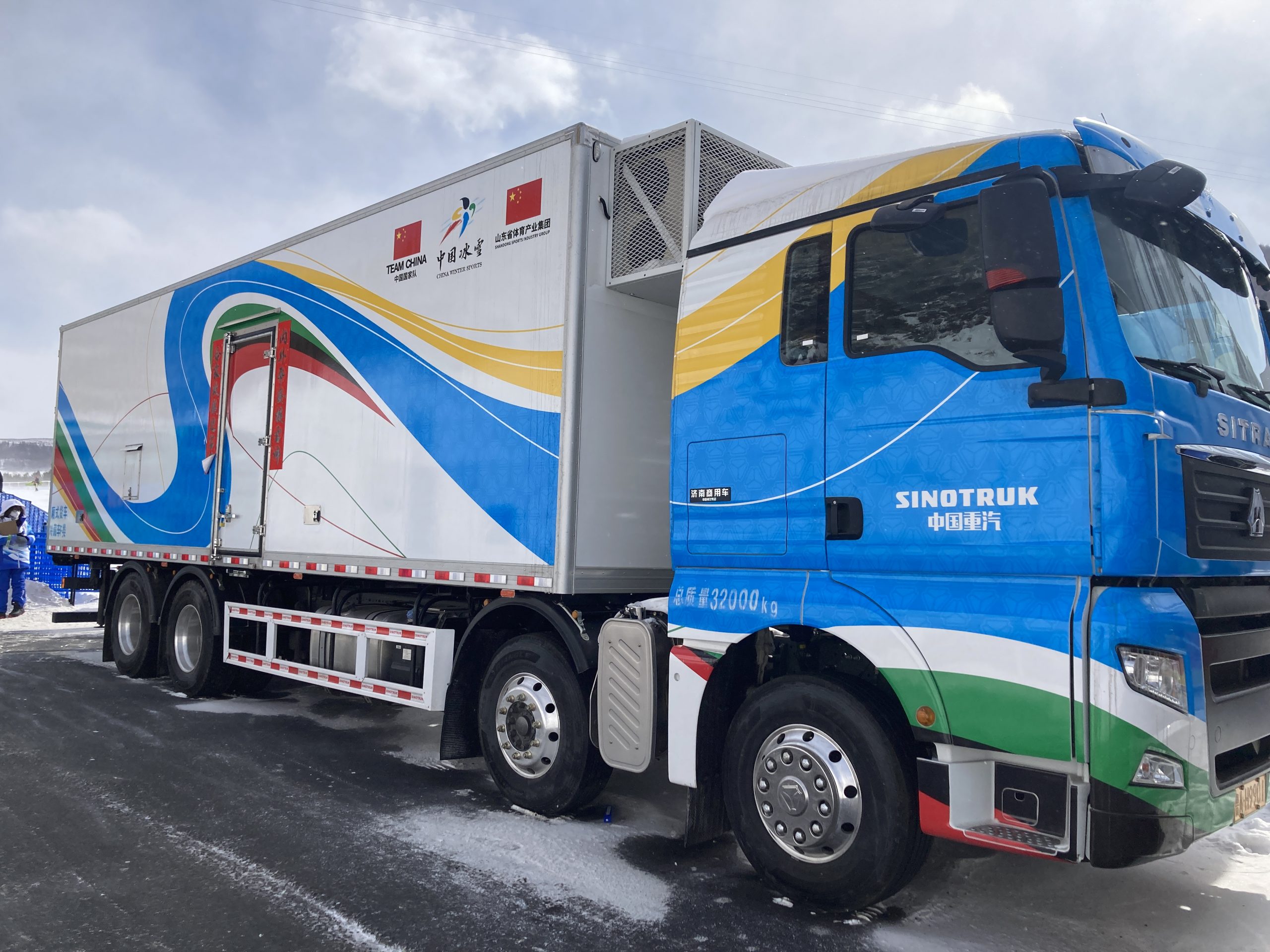
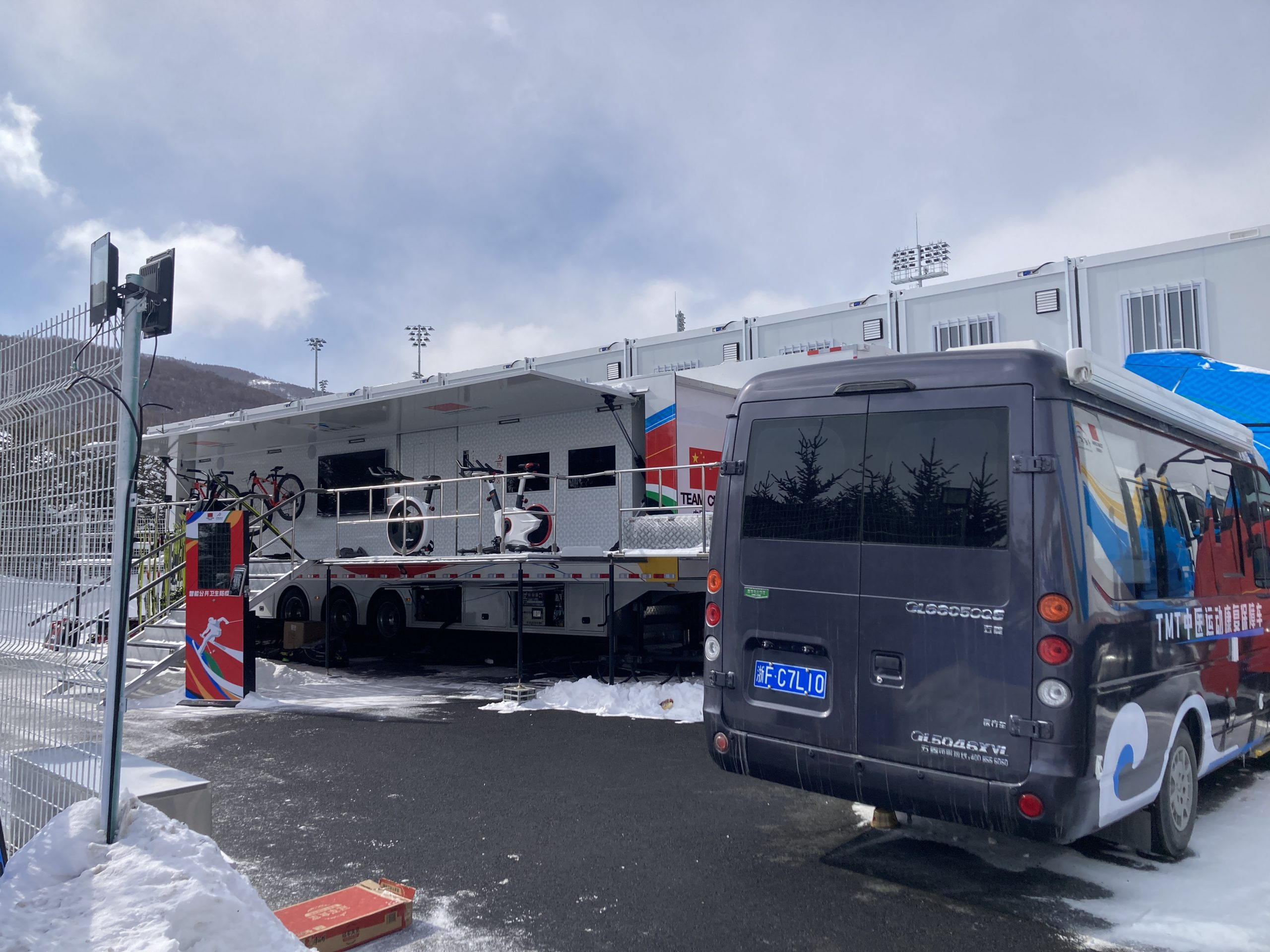
The team spent millions more on wax and equipment. In Zhangjiakou, the Chinese team had access to the Games’ only on-site ski waxing bus, which has sliding doors and facial recognition technology.
The Chinese ski team’s main wax bus at the 2022 Olympics in Zhangjiakou. (Photo: Nat Herz)
“They have started from zero,” said Hetland. The skiing infrastructure that the country has built up, he added, “is more than what Norway has done in the last few years.”
In the years before the Olympics, the team’s athletes recorded impressive results, even though some had only been skiing a few years — unlike many European athletes who have raced for the majority of their lives.
Yilamujiang and Bayani both cracked the top 30 on the World Cup circuit, and notched top-15 results at the world championships for juniors and athletes under 23 years old. Wang, China’s star male skier, performed at a similar level.
But at the Olympics, other than Wang, none of China’s cross-country skiers cracked the top 30. Some people close to the team described the event as a disappointment, given the Chinese athletes’ proven potential.
Former employees of the Chinese team said two dynamics help explain the results.
One was a tendency by Chinese team leaders to disrupt the Scandinavian coaches’ training programs, by pushing athletes through brutally difficult workouts that the Chinese staff thought were needed.
The other was the decision by team leaders to pull China’s athletes out of the World Cup circuit during the COVID-19 pandemic — a move that kept the skiers safe but deprived them of experience against international-caliber competition on trails outside their home country. (Chinese officials did hire semi-elite Russian athletes to travel to China to give the country’s athletes more racing experience.)
“They need to spend even more time in Scandinavia and learn from everybody in the environment that is around a skier,” said Hetland, the Norwegian coach. “And that has been maybe the biggest challenge for the team, when due to COVID they have stayed at home in China in the last two years.”
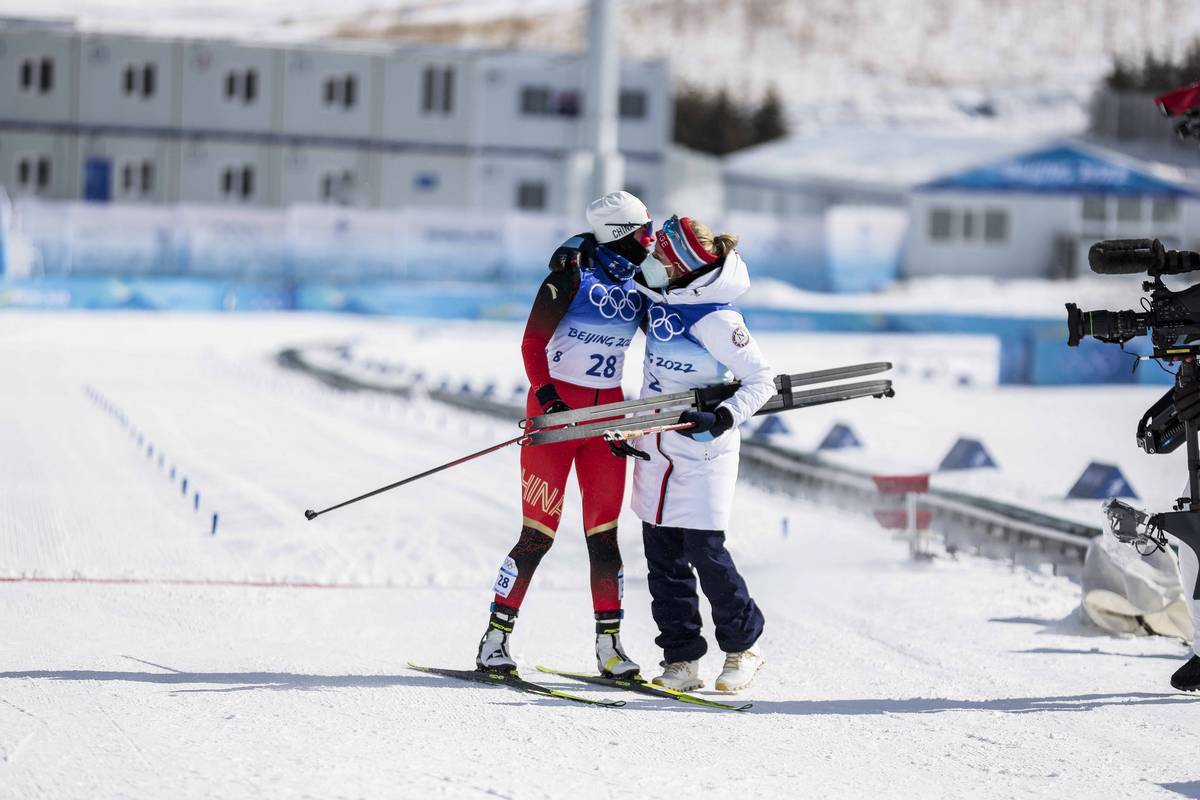
Olympic 30 k winner Therese Johaug (NOR) greets last place finisher Dinigeer Yilamujiang of China who finished over 25 minutes behind the Norwegian (Photo: NordicFocus)
Hetland said it’s important to remember that China has its own distinct culture from those of the European nations that have historically dominated cross-country skiing. Adapting that culture takes time, he and others said.
“I visited China two years ago, and I was clear to the officials there that developing or training up a good skier, fighting for medals, is not a quick fix,” said Ulvang, the Norwegian FIS official. Still, he added: “It’s really special to see such fast development into some of the best racers in the world.”
Zhang, the Chinese leader, had no complaints about her team’s Olympic results.
“I am very much satisfied with the performance of our athletes,” she said. “I also feel very satisfied that each of our athletes is enjoying the competition, and that they are happy.”
“They cut him”
Zhang spoke with me in a busy athletes’ lounge in the bowels of Zhangjiakou’s biathlon building.
With the help of some of her European coaches, I’d picked her out of her white-jacketed, fur-hatted entourage at the cross-country skiing venue a few days before. She reacted with surprising openness, and agreed to an interview after I supplied her with enough details to get approval from her superiors.
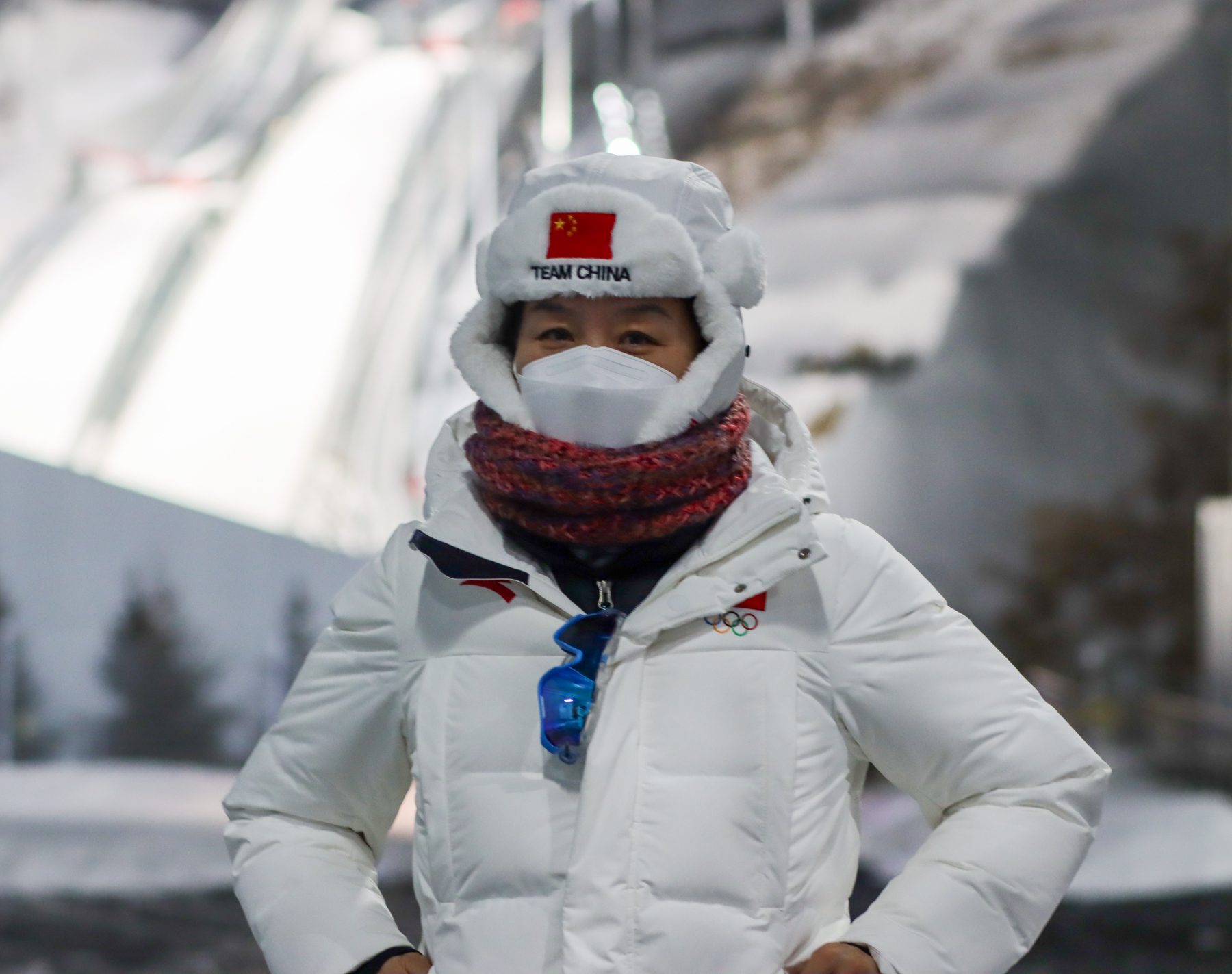
Zhang Bei is the Chinese Communist Party official in charge of the country’s cross-country ski team. (Photo: Nat Herz)
Zhang embodies China’s recent foray into winter sports: She came to her job four years ago, with a background as an elite rower, and only recently took up cross-country skiing herself. She told me she was too shy to try it in front of her athletes because she was worried they’d laugh at her.
In our hour-long discussion, Zhang came across more like a politician or ambassador than a coach or executive, striking a vague but upbeat tone that glossed over some of the challenges I’d heard about from former employees.
“We have a very good start,” she said in response to a question about her program’s future. “Most importantly, we have many young people that are interested in cross-country skiing. And we have to help them to fulfill their dream.”
The only time Zhang acknowledged even a hint of tension or conflict was on the subject of the disqualification of Wang, China’s star athlete. She said she and other team members were upset about the decision at the Olympics, which Zhang called “wrong.”
Technically, FIS’ race jury ruled that Wang would be “ranked as last” in the freestyle for breaking international competition rules against obstructing other skiers.
Slow motion replay of the event shows Wang in his neck-and-neck sprint heat edging to his right in a way that appeared to impede Golberg, the Norwegian, who was skiing alongside Wang and ultimately crashed. (The video cannot be posted here due to Olympic broadcasting rules, but FasterSkier can provide a copy by email upon request.)
The video isn’t exactly conclusive, and the jury’s decision has its critics — including, apparently, Gou, China’s sports minister.
Four separate sources told me that Gou learned of the disqualification during a dinner with Johan Eliasch, the FIS president, where Gou subsequently “lost his appetite” and raised his concerns with Eliasch directly. (A FIS spokesperson said in an email that the federation “does not comment on speculation about discussions between individuals during private dinners.”)
China ultimately appealed the jury’s decision, but the appeal was rejected, said Ulvang. The source close to the government said China also asked FIS to extend some type of goodwill gesture after the disqualification, but that request wasn’t granted either.
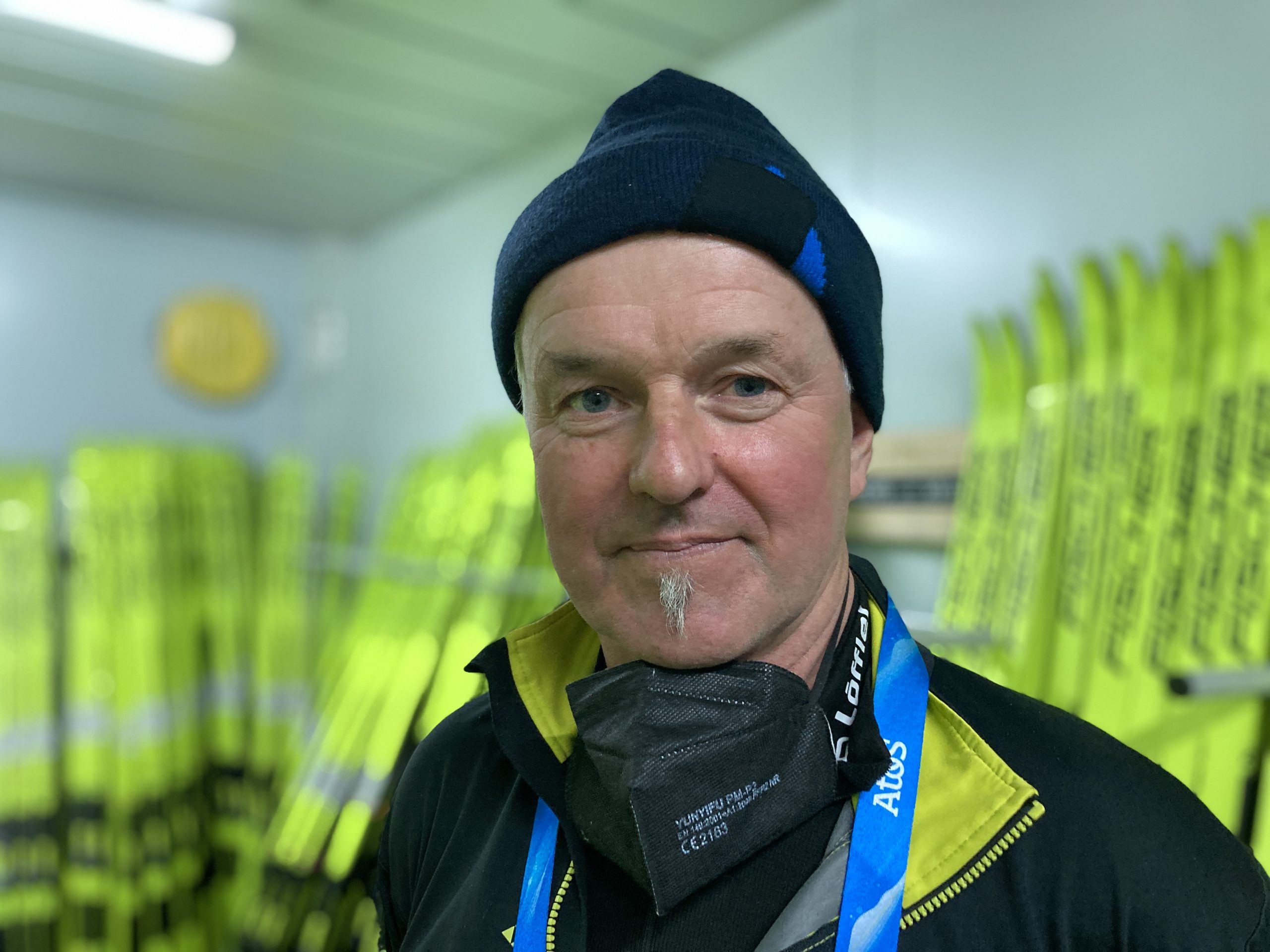
Representatives from cross-country ski equipment manufacturers were frustrated, too. Currently, the industry sells only small amounts of gear and skis in China, and only to elite athletes there — not to “normal people,” said Hans Hubinger, an official from ski giant Fischer who was working at the cross-country venue in Zhangjiakou.
“It’s not easy for us to see if there’s a future for the Chinese market or not,” Hubinger said in an interview.
Hans Hubinger is an official from ski company Fischer who was working at the 2022 Olympics in Zhangjiakou. (Photo: Nat Herz)
Wang was the industry’s only hope for a Chinese cross-country skiing medal, which could have stimulated new interest, and gear sales, in the nation’s massive market. That market could also bring much-needed television viewers to cross-country skiing’s broadcasts — a major source of revenue for the sport.
Hubinger said he thought Wang’s disqualification was a close call where the jury could have given him the benefit of the doubt.
“I think, ‘Oh, this is the chance now, to turn some guys into heroes’…and they cut him,” he said. “If the rules are clear, then you have to cut him. But this rule is not clear.”
Pierre Mignerey, FIS’ cross-country skiing race director and a member of the jury that disqualified Wang, said he sees the situation completely differently.
In an interview in Zhangjiakou, Mignerey said it would be completely inappropriate for a race jury to weigh political factors, like the size of China’s ski market or its investment in the Games, in their decisions.
“Sports mean that we have some rules. And that would be, in my opinion, quite shocking if the rules would not apply to everyone in the same way, regardless of if it’s the host nation,” said Mignerey, a retired French racer. “What would people say if the jury had decided something else?”
Others placed responsibility for the disqualification on Chinese team leaders, arguing that their decision to skip international races during the pandemic left athletes like Wang without enough experience in the kind of tight-quarters competition that happened in the Olympic sprint.
In the weeks after the Games, Wang delivered results that only underscored the opportunity he missed when he was disqualified — regardless of who bears the ultimate responsibility for that decision.
In his first World Cup race after the Games, in Finland, Wang, 28, finished a career-best sixth place. The following week, in Norway, he landed on the podium for the first time.
That result delivered a shot of hope to those who want to see the Chinese program continue.
On social media afterward, Wang made clear his intentions to continue in the sport, even if his country’s commitment to its skiing program remains something of a mystery.
“Today is a milestone. This is the first time a Chinese athlete stands on the podium of the World Cup series. We have won the respect of the world,” Wang said on a platform called Weibo. He added: “I will continue to pursue my dream with a humble attitude.”
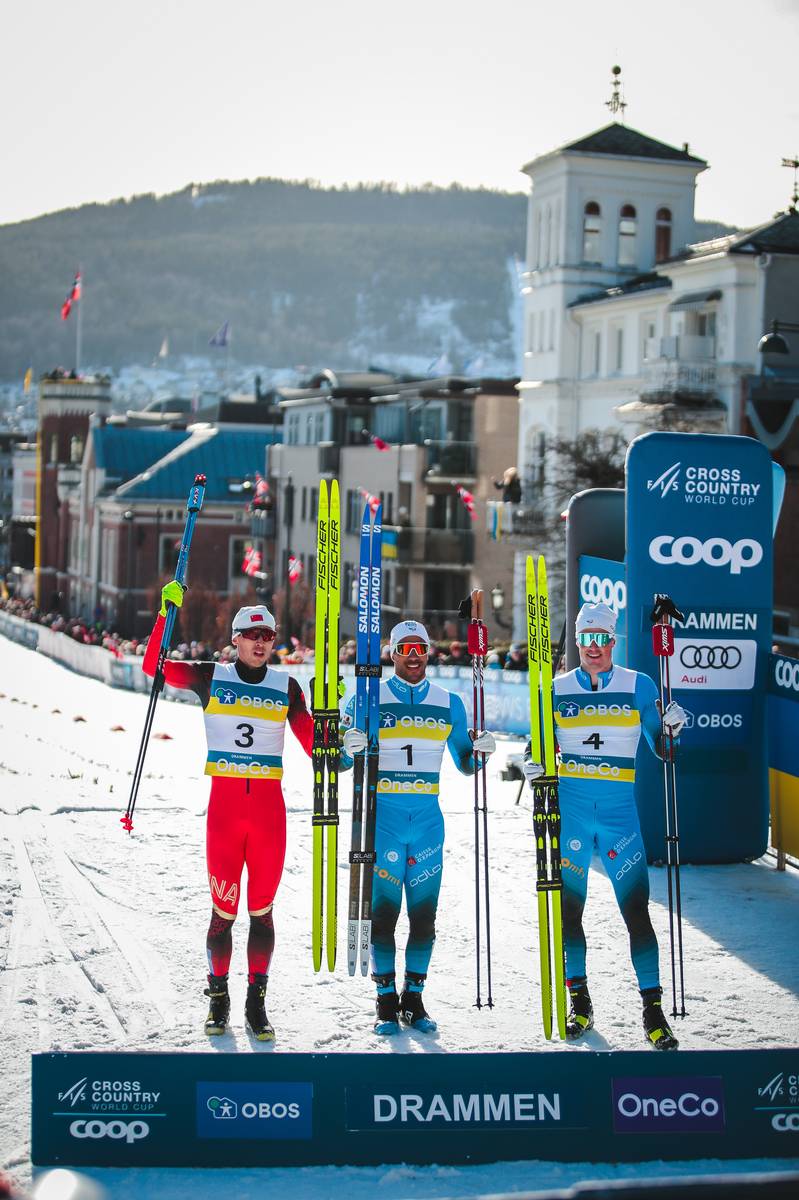
Richard Jouve (FRA) takes the win in Drammen, NOR, with a first podium for China’s Wang Qiang, who took second ahead of Lucas Chanavat (FRA) in third. (Photo: NordicFocus)
This World Cup coverage is made possible through the generous support of Marty and Kathy Hall and the A Hall Mark of Excellence Award. To learn more about A Hall Mark of Excellence Award or to learn how you can support FasterSkier’s coverage please contact info@fasterskier.com.
It’s the last hurrah, folks! The World Cup Finals kicked off in Falun, Sweden today with a classic sprint. While the season has been a wild ride for many reasons – spills and thrills in the Tour de Ski, COVID-cancellations, Olympic Games, geopolitical nightmares – Falun evidenced that spring is on it’s way and it’s time for the World Cup crews to head home take a break, and begin anew.
Contrasting the dim light and long shadows of far-north Ruka, Finland at the opposite bookend of the season, the sprints in Falun were raced under bright sun, with temperatures well-above freezing, bare ground and green grass emerging from beside ski tracks.
Zak Ketterson leads the U.S. in 39th during the classic sprint qualification round in Falun, SWE. (Photo: NordicFocus)
The American men, particularly in sprint, headed into the Falun weekend at a significant disadvantage. Kevin Bolger announced on Instagram Thursday that he had tested positive for COVID, while Ben Ogden, JC Schoonmaker, and Luke Jager – the remainder of the four sprint men who competed during the 2022 Olympics in Zhangjiakou – are currently competing at the NCAA championships in Soldier Hollow, UT. The sprint field as a whole has been weakened; Russian athletes were banned from competition on March 1st, while Norway’s top-six sprinters, including sprint and overall World Cup leader Johannes Høsflot Klæbo, each tested positive for COVID following the World Cup race weekend in Lahti, Finland. With no Russian’s and the top-Norwegians out, the men’s field had been cracked wide open.
Finland’s Joni Mæki posts the fastest time in the classic sprint qualifier in Falun, SWE. (Photo: NordicFocus)
Finland’s Joni Mæki took the top spot in qualification, setting the mark at 2:51.58. Sivert Wiig of Norway took second in the qualifier (+0.69), with Sweden’s Calle Halfvarsson in third (+1.41). Three nations represented in the top-three.
Though new-to-FasterSkier names made the top-30, the early heats featured little surprise. Building momentum from a podium day in Drammen last week, France sent three of its top men to the semifinals: Lucas Chanavat and Richard Jouve, who had been third and first, respectively in Drammen, plus Jules Chappaz. Long-time sprint force Federico Pellegrino of Italy also moved through with an automatic spot, joining the day’s top-three qualifiers in the next round.
What did shake up the quarters was some trouble for the two Chinese athletes in the field. Shang Jincai, who had qualified in 25th, had a false start in heat three. Jincai looked as though he had been trying to keep himself so primed for forward momentum at the start beep, that he lost his balance, kicking a foot forward to catch himself well-before the beep and thus triggering the start. After a discussion with a jury member, while Pellegrino shook his head and raised his hands nearby, looking impatient, Jincai received a yellow card and was disqualified.
After stumbling on a climb and losing ground, Wang Qiang (CNH) races to 18th in the classic sprint quarterfinal in Falun, SWE. (Photo: NordicFocus)
In the next heat, Wang Qiang, who qualified in 9th and took second in Drammen, fell when hopping out of the track to run uphill, roughly two minutes into the heat. Qiang had been in the lead, though the pack remained tight. After a few missteps, he was back to his feet, chasing as real estate ran out, while Lars Agnar Hjelmeset (NOR) and Calle Halfvarsson (SWE) took the reins at the front to go 1-2 in the heat. Qiang raced his way back to fourth, just over a second back, but it was not enough for a lucky loser spot.
Richard Jouve (FRA) takes control through the rounds in Falun. (Photo: NordicFocus)
In the semis, France’s Jouve took control of the fast first heat, beginning a surge just under-two minutes in as the men ran up the steep climb and banked left to head back toward the stadium. Around the last corner, Jouve still held the lead with Mæki (FIN) just off his shoulder. Jouve pulled ahead in the double pole sprint through the lanes, while Mæki, Wiig (NOR), and Chanavat (FRA) raced each other and the clock down the final meters. At the line, it was Norway-France-Finland, spread by 0.38 seconds, fifth and sixth less than a second behind also. Each of the top-four finishers advanced into the final round.
The second heat was significantly less smooth, though times did not reflect the chaos and were only marginally slower than the first. As the course broke down, it looked to be continually harder to keep klister free and stay upright. Heading into the final downhill in strong position to take the heat, France’s Jules Chappaz looked as if his klister snagged some loose granules of snow; as he pushed off the outside ski to stay in the curve, the ski looked unable to slide and he crashed into the abrasive corn.
The remaining athletes in the head narrowly dodged Chappaz, allowing Hjelmeset and Pellegrino to take the lead and eventually win the heat. Sweden’s Halfvarsson also went down earlier in the heat, looking to have similarly iced up while running up the first climb, leaving him off the back after the subsequent downhill.
After leading into the final downhill, a dejected Jules Chappaz (FRA) recovers from a crash to finish his semifinal. (Photo: NordicFocus)
Once again, Jouve took control of the final early, with Pellegrino marking. Mæki stayed wide on the first climb looking for better snow, but came over the top and into the curve behind the top three. Jouve, still calling the shots, led into the downhill, but he could not create any significant gaps there; Wiig, Pellegrino, Chanavat and Mæki quickly accordioned onto the backs of his ski tails.
Looking confident and composed despite being unable to break away, Jouve remained at the front heading into the final curve. Once in the lanes, Jouve began to pull ahead a final time, creating a gap of several meters toMæki and Chanavat, who were evenly matched in the double pole sprint.
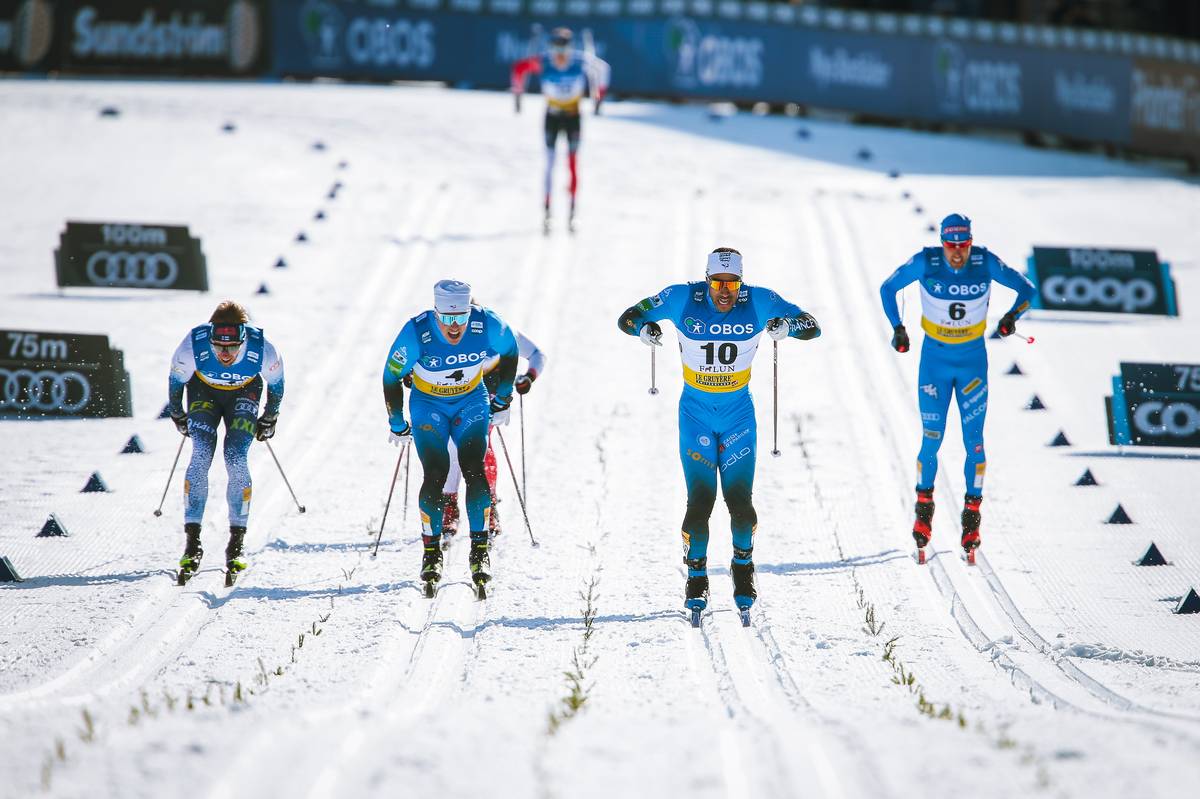
Richard Jouve (bib 10) leads the men’s classic sprint final to the finish in Falun, while four athletes vie for the remaining two podium positions. (Photo: NordicFocus)
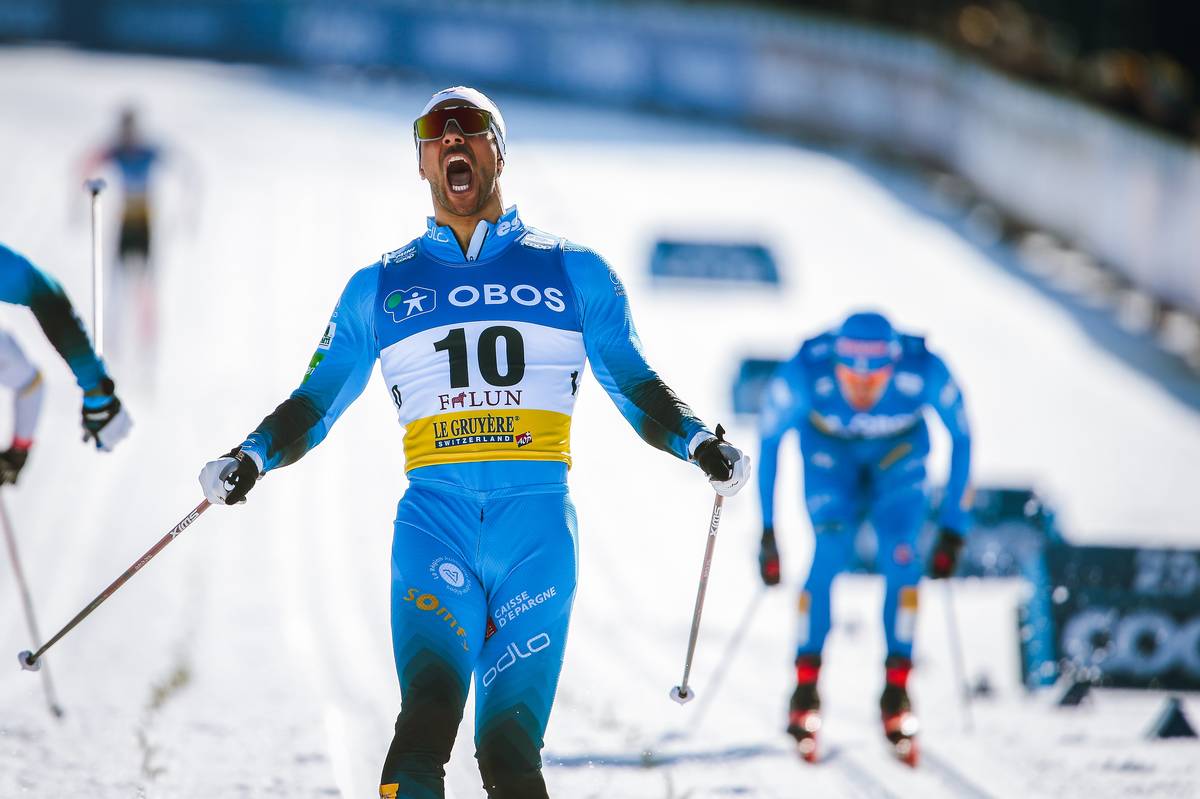
Emptying his lungs with a triumphant cry, Jouve coasted over the line for the win in 3:03.62, while Mæki and Chanavat threw their boots forward in a photo finish for the second and third podium spots roughly half a second behind. From the slow-mo, it was Mæki with the better lunge, nipping Chanavat by 0.03.
Just behind Wiig crossed fourth (+1.41), with Pellegrino fifth (+2.06), followed by a gap to Hjelmeset in sixth (+13.18).
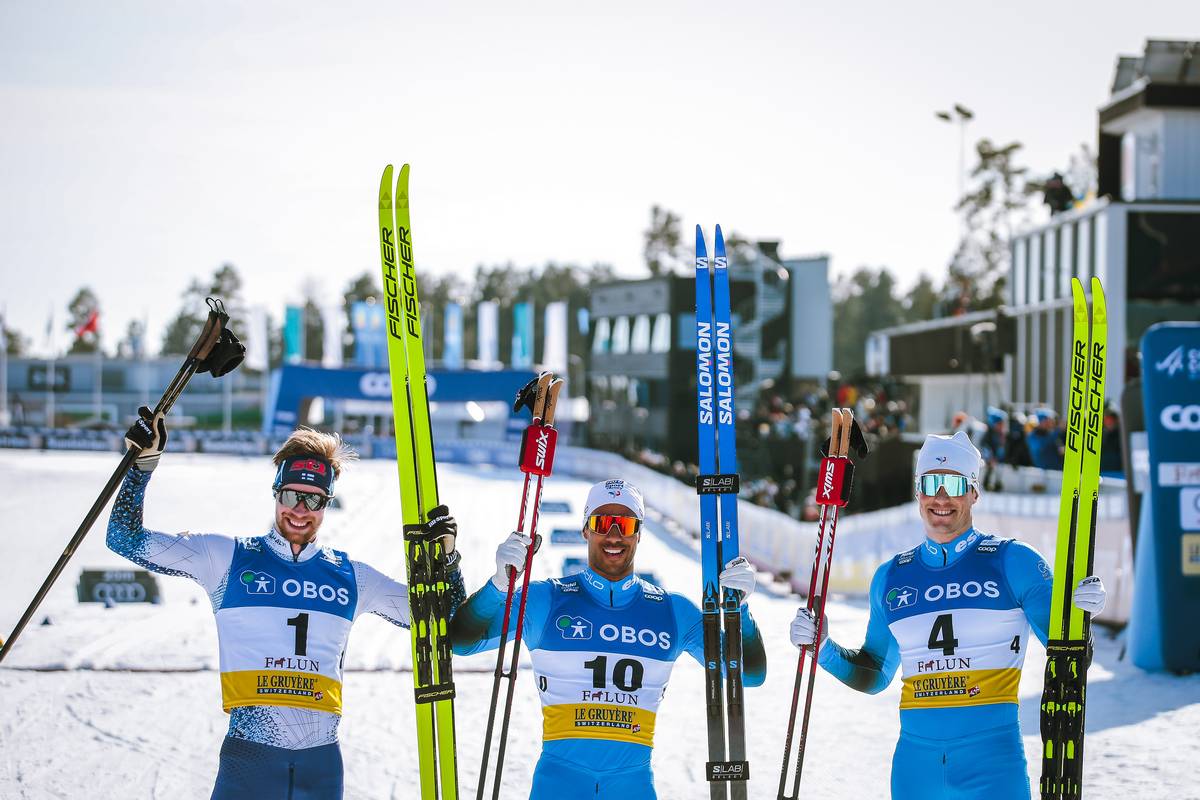
Richard Jouve (FRA) lets out a victory cry as he takes the classic sprint win in Falun. (Photo: NordicFocus)The men’s classic sprint podium in Falun, Sweden: Richard Jouve (FRA) took the win ahead of Joni Mæki (FIN) and Lucas Chanavat (FRA). (Photo: NordicFocus)
“I’m very proud,” Jouve told FIS after the race. “Off myself, my team. It’s amazing.”
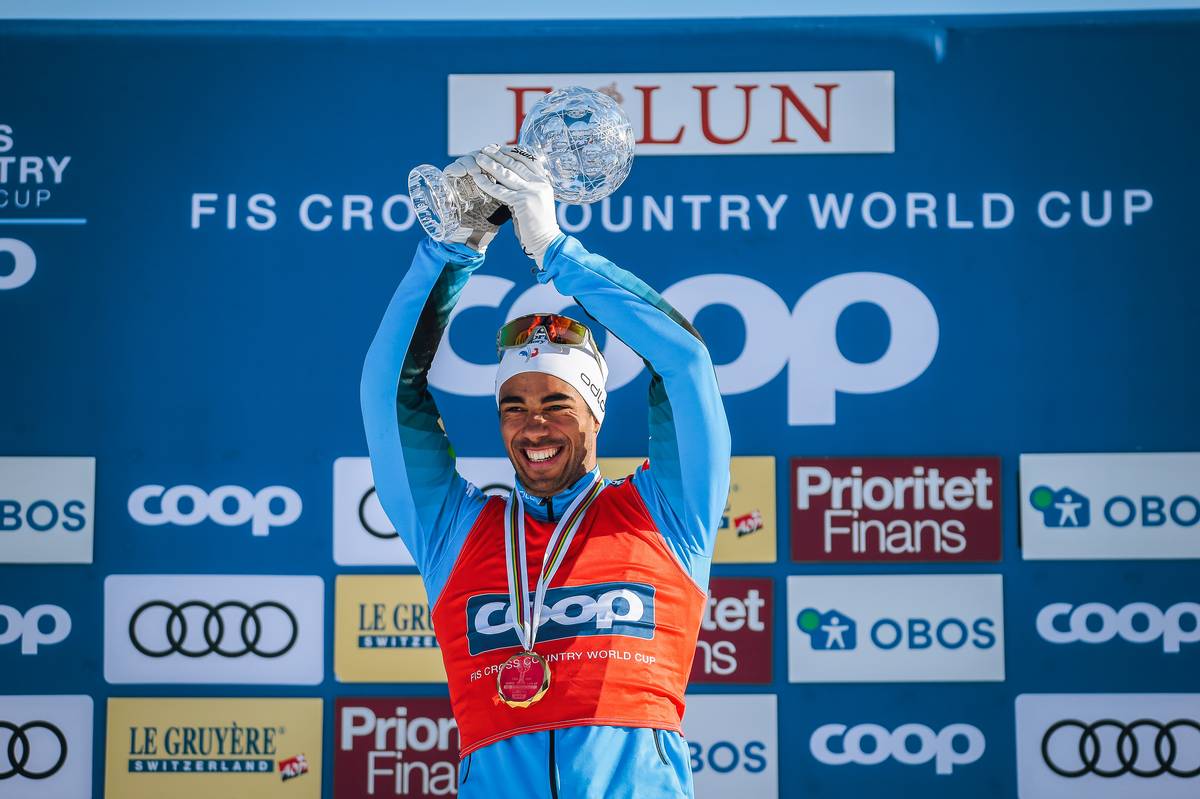
With the win today, Jouve also took the lead in the sprint World Cup standings, advancing by just six points ahead of Johannes Høsflot Klæbo (NOR). The season saw Jouve land on four World Cup podiums, finish seventh in the freestyle sprint during the Olympics, and then earn his career first World Cup win in Drammen’s classic sprint last Thursday.
“It’s amazing,” said an emotional Jouve, seemingly in happy disbelief. “The season was very great for me, to win at the end of the season is already a dream, but to grab [the globe], it’s big. Fantastic.”
With a win in the final sprint stage, Richard Jouve becomes the 2022 World Cup sprint champion, hoisting his crystal globe. (Photo: NordicFocus)French teammates Richard Jouve (left) and Lucas Chanavat (right) end their season in first and third, respectively, in the World Cup sprint standings. (Photo: NordicFocus)
A quick review of the final standings: With 568 points, Jouve is the 2022 sprint World Cup champion, with Klæbo second (-6) and Chanavat third (-107). Italy’s Pellegrino was fourth (-238), with Norway’s Håvard Solås Taugbøl fifth (-244).
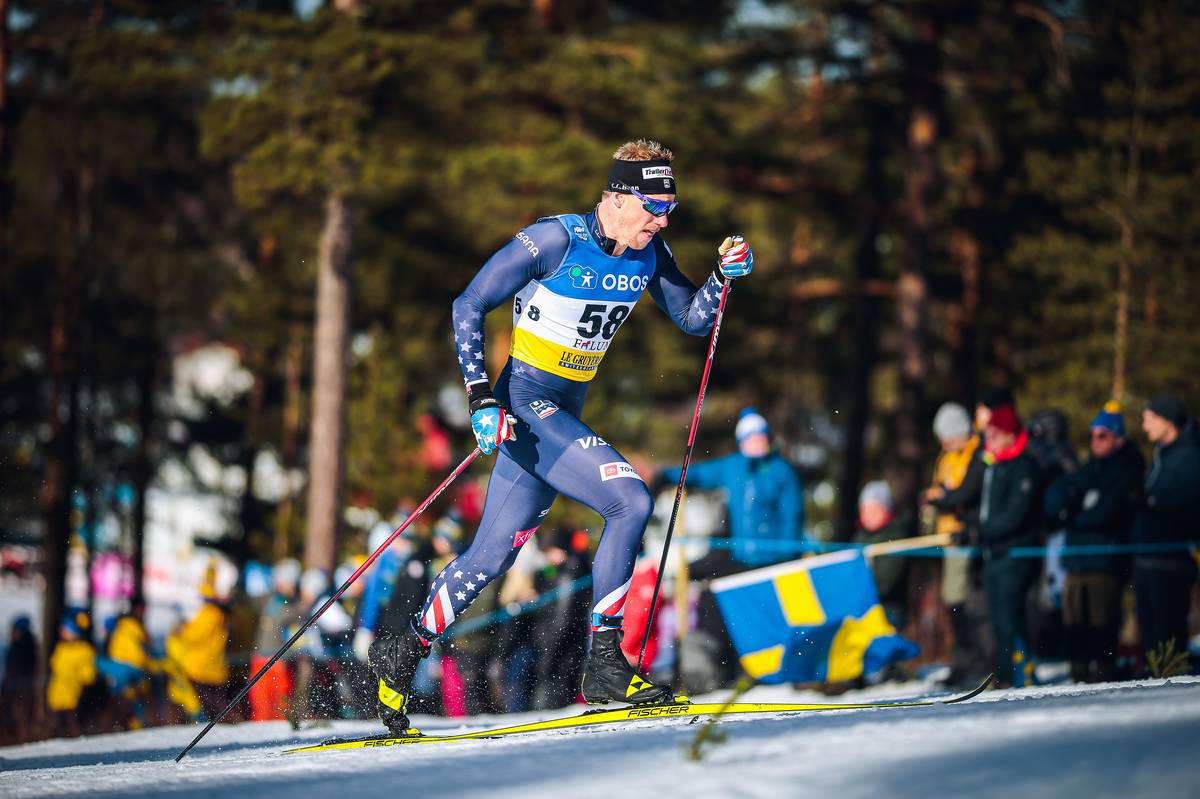
The US had three starters for today’s final sprint stage. Zak Ketterson led the way for the American team in 39th (+9.92), followed by Logan Hanneman in 47th (+10.79), and Peter Holmes 54th (+13.38).
Listen to post-race interview with U.S. Ski Team Head Coach Matt Whitcomb here.
Logan Hanneman skis to 46th in qualification in Falun. (Photo: NordicFocus)Graham Ritchie leads the way for North America, finishing 20th in Falun’s individual classic sprint. (Photo: NordicFocus)
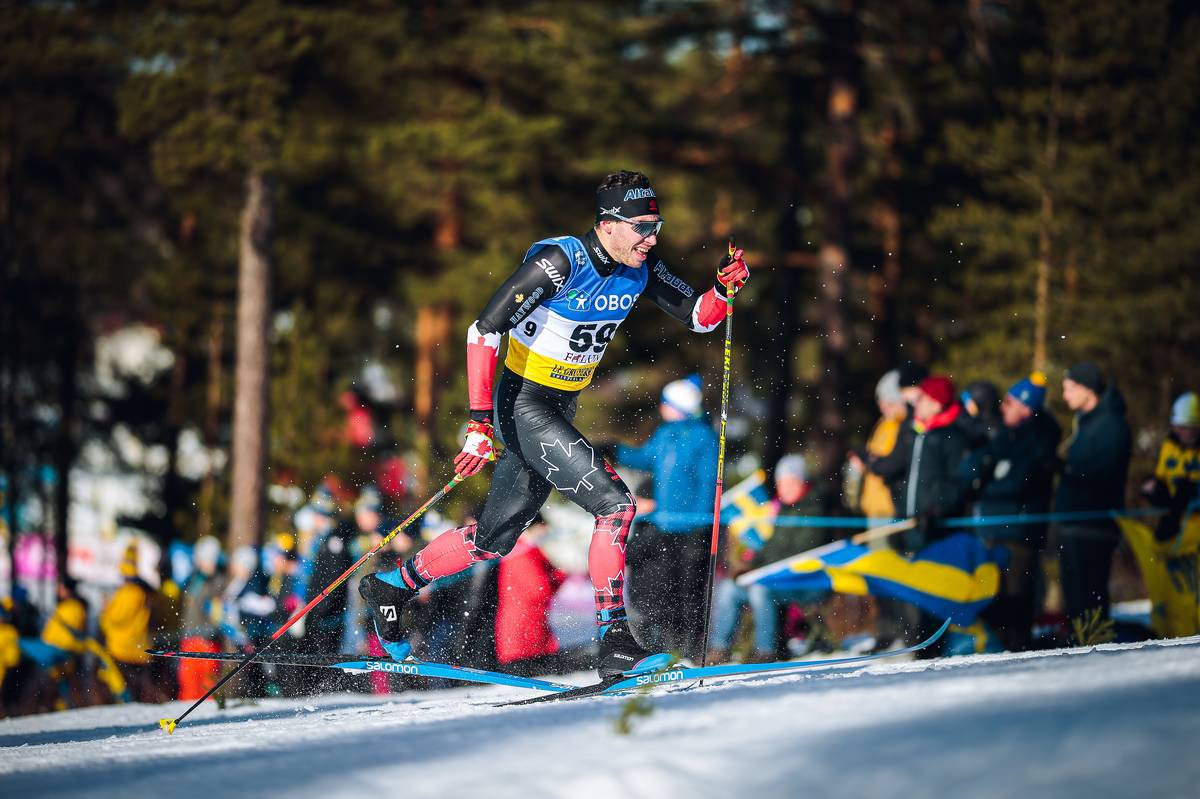
Racing for Canada, Graham Ritchie was the sole North American to break into the heats after qualifying in 28th (+8.11). Racing in the third quarterfinal heat, Ritchie crossed fourth, roughly three seconds behind Chanavat and Pellegrino, the heat winners. The effort landed him in 20th overall once final rounds were decided.
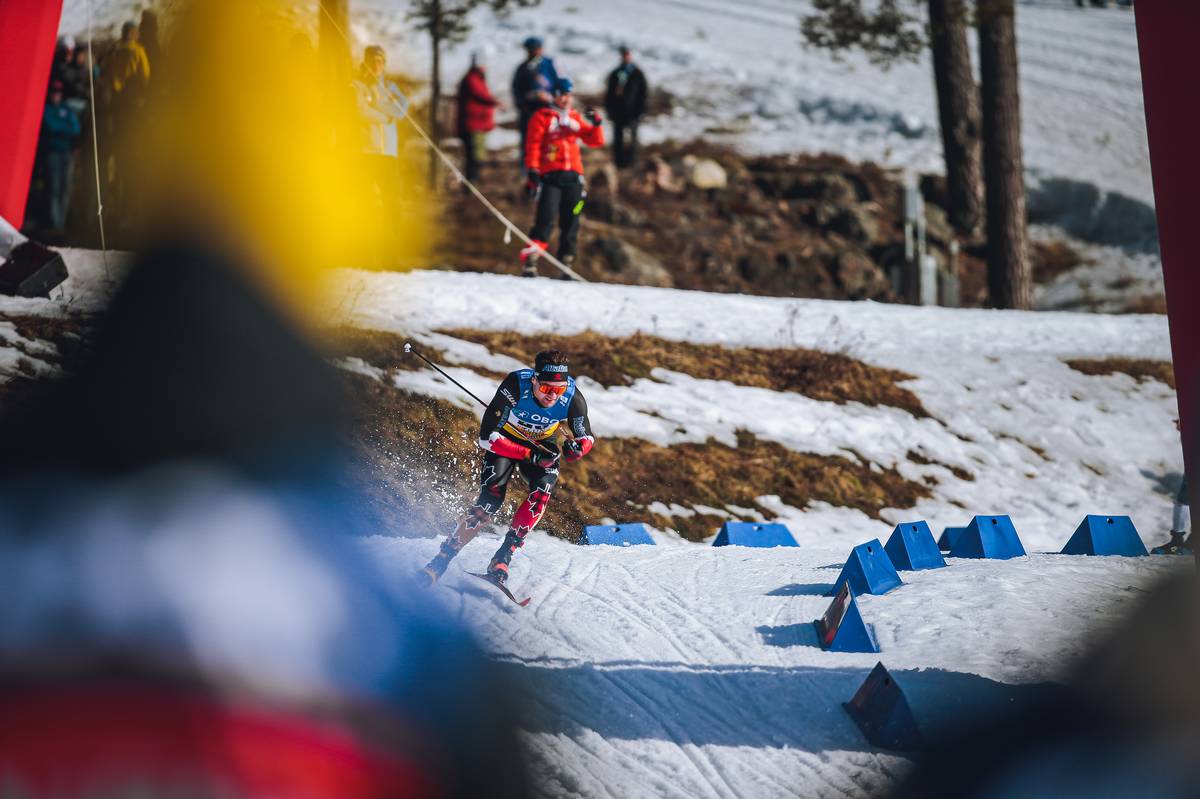
Missing the top-30 by just 0.27 seconds, Antoine Cyr was next for Canada in 31st (+8.76), with Xavier McKeever next in 44th (+10.54), followed by Rémi Drolet in 57th (+14.59).
Antoine Cyr just misses the mark in qualification, finishing 31st. (Photo: NordicFocus)
Racing in Falun continues tomorrow with a 15 k individual start skate.
There’s a war going on in Ukraine, and we touch on its impacts on the World Cup. But ski racing is also continuing, so we’re forging on, with respect for and acknowledgment of the tragedy that’s unfolding in Europe. For a few hours at least, on Thursday, the classic Drammen city sprint provided one heck of a distraction, and Devon and Nat are back to break down some performances for the ages by Norway’s Maiken Caspersen Falla, the French men and China’s Wang Qiang.
This World Cup coverage is made possible through the generous support of Marty and Kathy Hall and the A Hall Mark of Excellence Award. To learn more about A Hall Mark of Excellence Award or to learn how you can support FasterSkier’s coverage please contact info@fasterskier.com.
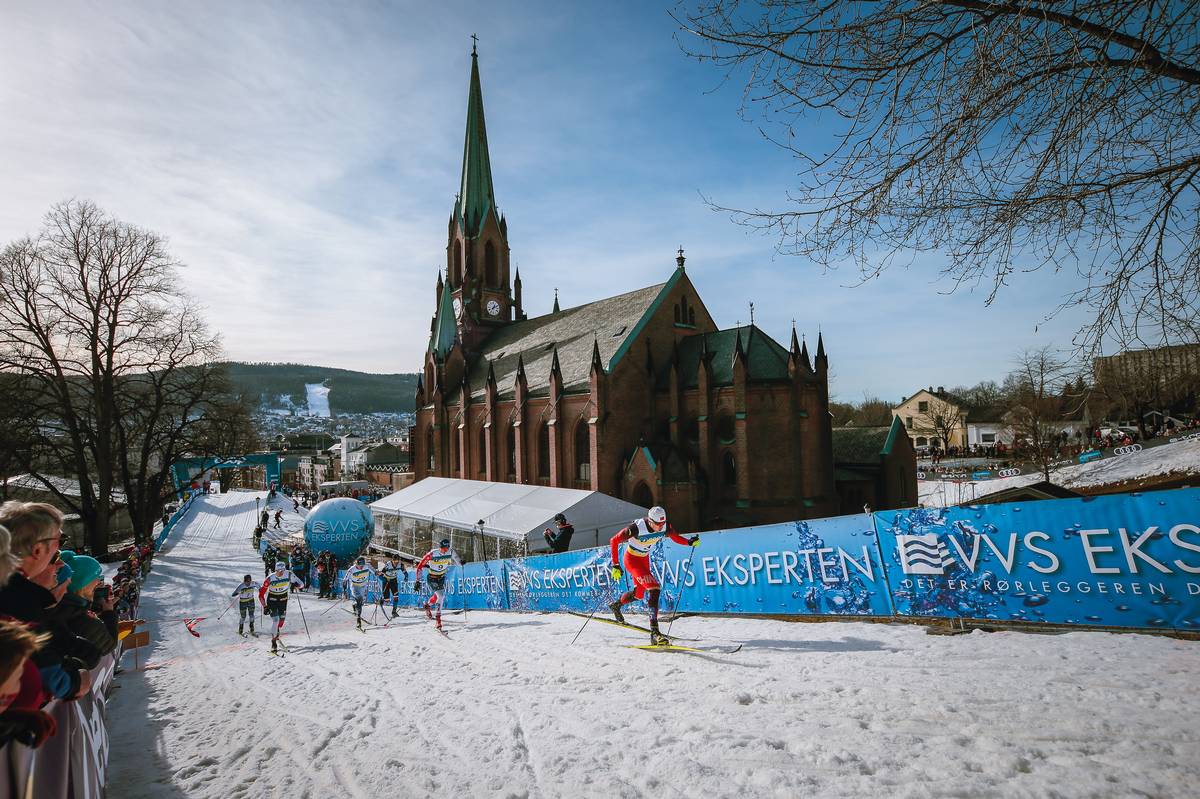
Cross country skiing’s most ancient, classic, weekend of racing in Norway (the Holmenkollen ski festival) began with a sprint through the center of Drammen, about 45-kilometers (30 mi) south of Oslo, and despite its best efforts, got caught up in these confounding and confusing times.
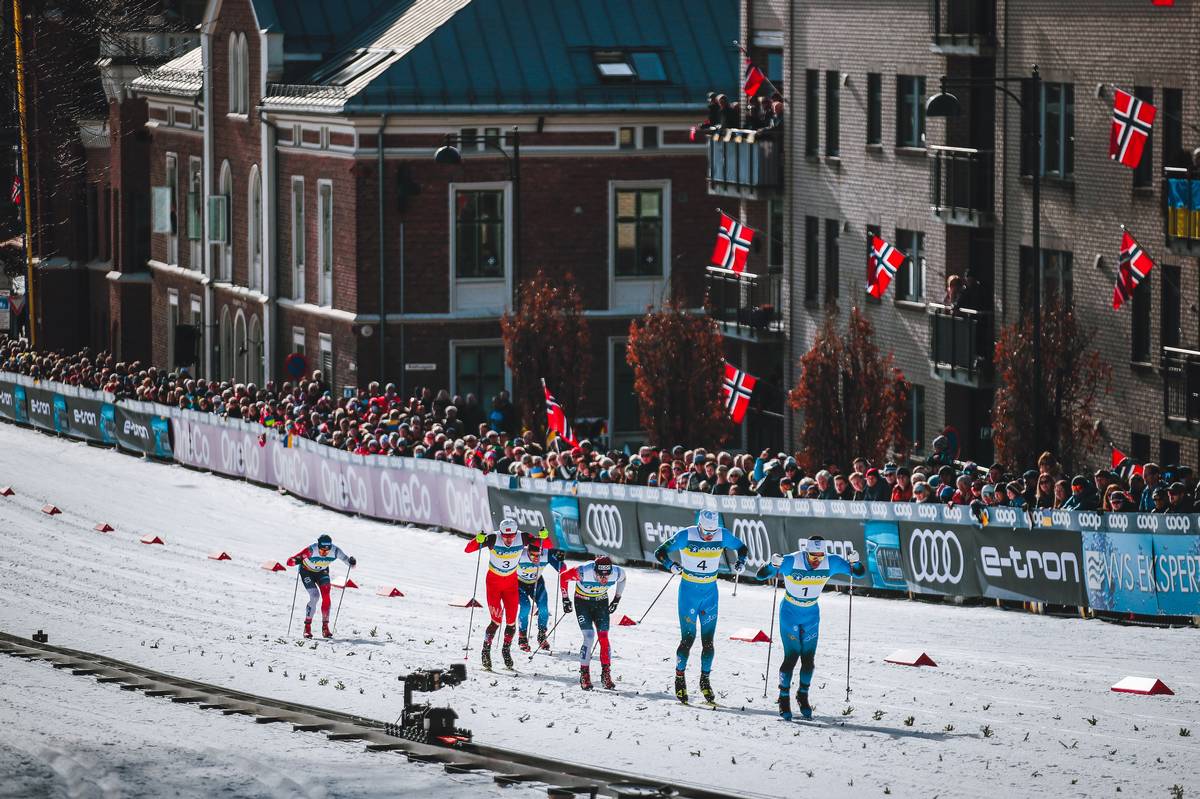
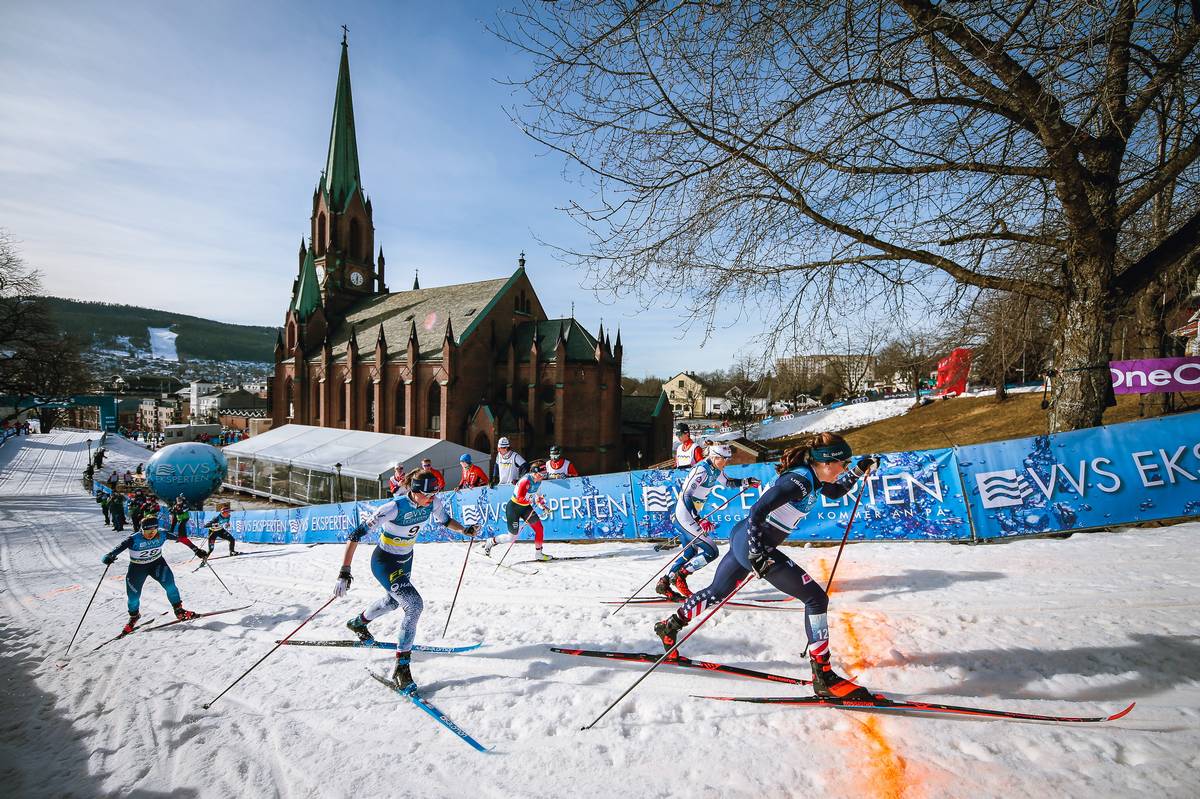
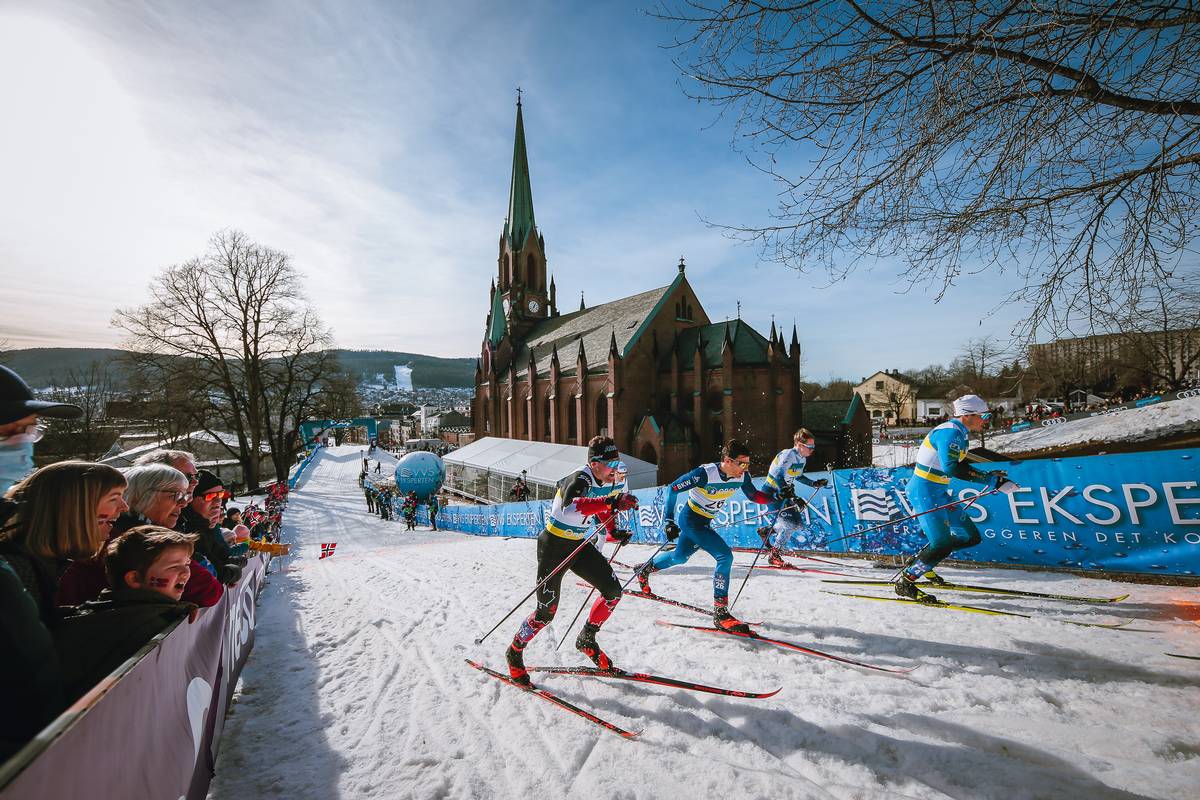
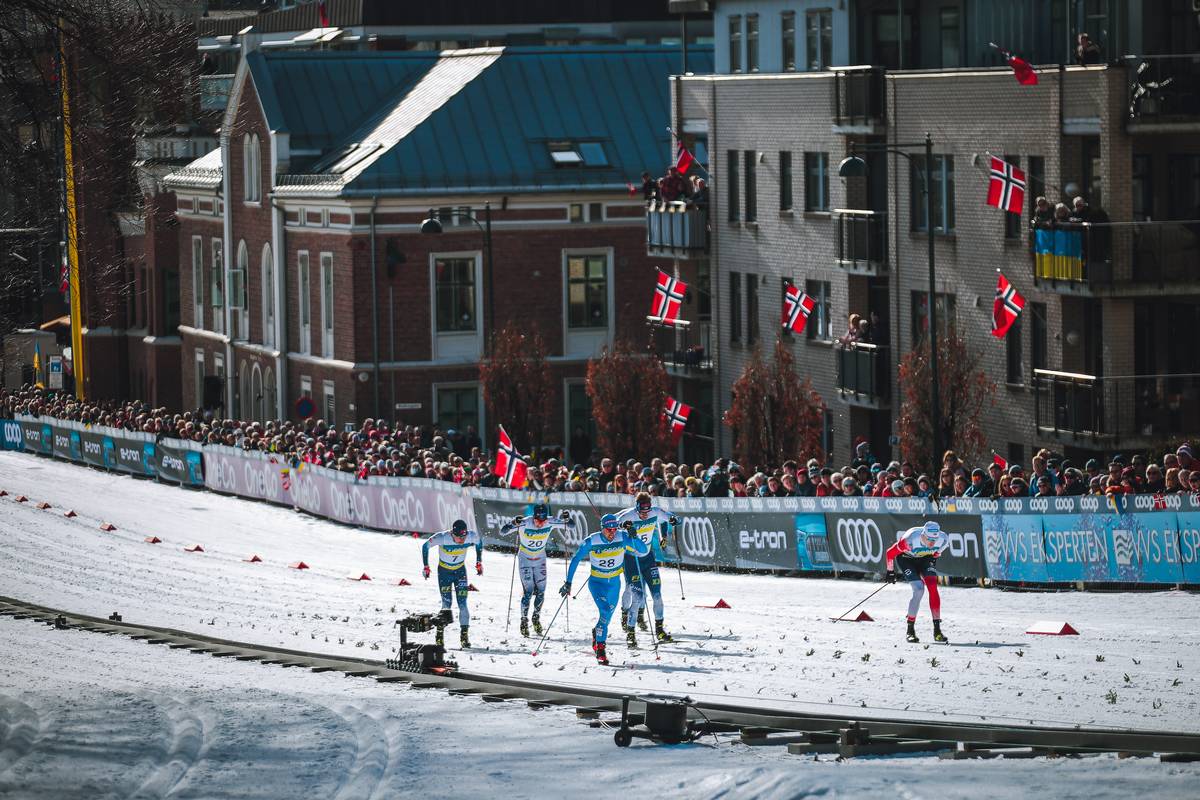
If you didn’t focus in completely, the scenes in Drammen looked pleasantly familiar in a way that could keep you in the timeless state of mind associated with Holmenkollen. It was reassuringly nice to see sprint racing return, after two years, to the type of venue that led to its exciting, spectator-friendly, rise in the first place. A genuine town-center sprint, trucked in artificial snow and all, with a genuine (and very enthusiastic) crowd.
Graham Ritchie (CAN) races in the second heat of the classic sprint quarterfinals in Drammen, NOR. (Photo: NordicFocus)
Bring some focus into the racing though, particularly who was in the men’s field day, and you couldn’t help but see the upheaving forces of the moment doing their upheaving. COVID still had a heavy-hand in the field today, with the entire Norwegian men’s sprint team (who had raced in Lahti last weekend), including Johannes Høsflot Klæbo, having recently tested positive. Then, there was the FIS imposed ban on Russian and Belarusian athletes, which also went into effect this week in response to their government’s invasion of Ukraine. In all, 7 of the top 10 in the FIS Sprint Points Classification were absent from the field in Drammen. There was a spectral quality, something eerie, to just how much world events have managed to find and catch the quiet corner of nordic skiing in the past couple of weeks.
For their part, the FIS decked out Drammen in blue and yellow in a sign of solidarity with Ukraine. From bibs, to fencing boards, to the souvenir flags held in the crowd. Idealists will note the poignant gesture, especially in a country where, in a friendlier geopolitical sense, blue and yellow are the colors of neighbor and rival, Sweden. Regardless, it was a stunning way for the FIS to symbolize the implied meaning surrounding the policies they implemented surrounding Russia this week. Cynics, on the other hand, could also read it as the FIS trying to stave off some of the pointed criticism that’s been directed at larger international sport’s governing bodies like UEFA, FIFA, and the IOC surrounding their handling of Russia.
Logan Hanneman skis to 50th during the classic sprint qualifier in Drammen, NOR. (Photo: NordicFocus)
No matter the forces affecting skiing, the fact remained that there was skiing to be had. And without Norway’s top squad and Russia, it brought out the interesting prospect of watching racers who have navigated tactically around them to podium finishes all season – Richard Jouve (FRA), Lucas Chanavat (FRA), Federico Pellegrino (ITA), and Joni Mæki (FIN) among them – now represent the top of the field themselves.
In the qualifier, it was Jouve who took first place by an impressive margin, finishing in a time of 2:26.35, -2.07 sec over second place Ondrej Cerny (CZE). Following up on an impressive Olympic sprint in his home country, Chinese skier Wang Qiang took 3rd place (+2.66). Among North American athletes, the Canadian men had an impressive showing, sending three to the heats with Graham Ritchie qualifying 13th (+5.91), Antoine Cyr in 19th (+6.42), and Pierre Grall-Johnson 23rd (+6.85).
Antoine Cyr (CAN) races to 19th in qualification in Drammen. (Photo: NordicFocus)Sun Valley’s Peter Holmes races the classic sprint qualifier in Drammen, NOR. (Photo: NordicFocus)
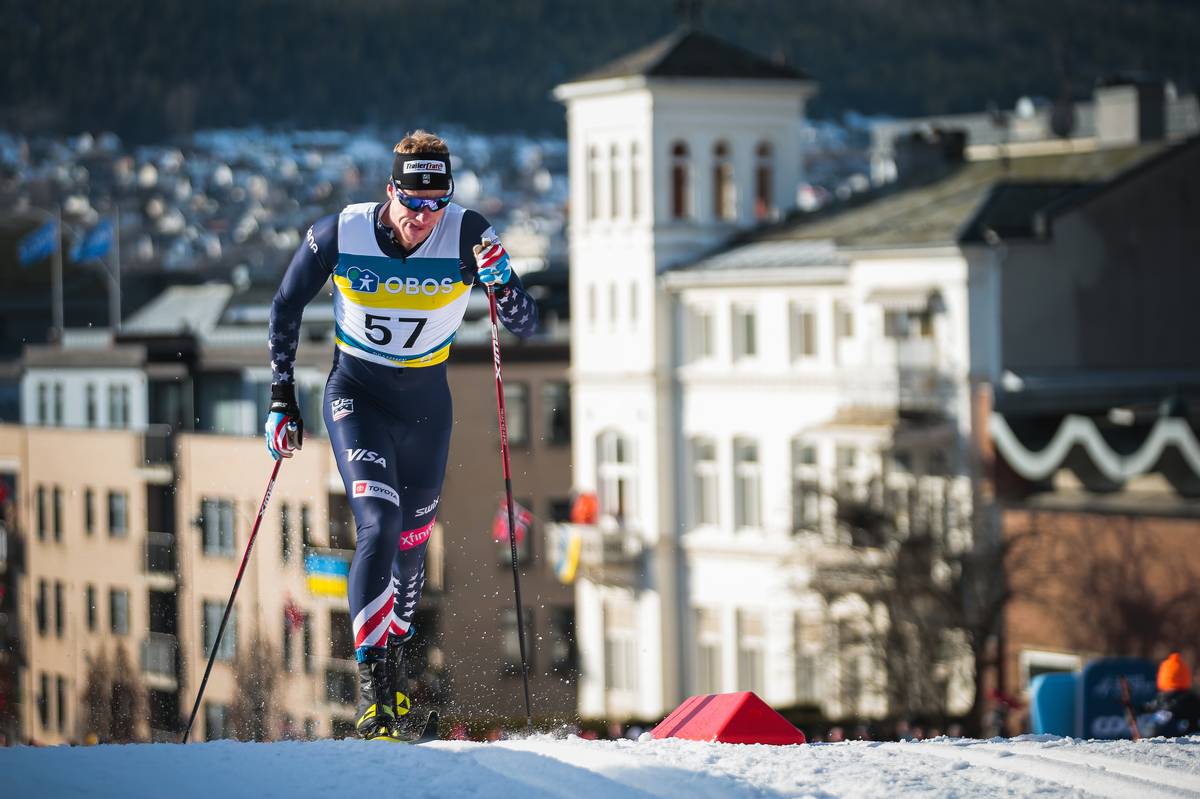
The American men were just outside the top-30 mark necessary to race the quarterfinals, with Kevin Bolger just +0.7 off the last spot in 35th (+8.90), Logan Diekmann 39th (+9.40), Logan Hanneman in 50th (+11.19), Peter Holmes in 53rd (+12.05), and Zak Ketterson in 54th (+12.26).
The heats then, were filled with a motley mix of familiar sprint stars and younger talent from the home country Norway.
The course they raced was a classic town center sprint – a long gradual stretch going out from the start that narrowed as they hit two technique-zoned uphills leading into a hairpin. From there, it was a gradual downhill into another tight hairpin that opened up to a 4-track wide sprint finishing straight that allowed the best sprinters to open up and hit top speed.
Despite his absence, Klæbo’s tactical maneuvering and push-and-pull with pace was still felt throughout the race. Richard Jouve raced out of the first quarterfinal, and the typically aggressive Frenchmen held steady at the front of the pack, before shooting around the first hairpin turn that returned to the stadium. From there, he held control of the race to advance comfortably to the semi-finals and win the heat (2:32.98). He was followed by Sivert Wiig (NOR) in 2nd (+0.61), who would escape a tangle earlier in the race that saw Canadian Pierre Grall-Johnson fall and break a pole.
Canada’s Pierre Grall-Johnson (CAN) races the quarterfinal of Drammen’s classic sprint. (Photo: NordicFocus)
The exception to the relative care in pacing that many of the racers showed in the quarterfinals came in the third heat, where Wang Qiang from China shot out of the gate and went full bore throughout the race. By the time they hit the first technique zone, he had a comfortable gap on his competitors, who wouldn’t come back to him. In the process of taking the field out fast, Qiang had also made it by far the fastest quarterfinal at a winning time of 2:30.94. Second place Lauri Vuorinen (FIN) (+0.72), third place Pål Trøan Aune (NOR) (+0.99), and fourth place Harlad Østberg Amundsen (NOR) (+1.08) all advanced to the semi-final with two lucky losers coming out of the heat.
Wang Qiang (CHN) is off the front during the men’s quarterfinals in Drammen. (Photo: NordicFocus)
The 4th heat saw Joni Mæki (FIN) and Federico Pellegrino (ITA) follow early moves from Renaud Jay (FRA) and Ludek Seller (CZE) before reminding observers of their well-earned reputations as two of the best top-end speed racers in a finishing straight. Mæki advanced in first place (2:34.44), with Pellegrino in second (+0.62).
The semi-finals brought a similar field to the one that had advanced to the quarterfinals, with the familiar names of Richard Jouve and Lucas Chanavat joined by the young Norwegian pairing of Wiig and Amundsen, Swiss skier Jovian Hediger, and Wang Qiang.
Qiang again attacked from the start, with a lesser, but still commanding, gap established by the time he hit the first corner to head back towards the stadium. Jouve was the only skier that covered the gap off of that corner, and was able to pull along his countryman and Wiig with him before they all came together for the final sprint. There, the Frenchmen both showed their sprinting prowess, with Jouve winning the heat in 2:31.94 and Chanavat in 2nd (+0.74). Qiang’s early attack again proved to shape the field beyond his own racing, again making sure that both lucky losers, he and Wiig, came from the first semi-final.
Qiang’s attempts to force a semi-final with two lucky losers was aided by the way that the second semi-final raced, starting out at a steady pace before halting to a crawl around the first corner. George Ersson (SWE) got caught in front before Federico Pellegrino took charge on the downhill going into the stadium. By the time he rounded the corner into the finishing straight, he was in control of an otherwise tight pack. Pellegrino crossed the line in first (2:42.16) to advance to the finals, along with Norway’s Aune, who finished second (+0.16).
Federico Pellegrino (ITA) and Pål Trøan Aune (NOR) lead in the final stretch during the men’s semifinal in Drammen, NOR. (Photo: NordicFocus)
That set up a final with French pairing of Richard Jouve and Lucas Chanavat, the Norwegian pairing of Sivert Wiig and Pål Trøan Aune, Italian Federico Pellegrino, and Chinese Wang Qianq.
Qiang was subdued in the final compared to his previous heats, but then again, Richard Jouve had also stepped up the pace earlier in the final. The result was a tight pack with Jouve and Qiang at the front, with a quick but controlled pace through the early two climbs on course. Jouve took the pack into the first corner, and it was there, again emulating the absent Klæbo, where he chose to shoot around, concealing his burst of speed from the back part of the pack so that by the time they knew they needed to respond Jouve was already well on his way down the long descent.
Men’s final led out by the French pairing of Richard Jouve and Lucas Chanavat in Drammen on Thursday. (Photo: NordicFocus)
Their positioning in second and third, respectively, allowed Wang Qiang and Lucas Chanavat to try and match Jouve’s move, but as the pack hit the final stretch it became clear that Jouve hadn’t just made a move, he had made a move and followed it up with a burst of speed that left him peerless on the day.
Jouve crossed the line comfortably in first (2:32.84), with a lightly-packed sprint for the podium behind him.
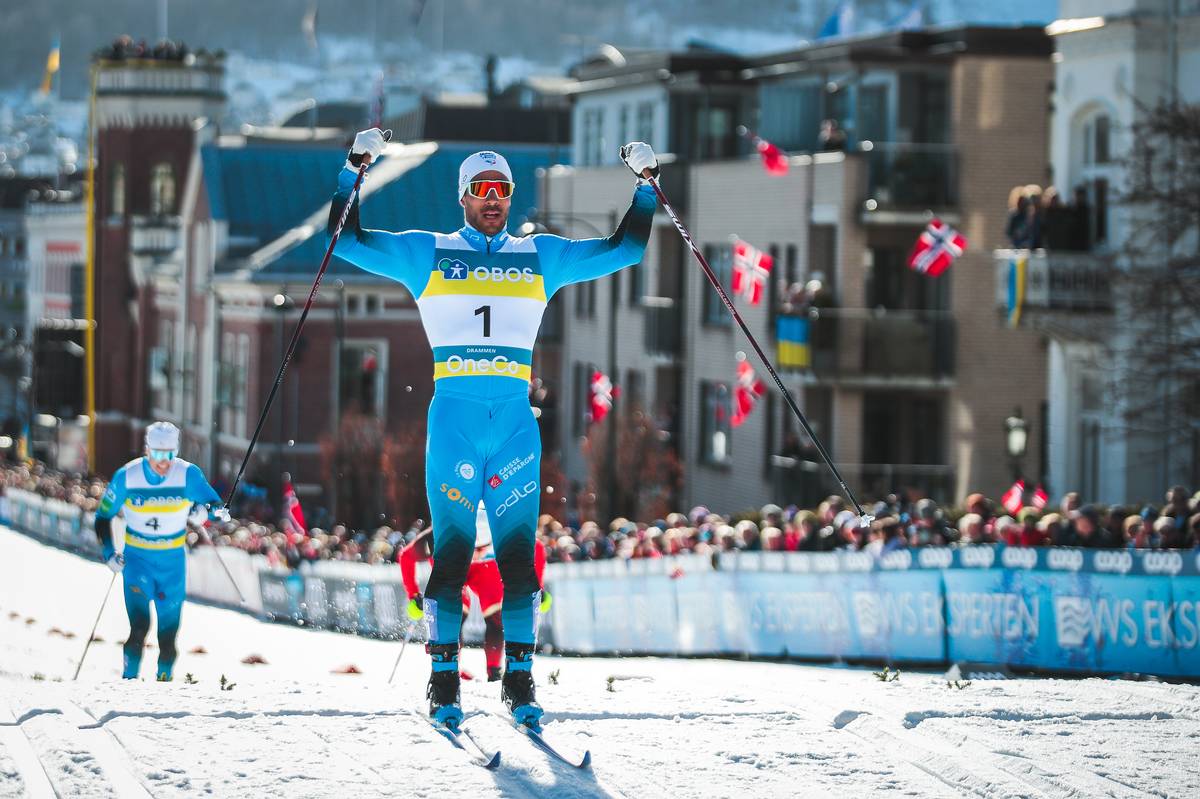
Richard Jouve takes the win in Drammen. (Photo: NordicFocus)Wang Qiang became the first Chinese athlete to podium in a World Cup, finishing 2nd in the classic sprint in Drammen. (Photo: NordicFocus)
Leading that, after having shown tenacity and panache all day, was the Chinese skier Qiang Wang, who crossed the line in second (+1.59), with poles raised and a shout that stood at the end of a half-decade journey for his country. China, weeks off of having hosted the Olympic games, has earned a World Cup podium in nordic skiing, with Wang showing real promise for what may come from that country’s program.
Lucas Chanavat crossed the line in third (+2.32) to round out the top 3, while Sivert Wiig finished in fourth (+3.14), Federico Pellegrino in fifth (+5.34) and Pål Trøan Aune in sixth (+11.25).
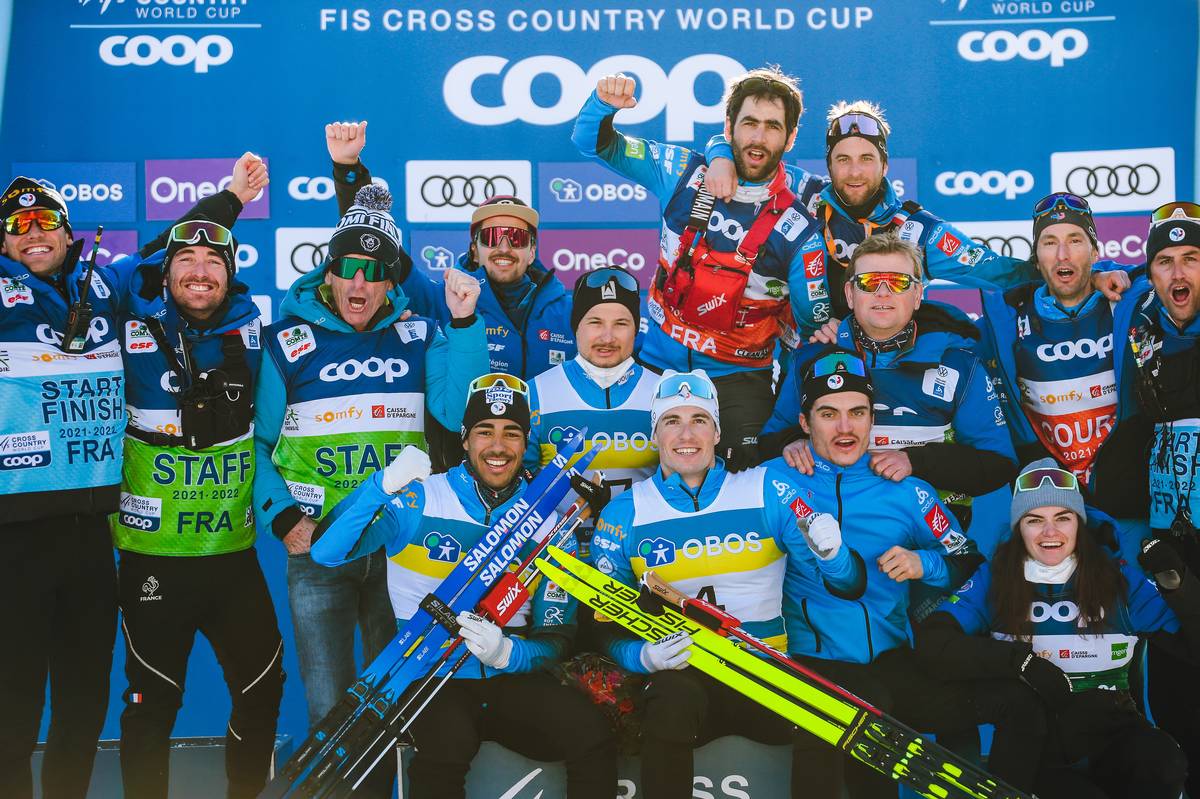
Richard Jouve (FRA) takes the win in Drammen, NOR, with a first podium for China’s Wang Qiang, who took second ahead of Lucas Chanavat (FRA) in third. (Photo: NordicFocus)
It was an appropriate podium for a particular moment in skiing where the world’s motion on all scales has upended the familiar rituals that come with the final stretch of the World Cup that Holmenkollen traditionally marks the beginning of. The world’s best skier out in quarantine, his closest competitors removed from the competition, and the schedule for the last month of the season in flux as we enter it.
At once, we saw something familiar – Richard Jouve with a commanding performance alongside his countrymen – and something wholly new – a Chinese skier not only at a European World Cup race, but at the front. A strange, but moving race, for a strange and moving time.
Once the final results were determined, Antoine Cyr led the Canadians in 19th after finishing fourth in quarterfinal four. His Olympic team sprint partner, Graham Ritchie, was next for Canada in 21st, with Pierre Grall-Johnson 27th.
This is the final installment of a three-part series on the development of the Chinese ski program. Click here to read part 1 and part 2.
Part 3: Olympic Hopes and Misgivings in Norway
For the Chinese cross country ski team, the 2022 Beijing Olympics opened with a blaze when Dinigeer Yilamujiang was selected to co-light the Olympic flame. It was an enormous honor for the twenty year old cross country skier from Altai, China with Uyghur roots. Yet her ethnic background overshadowed the moment, and, like so many aspects of the Chinese cross country skiing project, the ceremony meshed sporting aspirations with political theater.
China’s Dinigeer Yilamujiang (CHN) races the freestyle sprint qualifier during the 2022 Olympic Winter Games in Zhangjiakou. (Photo: NordicFocus)
Dinigeer, known as Dini on the ski circuit, is a rising star on the Chinese ski team. She is one of the few of the team’s new generation that grew up with skiing, and her father had hopes of becoming a great skier himself, and later became a coach.
Dini’s father Mulaji Yilamujiang, never expected her to become a professional athlete. That began to change when at age twelve, Dinigeer competed in a regional race and a competitive chord was struck. “She wanted to win the race like a professional athlete and get on the podium,” Mulaji recounted to Chinese news outlet Xinhua.
It was hardly surprising then that when Kristian Bjune Sveen took the job as coach of the Swix China team in 2017, he picked fifteen year old Dini.
Since then, her success has by any measure been extraordinary: At the 2020 and 2021 Junior World Championships, Dinigeer proved that she was among the best in her age group, finishing 5th and 6th respectively in the 5k distance.
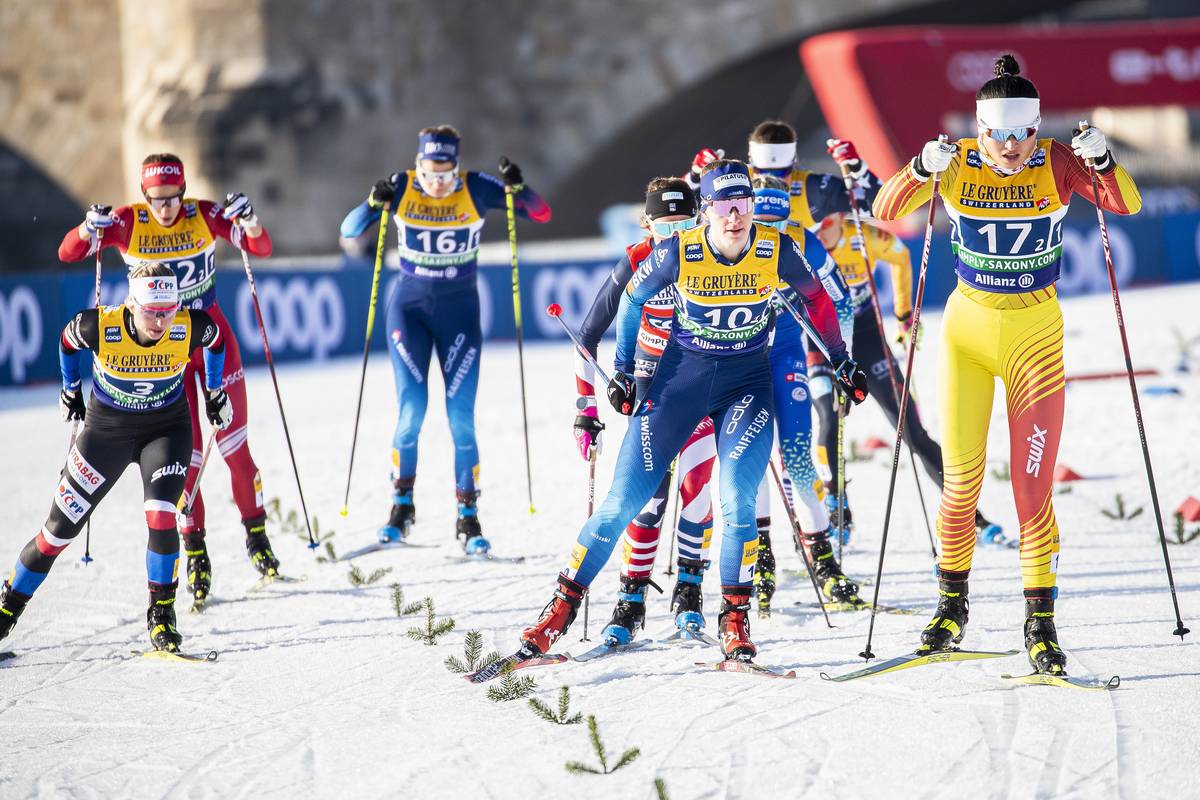
Chinese cross country skier Dinigeer Yilamujiang (bib 17) races a December, 2020 team sprint in Dresden, Germany. (Photo: NordicFocus)
Together with her teammate Bayani Jialin—who had no prior skiing experience before joining Sveen’s team—the two have skied together on the World Cup to top ten team sprint finishes and top thirty in individual sprints.
“Going from being an untrained person to being able to beat half the Norwegian national team and become a top 30 in a sport you [didn’t] know existed,” Sveen told NRK, “it is objectively completely insane!”
Liu Rongshen is another twenty year old Chinese skier that has impressed early in the Games. Originally a runner from Yunnan, he was “one of the athletes that came to Meråker [in] March 2019,” wrote Tor-Arne Hetland to FasterSkier. Liu finished 38th in the men’s skiathlon, some 16 seconds ahead of Johannes Klæbo. “Pretty [impressive] that he never had been on skis before he came to Norway,” Hetland wrote, adding, “Maybe in the sprint China can have athletes in the semi-finals.”
Hetland’s prediction nearly came true when Wang Qiang—China’s best sprinter and medal hope—qualified in 5th in the men’s sprint and appeared to have advanced out of his quarterfinal heat only to be ruled out due to obstructing another skier.
In biathlon, the women are led by Meng Fanqi—one of the best sharpshooters on the circuit—as well as Chu Yuanmeng and Zhang Yan. All three are top class on the range, and with a home snow advantage, and fast skis provided by Norway, a relay medal remains a tangible, if distant, prospect.
Although some juniors such as Dinigeer Yilamujiang spent the last few winters in Norway, much of the Chinese cross country team has been based in China since the start of the pandemic.
To compensate for the lack of international racing for their homebound skiers, Russian second tier racers were hired to come to China for extended periods and enliven national races and ski with Chinese athletes.
Wang Qiang (CHN) takes an early lead in the men’s team sprint semifinal during the 2022 Olympic Winter Games. (Photo: NordicFocus)
To the Chinese skiers advantage was sole access to the Olympic courses in Zhangjiakou ahead of the Games, although their coach Bernhard Rønning dismissed this assertion to Dagbladet, saying that while they had trained and competed in the area “not so much in the Olympic tracks.”
Still, the team was not without excellent training opportunities, with ready access to altitude, year round skiing in the Beishan tunnel, and “the best equipment,” according to Max Volkov, coach of the Chinese distance team.
Volkov, the former assistant coach to Alexander Bolshunov, joined a talented coaching staff in China, including his compatriot and former Olympic champion Nikita Kriukov, who trained their sprint team.
Magnus Frodahl worked with the Nordic combined team, and former Norwegian World Champion Terje Langli ran the Chinese cross country teams wax service, and trained in two apprentices, Li Xin & Wang Yihan.
Rounding out the core foreign coaches for the cross country team were Ole-Marius Bach, Bernhard Rønning, and Kristian Bjune Sveen.
Bjørndalen
The highest profile coaches to sign on to the Chinese Olympic project were Ole Einar Bjørndalen and his wife, former Belorussian biathlete Darya Domracheva. The two joined in 2019.
After the pandemic interrupted their debut season with the team, Bjørndalen rejoined his squad in China during the summer of 2020.
There, even for a legendary biathlete, the work was anything but glamorous. That summer, Bjørndalen worked daily from six in the morning to eleven at night. Each time he entered China he had to undergo a 17 day quarantine. Always the athlete, Bjørndalen ran 20 k a day inside his hotel room, running the length of the room around one thousand times.
The biathlon team spent the 2020/21 season training in China inside of an intense bubble. “There is no question of anyone coming in,” Bjørndalen told NRK, “And if you are going out on an errand in Beijing, it is straight into the corona quarantine.”
Chinese biathlete Ding Yuhuan (bib 18) takes aim during the women’s relay in Zhangjiakou. (Photo: NordicFocus)
That winter, Chinese President Xi Jingping visited the team. “I think he liked biathlon,”Bjørndalen said in the article.
According to NRK, Xi’s visit to the Biathlon camp underscored the expectations to deliver results. “We have set ourselves the goal of winning a medal in the relay,” Bjørndalen explained, adding, “It’s a pretty horrible goal, but anything is possible.”
The work of the famous duo has been apparent on the IBU World Cup, which China returned to this winter. US Biathlete Clare Egan said, “They’ve really done an incredible job bringing the athletes up. It’s funny because Daria [Domracheva] has a very unique and beautiful, graceful ski style and now all of the Chinese women, half the time I think they’re Daria when they go by me, they all ski exactly like her.”
The shooting prowess of the Chinese biathletes is exceptional according to Egan. “They’re incredible, incredible precision shooters. I have to imagine that their team hit percentages are at least as high, if not higher, than any of the other teams.”
“The reason they’re not winning medals is because they’re not quite there with the ski speed,” Egan said, “Even though they’ve really improved a lot.”
When Bjørndalen took the job he ensured his athletes would have competitive skis by signing a deal with the Norwegian biathlon team to wax their skis through to the Olympics.
Tobias Dahl Fenre, the head waxer for the Norwegian biathlon team, said of the wax deal, “We do not share the expertise. It will be in Norway. We employ Norwegian waxers in the Norwegian system.”
The deal, worth an undisclosed sum, allowed the Norwegian biathlon team to hire four more techs, bringing their service team size to fifteen.
Egan said the results of the wax partnership were clear on the IBU World Cup. “It’s cool to see them have a chance on skis because previously when they were waxing their own skis, they just didn’t have that background to be internationally competitive. Now sometimes they’re passing us on the downhill.”
Cheng Fangming (CHN), races the men’s relay during the 2022 Olympic Winter Games. (Photo: NordicFocus)
While the work of Bjørndalen, Domracheva, and Sveen have impressed, for the foreign coaches working in China, the experience varied.
For Kristian Bjune Sveen, who took the job with Swix China when he was twenty five years old, the experience had been positive, if exhausting. “I work around the clock, every day, and have almost no privacy,” he told NRK. Nevertheless he said it was “an insanely exciting job. It is a coach’s dream to be able to design a plan that you want.”
Sveen felt that he would not find another opportunity to influence a whole skiing culture in the way that he could in China, and fretted that the next job wouldn’t match the significance of his present work. “It’s almost like I’m not sure if I want to be a coach again after this,” Sveen said. “These are athletes I think can be the best in the world.”
Others had more jaundiced views of coaching in China. When Anita Moen’s athlete’s were recalled abruptly in December 2019, the pandemic prevented her from rejoining her team until the following August.
“By then, five months had passed without me having been a coach for them,” Moen recounted. “That was when I noticed the change. The basic work we had done, and on which we made such great progress, was destroyed.”
Moen’s athletes had returned to a Chinese sport system marked by authoritarian control. The result had a big effect on her.
“I knew these athletes very well,” she said. “I did not need to talk to them. I could see it in their eyes…The joy I had seen was gone.” Moen found the experience troubling, and decided to end her involvement.
A non disclosure agreement had prevented her, (as well as many other coaches) from discussing the team’s work. Through these legal tools, much of what the Chinese team has been up to in the last year and half has remained opaque.
Soul Searching
As the Games crept closer, so did criticism of China’s human rights record. In Norway, the agreement to help the Chinese skiing programs became a contentious topic, with anxiety over whether the work of some one hundred coaches, techs, and physios was done in the service of expanding the sport, or rather a massive nation branding campaign to distract from China’s human rights abuses.
Had Norway, the home of the Nobel Prize and defender of human rights, sacrificed its moral center for a trade agreement masked by a feel-good ski coaching story?
That was the argument made by John Peder Egenæs, the head of Amnesty Norway, who suggested to NRK that China’s 2019 hiring of Bjørndalen—the most popular athlete in Norway—as the head coach of their biathlon team was part of a “big political game.”
Egenæs believed that the Olympics were being used to “launder a deplorable human rights record,” and feared thatBjørndalen would be used as an “ambassador for [Norway] to forget the negative sides of China.”
China’s Jincai Shang (bib 20) leads the men’s semifinal of the classic team sprint in Zhangjiakou. (Photo: NordicFocus)
Bjørndalen disagreed with the criticism, and told NRK, “I do not feel any political game in what I do. I focus on the skiers I have and do not have any dialogue about any propaganda with any leader.”
Sports commentator Andreas Selliaas fretted about the whole agreement, saying to Aftenposten, “I do not think Norwegian sports really know what they are involved in. This is not about skiing, but about nation building and domestic politics in China.”
Questions began to be raised about why the Sports Confederation was not consulted prior to the 2017 agreement. “The sport was thrown in like a meat bone to the Chinese,” was the assessment of Gudmund Skjeldal, a former Norwegian national team skier.
Tom Tvedt, the former President of the Norwegian Sports Confederation believed that the agreement had overstepped the historic divide between Sport and State, saying, “In this area, the independent, free sports movement was abused.”
In an op-ed to Aftenposten, a group of PhD students at the Norwegian Sports Academy wrote, “Perhaps the point is not whether we, a tiny country, can influence the gigantic China. There is something called losing one’s soul. There is something more important than Olympic gold medals. It’s something more important than salmon, even.”
The authors pointed to the history of Norwegian sports resisting oppression, and ski jumping hero Birgir Ruud, who refused to organize competitions during the Nazi Occupation and was imprisoned.
“So one might like to ask:” The authors wrote rhetorically, “[Why didn’t] Norwegian sports protest against being forced to cooperate with such a totalitarian power as China?”
The answer, they suggested, had much to do with funding.
Others asserted that Nordic skiing needed China to survive in the future. In a story in Aftenposen, Rønning said, “If you bring China with you, you have almost saved the sport of cross-country skiing.”
Tvedt disagreed. “It’s really a disaster. Both for sports and Norwegian democracy.”
Skjeldal and others have called for the Norwegian Parliament to investigate the matter. That the calls of alarm came at the doorstep of the Olympic Games may be telling.
Li Xin (CHN) follows Dahria Beatty (CAN) during the classic team sprint semifinal. (Photo: NordicFocus)
While Norway wrestled with the ethics of their nearly completed sports agreement, the Chinese cross country ski team faced controversies over the diversity of the team’s athletes that include ethnic Uyghur, Kazakh, and Tibetan skiers.
The diverse team has been celebrated by Chinese State Media and questioned abroad. As a Uyghur athlete, Dinigeer Yuliamujiang is the prime example. She gained international fame overnight by lighting the Olympic torch—but not as a skier. Instead she has been viewed symbolically as Beijing’s defiant and brazen counter to charges of an ongoing Uyghur genocide.
Dini’s teammate, Bayani Jialin, is an ethnic Kazakh, and Chen Zhendui (whose Tibetan name is Tsering Damdul), made history by being one of the first Tibetans to compete for China at the Winter Olympics. He too was caught in the furor of the Tibetan exile communities’ protest against the Games over human rights abuses and an Olympic inspired crackdown in Tibet.
The push and pull of dueling narratives has put the young and unseasoned skiers in an impossible position as they seek to make good on the far fetched expectations of medaling on home snow.
Chunxue Chi (bib 16) skis the scramble leg of the women’s 4 x 5 k relay for China. (Photo: NordicFocus)
The Chinese skiing project is something of a looking glass, with those involved seeing in it what they wish to see.For Moen, who had grown close to the athletes under her care, the project represented a lost opportunity.
“Imagine if we could have the Chinese athletes here in Norway most of the time, in all these years,” she pondered. “Then I think the whole project could have been very, very exciting. Because they had such extreme progress that they could [have] continue[d]. There could have been results that would have been sensational.”
Whether or not Chinese athletes in the Nordic disciplines manage to medal remains to be seen. The Games will mark the culmination of an expansive and unprecedented experiment in cross country skiing.
Historians of the future may well parse out the significance that a few hundred novice Chinese skiers and their Norwegian coaches had on the course of geopolitics. For now, all we can do is watch them race.